I can take no credit for the links to this collection of videos given below; it has merely come about because on occasion I have been searching for a video from a certain year, and wished I could find a page that did the hard work for me by providing an index.
There have of course been such pages put up from time to time, but their quality of recordings is variable, and of course on-line videos come and go. So I started keeping a note of the videos I had found interesting and simply created a list.
Today I have just added another one: the 1976 show, which is rather interesting as we already had the 1976 rehearsals on the list.
Thanks of course to everyone, amateur and professional who has put up a video of a show. As historical material these recordings are invaluable.
The index of shows we have put up links to is given below and after that today’s new addition. If you would like to recommend a video to add to the list please do drop me a line: Tony@schools.co.uk
By the time Bob Dylan wrote Percy’s Song he had got well into the notion of the protest song. Indeed however one analyses the songs that Dylan composed in 1963, the vast majority had at least an element of protest within them. And to save you looking back to where we looked at these songs before here’s a list of those songs I would consider to be within the realms of “protest” from this period.
Now in looking at these songs as a group it seems to me that Dylan was not only writing lyrics that contained what we tend to classify as protest commentaries, he was also varying the way the music was written, in order to emphasise the change in the lyrical approach.
These were not always huge changes to the musical structure and form but they were there and they had an important part to play in terms of what the music was doing in order to back up the themes of the lyrics.
After Hattie Carroll, one of Dylan’s strongest pieces of protest to date, in terms of the lyrics, Dylan finished the year with three more compositions. In these three songs, in the lyrics, he expressed the view that the natural world is superior to anything that mankind could create and that the only logical response to being in a time like this is to move on. These songs were:
With “Lay Down” Dylan himself expressed the view in his notes printed on the album “Times they are a changin” that he was trying to capture the feeling of a Scottish ballad that he had once heard on a 78rpm record. He didn’t identify the song in question, and it is more than likely that by the time he wrote the sleeve notes he had forgotten which song it was, (although there has been much debate about which song it might have been).
One possibility is “The Water is Wide” which Dylan himself performed in1975
Another source that is quoted is “I Wish I wish” a song that Bob clearly knew because he used its lyrics for part of “Bob Dylan’s Dream” in 1963. There are multiple versions of “I wish” around, although I suspect I have been listening to the wrong ones in trying to trace the source of Bob’s inspiration! Bob however did perform a version of “The Water is Wide” which is close to “Lay Down Your Weary Tune.”
“One too many mornings” is most likely taken from “Deliverance will come” a traditional folk song which is often traced back to John B. Matthias (1767-1848) but which may well have antecedents beyond that date.
“Restless Farewell“, is a song he wrote, we are told, as an angry response to a Newsweek reporter who in late October 1963 published a story about Dylan of which Dylan did not approve. In this case, the musical source is said to be the Irish folk song “The Parting Glass,” a Scottish song dating back to the 17th century.
What we can see with these songs is that with greater or lesser variation Dylan was not using the dominant musical forms and approaches of his time, but instead deliberate using the musical forms of other countries and previous eras.
Now of course what we don’t know is exactly which versions of which songs Bob listened to and worked from, but we can see a linkage between the songs themselves.
These three songs, “Lay Down your Weary Tune”, “One too many mornings,” and “Restless Farewell” are all about setting the past aside, and in such a situation one might expect the obvious next step for Bob to take at this point would be to write music which was new. And that of course was to come, but for now, in each case he returned for his sources to traditional pieces. It was as if he was taking the traditional visions, and writing new songs in that style from days gone by.
This of course contrasts with “The Hour that the Ship Comes In,” which I looked at in the earlier piece From Hattie Carroll to the Incoming Ship where I argued that it would appear that Bob wrote original music to match his bouyant positive message, but then only performed the piece very rarely indeed, despite the obvious success of the composition.
Dylan’s writing at the end of 1963 is thus most curious in a way that I feel most commentators have not considered. He had written one of his most successful songs ever (“Times they are a changin”) which had a strong, positive message about the future and for which, as far as I know, he developed an original melody to go with the lyrics. It says the future can be better than the past, and we can make it happen.
And yet then having not only written that song which clearly works in every way, and as far as I can see was an immediate success when first performed on 26 October 1963 at Carnegie Hall, Bob then turned away from that positive message and the strident “voice” of “Times” and wrote “Percy’ Song”.
Now Percy’s Song is a much more gentle piece, and contrary to “Times” is about the failure of justice. “Hattie Carroll” returns to the strident approach but again about the failure of justice. “Lay Down” is about the failure of everything manmade, “Mornings” is about giving up and moving on, and so is “Restless Farewell.” In fact, and rather bizarrely, after wriitng his most positive piece to day, he writes about negativity. Everything is now about failure and the need to keep moving. Which of course was the message the songs of Robert Johnson were giving Bob.
Now I postulated above that the songs Bob composed, and which we are looking at here, reflect a view that there is nothing mankind can do which nature cannot do better. Robert Johnson gives us the slightly different visio, that whatever we do we are going to be in trouble. So perhaps to find the answer to questions about what was driving Bob in these musical directions, we should look at the end of “Restless Farewell”, as I have noted before in writing about that song. For if Robert Johnson was anything, he was utterly restless.
Musically Bob is back to that less-than-common 12/8 time which I noted before, and however one writes out the lyrics, the rhyming scheme is irregular. Indeed if we write out the lyrics so that each line of lyrics is one bar of 12/8 time we get this….
Oh, ev'ry girl that ever I've touched,
I did not do it harmfully
And ev'ry girl that ever I've hurt,
I did not do it knowingly
But to remain as friends You need the time
to make amends And stay behind
And since my feet are now fast, and point away from the past
I'll bid farewell and be down the line
There are indeed eight lines of lyrics when written this way, but this is not how most transcribers write the lyrics, because they are not contemplating the progression of the 12 beats and the use of the triple time which makes the song so unusual.
But what I think Bob is doing here is reflecting the irregularity of Robert Johnson’s timings and rhythms, but doing so in a way that takes the edginess of Robert Johnson’s music, and combines it with the gentility of European folk songs from earlier centuries.
In short, he is combining different traditions in unique ways. And all this was happening just in a short period at the end of 1963. Bob had created a great worldwide hit song, but his interests and his resultant subsequent compositions, were taking him to very different musical places.
It Takes A Lot To Laugh, It Takes A Train To Cry (1965) part 7
by Jochen Markhorst
VII It Hurts Me Too
Well, I wanna be your lover, baby
I don’t wanna be your boss
Don’t say I never warned you
When your train gets lost
Alfred Kralik (James Stewart) is now manager of the shop where they both work when he finally reveals to shop-girl Klara Novak (Margaret Sullavan) that he is the mysterious man with whom Klara has been having such an intimate, heartfelt correspondence all this time. Alfred wants to be her lover, not her boss. Thus bringing the plot of The Shop Around the Corner (Ernst Lubitsch, 1940) to a happy ending. Yes, indeed: in 1998 Nora Ephron reworked the movie into the hit film You’ve Got Mail with Tom Hanks and Meg Ryan. But by then we are almost sixty years on and a love affair between an executive and a subordinate is a lot more problematic – in Ephron’s film, for safety’s sake, man and woman are no longer colleagues in the same company, but both executives at competing shops.
In the intervening years and in the decades, or even centuries before The Shop Around the Corner, it is anything but offensive, and even a romantic, plot-driving ideal: the manager with the secretary, the prince with the citizen, the squire with the maid, the surgeon with the nurse, and when Dylan writes his song in the spring of 1965, he has just seen Captain Von Trapp break up with the baroness to marry his children’s governess Sister Mary, Julie Andrews. For centuries we have, in short, found it super romantic when the boss wants to be not the boss but the lover. And we actually still do – despite the twenty-first century enshrining in company protocols, army regulations and even laws that amorous liaisons within an authority relationship are forbidden, it remains popular in all telenovelas, soaps and Bollywood productions. Or perhaps all the more so: der Reiz des Verbotenen, as our German friends call it – the forbidden attraction.
In songs, however, master & servant never is a romantic constellation. Bosses do appear, but really always as The Evil One, or as representative of the life the protagonist now leaves behind, as a recipient of resignation, or to illustrate the hero’s rebellious disposition – who now says the boss can go f*ck himself, or something like that. “Summertime Blues”, Jimmy Reed’s “Big Boss Man”, “Wake Me Shake Me”, “John Henry”, songs like that. As a love object never, anyway. And if so, then only in a figurative sense – “he or she is is bossing me around,” or, as Elvis warns in “Britches”: “Who wears the britches is the boss / That’s a gal, that’s a gal in britches.” A warning he himself doesn’t take too seriously, by the way: “But in the middle of the night when the moon is shining bright / Ah, you’re the boss” (“You’re The Boss” in Viva Las Vegas, 1964). Then again, that’s Ann-Margret, so that doesn’t really count.
Dylan seems to realise that too, that originality of I wanna be your lover, baby, I don’t wanna be your boss in a lyric. It is the only line of the final couplet that has stood from Day One, never changing, and which he continues to sing throughout, not only in all studio takes, but also in all live performances. Indeed, it is even the only line in his oeuvre that he reuses.
“Bob really, really hates to repeat himself. He just hates it,” reveals engineer Chris Shaw in 2008 in the Uncut special dedicated to the release of The Bootleg Series Vol. 8: Tell Tale Signs. Shaw should know – he has been involved with both the Bootleg Series and Dylan’s regular studio albums since “Things Have Changed” (1999) through to Rough And Rowdy Ways in 2020. It is clear from the context that Shaw is referring to less tangible things like sound or the shuffle or – even more elusive – the “feel”, but an aversion to repetition obviously extends to lyrics as well; Dylan, like any poet, will not want to reuse notable word combinations in other songs, would surely never sing “one hand waving free” or “infinity goes up in trial” or “at the time of my confession” in any other song.
But during the recording of the “scooped up” songs that would later be cobbled together on Self Portrait (1970), other laws temporarily applied. That reviled album, which Dylan himself also repeatedly dismisses with derogatory qualifications like “joke” and “a lot of crap”, and which he claims was meant as a deterrent, as a deliberate attempt to put an end to his stifling popularity, contains enough moments that make it a treasured album for many despite everything – even well before its more or less official rehabilitation with the release of The Bootleg Series 10 – Another Self Portrait (2013). If only because, for a whole next generation, it is a first introduction to classics from the canon. “Alberta”, “I Forgot More Than You’ll Ever Know”, “Little Sadie”, “Gotta Travel On”, “Copper Kettle”, and perhaps the greatest of them all: “It Hurts Me Too”.
“It Hurts Me Too” is a monument and all the gods have it in the repertoire. From The Stones to the Grateful Dead, Clapton to Junior Wells, Big Bill Broonzy, Chuck Berry to John Mayall’s Bluesbreakers, not to mention all the songs that use “It Hurts Me Too” as a template (like Dylan’s 1966 “Pledging My Time”). The song is first recorded by – and usually attributed to – Tampa Red in 1940, but is pumped up into the outer limits of the stratosphere first and foremost by Elmore James in 1957, and again in 1962.
Lyric variations aplenty, of course. To Elmore, for instance, we owe the rewrite of the first verse, which has become sort of the standard by now;
You say you hurting, you almost lost your mind
The man you love, he hurts you all the time
When things go wrong, go wrong with you
It hurts me too
… but none of the dozens of variants has the words Dylan sings in 1970 as the second verse:
I want you baby just to understand
I don't want to be your boss babe, I just want to be your man
When things go wrong, so wrong with you
It hurts me too
… with which Dylan adds further music-historical lustre to the monument: it is the only recording in which the greatest song poet of the past 60 years repeats himself. Which he really, really hates, thus making his derogatory, scathing self-reviews with “joke” and “a lot of crap” even more convincing on reflection – he really, really means it.
Official monument status, by the way, “It Hurts Me Too” won’t be given until 2012, when the song will be inducted into the Blues Hall Of Fame in Memphis. Pretty late, as a matter of fact. The Blues Hall Of Fame has been elevating songs to the peerage since 1983, an average of three a year, and “It Hurts Me Too” in Tampa Red’s rendition is, 42 years after the list’s inception, only song number 69 on that list. For what that list is worth; Jimi’s “Red House” is not on it, for instance – Jimi Hendrix is not on there at all – and neither is “It Takes A Lot To Laugh, It Takes A Train To Cry”. Nor any other blues by Bob Dylan, the hardest-working and most respected bluesman of the past sixty years – which is a bit strange for a foundation that claims to have as its mission: preserving history, celebrating excellence, supporting education, and ensuring the future of the music.
Jochen is a regular reviewer of Dylan’s work on Untold. His books, in English, Dutch and German, are available via Amazon both in paperback and on Kindle:
In the previous articles, I’ve noted some of the key issues in Bob Dylan’s compositions through which he changed the way the music of folk and rock songs was composed. These changes included expanding the length of the song overall, and the length of individual verses. Bob also introduced a range of new rhyming schemes and moved away from the traditional strophic (verse, verse, verse) and ternary (verse, verse, middle 8, verse) arrangements of the music.
He also explored emphasising the last line of a verse by repeating it and rather obviously, dramatically increasing the number of words that could be used within a song – which although a lyrical change, meant that the music itself now had to change to accommodate the additional lyrics.
However such changes always come with the danger that they can feel forced, as if the composer is making changes for the sake of being different, and it is a measure of Dylan’s success that most of us never feel this. If we take “Times they are a-changin'” it is doubtful that many people realise the five six-line verses change their rhyming structure:
In verse one lines 1, 2, 3 and 5 rhyme (roam, grown etc)
In verse two lines 1, and 2 rhyme (pen again), lines 3 and 5 rhyme (spin, win) and lines 4 and 6 rhyme (namin’, chagin’)
In verse three and four lines 1, 2, 3 and 5 rhyme as do lines four and six. In the final verse again lines 1, 2, 3 and 5 rhyme, and lines 4 and six half rhyme (fadin’, changin’).
These alternations to the rhyming structure then have an impact on the way in which we appreciate the unity of the song, as well as allowing the composer to access a greater variety of words than a strict adherence to the “rules” of rhyme in a song.
Where the rhyming pattern does change, we tend not to notice it because of the effect of the strophic form – that is verse, verse, verse etc, with just the title line at the end and this seems like a highly structured song in terms of the lyrics (quite simply, change is happening now, and cannot be stopped), in terms of the time signature and the melody.
But the change is not just to the lyrics for the time signature here is 12/8, which means in each line of lyrics we have four sets of three beats:
Come gather round people where ever you roam
This doesn’t change at all over the years, quite probably because it would be impossible to maintain the essence of the song by taking it out of the 12/8 time. So Bob has done something quite different.
In the 2009 version of the song, we can hear that familiar 1,2,3 beat as always, but the melody has now changed beyond recognition in many of the lines, including the melody for the last line of each verse. Even the rhythm changes at times, for in verse three, “For he that gets hurt, will be he who has stalled; The battle outside ragin’, Will soon shake your windows and rattle your walls” has a completely different set of emphases from anything we have heard before. The way “soon”, “windows”, “rattle” etc are emphasised almost seems like a parody, as if Bob is saying, yes all this changed, but I am not sure if it made anything better.
That of course is my interpretation, but whatever reason you find for Bob changing the song in this way, change it he has. (This recording comes from the Never Ending Tour series on this site).
2009
My contention here is thus that not only was “Times they are a changin'” a piece of music which challenged popular music’s standard approaches when it was written, through its rhyme structure, and its use of the 12/8 time signature, it was a piece of music that Dylan then changed later, by amending the melody, and placing an extra emphasis on the first of each of the three beats, to give a more plodding feel to the song.
Through these musical changes, I would argue, the meaning of the song has changed. Whereas at first we might reasonably have taken the song to mean that there is hope in the future, because the younger generation has slipped the bonds of their forebears, and are creating a new world in a new way, and this is to be celebrated, this much later version musically suggests that since we are all just plodding along, going through the motions, believing something is happening, and not only do we not know what it is, (as was the case with Mr Jones) there might not actually be anything happening at all. We are simply plodding along.
Of course, this is my own interpretation, and interpretations must always be treated with caution, but I would argue it is a valid interpretation, while the notion that Bob is still singing the same song with the same meaning as he was when he first wrote it, is very, very difficult to sustain in the light of these recordings.
Normally of course Bob’s songs are considered in isolation, or via the album on which they appeared, but if we do continue to consider the songs in the order in which they were written, what we now find is something very curious. For, as far as we can tell, the next song written by Bob Dylan was Percy’s Song. In one sense this a song on the same theme as “Times” in that it is about the failure of the system in which we live.
But there is more here, for this is really quite an extraordinary song – the music is utterly gentle and one might say almost delicate and yet contains the most horrific message, at the line “What happened to him could happen to anyone”.
It is in fact about the ineffectiveness of people in trying to change the system. And in a very real sense this is utterly the opposite of Times they are a changin, for in Percy’s Song there is nothing at all that can be done – the song is left with “With no other choice except for to go”.
Musically the composition comes from the traditional ballad “The Twa Sisters” and lyrically from another traditional ballad “Geordie”.
Now my point here is that in “Times they are a changin” the message is clear from the title; the change is happening, and that change will be good. But the very next song Bob recorded contained the opposite message, for in Percy’s Song the singer is defeated, the judge will not change his ruling and the singer is left singing….
And I played my guitar through the night to the day
Turn, turn, turn again
And the only tune my guitar could play
Was, "Oh the cruel rain and the wind"
Thus my point is, to repeat it, if we wish to understand Bob’s music, we should not be looking at individual songs, but rather at the sequence of songs in the order of composition. And here we see, “Times they are a changin” being immediately contradicted by a song about an appalling injustice which cannot be overturned. There is no appeal, and everything is lost. Nothing is changing.
These two songs are utterly contradictory in their visions, and yet the structures of the songs have certain similarities, such as the repeated lines in each. But where they are so different is that “Times” has a strident quality in the music which within it carries the message of moving forward in hope. The relentlessness of the 12/8 beat gives a strength to the words “Come gather round people wherever you roam” – the message is clear – group together, work together, support each other.
But in Percy’s song the meaning is quite different as it ends
And I played my guitar through the night to the day Turn, turn, turn again And the onlytune my guitar could play Was, "Oh the cruel rain and the wind"
What I think is extraordinary is not only that Bob could write two utterly contradictory songs one after the other (one saying the world is changing, and the other suggesting it isn’t, and worse it can’t be changed), but he could adopt completely different musical forms to convey the messages. One might expect the horror of Percy’s song to be accompanied by more strident music but it is not. It is just the music that never changes – the music that says “this is what the world is”.
Thus we have in quick succession Bob writing two songs with completely contradictory messages and in each case using different musical approaches.
We might ask why, and how he did it, but I think also just noting that at this early stage in his career that he could do this, gives a real insight into Bob and his music. He could change his message and his musical approach in a trice. And that I think gives us an insight into how his compositions and performances developed from throughout his career.
Bob, in short, has always been interested in different musical forms and messages, and having seen one side of the situation, he can not only quickly see the other he can also write about it. One song is about the forthcoming liberation from the tyranny of the past, the next is about how the traditional ways still control us and there is nothing we can do.
And this was not just a one-off moment of two songs written in short proximity, contradicting each other. For it was about to happen again.
Percy’s song was performed by Bob just once, on 26 October 1963 at Carnegie Hall.
It’s All Over Now, Baby Blue– A History in Performance, Part 1: 1965 –
Crying like a fire in the sun
By Mike Johnson
[I read somewhere that if you wanted the very best, the acme of Dylan’s pre-electric work, you couldn’t do better than listen to side B of Bringing It All Back Home, 1964. Four songs, ‘Mr Tambourine Man,’ ‘Gates of Eden,’ ‘It’s All Right Ma (I’m Only Bleeding)’ and ‘It’s All Over Now Baby Blue’ represent the pinnacle of Dylan’s acoustic achievement. In this series I aim to chart how each of these foundation songs fared in performance over the years, the changing face of each song and its ultimate fate (at least to date).
This is the first article on the fourth and final track, ‘It’s All Over Now, Baby Blue’ You can find the previous articles in this History in Performance series at the end of this article: ]
Compared to ‘Mr Tambourine Man’ with, to date, 903 performances, and ‘It’s Alright, Ma’ with 772 performances, ‘Baby Blue’ lags behind with only 595 performances (Gates of Eden has the least at 217 performances). But ‘Baby Blue’ has done something none of the other songs from Bringing It All Back Home have done, namely, crashed through the 2019 barrier to be one of the few older songs performed on the Rough and Rowdy Ways Tour.
In fact, as I was starting to work on this article Dylan performed the song again at Tulsa, the first concert of 2025 on March 25th. The song is still alive, first appearing in the Rough and Rowdy Ways tour in 2024, being played multiple times in that year.
So I decided to break with my previous tradition and start with this Tulsa performance before tracking back to the origins of the song’s life in 1965.
2025 Tulsa
It has been slowed right down, surrounded by clusters of piano notes, and sung in a hushed, sepulchral voice. Perhaps inevitably, it sounds more like a farewell to a lifetime on the road than to a particular relationship. It drips with mortality, as the eighty-three-year-old faces a slow but inevitable decline. And it’s as heart-rending as it’s ever been, perhaps more so with the accumulation of the years as evidenced in the world-weariness of Dylan’s voice, the sad, soaring notes, the dark troughs on the low notes, the elegiac and haunting piano still stabbing at grief. None of us want it to be over.
Time and time again Dylan has warned us against reading autobiographical significance into his songs, but fans and writers go on doing it regardless, convincing themselves that this song written for, say, Joan Baez, as if that really matters. As if that explains everything. It doesn’t.
Such explanations serve to limit the song, put shackles on what is a powerful ballad of farewell, what I have called love’s last song. As such it transcends any particular situation to become a more general, more universal heartbreak – an evocation of the death of love. An evocation that can speak to us, in our own lives, if we don’t relativise it as yet another episode in the Bob & Joan soap opera. It speaks most powerfully to me when I strip it of those associations, and I realise that I am the one ‘crying like a fire in the sun.’
‘Baby Blue’ belongs to a cluster of songs written around this time that may be called farewell, or break-up songs. This cluster includes, ‘Don’t Think Twice,’ ‘Boots of Spanish Leather,’ ‘Restless Farewell,’ ‘It Ain’t Me, Babe,’ ‘Ramona,’ ‘Farewell Angelina,’ ‘I’ll Keep It With Mine,’ and probably others that haven’t sprung to mind. Of course, this kind of song is deeply rooted in the country, blues, cowboy, and pop traditions. Somebody is always leaving while somebody else is crying into their cups.
Rather than trying to trace these songs to some relationship or other, I would trace it to a particular feeling, a feeling evident in these lines from ‘Bob Dylan’s Dream’:
With hungry hearts through the heat and cold
We never much thought we could get very old
We thought we could sit forever in fun
And our chances really was a million to one
And:
How many a year has passed and gone?
Many a gamble has been lost and won
And many a road taken by many a first friend
And each one I've never seen again
In other words, everything is transitory, especially youth; loss is inescapable, change inevitable, innocence fleeting. Those lines were written before most of the farewell songs, but prefigure them. As he sings in Ramona another early ‘challenge’ song:
Everything passes
Everything changes
Just do what you think you should do
A sentiment very much in harmony with ‘Baby Blue.’
It’s to do with rootlessness, homelessness, lonesome whistles blowin’, the seductions of nostalgia, the furiously precarious nature of existence (‘he not busy being born…’) and love. All things pass. Even love. What you don’t lose will be ripped from you. That is a condition of our mortality.
The lover who just walked out your door
Has taken all his blankets from the floor
If you want to salvage anything out of the hectic, hurdy-gurdy swirl of life ‘you’d better grab it fast.’ He’s laying down a challenge, but the real challenge is what life brings.
These are the dimensions of feeling opened up in this cluster of farewell songs, and, for my ear, none does it quite so well as ‘Baby Blue’ with its undiluted poignancy. These feelings don’t go away in later songs, like ‘Like a Rolling Stone,’ ‘Sooner or Later,’ and ‘Just Like a Woman,’ but these later songs morph the farewell genre into more confrontational, ‘attack’ songs with other threads running through them, like glee, self-justification, hurt, and a magnificent condemnation of falsity.
As you’d expect, Baby Blue started out sounding very different from the contemplative 2025 version. More brash and confident. It was first performed in February 1965, so we can assume it was written in that year of great flowering:1964. These early performances have been pretty well covered, so I don’t intend to linger over them. I expect you may well be familiar with them.
For 1965, we have a couple of absolutely essential performances. Perhaps the best of these is from the Newport Folk Festival in July of that year. Passions were running high because of Dylan’s electric set; his first ever. Focus on those electric sounds shouldn’t distract us from the forthright and authoritative acoustic set that followed. Dylan was well riled up when he came to perform Baby Blue, a performance that misses nothing of the song’s challenge, or its heartbreak.
Because of the context, you can read this performance as a challenge to his audience: I’m not who I was. I’m striking another match. I’m starting anew. Can you do the same, baby blue?
1965 Newport Folk Festival
Dylan didn’t vary his delivery of the song much in 1965. It’s worth, however, checking one more outstanding performance, this one from Liverpool in May.
1965 Liverpool
Before leaving 1965, I would be remiss if I left out this house party performance during Dylan’s UK tour. This is footage from the film Don’t Look Back, so you will probably know it. Donovan sings ‘Catch the Wind’ then Dylan sings ‘Baby Blue.’ He has a triumphant grin on his face as he delivers the song. He is revelling in his genius. He knows perfectly well that he is knocking their socks off. ‘Catch the Wind’ is a pretty song, but has none of the bite of ‘Baby Blue.’ Some think he’s putting Donovan down. I don’t think so. He’s just so much better. ‘Look out! the saints are coming through.’
1965 – House party with Donovan (Dylan starts at 2’50”)
The shift in tone from 1965 to 1966 is subtle yet profound. The tempo’s the same, the chords are the same, the words are the same, even some of the intonations are the same, but the tone is darker. It’s still a challenge laid down to a former love, but it’s more introspective, less steady on its feet (a touch of syncopation), and more final. Dylan’s voice is softer, silkier, more insinuating than confrontational.
For performances, I don’t think we can go beyond the Free Trade Hall, Manchester, May 17th performance captured in The Bootleg Series Vol 4. The near miraculous harmonica solo alone puts this as one of Dylan’s finest-ever performances (I can’t seem to quit this ‘best ever’ hunt that dogged me while writing the NET series). I think, brilliant as some coming performances are, we have to wait until 1995 until we get such a blistering emotional statement and soaring harp.
And how the two harmonica solos toy with our feelings, raising us up to the sharpest highs and swooping us down into the anguished, bluesy lows. That harp pulls on us and buries us.
1966 : Manchester
We could leave it there, but I’m drawn to the Sydney performance (April). These Australian concerts are particularly bleak and unadorned. We don’t find the perfection of the Manchester performance of the following month, but for raw feeling this one is unmatched.
1966, Sydney
I should leave 1966 right there, and quit while I’m still ahead, but I can’t resist Dylan’s zonked-out intro to the Paris performance. One of the comments says, ‘You don’t have to smoke the whole bag, Bob.’ I dunno. Sure goes down well with a bottle of wine. A birthday performance. The song starts at 1’25”
1966 Paris
Now we face the big jump from 1966 to 1974 when Dylan did no touring. But he sure came back with a roar, with the Band and a new, mature voice to go with the old songs. A vibrant, quivering voice as Dylan discovers vibrato.
‘Baby Blue’ was only performed half a dozen times in 1974. He speeds up the song, knocking a whole minute off its performance time. Does he race through it too fast? You can decide. I find it a bit disconcerting, but on the other hand he’s in such good voice! Somehow it doesn’t feel too rushed. (Inglewood, February 14th,)
1974
Good as that is, it’s not to conclude that Dylan was starting to lose contact with the song. In 1975, the first year of the Rolling Thunder Tour, he would perform the song only twice. It had to make way for new material from Blood on the Tracks and Desire.
It’s to 1975 we will return in the next article in the series on Untold Dylan. I’ve some great sounds lined up for that one.
It Takes A Lot To Laugh, It Takes A Train To Cry (1965) part 6
by Jochen Markhorst
VI Those old Baptist hymns
I been into the baggage room where the engineer's been tossed
I stomped on a 100 compasses, God knows what they cost
I wanna be your lover, baby, I don't wanna be your boss.
I sure can't help it if this train gets lost.
The last verse of “Phantom Engineer” opens with the psychedelic lines with which Dylan remains satisfied for quite some time. They are more or less maintained on that first day of recording, 15 June, and on the second and final day of recording six weeks later they also still appear to be to the master’s liking. It is only after the lunch break, in the very last takes, when the tempo is also halved to the dreamy, slightly muggy version that will elevate the final version to the stratosphere, that Dylan suddenly says a radical goodbye to the engineer, the baggage room and the stomping on the compasses.
The Cutting Edge gives us five recordings in which we hear that alienating mise-en-scene. The only thing that changes in them, between the first take on 15 June and Take 3 of 29 July, is the number of compasses. From 100 to 40 – hundred compasses we only hear in the first take, then Dylan throws away sixty compasses and the first-person has to satisfy his destructiveness on the remaining forty compasses. Not too drastic or remarkable really – except that it has a funny correlation with an intervention in a song Dylan is recording these same days: “Highway 61 Revisited” (2 August). In that song’s first takes we still hear “I got a thousand red white blue shoestrings”, which has been changed in the final version to I got forty red white and blue shoestrings.
Phantom Engineer (Live at Newport – July 1965):
A similar operation, then, to change a numerical code for “very many” to “forty”. Prompted, presumably, by the euphony of the word forty. At least, it is a number we encounter so often in songs that it eludes probability and chance, and becomes statistically relevant. Not least with Dylan himself, by the way. “Miles”, for instance, in Dylan’s discography are sometimes many, sometimes two hundred, in two songs ten thousand, three times a million and four times thousand, all of which, of course, are not so much exact distance terms, but simply synonyms for “many”… and then three times forty (in “Long and Wasted Years”, “Things Have Changed” and “Lonesome Day Blues”). Which, among all those bulk numbers, suddenly seems oddly specific.
Then again, the Christian Dylan exegetes may want to argue that 40 is a “Biblical number”, as they are prone to do with every seven and every three and every twelve, but here with even less relevance. Sixty years after “It Takes A Lot”, we may have well reached the point to conclude that Dylan is not a Thirteenth Apostle, and apart from that, we cannot, with the best will in the world, see an edifying, evangelising symbolic quality in smashing 40 compasses (rather the opposite).
No, euphony is most likely the decisive trigger. Which seems pretty universal; “forty” is equally loved by poets, songwriters and literati. Through all the centuries: in the oldest variants of “The Maid Freed from the Gallows” (Dylan’s template for “Seven Curses”), the maid does not have to be ransomed by gold or silver, but by “forty saddled horses, forty oxen with their yokes and forty geese with their goslings”; “Sir Patrick Spens” drowns forty miles off Aberdeen and the pirate “Charles Gibbs” robb’d full forty gallant vessels – to name just three examples of many from the Child Ballads. Kerouac (On The Road) is remarkably often “forty miles” from his next location, Burroughs, in Junky, more often than not holds back coincidentally forty pounds of weed or has forty dollars in his pocket. Dylan in his Tarantula calls a poem “Forty Links of Chain”, and a conversation with one Abner just so happens to last exactly forty minutes…. we need not, in short, ascribe mysterious symbolic qualities to Dylan’s choice of forty compasses.
More charge suggest the remaining words of these first, later rejected, lines. The engineer thrown into the baggage room seems to echo the fate of Casey Jones. Reports of his fatal accident always mention the fact that the baggage car was located behind the loco and tender – whether his body was actually tossed there the historiography does not mention, but the word baggage jumps out, in any case.
With the compasses, Dylan seems just as satisfied – at least they are maintained for just as long as the tragic engineer. Understandable, as it is a strong visual image with attractive, ambiguous connotations and, moreover, not yet milked – all too common is “compass” as a metaphor not in songwriting. Fitting also in the mercurial oeuvre of these years, among images such as the broken doorknob (“Desolation Row”), the crumbling statues made of matchsticks (“Love Minus Zero”), the empty-handed painter (“It’s All Over Now, Baby Blue”) and telephones that don’t ring (“Highway 61 Revisited”), among those dozens of images that insinuate failing communication or emotional emptiness. Besides, destruction of directional saviours, of compasses, has the same liberating power as “don’t follow leaders” (“Subterranean Homesick Blues”) or “You Go Your Way (and I’ll Go Mine)” – a wonderful, very Dylanesque image, all in all, which like, say, “watch the parking meters” after “don’t follow leaders” gets an again very Dylanesque banalising, ironic addition with God knows what they cost.
Therefore, the deletion of these lines that at least survived the six weeks from 15 June to 29 July does not seem motivated by dissatisfaction with the words or the images themselves. In the previous stanza, we saw that Dylan made a structural change to achieve compositional consistency, to mirror the triplet Robert Johnson – erotic ambiguity – train from the first stanza. And to exactly the same end he now seems to decide in this last stanza. Less thought-out apparently, but still: in the lunch break on that session day 29 July, Dylan not only comes up with the brilliant inspiration to cut the song’s tempo in half and thus quicksilvering it, but – kill your darlings – also to scrap the engineer, the baggage room and the forty compasses. In favour of the missing Robert Johnson reference:
Babe, it's goin' to be rainin' outdoors
Wintertime's comin', it's gon' be slow
You can't make the winter, babe, that's dry, long, so
You better come on in my kitchen, 'cause it's goin' to be rainin' outdoors
… “Wintertime’s comin’” from the last verse of Johnson’s “Come On In My Kitchen”, one of his plaintive blues songs, according to biographer Elijah Wald “his first unquestionable masterpiece”, the song in which sister Annye Anderson hears echoes of “those old Baptist hymns” (in Brother Robert: Growing Up with Robert Johnson, 2020), the song also from which some joker got lucky seems to echo a year later in the last verse of “Pledging My Time”, in somebody got lucky.
Robert Johnson – Come on in my Kitchen:
Today, 29 July 1965, the sought-after compositional consistency then delivers the desired Robert Johnson reverence to “It Takes A Lot”, retaining the original rhyme (been tossed/they cost being changed to with frost/across):
Now the wintertime is coming
The windows are filled with frost
I went to tell everybody
But I could not get across
And it’s not even a crazy thought that Johnson’s song also provides the inspiration for the slowdown; at the same time as the lyric intervention, Dylan brings the tempo down to 92 beats per minute… remarkably close to the 82 bpm of “Come On In My Kitchen”. And alright, with that I could not get across, the poet still maintains a small, shaky bridge to those smashed and then discarded compasses, to “being lost”. A bit regrettable it still remains though.
Jochen is a regular reviewer of Dylan’s work on Untold. His books, in English, Dutch and German, are available via Amazon both in paperback and on Kindle:
(Preliminary note: I do know that I included this street performance of Hattie Carroll in an article under a week ago. But I include it again because it is one of the most extraordinary cover versions of a Dylan song I have ever heard. I’ll try and restrain myself better in future).
In various earlier articles, I have tried to trace what Bob has done as he has moved away from the love and lost love lyrical themes that have dominated pop and popular music since the development of the phonograph, into songs in which the music and the lyrics are of equal significance. And Bob has done this by varying a whole range of factors, including
The length of the song. Gone are the days of two and a half minutes (a concept created by the technology of the 78rpm record).
The length of the verse. With Dylan we found we could have verses that can have different numbers of lines as the song progresses – something virtually unknown in popular music or folk music before Bob came along.
The changing rhyme scheme. Previously the rhyme scheme within each song was more or less fixed, and might be written as A A B B or A B C B with each letter representing a rhyme. But this notion of there being only a handful of acceptable rhyming schemes restricts what the music can do. Thus as Bob has varied rhyme schemes or even abandoned them part way through a song, he has evolved ways of changing the feel of the song without in any way losing the concept that we are in the same song.
Of course, it can be argued that the rhyme scheme is part of the lyrics, a notion that would in some degree exclude it from my approach that says that Bob should be seen as a musician as well as a poet, but the rhyme of a song really does affect the way the music runs, as much as the sound of the lyric at the end of the line. The rhyme scheme plays a part in determining how we “feel” the music. Non-rhyming lines (including lines with the same word at the end of each line) in which the music is the same, keep us on edge, in the way that rhyming lines don’t.
Just consider the impact of this in the song we were looking at in the last article
Hattie Carroll was a maid of the kitchen She was 51 years old and gave birth to 10 children Who carried the dishes and took out the garbage And never sat once at the head of the table And didn’t even talk to the people at the table Who just cleaned up all the food from the table And emptied the ashtrays on a whole other level Got killed by a blow, lay slain by a cane That sailed through the air and came down through the room Doomed and determined to destroy all the gentle And she never done nothing to William Zanzinger
Those end-of-line words give an edge of desperation to the music so that we hear the ceaselessly repeated line of music as painful. If the music had been jolly the immediate complaints of many would be “But it doesn’t rhyme”. In this case, however, no one makes that complaint.
Changing the structure of the song. With Bob we can often find that we are no longer working to the A A B A format, (or verse, verse, middle 8, verse as I have been describing it) but instead, as also I have been trying to show in recent articles, we can come across the variant verse (known as the middle 8) not where it normally appears (between the second and third verse, and then subsequently alternating with the verses through the rest of the song). For now, it can turn up between the third verse and before the fourth, and then no more as we just get verse, verse, verse etc.
This movement away from the accepted structure of pop and rock again puts us on edge, because we don’t know where the song is going, except we feel that things are not going to end well – which is exactly the point of “Hattie Carrol”
Adding to the importance of the last line of music by repeating it. This is not a major change, and it is taken from earlier folk music, but it has an impact and has not been that much used in popular music. Thus the last line of each verse of “Times they are a changing” is always the same. It seems obvious when it is done, but it was not that often done before Bob came along.
Massively increasing the number of words in the song As we noted there are just 52 words in “White Christmas” which means there is precious little chance of changing the music as we go through the song. But massively increasing the number of words gives many more opportunities for the music to change within the song. Bob explored increasing the number of words and out of this idea he found that he could amend the music as he went as well..
Varying the message, including a message that everything in the world is going wrong, rather than an insistence that everything is fine because “I love you” was an incredibly powerful step. Of course there had been sad songs before, songs of lost love and death, but few if any which explored all the tangled emotions that we can experience as people, when the world seems to be transformed, or indeed no longer makes any sense.
When one stats investgiating an idea like this we soon find that the music has to be transformed to meet this added dimension. “Visions of Johanna” is almost ten times as long as White Christmas, because it expresses a world of contradiction and incompleteness as in…
We sit here stranded, though we’re all doin’ our best to deny it
Of course Bob didn’t adopt all these new approaches to lyrics and thus to the music he created immediately, for he started out writing what we might call “straight songs”, even when taking on board lyrical subjects that were certainly not commonplace in popular or folk music before he came along…. Gypsy Lou is a song about art and protesting for example. Two lines of music, a chorus, and a harmonica break is basically all there is. And yes I know there’s a mistake in the performance, but I do love the way Bob approaches the song in this version.
Indeed if we were just to listen some of Bob’s early recordings we might think he would never get away from the verse / chorus / verse approach, complete with repeated lines within the chorus.
When the ship comes in however does seek to take us in a new direction by having the repeated title line halfway through each verse, rather than at the end of each verse as had always been traditionally the case.
But now here is the point: as I noted in earlier articles, “When the ship comes in” was only performed three times in public despite being very unusual in the context of folk songs, having a great buoyant melody, and an intriguing message of hope.
But could it be that, fun though the music is, Bob really was at this moment looking for songs that did something else musically, as well as in terms of the message it portrayed. Or maybe at the time, it felt a little bit too religious. But maybe also Bob realised that he could go a lot, lot further still, in terms of where he took the music.
Details of previous articles on this theme of Dylan the musician, and how he worked to change some of the very fundamentals of folk music that existed when he strarted writing are given at the end of this article.
By Tony Attwood
In a recent piece I continued my argument that in his early days Bob Dylan avoided the obvious and took us into worlds unknownnot just through the topics he covered in his lyrics, but also in the way that he wrote the music for those lyrics.
And yet, perhaps because writers on the subject of Dylan don’t always know too much about the structure of music, or maybe because they do but rather pompously believe that their readers can’t understand musical form and variation, (or maybe even because they think their readers don’t want to read about the way music is constructed), almost all the emphasis in most articles about Dylan has been on Bob Dylan’s lyrics, with Bob Dylan’s lifestyle coming second (thanks to Heylin), followed in third place with details of what Bob played on stage and the structure of Bob’s music (when discussed at all) coming a very, very poor fourth. In fact sometimes I think there is more written about the weather at the gigs than the musical arrangement.
So given this site is “Untold Dylan” (rather than “What everyone else has said about Dylan but in a different way”), I’m writing at this moment primarily about Dylan’s music – and how he varied the standard approaches to music that he found dominating the world of folk, pop and rock music as he began to compose.
But this approach brings a problem, for because I have not found many other writers considering the music of Dylan per se, I’ve been unsure how best to construct the argument that the dominant “let’s focus on the lyrics” approach does not give us a full understanding of Dylan’s work.
Of course, I am by no means the first to try to see Dylan’s work from a different point of view. To give just one example, the in-depth analysis of Dylan’s individual songs contained within Jochen’s consideration of “It takes a lot to laugh,” really does get far beyond the lyrics as lyrics, and into the world of what lies beneath the song as performed and recorded. Likewise, Mike’s “History in Performance” series gives us an exquisite vision of how Bob evolved his songs across time through the on-stage performances. As indeed did Mike’s earlier series on the Never Ending Tour. (Links to series are generally contained on the home page).
But what I am trying to find here is an even deeper understanding of the way the songs are constructed – which I hope might ultimately lead to a deeper understanding of the songs as music, in the way that Mike and Jochen have given us with their analyses of the lyrics – and which as Jürg Lehmann also explores through his earlier series on cover versions which took us to a whole different level.
Now these considerations are indeed important, because Dylan songs have been, and continue to be re-worked by Dylan himself and other artists. It is as if Dylan provides us with a basic grid of a musical interpretation of the lyrics, ready for himself and others to then play with, seeking what comes out in the end.
And I know I have given my favourite example of this multiple times, so please do skip forward if you are now bored with it, but if you have not heard this before, or like me can never hear it enough, just consider this example below. If you want the whole journey of this song’s mutation it is here.
And I keep quoting this just not because I love this arrangement, but because it seems to me to be one of the greatest journies of re-writing that I have come across with Bob.
Now of course, none of this is not to deny the importance of the lyrics of Dylan’s songs, nor indeed to suggest that he was not worthy of the Nobel Prize for Literature. The lyrics are a central part of what Dylan has done, but if that is the heart and soul of the matter then surely he would have been a poet and nothing more. But no, he is a songwriter – and most certainly the greatest songwriter of the modern age. And also, for many years (at least until his voice inevitably started to go) the greatest interpreter of those works.
I say this not just because of the songs that Bob himself wrote, but the way in which he revealed to the world that the musical forms we know as pop, rock, modern folk and so on, could be taken in totally new directions both lyrically and musically. But the problem we have had is that most writers on the topic of Dylan have focussed almost totally on the lyrics.
That this approach of not considering music and lyrics as a unified and unchangeable part of each song has not been adopted by many contemporary writers is perhaps because they have been influenced by the notion that the music (in the context of “popular music”) is simple and thus the lyrics are the only thing to be discussed. Thus they have maintained the myth that Dylan’s work is of merit exclusively because of his words. Indeed that ultimate accolade – the Nobel Prize – was of course for literature, but this was entirely due to the fact that Nobel Prizes are only awarded for Physics, Chemistry, Physiology or Medicine, Literature, Peace, and Economic Sciences. They could have thought of giving Bob the Nobel Prize for Peace, and maybe they did think about that, but in the end, they opted for the only other possibility at their disposal: The Nobel Prize for Literature.
And so the prejudice of commentators on popular, rock and folk music – that really it’s all in the lyrics – was again maintained. The music it seems is hardly to be considered.
But, I contest, that argument simply doesn’t stand up to interrogation. For it seems to me that Bob from his earliest days, Bob has looked for ways to make changes to both of these all-pervading structures (lyrics and music), and he has done brilliantly, for it has been achieved without the music becoming incomprehensible to his audience.T
Thus to give one other example of what Bob can do, try this version of “Things have changed” – the quality of the recording is not so good at the start, but it does improve so it is worth listening to it all the way through. And I hope you can hear like me that the meaning of the lyrics does indeed change through this change in the music.
If you have found this interesting you might also appreciate…
It Takes A Lot To Laugh, It Takes A Train To Cry (1965) part 5
by Jochen Markhorst
V He smelled like cigarettes and Dixie Peach
Don’t the brakeman look good, mama,
Flagging down the “Double E”?
Robert Johnson may be untouchable, but Howlin’ Wolf comes pretty close. In the 21st century, in Theme Time Radio Hour, DJ Dylan plays a Chester “Howlin’ Wolf” Burnett song six times, and doesn’t shy away from superlatives. “This next song is entirely without flaw and meets all the supreme standards of excellence,” for example (announcement of “My Friends” in Episode 17, Friends & Neighbours). And in the decades before and since, Dylan professes his admiration just as unreservedly, in both word and deed. In “Mississippi” (2001) he quotes You know another mule is kickin’ in your stall from “Evil (Is Going On)”, “Going Down Slow” gets a subtle name-check on 2020’s Rough And Rowdy Ways (twice, in fact, both in “Key West” and in “Murder Most Foul”), as in “Caribbean Wind” (1980) for that matter, and like these, we find more whole and half reverences in Dylan’s oeuvre.
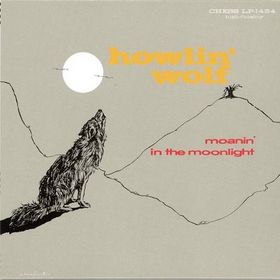
In the summer of 1965, Howlin’ Wolf is whirling in the studio air as well. We hear Mike Bloomfield, a devout fan of his fellow Chicagoan anyway, playing the lick from “Smokestack Lightning” in Take 4 of “Tombstone Blues”, and we hear another echo of the same record to which the world owes “Smokestack Lightning”, of Wolf’s unforgettable 1959 debut record Moanin’ in the Moonlight. It is a record that has often been on Dylan’s turntable, by the sound of it. Apart from “Evil (Is Going On)”, it includes classics like “I Asked for Water (She Gave Me Gasoline)” and “Forty-Four”, songs whose aftershocks we will continue to hear (in “Call Letter Blues”, for instance). And today we hear an echo of the closing track of Side A, from “All Night Boogie (All Night Long)”, from which Dylan copies the opening line Come here baby, sit down on daddy’s knee to the very first version of “Phantom Engineer”:
Don't the angel look good, babe,
Sittin' on his daddy's knee?
… the middle lines of the middle verse, the ones Dylan struggles with the most. Before we get to the final Lyrics version, he tries and rejects six variations:
June 15, 1965:
Don't the angel look good, babe,
Sittin' on his daddy's knee?

Don't the ghost look good, mama,
Sittin' on this madman’s knee?

Don't the angel look good, mama,
Sittin' on this madman’s knee?

Don’t the ghost look good, babe,
Sittin' on this madman's knee?

Don't the ghost child look good, mama,
Sittin' on this madman's knee?
July 29, 1965:
Don’t the brakeman look good,
Being where he wants to be?

Don’t the brakeman look good,
Flagging down the “Double E?”
It gives a small but fascinating insight into the poetic puzzling of a creative genius at one of his mercurial high points. For this middle verse, he apparently insists on sticking to the rhythmic repetitio don’t the […] look good. The moon and the sun are fixed – although in the eight versions we know thanks to The Cutting Edge they keep swapping places. In the first version, the moon shines through the trees and the sun sets over the sea, in the next the sun shines and the moon sets, and they keep going back and forth after that (with the most awkward variation being takes 6 and 9 of 15 June: “don’t the sun look good, baby, coming down through the trees”). Anyway: the sun and moon are stayers, courtesy of Bob Wills and Leroy Carr.
But the filling in of the repetitions between the two celestials proves less steadfast. In the five variations of 15 June, when the song is still fresh and young and uptempo and booked as “Phantom Engineer Number Cloudy”, the ghost of Casey Jones still seems to be floundering around in Dylan’s stream of consciousness. “Angel”, “ghost”, and “ghost child”, featured on either the daddy’s knee borrowed from Howlin’ Wolf or the madman’s knee – these are images dripping with symbolism, evoking a machinist on his way to his death. The primal version, with the “angel” on “daddy’s knee” is then perhaps a bit too corny, a bit too cheap country sentimentality, the song poet feels. Flipping then to the other extreme: the angel is replaced by a “ghost”, daddy by a “madman”. Granted, all corniness has evaporated – but now things are getting a bit too hysterical again, the ad-libbing Dylan seems to think. And shoves the angel back onto the knees again, then again the ghost, and eventually even a “ghost child”… no, none of this works, he thinks.
He takes his time. The next take is 44 days later. And in those six weeks, Dylan seems to have made up his mind about this verse and made an academic decision: the lyrics shall be neatly balanced. In every verse a reverence to Robert Johnson, in every verse an erotic ambiguity, and what we were still missing in this verse is now also inserted: the train reference. What kind of train reference seems unimportant. Well, brakeman then. The brakeman floats on the surface of Dylan’s inner baggage anyway. He has already sung a few brakemen in recent years; in “Freight Train Blues” on his debut album, and in 1961 “Railroad Bill” is in his repertoire as well – two of many songs in which a brakeman comes along.
But given his outspoken respect and admiration for “The singing brakeman” Jimmie Rodgers, Dylan probably chooses “brakeman” rather instinctively when he wants to integrate a random train reference into a song lyric – while at the same time looking for words for “crossing the boundaries between country and blues music”. Moreover, like any folk artist, he can sing along with Rodgers’ evergreen “Waiting For A Train”, in which the brakeman is the antagonist of a hapless hobo (I walked up to a brakeman to give him a line of talk / He said if you’ve got money I’ll see that you don’t walk). Originally a B-side to 1929’s “Blue Yodel No. 4”, the B-side soon eclipsed the A-side and grew into one of the most popular country classics – the song is on a pedestal with and in the repertoire of premier league players like Jim Reeves, Johnny Cash (who opens his Jimmie Rodgers tribute show in 1962 with it), Boz Scaggs, George Harrison and Jerry Lee Lewis. And with the man who is alpha and omega of “It Takes A Lot To Laugh, It Takes A Train To Cry”, although Dylan couldn’t have known that in 1965.
In 2020, when Robert Johnson’s stepsister Annye Anderson publishes her memoir Brother Robert: Growing Up with Robert Johnson, driven by the conviction that justice is not being done to the memory of her beloved older brother, critics agree: the book written by Mrs Anderson together with music historian Preston Lauterbach sheds an as-yet-unknown, enriching light on Johnson, his life and especially his musical influences. He played anything, says Anderson, anything people wanted to hear: “I remember him asking all the guests, and even the children, ‘What’s your pleasure?’” And then he would play a Fats Waller number, or “Pennies from Heaven”, Gene Autry or Count Basie or “Sugar Blues” or Louis Armstrong… Johnson was a walking jukebox. But his sister loved country, and especially Jimmie Rodgers:
“We had that record “Waiting For A Train.” I sang that with Brother Robert all the time. […] Nothing could take the place of the trainman, Jimmie Rodgers. I learned to sing along with those Jimmie Rodgers records. I couldn’t yodel, but I’d sort of hum it. Brother Robert could really yodel. He identified with Jimmie Rodgers through the “TB Blues”—we had two older half-siblings die of TB in Memphis around the time Jimmie Rodgers passed from it.”
The memoir concludes with a marathon interview conducted by the trio of music historians Peter Guralnick, Elijah Wald, and Preston Lauterbach with Mrs Annye C. Anderson, and in it Jimmie Rodgers and “Waiting For A Train” come up again:
“He was blues, he was folk, he was country. Jimmie Rodgers was his favourite, and he became my favourite. Brother Robert could yodel just like he did. We did “Waiting for a Train” together.”
“He was blues, he was folk, he was country”… unintentionally, Mrs Anderson articulates an unmistakable, artistic kinship with Dylan. With an extra colourful touch as she recalls her last memory of her brother:
“Walking with him to Third Street, Highway 61, where he’d hitch a ride across the Harahan Bridge, going over the Mississippi River. I still think of how it felt to hug him. He put his skinny arms around me. His clothes felt starched and pressed. His face felt smooth. He smelled like cigarettes and Dixie Peach.”
Jochen is a regular reviewer of Dylan’s work on Untold. His books, in English, Dutch and German, are available via Amazon both in paperback and on Kindle:
The full recording of one of Bob’s current series of concerts is now available on the internet, so I thought I would add it here, as part of our series reviewing Bob’s concerts across the ages. The full concert is at the end of this post. Other articles in the concert series include
First, for this recent concert, here is the song list. Throughout Bob is playing piano.
1: I’ll be your baby tonight.
2. It Ain’t me Babe
3: I contain multitudes
4: False Prophet
5. When I paint my masterpiece
6. Black Rider
7. My own version of you
8. To be alone with you
9. Crossing the Rubicon
10. Desolation row
11. Key West
12. Watching the River Flow
13. It’s all over now Baby Blue
14. I’ve made up my mind to give myself to you
15. Mother of Muses
16. Goodbye Jimmy Reed
17. Every Grain of Sand.
Now I must admit I am not a fan of this show. What puts me off this performance, and indeed where Bob is now, is that in order to accommodate his voice, Bob is slowing down many of the tracks, and removing much of the melody, replacing the singing with a “declaiming” style, which simply isn’t to my taste.
That of course is my problem, but here is the whole concert so you can judge, and enjoy.
And what I thought I would do here, to explain my own viewpoint (but not in any way to try and change your view) is compare that last song with this version of Every Grain of Sand, with that from 2007 which was highlighted in our Never Ending Tour series.
2007 Every grain
And perhaps as I don’t feel very positive about this performance I might re-introduce my own list of “absolute highlights” from the Never Ending Tour, not because I think that somehow my view is superior to anyone else’s but rather, in case there is any song in the list below which you would like to hear again and wonder which version I chose. As you can see I got a bit carried away and did one song twice.
But might I also direct you to the History in Performance series which is currently covering Side B of “Bringing it all back home” in more depth and with more examples than I think has ever been done before (although of course I haven’t checked every nook and cranny of the internet).
The third part of “It’s alright ma” has just been published here with a complete index to the previous articles (packed with recordings) on that song. Gates of Eden is here. And the final part of Tambourine Man is here, again with an index through the series.
The (very personal) Absolute Highlights series, taking from the Never Ending Tour
My recent articles (see a few links at the end of this piece) concerning Bob Dylan’s early years of songwriting in the 1950s and 1960s have been, by my own admission, a ramble, because for once on this site I have started out publishing a series without knowing where it is going or what it is trying to prove – beyond the fact that we ought (in my opinion) to be spending much more time thinking about Dylan’s music rather than just focussing eternally on his lyrics.
Part of my emerging argument can be seen (I think) in How Bob Dylan turned the entire notion of how a song should be written, upside down and other recent articles under my name. And I recognise you may well have opted out of them given that Mike and Jochen have of late been offering much more considered and much more exciting pieces.
But my concern remains, and I want to try and summarise where I have got to thus far, because unformed and unresearched as it is, the concept still seems both very important and very under-researched. It is this:
What was Bob Dylan's approach to music when he started writing songs
in 1959/60, and how did this approach evolve in the early years of
his writing?
And I do want to explore this, because so many thousands of books and millions of articles have been written about Bob’s lyrics, it seems to me odd, that there have been so few articles considering the musical side of his work at the same time.
In many of the articles that have been published, of course it is true that lyrical issues overflow into the musical issues, and writers have recognisedd this – but in my view we are swamped by analyses of the lyrics. And important though they are, and as pleased as I have been to publish many such, they are only half the story.
So I am asking myself: what is it about the music of Dylan that is important? Or put another way, why has he written songs, rather than just written poetry (which is how many of the commentators on Bob’s work, treat the lyrics – or so it seems to me).
And to get this subject going I want to begin with the rhyme scheme. Everyone around in the 1950s for the launch of rock n roll, knew that there had to be rhymes, because songs always included rhymes, but they could be played with – a bit. Take “Rock Around the Clock” for example. Without thinking about it one might well be inclined to say that the rhyme was A A B B (hon, one; tonight, daylight) but in fact the consists of five lines when normally written out, although 12 bar blues structure makes this sound absolutely fine.
Put your glad rags on and join me, hon
We'll have some fun when the clock strikes one
We're going to rock around the clock tonight
We're going to rock, rock, rock, until broad daylight
We're going to rock, going to rock around the clock tonight
Some of course took this to be way too complicated for teenagers, and so simplified it even more until we got in subsequent songs things like…
You ain't nothing but a hound dog crying all the time
You ain't nothing but a hound dog crying all the time
You ain't never caught a rabbit and you ain't no friend of mine.
And yes I do know that “time” and “mine” don’t actually rhyme, but for the purposes of rock n roll they did.
But what Bob did was to break away from simplistic rhymes, just as he did with the whole rhyme scheme, the length of verses, the rhythm. “Masters of War” and “Times they are a-changing” for example are both in 12/8, which means the beat for “Come gather round people wherever you roam” is
3, 1 2 3, 1 2 3, 1 2 3, 1 2 3.
Masters of War plays with this “four groups of three” effect in a more pounding and forceful way
1 2 3 1 2 3 1 2     3  1   2   3  1 2 3 1 2 3 1
              Come you masters of war
2     3    1    2   3   1
You that build the big guns
And so having changed the whole way the rhythm works, Bob could change the rhyme scheme too – for in the first verse there is no rhyming scheme.
That song eventually has a scheme in which line 2 rhymes with line 4, and line 6 rhymes with line 8 and this applies all the way through the remaining seven verses. It is just verse one that is the odd one out.
These are changes from the norm that we don’t expect, for most of the popular music that had come before had been in straightforward four beats in a bar, with straightforward rhyme schemes which apply throughout. But Dylan made these changes work in terms of music and made them sound natural. Of course it is true that many others had used time signatures other than the straight four beats in a bar many times over, but four beats to a bar was by far the most common approach – but not that many songwriters had played with the rhyme scheme as Bob has done.
So my point is that although the prime focus has always been on Dylan’s lyrics, this has led, I think, to a view that the music is not particularly adventurous. And yet if one looks back just to yesterday’s article concerning the way that “It’s alright ma” has evolved on stage, shows us that this is a complete misconception.
At the risk of overdoing the point let me remind you of one of the versions of “It’s alright ma” which we published yesterday, and if you have a moment, this time in listening, please focus not on Bob’s voice but the arrangement of the instruments. Focus, if you will, on that descending instrumental line behind Bob’s verse. I don’t think they get it completely coordinated at the start but by the second line it really is running perfectly. What we have is a “melody” that is now little more than a declamation, but with all the musical interest now transferred to the accompaniment. I am finding it hard to think of antecedents to this approach.
This is a remarkable musical re-arrangement (just compare it with the original!) – and of course, it is just one of thousands that we have been able to hear across the years. (And indeed as ever I must pay tribute to Mike Johnson for his devotion in collecting these arrangements and allowing us to share them).
Now within this context, we have to remember that across the years there have been precious few commentaries that focus on Bob Dylan the music arranger – it is always Bob Dylan the songwriter. But listening to that arrangement above (and of course it is just one of many) I feel yet again that we should indeed be thinking far more of Bob as a musical arranger just as much as anything else.
Which brings me back to the music within Bob’s songs. In one way it is tempting to feel that Bob has not been a great innovative composer of music, but I think this is wrong. When we start considering all the different aspects there are in songs, we can see that the singular focus on the lyrics, that many have contemplated, misses a major part of the work.
The variations in the rhyme schemes within a song, the changing length of the verses, the use of unusual rhythmic schemes, the rearrangement of the accompaniment, the occasional unusual chord sequences, all of these and more changes are within the music, but largely ignored because of the insistence of focussing on just the lyrics.
But to jump back, now consider this version of “Who Killed Davey Moore” – which has a musical approach quite different from the later released version.
And in fact I think that Dylan’s music does demand much deeper investigation. Now I have tried to mention this on occasion on this site, and in this regard, I want to quote myself (generally the sign of a writer on the slippery slope, but I really can’t find a better way to say this than I did a few years back)….
As I went out one morning
“… it is indeed interesting that he wrote the music not in a normal major or minor key of the type that we hear in 99.99% of our music today, but in a mediaeval mode. I think it is the phrygian mode – if you want to experiment sit at the piano and play the white notes only from E up to the next E. That scale of eight notes doesn’t sound major or minor, but actually sounds rather old and mediaeval. That is the phrygian mode – it was quite a thing in the 15th and 16th centuries…”
One of the benefits of Bob’s experimental approach to music, both in his original writing and then (perhaps more importantly) in the subsequent re-arrangements that he has developed is that it has shown many musicians the options that exist within Dylan’s music for the songs to be re-written. Consider this extraordinarily atmospheric version of Bob’s “Seven Curses”
This is by Gavin Ghee and was recorded in June 2021. It takes Seven Curses into a totally new world – and gives us a piece of music that I for one can play over and over again. Indeed a song that I, in writing about Bob, had really set aside as an early composition (it was written in 1963), and which I suspect many fans had likewise thought of as ok, it is interesting, but not in the top rank. Yet it turns out to be an utter masterpiece once it is re-arranged.
As far as I know, Bob didn’t contemplate the arrangement, but that’s not my point here. My point is that Bob wrote a song that had the potential in it to be re-arranged, and as a musician myself I can tell you that very many songs do not have this potential within them. Take them out of their original box, and they fall apart.
But as this arrangement shows, with this Dylan song (and there are many others) a re-arrangement can bring completely new life and meaning into a song. Indeed if you have been kind enough to read my ramblings on the subject of re-arrangements you will know the excessive praise I have thrown at the re-arrangement of Tweedle Dum.
And my point remains – if we only consider Bob’s lyrics, or we only consider the songs as they occur in their original form, we are missing a fundamental issue in Bob’s work. For I don’t think anyone else involved in popular music in any of its form, has engaged in this level of re-arrangement or multiple songs before, in this way.
So in considering Bob’s music, I think we should be considering not just the way he writes the original version, but also the fact that he somehow builds into many of his songs, ways in which they can be re-engineered – (if I can use that word about the creative musical process).
That this process has been ignored by so many writers, is because this is a process that focuses totally on the music – and for some reason most writers on Bob don’t like to write about his music.
But Bob has not been primarily a poet, nor even a poet who sets his poetry to music. He has from the start been a songwriter, and in my view, we can understand him so much better if that is how we contemplate his work.
If you have found this interesting you might also appreciate…
[I read somewhere once that if you wanted the very best, the acme of Dylan’s pre-electric work, you couldn’t do better than listen to side B of Bringing It All Back Home, 1964. Four songs, ‘Mr Tambourine Man,’ ‘Gates of Eden,’ ‘It’s Alright Ma (I’m Only Bleeding)’ and ‘It’s All Over Now Baby Blue’ represent the pinnacle of Dylan’s acoustic achievement. In this series I aim to chart how each of these foundation songs fared in performance over the years, the changing face of each song and its ultimate fate (at least to date). This is the sixth article on the third track, ‘It’s Alright Ma (I’m Only Bleeding)’ You can find the previous articles in this History in Performance series listed above.
Like ‘A Hard Rain’s A‐Gonna Fall,’ ‘It’s Alright, Ma’ is a report on experience. These two protest songs, Dylan’s greatest to my mind, have a lot in common. In both songs, a young man reports to a mother figure what he has seen and heard in the big bad world. In ‘Hard Rain’ the mother figure has to implore her ‘darling young one’ to tell her what he has discovered, whereas in ‘It’s Alright, Ma’ the singer spills it out in a jet of anguish without having to be asked. He assures his ‘Ma’ however that he is not going to be overwhelmed or done in by the ‘darkness’ of the world. He will survive, he will endure.
Stoical resistance is a term that springs to mind with regard to the underlying message of ‘It’s Alright, Ma,’ but we mustn’t forget that it is laced with anger, a moral outrage at the world where ‘goodness hides behind its gates.’ (Are these, by any chance, the gates of Eden?) In this world, ‘disillusioned words like bullets bark,’ which is a good description of the song itself.
Pushing fake morality (‘To push fake morals, insult and stare’) is nothing new, Jeremiah railed against it centuries ago, and surely that hypocrisy rules our contemporary world as much if not more than it did when the song was written. I am reminded of another song written much later (‘Slow Train Coming’ 1979) with an almost identical message:
Big-time negotiators, false healers and woman haters
Masters of the bluff and masters of the proposition
But the enemy I see wears a cloak of decency
These lines could fit into ‘It’s Alright, Ma’ without too much trouble, and I would once more argue for the consistency of Dylan’s critique of society over his career. Try these lines from ‘Unbelievable’ (1991)
They said it was the land of milk and honey
Now they say it's the land of money
Whoever thought they'd ever make that stick
It's unbelievable you could get this rich this quick
Again, the sentiment fits ‘It’s Alright, Ma,’ a song we can now see as something of an urtext for these later songs, songs that will assail, again and again, the rank materialism of our age.
As we have seen, the song began as a solo acoustic number, but slowly evolved into a stadium rocker, which is what we find when we get to 2005, the point we have now reached. All traces of the acoustic origins of the song are gone, as you can hear in this recording from the fifth night of the Brixton residency of that year. It’s a powerful performance, full of swing and swagger, it’s dark and swirling, and may well be the best of the Sonny Boy Williamson rock riff versions. Not only is this a powerful vocal performance, but don’t miss the wonderfully sudden violin break at about 4.30 mins.
2005
From the earliest performances Dylan has spat the words out at breakneck speed, but I can’t help but feel that this particular riff has him babbling the words a little too fast at times, reminding me that I have never been quite convinced that this riff suits the extended vocal lines of the song, particularly with a brisk tempo.
In 2006 Dylan moved from the piano to the organ – although I can’t hear the organ in this recording – and again played the song multiple times The first thing I noticed, comparing this performance with 2005, is the much slower tempo. Slower and more deliberate, although there is still a tendency to babble out the words, which is fine if you already know them – and I did miss that violin break.
2006
The song stayed very much alive in 2007. The first thing I noticed was that Dylan had finally dropped the Sonny Boy Williamson riff and returned to the original chord structure of the song, now transformed into a rock riff of its own. There is no return to its acoustic roots. I prefer this performance from Albuquerque, July 22nd. Dylan is in great voice and powers the song along.
2007
We have two excellent YouTube videos from 2007, one from Birmingham (April 17th) and the other from Glasgow (April 11th). There is little to choose between these in terms of performance. I have chosen the Glasgow one as you can see more of the band than Birmingham. I notice Donnie Herron on the violin, although I don’t hear it that well – it’s just a part of the mix. Interestingly, Dylan returns to the guitar for this one, giving his audience a flash of the Dylan of old, the guitar playing menace.
2007 (Glasgow)
Again, the song features strongly in 2008, and we have two necessary performances from that year. We’re still with the original chord structure, but the addition of the banjo pushes the song in the direction of country rock. These 2008 performances are more restrained than what we have seen but, if we go right back to the 1960’s performances, we find a pleasing balance between passion and restraint that created the musical tension that drives the song, a tension that is arguably lost with the rock riff versions. Dylan may be trying to recapture that tension in these 2008 performances.
I’m including this second recording from 2008 because I love the way it kicks along and has something of a sinister edge, that ominous tone that suits the song so well – maybe it’s that bit of an echo in Dylan’s voice that does it. And you can tap your feet to that banjo. Even get up and dance.
2008 (B)
Dylan keeps the ball rolling in 2009 with multiple performances once more. This one I used in my NET series
The vocal is very up-front in this recording. The banjo has gone, turning this one into a solid rocker.
2009
And then, suddenly, in the midst of this fascinating evolution, it disappears. Vanished from the setlists for three years. Why did he drop it, and why did he bring it back in 2013 for a mere two performances? We certainly don’t get the sense of Dylan losing connection to the song the way he did with ‘Mr Tambourine Man.’ It was powering along and then
Bang!
it’s gone.
And when it did return in 2013 for those two performances, both within a couple of days of each other in October, it was completely renovated. A new approach, a new arrangement, a new sound. There is no lack of interest or innovation.
This is the final performance from Stockholm, Oct 12th. The violin is back, and it all sounds good, but maybe Dylan thought it was a little too bouncy, a little too upbeat and countrified for the scathing social comment that drives the lyrics. We can only speculate. I like the descending riff, and feel that this could have been the beginning of a new evolution of the song. But no. This is it. The last we see of it. One of the greatest songs of the twentieth century.
2013
Finally, as an afterthought, you might enjoy this remix by J Period from 2015. It’s only a fragment, but takes us back to Dylan’s 1960’s voice. It’s fun.
Remix
So that’s it for ‘It’s Alright Ma.’ A sudden, unexpected end. But I’ll be back soon with the last song on side B of Bringing It All Back Home – ‘It’s All Over Now, Baby Blue.’
Don’t the moon look good, mama, shinin’ through the trees?
Don’t the brakeman look good, mama, flagging down the “Double E”?
Don’t the sun look good, goin’ down over the sea?
Don’t my gal look fine, when she’s comin’ after me?
“You also cover Leroy Carr’s “Alabama Woman Blues,” which you’ve played in concert in the past. Around 12 years ago, you listed it as one of your 10 favorite songs of all time. What do you find so alluring about it—or at least about Carr’s original recording of it?”
“I think it was where it hit me in my own life. It was one of the first songs I heard as a teenager, not really knowing anything about Leroy Carr. But there’s something about the sadness of that song. There’s a certain atmosphere to his recording. Something about it is so poignant, moving, simple and sad. My version is much more out there and upbeat, but you really should listen to Leroy Carr’s version.”
(Clapton, GuitarWorld, 19 May 2016)
Eric Clapton’s I Still Do oozes melancholy. Starting with the album’s title. “It’s a quote from my auntie,” Clapton tells interviewer Paul Whitehouse, in the promo video for the album’s 2016 release. Auntie is on her deathbed. Clapton pays a farewell visit and thanks her for all the good care and love she gave him, back when he was a troublesome, difficult child. “Well, I liked you,” Auntie says, “and I still do.”
The album is basically a “regular” Clapton album that follows the formula: a few self-written songs, a few covers (as usual from J.J. Cale and from Dylan – in this case a wonderful “I Dreamed I Saw St. Augustine” sounding like a forgotten outtake of Ry Cooder’s masterpiece Chicken Skin Music) and a few blues classics.
So the melancholy is evoked not so much by the track list, but mainly by the sound. Working with master producer Glyn Johns again for the first time in forty years (The Beatles, Led Zeppelin, The Rolling Stones, The Who, Eagles, to name but a few), Clapton has mostly experienced veterans around him. Men like Andy Fairweather Low and Paul Carrack and Henry Spinetti (Dylan’s drummer on Down In The Groove, 1988), and one of Dylan’s “secret heroes” (according to the Biograph booklet, 1985), Paul Brady. All men who are already approaching seventy, who have been making music at Premier League level for more than half a century and whom you no longer need to explain what a song needs. Which we hear pre-eminently in the classics: Robert Johnson’s “Stones in My Passway”, Skip James’ “Cypress Grove” and in the opening, in Leroy Carr’s indestructible “Alabama Woman Blues”, the song with the now over-familiar closing lines
Don't the clouds look lonesome across the deep blue sea
Don't my gal look good when she's coming after me
It is one of the best examples for Dylan’s 2008 radio lesson, a great example for “certain phrases are used over and over in the folk process, and are crossing the boundaries between country and blues music.” Well, would have been a great example, but the DJ never mentions songs of his own. In 1930, Leroy Carr records “Alabama Woman Blues”. Charley Patton also knows the song and records “Poor Me” four years later, in the last recording session before his early death in 1934: Don’t the moon look pretty shinin’ down through the tree? And apparently those lines with the lonely clouds, the moon and look good resonate with Bob Wills when he records his rip-off of Kokomo Arnold’s “Milk Cow Blues” in 1947:
Well, good evenin', don't that sun look good goin' down
Well, good evenin', don't that sun look good goin' down
Don't your home look lonesome when your lover ain't around
… “Brain Cloudy Blues”, the song Elvis seems to hear when he records his version of “Milk Cow Blues”, and the song Dylan plunders for both “Quit Your Lowdown Ways” and “Rocks And Gravel”, both in 1962. And “Rocks And Gravel” is then still a bit more than a song that just reuses “certain phrases” here and there; the entire song is cut and pasted from front to back. The first stanza is borrowed from Mance Lipscomb’s “Rocks and Gravel” (1961, but Mance’s song is in turn a rip-off of “Rock And Gravel Blues” by Peg Leg Howell from 1928); the continuation comes from Leroy Carr’s “Alabama Woman Blues” (Did you ever go down on the Mobile and K C line / I just want to ask you, did you ever see that girl of mine), just like the lonely clouds and the closing line copy Leroy Carr’s Don’t my gal look good when she’s coming after me, the closing line of yet again “Alabama Woman Blues”. The closing couplet of Dylan’s cut-copy-and-paste piece “Rocks And Gravel” is then:
Don't the clouds look lonesome shining across the sea,
Don't the clouds look lonesome shining across the sea,
Don't my gal look good, when she's comin' after me?
Leroy Carr remains a loyal supplier, by the way. Even into the 21st century. In “Blues Before Sunrise” from 1934, for instance, we hear halfway through:
Today has been such a long and lonesome day
Today has been a long and lonesome day
I've been sitting here and thinking
With my mind a million miles away
… which we hear return almost verbatim as the first verse of Dylan’s “Lonesome Day Blues” from 2001.
Still, in the end, neither Leroy Carr nor the almost literal copying of the moon shining through the trees from Charley Patton’s “Poor Me”, but rather Bob Wills’ “Brain Cloudy Blues” seems to be the station from which Dylan’s “It Takes A Lot To Laugh, It Takes A Train To Cry” departs. And not so much because of those certain phrases, but mainly because of that peculiar addition on the first recording sheet: “cloudy”. We hear how on The Cutting Edge producer Tom Wilson gives the go-ahead with the words “Phantom engineer number cloudy take one,” and we hear Dylan chuckle – it seems that Wilson is making an in-joke, referring to something that has just been discussed or happened; an educated guess is that Dylan mentioned Wills’ song or maybe even played a few bars of it. Or perhaps that Wilson thus hints that he sees through Dylan’s theft, and Dylan giggles because he is caught.
Anyway: Leroy Carr, “Milk Cow Blues”, Bob Wills’ “Brain Cloudy Blues”, Mance Lipscomb, and Dylan’s own “Rocks And Gravel”… this one verse illustrates not only the DJ Dylan’s words about certain phrases used over and over, but also what G.E. Smith, Dylan’s guitarist in the 1988-90s tells us in the fascinating interview with Ray Padgett for Flagging Down The Double E’s, Ray’s brilliant Dylan newsletter of 2 March 2025:
“We still had cassettes back then, and on the bus he’s playing these cassette tapes of all this great old traditional stuff, because by then he knew I was really into it. He said, “This is a good song, you should learn this one.” “And this one, see how this turned into this, and then Hank Williams wrote–” You know, he totally knows the history of all that music in the United States. He knows all those songs. Just off the top of his head.”
“This turned into this”… it is as Dylan later says in his famous MusiCares speech (2015): “All these songs are connected. Don’t be fooled. I just opened up a different door in a different kind of way. It’s just different, saying the same thing.” And then that connection is not a neat serialisation, not a relay-like succession where from Song 1 something is carried over to Song 2, and from Song 2 then something again to Song 3. No, “Milk Cow Blues”, Robert Johnson, “Brain Cloudy Blues”, Elvis, “Casey Jones”, Mance Lipscomb, Charley Patton’s “Poor Me”, “Rock And Gravel Blues”, William “Brother Bill” Burroughs, The Foggy Mountain Boys, “Roll In My Sweet Baby’s Arms” and Dylan’s own “Rocks And Gravel”: it is a labyrinth, a pit full of wriggling snakes biting each other’s and their own tails.
Why exactly these particular songs, one might still ask. “Well, I liked them,” he’d say most likely, “and I still do.”
Jochen is a regular reviewer of Dylan’s work on Untold. His books, in English, Dutch and German, are available via Amazon both in paperback and on Kindle:
“…managed to persuade so many of us to listen to (and one might almost say “adopt”) a song that paints the world as being in such an utterly disjointed and decayed state? For “Visions” is not a protest song like “Masters of War” or “Times they are a-changin’” – it is a song of collapse and disintegration. And yet it is one of his most popular and successful songs of all time.
I then offered up by way of conclusion, a recording of none of those songs, but Laura Marling singing “A hard rain’s gonna fall”. Which maybe if you read my piece, made you think that I’d either lost it totally, or simply made a silly mistake.
But actually, I was trying to prove my point, without explaining it… in short leaving me something to say in this, the next article.
For my point is that in these early years Dylan was learning, through his writing of multiple songs (36 published songs in 1962, 31 in 1963) how to write songs in different ways. The form was pretty much the same each time (mostly verse-verse-verse, occasionally verse and chorus, and occasionally verse with a repeated line), but the essence of the songs was still experimental, which is what has allowed others since Dylan, to take his songs into new pathways musically.
In doing this Bob stuck to strophic (ie a verse format repeated throughout the song), or verse and repeated lines (Times) or later verse and additional lines (Johnanna).
Now I have to admit that I do not know any other songwriter who developed his writing in such a manner. And here I would love your help. Because, if you know of other songwriters who did (either back in the 1960s or any time since) what Bob did in songs like “Tambourine Man” in varying the length of verses, and with the use of repeated rhymes, then please do tell me.
What we can see even without such comparisons however is the experimentation that Bob goes through as he looks for ways to extend his songwriting through this technique.
Take the “Lonesome Death of Hattie Carrol”. That song is based primarily on three chords: C, A minor and E minor. That’s unusual but within the structure of a song in the key C major these are conventional chords. However musically it leaves us unsure of what key the song is in. It could be C major or it could be Eminor, but eventually, most of us who think about such things feel it to be in C major. But it is a very unusual C major since most of the time the song is accompanied by minor chords. That’s legit, but weird.
In short, already Dylan is something very unusual with the music: a song in a major key which spends most of the piece in the minor.
And that is not all, here again, Dylan goes exploring, in terms of musical form. The first two verses are nine lines long, the third verse is 10 lines long and the final verse is 14 lines long. Whoever did that before?
All of this is a challenge to normal, conventional music which says that each verse of a song should be the same length. But more than that, it should be the same length but NOT nine lines long.
And then consider the rhyme pattern
William Zanzinger killed poor Hattie Carroll
With a cane that he twirled around his diamond ring finger
At a Baltimore hotel society gath'rin'.
And the cops was called in and his weapon took from him
As they rode him in custody down to the station
And booked William Zanzinger for first-degree murder.
But you who philosophize disgrace and criticize all fears,
Take the rag away from your face.
Now ain't the time for your tears.
We have two rhyming couplets there (lines three and four, and lines eight and nine). And the fact that one of those pairs takes us into line nine shows us how far Bob has moved on from conventional songwriting. Not only did songs not previously just have two rhyming pairs of lines and others without rhyme, but songs didn’t have nine lines in a verse.
But by the last verse we have travelled even further. Now we have a 15-line verse! We can make out some rhymes – I am stretching it a bit by including “caught em” and “bottom”, and it is possible at the end to argue that the last two lines I have set out, are not the last two lines, as many transcribers turn those into three lines.
In the courtroom of honor, the judge pounded his gavel
To show that all's equal and that the courts are on the level
And that the strings in the books ain't pulled and persuaded
And that even the nobles get properly handled
Once that the cops have chased after and caught 'em
And that the ladder of law has no top and no bottom,
Stared at the person who killed for no reason
Who just happened to be feelin' that way without warnin'.
And he spoke through his cloak, most deep and distinguished,
And handed out strongly, for penalty and repentance,
William Zanzinger with a six-month sentence.
Oh, but you who philosophize disgrace and criticize all fears,
Bury the rag deep in your face for now's the time for your tears.
But however we look at this, the old concept of rhyming and regular line length and structure has been thrown away, and replaced by something new.
Thus my point is that Dylan, having moved away from taking other people’s music, and keeping his own compositions very simple with simple techniques such as a repeated last line (such as in “Times they are a changing”) Bob had very quickly moved into a near free form of, and a new approach to, songwriting.
Now I was going to contrast the above rhyme scheme with that of Don’t Think Twice written in the previous year. But at this point, coming to look at Don’t Think Twice again, I think we can see the same games being played with the rhyme scheme even in that early composition, although the music itself is more regular. (“Don’t think twice” was written about a year before “Harrie Carrol”).
It ain't no use to sit and wonder why, babe
If'n you don't know by now
And it ain't no use to sit and wonder why, babe
It'll never do somehow
When your rooster crows at the break of dawn
Look out your window and I'll be gone
You're the reason I'm a-traveling on
But don't think twice, it's all right
Here the rhyme scheme is
A B A B
C D D E
You can, if you really want to stretch the point, argue that “dawn” rhymes with “gone” but really I think that is going too far. Unless you are from a part of the world where “gone” really does rhyme with “dawn”.
What I think we have got, when we come to look, is Dylan experimenting with the structure of the songs from his earliest years in serious songwriting, in terms both of the lyrics (in the sense of what the song was about), but also in terms of the way he made the lines rhyme. And here I think that very few, if any, other songwriters of this time were doing that. And yet for some reason, very few commentators show any interest in this.
Which is interesting since in popular music that period – and I am tempted to say any period – the rhyme scheme was central to the construction of most songs except the “art” songs of composers in the classical romantic tradition such as Hugo Wolf.
For example, the song “White Christmas” plays with the rhyme structure a bit, but the rhymes are still clearly there:
Verse 1: “Know” rhymes with “snow”
Verse 2: “Write” rhymes with “bright” rhymes with “white”
Now I am not saying Dylan invented the notion of playing around with rhymes, (in “Hound Dog” the word “time” rhymes with “mine” – which is almost a rhyme, although not strictly so), but I am saying he went much further than anyone else in these early songs – and remember the rhyme in songs was, until Dylan came along, at the very heart of the song structure.
And I think to round this off one might also note that what is by common consent one of the most famous songs of the Beatles, who were, I think you might agree, fairly famous for their songwriting in the 1960s, was…
Oh, yeah, I'll tell you somethin'
I think you'll understand
When I say that somethin'
I want to hold your hand

Oh, please, say to me
You'll let me be your man
And please, say to me
You'll let me hold your hand

And when I touch you
I feel happy inside
It's such a feelin' that my love
I can't hide
So my point is that Bob was not just experimenting with what he could write about, he was also experimenting with the whole notion of rhyme, and with the whole concept of how a song should be structured, not least by regularly changing the length of each verse.
Yet these revolutionary musical approaches and musical changes were and still are often ignored in reviews of Dylan’s work because, in my view, of the insistence of most commentators in focussing only on the lyrics, and not at all on the music or the structure. Bob was, from the start, challenging the entire concept of how a song could be structured, and this I think is utterly amazing. He hadn’t been writing songs for that long, and yet he was turning the whole notion of how a song was put together, upside down.
If you have found anything here of interest, you might also like to glance at….
Well, I ride on a mailtrain, baby / Can’t buy a thrill
Well, I’ve been up all night / Leanin’ on the windowsill
Well, if I die / On top of the hill
And if I don’t make it / You know my baby will
The spirit of Casey Jones and the spirit of Robert Johnson mould the form as well, or so it seems. Four-line stanzas with the simplest rhyme scheme. The “Casey Jones-variants” are simple enough; all written in the pair rhyme aabb, and even simpler is the mono rhyme of the classic blues couplets, though these are usually three-line (a repeated opening line plus a bouncer). But Robert Johnson does occasionally resort to the four-line aaaa. For example, in track 4 of that legendary record King of the Delta Blues Singers that so impressed Dylan, “Walkin’ Blues”:
I woke up this mornin' / feelin' round for my shoes
Know 'bout 'at I got these / old walkin' blues,
Woke up this mornin' / feelin' round oh, for my shoes
But you know 'bout it I / got these old walkin’ blues
Likewise twelve-syllabic verse lines, likewise four-line stanzas, likewise rhyme scheme aaaa… it could just be that Dylan uses “Walkin’ Blues” as the railway tracks to guide his mailtrain of thought across. Without the repeated verse lines, of course – he has used that particular trick before (very recently as a matter of fact; “Outlaw Blues” and “She Belongs To Me”, six months ago) and besides: he has converted to Beat Poetry, Dylan is more ambitious, these days.
We hear that right after the “Casey Jones opening”. Well, if I die / On top of the hill is an alienating derailment. It seems cut-up, it seems as if Dylan is pasting a randomly chosen film quote into his lyrics, or at least a sentence patch borrowed from some low-culture product. A B-western with Gene Autry or Roy Rogers, or Blind Boy Fuller’s “I’m Climbin’ On Top of the Hill”, or maybe even from the Big Bang of rock ‘n’ roll, Chuck Berry’s “Maybellene” (And I caught Maybellene at the top of the hill). Though a borrowing from the über-sad ballad “Two Soldiers” still seems the most obvious source (the blue-eyed Boston boy with the curly hair who meets his death on top of the hill), as that age-old folk song is high on Dylan’s list of favourites. Not important of course; on top of the hill, combined with if I die or not, is far too generic to attribute to a source, and is presumably instinctively chosen by Dylan precisely to trivialise. In fact, the word combination is so common that Dylan – very unusually – repeats himself a month later when he writes “Tombstone Blues”:
I wish I could give Brother Bill his great thrill
I’d set him in chains at the top of the hill
Send out for some pillars and Cecil B. DeMille
He could die happily ever after
in which “top of the hill” also rhymes with thrill and is the setting of a death scene again.
Besides the desired banalising effect, the blues-exploring Beat poet is undoubtedly attracted by the by-catch: the erotic connotation. Dylan has immersed himself in Johnson’s lyrics, even transcribing them all, and is entranced by the “free association, the sparkling allegories, bigass truths wrapped in the hard shell of nonsensical abstraction,” as he explains in Chronicles, and acknowledges that in 1965 he was trying to copy “the lyrical imagery”. So he has encountered them all: You can squeeze my lemon ‘til the juice runs down my leg and I flash your lights, mama and I’m bound to check your oil and Your calf is hungry, I believe he needs a suck and all those other euphemisms for genitals and intercourse. And also the same sub-variant that Dylan seems to insinuate here: the failing lover. With Robert Johnson, Dylan sings along to “Phonograph Blues”, to
Beatrice, I love my phonograph
honey, you have broke my windin' chain
And you've taken my lovin'
and give it to your other man
… as “Poor Bob” laments in one verse, only to choose different “lyrical imagery” to express the same thing in the next:
Now, we played it on the sofa, now
we played it 'side the wall
My needles have got rusty, baby
they will not play at all
Phonograph Blues – Robert Johnson:
“Nonsensical abstraction” may semantically not be entirely conclusive, but it covers quite nicely the idiomatic turns those old blues giants had to wriggle into to avoid vulgarities. A “lyrical imagery” that, by the time Robert Johnson uses imagery like “calf” and “oil” and “phonograph” and “rusty needles”, is already starting to go berserk. By the time Johnson records his songs (late 1930s), his predecessors and his colleagues have pretty much looted the entire fruit basket (peaches, grapes, lemon, banana, apple), the entire zoo plus the safari park and petting zoo (rooster, rattlesnake, poodle, mare, bumble bee), every physical activity (ride, roll, shake, gravel, rock, drive, bang) and the Food Department too (sugar, ham, honey, syrup, pie, jelly, meat, milk). It is, in short, getting increasingly difficult to come up with something new if you want to capture “intercourse” in lyrical imagery.
However, all those culinary, zoological and fructarian variations are, for all the imagery, hardly ambiguous. Dylan’s preference, as is well known, is keeping things vague, and vagueness he achieves with if I die on top of the hill. Even within its ambiguity: surely, you can understand it as a euphemism for “orgasm”, la petite mort, but also as “failure”, as premature ejaculation or impotence – to which the sequel if I don’t make it seems to hint. But just as effortlessly, you can initially deny any sexual connotation.
After all, Casey Jones is in fact, leaning on the window sill, on his way to his death. Agreed, not on a hilltop, but we could attribute some metaphorical quality thereto. But then, in the next stanza the narrator communicates the already less ambiguous don’t my gal look fine when she’s comin’ after me? and the last stanza shuns any ambiguity: I wanna be your lover, baby, I don’t wanna be your boss. Reasoning back then, the vagueness from the first stanza does indeed seem like an intimate confession: the narrator laments his premature ejaculation or his erectile dysfunction.
Which still does not promote the song to being a dirty blues, although Dylan does wink at it, at the very least. And then opts for the less usual failing lover as narrator. By far the majority of dirty blues songs, of course, have boastful, horny, virile narrators who, in songs like “Shave’ Em Dry” or “Sixty Minute Man” or “Keep On Churnin’ (Till the Butter Comes)”, sing of not only the pleasures of sex, but also one’s own Olympic lover’s qualities. Still, we also are familiar with the more tragic variation, the song told by the failing lover. The aforementioned “Phonograph Blues” by Robert Johnson, for instance, or Bo Carter’s “My Pencil Won’t Write No More” (remarkably also recorded by the hoochie-coochie man himself, Muddy Waters). And in that subcategory, we may now conclude, we can place ‘”It Takes A Lot To Laugh, It Takes A Train To Cry” as well.
Jochen is a regular reviewer of Dylan’s work on Untold. His books, in English, Dutch and German, are available via Amazon both in paperback and on Kindle:
Details of some of our other recent articles and series can be found on the home page of this site. If you would like to contribute an article to the site, please do email Tony@schools.co.uk
By Tony Attwood
In recent articles, such as the two listed at the top of the page, I have been attempting to look at the form of Dylan’s songwriting as he slowly moved away from straight strophic songs (ie verse, verse, verse) to include choruses and “middle eight” which helped break the music up.
And although this change of form may look like something of a deliberate expansion of his awareness of the possibilities of music, moving from the rigidity of the strophic approach to something more flexible, we have to admit that when the mood took him, Bob could travel in all sorts of musical directions.
For example “Father of Night” written in the spring of 1970 was not only Dylan’s shortest song (fractionally over one and half minutes – in contract to “Murder Most Foul” which runs for over 16 minutes) it also has some oddities of its own, such as being written on the pentatonic scale – which is most easily understood as utilising only the black notes on the piano.
Now I find these variations in songwriting approach and technique interesting because they show how willing Bob was to explore different musical and literary techniques while at the same time remaining deeply grounded in the folk traditions of either strophic songs (ie verse, verse, verse – as in “Bob Dylan’s Dream”), or strophic songs with a repeated line at the end (“Times they are a changin'”), or strophic songs with a chorus (“Just like a woman”).
But at the same time as being attracted to these basic musical forms, Bob also experimented, for example in Visions of Johanna which as I have noted before, not only has a revolutionary structure of itself, but also extends that structure past breaking point in the final verse (so much so that in the original album recording the bass guitarist forgets that this is the final verse in which the number of lines is extended, and makes a mistake).
What’s more, in Visions, the structure itself is very unusual – I would venture unique being three unequal groups of lines
Group A consists of three rhyming lines
Ain't it just like the night to play tricks when you're
                                         tryin' to be so quiet
We sit here stranded, though we're all doin' our best to deny it
And Louise holds a handful of rain, temptin' you to defy it
Group B consists of four rhyming lines
Lights flicker from the opposite loft
In this room the heat pipes just cough
The country music station plays soft
But there's nothing, really nothing to turn off
Group C consists of two rhyming lines.
Just Louise and her lover so entwined
And these visions of Johanna that conquer my mind
Except that in the last verse, it changes again and Group B consists of seven lines
And Madonna, she still has not showed
We see this empty cage now corrode
Where her cape of the stage once had flowed
The fiddler, he now steps to the road
He writes everything's been returned which was owed
On the back of the fish truck that loads
While my conscience explodes
But then having done that experiment I am not sure how often (if at all) Bob came back and re-used the approach, even though it works so well. For even if one doesn’t appreciate the actual technique is still very unsettling and adds a real sense of expansion and desperation as we approach the line “Oh how can I explain”. It is in fact a moment of songwriting genius, for the power mustered at, “How can I explain” is there irrespective of whether we appreciate what has happened musically, or not.
Thus I would argue the early days of playing with a band was a time of regular song-writing experiments by Bob, which we can easily miss, or maybe just accept as part of the song, even though they make the song feel a bit odd because it suddenly doesn’t follow the traditional rules.
If we take “Thin Man” for example it consists of seven verses of identical musical structure, but there is also what we might call a “B” section which crops up after verse three but nowhere else…
You have many contacts among the lumberjacks
To get you facts when someone attacks your imagination
But nobody has any respect, anyway they already expect
     you to all give a check
To tax-deductible charity organizations
If we were to try and describe the form in the classical way, it would be
A A A B A A A A
… a form which has no name and indeed which I don’t think I’ve noted in any other song or any era.
Now of course there is nothing in the rule book that says that songs have to be in a particular form – it is just that folk songs have evolved in a certain style in order to make them memorable and recognisable, in an era when live performance was all we had.
And I suspect like all species, humans like to have certain things around them that are recognisable, which in musical terms means a structure everyone can recognise, even if the listener has no musical experience or education. So although not all songs follow the repeating formats of either Strophic Form (Verse – Verse – Verse…), or the variant Ternary Form (Verse – Verse – Middle 8 – Verse), most popular songs do, because that makes them easier to appreciate, and easier to remember.
Indeed it can seem rather shocking to note the fact, but in terms of 99% of popular songs, the only form the song exists in is either “Strophic” or “Ternary”, and these two are hardly massively different, in that a ternary song is just like a strophic song but with a “middle eight” or “B” section added, usually after the first two verses (or “A” sections).
But what it seems to me that Bob has done from his earliest days, is to look for ways to make changes to these two all-pervading structures, but without the music becoming incomprehensible to his audience.
Thus we have the fairly obvious techniques such as the repeated last line such as, “The answer is blowing in the wind” and the repeatedly re-used “The times they are a changing” to give a sense of unity to the strophic songs.
But we also get the revolutionary idea quite early on that not all the verses have to be exactly the same. Of course, if one wants to keep the strophic structure of verse – verse – verse then each verse has to be recognisable as having the same musical basis, and that makes the music memorable but the songwriting restrictive. But what Bob did from quite early on was explore the notion of these extra lines within a verse, and a move away from rhyming.
Consider for example “Hard Rain”. Verse one starting “Oh, where have you been, my blue-eyed son?” has nine lines. Lines one and two rhyme:
"Oh, where have you been, my blue-eyed son?"
Oh, where have you been, my darling young one?
but after that there are no rhymes at all.
The second verse has 11 lines with a couple of partial rhymes (“dripping” and “bleeding”)
I’ve stumbled on the side of twelve misty mountains
I’ve walked and I’ve crawled on six crooked highways
I’ve stepped in the middle of seven sad forests
I’ve been out in front of a dozen dead oceans
I’ve been ten thousand miles in the mouth of a graveyard
And it’s a hard, and it’s a hard, it’s a hard, and it’s a hard
And it’s a hard rain’s a-gonna fall
Verse 3 has 11 lines but verse 4 has only ten lines, while the final verse has 16 lines. This is an approach which if not totally unknown elsewhere either in pop / rock music or in folk music is at least extraordinarily unusual.
And we have to remember that Dylan was entering a world in which the song in popular music lasted between two and a half minutes to three and a half minutes. This tradition goes back to the early days of the phonograph and the limitations of that technology, but also reflects the move from the song as a way of recording important events in history, or (for example with Scarborough Fair) listing a range of near impossible tasks for the would-be lover to perform in order to show that he is truly in love with the singer.
We should also remember that prior to Dylan, the most eminent of all American songwriters was Irving Berlin (who is estimated to have written around 1,250 songs many of which became classics) who along with everyone else wrote songs that lasted around three minutes. Indeed if we consider his most well-remembered song (White Christmas), we can note that contained just 52 words in the lyrics, there being just two verses which are then repeated. “Visions of Johanna” in terms of words is over eight times the length.
“White Christmas” – the most famous song by the most prolific and successful songwriter of all time, reveals an approach which is the exact opposite of that of Bob Dylan. Berlin’s Christmas deals with a simplistic vision of an imagined perfect event. We might compare that with a song containing a vision that itself cannot be trusted as being representative of reality (as the very first line of the song says – “Ain’t it just like the night to play tricks when you’re trying to be so quiet”).
But the length of the song is of course not the key issue. What “White Christmas” does it give the listener a simple reassuring message – and reassuring not just because of what type lyrics say, but because the complete set of lyrics comes twice. “Visions” is absolutely the opposite. Everything is confused and uncertain from those famous opening lines…
Ain't it just like the night to play tricks
When you're tryin' to be so quiet
We sit here stranded, though we're all doin' our best to deny it
And although there is of course no suggestion that Dylan was thinking of writing the antithesis to “White Christmas” in writing “Visions” he has constructed a song which in lyrics and music is that antithesis. Where there was certainty and simplicity there is now uncertainty, confusion and chaos.
And this seems to me to be important because whereas Berlin was telling us that everything is wonderful, Dylan was telling us that everything is far from wonderful. In fact, the world is so confusing, we can’t actually understand it.
But more than that. To get into the meaning of Dylan’s song one needs to focus and question everything that is happening. It is, in my view, an expression of every frustration and concern and worry and anxiety that we have ever experienced, all pouring in against us at once. Exactly the opposite of “White Christmas” where there are no worries, no problems, and everything will be just fine as it was (we are informed) in the old days.
Yet there is more; there is something that leads me to bring these two utterly dissimilar songs together in one article. For to grasp “White Christmas” one hardly needs any patience; the message is there from the very first line. And the same is true in “Visions”. One only has to say the opening line of each song to see that they are both fixed within the same model of songwriting: we set the scene in the opening line.
Ain't it just like the night to play tricks
When you're tryin' to be so quiet
We sit here stranded, though we're all doin' our best to deny it
compared with
I'm dreaming of a white Christmas
Just like the ones I used to know
This is “everything is wrong” contrasted with “everything is right”. In “Visions” the question is “how do I cope?” In “Christmas” there is nothing to cope with because everything is fine.
So what we have in this contrast is one song about the world being wrong, and the other saying everything is ok. In “White Christmas” there is nothing to be dealt with, because when everything is already fine. In “Johnanna” everything is confused and has to be dealt with. In “White Christmas” the song ends with the hope that all your experiences will be perfect and fulfilling. In “Johanna” the visions are so awful they become more real than the individual. The visions are the new reality, the night has played its tricks and taken over.
In essence “White Christmas” and “Johanna” are each songs which symbolise some of the thinking of the age. In the former everything is perfect. In the latter song, even reality has been shattered.
And what links the two songs even more strongly is that in each case there is nothing for the individual to do. In the Berlin song everything is perfect so nothing needs to be done, in the Dylan song, the world has fallen apart so much that nothing can be done. “Visions” in fact is a song of a world gone so wrong, that even its reality is in doubt.
Thus both songs describe worlds in which nothing happens to change the situation. In the former, nothing needs to happen because Berlin paints a picture of a perfect family Christmas. Everything has been gained – the family are together for a perfect White Christmas In Johanna, everything has been lost; the singer’s conscience has exploded and all he has left is someone else’s thoughts, as “these visions of Johanna are now all that remain.”
In short, these two songs give utterly different visions: “It is all about to be wonderful” against “It is already utterly dreadful”. And there is an important point here because it is much easier to persuade people to be engaged with a song that offers them a picture of the good times, or a picture of bad times which can be made better than to persuade people to engage with a song in which everything is wrecked and there is nothing you can do about it.
And yet Dylan has done this. And this raises the question: how on earth has he managed to persuade so many of us to listen to (and one might almost say “adopt”) a song that paints the world as being in such an utterly disjointed and decayed state? For “Visions” is not a protest song like “Masters of War” or “Times they are a-changin'” – it is a song of collapse and disintegration.
And yet it is one of his most popular and successful songs of all time.
In a number of recent articles, I have been exploring the issue of the way in which Bob Dylan wrote music in the 1960s. We all, of course, know that quite often he borrowed music that already existed and manipulated it for his own purposes, while adding original lyrics. I have been wondering why he worked like this. Was he lacking in confidence in his own songwriting, or was it just easier to take the music of an existing song, and tweak it a bit? Or is there something else involved – something which maybe was influencing the way Bob would write the musical accompaniments to his songs?
It is an issue that I feel has rarely been touched upon by commentators who devote most of their time to writing about the lyrics. And as I have tried to admit through this series, I am not completely sure of the answer myself, but I do just have an inkling that this series might be taking us to a new view of Dylan’s songwriting from the perspective of the music, rather than just the lyrics.
Dylan’s approach of borrowing existing music was very much in keeping with the way in which traditional folk music had evolved across the centuries, and it was obviously something Bob could do with ease, and really without too many people being particularly worried about, or even interested in, what he was doing. As a result, from the start the focus tended to be on his lyrics; few articles have been written about the music per se, and most of those that have been published have simply focussed on the notion that Bob was not writing original music, but taking other people’s (or traditional) music to accompany his own lyrics. The fact is occasionally noted, but few if any conclusions are drawn.
And besides, does it really matter that Bob didn’t write the music for some of the songs he recorded and which show him as the sole composer of words and music?
In one sense, clearly it does not matter – whoever it was who wrote the music doesn’t actually change our appreciation of the song. The song as recorded by Dylan or as performed in concert, was very much there for us to appreciate and (should we be of that mind set) enjoy. I don’t appreciate “Restless Farewell” any more or less because it is a Bob Dylan song rather than a song composed by someone I have never heard of – or indeed if it were listed as “traditional”. I appreciate it for what it is.
But if it doesn’t matter that Bob didn’t write the tune to “Restless Farewell” when does it matter who wrote the song?
First it matters in the case of royalties. I’ve mentioned before that I write songs, and that in my earlier times I had some hope of becoming a professional songwriter. It never happened, almost certainly because I am not as talented as I like to imagine I am, and it didn’t matter too much because I found I could make money writing advertisements instead.
But on the other hand, it matters from the point of view of the accurate telling of how things are. I have said in these various articles, that Bob wrote “Times they are a changing” both in terms of lyrics and music. I’m not sure anyone has written in to contradict me, but of late I’ve been doing some digging (or “research” as we call it when being academic) and found suggestions that the music of Times is taken from “The 51st (Highland) Division’s Farewell to Sicily” by Hamish Henderson.
And then I also find a reference to the fact that the “Farewell” came from a piece played on the Scottish bagpipes “Farewell To The Creeks” in the first world war. In the video below it starts at around 38 seconds.
And here is another version
Now there are two things to argue about here. One is, are these songs actually the origins of the melody of “Times they are a changing”? And if they are, and if Bob heard one of them and then consciously based his song on one of these originals, does it actually matter? That is to say, are we to be annoyed or frustrated by the fact that he didn’t write “Traditional – arranged Bob Dylan” on the copyright note?
And now I start chasing this issue down, what I find is that there are three different issues circling around. One is, did Bob hear one of these performances and then write “Times” knowing that he was copying the song? A second is did he know of these ancient songs but copy one of them unconsciously? And a third point is, does any of this matter?
Certainly, it might matter if I listened to one of the recordings above and then wrote my own lyrics to it, and performed it on a record as a composition of my own, and then the company looking after Bob’s affairs decided to sue me for breach of his copyright. What fun we would have in court! (That is of course an ironic statement).
However, in reality, the main issue for me would be that most people would probably assume I had nicked the tune from Bob’s recording, and was trying to pass it off as my own, – which really wouldn’t do my already minuscule reputation as a song writer much good.
What all this brings to the fore is a basic point, which I have alluded to before. Songs are not novels – they are much, much simpler than that, and therefore some similarities are bound to crop up between one song and the next. We don’t have this sort of argument when it comes to concertos and symphonies because they are infinitely more complex. But the song is, by and large, simple, because in essence it arises from the notion of one person singing either unaccompanied or with a single instrument playing alongside the voice. Of course some has taken the song to new levels: Schubert is the obvious example
Thus, obviously, the notion of the song has ebbed and flowed. Pop music in the era of early Elvis Presley recordings took us back down to a period of absolute minimalism as Jerry Leiber and Mike Stoller took to extremes….
But later popular music recovered and by the time we got to the era of Dylan’s early recordings we might argue that “Times they are a changin'” is a unique song because of the combination of the lyrics and the melody.
Yet Bob has never been satisfied, for while no one ever seems to have done a serious re-arrangement of Hound Dog for any reason other than pure effect, Dylan challenged all our notions about contemporary music, when he started to re-arrange his own compositions.
Now sometimes that move toward rearrangement simply gave us a slightly different way of hearing Bob’s music while leaving much of the essence of the music the same. Thus when we hear “All along the watchtower” in its original form we recognise it at once….
What hits us, even if we have no musical education or experience, is the three rotating chords played over and over again to a simple melody. What we might not notice if we don’t play the piece is that the notes of melody clash with the chord sequence.
So what makes Bob’s composition interesting and indeed very memorable is not just that it is just three chords (just like Hound Dog), nor that it is just two lines of melody constantly repeated (just like Hound Dog), it is that the melody clashes with the chords and that is what makes the music so singular, and makes the song so memorable.
“Times they are a changing” on the other hand, is a much more conventional piece, although this time primarily based on just two chords and with a melody which is clearly aligned to those chords. But what makes Times so utterly memorable are the lyrics and the incredibly powerful title line.
The lyrics start, as of course we all know, like a “Come All Ye” by saying “Come gather round people wherever you roam” and continues with its message that not only are times changing, but that the people who have been used to knowing and believing they are in power, are slowly realising they aren’t any more, because “your sons and your daughters are…” well, you know how it goes.
Thus what makes “Times” so exciting and challenging is not the novelty of the music, nor the opening of the lyrics (“Come gather round people wherever you roam” is after all just a variant on the traiiditonal “Come all ye fair and tender ladies” but with a much less interesting tune). No, it is the message that says, no matter what anyone does, the old order is losing power and control.
Indeed if you want entertainment from the music, Times is not the place to go, as this example of “Come all ye fair” makes absolutely clear.
In fact what makes Times they are a changing” work is the ordinaryness of the music and the lyrics combined with that most powerful of all messages; the fact that it is not that we are making things different, it is that it is happening by itself, and there is nothing that can be done to stop it. The lyrics are simple, the music is simple, but the message is profound. “If you think you have power, forget it. It’s over.”
So to come back to the issue of originaliity, what Bob realised, or perhaps stumbled upon, was the fact that the message of “Times” was so powerful and so revolutionary (including also, as it does, the thought that the times are changing all by themselves and nothing can be done to stop this) that he could use a very ordinary melody with the slow solid pounding beat that the 12/8 time signature brings.
If you go back to the “Farewell to the Creeks” videos and listen to the music, you can hear that 12/8 beat there too, meaning the music is running 1 2 3, 1 2 3, 1 2 3, 1 2 3 exactly as Times does
Come gather round people where ever you roam
     1    2   3   1   2    3   1  2   3  1....
So what I am arguing is that Bob took elements of songs and combined them to make a new song and slowed it down. But then, (and this is the crowning glory of Times they are a-Changing) he used this very simple and basic musical form, which dates back centuries, to challenge to the entire ethos of Western civilisation. For the message contained in the song is, “We’re not creating a revolution; it is simply happening”.
And the fact is, as Bob also suggested, that those people who have held onto power for so long might not even notice this revolution is happening until it is too late. But it is there…
The battle outside ragin'
Will soon shake your windows
And rattle your walls
For the times they are a-changin'
So to come back to the music, and whether it is copied from older folk songs, which indeed to some extent it is, the point of the music here is that by putting it in 12/8 time, as much folk music from earlier eras was written, Bob is stressing that just as this music is of the older times, and has been surpassed, so the thinking of past years is now also being set aside. But the most ancient ideals of liberty and freedom, remain.
Thus, I would argue that having the song in 12/8, even if the vast majority of people don’t actually realise it is in an unusual time signature for the 1960s, is itself a signal. Just as, in a different way, the ceaseless repetition of the three chords in “Watchtower” is also a message (in that case of the similarity between one day and the next for those watching from the watchtower.)
Dylan undoubtedly wanted to make that point of life going on and on in the same way, for indeed…
There are many here among us
Who feel that life is but a joke
Yes indeed. Life goes on and on, just as the music of Watchtower is simply one line going round and round. This is where we have got to, but now the times are changing. And so the music must start changing as well….
I been into the baggage room
Where the engineer's been tossed
Steel guitarist Bill Schlotter acknowledges that Rod Morris (1919-1980) may not have been as great a musician or as great a singer as, say, Roger Miller, but: what a songwriter. In the 1950s, Schlotter was the regular steel guitarist of Rod Morris And His Missourians in the studio and on stage, and he recorded a dozen or so songs with him for Capitol Records and later some more for Morris’s own label Ludwig Records. The record contract, Schlotter knows, was only offered because Capitol wanted to bring in the songwriter Rod Morris – the artist Rod Morris they then accepted as part of the deal. He recorded skillful country swing songs. Most of them are actually quite nice, but have since dissolved into the mists over the Waters of Oblivion. Except for the evergreen “Bimbo”, of course, the mega-hit for Jim Reeves, and maybe Slim Whitman’s “North Wind”. Schlotter’s paean to Morris’s writing skills even outlines a Dylan avant-la-lettre:
“Rod was a talent, a great talent. That’s why Capitol wanted him so bad, ’cause his writing ability was unquestionably great. He could sit down and hear some off the wall saying and write a song. Even during a recording session. They said, ‘That song’s too short.’ So he sat down at the piano and wrote another verse to it. Just uncanny how he could write.”
Pretty close to the exceptional working method and uncanny writing talent as described by eyewitnesses of Dylan’s studio sessions. And one of those songs Morris shakes out of his Stetson seems to echo somewhere in the back of the mind of the walking music encyclopaedia Dylan when he writes the first song for Highway 61 Revisited in the spring of 1965, for the time being calling it “Phantom Engineer”: “Ghost Of Casey Jones”, the B-side of “I’d Trade My Place Up In Heaven” (1958). Well, seems to be haunted by the same ghost, at least.
“It Takes A Lot To Laugh, It Takes A Train To Cry” is the first song of the first Highway 61 Revisited session, 15 June 1965. The session lasts three hours. The second hour Dylan, producer Tom Wilson and the six session musicians then attempt to get an acceptable version of “Sitting On A Barbed Wire Fence” on tape; the last hour is spent on the first, embryonic takes of the earthquake “Like A Rolling Stone”. The next day, 16 June, is entirely devoted to “Like A Rolling Stone” (yielding THE version), and after that Dylan is busy with other things for a month and a half. The final version of “It Takes A Lot To Laugh, It Takes A Train To Cry” is only realised towards the end of the third session day, more than six weeks later, on 29 July. The fourth session in fact; 29 July is divided into a morning session and, after a lunch break, an afternoon session – the fourth and final take of that afternoon session is the “It Takes A Lot To Laugh”-version that goes on the album.
On that Thursday afternoon at Columbia Recording Studio A, the song is still called “Phantom Engineer”. Or, to be even more precise: the first recording sheet reads “Phantom Engineer Number Cloudy”, the one from the last session “Phantom Engineer”. An educated guess is that Dylan initially set the song up as a semi-epic ballad, something like “Ballad Of A Thin Man”, or “Mr. Tambourine Man”, songs in which a protagonist is placed “in some sort of predicament”, and then just wait and see what happens – as grandmaster Stephen King teaches us in On Writing (2000). And Dylan today opts for an engineer on the mail train – which inevitably leads the flow of thought to Casey Jones.
John Luther “Casey” Jones was killed trying to stop his train and save the lives of his passengers. The collision occurred on 30 April 1900 when Jones’ train, “Ole 382”, collided with a stationary freight train near Vaughan, Mississippi. His friend and colleague Wallace Saunders wrote a song about it, thus immortalising Casey – the song almost immediately found a place in the canon.
Dylan learns the song from John Koerner, as he writes in Chronicles (“I learned a lot of songs off Koerner. John played “Casey Jones,” “Golden Vanity” – he played a lot of ragtime style stuff”), but by the spring of 1965 he undoubtedly also knows the versions by Johnny Cash, by Pete Seeger, by Bing Crosby, and more. In 1992, he recorded the song himself with David Bromberg, and as a DJ in 2007, he plays one of the primal versions on his radio show: Furry Lewis’ 1928 “Kassie Jones”. The DJ seems to know the primordial version from 1900 as well, penned by Alan Lomax, and that one might just be the version that fertilised him in these mercurial days – at least, it is the only version that features the professional term “flagging down”: Lawd, they flagged him down but he never looked back (according to all official accident reports, Casey Jones ignored or missed the warnings of Flagman Newberry, who is said to have pointed out the danger with flag signals), and it is one of the few versions that explicitly says Casey’s train carries mail (“Cause I’m way behind time with the Southern mail”).
All in all, it seems fairly obvious that Dylan is thinking of Casey Jones as soon as he brings up a train engineer in a song. And of that one picture of Casey leaning on the windowsill. However, he has already left the folk scene; this will not be an epic ballad like “Rambling, Gambling Willie” or “Ballad of Hollis Brown” or “The Death of Emmett Till”. Dylan in these days has converted to the Beat Poets, to Kerouac, Michael McClure and Ginsberg, and to bookseller/poet Lawrence Ferlinghetti, whose shop City Lights in San Francisco he visited in 1965. Robbie Robertson is there and keeps his eyes open:
“Allen Ginsberg had put this gathering together, and I had come to appreciate the strong link between Bob and the Beat poets. Before Bob, nobody had written songs overflowing with the kind of imagery he conjured; he shared with these writers a kind of fearlessness when it came to pushing limits….”
(Robbie Robertson – Testimony, 2016)
… and a fearlessness that Dylan especially shares with William “Brother Bill” Burroughs, with whom he has an unfortunately barely documented date in a Greenwich Village café in the days leading up to the conception of “It Takes A Lot To Laugh”, in late March, early April 1965.
Burroughs’ impact on Dylan’s songs in the mercurial years is undeniable. Apart from the name-check in “Tombstone Blues” (“Now I wish I could give Brother Bill his great thrill”) and Dylan’s outspoken admiration in interviews, we also see how much he tries to imitate the chaotic, alienating cut-up technique not only in his prosa (Tarantula is on visual page level alone, graphically, a twin sister of Burroughs’ Nova Express) but also and especially in his songs. We find dozens of borrowings of unreal word combinations and striking idioms – too many in any case to attribute to chance. In the embryonic phase of “It Takes A Lot To Laugh”, for example, “phantom” in particular seems to owe a debt to reading Burroughs. “Phantom” is one of those striking words that Burroughs uses dozens of times, and then – even more strikingly – often as Dylan does today: as an adjective to a noun, often enough function designations. With Burroughs, we find a phantom gun, phantom interrogators, phantom voices, phantom porters, phantom tendrils, phantom motor scooters, and more.
Apart from those external triggers we then have, of course, Dylan’s own eternal preoccupation with trains. “That’s just my hang up, you know, trains,” as Dylan says in 1991’s radio interview with Eliot Mintz. “It Takes A Lot To Laugh” is already the thirteenth Dylan song in which a train comes along, and in the album’s liner notes, too, a train is again alpha and omega: “On the slow train time does not interfere” is the opening, “Vivaldi’s green jacket & the holy slow train” are the closing words (before that odd coda, in which Dylan weirdly echoes Harry Haller’s last words from Herman Hesse’s Der Steppenwolf – “I understood Pablo. I understood Mozart” vs. Dylans “quazimodo was right–mozart was right”).
Anyway: Robert Johnson, The Foggy Mountain Boys, “Roll In My Sweet Baby’s Arms” and “Rambling On My Mind” and “Ghost Of Casey Jones”, Furry Lewis, Ferlinghetti, William Burroughs and a train… all the undercurrents are in motion. Dylan has a setting and a protagonist, the song will now write itself.
Jochen is a regular reviewer of Dylan’s work on Untold. His books, in English, Dutch and German, are available via Amazon both in paperback and on Kindle:
Publisher’s note: “It’s alright ma” is the third song to be considered in the “History in Performance” series. A full index of the articles relating to “Mr Tambourine Man” and “Gates of Eden” appears at the end of this article. Previously in relation to “It’s alright ma” we have published
It’s Alright, Ma (I’m Only Bleeding)– A History in Performance, Part 5: 1999 – 2004. Stuffed graveyards, false goals
By Mike Johnson
Preface: I read somewhere once that if you wanted the very best, the acme of Dylan’s pre-electric work, you couldn’t do better than listen to side B of Bringing It All Back Home, 1964. Four songs, ‘Mr Tambourine Man,’ ‘Gates of Eden,’ ‘It’s Alright Ma (I’m Only Bleeding)’ and ‘It’s All Over Now Baby Blue’ represent the pinnacle of Dylan’s acoustic achievement. In this series I aim to chart how each of these foundation songs fared in performance over the years, the changing face of each song and its ultimate fate (at least to date). This is the fourth article on the third track, ‘It’s Alright Ma (I’m Only Bleeding)’ You can find the previous articles in this History in Performance series here:
———
‘It’s Alright, Ma’ is a song celebrating emergence. Emergence from all the lies and bullshit. Alongside that, it celebrates resilience – we can make it! We can ‘crash’ off our shackles, look around and say ‘What else can you show me?’ Other than lies and bullshit, that is. Can you show us the real and the true? Maybe even the sacred.
In this respect, the song is as vital today, perhaps even more so, than it was when it was written back in 1964. This is how the song ends:
My eyes collide head-on with stuffed
Graveyards, false gods, I scuff
At pettiness which plays so rough
Walk upside-down inside handcuffs
Kick my legs to crash it off
Say okay, I have had enough
what else can you show me?
I can’t think of a better image for resistance than walking ‘upside-down inside handcuffs.’ The handcuffs may be real, or shackles of the spirit, but that’s just ‘life and life only.’ We don’t have to put up with it.
That is the radical message of the song. Move beyond the ‘stuffed graveyards,’ the ‘false goals’ and the ‘pettiness.’ There is life on the other side of lies and bullshit. In that respect, the song is full of hope. There are better things to come. Resist, push back, don’t give up.
In the last article, we saw that, after the blistering performance in 1992, at The 30th Anniversary Concert Celebration, Dylan dropped the song for seven years – we don’t know why, or why he picked it up again – so it’s to 1999 we must how turn. In that year it was performed some fifteen times. While Dylan is playing the acoustic guitar, he’s playing with the full band. It kicks off with a blues riff that I first heard on Sonny Boy Williamson’s ‘Help Me’ but was not uncommon. Dylan was to stick with this riff for some years and, I have to confess upfront now, I’ve never been totally convinced that it fits easily with the verse structure of the song. Dylan seems to have to babble through the lines to get them to fit. This is not so evident in 1999, however, in this performance from the Milwaukee concert, Oct 30th.
1999
He messes up the lyrics a bit, but it’s on its way to becoming a rock-blues. The light, pattering beat prevents it from becoming too heavy and cumbersome, which is the danger in that Sonny Boy Williamson riff.
In 2000, the song comes back even stronger with some forty performances. We get the feeling here that Dylan is truly rediscovering his old classic. He keeps the riff nice and nifty, playing it on the acoustic guitar to deliver convincing performances. This one’s from the wonderful Newcastle concert, Sept 19th.
2000
I don’t see the point in needlessly repeating similar performances, but I can’t resist putting in this beauty from London, Oct 5th 2000. An excellent recording of an excellent performance.
2000
2001 was another ace year for the song in its new arrangement with over thirty-five performances. Tony Attwood has used this recording for his ‘Absolute Highlights series 10,’ making some interesting comments on the performance, and it (sorry no date for this one) could well be the apex of this particular style and a great vocal.
2001
Dylan kept up the pace in 2002 with multiple performances of the song. We have an interesting development in 2002, the year Dylan moved from guitar to keyboards, with Dylan trying out two distinct arrangements. 2001 – 2003 was a period of restless innovation for Dylan as he began to integrate “Love and Theft” songs into his performances and sought new ways to present his old material.
This first recording (again, date lost on this one, sorry) I used for my NET series sees Dylan slowing the song down and anchoring it more firmly in the Sonny Boy Williamson riff.
2002
However, on October 13th, in Tahoe, Dylan presents a brisk, upbeat arrangement with a descending guitar riff, briefly abandoning the Sonny Boy Williamson riff. It’s a distinctly countrified version, an interesting experiment that Dylan didn’t repeat. Perhaps the arrangement is too brisk and upbeat, a little too jolly for the subject matter of the song. It sounds too cheerful. Where has the menace gone?
2002 (Tahoe)
In 2003 Dylan returns to the Sonny Boy Williamson riff, slows down the tempo so that he doesn’t have to gabble the words, and we have a highly effective arrangement of the song. It is, however, no longer a ‘folk song’ and there’s not much left of the acoustic sound that has characterised it up to this point. It is now a rock blues. It swings. It’s almost stately. It has grandeur, but no longer slashes by, shredding our minds as it goes.
Luckily, we have this excellent video of this fine performance from the Sheffield concert, Nov 20th.
In 2004, which saw some thirty performances of the song, we find the same arrangement as 2003, although there are subtle but important differences. The drumming is heavier, the slow tempo thumpier, it’s lost some of its swing, and the problems inherent in that rock riff become evident. Can it carry a long song like this without becoming wearying? It can’t catch us up with that excitement that characterised the best of the acoustic style. It’s a good time to slip back to Part 2 of this series and re-listen to the 1981 performances.
In comparison to those, this 2004 version, from Glasgow June 24th, lumbers along, buried in the rock riff.
Western societies seem to me to have a mixed, not to say utterly confused view of truth and fiction. Parents tell children not to lie, but at the same time watch fictional tales on TV and maybe occasionally help children distinguish real life from fantasy, but not always accurately. Conspiracy theorists create explanations for what we can and can’t see around us, without evidence to back up their “facts”, and seemingly a lot of people believe the theories. And quite a few don’t. Fairy stories as entertainment for children, remain popular. So does science fiction for adults.
Now most of us do seem to get through life knowing how to distinguish fact from fiction most of the time, although it can be annoying when others get it wrong. I can still recall playing a song I’d written in my teens, in a folk club, and announcing that it was a piece I’d written, and being told later that my girlfriend who had been in the audience, that she heard the people next to her say, “I don’t believe he wrote that.” I was frustrated, and it took a while to realise actually, there was not only no way I could prove that I had written the piece but also no need to. If they’d been seriously interested they could have searched for another folk song just like mine, and which predated it (although I don’t think there was one). But without that proof, it was their word against mine.
So does it matter what is and isn’t true? It’s a question that seems relevant about Dylan, given that at one stage in his career, he was telling everyone who asked that Zimmerman wasn’t his real name, he hadn’t seen his parents in decades etc etc, when in fact they had recently been to a concert to see him perform.
Of course for many of us, what is true and what isn’t seems to matter quite a lot. But why should it matter to us if what is true and what is not, doesn’t matter to Bob? Or should we take his comments as a way of challenging us to think about truth?
Over the years I’ve obviously come to learn that some people do tell the truth and some don’t, and I reach the conclusion that I prefer the company of people who tell the truth because the truth seems important to me. Mind you I also hate people who play practical jokes, and in one way Dylan’s tales about his past were at one stage (for me) little more than a pack of lies most people sought to excuse.
But (finally to get to my real point) does any of this really matter too much, especially when it comes to writing songs? And if it does matter, where is the dividing line?
If Bob writes a song which opens “While riding on a train going west I fell asleep for to take my rest” does it matter if that is not true? I guess for almost all of us, no, it doesn’t matter. But does it matter if “Restless Farewell” was written by a person unknown, or adapted from a song by someone else, or written by someone else, and then claimed for authorship by Bob Dylan?
To a degree, I would say yes it does, because there is money to be made from the song, but back in the days when travelling minstrels played songs in different villages presumably it didn’t matter who wrote it, or who claimed to write it. In fact does the truth matter as to who wrote a particular song matter at all?
That’s a question I find a bit troubling because I know that if someone ever took one of my songs and recorded it and made lot of money out of the song, I would primarily like some recognition and then secondly, some of the money, even though I have to admit that I don’t actually need either. My pals seem to think I am a decent enough guy, and I know I have enough money to live on.
Bob as we know, took a lot of songs that he had heard elsewhere, reworked them a bit, and then played them in concerts and later often recorded them. And as we have seen looking back through the songs in his early career he (or maybe it was the record company acting on his behalf) sometimes claimed his rights to be asserted as that of the songwriter, meaning he would get a royalty payment for each time the song was recorded and the record sold, each time it was played on the radio, and so forth.
But what took this all a bit further was an interview with Andrea Svedberg in 1963 in which Bob said he didn’t know his parents but knew his name was not Robert Zimmerman. This approach of telling downright lies continued, off and on, for a few years.
Quite why Bob has often been mysterious about his own history is not clear, at least to me, but it most certainly does go back to the days in the 1960s when he was first developing his career. And maybe it came from nothing more than a blurring of the lines as to who wrote what in relation to traditional folk songs and what rights a contemporary performer had over that song.
This is a conundrum which can affect all artists no matter what their stature. Try writing a song about life, a man, a woman, a strange situation or anything else like that, and you will most likely find your friends believe that you are writing about the world as you see it. No matter how many times you tell them this is not the truth, it is just a song you’ve written, just like some people write short stories, they still won’t believe you. I certainly have had the very unfortunate experience of a lady of whom I was fond, hearing one of my songs about a totally mythical woman, and then saying “so that’s what you really think of me,” and ending the relationship, despite my having told her a dozen times the characters in my songs as an amateur songwriter are as fictional as the characters in my novels (who no one ever seems to find real!)
Which leads to a problem. While most of us are able to accept fiction as fiction on TV or in novels or in the cinema, with a song, and indeed with statements made to the media about our parents and our past, people expect the truth. When the critics start saying, “X claims that these songs are about no one in particular, but if you listen closely you can see that….” that is what people start to believe. How many songs have you come across where someone has said, “This is about his ex-girlfriend,” without any serious evidence to back that up?
In short, the songwriter tends not to be believed in the way that the dramatist or film-maker can, when she or he says, what a work of art is or is not about.
Heylin touches on this in relation to Restless Farewell, where he claims that “this is one instance where narrator and writer are one and the same”. Which brings us right up to the problem of the people who write about poets and songwriters with utter assertions and precious little evidence.
Heylin in Revolution In The Air: The Songs of Bob Dylan: Volume One calls Restless Farewell “a memorable declaration of independence from ‘unknowin eyes’, signalling a desire to write only ‘for myself’. Never again would he knowingly expose himself to anyone looking to bury him in ‘the dust of rumors’.”
Maybe that is right, maybe not, or just maybe it is only the start: a desire by Dylan to write for himself without any concern about where the ideas, music and lyrics come from; in short without any worries about copyright.
Of course, as others have said it could also be a song about “all the misgivings he feels about the direction of his life, his work and his career, which, in this song, brim over ‘into a wistful adieu to his former friends and foes”. (Gill, 1998, “Classic Bob Dylan: My Back Pages””.)
The point is that evidence from various sources can be used to promote multiple different points of view not only as to what individual songs are about, but also why Bob wrote them, why he wrote them as he did, and why he chose to keep one song and not another, or one arrangement and not another. And why he chose to keep performing the song. Or not.
So when Shelton points out in relation to the album, “The singer realises that his times are also changing, and if he can go on to quote “Oh a false clock tries to tick out my time” maybe many want to believe that – whatever interpretation they want to put on that highly enigmatic phrase.
But, and really this is my key issue, we can’t be sure, and with a person like Dylan who seems to love false trails, as well as regularly changing his mind, there is no proof. We don’t know if Bob wrote about sons and daughters being beyond your command, or if he was speaking of the world as he saw it, or using some words that fitted the musical line that he had created perfectly, or just telling us what we want to hear at the time. (Just as I as a teenager most certainly wanted to hear “your sons and daughters are beyond your command).
Which brings us back to the point: what did Bob mean when he wrote…
Oh, a false clock tries to tick out my time
To disgrace, distract, and bother me
And the dirt of gossip blows into my face
And the dust of rumors covers me
But if the arrow is straight
And the point is slick
It can pierce through dust no matter how thick
So I'll make my stand
And remain as I am
And bid farewell and not give a damn
Because he is a songwriter do we have to believe that he meant this? In which case do we have to accept that he meant everything he wrote? Which then asks the question, why can’t song writers write fiction, like novelists and short story writers? The lines may seem to fit our vision of how he must have felt at the time with so much interest in his work being expressed, and such a rapid rise to fame, but that does not mean that he meant it. Maybe he thought he’d give the media something else to think about. Maybe he just wrote it.
However, I would also argue that it doesn’t matter, because what matters to me, as a member of the audience, is that the lines mean a lot to me., personally And in songwriting as in poetry that is what matters.
But if it doesn’t matter what Bob meant (if anything at all) when he wrote the lines then what do we now say about the connection between this song and “The Parting Glass” on which it is based? In “The Parting Glass” the song speaks of leaving home. Perhaps, as some argue, “Restless Farewell” is about leaving one’s identity behind and creating for oneself something new. Or maybe not.
However, at this point I do pause because this is a concept that many people find frightening. Our whole notion of personality and the “self” is based on consistency of observation. “You can never trust X,” is said because we believe that a person will carry on being the same in all situations so we can make judgements and talk about personality. “That’s so unlike her,” is said because we can and do have expectations about how “she” will behave and we are troubled when she doesn’t accord to our set view.
As a result, if “Restless Farewell” is about leaving one’s personality or identity behind and becoming a new person, this suddenly becomes one of the most radical songs ever. Dylan in parting is not leaving his family, or his friends, or even starting up a new life in terms of playing music in a new way. He is leaving his old world behind totally. He is walking away from all that had gone before. He is walking away from himself. And that is frightening.
And here’s another strange thing. Dylan only performed this song once, as you probably know. It was the live performance as part of the Sinatra: 80 Years My Way television programme. We are told Frank Sinatra specifically asked for that song.
Ever since that moment, I have been puzzling on why such an eminant singer should make that specific request for a performance of one of the more obscure Dylan compositions. It is a wonderful song, which is one good reason, but was it also that the title reflected Sinatra at that moment of his departure from the stage. Or was there something deeper?