Vladimir Nabokov’s Gnostic-like sorrowful representation of Hebe, the cup-bearing Greek Goddess of Youth, is infused into some of the musical creations of Bob Dylan.
Nabokov’s Post Modern novel “Lolita” parodies various genres of literature – the mythological, the erotic, the fairy tales of the Brothers Grimm, the psychological speculations of Sigmund Freud; the Gothic tales of Edgar Allan Poe; and the detective stories of Arthur Conan Doyle:
For the moon never beams without bringing me dreams
Of the beautiful Annabel Lee
And the stars never rise but I see the bright eyes
Of the beautiful Annabel Lee
(Edgar Allan Poe: Annabel Lee)
In “Lolita”, an erudite, double-personalitied author writes a novel concerning his marriage to a middle class American woman; he’s a sexual deviant who wants to be near the object of his obsession his wife’s Coke-drinking, gum-chewing underaged daughter. She reminds him of a childhood sweetheart named Annabel Leigh; Shirley Holmes is the name of Lolita’s summer camp director. Lolita’s actual name is Dolores, a reference to a Charles Swinburne poem. Dolores Haze is victimized in the novel as was Sally Horner in real life.
The novel is a work of art for its own sake rather than a didactic depiction of the dire consequences of deviant morality. The sound of the words, if not moreso, is as important as their meaning. What the narrator in ‘Lolita’ claims supposedly happens, and what is mere fantasy on his part is not at all clear.
He reads to the underaged girl a poem featuring mythological Psyche, the ideal Goddess of Beauty, who’s juxtaposed with the physical decay of earth-bound beauties like Ulalume and Annabel Lee though the memory of their beauty remains:
It was night, in the lonesome October
Of my most immemorial year
It was hard by the dim lake of Auber
In the misty mid-region of Weir .....
Thus I pacified Psyche, and kissed her
And tempted her out of her gloom
And conquered her scruples and gloom
And we passed to the end of the vista
But were stopped by the door of a tomb
The door of a legended tomb
And I said, "What is written, sweet sister
On the door of this legended tomb?"
She replied, " Ulalume , Ulalume!"
(Edgar Allan Poe": Ulalume, A Ballad)
Which links up with the somewhat less dark Egyptian mythological motif in the song lyrics below:
I broke into the tomb, but the casket was empty
There was no jewels, no nothin', I felt I had been had
When I saw that my partner was just being friendly
When I took up his offer, I must have been mad
I picked up his body, and I dragged him inside
Threw him down in the hole, and pulled back the cover
I said a quick prayer and felt satisfied
Then I went back to Isis to tell her I love her ....
Ìsis, oh Isis, you mystical child
What drives me to you is want drives me insane
I still remember the way that you smiled
On the fifth day of May in the drizzlin' rain
(Bob Dylan: Isis~ Dylan/Levy)
https://www.youtube.com/watch?v=yL0xLUP8P_o
The character of the narrator in the song lyrics below is akin to Nabokov’s
youth-obsessed male egotists in ‘Lolita’:
Well I'm drivin' the flats in a Cadillac car
The girls all say, "You're a worn out star"
My pockets are loaded, and I'm spending every dime
How can you say you love someone else when you know it's me all the time
(Bob Dylan: Summer Days)
More sexually explicit is:
Spread out now Rosie, doctor come cut loose her mother's reins
You know playin' blind-man's-bluff is a little baby's game ....
The only lover I'm ever gonna need is your soft, sweet little girl's tongue
And Rosie, you're the one
(Bruce Springsteen: Roselita)
The following song repaints Jean-Jacques Rousseau’s Romantic portrayal of the innocence of childhood. The premature corruption of youthful innocence is as about as Nabokovian as you can get:
Nobody feels any pain
Tonight as I stand inside the rain
Everybody knows
That baby's got new clothes
But I see her ribbons and her bows
Have fallen from her curls
She takes just like a woman, yes she does
She makes love just like a woman, yes she does
But she breaks just like a little girl
(Bob Dylan: Just Like A Woman)
What else is here?
An index to our latest posts arranged by themes and subjects on the home page. You can also see details of our main sections on this site at the top of this page under the picture.
There is an alphabetic index to the 550+ Dylan compositions reviewed on the site which you will find it here. There are also 500+ other articles on different issues relating to Dylan. The other subject areas are also shown at the top under the picture.
We also have a discussion group “Untold Dylan” on Facebook which mostly relates to Bob Dylan today. Just type the phrase “Untold Dylan” in, on your Facebook page or follow this link
And please do note The Bob Dylan Project, which lists every Dylan song in alphabetical order, and has links to licensed recordings and performances by Dylan and by other artists, is starting to link back to our reviews.
I have been forwarded a copy of “HELP ME UNDERSTAND Michel Montecrossa’s ‘Michel & Bob Dylan Fest 2019′” which was recorded live at the Spirit of Woodstock Festival in Mirapuri, Italy. The album comes from a series called Michel Montecrossa sings Bob Dylan.
Now if you are an avid reader of Untold Dylan, you might recall we focussed on the work of Filip Łobodziński who has contributed three articles here:
It has become an interesting topic for me – as a native English speaker I’ve not historically thought much about Dylan translated into other languages – but if we do consider to be a master of the literature (as the Nobel Committee certainly did) then accessibility to Dylan in other languages surely must be a valid concern. And it is an interesting topic as I am sure you will find it you start to listen to Dylan as reinterpreted by those whose first language is not English.
You may also recall, if a really avid reader of these columns, the fact that we focussed on a reworking of Dylan’s songs into Frisian, the language spoken by people who live in the Netherlands and Germany bordering the North Sea. Part of the group of languages descended from Old English. We covered a couple of the songs from an album of such works when undertaking part 7 of the series on the greatest recordings of Bob Dylan songs by everyone else.
Now, in “Help Me Understand” Michel Montecrossa takes up the issue of Dylan and his performances of his songs. If you click on the title at the top of the block below you’ll get to the website of the album, and from there can play a number of the tracks.
The first track is “Dylan is right” and here are the lyrics…
Bob Dylan is right
when demanding respect
for the value of
his performance work.

Bob Dylan hat recht,
wenn Respekt er verlangt
für den Wert seiner
Performance Arbeit.

The uniqueness of a song
shines brightest by staying
unique and a
one-time happening.

Das Besondere eines Liedes
wird am hellsten leuchten,
wenn es besonders bleibt,
das Einmalige bewahrend.

The live-work of a
performing artist is
to bring to the audience
again and again this unique magic.

Die Auftrittsarbeit eines
vortragenden Künstlers ist es, diesen
Einmaligkeitszauber den Leuten
immer wieder zu bringen.

Bob Dylan is right
when demanding respect
for the value of
his performance work.

Bob Dylan hat recht,
wenn Respekt er verlangt
für den Wert seiner
Performance Arbeit.
Here is the full track listing…
Bob Dylan Is Right – Bob Dylan Hat Recht
Love Minus Zero / No Limit
One Too Many Mornings
Red River Shore
Rebellion Of Love & Hope Song
The Water Is Wide
The Thunder Woman Of Love & Freedom
Oh, Sister
Love & Freedom Showdown In The Making
Making A Liar Out Of Me
What Love & Freedom Tell Me
Help Me Understand
One More Cup Of Coffee (Valley Below)
Dark Eyes
I don’t think I am at all qualified as an English speaker with only partial French as a second language to comment upon this work but nevertheless it does strike me as important to listen to and as far as possible understand how the work of Dylan is being taken into other languages.
So what I would do, as I have done before, is to encourage everyone who is a native English speaker to venture into Dylan in what to us are foreign languages, to appreciate how the majority of the world (ie the non-native-English speakers) hear Dylan in their own languages.
What else is here?
An index to our latest posts arranged by themes and subjects on the home page. You can also see details of our main sections on this site at the top of this page under the picture.
There is an alphabetic index to the 550+ Dylan compositions reviewed on the site which you will find it here. There are also 500+ other articles on different issues relating to Dylan. The other subject areas are also shown at the top under the picture.
We also have a discussion group “Untold Dylan” on Facebook which mostly relates to Bob Dylan today. Just type the phrase “Untold Dylan” in, on your Facebook page or follow this link
And please do note The Bob Dylan Project, which lists every Dylan song in alphabetical order, and has links to licensed recordings and performances by Dylan and by other artists, is starting to link back to our reviews.
Comic songs are ten a dozen, but good comic songs are incredibly rare. The point is of course that music is intended to be heard over and over; those of us who have been around from the start of Dylan’s career (and who are thus obviously now reaching an advanced age) may still choose to play Dylan records even though we know them off by heart, in order to enjoy that original sound, and maybe remember the days when we played the LPs on equipment which if seen anywhere these days is likely to be in a museum (if in good condition) or a second hand junk shop.
But comedy is different. Jokes don’t need to be heard over and over – if they are, they quickly stop being funny. Generally humour has to be new to be enjoyed, or at least be reinterpreted to make it funny once more. Only a few comic films, radio shows, TV shows or novels last the test of time. And that’s not because they were not genuinely funny in their day, but because they often rely on the context of the day. I can still enjoy the movies of Will Hay, the Marx Brothers, WC Fields etc, and the Goon Show radio programmes (a very English type of humour which I suspect never travelled far beyond my country) as I can the more recent Monty Python shows and movies – but not as often as I can go back and listen to the music of days gone by.
So it might be thought that anyone writing comic songs has a greater chance of longevity than those who make funny films or radio shows. But no, normally the comedy is too much to the fore, and the music is simply there as background.
Paul Simon’s “A Simple Desultory Philippic (Or How I Was Lyndon Johnson’d Into Submission)” survives the test of time because he was and is a sublime composer of both lyrics and music, and a great performer. Plus it turns out he has a great sense of humour combined with his neat turn of phrase.
The way he manages to get every name into the song, and find something amusing within it really makes the song work. And of course Dylan gets a very special mention, for while other people are mentioned in passing, Dylan is worthy of a whole section…
I knew a man his brain so small
He couldn't think of nothin' at all
He's not the same as you and me
He doesn't dig poetry, he's so unhip that
When you say Dylan, he thinks you're talkin' about Dylan Thomas
Whoever he is
The man ain't got no culture
But its alright, Ma, everybody must get stoned
This was first released on his first solo album The Paul Simon Songbook in 1965 and then rewritten and re-recorded for S&Gs third album Parsley, Sage, Rosemary and Thyme. Maybe Simon is saying, “look I can do this too, it’s not that hard, I’m just as good”. Do you get that too? Aaron prefers the solo version as being more Dylanesque, Tony likes the re-write more.
Tony’s thought: I’m not going to say that this is a great Paul Simon song in the way that You can call me Al is (for me at least) but it is far. And it gives me an excuse to put up You can call me Al, just in case you’ve forgotten it.
So let’s move on to Loudon Waitwright.
Larry on Wainwright:
As far as the Wainwright song I have a little bit of history here… and it appears on his 1992 album History…I actually saw him do this live. He had his own TV show in 1994, filmed at the Glasgow Old Fruitmarket venue, called Loudon And Co. I went along to the filming of one episode as James Taylor was performing and I’m a big JT fan. Loudon performed this song (this was before I was even a Dylan fan). Then later when the show was broadcast on tv I recorded it to vhs and watched it many many times over the years. I grew to know and love the song and still laugh at all the jokes, especially as my love and knowledge of Dylan grew. Unfortunately I couldn’t find the TV show on YouTube but did find other clips from the show including Taylor’s set. Not sure if you are a fan but here is Taylor’s set along with LWs Mr Guilty from the same night.
I still love the “your dumb ass kid brothers” line.
https://m.youtube.com/watch?v=SYicyzZ2Xzw
It’s lovely to think that 17 year old me is in the crowd listening to these performances (probably with a lager in hand, bought by my 3 years older big brother!). I didn’t shout the request for You’ve Got A Friend but I certainly joined in the singing toward the end! Happy days!
And finally, just as we were polishing this little piece off, we came across. Maybe not everyone will find it funny, but both of us laughed and enjoyed this.
But the last straw came one night at a local motel
where I had a young girl who was willin’.
As she shook off her dress, she said «I’ll say yes,
if only you’ll sing some Bob Dylan!».
I said «No! No! A thousand times no,
I’d rather see my life blood spillin’.
I’ll sing anything, even ‟God Save the King”,
but I just won’t sing any Bob Dylan.».
But I tell you, my friends, that was the end
of all my traditional aspirations.
If being a folkie was goin’ to cut off my nookie,
there was one way to end my frustrations.
The next night I sang at my local folk club,
where the audience as usual was millin’.
‘Til I took off my coat and I ruptured my throat
and I sang – just like Bob Dylan!
Well, the audience went wild, men, women and child,
and they clapped ’til their raw hands were bleedin’.
And said, so to speak, that my style was unique,
and just what the Australian Folk scene was needin’.
So all you young folkies who bash out a chord,
if you want to attain the top billin’,
just murder good prose, and sing through your nose,
and then you’ll sound just like Bob Dylan!
What else is here?
An index to our latest posts arranged by themes and subjects on the home page. You can also see details of our main sections on this site at the top of this page under the picture.
There is an alphabetic index to the 550+ Dylan compositions reviewed on the site which you will find it here. There are also 500+ other articles on different issues relating to Dylan. The other subject areas are also shown at the top under the picture.
We also have a discussion group “Untold Dylan” on Facebook which mostly relates to Bob Dylan today. Just type the phrase “Untold Dylan” in, on your Facebook page or follow this link
And please do note The Bob Dylan Project, which lists every Dylan song in alphabetical order, and has links to licensed recordings and performances by Dylan and by other artists, is starting to link back to our reviews.
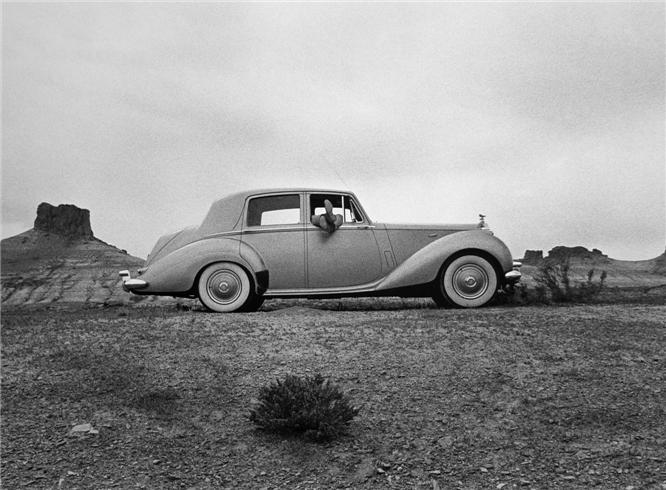
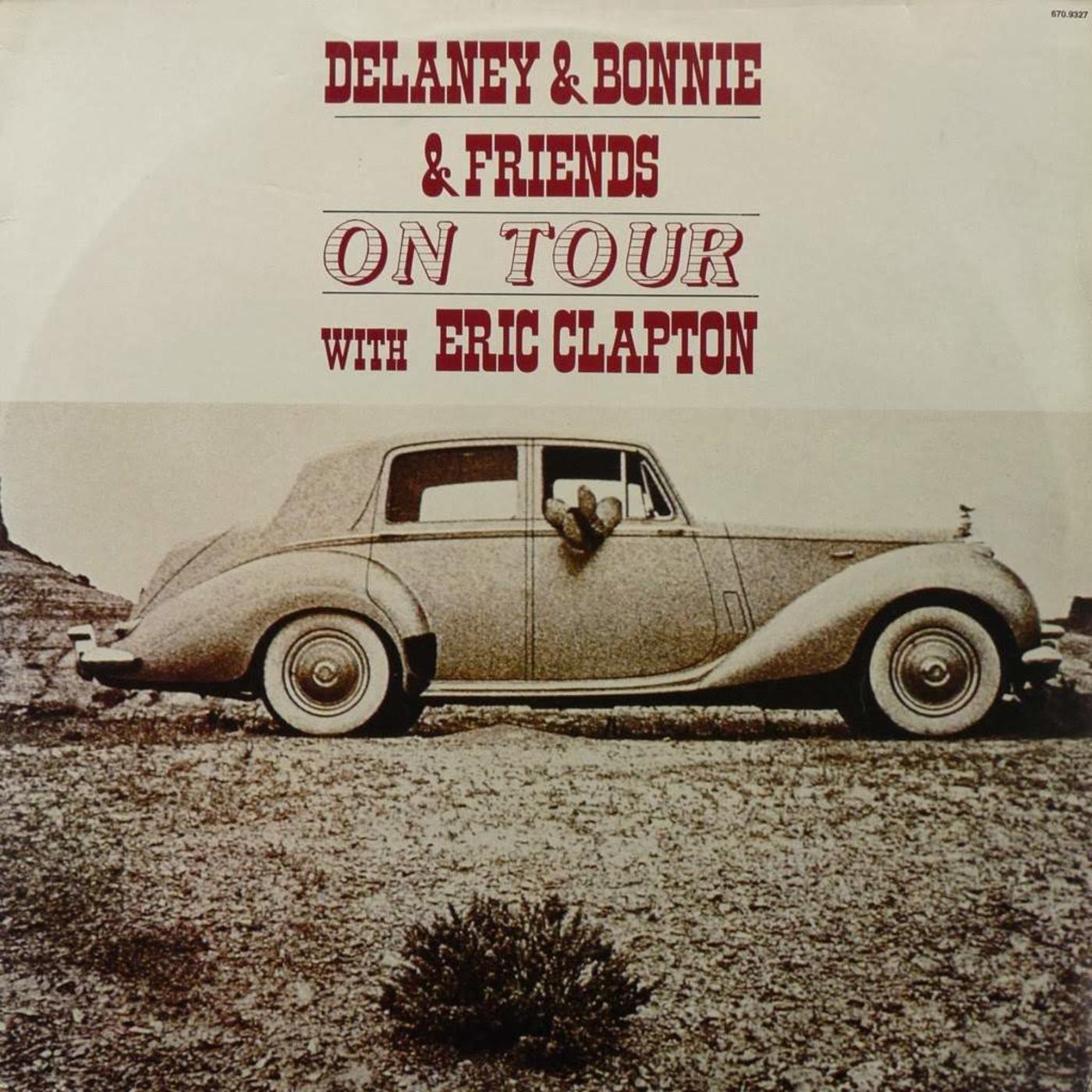
On the cover of the 1970 album Delaney & Bonnie on Tour with Eric Clapton, there is a photo of a Rolls Royce. On the car’s front seat, someone seems to be asleep, as a pair of boots is sticking out of the open window.
The photographer was Barry Feinstein. These boots (and the feet in them) belong to Bob Dylan and the car was from his manager Albert Grossman.
It is that car that brought the singer and the photographer together.
In the early Sixties, Feinstein worked as freelance photographer for Life magazine. His work stands out, because of his unusual images of celebrities: from Hollywood stars to President John F. Kennedy. “I didn’t want to photograph the glamour end of it,” he later explained. “I wanted my pictures to say something. I don’t really like stand-up portraits, there’s nothing there, no life, no feeling. I was much more interested in capturing real moments. [….] It was the behind the scene thing – that part of Hollywood that nobody thinks about or looks at.”
In early September 1963, Feinstein was visiting the Grossman’s office in New York, when Bob Dylan walked in to see his manager.
Feinstein was a friend of Albert Grossman, whom he had met through his fiancée: Mary Travers – the singer of Peter, Paul and Mary, also clients of Grossman. The folk trio recently had a big hit with Dylan’s “Blowin” In The Wind”. Allegedly, Grossman bought the Rolls Royce with the money he made from that hit.
The vintage 1953 Silver Dawn is refurbished in a garage in Denver and now Grossman is looking for a volunteer to pick up the car and bring it home. Feinstein offers himself as a volunteer, but mentions that doesn’t like to make the trip alone. “Maybe Bob would like to take a ride with you,” suggests Grossman. Dylan is willing to come.
Together they fly to Denver and then drive the 1.800 miles back. ‘It was a long drive but a fun trip,” Feinstein writes in his book Real Moments: Photographs of Bob Dylan 1966-1974.
“We stopped off along the way whenever we felt like it. Bob wanted to check out an old-style saloon bar in Central City, where he used to play the piano for a stripper.
“Each time we stopped more people would recognise Bob; he was really amused by it all. One time we pulled over to listen when a song from Bob’s new album played on the radio.
“We didn’t talk much unless there was something really to say. That’s how I am and it’s how Bob was too, so we got along fine. Over time we hung out more and understood each other’.”
En route, the two men become friends. So when a portrait for the sleeve of Dylan’s third album is needed, Feinstein is the obvious choice.
“Columbia asked me to do an album cover,” Feinstein explained. “So I took Bob up to my friend John Cort’s penthouse apartment in New York City. I said, ‘Let’s go to the edge on the balcony and make some pictures.’ I was kneeling down and I said to Bob, ‘Look around, look at the landscape, the city and this and that.’ I went click, click, click.
I didn’t have to shoot a lot of pictures because I knew immediately it was a very unusual shot and an angle and a moment with Bob.” Ten minutes and the job is done.
“We looked at the proof sheet and he chose that shot. In those days the record company normally chose the picture for the cover, especially Columbia, but they let him do it this time. They did a good job. It wasn’t premeditated or anything, it was one of the quickest and easiest photo sessions I’ve ever done.”
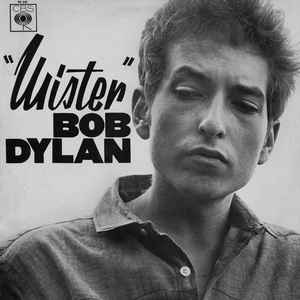
The Times They Are A-Changin ’is all about protest and social conflicts and the intense black-and-white photo portrait of a serious-looking Dylan emphasizes this.
He looks bleak, as if at the age of 22 he already has a cross to bear, the heavy burden of violence and the injustice of the world.
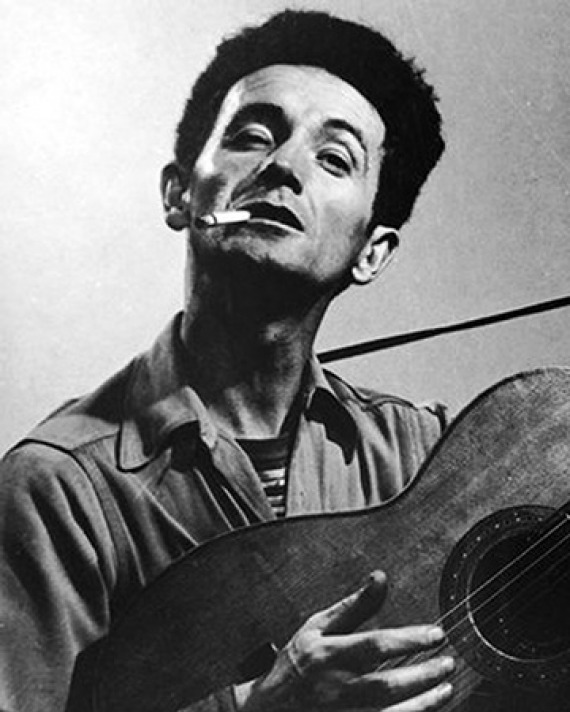
The resemblance to a portrait of Woody Guthrie is striking.
Commissioned by Life, Feinstein follows Dylan’s tour of 1966 (think of the photo on the cover of No Direction Home) and is also the official tour photographer in 1974.
Because of this and his cover photos for George Harrison (All Things Must Pass – 1970) and Janis Joplin (Pearl – 1971), Feinstein became an influential rock photographer.
This time a poem by Dylan appears on the back of the cover: “11 Outlined Epitaphs” The text continues on both sides of the inner cover.
In France, the album was renamed: ‘Mister’ Bob Dylan.
An index to our latest posts arranged by themes and subjects on the home page. You can also see details of our main sections on this site at the top of this page under the picture.
There is an alphabetic index to the 550+ Dylan compositions reviewed on the site which you will find it here. There are also 500+ other articles on different issues relating to Dylan. The other subject areas are also shown at the top under the picture.
We also have a discussion group “Untold Dylan” on Facebook which mostly relates to Bob Dylan today. Just type the phrase “Untold Dylan” in, on your Facebook page or follow this link
And please do note The Bob Dylan Project, which lists every Dylan song in alphabetical order, and has links to licensed recordings and performances by Dylan and by other artists, is starting to link back to our reviews.
As pointed out previously, the two riders in the song below are none other than attendant thief Bob Dylan, and jokester nurse Allen Ginsberg:
Two riders were approaching
The wind began to howl
(Bob Dylan: All Along The Watchtower)
They hope to hatch a plan to save drifter Jesus from being crucified on the cross; one of His followers has been accused of attacking a guard of a high priest:
There must be some way out of here
Said the joker to the thief
"There's too much confusion
I can't get no relief"
(Bob Dylan: All Along The Watchtower)
Within the Holy Bible, the two riders find the answer to the way out, and together they come up with a plan worthy of Charles Dickens.
That Bob Dylan practices Gnostic time travelling has been pointed out in other Untold articles, but for those who are non-believers here are other clues that Dylan’s persona is from the separate Spirit World, and is capable of transforming himself into any physical manifestation on Earth that he chooses.
In the movie ‘Renaldo And Clara’, Bob Dylan and poet Allen Ginsberg are shown visiting the ‘ Way Of Sorrows’ religious icons, one of which is “Simon of Cyrene Helps Jesus’. Some Gnostics claim that Libyan Simon takes the the place of Jesus on the cross since Christ is from the Other World, and therefore cannot be put to death. But of Simon, little is known.
The Holy Bible contains remanents of that Gnostic story:
And they compel one Simon, a Cyrenian
Who passed by, coming out of the country
The father of Alexander and Rufus
To bear His cross
(Mark 15: 21)
Always in search of further knowledge, there are Gnostics who question the assertion that it’s Simon who gets crucified. Apparently, Bob Dylan, or at least his persona, transfigures himself into a detective Sherlock Holmes archetype in search of the truth:
Well, I'm goin' off to Libya
There's a guy I gotta see
He's been livin' there three years now
In an oil refinery
I've got my mind made up
Oh, I got my mind made up
(Bob Dylan: Got My Mind Made Up ~ Dylan/Petty)
Unfortunately, because Gnostics are bound by an oath of secrecy, we do not find out from Dylan if he finds it’s the Cyrenian Simon who’s in the Libyan refinery. Of course, then Simon would have had to have returned from the Spiritual Plain rather than being dead as a doornail. It’s all rather mysterious, but the clues left behind in the lyrics by the singer/songwriter cannot be ignored.
Not to mention that the jokester and the thief apparently succeed in their mission:
"No reason to get excited now"
The thief he kindly spoke
"There are many here among us
Who feel that life is but a joke
But you and I, we've been through that
And this is not our fate
So let us not talk falsely now
The hour is getting late"
(Bob Dylan: All Along The Watchtower)
Whatever truth lies behind the fates of Simon and Jesus, the story serves as a template for other songs by Bob Dylan. In the lyrics below, it seems that Rosemary sacrifices herself for the sake of Lily, a Mary Magdalene archetype, and for the Jack Of Hearts – for JOH, for JehOvaH, if you like (to confuse matters further, some Gnostics consider Jehovah, the creator of the physical realm, to be a demiurge, but not so the ‘real’ Jesus from the Spirit World):
The next day was hangin' day, the sky was overcast and black
Big Jim lay covered up, killed by a penknife in the back
And Rosemary on the gallows, she didn't even blink
The hangin' judge was sober, he hadn't had a drink
The only person on the scene missin' was the Jack Of Hearts
(Bob Dylan: Lily, Rosemary, And The Jack Of Hearts)
The characters present in the song below obviously influenced the author of the song above:
I stepped up to my rival, dagger in my hand
Being mad by depression, I pierced him to the breast
All this for lovely Flora, my Lily of the West
They placed me in the witness box, and then commenced on me
Although she swore my life away, deprived me of my rest
Still I love my faithless Flora, the Lily of the West
(Bob Dylan: Lily Of The West ~ Davis/Peterson)
Thank goodness that the sun is shining, and everything is clear now!
What else is here?
An index to our latest posts arranged by themes and subjects on the home page. You can also see details of our main sections on this site at the top of this page under the picture.
There is an alphabetic index to the 550+ Dylan compositions reviewed on the site which you will find it here. There are also 500+ other articles on different issues relating to Dylan. The other subject areas are also shown at the top under the picture.
We also have a discussion group “Untold Dylan” on Facebook which mostly relates to Bob Dylan today. Just type the phrase “Untold Dylan” in, on your Facebook page or follow this link
And please do note The Bob Dylan Project, which lists every Dylan song in alphabetical order, and has links to licensed recordings and performances by Dylan and by other artists, is starting to link back to our reviews.
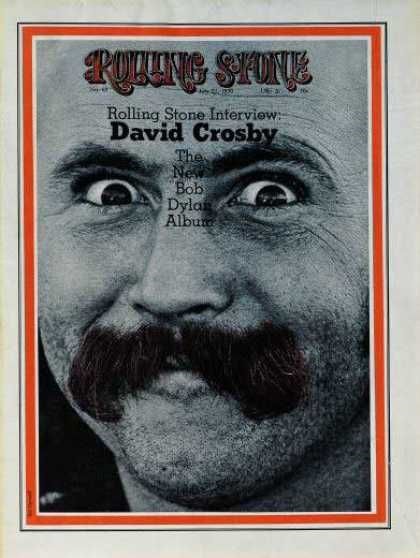
Dylan is now only a big name from the past, the bitterly disappointed Greil Marcus argues, in his famous What-is-this-shit review of Self Portrait in the Rolling Stone of July 23, 1970. Unless … “unless he returns to the marketplace, with a sense of vocation and the ambition to keep up with his own gifts.”
Eight years later, in the poetic explosion with which he opens the Street Legal album, in “Changing Of The Guards”, the poet responds: “I stepped forth from the shadows, to the marketplace.”
In a similar, reflective interpretation, the opening lines, sixteen years, sixteen banners united over the field, are a reference to the sixteen years Dylan has been active as a recording artist and to the sixteen studio records he has delivered so far.
Nice find, but not very likely. Such an all too personal retrospective of his own career would be very, very atypical, far too vain and petty for a poet who often, and credibly, says: je est un autre. The private worries the poet Dylan lets trickle down into his work always have a universal, ego-transcending value; the passing of time, the loss of a love, the human condition – something as egomanic as my sixteen years in the market place fits in poorly.
The baroque exuberance of the text fascinates and invites to take a stand, that much a trip through the fields makes clear. In addition, many clarifiers remain stuck in the – not always admiring meant – conclusion that the lyrics are so ambiguous. That is euphemistic; in the vast majority of analyses, the reader is taken along a few more and less far-fetched associations, to discover at the end that the analyst is unable to produce one single interpretation, let alone more interpretations. And those few Dylanologists who bravely attempt to capture “Changing Of The Guards” in one conclusive interpretation, go down struggling.
David Weir, who fills his otherwise enjoyable blog Bob Dylan Song Analysis with well-written, worth-reading interpretations, knows that the song is about the life of Christ, “from before his birth to after the resurrection”. For that interpretation, contortionist Weir squeezes and bends himself in some quite impossible twists and turns. The enigmatic line he’s pulling her down, and she’s clutching onto his long golden locks, for example, actually means: He, the risen Jesus, pulls God (“she”) down to earth so that He and God can unite to a whole. And if, for the sake of convenience, we’d be so good to read the sun is breaking as the son is breaking, then that verse does tell of the resurrection of Jesus.
Mr. Weir is not the only one who seizes Dylan’s upcoming conversion to Christianity as the key to text explanation, but he is the only one who tries to squeeze almost every image from the text, with laudable stubbornness and creativity, into that mold. Without success in the end; the Saviour’s biography as a key to the work is not at all convincing. The same goes for cherry-picking analysts such as Prof. R. Clifton Spargo, who finds the song a “stunning rewriting of the Samson story”, triggered by the mentioning of a shaven head (of a woman, unfortunately) and broken chains. Or Clinton Heylin, who suspects a “Babylonian narrative of lust and betrayal”, whatever that may be, but ultimately opts for the End Times.
The Apocalypse is seen by more readers. The most creative cryptoanalyst is a blog reader who points out to David Weir that the number 16 in sixteen years and sixteen banners was probably not chosen at random. Revelation 16:16 reads “And he gathered them together into a place called in the Hebrew tongue Armageddon” – the Bible verse that reveals the location of the Last Battle, also the place where the I-person on Side 2, in Señor, fears to go.
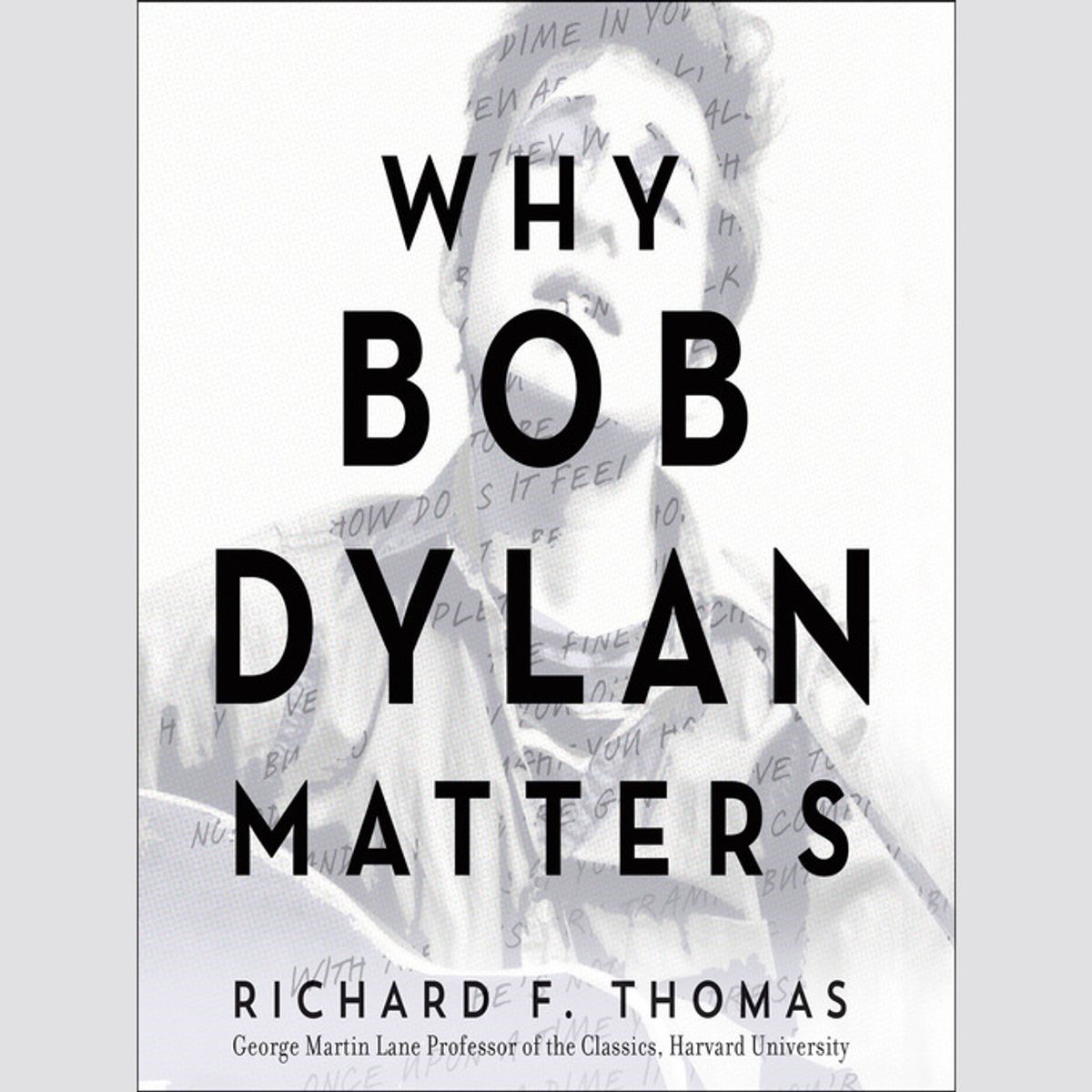
Harvard professor Richard F. Thomas produces the most fascinating commentary on “Changing Of The Guards”. The Professor of Classical Languages is becoming quite a name in Dylan circles. Not only due to his resounding, erudite article from 2007, The Streets Of Rome: The Classical Dylan, but also because he alternates his lectures at Harvard on Homer, Virgil and Ovid with a lecture block on Dylan, to the dismay of some of his academic colleagues. Thomas distilled the brilliant work Why Dylan Matters (2017) from that famous lecture block and therein he devotes an entire section to The Guards.
Thomas is, obviously, taken with Dylan’s words from the interview with Jonathan Cott from 1978. “Changing Of The Guards is a thousand years old (…), might be a song that might have been there for thousands of years, sailing around in the mist and one day I just tuned into it.”
Dylan’s statements in this very conversation are often quoted and that is understandable. The master seldom elaborates on his songs and here he vents some pleasantly misty, very Dylanesque hints. “We’re all dreaming, and these songs [from Street Legal] come close to getting inside that dream. It’s all a dream anyway,” and “It means something different everytime I sing it.”
Seemingly very revealing and mysterious at the same time, but what both Thomas and all those others prefer to ignore: the words are almost literally put into Dylan’s mouth by the interviewer.
JC: The lines, “She’s smelling sweet like the meadows where she was born/On Midsummer’s eve, near the tower,” are so quiet and pure.
BD: Oh, yeah?
JC: Those lines seem to go back a thousand years into the past.
BD: They do. Changing Of The Guards is a thousand years old.
Despite that, despite the few serious outpourings by Dylan himself, Prof. Thomas, the expert in ancient literature, goes looking. He acknowledges that the song, with all these peculiar images, situations and characters, escapes a comprehensive interpretation. But he does think that the lyrics owe much to both the world of Rome and the Biblical world, given the clear references. He is then triggered by the image on the page next to “Changing Of The Guards” in The Lyrics 1961-2012. On that image, a black-and-white cut-out of the cover, are different typewriter letters, first versions of the fourth and the eighth verse, supplemented with handwritten words. That fourth verse in particular intrigues, where he decipheres:
I stared into the eyes—Ages roll—upon Jupiter & Apollo
Midwivesstroll between jupiter & apollo Struggling babes past (Between the sheets of . . . Destiny’s faces miraculous one-eyed glory
The Professor of Classical Literature immediately jumps up: he recognizes almost all – later deleted – words from a poem by Virgil, Ecloge 4, one of the ten shepherds’ poems Virgil publishes around 38 BC. Quite unfathomable poetry, in which the birth of a Saviour is told, a Saviour who will become divine and rule the world. Christians see, of course, a prophetic announcement of the First Coming, of Jesus (but it is more likely that the immodest Virgil uses the birth of a wonderful, divine child as a metaphor for the creation of his own poetry).
The disappointed are in the majority. Not only with the professional critics at the time of publication, but also with the fans, who are still going on in the various forums decades later. On expectingrain, for example. “Vague, disorganized and badly written”, “Bob lost in his own clichés”, “over-written parody”, “embarrassing”, “could have been written by a computer program”, “betrays cocaine abuse”, “confused, portentous self-parody”, “a catalogue of narcissism and mannerism” and one of the most beautiful sentences of all 655720 pages and more on expectingrain’s General Discussion pages : “This song alone should disqualify Dylan from any consideration for a Nobel Prize.”
A harmonica albert writes this in July 2010, six years before Dylan is awarded the Noble Prize.
It cannot entirely be felt, this Guards-bashing. The song is really not that much different from acclaimed classics like “Farewell Angelina” or “Desolation Row”. No recurring line of verse, that may rob the disappointed of a hold. But apart from that? We have come to know and admire the accumulation of seemingly unrelated, strong visual images, the subcutaneous, hazy symbolism and the love for rhyme and rhythm for years. The crowded arrangement, with wind instruments, organ, percussion and ladies’ choir, is perhaps uncomfortable, or at least unusual for the Dylan fan in 1978, but should no longer evoke disgust decades later; the loose, soulful band actually embeds the song in a swinging, pleasant sounding and melodic setting.
Dylan himself is quite fond of the song. He has it released as a single, selects it for Greatest Hits Volume 3 in 1994 and again for another compilation album, for Dylan (2007), and performs it about seventy times in 1978. Invariably as an encore, both in Europe and at all performances at home in America. But the criticism also seems to affect him. He never performs the song again after 1978, not even after he arbitrarily appoints it as a Greatest Hit, and in an interview for Q Magazine (December ’89) the master, when asked, actually slightly criticises precisely this song. Interviewer Adrian Deevoy asks about the songs on the recently released Oh Mercy:
AD: Have you made your lyrics consciously less cryptic?
BD: Well, uh, no. You see these songs weren’t consciously anything. They were mostly just streams-of-consciousness stuff.
AD: But is being cryptic in your writing something you’ve veered away from? Songs like Changing Of The Guard on Street Legal.
BD: Yeah. Maybe. Maybe. We used to do that song Changing Of The Guard quite a few times, quite a bit a few years ago. And the more we did it, the less cryptic it became.
AD: How do you mean?
BD: Doing it night after night, it becomes a lot less cryptic to the person singing it.
AD: What? Less cryptic to you?
BD: To me, yeah.
AD: It’s a very dream-like song. He nods vigorously.
BD: Yeah, yeah… (Then reconsiders) It could have used some editing a song like that.
On the contrary, an admirer like Prof. Thomas would say: Dylan’s refining, planing, and polishing only diluted the Virgil references. Moreover, one may wonder to what extent the song is cryptic, to what extent the words have a hidden meaning. More obvious is the observation that the poet, as is often the case here, is initially guided by the sound of the words, which fill his creating mind in a stream of consciousness, in a continuous stream of thoughts, without clear logic. And apparently uncoordinated Biblical scenes, memories of Virgil and less grand images pop up.
The black nightingale, for example. Although black nightingales do not exist, the association itself is not too difficult to grasp. A nightingale sings at night, it is a night bird, the prefix “night’ automatically leads to “black” anyway, and besides that the music fan Dylan has often come across the metaphor as a nickname for a black singer. Belle Fields, who causes a furore from the 1890s to the 1920s especially in Europe (Norway, The Netherlands, Germany), is the best known, but also a Miriam Makeba sometimes gets that name, just like the nurse Mary Seacole (1805-1881), a coloured colleague of Florence Nightingale.
That does not shed any light on an alleged hidden meaning of the verse in question, or of the lyrics at all. But nevertheless (or perhaps partly because of that) it is a beautiful, poetic passage: A messenger arrived with a black nightingale / I seen her on the stairs and I couldn’t help but follow.
The same applies to a text fragment like mountain laurel and rolling rocks. A verse later the poet paraphrases Matthew 17:20 (in which Jesus says that faith can move mountains) with I’ve moved your mountains. The association with the pleasant assonating mountain laurel and the classic alliteration rolling rocks is easily made, but of course it tells nothing. “Mountain laurel” is the somewhat misleading name for calmia latifolia (so actually spoonwood broadleaf). The plant is pretty poisonous and widely distributed throughout almost the entire eastern United States. Dylan will therefore mainly have chosen it because of that pleasant assonance, but in addition, “mountain laurel” also suggests something with mythical struggle, heroics, with ancient legends. And fits beautifully within a text in which besides Bible fragments and shavings of Roman culture also hints of folklore must provide the colour. After all, the witches, shoeshine and the Rapunzel-like scene, including long blonde locks, provide some archaic, European fairy tale colour – and a mysterious mirroring with the closing song of Street Legal, with “Where Are You Tonight?”
Surely, a protagonist singing “I climbed up her hair” and “clutching to golden locks” really can only be referencing that tragic long-haired beauty… or maybe, maybe the poet just succumbs to the rhythmic beauty and the vowel harmony of on to his long golden locks. Which is, indeed, a wonderful finale of this extraordinary, very visual verse:
She wakes him up
Forty-eight hours later, the sun is breaking
Near broken chains, mountain laurel and rolling rocks
She’s begging to know what measures he now will be taking
He’s pulling her down and she’s clutching on to his long golden locks
Equally evocative are the incomprehensible tarot references, with which Dylan apparently aimlessly interlaces the song. The aforementioned Jonathan Cott, who often speaks with Dylan between the end of ’77 and September ’78 and publishes two interviews in Rolling Stone, drones on about all the tarot symbolism he discovers in “Changing Of The Guards”. The Moon, the Sun, the High Priestess, the Tower and of course the King and the Queen of Swords from the final line can all be found on tarot cards and the all too eager Cott does have theories. But Dylan rejects them all, slightly embarrassed, as it seems. “I’m not really too acquainted with that, you know.” Three years later, in an interview with Neil Spencer in New Musical Express, he repeats that almost literally: “I don’t know. I didn’t get into the Tarot Cards all that deeply.”
The fruitlessly puzzling cryptoanalysts should comfort themselves with those famous words that the master himself entrusts to interviewer Ron Rosenbaum in November ’77, so in the same weeks when he writes this song:
“It’s the sound and the words. Words don’t interfere with it. They… they… punctuate it. You know, they give it purpose.”
… which he does seem to mean seriously. In his overwhelming Nobel Prize Speech, almost forty years later, repeating again that the sound is more important to him than the meaning of the words:
“[The songs] can mean a lot of different things. If a song moves you, that’s all that’s important. I don’t have to know what a song means. I’ve written all kinds of things into my songs. And I’m not going to worry about it – what it all means. (…) I don’t know what it means, either. But it sounds good. And you want your songs to sound good.”
The Patti Smith version is a small masterpiece. Smith, who also has such a remarkable “Wicked Messenger” to her name, surprises with a driving, inspired cover in a – compared to the original – stripped-down arrangement. Muted drums, a murmuring guitar and modest fillings of a piano and an equally modest second voice from daughter Jesse Paris, but beyond that is the driven, emotion-laden recital of Smith – Patti seems to know very well what she is singing here (on Twelve, 2007).
The contribution of The Gaslight Anthem to the tribute album Chimes Of Freedom: The Songs Of Bob Dylan Honoring 50 Years Of Amnesty International (2012) is generally received favorably, and is even praised in some forums, but really does not match Patti Smith; frankly, the stadium rock arrangement and the acted outburst of singer Brian Fallon bores rather quickly. After all, it is not a Bruce Springsteen song and moreover, we already knew the adrenaline approach from Frank Black, who then at least adds more raw, angular energy to it (All My Ghosts, 1998).
Chris Whitley and Jeff Lang (Dislocation Blues, 2007, recorded half a year before Whitley’s death) are the only ones who can rival Smith. The duo opts for a spectacularly different approach and produces a slow, sultry version with a very attractive, pleasant Delta Blues atmosphere, filled with despair, lost love and regret.
It is a cover that most likely pleases the master too, a cover that brings the song forth from the shadows, to the marketplace.
https://www.youtube.com/watch?v=oKr6nXJoO2M
What else is here?
An index to our latest posts arranged by themes and subjects on the home page. You can also see details of our main sections on this site at the top of this page under the picture.
There is an alphabetic index to the 550+ Dylan compositions reviewed on the site which you will find it here. There are also 500+ other articles on different issues relating to Dylan. The other subject areas are also shown at the top under the picture.
We also have a discussion group “Untold Dylan” on Facebook which mostly relates to Bob Dylan today. Just type the phrase “Untold Dylan” in, on your Facebook page or follow this link
And please do note The Bob Dylan Project, which lists every Dylan song in alphabetical order, and has links to licensed recordings and performances by Dylan and by other artists, is starting to link back to our reviews.
Let’s start with an excerpt from Springsteen’s memoir “Born To Run”
“Bob Dylan is the father of my country. Highway 61 Revisited and Bringing It All Back Home were not only great records, but they were the first time I can remember being exposed to a truthful vision of the place I lived. The darkness and light were all there, the veil of illusion and deception ripped aside. He put his boot on the stultifying politeness and daily routine that covered corruption and decay. The world he described was all on view, in my little town, and spread out over the television that beamed into our isolated homes, but it went uncommented on and silently tolerated. He inspired me and gave me hope.
“He asked the questions everyone else was too frightened to ask, especially to a fifteen-year-old: ‘How does it feel… to be on your own?’ A seismic gap had opened up between generations and you suddenly felt orphaned, abandoned amid the flow of history, your compass spinning, internally homeless. Bob pointed true north and served as a beacon to assist you in making your way through the new wilderness America had become. He planted a flag, wrote the songs, sang the words that were essential to the times, to the emotional and spiritual survival of so many young Americans at that moment.
“I had the opportunity to sing ;The Times They Are A-Changin’ for Bob when he received the Kennedy Center Honors. We were alone together for a brief moment walking down a back stairwell when he thanked me for being there and said, ‘If there’s anything I can ever do for you…’ I thought, ‘Are you kidding me?’ and answered, ‘It’s already been done’.”
Going back all the way to 1975, Springsteen covered “I Want You” in concert. For me, this is prime 70s Springsteen.
Then jumping forward to 1988 and Springsteen inducted Dylan into the Rock And Roll Hall Of Fame with the famous words, “the way that Elvis freed your body, Bob freed your mind.”
“The first time that I heard Bob Dylan I was in the car with my mother, and we were listening to, I think, maybe WMCA, and on came that snare shot that sounded like somebody kicked open the door to your mind, from ‘Like a Rolling Stone.’”
That same year he added “Blowin” In The Wind” to his set list.
Also in 1988, he released a special 12” single with “Chimes Of Freedom” on the a-side for Amnesty International.
In 1995, Springsteen performed “Highway 61 Revisited” and “Knockin’ On Heaven’s Door” for a concert in Berlin.
https://www.youtube.com/watch?v=my12GQoGrYw
Bob commented on the performance of “Knockin’ On Heaven’s Door” – “Springsteen did that song like the record – something I myself have never tried. I never even thought it was worth it. Maybe never had the manpower in one band to pull it off. To tell you the truth, I’d forgotten how the song ought to go.
“Bruce pulled all the power and spirituality and beauty out of it like no one has ever done. He was faithful, truly faithful to the version on the record.”
Also, in 1995 Bob invited Springsteen on stage to perform together on a lovely version of “Forever Young”. “Let me hear you say “Bruuuce”!”
https://www.youtube.com/watch?v=YuGkMu751K8
In 2003 they got together again at Shea Stadium for “Highway 61 Revisited”. Not the best audio quality here, maybe Bob’s mic isn’t plugged in for the first verse, but it all comes together nicely after a minute of two and Bob seems to be having a lot of fun!
During the “Working On A Dream” tour in 2009, Bruce performed an amazing one off version of “Like A Rolling Stone”.
In 2006 Springsteen released “We Shall Overcome: The Seeger Sessions” featuring covers of songs associated with Pete Seeger. Including covers of several tracks Dylan also covered over the years.
First up, “Shenandoah”.
Followed by ”Froggie Went A-Courtin’”. So that’s Dylan, Presley, McCartney, Guthrie, Cave and Springsteen all recorded this one now!
Back in 1971 during the Allen Ginsberg sessions Bob and friends also ran through a version of another track Springsteen selected for the “Seeger Sessions” album. Here we have their version of “Pay Me My Money Down”
https://www.youtube.com/watch?v=xZQxM7qBRjA
There is only really one place for me to leave this article and that is with Bob’s own cover of “Dancing In The Dark”. This was made in 1990 at the infamous, 4 hour-long set at the 700 seater venue Toad’s Place. This was Bob’s very first concert of the 90s and you can tell that he doesn’t know all the words but does occasionally manage to pick out some lines, “I ain’t nothing but tired” and “shake this world off my shoulder”, the rest he just makes up. I, for one, love it!
https://www.youtube.com/watch?v=zBpXYaBg9nU
What else is here?
An index to our latest posts arranged by themes and subjects on the home page. You can also see details of our main sections on this site at the top of this page under the picture.
There is an alphabetic index to the 550+ Dylan compositions reviewed on the site which you will find it here. There are also 500+ other articles on different issues relating to Dylan. The other subject areas are also shown at the top under the picture.
We also have a discussion group “Untold Dylan” on Facebook which mostly relates to Bob Dylan today. Just type the phrase “Untold Dylan” in, on your Facebook page or follow this link
And please do note The Bob Dylan Project, which lists every Dylan song in alphabetical order, and has links to licensed recordings and performances by Dylan and by other artists, is starting to link back to our reviews.
“Which side are you on?”, writes Bob Dylan in a song that foretells of a schism that develops, and threatens to tear apart forever scholars who analyze the art of Bob Dylan. The great debate centres on the distinction between the Italian (or Petrarchan) sonnet that has as its format an eight-line octave followed by a six-line sestet, and the English (or Shakespearean) sonnet that’s composed of three quatains and a concluding couplet.
The poem below is in the form of an English sonnet in that it ends in the rhyme ~ ‘you’/’new’:
When I consider every thing that grows
Holds in perfection but a little moment
That this huge stage presenteth nought but shows
Whereon the stars in secret influence comment
When I perceive that men as plants increase
Cheered and chequed even by the self-same sky
Vaunt in their youth sap, at height decrease
And wear the brave state out of memory
Then the conceits of this inconsistent stay
Sets you most rich in youth before my sight
Where wasteful Time debateth with Decay
To change youth to sullied night
And all in war with Time for love of you
As it takes from you, I engraft you new
(William Shakespeare: Sonnet XV)
A number of literary scholars claim that the following song is essentially an English sonnet, not an Italian one, because it can be set down in three quartrains, and an ending couplet ~ ‘grew”/’blue’:
I had a job in the great north woods
Workin’ as a cook for a spell
But I never did like it all that much
And one day the axe just fell
So I drifted down to New Orleans
Where I was lookin’ to be employed
Workin’ for a while on a fishin’ boat
Right outside of Delacroix
But all the while I was alone
The past was close behind
I see a lot of women
But she never escaped my mind
And I just grew
Tangled up in blue
(Bob Dylan: Tangked Up In Blue)
Indeed, the rift between the Dylan scholars gets so wide that many of the so-called ‘Petrachans’,
and of the the so-called ‘Shakespeareans’ refuse to talk with one another with the latter group insisting that its format is the one and only correct one.
As in:
So now I’m goin’ back again
I got to get to her somehow
All the people I used to know
They’re an illusion to me now
Some are mathematicians
Some are carpenters’ wives
But I don’t know how it all got started
I don’t know what they’e doin’ with their lives
But me, I’m still on the road
Headin’ for another joint
We always did feel the same
We just saw it from a different point
Of view
Tangled up in blue
(Bob Dylan: Tangked Up In Blue)
The former group insist that the last six lines above comprise the sestet of a Petrarchan sonnet.
What else is here?
An index to our latest posts arranged by themes and subjects on the home page. You can also see details of our main sections on this site at the top of this page under the picture.
There is an alphabetic index to the 550+ Dylan compositions reviewed on the site which you will find it here. There are also 500+ other articles on different issues relating to Dylan. The other subject areas are also shown at the top under the picture.
We also have a discussion group “Untold Dylan” on Facebook which mostly relates to Bob Dylan today. Just type the phrase “Untold Dylan” in, on your Facebook page or follow this link
And please do note The Bob Dylan Project, which lists every Dylan song in alphabetical order, and has links to licensed recordings and performances by Dylan and by other artists, is starting to link back to our reviews.
Indonesian writer Eka Kurniawan writes beautiful books and will one day win the Nobel Prize for his magical-realistic, sociocritical oeuvre, but he cannot write songs. “It’s the hardest thing there is. You have so few words at your disposal,” he analyzes, with regret, in the Dutch Volkskrant interview, 26 January 2019. “I tried, but I can’t. With me, a small story quickly expands. (…) Songwriters make a reverse movement: they can turn a big story into something very small.”
He says so when expressing his admiration for “Knockin’ On Heaven’s Door”, that he got to know in the Guns ‘n’ Roses version. And by extension, he declares to be a fan of the Indonesian Bob Dylan, Iwan Fals: “I love how he tells little stories in his songs.”
Author Rudy Wurlitzer, the screenwriter of Pat Garrett & Billy The Kid, shares Kurniawan’s admiration, but especially admires the circumstances under which and the speed with which the bard manages to fabricate that song:
“Bob wrote the film score in Mexico City,” Wurlitzer says. “But before that, one night when we were returning to Durango from Mexico City – I forget why we were there – he said he wanted to write something for Slim Pickens’ death scene, which was due to be shot the next day. He scrawled something on the airplane and showed it to me line by line and when we got off the plane, there it was, Knockin’ On Heaven’s Door.”
Wurlitzer also tells how Dylan prepares for the film, the zeal with which he plunges himself into the project and he claims that Dylan gets the role in that film through him:
“When Dylan heard that a Billy the Kid film was in the works, he came to see me at my place on the Lower East Side wanting to know if there was any way he could be a part of it. He said he was Billy the Kid in a past life. After I wrote a part for him, we flew to Durango so that he could meet Sam. We walked up to his house after dinner where Sam was drinking alone in his bedroom and staring at himself in a full-length mirror. He turned to Dylan and said, “I’m a big Roger Miller fan myself. Not much use for your stuff.”
(interview in Arthur Magazine, May 2008)
But Bloody Sam Peckinpah’s disinterest turns into adoration after he gives Dylan the chance to sing “Billy”, as James Coburn knows. Protagonist Coburn (Pat Garrett) does not mention that rejecting Roger Miller remark, but knows quite well that Peckinpah had no idea who Dylan was (“Sam didn’t know who the fuck Dylan was”). However, he also remembers that the director was converted already after one listening session:
“But when he heard Dylan sing, Sam was the first to admit he was taken with Dylan’s singing. He heard Dylan’s Ballad of Billy the Kid and immediately had it put on tape so that he could have it with him to play.”
(interview with Garner Simmons in: Peckinpah: A Portrait in Montage, 2004)
“Knockin’ On Heaven’s Door” is of course an unassailable monument. The song is one of the most covered Dylan songs, and probably one of the most covered songs of all. The film site imdb.com counts 78 films and television series that use the song for the soundtrack, and anyone who has ever held a guitar has played this song.
The popularity, however, is not due to the quality that writer Kurniawan so admires, not to “a big story” that is cast into “something very small”. Knockin’ has very few words indeed (about 45), but those few words don’t tell a story – this is lyricism, the articulation of a feeling.
On that front, this short text does a great job, and that, in particular, must have touched screenwriter Wurlitzer.
Rudy Wurlitzer displays his talent in writing novels and film scripts, and has proven himself in both fields. His experimental, psychedelic debut novel Nog (1968) immediately attracts attention and earns him his first film assignment: rewriting the script for the cult classic Two-Lane Blacktop (1971), the only film in which James Taylor can be seen as an actor. Kris Billy The Kid Kristofferson sings his own “Me And Bobby McGee” for the soundtrack and Harry Dean Stanton, who somehow runs through Dylan’s life as a continuous thread, plays a supporting role.
Substantive references to the film can be found here and there, in Dylan’s songs (Tail of the dragon in “Señor”, for example), but especially Wurlitzer’s style and theme seems to penetrate into “Knockin’ On Heaven’s Door”: expressing with as few words as possible the paradox of fearing and welcoming death at the same time.
Wurlitzer himself thanks his teacher Robert Graves (the writer of I, Claudius) for his skills to “write short sentences” and perhaps best demonstrates this particular talent in the underrated and unjustly forgotten masterpiece Homo Faber (1991, Volker Schlöndorff), the film adaptation of one of Max Frisch’s three Great Novels.
The leading role in that film is played by that other greatness in the field of condensed, meaningful film scripts, Sam Shepard (Paris, Texas being the highlight), but as far as is known, Shepard does not interfere with this scenario. Walter “Homo” Faber is a twentieth-century Oidipus, a poor communicator, who firmly believes in technology, control and rationality – and for that, Fate punishes him with improbable, cruel “coincidences”. Wurlitzer’s script is sparse, brooding and overflowing under the surface – demonstrating Kurniawan’s ideal; telling a big story with few words.
Thematically, Wurlitzer also aims at what Dylan manages to achieve in those few words of “Knockin’ On Heaven’s Door”: reconciling extremes, as Dylan does with the extremes fear of death and resignation.
Deputy Cullen Baker (Slim Pickens) has been fatally hit and stumbles to the bank of the river, where he collapses, leaning on a large rock. Upset, his tough wife (Katy Jurado) sees it happening. She rushes towards him, but does not dare, cannot bring herself to take the last steps and sinks down, broken, three meters away from her beloved husband and watches silently crying as he dies, in his eyes a mixture of regret and resignation, looking out over the peaceful, slow flowing river in the evening light.
And over it all, “Knockin’ On Heaven’s Door” swells up, the lyrics of which not only convey this specific death scene, but the entire film as a matter of fact: that cold black cloud is comin’ down, feels like I’m knockin’ on Heaven’s door.
The chosen imagery is not new and illustrates the grand mastery of the cherry-picking thief of thoughts Dylan. The text is actually an amalgam of “Fixin’ To Die”, Bukka White’s classic that Dylan sings on his first album, and “Trying To Get To Heaven” by Reverend Gary Davis, and especially Al Koopers version with the chorus “Tryin’ to get to heaven in due time / Before the heaven doors close” (“Wake Me Shake Me”, The Blues Project, 1966)… which will descend even more literally in “Tryin’ To Get To Heaven” (1997, Time Out Of Mind), of course.
Part of the popularity among fellow musicians is due to the simplicity of the music. Only three chords, G-D-C, well alright: four (the C is interspersed with twin sister Am7), a chord scheme that every beginning guitarist has in his fingers after an hour. Although, according to George Harrison, it is not that easy, as he notes in an interview with Paul Cashmere, 1993:
PC: Have you heard Guns ‘n’ Roses “Knocking on Heaven’s Door”?
GH: Yeah, didn’t even get the chords right, did they?
PC: So I take it you’re not a big fan of that one, then?
GH: There’s only three chords in it, but they managed to get one of them wrong. (laughs)
A bit vicious, but funny still. Meanwhile, the cover of Guns ‘n’ Roses is the most successful version of the song (Top 10 in fourteen countries, in three of them at number 1) and whatever one may think of Axl Rose’s vocal acrobatics: he can sing, with its incredible range of five octaves and some. The talents of guitarist Slash are generally recognized as well, even by Dylan (Slash is invited to the sessions of under the red sky). And oh well, cheating with the chord scheme does suit the rebellious image of the band.
For the lyrics, Axl Rose does respectfully stick to the published lyrics, although that happens to be the part of the song which is not carved in stone. Dylan sings dozens of variations. An outtake of the original sessions in Burbank, February ’73, has an extra couplet, the long black cloud is a long black train, and the Before The Flood version of 1974 even has an extra, third couplet:
Mama wipe the blood from my face
I’m sick and tired of the war
Got a lone black feelin’, and it’s hard to trace
Feel like I’m knockin’ on heaven’s door
During the Rolling Thunder Revue (’75 -’76) the lyrics differ almost every evening. Other than “blood from my face” Mama also takes “bells out of my ears”, “tears out of my eyes”, “my barge down the sea” (Deputy Baker builds his own sloop and dreams of sailing away), but the most solemn, old-fashioned, antiquish version is for Roger McGuinn to sing, Waterbury, November ’75:
Mama I can hear that thunder roar
Echoin’ down from God’s distant shore
I can hear it callin’ for my soul
Feel I’m knockin’ on heaven’s door
Those who are eager to find autobiographical traces in Dylan’s songs can indulge in the 1981 versions, when the bard sings repeatedly: Two brown eyes are looking at me. On the other hand: “Mama”, Mrs. Cullen Baker (Katy Jurado), also has big, beautiful, brown eyes. Just ask John Wayne, Elvis, Marlon Brando, Ernest Borgnine, Tyrone Power, all those men who were so fortunate as to look into those eyes up close, and generally succumbed:
“Her enigmatic eyes, black as hell, pointing at you like fiery arrows”
(from: Darwin Porter, Brando Unzipped, 2006)
… Marlon Brando, for one, is feeling as if he is knocking on a gate to heaven.
The covers are uncountable. A site like secondhandsongs.com gives up after 139 versions, allmusic.com yields 633 hits (though with quite a few double counts), Björner comes to 165 and Wikipedia doesn’t even try, but limits itself to mentioning the most famous ones.
Warren Zevon’s subdued adaptation, recorded just before his death, is heartbreaking. Guns ‘n’ Roses and Clapton are the best known, Randy Crawford, Kevin Coyne and Roger Waters are special, but the Dunblane Tribute, the rewritten version that is recorded for charity with Dylan’s permission, really stands out.
Following the horrific shooting of school children in the Scottish village of Dunblane, in which a 43-year-old man kills fifteen children between the ages of five and six plus a teacher, musician Ted Christopher rewrites the lyrics. Mark Knopfler helps free of charge and in the Abbey Road studios, with a choir of brothers and sisters of the victims, the single is recorded on December 9, 1996. It immediately climbs to first place in the English charts.
Psalm 23 is incorporated in it (The Lord is my shepherd), the second verse has been rewritten and a third verse has been added:
Lord these guns have caused too much pain
This town will never be the same
So for the bairns of Dunblane
We ask please never again
Lord put all these guns in the ground
We just can’t shoot them anymore
It’s time that we spread some love around
Before we’re knockin’ on heaven’s door
Nobody knows what possessed the murderous coward, who commits suicide on the spot. Heaven’s Door remained closed to him, in any case.
What else is here?
An index to our latest posts arranged by themes and subjects on the home page. You can also see details of our main sections on this site at the top of this page under the picture.
There is an alphabetic index to the 550+ Dylan compositions reviewed on the site which you will find it here. There are also 500+ other articles on different issues relating to Dylan. The other subject areas are also shown at the top under the picture.
We also have a discussion group “Untold Dylan” on Facebook which mostly relates to Bob Dylan today. Just type the phrase “Untold Dylan” in, on your Facebook page or follow this link
And please do note The Bob Dylan Project, which lists every Dylan song in alphabetical order, and has links to licensed recordings and performances by Dylan and by other artists, is starting to link back to our reviews.
There are something around 300 songs that Dylan has written and/or recorded which, according to the official web site, he has never played on stage. They range from the mysterious “Unknown instrumental” to some Christmas classics as well as some monsterworks such as “Tempest”.
For many we can guess the reason – some are obscure pieces played just the once in the Basement or in the days when the maestro was struggling to get enough works together to make the next album. Others really are too big to be played in the context of a gig; Tempest itself is 1000 words and 14 minutes long – and that is a lot of the concert to take up with a song not necessarily rated that highly in the genre by all and sundry.
But others are perhaps more surprising. Maybe Bob wasn’t satisfied with “No time to think” but it is such an interesting exploration of songwriting in itself, it seems strange to leave it on the shelf forever more.
We might guess that having passed “Farewell Angelina” over to Joan to sing, Bob felt that song was done and dusted, but has he never thought of the excitement there would be in the audience to hear him perform it for the first time?
Neighbourhood Bully is one of the most commented upon songs reviewed on this site, but that too has never had an outing – and there again neither has “Property of Jesus”.
What strikes me is that there seems to be no logic to the list. I can understand Bob not bothering to go back to “Motorcycle Nightmare,” “Ballad in Plain D”, “I shall be free number 10″ and Black Crow Blues” from “Another Side”, but I was surprised to see he has never once attempted “Sad eyed lady” in public. It is a big piece, but even so…
And how about this for something a little strange…. He called the album “John Wesley Harding” but has never once performed the title track on stage. While another song from the album (you will of course know which) has been performed by Bob more than any other song during the Never Ending. And that’s one which proves (so he says) that the original is not always best.
Looking at the list from an album point of view the New Morning collection hasn’t done well. Dylan surprised us (well he surprised me) by giving “If Dogs Run Free” over a 100 runs out with several different arrangements, but has never ventured forth with “One more weekend”, “Winterlude,” “Went to See the Gypsy”, “Sign on the Window,” “Three Angels” or “Time Passes Slowly”. And several more. OK not absolute peaks of his writing I would agree, but the last of those surely is worth a meander through with a new arrangement on at least one tour.
As for songs Bob has recorded but did not write, many – perhaps most – of these also have been missed from the concert. I personally loved his versions of “Alberta” and he obviously enjoyed it enough to put two on the album of odds and ends, but not enough to perform to the wide world.
Of course I have never expected my great favourite “Ballad for a Friend” ever to turn up – I suspect Bob has utterly forgotten about it, and if it did get played and I was there I’d probably pass out on the spot, but even allowing for the oddities of my personal taste and Bob’s prediliction for doing the opposite of what we might expect, it seems odd that he has left out certain songs completely.
Why, for example, of all the songs of that era, is “Temporary Like Achilles” the one that has never seen the light of the concert hall?
Actually the list gets even odder when we look at the songs Dylan has performed once, and then never taken to again. Weirder because he went to the trouble of working out an arrangement, and then left it after one show. “Caribbean Wind” stands out, but there is also “Black Diamond Bay”, “Meet me in the morning”, “Brownsville Girl,” “Spanish Harlem Incident”, “Spanish is the loving tongue”, and on and on.
In fact about half of the songs listed on the official Dylan site have either never been played in a concert, or have only been played the once. Which means that when it comes to performance, Dylan has abandoned and ignored about half of the songs he has written and/or recorded. Of course he has written so much, but even so…
At the other end of the list you’ll know what’s coming… there are nine songs that have been performed over 1000 times, with “Things have changed” moving up all the time and undoubtedly soon to join the 1000 club.
Anyway, just for the record (as it were – and I am sure one day the record company will put out an album of the most often performed concert songs), here are those top nine in descending order (as of mid September 2019)
All Along the Watchtower
Like a Rolling Stone
Highway 61 Revisited
Tangled Up In Blue
Blowin’ in the Wind
Ballad of a Thin Man
Don’t Think Twice, It’s All Right
It Ain’t Me, Babe
Maggie’s Farm
“Things have changed” has 33 to go to get to the magic 1000.
What else is here?
An index to our latest posts arranged by themes and subjects on the home page. You can also see details of our main sections on this site at the top of this page under the picture.
There is an alphabetic index to the 550+ Dylan compositions reviewed on the site which you will find it here. There are also 500+ other articles on different issues relating to Dylan. The other subject areas are also shown at the top under the picture.
We also have a discussion group “Untold Dylan” on Facebook which mostly relates to Bob Dylan today. Just type the phrase “Untold Dylan” in, on your Facebook page or follow this link
And please do note The Bob Dylan Project, which lists every Dylan song in alphabetical order, and has links to licensed recordings and performances by Dylan and by other artists, is starting to link back to our reviews.
Singer/songwriter Bob Dylan comes in contact with the nonabstract, co-ordinating conjunctive style of Ezra Pound’s poetry indirectly through the poetics of Delmore Schultz – ‘the thing’ is the thing.
The vorticose imagery of Ezra Pound swirls in the themes of the modern symbolistic poems of Delmore Schwartz. Dominant be the imagery of a non-discriminatory whirling universe – if there be any divine plan behind the universe, it’s kept secret from most of its earthly inhabitants by the God of Creation; He’s transcendent, mysterious, and unknowable; He’s beyond, not immanent in, the material world:
Each minute bursts in the burning room
The great globe reels in the solar fire
Spinning the unique and trivial away
How all things flash! How all things flame!
(Delmore Schwartz: Calmly We Walk Through This April's Day)
A sorrowful sentiment expressed in the lyrics of the following song:
When the Reaper's task had ended
Sixteen hunderd had gone to rest
The good, the bad, the rich, the poor
The lovliest, and the best
(Bob Dylan: Tempest)
As for the distant God, He’s apparently disinterested, and just stands there looking down.
However, according to Schwartz, something stable in the whirling chaos of time, with a bit of luck, may be found to cling to – possibly someone to love:
The old error, the thought of sitting still
The senses drinking, by the summer's river
On the tended lawn, below the traffic
As if Time would pause, and afternoon stay
No, night comes soon
With the cold mountains, with desolation, unless love
Builds it's city
(Schwartz: In The Slight Ripple, The Mind Perceives The Heart)
The singer/songwriter stirs the theme into the lyrics of the song below:
I'm movin' after midnight
Down boukevards of broken cars
Don't know what I'd do without it
Without this love we call ours
Beyond here lies nothin'
Nothin' but the moon and stars
(Bob Dylan: Beyond Here Lies Nothing ~ Dylan/ Hunter)
Indeed, it’s hard to keep a good-hearted person down – his or her ‘spirit’ figuratively lives on in the memory, in the imagination, and in the world of dreams:
A master of men was the Goodly Fere
A mate of the wind and the sea
If they think they have slain our Goodly Fere
They are fools eternally
(Ezra Pound: The Ballad Of The Goodly Fere)
Similarly, writes Bob Dylan:
I dreamed I saw St. Augustine
Alive as you or me
Tearing through these quarters
In the utmost misery
With a blanket underneath his arm
And a coat of solid gold
(Bob Dylan: I Dreamed I Saw St. Augustine)
Ezra Pound would freeze the never-ending flow of time if he could:
Tell her that sheds
Such treasure in the air
Recking not else, but what her graces give
Life to the moment
I would bid them live
As roses might, in magic amber laid
Red overwrought with orange, and made
One substance, and one colour
Braving time
(Ezra Pound: Envoi)
Reminding us of the pounding imagery of Delmore Schwartz:
As for my part felt in my heart as one who falls
Falls in a parachute, falls endlessly and feel the vast
Draft of the abyss sucking him down and down
An endlessly helplessly falling, and appalled clown
(Delmore Schwartz: All Night, All Night)
And the imagery in many of the songs of Bob Dylan:
Look out kid
You're gonna get hit
By users, cheaters, six-time losers
Hang around the theatres
Girl by the whirlpool
Lookin' for a new fool
Don't follow leaders
Watch the parkin' meters
(Bob Dylan: Subterranean Himesick Blues)
What else is here?
An index to our latest posts arranged by themes and subjects on the home page. You can also see details of our main sections on this site at the top of this page under the picture.
There is an alphabetic index to the 550+ Dylan compositions reviewed on the site which you will find it here. There are also 500+ other articles on different issues relating to Dylan. The other subject areas are also shown at the top under the picture.
We also have a discussion group “Untold Dylan” on Facebook which mostly relates to Bob Dylan today. Just type the phrase “Untold Dylan” in, on your Facebook page or follow this link
And please do note The Bob Dylan Project, which lists every Dylan song in alphabetical order, and has links to licensed recordings and performances by Dylan and by other artists, is starting to link back to our reviews.
An index to all the articles in the series is given at the foot of this article, and in the index file Bob Dylan Master Harpist.
By Mike Johnson (Kiwipoet)
We ended part 1 of this postscript with a triumphant, acoustic, 1997 performance of Tangled Up in Blue. The pattern Dylan laid down in 1996, with amplified acoustic guitar and harmonica breaks, continued through to 2002 pretty much unchanged. This foot-stomper became a showcase for Dylan’s guitar and harmonica work.
I wasn’t going to include this 1999 performance, since it doesn’t break new ground, but it’s a good way of picking up from where we left off. A wonderful vigorous performance. Seems like the song has lost none of its luster for Dylan and the band
Performances continued, pretty much in the same vein, until Dylan put aside the guitar and took to the keyboards in 2002. I’ve written about this shift, and how it affected his sound, in Master Harpist 4. This song, from 2003, is a repeat, and I encourage the new reader go to that article for the full discussion.
This could well be the greatest ever performance of this song. Dylan, the band, they all sound so liberated, and boy, do they cook!
This performance, with the excited screams of the harp, is as epic and thrilling as those 1990’s ecstatic versions, while heading back in the electric direction for the guitars. Dylan evolved a mix of acoustic and electric sounds that work like charm, at least in this case. Acoustic rhythm guitar, electric bass and lead, acoustic piano.
It wasn’t until 2006/7 that we get another change in direction. Dylan moved from the piano to the organ, and at first, his tendency was to play the organ softly, lightly and whimsically, with a circus like sound. With these new arrangements, TUIB goes from being a foot-stomper to a toe-tapper. The opening harp break and the acoustic first verse takes us back to a slower, more reflective TUIB that has it roots in the original New York recordings in 1974.
Experience, as mediated through memory, becomes something not so much to be celebrated with wild sounds but gently probed. A whiff of sadness and nostalgia for times past can be heard in the opening and closing harp breaks (heartbreaks?) and while the song still builds to a climax, the mood has moved towards the somber. Here’s a performance from 2007.
From somber to desperate we go as we arrive in 2009, during which there were some highly ambivalent performances of TUIB. Again, I have written about this version in Master Harpist 4, and won’t now repeat those comments, except to say this ‘mechanical’ version, as I have nicknamed it, must be the strangest performance of TUIB you’re ever likely to hear. Strained and plodding, we’re a long way into weariness, the drudgery of memory, and far away from the ecstatic celebration of experience. Only the harp remembers the light and the airy.
By 2011, the song had regained its force and vigor. If Dylan is playing the organ here, I can’t hear it. For all its power, and Dylan’s passionate vocal, the song has been tamed a little, I can’t help but think. Those ten to twelve minute wild sprees have been cut back to a brisk six minutes. And, brilliant as the harp break is, everything is under tight control.
In 2012 there is another shift in sound, as Dylan moves from the organ back to the piano, but this time a baby grand. Bob’s love affair with his baby grand begins, and this new love starts to push out his old used to be – his trusty harp.
A new arrangement emerges for TUIB that Dylan will keep for the next four years. He does the first verses center stage, does a mid-song harp break, then heads to the piano for the last verse and some piano flourishes to end. The harp thus loses its established position as the instrument that finishes the song off. Those wonderful, wild end breaks are gone for good.
There is a sense of excitement, however, in the early days of the new arrangement, with Dylan sometimes varying the pattern by playing a harp intro, as in the link below. Some of old wildness is there, even while the song is still trimmed back to six minutes and there are no guitar breaks. Dylan toots and shimmers his way through the harp break, but the triumphant piano ending announces the arrival of Dylan’s new love in the most emphatic manner.
What makes this version special is the re-appearance of the 1984 lyrics, spliced into the more familiar lyrics. Dylan was getting ready for a major reinvention of the song.
In 2015 there was another major shift, this time with the lyrics. For some time Dylan had been cutting out some of verses, and these we sorely miss. We lose the wonderful, ‘there was music in the cafés at night/ and revolution was in the air.’ And we lose the ‘working for a while on a fishing boat’ verse.
To my mind, this compromises the epic reach of the song, the sense of a life full of incidents and craziness. These stripped down versions are not as Odyssean as the earlier, richer song.
In the 2015 version, it all gets focused down to one event – the ‘she lit a burner on the stove’ verse. This verse is sandwiched between the opening two verses and the last verse. This makes it the focal point of the song, as if memory has faded to one or two emblematic incidents; the rich variety of experience honed to a few fragmentary moments.
That, however, doesn’t detract from the brilliance of the revamped last two verses.
These are lyrics in the 2015 version, largely unchanged to the present day.
Early one morning, the sun was shining
and he was lying in bed
Wondering if she changed at all,
if her hair was still red.
But their folks they said that their lives together
sure was gonna be rough,
they never liked mama’s homemade dress,
papa’s bankbook wasn’t big enough.
He was turning on the side of the road
with the rain falling on his shoes,
Heading out for the east coast,
the radio blasting out the news,
right on through
Tangled up in blue.

She was married when they first met,
she was soon to be divorced,
Well, he helped her out of a jam I guess
but he used a little too much force.
And they drove that car just as far as they could
and they abandoned it way out west,
Splitting up on a dark, sad night
somewhere in the wilderness.
He turned around and looked at her,
as she was walking away
Saying over her shoulder,
“we’re gonna meet someday stepping on the avenue.”
Tangled up in blue.

She lit a burner on the stove
and then she swept away the dust.
“You look like someone that I used to know,” she said,
“You look like someone that I used to trust.”
Then she opened up a book of poems and she said,
“take that, just so you know.”
“Memorize these lines,
and remember these rhymes,
when you’re up there, walking to and fro.”
Every one of them words rang true
and they glowed like burning coal,
Pouring off of every page like it was written in my soul,
from me to you.
Tangled up in blue.

I’m going back again
I got to get to them somehow
Yesterday is dead and gone
and tomorrow might as well be now.
Some of them, they went to live upon the mount
And some of them went down to the ground.
Some of the names were written in flames
And some of them, well, they just left town.
And me I’m still on the road
trying to stay away from the joint.
We always felt the same
depending on your point of view.
Tangled up in blue.
Classic Dylan, that last verse. And the harp too has lost none its sharpness, it’s capacity to lift the song towards the wild and ecstatic.
And so it continued until 2017/18 when the song once more undergoes a dramatic rearrangement, but before going there, let’s just tune in to this 2016 performance. I’ve chosen it because of audience response. Oh, don’t we love this song, can’t get enough of it, and there is enough kick in the harp to take us back to earlier performances. Not quite the ecstatic version of old, but near enough for a Dylan fan!
There our story ends, pretty much. But I can’t finish without a listen to how the song sounds now, without any harp break, or guitar break. The song has some charm, but has become a tiptoe-through-the-tulips down memory lane.
Dylan’s post Sinatra singing is intriguing, to say the least, but control reigns and ecstatic rock is more than a swing and beat away. We’re down to a quick five minutes, in and out. Experience has lost its edge, perhaps; these things no longer hurt. A quick bounce and swing through the gallery of time. Was that even us?
We could say that all art is a tension between order and chaos. Too much order, and your work becomes rigid, predictable, too tightly framed. Too much chaos and there is no coherence, just a big mess. In Dylan’s work, we often see these two tendencies in play.
The song ‘Dark Eyes’ has been criticized for having too rigid a musical structure. Rigidity of form is to some extent built into rock music, more so than jazz. We think of the fanatical rigidity of the arrangements on Tempest, and the tight coherence of Frank Sinatra. In Tempest, Dylan emulated Sinatra’s method of recording, and Sinatra’s absolute control of the sound he created. Songs like ‘Narrow Way’ create a very narrow way musically indeed.
On the other hand, we find the wild innovator and improviser. The artist who could stand in front an audience and pretty much make up on the spot a whole set of new lyrics to ‘Serve Somebody’. The artist whose impulse to improvise is perhaps most vividly and clearly expressed in his harmonica solos, the best of which are touched by the wildness of a free spirit, passionate and playful.
TUIB attempts to capture the chaos of experience within the ordered development of a song. It’s all about experience – to be celebrated, anguished over, and, in the end it seems, tamed and neatly tied with a perfectly constrained musical ribbon. And only the hint of a swagger, a touch of madness in this weird piano!
I’d be foolish to assume that the story of this mighty, indestructible song, ends here. If Dylan, in his late seventies, keeps on keeping one, like that bird that flew, who can tell what the future might hold, and that beautiful little instrument, the harmonica, might yet fly again too.
The songs of Country Joe and the Fish & Samuel Walker
Research by Aaron Galbraith and text by Tony Attwood
For me Country Joe and The Fish was one of the alternative bands popularised in the UK by DJ John Peel initially on pirate radio station Radio London, and later (after the pirates were shut down after pressure from the music industry in the UK) the BBC. For me the memorable song of the band was “Not So Sweet Martha Lorraine…”
https://youtu.be/L3JgP8_P4dE
“Hey Bobby” came from the band’s fifth, and I think last, album “CJ Fish” released in 1970
My take on this Country Joe song is that it is a response to that change in Dylan at this time from the music before 1969 to that which he was singing when Country Joe and the Fish made their recording.
I had a dream the other night, everybody was there
Laughing and singing, smoke filled the air
Everybody was rapping on the way it used to be
I searched my mind for the good old days, they’re coming up you know.
Hey Bobby, where you been? We missed you out on the streets
I hear you’ve got yourself another scene, it’s called a retreat
I can still remember days when men were men
I know it’s difficult for you to remember way back then, hey.
Screamin’ Jay can’t put no spell on me, I ain’t afraid of no bones
Tell them guys in Washington, D.C. to leave my friends alone
I’m sick and tired of hearing your lies
Takes nothin’ less than the truth to get me high.
Hey, I had a dream the other night, everybody was there
Laughing and singing, smoke filled the air
Everybody was rappin’ on the way it used to be
I searched my mind for the good old days are comin’ up, you know.
Screamin Jay is, I imagine, a reference to Screaming Jay Hawkins who recorded “I put a spell on you”.
Moving on to our second choice today it is Samuel Walker – Ragamuffin Minstrel Boy
This isn’t too well known either in the UK or the States, so here are some details…
This was released on the 1975 Song For Patty album and also included on the excellent The Best Of Broadside 5 disc box set, along with several Dylan tracks and covers.
Here are the lyrics
There’s mountains in the rocky west that stand above us strong, And waves that rush on sandy shores where only wrecks belong, Men who lift a thousand pounds and build up great stone walls, And highways stretchin’ from Mexico to the hills of old Saint Paul.
But there’s one whose words are strong enough to change the seasons ’round, That ragamuffin minstrel boy from a little ol’ minin’ town.
Standin’ on a high wire three days at a time, Cannot match that minstrel and his haunting sense of rhyme. Tunnels pass through solid rock and under salty bays, But his tunes will still blow in the wind when the tunnel wall decays.
His leaves will still hang bright and green when the rest have all turned brown,
That ragamuffin minstrel boy from a little ol’ minin’ town.He’s walked down the backroad and through the velvet walls, And he’s walked beside the poor man when he heard those helpless calls. Blind eyes have been opened and deaf ears now can hear From the words that he’s sung out over lands far and near.When all comrades lay down their hand, you’ll find him with the crown, That ragamuffin minstrel boy from a little ol’ minin’ town.
Now I have to say that I had not only never heard this before Aaron offered it for this article, I had not heard of Samuel Walker – although given there are a large number of people of whom I have not heard I guess that is not saying too much.
And because I didn’t know about Samuel Walker I have been doing a spot of research, which of course may have led to some false or incomplete information. If you know more or can correct inaccuracies please do write in.
I believe he was born in Georgia in 1952 and is cited as being influenced by Dylan, Guthrie and Hank Williams. He was spotted performing by Phil Ochs who helped promote him and later recorded with Warner Brothers touring Europe twice
In more recent times he released “Misfit Scarecrow” in 2008. I do hope you enjoyed it. I certainly did.
In stories of romance, the heroes thereof often get into trouble big time: they usually manage to get away at the last second. In the New Testament, though details are lacking, it appears that Jesus of Nazareth manages to slip away from his would-be executioners after a Libyan takes His place:
And as they came out, they found a man of Cyrene
Simon by name
Him they compelled to bear the cross ....
And set up over his head his accusation written
'This is Jesus, the King of the Jews'
There were there two thieves crucified with him
One on the right hand, and another on the left
(Matthew 27: 32,37,38)
The later written Gospel of St. John omits the switcheroo story – adding to the mystery.
Singer/songwriter Bob Dylan oft places the dramatic narrow-escape motif in his song lyrics. Writes he of a member of Captain Ahab’s crew:
Tashtego says that he died and was reborn. His extra days are a gift. He wasn’t
saved by Christ, though, he says he was saved by a fellow man, and a nonChristian
at that. He parodies the Resurrection….
That theme and all that it implies would work its way into more than a few of my songs.
(Bob Dylan: The Nobel Lecture)
In the song below, the narrator has a narrow escape from death with aid from the God of Thunder:
"Oh, stop that cursed jury"
Cried the attendant and the nurse
"The trial was bad enough
But this is ten times worse"
Just then a bolt of lightning
Struct the courthouse out of shape
And while everybody knelt to pray
The dwifter did escape
(Bob Dylan: Drifter's Escape)
Also expressed in song is the viewpoint that, in a disinterested Universe, it be just a matter of good luck if one escapes from dire peril:
The ship was going under
The universe opened wide
The roll was called up yonder
The angels turned aside
(Bob Dylan: Tempest)
It’s not all about blind luck – human beings are social animals who get assistance and knowledge from others as well as learning how to cope with the surrounding physical and social environments from their own individual experiences – most manage to live ordinary, peaceful, and productive lives. However, the effects of authoritarian hierarchical social structures ensure that there are those who do not.
So expressed in the following song:
He was a clean cut kid
But they made a killer out of him
That's what they did
They said, "Listen, boy, you're just a pup"
They sent him to a napalm health spa to shape up
(Bob Dylan: Clean Cut Kid)
The lyrics of many of the songs of Bob Dylan present a somewhat Existentialist position – in the final analysis, the choice of what individuals decide to do rests squarely on their own shoulders, and they’re going to have to live with it, and suffer any negative consequenes wrought therefrom; or else change their way of thinking and behaving:
Jesus said, "Be ready
For you know not the hour in which I come"
He said, "He who is not for Me is against Me"
Just so you know where He's coming from
(Bob Dylan: Gonna Change My Way Of Thinking)
It comes to be believed by many that Jesus of Nazareth is put to death and then reborn. Indeed, it might be construed that He allows Simon of Cyrene to sacrifice himself in His stead so that Jesus is able to live on for a time, and therefore continue to inspire His apostles to spread the gospel abroad:
This is my commandment
That ye love one another, as I have loved you
Greater love hath no man than this
That a man lay down his life for his friends
(John 15: 12,13)
What else is here?
An index to our latest posts arranged by themes and subjects on the home page. You can also see details of our main sections on this site at the top of this page under the picture.
There is an alphabetic index to the 550+ Dylan compositions reviewed on the site which you will find it here. There are also 500+ other articles on different issues relating to Dylan. The other subject areas are also shown at the top under the picture.
We also have a discussion group “Untold Dylan” on Facebook which mostly relates to Bob Dylan today. Just type the phrase “Untold Dylan” in, on your Facebook page or follow this link
And please do note The Bob Dylan Project, which lists every Dylan song in alphabetical order, and has links to licensed recordings and performances by Dylan and by other artists, is starting to link back to our reviews.
The western fascination for the exotic mysticism of ancient Egypt is even older than the introduction of Egyptology in the nineteenth century. Already in Mozart’s Zauberflöte (The Magic Flute, 1791), the opera full of freemason mystique, the sage Sarastro invokes Isis und Osiris, standing in a setting of pyramids and palm branches. The appeal culminates in the following decades; the time of the pharaohs inspires thousands of operas, literary works, paintings and later also films (Cleopatra from 1917, for example, and the entire series of Mummy horror films starting in 1932).
After the Second World War, the theme fades a bit, but it never disappears. Tintin and The Cigars Of The Pharaoh is a bestseller in 1955, Asterix and Cleopatra in 1965, Indiana Jones travels with Ra’s Staff to Cairo (Raiders Of The Lost Ark, 1981), The Bangles score their world hit in 1986 (“Walk Like An Egyptian”). And even today, the perfume industry tempts customers with the scent “Egyptian Godess” (Auric Blends, $9.98 on amazon.com).
So the Isis and the pyramids from Dylan’s song do not stand on their own, but are part of an age-old tradition of Egyptian references in Western culture. And much more than that it is not, according to Jacques Levy, the co-author. In one of his last interviews, for Prism Films in May 2004, he tells quite extensively about his collaboration with Dylan.
“We didn’t get into “What do you mean by this, what’s all this” kind of stuff. I can’t tell you how many times I’ve been asked the significance of the fifth day of May. And I just fend it off. I don’t know the significance. And I don’t care. I tell people: make up your own significance. (…)
Exotic is a good word (…) The sense of a foreigness. It was exotic, but there was also some aspects of autobiography in the song. Whether mine or Bob’s. (…)
I was very interested in Western stuff, in cowboy stuff. Stuff I’d written with McGuinn all had that kind of Western flair. And a couple of songs I wrote with Bob had that too. Take a song like “Isis”. “Isis” is this cowboy story, but there’s very little that’s Western about it. The music isn’t Western and the images aren’t Western. But it feels more like a cowboy story taking place through some other kind of lens.”
Just like those Egyptian elements, those autobiographical elements are at most insignificant flavour enhancers. Isis is called a mysticalchild – in the complete Dylan catalog that adjective appears only in one other song: in “Sara”, on this same album Desire, the same Sara who wears a magical Egyptian ring in “She Belongs To Me”. Apparently the poet thinks of his future ex-wife as an ancient Egyptian beauty. The link between the names Sara and Isis is soon made – it takes place along the same lines on which Kafka calls his protagonist “Samsa”, Klaus Mann renames his collaborating brother-in-law Gustav Gründgen to “Hendrik Höfgen” (in Mephisto, 1936) and Neal Cassady changes to Dean Moriarty (On The Road, Jack Kerouac).
In the enlightening SongTalk interview with Paul Zollo, Dylan too confirms that limited depth:
“With this Isis thing, it was Isis…. you know, the name sort of rang a bell but not in any kind of vigorous way. So, therefore, it was name-that-tune time. It was anything. The name was familiar. Most people would think they knew it from somewhere. But it seemed like just about any way it wanted to go would have been okay, just as long as it didn’t get too close. (laughs)”
Not too close to himself, Dylan explains (laughing still), when asked.
A nice little story, in short. And we don’t mean anything else by that, Dylan claims a few years earlier too, to the question of a listener when the singer patiently answers questions, an hour in a radio studio in Hollywood. “It’s kind of like a journey, you know, like sort of a journey type trip. (…) I don’t really know too much in depth what it would mean.”
Like sort of a journey type trip is a very scanty summary of the fateful odyssey that the main character from “Isis” undertakes, but Dylan’s point is clear: the sparkle of the song is not so much in the narrative quality, and certainly not in hidden meanings, but in the visual power, the unexpected turns and the beauty of the words. The protagonist undertakes a long journey full of hardships and eventually returns to his legal wife – a real odyssey, something like Odysseus did.
It is not very clear where Levy sees a cowboy story. The main characters travel on horseback, that’s about it. And the word canyon is spoken, but then again; this canyon is icy and snowy, not exactly the kind of canyon one would immediately associate with the Wild West. In fact, the ballad is teeming with decor pieces and props that push the imagination half a world the other way. The main characters meet at the launderette, travel to the cold North and find an empty tomb in an icy pyramid. The backdrop of the homecoming is a grassy meadow near a dry creek, at sunset.
The listener does not see Once Upon A Time In The West, but rather apocalyptic landscapes from a movie like Mad Max or the Bible book Ezekiel, or fantasy worlds like in The Lord Of The Rings. In any case “exotic”, that part of Levy’s analysis is traceable.
The dialogues are no less enigmatic and through and through Dylanesque. Conversations brushing past each other, answers that don’t answer, dialogues that only seemingly make sense.
“Where are we going?”
“We’ll be back by the fourth.”
“That’s the best news that I’ve ever heard!”
He comes back from the Cold North, has just put the body of his companion in an empty tomb in an icy pyramid. But when asked, that was “no place special”.
Tone and the confusing content of the dialogues are comparable to Kafka’s parables, but also from Dylan’s more surreal press conferences and interviews. And Dylan’s life partners undoubtedly recognize it too. “You who are so good with words and at keeping things vague,” as Joan Baez would put it in “Diamond & Rust”. Infuriating when trying to decide on a new ceiling lamp together at the Ikea, but in a song text like “Isis” these kinds of dialogues get an irresistible, deeply poetic shine.
Just as irresistible is the music, or rather: Dylan’s recital. The musical accompaniment is simplistic and effective, really no more than a rolling, falling ostinato (Ⅰ–ⅤⅠⅠ♭–Ⅳ–Ⅰ). Hypnotising enough, but the interpretation elevates the song to a Dylan classic. And not so much because of the combination of the stubborn, mesmerizing piano hammering and the elegant, enticing violin and the driven harmonica; it is mainly Dylan’s vocal performance. The bard sings masterfully meandering around those piano chords, powerful and confident, stretching vowels so that the words merge into one – as if he is playing a saxophone solo. Take a verse like the opening line of verse three, “A man in the corner approached me for a match”; a serpentine of dancing, waltzing sounds, the meaning of which, indeed, is actually no longer important.
Underexposed is the remarkable supporting role of the drums. Most hits from the exceptional talent Howie Wyeth (also a fairly skilled ragtime and jazz pianist) are just milliseconds outside the beat, granting the recording this fascinating, driving dynamic.
Dylan is impressed too. “Your drummer sounds great,” he tells bass player Rob Stoner, who brought his drum buddy to the studio. He is then subsequently invited to the Rolling Thunder Revue. Howard Wyeth has more successful sessions to his name, with Don McLean for example, and with Roger McGuinn, on his most beautiful album, Cardiff Rose. On the continent he is known from the smashing piano solo and the dry, tight drums on the hit “Red Hot” by Robert Gordon and Link Wray (1977), although he is playing on the bass in the videoclip (and bassist Rob Stoner is at the drums).
But at his premature death in 1996 (51 years old), his work on Dylan’s Desire still ranks as his moment of glory.
But at his premature death in 1996 (51 years old), his work on Dylan’s Desire still ranks as his moment of glory.
The fellow musicians are in awe. Few colleagues risk a cover – Dylan’s studio version and the live versions are fairly unassailable and presumably too daunting a challenge. The massive, white blues giant Popa Chubby has had the song on his repertoire for a few years and comes close to what Jimi Hendrix would have made of it.
The 1996 recording is one of the most beautiful. Even better than the only more or less well-known cover of “Isis”, the one by The White Stripes.
The ultimate cover does and will not exist. Dylan surely would have been delighted by Umm Kulthum, Egypt’s national icon, “The Planet Of The East”, “Egypt’s Fourth Pyramid”, the singer he explicitly honours in the Playboy interview with Ron Rosenbaum, 1977:
“She does mostly love and prayer-type songs, with violin and-drum accompaniment. Her father chanted those prayers and I guess she was so good when she tried singing behind his back that he allowed her to sing professionally, and she’s dead now but not forgotten. She’s great. She really is. Really great.”
It is quite conceivable that Dylan copied the Eastern garlands in “Isis”, “One More Cup Of Coffee” and “Mozambique” from her.
But alas, no Egyptian “Isis”. Mrs. Kulthum dies on February 3, 1975, a year before Desire is in stores. We can only dream away on the fantasy of how Dylan’s love and prayer-type song would have sounded with Arabic violins and drums – and with Umm Kulthum.
What else is here?
An index to our latest posts arranged by themes and subjects on the home page. You can also see details of our main sections on this site at the top of this page under the picture.
There is an alphabetic index to the 550+ Dylan compositions reviewed on the site which you will find it here. There are also 500+ other articles on different issues relating to Dylan. The other subject areas are also shown at the top under the picture.
We also have a discussion group “Untold Dylan” on Facebook which mostly relates to Bob Dylan today. Just type the phrase “Untold Dylan” in, on your Facebook page or follow this link
And please do note The Bob Dylan Project, which lists every Dylan song in alphabetical order, and has links to licensed recordings and performances by Dylan and by other artists, is starting to link back to our reviews.
Aaron suggested that there are enough songs about Bob Dylan to make a new series, so here we are, starting out with the Joan Baez songs.
And Tony picked up on the idea – so in this series, as before, much of the leg work is done by Aaron and the words are put into some sort of relevant order (or not as may be the case) by Tony. The “I” is thus Tony. And that is where we begin…
I’ve always been bemused by Joan Baez as a songwriter, because she is obviously brilliant at the art, and yet has released so little of her work. Or maybe she really has not written many songs; I’ve found eight of her compositions, but even if I’ve lost half of what she has created, that is still a tiny number for someone with such talent.
Dylan and Baez met in 1961, and at that time she was already ahead of Bob in the LP stakes – and two of her first three albums went gold. But by 1963 they were often to be found sharing a stage, and then as these things go, within a couple of years of that they were drifting apart.
But Baez was part of the Rolling Thunder Revue, and in Renaldo and Clara, and by then had already written “To Bobby”. This was released in 1972, possibly written in 1971.
I'll put flowers at your feet and I will sing to you so sweetAnd hope my words will carry home to your heartYou left us marching on the road and said how heavy was the loadBut the years were young, the struggle barely had its startDo you hear the voices in the night, Bobby?They're crying for youSee the children in the morning light, BobbyThey're dyingNo one could say it like you said it, we'd only try and just forget itYou stood alone upon the mountain till it was sinkingAnd in a frenzy we tried to reach youWith looks and letters we would beseech youNever knowing what, where or how you were thinkingDo you hear the voices in the night, Bobby?They're crying for youSee the children in the morning light, BobbyThey're dying
Perhaps the pictures in the Times could no longer be put in rhymesWhen all the eyes of starving children are wide openYou cast aside the cursed crown and put your magic into a soundThat made me think your heart was aching or even brokenBut if God hears my complaint He will forgive youAnd so will I, with all respect, I'll just relive youAnd likewise, you must understand these things we give youLike these flowers at your door and scribbled notes about the warWe're only saying the time is short and there is work to doAnd we're still marching in the streets with little victories and big defeatsBut there is joy and there is hope and there's a place for youAnd you have heard the voices in the night, BobbyThey're crying for youSee the children in the morning light, BobbyThey're dying
This is an astoundingly powerful personal song to release as Baez seeks to persuade Dylan to return to political commentary, perhaps not grasping, as so many people did not, that Bob was for most of the time, not calling on people to rise up, but rather saying “this is how it is”.
Change he suggested, if it ever does come, just happens. The times are a changing, not because we are making changes for the better, but because things change. Hollis Brown shoots his wife and kids and then himself because life is so terrible. He doesn’t rise up and overthrow the state.
Now this of course is ludicrous. How can I perceive that Dylan is just saying change happens, while Joan Baez feels that by singing about it, change can be made to happen in the right way?
I don’t know, but people saw Dylan as a protest singer, and that thought dominated the feelings about some of his songs rather as those people who have seen Dylan as a religious songwriter have seen religion in every song.
In Chronicles Dylan said, “Joan Baez recorded a protest song about me that was getting big play, challenging me to get with it – come out and take charge, lead the masses – be an advocate, lead the crusade. The song called out to me from the radio like a public service announcement.”
But it was on Diamonds and Rust that Baez showed her extraordinary talent as a songwriter with the title track.
Well I'll be damnedHere comes your ghost againBut that's not unusualIt's just that the moon is fullAnd you happened to callAnd here I sit, hand on the telephoneHearing a voice I'd knownA couple of light years agoHeading straight for a fallAs I remember your eyesWere bluer than robin's eggs"My poetry was lousy", you saidWhere are you calling from?A booth in the MidwestTen years agoI bought you some cuff linksYou brought me somethingAnd we both know what memories can bringThey bring diamonds and rustYou burst on the sceneAlready a legendThe unwashed phenomenonThe original vagabondYou strayed into my armsAnd there you stayedTemporarily lost at seaThe Madonna was yours for freeYes the girl on the half-shellWould keep you unharmed
Now I see you standingWith brown leaves falling aroundAn' snow in your hairNow you're smiling out the windowOf that crummy hotel over Washington SquareOur breath comes out white cloudsMingles and hangs in the airSpeaking strictly for meWe both could have died then and thereNow you're telling meYou're not nostalgicThen give me another word for itYou, who are so good with wordsAnd at keeping things vague'Cause I need some of that vagueness nowIt's all come back too clearlyYes I loved you dearlyAnd if you're offering me diamonds and rustI've already paid
Even now all these years – and decades – since I first heard the song I marvel over it. It is so perfectly composed, so perfectly rounded, how could this be unless the songwriter had written hundreds before to get to this level?
Or if this what she could do straight off, why not write 100 more, because this is a profound work of art!
It was in the year that Diamonds and Rust was released that Dylan invited Joan Baez onto the Rolling Thunder Revue tour, and of course on the tour they did sing a few protest songs. But I am not sure any new ones emerged at that time.
And as a postscript, how about this thought.
Can you imagine someone writing a song for you with the lines
And you have heard the voices in the night, Bobby They’re crying for you See the children in the morning light, Bobby They’re dying
What would you do?
What else is here?
An index to our latest posts arranged by themes and subjects on the home page. You can also see details of our main sections on this site at the top of this page under the picture.
There is an alphabetic index to the 550+ Dylan compositions reviewed on the site which you will find it here. There are also 500+ other articles on different issues relating to Dylan. The other subject areas are also shown at the top under the picture.
We also have a discussion group “Untold Dylan” on Facebook which mostly relates to Bob Dylan today. Just type the phrase “Untold Dylan” in, on your Facebook page or follow this link
And please do note The Bob Dylan Project, which lists every Dylan song in alphabetical order, and has links to licensed recordings and performances by Dylan and by other artists, is starting to link back to our reviews.
Between 1960 and October 2012 Dylan played this song 12 times in public, and by general agreement during this time he discovered all the depths there are in this song after they had been destroyed by years and years of mistreatment. I’ve included two Dylan versions here – this first from 1993 is to me the classic
Here are the lyrics – for anyone like me not 100% familiar with American slang of the era, the word “rounders” is, I believe, a word for drunkards, thieves, burglars, and others of ill-repute, bad or illegal behaviour.
Delia was a gambling girl, gambled all around, Delia was a gambling girl, she laid her money down. All the friends I ever had are gone.
Delia’s dear ol’ mother took a trip out West, When she returned, little Delia gone to rest. All the friends I ever had are gone.Delia’s daddy weeped, Delia’s momma moaned, Wouldn’t have been so bad if the poor girl died at home. All the friends I ever had are gone.Curtis’ looking high, Curtis’ looking low, He shot poor Delia down with a cruel forty-four. All the friends I ever had are gone.High up on the housetops, high as I can see, Looking for them rounders, looking out for me. All the friends I ever had are gone.Men in Atlanta, tryin’ to pass for white, Delia’s in the graveyard, boys, six feet out of sight. All the friends I ever had are gone.Judge says to Curtis, “What’s this noise about?” “All about them rounders, Judge, tryin’ to cut me out.” All the friends I ever had are gone.Curtis said to the judge, “What might be my fine?” Judge says, “Poor boy, you got ninety-nine.” All the friends I ever had are gone.
Curtis’ in the jail house, drinking from an old tin cup, Delia’s in the graveyard, she ain’t gettin’ up. All the friends I ever had are gone.
Delia, oh Delia, how can it be? You loved all them rounders, never did love me. All the friends I ever had are gone.
Delia, oh Delia, how can it be? You wanted all them rounders, never had time for me. All the friends I ever had are gone.
The most commonly held view is that the song is about Delia Green who was born in 1886 and killed aged 14. The song appears in many forms but the most common is that she was shot dead on Christmas Day, 1900, by youth named Houston, after the couple had had an argument, seemingly him boasting that he had been to bed with her many times, and she saying that was not so. He served 12 years in prison and died in 1927. Delia Green was buried in an unmarked grave.
Many songs that since emerged based on the story, including one famously by Blind Willie McTell “Delia” which retells the story in a different way.
https://youtu.be/FcS16tpA6-c
But the real interest in the story and the song returned in the 1950s and as time went by the music lost all touch with the lyrics. Pat Boone’s song shows this completely.
Johnny Cash also recorded a version
Now these songs have nothing much to do with Dylan’s song. And yet Bob Dylan’s version is noted as “traditional” in the catalogue. Here is the second Dylan version…
Such facts as we have of the real life story because of the work of folk song collectors who have recorded multiple versions of the song. It seems that at first there was no mention of either protagonist’s age, thus removing a key element from the tale.
The earliest versions also have strong negative references to race, suggesting either the events were of no significance because of the colour of those involved. Also most early versions are told from the man’s point of view, without any thought of the young woman who died, thus continuing to promote misogyny through the song.
Dylan however does something else – portraying Curtis as a victim of his own situation, as much as Delia. An interesting approach.
It is a forgotten piece of Dylan’s performance history, but it should not be. To me this is a wonderful rescuing of an old song that needed reworking.
What else is here?
An index to our latest posts arranged by themes and subjects on the home page. You can also see details of our main sections on this site at the top of this page under the picture.
There is an alphabetic index to the 550+ Dylan compositions reviewed on the site which you will find it here. There are also 500+ other articles on different issues relating to Dylan. The other subject areas are also shown at the top under the picture.
We also have a discussion group “Untold Dylan” on Facebook which mostly relates to Bob Dylan today. Just type the phrase “Untold Dylan” in, on your Facebook page or follow this link
And please do note The Bob Dylan Project, which lists every Dylan song in alphabetical order, and has links to licensed recordings and performances by Dylan and by other artists, is starting to link back to our reviews.
Singer/songwriter Bob Dylan follows the Post Modernist convention of smashing traditional templates. Below, he strips away the fourteen-line format of the Petrarchan sonnet by placing the sestet between two quatrains instead of positioning it as the second segment of the poem:
I've torn my clothes, and I've drained the cupStrippin' away at it allThinkin' of you when the sun comes upWhere teardrops fallBy the rivers of blindnessIn love and with kindnessWe would hold up a toast if we metTo the cuttin' of fencesTo sharpen the sensesThat linger in the fireball heatRoses are red, violets are blueAnd time is beginning to crawlI just might have to come see youWhere teardrops fall
(Bob Dylan: Where Teardrops Fall)
https://youtu.be/-8heKMupmKU
The sonneteer’s not really sorry about what he’s done – it’s actually rather clever!
As if to leave a clue about what’s happening, the first half of the song’s lyrics follows more closely the traditional form of the Italian sonnet:
There’s the first eight lines, the octave:
Far away where the soft winds blowFar away from it allThere is the place you goWhere tear drops fallFar away in the stormy nightFar away and over he wallYou are in the flickering lightWhere teardrops fall
Then comes the sestet of six lines:
We banged the drums slowly And played the fife lowlyYou know the song in my heartIn the turning of the twilightIn the turning shadows of moonlightYou can show me a new place to start
(Bob Dylan: Where Teardrops Fall)
Carrion, regardless -the Owl of Minerva flies at twilight and in its claws be clasped the corpse of the traditional sonnet.
And of an American folksong:
Oh, beat the drum slowly, and play the fife lowlySing the Death March as you carry me alongTake me to the valley, there lay the sod over meI'm a young cowboy, I know I've done wrong
(Marty Robbins: The Street Of Laredo ~ F. Maynard)
With a little untwisting, here’s another example of a Dylanesque Sonnet that’s near to the traditional form. It follows up on the theme of ‘Where Tearsdrops Fall”:
How long can I stay in this nowhere cafeWhile night turns into dayI wonder why i'm so frightened of the dawnAll I have, and all I knowIs this dream of you that keeps me living onThere's a moment whenAll things become new againBut that moment might have past and gone
All I have, and I all I knowIs this dream of you that keeps me living onI look away, and I keep seeing itI don't want to believe, but I keep believing itShadows dance upon the wallShadows that seem to know it all
(Bob Dylan: This Dream Of You)
And another that completes the song’s lyrics:
Am I too blind to see, is my heart playing tricks on meI'm lost in the crowd, and my tears are goneAll I have, and all I knowIs this dream of you which keeps me livin' onEverything I touch just seems to disappearEverywhere I am, you are always hereI'll run this race until my earthly deathI'll defend this place with my dying breath
From a curtained gloom In a cheerless roomI saw a star from heaven fallI turned and looked again, but it was goneAll I have, and all I knowIs this dream of you that keeps me living on
(Bob Dylan: This Dream Of You)
What else is here?
An index to our latest posts arranged by themes and subjects on the home page. You can also see details of our main sections on this site at the top of this page under the picture.
There is an alphabetic index to the 550+ Dylan compositions reviewed on the site which you will find it here. There are also 500+ other articles on different issues relating to Dylan. The other subject areas are also shown at the top under the picture.
We also have a discussion group “Untold Dylan” on Facebook which mostly relates to Bob Dylan today. Just type the phrase “Untold Dylan” in, on your Facebook page or follow this link
And please do note The Bob Dylan Project, which lists every Dylan song in alphabetical order, and has links to licensed recordings and performances by Dylan and by other artists, is starting to link back to our reviews.
Somewhere in the last part of his Black Coffee Blues trilogy, in “Smile, You’re Traveling” (2000), the multifaceted phenomenon Henry Rollins expresses his love for Sinatra, and specifically for his 50s albums:
“I like the records he did where he’s all bummed out like In the Wee Small Hours, No One Cares, Where Are You and Only the Lonely. I like Sinatra because all his life he’s been saying fuck all you motherfuckers with the talent to back it up. He kept coming back no matter what was thrown his way. He inspires me big time. He’s like a swan, graceful but mean when confronted.”
Fifteen years later, Elvis Costello writes a very similar declaration of love in his autobiography, in Unfaithful Music & Disappearing Ink:
“I spent nights deep in The Wee Small Hours of the Morning, No One Cares, and Only the Lonely, that incredible run of intense ballad albums that Sinatra had cut for Capitol with Nelson Riddle.”
Dylan confesses that same love a little more indirectly, in Chronicles, when he unpacks a lot to describe his awe for the song “Ebb Tide”: “The lyrics were so mystifying and stupendous. When Frank sang that song, I could hear everything in his voice — death, God and the universe, everything.”
https://youtu.be/_b6JNRvOat4
“Ebb Tide” is on Side 2 of Frank Sinatra Sings For Only The Lonely (1958) and traces of that album can be found throughout Dylan’s entire oeuvre. In songs like “Forgetful Heart”, “Dignity” and “Wallflower” resonate word choice and song structure, Only The Lonely songs like “One For My Baby (And One More For The Road)” and “Good-Bye” are paraphrased in the Basement, in “Sign Language”, in “Scarlet Town” and in “Don’t Think Twice”, and with some cut and paste work, the classic “Blues In The Night” can be reconstructed in its entirety from Dylan’s Collected Works.
“Blues In The Night” should be somewhere on the first pages of The Great American Songbook. Even composer Harold Arlen, usually a modest man who can’t be caught on selfcongratulatory behaviour, gets excited again when his biographer Edward Jablonski asks about this song: “I knew in my guts that this was strong, strong, strong!” (Rhythm, Rainbow And Blues, 1996 ). He even takes, very unusually, credit for some of the lyrics by Johnny Mercer:
“It sounded marvelous once I got to the second stanza but that first twelve was weak tea. On the third or fourth page of his work sheets I saw some lines—one of them was “My momma done tol’ me, when I was in knee pants.” I said, “Why don’t you try that?” It was one of the very few times I’ve ever suggested anything like that to John.”
(Source: Alec Wilder’s American Popular Song, 1972)
True; it is an exceptional song. Written for the film Hot Nocturne in 1941, but after the success of the song the film title is changed to Blues In The Night. A year later, the song does not win the Academy Award for Best Song. One of the many injustices in the history of the Oscar awards, but it does get a coda. Winner Jerome Kern (“The Last Time I Saw Paris”), who is actually known as a quite competitive, somewhat arrogant song composer with a strong ego, is ashamed. To make up, he gives Arlen a remarkable, personal gift (the walking stick of Jacques Offenbach) and he ensures that the rules of the game are changed: from 1943, an Oscar-nominated song must actually have been written for the film. Kern’s winning “The Last Time I Saw Paris” was an old song that, more or less coincidentally, was inserted at the last minute in the film Lady Be Good. Not an Oscar winner, as Kern himself thought at the time, so he wasn’t even present at the award ceremony.
Dylan is a fan of lyricist Johnny Mercer, and especially of this song, although in Chronicles he still seems to think it’s all Harold Arlen:
“Arlen had written “The Man That Got Away” and the cosmic “Somewhere Over the Rainbow,” another song by Judy Garland. He had written a lot of other popular songs, too — the powerful “Blues in the Night,” “Stormy Weather,” “Come Rain or Come Shine,” “Get Happy.” In Harold’s songs, I could hear rural blues and folk music. There was an emotional kinship there.”
Of course; Woody Guthrie, Hank Williams, Hank Snow… they are all deeper under his skin, “but I could never escape from the bittersweet, lonely, intense world of Harold Arlen.”
Copywriter Johnny Mercer does not get explicit credits from the bard, but indirectly more than once. From this song, from “Blues In The Night”, the Dylan fan recognizes
Now the rain’s a-fallin’
Hear the train a-callin
… of which echoes descend in “A Hard Rain’s A-Gonna Fall” and in “Dusty Old Fairgrounds”, the fourth verse opens with
From Natchez to Mobile
From Memphis to St. Joe
… that should sound familiar too, and the chorus,
The evenin’ breeze’ll start the trees to cryin’
And the moon’ll hide it’s light
When you get the blues in the night
Take my word, the mockingbird’ll sing the saddest kind of song
He knows things are wrong, and he’s right
… reveals where Dylan borrowed that atypical combination of moon and mockingbird from “I’ll Be Your Baby Tonight” (and that last line comes very close to “You’re Gonna Make Me Lonesome”, first verse – when something’s not right, it’s wrong).
Together with “Down Along The Cove”, “I’ll Be Your Baby Tonight” is the odd song out on John Wesley Harding. After ten songs with mysterious, biblical, parable-like lyrics such as “All Along The Watchtower”, “Drifter’s Escape” and “Dear Landlord”, the album closes with two genuine country songs, both love songs with simple language, simple lyrics without extravagancies like barefoot servants, fairest damsels or obscure saints wrapped in solid gold, and they are the only songs on the record in which a steel guitar plays along (Pete Drake).
In retrospects and review articles, the songs are often referred to as “transition songs,” as a transition to, or some sort of strategic, announcement of the country on the next album, on Nashville Skyline. Dylan himself does not agree with that, at least: with the assumption that he would have a preconceived strategy, that at the time of John Wesley Harding he would already have had ideas about the next album. But, obviously, it is undenialble that both songs would fit on Nashville Skyline without any problems.
The last two songs are also recorded last, written last and, unlike the other ten songs, written on the spot, where according to Dylan music and lyrics came simultaneously – for the other songs he had written the lyrics well before.
Thus the Spirit of Nashville, country capital of the world, finally gets hold of Dylan after all. Ironic, because Dylan himself had just relieved the city of that stamp by recording Blonde On Blonde in Nashville. The previously prevailing provincialism and the one-sidedness of the music scene before Blonde On Blonde the reminiscing autobiographer expresses, rather crassly, in Chronicles:
“The town was like being in a soap bubble. They nearly ran Al Kooper, Robbie Robertson and me out of town for having long hair. All the songs coming out of the studios then were about slut wives cheating on their husbands or vice versa.”
… and “I’ll Be Your Baby Tonight” is not that far behind. Admittedly, the text is vague enough to be able to deny adultery is committed here. With some creativity one could even say that the sung Baby is literally a baby, that Dylan is writing a lullaby for the one and a half year old Jesse Dylan. But Ockham’s razor points to the most obvious interpretation: an I-person who sings “I’ll be your sweetheart tonight” is not the lawful life partner of the person to whom the song is sung – but probably a slut wife cheating on her husband or vice versa.
Totally unimportant, of course. “I’ll Be Your Baby Tonight” is a beautiful song, with the shine of an indestructible evergreen, which is almost immediately recognized by the front fighters of both the country and pop world.
The superpower Burl Ives records his version as early as 1968, a few months after the release of John Wesley Harding, for his album The Times They Are A-Changin’, on which he covers no fewer than four Dylan songs (also “One Too Many Mornings” and “Don’t Think Twice It’s All Right” – Burl writes it without a comma).
The covers are rather controversial. The producer is Dylan expert Bob Johnston, who recorded the original a few months before. The album is recorded in the same studio in Nashville and though the sleeve does not mention musicians, it is likely that the Nashville Cats, Charlie McCoy and Kenny Buttrey are on duty again. But it is arranged quite horribly, with tormenting violins, corny female choirs and a theatrically talk-singing Ives.
“I’ll Be Your Baby Tonight” is the exception. It’s not too bad – Burl just sings, the violins hold back – it is rightly chosen as a single and it is both in America and in Australia a modest hit (numbers 35 and 28 respectively).
Equally eager are Emmylou Harris, Ray Stevens, George Baker, Anne Murray and many more artists; before 1970, within two years, half the premier division already has the song on the repertoire.
The popularity does not decrease after 1970. “I’ll Be Your Baby Tonight” is undoubtedly high on a (non-existent) list of Most Covered Dylan Songs, and is often chosen as a single. The Hollies, Judy Rodman, Bobby Darin, John Walker (of the Walker Bothers), Blossom Toes … that list is endless too.
The biggest success is the one-off project Robert Palmer & UB40, which achieves a major hit in 1990 with a tolerable, cute reggae arrangement of the song.
Dylan’s heart probably skipped a beat when Hank Williams Jr., the son of his great hero, covered the song. Only for sentimental reasons, however – Hank’s cover is intolerably smooth.
Unreal, and much more fun, is the former Deep Purple singer Ian Gillan, turning it into a cheerful, cajun-like sing-along (on Gillan’s Inn, 2006).
https://www.youtube.com/watch?v=C27YpoExSzY
But real beauty, real moving power cannot be found that often. For the time being this is limited to two almost perfect masterpieces, both of which also manage to extract something from the original that Dylan himself only partly achieves.
The first, and actually the best, is Norah Jones, the exceptionally talented daughter of Ravi Shankar, who also sings such a crushing “Heart Of Mine”. Her “I’ll Be Your Baby Tonight” is sultry, a bit ordinary and sexy – exactly what the song calls for. On Stay With Me, 2003.
Well alright, of equal merit is the rendition of Curtis Stigers, not coincidentally also from the jazz corner, with a cool swinging, lazy jazz performance – even better live than the studio version (Real Emotion, 2007).
Apparently Dylan, despite the unmistakable country overtones, injected subcutaneously Wee Small Hours. A Blues In The Night is hidden in it, which only the real jazz talents are able to uncover.
What else is here?
An index to our latest posts arranged by themes and subjects on the home page. You can also see details of our main sections on this site at the top of this page under the picture.
There is an alphabetic index to the 550+ Dylan compositions reviewed on the site which you will find it here. There are also 500+ other articles on different issues relating to Dylan. The other subject areas are also shown at the top under the picture.
We also have a discussion group “Untold Dylan” on Facebook which mostly relates to Bob Dylan today. Just type the phrase “Untold Dylan” in, on your Facebook page or follow this link
And please do note The Bob Dylan Project, which lists every Dylan song in alphabetical order, and has links to licensed recordings and performances by Dylan and by other artists, is starting to link back to our reviews.
In Chronicles: Volume One, Bob Dylan wrote, “The Luke the Drifter record, I just about wore out. That’s the one where he sings and recites parables, like the Beatitudes. I could listen to the Luke the Drifter record all day and drift away myself, become totally convinced in the goodness of man.”
“He” in this case is Hank Williams.
Now I am sure some people have investigated this statement by Bob and considered it in detail; but somehow I just haven’t been able to find their musings. And that is a shame because on this occasion (and not for the first time) I am bemused.
I suspect that this is simply because my background doesn’t lead me to this type of music and recitation – it is a cultural thing rather than anything to do with the quality of the music.
But I have a problem here because I don’t know of other references from Dylan to this album, or if he at any time specified some aspect of the album that influenced him – but I am going to assume for the moment that Bob meant it seriously and he really loved the album. However the album sure is a strange affair.
It is an album of country versions of the talking blues style – there’s country music in the background and on most tracks the singer just talks in time to the music.
According to the reports I’ve seen, there was a problem with the record however in that Hank Williams was very famous and all his records sold well – but if he suddenly turned up with something that was mostly not sung, a lot of people would buy the record just because it was Hank Williams and then be rather fed up. Including apparently the companies that had thousands of juke boxes in bars and clubs around the country, who would order Hank Williams records in bulk each time one came out.
So the recording was called “Hank Williams as Luke the Drifter”. In a documentary on the recording, Hank Williams grandson is quoted as saying, “While Hank was at the peak of his career, he had another side to him that he wanted to get out, and that side was called Luke the Drifter…. That’s a dark side, man.”
Wikipediea states the country music historian Colin Escott said, “If Hank could be headstrong and willful, a backslider and a reprobate, then Luke the Drifter was compassionate and moralistic, capable of dispensing all the wisdom that Hank Williams ignored.”
The album also included a political song “No, No, Joe”, and much lighter tracks such as “Just waiting” and “I’ve been down that road before.” Here’s “I’ve been down that road before.”
The most famous tracks from the recordings are “Ramblin’ Man,” “Pictures from Life’s Other Side,” and “Men with Broken Hearts.” Here are recordings of these songs…
Ramblin Man
“Pictures from Life’s Other Side” is one that was particularly well known at this time. It had been recorded by Woodie Guthrie and just to give a break from Luke the Drifter, here is Woody’s version… I have put the lyrics at the end of this article.
Men with broken hearts
From here on are some more of the tracks from the ablum that Bob says influenced him so much in those early days. It’s not the whole set, but I must admit I found this collection quite hard to take, so in the end I stopped listening.
Help me understand
Too many parties and too many pals
https://youtu.be/jCNk_2uZKMk
Please make up your mind
Be careful of the stones that you throw
And the lyrics to Life’s other side…
In the world’s mighty gallery of pictures
There are scenes that are painted from life
Scenes of youth and of beauty
Scenes of hardship and strife
Scenes of wealth and of plenty
Old age and the blushing young bride
Hang on the wall but the saddest of all
Is a pictures from life’s other side
A picture from life’s other side
Someone has fell by the way
And a life has gone out with the tide
That might have been happy someday
Some poor mother at home
Is watching and a-waiting alone
Longing to hear from her loved one, so dear
That’s a picture from life’s other side
Now the first scene is one of two brothers
Their paths them both differently led
One lived in luxury and riches
And the other one begged for his bread
One night they met on the highway
“Your money or life, sir”, one cried
And then with his knife took his own brother’s life
That’s a picture from life’s other side
The next scene is that of a gambler
Who had lost all his money at play
An’ he draws his dead mother’s ring from his finger
That she wore long ago on her wedding day
It’s his last earthly treasure but he stakes it
Then he bows his head that his shame he may hide
But, when they lifted his head they found he was dead
That’s a picture from life’s other side
A picture from life’s other side
Someone has fell by the way
And a life has gone out with the tide
That might have been happy someday
Some poor mother at home
Is watching and a-waiting alone
Longing to hear from her loved one, so dear
That’s a picture from life’s other side
Now the last scene is down by the river
Of a heart broken mother and babe
In the harbor light glare see them shiver
Outcasts that no one will save
Once she was once a true woman
Somebody’s darlin’ and pride
God help her, she leaps for there’s no one to weep
That’s a picture from life’s other side
A picture from life’s other side
Someone has fell by the way
And a life has gone out with the tide
That might have been happy someday
Some poor mother at home
Is watching and a-waiting alone
Longing to hear from her loved one, so dear
That’s a picture from life’s other side
https://www.youtube.com/watch?v=4M_AHB0g98E
What else is here?
An index to our latest posts arranged by themes and subjects on the home page. You can also see details of our main sections on this site at the top of this page under the picture.
There is an alphabetic index to the 550+ Dylan compositions reviewed on the site which you will find it here. There are also 500+ other articles on different issues relating to Dylan. The other subject areas are also shown at the top under the picture.
We also have a discussion group “Untold Dylan” on Facebook which mostly relates to Bob Dylan today. Just type the phrase “Untold Dylan” in, on your Facebook page or follow this link
And please do note The Bob Dylan Project, which lists every Dylan song in alphabetical order, and has links to licensed recordings and performances by Dylan and by other artists, is starting to link back to our reviews.