A list of the earlier articles in this series appears at the foot of this page.
Deciphered from the Dylavinci Code (uncovered in song lyrics) reveals that singer/songwriter Bob Dylan, shape-shifts into the form of Jesus; the risen Christ now with the sepulcher of Mary Magdalene, enclosed in the Great Sphinx of Egypt.
Dylan-as-Jesus has memories of Roman soldiers outside, of the two angels inside, and meeting Mary in the rock-covered tomb on Skull Hill near the walls of Jerusalem:
The palace of mirrors where dog soldiers are reflected
The endless road, and the wailing of chimes
The empty rooms where her memory is protected
Where the angles' voices whisper to the souls of previous times
(Bob Dylan: Changing Of The Guards)
https://youtu.be/oKr6nXJoO2M
The Egyptian tomb echoes with the voices of Israfel and Orpheus singing in a background choir:
It was many and many a year ago
In a kingdom by the sea
That a maiden there lived whom you may know
By the name of Annabel Lee
And this maiden she lived with no other thought
Than to love, and be loved by me
(Edgar Allan Poe: Annabel Lee)
The ‘undead’ mummified body of the beloved maiden of Jesus at first appears to be “beyond communication”, but Magdalene shows that she is still in love with Him; she envisions Christ as the golden-haired Sun-God Apollo.
The good shepherd grieves for what he has done, and Jesus lies down beside Mary in the coffin:
She wakes him up forty-eight hours later, the sun is breaking
Near the broken chains, the mountain laurel, and rolling rocks
She begs to know what measures he now will be taking
He's pulling her down, and she's clutching on to his long
golden locks

(Bob Dylan: Changing Of The Guards)
The Code broken reveals that Christ is determined to make amends for the terrible sin He has committed by murdering the only one he ever loved because He supposed her a whore.
Alas, considering that’s He’s perfect’ Jesus still does not think Mary is good enough for her to be His bride:
All through the summers, into January
I've been visiting morgues, and monasteries
Looking for the necessary body parts
Limbs and livers, and brains and hearts
I'll bring someone back to life, it's what I wanna do
I wanna create my own version of you
(Bob Dylan: My Own Version Of You)
The revelations of the Dylavinci Code provide no happy ending – Mary Magdalene’s forgotten, sealed up in the walls of the Great Sphinx forever.
In the song lyrics below, Mary is called Claudette, about whom Dylan-as-Jesus says he “ain’t seen’er since January”:
Don't know what I can say about Claudette that
    wouldn't come back to haunt me
Finally had to give her up 'bout the time she began to want me
But I know God has mercy on them who are slandered and humiliated
I'd a-done anything for that woman if she'd only
     made me feel obligated
(Bob Dylan: The Groom's Still Waiting At The Altar)
I can hear that whistle blowin’
I see that stationmaster, too
If there’s a poor boy on the street
Then let him have my seat
’Cause tonight I’ll be staying here with you
It would be going way too far to call Udo Lindenberg the German Bob Dylan, but still. His status, for starters, is quite comparable. Roughly speaking, Udo has since the beginning of the twenty-first century the same stature in Germany as Dylan has in the rest of the world: respected in all corners of cultural circles, beyond criticism, living legend. The old rocker (he was born in 1946) also has been in the front trenches for half a century now, shook up the German music scene with his Panik Orchester, is an accomplished painter (his works hang in museums and even in the Bundeskanzleramt, the German Chancellery), he writes books and for five decades, right up until 2021, his records have been topping the charts.
More relevant similarities between Dylan and Lindenberg are a superior sense of rhyme and rhythm, respect for tradition, the infectious enjoyment of playing with language and the demonstrable influence on colleagues. A sublime example is “Sonderzug nach Pankow” from 1983, one of Udo’s biggest hits.
Entschuldigen Sie, ist das der Sonderzug nach Pankow?
Ich muss mal eben dahin, mal eben nach Ost-Berlin
Ich muss da was klären, mit eurem Oberindianer
Ich bin ein Jodeltalent, und ich will da spielen mit 'ner Band

Pardon me Sir, is this the Special Train to Pankow?
I have to get over there, over to East Berlin.
I gotta sort something out with your Chief Indian.
I'm a yodelling talent, and I wanna play there with a band.
… Lindenberg actually tried for years to be allowed to perform in East Germany, and this song really was an attempt to get permission from “the Chief Indian”; from Secretary General Erich Honecker. Tone and word choice, however, are absolutely melodious and funny, but not very diplomatic. “Ey Honni, I sing for little money,” for example, and further on Udo states that Honecker probably also secretly, in the toilet, listens to rock ‘n’ roll on West-radio.
The template is, obviously, Glenn Miller’s immortal “Chattanooga Choo Choo” (1941), the first gold record in music history. Lindenberg picks up the opening words (“Pardon me boy, is that the Chattanooga Choo Choo?”) transforms the shoeshine boy into a stationmaster and then takes the lyrics his inimitable way. And the song starts, just like “Chattanooga Choo Choo”, with a train whistle blowin’.
It is one of the strongest and most popular images in a hundred years of song history: the train whistle blowin’. With the abolition of the steam whistle and the introduction of the air horn, it has actually become an archaic concept, but like dial a number or the floppy disk icon for “save”, it is firmly anchored in our cultural baggage. Even in the twenty-first century, artists such as Kid Rock (“Cowboy”), The Tragically Hip (“Are You Ready”) and Cake (“The Distance”) still sing with straight faces about lonesome whistles that they could have never heard themselves.
Dylan’s anchor points are easy to point out. There are dozens of records in his record cabinet on which a steam whistle is blowing anyway. “How Long Blues” by Dinah Washington, Conway Twitty ‘s “Mama Tried”, “Southbound Train” by Big Bill Broonzy, “On the Atchison, Topeka And The Santa Fe”, “I’ve Been Working On The Railroad”, “Won’t Be Long”, “500 Miles”… without steam whistles, Dylan’s record cabinet would be pretty empty. He’d even be missing his own first album:
I got the freight train blues
Oh Lord mama, I got them in the bottom of my rambling shoes
And when the whistle blows, I gotta go baby, don't you know
Well, it looks like I'm never gonna lose the freight train blues
… not to mention the song that was on his repertoire even before his first album, and which he performed on Cynthia Gooding’s radio show, March ’62:
I was riding number nine
Heading south from Caroline
I heard that lonesome whistle blow
Got in trouble had to roam
Left my gal and left my home
I heard that lonesome whistle blow
… Hank Williams’ “Lonesome Whistle Blues”, one of the heaviest anchors under Dylan’s entire oeuvre. And the other anchors are whistleblowers too. The second anchor is Harold Arlen’s “Blues In The Night”, the song of which more or less every line recurs in Dylan’s oeuvre.
“Blues In The Night”, like “Chattanooga Choo Choo”, was written in 1941, like “Chattanooga Choo Choo” for a movie, and both are nominated for the Academy Award for Best Original Song in 1942. And both lost, inexplicably, to Jerome Kern’s “The Last Time I Saw Paris”. Incomprehensible, because that is a) a pretty mediocre song, and b) not even an Original Song (the song is five years old by then). Jerome Kern, who hadn’t even come to the awards ceremony, fully convinced that both “Blues In The Night” and “Chattanooga Choo Choo” were far superior to his “The Last Time I Saw Paris”, felt so embarrassed that he personally made sure that the rules were tightened: from 1943, an Original Song must really be an Original Song, written especially for the film.
Too late for Arlen, of course. But still. “The Last Time I Saw Paris” was one of the few songs that year that did not involve the blowing of a steam whistle – perhaps that won over the Oscar jury. And “Blues In The Night” has reached its place of honour on the Olympus easily, even without that Oscar – not only because there are at least eight Dylan songs in which the song descends;
Now the rain's a-fallin'
Hear the train a-callin, "whoo-ee!"
My mama done tol' me
Hear that lonesome whistle blowin' 'cross the trestle, "whoo-ee!"
My mama done tol' me
A-whooee-ah-whooee ol' clickety-clack's
A-echoin' back th' blues in the night
… nine, if we include “Tonight I’ll Be Staying Here With You”.
And the third, and heaviest steam whistle blower in Dylan’s backpack is of course Johnny Cash. If only for Johnny’s alpha and omega song “Folsom Prison Blues”,
Well, if they freed me from this prison
If that railroad train was mine
I bet I'd move it on a little
Farther down the line
Far from Folsom Prison
That's where I want to stay
And I'd let that lonesome whistle
Blow my blues away
… and because of that whole earth-shattering debut album Johnny Cash with His Hot and Blue Guitar! (1957) too, the album with “The Rock Island Line” and Hank Williams’ “I Heard That Lonesome Whistle” and “I Walk The Line” and “Doin’ My Time” and “The Wreck of the Old ’97”… the songs that make Dylan sigh in his autobiography Chronicles: “Ten thousand years of culture fell from him,” and
“The coolness of conscious obvious strength, full tilt and vibrant with danger. I keep a close watch on this heart of mine. Indeed. I must have recited those lines to myself a million times. Johnny’s voice was so big, it made the world grow small, unusually low pitched — dark and booming, and he had the right band to match him, the rippling rhythm and cadence of click-clack. Words that were the rule of law and backed by the power of God.”
… songs with words about prisoners with ball and chain, about John Henry, about Jesus and about tramps. And especially about trains. Lots of trains, all of them with lonesome whistles. As in “Train Of Love”, the song Dylan picks for his contribution to the wonderful tribute album Kindred Spirits (1999);
Der Udo eventually managed to take his Special Train to Pankow after all. Eight months after the release of “Sonderzug nach Pankow”, four years after his first request, Lindenberg is suddenly allowed to perform at the Palace of the Republic in East Berlin (25 October 1983). On condition that he does not perform “Sonderzug nach Pankow”. The GDR leadership keeps him on a leash with the promise of a tour in 1984, but this promise is (of course) withdrawn after the Pankow-less concert. Three years after the fall of the Wall, in 1992, Leipzig fans paint a train that does indeed travel to Berlin, bearing the inscription Sonderzug nach Pankow, and on 25 March 2015, thirty-two years after the release of “Sonderzug nach Pankow”, Lindenberg finally really does travel, by underground U-Bahn train, from West Berlin to the Far East, to Pankow. The Oberindianer, meanwhile, has long since become little more than an embarrassing memory from a bizarre past.
————–
To be continued. Next up: Tonight I’ll Be Staying Here With You part 5: Hits of sorts
Jochen is a regular reviewer of Dylan’s work on Untold. His books, in English, Dutch and German, are available via Amazon both in paperback and on Kindle:
This is part of the series “All Directions at Once” which aims to consider Bob Dylan’s compositions as a sequence of works, rather than individual pieces or songs that that can be understood by being examined line by line.
The theme behind the writing in 2005/6 was set early on as we have seen in the last episode with Bob Dylan taking up ideas from other songs, books and poems and exploring each in his own way. He might take a title, a line, an idea, a chord sequence – anything he fancied and from there evolve his new song.
The next song we can consider is “When the deal goes down” for which Bob turned to his old favourite Henry Timrod along with the songwriters Roy Turk and Fred E. Ahlert who wrote the Bing Crosby classic “Where the Blue of the Night Meets the Gold of the Day.”
Dylan’s thoughts here (and one can understand this, given his age) have moved towards what psychologists call “finitude” – the state of having limits. And limits there certainly are in this piece…
My bewildering brain, toils in vain
Through the darkness on the pathways of life
Each invisible prayer is like a cloud in the air
Tomorrow keeps turning around
We live and we die, we know not why
But I’ll be with you when the deal goes down
And there is some Robert Johnson too with “Last fair deal gone down”
But if Bob is not just wanting to pay tribute or just borrow some good ideas, musically he is traveling in new dimensions as the opening chord sequence shows:
C, E7, F6, Dm7-5
C, G11, C, G
That is new territory for Bob. But in virtually every new song that he produces at this time there is an origin somewhere in the past.
For Someday Baby, the source is “Worried Life Blues” which was probably first recorded and maybe even written by Sleepy John Estes, and known in some recordings as Trouble No More. The Allman Brothers also did a version later, and some sources (almost certainly mistakenly) suggest the Dylan copied their version.
And really that sentence contains the essence of the debate surrounding these songs. Some see Dylan as a man who has run out of ideas and is copying past music, others see his as paying tribute, and still others (perhaps the smallest group of all) see this as a perfectly valid musical exploration, taking in the past, and evolving the ideas for modern times.
Plus of course it may be that by now Bob felt he had written so many songs there was nowhere else he could go
I’m so hard pressed, my mind tied up in knots
I keep recycling the same old thoughts
At the same time, songs such as “Cant Wait” and “Someday Baby” turned up in variant versions. He’s re-writing others, he’s re-writing himself. But much of this is missed by the critics who insist on writing about individual lines within the lyrics, and forget the music.
In effect, from the critics’ point of view we have moved on from seeing lines here and then as pointing to a continuing religious belief, and instead, discussions emerge as to which song influenced Bob Dylan. Yet such treatises tend to ignore the fact that 99% of art in all forms builds on what has gone before. Maybe Visions of Johanna was totally novel, but such moments are rare; that’s not how it normally goes, even for the greatest artist.
And we must not forget that Bob wanted to do all those radio programmes, to show us where his musical influences came from.
Thus commentators can choose: either Bob had run out of ideas (it is “all he’s got left in the tank” as Heylin puts it), or he is using source material to create yet more masterpieces.
And in making such a judgement there is a cultural issue. At school I was always told not to copy. But then if I really tried to be wholly original I was often told it “didn’t work” and I had to learn more about form and style. Bob of course takes no notice of the critics and just goes his own way.
Thus Heylin says, “There is a laziness that manifests itself in the way Dylan wanders from thought to thought, resorting to the lexicon to fill in any blanks…” and I could say of Heylin “There is an utter laziness in which he marches from song to song, resorting to telling us how poor some works are, in order to fill up the pages.”
And ultimately the point is, it was only in the 20th century that we started to see novelty as something of virtue in its own right. My point being that copying, using, re-using, developing, exploring – these are not mortal crimes, but ways of working for artists across thousands of years.
As I have so often asked before, are we to dismiss Shakespeare because Juvenal, the 1st/2nd century poet from the early days of the Roman Empire wrote in Satire 3 “All of Greece is a stage, and every Greek’s an actor.”
Beyond the Horizon is a reworking of “Red Sails in the Sunset”. I offer two different versions here in case you are interested of where Bob got it from…
and a totally different version from Fast Domino.
I love Fats, but really you need to hear Bing to see what the song was really about. Simplifying the chords and rhythm back to “Blueberry Hill” doesn’t do justice to the composition in my view.
The opening lyrics are…
Red sails in the sunset way out on the sea
Oh carry my loved one home safely to me
He sailed at the dawning, all day I’ve been blue
Red sails in the sunset, I’m trusting in you

Swift wings you must borrow, make straight for the shore
We marry tomorrow and he goes sailing no more
Red sails in the sunset way out on the sea
Oh carry my loved one home safely to me
And Bob wrote
Beyond the horizon, behind the sun
At the end of the rainbow life has only begun
In the long hours of twilight ‘neath the stardust above
Beyond the horizon it is easy to love...

My wretched heart’s pounding
I felt an angel’s kiss
My memories are drowning
In mortal bliss
One interesting review I have found on line says, “Beyond The Horizon is a song about transcending the fear of death. Maybe. Or maybe Bob just liked the originals and played around with them for a while, moving across times and places from the American Civil War, to whiskey distillers, W.C. Handy to Robert Johnson…
Out of this we get some great songs like Nettie Moore and some highly derivative pieces such as “The Levee’s Gonna Break” based on “When the Levee Breaks” by Kansas Joe McCoy and Memphis Minnie. It is a straight 12 bar blues in B flat without any variations – even the instrumental verses follow the theme. Dylan has a guitar play a two note signature when he’s not singing (D flat to B flat) which is quite attractive, although must have been the most boring part ever to play. “Here’s your part – just play these two notes 32 times. OK?”
And we get a bit of Ovid too. “Some people got barely enough skin to cover their bones” probably comes from Ovid’s Tristia, Book 4: “there’s barely enough skin to cover my bones.”
But with Nettie Moore, we get a beautiful song that, if we allow it to, lingers long in the memory. And surely there’s nothing wrong with that is there? To me at this time Bob really was travelling through his record collection in all directions at once, and giving us some of the musical thoughts that came to him
In the series, Aaron in the USA selects some cover versions of Dylan songs and sends them to Tony in the UK, and Tony has to write a review while the track is playing – no going on and on for ever and ever.
Aaron:I first came across Playing for Change a couple of years ago when I stumbled upon this version of The Bands’ The Weight on YouTube
Playing For Change is a movement created to inspire and connect the world through music, born from the shared belief that music has the power to break down boundaries and overcome distances between people. Our primary focus is to record and film musicians performing in their natural environments and combine their talents and cultural power in innovative videos we call Songs Around The World.
Aaron:Several big names have been involved over the years (Robbie & Ringo, Keith Richards, Yusuf/Cat Stevens & Peter Gabriel etc) and as you can imagine Dylan covers pop up regularly. Here are some I’ve came across for your listening pleasure, let’s see what Tony thinks of these! I’ll put these in order of my favorites – leaving the best to last (in my opinion!)
If the videos don’t work in your country you can listen/watch them all on their website above.
Times They Are A-Changin’
Tony: I am of course a pedant, (and as such note that the word “pedant” isn’t recognised by my wordpress spell checker by some bizarre reason!) and I’ve noted time and again that the song doesn’t tell us that we can make change for the better happen, but rather that change happens, and that no matter what, we can’t stop it. That’s the point of the of the “senators and congressmen” line – not that they should, or can, or will implement change but rather that they can’t stop the natural course of change.
There is a more about this song that intrigues me – I was a schoolboy when it was first produced, and now (obviously) in my later years, so the song has been with me virtually all of my life that I can remember. And yes I have seen times change. But for the better? Medically and scientifically maybe, but socially, no I don’t think so.
However, enough of that, this is a great version. We all know it off by heart but they put more vigour and bounce and power into it than most, and given the song is so well know, that is indeed what we need.
Knockin’ On Heaven’s Door
Tony:What is striking me here with this collection is the original approach to the arrangements – far more original and entertaining than many of the cover versions Aaron has selected for me to ramble on about. (That’s not a knock at your choice Aaron, it is more a reflection that I seem to have lost the power to be engaged and surprised much of the time).
But here – just listen to that rhythm – that is brilliantly clever – I think this is the best version of Knockin I have ever heard. The production is utterly perfect and utterly laid back, the harmonies are sublime, the accompaniment is exactly where it should be, and above everything that rhythm…
And just when I was running out of superlatives there is the oh so double extra plus laid back acoustic guitar solo. And then… I am sorry to say I don’t know what language we have moved into, but it works brilliantly.
Jokerman
Tony: Yet again a beautifully original setting, quite right for a totally original cover version. Blimey, I can’t take all this in in one go. I’m sticking by the rules of the game and just writing as I hear and see the videos for the first time ever, but that’s only because I am a law-abiding soul these days.
And just listen to the way the performance evolves both in terms of the vocal and the instrumental – that takes really sublime talent, taking us up and down, playing the audience through the performance. You don’t need me rambling on – just listen. The fact you know the song by heart is neither here nor there, there is a new insight into the song.
Brilliant, brilliant, brilliant.
All Along The Watchtower
Tony:Phew I don’t know if I can take any more – but here we are with another setting and with another set of surprises. Goodness me, I hope Bob has heard and seen this. And Aaron, what a good one to finish with – did you realise I would have used up all my superlatives by now and had nothing left?
We’ve all heard this song so many thousand times but have we ever seen or heard anything like this?
No, you don’t need me here. Just watch the video and hear the music, and enjoy every second.
Bob Dylan write songs – many of them burlesque bound.
Mary Magdalene talks with two angels in Christ’s tomb:
And they unto the her, "Woman, why weepest thou?"
She saith unto them, "Because they have taken away my Lord
And I know not where they have laid Him".
(John 20:13)
Christ Himself then appears in the tomb, and whispers to Mary that it’s off to America where the risen Jesus goes.
Mary apparently follows after Him; however, turns out that the New World is the New Babylon.
Further deciphering of the Dylavinci Code hidden in Bob Dylan song lyrics reveals that Jesus and Mary Magdalene spend some time in Virginia before they head back across the Atlantic Ocean for Europe, they having been chased down to Mexico by a dogmatic posse.
To hide their identities, Mary disguises herself as Pocahontas, a native American princess, and Jesus transfigures Himself into John Rolfe. John’s a tobacco exporter, and husband to Pocahontas. The English colony possessed some black slaves.
Some so-called Dylanologists claim that Rolfe is actually John the Baptist, but the Code, taken as a whole, shows that this is clearly not the case.
"Pocahontas" is described in the following poem:
Knowest what thou hast done, thou dark-haired child
What great events on thy compassion hung
(Lydia Sigourney: Pocahontas)
In the lyrics beneath, the singer/songwriter/time-traveller hauls on the persona of Jesus:
I got a house on a hill, I got hogs out lying in the mud
Got a long-haired woman, she got royal Indian blood
(Bob Dylan: Summer Days)
There exists Christian lore that Mary Magdalene goes to Indian, but obviously confused therein is Virginia for the Asian subcontinent.
Though there are Dylanologists amongst us who believe there be no connections, Bob Dylan, in his burlesque of religions, puts on the duo-masks of Julius Caesar and Jesus Christ; of John Rolfe and Jimmy Reed, a black blues singer.
‘Official’ published lyrics notwithstanding:
'Cause thine is the kingdom, the power, and the glory
Go tell it on the mountain, go tell the real story
Tell it in that straightforward puritanical tone
In the mystic hours when a person's alone
Goodbye Jimmy Reed, Godspeed
Thump on the Bible, co-claim a creed
(Bob Dylan: Goodbye Jimmy Reed)
This series traces the performances of the Never Ending Tour from 1987 onward. This is episode 56 in the series, and a full index to the series can be found here.
For 2001, I’m holding back the best till last, that is, the new songs from Love and Theft. I’m building up to them. The first two posts for 2001 were dedicated to Dylan’s acoustic performances. In this post I’ll focus on his electric setlist and so inch closer to the new songs.
One of the themes I’ve been developing here is the increasingly retro element in Dylan’s performances. Antique music, to use Dylan’s expression, music that takes us back to the 1950s and earlier. The songs from Time out of Mind set us in that direction, and the songs from Love and Theft will take us even deeper into that territory.
The signs are there, not just in the Time out of Mind songs, but in the way in which Dylan is treating his older songs. A good place to start is with ‘To Be Alone with You’, from Nashville Skyline (1969), a bouncy, happy song that, by 2001, Dylan has transformed into a ripping rocker. The opening bars do the trick, straight out of the rhythm and blues music that underpinned rock-and-roll. If Dylan and his band were suddenly magically transported back to the mid 1950s his audience would not be too far out of their depth with this. But it’s not an exact copy of that antique music, rather it evokes the era. To my ear it’s just a bit too sophisticated to be mistaken for the music it’s modelled on. Rock and Roll with a country twist. Is that a fiddle I can hear in the background? This one’s from Seattle 6th Oct.
To Be Alone with You
‘Cat’s in the Well’ (Under a Red Sky, 1991) mines the same territory. With its dark message, this is a more typically Dylan song than “To Be Alone with You” but it gets into a very similar groove. ‘Back alley Sally is doing the American jump…’ I’ve always loved that line for some unknown reason. And the deadly casualness of this:
‘The cat's in the well and the servant is at the door.
The drinks are ready and the dogs are going to war.’
This is a great performance to listen to, as Dylan more or less sings his introductions to the band. He’s closing a concert on an exciting note. (Sorry, no date for this one.)
Cat’s in the Well
‘Till I Fell in Love with You’ (1997) brings the blues into the city. Although the backing on this performance is pleasingly minimal, it still derives from big band city blues. What is called Delta Blues migrated to Chicago where blues masters like Buddy Guy created a particular Chicago style. Again, this is not exactly that music, but points us in that direction. I’m also reminded of the versatile Big Joe Turner, the blues ‘shouter’. Dylan has absorbed these influences and come up with his own brand of retro.
What’s so good about this performance is that the backing does not overwhelm the song. Foregrounding Dylan’s voice provides for the variations needed in a rigidly repetitive song like this. Vocal variations carry it, while the band manage to keep it interesting all the way through, and it never becomes rote, which can be a problem with blues. This would have to be my favourite performance of this song.
Till I fell in love with you
Staying with the blues brings us to ‘It Takes a Lot to Laugh, It Takes a Train to Cry’, the great blues song off Highway 61 Revisited. With its unvarying three chord, twelve bar structure, the blues hasn’t changed in a 100 years. In the 1960s there were rock bands like John Mayall’s blues band. The Paul Butterfield Blues Band made a particular impression on Dylan, who early on had ambitions to be their lead singer. Mamie Smith, the vaudevillian, did the first known blues recording, ‘Crazy Blues’ in 1920. She would be quickly followed by Ma Rainy and Bessie Smith. The line ‘blues all around my head,’ close to the last line of Dylan’s ‘Standing in the Doorway’, can be traced to Leadbelly’s ‘Good Morning Blues’ 1941.
The blues is naturally antique, you don’t have to do anything special to it. Here Dylan does ‘It Takes a Lot to Laugh’ as a slow, gutsy urban blues. Note that Dylan changes the traditional lyrical pattern by not repeating the first line. Classic blues only gives us three lines, the first repeated and an extended third line. Dylan turns that into a classic four-liner rock song. An outstanding vocal performance. What a wonderful blues singer the older Dylan makes. He now really is starting to sound like those old travel-hardened, whisky drinking blues journeymen Dylan loves so much. You’ve really got to be sixty or over to sound like you’ve lived the blues. Dylan’s note-bending style works wonders here. He’s got the blood of the land in his voice.
It takes a lot to laugh
‘Just Like Tom Thumb’s Blues’ is not exactly a twelve bar, three chord song, although it comes very close, the first two lines leading to the climax of the third line, with the fourth following to wrap it up:
‘Now all the authorities, they just stand around and boast
How they blackmailed the sergeant-at-arms into leaving his post
And picking up Angel, who just arrived from the coast
Who looked so fine at first, but left looking just like a ghost’
Dylan the master rhyme maker is at work here, as the same sound at the end of each line builds to the last line, the cumulative effect of that sound. Despite a little slip with the lyrics, this is a powerful vocal.
Tom Thumb’s Blues
‘St James Infirmary Blues’ was first recorded by Louis Armstrong in 1928, but the origins of the song are obscure. By the 1960s it had become a famous blues song, full of grief and sadness at the death of a love, and had been covered by many singers. It’s not surprising then that Dylan picked up on it and used it as a template for ‘Blind Willy McTell’ in 1983. Recognised as one of Dylan’s lyrically finest songs, it quickly became a favourite after its live debut in 1997. Although I’m sure we all love the quiet, spare, piano and guitar version that was eventually released, I’ve come to appreciate the heavier, electric treatment the song gets during this period. It suits the grandeur of the song. On this one Larry is playing a bouzouki, a long-necked plucked lute from Greece. You can also hear Mr Guitar Man himself deliberately wrenching the sound off key. For the thousandth time I have to ask why he does it. There’s a strategy here, and I wish someone would explain it to me.
Blind Willy McTell
Mr Guitar Man also makes some strange interjections in this performance of ‘Lovesick’, another blues-drenched song from Time out of Mind. It’s as if the song’s key signature, and musical structure, is a sheet upon which Dylan can draw crazy patterns. He can use his hollow sounding Stratocaster to scribble over the song. I’m not sure if it’s just plain bad or twisted genius. I have to leave that over to you.
Lovesick
‘Lovesick’ takes a step away from the twelve bar structure, but its sentiment is pure blues, the blues that expressed the despair and alienation of the black culture out of which it sprang. The blues belongs to prisons, chain gangs, cotton fields and lonely streets at night when the emptiness rings in the heart, and there are nothing but shadows to cling to. ‘Lovesick’ reminds me of the insight that the great blues singers did not sing the blues to make themselves sad, but to get out of their sadness by giving it full expression. That helps explain the paradox of the blues, which is how singing about the sad, dark side of life can be uplifting.
The same applies to ‘Cold Irons Bound’. It takes a step further from the blues template while staying within the spirit of the blues, hard driving, urban blues, the expression of a convict heart, one which is cold irons bound. (24th August)
Cold Irons Bound
‘If Dogs Run Free’ brings us a different style of retro, bluesy only by implication, more the slinky jazz favoured by the beat poets, and the lyrics themselves are right out of the beat poetry songbook. The song both satirizes and celebrates the era. Dylan’s treatment of the song hasn’t changed since we heard it in 2000. It’s so different from other Dylan songs from the past, yet it sits quite comfortably with the jazz flavoured songs of Love and Theft, like ‘Moonlight’ and ‘Poor Boy’. (25th Feb) Pity about the hand-clapping.
If Dogs Run Free
Another song reminiscent of the blues without being the blues is ‘Serve
Somebody’. It has a steady tom-tom beat, and a bluesy shift into the minor key. Dylan does his usual trick of slipping in new or revised lyrics, lyrics I suspect him of making up on the spot – ‘sleeping on nails, sleeping in a hollow log’. I think that’s what he’s singing. Can’t catch the preceding lines. It’s time someone compiled a full list of this song’s lyrical variations. They’d fill a book.
Serve Somebody
While the blues, and bluesy rock, can be smooth, gentle and creamy, Dylan likes to play it rough, gutsy, in a garage band style. It’s a hard-scrubbed sound he gets in this tight performance of ‘You Go Your Way’ (Blonde on Blonde, 1966). It sounds more scrappy than it really is. It’s sharp and edgy. The pissed-off impatience inherent in the song comes out in this performance. It’s a fine old finger pointing exercise; a little truth attack as you head out the door.
You go your way
‘You say you're sorry for tellin' stories
That you know I believe are true
You say ya got some other kinda lover
And yes, I believe you do’
‘You Go Your Way’ has a decidedly urban feel, but with ‘Tears of Rage’, we’re back in the country, that heavy, melancholy country sound that The Band perfected in their first solo album Music from Big Pink (1968). It’s in bed with the blues.
The lyrics are difficult, but the song is full of the sense of betrayal, greed and the inevitability of death. Dylan is in good voice, as usual, but for me his performance is spoiled by too much upsinging. It doesn’t suit the song. It becomes distracting. Somehow the downsinging he does so much of in 2001 is more effective. Right from the start he was bending his voice downward at the end of the line. That’s what gave him his early, distinctive wah-wah voice, brought to perfection on Blonde on Blonde. Upsinging feels less natural, more forced. At least for me.
Tears of Rage
That’s it for this post. I’ll be back shortly to finish looking at Dylan’s electric set for 2001. In the meantime, stay safe and stay sane.
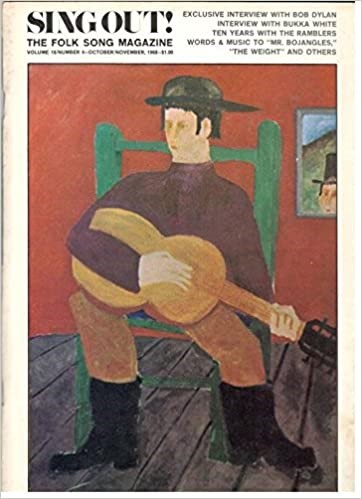
Dylan is quite firm, in the interview he gives to John Cohen and Happy Traum in the summer of 1968, to give the ailing folk music magazine Sing Out! a financial boost: “The song has to be of a certain quality for me to sing and put on a record. One aspect it would have to have is that it didn’t repeat itself. I shy away from those songs which repeat phrases, bars and verses, bridges…” Actually, Dylan says, he wanted to record a whole album of other peoples songs, but “about nine-tenths of all the contemporary material being written” has those damned repeating phrases and bridges, so he went back to writing his own songs. Songs like “The Ballad Of Frankie Lee And Judas Priest” and “All Along The Watchtower”, so we don’t have to be too sad about Dylan’s alleged dislike of choruses and bridges.
Fortunately, the bard is not too principled either. For his most recent album, John Wesley Harding, which is the thread of the conversation, he already plucked “I’ll Be Your Baby Tonight” from the motel room air of the Ramada Inn in Nashville – a beautiful song which repeats phrases, bars and verses, and a bridge it has as well. It is not a one-off slip-up, not a rule-confirming exception. Six months after his declaration of principle, Dylan wholeheartedly embraces all those artifacts he so resolutely rejected; “To Be Alone With You”, “I Threw It All Away”, “Peggy Day”, “One More Night”, “Tell Me That It Isn’t True”, “Country Pie”… almost every song on Nashville Skyline repeats phrases, bars and verses, and has a bridge too. And in “Tonight I’ll Be Staying Here With You” he doesn’t “shy away from” a bridge either:
Is it really any wonder
The love that a stranger might receive
You cast your spell and I went under
I find it so difficult to leave
Textually, a hotchpotch of clichés. Mostly from recent radio hits, it seems. Is it any wonder Dylan has been hearing since he first played Hank Williams’ records (“Kaw-Liga”, for instance), and he hears the words every week on the radio. “So Sad” by The Everly Brothers, Ella Fitzgerald’s “Walking In The Sunshine”, “I’m In The Mood For Love”, “Gentleman Friend”, Cliff Richards’ “I Only Came To Say Goodbye”… the list is endless. Apparently, we find it a nice word combination to sing. Equally chewed out and indestructible are all the word combinations with under your spell. “Don’t Blame Me”, of course, but otherwise everyone from Sinatra to Buck Owens and from “Black Magic Woman” to The Everly Brothers. And especially “I Put A Spell On You”, obviously. And the third pillar under the bridge also is a third grab in the goldie-oldie box: the combination love-stranger is just as stereotypical as any wonder and as under a spell. One of the Four Tops’ greatest hits, for example. “Shake Me, Wake Me (When It’s Over)” still sounds often enough on the radio these days and can be found in any jukebox:
They say "She don't love him, she don't love him"
They say my heart's in danger
'Cause you're leaving me
For the love of a stranger
In terms of content, the middle-eight builds, as befits a classic middle-eight, a bridge to a better understanding. Though it seems to completely elude analysts like Clinton Heylin (who understands a “message of reassurance”), Robert Shelton (“commitment to a love”) and Michael Gray (“a deliberate announcement of the fall from restlessness”) that the first-person narrator is an utterly unstable, emotion-driven rolling stone. The critics seem to be fueled by biographical facts, by their knowledge of Dylan’s recent domestic, rural status as a young, newlywed father who has said goodbye to the frenzy of rock star life. Conveniently, they assume, as annoyingly do many Dylanologists, that the “I” is Dylan himself, and they also don’t appear to look much further than the title to conclude that I, Dylan, is here wording his farewell to the restless feeling. And expresses a moving pledge of allegiance to his dear wife Sara, something like that.
Both Heylin and Shelton and Gray write this in the twenty-first century, when Dylan has been saying, in variants, for nearly fifty years now: je est un autre. The “I” in my songs is not “I, Bob Dylan”. In vain, though.
In the bridge, the lyricist quite unambiguously confirms what has already been suggested in the previous lines: the first-person narrator is not a loving husband bidding farewell to his troubled life, but rather a stranger passing by, following an impulse. He doesn’t belong in this town at all, was already on his way to the station with his suitcase, probably heading home, but falls under the spell of some village beauty. Impulsively, he decides not to return to his troubles, he decides to throw away his train ticket and to stay the night with this irresistible lady. Granted, imperatives like “Throw my ticket out the window” can with a little tolerance be interpreted metaphorically, as poetic expressions of a desire to say goodbye to the hectic life of a restless rock star. But verses like “I should have left this town this morning” and “The love that a stranger might receive” do not fit into such a pliable interpretation – it really would take some surreal acrobatics to interpret them as romantic family man rhetoric. No, these are really the words of a cheating debaucher about to indulge in a one-night stand.
Dylan is in a motel in Nashville, after all. The classic décor of an extramarital escapade. In the town where “all the songs coming out of the studios then were about slut wives cheating on their husbands or vice versa.”
To be continued. Next up: Tonight I’ll Be Staying Here With You part 4: The cadence of click-clack
Jochen is a regular reviewer of Dylan’s work on Untold. His books, in English, Dutch and German, are available via Amazon both in paperback and on Kindle:
Aaron: Some 2 years I wrote a piece documenting the music of Bob’s two nephews, Luke & Seth Zimmerman.
At the time I didn’t ask for Tony’s opinion on the music, so I thought it would be nice to present some more examples of their music , this time with Tony’s input. As Luke has had a new album out since the last article I thought I’d start with him. I’ll give Tony two tracks from older albums, plus three from his latest to consider.
First up, from his debut solo album, Twilight Waltz, it’s Duluth.
Tony: I’ve long been of the opinion that these days one really needs an opening line with a bit of bunch – or instrumentation with a bit of punch, or something else with a … well you get the idea.
Even something like “Come gather round people” in its day had it. “Oh, where have you been, my blue-eyed son?” most certainly has it, and “You’ve got a lot of nerve to say you are my friend” is one of the great all-timers beaten perhaps only by “They’re selling postcards of the hanging”.
Now this song has been playing for a couple of minutes I can’t recall the opening, but it seemed rather ordinary to me. And I am prejudiced because I don’t like the voice at all – too nasal for my taste. So a bit of a rejection from me, although the gentle guitar counter melody that sweeps in from time to time, does do it for me. That’s nice, but otherwise neither the sound nor the lyrics give me anything to write home about (although that would be rather silly since I am sitting at home anyway). (Although I’m going out later).
Aaron: From his third album, Heyday for the Naysayers, I have picked Little Girl.
Tony: Now this album has a great title – I do like “Heyday for the naysayers”. But the instrumental intro doesn’t give me hope, and yet, the voice is quite different. A much better sound, but the rhymes, oh, no… Rhyming “be still” with “window sill”. Argh!
OK I am a failed songwriter in the sense that I never made it in the business, but I’ve written around 150 songs that I have kept, so I know that sensation of looking for a rhyme, and it is all too easy to find a rhyme and slip it in because it rhymes not because it actually adds to the music.
Bob never ever does that – at least I can’t think of an occasion when he does. However the instrumentation here really does rescue this song. The opening “Little girl lay down your head” is nice when one realises he is singing to his daughter – I have three daughters (all married now) and I remember those days. Brings tears to my eyes…
So yes it’s a nice song, easy on the ear… Take the line “you’re the best thing I’ve ever seen” – of course I felt that with all three of my daughters as little ones being tucked up at night in bed, being told bedtime stories etc etc, but the rhyme just doesn’t excite. And it doesn’t really need four and a half minutes to put it all across.
Aaron:His latest album The Man In The Silver Box was released in August 2019. A full length film for the album is available on YouTube. For this article, I’ll just subject Tony to the audio versions!
The title track…
Tony: Oh, that’s a spooky picture. I’d love to have been able to look at the lyrics, and I did a very quick search while the music is playing but couldn’t find them… and can’t make them out myself.
So I am just left with the instrumentation, the melody, and the singing, and none of them really do anything for me. Indeed the wobbly synth sound in the instrumental break is, I think, horrible. There honestly is nothing here that makes me think “I must hear this again”.
Therefore, maybe it is all in the lyrics – but then if that is so perhaps some of them should have been a bit clearer.
I guess it is because I didn’t understand anything of what is going on, I also didn’t understand the repeated two-note chord at the end. Would anyone like to enlighten me – I am sure this is all my failing to understand, nothing else.
Spoon & Cherry
Tony: Trepidation – this track is over five minutes long. Will I survive the jerky introduction? OK I have to, although it goes on and on and … it’s still going. Aaron – would you like to write a review of this song, telling us why you selected it? Or if not Aaron, then is there a reader of Untold who could send in a positive review of this track (or failing that any track reviewed here). Send to Tony@schools.co.uk and mark it Zimmerman Review. Ideally as a word file, but if not, I can still use it.
I am really sorry Aaron, I just don’t get it. What is there here? I can’t make out the lyrics, the instrumentation seems unstructured, there is nothing in the melody or chord changes that makes me sit up. And although the song is not finished, I can’t think of anything else to say.
You Were There, But You Weren’t There
Tony: The last one, which is good, and I think this is the first time I’ve ever thought this in all the songs that we’ve reviewed this way between us. I think this must be a style of music that I have not been introduced to before, and that contains hidden depths and secrets which I have just not understood. I entered the cavern and took a wrong turning is a phrase that seems to encapsulate where I am.
Can someone tell me the generic name for this type of music? That’s not because I’m going to make some silly crack about “I’ll know to avoid it” but rather because I genuinely would like to understand.
Sorry everyone. I just don’t get it. Even the percussion just plods, lines without interest are simply repeated for no purpose… Is this art?
Singer/songwriter/musician Bob Dylan dabbles in biblical burlesque a lot as the unravelling the Dylanvinci Code reveals.
No doubt, everybody’s asking what leads time-travelling and time-stopping adventurer Bob Dylan to Tangier in Morocco, and finally to Memphis in the United Arab Republic of Egypt?
The answer is quite simple. The key to breaking the whole code lies in the following song:
Let me tell you about Ahab the Arab
The shiek of the burning sand
He had emeralds and rubies just dripping off of him
And a ring on every finger of his hand
(Ray Stevens: Ahab The Arab)
A reference to the song above pops up in the lines of the song quoted beneath:
Sheikhs walking around like kings, wearing fancy jewels
and nose rings
Deciding America's future from Amsterdam, and to Paris
(Bob Dylan: Slow Train Coming)
Burlesquer Dylan, like the Spanish burlesquer – par excellence – in ‘Don Quixote’, drops red herrings to divert literary analysts off the trail.
Little wonder that Dutch Dylanologist Jochen Markhorst, as well as others, contends that certain song lyrics refer to Herman Melville’s whale-of-a-tale “Moby Dick”, and to its Captain Ahab.
But take note, it’s Captain “Arab”, not Captain Ahab, in the song lyrics below:
Well, the last I heard of Arab, he was stuck on a whale
That was married to the deputy sheriff of the jail
(Bob Dylan: 115th Dream)
[Editor’s note – despite the long intro this really is the right video]
According to the Holy Bible, Ishmael’s parented by Abraham and an Egyptian lady – although Abe’s married to Sarah.
God orders Abraham to kill Ishmael. Reprieved, the first-born son ends up living in the Arabian desert with his mother:
Oh God said to Abraham, "Kill me a son"
Abe say, "Man, you must be putting me on"
(Bob Dylan: Highway 61 Revisited)
Decoded, the dream tells us that Ishmael marries a fat woman in the desert, an Egyptain lady who’s been married 115 times before.
Anyway, Dylan’s now off to Egypt in search of the burial site of Mary Magdalene.
As we have observed, according to the Dylavinci Code, Mary Magdalene marries brown-skinned Jesus, a descendant of Isaac, the younger half-brother of Ishmael – Isaac being parented by Abraham and Sarah.
Ahab, who provokes the white whale in “Moby Dick”, gets a mention in the Holy Bible:
And Ahab did more to provoke the Lord God of Israel to anger
Than all the kings of Israel that were before him
Tonight I’ll Be Staying Here With You (1969) part 2
by Jochen Markhorst
II Slut wives cheating
I should have left this town this morning
But it was more than I could do
Oh, your love comes on so strong
And I’ve waited all day long
For tonight when I’ll be staying here with you
Baby Driver (Edgar Wright, 2017) is an entertaining action film, lovingly spiced up with unobtrusive details like leading colours, lighting, superior camera use, sound effects and especially, less unobtrusively: music. Protagonist Miles ‘Baby’ (Ansel Elgort), a very young, exceptionally gifted getaway driver, suffers from tinnitus and suppresses the whistling beeping almost continuously with music – a not too far-fetched alibi for director Wright to inventively synchronise the overflowing soundtrack’s songs with storyline and action scenes. And for the Dutch viewers, there are two sequences that appeal to perhaps petty, but understandable national pride.
One is the brilliantly edited chase scene in which Baby escapes his assailants on the stop-and-go pattern, the rhythm and even the drum beats of Focus’ 1973 world hit, “Hocus Pocus”.
The other Dutch hurrah moment is Golden Earring’s “Radar Love” (1973), which is considered an alternative Dutch national anthem anyway. And, as with the actual national anthem, no one knows the correct lyrics. Especially the third verse has the most bizarre phonetic abberations, but officially it should be:
The radio's playin' some forgotten song
Brenda Lee's "Coming On Strong"
The road has got me hypnotized
And I'm speedin' into a new sunrise
The final line is reworded as, for instance, spitting into a nude sunrise, but Brenda Lee causes the most problems. Randal Lee, Brandon’s lead, The melody’s, Steadily, Reveille’s, Randy Leeds, Brad and Lee are coming on home… poor Brenda Lee has been overgrown by a thicket of wild onomatopoeic imitations.
Not really blameworthy, to be fair – in the Netherlands, Brenda Lee has nowhere near the status and name that she has in the UK and the US, and “Coming On Strong” is completely unknown. An informed Dutchman knows at most “I’m Sorry” from 1960. But then, Golden Earring’s singer and songwriter Barry Hay has a Scottish father, was born in India and attended an English boarding school in The Hague – Barry is a bit more international than the average Hollander. Plus: the band has just completed their first tour of America in 1969. A forgotten song like “Coming On Strong” might very well have been played on the radio there – perhaps also when Dylan, in his hotel room in Nashville, plucks “Tonight I’ll Be Staying Here With You” from the air.
It seems a rather thin line, the line from “Coming On Strong” to Oh, your love comes on so strong. Still, the line becomes already a little thicker when we look not at Brenda Lee, but at the discography of the Queen Of Nashville, at Kitty Wells. It seems that Dylan has her 1967 Love Makes The World Go Around on the turntable these days. The title track is quoted verbatim in “I Threw It All Away”;
Love is all there is, it makes the world go ’round
Love and only love, it can’t be denied
… the song in which in any case echo more songs from the Kitty Wells album (“The Hurtin’s All Over”, “There Goes My Everything”). And the final song of the album is Kitty’s version of “Coming On Strong” – again a lament of the abandoned love partner. “All the songs coming out of the studios then were about slut wives cheating on their husbands or vice versa,” as Dylan says in Chronicles about Nashville (Chapter 3 “New Morning”) – a concept Dylan also succumbs to once, here on Nashville Skyline, in the underrated gem “Tell Me That It Isn’t True”.
Kitty Wells’ ultimate contribution to the cheating slut wife and ditto husband genre is also on Love Makes The World Go Around:
Straighten up your tie and comb your hair
Look as though you spent your time alone
Wash away her lipstick from your collar
Get your lie the way you want it then come on home
… “Get Your Lie The Way You Want It”, the closing track of Side A. In terms of content and theme, it is the opposite of “Tonight I’ll Be Staying Here With You”, but stylistically it is a copy: just like Dylan’s song, it opens with an accumulation of imperatives, of short commands from the first person to the love partner.
The album’s appeal to Dylan is recognisable. The album cover does not mention names of session musicians, but one Nashville Cat who also excels on John Wesley Harding and Nashville Skyline is not too hard to spot: Pete Drake’s steel guitar dominates half of the songs. In the backing choir we recognise Elvis’ favourite men, The Jordanaires, the unknown duet partner in heartbreaking songs like “The Hurting’s All Over” provides an irresistible Everly Brothers sheen, and tremolo guitar like in “Once” must have taken Dylan back to magical moments from his youth, earth-shattering moments like the first time he heard “Uncloudy Day” by The Staple Singers. The song that shifts a not insignificant part of American rock music history, by the way. John Fogerty honours the monument too, in his autobiography (Fortunate Son, 2015):
“The Staple Singers, “Uncloudy Day.” The sound of that guitar—God, what a cool thing. That vibrato: bewoowowow. Even as a kid I could identify that sound right away. Pops Staples was doing all that. I loved that sound.”
Dylan expresses his admiration somewhat more poetically, of course:
“It was the most mysterious thing I’d ever heard. It was like the fog rolling in. I heard it again, maybe the next night, and its mystery had even deepened. What was that? How do you make that? It just went through me like my body was invisible. What is that? A tremolo guitar? What’s a tremolo guitar? I had no idea, I’d never seen one. And what kind of clapping is that? And that singer is pulling things out of my soul that I never knew were there. After hearing “Uncloudy Day” for the second time, I don’t think I could even sleep that night.”
(AARP The Magazine interview, 2015)
An inconspicuous footnote in Kitty Wells’ rich discography, Love Makes The World Go Around. Filled with forgotten songs. But still coming on strong.
To be continued. Next up: Tonight I’ll Be Staying Here With You part 3: Cheating husbands
Jochen is a regular reviewer of Dylan’s work on Untold. His books, in English, Dutch and German, are available via Amazon both in paperback and on Kindle:
By Aaron Galbraith (in USA) and Tony Attwood (in UK)
In this series Aaron Galbraith based in the USA picks out interesting cover versions of Bob Dylan’s songs and Tony Attwood in the UK attempts to write a review of the performance while the song is playing, and without looking stuff up.
Aaron: Hi Tony. I had a bunch of covers that I couldn’t find many other interesting versions of the songs but still wanted to present them to you for your opinions! So I thought I’d put together this smorgasbord of delights to see if any of these are to your taste!
First up it’s Senegalese musician Youssou N’Dour with Chimes Of Freedom. He treats the song as an anthem for African’s struggling to survive.
In 2004, Rolling Stone magazine described him as, “perhaps the most famous singer alive” in Senegal and much of Africa.[3] From April 2012 to September 2013, he was Senegal’s Minister of Tourism.
Tony: I absolutely love this man’s work. And he doesn’t disappoint – ever. The way he treats the rhythm is extraordinary, and he changes the chord sequence, but only from time to time. Plus his sense of orchestration is extraordinary. So many subtle touches. After I have finished writing this I am going back to play this a dozen times over just to get every nuance that he puts within the song.
This is surely the best ever Chimes of Freedom version ever isn’t it? Of course by the rules of this series I have to write the commentary without looking lots of things up, and it is hard to think of other versions while listening to just this one, but this is absolutely a knockout.
Aaron: Next up, from one of my favorite Britpop era bands, Kula Shaker with Ballad Of A Thin Man. This was released as a bonus track on their greatest hits compilation.
Tony: You have the advantage of me Aaron, as I don’t know the band (although that doesn’t mean anything – I don’t know most bands).
The problem for me is that by going in with all guns blazing as they do for the first verse, there feels like there isn’t going to be anywhere else to go. And that is a problem for me because we all know the song so well. And now we’ve heard their full-on approach from verse one.
The same is true with the instrumental break, we know where it is going to go. It is the opposite of the Youssou N’Dour version where he throws in so many unexpected variants I can’t stop listening.
Aaron: Another one exclusive to an artists greatest hits compilation is Its Alright Ma by Terrence Trent D’Arby.
Tony: Now that instrumental intro is a surprise – how are they going to run the lyrics against such a beat? But they do it ok, and it is fun, but something is lost, because in the original slower version there is a wonderful contrast between the first part of the verse and the second part (But don’t fear if you hear…)
It’s fun, but it sounds a little bit of trying too hard to be different. By which I mean that he music doesn’t flow naturally from the lyrics, but rather the aim is to do something that has never been done before. Which is ok but not enough – in my view.
It’s a bit like the three runs at “It’s all right ma” – ok the first time around, but thereafter… I’m not sure. I was rather glad it was only three and a half minutes long.
Aaron: Beck next, who covered Leopard Skin Pill Box Hat on the War Child presents Heroes album (surprisingly great album all around!)
Tony: a shout in the very first half second doesn’t bode well for me, but the notion of doing this as a dead standard 12 bar blues is fun, and actually works for me.
And why is that? Do you know, Aaron, I really am not at all sure. It is just so unexpected I suppose, and the beat is so unusual for this type of song. The instrumental break is a real treat too. The percussionist was having great fun too without simply getting louder and louder. Yep, this is genuinely inventive while at the same time having a real understanding for the original song. Fun ending too.
So far then, this song and Youssou N’Dour are winning hands down.
Lastly for now it’s Buckwheat Zydeco with On A Night Like This. I’ve actually came across a couple of Zydeco covers of Dylan tracks but this one is the best
Tony: Yep, the accordion fits well with this song, and its a bouncy, fun piece in this version. I’m not sure it adds too much to the original but it doesn’t offend either.
Aaron: To keep the fun going here’s a slightly faster paced live version.
Tony: More fun – shame I couldn’t quite make out the sound made by the washboard. What’s the sound engineer doing to earn his cash?
Although it’s a strange extra sound to want to add. It’s fun, it’s bouncy, it’s ok. Yes it’s ok, but it doesn’t keep me from doing the washing up. However I do rather think they were miming…
But thank you for reminding me of Youssou N’Dour. Time to dig out all the other recordings of his work I think.
The “Dylavinci Code” uncovered in many of the song lyrics of Bob Dylan can be deciphered to reveal that indeed therein lies a stretched out “murder ballad”.
In the lyrics below, the time-travelling singer/songwriter/shape-shifting narrator speaks in the third person through the teeth of the supposedly ‘crucified’ Jesus Christ
Described be His embattled quest for the remains of Mary Magdalene, a journey that ends up at the site of the Great Sphinx in Egypt:
There's a lone soldier on the cross
Smoke pouring out of a boxcar door
You didn't know it, you didn't think it could be done
In the final end, he won the war
After losing every battle
(Bob Dylan: Idiot Wind)
Talking to the ‘nondead’ mummified Holy Ghost Magdaline as she lies in her sepulchre room within the Sphinx, Christ explains to Mary that he now remembers placing her there, and confesses the reason why He murdered her:
Idiot wind, blowing through the flowers on your tomb
Blowing through the curtains in your room
Idiot wind, blowing every time you move your teeth
Your're an idiot, babe
It's a wonder that you still know how to breathe
(Bob Dylan: Idiot Wind)
It’s very clear the “Saviour” is extremely angry at Mary for convincing Him to marry her, and then getting pregnant; she almost got away with singlehandedly undermining the little fib that He, the ‘Son of God’, died on the cross in order to save all mankind.
Nevertheless, the “risen” Christ confesses that He’s so sorry for what He’s done:
You never know the hurt I suffered
Nor the pain I rise above
And I'll never know the same about you
Your holiness, or your kind of love
And it makes me so sorry
(Bob Dylan: Idiot Wind)
Now’s a good time to explain what ‘burlesque’ is all about, not that I would ever dabble in such satire.
The song ‘Key West’ by Bob Dylan can be classified as “high” burlesque (in the style of a ‘mock epic’) with the narrator thereof considered as the Trojan war hero Aeneas afoot in the Plutonian Underworld.
In another song “Seeing The Real You At Last”, the narrator considered as the Greek war hero Odyesseus strapped to the mast of his ship in order to get pass the call of the Sirens.
The song “Talking Bear Mountain Massacre Picnic Blues” can be classified as ‘low’ burlesque (in the style of a ‘travesty’); the narrator ticket-buyer overplays the outcome of a boat mishap.
In another song “Talking World War III Blues”, the narrator survivor underplays the effects of a nuclear war.
But, as I’ve said, I would never stoop to such a vulgar form of writing.
The “Dylavinci Code” uncovered in many of the song lyrics of Bob Dylan can be deciphered to reveal that indeed therein lies a sretched out “murder ballad”.
In the lyrics below, the time-travelling singer/songwriter/shape-shifting narratotor speaks in the third person through the teeth of the supposedly ‘crucified’ Jesus Christ
Described be His embattled quest for the remains of Mary Magdalene, a journey that ends up at the site of the Great Sphinx in Egypt:
There’s a lone soldier on the cross
Smoke pouring out of a boxcar door
You didn’t know it, you didn’t think it could be done
In the final end, he won the war
After losing every battle
(Bob Dylan: Idiot Wind)
Talking to the ‘nondead’ mummified Holy Ghost Magdaline as she lies in her sepulchre room within the Sphinx, Christ explains to Mary that he now remembers placing her there, and confesses the reason why He murdered her:
Idiot wind, blowing through the flowers on your tomb
Blowing through the curtains in your room
Idiot wind, blowing every time you move your teeth
Your’re an idiot, babe
It’s a wonder that you still know how to breathe
(Bob Dylan: Idiot Wind)
It’s very clear the “Saviour” is extremely angry at Mary for convincing Him to marry her, and then getting pregnant; she almost got away with singlehandedly undermining the little fib that He, the ‘Son of God’, died on the cross in order to save all mankind.
Nevertheless, the “risen” Christ confesses that He’s so sorry for what He’s done:
You never know the hurt I suffered
Nor the pain I rise above
And I’ll never know the same about you
Your holiness, or your kind of love
And it makes me so sorry
(Bob Dylan: Idiot Wind)
Now’s a good time to explain what ‘burlesque’ is all about, not that I would ever dabble in such satire.
The song ‘Key West’ by Bob Dylan can be classified as “high” burlesque (in the style of a ‘mock epic’) with the narrator thereof considered as the Trojan war hero Aeneas afoot in the Plutonian Underworld.
In another song “Seeing The Real You At Last”, the narrator considered as the Greek war hero Odyesseus strapped to the mast of his ship in order to get pass the call of the Sirens.
The song “Talking Bear Mountain Massacre Picnic Blues” can be classified as ‘low’ burlesque (in the style of a ‘travesty’); the narrator ticket-buyer overplays the outcome of a boat mishap.
In another song “Talking World War III Blues”, the narrator survivor underplays the effects of a nuclear war.
But, as I’ve said, I would never stoop to such a vulgar form of writing.
“All Directions at Once” traces Bob’s song writing in the order in which the songs were written while noting the themes and influences that can be heard in the music. There is an index to the whole series here.
——–
After 2002, Bob Dylan wrote just three songs before starting out on the collection that became Modern Times in 2006.
“Can’t Escape,” written after Tell Ol Bill, continued the theme of writing film music, although in this case the movie was never made. Indeed whoever persuaded Bob to work on the piece must have been incredibly persuasive. Although since there seems to be very little that is certain about the project, maybe someone just mentioned the idea, Bob quite liked it, and sat down and write his piece. It finally appeared in 2008 on Tell Tale Signs, and turns out to be a very simple piece indeed.
In fact even although the moving on theme is there, as ever, the lyrics themselves don’t really feel very Bob-like…
Oh the evening train is rolling
All along the homeward way
All my hopes are over the horizon
All my dreams have gone away
The hillside darkly shaded
Stars fall from above
All the joys of earth have faded
The night’s untouched my love
The song has a certain strangeness in it, as with the line “You made love with god-knows-who” where Bob is telling us all the way through the song how wonderful the girl is, and is “full of grace” line stresses, but then we find she sleeps around.
Fair enough, that’s her choice, and I make no moral judgement. Some people have lots of sexual partners, some don’t, that’s how it goes. But normally if this is a relevant fact to be mentioned earlier in the song, it might get mentioned earlier, not in verse 15. Or if verse 15 really is the place to reveal this fact, then it needs to be dealt with thereafter. Just throwing in the unexpected and leaving us to work it out, doesn’t work for me at all.
If the writing of a song for a film that was never made and no one seems to know much about is odd, the co-composition with Gene Simmons of Kiss is even weirder. Simmons says he phoned Dylan’s agent, said he wanted to write a song with Bob, and then a while later Bob just turns up at Simmons’ house unannounced and they write, what to me seems a rather uninspiring song, “Waiting for the Morning Light”.
It would have been tragic if that had been the end of Bob’s writing, but of course it wasn’t for then he returned with a bang writing Thunder on the Mountain.
Yes it is a 12 bar blues but the variations within it, the power and drive of the music and the inventiveness of the lyrics together announce that not only is this a really jolly, enjoyable outing, what follows is liable to be pretty enjoyable too.
Perhaps we should also note that not only does Bob make the old blues format really great fun, he is playing with the language once again, not least (as many others have noted) rhyming bitches with orphanages. It takes real guts to do that – especially when the song, and indeed the album seems to pack in as many references to Ovid (born 43BC) as possible.
The cover version by Wanda Jackson with Jack White on guitar captures the energy that Dylan had now re-found after his prolonged break.
That song set the scene for the album that was to come, and Bob followed it with Spirit on the Water – another venture in looking at popular music from the past. Rolling Stone called it a “dance-hall ballad” and incorporates lyrics that half make sense but don’t quite. There are Biblical quotes (which of course lead some to suggest Bob never lost his Christian faith but has been discussing it, or weaving it into his songs, in different ways all the time). You’ll find that theme in many books and articles, but it is hard to argue consistently, not least because to make that thesis work one has also to explain what Sonny Boy Williamson’s “Black Gal Blues” is also doing here.
This “back to religion” approach isn’t an explanation I go with, and one reason is that for that line to work one also has to explain why he is constantly taking lines from elsewhere. For example Sonny Boy Williamson’s Black Gal Blues runs
Lord knows I’m wild about you black gal
You ought to be a fool about me
While Dylan goes with
I’m wild about you, gal
You ought to be a fool about me
So I think Bob just quotes lines he likes; he is (in my view) neither confessing to murder, nor discussing Cain. It’s just a line that fits.
Thus what we have is a continuance of the notion of taking lines that sound good from wherever they turn up – just as happened in “Tell Ol Bill“. Finding the origins of each one is fun, and occasionally be illuminating but I really don’t think this is the key to understanding all of Dylan’s music. For me, it is simple, he just like phrases that sound good – both musically and lyrically.
https://youtu.be/bm-_1x_IdGU
What we most certainly do know is that Dylan once more has created a song he loves. By the time of the pandemic, it had knocked up over 500 performances on the Never Ending Tour. I wonder if Bob wasn’t saying, “Stop raving about those oldies – some of these new songs are pretty good too.”
Plus musically it has some innovations for Bob – such as those endlessly alternating chords, with some highly unexpected changes later.
In an interview with Robert Hilburn in 2004 Dylan said pretty much explained how it all worked…
“What happens is, I’ll take a song I know and simply start playing it in my head. That’s the way I meditate. A lot of people will look at a crack on the wall and meditate, or count sheep or angels or money or something, and it’s a proven fact that it’ll help them relax. I don’t meditate on any of that stuff. I meditate on a song. I’ll be playing Bob Nolan’s “Tumbling Tumbleweeds,” for instance, in my head constantly—while I’m driving a car or talking to a person or sitting around or whatever. People will think they are talking to me and I’m talking back, but I’m not. I’m listening to a song in my head. At a certain point, some words will change and I’ll start writing a song.”
Which certainly fits with the music he delivered, and the theme of the new album, if not decided before he started writing, was fairly soon set once the songs began to emerge.
Indeed even when, with the third song, Bob took this theme forward he really showed us what was on his mind – the connection between different works of art from different ages.
Many have gone before me commenting on the connection between “Thunder on the Mountain”, with the line “I’ve been sitting down studying The Art of Love.” This relates to The Art of Love by Publius Ovidius Naso (20 March 43 BC – AD 18) known to his pals as Ovid.
And ditto from the origin of the song itself: Bob is raiding history right along the way…
https://youtu.be/gOtyJs5SoSE
Indeed some commentators do take us back a bit further to Gus Cannon’s recording of “Minglewood Blues”, in 1928
“Don’t you never let one woman rule your mind
Don’t you never let one woman rule your mind
Said, she keep you worried, troubled all the time

“Don’t you think your girl was li’l and cute like mine
Don’t you wish your girl was li’l and cute like mine
She’s a married woman, but she comes to see me all the time”
Among the features that turn up in some (but not all) of the variant historic versions of the song is that the number of bars is highly unusual. Dylan keeps this tradition, extending the 12 bars (which is why the format is invariably called the 12 bar blues) to 13 bars. That you hardly notice this is a testament to Dylan’s musical ability. That he does it, shows just how much he wants to trace the origins of his creativity to these earliest days of recorded music. Few people notice that 13th bar. To Bob it seems really important that it’s there.
But no matter how often I hear this song, that line from Ovid, “I’ve been conjuring up all these long dead souls from their crumbling tombs” comes back to me as the key to the thinking behind the whole album. Dylan is saying, I’m looking at the past, looking at old song, old rhymes, from Ovid to the blues to Bing Crosby, and seeing where their relevance is to us in these Modern Times. We are built on the past: there is no escaping that.”
In 2004, out of 22,838 entries from 111 countries, Habseligkeiten is chosen as “German word of the year”. The jury, which included singer/songwriter Herbert Grönemeyer and author Uwe Timm, state that they are touched by the “friendly, pitying undertone”, and at the same time it makes the owner of Habseligkeiten seem “sympathetic and lovable”.
It indeed is a wonderful word. It means more than just “possessions”. Lexically, it connects two areas of life: earthly possessions (haben, “to have, to possess”) and the bliss (Seligkeit, “bliss, benediction”) that is unattainable in earthly life. This tension leads the reader to have positive feelings towards the owner of the Habseligkeiten. The love for the small, in itself perhaps worthless things is understood as a “condition for happiness”.
“In der Beschränkung zeigt sich erst der Meister, only in confinement the master reveals himself”, Goethe asserts, as if to explain why he is making things so difficult for himself, in the 1780s. The by then long world-famous poet escapes his degeneration into a magistrate and the stifling court life in Weimar, takes a sabbatical of three years in Italy (1786-88) and returns born again: back to the Antiques it shall be. With all the restrictions that entails: stripped-down tragedies without scenery, a minimum of action, hardly any supporting actors and endless monologues in Alexandrian lines. Tightly drawn poetry within strictly defined frameworks of fixed rhythm and rhyme. Retellings of material that has existed for centuries (Iphigenia in Tauris, for instance).
Within all these limitations, Goethe says, it takes mastery to be able to move and captivate. And, sure enough, there is something to be said for that. We admire The A-Team, getting locked up in an old shed once again, and then managing to construct a bazooka with the devastating power of a hydrogen bomb only using objets trouvés like rubber bands, rusty drawing pins and chicken wire. Or the unworldly surgeon who performs life-saving emergency surgery on the floor of the airport departure lounge with the help of a straw, a pocketknife and a biro – in der Beschränkung zeigt sich der Meister.
The genesis of the tight, minimalist masterpiece “Tonight I’ll Be Staying Here With You” gives no reason to think that its creation was a deliberate attempt to create a masterpiece within self-imposed limitations. But the rigid frameworks within which Dylan squeezes the song do suggest it.
On Wednesday 12 February 1969, Dylan arrives in Nashville with only half an album of songs in his suitcase. The rest for Nashville Skyline will be either written on the spot or improvised (such as the opening track, “Girl From The North Country” in duet with Johnny Cash). In June, when Jann Wenner interviews him for Rolling Stone, Dylan says:
“The first time I went into the studio I had, I think, four songs. I pulled that instrumental one out… I needed some songs with an instrumental… Then Johnny came in and did a song with me. Then I wrote one in the motel… Then pretty soon the whole album started fillin’ in together and we had an album.”
… but that seems a bit too modest. “To Be Alone With You”, “I Threw It All Away”, “One More Night”, “Lay Lady Lay” and “Western Road” are recorded on Thursday 13 February in a session that, according to the recording sheets, lasts until 12 o’clock in the evening. The next day, “Peggy Day”, “Tell Me That It Isn’t True” and “Country Pie” were also recorded – eight songs, so it seems likely that Dylan arrived with more than four songs, two days ago.
The album, for which Dylan is still considering the title John Wesley Harding Vol. 2, is missing a closing track like “I’ll Be Your Baby Tonight”, et voilà: over the weekend, Dylan shakes a song out of his sleeve on the hotel stationery of the Ramada Inn. Which is then recorded after the instrumental album filler “Nashville Skyline Rag” on Monday 17 February, when the working week has started again.
That song, “one I wrote in the motel”, must be “Tonight I’ll Be Staying Here With You”, which provides a fascinating glimpse into Dylan’s working methods. Apparently, the world’s best songwriter with performance pressure feels comfortable in a tight corset. He chooses quintins in an unusual rhyme scheme: ABCCB. It’s somewhat archaic – an 11th-century archetype of the limerick has such a scheme, William Wordsworth uses it for “The Idiot Boy” (1798), and it provides a somewhat nursery rhyme-like playfulness – but Dylan just uses the same rhyme scheme he chose for “I Threw It All Away”:
I once held her in my arms
She said she would always stay
But I was cruel
I treated her like a fool
I threw it all away
… which he recorded the day before yesterday. In terms of content, obviously, diametrically the opposite of “I Threw It All Away”; the narrator in “Tonight I’ll Be Staying Here With You” is on the other side of a love’s affair time-line, is still in the very early stage of embracing his happiness of love unconditionally:
Throw my ticket out the window
Throw my suitcase out there, too
Throw my troubles out the door
I don’t need them anymore
’Cause tonight I’ll be staying here with you
Apart from that remarkable rhyme scheme, the cast-iron, again somewhat old-fashioned metre catches the ear: all verse lines work towards the refrain line with a four-foot trochee (DUM da DUM da DUM da DUM da), with a trochaic tetrameter, as the schoolmaster would say. Not necessarily very uncommon in the art of song, but unusual nonetheless. And very classical. Beethoven’s Ninth for instance (“Ode To Joy”, Freude schöner Götterfunken). Wordsworth’s “Song Of Hiawatha”, the Weird Sisters in MacBeth (“Fair is foul, and foul is fair / Hover through the fog and filthy air”).
And, again, nursery rhymes. Dr. Seuss’ One Fish Two Fish Red Fish Blue Fish. “Peter Pumpkin Eater” is perhaps the best-known shortcut to identify a trochaic tetrameter (Peter Peter pumpkin eater / Had a wife and couldn’t keep her). And a work that keeps popping up in Dylan’s output, William Blake’s “The Tyger” (Tyger! Tyger! burning bright / In the forests of the night).
Attractive, but indeed not very common. The trochee simply clashes with our “natural” sense of rhythm, our sense of language that automatically steers us towards iambic rhythm structures. This may also explain the seemingly lazy opening, the somewhat easy choice to start three times with “throw my … out”. Still, a Goethe would have imposed a limitation like this on himself to demonstrate mastery in the continuation of those restrictive opening words. In which Dylan also succeeds, by the surprising turn from symbolic, but concrete possessions (ticket and suitcase) to immaterial inner stirrings, to the troubles that also go out the door. Habseligkeiten.
To be continued. Next up: Tonight I’ll Be Staying Here With You part 2: Slut wives cheating
Jochen is a regular reviewer of Dylan’s work on Untold. His books, in English, Dutch and German, are available via Amazon both in paperback and on Kindle:
There is an alternate interpretation of the clues hidden in the Dylavinci Code, a Cubist-like point of view that asserts the relationship of Jesus Christ and Mary Magdalene has a dark side ~ the sad-eyed Lady Magdalene gets killed.
The Dylavinci Code is a drawn-out ‘Murder Ballad”!
Mary’s a Lilith-like independent Jungian archetype whose husband attempts to exorcise the demonic spirits that possess her body.
All in vain - there's demons inside her Jesus can't get rid of:
And certain women, which had been healed
Of evil spirits and infirmities
Mary called Magdalene, out of whom went seven devils
(Luke 8: 2)
Expressed humorously in the following song lyrics:
Her name was Magill
And she called herself Lil
But everyone knew her as Nancy
(Beatles: Rocky Raccoon ~ Lennon/McCartney)
A dire situation that’s foreseen by a Jewish prophet in the days when Hebrews flee from Northern Israel to Memphis, Egypt; the Assyrian armies are approaching.
Prophesied is that these outsiders will fare badly in Memphis, capital of the land of Isis, Osiris, and Horus; their dead bodies ferried off to the Underworld; leftward to the place of mummies, not right to the Elysian Fierlds:
For, lo, they are gone because of destruction
Egypt shall gather them up
Memphis shall bury them
(Hosea 9:6)
A black-light scenario depicted in the decoded song lyrics below.
Handy Dandy (Devil himself, dressed as if he were the transfigured Jesus) seated with Mary Magdelene (Nancy) in the ‘Garden of Eden’ cabaret, unzippers his “gun”:
Handy Dandy, sitting with a girl named Nancy
In a garden feeling kind of lazy
He says, "You want a gun? I'll give you one"
She says, "Boy, you're talking crazy"
(Bob Dylan: Handy Dandy)
The above song lyrics reference a horn-blowing cabaret musician in Memphis, a city on the American ‘Nile’, the Mississippi River.
He composes a ragtime tune that knock’em all dead:
I went out a-dancing with a Tennessee dear
They had a fellow there named 'Handy'
With a band you should hear
(Memphis Blues ~ William Handy)
Bringing it all back home to a crowd-drawer:
The ragman draws circles
Up and down the block
I'd ask him what the matter was
But I know that he don't talk
(Stuck Inside Mobile With The Memphis Blues Again)
This series traces the performances of the Never Ending Tour from 1987 onward. This is episode 55 in the series, and a full index to the series can be found here.
When Barbados Prime Minister Mia Amor Mottley, addressing the 76th session of the United Nations General Assembly on September 24, 2021 in New York, used the words ‘How many deaths will it take…’ it is unlikely that she was thinking about Bob Dylan, or ‘Blowing in the Wind’, but she was quoting him anyway.
The full text of her quote is: “How many more deaths must it take before 1.7 billion excess vaccines in the possession of the advanced countries of the world will be shared with those who have simply no access?” In other words:
‘how many deaths will it take 'til he knows
That too many people have died?’
The Barbados PM went on to further reference ‘Blowing in the Wind’.
“How many more times will we then have a situation where we say the same thing over and over and over, to come to naught?” she asked. “My friends, we cannot do that anymore.”
The question, my friends, is how do we escape the dreary, atrocity-filled repetitions of history? The PM’s further comments give us an insight into the intention of that song. “If I used the speech prepared for me to deliver today, it would be a repetition, a repetition of what you have heard from others and also from me.”
How much do we have to pay to get out of going through all these things twice, or over and over again in the endless cycle of times that are always a-changing? The questions posed in ‘Blowing in the Wind’ are aimed, like the PM’s speech, to stir our consciences and to break the cycles of injustice. But this is unlikely to happen.
Of course I can’t know, but I don’t think the Barbados PM was consciously, or even unconsciously, quoting Dylan. Rather she hit upon the same rhetorical device as Dylan for the same purpose. The roots of these rhetorical questions lie in everyday speech: ‘How many times have I told you to….’ With the Barbados MP there is desperation behind her questions, with Dylan a deep-seated fatalism. We can go on asking these questions but we will never get the answers.
That fatalism, or sense of weary resignation in ‘Blowing in the Wind’, doesn’t have its roots in the rising youth and protest movement of the 1960s, is quite at variance with that movement, but rather in ‘the old time religion’ of early gospel music, music that had its origins in the slave plantations of the middle 1800s, just as the melody of that song did.
The sense of approaching apocalypse, so cogently expressed in ‘Hard Rain’, seems to be derived both from the fears of the then young, cold-war baby-boomers, facing nuclear annihilation, and from that older, doom-laden gospel tradition.
We find that tradition in ‘This World Can’t Stand Long’ by Jim Anglin, Jack Anglin, Johnny Wright, from the 1940s. The song is full of melancholic resignation to God’s will, and the approaching end of the world. Dylan often performed it from 1999 to 2002. I’m starting off this post with it, as it holds the origins of Dylan’s fatalism. (6th Nov) Nice sharp, clear recording.
This World Can’t Stand Long
The underlying sentiments of this song can be found in Dylan’s earliest songs, like ‘Song to Woody’, one of only two Dylan songs to appear on his first Album Bob Dylan (1962). The song isn’t itself a protest song, but Guthrie was a protest singer, and a particular attitude, that the world’s gone wrong, comes across loud and clear.
‘Hey, hey, Woody Guthrie, I wrote you a song
About a funny old world that’s a-coming along
Seems sick and it’s hungry, it’s tired and it’s torn
It looks like it’s a-dying and it’s hardly been born’
Guthrie sang about a world that seemed sick and hungry, tired and torn, and so would Dylan. The blues singers that Dylan mentions in the song were protest singers too, in Leadbelly’s case songs from prison, because they were black and poor. Their protest grew directly out of their circumstances. In this very early song we hear Dylan aligning himself with these outsiders and blues journeymen. This one’s from Australia, 23rd March. He keeps it simple, doesn’t try to fancy up the song at all.
Song to Woody
The Freewheelin’ Bob Dylan (1963), the first album of Dylan songs only, contained three songs that would stay with him for the rest of his career, and which came to epitomise protest songs as such. These are ‘Blowing in the Wind’, ‘Hard Rain’ and ‘Masters of War’.
‘Blowing in the Wind’ became so famous it is almost impossible to see it in context. Is it possible to listen to it again with fresh ears? It’s a frail little ballad with anthemic power. This 2001 performance, with its dead slow tempo, brings out the gentle frailty in the verses with their impossible rhetorical questions and the anthemic power in the chorus. It’s one fearsome wind that blows away all our hopes and aspirations for a better world.
Dylan mixes upsinging and downsinging to great effect here, as he did with ‘Mr Tambourine Man’, running the lines on together and so relentlessly piling up the images (See previous NET post). I’ve lost the date of this one, sorry.
Blowing in the Wind
Since ‘John Brown’ was written in October 1962, and Freewheelin’ didn’t come out until May 1963, we have to wonder why this marvellous narrative wasn’t included on the album. It makes a nice fit with ‘Masters of War’. As I’ve written before, what makes this song so great is not the anti-war theme, or even the story of the young soldier who returns maimed and disillusioned from the war, but the dramatic confrontation between mother and son on the train platform when her ‘soldier son’ comes home from the war.
The term ‘cannon ball’ used here and in ‘Blowing in the Wind’ has an oddly antique flavour. By the 20th Century we had graduated to ‘artillery shells’ or just shells. The term cannon ball takes us back to Civil War and earlier. It might have been that very universality of the term that appealed to Dylan. When listening to this, the Vietnam War comes to mind, and it is prescient in foreseeing the clash of generations that war sparked, but the Vietnam War had not started in 1962, and it could well have been the civil war Dylan had in mind. ‘Buried in the mud’, of ‘Masters of War’ also seems to evoke the Vietnam War, and I’ve seen a pretty good You Tube video that plays the song against a background of scenes from that war, but again it was written too early, and again Dylan may be thinking of the civil war.
This performance of ‘John Brown’ from the Madison Square Gardens, 11th November concert, is the best I’ve heard, and we heard a pretty good one in 2000. Dylan has tended to forget his lines with this song, but this performance is faultless. If you are used to the rock version from the 1994 MTV Unplugged concert, this slower, more gentle yet more deadly acoustic performance might surprise you. Beautifully underpinned by Garnier’s bow-drawn doublebass, the drums picking up a pattering beat when the train pulls out, the understated acoustic guitar work, all add up to a classic performance.
John Brown
That song leads naturally to ‘Masters of War’, Dylan’s most explicit anti-war song. It locates the villains precisely in the armaments industry, those who ‘fasten the bullets for others to fire’. To fasten a bullet, as I understand it, is to snip it into its cartridge. The phrase, ‘I see through your masks’, also resonates, as in a couple of years Dylan would be seeing through all kinds of masks. Isn’t that what ‘Just Like a Rolling Stone’ is all about, seeing through the masks of snobbery and hypocrisy? ‘It’s All Right Ma’ could well be the great unmasking song of all time.
Over the past few years Dylan has been developing a slow, syncopated, acoustic version of the song. It has an ominous feel at the beginning. The war makers are being called to account. This one has Larry on dobro, twangy and metallic, and some very tasteful guitar work from Charlie and Bob. (Hiroshima concert)
Masters of War (A)
Here’s another performance, a bit harsher with Dylan’s voice up close.
Masters of War (B)
Last but far from least of these Freewheelin’ songs, is ‘Hard Rain’. Lyrically it reached beyond anything else he’d done to that point, but the point is only late 1962, right at the beginning. It went beyond the topical protest of songs like ‘Oxford Town’ in a series of surreal and apocalyptic images. It doesn’t just ‘protest’ about war and racism, it is prophetic and visionary in a spine chilling way. Note that Tony Attwood gives a good account of the song here https://bob-dylan.org.uk/archives/1550. This is another one from Madison Square Gardens. Dylan slows it down to a gentle movement, and uses his downsinging to great effect. The song seems to suit that style; it has an eerie beauty.
Hard Rain
The Times They Are a-Changin’ came out in January, 1964, and the title track immediately became another Dylan anthem. It seemed like a rallying cry, a call for radical change, and a prophesy that that change was a-coming. But we can see now that the song is more about the wheel of time, and the inevitability of eternal recurrence. The song is heavy with the sense of fate, and takes us back to ‘Blowing in the Wind’. How many times…? That wheel just keeps on turning, though, it’s still in spin.
Over the past few years Dylan had been playing it slow and nostalgic, as a crowd pleaser, everybody remembering the old days when the wheel, we thought, was turning in our direction. This performance (sorry, I’ve lost its date) is cast in the same mould, but because of Dylan’s vigorous and provocative vocals, it becomes something more than bitter-sweet nostalgia, and becomes once more, a challenge. In Dylan’s voice I can hear the voice of fate itself taunting us.
Times they are a-changing
None of all this, however, the protest and the flood of imagery unleashed, prepared us for the full-on broadside against the dangerous falsities of the world, and such a full on declaration of alienation from it all. I’m old enough, dear reader, to remember putting this song on the turntable when it first came out. A group of us university students nearly fell off the floor. We’d never heard anything like it. Not even ‘Hard Rain’ could prepare us for this.
It was a protest song to end all protest songs, and in a sense it did. It was the last and greatest protest song, coming in 1964, and we’re just a step away from ‘Desolation Row’.
By 2001 Dylan was putting a busy beat behind the song. I’m not sure how effective that is, but I have no quarrel with the vocals.
It’s all right Ma
The real signing off song had come earlier in 1964, with ‘My Back Pages’. The moral simplicities on which the protest movement was based crumbled away into relativism and complexity. Dylan’s 2001 downsinging is perfect for the self-mockery of the song. The world’s still sick and hungry, tired and torn, but there are other ways to go than hating hatred, and there might be an escape from the paradox of
Well the fat’s in the fire and the water’s in the tank
The whiskey’s in the jar and the money’s in the bank
I tried to love and protect you because I cared
I’m gonna remember forever the joy that we shared
But here I am in prison, here I am with a ball and chain…it doesn’t end well, for Captain Farrell’s killer. The money he had stolen from the Captain has not been deposited in the bank, but purloined by that treacherous Molly. In cold irons bound he sits in the cell now, dreaming of Molly’s bedroom, and he sings his refrain once more;
Musha rain dum a doo, dum a da, heh, heh
Whack for my daddy, oh
Whack for my daddy, oh
There’s whiskey in the jar, oh
The indestructible Irish classic “Whiskey In The Jar” is an ancient, irresistible folk monument with dozens of versions in circulation. The rock version by Thin Lizzy (1972) is probably the best known and inspired Metallica to do a Grammy-winning heavy metal cover in 1998. And in between, it sneaks into a Dylan song, into the final verse of “Cold Irons Bound”.
The in itself meaningless phrase steers the narrative of “Cold Irons Bound” down a side path. Down the wrong path, to be more precise, on the path to evil. Suddenly, through that highwayman connotation from the old folksong about a criminal who actually ends up in ball and chains, the poet highlights the possibility that in cold irons bound is meant literally, that the narrator has just murdered the woman he so pitifully longs for, and that he is now being carried off – jogging along in chains, already twenty miles on the way to the penal camp.
It is – of course – not unequivocal. The opening, “the fat’s in the fire”, fits in a bit – it does, after all, mean something like trouble ahead, imminent crisis. Squeezing in, however, is not possible with the other two expressions, “water’s in the tank” and “money’s in the bank”. In themselves, again, without much relation to each other or to the text at all. But strangely enough, the accumulation of the four (quasi-) proverbial expressions does actually suggest, without any substantive basis, something like the die is cast, I crossed the Rubicon.
The accumulation, however, seems mainly the product of an improvising, unleashed poet in the zone. Stylistically, but coincidentally also in terms of content, it resembles the enigmatic word processions that Jethro Tull’s Ian Anderson is so fond of producing for the crypto-analytical faction of his fan base. Like in the outtake “Living In These Hard Times”, from a somewhat forgotten, beautiful folky highlight of Jethro Tull’s discography, from 1978’s Heavy Horses:
The bomb's in the china. the fat's in the fire.
There's no turkey left on the table
(…)
Well the fly's in the milk and the cat's in the stew.
Another bun in the oven --- oh, what to do?
… a beautiful song by the way, that is rightly added as a bonus track on the 2003 reissue (and again on the 2018 40th Anniversary New Shoes Deluxe Edition of course). Demonstrating the same playful enjoyment of language: the alienating mixing of existing expressions (fat’s in the fire, bun in the oven) with catachreses, with non-existent word compounds that nevertheless sound familiar (cat’s in the stew, fly’s in the milk). Triggered, no doubt, by a love of antique nursery rhymes, again similar to Dylan’s – for example, Ian Anderson’s fourth verse begins with:
The cow jumped over yesterday's moon
And the lock ran away with the key.
… a not too veiled paraphrase of the age-old “Hey Diddle Diddle” (The Cow jump’d over the Moon / And the Fork ran away with the Spoon). And, to complete the circle, equally inspired by nonsensical refrains like in “Whiskey In The Jar”.
It’s all possible, the nonsensical expressions and the empty metaphors like fly in the milk and water in the tank and whack for my daddy, thanks to the context. “Whiskey in the jar” becomes something like those were the days. Ian Anderson embeds his invented sayings in a portrait of a life full of misfortune, making something like cat’s in the stew suddenly meaningful. And Dylan offers a fitting meaning for his linguistic finds in the lines that follow:
I tried to love and protect you because I cared
I’m gonna remember forever the joy that we shared
So: “our good times are over now and out of reach”, something like that. Like water in a tank, like money in a bank, like whiskey in a jar and like fat in a fire. Maybe not entirely watertight, but what the heck – Dylan shakes the lyrics out of his sleeve in a few minutes, doesn’t feel like polishing them, records it straight away, and above all: it sounds good. And you want your songs to sound good (Nobel Lecture, 2017).
VII Cosmic waste and space debris
Looking at you and I’m on my bended knee
You have no idea what you do to me
I’m twenty miles out of town in cold irons bound
The sketchy, improvised impression of the last verse is confirmed by the last refrain. I’m gonna remember forever the joy that we shared is a farewell – it fits badly with the subsequent present tense of the chorus lines. But in terms of content, it once again gives food for the thought that “Cold Irons Bound” subcutaneously is a murder ballad: the scene described is a copy of the repentant murderess Frankie from “Frankie And Johnny”;
She said, “Oh, Mrs. Johnson
Oh, forgive me please
Well I killed your lovin' son, Johnny
But I'm down on my bended knees
I shot my man, but he was doin' me wrong, so wrong.”
Dylan uses the image in his adaptation of the song (“Frankie & Albert”, on Good As I Been To You, 1992), but shifts it to an even more dramatic scene:
Frankie got down upon her knees, took Albert into her lap.
Started to hug and kiss him, but there was no bringin' him back.
He was her man but he done her wrong
… the death scene. After which Frankie is taken away – bound in cold irons, no doubt.
Not too far-fetched. “Frankie & Johnny” and its many adaptations (Leadbelly, Mississippi John Hurt, Elvis) is somewhere at the front of Dylan’s inner jukebox, and echoes thereof easily seep in, when the songwriter is in a creative daze and has a murder ballad up his sleeve. But who knows – Dylan’s meandering mind may also have led him past Muddy Waters, triggered by the preceding money in the bank (from Muddy’s “You Can’t Lose What You Ain’t Never Had”: I had money in the bank / I got busted, boys, ain’t that sad?), which then might lead Dylan to Muddy’s ode to his wife, to “Little Geneva” from 1949:
I want to see Geneva so bad, so bad
Right now I'm on my bended knee
Less fitting in a possible murder-context of “Cold Irons Bound”, but on the other hand: almost all bended knees in Dylan’s repertoire and in Dylan’s record collection are of desperate men begging their (living!) wives to stay. George Jones’s “There Ain’t No Grave Deep Enough”, John Lee Hooker’s “Wednesday Evening Blues”, Blind Willie McTell’s “Broke Down Engine” (which Dylan records for World Gone Wrong in 1993), Little Richard’s “Can’t Believe You Wanna Leave”… no, that record cabinet is filled to the brim with pitiful men on bended knees, but none of them is a murderer – they are all suckers humiliating themselves in front of an apparently dominant, but most of all living woman.
A remorseful murderer or a pathetic sucker – it seems Dylan doesn’t know either at the time of conception. “It’s one of those where you write it on instinct. Kind of in a trance state. Most of my recent songs are like that,” as Dylan says about “I Contain Multitudes” in 2020, and: “They just fall down from space.”
Okay, the latter is perhaps a bit too woolly. It does seem quite likely, after all, that large parts of Dylan’s songs do not so much come from outer space, but rather from his own record collection. Which is a good thing, by the way; falling-out from Dylan’s record cabinet undoubtedly sounds much better than incoming space junk.
And you do want your songs to sound good.
————————–
Jochen is a regular reviewer of Dylan’s work on Untold. His books, in English, Dutch and German, are available via Amazon both in paperback and on Kindle:
In this series Aaron Galbraith based in the USA picks out interesting cover versions of Bob Dylan’s songs and Tony Attwood in the UK attempts to write a review of the performance while the song is playing, and without looking stuff up.
Aaron: The first cover came in 1974, the same year Dylan released his own version. It was by the New Riders Of The Purple Sage, from the album Brujo.
Tony: Love the illustration above, what a brilliant cover. One presumes those volcanoes are inactive.
They are taking it quite a bit faster than Bob did on Planet Waves, (I’m saying that from memory, don’t shout at me if I’m wrong) and that gives them a problem, because as I hear it in my head, Bob is able to really give the middle 8 an extra boost, (that “Oh I can’t sleep at night” is really the highlight), but this is all a little lightweight. They do try their best with that B section, but they are going too fast really to get that much out of it.
They also do the Dylan thing of having an instrumental break without any instrument taking a solo. Dylan can pull it off, but I am not quite sure this band can. So overall I find it very pleasant but rather lightweight.
Aaron: In 1976 three members of Bob’s Rolling Thunder Revue band, T Bone Burnett, Steven Soles & David Mansfield formed The Alpha Band. Second album Spark In The Dark contained their cover with a certain Mr Ringo Starr on drums.
Tony: Oh someone help me out, what does that drum rhythm at the very start remind me of. Is it Sheila by Tommy Roe? I could be way out but I’ll stay true to the format and not look it up.
And Ringo does have another little extra part in the middle 8, which helps but it all seems rather lightweight. Once again I miss what Dylan does with his off the beat singing. “I can’t sleep at night…” does work well, but for me it’s not enough really.
But still good to hear another little burst from Ringo – except he seems to have got rather fixated on it and brings it in too many times. No, sorry, for me, “lightweight” is the best word.
Aaron: Manfred Mann’s Earth Band released their version in 1979 on Angel Station and as a single.
Tony: This is one of those videos that seems to have regional restrictions, Aaron was listening to the copy below, which in the UK I can’t access, so I’ve added the one above.
Tony: When I saw this was Manfred Mann I hoped for more (and more and more) but it wasn’t there. Is it really impossible to bring the sort of extra life that Bob got into the song? All the differences that each band introduces seem trivial, or in this case, horribly unrelated. What on earth are the guys trying to say with those strange sound effects and variations that basically aren’t variations at all, but completely new musical thoughts?
Very rare for me to say this about the Manfreds, but I thought that was rather horrible. Shoot the organist. (Actually I rather like that phrase. Maybe I could write a song called that. My previous piece – unheard in the world at large except by a tiny group of friends who have learned to be polite – was “What would Jane Austen say?” – but enough, back to the matter in hand, as the performance has now finished).
Aaron: Their lead singer Chris Thompson released his own version in 2011.
Tony: So why does Chris have to shout “1 2 3”? This is a much better rendition than the Manfreds because it has the power and drive that the song really needs. It’s got a few everyday moments from the band, and in the instrumental break the excellent solo guitar seems quieter than I would like, but maybe that’s my ears in old age.
I like the pause before the “Here we go” and the change of instrumentation. I’m not saying that this is a great, great rendition, but it is the best of the collection, because Chris has used his profound imagination and only once descended into the obvious with the “more and more and more” at the end.
Not at all bad.
Aaron: The last cover I’d like to present is from 2012 by Eryn Shewell & Pat Ruh.
Tony: That was a good idea to leave the most laid back version til last Aaron. And as it happens, for me, by far the most enjoyable. Before I got to this I was thinking Chris Thompson’s version was the best of a modest bunch but this rendition really gets the essence of the song.
It is the voice and style of Eryn Sherwell that carries it through with that relaxed beat. The opening lines are so seductive even though I have just listened to four versions of the song without being at all impressed. She carries out the middle 8 perfectly with those delicious harmonies – the “never did get up and walk the floor” now really does mean something.
So it turns out that what we really need is gentleness – and a delicious voice to die for. Plus a superb guitarist who knows that more doesn’t always mean better.
Lovely voice, excellent lead guitar behind – that’s what this song needs and that’s what she gives.
And now having got here, I just had to hear Bob’s recorded version again.
There are such extraordinary elements in this version – just listen to what he does in the middle 8 compared to the verses, and the way the accompaniment is held in place by the producer, even though everyone is doing their own thing. The guitar and organ are both vying for attention in the instrumental break, which gives us the real excitement of the final version. Which is very clever because all the instruments are vying for attention by the end.
Great choice Aaron – really enjoyed that selection. Oh and leave that final video running, just to show that Bob didn’t know how to get it right at first.
Whether ‘The Dylavinci Code’ be considered burlesque, or a valid interpretation of Dylan’s interconnected songs, denied it cannot be that many of his song lyrics emanate sparks of light into the dark, gloomy world of existence.
The Code covers the story of Mary Magdalene – she’s the Holy Ghost of the Unknowable Godhead; she pairs up with her bridegroom Jesus Christ, and together they send light from the Sun, and the light reflected from the Moon, down upon Earth that’s full of bad company.
Mary is the Gnostic-styled personification of Wisdom; she’s bears Sophia- they’re “the most lovely flowers in all of womenhood” (I crossed The Rubicon).
The Commander-In-Chief, the Father of All, gives the Order, “Get Smart!”:
Get wisdom, get understanding; forget me not
Neither decline from the words of my mouth
Forsake her not, and she shall preserve thee
Love her, and she shall keep thee
(Proverbs 4: 5)
Transfigured sometimes into Jesus Christ; at other times into Julius Caesar (Caesar not only crossed the Rubicon, he conquers Egypt in the ‘Battle of the Nile’), Dylan unlocks the secret spider-webbed, wooden door of the Sphinx that leads to Magdalene’s burial chamber.
He turns the key, pulls back the lid of a sepulchre; therein lies the Holy Ghost of Mary; beside hers, another that holds the ghost of her only begotten daughter.
A good Poe-detective deduction is that the “dead-or-alive”Jesus placed both of those bodies there.
So revealed in the deciphered Dylavinci Code:
I feel the Holy Spirit inside
See the light that freedom brings
I believe it's in the reach of
Every man who lives
It's the darkest 'fore the dawn ... O Lord
I turned the key, broke it off
And I crossed the Rubicon
(Crossing The Rubicon)
There are those among us who claim that the Dylavinci Code is actually a confessional “murder ballad”.
For starters, we don’t know for sure which side of Nero’s “Neptune”Joan Baez sails on.
But, dear reader, I can’t think for you – you’ll have to decide –
Oh, the winds in Chicago have torn me to shreds
Reality has always had too many heads
Some things last longer than you think they will
There are some kind of things you can never kill

It’s you and you only I been thinking about
But you can’t see in and it’s hard lookin’ out
I’m twenty miles out of town in cold irons bound
It is a beautiful, revealing glimpse behind the scenes that scriptwriter Larry Charles (Masked And Anonymous, 2003) gives us, when he describes one of Dylan’s working methods. It turns out that Dylan keeps hundreds of scraps of paper, in a “very ornate, beautiful box”, and on those scraps are hundreds of one-liners, ideas, short rhymes and aphorisms. He turns the box upside down onto the table, and starts shuffling back and forth – rather like William Burroughs is drawing from his Word Hoard, his collection of paragraphs, sentences and fragments of sentences from the pile of paper (about a thousand sheets) that Brother Bill, with the help of among others Allen Ginsberg and Jack Kerouac typed away in Tangier, spring 1957. Burroughs writes his Nova Trilogy in this way, and ever since “Gates Of Eden”, or “Tombstone Blues” (1965) at any rate, Dylan has occasionally used this cut-up technique for some of his songs.
The witness to the making of “Cold Irons Bound”, drummer David Kemper, does not mention a box, but this fourth verse seems to demonstrate that Dylan can also topple that ornate, beautiful box in his head, sitting with his notepad next to the drum kit. The four stanza lines seem to be sorted together like a painter sorts his crayons; the blues to the shades of blues, the greys to the shades of grey. In terms of content, these lines have no clearly recognisable relationship, no epic quality; only the lyricism, the colour, the grey-blue mood of the protagonist, matches.
They are beautiful opening lines, lines from a Nobel Prize-winning poet. Oh, the winds in Chicago have torn me to shreds is a skilful anapaestic tetrameter, the four-footed anapaest (da da dum, da da dum, da da dum, da da dum) we know mainly from Dr Seuss, Lord Byron and T.S. Eliot, and for which Dylan also seems to have a soft spot (“Where Are You Tonight?”, for example). And in terms of content, it is a stunningly rich verse that evokes a world in just ten words; it connects the cliché Windy City Chicago with urbane loneliness and despair with an admittedly somewhat showy yet heart-breaking metaphor. With as a bonus the cross-pollination of blues and bluegrass, of a blues cliché like in Bo Diddley’s “Diddley Daddy” (1955), one of the many songs in which a protagonist loses his sweetheart to the temptations of the Windy City;
I got a baby that's oh-so pretty
Diddley-diddley-dum, dum, dum-diddley
I found her right here in the windy city
Diddley-diddley-dum, dum, dum-diddley
Somebody kissed my baby last night
Diddley-diddley-dum, dum, dum-diddley
My pretty baby cried, you know it wasn't right
Diddley-diddley-dum, dum, dum-diddley
…combined with a popular bluegrass metaphor, as in the classic “Maybe You Will Change Your Mind” (1959) by banjo legend Don Reno (The tie that binds our love, sweetheart / Was torn to shreds by you).
The continuation, Reality has always had too many heads, has at best a lyrical resemblance to the state of mind of the man being torn to shreds in Chicago, and may even have fallen out of the inner ornate, beautiful box just for the rhyme word. But the emotion fits, regardless, and it is again a wonderful, loaded image to express the dazed lostness of the protagonist. The choice of words itself is perhaps initially reminiscent of the comic scene from the beginning of Moby-Dick, when Ishmael asks the innkeeper where his as yet unknown roommate is, the stranger with whom he has to share his bed tonight. The innkeeper does not know;
“May be, he can’t sell his head.”
“Can’t sell his head?—What sort of a bamboozingly story is this you are telling me?” getting into a towering rage. “Do you pretend to say, landlord, that this harpooneer is actually engaged this blessed Saturday night, or rather Sunday morning, in peddling his head around this town?”
“That’s precisely it,” said the landlord, “and I told him he couldn’t sell it here, the market’s overstocked.”
“With what?” shouted I.
“With heads to be sure; ain’t there too many heads in the world?”
“I tell you what it is, landlord,” said I quite calmly, “you’d better stop spinning that yarn to me—I’m not green.”
… the comedy-of-errors-like scene in which the innkeeper fails to reveal that Ishmael’s prospective roommate is a tattoed cannibal who sells his balmed New Zealand heads, “and he’s sold all on ’em but one, and that one he’s trying to sell tonight.”
Of its comic content – obviously – nothing remains in Dylan’s lament, but for the alienating word combination too many heads the poet finds a splendid function in a oneliner that, in just seven words, contains as much richness as the preceding Chicago line. Reality has always had too many heads has an aphoristic depth that suggests that the narrator has had to learn, at the expense of his happiness, that there is never one truth, that truth lies in the eyes of the beholder. In addition, the personification of Reality has the antique elegance of a medieval allegory, and many heads echoes mythological many-headed horrors such as Hydra, Cerberus and Medusa. A richness, in short, which may not add anything to the plot of “Cold Irons Bound”, but does add to its couleur, to its universal, timeless power.
After these two hits, the poet slows down a little. The following distich still is elegant as well, but
Some things last longer than you think they will
There are some kind of things you can never kill
… hardly has the Nobel Prize-worthy depth of the preceding verses. It seems to be a not too elaborate, Dylanesque improvisation on Kill Your Darlings, as shown by the weakness of settling for some things – twice even. If we are to believe Kemper, the song was recorded immediately after its conception – presumably Dylan would have sharpened these two lines a bit more, if he had let the song mature another day.
The same goes for the following lines of the verse. It’s you and you only I been thinking about elaborates nicely on the things you can never tell and on the things that last longer than you will, but is otherwise rather lazy poetry. Just like the following But you can’t see in and it’s hard lookin’ out; a dime-a-dozen antithesis from the same drawer as, but without the brilliance of poetic antitheses like in through the outdoor or the playfulness of come all without, come all within or the layered quality of I’ve been in and out of happiness and drifting in and out of dreamless sleep.
But then again: who cares. Surrounding those lesser, throwaway lines are those two shining jewels before them and the brilliance of the indestructible chorus line I’m twenty miles out of town in cold irons bound thereafter.
To be continued. Next up: Cold Irons Bound part 6:
Jochen is a regular reviewer of Dylan’s work on Untold. His books, in English, Dutch and German, are available via Amazon both in paperback and on Kindle: