“If I could be given something impossible, just once, I would ask for the studio tape of “Maybe Someday”, and the opportunity to remix it. Maybe it is just me, but this is a stunning masterpiece, spoiled (only slightly) by the mix. Oh how I would love to deal with the female chorus. Who did that to the instrumental break? Being first up against the wall when the revolution comes is too good for them.”
Paul: There’s a music editing program that’s been around for about a year called Spleeter. One can use it fairly easily to split a song into various instruments, such as vocals, drums, bass, and so on. I just used it on “Maybe Someday” to remove the backing vocals through the instrumental break, as well as the end.
“I have to agree it sounds a lot better that way. I also lowered the drums and bass, since 1980s production tends to have too much of that.”
So here it is the unique Untold Dylan mix of “Maybe Someday”
Paul: Furthermore, consider the possibilities a program like this opens up! Are there other Dylan songs where you think the production needs improvement? Let me know and I may be able to do it. Or you can get this free program and try tinkering yourself. It’s fairly easy to use.
Tony: Sorry for the delay in replying, I’ve just had to call out the medics to restore me after I collapsed. I mean this is crazy. I wrote that original review about nine years ago, and updated it a while later without any thought that it could ever be possible to cut out those singers.
Of course now that has been done I know why the producer (be it Bob or someone else) put the singers over the guitar solo, because it hides some uninspired playing at that point, but even so I’d still sooner have my version.
And the possibilities now are endless. Find a song and tweak it!
Of course I do appreciate that lots of people might well say this is sacrilege but in fact isn’t this what Bob, and indeed all the cover artists do all the time – they modify the music. That is a major part of the attraction of Bob’s work. It is so powerful and varied that it is possible to do something else with the music. And now it turns out we can do it ourselves.
Paul: And here’s another edit I made today. I think this was due to something I read somewhere on your website, where it was pointed out the Bootleg Series version of “Long Black Veil” went on way too long, due to the fact that the take of the song is basically two versions of it, back to back. So I cut out the first half. I like it better now.
Tony: I think the possibilities here are endless, and I really hope we can follow through on this. Of course I am sure there are people who much prefer the original – and anyway who are we to mess around with what Dylan feels like releasing? And for such people I would say fine, don’t listen.
I’ll try and find some other songs I would like to be re-edited. But if anyone else has suggestions, please either work on the song yourself and send me (Tony@schools.co.uk) the results for publication here, or if you are not technically minded just make the suggestion and maybe Paul will have a go (if he has time!).
But for now this is a unique Dylan recording – on Untold!
I also suggest you do take a look at Paul’s website. It is utterly amazing
So-called ‘Dylanologists’ have yet to realize that many of the songs written and sung by Bob Dylan contain hidden clues to the “Dylavinci Code”, a code that reveals that the American born singer/songwriter/musician has been searching quite some time now for the burial site of Mary Magdalene, and her child by Jesus Christ.
That search is a dangerous undertaking because authorities of the established canon of the Holy Bible want no biological link made that leads back to the Saviour; their positions on the interpretation of the Scriptures would be completely undermined.
Dylavinci clues abound in many lyrics, obviously written by Dylan in a transfigured, time-travelling state of mind.
Below, he’s Jesus speaking, revealing that Mary Magdalene goes off to France after the couple were tracked down in Durango, Mexico:
Shakespeare, he's in the alley
With his pointed shoes, and his bells
Talking to some French girl
Who says she knows me well
(Stuck Inside Of Mobile With The Memphis Blues Again)
Clear it be that Ruth, a guardian of the ‘lagoon’ of biblical lineage, attempts to divert Dylan-as-Jesus (“discovered beneath the church”) from joining Mary in France, the ‘land of oaks’, encoded, as noted, in another song “Duquesne Whistle’:
When Ruthie says come see'er
In her honky-tonk lagoon
Where I could watch her waltz for free
'Neath the Panamian moon
(Stuck Inside Of Mobile With The Memphis Blues Again)
Ruthie marries wealthy Judge Boaz, and their offspring uphold the Jewish Davidian line.
Something fishy is going on.
The Dylavinci Code unfolds.
Roman emperor Nero plays a fiddle as Rome burns, and sets scapegoat Christians on fire (they identified by the symbol of a fish):
Praise be to Nero's Neptune
The Titanic sails at dawn
And everybody's shouting
"Which side are you on?"
(Desolation Row)
Fiery Nero tips off Robert Zimmerman that girlfriend Joan Baez, a descendant of Judge Boaz, is not on his side:
The fiddler, he now steps to the road
He writes everything's been returned that was owed
On the back of the fish truck that loads
While my conscience explodes
 (Visions of Johanna)
Things start getting interesting right about now – it’s Memphis in Egypt, near the Great Sphinx, not the city in Tennessee, that’s referred to in the lines below:
Oh mama, can this really be the end
To be stuck inside of Mobile
 With The Memphis blues again
Apparently, the Sphinx on the Giza Plateau in Egypt holds the secret to the location of Mary Magdalene’s tomb.
In this series Aaron Galbraith picks out interesting cover versions of Bob Dylan’s songs and Tony Attwood attempts to write a review of the performance while the song is playing, and without looking stuff up.
Aaron: From his 2012 album Let’s Go Out Tonight. I read a review which states “Stigers’ version captures just the right mood for the lyrics”. Let’s find out if Tony agrees.
Tony: I’ve listened to this song so many times (and two of us actually worked out a modern dance routine for it during lockdown – which is a really good way to get to know a song and not a bad way to pass the days when there’s nothing else to do!) so I approach this from the inside.
And when that happens it is the details that get to me – like why put in castanets? I find that a little annoying, but by and large I enjoy this. The sax solo certainly does work for me although maybe the beat is a little plodding after a while. But no, I think I am getting a bit picky.
There is indeed something very laid back here with the instrumentation so that by the time we get to the wheel barrow, there is a really delicious contrast between the broken-downness of putting a body in a wheelbarrow and the way the music moves along works really well.
I just worry for that bass player plodding away with just two notes to play all the way through.
The Persuasions
Aaron: It’s a fairly long song to sing acapella but the Persuasions “boom-boom” their way through the whole song.
Tony: Now this I am looking forward to, simply because of the audacity of the idea, and my goodness this works. Whoever would have imagined that. And bringing in the full chorus for the “last train” and the “people are crazy” line – ah … yes this works wonderfully for me.
At least it works first time through, because as the song progresses, I find I have got used to the idea. It’s still a good listen but would one want to come back and play it again? Or come to that will I want to pass this on to a few friends and say “you must listen to this”?
Probably not – it is a great sound, but it doesn’t actually add to my understanding of the song. I think if I didn’t know the song yes of course I would listen all the way through, but now I know it so well… no. And that is the key thing for those who want to re-work Dylan – the audience will know the song so well that something different needs to happen to the music as it works through, not just as an overall idea.
String Swing
Aaron: Here’s a nice swinging version – will Tony think this is a danceable version?!
Tony: Wow that’s a surprising start instrumentally, and I love the vocals too. There’s a nice mix of the instrumentation, without everyone trying to get to the fore when it’s not their turn. I guess I must have told you about working out how to dance to this before, Aaron. Actually, by a strange coincidence, I was doing a little piece for BBC radio this week and mentioned dancing to this song in that (not that anyone would notice).
Indeed I love the instrumental break – now that does really give me an extra insight into the song. Suddenly “I used to care but things have changed” means something new; I can walk away from all this with a swing in my step.
And it gets better and better as it goes – which is really what I want from a reworking of a Dylan song I know so well. The instrumental breaks really work too. Oh sorry I already said that.
Oh and what a great ending too! Love it.
Waylon Jennings
Aaron: One of the first to cover the song was the late great Waylon Jenning. He was doing the song in concert as early as September 2000 (It was first released by Dylan in May 2000). It became a regular part of Jenning’s set list throughout his final tours in 2000-2001.
Tony: “You may have not heard it, you maybe have” (or words to that effect). What kind of an intro is that? Well, yes given when he way playing it, I can see what he means, so I’ll let that go.
The inter-verse breaks really do work, but I think the vocals are worked too hard to play with the lyrics. Again it is that problem of a recording made around the time when many listeners won’t know the song too well, but now coming back to it knowing the song so well, it doesn’t always work.
It is that issue of listening to a song we know so well, and focusing on it rather than using it as background – as if it came on the radio while we are doing something else. But the sudden arrival of the female voice wakes me up and refocuses me.
It’s not earth shattering, but it’s well done – and a damn site better than anything I could ever have done (just to put it in perspective).
There’s too many people, too many to recall
I thought some of ’m were friends of mine, I was wrong about ’m all
Well, the road is rocky and the hillside’s mud
Up over my head nothing but clouds of blood

I found my world, found my world in you
But your love just hasn’t proved true
I’m twenty miles out of town in cold irons bound
Dylan remains in Villon mode for a while, in Où sont les neiges d’antan spheres. Or, to stay close to Paris, in the Georges Moustaki mode. More precisely: in the theme and colour of one of Moustaki’s loveliest songs, “L’Homme Au Coeur Blessé” from 1971, the formidable translation of a song by the Greek legend Mikis Theodorakis. Also, like “Not Dark Yet”, “Tryin’ To Get To Heaven”, Rilke’s “Herbsttag” and this “Cold Irons Bound”, the dismal retrospective of a man in the autumn of his life, disillusioned and melancholy. With, as in “Cold Irons Bound”, the depressing image of the man who wonders where the friends of the past have gone;
Les quatre murs de sa maison
N'abritent que l'absence
Où sont partis les compagnons
Avec leurs rires et leurs chansons ?

The four walls of his home
Contain nothing but absence
Where have the companions gone
With their laughter and their songs?
… and whose heart-breaking opening line alone, Jour après jour, les jours s’en vont, laissant la vie à l’abandon (“Day after day, the days go by, leaving life behind”), already has such a strong Time Out Of Mind-vibe, of course.
Just as conventional as the image of the friends dissolved in the mists of time is the subsequent rocky road on which the beaten narrator finds himself – but then the fast-rhyming artist finds his inspiration again. A muddy hillside is already a fresh inversion of the cliché. For centuries, in songs, novels and poems, hillsides have been the backdrop of blooming flowers, of carefree summers in love, the background of a rising or a setting sun, and wild roses often grow there too. Or, quite on the contrary, the sad location of the grave of a loved one – in which case it is usually misty.
Dylan chooses the conventional setting for an unconventional scene: to reinforce the protagonist’s Sisyphean state of being. Not only does he trudge along in cold irons bound, but the road is rocky and the hill he climbs muddy – he is truly not te be envied, this mirror image of Jeff Beck’s insufferably optimistic Hi-Ho Silver Liner (“Going down a bumpy hillside, in your hippy hat”). To be fair, songwriter Scott English later confessed having tried to write “the most unusable, stupid lyric he could think up, about flies in pea soup and beach umbrellas” to scare off Beck’s producer Mickey Most; Scott actually wanted to keep the song himself.
The pitiful scene is spanned by clouds of blood. Like hillside, not necessarily an original décor, but like hillside, alienating here – this time, however, mainly through the choice of words. Red skies in themselves are not all that uncommon in the Arts.
In painting, it is already so commonplace that any artist who paints the sky red risks getting the label “kitsch”. And in songs, it has been around long enough. Usually to express menace. Like in Ry Cooder’s “Poor Man’s Shangri-La” (It’s a red cloud over Chavez Ravine), in “Johnny, Kick A Hole In The Sky” by the Red Hot Chili Peppers (The red cloud rains and the black horse rides), in Fisher-Z’s “Red Skies Over Paradise”. Or to frame idyllic scenes, like Tom Petty’s “California” (Sundown, red skies), U2 in “Even Better Than the Real Thing” (We’re free to fly the crimson sky) and like in “Galbraith Street”, Ron Sexsmith’s nostalgic childhood memory.
There are many more examples, and Dylan himself has been using the expressionistic value of a red sky at least once in every decade of his career. The corpse of Emmett Till is disrespectfully rolled away amidst a bloody red rain, the narrator from “Someone’s Got A Hold Of My Heart” has just returned from a city of flaming red skies, the little boy and the little girl live “under the red sky”, the clouds are turnin’ crimson in “Moonlight”, the protagonist from “Things Have Changed” is looking up into the sapphire-tinted skies, and idyllically meant as well is ‘neath crimson skies in “Beyond The Horizon”. So, in itself not too remarkable, a red sky. But the choice of words is: clouds of blood.
Clouds of blood has an inescapable, lugubrious connotation that seems rather out of place in this song. The overall tenor evokes the image of a washed-out, faded-out man who, like a grey old tusker, is heavily and lonely making his last journey to the elephant graveyard. The fields have turned brown, beginning to hear voices, heart torn away, the fat’s in the fire, torn to shreds… the song lyrics offer an accumulation of images that are ambiguous enough to associate with a farewell to life. None, however, with the fatal, violent implication of clouds of blood, an image that seems to have imposed itself via William Blake.
In interviews during the nineties, Dylan often mentions his renewed fascination with William Blake, even unsolicited. “My latest thing of just reading was back into reading the William Blake poems again,” he says in a telephone interview with Stuart Coupe. “In the last couple of lines, it might just open a door for another song. William Blake could have written that,” he tells Gary Hill in San Diego in October ’93 (on “Love Henry”). Often enough, in any case, to guess that three years later, Dylan, sitting with his draft inspired next to the drumming David Kemper, is incorporating echoes of Blake lecture; The Divine Vision dimly appear’d in clouds of blood weeping, for instance (from “Jerusalem”, in which the bloody clouds drift by every few pages anyway). Or The sound of a trumpet the heavens / Awoke & vast clouds of blood roll’d, from “The Book of Urizen”(1794) – William Blake did like grand, apocalyptic settings. And iron. Iron whips, iron thorns, iron rocks, iron tears, iron arms of love, you name it. And iron chains, obviously. Lots of them. Like on the Little Boy Lost;
The weeping child could not be heard,
The weeping parents wept in vain:
They stripped him to his little shirt,
And bound him in an iron chain
… bound him in a cold iron chain, no doubt. Far from his friends with their laughter and their songs.
To be continued. Next up: Cold Irons Bound part 5: A very ornate, beautiful box
Jochen is a regular reviewer of Dylan’s work on Untold. His books, in English, Dutch and German, are available via Amazon both in paperback and on Kindle:
Everybody knows about 9/11. Perhaps the most famous date in modern history, many see it as the true beginning of the 21st century. Only us Bobcats, however, appreciate the other monumental event that took place that day – the release of a new album by Bob Dylan, “Love and Theft”. It took a while for it to sink in that this could well be Dylan’s most adventurous and lyrically dense album ever. I don’t know if anyone has added them up, but I wouldn’t mind betting that on “Love and Theft” Dylan belts out more words than on any other album (Maybe Street Legal).
It’s tempting to spend this first post jumping right in with the new songs, as I did in 1997 with Time out of Mind. Because the album didn’t come out until late in the year, there has been much focus on the last three months of 2001, during which Dylan performed eleven of the twelve new songs from the album. They were great concerts, but they do tend to overshadow Dylan’s achievements earlier in the year, while the focus on the new songs may be at the expense of appreciating his treatment of his classics even during those last three months.
So I’d like to hold back on this new material to tune into his familiar songs from both before and after the release of the album, to give us a feel for what he sounded like in 2001, and what else was happening in that year.
For a start, interesting things were happening to Dylan’s voice. It was distinctly rougher than in 2000 and 1999. Dylan always liked to give his voice a tearing edge. (You can hear it on very early recordings like ‘One Kind Favour’.) By 2000 he could make his voice go soft or rough at will. In 2001 we find his voice thicker, less comfortable with the high clear notes found in 2000 in songs like ‘Gates of Eden’ (see NET, 2000, Part 1), but full of power and expression for all that.
I’m going to start with the acoustic Dylan, the Folk Bob, for he is very much alive during 2001. These are the old songs we’re well familiar with. I have called them his ‘core’ songs and his ‘bedrock songs,’ ‘vintage Dylan’ and so on, but to me there is something special about these performances, as this will be the last full year in which Dylan will play the guitar on stage (except for odd occasions), either acoustic or electric. In 2002, Mr Guitar Man will hang up his hat and take to the keyboards, and the distinction between the acoustic and electric sets will be further blurred.
By 2001, Dylan no longer divides the shows into two sets, one acoustic and the other electric, tending to mix them up, but the distinction remains. The band put down their electric guitars, pick up their acoustic guitars, the drums fall silent or go soft, and we have the Folk Bob back with us, singing his old songs – but like never before. So I’m going to follow my practice of previous years, pluck the acoustic tracks out of the concerts and create my own acoustic concert, 2001 style.
His classic ‘Mr Tambourine Man’ is a good place to start, as his treatment of the song is radically different from previous versions. The jingle-jangle rhythm of ‘Mr Tambourine Man’ gives way to a sound slower and denser. It’s like a different song, with a different chord progression. This performance from later in the year (Madison Square Gardens, 11th November) is extraordinary in its intensity. By not allowing any pause at the end of each line, but ripping into the next one straight off, Dylan creates a momentum and vehemence unmatched by any previous performance. He discards the dumpty-dum rhythm, slows the tempo as he has learned to do over the past years, and with his newly cracked voice turns the song into an expression of agonised yearning. That yearning is amplified by a wonderfully jagged and insistent harmonica.
Mr Tambourine Man (A)
It’s so good you almost don’t mind him missing out a verse, the ‘skipping reels of rhyme’ verse I’ve always loved because that phrase itself seems to characterise the song.
Before the words ‘best ever performance’ pass your lips, you should listen to this one from earlier in the year (21st August, Telluride). The arrangement is the same, but the singing is much darker. The way Dylan bends his voice down at the end of each line (downsinging) is more pronounced, and the optimistic bounce of the original 1960’s song is gone. The journey sounds more like a descent into hell than a plea to go tripping.
Mr Tambourine Man (B)
As he has been doing in the last few years, Dylan turns ‘Don’t Think Twice’ into a celebration, playing it up tempo and building it to a rousing conclusion, with, in this case, a stirring harmonica break at the end. This pitiless little song takes on a warmer feel with the mature Dylan. This one is also from the MSG concert.
Don’t think twice (A)
The song is less than an apology but more than a simple good-bye. It’s an explanation, with some unexpected subtleties for such a simple sounding ditty. Words are in question here. Words are not always what they seem. Words are powerless and deceptive:
‘But I wish there was somethin' you would do or say
To try and make me change my mind and stay’
and
‘Goodbye is too good a word, babe
So I just say, "fare thee well"’
and
‘I once loved a woman
A child I’m told’
and
‘I ain't a-sayin' you treated me unkind’
and
‘We never did too much talking anyway’
It’s what people say or don’t say that determines the fate of a relationship.
This second version may have the edge in terms of vocal performance, but without the harp it feels incomplete to me. (20th August)
Don’t think twice (B)
We have another double happy coming up now in the form of two performances of that great epic ‘Desolation Row’. The 2000 performances of this song are hard to beat (see NET, 2000, part 4) because of the full-throated power of Dylan’s baritone in that year, but in 2001 we find strong, vigorous performances. A bit rougher but by no means less compelling. The first is from Lancaster and clips along with minimal backing. It’s a wonderful tour through the stranger parts of town.
Desolation Row (A)
These performances both make Desolation Row sound like a gritty rather than a spooky place. The ‘best ever’ 1995 performance has Dylan’s voice smoother and more ghostlike, which makes for a different sounding song. Dylan aims for that more spectral effect in this performance (Sorry, lost the date of this one), and roughens it up as it goes
Desolation Row (B)
‘Girl from the North Country’ always sounds good with a softer treatment. In past posts we have seen some exquisite performances of this tender and sad love song. A song untouched by bitterness but tinged with regret. This performance from Telluride, 20th August doesn’t disappoint. The rough-voiced Dylan can sing softly and quietly when he wants, with just a little tear in his voice to add to the regret. Beautifully underpinned by Tony Garnier’s bow-drawn double bass. Pity there’s no harp break. Don’t let a couple of idiots in the audience distract you from this fine, warm-hearted performance.
Girl from the North Country
‘Tomorrow is a Long Time’ seems a natural fit here, after ‘Girl from the North Country’, since both songs come from the same poignant bag. Again, there is no bitterness, just the turning screw of regret. It’s all about time. Today…tonight…tomorrow… echoes and reflections…softly poundin’ hearts…a bed that was once yours…
The soft gentleness of this song can get lost on these big, stadium rock audiences; you need a quiet and receptive audience for it, which is exactly what Dylan gets for this performance from Hiroshima (10th March). Sure, I like to joke about ‘best ever’ performances, because there’s always another one, but I find this performance of ‘Tomorrow is a Long Time’ hard to match. It’s beautifully balanced and clear, the band sounds as gentle and tender as Dylan, who delivers a restrained and heart-breaking performance.
Tomorrow is a long time
It’s a natural movement from that to ‘One Too Many Mornings’, although this song is darker than the previous two. As he sings in ‘Restless Farewell’, another song from the same era, ‘someone’s eyes must meet the dawn’, so in ‘One Too Many Mornings’ we find that same ‘restless hungry feeling’.
‘The crossroads of my doorstep’ is an intriguing image as it suggests choices and decisions, to turn back or to go on, but in the end we’re all just ‘one too many mornings and a thousand miles behind’. The song is heavy with the sense of fate. This performance from Seattle, (6th Oct) does the song full justice. Larry’s steel guitar works like a string section, providing a more lush backdrop to Dylan’s superb vocal.
One too Many Mornings
Where else to go but ‘Mama You’ve Been On My Mind’. ‘She never escaped my mind’, he sings on ‘Tangled up in Blue’, and ‘Gotta get you out of my miserable brain’, he will sing in ‘Ain’t Talkin’. ‘Walkin’ with you in my head’, he sings in ‘Lovesick’. Someone’s got a hold of his heart and never let go, and, hell, some loves ‘take a long time to die’, as he sings in ‘Cold Irons Bound’ (21st August, Telluride. Pity the audience was a bit chatty)
Mama you’ve been on my Mind
‘To Ramona’ might seem like it comes from the same bag, but it doesn’t. It could be read as a reproach, but these recent versions with their extreme downsinging give the song quite a nasty edge. Unless you hate the downsinging, this is a great performance.
To Ramona
What better way to finish this round up of these more personal songs than three rousing, best ever performances of ‘Tangled up in Blue’, where time and memory get a shake up and ‘she’ is still around, even after splitting up on a ‘dark sad night’. The past will always be close behind. The outlaw is always only one step ahead of the posse.
But isn’t three performances a bit excessive and indulgent, even if they are best evers? Yes, totally. So let’s indulge. This first one’s from the Hiroshima concert. I love the sound he gets in this concert, and the focus of the audience. Dylan’s vocal performance is hopelessly, wonderfully good. I want to create a new category for it – best-best ever. High and clear and floating. I’ve never heard anything quite like it. Prepare to be entranced and astonished. (Pity about the lack of harp.)
Tangled up in Blue (A)
Speed it up a bit, and roughen it up some more, and it sounds like this:
Tangled up in Blue (B)
That one’s from 18th March. Now for the indulgence. This one’s from Australia, 23rd March. A full-bodied sound with a harder, nasal edge. Like good wine, it only gets better.
Tangled up in Blue (C)
Had enough Dylan yet? No? I’ll be back soon with more acoustic sounds from 2001.
Yes, burlesque the ‘Dylavinci Code’ be for the most part, but, nevertheless, there’s some truth in it.
Said it can be that the so-called “code” is a rebuttal, a long footnote, to the biblical writings of Saint Jerome:
You bring it up to St. Peter
You bring it up to Jerome
You can bring it all the way over
Bring it all the way home
(My Own Version Of You)
What the singer/songwriter is bringing all the way back home is the dogma of ‘original sin’. The assertion that Adam’s guilt pervades the whole human race, and that he’s therefore responsible for the mortality of the human race, the narrator intends to kill:
Bring it to the corner where the children play
You bring it to me on a silver tray
I'll bring someone to life, spare no expense
Do it with decency, and common sense
(My Own Version Of You)
The dogma of inherited sin be anathema to most who have a background in the Jewish faith.
Jerome accepts the translation of the New Testament verse given below:
Wherefore, as by one man sin entered into the world
And death passed upon all men
And so death passed upon all men
In whom all have sinned
(Romans 5:12)
More accepted today is the following translation:
Wherefore, as by one man sin entered into the world
And death passed upon all men
And so death passed upon all men
For that all have sinned
(Romans 5:12)
Emanuel Swedenborg, for one, takes the above verse to mean that Adam, a symbol for every man, means that each individual is solely responsible for his own misbehavior, and the guilt that arises therefrom.
The religious Gnostic-like teachings of Swedenborg influence, to varying degees, poets like William Blake, Samuel Coleridge, and Robert Frost.
Saint Augustine picks up the biblical translation accepted by Jerome, and he runs with it.
Augustine rejects the religious view that holds there’s a dualistic conflict between light and dark forces.
Everyone, according to Augustine, is at the very least guilty of original sin, spread it be through Adam’s seed; the belief that Chirst, the Son of God, dies for the sins of everybody is essential for his or her salvation.
In the lyrics below, the narrator, sorrowful though he may be, can be construed as putting the personification of original sin to rest:
I dreamed I saw St. Augustine
Alive with fiery breath
And I dreamed that I was amongst the one
That put him out to death
(I Dreamed I Saw St. Augustine)
The walls of pride are high and wide
Can’t see over to the other side
It’s such a sad thing to see beauty decay
It’s sadder still to feel your heart torn away

One look at you and I’m out of control
Like the universe has swallowed me whole
I’m twenty miles out of town in cold irons bound
“The walls of pride” is not too remarkable an image; any given Sunday there must be a preacher somewhere in the world who reads from Ezekiel, Acts or Isaiah and then warns the congregation of the walls of pride. Dylan, as we know, is not necessarily averse to an evangelical connotation either – but in this context, in “Cold Irons Bound”, it is more likely that the slightly worn-out metaphor has surfaced in Dylan’s stream of consciousness via the heartbreaking “No Tomorrow In Sight”.
Willie Nelson – No Tomorrow in Sight:
In our efforts to break through
The thick walls of pride
With harsh words that burned to the core
The walls still remain
But the words broke inside
And strengthened the walls even more
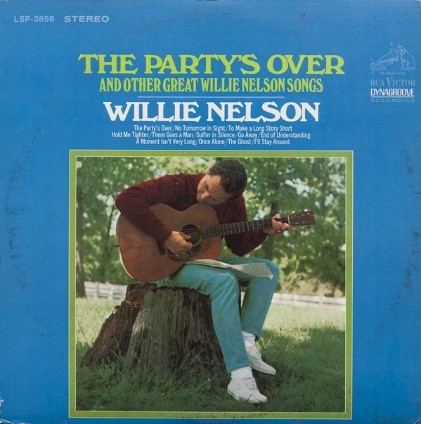
… on The Party’s Over and Other Great Willie Nelson Songs from 1967, from the time when Willie still had short hair and at least had one foot firmly planted in the Nashville clay. But also a record that demonstrates from start to finish what Dylan admires so much in Willie: “No one writes a bitter song like Willie Nelson” (Robert Hilburn interview, 1992). There is a line to “Cold Irons Bound” in there too, but still: too generic to put the “influential song” stamp on “No Tomorrow In Sight”.
All the more radiantly, after that clichéd opening, shines the most elegant aphorism of the song, and one of the most poignant of the album at all: It’s such a sad thing to see beauty decay / It’s sadder still to feel your heart torn away.
Its perfection suggests that Dylan had the one-liner already up his sleeve. “It was hotel stationary, little scraps like from Norway, and from Belgium and from Brazil, you know places like that. And each little piece of paper had a line,” as Larry Charles reveals in 2014 about Dylan’s working methods in the 1990s.
The isolation of the line within this song seems to confirm this; in terms of content, the first part, the decaying beauty, does not match the emotions that the protagonist conveys. One look at you and I’m out of control he sighs after this, and at the end of the song looking at you and I’m on my bended knee… heartfelt sighs and choice of words that at least suggest that there is no question of decaying beauty, but quite on the contrary, of radiant beauty.
The line must have been inspired by Keats, by the indestructible A thing of beauty is a joy for ever from “Endymion” (1818), and presumably its continuation (its loveliness increases) also triggered Dylan. Keats’ opening line has gained proverbial status and is quoted all over the place – by Willy Wonka, by physicists admiring the elegance of a beautiful formula, in adverts, by Mary Poppins, in songs (ABC’s “Never More Than Now”, for example) and by Woody Harrelson in White Men Can’t Jump… by everyone and everything, actually. In an ironic way, often enough, but just as often to express genuine admiration.
Keats’ figurative meaning is clear, of course. The memory of beauty can provide lasting, for ever, happiness, comfort or poignancy – Keats does know and acknowledge that beauty in itself is impermanent, (as “Ode To A Nightingale”, the poem in which Professor Ricks sees the template for “Not Dark Yet”, demonstrates). In 1882, Oscar Wilde argued pretty much the same thing, in The English Renaissance Of Art (“Beauty is the only thing that time cannot harm”), and Wilde was no fool either, obviously. Yet, strictly speaking, all beauty is indeed perishable, indeed does decay – even the stars above eventually fade away, after all. Which is the root of all melancholy, and thus an inexhaustible source of inspiration.
Melancholy is probably, after Love, inspiration No. 1 in the Arts since Homer, and the combination, the melancholy caused by a lost love, has also animated poets and songwriters for centuries. Usually clichéd and superficial (“Bye Bye Love”, “I Still Miss Someone”), as the emotion itself is big and recognisable enough to communicate without much poetic artifice. Exceptional talents, such as Tim Buckley, do manage to deepen it, though…
So tell me darlin' if the feeling's wrong
Don't waste another day
Lord, the saddest thing I've ever known
Was to watch it die away

“Love from Room 109 at the Islander(On Pacific Coast Highway)”, 1969)
But the Very Greats know how to avoid every cliché and avoid all mushiness – and thus still manage to move with melancholy. The template being, obviously, François Villon’s “Ballade des dames du temps jadis” (Où sont les neiges d’antan? – “Where are the snows of yesteryear”, 1461). Dylan’s “Not Dark Yet” on the same album is another perfect example, John Williams’ film music for Schindler’s List, De Chirico’s paintings, and a poetic masterpiece like Rilke’s “Herbsttag” (1902), with whom Dylan, not for the first time, demonstrates an artistic kinship;
Lord: it is time. The summer was immense.
Lay your shadow on the sundials
and let loose the wind in the fields.

Bid the last fruits to be full;
give them another two more southerly days,
press them to ripeness, and chase
the last sweetness into the heavy wine.
(transl. “Autumn Day” – Edward Snow)
… and to that list of extraordinary works of art belongs the sepia-coloured aphorism It’s such a sad thing to see beauty decay / It’s sadder still to feel your heart torn away.
The second part of the aphorism, heart torn away, fits in well with the desperate tenor of the song, and is also in line with the famous second, last part of Rilke’s “Herbsttag”. (He who has no home now, will build one never / He who is alone now, will long so remain).
The beauty of Dylan’s aphorism shines through all the more strongly because of the relative weakness of the surrounding lines. The introduction, with its walls of pride, is not very spectacular. And the continuation, the varying “transition lines” to the refrain line I’m twenty miles out of town in cold irons bound, again underpin the credibility of David Kemper’s testimony that Dylan dashes off the lyrics in ten minutes;
One look at you and I’m out of control
Like the universe has swallowed me whole
… first a run-of-the-mill cliché, and then a sonorous, neatly rhymed, but in fact incomprehensible, inconclusive metaphor. Apparently, the poet wants to express something like “struck by lightning” or perhaps “on cloud nine”. The eloquence of “the universe has swallowed me”, however, is rather polluted by its absurdity – you don’t have to be too scientifically literate to realise that we are all already “in the universe”. To understand how you can be swallowed by something you are already in requires an imagination that even a Kafka or a Charlie Kaufman would not dare to presume in the audience.
Well, in his defence: the poet is out of control, after all.
To be continued. Next up: Cold Irons Bound part 4:
Jochen is a regular reviewer of Dylan’s work on Untold. His books, in English, Dutch and German, are available via Amazon both in paperback and on Kindle:
Beautiful Obscurity is an exploration of some of the best or more unusual of Dylan cover versions. The recordings are selected by Aaron Galbraith and Tony Attwood has the job of writing comments. But Tony only has the time of playing the recording once to write his commentary – no cheating and going back to play it again.
Oh yes and Aaron and Tony never talk on the phone, what with being on different continents, so Tony only knows what’s coming as he starts to write. It’s all just a bit of a game, but it keeps us off the streets.
Aaron: I wonder if you’d like to take a journey across the years via 5 different versions of Chimes Of Freedom? Let’s see what ones you like best!?
10/8/87 – with Tom Petty & The Heartbreakers and Roger McGuinn
https://m.youtube.com/watch?v=4rnTVjpzthk
Tony: As mentioned many a time, I’m a great lover of Tom Petty’s work, both with Dylan and independently, and the magic of “Learning to Fly” played in a darkened auditorium with everyone holding up lights will be with me forever.
The problem with the songs I know so well is that, well, I know them so well that new versions have to be radical indeed to grab my attention. Here, once I’ve got the hang of how they guys are treating the song, then fine, I’ve got it. Except for the harmonies and oh what I would give for a clearer version to hearing the harmonies properly. That is fantastic – or at least I think so.
And I have to admit I have hit return a few dozen times to take my writing down the page and get the video out of my view – it is horribly distracting.
But by the third verse (I think) Bob is just calling out the lyrics. However the harmony based latter part of the verse pulls him back in. My suggestion is that after you’ve finished reading this you play the video again and turn the screen off, or look the other way.
And maybe wish, like me, we had a better recording of the gig.
Aaron: 12/7/87 – with the Grateful Dead
Tony: I am not at all sure the introduction adds anything to the song – it just seems to be bits and pieces as if to torment the listener. But of course once they start we know where we are.
Lovely contrast with the version before. And this is from the period when I wonder if Bob suffered from repetitive strain injury in his right hand. Could be an explanation for the strange guitar work that has been commented on a number of times by Mike Johnson in the Never Ending Tour series. And if so he has my sympathies – I have RSI from the combination of piano playing and typing at the computer, and wear a support that looks quite like that on my left hand when at the computer. It’s a pain ain’t it Bob?
Not too sure Bob gives us much more in this version but the lead guitar really does – that is what makes this recording worth hearing. The short instrumental breaks really do add a meaning as fast as Bob’s singing takes it away. (Sorry that is probably sacrilege and I shall expect the Dylan Police to be knocking on the door within minutes of this being published.)
And there are some lyrics changing too – but oh that lead guitar reworking of the song will stay with me. I’ll play in on the piano when writing this is over, RSI or not.
But I tell you what, that line “And for every hung-up person in the whole wide universe
we gazed upon the chimes of freedom flashing” is one of my all time favourites, from Dylan.
1/17/93 – Bill Clinton’s First Inauguration Concert – apparently 1 million people are in attendance!
Tony: This shows just how readily Bob has appealed to so many different group. But what Bob has done here! The point about the song musically is that it is in 12/8 – a very very unusual time signature for pop or rock or folk. But in the original it is a slow and stately 12/8 so you could reimagine it as a 3/4 and dance a waltz to it. Now it goes at full blast and he’s added a modulation in the penultimate line.
To me it is fun, but also more of a musical gimmick than a serious reinterpretation, and I am not quite sure what is amusing the President so much. Is it Bob’s appearance on the stage, or the choice of the song, or is the President musical enough to realise how Bob has just re-worked the song upside down and inside out? Or the fact that Bob is playing it so fast that he seems just to want to get it over with?
Clinton did replace Bush, from my recollection, and was seen as a spark of reforming lights – so maybe it was just the compliment of Bob playing for him.
From October 1998 – studio recording with Joan Osbourne – released on the soundtrack CD to the miniseries “The 60s”
Tony: From the very start I am intrigued. The harmonies work and nothing is rushed – a complete contrast to the version for the President. (Maybe some idiot told Bob he only had four minutes in that gig!)
I like this because Bob really really sounds like he means it. The time signature has changed to 4/4 and that allows the song to roll along in a way that suits this type of accompaniment.
But most of all the lyrics stand out. Every line sounds to me like I have never heard it before – and this is a song which when I first heard it in my childhood / teens transition had me reduced to tears (I am stupidly emotional, and that goes back to my childhood – although it has allowed me to work throughout my life in the arts, which has been very enjoyable).
Lines now stand out – oh this is by far, by far by far the best version so far. This is the one I will go back and play again. If I want to have a negative, it is the organ playing – I could have done with out… I want to go on but the time is up. Superb.
10/18/12 – live in San Francisco
Tony: And now it is a waltz! But it is that style of singing where Bob makes his voice jump an octave at the end of some lines and in other places – for reasons that never become clear to me. I’m really just waiting for this to play through – I don’t think Bob has ever really mastered the waltz, although trying to do so stayed with him for years; at least up to his multiple attempts to record “Tell Ol’ Bill”, which I covered yesterday (at least I think it was yesterday).
Does this tell me anything new? Does it entertain me? Does it give me new insights into these wonderful majestic lyric? Does it do what the Joan Osborne recording does?
Nope. I’ll stop here, so I can play that version Osbourne version again while I proof my rambling copy for spelling and grammatical errors. (That’s allowed isn’t it Aaron?)
According to the Dylavinci Code uncovered in Bob Dylan’s song lyrics, it’s noted that Jesus, after His ‘crucifixion’ in the Holy Land, sails across the Atlantic to what’s later known as the ‘New World’.
Christ travels with His ‘companion’ Mary Magdalene, though whether the Christian Saviour be technically alive or dead
Is a point of contention.
Fragmented song lyrics, pulled from the Holy Grail stored at the Archives Department of the Untold Dylan Headquarters, read like this when put back together:
They got Jesus Christ trapped
Out there in Romans Five
Judge says to the High Priest
'I want Him dead or alive
Either one, I don't care"
(High Water Everywhere)
Clues are scattered about, embedded in present-day song lyrics as well, lyrics that at first glance appear to have nothing to do with the history of Jesus.
Before Jesus and Mary head off to what is now Mexico, the two love birds have plans to marry, and settle down in what is now the American State inhabited by lots of Christian-like ‘Mormons’ – so expresses the Dylanesque clue beneath:
Build me a cabin in Utah
Marry me a wife, catch rainbow trout
Have a bunch of kids who call me "Pa"
That's what it must be all about
(Sign On The Window)
What’s very clear, however, according to the Dylavinci Code, is that Jesus and Mary instead gallop off on horses to Mexico, pursued by a posse that’s been organized by the established Church.
The narrator in the following lyrics – obviously, Jesus:
Sold my guitar to the baker's son
For a few crumbs, and a place to hide
But I can get another one
And I'll play for Magdalena as we ride
(Romance In Durango)
Another clue dropped in the lyrics below cheekily references the dualistic gnostic metaphoric dark/left, and light/right aspects of the material/spiritual Universe that Mary Magdalene has the task of carrying.
‘Louise’ (Lou) means ‘female warrior’ while ‘Pearl’ harks back to the standard labelling of Queen Maggie as a former whore “with her fog, her amphetamine, and her pearls”.
The Dylavinci Code clearly places the departed-double Mary as the inhabitant of the right side of the mythological Plutonian underworld where the souls of heroic warriors get to go:
Hello Mary Lou
Hello Miss Pearl
My fleet-footed guides from the underworld
(False Prophet)
“All Directions at once” is a series that looks at Bob’s songs in the order they were written, rather than the order of release or by themes. We are now in the final leg of the journey with the songs written in the 21st century. The most recent posts are…
To me, the writing of Tell Ol’ Bill is a key moment in Bob Dylan’s writing, and to understand the song we have to understand Bob’s work in the 21st century, and I believe that to see what this work is about we have to understand the process and approach of his work from 1997 onward.
1997 was a time of finishing “Time out of mind” ending with three songs that reflected love: “Make you feel my love”, “Till I fell in love with you” and that most downbeat of songs, “Love Sick”. That was the last song written for the album, the first track on the album.
Then, as had happened in recent times, Bob (to be the best of our knowledge) stopped writing until in 2001 he produced one of his most highly acclaimed songs of all times, “Things have changed”.
And of course we recall that the line “I used to care but things have changed” came from the man who told us to gather round and admit that change has happened and is happening, and that we had better try and keep up with the change, or else we’ll be in trouble.
So quite a few of us swam, and kept swimming, as instructed to do, only to find, as Bob did, that just keeping up might not be enough. Just as caring might not be enough. The world changes, no matter what we do. So what is the point of caring, if we can’t make a difference.
And so the emphasis has changed. “Times they are a-changin'” is about the very essence of society; society changes because the times in which society endlessly evolves change. But “Things have changed” is about the individual; the individual who steps aside from that evolution of society, and just looks on, dispassionate, uncaring. Worried, yes, but primarily worried about who is walking behind him, not about where society is going.
Yet this man in “Things have changed” who steps aside from worrying or being concerned about society, is only one of the examples of people who leave the rat race behind. What of the man who goes to the other extreme. The guys who jumped on the freight trains, or who hitched a ride. Those for whom none of this social push forward was relevant, because they were not interacting with society at all. All those hung up people in the whole wide universe. What of them. The hobos, the tramps, the lost…
For such people the wrongs of the world, the evils done by politicians, being let down by friends – all of this is irrelevant. The only relevance is a dry place to sleep for the night, and something to eat.
It’s all a bit of a tangle as we consider who we are, what we have done, and what we believe. So we get to “Honest with Me”. Bob rather liked it; he played it 739 times in concert.
(The video screen below looks a little like a video that is not available, but it seems to play ok).
Just consider some of these lines
These memories I got, they can strangle a man

Lot of things can get in the way
          when you’re tryin’ to do what’s right

I’m not sorry for nothin’ I’ve done
I’m glad I fought—I only wish we’d won

When I left my home the sky split open wide
I never wanted to go back there—I’d rather have died

You say my eyes are pretty and my smile is nice
Well, I’ll sell it to ya at a reduced price

Some things are too terrible to be true

I’m having a hard time believin’ some people were ever alive
This really is a man who has had it all only to find he couldn’t do it all. For some of what he has found is just too terrible to be true. It was the obvious precursor of “Things have changed,” the only composition of 1999.
So the question is, how can a writer follow up on this position? What can you say after saying “I used to care but things have changed”?
What Dylan did was take his writing back to the past, drawing inspiration from the music he loved, rather than trying to talk any more about now. And so by 2001 Bob was able to write “Summer Days” which has the line
She says, “You can’t repeat the past.”
I say, “You can’t? What do you mean,
you can’t? Of course you can.”
And you do that when you’ve given up on change: you just replay the past. So in this interregnum as Bob looked back and contemplated his album of songs based on the work of others, he found himself in 2005 with another film commission, and a mind which was focused on the past and how really nothing had changed since he wrote his earliest songs.
So, in writing Tell Old Bill Bob used from two sources: a compendium of American folk songs by Carl Sandburg from 1927 which gave him the lines Tell Old Bill when he gets home/Leave them downtown gals alone, and the song “I never loved but one” recorded by the Carter Family. Here’s a modern recording of the traditional “Tell Ol Bill”
This song obviously not the source of Dylan’s composition, but it is the source of the first seven words. And Bob knew this song well, as he recorded the Sanburg collected song for Self Portrait, (although it wasn’t included).
Thus we have one source for Tell Ol Bill. The second is the desperately sad, “I never loved but one” from which the melody and chord sequence of Dylan’s “Tell Ol’ Bill” is taken and which has the chorus
I look around but cannot trace
One welcome word or smiling face
In gazing crowds I am alone
Because I never loved but one
The music is very similar and there are occasional lyrical touches that Bob has lifted from the Carter family as “One welcome word or smiling face” and “Until I forget that lasting face” becomes “I tried to find one smiling face”. Plus “You bent to me and kissed my brow” mutates to “Left the coldest kiss upon my brow.”
But it wasn’t just the Carter Family that Bob knew in writing this. As Larry pointed out in his article, John Keats: La Belle Dame Sans Merci contains more than a hint of where Bob was going. (Besides how many other times has Bob used the word “brow” in a song?)
I see a lily on thy brow
With anguish moist and fever-dew
And on thy cheeks a fading rose
Fast withereth too
Now you will probably know that at least nine takes of “Tell Ol Bill” were made going through a whole range of styles and approaches – Bob had the lyrics (including the “thunder blasted trees” – a superb image lifted from Edgar Allen Poe’s “To one in paradise”) … but just couldn’t quite find a way to make this jigsaw of inspirational points work musically.
And then, perhaps because it was a piece of film music, but this time didn’t win any awards, and indeed because it didn’t make it to a mainstream album, it was ignored.
Yet this is the ultimate song of loss, isolation, despair, regret, fear, powerlessness, uncertainty… that’s pretty much the whole collection of human feelings that despite any progress the race might have made, are still there as part of our condition. In the end we have a song of having tried to step outside human society, and finding that having done this, it is impossible to get anything done, either on a personal or a social level. We become a drifter. And the drifter only escapes when the world explodes in chaos.
Is this where it all ends?
The river whispers in my ear
I've hardly a penny to my name
The heavens have never seemed so near
All of my body glows with flame

The tempest struggles in the air
And to myself alone I sing
It could sink me then and there
I can hear those echoes ring

I tried to find one smiling face
To drive the shadows from my head
I'm stranded in this nameless place
Lying restless in a heavy bed

Tell me straight out if you will
Why must you torture me within?
Why must you come down off of your hill?
And throw my fate to the clouds and wind

Far away in a silent land
Secret thoughts are hard to bear
Remember me, you'll understand
Emotions we can never share

You trampled on me as you passed
Left the coldest kiss upon my brow
All my doubts and fears have gone at last
I've nothing more to tell you now

I walk past tranquil lakes and streams
As each new season's dawn awaits
I lay awake at night with troubled dreams
The enemy is at the gate

Beneath the thunder blasted trees
The words are ringing off your tongue
The ground is hard at times like these
The stars are cold, the night is young

The rocks are bleak, the trees are bare
Iron clouds are floating by
Snowflakes falling in my hair
Beneath the grey and stormy sky

The evening sun is sinking low
The woods are dark, the town isn't new
They'll drag you down, they'll run the show
They will see you black and blue

Tell ol' Bill when he comes home
Anything is worth a try
Tell him that I'm not alone
And that the hour has come to do or die

All the world I would defy
Let me make it plain as day
I look at you and now I sigh
How could it be any other way?
And from the first moment I heard that I wondered where I had come across this before – this isolation, hopelessness, where all the singer can do is call out to a friend who isn’t there…
Ain't it just like the night to play tricks
   when you're tryin' to be so quiet?
We sit here stranded, though we're all doin' our best to deny it
And Louise holds a handful of rain, temptin' you to defy it
Lights flicker from the opposite loft
In this room the heat pipes just cough
The country music station plays soft
But there's nothing, really nothing to turn off
Visions is set in the room where the heating doesn’t work. Decades later old Bill is now stranded in a nameless place. As Bob concludes, “How could it be any other way?”
Both are songs of hopelessness; of having made decisions which have led to a world that makes no sense and is a trap. And this is worth contemplating because if these are the alternatives to becoming totally wrapped up within society, that’s not a great choice.
In short, if we step outside of the mainstream, we are liable to find life’s not so good. Maybe old Bill did start out without any debts to anyone. After all,
The fiddler, he now steps to the road
He writes ev'rything's been returned which was owed
But he still had to eat, pay for a room for the night, try to keep warm. Other than being a hunter gatherer there is no escape.
Of course it can be argued that my link between Visions and Tell Ol Bill is fanciful, and that Dylan just liked the song “I never loved but one” and picked up other people’s lines here and there. But to me, the man giving advice to Old Bill, and telling him anything is worth a try, and Louise, Johanna, Little Boy Lost… none of them found any form of personal salvation. No one worked out how to get this right.
The entire Tell Ol Bill recording session is also now available
For as the Carter Family sang,
I look around but cannot trace
One welcome word or smiling face
In gazing crowds I am alone
Because I never loved but one
Of course we don’t know who Dylan aimed his thoughts at with the lines
You trampled on me as you passed
Left the coldest kiss upon my brow
All my doubts and fears have gone at last
I've nothing more to tell you now
but we sure can get the message, if we want to listen. Times change, and I used to care, but now I just accept where I am. This has been my life. There’s nothing I can do about that; the past is what it is.
Details of the authors who write for Untold Dylan are given in Untold Writers. If you’d like to write for Untold, and reach a fairly large worldwide audience, please drop a note to Tony@schools.co.uk either with your idea or an original article. If you’d like to explore further issues, please do join our Facebook Group. Just search for “Untold Dylan”
Just then a bolt of lightning
Struck the courthouse out of shape
And while everybody knelt to pray
The drifter did escape
(Drifter's Escape)
Clues that pop up in the song lyrics of Bob Dylan indicate that the Dylavinci Code (discovered by our intrepid research team at Untold Dylan headquarters) agree with the Christian legend that Mary Magdalene, and her sister Martha, along with Lazarus, journey to southern France, the land of oaks, after Jesus is supposedly crucified:
And as they led Him away
They laid hold of one Simon, a Cyrenian
Coming out of the country
And on him they laid the cross
(Luke 23:26)
According to the legend, Mary, Martha and Lazarus endeavour to convert the French pagans; in symbolic language akin to gnostic writings, Martha is responsible for the killing of a sphinx-like creature similar to the beast featured in Greek mythology.
So encoded in the song lyrics quoted beneath:
Ring them bells Sweet Martha for the poor man's son
Ring them bells so the world will know that God is one
Oh, the shepherd is asleep
Where the willows weep
And the mountains are filled with lost sheep
(Ring Them Bells)
Quickly noticed by our biblical scholars is that the “shepherd” Jesus, a Jewish rabbi, is missing, and that God is not referred to as a Trinity. Nor is there any mention of ‘original sin’ as interpreted by St. Jerome in the Vulgate Bible.
The Christian legend has it that Mary dies in France, but, according to the Dylavinci Code, Jesus and His pregnant wife Mary Magdalene simply split up in France for safety reasons, and the two later meet in Tangier, Morocco.
Gathered from the following Dylanesque clue provided in the song lyrics quoted beneath, Jesus being cast as the narrator therein:
If you see her, say 'Hello'
She might be in Tangier
She left here last early spring
Is living there I hear
(If You See Her Say Hello)
In his typical ‘character sketch’ approach to interpreting Dylan’s lyrics, David Weir concludes that the narrator of the above song lyrics is “bitter, dominating, false, inconsistent…”
Dear reader, you can tell the sad-eyed lady Mary Magdalene that this isn’t so.
Strawberry Fields await her:
Night speeds by, and we, Aeneas, lose it in lament
Here comes the place where cleaves our way in twain
The road, the right, toward Pluto's dwelling place goes
And leads us to Elysian Fields
And the left hurries us to our doom
(Virgil: The Aeneid, Book VI ~ translated)
The breaking of the Dylavinci Code lies exclusively beyond the locked doors of the Untold Archives Department:
Wisdom, who is called barren, is the mother of angels
The companion of the Saviour is Mary Magdalene
And He kissed her often on the lips
(Gospel Of Philip)
I’m waist deep, waist deep in the mist
It’s almost like, almost like I don’t exist
I’m twenty miles out of town in cold irons bound
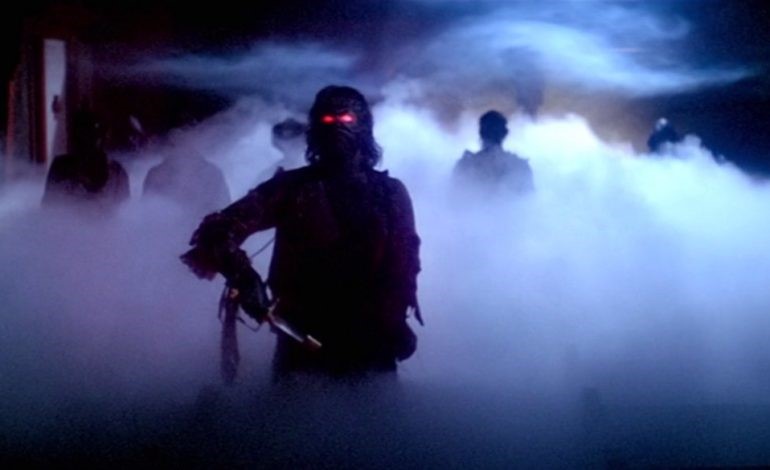
The Fog (1980) is a low-budget horror film by John Carpenter which, despite poor reviews, was well received at the time and has since become something of a cult classic in the twenty-first century. The story is simple enough: exactly one hundred years after a ship has been lured onto the rocks by evil-doers using false light signals, a strange, luminous fog creeps into a Californian coastal town, and this fog brings with it the vengeful spirits of the drowned sailors. Not too imaginative, but Carpenter is a craftsman who impresses with lighting, music and almost poetic tableaux – such as the sheer iconic image of the ghosts, the non-existent, emerging from the fog: waist deep in the mist, almost like they don’t exist.
Apparently Dylan also recognises its poetic power, and he explores its metaphorical potential for the chorus of “Cold Irons Bound”. Inspired, he sits with his yellow pad of paper next to the drumming David Kemper, echoing in his mind are the songs of Stanley series: Vol. 3, no. 4, and presumably he has already fixed the refrain line I’m twenty miles out of town in cold irons bound;
“In that particular song, the last few verses came first. So that’s where the song was going all along. Obviously, the catalyst for the song is the title line. It’s one of those where you write it on instinct. Kind of in a trance state.”
That’s what Dylan says in 2020 about the creation of “I Contain Multitudes”, with the addition most of my recent songs are like that (New York Times interview with Douglas Brinkley). The outpouring seems to apply one-to-one to the creation of “Cold Irons Bound”. The last line, I’m twenty miles out of town in cold irons bound, is probably there before the previous one. Kemper’s drum pattern inspires.
It just so happens that today The Stanley Brothers are buzzing through Dylan’s mind, and via “The Fields Have Turned Brown” and “Handsome Molly” the stream of consciousness flows to “I’ll Fly Away”, to cold iron shackles on my feet, which perhaps awakens in cold irons bound from an obscure variant of “The Banks Of Inverness”. Strong metaphor, the poet thinks, to express bound-against-your-will, to express the state of mind of his protagonist; an I-person who is love sick, standing on the doorway, about to hit the dirt road. The musician Dylan’s particular choice of words is then, as so often, sound-driven – not on the road in iron shackles, and not like the worried man in “Worried Man Blues” twenty-one links of chain around my leg on the Rocky Mountain line, but a superior assonant triplet around the ou-sound: out – town – bound.
The bridge to that refrain line is not fixed. The poet is inspired, trusts the richness of the stream-of-consciousness and will choose different images and different words in each of the five refrains to express the loneliness and the quiet desperation of the unhappy protagonist. Here, in this first refrain, is the desolate image of disoriented people wandering through the fog. The symbolic power of this, of course, has been recognised by artists for centuries. Who knows, maybe Dylan has also browsed through the works of fellow Nobel Prize winner Hermann Hesse:
Seltsam, im Nebel zu wandern!
Leben ist Einsamsein.
Kein Mensch kennt den andern,
Jeder ist allein.
Strange, to wander in the fog,
To live is to be alone.
No man knows the next man,
Each is alone.
(Hesse, Im Nebel, 1911, transl. In the Fog Scott Horton, 2007)
Hesse reading “Im Nebel”:
Although – on a side note – this cinematic image conveying alienation and sadness probably has never been used in such a goosebumps-inducing way as in the most gorgeous “mist-song” ever, in Gene Clark’s “In A Misty Morning” from 1972;
Running through my thoughts
Were the memories of the days that I had left behind
Way down in my soul were the hopes
That better days were always there to find
The fog rolled in and the lights grew dimmer
And the sound of the city streets seemed amplified
In the misty morning when it had just been pouring
Like the clouds above the storm just had to cry
The unusual repetitions in these two chorus lines give some credence to Kempers’ story that Dylan wrote the lyrics in ten minutes. “Ten minutes” is probably more or less true, but it is likely that Dylan, the compulsive scribbler and note-taker, had already got a few one-liners up his sleeve. A refrain line like I’m twenty miles out of town in cold irons bound and a couplet line like My love for her is taking such a long time to die have a polished perfection that suggests they were already a while in the making, the marble elegance of the coming “decaying beauty” aphorism doesn’t seem to have come out of the blue either.
Still, the atypical repetition in these couplet lines (waist deep, waist deep and almost like, almost like) is the stopgap solution of an inspired poet who does not want to lose his flow, who wants to keep the momentum going and quickly fills in the empty syllables with repetition. Atypical for the eloquent Dylan, but a ten-a-penny style characteristic of The Stanley Brothers;
Everybody I met, everybody I met, seemed to be a rank stranger
No mother or dad, no mother or dad, not a friend could I see
They knew not my name, they knew not my name,
    and I knew not their faces
I found they were all, I found they were all, rank strangers to me
To be continued. Next up: Cold Irons Bound part 3: He who is alone now, will long so remain
———-
Jochen is a regular reviewer of Dylan’s work on Untold. His books, in English, Dutch and German, are available via Amazon both in paperback and on Kindle:
This series reviews the Never Ending Tour from its origins in 1987 through to its cancellation with the outbreak of the pandemic. A full index of the articles is available here, and the most recent are
Between 1999 and 2002 Dylan often started his shows with a traditional folk, blues, gospel or country song, and peppered his setlist with such songs. Dylan has always looked beyond himself to the music of the past for inspiration. His very first album (Bob Dylan, 1962) contained only two Dylan songs, the rest being from the history of popular music. Dylan’s own music grew out of that history, and his early songs were set to traditional melodies.
He returned to these roots in 1970/71 for the songs on Self Portrait, and again in the early nineties, when he wasn’t writing his own songs, with two albums of traditional material, and he would return to that rich field, spectacularly, in 2014/15, with his ‘uncovers’ of songs from what is known as The Great American Songbook.
Just what Dylan was up to in these four years spanning the turn of the century did not become clear until his next album, Love and Theft, appeared in 2001. We’ll be looking at that in my next post.
When I came to the end of my survey in 1999, I added a whole post dedicated to these songs (See NET 1999, part 6), and feel it right to do the same thing for 2000, even though there are many repeats, and not much variation in arrangement and delivery. Writing this feels a bit like a rerun of my 1999 final post, and in a sense it is.
Take the Buddy Holly classic ‘Not Fade Away’. It first appeared for us in 1997 (see NET, 1997, part 2), but the bulk of Dylan’s 138 performances of this song were in 1999. By 2000 the song is beginning to fade away. He’d play it only once in 2001, a few times in 2002, and except for a one-off in 2009, that was pretty much it. Dylan sings it here, the band in full cry with some great harmonies. It’s a good bouncy song to get an audience jumping.
Not Fade Away
‘I Am the Man, Thomas’ by Ralph Stanley and The Clinch Mountain Boys (1971), would fully come into its own in 2002, but we have a dozen performances from 2000. Over the four years, he used it 59 times as a concert opener (See Attwood: https://bob-dylan.org.uk/archives/15113). This one’s from Anaheim.
I am the Man, Thomas
Dylan played the traditional murder ballad, ‘Duncan and Brady’, over 80 times between 1999 and 2002. Wikipedia has an interesting entry for this song:
You might notice that one of titles of the song, ‘Been on the Job Too Long’ is the last line of ‘Black Rider’, on Rough and Rowdy Ways (2020).
While Dylan no longer writes topical protest songs, he is still singing them. Despite his protestation that ‘things have changed’ from that song, some things it seems don’t change. (6th Oct London)
Duncan and Brady
Described as one of the building blocks of rock’n’roll, Willie Dixon’s ‘Hoochie Coochie Man’ has been recorded by everyone from Muddy Waters to Motörhead. It was first recorded by Muddy Waters, 1954. With slow, heavy beat and bluesy feel, this song was perfectly suited to the rock wave of the 1960s. Dylan plays it straight, just as he might have heard it back in the day.
Hoochie Coochie Man
‘The Newry Highwayman’ is a traditional Irish or British folk song about a criminal’s life, deeds, and death. First sung by Dylan for the NET in 1998. More evidence here, if we needed it, of Dylan’s fascination with outlaws, outsiders and criminals. ‘Joey’ comes to mind. These are songs that tell the story of a whole life, story-telling ballads, and there always was something romantic about a highwayman. Lovely to hear Dylan singing these antique melodies. (6th Oct, London)
Newry Highway Man
‘She’s About a Mover’ is a 1965 song which was written by Doug Sahm of the Sir Douglas Quintet in 1965 and quickly covered by several other artists. The song has a 12-bar blues structure, and is quite basic and energetic. It’s part of the blues revival of the 1960s, and could have been written a lot earlier. Like ‘Hoochie Coochie Man’, this song is another reminder of the importance of the blues in Dylan’s development.
She’s about a mover
Of these antique, bluesy songs, ‘House of the Rising Sun’ must be the most famous. The song appeared in America in the 1930s, but is probably derived from a traditional English folk song. Dylan included it on his first album, which would inspire The Animals to do their epic version. For all that, Dylan has only performed the song eight times. Once in the year 2000 – this one from 17th June, George. Dylan doesn’t do it acoustically, as he originally did it. His version seems more inspired by The Animals’ version, to bring that story in full circle.
House of the Rising Sun
‘Searching for a Soldier’s Grave’ became a firm favourite of Dylan, being performed 111 times over 2000 to 2002. Written by Jim Anglin (1913-1987), although sometimes credited to Hank Williams, it was first recorded and released by the Bailes Brothers in 1946. It’s a patriotic song about someone searching for the grave of a loved one, an American soldier ‘killed in action’. It’s probably from the point of view of a wife or girlfriend. (6th Oct London)
Searching for a Soldier’s Grave
‘This World Can’t Stand Long’ was written by Jim Anglin, Jack Anglin, Johnny Wright and was first recorded by King’s sacred Quartette in 1947, although I have seen it credited to Roy Acuff. It’s a folk gospel song about how the hate and sin in the world will bring it to an end. It ties in with Dylan’s feel for the apocalypse. (Anaheim). It has a gentle beat and Dylan gives it sensitive treatment.
This world can’t stand long
‘Hallelujah I’m Ready to Go’ is a traditional song, a more upbeat, rousing gospel song than the melancholy ‘This World Can’t Stand Long’. It wouldn’t have sounded out of place during Dylan’s gospel period (1979 -81). Again Dylan uses the band to create some cool harmonies. On a personal note, this song reminds me of when I was a kid going to the local folk club in my home town (Christchurch NZ) to listen to songs like this, songs like ‘Down by the River Side’ and ‘When the Saints Go Marching In’.
Hallelujah I’m ready to go
‘Big River’ is a Johnny Cash song from 1958, so its appeal to Dylan needs no explaining. Cash’s use of place names presages Dylan’s:
‘I met her accidentally in St. Paul, Minnesota,
And it tore me up every time I heard her drawl, Southern drawl,
Then I heard my dream was back Downstream cavortin’ in Davenport,
And I followed you, Big River, when you called.’
Is there not a flavour of ‘Tangled up in Blue’ here? (October 5th London)
Big River
“Pass Me Not, O Gentle Savior” is a 19th-century American hymn written by Fanny Crosby in 1868, set to music by William H. Doane in 1870. For my 1999, part 6 post on this song I wrote: ‘the song was not performed by Dylan prior to 1999, and would only be performed five times over 1999 and 2000. It’s a country music hymn, an interesting fusion that produced many such songs. Fanny Crosby herself wrote dozens of them. Still a cowboy song, it’s about salvation rather than whisky or love woes. Dylan’s arrangement here is similar to The Stanley Brothers version released in 1960.
‘It’s something of a curiosity in this context, a dark period for Dylan in which his faith is deeply called into question by the Time out of Mind songs. ‘Don’t even hear the murmur of a prayer’, he sings on ‘It’s Not Dark Yet’. Perhaps this expression of a simple, old fashioned faith appealed to Dylan during such a time, a crisis of faith if we can call it that. There’s a strong flavour of nostalgia in all of this.
There’s some particularly fine guitar work by Larry Campbell (I assume but don’t know) making his guitar sound like a mandolin – unless I’m making a fool of myself here and it is a mandolin. Whatever, it’s quite irresistible. (London, 5th Oct)
Pass Me Not O Gentle Savior
Dylan has been performing ‘Roving Gambler’ since 1960. It’s one of those songs that has been in his blood all along. Authorship unknown, one can imagine it just grew out of the taverns and gambling houses of the wild west. It was first recorded and released by Samantha Bumgarner in 1924. This one’s from Dresden, 24th May.
Roving Gambler
This brings to an end my six part survey of 2000, which must surely be counted as one of the outstanding years of the NET. Put together with 1999 and you have two years of Dylan in top form. We’ve seen Dylan as master vocalist, in full command of a number of styles from soft and spooky (‘Gates of Eden’), to full on baritone (‘Desolation Row’), to rough and gutsy (‘Watching the River Flow’), and dark and sinister (To Ramona). An extraordinary range of expressions.
His guitar playing, while still strangely off key and dissonant has become much more disciplined, and we saw the driving power of his acoustic guitar in ‘Desolation Row’ and ‘Tangled up in Blue’. The harmonica did a bit more work than in 1999, but was still kept pretty much in the background. Hard to forget the wicked harp in ‘The Wicked Messenger’.
Dylan was certainly on a roll, whatever he says on ‘Highlands’, and he would keep on rolling right through 2001 with the arrival of his next album, Love and Theft.
Until next time, stay safe and keep dodging lions.
In the last episode of “All Directions” (part 64) we got to Floater – and we have seen Bob move into an approach to song writing in which he would take a song from the past that he liked, and then rewrite it or amend it or in other ways play with it. And this very much continued all the way through this period from 2001 on to 2005.
In fact the very next song after Floater (“Moonlight”) and the last in this sequence of song borrowings (“Tell Ol’ Bill”), were both developed from Carter Family songs. The difference is the “Meet me by the moonlight” really is a long way from “Moonlight”, whereas with “Tell Ol Bill” the relationship is much closer .
This is not to suggest the songs are not enjoyable – they certainly are – and indeed had anyone else created this collection it would be heralded. It is just that at the end of the 1990s Bob had created a totally wonderful and as far as I know completely original song for a movie, along with an album that is considered by many to be an utter masterpiece, and maybe we felt he could carry on at that level without evolving songs from the works of others.
But in all work is borrowed and evolved, and most certainly in the works of Shakespeare (to take but one writer of a certain renown) much is “borrowed” from the past. Indeed even “All the world’s a stage”, perhaps the greatest metaphor in the language, appeared in Damon and Pythias which was completed by Richard Edwards in the year of Shakespeare’s birth. “Pythagoras said that this world was like a stage / Whereon many play their parts; the lookers-on, the sage.”
But Bob wasn’t just turning to the Carter Family for inspiration. For example Po’ Boy uses chords that many of us everyday musicians have to go and look up, and that sequence certainly seems to me to be totally original, but lyrically it seems to be giving a nod to “Alice in Wonderland” and “Through the Looking Glass” – two children’s books deeply embedded in English culture but musically… well, it’s not very Dylan at all.
As for those chords I am not saying I couldn’t sort out all those chords, but, you know, given that I had people coming round for dinner, it just seemed easier to take Eyolf Østrem’s word for it: Fmaj7, F6, F#m7-5, Bm7-5 etc etc. It’s not that it is not an original sequence, I am sure it is, but rather it looks and sounds like a way to find something new to write: a deliberate “I know let’s use some obscure chords” as opposed to pure inspiration (which I take “Things have changed” to be).
What’s more Bob then composed another single chord piece (with a couple of passing chords): “High Water”. Highly enjoyable but almost as if, since he’s done a song with insanely complex chords, now he’ll do one with the most simple chords.
(And incidentally maybe that is why Barb Jungr’s reinterpretation of it goes in a totally different direction!)
Which is not to say that such decision making is wrong, or makes the songs any less interesting. No, what I am trying to say is that at this moment Bob changed his way of writing, making structural decisions about his songs, rather than just letting them emerge.
To put it another way, an example would be that of the poet who sits down and let’s it all pour our of his head, as opposed to one who is reading someone else’s work and thinks, “wow that’s good” and takes his inspiration from that point. Bob had moved at this time from the former to the latter.
Additionally, listening to the songs in the order they were written does indeed make it seem also as if Dylan was pulling in references to all the blues songs he hasn’t referenced so far in his compositions, and in the end there seem to be so many references, one can get carried away finding them. But of course it is still important to hear them as what they are: great songs.
And Bob did have a treat in store, which was saved for the end, as he concluded the year’s album writing with Sugar Baby, a really remarkable looking-back song; an insightful piece with thoughts and notions that don’t connect, that can’t co-exist, but within the song absolutely do just that. A reflection on all the songs that he has written during the year perhaps.
But yes also once more digging into those highly unusual chords, some of which are created by only using five of the six strings on a re-tuned guitar. Again please turn to Mr Østrem for definitive details, but I can say that although I consider myself not an incompetent guitarist, I wouldn’t fancy playing these anywhere but on the piano (wherein life is much easier with some of these chord inversions). It’s almost as if Bob is saying to us mere mortals – “Ok guys, now work out what I’m doing here.”
So my point is not that these are not good songs – indeed this commentary ends with what I consider to be one of Bob’s greatest pieces – but rather it is to note that he had changed approaches. And I would urge you to listen to this.
Sugar Baby, get on down the road
You ain’t got no brains, no how
You went years without me
Might as well keep going now
And indeed for anyone who has lived a lively, varied and interesting life and who really knows what emotions are all about, the line
Some of these memories you can learn to live with
    and some of them you can’t
really summarises everything.
Finally this year Bob wrote another piece of film music: “Waitin’ for You”. It is a waltz, and Bob played well over 100 times in concert and which ends with the line “Happiness is but a state of mind.” OK, I get that, but taking the song as a whole (melody, accompaniment, lyrics) it’s not a song I understand at all – and maybe in all these play-throughs Bob was just celebrating that he had written a waltz. I am not sure if he had written one before – if you know of one (by which I mean a song in straight 3/4 time) do let me know.
Film music was obviously something Bob was fascinated by at this time, and I imagine he now received a vast number of requests to write something for a movie. But after the album tracks of 2001 Bob contented himself with just one composition in 2002, “Cross the Green Mountain”, and this most certainly was a song that related to the movie for which it was composed.
The song also marks a major moment in Dylan’s relationship to the work of Henry Timrod, and in doing so he also used a technique he had explored before, as for example with the work of Dylan Thomas, changing “The goat-and-daisy dingles” from Under Milkwood into “The cloak and dagger dangles”.
Before Cross the Green Mountain, Dylan was doing that with the work of Henry Timrod taking
That distant peak which on our vale looks down
And wears the star of evening for a crown
to turn into
My pretty baby, she’s lookin’ around
She wears a multi-thousand dollar gown
Timrod, a civil war poet, confesses that he cannot unravel the unknowable mystery of how and why the Universe exists; indeed, as time passes, the Civil War poet contends that, like a Swedenborgian Creator, God is falling farther and farther back into the vast emptiness of space.
Somehow that seems to fit exactly where Bob had got to by now – indeed one might take from that vision the line “I used to care but things have changed”.
And given that Bob was a figure of world-renown, he had nothing to prove, and so he was perfectly entitled to contemplate any aspect of the world that took his fancy in any way that he liked. And in doing so he found himself facing a type of darkness that is present in “Things have changed” and indeed in “Sugar Baby”. It is a pretty awful world and people can behave pretty badly in it. As I noted before, “God is not dead, he’s just missing.”
Thus overall it seems to me that from 1996 onward Bob was by and large suggesting that it might not be dark yet but it most certainly would be pretty soon.
And then in the midst of all this, Bob came up with something utterly different. “Tell Ol’ Bill” was made for is “North Country” which the New York Times called “an old-fashioned liberal weepie about truth and justice.” Like “Green Mountain” it lost money, but it’s losses in terms of film production were modest, and it was fairly highly acclaimed, getting a 63% approval rating as opposed to an 8% approval rating for “Gods and Generals”.
Now, if you have been reading my ramblings for a while you may have noted that I hold one version of Tell Ol’ Bill in very high regard, and I do want to take some time to examine both it, and the Carter Family original from which it evolved, in more depth. I’ll save that for the next episode.
A dangerous business perhaps, but Bob Dylan leaves lots of clues in his song lyrics that he’s been searching for the hidden tomb of Mary Magdalene, and her daughter by the Christian Messiah.
As we have seen, Bob’s got Mary’s burial site narrowed down to Egypt – like Indiana Jones in the movies, he believes the great Sphinx statue (near the Nile River where Moses was hidden as a baby) has something to do with it, and the discovery of her remains could clarify to one and all what Mary Magdalene be really like.
The singer/songwriter throws down a few red herrings to divert barking religious hound dogs from the trail:
I'm just like Anne Frank, like Indiana Jones
And them British bad boys, the Rolling Stones
I go right to the edge, I go right to the end
I go right where all things lost are made good again
(I Contain Multitudes)
Dylan also turns right to the Elysian Fields, not left to Hell, in the song “Key West”:
You stay to the left, and then you lean to the right
Feel the sun on your skin, and the heeling virtues of the wind
Key West, Key West, is the land of light
(Key West)
Known as ‘Horus Of The Nile’, the protective human-headed, lion-bodied Sphinx is equated in Greek mythology to a man-eating beast that has the head of a woman, the wings of a falcon, and the body of a lion.
The Dylavinci Code rejects that dark view, and suggests there’s a secret door that leads to the light and truth about the mother of Christ’s child.
According to an Old Testament Gnostic-like prophet, the throne of God is held up by angels with the face of a man, a lion, an ox, and an eagle:
As for the likeness of their faces
They four had the face of a man
And the face of a lion, on the right side
And they four had the face of an ox on the left side
They four also had the face of an eagle
(Ezekiel 1:10)
Alluded in the song lyrics below:
Beat a path of retreat
Up them spiral staircases
Pass the tree of smoke
Pass the angel with four faces
Begging God for mercy
(Angelina)
The songwriter struggles with the vision of Mary Magdalene, with the child of Jesus wrapped up in her arms, where she is portrayed by at least some New Testament Christians as a former prostitute in need of repentance:
Queen Mary, she's my friend
Yes, I believe I'll go and see her again
Nobody has to guess that baby can't be blessed
'Til she finally sees that's that she's like all the rest
With her fog, her amphetamine, and her pearls
(Just Like A Woman)
Mary Magdalene is Bob Dylan’s friend, and he’s grateful that she’s travelled with him this far, right to the very end.
“It was a really great band. And I’m sorry not to be in it today. I miss Bob and I miss that band.” Drummer David Kemper does open the doors to his heart, in Uncut’s wonderful interview series surrounding the release of Tell Tale Signs (2008), number 8 in The Bootleg Series. For the thirteen-part interview series, Uncut talks to men like engineer Malcolm Burn, drummer Jim Keltner, guitarist Mason Ruffner and producer Daniel Lanois, men who were directly involved in the making of albums like Oh Mercy, Time Out Of Mind and Love And Theft; records Dylan made between 1989 and 2006.
It provides a wealth of amusing anecdotes, inside information, and intimate glimpses into Dylan’s working methods. Like the story of David Kemper, Dylan’s drummer from 1996 to 2003, about the making of “Cold Irons Bound”. Kemper remembers the recording day, January 1997 at Criteria Studios in Miami. He’s earlier than the appointed time, he’s alone in the studio and starts drumming – a variation on a pattern he heard on his way here, “this disco record with a Cuban beat”.
“So I was playing this drum beat, and then Bob snuck up behind me and said, ‘What are you playing?’ I said, ‘Hey Bob, how are you today?’ He said, ‘No, don’t stop, keep playing, what are you playing?’ I said, ‘It’s a beat, I’m just writing it right now.’ ‘Don’t stop it. Keep doing it.’ And he went and got a yellow pad of paper and sat next to the drums, and he just started writing. And he wrote for maybe ten minutes, and then he said, ‘Will you remember that?’ And I said, yeah, I got it. And then he said, all right, everybody come on in, I want to put this down.”
A “disco record with a Cuban beat” can indeed be heard in it. Miami Sound Machine’s “Bad Boy”, for example. But despite the not-so-subtle addition “I’m just writing it right now”, neither David Kemper nor Gloria Estefan get any credit.
Anyway, Kemper suggests that the drum pattern inspires Dylan so much that he hears a song in it and in ten minutes comes up with the complete lyrics for “Cold Irons Bound”. In line with more anecdotes from other witnesses who tell how amazingly fast Dylan can produce lyrics, anecdotes we’ve heard before, but fascinating it remains still. And, as far as possible, insightful; at the very least, it gives a glimpse into the workings of a Nobel Prize-winning poet’s creative mind.
After the first two lines, it is already clear what the inspired Dylan has in mind today;
I’m beginning to hear voices and there’s no one around
Well, I’m all used up and the fields have turned brown
I went to church on Sunday and she passed by
My love for her is taking such a long time to die
… “The Fields Have Turned Brown” is quite a giveaway. By The Stanley Brothers, Dylan’s bluegrass heroes who we encounter more than once here on Time Out Of Mind (on the highway of regret in “Make You Feel My Love”, for example). This particular song seems to be haunting him – it’s also the song Dylan quotes in the congratulatory telegram he sends to the jubilee Dr Ralph Stanley two months earlier, on 9 November 1996. Dylan is often mentioned in the autobiography Man Of Constant Sorrow (written with Eddie Dean, 2007) – Stanley is, rightly, proud of the fact that Dylan admires him so much. He mentions that telegram from 1996 twice, and the second time he reveals its contents:
“They had a big celebration for me in Nashville in honor of my fiftieth anniversary as a professional musician. There was a fancy reception at the Country Music Hall of Fame, with all kinds of friends from down through the years and former Clinch Mountain Boys there to greet me. Then I played a show with my band at the Grand Ole Opry. During the show, Opry host Del Reeves announced to the crowd he had a telegram “a special fan” had sent from New York City. The telegram said:
“DEAR DR. RALPH.
THE FIELDS HAVE TURNED BROWN.
NOT FOR YOU, THOUGH.
YOU’LL LIVE FOREVER.
BEST WISHES, BOB DYLAN.”
That was something I didn’t expect, and it was a wonderful surprise. I know what Bob meant in his message, and it really touched my heart. I know he meant my music would be around long after I’m dead and gone.”
And just as gladly (also twice), he recalls that “we sang together on Lonesome River for the Clinch Mountain Country album”, and that “Bob Dylan told me it was the highlight of his career when he sang with me on Lonesome River.” That duet was recorded on Sunday, 30 November 1997, ten months after the recording of “Cold Irons Bound”. Remarkably then is the first half of the sound check for the concert in Atlanta, the next day (Monday, December 1):
1. Unidentified Blues
2. Cold Irons Bound
3. The White Dove (Carter Stanley)
4. The White Dove (Carter Stanley)
5. Cocaine Blues (trad.)
… apparently Dylan still feels the strong connection of “Cold Irons Bound” with The Stanley Brothers. Which goes beyond “The Fields Have Turned Brown”. The third line, I went to church on Sunday and she passed by, comes almost literally from the Stanley’s version of “Handsome Molly”, the old folksong Dylan himself also played in ’61 and ’62, but back then always skipping this verse:
I'd think of Handsome Molly
Wherever she may be
Well I saw her at church last Sunday
She passed me on by
I knew her mind was changing
By the roving of her eye
… an omission that Dylan makes up for almost forty years later in “Cold Irons Bound”.
All in all: “The Fields Have Turned Brown”, “Handsome Molly”, the theme and tone of Stanley Brothers songs like “If That’s The Way You Feel”, “The Lonesome River” and “The Memory Of Your Smile”… it seems very likely that on his way to the studio Dylan had the compilation album Stanley series: Vol. 3, no. 4 in the CD player. And that the chorus of “I’ll Fly Away” could be buzzing through his head next: No more cold iron shackles on my feet. However, Mark T., an alert Untold reader, recalls an old folk song in which the peculiar expression in cold irons bound is sung verbatim: “The Banks Of Inverness”.
This old folksong has many variants, and this particular line is also sung in many variants. John Healy sings, “For he’s bound in iron chains along a foreign shore”, Julie Mainstone sings “For he’s bound in irons along some distant shore”, and variants such as “For he’s bound in irons strong upon a Turkish shore” and “For he’s bound up in irons strong all on fair Turkey’s shore” can also be found. A recording with the words in cold irons bound cannot be found, but researchers from California State University, Fresno report in their Ballad Index:
“The sailor sees a girl sighing on the banks of the (Inver)ness. He asks her if she is available. She says she is engaged to Willie. He declares that Willie is “in cold irons bound” and will not return. She says she will remain faithful. He reveals himself.”
… which is far too specific to be a coincidence.
By the way, we don’t have to feel too sorry for David Kemper, who misses drumming in Dylan’s band so much. He has an enviable career, playing with all the greats, was in the Jerry Garcia Band for eleven years, drummed in Holland with Focus, in Nashville for ex-Eagle Bernie Leadon, in Malibu with Beach Boy Dennis Wilson and in London he recorded perhaps his most beautiful drumming: his session work for Joan Armatrading’s masterpiece Show Some Emotion (1977).
In the many highlights, in masterful songs like “Willow” and the title track, but especially in “Peace Of Mind”, we can hear why an Eagle, a Beach Boy, the supreme Deadhead Jerry Garcia and the living legend Bob Dylan are so charmed by Kemper’s superior drumming; understated, elegant, all-round, tasteful and with that special, mesmerising Mick Fleetwood quality of playing just microseconds behind the beat.
David Kemper will live forever, too.
To be continued. Next up: Cold Irons Bound part 2: To live is to be alone
——–
Jochen is a regular reviewer of Dylan’s work on Untold. His books, in English, Dutch and German, are available via Amazon both in paperback and on Kindle:
The people we are looking at in this series are artists who have a direct connection to Dylan and his work or life. So they could be from his backing bands, friends from back in the day or even family members.
The research and introductory commentary is by Aaron Galbraith in the USA with further comments added while listening to the recordings, by Tony Attwood in the UK.
Aaron:It’s been awhile since the last one in the Dylan Adjacent series. Let’s take a quick look at the solo career of one time Dylan co-writer – Helena Springs.
Following her stint with Dylan she became a backing singer of some success. She sings on a couple of early Pet Shop Boys hits including West End Girls and Opportunities in 1986. Prior to that she performed backing vocals for David Bowie including his Live Aid set.
As far as I can tell she only released two solo albums – Helena (1986) followed by New Love (1987). The albums contain a song she co-wrote with the Pet Shop Boys plus one by Genesis’s Mike Rutherford.
Now it’s time for Tony to take a listen to some music and leave us his thoughts on these! Be warned these are so mid-80s I feel like I’m back at my school disco!!
Her first single was I Want You (not the Dylan song – this is a Springs’ original). I tried to find an audio only version but only the music video was available on YouTube.
Tony: A lot of the time I don’t get what some of these video producers are up to at all. It is as if they believe that the music is merely an accompaniment to their fanciful cut and paste jobs, when surely in most cases the video is only there as an accompaniment to or perhaps occasionally an extension of, the music.
Now this doesn’t matter at all, in situations in which we all know the song so well we can hear it in our heads, and thus are ready to have another medium thrust in on top. But when listening to a song that one doesn’t know, it is nothing but a distraction unless it adds to the meaning of the music.
It’s a jolly song with a really fine production avoiding all the obvious tricks of engineering that can sometimes be forced upon us poor listeners and viewers, but I am not too sure I really want to hear it again. I most certainly don’t want to see the video again.
But then that’s all a bit unfair because it’s not my style of music. It is just straight heavy production pop, and I don’t really go for that. I am sure it is very good of its type, but that’s about it.
Interestingly, I couldn’t find the lyrics on line, for I wanted to compare them with Dylan’s “I want you” but couldn’t bear the thought of listening to Helena’s work again and then line by line writing the lyrics down. No one seems to have them on line; maybe there is nothing there.
Aaron: The second album contained 3 singles, including Midnight Lady, the ballad Be Soft With Me Tonight…
Tony: Sorry but I am annoyed again by the musical accompaniment: that strange combination of a bass playing the same two notes and a melody that goes to unexpected places for no sort of reason while the rest of the accompaniment does the more normal orchestral arrangement behind a pop song. (I swear those guys have about a couple of dozen arrangements on file, listen to the melody and then say, “ah yes, I think this is an accompaniment number 6” and they find the tape and drop it in.
And since I am in moaning mood there are a couple of jerk modulations in here in which the piece changes key simply by moving up a semi-tone. It is used as a short hand way of saying, “we are moving up a gear” which the music isn’t at all. It’s crashing a gear like a learner driver with a manual gearbox. (Dylan as you may know, never, if ever, changes key in a song).
I don’t know… maybe someone who likes this type of music can find something good to say. It’s not that it is bad, she’s not singing out of tune or anything, it is just that there is nothing here that hasn’t been done a million times before and will be done a million times after.
Aaron:And finally the self written Prince-esque Paper Money.
https://m.youtube.com/watch?v=oOl50cpiKLY
Tony: OK, this accompaniment is different but there is nothing really interesting within this. And why the oh-oh-oh vocal accompaniment? Besides, why the lyrics “Paper money makes your dream come true.” No it doesn’t. It’s unlimited credit that does that – for a little while before everything falls down.
But there is one thing that runs all the way through these songs: the unexpected chord change and jump to another key for absolutely no reason whatsoever.
Aaron: I wonder why she didn’t choose to include any of the songs she wrote with Dylan on her two albums. Would have definitely been a major selling point.
Tony: I think she was probably trying to show that she was a songwriter in her own right, and not riding on the back of Dylan (if you will forgive the phrase).
But really listen to the singing of the line, “Paper money makes your dream come true”. On “true” we get an unexpected chord change – which is one of Dylan’s techniques occasionally, but for Ms Springs it always sounds forced – as if she has remembered Bob doing it, and now thinks it it de rigueur for the inventive composer who is going places.
She is going places, but they are always the same places. I don’t know if any of these were hits or indeed had any impact on popular culture, but really I just think they are very everyday.
The website on her, from last fm says “In 1986 she signed a solo deal with Arista records and released the singles “I want you” & “Paper Money”. Both were popular in the clubs, but failed to be pop hits. In 1987 she released the album “New Love” which also contained the singles “Midnight Lady” and “Be soft with me tonight.”
And that’s about it, so I guess at that point she stopped working in the music business or the music business stopped working with her.
From the reporting of his time-travelling adventures, our readers can readily see that singer/songerwriter Bob Dylan secretly encodes the story of the marriage of Jesus and Mary Magdalene, and the birth of their daughter, in a number of song lyrics.
The fragmented manuscripts found by ‘Untold’ in the Holy Grail leaves no doubt that Dylan indeed has the ability to travel back through space and time.
Fear of what mainstream religious authorities could do explains why Bob Dylan does not come right out, and write down what he discovers about the history of the past.
Instead, the singer drops symbolic clues, mostly in lyrics, so that attentive listeners might figure out the story for themselves.
One of the biggest clues is the diagram on the back cover of Dylan’s ‘Blood On The Tracks’ album.
It’s one thing to say Mary has a daughter by Christ; quite another to point out where the bodies of mother Mary Magdalene, and Sophia Sarah, her daughter, are buried.
In the pictorial diagram, two sepulchres are shown enclosed at the bottom of a pyramid, topped by a hard-to-distinguish ‘Eye of Horus’, an Egyptian symbol of regeneration.
Gluing together the fragments of a song stuffed in the Holy Grail demonstrate that the following lyrics, referring to the birth of Maggie’s daughter, are changed in the modern rendition:
I can hear a sweet voice gently calling
Must be the Mother of our Adored
(Duquesne Whistle)
Spanish-speaking Mary Magdalene apparently travels to France from Mexico – so indicated by the French word ‘duquesne’ which means “of the oaks” in English. ‘Adored’ then refers to Sophia, her child born beneath the oaks of France.
The line later changed from the neutral ‘adored’ to the masculine ‘Lord’ so as to mesh with the biblical story of Joseph and the other Mary that’s told by the orthodox high priests of Christianity.
The revelations of the DylavincI Code indicate that the burial site of Mary Magdalene, later joined there by her daughter, is in Egypt.
The recently written song, quoted below, warns that one must be careful, however. Beware, on an exceptionally cold and snowy night in Egypt, no bodies are found:
We came to the pyramids all embedded in ice
He said, there's a body I'm trying to find
If I carry it out, it'll bring a good price
'Twas then that I knew what was on his mind
The body to be carried out of the tomb is intended of course to be that of Dylan himself, murdered by a hired assassin. The killer then paid off by authorities from the established Church should he succeed.
Well, the last I heard of Arab, he was stuck on a whale
That was married to the deputy sheriff of the jail
But the funniest thing was, when I was leavin' the bay
I saw three ships a-sailin', they were all heading my way
I asked the captain what his name was
And how come he didn't drive a truck
He said his name was Columbus, I just said, "Good luck"
In August 2021, The Journal of Neuroscience publishes the article “The Music Of Silence” by French researcher Guilhem Marion. It is a fascinating study that explains the effect of both imagined music and music actually heard, on our mood, (among other things). And it might explain Dylan’s bright mood and infectious burst of laughter on Wednesday, January 13, 1965, when he sets out to record “Bob Dylan’s 115th Dream” during the first Bringing It All Back Home session.
Marion and his colleagues build on a phenomenon described earlier, the phenomenon that listening to music activates the reward system in the brain. While listening, our brain tries to predict the music, anticipates the course of the melody, and “rewards” this with dopamine. It does not matter whether the prediction is correct; the surprise after an incorrect prediction (for example: the next note is higher than expected) has the same, pleasure-inducing, effect.
The remarkable thing is that the same thing happens when we just imagine music, playing it in our heads; the same brain areas become active, dopamine is released. For Dylan a fairly permanent state of being, if we are to believe his words in the interview with Hilburn (Amsterdam 1984) for the L.A. Times:
“What happens is, I’ll take a song I know and simply start playing it in my head. That’s the way I meditate. A lot of people will look at a crack on the wall and meditate, or count sheep or angels or money or something, and it’s a proven fact that it’ll help them relax. I don’t meditate on any of that stuff. I meditate on a song. I’ll be playing Bob Nolan’s ‘Tumbling Tumbleweeds,’ for instance, in my head constantly — while I’m driving a car or talking to a person or sitting around or whatever. People will think they are talking to me and I’m talking back, but I’m not. I’m listening to the song in my head. At a certain point, some of the words will change and I’ll start writing a song.”
Which song Dylan is playing in his head on that Wednesday in January ’65 is not hard to figure out: his own “Motorpsycho Nitemare”, which he taped seven months earlier in this same studio. Same chords, same melody. He plays the song in his head, “at a certain point, some of the words will change” and Bob’s your uncle. And the by-product is, as explained scientifically in August 2021, feelings of happiness and pleasure – because “imagery induces the same emotions and pleasure felt during musical listening because melodic expectations are encoded similarly in both cases”, after all. Hence the susceptibility to a fit of laughter, as Dylan demonstrates in that first run-up to “115th Dream”. Apparently Dylan starts playing unexpectedly. The band, in any case, doesn’t react – the infectious laughter of Dylan and producer Tom Wilson might be triggered by the startled reactions of the shaken musicians.
Anyway: the song begins, and the first line promises that it will be a kind of “When First Unto This Country”, the song Dylan will perform twice on stage a quarter of a century later. At this point, in January ’65, Joan Baez’s version is probably in the back of his mind (later released as a bonus track on In Concert Part 2, 1963, Baez’s first record to feature Dylan songs). The promise only holds one line, obviously, and thematically “115th Dream” is otherwise incomparable. Yes, one plot twist is similar: in that old folksong, the main character also ends up in prison;
Sheriff's men, they'd followed and overtaken me
They took me away to the penitentiary
They took me to the jailhouse and then they shoved me in
They shaved off my head and they cleared off my chin
Undoubtedly Dylan also knew the song from The New Lost City Ramblers, who performed it regularly in the early 1960s. But the closest thing to it is the adaptation by Phil Ochs, presumably 1963, who turns it into an anti-war song. Like the 115th dream, the protagonist travels in time from 1776 via Napoleon to the 1846 Mexican-American War, to the Civil War, the Spanish-American War of 1898, via the World Wars to Korea. There is a photograph from about 1964, in which it seems that Ochs is playing a song to Dylan – but the assumption that Ochs is playing “When First Unto This Country”, thus sowing the seed for “115th Dream”, is a bit all too romantic, of course.
Ochs’ song perhaps also demonstrates why, despite all his talent and all his skills, he has never achieved the same status as Dylan; Ochs’ “When First Unto This Country” is craftsmanship from a politically inspired idealist. Chronologically correct, inner logic in order, indestructible rhyme scheme, no alienating nonsense like I asked how come he didn’t drive a truck and half-successful one-liners like
And when that war was over there was no one left to fight
So we turned and fought each other--to the historians' delight
… where that arduous, sought-after historians’ delight illustrates the pitfall: humourless and preachy. Jude Quinn, Cate Blanchett’s Dylan character in the remarkable movie I’m Not There (2007), expresses it a bit too sharply at the press conference scene, but the tenor of the criticism gets right to the point:
“There’s… there’s no one out there who’s ever going to be converted by a song. There’s no Phil Ochs song that’s going to keep a movement moving nor the picket line picketing. His songs are acts of personal conscience, like burning a draft card or burning yourself. Doesn’t do a damn thing except disassociate you and your audience from all the evils of the world.”
Which, as if to make Jude Quinn’s/Cate Blanchett’s point, is exactly what the narrator in “115th Dream” does in the last lines. He takes off, minutes before America is discovered – he disassociates himself quite literally from all the evils of the New World and wishes good luck to the unsuspecting suckers who are about to dock.
An act of personal conscience. Still, one that releases enough dopamine to make us all feel good.
———-
Jochen is a regular reviewer of Dylan’s work on Untold. His books, in English, Dutch and German, are available via Amazon both in paperback and on Kindle:
In this series we look at some fine, but also less well known, covers of Dylan compositions with Aaron making the selections and Tony playing the game of writing a review while the song is playing.
A list of previous articles in the series is given at the end
Aaron: Lay Lady Lay has been covered well over 100 times so it’s quite a challenge to pick out 4 or 5 interesting or unusual versions. Here’s my attempt!
First up as a tribute to the late great Don Everly, it’s the Everly Brothers from their brilliant reunion album “EB84”. As sometimes happens there are regional restrictions on this recording, so we’ve put it in twice.
Tony:We all know it so well that just re-running the song in the style of Dylan isn’t going to do any artist or the audience any good, and here the Brothers with subtlety change the rhythm of the lyrics (the rhythm being is at the core of the song). So by and large we get the melody as was but with enough rhythmic change to catch us out each time with every line.
I used to love the music of the Brothers but then the attraction faded as I found there was simply not enough therein to keep me going back to songs. But it was very refreshing to hear those distinctive harmonies once more. And to listen to subtle changes that really can refresh a song – simply by changing the way the title line is spread out, leaving a rest on the first half beat of the bar.
Aaron: Duran Duran – from their critically derided 1995 covers album “Thank You”, (Q magazine voted it the worst album of all time!) This was one of the better tracks from that album.
Tony:So what was I doing in the 1980s? Bringing up three tiny daughters, and setting up my publishing company and ad agency. Which is probably why Duran Duran didn’t make an impact on me.
Of course I know them now, and I liked this all the way through to the last 20 seconds or so which seems to me like a fill-in because the producer has said, “we need another 20 seconds guys”.
But it’s nice and gentle and unchallenging which is fine for a song we all know by heart. And the way “big brass bed” is extended just slightly does a bit more for grabbing attention, along with the contrast of the two voices.
It’s nice, enjoyable, the orchestration works fine so there must have been something pretty awful in the rest of the album for it to have such bad reviews and reputation. The think the arranger loses it a bit in the middle 8, trying too hard to make it different, but it’s not the first time that has happened.
Aaron:Pete Drake played with Dylan on the original version. He also played on all three of Bob’s Nashville albums, as well as All Things Must Pass for George Harrison and Beaucoups of Blues for Ringo Starr.
Tony:Wow that guy has a cv and a half, which makes me wonder why he decided to use such a similar percussion background in his instrumental version. Surely he has enough musical knowledge to take this somewhere else.
Actually I really don’t like the guitar technique in this – it all seems very gimmicky – including making the guitar sound like a voice and vice versa. What is the point?
This really is my issue with covers: I want cover versions that give me new insight into the original song. Otherwise it is just like we used to do as a semi-pro band touring the local clubs: playing other people’s hits with just a tiny bit of variation, but mostly trying to sound like the original group.
Not for me this one: I would have expected more.
Aaron: Pete explained how he gets the strange effects on the vocals.
“You play the notes on the guitar and it goes through the amplifier. I have a driver system so that you disconnect the speakers and the sound goes through the driver into a plastic tube. You put the tube in the side of your mouth then form the words with your mouth as you play them. You don’t actually say a word: The guitar is your vocal cords, and your mouth is the amplifier. It’s amplified by a microphone.”
Tony:And was it worth it?
Aaron: Let’s finish up this time with another of Bob’s old Greenwich village buddies. Ramblin’ Jack Elliott from his 1970 album Bull Durham Sacks And Railroad Tracks.
Tony:What gives cover artists a hard time is the opening chord sequence. It is so very unusual such that I am sure most people would only have to hear the chords to know the song, even if they had no musical knowledge at all.
That sequence is A, C#m, G, Bm.
In fact I don’t know any other song that uses that, and indeed if anyone did compose a song using that sequence, those listening would immediately say “That’s Lay Lady Lay”. This doesn’t mean that each song has to have its own sequence – and they don’t. A billion songs have the 12 bar blues sequence of three chords. No, it is just that I don’t think anyone had written a popular melody around this sequence before, which means we always associate it with this song.
So to do something different is more difficult – especially as the rhythm is so distinctive too. That’s why I like the Everly’s version.
Here there’s nothing done to change melody or chords or rhythm – everything depends on the voice and that simple guitar accompaniment, and that is very clever and very effective.
And yet this is the one I could play again and again – I know the song inside out and upside down of course, but this is so subtle in its changes, it is beautiful. It is exquisite, and so suddenly a song I do know inside out is given a new life for me.
The technique is so simple, so clear, and ultimately so downright beautiful, I must hear it again. He has done the impossible – improved on the original.
Thanks Aaron, not for the first time, I owe you for introducing me to something old in a wonderful new guise.