Bob says to Tony, “Make me an album” part 2

Tony Attwood

This article continues from part 1 of this piece, Bob says to Tony, “make me an album” (part 1) in which the totally fanciful idea is put forward that Bob Dylan asks his manager to give me a call, suggesting I might put together his next compilation album, under the condition that it has to have a certain amount of coherence, and can’t be a collection of greatest hits that everyone knows anyway.  I chose to make the album “Bob Dylan 1980”.

In part 1 I gave the full track listing…

  1. Are you ready? fundamental Christianity, second coming
  2. I will love him fundamental Christianity, second coming
  3. Cover Down Christianity, the grave won’t set you free
  4. Ain’t gonna go to hell for anybody Christianity, I’m following Jesus
  5. Property of Jesus Christianity, salvation is assured
  6. Every grain of sand God made this world
  7. Caribbean Wind  End of relationships, the end of time, the end of all things
  8. Groom’s still waiting at the alter It’s all falling apart
  9. Yonder comes sin It’s all falling apart
  10. Let’s keep it between us (Love – all we need is honesty)
  11. Making a liar out of me (This is me, this is where I have got to)
  12. City of Gold (Revelations / gospel)

… the logic being that these songs were all written in 1980, in the order set out above.  Part one of the series took us to Every Grain.

Of all the songs on the album, this is the one that exists in the most different forms.  It is also the pivotal moment of 1980, and the pivotal moment between Bob Dylan writing religious songs and nothing but religious songs, and other types of songs.

Remember that through every other part of his working life as a songwriter, he wrote songs on a multiplicity of subjects, but in 1979 he abandoned that and only wrote about Christianity.

So “Every grain” is incredibly important.  It is the turning point.  Here’s another chance to get us back into the mood.

Leave the track running and you also get Emmylou Harris’ rendition of the song.

So there we had the bridge between the overt religious songs and the Caribbean Wind, a masterpiece of a song, a song of staggering overwhelming genius, a song as brilliant as Tell Ol Bill in the way that it challenges our perception of the world around us, that exists with multiple versions.

The lyrics changed from version to version but just consider the opening of this version

She was well rehearsed, fair brown and blonde
She had friends who was busboys and friends in the Pentagon
Playin' a show in Miami in the theater of divine comedy.
Talked in the shadows where they talked in the rain
I could tell she was still feelin' the pain
Pain of rejection, pain of infidelity.

How did we get from all those “second coming” songs to this?   The answer of course is through Every Grain of Sand, that image of living the good life that has so much more to do with Taoism than Christianity.

And then…

Well i slept in a hotel where flies buzz my head
Ceiling fan was broken, there was heat in my bed
Street band playin', "Nearer My God To Thee.”
We met in secret where we drank from a spring
She said, "I know what you're thinkin', but there ain't a thing
We can do about it, so we might as well let it be.”

This is real life – this is not the end of the world and the end of time at the second coming, this is now, this is back to everyday.  This is life.

Yes it is still the end of times, but the reason is mankind’s incompetence not the wrath of the vengeful God or the final throw of the dice by an insane Devil.

Every new messenger bringin' evil reports
'Bout riotin' armies and time that is short
An' earthquakes and train wrecks and 
hate words scribbled on walls.

And that’s the point.  If this is not the end of times, then it is just the work of man.  2000 years after Jesus, mankind is still out there wrecking the joint, with a bit of aid from the local geology.  All made by God?  No, perhaps not.  And that is not me trying to slip my atheist vision into the middle of a song review but trying to understand where Bob was at this time.  He was in the middle of a whirlpool deciding which route out to take.

So as Bob tells us

And that Caribbean winds still blow from Nassau to Mexico

which is to say that the world he left behind 18 months before when telling us that there is a Slow Train Coming, is still out there, and the train is still coming, but simply not heading in the direction that he thought, for the reason that he thought.

The musical result is that suddenly Bob is alive, and doing all sorts of musical things that are completely surprising us at a level he has never reached before.  This is Desolution Row x 2.  This is Johanna +++.

For me, musically, structurally and lyrically this is an utter absolute masterpiece.  In part, because no one but no one has written lines like “She was well-rehearsed, fair brown and blonde, She had friends who was busboys and friends in the Pentagon” as the opening of a song in the popular music style before.  But it is also in part because decades later I am still deconstructing these lines to dig ever deeper into the meanings.

And still there is the phenomenally complex interplay of the melody, chord structure and lyrics which tell us this is the end of time, but not at all the end of time.  It’s just not dark yet, but it is getting there unless we do something.  Just tell ol’ Bill, anything is worth a try.

It is a staggering masterpiece.  And then, as we recover we get…

In my original review of this song I said

East of the Jordan, west of the Rock of Gibraltar,
I see the burning of the page, Curtain risin’ on a new age,
See the groom still waitin’ at the altar.

“This is seriously odd, and you can take your pick of a whole range of options.  I’ve read lots of them in the last week but I can’t say that any of them have me thinking, “ah, so that’s where Dylan is”.”

But now, listening again to the songs of this year in the order in which Bob wrote them, I have the strongest sense that here Bob has now thrown off the shackles of that all-embracing belief that took over his life so totally in 1979.  Here he is with a traditional 12 bar blues.  Here he is, not repeating a mantra told to him by others, but doing what he does best of all: he’s using his imagination.

And this is the validity of my concept album found here in this one song, because as we listen to the songs in the order of their composition, we can feel the shackles of an all-encompassing religion being set aside, we can feel the leap in the air, we can feel the shout of “no!”   I am so tempted to say that Dylan was brought to the altar in the church as part of his conversion, and he was waiting for a sign, and now we find he’s still waiting… so tempted to say it in fact, that I just have.

Could he be talking to all those Christians who converted him and preached to him, to whom he sang the songs of one year before?  As when he said.

Put your hand on my head, baby, do I have a temperature?
I see people who are supposed to know better standin’ around like furniture.
There’s a wall between you and what you want and you got to leap it,
Tonight you got the power to take it, tomorrow you won’t have the power to
keep it.

My original commentary on the song says, “This is a song of the disconnected images of nightmares, it is the creatures at the Million Dollar Bash going haywire on meths and tormenting each other.  I don’t think it has much connection with most of the rest of the album.

“One description I read, as I did my research on this song, speaks of the “chaotic absurdity” of the piece, the “breathing in hot pursuit of the listener across the switchback longs and shorts of the verses and the punching ups and downs of the chorus melody.”

“And yes, I’d say that is a fair description.  The lines vary in length ludicrously, the rhymes are bizarre, and all around us the world is falling to pieces.  So that concept of the switchback works for me.  I don’t need an actual meaning for the bride at the altar any more than I do for Bob’s passing interest in “Gibraltar” (which I’ve visited three times, and a charming place it is too,) nor do I need to know who these people are, to appreciate the cracks in the pavement.”

I’m quite glad I wrote that, because now, hearing all the songs of this year in sequence that is still exactly how it sounds to me.

The creation of Yonder comes sin as the next song, at one level seems a surprise – the title suggests Bob is still a believer in Christian concepts deriving from good and evil.  So the change that has happened as he has moved through the gateway into Caribbean Wind is not completely shut.  The past can still creep in and worry him.

We only have one recording of this song, and it is far from complete.  In the copyrighted lyrics we have more verses, and each verse ends differently “can’t you take it on the chin”, “Pour me another glass of gin”, “Ain’t no room tonight at the inn”, “Sounding like a sweet violin”… I feel – I absolutely feel – Bob slipping away from those earlier religious songs, despite the concepts within the song.

I just listen to his voice and find it so natural, so apt, so utterly Bob.  The old Bob in fact, not the new persona adopted the year before

In the first of the verses that we don’t have recorded, the lyrics read

High cost of survival
Gets a little higher than you expect
When you're trying to get along with your enemies
And still maintain your self-respect
As a child you knew all there was to know
It just couldn't get expressed
Now it scares me to see what you accept as good
At one you wouldn't have settled for less than the best
Yonder comes sin

The world we see is a world of compromise or making do, of getting by, of trying to be a decent person.  The simple certainties of childhood have gone, we have to get on with our neighbours no matter who they are.  We can keep our ideas and our ideals but they don’t have to be the ideals handed down by the Christian church or any other religious group for that matter.  It’s just easier to take someone else’s vision of right and wrong – try and do it yourself and it is harder than you might think.

As for the final verse of Yonder Comes Sin, it is a truly magical place…

There's a place down in your soul
Where the law can never touch
You do most likely what you please
And not think about too much
I'll be down the line when morning comes
And that I pulled the hood up for you
So that you could see real good your uninvited guest
Yonder comes sin
(It's a pleasure to meet ya, nice to have known ya)
Yonder comes sin
(It wants to kill you, it wants to own you)
Look at your feet see where they've been to
Look at your hands, see what they've been into
Being pulled in all directions by the wind
Yonder comes sin

The complete acknowledgement that good and evil exists, that we can do good and bad things, is here for all to see.  But to express this one does not have to believe in God and the Devil, but simply to believe in morality.  The sin is created when we do things which hurt others, simply to benefit ourselves.  I, as an atheist through and through, can take that.

Bob was clearly on a roll – I mean these songs are songs of the highest quality, originality, and entertainment value, and if that were not enough we then have “Let’s keep it between us.”

But for that, we’ll have to wait until part 3.

Untold Dylan: who we are what we do

Untold Dylan is written by people who want to write for Untold Dylan.  It is simply a forum for those interested in the work of the most famous, influential and recognised popular musician and poet of our era, to read about, listen to and express their thoughts on, his lyrics and music.

We welcome articles, contributions and ideas from all our readers.  Sadly no one gets paid, but if you are published here, your work will be read by a fairly large number of people across the world, ranging from fans to academics who teach English literature.  If you have an idea, or a finished piece send it as a Word file to Tony@schools.co.uk with a note saying that it is for publication on Untold Dylan.

We also have a very lively discussion group “Untold Dylan” on Facebook with approaching 5000 active members. Just type the phrase “Untold Dylan” in, on your Facebook page or follow this link 

You’ll find some notes about our latest posts arranged by themes and subjects on the home page of this site.  You can also see details of our main sections on this site at the top of this page under the picture.  Not every index is complete but I do my best.

But what is complete is our index to all the 604 Dylan compositions and co-compositions that we have found, on the A to Z page.  I’m proud of that; no one else has found that many songs with that much information.  Elsewhere the songs are indexed by theme and by the date of composition. See for example Bob Dylan year by year.
Posted in Uncategorized | 1 Comment

Not Dark Yet III         Gaîté Parisienne

by Jochen Markhorst


Well, I’ve been to London and I’ve been to gay Paree
I’ve followed the river and I got to the sea
I’ve been down on the bottom of a world full of lies
I ain’t looking for nothing in anyone’s eyes
Sometimes my burden seems more than I can bear
It’s not dark yet, but it’s getting there

Cole Porter wondered as early as 1953, “Who Said Gay Paree?”, next to the immortal, “It’s All Right With Me” and the classic “I Love Paris” one of the stand-out songs from the hit musical Can-Can. The link with Jacques Offenbach is obvious; Porter was an admirer and incorporated in his musical winks at the work of the great German-French composer of the nineteenth century.

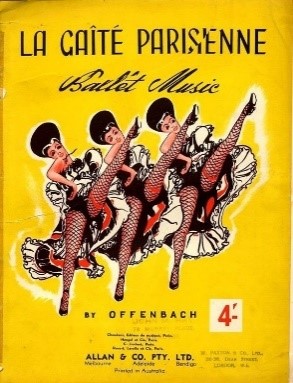
Offenbach himself, ironically, has never heard his most famous work. Manuel Rosenthal (1904-2003) is the French composer and conductor whose claim to fame is a kind of Best Of: Gaîté Parisienne is a suite composed of highlights from operettas by Jacques Offenbach. Rosenthal premiered it in 1938 in Monte Carlo, and its success definitively established Offenbach’s Can-Can (originally the “Galop Infernal” from the operetta Orphée aux Enfers, 1858) as the soundtrack for Gay Paree, or as standard background music to cheerful, exuberant scenes at all.

Galop Infernal:

Despite the very French concept of gaîté, the expression gay Paree seems to be of Anglo-Saxon origin, and much older than 1938. Cole Porter is looking the wrong way. In 1919 Jim Europe’s 369th Infantry Band scores a huge hit in America with the song of the returning American soldiers from World War I: “How You Gonna Keep ’em Down On The Farm (After They’ve Seen Paree)?”. The expression itself has turned out to be a keeper (as in The Big Lebowski, where The Dude says: “How you gonna keep ’em down on the farm once they’ve seen Karl Hungus?”), just like the naughty-meant spelling of “Paris”. In Nathanael West’s debut, The Dream Life Of Balso Snell from 1931, for example, can be read:

He claims that the only place to commit suicide is on Chekov’s grave. The Seine is also famous for suicide: “‘midst the bustle of `Gay Paree’—suicide.” “She killed herself in Paris.” There is something tragic in the very thought. French windows make it easy; all you have to do is open the window and walk out. Every window over the third floor is a door into heaven.

This in itself intriguing fragment is an exception; Balso Snell is a rather adolescent, rudderless work, by no means as successful as Miss Lonelyhearts and The Day Of The Locust, the two works that have elevated Nathanael West to the pantheon of Great American Writers. But we do know that Dylan uses Balso Snell as a source. In Chronicles, Dylan even copies almost literally from West’s novella:

I’m like an old actor mumbling Macbeth as he fumbles in the garbage can outside the theatre of his past triumphs,

… is in Chronicles paraphrased into:

The mirror had swung around and I could see the future — an old actor fumbling in garbage cans outside the theater of past triumphs.

In songs, “Gay Paree” has been a twoness since the nineteenth century. For example, “I’ve Been To Gay Paree” from 1893, “The Tips Of Gay Paree” from 1900, “Sammy In Gay Paree”, “When The Robert E. Lee Arrives In Tennessee, All The Way From Gay Paree”… in the sheet music section of the Library Of Congress there are quite a few humorous songs with the frivolous location indication.

“How You Gonna Keep ’em Down On The Farm (After They’ve Seen Paree)?”:

https://www.youtube.com/watch?v=aWbOLrwB6Ak

For the Gay Paree in “Not Dark Yet”, however, the inspiration comes neither from Cole Porter, nor from Nathanael West, nor from any of those pub songs. The best candidate is another antique song: “My Heart Goes Back To Dear Old Pendleton”. It’s a rather obscure song that was sung somewhere around 1910 in the saloons of Pendleton, Oregon, and is included in Norm Cohen’s anthology American Folk Songs. The opening lines inspire Dylan:

Now I’ve sailed the sea, I’ve seen gay Paree,
I’ve seen the sights of old London.

“Not Dark Yet” differs from this song, and all the others are – obviously – in poetic value; in all those songs the protagonist really, physically, goes to the French capital and then refers to it with a boyish oh-la-la-la wink. The poet Dylan, however, uses it metaphorically; the narrator has not really been to Paris, but expresses in this verse the emotional ups and downs of his life in general and of his recent love drama in particular.

The poet Dylan likes to use the topographical metaphor to express an emotional “very far” or “very much”, ever since his very first songs, actually. Initially, a quarter of a century before this London and gay Paree, he thinks from Washinton Heights to Brooklyn is quite enough (hardly an hour’s walk, from “Hard Times in New York City”), in “Down the Highway” we have to walk about 5000 km from the Golden Gate Bridge to the Statue of Liberty and the well-known simplification thereof (from the west unto the east) he uses in “I Shall Be Released”.

The search for more original variants began in the 1970s. From the heavens to the ground in “Never Say Goodbye”, from the Grand Coulee Dam to the Capitol in “Idiot Wind” and from Mexico to Tibet in “We Better Talk This Over” – which would be beyond the 10.000 km limit.

In “Slow Train” the poet slows down a bit (from Amsterdam to Paris), but in the different versions of “Caribbean Wind” he is back at it again; first the wind blows from Mexico to Curacao, which changes into Tokyo to the British Isles and when the song finally reaches the shore, it’s from Nassau to Mexico, so still 2000 kilometers. In “Union Sundown” Dylan then reaches the superlative: from Broadway to the Milky Way, although a less poetically inclined know-it-all will object that it actually says ‘from here to here” – after all, our earth is part of the Milky Way.

In terms of content, we shouldn’t look for anything in London and gay Paree. The metaphor stands for something like good times, bad times of ups and downs. With the archaic frivolity of gay Paree, the poet, just like with the introduction of that very earthly letter, prevents the lyrics from getting stuck in the stately, untouchable tone of the first stanza, “so lofty they sound as if they shit marble,” as Mozart says in Shaffers Amadeus.

London then bubbles up thanks to the encyclopaedic song knowledge of the poet Dylan, thanks to that “Dear Old Pendleton” and is skilfully processed; with Nobel Prize-worthy brio, the poet processes the assimilating o-o in every next line (London – followed – bottom – for nothing). These lines further express, in one lyrical direct hit after another, the weariness and disillusionment of the narrator. He has followed the river and has now reached the sea – the end, that is. He has seen the worst of the world and has no further desires – contained in the bluesy, ungrammatical double negation I ain’t looking for nothing, an echo of the I ain’t got no’s from Nina Simone’s “I Got Life”.

The stately, marble verse lines the lieder poet saves for the last verse.


Not Dark Yet I: But Shadows are Falling

Not Dark Yet II: Lucy

Jochen is a regular reviewer of Dylan’s work on Untold.  His books are available via Amazon both in paperback and on Kindle:


Untold Dylan: who we are what we do

Untold Dylan is written by people who want to write for Untold Dylan.  It is simply a forum for those interested in the work of the most famous, influential and recognised popular musician and poet of our era, to read about, listen to and express their thoughts on, his lyrics and music.

We welcome articles, contributions and ideas from all our readers.  Sadly no one gets paid, but if you are published here, your work will be read by a fairly large number of people across the world, ranging from fans to academics who teach English literature.  If you have an idea, or a finished piece send it as a Word file to Tony@schools.co.uk with a note saying that it is for publication on Untold Dylan.

We also have a very lively discussion group “Untold Dylan” on Facebook with approaching 5000 active members. Just type the phrase “Untold Dylan” in, on your Facebook page or follow this link 

You’ll find some notes about our latest posts arranged by themes and subjects on the home page of this site.  You can also see details of our main sections on this site at the top of this page under the picture.  Not every index is complete but I do my best.

But what is complete is our index to all the 604 Dylan compositions and co-compositions that we have found, on the A to Z page.  I’m proud of that; no one else has found that many songs with that much information.  Elsewhere the songs are indexed by theme and by the date of composition. See for example Bob Dylan year by year.

 

Posted in Uncategorized | 2 Comments

Dylan Lost album track nine: Sidewalks fences and walls

by Aaron Galbraith and Tony Attwood

Just recently we’ve been engaged in a project listening back to some of the outtakes from the 1986 and 1987 sessions that produced the majority of Bob Dylan’s “Down In The Groove” album, as well as some of the live shows from the era.

And between us we reached the conclusion that, as many people said at the time, the album is, to be fair, not very good.

So we decided to see if we could compile a better album ourselves from the outtakes and live shows from the period which you never know, might one day turn up on the Bootleg series.

For the penultimate track on the vinyl edition of “Sheep In Wolves Clothing” we had initially chosen Dylan’s cover of “The Usual”, which had already been released on the Hearts Of Fire Soundtrack and as a single. We wanted a “big” moment at this point in the record. But then we went back through the tapes and came across this one, which we had forgotten about or missed entirely during our initially pass. So, much like the original Down In The Groove album, The Usual was binned from the running order right at the last minute!

It was replaced by this tremendous version of “Sidewalks, Fences And Walls”.


This certainly provides the “big” moment we were looking for towards the end of the album. It may well be the best track and performance we’ve uncovered so far. Why this wasn’t on the original album is anyone’s guess! The track starts out tentatively enough but really builds towards the middle and by the end Dylan is in full voice and the band is driving towards the finish line with everything they’ve got. A wonderful performance, reminiscent of the Bootleg Vol 1-3 Version Of “When The Night Comes Falling From The Sky”.

As for the song itself, it was written by Jerry Williams and first recorded by Freddie North In 1971, but the version Dylan would have known was by Solomon Burke and was released in 1979, after all Bob sings the line as “Solomon loves Mary”,


Dylan is a self-proclaimed Solomon Burke fanatic, he once described him as “a mighty, mighty man, a mammoth talent…”. Bob  gifted him his song “Stepchild” and Burke again covered Bob on a number of occasions, including “The Mighty Quinn”, “Maggie’s Farm” and “What Good Am I?”.


Dylan’s Verizon Of “Sidewalks…” should have been on “Down In The Groove”. This new/old album gives us the chance to rectify that mistake.

The lyrics:

Little crooked heart
Drawn in chalk
On an old brick wall
Started writing in the heart
Told one and all
“Solomon loves Mary”
On sidewalks, fences, and walls

Now the rain that fell
Washed away those hearts in a childish scrawl
But the love that came from those hearts
Was big when we were small
And I wrote my love letters
On sidewalks, fences, and walls

Got chalk on my fingers
Got chalk on my hands
But somebody wrote across my heart a love so grand
So grand, so grand, so grand

Now I write my letters
With a fancy pen
But my mind goes back to chalk
Every now and again
“Solomon loves Mary”
Came straight from my heart
But just like all the other kids
One day we had to part

Now Mary’s married to Billy
But I can recall
“Solomon loves Mary”
On sidewalks, fences, and walls

Yesterday I walked by there
To reminisce again
I saw a child that looked like Mary
My childhood friend
She was writing a letter, a love letter
To the boy of her dreams
Just then her mother walked by
I knew her but she didn’t know me
I stood there in a daze
My mind looked beauty in the face
“Solomon loves Mary”
On sidewalks, fences, and walls
Sidewalks, fences, and walls
Sidewalks, fences, and walls…

The lost Dylan album – the tracks so far

Untold Dylan: who we are what we do

Untold Dylan is written by people who want to write for Untold Dylan.  It is simply a forum for those interested in the work of the most famous, influential and recognised popular musician and poet of our era, to read about, listen to and express their thoughts on, his lyrics and music.

We welcome articles, contributions and ideas from all our readers.  Sadly no one gets paid, but if you are published here, your work will be read by a fairly large number of people across the world, ranging from fans to academics who teach English literature.  If you have an idea, or a finished piece send it as a Word file to Tony@schools.co.uk with a note saying that it is for publication on Untold Dylan.

We also have a very lively discussion group “Untold Dylan” on Facebook with approaching 5000 active members. Just type the phrase “Untold Dylan” in, on your Facebook page or follow this link 

You’ll find some notes about our latest posts arranged by themes and subjects on the home page of this site.  You can also see details of our main sections on this site at the top of this page under the picture.  Not every index is complete but I do my best.

But what is complete is our index to all the 604 Dylan compositions and co-compositions that we have found, on the A to Z page.  I’m proud of that; no one else has found that many songs with that much information.  Elsewhere the songs are indexed by theme and by the date of composition. See for example Bob Dylan year by year.

Posted in Uncategorized | 3 Comments

Bob says to Tony, “make me an album” (part 1)

By Tony Attwood

The incitement:

This article takes you through the first six songs that Bob Dylan wrote in 1980.  Unless you are yourself a chronologist, it will probably be the first time you’ll have listened to these songs in the order they were written.  Even if you don’t normally read my pieces on Dylan’s songwriting year by year, I hope you might have a moment to read this one, and much more importantly, play the songs in this order.  I think you might find it quite revealing.

* * * * * * * * * * *

The fantasy:

One day, in a fantasy world many light-years from Earth, my telephone rings and the voice at the other end says, “Hi, I work with Bob Dylan, and he’s asked me to tell you that he really likes what you do on “Untold”.  And he wants to say thank you by letting you pick the tracks for a new compilation album.  All he’s said is that he’d appreciate it if you didn’t just choose the favourites that everyone has.  He likes the fact that you go mad over “Tell ol’ Bill” which no one else has ever heard of, so he wants an album of tracks like that.

“Oh yes, it’s going to be called Untold Dylan.  And Bob wants you to write the sleeve notes.  That ok with you?   And it’s got to make sense… Bob says it has to have a unity about it.”

“What does ‘a unity’ mean,” I ask trembling.

“He didn’t say,” says the caller.  “But are you ok with this?”

Well yes, it is ok, not just because of the honour and the notion that would come if it were true and if Bob did ever know about our work on this site, which of itself would be just so overwhelming that the two of us who started this site would throw the biggest party in the history of parties and invite every regular reader along.

But there’s more, because I really do know what I would do if I ever got the chance to choose an album which had a unity about it, and wasn’t just my favourites.  Because the album would be called “1980”.  And it would just contain songs that were written in that year.

Of course, if you are following the series Aaron and I are running on “Dylan’s missing album” (the latest episode of which is here, and there will be another episode along shortly) will wonder why I am cutting across that series with something similar.

The reason is that the series Bob Dylan Songs: The Themes has reached 1980, and I don’t want to abandon that series.   So we’re doing two missing albums at once.

The reasoning:

I think it is fair to say that my series Bob Dylan Songs: The Themes is not exactly the talk of the town.  But I enjoy it, so I keep doing it.   In this series, I take each year, and look at the songs Bob wrote that year, ask what those songs are about, and see what that tells us about how Dylan was, and what he was thinking about, that year.

Now I think this is just about the most fascinating study of Dylan’s work I have ever been involved in, even though most readers avoid it like the plague.  I have learned more about Bob’s thinking, and about his way of seeing the world, by writing this series, than through anything else.  I rather fancy it might turn into a book in due course.

Just the simple fact that the single most common subject that Bob has written about is “love” surprised me.  I really didn’t know that before I started the series.  Nor that his second most popular theme was “lost love”.

Leaving aside the years in which he wrote very little,  only in one year up to 1980 did Bob focus totally on one subject – 1979.   And then there is the issue of the number of songs about being trapped, that were written in the Basement…   that sort of thing seems logical when pointed out, and maybe it was just me not realising, but I really hadn’t grasped that fact before.  Seems obvious now that he might have felt that way – I just hadn’t got it before.

Of course you can argue with my nomination of subjects but I suspect for most song you’ll probably go along with the categorisation because they are fairly obvious.  Here’s the top five subjects that occupied Bob from the moment he started writing in the late 1950s up to the end of 1979…

  • 1 – Love, desire: 62 songs
  • 2 – Lost love, moving on: 48 songs
  • 3 – Protest: 21 songs
  • 4 – Faith: 19 songs
  • 5 – The environment: 17 songs

So, if you came to 1980 afresh you might expect more of what we had in 1979 – faith songs.  But no, it doesn’t work like that.  Or rather, it starts out like that, but then the most amazing things happen.

But before I get into this, there is one oddity that is listed at the start of the list of songs for 1980 – Street Rock –  which was a co-composition, Bob just writing the lyrics at the start, as far as I can make out.  I don’t know when in the year it was written, and although it is kept on the list as part if the 1980 work it seems very out of place, and we know little about it, so I am leaving that out.

But we still have a dozen songs for the year and won’t you just look at the 12 songs I have got to choose for my CD “Dylan 1980”.   Since the album is just a fantasy I’ve not timed them to see that they do fit on a CD, (that would be just too laborious and remove some of the magic – I’ll a minion at the record company do that).  For now, let’s just assume that they can all fit on.

The songs

In keeping with the articles in the earlier articles in “The Themes” series, I am keeping the songs in the order that they were written, and giving them a simple subject listing in each case.

  1. Are you ready? fundamental Christianity, second coming
  2. I will love him fundamental Christianity, second coming
  3. Cover Down Christianity, the grave won’t set you free
  4. Ain’t gonna go to hell for anybody Christianity, I’m following Jesus
  5. Property of Jesus Christianity, salvation is assured
  6. Every grain of sand God made this world
  7. Caribbean Wind  End of relationships, the end of time, the end of all things
  8. Groom’s still waiting at the alter It’s all falling apart
  9. Yonder comes sin It’s all falling apart
  10. Let’s keep it between us (Love – all we need is honesty)
  11. Making a liar out of me (This is me, this is where I have got to)
  12. City of Gold (Revelations / gospel)

It’s fairly obvious looking at this list that songs one to five continue the work of 1979, and looking at that list, and perhaps having picked up from my occasional comments on the matter that I am not just an atheist, but an atheist who would like the Chuch of England removed from its position of power and governance in the United Kingdom, you may be wondering what on earth is going on here.

And what is going on is that because of putting all of Dylan’s songs in their chronological order I’ve seen, more clearly than ever before the transition between Dylan the believer in Christ the king, Christ the saviour of mankind, Christ the son of God, into Dylan the philosopher.

If you can call all these songs to mind, there at song number six is the midpoint where Bob’s mindset utterly changed.  In the rest of this article I’m going to look at songs one to five for 1980.  Next time it will be the rest of my imaginary album, songs six to 12.

Now let’s go through the remainder of Bob’s Christian period and let’s listen to these works as we go…  The songs that open my imaginary album “Dylan 1980”.

This first song of the year really makes it sound as if Bob is going to be intent on keeping the theme of 1979 running – the essence of the song is dead simple: Are you ready for the second coming?   Look at the way Bob kerfollops onto the stage, looking around to see everyone is here and gives everyone an intro.   It’s a new democracy, combined with the statement that “Somebody’s got to tell you about Jesus right?”   It goes on for a while – and it is so worth hearing this and remembering it, in the light of what happened with the second group of songs this year.   Bob actually starts singing around 3 minutes 15 seconds: “Are you ready to meet Jesus”.  There really is no messing with this message.

I will love Him comes in as track two

The theme is the same – it is a song about the Lord complete with the female chorus, and the dedication of the singer to the Lord

I will love Him, I will serve Him, I will glorify His name

Whatever happened to Bob the lyricist?  Well, yes we do get some variation, but just how many times do we need to repeat the same lines.   And here’s a thought: apart from believers does anyone find any quotes from these songs worth keeping?  I am sure there are a few, but they don’t leap out to me.

OK, two tracks down and we haven’t got much further, although I imagine those who are fundamentalist Christians will applaud the regular repetition of devotion to the Messiah.  Indeed it is interesting that there appears to be this view that repetition, something that Dylan has only used sparingly should be used so much in these Christian songs.  It’s a bit like hearing “I need your loving

The third track is Cover Down

The musical style of the repeated lines and Old Testament references with the female singers giving support is the same.  Three songs and he’s doing the same thing both with the lyrics and the music.

Well, you wake up early in the mornin'
Turnin' from a-side to side
Somethin' givin' you a warning
You can run but you can't hide
Demands are laid upon you
And burdens a-you can't bear
Sins you can't even remember
are waiting to meet you there
You got to cover down, cover down.

Just listen to these songs one after the other – they are truly a series in the same style and approach throughout.

The title of the fourth song makes us expect the same again.

https://youtu.be/sF6oUhqI7AQ

Yep, there it is, that same level of repetition – a repetition that has never been central to Bob’s work in the past.  OK he has repeated the melody.  Take “Blowing in the wind”, virtually every other line is musically nearly identical throughout the song – there isn’t even a “middle 8” to break the music up.  But even that doesn’t reach the repeat repeat repeat level of singing the title of this song.

And by track five you are ready to question my protestations of being an athiest because it is Property of Jesus.  And yes here we are with the same musical line over and over and over.

https://vimeo.com/74542363

Even the chorus is repeating too, although the melody is a relief from listening  to “Ain’t going to go to hell”.   In fact, the music construction is quite an improvement on all that has gone before.  And OK if you are moved by the message, or you are into the beat and the repetition of the message pounded into your heart and soul over and over, then you will be happy.  And it is not hard to hear that Dylan did write these songs one after the after.  They just come “pouring out” if you like them, or he’s “churning them out” if you don’t.  He is a consummate musician and he could make a shopping list sound great, but…

But then, what happens?

Suddenly he stops.

He stops musically and lyrically and goes utterly somewhere else.    OK you know the voice, of course it is Bob, but just listen to the difference between the lyrics and this music of what happens next and all that has gone before.

It is as if he has stopped walking down the same road and suddenly turned the corner and a totally different light is illuminating his life.

“Every Grain of Sand” is a philosophical piece, with clear religious overtones, but it is utterly different from the in-your-face you-must-believe songs that Bob had written for the past 18 months or so.   This is where everything changes.

I do hope that to get to this point you have listened to at least some of each example – for quite possibly this might be the first time you have ever heard them in the order in which Bob wrote them.   Remember them all.  Clear you might.  Stop.  Take a deep breath, and now…

The change

https://youtu.be/B0ghOdhmP-E

Here Bob has suddenly written a song that can be developed, evolved, moved, changed, transformed and re-invented, using the same lyrics in multiple ways – one only has to search around the internet to hear all the different versions, each one so different.

And that is the first big point.  These earlier 1980 songs all had the same version almost each time they were played but “Every grain” had complete musical re-writes.  And that is what started happening – just think of Caribbean Wind where every version is different.

Then the second point, as we move into this song the religious references are there but God, the Lord, the Master is no longer the dictator telling us how to behave, the slayer who will strike down those who do not believe.  No we have suddenly stepped into the land of Tao Te Ching.  We hear of the trembling leaf and gains of sand.

If God is still there He is gentle.  But as far as I can see it is not God or Jesus that lights the way now, but nature.  We are not trembling in fear, but we can appreciate conscience and good cheer.

This is also not the land of punishment, because the past doesn’t matter, we “Don’t have the inclination to look back on any mistake.”

Suddenly the God, if it is God that is being sung about, is not the avenger sweeping aside all the evil but pure goodness and removes “the bitter dance of loneliness fading into space.”   If this is God it is not the avenging God but the God of forgiveness.

Every millisecond of this rough run-through of this magical song turns the message of the previous performances upside-down both lyrically and musically.  The door on the pounding message of the initial tracks has been shut and another has opened and taken us into a peaceful, magical, calm and beautiful garden of hope.  A garden that is not restricted to the believers, but is open to all who are simply good people trying to act honourably in a mixed-up world.

Of course this is still the end, and a new beginning, but a different type of end and a different type of start.  We don’t need God and Jesus to become good, we can just do it, because nature is perfect.  We have set sail afresh, so where will we go?

Next time

Where Bob went follows in the second article about what I perceive to be this most extraordinary year in Bob’s history as a songwriter.

Untold Dylan: who we are what we do

Untold Dylan is written by people who want to write for Untold Dylan.  It is simply a forum for those interested in the work of the most famous, influential and recognised popular musician and poet of our era, to read about, listen to and express their thoughts on, his lyrics and music.

We welcome articles, contributions and ideas from all our readers.  Sadly no one gets paid, but if you are published here, your work will be read by a fairly large number of people across the world, ranging from fans to academics who teach English literature.  If you have an idea, or a finished piece send it as a Word file to Tony@schools.co.uk with a note saying that it is for publication on Untold Dylan.

We also have a very lively discussion group “Untold Dylan” on Facebook with approaching 5000 active members. Just type the phrase “Untold Dylan” in, on your Facebook page or follow this link 

You’ll find some notes about our latest posts arranged by themes and subjects on the home page of this site.  You can also see details of our main sections on this site at the top of this page under the picture.  Not every index is complete but I do my best.

But what is complete is our index to all the 604 Dylan compositions and co-compositions that we have found, on the A to Z page.  I’m proud of that; no one else has found that many songs with that much information.  Elsewhere the songs are indexed by theme and by the date of composition. See for example Bob Dylan year by year.

Posted in Uncategorized | 5 Comments

Not Dark Yet II: Lucy

Not Dark Yet part 1: But Shadows Are Falling appears here.

By Jochen Markhorst

Well, my sense of humanity has gone down the drain
Behind every beautiful thing there’s been some kind of pain
She wrote me a letter and she wrote it so kind
She put down in writing what was in her mind
I just don’t see why I should even care
It’s not dark yet, but it’s getting there

It is an ineradicable but fertile myth, the myth that we only use a small percentage of our brains. It does inspire often amusing advertisements, books, comics and films – in which, incidentally, usually thanks to a drug, the “other brain areas” are unlocked, after which the protagonist acquires extreme perception and intelligence (Limitless, 2011) or superhero powers, usually psychokinesis.

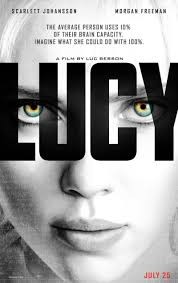
The most successful, and perhaps the most philosophical adaptation of the subject is released in 2014: the film Lucy by the French filmmaker Luc Besson. Lucy (Scarlett Johansson) accidentally is exposed to an absurd dose of a new synthetic drug, gradually unlocking larger and larger parts of her brain. In addition to all kinds of more and less spectacular abilities, this also leads to what we, with our limited insight, would call “inhumanity”; for example, Lucy realises that we never “really” die – and can, therefore, kill completely insensitively. Besson, through Lucy, defines it as a loss of humanity:

Lucy:
I don’t feel pain, fear, desire. It’s like all things that make us human are fading away.

Dylan’s protagonist in “Not Dark Yet” has reached a similar state of detachment, and Dylan suggests that this is due to advancing insight as well. Fortunately, not by something as childish as a fictional, brain-unlocking drug, but by life experience.

The narrator begins with his conclusion, my sense of humanity has gone down the drain, followed by the brilliant, melancholy aphorism behind every beautiful thing there’s been some kind of pain – a poetic variant of the ancient wisdom that an unhappy childhood is the artist’s goldmine, that behind every great work of art there is a Great Suffering.

The examples of artists giving witness to this are numerous. Frida Kahlo, Vincent Van Gogh, Kafka, W.H. Auden… all of them are artists who claim with some right to a say that only suffering can produce Art. From The Kinks’ Ray Davies is the quote “I call it suffering and pain, they call it entertainment” and that is practically the same as Dylan’s own observation, in the radio interview with Mary Travers, 26 April 1975.

MT: And one of the things I enjoyed about Blood On The Tracks, as an album, was that it was very simple.
BD: Hm, hm. Well that’s, you know, that’s the way things are really, they are basically very simple. A lot of people tell me they enjoy that album. It’s hard for me to relate to that. I mean, you know, people enjoying the type of pain, you know.

Yes, indeed – behind every beautiful thing there’s been some kind of pain. Granted, the message is not too earth-shattering, but is beautifully, poetically expressed.

However, the true brilliance of the song poet Dylan only begins to shine now, in the next line: she wrote me a letter – and suddenly the song is tilted.

Until this ninth verse line we listened to the farewell words of a reflective, resigned narrator on the threshold to death. The choice of “one day” as a metaphor for the whole of life, although old-fashioned, remains moving. These first eight lines also neatly follow the classical composition from personal (I’ve been here all day) to universal (behind every beautiful thing), so that the very intimate, very personal outpouring in verse 9 contrasts all the more sharply: the narrator has apparently just received a so-called Dear John letter, the letter in which his lover puts an end to the relationship.

The tone of the letter is well chosen. He is “kindly“, lovingly, dumped – the Dylan fan involuntarily thinks back to the tone of “If You See Her, Say Hello”. It may soften the blow, but it remains crushing; with the loss of her, the narrator loses all zest for life (I just don’t see why I should even care) and, as we understand now, the light of his life – it is getting dark when she disappears from his life.

It is a classic stylistic tool to which Dylan often resorts, contrasting the private with the universal. Usually very successful, such as in “The Groom’s Still Waiting At The Altar”, “Slow Train”, “Changing Of The Guards”, but rarely as crushing as in the exceptional masterpiece “Not Dark Yet”.

The prop letter to force a plot twist is not new either. In “Boots Of Spanish Leather” the narrator receives such a Dear John Letter, but there, the attentive listener had already seen it coming. In “When The Night Comes Falling From The Sky” and “Where Are You Tonight?” the letters are indeed not much more than props, they don’t tilt the plot, but in “Desolation Row” we see a similar impact and a similar change of perspective as here in “Not Dark Yet” – although in Desolation it doesn’t seem to be a farewell letter.

Here it is. The blow robs the narrator of his sense of humanity, time runs away from him, his “soul turns into steel”, he can’t sleep and just sits there staring, the poor soul.
I don’t feel pain, fear, desire. It’s like all things that make us human are fading away.

Untold Dylan: who we are what we do

Untold Dylan is written by people who want to write for Untold Dylan.  It is simply a forum for those interested in the work of the most famous, influential and recognised popular musician and poet of our era, to read about, listen to and express their thoughts on, his lyrics and music.

We welcome articles, contributions and ideas from all our readers.  Sadly no one gets paid, but if you are published here, your work will be read by a fairly large number of people across the world, ranging from fans to academics who teach English literature.  If you have an idea, or a finished piece send it as a Word file to Tony@schools.co.uk with a note saying that it is for publication on Untold Dylan.

We also have a very lively discussion group “Untold Dylan” on Facebook with approaching 5000 active members. Just type the phrase “Untold Dylan” in, on your Facebook page or follow this link 

You’ll find some notes about our latest posts arranged by themes and subjects on the home page of this site.  You can also see details of our main sections on this site at the top of this page under the picture.  Not every index is complete but I do my best.

But what is complete is our index to all the 604 Dylan compositions and co-compositions that we have found, on the A to Z page.  I’m proud of that; no one else has found that many songs with that much information.  Elsewhere the songs are indexed by theme and by the date of composition. See for example Bob Dylan year by year.

Posted in Uncategorized | 2 Comments

Dope fiend robber: the Paul Robert Thomas version

By Tony Attwood

We’ve already had a response to the idea of turning Bob Dylan’s lyrics for Dope Fiend Robber into a completed song.  The earlier entry is here.

Now Paul Robert Thomas takes up the challenge.

Here is what Paul says…

“As you will hear we tried to create a contemporary sound and I, as the lyricist, tried to adhere to Bob’s storyline.

“The song starts with a tip-of-the-hat to the late great Woody Guthrie’s ‘Pretty Boy Floyd’ in ‘Come gather ’round boys ………’ who was Bob’s idol at his time of writing his Guthrie inspired lyrics to Dope Fiend Robber.

“We would very much like to include this song on our next album called BELIEF that contains songs we wrote for Sir Cliff Richard and will have a track from the UK’s Luke Jackson on it (tours with Amy Wedge who co-wrote some of Ed Sheeran’s hits).”

Paul has his own lyrics site and Facebook page.  Here are the details…

Dope Fiend Robber

Come gather ‘round boys and all
There’s a story I will tell
About this man’s fall
And his descent into hell

I got shot from a perpetrators gun
Defending mine and your land my son
Defending the dream of Uncle Sam
Just a man doing all he can
Just an American man
Doing all he can for Uncle Sam

They took me to the emergency room
I was unconscious I presume
They gave me something to ease the pain
Said ‘it’s ok it’s just morphine rain’

I left the Hospital at 2.45
Felt a good time to be alive
As I caught the slow train, the slow train home
Felt like a fallen king back on his throne

Just an American man
Doing all he can for Uncle Sam

They fixed my wounds of that I’m glad
But the pain inside grew to be bad
It makes you crave and it makes you mean
It’s from what they call ‘White gold’ — Morphine

It caused me ruin, it caused me shame
My wife don’t even wanna know my name
I was getting high day after day
Selling my soul so I could pay

Now I don’t mean no harm to no man
I just hope that you’re able to understand
I had to steal so I could eat
But the word soon got out on the street

They called me a dope fiend robber
That’s what I became
A dope fiend robber
I hung my head in shame
Hung my head in shame, hung my head in shame

Cause I tried to rob the jewelry store
And the cops grabbed me coming out the door
They threw me down in the hole at 10 to 6
I went all night without a fix

Nobody wanted to post my bail
I just knew I had to break out of jail
But I didn’t mean to kill the guard
I took the keys but I hit him too hard

I ran and ran but I didn’t get far
I soon got picked up in a dope bar
I was crawling down on the floor
The cops kept hitting me more and more

They beat me black and blue without rest
They claimed I was resisting arrest
Newspapers had my tale on the front page
And fueled the country’s anger and rage

They called me a dope fiend killer
That’s what I now became
A dope fiend killer
I hung my head in shame

Judge found me guilty but it wasn’t fair
Sentenced to die in the electric chair
I had defended my country with my life
The doctors that gave me ‘white gold’ 
just brought me strife

You made me an addict you made me crave
Now I sit in this lonely cold cage
Soon my life will be gone
But the drug pushing doctor’s will be 
keeping on and on

They made me a dope fiend robber
That’s what I became
A dope fiend robber
Lord, I hung my head in shame
They made me a dope fiend killer
That’s what I became
That’s right, a dope fiend killer
No one will remember my name

And wise man try to ease the ‘White Gold’s’ pain
But nothing can stop the Morphine hard rain
Nothing can stop the Morphine hard rain
The Morphine hard rain
Nothing can stop the Morphine hard rain
Nothing can stop,  Nothing can stop

Bob Dylan//Paul Robert Thomas

Untold Dylan: who we are what we do

Untold Dylan is written by people who want to write for Untold Dylan.  It is simply a forum for those interested in the work of the most famous, influential and recognised popular musician and poet of our era, to read about, listen to and express their thoughts on, his lyrics and music.

We welcome articles, contributions and ideas from all our readers.  Sadly no one gets paid, but if you are published here, your work will be read by a fairly large number of people across the world, ranging from fans to academics who teach English literature.  If you have an idea, or a finished piece send it as a Word file to Tony@schools.co.uk with a note saying that it is for publication on Untold Dylan.

We also have a very lively discussion group “Untold Dylan” on Facebook with approaching 5000 active members. Just type the phrase “Untold Dylan” in, on your Facebook page or follow this link 

You’ll find some notes about our latest posts arranged by themes and subjects on the home page of this site.  You can also see details of our main sections on this site at the top of this page under the picture.  Not every index is complete but I do my best.

But what is complete is our index to all the 604 Dylan compositions and co-compositions that we have found, on the A to Z page.  I’m proud of that; no one else has found that many songs with that much information.  Elsewhere the songs are indexed by theme and by the date of composition. See for example Bob Dylan year by year.


*The note above about “riches” might be a slight exaggeration.

Please send your recording as an audio file, or as a YouTube video to Tony@schools.co.uk and PLEASE PLEASE PLEASE mark the subject line “Dope Fiend Robber music.”   Tony does get a fair number of emails as a result of running Untold Dylan – which is fine, and no complaints about that, but it is helpful to be able to identify what each is about from the subject line.

Links:-
Current album – ‘Les Paul’s’ (The Paul’s’) ‘Greatest Hits Vol. Two’

at https://www.paullyrics.com/album/les-pauls-pauls-greatest-hits-vol-two


On Fri, 8 May 2020 at 13:50, Tony Attwood <Tony@schools.co.uk> wrote:

Fantastic.

When you send over your recording, could you also put with that the links that you have sent me this time (in case I lose them or forget to add them) then I can run your recording and the links to you all in the same place.

Tony

Untold Dylan

On 08/05/2020 08:33, Paul Robert Thomas wrote:
Hi Tony,
How you doing, good I hope?
London born & bred song lyricist Paul Robert Thomas here to let you know that we, ‘Les Paul’s’ (The Paul’s) have almost finished our version of Dope Fiend Robber, we’ve had loads of tech probs in the studio but hope that the song will be with you at the weekend. It’s not an acoustic version but more ‘electric’ and when that’s done we’ll start on the ‘Story’ song that I’ve already written the additional lyrics for – wot wiv me being a song lyricist & all that jazz (www.paullyrics.com)😎.
Our links are below but I’ll give you more info when I send the song(s) –

https://www.facebook.com/LesPaulsThePauls

http://www.paullyrics.com/les-pauls-the-pauls-official-homepage

Cheers Tony & wishing you a great weekend, Paul

Posted in Uncategorized | 1 Comment

Dylan and postmodernism Part II

Dylan And Post-Post Modernism (Part II)

By Larry Fyffe

Though vaguely defined and overlapping other categories that seek to classify art, we’ll consider Post-Post Modernism to be literature and song lyrics that revive the hopes for a better society envisioned by the Romantic Transcendentalist writers. In the poems of innovative artists like Walt Whitman who hails the progress made by American technology to the less optimistic middle-of-the road approach taken by Robert Frost, the “American Dream” lives on.

According to Post-Post Modernist writers, the “American Dream” is not dead, nor shattered beyond repair, as many Post Modernist writers consider it to be – there’s still a light shining notwithstanding that it’s diminished in these modern times.

The persona in the song lyrics below strives to stay forever young; tries to keep on the
Post-Post Modern side of the road:

Hey, come on try a little
Nothing is forever
There's got to be something better
Than in the middle
But me and Cinderella
We put it all together
We can drive it home
With one headlight
(The Wallflowers: One Headlight ~ Jakob Dylan)

Compare the following lyrics that can be considered Post Modernist:

Cinderella, she seems so easy: 
    "It takes one to know one", she smiles
And puts her hands in her back pockets, Bette Davis style
And in comes Romeo, he moans: 'You belong to me, I believe"
And someone says: 
    "You're in the wrong place, my friend, you'd better leave"
And the only sound that's left after the ambulances go
Is Cinderella sweeping up on Desolation Row
(Bob Dylan: Desolation Row)

In the song lyrics below, Walt Whitman’s dream is all but shattered:

I have no apologies to make
Everything's flowing at the same time
I live on a boulevard of crime
I drive fast cars, and I eat fast foods
I contain multitudes
(Bob Dylan: I Contain Multitudes)

In the following lyrics, the dream is dead as a door nail:

Stack up the bricks, pour the cement
Don't say Dallas don't love you, Mr. President
Put your foot in the tank, and step on the gas
Try to make it to the triple underpass
(Bob Dylan: Murder Most Foul)

In the poem below, ideals apparently never die:

My Captain does not answer, his lips are pale and still
My father does not feel my arm, he has no pulse or will
The ship's anchored safe and sound, 
    it's voyage closed and done
From fearful trip, the victor ship comes in with object won
(Walt Whitman: O Captain, My Captain)

The forces of good outshine the forces of darkness in the lyrics below; complacency be the order of the day:

I got my window open wide
Got a good woman by my side ...
Yeah, this kind of day has no night
And I ain't got much on my mind
I ain't got much on my mind
'Cause I know something good this way comes
(Jakob Dylan: Something Good This Way Comes)

For sure, Shakespeare is not in the alley with his pointed shoes and his bells:

By the pricking of my thumbs
Something wicked this way comes
Open locks
Whoever knocks!
(William Shakespeare: Macbeth, Act IV, sc i)

The apple, however, never falls far from the tree:

Well, you're on your own, you always were
In a land of wolves and thieves
Don't put your hope in an ungodly man
Or be a slave to what somebody else believes
(Bob Dylan: Trust Yourself)

You may also enjoy

Untold Dylan: who we are what we do

Untold Dylan is written by people who want to write for Untold Dylan.  It is simply a forum for those interested in the work of the most famous, influential and recognised popular musician and poet of our era, to read about, listen to and express their thoughts on, his lyrics and music.

We welcome articles, contributions and ideas from all our readers.  Sadly no one gets paid, but if you are published here, your work will be read by a fairly large number of people across the world, ranging from fans to academics who teach English literature.  If you have an idea, or a finished piece send it as a Word file to Tony@schools.co.uk with a note saying that it is for publication on Untold Dylan.

We also have a very lively discussion group “Untold Dylan” on Facebook with approaching 5000 active members. Just type the phrase “Untold Dylan” in, on your Facebook page or follow this link 

You’ll find some notes about our latest posts arranged by themes and subjects on the home page of this site.  You can also see details of our main sections on this site at the top of this page under the picture.  Not every index is complete but I do my best.

But what is complete is our index to all the 604 Dylan compositions and co-compositions that we have found, on the A to Z page.  I’m proud of that; no one else has found that many songs with that much information.  Elsewhere the songs are indexed by theme and by the date of composition. See for example Bob Dylan year by year.
Posted in Uncategorized | 6 Comments

Covers from beyond

By Tony Attwood

I get a fair number of emails these days suggesting I might listen to various Bob Dylan songs sung by other performers.

Indeed in the dim and distant past we put together a collection of readers’ favourite cover versions.  That is, of course, still on the site with links to the songs and recordings that have been nominated.

Now my normal response is to say to those who write in, “Why don’t you do a review?” and mostly readers don’t – which is fair enough.  But I’ve been sent one that I particularly like by Richard, and I have taken up the opportunity to bring it the wider audience…

We all know Baby Blue and know what it represents and says and that makes it very hard, in my view, for anyone to get something out of the song that has not been got before, and yet for me this recording does just that.

The point is, the words don’t really make much impact now, we’ve heard them a million times, and likewise the chord sequence and melody are all there trapped in our heads forever more.

But this song works for two reasons I think.

One is that the opening is so gentle and charming, and I don’t mean “charming” in a pejorative way.  It really is beautiful.  Which makes what happens all the more interesting and indeed surprising.

The performance is excellent as is the second change after the instrumental break.  The interpretations are not tearing the song apart, they are adding to it, in my view.  “Strike another match” suddenly, for me becomes a new line, a line that regains its meaning having lost is 5000 plays ago.

If you like the performance leave the video running and you’ll be in for a surprise.  I don’t actually want to tell you what the next track is – it really should be something for you to find.

The band is Vargen (The Wolf) and here are some links…


The album is “Love/Leave – 11 Songs of Bob Dylan”

Vargen is the stage and recording name of singer-songwriter Reine Johansson. In the wake of the international recognition of his and fellow singer Mia Rosengren’s translations on Tänk inte efter (Don’t Think Twice – Bob Dylan in Swedish), Vargen’s recorded new vocals in English to all nine tracks from that album. The band also recorded two new songs, singles “One Too Many Mornings” and “Abandoned Love”. “Love / Leave – 11 Songs of Bob Dylan” is released worldwide on vinyl and CD on Friday 29 May.

Release date: Vinyl/CD Worldwide: Friday 29 May 2020

DL / Preorder Vinyl / CD (Amazon):

Tracklist:

01 It's All Over Now, Baby Blue    -music video / single Feb 21
02 I Threw It All Away
03 I'll Be Your Baby Tonight
04 Don't Think Twice, It's All Right
05 One More Cup of Coffee (Valley Below)
06 Abandoned Love    -single March 13
07 It Ain't Me, Babe
08 Tomorrow Is a Long Time
09 One Too Many Mornings    -single March 13
10 Knockin' on Heaven's Door
11 Love Minus Zero / No Limit
  • Musicians:
    Reine Johansson Vocals, harmonica
    Mia Rosengren Vocals
    Dan Kristensen Lead & rhythm guitars, lap steel
    Andreas Alm Rhythm guitar, keyboards, percussion, sounds
    Zacharias Sjöberg Piano
    Jan Lundin Bass
    Måns Broman Drums
    Daddy Musesa Congas, bongos
    Anna Vild Harmonica (Love Minus Zero), backing vocals
    Johann Laux Drums (Abandoned Love)

Untold Dylan: who we are what we do

Untold Dylan is written by people who want to write for Untold Dylan.  It is simply a forum for those interested in the work of the most famous, influential and recognised popular musician and poet of our era, to read about, listen to and express their thoughts on, his lyrics and music.

We welcome articles, contributions and ideas from all our readers.  Sadly no one gets paid, but if you are published here, your work will be read by a fairly large number of people across the world, ranging from fans to academics who teach English literature.  If you have an idea, or a finished piece send it as a Word file to Tony@schools.co.uk with a note saying that it is for publication on Untold Dylan.

We also have a very lively discussion group “Untold Dylan” on Facebook with approaching 5000 active members. Just type the phrase “Untold Dylan” in, on your Facebook page or follow this link 

You’ll find some notes about our latest posts arranged by themes and subjects on the home page of this site.  You can also see details of our main sections on this site at the top of this page under the picture.  Not every index is complete but I do my best.

But what is complete is our index to all the 604 Dylan compositions and co-compositions that we have found, on the A to Z page.  I’m proud of that; no one else has found that many songs with that much information.  Elsewhere the songs are indexed by theme and by the date of composition. See for example Bob Dylan year by year.

Posted in Uncategorized | Leave a comment

Anybody Sings Dylan like Dylan: what is the point of the parody?

By Filip Łobodziński

To parody Bob Dylan? Any problem? I’d say it’s easily done, you just pick any song and pretend you sing it with typical Dylan phrasing and accent.

Easy?

Yeah, but… What exactly is a “typical Dylan phrasing and accent”? The “Freewheelin’ Dylan” sang one way, the “Revisited Dylan” another, then came the “Dylan of St. Augustine”, the “Nashville Dylan”, the “Dylan on the Tracks”, the “Saved Dylan”, fast forward to the “Dylan Out of Mind” and then to the “Rough and Rowdy Dylan”… And so many of them in between.

Anyway, we might agree that there is a specific way Bob Dylan sings (and plays) which made him notorious and original in the first place. And obviously anyone who’s ever  CONSCIOUSLY heard Dylan sing remembers this iconic voice and style. For better or worse.

A banal fact: after Bob Dylan had been first noticed on the music scene, the music scene was made to accept that gone were the days of sweet voices’ domination. The whole music world was rapidly changin’ – as long as you had something relevant to sing about you could sing it any way you wanted or could. Ugly voices made themselves at home at the recording studios and on stage. And thanks to this unique fact – to the decision Dylan made of going East and starting a professional singer-songwriter career with his own chosen style – we can now indulge in the sloppy Lou Reed, in the gravelly Tom Waits, in the detached Chrissie Hynde, and – who knows? – perhaps also in all the hip-hop scene which would have remained in the ghettoes had the music industry not seen the fact that you could earn lots of bucks on a wise message dressed in not-that-beautiful rendering.

Another banal fact: Dylan could sing beautifully if we want to use that phrase. The Nashville Skyline sessions prove it. He only CHOSE to sing differently. And to play the harmonica in an idiosyncratic way although – as Mike Johnson (Kiwipoet) explained here more than twice – he has been an accomplished harmonica player too (just three songs as examples – It Takes a Lot to Laugh, Pledging My Time and What Can I Do for You?).

Long story short: Dylan WANTED to be different because he KNEW his message would be complete with that nasal voice, strange phrasing (bordering on declamation at times) and apparently chaotic harp playing.

Now, what is a parody and what is its purpose? It’s the adoption of the most relevant elements of somebody else’s style to make them radically discernible – for the fun of it. Fun – serving as irony, satire, caricature or (much more seldom) pure pleasure of imitating someone known.

The parody can be regarded as good if one imitates/impersonates an artist nearly perfectly – and yet on a visible purpose. The aim of a parody is not to pretend one IS the spoofed artist but rather to point out one’s own view of that artist. The ”spoofer” says, “I don’t pretend I’m the artist but I can show you how easy it is to step into the artist’s shoes and pretend you’re the man himself.”

Example: ‘Weird’ Al Yankovic, possibly the most renowned and gifted singers’ impersonator of all times. He does it for the pure fun of it and to strengthen his own reputation as a Parody Master No. 1:

There are plenty of lesser-known/successful/gifted Dylan impersonators who just want to ridicule the artist without any background, deeper message:

https://youtu.be/SoSidPGl9mc?t=48

Many of them, the Dylan wannabes, even try to imitate Dylan’s looks, taking his 1965/66 image as a model (curly hair, shades, slim pants an s.o. – nothing that nifty, I think).

But you may find cases when a renowned artist tries his or her ways in the Dylan style – and has something to say with it.

Example: when Joan Baez sings Simple Twist of Fate:

– she does not want people to believe she can be a Bob Dylan clone but rather does she wink an eye as if to say, “You know the guy, I surmise, you know we once had a story together, but a simple twist of fate tore us apart, or maybe it was not just a fate…”. And does it in a funny way to make people laugh or smirk.

There’s no doubt Paul Simon has always respected his contemporary to the extreme. It was Bob Dylan, after all, who made it possible for Simon to break through with his own meaningful, wise songs. And yet, even Paul Simon seemed perhaps a bit perplexed when Dylan had started to steer away from the realm of a plainly understood, albeit poetic songs, and opted for cryptic, overloaded with metaphors stream-of-consciousness tales. I don’t know the story behind Simon & Garfunkel’s A Simple Desultory Philippic (or How I Was Robert McNamara’d into Submission) but it seems like a pun to me:

Quite inventive, if a bit naïve nowadays.

Then one parody, for me, is arguably the best (but you may disagree, of course). The author is Frank Zappa and the performer (singing and playing harmonica) is one and only Adrian Belew. It’s from Zappa’s 1979 album Sheik Yerbouti:

What is the purpose of this cute little scene inside the song? ‘Flakes’, as far as I know, are the lazy, incompetent people, living in California in this case. Bob Dylan, whom Zappa had admired a lot in the Sixties (especially for Like a Rolling Stone), became the symbol of a rich artist who once used to give voice to fundamental causes and now, as any other rich Californian, is just having troubles with the ‘flakes’. “He was so much bolder then, he’s mundaner than that now”. Even if it’s not just it’s very clever and does not lampoon Dylan that much. And makes listeners laugh, that’s for sure. A clever one.

Now, one Connor Party recently put their own parody with a serious message but put in a light tone, and doing some justice to the original (although it’s always a question of one’s personal taste):

As we may now see, the parodies may differ. There are good ones, weak ones, ones that make difference and ones that leave you indifferent and unimpressed.

BUT – let me add just one more thought.

Do you have that many, say, Ella Fitzgerald parodies? Or Paul McCartney? Or Sting? Or Eddie Vedder? Or Joni Mitchell? WHO do you parody, if anyone?

A parody, for me, is only possible when the spoofed artist is someone very relevant. Parodying, you somehow immortalize your own admiration or respect (the parodied artist is generally immortal anyway). No other artist makes people all around the world gather and study his/her lyrics immediately after the release of this artist’s new album or song. No other artist triggers off that many discussions over the Internet about his/her songs and possible messages.

But the point is – when you parody a figure of Bob Dylan stature, better try and think of what you want to say through your performance. Fun is too little, in my humble opinion.

Untold Dylan: who we are what we do

Untold Dylan is written by people who want to write for Untold Dylan.  It is simply a forum for those interested in the work of the most famous, influential and recognised popular musician and poet of our era, to read about, listen to and express their thoughts on, his lyrics and music.

We welcome articles, contributions and ideas from all our readers.  Sadly no one gets paid, but if you are published here, your work will be read by a fairly large number of people across the world, ranging from fans to academics who teach English literature.  If you have an idea, or a finished piece send it as a Word file to Tony@schools.co.uk with a note saying that it is for publication on Untold Dylan.

We also have a very lively discussion group “Untold Dylan” on Facebook with approaching 5000 active members. Just type the phrase “Untold Dylan” in, on your Facebook page or follow this link 

You’ll find some notes about our latest posts arranged by themes and subjects on the home page of this site.  You can also see details of our main sections on this site at the top of this page under the picture.  Not every index is complete but I do my best.

But what is complete is our index to all the 604 Dylan compositions and co-compositions that we have found, on the A to Z page.  I’m proud of that; no one else has found that many songs with that much information.  Elsewhere the songs are indexed by theme and by the date of composition. See for example Bob Dylan year by year.

Posted in Uncategorized | 3 Comments

Get your rocks off Manfred Mann!

by Jochen Markhorst

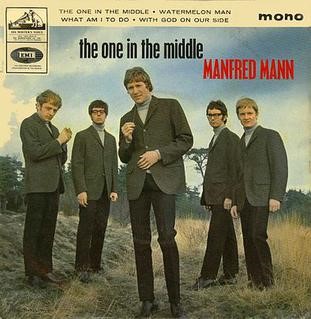
“With God On Our Side” is the first Dylan song Manfred Mann takes a shot at and can be found on the 1965 EP The One In The Middle. The EP is a huge hit; achieves first place in the EP charts three times and sells so well that it also scores in the singles Top 10.

The title song is really nice, and with the other songs (the jazzy “Watermelon Man” and the Phil Spector/Doc Pomus ballad “What Am I To Do”) is not much wrong either, but the Dylan cover is the real highlight. The song is recorded, according to the liner notes, because Dylan had attended a live concert of the band, after which he declared the band being “real groovy”.

Dylan suits Manfred. After this, the band makes a sparkling adaptation of “If You Gotta Go, Go Now”, which becomes a huge hit too. Manfred’s Dylan love gets an extra boost when Dylan publicly declares, at a press conference in December 1965, that nobody does as much justice to his songs as Manfred Mann: “They’ve done about three or four. Each one of them has been right in context with what the song was all about.”

Not entirely correct (Mann only recorded two Dylan songs at that time), but that can’t spoil the glorious feeling. For his book Jingle Jangle Morning: The Folk Rock In The 1960s Richie Unterberger asks Manfred what he thought of that public approval. “It certainly didn’t depress me when I read that. I was delighted, of course.”

This retrospect is spoken in 2014 after Manfred has recorded some twenty Dylan songs. In the ’60s, still leading his eponymous beat group, he elevates “The Mighty Quinn (Quinn The Eskimo)” to a world hit and to the pop monument it still is today, shortly after he conquered the charts with “Just Like A Woman” as well. And had a big hit with one of the most successful Dylan rip-offs of the ’60s, the catchy psych-pop gem “Semi-Detached Suburban Mr James”, which originally sings a Mr Jones by the way. Because singer Paul Jones has just left the band (this is the first hit with new singer Mike d’Abo), Manfred imagines that a song about a Mr Jones with phrases like So you think you will be happy, taking doggie for a walk and Do you think you will be happy, giving up your friends, might be conceived as a kick after he’s down, so he last-minute changes Jones into James.

In 1971 Mann starts his Earth Band and continues the tradition; for almost every album in the 70’s he records a Dylan cover. Still with the master’s consent, apparently. When a journalist at a press conference in Travemünde in 1981 asks Dylan what he thinks of Manfred Mann’s covers, he answers: “Yeah, those are okay… even better than Peter, Paul And Mary.”

The success of “Quinn The Eskimo” points Mann to a fertile side-path: the under-appreciated ditties, the shelf warmers, the ugly ducklings and the wallflowers. Manfred turns out to be a true master in the cutting of rough diamonds, in the development of fallow land – more or less as Dylan himself does, with forgotten songs and dusty melodies and from past centuries.

A first structural start is made by Mann as a producer, for the hairy quartet Coulson, Dean, McGuinness, Flint.

When Gallagher and Lyle leave the band McGuinness Flint after two albums and as many hits (“When I’m Dead And Gone” and “Malt And Barley Blues”) in 1971, the remaining band members not only lose two very talented multi-instrumentalists, but also the most important songwriters.

McGuinness complains to his old bandleader Manfred Mann, who knows what to do. Bass player Dixie Dean is called in, McGuinness has a pile of unknown Dylan songs lying around (thanks to a friend at music publishing company B. Feldman & Co), Manfred takes his place behind the recording desk and the organ and then the men throw themselves onto Basement gems like “Please Mrs Henry” and “Sign Of The Cross”, onto a few unreleased early Dylan songs, and onto curiosities like “Eternal Circle” and “I Wanna Be Your Lover”.

The artistic success of the resulting masterpiece Lo And Behold! (1972) shows Manfred Mann the way to the hits he will make in the ’70s with overlooked Dylan songs, to shining covers of less appealing songs like “Quit Your Lowdown Ways”, “You Angel You” and “Father Of Day”.

The first album of his Earth Band, Stepping Sideways, will never be officially released, but in the twenty-first century, thanks to a Biograph-like box (Odds And Sodds – Mis-takes And Out-takes, 2005), we do get to know the “Please Mrs Henry” he recorded for it. For the first official album (Manfred Mann’s Earth Band, 1972) the band records a radically different, but equally brilliant version of that ignored Basement song.

The album flops, but Mann never despairs. Side Two of Messin’ (1973) opens with yet another wonderful version of yet another unknown Dylan original, “Get Your Rocks Off!”, again a remnant of those basement sessions in the Big Pink. For the American market, Messin’ is renamed Get Your Rocks Off! and given a different, quite ugly album cover. To no avail; the album doesn’t get any further than the 196th place on the Billboard 200 (June 1973, the same week George Harrison’s forgotten masterpiece Living In The Material World is number one).

The original of “Get Your Rocks Off” harvests little affection with the professional Dylanologists. Clinton Heylin considers it a “perversity” that this song was, and songs like “Going To Acapulco” were not immediately copyrighted, stating that this “least successful” song isn’t much more than some fiddling around the double entendre of rocks (the rocks to stone someone, on the one hand, the vulgar name for testicles on the other hand). Cultural Pope Greil Marcus virtually ignores the song in his exuberant declaration of love to the Basement Tapes, in Invisible Republic (1997), merely mentioning it as one of the examples of the miasmic, unplaced, floating dramas. The qualification miasmic in particular is rather puzzling; “toxic smell producing, noxious, disgusting”? An enigmatic, but anyhow not too charming designation.

Similarly, in echelons below, with respected amateur Dylanologists like Tony Attwood, there is little love to be found. Attwood listens to the song on The Basement Tapes double-cd-edition, finds the best about the song: that “Santa Fe” comes after it, and does not understand why the song gets a place on an album at all.

The other extreme is the venerable emeritus professor Louis Renza in his Dylan’s Autobiography of a Vocation (2017), which tries, bordering on awkwardness, to expose depths in the jovial party song. The “explicit allusion to Blueberry Hill and the image of the bus cruising down the highway conjure the rock ‘n’ roll demand of touring,” still is a naïve, charming interpretation by the professor and Dylan scholar from the stately Dartmouth College in New Hampshire. Arriving at the mysterious Mink Muscle Creek, though, Prof. Renza really goes berserk:

“Dylan points to himself and another man “layin’ down around Mink Muscle Creek,” a scene keynoted by two tropes: commercialized “mink” a.k.a. the money and social status that come with rock ‘n’ roll success; and the power (“muscle”) a celebrity figure like Bob Dylan unavoidably feels he can wield in his (then) cultural environment. Both threaten to block Dylan’s already weakened (it being merely a “creek”) flow of creativity and for him its indissociable relation to his existential vision.”

Fancy words, eventually leading to the conclusion of how Dylan in this song, roughly like in “Maggie’s Farm”, exhibits his annoyance about his audience’s expectations and the demands made on him. So: “Get those heavy stones off me, relieve me of this burden.”

Renza ignores, probably out of ambition, the most obvious analysis: the playful language artist Dylan, who, as is often the case, is mainly guided by the sound of the words and less, or even not at all, by their semantic charge. After all, more important than the content is the sound, as Dylan noted in that Playboy interview with Rosenbaum in 1977. And “Mink Muscle Creek” (or “Mink Mussel Creek” or, even more trite, “Mid-muscle Creek”) sounds great, runs like clockwork. The poet doesn’t care so much about the content. In fact: it amuses him quite a bit, as we can hear from the master’s infectious, squealing laughter during the recording session.

Which should have warned Renza against taking this all too seriously. Or else Robertson’s testimony from Testimony:

“We marched back down into our subterranean refuge and recorded “Get Your Rocks Off”. Garth played some killer organ on this one. Bob could usually get through his hilarious lyrics, but after he sang “mid-muscle creek,” he cracked up, couldn’t hold it in any longer. Richard’s bass vocal raised the stakes – “Get ’em off!” Great fun, great mood.”

Apart from this: in general, Professor Renza certainly deserves every admiration for his missionary work, for his efforts to make Dylan penetrate the highest academic circles. In the end, he is certainly one of the trailblazers for Dylan’s Nobel Prize.

The lazy, languid original is already pretty much polished up by Coulson, Dean, McGuinness, Flint, who turn it into a dry, cool stomping, funky swamp blues with a sultry Lynyrd Skynyrd-like turn-over halfway through. Producer Manfred Mann apparently couldn’t let go of the song and then pours even more concrete on “Get Your Rocks Off!” with his Earth Band. It’s a driving, sweaty hard rocker and after “Mighty Quinn” and “Please Mrs Henry” the third basement-scribble Mann manages to pimp up into a beautiful Dylan song.

The secret is, Mann explains to Unterberger: disrespect. That is essential.

“We had the songs that everyone else had missed, where the original versions were sometimes quite idiosyncratic and a bit left-field. But I could use it. I was simply a bit of a predator, looking for material.”

Material from which some are building monuments – the phenomenon Manfred Sepse Lubinowitz from Johannesburg most certainly does, in any case.


The English version of Jochen’s “Basement Tapes” book is now available on Amazon, though Amazon seems to have delivery problems at the moment, as in some parts of the world you may find the disappointing introduction “Currently unavailable for delivery to your region due to high demand. We are working to resume delivery as soon as possible.”

There is a review of the book at here which the publisher of this august journal is willing to mention despite being called an “amateur Dylanologist” in the piece above.


Untold Dylan: who we are what we do

Untold Dylan is written by people who want to write for Untold Dylan.  It is simply a forum for those interested in the work of the most famous, influential and recognised popular musician and poet of our era, to read about, listen to and express their thoughts on, his lyrics and music.

We welcome articles, contributions and ideas from all our readers.  Sadly no one gets paid, but if you are published here, your work will be read by a fairly large number of people across the world, ranging from fans to academics who teach English literature.  If you have an idea, or a finished piece send it as a Word file to Tony@schools.co.uk with a note saying that it is for publication on Untold Dylan.

We also have a very lively discussion group “Untold Dylan” on Facebook with approaching 5000 active members. Just type the phrase “Untold Dylan” in, on your Facebook page or follow this link 

You’ll find some notes about our latest posts arranged by themes and subjects on the home page of this site.  You can also see details of our main sections on this site at the top of this page under the picture.  Not every index is complete but I do my best.

But what is complete is our index to all the 604 Dylan compositions and co-compositions that we have found, on the A to Z page.  I’m proud of that; no one else has found that many songs with that much information.  Elsewhere the songs are indexed by theme and by the date of composition. See for example Bob Dylan year by year.


Posted in Uncategorized | 1 Comment

Bob Dylan and John Milton

by Larry Fyffe

Often, nursery rhymes are morality tales told by adults to children in order to teach them the difference between bad and good behaviour:

Ding dong bell
Kitty's in the well
Who put her there?
Little Johnny Thin
Who pulled her out?
Little Tommy Stout
(Ding, Dong Bell ~ nursery rhyme)

An adult, however, might go further, and make a religious allegory out of the nursery rhyme: Johnny Thin is Satan who leads God’s human creations (represented by the ‘kitty’) to Hell; Tommy Stout is Jesus who endangers His own life in order to save them.

Singer/songwriter Bob Dylan adds another step to the ladder. He revises the above nursery rhyme, and combines ‘low’ and ‘high’ art to construct a Post Modern narrative that leaves the door ajar for the adult reader/listener to add his/her own thoughts to its possible meaning:

The cat's in the well, the wolf is looking down
He got his big bushy tail dragging all over the ground
(Bob Dylan: Cat's In The Well)

https://youtu.be/FwW6PtowHQM

At first glance, the above song is similar to the allegorical nursery rhyme, only this time the wolf represents Satan: here’s a biblical reference to support this interpretation.

In the biblical piece below, the wolf represents Satan; the good shepherd, Jesus; the sheep, the people; and the hireling, corrupted clergy:

I am the good shepherd
The good shepherd giveth his life for the sheep
But he that is an hireling ... seeth the wolf coming
And leaveth the sheep and fleeth
And the wolf catcheth them, and scattereth the sheep
(The Book Of St. John 10: 11,12)

Likewise in the song below, “the gentle lady”, the bride of Christ (the church), nor its flock, are on alert for the devil:

The cat's in the well, the gentle lady is asleep
She ain't hearing a thing , the silence is a-sticking her deep
(Bob Dylan: Cat's In The Well)

There’s something rotten in the state of Denmark:

The cat's in the well, and the barn is full of bull
The night is long, and the table is, oh, so full
(Bob Dylan: Cat's In The Well)

The kitty is hoping for one of those biblical miracles:

And He commanded the multitude to sit down on the grass
And He took the five loaves, and the two fishes
And, looking up to heaven, He blessed, and brake
And gave the loaves to his disciples
And the disciples to the multitude
And they all did eat, and were filled
And they took up of the fragments that remained
Twelve baskets full
(St. Matthew 14: 19, 20)

But where is Jesus when you really need Him? Not to worry, He’s ‘looking down’ at you from Heaven; he’s protecting the kitty. Jesus is symbolized by the wolf, the sacred animal of Apollo, the son of Zeus (Jove):

Another name often given him was ‘the Lycian’, variously explained as meaning
Wolf-God, God of Light, and God of Lycia
(Mythology: Edith Hamilton)

According to mythology, Apollo (Phoebus) is born in Lycia, “the land of the wolves”, where his mother flees to get away from the wrath of Hera, the wife of Zeus; Leto is guided and guarded by wolves.

A Puritan poet pens an elegy – the main theme of which is thought by many analysts thereof to be about the corrupt members of the clergy of the established church, they neglecting their flock of sheep:

"The hungry sheep look up and are not fed
But swollen with the wind, and the rank mist they draw
Rot inwardly, and foul contagion spread
Besides what the grim wolf with privy paw
Daily devours apace, and nothing said ..."
(John Milton: Lycidas)

In ancient mythology, Lycidas is a shepherd, not a wolf, akin to Adonis, the handsome youth who’s allowed to return to “the high lawns” in the spring; running water is a symbol of regeneration. In the winter, Adonis is trapped in the underworld; Nature’s unconcerned about the comforts of mankind; at times life seems so futile:

The cat's in the well, the leaves are starting to fall
Good night, my love, may the Lord have mercy on us all
(Bob Dylan: Cat's In The Well)

Never let it be said that the poetic lyrics of John Milton or Bob Dylan be simplistic.

Untold Dylan: who we are what we do

Untold Dylan is written by people who want to write for Untold Dylan.  It is simply a forum for those interested in the work of the most famous, influential and recognised popular musician and poet of our era, to read about, listen to and express their thoughts on, his lyrics and music.

We welcome articles, contributions and ideas from all our readers.  Sadly no one gets paid, but if you are published here, your work will be read by a fairly large number of people across the world, ranging from fans to academics who teach English literature.  If you have an idea, or a finished piece send it as a Word file to Tony@schools.co.uk with a note saying that it is for publication on Untold Dylan.

We also have a very lively discussion group “Untold Dylan” on Facebook with approaching 5000 active members. Just type the phrase “Untold Dylan” in, on your Facebook page or follow this link 

You’ll find some notes about our latest posts arranged by themes and subjects on the home page of this site.  You can also see details of our main sections on this site at the top of this page under the picture.  Not every index is complete but I do my best.

But what is complete is our index to all the 604 Dylan compositions and co-compositions that we have found, on the A to Z page.  I’m proud of that; no one else has found that many songs with that much information.  Elsewhere the songs are indexed by theme and by the date of composition. See for example Bob Dylan year by year.

Posted in Uncategorized | 2 Comments

Dylan’s missing album track 8… Treasure Of Love.

by Aaron Galbraith and Tony Attwood

Just recently we’ve been engaged in a project listening back to some of the outtakes from the 1986 and 1987 sessions that produced the majority of Bob Dylan’s “Down In The Groove” album, as well as some of the live shows from the era.

And between us we reached the conclusion that, as many people said at the time, the album is, to be fair, not very good.

So we decided to see if we could compile a better album ourselves from the outtakes and live shows from the period which you never know, might one day turn up on the Bootleg series.  (Our charge to the record company for being the researchers on this project will be modest, although Tony is insisting that there is a sleeve credit with his surname spelled correctly.  “Two t’s please,” is the phrase being used.)

And now we have reached track 8 on our new release for “Sheep In Wolves Clothing” and here we have chosen Bob’s cover of “Treasure Of Love”.

https://m.youtube.com/watch?v=TNC7p5K7WvA


The track was recorded in March 87 at the home of Ted Perlman, shortly before Bob’s appearance at the Gershwin Tribute Concert.

Perlman had this to say about the session:

“Bob stopped by our house many moons ago and we hung for a few days recording a few songs together. I’ve done two albums with Bob previous to this but this was my favorite time working with him. I didn’t really have much recording equipment at the time, and I ended up playing the drums to Bob’s guitar, but in retrospect there’s an honesty and joy that comes thru on this record. Kudos to Peggi Blue for her excellent background vocals.“

The song was originally released in 1956 by Clyde McPhatter and it is a fine example of the eras Doo Wop and early Rock n Roll sound. Clyde McPhatter was the first person to be inducted twice into the Rock n Roll Hall Of Fame, as a solo artist and as a member of the Drifters. In fact, to this day, anyone with multiple entries to the Hall is said to be joining the Clyde McPhatter Club.

And in fact while looking into this track we thought of another idea.  Why don’t we make this a double CD and include the original versions by the original artists on disc 2.  (Tony’s comment was “fine as long as I don’t have to do any of the negotiations with the record companies to get the rights to those originals”).
A treasure of love, is easy to find
It’s waiting for you, if your hear,ar,art isn’t blind
A treasure of love, is not very far
It glows like fire and it shi-i-ines, like a starIt’s stronger than diamonds and worth more than gold
This is a treasure that never grows old
The treasure of love is found on no chart
To find where it is just look in your heart

It’s stronger than diamonds and worth more than gold
This is a treasure that never grows old
The treasure of love is found on no chart
To find where it is just lo-a-ook in your heart

The song was written by Joe Shapiro and Lou Stallman.  It reached the top of the rhythm and blues charts, number 16 in the pop charts and number 27 in the UK singles charts.

The lost Dylan album – the tracks so far

Untold Dylan: who we are what we do

Untold Dylan is written by people who want to write for Untold Dylan.  It is simply a forum for those interested in the work of the most famous, influential and recognised popular musician and poet of our era, to read about, listen to and express their thoughts on, his lyrics and music.

We welcome articles, contributions and ideas from all our readers.  Sadly no one gets paid, but if you are published here, your work will be read by a fairly large number of people across the world, ranging from fans to academics who teach English literature.  If you have an idea, or a finished piece send it as a Word file to Tony@schools.co.uk with a note saying that it is for publication on Untold Dylan.

We also have a very lively discussion group “Untold Dylan” on Facebook with approaching 5000 active members. Just type the phrase “Untold Dylan” in, on your Facebook page or follow this link 

You’ll find some notes about our latest posts arranged by themes and subjects on the home page of this site.  You can also see details of our main sections on this site at the top of this page under the picture.  Not every index is complete but I do my best.

But what is complete is our index to all the 604 Dylan compositions and co-compositions that we have found, on the A to Z page.  I’m proud of that; no one else has found that many songs with that much information.  Elsewhere the songs are indexed by theme and by the date of composition. See for example Bob Dylan year by year.

Posted in Uncategorized | 1 Comment

Dylan nobody knows; the Dutch and French versions

By Aaron Galbraith and Tony Attwood

Dylan’s work has been translated into several languages over the years, here is just a couple we wanted to share with you.

One is in Dutch and one in French and as we don’t speak either language we reached out to our Dutch friend Jochen for assistance (he speaks every language known to mankind and a few of the dialects found on the outer moons of Jupiter).

First up, the Dutch seem to have rewritten Death Is Not The End as a comedy song! Here is Freek De Jonge with Levon Na De Dood :

https://m.youtube.com/watch?v=GbVhweohqmo

Judging by the laughter of the audience, everyone is having a grand old time here and lapping up all the humorous lines. I (Aaron) used to love when the Dutch came to Scotland to play at Hampden (the national stadium of the Scotland football team) the bars the night before and again after the match would be crammed full of orange wearing Dutch fans who were all up for a good time, regardless of the outcome of the match (to be fair they did usually win, except that one time we won 1-0 in a Euros playoff game…which I was at – happy days!). So I know first hand the good humour of the Dutch.

According to Jochen the track is fairly well known and even reached number 1 in 1997!

Even in the google translate version there are some funny lines.

So drive slowly through orange 
and give extra throttle to red
There is life, there is life after death

Or, how about this commentary, which Jochen tells us refers to the Mad Cow disease outbreak in England in the mid 80s.

Feel free to eat some English beef 
with your vegetables or on bread
There is life, there is life after death

And then another line referencing a missed penalty by Clarence Seedorf, who was a striker for the Dutch National Soccer Team. He missed a penalty against France at Euro ‘96 in the semi final which knocked the Dutch out of the tournament.

What could happen to Seedorf 
when he shot from eleven meters
There is life, there is life after death

If it was Scotland we’d say Gary McAllister or English fans would say Stuart Pearce…both famous for missing penalties at important times in their career!

Here is the lyric kindly translated by Jochen, although apparently the artist would change the lyrics during subsequent performances to highlight recent current events.

Whether you're Christian, Hindu, Muslim or Jew.
There's life, there's life after death...

Feel free to eat some English beef
with your vegetables or on bread
There is life, there is life after death

So pitch your tent in Mecca, pray full of fire
Allah's great,
there's life, there's life after death

So ignore the yellow traffic light,
and speed up at red.
There's life, there's life after death.

After death. (After death)
There's life,
there's life after death.

According to my father in heaven, it's party all day.
And my father should know, because he's been there...

If you want to get out of Tirana,
then take the boat for fun.
There's life. There's life after death.

If you've conquered your fear of death, it's party every day.
So I guess you'd better start today, it’s over before you know it.

What could go wrong with Seedorf
when executing the penalty?
There's life, there's life after death


The second track we wanted to look at today is this French version of Mr Tambourine Man by Hughes Aufray, called “L’Homme Orchestre”.

https://m.youtube.com/watch?v=QltvPzGex0k

The track was released on an EP in 1965 not long after Dylan’s own version was released.

According to Wikipedia Aufray is known for French language covers of Bob Dylan’s songs. Aufray knew Dylan and his work from his time in New York City,as well as from record shops, and his translations capture the rawness of the original songs.

While supporting Peter, Paul and Mary in New York in 1962, he struck up a friendship with Bob Dylan,who would then visit him in Paris in 1964. Aufray translated many of Dylan’s songs into French:their appearance on his 1965 album Aufray chante Dylan helped form the tastes of the new French generation.

He also joined Bob on stage in 1984 at shows in Grenoble and Paris, here is their version of The Times They Are A Changin’

Jochen provided some interesting additional information on the artist that we weren’t previously aware of:

Hugues’ second Dylan album, New Yorker: Homage á Bob Dylan from 2009, is even more beautiful than Aufray Chante Dylan – thanks also to the cooperation of an all-star-ensemble with names like Carla Bruni, Johnny Hallyday, Jane Birkin and especially Francis Cabrel (on one of the most beautiful covers of “Girl From The North Country” ever – La Fille Du Nord).

Dylan himself also contributes, in the form of winsome, melancholic and particularly elegant liner notes:

“Hugues a traduit et enregistré beaucoup de mes chansons et j’ai parfois l’impression qu’elles ont d’abord été écrites en français et que c’est moi qui, ensuite, les ai traduites. Il est un ami cher.”

(Hugues has translated and recorded many of my songs in the past and sometimes it makes me think that they were written in French to begin with and it was me who translated them back. He is a dear friend.)

Here’s  the translation for L’Homme Orchestre:

Hey, Mr. Orchestra Man.
Play me your song
I'm not sleepy.
And life just leads me anywhere...

Hey, Mr. Orchestra Man.
Make my nights sing
In this Money-Jungle
Take me far away from here

I saw in the setting sun, an empire crumbling down
To the sands let’s fly
Before my wounded but still awake eyes
Tired, exhausted, and shackled feet
No one to talk to
To the dead cities of my emigrant dreams

Hey, Mr. Orchestra Man.
Play me your song
I'm not sleepy.
And life just leads me anywhere...

Hey, Mr. Orchestra Man.
Make my nights sing
In this Money-Jungle
Take me far away from here
Take me very far there
On your magical three-masted ship
My hands are torn, my toes are frozen...
But since yesterday my boots are those of a vagrant...
Ready to go anywhere
To sleep in a hole
At the heart of the big parades
Put a spell on my ballads
I want to go away with you, I'm ready for anything.

Hey, Mr. Orchestra Man.
Play me your song
I'm not sleepy.
And life just leads me anywhere...

Hey, Mr. Orchestra Man.
Make my nights sing
In this Money-Jungle
Take me far away from here

Footnotes:

Our series on covers of Bob Dylan songs a few years back contained in part 7 a couple of non-English covers in case you want to explore this further:

Untold Dylan: who we are what we do

Untold Dylan is written by people who want to write for Untold Dylan.  It is simply a forum for those interested in the work of the most famous, influential and recognised popular musician and poet of our era, to read about, listen to and express their thoughts on, his lyrics and music.

We welcome articles, contributions and ideas from all our readers.  Sadly no one gets paid, but if you are published here, your work will be read by a fairly large number of people across the world, ranging from fans to academics who teach English literature.  If you have an idea, or a finished piece send it as a Word file to Tony@schools.co.uk with a note saying that it is for publication on Untold Dylan.

We also have a very lively discussion group “Untold Dylan” on Facebook with approaching 5000 active members. Just type the phrase “Untold Dylan” in, on your Facebook page or follow this link 

You’ll find some notes about our latest posts arranged by themes and subjects on the home page of this site.  You can also see details of our main sections on this site at the top of this page under the picture.  Not every index is complete but I do my best.

But what is complete is our index to all the 604 Dylan compositions and co-compositions that we have found, on the A to Z page.  I’m proud of that; no one else has found that many songs with that much information.  Elsewhere the songs are indexed by theme and by the date of composition. See for example Bob Dylan year by year.

Posted in Uncategorized | 4 Comments

Dont let anyone write your stories: episode three – Rob Berretta

By Tony Attwood

So busy was I trying to work out my solution to these strange lyrics that I stupidly missed the fact that Rob Berretta had also supplied a copy.  Clearly I’m getting too old for this publishing lark.  Fulsome apologies Rob.

I love this version, so it does deserve a mention on its own.

Here’s Rob’s website

www.robberretta.com

The lyrics are below

Don’t let anyone write your story
Write a story of your own
The greatest thing we have to live for
Is seeking the unknown

Don’t let anyone write your story
Or tell you how to love
Save it for the one who really loves you
Or as written in the stars above

I am just the humble one
Coming home from work when the day is done
But it’s love and lovin’ that makes the world go ’round
Here with both feet on the ground

Don’t let anyone write your story
Nowadays it’s not that hard
Don’t let anyone write your story
I’m still not too old to do the job

Posted in Uncategorized | 1 Comment

Untold Dylan Showcase: A new Dylan song – “Don’t let anyone write your story”

by Tony Attwood

We asked for contributions relating to completing the song “Don’t let anyone write your story.”   The original request is at  Another set of Bob Dylan lyrics without music for us to complete

The lyrics were credited to Gerry Goffin, Carole King and Bob Dylan.

Our first reply was from Claudio Diarni – and we put up his piece.  But unfortunately, for some reason the song doesn’t play here, maybe because it is in the wrong format.  So Claudio is you are still reading, please can you send over a copy as an mp3 or mp4 file?

Anyway, as Claudio was for a while the only person brave enough to have a go at the song I thought I had better find out why no one else wanted to take this on.  So I spent a while trying to write my own music to the song – and I can tell you what the problem is

a) the lines don’t easily scan

b) the last verse abandons the rhyming scheme completely.

c) the concept of “the job” is a bit, well, odd.

So double bravo to Claudio for having a go and I am sorry I can’t bring that version to you.  But first here are the lyrics and then my version.

Don’t let anyone write your story
Write a story of your own
The greatest thing we have to live for
Is seeking the unknown

Don’t let anyone write your story
Or tell you how to love
Save it for the one who really loves you
Or as written in the stars above

I am just the humble one
Coming home from work when the day is done
But it’s love and lovin’ that makes the world go ’round
Here with both feet on the ground

Don’t let anyone write your story
Nowadays it’s not that hard
Don’t let anyone write your story
I’m still not too old to do the job

Now have a look at that last verse and imagine – what does one do with it?  The rhyme scheme vanishes, and what is this about doing the job?

Anyway, I have done this in a bit of a rush, but that’s my solution to the problem of the final verse.  And I think Claudio and I can be rather proud about tackling this when no one else has.  Plus, we can now both claim to be co-writers with three of the most famous songwriters in history.

My apologies for the hugeness of the image below – it is not, I assure you, an attempt at aggrandisement of myself, but I couldn’t see how to reduce the size to something more acceptable.  Nor how to turn it into an audio-only.  (If you know, please tell me).

Untold Dylan: who we are what we do

Untold Dylan is written by people who want to write for Untold Dylan.  It is simply a forum for those interested in the work of the most famous, influential and recognised popular musician and poet of our era, to read about, listen to and express their thoughts on, his lyrics and music.

We welcome articles, contributions and ideas from all our readers.  Sadly no one gets paid, but if you are published here, your work will be read by a fairly large number of people across the world, ranging from fans to academics who teach English literature.  If you have an idea, or a finished piece send it as a Word file to Tony@schools.co.uk with a note saying that it is for publication on Untold Dylan.

We also have a very lively discussion group “Untold Dylan” on Facebook with approaching 7000 active members. Just type the phrase “Untold Dylan” in, on your Facebook page or follow this link 

You’ll find some notes about our latest posts arranged by themes and subjects on the home page of this site.  You can also see details of our main sections on this site at the top of this page under the picture.  Not every index is complete but I do my best.

But what is complete is our index to all the 604 Dylan compositions and co-compositions that we have found, on the A to Z page.  I’m proud of that; no one else has found that many songs with that much information.  Elsewhere the songs are indexed by theme and by the date of composition. See for example Bob Dylan year by year.

Posted in Uncategorized | 4 Comments

Rough and Rowdy Ways: the preview

By mr tambourine

Finally.

A new album announced. June 19 is the day to wait for.   10 tracks, including “Murder Most Foul”, “I Contain Multitudes” and the newly released “False Prophet”.

Looks good to me.

My take so far on these three songs is – they’re all different. They don’t have anything similar. Which means we could expect a very well rounded album, with very different themes.

There are some similarities of course – the many similar references and some similar phrases here and there – but all in all, so far I’m very impressed.

I have already announced on multiple occasions that if Bob releases a new album this year, we need to be careful – ’cause it’s gonna be good. So far, I still stand by that.

Two songs have a lot of humor in them and very well could be Dylan playing with his own persona which we’re really not that used to – “I Contain Multitudes” and “False Prophet” – while the only other song so far released (and known) is “Murder Most Foul” – a sad song about a very tragic event.

So far , I have seen Bob reflecting on his entire career – “Murder Most Foul” lyrically resembles his material from his most famous sixties period, “I Contain Multitudes” musically is Bob writing his own “American standard” after three albums of mostly Sinatra covers and “False Prophet” musically is everything Bob Dylan was doing between Time Out Of Mind and Tempest, in fact, musically, it’s Time Out Of Mind 2.0 with some hint of Together Through Life.

I won’t talk about these songs yet. As singles they are good, but with Bob, it’s always about listening to the entire album and seeing how the story in the songs progresses. I think all three would be amazing live, but that’s not important now.

This is my preliminary review of the album.    I hope to write two more parts of it after this.

The next one, I will write after June 19. (What’s interesting to me, June 19 reminds me of Covid-19 for some reason…).

I recommend this album already, no matter what it turns out to be. We have seen many sides of Bob in just three songs. And these are just singles. The other 7 songs must be hiding something amazing as well. And knowing Bob, he’s gonna put the songs very well together.

The only negative review I can give so far is the cover. If it’s the cover around the internet surfacing… I don’t know what to say.

It kind of reminds me of Together Through Life and Bob’s official video for “Unbelievable”. Although, those two have some much brighter colors.

I really hope they give it a different cover than that. The cover that’s on the video of “False Prophet” is very interesting. It could’ve been similar to that.

But don’t mind me.

Bob is turning 79 soon.  I hope he lives to be a hundred, just like Allen Ginsberg said.

Untold Dylan: who we are what we do

Untold Dylan is written by people who want to write for Untold Dylan.  It is simply a forum for those interested in the work of the most famous, influential and recognised popular musician and poet of our era, to read about, listen to and express their thoughts on, his lyrics and music.

We welcome articles, contributions and ideas from all our readers.  Sadly no one gets paid, but if you are published here, your work will be read by a fairly large number of people across the world, ranging from fans to academics who teach English literature.  If you have an idea, or a finished piece send it as a Word file to Tony@schools.co.uk with a note saying that it is for publication on Untold Dylan.

We also have a very lively discussion group “Untold Dylan” on Facebook with approaching 5000 active members. Just type the phrase “Untold Dylan” in, on your Facebook page or follow this link 

You’ll find some notes about our latest posts arranged by themes and subjects on the home page of this site.  You can also see details of our main sections on this site at the top of this page under the picture.  Not every index is complete but I do my best.

But what is complete is our index to all the 604 Dylan compositions and co-compositions that we have found, on the A to Z page.  I’m proud of that; no one else has found that many songs with that much information.  Elsewhere the songs are indexed by theme and by the date of composition. See for example Bob Dylan year by year.


Posted in Uncategorized | 6 Comments

Not Dark Yet but shadows are falling

by Jochen Markhorst

In 1997 Dylan surprises friend and foe with the album Time Out Of Mind. It’s the second time he entrusts the production to Daniel Lanois (after Oh Mercy, 1989), and that works out well this time too. Of course, for the first time since Oh Mercy, Dylan has very strong songs again, gaining strength through Lanois’ spherical, dark production, which recognizes the added value of Dylan’s grit.

There are more breathtaking songs on the album (“Tryin’ To Get To Heaven”, for instance, and the world hit “Make You Feel My Love”), but the dark pearl “Not Dark Yet” stands out above all else.

It is a monumental song, just like “Desolation Row” and “Where Are You Tonight?”, too impressive to discuss in one article – today part 1, about the first verse.

I           Mehr Licht

Shadows are fallin’ and I’ve been here all day
It’s too hot to sleep and time is runnin’ away
Feel like my soul has turned into steel
I’ve still got the scars that the sun didn’t heal
There’s not even room enough to be anywhere
It’s not dark yet but it’s gettin’ there

We owe it to Dr. Carl Vogel that we know Goethe’s last words, or, more specifically: the revised reconstruction of that finale: “Mehr Licht (More light)”.

Vogel, Goethe’s physician, was in the room next door during the last minutes on March 22nd, 1832. Other persons, who were present in the bedroom, report something like “Open the other hatch, so that there be more light,” or correct the quotation to the equally romantic variant “Mehr nicht (No more)”. And Goethe’s daughter-in-law Ottilie, also present, later revealed that the old poet, very profane, in his last moments asked his servant Friedrich Krause for the “Botschampfer“, the chamber pot.

All more realistic and more likely, but a year later, in 1833, Dr. Carl Vogel publishes his Journal der practischen Heilkunde (“Journal of practical medicine”) containing the words that would become famous:

More light,” are said to have been, while I had left the death chamber for a moment, the last words of the man who hated darkness in every respect.

“The last words of the man who hated darkness in every respect”… being, obviously, far more attractive than something as banal as I have to pee. Dr. Vogel’s intervention is defensible.

The court physician’s poetic instinct is admirable. Approaching darkness as a metaphor for dying has been a popular image among artists for centuries. Especially in literature (Heart Of Darkness, Voyage Au Bout De La Nuit, “Do Not Go Gentle Into That Good Night”, to name but three relatively recent examples), but just as popular with painters, of course. David’s “Death of Marat”, the dark skies of Carel Willink, and Morbelli’s painted impression of Goethe’s time of death is striking as well: on Goethe Morente (1880) the light falls on Ottilie, the great poet’s head fades into darkness. Not dark yet, but getting there.

Goethe himself was also receptive to the dramatic power of darkness; Werther commits suicide on 21 December, the shortest, i.e. darkest day of the year, at midnight. Faust I ends in a dark cell with the death of Gretchen, at the end of the night – the darkest hour right before the dawn.   

Although the metaphor is too universal to draw a line from Goethe to Dylan’s “Not Dark Yet”, the artistic congeniality with Goethe and, as Professor Ricks passionately argues, with Keats but especially with later generations of poets in the heart of the Old Continent is unmistakable – Rilke and Trakl, in particular.

The Marilyn Monroe of the European fin-de-siècle lyricism is Rilke’s early masterpiece “Herbsttag” (“Autumn Day”, 1902). It’s a rather short poem that, unlike most poems in the canon, does not survive because of an unforgettable opening (like “April is the cruellest month”), or one memorable, quotable verse (“Two roads diverged in a wood”), but rather because of its overall perfection, from the superb opening line to the supreme last line.

Not only in that respect, “Herbsttag” is comparable to Dylan’s dark pearl “Not Dark Yet”. Rilke’s opening, and with it the theme, is identical too:

Herr: es ist Zeit. Der Sommer war sehr groß.
Leg deinen Schatten auf die Sonnenuhren,
und auf den Fluren laß die Winde los.

Lord: it is time. The summer was immense.
Lay your shadow on the sundials
and in the fields let loose the winds.

Identical imagery (the shadows depicting the approach of death), the same observation regarding the passage of Time without the narrator, and the withdrawal from the world, the loss of Space – great minds think alike, apparently.

However, it is not limited to Rilke, the kinship of “Not Dark Yet” with the decadent grandeur of the dying days of the Danube monarchy. If one of Dylan’s works, in terms of elegance, choice of words and visual power, fits into a Vienna of roughly 1910, into the downfall melancholy of the Austro-Hungarian Empire, it is this song.

With another giant of those days, from that part of the world, the kinship is at least as demonstrable and just as remarkable; with the Austrian poet Georg Trakl (1887-1914), one of the most important poets of Expressionism. Immortalized by his last poem, the terrifying war memorial “Grodek”, which he wrote just before his (presumed) suicide, but the congeniality with Dylan is evident in many more of his works. The majestic “Psalm” (1912) for example, which in itself already looks like a preliminary study for “A Hard Rain’s A-Gonna Fall”, and of which on a detailed level the synesthetic images, the melancholic tone and the trench jargon echo in songs like “Gates Of Eden”, “Jokerman” and “Not Dark Yet”:

Auf silbernen Sohlen gleiten frühere Leben vorbei
Und die Schatten der Verdammten steigen zu den seufzenden Wassern nieder

Former lives glide past on silver feet
And the shadows of the damned descend to sighing waters.

Former lives glide past on silver feet”… the beauty, visual power and autumnal melancholy of such a verse paints in seven words the same Great Emotion as Dylan’s “Not Dark Yet”; the cocktail of feelings, insights and stillness on the threshold of death, the musings of an old man at the end of his life. As Trakl’s next line, “And the shadows of the damned descend to sighing waters“, summarizes in one line the content of Dylan’s masterpiece.

Producer Daniel Lanois does not make that connection with the Austro-Hungarian Dual Monarchy of a century and a half ago, but is close – by acknowledging an ancient trench feeling:

“There’s always going to be a sense of discovery with Bob because, at the last second, without warning and as the “record” button is pressed, he’ll change the key and time signature! Then musicians will just look at themselves and dribble in and often Bob will say “that’s it”. That happened in at least half the tracks on this album. Not Dark Yet had a radically different feel in the demo we did, which I loved and still miss. It was quicker and more stripped down and then, in the studio, he changed it into a civil war ballad.”

(interview Irish Times, 24 oktober 1997)

“A civil war ballad”? It’s hard to tell wherein Lanois does hear that or of what he is thinking. “Dixie”? “When Johnny Comes Marching Home”? “John Brown’s Body”? None of the standard civil war ballads seem to have a link to Dylan’s “Not Dark Yet”. Lanois explicitly doesn’t mean the lyrics though, but rather the musical accompaniment. However, the feel of civil war ballads is not discernible there either; they are usually quicker and more stripped down – like for instance Dylan’s own civil war ballad, “John Brown”. At best, the “feel” corresponds with the war ballad “’Cross The Green Mountain”, which Dylan will write a few years later for the film epic about the American Civil War, God And Generals (2003) – but obviously, Lanois does not know that song at the time of the interview.

No, presumably Lanois’ association is driven more by the Walt Whitman-“feel” of the lyrics than by the slowing down of the musical accompaniment, which apparently was more up-tempo originally.

Still, “Walt Whitman” is hardly more than an instinctive link. Very demonstrable influence of the great American poet there is not in this “Not Dark Yet”, at least not as tangible as a quarter of a century later in “I Contain Multitudes” (2020). The album title could have been inspired by Whitman’s “Song Of The Broad-Axe” (“Served those who, time out of mind, made on the granite walls rough / sketches of the sun, moon, stars, ships, ocean-waves”), and from Whitman’s continuous preoccupation with Time and Space, lines can also be drawn, just like from his weakness for shadows (undoubtedly in the Top 10 of Whitman’s most used nouns, along with soul), but that’s about it.

In the end the choice of words is, just like the theme at all, too universal to lead back to one admired work or one admired poet. If so, then Paul McCartney would be an even better candidate:

Suddenly, I’m not half the man I used to be
There’s a shadow hanging over me
Oh, yesterday came suddenly

Jimmy LaFave:

Untold Dylan: who we are what we do

Untold Dylan is written by people who want to write for Untold Dylan.  It is simply a forum for those interested in the work of the most famous, influential and recognised popular musician and poet of our era, to read about, listen to and express their thoughts on, his lyrics and music.

We welcome articles, contributions and ideas from all our readers.  Sadly no one gets paid, but if you are published here, your work will be read by a fairly large number of people across the world, ranging from fans to academics who teach English literature.  If you have an idea, or a finished piece send it as a Word file to Tony@schools.co.uk with a note saying that it is for publication on Untold Dylan.

We also have a very lively discussion group “Untold Dylan” on Facebook with approaching 5000 active members. Just type the phrase “Untold Dylan” in, on your Facebook page or follow this link 

You’ll find some notes about our latest posts arranged by themes and subjects on the home page of this site.  You can also see details of our main sections on this site at the top of this page under the picture.  Not every index is complete but I do my best.

But what is complete is our index to all the 604 Dylan compositions and co-compositions that we have found, on the A to Z page.  I’m proud of that; no one else has found that many songs with that much information.  Elsewhere the songs are indexed by theme and by the date of composition. See for example Bob Dylan year by year.


Posted in Uncategorized | 1 Comment

Bob Dylan as Cassandra

by Larry Fyffe

Apollo is disliked by Hera, the wife of Zeus, as he’s not her son though Zeus is his father; the feeling be mutual because Hera’s unkind to Apollo’s mother. Hera supports the Greeks in the Trojan War because Paris, a Trojan, does not judge her the most beautiful woman in the world; instead, he gives the honour to Venus in return for Helen of Troy.

Apollo (whose father, Zeus, the God of Thunder, attempts to remain neutral) sides with the Trojans. Exceptions are made to the rule by these Olympian gods in events that involve desecrating temples, or killing sacred animals.

Apollo falls in lust with Princess Cassandra, daughter of the King of Troy, expecting sex in return for granting her the gift of prophecy. A good Greek god don’t break no promises so when Cassandra doesn’t come across, he amends his promise, adding that no one will believe her. Cassandra foretells that the Trojan Paris will abduct Helen, and that the ‘Trojan horse’ is a Greek trick. Sure enough, no one pays any attention to Cassandra’s warnings.

Married though he be, the leader of the victorious Greeks – Agamemnon – takes Cassandra home as his concubine. She’s thought mad, and a whore to boot; predicts her own death, and that of the Greek leader.

Singer/songwriter Bob Dylan, transgendered, can be considered to take on the persona of Cassandra in a number of song lyrics.

In a song lyrics below, Bob Dylan refers to the prophecy of the Old Testament. From a Jewish background, the entertainer refers to “the Lord” and to “God”; the name of Jesus is not mentioned:

Are you ready for the judgment
Are you ready for the terrible swift sword
Are you ready for Armaggeddon
Are you ready for the day of the Lord?

(Bob Dylan: Are You Ready)

https://youtu.be/dtTKkRKgijI

In the Old Testament, God’s final judgment is foretold – God’s kingdom will be established in Israel:

And in the days of these kings shall the God of heaven set up a kingdom
Which shall never be destroyed
And the kingdom shall not be left to other people
But it shall break in pieces, and consume all these kingdoms
And it shall stand for ever

(Daniel 2:44)

The Gnostic-like earth/air/fire/water metaphors in the book of Revelations (New Testament) are  interpreted simplistically by most orthodox Christian authorities – it’s all about Christ’s coming victory over the Whore of Babylon (Revelations is the only book in the Holy Bible where “Armaggeddon” gets mentioned):

And he gathered them together into a place
Called in the Hebrew tongue Armaggeddon
(Revelation 16:16)

When Dylan refers to Jesus, and to Christ’s anti-materialistic teachings, he does not speak about Christ as though Jesus were God – the lyrics below be not straight forward, but double-edged indeed:

When the whip that keeps you in line doesn't make him jump
Say he's hard of hearing, say that he's a chump
Say he's out of step with reality as you try to test his nerve
Because he doesn't pay tribute to the king that you serve
(Bob Dylan: Property Of Jesus)

Blasted Dylan gets from all sides – from nonbelievers, from Christians, and from Jews. He sings lyrics that criticize the God of the Hebrews; he joins a Christian sect, and sings gospel songs; not only that, he preaches from the stage like a fire-breathing evangelist.

Yes he does, but the burlesquing ghost of Lord Buckley stands, a-smiling, behind the “Whore of Bab Dylon”.

Cassandra's a sad-eyed lady; 
    she's treated  badly, and unfairly so:
Are you to pay for what you have
With all you are? - No other word
We caught, but with a laughing crowd
Moved on. None heeded, and few heard

(Edwin Arlington Robinson: Cassandra)

Untold Dylan: who we are what we do

Untold Dylan is written by people who want to write for Untold Dylan.  It is simply a forum for those interested in the work of the most famous, influential and recognised popular musician and poet of our era, to read about, listen to and express their thoughts on, his lyrics and music.

We welcome articles, contributions and ideas from all our readers.  Sadly no one gets paid, but if you are published here, your work will be read by a fairly large number of people across the world, ranging from fans to academics who teach English literature.  If you have an idea, or a finished piece send it as a Word file to Tony@schools.co.uk with a note saying that it is for publication on Untold Dylan.

We also have a very lively discussion group “Untold Dylan” on Facebook with approaching 5000 active members. Just type the phrase “Untold Dylan” in, on your Facebook page or follow this link 

You’ll find some notes about our latest posts arranged by themes and subjects on the home page of this site.  You can also see details of our main sections on this site at the top of this page under the picture.  Not every index is complete but I do my best.

But what is complete is our index to all the 604 Dylan compositions and co-compositions that we have found, on the A to Z page.  I’m proud of that; no one else has found that many songs with that much information.  Elsewhere the songs are indexed by theme and by the date of composition. See for example Bob Dylan year by year.

And please do note our friends at  The Bob Dylan Project, which also lists every Dylan song in alphabetical order, and has links to licensed recordings and performances by Dylan and by other artists, plus links back to our reviews (which we do appreciate).

Posted in Uncategorized | Leave a comment

“Stay observant!” – Bob Dylan´s dirge for America

by Jens-Philipp Gründler

With the release of the third song from the forthcoming Dylan album, it’s time to look back to the first released to get some more perspective on what we are being offered. 

On the occasion of the publication of an unheard song, “recorded a while back”, Bob Dylan sends his audience the following greetings and wishes: “Stay safe, stay observant and may God be with you.”

At first glance, the dirge “Murder Most Foul”, a quote taken from Shakespeare´s “Hamlet”, deals with the assassination of President John F. Kennedy in November 1963.

Running at approximately seventeen minutes, the exquisite piece of music deals with the looming apocalypse of today´s America at an allegorical level. One could even go so far as to say that in it, Nobel prize winner in literature Dylan is mourning the general loss of the soul worldwide. The narrator tells us that on the day of the murder of the charismatic US president, “the age of the anti-Christ had just only begun.”

Dylan puts himself in Kennedy´s position lyrically: “[…] ridin´ in a long, black Lincoln limousine / Ridin´ in the back seat, next to my wife / Heading straight on into the afterlife.” And, he states, the murderer had killed the body but not the soul. For more than fifty years it could not be found, because “his soul was not there where it was supposed to be at”.

These sinister verses are of beguiling beauty, accompanied by still background music. When the narrator diagnoses the loss of truth in our world, he expresses bleak, metaphysical facts and the listener is free to interpret these on manifold levels.

One such cryptic message contains the following verse: “Hate to tell you, Mister, but only dead men are free”. According to Platonic philosophy, the soul appears here as an immortal substance which can be separated from the body. Freed from its physical prison, the soul of the murdered president, or more broadly formulated: the souls of the dead, float around eternally. As usual, Dylan proclaims enigmatic truths, tinged with a sense of eternity. That’s what makes his songs and lyrics so irresistible and thrilling. And that is why the realm of his poetry is such a paradise for those who are committed to the act of interpretation. It is a hermeneut’s heaven.

In general terms, the song “Murder Most Foul” narrates the gradual decline of American culture and moral decay. Even though it was written at an earlier date, the content seems to allude to Donald Trump´s presidency. Published at the end of March 2020 when the Corona crisis had reached its temporary peak in America, Dylan´s song could not fail to be understood as a commentary on current politics.

Dylan´s style of performance is reminiscent of spoken word poetry and of the eulogy in particular. More a recital than a chant, “Murder Most Foul” seems to offer universal meanings. The soul (of a nation) has been torn away and a slow decay began on the day of the assassination. Meanwhile the narrator tells us: “[I]t’s thirty-six hours past judgment day.”

Seen through the eyes of the murderer, we discover he has made a deal with the devil. At Dealey Plaza in Dallas where the killing took place, “Faith, Hope and Charity died”. However, we are reassured in Platonic terms, the invisible soul cannot be slain: “See if you can shoot the Invisible Man”.

Untold Dylan: who we are what we do

Untold Dylan is written by people who want to write for Untold Dylan.  It is simply a forum for those interested in the work of the most famous, influential and recognised popular musician and poet of our era, to read about, listen to and express their thoughts on, his lyrics and music.

We welcome articles, contributions and ideas from all our readers.  Sadly no one gets paid, but if you are published here, your work will be read by a fairly large number of people across the world, ranging from fans to academics who teach English literature.  If you have an idea, or a finished piece send it as a Word file to Tony@schools.co.uk with a note saying that it is for publication on Untold Dylan.

We also have a very lively discussion group “Untold Dylan” on Facebook with approaching 5000 active members. Just type the phrase “Untold Dylan” in, on your Facebook page or follow this link 

You’ll find some notes about our latest posts arranged by themes and subjects on the home page of this site.  You can also see details of our main sections on this site at the top of this page under the picture.  Not every index is complete but I do my best.

But what is complete is our index to all the 604 Dylan compositions and co-compositions that we have found, on the A to Z page.  I’m proud of that; no one else has found that many songs with that much information.  Elsewhere the songs are indexed by theme and by the date of composition. See for example Bob Dylan year by year.

And please do note our friends at  The Bob Dylan Project, which also lists every Dylan song in alphabetical order, and has links to licensed recordings and performances by Dylan and by other artists, plus links back to our reviews (which we do appreciate).

Posted in Uncategorized | 1 Comment

Never Ending Tour 1989 part 4: Hanging in the Balance

By Mike Johnson (Kiwipoet)

You might say that I saved the best till last, once you hear the first couple of performances, but it was not deliberate!

The pattern of these posts is starting to come clear to me. I use part 1 to introduce new songs, rare or unusual, and parts 2 and 3 to catch up with Dylan’s new approach to old favourites. This last part is a safety net of sorts, to catch any performances that had slipped by me.

So I’ve got a couple of absolute beauties to kick this off.

First up. ‘She Belongs to Me’, that hymn to the superior female, the girl who belongs to no one, probably the kind of woman your mother forgot to warn you about. Beware, lovers, put her on a pedestal and she’ll have you grovelling. We have met this song before and will do so again, but never this way, just Bob on acoustic guitar and harmonica. For lovers of Dylan’s acoustic sound, and his squealing 1989 harmonica style, this is an absolute gem. Classic performance coming up!

She Belongs to me

Just as you’re sighing with satisfaction from listening to that, consider the next performance – ‘Every Grain of Sand’. Most Dylan followers agree that this is one of his greatest songs. There’s a magic in it that goes beyond the lyrics.

In Master Harpist 3 I wrote about the song, and how Dylan seemed to be able to make some fairly corny lines sound wonderful. Many lovers of the song prefer the demo version he did at home on the piano, to the lush, swept-up version on the album (Shot of Love 1981). Like me you might have wondered what it would sound like if Dylan just played it alone, on the acoustic guitar, like it was a folk song. Well…wonder no longer. Here it is, the gems of gems, the discovery of discoveries.

Every grain of sand

Around the time of the harmonica break in the middle of the song, a second guitar joins. GE Smith, I suspect, doing some very discreet work, harmonising beautifully and unobtrusively with Dylan. Relatively rare to hear them working so closely together like this.

‘Deadman,’ also off Shot of Love, has always intrigued me because of its ambivalence. Presumably, the ‘deadman’ is a man unredeemed, who’d never accepted the word of god. Reprobates. But the descriptions suggest Dylan could be talking about the very crowd he’d fallen in with – the Pentecostals.

What are you tryin' to overpower me with,
the doctrine or the gun?
My back is already to the wall
where can I run?
The tuxedo that you're wearin'
the flower in your lapel,
Ooh, I can't stand it, I can't stand it,
You want to take me down to hell.

When he sings ‘Do you have any faith at all/do you have any love to share?’ he’s most likely singing about those who claim to have faith and love, not the unconverted sinner. The deadman’s sin is worse as it is rooted in hypocrisy and Dylan’s old foe, godless materialism:

‘The glamor and the bright lights
and the politics of sin,
The ghetto you build for me
is the one you end up in.’

Deadman

Dylan’s voice here is deeper and darker than it was in 1981, and we get a nice sinister feel from this performance, with some great opening work from GE Smith. The problem here is that GE Smith doesn’t know when to end the song, which peters out after a couple of aimless choruses. It sounds to me as if Smith is expecting Dylan to round it off with another verse, or a harp break, and nothing happens. There are lot of these, shall we say ‘unrehearsed’ endings in 1989. Nobody quite sure what will happen next.

At the Toronto concert in 1980, his almost hysterical assertion of his faith in that powerful love song, ‘I believe in you,’ might well be Dylan’s greatest vocal ever. Any subsequent performances of the song have to suffer comparison with that superlative moment. I wasn’t expecting too much, therefore, and was pleasantly surprised. The 1980 sound is big and warm and rich. Here, nine years later, it is hard and spare, with that sharp metallic edge we have come to associate with 1989. Dylan’s performance is quite ragged, he messes up the lines a bit, but warms to the song as it goes. I find GE Smith’s guitar work quite intrusive on this one, but we get some nice plaintive harmonica work at the beginning and end.

I believe in you.

‘I dreamed I saw St Augustine,’ although written twelve years before ‘I believe in you’, fits in well with the religious theme here. I wrote about this song when we looked at 1988, and the sense of quiet despair that fills this little ballad. In the later, gospel songs, salvation is at hand, but in ‘I dreamed I saw St Augustine,’ salvation is nowhere to be found. On the album it’s a slow, gentle acoustic song but here it turns up with a solid rock base, medium tempo, sounding good. Sometimes I wonder if Dylan’s ‘folk songs’ are not rock songs in disguise.

Again we hear Dylan building the song up from a quiet, vocally understated beginning to the loud confessional climax: ‘I put my hands against the glass/and bowed my head and cried.’

 I dreamed I saw St Augustine

I have to admit to an ongoing fascination with ‘Tears of Rage’ (1967). Again, this religious undertone. Again, lyrics that seem to lie just beyond our ability to comprehend them. Perhaps the song is not written to a person but to America. Perhaps that ‘false instruction’ is the kind of materialism that turns a ‘heart into a purse.’ It’s all perhaps perhaps, while the song continues to exert a mysterious power with a hint of grandeur. Dylan’s declamatory vocal style suits the song well as a form of rhetoric – ‘Oh what kind of love is this/which goes from bad to worse?’

Tears of Rage

Every concert, like every album, needs a fast, hard rocker or two to remind us that rock is one of Dylan’s first loves, even before he became a folk-singing icon. The fast, hard and irreverent ‘Highway 61 Revisited (on the album version, Dylan blows a police whistle) sounds frivolous, with throw-away lyrics, but that is far from the case. The first verse, however casual the language, catches the Biblical Abraham as he was about to sacrifice his son, Isaac. God holds Abraham back, an act of divine mercy.

The answer to all earthly woes is ‘Highway 61’. Back in the druggy days of the sixties, junkies called their veins ‘highways’, but there’s no need to get snagged by that interpretation, despite the allusion to some sinister ritual or other:

Now, the fifth daughter on the twelfth night
Told the first father that things weren't right
"My complexion, " she says, "is much too white"
He said, "Come here and step into the light"
He said, "Hmm, you're right,
let me tell the second mother this has been done"
But the second mother was with the seventh son
And they were both out on Highway 61

Highway 61 is a place where you can abdicate all responsibility and allow evil things to happen, even a ‘next world war.’ Have a think about all this serious stuff while you rock along!

Highway 61 Revisited

The accepted narrative is that Bob Dylan stopped writing protest songs and started writing ‘surrealist’ or ‘symbolist’ songs. That’s so hardly true, it’s false. Dylan stopped writing topical songs, like ‘Oxford Town’, ‘The Lonesome Death of Hattie Caroll’ and ‘Who Killed Davey Moore?’ but a song like ‘Highway 61 Revisited’ takes protest to another level – a zany, madcap level. Humour and satire are the weapons here. As Dylan was to write many years later, ‘People are crazy and times are strange.’

‘It takes a lot to laugh, it takes a train to cry,’ off the same album, has quite a different intent. While Dylan never wanted to become trapped by the blues, he likes to put at least one twelve-bar blues on every album. I think it’s his way of acknowledging the importance of the blues in his music. Blues singers were writing strange lyrics long before Bob, and of course the structure of the blues underlies a lot of rock music. On the album, it’s a gentle rollicking love song with some impeccable verses, but in performance it tends to heavy up. It’s easy for something that starts with the flavour of country blues to slip into a surging, urban blues.

It takes a lot to laugh

To finish off this post, and the year of 1989, we come to ‘Visions of Johanna’, and I lose all objectivity and even-handedness as a commentator. For me, ‘Visions’ is a lot more than a song. To listen to the studio version (Blonde on Blonde, 1966), or the live acoustic performances of that year, is to enter another medium, like stepping into another world. It’s like trying to stand underwater; it makes you feel queasy.  You reach for the bottom but there is no bottom – you just keep falling. It’s like being in somebody’s bad trip. There are strange people in this world, which is a very claustrophobic place, and they plumb the depth of cynicism:

The peddler now speaks to the Countess
Who’s pretending to care for him
Saying, name me someone who’s not a parasite
And I’ll go out and say a prayer for him.

‘Visions’ is a nightmare of Dantesque proportions. The question it generates is, why does the poet’s conscience ‘explode’ at the end of the song? Because sinister and unconscionable things have been going on, unsavoury rituals only hinted at. Everybody seems seriously fucked up.

The jelly-faced women all sneeze
And the one with the moustache says ‘Jeez
I can’t find my knees.’

You find yourself in receding hallways of echoing voices, haunted by the absence of a certain Johanna. The phantasmagoric world around us becomes an ‘empty cage’ which we see ‘corrode’. There is no salvation here, merely the echo of it. The song ends with the vanishing sound of harmonicas in the rain. It’s a crepuscular song, a consummate mood piece…

… at least, that’s how it sounded in 1966. After all this raving about it, I think we need to hear what I’m talking about. This is ‘Visions of Johanna,’ Sheffield, 1966.

Visions of Johanna

A voice like a fallen angel!

Tony Attwood has posted Dylan’s Australian performance* from that year, one of delightful weariness. This is peak Dylan.

These performances are unmatchable. Subsequent performances of the song just don’t seem to cut the mustard. The lyrics are there, but the fast beat means he has to rush through them, almost throwing them away. He doesn’t savour the lines, those magnificent lines, rolling them around in the echo chambers of his mind. The spookiness has gone, and the hints of depravity somehow don’t resonate. But here it is, ‘Visions’ 1989 style. Just another song.

That brings to a close this article and the series ‘The Piercing Edge’ in which I looked at some highlights from Dylan’s 1989 NET. What can we say about 1989? The effect is looser and less locked-down than 1988. Dylan’s prepared to sing the song through, then allow time for improvisation, either GE Smith on the guitar or Dylan on the harp.

As I have commented, there is a sharp, metallic sound to most of these performances, reinforced by Dylan’s piercing edge harmonica. He’s beginning to work his songs from quiet beginnings, often acoustic, to a pounding climax. As in 1988, his voice is strong and to the fore and there are some passionate performances to be found.

I’ll be back shortly with the next round, 1990 – a new decade. Take care out there, in the cities of the plague.

Michael Johnson

Please note this final audio was originally missed from the presentation. Apologies.

Kia Ora

*The recording from Australia is now appearing with a note that it is only available in some regions, but there is a second performance in that article which is also worth hearing

Untold Dylan: who we are what we do

Untold Dylan is written by people who want to write for Untold Dylan.  It is simply a forum for those interested in the work of the most famous, influential and recognised popular musician and poet of our era, to read about, listen to and express their thoughts on, his lyrics and music.

We welcome articles, contributions and ideas from all our readers.  Sadly no one gets paid, but if you are published here, your work will be read by a fairly large number of people across the world, ranging from fans to academics who teach English literature.  If you have an idea, or a finished piece send it as a Word file to Tony@schools.co.uk with a note saying that it is for publication on Untold Dylan.

We also have a very lively discussion group “Untold Dylan” on Facebook with approaching 5000 active members. Just type the phrase “Untold Dylan” in, on your Facebook page or follow this link 

You’ll find some notes about our latest posts arranged by themes and subjects on the home page of this site.  You can also see details of our main sections on this site at the top of this page under the picture.  Not every index is complete but I do my best.

But what is complete is our index to all the 604 Dylan compositions and co-compositions that we have found, on the A to Z page.  I’m proud of that; no one else has found that many songs with that much information.  Elsewhere the songs are indexed by theme and by the date of composition. See for example Bob Dylan year by year.

And please do note our friends at  The Bob Dylan Project, which also lists every Dylan song in alphabetical order, and has links to licensed recordings and performances by Dylan and by other artists, plus links back to our reviews (which we do appreciate).

Posted in Uncategorized | 7 Comments