The Philosophy of Modern Song: My Generation and Desolation Row

Preface: this article includes a rather unusual recording of “Desolation Row”.  Even if you don’t feel like wandering through another of my meanders, you might care to skip the text and go to that recording.   If you’ve never come across it before, you might be surprised.  Although of course I would much prefer it if you could battle through my prose as well.

By Tony Attwood

Bob Dylan’s book, “The Philosophy of Modern Song”, was written, as I understand it, after he was awarded the Nobel Prize for Literature.  I started out this series of articles thinking I might write a commentary upon the book, but soon felt I simply didn’t understand enough of what Bob is saying in the book, particularly in terms of why he chose the songs, to be able to write proper commentaries.  Which of course is a failure on my part, not on Bob’s.

And so after a hesitant start in reviewing the book, I abandoned that concept but at the same time still found myself drawn back to it by the notion of listening again to the songs Bob had picked, to see if I could find the links between these songs and his own work.

I would add however that if you, or anyone you know, would like to write an article or a series of articles about Dylan’s “Philosophy” book, I would be very interested in publishing it.  Indeed I am always happy to hear about ideas for an article or set of articles as much as receiving the article/s in finished form.   Email me at Tony@schools.co.uk

So far we’ve had

Now I turn on to “My Generation” by the Who, a song which certainly had an impact on me as a school student, not least because of the opening line “People try to put us down”.  Living in the then still rural county of Dorset in southern England, being part of the protest movement, or even going to concerts, was simply not possible.  TV exposure of such bands was limited (only three TV channels were available where I lived), as was the amount of recorded rock music to be heard on the radio.  Everything conspired to make “my generation” feel like outsiders in our own society.

The fact that “My Generation” became part of our genre shows just how alienated from the rest of society some of us felt, and this song perhaps more than most, expressed a sense of total removal from the adult society that ran the country, the schools, society, the radio…

And into this background came “My Generation” and that it was a song of its time was shown by the fact that while by 2004 it was still number 11 in the Rolling Stone “Greatest Songs” list, by 2021 it had sunk to number 232.  Yet in terms of overall impact, I think it should still be right up there near the top.  We may not listen to the song much any more, but its influence on our society is surely still to be seen and felt.

“My generation” was released on 29 October 1965, by which time Bob Dylan had just released his sixth album (already available were Bob Dylan, Freewheelin’, Times they are a-changin’, Another Side, Bringing it all Back Home, and then, just before “My Generation”, we received “Highway 61 Revisited”.

And it is this coincidence of time that, looking back, I find this extraordinary, because the song “My Generation” is at once the antithesis of what Bob was doing in Highway 61, and deeply connected to it.   The connection of course is that both songs are about one part of society being utterly alienated from the other.   The antithesis is that Townshend expresses his view as anger – a clear statement that he has every right to choose the lifestyle he wants.  Dylan howeer is desperately distressed by living in a society in which “they are selling postcards of the hanging”.

The lyrics of “My Generation” are at the simple end of “simple”.  The words “Talkin’ bout my generation” are repeated at the end of each line, but since they are always there and always the same I am not sure they need to be included in the transcript of the lyrics…

People try to put us d-down 
Just because we get around 
Things they do look awful c-c-cold 
I hope I die before I get old 

Why don't you all f-f-fade away 
And don't try to dig what we all s-s-say  
I'm not tryin' to cause a big s-s-sensation  
I'm just talkin' 'bout my g-g-g-generation

And that’s it.  Now it is in fact, a coincidence that in my last rambling piece on this site in the series about the music of Bob Dylan,I considered “Desolation Row” and the way in which the horrors of the world were described within a lilting, gentle ballad with minimal acoustic accompaniment.

For what we find is that “Desolation Row” is about the world gone wrong in a racial context, while The Who’s “Talking bout my generation” is about younger people rejecting the older generation, their values, and the restrictions they seek to put on the behaviour of the young.

And you might think there can never, ever be any connection between these two utterly different songs, but just in case that is yur view, have a listen to this…. it is from November 2024…

But equally, the perspective is obviously utterly different.  Pete Townshend’s song reflects the world through his eyes as a young rebel, while Dylan is much more reflective.

Yet the two men were only born four years apart (Dylan in 1941, Townshend in 1945).  And somehow these two songs from 1965 offer us two utterly different ways of looking at the world.   One offers resignation (“Right now I don’t feel too good, don’t send me no more letters, no…”) the other pure anger (“Why don’t you all f-f-fade away”).

Yet there is this powerful connection from these two songs each of which emerged from highly talented songwriters at about the same time, and that is, “it’s broken”.  It being both society at large, and our ability to communicate across generations, across the social divide, across race…

Of course, the two songs are not normally considered alongside each other because their musical approach is so radically different.   “Desolation Row” is lilting, gentle, full of dismay and regret, “My Generation” anything but.  And yet the concept of non-communication, a lack of understanding, and indeed a complete lack of empathy between two major groups of people within the same society, is the same in each case.

The difference comes thus not from the issue that the composer chooses, but from the way the musician responds.  For Dylan, there is resignation and despair at the lack of communication between different parts of society.

Right now I can’t read too good
Don’t send me no more letters no
Not unless you mail them
From Desolation Row

For Townshend the break leads to anger and a desire to keep the different generations apart

Why don't you all fff fade away
And don't try to dig what we all ssss say

Yet both pieces of music contemplate in the most unsettling of terms the way society had collapsed, each into their own separate world.
 

Posted in Uncategorized | 1 Comment

My Own Version Of You 10: And then see if you can make it make sense

My Own Version Of You (2020) part 10

by Jochen Markhorst

X          And then see if you can make it make sense

I’m gonna make you play the piano like Leon Russell
Like Liberace - like St. John the Apostle
Play every number that I can play
I’ll see you baby on Judgement Day

 “I’m absolutely convinced that people essentially see what they’re hearing,” says Stephen Sondheim, one of the most successful musical composers and lyricists of the twentieth century (Follies, Sunday in the Park with George, Sweeney Todd). That’s why he loves rhymes that don’t seem to rhyme visually, on paper. Rougher, for example, he explains, you can rhyme it with tougher. But if you use suffer instead, “you really engage the listener”;

Brown: Yes. So, I’m hearing rougher and suffer rhyme, but I’m… and then I quickly think…


Sondheim: And you think… and that’s a surprise. I have got a rhyme in “Passion,” colonel and journal. Now, you look at them on paper, they seem to have no relation to each other at all. So, when you rhyme them, it’s, ooh, you know? It’s – it – I really may be wrong about this. It’s just something that has struck me over the years.
(interview with Jeffrey Brown for PBS News Hour, December 2010)

Very recognisable and comparable to that other great, Lorenz Hart, and his passion for “outrageous rhymes”, as he himself calls them, which sometimes had to be reined in by his inseparable partner Richard Rodgers. Take “Mountain Greenery” from The Garrick Gaieties (1926), their first success, when Lorenz was still young but no less frenzied than he would remain for the rest of his career:

We could find no cleaner re-
Treat from life's machinery
Than our mountain greenery home

In the previous verse, Hart rhymes keener re-(ception) / beanery / greenery (“where God paints the scenery”), and elsewhere we encounter extravagances such as life its tone / Heifetz tone and map her own / chaperone, and a quatrain that almost collapses under its own linguistic and rhyming delight:

Simple cooking means
More than French Cuisines
I've a banquet planned which is
Sandwiches and beans

Or Tim Rice, the lyricist for giants such as Andrew Lloyd Webber (Evita, Jesus Christ Superstar) and Elton John (The Lion King, 1994). In 1999, Rice wrote his autobiography Oh, what a circus, and with reserved pride, he pauses in almost every chapter to reflect on a successful rhyming discovery:

“While purists (and I now count myself as one) would shudder, no one was anything but delighted with the couplets as they flowed from my portable typewriter. ‘Biscuit’ and ‘district’ always hit the button laugh-wise, but is of course an inaccurate rhyme. […] When I have tried to correct rhymes for subsequent professional productions, the directors and singers involved always refused to accept the changes, saying they had always loved the original. I am stuck with ‘biscuit’ and ‘district’.”

Dylan instantly would recognise it, this pure pleasure. “It’s mentally… mentally… it gives you a thrill,” he says when interviewer Paul Zollo (SongTalk, 1991) asks him if rhyming is fun. “It gives you a thrill to rhyme something you might think, well, that’s never been rhymed before.” And besides just enjoying it, Dylan also recognises the necessity: “The rhyming and rhythm, what I call the mathematics of a song,” he analyses in 1965 (Margaret Steen interview for The Toronto Star Weekly), in the same years that he consistently refers to his songs as “mathematical music” in almost every interview.

This pure fun, the thrill of finding a rhyme that has never been used before, has not diminished in 2020:

I’m gonna make you play the piano like Leon Russell
Like Liberace - like St. John the Apostle

… the frenzy to rhyme the Apostle with Leon Russell is indeed one in the category of “well, that’s never been rhymed before”. Even Tim Rice never got further than apostle / gospel (in Jesus Christ Superstar, of course), an obvious rhyme that is chosen nine times out of ten by songwriters who feature an apostle. Dylan only has competition from surprising outsiders: Billy Idol, of all people, sings and rhymes colossal with apostle (“Rita Hayworth”, 2021), Blondie’s Debby Harry sings while dancing Do the dark apostle / Do the sidewalk hustle (“Do The Dark”, 1980), and closest to Dylan’s outrageousness is a slightly less surprising outsider, R.E.M.’s eccentric frontman Michael Stipe in the chorus of the opening track of the comeback album Accelerate, in the furious “Living Well Is The Best Revenge” (2008):

All your sad and lost apostles
Hum my name and flare their nostrils

“You get the rhymes first,” Dylan says in the same interview with Paul Zollo, “and work back and then see if you can make it make sense in another kind of way.” And that seems to have been the mechanism here, in this fifth verse of “My Own Version Of You”. Dylan has that crazy rhyme Leon Russell / the Apostle up his sleeve, and sees if he “can make it make sense”. Well, he has a narrator who creates an entity, an entity that produces music… Leon Russell plays the piano. Alright, the creature plays the piano like Leon Russell, like John the Apostle, and who else would fit in between?

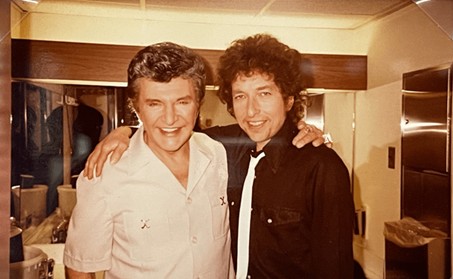
Liberace has been floating around somewhere in the shadowy corners of Dylan’s creative mind for more than half a century. Opposites attract, apparently. The über-flashy bird of paradise, whose exceptional piano talent is overshadowed by glitter, fur coats and an uncanny toothpaste smile, really would seem to be Dylan’s incarnate allergy, but he is certainly not. Remarkably, Dylan talks about Liberace with apparent sympathy and without irony. He poses willingly and charmingly when the two happen to meet on the David Letterman Show on 22 March 1984 (Dylan performs with The Plugz, Liberace gives a cooking demonstration). In Dylan’s inimitable prose explosion Tarantula (written in 1964/65), Liberace is alpha and omega – Dylan incorporates “liberace” both in the first chapter Guns, the Falcon’s Mouthhook & Gashcat Unpunished (“save the clean, the minorities & liberace’s countryside”) as in the last chapter AI Aaraaf & the Forcing Committee: “the sight of george raft-richard nixon-liberace-d.h. lawrence & pablo casals-all the same person.” And when interviewer Bob Fass (WBAI Interview, 1966) tries to provoke Dylan into a taunt, Dylan doesn’t budge:

Fass: Well, people call up and ask us to play old Mario Lanza
records.  Somebody called up and asked me to play some Liberace 
tonight.
Dylan: Oh, that’s fine.
Fass: Yeah?
Dylan: Yeah. […]You know, I met him one time. He smiled.

So if he in 2020 is looking for a musician who can serve as a model for his creature’s skills, the talented Liberace is a respectful choice. That, and because Li-be-ra-ce has the same rhythm as Le-on-Ru-ssell and the-A-pos-tle, of course. And we put him at the beginning of the second line, in the middle of the unlikely trio, because finding a rhyming word for Liberace is even more difficult than for Apostle. Well, finding a rhyming word might still be possible – Liberace loves an Apache from Karachi playing a mariachi or something like that, at most – but then again: see if you can make that make sense.


To be continued. Next up My Own Version Of You part 11: Just extending the line


Jochen is a regular reviewer of Dylan’s work on Untold. His books, in English, Dutch and German, are available via Amazon both in paperback and on Kindle:


Posted in Uncategorized | Leave a comment

Desolation Row: perhaps the most amazing piece of popular music ever written

By Tony Attwood

Two themes dominated Bob Dylan’s song writing in 1965, a disdain for the world he saw around him, and a desire to be moving on physically and emotionally.   Combined with this, I find in the songs of that year a sense of Dada, in that Dylan seems not to see or value progress or reform, but instead sees a world of chaos; a world with a lack of any value in the norms of society.

Except that although Dylan comments on the abandonment of reason within the racism described in some of the songs, he does so using a traditional musical approach.  The “postcards of the hanging” are so appalling, they represent in one lyrical line, the chaos and insanity of the world.   To this (and this explains the magic of “Desolation Row”) Dylan responds not with shock and challenge, but rather with a performance that is musically gentle and lilting.  It moves on through ten musically identical verses, telling us of the atrociousness of human behaviour through the style of a lilting, unchanging ballad. He could have been talking about having a picnic on a spring afternoon.  Instead he is talking about a racist murder and it is the most brilliant summation of all of Dylan’s work (which is to say at least 119 songs – although there may have been more) up to this point. 

The approach to composing “Desolation Row” is thus of much interest in thta the musical sequence begins with Farewell Angelina – a genuine and gentle song of farewell, which in compositional terms was followed by a song that questioned if love can ever be truly real Love is just a four letter word, which in turn was followed by a song that took us into the world of dada, a world beyond any thought of making sense (Subterranean Homesick Blues – itself followed by Outlaw Blues

Of course the “love” and “lost love” songs which dominated popular music at the time, and at the composing of which Bob had already shown himself to be the absolute master, were still there and certainly righly seen as great works of a master songwriter. Love Minus Zero, She Belongs to Me and It’s all over now baby blue all told us that love can exist, but also suggested (with that last song) the fragility of all human emotions.

But it was at this point that the notion of the world as being, if not meaningless, then certainly a place in which all one can do is move on.  Indeed song after song incorporated the “moving on” theme at this time, such as On the Road Again, Maggie’s Farm,  and It takes a lot to laugh it takes a train to cry – which were written one after the other.

Of this new world through which and away from which one feels the need to move, Bob Dylan also seemed to feel a growing sense of disdain, alongside the view that things don’t make sense.    Sitting on a barbed wire fence, Like a Rolling Stone, Why do you have to be so frantic followed one after the other each posing questions and anxieties, but rarely giving answers or resolutions.

For in many of the songs of this time, everything is a jumble, as in Tombstone Blues or things are falling apart as we find in Desolation Row.  And the feeling grows that Bob has had enough of it all, and is moving toward despair, as in Can you please crawl out your window? and Positively Fourth Street

At the heart of this, is the vision that nothing makes sense and the world is hurtling out of control as in Tombstone Blues.

Where Ba Rainey and Beethoven once unwrapped their bedrollTuba players now, rehearse around the flagpoleAnd the National Bank at a profit sells road maps for the soulTo the old folks home and the collegeI wish I could write you a melody so plainThat could hold you dear lady from going insaneThat can ease you, cool you, and cease the painOf your useless and pointless knowledge

What is particularly interesting here is the way Bob uses music – in this case, taking us charging through the reams of references without any clear explanation or exposition of what on earth is going on.  It is indeed all useless and pointless knowledge. By 2005 the song had become much scarier and frightening, with the emphasis on the beat and Bob’s singing so much of the lyrics on one note.   This is a bleak world on the edge of the end.  (This version comes from the Never Ending Tour series on this site).  This really is an end of the world sound, while using the basic three chords of the blues.

But what is especially interesting is what Bob wrote next: it was Desolation Row.   And although the message is the same, Bob has moved on.  Tombstone Blues ends with the comment…

I wish I could write you a melody so plainThat could hold you dear lady from going insaneThat can ease you, cool you, and cease the painOf your useless and pointless knowledge

And indeed the melody is so plain that it hardly exists – especially by this version from 2005.

But what he wrote next most certainly incorporated a melody – and not one that was “so plain” but a melody to remember for all time.  The melody that was plain but beautiful, and could hold us all from growing insane.

You will undoubtedly recall how it sounded at first in 1965 with Bob at the age of 24.   The lady and Bob were looking out onto Desolation Row, but not facing their end.  Bob was simply describing how it was.

And consider also the accompaniment.   The normal thought when creating a piece of music about the end of all things, is to give it lots of noise.   But all we get is two guitars and a bass.  No electrics, no percussion.

Lyrically we have ten six-line verses taking us through 661 words, and of course the lyrics are so wonderfully crafted that they hold us all the way through, and need no musical variation.  Instruments don’t come and go; the music just continues over 11 minutes.  We are held in its trance.

This really is a magical achievement to keep us engaged with the song, with each verse the same and only three chords.   Of course, it is the lyrics that engage our interest, but melody is something remarkable, and I have sought to make the point before on this site that the meaning of the song comes not just from the lyrics, but from the gentle, constant nature of the music.  Music as I have suggested in previous articles, “tells us that life goes on, and on, and it can be pretty horrifying, but somehow because it is always there, we get used to it.”

If we look at the lyrics of the last verse…

Yes, I received your letter yesterday(About the time the door knob broke)When you asked how I was doingWas that some kind of joke?

we know we have reached the end of hope, and yet the music continues, if not exactly in a jaunty mood then most certainly not in a feeling of utter despair.

And this to me is the absolute point of the song, and the absolute genius of Dylan’s approach.  The song is about the hopelessness and horror of life in our civilisation (just consider the opening line of lyrics) and yet the music in this original recording is not that at all.  It has a spot of swing to it, the lead part is played on an acoustic guitar and meanders happily around the chord sequence, there is no rise or fall in tempo or volume.  Everything is gentle and calm, and yet this is a piece that starts, “They’re selling postcards of the hanging”.  This is our world of contradiction.

Thus it is that by the end, the line that “No one has to think too much about Desolation Row” takes on a powerful central meaning, when the music is taken into account with the lyrics.

And so as the characters slip in and out, yet there is a constancy within the song, while the horror show slips by.  We are made immune to what is happening out there because it is out there every day.  Indeed, it is still there, but much of the time we pretend it is not.  

In this view of the song, there is no point shouting about the life that Dylan describes, any more than it is worth my while shouting out about the three giant trees at the end of my garden that I watch swaying in the wind, day after day, as I sit and write.  The sun, the snow, the rain,  it all comes and goes and everything is pretty much the same.  In such a world one begins to accept everything that is present, and everything that happens.  Emotions and energy drift away.  The sun rises, the sun sets.  It rains, it snows.  We don’t particularly notice, because this is how it is.

Change the music however and the song becomes something quite different.   Which is to say that the meanings and emotions carried within the lyrics and not just based on the lyrics themselves but are also determined by the music that accompanies them.  And indeed it can be argued that the song is thus 11 minutes long in order to express the constancy of a world of horrors which exist all around us and the way we come to terms with those horrors.

For me, the recording above is superb because the music does give us this contrast between the acceptance of life around, and the life itself.  The original album version does the same.    Being gentle and pretty much unchanging, these two versions say, “there’s the horror show out there, it never changes, we have to live with it.”

Which is rather a profound thought, given that Dylan was seen as a protest singer, which, as I have often argued before, he wasn’t.   Indeed as I’ve noted so often, “Times they are a changin’” is not a protest song, but a song that actually says, the world changes, it happens, it has nothing to do with what people do – it just happens.   “Desolation Row” says life is awful, but somehow we just carry on.

Put the two messages together and we have a vision of humans meandering through a world, letting everything just happen around them.  It gets better it gets worse, it’s not much to do with us.

All such meanings however are lost when the song is transformed and the original music is lost.  In 1990 for example it sounded like this – and it gives us a feeling of rushing to the final end.

Listening to this 1990 version still makes me feel almost breathless,  and brings forth an image of being in a truck hurtling towards the edge of a cliff – and I’m really not very happy about it.

By 2017 we were still utterly sure the end was coming, but there was perhaps that slight feeling that maybe we could all sit in our favourite armchairs in front of the fire and watch civilisation collapse on TV.  There was nothing we could do to stop it, but we didn’t have to be there.

Bob of course does play with the melody somewhat but it is the rhythm that Bob changes which makes all the difference.   In this last version, there is a swing to the movement of the song.  So when we are “getting ready for the show” we know it is the end, but we, like Bob have aged, and we know we all have to go sometime.   As I have said to many friends in the same age group as me (ie almost but not quite as old as Bob) with this version, stop listening to the lyrics, and take in the music.    It says, yes the end of it all is coming soon, but rather amazingly we made it to this point.

So my thought is with these last two recordings, both are telling us of the end, but in the former, I feel pushed onward when I don’t want to be.  With the 2017 version, Bob manages to make me feel it’s ok – it is all coming to an end, and that’s all right.

To appreciate just how radical, and one might say “unlikely,” the music of “Desolation Row” is, just consider the opening about selling postcards of the hanging.  This is a horror story of a racist incident of the first degree, and yet it is a gentle, lilting ballad.   Now consider the ending:

Right now I can't read too good, don't send me no more letters noNot unless you mail them from Desolation Row

And still, that gentle lilting ballad music continues, as if saying, yes, this is normal, this is all right.

This is the most appalling horror story, but somehow we just treat it as our history, as part of how things have been, and maybe in some places still are.   And that brings home the horror of the story far more than any heavy drum beat and crashing of cymbals could ever do.

Previously in this series….

Posted in Uncategorized | Leave a comment

Dylan: The Concert Series. The utterly stunning and magnificent 5 July 1984

By Tony Attwood

The idea of the concert series is very simple – a set of links to videos or recordings of a single concert year by year, gathered together so that when complete we can all find at least one concert for each year, really quickly, (if for any reason we ever so wanted to).

And I have to add by this point having put up 31 recordings, I was wondering if it was worth going on to the final aim of one a year, but now looking at the number of views, not just of the latest concert linked to, but previous ones in the series, it seems that this collection is providing a service.   And certainly I am enjoying going back to these gigs and taking a snapshot of how Bob was at the time, how his voice sounded, and what he chose to play.

This concert is exceptional for its sound and visual quality, and for the editing.  I really do recommend it, even if you have no interest in the series as a whole.

But in case you want to go further there is a full index of concerts below: every decade now has five concerts, and I am hoping to get as close to one a year as I can by the end of the series…

The concert…..

And just as a thought from me – even if you don’t listen to the whole gig, do listen to the final track.   Although if you can listen to the whole event the power of that last song is doubled and redoubled.  There is a palpable sadness in Dylan’s voiec with “Come mothers and fathers…” between the two instrumental breaks.

  • 1. Highway 61 Revisited
  • 2. Jokerman
  • 3. All along the watchtower
  • 4. Just like a woman
  • 5. Maggie’s Farm
  • 6.  I and I
  • 7.  License to kill
  • 8:  A Hard Rain’s a gonna fall
  • 9.  Tangled up in Blue
  • 10.  It’s alright ma
  • 11. Simple twist of Fate
  • 12.  Masters of War
  • 13. Ballad of a Thin Man
  • 14. Enough is Enough
  • 15. Every grain of Sand
  • 16. Like a rolling stone
  • 17. Mr Tambourine Man
  • 18. Girl from the North Country
  • 19.  It ain’t me babe
  • 20. Leopard Skin Pill Box Hat
  • 21.  Tombstone Blues
  • 22.  Blowing in the Wind
  • 23.  Knocking on Heaven’s Door
  • 24.  Times they are a changin’

The concert series so far (and as noted, the aim in the end is to have, as far as possible, at least one gig per year that Dylan performed).

Posted in Uncategorized | 2 Comments

My Own Version Of You (2020) part 9: You take things and you make them your own


My Own Version Of You (2025) part 9

by Jochen Markhorst

IX         You take things and you make them your own

I get into trouble and I hit the wall
No place to turn - no place at all
I pick a number between one and two
And I ask myself what would Julius Caesar do

Todd Haynes’ beautiful biopic I’m Not There (2007) has an apt subtitle, “The Many Faces & Lives of Bob Dylan”, which fully lives up to its promise: the idea of having Dylan played by six different actors works well. Particularly intelligent is the idea of having the most clichéd, iconic Dylan, the neurotic, sunglasses-wearing, sardonic Dylan of the mid-1960s, with his pale skin, polka dot shirt and wild hair, played by a woman. This alone allows Haynes to avoid histrionics – which, as we see in 2024 in the performance by the talented Timothée Chalamet in A Complete Unknown, is almost inevitable. Plus: Haynes is of course very fortunate to have been able to secure the exceptional Cate Blanchett for the role.

Anyway, 2007 is still a little too early to write a complete biography, obviously; Dylan will continue for a few more decades and calmly expand his resume with new Faces & Lives. So Haynes inevitably misses, and could not have predicted, the 2023 Dylan: Dylan the crowd pleaser.

The seventh leg of the Rough And Rowdy Ways World Wide Tour kicks off on 1 October 2023 in Kansas City, and Dylan has decided to open with Wilbert Harrison’s classic “Kansas City”, much to the delight of the audience. It’s not a spur-of-the-moment decision. It soon turns out to be policy: next we go to St. Louis, where he plays two songs written by the city’s most famous son, Chuck Berry (“Johnny B. Goode” and “Nadine”), and the opening of the third stop is “Born In Chicago” from the Paul Butterfield Blues Band – because we are in Chicago, indeed. In retrospect, we can even see that Dylan had been preparing his sudden, atypical friendliness towards the audience for years:

I’m giving myself to you, I am
From Salt Lake City to Birmingham
From East LA to San Antone
I don’t think I could bear to live my life alone

… in the first bridge of “I’ve Made Up My Mind To Give Myself To You”. Dylan probably wrote the song sometime around 2019/2020, and the names of those four cities were not chosen at random: all four are places that appear on his 2022 tour calendar, and, even more atypically, he even makes a point of it: “From Salt Lake City to Birmingham!” the entertainer shouts as he announces the song on 30 June in Salt Lake City, predictably generating loud cheers and surprised applause.

In the autumn of 2023, after Kansas City, St. Louis and Chicago, we arrive in Milwaukee, which then does not inspire Dylan. He could have chosen something by Al Jarreau, or even more obvious, Steve Miller, but apparently Dylan is not in the mood to give out gifts today. He prefers playing Grateful Dead’s “Truckin’”, which does name-check Chicago, New York, Detroit, Dallas, Houston, New Orleans and Buffalo, but not Milwaukee. The Milwaukeans will have to console themselves with the fact that their neighbours in Dylan’s next stop Grand Rapids (14 October), don’t get anything special either. He rejects Alice Cooper’s “I Like Girls” (I bought a Porsche and I’m leaving Grand Rapids), and even Grand Rapids’ son Del Shannon, who does have a place in Dylan’s heart, fails to inspire him. Dylan opts for another rendition of Chuck Berry’s “Nadine” Sure, Nadine is walking towards a coffee-coloured Cadillac, but Cadillac is still about 90 miles from Grand Rapids – way too far to evoke local patriotic feelings in his audience.

But then next stop Indiana is treated to a personal touch again, with the surprising choice of “Longest Days” by Hoosier John Mellencamp, and even more surprising is 20 October Cincinnati: Dwight Yoakam’s forgotten album track “South Of Cincinnati”, from Dwight’s 1986 debut album Guitars, Cadillacs, Etc., Etc.  Surprising and odd, as Dylan has many, often more attractive alternatives to choose from. “Susie Cincinnati” from the Beach Boys, Ray Charles’ “The Cincinnati Kid”, Buck Owens’ “Sam’s Place” (There’s Hootch-why-kootchy Hattie, she comes from Cincinnati), “Cincinnati Lou” by Merle Travis, Waylon Jennings, Dave Dudley… there are dozens of songs to choose from if you want to add a personal touch to your Cincinnati concert. And often enough, excellent songs from artists who are held in high regard by Dylan. Bobby Bare’s “Cincinnati Jail”, for example, Johnny Cash’s “Papa Was a Good Man” (okay, that’s a terrible song), Hank Williams’ “Pan American”, and especially Connie Smith’s unabashed declaration of love, her 1967 hit “Cincinnati, Ohio”:

There she lies at the foot of the hill
Shinin' like a jewel in the valley below  
Cincinnati, Ohio.

And let’s not forget Sinatra’s “I Can’t Get Started” (In Cincinnati or in Rangoon, I simply smile and all the gals swoon), another highlight from Dylan’s beloved American Songbook. In fairness, it should be noted that it is not so much the grandeur or beauty of the city, but rather the euphony of the word “Cincinnati” which usually motivates the décor choice.

Sinatra, Cash, Hank, Buck Owens, Bobby Bare and Merle Haggard… but Dylan chooses Dwight Yoakam. His afterword conveys a certain intimacy: “Dwight wrote that, you know that. I think he wrote it for King Records.” Partly fake news (Yoakam never signed with King Records), but that familiar “Dwight” stands out. Which makes sense: the men know each other and Dylan does appreciate him. They even have sung together: the background vocals for Carlene Carter’s 1993 recording of Dylan’s “Trust Yourself” are provided by the occasional duo Yoakam & Dylan, and a quarter of a century before “South Of Cincinnati” Dylan had already played another Yoakam song: the flawless tear-in-your-beer ballad “The Heart That You Own” (West Palm Beach, 1999).

It makes it all the more likely that Dylan is giving a nod to Dwight Yoakam here in this fourth verse. “Cincinnati” may appear in hundreds of songs, but there is really only one song with that strange, absurd concept of “pick a number between one and two,” and that is the closing track on Yoakam’s 2003 album Population Me, “The Back of Your Hand”:

Take a guess at where I stand
Pick a number one to two
Take a look at the back of your hand
Just like you know it
You know me too

Funny, and not entirely unusual in a Dylan song, such a paraphrase from a song by an admired colleague. However, it becomes more puzzling when we look at the credits: “The Back of Your Hand” is one of the few songs not written by Dwight himself. It was written by actor Gregg Lee Henry, the actor who usually plays the bad guy and whom we know from films such as Brian De Palma’s Body Double (1984), the Guardians Of The Galaxy series (2014-23), dozens of TV series and, above all, as the serial killer Dennis Rader in the horror television film The Hunt for the BTK Killer (2005).

In June 2017, Gregg has a somewhat more demanding role: he is playing the title role in the Shakespeare play that is on the programme for this year’s annual Shakespeare in the Park in Central Park. Dylan is nearby: on 13, 14 and 15 June, he is in Port Chester, barely a 45-minute drive from Central Park. And Dylan is a big, self-proclaimed Shakespeare fan (“I like to see Shakespeare plays, so I’ll go — I mean, even if it’s in a different language. I don’t care, I just like Shakespeare, you know” – AARP interview 2015). So it’s very likely that Dylan seized the opportunity. And what does he see?

I pick a number between one and two
And I ask myself what would Julius Caesar do

… he sees how Gregg Lee Henry, the actor who wrote Yoakam’s “The Back of Your Hand” with the chorus line “Pick a number one to two”, gets into trouble on stage, is pushed against the wall, no place to turn – no place at all, and then murdered by Casca, Cinna, Cassius and even Brutus – Dylan sees Gregg Lee Henry playing Julius Caesar.

In a controversial performance, incidentally – Gregg’s Julius Caesar is very much modelled on Donald Trump, which is causing the organisation quite a few problems. How did you prepare for that role, Backstage asks Gregg Lee Henry in May 2017.

“You invest your creativity in your part. You can watch other films and productions of Julius Caesar and see what they did and see whether it’s worth stealing or not! [laughs] Which is true of all art—you take things and you make them your own.”

I create, says Gregg, very Dylanesque, my own version of you. And then chooses – coincidentally, probably – almost the same words as Dylan did at the time in that famous Rolling Stone interview, 2012: “You make everything yours. We all do it.”

 —————–

To be continued. Next up My Own Version Of You part 10: And then see if you can make it make sense

Jochen is a regular reviewer of Dylan’s work on Untold. His books, in English, Dutch and German, are available via Amazon both in paperback and on Kindle:

Posted in Uncategorized | Leave a comment

The Philosophy of Modern Song: “Waist Deep in the Big Muddy”

By Tony Attwood

Bob Dylan’s book, “The Philosophy of Modern Song”, was written, as I understand it, after he was awarded the Nobel Prize for Literature.  I started out thinking I might write a commentary upon the book, but soon felt I simply didn’t understand enough of what Bob is saying, particularly in terms of why he chose the songs, to be able to write proper commentaries.  Which of course is a failure on my part, not on Bob’s.

And so after a hesitant start in reviewing the book, I abandoned the concept but became drawn back to it by the notion of listening again to the songs Bob picked and seeing if I could find anything to say about them, which might be of interest to anyone other than me.

So far we’ve had

This time I have turned to “Waist Deep in the Big Muddy,” a song written by Pete Seeger in 1967 and made more famous than it might otherwise have been because of it being censored out of the “The Smothers Brothers Comedy Hour,” apparently for being unpatriotic.

It was to have been Pete Seeger’s first appearance on network commercial television in the United States in 17 years since being blacklisted in 1950. But specifically, his performance of “Waist Deep in the Big Muddy” was dropped from the broadcast after he refused to remove the sixth verse.

Which takes me back to the Weavers, a folk group who were banned from a lot of public broadcasting outlets from January 1962, when the group’s appearance on The Jack Paar Show was cancelled when they wouldn’t sign the oath of political loyalty.

The Weavers were founded by Pete Seeger and Lee Hays in Greenwich Village in 1948 and they were a fundamental part of the rise in interest in traditional American folk songs, starting with “Goodnight Irene”.

What upset the authorities with “the Big Muddy” was this verse….

Well, I'm not going to point any moral,I'll leave that for yourselfMaybe you're still walking, you're still talkingYou'd like to keep your health.But every time I read the papersThat old feeling comes on;We're, waist deep in the Big MuddyAnd the big fool says to push on.

Commentaries of the time suggest that the problem with the song was that it was seen as a reference to President Johnson’s actions in the Vietnam War although the piece itself is similar to the Ribbon Creek Incident.   That event took place on 8 April 1956 when the Marine Corps were marched across a tidal creek, in which six of the recruits died.  Staff Sergeant, a junior drill instructor was found guilty of possession and drinking alcohol on duty and of negligent homicide.

Ultimately in Pete Seger’s case, the TV company did relent and he appeared on a later edition of the show singing the song in full.

It was back in nineteen forty-two,I was a member of a good platoon.We were on maneuvers in-a Louisiana,One night by the light of the moon.The captain told us to ford a river,That's how it all begun.We were -- knee deep in the Big Muddy,But the big fool said to push on.

The Sergeant said, "Sir, are you sure,This is the best way back to the base?""Sergeant, go on! I forded this river'Bout a mile above this place.It'll be a little soggy but just keep slogging.We'll soon be on dry ground."We were, waist deep in the Big MuddyAnd the big fool said to push on.

The Sergeant said, "Sir, with all this equipmentNo man will be able to swim.""Sergeant, don't be a Nervous Nellie, "The Captain said to him."All we need is a little determination;Men, follow me, I'll lead on."We were, neck deep in the Big MuddyAnd the big fool said to push on.

All at once, the moon clouded over,We heard a gurgling cry.A few seconds later, the captain's helmetWas all that floated by.The Sergeant said, "Turn around men!I'm in charge from now on."And we just made it out of the Big MuddyWith the captain dead and gone.

We stripped and dived and found his bodyStuck in the old quicksand.I guess he didn't know that the water was deeperThan the place he'd once before been.Another stream had joined the Big Muddy'Bout a half mile from where we'd gone.We were lucky to escape from the Big MuddyWhen the big fool said to push on.

Well, I'm not going to point any moral,I'll leave that for yourselfMaybe you're still walking, you're still talkingYou'd like to keep your health.But every time I read the papersThat old feeling comes on;We're, waist deep in the Big MuddyAnd the big fool says to push on.

Waist deep in the Big MuddyAnd the big fool says to push on.Waist deep in the Big MuddyAnd the big fool says to push on.Waist deep! Neck deep! Soon even aTall man'll be over his head, we'reWaist deep in the Big Muddy!And the big fool says to push on!

I have seen this referred to as one of what are classified as the “Dangerous Songs” and I rather like that comment, cementing the notion that songs can indeed be dangerous.  Long may it be so.

Posted in Uncategorized | 1 Comment

Polish Dylan part 2: a different band and ten new songs


This is the conclusion of the article a review of the amazing world of Dylan.pl – which we published a few days ago.


By Filip Łobodziński

Now we’re in 2025 and we’re a different band. During the lockdown, we parted ways with two of our main players, the guitarist and the accordionist. I acknowledge their great input and I owe them a lot but the time came when the band needed some fresh blood. A new guitar/banjo/mandolin player has been on board since 2022 and a harmonica virtuoso/electric guitar player jumped ship in 2024. And together we started work on a new repertoire for another album that I had conceived three years previously.

We have 10 new songs now which we play live. They are received enthusiastically by our fans. And our older stuff has also been refurbished.

Sometimes we are faithful to the original version in terms of rhythm and groove, e.g. this rendition of Gotta Serve Somebody:

– or our take on the Ballad of a Thin Man:

– or our Tweeter and the Monkey Man:

But that’s not our main point. We look for different angles, new perspectives or just slightly off-course ways of doing Dylan. For instance, with Slow Train we opted for a “train” drive, a bit inspired by the Allman Brothers’ Whippon’ Post groove:

For A Hard Rain’s a-Gonna Fall we chose a steady-rock rhythm:

Our Highway 61 Revisited has a rockabilly, Carl Perkins-tinted vibe:

Blind Willie McTell is a nod to the funeral bands:

Meanwhile, our Fourth Time Around has a reggae pulse and an allusion to its sister song:

Our Chimes of Freedom is a different story altogether, very dynamic and sometimes aggressive yet optimistic in the end (in my translation, I referred here to the Polish translations of the Rimbaud poems):

Masters of War on their part, are aggressive and sinister:

And for One More Cup of Coffee (Valley Below) I wanted to showcase our two guitar players, with the three of us playing initial and final theme in 3-part harmony:

And with Love Sick, we get once again in a hard-edged rock rhythm:

This is dylan.pl A.D. 2025. Our current line-up is:

  • Filip Łobodziński – translations, vocals, rhythm guitars (since 2014)
  • Marek Wojtczak – bass (since 2014)
  • Krzysztof Poliński – drums (since 2015)
  • Tomek Pfeiffer – guitars, banjo, mandolin (since 2022)
  • Bartek Łęczycki – harmonica, guitar (since 2024).

And we try to keep on keepin’ on.  And perhaps I may add that maybe thanks to my efforts (in addition to the band; I’ve published two anthologies of Dylan lyrics and Tarantula so far) the awareness of Bob Dylan’s output is a lot greater than before.

Posted in Uncategorized | Leave a comment

No Nobel Prize for Music 22: the journey of turning the music upside down


By Tony Attwood

Details of the previous articles in this series are given at the end of the article.  Details of all the series were are currently running, and some recently concluded are given on the home page of this site.    We always welcome ideas for new series, and indeed offers to write for Untold Dylan.  If you are interested please email Tony@schools.co.uk

———-

Dylan’s compositions at the start of 1965 were extraordinary, both musically and lyrically ranging from “Farewell Angelina” to “Subterranean Homesick Blues” from “She Belongs to Me” and then onto “It’s all over now baby blue”.   Songs that for almost any other composer could be the definitions of a lifetime’s work were composed in a run of eight compositions which were just the opening salvo of a year’s work that concluded with the monumental “Visions of Johanna”.

But of course at the time, we couldn’t see where Dylan was going, and could only know that whatever he did next it would be a surprise.  And surprise it was as unexpectedly he turned to humour with Bob Dylan’s 115th Dream – a song that got six perofmrances in 1988 (that is to say 23 years later) and then was once more put away in the locker and left.

It is a song that I have described as “Beat poetry as rock music” and an “update on talking blues” with a touch of Dada.   In the live performances however Bob turned the song into a persistent 12 bar blues which has a modicum of a melody within it, but not much.  However it did to me seem to take Bob a step or two toward finding a new form.  Maybe Dada maybe something else – but I got the feeling then, and still get it now, that he knew there was somewhere else to go and something else to find, but as yet he didn’t know what or where.

In terms of compositions the Dream this was followed up with “On the road again” which did not ever make it onto the stage – yet another 12 bar blues that again seemed to be reflecting the total chaos and meaninglessness of the world around us.   One can suggest it is about moving on, or about the artist taking on society or… well, whatever you wish.   But what surely we must note is that after the compositional originality and gorgeous musical arrangements of “She Belongs to Me” and “It’s all over now Baby Blue” Bob seems to have retreated into the very basic essence of rock.  For to tell the truth, neither “115th Dream”, nor “On the Road Again”, have much musical originality in them.  Indeed if I can find an artistic form that they seem to approach it would be Dada.

And given the low number of performances we might feel Bob felt the same way even though he included these songs on the LP.   But then Bob did compose a song he was willing to perform – and how.   It got over 1000 performances across 45 years: Maggie’s Farm.   Here is one from 2009 taken from the Never Ending Tour series on this site.

It is fun, and Bob has found some variety in the piece across the decades as we might note in this comparison with 1988. And indeed it is such a simple song it is quite remarkable that the music could be varied at all, but it is.

And yet still what we really have a bouncy rocker, in this case primarily on one chord with the first line of lyrics repeated, and then followed by a rhyming line.   If someone who didn’t know Bob’s work just heard this they would struggle to know what all the fuss is about – and even if they did enjoy the lyrics or find originality in them, there is still the question: there’s not much originality in the music, is there?

That is not to say there is anything wrong with the song or these performances but rather to note that there is no profundity, no depth, no innovation, no message.  It is indeed as if all the innovation, insight, beauty and feeling that we found in “Baby Blue” has been used up, and Bob has nothing left to do but to create a few 12 bar blues and their variants.

That doesn’t make the songs unenjoyable, but musically and emotionally they are so different from the first eight songs of the year, one wonders what happened.  And indeed at the time, one wondered what would happen next.

What in fact happened was yet another 12 bar blues: “Bob’s 115h Dream”.

But again we have the 12-bar blues format, with very little musical variation, and again not much use for the song in the shows: six performances in October 1988 and that was it.

In compositional terms this was then followed by On the Road Again a song which in fact garnered no performances    “Maggies’ Farm” came next and again gave us more of the same – which is not to say that these are not enjoyable Dylan compositions, but rather to point out that when we consider them in the order of composition, they have little to offer in terms of musical originality.    Indeed if we consider Maggie’s Farm then we might say that like “On the road again” it tracked the notion of moving on, along with the concept of the artist against society.    And this one did get played, over one thousand times in fact.

But there is moving on and there is moving on, and quite where this was taking us I remember wondering at the time.  At least until something happened, for it is almost as if a voice from on high says, “Bob even with one or two chords, you can still have a melody” for that is what we got with  It Takes a Lot to Laugh, It Takes a Train to Cry.     It appeared on Highway 61 Revisited and Bob gave it 213 performances – but perhaps most noteworthy is not the number of times he sang it, but how long it took to get through those 213 editions.   50 years it took.   And I am sure you don’t play a song across fifty years unless it really resonates.

In an earlier article I raved over a 2003 performance, and I still do love that.   But now try this from 2019…

What makes this work for me is that by now we all know the song, we know the lyrics, there are only three chords, and they come in the classic “12 bar” order.  But the way the accompaniment now works is just something else.  The beat is great, but it’s not just that.  This is the breathing of new life into the old dog.  We are still reaping the benefits of the works of all those blues singers through the ages, but with a new life put into their work.  It is as if Bob is now saying, “I have walked that road up and down throughout my life.  I’m still singing the 12 bar blues, and I can even remember now to include a bit of a melody along with the beat and those unexpected chord changes.”

To me this 2019 version does more than knock new life into an old song, it shows us what there is in the song, and what was happening to Bob at this moment.

But back then Bob had not seen his way through what I think was something of a songwriting crisis.  His next song Sitting on a barbed wire fence concerned moving on, just as most of these songs seemed to, although with the secondary ingredient that nothing at all makes sense, and then that was it.   In fact Bob had written song after song about travelling and the concept of “moving on” – and with the wonderful It’s all over now baby blue it had worked perfectly.   But with the subsequent “moving on” songs that we have considered here (from “115h Dream” to the “Barbed Wire Fence”), the moving on becomes tired and gradually makes less and less sense.   So the music because less and less inventive.  There is still music that we can enjoy, particularly in “It takes a lot to laugh”, but we are still just moving on and moving on, and “Sitting on a barbed wire fence” which was written next did nothing to transform these thoughts.

However, it all did have to come to an end at some time, and Dylan achieved this by pulling all his feelings of moving on and never finding the end, together in one song.   And indeed it was a song in which he chose a new musical approach – that of the ascending scale in the bass against the same note in the vocal line.   And it worked brilliantly beyond belief.  Bob asked all of us how it felt, and at least in terms of “like a complete unknown” most of us knew.

It was indeed as if all those moving-on songs had finally led to their rightful conclusion.  And as for that musical innovation of the rising scale in the bass against the same note held in the vocal – maybe most people who heard the song didn’t realise it, but that announced to anyone ready to hear that everything in popular music was up for grabs.  And that is before we think about the vocal line in the chorus being followed by, not accompanied by, the chord changes.   Bob truly had innovated, and from this moment on popular music would never be the same again.

Why did Bob innovate so extensively in this song, which when look back to the compositions immediately before it, seems to have come out of nowhere?   I don’t know, and I rather suspect if asked he wouldn’t know either (although of course that is just a guess).  But he did suddenly change, and thus after a long series of pieces created on and around the notion of the classic 12 bar blues we got a song unlike anything any of us had ever heard before.  And oh my, it was certainly worth the wait.

Previously in this series….

Posted in Uncategorized | Leave a comment

Bob Dylan the concert series. New York 2017

By Tony Attwood

The idea of the concert series is very simple – a set of links to videos or recordings of a single concert year by year, gathered together so then when complete we can all find at least one concert for each year, really quickly, if we ever so wanted to.

So in a sense it is a little extension to the  Never Ending Tour series incorporating the years before and after the Tour itself.

So we are still simply working on having one recording for each year.  And a full list of all the concerts we have covered thus far is given at the end of this little piece, with links in each case.   But all suggestions are welcome.

There is a full index of concerts below, and with the addition of this rather fine recording I think we now have four concerts from each decade, so now we start again to take this up to five per decade.  Some decades already have this, but there are a few gaps to fill in.

Albany, New York 17 November 2017

The songs….

  1. Things Have Changed
  2. It Ain’t Me, Babe
  3. Highway 61 Revisited
  4. Why Try to Change Me Now
  5. Summer Days
  6. Melancholy Mood
  7. Honest With Me
  8. Tryin’ to Get to Heaven
  9. Once Upon a Time
  10. Pay in Blood
  11. Tangled Up in Blue
  12. Soon After Midnight
  13. Early Roman Kings
  14. Scarlet Town
  15. Desolation Row
  16. Thunder on the Mountain
  17. Autumn Leaves
  18. Love Sick
  19. Blowin’ in the Wind
  20. Ballad of a Thin Man

The series so far

Posted in Uncategorized | Leave a comment

My Own Version Of You part 8: A truly fascinating song

My Own Version Of You (2020) part 8

by Jochen Markhorst

VIII       A truly fascinating song

I say to the willow tree - don’t weep for me
I’m saying the hell with all things that used to be

“An exceptional song,” says a man who should know, Alec Wilder in his American Popular Song (1972). “It’s on a par with Carmichael’s experiments and was written, I’m sure, far from the maddening crowd of commercial song writers.” This is a huge compliment coming from Wilder, as he considers Hoagy Carmichael to be “the most talented, inventive, sophisticated, and jazz-oriented of all the great craftsmen.” And “Willow Weep For Me”, because that’s what he’s talking about, is “a truly fascinating song.”


The song was undoubtedly injected under Dylan’s skin by Sinatra, via Sings For Only The Lonely (1958), Sinatra’s perfect suicidal mood album. In his autobiography Chronicles, we read Dylan’s undisguised declaration of love for track 9 of that same album:

“I used to play the phenomenal “Ebb Tide” by Frank Sinatra a lot and it had never failed to fill me with awe. The lyrics were so mystifying and stupendous. When Frank sang that song, I could hear everything in his voice — death, God and the universe, everything.”

… and for more than sixty years, we have heard echoes of the remaining eleven songs reverberating throughout Dylan’s entire oeuvre. In songs like “Forgetful Heart”, “Dignity” and “Wallflower” resonate word choice and song structure; Only The Lonely songs like “One For My Baby (And One More For The Road)” and “Goodbye” are paraphrased and quoted in the Basement, in “Sign Language”, in “Scarlet Town” and in “Don’t Think Twice”, and with some cut and paste work, the classic “Blues In The Night” can be reconstructed in its entirety from Dylan’s Collected Works (there are at least nine Dylan songs with word combinations and paraphrases from that one song).

That’s no different here on Rough And Rowdy Ways. Dylan quotes “only the lonely” in “False Prophet”; So you take the high road / and I’ll take the low from “Goodbye” resonates in “Crossing The Rubicon”; further on in this “My Own Version Of You” we hear in the wee, small hours, the reference to Sinatra’s other collection of tearjerkers, the equally brilliant In The Wee Small Hours from 1955… the impact of Sinatra’s torch ballads is not limited to the unabashed tributes Shadows In The Night, Fallen Angels and Triplicate (2015-17), the albums on which Dylan reinterprets 52 songs from the American Songbook, but has also been seeping into Dylan’s own songs for sixty years.

However, the reference to “Willow Weep For Me” seems to have a little more substance than the “normal”, weightless references. The wee small hours in the tenth verse, or something like in a small café at a quarter to three in the 1970s song “Sign Language” (the setting borrowed from “Only The Lonely”, the time copied from “One For My Baby”) and those dozens of other hints in Dylan’s oeuvre: these are usually nothing more than nice but meaningless nods.


But here in “My Own Version Of You” Dylan plays with the reference: “willow don’t weep for me.” The continuation takes it even a step further, going full Hemingway: “I’m saying the hell with all things that used to be.” Alienating. The narrator seems to contradict himself. Is this the same man who, twelve seconds ago, revealed that he is studying the fossil language Sanskrit? Who has made it his mission to save the best of the past for the future and who, in the last line of this song, will say: “I wanna turn back the years”? In short, the man who extols all things that used to be now wants to send them to hell?

The interlude insinuates a Jekyll/Hyde-like schizophrenia, a man who, on the one hand, feels an evangelical urge to spread the Way, Truth and Light of old songs, ancient literature and whatnot, and, on the other hand, has a severe allergy to repetition, to rehashing things that used to be. Which is certainly an issue for the artist Dylan himself, as we know. Studio engineer Chris Shaw quotes Dylan, and is then un-Dylanesque clear and concise:

“My favourite Bob Dylan song is probably ‘It’s Alright Ma (I’m Only Bleeding)’. He has this wicked way of playing it live now, and I saw him backstage once after a show, and I said, ‘Hey, I love the new version of “It’s Alright Ma” – but do you ever play it like the original recording?’ And he looked at me, and he said: Well, y’know, a record is just a recording of what you were doing that day. You don’t wanna live the same day over and over again, now. Do ya?”
(Life with Bob Dylan, UK Uncut’s autumn special 2008)

… and even more unequivocally in the same interview, a little further on:  “Bob really, really hates to repeat himself. He just hates it.” Still, that applies exclusively and solely to his own work – after all, Dylan repeats other people’s work so exhaustively and frequently that it has become a stylistic feature. Not only by dusting off old songs and performing them as covers, but also by quoting and integrating parts of them into his own songs, by filling his autobiography with phrases and word combinations from other people’s work, by freezing film scenes and copying them in his paintings, by peppering a Nobel Prize lecture with passages copied from SparkNotes, by embellishing his film script for Masked And Anonymous with quotes from things that used to be… no, the artist Dylan is a fan of repetition, and is grateful that the things that used to be have not gone to hell. We can identify the artist Dylan with the indignant narrator from “Summer Days” (“Love And Theft”, 2001): She says, “You can’t repeat the past.” I say, “You can’t? What do you mean, you can’t? Of course you can.”

An aversion to weeping willows is more in keeping with the machismo of the creative storyteller, the genius who creates a creature who feels the way that I feel and is modelled on parts of Scarface Pacino and the Godfather Brando. This is a robot commando who has no patience for the sentimentality of a willow weeping for him. No, if he’d want the sympathy of a salix babylonica at all, then it should be from the willow in the most beautiful willow song of the twentieth century, even more beautiful than “Willow Weep For Me”: Joan Armatrading’s “Willow”, one of the breathtaking highlights of Armatrading’s crown jewel Show Some Emotion (1977):

I'm strong
Straight
Willing
To be a
Shelter in a storm
Your willow oh willow
When the sun is out

Alec Wilder may have heard Joan’s willow song (Wilder died in 1980), but if so: he did not make his opinion public. Still, we can of course guess what it would have been: “An exceptional, truly fascinating song.”

To be continued. Next up My Own Version Of You part 9: You take things and you make them your own

——————–

Jochen is a regular reviewer of Dylan’s work on Untold. His books, in English, Dutch and German, are available via Amazon both in paperback and on Kindle:

Posted in Uncategorized | Leave a comment

The Philosophy of Modern Song: There stands the glass

By Tony Attwood

Bob Dylan’s book, The Philosophy of Modern Song, was written, as I understand it, after he was awarded the Nobel Prize for Literature.  It is not a book I feel I can comment upon, largely because I don’t understand much of what Bob is saying, which of course is a failure on my part, not on Bob’s.

And so after a hesitant start in reviewing the book, I abandoned the concept  If you feel you could write a review of the whole book, or individual chapters, please do send me an article – as ever it is Tony@schools.co.uk

But while waiting for someone else’s review of the book, I was drawn back to it by the notion of listening again to the songs Bob picked and seeing if I could find anything to say about them, which might be of interest.

So far we’ve had

And now it is “There Stands the Glass”

There Stands the Glass” is self-evidently a country song, and it was written by Russ Hull, Mary Jean Shurtz, and Audrey Grisham.  Hearing it for the first time my initial thought was, “Why does it take three people to write such a song?”  I guess it was one for the lyrics, one for the music of the verse and one for the music of the middle 8 but I could be wrong.

First recorded in 1952, it was a hit for Webb Pierce in 1953.    Wiki tells me he was “one of the most popular of the genre, charting more number-one hits than any other country and western performer during the decade. It was Pierce’s fifth release to hit number one on the country chart. It spent 27 weeks on the chart and was at the top for 12 weeks.”

They also note that Bob said, “The star of this song is the empty bourbon glass, and it’s built around the same kind of crack guitar sound as on a Hank Williams record, as well as the magical open-string, strummed chord.”   Rolling Stone put it at 127 in the list of the greatest country songs of all time.  (Which perhaps explains why I don’t really take to country music).

But moving on: the crack guitar sound:   I’m told the “crack” guitar sound on Hank Williams records can be heard on songs such as “I’m So Lonesome I Could Cry,”

It was created by using the electric guitar as a rhythm instrument, emphasizing the pulse without percussion.  The guitarist plays the lowest strings on the guitar but with the sound deadened by the fingers touching the string as soon as it has been played.  The resultant pulse defines the beat of the song.  

At least that is what I have read.   The trouble is however I can’t hear that in “There Stands the Glass” at all, which means as a reviewer I am lost.  Maybe it is the fact that I don’t like songs that celebrate using alcohol to avoid facing the real world (not least because it doesn’t work but instead leads to habituation), so I approach the song with a prejudice, and as a result perhaps can’t hear what I am listening to.  Besides which, I guess no radio station (at least in the UK where I live) would be allowed to play this song these days…   Here is the full set of lyrics:

There stands the glass that will ease all my painThat will settle my brain, it's my first one todayThere stands the glass that will hide all my fearsThat will drown all my tears, brother, I'm on my way

I'm wondering where you are tonightAnd I'm wondering if you are all rightI wonder if you think of me in my misery

There stands the glass, fill it up to the brimUntil my troubles grow dim, it's my first one today

So I start with a prejudice about the subject matter, and I am lost on the subject of what sounds we are listening to.  Not very conducive to writing a review!  But worse, I think I have a reaction these days against songs where the music and lyrics are so simple – I am tempted to write “excessively simple” although I am not sure one can say that.  But I still am pondering why three people were needed to write this!

Is my problem that of writing about alcohol?   I do enjoy a drink, but only a few nights a week with a meal, and I wouldn’t have said I had a problem with the subject within songs.   Although thinking further on this I can only think of one Dylan song about alcohol – although of course there may be more that slip my mind at the moment.   The song I recall is “Moonshiner” – a song which Bob has adapted from a piece normally accredited as “trad”.

But as others have pointed out before me, in his radio selections on the radio show he had included “A Quiet Whiskey,” “Whiskey Blues,” and “I’ve Been Drinking.” He also included songs that referenced specific types of alcohol like “One Scotch, One Bourbon, One Beer,” demonstrating an appreciation for the variety of music and lore surrounding alcohol, (at least according to Far Out Magazine)

So really I need help.  Not with my drinking, but with my understanding of why Bob included “There Stands the Glass” in the “Philosophy of Modern Song”.  Is it that popular songs have emphasised drink constantly?   I mean yes of course there are many songs on the subject but no more than on most other subjects, and certainly far fewer than on the topics of love, lost love and dance.

But I certainly can think of quite a few off the top of my head

  • Have a Drink on Me 
  • One Bourbon, One Scotch, One Beer
  • One Mint Julep
  • Red Red Wine
  • Tequila

and there are many many more of course.  But to come back to “There Stands the Glass” maybe it was the original that Bob liked.  I don’t know if that is so, but here it is…

My answer would be, don’t drink, go dancing.  But that’s just me.

Posted in Uncategorized | 4 Comments

So, only six more songs to go: a love affair with Highway 61 Revisited

So, only six more songs to go

by Jochen Markhorst

The history of my love affair with Highway 61 Revisited is probably not that different from most of us: upon discovering the LP in my father’s record collection, I kept putting the needle back to the lead-in groove after 6’13” – longing for “that snare shot that sounded like somebody kicked open the door to your mind,” as Bruce Springsteen aptly described that first bang of “Like A Rolling Stone”.

Not to take anything away from the beauty of “Tombstone Blues” or, say, “Desolation Row” (on the contrary), but certainly in the first few weeks, the ratio of “Like A Rolling Stone” to the rest of the LP must have been about 20:1.

The rest, of course, soon caught up. Highway 61 Revisited is for many of us the GOAT, a monument without a single dull spot. Unlike, say, Sgt. Pepper or Dark Side Of The Moon, we don’t secretly skip a “When I’m Sixty-Four” or some “On The Run”. No, while still enjoying the fade-out of “From A Buick 6” we are already looking forward to “Ballad Of A Thin Man”, we get already excited for “Highway 61 Revisited” halfway through grooving to “Queen Jane Approximately” and by the time the doorknob breaks in “Desolation Row” we know we want to hear the whole album again.

Some fifty years after that initial excitement all the impressions have sunk in and the processing begins. Or rather: the attempt to put the magic into words, the attempt to peek into the magician’s sleeve. “Like A Rolling Stone” was still a bit too big, too scary, so I started with the last chapter; with “Desolation Row”. I did expect it to be a big chapter, but the richness of the song turned out to be even greater than expected – after 130 pages, it dawned on me that a Highway 61 Revisited book might be very, very ambitious.


The second H61 book, about “Tombstone Blues” plus an epilogue about the unfinished, rejected song fragment “Jet Pilot”, also clocked in at over 100 pages, which meant that an H61 book was off the table; nine songs, and for the sake of completeness you’d want to include the non-album single “Positively Fourth Street”, and, in addition to “Jet Pilot” also include the outtake “Sitting On A Barbed-Wire Fence”, and knowing that you won’t be able to cover “Like A Rolling Stone” in less than 100 pages either… that H61 book was going to be an unwieldy 1,000-page tome. No, we’ll do it in parts.

After Desolation Row – Dylan’s poetic letter from 1965 (2020) and Tombstone Blues b/w Jet Pilot – Dylan’s looking for the fuse (2021), came the book focusing on the unforgettable canon shot of the album a.k.a. one of the most beautiful singles in rock history, Like A Rolling Stone b/w Gates Of Eden – Bob Dylan kicks open the door (2025), and now Part 4 follows: about the two melancholic moments of calm. One on Side A, the brilliant fermata between the frenzy of “Tombstone Blues” and the brutal neuroticism of “From A Buick 6”. The other on Side B, the hypnotic breather after the commotion of “Highway 61 Revisited”: It Takes A Lot To Laugh, It Takes A Train To Cry b/w Just Like Tom Thumb’s Blues – Bob Dylan’s melancholy blues.

So, only six more songs to go:

“From A Buick 6”
“Ballad Of A Thin Man”
“Queen Jane Approximately”
“Highway 61 Revisited”
“Sitting On A Barbed-Wire Fence”
and
“Positively 4th Street”

In 2030, Highway 61 Revisited will reach retirement age. A great moment to have completed the H61 series. Should be doable.

The H61 series:

Posted in Uncategorized | 1 Comment

Translating Dylan: a review of the amazing world of Dylan.pl

Introduction by Tony Attwood

I think we first mentioned the band Dylan.pl back in 2018 when we picked up on their cover of Jokerman and have noted with much applause a fair amount of their work since.  Indeed I’ve been delighted to publish a whole range of articles relating to the band since then..

But then of course times move on, and we head toward different subjects, trying hard not to repeat ourselves (this is of course UNTOLD Dylan) but I was delighted to hear again recently from Filip Łobodziński, at which moment I suggested that maybe he would like to write another piece for us.  And very kindly he has agreed.   So here is part one.   Part two, as you might expect, will follow in a few days….

—————-

By Filip Łobodziński

The whole thing started in 2014 when… oh, wait. It was back in 1979, actually. That year, in April, I translated the first of hundreds of songs which are now in my archive. It was Don’t Think Twice, It’s All Right. Then came some French and Catalan songs, and then, Romance in Durango, You’re a Big Girl Now… and so it went. Fast forward to 2014 and I have a thick binder full of Bob Dylan’s songs translated into Polish.

In the meantime, in December 1983, I started a band with my friends from the Warsaw University. We called it Zespół Reprezentacyjny (Representative Group) and our repertoire consisted of, mainly, Catalan and French songs (translated into Polish by ourselves) which we found suitable to arrange and perform in a Poland ruled by communists, to mock the regime and encourage people to think and act independently.

The band is still performing today, we have 6 albums released and we plan to record at least one more. But the musical sensibility of the band somehow did not suit the Dylan songs so my translations were neglected.

And then, in 2014, I thought I could perhaps show my Dylan work to the world by singing my translations in the bars; just me and my guitar. The Zespół Reprezentacyjny’s bassist argued against the idea however and offered to be my accompanist. Then another friend of mine asked me, “Filip, why don’t you start a different band dedicated solely to your Dylan output?”

In early December, I contacted a very good guitar player (doing a fantastic job on a variety of guitars, mandolin, banjo, resonator guitar* and harmonica) and a renowned producer and together with a drummer we formed a quartet I dubbed dylan.pl. My original aim was to do Dylan songs in an Americana vein (or as close to Americana as we the Poles could get), i.e. mixing up folk, blues, country, gospel and acoustic rock’n’roll elements. The point was not to replicate the originals but to express ourselves instead through the lyrics, the rhythms and melodies.

Our first rehearsal took place on Dec 27, 2014. A year later, we had already nearly 30 songs in the bag and the first live concert behind us. We were received with serious applause.

Another nine months passed and we finished recording our album. I knew the Polish market was not prepared for Bob Dylan in Polish in the long run so I managed to persuade the record label which agreed to release the album that it should be a double-CD affair. I wasn’t sure if I could hope for another opportunity so I went for the big one.

Since the label was not sure if my voice and name could sell the product they insisted on having guest vocalists. They did not believe in my singing although I’d already had released five albums with Zespół Reprezentacyjny to remarkable sales. But, who’s the boss if not the label? Even our lead guitar player/producer would not argue. We invited six top singers from the world of Polish folk and rock and I let them sing some parts of a few songs. In my opinion, only a small part of those songs could be sung as duets because of their intimate mood but I found that I could give some room for other voices without sacrificing the message.  One of our joint efforts is above, and a second below…

Meanwhile, a fifth member was enlisted, a good trombone and accordion player. We were a quintet then.

The idea for the album was to dedicate the first CD to the more “social”, “political” or “commenting” Dylan and the second one to the “intimate” and “reflective” Dylan. The album brought 29 songs, spanning between The Freewheelin’ Bob Dylan and Tempest. I wanted to show as many different sides of Bob Dylan as I could. Short numbers (Father of Night, Time Passes Slowly, Blowin’ in the Wind…) and long ones (Tempest, Highlands), prayers (Ain’t Talkin’, Every Grain of Sand) and stories (Black Diamond Bay, Isis), soft ballads (Señor, To Ramona) and aggressive diatribes (Subterranean Homesick Blues, Gotta Serve Somebody).

One of the best Polish writers, Andrzej Stasiuk, a huge Dylan fan, wrote a beautiful essay for the booklet. And finally, when all the obstacles with the layout and the copyrights were behind us, the album was released exactly on my 58th birthday, March 24, 2017. And it gathered very positive reviews.

To be continued….

————————

*Editor’s note.   I like to think I’m fairly well up to date with both music and musical  instruments but “resonator guitar” had me beat so I looked it up, (and I mention this just in case you are not sure either).  It’s a guitar that “uses one or more metal cones, called resonators, to amplify and modify the sound. Instead of relying solely on a wooden soundboard, like a typical acoustic guitar, the vibrations from the strings are transferred to the resonator(s), producing a distinctive, often louder and more metallic sound.”

So, different from an electric guitar, and also from an acoustic guitar.  Now I know, and if you were uncertain, now you know too.


Posted in Uncategorized | Leave a comment

Bob Dylan the concert series: Glasgow 2004

Do you have a view on Dylan, his lyrics or his music which you’d like to put across to our readers?   If so, please do drop me a line.  We are always open to new ideas and new points of view.   Just email Tony@schools.co.uk

By Tony Attwood

The idea of the concert series is very simple – a set of links to videos or recordings of a single concert year by year, gathered together so then when complete we can all find at least one concert for each year, really quickly, if we ever so wanted to.

Since then other ideas have emerged, such as comparing individual songs through the series.   Of course Mike has done this through his brilliant Never Ending Tour series: this I guess should be seen as a sort of lesser addendum to that.

But that is for the future, for we are still simply working on having one recording for each year.  And a full list of all the concerts we have covered thus far is given at the end of this little piece, with links in each case.   But all suggestions are welcome.

Meanwhile how are we doing?   Looked at by decades we have

  • 2020s: six concerts
  • 2010s: three concerts
  • Two thousands: three concerts
  • The nineties: four concerts
  • The eighties: four concerts
  • The seventies: five concerts
  • The sixties: three concerts

There is a full index of concerts below but for the moment it is clear that the decade that has been missed somewhat is the 2000s (along with the 60s of course).   So that is where we need to go…. but I should add another point.   The wonderful “Never Ending Tour” series on this site contains concert recordings from 1987 to 2013.  You can find the index here.

  1.  Wicked Messenger
  2. Times they are a changing
  3. The Wicked Messenger
  4. The Times They Are A-Changin’
  5. Cry a While
  6. Tryin’ to Get to Heaven
  7. It’s Alright, Ma (I’m Only Bleeding)
  8. Stuck Inside of Mobile With the Memphis Blues Again
  9. Man in the Long Black Coat
  10. Tweedle Dee & Tweedle Dum
  11. Boots of Spanish Leather
  12. I Don’t Believe You (She Acts Like We Never Have Met)
  13. Forever Young
  14. Honest With Me
  15. Every Grain of Sand
  16. Summer Days
  17. Don’t Think Twice, It’s All Right
  18. Like a Rolling Stone
  19. All Along the Watchtower

The series so far

Other recent posts


Posted in Uncategorized | Leave a comment

No Nobel Prize for Music. It’s over. Start anew. It’s the end.

Details of the previous articles in this series are given at the end of the article.  Details of all the series were are currently running, and some recently concluded are given on the home page of this site.    We always welcome ideas for new series, and indeed offers to write for Untold Dylan.  If you are interested please email Tony@schools.co.uk

By Tony Attwood

If we look at the first seven songs composed by Bob Dylan in 1965 we can see one theme suddenly coming to the fore: relationships.  Or put another way, “Should I stay or should I go?”    Bob puzzled over such matters in songs such as Farewell Angelina. Love is just a four-letter word,  Outlaw Blues, and of course Love Minus Zero and She Belongs to Me.

These are often very personal songs – completely different from many of the songs Dylan offered just a year or two before, and as noted before, the music in “Love minus zero” and in “She Belongs to Me” does not stick to either the classic chords of folk songs (as for example Bob does with songs such as  “Times they are a changing”) nor to the tradition of the blues, (wherein we often find the addition of a chord from outside the key in which the song is written).

Of course, blues songs often do this – as indeed do composers of quite a lot of pop music – by adding a chord based on the flattened seventh of the scale (so for example including the chord of D major in a song in E major.   But Dylan’s added chord is different.   His added chord, if thinking in E major, is the chord of F# major.

Clearly the issue of love – not a regular topic in his songs thus far – was on his mind, for the next song he wrote was “It’s all over now baby blue.”    Indeed this has been a favourite Dylan song over the years – the 28th most performed song in his concerts, if my adding up is correct, with 607 performances (as of June 2025).

And in terms of those performances I can of course do nothing better than refer you to Mike Johnson’s seven-part series, “It’s All Over Now, Baby Blue, A History in Performance”.  If you want  to dip into that series there is an index to the articles on Baby Blue at the end of this piece.

Let’s just compare the first with the last that we have from that series of articles on this song.  First 1965.

And now by way of comparison, sixty years later: 2025

And so the music has changed quite considerably over those intervening sixty years, and it is only the lyrics that really tell us this is still “Baby Blue.”

But take this 1974 performance, which like the version from 1965 above is a performance by Dylan and his guitar only.   Same melody more or less, same chord sequence, same lyrics, but, I would argue, a new meaning.

My point here therefore is that Dylan has used the music (which, to be exact, means the melody, the way the lyrics are related to the melody, and the way the accompaniment then relates to lyrics and melody) to say something different from that which was said at first.

The song is always about the end of a relationship, moving on, walking away, but it now also offers new insights.   For example, in the first version the song moves along at a fairly rapid pace and thus it puts the emphasis on those powerful opening lyrics, “You must leave now, take what you need…” This emphasis on moving on does require a fairly brisk musical arrangement of the song.

But also one can argue that in the song’s five verses there are five messages.    In verse one the message is that the singer has just reached the conclusion that you must leave.   In verse two there is the warning – there are some strange and maybe nasty people out there.   For verse three we find some of these people have been damaged, as the world changes.  So we are warned: Don’t think everything is going to be the same.

Then in the final verse there is the more urgent plea: don’t try and rebuild the past, the changes are wholesale and there is no going back.  The “it” in the title that is all over now, is not, it seems, just the relationship, but rather, everything.  Everyone is affected, the entire world is changing.  Thus, we might presume, the meaning of the concept of “relationship” has changed too.  (Indeed my guess would be that when he first wrote the piece Dylan did take “it” to mean the relationship, but as the decades slipped past, “it” did become “everything”.)

Such a set of lyrics has a profound impact on the song.   Obvioulsy Dylan writes a strophic song as he often does (which is to say, it runs verse, verse, verse etc through the five musically identical verses), in order to help the lyrics carry this sense of moving onwards, and also to give focus to the notion of moving onwards, as the world itself changes.

But at the same time this is a strophic song, meaning that each and every verse is the same musically.   So the composer is left with the question, how can the music reflect the urgency of the message?

One good way to understand this in any Dylan song is to go back to the original recording, made obviously before all the embellishments that followed in the performances across over 600 concerts.   For in listening to the album recording again we can hear what Dylan does musically.

To begin the harmonica played right at the start gives a slight edge, a slight element of uncertainty.   It is not unknown to have the harmonica play right from the start, but it is unusual, especially as the harmonica note is gone almost as quickly as it begins.    Likewise, the guitar is playing just one chord.  Quite often, where the band plays before the vocals appear, they give a feel of the song, across several chords, but here it remains  just the one chord.   The music is moving at some speed but with just one chord it is going nowhere, for there is no melody and hence no changes to be found.   We are here, we are stuck.

And then suddenly as the vocals start, (contradicting that feeling of stasis with “You must leave” and we realise that there is a second guitar part playing a simple counter- melody, and Bob opens with the line “You must leave now take what you need….” and he sings it not on the key chord but on the dominant 7th chord.

Of course, by now some of us have been listening to this song for 60 years, but even so, to come back and focus on the elements within that recording can be a shock.

That dominant 7th chord which opens the accompaniment to the melody, is the chord that normally is heard towards the end of a verse leading us back to the tonic chord – the chord that is at the heart of the piece.   In this case the piece of music is in C major, and it opens on G7 (the dominant) and then the melody falls back down as the chords progress from G7 through F to C.

In effect this is the reverse of what happens in most songs.   Generally, if the song is written in C major, then the chord of C major is the first chord we hear.   There is no absolute rule about this, but in folk, pop and rock music this is normal.   Likewise if the song is about the affair ending, it opens with a reminiscence of how good it was in the past.

Take “Times they are a changing”.  It is in the key of G and the song starts on G.   The first line (Come gather round people etc) has the chords G, E minor, C, G.   Thus G is firmly established at the start and the end of the line.

But here in Baby Blue, most of the first line is G7, the lyrics are “take what you need” and at the end of the first line we fall back to C major.  It is as if we are on the edge of the cliff, but take a step back, both emotionally and physically, and end up a safe distance away contemplating how to let life continue (“you think will last”).

And then, extraordinarily,  the next line repeats the process, and we are back at the end of the cliff and have to been drawn back once more.

        G7                         F      C
But whatever you wish to keep, you better grab it fast.

Of course this is not something that can be repeated too often, especially as there are five verses that are musically identical, and so we are drawn back, and effectively in the next two lines we have moved away from the cliff face and are sitting down on the grass looking at the cliff edge and out to the great unknown.  But even there the most appalling danger lurks.

Dm                 F               C
Yonder stands your orphan with his gun,
Dm            F           C
Crying like a fire in the sun.

It is a brilliant contrast from the taking of what is needed and getting out, to the reflection upon those who are left behind, uncomprehending.   (Could the orphan really be saying, “if you leave I’ll shoot myself”?   Or is it “if you go I’ll shoot you”?  Both are equally horrific).

And then the completely unexpected, we get E major; a chord that has nothing at all to do with the key Bob is peforming in.  Not only is it unexpected, the lyrics proclaim this is a warning of what is to come.

E                       F      G7
Look out the saints are comin' through
    Dm            F         C
And it's all over now, Baby Blue.

And then that final calming last line.  The lyrics tell us it is all over now, and taking the music firmly back to the key of C (by using D minor, F and C, chords directly associated with C major) we instinctively know we are home.  Besides, the saints have arrived; they’ll sort it out.

Likewise, the melody which has reached the heights with “Look out” now returns to lower levels and we end up almost an octave below where we started.   This is both lyrically and musically, an absolute roller coaster.

This is not to say that Dylan invented a new technique here; what he does is unusual, but I suspect others must have done the same before.  But what is important to note at this point is that Bob is already mega-famous, and has already developed a number of other new approaches – not least moving from the folk music basis of a singer and guitar to playing accompanied by other instruments too.

No, what Bob does at this point is that he is taking issues that are of interest or concern to him, and writing about them in a new musical and lyrical way, but without giving us any background.  We don’t know why this group of people are in chaos.   And indeed, if we did not know “Baby Blues” as we do now, and heard the opening chord and bouncy rhythm for the first time, we’d be assuming that a jolly love song might follow.   But no, the opening line “You must leave” knocks that assumption aside, as does the melody starting high and then delining, before by line three being in a lower register, as if offering an aside.   Except the character now introduced has a gun!   And yet the music is still quite bouncy and jolly in style.

It is this an utterly extraordinary set of contradictions that Dylan introduces for the first time, that sweeps us up into a new world.  It is now of course impossible to recapture what it was like for those of us old enough to have been there some 60 years ago when we played side two of the album for the first time.    But we can still get a slight feel for what was happening:

Tambourine Man suggests we are on a magic swirling ship.  But that swirling ship is shipwrecked at the Gates of Eden and those aboard are forced to consider the broader and deeper issues of war and peace rather than having a nice gentle song played for us.

And although “It’s all right ma” suggests everything is fine, and if this is a description of “life and life only” then indeed we are in the darkness being serenaded by a deeply grim masterpiece.  “Where is the jolly tambourine man now?” when we need him, when it is seemingly indeed all over now.  Or is it worse than that.  Are the depths to which we have been taken part of a never-ending spiral?   It might be all over now, but then it starts anew.   And another circle will turn; the vagabond is wearing your clothes, and who is to say that the world won’t turn once more and those clothes will come back to the original owner?   It’s all over, except that it never is over.   We play the album again.  It just repeats.

The magic swirling ship has taken us to the gates of Eden, where all hopes are false hopes.  I am bleeding, and it really is all over until we are forced to start again.   Side two of the original LP is indeed a comprehensive musical masterpiece.  A description of life in all its horrors.   How, one wondered at the time, could this extraordinary genius, ever climb such heights again?

Previously in this series….

Articles on the history of performances of “It’s all over now baby blue”

Posted in Uncategorized | Leave a comment

A look back at Dylan’s songs about gambling: and one of Bob’s favourites

By Jack Beam

It’s quite a while since we did a review of Bob Dylan’s compositions over time on the subject of gambling, but I am always willing to oblige when the subject comes up, (as indeed it did in the Untold Dylan office this week), because I’m instantly drawn, not to a Bob Dylan song, but to one of the songs he put in his own personal top ten of songs written by other people.  But more on that in a moment.

The subject came up from UK BTC casino and I was rather pleased about that as it led me onto the question: what was that song about gambling that Dylan liked so much?

Just in case you don’t know what song that eventually led me on to is I’ll keep you waiting til the end of this little piece, with a promise that all will be reevealed, along with a reminder to pay more attention in future!   But in the interim, it’s not a bad idea to go over one of two of Bob’s songs in the genre, and pick out one or two recordings that perhaps you might have missed.

The earliest data we have on Bob writing a song about gambling is “Rambling, Gambling Willie” which appeared on the Whitmark demo of 1962.

Interestingly (to me if no one else) for this live recording, they’ve changed key from the recording.  And I do love the way an extra bar is added in places.   In fact I love all of it.   Especially the notion of going through all this and claiming to be an innocent by-stander.  Fabulous.

I first knew of Warren Zevon, because of “Werewolves of London”, but nothing more, so it was learning of Dylan’s admiration, took me further into his music.  He was, it seems, born in the same year as me but died of cancer 20 years ago.   (And that is quite an unsettling thought: how come I, just a regular guy who enjoys all this music, managed to survive?  Beats me.)

I’ve featured the song before, but here’s a live version recorded for TV that I don’t think I’ve put up previously.  Of course, certainly in the UK at least, today you don’t have to go to Havana to have a flutter which makes life easier.   And I do so love this song.

As ever, I hope you found something in this piece that you enjoyed.

Posted in Uncategorized | Leave a comment

Jimmy Wages: proclaimed by Dylan as the key to the light


By Tony Attwood

In his final part in the series of articles on the Dylan song “False Prophet” (published on this site), Jochen wrote:

“Having resisted the label “prophet” for more than half a century, Dylan now then confesses: well alright, I am a prophet. Not a false one, a real one. And let me show you the way to the Light: Ricky Nelson and Jimmy Wages, Billy ‘The Kid’ Emerson and Roy Orbison, your guides from the underworld.”

And although I made an attempt a little while back to start reviewing, or maybe dissecting (or maybe better said, just fumbling around with) Dylan’s book, “The Philosophy of Modern Song” I really felt I was failing to get a grip with the work, so I stopped after just a couple of articles.

But I have been drawn back to a rock song specifically mentioned in that series of articles: “Take Me from This Garden of Evil”.

At the time I thought I could review the song within the context of what Dylan wrote in “The Philosophy of Modern Song,” but then after several days of false starts I had to conclude that I couldn’t write the piece, for the simple reason that I couldn’t follow Dylan’s argument within the book.   What I then meant to write, but somehow never got around to, was “if you know what Dylan was saying about ‘Garden of Evil’, and can explain it to someone like me who doesn’t get it, please do write an article (preferably without calling me a complete idiot, although I will allow that if you really think that is helpful to your argument) explaining Dylan’s thinking.  Email it to Tony@schools.co.uk and mention this article, so I know where you are starting from.

But life goes on, and yesterday, apropos nothing in particular, I decided to take another listen to “Take me from this garden of evil,” and also felt it was time to listen to some other works by Jimmy Wages.  After all, if Bob reckons he is worth a chapter, he really has to be something, and I am the one missing out.

I also thought that if I did end up thinking it takes us somewhere, maybe I could try and consider one or two more from “The Philosophy”.  And this I must stress is because I don’t fully get quite  a few of Bob’s arguments in “The Philosophy”.  So you are most welcome to have space here and put me right on all of this.

But first, Jimmy Wages

What strikes me about the music in this song is that it is constantly “not quite right” by which I don’t mean that the composer didn’t know what he was doing, but rather that he was deliberately doing the unexpected.  As a result, the song which sounds upon a casual listen like a regular rock n roll piece played on guitar, bass and percussion (I don’t think there are other instruments involved, and I think that is for a very good reason), it is in fact, nothing of the kind.

To begin, the opening guitar solo which occupies the first six seconds does not use chords that are used anywhere else in the rest of the song – which is very unusual for rock n roll.  It also gets me alert – not because I am transfixed by what chords a composer uses, but because the whole intro and then the opening of the song, sounds so unexpected and interesting.

For what we get in that briefest of solos is the chord of A and then the chord of A minor, before we are immediately hearing a regular rock n roll piece in D.   OK the chord of A major is regularly found in a piece written in D, although A minor isn’t.   But more than that: A minor never turns up again.  Which may seem a technical point, but it does add to the feeling that there is something strange here, as it is immediately followed by another unexpected twist.   In effect we have an intro that in terms of chords has nothing to do with the rest of the song.

As for the song, after that intro, it sounds and feels like it is a classic 12-bar blues which would mean that first line of lyrics is repeated but on the IV chord (in this case G) before  reverting back to D, which we get.  But then instead of the final line of the verse being on the expected chord of A, it stays on G, before resolving to D.  The chord of A, from the introduction, like the chord of A minor, doesn’t get a look in.

D
Well a friendly face in a friendly place
Is what I like to see
G
Yeah, a friendly face in a friendly place
                    D
Is what I like to  see
G
Well if you don't hurry, get away from here
                                 D
This little girl is gonna set my  pace

Now given that the lyrics are simply the singer telling his girlfriend to get here quick or else he is going to start “making out” as I think the term was with this new girl, this might sound like a load of totally unnecessary technical hogwash if you are not a musician.  But even if that is so, I suspect you will feel that there is something different about the song.  The changes are very slight – changing chords in one place a bit early, and not moving to the chord of A (the dominant chord as it is called by musicians for this key), and so on….  It sounds like regular rock n roll, but somehow, even though we do get back to the chord of D, it is odd.  Edgy.  Not quite right.  But really, really fun and engaging nonetheless.

So yes, it is these subtle changes that make the difference, and it really doesn’t matter if you don’t know about which chord is which, because they give that feeling that there is something very different going on within this short song.  Something is in fact slightly out of sync.  Which is not to say anything is wrong, and certainly not at all unpleasant but it is just a bit unexpected.  And it is all achieved by an introduction using a chord we don’t expect, and a chord change in the piece of music itself which is also just that bit different.

Thus instead of a 12 bar blues in the classic format, we get something just that bit more edgy.   And maybe most non-musicians would never quite know what makes the difference, but that doesn’t matter if you feel the difference, the slight hint of uncertainty….   It is those changes of chords at different times, and the use of chords that are not quite where we expect them to be, that achieves this.   It is an almost 12 bar blues but not.

As a result of this, the instrumental solo also sounds slightly unexpected – we intuitively expect it to be following the established pattern of chord changes (because that is what normally happens in rock n roll)  but it doesn’t.

And then at the end we get the unexpected, “I don’t have long to ponder” and unexpectedly, the song stops.

Now I must admit that before Dylan introduced this song to us, I had no idea about Jimmy Wages, but going and looking I found Miss Pearl which usees the same rhythmic trickery…

I found an article on Jimmy Wages on the website of Bear Family Records which tells us that “Jimmy Wages was one of the great finds in the Sun vaults. A man of singularly warped vision and a true musical primitive, he was a little too deep into left-field even for Sun in its heyday.”

Apparently Jerry Lee Lewis backed Jimmy Wages on one session with Sun Records  After that he “became a club act, touring as far afield as California.”   He is quoted as saying “I’m just one who tried and didn’t make it,” adding “I got a lot of company.”

But now listening to this third example of his work, looking back we can see why he didn’t make it.   Those time changes are just too much!  The speed of the song makes it hard to dance to, and the time changes make one feel something isn’t right – which was probably the idea.  And there are other songs in the catalogue with the same title.   He was in fact being dragged away from the music he instinctively loved, and forced into something he was not.

Jimmy Wages was born in 1931  and passed away in 1999 aged 68.  Today he is remembered not for the records that were released but for the much more experimental (some reports say “wild” recordings for Sun which remained unreleased for so many years.   There is a list of his recordings here.  But following the rejection of his wonderful variations on how the rhythm of rock songs could work, he was pushed toward more conventional music and his unique talent was lost..

But some of his early work can still be found, and those odd rhythmic changes can be found, even though he did reduce them over time.

This is a 12 bar blues which actually turns into an 11 bar blues, which no one else even seems to have attempted let alone pulled off.   And we must remember that with recordings from this era, everything was taken as a single take – which is to say that these odd rhythms were part of the performance.

So yes, I still don’t fully get what Bob is saying, but I’m so pleased to have been introduced to the early music of Jimmy Wages


Posted in Uncategorized | Leave a comment

My own version of you, part 7: “Although I did not mean myself when I said ‘I’…”


by Jochen Markhorst

VII        “Although I did not mean myself when I said ‘I’…”

I study Sanskrit and Arabic to improve my mind
I want to do things for the benefit of all mankind

Karl May in 1906. Photo courtesy Karl May Museum, Radebeul, Germany.

“What if my readers think that by “I” I mean myself? Wouldn’t they consider me a liar and a fraud? No, surely not – any reasonable person understands that my main characters are imaginary, and that the “I” speaking is also imaginary. Right?”

One of the best-selling German authors of all time (after the Brothers Grimm, of course) is Karl May (1842-1912); sales figures of his “travel stories” featuring Indian chief Winnetou and his Western friend Old Shatterhand, and his Arabian travel stories featuring the main character Kara Ben Nemsi (“Karl, son of the Germans”) are estimated at around 200 million. By way of comparison, that is about the same as Dan Brown or J.R.R. Tolkien, and double that of names such as Ian Fleming, Lewis Carroll or Hermann Hesse. However, May’s career path is radically different from all those other names in the Top 100 most-read authors ever: May started out as a common con artist, an incorrigible thief with particularly poor criminal skills – he was caught time and time again and eventually, when he was released from prison for the last time at the age of 32, he had already spent half of his adult life behind bars. Eleven so-called Steckbriefe, “wanted posters”, are still kept in various Saxon police archives (only the last one, which also featured a photograph of Karl, led to his arrest). The first (Penig, 23 July 1864) is the most intriguing:

—————–

Unbekannter Betrüger, angeblich ein Arzt aus Rochlitz. Alter: 21 bis 23 J.; Größe:68-69″; Statur: mittel u. schwach; Gesicht: länglich, blaß; Haare: dunkelbraun; Nase u. Mund: proport.; Stirn: hoch und frei; Kleidung: schwarzer Tuchrock mit sehr schmutzigem Kragen, dunkle Bukskinhosen, lichte Bukskinweste, schwrzseidene Mütze u. Schnürstiefel. Er hat eine Brille mit Argentangestell u. an einem Finger der rechten Hand 1 Ring getragen; von freundlichem, gewandtem und einschmeichelndem Benehmen, hat sich der Betrüger, welcher übrigens den in hiesiger Gegend üblichen Dialect gesprochen, auch noch den Anstrich einer wissenschaftlichen Bildung zu geben gewußt. Aus einem von ihm geschriebenen, zur Ansicht an Amtsstelle bereit liegenden Recepte, läßt sich, da die darauf vorkommenden lateinischen Worte fast ohne Ausnahme correct geschrieben sind, recht wohl schließen, daß der Betrüger eine mehr als gewöhnliche Schulbildung erhalten haben mag.

—————–

Unknown fraudster, allegedly a doctor from Rochlitz. Age: 21 to 23 yrs; height: 68-69”; build: medium and weak; face: elongated, pale; hair: dark brown; nose and mouth: proportional.; forehead: high and clear; clothing: black cloth coat with very dirty collar, dark buckskin trousers, light buckskin waistcoat, black silk cap and lace-up boots. He wore glasses with silver frames and 1 ring on the finger of his right hand; friendly, skilful and ingratiating in his manner, the fraudster, who incidentally spoke the dialect common in this area, also knew how to give himself the appearance of having a scientific education. From a prescription he wrote, which is available for inspection at the office, it can be concluded that the fraudster may have received a more than ordinary school education, as the Latin words on it are almost without exception spelt correctly.

But during his last detention, he forms a deep bond with prison chaplain Kotcha, to whom he owes his “innere Wandlung, inner transformation.” He starts writing and is almost immediately successful; he sends his writings to his parents, who let “Kolportagebuchhändler, (pulp bookseller) Münchmeyer read them. Münchmeyer smells money, publishes them, and that is the beginning of Karl May’s dizzying writing career.

At least, that is what May reports in his “Selbstbiografie”, his autobiography Mein Leben und Streben (“My Life and Aspirations”, 1910). But, like so much else in May’s memoirs, it is not true. Writing was not possible in the Waldheim reformatory, and May’s version of how he ended up in prison, innocently of course, does not correspond at all with the official history. May embellishes his own biography many times more wildly and implausibly than Dylan did in the early years of his career. For example, he fabricates the notion that he was blind for the first five years of his life due to a vitamin A deficiency. And amazingly he is also a linguistic prodigy: he learns one language after another, Indian dialects and even Arabic in no time at all. All necessary, he explains, to make his mission a success: Old Shatterhand and Kara Ben Nemsi are role models, men “who possess the highest intelligence, the deepest nobleness of the heart and the greatest skill in all physical exercises.”

May views the “unstoppable decline” of the red race as a terrible tragedy and denounces the enmity between the Orient and the Occident.  May seeks connection, preaches that the human race is one, emphasises the importance of friendship and communication, and illustrates his point by portraying noble, intelligent Indians and noble, intelligent Arabs: he writes his works “zum Wohl der Menschheit – for the benefit of all mankind”.

Still, he is and remains a liar and a deceiver, albeit now within legal limits. In his autobiography, he seemingly presents himself as rather like the suffering Dylan of the future, as a man who finds it annoying that his readers identify the “I” in his novels with the author, but there are more than enough testimonies from contemporaries who say that May, at presentations, lectures and other gatherings, allowed himself in a quasi-coquettish manner to be “caught”, reluctantly revealing that he himself was indeed hiding behind the “pseudonyms” Old Shatterhand and Kara Ben Nemsi and had experienced all those adventures himself. Perhaps motivated by commercial considerations – give the people what they want, after all – but even in the memoirs he wrote at the end of his life, he left that door open:

Ja, ich war sogar fest überzeugt, trotzdem ich mit dem ,,Ich” mich nicht selbst meinte, doch mit bestem Gewissen behaupten zu können, daß ich den Inhalt dieser Erzählungen selbst erlebt oder miterlebt habe, weil er ja aus meinem eigenen Leben oder doch aus meiner nächsten Nähe stammte.

Yes, I was even firmly convinced that, although I did not mean myself when I said ‘I’, I could say with a clear conscience that I had experienced or witnessed the content of these stories myself, because they came from my own life or at least from my immediate surroundings.”

“These stories came from my own life.” Yeah, right. Well, if not with Dylan, then Karl May can at least identify with an imaginary self from a Dylan song, with the Dr. Frankenstein-like self from “My Own Version Of You “, that is. Both learning Arabic to improve their minds, both working for the benefit of mankind. Words and images that Dylan, adding another fictional layer to the imaginary self, does not borrow from Dr. Frankenstein, but from the narrator of Mary Shelley’s novel, from the “I” in Frankenstein – The Modern Prometheus: Captain Robert Walton. In his first letter, Walton writes to his sister at home in London:

“You cannot contest the inestimable benefit which I shall confer on all mankind to the last generation , by discovering a passage near the pole to those countries, to reach which at present so many months are requisite.”

… though the exhausted and dying Victor Frankenstein says something similar in Chapter XXIV, quoted by Walton: “You were hereafter to be hailed as the benefactors of your species; your names adored, as belonging to brave men who encountered death for honour and the benefit of mankind,” both times referring to finding a navigable passage near the North Pole – which would be pleasant indeed, but still somewhat less spectacular than Karl May’s ambition to reconcile all peoples and all religions.

Even more evident is Dylan’s borrowing re the study of exotic languages. In Chapter VI, Frankenstein tells of his fellow student Clerval, who shares none of Frankenstein’s passion for natural sciences, but nevertheless, there is a connection between them: “The Persian, Arabic, and Sanscrit languages engaged his attention, and I was easily induced to enter on the same studies.” However, Frankenstein considers it nothing more than “temporary amusement” and has no higher ambitions, unlike Clerval, Karl May, and Dylan’s narrator in “My Own Version Of You”.

Which brings us, after a labyrinthine detour, back to the unscientific but nonetheless intriguing question: imaginary “I” or autobiographical “I”? Well, despite all the lies, deceit and romanticisation: after his wild years (or the Vagantenjahre, as May’s benevolent biographers euphemistically refer to his criminal career, “the vagrant years”), Karl May did indeed have a sincere ambition, just like “I, Kara Ben Nemsi” and just like “I, Old Shatterhand”: to reconcile cultures and unite races.

And the Frankenstein-like narrator from Dylan’s songs unearths cultural treasures, restores and rebuilds them, and passes them on to the next generation – for the benefit of all mankind. Which, admittedly, is an imaginary “I” that is indistinguishable from the autobiographical “I, Bob Dylan”. The autobiographer who, in Chronicles, talks about his passion for learning “Robert Johnson’s code of language”, his fascination with “singers who seemed to be groping for words, almost in an alien tongue”, and who explains once again in his Nobel Prize speech: “By listening to all the early folk artists and singing the songs yourself, you pick up the vernacular.”

Alright, not Arabic or Sanskrit, but close enough.


To be continued. Next up My Own Version Of You part 8: A truly fascinating song

———

Jochen is a regular reviewer of Dylan’s work on Untold. His books, in English, Dutch and German, are available via Amazon both in paperback and on Kindle:

Posted in Uncategorized | 9 Comments

Bob Dylan: the concert series: 1968


Do you have a view on Dylan, his lyrics or his music which you’d like to put across to our readers?   If so, please do drop me a line.  We are always open to new ideas and new points of view.   Just email Tony@schools.co.uk

By Tony Attwood

The idea of the concert series is very simple – a set of links to videos or recordings of a single concert year by year, gathered together so then when complete we can all find at least one concert for each year, really quickly, if we ever so wanted to.

Since then other ideas have emerged, such as comparing individual songs through the series.   Of course Mike has done this through his brilliant Never Ending Tour series: this I guess should be seen as a sort of lesser addendum to that.

But that is for the future, for we are still simply working on having one recording for each year.  And a full list of all the concerts we have covered thus far is given at the end of this little piece, with links in each case.   But all suggestions are welcome.

Today’s concert was held on 20 January 1968.  This, we are told by those who have put the recording on-line, was Bob’s first public appearance since 1966.  It was at the Woody Guthrie Memorial Concert at Carnegie Hall, New York City, New York.

And to give a spot of context within this, by January 1968 Bob had already written such masterpieces as Hard Rain’s a gonna fall,   Don’t think twice,   Masters of War,  Girl from the North Country,   With God on our SideThe Times they are a-Changing , Mr Tambourine Man,  Gates of Eden ….    and that is just a tiny fraction.

The full set list for today’s concert was

  1. Dear Mrs. Roosevelt (see below)
  2. This Land Is Your Land
  3. This Train Is Bound for Glory

… and the two links in there are to Facebook pages containing a recording from that concert.

As noted we also have found a recording of Dear Mrs Roosevelt

Here’s the list of concerts covered so far.  We’re currently adding a couple a week.  If you feel there’s a concert we should particularly add to the list because of the particular quality of a recording or indeed any other reason, please do write in and let me know.

From my calculations, we need another concert from the 2000s to ensure every decade has at least four years represented.

Meanwhile


Posted in Uncategorized | Leave a comment

No Nobel Prize for Music: Add one chord, keep it simple, sing of love


This series looks at Bob’s compositions from a musical point of view considering the songs in the order that they were written. Details of earlier articles in this series are given at the foot of this piece.

By Tony Attwood

By 1965 and the writing of “Love Minus Zero”, Bob had written something like 102 songs, and of those about 14 relate in some way love as a major theme in the lyrics.   (At least that is the total that shows up on the chronological chart created on this site, and by and large it has served us quite well as the site and its readership has grown.)

But of those, by my reckoning, only two were actual love songs.   The other songs with love within the lyrics are better described as “lost love” songs.  Now if you really want to check my counting and my definitions you can do so through that link above where in a fairly clumsy but perhaps still useable way, I have given the briefest possible summary of the meaning of each song.  And if I am wrong and the number of lost love songs is slightly higher or lower, the fact is that the songs about “lost love” outweigh the songs about love by about 50 to 1.

This is not a thought that I have mentioned here before, although I have found it very interesting because, of course, it is quite often possible to reclassify many Dylan songs as being in essence about something different.  But I spent quite a while doing the classification and even if a few of the songs I have classified in other ways can be considered differently, and even if many people say “it is impossible to classify a Dylan song in this way,” I still get some insight from this review.

Put simply: Bob writes about many different subjects, but certainly, in this early period of his lyric writing, when he touches on love as the central theme (which happens about 14% of the time) he almost always writes and sings about lost love.

From the early trio of 1962 songs (each seemingly written one immediately after the other) onwards to Corrina Corrina, Honey just allow me one more chance, and Rocks and Gravel and on and on to “Love is just a four letter word” in 1965, lost love, and love gone wrong, are fairly common themes for Bob.  “Love” pure and simple, is hardly touched upon.

In fact by 1965 the notion for Dylan that “love” as a concept is a myth – that it doesn’t exist at all – has arrived, with Love is just a four letter word.     “Is love real?” the poet asks, and the answer seems to be fairly clearly, “no”.  Which pretty much separates Bob as a songwriter, from all the other songwriters – as if he were not already separated enough by his genius.

But then after a quick diversion into the world in which the artist in general, or perhaps the poet in particular, takes on everything and everyone else (I refer to Subterranean Homesick Blues and Outlaw Blues  created in 1965), everything changed.  Because even if love has existed it exists no more, “Farewell Angelina” ends…

Machine guns are roaring, the puppets heave rocks
At misunderstood visions and at the faces of clocks
Call me any name you like, I will never deny it
But farewell Angelina, the sky is erupting 
                                and I must go where it is quiet

Angelina, it seems from the song, and whoever she was, was indeed once loved.  But times were againsst the couple.  Yet that song gave us a clue as to Bob’s view of love.

The camouflaged parrot, he flutters from fear
When something he doesn't know about suddenly appears
What cannot be imitated perfect must die
Farewell Angelina, the sky is flooding over 
                            and I must go where it is dry

Of course, there are many ways to interpret that but for me it has always meant that Angelina was the singer’s one love, she is gone and can never appear again, and he knows that now, somehow, he must stop crying, he must move on.  He cannot take the pain but he knows, there will never be another.

And yet, and yet, that was not it at all.   Because two of the next three songs Dylan composed were love songs – seemingly Bob’s first love songs (as opposed to lost love songs).   And even if you disagree and would classify some of the earlier 100 or so compositions as love songs, the song composed in between Love Minus Zero  and She Belongs to Me was clearly a song about moving on – one of Bob’s main themes.  That song is California.  It is a song of walking away:

But if we listen to that song above, and to “Love Minus Zero”, it is hard to believe that not only the same composer wrote each one, but the same composer wrote these songs one after the other.  And yet he did.  California is a straight 12-bar blues.  Musically the songs written either side, each add just an extra chord, and yet through that change the feel of the music is utterly different.  Here’s a performance of “Love Minus Zero” that I particularly enjoy, and having listened to the piece above, it helps me calm down at this point.

But I must admit and as I have tried to acknowledge in the past, the date of compositions with Dylan songs can often be uncertain.   Yet I retain the view that even if the dates of compositions are challenged, there is a real significance here, for the number of songs written, and the number of lost love songs among the 102 compositions, so far exceeds the number of love songs, it seems Bob primarily saw love as a painful farewell, or a restriction on his liberty.

Why Dylan suddenly moved into writing love songs I will perhaps come back to another time.  But what interests me is whether in making this change of subject matter, Bob changed the way he wrote the music.

And here it is interesting indeed (at least to me) that musically these two love songs are so closely linked while the song not on this topic, but written in between these two love songs, (California) is utterly different musically, in every regard.  And yet, all three songs are linked in one way, for all three of these songs are strophic (ie verse, verse, verse etc) and they spend most of their time accompanied by the chords I, and IV.

What’s more each of the two slow songs also throws in a chord we don’t expect.    In “Love minus zero” we get the D minor chord at the opening of  “Yet she’s true, like ice, like fire” and “Valentines can’t buy her”.  In “She Belongs to Me” the piece is in G but suddenly in the penultimate line, we get the unrelated chord of A major added.  However so expert is the composing that it almost seems like a slip, for as quickly as she has taken the “Dark out of the nighttime” on that chord of A major, we are back on track with “and paints the daytime black” on the chords of C and G.

These are simple changes.  Indeed the chord of D minor is one that can often be heard within pieces of music composed in C major.    And although the chord of A major isn’t one that naturally occurs in a piece in G major, adding it in is hardly revolutionary.   It gives us a slight element of surprise, a slight wondering about where we are, which fits exactly with the line “She can take the dark out of the night-time” but the line is resolved immediately back to the chords that we expect.

“She Belongs to Me” is one of those songs that opens itself up to being performed in many ways at many speeds, with any sort of accompaniment one wants.   Which as many composers would agree, is pretty amazing for such a simple song.   Three chords, two lines of lyrics per verse, one of which is repeated, and yet one can do so much with it.

Thus we have two gentle songs of love and admiration.   And in both cases the women have everything and they know they have everything.  In one case “My love winks, she does not bother, She knows too much to argue or to judge,” and in the other “She never stumbles, She’s got no place to fall. She’s nobody’s child, The Law can’t touch her at all.”

One can indeed only sit and admire, and quite possibly, even at the distance a sound recording brings, imagine that one could also love the lady if only we had met.

And yet, in between writing these two songs, Dylan did compose something else – although it is more than likely there was an overlap in the writing.  The song was noted in our reviews of Dylan songs in the order they were written as an alternative to “Outlaw Blues”.   You can find a recording and review here: California by Bob Dylan.    It is a straight 12 bar blues, and sounds very much as if Bob was trying to shake himself free of those two love songs!

“Love Minus Zero” was played 365 times in concert, “She Belongs to Me”, 491 times.  Both clearly songs Bob loved and enjoyed.   And quite rightly so.   He had suddenly, out of nowhere, decided to write two love songs – something he was most certainly not used to doing.  They came out of nowhere, and they were both simple pieces of music and yet both masterpieces.

Previously….

Posted in Uncategorized | 3 Comments