No Nobel Prize for Music: from Queen Jane to the Thin Man. Structure and form.


By Tony Attwood

In this series, at the moment, we are looking at the songs Bob Dylan wrote in 1965, specifically in the order that he wrote them, looking specifically at the way Bob composed the music songs.  The list of previous episodes is at the end.

Now, from the lyrics of the songs, we can conclude that either the world that Bob saw was pretty awful, or he had fallen into the habit of writing negative lyrics about the world around him.   But if we do take that second option one of the things we hvae to admit and then admire is the way that even with a song of total negativity such as “Desolation Row” Bob was able to create a really interesting, and indeed relaxed sound, which when we consider it abstracly seems totally out of sync with the message of the lyrics.  And this is particularly unusual in Dylan’s work.

Desolation Row 1992


Looking at the most recent songs we have considered (and remember this is the order in which Bob wrote the songs,) “Desolation Row” tells us much of what we can take to be his attitude towards people and society, from the title.  He and the lady are looking out at Desolation Row – it is not a prediction, it is now, and it is awful.  It is, we must conclude, only the fact that the two of them are there together that keeps each of them both alive and sane.

True the lady he is with has everything (From a Buick 6) but either that relationship fails, or it was just a fictional relationship created for the song, because in the next composition, Bob is then really giving us the negativity full on with such works as Can you please crawl out your window?,  Positively Fourth Street, and then Highway 61 Revisited.    The first two tell us the horrors of the world he sees and the people he knows, while the last takes the negativity of the world a step further and suggests that the world makes no sense – but somehow cope with this by bouncing along to rock and the blues.   They are our drugs that stop us from seeing how awful everything has become.  In short, if we can sing about it, it doesn’t hurt so much, which is the essence of the blues.

But after that moment of hope, we have an even further descent into total despair with “Just like Tom Thumb’s Blues” and “Queen Jane” (mother sends back invitations, the lady wants the presents she gave back, the clowns have died… no one is helpful, no one is as they seem.  And finally, the singer is asked, “How does it feel to be such a freak?” to which of course, there is no reply.  How does one even know that one is a freak?

What is noticeable is that generally these songs are strophic – verse, verse, verse, without any change.   Only with “Thin Man” do we get one sudden break from that rigid format, with, after three verses,

You have many contacts among the lumberjacksTo get you facts when someone attacks your imaginationBut nobody has any respect, anyway they already expect you 
to all give a check toTax-deductible charity organizations

But then, just in case we were getting carried away, it is back to the verses – five more of them, and no return to that middle section.

This is indeed a sudden break musically from the other songs with their relentless drive of negativity and repetition, as if the music is saying, “the world is awful, it just goes on in the same way.  And worse, there is nothing we can do.

Except that this explanation, from a musical point of view, it won’t do, because the lyrics of “Desolation Row” are, really curiously, set to a lilting, gentle ballad, with a soft, flowing accompaniment.   So gentle is the melody and the accompaniment, maybe it could be called a “lilting ballad” although of course the lyrics tell us this is not so.   In short, the combination of lyrics and music tell us that, yes, as shown elsewhere, everything is awful, but we have a way of coping with it.   We sing ballads with beautiful melodies

But as it stands, the music tells us that everything is fine – and it just goes on and on being fine as one verse follows another without any musical change through ten sung verses with musically one identical interlude before the end, each verse musically identical from the point of view of both the accompaniment and melody.

What Dylan is telling us musically, through all these songs, is that nothing changes.  While the lyrics make the point (again) very clearly and forcibly of what is wrong, the musical accompaniment and the melody, through being an unchanging background to the lyrics, insist that this situation goes on and on and on.  There is no way out.  There is nothing else.   This is not an invite to a revolution, the music tells us this ia a real life portrayal of a world gone wrong.

And again we have a musical technique cropping up which forces us even further into an awareness of that situation, for we have that descending bass

Am
You walk into the room
G#
With your pencil in your hand
G
You see somebody naked
F#
And you say, "Who is that man?"
F
You try so hard....

This is an interesting use of the descending bass in that it descends by semitones, which is to say that if you played this on a keyboard, you would be playing one note then on to the one below it – irrespective of whether it is a white note or a black note on the keyboard.

Indeed, only once with Mr Jones do we get a break from the ceaselessly repeated verses, as with

You have many contacts among the lumberjacksTo get you facts when someone attacks your imaginationBut nobody has any respect, anyway they already expect 
     you to all give a check toTax-deductible charity organizations

It is almost as if it is an aside saying, “and just in case you are arguing against this worldview, don’t bother”.  For there are now four more verses to come, just like the first three.

          F      Em         Dm           C       Csus4 C
When your mother sends back all your invitations
         F              Em     Dm   G        /f /e /d
And your father to your sister he explains
            C            F                    C        
That you're tired of yourself and all of your creations
C                F     C       F
Won't you come see me, Queen Jane?
C              F            C
Won't you come see me, Queen Jane?

It is in short a strophic song.  There are no variations, no interludes; the message is consistent.  Come and see me.   Indeed in a clever twist, Dylan even makes the lyrics make fun of the song they are in…

And you're sick of all this repetition

for this song has a straight line of repetition at the end of each verse.

When else has Dylan done this?  One can think of “I want you, I want you, I want you so bad” and of course the use of the title line in some song at the end of every verse (as with “Blowing in the Wind”, “Don’t think twice”, “Times they are a changing” etc but here I am not sure.  Has he actually criticised his own song-writing technique of repetition by using repetition?

Thus very simple line such as “Won’t you come see me Queen Jane?” can seem very un-Dylan (not least because the melody in the chorus is just one note throughout), but also challenging; is the singer really so dependent on a visit from this woman?   Why doesn’t he get up and visit her?   Musically, the chord beneath the melodic line changes to suggest movement, but even that change is a very obvious, rotating chord I to chord IV and back.  Is the song turning into a self-parody concerning movement and change?

It is as if Dylan is himself desperately tired.  And indeed, this tiredness comes across even more deeply with Ballad of a Thin Man.

The Thin Man has always seemed to me to be not just the journalists who didn’t really understand Dylan and his writing, but also the politicians, the clergy, those non-musicians working in the music industry, and indeed virtually everyone who represented the mainstream in music and in society.  So that would take in religious leaders, politicians, school teachers, lawyers, record company executives….

In this sense the “thinness” is of course a mental attribute, and it seems to be widespread.  In fact maybe omnipresent.

And yet here again Dylan has moved away from the strophic verse, verse, verse format, by introducing the “middle 8” (although that name, originating as it does from the fact that the middle 8 originally was just eight bars long, seems increasingly inappropriate in Dylan’s hands.)  This “middle 8” neither comes in the middle nor is eight bars long.

But this is not all, for there is another interesting musical issue here as well – the use of the descending bass, which runs F , E, D, C in “Queen Jane” and A, G#, G, F# F in “Thin Man”

So what we have got with Queen Jane and the Thin Man is a technique which while not unknown in Dylan’s work, hasn’t been used for a while – the descending bass   Quite why this compositional technique suddenly popped up at this moment we can really say – it could have been that in each case it felt like the right thing to do (even though the technique had not been used for many songs previously).   But the fact that the two songs were composed one after the other is indicative of the notion that Dylan was thinking about ways to be able to expand his songs beyond writing just strophic pieces.

“Desolation Row” is  a stunning, successful strophic work, and it works because the melody is so interesting and so variable, and so are the lyrics.   But with these later songs, which seem to have taken us into even darker territory, the middle 8 in each case seems to have another function.

There is almost a suggestion that Dylan is looking for ways to provide some variation – variation that most certainly was not needed on Desolation Row.  There, the melody is in such contrast to the message of the music that we are entranced and gripped.  Where there is not such a beautiful, stunning melody, with such a relaxed accompaniment offering a counterpoint to the end-of-the-world lyrics, nothing more is needed.   But not every song can be as beautiful musically as “Desolation Row” while portraying such a horrific landscape.

The conclusion has to be that Dylan was looking for ways to make songs which musically were not as beautiful as “Desoltation Row” but which had the same horror lyrics, work in a musical sense.   Hence the return to the ternary form.

Posted in Uncategorized | Leave a comment

The Concert Series: 7 August 1997- the full show.

By Tony Attwood

The aim of this series is to provide one Dylan concert to listen to with reasonable acoustics for each year since Bob started performing regularly.  However, there have of course, been some years when Bob hasn’t performed very often on stage, so on occasion the choice of shows is limited.

We are now at the stage of at least four concerts (or extracts if we can’t find a whole show) for each decade, and continuing to add until we reach our target of one show a year.

If you have a particular concert that you feel should be included and you know of a recording of it on the internet which can be replicated here, please do send in your suggestion to Tony@schools.co.uk   Don’t worry if we already have a concert for that year – there is nothing to say we can’t have more than one entry each time.

Today it is 1997 – and there is a list of all the other concerts included in the series, below.

Here is the list of songs.  If you are thinking of taking in the whole show, it lasts just over an hour and a half.

  1. Absolutely Sweet Marie
  2. If You See Her, Say Hello
  3. Tough Mama
  4. I’ll Be Your Baby Tonight
  5. Silvio
  6. Don’t Think Twice, It’s All Right
  7. One Too Many Mornings
  8. Cocaine Blues
  9. Watching the River Flow
  10. This Wheel’s on Fire
  11. Leopard-Skin Pill-Box Hat
  12. Likke a Rolling Stone
  13. Forever Young
  14. Rainy Day Women #12 & 35
Posted in Uncategorized | Leave a comment

The Philosophy of Modern Song: Strangers in the Night

Previously…

By Tony Attwood

Prelude:  I tried at first to write a set of reviews of Dylan’s “Philosophy” book but I found I really couldn’t do it –  I simply couldn’t find a way to write about the points raised by Dylan, and all I could do was say “read the book and make of it what you will.”

So I then started to ask if anyone else would like to try, but no one came forth.   (And to be clear I mean, come forth by reviewing what Dylan says about the songs, not primarily writing about their own thoughts on Dylan’s music).

Thus I am now working my way not through what Dylan wrote, but through the songs he chose, and this one is “Strangers in the Night” which was released in mid-1966 under the title “Beddy Bye” as part of the score for the film “A man could get killed”.

Should you wish to go exploring you can hear the musical score of the film here… it comes in just after the two-minute mark.

But seemingly almost immediately, the potential of the instrumental version of the song was realised, and English lyrics were added by Charles Singleton and Eddie Snyder with Sinatra rushing out a recording within a month or so.   It was a number 1 hit in both the USA and the UK, and it was then also placed on an album which bore the song title, and became Sinatra’s best-selling record of all time.  It also won awards for the Best Male Pop Vocal Performance and the Grammy Award for Record of the Year.

And it that were not enough, Grammy also gave it awards for “Best arrangement” the following year.   As a result, people who don’t particularly feel attracted to Sinatra or his songs, still most probably know “Stranger in the Night,” just as people who don’t really know much about Dylan and profess not to like or even know his work probably know “Blowin’ in the Wind”


Sinatra’s recording of the song reached No. 1 on all the charts it could qualify for in both the USA and UK (Hot 100, Top 40, East Listening, Singles, etc etc.   The album quickly followed and it was Sinatra’s most successful album in terms of sales and money-making.

And, listening to it, I would argue that if ever there was a song that was the opposite of Dylan’s work, surely this is it.   The story such as it is, is that the couple have a dance and fall in love.   The song suddenly changes key just by jumping from one key to another – there is no real progression or anything else.  It all comes down to those three notes that occur the first two bars for the lyrics “Strangers in the night, exchanging glances.”

Overall the song contains just 121 words, but it seems to me (and of course this is just a reflection of my age and my location) everyone I know, even if they have no interest in music, knows the song and can make a stab at singing the first line.  And would probably say “Frank Sinatra” in answer to “who recorded it?”

Perhaps it is the simplicity that makes the song work.  For there is indeed nothing in the lyrics other than the concept that two lonely people met, fell in love, while dancing together, and then as the song concludes, “It turned out so right, For strangers in the night”.   They are lovers forevermore.

It is, I suppose, the ultimate idealistic dream – the dream of everyone who is lonely that somehow, without making any effort or doing anything special, the right person will be met and the two will fall in love.

The reality, that people who actually are not out doing much except going to a dance on their own could meet another person in exactly the same position and find the two of them are destined to love each other forever, is unlikely.   Maybe I have just got the wrong friends, and maybe I have just got the wrong personality, but in my experience, it doesn’t actually work out like that.   But then perhaps that is why the song is so eternally popular.  It is all so utterly unlikely.   Like winning the lottery (although actually my next door neighbours did that, so it is possible!)

So it is a pretend song.  It could happen, but the odds are against it.   And indeed that is the point that Dylan raised four years previously when writing “Blowing in the Wind” wherein he suggested we really don’t know how long it will take for anything to happen.    Or one could say Dylan had already faced the question on the same album when he sang

I once loved a woman, a child, I'm toldI give her my heart but she wanted my soulBut don't think twice, it's all right

For Dylan, the sort of love that Sinartra “croons” (I think that is the word) about, is the fantasy that so many love-lorn people have, desperately sad either because they can’t find someone to love, or else their love is unrequited.   But let’s be fair – Bob did write the perfect love song: “Love Minus Zero / No Limit” – it was written in 1965 as a tribute to his future wife, Sara Lownds. 

Dylan’s song however, was about the love affair that was established; the Sinatra song is about meeting the perfect lover by chance – so the events are different, but the core concept is the same.  Meet the person, fall in love, hopefully forever more.  I never managed it; I wish I had.

Although it seems Bob maybe got a bit fed up wiht the thoughts that the song raised.  Here is Bob’s feelings on the issue from the last year in which he ventured into the song

Bob clearly did cherish the song, however, for he played the song 365 times between 1965 and 2012, and as far as I am concerned, he could bring it back again any time he wishes.

Here’s another version – this from 2008.

What those two versions of the same song tell me is just how many ways love can be portrayed in song.  For me, it is not a case of saying one is better than the other, but rather a case of revelling in the multi-featured layers of the concept of and the possibilities in the song.  Bob is to some degree, having a bit of fun in this second recording, I feel sure – but then surely that is part of what love is about.

Both recordings of course, come from The Never Ending Tour series on this site – and there is a;waus a link to the series at the top of the page.   And just in case you wanted something more in keeping with the song as it started  – this recording is coming from 1988.  And there are plenty more in the series.


Posted in Uncategorized | Leave a comment

My Own Version Of You (2020) part 14: Carrying a noose on a silver tray

My Own Version Of You (2020) part 14

by Jochen Markhorst


XIV      Carrying a noose on a silver tray

You can bring it to St. Peter - you can bring it to Jerome
You can move it on over - bring it all the way home
Bring it to the corner where the children play
You can bring it to me on a silver tray

The opening line of Salman Rushdie’s The Satanic Verses (1988) does have a Dylanesque touch. “To be born again,” sang Gibreel Farishta tumbling from the heavens, “first you have to die.” It seems to be a variation on the words that inspired Steve Jobs throughout his life, on He not busy being born is busy dying from “It’s Alright, Ma (I’m Only Bleeding)”, and has a similar implication: the new comes forth from the old. Five pages later, Rushdie makes the link with music as a life-giving force:

‘Fly,’ Chamcha shrieked at Gibreel. ‘Start flying, now.’ And added, without knowing its source, the second command: ‘And sing.’
How does newness come into the world? How is it born?
Of what fusions, translations, conjoinings is it made?

Novelty, Rushdie reveals, originates from “fusions, translations, conjoinings,” from what already exists, in other words. Much like Dylan constructs his songs and like he continues to transform, reinterpret and rebuild his own songs on stage. And in extremis like we see with artists who go into the studio and re-record old work. Not re-recordings for copyright reasons, such as Taylor Swift’s Taylor’s Version series, or as the spiritual fathers of that legal move, The Everly Brothers (who re-recorded all their hits for Warner Brothers after leaving Cadence Records in 1960), or for pragmatic reasons, such as Bing Crosby’s re-recording of “White Christmas” in 1947 because the original master tape was damaged, but artists who re-record old work for artistic reasons.

Which is rarely a success, by the way. Except for the artist himself, re-recordings seldom generate enthusiasm. In the final phase of his career, starting in 1994, Gerry Rafferty peppered his records with re-recordings of old Stealers Wheel songs, including lesser-known gems such as “Over My Head” and “Right Or Wrong”, but also re-recordings of old, well-known hits such as “Late Again”, “You Put Something Better Inside Of Me” and even “Stuck In The Middle With You” (with a symbolic bonus value: it is the last track on his last album, the posthumously released Rest In Blue, differing from the original only in minor details). Wonderful songs, performed by a brilliant artist and masterfully produced – but all without the je ne sais quoi of the original. A certain something that seems to become more discernable while listening to Brian Wilson’s second attempt at Smile (2004) or Cat Stevens’ anniversary album Tea For The Tillerman2, the complete revision of his 50-year-old masterpiece from 1970: you miss the wabi-sabi (侘 寂), the beauty that can be found in inadequacy, in transience and in authenticity – you miss the perfect imperfection. Small imperfections that are, however, precisely the reason for the artist to revise the work;

“I could update my catalog a little bit and show how I sound today. I also wanted to take some expeditions and adventures with the songs, which I certainly have done with some of them. I have taken them to a slightly different sphere of sonicality. That was another reason.”
(Rolling Stone interview, 28 May 2020)

Tea For The Tillerman2 opens (again, of course) with the question that Cat Stevens has apparently been grappling with for half a century: “Where Do The Children Play?”, to which Dylan, also in 2020, but three months before Stevens’ re-release, already provided an answer: Bring it to the corner where the children play – Cat Stevens (or rather: Yusuf / Cat Stevens, as he calls himself in 2020) should have looked around. But more importantly, with “My Own Version Of You” and with his 21st-century output in general for that matter, Dylan demonstrates the validity of both Salman Rushdie’s definition of newness and the truth of Stravinsky’s stern admonition: “Repeat anyone else you like, only not yourself!” (letter to Alexandre Benois, 1913).

The message from Dylan’s narrator to his creature in this sixth verse seems to further elaborate on the overarching theme, the how of songwriting: how to fill your palette. A little St. Peter for the confessional colour, for the message; a dash of Jerome for the foundation, the blues; a few shades of nursery rhymes from the children’s corner for the melody; and present it all on a silver tray.

At least, the silver tray from the final line seems to be intended as the bearer of beauty, of a successful end product. Which certainly is the metaphorical meaning in most of the songs in Dylan’s jukebox, anyway. As in Bobby Bloom’s evergreen “Montego Bay” (how cool the rum is from his silver tray), or Brian Wilson in his cheesy gem “Christmasey” (all the goodies are stashed away / waitin’ for you on a silver tray), Springsteen’s “You’ll Be Comin’ Down” (A silver plate of pearls my golden child / It’s all yours at least for a little while), and dozens of other songs… a silver tray usually signifies something like “perfection”, “desirability”, “beauty”. The only one who escapes this, however, provides a significant portion of the content of Dylan’s cultural grab bag as well, has a prominent place on Dylan’s bookshelf: Brother Bill, William S. Burroughs, the junkie beat poet who has been popping up in Dylan’s oeuvre from time to time for more than half a century now.

Brian Wilson 

Burroughs clearly has a thing for silver trays – one or more appear in each of his books. But they never carry anything socially acceptable, and usually something illegal. “He comes back carrying the noose on a silver tray” (Naked Lunch); “The nurse was back with a hypo on a little silver tray” (Cities of the Red Night); “a tray of old knives and rings, with the silver plate flaking off” (Queer); “the nurse moved around the lawn with her silver trays feeding the junk in” (Nova Express); “a waitress carrying a skull on a tray” (Junky)… no pearl necklaces, crystal wine glasses or Christmas presents, in any case.

All of which seems far away from the implication here in Dylan’s song, the implication that a song adorns the silver platter. Still, on the other hand… the songs here on Rough And Rowdy Ways serve up pistols and knives, a hateful heart and a poisoned brain, blood and body parts, a crooked knife and death days, and that’s just a small selection of the numerous violent ingredients. On second thought, Dylan’s narrator might just be sending his creature to Brother Bill’s macabre trays indeed. After all: to be born, first you have to die.

—————-

To be continued. Next up My Own Version Of You part 15: “And Mick can write!”


Jochen is a regular reviewer of Dylan’s work on Untold. His books, in English, Dutch and German, are available via Amazon both in paperback and on Kindle:


Posted in Uncategorized | Leave a comment

No Nobel Prize for music: Tom Thumb’s journey. It wasn’t that bad was it?



By Tony Attwood

1993

The last article in this series was Where the lyrics find new lands, keep the music simple and it made a point I should have spotted a long time ago.  What finally tipped me off in terms of the importance of this issue were the last few songs I considered: Desolation Row, Can you please crawl out your window, and Positively Fourth Street.   For in the first and last of those three, the message is complex, and so the music kept simple.   In between it is the reverse – all Bob is saying is “Go Away” but the music is among the most complex he has created.

Now the point here in this series is that I am writing each article and publishing it on the same day – if you are kind enough to be reading the series, you are reading it as I write it.  So as I write this, I don’t know if my new theory of Dylan either writing simple music and complex lyrics, or the reverse, but never complex lyrics and music together, is right.

But as I look at the next songs on the list in the order that they were written I can see that the dominant theme for Dylan through the rest of 1965 was in fact, that the world either made no sense at all, or if it did, that sense most certainly was not clear.  But either way, Bob did not care much for the people he met.  “Disdain” is a word I have used a number of times – indeed, I have used the phrase “Songs of Disdain” to describe the genre.   I think that is a phrase of my own, but if I have nicked it from someone else, my apologies, and I will credit the originator if it is other than myself, as soon as I find out.

The www.genius.com website has the comment that ‘“Just Like Tom Thumb’s Blues” is a tale of one man’s surreal misadventures in the tropics, featuring allusions to Malcolm Lowry, Arthur Rimbaud, and Jack Kerouac.

“Recorded on August 2, 1965, it took 16 takes for Dylan and the band to successfully record the lyrically dense song.”

But there is a problem with that comment because we don’t know how many takes other songs took and why.   Of course, we know there are a few songs that were accepted by Bob on the first take, and we also know that sometimes he would accept a take even with a mistake on it (as with the bass guitar slip in the final verse of “Visions”).  So it is not clear what the number of takes signifies.   Does it show us that Bob had not rehearsed the song fully before entering the studio?  Or that he was having a bad day?  Or that someone kept sneezing?  Or is the producer afraid to suggest that something Bob likes is still not good enough?

Such questions lead me to I think we need to be careful with “takes,” not least because I have never seen details of what information or music Bob gives his fellow musicians, once they got into the studio to record albums with full band backing.   I mean, did Bob just play them the song once or twice, or did he give them sheet music or what?

Anyway, moving on, after the nether world of Positively Fourth Street, the opening line of which was “You got a lot of nerve to say you are my friend” we get Just like Tom Thumb’s Blues  which in my classification chart I put down as a song of “Total despair, an absolute nightmare.”

Indeed, I am not sure that most people who listen to the song actually know that Rue Morgue doesn’t exist but is an imaginary place created by Edgar Allan Poe in  short story, aptrly named “The Murders in the Rue Morgue.”   But once you know that, the meaning becomes clearer.

Also at this stage, perhaps I should add for the benefit of non-American listeners to Bob’s music, there is no Housing Project Hill – a housing project is perhaps best described for UK readers as a Council Estate.

I won’t go on with the “translations” but in essence Bob is describing life among those “on the way down” only to admit that he’s been “on the way down” too, has been travelling the country to find something better, but can’t, and so is going back home.  In short, the whole country is rotting, physically and mentally.

Now I suspect Bob expected everyone to get these allusions straight off, not thinking that among his audience could be some teenage English guys who had never been to America.   But even so, for these people, Tom Thumb is just a person out of his depth metaphorically and quite possibly literally.

That notion as the explanation of the song is hardly complex, but the allusions that Bob makes to the characters give it more complexity than the simple explanation makes it sound.   If we are not prepared for all these characters turning up at once in a song, it certainly can sound confusing.

So to counteract this, Dylan gives us once more a 12-bar blues sequence for the chords.  The melody in line two is a repeat of the melody in line one, while the final lines take us to an expected high point and back down.

This is not to say it is a poorly written song – far from it.  But it is to make the point that once again, when the lyrics get incredibly complex (and with all these characters turning up in the story surely we can’t hear it as anything other than complexity when we do turn to study the lyrics) then Bob keeps the music simple.    The form is strophic – the most simple form there is – and within that, musically it is a 12 bar blues – again the most simple of songs.

This is once more not to say that Dylan is doing this deliberately – I’ve no idea if that is so, but it works.  Complex music, simple lyrics.  Complex lyrics, simple music.

The only problem with the approach is that we’ve heard a lot of 12-bar blues, and there is a limit as to just how many such songs the audience will accept, no matter how inventive the lyrics.

Bob has however, stuck with the song, playing across sixty years of touring.  This is from 2012, from the Never Ending Tour series, of course.  This is now much more clearly a 12 bar blues than it sounded in the original recording, where my feeling is that the aim was to hide that 12-bar format.  It has, however, become more reflective.

Compare that if you have the time, with the 1993 version at the top of this piece.  Here, the chord sequence has a couple of extra chords added, and it is almost a dance number.

Yes, Bob has taken this simple 12-bar song on a little journey, which of course is not a problem at all, given that we all know the lyrics.  But if you have a moment, just consider these recordings: has any of the original meaning remained?  Or are we all just having a bit of a bop to a relaxed 12 bar?  I rather suspect we are, but then we got the message of the lyrics many decades ago.  We’ve had our lives since then.  If we understood, then there is probably a fair chance we survived ok, and we don’t need to be told again – so the music cane become more relaxed.  We know about these things, and those of us who have lived through it all, have let it all happen.  We did nothing to stop it, and one can argue (should one have a mind to) that it is now worse than ever.

But if you are not convinced, may I invite you to listen to the extended instrumental breaks in the 1993 version?   Are these the music of warning the kids not to throw their lives away on junk?  I think probably not.  No,by 1993 it was just a song.  A really good song, and a very enjoyable performance.   But a song for all that; not a warning.  And if you are not convinced, do let this second recording play through to its conclusion.   The message is simple, so the music can become more complex – not in terms of the chord sequence, but in terms of the improvisations.  We can create entanglement.  But that doesn’t actually change anything, except maybe as we look back at the past we think, actually it wasn’t that bad, was it?

Previously

Posted in Uncategorized | Leave a comment

The Concert Series number 36: 1985 – Live Aid

By Tony Attwood

The aim of this series is to provide one Dylan concert to listen to with reasonable acoustics for each year since Bob started performing regularly.  However, there have of course, been some years when Bob hasn’t performed very often on stage, so on occasion the choice of shows is limited.

But if you have a particular concert that you feel should be included and you know of a recording of it on the internet which can be replicated here, please do send in your suggestion to Tony@schools.co.uk   Don’t worry if we already have a concert for that year – there is nothing to say we can’t have more than one entry each time.

Today it is 1985 – and there is a list of all the other concerts included in the series, below.

This appearance from Dylan at the Live Aid concert only included three songs, in which he was accompanied by Keith Richards and Ron Wood.

The three songs chosen were a curious collection – Hollis Brown was a fairly regular choice by Dylan, being performed from 1962 onward and reaching 211 performances all told – the last in 2012.

But for “When the Ship Comes In,”  this was one of just three performances and it was in fact the last time ever that Bob performed the song.

Ballad of Hollis Brown however had 211 performances stretching from 1962 on to 2012

The concerts so far in this series (each of which are much longer than the above)

Posted in Uncategorized | Leave a comment

The Philosophy of Modern Song: Cheaper to Keep Her

By Tony Attwood

Prelude:  I tried at first to write a set of reviews of Dylan’s “Philosophy” book but I found I really couldn’t do it – so I then started to ask if anyone else would like to try, but no one came forth.   (And to be clear I mean, come forth by reviewing what Dylan says about the songs, not primarily about the songs themselves).

Thus with no offers on the table, I am now writing reviews not of the book but of the songs that Bob chose to include in the book, and doing so totally from my own perspective.  If nothing else, it gives you a chance to hear the occasional song that Bob chose, which perhaps you might not have heard before, and maybe you might wish to consider your own thoughts on why Bob included each particular song.

So now we have “Cheaper to Keep Her” – which is a song I have never heard before today – although quite possibly that is because I have lived most of my life in England and I guess it was never heard on UK radio.   And I’ll also admit to ignorance about the performer too.   But let’s start with the song.

It has a jazz-blues feel but uses the chords that can be found in a classic 12 bar blues.  And here’s my second admission, I find the notion that any person and/or relationship is to be reduced to finance as offensive.

So quite clearly this is not a song that appeals to me, although the music stripped of the lyrics has a nice swing to it.   Add to this the fact that before today I didn’t know about Johnnie Harrison Taylor who was born in 1934 and passed away in 2000, and you can quite reasonably conclude I’m in unknown lands.

And that might well have you shuddering and leaving this page, not least because I had to look it up to discover that the singer has had a number of hits in the USA, including “Disco Lady” which reached number 1.  If it was a hit in England, I missed it, not least because around this time I was living in Algeria, so I’ll use that excuse to explain my ignorance.

But of course my ignorance counts for nought for this track, I have found out today, sold over 2.5 million copies in the USA and Cashbox made it the number 1 song of the year.

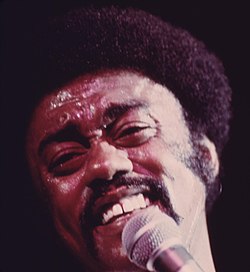
Taylor started out as a gospel singer and was in a group with Sam Cooke early on, and it has been said that his voice was very similar to that of Sam Cooke.    He also later recorded with Booker T and the MGs, and had a number of hits both on the Hot 100 chart and in the R&B chart, including “Cheaper to Keep Her”.

Wiki tells me that “Taylor, along with Isaac Hayes and The Staple Singers, was one of the label’s flagship artists, who were credited for keeping the company afloat in the late 1960s and early 1970s after the death of its biggest star, Otis Redding…”

The site also tells me that “Stax billed Johnnie Taylor as ‘The Philosopher of Soul’.  He was also known as,”the Blues Wailer.”

And although it is not relevant to the music, I must admit I was fascinated to read of the singer’s “highly complex personal life” which apparently was not revealed until after his demise, particularly in Rolling Stone, and which led to difficulties in allocating how much of his subsequent royalties each of his numerous heirs should receive.  And this is not me just digging around in the dirt, at least I don’t think so, but due to the fact that the song in question has the title “Cheaper to Keep Her”.   I haven’t really studied the situation, but reading about his multiple children with different mothers, the song does take on a new meaning.

But to be clear “Cheaper to keep her” was not written by Taylor but by Mack Rice.

When your little girl make you mad
And you get an attitude and pack your bags
Five little children that you're leaving behind
Son, you're gonna pay some alimony or do some time

That's why it's cheaper to keep her
Help me say it, y'all
It's cheaper to keep her (it's cheaper to keep her)
See, when you get through staring that judge in the face
You're gonna wanna cuss the whole human race
That's why it's cheaper to keep her (it's cheaper to keep her)
(It's cheaper to keep her)
(It's cheaper, it's cheaper, it's cheaper, it's cheaper)
(It's cheaper to keep her)

You didn't pay but two dollars to bring the little girl home
Now you're about to pay two thousand to leave her alone
You see another woman out there and you wanna make a change
She ain't gonna want you 'cause you won't have a damn thing

I am also not sure I like that argument, but I guess it can be made.  And I am glad I had the time for the background, for knowing something about the writer’s mutiple relationships, the song does make a lot more sense.

And maybe that is why Bob wanted to include it – because here the singer is indeed revealing the basic facts of his life, rather than romanticising the world in a way that he feels others want to hear.

Previously…


“Cheaper to Keep Her” Johnnie Taylor Mack Rice
Posted in Uncategorized | Leave a comment

My Own Version Of You (2020) part 13: “One of the sweetest motherfuckers you could ever meet”

My Own Version Of You (2020) part 13


by Jochen Markhorst

XIII       “One of the sweetest motherfuckers you could ever meet”

You can bring it to St. Peter - you can bring it to Jerome
You can move it on over - bring it all the way home

 “Jerome Green was Bo Diddley’s maracas shaker. He’d been with him on all the records and he was sloppy drunk, one of the sweetest motherfuckers you could ever meet. He would just fall into your arms.” Keith Richards was quite fond of Jerome Green, as we can gather from his autobiography Life (2010). During The Stones’ first UK tour, a shared bill with the incredible line-up of the Everly Brothers, Bo Diddley, Little Richard and Mickie Most in the autumn of 1963, Keef and Jerome hit it off, and Jerome even stayed with Keith for a while when Jerome fell ill towards the end of the tour and couldn’t continue. But Keith already had Jerome on a pedestal way before this shared experience, as we can deduce from a diary entry dated 5 January 1963:

Got wallet back,
Richmond
Cock up. My pickup clapped out completely. Brian played harp and I used his guitar. “Confessin’ the Blues” “Diddley-Daddy” & “Jerome” and “Bo Diddley” went well. Mad row with promoter over money. Refused to play there again. Discussed new demo disc. To be made this week with any luck. “Diddley-Daddy” looked good. With Cleo and friends as vocal group. Band earned PS37 this week.

By “Jerome” the Glimmer Twin means “Bring It To Jerome”, the B-side of Bo Diddley’s third single, “Pretty Thing”. “Bring It To Jerome” was written by Jerome Green, and besides the maracas, we also hear his voice; he sings the chorus together with Bo Diddley, the words that Dylan copies: Bring it all home, bring it to Jerome.

At first listen, the song doesn’t seem all that spectacular. An “ordinary” B-side, a simple two-chord riff repeated from start to finish, with a run-of-the-mill blues lament about the woman who treats me so badly. The kind Bo Diddley could pull out of his left sleeve while signing an autograph for Mick Jagger on the cover of Have Guitar Will Travel with his right hand.

Simple and not particularly original or idiosyncratic, but apparently, the song has a magnetic power that attracts all the greats. So The Stones included the song in their set list in 1963; Manfred Mann graced his first (and best) American album, The Manfred Mann Album (1964), with it; the song is one of the highlights on ZZ Top’s Billy Gibbons’ second solo album, The Big Bad Blues (2018, awarded “Blues Rock Album of the Year” by The Blues Foundation, on which, incidentally, Bo Diddley’s “Crackin’ Up” is the finale); but above all: Sir Paul himself often plays “Bring It To Jerome” as a warm-up – we know of ten recordings of soundchecks in which McCartney puts his heart and soul into the song, sometimes on his Höfner 500/1 Violin Bass, sometimes on guitar.

Paul McCartney – Bring it to Jerome (Soundcheck in Sunrise, FL, 2002): 

The Stones, a Supreme Beatle, and now the name-check in a Dylan song… despite its seeming insignificance, “Bring It To Jerome” is one of the very rare songs that has penetrated all three members of the triumvirate. And apart from his song, Jerome Green also left his mark on music history in other ways: he infected the British Invasion with maracas. Since Jerome, we have seen Mick Jagger, Phil May of The Pretty Things, Van Morrison (then still with Them), The Animals and Manfred Mann’s Paul Jones shaking the samba balls – and Jagger’s unforgettable, stylish shaking of the maracas on American television (The Mike Douglas Show, 1964) in The Stones’ version of Buddy Holly’s Bo Diddley rip-off “Not Fade Away” brings the song right back home, back to Diddley and Green.

The introductory recommendation You can bring it to St. Peter is an intriguing, Dylanesque riddle. The idea that Dylan is indulging in a play on words here, a playful nod to the meaning of the name Peter, “rock”, and with it the implication that Dylan’s “own version” will lead us via blues and spirituals to rock music, is appealing. However, the context, after the closing line of the preceding verse, the verse with Judgment Day and Armageddon and especially with I’ll hear your footsteps – you won’t have to knock, almost inevitably leads the associations to the heavenly gatekeeper Peter, who springs into action after he hears knockin’ on Heaven’s door. A poetic stroke of luck, perhaps. It seems obvious that Dylan first decided that his creation should immortalise the song “Bring It To Jerome”, and that his meandering inspiration then lingered on another gem by Bo Diddley and Jerome Green, on their version of “Sixteen Tons” (on Bo Diddley Is a Gunslinger, 1960), the classic with the chorus

You load sixteen tons, what do you get?
Another day older and deeper in debt
Saint Peter, don't you call me, 'cause I can't go
I owe my soul to the company store

… and with prominent maracas. There are, obviously, more songs and more possible sources of inspiration in which St. Peter appears (not least Dylan’s own “Ring Them Bells”, of course), but we know that “Sixteen Tons” has been under Dylan’s skin for at least sixty years already:

“I changed words around and added something of my own here and there. Nothing do or die, nothing really formulated, all major chord stuff, maybe a typical minor key thing, something like “Sixteen Tons”. You could write twenty or more songs off that one melody by slightly altering it. I could slip in verses or lines from old spirituals or blues. That was okay; others did it all the time.”

… from Dylan’s autobiography Chronicles, chapter 5 “River Of Ice”. In which Dylan, the songwriter, again expresses the secret of his core business, this time in a completely clear, demystifying way. “You change the words here and there,” “slightly alter a melody,” “smuggle in lines from old spirituals or blues”… and then “add something of myself.” The autobiographer describes this creative process in 2004, when Chronicles is published, and in doing so reveals his recipe for success in a surprisingly unambiguous way, the recipe that he expresses here, in “My Own Version Of You”, in a much more poetic way –demonstrating it in the process: You can bring it to St. Peter – you can bring it to Jerome / You can move it on over – bring it all the way home… “I changed words around and added something of my own here and there.”

—————–

To be continued. Next up My Own Version Of You part 14: Carrying a noose on a silver tray

Jochen is a regular reviewer of Dylan’s work on Untold. His books, in English, Dutch and German, are available via Amazon both in paperback and on Kindle:


Posted in Uncategorized | Leave a comment

Bob Dylan: Where the lyrics find new lands, keep the music simple

By Tony Attwood

“Positively 4th Street” – the last song reviewed in this series – was composed within a sequence of songs of which the prime essence within the lyrics was that nothing made sense.  The series started with “Bob Dylan’s 115th Dream”, and continued through a range of songs including “Maggie’s Farm”, “Why do you have to be so frantic”, “Tombstone Blues”, and, among others, “Can you please crawl out your window”.

But even then Bob was not finished with the joint themes of the world not making sense, and a feeling of disdain for those around him, with the totally negative “4th Street”  for the next song he composed, “Highway 61 Revisited” once more contains the notion that the world really is disjointed and out of phase with itself and the people within it.  One might perhaps say that the world has become so complex and so diverse, while at the same time trying to be unified (in that most of the realities Bob describes are clearly within the United States)

Dylan is quoted as saying that “It was the same road, full of the same contradictions, the same one-horse towns, the same spiritual ancestors … It was my place in the universe, always felt like it was in my blood.”

The lyrics of the opening verse leave us in no doubt that we are still in this universe of contradictions and no sense being made

Oh God said to Abraham, “Kill me a son”
Abe says, “Man, you must be puttin’ me on”
God say, “No.” Abe say, “What?”
God say, “You can do what you want Abe, but
The next time you see me comin’ you better run”
Well Abe says, “Where do you want this killin’ done?”
God says, “Out on Highway 61”

Perhaps the simplest thing to say is that this is a world in which reality and non-reality combine to such a degree, one can’t tell them apart.  Thus, each verse suddenly leaps into the world of another character who seems to have no connection with the person sung about in the previous verse.  We can get a real sense of this through the opening line of each verse wherein a new character or two comes on the scene….

  • Oh God said to Abraham, “Kill me a son”
  • Well Georgia Sam he had a bloody nose
  • Well Mack the Finger said to Louie the King
  • Now the fifth daughter on the twelfth night
  • Now the rovin’ gambler he was very bored

… and then disappears from the song.

It is as if, in fact, there is no connection – and thus onec again Dylan has used the strophic form of composition, writing five musically identical verses but with ever changing and seeingly disconnected lyrics, save for the fact that everyone is connected with Highway 61.  The notion of the chorus which we found in “Rolling Stone” has not been used apart from Buick Six having a repeated final line (“If I go down dying…”), similar to a degree with the repeated words at the end of each verse in “Desolation Row”

So with the lyrics of “Highway 61” what holds the song together are the facts that each verse is about a character or two (God and Abraham in verse one, Georgia Sam and Howard in verse two, Mack the Finger and Louis the King in verse three, the fifth daughter and the first father (and variants) in verse four, and the gambler and promoter in the final verse) are all somehow (we never really know how) connected with Highway 61.

Now this approach of songs about multiple characters, with each character having one verse to him/herself and then vanishing from the script, is very unusual lyrically.  Did someone do this before Dylan?   I can’t think of anyone, but if you can, please let me know!

This approach is the reverse of “Rolling Stone” and “Fourth Street” by way of examples, where the song is about one person – and this in fact is the convention of popular music.  However, this level of complexity and confusion could easily cause listeners to lose track of the coherence of the whole song – hence the use of the strophic form of music, in which each verse, although lyrically different, is musically the same.

Indeed the song is so complex lyrically, taking a street name from Edgar Allan Poe, “Housing Project Hill” from Kerouac, “Tom Thumb” from Rimbaud, “Howling at the Moon” from Frank Williams, etc, that once again the stophic form is needed to hold the piece together.  Put another way, even the introduction of a “middle 8” to vary the music, could have been confusing with this level of quotations and references within the lyrics.

But more than that, the music  is based on the construction of the extended 12 bar blues.

Indeed as the Dylan Chords website agrees the only change made to the music during performances of the song is that Dylan changes the key slightly (the website suggests adding a capo to take the song up a semitone or two), but otherwise he leaves everything as is.

And this really makes the point.   As the lyrics get more and more complex and one might even say more and more convoluted, the music gets simpler and less varied.  Undoubtedly. Bob’s feeling is just that: you can’t have complex music and complex lyrics at once.

Even “Rolling Stone” with its ascending bass line counters by having the melody virtually all on one note for the first two bars of each line.  So at this stage in his life he’s taken to working hard on new forms of song lyrics, but left the music pretty much in the standard place.

The story so far

Posted in Uncategorized | Leave a comment

The concert series: a bit of a cheat for 1972, but better than nothing

The aim of this series is to provide one Dylan concert to listen to with reasonable acoustics for each year since Bob started performing regularly.

And of course I have picked the easy ones first, but now we come to 1972 – and there I am having a problem – if you can find a decent video for 1972 please send me the link.  But for now I am putting up the concert for New Year’s Eve 1971, which is as close as I can get.

But this is the great thing about the internet – if I have missed something utterly obvious, I can just put it up and pretend I knew all along.

So what we get is

  • Crash On The Levee (Down In The Flood)
  • When I Paint My Masterpiece
  • Don’t Ya Tell Henry
  • Like a Rolling Stone

The concerts so far in this series (each of which are much longer than the above)

Posted in Uncategorized | Leave a comment

From Rock Band to Guitar Hero How Bob Dylan Conquered Rhythm Gaming


There’s an adrenaline shot that will pop players once “The Tambourine Man” enters a modern gaming craze. On the singing surface, sultry ballads, and poetic lyrical work of Dylan do not by any means place him in the front as strong contenders for frantic energy in rhythm games. Yet, somber entrance into Rock Band as well as Guitar Hero demonstrates even folk-rock icons can have their moment under the digital lights. What this journey also did was not solely amplification of universal appeal but allowed thousands to witness the storytelling magic.

Dylan Pops Up in Music Games

When Rock Band 2 released “Tangled Up in Blue” by Bob Dylan in 2008, this pretty much redefined the game’s classic rock selection, sneaking in a song focused more on lyric nuance than explosive riffs. A year later, “All Along the Watchtower” returned in Guitar Hero 5, further embedding Dylan’s tunes into rhythm games. It was the addition of his tunes that signaled a step toward a more inclusive metal/arena rock game genre, and perhaps even culture. These careful slots of Dylan’s songs let players find his artistry and broaden their musical horizons beyond what they might have done outside the console.

Why Dylan Didn’t Lead His Show

It would be nice to imagine a world in which ‘Bob Dylan: Rock Band’ could coexist with ‘The Beatles: Rock Band’ or ‘Guitar Hero: Metallica,’ but it’s much more nuanced. At its core, the challenge is Dylan’s musical style. His songs are more narrative and emotive than the type of guitar-driven epics that get players strumming a plastic fretboard. It’s the riffs that are at the heart of these games. Quite a significant portion of the rhythmic action in these games comprises riffs and solos, and Dylan’s songs, while lovely, just don’t quite make it.

And let’s not forget the market dynamics. For instance, ‘The Beatles: Rock Band’ is a cool package since the entire band’s catalog was included for group performances, singing together, harmonies, and up-tempo tracks to turn any living room into the concert hall; more introspective product not really suitable for that rollicking party-gaming vibe that characterized the golden years of the rhythm genre. Of course, there were fans making jokes on a hypothetical “Harmonica Hero” being more suitable to his essence but this was more of playful banter than a serious topic of business speculation.

Cultural and Gameplay Impacts

Nothing was done here as clean room building around Dylan’s songs, yet the force was with them just the same. And so it goes that handing the work over to Rock Band and Guitar Hero was an act of reverence to the musical poet. People could be Dylan for a second and feel what it was to sing stories on multiple levels and paint vibrant pictures. This was no evasion, but truly felt history and soul in every line.

Finally, there’s the matter that including Dylan in the game represents a kind of ‘coming of age’ for rhythm gaming, as its creators look to expand the appeal of their vaunted soundtrack beyond the pop/dance/hip-hop demographic and into the folk/alternative/classic rock demographic. The tracks were their response to the demonstration that rhythm games don’t have to be strictly didactic or otherwise empty exercises in technical problem-solving; they can “teach” about music history and culture.

Dylan vs Other Rhythm Game Legends

Dylan’s legacy relative to musicians who received stand-alone music games is quite extreme compared to the rest but, surprisingly limited. ‘Fab Four’ enthusiasts went through ‘The Beatles’ game to trace the band’s evolution; metal heads were treated to a face-melting amalgamation of power solos and heavy riffs in the ‘Guitar Hero’ Metallica game. Dylan lowered the volume: a thoughtful breather amidst the din; an inkling that rhythm games need not be only supercharged, but also substantial, and even something more.

In short

Bob Dylan’s cameo in Rock Band 2 and then in Guitar Hero 5 was not enough to launch a franchise in his name. But it was part of a revolution that changed the genre of rhythm gaming. His songs asked players to re-think their strategy for music games, less centering on finger speed and more on the strength of words and melody. Dylan initiated a quiet revolution in a genre based mostly on extravagance; he will never be the face of a music rhythm game, but proof that even now in this digital age, good songwriting still matters.


Posted in Uncategorized | Leave a comment

Enhancing Metadata Quality in Digital Music Distribution


Have you ever wondered why some Dylan recordings seem to sound so wonderful so that you hear them over and over again, while others fizzle out in the background noise?

It’s not always to do with the undoubted writing talent of Bob, for sometimes it is about  your metadata, the invisible information that guides you in terms of how you hear the music and what it then means to you.

The truth is, your music distribution service has just as much to do with just how much you appreciate his work.

Why Metadata is the Secret Sauce of the Streaming Era

It might sound technical, but metadata is just information about your music: artist name, track title, genre, year, and so much more. Think of it as each song as a digital passport, stamped at every streaming checkpoint.

Now, the industry is levelling up. Deezer’s June 2025 newsroom release announces “the world’s first AI tagging system,” designed to flag synthetic tracks, reduce fraud, and protect accurate metadata across its streaming catalogue. This isn’t just an innovation; it’s a lifeline for artists such as the great man who want to be sure their music is correctly credited, found, and fairly paid.

The Human Side of Digital Details

Of course Bob Dylan will have all this nailed through his recording company.   But if you are creating your own music, or indeed if you are playing songs he has written, you don’t have to be a tech whiz to nail your metadata. Most music distribution platforms, from MusicAlligator to CD Baby, walk you through the process. Still, the best results come from those who pay attention to every field. Got a collaborator? Credit them right. Have a unique album name? Double-check the spelling. Want your genre to be pop, not generic “other”? Be specific.

A quick checklist for boosting your metadata:

  • Double-check all spellings, especially artist and song names.
  • Choose the most accurate genre and mood tags.
  • Include ISRC and UPC codes for tracking and payment.
  • Add composer, lyricist, and featuring artist details.
  • Go over all before clicking the submit button.

One missed field could mean a missed royalty or a lost listener. Don’t let it happen.

AI and the Future of Metadata

It is an era in which art and artificial intelligence merge. Platforms like Deezer are pushing boundaries, using artificial intelligence to catch errors and flag tracks that don’t belong. It’s an extra set of eyes protecting your hard work. But don’t leave it all to the robots. The best music finds its way to fans when humans and tech team up.

MusicAlligator and You, A Winning Team

So if you are performing your own songs or indeed Dylan songs every track deserves the chance to shine. By treating metadata as more than an afterthought, you’re setting your music up for real success. Trust your music distribution service, keep your details sharp, and let innovative tools from companies like MusicAlligator guide your journey. The right info, in the right places, can open the world to your sound, one perfectly tagged track at a time.


Posted in Uncategorized | Leave a comment

The Philosophy of Modern Song: “Old violin” by Johnny Paycheck

By Tony Attwood

Prelude:  I tried at first to write a set of reviews of Dylan’s book but I found I really couldn’t do it – so I have been asking regularly if anyone else would like to try.  But no one has come forth.   (And to be clear I mean, come forth by reviewing what Dylan says about the songs, not primarily about the songs themselves).

Thus I am continuing to write reviews of the songs that Bob chose to include in the book, and doing so totally from my own perspective.  If nothing else it gives you a chance to hear the occasional song that Bob chose which you might not have heard before, and maybe you might wish to consider your own thoughts on why Bob included each particular song.

In this case the link is obvious – Johnny Paycheck and Bob Dylan both devoted their lives completely to music, creating the music they wanted, regardless of what others said or thought.  They were/are the music, the music is them, and will remain long after they are gone.

One thing in this activity however has caused me a problem or three – and that is that while some of the songs are ones I am utterly familiar with (“My generation” being an obvious example) others were not familiar to me, and so if nothing else, I have enjoyed getting to know these pieces of music – and indeed these performances.  And I am hoping that in plodding on with this series. if nothing else, maybe you’ll find one or two pieces of music you didn’t know and which you find moving.

Certainly in the “not knowing” category and in the “moving” category, I would place “The old Violin” by Johnny Paycheck.  And that is unusual for me, since I really don’t normally relate to this type of openly emotional song.

So, doing my research into a singer and song of which I knew nothing (and if that sounds ludicrous to you, please remember I was born and brought up in England, where such music has never been as popular as it has been in the United States) Wiki started me off with the raw details: “Johnny Paycheck (real name Donald Lytle, born 1938, died 2003) was an American singer and songwriter. He is a notable figure in the outlaw movement in country music.”

Now that meant I had to expand my knowledge of country music – so just in case you are as ignorant of the genre as I (which I very much doubt is possible) the outlaw movement refers to those “who fought for and won their creative freedom outside of the Nashville establishment that dictated the sound of most country music of the era.”

His most famous song was released in 1977 with the wonderful title “Take This Job and Shove It,” which gave Paycheck a status alongside Waylon Jennings and Willie Nelson, whose music I am more familiar with.

Johnny Paycheck was however, one of those performers who struggled seemingly in all aspects of his life with substance abuse, spending time in prison, and often being involved in what Wiki calls “legal controversies, including a conviction for assault and a high-profile sexual misconduct case.”

The music is described in the Wiki article as “raw and uncompromising,” which I don’t really understand in relation to the music I have heard in preparing this piece, but then I am not familiar with nor a fan of “outlaw country music,” so my comments are not particularly relevant.

In fact this is a case very much of me being on the outside looking in to find that, “His life and work have been recognized as emblematic of both the rebellion and the heartbreak that defined a pivotal era in American country music.”

And this certainly comes across in The Old Violin, written in 1986, when he was 48.  And these are pretty desperate lines for a man of that age.

He did live for another quarter century or so, but as is obvious here, his music and his life is something new for me, so I can’t really write anything more illuminating at this point except to quote the lyrics of the song Dylan chose to include.  In case you, like me, don’t know the song, and want to play it while reading the lyrics, the link used above is here: https://youtu.be/NrvY6Lkgu_

Well, I can't recall, one time in my lifeI've felt as lonely as I do tonightI feel like I could lay down, and get up no moreIt's the damndest feelin', I never felt it before

Tonight I feel like an old violinSoon to be put away and never played againDon't ask me why I feel like this, hell, I can't sayI only wish this feelin' would just go away

I guess it's 'cause the truthIs the hardest thing I ever faced'Cause you can't change the truthIn the slightest way, I tried

So I asked myselfI said, "John, where'd you go from here?"And then like a damned foolI turned around and looked in the mirror

And there I saw, an old violinSoon to be put away and never played again

So one more time, just to be sureI said, "John, where in the hell do you go from here?"You know that when a nickel's worth of differenceAnd I looked in the mirror, 

That there I was seein', an old violinSoon to be put away, and never played again

And just like that, it hit meThat old violin and I were just alikeWe'd give our all to musicAnd soon, we'll give our life

Now, having read up on the life of this artist whose work I have had no knowledge of before, I must say I find the song incredibly moving.   And indeed here I can see why Dylan chose this as one of the songs he wanted to include in “The Philosophy”, not least because  the song was not only recorded by Johnny Paycheck but also written by him.   Which seems to add a lot to the feelings I get on listening to it today, for the very first time.

What can one say other than that the music industry is not always a good place to be.

Previously….

Posted in Uncategorized | Leave a comment

My Own Version Of You part 12: The dismalest tavern of them all


by Jochen Markhorst

XII        The dismalest tavern of them all

I’ll see you baby on Judgement Day 
After midnight if you still want to meet
I’ll be at the Black Horse Tavern on Armageddon Street
Two doors down not that far to walk 
I’ll hear your footsteps - you won’t have to knock

In October 1971, journalist Pete Hamill writes a column for the New York Post entitled “Going Home”. Six young people are travelling by bus from New York to Fort Lauderdale for a beach holiday, a journey of around 24 hours. Soon, the six become intrigued by a silent, hunched man sitting a few seats in front of them. One of the girls tries to strike up a conversation. He is not unfriendly, but seems very shy and holds his tongue. It is not until the next morning, after a coffee break at a roadside restaurant, that the girl manages to get his story out of him. His name is Vingo, he has just been released after serving a three-and-a-half-year prison sentence, and is now on his way home to Brunswick, Georgia. “Wow,” says the girl. “Are you married?” ‘I’m not sure,” replies Vingo. “You’re not sure?”
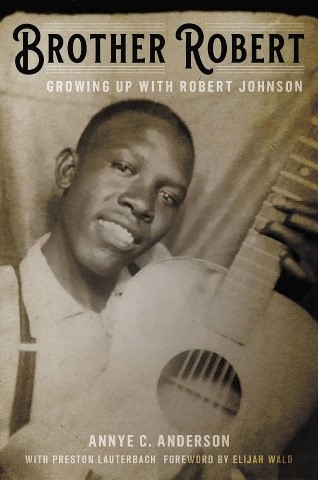
“Yeah,” he said shyly. “Well, last week, when I was sure the parole was coming through, I wrote her again. We used to live in Brunswick, just before Jacksonville. There’s a big oak tree just as you come into town. I told her that if she’d take me back, she should put a yellow handkerchief on the tree, and I’d get off the bus and come home. But if she didn’t want me to come home, forget me—no handkerchief, and I’d keep on going.”

We all know how it ends. Twenty miles before Brunswick, a nervous, tense silence descends on the bus. The six young people crowd around the window, looking out for the old oak tree. Ten miles to go, five… When the bus pulls into Brunswick, Vingo doesn’t dare look. But then suddenly the young people start shouting, jumping, crying. Stunned, Vingo stares at the oak tree. It is covered with yellow handkerchiefs. Twenty, thirty, maybe a hundred.

The Grammy-winning liner notes Pete Hamill wrote for Dylan’s Blood On The Tracks (1975) were not Hamill’s first contribution to music history. The global hit “Tie A Yellow Ribbon Round The Ole Oak Tree” by Dawn featuring Tony Orlando, which was number one in Australia, Europe, Africa and North America two years earlier (number 2 in Argentina, so South America is only slightly less enthusiastic), and has been in Billboard’s All-Time Top Songs Top 50 for fifty years, is based on his column.

ABC television filmed the story in 1972 (with James Earl Jones as the ex-convict), and in Japan, the award-winning film The Yellow Handkerchief was based on it in 1977, but it was the million-selling hit single that really bothered Hamill. He sued songwriters Irwin Levine and L. Russell Brown, but when they proved that the story was over a hundred years old and that Hamill, too, had just heard it somewhere, he dropped the charges.

A wise decision. And Hamill has already earned his place in music history anyway. Even more honourable than with that embellished second-hand melodrama that led to a global hit: the award-winning liner notes for Blood On The Tracks definitely carry more weight than those hundred yellow handkerchiefs. Liner notes that, moreover, seem to have inspired a Dylan song years later: “The plague ran in the blood of men in sharkskin suits,” Hamill writes in the opening of his essay, and 37 years later Dylan opens his blood stained song “Early Roman Kings” with “All the early Roman Kings in their sharkskin suits” (Tempest, 2012).

Bob Dylan – Early Roman Kings (live Aug. 10, 2024):

In the meantime, Hamill continues to write and his star continues to rise. Hundreds of journalistic essays, short stories and columns, scripts and ten novels – almost all of which are set in New York, the city where he was born 1935 and where he died in 2020. Like Dylan, he is part of the fabric of the city, as Pete’s colleague with the unbeatable name Lucian K. Truscott IV puts it (Village Voice, 2 November 2016). The novels are all well-received, but perhaps the most remarkable is the widely acclaimed bestseller Forever (2003), which seems to be on Dylan’s bookshelf too.

Forever is the Homeric story of Irish Jew Cormac O’Connor, who arrives on the island of Manhattan in 1741 in search of his father’s killer. When he is mortally wounded in his attempt to free the slave Kongo, he is brought back from the dead by a grateful mystical African priestess. Brought back for good: Cormac is now immortal, as long as he does not leave the island of Manhattan. And so the immortal Cormac remains on Manhattan. He watches the settlement grow over the centuries into The Big Apple, the economic, cultural and political world power, and will continue to roam Manhattan until Judgment Day.

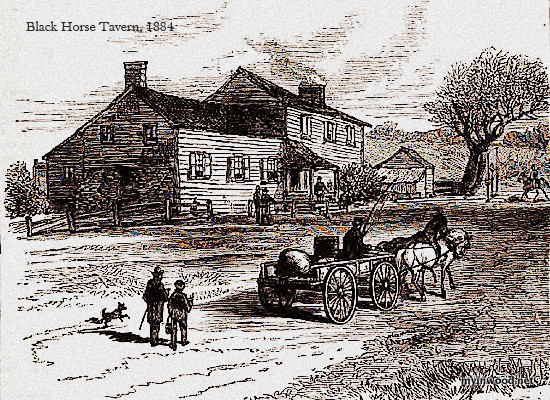
During the crossing from Ireland, Cormac has already managed to secure a job: he will be working as a printer for Mr. Partridge, who is staying at the Black Horse Tavern. And there we have Hamill’s next contribution to Dylan’s oeuvre: “I’ll be at the Black Horse Tavern on Armageddon Street,” Dylan’s narrator reveals in this fifth verse. The address is poetic licence. The historic Black Horse Tavern was in the far north of Manhattan, now Inwood, and was located at the intersection of what is now Broadway, Dyckman Street and Riverside Drive – pretty much exactly where a Starbucks is now.

Anyway, “immortality” seems to be the paddle stirring Dylan’s stream of consciousness here. We follow a Dr. Frankenstein-like narrator, the Dr. Frankenstein who became a scientist in the first place in order to play God (“the masters of science sought immortality and power; such views, although futile, were grand,” Ch. 3), and who creates a creature that will apparently outlive him: he will only see him again after midnight on Judgment Day, after the end of time. According to Revelation 16:16, this will take place immediately after the “gathering” at “the place that in Hebrew is called Armageddon” – Dylan’s associative leap from Judgment Day to Armageddon is somewhat more obvious than the immortality triple jump Frankenstein – Cormac O’Connor – Black Horse Tavern.

The gloomy street name and sombre location description suggest that the narrator does not expect to be admitted to the Kingdom of Heaven or the Garden of Eden after midnight on Judgment Day. Which is historically accurate, more or less:

“Of all bleak and dreary travesties of wayside inns, of all melancholy mockeries of old time hostelries the Black Horse Tavern is the dismalest.”
(New York Herald, July 7, 1890)

The inn could do with a makeover, as a more constructive way to express the Herald’s criticism would be. Perhaps something with a hundred yellow handkerchiefs. Surely would brighten things up.


To be continued. Next up My Own Version Of You part 13: “One of the sweetest motherfuckers you could ever meet”


Jochen is a regular reviewer of Dylan’s work on Untold. His books, in English, Dutch and German, are available via Amazon both in paperback and on Kindle:


Posted in Uncategorized | Leave a comment

No Nobel Prize for Music: Positively Fourth Street


By Tony Attwood

If ever Bob Dylan was giving us a message in consecutive songs it surely was in 1965 when he composed, one after the other, “Can you please crawl out your window” followed by “Positively Fourth Street”

The disdain in both these songs however was not new for in this run of eight successive compositions virtually every one (possibly except “From a Buick 6”, although that included the lines about a “graveyard woman” who is a “junkyard angel”) seems to be about nothing making sense, life being a jungle, and above all a world full of disdain.   That notion that everyone else is unworthy of consideration is mixed with that of nothing making any sense, through this whole sequence of songs leading up to Fourth Street.

If you have been following my ramblings in this series, you will know the songs I have in mind, including particularly Desolation Row in which Bob is inviting the recipient of his message to meet him at the bottom and please crawl out your window in which he is expressing his exasperation at the subject of his song.

There have been some covers of course, but not many and Cash Box described the version by the Vacels as a “hard-driving, bluesy message-song which utilizes some vastly different but interesting melodic constructions.”   But what neither that publication nor Billboard mentioned directly was how negative the song was – although that band also recorded “Please Crawl Out”.

In an era when songs were about love and lost love these songs (both “4th Street” and “Please Crawl” were about sheer dislike .  Indeed things don’t get more negative than the title of “Please Crawl Out” nor more negative than the opening line of Fourth Street.    In fact, though of course I don’t know who you are dear reader, I am sure you know…

You've got a lotta nerve to say you are my friendWhen I was down you just stood there grinnin'You've got a lotta nerve to say you got a helping hand to lendYou just want to be on the side that's winnin'

One might ask, “Just how nasty do you want to get?”   And the answer comes with looking at the last verse

I wish that for just one time you could stand inside my shoesAnd just for that one moment I could be youYes, I wish that for just one time you could stand inside my shoesYou'd know what a drag it is to see you

I’ve had some pretty nasty things said to me, but I am not sure anyone has gone that far.

So that much is clear – the lyrics are nasty and very unlike anything we have heard within pop and rock before – or indeed very much since.   We might think of “How can you treat me this way” but really there is no much comparison.

However the big question for Bob was what to do about the music?   With “Please crawl out your window” he used an accompaniment that sounds awkward and a chord sequence that is most unusual in pop and rock.  In that song what makes the music sound so edgy is the use of unusual chords in sequence such as having two lines that run from A minor to C.   I find it impossible to think of another song that does this

   Am                    C
you know that he has no intentions

        Am                      C          
That he needs you to test his inventions.

It really is an extraordinary sequence, helping to create a very edgy sound and what surely must be one of the ultimate songs of disdain.

What Dylan does in Fourth Street however is use a standard set of chords in a standard way.  But he gets the effect of tedium and hopelessness by repeating the same chordal and melodic sequence not just in each verse, but keeping the two two-line sequences very similar

G         Am
You got a lot of nerve
C                 G
To say you are my friend
G            D
When I was down
C        Em          D
You just stood there grinning

Thus we get that exact same sequence and exact same melody a dozen times without variation.  There isn’t even an ending.  The song just fades out.   It is the perfect expression of tedium – even the melody line and accompaniment stay the same throughout.  And indeed, through the various takes, the lyrics hardly change.

Yet the song works brilliantly, and Bob has played it 359 times in concert.   So what makes this happen?

That I have trouble in answering because the strict structure of the song makes it very hard to find much new that can be done with the song.

You can skip forward to around 4 minutes 45″ on the above and hear a different version – but in reality not that different.  It is a sorrowful rather than an angry version, and in that regard interesting, but the structure remains unchanged, and hence so does the song.

It is perhaps the way that the lady pretends that nothing happened that is the most shocking

You see me on the street, you always act surprisedYou say "how are you?", "good luck", but ya don't mean itWhen you know as well as me, you'd rather see me paralyzedWhy don't you just come out once and scream it

And really that gets to the heart of it all for me.   She has treated him so badly, but then pretends nothing happens – hence the music just goes round and round 12 times across six verses.   In those few words Dylan captures the world many of us discover – where total denial of what happened in the past is seen as a way of excusing an individual’s actions.   It never has been, and never will be yet people do it all the time, and Dylan captures that perfectly.

And for that, as much as for anything else, I am so grateful for this song.

I wish that for just one time you could stand inside my shoesAnd just for that one moment I could be youYes, I wish that for just one time you could stand inside my shoesYou'd know what a drag it is to see you

But there is another point.   For it is the sheer repetition of this approach by many individuals that makes the situation this song describes so appalling.  It is not about one act of betrayal, one broken date, because a “better offer” came along.  It is about the fact that such behaviour goes on and on.

Which is why there are only two musical lines, repeated, in each verse.  For that is what the girl in this song, and people who behave like this, do over and over.   Their method of living is hurt – repeat – hurt – repeat, and Bob captured this totally in the song.   Bob gave up on the song 12 years ago, but for my money, he could bring it back any day he wishes.

After all it is the sheer repetition of the music that makes that song.

The story so far

Posted in Uncategorized | 1 Comment

Dylan: The Concert Series. Los Angeles 3 September 1965

For details of some of our other series on this site please see the home page    The concerts for this series are selected by Tony Attwood, from those that are available on line in the UK.  If you have problems accessing any of the concerts in the series please email Tony@schools.co.uk letting us know which country you are in.   Thanks.

—–

The concert series so far is listed below, and as noted, the aim in the end is to have, as far as possible, at least one gig per year that Dylan performed.  For a much more detailed review of Dylan on tour you might well also find the definitive 144-part series on the Never Ending Tour of interest.  It is also on this site here.

Today’s selection is the Los Angeles Hollywood Bowl, 3 September 1965.   The songs are listed below, but please note there are some problems with this video.  I have included it because it is (in the parts that are there) the best recording I have found from the year).

Also, advertisements have been inserted into the recording, which you may find rather unwelcome interruptions.   My apologies for these and any other problems you find with this video.  If you know of a source of this video without these problems please do write in.

But even with all the issues, for me, it is still worth it.

  1. She Belongs to Me (There is a long tuning pause between song 1 and 2)
  2. To Ramona (this is cut, it is said, for copyright reasons)
  3. Gates of Eden
  4. It’s All Over Now, Baby Blue
  5. Desolation Row
  6. Love Minus Zero/No Limit
  7. Mr. Tambourine Man (cut for copyright reasons)
  8. Tombstone Blues
  9. I Don’t Believe You (She Acts Like We Never Have Met)
  10. Just Like Tom Thumb’s Blues
  11. From a Buick 6
  12. Maggie’s Farm (the recording again states that this has been cut for copyright reasons)
  13. It Ain’t Me, Babe
  14. Ballad of a Thin Man
  15. Like a Rolling Stone

The concerts so far in this series

Posted in Uncategorized | Leave a comment

The Philosophy of Modern Song: Dirty Life and Times (and Lawyers Guns and Money)

By Tony Attwood

I made an attempt to write about Dylan’s “Philosophy” book but had to stop very early because I couldn’t find a way to comment on it that said anything meaningful or entertaining.  (But if you feel you can do a review of that book by all means get in touch: Tony@schools.co.uk).   So I moved on to looking at the songs Dylan chose.

So far we’ve had

Now we come to “Dirty Life and Times” by Warren Zevon

Warren Zevon has turned up time and again on this site, but “Dirty Life and Times” has only had one mention – and that in passing.   Which is strange because Warren Zevon made some extraordinarily brilliant recordings in his life, and yet with this one I had to go back and look it up, as it had never made an impact on me.

The lyrics are clearly what has drawn Dylan in, although the melody is certainly very memorable – one listen and it’s there in my head for days to come…

Some days I feel like my shadow's casting meSome days the sun don't shineSometimes I wonder what tomorrow's gonna bringWhen I think about my dirty life and times

One day I came to a fork in the roadFolks, I just couldn't go where I was toldNow they'll hunt me down and hang me for my crimesIf I tell about my dirty life and times

I had someone 'til she went out for a strollShould have run after herIt's hard to find a girl with a heart of goldWhen you're living in a four-letter world

And if she won't love me then her sister willShe's from Say-one-thing-and-mean-another's-villeAnd she can't seem to make up her mindWhen she hears about my dirty life and times

Some days I feel like my shadow's casting meSome days the sun don't shineSometimes I wonder why I'm still running freeAll up and down the line

Gets a little lonely, folks, you know what I meanI'm looking for a woman with low self-esteemTo lay me out and ease my worried mindWhile I'm winding down my dirty life and times

Who'll lay me out and ease my worried mindWhile I'm winding down my dirty life and times

And really I can do no better than quote what Jochen said on this site…

———–

Zevon, to whom Dylan also devotes an honourable chapter in The Philosophy Of Modern Song (Chapter 39, “Dirty Life And Times”), as well as to the song “Jesse James” (Chapter 10); Zevon, who is also quoted again in the only interview Dylan gives in 2022 (“We’re in ‘Splendid Isolation,’ like in the Warren Zevon song; the world of self, like Georgia O’Keefe alone in the desert” – Wall Street Journal, 19 December 2022); like Dylan quotes just as reverently from that same “Dirty Life And Times” back in 2011, in the Elderfield interview:

“Sure, but everything in life, directly or indirectly, has a great degree of mystery. To paraphrase Warren Zevon, some days I feel like my shadow’s casting me. Persons, places, things … time itself is a mystery.”

… the song in which the narrator sighs: “She can’t seem to make up her mind.”

“This is a great record,” Dylan writes, continuing with effervescent praise of both this one song, one of the very last songs Zevon writes, and of Warren Zevon the artist at all.

“Being a writer is not something one chooses to do. It’s something you just do and sometimes people stop and notice. Warren was a writer till the very end.”

It’s almost as if Dylan is talking about himself; just before this, again admiringly, he describes the different sides of Zevon at different stages of his career, as well as “all the roles Zevon chose to play in his songs”.

Zevon dies of cancer, 7 September 2003. Just before his death, he manages to record one last record, The Wind, the album featuring “Dirty Life And Times”. And with a breathtaking, moving cover of Dylan’s “Knockin’ On Heaven’s Door”.

—————

And I think here we can be absolutely clear what has drawn Bob into the song – it is the lyrics, for surely it cannot be anything in the music that he has found to be unusual or inspirational.  It is in fact a reflection of what it feels like to be a person like Warren Zevon or Bob Dylan: “some days I feel like my shadow’s casting me”.

Jochen has returned several times to Zevon several times including featuring a recording of Knocking on Heaven’s Door within the final part of I made up my mind to give myself to you.

But now, since we are back on the subject of Warren Zevon, and since Bob Dylan nominated a Warren Zevon song as one of his favourites in the  past, and wrote about him in the Philosophy of Modern Song, I think that is enough of a reason to re-introduce my favourite too – just in case you missed it before.

In fact it turned up in our series on Dylan’s favourite songs so that is all the excuse I need to play it again.   If it had been me writing “The Philosphy” it would have been this song that was included from Warren.


Posted in Uncategorized | Leave a comment

My Own Version Of You (2020) part 11: Just extending the line

by Jochen Markhorst

XI         Just extending the line

Play every number that I can play
I’ll see you baby on Judgement Day

In 2020, Robert Johnson’s stepsister Annye Anderson publishes her memoirs, Brother Robert: Growing Up with Robert Johnson, written down by music historian Preston Lauterbach.

It is a surprisingly enriching contribution to the little we know about one of Dylan’s greatest heroes, blues pioneer Robert Johnson. Sister Annye, for example, makes quite a point of how her brother had such a wide range of interests, and how he presented himself as a human jukebox at every gathering and party. “I remember him asking all the guests, and even the children, ‘What’s your pleasure?’” And then he would play a song by Fats Waller, or “Pennies from Heaven”, Gene Autry or Count Basie or “Sugar Blues” or Louis Armstrong, and Annye herself always wanted to hear the Singing Brakeman, also one of her brother’s favourites: “Nothing could take the place of the trainman, Jimmie Rodgers.”

And then he would just as easily play a Protestant hymn; “I’ve never known Brother Robert to attend church, but he knew every hymn in the book.” That’s 765 (Annye undoubtedly sang from the Baptist Hymnal, 1902), so that may be a somewhat overly optimistic representation of Johnson’s encyclopaedic knowledge of songs, but the gist of Annye’s memories is clear: Brother Robert knew a great many songs, from every conceivable corner, and Annye recounts it with the same awe with which colleagues talk about Dylan. As, for example, G.E. Smith, Dylan’s guitarist in the years 1988-90, recounts in the fascinating interview with Ray Padgett for Flagging Down The Double E’s, Ray’s wonderful Dylan newsletter of 2 March 2025:

“On the bus he’s playing these cassette tapes of all this great old traditional stuff, because by then he knew I was really into it. He said, “This is a good song, you should learn this one.” “And this one, see how this turned into this, and then Hank Williams wrote–” You know, he totally knows the history of all that music in the United States. He knows all those songs. Just off the top of his head.”

Traces of those Baptist hymns can be heard throughout recent music history. First and foremost Mahalia Jackson, obviously, but we hear it just as clearly in Aretha Franklin, Doc Watson, Johnny Cash, the Stanley Brothers and then trickling down to their disciples, such as Dylan. Who is well aware of this himself, of course: “My songs are either based on old Protestant hymns or Carter Family songs or variations of the blues form,” as he analyses in 2004 (in the LA Times interview with Robert Hilburn). As Sister Annye can identify the Baptists in her brother’s work:

“Brother Granville used to holler out in the field, when he was behind the plow. It sounded like what Brother Robert’s doing in “Terraplane”. I can still hear Brother Granville singing “Guide Me O, Thou Great Jehovah.” You heard that humming like Brother Robert does in “Come on in My Kitchen” in those old Baptist hymns.”

And we hear it even more tangibly in Johnson’s lyrics, of course. Among all the songs about sex, gambling, work and wandering on the monumental King of the Delta Blues Singers (1961), we hear how Side 2 opens with Johnson’s confession:

Oh, I'm gonna get me religion
I'm gonna join the Baptist Church
Oh, I'm gonna get me religion
I'm gonna join the Baptist Church

… “Preachin’ Blues”, the song in which he also sadly has to admit that “the women and whiskey would not let me pray”. Every time he bows his head to pray, “then the blues come along and they blew my spirit away.” And just before that, just before he turned the LP over for the umpteenth time, Dylan listened to the closing track of Side 1 for the umpteenth time in his small apartment on West 4th Street:

If I had possession over Judgment Day
Lord, the little woman I'm lovin' wouldn't have no right to pray


… “If I Had Possession Over Judgment Day”, the song in which Johnson incorporates echoes from Hymn 355 (In the great judgment day, Jesus is mine) or Hymn 663 (Day of judgment, day of wonders), or one of those other hymns about the day “when the last trumpet blows,” as Dylan sings in his own Judgment Day song “Ye Shall Be Changed” (1979).

In any case, the many plays of “If I Had Possession Over Judgment Day” have etched “Judgment Day” into Dylan’s working memory (Dylan spells it the British way, with the extra e), if we are to believe Dylan’s own account in Chronicles:

“I copied Johnson’s words down on scraps of paper so I could more closely examine the lyrics and patterns, the construction of his old-style lines and the free association that he used, the sparkling allegories, bigass truths wrapped in the hard shell of nonsensical abstraction.”

We see more – indirect – echoes of “If I Had Possession Over Judgment Day” in Dylan’s oeuvre. The song itself is derived from Hambone Willie Newbern’s “Roll and Tumble Blues” (1929), from which Robert Johnson copied not only the melody and structure in 1936, but also a few words (third verse: “And I rolled and I tumbled and I cried the whole night long”). Muddy Waters turned it into “Rollin’ And Tumblin’” in 1950, which in turn reappeared on Dylan’s Modern Times in 2006, in “Rollin’ And Tumblin’” – actually a copy of Muddy’s arrangement, including an identical first verse, being again the same lines that Robert Johnson wrote:

Well, I rolled and I tumbled, cried the whole night long
Well, I woke up this mornin', didn't know right from wrong

… after which Dylan takes a sharp turn towards lazy sluts, crazy women and unsatisfied wives, while Muddy and Robert Johnson remain a little more prudish and complain that whiskey and women won’t let me pray and the little woman I’m lovin’ wouldn’t have no right to pray.

And that too Dylan has known for a long time, of course, this chain from “Roll and Tumble Blues” to “If I Had Possession Over Judgment Day” to “Rollin’ And Tumblin’” – “And this one, see how this turned into this … he knows all those songs just off the top of his head,” after all. And, as Dylan says in that much-quoted MusiCares speech: “All these songs are connected – I was just extending the line.” After which he picks up his guitar again to play every number he can play. And will continue to do so until Judgment Day.


To be continued. Next up My Own Version Of You part 12: The dismalest tavern of them all

—————

Jochen is a regular reviewer of Dylan’s work on Untold. His books, in English, Dutch and German, are available via Amazon both in paperback and on Kindle:


Posted in Uncategorized | Leave a comment

No Nobel Prize for Music: Can you please crawl out your window

by Tony Attwood

What did Bob Dylan write after completing the utter and total masterpiece that is “Desolation Row?”  The answer is “From a Buick 6,” a song which expresses the opposite vision of life from “Desolation Row” in the lyrics, and which in the melody has none of the delicate nuances of “Row” and is, in fact, nothing more than a 12 bar blues with, it has been noted, a refernce to Sleepy John Estes song “Milk Cow Blues”

But maybe we should not be too surprised; after all, the writing of “Desolation Row” must have taken a long while, and there was an album to be created, and an album contract to be fulfilled.

But just as Buick 6 was as different musically from Desolation Row as it could be, so the next song that Bob composed was different again; it was “Can you please crawl out your window”.

And the point about this song is that the musical feel of the piece is really very awkward.  Which probably explains why Bob only played once in public.  There is, as far as I know, no recording of that performance available, but Jimi Hendrix did have a go at the song, so we do have one alternative version… sorry the quality is poor – if you can find a better recording on the internet please do send me the link.

This was in fact the launch of Dylan’s period of writing songs of disdain in 1965.  And here we should remember that the year began with the delicate, beautiful and melodic “Farewell Angelina”.

But here, I think, if we look at the lyrics of the following songs we can see just how personal that song was…. for then Bob seems to be asking if love can be real (Love is just a four letter word) before starting to see himself as the person standing outside of society (as in Subterranean Homesick Blues and Outlaw Blues). 

There were two more beautiful love songs composed soon after Love Minus Zero and She Belongs to Me, before  the ultimate song of farewell with It’s all over now baby blue.  And from here on the songs became bleaker and bleaker.  True there were some surreal moments and songs in which Bob emphasised the benefits of simply moving on, as with Bob Dylan’s 115th DreamOn the Road Again, and Maggie’s Farm which were written one after the other, but then even moving on became tiresome (or perhaps just part of everyday life) as with It takes a lot to laugh it takes a train to cry.     Indeed ultimately moving on seemed to make no sense as with Sitting on a barbed wire fence.

Which, as we have see,n led to the final summing up of all the problems in Like a Rolling Stone, wherein everything seemed to be an absolute mess and a jumble – something reflected in other songs of the time such as Why do you have to be so frantic (Lunatic Princess) and Tombstone Blues

I’m not at all sure who Bob is addressing the former of these songs with the lines

Why should you have to be so frantic
You always wanted to live life in the past
Now why d you wanna be so Atlantic
You finally got your wish at last

but  equally,I am not sure it matters, and quite understandably, “Lunatic Princess” was never performed by Bob.  He did of course, recover all his composing talent (and how!) with “Desolation Row” but the two songs composed between “Rolling Stone” and “Desolation Row” do seem to me to lack the focus that those two masterpieces have.

However, if we wanted to find a phrase for that sequence of compositions without contemplating their artistic merit, I guess it could be “everything is a mess”.  The lesson was however, that this message could turn out to be itself something of a mishmash that most people would never remember (as with “Lunatic Princess”) or a profound works of insight (like the first and last songs in that sequence).

But it is also important to note, I think, that this feeling of everything being a mess stayed with Dylan for almost all of the rest of the year in terms of his song writing, and it was only in the final composition of 1965 – Visions of Johanna – that he once more found his way to express the concepts that were on his mind, in a musical form that the rest of us could appreciat eand savour for years and years to come.

The one love song – first song in this series – From a Buick 6 – proclaimed that Bob had everything, but after composinig that then he was immediately back to disdain with Can you please crawl out your window?

And what marks this song out is the musical arrangement which is not only unique for Dylan, but almost certainly unique in terms of any pop, rock or popular song.  For a start the instrumental introduction is three bars long – not two or four bars as we normally get but three bars – which even if we are not counting and have no musical education, sounds rather odd.  It makes us uneasy before Bob has even started.

Then, the first line covers the conventional four bars of music but is followed in the  “Preoccupied with his vengeance” line with another three-bar line.  In short we have is actually a seven-bar phrase, which I am not sure was ever tried in popular music before this moment, not least because most of the time pop and rock musicians were expecting some people to be dancing to their songs.  (If you want to see the impossibility of dancing to seven bar phrases, in a partner dance, just try it!)

But then no one who listens to the lyrics is going to want to do a partner dance to this song, so really this doesn’t matter, but even though we are listening to Bob and not counting the beats, it feels odd.   And it gets odder: “Cursing the dead that cannot throw him back” actually takes up three and a half bars of music before Bob comes back with “You know that he has no intentions” which lasts three bars.   And then just to mess with us even more we have four bars of “Of looking your way, unless it’s to say, That he needs you to test his inventions” followed by one bar of music before we get to the chorus.

If you are a musician, have a go at playing it and you will see how weird it is.  If not, just listen; it feels odd.

And there is more for the chordal structure is really odd too.  The opening line begins conventionally enough with G, C, D which gives a clear feeling of being in G major, and although the second line (“Preoccupied with his vengeance”) contains two chords that are perfectly normal and usual within G major (A minor and G major itself) I can’t think immediately of another song which uses these two chords as a cadance – as a way of rounding off a line.  It makes the music feel as if we have got nowhere at all.

The third line returns to something like G major normality with the chords, G major, B minor, A minor, D major – all perfectly acceptable and commonpalce within G major, but then the fourth line (“you know that he has no invetnions”) again throws in two chords from the same key, but in a way that we don’t normally hear (A minor and C major).

And what makes the song sound even more unusual is we then get the totally unexpected whole bar of D major (which would be normal as a way of finishing a verse but here isn’t the end) followed by another A minor to C major sequence as in line four, but this time followed by a D chord leading into the chorus.

In short everything is strange.   Indeed the opening lyrics are not just strange but uncomfortable

He sits in your room, his tomb, with a fist full of tacks
Preoccupied with his vengeance

And it gets more and more spooky as it goes on.   So what Dylan has done is not just created lyrics that I think we can fairly call “weird” but also created a chordal accompaniment that is equally strange and unsettling.

Indeed if we then expect the song to resolve itself into something more Dylanish he only half obliges.  The melody and chord sequence of the chorus are perfectly standard and acceptable to the contemporary ear, but the lyrics are just plain strange….

Can you please crawl out your window?
Use your arms and legs it won’t ruin you
How can you say he will haunt you?
You can go back to him any time you want to

OK, it is a song that says to the lady, “you can leave him whenever you wish”  – or at least that is how it seems at the start, but the musical accompaniment is like nothing we have ever heard before.   There is no rhythmic balance to the lines, and the lyrics are stranger than strange.  Just consider the second verse…

He looks so truthful, is this how he feels
Trying to peel the moon and expose it
With his businesslike anger and his bloodhounds that kneel
If he needs a third eye he just grows it
He just needs you to talk or to hand him his chalk
Or pick it up after he throws it

It is almost as if, having written a song so beautiful, elegant and comprehensible, but also a song which is as utterly unsettling as “Desolation Row,” Bob felt he had to do weird and do it in a big way.  Indeed, even the use of the word “please” in the repeated title line sounds odd, given the context of the other lyrics and the jarring effect of the music.

Now this is all getting rather heavy, I know – but it is that sort of song.  However, if you would like a little light relief, you can always try and ask “AI Overview” what makes “please crawl out your window” sound so strange.  Not I hasten to add that I use AI to write my little reviews and articles here, but rather because I came across this while doing the background research into what others have thought of this song.   In essence, their view that that the title phrase “creates a jarring juxtaposition of formality and awkwardness, making the sentence sound unusual and even slightly unsettling. ”   

And I mention that because that is what the music does also – here both the lyrics and the music are completely as one.   The whole concept is unusual and (I would say more than slightly) unsettling.

The story so far

Posted in Uncategorized | 1 Comment

Dylan: The Concert Series. Number 31: Blackpool (UK) 24 November 2013


Other series currently running on this site

Further details are on the home page

The Concert Series is compiled by Tony Attwood.

The concert series aims to contain links to videos or recordings of a single concert each year; year by year, starting in 1961, gathered together in chronological order.    This is the 31st entry in the series – all the links are below.

If we are able to find a recording for each year (which at this stage I very much doubt!) we would have 64 concerts in the series – so we are almost halfway there.  I’m hoping this is a bit of a service if you are suddenly wanting to hear a recording from a certain year, but even if not, I’m enjoying listening to the shows.

This concert is another one which has a superb quality of recording, given the restrictions that exist on taking recording equipment into the gigs.

And if you would like to nominate a concert that could be added to the series do drop me a line (Tony@schools.co.uk).   Or even send me a link to the recording that you have found.  Even if we already have a link for the year in question, there is nothing to stop us from having two concerts from the same year.

Here are the details of today’s gig…

Blackpool (UK) 24 November 2013

  1. Things Have Changed
  2. She Belongs to Me
  3. Beyond Here Lies Nothin’
  4. What Good Am I?
  5. Duquesne Whistle
  6. Waiting for You
  7. Pay in Blood
  8. Tangled Up in Blue
  9. Love Sick

Interlude

  1. High Water (For Charley Patton)
  2. Simple Twist of Fate
  3. Early Roman Kings
  4. Forgetful Heart
  5. Spirit on the Water
  6. Scarlet Town
  7. Soon After Midnight
  8. Long and Wasted Years
  9. All Along the Watchtower
  10. Blowin’ in the Wind

The concert series so far is listed below, and as noted, the aim in the end is to have, as far as possible, at least one gig per year that Dylan performed.  You might well also find the definitive 144-part series on the Never Ending Tour of interest.  It is also on this site here.

Posted in Uncategorized | Leave a comment