Bob Dylan’s “Do right to me baby”: Christianity but not as we know it

by Tony Attwood

The first anyone ever knew of what some now call Dylan’s first Christian song was on the last night of a 115 date world tour – something which in itself to mere mortals seems incomprehensible – on 16 December 1978.

Except that on closer inspection, and considering the progress of 1978 in its chronological order, it wasn’t really that religious.

For example, the line “if you do right to me baby, I’ll do right to you” is more 1956 rock and roll than 1st century Bible.   For surely the whole point of Christianity’s moral code (at least as I see it, and of course I might be wrong) is that you most certainly do not wait for someone to do the right thing to you, before you do the right thing to them.  You always do the right thing.

And indeed if they then treat you badly, you just turn the other cheek and walk on.

Indeed one doesn’t have to be a Christian to have this sort of moral code.  It is what many of us would simply see as being a decent, honourable, good human being.   You don’t exploit, you don’t take advantage, you do the right thing, the honourable thing, no matter what the other person does to you.

And for me this is the problem with the whole song – it actually, when you get down to it, isn’t very Christian.  The very first line “don’t wanna be judged” is not what it is all about as far as I was taught.  Christianity is about being judged when the final reckoning comes.  That’s why it is called “Judgement Day”.  The Christians who have been true to the faith and the teaching of the Lord pass into heaven and the rest of us… well, best not think about what happens to the rest of us.

OK, so maybe that first line which in full reads “Don’t wanna judge nobody, don’t wanna be judged,” is not meant in terms of the Second Coming but in terms of everyday – but then again surely the Christian every day is judged according to how well he/she fulfils what the New Testament requires people to be.

Basically even I as a non-Christian know that Matthew 7:12 says “So in everything, do to others what you would have them do to you,for this sums up the Law and the Prophets.”  I remember learning that as a child in north London.  You do good first, irrespective.

Of course this misuse of the Bible could be seen as artistic licence – after all the chorus does get it right with

Ya got to do unto others
Like you’d have them, like you’d have them, do unto you

Thereafter much of the list of things Dylan doesn’t want hasn’t got too much to do with the specifics of the Bible.  OK he doesn’t want to shoot anyone, which I think most of us would feel is a fairly good idea, he doesn’t want a slave or to be a slave, he doesn’t want to bury anyone or indeed marry a woman already married which would certainly be against UK law anyway, although maybe not in all other places.

By this time I get the feeling Dylan was just finding lines to fit, so I am not so sure that the not wanting to burn anyone actually has any real Book of Revelations and hell-fire connotations.  Revelations is where hell-fire and damnation comes from, and where people like me end up, but Dylan not wanting personally to burn anyone seems like nothing other than (once again) a line that fits.   As for the not cheating, not defeating, that could have been written into any 1960s folk song.

Don’t wanna burn nobody, don’t wanna be burned
Don’t wanna learn from nobody what I gotta unlearn
Don’t wanna cheat nobody, don’t wanna be cheated
Don’t wanna defeat nobody if they already been defeated

After which I find it gets a bit silly.  Some of the points above are rather important – like the notion of treating people as you would wish to be treated yourself; a fundamental in basic human decency.  But where exactly does

Don’t wanna wink at nobody, don’t wanna be winked at
Don’t wanna be used by nobody for a doormat

fit into all this?  Interestingly the next lines are

Don’t wanna confuse nobody, don’t wanna be confused
Don’t wanna amuse nobody, don’t wanna be amused

and this is where I really do think we just having a load of lines put out, some of which are about what Dylan personally wants and doesn’t want, others of which just happen to fit to make the rhyme and rhythm work, without any reference to religious text.

After all, what is so wrong with amusing people – surely we are all better off when we laugh.  What is so bad about being amused?  OK it might be trivial, nothingness, gentle pap on TV, but we all of us need a break from the serious things in life sometimes, don’t we?

Yes it is a good idea not to betray people, but instead to be honest, but really, what sort of world are you in if you “dont wanna miss nobody”.  We might not like the pain of separation, but that is part of life, and really, do we not want to be missed?  I like to think that I am not too selfish and too self-centred a man, but hell, I really would be distressed to think my children and friends wouldn’t miss me when I’m gone.

At least for a while.

By this stage the emotions of the song seem to me to be deteriorating rapidly – don’t want to put your faith in no one… I have a certain faith in my doctor, and in my friends to stand by me when I need them.  And in my daughters.  That is kind of important.

In the end I find myself listening to just a set of jingle jangle ideas that happen to fit into the rhythm and layout of verse one.  Musically the leaving of the chord change until the end of each line, instead of playing it either a beat earlier, or not at all, makes the whole piece much more interesting from a musical perspective, but other than that it is a rocking two chord song (E7 A7) with the extra chord (G) thrown into the chorus.  It’s easy on the ear but not a brilliant piece – not a piece that would have been remembered had anyone other than Dylan written it.

Releasing it to the world on that last night of the tour, it was then a major part of the next tour, and continued to be played until 18 November 1980, at which time, after 73 renditions, it was gently put really where it needed to be put; to rest.

Here’s a live version…


Recent Posts

And elsewhere….

Posted in Uncategorized | 5 Comments

Slow Train: this Dylan song isn’t at all what it is sometimes taken to be

By Tony Attwood

The curious thing about Slow Train is that it is eternally associated with Dylan’s religious period of writing, and yet by and large the song isn’t actually religious at all.  It’s patriotic, inward looking, isolationist, “things ain’t what they seem” “times they are a changing” and anti-Arab, but there is nothing much here that is propagating Christian values.

Indeed Slow Train – the song not the album – makes a lot more sense when you consider the order in which the songs were written and see it as the bridge between the earlier songs in the year and the writing of the new album.

The New Pony has the name Lucifer – who gets shot while of the woman in the song Dylan says, “They say you’re usin’ voodoo, your feet walk by themselves”.  Dark and mysterious stuff.

Then we have

Baby, please stop crying
You know, I know, the sun will always shine
So baby, please stop crying ’cause it’s tearing up my mind

Two songs linked to bluesmen – the first to Charlie Patton then second to Robert Johnson.

After that comes Stop Now and a series of songs about difficulties in relationships, followed by Legionnaires Disease which if it can be classified has to be a song asking “what’s it all about”.  An appropriate topic for this given that at the time we had no idea what Legionnaires Disease was all about.  The discovery of its cause came later.

Following this line, Slow Train is by and large another “what’s it all about?” song (with extras) – especially when one considers the lines such as

But the enemy I see
Wears a cloak of decency

And there is a real hit on manipulation by… big business? the state? politicians? foreign powers? lack of clarity in one’s thought?   If one didn’t know what came next one might even postulate that the Christian church is one of the issues.  Certainly the eradication of the likes of Jimmy Swaggart which was chronicled later in Disease of Conceit would fit into the list Dylan is singing about here.

And there is something else epitomised by the line

But it sure do bother me to see my loved ones turning into puppets

Puppets of whom is not at once clear, but the notion of being manipulated, being out of control, and the world not being what it seems, is still very much there.

Of course I have some difficulties here because this is also a sort of “state of the union” message and we don’t have that sort of thing in the UK – if anyone delivered a “state of the kingdom” message they would be laughed at, jeered and sneered at.  We don’t do patriotism very easily in the UK, and our boldest attempt at it (voting to leave the European Union in 2016) resulted in those who voted remain seeing those who voted leave as a bunch of nutters and the biggest social split we have seen in decades.

So the patriotism that is part of the song is difficult to analyse for a non-American.  Mine is a small country, used to sharing its fortunes and ills with the rest of Europe, our days of Empire, as with our days of complaining that the price of petrol (gas) is manipulated on foreign exchanges are long since gone.

What I can understand is the image of the “slow train coming up around the bend” as something profoundly American. It’s a sign of power and moving on, an affirmation of “progress” and a liberation of the people who are on the train but really not getting that much out of it.

Thus this isn’t Desolation Row, it is not the country in utter ruins.  These people aren’t selling postcards of the hanging, they are lost, and need to refind themselves.  It is not the world, but the way you see the world, that defines what’s what.

In short, we have become disenfranchised because we choose to see ourselves as disenfranchised.  As a result

it sure does bother me
To see my loved ones turning into puppets.

Thus all the disconnect, all the weirdness that Dylan has been expressing through the year now turns into not personal disconnect but the disconnect of the nation.  He’s still very upset with everything – in fact he is more upset than he ever was before because he doesn’t quite know what is happening to everyone.

The opening of the song expresses this perfectly

Sometimes I feel so low-down and disgusted
Can’t help but wonder what’s happenin’ to my companions
Are they lost or are they found
Have they counted the cost it’ll take to bring down
All their earthly principles they’re gonna have to abandon?
There’s a slow, slow train comin’ up around the bend

Thus the huge difference here is that he is not just confused – but there is change on the way.  Times, this time, they really are a changing.

If you have read my commentaries on the songs on Times, you may recall that I made the point several times that the only song about changing times was the title song.  All the other songs are about the way the world is now, and with nothing ever changing. The world is what it is, is the message.  A very curious contradiction of the album title song.  (If you are not sure of the validity of my point just listen to Hollis Brown, a song of desperation and no hope of change.  That desperation is what makes up the whole album – apart from the title track).

But now, all these years later this isn’t what it is – or at least this isn’t for ever more, because that slow train is coming and everything is going to be overthrown.

Indeed in this piece, even Dylan’s song characters, instead of being observed as odd balls from a distance, are now telling him, it is all going to change.

I had a woman down in Alabama
She was a backwoods girl, but she sure was realistic
She said, “Boy, without a doubt
Have to quit your mess and straighten out
You could die down here, be just another accident statistic”
There’s a slow, slow train comin’ up around the bend

So America has been betrayed; outrun by Arab countries with oil, and outdone by its own people.  Who knows, there might even be a grand conspiracy

Man’s ego is inflated, his laws are outdated, they don’t apply no more
You can’t rely no more to be standin’ around waitin’
In the home of the brave
Jefferson turnin’ over in his grave
Fools glorifying themselves, trying to manipulate Satan
And there’s a slow, slow train comin’ up around the bend

Indeed, now, instead of bemoaning his own fate, Dylan is lashing out wholesale; it is hard to see who he is not hitting at…

Big-time negotiators, false healers and woman haters
Masters of the bluff and masters of the proposition
But the enemy I see
Wears a cloak of decency
All nonbelievers and men stealers talkin’ in the name of religion
And there’s a slow, slow train comin’ up around the bend

Certainly capitalism is coming under the cosh here

People starving and thirsting, grain elevators are bursting
Oh, you know it costs more to store the food than it do to give it

It is the world gone completely wrong.

In the end the song was placed on the album to end side one of the LP, which means if you are playing the album through you are pretty clear about the religious context by the time you get to it.  But taken alone – as it should be given that it was written before the rest of the album – it is a song of total disaffection.  It is in fact a total, absolute protest song, far, far more powerful than the more famous “Times”.

The desperation of the song demands that it is written in a minor key and that’s what we get – a rotating A minor / D minor throughout.  In fact there is only one major chord in the whole piece, the F major which comes over the words “slow, slow” but then we are quickly back to D minor and A minor.

And with that line, Bob opened the door to a new episode in his writing.

Recent Posts

And elsewhere….


Posted in Uncategorized | 11 Comments

Black Diamond Bay; a second view

From:  Ken Smith

Re: Interpretation Black Diamond Bay, Bob Dylan


I think the piece is a reflection on Viet Nam.

Black Diamond Bay => Vietnam (1 too many syllables) => or Black “Vietnam”.

The dark side of the war …. And written the year the war ended.

I was sittin’ home alone one night in L.A.,Watchin’ old Cronkite on the seven o’clock news, It seems there was an earthquake that, Left nothin’ but a Panama hat

And a pair of old Greek shoes, Didn’t seem like much was happenin’, So I turned it off and went to grab another beer. Seems like every time you turn around, There’s another hard-luck story that you’re gonna hear

This sealed it for me. Walter Cronkite’s commentary that the war is lost in 1968 was the end of it.  Earthquake (destruction) left the remains of the women from the Veranda (references to the easy life of the French, and use of the French language) and the Greek shoes – the bodies were gone.  “Didn’t seem like much was happenin” (everyone had given up), “went to grab another beer”, (ignore it, it was a mistake, not worth the time anymore).  “Just a hard luck story”, captures the sadness and uselessness of Vietnam, after everything that was sacrificed. I was such a huge cost to the country in lives and resources.

This is one of my more favorite Dylan refrains (one of many/many). I did watch, and remember Cronkite’s commentary.  How serious Cronkite’s statement was to the nation yet Dylan makes it even more powerful, “So I turned it off and went to grab another beer”.   He grabs for the beer, but instead turns around to the TV, and reflects on another “hard luck story, that you’re gonna hear”.  Amazing.

Everything is getting worse on “Black Diamond Bay” at the end of each refrain, as the failed initiative collapses. The last ship sailed: TOO LATE TO GET OUT.   “And I never did plan to go anyway” => this is the epitaph for all those who participated, and not all to apologetic for committing the nation to such a disaster – not responsible for the mess.  “And there’s really nothing any one can say”.

“As the island slowly sank and the loser broke the bank” => ran out of money or political will to continue.  “The dealer said, It’s too late now, You can take your money, but I don’t know how, You’ll spend it in the tomb” => the west is dead, your money’s gone, wasted.

References to soldiers, the Soviets (cold war match – image of the Soviets, the ambassador), and the Greeks (western partners who paid the price).

“the boiler in the basement blew”, the bottom came out from under the whole thing.

“Then the volcano erupted”, boilers blowing up, volcanoes => complete disaster.

“As the fire burns on and the smoke drifts away”, exploding bombs and the smoke from the fire.

I see references to Vietnam everywhere, just a few outlined above.

Thank you   …..  for listening …..


You might also enjoy…. Tony’s 2013 review of the song.

Recent Posts


And elsewhere

Posted in Uncategorized | 1 Comment

Legionnaire’s Disease: the meaning behind the music and the lyrics of Bob Dylan’s song

By Tony Attwood

I am not at all sure that writing a song about Legionnaire’s Disease was Dylan’s best idea, and then mixing it with scattered musical elements of “Like Rolling Stone” didn’t really help much.  I have no idea if the “uncle” of the song was actually Dylan’s uncle, but if so, and indeed if the history of the family fighting wars is anything like true, rather than being a story, it certainly is one hell of a concept to write a song around.  But I suspect this is just fanciful story telling, and that takes a lot of the edge off the song.

And I guess maybe if 1978 were not such a curious year I would skip over this song totally, but we are in 1978 when Dylan was experimenting with writing on the road once again.  He’d done it extensively with Helena Springs, and now he was trying to find his own voice again.

As we look at the chronology of songs we can see

Now we know what Slow Train became, but the journey just by looking at the songs isn’t clear other than the fact that it is troubled.   Indeed looking at it now, this journey looks like one of the most fascinating parts of Dylan’s travelling through song.

More Than Flesh and Blood gives us the line “I reach for you at midnight just to find you’re never there”.

Then we have “I must have loved  you too much” which I postulate was based on Dylan Thomas’s writing about his desperate love for his soon-to-be wife.

Next it is Stepchild with

I wanna turn my back and run away from you
but oh, I just can’t leave you babe

You will see a certain theme developing here – the theme of emotions out of control and highly problematic relationships.   A life in fact in turmoil.

But then up pop’s Legionnaire’s Disease, another one of the songs that was performed as part of the sound check routine before each gig – but which never evolved beyond that stage.

The awful illness gets its name from the fact that the American veterans’ association “The American Legion” (for those who had served their country with honour) was staying at a hotel in Philadelphia.  182 of them became very ill with an unknown form of pneumonia with 28 eventually dying.  The strain became known as Legionella.

The bacteria is found in water, particularly indoor plumbing and air conditioning systems, and these days all institutions from hotels to swimming pools check for the bacteria and there is now technology that protects the water systems from allowing a build up of the bacteria.

     A                     D           E                A         D  E
Some say it was radiation,  some said: acid on the microphone
    A                             D                E                      A      D  E
And some say it was a combination   of things that turned their hearts to stone
    D                                       E
But whatever it was, it drove them to their knees
E7                     |: A . . .  D . . .  E . . . | . . . .  :|
Oh, that Legionnaire's disease


I wish I had a dollar for everyone that died within that year
Got 'em grabbed by the collar, and plenty a maiden shed a tear
Now beneath my heart, it sure put on a squeeze,
Oh, that Legionnaire's disease
It was Legionnaire's disease

Granddad fought in a revolutionary war, father in the War of 1812
Uncle fought down in Vietnam and then he fought a war all by himself
But whatever it was, it hit him like a tree
Oh, that Legionnaire's disease
It was Legionnaire's disease

This seems at first wholly unrepresentative of Dylan’s output during the year – a completely odd one off.  And it can be considered as that when we have the fact that Dylan was writing these songs as pieces to be played during the sound check sessions before the gigs.

Or at least that is how it sounds until one realises that the next song was Slow Train

I had a woman down in Alabama
She was a backwoods girl, but she sure was realistic
She said, “Boy, without a doubt
Have to quit your mess and straighten out
You could die down here, be just another accident statistic”
There’s a slow, slow train comin’ up around the bend

Looked at in this way 1978 was indeed quite a journey.  The Times they are a Changing.  Again.

Recent Posts


Posted in Uncategorized | 4 Comments

“Stop Now” and “The Wandering Kind”. What lies behind two of Dylan’s “lost” songs

by Tony Attwood

This article is a 2018 update on an earlier piece; Updated because recordings are now available.  The Rundown Rehearsal Tapes vol 4 is on line and contains two versions of “Stop Now” written by Dylan and Helena Springs.   For the Wandering Kind we have the Paul Butterfield version which I can now link to…

https://youtu.be/qM_Ax0_kRgA

So to begin with Stop Now which is on the rehearsal album above…

Stop Now Version 1: At 38 minutes 40 seconds (approx).  This is a very slow variant 12 bar blues in which the singers have tons of space to fill in around the music.   The centre piece is the rise up through “You had better stop now” but for me, the repetitions of “Stop now” just go on too often, too long.  It just doesn’t seem to work as a piece of music that holds attention, which perhaps is why Bob decided to try

Stop Now Version 2: At 44 minutes 20 seconds (approx) on the album above.

This is a completely different approach.  The same blues chord play from the variant 12 bar approach, and because it is much faster the “you had better” doesn’t feel so strained and the “stop now” repeats actually become something you might want to jig along to if that’s the kind of thing you like to do.

Version two is certainly entertaining and bearable, which I personally don’t find is true in the first.  Also the middle 8 feels like a good bit of fun and the return to the verses works, not least because of the fun of the middle 8 lyrics

You felt on your leavin’ and you’re so desired
I mean you’re yearning and your heat in mind
But I’ll tell what I need your why
Your heart beats so you’re making me cry

You got big licks, big lips,
Big belly, big hips
But you have better
Stop now, stop now, stop now, stop now,

No wonder Bob starts laughing.

Heylin suggests that Stop Now was considered as an alternative track to New Pony on Street Legal.

Here are the full lyrics of Stop Now

I got a woman fine as she can be
She’s gonna get mad when she sees you here with me
You better, you have better
Stop now, stop now, stop now, stop now,
Before it’s too late.

Now she is fire to the wind and snow
But if she chums you, better go
You have better
Stop now, stop now, stop now, stop now,
Before it’s too late.

You felt on your leavin’ and you’re so desired
I mean you’re yearning and your heat in mind
But I’ll tell what I need your why
Your heart beats so you’re making me cry

You got big licks, big lips,
Big belly, big hips
But you have better
Stop now, stop now, stop now, stop now,
Before it’s too late.

As for “The Wandering Kind” Paul Butterfield’s recording of “The Wandering Kind” has turned up on Spotify has got it, so now it is there.

Here are the lyrics of The Wandering Kind; it is a slow blues with a variation of the chord sequence and an excellent wailing harmonica.   It’s a hell of a story encapsulated in a short song: you could make a whole movie out of this.  Mind you, isn’t that the way so often with Dylan.

She’s like sweet water that runs down my face,
I keep her posted in diamonds and lace.
I give her freedom and what else I can find,
But I know she’s restless in her mind
And the wandering kind.

Way down in Texas many years ago,
She travelled with me to ease my heavy load.
Some big shot saw her ’cause she looked so fine,
How was he to know she was restless in her mind
And the wandering kind.

A strange bedfellow wandered in her room
She was more unfaithful than I ever could assume
She took his money and slayed him from behind
‘Cause she knew she was restless in her mind
She’s the wandering kind.

Down at the border with new plans of my own
Don’t need no woman I’ll go it alone
I miss my baby and I can’t keep from crying
‘Cos I know she’s restless in her mind
And the wandering kind.

I should have known better than to get mixed up with her
I guess I’ll never know for sure
For better or worse the situation now is reversed
And I’m broke ’cause she is no longer first in my heart.

I wrote this letter before leaving the hotel
To where she’s staying in that dark adobe cell
I tried to help her but she knows I’m not blind
And because I’m not restless in my mind
I’m the wandering kind.


The Wandering Kind however does lead me to a story that is rarely mentioned, but to me seems to be of some significance as Paul Butterfield recorded the song.

At the last minute Paul Butterfield’s band was booked to perform at the Newport Folk Festival in July 1965 as the “crowds in” act on the first night when the gates are opened and again the next afternoon in an “urban blues workshop”.  (Workshop as in, “we have no idea what to call this”.  I remember one of my co-workers in the theatre some years later describing something I was proposing as “a workshoppy type thing”.  He wasn’t being polite.)

Now I have played in bands as part of the last minute booking of the support of the support of the support at events because of the support of the…. didn’t show or maybe didn’t ever exist.  And so I know what it is like to play in a band and be ignored, dismissed and have the audience talk over you.

But on this occasion Alan Lomax, it seems, noticed the band on the first night, and apparently through his efforts Paul Butterfield’s gig got a much bigger audience for the workshop event than anyone expected.

It is suggested in some quarters that because this style of electric blues was not widely known among the folk music audience that came to Newport, the performance was something of a revelation to many and caused quite a stir.  Indeed it was a precursor of what was to follow, but one that is missed by many writers who like to focus just on the “Judas” show as the start of Dylan Electric.

Anyway, Bob Dylan was there, heard the workshop performance and arranged for the band to work with him the next day on four songs, which they then performed.  Al Kooper was also involved and although the performance was apparently not that well received, it was the start of something so much bigger.

As for the man who impressed Dylan on this occasion, Allmusic sums up the influence of Paul Butterfield particularly well…

It’s impossible to overestimate the importance of the doors Butterfield opened: before he came to prominence, white American musicians treated the blues with cautious respect, afraid of coming off as inauthentic. Not only did Butterfield clear the way for white musicians to build upon blues tradition (instead of merely replicating it), but his storming sound was a major catalyst in bringing electric Chicago blues to white audiences who’d previously considered acoustic Delta blues the only really genuine article.

For me that is a fair analysis, and if you have a mind to look into what attracted Bob Dylan on that night, try “The Paul Butterfield Blues Band” from 1965 or “East West” from 1966 if you can find a copy.

Sadly, like so many other great rock musicians, Paul Butterfield’s life ended in tragedy, seemingly suffering from peritonitis and eventually using morphine to counteract the pain, he died from an overdose aged just 44.  I hope Bob remembers him and that gig just occasionally.

Here is the complete track listing from the Bob Dylan rehearsal bootleg vol 4 referred to above in case you want to play the whole thing…

We’d Better Talk This Over
Coming From The Heart
I Threw It All Away
Maggie’s Farm
Ballad Of A Thin Man
Simple Twist Of Fate
To Ramona
If You See Her Say Hello
I Don’t Believe You
Love Minus Zero
Stop Now (1)
Stop Now (2)
Coming From The Heart (2)
Bonus:
Am I Your Stepchild?
Do Right To Me Baby
Coming From The Heart (3)
More Than Flesh And Blood

Think there’s something missing or wrong with this review?

You are of course always welcome to write a comment below, but if you’d like to go further, you could write an alternative review – we’ve already published quite a few of these.  We try to avoid publishing reviews and comments that are rude or just criticisms of what is written elsewhere – but if you have a positive take on this song or any other Dylan song, and would like it considered for publication, please do email Tony@schools.co.uk

What else is on the site

1: 500+ reviews of Dylan songs.  There is an index to these in alphabetical order on the home page, and an index to the songs in the order they were written in the Chronology Pages.

2: The Chronology.  We’ve taken the songs we can find recordings of and put them in the order they were written (as far as possible) not in the order they appeared on albums.  The chronology is more or less complete and is now linked to all the reviews on the site.  We have also produced overviews of Dylan’s work year by year.     The index to the chronologies is here.

3: Bob Dylan’s themes.  We publish a wide range of articles about Bob Dylan and his compositions.  There is an index here.

4:   The Discussion Group    We now have a discussion group “Untold Dylan” on Facebook.  Just type the phrase “Untold Dylan” in, on your Facebook page or follow this link 

5:  Bob Dylan’s creativity.   We’re fascinated in taking the study of Dylan’s creative approach further.  The index is in Dylan’s Creativity.

6: You might also like: A classification of Bob Dylan’s songs and partial Index to Dylan’s Best Opening Lines and our articles on various writers’ lists of Dylan’s ten greatest songs.

And please do note   The Bob Dylan Project, which lists every Dylan song in alphabetical order, and has links to licensed recordings and performances by Dylan and by other artists, is starting to link back to our reviews

Posted in Uncategorized | 3 Comments

The first ever transcription of the lyrics of “More than flesh and blood” by Bob Dylan. (Maybe)

More Than Flesh & Blood

(Please note that I have now incorporated all the incredibly helpful suggestions for the lyrics of the song into the version that is published below.  I can’t say it is a perfect rendition but it is certainly better than the first version I worked on alone!)

By Tony Attwood

According to Heylin the song was rehearsed with Dylan’s touring band and then there was a plan to have it as Springs’ debut solo single, but that never happened.

There is a version of Springs singing it on the web – it is in two places, and both seem a bit slow or difficult in uploading so I am giving both links below in case one doesn’t work for you.

And then the lyrics…   Well, no one seems to have put them up on the internet that I can find, so I have just spent a few hours trying to write them out myself.

Now I do this with a lot of uncertainty, because although I have a moderately good ear for music, when it comes to transcribing lyrics, I am not so clever.  My excuse of course is that I am English, which means sometimes I don’t get the phraseology, and sometimes the accent, and besides sometimes songs are not that clear.

But at least I have had that rare opportunity; to be the first person (maybe) ever (perhaps) to transcribe a Dylan song.   As you find errors, please do correct them and I’ll work on putting up what might ultimately be a generally agreed set of lyrics.

Now a lot of it makes no sense – and I am fully aware of that.  But I’ve put in the words I hear even if there is no sense in them.  (And maybe this is why no one has previously put their head on the block for this song – it is just weird at times.)

With profound thanks to Jack Aldworth and Eduardo Ricardo from Edlis Cafe.

You’re fighting for existence, you hate me cos I'm pure
You put a hurting on me baby and you make me insecure
But to be strong  I must be weak or else I won't endure
I love you, but I love you unaware
And that's more than flesh and blood can bear
More than flesh and blood can bear
I reach for you at midnight just to find you're never there
And its more than flesh and blood can bear


I see you at the party baby trying to converse
The room is going round and round and now it’s in reverse
Don't give into the spirit, the spirit is adverse
Beware because your feeble mind will tear
And that's more than flesh and blood can bear
More than flesh and blood can bear
Don't discard the lily like the garment that you wear
It's more than flesh and blood can bear


Time regards a pretty face like time regards a fool
You drive off in your Cadillac and leave me with the mule
In order to keep up with you I must go back to school
I see that in the wicked way you stare
And that's more than flesh and blood can bear
More than flesh and blood can bear
Do yourself a favour cos I know you're never there
And its more than flesh and blood can bear

I'm going down to find a church that I can understand
I need new inspiration and you're only just a man.
And with the blackjack table I can't play another hand,
The meat you cook for me is blood red rare 
It's more than flesh and blood can bear 
More than flesh and blood can bear 
Take the saddle off your horse and give yourself a chair 
More than flesh and blood can bear.

Here’s the first link to the song.  Give it time to set up as it seems a bit reluctant to play sometimes.

And the second…

So moving on from the lyrics, which have occupied me for far longer than normal, what have a we got?  A bouncy three chord song with hints of concern about the true religion maybe.   IF my understanding of the opening line is right then she’s saying that he’s trying to get into the church, while she is already there.

But no, I’m pushing this too far… and of course given that we don’t know if Dylan wrote it all, or Springs wrote the lyrics or, maybe the music or whatever, it really is too hard to say what’s what and at this stage, everything is a bit of a guess.

And as you will have seen, at the moment I’m completely bemused by the third line from the end of the final verse, and that might hold a clue.

Except that some of the lines that I really think I have got right just don’t make too much sense even when resolved.

If we look at the chronology we can see that the song came straight after “Love you too much” which again has difficulties with the lyrics, because of the suggestion that the version that we now have has all sorts of extra lyrics not in the original.

But Love you too much and More than flesh and blood have a real similarity of meaning.  There is just too much in this relationship, I can’t take it, it is overpowering me.   And that most curious line

Take the saddle off your horse and give yourself a chair

suggests an absolute need to stop everything and find simplicity and stability, and in effect have no more of the turmoil that Dylan had to endure in the divorce, and the fight over custody of the children after the divorce.

Somehow in both these songs there seems to me to be a touch of “can’t we just make this all stop for a moment?”

Recent Posts

Posted in Uncategorized | 4 Comments

Unravelling the origins of Dylan’s rarely heard song “I must love you too much”

By Tony Attwood

Of all the Dylan-Springs songs this is the one I have always enjoyed – although not totally for its own inherent musical qualities.  I’ve only delayed reviewing it here because I am bemused by the lyrics.  By which I mean that the web sites that have the lyrics up, have lyrics that don’t have too much to do with the lyrics I know from the two recordings I have.

But I want to persevere with this, because I think I can trace the history of this song in a way that everyone else has missed, and when I do that, I sort of feel rather pleased with myself.

Even when I am hopelessly wrong.

Heylin helps me a little with the comment that “…it is not clear what the original lyrics are, at least as Dylan sang them at the September shows… he certainly sings about how his affair [with Springs] has cost him his car and his wife, and is now threatening his life, all because he loves her too much.”

Heylin also says that “Dylan kept tinkering with the verses even after he dropped the song from the set” (he only played it live twice, but he kept on using it for the sound checks).

And the biographer of songs adds he is unsure where the copyright version of the lyrics comes from.  “Lyrics” has a version which is credited to Dylan, Springs and Greg Lake (see below).  Heylin calls it “UnDylanesque Drivel” and makes a childish joke about brain surgery that is all too typical of the man, and not much help to the rest of us.

Unusually, Dylanchords.info doesn’t have the song listed, and nor does BobDylan.com so I am pretty much out here on my own.  The best one can say is that the versions that we have by the Band, and by Greg Lake, come from amendments upon amendments and probably their own bits added.

But as I suggested above, I have a theory.  Given that no one else has ever seemingly published much of an analysis of the song I may be totally off centre, but then it wouldn’t be the first time.  And besides I still think my view of “Too much of nothing” and TS Eliot is right, so I am emboldened to boldly go, as they say.

My view takes on board the interest in Dylan Thomas that Bob Dylan always had, and indeed as oft admitted.  Soon after he met his wife to be, Caitlin in 1936, Dylan Thomas started writing her letters – letters which are central to our understanding of the poet’s life and thinking at the time.

Before Christmas 1936 Thomas wrote to Caitlin, “Tell me everything; when you’ll be out again, where you’ll be at Christmas and that you think of me and love me.  I don’t want you for a day (though I’d sell my toes to see you now my dear, only for a minute, to kiss you once and make a funny face at you): a day is the length of a gnat’s life: I want you for the lifetime of a big, mad animal, like an elephant.

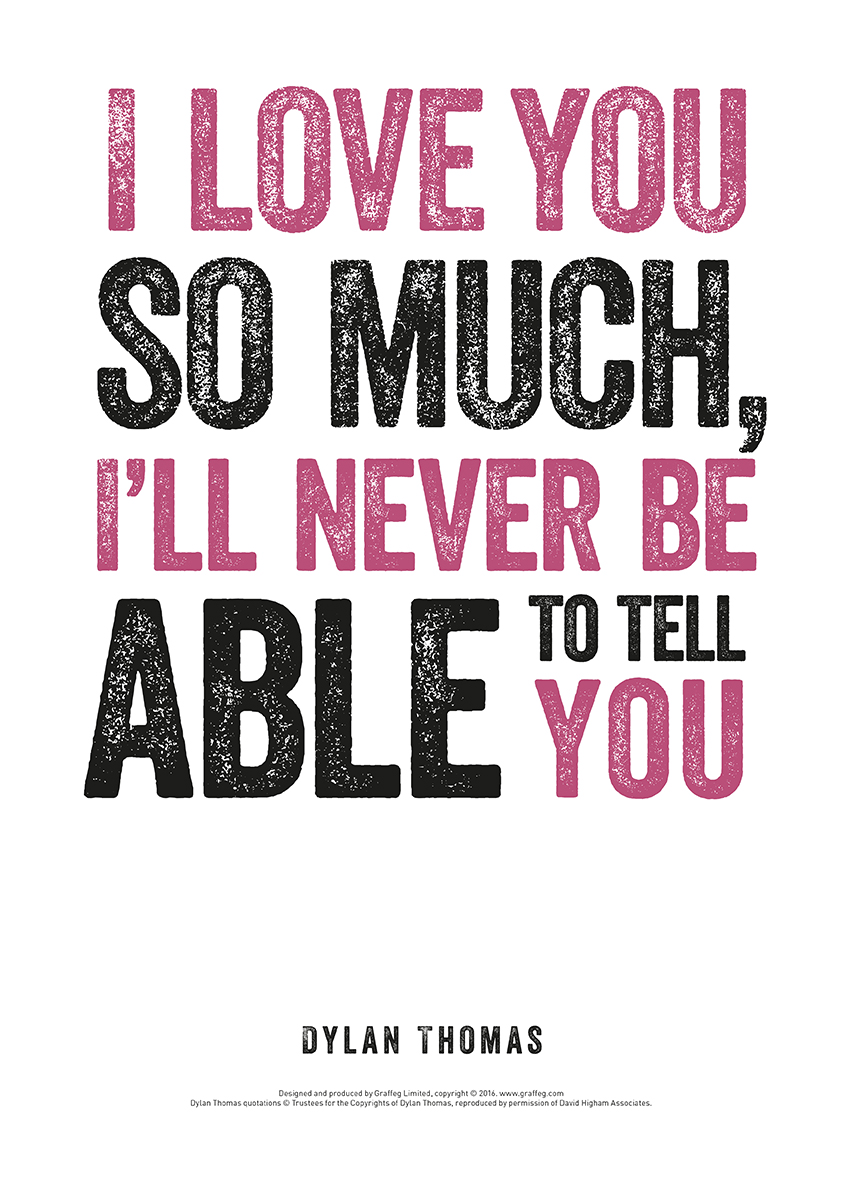
“You’ll never, I’ll never let you, grow wise, and I’ll never, you shall never let me, grow wise and we’ll always be young and unwise together . . . I love you so much, I’ll never be able to tell you; I’m frightened to tell you.”

In another letter he wrote, “I don’t want to write words, words, words to you; I must see you and hear you; it’s hell writing to you now . . . you are really my flesh and blood Caitlin whom I love more than anyone has loved anyone else. It’s nonsense me living without you, you without me: the world is very unbalanced unless in the very centre of it we stand together all the time in a hairy, golden, more-or-less unintelligible haze of daftness.”

From this the phrase “I love you so much” became central to the Dylan Thomas image, so much so that there are even posters that simply quote it…


You can buy the poster from Graffeg Publishing

Of course it is putting two and two together, but I think it is a viable theory.  Bob Dylan studied Dylan Thomas, and Bob knew that emotionally he was being pulled in every direction by Ms Springs, so there are a lot of links.

But there is also the music itself.  It is an endless driving force like a runaway bulldozer on heat, and that surely is what comes across in Dylan Thomas’ letters.

So, that’s where I think it comes from, and the frantic version of the song seems to be in keeping with the style of Dylan Thomas’ letters.

Here’s the Greg Lake version from his 1981 UK “Greg” album

And the The Band versionhttps://www.youtube.com/watch?v=raxKf6JQ5gk


Finally the lyrics from Genius.com

Well, my mama said the girl’s puttin’ you down
She’s gonna ruin my life
I must have loved you too much
(Must of loved you too much)
I must have loved you too much
(Must of loved you too much)

She said : ‘Boy, you’re gonna lose your home’
‘You better lose your world’
I must have loved you too much
(Must of loved you too much)
I must have loved you too much
(Must of loved you too much)

I can’t help it, I can’t help it, girl
I know I miss that old put you down
I just can’t do it, girl

[From here on I’ll cut the chorus – you’ll have got the hang of it by now]

Back way up if you carry me
You need me, girl, when I disappear

In a slanted way, frontwards and backwards
Anyway you just don’t hear

Well, I don’t know the way but I wish you would go
I wish that you’d get out of my sight

Anyway at all, just leave and go
I won’t ’til you leave me alone

Leaving aside the sound check versions Dylan played it twice – on 24 September 1978 and 29 September 1978.

As a PS there is a quiz with 12 quotes from Bob Dylan and Dylan Thomas in which you have to guess which is which.  It helps pass the time when it is passing slowly.

http://blog.oxforddictionaries.com/2013/11/dylan-or-dylan/

Recent Posts


Posted in Uncategorized | 8 Comments

Stepchild: the meaning behind one of Bob Dylan’s lesser known works.

By Tony Attwood

“Stepchild” was performed regularly by Dylan on tour for a short spell, but never recorded by him, and then dropped from the repertoire.   Quite amazingly the extraordinary Dylanchords web site has listed three of the performances with each having a slightly different set of lyrics.  You can see the whole set of three here.

Heylin however adds that the lyrics constantly changed throughout the tour – so we perhaps should take the ones we have noted as simply snapshots from an ever changing song.

The song is a slow 12 bar blues – here is the version from the first gig…

You mistreat me, baby, I can’t see no reason why
You know that I’d kill for you, and I’m not afraid to die
You treat me like a stepchild
Oh, Lordy, like a stepchild
I wanna turn my back and run away from you
but oh, I just can’t leave you babe

There are three verses with lines three to six being the chorus – the same in each verse.

I get nervous in your company, my knees get weak
both my eyes get misty and my tongue can’t speak
You treat me like a stepchild
Oh, Lordy, like a stepchild
I wanna turn my back and run away from you
But you know I can’t leave you babe.


Ah, you know that I love you honey, like a nervous wreck
this way its gonna be like you hold me like a … around your neck
You treat me like a stepchild
Oh, Lord, like a stepchild
I wanna turn my back and run away from you
But you know I can’t let you be

The changes in each performance are to my mind minor, it remains a blues.  But it is just another blues.  Interesting, but still, just another blues.

But the theme is odd given that by this time Dylan was a step father having adopted Sara’s daughter Maria.  Maybe that is just a reflection of the turmoil that Dylan found himself in, after the difficult divorce and access arrangements for the children.

There is a variant version of the song with amended lyrics again by Solomon Burke and that is currently on line here.   Just scroll down the page to find the link.  There is also a version by Jerry Lee Lewis, but I don’t think there is a free download of that available.

So why was the song picked up and then just left?  Personally, I find it to be just another 12 bar blues, of which Dylan wrote many, and of which quite a few never even made it to one live performance.  Black Crow Blues for example got onto an album, but has never been heard in public – and yet seems to have a little more to say that this one.

And Street Legal of course had its 12 bar blues by the time this came along – and I think New Pony really has a lot more going for it than this piece.

To me it is one of those songs that all song writers work on – and by and large it is one that is then consigned to the bin.  And yet according to Heylin it was played at all 65 shows in the North American tour at that time, so clearly Dylan had a certain feeling for the song.   And it was the first song in a while written just by Dylan, rather than by Dylan and Springs, so maybe he was just pleased to be back writing on his own.

Now I have something of a disadvantage here because I have not managed to find copies of all the songs written with Helena Springs but from what I have heard of them, Dylan was right not to use them in the albums.   Indeed if we look at Dylan’s writing in chronological order across this year and the last we can see that it was in a bit of a downturn.

1977

1978

1977 was not Dylan’s most prolific year by any means but it had some amazing work within it, but now, in 1978, the drive seems to have gone.

Stepchild was the first song written alone since Baby Stop Crying, and both songs, in common with New Pony, have an absolute paucity of lyrics.  For the man who took pop and rock songs into utterly new dimensions – and indeed for the man who wrote seven songs in 1977 which for any other songwriter would be the height of achievement, I do think this was something of a low point.

Recent Posts


Posted in Uncategorized | 3 Comments

Bob Dylan’s “Baby Stop Crying”: the meaning of the lyrics and the song

By Tony Attwood

Baby Stop Crying has its lyrical (although not its musical) origins in Robert Johnson’s Stop Breaking Down.  Just compare the lyrics

Dylan:

Baby, please stop crying
You know, I know, the sun will always shine
So baby, please stop crying ’cause it’s tearing up my mind

Johnson:

Stop breakin’ down, yes stop breakin’ down
The stuff I got’ll bust your brains out, baby
Ooh, it’ll make you lose your mind

The difference is that Robert Johnson delivers the song with a rare bounce and hypnotic drive which isn’t part of Dylan’s work at all.  Dylan, for me, sounds really fed up.

Robert Johnson “Stop Breaking Down”.

Johnson’s piece was recorded by him in 1937 and was itself melodically (although not lyrically) based on the music of Memphis Minnie, Buddy Moss (try “Stop Hanging Around”) and the like.   The Rolling Stones recorded “Stop Breaking Down” in Exile on Main Street.

The problem for me is that knowing Stop Breaking Down, I can’t really do justice to analysing Dylan’s lyrics.  For example consider this set of lyrics…

I can’t walk the streets now, can’t consulate my mind
Some no good woman she starts breakin’ down
Stop breakin’ down, please stop breakin’ down
The stuff I got’ll bust your brains out, baby
Ooh, it’ll make you lose your mind

This takes “lose your mind” into a different level and there is no comparison (for me) with

You been down to the bottom with a bad man, babe
But you’re back where you belong
Go get me my pistol, babe
Honey, I can’t tell right from wrong

Of course I get the point of singing “stop crying” eight times in every chorus, because that is the point with someone who is so distressed by the break up of a love affair that they simply cannot escape the misery and pain.

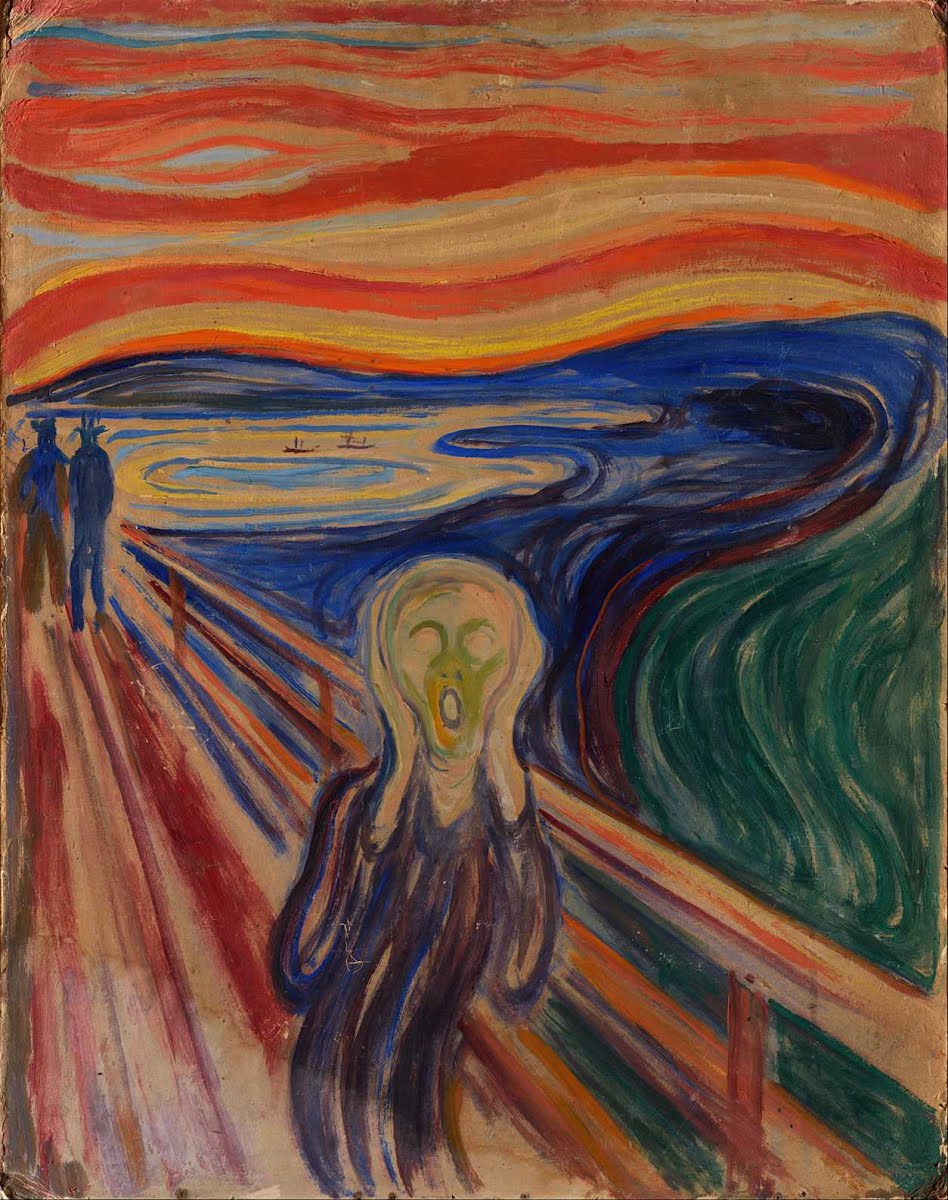
But like the paintings that make up The Scream by Edvard Munch I don’t need to look at it that much before it just overwhelms me.  The Scream overwhelms me with horror, Stop Crying with depression.  Different views of life, but not something that I want every time I come to play the album.

In fact I can handle the poem behind The Scream better than I can deal with the painting…

“I was walking along the road with two Friends / the Sun was setting – The Sky turned a bloody red / And I felt a whiff of Melancholy – I stood / Still, deathly tired – over the blue-black / Fjord and City hung Blood and Tongues of Fire / My Friends walked on – I remained behind / – shivering with Anxiety – I felt the great Scream in Nature.”

And maybe if I was in that state (thankfully I’m not this week) or if a friend was, then maybe I’d have more empathy with the song, but somehow without that, I fail to appreciate the chorus. And by the end hearing the phrase “Stop crying” 32 times is just a bit much.

So that is my problem.  I can appreciate The Scream as great art even though I can’t and don’t want to share the horror of dissolution and loneliness.  But I don’t want to head “Stop crying” sung 32 times.   But as always, I am sure the failure to appreciate this moment of Dylan’s work, is entirely my problem, not his as a composer.

It might be ok for me if the verses in between said something to me but

Go down to the river, babe
Honey, I will meet you there
Go down to the river, babe
Honey, I will pay your fare

or

You been hurt so many times
And I know what you’re thinking of
Well, I don’t have to be no doctor, babe
To see that you’re madly in love

really don’t cut anything with me.

The blues of course is a simple song form, but when I listen to the Robert Johnson song I just want to hear it over and over, and this Dylan piece does not do that to me.  Simplicity can work, but, to my mind, it isn’t enough on its own.   Dylan’s melody is ok, and the four chords (A, C sharp minor, D, E) give possibilities but are commonplace in this type of song.

So what was it that made it a hit (it reached 13 in the UK charts, and did well in most of Europe)?  I must say I don’t know, and I’m with the USA on this one, where it didn’t go down at all well and didn’t make the charts.

Maybe people in Britain in 1978 were just plain miserable at the time.   We’d had terrible storms, Margaret Thatcher was making anti-immigrant speeches, they gave Freddie Laker a knighthood, the IRA were letting off bombs, our Embassy in Iran was attacked, and the Yorkshire Ripper was on the loose.  Yeah, I guess we all were pretty fed up.

Dylan performed the song from 1 June 1978 through to 14 November 1978 (39 performances) but then on returning to the USA dropped it from the set list.

Here’s the live version from the UK tour.

Recent Posts

Posted in Uncategorized | 5 Comments

“Coming from the heart”. Bob Dylan the Helena Springs searching for a way forwards?

By Tony Attwood

This is one of the outtakes that Heylin rates, and he says that a full band version of it was tried out at the time of Street Legal.  Helena Springs says it was the third song that she and Dylan wrote together.

When the Daily Telegraph published Heylin’s list of the “gems” that Dylan abandoned this comes in at number 13 and he says of it…

One of Dylan’s best love songs, co-written with backing singer Helena Springs. It was performed only once, at a concert in October 1978. It would be left to the Searchers to put it in the public domain.

I have to admit I don’t think that much of it.  The melody is (for me) just uninspiring step by step stuff, and the lyrics don’t take me anywhere new.

Of course I’m just a regular guy with an opinion, so my view is worth no more than anyone else’s but I just wish people could explain a little more as to what they find in a song like this.  Take the opening.

We have got to come together
How long can we stay apart?
You may get it maybe never
But it’s coming from the heart.

Your life is full of indecision
You can’t make up your mind.
We must get it in position
And move it on down the line.

‘Cause the road is long, it’s a long hard climb
I been on that road too long of a time
Yes the road is long, and it winds and winds
When I think of the love that I left behind.

To me, those words are not very inspiring, unless one has a would-be lover and one is looking for a song to sing to him/her.  In such circumstances the song becomes less important and it is swished away by the emotion.

But looked at in the fresh light of day… it still doesn’t work for me.  And when the melody just works its way along in a manner I can only call “plodding” I am left looking for something else, anything else in fact, to make me want to play this again.

And maybe there an awareness in Dylan that this really wasn’t where it was at, as they say, since although the song was included in early versions of Lyrics it was then removed.

For what it is worth, my guess is that Dylan was still hypnotised by what happened at the end of the era of writing with Jacques Levy – a period that could bring lines such as

At the corrida we’ll sit in the shade
And watch the young torero stand alone
We’ll drink tequila where our grandfathers stayed
When they rode with Villa into Torreon.

or

Up on the white veranda
She wears a necktie and a Panama hat
Her passport shows a face
From another time and place
She looks nothing like that

It seems simplistic to say it, but maybe Dylan forgot that Levy was a) a consummate lyricist who could take rock music to places it had previously never even imagined existed, b) it took Levy and Dylan several goes at it, before they really got things to work between them – and even then they still managed to write a couple of pieces that were, perhaps, not 100%.

Coming from the heart works, I think, if it means something to the listener, whereas the songs from the Levy period work for anyone willing to be blown away by the wash of the words and the images they create.  If we take

Please don’t talk about tomorrow
I’m really not one to care
This world is filled with too much sorrow
That nobody’s heart should bear.

it really doesn’t have anything like that sort of power that Levy could bring – or indeed Dylan could bring much of the time.

And I have the notion that Dylan knew that, not least because the song that he wrote next, after “Coming from the Heart” contains the lines

I got a new pony, she knows how to fox-trot, lope and pace
Well, I got a new pony, she knows how to fox-trot, lope and pace
She got great big hind legs
And long black shaggy hair above her face

I am not saying that is great literature, but it is fun, challenging, and within the context of a standard 12 bar blues, it is utterly arresting.

In Coming from the Heart, even the images that Dylan loves, such as the river, get stuck in the everyday

Please, please give me indication
Stop and talk to me
Like a river that is flowing
My love will never cease to be.

Dylan never has to be complicated to achieve something interesting, and normally an image takes him in much more interesting directions.  Consider

Daylight sneakin’ through the window
And I’m still in this all-night café
Walkin’ to and fro beneath the moon
Out to where the trucks are rollin’ slow
To sit down on this bank of sand
And watch the river flow

So no, sorry, this doesn’t work for me.


https://vimeo.com/85647258

The reports suggest that when Street Legal was recorded Dylan knew exactly which songs he wanted to use, and this view suggested that although three songs with Helena Springs were also recorded during these sessions (including “Coming from the Heart”), they were thus not outtakes in the sense that they were ever seriously considered for inclusion.

But if you disagree with my entire view of this song and want more, there is more… for the Searchers recorded it.

https://www.youtube.com/watch?v=8qhbT_4k4fc

There is a spot of interest in the Searchers use of this song, which perhaps backs up my view a little.

The Searchers were a Merseybeat pop band of the 1960s, considered by some to be second only to the Beatles (if you like that sort of music).

Like so many groups, they continued (with changing lineups) to tour in the 1970s to smaller audiences but then in 1979 got a new record contract, after their shows had started to get some critical acclaim, not least as they moved away from the Mersey Sound into new areas (their version of ‘Southern Man’ being particularly noted).

The first of two albums under this new deal (rather boringly called The Searchers) was welcomed by critics but got no air play and so was withdrawn, and then released again as a new version of the same album with a new title.  The original version (The Searchers) is the album that has the version of “Coming from the Heart” on it.  In the revised version (Golden Hits)  ‘Coming From The Heart’ was dropped and several new songs were put in.

The two albums (or three albums if you consider the re-worked version of The Searchers into Golden Hits, to be a different album) sold very well at the gigs, and kept the band going on the circuit but never brought them a return to stardom.

So why did “Coming from the Heart” get the chop?  Maybe because it didn’t fit with the new album title.  Or maybe it was the recording. You might decide if you play the link above.

Recent Posts


Posted in Uncategorized | 3 Comments

Walk out in the rain: the start of Bob Dylan’s second collaborative period

By Tony Attwood

Uncharted territory here – before tackling the “1978” section of the Chronology on this site I didn’t have any ideas about this song, and there is precious little from other commentators around.

I have two recordings of the song – both are by Eric Clapton and both are linked below.  One is a very rough on stage recording, but it reveals the possibilities the other is a much clearer version from “Backless” which reveals more of a most interesting melody line.

After three plays I can begin to understand what Clapton saw in the song, but the lyrics really are fairly ordinary.  It is the bounce of the song that must have made Dylan consider it for Street Legal – but ultimately it was an outtake.

In terms of chords there are no unexpected changes – it is a simple three chord song – and this fits with Helena Springs reporting of the writing of the songs – they were just playing around – Dylan would strum the guitar and she’d just make up lyrics and then they’d spend a bit of time refining the song.

The reporting is that the couple wrote a couple of songs on the first night in Australia, and that Dylan was encouraged to try out the idea after the work with Jacques Levy.

Heylin reports a story which suggests that Clapton played his finished version of the song and Dylan took it to be a demo version, but I suspect this is an apocryphal story.  It would be hard to mishear the studio version as unfinished.

Here are the opening three verses.

Walk out if it doesn’t feel right
I can tell you’re only lying
If you’ve got something better tonight
Then don’t mess up my mind with your crying

Just walk out in the rain
Walk out with your dreams
Walk out of my life if you don’t feel right
And catch the next train
Oh, darling, walk out in the rain

I have come from so far away
Just to put a ring on your finger
If you’ve said all that you’ve got to say
Then please don’t feel the need to linger

Just walk out in the rain
Walk out with your dreams
Walk out of my life if you don’t feel right
And catch the next train
Oh, darling, walk out in the rain, in the rain

It’s raining outside of the city
My poor feet have walked till they’re sore
If you don’t want my love, it’s a pity
I guess I can’t see you no more

… you get the idea.

Clapton has an interesting take on Dylan, finding some of the less well known songs by and large for his albums…

– Sign Language (No Reason To Cry – 1976)
– Walk Out In The Rain (Backless – 1978)
– If I Don’t Be There By Morning (Backless – 1978)
– Born In Time (Pilgrim – 1998)

Here’s the album version

And here’s the live version

It’s not a great song in my view, but it is nonetheless a memorable, interesting and jaunty tune which seems to fit in with the rest of Street Legal.  I’m glad I’m doing these reviews as I wouldn’t have found the song had I not gone looking, and it is an enjoyable piece.

If like me you didn’t know the piece before, I hope you find the exercise of interest.

Posted in Uncategorized | 6 Comments

Señor, Tales of Yankee Power; on the road to Love’s “Old Man” and finding Christ.

By Tony Attwood

As I have noted elsewhere, after Dylan finished writing “Desire” with Jaques Levy he had a long pause while he battled over the issue of access to his children through the divorce proceedings.

He wrote just one song in 1976, the year after Desire, Seven Days, but then towards the end of 1977 started writing again, with the songs that were to become Street Legal.

The tales that are told of the recording sessions for Street Legal are tales of chaos – Dylan coming and going, not settling, being in a bad mood etc etc, and the album that resulted is one that, according to the reviews I have read, was disliked in the USA.  Curiously it found favour in the UK, and it certainly found favour with me upon its release.

Michael Watts of Melody Maker magazine in the UK said this was Dylan’s “best album since John Wesley Harding” and New Musical Express (the other leading rock magazine of the era in the UK at the time) said, it was Dylan’s “second major album of the 70s.”  Q Magazine has since given the album a 5 star rating on re-release on two occasions.

Indeed for myself the list of songs from 1977 which went into the album are among my favourites as I come to look back on Dylan’s writing career, and create the chronology of the songs in the order they were written.

I have also mentioned Seven Days – the one song written in the preceding year, which was then re-used in order to create Señor.  But whereas Seven Days quickly faded from the scene, Señor most certainly did not.  It is the song that was continued to be performed over a number of years.  Between 1 June 1978 and April 28 2011 it was performed 265 times on tour.  “Where are you tonight” by way of contrast, got just 33 performances and was lost before the end of 1978.

In 1978 Dylan also told the story of how he was on a train going from Mexico to San Diego and how a strange old man got on the train, and Dylan felt the urge to talk to him.  Apparently the story told in the concerts started off fairly simply and gradually expounded adding the notion that when Dylan finally did want to talk to the man, he had gone.

Given this explanation the context of the song is easier to place

Señor, señor, do you know where we’re heading?
Lincoln County Road or Armageddon?
Seems like I been down this way before
Is there any truth in that, señor?

(As I understand it Lincoln County is one of the far south-western parts of New Mexico.)

Señor, señor, do you know where she is hiding?
How long are we gonna be ridin’?
How long must I keep my eyes glued to the door?
Will there be any comfort there, señor?

Then for the middle 8 Dylan goes into a different vision – a look at the woman through a different time scale in a different place – it evens seems suddenly that he is transported onto a ship…

There’s a wicked wind still blowin’ on that upper deck
There’s an iron cross still hangin’ down from around her neck
There’s a marchin’ band still playin’ in that vacant lot
Where she held me in her arms one time and said, “Forget me not”

But then he is back with the old man

Señor, señor, I can see that painted wagon
I can smell the tail of the dragon
Can’t stand the suspense anymore
Can you tell me who to contact here, señor?

And then again in the reflections upon this other strange land – the land of the marching band in a vacant lot, the iron cross…

Well, the last thing I remember before I stripped and kneeled
Was that trainload of fools bogged down in a magnetic field
A gypsy with a broken flag and a flashing ring
Said, “Son, this ain’t a dream no more, it’s the real thing”

This is a really strange set of contrasts back and forth between the notion of sitting on the train with the old man and reflecting on some sort of semi-revealed vision of a trainload of fools (see below for more on this) bogged down in a magnetic field.   But somehow the singer is suggesting that the old man can deliver him and take him through.

Señor, señor, you know their hearts is as hard as leather
Well, give me a minute, let me get it together
I just gotta pick myself up off the floor
I’m ready when you are, señor

That taking through to another world, seems to involve cutting loose from the past, walking away from all that was previously known, getting going onto the new life.

Señor, señor, let’s disconnect these cables
Overturn these tables
This place don’t make sense to me no more
Can you tell me what we’re waiting for, señor?

Because the old life (wife and children) was shattered and torn, and the conversion to Christianity close at hand, many have interpreted this as a way of talking about that conversion.  Maybe it was.  Or maybe he still just had the feeling he was ready to move on.

But now, here’s the bit that I think is normally missed in discussions of this song.  In November 1967 Bryan MacLean wrote and performed the song “Old Man” which was recorded by Love on their all time classic album (ok, for me their all time classic – although I’d suggest a lot of others agree) “Forever Changes”.

Here is an extract from it

Dear old man
He’d seen most everything
Gave me a piece of good advice
Said it would do me well
I couldn’t really tell until
I have been loving you

Now it seems
Things are not so strange
I can see more clearly
Suddenly I’ve found my way
I know the old man would laugh
He spoke of love’s sweeter days
And in his eloquent way
I think he was speaking of you
You are so lovely
You didn’t have to say a thing

OK, you are not going to see too much similarity without hearing that song, but there is a link because Bryan MacLean joined the same Christian ministry (the Vineyard) that subsequently converted Bob Dylan.

Dylan, as we well know, is utterly versed in all forms of popular music, and of course would know Love and Forever Changes.  After all it was 40th on Rolling Stone magazine’s 2003 list of The 500 Greatest Albums of All Time, being inducted into the Grammy Hall of Fame in 2008 as well as being added to the National Recording Registry in May 2012.

Dylan’s old man is not MacLean’s old man, in fact he is the reverse, but the concept is similar, and although of course in situations like this I can never prove anything at all, the similarity struck me long before I knew of the link between the two conversions to Christianity.

And anyway, if by any chance you have never heard Forever Changes, do go and get a copy.  It shouldn’t cost more than $5.00.

Back with the reviews, Christopher Rollason called “Señor” “a wasteland with no easy answers.” He added, “Political and religious readings are both possible, but, at least on first listening, this song propels the listener into a dark and desolate borderland world, where nothing can be taken on trust.”

In short, it is as if the Old Man on this occasion gives all the wrong answers – but the positive answers were just around the corner.  Finding the Old Man was the key, but the journey was far from easy, particularly if one is

lost in the rain in Juarez
And it’s Eastertime too
And your gravity fails
And negativity don’t pull you through

What we have is the reverse of MacLean’s Old Man – in the Forever Changes song, the Old Man delivers a message of love and hope – everything that the summer of love offered in fact.  In Señor what we have is darkness, despair and destruction – everything that Christianity offers to the non-believer.  The trainload of fools is an update of the allegory “Ship of Fools” which dates back to a 1494 satire by Sebastian Brant and a c1495 painting by Hieronymus Bosch.  We may note the sudden mention of the ship in the bridge section.

Thus the old man ultimately gave peace to Brian MacLean but initially horror to Dylan, who then found his own peace a little later. But I suspect in both cases he takes us back (as I have mentioned quite a few times in these reviews) to the Wandering Jew who taunted Jesus on the way to the Crucifixion and was then cursed to walk the earth until the Second Coming.  He’s been a part of English literature since the 14th century, and certainly plays a significant part in Chaucer.  There’s no reason why he has to be Jewish or meandering around the English countryside as early literature of my country has it.

He is, in short, the warning, as when seen in the Canterbury Tales and in Señor, but ultimately transforms into the delivery into the light.

‘Can you tell me what we’re waiting for, señor?’

Either Armageddon or the Old Man of Love’s song, seems to be the answer.

The Allmusic review of “Señor” suggests the song “could have been one of Dylan’s finest songs of the 1970s. As it stands, however, it is an ambitious song which doesn’t quite come off.”

I think that is harsh.

Posted in Uncategorized | 20 Comments

Bob Dylan’s sense of place

By Tony Attwood

Having written about Dylan as a protest singer, I returned to a much earlier theme of this site – and one that caused me no end of problems.  Trying to classify Dylan’s songs by subject matter.

I have made two attempts at such a classification in the past and abandoned both.  But having written about protest I wondered if I might have more success by choosing a theme, and looking for songs that fitted into it, rather than looking at songs and assigning them to a theme.  So here’s part two: Dylan and Places.

Take as a starting point, North Country Blues from 1963.  This song is in a sense a political song about cheap labour disrupting traditional industry, and how company owners can make decisions that wreck people’s lives.  A protest song, therefore. But it is the effect that hits us

The summer is gone
The ground’s turning cold
The stores one by one they’re a-foldin’
My children will go
As soon they grow
Well there ain’t nothing here now to hold them.

It is a place that is full of decay, decline and dissolution.

Now consider One too many mornings.

This is an absolute, overpowering, overwhelming  song of lost love.  There’s no blame – the singer and the woman he loved are both right.  There are regrets, although the singer suggests maybe there are not – but you just know he’s wrong.

So we can call it a song of lost love (one of the three main themes of pop, rock and blues through the ages) but it is more than that.

The first two verses of this three verse song are totally about place.  And that can be said without even emphasising the opening lines that give the listener an absolute sense of where you are and what the world is like.

Down the street the dogs are barkin’
And the day is a-gettin’ dark
As the night comes in a-fallin’
The dogs’ll lose their bark

And in verse two a second emphasis on place

From the crossroads of my doorstep
My eyes they start to fade
As I turn my head back to the room
Where my love and I have laid
An’ I gaze back to the street
The sidewalk and the sign
And I’m one too many mornings
An’ a thousand miles behind

This is real talent.  The ability to give the audience an absolute sense of where you are, and what the place means.

That was 1963 as well, but let’s jump forwards.  A song that starts “There must be some way out of here.”  That line itself tells us the place is confused, mixed, unclear, and that is certainly the picture that emerges.

Here’s the opening to All along the watch tower

“There must be some way out of here,” said the joker to the thief
“There’s too much confusion, I can’t get no relief
Businessmen, they drink my wine, plowmen dig my earth
None of them along the line know what any of it is worth”

and then in the last verse..

All along the watchtower, princes kept the view
While all the women came and went, barefoot servants, too

Outside in the distance a wildcat did growl
Two riders were approaching, the wind began to howl

This is a really weird place indeed.  In fact it has been suggested to me (and I am always very grateful indeed for all the suggestions made, apart from the ones that tell me where I ought to go – which I tend not to publish) that Dylan himself is both the joker and the thief.  It is a theme I want to return to, but who else could handle this strange place we find ourselves in?

Time passes slowly  on the other hand describes a simple land, where nothing happens.  But the simple land is deceptive – the mountains don’t change but the thoughts and dreams of those who live here can change.  It is as if those thoughts create the world.  There is nothing real here at all… except of course there is.  This is the simple countryside isn’t it?  Streams and log cabins and stuff…

“Ain’t no reason to go anywhere,” however is a deceptive line it almost seems as if you need to keep shouting it to keep the demons at bay.   Dylan is trying over and over to tell himself this is how it is, he knows where he is, this is an ok place, but when you listen to those two inter-twining guitars, you start to wonder if it really is true, or not.  Have the demons been left behind, or are they merely locked behind to log cabin door?

You can win and defeat the demons if only you can be like the Zen monk on the hillside looking down, with the perfectly clear vision – for then time passes slowly and fades away.  But in doing that what you have done is removed yourself from the world.

Time passes slowly up here in the daylight
We stare straight ahead and try so hard to stay right
Like the red rose of summer that blooms in the day
Time passes slowly and fades away

It is a bit like the lines from Sign on the Window

Build me a cabin in Utah
Marry me a wife, catch rainbow trout
Have a bunch of kids who call me “Pa”
That must be what it’s all about
That must be what it’s all about.

I’ve never been to Utah, but I get the idea.

In my pursuit of Dylan’s sense of place I am now going to jump forwards to one of my great favourite Dylan songs Tell Ol’ Bill

I haven’t got round to re-writing my review of this song, following my discovery (although I suspect everyone else knew it all the time) that the title of the song is taken from an old slave song – which gives a totally different meaning to the piece, but with or without that knowledge we know this is a man finding his place in the world that is far from right…

I could happily quote the whole song as an example of Dylan’s sense of place in songs but just take the opening three stanzas.

The river whispers in my ear
I’ve hardly a penny to my name
The heavens have never seemed so near
All of my body glows with flame

The tempest struggles in the air
And to myself alone I sing
It could sink me then and there
I can hear the echoes ring

I tried to find one smiling face
To drive the shadow from my head
I’m stranded in this nameless place
Lying restless in a heavy bed

And one section from a little later on

I walk by tranquil lakes and streams
As each new season’s dawn awaits
I lay awake at night with troubled dreams
The enemy is at the gate

Beneath the thunder blasted trees
The words are ringin’ off your tongue
The ground is hard in times like these
Stars are cold, the night is young

The rocks are bleak, the trees are bare
Iron clouds go floating by
Snowflakes fallin’ in my hair
Beneath the gray and stormy sky

I can’t think of many other songs that take us so deeply into the sense of place that the singer inhabits in this song.  It is one of the most extraordinarily powerful pieces of writing in popular music of all times.

One of the most, because I can’t really say which is the most.  But right up there has to be

Ain’t it just like the night to play tricks when you’re tryin’ to be so quiet?
We sit here stranded, though we’re all doin’ our best to deny it
And Louise holds a handful of rain, temptin’ you to defy it
Lights flicker from the opposite loft
In this room the heat pipes just cough
The country music station plays soft
But there’s nothing, really nothing to turn off
Just Louise and her lover so entwined
And these visions of Johanna that conquer my mind

I think that those of us who adore Visions of Johanna so much, from Poets Laureate to Heylin with his analysis of line changes and recording sessions to regular everyday commentators like me, all find ourselves drawn into this place.  I know this room, I know the view across the street, I know the sounds.

What is so extraordinary about the sense of place here is that it is so instant – one minute you are in your own real world, the next, there you are in that place.  Looking, watching, feeling.

Of course the place doesn’t have to be somewhere we recognise, or somewhere that makes any sense.  The Watchtower is neither.  Nor is Desolation Row

They’re selling postcards of the hanging
They’re painting the passports brown
The beauty parlour is filled with sailors
The circus is in town
Here comes the blind commissioner
They’ve got him in a trance
One hand is tied to the tight-rope walker
The other is in his pants
And the riot squad they’re restless
They need somewhere to go
As Lady and I look out tonight
From Desolation Row

This is a multiplicity of places – the images fall across each other so rapidly that we can’t quite pin anything down except that we know from line one that this is the horror show of all times.   If there are mists circling around the Watchtower, they have all cleared here and now we see the nightmare and find it is right inside our heads.


I want to end what is little more than an introduction to the notion of Dylan’s stories of places with one of the most evocative “place” songs of all, Dark Eyes

Oh, the gentlemen are talking and the midnight moon is on the riverside
They’re drinking up and walking and it is time for me to slide
I live in another world where life and death are memorized
Where the earth is strung with lovers’ pearls and all I see are dark eyes

Just how much of another world do we want to enter?  How far beyond the “Ain’t it just like the night to play tricks” can we travel?   How deep and dark can we get.   Dylan in fact suggests he can go as dark and deep as you want, into an underworld we hardly suspected existed.

This is not a good place at all, but it is part of Dylan’s stories of places.

Oh, the French girl, she’s in paradise and a drunken man is at the wheel
Hunger pays a heavy price to the falling gods of speed and steel
Oh, time is short and the days are sweet and passion rules the arrow that flies
A million faces at my feet but all I see are dark eyes.

I’ve never explored this notion before of Dylan’s sense of place, and I am still coming to terms with it, but I hope you find something here that gives a further insight into Dylan’s writing.


Posted in Uncategorized | Leave a comment

Seven Days: the prelude to Señor. The meaning of the music and the lyrics

By Tony Attwood

If you are a regular reader you’ll know I am not listing and reviewing every Dylan song – just the songs on the original albums and the outtake albums, plus a handful of others where other artists have recorded the songs.  In short the songs where we have full versions rather than notes and excerpts.

Seven Days is unusual – it is the only song from 1976 that we have, making it song number 168 in the list that starts with Ballad for a Friend in 1962.

We have the Dylan live recording, and a significant array of versions from other artists – although I don’t want to start giving listings of them on YouTube.  They are easy to find, and I am not too sure any of them add anything to the Dylan version.  I get the impression that some “superstars” find it a good excuse for a long jam session.

What interests me however is something different: what happened to the song.

It was first played in a concert on 18 April 1976 and got five outings and was then dropped from the repertoire.  Then on 19 April 1996 it suddenly reappeared, was performed 13 times, and then dropped again.

Now that information is available in various books and web sites, but that is not all there is to the story.  Because in late 1977 Dylan wrote “Señor (Tales of Yankee Power)”, the third of the songs written in the Street Legal sequence, and in this song a part of “Seven Days” reappears.

If you listen to the lines

seven more days she’ll be comin’
I’ll be waiting at the station

and compare with

do you know where we’re headin’?
Lincoln County Road or Armageddon?

you may perhaps note a similarity in the melody and the chord sequence.  (I’ve put the two songs in the same key below for this comparison although the two recordings are in different keys).

The sequence in the original song (Seven Days) is F, C, E, Am.  The melody is also very similar.

“Seven Days” is recorded as a lively bouncy piece, sung with a lot of vigour and energy, and it is also a very simple piece – the singer has been waiting to see again a woman whom he has not seen since childhood, and she’ll be here in seven days.  All of this is set out in three straight verses.

Seven days, seven more days she’ll be comin’
I’ll be waiting at the station for her to arrive
Seven more days, all I gotta do is survive

She been gone ever since I been a child
Ever since I seen her smile, I ain’t forgotten her eyes
She had a face that could outshine the sun in the skies

I been good, I been good while I been waitin’
Maybe guilty of hesitatin’, I just been holdin’ on
Seven more days, all that’ll be gone

And then to contrast with the long held “Days” at the start of the verse we get the rush of lyrics in the bridge…

There’s kissing in the valley
Thieving in the alley
Fighting every inch of the way
Trying to be tender
With somebody I remember
In a night that’s always brighter’n the day

The music is different and the lyrics take on a very different turn, before we come back to the original theme

Seven days, seven more days that are connected
Just like I expected, she’ll be comin’ on forth
My beautiful comrade from the north

(There is also a variant version of this verse: Seven days she’ll be going, I can hear the whistle blowing.)

I find it a strange notion – the long, long wait for a childhood friend, interrupted by the kissing and thieving passage – then back to the childhood friend now described as the beautiful comrade from the north.  I don’t think I can offer any insight into that, it just seems disconnected to me.

Heylin sees a link between this song and “Darling be home soon” by John Sebastian of the Loving Spoonful, the song and used in the film “You’re a Big Boy Now”.  The All Music review called it “…one of the most heartfelt songs about being away from a loved one, written from the point of view of a musician on the road writing a letter.”  I would certainly agree – it is a song that has been with me all my life – I still have the original 45rpm disc and still play it occasionally even though I’ve long since known it off by heart.

The link Heylin finds is with the fact that “Darling be home soon” suggests the singer has been waiting for his love since she was as child, and Dylan speaks of her having been gone since he was a child.

But it seems to me a bit of a tenuous link, because the feel of the two songs is so utterly different, and I’ve always taken it that Sebastian is suggesting that he has been waiting all his life for this moment, which is rather different from Dylan’s notion.

There are loads of versions of “Darling be home soon” (truly one of the great romantic rock songs of all time) on the internet.  If you are interested you might care to try this one by the composer, from Woodstock.

My point is that Sebastian’s concept is that

And I see that the time spent confused
Was the time that I spent without you

which is not at all related to Dylan’s vision in Seven Days.

But maybe Heylin meant something else.

Anyway, it is interesting though that Señor was the one song from Street Legal that really survived for Dylan in the next era of his songwriting and was played 265 times between June 1978 and April 2011.  So a little element of Seven Days did live on.  And it gave me an excuse to mention one of my favourite non-Dylan songs of all time.

Posted in Uncategorized | 3 Comments

Bob Dylan never was a writer and performer of protest songs

By Tony Attwood

First point: what is a protest song?

These four definitions are taken from various on line dictionaries.

Definition 1: a song that expresses disapproval, usually about a political subject

Definition 2: Term which gained currency (first in USA) in 1960s for song which voiced feelings of protest about some social or political injustice, real or imagined, or about some international event which aroused strong emotions, e.g. American part in Vietnam war. A famous example is ‘We shall overcome’.

Definition 3: A protest song is a song that is associated with a movement for social change and hence part of the broader category of topical songs (or songs connected to current events). It may be folk, classical, or commercial in genre.

Definition 4: Protest songs are songs to encourage social movement toward social change. These songs protest about issues such as war, women’s suffrage, civil rights, immigration or current events in the world today.

Now there is a distinction those definitions – because the first two stress the fact that the song highlights some wrong doing or bad state of affairs.  The last two talk of the song as part of the movement to change the world.  The songs encourage change and urge action.

This resonates with me a lot because when I was a very young and incredibly inexperienced writer, I worked with Adrian Mitchell, a leading pacifist and writer about social issues.  Ultimately we wrote a musical together – it was my first published work of music.

He was many years my senior and I was very much in awe of him and listened with great care to his views on the world, which is why I still remember one of his phrases: “The only reason for writing is to change the world”.  That sums up definitions three and four of protest music.

Now Definition 2, with its mention of “We shall overcome” could be seen as writing to change the world – except “We shall overcome” continued “some day”.  It is about belief in the inevitability of historical progress, not in our own ability to change the world.

Of course when it comes to Dylan I have no idea of what he thinks – although it seems to me that the songs like Hurricane are very much about making change happen.  But in terms of a “movement towards social change” which crops up in the definitions above, Hurricane is not so much about social change as about getting one man released from prison (although he was there, Dylan says, because of racial issues).

Indeed I do have a problem with a number of Dylan songs that are called “protest” quite often, but for which there is no attempt to consider where there protest is leading.  As an example I’d quote “Only a pawn in their game” which clearly protests against the system, but in no way suggests anyone can do anything.

In the Lonesome Death of Hattie Carroll we have the famous ending

And handed out strongly, for penalty and repentance
William Zanzinger with a six-month sentence
Oh, but you who philosophize disgrace and criticize all fears
Bury the rag deep in your face
For now’s the time for your tears

If we take this at face value Dylan is just telling us to cry at the betrayal of our hopes and dreams by a bent legal system.  There is no call to the masses to rise up and fight.  There is no hope for change.  In fact in both these songs Dylan tells us that the political and legal system in which we live is broken, but he makes no suggestions at at as to whether we can do anything about, whether we should do anything about it, and if we should, what we should do.

Indeed it is a point Dylan often seems to make – I am not telling you what to do.  Except, “Don’t follow leaders.”

We have the same sentiment in Hollis Brown

There’s seven people dead
On a South Dakota farm
Somewhere in the distance
There’s seven new people born

These are desperate, desperate, awful images, the painting of bleak hopelessness.  And all given without solution.

What is so curious about these early works from a protest point of view is that Times They Are A Changing which is itself seen as a protest song, is actually nothing of the kind.  It is a song that says that the world is changing, and that there is nothing the old guard can do about it.  Change happens, get used to it.

At the end the song has deeply religious connotations (Matthew 20:16 “So the last will be first, and the first will be last”) but also is the warcry of every teenager who has ever looked bleakly at his/her parents and shouted “You don’t understand!”

Come mothers and fathers
Throughout the land
And don’t criticize
What you can’t understand
Your sons and your daughters
Are beyond your command
Your old road is rapidly agin’
Please get out of the new one if you can’t lend your hand
For the times they are a-changin’

But this is no call to arms.  The revolution is here.  It’s happening.  Sit down and watch the show.

If we return to earlier songs like “Oxford Town” there is a clear approach that Dylan has even then, which is to handle the protest from a distance – in this case “me and my gal” arrive, they are horrified, they depart.  (Incidentally if you have a mind to, you might like to look at that review, not because I said anything profound, but because of the background – if you don’t know it – and the comments made after by readers of my piece).

(There is one other point here – one of the correspondents writes of the link between Oxford Town and “Nottamun Town”, which I suggested in reply was not right.  What I had forgotten when I wrote that was that the very next song that Dylan wrote was very much based on “Nottamun Town”.  Listening again I think the correspondent was right, I was wrong – and not for the first time!

So straight after Oxford Town Dylan wrote Masters of War which surely we would all agree is a protest song.  And yet I think by this time he was settling into the notion of just telling people that they should see the world from another point of view.  He is not telling us to rise up and overthrow the war machine…

There are two couplets in Masters of War that utterly overwhelm me, even now, so many years after buying the original when it came out…

For even Jesus would never
Forgive what you do

and

I just want you to know
I can see through your masks

So Dylan again is never saying “shake off those who oppress you” nor is he saying, “don’t pay taxes, they only spend it on war”.   In fact Dylan virtually never tells us what to do.  At this moment, as I write this, without going through all the material to look for Dylan’s advice, still all that comes to mind is “Don’t follow leaders”.  I know for a while he told us to follow Jesus, but I am setting that aside for a moment because religion is normally considered a different subject from protest.

Yes of course he makes his viewpoint clear at the end…

And I hope that you die
And your death’ll come soon
I will follow your casket
In the pale afternoon
And I’ll watch while you’re lowered
Down to your deathbed
And I’ll stand o’er your grave
’Til I’m sure that you’re dead

But he is hoping for their deaths, he is not raising the flag and fighting the cause.

When we get to With God on Our Side (and I do know I’m jumping around in the order the songs were written!) we get an even clearer statement of where Dylan has got to…

So now as I’m leavin’
I’m weary as Hell
The confusion I’m feelin’
Ain’t no tongue can tell
The words fill my head
And fall to the floor
If God’s on our side
He’ll stop the next war

Whether it is social change or economic change or political change or the misuse of religion to support inequality, Dylan is the observer.   And this is how he stays, for much later there is Union Sundown

the car I drive is a Chevrolet
It was put together down in Argentina
By a guy makin’ thirty cents a day

And North Country Blues

it’s much cheaper down
In the South American towns
Where the miners work almost for nothing.

He’s observing, not telling.  He’s making his position absolutely clear, but he is not saying, go out and smash the system.    There is of course occasional hope

Tolling for the aching ones whose wounds cannot be nursed
For the countless confused, accused, misused, strung-out ones an’ worse
And for every hung-up person in the whole wide universe
And we gazed upon the chimes of freedom flashing

But it is just hope, a dream, not a call to arms, not a message of action.

It is also interesting that one of the few times Dylan did touch on the political protest movement (Gypsy Lou) he seems to have been making fun of the activists.  It is also interesting that the writers who were his models – such as Rimbaud, Dylan Thomas etc – were men who specialised in seeing the world in other ways, not doing something about it.

So at this stage I conclude: Dylan is not a writer of protest songs in the stronger definition.  He is more an observer of inequalities and injustice.  He looks in and often doesn’t like what he sees.


Posted in Uncategorized | 2 Comments

Sign Language: the meaning behind the music and lyrics in Dylan’s song

By Tony Attwood

Sign Language was the first song Dylan wrote and completed after the collaboration with Levy that gave us Desire (there is at least one other song, but it is neither complete nor recorded, and I’m ignoring these as I work through Dylan’s songs year by year).

With this look at “Sign Language” we come to the end of 1975; there was one more song in 1976, and then by and large Dylan stopped writing.  Until Street Legal came along.

And for me 1975, such a remarkable year on songwriting for Dylan, ends with an enigma.  Quite what Dylan was doing with this song I have to admit I really have no idea.

It’s on YouTube as a duet with Clapton (if you play this one, don’t click off at the end, as there is a nice duet between the two playing “Don’t think twice” – and then it moves on to other collaborative ventures).  It is not one of the great highlights of Dylan’s performing career but still, worth watching and hearing if you haven’t seen it before.

And there is a second video of the song, this time with Clapton playing it without Dylan being involved.

I am actually not sure Dylan really finished this song; rather I think he was wondering what he could do after the supreme heights that he climbed with Levy in the final collaborations of Desire.

By which I mean, what are we to make of “You speak to me in sign language, I’m eating a sandwich in a small cafe at a quarter to three”.

If we compare this with the opening of the last song written with Levy, we have…

Hot chilli peppers in the blistering sun
Dust on my face and my cape
Me and Magdalena on the run
I think this time we shall escape.

There is comparison in the sense that Levy took the world around the central character and turned it into a way of setting the song quickly.  Dylan was, perhaps, attempting to do the same, but the level is so prosaic (what is there that is interesting about eating a sandwich?) that (for me) it doesn’t work.

And perhaps Dylan felt this, which is why in effect the song writing stopped.  Levy was away on other projects, the album was going to be released at the start of the next year, and so that was that.  Have a break from writing until some new ideas came along, as they surely would.  And indeed did.

The melody and chord sequence are pretty ordinary – musically Dylan seems as diminished in creating the melody, rhythm and chords as he is lyrically – we get a regular chord sequence of G, D, C, Em, C, G and that’s it.  It’s ok, but a song of this nature needs one of the three elements (lyrics, chords, melody) to explore upon us, or at least grip us by the throat and wave us around a bit.  Here’s the version that the excellent Dylan Chords web site gives us.

G             D   C        Em
 You speak to me   in sign language
                D                   Em
As I'm eatin' a sandwich in a small cafe
C                G
 At a quarter to three.

Some of it I must admit I simply don’t get

'Twas there by the bakery, surrounded by fakery
Tell her my story, still I'm still there
Does she know I still care?

No, sorry, I have thought abut it, but really, “bakery fakery”.  It doesn’t work for me at an emotional level.  And it doesn’t work for me at an intellectual level.  And if the idea is that he is talking about refined cakes with cream and all the twirly whirly bits, well, I don’t know…

But there is of course the reference to Link Wray

Link Wray was playin' on a jukebox I was payin'
For the words I was sayin' so misunderstood
He didn't do me no good.

Link Wray was the absolute musicians’ musician.  Iggy Pop Neil Young,  Jimmy Page all cited him as a major influence.  Pete Townshend said, “If it hadn’t been for Link Wray and ‘Rumble,’ I never would have picked up a guitar.”

According to Wiki  “Rumble”, was banned in New York and Boston for fear it would incite teenage gang violence.  Maybe that’s why everyone liked it.

But what is so extraordinary is that “Rumble” is an instrumental.  If you don’t know it and want to understand more about the musical influences on Dylan (not to mention everyone else) it is here – and as you listen, just remember that this instrumental was banned).  Oh and don’t get bored after 30 seconds and think, “yeah I get this, I’ve heard this before”… just give it a chance.


If you want to know why all these great men of rock music can still revere Link Wray you should listen not just to this but other recordings of his music.  And if you are British like me, you might care to let the recording run, to hear the original version of Apache.  If you are old enough, that might make you recognise where it all came from.

When Wray died in 2005, Bob Dylan and Bruce Springsteen both performed “Rumble” on stage in tribute.

So there we are – an end to a year, an era has gone by, and one that has left us an album with some sublime moments, but finished on what is for me a curious downbeat.

But despite this ending, it was nevertheless one hell of a year.  You might not agree with my choice but how about this collection just from one year in the composer’s life…

For anyone else, that would be the highlights of a lifetime.  For Dylan it was the highlights of one year.


Posted in Uncategorized | 6 Comments

Romance in Durango; a brilliant end to a singular period in Dylan’s work

By Tony Attwood

And so what I guess is Dylan’s longest and most fruitful period of collaboration with another writer (or have I been focussed on this period for so long I’ve forgotten something – tell me if so) comes to an end with Romance in Durango.  Along with Black Diamond Bay, which it is linked to on the album, it represents the high point of the work with Jacques Levy – and there is no doubt that we are all the richer for it.

Indeed, once again, when we focus on Dylan’s songs in the order that they were written in, rather than the order in which they appear on an album, they do make a lot more sense, in terms of understanding Dylan’s progression in working with Levy.

The notion of writing fictional stories and setting them as songs was developing through the year but was interrupted by the idea of songs about real people.  So after the totally imaginary Isis, we have the real life Joey, Rita May and Hurricane.  Then it is as if the pair of writers closed the door on that and perhaps thought – we can have a lot more fun and a lot less trouble with fiction.  Although of course Dylan’s commitment to Joey and Hurricane cannot be doubted.

It seems to me, by the time the pair got to the end of their work together they had really got the hang of the relationship and were able to launch into much more exciting and interesting fictional works.  If only they had time to develop this side of their work further we could have had a second album of collaborative fiction, rather than having to wait a couple of years for Street Legal (although in the end it turned out to be worth the wait).

But back to this concluding song.   There is nothing really in Hurricane that prepares us for Black Diamond Bay. Then the story and notion of exotic locations continues with Mozambique and then we get Romance in Durango.  Here’s the chronology…

with Romance being, as I’ve said, the final collaboration between Dylan and Levy.

Dylan had been in Mexico in 1972/3 but there seems to be little influence on his music from this period – until now.

Levy stated in an interview that the two writers wrote the opening of the song, and then Levy finished it off, perhaps (according to Heylin) to Dylan’s slight annoyance.

This is one of those songs where we have two excellently arranged different versions – the slow version on the album, and the upbeat Biograph live version.  Heylin makes it very clear that it prefers the Biograph version, but I fear he misses something profound in the original album version, namely the extraordinary way in which Dylan plays with the timing.

Indeed I can’t imagine how the song was possibly recorded with the whole band playing together (in Dylan’s preferred style), as there are so many twists and turns to the lyrics are handled.  Sometimes an extra beat appears at the end of a line, sometimes the line takes an extra beat or two at the end.  The time signature changes wildly as we go; I can imagine Frank Zappa rehearsing this to perfection, but not Dylan!

The only thing I can think is that they multi-tracked the whole thing, and then kept the Dylan lyrics and gradually replaced all the instrumentals around that.  Certainly there is a hell of lot happening in there, and the normal odd slips by the instrumentalists that we get on Dylan albums are missing.

But whatever the explanation, what we have here is the summation of the work of these two fine artists, now utterly used to working together.  And I think, despite the way the songs slip into each other on Desire, with Black Diamond Bay seeping out of Durango, it is worth just occasionally playing the sequence in the order the songs were written.  It does give a different understanding to this period of work.

Is there a more evocative opening of any Dylan song than this?

Hot chilli peppers in the blistering sun
Dust on my face and my cape
Me and Magdalena on the run
I think this time we shall escape.

Sold my guitar to the baker’s son
For a few crumbs and a place to hide
But I can get another one
And I’ll play for Magdalena as we ride.

What works so brilliantly here is that within eight lines we have the whole picture, just through the simple selected images.  Our minds create the actual images, but the essence of the situation is there, clearly painted in eight lines.   Songwriting at its best

Then the Spanish phrases set the scene… Here are my simplistic translations of the Spanish in case you need them (but really my Spanish is poor to non-existent so please do give me a better version if you can)

No llores mi querida  (Do not cry my darling)
Dios nos vigila (God is watching over us)

Agarrame mi vida (hold me, my love, my life)

And we have the history and culture mingled with the hopes of the poor.

Past the Aztec ruins and the ghosts of our people
Hoofbeats like castanets on stone
At night I dream of bells in the village steeple
Then I see the bloody face of Ramona.

And just as I am sure you can improve on my language skills, so I am sure there must be a reader more versed in Mexican history than me, but I am taking it that Ramona is the leader of the Zapatista Army of National Liberation.  As I understand it she was one of a number of female commanders in charge of directing the army; a symbol of equality and dignity for impoverished women.

At the corrida we’ll sit in the shade
And watch the young torero stand alone
We’ll drink tequila where our grandfathers stayed
When they rode with Villa into Torreon.

Pancho Villa is a revolutionary folk hero, who fought against the regimes of both Porfirio Díaz and Victoriano Huerta.  A torero is a bull fighter (I knew that time studying Latin would come in useful one day!) and Torreon is a city – I had to look that one up, tell me about it if you know why it is important in the context of the song – unless of course it is just a play on sounds having a “young torero” and riding into Torreon.

In this part of the song what we are getting here is not a logical set of historical developments over time, but a jumping around through names of famous outlaws in Mexican history – outlaws who we might or might not sympathise with.  (Why couldn’t Dylan write about historic characters from London – it would be a lot easier for me to review!)

So having run away the couple prepare for marriage.

Then the padre will recite the prayers of old
In the little church this side of town
I will wear new boots and an earring of gold
You’ll shine with diamonds in your wedding gown.

The way is long but the end is near
Already the fiesta has begun
The face of God will appear
With His serpent eyes of obsidian.

Obsidian is a volcanic glass-like rock – I’m not sure I get the image of God with serpent eyes of obsidian, but maybe that’s the point, we’re not supposed to get it.  God’s serpent eyes is one hell of an image however.  And maybe that’s the point for it sets us up for the moment it all goes wrong

Was that the thunder that I heard?
My head is vibrating, I feel a sharp pain
Come sit by me don’t say a word
Oh can it be that I am slain ?

Quick, Magdalena, take my gun
Look up in the hills that flash of light
Aim well my little one
We may not make it through the night.

The outlaw is killed, his lover is left, and I suppose that bleakness is what makes me feel in part that the slower album version works better than the Biograph version.  That and the fact that the Biograph version, having been played live, has got rid of all the edgy changes of rhythm, time, bar length and everything else that makes the original version so extraordinary.

Musically I also think that the original album version maintains the Mexican feel through the use of the instrumentation (for example the trumpet calls) and the rhythms associated with central American music.   The chord system beneath it however is simple

D                                                               A
Hot chilli peppers in the blistering sun
G                                            D
Dust on my face and my cape,
D                                               A
Me and Magdalena on the run
G                                             D

The same chords are used through the chorus.

The song was played 38 times by Dylan between October 30 1975 and October 17 2015.  It is, for me a most fitting and insightful end to an era in Dylan’s writing.  With the death of the outlaw at the end of the song, the curtain comes down on a singular period in Dylan’s career.  When he took up songwriting again, we found we were in a new land.

What else is on the site

You’ll find some notes about our latest posts arranged by themes and subjects on the home page.  You can also see details of our main sections on this site at the top of this page under the picture.

The index to all the 596 Dylan compositions and co-compositions that we have found on the A to Z page.

We also have a very lively discussion group “Untold Dylan” on Facebook with over 2000 active members.  (Try imagining a place where it is always safe and warm).  Just type the phrase “Untold Dylan” in, on your Facebook page or follow this link 

If you are interested in Dylan’s work from a particular year or era, your best place to start is Bob Dylan year by year.

On the other hand if you would like to write for this website, please do drop me a line with details of your idea, or if you prefer, a whole article.  Email Tony@schools.co.uk

And please do note   The Bob Dylan Project, which lists every Dylan song in alphabetical order, and has links to licensed recordings and performances by Dylan and by other artists, links back to our reviews

Posted in Uncategorized | 16 Comments

“Hurricane” by Bob Dylan. Does it matter if it is not totally accurate?

by Tony Attwood

Having been (quite rightly I am sure) called to book over my interpretation of Rita May I approach Hurricane – the next song on the chronological list of Dylan compositionss – and it causes me to pause and consider.  Indeed if I weren’t writing the reviews in chronological order I think I’d most certainly move on and do something else, in order to give myself more time, but thisis where we’ve got to, and I can’t back out now.

What causes me difficulty is that it would appear from a comment made on the site that I got the interpretation of Levy’s intention vis a vis Rita May quite wrong, and I fear I am going to get into deeper water now.

There are two problems.  One is Dylan’s own willingness to bend reality in songs, and the other is the Dylan-Levy collaboration, which I have suggested started out tentatively with Money Blues and then picked up as it went along and was clearly in full swing by the time Hurricane came along.

From what I have read in various commentaries, after Joey, there was a determination to continue with the notion of songs in the “outlaw” mode of writing.   But once again the criticism of the accuracy of Dylan’s outlaw which surfaced with “Only a pawn” and continued through to “Joey” is seen again here.  And again I take it that Jacques Levy wrote the lyrics, and Dylan provided the music, so it is Levy who takes the blame (if we feel that there is blame to be handed out) for not being accurate in a historical sense.

But, a large part of me says, this doesn’t matter at all.  If I look at a picture by any great artist of any person I don’t look and say, “he hasn’t got the nose right” – I take it to be an artistic interpretation of the individual.  Likewise if I look at Picasso’s Guernica I don’t say “what are those horns doing up there top left?” and “what is that light bulb doing there”.  I see it as a staggering symbolic representation of an appalling historic act of barbarism.  I see it as painting and protest; I don’t expect it to be “true”.

So is there a difference between painting as protest and songwriting as protest?  Does a song like Hurricane have to be accurate in a way that Guernica doesn’t, because the arts are of their essence difference?

The answer is, I don’t think so although I am still struggling to write my essay on the notion of protest music, because I can’t get definitions that fit all I want to fit into it.

So all I can do is start with the music – and in terms of performance the version on the album really is something extraordinary; the power, the drive, the energy – Dylan’s vocalisations combined with the most amazing improvised violin counterpart throughout, makes for an utterly remarkable performance.

That the song didn’t translate so well into live concerts is well attested – indeed it stayed on the repertoire for just three months, garnering 33 performances, and then it was dropped totally.

But aside from the sheer drive and energy of the song, we are also transported along by the uncertainty of where we are – a feeling that is perfect for the lyrics.

We start with a minor (Am) and shift to F – back and forth back and forth for four lines of power, drive and uncertainty, until we get to the chorus where are rocking instead from C to F major before chords tumble over each other as we have the last line of the chorus, “Put in a prison cell but one time he could have been the champion of the world”.

But my question remains: as for what Levy and Dylan wrote (and as I say I am taking it that Levy wrote the lyrics) does it matter that there might be variations from the truth therein?  I am not going through these “variations” simply because people who know about such things have done it in much greater depth – from Clinton Heylin through to the web site “Hurricane Carter, the other side of the story” which has the headline “Dylan’s distortion of the facts in Hurricane is appalling, irresponsible and wrong.”

So, for a moment, let’s leave aside the argument about accuracy, and instead ponder the issue from the other side, not starting with the event portrayed, but with the artist.  A songwriter writes songs about imginary, half imaginary and real situations.  But in such an art form the real life situation is distorted, changed, altered.  Does it stop being art and becomes simply a lie?

We are quite clear in the song that it is about Rubin Hurricane Carter, and we know that all his life Dylan has been a great boxing fan.  Indeed we recently published on the “Untold Dylan” Facebook group a picture of Dylan with Mohammed Ali.   We know Dylan often takes the side of the oppressed and the underdog, so it is not surprising that Dylan takes the view that there was racism in the legal case which led to a false trial and ultimately a false conviction.

We also know Dylan met Rubin Carter in Rahway State Prison in Woodbridge Township, New Jersey which reveals a considerable closeness to the issue – it wasn’t just something that he picked up on, along the way and then dropped.  And we know about the fund raising concerts.

But what happened?  Why are the details open to debate?

I think the answer is found in a Heylin quote of Levy as saying that,”I think the first step was putting the song in a total storytelling mode, I don’t remember whose idea it was to do that. But really, the beginning of the song is like stage directions, like what you would read in a script: ‘Pistol shots ring out in a barroom night…. Here comes the story of the Hurricane.’ Boom! Titles. You know, Bob loves movies, and he can write these movies that take place in eight to ten minutes, yet seem as full or fuller than regular movies”.

Now the reality is, all of us are used to films of life stories being inaccurate – they have to be in order to become watchable movies, because the reduction of the events of maybe 30, 50 or even 70 years to two hours means a lot is cut.  Indeed when I watched the movie of Stephen Hawking’s life last year I found myself completely swept along by the tale, absorbing it, enjoying it, while also knowing perfectly well (because I’ve read a lot about Hawking and his work) that this was a massive contraction of all sorts of issues, and in some ways almost a parody of his work.

So here’s my next thought: we accept the absolute contraction of people’s lives when a film is made about them, so what is wrong with this in the case of a song?  The argument could be that a song is far too short a medium to reflect something as complex as this… but surely it is no more contracted than putting a whole life into two hours?

The song itself was not without problems particularly in reference to Bello and Bradley and a second version had to be recorded some months later to avoid possible law suits.  There was still one legal case however, but Dylan and co won that.   

Now let me try another approach.  The song suggests that Hurricane could have been the champion of the world, whereas apparently Rubin Carter was ranked ninth in the world at the time of the arrest.  Do we allow that variation without comment?

Indeed do we call it “poetic licence” (which the Oxford Dictionaries define as The freedom to depart from the facts of a matter or from the conventional rules of language when speaking or writing in order to create an effect)?   It is a phrase that has been with us since the 18th century, so we’ve had plenty of time to get used to the idea – and indeed I think as a culture we are totally used to and accepting of the concept – except when it doesn’t suit us to be.

Thus if an artist in any form uses poetic licence to change a description of reality in a way we don’t like – we get angry and protest.  If he/she does it in a way that makes a point we approve of, we are happy.  

Ultimately poetic licence can go too far however and the resultant artwork becomes a parody of the facts of the case – but even here what we believe distorts our view.   Indeed as Picasso said in 1948, in Russia they hated his work and loved his politics, whereas in the US the situation was reversed. Picasso commented “I’m hated everywhere. I like it that way.”  Our view of the world and our prejudice determines everything – especially how we see art.

The comment takes me back to Abraham Lincoln’s comment “You can fool all the people some of the time, and some of the people all the time, but you cannot fool all the people all the time.”

Which of course Dylan turned into..

Half the people can be part right all of the time,
And some of the people can be all right part of the time,
But all the people can’t be all right all of the time.
I think Abraham Lincoln said that.
“I’ll let you be in my dream if I can be in yours.”
I said that.

Which of course is saying not just my dream, but my vision, my view of reality…  You can tell how important I think that phrase is because it is has been on the home page of this site for quite a few years now.

Such comments develop a similar theme – which come down to the fact that you can put your ideas across with artistic licence if you want to, and if you want to share that vision with me, that’s great.  And in the end that is what poets and artists do.

Eventually it was ruled in 1985 that Carter had not received a fair trial and Carter was released.  In 1988 the prosecution said they would not seek another trial and the case came to an end.    But the arguments went on, with those against the version portrayed in Hurricane saying there is no mention of the boxer’s criminal past and a reputation for a violent temper continued their arguments.   But then this is art – art doesn’t have to be accurate.  If you write a love poem you mention the beauty, not the clicky knee.  If you write a defence, you emphasize everything in the defendant’s favour.  To move away from all this would move us away from all poetry, and all art.

But there is one more thing that I want to mention about this song.  What we do get in this work is something that we don’t see too often in Dylan – an onrushing never stopping full speed story line, from the opening

Pistol shots ring out in the barroom night
Enter Patty Valentine from the upper hall

onwards to

Three bodies lyin’ there does Patty see
And another man named Bello, movin’ around mysteriously

Meanwhile, far away in another part of town
Rubin Carter and a couple of friends are drivin’ around

What I think I feel, as I try to step back from a set of lyrics I know by heart is just how this is all storyline, and no reflection…

He said, “I saw two men runnin’ out, they looked like middleweights
They jumped into a white car with out-of-state plates”

And every line adds more to the tale

Four in the morning and they haul Rubin in
Take him to the hospital and they bring him upstairs
The wounded man looks up through his one dyin’ eye
Says, “What you bring him in here for? He ain’t the guy!”

In fact some of the terminology is straight out of a novel

Four months later, the ghettos are in flame
Rubin’s in South America, fightin’ for his name

And so it continues to the ultimate protest about the innocent suffering

Now all the criminals in their coats and their ties
Are free to drink martinis and watch the sun rise
While Rubin sits like Buddha in a ten-foot cell
An innocent man in a living hell

It is a phenomenally hard thing to pull off – to keep the format of the song, but having it streaming forwards with the storyline coherent and driving.

In the end I do think poetic licence allows the artist to emphasise one approach against another without setting out the evidence, and without any attempt to consider opposing views.  My view, for what it is worth, is that people who argue to the contrary, fail to understand the nature of poetry.

As Dylan Thomas said, “A good poem helps to change the shape and significance of the universe, helps to extend everyone’s knowledge of himself and the world around him.”   And as Plato said in the Republic, ” We are, at all events, aware that such poetry mustn’t be taken seriously as a serious thing laying hold of truth…”


Posted in Uncategorized | 4 Comments

Rita May by Bob Dylan and Jacques Levy: the antidote to Joey or once more misguided?

By Tony Attwood

There has been a continuing commentary that this Dylan/Levy composition was based on the song “Bertha Lou” (written by Johnny and Dorsey Burnette in 1957) and indeed the structure and style are identical.  But to be fair, the song is nothing more than a fast 12 bar blues with a middle 8 that modulates – something that by the time Rita May was written had been done many times before, not just by the Dorsey brothers.   

Yes there is a direct bit of copying going on  – it comes more from the use of the two word title being a girl’s name and being repeated.  So we get a common fast blues structure, but it is that opening that sticks in the mind and gives each song its feel.

Rita May, Rita May

Bertha Lou, Bertha Lou

Apparently the song was written in the same week by Levy and Dylan as they wrote Joey, and being so utterly different in style and in the nature of the lyrics it might well have been an antidote to all the work on Joey.   If we take it that Levy wrote the lyrics (which probably only took about five minutes) we can take it that Dylan spent the same amount of time simply adapting a commonplace 12 bar variant as the music.

But it was thought to be worthy enough to be issued as the B-side of Stuck inside of mobile and be put on the “Masterpieces” album – although describing this as a “masterpiece” is, I think, a bit over the top.

The few commentaries that have been written on Dylan’s song dismiss Rita Mae Brown (“Mae” is, I believe the correct spelling of Dr Brown’s name) as something of a wild and wacky feminist, but this is wholly unjust from what I can see and from what I have read – a typical bit of mindless newspaper put down, then endlessly repeated through cut and pasting, and so the story gets passed on from one review to another.

For the record Dr Brown (she actually has two doctorates, one in literature and one in political sciences), was an activist in the civil rights movements, and a strong supporter of the anti-war movement and was expelled from her first university for her prominent work in rejecting segregation, and as a result, when she finally was able to return to her studies (in the more liberal New York) she was penniless and homeless.

She is known for being a founder member of The Furies Collective, the lesbian feminist newspaper that once claimed that heterosexuality was the root of oppression and that indeed was part of her work – but only part, and to make that the only thing one says about her work is rather like watching “Comedy of Errors,” and then saying that all Shakespeare wrote was comedies with clever lines but dumb plots.  To label her entirely for a couple of articles is unreasonable, and unworthy of Levy and Dylan.

In an interview in Time, she said, “I don’t believe in straight or gay. I really don’t. I think we’re all degrees of bisexual. There may be a few people on the extreme if it’s a bell curve, who really truly are gay or really truly are straight. But because nobody had ever said these things and used their real name, I suddenly became the only lesbian in America.”

I am not sure that the view is at all correct, but when our response to other people’s analyses of human experience is to jeer and knock off a quick song, then we do everyone a disservice.

This is, I fear, not the only time Dylan did this.  Gypsy Lou does the same sort of thing, but that song can be excused as it was a much earlier work.

Although Rubyfruit Jungle is the one book of Rita Mae Brown that is always mentioned, she has published 14 novels and a long series of murder mysteries and written ten screenplays and four works of non-fiction.   (She is of the same generation as Dylan, and still very much alive).  Indeed in 1982 Dr Brown was nominated for an Emmy for Outstanding Writing in a Variety or Music Program for I Love Liberty.   

What is so sad, to my mind, about Levy’s attack on Rita Mae Brown in the song is that if you look at some of the lines from her work you might (if your brain works like mine) see within them some interesting insights.  Here’s a few snippets…

  • The reward for conformity was that everyone liked you except yourself.
  • One of the keys to happiness is a bad memory.
  • Creativity comes from trust. Trust your instincts. And never hope more than you work.
  • Good judgement comes from experience, and often experience comes from bad judgement.
  • About all you can do in life is be who you are. Some people will love you for you. Most will love you for what you can do for them, and some won’t like you at all.
  • I finally figured out the only reason to be alive is to enjoy it.

OK, they are not necessarily profound, but I find some real truths within those simple lines.  And because I have a poor memory in some respects I love “One of the keys to happiness is a bad memory.”

So quite why Levy wanted to parody a woman whom we might expect Dylan to recognise as being on the same political side as him, I don’t know, because I don’t know enough about Levy, but neither this nor “Joey” draw me to the man and I am starting to wonder if he didn’t have a more negative impact on Dylan than I’ve thought before.

Perhaps it is also interesting that the best version of the song going is a bouncy version of the song by another man who seems on occasion to have unpleasant ideas about how to treat other people: Jerry Lee Lewis (see below).

But Dylan was clearly taken with the song in that they recorded no less than 11 takes of it before deciding to leave it off the album altogether.   And yet I can’t quite see why they bothered with it so much.  I mean, if you look back to everything Dylan had written up to this point, why would he get so worked up about lyrics that read…

Rita May, Rita May
You got your body in the way
You’re so damn nonchalant
But it’s your mind that I want
You got me huffin’ and a-puffin’
Next to you I feel like nothin’
Rita May

Rita May, Rita May
How’d you ever get that way?
When do you ever see the light?
Don’t you ever feel a fright?
You got me burnin’ and I’m turnin’
But I know I must be learnin’
Rita May

For me, these early collaborative songs with Levy were not Dylan’s finest moments.  For that we have to wait for Isis, and I am unsure how much of that Levy wrote.  Creating “Joey” as a memorable outlaw who should be considered positively in one song, and then laughing at a civil rights activist who put everything on the line in protest against segregation and the dominance of males in society, and indeed laughing at her because of her sexual beliefs, really doesn’t reveal Dylan in his best light.  That Levy wrote the lyrics is a partial excuse, but not a total one, in my opinion.  Of course you may well differ in your view.

Dylan played the song once in public, on 3 May 1976 and after that left it alone.   Here’s the Jerry Lee Lewis version.

And if you want to hear the song that is so closely related to it, Bertha Lou, here it is.  But as I said, there are so many other songs in the 12 bar variation mode that picking this one as the source really just come down to the use of the name twice as the title.

What else is on the site?

We have a very lively discussion group “Untold Dylan” on Facebook with over 3600 active members.  (Try imagining a place where it is always safe and warm).  Just type the phrase “Untold Dylan” in, on your Facebook page or follow this link 

You’ll find some notes about our latest posts arranged by themes and subjects on the home page of this site.  You can also see details of our main sections on this site at the top of this page under the picture.

The index to all 602 Dylan compositions and co-compositions that we have found on the A to Z page.

If you are interested in Dylan’s work from a particular year or era, your best place to start is Bob Dylan year by year.

On the other hand if you would like to write for this website, or indeed have an idea for a series of articles that the regular writers might want to have a go at, please do drop a line with details of your idea, or if you prefer, a whole article to Tony@schools.co.uk


Posted in Uncategorized | 4 Comments

Joey: one of Dylan’s worst songs, or one of his best?

By Tony Attwood

I start with trepidation, because when I have touched on quintessentially American issues, as for example with “George Jackson” no matter how much and how often I say, “I’m a British guy and thus I can’t get all the nuances and details of American situations, histories, people, and events, but this is how it strikes me…” I get back some comments telling me I haven’t got a clue what I am talking about and should shut up.

But there is a further point here, not just with George Jackson and Joey but also with “The Lonesome Death of Hattie Carroll” and indeed Hurricane, and that is that these records are released in the UK, and of course across the world, so we have to make sense of them too, if we are to enjoy and understand the music.

They don’t come with notes from Dylan, so we’re all there enjoying or not enjoying the music, and also wondering about the storyline, the background.   It’s not really our fault we come from a different cultural background.

Thus my commentaries on the more contentious songs represent one regular guy from outside the US trying to make sense of what is going on in the music, but without the benefit of being part of the world Dylan writes about.

That is not to say that Dylan should be spelling things out just for us non-Americans, that would be ludicrous.  I think I am just reflecting the battle a lot of people go through in trying to understand the what and the why, as well as getting the overall feel of the music.  In a sense these little reviews of mine are my journey in doing that.  Trying to make sense of the music of a guy who by a large could be from another planet.

Of course when it comes to “Joey” we have additional issues.  Not just the music and the lyrics, not just of who Joey Gallo was and what he did, but also of Lester Bangs and his article “Dylan Dallies with Mafia Chic” subheaded, “Joey Gallo was no hero”.   It is an important piece of musical criticism in my view, which asks the question as to whether Dylan really cares about these people he writes about or is he using these people to ensure his own relevance?  Of course I have no idea what the motivation was, but by this stage in 1975 we most certainly were at the stage of Jacques Levy writing the lyrics and Dylan the music.  Indeed I have seen quotes from Dylan saying definitively that Levy wrote all the words.

Of course Dylan is implicated because he chose to record this song and put it on his album, and indeed in so doing he took off one of my favourites, Abandoned Love.  But it seems his love of the outlaw motif overwhelmed his need to check the accuracy of the story he was told.

The case made in the article (and it is a masterpiece of rock analysis, whether one agrees with any of it or not) is that Dylan has always been interested in his own image, and has created stories and myths to enhance the image of Dylan.  For what it is worth my own view is that this is probably true, BUT, I also follow the psychological theory that suggests that we all do this.  We none of us have access to all our past memories, so somehow our brains pick and choose the memories we consider to be the points that define who and what we are.

However it is quite possible to make this a conscious process, and to recognise that our perceptions of our past (and thus our definitions of who and what we are) are based on incomplete data.  Thus there is nothing wrong with highlighting key positive moments within our definition of what we are.  People who do this, so the theory (the name of which I now totally forget) says, are happier people.   People who don’t actively redefine their memories tend to be more miserable.

So if Dylan does this, then he is just emphasising a trait that many people do subconsciously and a smaller number do consciously.

Bangs’ article gives us a run down (accurate or not I don’t know) of mafia development and claims that Dylan wove his song out of the mythology.   But if that were all it was, it would be just another Bangs article – well written, well argued, and having a bash at a well established artist, piece of music or point of view.  But it is the end of the article – the final column in the Village Voice version which takes us somewhere else.

Bangs had a phone call or meeting (I think it was the former) with Levy and asked him about the writing of the song.   Levy said that he suggested the song to Dylan, and Dylan was excited about the idea, emphasising the point that Dylan was always interested in outlaws, citing the JWH album by way of example.  Levy put forward a strong defence of the Gallo family saying, “I think calling Joey [a hoodlum] is labelling someone unfairly, and he wasn’t a psychopath either.  He was just trying to build something to help his people and family, and I don’t mean in a Mafia sense.”  His view is he and Dylan worked on the song together.

It goes on to say that Joey was the victim of social circumstance, and that it was never proven that the Gallo family killed anyone.  When Bangs argued that Joey claimed to have killed Anastasia, Levy argues back that this was just his bragging style.

So, we have Dylan’s view that Levy wrote the words, and Levy’s view that they knocked around the ideas together.  Either way it seems that as Bangs says, Dylan didn’t do his homework, but then poets aren’t expected to do homework.   Which is probably why Plato banned poets from the Republic, now I come to think of it.

Bangs article is, as I suggest, really worth reading in depth.  Unfortunately what most people know about Bangs and this song is his comment in Creem, “One of the most mindlessly amoral pieces of repellently romanticist bullshit ever recorded.”  Heylin by and large has the same doubts, but being a lesser writer reduces it all to one sentence, “Gallo was just plain nuts.”

Heylin reports on Dylan discussing the choice of song with Larry Sloman (author of On the Road with Bob Dylan) three months before the release, with Dylan saying “I never considered him a gangster.  I always thought of him as some kind of hero… An underdog fighting against the elements.”

Piecing the bits together it does seem as if one way or another Dylan felt he had (in Heylin’s words) “an outlaw ballad as epic as the medieval Robin Hood ballads.”  And of course it is a theme Dylan has picked up on.

The problem is that none of us knows just how moral or immoral Robin Hood was (if there ever was a man whose activities served as the basis for the legend), given that he first turned up in Piers Plowman in the 14th century, and has been modified in legend ever since.

The big difference is that I am not too sure that many people other than Dylan have chosen to defend Joey Gallo, while Robin Hood has evolved into the absolute romantic English hero.  The county of Nottinghamshire (which by chance I visited last night) has (or certainly used to have) on its borders the sign “Robin Hood Country.”  (The traffic was heavy last night so I didn’t notice if those signs are still there as you enter the county). Nottingham Castle does Robin Hood tours, you can spend the day in Sherwood Forest and see the giant oak that (allegedly) the Merry Men met under etc etc etc.  I guess most of us who live nearby have done it a few times.

But Joey Gallo’s image is nothing like this.  The contentiousness of Robin Hood is simply that we have no idea who he was, or whether he was just a symbolic representation of a man who stood up for the poor.

Back with Dylan, we also have to take into account where he was in his writing thus far in the year…

“Joey” doesn’t seem a natural progression from any of that, which makes it seem most likely that Levy did have a major, if not total involvement in the theme and the lyrics.

Of course not everyone has been critical.   The Allmusic review of the song calls it, “One of the finest songs on Desire” and notes that regardless of the questionable character the song is about, “it’s a beautiful creation. Dylan sings many of the verses, especially One day they blew him down in a clam bar in New York... with heartbreaking skill and timing, and is very persuasive in his evocation of Gallo’s life, whom he sees as a decent, kind man, a “king of the streets” and a man with morals (“But Joey stepped up, and he raised his hand/Said ‘We’re not those kind of men’…)

It then goes further and calls this “Arguably one of Dylan’s finest songs of the 1970s,”…

Rolling Stone however took a different line, arguing that, “When Bob Dylan sings about historical figures, he often gets a lot wrong. “Hurricane” is riddled with errors, and “The Lonesome Death of Hattie Carroll” is almost worse. “Joey” has some issues too, but it’s mainly objectionable for the simple fact that it glorifies a vicious mobster. Judging solely by the song, one would think he was a saint.  It does this across 11 minutes, and is ultimately interminable.”

Between 1987-2012 Dylan played the song at concerts 87 times, mostly, according to Heylin, forgetting the words along the way, including apparently in Brixton in late March 1995, “the night after they buried East End hoodlum Ronnie Kray.”   At least I think most people in the UK who consider such matters have a less forgiving vision of the Kray Twins than we get from Dylan’s vision of Joey.

Perhaps my problem with the song, in all the years before I picked up on who Joey was (and it really wasn’t that easy to get that information in England in the days before the internet unless a magazine like New Musical Express delved into it, and I can’t remember it doing so) was musical.  It just doesn’t have enough musical or fascinating or exhilarating interest for me (and this is of course a very personal view) to carry the length.

There is a slight interest gained from the fact that the song is in G but starts on the chord of C, however this is hardly unknown, and C, D, C, G as an opening chord sequence is hardly revolutionary.   Likewise ending the verse on A minor is intriguing, and carries us forwards, but then, after hearing it the first few times, we just know it is coming.

The same can be said of the end of the chorus.  Having used the classically correct chords for a song in G all the way through, Dylan throws in the chord of F under “What made them”.  Another nice twist, but he’s done it before.

One review from the Vinyl District had this interesting comment:

Had Dylan celebrated Gallo as a fascinating figure while honestly acknowledging he was a pathological killer, I’d have no trouble with “Joey.” Instead Dylan chose to transform Gallo into a kind of Mafioso saint, which is why “Joey” fails as art (despite the fact that its melody is really kinda catchy) and is totally dishonest at heart. 

And there is a part of me that is with that, except I don’t find the melody “kinda catchy”.

Here’s one other thing I found:  In a readers’ poll conducted by Mojo magazine, “Joey” was rated the 74th most popular Bob Dylan song of all time.  In a Rolling Stone survey of the 10 worst Dylan songs of all times, “Joey” got listed along with “If Dogs Run Free” and “Wiggle Wiggle”.

So…

There was talk they killed their rivals, but the truth was far from that
No one ever knew for sure where they were really at
When they tried to strangle Larry, Joey almost hit the roof
He went out that night to seek revenge, thinking he was bulletproof

The war broke out at the break of dawn, it emptied out the streets
Joey and his brothers suffered terrible defeats
Till they ventured out behind the lines and took five prisoners
They stashed them away in a basement, called them amateurs

The hostages were trembling when they heard a man exclaim
“Let’s blow this place to kingdom come, let Con Edison take the blame”
But Joey stepped up, he raised his hand, said, “We’re not those kind of men
It’s peace and quiet that we need to go back to work again”

Well, maybe.  Maybe not.  I’m an English guy, writing this looking out across the Northamptonshire countryside.   And I rarely believe what I read in the papers.


Posted in Uncategorized | 16 Comments