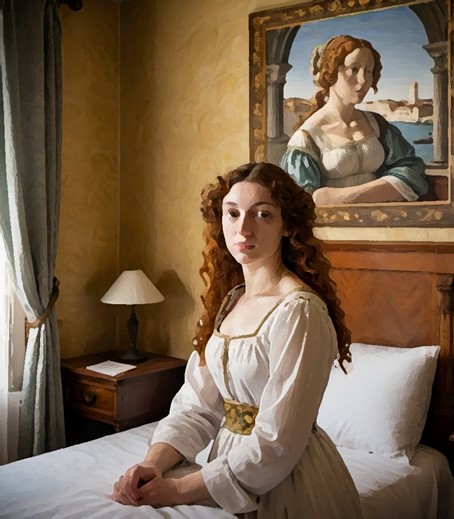
When I Paint My Masterpiece part 14: Un appuntamento con la nipote di Botticelli

When I Paint My Masterpiece (1971) part 14

by Jochen Markhorst

XIV      Un appuntamento con la nipote di Botticelli
 Legendary German band BAP’s contributions to the European canon are of course 1981‘s “Verdamp lang her” and especially 1982’s “Kristallnaach”, but the oeuvre has plenty of candidates at least as strong. The intimate masterpiece “Do kanns zaubere” with its delightful melodies, for instance, or the moving, abrasive “Jupp”, the story of the old alcoholic bum who spends his days on the park bench, with his plastic bag and his mammoth bottle of cheap Lambrusco. He is a great storyteller, old Jupp. He has been everywhere, balanced on the equator, danced with cobras, played poker in Kathmandu, his romance in Beijing with a blonde fairy, how he lived as a Robinson stranded on an island, and Jupp has lived a gold rush. But then the final lines:

Nur vun Stalingrad verzällt e’ nie:
“Wo litt dat, Stalingrad? Enn welchem Land ess dat?”
Stalingrad pack e’ nie, irjendwie

Only Stalingrad he never mentions:
“Where is that, Stalingrad? What country is that in?”
He never gets to Stalingrad, somehow ...

… sung as usual in the Cologne dialect, Kölsch.

Before he got really big with his band BAP, Wolfgang Niedecken sometimes performed solo. With acoustic guitar and harmonica, and not only for that reason he is called the “kölsche Dylan”. Social commitment, moral missionary zeal and fighting spirit he has been demonstrating since the late 60s, and that remains the lifeblood of BAP as well when, in the 80s, the band has long since become a European titan and effortlessly breaks through one million-dollar barrier after another.

Meanwhile, the songwriter never hides that Dylan is his great role model. Demonstrating it on stage with Dylan covers sung in Kölsch, and even more when he presents a monthly radio programme on WDR4 from 2017. In 1995, the Dylan love culminates with the release of a solo album: Leopadenfell. Seventeen Dylan covers, one (“Jeder’s manchmol einsam” – “It’s All Over Now, baby Blue”) even more beautiful than the next (“Nix andres em Kopp” – “License To Kill”).

Superb interpretations, thanks in part to the exceptionally successful translations of the Dylan lyrics – known to be a huge pain point in 99 out of 100 Dylan translations. Niedecken has made his own translations – in Kölsch, of course – and ignored the German standard work Bob Dylan Songtexte 1962-1985 by Carl Weissner and Walter Hartmann. Producing a quality impulse that also permeates “When I Paint My Masterpiece”. Weissner & Hartmann translate as much as possible one-to-one, thereby accepting rigidity. Which is not entirely culpable: on the first page of the monumental work, the translators publish, as a kind of disclaimer, the requirements they had to meet in order to obtain the licence:

“In the license agreement for this German edition, Bob Dylan demands that the rhyme of the original be maintained as much as possible. Operations like these are always problematic. In many cases it is inevitable to deviate from the content of the original. It is clear that the extent to which one may go there is quite debatable. We have tried to keep it within reasonable limits, without doing things by half.”

“Maintain the rhyme of the original as much as possible” … apart from inferring that Dylan has no understanding of foreign languages, the requirement also demonstrates that he values form over content. Consequently, the best translations are those that, like Niedecken’s Kölsch, ignore this weird requirement, and rather try to capture the poetry of the text. Niedecken, for example, understands that the wordplay in Botticelli’s niece evaporates in German (Weissner & Hartmann: Botticellis Nichte), and sings Nix wie heim en ming Hotelbett, wo Botticelli’s Venus waat “Quickly home to my hotel bed, where Botticelli’s Venus is waiting”. Just as he can ignore the awkward Eines Tages wird es sein wie eine Rhapsodie (“one day it’ll be like a rhapsody”) and take the poetic liberty to make of it: Hück Morjen stund ich noch op irjendeiner griechische Bröck (“Just this morning I was still standing on some Greek bridge”) – a griechische Bröck in this second verse that subtly builds a bridge from the spanische Trepp in verse 1 to the Belgian landing in Brussels in verse 3.

Niedecken is one of the few who feels free within the constraints. A journey around the world in 80 languages reveals much translator’s suffering, much laborious toil to build in some kind of coherent narrative and to stay as close to the source as possible, as well as feeble compromises to “maintain the rhyme”.

Swede Mikael Wiehe (“När mitt mästerverk blir klart”, 2007), for example. Minimal liberties. Such as promoting the pretty little girl from Greece to en häftig liten grekisk dam, a cool Greek (or “hot”, depending on the listener’s perceived value of häftig), and Mikael does not sigh that he has happily returned to the land of Coca-Cola, Nej, låt mej få simma i ett hav av Coca Cola, “no, let me swim in a sea of Coca-Cola”. The only other text aberration is the most ferocious. The young girls pulling muscles are given more erotic allure in Sweden: in Brussels, gyttjebrottning drottningar come to say hello – “mud wrestling queens”, in other words. Musically an excellent cover by the way – great organ.


Even less freedom French Dylan fan Pierre Mercy allows himself, translating “Quand je peindrai mon chef-d’œuvre” as literally as possible, even abandoning rhyme and metre. And thus faithfully presents la nièce de Botticelli, the wild geese are un troupeau d’oies sauvages and young girls training their muscles are des jeunes filles bandant leurs muscles. It does not rhyme anywhere, but the content is completely copied. Pierre is even vivement de retour au pays du Coca-Cola.

Identical to the crippling respect with which Neapolitan Michele Murino treats the lyrics for his likeable project Mirino & Maggie’s Farm, an occasional project of talented Italian musicians who fill the 2023 album La Nostra Versione Personale di Te with 14 Dylan covers in Italian. The press release even considers the non-rhyming literal translation a selling point: “Fourteen Bob Dylan tracks interpreted with Italian lyrics, all by Mirino, trying to respect, if not one hundred per cent, at least as closely as possible, più vicino possible, Dylan’s original lyrics.”

And indeed, in Mirino’s “Quando il mio capolavoro (io) dipingerò”, the opening song, the narrator again has un appuntamento con la nipote di Botticelli, the day will be a rhapsody, the wild geese fly, we are happy to be back in the land of Coca-Cola, and we see the Brussels girls che stiravano i muscoli, stretching their muscles. But then again, in Italian everything sounds good, of course.

At the other end of the spectrum are the ambitious show-offs. Translators who are suspected of trying to hitch a ride on Dylan’s name and use the source text as a stepping stone for frustrated literary aspirations. In the Netherlands, the translator duo Bindervoet and Henkes have made a name for themselves with large, in itself very admirable projects like translating such untranslatable monuments as Finnegans Wake, Ulysses, Hamlet, all the Beatles songs and more. A love of James Joyce can lead to professional deformity, it turns out. As with their “Schilder ik mijn meesterwerk”, which is very Joycean laced with alienating archaisms like stervenswee (an extinct word, approximately: “moribund”), abundant, distracting poetic tricks like alliteration and inner rhyme Snoepgrage journalist die sjort en port / Sterke agenten stellen paal en perk (“candy munching journalist lashing and prodding / Strong cops putting limits”) and inexplicable extra layers like Botticelli’s nicht bezoekt me na de kerk (“Botticelli’s niece visits me after church”) – everything has to give way to rhythm, apparently.

Ironically, in their own manifesto on translation studies (“Meta-language Reflection” in Filter, a journal of translation and translation studies, volume 15), the men comment with disdain on translators who miss “that there is more behind the words than the communication alone”. Ironic, as the men then miss virtually every shade behind Dylan’s words – the association Venus under Botticelli’s niece, the homophone muscles/mussels, the charge of Spanish Stairs (with them: “Spaanse Plein – Spanish Plaza”) and through the narrator’s memory rumbles a “stoomtrein – steam train”, suddenly taking us back to the days of Mussolini.

It is, in short, certainly a challenge to do justice to the Holy Trinity, to the indefinable magic of the Poetry-Euphony-Colour trinity of a Dylan text. It’s a long hard climb. But some craftsmen do reach that summit. Not coincidentally men like Wolfgang Niedecken or, as we shall see, Romanian Alexandru Andries and Japanese Haruomi Hosono – successful songwriters who have decades of songwriting experience in their backpacks.

————–

To be continued. Next up When I Paint My Masterpiece part 15: An absolutely personal interpretation

Jochen is a regular reviewer of Dylan’s work on Untold. His books, in English, Dutch and German, are available via Amazon both in paperback and on Kindle:

Posted in Uncategorized | Leave a comment

Once or twice: A satisfied mind


 I don’t know what it means either: an index to the current series appearing on this website.

——————–

Once or twice: A review of some of the songs that Bob has performed just once or twice on stage, selecting those of which we have either a live recording or failing that something of interest to offer Text and video selection by Tony Attwood.

Satisfied Mind appeared on the album “The Bootleg Series Vol. 11: The Basement Tapes Complete”. recorded in 1967, released in 2014.   Aaron also had a look at the song in the Other People’s Songs series.

We covered it in the NET series

The song written by Joe “Red” Hayes and Jack Rhodes. Red Hayes said in an interview that the lines in the song were the things he had heard his mother say across the years.

Bob’s recording in the studio ran like this….

The Basement Tapes complete recording sounded rather different

Posted in Uncategorized | Leave a comment

The Never Ending Tour Extended: The extraordinary journey of I and I


 I don’t know what it means  either: an index to the current series appearing on this website.


The Never Ending Tour Extended: This series primarily uses recordings selected by Mike Johnson in his inestimable masterpiece The Never Ending Tour, and looks at how those performances of individual songs change as time goes by.   The selection of songs from the series, and the commentary below, are by Tony Attwood.   A list of all the songs covered in the series is given at the end.

I and I

I and I was played 204 times by Bob and the band between 1984 and 1999.  And before I offer the earliest recording we have from the Tour (in 1987), I would like (if I may) to remind you of just how the song sounded on the album.

Now if you have taken that in, or indeed if you have a perfect musical memory and you remember that original recording without having any need to remind yourself, have a listen to this, from  first ever article from Mike Johnson’s Never Ending Tour series of articles…

1987 Farewell to all that

It is that introduction that surprised me – the way the guitar is played and the speed change.  This is a really lively, bouncy song, and the way Bob half-sings and half-recites the song from the one minute mark onwards certainly suggests a total rethink of the song.  As indeed does the instrumental work that follows.

And the instrumental section led by the organ just over halfway through also really takes us into a new land.

Plus if that is not enough the constant repeat of a line by the chorus from around 3 minutes 18 seconds on, is something else again.  Come to that so is the prolonged ending!

So what would Bob do after that?

1992: Heading for the promised land

Well, the answer turned out to be something of a retreat after that staggering re-appraisal five years earlier.

There is an almost tired feeling that comes across in the singing. The re-worked instrumental verses certainly do put across a new mood and the percussionist is given a free rein, but everything positive seems to have been lost.   But where this version most certainly does fit musically is that doom-laden final verse.

Noontime, and I'm still pushin' myself along the road, the darkest partInto the narrow lanes, I can't stumble or stay putSomeone else is speakin' with my mouth, but I'm listening only to my heartI've made shoes for everyone, even you, while I still go barefoot

And then we have the long instrumental, where the percussionist has his say.  But for me, what is said is not at the level of that amazing earlier version.

1994: Dancing to the nightingale’s tune

So now jumping forward again, we have an even slower version, with the percussion once more given the freedom to do, well, anything I guess.   For me this is as if Bob is seeing just how depressing he can make the song.

And yes I do understand that there is that line “One said to the other, “No man sees my face and lives””.  But even so…  By now the question is, could the performances get any slower or have and more doom written into them?   Or come to that could the percussionists do anything else?

1998: You won’t regret it

And now having gone as low as possible in terms of the way the meanings are extracted from the song emotionally, we are on the way back.  Not all the way back of course, but still some distance away from the depths.

And having run through these recordings I just find myself still wondering why Bob moved away from that 1987 version.

1999: Inside the museum.

And here we are as the song is ready to be put away for the last time – and what a curious journey this has been.   Just as I adored the very first performance in this selection, so I love this last one.   It is a totally different approach, but the speeding up helps.

Indeed although I haven’t been back to check it really does linger in my mind that this is not the first time that Bob has given up a song after producing a really excellent, insightful and utterly enjoyable performance.

Is that what he does?  Take the song to a new place, and feel “yes, that’s about as far as I can go”? And then (unlike most performers of the genre) admits that is it, and stops?

Well maybe so, but also this time, he seemed to have started at a remarkable new place and wandered backwards and then tried to recapture that first version.  (Which makes me wonder, does Bob have access to recordings of his own earlier shows?)

But of course he’s the boss.  I’m just the guy with the computer keyboard.   But just one last thought – do stay with this 1999 performance to the last note – it is a wonderful farewell.

Other articles in this series…

Posted in Uncategorized | Leave a comment

Bob Dylan: the covers we missed. All I really want to do.


I don’t know what it means either: an index to the current series appearing on this website.

————

For more details on this new series on cover versions of Dylan songs that were not previously considered in the last series, please see the intro to the first article in this series.

This new series is selected and written by by Jürg Lehmann

Ben Sidran

Ben Sidran is an American jazz and rock keyboardist, producer, label owner and music writer.

Sidran is one of those musicians who have done an incredible amount for the reception and promotion of Dylan.

He has released two albums with excellent Dylan covers, a studio album and a live album.


Sussan Deyhim – La Belle et la Bête (2012)

Sussan Deyhim’s cover was originally a part of the Amnesty International release Chimes of Freedom, an album in celebration of Bob Dylan’s 70th Birthday with 70 international artists contributing their interpretations of his songs. Sussan’s version is in collaboration with composer Anton Sanko on Ukulele, Bass synthesist Peter Freeman and produced by Richard Horowitz.

Asked how she arrived at that very particular arrangement of “All I Really Want to Do”, Deyhim said: “I’ve been really involved with human rights organizations for the last 15 years. Amnesty International called me and said they had an idea to get dozens of artists to cover songs by Dylan. It was his 70th birthday, so it was also celebrating that.

“I said I’d do it and it was quite a challenge to choose something that hadn’t been taken by the more well-known artists. Then I ran into “All I Really Want to Do” which had a lot of potential. Dylan sings it with passion, but there’s also an element of anger at the same time. I chose to do it in a very feminine way. I was very self-conscious about it, initially, but my collaborators convinced me it was a really good idea.

“I also thought about doing it in a very punk way, which would have been interesting too. But my friends said let’s do it the other way. I like how it came out, but I wish we had mixed the guitars a little louder and made it more of a literal pop song. But when you’re doing projects like this, you don’t have the luxury of time. You have to deliver quickly and there’s never a budget. It’s labor of love and your choices are influenced by that.

Sussan Deyhim is an Iranian-American composer, singer, performance artist and activist. She is internationally recognised for her unique language of sound and song, imbued with a sense of ritual and the unknown.

She has been a member of the Iranian National Ballet since the age of thirteen and has travelled all over Iran to study with folk musicians and dancers. In 1976, she joined the Béjart Ballet in Europe after receiving a scholarship. In 1980, she moved to New York and began a career spanning music, theatre, dance, media and film.

Deyhim’s contribution to the Amnesty album is a great, very individual cover, and if you’re wondering what language it is at about 3:40 and 4:28: it’s Farsi.

Posted in Uncategorized | Leave a comment

The Lyrics and the Music: Lenny Bruce is Dead

I don’t know what it means either: an index to the current series appearing on this website.    A list of the previous articles in this series appears at the end.

“The Lyrics and the Music” is a series by Tony Attwood which tries to find out what happens when one reviews a Dylan song not primarily as a set of lyrics, but as a piece of music which includes lyrics.   An updated list of previous articles in the series is given at the end.

Lenny Bruce

We only have to look at the opening verse to understand why the music of “Lenny Bruce is dead” is as it is.   Dylan is not offering an opinion, he is absolutely telling us how it is.

Lenny Bruce is dead, but his ghost lives on and onNever did get any Golden Globe AwardNever made it to SynanonHe was an outlaw, that's for sureMore of an outlaw than you ever wereLenny Bruce is gone, but his spirit's livin' on and on

But as we will see from the two musical examples offered below, these lyrics can be interpreted in utterly different ways, while still carrying the same meaning.

The music to accompany these lyrics needs to be clear – it can’t have a range of violins giving an ethereal backing.   But ut can be gentle or it can be solid and pounding musically – which is quite remarkable because this is not how songs about the departed generally are.   They often highlight the good parts in a person’s life, and have a certain gentility, but Bob will have none of that.

But if we move on to the last verse we can see that this is very much a fighting song.

They said that he was sick, 'cause he didn't play by the rulesHe just showed the wise men of his day to be nothing more than foolsThey stamped him, and they labeled him like they do with pants and shirtsHe fought a war on a battlefield where every victory hurtsLenny Bruce was bad, he was the brother that you never had

That line “where every victory hurts” tells us what this is about – but then it is followed by probably one of the most powerful lines in the whole of Bob Dylan’s songwriting: “he was the brother that you never had”.

So let’s turn to the two arrangements of the music…

Maybe in the end the attraction between Bob and Lenny Bruce is to be found in one particular line

He just showed the wise men of his day to be nothing more than fools

And that line can be sung with aggression and anger or with a deep sadness.

But the point about the song, is that even whichever of these two ways it is performed the music still carries the message.  In the original Bob is much more sympathetic far less forceful.  Later he was powerful to the point of aggression in blaming those around Lenny Bruce.

And yet the same basic musical structure works, whatever the arrangement.   And that is a remarkable musical achievement, to make the music work whether it is performed in a sad and regretful manner or making it quite clear that this is our loss.

Personally I prefer the forceful performance above rather than the original version below, but either way the music fits utterly with the lyrics – and that is quite a remarkable achievement.

The songs reviewed from the music plus lyrics viewpoint…

Posted in Uncategorized | Leave a comment

When I Paint My Masterpiece (1971) part 13:  I spent time with Bob. Got two words.


by Jochen Markhorst

XIII       I spent time with Bob. Got two words.

Every Jerry Garcia and Grateful Dead rendition is at least highly enjoyable and usually hypnotic, yet the finest “Greatest Hits version” is made on the other side of the world in Australia: Jeff Lang and Chris Whitley’s 2005 collaborative project Dislocation Blues, a great album that also includes a breathtaking cover of Dylan’s “Changing Of The Guards”. Whitley distinguishes himself often enough with excellent Dylan covers (“Spanish Harlem Incident”, “Fourth Time Around”), if only because of his unique vocals: a husky falsetto and stunning phrasing. Here on “When I Paint My Masterpiece” entwined with the mean, swampy, ZZ Top-like licks of Jeff Lang’s guitar, and above all shining in full glory thanks to the sound, the very sound Dylan is always looking for in the twenty-first century:

“Jimmy Reed is about space. About air being moved around the room. You feel like you can see the light hitting the dust as it swirls under the sway of music.”
(The Philosophy Of Modern Song, 2022)

… the air, the space, “the sound of a guitar in a room where you can hear the air around it,” as Henry Rollins puts it. Like Dylan in, say, “Goodbye Jimmy Reed” and especially in “Crossing The Rubicon”, a quality you achieve if you’re not afraid to leave voids between the notes, but with Whitley & Lang even more spacious thanks to the metallic sound of Whitley’s resonator guitar (Chris was an avid collector of antique Dobros, numerous Nationals and eccentric Regals), and by the placement of the drums with an extremely tightly stretched snare – which by the sound of it are allowed to leak into Whitley’s vocal microphone.

Chris Whitley himself did not live to see the success of Dislocation Blues, unfortunately; he died of lung cancer on 20 November 2005, nine months before the album’s release.

Jeff Lang and Chris Whitley – When I Paint My Masterpiece:

A third and final category of cover variants is the “Lyrics version”, as we may call it for convenience: artists following the official publication of the lyrics, as first published in Writings & Drawings, and later in Lyrics and on the site – but never put on tape like this, neither by Dylan nor by The Band.

Notable in that category is Grateful Dead’s Bob Weir, who always does sing the Coca-Cola bridge when Garcia is not around. To this day, by the way. Take late January 2024, when Weir contributes to a benefit concert in The Masonic in San Francisco for his now 92-year-old, still spry friend Ramblin’ Jack Elliot, and chooses “When I Paint My Masterpiece” for unclear reasons. Wonderful rendition, but at least as much fun is the seven-minute introduction over the opening chords of Masterpiece, with the grey-haired Weir, barefoot, relaxed and funny, recounting the story of his first encounter with Ramblin’ Jack (according to Dylan the “king of folk singers”).

Weir has been playing the song for 50 years now, has performed it perhaps more often than Dylan himself, and – like Dylan – keeps getting better. Opting for a similar set-up as well: upright bass, violin, steel guitar and two guitars. He does however seem to surprise the band with his decision to do the Coca-Cola bridge – breaking the flow, the guitarist and violinist losing it, the steel guitarist hesitating and only the drummer and the bassist pump along unconcernedly. Of course, it cannot spoil the fun, nor take away the admiration for the now 76-year-old Bob Weir, whose voice – bizarrely – seems to age like fine wine.


Still, he must leave the honour for the finest “Lyrics version” to his English colleague Steve Harley. “When I Paint My Masterpiece” is the closing track from 2020’s Uncovered, Harley’s last studio album, recorded five years before his death in 2024. The album is an extraordinary, dignified and unusual swansong: the album contains almost exclusively covers. Charmingly motivated:

“I play guitar for hours most days I’m at home. And I play songs I respect deeply and wish I had written. Some of those songs are included here. Lyrics full of imagery, philosophy and wit abound amongst them.”

Many highlights. A surprising, beautiful rendition of Bowie’s “Absolute Beginners” for example, and an equally surprising, heart-breaking interpretation of Hot Chocolate’s “Emma”. But Masterpiece still stands out above them all. Largely acoustic, folky violin, particularly attractive percussion and – again – an irresistible sound;

“I wanted it to sound like I’m in your living room when you play it through your speakers. The voice is up front and everything around me is as if we were playing in your house. No effects. It’s as organic and natural as a recording could possibly be, I’m really proud of that. My engineer Matt Butler is the man who made it sound so fabulous.”

One cheeky artistic liberty Steve permits himself, at the very end: “Someday, everything is gonna be different – when I write my masterpiece.” But Steve is allowed to do so, as he delighted us with one of the most amusing Dylan anecdotes. After Harley has already mentioned a few times in interviews and stage talk that he once met Dylan, he finally tells the whole story in October 2017, from the stage at Nell’s Jazz and Blues in London:

“I’ve had time with Dylan, I met him. He was very very sweet to me. It’s a long story, I won’t bother you with it. He was very sweet to me. He didn’t say anything for ten minutes. I had to say everything. For ten minutes. And my lips dried up. You know, I ran out of energy. And words. You know, when you meet a hero after 45, 50 years, you’ve got all these things, you accumulated thoughts, words, questions, that you’ve got to have to put to this idol of yours, and you meet this person, and you haven’t got a word to say. It just all goes, it just disappears, through a sieve. And that kind of happened to me, but it was quite good with him. But he didn’t talk back. It’s hard work. It’s like hard work. And when it was over, when he wanted to go, he stood up and shook my hand, and he said four words to me. No wait, it was two words. But he repeated. He stood up, and he took my hand to say goodbye, he said: [growling imitation of Dylan’s voice] ‘The weather, the weather.’ [audience laughter]
[Smiling proudly]: I spent time with Bob. Got two words. It’s good enough for me.”

What Dylan meant by “the weather, the weather” will probably always remain a mystery. That it was a cold dark night on the Spanish Stairs, perhaps.


To be continued. Next up When I Paint My Masterpiece part 14: Un appuntamento con la nipote di Botticelli

————–

Jochen is a regular reviewer of Dylan’s work on Untold. His books, in English, Dutch and German, are available via Amazon both in paperback and on Kindle:


Posted in Uncategorized | Leave a comment

Once or Twice: A satisfied mind


 I don’t know what it means either: an index to the current series appearing on this website.

——————–

Once or twice: A review of some of the songs that Bob has performed just once or twice on stage, selecting those of which we have either a live recording or failing that something of interest to offer Text and video selection by Tony Attwood.

Satisfied Mind appeared on the album “The Bootleg Series Vol. 11: The Basement Tapes Complete”. recorded in 1967, released in 2014.   Aaron also had a look at the song in the Other People’s Songs series.

The song written by Joe “Red” Hayes and Jack Rhodes. Red Hayes said in an interview that the lines in the song were the things he had heard his mother say across the years.

Bob’s recording in the studio ran like this….

The Basement Tapes complete recording sounded rather different

And so onto the one time Bob seems to have performed it on the Never Ending Tour, and fortunately for this series it was included in Mike Johgnson’s series which charts the NET from its origins in 1987 to the present day, with multiple examples of Dylan’s performances through the period in question.  The full index is here.

The one performance was in 1999 and Mike found the recording and included it in part six for that year: Honky Tonk Dylan: Despair and sentimentality.

Posted in Uncategorized | Leave a comment

The Never Ending Tour Extended: Maggies Farm – and a wonderful ending

 I don’t know what it means either: an index to the current series appearing on this website.


The Never Ending Tour Extended: This series primarily uses recordings selected by Mike Johnson in his inestimable masterpiece The Never Ending Tour, and looks at how those performances of individual songs change as time goes by.   The selection of songs from the series, and the commentary below, are by Tony Attwood.   A list of all the songs covered in the series is given at the end.

Without doing any research on the subject, I would place “Maggie’s Farm” as one of the songs of which I couldn’t understand why Bob played it so often.  1051 times between 1965 and 2009.   What made it so special to Bob?  I don’t get to answer that below, but believe me the journey does take us to an unexpected place.

However…. We first picked up on it in 1998 by which time the song was already 30 years old.  And the song now has some exciting lead guitar extemporisation which really fits in neatly between the lines we all know.

But while we marvel at the dexterity of the lead guitarist, spare a thought for the bass guitarist who is for the most part reduced to playing just two notes, although as time goes by he slips in a number of extra notes.

However, to come back to the lead guitar, I wonder how those extemporisations actually happened – especially the full verse instrumental break – as the bass just plods on and on and… Bob gets to the line of “sing while you play” (or is it “sing while they play”).  I’m not exactly bored, but I’m not quite, well, enthused…

1988: The 60s revisited

So let us jump forward a few years, and listening to this opening you might well not get what song it is until Bob starts singing.

And here it is quite remarkable the changes Bob has generated in the song given the limited number of resources there are to play with within the song.  At least the bass player must be a lot happier having so much more freedom.

There is thus a totally different feel to the song – a sort of removal from this world into somewhere else.  The instrumental breaks add to it, and Bob’s vocals really are those of an out-of-world visitor, one totally displaced from this reality.  He isn’t just not working for Maggie; he’s not here at all.

We also have a band introduction part way through the song too, as if Bob himself doesn’t value the piece that much – which is odd given how often he plays it.  And indeed given that this is well over seven minutes long.

1995 The Prague Revelation – down in the flood

So let us jump forward again, this time to 1999.  And once more the feel of the song is completely different.  Still those same lyrics, and those same three chords, but now the lead guitar is much more gentle, and Bob’s voice is almost regretful that he ain’t gonna work there no more.

The instrumental break is different and highly inventive given the limited amount of material there is to play with, and that’s the point, there isn’t much there.  But what we do have, especially in the instrumental break, is something of a jaunty feel.  A sort of lightheartedness that was never there before.  True the “sing while they slave” still has an edge, but not so much of an edge.

1999   Every night in a combustible way.


And now jumping forward again we get another new sound – still with those same lyrics and just those same three chords.   But again the interval between each verse is different.

2004 Rocking on

So I thought, that must be about it.  A song that Bob plays with, but really, doesn’t add that much too.  However I also thought, let’s have just one more – although as ever of course there are many more versions to be found within the Never Ending Tour series on this site.

Thus I jumped from the 2004 to the totally new rhythm we have in 2009.  Now suddenly we have a transformation of the song in every way.   And this is one of those moments (and by no means the only one) that I work my way through the various recordings sometimes wondering if you, my reader, will actually want to go through the recordings, only to find at the end a real revolution.

OK Bob is still constrained by the chords but that adds to the surprise that he really can do something here.   And goodness me he does.   (Indeed have we heard Bob sing the bass line like he does somewhere around 2 minutes 50 at the end of that verse).

Oh yes, this is the recording, as has happened before, the one recording that really makes me think this was so worth the journey.  Thank you Bob.  Forever in your debt.

2009 Rolling the Rock

Other articles in this series…

Posted in Uncategorized | Leave a comment

The lyrics AND the music: If not for you (but at a slower speed)

I don’t know what it means either: an index to the current series appearing on this website.    A list of the previous articles in this series appears at the end.

“The Lyrics and the Music” is a series by Tony Attwood which tries to find out what happens when one reviews a Dylan song not primarily as a set of lyrics, but as a piece of music which includes lyrics.   An updated list of previous articles in the series is given at the end.

“If not for you” was performed by Dylan 89 times between 1992 and 2004.

However although Bob started to perform it as noted above it was written in 1970 or before, as it appeared on New Morning, and in fact was issued as a single the following year.   He also performed with George Harrison

As we know from most reports, it was written for Bob’s wife Sara, and was recorded with George Harrison soon after the break up of the Beatles.

The solo version (the top one above) has for me a feeling of being rushed musically, which may come about because the lyrics are much simpler than those we normally associate with Dylan.  And indeed the song includes rhymes which are generally associated with pop songs, once again rather than with Dylan.

Indeed there is a curious moment in the middle 8 where the lyrics do become slightly more adventurous with “My sky would fall, rain would gather too” – an interesting combination of a metaphor and the everyday, but the section ends with the mundane, “And you know it’s true.”

If not for you
My sky would fall
Rain would gather too
Without your love I’d be nowhere at all
I’d be lost if not for you
And you know it’s true

It is as if Bob really did want to write an ordinary everyday pop song, but his natural ability with words occasionally pokes through.

Indeed, the ending is much more interesting…

If not for you
Winter would have no spring
Couldn’t hear the robin sing
I just wouldn’t have a clue

There would be eternal winter without you, and worse one of the few reliefs from the rain and the cold (the singing of the robin) would be lost through his misery.

But in many ways the delicacy and interest evoked by those final lines are completely lost because of the way the music jogs along at a fair old pace.  Worse, the instruments are all going their own way without any clear musical direction, and eventually seem to be waiting for Bob to start.

And yet it all works because the music, the lryics and the accompaniment have a certain clear simplicity about them.   A contrast or maybe even a contradiction is formed however because Bob’s singing sounds genuine and heartfelt while the music really is bouncing along like a two and a half minute 45rpm hit, and the two sets of emotions generated don’t seem to mix very well.

And indeed the harmonica solos that occur a couple of times appear to be added for no real reason other than the fact that well, it’s Bob, so the producer knowing it is all fairly mundane anyway says “we ought to have some harmonica”.

Whenever I heard this I just wished for a much slower version so that although the everyday world portrayed in the lyrics would still be there. the music would be less boppy.  Soon after getting the album a few of us actually tried playing it this way and found it could become a rather lovely gentle lullaby.

But I guess the record company required a two and three quarter minute pop song complete with fade out, so that is what is produced.

George Harrison did indeed take the approach of slowing it down with his live performance of the song.  What’s more the accompanying counter melody becomes far less prominent and we do finally have a love song that feels like the singer-songwriter actually meant it.

George Harrison also adds a few minor but very welcome variations to the melody.

So in the end we can see it is actually a rather beautiful love song which was in my view spoiled both by the accompaniment and the speed it was taken at.

And indeed I think Bob got the message too, for in the end he seemed to agree.  This version comes from our Never Ending Tour series 2003, part 6: The Ragged Clown

Now that’s more like it.  And again we can see that the lyrics are still the same, but the music can change – and sometimes for the better.  I think Bob overplays the matter in that middle 8, but clearly he’s seen the possibility of enhancing the song by taking the song at a slower pace.

The songs reviewed from the music plus lyrics viewpoint…


Posted in Uncategorized | Leave a comment

When I Paint My Masterpiece (1971) part 12: A Bob Dylan song, for those of you with Google


When I Paint My Masterpiece (1971) part 12

by Jochen Markhorst

XII        A Bob Dylan song, for those of you with Google

“When I Paint My Masterpiece” is among the handful of songs whose cover we get to know earlier than the original. Hardly the lesser songs, by the way. “Tomorrow Is A Long Time” has appeared about 10 times on other people’s records (Ian and Sylvia, Odetta, Judy Collins, Elvis) before we get to hear what Dylan himself does with the song, also on Greatest Hits Vol. II in 1971. Dylan’s own interpretations of Basement songs like “Quinn The Eskimo” (Manfred Mann), “This Wheel’s On Fire” (Judie Driscoll), “You Ain’t Going Nowhere” (The Byrds) and “I Shall Be Released” (Boz Burrell) we don’t hear until years after the premieres either. Or never at all, like, say, “Love Is Just A Four-Letter Word” (Joan Baez) or “Sign Language” (Clapton). And then we have “Seven Days” (Ron Wood), “Blind Willie Mctell” (The Band), “Make You Feel My Love” (Billy Joel)… well alright, it’s more than a handful, but within Dylan’s vast oeuvre still no more than a fraction anyway.

One difference with all those recordings is the side effect, the consequence that most of those songs get confiscated, as it were. “Quinn The Eskimo” is not a Dylan song, it has since long become a Manfred Mann song, and of “Make You Feel My Love” an estimated three-quarters of the audience singing-along with Adele does not even know it is a Dylan song. Which seems to be the case for “Knockin’ On Heaven’s Door” as well, since Guns ‘n’ Roses.

But the status of “When I Paint My Masterpiece” is diffuse – there are about as many music fans who deem it a Band song as fans who consider it a Dylan song. Plus a splinter fraction of Masterpiece fans who think it has become a Grateful Dead song. At least, that can be gathered from the many, many covers of the song. Musically from all corners of the globe, of course. Bluesy, bluegrass, rock, folk and all their mixtures, translated into Japanese, Finnish, German, Romanian and whatnot, but at least textually we can make a three-way split: The Band’s version from Cahoots, the Dylan version from Greatest Hits and the fictional version as chronicled in the official lyrics.

We hear the “Cahoots version” – obviously – on the wonderful 2007 tribute album Endless Highway: The Music of the Band, on which Josh Turner accounts for “When I Paint My Masterpiece”. An impeccable folk-rocking performance with banjo, fiddle and steel guitar for the rustic couleur, though not too adventurous. However, the contribution to the tribute album does demonstrate that the song is considered a Band song by its compilers. Which also seems to be the case with A-listers Emmylou Harris and Blake Mills. Identifiable by the choice for the girl from Greece and the Coca-Cola bridge, rather than Botticelli’s niece and no bridge.

Emmylou’s cover (on the compilation box Portraits, 1996) is gorgeous and rather safe; largely acoustic, not substantially different from The Band. Not surprising – it is a 1993 recording with her own Nash Ramblers, the band featuring highly skilled men like Sam Bush on mandolin and Al Perkins on resonator guitar, guys who have Americana in their blood.

More idiosyncratic and therefore more interesting is the 2015 exercise of the rightly acclaimed Blake Mills, five years before he will put such a brilliant mark on Dylan’s Rough And Rowdy Ways. In a dilapidated side room, alone on a kitchen chair, a guitar amplifier and a microphone, and above all: Dylan’s Stratocaster. The Dylan-goes-electric-guitar from Newport 1965. The 1964 Three-Tone Sunburst Strat he had left behind in a private plane at the time and only found in the attic years later in 2004, by the daughter of the now-deceased pilot Victor Quinto.

Mills knows how to appreciate it. He conjures a magical, supremely elegant and tasteful arrangement of Masterpiece from the antique treasure (the Strat was eventually auctioned for the staggering sum of $965,000), reverently turns the guitar towards himself after the last note and says: “Wow. Awesome. Thank you, guys.” Introducing the clip is a confession of love from die-hard Dylan fan Blake Mills: “To me he is a torch and an example of a lot of bravery”. And at later concerts where Masterpiece is on the setlist he always faithfully mentions that this is a Dylan song (“A Bob Dylan song, for those of you with Google”), though he still sings the Cahoots version of the first verse (with the girl from Greece). Then again, he does not sing the bridge – but sometimes incorporates it instrumentally in the virtuoso guitar interlude between the second and third verse (the live performance at the Greek theatre Los Angeles 2016 is a highlight after the chilling opening with his own brilliant song “If I’m Unworthy”).


Comparable in terms of idiosyncrasy is the most compelling cover of this variety: Elliott Brood, the Canadian band obviously staying true to their compatriots’ version: “We recorded this Dylan cover at Revolution Studios in Toronto. I think some of the words are wrong, but we had a blast doing it. We were referencing The Band’s version anyways.” The three-man band is usually pigeonholed as an “alternative country band”, but this interpretation is steeped in grunge. Thanks to the heavy, lingering fuzz guitar, illuminated by the heavenly harmony of the second and third vocals, and an irresistible harmonica.

The Dylan faction, the artists who got to know and love the song via Greatest Hits Vol. II is about the same size and is led by Jerry Garcia. Masterpiece was on his setlist as early as ‘72: with Merle Saunders on 6 February at Pacific High Studios. Like the Leon Russell version of Greatest Hits without bridge, but remarkably this one time with the pretty little girl from Greece, whom Jerry in February ’72 can only know thanks to The Band. He converts quickly, though. In the many, many solo and Grateful Dead renditions hereafter, then usually sung by Bob Weir, she remains Botticelli’s niece. As do such tribute bands as Dark Star Orchestra and Uncle John’s Band – Grateful Dead tribute bands, so apparently they consider it a Grateful Dead song.

With which, incidentally, Dylan surely would have no problems at all. His love for the Grateful Dead, and Jerry Garcia in particular, is well-documented, and takes on another layer when concert promoter John Scher gives us a behind-the-scenes look on the Bob Lefsetz Podcast in December 2023. He reminisces about Garcia’s funeral in 1995. Scher is on the front page of the San Francisco Chronicle the next day: “Bob Dylan with an unknown person leaving Jerry Garcia’s funeral,” Scher quotes with a laugh. What were you guys talking about, host Bob Lefsetz wants to know.

“What I really remember about it is while we were walking out, Dylan leaned over to me and said, ‘You know what, John?’ I said, ‘What, Bob?’ He said, ‘The guy lying there (referring to Garcia), he’s the only one in the world who knows what it’s like to be me.’ Which was pretty profound.”

Thus Dylan gives, indirectly and posthumously, his blessing to whatever Dylan song has been covered by Jerry. And a quarter of a century after Jerry’s funeral, he is even more outspoken in The Philosophy Of Modern Song, chapter 55. “One thing Jerry knew was his place in the universe,” Dylan says, then bringing Garcia back to the Roman Empire:

“He knew, as the great Roman orator, philosopher, and statesman Cicero did, that there is assuredly nothing dearer to a man than wisdom, and though age takes away all else, it undoubtedly brings us that.”

He did leave some ancient footsteps, Jerry Garcia.

————–

To be continued. Next up When I Paint My Masterpiece part 13: I spent time with Bob. Got two words.

————–

Jochen is a regular reviewer of Dylan’s work on Untold. His books, in English, Dutch and German, are available via Amazon both in paperback and on Kindle:

Posted in Uncategorized | Leave a comment

Once or twice: Sally Sue Brown


 I don’t know what it means either: an index to the current series appearing on this website.

Once or twice: A review of some of the songs that Bob has performed just once or twice on stage, selecting those of which we have either a live recording or failing that something of interest to offer Text and video selection by Tony Attwood.

—————

Sally Sue Brown appeared on Down in the Groove and according to the official Dylan site was performed live twice in April 1992.  It was written by Arthur Alexander, (1940-1993), also known as June Alexander for reasons that will not become clear at this time.  Aaron wrote an article about the song a couple of years ago for the other people’s songs series, and I really enjoyed discovering it then.  And since it fits in here too…

We have a recording from the Seattle performance that year.

As you can hear it is quite a rocker, and it sounds to me like a song Bob could easily have grown into and seriously enjoyed playing, as well as keeping the audience happy, but those two performances were all the song got.

But it did make it onto the album… and complete with a backing female voice

The song was first recorded in July 1960 by June Alexander (real name Arthur Bernard Alexander, Jr), and it is worth a listen.

I am fascinated by this.  Bob chose the song to put on the album, played it twice, and then… nothing.  I mean if it was good enough for the album (which it clearly is) why leave it at just two performances.

But still, this is Bob.

Previously in this series we have looked at

Posted in Uncategorized | Leave a comment

The Never Ending Tour Extended: Lay Lady Lay

 I don’t know what it means either: an index to the current series appearing on this website.


The Never Ending Tour Extended: This series primarily uses recordings selected by Mike Johnson in his inestimable masterpiece The Never Ending Tour, and looks at how those performances of individual songs change as time goes by.   The selection of songs from the series, and the commentary below, are by Tony Attwood.   A list of all the songs covered in the series is given at the end.

———

Lay Lady Lay was played by Dylan for the first time on 31 August 1969 and was finally retired on 27 November 2010 after 407 performances across 41 years.

1993: The epic adventures of Mr Guitar Man

At the time we pick up on the song on the Tour Bob had kept the essence of the accompaniment and the feel of the song but had changed the melody considerably along with his singing style.  Lines are extended, the melody vanishes sometimes or becomes something quite different.   Altogether it gives a sense of relaxation and do-as-you-please, as if the message is everyone can do as she or he wants.  He wants her to stay, but really it is up to her.  He is asking, not begging.

And as happens most of the time the song is extended way beyond its original recording.  That lasted three minutes 19 seconds, this live version is around nine minutes, thanks not least to a very prolonged instrumental break which starts around 3 minutes 50 seconds, and takes us down to almost nothing (suggesting the end of the song) at around 6 minutes 30 seconds, before building up again as Bob uses one of his favourite instrumental techniques of playing the same musical pattern over and over again.   Indeed given the chattering in the background it could be that by around 7 minutes 20 seconds the audience is thinking it is all over.

Indeed by eight minutes 10 seconds we are almost at silence, but there is still a coda to be added and the performance takes its final bow at nine minutes 12 seconds.  Three times as long as the original.  And I wonder, listening now at home without the excitement and enthusiasm of fellow fans around me, if this coda really adds anything to the song.   Perhaps it does but that coda is almost as long as the song, and it feels a little like an indulgence to me.

Such extemporisations are fun to play I know from my own experience, but musically for the audience, I am not sure.

1995: The Prague Revelation and other astonishment 

Two years on, it feels from the opening as if Bob has taken the notion of this song as relaxation to heart, as this feels even slower than before.  Much of the original melody has gone but there is enough of it to remind us (if we needed reminding) that this is indeed “Lay Lady Lay”.   There’s a lot of emphasis on “I LONG to see you,” too, which I had never taken from the original recording – although maybe I just wasn’t listening closely enough.

The instrumental break is shorter and I think that helps – it now has almost become a song in its own right – although then the guitar  (I presume that is Bob) starts to take it in a more energetic direction before the song winds up at five and a half minutes – a considerable retreat from the epic approach of two years earlier.

2001: Down Electric Avenue

And now we have even more of the original melody removed with Bob adopting the style of one reciting a poem.   The length of the performance is back up again – and what is noticeable is that aside from Bob’s own guitar playing (his usual picking out of phrases and notes to be repeated over and over) the accompaniment is pretty much the same as where we started.

Although about the four minute 20 second mark the middle 8 does take on a different form – but this is mostly to contrast with the rest of the song which seems by and large to drift along.

2010: Stay Dylan Stay (part 2)

So the question remains, did “Lay Lady Lay” ever move onto anywhere else?   Well yes and no.  The music was eventually speeded up just a little, and Bob emphasised the gruff voice approach, taking elements from his various earlier outings we have sampled above.

Yet there is something else that is different by the time of this final departure from our collection of recordings made on the Tour.  It is in many ways a summary of the journey rather than the final part of the journey.  Emphasising perhaps that he is not the man he was 40 years before when he wrote it.

But we have the harmonica here once more.  Although the sudden accent of words that are just passing and not of central importance (such as “For”) continues, overall there is a sense of goodbye to an old friend, rather than the transformation that we have seen with other songs.

Indeed if that final harmonica burst says anything, it says goodbye old friend.

Other articles in this series…

Posted in Uncategorized | Leave a comment

Dylan: The lyrics and the music. “Foot of Pride.” There really ain’t no going back.


I don’t know what it means either: an index to the current series appearing on this website.    A list of the previous articles in this series appears at the end.

By Tony Attwood

Foot of Pride is a song of lyrics and atmosphere – it starts out sounding like it is going to be a 12 bar blues playing the chords we would all recognise of the standard blues format (in musical terms that means chords I and IV), but then suddenly it all breaks up with the line “There ain’t no going back”.

Played in B the chorus line has the chords of G#m, E, B, which are perfectly normal if playing in the key of B, just somewhat unusual as a chorus of a blues format song in B (which itself is a very unusual key to choose).

But the music is spooky, and repetitive, and hence mostly we focus on the lyrics – especially in the version above (Spring time in New York).  In fact the song is primarily about the atmosphere created by living in a world where everything is already doomed.   And here we can see (as I believe we often see) Dylan is not primarily about the lyrics, but is equally about the music which creates the atmosphere surrounding the lyrics.

And the point here is that this song is not about melody or chord sequence, but is about the way the music creates an atmosphere.   Indeed I would say that the atmosphere in the recording above is unique in Dylan.   (And I know I can often go wrong in my claims of uniqueness in Dylan but if it isn’t unique, it sure is unusual).   This really is music and atmosphere, atmosphere and music.

Certainly, the melody, although present, often gives way to recitation, and this recording makes me wish that Dylan had taken this notion of music as atmosphere further.  But then I guess you have to be pretty desperate in terms of your vision of the future of the race to be thinking this way.

This last recording is one that I have picked up before and highlighted several times, Lou Reed performing the song live.   I’ve also mentioned before Lou is actually reading the lyrics from the monitor, which is itself interesting.  Why choose a song that for which you have not learned all the lyrics?  Maybe Bob suggested it.  Maybe Lou fully understood the message and agreed with it totally.

So to return to the key point of this series of articles: what about the issue of the music AND the lyrics, which is after all the very heart of this series.

The fact is the music is little beyond the recitation of the lyrics plus the atmosphere created by the way the guitar is played; that is the key issue.  The music here is not about an interesting, or plaintive or memorable melody, it is about the repetition of our foolish, hopeless lives – how for many people life can go on being the same monotonous and tedious repetition of hopelessness over and over again.

And to do that without making any of the versions of this song monotonous and repetitive is a very clever trick to pull off. It works because for me at least the lyrics themselves are absolutely fascinating, just as I find the atmosphere created by the song fascinating.  What Dylan is doing is writing about contemporary life which can be the same dire situations and outcomes over and over again, and that is the antithesis of what most songs are about.

In contrasting this ceaseless beat and guitar accompaniment with lyrics such as

in these times of compassion 
when conformity's in fashion
Say one more stupid thing to me 
before the final nail is driven in.

he forces anyone who cares to think about the feeling that the music presents.  As a result anyone who can listen to the lyrics has to hear the music and hence is pushed toward understanding the thought that we are all being slaughtered by the tedious humdrum existence of working life and TV, that so many people are forced to take.

That line, “Conformity’s in fashion” is one of the keys to the song: we no longer value the new, the unexpected, the different, everything now has to be the same, which is what that pounding unending guitar accompaniment says.   And worse, “There ain’t no going back”.  We have created this and we are stuck with it.

In fact the lines are telling us our lives are now meaningless because life is just a repetition.  Consider

If you don't mind sleepin' 
with your head face down in a grave.

and remember the music at the same time.

Being an atheist myself (something that makes me virtually an outcast in today’s world – or at least I can feel like that in today’s Britain) I also appreciate what this song says about religions in general – for Dylan in this song is being quite clear that religion is part of the problem, and not in any way the solution.

They like to take all this money from sin, 
build big universities to study in
Sing "Amazing Grace" all the way to the Swiss banks

And all the while the music goes on and on the same, verse upon verse, ramming home the message that there is no way out for their ain’t no going back.

Of course such a powerful song needs a powerful ending and it has to come from the lyrics because the song itself is not going to, and indeed cannot, change.  So we get the ending…

Ain't nothin' left here, partner, 
just the dust of a plague that has left this whole town afraid
From now on, this'll be where you're from
Let the dead bury the dead. Your time will come
Let hot iron blow as you raise the shade
Well, there ain't no goin' back 
when your foot of pride come down
Ain't no goin' back

If you are going to write a song in which the last verse ends “Let the hot iron blow as you raise the shade” you really need music that is forcing itself deep into the audience’s mindset so that they ultimately feel the message: this world is screwed, there is no way out, there ain’t no going back” and we certainly get this.

No other music could fit this message.  Dylan, the extraordinary composer, once again has met Dylan the extraordinary poet.   And as so often we need both lyrics and music to make it work.

The songs reviewed from the music plus lyrics viewpoint…

Posted in Uncategorized | Leave a comment

When I Paint My Masterpiece part 11:  I go back to Stephen Foster

When I Paint My Masterpiece (1971) part 11

by Jochen Markhorst

Links to all the previous articles in this series can be found at the foot of this article.

XI         I go back to Stephen Foster

I left Rome and I pulled into Brussels 
On a plane ride so bumpy that it made me ill
Clergymen in uniform, young girls pullin' muscles
Everyone was there to meet me comin' down the hill
Newspapermen eating candy
Had to be held down by big police.
Someday, everything is gonna be beautiful
When I paint my masterpiece.

“Everyone was there to greet me when I stepped inside,” it becomes in the piano demo version of Day Four, replacing the indeed somewhat illogical Everyone was there but nobody tried to hide in the primal version, the Leon Russell version of Day One in 1971. The improved version is sung by Levon Helm on Cahoots as well, and the friendlier “greet-version” is thus also typed by the girls upstairs for Writings & Drawings. On New Year’s Eve 1971, Dylan may then sing “Everyone was there to meet me when I stepped inside,” and in the decades that follow, at most slightly different variants (“Anyone was there to meet me”, for example – Utica 1991), but the thrust remains in place for almost half a century, and it is not until 2018, until the start of the Far East & Down Under Tour in Seoul, that the verse gets its current, Messianic twist:

Everyone was there to meet me comin' down the hill

… a loaded line with semi-official status since the release of Shadow Kingdom in 2023. Loaded, because we usually associate comin’ down the hill with prophets or divine messenger boys who have raised their antennae atop the hill and are now coming down with Commandments or prophecies or admonitions or whatever. Fitting with Dylan’s own wondrous song analysis in the New York Times, “something that is so supreme and first rate that you could never come back down from the mountain”, which without too much neck-breaking acrobatics can also fit in with the song’s theme, the theme that has been continuously developed and refined for 50 years: “receiving divine inspiration”, something like that.

The words themselves don’t have to be made up by Dylan. “I go back to Stephen Foster,” Dylan reveals to Robert Hilburn in 2003, and we see this confirmed often enough. “Hard Times Come Again No More”, “Nelly Bly”, “My Old Kentucky Home”… Dylan has been incorporating or covering songs of “the father of American music” for decades, and an echo from Foster’s all-time greatest hit “Oh! Susanna” from 1848 now invades yet another revision of “When I Paint My Masterpiece”:

I had a dream the other night when everything was still
I thought I saw Susanna a-coming down the hill
The buckwheat cake was in her mouth
The tear was in her eye
Says I, I'm coming from the south
Susanna, don't you cry


… Susanna who is likewise coming down the hill, that is. Slightly too generic to be promoted to “Stephen Foster reference”, but still the most likely source for this particular word combination; Dylan has been explicitly honouring Foster for decades, culminating in a Foster chapter in The Philosophy Of Modern Song in 2022 (chapter 24, “Nelly Was A Lady”), and apart from Stephen Foster’s “Hard Times”, he also plays this “Oh! Susanna” (in 1983, in the studio with Mark Knopfler, or – weirdly – opening the Amsterdam concert 2022 with a few instrumental lines from the song). And Susanna seems to be sung at family parties as well, as we can infer from the amusing anecdote Dylan tells Jeff Slate in the Wall Street Journal interview in 2022:

“Another time, one of the others [granddaughters] asked me if I wrote the song “Oh, Susanna”. I don’t know how she heard the song, or when, or what her relationship to it is, but she knows it and can sing it. She probably heard it on Spotify.”

With a comparable established word combination, conscious or not, Dylan ends his demonstration for Leon Russell. The closing lines, “Newspapermen eating candy / Had to be held down by big police”, are remarkably steadfast – they are among the rare words that have been maintained since Day One. No guarantee for eternity, of course – Dylan’s many lyrics changes, over the course of half a century, follow a more or less gradual pattern from verse 1 (“rubble” is occasionally replaced by “trouble”) to verse 22. So these verse lines 23 and 24 could theoretically be the next candidates for the next lyrics intervention. But it is 2024 now, Dylan has sung these lines more than 400 times… they seem, like the ancient footsteps, ingrained and irremovable. Well, they just might have a chance to survive, anyway.

The snacking reporters are presumably a personal, biographical observation from a press conference or something. At least, the image is too specific – and too inane – to be suspected of depth or metaphorical quality. More history has the authority that keeps the journalistic sweet teeth behind the barricades: the big police.

This peculiar word combination is now more than a hundred years old and no doubt Dylan picked it up from the blues canon. Or from antique bluegrass perhaps, that is possible too – we hear it, for instance, in the “Policeman” version by the phenomenon Kenny Hall, the blind bluegrass musician from California who plays the song most of his life;

Big police sittin’ on a log this mornin’
Big police sittin’ on a log 
Finger on the trigger and eye on the hog this mornin’

… a song already in the repertoire of young Bascom Lamar Lunsford in the 19th century, presumably already hummed by Stephen Foster and, like “Tell Ol’ Bill” and “Sugar Babe”, one of the variations of the songs that evolved from “This Evening So Soon”. And which in turn seeps into songs like “Old Salty Dog Blues” from the Stanley Brothers and Ramblin’ Jack Elliott’s “Talking Blues (Talking New York)”. Songs and artists Dylan admires and songs we find on Dylan records, so it is not too far-fetched. On the contrary, actually; “This Evening So Soon” was recorded by Dylan a year before “When I Paint My Masterpiece” during the Self Portrait sessions and should still be somewhere at the front of his working memory in March ‘71.

Still, big police is more common in the blues. Even in common conversational jargon, as we can glean from interviews in which Muddy Waters talks about his younger days in Clarksdale: “Twelve o’clock, you better be out of there, get off the streets. The great big police come down Sunflower Street with that big cap on, man, waving that stick…” Michael Gray, the author of Song And Dance Man – The Art Of Bob Dylan, finds the phrase in obscure blues songs from 1928 (in Curly Weaver’s “Sweet Petunia” and in Mimmie Wallace’s “Dirty Butter”), but Dylan may have heard it more recently with the greatness for whom he has expressed his admiration often enough, on Big Mama Thornton’s 1969 go-to album Stronger Than Dirt. An album with nothing but beauty and power, with reinterpretations of her own “Hound Dog” and “Ball And Chain”, with superior performances of “Born Under A Bad Sign”, “Lucky Old Sun”, Muddy Waters’ “Rolling Stone” and “Let’s Go Get Stoned”, with a most heartbreaking “Summertime” and the wonderful Dylan surprise “I Shall Be Released” as the bouncer. And in between, Dylan may have pricked up his ears at the odd duck out, at Big Mama’s reconstruction of the soul stomp “Funky Broadway”;

A big police walked in
He said looka hear you people make too much noise
I’ll just have to run you in
So he took us all to jail
Didn’t no one come and pay my bail


Perhaps. Anyway: for some reason, the distich “Newspapermen eating candy / Had to be held down by big police” has survived Dylan’s innovation drive for over fifty years now. On the other hand: a system, a vague pattern of rewriting seems to be discernible. Gradually from the first stanza to the second stanza and then via the bridge to this final couplet, with the last victims being the lines just before the newspapermen and big police. Which would mean that these lines too will perish after all – at this pace sometime before 2035.

To be continued. Next up When I Paint My Masterpiece part 12: A Bob Dylan song, for those of you with Google

Jochen is a regular reviewer of Dylan’s work on Untold. His books, in English, Dutch and German, are available via Amazon both in paperback and on Kindle:

Posted in Uncategorized | Leave a comment

Once or Twice: Restless Farewell. The “lost” recordings and two of Bob’s magical moments

 I don’t know what it means either: an index to the current series appearing on this website.

Once or twice: A review of some of the songs that Bob has performed just once or twice on stage, selecting those of which we have a genuine recording (and “genuine” is important here since I have found a few sites that seem to suggest they are a recording of a live version, but I have my doubts.)  Text and video selection by Tony Attwood.

—————

When I came up with the idea of “Once or Twice” as a possible series for Untold, this was one of the songs I had in mind.  I did a quick check to ensure that this was a song that would qualify in the “Once or Twice” category by looking at the official Dylan site, and that was that.

So it has been on my list to cover – except now coming to write the piece I find a problem.  For although official Dylan site does indeed still have this song performed twice, I am not sure that is quite right.  But the official site being wrong?  Well whoever would have thought that?   (Actually most of us because we’ve found all sorts of errors there, but still, it is a helpful resource even if not always 100% right).

So let’s just see what we have got…   Certainly we have a 1964 version here… which may well be the one recorded on February 1, 1964, at CBC TV Studios in Toronto, Ontario, Canada, for the show “Quest”.  So perhaps we should discount this one as it is not live in the normal sense of being in front of an audience.  And this is not included in the official site’s listing.


But to link in with the official site what we also have is this one which is labelled 17 May 1964 – played in a different key from the one above.  So this would be the first one of the official site’s count of “two”.


What you will notice in these two early recordings is that Dylan is playing a chordal accompaniment which seems to have no direct relationship with the rhythm of the melody.  I have always been puzzled by this, and my only thought is that the chordal accompaniment symbolises the moving on, in contrast to the lyrics and melodic line which symbolise the stability of the past.   Maybe, maybe not, but musically I am not sure it works well.   Which is why I much prefer the versions that came later.

And these are so wonderful I can but despair at the fact that there were only two of them.  But that’s what we have so let us consider…

Thus we are now looking for the 21 May 1998 performance – and yes there is one

So yes we have covered the two from the official site, and have one more which maybe isn’t that “live” in front of an audience.

But still that is not it, and you will probably know already why not.   For below is a beautiful version of this gorgeous song performed in 1995 for the Frank Sinatra concert.

So I think we have three live versions and one that wouldn’t normally be called “live” as it has all the attributes of a studio recording.

Still that is 50% up on the official site.  I wonder if we should let them know?   But no, I’m sure they wouldn’t want to give us credit.  And if they did update their listing from two to three performances, then the song wouldn’t qualify for this series!

Previously in this series we have looked at 

Posted in Uncategorized | Leave a comment

Great Dylan years: 1994 part 2


I don’t know what it means either: an index to the current series appearing on this website.

Great Dylan Years: 1994. Part 1. Performances of “Masters of War” to “Dignity”

by Robert Ford

I believe 1994 was a turning point for Dylan. As with 2014 when he recorded the classic Shadows in the Night album and his voice suddenly transformed, I feel the Great Musical Experience in Nara had a similar dramatic impact on his vocal performance.  It’s another reason the Unplugged concerts exceed the Supper Club concerts in 1993.

I have always believed that Dylan’s voice, (or should that be, voices?) is his most wonderful gift, together with the unique way he uses his voice, as with his phrasing, articulation and subtlety. His vocal performance is as important, if not more important, than his poetic lyrics or his beautiful melodies.

Prior to going to Nara in May, Dylan decided to take his NET band into the Ardent Studios in Memphis where he recorded a great ‘My Blue Eyed Jane’ for his own tribute album to Jimmie Rodgers and a lovely ‘Boogie Woogie Country Girl’ as a tribute to Doc Pomus.

Bob Dylan loves and respects musical history.  He also performed one of his favourite songs ‘ Tomorrow Night’ on the The  Rhythm, Country & Blues Concert in Los Angeles on the 23rd March 1994. He had covered this song on his brilliant Good As I Been To You covers album in 1992 and had been performing the song since 1993 in concert including, of course, his 1994 concerts around the world.

There was another studio session in September when Dylan went into Sony Music studio’s in New York and recorded ‘Anyway You Want Me’, ‘Lawdy Miss Clawdy’ and ‘Money Honey’. There was some speculation that they were for some kind of Elvis tribute album.

It is common knowledge that Bob Dylan is a great admirer of Elvis Presley and was truly devastated when Elvis died in 1977. Dylan has, of course, performed and recorded Elvis songs over a long period, for example, ‘A Fool Such As I’ at the Nashville studio sessions in 1969 and ‘Can’t Help Falling in Love’  at the studio sessions in New York in 1970 ( both songs were included on the rogue Dylan album released in 1973 ) and playing live versions of ‘Money Honey’ in 1999, ‘Heartbreak Hotel’ in 2009 and ‘Blueberry Hill’ in 2014.

It would be wrong not to give credit to Dylan’s band during 1994. This group of musicians had been on the road with him since February 1993 and were now used to Dylan’s idiosyncratic and daring performance methods. He knew he could change 10 songs at a whim or play the song as the mood takes him and this band could rise to the challenge.

I do not know how many different songs he performed in 1994. Maybe 70? 100? However, it is easy to see and hear that this band loved the ride. I believe that special mention must be given to the great guitarist John Jackson who was in the band for several years and was one of the all-time finest musicians to play with Bob Dylan. This NET band were the 9th Never Ending Tour Band and performed 358 concerts ending on the 4th August 1996 at The House Of Blues, Atlanta, Georgia.

This year was also a prime year for lovers of Dylan’s harmonica playing. I feel that his harmonica playing enhances most of the songs he chooses to embellish whether they are acoustic songs performed solo or with his band, or whether they are electric songs.

There were too many great performances to mention them all, luckily for us many are available to listen to on bootlegs,etc. ‘Mama,You’ve Been On MY Mind’ , ‘Disease Of Conceit’ and ‘Lay Lady Lay’ are among the songs graced with the harmonica.

A closer look at the range of songs performed this year suggests to me that Dylan performed songs from virtually all of his, up to that point, 29 studio albums . From Bob Dylan to World Gone Wrong only missing out the rogue Dylan, Self Portrait and Knocked Out Loaded. Typically, he performed one song from the 1992 lost Bromberg album the quite gorgeous ‘Lady Came From Baltimore’.  Who else could or would do this ?

It has been 16 months since the last official Bootleg series and I believe 1994 would make a terrific version of the series. The box set could comprise the Great Musical Experience, Woodstock 2 and the complete Unplugged songs with all the outtakes together with a selection of great live songs such as the Hiroshima ‘Masters of War’ and the songs plus outtakes from the previously mentioned tribute albums (The Supper Club and Bromberg sessions would be a great bonus or make a superb stand alone series ). These performances would be as great a gift as the complete 1976 Fort Collins concert which was the basis for arguably his greatest official live album Hard Rain.

The first published book of Dylan’s drawings ‘Drawn Blank’ appeared in 1994 to acclaim and was the beginning of his ongoing success as a visual artist. However, his major work was undertaken on stages around the world with his performances of a myriad of incomparable songs delivered with remarkable power and passion. There are many other great years (and decades ) prior to and beyond 1994.

But 1994 is one of the most significant years in Dylan’s performing history.

Robert Ford

Posted in Uncategorized | Leave a comment

Covers We Missed 5: All I really want to do.


I don’t know what it means either: an index to the current series appearing on this website.

For more details on this new series on cover versions of Dylan songs that were not previously considered in the last series, please see the intro to the first article in this series.

———

by Jürg Lehmann

All I Really Want to Do

Two covers that I would like to recommend: Sussan Deyhim and Ben Sidran.

Sussan Deyhim’s cover was originally as part of the Amnesty International release Chimes of Freedom, an album in celebration of Bob Dylan’s 70th Birthday with 70 international artists contributing their interpretations of his songs.

Sussan’s version is in collaboration with composer Anton Sanko on Ukulele, Bass synthesist Peter Freeman and produced by Richard Horowitz.  Asked how she arrived at that very particular arrangement of “All I Really Want to Do”, Deyhim said, 

“I’ve been really involved with human rights organizations for the last 15 years. Amnesty International called me and said they had an idea to get dozens of artists to cover songs by Dylan. It was his 70th birthday, so it was also celebrating that. I said I’d do it and it was quite a challenge to choose something that hadn’t been taken by the more well-known artists.

“Then I ran into “All I Really Want to Do” which had a lot of potential. Dylan sings it with passion, but there’s also an element of anger at the same time. I chose to do it in a very feminine way. I was very self-conscious about it initially but my collaborators convinced me it was a really good idea.

“I also thought about doing it in a very punk way, which would have been interesting too. But my friends said let’s do it the other way. I like how it came out, but I wish we had mixed the guitars a little louder and made it more of a literal pop song. But when you’re doing projects like this, you don’t have the luxury of time. You have to deliver quickly and there’s never a budget. It’s labor of love and your choices are influenced by that.”

I’m glad she did it the way it came out

A great, very individual cover, and if you’re wondering what language it is at about 3:40 and 4:28: it’s Farsi.

Sussan Deyhim is an Iranian-American composer, singer, performance artist and activist. She is internationally recognised for her unique language of sound and song, imbued with a sense of ritual and the unknown. She has been a member of the Iranian National Ballet since the age of thirteen and has travelled all over Iran to study with folk musicians and dancers. In 1976, she joined the Béjart Ballet in Europe after receiving a scholarship. In 1980, she moved to New York and began a career spanning music, theatre, dance, media and film.

Ben Sidran is an American jazz and rock keyboardist, producer, label owner and music writer. He is one of those musicians who have done an incredible amount for the reception and promotion of Dylan – in his case, especially in the field of jazz. Sidran has released two albums with Dylan covers, a studio album and a live album. On the occasion of a live concert in Paris, Sidran explains why and how he got involved with Dylan:

Ben Sidran will also be featured later in this series with excellent covers. Here is All I Really Want to Do:


Posted in Uncategorized | Leave a comment

Hard Rain in concert: 1988 to 1999


 I don’t know what it means either: an index to the current series appearing on this website.


The Never Ending Tour Extended: This series primarily uses recordings selected by Mike Johnson in his inestimable masterpiece The Never Ending Tour, and looks at how those performances of individual songs change as time goes by.   The selection of songs from the series, and the commentary below, are by Tony Attwood.   A list of all the songs covered in the series is given at the end.

A Hard Rain’s a gonna Fall, comes of course from Freewheelin, and was performed live 457 times by Dylan according to the official site, starting in 1962 and concluding in 2017.

1988

We first hear it in the Never Ending Tour series in 1988: The Sixties Revisited.  The recording level is low but the quality of Dylan’s singing is excellently picked up.   There is an extra emphasis that he is adding to the first of each set of the three beats that is the fundamental of the song (technically it is in 6/8 time).   The implication is that 26 years after the song was composed, still no one is listening, no matter how often the message is put across.

There is also a strange effect of singing off the key in the “who did you meet” verse – which Dylan does all the way through that verse – along with a similar effect in the following chorus.  There are elements of the same off-key singing in the next verse too; I’m not sure why, as I don’t find it very attractive, but of course that’s just me.

But that is not all.  We get a chorus change around the 6’30” mark which is followed by an instrumental verse which rounds the performance off.

Songs of love, songs of betrayal takes us to 1990, and the performance now is much more strident both in terms of the guitar playing and the singing, and Dylan once more uses his voice to hold our attention through the ceaselessly repeated musical lines, but with the chorus more spaced out.

This time it seems that there is no pleading at all, but a strident announcement of what has been seen and what is to come.  (Just listening to the “starve” and “laughing” lines).  And subsequently, we get some lines where the first note (oft-repeated) is constantly off-pitch.  And now sometimes so is “It’s a hard”.  It is a strong way of reminding the audience that there is a message here, not just a song everyone wants Dylan to perform.

And around the 6 minutes 20-second mark there is that extension of the chorus that announces that we are going to get the instrumental verse

1992 

We are now at the 30th anniversary of the song and we now have a gentle percussion behind Dylan and the guitars.  The melody changes too, and very effectively it seems to me after the two-minute mark.  Indeed this is quite a considerable re-working while keeping the original essence of the song, although I get the feeling that Bob just can’t quite find what he wants to do with a song he’s been performing for far longer than the lifetime of the average rock music band.

The reworking of the melody in the latter part of the song is in my view more successful than previous attempts, and I feel there is a battle going on between the fact that everyone in the audience wants to hear the song while Bob was wondering what more he can do with it.  There is however a very enjoyable if short musical epilogue.

 The epic adventures of Mr Guitar Man

By 1999 Bob had done pretty much everything he could without actually re-writing the whole piece, and of course by now every single member of the audience will know the song forward, backward and inside out.

Bob’s response is interesting, for here he strips the song back as far as he can to its plaintive essence, without actually just standing there with an acoustic guitar and no other accompanying instruments.

And this recognises that really, to keep the meaning of the song, it has to be a much more gentle piece than it had become in recent years.

Here we can hear almost whole verses sung on one note, before the soaring chorus.  Indeed if you listen to the verse starting around 4 minutes 20 seconds, it is hard to think of more delicate performances than this.  Bob is doing nothing in such verses to distract from the power of the lyrics.

The instrumental break too is now stripped back, so that we have no escape from the message, which is what the song is, in essence.  A delicate plaintive message of farewell to all we have known.   For me the instrumental verse at the end is not one of the most successful of moments, but overall this is superb.

And this is one of those performances where yet again I am so grateful to the people who made these recordings and of course to Mike for curating them for us to be able to enjoy and appreciate all these years later.

Acoustic wonderland

Other articles in this series…

Posted in Uncategorized | Leave a comment

The lyrics and the music: Beyond here lies nothing


I don’t know what it means either: an index to the current series appearing on this website.

By Tony Attwood

———

Beyond here lies nothing is a 12-bar blues which is written in such a way that at first we don’t actually realise it is a 12-bar blues.   Indeed the first key element that takes us away from seeing and feeling this as the structure is the fact that the second line is not a repeat of the first.

But at the same time one begins to feel there is something else that is different – and it there is because this is a 12-bar blues in the minor key.  The chords are Am, Dm7, Am, Em, Dm, Am.  It is a blues in the minor key – and yet with very positive lyrics.  A contradiction.

However, the melody is so strong in this song (as opposed to many 12 bar blues where it is added as an afterthought), that this, combined with the minor chords, means we don’t really focus on the 12-bar blues construction.

Nevertheless, the music is strophic – that is it is repeated verse after after verse with no variations except for the instrumental break, which in fact musically continues the same construction.  Indeed the fact that the first line of the music on the album version, is just one note, as is the third line, still doesn’t make us think “12 bar blues”.

What I feel, through this repeated line of music on one note, which comes twice, is the dullness and repetition of life – as portrayed in the original video (which I have put on this site with my original review but I really, really don’t like) – when there is no way out.  Yet the lyrics offer a contradiction suggesting life is repetitive but when we are together it doesn’t matter.

That in short is the meaning I take from this: there is just the two of us and we make each other happy, and that’s good because really the rest of life is just dull and boring.  In essence, outside of the two of us, there is just tedium.

But what is curious is the violence of the official video (which is on this site with my original review, but I really don’t want to put it up again) which seems to have nothing at all to do with the music.

The song opens

Oh, well, I love you, pretty babyYou're the only love I've ever knownJust as long as you stay with meThe whole world is my throne

Beyond here lies nothin'Nothin' we can call our own

Thus “beyond here” actually stands for “beyond you and me together as a loving couple”.  And in that regard the song clearly works.

But I do find it hard to get that original video out of my mind, and I wonder if Dylan actually gave the ok for that, or whether making the video to go with a song is totally in the hands of the company that makes them.

However still trying to get that video out of my head what we have is a song with a regular beat, the simplest of chordal structures, a simple melody, and a lilting feel to it, which basically says the relationship with the woman is everything, it is wonderful and nothing else matters.

That is what the lyrics say, and that is what the music says.  It lilts along, it is gentle and it fits the music.  We also know that it wasn’t always like this, but now everything is calm. It is true that…

Beyond here lies nothin'But the mountains of the past

…is rather enigmatic, suggesting that all we are going to do is replay what has gone before – which could well have been the trigger for the video I mentioned above.  We have climbed mountains, but now all that is gone.

And indeed the music makes its lilting way along suggesting everything is running smoothly and without change.

Indeed the verse leading up to the “mountains of the past” line suggests this very strongly

Down every street there's a windowAnd every window's made of glassWe'll keep on lovin', pretty babyFor as long as love will last

Musically, we have the same.  Verse after verse, with four new lines and a repeated title line and then a final variant line.  Nothing changes.

So, to summarise,  and again leaving aside the violent video, this is a gentle lilting song where the unchanging 12 bar format and melodic line fits exactly with the notion of life just going on and on – this time in a happy way, with no thoughts that anything will change.

It is the promotional video that says exactly the opposite, which is really weird because the music and the lyrics are united in projecting the image of a couple, happy together, going on, not changing.

Thus it’s the video maker who is utterly out of tune with the piece.  The music and the lyrics travel in exactly the same direction.

The songs reviewed from the music plus lyrics viewpoint…

Posted in Uncategorized | Leave a comment

Covers we missed 4: All along the Watchtower


I don’t know what it means either: an index to the current series appearing on this website.

For more details on this new series on cover versions of Dylan songs that were not previously considered in the last series, please see the intro to the first article in this series.

———

by Jürg Lehmann

I would like to point out two covers that are a bit out of the ordinary: One is the interpretation by Lisa Gerrard

The second (which appears below) is a recording of the performance “Teaterkoncert” with Bjørn Fjæstad, Claus Hempler, Ole Thestrup and Ulla Henningsen

Lisa Gerrard is an award-winning singer, composer, and instrumentalist from Australia who rose to fame as a member of Dead Can Dance during the 1980s, and has remained an in-demand collaborator and soundtrack composer throughout. One of the most otherworldly vocalists of her time, she sings in the dramatic contralto and mezzo-soprano ranges, often in a self-created language.

As with Dead Can Dance‘s work, Gerrard’s own music is virtually unclassifiable, incorporating folk melodies, traditional instruments, electronics, and orchestral arrangements. Among other instruments, she is particularly skilled at playing the yangqin, a Chinese hammered dulcimer.

After releasing several albums as part of Dead Can Dance throughout the ’80s and early ’90s, she made her solo debut in 1995 with the full-length The Mirror Pool. By the early 2000s, she’d established herself as a notable film composer; her score for the 2000 film Gladiator, in collaboration with Hans Zimmer, won a Golden Globe and her original score for 2009’s Balibo which received an Aria award.

Gerrard has worked on dozens of film and television scores such as A Thousand Roads (2005), Burning Man (2011), Samsara (2014), and Valley Of Shadows (2018) and released several more solo albums including 2009’s The Black Opal, and 2014’s Twilight Kingdom. She has engaged in numerous recorded and live collaborations with Pieter BourkePatrick CassidyKlaus Schulze, Le Mystère Des Voix Bulgares, among many others.

In 2021, she and composer Jules Maxwell (Dead Can Dance‘s keyboardist) released the collaborative album Burn.  Maxwell is an Australian musician, singer and composer who rose to prominence as part of the music group Dead Can Dance with music partner Brendan Perry. In addition to singing, she is an instrumentalist for much of her work.

Gerrard sings many of her songs in idioglossia [that is to say a private language understood only by one or two people]. With respect to such work she has said, “I sing in the language of the Heart. It’s an invented language that I’ve had for a very long time. I believe I started singing in it when I was about 12; roughly that time. And I believed that I was speaking to God when I sang in that language.”

Lisa Gerrard’s music is not exactly what I usually listen to and I haven’t gone through all her albums, but it seems that All Along the Watchtower is one of the very few songs that she sings not in idioglossia but with conventional, original lyrics. Of course, one would like to know why she chose this song of all songs. Unfortunately, in the numerous interviews with Gerrard, as far as I can see, nobody has asked this question.


Teaterkoncert Bob Dylan was the third and final part of Nikolaj Cederholm and Jens Hellemann’s theatre concert trilogy performed in Aarhus Teater, Denmark, in 2010 (part 1 was The Beatles, part 2 Beach Boys). You can get an impression of the Teaterkoncert show in this video featuring ‘Maggie’s Farm’, ‘Quinn the Eskimo’ and ‘Like a Rolling Stone`:

The cast in the show were Ole Thestup, Ulla Henningsen, Claus Hempler, Bjørb Fjæstad, Liv Lykke, Ashok Peter Pramanik and Jacob Madsen Kvols.

The self-description of Aarhus Teater said back then: Here’s the theatre concert for everyone who loves Bob Dylan – and for everyone who thought they didn’t. We have selected thirty songs out of more than six hundred. We’ve staged and reinterpreted them, we’ve given them new clothes and lifted them into the air. Theatre Concert Bob Dylan is a colourful, poetic, funny and wildly imaginative trip into Dylan’s universe. Each song has been given a brand new arrangement, which at the same time fully proves both the eternal quality that the songs contain.

I’m not sure if I personally would have liked the theatre performance very much, but one result of the show was a double CD with around 30 songs, including some remarkable, sometimes even excellent covers (for example Mighty Quinn….

And also Lay, Lady, Lay https://www.youtube.com/watch?v=WflNq3Am298.

I also like All Along the Watchtower https://www.youtube.com/watch?v=fTtw-2Nxdsk.

Powerful and mysterious, with a biblical quote (around 1:40) from Genesis 6:5 (‘The Lord saw how great the wickedness of the human race had become on the earth’ etc.), which is perhaps very irritating at first, but somehow not absurd and makes perfect sense – if you choose to interpret the song freely.

The covers we missed

Posted in Uncategorized | Leave a comment