The lyrics and the music: Simple Twist of Fate


An index to the current series appearing on this website appears on the home page.    A list of the previous articles in this series appears at the end.

———-

“The Lyrics and the Music” (or sometimes “the music and the lyrics) is a series by Tony Attwood which tries to find out what happens when one reviews a Dylan song not primarily as a set of lyrics, but as a piece of music which includes lyrics.   An updated list of previous articles in the series is given at the end.

Back in August 2016 Jochen, commenting on “Simple Twist of Fate” noted that, ‘Just like her big sister, “Tangled Up In Blue”, Simple Twist is not only ambiguous, but constantly on the move, too. The words change per performance, Dylan swaps personal pronouns, sometimes pushes the text in one direction (and then suggests that the lady’s love is paid for: She raised her weary head and couldn’t help but hate / Cashing in on a simple twist of fate).’

“Ambiguity and movement” – I think that sums the song up perfectly.   Just look at the opening verse….

They sat together in the parkAs the evening sky grew darkShe looked at him and he felt a sparkTingle to his bones'Twas then he felt aloneAnd wished that he'd gone straightAnd watched out for a simple twist of fate

What the music gives us here, is the picture of a the couple sitting together in a relaxed way – it is the bass that provides the accompaniment to the strummed acoustic guitar, which is very unusual indeed.  Indeed it is the bass that gives us a sense of both stability and gentle movement, which fits exactly with the walk along by the old canal.

In fact for much of the time the bass is descending suggesting not so much that the life of the person portrayed in the song is in decline but rather that it is just progressing along in its own path.   It is an approach that works beautifully – consider when he woke up in the bare room feeling emptiness inside – that bass gives us that feeling of time passing and things moving along.

But now listen again to the verse beginning around 3 minutes 20 wherein he still believes she was my kin, but we still have the feeling that it is inevitably over, because of the descending bass.

And yet this is not just a simple descent into sadness, because throughout the singer recognises that the loss of the lady was inevitable.

People tell me it's a sinTo know and feel too much withinI still believe she was my twin but I lost the ringShe was born in springBut I was born too lateBlame it on a simple twist of fate

So yes there is both inevitability but also culpability on his part, and that descending bass line over and over tells us this – but also tells us that each time the bass gets to the bottom of the run, it will pick up and start at the top going down once again.

What I really wonder, listening to this original album version again, is who it was who came up with the notion of the rhythm guitar and the bass working together behind the melody, for that really was an inspired idea.   It is that combination of the two instruments that allows Dylan suddenly to take us by surprise at the end of each verse with his dramatic rise of the voice.

It is in each verse the one line of protest both in the lyrics and in the singing; a line that stands out from every other line….

And wished that he'd gone straight

Hit him like a freight train

Another blind man at the gate

To which he just could not relate

How long must he wait?

But I was born too late

These are arresting lines in terms of  the lyrics, and in terms of the music, and that brings a problem, because this penultimate line in each verse is out of context with the rest.  That is expressed by the way the melody rises, but it does leave the problem: how then can the music come back down.

If each verse ended on that high point it would have left us expecting the song to move on, but the point is, the lyrics don’t move on.  The singer is as bemused at the end of the piece as he is at the start.

This is only made possible by that penultimate line – almost a shout of protest in each case – which is then followed by the final line that itself always ends with the title.

The essence of the song is thus that she came along, they were together, she left, that final event being recorded in the wonderful fines

He told himself he didn't carePushed the window open wideFelt an emptiness inside

And here more than anywhere the music helps us understand.  The descending bass reveals his utter despondency, but we know at the end of the verse he is going to break down because he simply cannot understand why she has gone (“To which he just could not relate).

A lesser composer would have kept the music of that penultimate line in the same mood and style as the rest of the song, but no, Dylan will have none of that.   Those penultimate lines express his grief both musically and lyrically.

And wished that he'd gone straightHit him like a freight trainAnother blind man at the gateTo which he just could not relateHow long must he wait?But I was born too late

These are the lines of pain – most especially in the final when the character stops being “he” and becomes “I” with that final cry on the top note, as all the while the bass plods along its predestined road.

A remarkable piece of music as well as a remarkable set of lyrics.

However because we now know the song so well, it is possible to perform it with far less emphasis on the penultimate line, and in that way the song still works, because in our memories we will always have Bob’s original version, although much of the drama is then lost.

The songs reviewed from the music plus lyrics viewpoint…


Posted in Uncategorized | Leave a comment

Once or Twice: You Angel You

Once or twice: A review of some of the songs that Bob has performed just once or twice on stage, selecting those of which we have a genuine recording of a live event (and “genuine” is important here since I have found a few sites that seem to suggest they are a recording of a live version, but I have my doubts.)  Text and video selection by Tony Attwood.

You Angel You was written in 1973, and performed twice by Dylan, on 14 January 1990 and 8 February the same year.  I am not sure why he left it so long and why it suddenly came back, and Mike Johnson in the Never Ending Tour series doesn’t offer a reason either.  It just happened, as these things do.

The 8 February recording was captured as part of the Never Ending Tour series in the episode Songs of love, songs of betrayal

The version that is on the internet is I think the same one, but with a less clear recording…and is identified as the 8 February recording.

So why did Bob just give us this song twice having thought enough of it to put on the album?

First, it is a short performance – most Never Ending Tour pieces last several minutes longer, so I guess Bob did not have a way of extending the piece either through new lyrics or indeed through an extended instrumental break or two.   And he also didn’t feel like adding any significant variations.

Also the lyrics are fairly short – making for a much shorter song than Bob often indulges in – and I am not sure they have too much to say…

You angel, youYour essence got me under your wingThe way you walk and the way you talkI feel I could almost sing

You angel, youYou're as fine as anything's fineI just walk and watch you talkWith you memory of my mind

You know I can't sleep at night for tryingYes I never did feel this way beforeNever did get up and walk the floorIf this is love then gimme moreAnd more and more and more and more

And that’s it with the repeats removed.  Not really a Dylan-esque song.  And so I guess he either suddenly thought of  it one day, or maybe a friend asked for it, or perhaps the person about whom it was written, suddenly turned up, or sadly passed away, or something….

But there was more to be done with it, as Manfred Mann showed us a couple of years later (this was recorded in 1983).

But there is still more to this song, and Aaron and I did one of our joint reviews of it, including some rather interesting cover versions. in the Beautiful Obscurity series.   I do hope you have a moment to go back and have a look.  As you will know if you are a regular reader Aaron past away recently, and this is a good a way as any to remember his contribution.

Previously in this series we have looked at 

Posted in Uncategorized | Leave a comment

Bob Dylan 1971: Wallflower Part 1

1971 is the fourth year of Dylan’s Seven Lean Years, the dry spell that Dylan himself places between John Wesley Harding (late 1967) and Blood On The Tracks (late 1974). These are the years when Dylan sits on the waterfront, watching the river flow, waiting for the inspiration to paint a masterpiece.

Then, in January ’71, a tape of Leon Russell floats by, inspiring a brief but long-legged revival: the songs Dylan recorded with Russell in March ’71 are on the setlist 50 years later, throughout the Rough & Rowdy Ways World Tour 2021-2024, night after night, some 200 times.

Apparently, they mean something to Dylan…

NL: Bob Dylans 1971 : Markhorst, Jochen: Amazon.nl: Boeken

UK: Bob Dylan’s 1971 (The Songs Of Bob Dylan): Amazon.co.uk: Markhorst, Jochen: 9798329337044: Books

US: Bob Dylan’s 1971 (The Songs Of Bob Dylan): Markhorst, Jochen: 9798329337044: Amazon.com: Books

DE: Bob Dylans 1971 (Die Songs von Bob Dylan) : Markhorst, Jochen: Amazon.de: Boeken

Wallflower (1971) part 1

by Jochen Markhorst

I           There’s so much beauty and truth in it

In 2020, she repeats the formula, albeit this time Diana Krall stays closer to her roots: This Dream Of You is the second album she names after the Dylan cover on it. The rest of the album is mostly filled with jazz classics from the American Songbook. “How Deep Is the Ocean”, “Autumn in New York”, “But Beautiful”, and the like. Actually Diana’s core business, the repertoire and genre that secured her a place among the greatest jazz musicians of the 21st century, but strangely enough, in particular the one Dylan song stands out. Perhaps partly because this is one of the three songs on which Dylan’s bassist Tony Garnier assists her, or maybe just because “This Dream of You” is not yet a hackneyed song that has been played to death, but compared to this one rendition, the other songs suddenly sound a bit, well, stale and listless.


The last time Krall let an album sail under the banner of a Dylan song was five years earlier; in 2015, she released the surprising Wallflower. The surprising thing being the tracklist: classics from the pop canon, mostly from the 1970s – “Desperado”, “Sorry Seems to Be the Hardest Word”, “I’m Not in Love”, that category. Jazzy arranged, carried by her signature hazy, sensual vocal style and her superior, hypersensitive piano playing. Good enough, but not as startling as the outlier on the tracklist, Dylan’s wallflower “Wallflower”. Strange at first, to see this lightweight ditty listed among such landmarks as “California Dreamin’” and “Alone Again (Naturally)”, but half a listen is enough to understand why Krall puts precisely this flag on her album: it’s a breathtaking performance, intimate and sexy, with a superb contribution from guest guitarist Blake Mills – the master who demonstrates here once again that a Dylan song brings out the best of his enviable talents.

Incidentally, Krall’s solo performances – i.e. just piano and vocals, no strings and no Blake Mills – are no less crushing. Actually, paradoxically, the dullest version happens to be the live performance together with her husband Elvis Costello.

However, her motivation for choosing the song, which she reveals in a radio interview with Scott Simon for NPR, definitely does not resonate in her interpretation:

“I heard it on a Bootleg Series. It was summertime and I was driving around British Columbia on a beautiful summer afternoon and I was listening to it with the children in the back, and I thought, ‘Well, this is a song we all should be singing together in the car.’ I loved it. There’s so much beauty and truth in it. Simple, but it speaks to a lot of people.”

… fortunately, Diana does not turn it into a merry sing-along.


Still, that’s what most colleagues do, turn it into a nice sing-along. The approach is usually upbeat country with leading roles for fiddle and banjo, the mood is usually: a sunny farmer’s wedding out in the country. Which seems largely due to the song’s first official release.

Which is not Dylan’s, by the way, that first official release. Dylan records the song during the “George Jackson” session, Thursday 4 November 1971. The session is his second and last creative outpouring in that desert year 1971, apart from the somewhat obscure contributions to Ginsberg’s sonic experiments, also in November (of which Dylan’s musical contribution to Ginsberg’s long, half-spoken poem “September On Jessore Road” is at the very least interesting). “Wallflower” seems originally intended only as a B-side for the single “George Jackson”, and given its somewhat throwaway, easy-going quality, probably even written especially for that. In any case, an opening couplet like

Wallflower, wallflower
Won’t you dance with me?
I’m sad and lonely too
Wallflower, wallflower
Won’t you dance with me?
I’m fallin’ in love with you

… does not give the impression that Dylan spent much time and love on it, nor that he felt any ambition other than “it’s just a B-side”. What Paul McCartney calls a “work song”, the songs that unlike the “hit songs” are casually dashed off to serve as B-sides or album filler, the song that may then be sung by George or Ringo, or sold by Brian Epstein to Peter & Gordon, or Billy J. Kramer, or The Fourmost, or whoever, who then often enough score big hits with them. In fact, one might even suspect that Dylan used one of those work songs as a template:

Little child, little child,
Little child, won't you dance with me?
I'm so sad and lonely,
Baby take a chance with me.


… “Little Child” from 1963’s With The Beatles. Initially written for Ringo as a matter of fact, and intended only as an album filler, but Ringo didn’t like it (and therefore got “I Wanna Be Your Man”), so Lennon then did it himself. Indeed not a real “hit song”, in Macca’s words. They weren’t too proud of it either; the song is never played again by the lads, not even by any of them in the solo years. Though even a weekday “work song” from The Beatles is still a Beatles song, of course. Nevertheless, “Little Child” is too unremarkable to merit a Dylan reference. Taken on their own, separately, the lyric fragments won’t you dance with me, I’m so sad and lonely and take a chance with me are obviously too stereotypical to be considered for the “Dylan source” label, but hearing all three of them, in the same order too, does rule out the coincidence factor. Somewhere in Dylan’s subconscious, “Little Child” is apparently floating around, and the angle “just popping out a B-side” is enough to bring up the words of Lennon/McCartney.

Just as Dylan’s aftercare is similar to the love the Fab Four gave “Little Child” afterwards. Disinterest, that is. Worse still, “Wallflower” does not even end up on a B-side in the end, is never played live by Dylan either, is indifferently passed over for the compilation box Biograph in 1985, and is not released until twenty years later, on the second CD of the start of the successful Bootleg Series, The Bootleg Series Volumes 1–3 (Rare & Unreleased) 1961–1991. Although – something of affection seems to be felt by Dylan after all, as we see a short year after that Thursday in November 1971. At least in October 1972, he hasn’t forgotten the song altogether…


To be continued. Next up Wallflower part 2: “He once played with Hank Williams!”


Jochen is a regular reviewer of Dylan’s work on Untold. His books, in English, Dutch and German, are available via Amazon both in paperback and on Kindle:

Posted in Uncategorized | Leave a comment

The Never Ending Tour Extended: Not Dark Yet 1997 to 2019. Tears to my eyes

 I don’t know what it means  either: an index to the current series appearing on this website.


The Never Ending Tour Extended: This series primarily uses recordings selected by Mike Johnson in his inestimable masterpiece The Never Ending Tour, and looks at how those performances of individual songs change as time goes by.   The selection of songs from the series, and the commentary below, are by Tony Attwood.   A list of all the songs covered in the series is given at the end.

Not Dark Yet began its live performances in 1997 and concluded in 2019 after 166 outings.

We pick it up in 1998; Friends and other strangers

The first thing I notice is the beat which is seems much more emphasised than I recall it from the album.  It’s faster and the key has changed.  The voice has become pleading but beyond everything that strange rhythmic approach of the original recording has gone.   Whereas before we had that unexpected beat before each line (as in Beat “Shadows are falling”) which gave such a sense of unease and uncertainty, that has gone.

That is not to say Bob is singing on the first beat of each bar but the unsettled feel of the recording has gone.  The edge is missing.  And listening to the instrumental section at the end, it feels (to me) that the instruments are falling over each other.

2000: Please heed these words that I speak

Now immediately we feel something gentler – something closer to the original recording.  The instrumentalists are not falling over each other – everything is more gentle as befits the lyrics.  “Still got the scars” now once more makes sense.

The whole point, it seems to me, is in that line that “It’s not dark yet but it’s getting there”, – that feeling of resignation, that it is all over – as explained in “She wrote me a letter”.

The deep resignation that is at the heart of the original is now once more the dominant force in Dylan’s vocals, and I can just sit here and take this in.   I’m not too sure about giving the bass the lead solo in the instrumental section – although the audience give some applause.

“Don’t even hear the murmur of a prayer,” – yes I feel that.

2004:  The best singing audience

Now Bob decides to make his vocals the variations within the piece, and the rest of the band just follow along.  For me this doesn’t help; we know the melody and I am not sure these variations do anything to help.  But we now have the harmonica, played gently and with a deep sympathy for not just the music but also the lyrics, and beyond everything else the feeling of sadness that is at the heart of the piece.    He is after all so far gone he can’t even remember what he came here to get away from.

2009:  Contending forces: Courting Disaster

And now we are back to the thing I really didn’t like – that heavy beat from the percussion.   Bob performs in a true Dylan style of the era, with lots of emphasis on the last word or indeed the last syllable of each line

2019: It’s not dark yet 

Now if you followed Mike’s wonderful 144 episode Never Ending Tour series you will know that the final episode of the series dedicated itself  to this one song, with three amazing performances concluding this vast enterprise.  I won’t repeat all three here because you can simply go to that final 144th article and read and listen.  But I cannot, I absolutely cannot leave out this.

This is the master at work, the master at the top of his game, the master who knows exactly what he has created and what it is worth, and above all exactly how it should sound.

It is as if he is saying, “OK I’ve tried everything else, you’ve heard everything else, and this is really what it is all about.”

In many ways there is nothing else.   There is just “It’s not dark yet” and there is this staggering recording.  It is total.  It is everything.

“It brings tears to my eyes” is a totally overdone phrase.   Except here it is not.

Other articles in this series…

Posted in Uncategorized | 1 Comment

The Double Life of Bob Dylan 3: Getting Noticed

I don’t know what it means either: an index to the current series appearing on this website.


by Tony Attwood

The Double Life of Bob Dylan by Clinton Heylin is a big book. Over 500 pages in fact, and it is only the first part of Heylin’s latest offering on Dylan.   But despite Heylin’s eminence as a Dylan commentator, it’s a book that I think misses the point.

Clinton Heylin in his writing gets particularly spikey on the question or originality, particularly concerning the originality of certain songs, pondering whether Bob copied his music or lyrics unduly from someone else.   Heylin appears to see this not only as a point of reference (in the sense of “this song sounds very much like that song”) but also implies that Dylan was deliberately copying the music and then claiming it for his own.

In fact anyone who has deeply immersed themselves at a young age in a particular musical style will inevitably compose music that is imitative, and often not realise it.  Of course, as composers become more experienced they get deeper and deeper into their own “voice” and so the music becomes more recognisable as being in their own style – but this takes a while.

Indeed if you have never written a song that you feel might be good enough to be performed on stage, just imagine what it might feel like to have accomplished such a feat.  Then imagine what it is like if someone who has never written a song in his/her life tells you that “it sounds like you are copying Bob Dylan” (or anyone else).  It is a real downer.

Now these are important points, because when we read in Heylin (page 80) that Dylan claimed that an arrangement of, “He was a friend of mine” was his original work, and that this was unlikely to be so, it makes Dylan sound like an outright thief of creative works.  But in the early days of creativity, it is extremely hard for most artists (not matter what the art form) to distinguish between an arrangement that develops someone else’s ideas and something that is a direct copy.  Where is the borderline?

The fact is that songs can be transformed by the repeat of a verse, or the addition of a line or two, and through such a minor change can be moved from being “just another song” to being a really interesting piece of music.   But somehow Heylin will have none of this.  It is as if he has never realised that all 12 bar blues use the same chord structure, and a lot of them the same melody.

Of course I don’t know who “borrowed” what musical or lyrical phrase or arrangement from whom, but Heylin’s insistence that Dylan was deliberately copying and then hiding the fact rings untrue, given the way in which Bob developed his own songwriting subsequently.   But Heylin does quote an occasion in which Bob confessed that he couldn’t remember if he had written a piece or heard it (page 81) and takes from this to the notion that in essence Bob was free and easy with everyone’s copyright.

But the simple fact is that when one is writing constantly, one often can’t remember if a phrase or idea is an original or not.   I know school teachers and parents can, in annoyance say, “But you must know if you copied this or not,” because copying is seen as such a massive sin in schools, and most parents and teachers don’t write original work, but in my own experience this is not uncommon.  But most creative people don’t talk about “borrowing” ideas, phrases etc, simply because most non-creative people carry around with them the “it is a sin to copy” notion preached by parents and school teachers.   But in fact a lot of the time one simply doesn’t know.

I don’t know how many books I have read in my life, but I have written something like 70 books, and yes I have been told that I have copied someone else.   I can assert this is not overtly true in the sense of sitting with a book and retyping it, but I might well have retained something in my head – I’ll certainly admit that – especially as I am now in my 70s and my memory is seriously in retreat.

Indeed Heylin does go so far as to admit that, “Sometimes, it seems, Dylan genuinely did not know where a song he was playing had come from,” but the addition of that “it seems” shows how disbelieving of all this Heylin actually is.

It is my view that the complete lack of experience of Heylin as a songwriter and performer stops him from appreciating what was happening to Dylan in the early years.  As where he says that, “Incredible as this seems, the idea of putting together his own folio of songs actually predates that Columbia contract”.   And that use of “incredible” I think is telling.

Dylan was writing songs, and he felt this was his mission in life, and he felt he wanted to keep track of the songs he had written, even though none of them were as yet available on albums.  But why would he not keep such a collection of lyrics and chord structures?  Why is in “incredible”?  He is recording his own achievement.

The few songwriters I have known, have all kept copies of their songs both on paper and recordings.  And indeed yet again to bring myself, a person who writes songs as a way of relaxing after a day hammering away writing on the computer, I have a vast pile of paper containing the lyrics of numerous half written songs, plus on my computer recordings of around 250 songs I have written and actually managed to complete.  I guess maybe 10 people have heard a few of these but no more; writing them is my relaxation and fun.  Why on earth would a person with as much amazing talent as Bob Dylan not keep such a collection?

The fact is that Dylan’s songwriting became a sort of creative diary – not recording what happened to him, but a diary of where his creative thoughts were going.

But on one point Heylin does hit the nail on the head, as when he notes that these early days of listening and performing gave Bob Dylan a great level of self-belief – something which is essential to anyone who wants to make an art form the heart and soul of his/her life.   Of course not all great artists have this, but those who don’t, give themselves a real problem, given that at least at first others don’t recognise their ability.

However for Heylin this self-belief is suddenly noteworthy after the first 100 pages or so in which it is not mentioned at all.  But I think that to make sense of Bob’s development through his early performances and songwriting, we have to take this self-belief into account.   And indeed it is that self-belief that helps us understand his earlier somewhat self-centred behaviour.

But less we think that as the book continues Heylin stops suggesting that Dylan has made up his own history, this is not the case, for Heylin spends page after page following Dylan’s assertions that he met this or that record producer etc and then pointing out that he didn’t.     Although to be fair, when it comes to working with John Hammond Heylin admits that happened.

In essence, in one telling phrase, Heylin calls Dylan “a myth maker”.   It is a put-down phrase of course – you don’t call someone a “myth maker” if you are praising that person.  But even if the incident that leads to this accusation is true, then so what?    That is how most of the folk, pop, rock industry works.  Indeed it is how any industry in which there are more wanna-be people than there are vacancies actually works.  Try getting a job as an actor and saying that you have not worked before!  Indeed it is the way all the arts work, not just because the artists themselves talk themselves up, but because people who know the artists talk them up in order to get some of the reflected glory.

And this is the sort of point that Heylin always misses.   Dylan was in his early days trying to push his way into an over-crowded business, in which many people of talent are often ignored or lost.   So maybe he did become a mythmaker.   But so did many others, and if Bob had not have done that, maybe he would never have got his first recording contract, (and then this blog would never have existed).

Thus while Heylin criticises Bob’s way of forcing his way into the folk music world, I remain rather pleased that he did this.

The series will continue shortly….

Posted in Uncategorized | 6 Comments

One Too Many Mornings: the music and the lyrics


An index to the current series appearing on this website appears on the home page.    A list of the previous articles in this series appears at the end.

———-

“The Lyrics and the Music” (or sometimes “the music and the lyrics) is a series by Tony Attwood which tries to find out what happens when one reviews a Dylan song not primarily as a set of lyrics, but as a piece of music which includes lyrics.   An updated list of previous articles in the series is given at the end.


“One too many mornings” had an on-stage life from 1966 to 2005 notching up 237 performances.  It is thus the 74th most played song to date.  (As you will know from this site we have Dylan down as writing 628 songs that we know about, but in fact only 378 of these have ever been performed by Bob in concert, at least according to the official Bob Dylan site).

It is a song that I, like I guess all of us who have been following Dylan from the early days, know by heart.  But actually playing it here for the first time in quite a few years I was amazed by how soft and gentle this original recording is, and how plaintive is the harmonica playing.  Bob’s voice is totally in tune with the emotions.  There is a desperate sadness here for times passing.

The melody is simple: “Down the street the dogs are barking” is all sung on one note and the whole of that first line has only three notes in it.   The melody rises, and the appropriately falls back with the second line “And the night comes in a falling.”   Of course if you’ve been playing the track regularly over the years you’ll know all this – it is just striking me because (for whatever reason) I’ve not listened to this original for a while.

The fact is that the picked guitar part is as gentle and as plaintive as the lyrics.  What’s more evening sounds simple (although if you have never done it you’d be amazed how long it can take to get guitar picking like that absolutely right, unless you are born to it).

The melody too is restrictive – it just ranges over the first five notes of the scale – so if you are playing this in C major (the key it is recorded in in the “Times” version the only notes you are singing are C, D, E, F, G.  It is a song built entirely on five notes – which of course adds to the simplicity of the meaning.

And to make it even more it is built around just two chords (C major and G major).

But then, as you will probably know Bob then changed the music, including giving it a new melody and a completely new power.

Through this change of the chord sequence and melody the entire song changes from sadness and tiredness to one of anger at a life where things went wrong and an anger over wasted time.  Now when he turns his head back to the room where his love and he has laid he is frustrated and angry and how it could all have gone so wrong.

Thus in the original Bob is simply resigned and the music is simple, in keeping with this message.  But by the time of this electric version, he has moved from a view that this is how life goes where we are all blown along by the wind, to a vision that he is a thousand miles behind because of the decisions that he has made (rather than a thousand miles behind because he just let it all simply drift by).

The lyrics are the same but the transformation of the meaning is as monumental as it is dramatic.  It is once more a reminder of just how important it is to consider not just Bob’s lyrics but also the musical arrangement.  The meaning changes through the way the music is presented.

The songs reviewed from the music plus lyrics viewpoint…

Posted in Uncategorized | Leave a comment

Once or Twice: Talkin New York

 I don’t know what it means either: an index to the current series appearing on this website.

——–

Once or twice: A review of some of the songs that Bob has performed just once or twice on stage, selecting those of which we have a genuine recording of a live event (and “genuine” is important here since I have found a few sites that seem to suggest they are a recording of a live version, but I have my doubts.)  Text and video selection by Tony Attwood.

Previously in this series we have looked at 

According to the official Dylan site Talkin New York was performed twice live, once on 16 April 1962 and once on 12 April 1963.   And of course it also appeared on the album “Bob Dylan”.  This version opens with a harmonica solo.

The 1961 New York live version has no harmonica introduction and has a slightly more relaxed feel, which somehow feels more appropriate given the lyrics.   And of course we have the one or two throwaway lines.

One of the great problems with putting a talking blues on an album, is that one of the key elements of the talking blues is that each performance can be slightly different, with new jokes, and slight variations in the music played between each line.  And indeed a line or two added that is relevant to the local audience.

So putting a talking blues on an album is a bit of a dodgy idea, but maybe it was felt helpful in showing Bob’s new audience the depth of his narrative, or maybe it was to accommodate people who bought the album because they had seen him play in one of those early performances.

Now I have put up the Loudon Waiwright III reply before on this site but I think it deserves a repeat just in case you missed it last time.

Likewise I have also put up Chris Bouchillo’s Talking Blues from 1926 before, but it is worth reminding ourselves perhaps where this form came from.

But having offered two repeats, here is something that I came across in my searching around for any other interesting background to Bob’s talking blues which is a talking blues by Pete Wylie of Wah! (and various other bands with the word Wah in their names).

For me it just shows that even the simplest of forms (for example the talking blues and the 12 bar blues) still have something to say, 100 years after its foundation.  And as I have so often suggested, if you can make it through to the end, it is worth it.


If you have an idea for a series on Untold Dylan, or maybe you would like to write a series, or indeed maybe you just have one article which you think could fit into this site, I’d be really happy to hear from you.    Please do drop me a line at Tony@schools.co.uk and write Untold Dylan article in the subject line, and then either describe the article or series, or attach the article as a word document.    Tony

Posted in Uncategorized | Leave a comment

The Covers We Missed: the most amazing versions of “As I Went Out One Morning”

I don’t know what it means either: an index to the current series appearing on this website.

For more details on this new series on cover versions of Dylan songs that were not considered in the last series, please see the intro to the first article in this series.

Recordings researched and suggested, and commentary by Jürg Lehmann.  An index to the songs covered in the original “Cover a Day” series is given at the end of the final article in the series.

———–

As I Went Out One Morning

The history of cover songs starts two years after Dylan’s release in 1969 with a rather psychedelic version by The Rainbow Press

The Rainbow Press released two albums in 1968 & 1969 then they disbanded. In 2018, the band was reunited after 50 years for fans of the Beatles, ELO, Utopia and Coldplay.

Only 16 years later Tribe After Tribe covered the song again with much energy and sheer force


Formed in Johannesburg and fronted by the uncompromising vision of guitarist Robbi Robb, Tribe After Tribe were one of the hardest-hitting rock bands of the mid to late 80’s. Formed in Johannesburg in 1984, they released their debut album ‘Power’ and the cover of ‘As I Went Out One Morning (Damsel)’ as a single in ‘85.

Tribe After Tribe reflects the members’ African background in a deft fusion of world music rhythms, chant vocals and guitar-driven alternative rock. Soon after the release TAT moved on to greater things in the U.S., releasing several critically acclaimed albums over the following 18 years.

Referring to Greil Marcus’ commentary on the song Jochen Markhorst comes up with the conclusion that “Dylan’s texts on John Wesley Harding are not encrypted philosophical tracts, encoded political pamphlets or veiled autobiographical confessions. They are neutral colouring pictures; the lines are drawn and everyone may colour it in as it pleases him. The right colour does not exist. Not “in fact” either. To a certain extent, this also applies to the music. Dylan’s original (of ‘As I Went Out One Morning’) is breathtaking in its simplicity and naked beauty. Simple melody, stripped-down chord progression and starkly arranged, like all songs on the album. Hence, a lot of room for the covers.”

You can’t say that the cover artists have really explored this space. Most of them have started tentatively into their expedition, decorating and expanding the original a bit without giving us any new insights. The results often sound nice, but it’s really nothing that would captivate you.

 Other covers

Stan Ridgway (1996)

Dr. Robert (1997)

Mira Billotte (2007)

Sfuzzi East/West (2008)

Dirty Projectors (2010)

Yoni Wolf (2014)

Jessica Rhaye and The Ramshackle Parade (2019)

Doing justice to the simplicity and beauty of the original without making a flat copy or a trashy knock-off is quite a challenge. Wovenhand (2009) has done it by reducing the austere original once again https://www.youtube.com/watch?v=2e3vLaHt7yY

 By the way, there are also several YouTube contributions that have succeeded quite well in capturing the dreamy, impressionistic atmosphere of the song, for example

Why? (2008) https://www.youtube.com/watch?v=C8xfp3aJ85g

Alec Martin (2015) https://www.youtube.com/watch?v=FS6aiJa7rx8

Jedan Tutuhatunewa (2017) https://www.youtube.com/watch?v=7ogJiBdJ614

Thea Gilmore wakes us from our slumber with a rocking version on her superb tribute album John Wesley Harding (2011)  Gilmore fleshes the original and breathes fresh life into the song, as the BBC review puts it.

But if your claim to a cover song is “that you discover something new in the music, that it reveals to the willing listener an insight previously unrealised,” as Tony Attwood puts it in his review then you must not miss the contribution of Jef Lee Johnson (2009)


Posted in Uncategorized | 2 Comments

Bob Dylan: 1971 (the fourth of the seven lean years)

By Jochen Markhorst

1971 is the fourth year of Dylan’s Seven Lean Years, the dry spell that Dylan himself places between John Wesley Harding (late 1967) and Blood On The Tracks (late 1974). These are the years when Dylan sits on the waterfront, watching the river flow, waiting for the inspiration to paint a masterpiece.

Then, in January ’71, a tape of Leon Russell floats by, inspiring a brief but long-legged revival: the songs Dylan recorded with Russell in March ’71 are on the setlist 50 years later, throughout the Rough & Rowdy Ways World Tour 2021-2024, night after night, some 200 times.

Apparently, they mean something to Dylan…

And there shall arise after them seven years of famine

by Jochen Markhorst

The designation “Seven Lean Years” for the years 1968-1974 does evoke some resistance in Dylan circles. As in any fan community, there is quite a faction among Dylan fans parrying passionately, though not always coherently, both genuine criticism and perceived criticism of the idol. The tenor of the protest is obvious: Dylan really did make some very fine songs in those years. Okay, on a detailed level the displeased differ. In defence of Dylan’s honour one brave crusader boldly declares that New Morning (1970) is “massively underrated”, another sentinel limits himself to replying in reproachful capital letters with “NASHVILLE SKYLINE!”, a third Knight of the Locked Caps claims with straight face that Planet Waves is one of Dylan’s best records at all, and the dramatic climax comes from Canada from a hopefully ironic disciple arguing that “Winterlude” is “one of the best songs he ever wrote” – but the strategy of all the patrons is, of course, identical: citing Dylan recordings from the 1968-74s as proof of his mastery. And to refute the “Lean Years” classification, which is perceived as derogatory.

Charming and understandable, this defensive reflex, but sadly ill-founded. Joseph, the founder of the concept (Genesis 41, The dream of Pharaoh) explains it well enough: seven years of abundant harvests are followed by seven years of famine – in the seven lean years, the land produces little grain, compared to the quantities of grain in the seven fat years before.

Wednesday 29 November 1967 is the third and last day of recording for John Wesley Harding. Monday 16 September 1974 is the first recording day for Blood On The Tracks. The seven intervening years may, for quantitative reasons alone, be called the Seven Lean Years:

In the “Seven Fat Years” (1961 to 1967) Dylan wrote 222 songs.

(By comparison, in these seven years 1961-1967, John & Paul came to 108 Lennon/McCartney songs. The Jagger/Richards counter stood at 77 at the end of 1967.)

In the seven years between JWH and BOTT Dylan wrote 52 songs.

To put things in perspective, those 222 Dylan songs include dozens of one-day wonders, mayflies and passing fads from the Basement (“I’m Not There” and “Clothes Line Saga”, for instance), throwaway songs we know thanks to hotel room recordings and the like (“Definitively Van Gogh”), sketches and snippets of outtakes (“Jet Pilot”). But even without those stunted songs, the production on Dylan’s Seven Fat Years remains well above that of his peers, and well above the production quantities he manages to achieve himself in later years. All in all, the comparison of Joseph’s 14 Egyptian years on the one hand, and Dylan’s first 14 years on the other, seems pretty conclusive.

Bob Dylan – Definitively Van Gogh:

The comparison with the oeuvres of other artists, while impressive, is not too relevant in this regard, of course. After all, the metaphors from Pharaoh’s dream, the Seven Fat Cows/Seven Skinny Cows and the Seven Full Heads of Grain/Seven Thin Heads of Grain are closed in on themselves; meant only for comparison with themselves. Rightly, Joseph does not relate the harvests to, say, Sumeria, Elam or Libya, but rather compares Egyptian harvest years to Egyptian harvest years.

Anyway: so the “lean years” classification refers to quantity, not quality. “Quality” is – obviously – not objectively measurable, and discussions soon degenerate into the sometimes amusing but usually not very fruitful bickering about what is a good song, what is a mediocre song and what is an out-of-category song. Still, there is something sensible to say about that too – albeit with some restraint.

Indeed, apart from the quantitative argument for referring to the seven years from late 1967 to late 1974 as “Lean Years”, it is also striking: most of the songs (about 70%) from those years simply evaporate. They aren’t played live, don’t appear on compilation albums, are covered remarkably little, are underrepresented in the various “100 best Dylan songs” lists (songs like “Wigwam”, “On A Night Like This”, “Billy”, “Living The Blues”, “Three Angels”, “One More Weekend”… it’s a long list).

I myself – like all Dylan fans – find plenty of beauty in this period (Nashville Skyline, “The Man in Me”, the 1971 “Leon Russell songs”, “Never Say Goodbye”), but I don’t think it’s too absurd to classify the mercurial songs from ’65-’66 on the one hand or Blood On The Tracks on the other as artistically more valuable. Ditto for the folk songs, love songs and protest songs from ’62-’64; it does require some mental acrobatics and uncritical benevolence to equate the beauty of, say, “One Too Many Mornings” or “Seven Curses” or “Just Like A Woman” with, say, “Country Pie” or “Wedding Song” or “Went To See The Gypsy”.

Which is not to say anything against the 52 songs from the Lean Years – with any other artist, we would describe the years in which songs like “Forever Young”, “Lay, Lady, Lay” and “Knockin’ On Heaven’s Door” are written as the Golden Years. But Dylan, with “Visions Of Johanna”, “All Along The Watchtower”, “Hard Rain”, “It’s Alright, Ma” and all those other immortal masterpieces, has simply set the bar for himself somewhere in the stratosphere.

Bob Dylan – Seven Curses:

Dylan himself, by the way, is generally rather condescending about his work from those lean years. In interviews and in Chronicles, for example (“I just threw everything I could think of at the wall and whatever stuck, released it, and then went back and scooped up everything that didn’t stick and released that, too”); he repeatedly claims that in those years he didn’t know how to write songs anymore (“It was like amnesia” and “Never until I got to Blood On The Tracks did I finally get a hold of what I needed to get a hold of”); and Al Kooper’s account of his work with Dylan on New Morning (in Kooper’s autobiography Backstage Passes & Backstabbing Bastards) is disconcerting.

For what it’s worth, of course; the value of Dylan’s take on his own work is not uncontroversial. But in this case I do go a long way with him, yes.

PS: Like Joseph and the Pharaoh, Dylan eventually survives the drought. The seven years following these lean years (BOTT through Shot Of Love, 1975-1981) are again astoundingly prolific, and almost at the mercurial level: 110 songs, including granite monuments like “Every Grain Of Sand”, “Isis”, “Where Are You Tonight?”, “When He Returns” and all those other immortal masterpieces.

After which the next dry spell is already upon us…

Footnote from Tony: A full list of Dylan’s compositions in the 1970s in chronological order is to be found here.

—————

Jochen is a regular reviewer of Dylan’s work on Untold. His books, in English, Dutch and German, are available via Amazon both in paperback and on Kindle:

Posted in Uncategorized | Leave a comment

The Never Ending Tour Extended: Gates of Eden. Another all-time best performance


 I don’t know what it means  either: an index to the current series appearing on this website.


The Never Ending Tour Extended: This series primarily uses recordings selected by Mike Johnson in his inestimable masterpiece The Never Ending Tour, and looks at how those performances of individual songs change as time goes by.   The selection of songs from the series, and the commentary below, are by Tony Attwood.   A list of all the songs covered in the series is given at the end.

Bob Dylan has performed Gates of Eden 217 times on the tour between 1964 and 2001.  We pick it up in 1988 and the opening made me wonder if I had picked the wrong musical extract from the tour.  But no, this is Bob emphasising the horror side of the song.  Every aspect of the performance emphasises the decline and destruction of humankind – and there is no relief – it continues to the end in the manner in which it started, making it a very hard listen indeed – although of course that is the idea.

1988: Heroes and Villains

By the following year Bob had decided to take the song back under his own command.  This is one of those recordings that remind us that some people go to a Dylan concert in order to talk all the way through the gigs.   I know what I think of that; I wonder what he thinks of it.

But ignoring the chatter as much as I can this is a fine performance, which to me reclaims the song from the excesses of the full band version from the year before.   There is ever more emphasis put into lyrics without overdoing it – by this date the song was almost a quarter of a century old and everyone would of course know it by heart.

And please do stay with it to the end – it is a remarkable conclusion.

1989: A fire in the sun

Moving on a few more years we are now with the solo version with a slight second guitar accompaniment but the attempt to push out each word and phrase with a much higher energy and tempo level.

I must say I absolutely love this version (although if you stay with me through this piece you’ll see it is ulimately out done).  There is a reflective quality about Bob’s performance here.  We have lost the emphasis on the horrors and now just have reflection – which is managed particularly well given the tempo.  The fact that some of the lyrics are lost matters not, because we know them.   We are rushing headlong to the cliff, and know there’s virtually no chance of stopping.

1992: All the friends I ever had are gone

Jumping forward again we have a confusing introduction.  It sounds darker and deeper but there is something else in there in the introduction – and it turns up again just before the last line of each verse.

The contrast between the pounding beat from the guitar and the third line doesn’t exactly work for me – why is the third line of each verse so different?   It gets more understandable as the song progresses as the vocal part gets clearer, but I am still not sure.   However the instrumental verse after three minutes really is something, and the verse that follows seems to get the third line in a more meaningful setting.

Which really makes the point, each of these modifications is an experiment – as is the second instrumental break.  And this really is a performance that evolves in interesting ways as it continues.  What is happening after six minutes for example in the final  instrumental break which runs on to the end of the song is really unnerving and wonderful at the same time.

1995:  Acoustic wonderland

So we move on to the final performance from our archives and not for the first time I feel that Bob himself knew this was a farewell – or getting close to it.   This is the performance I was waiting for.  The reflection, which tells us it is all over, we’ve wrecked the world, the prophets of eternal salvation and the prophets of doom are just kicking each other down the street.  There is no salvation; just this eternity of our own stupidity.

This is not the only magical performance that is to be found on the Never Ending Tour of course, but if you are not convinced just listen to the instrumental verse after three minutes, and the way Bob takes the whole performance right down.

I can’t say that this is as astonishing as the farewell performance of Tweedle Dum and Tweedle Dee from 2014 but like that performance, this one is there for me as one of the most extraordinary and amazing moments.  It goes onto my make-believe album of “The Never Ending Tour’s Greatest Hits.”   And if Aaron were still with us I’d be saying, “We must create an album of “The Never Ending Tour’s Greatest Moments”.  Perhaps I can do that on my own at some time in the future as a more lasting tribute to my dear friend’s memory.

2000:  Master Vocalist: Finding voice

Other articles in this series…

Posted in Uncategorized | Leave a comment

The Double Life of Bob Dylan 2: On the road to creativity

I don’t know what it means either: an index to the current series appearing on this website.


by Tony Attwood

The Double Life of Bob Dylan by Clinton Heylin is a big book. Over 500 pages in fact, and it is only the first part of Heylin’s latest offering on Dylan.   But despite Heylin’s eminence as a Dylan commentator, it’s a book that I think misses the point.

Part 1 of my review was  The Double Life of Bob Dylan: a consideration. Part 1: Let’s ignore creativity.  Here’s part two.

Creativity is often taken to mean the ability to produce or use original and unusual ideas or use old ideas in original ways   But it is a word that can often have a tighter meaning than that.   Because a person is only considered “creative” if the original and unusual ideas produced by the individual are valued by the on-looker.   Just being different in what one does, is not enough to gain the epithet “creative.”   What is also needed for someone to be called creative is for the person to show ingenuity and flair, or traits of that nature – and for the observer to value what the person produces.  In short the creative act is expected to make some sort of contribution that we value.
In his opening chapter of “The Double Life of Bob Dylan” Heylin describes a man who is behaving in an unusual, although not original way.  He is wandering from town to town, getting lifts where he can, going places on a whim.   He is also behaving in a way most of us would not approve of – “borrowing” records, taking other people’s hospitality without offering much in terturn, and generally thinking of himself.
Now a person who carries on in that way for a long time, but produces nothing that others value, is not going to be seen as creative.  Indeed after a way far from having any fans such a person would not have many friends.
So what Heylin is describing in the early stages of his book are the signs of a person struggling with a feeling that he could be creative but not quite knowing how he could achieve this, and not really impressing on other people the thought that his behaviour could be excused because of his creativity.
But then in May 1966 Dylan showed he had a hint of what was going on (and oddly Heylin quotes this without seeming to understand the implication), through the comment “Writing is nothing: anybody can write really… if they got dreams at an early age.”
That is true, but of course that is only true if no qualitative value is put on the writing.  Anyone can write – but that doesn’t mean anyone can write something others want to read, or in the case of music, hear.  It’s like building a sandcastle on the beach.  It might be original, it can be fun for the creator/s, but we don’t normally designate this as a creative act.
And because of this lack of focus on creativity (in the sense of originally, and of beauty or insight or other measure that we might introduce) Heylin does recognise (page 48) the creation of “Ballad for A  Friend” – but only with a passing interest.  It was already Bob’s 15th song of consequence (that is to say, the 15th song that was written down and the music recorded.  You might know one or two of the previous songs, or if you are a real scholar of early Dylan, you might know more, but not too many people value any of these earlier songs particularly.   Song to Woodie  became recognised because of its subject matter while Talkin New York  is noted as one of Dylan’s very early talking blues – a form he liked early on.   Man on the street  shows Bob’s sense of the tragedy of modern life and is notable because it was followed by a satire on that life Hard times in New York Town 
But then at the start of 1962 we get Ballad for a friend and now we do have something that moves us into another league.

This is an extraordinary piece of writing.  Each verse is just three lines.  Only two chords are implied throughout yet Bob puts across the desolation at watching the train take the body of his best friend for burial.  There is form in the guitar accompaniment, but it is varied, and that gives us a sense of edge, of uncertainty, which a lesser performer would never be able to consider let alone execute.   Together this remarkable performance delivers  a suggestion that the singer has something to be deeply ashamed of in terms of the death

Something happened to him that day,I thought I heard a stranger say,I hung my head and stole away
Did he leave his friend to die, did he not take care of his friend, was the accident that appears to have killed his friend, the singer’s fault in some way?  We don’t know but we feel the pain.
Heylin in “On the Road to Damascus” mentions the song in passing but sees no significance in it other than the fact that by the time he was 12 the young Bobby was yearning to be in another world.  But what he misses is that Bob wrote this song when he was 21 or 22 – and by that age he had managed to take his writing into another world.  If we devote ourselves to listening to the song we are there, we feel the pain, and we damn well don’t want Bob explaining that he got the words wrong.
Few songwriters – indeed few musicians – write music that is of lasting significance.   We might remember songs, but the deeper feeling with the song goes.  And yes of course I know about Mozart writing a symphony at the age of nine, and that Beethoven wrote “Variations for piano on a march by Ernst Christoph Dressler” when he was 11, but these were child prodigies who were re-creating something that most people can’t recreate and those that can, can’t perform until their later teens.
Writing a song as memorable as “Ballad for a Friend” at the age of 21/22 is something special, and original.  By itself it does not mark out Dylan as a genius composer, but it does show an extraordinary insight in the possibilities of the blues when not trapped in the old 12 bar format.
And of course if you want to tell me about the first Lennon and McCartney song which was written in their teens you may.  And in return I would reply look at the lyrics
In spite of all the dangerIn spite of all that may be (Ah, ah, ah, ah)I'll do anything for youAnything you want me toIf you'll be true to me (Ah, ah, ah, ah, ah, ah)
No, my point is not that this is Dylan’s first song, but it is his first mature song – an incredibly mature song in fact which anyone with a sense of the depth and feeling that can be produced in a song has to notice.

But with Heylin, by page 80 I felt I could have been reading about a guy who’d hang around garages because he loved cars and decided to open his own petrol [gas] station and eventually had one in every county.

Maybe it is true that by the time he was 15 Bob was telling everyone who would listen he was going to be a rock n roll star, and Heylin sees this as important because “At an age when many contemporaries were obsessing about girls, he was obsessing about music.”

And ok maybe it’s Bob (and me – and as I recall several of my school friends) being oddballs, for at 15 I recall I was obsessing about music, mostly the obscure music that never got played by the BBC – like Bob Dylan.  But it didn’t stop me obsessing about girls as well.   Or writing.  (I was writing my first novel at the time – thankfully long since lost).

The point here is that by mid-teens something of the future of our lives can be perceived in many of us.  That doesn’t mean that the teenager who steals a pen is going to be a thief, nor that the teenager who writes a song is going to be a genius composer, but such actions are hints of what might come later.  And the more and more the individual is focussed on this slightly unusual behaviour, the more likely that final outcome is.

So my point is that somehow, the young Bob Dylan was odd because he was so interested in music “at an age when many contemporaries were obsessing about girls”.  That doesn’t mean he was destined to be a genius songwriter (as witness the fact that six years later, I too had the desire to write songs).  But Dylan not only had the obsession, he clearly also had the talent, which drove him on.  The prime point is that he knew he had the talent and would let nothing get in the way of exploring that talent, and that is what gave him the development in his songwriting skills that produced Man on the Street and other songs…

… and just kept going.

The fact is that Bob appears to have adopted the blues songs as a way of life was because he found he had a direct link to the songs.  For whether he had lived the songs or not it sounded like he had lived them – or least he might have done.   And yes, as Heylin points out, he “only really seemed  to want to participate when he was the centre of attention and could play music” and that is the clue.  For he knew he had created interesting, original music and he knew that no one else in the room could do that.

I have a memory of playing a song that I had written in a folk club on the south coast of England, around the age of 17, and after my slot was finished one of my friends  told me that the people next to him, on hearing me announce it was a song I had written, said “I don’t believe he wrote that,” or words to that effect.  I didn’t know how to respond, except to go on writing more songs just to prove that I could.  Given how superior Bob’s songs were to mine, I suspect any sort of put down like that would have driven him on as well.  Only 100 times more so.

The series continues…


Posted in Uncategorized | Leave a comment

When I Paint My Masterpiece part 15: An absolutely personal interpretation

1971 is the fourth year of Dylan’s Seven Lean Years, the dry spell that Dylan himself places between John Wesley Harding (late 1967) and Blood On The Tracks (late 1974). These are the years when Dylan sits on the waterfront, watching the river flow, waiting for the inspiration to paint a masterpiece.

Then, in January ’71, a tape of Leon Russell floats by, inspiring a brief but long-legged revival: the songs Dylan recorded with Russell in March ’71 are on the setlist 50 years later, throughout the Rough & Rowdy Ways World Tour 2021-2024, night after night, some 200 times.

Apparently, they mean something to Dylan…

NL: Bob Dylans 1971 : Markhorst, Jochen: Amazon.nl: Boeken

UK: Bob Dylan’s 1971 (The Songs Of Bob Dylan): Amazon.co.uk: Markhorst, Jochen: 9798329337044: Books

US: Bob Dylan’s 1971 (The Songs Of Bob Dylan): Markhorst, Jochen: 9798329337044: Amazon.com: Books

DE: Bob Dylans 1971 (Die Songs von Bob Dylan) : Markhorst, Jochen: Amazon.de: Boeken

 —————–

 When I Paint My Masterpiece (1971) part 15 (final)

by Jochen Markhorst

XV       An absolutely personal interpretation

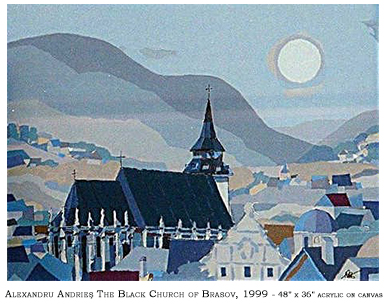
Located in southeastern Transylvania, in the centre of Romania at the foot of the Carpathian Mountains, Brașov has an eventful history. Over the centuries, it was a Saxon, Hungarian, Transylvanian and Austro-Hungarian town before gaining its current Romanian nationality in 1920. Its naming reflects the jumpy history: Brașov used to be called Corona, Kronstadt and Brasso, and when one of its most famous sons, Alexandru Andrieș, was born there in 1956, it was called Orașul Stalin – “Stalin City”.

Andrieș is as multicoloured as his city’s history. Distinguished architect, graphic designer, celebrated poet, award-winning actor… but surely his main claim to fame is his music. His enormous body of work (“Awfully prolific. The collector’s nightmare,” according to his biographer Sergiu Mitrofan) includes more than 70 studio albums, live records, DVDs and more, he has performed thousands of times, probably more often even than his idol Dylan, and is still going strong.

His 1999 Dylan album Alb Negru (“White and Black”) is superb. Seventeen Dylan songs in Romanian, with lyrics he had already published separately in book form in 1991 on the occasion of Dylan’s 50th birthday (La mulți ani, Bob Dylan). For Dylan’s 60th birthday in 2001, another EP with Romanian versions of “It Ain’t Me, Babe”, “Shelter From The Storm” and “Motorpsycho Nightmare” – again very successful covers – was released as a bonus.

A highlight of Alb Negru is the intimate, casual performance of “You’re Gonna Make Me Lonesome When You Go” (Ma lasi prea singur dacă vei pleca), but the album’s closing track is certainly just as strong: Alexandru alone at the piano with his interpretation of “When I Paint My Masterpiece” – Cînd am să-mi pictez capodopera. In the album’s liner notes, Andrieș writes: “Acest album – o interpretare absolut personala, in cel mai poetic sens al cuvantului, a cantecelor lui Bob Dylan; This album – an absolutely personal interpretation, in the most poetic sense of the word, of the songs of Bob Dylan,” which is very well-put. Demonstrating this “absolutely personal” and “most poetic” with his translation of Masterpiece, for example.

The form is expertly maintained (rhyme scheme and almost identical metre), but with the melody, tempo and content of the lyrics Andrieș goes his own poetic way. This narrator also finds himself in a messy Rome, with “chunks of history” everywhere, but then takes his own, magically realistic turn: “S-a furat Coliseul, mai e doar un ciot – The Colosseum’s been stolen, there’s only a stump left…” Quickly back to the hotel, to call the police. At night, the narrator returns to the empty plain, sees a goddess wandering about, but “degeaba încerc să-i vorbesc, avem limbi diferite – no use trying to talk to her, we have different languages”. In the last stanza, in the taxi on the way to the airport, the fellow traveller asks what he thought of it, here in Rome. To that question, the narrator replies, you get your answer cînd am să-mi pictez capodopera – when I paint my masterpiece.

Magic realism like a Murakami story, a dreamlike interlude á la Petrushevskaya and a pinch of Kafka to conclude: for Alexandru, Dylan’s source text is a coat rack on which he hangs – very Dylanesque – the poetic fruits of his own associative mind. No pretty girl in the hotel room, no lions, Spanish Steps nor geese, munching journalists or muscle-sporting girls… so it is really not a translation of “When I Paint My Masterpiece” in the strict sense of the word. Alexandru Andrieș gives an absolutely personal interpretation, in the most poetic sense of the word.

Alexandru Andries – Cînd am sa-mi pictez capodopera:

Different but just as poetic is the third and final successful translation, made on the other side of the world by Japanese legend Haruomi Hosono. In Dylan circles, we have come across the electronica giant (Hosono is the driving force behind the revolutionary band Yellow Magic Orchestra in the 1970s) before; in 1969, he and his band Apryl Fool recorded a striking, peculiar cover of Dylan’s “Pledging My Time”. East meets West doesn’t really work for that cover yet, but in 2013 we are 44 years older and correspondingly much craftsmanship richer.

On Heavenly Music, Hosono honours his musical heroes, the American songs he learned to appreciate during the American occupation and helped him through the misery of post-war Tokyo (Hosono was born in 1947). Influences we have been able to hear throughout his oeuvre, but on this album it is thematised. With an exquisite Japanese touch: stillness and introspection. As in his cover of Burt Bacharach’s “Close To You”, which begins like a soft rain shower in May, with thin chords on the piano steadily trickling down, dull beating on the roof by the drums and a bass half-mixed away – as if you’re faintly hearing the neighbour’s radio. “Tip Toe Thru The Tulips With Me” Hosono sings in Japanese, accompanied by an accordion that takes us to Place Pigalle, “Something Stupid” is a faithful copy of Nancy Sinatra & Lee Hazlewood’s classic, “My Bank Account Is Gone” by Jesse Ashlock from Hosono’s birth year 1947 sounds oddly even more authentic than the original… Heavenly Music surprises the listener with one gem after another.

The biggest surprise is the closing track. Hosono’s covers a monument from his German art brothers from Düsseldorf, the electronics concern Kraftwerk. Not only surprising because Hosono precisely chooses “Radio Activity” of all things, thus giving a place to the horrors of post-war Japan, but also because of the exceptional arrangement: the synthesiser classic is now carried by acoustic guitar and piano, the electronics relegated to atmospheric noise in the background á la Radiohead. In the short interlude halfway through, early 70s Brian Eno violence unleashes itself very briefly, but then the radio-active cloud descends, and hushed the album ends.

Shortly before that, at track 8, is Hosono’s tribute to Dylan: “When I Paint My Masterpiece”. Similar both in sound and instrumentation to Dylan’s Shadow Kingdom version (and thus also to The Band); accordion, upright bass, mandolin and acoustic guitar. But, like only the greatest artists, Hosono goes his own way with the lyrics – and survives. More than satisfactory, even.

Hosono’s “translation” is similar to Romanian Andrieș in approach: the source text is merely a coat rack. The elaboration, however, is diametrically opposite. Whereas Andrieș still extrapolates the fantasy elements and lifts the content of the text towards surrealism, Hosono opts for naturalism, for sobriety. Hosono’s narrator walks through Rome and is cold, quickly returns to his hotel room. No Botticelli, no Venus – here is the Greek girl again, and she is kawaii, cute. At the Colosseum, he wastes his time in mui, “idleness”, and Hosono eliminates something as unrealistic as lions supposedly roaming there. No, he only notices a shishi no zou, a statue of a lion. “Geese” for that matter also seem too exotic for unclear reasons – here the narrator recalls a hunt for ducks. Understandable, on the other hand, is how a Japanese might find clergymen in uniform too alienating, so that becomes – very Japanese – sou, monks. And thus, Hosono is also the only one in the world who finds young girls pulling muscles far too weird and unrealistic, and therefore makes grateful use of the homophones muscles/mussels: the young girls in Brussels open kai – “shellfish”.

Haruomi Hosono – When I Paint My Masterpiece:

Many translations, all in all, but only three of them doing what a cover should do: enrich the original. With which Dylan himself, despite that strange condition in the licence agreement with the German translators Carl Weissner and Walter Hartmann, surely would agree. And if he then had to choose between German Wolfgang Niedecken, Romanian Alexandru Andrieș and Japanese Haruomi Hosono, his heart would presumably incline towards the Japanese. Haruomi is the grandson of Masabumi Hosono, the only Japanese passenger and survivor of the Titanic – and well, then you do have an edge with Dylan. Plus: nobody sighs “Coca-Cola” as nostalgically, as full of lost akogare, longing as Haruomi.

When I Paint My Masterpiece part 14: Un appuntamento con la nipote di Botticelli

Jochen is a regular reviewer of Dylan’s work on Untold. His books, in English, Dutch and German, are available via Amazon both in paperback and on Kindle:

Posted in Uncategorized | Leave a comment

The lyrics and the music: Masters of War

An index to the current series appearing on this website appears on the home page.    A list of the previous articles in this series appears at the end.

———-

“The Lyrics and the Music” is a series by Tony Attwood which tries to find out what happens when one reviews a Dylan song not primarily as a set of lyrics, but as a piece of music which includes lyrics.   An updated list of previous articles in the series is given at the end.

Masters of War

There is a pulsating relentless feel about the music of Masters of War which grabs the listener by throat and won’t let go.    The guitar part is unvarying, there is only one chord, only the last line offers any variation, and that only slight – and with a sense of desperation.   The music is in fact utterly relentless is delivering the message that is in the words.

And more, verse after verse continues: there is no inter-verse instrumental break, apart from an occasional extra bar, which Bob can be forgiven as the music pounds on without any chance of us (or him) pausing for breath.

The message is clear there is no escape: it is as relentless as the build up for war is relentless.  Even the end won’t give up – he is not just talking about defeating the Masters of War he doesn’t even trust them to stay dead once they are buried.

There is also the extra power put into the third line of each verse with its strong accent at the end

  • You that build the death planes
  • You play with my world
  • A world war can be won
  • Then you sit back and watch
  • Fear to bring children
  • You might say that I’m young
  • Will it buy you forgiveness
  • I’ll follow your casket

These are all challenging lines which Dylan punches out so we cannot miss them, or the importance of the words.

Not surprisingly for such a powerful forceful song that resonated so much with the times, Bob played the song in concerts no less than on 884 occasions across 53 years (at least according to the official site).

The last recording we have from the Never Ending Tour comes from 2010 and I found myself wanting to hear how on earth Bob could retain the menace all those years later but without playing the song exactly as he did when it was first recorded.

In fact he does it masterfully, primarily by adding one or two beats after each line.   It is a simple but incredibly effective musical device.  We all know the song so well, we all know what happens even if we are not recognizing the way the beats work, and here is something totally upsetting to that rhythmic pattern, but without in any way destroying the message.  In fact the message is enhanced.   As is the repeat of the last verse.

And of course the song is as utterly relevant today as it was which is why Bob kept that power right the way through to the final performances.

Indeed it could not be any other way.  It pounds into the heart just as it pounds into the brain.

The songs reviewed from the music plus lyrics viewpoint…

Posted in Uncategorized | Leave a comment

Once or twice: Highway 51 revisited

 I don’t know what it means either: an index to the current series appearing on this website.

——–

Once or twice: A review of some of the songs that Bob has performed just once or twice on stage, selecting those of which we have a genuine recording (and “genuine” is important here since I have found a few sites that seem to suggest they are a recording of a live version, but I have my doubts.)  Text and video selection by Tony Attwood.

I know it is singularly nerdish but I am fascinated by the way Bob so often decides to change the key that a particular song is played in – not least because I can’t think of other recording artists that do this so often.   The album version is played one tone lower than the “take 5” version.

The original Highway 51 song was released in 1938 by singer songwriter Curtis Jones who became well known later for “Lonesome Bedroom Blues” and  “Tin Pan Alley”

The significance of Highway 51 is reported as being the road taken by many African Americans who moved from the south to the north of the country.

In Chronicles Bob wrote, “Highway 61, the main thoroughfare of the country blues, begins about where I began. I always felt like I’d started on it, always had been on it and could go anywhere, even down into the deep Delta country. It was the same road, full of the same contradictions, the same one-horse towns, the same spiritual ancestors … It was my place in the universe, always felt like it was in my blood.”

Dylan recorded his version on 22 November 1961 for release on his initial album although the lyrics are those written by Tommy McClennan when he released New Highway 51.  However Dylan varies the chords somewhat.  (According to Wiki).

“Dylan gave a performance at Eve and Mac Mackenzie’s home in New York in December 1961. He has performed the song in public at concerts only twice: at Carnegie Hall on September 22, 1962, and at New York Town Hall on April 12, 1963.”

Recordings of neither of these events appear to exist on the internet – but if you can find a link please do send it in.

But Aaron did find another recording of New Highway 51 which he included in his “other people’s songs” series.  I’ve expressed my thanks to Aaron for all his work on this site recently in Aaron’s obituary, but I just felt today that as it was time for another article in the “Once or Twice” series I’d offer up this recording Aaron found, as a final farewell.

Quite why Bob then didn’t ever want to revise the song on stage, especially having used the name of the song as the title of the album, I don’t know.  The answer is probably buried in a book on Dylan somewhere, but sadly, I can’t findit.

Postcript: as you will see from the comments below Larry has noted the full concerts are available on line – which I had missed.   Here’s a link

Previously in this series we have looked at 

Posted in Uncategorized | 5 Comments

The Never Ending Tour Extended: Goodbye Jimmy Reed

 I don’t know what it means  either: an index to the current series appearing on this website.


The Never Ending Tour Extended: This series primarily uses recordings selected by Mike Johnson in his inestimable masterpiece The Never Ending Tour, and looks at how those performances of individual songs change as time goes by.   The selection of songs from the series, and the commentary below, are by Tony Attwood.   A list of all the songs covered in the series is given at the end.

Goodbye Jimmy Reed had a short but intensive lifespan as a concert song, being played between 2 November 2021 and 6 April 2024: a total of 202 times.  Clearly for a while it was one Bob wanted to keep in the repetoire.

2001:  Down Electric Avenue

We get a whole verse introduction before Bob comes in with a half sung half recited version.   Instrumentally the performance keeps very close to the album version, including that signature descending sequence between each verse.

Bob sings this in an almost desperate way at times, emphasising the paranoia of being stuck in Mobile.  It makes me wonder if it really is such an awful place!

The instrumental break just keeps rolling along without anything very new to distinguish it.  There is a lot of repetition from a guitar playing one note over and over which I suspect is put in Bob – it is something he often does.

There is however also a good harmonica solo at the end, which helps quite a bit.  Even though it too uses the repeat repeat technique.

2005: God knows you gotta weep

If you are a trifle impatient I should point out the recording of the song doesn’t start until the 30 second mark, but it is worth waiting for as from the off we have a more relaxed accompaniment over that unmistakable arrangement.

To me, Bob sounds more engaged this time, even though he hasn’t done much with the song except make the lyrics come out a bit faster – along with those famous leaps in the vocal line of a 5th upwards.

Thus overall, it seems much more of a gentle stroll around an old favourite than before.  And that feeling is emphasised after the 6-minute 10-second mark when we get a fun, relaxed, and basically just enjoyable instrumental verse.  This in turn is followed by another variation with the same lead guitar going a little further but still keeping it all calm and relaxed.

Those two instrumental verses do really ensure the relaxed feel of the song is totally embedded in the performance.  After that there is yet another instrumental verse which really does take us on a step further.   Listen to the last instrumental version of the “Oh mama” section as we approach the end.  It is not spectacular, but it’s fun.

2008: Drowning in the honky-tonk Lagoon

There are subtle differences again – and to me that’s fair enough because the structure of the song with its unusual chord changes, and “Oh mama” section means that there is not too much one can do with the song.

Except…. then in comes Bob with a declamation performance we have not been expecting.  He really delivers something different here.   Whether this was worth waiting for, I am not sure, but it certainly is interesting.  As indeed are the further variations that we get as the song meanders through its eight-minute performance.

To be critical I would wonder if really there is enough here to make it worthy of eight minutes, but we do get a different harmonica solo at the end in which Dylan plays the same sequence over and over no matter what the band is doing.  It makes for a very curious clash of implied chords.

2010: Stay Dylan Stay

And was there to be a sudden and unexpected re-writing of the song as its lifetime comes to and end?  Well, no but the crowd appreciate it anyway.  The percussionist seems to want to have more of a say than normal, but Bob fights back with the harmonica solo we are now expecting with this song.

It is a song that has had some variations added to it along the way, but in essence it has remained unchanged, probably because of that signature arrangement to the chorus line of “Oh mam…”

Other articles in this series…


Posted in Uncategorized | Leave a comment

The Double Life of Bob Dylan: a consideration. Part 1: Let’s ignore creativity.


I don’t know what it means either: an index to the current series appearing on this website.


by Tony Attwood

The Double Life of Bob Dylan by Clinton Heylin is a big book. Over 500 pages in fact, and it is only the first part of Heylin’s latest offering on Dylan.

I was given a copy for my birthday, and very grateful I was for it too, because I had been thinking in recent days, “what is the essence of Dylan?”   Or put another way, I was pondering, if I were going to write a mega-volume on Dylan, which was not an analysis song by song, what would be my core focus?

It didn’t take long to answer that – maybe five minutes, maybe less.  For I knew my theme would be Dylan’s creativity.  The creativity that has led him to create over 600 songs in a multiplicity of styles.  That is not to claim that this is the most by any songwriter, of course.  Irving Berlin wrote around 1,500 songs, including “Easter Parade”, “White Christmas”, and “There’s No Business Like Show Business” – and that list could go on and on with famous titles.

OK so Bob is only half way there, and with great temerity when speaking of the ultimate geniuses of songwriting, I’d say a few of the now forgotten Berlin songs were, well, not very good.  And yes, I’d say pretty much the same of a few of Bob’s now largely forgotten (although reviewed on Untold Dylan) were not so good (although we did find a few lost gems).

But there is a difference beyond numbers because Irving Berlin wrote his songs, and by and large handed them over. There is no comparison between Berlin and Dylan in terms of re-working the songs into new arrangements.

And this came home to me more than ever when about six weeks ago I sat down to write another episode in the series “The Never Ending Tour Extended” in which I traced the evolution of “Tweedle Dee and Tweedle Dum” from 2001 to 2014. I’m sure you know the original version – which is how it sounded across most of those yeras, but just in case you missed my article, here’s what I made the fuss about as the song was ready to be dropped from the tour once and for all.

2014: The survivors

Now my point here is that the lyrics have not changed, but the music is so utterly different from the original that this is a new song.

This is a very rare accomplishment for any songwriter, to keep the lyrics exactly the same and yet utterly change the music so as to make a new piece.  This is a moment (among many others with Dylan) of utterly sublime creativity.

And I mention it again, not just to push this particular recording down your throat, but rather because this was one of many thoughts that came to me as I started pondering how to write a review of “The Double Life of Bob Dylan”.  For I started to think, “what is it that makes Dylan stand out above all other songwriters?”  And I thought that because it struck me that in my imaginary book on Dylan that was where I would start: the extraordinary variety of his work.  In short his astounding creativity.

For the extraordinary variety of the songs comes in terms of both lyrical themes and music, and this (often ignored by critics) amazing ability to re-write his songs in a new form.

Now I am sure my memory is playing me false at this point, but I can’t think of another singer-songwriter who has changed his own work so often as Dylan.  Which means we have the fact that he is lyricist, lyric re-writer, composer, arranger and re-arranger…

In short in terms of composition, arrangement and performance Dylan is the great creative  genius.

Which brings me to my point.  As I start reading “The Double Life” there is not a single mention of Dylan’s creativity.  And this really hit me when on page 48 there is a quote from Dylan apparently said in May 1966, “Writing is nothing, anybody can write really if they got dreams at an early age.”

Now clearly that is a challenging view – that anyone with “dreams” (which I take to be “imagination” in my vocabulary) from an early age, can write.  And yes it is probably true.  But that doesn’t actually tell us anything, except that it suggests that something in our society that knocks the ability and desire to create out of most people.

If course this didn’t happen to Dylan because in 1962 alone Bob had written

  1. Ballad for a friend
  2. Rambling Gambling Willie
  3. Standing on the highway
  4. Talkin’ John Birch Society Blues
  5. Let me die in my footsteps
  6. Blowing in the wind 
  7. Corrina Corrina
  8. Quit your Lowdown Ways
  9. Down the Highway
  10. Tomorrow is a long time 
  11. Hard Rain’s a gonna fall
  12. Ballad of Hollis Brown
  13. John Brown
  14. Don’t think twice
  15. Paths of Victory
  16. Walking Down the Line
  17. Oxford Town
  18. Kingsport Town
  19. Hero Blues
  20. Whatcha Gonna Do? 

Now I have published that list before but I do it again to show that Bob the musician was adopting numerous musical forms in 1962 as well as developing lyrics from all sorts of subject matter.

But what Heylin in fact does at the very start of the book is spend more time debating whether Bob was in one place where he says he was, or not, while at the same time (page 49) dismissing a rival writer as a pseudo-biographer, for getting the details of a camp that Dylan went to, wrong.

For me (and here I must admit I think this point is utterly obvious) the essence of Dylan is his creativity.  Not just the phenomenal number of songs written, but also the range of his output that was being demonstrated, for even by 1962 he was writing songs covering issues such as Death, It’s up to each of us how we see the world, Leaving, Moving on, Lost love, Optimism, Racism, Right-wing politics, War, the Evolution of society, Poverty, the Blues, and Being an outsider.  

That in itself is of note, but behind it there is another enormous point: where did all this creativity come from?  How did Bob find it, how did he deal with it, how did he use it?

So maybe it is true that Dylan “found out real quick that playing and singing was a good way of impressing the girls.” (page 51)   But even if that was a prime motivation we still have not a single insight into the creativity which is what we all celebrate in Bob Dylan.

As a result we get some interesting snippets in the telling, for Heylin makes quite a bit of the fact that the way that Bob told his story, through phrases like “nothing could be further from the truth” (page 55).

Which I take as another hint at what we have got here; which is to say, early signs of what Dylan became as a writer and performer – a person who endlessly re-creates his own world including everything from his own past to his own songs.  It is a fascinating part of his creative make-up and although quite possibly in these early times he was simply lying in order to create what he took to be a new and more exciting persona, the fact is that in his lyrics this is what Dylan did throughout.  Although of course when it turns up in a song, as when it turns up in a novel, we don’t call it lying, but rather the art of the writer.

Thus I would argue that even within Heylin’s book we have the clear hints as to what the dominant force was in Bob Dylan at a young age: the inventiveness, the storytelling.  And of course, you could reply, “but all the kids do that”.  Which is true – except that most kids don’t turn it into an art form.  Yet this is the debate we don’t have, because, quite simply, Heylin doesn’t do “creativity”.

Dylan, we are told, tended to be quiet except when he performed.  It is a sign of an artist – he comes alive when involved in his art.  But Heylin, not having the time or inclination to consider such matters as performance or the aforementioned creativity, almost sees it as a failure or an oddity.

The fact is that for the creative youngster, the lack of creativity exhibited by those around him/her is often a significant issue, and it can make the creative person look like an outsider.  But one only gets to understand any of this by considering the artist’s creativity, and how the artist uses his creativity.

And I’ll continue that then in my next article on this volume, in a few days time.

Posted in Uncategorized | 7 Comments

The Covers We Missed: All the Tired Horses


I don’t know what it means either: an index to the current series appearing on this website.

For more details on this new series on cover versions of Dylan songs that were not previously considered in the last series, please see the intro to the first article in this series.

Songs and recordings researched and suggested by Jürg Lehmann.

All the Tired Horses

 Surprisingly, there are quite a number of covers. This doesn’t seem obvious for a song that is so reduced in musical and lyrical terms, but obviously this reduction also opens up space for the performers. Unfortunately, only a few know how to utilise this, but those who dare to do so achieve fantastic results.

An emotive version by Irish folk musician Lisa O’Neill soundtracks the climactic ending to Peaky Blinders in the 2022 series finale, “Lock And Key”

O’Neill, who wrote a song called “Bobby D” about her admiration for Dylan, is a big fan of “All The Tired Horses”, but a straight re-creation wouldn’t work for the scene.

“I had to do something different with it,” she explained in a 2023 Songfacts interview. “I guess I went in the opposite direction, and they slowed it right down. I had to figure out how low I could go with my voice and how high I could go.”

O’Neill had help from fellow Irish musicians, who contributed ideas and played on the track. They recorded the song over the course of two days at an old horse stables in Cabinteely, South Dublin, by constant candlelight in honor of O’Neill’s friend, the Irish singer/fiddler Mick O’Grady, who was dying at the time. “This all contributed to the energy and the charge of the final track,” O’Neill noted.

Another cover comes from Tim Heidecker (2012)

Tim Heidecker, half the duo responsible for Tim And Eric Awesome Show, Great Job!.

During his traveling promotion of Tim and Eric’s Billion Dollar Movie, he found the time to record a dreamy rendition of All The Tired Horses.

“I was sitting around in my hotel in Austin, reading this article about the new Dylan covers CD called “Chimes of Freedom.” I had some spare time and thought it’d be fun to try and make my own Dylan cover on my laptop and post that I was angry Amnesty International cut mine from the record.”

Heidecker announced on Twitter that he was looking for a studio to record in while in Chicago. Local band The Earth Is A Man were happy to help out. The result is a cover reminiscent of the soft 70s rock that has played a huge role in Heidecker’s previous musical endeavours. Eventually Heidecker’s cover was not included on the Amnesty album.

Other covers come from

The Sports (1981)

Ellie Come Home – Milion Dollar Bash (2006)

Autumn Dirge – Forever Autumn (2009) 

The Narrator (2013) 

Patrick Chabot (2014), who calls his rendition “a requiem”

Tobacco City (2021)

Family Values (2023)

The most convincing cover version in terms of musical quality is by American songwriter, lyricist and composer Ashley Raines&The New West Revue. In fact, it is superb, a real gem.

One critic has described Raines’ music:

Ashley Raines wants you to think about the spaces between a whisper and a shout. If you can’t do that on your own, his voice and the words he sings might be able to help you. Many music critics have compared him to the likes of Tom Waits and Nick Cave, but he’s having a completely different conversation than anyone before him.

While those other singers might know the darkness like an old friend, Ashley asks the listener to discover it for themselves, along with his humble aid. It might be more prudent to compare his songs to a Lynch film. Moving beyond the obvious aesthetic commonalities of the blues and the underlying darkness in all stories, Raines ends up giving a bit of realistic hope that the darkness and the light can live together in harmony. Listen in to hear a flock of doves being released into an endless night.


Posted in Uncategorized | Leave a comment

Three Outlaw Tour Bob shows completed so far – how do they look and what awaits?”


By mr tambourine

Videos selected by Tony Attwood

In this article, I will try to analyze what we have just witnessed and what might await us going forward.

The first three shows have made us go through all kinds of emotions.

The first show in Alpharetta, Georgia had a 100% different setlist compared to the previous show in Austin, April 6 this year, which is the first time since God knows when that has happened. May go as far as 1987.

That being said, nothing really unusual happened. Well… At least not unusual for the 2013-2024 period so far.

Apart from live debuts of several covers, such as My Babe, Little Queenie, Cold, Cold Heart, Mr. Blue, the rest of the set consisted of 2013-2019 staples, a polite word for “overplayed tunes” in such a time period. Well, apart from Under The Red Sky, which was a real, true surprise. First performance since 2013, and only its third performance since 2010. That is a real surprise in my book, based on my detailed research of setlists over the years.

Covers, as much as they vary over time, are not a big surprise in the 2021-2024 time frame so far. Especially starting in 2023, and after Bob has written the book “Philosophy of Modern Song”.

Bob has done plenty of covers over his live career, and most of them, he has really done well. But not all of them hold the same mystique or aura. Few of them really stand out in the grand scheme of things, when it’s all said and done. Many of them become forgotten over time. Which is no big surprise in an ever-changing landscape of Dylan’s interests. At this stage, Bob bringing back original songs into the set is a bigger surprise and a bigger deal these days.

And most of them that he brought, at least on the first night in Alpharetta, still left a lot to be desired.

Dylan has been known as a person never to look back. And while that may be true, even in this stage, on this first night in Alpharetta, he sure looked back more than necessary, in my opinion. Apart from Under The Red Sky, which again was a clear surprise and a hint of something new, as well as so many debuts of covers and their laidback approach – revisiting so many staples of a period that should’ve been far behind him by now, is to me a very unlike Bob move. A little bit frustrating even.

While some of those songs sure are great, favoring them over so many others in his rich catalogue is a travesty of this entire period, that began in 2013. This period, while often praised by many, me included, several times, sure leaves a whole lot more to be desired. And that to me is its biggest flaw, by far.

I’m not saying Bob should play “his greatest hits” only, night in and night out.

But for someone, with such a deep catalogue, where many of his mid and “bad” songs make a lot of songwriters and performers (even legendary ones) jealous, there are so many more possibilities to showcase his brilliance. Dylan may have changed many sets since 2013, but most of those he stuck with for longer periods of time, too long sometimes even. Which is why certain songs, like the ones played in Alpharetta, give the impression of being overplayed songs.

While some of those songs may have been overplayed over the years, some of them did feel a bit fresh.

“Beyond Here Lies Nothin” for example had a minimalistic start, somewhat reminiscent of Black Rider, before the more recognizable melody was used when the band took swing.

“Things Have Changed” was given the “My Own Version of You” arrangement of 2023, which did give the song one of its most radical, if not the most radical change to date.

So, there is some good behind it all.

Also, “Long and Wasted Years” hasn’t felt more loose and stripped down in a long time, kind of an even intimate performance in a way.

Charlotte however, the second night of the tour, was almost totally different. With only five songs repeated from previous night.   Again, not as many surprises as one would have you believe, still many staples of the 2013-2019 period.

The biggest surprise was “Shooting Star” of course. More covers like “Stella Blue” (played before) and “Six Days On The Road” (never played before) were the continuation of Dylan’s covers fascination.

The impression was better by far, but still with a lot left to be desired.

We felt that the Never-ending tour was back in its true form again, with everchanging setlists, for a moment.   But we were so wrong.

The very next night, in the very same state of North Carolina, in Raleigh, Bob played the exact same set.

The only positives?

Well, playing “Shooting Star” and “Under The Red Sky” still. They are songs that haven’t been setlist regulars in a very long time, if ever. Although, their reputation may change if he keeps playing them constantly. They might eventually get in danger of being overplayed too if he keeps it up.

And whatever is happening currently with “Things Have Changed”, it is still at a stage where it’s at least intriguing.

The first two shows felt like a live rehearsal to me. Anything felt possible. That’s the feeling many of us want at a Dylan show.

I also do not understand the complete omission of Rough and Rowdy Ways songs. Alright, sure, Bob wanted to show that the Outlaw tour is not part of the Rough and Rowdy Ways tour. We get that by now. It was clear in Alpharetta.

Hearing all kinds of praise from Dylan fans being happy that Tempest material is back, and celebrating the omission of Rough And Rowdy Ways material was a tragic sight to behold.  What did that wonderful album do to people to deserve such disrespecting opinions?

I see no harm in Bob playing one Rough and Rowdy Ways song here and there, on each show.  That and Shadow Kingdom are his most recent releases. Isn’t it normal to expect those to be a part of this too?

The next show in Virginia Beach is 3 days after the Raleigh show. Enough time to add more songs in the mix. If Bob sticks to the same set completely, or mostly, even after that, I won’t be interested any longer.

I have followed setlists in detail since 2016, basically all of them, and I also researched earlier ones. For the first time, I might quit of following every single show setlist-wise, before listening to them.

Because Bob to me proved it’s very possible to change the set more often. I see no reason why that wouldn’t become the pattern.

He’s had very effective patterns in the 2000s, especially in years like 2009, where surprises were possible.

I understand Bob can do what he wants – that has never been my issue. But what he has to know is that nobody but him is interested in these setlists that get repeated over and over. Setlists with staples that never seem to completely go away.

At least with an overplayed song like “Like a Rolling Stone” he lets you miss it for a long time when he doesn’t play it for so long before he brings it back. And the last time he brought it back and played it in his set all the time, it was a success.

Songs like “Love Sick” and “Things Have Changed” and most of all – “Early Roman Kings” – do not really do anything for anybody anymore. Even “Thin Man” is somewhere out there.

Also, why not for once mix Rough and Rowdy Ways songs with other songs from Time Out Of Mind, Love And Theft, Modern Times, Together Through Life and Tempest? I bet they would gain more respect than they have now, because they would show some life compared to some of these overplayed staples.

I’m not saying the RARW set wasn’t overplayed in the 2021-2024 – of course it was. But the RARW songs were not the major issue there, they held pretty well, most of them, through many periods. The issue was more the rest of the set.

Which is why I also think we don’t need too much of “Baby Tonight” in this set now, even though that’s one of the better staples of the 2021-2024 set.

We, as fans, deserve better.  We stuck with Bob as he stuck with his many repeated sets. We endured 11 years of this.   Playing with us, like he did this time, is not what we deserved.

Returning to that repetition once again, and with this set… It will be torture of sorts, and probably not a pleasant one.

I loved the live rehearsal feel of the band, the spontaneous spirit. I don’t want that to disappear because of staples again.

We for once got off on the right foot. Why stop there?

There is no reason for some songs to be sitting on the shelf for so long. With such a catalogue, to stick to only a handful of songs over and over is a tremendous waste.

Despite Bob being 83 at this point, his voice in 2024 is one of his best ever, dare I say. His band is diverse enough to play whatever he wants, especially to make it sound spontaneous, fresh and new.

With his catalogue, and with his knowledge of music, music history, which he proved time and time again, with Theme Time Radio Hour and Philosophy of Modern Song, and with his understanding of arrangements and how much he can re-structure the songs…

We are being robbed of an even better show night in and night out, I’m sure of that. It’s proven time and time again that mixing up the set every once in a while builds excitement. I see no harm in changing one or two songs every night if more is too much.

Every once in a while, I do remember that the priority should be Bob’s health. I am very much thankful he is still touring. I will still listen to his concerts no matter what.

But I just hope that Bob understands that, most of us, me included, were drawn to him in the first place because of his unpredictability. We had it back for a moment and it was obvious how happy we all were. Until he took it away again… For a moment at least.

I hope he reconsiders.


The 18-part review of the Rough and Rowdy Way Tour with videos selected by mr tambourine is available on this site.  Links to all the episodes can be found at the end of the final instalment here.

Posted in Uncategorized | 2 Comments

Farewell Aaron: wonderful Dylan fan, and such a great friend who I never met


By Tony Attwood

I am desolated beyond measure to have to report the passing of Aaron Galbraith, one of the great friends of this site, a terrific researcher and writer, and an absolute Bod Dylan fan.

Although Aaron wrote and co-wrote well over 300 articles for this site, he and I never met (what with living on different continents), and we never even got to talk on the phone (although I did ask), but his contribution to Untold Dylan was immense and invaluable.

One day back in 2018 (just six years ago but it seems so much longer) he simply sent me an email with an article he thought might fit into Untold Dylan.  From that piece it was obvious at once that here was a writer with imagination, original thoughts and a lot of knowledge about Dylan and the music that influenced Dylan.   Of course I was delighted to oblige and publish it.   I wrote back and begged for more, and Aaron returned the favour over and over and over again

I did also suggest we might have the occasional chat but no, he was just happy writing, and coming up with ideas.

For what Aaron was, was a guy who not only knew about Dylan and the music that influenced Dylan, he was also brilliant at considering new ways in which we could look at Dylan – ways that would give us greater insights into this work.  Ideas that could make a one-off article, or turn into a series which could run to maybe 5 or 10 or 100 articles on specific Dylan topics we hadn’t previously covered.

These included having the brilliant idea of creating albums that Dylan didn’t make but should have done.   I am hoping in the near future that I will be able to go back and pick out some of those articles and bring them to the fore once more – although of course they all remain on the site.

In short, Aaron was one of the exclusive band of people who, for reasons that will never become clear, was willing to give up hours of his time writing for and creating ideas for Untold Dylan, just because he enjoyed doing it  He wanted no reward.  In fact, I doubt if he would have objected if I’d left his name off one of the articles he wrote or contributed to.   I hope that never happened, because I valued his input so much, but it always struck me he was that kind of guy.  He just enjoyed having the ideas and doing the research.

I never learned much about his life (although I did ask) but somehow we always got on well as we exchanged emails about the topics we might cover.  Indeed if you want to see what Aaron wrote just go to the Dylan site and type in “by Aaron Galbraith” in the search box (using the inverted commas) top right and they will all come up.

In fact Aaron didn’t just invent series, he invented series that kept Untold Dylan going, such as “Other people’s songs”, and “Why does Dylan like” and then would often very gently and kindly point out where I’d missed something out in one of my articles, or gone off on the wrong track.  Indeed we even created albums together that Dylan didn’t make but should have made. Not just a list of songs, but the actual recordings.

But beyond all that Aaron did a huge amount of uncovering of songs Dylan wrote which I had missed – indeed he was part of a tiny group whose work allowed me eventually to claim that we had the definitive list of Dylan compositions.   My goodness, I really do hope that I said thank you enough to Aaron for that and that he fully appreciated how much I felt I owed him.  When Dylan himself passes on, I expect at least a postcard from on high thanking Untold for creating the definitive list of Dylan compositions.   I’ll refer Bob to Aaron who will be waiting up there, finally able to say hello.

And there was so much more.  Aaron also invented the wonderful series that ran and ran – “Other people’s songs”.  That contained recordings I’d never come across before – my education continued.

But mostly, our list of Dylan compositions was added to many times by Aaron (https://bob-dylan.org.uk/dylan-songs-reviewed-on-this-site) and is now seen by quite a few people as the definitive list.  Indeed over the years Untold Dylan has become seen as an important Dylan site for those seriously interested.   Wiki occasionally quotes us when talking about a Dylan song and ludicrously calls me “Dylan scholar, Tony Attwood….” But really they should be paying tribute to those other writers who have made this site what it is.  I just pull the strings and give some opinions:  Aaron was one of those who did the hard work.

But my main point is that Aaron’s approach always added a different flavour from that of the rest of us writing on this site, and his is one of the voices that has helped Untold keep going down the track we have chosen.

In later days, I guess when Aaron was perhaps not feeling so well, or maybe was getting more tired (he never said) he would select songs, and I’d write a meandering review of them for me to develop.  Some people treat them as my articles, but the key point was I would never have been able to write that review without Aaron being there making the selection.  He really did take the word “Untold” seriously and took us into new dimensions.

Aaron never dictated what he wanted (and you may have heard, some authors really can be very demanding in terms of the way their work is treated – very pesky creatures these authors…) and indeed he seemed very happy to come up with ideas and let me meander off with them probably in ways that he would not have taken.  At least he never once complained at anything I did with his work.  If only every author could be like that.

I want to give one example of this which appears at https://bob-dylan.org.uk/archives/8637

I mention Aaron’s work at the top in finding this, and then go onto a ramble of my own.  But the key point is that it was Aaron who pointed out that we could do an article on this – and then he left it in my hands.  So my name is on the article and Aaron gets his mention – but the key point is there would have been no article without Aaron.

I knew inside me things were not right for Aaron when he stopped writing for Untold, for he told me in several emails just how much he had enjoyed what he had been doing.   Knowing he was having a break I wasn’t pushing for anything more from him, but as he had created albums of Dylan songs – if you want to see an example take a look at https://bob-dylan.org.uk/archives/26235 -….  I was hoping I might persuade him to do that again. Sadly that hope has now gone.  I suspect he is entertaining all the other good people with whom he is now sharing the afterlife.

So overall, if it was possible for two guys of the older variety, who had never met and never even spoken on the phone to have one hell of a good time together, this was it.  And indeed it was, from my perspective, Aaron and me.  He was my great friend that I never got close to… In the way I published the articles I felt I was respecting how he wanted things to be; I do hope I got it right.

Indeed when he pulled out of writing for Untold I really tried to get the balance right between saying that I would welcome an article from him any time, but at the same time not hassling him for more.  I do hope I got that right too.

Take a look at https://bob-dylan.org.uk/archives/21863 and you will see just how we worked together and how it was Aaron’s ideas that allowed me to expand Untold Dylan.

Occasionally I get emails from senior academics thanking me for Untold Dylan and the variety of work therein.   Not notes correcting an error, not pointing out something we missed, but thanking me for Untold Dylan.   Aaron was very much part of creating the environment that it seems some people now do consider worthy of study.

And indeed “creating this environment” was what Aaron helped bring to the show.   That idea of going somewhere else, thinking about Dylan in the way others had not done, and then allowing us to see where it goes… that was Aaron.

When writers have written more than a few articles for Untold I ask them to write a piece in the Untold writers page.   I haven’t changed what he wrote as yet, but I will do in due course to pay proper tribute to him.   For the moment it remains as he wrote it….

https://bob-dylan.org.uk/archives/9215

Aaron Galbraith grew up in the west of Scotland and was educated at Glasgow University. Always a massive music fan, the first concerts he attended were Paul McCartney and Neil Young. He recently counted and has seen over 100 different acts live (several more than once), ranging from Bowie, The Rolling Stones and Van Morrison to BB King, The Strokes, Blur and Adam Ant.

He became acquainted with the work of Bob Dylan whilst at Uni due to one of those 3 CDs for a tenner deals popular at the big music superstores of that time. On a whim, he picked up Bringing It All Back Home, Highway 61 Revisited and Blonde On Blonde. He then proceeded to collect the entire back catalogue and has since seen Dylan over ten times in concert.

He now resides in Virginia in the Good Ol’ US of A with his wife and young daughter. His hobbies, beyond Dylan and other musical acts, include following the Scotland national football team and attending various tennis tournaments throughout the world, primarily to see Andy & Jamie Murray in action.

———————–

My goodness I really do hope that I said thank you enough to Aaron for that and that he fully appreciated how much I felt I owed him.  When Dylan himself passes on, I expect at least a postcard from heaven thanking Untold for creating the definitive list of Dylan compositions with a full acknowledgement to our dear, dear friend who I never got to talk to: Aaron Galbraith.

Posted in Uncategorized | 15 Comments

Bob Dylan: The lyrics and the music. Man in the Long Black Coat


By Tony Attwood

I don’t know what it means either: an index to the current series appearing on this website.    A list of the previous articles in this series appears at the end.

———-

“The Lyrics and the Music” is a series by Tony Attwood which tries to find out what happens when one reviews a Dylan song not primarily as a set of lyrics, but as a piece of music which includes lyrics.   An updated list of previous articles in the series is given at the end.

This song from Oh Mercy was performed 286 times by Dylan between 1989 and 2013.  The video below starts with a few seconds silence.

The lyrics are at first hard to grasp although the chorus line is unmistakable:

Not a word of goodbye not even a noteShe gone with the man in the long black coat

And that of course gives us the clue to the essence of the whole piece – along with the fact that the mysterious man is so evidently portrayed in the way the music is written and performed.

It is a very unusual approach for Dylan, spending this time as he does creating the atmosphere – in fact so much atmosphere that it took me a while to get to listen to the lyrics when I first heard the song.  The beat doesn’t start until the 30 seconds marker and the melody only appears at one minute 15 seconds.

And indeed after a while we get the feeling this is never going to change, but finally we have a “middle 8” – much later than we expected.  And very obviously the harmonica is used to add to the atmosphere.  In fact we could say it is all atmosphere.

So everything about him is strange to the point of being utterly weird.  And the relief we feel both lyrically and musically when the middle 8 does finally get there, is overwhelming.

There are no mistakes in life some people sayIt is true sometimes you can see it that wayBut people don't live or die people just floatShe went with the man in the long black coat
And the notion that “people just float” is strange – it is not that we choose to be good or bad, it is not that we choose to follow the “way of the Lord” as it were, or not, we just float.  We have no underlying driving force, no passion.  Yes he quotes from the Bible – but what?  Old Testament?  New Testament?  Who knows – it is just something that somebody said.  And besides, “Somebody seen him hangin’ around.”
And then we have this really strange third voice – for which the music doesn’t change.  It stresses that logically we can’t use our own conscience to keep us on the right path because our conscience comes from ourselves, not from the Almighty.
To me it all gets a bit hard to follow lyrically, at this point and if it were not for the superb arrangement and delivery I might well have given up any thought of analysing the song at all, when we get to “She gave her heart to the man in the long black coat.”
He’s the outsider, the mysterious stranger, the lone man who passes by and steals the most beautiful woman in town.  And that feeling is helped along by the lines
But people don't live or die people just floatShe went with the man in the long black coat
There are these people out there who are not part of “us” – the man in the long back cloack is one, and it turns out the girl is one.  He has walked in, taken her, and they have gone.  We don’t know why.
And magically the music keeps up the mystery all the way through, for after that break in the spell with the middle 8 (“There are no mistakes in life…”) we are back with that plodding along through our own lives.  We cannot see what is beyond, only the stranger and the girl see that.
She never said nothing there was nothing she wroteShe gone with the man in the long black coat

The mystery of the situation and the inexplicable events are everything – and the music ensures that is all that we see and hear.

But by 2013 Bob was performing it with a beat so clear that one can dance to it.   The notion of the man walking in, taking the woman, walking on, is no longer there.   We can swing back and forth.   It has become lighthearted.  They leave.  Now it is no longer the end. There is no longer an issue.  The mystery is gone.  It’s just something that happens.

Softly softly golden oldies

It doesn’t mean the song has been destroyed.  Rather, it’s a different song with a completely new feeling, and indeed a new meaning.

The songs reviewed from the music plus lyrics viewpoint…

Posted in Uncategorized | Leave a comment