Bob Dylan, born Robert Allen Zimmerman on May 24, 1941, in Duluth, Minnesota, is an iconic American singer-songwriter and musician. Widely regarded as one of the most influential figures in popular music, Dylan’s work spans over six decades, marked by a profound impact on music, culture, and politics. Renowned for his poetic lyrics and distinctive voice, Dylan has an extensive discography that includes over 39 studio albums.
Dylan’s music often addresses social issues, political unrest, and personal introspection. Iconic songs like “Blowin’ in the Wind,” “The Times They Are a-Changin’,” and “Like a Rolling Stone” have become anthems for change and self-reflection. While Dylan is celebrated for his socio-political commentary, he also has a rich repertoire of love songs that showcase his romantic side.
Characteristics of Romantic Folk
Bob Dylan’s approach to romantic folk music is distinct and deeply emotive. Here are some key characteristics that make his love songs timeless:
Poetic Lyrics: Dylan’s love songs are known for their intricate and poignant lyrics, often exploring themes of love, longing, and heartache with poetic finesse.
Expressive Vocals: His unique vocal style conveys deep emotion and raw honesty, enhancing the romantic sentiment of his songs.
Acoustic Arrangements: Many of Dylan’s love songs feature simple yet beautiful acoustic arrangements that highlight the intimacy of his lyrics.
Storytelling: Dylan’s knack for storytelling shines in his love songs, painting vivid pictures of romantic experiences and emotions.
Bob Dylan’s Top Romantic Songs You May Have Forgotten About
Bob Dylan, while known for his profound social and political commentary, also created several love songs that capture his romantic side. Here are some of his most underrated love songs:
“Sad-Eyed Lady of the Lowlands”
A sprawling, epic love song from the “Blonde on Blonde” album, this track is a heartfelt ode to a mysterious and enchanting woman. The song’s length and intricate lyrics make it a standout in Dylan’s catalog.
“Tomorrow Is a Long Time”
This tender ballad expresses the longing and anticipation of waiting for a loved one. Its simple acoustic arrangement and heartfelt lyrics make it a timeless love song. Songs like “Tomorrow Is a Long Time” are often played during intimate encounters with independent escorts as it adds a sexy allure to any encounter. If you are considering hiring a high-class escort for a sensual massage, ask for some Bob Dylan music to add some steamy intimacy to your next rendezvous!
“If Not for You”
Featured on the “New Morning” album, this song is a straightforward declaration of love and appreciation. Its catchy melody and sincere lyrics have made it a beloved track among Dylan fans.
“I Want You”
From the “Blonde on Blonde” album, this upbeat and catchy song combines whimsical lyrics with a joyful declaration of love. The song’s playful nature and infectious melody make it a hidden gem.
“To Ramona”
A beautiful acoustic ballad from the “Another Side of Bob Dylan” album, “To Ramona” is a tender and empathetic song about comforting a loved one in times of trouble.
“Lay, Lady, Lay”
This song, with its smooth, country-infused sound, is one of Dylan’s most sensual tracks. The gentle, inviting lyrics and the warm arrangement create a deeply intimate atmosphere.
“Shelter from the Storm”
A poetic and evocative song from the “Blood on the Tracks” album, “Shelter from the Storm” speaks to the solace and refuge found in a loving relationship.
These songs highlight Bob Dylan’s versatility as a songwriter and his ability to capture the essence of love and relationships in his music.
Conclusion
Bob Dylan’s music, while often associated with profound social and political messages, also has a rich tradition of romantic themes. His love songs, characterized by poetic lyrics, expressive vocals, and heartfelt emotion, offer a timeless appeal that resonates with listeners seeking love and connection. While some of Dylan’s romantic tracks are widely celebrated, others remain underrated gems that showcase his depth and talent as a songwriter.
For more details on this new series on cover versions of Dylan songs that were not previously considered in the last series, please see the intro to the previous article in this series.
———
by Jürg Lehmann
Ain’t talkin’… There is of course Bettye LaVette with her vivid interpretation, but I would like to draw attention to another version (as far as I can see the only one noteworthy apart from LaVette): Bertrand Belin with his Le Feu au Coeur
I’ll go into a little more detail here because the song is in French.
Basically, I have a big problem with translations of Dylan songs, although I can’t judge many creations because I don’t understand the language – the numerous Scandinavian covers for example (Näslund, Wiehe, Forsberg, Larholm, Arve-Gunnar Heloy to name just a few), the Czech (Robert Krestan&Druha trava), Polish (Dylan.pl), Dutch (Ernst Jansz), Catalan (Gerard Quintana, Jordi Batiste) etc.
I am sure that all these people made a great contribution to the reception and popularity of Dylan in their countries and languages. This also applies to the most important Dylan interpreters who have translated into languages that I understand and speak: Wolfgang Niedecken into German, Francesco de Gregori into Italian, Hugues Aufray into French.
But it’s like Robert Frost said: Poetry is what gets lost in translation and if you want to preserve the poetry in Dylan’s songs, you have to be your own poet. I don’t know any singer who can really do that (not even de Gregori). In my opinion they often fail because they stay too close to Dylan’s text and they disregard the poetic melody in their own language (if you translate ghost of electricity as Geist der Elektrizität into German, you are literally killing the song).
The art must be to find a balance between the original text and your own interpretation. I think that’s exactly what Belin has achieved (the title alone announces something distinctive, autonomous: fire in the heart), his text is very beautiful poetry, the musical performance is perfect.
I did a little experiment to illustrate my thoughts, and that was to translate Belin’s text back into English (actually AI did it, not me):
Dylan
Belin
Back translation from Belin
As I walked out tonight in the mystic garden
The wounded flowers were dangling from the vines
I was passing by yon cool and crystal fountain
Someone hit me from behindAin’t talkin’, just walkin’Through this weary world of woe
Heart burnin’, still yearnin’
No one on earth would ever know
Comme la nuit, je m’avance dans ce jardin
Aucune fleur debout, pas de parfum
À la fontaine, au chant glacé de son eau
Je sens l’ennemi dans mon dos
Je me tais, j’avance
Dans ce jardin noir de bleu
Le feu au cœur, j’avance
Tous ignorant tout de ce feu
Like the night, I walk through this garden
No flowers standing, no perfume
At the fountain, at the icy song of its water
I feel the enemy at my back
I keep silent, I move forward
In this blue-black garden
Fire in my heart, I move forward
All unaware of this fire
The poetry is again lost in the re-translation, of course, but the point here is to show how Belin writes his own lyrics and still stays in Dylan’s song.
Unfortunately, I couldn’t find anything from Belin on the subject of translation (maybe we should try to get an interview with him…). I only found something on his facebook account about the creation of Le feu au coeur: J’habitais à Porto lorsque l’album Modern Times de Bob Dylan est sorti. Il est vite devenu une sorte de compagnon qui m’aidait à supporter la solitude dans laquelle je m’étais moi même plongé, venu chercher les conditions nécessaires à l’écriture de mon premier livre ‘ sortie de route ’. La chanson Ain’t Talkin’, en particulier transportait me par sa grâce et la profondeur obscure de son propos. Une épique clameur du monde. Une chanson monde.
It was Syd Matters’ invitation to sing at the Philharmonie de Paris concert on the occasion of the Dylan exhibition that gave me the idea for this adaptation. Since then, I’ve never stopped singing it. C’est chose faite.
(I was living in Porto when Bob Dylan’s Modern Times album came out. It quickly became a sort of companion, helping me to cope with the solitude into which I had plunged myself, in search of the conditions I needed to write my first book, ‘sortie de route’. The song Ain’t Talkin’, in particular, transported me with its grace and the obscure depth of its message. An epic clamour of the world. A world song. It was Syd Matters’ invitation to sing at the Philharmonie de Paris concert to launch the Dylan exhibition that gave me the idea for this adaptation. Since then, I’ve been thinking about recording it. And now it’s done).
If you want to write something about Belin’s (musical) biography, you can find many articles on the internet. Here is a link to a song from his last album: In Heaven feat. Erik Truffaz):
Tony’s note: and in case you want more here is the aforementioned Bettye LaVette
Once or twice: A review of some of the songs that Bob has performed just once or twice on stage, selecting those of which we have a genuine recording (and “genuine” is important here since I have found a few sites that seem to suggest they are a recording of a live version, but I have my doubts.)
For this article I started out by looking for a recording of “Black Diamond Bay” on the internet, that song being noted by the official Dylan site as being played once live. And indeed on the internet there is a site that seems to suggest it has the live version, but following on from the note above, certainly to my ears it sounds like nothing more than simply a poor recording of the album version.
Perhaps the reason for a lack of interest by Bob is that maybe he didn’t write the lyrics – the general feeling is that they were written by Jacques Levi. Certainly there are references on the internet to that as a fact. But either way – it seems there is no recording of the one live performance that the official site notes.
Similarly the one live performance of Buckets of Rain by Dylan seems not to have been recorded, although I came across a version by John Mayer I hadn’t heard before, so I thought I would share that as I rather like it (and please don’t switch away now, because there are two live Dylan recordings coming up). And it has always struck me that one of the joys of doing a bit of digging around (or “research” as us pompous writers like to call it) is the finding of the unexpected.
But moving on, I had more luck with Roll on John, which I can be certain was played live in Blackpool in 2013 – it was said Bob played the song there since it was the closest venue on the tour to Liverpool (the town and the city are about 55 miles apart). I was there courtesy of my dear friends Pat and Jayne who very kindly got the tickets, booked the hotel and drove the car. (I’m really hoping I paid my share).
The second performance was at the Royal Albert Hall which I wasn’t at. John Lennon was shot in December 1980 – so the commemoration was 33 years on from his passing.
And since Wikipedia has been kind enough to quote Untold Dylan as an authoratative source on one or two occasions, I can do no better than quote Wiki on the subject of this song….
“It is likely, however, that the specific origins of “Roll On John” came from a public minibus tour that Dylan took of Lennon’s childhood home in Liverpool in 2009. A spokeswoman for the National Trust-owned home said in an interview that Dylan “could have booked a private tour but he was happy to go on the bus with everyone else”. She also noted that Dylan, who apparently went unrecognized by the other 13 tourists on the bus ‘appeared to enjoy himself’. Dylan himself mentioned the visit and what he had learned about Lennon’s life from it in a 2012 Rolling Stone interview to promote Tempest. In the same interview, Dylan also recalled that he and his band had “started practicing” the song during soundchecks in late 2011.”
That date fits with the 2013 performances, so that probably is right.
The Never Ending Tour Extended: This series primarily uses recordings selected by Mike Johnson in his inestimable masterpiece The Never Ending Tour, and looks at how those performances of individual songs change as time goes by. The selection of songs from the series, and the commentary below, are by Tony Attwood. A list of all the songs covered in the series is given at the end.
Boots of Spanish Leather
Egoistical thought it may sound I must admit to loving writing this series of articles, for in listening to Bob’s performances of his own songs across a period of years I have been able to come to a much deeper appreciation of many of the songs, and the way in which Bob himself understands his own work.
And never more so is this the case than with this song: “Spanish Boots of Spanish Leather.”
This song was first played on 12 April 1963 and was finally wrapped up on 6 July 2019 after 300 performances. And this is one of the songs where the very earliest recording we have from the tour is one of utter magic and beauty…. except for the audience.
Now I am not by nature a violent man but I would willingly partake in the forced removal from all society of the people (and in particular one person) who screeched at intervals through this performance, which to me is one of the magical highlights of the Tour. To make a sound during that performance would have been sacrilege. To do it repeatedly requires…. well, no I’d better not say.
The changes in the melody add to the plaintive message and Mike’s title for this episode of the tour captures the power, beauty and meaning within this performance. It is one of the moments that I would place on my imaginary CD of the very best of the entire Never Ending Tour. Although I would pay anything an engineer demanded to get rid of the idiotic screaming.
Bob kept the song on the set list, not surprisingly, but added further variations as he went along. I don’t think that the utter heights achieved subsequently always reached the majesty achieved in the previous version, but the essence is the same, the instrumental break is certainly interesting, and my wish has been fulfilled and the screamer has been removed to Antarctica for eternity.
If I were to have a criticism, then I do think that some of the variations in the melody for the sake of emphasising certain lines is a mistake: the song is so beautiful and the words so extraordinary in their simplicity, no variations are needed.
And although the two and a half minutes of harmonica work at the end is something to behold, the constant repeat of the same short musical phrase doesn’t really seem to me to fit. But fortunately for me if no one else, Bob stops that and we do get a magnificent acoustic guitar finale. Overall it is over seven minutes of joy and fun. All hail the man or woman with the recording device.
So now let us jump forward a couple of years, to 1995. Bob by now has felt the need to fill out the song a little with the extra emphasis on the guitars, which to some degree dominate over Bob’s plaintive voice. That is probably just due to the balance in the concert, but there is enough of the vocals for us to understand and feel the way he is nurturing the song, and joyfully stroking the melody with a deep love of a creator. And the balance is improved slightly as we go along to allow for a more fulsome appreciation of what the master has done with his masterpiece.
The original LP recording lasts 4 minutes 30 seconds. But these seven minute extended concert performances still feel they could be extended even further.
For my final choice in this selection, I am jumping forward another four years. Any thought that some of the gentleness was being lost through the way the guitars are left to compete with each other in earlier editions has gone, and the simplicity of the song is once more refound.
And again in listening to this version, I’m so glad the idea emerged of this series in which what happened to individual songs over the years can be heard within one article. For I think in considering certain songs in this way I, (if perhaps no my readers), have come to a much deeper understanding of Bob’s musicality. The lyrics remain the same, but he plays with the music as if caressing a long-time girlfriend who has just returned.
What I find so magical is that he can find so many variations, for each of these performances contains within it subtle changes on what went before. And here, as so often before, I am so grateful to Mike for having worked all those hours, weeks, months and years to curate the collection. Neither he nor I had any idea that this notion of putting different recordings of individual songs together, would come about or that the series was written. But in listening to these versions of Spanish Leather from across a seven-year period I really am moved, in a way that doesn’t happen so often when one gets to my age. I am as ever deeply indebted to you Mike.
The lyrics and the music. A series looking at how Dylan’s music relates to his lyrics. A list of the previous articles in this series is given at the foot of this article
By Tony Attwood
The musical opening of this song is nothing if not frantic. If you’ve not played the track for a few years just listen one more time to the speed of that instrumental introduction.
It was often played more slowly on tour, but here everything is flying along at an amazing pace. And so it is not surprising that Dylan hardly worries about a melody – it is in fact a recitation depicting an utterly frantic world, which is then emphasised by short guitar solo at the end of the chorus. Everything goes round and round, and then off we go again.
When we do get around to focusing on the lyrics we can see the reason for this relentlessly frantic approach, for the world painted here is one of utter chaos and indeed meaninglessness.
If there is to be an explanation for all this it comes at the end of the last verse
Now I wish I could write you a melody so plain
That could hold you dear lady from going insane
That could ease you and cool you and cease the pain
Of your useless and pointless knowledge
And that really sums up the earlier verses – we know so much about the world, yet we are laying waste to it. We know so much about each other, but much of the time we can’t make each other happy. We know so much about poetry and literature but critics can’t actually agree about what is going on and why. (Yet even here there is a suggestion from critics that the song is somehow about Tombstone Arizona, rather than being about, nothing, everything, the pace of life, the chaos of life…)
But the changes Bob made to the lyrics as the recordings progress (“John the blacksmith” for example, metamorphising into “John the Baptist”) shows just how little the actual words mean in comparison with the overall driving force of the music.
Certainly there is a total franticness to the opening from the guitars and percussion, and yet against this Dylan sings,
The sweet pretty things are in bed now, of course
The city fathers, they are trying to endorse
The reincarnation of Paul Revere's horse
But the town has no need to be nervous
This music has nothing to do with the “sweet pretty things”, and having the city council or whoever they are, focussing on reincarnating an animal that was part of an event in the 18th century, is just bizarre.
And that is the point. Everything is bizarre… but then how does one make music bizarre? Certainly one could try cacophony, except that few of us would be willing to listen to it. So Dylan goes the other way and restricts the song to just two chords, hardly any melody at all (it really is more declamation than singing particularly in the verses)
But interestingly this turns out to be the perfect solution. The music is highly structured and with just two chords behind it, but it goes at a racing pace, Dylan declaims more than he sings, and there is a chorus that is performed four times but has no real relationship with anything else…
The lyrics through which we might find an explanation actually mean nothing. It is the music that tells us what is going on. Everything is frantic and rushing forward, where in the end the only relief that could be imagined is thinking about the peace, quiet and ultimate nothingness, beneath the tombstone.
It really is an exceptional combination of music and lyrics, and a perfect example of Bob’s automatic grasp of just what music is needed for the meanings hidden within the lyrics.
The songs reviewed from the music plus lyrics viewpoint…
For more details on this new series on cover versions of Dylan songs that were not previously considered in the last series, please see the intro to the previous article in this series.
———
by Jürg Lehmann.
After listening again to 30 or 40 cover versions of “Abandoned Love”, I’ll stick with my favourite, Willie Nile. I think most interpreters fall into the Everly Brothers/George Harrison trap: they sing the song too softly and gently what makes everything so harmless, some even turn it into a ballad.
In contrast, Willie Nile hits the right tone (in my opinion, this doesn’t necessarily apply to the rest of his album Positively Bob).
It’s the tone that Dylan himself needs, especially in the recording at The Bitter End cafe on Bleecker Street in Greenwich Village on July 3, 1975. I can hear regret, remorse, sadness, but also a kind of defiance and a lot of self-confidence.
Now of course I don’t want to say that you should sound like Dylan when you cover Dylan. But I think it’s important that this song comes across as sober and self-confident. I hear that in Nile’s version. Two other covers that also go in this direction are by Dramarama…
… and David Moore on Paupers, Peasants, Princes & Kings
(Editor’s note there is a pause at the start of this recording – at least me when I play it – but it does come to life. Give it a moment).
Up next in the series: Ain’t Talkin.
————
For an index of all the Dylan covers that we included in the last series please see You gonna make me lonesome when you go – there is an index to all 176 articles in that series at the end of that piece.
IX And then along came Man to burn the oak tree down
I left Rome and landed in Brussels
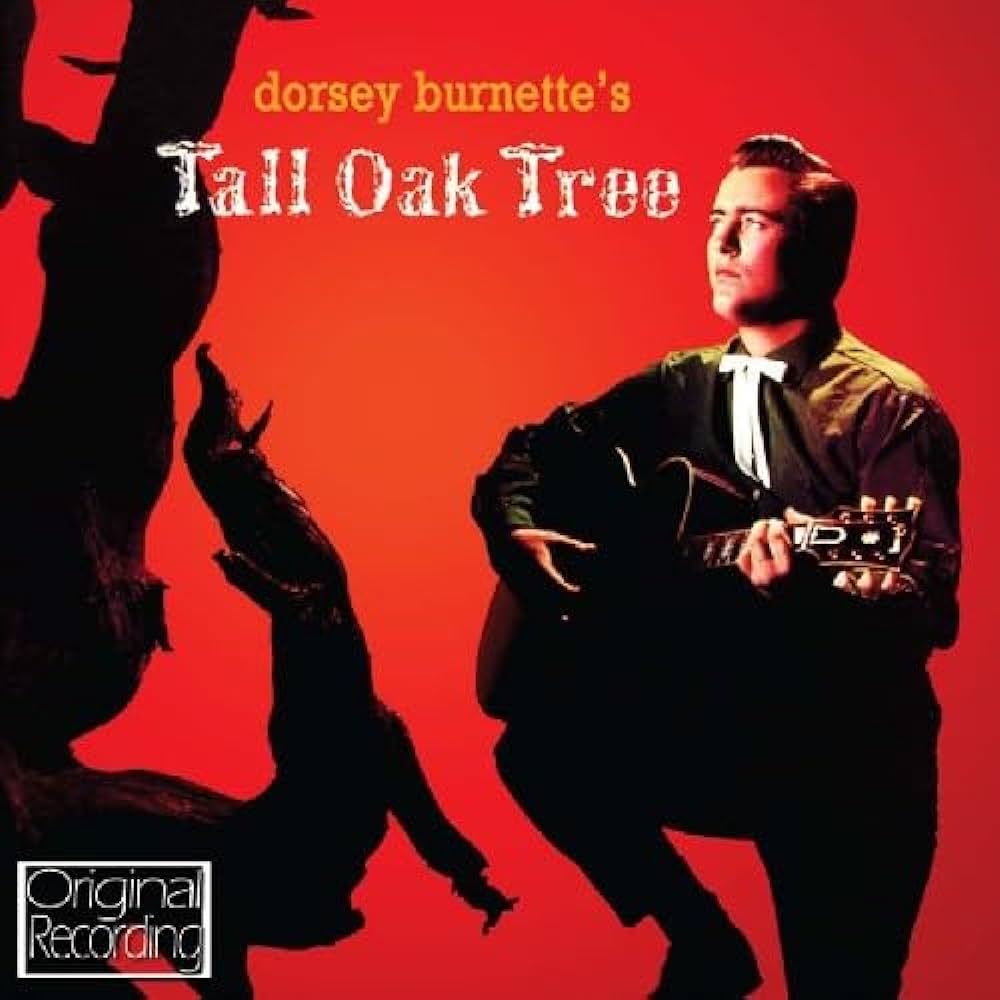
With a picture of a tall oak tree by my side
Dylan’s profound truth from his MusiCares speech in 2015, “all these songs are connected”, is demonstrated once more when we study the tracklist of Billy Burnette’s fine 2006 rock album Memphis In Manhattan. Dylan’s “Everything Is Broken” is track 3, and the choice of precisely this song seems to have a deeper layer. After all, Billy has more than enough Dylan songs in his backpack. In February 2003, he replaced guitarist Charlie Sexton in Dylan’s band for three weeks, during 11 concerts in Australia and New Zealand. Which he talks about entertainingly and cheerfully in 2015, in the English podcast StageLeft:
“I think I learned a 120 songs in like a month and a half or something. It was like… we’d only get the setlist five minutes before the show started, no, I got it twenty minutes before the show started, and there would be five new songs on it, which I had to learn really quick. So it was challenging. […] It was all different. He may change the key from night to night. Because it sounds better in this key today. It was a wild ride, but I really loved it.”
… so even if we think Billy is exaggerating a bit and apply point deductions, he had to learn at least about 150 Dylan songs in those days (not “Everything Is Broken”, though). Hardly a problem, by the way; music is quite literally in his DNA. And indeed, Billy is in the DNA of American music. Billy is the billy in rockabilly, the genre name that gets its name from his father and uncle’s hit song, from brothers Dorsey and Johnny Burnette. The brothers became parents at about the same time: Dorsey became father to Billy on 8 May 1953, Johnny to Rocky on 12 June 1953, both in Memphis, Tennessee. They immortalize this double celebration with a song they write together and then call “Rock Billy Boogie”.
They do not record it until 4 July 1956, and it first appears on one of the pillars under the genre and one of the best rockabilly records ever at all, on The Johnny Burnette Rock ‘n’ Roll Trio (December 1956), the record of which Paul McCartney (according to Billy) says:
“John and I, every morning when we’d get up in our little flat in Liverpool, we’d put on The Johnny Burnette Rock ‘n’ Roll Trio album, and that has really influenced us a lot.”
Live on the BBC, we hear Lennon announce “Lonesome Tears In My Eyes” on 23 July 1963: “This is a Dorsey Burnette number, brother of Johnny Burnette, called Lonesome Tears Of My Eyes. Recorded on my very first LP, in 1822.”
The words “Rock Billy” soon transformed into rockabilly, and Dylan is a fan too. “Believe it or not,” says DJ Dylan at the beginning of episode 45, “Trains”, of his Theme Time Radio Hour in March 2007, “The Johnny Burnette Rock ‘n’ Roll Trio were invited to appear on the Ted Mack Amateur Hour, where they won the competition three times in a row. I want you to listen to this record, and just imagine anything this raw winning three weeks in a row on American Idol.” And then plays track 2 of The Johnny Burnette Rock ‘n’ Roll Trio, the all-time rockabilly monument “Lonesome Train (On A Lonesome Track)”.
In addition, we are fairly certain that Dylan also has Dorsey Burnette’s “Bertha Lou” from November ’57 in his record case. Back in 1975, he seems to have used that rockabilly classic for his throwaway “Rita May”, and in 1989 we hear the lick and drive one-on-one in Oh Mercy’s track 3, in “Everything Is Broken”. Which Billy surely not chose by chance to cover in 2006 – he is indirectly honouring his father who died far too young (in 1979, aged 46, heart attack), and at the same time winking at Dylan as well.
A good-natured wink, no doubt. When the StageLeft Podcast‘s interviewer wants to hear more about Dylan, Burnette doesn’t have a whole lot more to offer, but still one fun, fascinating detail:
“He is a very private person. But we talked a lot about my dad and my uncle. He was a fan of some of their music. He was a big Rick Nelson fan [the Burnette brothers have worked a lot with Nelson and have written some of his hits]. So, he really liked that stuff and… I had actually met him in the seventies, and he told me that my Dad’s song, “Tall Oak Tree”, he said he realised that was the first ecology song ever written. And I called my dad the next morning, and I said ‘Hey Dad, I ran into Bob Dylan’. That’s neat, you know.”
The walking music encyclopaedia Dylan meets Billy Burnette sometime in the 1970s and immediately connects with a song by Billy’s dad from 1960, Dorsey Burnette’s “Tall Oak Tree”. That’s a nice enough song alright. Not too titanic, a bit silky perhaps, but good enough to be covered by greats like Johnny Rivers and Glen Campbell and to get a place somewhere at the front of Dylan’s phenomenal working memory. Dorsey had actually written it for Ricky Nelson, who rejected it. A good call, we might say in hindsight. It really is a Brook Benton song (who then did in fact record the song, in 1967). And true, the ecological admonition at the end of the song is ahead of its time;
And then along came Man to burn the oak tree down
And now the babbling brook is a-solid ground
And the mountain high don't stand so high
And there's a cloud of smoke that covers up the clear blue sky
It is tempting to think that Dylan had Dorsey’s own version on single. The B-side features “Juarez Town”, Dorsey’s attractive rip-off of “La Bamba”. We hear echoes of the chord progression in “Like A Rolling Stone”; the setting returns in “Just Like Tom Thumb’s Blues”. Coincidence, most likely – but still a nice coincidence. And a temporary, fleeting impression “Tall Oak Tree” evidently also leaves in Dylan’s “When I Paint My Masterpiece”. In that rich article “Whose Masterpiece Is It Anyway?” by Peter Doggett for the fanzine Judas! about Dylan’s recording sessions with Leon Russell in March 1971, Russell reveals even more intriguing details regarding the origins of the accompanying music, as well as on the genesis of the lyrics:
“When he first started writing it, he wrote, I left Rome and landed in Brussells/With a picture of a tall oak tree by my side – I think that he thought the changes that I’d played were “A Tall Oak Tree”, though they were actually “Rock Of Ages”, which I think “A Tall Oak Tree” was taken from as well. Anyway, he changed those lines later.”
The picture of a tall oak tree which the protagonist carries only in the primal, Greatest Hits Vol. 2 version invites wide-ranging guesswork from the esteemed ladies and gentlemen Dylanologists. Heylin suspects it refers to “the well-known story of an old man who spent his whole life painting and repainting the same tree” for example, and Tony Attwood seesa reference to the Zen tradition of using one aspect of nature alone to understand everything. But it turns out to be a bit more prosaic in the end – Dylan just thought he heard Dorsette’s “Tall Oak Tree” in the music track Leon Russell presented him with.
Anyway, he changed those lines later. Dylan feels a rather incomprehensible dissatisfaction with the line. Within three days, the Man burns down the big oak tree and replaces it with the inferior On a plane ride so bumpy that I almost cried, a rewrite to which Dylan remains – in slightly different variants – committed to this day, unfortunately.
To be continued. Next up When I Paint My Masterpiece part 10: The muscled mussels from Brussels
Jochen is a regular reviewer of Dylan’s work on Untold. His books, in English, Dutch and German, are available via Amazon both in paperback and on Kindle:
You Angel You was played on January 14 and 8 February 1990 and was picked up for this site by Mike Johnson in Songs of love, songs of betrayal.
It is interesting to hear the immediate cheer from the crowd. And as ever I bemused why Bob would play this twice and not work on it further, as he has done with so many other songs.
That is not to say that this is a particularly wonderful version of the song, (there is one such, and I’ve put it at the end, but it is not by Bob) but Bob has worked on far less successful early live versions of his songs and given them a new life on stage. But with this song, that was not to be.
So why do I like the song so much, and why does Bob not think enough of it to include it in the set list more than a couple of times?
Well, it is a very straightforward love song – and that is of course not the essence of most of Dylan’s most famous compositions. But the middle 8 is truly exceptional in a musical sense – as indeed the last cover version (below) shows.
However, I suspect Bob feels that the lyrics are just not very Dylan. There’s nothing at all wrong with them of course…
You angel you
You got me under your wing
And the way you walk and the way you talk
Feel I could almost sing

You angel you
You're as fine as anything's fine
Though I just walk and I watch you talk
Your memory's on my mind
… it is just that they are the lyrics of a straightforward love song and nothing more. I mean, if a lady ever wrote such lines to me I’d be floating so high in the sky I don’t think I’d ever come down.
But no, it is not the lyrics that have made me choose to go back to this song today; it is the elegance of the music in the middle 8 that really makes this song so special – the section that begins “Even though I can’t sleep at night for trying”. That first line of the middle 8 suggests we are going to have more lines in that format, but immediately the song changes into a new pattern.
Never did feel this way before
I get up at night and walk the floor
If this is love then gimme more
And more and more and more and more
Again it is not very Dylan, and that’s probably what Bob thought, I guess, but I love it.
This is of course a very different version from that on the Planet Waves album.
Aaron and I did a piece on the cover versions of this song in the Beautiful Obscurity series, and indeed one of those really did knock me out at the time.
In fact it was that version above that turned me onto this song which in turn led me back to Bob’s version. But I have to admit, I’ve still never found anything that surpasses this cover version above.
And that is one of the most wonderful things of working on this website. I keep finding and being reminded of recordings like this.
The Never Ending Tour Extended: This series primarily uses recordings selected by Mike Johnson in his inestimable masterpiece The Never Ending Tour, and looks at how those performances of individual songs change as time goes by. The selection of songs from the series, and the commentary below, are by Tony Attwood. A list of all the songs covered in the series is given at the end.
Long and wasted years was played 328 times between 2013 and 2019. We first pick it up in 2014 – The Setlist: The second half
The musical introduction of course tells us what we are going to get in terms of the song. And Bob declaims the lyrics with not so much a melody more simply a change of pitch. This is a performance of anguish, anguish and then more anguish. Indeed at times he’s almost shouting the rush of words, as the band just plays the same accompaniment over and over again.
It is obvious what the song is about – the opening verse tells us that –
It's been such a long, long time
Since we loved each other and our hearts were true
One time, for one brief day, I was the man for you
and this could turn into a song of regret and sadness, but with this performance it is a song of utter bitterness. There are some lyrical changes but that’s not the point. It is the pure venom that pour out that dominates.
By 2015 we get a somewhat different version. This is slightly slower version, with more melodic variations in the voice, and when Bob says he ain’t seen his family in 20 years he really is bitter – and there certainly is no recognition in the voice that this could be the singer’s fault. No, we are clear, everyone else is to blame, not him.
Given this delivery, some of the lines however are hard to believe. For example
Come back baby
If I hurt your feelings, I apologize
That doesn’t sound at all apologetic to me. Likewise…
You don't have to go, I just came to you because you're a friend of mine
Is that really meant? It is hard to believe it when performed in this way. I wouldn’t believe it, but the audience certainly seemed to love the pain and anguish.
And instantly from the opening notes of the changed accompaniment, we know we are into something else here. Dylan confirms that within seconds and if it were not confirmed already: the “Oh Baby” does it once more.
The problem is that there is not too much that can be done with the almost non-existent melody and that eternal descending accompaniment line. Yet there is a tiny element of gentleness that was not there before, and we get some variation from the band between the verses. Tiny changes but they do make a difference and hint at more to come…
In fact, I get the feeling here that Bob really would like to do something else with the song, and these slight changes are a hint in that direction. But the song itself is very limited, and the title of “Long and Wasted Years” doesn’t leave too much to the imagination.
And yes there is a journey going on because in 2018 we find…
The move towards a less angry and more sympathetic version has been a step-by-step progression, and yet here we are, along with an extra occasional moment from the band. Not much but it is there between verses, and it is different.
Bob is still declaiming rather than singing, but he is no longer calling out in anger – and those extra moments from the band between each verse express that well.
And so we come to the end for the song in the Never Ending Tour, in 2019. And yes that announcement introduction from the band is there, but consider how Dylan’s declamation of the song has changed from the first edition we had just four years earlier.
Sadness now dominates, and yet again there are slight changes in the accompaniment – an extra chord at the start of each year. And just consider how Bob declaims, “Twist and Shout” – there is no anger any more, just that sadness of a lost past.
Indeed musically the extra chords between the verses signify this too. In the end even after hearing the song five times one after the other, I am sad and sorry, not just for the singer but for the lady involved too.
Plus yet again I really do appreciate how the song has developed. There really is little one can do with this song while keeping it as the original song, because of the constrained nature of the composition and the clarity of the meaning of the lyrics. But Bob has found all that he can do. And for me, it was worth the journey.
“Everything is broken” is a most unusual song. It consists of 28 lines of lyrics of which 12 begin with the word “Broken” – which is not really what one might expect from the man often considered to be a great genius of songwriting.
What carries the music through against this repetition howeer is the multiple textures of the music which are introduced one by one at the very start. We start with the guitar with a repeated riff, then the bongos are added, with the vibrato guitar coming in – and we haven’t even got ten seconds into the song yet. Then there is a second guitar riff on top and with this whole array of intertwined musical accompaniment Bob starts singing on ten seconds with the opening salvo of repeated “Broken” lines.
What holds all this together is the fact that this is a standard 12 bar blues format, with the three prime chords. That means we have a feel of where this is going and so can enjoy the ride in terms of lyrics and accompaniment.
After three verses we get an instrumental break led by the harmonica – but this retains the repeated element – it is just one note played in a counter rhythm to the band.
So what holds our interest when the whole essence of the song is, both musically and vocally, so repetitive? One point to note is that it is a short song in Dylan terms, just three and a quarter minutes on the album. Another is that the 12-bar blues format of chords is one that everyone will feel at ease with. Even if you have not musical background at all, the movement between the chords I, IV and V, sounds very familiar and established.
Which in turn puts all the emphasis back onto the lyrics – and here the repetition of the message with the word “Broken” appearing so often we get a very clear feeling.
Yes everything is broken, but we can still live it and enjoy it. Nothing works, but that’s ok is the message which is conveyed as much by the energy of the music as by the lyrics.
And this really is quite an amazing achievement, because if one were to look at the lyrics alone without any knowledge of the music, one would never imagine this as a jolly bouncy song….
Broken bottles, broken plates
Broken switches, broken gates
Broken dishes, broken parts
Streets are filled with broken hearts
This is far from being the only way to see the world, but it is one way to perceive the civilisation in which we live. And yet the music tells us that this is ok – in fact we should celebrate the fact that everything is broken.
Even at the conclusion, there is no release from the brokenness of this civilisation
Broken hands on broken ploughs
Broken treaties, broken vows
Broken pipes, broken tools
People bending broken rules
Hound dog howling, bull frog croaking
Everything is broken
The message from the lyrics alone would be: this is an appalling disaster, a civilisation on its knees, or if you prefer, in its final days before it descends into anarchy. But the music tells us that if that is how it is, go out and embrace it and have fun as society and civilisation collapse. Collapse doesn’t have to be awful – we can embrace that too.
Bob played the song 284 times on the Tour, and if anything he upped the tempo, demanding that we all join in the celebration of brokenness with extra bounce. The message throughout is simple: it’s the end of civilisation as we know it. So let’s dance!
This recording from the Never Ending Tour series compiled by Mike Johnson comes from 1999 Inside the Museum. The instrumental break that starts at 2’40” and runs through to the end really is worth focussing on, as it shows there is even more to be got from this simple 12 bar blues than we might ever have imagined. It really is a celebration of brokenness – and one can’t say that of many songs. I do hope you have a moment to listen.
The songs reviewed from the music plus lyrics viewpoint…
Sailin’ round the world in a dirty gondola
Oh, to be back in the land of Coca-Cola!
Douglas Brinkley has noticed it too, the renaissance, or rather upgrade of “When I Paint My Masterpiece”. He asks about it in his interview for the New York Times in 2020, and then gets a remarkable answer from Dylan:
“I think this song has something to do with the classical world, something that’s out of reach. Someplace you’d like to be beyond your experience. Something that is so supreme and first rate that you could never come back down from the mountain. That you’ve achieved the unthinkable. That’s what the song tries to say, and you’d have to put it in that context.”
Remarkable for a variety of reasons. Confusing is the position taken by Dylan, after all the creator and restorer of the 50-year-old song; “I think this song has something to do with the classical world” – as if the song is a self-governing entity over which the creator has limited influence, and is as mysterious to himself as it is to the audience. In line, incidentally, with what Dylan says a little earlier in the same Brinkley interview about the creation of the Rough And Rowdy Ways songs: “The songs seem to know themselves and they know that I can sing them, vocally and rhythmically. They kind of write themselves and count on me to sing them.”
And the second noteworthiness is the depth Dylan seems to suspect in “When I Paint My Masterpiece”. And just as confusing. The more often you reread Dylan’s analysis, the more opaque it becomes – it’s almost Kafka’s paradoxical circle, the Kafkaesque quirk we know from ultra-short stories like Die Bäume (The Trees) and Der Aufbruch (The Departure), in which each subsequent sentence further obscures the understanding of the previous one. As it is with these five sentences. At least, “Coca-Cola”, “Brussels”, a plane ride and candy-eating journalists, to name just a few other song ingredients, do not, with the best will in the world, unleash “something with the classical world”. The subordinate clause something that’s out of reach suggests a contiguous connection, that the “something” from the Classical World is out of your reach – though Dylan doesn’t use a conjunction between the two phrases, so it’s a bit of a guess what the connection between the phrases is meant to be.
The following three sentences seem to be intended as an accumulatio, as a listing of equivalents for something like “creating a surprising masterpiece” – “surprising” as the talent apparently is deemed to be insufficient to create something of this exceptional quality. It is successively “beyond your experience”, “supreme and first rate” and an “unthinkable” achievement. The qualifications are a bit intense, and the metaphor you could never come back down from the mountain is perhaps a bit overly dramatic, but the thrust seems clear: the song is about, as we already have thought for about 50 years, creating a once-in-a-lifetime masterpiece.
After which Dylan’s closing words unscrew the newly-created notion again: this now is the “context” in which to put it. Weird. This is not “context”, this is saying-the-same-with-other-words. That “When I Paint My Masterpiece” is “something about the classical world” and features a narrator who dreams aloud of creating an exceptional masterpiece, we have known for 50 years. No, it seems as if Dylan is gradually removing contextually alien elements for the song’s renovation, to make the lyrics more one-dimensional, coherent. Which would at least explain the elimination of Botticelli’s niece and the pretty girl from Greece, as well as the deletion of “wasting my time and dodging lions in the Coliseum”, and it “contextualises” the evolution of the bridge as well.
It’s a jerky evolution. The very first recording, with Leon Russel, the one we know from Greatest Hits Vol. II, does not yet have a bridge. The demo version Dylan recorded on his own at the piano in those same March days in 1971 has an initial bridge:
Sailin’ round the world in a dirty gondola
Sure wish I hadn’t sold my old Victrola
Ain’t nothing like to that good old rock-n-rolla!
… the bridge that will never be sung again and according to Robbie Robertson, thanks to an inspirational Coke bottle from his mini-fridge before the song’s first release, the Band’s version on Cahoots, is changed into
Sailing 'round the world in a dirty gondola
Oh, to be back in the land of Coca-Cola
… the words that also appear in the official publication on the site and in Lyrics. It is the bridge version to which Dylan, apart from minor deviations, remains faithful until deep into the 1990s. I’d be so happy to be back in the land of Coca-Cola, Dylan sometimes sings abroad. Or when in the US: Oh, to be back in the town of Coca-Cola (in 1997 both in Durham and Los Angeles, for instance). And playful variations thereon. Oh, to be back in the land where I could have just one more rum and Coca Cola! he sings 1999 in Oxford, winking at the Andrew Sisters in a brilliant, lingering rendition with prominent steel guitar and impassioned vocals, by the way. And the most frenzied version gets the Brussels audience in 2002, already won over anyway because Dylan serves them with “When I Paint My Masterpiece” and the name-check “Brussels”:
Sailin’ round the world in a dirty gondola
I gotta fill it with root beer, 7-Up and even Coca Cola!
Bob Dylan – When I Paint My Masterpiece, Brussels 2002:
In yet another exceptionally successful performance, acoustic and driven, this time starring Larry Campbell’s mandolin, and stretched to over six minutes – in which Dylan plays the bridge twice (the second without root beer and 7-Up, but with “just another Coca-Cola”), and twice the last verse, so to the delight of the audience also twice “Brussels”, which Dylan milks very untypically and very showmanlike as well:
I left Rome, I pulled into Brussels [audience cheering again]
On a plane ride so bumpy… Brussels! Where they all go… [
                                   audience cheering even louder]
Sometime in the second decade of the 21st century, that drivel about gondolas and Coca-Cola then starts to bother Dylan, and he feels a need to tighten the lyrics further, make them more coherent, put them in context. So that silly bridge has to go. We’ll hear the revised version from 27 July 2018, the start of the Far East & Down Under Tour in Seoul:
Sailin’ round the world full of crimson and clover
Oh, sometimes I feel like my cup is running over!
… plus the musical novelty of playing the last bars of the bridge from “Tonight I’ll Be Staying Here With You” under my cup is running over.
Now, admittedly, the lyrics do indeed fit the “concept”. Sailin’ round the world full of crimson and clover, with the reference to Tommy James & The Shondells’ immortal world hit, does express something like “searching for an original masterpiece”. With as an amusing by-catch the backstory, which could just as easily have been a Dylan story: in a radio interview Tommy James was persuaded to play the rough mix of the song he was working on at the time (November 1968).
Unbeknownst to him, it is recorded and then sold as a single to listeners who ask for it. Demand soars, and Tommy’s record company denies the protesting Tommy James to finish the song, to mix it the way he thinks it should be. Comparable to Dylan’s objections to the release of unrelenting masterpieces like “Blind Willie McTell” or “Red River Shore”, recordings he feels are “not finished”. And comparably incorrect: the phenomenal success of the raw mix proves record company Roulette Records right. “Crimson and Clover still hits me,” as Keith Richards writes forty years later in his autobiography Life.
Also fitting with the “concept”, lastly, is Dylan’s new closing line of the bridge: Oh, sometimes I feel like my cup is running over, which can be understood perfectly as a heartfelt cry of the frustrated artist seeking inspiration for his Masterpiece. Perhaps a nod to another immortal 1968 masterpiece, to James Brown’s “I Guess I’ll Have To Cry Cry Cry”, but my cup is running over is, of course, in itself too generic to be promoted to reference.
It’s a fairly stable replacement since Seoul 2018 – Dylan varies at most on the introductory words. “Oh, lots of time I feel just like,” for example (Waterbury 2018), or even closer to the desperate gospel classic “Motherless Child”: “Oh Lord sometime I feel like…” (New York 2018), but these are only minute deviations from the more-or-less final version that will gain semi-official status with the release of Shadow Kingdom in 2023.
With which Dylan has finally put it into context, accomplished the unthinkable, reached the place beyond his experience, and built his supreme and first-rate bridge to the timeless portrait of the struggling artist. At least: if that’s what the song tries to say.
To be continued. Next up When I Paint My Masterpiece part 9: And then along came Man to burn the oak tree down
Jochen is a regular reviewer of Dylan’s work on Untold. His books, in English, Dutch and German, are available via Amazon both in paperback and on Kindle:
Songs and recordings researched and suggested by Jürg Lehmann. Opening commentary by Tony Attwood
Way back in November 2021 (well it seems like “way back” but in fact it actually wasn’t that long ago) I started a series called “A Dylan Cover a Day” in which each day I took a Dylan song and looked for some covers of that song which were on the internet, and then picked a few of them and wrote a bit about each one.
That series finished very recently with You gonna make me lonesome when you go – and at the end of that review there is a list of all the 177 songs previously covered in the series.
Now obviously that left a lot of Dylan songs not included, and of course even in the 177 articles, there were many excellent covers that were missed.
And so now the series is over, Jürg Lehmann has suggested we might go back and revisit a few songs, and perhaps include some of the songs that I missed first time around (which I often did simply because the song was not particularly one of my favourites) and add some more reviews.
So it is still me writing the commentary, but this time not me selecting the tracks.
Jürg’s first selection is 2×2 with which I started off the “Cover a Day” series. And his comment is simply, “There’s a very good cover by Saturday Night Fish Fry”.
This comes from the album Dirt Road Blues, and I must say the band does a wonderful job with the song – the track is beautifully performed and produced and the arrangement really takes us in a new direction. As it is not a song that I have particularly rated, I am amazed that the band spent so much time on the arrangement and recording – obviously not because I don’t think much of the original, but because I really couldn’t see where else it could be taken.
But I am so glad they could see what I couldn’t. Of course me not rating a song is neither here nor there; the main point is that I’ve been reintroduced to a Dylan song that really had passed me by before. I can only hope it does the same for you.
And… I do like to expand my musical education as I go along, and here I need some help. Obviously one can look up most things on Google and the like, but “Saturday Nite Fish Fry” is not only the name of this band but it is also the name of a very famous song from the 1930s which I have the feeling my dad played on sax when he was in a dance band at the time. And also the band’s first album was called Saturday Nite Fish Fry (although with the words “volume 1” added.)
Which makes it had to find other versions of the song (if there are others) on the internet. But you can find the whole album by the band on line here if you want to take this further.
But what about what happens if you go searching for “Saturday Nite Fish Fry” on the internet? Well, this is where you are quite likely to end up.
And I know this is several thousand miles away from what Jürg intended but I love this journey. This recording comes from 1949, but the song goes back much further than that. But sadly I can’t find any earlier recordings.
However I must come back to the version of 2×2 Jürg has come up with. It really does illuminate what Bob put into that song as a composition, but (in my view) didn’t manage to bring out in the performance.
And just in case you have forgotten it, here’s Bob’s version
What makes all the difference for me is the bass guitar part. In Dylan’s original version here it is just pounding away on the bass note of each chord, and it just makes the whole piece rather tedious for me before we get to the “How many” line.
Go back to the Saturday Night version, and not only has the song been slowed down but that bass guitar line has been really improved. The changes are not enormous in themselves but the impact of the change is to make me listen to the rest of the band, and not be put off by the bass.
So I’m really glad to hear this version that Jürg provided, as it gives me another Dylan song that I can listen to, even if I still find the original difficult to take in. I’m so glad the band persevered with it.
If you were to go back to our 2021 article “220 selected cover versions” you would find that 1 by 1 is not on the list. If we get round to doing that piece again, it would be.
The song I wanted to cover next in this little series of songs Bob has only performed once or twice was Lily Rosemary and the Jack of Hearts which was played at Salt Lake in 1976.
Officially the report is that this performance was not recorded although as ever there are stories circulating that it was recorded and a few collectors have a copy. But that’s what is always said. I certainly don’t have a copy and although there are people around who will always say, “it does exist I’ve heard it” (etc) the fact that it remains undercover suggests to me that it’s a fantasy. I’ll change my mind when someone sends me a copy.
Thre was also an extract from the song of under two minutes that has reportedly been Dylan performing on that one occasion, but again others dispute that too. It is also said that this extract is a rehearsal piece, not a concert performance.
So no go on “Lily” but since I have been searching around let’s have a live performance that is out there. For just because I start looking for something it doesn’t mean I can’t share what I actually found along the way. (Indeed I never understand researchers in any subject who say “but that’s not what I am looking for” – what one finds along the way is often more interesting than what one set out to find.).
This is a much more gentle version than Bob delivers although it occasionally builds up a little en route, but the (mostly very much in the background) piano accompaniment does a lot to keep it light. It also sounds to me like there is a glockenspeil in there too, which I do think is a bit odd. But every arranger does his/her own thing – and she’s the recording star. And a lady with a great memory.
Actually it is worth playing this and listening to the occasional moments from each instrument – the performer on the electric piano seems to have been given completely free range to be, well, a bit odd from time to time. Although when you have a strophic song that is over eight minutes long and everyone already knows the lyrics, something has to be done to hold attention.
But no, there’s nothing by Bob. And so, because I thought, if Lily wasn’t available, what was next on the list of songs Bob played once or twice? Here I came up with “Stage Fright” – and this one is equally oblique in that the performance does say as you can see below (featuring Bob Dylan) but it has Rick Danko on lead vocals.
The Stage Fright live performance is listed as 3 January , 1974 in Chicago and you can see the set list through the link. As for this recording, it is horribly unbalanced, but you can get a feel of what it was all about.
As a keyboard player myself I always enjoy hearing an organist having a bit of fun. And beyond that I wonder if Bob was having a bit of fun in suggesting he had spot of stage fright in not singing the song. (OK that’s a bit oblique, but if there is one thing Bob knows how to do it is oblique).
But of course if there ever was a man without stage fright it was and is Bob. No matter what happens and how, he seems just to be there, knowing (I guess) that his audience will wait. After all he had the experience of being booed for playing with a band, quite early on in his career, and just kept on keeping on.
Incidentally you have my most fulsome permission to stop listening to the Band’s recording of Stage Fright at any time you wish. I have to listen since I’m responsible for putting the recording up, but there’s no reason why you have to suffer too.
And maybe that performance was a reason why Bob never returned to the song.
The Never Ending Tour Extended: This series primarily uses recordings selected by Mike Johnson in his inestimable masterpiece The Never Ending Tour, and looks at how those performances of individual songs change as time goes by. The selection of songs from the series, and the commentary below, are by Tony Attwood.
Pay in Blood was played 477 times between 2012 and 2019 and I must admit I come to this song now with even more interest, and indeed excitement, than before as in the last article I re-discovered the changes made to Tweedle Dee and Tweedle Dum by Dylan on tour. If you missed that last piece I would urge you to go back to the last recording, not because of anything that I have written, but because of the final performance of that piece in the last outing of the song. It is still being played daily in my house.
But we move on to Pay in Blood. And here Bob manages to make the song appear slightly softer and a trifle slower. And such is the change of atmosphere it almost sounds as if he’s changed key, although in retrospect I don’t think so. It is just that the whole sound and approach gives an extra level of menace in this performance which was somehow not there on the album recording.
So what I am now listening out for is that sort of subtle change, especially in the final year of the tour… We start in 2013… which doesn’t particularly contain any surprises but is a very enjoyable outing for the song, even though it is a song about danger.
The second recording I’ve chosen comes from the same year and it seems to me to have increased the sense of menace and danger that was always there, even more. Partly this is due to the balance of the band, which of course can be down to the recording itself. It’s not a major set of changes, but there is something different here.
And as we move forward there are more changes but they are still very subtle. It is almost as if Bob knows there is something he can do with the song that is different, but what….? In fact what we get is a softer version, especially as the song continues. Consider how he is performing around the third and fourth minute of the song and listen to the very short instrumental section that ends the performance.
So was this going to be another song which in retrospect we find that Bob played what is after all a perfectly good and enjoyable version all the way through the tour without variation? Or we will find a sudden change of direction as we found with Dee and Tweedle Dum – an unbelievable journey?
Certainly by 2018 there were hints of change…. although not as dramatic as we have often found with other pieces…
So again we have a song that was kept much the same as the recorded format but in his last year of performance on the Never Ending Tour, Bob decided to kick the piece a different treatment.
Hearing the similarity of performances across the years (before the final tilt at the song if one may call it that) it strikes me that in these last years of the tour Bob was generally changing songs far less – and that might be seen as a prelude to the Rough and Rowdy tour in which both the set list and the arrangements remain similar across many shows.
But what does come across to me here, and of course most particularly in the previous edition with the final version of Tweedle Dee, is that Bob has decided to give his old favourites a kick in a new direction. One wonders what might have happened to these songs with their new variant performances if Covid had not come along and stopped the show. What would he made of this song, and Tweedle Dee next time around?
The lyrics and the music. Looking at how Dylan’s music relates to his lyrics and vice versa. By Tony Attwood
I’ve never checked in detail but it seems to me that the original release of Cold Irons Bound has one of the longest musical introductions of any Bob Dylan recording. And indeed it is interesting that in the live performances, this notion of the longish and mysterious introduction is maintained – although the exact format changes.
Indeed on the originally released recording that we have on Time Out of Mind (above) the musical introduction lasts just a few seconds under a minute. Now, I’ve not sat here measuring each song’s intro with a stop watch (even I am not that sad) but it does feel to me as if it is one of the longest introductions we have on an album track.
When the bass does come in with its repeated melody we are 20 seconds into the recording, but still half a minute away from Bob starting to sing. And ultimately when we get there we find the whole verse up to the chorus lines, is one musical line repeated over and over, above that bass.
This then contrasts with a completely different much more laid-back chorus.
So in effect, the whole verse is on one chord except the last three lines which form a chorus (followed by an instrumental line of the same music) giving us the title line.
The impact of this arrangement is quite strange. The song on this original is bouncy, both in the melody and the instrumentation. and even the instrumental verse then makes no concession – it is the music as before, but without the voice. There is no new guitar solo.
This constancy of the music, the form and the arrangement gives us an exact reflection of the meaning behind the lyrics. Life in the sense of this journey towards prison goes on – it is not passive with a person sitting alone reflecting, but rather life out in the wild, and the realisation that things are like this and will go on being like this. Until they get worse.
Well the winds in Chicago have turned me to shreds
Reality has always had too many heads
Some things last longer than you think they will
Some kind of things you can never kill
It's you and you only I'm thinking about
But you can't see in, and it's hard looking out

I'm 20 miles out of town, Cold Irons bound
In this way we get the feeling through the music of being out of town just walking on, with the wind howling, and everything happening, but at the same time there is the remorseless walking on. Not only does nothing change, nothing is expected to change. Hence the entire song on one chord.
There is a bounce of course within the accompaniment, and indeed a vigour in the way Bob sings, because the character in the song is constantly “Cold Irons Bound”, but still nothing is changing, the journey continues on and on and there is no escape.
So we have the implication of movement (it is a bouncy lively beat with the lyrical lines alternating between high (Well the winds in Chicago) and low (have turned me to shreds). And this movement is unchanging except for the final resigned line of each verse (“T’m 20 miles out of town…”).
Thus we have physical movement and mental decline – he’s given up on his life, but he is moving on and on physically, as he has to.
It is a remarkable concept to carry off within a song, without making it all to obvious, and in the seven plus minutes of the song it is extraordinary that such constancy can hold our attention. And yet it does. We are there with the singer making this long and painful journey which is most certainly not going to have a good ending.
A perfect match between the lyrics and the music.
The songs reviewed from the music plus lyrics viewpoint…
Someday, everything is gonna be smooth like a rhapsody
When I paint my masterpiece

Sailin’ round the world in a dirty gondola
Oh, to be back in the land of Coca-Cola!
To promote the release of Cahoots 50th Anniversary Edition in 2021, Robbie Robertson has himself interviewed for a “The Making Of” series of clips to be posted on the official The Band website, on YouTube, Facebook and whatnot.
The approach is – obviously – not overly critical, but Robertson is realistic enough to hint between the lines that he himself agrees that The Band’s fourth album is not exactly a highlight of the legendary band’s oeuvre. “We were just messing around,” is the gist of his reminiscences, laced with half-excuses like “we weren’t really studio guys” and “I just wanted to get off that treadmill”.
Then he seems to remember that we are actually making a promotional film and quickly dashes off some half-hearted advertising talk: “I think this record is unique in The Band’s music, unique in this discovery process, and it really represents the music of a period, and the fact that is has no rules – I don’t know, I just rejoice in them,” stressing that they were experimenting, that they had complete freedom in manager Albert Grossman’s new studio in Woodstock (Bearsville Studios); “So this was like a new toy.”
Cahoots’ biggest flaw understandably does not come up: the songs are just not that strong. In his autobiography Testimony, which was in shops five years before these promotional clips, Robertson is a touch more frank: “We knew it wasn’t all our best work” (like Levon Helm in his memoirs: “The music on Cahoots didn’t prove that memorable”). It’s still The Band, of course, with even on an overproduced album those irresistible frayed edges that elevate the men to such an exceptional band, and there are enough glimmers to call it a good album – the opener “Life Is A Carnival”, Allen Toussaint’s horns, Danko’s drive and vocals plus the arrangement of “Volcano”, the heartbreaking melancholy of the closing track “The River Hymn” – but the off-category quality of the three previous records is no longer there. We only hear that particular quality flaring up briefly in the album’s Dylan song, at track 2, in “When I Paint My Masterpiece”.
Not in so many words, but Robertson, too, does recognise this. And then oddly, with poorly acted modesty, seems to want to pull some of the credits back to himself in those promotional clips in 2021:
“He said: You know, I got a song. I got the beginning of a song. I think it might be good for you guys. So he played me this song “When I Paint My Masterpiece.” He’s playing the song, and I’m thinking, he’s right, he’s right. You put The Band in front of this song, something’s gonna happen. And he was playing and he was playing it, he got to a point and said: Yeah, that’s as far as I got. I really need in between the second verse and… I really need a bridge in there.
I said to him, do you want something to drink? (I had a little refrigerator.) You want something to drink, you want a Coke or something? He said: Oh great, okay. So I went and got a Coca Cola, and he made up the bridge. It says Oh to be back in the land of Coca Cola. And… it’s just one of those… in music… a perfect accident, when something just… this fits with that. And then we went and recorded that in the studio. And I thought, okay, this is a sign, this is telling us we’re getting down to business here. And it feels good. Again, very unusual, but I feels good.”
… which is a slightly upgraded version of the story he had already penned in 2016’s Testimony:
“There’s a tune, might be good for you guys.” He picked up my guitar and sang what he had so far on “When I Paint My Masterpiece.”
What a song! What an idea! I thought. I asked him if he wanted a Coke from the small fridge I had in my studio, and he came up with a bridge, “Sailing around the world in a dirty gondola, oh, to be back in the land of Coca-Cola.” I wrote down the words and the guys and I recorded the song the next day.
So, in both versions Robertson testifies that Dylan had only written part of the song and that a bridge was missing still; in 2016 he states Dylan lets him hear what he has so far, and in 2021 he reveals it was no more than the beginning of a song. Which is demonstrably false. Thanks to The Bootleg Series Vol. 10: Another Self Portrait (1969-1971), we know the demo version that Dylan recorded alone on the piano on Day 4, the last day of the Blue Rock sessions 19 March 1971. A version that is the same as the recording with Leon Russel and his men three days before, apart from a few minor textual interventions, and apart from:
Sailing around the world in a dirty gondola
Sure wish I hadn’t sold my old Victrola
Ain’t nothing like to that good old rock-n-rolla
… apart from a bridge, that is. A bridge Dylan already had for quite some time. The same chords and melody as the bridge with the familiar first line that we’ll hear shortly after on Cahoots. Only the second line has changed (and the third has been deleted). Granted, not too brilliant poetry, but on that front the alternative to which the contents of Robbie’s fridge inspire is not much shinier either;
Sailin’ round the world in a dirty gondola
Oh, to be back in the land of Coca-Cola!
… although this variant has plenty of fans. And not the least, by the way. The ever-enthusiastic Professor Rollason, for instance, sees in these lines “a crucial Old World/New World contrast” and finds the rhyming gondola/Coca-Cola “perhaps worthy of Byron” (Dylan, Europe and a wild goose chase, 1998). Or Los Lobos’ keyboardist and producer Steve Berlin. Stereogum publishes a list of eighty artists choosing their favourite Dylan song on Dylan’s 80th birthday, 24 May 2021. Steve Berlin chooses “When I Paint My Masterpiece”, praising these very words: “And then the line about the land of Coca-Cola brings it all back home.” Friendly, but if we’re honest it’s really not much more than some corny rhyming fun.
Nevertheless, these words in the bridge seem to suit Dylan quite well. He never sings the Victrola/rock and rolla variation again, to the Coca-Cola variation he remains faithful for decades. Longer in any case than to the preceding chorus line Everything is gonna be smooth like a rhapsody. Somewhere around 1990, Dylan apparently learns how lame this particular simile is; after all, a rhapsody is a piece of music that, while a unity, is defined precisely by its contrasting parts – and thus, by definition, is not supposed to be smooth. From the 1990s onwards, Dylan then usually sings there either everything is gonna be different or everything is gonna be beautiful. Very occasionally, the rhapsody still comes along (Poughkeepsie 1996, Akita 1997), but from the twenty-first century onwards, the oxymoron is permanently banned.
The evolution of the bridge, from Victrola to Coca-Cola to the presumably final Shadow Kingdom variant “world full of crimson and clover” is less choppy, but then again: much more drastic as well…
——-
To be continued. Next up When I Paint My Masterpiece part 8: “Crimson and Clover still hits me”
Jochen is a regular reviewer of Dylan’s work on Untold. His books, in English, Dutch and German, are available via Amazon both in paperback and on Kindle:
The Rough and Rowdy Ways Tour: Commentary by Tony Attwood, audio kindly provided by Mr Tambourine.
Love Sick
Lover Sick starts at 3.20.56
The opening staccato chords are enough to tell us what the song is going to be. And the accent Bob puts on words such as “brain” tells us that this is going to be a re-run of the recorded version with what has by now become the variations limited to the vocals rather than within the music.
And just in case you feel that this is how it always is on Bob’s tours, and this tour is no different from all the others, may I refer you back a few articles to the exploration of the way Bob ultimately developed an earlier song: Tweedle Dee and Tweedle Dum – an unbelievable journey
But now back to this piece: everything here focuses on the title – Bob’s voice really does tell us he is sick of love. If we didn’t believe him before, we do now.
Now at this point the recording kindly put together by Mr Tambourine continues with recordings of the songs we have already looked at in this series, and so my intention from the start of this little series has been to get to here and then leave you to enjoy those songs and the others that turn up subsequently.
For example, at 4.02.30 there is Simple Twist of Fate, and 4.10.51 we have I’ll be your baby tonight. But I can’t let the series go without leaping forward to 4:30.07. You will know the song at once from the opening two chords, but here we have a slow blues version of “It takes a lot to laugh it takes a train to cry”. It is not a radical rewrite but it is an arrangement that is utterly, utterly, full of feeling and does give new insights.
With a bit of luck the track might play immediately on the link below…
And really this performance makes a point that I have been increasingly aware of since starting this blog: that in trying to express thoughts about Bob’s work, any attempt I might make to hear the work afresh is always tempered by my personal relationship with the song which began of course from the first time I heard it and continue through my life.
For me, every Dylan song is not just a song to be heard once more, but a journey back through the years from the first listening on the album, through live performances and of late the videos we now have access to.
So for me this version of “Train,” as with so many other Dylan songs, is a personal experience utterly wound up with my life. If I’d been there I’d have been cheering just like everyone at the show.
And thus I will leave you to enjoy the rest of the recordings, and once more express my eternal thanks to Mr Tambourine for providing this set of recordings to Untold Dylan and giving me the OL to use his compilation. I am once more in your debt, sir.
Today it is “Spanish Harlem Incident”, and how one band took a single rather bland live performance, and transformed the song into a really memorable piece.
By Tony Attwood
For me it is the attempt to make this a solid fast-moving piece through the unchanging guitar part that makes this live performance unattractive. I suspect the response to this one performance persuaded Bob not to continue with the song.
For this is an occasion in which a varied accompaniment is essential to the holding of our interest, not least because in the first part of each verse there is not much dynamism in the song itself.
When we combine this with the fact that the melody in the verse is often non-existent but combines with lyrics which themselves don’t really grab attention, then we can see why the song in this form is lacking something when it comes to a live performance.
Take for example…
I've been wonderin' all about me
Ever since I seen you there
On the cliffs of your wildcat charms I'm riding
I know I'm 'round you but I don't know where
… that third line is actually really interesting – anyone who pauses over the lines will surely be asking “what are these wildcat charms?” and “how is he riding them?” (salacious thoughts spring to mind). Not to mention how the cliffs actually fit in with the whole concept of the piece.
But musically all we get is one note. Now that can work if the guitar rhythm is doing something interesting, or the melody is engaging us elsewhere, or perhaps there is a moving accompaniment. But here Dylan is doing neither of the first two and has no accompaniment beyond the guitar to help him out.
I feel it was at this stage that Bob was learning that in a live performance, the lyrics are not enough – for indeed if all we have is the lyrics then is probably better to leave the piece as a poem.
And so after this one performance, Spanish Harlem Incident was left – at least by Dylan, and by most cover artists. But do spare a moment if you can to listen to Dion’s version from 1978, which tackles every single one of these issues, and shows us what the potential of the song really was.
So yes, good reasons for Bob not to go forward with the song in its original form, but a lesson can be learned here by all cover artists – just because Bob drops the song doesn’t mean that the song is not worthy of further investigation.
In fact well over half of the songs listed on the official Dylan site have been performed by Bob either never at all, or only once. There is a treasure trove there for bands who want something different and potentially exciting and written by Dylan, if only they would bother to look.
The Never Ending Tour Extended: This series primarily uses recordings selected by Mike Johnson in his inestimable masterpiece The Never Ending Tour, and looks at how those performances of individual songs change as time goes by. The selection of songs from the series, and the commentary below, are by Tony Attwood.
And may I add that if you think (as I did at the start) that Tweedle Dum is hardly one of the highlights of Bob’s musical career, please stay with this, or at least skip to the very last performance at the end of this article. If you don’t know what happened to this song, you might well be as surprised, and indeed as delighted, as I was.
Tweedle Dee and Tweedle Dum was performed an amazing 491 times between 5 October 2001 and 23 June 2023. And I say “an amazing 491 times” because I have to admit that until I came to write this, and listen to the recordings across the years, I have always seen it as a trivial song, a bit of a throwaway. I do recall hearing it at concerts of course, but it never struck me until today that Bob played it quite so often. Or why he played it. Now I know.
It is, if my counting is correct, the 37th most played song by Dylan on the Tour. Our earlier recording from the tour comes from 2001 – the start of Bob’s use of the piece.
Listening to this recording of the song now for the first time in several years I actually wonder if I have been too hard on the piece (in my own thoughts). It’s a jolly rocker with a really lively backing, and that rather hard-to-play guitar solo after each line in the latter part of the song.
This is also a perfect example of Bob not wanting to put anything into the instrumental version by the way of extensive virtuoso solos. What we get is the music without the voice, not much more.
I have to admit that seeing just how often Bob has played the song I wondered if maybe I had totally missed the point of the piece, and that everyone else was seeing it as a major part of his output, I did a bit of looking, but no, most people see it as of moderate interest. But no, I don’t think any of us could have imagined where this was going to end up.
The main change I notice at once is Bob using that falsetto note at the end of the line which he has so often employed. But although the pace and orchestration is still the same, the way Bob sings the opening verses gives an even more frantic feel about the piece. (And if you don’t like frantic, I beg you, stay with this, because there is an utter gem to come).
This time, when we get to the instrumental break there is even more excitement and a real contrast then when Bob returns with a softer feel all round. It is still the same song, but there are a few extra nuances, especially in the instrumental break which starts around 3 minutes 50 seconds. It is as if Bob has said to the band “let’s show them there is more here than they thought”. And as if he knows that there is somewhere else he can go with this, but hasn’t yet found it.
Then the much softer section that follows that frantic instrumental break gives a real contrast… but I am now confused… I suppose I can best express this as “Why?” I don’t have an answer – or rather when I first wrote this I didn’t. Having got to the end of these extracts, I realised.
Now this is a surprise. Same song, same key, same speed, but much more laid back. It is a reflection on what we have seen and heard before. Even if you have had enough Tweedles by now, I would suggest listening to this piece in contrast with the 2003 version above. It is such a simple song, but Bob and the band really have done something new with it, without actually losing or changing or developing any of the piece.
Whether it is worth it I am not sure. The very soft verse just after the three minute marker seems just to be there as a contrast, without any other meaning or implication, but still, it’s fun I guess. As for the much softer verse that takes us through the last minute or so of the piece… another surprise.
Now we get the feeling that Bob really is going to keep on with this strange little song until he gets every last drop out it. We know what it is from the lyrics and the accompaniment, but Bob is singing it differently. He’s being reflective, more inward-looking, more resigned maybe. I get the feeling something else is going to happen, but it is such a simple song, how can there be anything more. Well, that comment shows why Bob is the genius and I’m the guy just reflecting on what he manages to do. (But don’t let this comment put you off listening to this version all the way through. This really is a fascinating development).
And now, if you don’t know what is here, you are going to be shocked, stunned, surprised, and well, I don’t know. OK I have rushed forward to 2014, and that is perhaps not fair, but it makes the point.
I love this. If only this had been the original version, I would never have dismissed this as a passing fancy. This is really fun, interesting and entertaining and dare I add, insightful. This is indeed one of my favourite moments from the Never Ending Tour. Not just because I love the performance but because of the journey that Bob took us through.
Who, honestly, on hearing the original live versions could ever have imagined the song could be like this? How did he clear his mind of everything the song has been before, to get to this?
I certainly could never imagine the song had enough within it to take such a simple accompaniment. I really do think this is one of Bob’s greatest Tour achievements – to take this simple song, and keep the essence of it and turn it into this utterly gorgeous arrangement.
I play this, I keep playing this, and I am so, so grateful to Mike for having selected it from the thousands and thousands of extracts he listened to.
As to why I like it so much… well, there is enough of the original there for me to recall where the song has come from. Plus it has a relaxed feel that suits my everyday life at my age. Plus I love the way the verses change – try the verse after the four minute marker. And that distinctive guitar solo that recurs throughout.
Oh Bob, I love you for this. No one else could ever have done it.
Oh, the hours I’ve spent inside the Coliseum
Dodging lions and wastin’ time
Oh, those mighty kings of the jungle, I could hardly stand to see ’em
Yes, it sure has been a long, hard climb
Train wheels runnin’ through the back of my memory
When I ran on the hilltop following a pack of wild geese
Someday, everything is gonna be smooth like a rhapsody
When I paint my masterpiece
According to The Guinness World Records, Bing Crosby’s 1942 “White Christmas” is the best-selling single of all time with an estimated 50 million units. Which probably is about right, but overly reliable such numbers, or record lists at all, are not. We have had hit lists only since the 1950s, and even from those you can only approximate how much a single or an album actually sells. After all, we do not have something like a Central Record Sales Office, where sales figures from all over the world are registered.
By extension, what the most covered songs in the world are is equally impossible to determine. Guinness World Records hoists “Yesterday” on the shield, claiming that more than 1,600 cover versions of it have been recorded, but Stacker can only find 512 and puts “Yesterday” at position 2 – Duke Ellington’s “Caravan” is at 1 with 516 covers.
But then again, according to Far Out, “Satisfaction” is #2, according to UK’s Independent, “Eleanor Rigby” is #1, the Washington Post seems to know that “Silent Night” is the most covered song of all time, and we could go on and on. Little consensus, all in all – we only agree at “most covered artist”: Dylan tops almost all lists.
The unreliability is demonstrated, among other omissions, by the absence of “Wimoweh (The Lion Sleeps Tonight)”, which does not make the Top 50 anywhere, despite the fact that we are all pretty sure it has to be one of the biggest hits of the 20th century. Written and recorded in 1939 by Solomon Linda and his Evening Birds in Johannesburg in Zulu language as “Mbube”, the song first rocketed across the African continent.
The South African record boss of Gallo Records puts the single in a box of records he sends to Decca Records in New York, where it is noticed by Alan Lomax. Lomax brings the song to Pete Seeger’s attention, who transcribes it by ear and releases it with his Weavers as “Wimoweh” – and scores a big hit with it. The English lyrics then are written in 1961 by lyricist George David Weiss, The Tokens record their version with these English lyrics, becoming the world hit we all know and love. And of which there are hundreds of covers – from Glen Campbell and Arlo Guthrie to Jimmie Rodgers and Roger Whittaker, from James Last to Bert Kaempfert, from Ladysmith Black Mambazo to Mory Kanté, and from R.E.M. to Brian Eno; “Wimoweh (The Lion Sleeps Tonight)” can be found in every corner of the record shop, and in 2000, journalist Rian Malan calculates in Rolling Stone that the song’s use in Disney’s The Lion King alone should be good for some $15 million.
Solomon Linda, as it then goes, barely sees a penny of that. Much to the chagrin of the autobiographer Pete Seeger:
“I distinctly remember being told, “Pete, money is coming in for ‘Wimoweh.’ Where should we send it? Gallo says send it to them.”
“Oh, don’t send it to them,” says I. “Solomon Linda will never get a penny of it.”
“Well, get his address. We’ll send it directly to him.” I didn’t bother to ask exactly what “it” was. Foolish me. A year later I’d located Linda and a check for about $1,000 was presented to him at a grand banquet in Johannesburg. I assumed this was the first of many such payments, and that a standard songwriter’s contract had been signed with Linda. Again, foolish me.”
(Pete Seeger – In His Own Words, 2012)
The Weavers – Wimoweh
The boatload of money ends up going to lyricist Weiss, Seeger recounts regretfully, because a judge in 1991 ruled that that was simply copyright law: “If you adapt and arrange an old song in the public domain, you get to keep all the royalties,” with the judge deciding that the original song is in the public domain – presumably because South Africa is not a signatory to U.S. copyright law.
Weiss apparently knew the approximate meaning of the original lyrics. Mbube means “lion”, and the chant that Pete Seeger heard as “wimoweh” is actually uyimbube – “you are a lion” in Zulu. Enough to inspire Weiss to
In the jungle, the mighty jungle
The lion sleeps tonight
… which in turn will echo ten years later, in 1971, in Dylan’s impromptu in Manhattan’s Blue Rock Studio: Dodging lions and wastin’ time / Oh, those mighty kings of the jungle. Rather poignantly, that line from “Wimoweh” to these words in “When I Paint My Masterpiece”, as we hear Dylan copying Weiss’s zoological fake news – after all, lions don’t live in the jungle. The mighty king of the jungle, of course, is Tarzan, who never encounters a lion there. Should Tarzan swing on all the way to Asia, he’d encounter tigers at most, as Elvis communicates zoologically correctly;
I am the king of the jungle
They call me Tiger Man
I am the king of the jungle
They call me Tiger Man
If you cross my path
You take your own life in your hands
(Editor’s note: Jochen’s link for this song https://youtu.be/0pV_Q_eyfnQ is not working in the UK, so an alternative is provided below).
Dylan’s first introduction to the song will have been Pete Seeger and The Weavers’ phonetic version, on 1957’s The Weavers at Carnegie Hall, the live album including “Rock Island Line” and “Woody’s Rag/900 Miles” and “Goodnight, Irene” and all those other songs that will somehow trickle down into a Dylan song in the sixty years that follow. Still, The Tokens’ English-language world hit is inescapable, of course. As inescapable as The King’s ’68 come-back special, in which he performs his driven version of “Tiger Man”. Which makes Dylan’s train of thought on this winter day in New York all traceable with a high degree of probability: Italian impressions on the walk to the studio – “Going Back To Rome” – Colosseum – wild-animal fighting – “The Lion Sleeps Tonight” – king of the jungle.
Slightly less reducible but still imaginable are the next stops on the train of thought. Train wheels runnin’ through the back of my memory could just be an autobiographical interlude – perhaps even a memory of his Rome visit in January ’63 and getting on the train there to visit girlfriend Suze in Perugia, two train hours away (who, however, is already back in New York by then). And the line When I ran on the hilltop following a pack of wild geese then might be triggered by Titus Livius’ old legend, about the geese of the Capitol, of the old citadel. The geese who, on the night of 2 August 387 B.C., warned of the invading Gauls with their snapping, waking up Marcus Manlius and thus saving Rome just in time.
Granted, not entirely conclusive, the latter; they were not wild geese, and the Capitol, while perched high on Capitoline Hill, is not really what you imagine a hilltop to be – but still within the bounds of artistic license that an on-call creating Dylan may allow himself, this Tuesday afternoon in March 1971.
Six weeks later, on 28 April 1971, he secures the copyrights. Under the title “Masterpiece”, the song is entirely in his name alone.
To be continued. Next up When I Paint My Masterpiece part 7: I had a little refrigerator
Jochen is a regular reviewer of Dylan’s work on Untold. His books, in English, Dutch and German, are available via Amazon both in paperback and on Kindle: