We recently launched a new idea – finding songs with the same title as a Dylan song, not written by Bob.
The first episode of the new series is available here covering “You’re a big girl now” and taking us into some of the backwaters of popular music from the last century. Now we have episode two: “Forever Young”.
Forever Young seems to be one of those song titles that has been used lots of times. Let’s remind ourselves of Bob’s take on the title, from The Band’s Last Waltz concert,
If you search for “Forever Young” in Google [at least on Aaron’s computer in the US and Tony’s in the UK- you may well get different results in other parts of the universe], the first result is not for the Dylan track. The first result is for the hit song by Alphaville. And the second hit is for a cover of the Alphaville track by Laura Brannigan. Dylan’s track is eventually mentioned after these along with similarly titled tracks by Rod Stewart and BLACKPINK.
Here is the Alphaville track
Alphaville were/are a German synth-pop band, popular in the 80s, named after the Jean Luc Goddard movie. The track concerns the fear of nuclear war and is obviously influenced by the political climate of the time. Remember, this was the time of Reagan, the Cold War was at its height, so asking “Do you want to live forever?” under the threat of nuclear war was a very bold move indeed.
Aaron’s score: Five out of five….wonderful, this is the type of 80s music I love.
Tony’s score: Three out of five. The idea of 16 bars of music repeated over and over can work but it doesn’t really grab me or dig itself into my heart, soul, head or anywhere else. It just goes around and around.
And since my first thought was the Jean Luc Godard movie, I thought maybe this band was taking its influences from a very diverse range of sources, so I went scouting around the rest of the band’s music, since I am not familiar with it. What I came across was this item below,which has a very strange video. Plus it is quite a jolly piece of music, which has the merit that one can modern jive to it.
What actually was disappointing however was that the band have a song “Dance with me” which one can’t modern jive to at all, so nowhere to go with that.
But there is a song called “Forever Young” by Rod Stewart, written by Stewart along with Jim Cregan and Kevin Savigar from his band. It’s not something I would play over and over but it’s ok, and I wouldn’t be inclined to flip forward. It’s a decent enough song, although I think they spin the end of unnecessarily. And the bonus here is that the video sequence (at least in the UK at the moment) goes on to the Wilburys.
However, my hopes remained high because Aaron then says…
Aaron: The next “Forever Young” is this one by acerbic pop and rock duo Sparks
The track appeared on the bands seventh album 1977’s Introducing Sparks. It’s a much different take on the title from both Dylan and Alphavilles, this time the singer wants to stay forever young himself for purely selfish reasons (I’ll meet a million girls in a million places).
Aaron’s score: Three out of five…not Sparks’ best work but it’s punky enough for 1977. I do love the bit around the 2:30 mark (“and I don’t care what you do babe…”)
Tony’s score: One out of five. Probably it ought to have two, but I was hopeful, since I can remember one (but only one) Sparks composition/performance. That was “This Town Ain’t Big Enough For Both of Us” which was a hit in Britain. I bought it as a youngster, and had no idea what it was about… which probably opened my ears and eyes to the fact that popular music doesn’t have to be about anything. If you have any interest in this, the record version is followed by an on stage version recorded in 2017. The music is identical but it is fun to see the guys.
It was nigh on impossible to get the lyrics from listening to the songs and of course in the 1970s there wasn’t an internet, so I spent ages trying to decipher the song. Just in case you are interested here they are
Zoo time is she and you time
The mammals are your favourite type, and you want her tonight
Heartbeat, increasing heartbeat
You hear the thunder of stampeding rhinos, elephants and tacky tigers
This town ain't big enough for the both of us
And it ain't me who's gonna leave
Flying, domestic flying
And when the stewardess is near do not show any fear
Heartbeat, increasing heartbeat
You are a khaki-coloured bombardier, it's Hiroshima that you're nearing
This town ain't big enough for both of us
And it ain't me who's gonna leave
Daily, except for Sunday
You dawdle in to the cafe where you meet her each day
Heartbeat, increasing heartbeat
As 20 cannibals have hold of you, they need their protein just like you do
This town ain't big enough for the both of us
And it ain't me who's gonna leave
Shower, another shower
You got to look your best for her and be clean everywhere
Heartbeat, increasing heartbeat
The rain is pouring on the foreign town, the bullets cannot cut you down
This town ain't big enough for the both of us
And it ain't me who's gonna leave
Now we all know.
Untold Dylan
We are approach 2000 articles on this site. You can find indexes to series linked under the image of Dylan at the top of the page and some relating to recent series on the home page.
Although no one gets paid for writing, publishing or editing Untold Dylan, it does cost us money to keep the site afloat, safe from hackers, n’er-do-wells etc. We never ask for donations, and we try to survive on the income from our advertisers, so if you enjoy Untold Dylan, and you’ve got an ad blocker, could I beg you to turn it off while here. I’m not asking you to click on ads for the sake of it, but at least allow us to add one more to the number of people who see the full page including the adverts. Thanks.
As for the writing, Untold Dylan is written by people who want to write for Untold Dylan. We welcome articles, contributions and ideas from all our readers. Although no one gets paid, if you are published here, your work will be read by a fairly large number of people across the world, ranging from fans to academics. If you have an idea, or a finished piece send it as a Word file to Tony@schools.co.uk with a note saying that it is for publication on Untold Dylan.
We also have a very lively discussion group “Untold Dylan” on Facebook with around 8500 active members. Just type the phrase “Untold Dylan” in, on your Facebook page or follow this link And because we don’t do political debates on our Facebook group there is a separate group for debating Bob Dylan’s politics – Icicles Hanging Down
'You know he keeps on saying everything twice to me.'
Doubling, doubles and the mirror in Rough and Rowdy Ways.
In Pickpocket (1959) by Robert Bresson, the director likes to fill the screen with doubles. If he has a circle on the left side of the screen, he will place a circle, or two, on the right side. A woman’s hat from behind is circular, balanced by a man looking through binoculars. He ends scenes with an open doorway and begins the next scene with a different open doorway. This doubling or mirroring is a technique also used in literature and music, such as the phrase and response in Schubert or Mozart, or in the writings of Dostoyevsky, who is particularly fond of inserting doubles.
The Grandaddy of doubling however must be Shakespeare and the work in which mirror images figures most is Hamlet, a play which not only supplies the name for ‘Murder Most Foul’ but also for part of the weft and woof of the fabric of ‘Rough & Rowdy Ways’ which Our Bard weaves into a unified whole. In Hamlet there are doubles everywhere: two fathers are killed ; two sons must revenge a killing; two kingdoms, Denmark and England (the latter where mad men who lost their mind would not be noticed as they are so plentiful there); Rosencrantz and Guildenstern, two different people yet they seem to be interchangeable. Arguably the most quoted line, from this play and Shakespeare’s total oeuvre, is a six word question, five of the words containing two letters and the sixth containing three letters; and two of these words are used twice. The list could go on.
Our Bard too also shows a great liking for doubling and repeating words especially in the long song Murder Most Foul and from the first two lines:
'Twas a dark day in Dallas, November ’63
A day that will live on in infamy
President Kennedy was a-ridin’ high
Good day to be livin’ and a good day to die'
'Was a matter of timing and the timing was right'
'We’ve already got someone here to take your place'
'Shoot him while he runs, boy
Shoot him while you can
See if you can shoot the invisible man'
' Business is business, and it's a murder most foul'
'I'm riding in a long, black Lincoln limousine
Riding in the backseat next to my wife'
'Where we ask no quarter, and no quarter do we give'
'Freedom, oh freedom
Freedom above me'
'I'm just a patsy like Patsy Cline'
'They killed him once and they killed him twice;'
'Play St. James Infirmary in the court of King James'
'Play another one and Another One Bites the Dust'
'Play "Mystery Train" for Mr. Mystery'
'Charlie Parker and all that junk
All that junk and All That Jazz'
'Play It Happened One Night and One Night of Sin'
'Your brothers are coming, there'll be hell to pay
Brothers? What brothers? What's this about hell?'
'Play Lonely At the Top and Lonely Are the Brave'
These are all doublings contained in just the one song, Murder Most Foul. However there are also doubles reverberating within and between the songs, such as these lines from ‘I Contain Multitudes’:
'Pink pedal-pushers, red blue jeans
All the pretty maids, and all the old queens
All the old queens from all my past lives
I carry four pistols and two large knives'
and ‘Ride the pink horse down that long, lonesome road’ from Murder Most Foul.
‘Play Down in the Boondocks for Terry Malloy’ is reflected in Key West :
‘Heard it on the wireless radio
From down in the boondocks - way down in Key West’
As well as these literal doublings in one song and also between the songs there are what I will refer to as ‘ghost doubles’. There are two Hamlets in Shakespeare’s play, a father and a son, and one of them is a ghost. There are hints that the son resembles the father, in character and bearing, and so in the songs there are resemblances and twinnings . For example, there are two references to Heraclitus ( who believed in a unity of opposites) and who is referred to obliquely twice in the songs on this album. In I Contain Multitudes the line ‘Everything’s flowin’ all at the same time’ echoes the famous panta rhei, which means ‘everything flows’. All is flux.
Heraclitus is also popularly connected to the phrase ‘No man ever steps in the same river twice’ This is mirrored in Black Rider:
‘The road that you’re on, same road that you know
Just not the same as it was a minute ago’.
‘ Follow me close - I’m going to Bally-Na-Lee
I’ll lose my mind if you don’t come with me’
Bally-Na-Lee refers to the town associated with the Irish poet Antoine Ó Raifteirí,( who wrote the lines: ‘My mind is now well satisfied, So walk with me To Bally-na-Lee.’)
It stands as a kind of Tir Na Nog, a celtic magic land, half in and half out of this world. Thus the very beginning of the album is balanced near the end by another magic isle, that of Key West:
‘Key West is fine and fair
If you lost your mind, you’ll find it there
Key West is on the horizon line ‘
‘I search the world over For the Holy Grail’ must link to Indiana Jones.
The ‘Enemy of the unlived meaningless life’ must admire the examined life.
‘Play number nine, play number six’ Notice, if you flip one of these numbers, it mirrors the other ( a plot detail often used in films).
A particular succinct density of these ‘ghost doubles’ comes in My Own Version of You:
‘Can you tell me what it means to be or not to be
You won’t get away with fooling me ‘
In this couplet is twinned the two opposite Shakespearean characters of Hamlet and King Lear. The young man, who pinpoints what Albert Camus called the only true philosophic question, and the old once regal octogenarian, adrift in a world of nothing and nought , abandoned by his fool and reduced to a foolish old man. The once Rimbaud-like outlaw prince of the sixties is the respected elder King of Literature and contemplates his life his kingdom and the valley below.
A third kind of doubling exist in the songs, where lines or expressions from his earlier songs throughout the oeuvre are quoted or referred. An example here is ‘The man who fell down dead, like a rootless tree’. This man obviously should have heeded advice and strapped himself to a tree with roots.
‘I’ll pick a number between a-one and two
And I ask myself, “What would Julius Caesar do?”
He is not here choosing 1.25 or perhaps 1.7. he is choosing either one OR two. That is, do you lead your life selfishly, looking out for number one, or do you connect with another and share life in a meaningful loving way? Without dialogue there is no community. Caesar looks out for number one. Walter Benjamin once conceived of writing a book composed entirely of quotations, where the juxtapositions of two or more seeming unrelated quotes would create a third meaningful and magical connection. Everything is connected and the whole universe has already been created, come together; what is the connection between creation and invention? Does a painter create new colours? Our Bard is very well read it’s well known, and who’s to say if Benjamin was not one of the stitches used in creating this, his very own version.
What in the devil can it all possibly mean, all this doubling? For Bresson perhaps it showed the divide in the main character of the film, who hovered between being a thief and a saint, finally redeemed by Love. For Dostoyevsky, who underwent a fake execution and was traumatised for the rest of his life, wondering if he was simply a ghost, it was a way of understanding or at least depicting his separation from life. For Shakespeare, who’s son Hamnet died aged eleven, but left behind his twin sister , in whose face her father could daily see the eyes or glimpses of his dead son, it nurtured an obsession with twinning, which he turned to superb artistic effect.
Shakespeare sometimes played small parts in his plays and one part we know he played was the ghost of king Hamlet. When the poet drifts into reverie he is not himself, he is not there, he is not one but two or more. Shakespeare constructed his Wooden O and portrayed the world in all its warlike, treacherous , deceitful , loving mysterious ways.
In Rough and Rowdy ways the poet, flinching at no part of the world he has seen, sees his country divided against itself, one side is red one is blue, one is white (or pink) one is black, a country built on slavery and genocide which will not acknowledge the fact, a civil war not yet concluded,, a world in violent turmoil devouring its own tail , where relationships have all been bad, but still he’s searchin for love like he did as a boy huddled under the bed blankets in the wintry north searching the dial for the signals from the warm south. In tales peppered with references to ancient Greece and Rome, world wars, generals and slaves and whippings, like Odysseus he has been blown off course on his journey to Ithaca and lies washed by waves gazing at the horizon line wondering what dreams may come. He has directed his journey from Bally na lee to Key West not as a straight line, but as a circle in song, a big nought, a big O.
You don’t know me darlin’ - you never would guess
I’m nothing like my ghostly appearance would suggest
What are you lookin’ at - there’s nothing to see
Just a cool breeze encircling me
Man I could listen to these tales all day.
Untold Dylan
You can find indexes to series linked under the image of Dylan at the top of the page and some relating to recent series on the home page.
Although no one gets paid for writing, publishing or editing Untold Dylan, it does cost us money to keep the site afloat, safe from hackers, n’er-do-wells etc. We never ask for donations, and we try to survive on the income from our advertisers, so if you enjoy Untold Dylan, and you’ve got an ad blocker, could I beg you to turn it off while here. I’m not asking you to click on ads for the sake of it, but at least allow us to add one more to the number of people who see the full page including the adverts. Thanks.
As for the writing, Untold Dylan is written by people who want to write for Untold Dylan. We welcome articles, contributions and ideas from all our readers. Although no one gets paid, if you are published here, your work will be read by a fairly large number of people across the world, ranging from fans to academics. If you have an idea, or a finished piece send it as a Word file to Tony@schools.co.uk with a note saying that it is for publication on Untold Dylan.
We also have a very lively discussion group “Untold Dylan” on Facebook with around 8500 active members. Just type the phrase “Untold Dylan” in, on your Facebook page or follow this link And because we don’t do political debates on our Facebook group there is a separate group for debating Bob Dylan’s politics – Icicles Hanging Down

In the last episode: All directions 28: Seeing the world through a fractured glass I took a look at Idiot Wind. Now, having look at that masterpiece it is time to ask ourselves what Dylan did next. He had a lot of material for his proposed new album, but not quite enough.
Having told us about lost love and love gone wrong within several songs such as “You’re a big girl now,” “If you see her say hello,” “Call Letter Blues,” “Simple Twist of Fate” and “Idiot Wind,” Bob created another twist. Suddenly he comes up with a song that says it isn’t all over, although he knows that ultimately the affair will die: You’re gonna make me lonesome when you go A song that is many ways the opposite of “Idiot Wind”.
I’ve seen love go by my door
It’s never been this close before
Never been so easy or so slow
Been shooting in the dark too long
When somethin’s not right it’s wrong
Yer gonna make me lonesome when you go
Indeed everything about the song denies the existence of those earlier songs, “I’ve only known careless love,” suggesting that those past events were mere dalliances, “I could stay with you forever and never realize the time…”
And yet even though this is the closest he’s ever been to perfection, he know it ain’t gonna last.
I get the feeling that having thrown everything possible into “Idiot Wind” Bob was now ready to write some less complicated songs. True, “When you go” does have an unusual structure of three verses, middle 8, verse, middle 8, verse. There’s no reason why one should not write that way; it’s just few had done it before, as normally we have, Verse, Verse, Middle 8, Verse, Middle 8, Verse. It’s only a minor change but it has an effect on the listener.
The song has been seen by “All Music” as melancholy, heartbreaking, and poignant, reflecting a hopeless situation, but the music to me doesn’t sound like that at all. Indeed Dylan used the song to bring life and fun into the performances on the second Revue tour (see below).
But it is unusual, in that it is about the future. The classic blues and rock songs are about the past (“my baby done left me”) or the present (“I’m in love, I’m all shook up.”)
In this song the singer is being fatalistic: it will go wrong, because it always goes wrong. And I really don’t feel the pain; to me it’s just a comment, as with “If we do break up I am going to be so sad…” Besides the music itself is not sad; it is just that things have gone wrong in the past.
Situations have ended sad
Relationships have all been bad
Mine’ve been like Verlaine’s and Rimbaud
But there’s no way I can compare
All those scenes to this affair
You’re gonna make me lonesome when you go
Then again, it is intriguing that not very many commentators have tackled the third line of this verse – a line on which (it can be argued) the whole of the song revolves. In the songs of the JWH album almost every line of every song is interrogated and seen by some to be religious. But these are just let go.
To me he seems to be saying, “yes my life has been pretty up and down and fairly wild, but I’m pulling it back together now. Although he teases us, for Rimbaud is particularly well known for the phrase, “Je est un autre” (“I is someone else”). Dylan wrote in Chronicles, “When I read those words the bells went off. It made perfect sense.”
Aged around 17 Rimbaud began writing to poets to try and meet up with them and explore his own ideas for his new style of writing, a style generally referred to as a precursor of surrealism.
As generally happens most of the up and coming writers of the time didn’t want anything to do with this crazy kid, hardly out of school – indeed would Richard Penniman have agreed to meet Robert Allen Zimmerman on the basis that he had just written Hey Little Richard?
Eventually it was Paul Verlaine (aged 28 at the time) who took Rimbaud in. But Rimbaud was a wife and child beater, Rimbaud and Verlaine became lovers, Verlaine shot Rimbaud, and was arrested and went to prison for two years. Rimbaud gave up writing and got a steady job and ultimately launched a business career. Maybe we should remember that when considering…
You’re gonna make me wonder what I’m sayin’
You’re gonna make me give myself a good talkin’ to
Dylan is perhaps saying he has had an up and down life, and now he has a steady job – making records and doing some tours. And perhaps we drop in the fact that Rimbaud later travelled the world and had success as an entrepreneur (although he died aged 37). And Dylan … well he invented the Never Ending Tour and later sold his copyrights for over $300m.
Musically the song has a similar chord sequence to “You’re a big girl now” and it turned out to be one of those where over time he chose to re-write the song and to give some new sense and meaning to it. There is a real happiness and jolity here… This isn’t a warning that the future is going wrong…
https://youtu.be/XF14OFXxNJM
And to emphasise this fact, Dylan then played it faster
And as something else, try this reinterpretation. Just put up with the wait at the start, you might well find it worth the wait – but if you can’t wait, it starts on 25 seconds… Once again the band gets the feel that this is good – the “when you go” is definitely hypothetical here.
To me it seems to be taking the wildness of artists and surrealism, not to mention Kafka with whom Bob had already dallied, and uses all that he has learned to shunt the past, present and hypothetical, possible, future, back and forth, as he had done with “Tangled up in Blue.”
After which he wrote “Up to me”, but then finding that the album was too long, left it off.
Which is sad because “Up to Me” may be described as “Sheltering from a Tangled Twist of Fate in the Storm.” But of course the song wasn’t rejected totally – it is on Biograph and on “More Blood More Tracks.”
Dylan the old story teller is looking at the past, shrugging the shoulders, moving on. We also have a double bass style that has become familiar through the songs mentioned above, a beautiful restrained style that adds enormously to the overall context of the song.
But what is so shockingly different here is the opening. OK – this is an out-take, and maybe not the best recording available, or maybe never intended to be the final version, but it just starts, musically and lyrically. Bang, you are in. No preliminaries.
And lyrically there is no, “They sat together in the park”. There is no “Early one morning the sun was shining.” There is, in short, no placement of the characters at all. No warm up, no opening chords. But what a start it is…
“Everything went from bad to worse, money never changed a thing”
And we think, “what the hell is going on here?” This is doom and gloom, but the music doesn’t represent that at all. Even lines like “Death kept following, tracking us down” are sung in the same “Tangled” style.
This opening however does set a scene of its own, once you have heard the song several times. Everything has gone wrong, and wrong again, and I ain’t got much time left to sort this out. But no one else is going to resolve anything, so it is up to me.
That’s the song – but such a simplified reduction does not do it any justice at all. For there are some wonderful lines in this song delivered by Dylan with a bounce and emphasis that shows a tremendous level of crafting. Just listen to the line
“I was just too stubborn to ever be governed by enforced insanity”
with its internal rhyme. What does it mean? We could argue about that forever either within or without the context of the song.
These lines just pile on top of each other, and drive us along in the whirlwind that the singer explores. Indeed some of these lines are utterly classic Dylan, which makes it so sad that they exist on a song many never got to hear. And then there is
“I’ve only got me one good shirt left and it smells of stale perfume”
How many evocative images do you want in one line?
And then
“In fourteen months I’ve only smiled once and I didn’t do it consciously”
Yes, you could build whole songs around each of these lines. But for me the key to the explanation of what the song is all about comes with the line
“The old Rounder in the iron mask slipped me the master key”
The old Rounder, I take to be, a person up to no good, the dissolute man, the wastrel. In an iron mask, not showing his true self, pretending to be one thing while being another. It is a term you often find in old blue grass music.
The woman of whom Dylan is singing is, I guess, higher class than he, and he’s unable to follow her – that is the rub. So when she is tricked away by the Rounder, he can’t follow.
“Well, I watched you slowly disappear down into the officers’ club
I would’ve followed you in the door but I didn’t have a ticket stub”
So either she’s moved up in the world and he’s tagging along – or she was always from that world. Maybe she was a film star, or something… But he certainly wasn’t…
"Oh, the only decent thing I did when I worked as a postal clerk"
Was to haul your picture down off the wall
near the cage where I used to work
Was I a fool or not to try to protect your identity?
You looked a little burned out, my friend,
I thought it might be up to me"
Put another way, “I’m just a regular guy trying to help you – but if you go back to your old world, beware, because there are some tricky guys out there.”
“Well, I met somebody face to face and I had to remove my hat
She’s everything I need and love but I can’t be swayed by that”
The working man, doffing his cap.with the everyday philosophy of the man of the road.
We heard the Sermon on the Mount and I knew it was too complex
It didn’t amount to anything more than what the broken glass reflects
When you bite off more than you can chew you pay the penalty
Somebody’s got to tell the tale, I guess it must be up to me
As for the rest of the crew, the suspicion that they are the sophisticates, and the singer is just the postman comes with the names…
“Well, Dupree came in pimpin’ tonight to the Thunderbird Café”
There are, incidentally, Thunderbird Cafes everywhere
“So go on, boys, and play your hands, life is a pantomime
The ringleaders from the county seat
say you don’t have all that much time
And the girl with me behind the shades, she ain’t my property
One of us has got to hit the road,
I guess it must be up to me”
The ol Rounder will hit the road not the sophisticate.
As the song ends we have the ultimate Dylan farewell – I don’t want to print those lines as I don’t want to spoil it for you if you haven’t yet heard the song.. It is “And if I pass this way again, you can rest assured” only with even greater feeling.
We touch these people and know a little of their lives… this is the short story form in literature transmuted into a popular song, and it is brilliant.
How could this recording have been made, and then just left? For anyone else it would be the summit of a career. For Dylan it is an out-take. He has never performed it in public. It just is.
And it kills me every time I have the strength to put it on. All that talent; the recording cast aside.
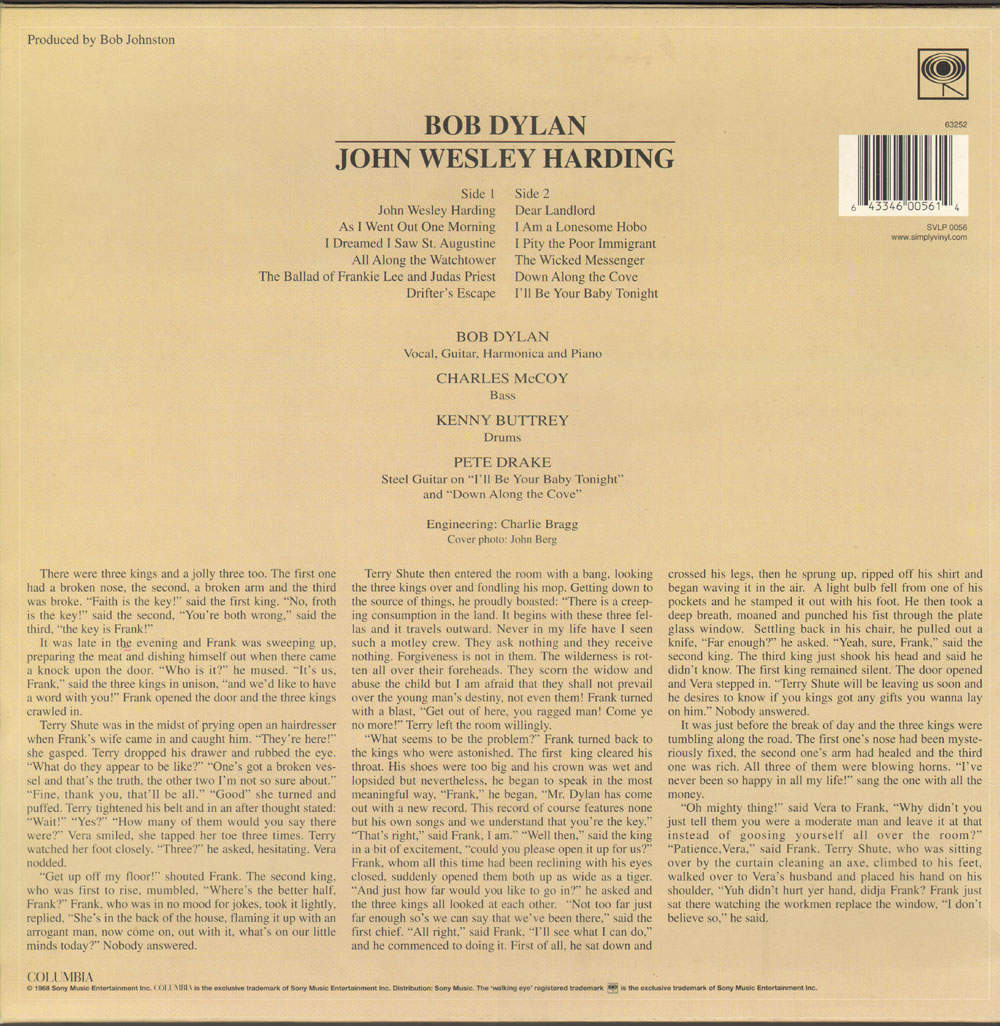
Which takes us on to Buckets of Rain the penultimate track song to be written for Blood on the Tracks, the final song on the record. In a constructional sense I am reminded of John Wesley Harding which ends with Down Along the Cove and I’ll be your Baby Tonight, two songs which really don’t have too much (if anything at all) to do with the rest of the album). Here on Blood on the Tracks, we get a plaintive reflective love song, and a 12 bar blues.
But there is more, for Dylan does like to throw in something different at the end, and this song certainly is different from what has gone before. Indeed Dylan treats it as different. He once played it as an opener at a concert on November 18 1990 but that was that – it was different enough to leave alone otherwise.
But maybe he became fully aware that the song’s music comes pretty much directly from Bottle of Wine by Tom Paxton, a very well known song in folk circles which opens…
Bottle of wine, fruit of the vine
When you gonna let me get sober?
Let me alone, let me go home
Let me go back to start over
Ramblin’ around this dirty old town
Singin’ for nickels and dimes
Times getting tough, I ain’t got enough
To buy a little bottle of wine
It is indeed possible to write a whole piece without realising that the song is lifted from elsewhere. It is only when someone plucks up the courage to tell you…
“Bottle of Wine” is today treated as a rather quaint song which everyone can join in.
Pain in my head and bugs in my bed
Pants are so old that they shine
Out on the street tell the people I meet
“Won’tcha buy me a bottle of wine?”
being completely lost on those who engage in such activity. It is desperate stuff made to sound jolly.
Dylan of course took the music elsewhere with a lighter shade of lyric, with lines like
Like your smile and your fingertips
and then wakes us up suddenly with
Everything about you is bringing me misery.
Indeed the first verse spells out the contrast very clearly…
Buckets of rain
Buckets of tears
Got all them buckets comin’ out of my ears
Buckets of moonbeams in my hand
You got all the love
Honey baby, I can stand
Thus we actually have the man who sees the world passing by and accepts it, changing himself as each situation demands, and thus losing himself in the world around him.
I been meek
And hard like an oak
I seen pretty people disappear like smoke
Friends will arrive, friends will disappear
If you want me
Honey baby, I’ll be here
But always we have this two way affair of delight and anguish
I like your smile
And your fingertips
Like the way that you move your lips
I like the cool way you look at me
Everything about you is bringing me misery
Quite what the red wagon and bike have to do with anything I am not sure but the ending is upbeat.
I like the way you love me strong and slow
I’m takin’ you with me
Honey baby, when I go
In a sense it is a summation of much that has gone before – the two sides of a love affair, the love, the despair, the ups and downs and ultimately as it is all over, the determination to pick oneself up again and move on. This time, unlike the time he thought about missing the new woman when she left, he’s taking charge. It is HIM, the singer, who is taking the woman when HE leaves. He’s back on track. It’s a summing up. Time to move on.
“Life is sad, life is a bust, all you can do is do what you must,” isn’t much to say but it is something after all the turmoil. After all, not everyone makes it through such a dark night.
There is that plaintive last line though, “can’t you tell” as if after all this he still can’t read people aright. But that too is how it goes. Nothing shakes your faith in people like a divorce.
Musically, the song is another one which is recorded with open tuning – which means the guitar is retuned away from the normal tuning of the strings. It gives a different flavour to the sound, and a chance once more to play with those odd chords that we have noted on the way through the album.
As I say, Dylan was left with just one song to write for the album, “Meet me in the morning” and it is interesting to see that he wrote the complex and long songs first, ending with the two simple pieces – a song based on “Bottle of Wine” – a simple piece of folk if ever there was one – and the other a standard 12 bar blues.
By the end of his writing surge in 1974, all the large complex work had gone. He was tidying up the bits and pieces in his head, and wrote music to fit.
So with this song, musically the year was almost over, and with one more composition the whole album could be considered done and dusted. All that was left was to select the order of tracks on the LP.
The intersection mentioned in the song, 56th and Wabasha, apparently does not exist. Which may, or may not, sum it all up.
And there we had it. The album quite a few people feel was / is the best ever Dylan album. But Bob what did he think?
Untold Dylan
You can find indexes to series linked under the image of Dylan at the top of the page and some relating to recent series on the home page.
Although no one gets paid for writing, publishing or editing Untold Dylan, it does cost us money to keep the site afloat, safe from hackers, n’er-do-wells etc. We never ask for donations, and we try to survive on the income from our advertisers, so if you enjoy Untold Dylan, and you’ve got an ad blocker, could I beg you to turn it off while here. I’m not asking you to click on ads for the sake of it, but at least allow us to add one more to the number of people who see the full page including the adverts. Thanks.
As for the writing, Untold Dylan is written by people who want to write for Untold Dylan. We welcome articles, contributions and ideas from all our readers. Although no one gets paid, if you are published here, your work will be read by a fairly large number of people across the world, ranging from fans to academics. If you have an idea, or a finished piece send it as a Word file to Tony@schools.co.uk with a note saying that it is for publication on Untold Dylan.
We also have a very lively discussion group “Untold Dylan” on Facebook with around 8500 active members. Just type the phrase “Untold Dylan” in, on your Facebook page or follow this link And because we don’t do political debates on our Facebook group there is a separate group for debating Bob Dylan’s politics – Icicles Hanging Down
“In general, the inhabitants of Göttingen are divided into students, professors, philistines and cattle, which classes are nothing less than strictly separated. The cattle class is the most important. The city itself is lovely and most pleasing to look upon with your back turned to it.” (The Harz Journey, 1826)
One of the greatest Jewish poets of the nineteenth century, the German Heinrich Heine, is in more ways than one Dylan’s artistic soulmate. Both, of course, have an admirable talent for making great emotions small and are equally moving with their ability to express private suffering poetically (lovesickness, feeling displaced) – but so do dozens of other word artists. More exclusive with both poets is the sardonic side; the casual sarcasm, as in the above quote, for example. And the dead-pan cynicism with which sung values such as “friendship” or “beauty” are shattered is another Common Denominator. One of Heine’s nicknames fits the Dylan of the mid-sixties perfectly: the malicious nightingale. As does a stylistic tool that characterises Heine: the ironic point.
The ironic point is usually a closing verse line or a concluding quatrain that destroys expectations by ending the preceding lofty, sentimental or melancholy lines with an inappropriate platitude, with a dry comic footnote or with a vulgarity;
When you become my married wife,
You’ll be my envied treasure;
You’ll have the very merriest life,
With nothing but joy and pleasure.
And if the very devil you raise,
I’ll bear it in silent sorrow;
But if you fail my verse to praise,
I’ll be divorced o’ the morrow.
(Book of Songs, poem 72, transl. Charles G. Leland)
Dylan uses it with some regularity. Don’t follow leaders / Watch the parking meters from “Subterranean Homesick Blues”, albeit only a oneliner, is one of the most famous; the Basement gem “Nothing Was Delivered” has the very Heine-like chorus
Nothing is better, nothing is best
Take care of your health and get plenty of rest;
… and the punch line of “She Belongs To Me” (And for Christmas, buy her a drum) banalises in one fell swoop the previous elegant, exalted eulogies and stately honours (“bow to her on Sunday”).
“Tombstone Blues” concludes with a similar kicker as Heine’s poem 72, “When you become my married wife”:
Now I wish I could write you a melody so plain
That could hold you dear lady from going insane
That could ease you and cool you and cease the pain
Of your useless and pointless knowledge
Three verses suggest that the narrator wants to express feelings of tenderness and concern for the well-being of a dear lady, only to torpedo that expectation in the closing line with a vile put-down. Heine can be proud of his twentieth-century torchbearer.
Yet that vile ironic point is not the most remarkable thing about this final quatrain; the suddenly tilted narrative perspective is. In the last verse of Dylan’s magnum opus (or rather: one of Dylan’s magna opera) “Desolation Row”, on this same record, we see the same plot twist: suddenly, out of nowhere, a “you” appears, tilting the narrative perspective of the whole text. For eleven quatrains we have followed the monologue intérieur of an associative mind, which now suddenly turns out to be not a stream of consciousness at all, not the flow of thought of the narrator, but a dramatic monologue, a monologue of a – not too gallant – sensitive person addressed to an otherwise invisible lady.
It is a second argument to see “Tombstone Blues” as a preliminary study for “Desolation Row”. The trick to unite unrelated protagonists for one verse is a first trigger. Ma Rainey and Beethoven, Galileo and Delilah, Jezebel the nun and Jack the Ripper… Just like the poet for “Desolation Row” creates unlikely duos like Cinderella and Romeo, Einstein and a jealous monk, and the Phantom of the Opera and Casanova.
In both songs the resulting alienation is similarly deepened. By putting contextless quotes in the mouths of the surprising protagonists, for example. Everybody’s shouting “Which Side Are You On?” is such a contextless quote from “Desolation Row”, with the same alienating quality as here the Commander-in-Chief’s “Death to all those who would wimper and cry”. Just as unusual attributes are used in both songs with an identical distorting effect. Einstein is sniffing drainpipes, the Commander-in-Chief drops a barbell. The superhumans are working with heart-attack machines, Gypsy Davey handles a blowtorch.
Size (657 words and 570 words) is also similar, as is the structure; “Tombstone Blues” consists of sections of twelve lines (two verses plus chorus), “Desolation Row” also consists of sections of twelve lines, but the chorus there has been replaced by a slightly varying chorus line (on or from or into Desolation Row, among others).
However, the last trigger in favour of seeing “Tombstone Blues” as a preliminary study for “Desolation Row” remains the most decisive: that unexpected change of perspective, the completely surprising introduction of a “you”. It seems that the poet himself has been surprised too – in this preliminary study it does tilt the text, but it is tilted nowhere. “Tombstone Blues” does not suddenly offer a narrative, the previous, unrelated verses do not suddenly take on, in retrospective, a red thread. But when Dylan writes “Desolation Row” shortly after this, he does remember the power of this unexpected change of perspective, and has found a function for it as a by-catch. Now the narrator says, introducing the “you” in passing:
Yes, I received your letter yesterday
(About the time the doorknob broke)
When you asked how I was doing
Was that some kind of joke?
All these people that you mention
Yes, I know them, they’re quite lame
… which opens the gate to understand the previous 585 words as the content of that letter. The narrator has encrypted the contents (I had to rearrange their faces and give them all another name), but now those seemingly unrelated verses have been given a red thread – being the content of one letter, that is.
This will not work with “Tombstone Blues”. Here the narrator regrets that he was unable to write a melody that would have helped the “you”. Even if we understand “melody” figuratively (as an “expression of admiration”, perhaps, or as an “articulation of consolation”), the change of perspective does not bring a connecting, uniform line in the previous verses; they remain incoherent tableaux.
Missed opportunity, the novice Beat Poet Dylan might think, looking back. Kerouac’s ferocious poems still have a thread (describing a journey, or a delirium, or impressions from a park bench) and even Burroughs’ experimental cut-up novels still have an overarching narrative. Dylan, therefore, creates his own re-enactment and builds another, now perfect, masterpiece with “Desolation Row”. Perhaps he has indeed read Heine in the meantime:
Thy letter was a flash of lightning,
Illuming night with sudden glow;
It served with dazzling force to show
How deep my misery is, how fright'ning.
To be continued. Next up: Tombstone Blues part XIII: I walk 47 miles of barbed wire (finale)
Jochen is a regular reviewer of Dylan’s work on Untold. His books are available via Amazon both in paperback and on Kindle:
We are approaching 2000 articles on this site. You can find indexes to series linked under the image of Dylan at the top of the page and some relating to recent series on the home page.
Although no one gets paid for writing, publishing or editing Untold Dylan, it does cost us money to keep the site afloat, safe from hackers, n’er-do-wells etc. We never ask for donations, and we try to survive on the income from our advertisers, so if you enjoy Untold Dylan, and you’ve got an ad blocker, could I beg you to turn it off while here. I’m not asking you to click on ads for the sake of it, but at least allow us to add one more to the number of people who see the full page including the adverts. Thanks.
As for the writing, Untold Dylan is written by people who want to write for Untold Dylan. We welcome articles, contributions and ideas from all our readers. Although no one gets paid, if you are published here, your work will be read by a fairly large number of people across the world, ranging from fans to academics. If you have an idea, or a finished piece send it as a Word file to Tony@schools.co.uk with a note saying that it is for publication on Untold Dylan.
We also have a very lively discussion group “Untold Dylan” on Facebook with around 8500 active members. Just type the phrase “Untold Dylan” in, on your Facebook page or follow this link And because we don’t do political debates on our Facebook group there is a separate group for debating Bob Dylan’s politics – Icicles Hanging Down
“Let the Light shine on me” is one of those traditional gospel / blues songs that has meandered through the traditions, and on its way picked up variations so great that on occasion you can be forgiven for thinking that you are no longer listening to the same song.
We know by it was recorded by The Wiseman Quartet in 1923, by Ernest Phipps in 1928 and by Blind Willie Johnson in 1929.
Here’s “Let your light shine on me” by Blind Willie Johnson. The website this comes from from gives the composers as George Nelson Allen, Blind Willie Johnson, Thomas Shepherd. If you start playing this and think, ok, but these very slow blues are not your thing, I’d urge you to stay with this. It does things you just don’t expect from a late 1920s song.
Over the years the name varied: “Let Your Light Shine on Me” became “Shine On Me”, “Let It Shine on Me”, “Light from the Lighthouse” and “Light from Your Lighthouse”.
The chorus…
Let it shine on me, let it shine on me,Let the light from your lighthouse shine on me.Let it shine on me, let it shine on me,Let the light from your lighthouse shine on.
relates to Matthew 5:16, “Let your light so shine before men, that they may see your good works, and glorify your Father which is in heaven.” I am told that “Lighthouse” was a popular metaphor for heavenly light.
In more recent eras Lead Belly recorded it, and then in England the skiffle singer Lonnie Donegan sang it.
Bob Dylan’s official site doesn’t have the song listed as far as I can see, but it has so many titles I might have missed it – but here it is…
https://youtu.be/LYvgTtOBPFI
Make me a pallet on the floor
This is another song with different titles – but all of them have “Pallet on the Floor” as part of it. A pallet in this regard is a bed.
Generally it is thought to have emerged from New Orelans in the late 19th century, and was certainly in print as sheet music in the first decade of the 20th century. WC Handy later modified the song at it became “Atlanta Blues” about a decade later. It was still a popular song to perform and record into the 1930s.
And so it evolved over time…
https://www.dailymotion.com/video/x7uelkc
Until we get to Bob Dylan. I’m not sure what the picture below relates to.
Deportees
This is a Woody Guthrie song with music by Martin Hoffman, retelling the story of the 1948 plane crash in which 32 people died, four of whom were Mexicans who had been working in California and now being flown back to Mexico.
Woody Guthrie was particularly struck by the fact that reports of the crash did not carry the name of the Mexicans, and simply referred to them as “deportees”. On the other hand the flight crew and security guard were named in the New York papers. However the local papers did carry the names of the Mexicans who were killed in the crash – something Woody Guthrie didn’t know.
The music was added some ten years later by Martin Hoffman a teacher, and Pete Seeger picked the song up and added it to his concert repetoire.
But… the implication of the song is taken by some to be that the Mexican citizens who died were illegal immigrants, but this was not so – in post-war America Mexican citizens were allowed under various programmes to work in the United States in specific areas for set amounts of time. The employers had the duty of transporting the workers from Mexico to the USA and back at the end of the programme. The song does make this clear, but some have ignored this.
It was one of the last songs Woody Guthrie composed.
https://youtu.be/F9DUK_8ITEo
This recording was made on 11 May 1976, and in all it was played five times on this tour.
Songs that Bob Dylan has only ever performed a handful of times.
We are approaching 2000 articles on this site. You can find indexes to series linked under the image of Dylan at the top of the page and some relating to recent series on the home page.
Although no one gets paid for writing, publishing or editing Untold Dylan, it does cost us money to keep the site afloat, safe from hackers, n’er-do-wells etc. We never ask for donations, and we try to survive on the income from our advertisers, so if you enjoy Untold Dylan, and you’ve got an ad blocker, could I beg you to turn it off while here. I’m not asking you to click on ads for the sake of it, but at least allow us to add one more to the number of people who see the full page including the adverts. Thanks.
As for the writing, Untold Dylan is written by people who want to write for Untold Dylan. We welcome articles, contributions and ideas from all our readers. Although no one gets paid, if you are published here, your work will be read by a fairly large number of people across the world, ranging from fans to academics. If you have an idea, or a finished piece send it as a Word file to Tony@schools.co.uk with a note saying that it is for publication on Untold Dylan.
We also have a very lively discussion group “Untold Dylan” on Facebook with around 8500 active members. Just type the phrase “Untold Dylan” in, on your Facebook page or follow this link And because we don’t do political debates on our Facebook group there is a separate group for debating Bob Dylan’s politics – Icicles Hanging Down

Where Ma Rainey and Beethoven once unwrapped their bedroll
Tuba players now rehearse around the flagpole
And the National Bank at a profit sells road maps for the soul
To the old folks home and the college
The release of Bruce Springsteen’s Letter To You (2020) is introduced by a kind of documentary of the same name, a making of spiced up with archival material and decorated abundantly with many atmospheric images of a musing Bruce, a philosophising Bruce, a smiling Bruce and many more Bruce, all in moody black and white. It’s perhaps a bit too smug and overly promotional, but what the heck – the fans are happy. And the album is good; strong songs, recorded live in a home-studio by a great band.
All the songs are discussed, and the Dylan fan opens his ears at the excursions into “Song For Orphans”, the most Dylanesque song on the album, and perhaps Springsteen’s most Dylanesque song at all. It is one of the album’s three old, dusted songs, still from 1972, from the pre-E Street period, with lyrics that are indeed stylistically unmistakable written in the vicinity of songs like “Blinded By The Light” and “Spirit In The Night”;
Well the missions are filled with hermits, they're looking for a friend
The terraces are filled with cat-men just looking for a way in
Those orphans jumped on silver mountains lost in celestial alleyways
They wait for that old tramp Dog Man Moses, he takes in all the strays
… to quote just one random verse (out of seven). It is one of the songs, says The Boss, that “hold a very warm place in my heart”. And a song that moves him to look back with the same amazement as the amazement with which an older Dylan looks back on songs like “It’s Alright, Ma (I’m Only Bleeding)”. “The songs from 1972… were and remain a mystery to me,” Springsteen says. “They were just the way I wrote back then. A lot of words.” An identical amazement and a similar choice of words as Dylan’s retrospect in the interview for Rolling Stone, November 2004.: “All those early songs were almost magically written. Ah… Darkness at the break of noon, shadows even the silver spoon, a handmade blade, the child’s balloon… Try to sit down and write something like that.”
But even more noteworthy is the anecdote Springsteen tells around this particular song. With a sense of self-mockery he remembers a phone call from Clive Davis:
“Matter of fact, Clive Davis, the man who signed me to Columbia Records with John Hammond, called me briefly after our record Greetings from Asbury Park was released and said someone had called him and told him if I wasn’t careful, I was going to use up the entire English language.
And he said that that was Bob Dylan.
Now, Bob was always my mentor and the brother that I never had, so I took these words quite seriously.”
… Dylan warns Springsteen being too wordy, that he too fast uses up the entire language. At first glance, that seems to be a case of the pot calling the kettle black. Demonstrated by the study of the Italian music data company Musixmatch, publishing the findings regarding the wordiest artists. Dylan stands there, towering high above the average songwriter, in fourth place with a vocabulary of 4,883 words, well behind “winner” Eminem with a vocabulary of 8,818 words – the entire Top 3 consists, not surprisingly, of rap artists. But still almost double the average vocabulary of an oeuvre, which is 2,677 words.
It is a bit flawed though, the research method and the resulting fourth place therefrom. The researchers, research engineer Varun Jewalikar and intern Nishant Verma, limited themselves to the “100 densest songs” of the investigated artists, in order to keep it more relevant statistically (until 2020 Dylan has written more than 600 songs, Eminem has released 367 songs). And for copyright reasons, Springsteen’s songs are not in Musixmatch’s database, so The Boss’s oeuvre did not participate. The counter for officially released songs of The Boss is at the end of 2020, including Letter To You, at 340, and he surely would make it to the Top 10. His catalogue has, after all, even more words than he can contain himself; Springsteen has been using a teleprompter on stage since the beginning of the twenty-first century, which he visibly needs for word explosions like “Jungleland”, but bizarrely also for “Born To Run”.
Still, on reflection, Dylan’s message to Springsteen may indeed very well be a well-intentioned tip from a songwriter who has grown wiser through trial and error. This anecdote dates back to somewhere in early 1973 (Greetings From Ashbury Park was released on 5 January 1973), so still in Dylan’s long period of creative emptiness, the years he sits on the waterfront, watching the river flow, waiting for the inspiration to paint his masterpiece. And apparently the world’s best songwriter blames this creative emptiness partly on his lavish, uninhibited use of the English language, during the mercury years.
“Tombstone Blues” is a textbook example of that excessive exuberance. The lyrics have 440 words and consist of 259 different words; that’s a ratio that even Eminem in his most eloquent raps does not reach. Words such as endorse, knits, swagger, barbell and blowtorch are not only new in Dylan’s oeuvre, but also completely unusual in popular music at all.
So far, anyway. Just like Dylan opened the door for Lennon to use “clown” (“Dylan had used it, so I thought it was all right”), and just as geek and freaks only penetrate the rock vocabulary after “Ballad Of A Thin Man”, or like after “Highway 61 Revisited” bloody noses are acceptable, “Tombstone Blues” enriches the rhyme dictionary of the song poets with – for example – blowtorch. Wilco, Glenn Frey, “The Paw Paw Negro Blowtorch” by the extraordinary word and music artist Eno (1973), Elvis Costello’s “Other Side Of Summer” (1991), and Bruce Springsteen of course, although he uses it as a verb, in the beautiful, moody “Silver Palomino” on Devils & Dust (2005):
Summer drought come hard that year
Our herd grazed the land so bare
Me and my dad had to blowtorch the thorns off the prickly pear
And mother, your hand slipped from my hair
In the same text words like sallow, pradera, serrata, scrub pine and riata stand out too – in the 21st century Springsteen no longer deals all too conscientiously with the heartfelt advice of his “mentor and brother that I never had”, not to use up all the words in the dictionary.
But true: “bedroll”, “flagpole”, “Ma Rainey”, “tuba” and “Beethoven” have not yet been used by The Boss. “Mozart” has, though;
Some silicone sister with her manager's mister told me I got what it takes
She said, I'll turn you on, sonny,
to something strong if you play that song with the funky break
And Go-Cart Mozart was checkin' out the weather chart to see
if it was safe to go outside
And little Early-Pearly came by in her curly-wurly and asked me
if I needed a ride
("Blinded By The Light", 1973)
…and quite a lot of other words.
To be continued. Next up: Tombstone Blues part XII: The malicious nightingale
Jochen is a regular reviewer of Dylan’s work on Untold. His books are available via Amazon both in paperback and on Kindle:
We are approaching 2000 articles on this site. You can find indexes to series linked under the image of Dylan at the top of the page and some relating to recent series on the home page.
Although no one gets paid for writing, publishing or editing Untold Dylan, it does cost us money to keep the site afloat, safe from hackers, n’er-do-wells etc. We never ask for donations, and we try to survive on the income from our advertisers, so if you enjoy Untold Dylan, and you’ve got an ad blocker, could I beg you to turn it off while here. I’m not asking you to click on ads for the sake of it, but at least allow us to add one more to the number of people who see the full page including the adverts. Thanks.
As for the writing, Untold Dylan is written by people who want to write for Untold Dylan. We welcome articles, contributions and ideas from all our readers. Although no one gets paid, if you are published here, your work will be read by a fairly large number of people across the world, ranging from fans to academics. If you have an idea, or a finished piece send it as a Word file to Tony@schools.co.uk with a note saying that it is for publication on Untold Dylan.
We also have a very lively discussion group “Untold Dylan” on Facebook with around 8500 active members. Just type the phrase “Untold Dylan” in, on your Facebook page or follow this link And because we don’t do political debates on our Facebook group there is a separate group for debating Bob Dylan’s politics – Icicles Hanging Down
The first article in this series is at Dylan obscuranti: the new album So, rather obviously, this is the second track from my invented album which Aaron is kindly creating on our YouTube channel
It is an album of recordings by Bob that you might possibly have missed along the way but which are deemed (by me, doing my imperious, “I know everything” bit) to be beyond genius.
Today’s piece is Tomorrow is a long time.
And because the series is only just starting I’ve got a chance to modify the approach a little, by including in this article some of the comments very kindly made by readers on this site about the song.
My original review of the song is here, and the first recording below is from 12 April 1963, in front of a perfectly quiet audience. None of your shouting out names of songs, just attentiveness for a great young artist. It is so wonderful to hear the way Bob was received.
It was written in the magical compositional year of 1962. You can see a list of all the songs written by Dylan in that year here in chronological order. “Lost love” was a favourite theme of Bob’s from start and during 1962 he wrote
in quick succession – they are numbers 10 to 17 on the list of songs in the order of writing showing that it was a theme that concerned him for a while. He then left the notion of “lost love” as a song concept and added just one more (Kingsport Town) towards the end of the year’s writing.
I really do love the chronological list which we’ve developed on this site, first because I don’t think before we came along anyone else had done anything quite so comprehensive, and second because it gives me a context – even when there is no artistic or creative context to hold onto. Just looking at the songs Dylan wrote immediately before this masterpiece, the only thing I can see as a fulsome antecedent is Blowing in the Wind. Everything else is exploring different avenues.
Thus this just pops up, as a new song coming out of the four preceding explorations of the theme.
It is also one of those songs that, at the time it was written was largely ignored, not appearing until “Greatest Hits Volume II” in 1971 and then on the triple album “Masterpieces”. But we do have this recording…
This recording is so perfect it can’t go any further. Everything else is a reworking going nowhere. Or at least that was what I thought when I first heard it, but of course, readers kindly write in and Jimmy, responding to the original review on this site, noted that “Ian & Sylvia did a gorgeous version on their second album, Four Strong Winds.”
https://youtu.be/Y89rmBlNAx4
Steve Crawford, also writing to the site, after my original piece was published had this additional interesting observation…
“The piece works at 3 levels. First, it tells a story, as all good songs do, at a very personal level. The story is about a man amidst his reflections of what he has lost as he revisits his past and re-experiences finding and losing love.
“Second, it is an invitation to explore the reflections and the emotions as we travel down his path of awareness, by tenses (today, tonight, tomorrow), and by the loss of senses, (I can’t see, I can’t speak, I can’t hear). ”
The third is to share both the joy and the sorrow of realizing that life’s beauty is temporal, leaving only memories of what was, – there’s beauty in the silver singing river, there’s beauty in the sun that lights the skies, but none of these, or nothing else can match the beauty, that I remember in my true loves eyes. Perfect rhyme, perfect meter, perfect images reflect a true master at his craft, and weaving his beautiful web. I learned this song back in 1967, have performed it 2468 times, and know what it is about.”
Robert Van Tol took us down a different route with the comment “Sacrilege Alert…I have always preferred Rod Stewart’s cover to Dylan’s original & love the “Run Down Rehearsals” version.”
OK, so Rod Stewart it is…
And we have the Rundown Rehearsal version…
This triggered more responses – and again can I say just how grateful I am to everyone who writes in to Untold. There’s no way I can reply to all the issues raised, and keep my regular life running but I do note what is said.
Ronald Perz wrote…
One of my all time favourites since 1971. I like Sandy Dennys Version too. Elvis. Ian and Sylvia. Bob and Jerry
Thomas Parr responded to Steve Crawford’s commentary, finding them very thought provoking and adding, “Upon hearing this song for the first time I must have played it 50 times that very day and many more times in the days to follow.
“It is the story of a mans existence being experienced as non-existence.I cant see, I cant speak, I cant hear. the strong symbolism of the bed too speaks to a man who is utterly lost: ones bed is home, it is safety and it is refuge. To be deprived of it shows how abjectly alone the singer is. This is how I’ve always interpreted the song.
Steve Crawford’s comments though give reason to look deeper.
“To me it is the quintessential love song, categorically different from nearly everything of the last 50 years.
And thanks to Richard Slessor for reminding us all that Judy Collins has of course visited the song, and I really should have included this in my original review. Thank goodness for commentators putting me right.
But of course there is only one place we can finish. Bob said one time this was the recording he valued above all others in terms of covers of his songs…
If you’d like to suggest a song of Dylan’s to include in this series – or indeed if you would like to write the article yourself, rather than have me endlessly pontificating, please do email your article as a word document to Tony@schools.co.uk
Just remember the theme here is that the song is a work of magic which will have been missed by many people.
Untold Dylan
We are approach 2000 articles on this site. You can find indexes to series linked under the image of Dylan at the top of the page and some relating to recent series on the home page.
Although no one gets paid for writing, publishing or editing Untold Dylan, it does cost us money to keep the site afloat, safe from hackers, n’er-do-wells etc. We never ask for donations, and we try to survive on the income from our advertisers, so if you enjoy Untold Dylan, and you’ve got an ad blocker, could I beg you to turn it off while here. I’m not asking you to click on ads for the sake of it, but at least allow us to add one more to the number of people who see the full page including the adverts. Thanks.
As for the writing, Untold Dylan is written by people who want to write for Untold Dylan. We welcome articles, contributions and ideas from all our readers. Although no one gets paid, if you are published here, your work will be read by a fairly large number of people across the world, ranging from fans to academics. If you have an idea, or a finished piece send it as a Word file to Tony@schools.co.uk with a note saying that it is for publication on Untold Dylan.
We also have a very lively discussion group “Untold Dylan” on Facebook with around 8500 active members. Just type the phrase “Untold Dylan” in, on your Facebook page or follow this link And because we don’t do political debates on our Facebook group there is a separate group for debating Bob Dylan’s politics – Icicles Hanging Down
It being the time of year for being jolly and silly (at least in the parts of the world where we are), Aaron has come up with a new series for Untold Dylan based around songs that have the same name as a Dylan song.
So, since we are currently looking at “Blood on the tracks” in the “All Directions at Once” series we’ll start with “You’re A Big Girl Now” which was recently considered here.
Now the idea of this new series is that having revisited Bob’s song we then present one or two songs by others with the same name, with a short paragraph about the track/band. And if anything interesting turns up, we just follow that lead and see where it takes us.
Also, just to ensure that no one takes this too seriously, after each track we each give the track a score out of 5 with the scale something like this
5 – Amazing : As good as Dylan’s song
4 – Great piece of music
3 – Decent enough
2 – OK I suppose if you like that sort of thing
1 – Oh for goodness sake turn it off
OK, here we go…
The Stylistics – You’re a Big Girl Now
Released in 1971, (so it could be argued that Bob stole the title from this track) this was the Stylistics’ first single, although it was not a big hit. The band would achieve considerable success later in the 70s with singles such as “Betcha By Golly Wow” and “You Make Me Feel Brand New.”
Aaron’s view: As for this song, I’d never heard it before and I really enjoyed it. The chorus has a nice melody and lead singer Russell Thompkins jr has an amazing voice when he sings the verses solo. It’s brought down slightly by the “talky” bit towards the end, I wasn’t a fan of that bit.
Tony’s thought: “Arghhh… I find the phrase ‘You’re a big girl now’ pejorative enough, but when followed by “no more Daddy’s little girl” I really had to work hard to avoid turning it off. Agree totally about the talking part at the end. Why do people put talking parts into songs? Do some people really like this?
But I had a vague remembrance of the Stylistics so I went looking and found this… not really my style but better than “You’re a big girl now”
Aaron’s score – 3.5 out of 5 (docked half a point for the end bit).
Tony’s score – Minus 10 out of five.
The Bell Notes: You’re a big girl now
The Bell Notes were an early American Rock n Roll band from New York. The single was released in 1959.
Aaron: Again, I’d never heard this one before. Nice little rocking number with a fairly wild (for the time) guitar solo. It’s a bit light weight but still most enjoyable!
Tony: This is very much of the type for 1959 with the deep bass voice coming in with the occasional line. Reminds me a little bit of the Coasters, and is the sort of thing that Chubby Checker was doing the twist to a year later.
Hearing this track set me off on the sort of musical journey that I adore… finding out who the band were, and what they got up to. And as ever there is a little nugget to be found because the band played in a bar that Steven Tyler (of Aerosmith) played in, in his youth. Tyler also covered the Bell Notes song “I’ve had it”.
https://youtu.be/F-ut2rAx14I
Allegedly the recording session for that track cost $50. It got to number six on the Billboard charts. They had other minor hits, before breaking up in 1962.
https://youtu.be/MNPnt19Yq-s
This is a reworking of a African American song from the 19th century, maybe even earlier. Shortening bread is a bread made of corn meal and/or flour and lard.
This is the thing I love doing – tracing songs back, especially when as a result I learn more about bits of history from beyond my own country. One article I read in putting this little piece together told me “During the Jim Crow period a typical American kitchen had many products with images that portrayed blacks in negative ways; these included packaging for cereal, syrup, pancake mix, and detergent; salt and pepper shakers; string holders; cookbooks; hand towels; placemats; grocery list reminders; and, wall hangings. Any object found in a kitchen could be-and often was-transformed into anti-black propaganda.”
And (and here I hope American readers will excuse my ignorance – I am British and although I know some American history, my knowledge is very limited, as American history was not much taught in schools in rural England when I grew up, and I include this for anyone like me who is unfamiliar with the term) I also read that a Jim Crow law was a law that enforced racial segregation in the South from the 1870s through to the civil rights movement.
Jim Crow was taken from the name of a minstrel routine (Jump Jim Crow) and became a derogatory phrase for Afro Americans. So I learned something.
Did the Bell Notes know they were being racist in singing that song? I doubt it. The song was certainly around in England in the 1950s, and I doubt many people knew of its origins or meanings then.
Aaron’s score – 3 out of 5.
Tony’s score – 4 out of 5.
Untold Dylan
We are approach 2000 articles on this site. You can find indexes to series linked under the image of Dylan at the top of the page and some relating to recent series on the home page.
Although no one gets paid for writing, publishing or editing Untold Dylan, it does cost us money to keep the site afloat, safe from hackers, n’er-do-wells etc. We never ask for donations, and we try to survive on the income from our advertisers, so if you enjoy Untold Dylan, and you’ve got an ad blocker, could I beg you to turn it off while here. I’m not asking you to click on ads for the sake of it, but at least allow us to add one more to the number of people who see the full page including the adverts. Thanks.
As for the writing, Untold Dylan is written by people who want to write for Untold Dylan. We welcome articles, contributions and ideas from all our readers. Although no one gets paid, if you are published here, your work will be read by a fairly large number of people across the world, ranging from fans to academics. If you have an idea, or a finished piece send it as a Word file to Tony@schools.co.uk with a note saying that it is for publication on Untold Dylan.
We also have a very lively discussion group “Untold Dylan” on Facebook with around 8500 active members. Just type the phrase “Untold Dylan” in, on your Facebook page or follow this link And because we don’t do political debates on our Facebook group there is a separate group for debating Bob Dylan’s politics – Icicles Hanging Down
In this series of articles I have been tracing Dylan’s career as a composer as a wave form – noting that the songs which are considered by many to be of the highest quality don’t come at random throughout his life, but in groups, interspersed by periods of little writing and songs which are less readily remembered. Looking at the list of songs in the order he wrote them we can see the wave of his creativity rising and falling through the years.
In terms of the early to mid-1970s Dylan clearly had difficulty finding his muse but in the latter part of 1973 he began to come back with some songs of extraordinary power, even if they were not commercial successful or liked by the fans. And this led into the writing in 1974 of the songs that became “Blood on the Tracks”. As ever in this series, I consider the songs in the order they were written, not in the order that they appeared on the album.
So far I’ve considered seven songs, all of which except one (“Call Letter Blues”) made it onto the album, and I can’t imagine there is any Dylan fan who would suggest that any of the six covered that did make it onto the album were anything less than masterpieces.
The last song I considered was “Simple Twist of Fate” which continues the theme that no matter how much we try and plot and plan our existence, fate – or if you prefer chance – can always come along and throw us off course.
Indeed chance, or fate, has clearly been part of Dylan’s songwriting life. Hardly any musicians have been able to keep the flow of brilliant masterwork songs running all the way through their careers, and so Dylan’s dip into non-writing and writing works which although of note, were not at the high level of earlier songs.
And it seems to me that no one in the field of pop and rock has been able to do it, as far as I can think. And the very title “Idiot Wind” always makes me think of chance, of fate, or things just happening. The wind just blows, it is answerable to nothing except chance changes in atmospheric pressure. It is the very embodiment of chance.
Dylan himself has been very clear that “Blood on the Tracks” was not autobiographical, and as he said in an interview, “It was just a concept of putting in images that defy time – yesterday, today, and tomorrow. I wanted to make them all connect in some kind of a strange way. I’ve read that that album had to do with my divorce. Well, I didn’t get divorced till four years after that.”
And surely no one thinks that the “Jack of Hearts” had anything to do with reality.
As for “Idiot Wind” if that is autobiographical, then clearly in my reading about Bob Dylan I’ve missed the bit pertaining to his shooing of Mr Gray, travelling to Europe with his wife who gets one million dollars, dies and leaves it to Bob. I think if that had been real it would have made the news.
So in reality to make the song be autobiographical one has to be selective and inventive, and really that’s cheating. It either is autobiographical or it isn’t.
But this debate is something of a shame because this song has so many amazing elements that we be focusing on rather than on the issue of its possible autobiographical content. I mean what other song starts with a chord sequence anything remotely like A minor, B suspended 4, B6, E? That is total novelty. I’ve never come across it, and if you know of such a piece, I do wish you’d tell me.
Or what about the number of beats in each line? For clarity, I’ve written them out below
Someone’s got it in for me, they’re planting stories in the press (12)
Whoever it is I wish they’d cut it out but when they will
I can only guess (12)
They say I shot a man named Gray and took his wife to Italy (8)
She inherited a million bucks and when she died it came to me (8)
I can’t help it if I’m lucky (4)
Or counting bars instead of beats we have 3 – 3 – 4 – 2- 2- 1. A song with a verse made up of 15 bars! The second section (“People see me….”) follows the same pattern and then the chorus give us 11 bars. The norm – more than that, the absolute rule – is for four and eight bar phrases in popular music. Hence we have the “12 bar blues” – the basic form of the blues from which everything else emerges. (Think “Hound Dog” by Elvis Presley; the classic 12 bar pop song).
This approach by Dylan is completely new. But instead of noting that, the impact is always the lyrics. And here Dylan has been clear. When asked if the song was autobiographical he said, “I came pretty close with that song ‘Idiot Wind.’ That was a song I wanted to make as a painting. A lot of people thought that song, that album “Blood on the Tracks”, pertained to me. Because it seemed to at the time. It didn’t pertain to me. It was just a concept of putting in images that defy time – yesterday, today, and tomorrow. I wanted to make them all connect in some kind of a strange way.”
And indeed that is exactly the concept with which we started this series of articles on “Blood on the Tracks”. “Rosemary Lilly and the Jack” doesn’t make sense which is why the missing verse doesn’t matter. Nor does “Tangled up in Blue” which is why the lyrics can be re-written so often. Time and people are distorted and moved around, all the way through the album. And nowhere more so than here.
But…
As people we are programmed to make sense. The phrase “It doesn’t make any sense” is generally used as an equivalent to, “It must be wrong.” Even though we are emotional and not logical creatures, we strive for logic, the logic that religious creeds, musicians, poets and painters have spent eternity seeking to undermine. And it is hardly Bob’s fault that the writers of pop lyrics have failed to follow that lead.
And yet rock musicians have been aware, even if their fans might have missed it. Justin Hayward’s line “Just what the truth is, I can’t say anymore” touches on it, as did Dylan in a different way with “Times they are a changin” which tells us that the future is always different from the past, no matter what we do, which is of course the obvious message of all history. I live in a village listed in the Domesday book of 1086 as consisting of 36 free people and four slaves. Times have changed. It’s population is now 2,248, and given that slavery was made illegal in 1833 in England, I suspect the slavery number is zero. Times change as Bob said.
So yes we can imagine that people don’t know how to act when they meet Bob. I wouldn’t have a clue what to say, and would probably make a total idiot of myself and spend the rest of my life berating myself for not handling the situation better, if I met him.
But no, the song is not intended as the telling of a coherent story (or at least if it is, it is a total failure). The clue to the meaning in this and many Dylan compositions are the random lines, such as, “I ran into the fortune-teller, who said beware of lightning that might strike.” It’s a line from the Tarot and Dylan places it amidst a jumble of disconnected lines including a lone soldier on a cross, a railway carriage (boxcar) on fire, the chance of winning, day dreams, a horse, feeling bemused, “you always hurt the one you love,” and he who is first being last.
There are indeed so many clues to the fact that this is a jumbled collection of ideas that one could begin to wonder if the “idiot” of the piece is not the person who tries to make sense of it all. Being this stupid, yes perhaps it is strange that as a race we have actually survived and are still breathing.
Of course it is possible that when Dylan wrote
I can’t feel you anymore, I can’t even touch the books you’ve read
Every time I crawl past your door, I been wishin’
I was somebody else instead
Down the highway, down the tracks, down the road to ecstasy
I followed you beneath the stars, hounded by your memory
And all your ragin’ glory
he was looking back at his past career and speaking of himself. Or of a writer he admires. It is possible, but unless he clearly tells us that is so, we’ll never know.
But it does seem to me that this insistence on making sense of these works in which time and people are not fixed, is to go against the essence of the works themselves. We can all do it – I can argue that the verse above refers to Bob’s annoyance that “Times they are a changin” was interpreted as a call to action, when in fact it clearly says, “stuff happens, things change”. And that he was an idiot for ever thinking people would understand.
I been double-crossed now for the very last time and now I’m finally free
I kissed goodbye the howling beast on the borderline
which separated you from me
You’ll never know the hurt I suffered nor the pain I rise above
And I’ll never know the same about you, your holiness or your kind of love
And it makes me feel so sorry
Idiot wind, blowing through the buttons of our coats
Blowing through the letters that we wrote
Idiot wind, blowing through the dust upon our shelves
We’re idiots, babe
It’s a wonder we can even feed ourselves
That line of thought would still fit with Dylan’s answer to the question, “Have you ever put something in a song that was too personal? Ever had it come out and then said, ‘Hmm, gave away too much of myself there’?”
He replied, “I came pretty close with that song “Idiot Wind.” That was a song I wanted to make as a painting. A lot of people thought that song, that album “Blood on the Tracks”, pertained to me. Because it seemed to at the time. It didn’t pertain to me. It was just a concept of putting in images that defy time – yesterday, today, and tomorrow. I wanted to make them all connect in some kind of a strange way.”
So yes, maybe this is a slightly confusing lost-love song, one of Bob’s two favourite themes. But maybe not.
But to try and resolve this issue of what the song is about let’s look at the sequence of song that led up to this… and I’ll leave out “Call letter” as it didn’t make the album…
Idiot Wind: Being lost, remembering bad times past.
That sort of meaning, which is of course hopelessly incomplete, does fit with the ever shifting sands of the songs that have gone before. But more than this, seeing the songs in the order in which they were written, if we run from “You’re a big girl now” through to “Idiot Wind”, we have a story of sorts.
He’s lost his love, and recognises she’s gone, he takes refuge in a one-night stand, he is finding being alone difficult, there’s a chance meeting but it’s hardly satisfying, and he now fully acknowledges he’s lost. That gives me a feeling of progression which (and this is a very personal thing) helps me make a bit more sense of the whole thing.
Now I do know that just a few lines back I wrote “it does seem to me that this insistence on making sense of these works in which time and people are not fixed, is to go against the essence of the works themselves.” And I still hold to that. I would prefer not to make sense out of anything here but accept the words and images as I accept abstract paintings.
But as Dylan is writing these songs one after another (and again I stress, we are taking them in the order of composition) it is quite possible that the images and background thoughts of one song play into the creation of the next. And that perhaps explains how each song emerged, and also why in the end Bob didn’t feel the order of composition was at all important when it came to putting the album together.
As we all know Bob has sold his music catalogue for vast amounts of money. He obviously knows that when his time finally comes, and he passes away to wherever it is that people pass away to, if anywhere, there will be an incredible upsurge of interest in his music.
It will be wall-to-wall Dylan, with people who know little about his music quickly putting together reviews of his life, tributes, and the rest, most of which will leave anyone who has ever bothered to study his music, running for cover while the lawyers have a field day tracking down unlicensed recordings.
I doubt that Bob wants to give his descendants all the hassle of dealing with that. The copyright arguments, the fake recordings, the bootlegged bootlegs, the disagreements about use in advertising. He wants them to have a quiet and peaceful life, sharing his millions.
And thinking of this, led me in a new direction. Because out of the 622 songs that we have noted on this site that Bob wrote or co-wrote, there are some real gems that that could be brought back to life, possibly as an album called “Untold Dylan”. Which raises some more thoughts.
Because for a start there is no point in putting songs on an album which are unknown, but which are unknown because they don’t actually go anywhere. Bob has of course written a multiplicity of masterpieces which he then abandoned, but he has also written some songs that he dropped after one run through – and quite probably most of us would agree that in some cases this was a wise decision.
So for the Untold Dylan album, we need songs that are really exciting, but which only aficionados will know about. In fact we could see this as our sacred duty. To give the world an album of Dylan songs that they the world has missed, (largely because the world wasn’t paying attention at the time, what with being concerned with wars, football games and stuff like that).
And indeed we have already created some albums on the Untold Dylan You Tube Channel. So a quick bit of checking with Aaron who is our You Tube Master (on the basis that in the old days we used to have WebMasters – so unless there is another name for people who create You Tube series Aaron is a YouTube master) I find he is willing to go with this.
And yes we have created the “Play Lady Play” series, the “Sheep in Wolves Clothing” album, the “Dylan 1980” album (that was my contribution – I’m probably the only person who plays that album but I really do love it), and the “Once only file”.
So I’ve convinced myself: it is time to build a new album, “Untold Dylan”. The great Dylan songs that the average punter who likes Dylan but is not really aware of the history will never have heard of. The one condition is that they have to be available on YouTube.
I’ve checked with Aaron, who lives a mere 6000 miles away from me, and he says he’s ok to do some more You Tube creating, so Untold Dylan, the album, is on the way.
Songs composed by Dylan, which are comparatively unknown, and for which a great recording is available on You Tube. The recording might be by Dylan, but doesn’t have to be.
If you want to make some suggestions, please do. But meanwhile here is my first suggestion. And for this I have to thank Jochen, who first pointed out the existence of this recording.
Untold Dylan: Track 1. Angelina by Ashley Hutchings MBE
Untold Dylan
We are approach 2000 articles on this site. You can find indexes to series linked under the image of Dylan at the top of the page and some relating to recent series on the home page.
Although no one gets paid for writing, publishing or editing Untold Dylan, it does cost us money to keep the site afloat, safe from hackers, n’er-do-wells etc. We never ask for donations, and we try to survive on the income from our advertisers, so if you enjoy Untold Dylan, and you’ve got an ad blocker, could I beg you to turn it off while here. I’m not asking you to click on ads for the sake of it, but at least allow us to add one more to the number of people who see the full page including the adverts. Thanks.
As for the writing, Untold Dylan is written by people who want to write for Untold Dylan. We welcome articles, contributions and ideas from all our readers. Although no one gets paid, if you are published here, your work will be read by a fairly large number of people across the world, ranging from fans to academics. If you have an idea, or a finished piece send it as a Word file to Tony@schools.co.uk with a note saying that it is for publication on Untold Dylan.
We also have a very lively discussion group “Untold Dylan” on Facebook with around 8500 active members. Just type the phrase “Untold Dylan” in, on your Facebook page or follow this link And because we don’t do political debates on our Facebook group there is a separate group for debating Bob Dylan’s politics – Icicles Hanging Down
In the last article I was making the point that Bob’s creative spirit had really risen at the end of 1973 and now he was in full swing producing incredibly varied and brilliant new songs that were taking him once again in a series of new directions, just as had happened in the 1960s.
In the previous year Dylan had explored the ups and downs of relationships with Dirge begins, “I hate myself for loving you,” while “Wedding Song,” begins “I love you more than ever.”
These contradictions of feelings were continued and taking the songs in the order they were composed, after the complex storyline of four characters in “Lily, Rosemary” etc, we had the ever varying lifelines of “Tangled”, the lost love of “You’re a big girl” and then the ultimate “come on” of “Shelter”. My point is thus that Dylan was working a consistent theme here – the ins and outs of feelings within relationships, seen from every angle he could find, and thus it is continued in “Shelter from the Storm” which suggests there is nothing we can latch onto, nothing we can hold, for nothing is fixed. The storm in short, is all around us. We might get shelter for a night, but after that, the storm is liable to leave a trail of destruction in every direction, and as a result, she has gone and oh how he misses her.
That indeed is the theme of all these songs going back to “Dirge”. Nothing is fixed, nothing is secure. And as such, nothing is knowable – and again we find that in “If you see her, say hello”
Life in fact is a storm, and that storm, it seems, can be expressed in many ways and indeed, “If you see her, say hello,” is one of those songs that has within it has a complete multiplicity of many of those ways.
It is also one of those songs that some of the “experts” on Dylan seem to take as a starting point for their own theoretical journey into their personal views as to what Dylan is and is not. My view is the reverse, as I hope I have been able to show. This is a continuation of the theme that Dylan found at the end of the previous year, and which he seems to have been finding a great source of inspiration at this time.
Of course anyone can play the game of finding themes within Dylan’s writing, but in doing so I believe the interpreter of Dylan’s work should be wary on the one hand of missing what is so obviously there for us to see (but which can be missed through having pre-ordined theories or by sticking to the view that each song is individual), and on the other creating theories of meaning which although plausible, are no more plausible than 50 other theories. And what use are 50 theories when we have no evidence as to which one is true?
Now it can be said that I don’t have evidence for the notion that Bob had, at the end of the previous year revitalised his creative power and had discovered this theme of the ebb and flow of life in relationships, but at least without forced upon songs, it fits!
So, to return to the music, the early version of “If you see her” that opens disk three of the Bootleg Series 1-3, reminds us that Dylan is, or was, a fine guitarist, a man who could pluck unusual chords from nowhere to give his music unexpected twists and meanings. It is not all about the lyrics – but it does mean the music fits with the lyrics, which are about the unexpected twists and turns in a relationship and in one’s emotions.
If you really want to hear early Dylan seeking to express himself with both music and lyrics unified, this track is a beautiful example. Even the typical wailing harmonica in its standard place as the penultimate verse, has a point as the song becomes more and restless in the lyric and the music.
In this early recording however Dylan holds himself back much more than in the version on Blood on the Tracks, keeping us within the lyrical and poignant content, until we get to “and I never gotten used to it” as the angst takes over.
The version that most of us know intimately however is the one from the masterpiece album “Blood on the Tracks” which simplifies the musical accompaniment considerably. Here, it is placed after the wild craziness of “Lily Rosemary and the Jack of Hearts” and in total contrast to the previous track it is tentative beyond anything on the earlier version.
Indeed, it is an interesting experiment to play the end of “Lily” running as it does at hyper speed. It’s final line is “Most of all she was thinking about the Jack of Hearts…” Then there is the harmonica verse which seems to leave us with just the organ playing. The between track pause and then that oh so slight, so unsure, opening, as we get the rocking between A and G, which symbolises all uncertainty whenever it starts a pop, rock or folk song.
It is in fact a total and utter contrast to the previous track, and all the more powerful for that.
So what we start with is a hesitant lost love song, just as in the early version, and it feels that at one stage we had something of a rarity, but what we ended up with at least 50 percent is a Dylan song of disdain. It is, “Once upon a time you looked so fine…” and “You’ve got a lot of nerve to say you are my friend” all over again.
Half disdain half lost love. Now there’s a thing.
If you listen to the Blood on the Tracks recording in perfect silence you can hear a slight upping of the ante as the second verse comes in. But still it is peaceful, as the singer describes his lost love. OK he’s heard she is in Tangier, and Tangier is not necessarily a nice place to be (or at least it certainly wasn’t around the time the song was written. I can attest to that out of personal experience). And so he is wondering just what she is getting up to.
And they’ve had a falling out, but it is accepted. It happens. He was really hurt, but he’s not blaming her. If that’s what she needs to do ok.
OK except… if you listen to the version above, three things happen in the song. The speed is different, and the way Bob delivers the lines gives them a completely different meaning. Does he really care any more? His voice is shakey. Is he frantic? Well, maybe but that guitar solo around two minutes is taking us somewhere. It is almost as if Bob is saying, “well yes I used to sing it this way, but you know, I never really felt like that.” It is a re-writing of the song, without changing the words or the chords which is quite something.
So when Bob sings the changed
We had a falling-out, like lovers sometimes do
And to think of how she left that night, hurts me through and through
The “chill” has gone, now he is “hurt” and that is in the music of this version – oh how it is there! And then the instrumental verse contradicts this – he’s pretending to be alright. And then we have the quiet verse….
If you’ve never listened to it in this way, go back and play this, because it is an amazing turn of the moment. We go from light to dark in one line. And there is no way back, for we hear the pain in the lines about her looking him up. Oh he is so desperate.
Oh yes he is in pain. But the musical interlude that follows it, belies the message of the lyrics. He’s with the guys and gals, and having a good time.
This contrast between feelings is quite extraordinary.
So by now Bob has written five songs of depth and potential for what became Blood on the Tracks. And this is unusual because normally with Bob’s writing we also find songs that are cast aside. Not always of course – it didn’t happen with JWH, not least because (according to reports) Bob simply wrote the lyrics one after the other, and then set them to music, knowing he had to do an album. Then he seemed to end up two songs short, and had to put in a couple of country numbers at the end.
Thus there were no rejected songs on JWH, but mostly in the past he has written a collection of songs, and the best ones for the album are pulled out. However with “Blood on the Tracks” that hasn’t happened so far, but now it does, for at this point Bob wrote, and recorded twice, the song “Call Letter Blues.”
Given the songs that have already been written for the album, this is a really strange song to write. It is a classic slow moving blues that actually is hardly moving at all. But it is not just saying the world has gone wrong. It is saying she left – not only did she leave the man, she left the children too. Maybe that was too much to put in a song, or maybe Bob just realised that it simply wasn’t as original as the other material he was producing.
And certainly the originality was still inside him, waiting to get out, for next he composed Simple Twist of Fate
If you have the outtakes or Spotify do play “Call letter blues” and then play “Simple Twist of Fate” for no other reason that the fact there is no comparison between them. Whereas we might all wonder why songs like “Blind Willie McTell” and “Dignity” never made an album, here I suspect everyone would understand why “Call letter” didn’t make it.
Which takes us on to that next composition… Simple Twist of Fate
Unlike the classic blues this can be played in a multiplicity of ways, as this version shows…
We are used this song as being the second track on the album, its position continuing the long established tradition of having an upbeat opening track followed by a slow or sombre second track. Just listen to the end of Tangled up in blue and the opening of this track – the contrast is overwhelming.
But hearing the songs in the order in which they were written takes us on a different journey. “Simple Twist” is a song of magnificence – an incredibly complex revelation contained in six musically identical verses. As such it is a true masterpiece of songwriting which emphasises the fact that “Call Letter” really was an aside, an incidental, a moment’s pause before the serious business of writing continued.
“Simple Twist” is in fact a follow up to “If you see her”. We really do have the story continuing – something that is lost if we play the songs in the order presented on the album. Plus the music is interesting too, for the chord sequence, while not unusual in pop and rock is unusual in Dylan, and it contains the twist of the title line.
The recording is in F major, and the moment within the music that sticks in the memory throughout is the move from B flat to B flat minor in the fourth line (for example “’Twas then he felt alone”). It is not a Dylan invention, but it portrays musically all the pathos and depth of feeling that the lyrics contain.
The accompaniment on the album is simple: the acoustic guitar strumming, bass guitar and harmonica when there is no vocal. Indeed the complexity of the meaning combined with the simplicity of the music has made it a song that many like to sing – Joan Baez included it on Diamonds and Rust, and Brian Ferry on Dylanesque, plus many others. It is a song you can do anything with…
The simplicity of the music seems to be apparent in the lyrics from the start – the lovers meet but the man feels this isn’t going to work for some reason…
They sat together in the park
As the evening sky grew dark
She looked at him and he felt a spark tingle to his bones
’Twas then he felt alone and wished that he’d gone straight
And watched out for a simple twist of fate
So we know there is a history, and wait to find out what. But then two things happen to the song which turn everything upside down. On occasion the “He” becomes “I” while the woman turns out to be a prostitute working the docks and the singer is an old man harking after the charms of a young woman. The he/I dichotomy gives us a difficult feeling, while the tale of an old man and a hooker seems out of place with the gentle melody and chord sequence.
In fact, if ever there is a Dylan song that gives you a knife in the heart after fooling you at the start this is it. You need a strong constitution to take this…
They walked along by the old canal
A little confused, I remember well
And stopped into a strange hotel with a neon burning bright
He felt the heat of the night hit him like a freight train
Moving with a simple twist of fate
Even if we got the changing positions and realities of “Tangled up in blue” sorted out, what are we to make of this “I remember well”. It seems in fact that the story teller is looking back to his past and is so removed from that past that he now confuses his personal memories with those which, because of the pain of the memory, he has had to place outside himself.
If you have ever experienced that pain, and had to take to that final recourse of separation from yourself to deal with it – or should I say if you are old enough to have to do that – then you will know the level of the anguish of what might have been, but now can never be.
So now we think we have this juxtaposition sorted, we understand the pain, but then Dylan hits us again.
A saxophone some place far off played
As she was walking by the arcade
As the light burst through a beat-up shade where he was waking up,
She dropped a coin into the cup of a blind man at the gate
And forgot about a simple twist of fate
He can’t forget her and his casual encounter. But she is up and on with her work, although showing a feeling for those worse off than her that might take us by surprise.
Now Dylan either does one of his time-mix tricks where we find the story is not told in sequence, or he wakes the next day and finds she is not there when he has perhaps been dreaming of her, tries to deal with it, but can’t. I prefer the latter interpretation but that’s just me.
He woke up, the room was bare
He didn’t see her anywhere
He told himself he didn’t care, pushed the window open wide
Felt an emptiness inside to which he just could not relate
Brought on by a simple twist of fate
The “he could not relate” line is the key to the “I” / “he” dichotomy – the “he” and “I” are the same person, because as this line says, the man cannot relate to these feelings. He is truly lost.
Then time passes, he searches her out, desperately hoping to find her again, but nothing is in his control. She has the power and he is lost.
He hears the ticking of the clocks
And walks along with a parrot that talks
Hunts her down by the waterfront docks where the sailors all come in
Maybe she’ll pick him out again, how long must he wait
Once more for a simple twist of fate
And then we move on to this wonderful final, final verse. It hardly feels as if Dylan has been singing a straight strophic song with no variations – that B flat to B flat minor pulls the heart every time and keeps us focused. He draws his conclusion – and for anyone who lives in a world of emotion and feeling – anyone who understands what it means to feel the pain of “if only” knows what he is saying with the opening two lines.
People tell me it’s a sin
To know and feel too much within
I still believe she was my twin, but I lost the ring
She was born in spring, but I was born too late
Blame it on a simple twist of fate
And now the “I” comes back, the eternal wishing for and thinking about a woman whom he met but could never get to know, could never love, but who is forever in his mind. The beautiful woman symbolising everything hopeful – she was born in spring. He is in the autumn of his life, and thus they are forever separated.
So strong is the emotion that the ability to separate himself into the “other man” who had these feelings, and the actual man living in the real world, now breaks down. He is that man, and all the pretending in the world cannot remove that reality.
The pain of memory is there; the pain is eternal.
And there are so many moving versions of the song… this one moves me to tears each time.
Untold Dylan
We are approaching article 2000 on this site. You can find indexes to series linked under the image of Dylan at the top of the page and some relating to recent series on the home page.
Although no one gets paid for writing, publishing or editing Untold Dylan, it does cost us money to keep the site afloat, safe from hackers, n’er-do-wells etc. We never ask for donations, and we try to survive on the income from our advertisers, so if you enjoy Untold Dylan, and you’ve got an ad blocker, could I beg you to turn it off while here. I’m not asking you to click on ads for the sake of it, but at least allow us to add one more to the number of people who see the full page including the adverts. Thanks.
As for the writing, Untold Dylan is written by people who want to write for Untold Dylan. We welcome articles, contributions and ideas from all our readers. Although no one gets paid, if you are published here, your work will be read by a fairly large number of people across the world, ranging from fans to academics. If you have an idea, or a finished piece send it as a Word file to Tony@schools.co.uk with a note saying that it is for publication on Untold Dylan.
We also have a very lively discussion group “Untold Dylan” on Facebook with around 8500 active members. Just type the phrase “Untold Dylan” in, on your Facebook page or follow this link And because we don’t do political debates on our Facebook group there is a separate group for debating Bob Dylan’s politics – Icicles Hanging Down
Over the past two posts we have seen Dylan bringing his old sixties hits back to life for the nineties, in a series of stunning performances that mark a distinct improvement on previous years. If you take the last two posts and this one, we have twenty-five of Dylan’s foundation songs given new arrangements and impassioned performances. With three years behind them, the band sound at home in the material, and Dylan’s bizarre guitar style (Mr Guitar Man!) is still evident but often muted and, especially when he plays the acoustic guitar, well integrated into the overall sound.
A good place to start is that dirge to approaching death, ‘Knocking on Heaven’s Door’. In these later versions, with the addition of the words, ‘Just like so many times before’, the song becomes a hymn of spiritual yearning and the desire for liberation. In this case the last verse finishes at 4.10 mins leaving another three and half minutes of guitar work in which Mr Guitar Man’s complex weaving of dark notes does the work of expressing that yearning. This one’s from the Boston concert.
The anthemic character of the song makes for a good encore, as does ‘All Along the Watchtower’. I don’t think this version quite matches the scintillating, jazzy 1992 performance, but it’s getting there. The song lends itself to an apocalyptic clash of guitars. This one, from the Woodstock concert, is up on You Tube (at least for the moment) and I was amazed at the negative reactions to Dylan’s vocal style, which some couldn’t get their heads around. Here’s a sample of the comments:
Lol I can't tell if he's being serious.
Why, oh why, is Bob singing it like that?
what the heck Bob?
This is disappointing to watch. Bob Dylan has the ability
to sing a lot better than that,
it's like he's being awful on purpose.
Seriously he is taking the piss out of every one of you.
Dylan on helium amphetamine high speed dubbing.
It deadass sounds like Popeye is singing the lyrics.
He is too lazy to stop so he decided to say all the lyrics at once.
How did this auction end up then ? What was the highest bid ??
Did he drink helium?
I’m struggling, but I’m not able to enjoy that.
I think if there’s no Hendrix, that song stays in the drawer.
Good Lord! There is some serious disconnect here. I…er…like the performance. There is an urgency in those rushed vocals, and every word comes clear. Just because he doesn’t try to sing it like Hendrix… But there is something else here, a tendency for Dylan to sing across the melody line. I see it (or rather hear it) as a deliberate ploy, not to wreck the song but to create a dissonance that draws attention to the lyrics. Heaven forbid that we become too comfortable with this song and its message.
And Mr Guitar man may be no Hendrix, but he sure can be insistent.
Over to you.
While we’re on the subject of songs that work well as encores, let’s try that sister song to ‘It’s All Over Now Baby Blue’, ‘It Ain’t Me Babe’. This nearly nine minute performance joins the ranks of the great acoustic performances that Dylan has been springing on us for the last couple of years. Once more the vocals are passionate and inventive, and Dylan’s spiky acoustic guitar sure pushes the song along. Brilliantly, he sings around the melody rather than right on it, pushing the words in unexpected directions.
And then, the vulnerable, trembling harp that veers into squeaky climaxes. What more can I say? Vintage Dylan indeed.
Another powerhouse performance from the Woodstock concert – ‘Just Like a Woman’. This is a contentious song that I have characterised as expressing vulnerability, but many have seen it as a full on attack song dripping with contempt. The insinuating leer that marked the album version has gone from Dylan’s voice in this rendition which is both open and passionate. There is more agony than spite in this 1994 version. And some great steel guitar work.
Switching back to the gentler sounds of the Unplugged concert, we find ‘My Back Pages’, generally considered to be a seminal Dylan song, signalling his change of direction in 1964 from acoustic protest to surreal electric.
The lyrics are quite dense and the sound worked on. But the movement from moral certainty to moral uncertainty was to haunt Dylan for the rest of his life, and he would seek that moral certainty once more during his Christian period, 1979 – 81. In ‘Ring Them Bells’ he laments the ‘breaking down the distance between right and wrong’.
‘In a soldier's stance, I aimed my hand at the mongrel dogs who teach
Fearing not that I'd become my enemy in the instant that I preach
My existence led by confusion boats, mutiny from stern to bow
Ah, but I was so much older then, I'm younger than that now
Yes, my guard stood hard when abstract threats too noble to neglect
Deceived me into thinking I had something to protect
Good and bad, I define these terms quite clear, no doubt, somehow
Ah, but I was so much older then I'm younger than that now’
‘I Don’t Believe You’ was years later to be complemented by ‘I Believe in You’, which expresses the opposite sentiment. ‘I Don’t Believe You’ is a strong reaction to a snub, to rejection. Remember the high-pitched yelling versions from 1966, when Dylan turned this acoustic song into an electric cry of pain.
This 1994 version, from the Krakow concert (7/17/1994), is most unusual for the sound the band creates. It may be the recording itself. It is very punky yet oddly muted. This one has slowly grown on me. The jazzy harmonica break certainly helps. I believe that’s rain you can hear pattering in the background.
I don’t think Dylan ever finished a concert with his Blonde on Blonde classic, ‘Absolutely Sweet Marie’, but I have no problem finishing this Absolutely Vintage Dylan series with it. It’s a foot-tapper. I’m not quite sure what I think of it without the young Dylan’s adolescent sounding whine, but I’m a sucker for the lyrics, how they hint at and rely on some unstated context, and how exactly they capture resentment, and resentment is what it’s all about.
The song contains one of Dylan’s most famous aphoristic lines: ‘To live outside the law you must be honest’. Paradoxical, but it makes perfect sense. I think, however that the line should be read in context:
‘Well, six white horses that you did promise
Were finally delivered down to the penitentiary
But to live outside the law, you must be honest
I know you always say that you agree
Alright, so where are you tonight, Sweet Marie?’
Those six white horses come straight out of the blues, perhaps from ‘See That My Grave Is Kept Clean’ but they pop up again in ‘Yonder Comes Sin’ (1981) as six wild horses.
‘I say: See them six wild horses, honey.
You say: I don't even see one..
You say: Point them out to me, love.
I say: Honey I got to run.’
However, back to the famous aphorism, the real kicker seems to me to lie in the following line. The two should be taken together:
‘But to live outside the law, you must be honest
I know you always say that you agree’
But is she honest? That’s what the first line is building to. The world of Blonde on Blonde is full of duplicity, and despite the aphorism, we just don’t know whom to trust.
This is another from the other Unplugged.
So that brings to a close this three part survey of Dylan’s 1994 performances of his sixties classics. I trust you have enjoyed yourselves. If you are having a Xmas break enjoy it. We look forward to a brighter 2021, we hope, and I’ll be back to see how Dylan handled his post sixties work in this breakthrough year of 1994.
Kia Ora
Untold Dylan
We are approaching article 2000 on this site. You can find indexes to series linked under the image of Dylan at the top of the page and some relating to recent series on the home page.
Although no one gets paid for writing, publishing or editing Untold Dylan, it does cost us money to keep the site afloat, safe from hackers, n’er-do-wells etc. We never ask for donations, and we try to survive on the income from our advertisers, so if you enjoy Untold Dylan, and you’ve got an ad blocker, could I beg you to turn it off while here. I’m not asking you to click on ads for the sake of it, but at least allow us to add one more to the number of people who see the full page including the adverts. Thanks.
As for the writing, Untold Dylan is written by people who want to write for Untold Dylan. We welcome articles, contributions and ideas from all our readers. Although no one gets paid, if you are published here, your work will be read by a fairly large number of people across the world, ranging from fans to academics. If you have an idea, or a finished piece send it as a Word file to Tony@schools.co.uk with a note saying that it is for publication on Untold Dylan.
We also have a very lively discussion group “Untold Dylan” on Facebook with around 8500 active members. Just type the phrase “Untold Dylan” in, on your Facebook page or follow this link And because we don’t do political debates on our Facebook group there is a separate group for debating Bob Dylan’s politics – Icicles Hanging Down
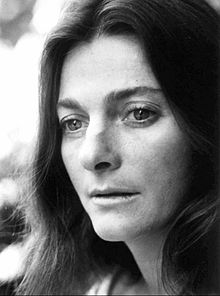
Where Ma Rainey and Beethoven once unwrapped their bedroll
Both in interviews and in his songs, Dylan demonstrates a fairly universal, predictable development with regard to established high culture: as a young guy he dismisses it, in middle age he recognises its value, as an older man he is not embarrassed to vent his admiration loud and clear. T.S. Eliot’s work is still called soft-boiled egg shit in the 60’s and the young savage Dylan claims straight-faced: “I never did admire him”, in the 70’s Dylan still finds him “aloof”, unworldly and acting high-brow. But in the Biograph interview with Cameron Crowe in 1985 Eliot is already mentioned in the same line-up as Elvis Presley and Albert Camus, in the line-up of artists who had a big impact on me. In the twenty-first century, in Chronicles, the autobiographer, who is now in his sixties, confesses: “I liked T.S. Eliot. He was worth reading,” and a few years later the DJ Dylan admiringly quotes the first eleven lines of Eliot’s “The Waste Land” in his radio programme Theme Time Radio Hour.
The appreciation of another untouchable big shot has a similar development. In 2020, on Rough And Rowdy Ways, Beethoven will be alpha and omega. In the opening song, “I Contain Multitudes” the protagonist declares, “I play Beethoven’s sonatas”, at the end of the majestic finale, “Murder Most Foul,” the narrator requests to play “Moonlight Sonata in F-sharp”. Unambiguous appreciation; Beethoven’s Piano Sonata no. 14 stands among the enumeration of pieces of music which the narrator apparently considers to be implacable, comforting and beautiful masterpieces.
But at first, Dylan’s associations with Beethoven are perhaps a bit disrespectful, or at least pretty narrow-minded, even to a less snobby cultural snob. Downright dismissing is the angry young man back in ’66, during a press conference in Denmark:
“What’s your favourite music?” Dylan asks a woman reporter.
“Beethoven,” she replies, “I’m very fond of Beethoven’s Symphonies.”
“Yes, but I was thinking more of your favourite music,” the bully continues.
“But it is Beethoven,” the lady repeats, rather brusquely.
“Oh come on,” says Dylan, “what’s your favourite music?”
…implying that Beethoven, of course, is not really music. Which ties in with Dylan’s memories in Chronicles. Just arrived in New York, the young folk singer is staying here and there, among others with “Ray and Chloe”. Ray’s record collection doesn’t really appeal. “Mostly, it was classical music and jazz bands.” But Dylan puts some on anyway.
“Once I put on Beethoven’s Pathetique Sonata — it was melodic, but then again, it sounded like a lot of burping and belching and other bodily functions. It was funny — sounded almost like a cartoon.”
“Burping and belching”? The “Pathétique”? That is not only a bizarre and embarrassingly stupid disqualification, but also quite hard to follow – just like “other bodily functions”, whatever he might mean by that, cannot be discovered either. Perhaps Dylan is familiar with the performance of Glenn Gould, who as usual gets carried away, audibly moaning and humming – but that recording is from 1967, so at the time, at Ray and Chloe’s house, it couldn’t be on the turntable.
The other (dis)qualification, “like a cartoon”, is easier to trace. Like most of us, Dylan first came into contact with classical music through cartoons. We know Liszt’s “Hungarian Rhapsody No. 2”, for example, thanks to Tom & Jerry’s The Cat Concerto. Rossini’s “Barber Of Seville”, both the Overture and arias, via Woody Woodpecker, Droopy, Tom & Jerry, Daffy Duck and Bugs Bunny (Long Haired Hare and of course The Rabbit Of Seville, both from 1949). Mozart’s “Sonata No. 16 in C major” (KV 545) can be heard in dozens of Warner Bros. cartoons, Nazis are usually introduced with and accompanied by Wagner or Strauss (as in Bugs Bunny’s meeting with Hermann Goering in the Black Forest, after Bugs took his traditional wrong turn at Albuquerque, in Herr Meets Hare, 1945) and Chopin’s “Marche Funèbre” sounds at almost every Looney Tune death or funeral scene.
If we should choose to believe Dylan’s recollection, the cartoon association triggered by the “Pathétique” must be due to Bugs Bunny Rides Again (1948), one of those typical films by the genius Fritz Freleng, the spiritual father of immortal heroes such as Bugs, Daffy and Yosemite Sam. There his brilliant music director Carl Stalling demonstrates how you can forge one, continuously exciting, whole from eighteen very different music fragments. In these seven minutes we hear among others Rossini’s “William Tell Overture”, Schubert’s “Erl King”, again Rossini (“Inflammatus”, from the Stabat Mater) and Wagner’s “Siegfried”. And a fragment of Beethoven’s “Pathétique”, in the this town ain’t big enough for the both of us-confrontation of Yosemite Sam with Bugs, in the saloon.
More iconic, however, is the use of Beethoven’s “cartoon-like” sonata in the television special A Boy Named Charlie Brown. Towards the end of that film is the overwhelming scene with Schroeder on his toy piano, who then plays the second movement from the “Pathétique”. The viewer is carried along with Schroeder’s rapture, in a dreamlike, psychedelic scene full of colour explosions, liquid slides, surreal Gothic symbolism, stylised panoramas of German towns, impressions of Vienna, pop-art portraits of Beethoven and Beethoven’s death mask.
Again absolutely no burping and belching, by the way. Anyway, the film is from 1969. Dylan’s cartoon association can therefore at most have entered his autobiographical memories as constructed memory. But much more likely, Dylan’s use of the Beethoven-recollection is as imprecise and incorrect as the “memories” of the books he reads while staying at Ray and Chloe’s – in this same chapter he pours out names such as Pericles, Tacitus and Thucydides and links these names to book titles that do not exist or have been written by others.
Still: Dylan at least expresses an opinion to Beethoven’s music. The other greatness in this penultimate verse of “Tombstone Blues”, Ma Rainey, is actually only used as a point of reference, as most people do, unfortunately. Usually with regard to her reputation, her appearance or her charisma – it’s never really about her music. In interviews, Dylan mentions her name at most as an example in a list of Great Artists, and in Chronicles her name comes up to explain how great Joan Baez is: just as with Memphis Minnie and Ma Rainey, “there was nothing girlish about Joan either”.
It is a somewhat bitter fate for the “Mother Of Blues”, who – to name but one – made the first recording of “See See Rider Blues”, but it is how it is. Ever since the 1950s, barely twenty years after her death in 1939, her appearance is apparently more memorable than her music. As in an – otherwise beautiful – scene in Jack Kerouac’s The Dharma Bums (1958):
A big fat woman like Ma Rainey was standing there with her legs outspread howling out a tremendous sermon in a booming voice that kept breaking from speech to blues-singing music, beautiful, and the reason why this woman, who was such a great preacher, was not preaching in a church was because every now and then she just simply had to go sploosh and spit as hard as she could off to the side in the grass, “And I’m tellin you, the Lawd will take care of you if you recognize that you have a new field . . . Yes!”—and sploosh, she turns and spits about ten feet away a great sploosh of spit.
Or as in Allen Ginsberg’s moving elegy to his deceased mother, “Kaddish” from 1959: “O mother, with your eyes of Ma Rainey dying in an ambulance”.
In this one line from “Tombstone Blues” there is no mention of her musical merit either. Her merit here is that she has given an unspecified location historical status by unwrapping a bedroll together with an antique German composer. Some analysts, such as Polizotti, search and find a deeper layer therein. Ma Rainey and Beethoven then symbolise something like an alliance of “the modern and the classical”, more or less the same thing Dylan does with a song like this – modern, surrealistic poetry embedded in an old, classical blues, allying the modern and the classical.
Well. You may see it that way, obviously. But it is to be feared that “Ma Rainey” has been chosen mainly for the sound of these syllables, because it has the same metrical foot, the amphibrach, as “Beet-ho-ven”; short-long-short. Which, by the way, is due to Chuck Berry; all generations since “Roll Over Beethoven” say Beethoven, emphasizing “-ho-“. And not, as it should be, Beethoven. Understandable; “Roll over Beethoven and tell Tchaikovsky the news” simply does not run as smoothly as roll over Beethoven.
Though Schroeder probably would have an opinion thereon.
To be continued. Next up: Tombstone Blues part XI
———
Jochen is a regular reviewer of Dylan’s work on Untold. His books are available via Amazon both in paperback and on Kindle:
We are approaching article 2000 on this site. You can find indexes to series linked under the image of Dylan at the top of the page and some relating to recent series on the home page.
Although no one gets paid for writing, publishing or editing Untold Dylan, it does cost us money to keep the site afloat, safe from hackers, n’er-do-wells etc. We never ask for donations, and we try to survive on the income from our advertisers, so if you enjoy Untold Dylan, and you’ve got an ad blocker, could I beg you to turn it off while here. I’m not asking you to click on ads for the sake of it, but at least allow us to add one more to the number of people who see the full page including the adverts. Thanks.
As for the writing, Untold Dylan is written by people who want to write for Untold Dylan. We welcome articles, contributions and ideas from all our readers. Although no one gets paid, if you are published here, your work will be read by a fairly large number of people across the world, ranging from fans to academics. If you have an idea, or a finished piece send it as a Word file to Tony@schools.co.uk with a note saying that it is for publication on Untold Dylan.
We also have a very lively discussion group “Untold Dylan” on Facebook with around 8500 active members. Just type the phrase “Untold Dylan” in, on your Facebook page or follow this link And because we don’t do political debates on our Facebook group there is a separate group for debating Bob Dylan’s politics – Icicles Hanging Down
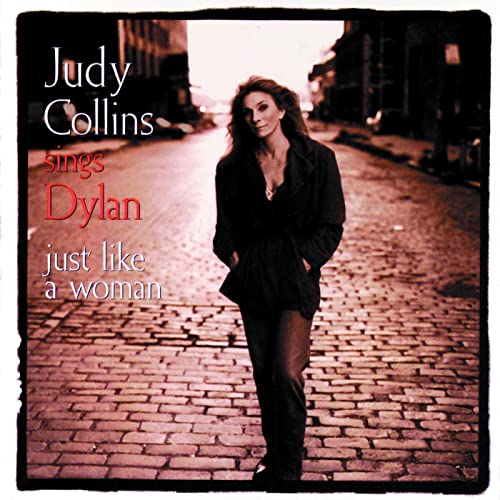
This was performed three times ranging from May 1961 through to July 2019 – so it has a longevity in Dylan’s memory even if only rarely played.
It was written in 1907 by Ada R. Habershon with music by Charles H. Gabriel. However it is now in the public domain as the copyright was not registered (or possibly has lapsed, but I think the former).
It was also recorded by the Carter Family which is perhaps why it has retained an affection for Dylan.
This was released in 1935, and is enough of a variant from the original for it to have been copyrighted and that copyright is still in effect. I have a great affection for the Jeff Buckley version, but unfortunately the version on the internet is of poor quality. It is however the only version that I know that he did of it.
but if you want something brighter, then this one is fun with Johnny Cash
Now something very different – Wild Mountain Thyme.
Bob performed this on 22 June 1988 at the Riverbend Music Centre, Cincinnati. I haven’t found a copy of that gig on line, hence this much earlier one. But really I do like this acoustic version. The two of them sound very together, and the accompaniment is very unusual for this song with its insistant off-beat. Since I found this I’ve been playing it over and over.
So long Good Luck Goodbye
This comes from 12 January 1990, performed in New Haven (I think).
It is a classic 1950s rock n roll song… written by Weldon Rogers (1927-2004), who was also the founder of Je-Wel records which released the first Roy Orbison record.
https://youtu.be/AkBq_PW0-E0
I am now going to cheat to end with and include a song I’ve included before, just because I really like it so much, and maybe today we’ve got some readers who have not ventured this way before. It’s Weeping Willow.
As we have noted in recent articles, Bob Dylan had a prolonged period from 1968 to 1973 in which he was writing songs at nothing like his earlier levels of productivity. The total number of songs was much reduced but despite this he was by and large not producing songs that were considered by most listeners to be of a quality akin to that found in the songs he had composed with much more frequency in earlier years.
Of those songs that were written we might perhaps note these eight of being of particular merit, although I know many who would cut this list down to perhaps just three or four compositions written during these six years – particularly questioning my continuing insistence of including the last two songs of the era: “Dirge” and “Wedding Song” and perhaps the much lighter piece, “You Angel You”.
Given that from 1965 alone many fans of Dylan’s work would be able to list a dozen songs they would put in the “genius” class (from “Chimes of Freedom” to “It’s alright ma”) even if you agree with my selection of the eight songs above, the fact that it took Bob six years to write these, shows how far his creative genius output had dropped.
But now, as we have seen, at the start of 1974 Dylan had written two songs (Lily, Rosemary and the Jack of Hearts and Tangled up in blue) which most fans would list as among his greatest works, it shows how far Dylan’s creative output had risen once again.
The third song Dylan wrote in 1974 was “You’re a big girl now” which has always struck me as the reverse of “Just like a Woman” where she breaks just like a little girl. I don’t see any woman or girl breaking in “Big girl”. Rather I find a man who is broken, and there really is only one way to read lines such as…
I’m going out of my mind, oh,
With a pain that stops and starts
Like a corkscrew to my heart
Ever since we’ve been apart
As we have seen through the various analyses conducted on this site, “lost love” as a lyrical theme has been one of Dylan’s prime approaches to lyrics, and here he is revisiting the theme once more.
There are also moments of Hank Williams here, in particular “I Can’t Help It (If I’m Still in Love With You),” but that it turns out Dylan’s song is far more complex than most lost love pieces. Even if we stick to the level of analytics rather than emotions, we find an unusual song in that the rhyme scheme is inconsistent, being at the start
A A
B C
D D
but later in verses three and five mutating to
A A
B
C C C
It doesn’t affect the listener, and I doubt that most people ever notice, but it does indicate the flexibility Bob had in his writing at this point. He wasn’t going to force rhymes just because he started out that way. The melody and the plaintive message would carry the listener through, he knew that.
To me “Big Girl” is one of the most successful, overpoweringly emotional songs of Dylan’s whole writing career – perhaps the ultimate emotional song in his entire output.
There is just so much here to hit anyone who has had a deep, intense, meaningful loving relationship which has ended with the other party leaving. So much that one could sink into its hurt and pain and never re-emerge. And what Dylan has done is given us an alternative to the mists of Visions and Johanna, or the anger of Idiot Wind. Another way of seeing the world.
The recording heard above has to be taken alongside the last songs of the previous year. It is as if Dylan decided to write “The Book of Emotions” through Dirge, Wedding Song, and now this. “You want emotions?” he is saying, “I’ll give you emotions…”
But what has happened is that some of those who comment on Dylan’s work, for some reason feel the need to distance themselves from the emotion, sometimes not even engaging with the emotional content of the song at all, as if they, the commentators, are emotionless entities about to comment upon the poor sap in the song crying about his heart being broken.
Yet this is totally nonviable as a method of critiquing the song . If you have never experienced the real highs and lows of emotion it must be hard to understand what is going on here. A bit like a person who has never been to Greece writing a critique of a travel guide to Greece. How can you comment upon a song that deals with these emotions if you have not experienced them? How can you critique a travel guide to Greece without having been to the country? If you have experienced those highs and lows, then you know that they are indescribable while one is within them, and beyond understanding when one has passed through and come out the other side.
It is not just “Our conversation was short and sweet, It nearly swept me off my feet, And I’m back in the rain, oh, And you are on dry land,” it is also that absolute self-destructiveness of the whole concept.
I’m going out of my mind, oh,
With a pain that stops and starts
Like a corkscrew to my heart
Ever since we’ve been apart
He doesn’t even have the strength to blame her, he has lost so much of himself every normal emotion has gone. This is desolation and isolation, hopelessness and emptiness, all rolled into one song. You can face the sheer horror of them “selling postcards of the hanging” and know that this actually happened, but when it is as personal as this it can get so overpowering there is nowhere else to turn and no way to take it all in.
Of course if we could find that time machine that was lurking around in “Tangled up in blue”, maybe we could escape the pain. But there’s never a time machine around when you want one. It’s either wandered off of its own accord, or you’ve lost the key.
On Blood on the Tracks, the sleeve notes quote Yates, “We make out of the quarrel with others rhetoric, but of the quarrel with ourselves, poetry.” Or as the All Music review said of this song, “It is like seeing your father cry for the first time.” There really is no escape from pain of this sort… you just have to let it take its course.
In another review I found, the writer reflects on taking a regular session called “Sociology of Rock ‘n Roll” at Ohio University taught by a lecturer who himself wrote protest and folk songs.
One Friday he solemnly laid down his guitar, put his hand over his heart, and vowed that he could never write another song. It was all hopeless. He waved a purple album cover in front of us. “This,” he said, “has done me in. You can’t write a better album than this. There’s no sense in even trying.”
It wasBlood on the Tracks, … There was only one song that immediately struck me, sitting in that bar, and it still raises the hairs on the back of my neck.
The writer of that piece then takes us into “Big Girl”.
Musically the two versions are very different – even the chord structure has changed, the NY version being much, much more complex, but then sounding (strangely) simpler because of the way the accompaniment is arranged.
The album version runs a chord sequence of
Bm, Am, Bm Am
G C G C
Am Bm Am D
On the New York version the guitar is also tuned in a completely different way and the chords are (thanks to Dylanchords.info because I certainly struggled with this)…
Emaj7, B11, Emaj7, B11
E, B, A, E, B, A
F#7, Emaj7, B11, E, A, E, B
If you are a musician you’ll know what I mean, but even if not, you might notice that we have in here chords never mentioned before in any review on this site – Dylan rarely, if ever, at this stage of his career used chords like “E major 7” or B11. These are very unusual chords – not unknown, just not normally used, and they give the song a new effect as Dylan takes us to a different land – a land he returned to much, much later.
Perhaps the utter brilliance of the song, and certainly the painfulness of the song is that we know something is going terribly, terribly, terribly wrong. And has anyone expressed this so powerfully before as
Bird on the horizon, sittin’ on a fence
He’s singin’ his song for me at his own expense
And I’m just like that bird, oh, oh,
Singin’ just for you
I hope that you can hear
Hear me singin’ through these tears
I have no escape, there is no solution, there is, in fact, nothing.
My one hope, if you are reading this, and you feel up to it (ie not if you are within six months of a serious breakup and there is no sign of anyone new on the horizon), you listen to both versions of the song, and then maybe listen again, not to the voice, but to what the instruments are doing. We are talking two different languages in the construction of this song, and that in itself is a masterpiece.
During the next 30 years Dylan played this song over 200 times in concert. Looking at the totals of live performances that is only three fewer than Visions, and half the number of times he’s played Tweedle Dum. He wanted to say it, each performance of this song takes it out of the singer – at least it does if he is thinking about the lyrics.
But let me leave you with a comment from a reviewer on the internet.
“I haven’t played Blood in the Tracks for a few years, but I’ve been listening to it over the past few days. I’m going to play that song at an upcoming arts conference. And I’m going to talk about why the words “oh, oh” might constitute some of the best songwriting ever.”
I can see exactly what he means.
Here’s the original version
Quite extraordinarily, the next song Bob wrote was another masterpiece, and Shelter from the storm takes Dylan’s magnificent return to songwriting form even further.
Of course he had written masterpiece after masterpiece before, and it is possible that Dylan tried out several other songs in between these compositions – songs which have simply been lost. But it seems unlikely. Over 620 songs written by Bob Dylan have survived, why would the non-album pieces here be so utterly removed from public consumption?
So if we take it that what we know about is the sum of Dylan’s writing at the time, we have to look back to periods such as 1962 wherein, “Hard Rain,” “Hollis Brown,” “John Brown,” and “Don’t think twice” one after the other. Or perhaps the start of 1963 as he produced “Masters of War,” “Girl from the North Country”, “Spanish Leather,” and “Dylan’s Dream”, hardly (its seems) pausing for breath. Indeed 1963 had another stream of amazing compositions one after the other at the end of the year, ending with “Restless Farewell.”
But then as we have seen, eventually Bob ran out of steam. Yet now here he was producing masterpiece after masterpiece for next came “Shelter From the Storm.”
And not just another masterpiece – but another change of subject
Lily, Rosemary and the Jack of Hearts: a rambling epic tale of four characters
Tangled up in blue: An ever-changing relationship in a seemingly ever changing world
You’re a big girl now: lost love, deep hurt, and there’s nothing to be done
Shelter from the storm: the world is a storm, there is nothing we can catch onto, nothing is fixed.
These are complex themes, far beyond the reach of 99.999% of song lyrics, and is one is so different in both temperament and style. And each has its own input, its own approach, its own vision, its own issues that it is explaining, relating, and perhaps resolving.
“Shelter from the Storm” adds another dimension in that there is a disconnect between the verses (as happens in “Tangled”), and yet the same line ends each verse, which suggests there ought to be a connection but somehow we can’t find it. The world is nonsense, there is nothing we can latch onto, there is no reality that is fixed. Indeed when we get to
Well, the deputy walks on hard nails and the preacher rides a mount
But nothing really matters much, it’s doom alone that counts
And the one-eyed undertaker, he blows a futile horn
we are left wondering “Where did that come from? Where does it take us?”
And all the while the same three chords are repeated and repeated as if there is a stability here, right under our feet… except we can feel it going round and round. As if somehow we are fixed but the world around us changes in ways that are completely beyond our understanding or control – and yet at the same time we seem to be in there, handling the affair, continuing our life. It is like a recurring nightmare where one cannot take control, but it is not a nightmare at all because she is there all the time offering shelter.
Long before Dylan won the Nobel Prize for Literature, Heylin, called this “a lyric worthy of any poet laureate”, which shows a rare bit of insight, even if it was wholly fortuitous in its predictive sense. For once I’m with Heylin on this one, and so it seems was the Nobel Prize committee.
Dylan had moved on from being the guy who wanted to get away from it all and live in a remote rural idyll to becoming a myth maker. The creator of worlds that are condensed into a song format, but which could, at a moment’s notice, be opened up, into something much broader.
Of course Dylan is not a myth maker in the true sense, for the songs are not complex or long enough to have the feeling of the myth, although in the missing 11th verse he gets closest…
Now the bonds are broken but they can be retied
By one more journey to the woods, and the holes where spirits hide
It's a never ending battle for a peace that's always torn
"Come in," she said, "I'll give you shelter from the storm"
which gives us the real clue as to what Bob was about. This is Dylan playing with images, showing us that lyrics can paint any picture, even against the simplest of musical textures. And that is brilliant; of course it is a brilliant song. The chords rotate, the melody follows, nothing changes, nothing moves on. The instrumentation is played out in the same terms of never-endingness. Round and round it could go on forever.
Here’s a variant I’m not sure it is better but hearing a different approach reminds us of just how much there is in this world of an endlessly repeating melody, rhythm and chords.
To me this represents the conflict of the man perceiving beauty and his desire to possess it (which will ultimately destroy that peaceful beauty). Hence the simple presentation, the repeats and repeats, and yet the complexity encoded in the lyrics.
Steve Adey actually went further in recording it and took it so slowly that it lasted forever, which fits the end, and tells us what else is possible if you have eight minutes to spare.
But overall, if you want an image for this song, just think of a cottage with no other habitation around, and a howling wind blowing outside, with all manner of evil lurking in the dark as the thunder crashes and rain falls. Then you have it. But as you find your own image, just remember those opening lines…
’Twas in another lifetime, one of toil and blood
When blackness was a virtue and the road was full of mud
Here’s the world:
In a world of steel-eyed death, and men who are fighting to be warm
And this is her:
Try imagining a place where it’s always safe and warm
And this is the singer:
I was burned out from exhaustion, buried in the hail
Poisoned in the bushes an’ blown out on the trail
Hunted like a crocodile, ravaged in the corn
She ends his torture…
She walked up to me so gracefully and took my crown of thorns
She is a goddess, he is a mortal, his pain self-inflicted. He wants to possess beauty, but knows that he cannot – and yet he can’t let go of that desire. In the end that’s it. He wants to possess, but she will not let him for beauty is to be shared, always, always, always.
Many people find this to be the greatest re-working of all by Bob. I’m not sure if it is the best, but to me it passes the eight minutes with more meaning and insight than I get from Adey.
Untold Dylan
We are approaching article 2000 on this site. You can find indexes to series linked under the image of Dylan at the top of the page and some relating to recent series on the home page.
Although no one gets paid for writing, publishing or editing Untold Dylan, it does cost us money to keep the site afloat, safe from hackers, n’er-do-wells etc. We never ask for donations, and we try to survive on the income from our advertisers, so if you enjoy Untold Dylan, and you’ve got an ad blocker, could I beg you to turn it off while here. I’m not asking you to click on ads for the sake of it, but at least allow us to add one more to the number of people who see the full page including the adverts. Thanks.
As for the writing, Untold Dylan is written by people who want to write for Untold Dylan. We welcome articles, contributions and ideas from all our readers. Although no one gets paid, if you are published here, your work will be read by a fairly large number of people across the world, ranging from fans to academics. If you have an idea, or a finished piece send it as a Word file to Tony@schools.co.uk with a note saying that it is for publication on Untold Dylan.
We also have a very lively discussion group “Untold Dylan” on Facebook with around 8500 active members. Just type the phrase “Untold Dylan” in, on your Facebook page or follow this link And because we don’t do political debates on our Facebook group there is a separate group for debating Bob Dylan’s politics – Icicles Hanging Down
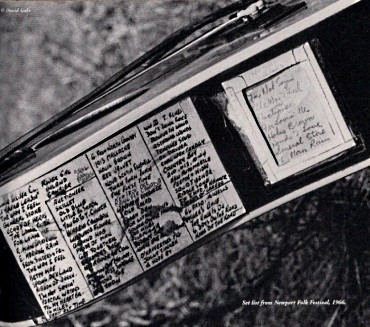
Now I wish I could give Brother Bill his great thrill I would set him in chains at the top of the hill
Then send out for some pillars and Cecil B. DeMille
He could die happily ever after
Millions of people who have never read or even heard of William Burroughs can easily quote from The Nova Trilogy:
Here comes Johnny Yen again
With the liquor and drugs
And the flesh machine
He’s gonna do another striptease,
and the hypnotizing chickens, the modern guy and the gimmick… Iggy Pop’s world hit from 1977, “Lust For Life”, draws exuberantly from The Ticket That Exploded (1962) and turns Burroughs’ side-kick Johnny Yen, “the striptease God of sexual frustration”, into a main character. In the same novel, by the way, the author of Junkie also introduces the concept of heavy metal, of which the boundaries have been stretched quite a bit by The Godfather Of Punk with his first band, The Stooges.
Iggy Pop is a fan, that should be obvious. Partly for this reason, the BBC invites him to participate in, or rather to co-host a radio programme on Burroughs in 2014, on the occasion of the hundredth birthday of the Beat Poet. Iggy happily accepts, confirms in the programme the tribute in “Lust For Life” and adds:
“This is coming out of some LustforLife, all right. He’s not just in my music. Burroughs is everywhere. He’s in Dylan’s TombstoneBlues. He’s on the cover of SergeantPepper’s two rows behind Paul, right next to Marilyn Monroe. He inspired band names like the Soft Machine, a great band, and Steely Dan, which is named after a strap-on dildo in NakedLunch. I didn’t know that.”
Burroughs’ presence in Dylan’s “Tombstone Blues”, Iggy explains, is officially confirmed by the supporting role for Brother Bill, one of The Priest’s nicknames, as another nickname says. Which, by the way, also draws a line to “Desolation Row”, to a perfect image of a priest, from the verse in which, as in “Tombstone Blues”, there are more Burrough references, paraphrases and winks.
In terms of content (expressing the wish to satisfy the Beat Poet), the opening line reflects Dylan’s artistic and cultural admiration for the – at the time – 51-year-old nestor. In these days the only meeting between the two word artists takes place, in a cafe in Greenwich Village. Dylan is impressed, and also charmed by Burroughs’ cut-up technique, an admiration he professes in a few interviews in 1965. “I thinks he’s a great man,” he says in the late summer of ’65 interview with Edmiston and Ephron, following his expressed awe for the cut-up technique.
The cut-up technique, which Dylan seems to want to imitate in both “Tombstone Blues” and “Desolation Row”, is still relatively new in 1965. Burroughs’ first books, Junkie and Queer are still quite straightforward. The writing process for Naked Lunch already approaches the technique; the basis for that legendary work consists of seemingly randomly pasted pieces from Burroughs’ so-called Word Hoard, from paragraphs, sentences and fragments of sentences from the pile of paper (about a thousand sheets) that Brother Bill, with the help of among others Allen Ginsberg and Jack Kerouac typed away in Tangier, spring 1957.
For The Nova Trilogy, or The Cut-Up Trilogy, as he also called it, Burroughs then uses the same Word Hoard (especially for The Soft Machine, but in The Ticket That Exploded and in Nova Express we see the same fragments, names and weird attributes again) – this time in a conscious attempt to “rearrange”, as a conscious attempt to develop a new writing technique.
Dylan’s approach, however, seems different. Burroughs sees language as a virus, as a weapon that is used to keep us under control – and which, in turn, can also be used as a weapon against it. “The word, of course, is one of the most powerful instruments of control… Now if you start cutting these up and rearranging them you are breaking down the control system,” as he explains in an interview with Daniel Odiers for The Job.
Dylan takes a more playful approach, seems to use cut-ups mainly to surprise, without further text-transcending intentions. More old-fashioned than Burroughs in fact – Dylan’s lyrics call to mind sooner the collage-like effect of the surrealists, rather than the deliberately destructive force of the Beat Poets. Nor would a Ginsberg or a Kerouac hardly allow themselves to be tempted into a relatively simple, cabaretesque wordplay like die happily ever after, with which surrealists like Duchamp or Margritte, on the other hand, would not have the slightest problem.
The same applies to the apparent need to maintain at least some order in the chaos. In this Brother Bill quatrain, for example, the Samson & Delilah story is still the silver thread, to which now the greeting to William Burroughs is attached.
After Samson’s weapon and enemies in the seventh quatrain, the jawbone and the philistines, and his femme fatale Delilah in the ninth quatrain, a fitting farewell is now being said to the legendary long-haired judge; after all, the pillars are indeed the suicide instrument;
And Samson took hold of the two middle pillars upon which the house stood, and on which it was borne up, of the one with his right hand, and of the other with his left.
And Samson said, Let me die with the Philistines. And he bowed himself with all his might; and the house fell upon the lords, and upon all the people that were therein. So the dead which he slew at his death were more than they which he slew in his life.
(Judges 16:29-30)
Cecil B. DeMille’s film adaptation (Samson and Delilah, 1949) is much more forgiving of Delilah. With DeMille she is not worthlessly at home, with tears on her cheeks from laughing. In the film, Delilah (an irresistible Hedy Lamarr) really loves her Nazirite and, tormented by remorse, helps him in his final moments. During the public humiliation by the Philistines, she beats a whip around the waist of the blind Samson and then leads him up the stairs to the pillars. The roaring audience expects that up there, as an ultimate humiliation, she will make Samson kneel and make him renounce his God. “Are these the pillars on which the temple rests?” he asks her when they are upstairs, and when she confirms:
“Go Delila, into the courtyard. Death will come into this temple. The hand of the Lord will strike.”
“I will not be afraid.”
“You must leave now. Wherever you are, my love is with you. Go!”
But Delilah decides to die with her beloved and stays, hiding only a few steps away. “Delilah! Have you gone?” Samson shouts, but the silently weeping Philistine beauty does not answer.
The tears on her cheeks are of deep sorrow.
To be continued. Next up: Tombstone Blues part X
———-
Jochen is a regular reviewer of Dylan’s work on Untold. His books are available via Amazon both in paperback and on Kindle:
We are approaching article 2000 on this site. You can find indexes to series linked under the image of Dylan at the top of the page and some relating to recent series on the home page.
Although no one gets paid for writing, publishing or editing Untold Dylan, it does cost us money to keep the site afloat, safe from hackers, n’er-do-wells etc. We never ask for donations, and we try to survive on the income from our advertisers, so if you enjoy Untold Dylan, and you’ve got an ad blocker, could I beg you to turn it off while here. I’m not asking you to click on ads for the sake of it, but at least allow us to add one more to the number of people who see the full page including the adverts. Thanks.
As for the writing, Untold Dylan is written by people who want to write for Untold Dylan. We welcome articles, contributions and ideas from all our readers. Although no one gets paid, if you are published here, your work will be read by a fairly large number of people across the world, ranging from fans to academics. If you have an idea, or a finished piece send it as a Word file to Tony@schools.co.uk with a note saying that it is for publication on Untold Dylan.
We also have a very lively discussion group “Untold Dylan” on Facebook with around 8500 active members. Just type the phrase “Untold Dylan” in, on your Facebook page or follow this link And because we don’t do political debates on our Facebook group there is a separate group for debating Bob Dylan’s politics – Icicles Hanging Down
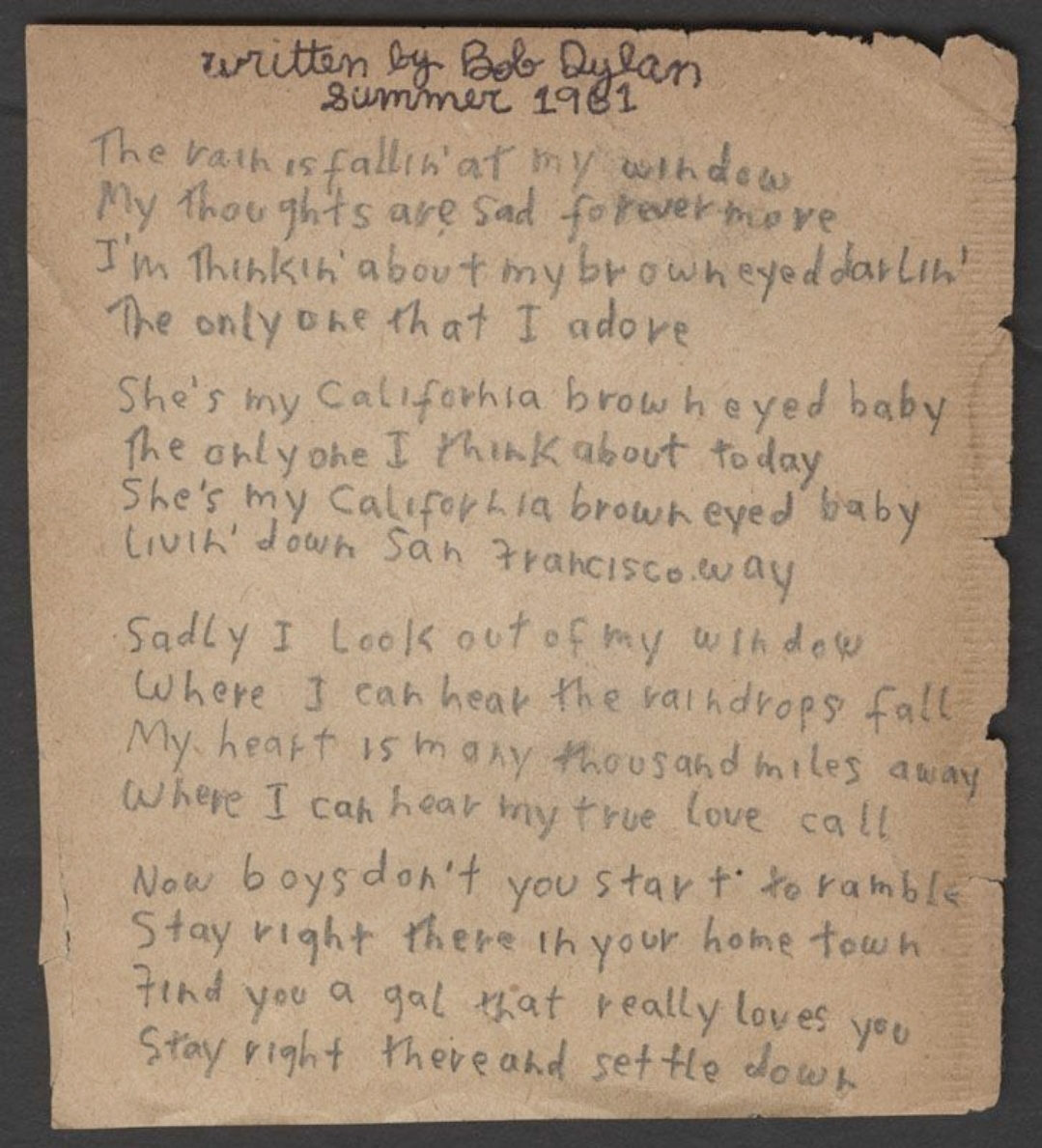
Note from the publisher: if you are outside the UK you might find one or more of these videos unavailable in your country. If so, it is always worth going onto your search engine of choice and simply typing in the details of the video (eg Series of Dreams, Di Gregori) and it might come up. I can’t guarantee it, but it happens quite often.
———–
by Geoffrey Morrow
I thought I’d get in touch with you after many years of enjoying your vast and enduring
enthusiasm for someone I’ve also always greatly admired since my own mid-teenage
years in 1964-65.
Like many people, besides the music, I’ve long been interested in the visual
minutiae of all things Dylan and I thought I would provide you with some facts that
might interest you, by giving you а little, perhaps new, background information
regarding what is considered to be by many of us the best authorized video made for
а song in BD’s vast catalogue; А Series of Dreams.
The official directorship of the video has always been given to the then LA-based Miert Avis, who, at the time, worked for the newly instigated Santa Monica-based wing of Dublin’s Windmill Lane recording and production studios.
While the production was in fact under his directorship and guidance, I’ve always felt that the much more significant contribution to the project was provided by my old friend Charlie Whisker, whose early and newly absorbed (1990) computer animation skills and personal art imagery suffuse the entire video.
I understand that this is all a bit old, but I still imagine that you and the team there might be interested in some of the background details of this production being fleshed out а little, with information on how the vibrantly interconnected imagery came about.
First a little background about Charlie’s and my long friendship and my subsequent
association with him on this project. We met while attending art college in Belfast from
1966 to1970. We both studied painting there and have continued to be connected to
the art world both as painters, and in my case, predominantly in the art conservation
side of things.
Charlie has lived for extended periods in London, California and Ireland where he still is а well known and highly regarded artist, unfortunately now in the descending grip of early on-set dementia. In а way this awful fact over the last 6-8 years has instigated the sending of this to you. I would like more people to know of both his own art and his important contribution to the world of BD studies that still resonates for many of us through this one magnificent work of video art, before he slips further away.
We’ve both spent time in BD’s company in the past and the possibility of somehow contributing even in а very small way to his art (that presented itself when Windmill Lane Santa Monica won the job of making the Series of Dreams video in 1990-91) gave us both great happiness at the time and still does.
Charlie’s association with Windmill Lane Dublin is closely connected to both his and his ex-wife’s friendship with and the early beginnings of U2, who have recorded most of their records there. That’s а whole other story but directly connected to Charlie leaving the world of teaching painting in the Dublin art college, to his working at Windmill Lane West in Santa Monica as an artist and video animator.
In 1990 the team from Windmill Lane West was given access to BD for only а few hours
in New York City in which to shoot some useful film footage but very little of that (the B&W meat market scenes where Dylan points and laughs at а sign saying ‘Т-Bone
Automotive services’) survives in the completed video.
From that afternoon’s shoot, those few seconds were all that was considered in any way usable. It seemed to have been а calamitously blown opportunity at the time and the dilemma for the team was how now to save the project and make а video worthy of the soon to be released ‘new’ song that would be the first track of what was to be the very first triple disc of the still continuing Bootleg Series of releases.
When back in Santa Monica, all turned to Charlie in the hope that he could conjure something out of almost nothing using previously existing footage for what was considered a very important project by the whole team. That’s when Charlie called me here in Ottawa and we began to discuss what might be possible.
Sony were happy to allow the use of just about anything they had as far as already available and unreleased film footage was concerned. This led to the previously unreleased Eat the Document being provided, along with some other bits and pieces of film. It was а scramble but it was something to be going along with and sections of film that could be coordinated and aligned with the lyric of the song began to be selected out of the film imagery they had given permission to use.
There was still а lot of song/sound running time to be somehow filled-in with relevant
visuals that would enhance the quite different and strange world being called into
vision by the lyric and slightly ominous sound of the song’s trajectory and thrust.
When Avis gave Charlie permission to go for anything he could put together, further discussions began to form into what would result in the final flow of film imagery, photographs and hand-written words in the completed video. Much of the painted or drawn background imagery (apart from well known artworks by famous painters such as Bosch or Piranesi etc.) is taken directly from Charlie’s own artwork, mostly seen as the backdrop to animated sequences in the final video.
Among photographs of our collective heroes such as Rimbaud, Lenny Bruce and Dylan Thomas were several photographs inserted into existing footage that were taken by either Charlie or myself at various times over the course of our lives. The one of Charlie sitting directly across the street from Umberto’s Clam Bar in New York’s Little Italy (where Joey Gallo had been gunned down years earlier) I shot in 1987 while we were in town for а U2 concert at Madison Square Gardens. The same image, of his head only, repeats in the mirror behind the merging and distorting faces of BD and ‘the science student’ from Don’t Look Back а little later.
On top of this shot of Charlie’s head is an inscription resembling that seen in the convex mirror background of the famous Jan Van Eyck painting of the Arnolfini Wedding, on which Van Eyck has inscribed ‘I Jan Van Eyck painted this’ as а tribute to that wonderful work, except in the video it says, ‘I Charlie Whisker painted this’.
All of the varied written inscriptions seen throughout the sequences are in Charlie’s distinctive handwriting referring to various different things. Rimbaud’s poetry as an example can be seen referenced in the sequence of coloured vowels at the end of the video in а homage to his famous poem ‘Vowels’. We were having fun with all this of course.
It wasn’t until Charlie had completed the video and sent me а copy on VHS tape that I realized that he had also slipped an image of myself into the mix. In the longer train carriage sequence about two thirds of the way in, where the 1965 BD is peering out the window from within а British train carriage from Dont Look Back footage, the outside passing landscape has been altered and changed into passing images of various things and people; from а Piranesi drawing of а dungeon to Napoleon on а White horse and Jack Kerouac smoking а cigarette.
I was delighted to find there too was a brief and fleeting image of myself passing by, holding at arm’s-length а fabricated (in being computer-drawn rather than actual) but rather real looking poisonous monitor lizard by the tail. He had taken аn earlier photograph of me from 1977 that I’d sent to him among others just after my wife and I had arrived here in Ottawa from London (where he still lived at the time) and which he had then reused all those years later for this purpose.
In short, he had not been able to resist the opportunity of embedding the both of us in this video and to this day I still get an enormous kick out of being seen in the thing for about one second. If I was а BD aficionado who loved this video at the time and still possibly did, I know I would have studied every frame of its packed overflow of references and wondered who the hell is that passing by just after Jack Kerouac and would’ve been stumped. I just thought you’d like to have this (vast and highly important) mystery revealed. So now you know. As I say, we were having а bit of fun with it.
The bald chap (Charlie) and the other one with the hair (me) will be travelling the universe
forever with our greatest hero and now lifelong inspiration. What a trip for us it’s been.
So, as I reach the age of 72 and whose daily routine still includes checking out your
wonderful website, I’d simply like to thank you for all you do by providing this little
snippet of obscure information for your files. If you would like to hear about the
afternoon I spent hanging out with BD and his crew in the cinema he later appeared in
that same night on May 6th 1966 in Belfast (smuggled in by the dear but quite recently
departed Mickey Jones, who admonished me as we passed through the stage door “Don’t tell anyone I brought you in here, OK”.) I’d be glad to relay the strange and awesome afternoon I had there observing and listening quietly from the side-lines for those few hours that are still seared into my memory of that unique day. Just let me
know. I’d be happy to do so.
As а skinny 17-year-old grammar school kid with a sketch pad under his arm and а determination to draw my God-like hero, I was close to both а nerve wracking kind of heaven and my first true out-of-body experience. And unfortunately as it turned out, and to my dying shame, towards the end of that afternoon, to be the recipient of Bob and his band’s (later The Band) quite terrifyingly confrontational displeasure. They didn’t even know I had been there for those few hours.
The concert that night knocked all new doubts (as to what strange behaviour by mere
mortals I had witnessed over that afternoon) out of my mind as I tried to absorb this new
and utterly visually altered version of an artist who was so fаr ahead of his UK audience back then as to be barely recognizable.
I hope that you and anyone else reading this will check out Charlie Whisker’s paintings
on-line and think of his wonderful contribution to this still riveting video as he himself
slips further into an uncertain future in Dublin.
Thanks for your attention and all your great work.
Geoffrey Morrow
Untold Dylan
We are approaching article 2000 on this site. You can find indexes to series linked under the image of Dylan at the top of the page and some relating to recent series on the home page.
Although no one gets paid for writing, publishing or editing Untold Dylan, it does cost us money to keep the site afloat, safe from hackers, n’er-do-wells etc. We never ask for donations, and we try to survive on the income from our advertisers, so if you enjoy Untold Dylan, and you’ve got an ad blocker, could I beg you to turn it off while here. I’m not asking you to click on ads for the sake of it, but at least allow us to add one more to the number of people who see the full page including the adverts. Thanks.
As for the writing, Untold Dylan is written by people who want to write for Untold Dylan. We welcome articles, contributions and ideas from all our readers. Although no one gets paid, if you are published here, your work will be read by a fairly large number of people across the world, ranging from fans to academics. If you have an idea, or a finished piece send it as a Word file to Tony@schools.co.uk with a note saying that it is for publication on Untold Dylan.
We also have a very lively discussion group “Untold Dylan” on Facebook with around 8500 active members. Just type the phrase “Untold Dylan” in, on your Facebook page or follow this link And because we don’t do political debates on our Facebook group there is a separate group for debating Bob Dylan’s politics – Icicles Hanging Down
This is article number 30 in our series reviewing the art work of Dylan’s albums. An index to all the articles can be found here.
Released: October 19,1970
Photographer Len Siegler
Art-director ?
Bob Dylan & Victoria Spivey
“I think one of the best records that I’ve ever been a part of was the record made with Big Joe Williams and Victoria Spivey. Now that’s a record that I hear from time to time and I don’t mind listening to it. It amazes me that I was there and had done that.”
Bob Dylan , Rolling Stone Magazine, November 22, 2001
Barely three months after Self Portrait, there is a new Dylan album in the shops. The press regards the title as telling: New Morning, a new start after the double album that has been reviewed as the nadir in the career of the great singer-songwriter.
Obviously, the man himself denies such a thing. Regarding that title, he reminisces in his Chronicles, Volume One (2004): “[The producer Bob] Johnston had asked me earlier, “What do you think you’ll call this record? ” Titles! Everyone likes titles. There’s a lot to be said in a title. I didn’t know, though, and hadn’t thought about it. […] I had just heard the song “New Morning” on the playback and thought it had come out pretty good. New Morning might make a good title, I thought and then I said it to Johnston. “Man, you were reading my mind!” That’ll put them in the palm of your hand – they’ll have to take one of them mind-training courses that you do while you sleep to get the meaning of that.”
Dylan immediately adds that he already had an idea for the cover: “…a photo of myself and Victoria Spivey. […] I knew that this photo would be on the cover before I recorded the songs. Maybe I was even making this record because I had the cover in mind and needed something to go into the sleeve.”
Said photo was taken on March 2, 1962, in the Cue Recording Studio in New York. That day Dylan was invited to play harmonica during a session of Victoria Spivey with Big Joe Williams.
Victoria Spivey is a singer who began her career in 1918, at the tender age of 12, and enjoyed success in the vaudeville and blues genres. Unlike many other musicians, the Great Depression didn’t stop her career, as she had moved on by then to musical films and stage shows. Spivey retired from show business in 1951.
Towards the end of that decade however, jazz historian Len Kunstadt lured her out of retirement and gave her a regular column in his Record Research magazine, entitled “Blues Is My Business”.
Kunstadt became her agent, manager and her husband. To give her career a second wind they founded their own record label: Spivey Records. The aim was to regularly release albums by Spivey, each time collaborating with different musicians.
One of the first sessions was in March 1962. Big Joe Williams, who happened to be in town for a two week stint in Gerde’s Folk City, was invited. The Delta blues singer/guitarist is probably best known for popularizing the blues songs “Baby Please Don’t Go” (1935) and “Crawlin ‘King Snake” (1941).
Big Joe brings a guest to the studio: a young aspiring folk singer he met in October 1961, when playing a previous series of gigs at Gerde’s. During that two week period, Bob Dylan frequently sat in to accompany the singer-guitar player on harp (harmonica) and backing vocals. By the end, they were billed as Big Bill and Little Joe. The two got on so well, that Dylan states in his Chronicles Volume One: “I´d played with Big Joe Williams when I was just a kid.”
The album Dylan so fondly remembers is Three Kings and a Queen, released on Spivey Records in October 1964. The queen of course is Victoria, while the three kings are guitarist Lonnie Johnson, pianist Roosevelt Sykes and Big Joe Williams. Dylan can be heard playing harp behind Williams driving guitar and raspy vocals on “Sitting on Top of the World” and “Wichita”.
During the session two photographs were made: the one, Dylan wanted on the cover of New Morning eight years after the fact, portrays a confident Bob standing with his right hand on Williams’ beat up Supertone guitar (converted into a 9 string). Sitting next to him, in front of the piano is Victoria Spivey, beaming up at the young man, looking immensely pleased.
There’s a second photograph, in which all those present are shown: Dylan, Spivey, Kunstadt and Williams.
New Morning
Visit my website https://vinyl-records.nl for complete album information and thousands of album cover photos
In late Summer 1970, plans have obviously changed, a photo of Bob Dylan face is made for the front sleeve of the New Morning album. The bearded Dylan gives the listener a serene and determined look.
The photo is printed in sepia and edged with a pale brown-orange-ish frame. For the third time in a row, both the title and the name of the performer are missing on the front of the album’s sleeve. Perhaps Dylan just wants to give his fans a hard time?
In the booklet of The Bootleg Series, Vol 1-3 (1991) in a very similar photo is printed,but this time in colour. So we learn that the vest he is wearing is blue and white striped.
But there’s more. When the 1962 photo of young Bob on the back is mirrored and put next to the 1970 Bob of the New Morning sleeve, there’s a similarity that simply cannot be coincidence. Exactly the same angle of the face is used and exactly the same look on both faces.
Len Siegler?
Who wielded the camera is unclear. Dylanologist Michael Gray mentions Len Siegler as a photographer in his Bob Dylan Encyclopedia (2006), but notes that the original remained in the possession of Len Kunstadt for many years. That also matches the credits on the cover, where only Siegler is credited as photographer.
In his series of articles in The Telegraph “Looking Up Dylan’s Sleeves” (1995-1996), Rod MacBeath calls Len Siegler a “Columbia staff photographer.” There is no further information at all about the man. Specialized sites such as Allmusic and Discogs do not mention any other album sleeve to which Siegler has contributed – remarkable for a staff photographer of a record company, isn’t it? It seems like Siegler has only taken a handful of photos in his entire career, all of Bob Dylan.
In fact, in the book accompanying The Bootleg Series, Vol. 10 – Another Self Portrait (1969-1971) there’s about a dozen photographs related to Len Siegler – and yet his name is not mentioned anywhere.
This lead me to think that perhaps Len Sigler and Len Kunstadt are one and the same. In November 2018, I mailed this suggestion to Alan Fraser (from the beautiful site Searching for a Gem). After consulting Rod MacBeath (The Bridge), the following text appeared on the New Morning entry on Searching for a Gem: “[…] This leads Rod MacBeath to conclude that, because the photos from the Aug or Sep 1970 session are the only ones known to be credited to Len Siegler, he and Len Kunstadt are the same person!
I recently put the question regarding Len Kunstadt/Siegler to the spiveyrecords.com blog and got a very friendly mail back from Lisa Weiner. “I am sorry that I do not have any insight for you. Len Kunstadt was my uncle. I have never heard him referred to as Len Siegler, and there is no Siegler in my extended family. That said, Lenny certainly did things his own way, so it is possible that he decided to use another name for some reason — I do not know.”
So, I’m afraid it remains an unsolved mystery who Len Siegler is.
Notes
The New Morning pressing on Deutsche Schalplatten has a different back cover, with the photo showing Bob and Victoria replaced with one from the mid-1960s of Dylan alone at the piano.
There’s one more photo of Bob and Victoria together. It’s made by Rowland Sherman, at the Newport Folk Festival in 1963, where they both appeared.
In her column for the April 1965 issue of Record Research, Spivey wrote about Bob Dylan the heading ‘Luck Is A Fortune!’:
‘If you live long enough your luck is bound to change. I was just thinking about little BOB DYLAN. The years flashed back to 1961 when I first met him at Gerde’s Folk City in Greenwich Village, New York City. He was the sweetest kid you would ever want to meet. Just a bundle of nervous energy. He would say Moms, this Moms, that Moms, always trying to get my attention, He was a doll. I was so proud of him then because he really had some talent which was just ready to explode. And did it! Just a couple of years later he was on his way to becoming a world idol in his field.
‘
Visit my website https://vinyl-records.nl for complete album information and thousands of album cover photos
Speaking about idols! Bob used to tell us all about his childhood and how he used to get next to the Chicago blues people. He had an idol too, among others, and he was none other than the great country blues singer, Big Joe Williams. A dream came true for Bob when Big Joe was here in New York for a Gerde’s engagement. Bob knew about my little record company SPIVEY and my plans to record Big Joe, and he wanted “in” too. What a sight as little Bob was carrying Big Joe’s unusual guitar to the studio! And did they play well together! Like they were together for 50 years! “Come On Big Joe Little Junior, Play your harp.” That’s the way Big Joe proudly gave Bob the cue to “take off” on one of the titles. Yes, this was Bob before Dame fortune was to reward him for his great talent.
‘When I see him now he still gives me that big baby kiss and hug. He’s still the same Little boy to me and I am so happy for him. On a recent Les Crane TV show Bob was simply great. I believe he could become a great comedian in addition to his writing and singing.
‘So Bob! keep up the good work and stay the same young man you were in 1961, and you won’t have to look back.’
Untold Dylan
We are approaching article 2000 on this site. You can find indexes to series linked under the image of Dylan at the top of the page and some relating to recent series on the home page.
Although no one gets paid for writing, publishing or editing Untold Dylan, it does cost us money to keep the site afloat, safe from hackers, n’er-do-wells etc. We never ask for donations, and we try to survive on the income from our advertisers, so if you enjoy Untold Dylan, and you’ve got an ad blocker, could I beg you to turn it off while here. I’m not asking you to click on ads for the sake of it, but at least allow us to add one more to the number of people who see the full page including the adverts. Thanks.
As for the writing, Untold Dylan is written by people who want to write for Untold Dylan. We welcome articles, contributions and ideas from all our readers. Although no one gets paid, if you are published here, your work will be read by a fairly large number of people across the world, ranging from fans to academics. If you have an idea, or a finished piece send it as a Word file to Tony@schools.co.uk with a note saying that it is for publication on Untold Dylan.
We also have a very lively discussion group “Untold Dylan” on Facebook with around 8500 active members. Just type the phrase “Untold Dylan” in, on your Facebook page or follow this link And because we don’t do political debates on our Facebook group there is a separate group for debating Bob Dylan’s politics – Icicles Hanging Down
The news that Bob Dylan was selling the copyright of 600 of his songs to Universal Music reminds me of a story I read somewhere about how assiduous the young Dylan was in amassing that intellectual property. Dylan would haunt the folk music shows, soak up melody lines and arrangements by such groups as the Clancy Brothers, write his own (brilliant) lyrics to the melodies and rush off to get them copyrighted.
The Clancy Brothers would find that some song they’d been singing now, technically at least, belonged to Bob Dylan.
From that time on, while he did some crazy things like giving songs away, in the main he jealously protected his intellectual property. He was fine giving permission for the hundreds of cover versions of his songs, but made it very difficult for writers who wanted to quote him, other than in critical works or blogsites such as Untold Dylan.
He was dead set against bootleggers ripping off his performances, and for many years there was constant battle between the bootleggers and the Web Sheriff on You Tube – an ongoing war, and a losing one, against copyright infringement. Videos would appear and disappear and reappear again. This still goes on to some extent, despite the flood of material onto You Tube.
Looking at this history, we see a Dylan very concerned with the integrity of his property, with a fierce sense of propriety when it came to his songs.
Now he’s cashing out. Or as some prefer to see it, selling out to the big musical corporates. Not everybody is comfortable with that.
When the news came out, The Guardian newspaper somewhat gleefully commented: ‘The fact that he’s ceded control of how the songs are used might cause palpitations for a certain kind of Dylan nut. Will this Nobel prize winner’s hallowed oeuvre now be allowed to play on the soundtrack of anything, no matter how inappropriate, so long as someone stumps up the requisite cash?’ (Bob Dylan’s rights sale all part of his freewheelin’ approach to business, Dec 7).
Judas! I can hear someone yelling from the middle rows.
Not happy with this sideswipe at Dylan’s admirers, The Guardian goes on to list all the adverts Dylan has been in, or his songs have been in, and comments, ‘If you look online, you can find Dylan fans tying themselves in knots attempting to square his fondness for adverts with their image of him as an artist above petty materialistic concerns but, in truth, after a tricky start – he dissolved his relationship with his 1960s manager Albert Grossman after discovering that his hastily signed contract entitled Grossman to 50% of his song publishing rights – he’s become impressively savvy when it comes to business.’
What this article doesn’t say is that all the young Dylan had to do was look around at the way managers treated Elvis Presley and Jimmy Hendrix, to get the picture.
However, fair to say there has been some agonizing on the Untold Dylan Facebook page, with wounded declarations that ‘these are his songs and he can do what he likes with them.’
I have no intention of ‘tying myself in knots’ defending the Great Cashout. My approach to Dylan has been solely through the songs and the way he sings them, not because of some idealized image I have projected onto him. I love and admire the songs and performances, not Dylan, whoever he may be. It is the songs and the performances that show the artist, not what he does with his money or how he disposes of his property.
Famously, Shakespeare left their marriage bed to his wife, specified in his will (but nothing else, it seems) and people have expressed surprise that the great artist who had plumbed the depths of tragedy and scaled the heights of comedy should be so downright bourgeois in his worldly ambitions. People also expressed amazement that Kahlil Gibran, the great mystic poet and author of that best seller, The Prophet, should die of alcoholism and despair. I just wrote The Prophet, Gibran complained, I wasn’t the prophet. The famous Chilean Marxist poet, Pablo Neruda, who identified himself with the working man, also owned several large houses. And so on and so on.
We may build up expectations of artists because of their work, and our response to it. Arguably, this has been made worse by the ‘follow’ culture, but it’s all about projection rather than hypocrisy.
I have only one thought to offer here. I’m going to suggest, with a full awareness that this is mere speculation, that the Great Cashout may have a spiritual function or dimension. I see it not so much as a sellout but a divestment. Property can become a burden. Fussing over it, defending it from rip-off merchants, hoarding it, growing it, all this activity can become wearisome.
By renouncing that which has occupied his whole working life, the 79 year old Dylan takes a step towards freeing himself from the material concerns of the world, an important step in preparation for death.
‘Three miles north of Purgatory
one step from the great beyond ’
he sings in Crossing the Rubicon. At times during his last album, Rough and Rowdy Ways, we get the feeling that he is entering some intermediary zone between life and death, and I suspect you can’t enter that zone carrying your property on your back.
Life is enacted in three parts, and the third part is a period of preparation for death and ‘the great beyond’. To some extent I want to evoke the spiritual journey evident in Dylan’s evolution as an artist. Christianity is not the only religion that requires us to ‘lay our burden down’, but it comes to mind where Dylan is concerned.
I am suggesting that it is the renunciation of ownership that lies behind the Great Cashout. The Great Cashout is, at the same time, the Great Disowning. The Great Letting Go. We could push this further and suggest that, as the spirit approaches the Great Beyond, ownership becomes meaningless. You can’t own the wind.
Am I conveniently forgetting the cool $300 million now in the singer’s back pocket? Hardly. Cash is not property. Cash is more ephemeral than a song. Cash can turn to ashes in your mouth if you have to sell that which is most precious to you to get it. But look at it this way – Dylan is now finally free. He is no longer ‘Dylan’, owner operator of his own intellectual property. Now he has no property; he is no longer Bob Dylan in the sense we knew. He has effected a separation from his life and work. He is already a shade.
One final point. The Great Cashout is also the Great Dispersal. All those amazing lyrics, which grew out of the popular culture of which he was a part, have now returned to the cultural cauldron from which they arose, the cultural cauldron celebrated in ‘I Contain Multitudes’ and ‘Murder Most Foul’. Dust returns to dust. Since Universal Music can now slice and dice, mix and remix his words, use them as they want to sell what they can, the very sense of a ‘Bob Dylan song’ may become problematic as time goes on.
Picture a man in a bar, alone. As he watches a woman leave, some mood music swells. A male voiceover says, in an insinuating voice, ‘Ain’t it just like the night to play tricks when you’re trying to be so quiet?’ The man grins ruefully. The camera focuses on a bottle of whisky: Heaven’s Door, the most expensive on the shelf.
‘But life sure has its compensations,’ the voiceover says. ‘And you ain’t goin nowhere.’
Ain’t that the truth?.
Bob who?
Untold Dylan
We are approaching article 2000 on this site. You can find indexes to series linked under the image of Dylan at the top of the page and some relating to recent series on the home page.
Although no one gets paid for writing, publishing or editing Untold Dylan, it does cost us money to keep the site afloat, safe from hackers, n’er-do-wells etc. We never ask for donations, and we try to survive on the income from our advertisers, so if you enjoy Untold Dylan, and you’ve got an ad blocker, could I beg you to turn it off while here. I’m not asking you to click on ads for the sake of it, but at least allow us to add one more to the number of people who see the full page including the adverts. Thanks.
As for the writing, Untold Dylan is written by people who want to write for Untold Dylan. We welcome articles, contributions and ideas from all our readers. Although no one gets paid, if you are published here, your work will be read by a fairly large number of people across the world, ranging from fans to academics. If you have an idea, or a finished piece send it as a Word file to Tony@schools.co.uk with a note saying that it is for publication on Untold Dylan.
We also have a very lively discussion group “Untold Dylan” on Facebook with around 8500 active members. Just type the phrase “Untold Dylan” in, on your Facebook page or follow this link And because we don’t do political debates on our Facebook group there is a separate group for debating Bob Dylan’s politics – Icicles Hanging Down
The geometry of innocent flesh on the bone
Causes Galileo’s math book to get thrown
At Delilah who sits worthlessly alone
But the tears on her cheeks are from laughter
In 2012 Monty Norman explains one more time, in the BBC’s The One Show, how he came up with the legendary theme tune for the James Bond films, probably the most recognisable tune in cinema history. Producer Cubby Broccoli happened to hear his music for the flop musical Belle or The Ballad Of Dr. Crippen (1961), is impressed and remembers Monty’s name when he has bought the film rights of Ian Fleming’s James Bond novels shortly afterwards. Monty is actually too busy with two stage shows at the time, but Broccoli makes him an offer he can’t refuse: a paid holiday for him and his wife in Jamaica, where the filming takes place, “to find inspiration”.
“Well, that was the clincher for me! I thought, even if Dr. No turns out to be a stinker at least we’d have sun, sea and sand to show for it!”
He finds inspiration indeed. Not so much for the theme music, but still for all the other music. “Underneath The Mango Tree”, for example, the song Honey Rider sings, Ursula Andress in her unforgettable opening scene, like an Aphrodite rising from the sea.
Monty finds the well-known motif (dum diddy dum dum dum) in, as he puts it himself, his bottom drawer; it is an re-working of a piece he had recently written for a musical adaptation of V.S. Naipaul’s A House for Mr. Biswas. The musical was shelved, but the song “Good Sign, Bad Sign”, an Indian-inspired song with sitar accompaniment, is too good to leave in the drawer.
“I thought: what would happen if I split the notes. So I went … [plays the same notes ‘split’]… and immediately, the moment I did that, I realized that this was what I was looking for. His sexiness, his mystery, his ruthlessness – it’s all there in a few notes.”
The young John Barry is recruited as arranger, which has some consequences. Barry provides the rather thin motif not only with a jazz arrangement, but also with countermelodies and ostinati, and thinks, rightly or wrongly, that the music should at least partly be in his name. Monty thinks otherwise, and the judge agrees with him, twice even (most recently in 2001).
Barry’s claim does have some ground, though (the chord progression of the opening is at least as well known and distinctive as the guitar motif), but his point loses weight when listening to “Softly”, a piece Henry Mancini wrote two years earlier for the TV series Mr. Lucky (1959) with an identical chord progression. And Mancini, in turn, copies it from Guy Mitchell’s hit “Ninety Nine Years (Dead Or Alive)” from 1956 – the simple, ominous chord progression is apparently very inspiring.
Apart from being a primal model for the James Bond theme, “Ninety Nine Years (Dead Or Alive)” has a second merit, of which we hear an echo in Dylan’s “Tombstone Blues”. Mitchell’s song (written by regular purveyor to his majesty Elvis, by Sid Wayne) is the first lyric with this rather recent expression:
Now today I’m thinking ’bout that courtroom trial
I was so sad, baby, saw you weepin’ like a child
Ah, the jury found me guilty, wouldn't listen to my plea
And the judge said Mercy, threw the book at me
“Throwing the book at someone”, as a metaphor for sentencing to the maximum sentence, is an expression that has, oddly enough, only existed since 1932. The few songs that use the expression after Guy Mitchell’s hit do safely stick to the same legal connotation (Oscar Browns hilarious “But I Was Cool”, 2Pacs “When I Get Free”). But a playful Dylan in top form – of course – freely and merrily misuses it: Galileo’s book, probably Il Saggiatore from 1623, or else Discorsi e Dimostrazioni Matematiche from 1638, gets thrown at Delilah – the lawbook is turned into a mathematics book and is thrown not metaphorically, but really, physically, at a notorious nasty lass.
The image offers an inexhaustible number of possibilities for interpretation, which are gratefully used. Polizotti suspects something like an unholy alliance of the scientific and the spiritual, Andrew Brown discovers something with God’s justice and his mercy and the beauty of “perfectly arranged and balanced fixed forces” (in The Independent, 4 October 1997), and actually only Robert Shelton in his No Direction Home has an eye for the poetry:
“One impudent image reminds us that Dylan’s control of language was absolute: The geometry of innocence flesh on the bone/Causes Galileo’s math book to get thrown.”
But there it is a little awkward that Shelton quotes exactly that one line with a spelling error as an example of “Dylan’s control of language”. Both in the studio and on stage, Dylan sings quite clearly “The geometry of innocent flesh on the bone”, which has indeed been spelled out erroneously as innocence since the first edition of the lyrics up to and including the official site. And Shelton has apparently also missed the wordplay with the expression throwing the book atsomeone. The thrust of his compliment, however, is to the point; this verse demonstrates the skill of a language artist.
Throwing the book may indeed trigger associations with Law, natural laws, mathematical laws, with Galileo, but the choice for that name nevertheless seems more a result of sound, of Dylan’s receptivity to the sound of the surrounding words rather than the meaning – the poet here dances with a succession of “e-o” sounds (geometry, innocent, flesh-on, the-bone, get-thrown) and in between a name like Galileo fits perfectly. Cleopatra could have done the same trick, but then it might have become too much of an extract of Burroughs’ Nova Express (in which Cleopatra passes by a few times). Napoleon has been used a few times too much already (in “Hero Blues”, in “On The Road Again” and in “Like A Rolling Stone”). And Romeo is reserved for “Desolation Row”, so: Galileo it shall be.
In that corner, in the corner of sound and rhythm rather than rhyme and reason, Delilah’s enigmatic, absurd “sitting worthlessly alone” should probably be placed too. After all, content-wise the unusual combination of words would imply that there is also such a thing as “sitting worthwhile alone” or “sitting valuably alone”, and that this darn, unruly girl cannot even show the decency of sitting worthfully.
No, “it’s the sound and the words. Words don’t interfere with it,” as Dylan later tries to explain to interviewer Ron Rosenbaum (Playboy interview 1978).
In the meantime, James Bond throws knives, cushions, grenades, villains, shoes, snakes, punches, bowler hats, flames and attractive ladies all through the sixties and beyond, but never a book. Least of all a math book.
To be continued. Next up: Tombstone Blues part IX
——-
Jochen is a regular reviewer of Dylan’s work on Untold. His books are available via Amazon both in paperback and on Kindle:
We are approaching article 2000 on this site. You can find indexes to series linked under the image of Dylan at the top of the page and some relating to recent series on the home page.
Although no one gets paid for writing, publishing or editing Untold Dylan, it does cost us money to keep the site afloat, safe from hackers, n’er-do-wells etc. We never ask for donations, and we try to survive on the income from our advertisers, so if you enjoy Untold Dylan, and you’ve got an ad blocker, could I beg you to turn it off while here. I’m not asking you to click on ads for the sake of it, but at least allow us to add one more to the number of people who see the full page including the adverts. Thanks.
As for the writing, Untold Dylan is written by people who want to write for Untold Dylan. We welcome articles, contributions and ideas from all our readers. Although no one gets paid, if you are published here, your work will be read by a fairly large number of people across the world, ranging from fans to academics. If you have an idea, or a finished piece send it as a Word file to Tony@schools.co.uk with a note saying that it is for publication on Untold Dylan.
We also have a very lively discussion group “Untold Dylan” on Facebook with around 8500 active members. Just type the phrase “Untold Dylan” in, on your Facebook page or follow this link And because we don’t do political debates on our Facebook group there is a separate group for debating Bob Dylan’s politics – Icicles Hanging Down
Steve Crawford, also writing to the site, after my original piece was published had this additional interesting observation…
“The piece works at 3 levels. First, it tells a story, as all good songs do, at a very personal level. The story is about a man amidst his reflections of what he has lost as he revisits his past and re-experiences finding and losing love.
“Second, it is an invitation to explore the reflections and the emotions as we travel down his path of awareness, by tenses (today, tonight, tomorrow), and by the loss of senses, (I can’t see, I can’t speak, I can’t hear). ”
The third is to share both the joy and the sorrow of realizing that life’s beauty is temporal, leaving only memories of what was, – there’s beauty in the silver singing river, there’s beauty in the sun that lights the skies, but none of these, or nothing else can match the beauty, that I remember in my true loves eyes. Perfect rhyme, perfect meter, perfect images reflect a true master at his craft, and weaving his beautiful web. I learned this song back in 1967, have performed it 2468 times, and know what it is about.”
Robert Van Tol took us down a different route with the comment “Sacrilege Alert…I have always preferred Rod Stewart’s cover to Dylan’s original & love the “Run Down Rehearsals” version.”
OK, so Rod Stewart it is…
And we have the Rundown Rehearsal version…
This triggered more responses – and again can I say just how grateful I am to everyone who writes in to Untold. There’s no way I can reply to all the issues raised, and keep my regular life running but I do note what is said.
Ronald Perz wrote…
One of my all time favourites since 1971. I like Sandy Dennys Version too. Elvis. Ian and Sylvia. Bob and Jerry
Thomas Parr responded to Steve Crawford’s commentary, finding them very thought provoking and adding, “Upon hearing this song for the first time I must have played it 50 times that very day and many more times in the days to follow.
“It is the story of a mans existence being experienced as non-existence.I cant see, I cant speak, I cant hear. the strong symbolism of the bed too speaks to a man who is utterly lost: ones bed is home, it is safety and it is refuge. To be deprived of it shows how abjectly alone the singer is. This is how I’ve always interpreted the song.
Steve Crawford’s comments though give reason to look deeper.
“To me it is the quintessential love song, categorically different from nearly everything of the last 50 years.
And thanks to Richard Slessor for reminding us all that Judy Collins has of course visited the song, and I really should have included this in my original review. Thank goodness for commentators putting me right.
But of course there is only one place we can finish. Bob said one time this was the recording he valued above all others in terms of covers of his songs…
If you’d like to suggest a song of Dylan’s to include in this series – or indeed if you would like to write the article yourself, rather than have me endlessly pontificating, please do email your article as a word document to Tony@schools.co.uk
Just remember the theme here is that the song is a work of magic which will have been missed by many people.
Untold Dylan
We are approach 2000 articles on this site. You can find indexes to series linked under the image of Dylan at the top of the page and some relating to recent series on the home page.
Although no one gets paid for writing, publishing or editing Untold Dylan, it does cost us money to keep the site afloat, safe from hackers, n’er-do-wells etc. We never ask for donations, and we try to survive on the income from our advertisers, so if you enjoy Untold Dylan, and you’ve got an ad blocker, could I beg you to turn it off while here. I’m not asking you to click on ads for the sake of it, but at least allow us to add one more to the number of people who see the full page including the adverts. Thanks.
As for the writing, Untold Dylan is written by people who want to write for Untold Dylan. We welcome articles, contributions and ideas from all our readers. Although no one gets paid, if you are published here, your work will be read by a fairly large number of people across the world, ranging from fans to academics. If you have an idea, or a finished piece send it as a Word file to Tony@schools.co.uk with a note saying that it is for publication on Untold Dylan.
We also have a very lively discussion group “Untold Dylan” on Facebook with around 8500 active members. Just type the phrase “Untold Dylan” in, on your Facebook page or follow this link And because we don’t do political debates on our Facebook group there is a separate group for debating Bob Dylan’s politics – Icicles Hanging Down