My own version of you 19: The striding of the gods


by Jochen Markhorst


XIX       The striding of the gods

You got the right spirit - you can feel it you can hear it
You got what they call the immortal spirit
You can feel it all night you can feel it in the morn
Creeps into your body the day you are born
On the 2020 recording, Dylan already balances between singing, reciting and conversing, and over the years, on stage, his style shifts more and more towards reciting. The lean melody lines wear off as the years progress, and in the spring of 2025, Dylan draws a radical conclusion: 90% of the musical accompaniment is discarded. The verse lines are recited in a vacuum.

At the end of each verse, Dylan himself places dramatic exclamation marks, commas and punchlines on the piano with Thelonious Monk-like phrasing and dissonances, bassist Tony Garnier hesitantly plucks a string here and there, guitarist Bob Britt hardly contributes, and if so, only minimalistic, we get some random toms – but the men behind Dylan remain mostly silent. Culminating in the long final verse, in which the band almost completely ceases its activities. The song has now truly become a recitative, and within that recitative, Dylan works towards this quatrain, towards lines 13-16 of this stanza.

It is a very rhythm-driven passage, which Dylan initially recites staccato, but in 2025 largely glissando, with syllables flowing into one another. Opening with a fourteener (“The fourteener has a much more pleasant movement, but a totally different one: the line dances a jig,” as C.S. Lewis teaches us), Dylan bombards the listener with an undylanesque barrage of repetitions. In a quatrain of only 44 words: seven times “you + verb”, twice “spirit” and three times “feel it”… verse lines from a rapper, from a singer, not so much from a man of letters, and the pleasure with which Dylan recites them every night is unmistakable.

Bob Dylan — My Own Version Of You, Tulsa, OK, 25 March 2025: 

Content is secondary. The quatrain expresses something like the magic of a song, and the words the poet chooses to communicate that are not particularly spectacular. In “you can feel it, you can hear it” we hear a faint echo of “See Me, Feel Me” from The Who’s Tommy, the Mother of All Rock Operas (1969). Just before this (or just after; it is unknown when Dylan recorded which song), Dylan also pays a friendly tribute to Tommy, in “Murder Most Foul” (line 59: “Tommy, can you hear me? I’m the Acid Queen”). At first glance, it is a somewhat alienating tribute; The Who’s pretentious, rather Wagnerian rock opera seems light years away from Dylan’s phonotheque and taste, but on second thought, it’s not that inconceivable at all.

Pete Townshend shares Dylan’s deep love for old country blues and folk tradition, and it shows. During the Tommy recordings, The Who also recorded Mercy Dee Walton’s “One Room Country Shack” (but couldn’t fit it into the story) and, above all, the brilliant cover of “Eyesight To The Blind” from the man who is held in towering high esteem by Dylan as well, Sonny Boy Williamson, the song sung by Richie Havens in the orchestral version of Tommy (1972).

Eyesight to the Blind – Richie Havens

No, it’s understandable alright, Tommy scoring quite a few bonus points with Dylan. And at the time of the conception of “Murder Most Foul” and of “My Own Version Of You”, Tommy seems to float somewhere on the surface of Dylan’s stream of consciousness. We already heard “Can you look in my face with your sightless eye” in the third verse; in the sixth chorus we hear Dylan sing “I’ll bring someone to life – spare no expense”, a word combination we also already heard with Tommy;

We need more room
Build an extension
A colourful palace
Spare no expense now

… in “Welcome”, the song on Side 4, just minutes before the catastrophic collapse of Tommy’s movement; and now we hear this “See Me, Feel Me” echo – which was presumably chosen primarily for the strong pulse of the word sequence you-can-feel-it, you-can-hear-it, for its potential to be spat out staccato.

However, the only truly remarkable combination of words in this excerpt is, of course, the immortal spirit. The narrator expresses something like “divine power,” like “the striding of the gods,” as Hesse’s Mozart calls it. But in 2020, Dylan seems to have a momentary difficulty naming God. At least, this is the only phase in his long, long career that he spells “God” as “G-d” (in the official publication of the lyrics on the site, in “Goodbye Jimmy Reed”, stanza 6: G-d be with you, brother dear). Weird, but it’s only a very short phase; in The Philosophy Of Modern Song (2022), Our Good Lord has all his vowels back (seven times “God”).

Anyway, for now, not “divine” or “God-given”, but: “immortal spirit”. An unusual combination of words, probably ended up in Dylan’s working memory via the immortal bard; from Measure For Measure (1604), the comedy from which we have heard traces in Dylan’s oeuvre before (Give me your hand and say you’ll be mine in “Mississippi”, for example, or the plot of “Seven Curses”). And here from Act 1 Scene 5:

Lucio:
        “I hold you as a thing enskied and sainted
         By your renouncement, an immortal spirit,
         And to be talked with in sincerity,
         As with a saint.”

Thin, but still: there are not that many immortal spirits wandering around Dylan’s library or record collection. And in any case, just as fitting for what Dylan’s narrator wants to express here: the divine spark, Pegasus’s wingbeat, the Muse singing to us through Homer, the immortal spirit that after Homer’s death descends into Aeschylus, then Sophocles, flutters on to Gilgamesh, inspires Confucius, Juvenal, Monteverdi, Shakespeare and Mozart and William Blake and so on into the 21st century, where it creeps into the body of My Own Version Of You.

Dylan’s narrator has acquired a body, he has invited a spirit, now all there is left to do is bring the body to life, let it be born…


To be continued. Next up My Own Version Of You part 20: If you’re okay, say something


Jochen is a regular reviewer of Dylan’s work on Untold. His books, in English, Dutch and German, are available via Amazon both in paperback and on Kindle:

Posted in Uncategorized | Leave a comment

Isn’t It A Pithy: why we should pay more attention to Dylan’s shorter songs.


By Robert Eli Cohen

Unquestionably, when asked to cite his most weighty explorations, perorations and extreme flights of fancy, the majority of his aficionados and the professors that have been through all of F. Scott Fitzgerald’s books, would cite his lengthiest works.  Or alternatively, if not those most protracted in the time it takes to perform them, then those most densely packed lyrically, i.e. “Subterranean Homesick Blues” or “It’s Alright Ma”.

Other well-known examples of Dylan’s extended discursive poetics include “Sad-Eyed Lady of the Lowlands”, “Desolation Row”, “Hard Rain”, “Lily, Rosemary…” or more recently, “Highlands”, “Ain’t Talkin'” or “Murder Most Foul”. In each of these examples, Bob lets loose a torrent of words, plumbing sentiments from glee to grand guignol and back again.

They’re all magnificent from any angle, but what I would like to examine in consideration of Bob’s oeuvre are those songs containing the very fewest words and yet, miraculously, all the more affecting and profound for their relative brevity:

“I’ll Keep it With Mine” totals 146 words and has been covered from its inception by a wide range of artists both contemporaneously and in the intervening years. That the song piqued the interest of other artists may well be due to its elusiveness and the paucity of its details. It is in the spaces between the words, in what in not delineated, in its ambiguity and obscurity, in its opaqueness, that performers and audiences alike can extract a meaning that they choose. Which, as has been said in other times and places, is essential to any work of art, because the work stands only as a starting point and truly exists as a sort of mirror held up to our souls so that, ultimately, what we see is our own essences starkly revealed. Keep WHAT, exactly, with mine?

“I Shall Be Released” totals only 148 words, and yet, it is both intensely moving and has proven to be everlastingly influential in the nearly sixty years since it was composed. Again, artists from every musical genre have determinedly endeavoured to give it new life and extract its recondite lessons. It is haunting, mysterious and, if I may borrow a Maltinism, “searing”. Released? From where, from what? A compact soulful lament and simultaneously a contemplation and condemnation of prisons, real and imagined. Yes, all this and only 148 words in its entirety.

“All Along the Watchtower” clocks in at 130 words! Would this song have simply been regarded merely as a curiosity from Bob’s biblical-themed “John Wesley Harding” had it not been for Jimi Hendrix’ brilliant reimagining? Jimi heard something in those 130 words, heard parables and allegories and glimpses of an approaching apocalypse and gave it voice, powerful, powerful voice, to furnish a blazing soundtrack for the 20th and 21st centuries. Articles and volumes in the years since its creation, and Jimi’s extrapolation, have been composed as authors elbowed each other aside to offer their own exegesis and why, exactly, might that be? We listen to these few words, this spare melody, and remain transfixed, but what can we say definitively it is about? None can say conclusively; only speculate.

“Knockin’ On Heaven’s Door” totals, in its original form, (Bob later on, after it morphed into a stadium anthem of sorts, added another verse or two) 103 words. Reflect upon that fact, 103 words that have held artists and audiences enthralled for decades and still, even now, with no signs of a lessening engagement. Yes, in this case of this song, as part of Dylan’s soundtrack for Sam Peckinpah’s “Pat Garret and Billy the Kid”, we do have context. Slim Pickins’ sheriff’s life-force slipping away while the sun is setting means we can easily surmise that the moment portrayed is one we all must eventually reckon with: our time on this plane approaching its end but then, for the generations that have subsequently sung along and been forced to confront inescapable mortality, theirs and all their loved ones, Peckinpah and Pickens may as well be a law firm that will chase an ambulance and if successful, give you perhaps 40% of the settlement. Spare, unblinking, poignant and in the end, simply unforgettable.

“Sign on the Window” totals 129 words, and once again its influence belies the scanty number of lyrics. Mournful, regretful, holding fast to anguish and remorse, the narrator takes us through the looking glass to revisit a relationship that painfully withered and died. After Kooper’s organ and Bob’s piano intertwine in the break, the song returns with a tone replete of acceptance and reconciliation, if not with his erstwhile partner, then with himself and his life as it must be lived as the future replaces the past. Again, as is true in all these previous examples, an astonishing economy of words providing deeply affecting illuminations.

Posted in Uncategorized | 5 Comments

Bob Dylan: the concert series: London 2022. 40 years covered


Dylan: The Conert Series: 64 years on tour

Videos selected by Tony Attwood

The aim of this series is to provide one Dylan concert to listen to with reasonable acoustics for each year since Bob started performing regularly.  However, there have of course, been some years when Bob hasn’t performed very often on stage, so on occasion the choice of shows is limited.  Indeed for some yeas there is nothing – if you would like to fill in a gap or have a particular concert you think should be added please email Tony@schools.co.uk

We hve now got links to 40 concerts (or extracts if we can’t find a whole show) for each decade, which means we are about two thirds of the way through Bob’s 64 years on tour.

If you have a particular concert that you feel should be included and you know of a recording of it on the internet which can be replicated here, please do send in your suggestion to Tony@schools.co.uk   Don’t worry if we already have a concert for that year – there is nothing to say we can’t have more than one entry each time.

Complete audience recording of Bob Dylan’s last of four nights at The London Palladium on 24 October 2022. 

Here are the songs performed 

0:01:07 Watching The River Flow

0:07:00 Most Likely You Go Your Way (and I’ll Go Mine)

0:12:02 I Contain Multitudes

0:17:35 False Prophet

0:24:25 When I Paint My Masterpiece

0:30:40 Black Rider

0:34:47  My Own Version of You

0:43:00 I’ll Be Your Baby Tonight

0:47:37 Crossing The Rubicon

0:55:40 To Be Alone With You

0:59:35  Key West (Philosopher Pirate)

1:10:12 Gotta Serve Somebody

1:15:50 I’ve Made Up My Mind To Give Myself To You

1:22:28 That Old Black Magic

1:26:00 Mother of Muses

1:33:15 Goodbye Jimmy Reed

1:39:49 Band introductions

1:40:45 Every Grain of San

The concert list….

Posted in Uncategorized | Leave a comment

Bob Dylan and American History III


by Larry Fyffe

Bob Dylan gets back at his manager, Albert Grossman, for not informing him about financial details in a contract whereby Dylan is required to write a book that eventually becomes the novella “Tarantula”.

Jewish Grossman therein is associated with the Christian existentialist whose name is Kierkegaard who wrote a famous book called “Fear And Trembling” that urges a subjective and authentic faith in God by choice rather than one that follows institutionalised dogma.

Figuratively, in the song below, the young and naive Dylan dies:

(H)ere lies bob dylan
murdered from behind
by trembling flesh
(Bob Dylan: Tarantula)

Zimmerman doubles down; Grossman’s depicted as the thirty-pieces-of-silver disciple Judas!  It could be said that Dylan presents himself as the betrayed Jesus Christ, sacrificed for money.

Anyway, he ain’t, according to the man in the following song:

Well, I rapped upon a house
With the US flag upon display
I said, "Could you help me out
I got some friends down the way"
The man says, "Get out of here
I'll tear you limb from limb"
I said, "You know they refused Jesus too"
He said, "You're not Him
Get out of here before I break your bones
I ain't your pop"

(Bob Dylan: Bob Dylan's 115th Dream)

Seems that the trembles of existentialist Kierkegaard take hold of Dylan himself in the song beneath. Grossman as “Judas Priest” tempts and corrupts innocent Frankie with money, liquor and women.

In the allegory, Albert won’t even offer Bob a cup of water when asked; so a big part of the naive Dylan disappears, dies:

Well, Frankie Lee, he trembled
He soon lost all control ...........
For sixteen nights and days, he raved
But on the seventeenth be burst
Into the arms of Judas Priest
Which is where he died of thirst

(Bob Dylan: The Ballad Of Frankie Lee And Judas Priest)

The following address to an unnamed “Landlord” can be easily interpreted to be directed at Bob’s manager, and that the singer/songwriter/musician gives out a warning that the landlord’s tenant is not as naive as Grossman might suppose:

Dear Landlord
Please don't dismiss my case
I'm not about to argue
I'm not about to move to no other place
Now, each of us has his own special gift
And you know this was meant to be true
And if you don't underestimate me
I won't underestimate you

(Bob Dylan: Dear Landlord)


Posted in Uncategorized | Leave a comment

The philosophy of modern song: Don’t let me be misunderstood


The Philosophy of Modern Song

By Tony Attwood

Having looked at a song from Bob Dylan’s “Philosophy” volume which I had never heard before (Keep my Skillet Good and Greasy) I’ve now gone to one that I can immediately hear in my head “Don’t let me be misunderstood”.

This was written by Bennie Benjamin, Horace Ott and Sol Marcus, and Dylan cites this version in his book – this is the original version, performed considerably more slowly than many later versions.

The credit that should have gone to Horace Ott, however, was given originally to his wife, Gloria Caldwell, because of a dispute between the two rival performance rights organisations in the United States.  Horace Ott was a member of the BMI, which meant he was required not to work with a member of ASCAP (of which Bennie Benjamin was a member).  Sol Marcus also co-wrote  “I Don’t Want to Set the World on Fire” with Benjamin, Seiler, and Eddie Durham.

Horace Ott worked a lot as an arranger, including on the song “You Don’t Have to Be a Star”, which was a major hit in 1976 for Marilyn McCoo and Billy Davis Jr

(ASCAP stands for American Society of Composers, Authors and Publishers.   BMI stands for Broadcast Music Inc).

Bennie Benjamin also wrote  “I Don’t Want To Set The World On Fire”…

Now the point about all these links is that these are songs that everyone from the era would have known – they became absolute standards endlessly performed by bands across the USA, Canada and the UK.   So, yes, this was a very talented team working on one song.

And to come back to “Please don’t let me be misunderstood” – this was first recorded in 1964, and was covered later by the Animals, Santa Esmeralda, and Elvis Costello.  And the point here is that the song endlessly appealed to different groups within society and ultimately different generations, each of whom felt that they were being dismissed from the mainstream.  Indeed, it is worth noting (in case you are not familiar with the work of Nina Simone – and forgive me if you feel that everyone is familiar with her work) that Nina Simone (who passed away in 2003) was a black artist.  This song appeared on her first album “Broadway Blues Ballads” in 1964.

Which now leads me on to the fact that Horace Ott wrote the melody and the lyrics to the chorus after he had had a falling out with his girlfriend.  In some reports, it is suggested that he then needed help completing the song, which is why his co-writers were brought in.  Thus the song, although perhaps not intended as a civil rights anthem, became just that, although of course it has for many, a very personal meaning concerning relationships.

The Animals recording of the song was something of a surprise – I’ve included this from the Ed Sullivan Show.  And that is interesting too, with regard to this being a Bob Dylan site, in that when Bob was asked to perform on the Ed Sullivan show in May 1963 he opted to play Talkin’ John Birch Paranoid Blues, which just before broadcasting CBS said could not be performed as the TV station could be sued.    Bob refused to perform another song.  Sullivan was very critical of the TV network’s stand..

The Animals’ version of “Misunderstood” was a hit in 1965 both in the UK and North America, and was a hit in multiple other countries from Sweden to Australia often in different styles…  

So what is there in this song that gives it a place in Bob’s book?  I’d say it has everything.   The message of the title was very central to the thinking of many younger people at the time, the melody is singable by everyone, and the song has that repeated descending chord sequence which allows it to fit into every arrangement…. and all that is just for starters.

And as you are still with me at this point (thanks for that) may I invite you back to the first recording at the top of this article.  That’s the one Bob nominated, and although the other versions are fun – this original really gives an extra feeling to the lyrics, that I imagine attracted Bob to the song.

———–

(The titles of songs reviewed in this series at the end of this article are now in alphabetical order, not in the order of publication.  That makes it easier for me even if no one else.)

Posted in Uncategorized | Leave a comment

No Nobel Prize for Music: Sooner or Later the committee will realise its error


By Tony Attwood

Prelude: this is an article about “Sooner or Later” which I consider to be one of Bob’s utter masterpieces, but the article includes within it a diversion into “Sad Eyed Lady”.  I’ve included the diversion because “Sad Eyed” is clearly an important Dylan composition, but if you feel you’ve had enough of it, I would urge you, if I may, to pick up on “Sooner or Later” for which the discussion starts again with “So Bob has ventured into the extremes”.

Here’s the article…

——————

In 1965, Bob Dylan wrote 29 songs.   You probably have your own personal nominations for what were the utter works of genius from that year, mine include a song of farewell, a song of disdain, and two songs considering how we see the world…  They are…

Those songs are, to my mind, so extraordinarily brilliant both in terms of music and lyrics, that they would be enough for other composers to have composed in an entire lifetime and hence be remembered just for those songs.  Dylan wrote them in one year, along with 25 other songs.

But then of course, he faced the question, what on earth could he do to follow up on that?  The answer was One of us must know (Sooner or Later).

This is how it sounded in 1997.

Which is a fair bit different from the original recording

To my mind, in 1966 Bob produced a whole stream of excellent songs, but only one of those approached the extraordinary standards of 1965, and that was this one: “One of us must know”.  You, of course, may disagree, but for me the standards of those four compositions from 1965 are just so far beyond belief I both can’t imagine others getting anywhere close, and can’t imagine how Bob could have considered how to take his writing forward.

But Bob did continue and he produced 22 songs, many of which found their way onto albums.   And the subjects within the lyrics were most varied, but to me, somehow Bob seemed to find variations of real merit in the music a little more difficult.

Yet musically, “One of us must know,” did something rather unusual for a Dylan song, for it contained a chorus.   Which is to say a set of music and lyrics that was repeated identically after each verse.

But, sooner or later, one of us must know
You just did what you’re supposed to do
Sooner or later, one of us must know
That I really did try to get close to you

Choruses have not been a centrepiece of Dylan’s work, although they do occur from time to time.  Perhaps from this period, the chorus that everyone remembers is that from “Sad Eyed Lady of the Lowlands” which is unusual in that it consists of 10 bars of music.

But “Sad Eyed Lady” which was composed a short while before “Sooner of Later” has within it another musical secret that goes far beyond the issue of having a chorus.

The first thing we notice is that the underlying beat is running 1-2-3, 1-2-3, and we get eight of these 1-2-3 pulses to each line.  So in line one we get three beats on “mer”, three on “cury”, three on “mouth” and three on “in the”.

Now of course, we don’t hear it like this because no instrument is playing the 123 beats like this, but this is the pulse that runs beneath the music.    The pulse we hear is the beginning of each group of three grouped into groups of four.   So for the first line we hear  “mer”, “mouth” “miss” and “times” as the emphasised words while the three beat below pass into the subconscious (except for the minds of tedious musicians who like to know what lies beneath).

The beats we perceive are on “mer” “cury” “mouth” “in” “miss” “ary” “times” and a final beat leading into “and your” as the start of the next line..

So effectively one can hear this is eight groups of three beats (thus two groups of three beat on “mer-cury” another group of three on “mouth” and again on “in the”) or ignore the underlying 1-2-3 pulse and hear four beats on “mer”, “cury”, “mouth” and “in the”.

This implied triple beat has a very important effect in the song because it stops the implied two strong beats and two light beats in each bar from becoming tedious.  Quite simply we feel there is something happening beneath plodding emphasis on the four beats which otherewise might become much more noticeable.

With your / mercury mouth in the  missionary times

Also the underlying three-beat pulse, which is never made explicit gives a sense of something else happening which lies just below the surface although no instrument is actually playing the three beats – they are just implied.

What’s more the 1-2-3 pulse disappears when we get to the chorus and the emphasis on the four beats in a bar is all that we have

1   2    3    4       1  2  3 4
Sad eyed lady of the lowland

This then is revolutionary stuff for Dylan and by and large for pop or rock music.  And that perhaps along with the length of the song (at over 11 minutes) means that it has never been performed in public by Bob.   But we can still pause, even without a live recording we can note that in this song, if we count the phrases such as “With your mercury mouth in the missionary times” as 2 bars of music, we actually have a verse of 26 bars – which I have never come across in any other song.

  1. With your mercury mouth in the missionary times (2 bars)
  2. And your eyes like smoke and your prayers like rhymes (2 bars)
  3. And your silver cross, and your voice like chimes (2 bars)
  4. Oh, who among them do they think could bury you? (2 bars)
  5. With your pockets well protected at last (2 bars)
  6. And your streetcar visions which you place on the grass (2 bars)
  7. And your flesh like silk, and your face like glass (2 bars)
  8. Who among them do they think could carry you? (2 bars)
  9. Sad-eyed lady of the lowlands (2 bars)
  10. Where the sad-eyed prophet says that no man comes (2 bars)
  11. My warehouse eyes, my Arabian drums (2 bars)
  12. Should I leave them by your gate (2 bars)
  13. Or, sad-eyed lady, should I wait? (2 bars)

It is a structure that removes from the casual listener any sense of where we actually are in the progress of the song.  Each two bars feels complete, but there is no structure in the sense that we know where we are at the other extreme of rock music – the classic 12 bar blues – which, despite its name in most upbeat blues songs, becomes a 24 bar song.   (Think of Tutti Fruiti as a perfect example – the title line is in fact two bars of music).

But to return to Dylan, “Sad Eyed Lady” is never performed, probably because it has an unusual musical structure and is approaching 11 and a half minutes long.

Immediately after that Bob wrote (in order) Tell Me Momma (which is a sort of farewell to folk music song of moving on).  Next Fourth Time Around (another song of moving on) is a straight 12-bar blues, complete with the first line of the song being repeated against the fourth chord (IV) in the traditional style.  Indeed in terms of pop, rock and blues, you can’t get more traditional musically than Leopard skin pill-box hat

So Bob ventured into the extremes of “Sad Eyed Lady,” then came back to the everyday format of the 12 bar blues, before moving on once more with One of us must know (another song of lost love).

And in many regards, for any listener who is expecting Bob to deliver songs that take us into territory unknown, this is certainly it.

Having a chorus in the song is not unique for Dylan, but it is not that common; more to the point, having a chorus that is this strong both in lyrics and music is unusual.  As is the flow of the chords throughout the song.

But if we want something that really is unexpected, it is that held note at the end of the verse.   And this is exactly what the music needs when we consider that the third and final verse with the words ” do you any harm” on the album recording Bob changes the melody and holds “harm” on a different note from that used in the previous words.

Then, if we listen to those final sung lines, Bob seems to be expressing all his frustration and indeed even anger on what quite possibly is not a note that he meant to sing!

And then, even more extraordinarily, there is a fade out.   I don’t know how many fade out Bob has used in his songs but I don’t think it has been many, and if I was forced to place a bet I’d say something went wrong at the very end of this recording (with him singing the wrong note), but Bob felt he had delivered everything he could, so the fade out was impposed, and the wrongly sung notes at the end of the final verse are kept.

But now if you are still with me, listen to this version; now we have what can only be called a bounce – indeed, it is a song one can dance in a modern jive form to this.   The final note of the third verse is sung at the pitch it should be sung at, and the whole thing is fun.  (And yes, I have danced to it, and it really is fun, although perhaps I should say, probably just for those of us who did it; we really had a whale of a time).

The bitterness and regret have gone – now this is a song saying “well, yes, that’s what happened, and you know, that’s how it goes.”

So it is a song that is in keeping the same lyrics and melody (except for the mistake at the end of the LP recording) but can be utterly transformed by the beat.

Bob, I think, used the chorus here to great effect because the whole point of the song is that the “one of us must know” concept hasn’t come yet – it will come.  Thus, the need to repeat the chorus – to emphasise that the chorus is the future (thus can be repeated) while the verse is the past (over and done no need to repeat).

Sad though the song is, and presumably these are real memories that Bob is singing about, I am so pleased that he could face the song and play it in public, although far fewer times than many of his other songs.

There are available on the internet a number of other recordings of the song from the Tour but the quality is often rather modest, and that is a tragedy for such a wonderful song.

So I will leave you with what I consider the best of the covers.    And if you don’t know this version, I would urge you to find time to listen to the whole song with no interruptions or extraneous sound.   Just let it ride over you, and should you ever wish to, reflect on your life and where it goes now.    (Of course, that is just me reflecting on what this song means to me.  How you take it, as always, is obviously up to you.)

Is it one of Dylan’s greatest ever compositions?  For me yes, although I know I am in a minority.


Posted in Uncategorized | 6 Comments

My own version of you 18: “It is strange what people discover in my work”

My Own Version Of You (2020) part 18

by Jochen Markhorst


XVIII    “It is strange what people discover in my work”

Step right into the burning hell
Where some of the best known enemies of mankind dwell
Mister Freud with his dreams and Mister Marx with his axe
See the rawhide lash rip the skin off their backs

It is an overused pleonasm that a Nobel Prize winning literator and wordsmith like Dylan should actually oppose, “burning hell”. Granted, in Dante’s Inferno there is more ice, snow, hail and water than fire, but apart from Dante, every representation of hell in our culture is already fiery and flaming. In any case, pleonastic or not, burning hell is a tried and tested cliché, presumably ingrained in the creative part of Dylan’s mind thanks to John Lee Hooker’s LP Burning Hell and song of the same name (recorded in 1959, but not released in Europe until 1964 – and, strangely enough, not in the USA until 1992). And further deepened by Tom Jones’ beautiful 2010 cover on his best album in decades, Praise & Blame. An album that apparently made an impression on Dylan as well;

“The night before the 2015 Grammy Awards in Los Angeles, Bob Dylan finally accepted a long-standing invitation to be honored by MusiCares, the music industry charity who regularly organizes an eve-of-the-Grammys tribute concert. Dylan accepted the award, but only on the grounds that (a) he wouldn’t perform at the concert himself and (b) that he would be allowed personally to curate the performers and the songs from his catalog that would be sung on the night. He told the organizers that they had to secure twelve specific artists, and if they couldn’t get them then he’d have to back down. In a few days, the organizers had secured everyone—and fuck me if I didn’t have the honor of being asked to sing “What Good Am I”.”
(Sir Tom Jones – Over the Top and Back – The Autobiography, 2015)

So Tom Jones is admitted to the exclusive club of the Twelve Apostles who are chosen to spread Dylan’s Word thanks to the opening song of Praise & Blame, Jones’ cover of “What Good Am I”. And on that same Side A, Dylan also enjoyed Sir Tom’s majestic version of John Lee Hooker’s “Burning Hell”, a song that seems tailor-made for Jones, by the way:

I'm going down
To the church house
Get down
On a bended knee
Deacon Jones
Pray for me
Deacon Jones please pray for me


Wonder producer Ethan Johns (yes, Glyn Johns’ son) and Tom opt for a remarkable, extremely stripped-down arrangement with all the flesh ripped off; a slightly distorted guitar playing a simple lick, a bare drum, and that’s it. Lots of silence between the notes. And Tom’s monumental voice, of course. But despite this apparent bareness, it is still meatier than the original.

Burning Hell is an outlier in Hooker’s oeuvre. Just Hooker’s impressive voice and an acoustic guitar, twelve songs stripped down to the bone, including stark naked versions of classics such as “Key To The Highway”, “Baby, Please Don’t Go” and “Smokestack Lightnin’”, a few original songs and adaptations such as “I Rolled and Turned And Cried The Whole Night Long”, Hooker’s own variation on the song Dylan will later adopt as well, the old classic “Rollin’ And Tumblin’” (on Modern Times, 2006). The entire LP is a strong argument for declaring John Lee Hooker the true heir to Robert Johnson, anyway. And a step right into the burning hell, too: the record opens with “Burning Hell” and closes with the terrifying “Natchez Fire”, Hooker’s interpretation of The Natchez Dance Hall Holocaust, the horrific fire in a dance hall on a Tuesday night in 1940 that killed 209 people.

The building had one door, it was on the side
The fire broke out late that night
People was screamin'
They couldn't get out
Everybody runnin', runnin' to the door
The door got jammed, nobody got out
All you could hear, crying, Lord have mercy

Anyhow, it’s just a stopgap solution, that burning hell. Presumably, Dylan’s draft version said something like Freud and Marx are burning in hell, which he then wanted to turn into a distichon for technical reasons. The real fireworks, of course, come right after, in that hysterical disqualification, “some of the best known enemies of mankind,” and that accusatory finger-pointing at the unsuspecting Dr. Freud and Karl Marx, resting innocently and peacefully in their graves.

It is a passage that initially brings to mind earlier partnerings in Dylan’s songs. Ezra Pound and T. S. Eliot fighting in the captain’s tower from “Desolation Row”, for example, or Verlaine and Rimbaud in “You’re Gonna Make Me Lonesome When You Go”. But this time Dylan gives it significantly more symbolic weight than just the metaphorical qualities of previous duos: Freud dreams, Marx has an axe, they are in hell, they are “enemies of mankind” and they are horribly flogged with a whip. Enigmatic on multiple levels. Why these two, for example. Both German-speaking intellectuals, Jewish and both died in London – a rather tenuous connection, then. Dylan himself probably doesn’t know either:

“Somewhere in the universe, those three names must have paid a price for what they represent and they’re locked together. And I can hardly explain that. Why or where or how, but those are the facts.”
(New York Times, 12 juni 2020)

… he says when interviewer Douglas Brinkley asks him about the combination of Indiana Jones, the Rolling Stones and Anne Frank in the album’s opening song, “I Contain Multitudes”, and it seems obvious that the same applies to Marx and Freud in this passage.

The second puzzling aspect is the narrator’s explicit dislike of Marx and Freud, an aversion he seems to share with Dylan himself. Dylan is not openly hostile when he talks about either of these gentlemen, but his antipathy is unmistakable. “Counterfeit philosophies have polluted all of your thoughts / Karl Marx has got ya by the throat,” he sings in 1979 (“When You Gonna Wake Up?”, Slow Train Coming). In his fictionalised autobiography Chronicles, he writes belittlingly:

“There was a book by Sigmund Freud, the king of the subconscious, called Beyond the Pleasure Principle. I was thumbing through it once when Ray came in, saw the book and said, “The top guys in that field work for ad agencies. They deal in air.” I put the book back and never picked it up again.”

… and the tone in Rome in 2001 surrounding the release of “Love And Theft” is not very respectful either. For some reason, German journalist Christoph Dallach from Der Spiegel gets a one-on-one with Dylan after the press conference. “Does it bother you,” Dallach asks, “the obsession with which your admirers analyse your songs and your statements?” Yes, it does bother Dylan a bit:

“It is strange what people discover in my work. What kind of analyses are those anyway? Freudian? Or perhaps Marxist-Freudian? I have no idea about any of this.”

Dylan’s last addition, “I have no idea about any of this,” seems the most dismissive, but paradoxically, it is actually an illustration – after all, “Freudian” implies unconscious motives and interests. Plus, the seemingly random qualification “Marxist-Freudian” is a little too specific to be thrown out there completely unprovoked. And a little too relevant. Marxist-Freudian, or “Freudo-Marxism” as it is more officially called, is admittedly a catch-all term, but it is nonetheless one of the pillars of the debate about the relationship between economics, culture and the human psyche, about how our social structures can lead to alienation and isolation, to the feeling that you are stuck on Desolation Row… All in all, it is an excellent tool for expressing the relevance of at least part of Dylan’s oeuvre.

However, none of this explains why the narrator of “My Own Version Of You” thinks he sees both men in hell, with barely concealed sadistic pleasure watching as the flesh is flogged from their backs – which, incidentally, evokes an awkward association with the flogging of Jesus – or why the narrator thinks that the rather banal symbolism of a dreaming Freud and, even more banal, of the “Marx with an axe” image should inspire my version of you. “Somewhere in the universe those names must have paid a price for what they represent and they’re locked together. And I can hardly explain that.”


To be continued. Next up My Own Version Of You part 19: The striding of the gods


Jochen is a regular reviewer of Dylan’s work on Untold. His books, in English, Dutch and German, are available via Amazon both in paperback and on Kindle:


Posted in Uncategorized | 4 Comments

Dylan: The Conert Series: 1989 – Vaughan Ontario

Videos selected by Tony Attwood

The aim of this series is to provide one Dylan concert to listen to with reasonable acoustics for each year since Bob started performing regularly.  However, there have of course, been some years when Bob hasn’t performed very often on stage, so on occasion the choice of shows is limited.

We are now getting close to five concerts (or extracts if we can’t find a whole show) for each decade, which means we are about half way through the whole series.

If you have a particular concert that you feel should be included and you know of a recording of it on the internet which can be replicated here, please do send in your suggestion to Tony@schools.co.uk   Don’t worry if we already have a concert for that year – there is nothing to say we can’t have more than one entry each time.

Today it is 1989 – we now have 39 years covered.

Here are the songs performed

  • Trouble
  • Early Mornin’ Rain (Gordon Lightfoot)
  • Tears of Rage
  • I Don’t Believe You (She Acts Like We Never Have Met)
  • Just Like a Woman
  • Simple Twist of Fate
  • It’s Alright, Ma (I’m Only Bleeding)
  • Don’t Think Twice, It’s All Right
  • Gates of Eden
  • Hey La La (Hey La La)  (Ray Price and Leonard McRight).
  • In the Garden
  • Silvio
  • Like a Rolling Stone
  • The Times They Are A-Changin’
  • All Along the Watchtower

The concert list….

2025:  April 2025, Iowa

2024: Erfurt 8th October 2024

2024:  The Mountain View, California concert in full on 3 August 2024.

2024:  What Dylan played on 7 July 2024, and how it sounded.

2021: The Beacon Theatre NYC, 21 November 2o21

2019: 14 October Palo Alto.

2017: 17 November New York 

2015:Regensburg  11 November

2013: Blackpool (UK) 24 November

2012: Wisconsin: 5 November

2009:  Paris, 8 April 2009

2006: Atlanta 5 May

2004: Glasgow.

2002: 9 February 2002: Atlanta. Sublime

2000: Portsmouth.   25 September 2000.

1999: April 7 1999   Lisbon

1997: August 7.  Molson Amphitheatre, Toronto

1995: Brighton (“The Brighton Centre”)

1992: Bob Dylan, Little Moses and the complete March 1992 concert

1991: Stuttgart.   The worst show ever?

1989: Vaughan, Ontario

1988: 30 June.  New York.

1986: 3 August 2024. Mountain View, California; 3 August 2024

1985: July 13: Live Aid.

1984: Newcastle:  St James Park, 5th July 1984.

1981: Earls Court, London 28 June

1980: 15 January Seattle

1978: Earls Court, London 1978

1976: Fort Collins 23 May 1976

1976: January 1976: the rehearsals

1974:  Largo, Maryland; 15 January 1974

1972:  New Years Eve 1971

1971: Maddison Square Gardens.  1 August

1969: The Isle of Wight (four songs).

1968: Concert for Woodie Guthrie

1967: I regret we have no concerts for this year

1966: Manchester 1966, the full concert.

1965:  The Hollywood Bowl 3 September

1961:  The Carnegie Chapter Hall concert in full: 4 November 1961

Posted in Uncategorized | Leave a comment

The philosophy of modern song: Keep my Skillet Good and Greasy

The Philosophy of Modern Song

(The titles of songs reviewed in this series are now in alphabetical order, not in the order of publication.  That makes it easier for me even if no one else.)

This article is presented in the order in which I researched it.  And it is of course very possible that after a few moments of reading through my ramblings and/or playing the opening video you will have had enough.  You might think indeed that none of this is for you.

But… I would be you, if that is the case and you really feel like leaving early, please do first skip down to the Frank Fairfield version of the song and give it a listen.   I came to this song because Dylan mentioned it, and hearing the Uncle Dave Macon version below thought, OK, but not much more.   But when by chance I heard the Frank Fairfield recording, my whole vision of what was possible changed.

However let us start with the Uncle Dave Macon version which is the one Bob Dylan cites in his volume.

This is one of a number of songs that Dylan included in “The Philosophy” of which I had no knowledsge until coming across his selection.   And the first thing I discovered is that lots of people have performed this, and the lyrics vary.  So I’ve been wanting to get this particular artist’s version.  The lyrics are at the foot of this piece.

And clearly it is a piece of music of some significance, not just because Bob Dylan mentioned it, but because so many people have performed it.  However if it made its way to the UK before Dylan mentioned it, I must have missed out.  Finding it in Dylan’s book took me into a new realm and of course that means I am completely dependent on other people’s work to try and make sense of this song, and why it is important enought to Dylan to include it in the book.

One particular reference to the song by Billy Faier, is interesting in that he says, “Keep My Skillet Good And Greasy is a fine old folk song that paints a marvellous portrait of a lovable country ne’er-do-well.”  But he also pointed out that the song got itself renamed many times and the tune was also varied, sometimes, he suggests, inappropriately.

Beyond that it is suggested elsewhere that the composer might have been Uncle Dave Macon (1870-1952), hence the recording selected above.    And indeed Bob Dylan cites the  1924 recording of “Keep My Skillet Good and Greasy” which I think is the one that I have added above.

But it s also interesting to note how different a performer Uncle Dave Macon was from Bob Dylan – in fact he was quite the opposite, with lots of talking and lots of jokes in beteen his songs.  He is often described as an entertainer, not as a musician.   Although it is also suggested that he wrote “Buddy Won’t You Roll Down The Line”.

Here are the lyrics I have taken from MusicMatch– disentangling them from the reecording is completely beyond the ability of this middle-class Englishman.  And below that a recording by Woodie Guthrie.

As for the meaning of the lyrics, I wouldn’t dare offer a thought.   But I was utterly amazed to find a very different version when looking around for more information on this song….


But again, going back to the lyrics of the version Dylan cites in his book…. here they are.

I'se chickens in my sack, bloodhounds on my track

I′m pullin' for my shanty home, home, home

I'm pullin′ for my shanty home


If they beat me to the door, I′ll put 'em under the floor

Keep my skillet good and greasy all the time, time, time

Keep my skillet good and greasy all the time


I′se a-walking down the street and I stoled a ham of meat

Got my skillet good and greasy all the time, time, time

Got my skillet good and greasy all the time


I'se gwine to the hills gwine to buy me a jug of brandy

Gwine give it all to Mandy

Keep her good and drunk and boozy all the time, time, time


Keep her good and drunk and boozy all the time

Honey, if you say so, I′ll never work-a no more

I'll lay round your shanty all the time, time, time

I′ll lay round your shanty all the time


And the Woody Guthrie version, which of course Bob must also know…

Posted in Uncategorized | 2 Comments

No Nobel Prize for Music: 29. Dylan – taking the music into completely new territory

By Tony Attwood

The last article in this series (wrongly published originally as part 38, and although it might have seemed like that it was in fact part 28), allowed me to put forward my argument that “Visions of Johanna” was the absolute revolution in musical and literary terms that Dylan had been ravelling toward.   But perhaps because most commentators focus on his lyrics rather than his music, it was generally not seen as the most revolutionary of songs, but rather a great song.

Now looking back, the earliest musical compositions of Bob Dylan that we know about come from 1959, so by the time of the composition of Visions, Bob had been composing songs and offering them to the public as a solo artist, for about six years.  He had travelled from Hey Little Richard to Visions, in an incredibly short space of time when one considers what a musical and lyrical revolution had taken place.

His themes lyrically had generally been those of disdain, and maybe that was what he was feeling about the world at this time.  And of course the tradition of folk music at the time was that of protesting about the lives of ordinary people, folk music coming from the tradition of “the rich have everything and we suffer”.

But I can’t help wondering – and I keep wondering – what Dylan felt about his songwriting in 1965.    In that year alone he wrote 29 songs that we know about (a phenomenal number – especially when one considers the length of some of those songs and the fact that he had absolutely broken new ground).   But perhaps he also reflected that between the utter masterpieces of “Desolation Row” and “Visions of Johanna” he had written at least eleven songs (and there may of course have been more that he didn’t record), which were not at that level of achievement.

Some of those we remember because he recorded them, but I suspect that the four compositions that preceded “Visions” will be hard for many Dylan fans to recall and indeed, one of them only exists as a fragment.   In short I think Bob selected what he was going to keep, and then popularity has ensured that we too tend to remember just a minority of his compositions from this era.

In case you are interested the four songs that preceded “Visions” were…

So we might add that notion that Dylan was clearly both experimenting with ideas before Visions came to him, and writing down and recording whatever came to mind.  For although in fact five of his next six compositions will be recalled by most fans who have musically been travelling with Dylan, I am also sure very few of us recall all the songs he wrote.

But from here on, the question for Bob must always hvae been, does THIS song reach the astounding heights of “Visions of Johanna” and “Desolation Row?”   And if not, what was he going to do with each of these lesser songs?

And perhaps for Bob himself, the question had to be, “Must the great songs always be tragic?”  (And ok, maybe you would not describe these two giant achievements of songwriting to be tragic in their lyrical content, but hopefully you will know what I am getting at.   They aren’t love songs, they are not light-hearted – at least let’s agree on that.

Bob, however, did try to lighten things up a bit with the next composition, “Stuck inside of Mobile with the Memphis Blues Again” and he must have liked it because it got 748 live performances across the years, compared with 654 for Desolation Row, and 216 for Visions.  (Quote Visions comes out so far down the list I really don’t know.

There’s a lot of it (nine verses, over 600 words) with the last 19 words of each verse forming a chorus which is repeated each time.

But it is not so much the lyrics that set this song at a much lower level of achievement than “Desolation” and “Visions” – it is that it “Stuck inside of mobile” is basically eight short lines with repeated chords, but without any drama in either music or lyrics.

The chord sequence C major / A minor comes three times.  Nothing wrong with that except that A minor / C comes twice and the very closely related (in sound) F / C also comes twice.  It is all pretty standard stuff.  Still worth listening to, but not in any way unusual.

Now of course, wonderful songs can be composed out of limited material, and indeed Dylan deliberately restricted himself musically with Visions and Desolation.  But he did so by utilising utterly gripping lyrics such as “Ain’t it just like the night to play tricks” and “They’re selling postcards of the hanging”.

Those openers were astonishing lines, and of cours,e we can’t expect this level of arresting drama in every song.  But “Oh the ragman draws circles” is nothing much compared wih those monuments, in my personal view (which of course is what this all is).

So, having taken us up to the very peak of expectation, Dylan now let us down with rather (by his standard) ordinary lines and ordinary chords.  Even the melody avoids giving us a surprise or anticipation of more to come by its simple use of three notes in each of the first three lines.

The point is that what happens in those two utter monuments of contemporary song writing, everything pulls together as we are taken on our journey, but here there is nothing pulling us along.   If we compare those opening lines

Ain't it just like the night to play tricks 
when you're tryin' to be so quiet

and

They’re selling postcards of the hanging, 
they’re painting the passports brown

with

Oh, the ragman draws circles Up and down the block
I’d ask him what the matter was But I know that he don’t talk

there is no compairson that can be made.  Which means that the music has to compensate.  At which point we may note that in the opening lines of Desolation Row Dylan only uses two chords.  With Johanna it is three chords.

It thus isn’t the chords that make the difference; it is the lyrics and the melody.

My speculation would be that Bob realised that he had failed to deliver another masterpiece with “Memphis Blues” and so he went absolutely out of his way with the next composition to compensate, which he did achieve with Sad Eyed Lady of the Lowlands

It is not that the chord sequence here is revolutionary; it certainly isn’t, but it has a shape that holds the whole song together.

My point here is this: listening to Dylan’s compositions in the order they were written, I get a feeling that at this time he finds it very easy to write song lyrics.   In a sense, that is me citing the “bleedin’ obvious” (as we say in England – don’t know if that phrase is used elsewhere).   But he can get stuck both lyrically and musically.  Yet he is such a genius that even when in a period of being stuck, moments of staggering genius burst through.

At this point in writing this article, I felt the need to stop and look back, just to check I was getting thie right.  My argument is that within three years of Bob starting to write and keep a range of songs, he was producing works of genius.

In 1962, Dylan wrote 36 songs.   In the “genius” group, I’d place “Ballad for a Friend”, “Blowing in the Wind”, “Tomorrow is a Long Time” (Bob’s version, not the Elvis version), “Hard Rain”, and “Don’t Think Twice”. That’s five songs out of 36.

In 1963, there were 31 compositions, and the genius was pouring forth: “Masters of War,” “Spanish Leather”, “When the Ship Comes In “, “One Too Many Mornings”.

By 1964 Dylan is on another planet writing “Tambourine Man”, “Gates of Eden,” and “It’s all Alright Ma”.  And of course, there were, as in each of these years, many other extraordinary works that he produced, but I am trying to make the genius level a level that really is beyond everything else.

So to 1965.  I’d give the accolade to “It’s all over now Baby Blue”, “Like a Rolling Stone”, “Desolation Row”, and “Visions of Johanna” out of the 29 compositions from that year that have survived.

Thus in the four years considered above (1962-1965) Bob composed 116 songs – you can find them listed in order of composition here.    And I am saying that to my mind, 16 of those songs (around 14%) are works of sheer absolute genius.  Which is extraordinary by any standard.

Now of course, one might argue that 14% genius is not really genius, in that Shakespeare wrote 38 plays and they are all works of genius.  But a play is a massive construction, and actually, they aren’t all works of genius, although most are.  But we are obviously talking about constructions of utterly different sizes and complexities.

So simply using my own judgement, I place Dylan right up there at the top – not because every song he wrote was fantastically wonderful, but because in four years he produced 16 utter masterpieces which took the genre he was writing in, into utterly new territory.

Posted in Uncategorized | 1 Comment

Bob Dylan and American History II


by Larry Fyffe

Bob Dylan’s persona takes jabs at America’s materialistic culture and its glorification of “manifest destiny”:

... (T)he parades don't need your money baby ...
it's the confetti & one george washington
& Nadine who comes running & says where is Gus?

(Bob Dylan: Tarantula)

George Washington, the first president of the United States, pushes the American native “Indians” off their land.

Below, a window washer, who’s out of place and out of time, kids himself that he’s a success:

(H)e's getting his kicks telling one of the two headed coins
that tom jefferson used to use him around the house when the
bad stuff was growing

(Bob Dylan: Tarantula)

Thomas Jefferson, the third president of the United States, a slave-owner and member of the Democratic Republican Party, advocates small government. The  “bad stuff”,  besides his political troubles, could also refer to the opium poppies grown in Tom’s Virginia garden.

An image akin to the two-headed coin, a symbol of corruption,  appears in the lyrics of the song below:

Well, they're living in a happy harmony
Tweedledee Dum and Tweedledee Dee
They're one day older, and a dollar short
They've got a parade permit and a police escort

(Bob Dylan: Tweedle Dee And Tweedle Dum)

The  media owned by the wealthy, though “the United States is not soundproof”, does its darnedest to keep the poverty that exists in the US off the minds of the satisfied  “tens of thousands living behind the wall of a dollar”:

(P)icture of dirt farmer - long johns - coonskin cap -
strangling himself on his shoelace
(Bob Dylan: Tarantula)

Franklin D. Roosevelt, a Democrat, gets a better shake because of his efforts to lighten the worsening poverty bought on by the Great Depression:

Dear Mrs, Roosevelt, don't hang your head and cry
His mortal clay is laid away, but his good work fills the sky
This world was lucky to see him born

(Bob Dylan: Dear Mrs. Roosevelt {a song  by Woody Guthrie})

Dear Mrs. Roosevelt, don't hang your head and cry;His mortal clay is laid away, but his good work fills the sky;This world was lucky to see him born.

He's born in a money family on that Hudson's rocky shore;Outrun every kid a-growin' up 'round Hyde Park just for fun;This world was lucky to see him born.

He went away to grade school and wrote back to his folks;He drew such funny pictures and always pulling a joke;This world was lucky to see him born.

He went on up towards Harvard, he read his books of law;He loved his trees and horses, loved everything he saw;This world was lucky to see him born.

He got struck down by fever and it settled in his leg;He loved the folks that wished him well as everybody did;This world was lucky to see him born.

He took his office on a crippled leg, he said to one and all:"You money changin' racket boys have sure 'nuff got to fall;"This world was lucky to see him born,

In senate walls and congress halls he used his gift of tongueTo get you thieves and liars told and put you on the run;This world was lucky to see him born,

I voted for him for lots o' jobs, I'd vote his name again;He tried to find an honest job for every idle man;This world was lucky to see him born,

He helped to build my union hall, he learned me how to talk;I could see he was a cripple but he learned my soul to walk;This world was lucky to see him born.

You Nazis and you fascists tried to boss this world by hate;He fought my war the union way and the hate gang all got beat;This world was lucky to see him born.

I sent him 'cross that ocean to Yalta and to Tehran;He didn't like Churchill very much and told him man to man;This world was lucky to see him born.

He said he didn't like DeGaulle, nor no Chiang Kai Shek;Shook hands with Joseph Stalin, says: "There's a man I like!"This world was lucky to see him born.

I was torpedoed on my merchant ship the day he took command;He was hated by my captain, but loved by all ships hands;This world was lucky to see him born.

I was a Gl in my army camp that day he passed away,And over my shoulder talkin' I could hear some soldier say:"This world was lucky to see him born."

I guess this world was lucky just to see him born;I know this world was lucky just to see him born;This world was lucky to see him born.


Posted in Uncategorized | Leave a comment

My Own Version Of You 17: They seemed to have an ancient presence


by Jochen Markhorst


XVII     They seemed to have an ancient presence

I can see the history of the whole human race
It’s all right there – it’s carved into your face
Should I break it all down - should I fall on my knees
Is there light at the end of the tunnel - can you tell me please
Stand over there by the Cypress tree
Where the Trojan women and children were sold into slavery
Long ago before the First Crusade 
Way back before England or America were made

“Μῆνιν ἄειδε, θεά, Πηληιάδεω Ἀχιλῆος – Sing, O goddess, the anger of Achilles, son of Peleus,” are the opening words of the Iliad. Written by Homer around 800 BC, so yes, long before the First Crusade, long before the names “England” and “America” were coined. An opening which suggests, just as the first words of the Odyssey do (“Sing to me of the man, O Muse”), that the Iliad is a song – a song that writes a chapter in the history of the whole human race. In which we also hear of the tragic fate of the Trojan women and children: slavery, indeed.

The “Cypress tree” under which they are sold, according to our narrator, seems to be a poetic liberty; neither Homer nor Euripides’ Trojan Women (415 BC) divulges dendrological details about the slave market. Perhaps an echo of Virgil’s Aeneid – as Troy burns, Aeneas tells his family to wait for him in an ancient temple outside the city, “with an ancient cypress growing close beside it” (in Robert Fagles’ 2006 translation), and shortly thereafter he sees “Children and trembling mothers rounded up in a long, endless line.” On the other hand, in Dylan’s own “Moonlight”, the song from which we already heard echoes in the previous verse, Dylan, whether by coincidence or not, also sings about cypress trees (“The boulevards of Cypress trees”). In the official Lyrics, for unclear reasons, it is again written with a capital letter, by the way.


We are at the end of Side A of Rough And Rowdy Ways, the album side that seems to embrace the concept of “song”, and after the “who” of the first song and the “why” of the second, “False Prophet”, this third and final song tells the “what”. Culminating in this closing verse, a marathon verse that at 20 lines is five times longer than the previous verse, and offers a sort of conclusion.

It is no small thing, what “you” bring us. “The history of the whole human race,” the whole of life as we know it, no less. Something of which the songwriter Dylan is aware as well. “I just let the lyrics go, and … they seemed to have an ancient presence,” says Dylan in 2006 in the Rolling Stone interview, when he talks about the creation of the most beautiful song on Modern Times, “Nettie Moore”. That is an exceptional song that indeed meets all the quality requirements set by the narrator for my own version of you, for a song. Dylan writes the song at the beginning of the 21st century, and makes his own version of a song from the 19th century, of James Pierpoint’s song “Gentle Nettie Moore” (1857), the poignant lament of a slave who has lost his beloved:

One sunny morn in autumn ere the dew had left the lawn,
Came a trader up from Louisiana Bay.
Who gave to Master money and then shackled her with chains.
Then he took her off to work her life away.

…a slave who has lost his beloved Nettie to a slave trader, then. Dylan copies the chorus, Oh, I miss you Nettie Moore / And my happiness is o’er, and writes a 565-word song around it, twelve verses featuring Lost John and Frankie & Albert, verses that meander along the railway junction where the Southern crosses the Yellow Dog and the trail where Robert Johnson was hunted by a hellhound, lines that echo the slavery and the Civil War and the Prohibition… in short, a song into which a chapter from the history of the human race has been carved.

It is quite ambitious, “the history of all humanity”, but it is still traceable. More concerning is the subsequent word choice, “it’s carved into your face” (let’s just ignore the rather clumsy typo on the official site, its carved). After the relatively pastoral tranquillity of the two preceding verses, we are back to the raw, cruel, apocalyptic narrative tone that the creator employs in the first half of the song. A face marked by grooves is usually described as a “lined face”, perhaps “rugged” or “furrowed”, sometimes “grooved” or “creased”… all participial adjectives that indicate that Time, or Suffering, or Exhaustion have left marks on the face.

But we use “carved” only to suggest an active, violent origin – most of us will think of The Joker upon considering “carved into face”. The Joker, whose Glasgow smile, as that gruesome disfigurement is euphemistically called, has a violent origin involving the cutting of the corners of the mouth. What origin exactly we do not know. The best Joker, the unforgettable Heath Ledger in Christopher Nolan’s The Dark Knight (2008), alternates between saying that his father did it with a knife (“Why so serious?”) and the explanation that he himself “carved into his face” with a razor blade. He even has a third variation, but Batman beats him up before he can share that one with us.

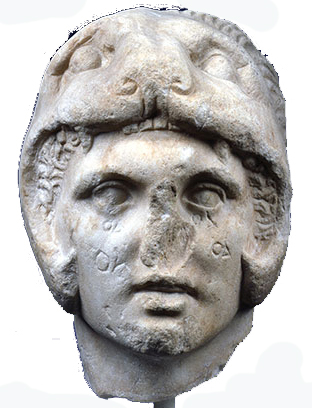
In any case, “carved” is generally bloody and cruel. At most, visitors to the National Archaeological Museum in Athens have a somewhat drier association, provided they pause for a moment to consider the breathtaking marble head of Alexander the Great, circa 300 BC, found in the Kerameikos in Athens. Alexander wears a lion’s skin, indicating that he is a descendant of Heracles. But even more striking are Alexander’s cheekbones: someone has carved letters into his face. Granted, not “the history of the whole human race”, but still… letters carved into the more than two thousand year old face of Alexander the Great wearing the lion’s skin of Heracles: close enough.

———-

To be continued. Next up My Own Version Of You part 18: “It is strange what people discover in my work”


Jochen is a regular reviewer of Dylan’s work on Untold. His books, in English, Dutch and German, are available via Amazon both in paperback and on Kindle:


Posted in Uncategorized | 1 Comment

The Concert Series Number 39. 2 July 1962; The Finjan club


Videos selected by Tony Attwood

The aim of this series is to provide one Dylan concert to listen to with reasonable acoustics for each year since Bob started performing regularly.  However, there have of course, been some years when Bob hasn’t performed very often on stage, so on occasion the choice of shows is limited.

We are now around five concerts (or extracts if we can’t find a whole show) for each decade, which means we are now over half way through the whole series.

If you have a particular concert that you feel should be included and you know of a recording of it on the internet which can be replicated here, please do send in your suggestion to Tony@schools.co.uk   Don’t worry if we already have a concert for that year – there is nothing to say we can’t have more than one entry each time.

2 July 1962; The Finjan club

  1. The Death of Emmett Till
  2. Stealing, Stealing
  3. Hiram Hubbard
  4. Blowin’ in the Wind
  5. Rocks and Gravel
  6. Quit Your Low Down Ways
  7. He Was a Friend of Mine
  8. Let Me Die in My Footsteps
  9. Two Trains Running
  10. Ramblin’ on My Mind
  11. Blue Yodel No. 8 (Mule Skinner Blues)

The concert list….

Posted in Uncategorized | Leave a comment

My Own Version Of You 16: Your writings and rotten plagiarisings ill-gotten


by Jochen Markhorst

XVI      Your writings and rotten plagiarisings ill-gotten

Can you tell me what it means to be or not to be
You won’t get away with fooling me
Can you help me walk that moonlight mile
Can you give me the blessings of your smile

This penultimate verse, the verse before the final marathon verse of 20 lines, is the odd one out. It is a demure quatrain that appears to be set up as a bridge. But once in the studio, Dylan, like all of us, becomes entranced by what Blake Mills conjures from his guitar, and decides to solidify that hypnotic descending c#/b/a#/a and let it resonate under the “bridge” as well. Well, that seems a likely scenario anyway, given the distinct colour of this quatrain’s lyrics.
The colour, or perhaps rather, the tone suggests a brief fermata, a short pause for breath before we plunge into that overwhelming, exhausting finale. The accumulation of polite, submissive questions, the opening with a well-known Shakespeare quote, the elegant nod to one of the most elegant Stones songs, and especially the remarkable gentleness and charm of the graceful final line Can you give me the blessings of your smile… tone and colour are decidedly different from the other seven verses of “My Own Version Of You”.

In this context, the blessings of your smile seems to signal something like “the impact of a work of art”, the shivers that run down your spine at the first notes of the Adagio from Rachmaninov’s 2nd Piano Concerto or when Jeff Buckley reaches the chorus of “Lilac Wine” – as this whole quatrain seems to want to articulate “the power of a song”. A song can give us “truth that needs no proof”, as Dylan writes in The Philosophy of Modern Song (Ch. 23 “El Paso”), the truth to which Dylan refers when he shares: “There’s a mystery, magic, truth and the bible in great folk music. I can’t hope to touch that, but I’m goin’ to try” (Michael Iachetta interview in New York Daily News, 1967), the truth he means when he says “Music is truthful” (Jonathan Cott interview for Rolling Stone, 1977), to which he alludes when declaring:

“The songs I play night after night are proven to be true and strong. Otherwise, I couldn’t sing them night after night. They can be performed over and over because there is a truth in them.”
(Edna Gundersen interview for USA Today, 1997)

… the truth that his protagonist seeks in “My Own Version Of You” when he asks his creature: “Can you tell me what it means to be or not to be?”. And after the next question, “Can you help me walk the moonlight mile?”, the chosen structure for this “bridge couplet” emerges. With anyone else, we might be inclined to think of the corniest and most successful inspirational quote of this century, Love Live Laugh, but knowing Dylan, he probably had as a format: the truth, the way and the life, John 14:6, Jesus’ self-portrait and His answer to the question of how we can come to the Father.

In this – presumed – structure, the blessings of your smile would then be “Life”, and the choice of words is striking. This is not the first time in Dylan’s oeuvre that we hear an echo from Hesse’s Steppenwolf (1927);

„Da klang hinter mir ein Gelächter, ein helles und eiskaltes Gelächter, aus einem den Menschen unerhörten Jenseits von Gelittenhaben, von Götterhumor geboren. Ich wandte mich um, durchfroren und beseligt von diesem Lachen, und da kam Mozart gegangen.“

“At that, there rang out behind me a peal of laughter, a clear and ice-cold laughter out of a world beyond unknown to men, a world born of sufferings, purged and divine humour. I turned about, frozen through with the blessing of this laughter, and there came Mozart.”

We are in the final phase of Harry Haller’s hallucinatory notes, as Harry comes to the realisation that he, like everyone else for that matter, contains multitudes, housing hundreds of characters and personas within him. United with his alter egos, he takes drugs, enters the “magical theatre”, and there he meets the “God of my youth, the lifelong object of my love and veneration,” Mozart.

In the background, the finale of Don Giovanni plays. “Well, the music is fine,” says Mozart, not entirely displeased. Fanboy Harry gets all mushy and makes it awkward. “Es ist die letzte große Musik, die geschrieben worden ist – It is the last great music ever written,“ he solemnly declares. Beethoven, Chopin, Schubert… all nice enough, but “a work of such plentitude and power as Don Giovanni has never since arisen among men.”

Mozart laughs heartily at him: “Take it easy,” and pulls Harry down from his high horse with funny faces, silly dance moves and wicked rhymes. Even worse: in the next scene, Mozart torments Harry with what he considers “the last victorious weapon in the war of extermination against art”, a radio, and from the “devilish metal funnel” sounds “its mixture of bronchial slime and chewed rubber” which is nowadays stupidly called “music”.

Once again, Mozart ridicules him wholeheartedly. Put that pathos aside, he smirks, and just listen: Händel’s Concerto Grosso in F major. Hear those basses – they stride like gods. “Behind the veil of this hopelessly idiotic and ridiculous apparatus the form of this divine music passes by. Pay attention.” Even a Händel distorted by the radio is still divine, Mozart teaches. And so it is with your life, Harry. The music that is mutilated by the radio is a metaphor for the eternal conflict between idea and reality – life is just like that, my dear. And then Mozart reveals to poor Harry the secret of life: laugh about it. Harry must learn to laugh, must learn the blessings of a smile.

Nat King Cole – Smile:

A nice correlation, all in all, Mozart’s lessons to Harry and this quatrain from Dylan’s song (including Harry’s Dylanesque sensitivity to sound), but it is unlikely that the associatively writing songwriter Dylan set it up like that. A more obvious scenario is that the course of his stream-of-consciousness meanders via Moonlight Mile past his own song “Moonlight”, the song he has performed over a hundred times in the first decade of this century. The song with the Melville paraphrase I’m preachin’ peace and harmony, the blessings of tranquility, (“Glad to find one blessed oasis of tranquility,” from The Two Temples), the only other instance in Dylan’s vast oeuvre with the word blessings, leading him to the final link in the association chain moonlight mile – Moonlight – blessings of tranquility – blessings of your smile.

Not very high-brow then, such a creation scenario of a quatrain constructed from Shakespeare’s most well-known bumper sticker, a Stones song, a song from his own catalogue, and an indirect paraphrase of Melville – but entirely in the spirit of the punchline of Mozart’s teasing, silly rhyme tsunami, with which he cheerfully and good-naturedly humiliates Harry Haller:

„Gott befohlen, der Teufel wird dich holen, verhauen und versohlen für dein Schreiben und Kohlen, hast ja alles zusammengestohlen.“

“For the devil, I pray, will bear you away and slice you and splice you till that shall suffice you for your writings and rotten plagiarisings ill-gotten.”

———————

To be continued. Next up My Own Version Of You part 17: They seemed to have an ancient presence


Jochen is a regular reviewer of Dylan’s work on Untold. His books, in English, Dutch and German, are available via Amazon both in paperback and on Kindle:


Posted in Uncategorized | Leave a comment

The Philosophy of Modeern Song: Eccentricity is ok – live it, enjoy it

An index to our most recent publications and the current series can be found on the home page of this site.

by Tony Attwood

In this series, I am looking at the songs Bob selected for his book “The Philosophy of Modern Song”, rather than at his interpretation of the songs in the book – although here I think it is easy to see why Bob chose this piece.

I’ve Always Been Crazy” was written and recorded by Waylon Jennings and released in 1978, along with the album of the same name.  It was a number one hit on the country music chart 

One of the things that (as a musician) horrifies me is that a single version of the song was released without the instrumental break.   I know why the record companies did this (to accommodate the wishes of DJs and advertisers) but for me, the music created by the composer and performers IS the music – and not to be messed around with.  I would imagine Bob thinks this way too – hence, he has never compromised on the lengths of his songs.

I’m also currently reading a pre-released edition of “Bob Dylan Things Have Changed” by Ron Rosenbaum, and will be reviewing that here shortly, and I think from reading that it is quite possible to see why Bob would immediately be drawn to any song with this title.  Although I think in terms of real life (as opposed to song lyrics) I would want to argue that the word “crazy” should be replaced by “highly eccentric” – although that has problems with the scan of the lines.

But the point is that to be an artist in today’s society, no matter what the art form, you have to be eccentric.  You have to live your art and love your art, because although Bob and a few others have made as much money as they could ever spend, for most artists this is not the case.   They have the visions that they want to express, but the need to earn enough money to live on, is always there as well, interfering with the amount of time they can spend on their art.

And so in this case, reading that book, thinking about Bob’s various changes of direction in his music and philosophy of life, and now by chance listening to this song, I think I can at once see why Bob empathised with the opening….

I've always been crazy and the trouble that it's put me throughBeen busted for things that I did and I didn't doI can't say I'm proud of all of the things that I've doneBut I can say I've never intentionally hurt anyone

I've always been different with one foot over the lineWinding up somewhere one step ahead or behindIt ain't been so easy but I guess I shouldn't complainI've always been crazy but it's kept me from going insane

At the same time there is also a real bounce and a load of real fun in this music; as a song, it really works.  Listening to it immediately makes me feel good, especially at the moment when my latest medical reports aren’t so good (although I am getting on a bit, so that is to be expected).   In fact the opening of this track reminds me in some way of “Tangled up in Blue”  which Bob played on stage over one thousand six hundred times   I’ll come back to that in a moment.

What does become so noticeable is the very heavy accent of the bass drum in Waylon Jennings piece.   And that, for me, really works.   It is a song based on the standard three chords of so many rock and pop songs, but that works perfectly here.

Just listen to the energy within the song, and at the same time hear the message that says eccentricity is ok, you can be what you like.  And that message is, for me (and I guess for Bob given he chose this song) exactly the message I want to hear.

Beautiful lady, are you sure that you understandThe chances your taking loving a free living manAre you really sure, you really want what you seeBe careful of something that's just what you want it to be

I've always been crazy but it's kept me from going insaneNobody knows if it's something to bless or to blameSo far I ain't found a rhyme or a reason to changeI've always been crazy but it's kept me from going insane

Of course this is not the same song as “Tangled up in blue” in any way, but somehow the message seems to me to be the same.   Different artists and different musical styles of course but still, yes, there is something about the life and the music….


The Philosophy of Modern Song

Posted in Uncategorized | Leave a comment

No Nobel Prize for Music 38: the song that revolutionised what popular music could do

By Tony Attwood

In this series of articles, we are looking at the songs Bob Dylan wrote in 1965, specifically in the order that he wrote them, looking specifically at the way Bob composed the music songs.  In this piece, we have reached the moment where musically, Bob turned the whole concept of what a piece of “popular” music could do, on its head and left everyone with a sense of musical structure and form, utterly stunned and unable to respond.  For Bob did something to the concept of popular song that had not been tried for the pas 500 years.

Of course there was a warning of what was to come, for listening to Dylan perform Desolation Row,  written part way through 1965, and then listening to the songs he wrote through the rest of that year, it doees seem to me that Bob was trying in his lyrics to extend the message of “Desolation Row” – although perhaps not always with success.  For from the opening line, “They’re selling postcards of the hanging,” through to “Right now I can’t read too good, Don’t send me no more letters no,” there is an overwhelmingly negative view of reality, which he didn’t manage to maintain in other works.

And thus I feel that Bob knew something else was needed – something as extraordinary in a musical sense as “Desolation Row” is in a lyrical sense.  Something that took the form of the music and manipulated it, into a completely new place.  Something that had never been tried before.

Now of course, the writers of song lyrics are not always talking about themselves – indeed most of the time they are writing lyrics to fit the form.   But the song “Desolation Row” went way beyond the norm in terms of length (ten verses, 657 words), and indeed in meaning went way past the expressions of melancholy, depression, sorrow, anguish etc etc, that even the most negative of popular songs offers.

It is very hard for me to imagine that Dylan wrote this song abstractly – as in the sense of “I know, I’ll write a song about how awful everything is,” for to me, everything about “Desolation Row” feels like an expression of his own feelings.

And yet, and yet, the song has a rather beautiful and indeed lilting melody and accompaniment, which are unexpected given the words, but through that unexpectedness add to the poignancy.

After composing “Desolation Row” Bob created eleven more songs through 1965 which dealt with the darker side of life.  Not as utterly desperate as “Desolation Row” but still very dark pieces.  It is true that he initially tried to lighten the work with a song that in essence says I have a woman who does everything, (From a Buick 6) but thereafter it was fairly negative all the way as in  Can you please crawl out your window? and Positively Fourth Street.

Even the occasional attempt to lighten the load with Highway 61 Revisited (which lyrically is not that light since it suggests that only the blues makes any sense) was quickly followed by nightmares (Just like Tom Thumb’s Blues and despair (Queen Jane Approximately) and more disdain (Ballad of a thin man).

My suspicion is that Dylan knew he was in a musical rut and later in the year set out to find a way through it with Jet Pilot  before turning back to a seeming desperation because the world either doesn’t make sense (I wanna be your lover) or in which he is descending into panic because he can’t get through on the phone (Long distance operator)

The musical form is strophic all the way, until we get to Ballad of a Thin Man where Bob tries a different approach, for there is a problem.  These songs are, as often as not, about negativity and quite often despair.  So although the notion of having verse after verse the same in musical terms seems right, (given that the repetition of all that is wrong is a fundamental part of despair) this can lead simply to too much musical repetition.  Yes, the verse-verse-verse concept of the strophic song has been used a billion times, but it leaves the music restricted.  The result is a poem set to music, rather than a song.

This didn’t matter with “Desolation Row” because the melody is of much interest in the way that many Dylan melodies are not (compare “Thin Man” with “Desolation Row” for example) and so Dylan does add a spot of variation on occasion.  True in “Thin Man” it is only there once, with a verse that doesn’t follow the same form as others, and it does break up the musical repetition.  But even so, it’s not that exciting.

After “Thin Man” Dylan wrote three songs that he then left in the studio – indeed, one of the three was not even completed.  And in Jet Pilot Medicine Sunday and I wanna be your lover and still the message is the same – the world is strange and there is no way out.

But then, finally, in the last composition of the year, Dylan found his way through.  The song is one that I previously described as being about “Mystical people in the half light,” with touches of surrealism added, and that is still about as close as I can get.   But what is so interesting here is that Dylan, seemingly looking for a new way to construct the music of the song, broke away from the notion of the verse-verse-verse concept that had dominated his work since the success of that ultimate strophic piece, “Desolation Row”.

For what Dylan did here was to take the notion of the verse – verse – verse approcah, but break each verse down into three sections.

We can see this clearly by looking at Verse 1 in this way

Ain't it just like the night to play tricks When you're tryin' to be so quiet
We sit here stranded, though we're all doin' our best to deny it
And Louise holds a handful of rain, temptin' you to defy it

Lights flicker from the opposite loft
In this room the heat pipes just cough
The country music station plays soft
But there's nothing, really nothing to turn off

Just Louise and her lover so entwined
And these visions of Johanna that conquer my mind

The sections are identified to us as listeners by the rhymes – we don’t necessarily note that the first group has three lines rhyming, the second has four lines rhyming and the final two lines rhyming, but we pick this up as we go.  It is a bit the same as looking at a masterpiece of architecture – we get the feeling of the whole building, and then see the individual elements that make up the building.    So here the shortness of the lines in the second group give us the sense of continuity – that nothing changes, but the night is indeed playing tricks – but this deetail is not perceived until we’ve got the overall picture.

Dylan repeats the format in verse two

In the empty lot where the ladies play blindman's bluff with the key chain
And the all-night girls they whisper of escapades out on the "D" train
We can hear the night watchman click his flashlight Ask himself 
                                  if it's him or them that's insane

Louise, she's all right, she's just near
She's delicate and seems like the mirror
But she just makes it all too concise and too clear 
That Johanna's not here

The ghost of 'lectricity howls in the bones of her face
Where these visions of Johanna have now taken my place

What is particularly interesting is that the extension and contractions of the lines don’t destroy the pattern of three lines, four lines, two lines.

By verse three, the musical form and approach are clearly embedded in our minds, and so Dylan can play with the length of the lines, for as listeners, we still appreciate the structure even if we have never considered it directly.   It now feels right even when line three is pushed to its limits (as indeed happened in line three of verse two, above).

In the empty lot where the ladies play blindman's bluff with the key chain
And the all-night girls they whisper of escapades out on the "D" train
We can hear the night watchman click his flashlight 
                         Ask himself if it's him or them that's insane

Louise, she's all right, she's just near
She's delicate and seems like the mirror
But she just makes it all too concise and too clear 
That Johanna's not here

The ghost of 'lectricity howls in the bones of her face
Where these visions of Johanna have now taken my place

Verse four continues with the same format of three sections containing three lines, four lines and two lines.  But then, as can happen with Dylan, the final verse makes a change.   This didn’t happen with “Desolation Row” because that is a song of quiet acceptance of what has happened, but here, Dylan is taking the energy is much higher.

The peddler now speaks to the countess who's pretending to care for him
Sayin', name me someone that's not a parasite 
                  and I'll go out and say a prayer for him
But like Louise always says You can't look at much, 
                  can ya man As she, herself, prepares for him

And Madonna, she still has not showed
We see this empty cage now corrode
Where her cape of the stage once had flowed
The fiddler, he now steps to the road
He writes everything's been returned which was owed
On the back of the fish truck that loads
While my conscience explodes

The harmonicas play the skeleton keys and the rain
And these visions of Johanna are now all that remain

As we can see, in the middle section has expanded from four lines to seven, which adds to the power that reaches its zenith with “explodes”.

I really have never come across a piece of music written in this musical form before this point, and I am not too sure that many people have tried to use it since.

Further, the structure of the song, containing nine lines, must at most be very rare, although for the moment, I am still hearing this as unique.   The notion of putting those nine lines into three groups is perhaps more logical musically, but to make those groups three lines, four lines and two lines is surely unheard of.   And yet there is more with that extraordinary addition of lines in the final verse to give us seven lines in section two.   (Which is incidentally what the bass player on the studio recording for the album forgot – he makes a slip and for a second plays the final verse as he has the previous verses, but then quickly corrects himself.   Why Dylan allowed this to go through as the album version, I don’t know.   He must have heard the mistake – maybe he had just had enough of the song.  Or maybe he thought it was amusing.)

So basically what we have had is a year of Dylan writing and keeping 29 songs, starting with Farewell Angelina, and ending with Visions of Johanna, taking in Desolation Row along the way, in which he stricks to the pure strophic form of verse-verse-verse with just the occasional use of the technique of having the last line of each verse repeated in “Love is just a four letter word”, “It’s all over now baby blue” and as we see here “Visions”.

Bob has also tried the use of the chorus as with “Like a Rolling Stone” and “Can you please”, but now we have something extraordinary – the extension of the last musical line in the last verse through running that same musical line six times.

This is truly the beginning of Bob Dylan taking the two forms of music that he has learned from his youth (strophic, which is verse, verse, verse and the binary form of verse, chorus, verse, chorus) and extending them with enormous effect through simple techniques.

Maybe someone did that before Bob Dylan, but if so, I think I must have missed it.   But Dylan has not invented a new form – rather, he has taken the existing musical form of verse and chorus, which has been there for 500 years and stretched it beyond breaking point through the addition of extra lines.

Written like that, this may not seem like much, but the creation of a new musical form of composition is rare indeed.  Maybe other composers did it before Dylan, but the power he generated through taking a four line structure and then in the last verse turning itnto a seven line structure is utterly extraordinary.

This was indeed the moment when Bob took popular music into a totally new dimension.


Posted in Uncategorized | Leave a comment

Bob Dylan and US History


By Larry Fyffe

“Tarantula”, a small book by Bob Dylan, bears the marks of Kerouac, Burroughs, Ginsberg, James Joyce, and other somewhat obscure postmodernists.  But a good knowledge in reference to the history of the United States of America helps garner the real facts that are  found mixed in with its pages.

From a letter therein by a talking “Mouse” to “Fang” {a cat?}):

(D)ear fang, how goes it old buddy? long time no see. guess what? was gonna vote for goldwater cause you know he was the underdog but then i found out about this jenkins thing, & i figger it aint much but it’s the only thing he does have going for him so i’m changing my vote to johnson 

(Bob Dylan: Tarantula).

At the time, a Republican politician, conservative Barry Goldwater, runs aganist Democratic President  Lyndon B. Johnson; Walter Jenkins, an aide to the President, is caught in a sex act with a man which the skittery mouse believes could well be turned against Johnson by the moralistic Goldwater:

Now I'm liberal to a degree
I want everybody to be free
But if you think I'll let Barry Goldwater
Move in next door and marry my daughter
You must think I'm crazy 

(Bob Dylan: I Shall Be Free, no. 10)

On the other hand, President John F. Kennedy gets presented in a humorous light:

Well, my telephone rang, it would not stop
It’s President Kennedy calling me up
He said, ” My friend, Bob, what do we need to make the country grow?”
I said, “My friend, John, Brigitte  Bardot”
(Bob Dylan: I Shall Be Free)

Vice-President Johnson takes over when President Kennedy is murdered;
in spite of his support for civil rights, President Johnson’s standing is undone by the Vietnam War; he resigns. The times they are a-changing ~ at least metaphorically, these days are depicted in ‘liberal’ lyrics as the start of the rule of the biblical AntiChrist:
Air Force One coming in through the gate
Johnson sworn in at two thirty-eight
Let me know when you decide to throw in the towel
(Bob Dylan: Murder Most Foul)

Posted in Uncategorized | Leave a comment

Dylan: The Concert Series – number 38 – Portsmouth 25 November 2000

Videos selected by Tony Attwood

The aim of this series is to provide one Dylan concert to listen to with reasonable acoustics for each year since Bob started performing regularly.  However, there have of course, been some years when Bob hasn’t performed very often on stage, so on occasion the choice of shows is limited.

We are now getting close to five concerts (or extracts if we can’t find a whole show) for each decade, which means we are about half way through the whole series.

If you have a particular concert that you feel should be included and you know of a recording of it on the internet which can be replicated here, please do send in your suggestion to Tony@schools.co.uk   Don’t worry if we already have a concert for that year – there is nothing to say we can’t have more than one entry each time.

Today it is 2000 – and another one from my home country.  There is a list of all the other concerts included in the series, below, after the set list.


The set list….

  1. Hallelujah I’m Ready
  2. Mr. Tambourine Man
  3. A Hard Rain’s A-Gonna Fall
  4. The Ballad of Frankie Lee and Judas Priest
  5. Tangled Up in Blue
  6. Searching for a Soldier’s Grave
  7. Country Pie
  8. She Belongs to Me
  9. Tombstone Blues
  10. Tryin’ to Get to Heaven
  11. Drifter’s Escape
  12. Everything Is Broken
  13. Things Have Changed
  14. Like a Rolling Stone
  15. It Ain’t Me, Babe
  16. Watching the River Flow
  17. Forever Young
  18. Highway 61 Revisited
  19. Blowin’ in the Wind

The concert list….

Posted in Uncategorized | Leave a comment

The Philosophy of Modern Song: Where or When


An index to our most recent publications and the current series can be found on the home page of this site.

by Tony Attwood

In this series, I am looking at the actual songs Bob selected for his book “The Philosophy of Modern Song”, rather than at his interpretation of the songs in the book – although in this case it seems to me important to go back to what Bob has said, (which I do later in this little piece).

Today I’ve picked out a song that, as far as I recall, I have never heard before.  The song is “Where or when” which came from the movie “Babe in Arms” and is now considered as Wiki says, “part of the Great American Songbook, having been recorded by scores of popular artists over the decades, starting with a successful cover by Hal Kemp and his Orchestra shortly after its debut in 1937.”   Which of course shows just how far out of touch with the Great American Songbook I am – but then I can perhaps excuse myself by not being American.

Ultimately, after everyone else seemed to have recorded it, the song was picked up by Dion and The Belmonts (among many, many, many others) and became a hit in 1960.   Sinatra recorded it in 1945, 1958 and 1966, so obviously rather liked it, and given Bob Dylan’s affection for Sintra’s work I suspect that might be a reason for its inclusion, as well as it being phenomenally well-known and successful as a hit song in America.

For me this is a classic example of writing a song which can be performed with a very memorable and emotional melody; the music itself holds within it the essence of all the emotions expressed in the lyrics.

Part of the longevity of the song has come from the fact that it appears in the musical as the first song in the show, and in the movie of the same name, and as a song in its own right.    And indeed no one seemed particularly to mind that the film and the stage play really didn’t have too much to do with each other, beyond the music.

There is however, (at least for me) an interesting twist in all this in that (as many others have pointed out) you never know if the couple actually meet (although in many versions of the song, the ambiguity is diminished by omitting the final line of the lyrics – as if consumers of popular music can’t cope with uncertainty!!!)

My thinking therefore, is that Bob knows the song because of his awareness of what has become known as the “Great American Songbook” and because of his engagement with Sinatra’s work.   But it is also interesting to note that there is enough in the music to allow many famous artists to record instrumental versions also.

This version by Dave Brubeck is one I came across in my teenage years – my father was a classically trained pianist who also performed in a touring dance band and although my memory can be faulty on such things (and sadly my father passed away some years ago so I can’t check with him) but I do seem to recall him playing this at our home.

But it is also interesting that the lyrics of the song are really extraordinarily simple, and yet they manage to put across the whole notion of uncertainty of whether the event actually took place or not.

Now at this point I should also add that I am writing this series in terms of my own response to the songs selected by Bob Dylan, rather than taking his comments and then commenting upon those.  But here I want to add something else.  If you have time, do listen to this…

For myself, I don’t see Bob as “fighting the same old battle” but maybe that is how he sees things.

Here are the lyrics of the full version

When you're awake the things you think
Come from the dream you dream
Thought has wings, and lots of things
Are seldom what they seem

Sometimes you think you've lived before
All that you live today
Things you do come back to you
As though they knew the way

Oh the tricks your mind can play

It seems we stood and talked like this, before
We looked at each other in the same way then
But I can't remember where or when

The clothes you are wearing are the clothes you wore
The smile you are smiling you were smiling then
But I can't remember where or when

Some things that happened for the first time
Seem to be happening again

And so it seems that we have met before
And laughed before, and loved before
But who knows where or when

If you would like to write an article about Bob’s views on any one song, as expressed in the book, or indeed on a whole series of songs, please do send an article along with any background notes you want to add to Tony@schools.co.uk

The Philosophy of Modern Song

Posted in Uncategorized | Leave a comment

My Own Version Of You 15:  “And Mick can write!”


by Jochen Markhorst

XV       “And Mick can write!”

Can you tell me what it means to be or not to be
You won’t get away with fooling me
Can you help me walk that moonlight mile
Can you give me the blessings of your smile

The film is set in 1972, and the responsible art director and set designers have really gone to town. The street scenes, cars, hairstyles, the typewriter that Susan Sarandon is working on, smoking in the cafés, the posters in the office where Dustin Hoffman works… everything is right, all of it exists in 1972.

The same goes for the soundtrack. In the opening scene, as the funeral procession starts moving, Susan Sarandon, the mother of the murdered Diana, brusquely and resolutely turns up the car radio, and then Sly & The Family Stone’s “I Want To Take You Higher” (1969) blasts through the first follow car, the follow car with Diana’s parents and her boyfriend Jake Gyllenhaal. Over the corny final minute, we hear Van Morrison’s “Sweet Thing” (1968). And in the café, the atmosphere radically changes when Jake meddles with the jukebox and chooses the song after which the 2002 film is named: The Rolling Stones’ “Moonlight Mile” (1971).


Anachronisms are neatly avoided throughout the rest of the soundtrack as well. Herb Alpert’s “So What’s New” from 1966, Gary Glitter, Jethro Tull, the completely unknown Ziggy Stardust outtake “Sweet Head” from 1971, and a good dozen other song snippets. Only once do the director and/or music supervisor allow themselves a “mistake”. After the catharsis of the courtroom scene follows the far too long (fourteen minutes) bittersweet finale in which we see the main characters turning the page to a life without Diana. Mother Susan Sarandon can suddenly write again, for example. And while her fingers begin to dance over the keys of her 1947 Royal KMM typewriter, Dylan’s “Buckets Of Rain” swells on the soundtrack. And continues to play for another minute and a half, so it is also the music under the footage showing the father, Dustin Hoffman, pulling himself together, turning his gaze to new horizons.

“Buckets Of Rain” was recorded in New York on 19 September 1974, and only released in January 1975 – thus creating an anachronism in a film set in 1972. What director Brad Silberling and music director Tom Carlson undoubtedly know, given the precision with which they selected the other 18 songs. But apparently, in this one case, the importance of allowing Dylan’s song to add a bittersweet touch to the finale outweighs historical accuracy. The bycatch being that the filmmakers essentially forged the Dylan – Moonlight Mile connection twenty years before Dylan himself does.

It is a weightless connection, though. The choice of “Moonlight Mile” is actually quite random; screenwriter Silberling prefers The Beatles and initially has the main character Jake select “Baby’s In Black” on the jukebox, a second working title is Goodbye Hello, and he only decides on the 70s and The Stones in the third revision. Still, dramatically a much better choice; the overwhelming change of atmosphere in the busy café is much more fitting and aligns better with “Moonlight Mile”. It certainly works more naturally than it would have with the Beatles’ tearjerker “Baby’s In Black” or with the catchy, but somewhat silly “Hello Goodbye”.

“Moonlight Mile” is an exceptional song and the name check in Dylan’s song is gallant – not only because of the fact itself, but also seeing the placement; in the same bridge-like quatrain as the Shakespeare reference to be or not to be. The acknowledgement is quite universal. Marianne Faithfull, who amusingly and maliciously seasons her autobiography Faithfull (1994) with playful jabs at Jagger, must concede: “Let It Bleed is my favourite Stones record. All those great songs: “You Got the Silver”, “Moonlight Mile”, “Salt of the Earth” (…),” where we may assume that she places the song on the wrong album to tease Jagger (“Moonlight Mile” is the closing track of Sticky Fingers), but that she genuinely means “great song” – La Faithfull never jokes about great songs.

More weight has the more or less official elevation to the nobility in the Wall Street Journal, in the splendid article series Anatomy of a Song (2011-16) by Marc Myers, in which he thoroughly examines 45 classic songs, focusing on their origins, usually with the help of the songwriter and/or fellow musicians. “Moonlight Mile” is number 26, following Janis Joplin’s “Mercedes Benz” and preceding Rod Stewart’s “Maggie May”. In the accompanying interview, Jagger once again disputes that the song has anything to do with cocaine (line 2: “With a head full of snow”), asserting that it truly pertains to his exhaustion, nostalgia, and sense of loss as an endlessly touring rock star. “Looking forward to returning from a foreign place while looking out the window of a train and the images of the railway line going by in the moonlight,” as Jagger states.

The credits state, as usual, “written by Mick Jagger and Keith Richard” (still without the ‘s’ in 1971), but Keith had nothing to do with the creation of the song. Which he freely acknowledges in his memoirs:

Moonlight Mile was all Mick’s. As far as I can remember, Mick came in with the whole idea of that, and the band just figured out how to play it. And Mick can write! It’s unbelievable how prolific he was. Sometimes you’d wonder how to turn the fucking tap off. The odd times he would come out with so many lyrics, you’re crowding the airwaves, boy. I’m not complaining.”
(Keith Richards and James Fox, Life, 2010)

Whether “the whole idea” is Mick’s, is not entirely undisputed, by the way. The song came about during a night session with only Jagger, Mick Taylor and Charlie Watts, and Taylor has since hinted more than once that this is one of those songs for which he really should have received a songwriting credit. Still, the lyrics were indeed already finished.

Jagger himself generally adopts a somewhat dismissive attitude towards his lyrics, usually claiming he is no Dylan. He admires Dylan immensely. Not only in so many words, but also in practice; since about 1965 we clearly see Dylan’s influence descending into Jagger’s lyrics. A sycophantic reporter attempting to flatter him is elegantly rebuffed:

What other group ever wrote a song like “19th Nervous Breakdown,” or “Mother’s Little Helper”?
Well, Bob Dylan.
That’s not really the same thing.
Dylan once said, “I could have written ‘Satisfaction’ but you couldn’t have written ‘Tambourine Man.’”
He said that to you?
No, to Keith.
What did he mean? He wasn’t putting you down was he?
Oh yeah, of course he was. But that was just funny, it was great. That’s what he’s like. It’s true but I’d like to hear Bob Dylan sing “I Can’t Get No Satisfaction.”
(Rolling Stone interview with Jonathan Cott, 1968)

Interviewer Cott does not see the connection that Jagger almost literally shoves in his face when pointing to Dylan re “Mother’s Little Helper”. For the Upper Stone knows full well what he owes that song to: the liner notes of Dylan’s Another Side Of (1964), the third poem from Some Other Kind Of Poems, the surprising collection of poems on the back of the album cover. Nameless poems, but for convenience, we’ll call Poem 3 “Everything Crawls.” A bunch of women sneak little white tablets into shoes, stockings, hats and other hiding places, Mick reads there, and

junkie nurse home heals countless
common housewives strung out
fully on drugstore dope, legally
sold t’ help clean the kitchen.

… which does not detract from the fact that Jaggers’ adaptation of this fragment into “Mother’s Little Helper” has its own unique poetic power and is a Dylan-worthy amalgam of Rhyme, Rhythm and Reason;

“Kids are different today,” I hear every mother say
Mother needs something today to calm her down
And though she's not really ill, there's a little yellow pill
She goes running for the shelter of her mother's little helper
And it helps her on her way, gets her through her busy day


… just like the lyrics of “Moonlight Mile”, which Keef says is one of those lyrics that flow from Jagger like water from a tap, don’t give reason to be dismissive either;

The sound of strangers sending nothing to my mind
Just another mad, mad day on the road
I am just living to be lying by your side
But I'm just about a moonlight mile on down the road

Resounding and intriguing, beautiful, bittersweet one-liners like just living to be lying by your side and the evocative power of the metaphor “moonlight mile”… powerful enough to earn a tip of the hat from maestro Dylan fifty years later.

———–

To be continued. Next up My Own Version Of You part 16: Your writings and rotten plagiarisings ill-gotten


Jochen is a regular reviewer of Dylan’s work on Untold. His books, in English, Dutch and German, are available via Amazon both in paperback and on Kindle:


Posted in Uncategorized | Leave a comment