“Casablanca” is a movie that’s set in a French Protectorate during World War II; it features Humphrey Bogart as ‘Rick’, Igrid Bergman as ‘Ilsa’, and Claude Rains as ‘Renault’, a captain in the Vichy police.
Rick is cynical because his love affair with Ilsa did not last; he considers human nature fickle and self-centred; nevertheless, he helps members of the French resistance in their struggle against the Nazis occupation.
Singer/songwriter/musician Bob Dylan draws from the film’s artistic well of memorable quotes.
There’s the Cafe scene in Casablanca containing the following dialogue:
Strausser: “I’m not entirely sure which side you’re on”
Renault: “I have no conviction if that’s what you mean. I blow with
the wind, and the prevailing wind happens to be from Vichy”
(Capablanca)
Dialogue that echoes in song lyrics below:
Praise be to Nero's Neptune, the Titanic sails at dawn
Eveybody's shouting, "Which side are you on?"
(Bob Dylan: Desolation Row)
In the following song, Captain Renault’s amoral attitude is questioned. The wind symbolizes a spirit of unselfish love that rises above concern for one’s own physical existence:
Yes, and how many times can a man turn his head
And pretend that he just doesn't see?
The answer, my friend, is blowing in the wind
(Bob Dylan, Blowing In The Wind)
The French police captain in the movie is no ideologue; he’s an opportunist who observes that at this point in time the Nazi occupiers are winning and that members of the French Resistance are being chased down. So best it be to present oneself as on side of the occupiers:
Renault: “This is the end of the chase”
A broader picture is painted in the song lyrics below. Painted in black because no matter what, death awaits everyone. This fact causes the singer/songwriter to combine the cynical attitudes of both Renault and Bogart, and grind it all down to the necessity of an individual having to make Existential decisions:
Well, I've walked over two hundred miles, look me over
It's the end of the chase, and the moon is high
It won't matter who loves who
You'll love me, or I'll love you
(Bob Dylan: When The Night Comes Falling From The Sky)
https://youtu.be/dLhJYQQn0Lc
Added is a line taken from another Bogart film:
Bogart: “All we’ve got is that maybe you love you, and maybe I love you (The Maltese Falcon).
In contrast to Renault, Rick chooses to side with the oppressed French (albeit colonists) rather than with the German oppressors; he makes a decision based on Romantic idealism:
On the other hand, the police captain’s remarks are cynical and sarcastic:
Renault: “The winning side would have paid you better”
The persona in the song lyrics below strikes out at such self-centred behaviour:
You've got a lot of nerve to say you got a helping hand to lend
You just want to be on the side that's winning
(Bob Dylan: Positively Fourth Street)
The Devil in the movie, as in Milton’s epic poem ‘Paradise Lost’, gets the best lines:
Renault: “I like to think you killed a man. It’s the Romantic in me”
Akin to black humour that appears in the following song lyrics:
They say I shot a man named Gray
And took his wife to Italy
She inherited a million bucks
And when she died it came to me
I can't help it if I'm lucky
(Bob Dylan: Idiot Wind)
You might recall that we recently announced we had come across a set of lyrics written by Bob Dylan which seemingly has no music. So, being UNTOLD Dylan (the name was chosen very purposefully) we asked if anyone would care to write the music to go with the lyrics, then perform the song, and have the song included in the list of all the songs that Dylan has composed or co-composed.
And now that has happened.
The song is called Dope Fiend Robber. The lyrics were written in 1961 and was found in a notebook left at the McKenzies. As we noted before Woody Guthrie also had an unreleased song called Dopefiend Robber, apparently written in 1953, and then discovered in 2012, with music subsequently added by The New Multitudes.
So we published the lyrics, noting that the “sections” of the song are of varying lengths, which suggests that this is a very early draft, and that the song would have been modified as the music was added, to make the verses more regular. So we suggested that anyone taking on the task of writing the music should feel free to write is as he or she wished.
For as we said at the time when Bob Dylan allowed all the famous songwriters to compose the music for the New Basement Tapes Notebook songs, he made it clear that the composers could do anything they liked with the lyrics. Indeed it is instructive to go back and look at those songs to see just how varied the composers were able to be in handling the notes that Dylan left.
And now we have the song evolved from “Dope Fiend” – and let us tell you, it is sensational. Like really sen-sat-ion-al.
We’ll be listing this as Dylan’s song number 604 and putting it in the alphabetical list of Dylan compositions – exactly as the New Basement Tapes songs are.
So here we have “Dope Fiend Robber” by Bob Dylan and Nick Juno.
As we noted above, the lyrics by Dylan were clearly not finished, so Nick has kindly provided us with his amendments and additions in italics in the text that follows
I got shot from a gatling gun
In the uniform of your land
I was doing nothing else
But fighting for uncle sam
They took me to the infirmary
They had to give me something for my pain
It was morphine
In the hospital till ‘45
More or less half aliveThey patched me up and I am glad
But now I got a habit and I got it bad
It caused me ruin and it caused me shame
My wife don’t even want my name
I was buying high day by day
All I do is pay and pay
I don’t want to harm no man
Hope that you can understand
Most need food to get along
I need dust inside inside my bones
I tried to rob the jewelry store
The police grabbed me at the door
They soon found out I use morphine
The papers called me a dope fiend
Nobody would go my bail
I couldn’t stay inside that jail
I didn’t mean to kill that man
But he held the keys right in his hand
They quickly caught me on the streetThe police knocked me off my feet
The headlines on the Morning Star
Mad dope fiend killer back behind bars
They found me guilty at the trial
The Judge condemned me to die
Been on that morphine quite a whileBut once I was somebody’s child
I don’t want your sympathy
An I’m not part of your society
But there’s a ghost who's chained to me
You’ll take my life and we both go free
And here it is. A new old Dylan song, exclusive to Untold Dylan, thanks very much to Nick Juno.
Insightful comment from Tony: “I can’t believe he’s just done that It’s fucking brilliant!”
Most fulsome thanks to Nick – we both think this is brilliantly written and exquisitely performed.
———-
Untold Dylan: who we are what we do
Untold Dylan is written by people who want to write for Untold Dylan. It is simply a forum for those interested in the work of the most famous, influential and recognised popular musician and poet of our era, to read about, listen to and express their thoughts on, his lyrics and music.
We welcome articles, contributions and ideas from all our readers. Sadly no one gets paid, but if you are published here, your work will be read by a fairly large number of people across the world, ranging from fans to academics who study English literature. If you have an idea, or a finished piece send it as a word file to Tony@schools.co.uk with a note saying that it is for publication.
We also have a very lively discussion group “Untold Dylan” on Facebook with approaching 5000 active members. Just type the phrase “Untold Dylan” in, on your Facebook page or follow this link
You’ll find some notes about our latest posts arranged by themes and subjects on the home page of this site. You can also see details of our main sections on this site at the top of this page under the picture. Not every index is complete but I do my best.
But what is complete is our index to all the 604 Dylan compositions and co-compositions that we have found on the A to Z page. I’m proud of that; no one else has that many songs with that much information. Elsewhere the songs are indexed by theme and by the date of composition. See for example Bob Dylan year by year.
And please do note our friends at The Bob Dylan Project, which lists every Dylan song in alphabetical order, and has links to licensed recordings and performances by Dylan and by other artists, plus links back to our reviews (which we do appreciate).
If in reading the site and listening to some of the music you get even one tenth as much pleasure as I get in publishing the material, you’ll be having a good time.
An index to all the articles in this series covering the 1960s is here.
I have noted before that I have been amazed at what this study has found on occasion. For example the number of “protest” songs is far lower than I had originally expected, and I would never have believed that Dylan’s prime occuption in lyrics was love and lost love.
But 1978 was a revelation and a half. We know that in 1979 Dylan became pre-occupied with Christianity. What I had not expected to find was just how troubled a year 1978 was in terms of the subject matter of songs. It prepares me for 1979 in a different way.
In terms of totals for this year, we have the details below.
Which makes it fairly straightforward. 19 songs, all defined as faith.
To give a comparison with what Dylan had been writing about, here are the subjects for the earlier part of the 1970s with the songs above added at the end. The final figure gives the total number of songs written by Dylan in each category since he started writing in the 1950s
Subject
1970/4
1975/8
1979
Total since 1950s
Environment, places, locations
8
17
Jewish prayer
1
1
Visiting
1
2
Love, desire
13
5
62
Lost love
5
12
48
Blues
1
4
14
Be yourself
1
1
3
Post-modernism
1
2
Protest
1
22
Dance
1
2
Being trapped
1
12
Death
1
1
6
Moving on
3
5
24
Rejection of labelling
1
2
Disdain
1
9
Gambling
1
3
Fate
7
7
Change
2
6
People
8
8
Religion
1
3
Personal commentary
1
3
Faith
19
19
Of the year before the faith year, I wrote, “This is fascinating; it is a year of change, with Dylan heading towards his religious period but also an era where he is not letting go of the old songs – love songs and songs of lost love dominate Dylan’s output throughout his career, and here we are again seeing these songs.”
But not this year. This was faith all the way. The awareness of change coming that I mentioned in the previous year had completely gone. This is straight certainty.
All Dylan compositions by subject up to 1979.
In this listing, the previous total up to 1977 is given first. Where there are songs from 1978 the plus sign (+) is added after the number for up to 1977, with the grand total to date including 1978, after the equals sign (=).
Art: 3
Be yourself: 3
Being trapped/escaping from being trapped (being world-weary): 12
Blues: 14
Betrayal: 1
Celebrating a city 1
Change: 6
Dance: 2
Death: 6
Depression: 1
Disasters: 1
Disdain: 9
Environment: 17
Eternity: 1
Faith: 19
Fate: 7
Future will be fine: 2
Gambling: 3
Happy relationships: 1
How we see the world: 3
Humour, satire, talking blues: 13
Individualism: 8
It’s a mess: 3
Jewish prayer: 1
Leadership: 2
Look after yourself: 1
Lost love / moving on: 48
Love, desire: 62
Lust: 1
Moving on: 24
Nothing changes: 4
Nothing has meaning: 2
Party freaks: 3
Patriotism: 1
People (including fictional people): 8
Personal commentary: 3
Postmodernism: 2
Protest: 22
Randomness (including Kafkaesque randomness): 11
Rebellion: 1
Rejection of labelling: 2
Relationships 1
Religion, second coming: 3
Sex (country life): 1
Social commentary / civil rights: 6
Slang in a song: 4
Surrealism, Dada: 15
Travelling on, songs of leaving, songs of farewell, moving on: 16
The tragedy of modern life: 3
Visiting: 2
WH Auden tribute: 1
And as usual here is the list of the top categories, this time by the end of 1979…
Randomness (including Kafkaesque randomness): 11
Being trapped: 12
Humour, satire, talking blues: 14
Surrealism, Dada, Kafka: 15
Travelling on, songs of leaving, songs of farewell: 16
Environment: 17
Faith: 19
Protest: 21
Moving on: 24
Lost love / moving on: 48
Love, desire: 62
In each episode, it comes as a shock to recognise that the two largest categories of Dylan songs that we have are love and lost love. Roughly five times as many Dylan songs to this date are about love and lost love as are protest songs. Once again these two topics were the only two topics that Dylan turned to each year thus far in this decade.
The whole of the 1960s (Bob’s most prolific decade as a songwriter) has been analysed through a series of articles which are indexed here.
Untold Dylan: who we are what we do
Untold Dylan is written by people who want to write for Untold Dylan. It is simply a forum for those interested in the work of the most famous, influential and recognised popular musician and poet of our era, to read about, listen to and express their thoughts on, his lyrics and music.
We welcome articles, contributions and ideas from all our readers. Sadly no one gets paid, but if you are published here, your work will be read by a fairly large number of people across the world, ranging from fans to academics who study English literature. If you have an idea, or a finished piece send it as a word file to Tony@schools.co.uk with a note saying that it is for publication.
We also have a very lively discussion group “Untold Dylan” on Facebook with approaching 5000 active members. Just type the phrase “Untold Dylan” in, on your Facebook page or follow this link
You’ll find some notes about our latest posts arranged by themes and subjects on the home page of this site. You can also see details of our main sections on this site at the top of this page under the picture. Not every index is complete but I do my best.
But what is complete is our index to all the 603 Dylan compositions and co-compositions that we have found on the A to Z page. I’m proud of that; no one else has that many songs with that much information. Elsewhere the songs are indexed by theme and by the date of composition. See for example Bob Dylan year by year.
And please do note our friends at The Bob Dylan Project, which lists every Dylan song in alphabetical order, and has links to licensed recordings and performances by Dylan and by other artists, plus links back to our reviews (which we do appreciate).
If in reading the site and listening to some of the music you get even one tenth as much pleasure as I get in publishing the material, you’ll be having a good time.
I’m very excited about the set of performances in this post. Not only some of the finest for 1989, but some ‘best ever’ or at least ‘very hard to beat’ performances of these 1960s favourites. I’ve learned my lesson when it comes to proclaiming a ‘definitive’ performance of any song, not just because someone will come up with a better one, but because the performances change from year to year and you can’t compare chalk with cheese.
Nevertheless, if you can point me to a better performance of ‘The Ballad of Hollis Brown’ (10-31-89) please do – maybe 1974, with the Band?
The Ballad of Hollis Brown
And while you’re enjoying the crisp, kick-arse vocals, and GE Smith’s scratchy little riff, take a moment to admire this elegant piece of storytelling. With its roots in the dustbowl poverty that Woody Guthrie sang about, this deadly, driving blues adroitly takes us through the stages of mind that lead Hollis Brown to murder his children and himself. One moment the shotgun is ‘hangin’ on the wall’ and the next it is in his hands. It’s narrated in the second person (you), rare in story telling, most opting for he/she or I. This ‘you’ brings us right into Hollis’s state of being; we’re right there standing in his shoes:
‘Well your brain is a-bleeding
and your legs can’t seem to stand…’
Interestingly, neither the first person (I), or the third person (he/she) would work here.
Is there anything to match that? Well, I think there is, in a gentler, more acoustic vein. ‘Love Minus Zero No Limit’ has, for me, remained a mystery wrapped in an enigma, just like the subject of the song herself, the silent, all-knowing one. And yes, it is a love song, and a very tender one, but what are we to make of these two verses?
‘The cloak and dagger dangles
Madams light the candles
In ceremonies of the horsemen
Even the pawn must hold a grudge.
Statues made of matchsticks
Crumble into one another
My love winks, she does not bother
She knows too much to argue or to judge.
The bridge at midnight trembles
The country doctor rambles
Bankers' nieces seek perfection
Expecting all the gifts that wise men bring.
The wind howls like a hammer
The night blows cold and rainy
My love she's like some raven
At my window with a broken wing.’
I could write ten thousand words and still be no closer to understanding these lyrics. Since they are resistant to interpretation, they keep their mystery. In performance, combined with the music and vocalisation, they seem to fit perfectly.
Dylan has said that we can enjoy a song without understanding it. He’s right. The question is, not what do these words mean, but rather how do they fit in with the feeling-tone of the song. This is Dylan at his best – specific yet elusive, restrained yet passionate. Enjoy!
Love minus zero
It’s all over in 2mins 53 seconds, the length of a pop song. Could be a no-frills 1988 performance. At the end of the song we get some twangy guitar playing that is not GE Smith. That’s Dylan, an early emergence of Dylan as second lead guitar. I’ll have more to say about Dylan’s guitar playing later, but it’s enough at this point to note it, and the dissonant effect it creates.
People are heard to complain, ‘Why doesn’t Dylan sound like the old Dylan?’ Well, because he was so much younger then, but also there are times when he does. This ‘Mr Tambourine Man’ (below) takes us right back to the 1966 performances, right down to the swooping harmonica break. Actually, this performance, direct and forthright, reminds me of the Concert for Bangladesh sound (1969). Dylan in full voice. Like many of Dylan’s sixties songs, Mr Tambourine Man’ expresses a yearning to escape, escape those ‘ancient empty streets too dead for dreaming’ and to get ‘far from the twisted reach of crazy sorrow.’ If you wonder why Dylan is celebrated as a poet, wrap your ears around this.
Mr Tambourine Man
One of simplest and most affecting love songs Dylan wrote is ‘One too many mornings.’ On the album, the song takes a mere 2.45 seconds, but its brevity is matched by its profundity. The ache of loneliness we might feel after a night of lovemaking, the alienation and distance from our own feelings.
‘From the crossroads of my doorstep
My eyes they start to fade
And I turn my head back to the room
Where my love and I have laid
An' I gaze back to the street
The sidewalk and the sign
And I'm one too many mornings
An' a thousand miles behind’
Add to that the despair the artist might feel, the hopelessness of the quest for meaning.
‘It's a restless hungry feeling
That don't mean no one no good
When ev'rything I'm a-sayin'
You can say it just as good
You're right from your side
I'm right from mine’
Note the consummate clumsiness of the lines, the Okie grammar, rhyming good with itself, all to emphasise the artist’s confessed unfitness for the task. He don’t mean it folks – he can say it gooder.
In this 1989 performance, he doubles the length of the song, but doesn’t sacrifice brevity as he works through the verses in about 2.30 minutes and spends the next 3 minutes in guitar work, repeating a verse, and ending by trying to capture the exquisite nostalgia of the song in the frail tones of his harp.
One too many mornings.
We mustn’t be fooled by ‘Ramona’, (Another Side of Bob Dylan, 1964). It may sound like a love song waltz; like a love song, assume an intimacy like a love song – but it is not that. Yes, it is a farewell song, but it is more than that. Like ‘Just Like a Rolling Stone’, which it prefigures, ‘Ramona’ is an attack on false values, on living unauthentically, blinded by all the bullshit:
‘I see that your head
has been twisted and fed
with meaningless foam from the mouth…’
The music may sound gentle, but the attack is relentless, an expose of sorts of the subject’s underlying drive to conform. To be what others want you to be and not yourself is a grievous sin in Dylan’s moral universe. Peer pressure, we call it nowadays.
‘From fixtures and forces and friends
Your sorrow does stem
That hype you and type you
Making you feel
That you gotta' be just like them…’
This, raw, acoustic 1989 performance doesn’t spare anyone’s feelings, but there’s a certain compassion evident in the timbre of Dylan’s voice. This is no victory song.
Ramona.
Another farewell song from the same era, ‘It’s all over now Baby Blue’ gets the same raw, acoustic treatment. I noticed that the harmonica break at the end progresses to higher and higher notes until he seems to be squeezing out the highest notes, as if in search of a sound beyond audial range.
I have written about the emotion behind this song in Master Harpist 2, in relation to a 1995 performance, and described it as love’s last song. The issue is not so much living falsely, as in Ramona, but suffering the pain of a disappointed love:
‘the lover who’s just walked out your door
has taken all his blankets from the floor.’
But lurking behind this pain, there’s a sense of the greater moral emptiness and confusion of the great hippy, free-love movement.
‘The empty handed painter from your street
Is drawing crazy patterns on your sheet.’
And always we are haunted by our vagabond past.
‘the vagabond who’s rapping at your door
is standing in the clothes that you once wore’
Despite the pain, we have to get up and get on with our lives. Strike another match. A very common saying, used to wonderful effect here, at the end of the song.
It’s all over now baby Blue.
‘Knocking on Heaven’s door’ is another kind of farewell song. We heard a very intense vocal on this one in 1987, with the Grateful Dead, (See Net 1987), and this is a lot rougher but no less intense. Dylan tears out the lyrics. Especially recommended is Dylan’s high-pitched squeaky harp work so typical of 1989. Quite jazzy and experimental; he seems to want to push the little instrument to its very limits. The combination of Dylan on the acoustic guitar and GE Smith playing electric works well in this case. A knock-out version.
This performance may not match the most magnificent 1988 ‘Gates of Eden’ (See NET 1988), but the problem is mostly with the rowdy audience. I nearly excluded it on those grounds, but in the end Dylan’s vibrant vocal proved too persuasive. If you can listen through the idiotic chatter, you’ll hear genius at work, filling these mysterious lyrics with an equally mysterious passion.
Knocking on Heaven’s door
In NET 1988 part 2, I called ‘I shall be released’ a rather delicate, oblique little song. None of us are to blame, of course, we’ve all been framed. We cry out loud for salvation. You’ll have to decide how this one stacks up beside the 1988 performance. A little lyrical sweetness from GE Smith’s guitar.
Gates of Eden
In NET 1988 part 2, I called ‘I shall be released’ a rather delicate, oblique little song. None of us are to blame, of course, we’ve all been framed. We cry out loud for salvation. You’ll have to decide how this one stacks up beside the 1988 performance. A little lyrical sweetness from GE Smith’s guitar.
I shall be released
The template for this fast-paced ‘It’s alright Ma…’ (1964) was created during the Tom Petty years in the mid-eighties and has changed little since. It is Dylan’s most comprehensive protest song, an all-out assault on everything false and phoney, the great rip-off machine. It’s his last blast at the world before departing the protest scene.
In the light of Dylan’s later development, and conversion to Christianity, consider the terms of his attack.
‘Disillusioned words like bullets bark
As human gods aim for their mark
Made everything from toy guns that spark
To flesh-colored Christs that glow in the dark
It's easy to see without looking too far
That not much is really sacred.’
The real crime is the desacralisation of culture from religion to sex. We are ruled by Mammon, the god of money, and he blasphemes: ‘money doesn’t talk it swears…’
And yet the song does not despair; it has a message of resilience because all this crap getting thrown at us is just ‘life and life only.’ And we ‘can make it.’
Do the words just come pouring out! I loved the flat, nasal delivery of the mid-sixties, which constrained the passion of the song, and the 1974 howling version, but have grown to enjoy these hard-out fast versions. This one doesn’t spark the way the 1990 performance will, but it gives us something to look forward to.
Untold Dylan is written by people who want to write for Untold Dylan. It is simply a forum for those interested in the work of the most famous, influential and recognised popular musician and poet of our era, to read about, listen to and express their thoughts on, his lyrics and music.
We welcome articles, contributions and ideas from all our readers. Sadly no one gets paid, but if you are published here, your work will be read by a fairly large number of people across the world, ranging from fans to academics who study English literature. If you have an idea, or a finished piece send it as a word file to Tony@schools.co.uk with a note saying that it is for publication.
We also have a very lively discussion group “Untold Dylan” on Facebook with approaching 5000 active members. Just type the phrase “Untold Dylan” in, on your Facebook page or follow this link
You’ll find some notes about our latest posts arranged by themes and subjects on the home page of this site. You can also see details of our main sections on this site at the top of this page under the picture. Not every index is complete but I do my best.
But what is complete is our index to all the 603 Dylan compositions and co-compositions that we have found on the A to Z page. I’m proud of that; no one else has that many songs with that much information. Elsewhere the songs are indexed by theme and by the date of composition. See for example Bob Dylan year by year.
And please do note our friends at The Bob Dylan Project, which lists every Dylan song in alphabetical order, and has links to licensed recordings and performances by Dylan and by other artists, plus links back to our reviews (which we do appreciate).
If in reading the site and listening to some of the music you get even one tenth as much pleasure as I get in publishing the material, you’ll be having a good time.
Tony Attwood, Publisher / editor, Untold Dylan.
Time and distance separate the singer from his love, as if all this happened may years ago and far away ‘where the winds grow heavy on the borderline.’
Those who are always searching for autobiographical meaning in Dylan’s songs might assume the ‘borderline’ to refer to Canada, and that may be so, but it speaks more of that borderline between memory and desire
Here we take a look at Dylan and Baez’ performance at Peace Sunday, June 6, 1982
https://m.youtube.com/watch?v=UEhEcz7iKsw
Whilst not the last time they appeared on stage together… Joan Baez joined Bob for two songs in Germany in 1984… Hamburg 5/31/84 and Munich 6/2/84. They sang “Blowin’ In The Wind” at both shows plus “I Shall Be Released” at Hamburg.
They also both performed separately at Live Aid in 1985 and were both onstage for The We Are The World finale… but I think Bob scuttled off pretty quickly.
Then they were also both on the same bill at Fleadh Mor festival in 1993 (Waterford, Ireland) but did not perform together.
But going back to Peace Sunday…the set list is
Blowin In The Wind
With God On Our Side
A Pirate Looks At Forty
The question would be…why would Dylan/Baez choose that last song in what is a very short set… It’s a Jimmy Buffett song from 1974… Apparently its part of his “Big 8”..ie the list of songs he has performed at almost every concert. But it’s a very strange choice, right?
https://youtu.be/5ODo23TnVQs
There is something wonderful about the way Bob and Joan will perform in front of these vast crowds, and the two of them have not particularly practised the song together. The instruction is clearly – “I’ll start and you join in when you can”.
The lyrics below are those published elsewhere for this song, but I (Tony) am not convinced they are 100% what Bob and Joan sing. There’s also a moment where Bob goes off track with the lyrics too (so it’s not all me).
Mother, mother ocean, I have heard you call Wanted to sail upon your waters Since I was three feet tall You’ve seen it all, you’ve seen it allWatch the men who rode you Switch from sails to steam And in your belly you hold the treasure That few have ever seen, most of them dreams Most of them dreamsYes, I am a pirate two hundred years too late The cannons don’t thunder there’s nothin’ to plunder I’m an over forty victim of fate Arriving too late, arriving too lateI’ve done a bit of smugglin’ I’ve run my share of grass I made enough money to buy Miami But I pissed it away so fast Never meant to last, never meant to lastI have been drunk now for over two weeks I passed out and I rallied and I sprung a few leaks But I’ve got to stop wishin’ Got to go fishin’, I’m down to rock bottom again Just a few friends, just a few friendsI go for younger women, lived with several awhile And though I ran away, they’ll come back one day And still could manage a smile It just takes awhile, just takes awhile
Mother, mother ocean, after all these years I’ve found My occupational hazard being my occupation’s just not around I feel like I’ve drowned Gonna head uptown
A footnote from Tony: This is one of those songs which once you have performed it, there just seems to be an incredible urge to sing it again. It’s impossible to describe what it is in songs like these, but something within the music and lyrics carries the performer (amateur or professional) back to another world. You sing, you play, you are there. I suspect this is why Bob and Joan performed it. They felt that special something with this song.
Some songs are intellectual – the message is in the lyrics, you understand them in your head. I’d argue “God on our side” is one such. But some songs like A Pirate are just pure emotion (at least when one performs them). Lines like “I feel like I’ve drowned” after the two lines that have come before, puts one inside the pirate’s mind. One is there, one feels what he feels at where his life has left him, and how the past has gone.
I hear it, I feel it.
Untold Dylan: who we are what we do
Untold Dylan is written by people who want to write for Untold Dylan. It is simply a forum for those interested in the work of the most famous, influential and recognised popular musician and poet of our era, to read about, listen to and express their thoughts on, his lyrics and music.
We welcome articles, contributions and ideas from all our readers. Sadly no one gets paid, but if you are published here, your work will be read by a fairly large number of people across the world, ranging from fans to academics who study English literature. If you have an idea, or a finished piece send it as a word file to Tony@schools.co.uk with a note saying that it is for publication.
We also have a very lively discussion group “Untold Dylan” on Facebook with approaching 5000 active members. Just type the phrase “Untold Dylan” in, on your Facebook page or follow this link
You’ll find some notes about our latest posts arranged by themes and subjects on the home page of this site. You can also see details of our main sections on this site at the top of this page under the picture. Not every index is complete but I do my best.
But what is complete is our index to all the 603 Dylan compositions and co-compositions that we have found on the A to Z page. I’m proud of that; no one else has that many songs with that much information. Elsewhere the songs are indexed by theme and by the date of composition. See for example Bob Dylan year by year.
And please do note our friends at The Bob Dylan Project, which lists every Dylan song in alphabetical order, and has links to licensed recordings and performances by Dylan and by other artists, plus links back to our reviews (which we do appreciate).
If in reading the site and listening to some of the music you get even one tenth as much pleasure as I get in publishing the material, you’ll be having a good time.
Black the Puritan view of mankind is, but as a poet, Edward Taylor is creative. In his poems, he cannot resist Baroque conceits, nor the flowery images of the ornamental Rococo literary style.
In the poem following, the Puritan poet compares himself, via an extended metaphor, to a loom worked by the masterful hands of the Almighty:
Make me thy loom then, knit therein this twine
And make thy holy spirit, Lord, wind quills
Then weave the web thyself. The yarn is fine
Thine ordinances make my fulling mills
Then dye the same in heavenly colours choice
All pinked with varnished flowers of paradise
(Edward Taylor: Housewifery)
The singer/songwriter quoted below reveals that he’s aware of Taylors’ Metaphysical style, though long ago the poet to paradise has gone:
First we wash our feet at the immortal shine
And then our shadows meet, and we drink the wine
I see hungry clouds above up above your face
And then the tears roll down, what a bitter taste
And then you drift away on a summer's day
Where the wildflowers bloom
With your golden loom
(Bob Dylan: Golden Loom)
Coincidence or not, there’s the Dylanesque ‘rhyme twist” in the poem and song:~ ‘twine’/’fine’; ~ ‘shine”/’wine’.
If you want it, you can have ~ ‘shine’/’wine’: ~ ‘fine’/’wine:
Nay, though I make no pay for this red wine
And scarce do say I thank you for it: strange thing!
Yet were thy silver skies my beer bowl fine
I find my Lord would fill it to the brim
Then make my life, Lord, to thy praise proceed
For thy rich blood, which is my drink indeed
(Edward Taylor: Stupendous Love ! All Saints' Astonishment!)
Bob Dylan, having a Jewish background, with Edward Taylor disagrees:
Never could learn to drink that blood
And call it wine
Never could learn to hold you, love
And call you mine
(Bob Dylan: Tight Connection To My Heart)
Below, the Christian point of view:
The human frame, my glorious Lord, I spy
A golden still with heavenly choice drugs filled
(Edward Taylor: The Human Frame, My Glorious Lord, I Spy)
Below, that point of view is mocked:
Someone must have slipped a drug in your wine
You're gulping it down, and you've lost your mind
(Bob Dylan: Pay In Blood)
With the same motif as in Taylor’s aforementioned poems, anaphora abounds in the following lines:
Shall not thy rose my garden fresh perfume
Shall not thy beauty my dull heart assail
Shall not thy golden gleams run through this gloom
Shall my black velvet mask thy fair face veil?
Pass over my faults: shine forth, bright sun ; arise!
Enthrone thy rosy self within my eyes
(Edward Taylor: The Reflection)
In the song lyrics below, the Dylanesque twist abounds: ~ ‘perfume’/’gloom’; ~ ‘perfume’/’loom’,
and ~’assail’/’veil’; ~ ‘tail’/’veil’:
I walk across the bridge in the dismal light
Where all the cars are stripped between the gates of night
I see the trembling lion with the lotus flower tail
And then I kiss your lips as I lift your veil
But you're gone, and then all I seem to recall is the smell of perfume
And your golden loom
(Bob Dylan: Golden Loom)
Nevertheless, the singer/ songwriter indicates he’s been netted more than once by followers of the “Fisher of Men”, and it’s all because of their golden loom:
Smoky autumn night, stars up in the sky
I see the sailing boats across the bay go by
Eucalyptus trees hang above the street
And I turn my head, for you're approaching me
Moonlight on the water, fisherman's daughter
Floating in to my room
With a golden loom
(Bob Dylan: Golden Loom)
When it comes to Bob Dylan, there always has to be some kind of hype involved – and for good reason.
There’s probably a lot of people who will never understand – but when you do understand, the man cannot stop surprising you, be sure of that.
The only live performer that can be introduced as a Nobel laureate. Which means, his lyrics are life-changing.
Some people will doubt his voice, doubt the musical arrangements during the concert, saying how he butchered it, it sounds nothing like on the record.
I am not against people who choose certain periods of his career over other periods, or people who think he’s not as good as he was before or stuff like that. People who politely express their honest opinion. I’m not against those people at all.
I’m against people who flat-out insult the man without any reason. Like it’s Bob Dylan’s fault why certain people cannot keep cool for at least 30 seconds in a single day.
I have friends who love artists like Leonard Cohen, Tom Waits and Nick Cave – but none of them like Bob Dylan. And I’m like – why?
Any of those kind of artists would give anything to have the catalogue and the reputation of Bob Dylan.
I think Dylan really shows what a performer and, yes, you hear that right, entertainer, should do!
I think the audience has changed more than Bob Dylan has changed and are demanding very different things from those which they used to.
Going to a Bob Dylan show is cool simply because you’re in for a treat in any kind of way. First of all, there is this aura of a genius, of course, and the mystique. And it really never disappoints.
Whether he’s 20 or 78, doesn’t matter; I haven’t found too many flaws in any Dylan period I’ve ever listened to, that can drive me away.
In any year ever you can find a performance that’s different than any other.
The most intriguing thing that’s always existed is the setlists. You really never know when Dylan is going to add a new song to the set.
Stockholm experienced that in 2019, when Can’t Wait and Girl From The North Country got added instead of Cry A While and Don’t Think Twice It’s Alright, just when we thought the set would never change.
2019 has had one of the steadier setlists in Bob’s entire live career, but even in that kind of year we witnessed some unexpected additions.
Other than the two already mentioned, Just Like Tom Thumb’s Blues got a couple of closing instrumental versions in Europe. Dignity, of all songs, got 6 attempts.
Who would’ve thought Lenny Bruce would be back?
Or Not Dark Yet with what seems to be the first arrangement change ever (at least melody wise)?
Let’s not forget Bob suddenly playing the guitar every single night on the Fall Tour! That hasn’t happened since 2012 at least, but maybe even more.
What I have learned by uploading many different performances throughout the years is that there is no end and you will never know.
Playing a song like Saving Grace for example, for the first time since 1980, in 2003, 23 years later. Then playing it in 2004 and 2005 and then not playing it until once in 2012!? I mean, who would’ve predicted that??
Who would’ve predicted a song like Waiting For You, a Dylan original song from 2002, to be played twice in 2005 and then 150 times in 2013, 2014 and 2015. I heard that it was even rehearsed or soundchecked before a show in 2018.
What about two songs like Shooting Star and Under The Red Sky for example, one from 1989 and one from 1990.
Both played every year (except Under The Red Sky was skipped in 2011) from 1990 to 2013 and then suddenly he stopped playing them?
Or the one outing for Billy 4, in 2009?!! 36 years after being released on Par Garrett And Billy The Kid?
As you see, it might depend on the location.
Stockholm has had many surprises in the set throughout the years. Stockholm is also I think the city where Olof Bjorner lives, a great Dylan researcher. And ultimately, the city of the Nobel Prize commitee.
I can give you a few examples about Stockholm:
1981 only performance of She Belongs To Me that year, played as an opener and played for the first time since 1976 and would not be played again until 1988.
1991 last ever performance of Man Gave Names To All The Animals
1998 rare performance of Watchtower as an opener and with a very unusual arrangement only used in ’98
2002 first Solid Rock performance since 1981
2005 last performance of Bye and Bye
2007 two nights, both nights had Country Pie performed, first time since 2004 and last two times ever
2009 Billy 4 as mentioned already, live debut
2013 Stockholm featured an already mentioned Waiting For You being played for the very first time since 2005 and was the beginning of a 2013-2015 streak. Also, the so far last ever performance of It’s Alright Ma with a very rare arrangement only used twice (previously in Oslo).
2017 Standing In The Doorway first performance since 2005 and last ever so far.
2019 Stockholm, already mentioned earlier in this post.
One of those other specific places I could think about are Oslo and Rome.
Everyone might remember the two crazy Rome nights in 2013 with some of the last performances of many songs and many first and only performances of all songs in 2013. Completely different set!
How about Oslo?
Oslo was the beginning of the Sinatra phase live! First time multiple standards were played was in Oslo 2015.
Oslo 2019 had one of only two performances of Boots Of Spanish Leather, first since 2013 Rome. Oslo-Rome, Oslo-Rome… Do you see what I mean?
Is it an accident that, after playing What Was It You Wanted in 1990 pretty frequently, Bob would play it only once in 1991 in Glasgow, and then not play it until 1995 in Edinburgh of all places and burying it?
Is it an accident that I Dreamed I Saw St Augustine gets played in Dublin 2005 and then not played again until 2011 in Cork of all places before burying it.
Is it an accident that Down Along The Cove gets played in Rome 2006 for the last time so far?
Also, how does Dylan decide when it’s over for a certain song and stops playing it?
He usually likes to stick to some songs for some time before burying them (temporarily at least).
Many of Dylan’s extremely long songs get refused for example to be played live. Yet again, Highlands got 9 attempts in 1999, 2000 and 2001.
Brownsville Girl got only one attempt in 1986 with only the chorus spinning around for 4 minutes. I also heard it was rehearsed or soundchecked in 1995.
Sad Eyed Lady of the Lowlands, no live performances. Desolation Row, of course, has had multiple ones, but not as much as it probably should have.
So, the moral of the story is, is it fair to write off any Dylan song and consider it buried forever?
Absolutely not! Some songs seem unlikely of course, but never count any song off!
Remember Romance in Durango being played in London 2003, first time since 1976. Now that I mentioned it, London is one of those occasions where Bob delivers rarities. Waiting For You was debuted there in 2005.
Remember Hazel being played in 2004 and 2005. Remember We Better Talk This Over being played in 2000, for the first time since 1978.
Even the best songs like Blowin’ In The Wind, Like A Rolling Stone, Times They Are A-Changin’ and Mr Tambourine Man get left out for a few years even. It’s been a decade since Times They Are A-Changin and Mr Tambourine were played.
Don’t you know that Watered Down Love, although buried in 1981, was actually rehearsed in 1984 and even soundchecked in 1998?
Don’t you know that Angelina, although not played live ever, was soundchecked multiple times. At least twice in 1999 and 2000. There’s also a version included in Masked And Anonymous Outtakes from 2003.
That’s why I can never count out any song. Not even Changing Of The Guards and Caribbean Wind. None.
Remember Handy Dandy being debuted in 2008, 18 years after the release of Under The Red Sky.
Remember that even the great Basement Tapes weren’t immediately played live. Dylan had to wait many years to play all those songs. Remember that even a great album like New Morning hasn’t been played live that much.
Know that Mississippi was soundchecked in 2017 (last played in 2012), know that Emotionally Yours was soundchecked in 2002 (last played in 1993).
Know that Shooting Star was soundchecked in 2014 (last played in 2013) or that I Want You was soundchecked in 2008 (last played in 2005).
I think after this pandemic is over, Bob has something to surprise us with as soon as touring gets allowed and concerts and events get approved all over the world.
What else is on the site?
We have a very lively discussion group “Untold Dylan” on Facebook with over 4200 active members. (Try imagining a place where it is always safe and warm). Just type the phrase “Untold Dylan” in, on your Facebook page or follow this link
You’ll find some notes about our latest posts arranged by themes and subjects on the home page of this site. You can also see details of our main sections on this site at the top of this page under the picture.
The index to all the 603 Dylan compositions and co-compositions that we have found on the A to Z page.
If you are interested in Dylan’s work from a particular year or era, your best place to start is Bob Dylan year by year.
On the other hand if you would like to write for this website, or indeed have an idea for a series of articles that the regular writers might want to have a go at, please do drop a line with details of your idea, or if you prefer, a whole article to Tony@schools.co.uk
And please do note our friends at The Bob Dylan Project, which lists every Dylan song in alphabetical order, and has links to licensed recordings and performances by Dylan and by other artists, plus links back to our reviews (which we do appreciate).
“Folk music,” says Dylan in the chaotic, unserious New York Post interview with Nora Ephron and Susan Edmiston in the late summer of 1965, “the only music where it isn’t simple. It’s weird, man, full of legend, myth, bible and ghosts. I’ve never written anything hard to understand, not in my head, anyway, and nothing as far out as some of the old songs. They were out of sight.”
“Like what songs?” the ladies ask.
“Little Brown Dog,” Dylan answers, and he sings: “I bought a little brown dog, its face is all gray. Now I’m going to Turkey flying on my bottle.”
It’s – again – a half-serious answer. “Little Brown Dog” indeed is an ancient, bizarre song that goes all the way back to “When I Was A Little Boy”, echoes of which can be heard in “Nottamun Town”, which Dylan will turn into “Masters Of War”. It’s a chain of songs through the ages and across the continents – all those songs are connected, as Dylan said in that remarkable MusiCares speech, in 2015. “I just opened up a different door in a different kind of way. It’s just different, saying the same thing.”
In this interview, fifty years earlier, the young Dylan already demonstrates this: he improvises on the spot a variation on the original text of “Little Brown Dog”, which he probably knows in Judy Collins’ version (on Golden Apples Of The Sun, 1962):
I buyed me a little dog its color it was brown
Taught him to whistle to sing and dance and run
His legs they were fourteen yards long his ears they were broad
Round the world in half a day on him I could ride Sing taddl’o day
The song has also been recorded, in variations and with other titles, by Dave Van Ronk, Taj Mahal and Peggy Seeger (in 1957), among others.
Dylan recorded the Van Ronk variant in 1970, which will be released as “Tattle O’Day” on The Bootleg Series: Another Self Portrait (2013). That text is nonsensical enough. Half a petting zoo passes by, from an oyster the chicken hatches a hare, the hare jumps over an attractive horse, sheep that supply wool sometimes, feathers at other times, but in 1965 Dylan adds a little more absurdity by also “flying to Turkey on a bottle”.
It is the cheerful nonsense of nursery rhymes, of children’s songs, not so much the “mystique of old folk songs”. Dylan’s weak-spot for the daring nonsense of nursery rhymes he demonstrates definitively on under the red sky (1990), but much earlier, in ’67, in the basement of the Big Pink, the love is already emerging. “The Mighty Quinn”, “Yea! Heavy And A Bottle Of Bread”, “Apple Suckling Tree”… songs with simple, catchy melodies, with language and rhyme fun and above all: with exuberant tattle.
And that’s where the foolish little miniature “Don’t Ya Tell Henry” comes in.
Is it, though? The refrain line apple’s got your fly and verse fragments like a little chicken down on his knees breathe the same insane anarchy as it ain’t my cup of meat and underneath that apple suckling tree, but most of the verse lines of “Don’t Ya Tell Henry” are more traceable than the nonsense in those other children’s rhymes from The Basement Tapes.
The opening line of each verse, for example. “I went down to…” (the river, the corner, the beanery) echoes blues classics like “Crossroads” (I went down to the crossroads), old negro spirituals like the nineteenth-century “Down To The River To Pray” and a legendary folk song like “St. James Infirmary Blues” in Louis Armstrong’s 1927 jazz adaptation (I went down to the St. James Infirmary).
Remarkably, the rest of the first verse appears to be satirising a modern classic: “A Chance Is Gonna Come”, Sam Cooke’s immortal masterpiece. Conditional intent hardly seems conceivable; that would be bordering on disrespect. But still: Dylan’s storyteller goes to the river to see who was born, looks around and finds a spring chicken on its knees, and calls please. It gets very inviting to call in Sam Cooke:
I was born by the river
(…)
I said mother could you help me please?
(…)
Then I looked around
and I was right back down, down on my knees
… implying that Dylan compares the protagonist of “A Change Is Gonna Come” to a kneeling, newborn squeaky spring chicken. No, that’s not very likely; Dylan’s awe for both Sam Cooke and the monumental song are well documented, culminating in his acclaimed interpretation of the song in 2004, at the Apollo Theatre in Harlem.
The other three verses give no reason to suspect any underlying intention, either. The words are squeezed into a rather restrictive corset and don’t tell much more than that the narrator visits a certain place (the river, the corner, a beanery and a pumphouse) around a certain time (Saturday-morning, at half-past ten, at half-past twelve and the other night). He looks around, browsing, and successively discovers a kneeling chicken, his beloved, three farm animals and himself, and in the chorus each of those opponents pleads him not to tell one Henry that the “apple has your fly”.
The most obvious association with the apple + fly combination is the Mediterranean fruit fly, the rhagoletis pomonella, which is called apple fly in American English. It remains uncertain why the unknown Henry should not be informed of the presence of this harmful insect, popular among entomologists. It must be a surprise, presumably.
But then again, fly has many meanings. Baseball. Batsman Apple figured out pitcher Henry’s fly ball, and we are not supposed to tell. Or Apple cut Henry’s zipper out of his pants. Or snatched his favourite artificial fly from of his tackle box, who knows.
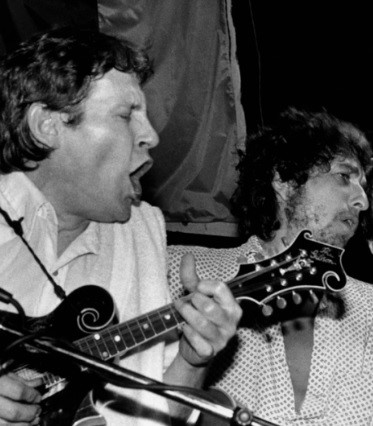
Legally, the world does not get to know the song until 1975, when it is released on the first official edition of The Basement Tapes. It is a polished, replayed version of the 1967 rough diamond. Levon Helm now takes care of the singing and does so very well. The Band has already more or less annexed the song; the song is instantly on the setlist when The Band starts touring again in 1969 (Winterland, San Francisco in April, Fillmore East, New York in May, and at Woodstock in August, for example).
For the sensitive Helm the tour is a revelation: “It was the first time in four years we hadn’t been booed when we played” (in his autobiography This Wheel’s On Fire, 1993). And consequently, in the following years, the song regularly makes appearances. It is still pretty obscure, though; The Band’s performance at Woodstock will not appear on the best-selling triple-LP (1970) due to legal struggles and half-hearted artistic objections, and “Don’t Ya Tell Henry” is not to be found on the famous “primal bootleg” Great White Wonder. But Levon does love the song, which fits him like a glove, which he really makes his own. Despite a potentially traumatic experience, by the way:
“My other recollection of that weekend is from Saturday night. I’d moved from the drums to the mandolin for Don’t Ya Tell Henry, and I touched my lip against the live microphone and saw a flash. I’d been shocked. It nearly blinded me. I went through the song, tears filling my eyes, my whole face on fire. Our equipment was new, remember, and probably hadn’t been grounded properly.”
The only time Dylan plays the song again is as a guest, at the Band’s New York New Year’s Eve performance ’71, where, to the surprise of the audience, a relaxed Dylan appears on stage to help to finish the set. In a good mood, the bard responds to shouting requests and decides to perform “Down In The Flood”, “When I Paint My Masterpiece”, “Don’t Ya Tell Henry” and as bouncer “Like A Rolling Stone”.
Henry remains a line between Dylan and The Band in the decades that follow, as Levon tells in his book. In 1983 Helm and Richard Manuel do an acoustic tour of clubs and universities.
“At five o’clock on a February evening Rick and I were doing our soundcheck when Bob Dylan strolled in wearing a cashmere coat and a big fur hat. He was between tours and said he was just hanging out in the Village when he heard we were playing. He said, “Whatcha playin’ tonight?” and I told him we liked to open with “Don’t Ya Tell Henry,” one of his songs. He borrowed one of Rick’s guitars, I picked up the mandolin, and we played some old tunes together. He stayed until about nine o’clock, then disappeared.”
But in the evening, during the performance, Levon is told that Dylan is at the bar, and lo and behold: when Manuel calls him, he actually climbs the stage and plays a few songs along.
When Robbie Robertson plunges into the first official release of The Basement Tapes in ’75, he discards the messy Basement recording on which Dylan sings, and plays with The Band their crystallized, superior version with Levon at the microphone.
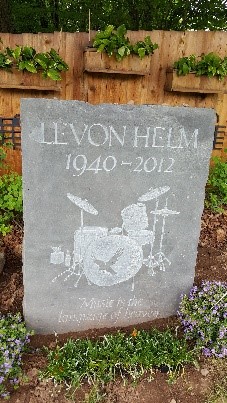
Purely on musical grounds it is an excellent intervention. The musical historical value and the charm of the original, on The Bootleg Series 11 – The Basement Tapes Complete (2014), are of course irresistible to every Dylan fan, but the song really had become Levon’s, my bosom buddy friend to the end, one of the last true great spirits of my or any other generation, as Dylan writes after apple finally got Henry’s fly, after Helm’s death in April 2012.
Jochen’s books are available via Amazon both in paperback and on Kindle:
We have a very lively discussion group “Untold Dylan” on Facebook with over 4200 active members. (Try imagining a place where it is always safe and warm). Just type the phrase “Untold Dylan” in, on your Facebook page or follow this link
You’ll find some notes about our latest posts arranged by themes and subjects on the home page of this site. You can also see details of our main sections on this site at the top of this page under the picture.
The index to all the 603 Dylan compositions and co-compositions that we have found on the A to Z page.
If you are interested in Dylan’s work from a particular year or era, your best place to start is Bob Dylan year by year.
On the other hand if you would like to write for this website, or indeed have an idea for a series of articles that the regular writers might want to have a go at, please do drop a line with details of your idea, or if you prefer, a whole article to Tony@schools.co.uk
And please do note our friends at The Bob Dylan Project, which lists every Dylan song in alphabetical order, and has links to licensed recordings and performances by Dylan and by other artists, plus links back to our reviews (which we do appreciate).
When I started this series of articles I had no idea if I was going to learn anything from trying to come up with a very simple classification of the essence or subject matter of each of Bob Dylan’s songs year by year.
And yes for me, if no one else, it has worked, and in a sense this year is where the whole series has been leading, because I wanted to see how Dylan’s build up to his Christian period was reflected in his songs.
In a sense the water at this point is muddied because a lot of the songs were written with Helena Springs and they are marked with an asterisk *. But we don’t know who wrote what (in terms of lyrics and music) and who influenced whom.
But we can trace the lead up to Christianity through some of the topics in Dylan’s writing.
I find many of the meanings of these songs quite obscure or if not obscure then muddled, which might be a reflection of Dylan working with Ms Springs, and it might be that Dylan was muddled and troubled, which led him to Christianity by the end of this sequence.
To deal with this in terms of meanings I have allocated a double meaning – a longer one first and then a shortened one that fits into the list of meaings that we have evolved previously. Those are highlighted at the end of each line.
In terms of totals for this year, we have the details below.
Moving on: 4
Love: 3
Blues: 3
Lost love: 3
Treating me badly: 1 (counted as lost love in the table below)
Come back to me: 1 (counted as lost love in the table below)
Legionnaires Disease: 1 (counted as death in the table below)
Let me be me: 1 (counted as “be yourself in the table below)
I have often commented in this series that in writing it I have been amazed to find that love and lost love are the two top topics in Dylan’s output. Here I am amazed to find something else – a total confusion and uncertainty. A year in which he is writing a piece that seems to be saying “just let me be myself” alongside a song about Legionnaires Disease, and a plea for a woman to return.
It is a year of confusion expressed in compositions and is a way of explaining where Dylan went next – into writing Christian songs.
To give a comparison with what Dylan had been writing about, here are the subjects for the earlier part of the 1970s with the songs above added at the end. The final figure gives the total number of songs written by Dylan in each category since he started writing in the 1950s
Subject
1970/4
1975/7
1978
Total since 1950s
Environment, places, locations
8
17
Jewish prayer
1
1
Visiting
1
2
Love, desire
13
2
3
62
Lost love
5
7
5
48
Blues
1
1
3
14
Be yourself
1
1
3
Post-modernism
1
2
Protest
1
22
Dance
1
2
Being trapped
1
12
Death
1
1
6
Moving on
3
1
4
24
Rejection of labelling
1
2
Disdain
1
9
Gambling
1
3
Fate
7
7
Change
2
6
People
8
8
Religion
1
3
Personal commentary
1
3
This is fascinating; it is a year of change, with Dylan heading towards his religious period but also an era where he is not letting go of the old songs – love songs and songs of lost love dominate Dylan’s output throughout his career, and here we are again seeing these songs.
Moving on, another popular theme is there as well, but there is a little bit of rebellion as Dylan heads towards handing himself over to Jesus as “Take it or leave it” falls into the hardly ever used “Be yourself” category.
This is thus not specifically a preparation for Christianity as such but an awareness of change coming, of which “Slow Train” itself was the perfect example – the definitive “moving on” song that Dylan had been edging towards for years.
All Dylan compositions by subject up to 1978.
In this listing, the previous total up to 1977 is given first. Where there are songs from 1978 the plus sign (+) is added after the number for up to 1977, with the grand total to date including 1978, after the equals sign (=).
Art: 3
Be yourself: 2 + 1 = 3
Being trapped/escaping from being trapped (being world-weary): 12
Blues: 11 + 3 = 14
Betrayal: 1
Celebrating a city 1
Change: 6
Dance: 2
Death: 5 + 1 = 6
Depression: 1
Disasters: 1
Disdain: 9
Environment: 17
Eternity: 1
Fate: 7
Future will be fine: 2
Gambling: 3
Happy relationships: 1
How we see the world: 3
Humour, satire, talking blues: 13
Individualism: 8
It’s a mess: 3
Jewish prayer: 1
Leadership: 2
Look after yourself: 1
Lost love / moving on: 43 + 5 = 48
Love, desire: 59 + 3 = 62
Lust: 1
Moving on: 20 + 4 = 24
Nothing changes: 4
Nothing has meaning: 2
Party freaks: 3
Patriotism: 1
People (including fictional people): 8
Personal commentary: 3
Postmodernism: 2
Protest: 22
Randomness (including Kafkaesque randomness): 11
Rebellion: 1
Rejection of labelling: 2
Relationships 1
Religion, second coming: 3
Sex (country life): 1
Social commentary / civil rights: 6
Slang in a song: 4
Surrealism, Dada: 15
Travelling on, songs of leaving, songs of farewell, moving on: 16
The tragedy of modern life: 3
Visiting: 2
WH Auden tribute: 1
And as usual here is the list of the top categories by the end of 1978…
Randomness (including Kafkaesque randomness): 11
Being trapped: 12
Humour, satire, talking blues: 14
Surrealism, Dada, Kafka: 15
Travelling on, songs of leaving, songs of farewell: 16
Environment: 17
Protest: 21
Moving on: 24
Lost love / moving on: 48
Love, desire: 62
In each episode, it comes as a shock to recognise that the two largest categories of Dylan songs that we have are love and lost love. Roughly five times as many Dylan songs to this date are about love and lost love as are protest songs. Once again these two topics were the only two topics that Dylan turned to each year thus far in this decade.
The whole of the 1960s (Bob’s most prolific decade as a songwriter) has been analysed through a series of articles which are indexed here.
What else is on the site?
We have a very lively discussion group “Untold Dylan” on Facebook with over 4200 active members. (Try imagining a place where it is always safe and warm). Just type the phrase “Untold Dylan” in, on your Facebook page or follow this link
You’ll find some notes about our latest posts arranged by themes and subjects on the home page of this site. You can also see details of our main sections on this site at the top of this page under the picture.
The index to all the 603 Dylan compositions and co-compositions that we have found on the A to Z page.
If you are interested in Dylan’s work from a particular year or era, your best place to start is Bob Dylan year by year.
On the other hand if you would like to write for this website, or indeed have an idea for a series of articles that the regular writers might want to have a go at, please do drop a line with details of your idea, or if you prefer, a whole article to Tony@schools.co.uk
And please do note our friends at The Bob Dylan Project, which lists every Dylan song in alphabetical order, and has links to licensed recordings and performances by Dylan and by other artists, plus links back to our reviews (which we do appreciate).
In the video below Dylan explores for a moment his admiration for traditional Irish music, and this is followed by Liam Clancy telling a story of meeting Bob and going to the White Horse Tavern, which then introduces a version of The Parting Glass followed by the best cover of Restless Farewell ever.
In case you don’t know them, the Clancy Brothers were an incredibly influential Irish folk music ensemble who came to widespread notice and acclaim in the 1960s, taking Irish traditional music in America. If you are interested in the music that influenced Bob Dylan in the early days, they should most certainly be part of your study.
They were rather oddly known for wearing Aran jumpers – something they complained about as their fame grew, wishing they’d never started wearing clothes that became unbearable under the TV lighting of the era, which threw out a huge amount of heat. But that was their costume, and they were stuck with it.
They were, in fact, the ensemble that prepared the way for many other Irish groups, most notably the Dubliners.
Unlike some other “brother” ensembles The Clancy Brothers did include three brothers, Paddy, Tom and Liam, along with Tommy Makem, although the ensemble changed over time as Bobby Clancy also joined the group. Paddy died in 1998.
They worked particularly with traditional Irish ballads, sea shanties and other traditional songs. Here Restless Farewell, after an introduction from Bob.
Liam also recorded a version in the studio with his son Donal singing
This is Dylan’s cover of the Clancy Brothers own Eileen Aroon
We have a very lively discussion group “Untold Dylan” on Facebook with over 4200 active members. (Try imagining a place where it is always safe and warm). Just type the phrase “Untold Dylan” in, on your Facebook page or follow this link
You’ll find some notes about our latest posts arranged by themes and subjects on the home page of this site. You can also see details of our main sections on this site at the top of this page under the picture.
The index to all the 603 Dylan compositions and co-compositions that we have found on the A to Z page.
If you are interested in Dylan’s work from a particular year or era, your best place to start is Bob Dylan year by year.
On the other hand if you would like to write for this website, or indeed have an idea for a series of articles that the regular writers might want to have a go at, please do drop a line with details of your idea, or if you prefer, a whole article to Tony@schools.co.uk
And please do note our friends at The Bob Dylan Project, which lists every Dylan song in alphabetical order, and has links to licensed recordings and performances by Dylan and by other artists, plus links back to our reviews (which we do appreciate).
In the song lyrics following be a ‘gnostic-like’ vision, a twisted version of a song from ‘My Fair Lady,’ a musical that harks back to the ancient Greek mythology of Pygmalion:
Hold on, I've been led in to some kind of trap
Where we ask no quarter, no quarter we give
We're right down the street from the street where you live
(Bob Dylan: Murder Most Foul)
The gloomy dark world in the song above contrasts with the the world of enchanted light in the song below:
Are there lilac trees in the heart of town
Can you hear the lark in any other part of town
Does enchantment pour out of every door?
No, it's just on the street where you live
(Vic Damone: On The Street Where You Live ~ Lerner/Loewe)
The reference to “murder most foul”:
Ghost: Murder most foul, as in the best it is
But this most foul, strange and unnatural
(William Shakespeare: Hamlet, Act I, sc, v)
In another tale of Greek mythology, the goddess Venus (Aphrodite), marries Vulcan, the god of Fire and Metalworking; he’s not good looking; makes himself machine-like handmaidens out of gold. Venus has an affair with Mars (Ares), the god of War, and sees to it that both her husband Vulcan, and her lover Mars side with the Trojans against the Greeks.
Trojan Paris, you see, judged Venus the winner in a beauty contest; needless to say, Vulcan is not content with being Venus’ obedient servant anymore; she’s an unfaithful wife.
So Vulcan plays a dirty trick. Venus and Mars have a daughter Harmonia. Cadmus, King of Thebes, marries Harmonia. Blacksmith Vulcan gives Cadmus a beautiful necklace to present to Harmonia as a wedding gift.
But it’s cursed so as to bring bad luck to the offspring of Cadmus and Harmonia, among them their daughter Semele, the mother of Dionysus, god of the Vine (The bluish-white metal “Cadmium” takes its name from the King Cadmus).
The song lyrics below mixes up mythologies:
I was thinking about turquoise, I was thinking about gold
I was thinking about diamonds, and the world's biggest necklace
(Bob Dylan: Isis ~ Levy/Dylan)
https://youtu.be/yL0xLUP8P_o
In Greek mythology, Pygmalion creates a statue of his vision of a perfect woman; Venus grants his wish that the statue come to life.
In the following song lyrics, that mythology is messed with. A Venus-like woman grants a man his wish not to become a non-communicative Pygmalion statue, nor a Vulcan machine:
The man in me will hide sometimes to keep from being seen
But that's because he doesn't want to turn into some machine
Took a woman like you to get through to the man in me
(Bob Dylan: The Man In Me)
Athena, the goddess of the City, is a wise protector who has dignity; her sacred bird is the owl; Mars, the god of War, and lover of Venus (despised by Vulcan he be) is rash, even cowardly; his sacred bird is the vulture.
In the lines below, the persona therein has dark-humoured fun at the expense of such mythological and religious tales:
I went down where the vultures feed
I would've gone deeper, but there wasn't any need
Heard the tongues of angels, and the tongues of men
Wasn't any difference to me
(Bob Dylan: Dignity)
No difference to the persona in the song just mentioned, but to the supposed Olympian gods, who were not devoid of compassion, there is. Athena is a favorite of Zeus, the god of Thunder. Gods and goddesses are immortal, but that doesn’t stop Athena from wounding Mars with a spear.
Below, a story is told in song that’s similar in kind to the mythological tale above (Dionysus, it’s noted, be not around in winter):
I'll be back in a month or two
When the frost is on the vine
I'll punch my sword right straight through
Half-ways down your spine
(Bob Dylan: Workingman's Blues, #2)
What else is on the site?
We have a very lively discussion group “Untold Dylan” on Facebook with over 4200 active members. (Try imagining a place where it is always safe and warm). Just type the phrase “Untold Dylan” in, on your Facebook page or follow this link
You’ll find some notes about our latest posts arranged by themes and subjects on the home page of this site. You can also see details of our main sections on this site at the top of this page under the picture.
The index to all the 603 Dylan compositions and co-compositions that we have found on the A to Z page.
If you are interested in Dylan’s work from a particular year or era, your best place to start is Bob Dylan year by year.
On the other hand if you would like to write for this website, or indeed have an idea for a series of articles that the regular writers might want to have a go at, please do drop a line with details of your idea, or if you prefer, a whole article to Tony@schools.co.uk
And please do note our friends at The Bob Dylan Project, which lists every Dylan song in alphabetical order, and has links to licensed recordings and performances by Dylan and by other artists, plus links back to our reviews (which we do appreciate).
One of the great things about running a blog like this is that one never quite knows what happens next.
Of course you might say that since I am the publisher I damn well ought to know what happens next, but there is a real joy in allowing the readership to determine where we go. Ideas emerge, possibilities are put forward and we try them and see what happens.
The people whose names you see at the top of articles were not in any way our friends when Pat and I started this venture, but they have found us, and have turned the vague idea of what Untold Dylan might become, into a reality.
And what is so wonderful (from my perspective at least) is that many of our writers are not from the UK. OK Dylan is American, so we might expect some American writers as well, especially since we speak something akin to the same language, but we have writers from all over the world, including those for whom English is not the first language.
Thus we have learned, among many other things, something of what it is like to be coming to terms with Dylan in a foreign tongue (foreign for us that is), and the issue of translating Dylan into another language.
Which is the case with Filip Łobodziński who has contributed a series of articles for us relating to Bob Dylan and Poland.
And of course it is right that Filip’s band should have a place in the Bob Dylan Showcase.
In case you have not been here before, let me explain: this is a place where any reader can submit a recording made by themselves which is either a Dylan song, or is in some way influenced by the music of Dylan.
A list of some of the music we’ve had submitted is at the end – and you’ll see (or rather hear) at once how incredibly varied the submissions are.
Now we go even further as we have Dylan.pl with Arlekin (Jokerman) described by Filip as “voodoo tinged”.
And second what Filip has described to me as a “New Orleans meets Tom Waits” version of Blind Willie McTell.
If you are interested in Filip Łobodziński’s work you might also enjoy
We have a very lively discussion group “Untold Dylan” on Facebook with over 4200 active members. (Try imagining a place where it is always safe and warm). Just type the phrase “Untold Dylan” in, on your Facebook page or follow this link
You’ll find some notes about our latest posts arranged by themes and subjects on the home page of this site. You can also see details of our main sections on this site at the top of this page under the picture.
The index to all the 603 Dylan compositions and co-compositions that we have found on the A to Z page.
If you are interested in Dylan’s work from a particular year or era, your best place to start is Bob Dylan year by year.
On the other hand if you would like to write for this website, or indeed have an idea for a series of articles that the regular writers might want to have a go at, please do drop a line with details of your idea, or if you prefer, a whole article to Tony@schools.co.uk
And please do note our friends at The Bob Dylan Project, which lists every Dylan song in alphabetical order, and has links to licensed recordings and performances by Dylan and by other artists, plus links back to our reviews (which we do appreciate).
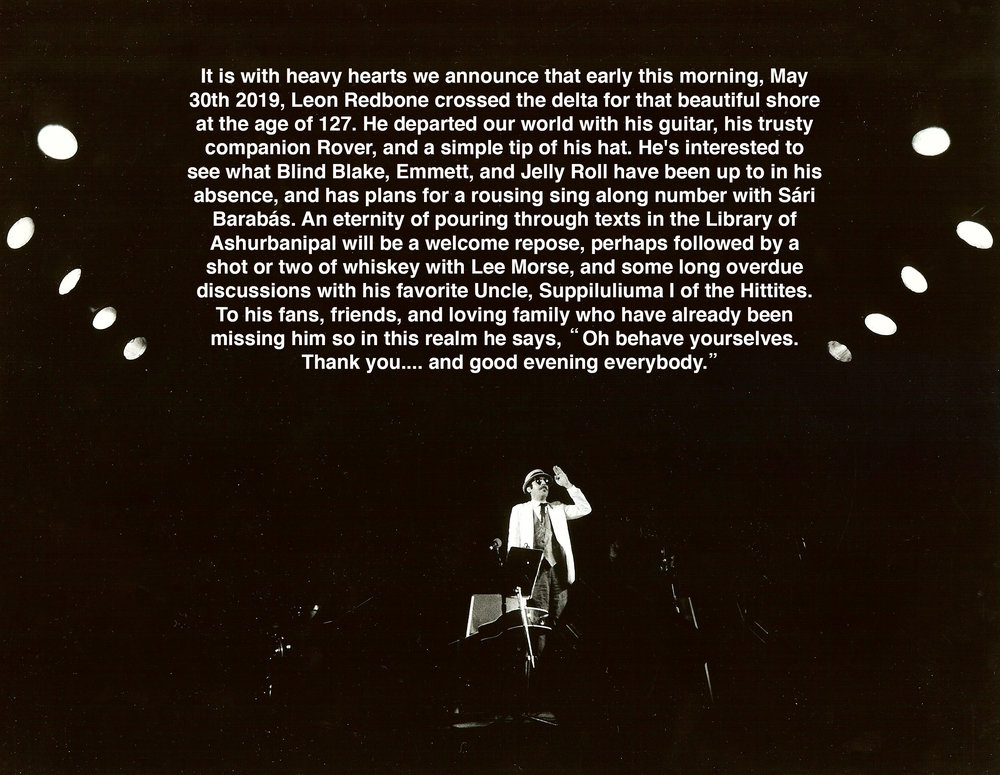
Leon Redbone, the famously mysterious musician whose Ragtime way of strumming a guitar and singing, and who very much numbered Bob Dylan among his fans, has passed away at the age 69.
He was notorious as a joker, and indeed when journalists and interviewers asked him for a picture to go along with the story they were creating he would often hand over a photo of Bob Dylan.
It is also widely reported that Bob Dylan went to Mariposa Folk Festival in 1972 particularly to find him, and in an interview Dylan said, “I’ve heard he’s anywhere from 25 to 60… I can’t tell. But you gotta see him.”
Bob added that the music was “so authentic you can hear the surface noise [of an old 78 rpm record]” adding that he ever started a label, he would sign Redbone. Redbone’s first album was released by Warner Bros three years later.
He was a prolific live performer and also released more than 15 albums over a four-decade career.
But one thing that really linked the men together was that Redbone would often rearrange the classic songs he sung, changing the chord sequences, and most interestingly not rehearsing with the band. He was also notorious for not following the agreed setlist but simply playing what he felt at that moment, requiring the band to follow him. That sounds somewhat familiar!
He also became a regular on Johnny Carson’s “Tonight Show.” More recently, he served as the voice of “Leon the Snowman” in Will Ferrell’s 2003 holiday hit “Elf.”
His introductions to his songs were also something to behold – he was the opposite of Dylan on stage, chatting away to his heart’s content. At the same time he could be funny, contradictory, vague, rambling, and always knowing exactly what he was doing and where he was going but making it seem he did not.
If you enjoy this music, you might just want to leave the video running after the first song – it is a real treat.
Redbone was known for eternally making up stories about his life. According to several reports, when asked for a biography for a music festival program, he handed over copy which said, “I was born in Shreveport, La., in 1910 and my real name is James Hokum” — which of course is fantasy.
In fact what he did share with Dylan was his sense of privacy – and both men dealt with media intrusion by making things up. In a Canadian magazine 19 years ago he said, “Some people seem to believe that as soon as you perform on stage you lose your rights as a private citizen. They want to find out who I am, what I am, where I was born, how old I am—all this complete nonsense that belongs in a passport office.”
What we do know (or at least think we know) he was born in 1949, in Cyprus. He announced his retirement in 2015, citing health concerns.
Announcing his passing his website said, in true reference to the man himself, said, “To his fans, friends, and loving family who have already been missing him so in this realm, he says, ‘Oh behave yourselves. Thank you… and good evening everybody.’ “
So why did Bob Dylan admire this musician so? First, most obviously, he was a one-off, and he was original, exactly as Bob Dylan himself is. Leon Redbone was also a sublime musician, not just as a performer but also in terms of holding an audience and carrying off a show.
Plus he had a magnificent voice which he knew exactly how to use, understanding exactly how the accompaniment could compliment the vocals. Also he brought a style of music to my generation that had been brought up on rock n roll. He reminded us all of another style, another place, another way of seeing the world. When he told the audience to behave, you knew that is exactly what he would not be doing – but in his own inimitable way.
In addition to his many other achievements Redbone appeared on children’s programmes such as Sesame Street, several times singing over films songs such as “Blueberry Mouth”, “Have You Ever”, and “What Do They Do When They Go Wherever They Go?”
He appeared as Leon in the 1988 film Candy Mountain,and narrated the 2011 Emmy Award-winning documentary Remembering the Scranton Sirens, celebrating the musical legacy of one of the most significant “territory” dance bands in American musical history.
He performed also in a Budweiser beer commercial in which he lay on a surfboard singing “This Bud’s for You”, and in a British Rail advert in which he sang the song “Relax”.
We have his recordings… and with those he will always be remembered.
What else is on the site?
We have a very lively discussion group “Untold Dylan” on Facebook with over 4200 active members. (Try imagining a place where it is always safe and warm). Just type the phrase “Untold Dylan” in, on your Facebook page or follow this link
You’ll find some notes about our latest posts arranged by themes and subjects on the home page of this site. You can also see details of our main sections on this site at the top of this page under the picture.
The index to all the 602 Dylan compositions and co-compositions that we have found on the A to Z page.
If you are interested in Dylan’s work from a particular year or era, your best place to start is Bob Dylan year by year.
On the other hand if you would like to write for this website, or indeed have an idea for a series of articles that the regular writers might want to have a go at, please do drop a line with details of your idea, or if you prefer, a whole article to Tony@schools.co.uk
Gallup in New Mexico is a small town, about twenty thousand inhabitants, with a remarkably high crime rate (five times the national average) and for a large part of the twentieth century popular with filmmakers. Films such as Billy The Kid (1930) and Superman (1980) were shot there, and the local El Rancho Hotel has hosted guests such as John Wayne, Ronald Reagan, Humphrey Bogart, Gregory Peck and Burt Lancaster. But the real claim to fame comes from a song: Gallup is one of the ten places listed in “(Get Your Kicks On) Route 66”:
Get your kicks on Route 66
It goes through St. Louis
A-Joplin, Missouri
A-Oklahoma City looks oh-so pretty
You’ll see Amarillo, a-Gallup, New Mexico
Flagstaff, Arizona, don’t forget Winona
Kingman, Barstow, San Bernardino
Would you get hip to this kindly tip
Take that California trip?
Not sung, but still mentioned, the town is on the first two Dylan albums, in the liner notes; in both texts the biographical “fact” is recalled that young Dylan has already seen so much of America, for he has lived in Gallup NM, Sioux Falls and Cheyenne (South Dakota), Phillipsburg KS, and in Hibbing and Minneapolis in Minnesota. An alert reader could have placed a first question mark at the time – there is a Cheyenne in Oklahoma and the capital of Wyoming is called Cheyenne, but a Cheyenne in South Dakota does not exist at all (although the Cheyenne River flows through it).
The source of this nonsense is Dylan himself, who, in the early years of his career, revived and mystified his own biography in newspaper and radio interviews. With many more details, too: he is said to have run away from home, several times, living and travelling with an itinerant fairground company.
After the release of The Freewheelin’, Newsweek magazine, in a disclosing, much-discussed article, punctures the balloon (“I Am My Words”, November 4, 1963) and reveals to the world that Dylan’s real name is Zimmerman, comes from a very ordinary middle-class family and has lived at home in Minnesota all his youth.
According to biographer Shelton, the publication infuriates the young bard, and he withdraws from public life for weeks, sulking (Björner’s unsurpassed website Still On The Road indeed does not record a single performance in November ’63).
Despite that early rebuttal in Newsweek, the story lingers. So persistent, in fact, that the Albuquerque Journal devotes an article to it still in 2012 with the beautifully alliterating title “Did Dylan Roots Really Reach Gallup?”
We now know that Dylan’s story was baloney, but the question still intrigues: why Gallup, of all places? Lawyer and former mayor of Gallup Bob Rosebrough thinks he knows. The starting point is that young Dylan once, with his parents, took a holiday trip through the Midwest and Southwest. Rosebrough recalls that at the time there was a Western-wear store in Gallup along Route 66, which happened to be called “Zimmerman’s”, written on a large, eye-catching sign.
“Well, what did he see as he drove through town? A huge sign stuck smack-dab in the middle of a town filled with Indians and cowboys that said ‘Zimmerman’s.’ And when it came time to invent a persona to match the freewheelin’ Bob Dylan he thought back to that sign and the town where he saw it.”
It is a creative story. But more likely Nat King Cole’s “(Get Your Kicks On) Route 66” has left a deeper impression on young Dylan than the supposed memory of an unproven family trip. In episode 83 (“Street Map”) of Theme Time Radio Hour, radio maker Dylan calls the song the definition of grooviness, the grooviest song I know, all about America’s main street – it’s a pity that neither Nat King Cole nor songwriter Bobby Troup have lived to hear this compliment from the world’s best songwriter. In Tarantula, Dylan’s inimitable literary debut, we see the impact demonstrated once again, in the last chapter “Al Araaf & the Forcing Committee”:
aretha – known in gallup as number 69 – in
wheeling as the eat’s in heat – in pittsburgh
as number 5 – in brownsville as the left
road, the lonesome sound – in atlanta as
dont dance, listen – in bowling green as
oh no, no, not again – she’s known as horse
chick up in cheyenne – in new york city she’s
known as just plain aretha . . . i shall play
her as my trump card
Gallup, Pittsburgh, Bowling Green, Atlanta… all of them place names lifted from songs in Dylan’s record collection (“Route 66”, “Sweet Little Sixteen”, “Long Gone”, “Mary Don’t You Weep”) and place names that will pop up in his songs (Brownsville, Cheyenne, New York City).
Dylan did live in that southwest corner of the United States for a while, when he and his family were fleeing from intrusive fans and other idiots in the early 1970s. In a 1985 interview with Scott Cohen, Dylan talks about the terror that drove him out of Woodstock and casually drops: “… when I was living in Phoenix, Arizona, in about ’72.”
This – in itself irrelevant – biographical fact is completely watered down in the very worth reading article “When Bob Dylan Practiced Downstairs” by Lucian K. Truscott IV in The Village Voice of November 2, 2016, in which the lucky dog Truscott recalls memories of 1974, when Dylan was his downstairs neighbour in Greenwich Village and he could secretly listen in while Dylan wrote his songs for Blood On The Tracks:
You read about how Dylan had decamped from New York in those years — first for Woodstock, then Santa Fe, then Malibu — but he was so much a part of the fabric of the city that there was never a sense he’d left.
“Woodstock, Santa Fe and Malibu.” And Albuquerque is mentioned too, with some regularity – apparently, there is a vague, but universal agreement that Dylan spent part of his life at least somewhere in New Mexico.
Truscott writes his article in 2016, a quarter of a century after the world officially met one of the more unfamiliar Basement gems, with “Santa-Fe” (on The Bootleg Series it is written with a hyphen, in Lyrics and on the site without). Presumably the song title causes Truscott’s confusion, but oh well; Gallup, Santa Fe, Albuquerque… all in New Mexico, all along Route 66.
In the popular music of the twentieth century, Santa Fe usually refers to a train, to the Atchison, Topeka and Santa Fe Railway (ATSF), one of the largest and best-known train companies in the United States. In 1944 Bing Crosby scores a big hit with “On The Atchison, Topeka And Santa Fe”, a year later it’s an even bigger hit for Johnny Mercer (number one, in the charts for sixteen weeks) and Judy Garland’s version wins an Oscar (crazy enough for “best original song”, in the movie The Harvey Girls) in 1946.
Before that, in 1942, Arthur Crudup already recorded “Mean Frisco Blues”, the song that, thanks to big guns like B.B. King, Jimmy Witherspoon, Eric Clapton and Muddy Waters, now belongs to the canon, and that song opens and closes with
Well that mean old dirty Frisco and that low down Santa Fe
Mean old Frisco and that low down Santa Fe
Well take my girl away, Lord and blow back out on me
…as in Lightnin’ Hopkins’ “Santa Fe Blues” and Skip James’ “Cherry Ball Blues” the Santa Fe is is the Big Mean Train that runs off with the narrator’s sweetheart.
But here, in Woodstock 1967, Dylan’s jumpy mind is perhaps most triggered by the recent version of “Midnight Special” by the Spencer Davis Group (on Autumn ’66). Dylan hears the band on their English tour in ’66 and is quite impressed, especially by the then eighteen-year-old foreman Steve Winwood. In Eat The Document you see him talking to Spencer Davis, as he asks, in awe: “How’d he learn to sing like that?”
Dylan jumping up on “Midnight Special” is hardly surprising: the song was his debut in the music industry (in ’61, when he is invited to play the harmonica on Harry Belafonte’s cover of that classic). And in England he undoubtedly notices the changed lyrics:
Get your ticket at the station, get your dinner on board
Well you know I have to leave you but I don’t wanna go
Let the Midnight Special shine its light on me
The Midnight Special to Santa Fe
…with Spencer Davis the opening verse, but merely the third line is the same as the other and the traditional versions.
Further down, the lyric line from which Dylan will make a whole song is maintained: “if you ever go to Houston” (on Together Through Life, 2009).
In the Basement Dylan then has a catchy tune, he has Santa Fe, and apparently he thinks that is enough. Robertson remembers in his autobiography that Dylan, after a cigarette break, pulls the lyrics for “Santa Fe” out of his typewriter, but that does not seem too likely; the verses are filled with empty words, with placeholder lyrics, pleasantly sounding harmonies without coherence. She’s rolling up a knot to pray till God’s away – or something like that. Strange, though, is the “remedial action”, a few years later, while securing copyrights. Dylan changes words and complete lines of verse rather arbitrarily and by adding eccentric idioms he only increases the incomprehensibility of the text: I’ll build a geodesic dome and sail away. That doesn’t even sound remotely like what Dylan sings there. Still, it does fascinate the Dylanologists, so there ís some gain, if you will.
Another uncertainty, equally unimportant, dividing the experts concerns the moment of creation. At the official release, on The Bootleg Series 1-3 (1991), Dylan expert John Bauldie writes that Levon Helm plays the drums.
But two of the top experts, Clinton Heylin and Sid Griffin (Greil Marcus skips the song), date the song before the return of drummer Levon Helm. Heylin isn’t particularly charmed by the song anyway (“just another discarded ditty”) and places it in the summer. Griffin isn’t very touched either (“this slight if charming little ditty”) and analyses that the drumming cannot be Helm’s and that Bauldie must be mistaken.
In his autobiography Testimony (2016), however, eyewitness Robbie Robertson remembers:
“We played through it with Levon on drums. He was a bit rusty and tentative from just getting back, and still a little unfamiliar with the clubhouse groove. We had recorded a ton of songs with Bob already, and by the time Levon joined us we were winding down a little.”
Robertson even places it after Halloween, so after October 31st, somewhere in early November. Also remarkable is the observation with which he introduces this anecdote: “Bob did some of his vibing vocables on words” with which he qualifies the lyrics of “Santa-Fe” as (something like) “intuitive wording of sounds” – not as real, meaningful words, anyway.
Levon Helm does not mention the song at all, in his memoirs (This Wheel’s On Fire, 1993).
The undervaluation is strange. “Santa-Fe” is certainly more than an “insignificant disposable tune”. It’s a particularly catchy, skilful piece of work, richly decorated with accessible melodies, comparable to a pretty nursery rhyme and has at least as much potential as “The Mighty Quinn” or “You Ain’t Goin’ Nowhere”.
Heylin and Griffin, however, are not the only ones to discard it, shrugging their shoulders; the song is hardly covered. But a few nice ones are still out there.
Funny is the fierce rockabilly adaptation by the obscure Bavarian punk band Lee and the Liars, and charming is Howard Fishman’s cover for his unsurpassed Basement Project (Live at Joe’s Pub, 2007); sunny, with a dazzling trumpet.
Still, even the most beautiful cover cannot break through that granite wall of lukewarm indifference; the version of the otherwise unknown Nick Mencia from Miami, who, together with one Erik Gundel and one David Stern, produces a monumental, atmospheric lecture of “Santa-Fe”, of the same level as, and very similar to, the piece of art that Jim James delivers with “Goin’ To Acapulco” for the I’m Not There soundtrack.
Mencia’s cover, which almost entirely follows the published lyrics on the site (only geodesic dome really goes too far; that becomes big ol’ dome), doesn’t make it to a soundtrack, unfortunately. Isolated and alone, it collects dust in a quiet corner of YouTube.
Perhaps Mencia first should have broadcasted that he used to live in Gallup.
Jochen’s books are available via Amazon both in paperback and on Kindle:
Copies of the volumes are also available in Dutch from the same source.
What else is on the site?
We have a very lively discussion group “Untold Dylan” on Facebook with over 4200 active members. (Try imagining a place where it is always safe and warm). Just type the phrase “Untold Dylan” in, on your Facebook page or follow this link
You’ll find some notes about our latest posts arranged by themes and subjects on the home page of this site. You can also see details of our main sections on this site at the top of this page under the picture.
The index to all the 602 Dylan compositions and co-compositions that we have found on the A to Z page.
If you are interested in Dylan’s work from a particular year or era, your best place to start is Bob Dylan year by year.
On the other hand if you would like to write for this website, or indeed have an idea for a series of articles that the regular writers might want to have a go at, please do drop a line with details of your idea, or if you prefer, a whole article to Tony@schools.co.uk
If you have never tried to come up with a completely new arrangement of a Dylan song, perhaps we might be permitted to reveal that it can be incredibly hard, not least because it is so difficult to get Dylan’s distinctive original version of the song out of one’s head.
But now, if you an aspiring composer, you have a chance not to be an arranger of a cover version, but rather Dylan’s co-writer! And to be fully recognised as such!
Because we’ve got a set of lyrics by Dylan for which no music has been composed. All you have to do is to write the music, record a performance and then we’ll put it up on the site. And you will be Dylan’s co-writer.
The song is called Dope Fiend Robber. It was written in 1961 and was found in a notebook left at the McKenzies. It’s interesting because Woody Guthrie also had an unreleased song called Dopefiend Robber, apparently written in 1953, and then discovered in 2012, with music subsequently added by The New Multitudes. There is a copy of that newly created music here – but please don’t take this as a suggested model – if you are going to write the music for these lyrics, you can do what you like.
Of course it is possible that Dylan was somehow aware of the Guthrie work, although no recording was ever made nor music known to have been written by Guthrie for his lyrics … it is all very intriguing.
But back to Dylan’s lyrics, the point about this is that the music does not in any way have to sound like Dylan sounded in the late 1950s and early 1960s. It most certainly doesn’t have to be along the lines of Bonnie Why’d You Cut My Hair or Talking Hugh Brown
Nor indeed does it have to be in the style of any of the VD songs that Dylan recorded, which we covered recently. It really can be in any style and with any approach that you want to use.
In the lyrics below you’ll see that the “verses” (maybe “sections” is a better word) are of varying lengths, which suggests that this is a very early draft, and that the song would have been modified as the music was added, to make the verses more regular. So if you are taking on the challenge please do feel free to do what you wish. You don’t have to use every line, you can modify lines, you can even add extra lines if you need them to make the scansion work.
After all, when Bob Dylan allowed all the famous songwriters to compose the music for the New Basement Tapes Notebook songs, he made it clear that the composers could do anything they liked with the lyrics. Indeed it is instructive to go back and look at those songs to see just how varied the composers were able to be in handling the notes that Dylan left.
So, if you wish to take up the challenge and send a recording in, we’ll be delighted to publish it here. And of course it will be noted as composed by Bob Dylan and YOU.
We’ll also be listing this as Dylan’s song number 604 and putting it in the alphabetical list of Dylan compositions – exactly as the New Basement Tapes songs are. And so you’ll be up there in the hall of fame, because that list of 603 (soon to be 604) songs is the industry definitive list. There are other shorter lists around, but we can tell you that some pretty important people take our list as the one that is complete (which is really a fantastic reward for everyone who has helped compile that list).
So, compose the music, record the song, send it to Tony, we’ll publish it on this site, and then fame and riches will undoubtedly follow*.
Here are the lyrics…
I got shot from gattling gun,
Defending your land,
I was doing nothing else but fighting for Uncle Sam.
They took me to the commissary room,
They had to give me something to ease the pain.
It was morphine, morphine
I was doing nothing else but fighting for Uncle Sam.
I left the Hospital in ’45
Quite lucky to be alive.
I’m a going home…
Now you fixed my wounds and I am glad,
But you didn’t fix the habit I had.
White gold — morphine.
It caused me ruin, it caused me shame.
My wife don’t even want my name.
I was buying high day by day
All I do is pay and pay.
Now I don’t mean to harm no man,
I just hope that you all understand,
That I’m a dope fiend robber
Now you need food to get along,
But I need dust inside my bones,
Cause I’m a dope fiend robber.
I had to rob the jewellery store,
But the cops they grabbed me at the door.
They soon found out I took morphine,
The papers said I was a dope fiend.
Now there’s a gang t’ me.
Nobody would go my bail,
I had to break out of the jail.
I didn’t mean to kill your man,
But he held the keys in his hand.
When you picked me up on the street that day,
You beat me up an’ I was in a daze.
I saw the headlines on the Morning Star,
Mad dope fiend killer behind the bars.
I was found guilty at the trail [sic],
Judge said I’m condemned to die.
Now I’m not asking for sympathy,
From anybody in your society,
Cause.
There’s a man that keeps on pushing me,
You’ll take my life and he goes free.
*The note above about “riches” might be a slight exaggeration.
Please send your recording as an audio file, or as a YouTube video to Tony@schools.co.uk and PLEASE PLEASE PLEASE mark the subject line “Dope Fiend Robber music.” Tony does get a fair number of emails as a result of running Untold Dylan – which is fine, and no complaints about that, but it is helpful to be able to identify what each is about from the subject line.
What else is on the site?
We have a very lively discussion group “Untold Dylan” on Facebook with over 4200 active members. (Try imagining a place where it is always safe and warm). Just type the phrase “Untold Dylan” in, on your Facebook page or follow this link
You’ll find some notes about our latest posts arranged by themes and subjects on the home page of this site. You can also see details of our main sections on this site at the top of this page under the picture.
The index to all the 602 Dylan compositions and co-compositions that we have found on the A to Z page.
If you are interested in Dylan’s work from a particular year or era, your best place to start is Bob Dylan year by year.
On the other hand if you would like to write for this website, or indeed have an idea for a series of articles that the regular writers might want to have a go at, please do drop a line with details of your idea, or if you prefer, a whole article to Tony@schools.co.uk
And please do note our friends at The Bob Dylan Project, which lists every Dylan song in alphabetical order, and has links to licensed recordings and performances by Dylan and by other artists, plus links back to our reviews (which we do appreciate).
Here are two songs I know only a little about except Dylan’s versions are spellbinding, and they are both takes from 1961…possibly my two favourites from all those early party Tapes.
First, “Remember Me (When The Candle Lights Are Gleaming)”
This is from the East Orange Tapes.
The sweetest songs are sung by lovers in the moonlight,
The sweetest days are the days that used to be.
The saddest words I ever heard were words of parting
When you said “Sweetheart, remember me.”
CHORUS:
Remember me when the candle lights are gleamin’,
Remember me at the close of a long, long day.
Just be so sweet when all alone you’re dreamin’
Just to know you still remember me.
A brighter face may take my place when we’re apart, dear,
A brighter smile an’ a love more bold and free.
But in the end, fair weather friends may break your heart, dear.
An’ if they do, sweetheart, remember me.
CHORUS:
Remember me when the candle lights are gleamin’,
Remember me at the close of a long, long day.
Just to be so sweet when all alone you’re dreamin’
Just to know you still remember me.
You told me once you were mine alone forever,
You were mine till the end of eternity.
But now it’s over, dear, and we can never
Be the same except in memory.
CHORUS:
Remember me when the candle lights are gleamin’,
Remember me at the close of a long, long day.
Just be so sweet when all alone you’re dreamin’
Just to know you still remember me.
The song is credited to Scott Wiseman who in a letter to Dorothy Horstman in 1973 wrote:
“This song was written in 1939 when LuLu Belle and I spent a year at radio station WLW, Cincinnati. In our guest room at home when I was a child there was a fancy old cup and saucer which sat on the dresser. The phrase “Remember Me” was on the cup in fancy gold lettering. We children were not allowed to touch this momento of the sentimental Gay Nineties, somehow connected with the courtship of Mother and Dad. Feeling a bit homesick and sentimental during the bustle of radio shows and road trips, I “made up” the song while riding in the car to personal appearance jobs. The lyric was not intended to apply to any particular person.”
“Girl from the North Country,” including the line from the refrain “Remember me to one who lives there, she once was a true love of mine”.
Our second recording here is Black Cross.
https://m.youtube.com/watch?v=Q0QPPYs2cS0
This is from the Minnesota Party Tapes. It always makes me step back a little (well a lot) when the n word crops up in a song, and this time is no different.
Hezekiah was a poor black farmer, who committed the unpardonable crime of reading books and thinking for himself. The white people thought him harmless enough, but also had the attitude that “reading ain’t no good for an ignorant nigger”.
As a result the Reverend Green, of the local church, asked Hezekiah if he believed in the Lord, the church, and Heaven. Hezekiah replied, that he’d never seen the Lord; that the church was divided; and that he tried to be as good as he could without expecting anything from Heaven or the Lord.
“You don’t believe nothin’,” said the white man’s preacher.
“Oh yes I do,” said Hezekiah,
“I believe that a man should be beholding to his neighbor
Without the reward of Heaven or the fear of hell fire.”
“Well, there’s a lot of good ways for a man to be wicked!”
And they hung Hezekiah as high as a pigeon,
And the nice folks around said, “Well, he had it comin’
‘Cause the son-of-a-bitch didn’t have no religion!”[2]
The poem was a signature piece of the American stage performer Lord Buckley who (if you have been paying attention) you may recall we have mentioned before. A live performance, in which he speaks the words over a solo female voice singing and humming the and a sparse instrumental accompaniment, is included on his 1959 album Way Out Humor.
What else is on the site?
We have a very lively discussion group “Untold Dylan” on Facebook with over 4200 active members. (Try imagining a place where it is always safe and warm). Just type the phrase “Untold Dylan” in, on your Facebook page or follow this link
You’ll find some notes about our latest posts arranged by themes and subjects on the home page of this site. You can also see details of our main sections on this site at the top of this page under the picture.
The index to all the 602 Dylan compositions and co-compositions that we have found on the A to Z page.
If you are interested in Dylan’s work from a particular year or era, your best place to start is Bob Dylan year by year.
On the other hand if you would like to write for this website, or indeed have an idea for a series of articles that the regular writers might want to have a go at, please do drop a line with details of your idea, or if you prefer, a whole article to Tony@schools.co.uk
And please do note our friends at The Bob Dylan Project, which lists every Dylan song in alphabetical order, and has links to licensed recordings and performances by Dylan and
Over the years, we have put on this site one or two recordings created by readers who have been performing Dylan songs. Often these have been songs that Dylan himself hasn’t performed, or indeed their own arrangement of a Dylan song.
Then the idea for the “Showcase” came along a couple of months ago, allowing anyone else who wanted to offer a recording to do so. The rule gives is that the items, which can either be audio files or audio+video, can be any of the following:
a) A cover of a Dylan song, which adds something to Dylan’s original
b) A recording of a Dylan song, which Dylan has not recorded.
c) A recording of a song that the performer has composed which emerges in some way from an interaction with Dylan’s music.
The response has been fantastic, and there is a list of the recordings we have published so far at the end of this article. Performances range from amateur performers who are readers of this site, to semi-professionals with all the benefits of a proper set of recording equipment.
It was not my intention that I was going to join in with this, because that makes it look like it was a set-up for me, which really it wasn’t. But I have been persuaded; “One night without you” is below.
My song is not Dylan-esque but the fact that I write songs is entirely because I heard Freewheelin’.
Here is the song, the lyrics are below. It was written in my head while driving back from a dance in Coventry (in England) in the early hours, with a bright half-moon shining down on a deserted M6 motorway while thinking of my partner who was elsewhere.
One night without you, start writing about you
First words in a month and of course I sing of you
I dance with another keep my thoughts under cover
Sing songs as I dance, I imagine my lover

Are you dancing are you thinking are you thinking of me?
Are you dancing are you watching are you still loving me?
Hold me in your thoughts you know I need you here by me
Hold me in your eyes as you’ve always held me
Are you dancing are you watching are you still loving me?

And the landscape is endless, why did I stop singing?
Singing of you and the love that you bring me
The world is enhanced by you in the sunlight
A thousand colours; you drive the music inside me

Are you dancing are you thinking are you thinking of me?
Are you dancing are you watching are you still loving me?
Hold me in your thoughts because I need you here by me
Hold me in your eyes as you’ve always held me
Are you dancing are you watching are you still loving me?

And there’s no wasting time every moment is precious
I’ll build a shrine so everyone sees you
The moon was half full as I drove home thinking
"Always," that one word, captured for ever...

Are you dancing are you thinking are you thinking of me?
Are you dancing are you watching are you still loving me?
Hold me in your thoughts you know I need you here by me
Hold me in your eyes as you’ve always held me
Are you dancing are you watching are you still loving me?

One night without you, start writing about you
First words in a month and of course I sing of you
I dance with another keep my thoughts under cover
Sing songs as I dance I imagine my lover

Are you dancing are you thinking are you thinking of me?
Are you dancing are you watching are you still loving me?
Hold me in your thoughts because I need you here by me
Hold me in your eyes as you’ve always held me
Are you dancing are you watching are you still loving me?
Rather sadly, six months later the lady to whom the song is directed, ended the relationship. I get the impression, living with a writer can seem quite a novelty for a while, but then ultimately the endless emotional highs and lows becomes a bit much.
We have a very lively discussion group “Untold Dylan” on Facebook with over 4200 active members. (Try imagining a place where it is always safe and warm). Just type the phrase “Untold Dylan” in, on your Facebook page or follow this link
You’ll find some notes about our latest posts arranged by themes and subjects on the home page of this site. You can also see details of our main sections on this site at the top of this page under the picture.
The index to all the 602 Dylan compositions and co-compositions that we have found on the A to Z page.
If you are interested in Dylan’s work from a particular year or era, your best place to start is Bob Dylan year by year.
On the other hand if you would like to write for this website, or indeed have an idea for a series of articles that the regular writers might want to have a go at, please do drop a line with details of your idea, or if you prefer, a whole article to Tony@schools.co.uk
And please do note our friends at The Bob Dylan Project, which lists every Dylan song in alphabetical order, and has links to licensed recordings and performances by Dylan and by other artists, plus links back to our reviews (which we do appreciate).
As noted before, over time ancient Greek/Roman, and other mythologies, get all mixed together. For example, Adonis is considered to be a half-god/half-mortal, akin to Dionysus.
Zeus allows Adonis to return from the Underworld in springtime. Venus entrusts the handsome infant Adonis to Persephone to look after. She’s the Queen of the Underworld.
When Venus demands him back for her own love interest, Persephone decides to keep him for herself. Zeus makes his decision – they both can have him to share.
Adonis gets wounded by a bull in the Upperworld; his blood turns into anemone flowers which blow open with the winds of spring.
Mythology akin thereto finds its way into the Holy Bible.
As punishment by God for their disobedience, not only does Jehovah (referred to as ‘Adonai’ in Hebrew) send the Assyrians against the Northern Israelites but causes their planted crops to fail in the autumn:
Because thou hath forgotten me, God of thy salvation
And hast not been mindful of the rock of thy strength
Therfore shalt thou plant pleasant plants
And shalt set it with strange slips
In the day shalt thou make thy plant to grow
And in the morning shalt make thy seed to flourish
But the harvest shall be a heap in the day of grief
And of desperate sorrow
(Isaiah 17: 10,11)
The mythology of Adonis springs up in the song lyrics below:
How many times must a man look up
Before he really sees the sky
How many ears must one person have
Before he can hear people cry
And how many deaths will it take till he knows
That too many people have died?
The answer my friend is blowing in the wind
(Bob Dylan: Blowing In The Wind)
Adonis falls in the poem below:
To-night can bring no healing now
The calm of yesterday is gone
Surely the wind is but the wind
And I a broken waif thereon
(Bliss Carman: The Wind Flower)
Flowers and leaves, objective correlatives of regeneration, rise and fall in the following poem:
Anemones sprang when she pressed
And cresses
Stood green in the slender source
And new books of poetry
Will be written, leather-coloured oakleaves
Many and many a time
(William Carlos Williams: A Coronal)
A circular view of human history is found in many songs by Bob Dylan, albeit double-edged is the last line in the song lyrics below. Christians can take the line as a reference to Jesus.
Theologians struggle because the birth of Jesus by a human being takes place at a particular time in history.
However, Christ can be considered a symbol of eternal regeneration. The singer/songwriter’s difficult to pin down:
Father of grain, Father of wheat
Father of cold, and Father of heat
Father of air, and Father of trees
Who dwells in our hearts and memories
Father of minutes, Father of days
Father of whom we most solemnly praise
(Bob Dylan: Father Of Night)
What else is on the site?
We have a very lively discussion group “Untold Dylan” on Facebook with over 4200 active members. (Try imagining a place where it is always safe and warm). Just type the phrase “Untold Dylan” in, on your Facebook page or follow this link
You’ll find some notes about our latest posts arranged by themes and subjects on the home page of this site. You can also see details of our main sections on this site at the top of this page under the picture.
The index to all the 602 Dylan compositions and co-compositions that we have found on the A to Z page.
If you are interested in Dylan’s work from a particular year or era, your best place to start is Bob Dylan year by year.
On the other hand if you would like to write for this website, or indeed have an idea for a series of articles that the regular writers might want to have a go at, please do drop a line with details of your idea, or if you prefer, a whole article to Tony@schools.co.uk
Dylan: Ah… the name of this is ah…the name of this is… Black Dallyroo! Hehehe.
Johnston: (laughing) “Black Dally Rue!”
Dylan: Dallyroo is D – A – double L – Y – R – O – O. No no! R – U – E! (pause). Right. Or Crimson Dally Rue, take your pick.
Johnston: “Pink Dally Rue.” Pink Bird.
The most famous working title is probably “Scrambled Eggs”, the title McCartney uses as long as he hasn’t written the lyrics for “Yesterday”. “Eleanor Rigby” is first called “Miss Daisy Hawkins” and “It’s Only Love” is actually more promising when it is still named “That’s A Nice Hat”.
Of the Stones are quite a few working titles known as well. “Sympathy For The Devil” is initially called “Fallen Angels”, for example, and “2000 Light Years From Home” is “Toffee Apples”, for lack of better. “Angie” was just a working title, Keith Richards reveals, no more than a noun that got stuck by accident. “It was just a working title, like, who’s gonna call a song “Angie”, how boring, another chick’s name, ya know”, and the same goes for “(I Can’t Get No) Satisfaction”.
One of the many delights of The Bootleg Series Vol. 12: The Cutting Edge, the 18-CD set of studio outtakes from the mercury years ’65-’66, is the studio talk, the conversations between Dylan and the producer and musicians. More than once we hear the producer on duty (first Tom Wilson, later Bob Johnston) ask for the title of the next song. And more than once it turns out that Dylan hasn’t chosen a title yet, only to dash something off on the spot.
https://youtu.be/UmIHQ-90muY
Corniness is the strongest motivator, as in “Alcatraz to the 5th Power”, “Just A Little Glass Of Water”, “What You Can Do For Your Wigwam” and especially in “A Long-Haired Mule and a Porcupine” (respectively “Farewell Angelina”, “She’s Your Lover Now”, “Pledging My Time” and “Rainy Day Women #12 & 35”).
A few times the working title seems to be a serious option, later rejected for whatever reason. “I’ll Keep It With Mine” is first called “Bank Account Blues”, “Obviously 5 Believers” has the less remarkable but more fitting title “Black Dog Blues”, and “It Takes A Lot To Laugh, It Take A Train To Cry” sounds just as poetic and if possible even more mysterious under the name “Phantom Engineer”.
Real, but unfortunately rejected beauty only have a small handful of working titles. “Temporary Like Achilles” initially has the beautiful, dreamy and suggestive title “Medicine Sunday”, but the most beautiful of all is the original name of “Visions Of Johanna”: “(Seems Like A) Freeze Out”.
That title combines Dylan’s profession of art from Bringing It All Back Home’s liner notes (“I am about t sketch You a picture of what goes on around here sometimes. tho I don’t understand too well myself what’s really happening”) with the perfect articulation of the impact a Renoir, or any other impressionist masterpiece, has on the viewer: it really does seem like a solidified moment from a hectic life. It would be a perfect title for the mercurial splendour of “Visions Of Johanna”, indeed. But perhaps too interpretive, as Dylan decides on reflection – and therefore rejecting it in favour of the conservative, not very adventurous final title, which only refers to the refrain line.
Somewhere in between is the enigmatic “Black Dally Rue”, the title Dylan, clearly à l’improviste, quickly comes up with. The song doesn’t have a chorus or recurring refrain line, so a “self-evident” title doesn’t impose itself – the song poet has to look for a painting-like title, as in songs like “Spanish Harlem Incident” or “Motorpsycho Nitemare”.
Despite the closing laugh and Bob Johnston’s hilarity, corniness does not really appear to be the primary inspiration this time. On The Cutting Edge we can hear how Dylan thinks about a title for eleven seconds. Eleven seconds in which he apparently oversees the lyrics at lightning speed, and then calls out a title that, unlike Alcatraz or that Long-haired Mule, does indeed have a connection with the song. In the first instance “Black Dallyroo”, in the second instance “Black Dally Rue” – and Johnston is allowed to turn that into “Crimson Dally Rue”, if he wishes so.
The colours are not that far out. The song poet knows that when the recording starts, he will have to crawl into the skin of a vile, black, bloody red protagonist. Even for those who, like Dylan, are not blessed with a perception tending towards synaesthesia, it is conceivable to qualify the forthcoming lyrics as “black” or “crimson” – poisonous green or shrill yellow would fit as well.
“Dallyroo” is a more difficult association to trace. It echoes Virginia Woolf’s Mrs. Dalloway, which would make an associative jump from way to rue traceable too – but it is unlikely that Woolf’s magnum opus is part of cultural baggage at all. Anyway, “dally” is a word that does not seem to be in his vocabulary. He never uses the – indeed somewhat matronly – word, not in any lyrics, not in any poem, neither in Tarantula nor in Chronicles. It usually means something like “loafing, fooling around”, by the way. “It is time that Prime Minister Johnson stopped dallying with other concepts.”
Also on this same recording day, late in the evening, after the final recording of “Positively 4th Street”, Dylan will have a first go at recording “Desolation Row”. In this monument, it is easy to point out that Dylan has Kerouac under his skin in these mercury days. Fragments like her sin is her lifelessness and a perfect image of a priest literally come from the novel Desolation Angels, and from Kerouac’s “blues-poems” (later collected in Book Of Blues) Dylan borrows images, archetypes and decor pieces.
One of those “blues-poems” seems to come to the surface at Dylan’s spontaneous Black Dally Rue eruption:
Rhetorical Third Street
Grasping at racket
Groans 8c stinky
I’ve no time
To dally hassel
In your heart’s house,
It’s too gray
…from the 17th Chorus of “San Francisco Blues”. The step from “Rhetorical Third Street” to “Positively Fourth Street” isn’t that big either. Remarkable idiom from neighbouring poems like “Mexico City Blues”, “Orizaba 210 Blues”, “MacDougal Street Blues” and from Kerouac’s prose at all, can be found outside of “Desolation Row” in more Dylan songs from these days (especially in “Just Like Tom Thumb’s Blues” and in “From A Buick 6”), so it is quite likely that a Kerouac-echo sounds here as well. More likely in any case than Virginia Woolf.
The final choice for “Positively 4th Street” is all the more remarkable, as it opens the door to biographical interpretation – something Dylan always resists so much. Je est un autre, after all. Still, “4th Street”… the man Dylan, and not some autre singing this song and naming it, has lived on West 4th Street for years, together with the young girl on the front of Freewheelin’, with Suze Rotolo.
Twenty years later, in an interview with Scott Cohen, Dylan confirms the exceptional position of precisely this song:
“Outside of a song like Positively 4th Street, which is extremely one-dimensional, which I like, I don’t usually purge myself by writing anything about any type of quote, so-called, relationships. I don’t have the kinds of relationships that are built on any kind of false pretence, not to say that I haven’t. I’ve had just as many as anybody else, but I haven’t had them in a long time. Usually, everything with me and anybody is upfront. My-life-is-an-open book sort of thing. And I choose to be involved with the people I’m involved with. They don’t choose me.”
…with which the bard also confirms that he – only this one time – lets off steam in this song, “purge myself,” as he calls it, taking out his aggression on hypocritical friendship-pretending acquaintances, on “relationships built on false pretences”. It is in line with what Suze Rotolo remarks about the song, in her autobiography A Freewheelin’ Time (2008):
“He could be cruel. Though I was never on the receiving end of one of his tirades, I did witness a few. The power he was given and the changes it entailed made him lash out unreasonably, but I believe he was trying to find a balance within himself when everything was off-kilter. Some of the songs from that period, such as “Positively 4th Street,” give a sense of the backbiting that thrived in a hermetic environment.”
Mild, understanding words, and in the following paragraph she further condones Dylan’s sharp-toned bitching by pointing out his exceptional talent and stating a general truth: “Artists we admire aren’t necessarily exemplary human beings just because they are exceptional in their chosen fields.”
Dylan, Rotolo means, is only human.
The qualification chosen by Dylan is remarkably to the point as well: “extremely one-dimensional”. Both stylistic and substantive, by the way. In Lyrics and on the site the verse lines are all cut in half and the lyrics are represented in twelve four-line verses, but the recitation is not; in the recitation, they are six four-line, iambic verses in a very ordinary abab rhyme scheme:
You got a lotta nerve / To say you are my friend
When I was down / You just stood there grinning
You got a lotta nerve / To say you got a helping hand to lend
You just want to be on / The side that’s winning
Like this, every eight cut lines of verse can be glued back into abab quatrains. More appropriate too, because much tighter, with the “extremely one-dimensional” content of the lyrics.
In terms of content, the song is indeed atypically unambiguous and direct. Six quatrains (or, according to the layout editor, twelve) in which six times the same thing is said in other words: boy, what a hypocritical jerk you are. No building-up, plot twist or climax, and the music complies with this track – chord scheme, arrangement and interpretation thereof does not vary either. Not really a recipe for a smash hit, all in all. Still: the single scores fine, being in the aftermath of “Like A Rolling Stone”. Top 10 in England and the US, no. 1 in Canada.
Despite the distinctly personal touch, the song does farewell with the colleagues too. The version by Johnny Rivers is distinguished by the master himself in Chronicles. Pulsating and vibrantly, even. “Of all the versions of my recorded songs, the Johnny Rivers one was my favorite.” And, after Dylan poetically expresses his soul kinship with Rivers:
“When I listened to Johnny’s version of “Positively 4th Street,” I liked his version better than mine. I listened to it over and over again. Most of the cover versions of my songs seemed to take them out into left field somewhere, but Rivers’s version had the mandate down — the attitude and melodic sense to complete and surpass even the feeling that I had put into it.”
Like most covers, though, Rivers does not rely on the dramatic power of his recitation and calls in an arranger; per verse more instruments drip in, and towards the end he doesn’t shy away from violins – the whole last minute is even reserved for an instrumental coda.
Comparable to the more obscure cover by John ‘Speedy’ Keen, who on a beautiful, but unfortunately forgotten solo album lends his thin, plaintive voice to “Positively 4th Street” (Previous Convictions, 1973, with again his old Thunderclap comrade, the exceptional Jimmy McCullogh on guitar). Thunderclap Newman, the one-off project under the wings of Pete Townshend is already four years ago, has made one LP (the brilliant Hollywood Dream, 1969), which included the successful Basement cover “Open The Door, Homer”, but especially the unforgettable monster hit “Something In The Air”.
Jochen’s books are available via Amazon both in paperback and on Kindle:
Copies of the volumes are also available in Dutch from the same source.
What else is on the site?
We have a very lively discussion group “Untold Dylan” on Facebook with over 4200 active members. (Try imagining a place where it is always safe and warm). Just type the phrase “Untold Dylan” in, on your Facebook page or follow this link
You’ll find some notes about our latest posts arranged by themes and subjects on the home page of this site. You can also see details of our main sections on this site at the top of this page under the picture.
The index to all the 602 Dylan compositions and co-compositions that we have found on the A to Z page.
If you are interested in Dylan’s work from a particular year or era, your best place to start is Bob Dylan year by year.
On the other hand if you would like to write for this website, or indeed have an idea for a series of articles that the regular writers might want to have a go at, please do drop a line with details of your idea, or if you prefer, a whole article to Tony@schools.co.uk
And please do note our friends at The Bob Dylan Project, which lists every Dylan song in alphabetical order, and has links to licensed recordings and performances by Dylan and by other artists, plus links back to our reviews (which we do appreciate).
Just recently we’ve been engaged in a project listening back to some of the outtakes from the 1986 and 1987 sessions that produced the majority of Bob Dylan’s “Down In The Groove” album, as well as some of the live shows from the era.
And between us we reached the conclusion that, as many people said at the time, the album is, to be fair, not very good. Robert Christgau called the album “horrendous product”.
So we decided to see if we could compile a better album ourselves from the outtakes and live shows from the period. Just in case the guys upstairs fancy issuing a new version when they run out of materials for the Bootleg series. (Full acknowledgement to Untold Dylan would be nice too – how about “Musical consultants”? That would do it).
Thus we are re-creating Bob Dylan’s Lost Album and it is called “Sheep in Wolves’ Clothing”. So far we have got
The song we’ve chosen for track 4 of “Sheep In Wolves’ Clothing” is Dylan’s cover of Gene Vincent’s “Important Words”.
Gene Vincent And The Blue Caps originally released the track in 1956 as the b-side to the “Crazy Legs” single.
In fact Crazy Legs was a song that lived on for a long time, as the title was ultimately used as the name of a studio album by Jeff Beck in 1993 – an album of Gene Vincent songs.
Gene Vincent was born in 1935 and died in 1971 and is remembered as one of the pioneers of rock n roll and particularly of what became known as rockabilly. His 1956 worldwide hit Be Bop a Lula is often cited as the start of the popularity of rockabilly.
And indeed we really can’t let an opportunity like this pass by (just in case you have no idea what we are talking about). Here it is…
Now here is Dylan’s take on “Important Words” which we are making the fourth track of the lost album…
https://m.youtube.com/watch?v=8hLG5sn7Uj4
The track was actually originally included on early promo copies of the album, when it was still known as “Sheep In Wolves Clothing”. It was eventually replaced with “Had A Dream About You, Baby”.
It’s easy to see why the track was dropped from the finalized album, the album already had its fair share of crooner ballads such as “When Did You Leave Heaven” and “Shenandoah”. Therefore, excellent tracks like “Important Words” and “Just When I Needed You Most” were dropped to make way for more rock n roll numbers. Which was unfortunate as they are fine performances and deserve to be heard.
At the time Dylan had mentioned in interviews his desire to make an album of romantic ballads, and repeatedly mentioned artists like Frank Sinatra and Bing Crosby. He also performed songs such as “All My Tomorrows” and “We Three” in concert during these years. Maybe he should have followed through with this idea after all.
https://m.youtube.com/watch?v=WrGaR_7icBs
Here are the lyrics
Important words
That mean a lot
They say, say
I love you
Important words
That’s all I’ve got
They say, say
I love you
The days, the nights, the hours
We spent makin’ plans
Have made both of us feel the same
Since we first held hands…
Important words
They say I love you
They say, say
I do
(Important words)
That say I love you
They say, say
I do
This really is a fine performance by Bob Dylan, and it is desperately sad that it was lost as the album was recreated and the original concept was chopped away. Bob’s voice is in particularly fine form, and this recording deserves to be better known than it now is.
What else is on the site?
We have a very lively discussion group “Untold Dylan” on Facebook with over 4200 active members. (Try imagining a place where it is always safe and warm). Just type the phrase “Untold Dylan” in, on your Facebook page or follow this link
You’ll find some notes about our latest posts arranged by themes and subjects on the home page of this site. You can also see details of our main sections on this site at the top of this page under the picture.
The index to all the 602 Dylan compositions and co-compositions that we have found on the A to Z page.
If you are interested in Dylan’s work from a particular year or era, your best place to start is Bob Dylan year by year.
On the other hand if you would like to write for this website, or indeed have an idea for a series of articles that the regular writers might want to have a go at, please do drop a line with details of your idea, or if you prefer, a whole article to Tony@schools.co.uk
And please do note our friends at The Bob Dylan Project, which lists every Dylan song in alphabetical order, and has links to licensed recordings and performances by Dylan and by other artists, plus links back to our reviews (which we do appreciate).