Articles published so far in this series written by Patrick Roefflaer can be found at the end of the article.
Here we deal with the art work of Infidels
———————————–
Released October 27,1983
Photographer Sara Dylan
Drawing Bob Dylan
Art-director Lane/Donald
———————————–
About five months after the release of Infidels, Bob gives an interview to Rolling Stone. Kurt Lodger closes the conversation with a question about the cover: “I think a lot of people take you for a pretty gloomy character these days, just judging by your photos. Why reinforce that image by calling this latest album Infidels?”
The answer is very Dylanesk: “Well, there were other titles for it. I wanted to call it Surviving in a Ruthless World. But someone pointed out to me that the last bunch of albums I’d made all started with the letter s. So I said, “Well, I don’t wanna get bogged down in the letters.” And then Infidels came into my head one day. I don’t know what it means, or anything.
Lodger insists: “Don’t you think when people see that title, with that sort of dour picture on the front, they’ll wonder, “Does he mean us?”
“I don’t know. I could’ve called the album Animals, and people would’ve said the same thing. I mean, what would be a term that people would like to hear about themselves? […] I mean, I don’t know any more about it than anybody else really. I did it. I did the album, and I call it that, but what it means is for other people to interpret, you know, if it means something to them. Infidels is a word that’s in the dictionary and whoever it applies to… to everybody on the album, every character. Maybe it’s all about infidels.”
Tony Lane and Nancy Donald, who took care of the design of the cover, further reinforced the gloomy feeling by writing the name of the singer in large black letters, finished with a red shadow line at the bottom. The only decoration on the entire design is a thin grey (!) border.
The photo itself is a close up of Dylan’s head. He does not pose, but looks straight ahead. In his dark sunglasses we see the reflection of the white centre line on the black asphalt. It looks like the work of a paparazzi, who photographed a famous person, waiting in a stationary car.
There is no photographer mentioned on the cover, but Rod MacBeath suspects it is Sara Dylan who pressed the button. She also took the photo that adorns the inner cover. There Dylan is pictured, squatting on the Mount Olive, with Jerusalem in the background.
The reason for their presence there, is explained by Dylan to Mick Brown, during an interviews him for the Sunday Times: Dylan and his ex-wife went to Israel in September 1983 for the bar mitzvah of their eldest son, Jesse. “An idea from his grandmother,” he added with a smile.
According to Jewish tradition, this transitional ritual should have taken place shortly after the boy’s thirteenth birthday on January 6, 1979, but then Dad was too busy with an intensive three-month Bible study course at the School of Discipleship.
On the back of the cover is a self-made drawing of a man kissing a woman.
When Bob Coburn (on June 17, 1985 during a radio interview for Rockline KLOS-FM Los Angeles) asks him who is presenting the couple, Dylan answers vaguely: “‘Hmm, well, the woman is someone I knew. [Laughs] The man I think I was wishing to be me, I guess.”
Some say the drawing was originally planned for the front of the sleeve.
You’ll find some notes about our latest posts arranged by themes and subjects on the home page. You can also see details of our main sections on this site at the top of this page under the picture.
The index to all the 590 Dylan compositions and co-compositions that we have found on the A to Z page.
We also have a very lively discussion group “Untold Dylan” on Facebook with over 2000 active members. (Try imagining a place where it is always safe and warm). Just type the phrase “Untold Dylan” in, on your Facebook page or follow this link
If you are interested in Dylan’s work from a particular year or era, your best place to start is Bob Dylan year by year.
On the other hand if you would like to write for this website, please do drop me a line with details of your idea, or if you prefer, a whole article. Email Tony@schools.co.uk
And please do note The Bob Dylan Project, which lists every Dylan song in alphabetical order, and has links to licensed recordings and performances by Dylan and by other artists, is starting to link back to our reviews
Poet Thomas Hardy pities himself, or at least his persona, for losing some gal that he loves:
And when my love' s heart kindled
In hate of me
Wherefore I knew not, died I
One more degree ....
Yet is it that, though whiling
The time somehow
In walking, talking, smiling
I live not now
(Thomas Hardy: Dead Man Walking)
The theme’s carried on in a bluegrass song:
Ain't talkin', just walkin'
Down this highway of regret
Heart's burnin', still yearnin'
For the best girl this poor boy's ever met
(Stanley Brothers: Highway Of Regret ~ R. Stanley/D. Anthony)
Surfaces again in the song lyrics below:
Ain't talkin', just walkin'
My mule is sick, my horse is blind
Heart burnin', still yearnin'
Still thinkin' 'bout that gal I left behind
(Bob Dylan: Ain’t Talkin’)
https://youtu.be/Hx6fHd99SxA
Playwrite Thomas Hardy pities ordinary soldiers; deplores their masters – there be a pun on Napoleon Bonaparte’s name:
Onwards again
If Boney's come, 'tis best to be away
And if he's not, why we've a holiday
(Thomas Hardy: The Dynasts – Part One, Act II, sc.v)
Singer/songwriter Bob Dylan too makes fun of Napoleon’s last name:
You need a different kind of man, babe
One that can grab, and hold your heart
You need a different kind of man
You need Napoleon Bony-Part
(Bob Dylan: Hero Blues)
Thomas Hardy’s sentiment be basically anti-war; he tells the story of Napoleon’s snowy retreat from Moscow with this image of ‘The Grande Army’:
The caterpillar shape still creeps laboriously nearer .....
And there are left upon the ground behind it minute parts of itself
(Thomas Hardy: The Dynasts – Part Three, Act I, sc. ix)
Then there’s this rendition of a song by its writer that’s about a broken heart – it includes the following Napoleonic analogy:
All your seasick sailors, they are rowin' home
All your reindeer armies are all goin' home
The lover who just walked out of your door
Has taken all his blankets from the floor
(Bob Dylan: It’s All Over Now Baby Blue)
Emperor Napoleon serves the singer/songwriter well as a symbol for a person possessing a militaristic attitude:
Your daddy walks in wearin'
A Napoleon Bonaparte mask
Then you ask me why I don't live here
Honey, do you have to ask?
(Bob Dylan: On The Road Again)
(This recording was found on the internet with the note “Performed by David Lowe
9/4/13 The Rev’s House sessions III”)
And as a symbol of the mighty who have fallen (the Duke of Wellington beats Napoleon at Waterloo):
You used to be so amused
At Napoleon-in-rags, and the language that he used
Go to him now, he calls you, you can't refuse
When you ain't got nothin', you got nothin' to lose
Bob Dylan: Like A Rolling Stone)
There’s the ‘Titanic’, the world’s grandest metaphor for an Existentialist Universe:
Over the mirrors meant
To glass the opulent
The sea-worm crawls
Grotesque, slimed, dumb, and indifferent
(Thomas Hardy: The Convergence Of The Twain)
Mixing up the medicine, it’s a viewpoint that Bob Dylan acknowledges:
Wellington, he was sleepin'
His bed began to slide
His valiant heart was beatin'
He pushed the tables aside
(Bob Dylan: Tempest)
What else is on the site
You’ll find some notes about our latest posts arranged by themes and subjects on the home page. You can also see details of our main sections on this site at the top of this page under the picture.
The index to all the 590 Dylan compositions and co-compositions that we have found on the A to Z page.
We also have a very lively discussion group “Untold Dylan” on Facebook with over 2000 active members. (Try imagining a place where it is always safe and warm). Just type the phrase “Untold Dylan” in, on your Facebook page or follow this link
If you are interested in Dylan’s work from a particular year or era, your best place to start is Bob Dylan year by year.
On the other hand if you would like to write for this website, please do drop me a line with details of your idea, or if you prefer, a whole article. Email Tony@schools.co.uk
And please do note The Bob Dylan Project, which lists every Dylan song in alphabetical order, and has links to licensed recordings and performances by Dylan and by other artists, is starting to link back to our reviews
This article comes from the series “Songs about Dylan” – you can find details of other articles in this series via that link (and in case you lose the link it also appears in the list of series below the Dylan picture at the top of the screen).
Today let’s take a look at two tracks by two of the biggest superstars of the 70s, David Bowie and Elton John.
First up it’s Bowie with “Song For Bob Dylan”
The track appears on Bowie’s greatest album, “Hunky Dory”. It kinda gets lost amidst that album’s classic tracks such as “Changes”, “Oh, You Pretty Things” and, especially, “Life On Mars”. But it’s still a great song. Here are the second and third verses
You gave your heart to every bedsit room
At least a picture on my wall
And you sat behind a million pair of eyes
And told them how they saw
Then we lost your train of thought
The paintings are all your own
While troubles are rising
We'd rather be scared
Together than alone

Now hear this Robert Zimmerman
Though I don't suppose we'll meet
Ask your good friend Dylan
If he'd gaze a while
down the old street
Tell him we've lost his poems
So they're writing on the walls
Give us back our unity
Give us back our family
You're every nation's refugee
Dylan wrote in “Chronicles”:
“I found myself stuck in Woodstock, vulnerable and with a family to protect. If you looked in the press, though, you saw me being portrayed as anything but that. It was surprising how thick the smoke had become. It seems like the world has always needed a scapegoat—someone to lead the charge against the Roman Empire. But America wasn’t the Roman Empire and someone else would have to step up and volunteer…Now it had blown up in my face and was hanging over me. I wasn’t a preacher performing miracles. It would have driven anybody mad.”
In an interview in Melody Maker in 1976 Bowie said, “It was at that period that I said, ‘Okay, Dylan, if you don’t want to do it, I will.’ I saw that leadership void”. Bowie’s song begins by directly referencing “Song To Woody” and so sets himself up to be Dylan’s heir presumptive:
Next up it’s an unreleased Elton John track with lyrics by, as usual, Bernie Taupin. “The Day Bobby Went Electric”
It might have been Ibiza
But it could have been the coast of Spain
On a clapped-out continental radio
I thought I heard his name
But I was just another hippie then
With my copy of Rolling Stone
In a kickback full of hashish
That I was trying to smuggle home
chorus:And where were youWhen you knewWhere were youWhen you heardThe day that Bobby went electricHow did you receive the word
There was years of independence
Put a meaning on the words "hard rain"
In a rundown beachfront arcade I heard
How the times have changed
I was thrown in jail in Tangiers
With a couple from Montreal
Who'd been working their way to London
To see the plug-in at the Albert Hall
The day that Bobby went electric
I was struggling through my teens
And when he plugged in up at Newport
I was caught up in a dream
The track was demo’d for the excellent “Songs From The West Coast” album. I’m surprised that it wasn’t used on the album or as a B side as it would really fit in with the sound and theme of that album. Maybe one day he will finish it off and record it properly for an album. It certainly works for me.
Now it’s quiz time… In 1973 Elton performed on radio a jokey pub piano style medley of some Dylan tracks. Much like Vic Reeves on Shooting Stars doing his Club Singer bit, try and figure out what songs Elton is playing here!
If you don’t get the Vic Reeves reference, here’s a clip to help you out. Enjoy!
https://m.youtube.com/watch?v=MRwgNtv29ig
What else is on the site
You’ll find some notes about our latest posts arranged by themes and subjects on the home page. You can also see details of our main sections on this site at the top of this page under the picture.
The index to all the 590 Dylan compositions and co-compositions that we have found on the A to Z page.
We also have a very lively discussion group “Untold Dylan” on Facebook with over 2000 active members. (Try imagining a place where it is always safe and warm). Just type the phrase “Untold Dylan” in, on your Facebook page or follow this link
If you are interested in Dylan’s work from a particular year or era, your best place to start is Bob Dylan year by year.
On the other hand if you would like to write for this website, please do drop me a line with details of your idea, or if you prefer, a whole article. Email Tony@schools.co.uk
And please do note The Bob Dylan Project, which lists every Dylan song in alphabetical order, and has links to licensed recordings and performances by Dylan and by other artists, is starting to link back to our reviews
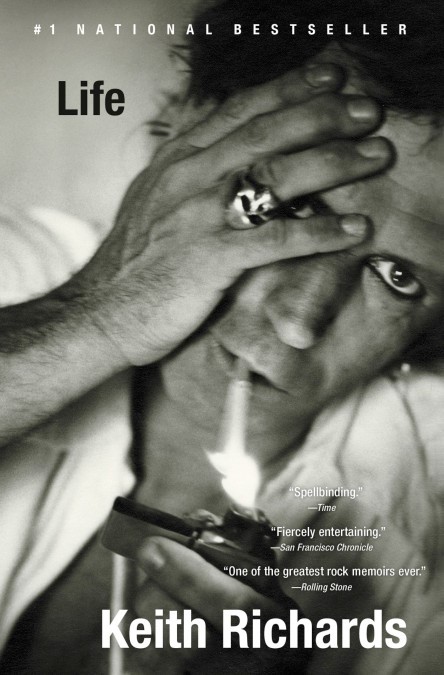
By literary standards, the autobiography of Keith Richards, Life (2009), is perhaps outweighed by Dylan’s memoirs, but on all other fronts both works are of a comparable, compelling level.
Attractive with both rock stars are the quirky choice of words, the attention to rhythm and sound of the sentences, and in terms of content especially the common thread: the deep, unconditional, all-embracing love for music.
Richards fully recognizes that his love of music has something neurotic, something obsessive:
“You might be having a swim or screwing the old lady, but somewhere in the back of the mind, you’re thinking about this chord sequence or something related to a song. No matter what the hell’s going on. You might be getting shot at, and you’ll still be “Oh! That’s the bridge!” And there’s nothing you can do; you don’t realize it’s happening. It’s totally subconscious, unconscious or whatever. The radar is on whether you know it or not. You cannot switch it off. You hear this piece of conversation from across the room, “I just can’t stand you anymore”… That’s a song. It just flows in.”
… very similar to the words that Dylan chooses to describe how he is always picking up songs:
“A lot of times you’ll just hear things and you’ll know that these are the things that you want to put in your song. Whether you say them or not. They don’t have to be your particular thoughts. They just sound good, and somebody thinks them. Half my stuff falls along those lines. Somebody thinks them. I’m sure, when I’m singing something, that I’m not just singing it to sing it. I know that I’ve read it. Somebody’s said it. I’ve heard a voice say that. A song like Don’t Fall Apart On Me Tonight sort of falls into that category: I’ll take you to a mountaintop and build you a house out of stainless steel. That kind of stuff just passes by. A guy’s getting out of bed saying don’t talk to me; it’s leaving time. I didn’t originate those kinds of thoughts. I’ve felt them, but I didn’t originate them. They’re out there, so I just use them.”
(interview with Bill Flanagan, 1985)
But Richards’ excessive talent does of course not lie with the poetic part of songs, but purely on the musical level. And his genesis as a songwriter is bit more cumbersome than Dylan’s, as he describes with amusing self-mockery and frankness. For eight, nine months he and Jagger are busy trying to write an acceptable song, he tells, until with “The Last Time” in January ’65, they finally, finally have a song they dare present to the other Stones – and that song is actually not much more than a rip-off from The Staple Singers’ “This May Be The Last Time”, which then becomes memorable mainly thanks to the lick Brian Jones adds.
Before that, Richards confesses with a grin, the Glimmer Twins write horrific songs, with titles such as “We Were Falling In Love” and “So Much In Love”. Some of those misfits end up with other artists, who sometimes manage to squeeze a small hit out of it. Gene Pitney with “That Girl Belongs To Yesterday”, for example, and Lulu with “Surprise, Surprise” (with Jimmy Page on guitar). But most of the time it leads to a flop or, as Keith says sardonically: “Our songwriting had this other function of hobbling the opposition while we got paid for it.” He mentions Cliff Richard, whose impressive stream of hits comes to an end when recording a Jagger / Richards song for the first time, the actually pretty nice song “Blue Turns To Gray” – Cliff’s first single that doesn’t reach the Top 10, but gets stuck somewhere in the Top 30.
“And when the Searchers did “Take It Or Leave It,” it torpedoed them as well.”
Keef is exaggerating a bit, but not that much. Sir Cliff’s Stones excursion is his thirty-fourth single and the fifth which does not reach the top positions – but still number 15. And the next three singles in 1966 reach, as usual, the Top 10 again.
The single from The Searchers is released on April 13, 1966 (two days before Aftermath, which contains the Stones version), when The Searchers have not had a Top 10 hit for more than a year. And that last big hit, “Goodbye My Love” in February ’65, is a final outburst after the steady stream of big hits in ’63 and ’64, after super hits like “Needles And Pins”, “When You Walk In The Room”, “Love Potion No. 9” and “Sweets For My Sweet”.
So by the time of that Stones song the career of The Searchers was already on a dead end, but indeed: after this it is definitely over. “Take It Or Leave It” reaches a meagre 31st place, the next single does not go further than 48 and the nineteen singles thereafter do not reach the hit parade.
A last album, Take Me For What I’m Worth (1965) is not doing too well either, but The Searchers do not give up. With many live performances, Greatest Hits collections, a few staff changes and re-releases (the biggest hits are re-recorded in 1972, stereo and re-released with reasonable success), the Mersey beatniks of the first hour keep themselves afloat.
In 1979 the time is considered ripe for a comeback: after fifteen years the men record an album with new material again. It will not be a success, neither artistically nor commercially. Record company Sire may be blamed some – virtually no marketing, tampering with track selection and track order on different releases – but The Searchers themselves also drop the ball.
Great songwriters the chaps never have been. On this album there are only two songs of their own – apparently everything the three songwriters of the band have come up with in fifteen years. Not very surprising, by the way; their strength has always been in finding and brightening up great, unknown songs. Unpublished songs from Jackie DeShannon and obscure B-sides from The Drifters, for example.
On this untitled comeback album they do try that same strategy. “Back To The War” is a still unknown song by John Hiatt (his own version will be released two years later on Two Bit Monsters), Tom Petty’s “Lost In Your Eyes” only the real fans know, from a bootleg recording (never officially recorded by Petty), and John David, hit supplier for artists such as Status Quo, Phil Everly, Cliff Richard and Alvin Stardust, contributes two songs.
But unfortunately: fool’s gold, every one of them. They are not particularly great songs and The Searchers do not have a Philosopher’s Stone to turn it into real gold.
The exception is the Dylan/Springs song “Coming From The Heart (The Road Is Long)”.
It is the third song from the collaboration of Dylan and Helena Springs, and perhaps the best one. In any case so good that Dylan is seriously studying it, performing it live once and, given the three takes we know from the bootleg Rundown Rehearsals, for a while even deeming it good enough for a possible studio recording.
The Searchers are undoubtedly attracted by the distinct riches of this atypical Dylan song. The opening, and the couplets too, promise a gospel-like hymn. In the chorus the song turns into a soulful pop ballad and The Searchers do justice to that richness. Their cover opens in an elegant and stately way, the chorus has the shine of a pop jewel and hereafter they polish up the gospel character – first with a successful choir and finally with a steaming, dynamic coda. Granted, not Mahalia Jackson, but still.
The second take of “Coming From The Heart” on the Rundown Rehearsals bootleg is beautiful and already breathes the same gospel atmosphere that The Searchers take even farther. Elvis bass player Jerry Scheff – prominently – joins in, but guitarist Billy Cross does not venture into the fills and licks of Scotty Moore. Which is remarkable; after all, Cross is an excellent rockabilly guitarist. Here, however, he opts for tasteful soul accompaniment and ditto solo, a la Steve ‘Soul Man’ Cropper.
The third and final take is not really a take, but a recording of the only time Dylan plays the song live, on October 31, 1978 in St. Paul. The introductory words suggest that the master still has high hopes: “This is a new song that we just wrote a while back. It’s gonna be recorded, but we’ll try it out on you.”
“It’s gonna be recorded”, so apparently the song is still on a to-do list. But alas, eighteen days later someone in San Diego throws a silver cross on stage and two months later Dylan has renounced the secular songs. Temporarily, fortunately. “Coming From The Heart” never returns, though.
At that one announcement in St. Paul, Dylan says “we just wrote a while back”. And here too, one initially assumes that Helena Springs contributed some lyrics – melodically it is a beautiful song and Helena may have put in her bit to that too, but the lyrics are really not too overwhelming – mostly Dylan-unworthy, frankly.
A long and winding road is a rather hackneyed cliché, especially if it has to communicate an image for a difficult phase of life. Tony Bennet’s “One For The Road”, The Beatles, “He Ain’t Heavy, He’s My Brother”, Ian & Sylvia’s “The French Girl” (which Dylan already sang in the Basement) … it’s only a small selection, and it is not very likely that a poet who during this period produces lyrics like “Where Are You Tonight?”, “No Time To Think” and “Slow Train” will dash off yet another long and winding road.
Not to mention awkward verses like Of all my loves you’ve been the closest / That’s ever been on my mind, or a toe-curling couplet like
Please, please give me indication
Stop and talk to me
Like a river that is flowing
My love will never cease to be
No, probably even Helena Springs thinks by now, a few decades later, matured and all: nâh.
The song has since become dusty and forgotten. There are no other covers. Maybe Keith Richards should do it, in the Elvis way, and finally learn that one Scotty Moore-lick:
“To this day there’s a Scotty Moore lick I still can’t get down and he won’t tell me. Forty-nine years it’s eluded me. He claims he can’t remember the one I’m talking about. It’s not that he won’t show me; he says, “I don’t know which one you mean.” It’s on “I’m Left, You’re Right, She’s Gone.” (…) It’s probably some simple trick. But it goes too fast, and also there’s a bunch of notes involved: which finger moves and which one doesn’t? (…) And Scotty’s a sly dog. He’s very dry. “Hey, youngster, you’ve got time to figure it out.” Every time I see him, it’s Learnt that lick yet?”
The Searchers: https://www.youtube.com/watch?v=9vPTC8A3xCk
You’ll find some notes about our latest posts arranged by themes and subjects on the home page. You can also see details of our main sections on this site at the top of this page under the picture.
The index to all the 590 Dylan compositions and co-compositions that we have found on the A to Z page.
We also have a very lively discussion group “Untold Dylan” on Facebook with over 2000 active members. (Try imagining a place where it is always safe and warm). Just type the phrase “Untold Dylan” in, on your Facebook page or follow this link
If you are interested in Dylan’s work from a particular year or era, your best place to start is Bob Dylan year by year.
On the other hand if you would like to write for this website, please do drop me a line with details of your idea, or if you prefer, a whole article. Email Tony@schools.co.uk
And please do note The Bob Dylan Project, which lists every Dylan song in alphabetical order, and has links to licensed recordings and performances by Dylan and by other artists, is starting to link back to our reviews
This article comes from a continuing series of reviews of Dylan’s compositions, and the themes he evolved in his writing, year by year. Previous articles in the series are…
By 1964 Bob Dylan was known as a protest singer, the voice of a generation, the songwriter of his age, and quite a few things more. Among his masterpieces already recognised as such he had composed maybe 15 masterpieces which anyone who studied the form would know about and recognise. In order of composition those 15 that I nominate were
These are songs that had been composed in under three years, of which the first four in particular, along with “Times” are surely known by most people who know anything about the era. And indeed Times itself is still quoted daily, with opening lines to newspaper and blog articles along the lines of “As Bob Dylan wrote, The Times They Are A-Changing, and ….” and off the piece goes. Do a daily search for articles from around the world on Bob Dylan and most days up will pop a fair sprinkling of those.
And it is this year that takes us to comparisons with America’s other great songwriter: Irving Berlin. On his death the New York Times wrote, “Irving Berlin set the tone and the tempo for the tunes America played and sang and danced to for much of the 20th century.”
Now, suddenly, we begin to find that Bob Dylan was setting the tone and tempo for the tunes that reminded America of where it had come from, how far it had fallen from its great ideals, and where it might yet go.
Both men wrote utter classics. By the time he was 30 Irving Berlin was an absolute legend. By the time he was 23 so was Dylan for he had written “Times they are a changin”, “Blowing in the wind”, “Don’t think twice,” and so on.
Curiously though although Berlin was nominated for Academy Awards eight times, he never got one. But he did write, “White Christmas” and “God Bless America”. Different men totally, but the two great pinnacles of American songwriting. Dylan was never going to write “Alexander’s Ragtime Band,” “Cheek to Cheek”, “There’s No Business Like Show Business”, “Blue Skies” and “Puttin’ On the Ritz.” but he started to get people to think about what lay beyond, rather than celebrating what’s here. And he got an Oscar, plus the Nobel Prize.
And certainly by 1964 people were realising that Bob had, in under three years, challenged the whole notion of what music could be about, while still using some of the themes of the past. He was about challenging the established view while not preaching a particular line. It was about lost love and hope for the future; a better world to come, maybe. And all done by one man with a guitar and harmonica.
It was a year which started with a song of hurting Guess I’m doing fine and ended up as a song of leaving and individualism (If you’ve gotta go, go now). (The additional song added at the end of the list of compositions, is of questionable date as it was evolved from the sleeve notes to the “Another Side” album and the date of writing those is uncertain).
In my earlier article, written long before I tried to pull all of Dylan’s lyrical themes together and make some sense of the pattern of his writing I used the title Bob Dylan in 1964: the overview. Adding new themes. And I think he did this with his first song of the new year Guess I’m doing fine. It’s far from a great piece, but it marks out a different element in Bob’s music.
But that was by way of introduction, because the next song of the year was the protest pieces Chimes of Freedom and It’s all right ma almost right at the end. And perhaps the even more important news was that he was still experimenting. He did not write “It’s all right ma” and think, “well I can’t go much further than that”, because he suddenly changed direction again and wrote If you’ve gotta go, go now before the year was done.
And it has just occasionally struck me, was Dylan talking to himself at that moment, saying, “You’ve just written the most profound song you’ll probably ever manage, so if you are going to stop writing now is a good time to do it. Cos if not, it’s going to be a long long ride.”
What else is on the site
You’ll find some notes about our latest posts arranged by themes and subjects on the home page. You can also see details of our main sections on this site at the top of this page under the picture.
The index to all the 590 Dylan compositions and co-compositions that we have found on the A to Z page.
We also have a very lively discussion group “Untold Dylan” on Facebook with over 2000 active members. (Try imagining a place where it is always safe and warm). Just type the phrase “Untold Dylan” in, on your Facebook page or follow this link
If you are interested in Dylan’s work from a particular year or era, your best place to start is Bob Dylan year by year.
On the other hand if you would like to write for this website, please do drop me a line with details of your idea, or if you prefer, a whole article. Email Tony@schools.co.uk
And please do note The Bob Dylan Project, which lists every Dylan song in alphabetical order, and has links to licensed recordings and performances by Dylan and by other artists, is starting to link back to our reviews
A number of poets consider that the Judeo-Christian God be rather vengeful in that He casts Adam and Eve out of eternal Eden, and punishes them with the prospect of unavoidable death simply because Eve takes a bite out of an apple.
Writer Thomas Hardy goes further. His bodily age advancing, Hardy addresses God, and criticizes the Almighty for allowing the human body to go that way while the longing for love, and the desire for sex still remain:
I look into my glass
And view my wasting skin
And say, "Would God it came to pass
My heart had shrunk as thin!"
(Thomas Hardy: Look Into My Glass)
Below, singer/songwriter Bob Dylan picks up this theme and runs with it (words vary a bit in other versions):
I'm driving in the flats in a Cadillac car
The girls all say, "You're a worn out star"
My pockets are loaded
But I'm spending every dime
How can you say you love somebody else
You know it's me all the time
(Bob Dylan: Summer Days)
Aside from Hardy’s rather sorrowful theme, Dylan comments above on his own determination to continue on performing live music before an audience of his fans who love him for doing just that.
Even at a young age, Bob Dylan’s aware of Thomas Hardy’s universal observation that relates to the human existential condition.
Expressed in symbolic terms (Hardy influences poet Robert Frost), the singer/songwriter endeavours to send out a warning of what’s to come:
Now the wintertime is coming
The windows are filled with frost
I went to tell everybody
But I could not get it across
Well I wanna be your lover, baby
I don't wanna be your boss
Don't say I never warned you
When your train gets lost
(Bob Dylan: It’s Takes A Lot To Laugh, It’s Takes A Train To Cry)
That the young songwriter has read the poetry of the aging Thomas Hardy, there is no doubt:
I leant upon a coppice gate
When frost was spectre-grey
And winter's dregs made desolate
The weakening eye of day .....
That I could think trembled through
His happy good-night air
Some blessed hope, whereof he knew
And I was unaware
(Thomas Hardy: The Darkling Thrush)
In the following song (words vary slightly in different versions thereof), Dylan refers to similar correlatives employed by Thomas Hardy (as well as by the French poet Paul Verlaine):
As I walked out tonight in the mystic garden
On a hot summer day, a hot summer lawn
"Excuse me, ma'am, I beg your pardon
There's no one here, the gardener's gone"
(Bob Dylan: Ain’t Talking)
https://youtu.be/Hx6fHd99SxA
Brings to mind the poem below:
I thought her behind my back
Yea, her long I had learned to lack
And I said, "I am sure you are standing behind me
Though how do you get into this old track?"
And there was no sound, but a fall of a leaf
As a sad response; and to keep down grief
I would not turn my head to discover
That there was nothing in my belief
(Thomas Hardy: The Shadow On The Stone)
The Victorian poet seeks to reconcile Charles Darwin’s biological Theory of Evolution with the dreams and desires of humankind – an idea that’s somewhat problematic, and it brings a smile to the face of the singer/songwriter as well as to those who have a more orthodox religious bent:
They got Charles Darwin trapped out there on Highway Five
Judge says to the High Sheriff, "I want him dead or alive
Either one, I don't care"
High water everywhere
(Bob Dylan: High Water)
What else is on the site
You’ll find some notes about our latest posts arranged by themes and subjects on the home page. You can also see details of our main sections on this site at the top of this page under the picture.
The index to all the 590 Dylan compositions and co-compositions that we have found on the A to Z page.
We also have a very lively discussion group “Untold Dylan” on Facebook with over 2000 active members. (Try imagining a place where it is always safe and warm). Just type the phrase “Untold Dylan” in, on your Facebook page or follow this link
If you are interested in Dylan’s work from a particular year or era, your best place to start is Bob Dylan year by year.
On the other hand if you would like to write for this website, please do drop me a line with details of your idea, or if you prefer, a whole article. Email Tony@schools.co.uk
And please do note The Bob Dylan Project, which lists every Dylan song in alphabetical order, and has links to licensed recordings and performances by Dylan and by other artists, is starting to link back to our reviews
This article continues from the article “Dylan, McGuinn, Hillman, Clark… part 1: Dylan and Roger McGuinn”
Moving on to Gene Clark, his second solo album, and in my opinion his masterpiece, “White Light” contains his moving take of “Tears Of Rage”. If you can find this album on Spotify or YouTube, you really must give it a listen, you will thank me for it. In the meantime, here is “Tears Of Rage”.
His 1984 album “Firebyrd” contained his piano led version of “Mr Tambourine Man” – for some reason titled as simply “Tambourine Man”. The album has also been issued as “This Byrd Has Flown”
A 1968 demo for “I Pity The Poor Immigrant” was eventually issued in 1990 on the compilation album “Flying High”
Here are a couple of live Dylan covers from Gene, each showcasing what an amazing singer he was. Makes me wish even more that I got to see him live. Please add a comment below if you were so lucky.
“Gates Of Eden” from 1985.
Lastly, “I Shall Be Released” from 1990. This one is particularly stunning.
Finally in this collection of artists we have Chris Hillman.
His first acquaintance with a Dylan tune was on the bluegrass album he recorded as a member of The Hillmen – the self-titled album “The Hillmen” was recorded in 1963 but was not released until 1969, no doubt to capitalize on Hillman’s Byrd’s success. It contained bluegrass versions of two Dylan originals “Fare Thee Well” and “When The Ship Comes In”.
Here is “Fare Thee Well”.
And now “When The Ship Comes In”.
After the Byrd’s split, Chris Hillman joined up with Gram Parsons and formed the Flying Burrito Brothers. During Parson’s tenure as lead singer they recorded Dylan’s “If You Gotta Go”. Following Parson’s departure, Hillman took over as band leader and delivered a fantastic version of “To Ramona”.
Besides all his various band’s projects (Byrds, Flying Burritos, Manassas, Desert Road Band etc) he has also released several fine solo and duo albums. His 1982 solo album “Morning Sky” includes a wonderful bluegrass version of “Tomorrow Is A Long Time”
Let’s finish up with two live performances from the complete trio when they reformed for a brief time as McGuinn, Clark, Hillmen in the late 70s to early 80s.
Firstly, here is “Chimes Of Freedom” from a 1978 concert.
Now let’s take things right back to where they started. Here they do a fine version of the Byrd’s first ever hit “Mr Tambourine Man” on Australian TV. All three gets to sing a verse. Also, nice t-shirt Roger!
I hope you enjoyed this somewhat unexplored look through the three ex-Byrd’s extensive solo back catalogue!
What else is on the site
You’ll find some notes about our latest posts arranged by themes and subjects on the home page. You can also see details of our main sections on this site at the top of this page under the picture.
The index to all the 590 Dylan compositions and co-compositions that we have found on the A to Z page.
We also have a very lively discussion group “Untold Dylan” on Facebook with over 2000 active members. (Try imagining a place where it is always safe and warm). Just type the phrase “Untold Dylan” in, on your Facebook page or follow this link
If you are interested in Dylan’s work from a particular year or era, your best place to start is Bob Dylan year by year.
On the other hand if you would like to write for this website, please do drop me a line with details of your idea, or if you prefer, a whole article. Email Tony@schools.co.uk
And please do note The Bob Dylan Project, which lists every Dylan song in alphabetical order, and has links to licensed recordings and performances by Dylan and by other artists, is starting to link back to our reviews
The article below, by Jochen Markhorst, is an extract from Jochen’s new book (in English this time),Blood On The Tracks which is now on sale via Amazon both on Kindle and as a paperback. Details of how to order both editions are given at the end of the article.
In 1979, the Guinness Book Of World Records officially recognized the Shortest Interview in the World, an interview conducted during a Dylan concert by Creem journalist Jeffrey Morgan, who is in the front row at the time of the “interview”.
Dylan: This next number is a song I once did with the Band. You remember the Band, don’t you? It was on an album called Planet Waves. It sold twelve copies. Morgan: WHY? Dylan: Get this guy outta here.
It’s October 1978, and Dylan makes that sour joke almost every night. With increasing sales figures, by the way; the first time there are only four sold (October 5, in Maryland), two days later already six, October 9 reports Dylan: “About ten of them have been sold. Ha, it sells better every day,” and the sales record is then set in Toronto on October 12, when there are no fewer than twelve copies sold.
He always says it halfway through the evening, with the announcement of “Going, Going, Gone”, one of the two songs from Planet Waves he performs that evening (the other is “Forever Young”).
The acidity is not entirely justified, but it is understandable. In the pre-sale the album broke Dylan’s record; more than half a million orders, enough for gold and the first place on the Billboard 200. After the release, however, sales stagnate, despite the – generally – positive reviews and the sold-out tour with The Band.
A year later, on top of that half a million, “only” a hundred thousand extra were sold. That initial success is mainly due to the excitement that the first real Dylan album in four years has been generating, not so much to the earth-shaking quality of the album – there won’t be too many fans among whom Planet Waves is in the Top 10 of best Dylan albums.
Even super fan Patti Smith withdraws. She will never belittle anything from her hero, but in her review (Creem, April ’74) she does take some sort of distance. “I’ve been following him like a good dog for too long now,” Smith writes, judging that the album is unbalanced, that The Band makes her nervous and that she is not very touched by the album, except for two songs: “I don’t care for the rest of the album.”
The two songs that fully justify the purchase of Planet Waves are the opposite of each other, Smith argues poetically. “Dirge” and “Wedding Song”.
“One black one white. One that swan dives and one that transcends. The death of friendship the birth of love. It’s a thin line between love and hate.”
The black one, Smith explains just to be sure, is “Dirge.” And she loves the musical accompaniment, the lyrics and especially the contrast with the white one, with “Wedding Song”. But “Dirge” she plays over and over. And well alright, “Going, Going, Gone” has beautiful lyrics and should be covered by Mick Jagger or Chuck Jackson.
The discomfort of Smith and many other reviewers mainly concerns the homeliness, the valentines and roses, the cosiness of most lyrics. The fans and the reviewers, in varying degrees of aversion, have been bothered by that since the final two songs on John Wesley Harding from 1967 (“Down Along The Cove” and “I’ll Be Your Baby Tonight”), it gets worse by the hundred percent score of unpretentious songs on successor Nashville Skyline (’69), with a crooning Dylan, to add insult to the injury, sung without any overtones of sarcasm or cynicism, and the embarrassment reaches the top of the end on New Morning (1970), with sweets like “If Not For You ”, skyrocketing confessions such as this dude thinks you’re grand (from “Winterlude”) and rural warblings as in “Sign On The Window” (Marry me a wife, catch a rainbow trout / Have a bunch of kids who call me “Pa” / That must be what it’s all about).
Now, completely evaporated it has not. The fans and critics still miss Dylan’s razor sharpness, his venom and his uppercuts, in “On A Night Like This”, “Hazel”, “Something There Is About You” and “You Angel You”. But some light on the horizon bring the instant classic “Forever Young”, the intense “Never Say Goodbye” and the irresistible “Tough Mama”. But most plus points are given to the two songs that are the harbinger of Blood On The Tracks, the songs demonstrating the deep truth of Dylan’s own adage from “She’s Your Lover Now” (1965): pain sure brings out the best in people.
Those two songs are the same songs Patti Smith picks out: “Going, Going, Gone” and “Dirge”.
————————————————————————–
Jochen’s book, as noted at the top of the page, is available in two editions. Here are the links…
You’ll find some notes about our latest posts arranged by themes and subjects on the home page. You can also see details of our main sections on this site at the top of this page under the picture.
The index to all the 590 Dylan compositions and co-compositions that we have found on the A to Z page.
We also have a very lively discussion group “Untold Dylan” on Facebook with over 2000 active members. (Try imagining a place where it is always safe and warm). Just type the phrase “Untold Dylan” in, on your Facebook page or follow this link
If you are interested in Dylan’s work from a particular year or era, your best place to start is Bob Dylan year by year.
On the other hand if you would like to write for this website, please do drop me a line with details of your idea, or if you prefer, a whole article. Email Tony@schools.co.uk
And please do note The Bob Dylan Project, which lists every Dylan song in alphabetical order, and has links to licensed recordings and performances by Dylan and by other artists, is starting to link back to our reviews
The poems of Guillaume Apollinaire, who is credited with coining the words ‘cubism’ and ‘surrealism’, are not all filled with dark humour; there be light-humoured poems as well. The Rimbardian fairy-tale-like poem by Apollinaire given below creates ancient mythological correspondences with the human condiction in modern times. Sigmund Freud does much the same thing.
Apollinaire, in his long poem, does so more directly than do the lyrics of singer/songwriter Bob Dylan in his song ‘Man Gave Names To All The Animals,’ which alludes to religion:
And Adam gave names to all cattle
And to every fowl of the air
And to every beast of the field
(Genesis 2: 20)
In ancient mythology, Orpheus plays a lyre made from a tortoise shell given to him by the Sun God, Apollo, whose sister is the Moon Goddess, Diana; Orpheus grows up in the Thrace region of Greece; Eurydice becomes his wife – she dies from a snakebite, and Orpheus fails to get her all the way out of Hades because he’s told not to look back at her, and he does.
Orpheus accompanies Jason on a sea journey in quest of the Golden Fleece, the skin from the Holy Ram of the Thunder God, Zeus, that’s guarded by a dragon. On the way back, Orpheus with his lyre drowns out the seductive voices of the dangerous Sirens. Winged Medusa, with her hair of poisonous snakes, turns men into stone who look at her face; she gives birth to Pegasus, a winged horse, ridden by the Greek hero who slays the monster that has a head of a lion, a body of a goat, and a tail of a serpent.
In his song lyrics, Bob Dylan refers to bears, bulls, cows, pigs, snakes, and sheep; Guillaume, in his poem, to lions, horses, serpents, tortoises, elephants, mice, and more.
Following are some verses of “The Beastiary Or Orpheus’ Procession” by Gùillaume Apollinaire (translated by Kline):
From magic Trace, O delirium!
My sure fingers sound the strings
The creatures pass to the sounds
Of my tortoise, and the songs I sing
(The Tortoise)

My harsh dreams knew the riding of you
My gold-chariot will be your lovely car
That for reins will hold tight to frenzy
My verses, the patterns of all poetry
(The Horse)

The fleece of this goat and even
That gold one which cost such pain
To Jason's not worth a sou towards
The tresses which I take
The Tibetan Goat)

You set yourself against beauty
And how many women have been
Victims of your cruelty!
Eve, Eurydice, Cleopatra
I know three or four more
(The Serpent)
Bob Dylan obliquely alludes to the story of Orpheus and Eurydice in the following song lyrics; the writer changes the artist into a woman who looks not back but to the present for inspiration to create art:
She's got everything she needs
She's an artist, she don't look back
She can take the dark out of the night-time
And paint the daytime black
(Bob Dylan: She Belongs To Me)
Apollinaire looks back to ancient mythology; he brings into the present in order to objectify human emotions and sexuality in the context of modern times.
The story of Medusa is called upon:
Medusas, miserable heads
With hairs of violet
You enjoy the hurricane
And I enjoy the very same
(Guillaume Apollinaire: The Jellyfish)
In the following song lyrics, there’s an allusion thereto as well, but it’s not so direct:
See the primitive wallflower freeze
When the jelly-faced women all sneezed
(Bob Dylan: Visions Of Johanna)
There also be a well-hidden mythological allusion to Venus, the Goddess of Love, giving her shield, adorned with a goose, to her son:
Train wheels runnin' through the back of my memory
When I ran on the hilltop following a pack of wild geese
(Bob Dylan: When I Paint My Masterpiece)
Referencing:
And there the silvery goose flying through the gilded
Colonnades cackled that the Gauls were at the gate
(Virgil: The Aeneid)
Religion is not left untouched by Guillaume Apolinaire’s sexually suggestive humour:
Dove, both love and spirit
Who engendered Jesus Christ
Like you I love Mary
And so with her I marry
(Guillaume Apollinaire: The Dove)
The singer/singer, as mentioned, messes around with stories in the Judeo-Christian holy book:
Hot chili peppers in the blistering sun
Dust on my face, and my cape
Me and Magdalena on the run
I think this time we shall escape
(Bob Dylan: Romance In Durango ~ Dylan/Levy)
https://youtu.be/-NBWMK0CV0Y
What else is on the site
You’ll find some notes about our latest posts arranged by themes and subjects on the home page. You can also see details of our main sections on this site at the top of this page under the picture.
The index to all the 590 Dylan compositions and co-compositions that we have found on the A to Z page.
We also have a very lively discussion group “Untold Dylan” on Facebook with over 2000 active members. (Try imagining a place where it is always safe and warm). Just type the phrase “Untold Dylan” in, on your Facebook page or follow this link
If you are interested in Dylan’s work from a particular year or era, your best place to start is Bob Dylan year by year.
On the other hand if you would like to write for this website, please do drop me a line with details of your idea, or if you prefer, a whole article. Email Tony@schools.co.uk
And please do note The Bob Dylan Project, which lists every Dylan song in alphabetical order, and has links to licensed recordings and performances by Dylan and by other artists, is starting to link back to our reviews
I’ve been lucky enough in my life to see both Roger McGuinn and Chris Hillman live in concert, although unfortunately Gene Clark died before I was of regular concert going age, he died in 1991 and I was only 14. I have also got to see, another ex-Byrd, David Crosby on many occasions…but he will be covered in a future article in this series, with his band mates in Crosby, Stills and Nash.
I decided this time to focus purely on the three ex-Byrd’s solo endeavours and ignore, for the time being their excellent work in the Byrds as a group (I might get around to them in a future article).
First up in this article, let’s look at Roger McGuinn’s dalliances with Dylan. Straight away on first album “Roger McGuinn”, track one is “I’m So Restless”, which not only has a verse about Bob but he also shows up on harmonica!
Hey, Mr D., do you want me to be
A farmer, a cowhand, an old country boy?
To get up in the a.m. and tend to the chore
And leave all my troubles behind a locked door
Laying with my lady and strummin' on my toy
Oh, I know what you mean and it sounds good to me
But, oh, Mr D., I'm so restless
On the third album “Roger McGuinn & Band”, McGuinn started a run of three albums in a row which contained a Dylan composition.
Here we have “Knockin’ On Heaven’s Door” from “Roger McGuinn & Band”
“Cardiff Rose” was recorded hot on the heels of McGuinn’s participation in Bob Dylan’s Rolling Thunder Revue. Much of the album was co-written with Jacques Levy, and it was McGuinn who introduced Dylan to Levy in the mid-70s. Levy would go on to co-write “Desire” with Dylan. “Cardiff Rose” contained the first released version of the amazing “Up To Me”.
“Thunderbyrd” followed in 1977. This time the Dylan track was “Golden Loom”. Again, this was the first time this track appeared on record.
In 1989 Roger McGuinn teamed up again with Chris Hillman and the Nitty Gritty Road Band for their “Will The Circle Be Unbroken: Volume II” album. McGuinn and Hillman duetted on a fine version of “You Ain’t Going Nowhere”.
Since around mid-96, Roger McGuinn has run a website called the “Folk Den”. Every month or so he uploads a new song, so far there are a couple of hundred tracks and you can listen to or download each one for free(!!). Each track is McGuinn’s own version of an old folk, bluegrass or other old-timey song. You can spend hours there just browsing through his back catalogue. He usually writes a little bit about each track such as the origins of the track and how he learned it. It really is an outstanding piece of work. Please do check it out at:
Amongst the many, many gems you will find several tracks you would also associate with Bob Dylan including “This Old Man”, “Barbara Allen”, “Pay Me My Money Down”, “O Come All Ye Faithful”, “Silver Dagger”, “We Wish You A Merry Christmas”, “Delia’s Gone”, “House Of The Rising Sun”, “Lily Of The West”, “Dink’s Song” and “Golden Vanity”.
From time to time he will also release a specially curated CD of some of the tracks from the Folk Den including “CCD”, “22 Timeless Tracks” and “The Folk Den Project” 4 disc set. And from “Limited Edition” here is “Shenandoah”
A second version of “Up To Me” was released on a cover mounted CD called “Dylan Covered” given away with the Mojo magazine in the UK in 2005. The whole CD is excellent if you can find it. Here is McGuinn’s contribution.
What else is on the site
You’ll find some notes about our latest posts arranged by themes and subjects on the home page. You can also see details of our main sections on this site at the top of this page under the picture.
The index to all the 590 Dylan compositions and co-compositions that we have found on the A to Z page.
We also have a very lively discussion group “Untold Dylan” on Facebook with over 2000 active members. (Try imagining a place where it is always safe and warm). Just type the phrase “Untold Dylan” in, on your Facebook page or follow this link
If you are interested in Dylan’s work from a particular year or era, your best place to start is Bob Dylan year by year.
On the other hand if you would like to write for this website, please do drop me a line with details of your idea, or if you prefer, a whole article. Email Tony@schools.co.uk
And please do note The Bob Dylan Project, which lists every Dylan song in alphabetical order, and has links to licensed recordings and performances by Dylan and by other artists, is starting to link back to our reviews
When Modern Times is released, in August 2006, the old master has achieved a status that a new album immediately hits the top of the charts and is breaking news in a wide range of the most diverse media. Enough is to be said about this particular album, but the trending topic is the surprise that the starlet Alicia Keys is being sung in the opening song “Thunder On The Mountain”
I was thinking about Alicia Keys, couldn’t help from crying
When she was born in Hell’s Kitchen, I was living down the line
I’m wondering where in the world Alicia Keys could be
I been looking for her even clean through Tennessee.
It is quite an issue. “A declaration of love,” some think, others consider it a bit creepy, and many are surprised at Dylan’s factual knowledge – Keys does come from New York’s problem neighbourhood Hell’s Kitchen and indeed did disappear, for three weeks in 2006, after the death of her grandmother.
Alicia herself has no idea either to what she owes the name check, and she acts incredulously pleased and honoured. Dylan chuckles and confines himself to a brief explanation when Rolling Stone’s Jonathan Lethem asks: “I remember seeing her on the Grammys. I think I was on the show with her, I didn’t meet her or anything. But I said to myself, there’s nothing about that girl I don’t like.”
We probably don’t need to look for much more behind it. The master recycles here, as he re-launches and re-uses a lot on this album anyway, a few lines from “Ma Rainey”, an ode from and by Memphis Minnie from 1940:
I was thinking about Ma Rainey, wonder where could Ma Rainey be
I been looking for her, even been ‘n old Tennessee
She was born in Georgia, traveled all over this world
https://youtu.be/0iyiJCfhDsQ
And also the words living down the line and couldn’t keep from cryin’ do come along in this song, confirming that the Alicia Keys verse is not much more than a playful paraphrase. Nevertheless, Keys may feel honoured, obviously, and she repeatedly expresses the hope that she may one day meet Dylan. The more optimistic followers now expect an answering song on her next album, but Alicia finds that a bit too pedantic. Her poor excuse is bad, cowardly and charming: “The problem is, nothing good rhymes with Dylan. And Zimmerman is worse.”
In the end, her reverence is much more elegant than a sung reply in a song. For the documentary Muscle Shoals (2013), about the legendary Muscle Shoals Sound Studio in Alabama, Keys opts for an interpretation of Dylan’s “Pressing On”, a song he recorded there in 1980, again with producer Jerry Wexler, for his second evangelical album, Saved. It is a tasteful and actually brave choice. From the rich history of the studio, she could have picked dozens of other, more famous and perhaps also better matching songs, but she goes for a forgotten gem of one of Dylan’s most maligned albums. And then produces a beautiful cover thereof, by the way – apart from being a nice lady, she is most certainly a gifted musician too.
Of the evangelical phase, Saved has been burned down the most enthusiastically, on both fronts. Granted, some reviewers do a very one-dimensional job, but still: filtered, the criticism is justified. Musically most of the songs do not reach the average level of Slow Train Coming and Shot Of Love, which is even sort of recognised by Dylan himself:
“Slow Train was a big album. Saved didn’t have those kinda numbers but to me it was just as big an album. I’m fortunate that I’m in a position to release an album like Saved with a major record company so that it will be available to the people who would like to buy it.”
… lyrically the album is generally too preachy, overdramatic even, and too fundamentalistic to be covered up by a mantle of love. That only works in those few moments when the power of the music overshadows the message; at “In The Garden” for example. And “Pressing On” too.
“Pressing On” has stood the test of time, and Keys is not the first to notice it. In the intriguing film I’m Not There (Todd Haynes, 2007), the Dylan split-off Jack Rollins / Father John treats a pitifully sad room on a masterful version of the song – actor Christian Bale convincingly playbacks John Doe’s performance (much more convincing than the musicians in the accompanying band, in any case). That version also goes back to the original, which at the time, when it was released, was considered by most critics to be one of the few bright spots of the album.
That album version is beautiful. Effectively arranged; after the lonely, driving piano, the female singers, drums organ, bass and guitar drip in. Not a too original structure, of course – but irresistibly exciting with the right melody. The leading role is for the gospel ladies, the starring role for master drummer Jim Keltner, who will remain Dylan’s loyal – and devout – companion for these evangelical years. Keltner counteracts the criticism of the album with references to the quality of the live performances; the excitement and intensity of some evenings: “…it’s a pity those songs were recorded in the studio, instead of live.”
Now, Keltner is a certified hypersensitive emotional person, an endearing man who sits sobbing behind the drum kit, overwhelmed by the beauty or content of a (Dylan) song. This has been the case since his third Dylan session (after “Watching The River Flow” and “When I Paint My Masterpiece”), since “Knockin’ On Heaven’s Door” in 1973: “It was such a touching song. It was the first time I actually cried when I was playing.” And not the last time, by his own account:
“So I went over to his studio in Santa Monica to listen to the album. I was put in a little room with a chair and some speakers. There was a box of Kleenex on the table next to me, and by the third song I started to cry and cried practically all the way through the end of the tape.”
But he definitely has a point here. Live recordings from before the studio recording (the beautiful Warfield ’79, for example) do illustrate that this is really a song for the stage, or even better, for Sunday mass in a wooden church somewhere in Alabama.
Covers abound, especially in Christian circles. The Chicago Mass Choir gospel choir with Regina McCrary is impressive and the many crackling amateur recordings of church orchestras on YouTube demonstrate that “Pressing On” can hardly be ruined. Although … the Irish songwriter Glen Hansard is a talented Dylan disciple, performed as his support act (Australia ’07), but is also a devout follower of Hare Krishna. And consequently his, otherwise skilled, version lacks the je-ne-sais-quoi (on Bob Dylan In The 80s, a very sympathetic tribute album from 2014).
But above all covers, the “secular” Alicia Keys shines – perhaps mostly because of the dry, warm sound of the Muscle Shoals Sound Studio, bringing her recording back home.
What else is on the site
You’ll find some notes about our latest posts arranged by themes and subjects on the home page. You can also see details of our main sections on this site at the top of this page under the picture.
The index to all the 590 Dylan compositions and co-compositions that we have found on the A to Z page.
We also have a very lively discussion group “Untold Dylan” on Facebook with over 2000 active members. (Try imagining a place where it is always safe and warm). Just type the phrase “Untold Dylan” in, on your Facebook page or follow this link
If you are interested in Dylan’s work from a particular year or era, your best place to start is Bob Dylan year by year.
On the other hand if you would like to write for this website, please do drop me a line with details of your idea, or if you prefer, a whole article. Email Tony@schools.co.uk
And please do note The Bob Dylan Project, which lists every Dylan song in alphabetical order, and has links to licensed recordings and performances by Dylan and by other artists, is starting to link back to our reviews
The oak tree is a symbol of durability and wisdom – in ancient mythology, oaks are believed to whisper the will of Zeus, the God of Thunder.
In the Bible, the Hebrew God speaks through one of his prophets about destroying a personified people who transgress:
Whose height was like the height of the cedars
And he was strong as the oaks
(Amos 2:9)
The dark-humoured singer/songwriter in the song beneath speaks of a woman who is initially strong just like any “Oak Lea”:
When I met you, baby
You didn't show no visible scars
You could ride like Annie Oakley
You could shoot like Belle Stars
(Bob Dylan: The Real You At Last)
The following song is heard in Bob Dylan’s film “Renaldo And Clara” – it’s played during his “Rolling Thunder” tour as well. The wisdom expressed through metaphor is that even mighty oaks do not last forever:
I leaned my back against an oak
Thinkin' it was a trusty tree
But first it bent, then it broke
Just like my own false love to me ....
But loves grows old, and waxes cold
And fades away like some mornin' dew
(Bob Dylan: The Water Is Wide ~ Cabrieres/traditional)
Alluding back to:
For ye shall be like an oak whose leaf fadeth
And as a garden that hath no water
(Isaiah 1: 30)
The endurance of an oak tree is objectively correlated to emotion (tough not tender)in the
song below:
I've been meek, and hard like oak
I've seen pretty people disappear like smoke
(Bob Dylan: Buckets Of Rain)
Relevent to the song below, and its title, ‘du chene’ is French for ‘oak’ (“do shane” v.s. “do cane”):
The lights on my native land are glowin'
I wonder if they'll know me next time 'round.
I wonder if that old oak tree's still standin'
That old oak tree, the one we used to climb
(Bob Dylan: Duquesne Whistle)
A lesson there be in the following song, and the same rhyme as there’s in ‘Buckets Of Rain’:
Build me a fire with hickory, ash, and oak
Don't use no green or rotten wood, they'll get you by the smoke
(Bob Dylan: Copper Kettle ~ A F Beddoe)
There’s wisdom spread around allegorically below in the form of a burlesque song. According to the Holy Bible, a tax collector for the Romans invites Jesus home for a feast:
And as Jesus passed forth from thence
He saw a man, named Matthew
Sitting at the receipt of customers
(Matthew 9: 9)
In the song lyrics, seems Mary, the mother of Jesus, ends up delivering her son to a gowned priest.
In any event, things don’t turn out that well for Him:
Matthew met Mary on a clear cool market day
Said Mary to Matthew
"I'd like to give my child away"
Said Matthew to Mary
"I got a pheasant farm, and I'll take good care of him
There's a diamond spring, and a big oak tree
And he can climb on every limb
A thousand doors couldn't hold me back from you"
Said Mary to Matthew
"You know this may never be
I'm not goin' to give my child away for nothin' but an old oak tree"
Just then a man wearin' women's clothes began to hop around
(Elvis Costello: Matthew Met Mary~ Dylan/Costello)
Reminding of:
Maggie and Milly, and Molly and May
Went down to the beach to play one day
(EE Cummings: Maggie And Milly And Molly And May)
The biblical prophet Samuel relates the story of the rebellious son of David fleeing from the King’s servants:
And Absalom met the servants of David
And Absolom rode upon a mule
And the mule went under the thick boughs of a great oak
And his head caught hold of the oak
And he was taken up between the heaven, and the earth
And the mule that was under him went away
(II Samuel: 18:9)
The singer/songwriter is not that eager to make the same mistake that Absolam makes:
The devil's in the alley, mule's in the stall
Say anythin you want to, I've heard it all
I was thinkin' about the things that Rosie said
I was dreamin' I was sleepin' in Rosie's bed
(Bob Dylan: Mississippi)
Bob Dylan composed 20 new songs in 1964 – although as you can read from the notes (just follow the link) the first song on the list is not a “real” Dylan song in that he only wrote the lyrics – and those were written as a poem and can’t be seen as an unfinished song.
But looking at the 20 songs he did finish, we can say that this was a year dominated by songs of lost love and moving on, on the one hand, and the issue of how we see the world on the other hand.
In the list below I have once again added a short note about the types of song that Dylan wrote during 1964:
Jack o Diamonds (This song was evolved from the sleeve notes to the “Another Side” album and the date of writing those is uncertain).
Taking these I have added the totals that we have had from previous years of writing, in terms of the subject matter. Where no new song is added, then using my cataloguing approach, Dylan wrote nothing new with those lyrics or in that style in 1964.
I’ve included some songs in more than one category, where that seems appropriate. The total at the end reflects the total number of songs written in that category by Dylan, from 1962 onwards.
I would add that this is not supposed to be a definite analysis, as obviously anyone can do this sort of work. But I think it gives us an insight into the key forms and subject matter of songs that Dylan was working on at the time, and how (if at all) it was different from earlier years.
Here are the 20 songs placed within the categories I’ve adopted.
The Blues (5 in 1962, 0 in 1963, 1 in 1964). Total: 6)
Black Crow Blues (Blues, The sadness of lost love and moving on)
Love / desire (3 in 1962, 0 in 1963, 2 in 1964). Total: 5)
The second coming / religion (1 in 1962, 1 in 1963, 0 in 1964. Total 2)
Justice (0 in 1962, 2 in 1963, 0 in 1964. Total 2)
Art (0 in 1962, 2 in 1963, 0 in 1964. Total 2)
Thus after three solid years of writing we can now see these themes emerge from Dylan’s work:
Protest (war, poverty, society…) 19 songs so far
Travelling on / songs of leaving 13 songs so far
Lost love / moving on 12 songs so far
Humour / satire / talking blues 12 songs so far
Now very clearly the travelling on category and the lost love category are very similar indeed – and this category, and the “protest” category in which Dylan tends to note the state of the world rather than encourage people to correct it, dominate Dylan’s writing since he started composing.
Indeed if we chose to combine the travelling on and lost love categories we have 25 songs there, making this the dominant theme of Dylan’s first few years.
I’m hoping to keep going with this series, at least to take us through the 1960s.
Elsewhere in the series
Other articles in this emerging series about Dylan the composer in the 1960s
“We are a nation of undertakers,” a cockily content Dutch Prime Minister Den Uyl speaks in the 1970s to a group of undoubtedly bewildered American entrepreneurs. Had Dylan been there, he most likely would have applied for a residence permit on the spot. Graveyards, gravestones, death, funeral directors … they colour more than hundred, more than fifteen percent, of all his songs – enough to assume a morbid fascination, anyway.
The undertaker comes along in four songs and especially the one from “I Wanna Be Your Lover”, which in itself is already a Stones pastiche, seems to have evolved into the Brian Jones-like figure from the latest verse: Well, the undertaker in his midnight suit / Says to the masked man, “Ain’t you cute!”
A vicious Dylan turns the suit into a Chinese suit, in which Brian Jones indeed does parade around, he takes his flute (which the multi-instrumentalist plays among others on “Ruby Tuesday”) and voilá: the dancing child has a face and a name. And to rule out any confusion, Dylan underlines with a reference to the Stones hit “Time Is On My Side” (“because time was on his side”).
As a result of this bullying, of this Brian Jones-harassment, it becomes tempting to look for the identity of the so badly wanted lady in the overlapping circles of both gentlemen: Edie Sedgwick and Nico then are candidates, and Sara also sat between them at a table once. Such an assignment, however, would degrade the preceding couplets to stuffing – if Dylan really wants to sing Edie, Sara or Nico, then we would have recognized her in the words before. However, she cannot be found therein – nor any other lady, actually.
More conclusive is the interpretation that the poet finds the images here to articulate a transcending, not tied to one person, theme: the sweet torment of a strong desire. A cinematic opening, in which a suffering young person sits in a jazz café, lonely, languishing, at closing time, and the tired band plays a final, melancholic ballad. Ben Webster’s “Stormy Weather”, something like that. The bridge and the second and third couplet have no epic ambitions; this is where the linguistic pleasure of the word artist dominates, the enjoyment of a poet milking an ingenious rhyme scheme.
That rhyme scheme is unusual: aaab cccb. Unusual, though not unique. The nineteenth-century English poet Swinburne, whose spirit seems to float over more than one Blonde On Blonde song, also occasionally uses this schedule (“Before Dawn”, for example), Robert Louis Stevenson, Longfellow, Ira Gershwin … and after Dylan the more ambitious pop poets sometimes venture into it. Joni Mitchell’s “Both Sides Now” is the best known:
Rows and flows of angel hair
And ice cream castles in the air
And feather canyons everywhere
I’ve looked at clouds that way
Not too long ago Dylan himself is inspired by the binding corset of this strict form, in “Tombstone Blues”. Therein, his rhyme mastery manifests itself mainly in the b of aaabcccb: nervous rhymes with commerce, boys in with poison and sick in with chicken.
In “I Want You”, the King of Rhyme seeks the challenge in the a‘s and c‘s and finds outrageous enjambements to rhyme – which are indeed only to be heard; on paper, in the published lyrics, the rhyme hides unobtrusively behind its gates. Immediately in the first verse, for example:
The guilty undertaker sighs
The lonesome organ grinder cries
The silver saxophones say I should refuse you
… the reader reads, but the listener hears:
The guilty undertaker sighs
The lonesome organ grinder cries
The silver saxophones say I s-
-hould refuse you
The enjambement is the style figure that Dylan milks further; in almost every verse he hides one or two rhyme finds. In the continuation of this first verse again:
The cracked bells and washed-out horns
Blow into my face with scorn
But it’s not that way
I wasn’t born to lose you
… which is cccb in sung form:
The cracked bells and washed-out horns
Blow into my face with scorn
But it’s not that way I wasn’t born
to lose you
… en passant, the poet serves the successful rhyme of the b, from refuse you – to lose you. And thus, the couplets are not seven-line, but actually eight-line.
Even more elegantly, the Bard models the second verse around this refined frame:
The drunken politician leaps
Upon the street where mothers weep
And the saviors who are fast asleep,
they wait for you
And I wait for them to interrupt
Me drinkin’ from my broken cup
And ask me to Open up
the gate for you
… with not only the successful enjambement between broken cup and open up, but also the perfect rhyme of the b: they wait for you / the gate for you.
It also marks the point at which Dylan’s fondness of gates (or/and doors), begins to stand out. On Blonde On Blonde alone there are three ladies behind the gate (the Sad-Eyed Lady and Sweet Marie too, and likewise the worshiper from “Temporary Like Achilles” is excluded).
Dylan will not let it go, neither as a metaphor nor in a literal sense. In his songs, gates keep opening and closing, shutting out protagonists and symbolizing insurmountables. “You Ain’t Going Nowhere”, “Golden Loom”, “When He Returns”, and in “Can’t Wait” he is once again waiting at the gate – to name just a few examples.
And in the twenty-first century, Dylan the Metalworker puts on his welding glasses and, after all those paper gates and doorways, constructs real, tangible, physical gates made from scrap and metal objects.
Still, in 1966 we are not there yet; for the time being the gates are solely literary objects. His rhyme and reason mastery the poet demonstrates often enough after Blonde On Blonde, but it will take until Street Legal (1978) before so much language fun, ingenuity and play with classical poetry come together again (like in “No Time To Think”).
The card metaphor, the Queen Of Spades in this case, also comes by every few years and will mainly have been chosen here to add a pinch of mystery, just as Dylan also frequently portrays the character of the failing politician without further deepening. However, those little-telling verses have the same attractive punch line: closing the overflowing, inscrutable and baroque flood of words with the simplistic chorus contributes greatly to the irresistibility of the song. It certainly does the job. The verses run like a charm and the catchy chorus is very user-friendly – Dylan rarely writes a chorus so poppy, ready-made for a Top Of The Pops audience.
Underneath this pop quality is a country song in a semi-country arrangement. Charlie McCoy usually plays the muffled staccato accompaniment of the second guitar for Johnny Cash, the acoustic country guitar sounds familiar too, as well as the soothing bass and the cheerful guitar lick – and especially the rolling lick of sixteenths with which Nashville Cat Wayne Moss repeatedly, seemingly casually introduces the chorus is astonishing: “The first time he came up with that, my jaw dropped — not only for the lick but for the effortlessness he played it with,” says Al Kooper.
For the record, Kooper should also have distinguished the restrained, but oh so mood-determining, driven drum work by that other Nashville studio musician, Kenny Buttrey, but he is forgiven. “I Want You” is the last recorded song for Blonde On Blonde, there in Nashville, with the stress of time and a waiting plane in Kooper’s neck; according to the organist, Dylan kept postponing the recording of Kooper’s favourite song just to tease him.
At three o’clock in the morning, after Dylan has wasted some more time with provocative directionless blues noise, the master finds that Kooper has suffered enough and at seven o’clock in the morning of 10 March 1966 the fifth, definitive take is on the tape.
The hit potential is obvious and of course Columbia decides to release it as a single. It does quite well (top 20 scores on both sides of the ocean) and is still a favourite in fan circles to this day – though mainly because of the B-side, the beautiful live version of “Just Like Tom Thumb’s Blues”. However, it will not be the hit from Blonde On Blonde. That shall be, bizarrely, the chaotic and unconventional “Rainy Day Women # 12 & 35” (which even reaches place 2 in the Billboard Hot 100).
Covers abound in every corner of the music industry. Moaning French girls, ambitious entertainers, serious folk singers and jazz combos, Italian, French, German, Swedish and Dutch translations … the song has a universal appeal, apparently. The interpretations differ accordingly.
Bruce Springsteen honours his idol live in 1975 with a compelling torch version, the endearing Mexican star Ximena Sariñana captivates with a very neat, intimate and loving version on the Amnesty project Chimes Of Freedom (2012).
and James Blunt (2005) perhaps does sing a bit too theatrically every now and then, but he does score bonus points with his beautifully constructed, supercooled arrangement.
Moaning Mrs Caroline Doctorow also scores those points (2003), plus the bonus, for the loose but driving up-tempo beat and, very stylish, the choice to have a sort of Serge Gainsbourg come along at the end.
Despite all the genuine love, the craftsmanship and the respect, even the most beautiful covers rarely come close to the original. Dylan is at a creative high point in February 1966, the mix of musicians at Studio A in Nashville is a golden flash in the pan and the thin wild mercury sound provides the song with a shine that is unmatched. Any attempt to equal the beauty is, in short, a bold undertaking and does require some exceptional undertaker.
What else is on the site
You’ll find some notes about our latest posts arranged by themes and subjects on the home page. You can also see details of our main sections on this site at the top of this page under the picture.
The index to all the 590 Dylan compositions and co-compositions that we have found on the A to Z page.
We also have a very lively discussion group “Untold Dylan” on Facebook with over 2000 active members. (Try imagining a place where it is always safe and warm). Just type the phrase “Untold Dylan” in, on your Facebook page or follow this link
If you are interested in Dylan’s work from a particular year or era, your best place to start is Bob Dylan year by year.
On the other hand if you would like to write for this website, please do drop me a line with details of your idea, or if you prefer, a whole article. Email Tony@schools.co.uk
And please do note The Bob Dylan Project, which lists every Dylan song in alphabetical order, and has links to licensed recordings and performances by Dylan and by other artists, is starting to link back to our reviews
Sophocles of Thebes writes a tragic play about the mythological King of Thebes, named Oedipus, who tries to avoid his fate. A female oracle of Truth, of Apollo the Sun God, lets it be known to his father that he’ll be killed by his son who will then marry his mother. So the father decides to get rid of his baby son, but the babe’s rescued, and adopted. He’s given the name Oedipus, and goes on to become king because the people of the city are grateful that he solves the riddle of the man-eating Sphinx who then perishes. Oedipus believes he’s safe from fate when his ‘father’ dies. His wife tells him that oracles are not to be trusted. However, it turns out that his wife was married to the man that Oedipus killed while on the road to Thebes, the very man who thought that he had gotten rid of his son. The truth uncovered, Oedipus’ wife hangs herself, and her son/husband then puts out his own eyes.
Teiresias be a male soothsayer who’s turned into a woman for seven years by Hera, the wife of the God of Thunder. The transgendered soothsayer becomes a prostitute. Having been both, the soothsayer sides with Zeus when he says to his wife Hera that woman enjoy sex more than men….not a good idea. It’s claimed that Athena (Minerva) causes Teiresias to be blinded because he had gazed upon her, the virgin Goddess of Athens, while she was bathing. Or perhaps it was Hera because Teiresias struck a pair of copulating snakes. In any event, seeming to have learned his lesson, elderly Teiresias at first refuses to tell Oedipus anything when the soothsayer is instructed by the King to tell all. That is, until Oedipus calls him an ‘idiot’ and a ‘traitor’.
Guillaume Apollinaire, though born in Italy, becomes a French writer associated with the rather ill-defined Symbolist, Cubist and Surrealist movements of Modernist art. In order to get away from the ongoing Realist and Naturalist modes of writing of the time, the dark-humoured Apollinaire returns to the imaginative worlds of mythology and religion, turning them inside out and upside down, in an effort to unearth and grapple with the underlying mysterious reality of human existence ~ in regard to the alienation wrought by modern technology, coupled as it is with a search for hedonistic pleasures.
Following in the ancient footsteps of Sophocles, Apollinaire writes a play called “The Breasts Of Teiresias” in which, unlike Sophocles, and the modernist poet TS Eliot, its author does not place all the blame for the problems of the world on the shoulders of women. In the surrealistic play, a woman transforms herself into a man, and heads off to war – surely a good method of birth control. The task of giving birth is left to the husband at home whom she’s dressed as a woman; he somehow immediately overpopulates their imaginary world.
Apollinaire references actual historical events in his surreal writings. Below is a poem in translation:
You set yourself against beauty
And how many women have been
Victims of your cruelty!
Eve, Eurydice, Cleopatra
I know three or four after
(Guillaume Apollinaire: The Serpent)
The three women mentioned above – and Teiresias as well – are harmed in one way or another by snakes.
In his lyrics, singer/songwriter Bob Dylan, whether through the direct reading of translations thereof, or from being in the company of other artists, shows that he’s familiar with the works of Sophocles and Apollinaire:
He saw an animal as smooth as glass
Slithering his way through the grass
Saw him disappear by a tree near a lake
{"Ah, think I'll call it a snake"}
(Bob Dylan: Man Gave Names To All The Animals)
The following song lyrics could have been uttered by the elderly Teiresias himself:
Oh, the leaves begin to fallin', and the seas begin to part
And the people that confronted him were many
And he was told but these few words, which opened up his heart
"If you cannot bring good news, then don't bring any"
(Bob Dylan: The Wicked Messenger)
https://youtu.be/c_1KkoVPLMA
Apparently, a motherly wife is what a husband needs – as expressed in the following double-edged lyrics:
Precious angel,  under the sun
How was I to know you'd be the one
To show me I was blinded, to show me I was gone
How weak was the foundation I was standin' on
(Bob Dylan: Precious Angel)
What else is on the site
You’ll find some notes about our latest posts arranged by themes and subjects on the home page. You can also see details of our main sections on this site at the top of this page under the picture.
The index to all the 590 Dylan compositions and co-compositions that we have found on the A to Z page.
We also have a very lively discussion group “Untold Dylan” on Facebook with over 2000 active members. (Try imagining a place where it is always safe and warm). Just type the phrase “Untold Dylan” in, on your Facebook page or follow this link
If you are interested in Dylan’s work from a particular year or era, your best place to start is Bob Dylan year by year.
On the other hand if you would like to write for this website, please do drop me a line with details of your idea, or if you prefer, a whole article. Email Tony@schools.co.uk
And please do note The Bob Dylan Project, which lists every Dylan song in alphabetical order, and has links to licensed recordings and performances by Dylan and by other artists, is starting to link back to our reviews
In 1962, the first major year of Dylan the songwriter, Bob Dylan composed 36 songs. In 1963 another 30 emerged. Actually, he probably wrote many more, but these 66 composed across two years are the ones that have survived by having been recorded either in a studio or at a concert.
Musically this was a time in which Dylan was often re-using the melodies and themes from traditional folk songs and re-writing them, as had been the tradition throughout the centuries of European folk music. However it was not the tradition of contemporary popular music, and some felt affronted by a traditional song being re-written, with Dylan claiming copyright on the words.
But we can readily understand why Dylan was doing this: to compose 66 original, interesting, singable, and memorable melodies in two years is a lot too ask. Maybe Irving Berlin did it, but I suspect even he was pushed to reach this level.
Now when, some years back I first attempted to do a very brief review of this year I called it Dylan the storyteller – and that title, still seems right to me.
I also chose as my “Highlight of the year” for 1963 as “When the Ship Comes In”, not just because I have always loved it from the moment I first got the LP through to today, but because of what it is: “Part religious, part protest, this has all the vigour and vitality of change and reform that “Times they are a changing” (written soon after) doesn’t get close to with imagery that is utterly new within this type of music.”
Yet in a sense “When the ship” is very much like “Times” in that both set out the profound belief that change is coming, with the implication that really there isn’t much we have to do – the change is inevitable, either because society is inexorably changing (Times), or because God has a plan for mankind (Ship). The inevitability of change became a central theme for Bob.
If we look at the range of themes Dylan introduced into his compositions this year, unsurprisingly many are very similar to those of the previous year – indeed they are the themes that Bob adopted as his own: lost love, songs of leaving, etc. But there are new themes gaining greater prominence too, particularly including songs recording the failure of justice.
The list of the 30 songs written in this year, in the order they were written, with a very brief note as to the subject matter appears here (just scroll down the page).
Below I am trying to group the songs according to the lyrical content, the aim being to get more of a feel as to what Bob was writing about this year, and then how that compared with other years.
To do this I am going to take the thematic headings that I affixed to Dylan’s work when looking at the previous years of his compositional life and from this draw a conclusion as to whether thematically Bob was moving on, or in fact if he was using the same themes as before.
The Blues (5 in 1962, 0 in 1963)
Love / desire (3 in 1962, 0 in 1963)
Gambling (1 in 1962, 0 in 1963)
It’s just how we see the world (1 in 1962, 0 in 1963)
Personal commentary – do the right thing (2 in 1962, 0 in 1963)
The future will be fine (1 in 1962, 0 in 1963)
Lost love / moving on (7 in 1962, 5 in 1963; total 12)
Thus after two solid years of writing we can see the main themes emerge from Dylan’s work:
Protest (war, poverty, society…) 16 songs so far
Travelling on / songs of leaving13 songs so far
Lost love / moving on 12 songs so far
And interestingly two of these themes (the second and third on the list) are closely related. So clearly although it was reasonable for Dylan to be known early on as a protest singer (it was the subject that occupied him more than anything else) we have to note that only 16 songs out of the 66 written in 1962 and 1963, (Dylan’s first two prolific years) were protest songs (just around a quarter). 20% were songs of leaving or travelling on, and 18% were songs of lost love and moving on.
Indeed since it would be perfectly legitimate to consider the second and third category in the short line as one (moving on, leaving, travelling on, lost love) we do have one major area of poetic interest for Dylan which occupies him more than protest songs, making up 38% if his songs.
But it was the protest songs that made the headlines, and understandlably so. Songs of lost love, leaving etc etc, will never make the national headlines. But songs telling swarms of young people that society is about to change is a challenge and a half to the established order.
Finally as a reference marker, here is the list of the 30 songs Dylan wrote this year, in the order in which he wrote them (as far as I can tell).
You’ll find some notes about our latest posts arranged by themes and subjects on the home page. You can also see details of our main sections on this site at the top of this page under the picture.
The index to all the 590 Dylan compositions and co-compositions that we have found on the A to Z page.
We also have a very lively discussion group “Untold Dylan” on Facebook with over 2000 active members. (Try imagining a place where it is always safe and warm). Just type the phrase “Untold Dylan” in, on your Facebook page or follow this link
If you are interested in Dylan’s work from a particular year or era, your best place to start is Bob Dylan year by year.
On the other hand if you would like to write for this website, please do drop me a line with details of your idea, or if you prefer, a whole article. Email Tony@schools.co.uk
And please do note The Bob Dylan Project, which lists every Dylan song in alphabetical order, and has links to licensed recordings and performances by Dylan and by other artists, is starting to link back to our reviews
In December 2016, a remarkable story with a suspiciously high urban legend quality bounces around through the media worldwide. In a television program, the Japanese Otou Yumi talks to his wife for the first time after 20 years of remaining obstinately silent. He felt ignored, he explains, because his wife Katayama gave all her attention to their children and out of jealousy he therefore punished her with silence.
In the Hokkaido TV programme both sit on a bench in the park where they once had their first date. At a distance, hidden behind trees, the three now grown-up sobbing children witness how father talks to their mother for the first time in all those years. “Somehow it has been a while since we talked to each other,” the cowered Otou opens the marital conversation, staring at his feet.
Silent treatment it is called, and for the associative, playful language artist Dylan the jump to the similarly sounding silent weekend is not that big. It is a destructive, passive-aggressive form of punishment and generally quite popular with relational quarrels to effectively express disapproval or contempt. It does bother the I-person from “Silent Weekend,” in any case. What he did or did not do is less clear – the song poet does not elaborate and leaves it at this sketchy, difficult to understand draft.
From the official lyrics can be concluded that the narrator, just like Otou Yumi, finds it annoying that his sweetheart has no attention for him, she is swinging with some other guys. Apparently he vented his dissatisfaction, perhaps against previous agreements about letting each other free. Or misplaced jealousy led him to vicious and unreasonable comments. And that is precisely why, just like Mrs. Katayama Yumi, he gets the cold shoulder. According to the official lyrics, as it is published in Lyrics and on the site:
Silent weekend
My baby she took me by surprise
Silent weekend
My baby she took me by surprise
She’s rockin’ and a-reelin’
Head up to ceiling
An’ swinging with some other guys
However, this October day in 1967, Dylan definitely does not sing about other guys in that second verse. What he does sing is not very clear, but it certainly is something completely different. Tony Attwood and Eyolf Østrem respectively hear something like:
Silent weekend My baby she took me by the heart Silent weekend My baby she took me by the heart She’s thinkin’ about disposin’ But I know I know she’s dozin’ And she’s tearin’ me all apart
… and Østrem:
Silent weekend, My baby she took me by the heart. Silent weekend, My baby she took me by the heart. She’s awake and bad, she’s boastin’ but I know I know she’s ghostin’ An’ she’s tearin’ me all apart.
Anyway, in both variants it seems more likely the narrator was caught with other ladies and subsequently has been put in the fridge. In the bridge he admits that he has done a whole lotta thinkin’ about a whole lotta cheatin’, and the mysterious metaphor in the (later rewritten) line to open up a passenger train seems to refer to Jimmie Rodgers’ mega hit from 1928 “Blue Yodel No. 1 (T For Texas)”:
‘Cause I can get more women Than a passenger train can haul
“Blue Yodel No. 1” was at the time a rather startling mix of folk, blues and jazz, which soon got the somewhat derogatory stamp “hillbilly”, but with some tolerance can be seen as a precursor to rockabilly, and consequently also to rock ’n’ roll. And that, playing a rockabilly tune, is also the raison d’être of “Silent Weekend” – not so much the poet Dylan’s need to encapsulate a universal relationship problem in poetic words. And like “Dress It Up, Better Have It All” seems to pop up from shreds of Carl Perkins, Wanda Jackson and Billy Lee Riley, this rocker too seems, apart from Jimmy Rodgers, to be indebted to the legendary Sun recordings of the 50s. “Lonely Weekends” by Charlie Rich being an obvious candidate:
Well I’m makin’ alright
From Monday morning till Friday night
Oh, those lonely weekends
Since you left me
I’m as lonely as I can be
Oh, those lonely weekends
And not just a source of inspiration in terms of lyrics – “Lonely Weekends” is a beautiful rocker, driven by a rolling piano and a Charlie Rich who is more Elvis-like than ever. Released in 1960 and Rich’s only Top 30 hit in those years (Charlie Rich is on the Sun label until 1963, also earning a living as a session musician for competing colleagues such as Johnny Cash, Jerry Lee Lewis and Billy Lee Riley). Forty-seven years after “Silent Weekend”, Dylan professes his love for “Lonely Weekends” in public, when he plays it in episode 53 of Theme Time Radio Hour (“Days Of The Week”): “And one of my favourite songs about the weekend is from the Silver Fox, Charlie Rich.”
The return of Levon Helm must have been a trigger. Almost two years before, November 29, 1965, the sensitive, gentle Helm said goodbye to the group, battered and bruised by the audience’s hateful booing during the world tour, and perhaps also in dissatisfaction with his supporting role as “the drummer of Bob Dylan’s backing band”. But in the late summer of ’67, Albert Grossman becomes the manager of the then-nameless band and arranges (eventually, a few months later) a record deal with Capitol. Rick Danko already sees the Big Money Ship on the horizon, and thinks that Levon should get the hell back in order to catch his drop of the honey pot. “They want to give us a couple hundred thou, Lee. Better come and get your share!” (in The Last Waltz of The Band, Neil Minturn, 2005).
The band has been in Woodstock since February, has been playing all those wonderful old and new songs for months, from June been recording all those bizarre, traditional, incomparable and everyday songs, and Levon is delighted:
“They played me some of these tapes, and I could barely believe the level of work they’d been putting out. (…). I could tell that hanging out with the boys had helped Bob to find a connection with things we were interested in: blues, rockabilly, R&B. They had rubbed off on him a little.”
(This Wheel’s On Fire, 1996)
Dylan’s “found connection” with blues and rockabilly is arguably a bit older than this summer in Woodstock, but it’s understandable that Levon’s heart skips a beat. Helm is the only real rockabilly veteran here in this basement; he plays drums in the original Hawks with Ronnie Hawkins as early as 1958 and records “Red Hot” with him (on the first album Ronnie Hawkins, 1959).
Levon has just missed the previous exercise, “Dress It Up, Better Have It All,” but Dylan effortlessly shakes a consoling plaster from his sleeve, the rockabilly stomper “Silent Weekend”, which could just as well have been plucked from the repertoire of Ronnie Hawkins.
Levon has wandered around in his almost two-year retreat. Lying on the beach in Mexico until his money runs out, traveling with an old friend from Arkansas from job to idleness to job through Florida, Tennessee and Louisiana, until he signs at the Aquatic Engineering and Construction Company in Houma, in the heart of Bayou Country, and then some months aboard a ship laying oil pipes in the Gulf of Mexico.
On his return after the telephone call from Danko, he is pleasantly surprised to hear how Richard Manuel has picked up the drumsticks and Levon is particularly pleased with his steep learning curve and level:
“Richard was an incredible drummer. He played loosey-goosey, a little behind the beat, and it really swung. (Later, when we were playing shows, Richard would hit the high-hat so hard the cymbal would break.) Knowing Richard, I shouldn’t have been surprised at this, but I was amazed how good he’d become. Without any training, he’d do these hard left-handed moves and piano-wise licks, priceless shit – very unusual.”
… more or less forcing Levon to become more proficient in other instruments – especially his beloved mandolin.
For the time being, however, Richard graciously steps down and returns his place behind the drum kit to his former band leader, marking the actual starting point of The Band. “Silent Weekend” is one of the first recordings with Helm. And despite all the friendly words from Levon, it immediately shows that there is now a real drummer in the house.
When Dylan occasionally is away (three times) to record John Wesley Harding in Nashville, the quintet tinkers further with their unique sound that a little later will be displayed on the masterpieces Music From The Big Pink (1968) and The Band (1969). The return of Levon Helm ignites it. And, as Otou Yumi says to his wife on the bench: “There’s no going back now, I guess.”
What else is on the site
You’ll find some notes about our latest posts arranged by themes and subjects on the home page. You can also see details of our main sections on this site at the top of this page under the picture.
The index to all the 590 Dylan compositions and co-compositions that we have found on the A to Z page.
We also have a very lively discussion group “Untold Dylan” on Facebook with over 2000 active members. (Try imagining a place where it is always safe and warm). Just type the phrase “Untold Dylan” in, on your Facebook page or follow this link
If you are interested in Dylan’s work from a particular year or era, your best place to start is Bob Dylan year by year.
On the other hand if you would like to write for this website, please do drop me a line with details of your idea, or if you prefer, a whole article. Email Tony@schools.co.uk
And please do note The Bob Dylan Project, which lists every Dylan song in alphabetical order, and has links to licensed recordings and performances by Dylan and by other artists, is starting to link back to our reviews
Generally speaking, somewhat related to the tenets of Zoroastrianism, gnostics (both Hebrew and Christian) hold that from the distant Spiritual Monad emanates a flawed Demiurge who creates a physical place, not of black and white, of good and evil, but of darkness that’s inhabited by humans. For very few humans be capable of climbing the steps leading to the light of complete ‘gnosis’, and union with the Monad.
According to some Christian gnostics, Jesus be a temporary physical manifestation of the absolute and eternal Monad, and so for that reason He’s incapable of being put to death. Needless to say, the orthodox priests of both Judaism and Christianity are shocked and apalled by such beliefs.
John the Apostle differs from the authors of the Books of Matthew, Mark, and Luke of the Holy Bible in that his writings contain a mixture of both orthodox and gnostic beliefs. John claims that he’s a personal associate of Jesus, that his beloved friend raises Lazarus from the dead, and that He sends Mary Magdalene as His special envoy from the sepulchre:
Mary Magdalene came and told the disciples
That she had spoken to the Lord
And that He had spoken these things to her
(John  20:18)
Following is another narrative about Jesus that is unique to the Book of John:
There was a man of the Pharisees, named Nicodemus, a ruler of the Jews
The same came to Jesus by night, and said unto Him
"Rabbi, we know thou art a teacher come from God
For no man can do these miracles that Thou doest except God be with him"
Jesus answered and said unto him ......
"That which is born of flesh is flesh
And that which is born of the Spirit is spirit"
(John 3,1-6)
Singer/songwriter presents his audience with the story about the legalistic and literalistic Pharisees in one of his double-edged gospel songs – it’s interesting to note that the verse below is omitted from some versions of the song:
Nicodemus came at night so he wouldn't be seen by men
Saying, "Master, tell me why a man must be born again?"
When He spoke to them in the city, did they hear
When He spoke to them in the city, did they hear?
(Bob Dylan: In The Garden)
No definitive answer be given in the song lyrics above. Interpreted it can be that the apostle John, and singer Bob Dylan, are saying that Jesus means that phrases like ‘to be born again’, and ‘to rise from the dead’ are to be taken as hyperbolic figures of speech for a new way of thinking, a less strict way of thinking, rather than that they are to be taken literally as Nicodemus initially mocks that they should be. For all we know, when gnostic-influenced Emanuel Swedenborg speaks of ‘correspondences’, he too is referring to ‘figures of speech’.
Paradoxically, the Gospel of John is a favourite source called upon for support by some
literalist-minded evangelistic Christian leaders for spouting fiery anti-Judaic rants:
Then from that day forth they took counsel together
For to put Him to death
Jesus therefore walked no more openly among the Jews
But went thence unto a country near to the wilderness
Into a city called Ephraim, and there continued with his disciples
(John 11: 53,54)
Dylan, with a Jewish background, does not let this biblical verse go by without a wry comment; only according to the Gospel of John does Jesus definitively claim that He is ‘the Son of God’ (John 11: 4):
The multitude want to make Him king
Put a crown upon His head
Why did He slip away to a quiet place instead?
Did they speak out against Him, did they dare
Did they speak out against Him, did they dare?
(Bob Dylan: In The Garden)
Nor is Mary Magdalene just one of the followers of Jesus in Bob Dylan’s song lyrics. According to John’s writings, while in the sepulchre by herself Mary at first mistakes Jesus as the gardener:
As I walked out tonight in the mystic garden
On a hot summer day, a hot summer lawn
“Excuse me, ma’am, I beg your pardon
Ain’t no one here, the gardener is gone”
(Bob Dylan: Ain’t Talkin’)
As indicated in the song lyrics above, the singer/songwriter doesn’t allow himself to be pinned down solidly by fundamentalists upon the cross of literalism.
https://youtu.be/Hx6fHd99SxA
What else is on the site
You’ll find some notes about our latest posts arranged by themes and subjects on the home page. You can also see details of our main sections on this site at the top of this page under the picture.
The index to all the 590 Dylan compositions and co-compositions that we have found on the A to Z page.
We also have a very lively discussion group “Untold Dylan” on Facebook with over 2000 active members. (Try imagining a place where it is always safe and warm). Just type the phrase “Untold Dylan” in, on your Facebook page or follow this link
If you are interested in Dylan’s work from a particular year or era, your best place to start is Bob Dylan year by year.
On the other hand if you would like to write for this website, please do drop me a line with details of your idea, or if you prefer, a whole article. Email Tony@schools.co.uk
And please do note The Bob Dylan Project, which lists every Dylan song in alphabetical order, and has links to licensed recordings and performances by Dylan and by other artists, is starting to link back to our reviews
As you may have realised (if you have been paying attention to my ramblings), of late I have been trying to evolve an overview of Bob Dylan’s writing between 1959/60 – when we have a sighting of three possible compositions – and 1962 wherein we now know Dylan wrote at least 36 songs.
1962 represented an extraordinary explosion of talent, not just because of the number of compositions but also because of the variety of themes to be found in these songs and of course the quality of some of those songs.
I’ve recently been back through the list of compositions from 1959 to 1962 and written, as best I can, a very short description of the lyrical theme of each song, (as well as trying to make sure that all the video links to recordings of the song work. That final task never ends because songs do get removed, and copyright rules are different in each country, but I’ve had a go and with luck you might find one or two of the “This video is not available” notices do, now, once again play some music.
The list of songs with the brief descriptions are in the article Dylan songs of the 60s and now, just dealing with those opening years of Dylan the composer, I want to try and draw a few conclusions about Dylan’s opening stance when it comes to the writing of lyrics. Then, if I manage to make that work, and if anyone is interested, I’ll try and do the same with subsequent eras.
So, as an opener, I’ve tried to list the subject matter of each of the songs during that initial burst of creativity, and I am hoping to go on and explore what happened in the years after this opening period.
Of course I am not suggesting that Bob sat down and thought, “Hmmm time to write another lost love song, I guess”. He wrote the lyrics and music as he felt them, influenced by his daily experiences and the music that he listened to.
And that simplistic observation explains why I feel an analysis like this – crude as it obviously is – has some interest. For the themes Dylan evolved in his songs surely reflect where his mind was at the time.
Of course that doesn’t mean that each time he wrote a song about death he did so because someone he knew had died. Dylan, in these formative years as a composer, was also listening to vast quantities of music, and following themes that he heard. But it does give us a clue as to where he was mentally, and where he wanted to be.
What I would add however is that whenever one comes up with an analysis like this there is always a strong chance that there is already an incredibly famous book that has done this in a more comprehensive and more exciting way, leaving me looking like a total idiot. “But surely you’ve read….” is one of the phrases everyone who plays with ideas and doesn’t spend a lifetime reading what everyone else has said beforehand, is bound to hear sometime.
But then there lies the benefit of the internet. If someone has done all this before me, then I can always delete this page and if ever asked, claim it was a set of notes I wrote “years ago” and which somehow got published by mistake.
As for the detail, I should add that where I find a song that incorporates several different themes, that song is listed in each of those thematic areas. If you are looking for a list of the songs in order of composition, with no duplication along the way, that is to be found on the page concerning Dylan songs of the 60s – as noted above.
I’ve got 16 categories for song themes in these opening years. I’m going to try and use the same categories as I move on to through the subsequent years (unless, as I say, someone has done this all before me). The one category that is slightly different from the rest is the first one – the blues – which can refer to the style of music, and the theme of the lyrics.
You’ll find some notes about our latest posts arranged by themes and subjects on the home page. You can also see details of our main sections on this site at the top of this page under the picture.
The index to all the 590 Dylan compositions and co-compositions that we have found on the A to Z page.
We also have a very lively discussion group “Untold Dylan” on Facebook with over 2000 active members. (Try imagining a place where it is always safe and warm). Just type the phrase “Untold Dylan” in, on your Facebook page or follow this link
If you are interested in Dylan’s work from a particular year or era, your best place to start is Bob Dylan year by year.
On the other hand if you would like to write for this website, please do drop me a line with details of your idea, or if you prefer, a whole article. Email Tony@schools.co.uk
And please do note The Bob Dylan Project, which lists every Dylan song in alphabetical order, and has links to licensed recordings and performances by Dylan and by other artists, is starting to link back to our reviews
David Crosby regards himself a friend of Dylan’s and that works because he cracked the code:
“I get along with him pretty well now because I’ve managed to keep him from knowing that I’m impressed (at least, until he reads this). The minute you let him know you’re completely impressed with him, he starts to mess with you. He’ll stir your brain like a spoon.”
The ex-Byrd and accredited marijuana bulk user does not really have the reputation of being an astute analyst, but there are more unexpectedly striking observations in Crosby’s first autobiography Stand And Be Counted – A Revealing (2000). He shows wonderfully well how uncomfortable Dylan can be when he feels cornered, like at the honorary doctorate granting and accompanying speech, Princeton 1970, and he has a well-developed sense for remarkabilities.
“One of the best things I’ve ever heard Bob say about himself was in somebody else’s words. He was quoting Henry Miller, who explains Dylan’s whole life in this one sentence: The role of an artist is to inoculate the world with disillusionment.”
Alright, this particular quote also comes along in a few interviews with Dylan (like in the Playboy interview, 1977), but still, theoretically Crosby may have heard it from Dylan’s mouth. And a nice, thought-provoking quote it is anyway.
The written confession that he secretly admires Dylan did not affect the friendship apparently; in Chronicles, three years after Crosby’s confidence, the Bard writes affectionate, kind words about his hairy friend. He recalls how he took Crosby to the dreaded honorary doctorate award, calling him “colorful and unpredictable”, he can be an obstreperous companion, and he likes him a lot.
That trip to Princeton is a much-discussed, well-documented day in Dylan’s life. First of all by Dylan himself, who dedicates more than six hundred words to the incident in Chronicles. But especially in Dylanology of course. Not only because it is a special event in Dylan’s biography, but also because it is one of those rare events of life that finds a clearly demonstrable, irrefutable reflection in a Dylan song: in “Day Of The Locusts”.
The title is beautiful and has already been taken from some very live place. At least, just about anyway. The insects that, in Dylan’s words, sing such a sweet melody, are not locusts, but cicadas. These are creatures that already have a fairly special life cycle, and this Princeton variant, the magicicada, even more so. The entomologists distinguish between the seven types of so-called broods, clutches. The cicada choir at Dylan’s ceremony is sung by the tenth clutch, Brood X, of the Michigan cicada and this species has the bizarre characteristic that they only come above ground every seventeen years. Then the nymphs are sexually mature, and have a few weeks to reproduce and die.
The second poetic freedom Dylan allows himself, apart from the renaming to locusts, is the “sweet melody” they supposedly sing with a “high whining thrill”. Granted, it is certainly high and vibrant, but already a few dozen cicadas in a tree can reach 100 dB (comparable to a motorcycle) and the monotonous droning is anything but melodic. Washington Post journalist Cameron W. Barr, who lives nearby, writes regularly about the plague and calls it deafening, comparing it to the thundering of an arriving subway train and finds the sound otherworldly – which is not meant admiringly.
It is nevertheless understandable that the poet cannot resist the loaded power of the image of a locust swarm. In addition to the archaic, biblical doom the mere mentioning of locusts evokes (for example, the Egyptian plague in Exodus 10, and especially the prophecy of the fifth angel in Revelation 9), The Day Of The Locust is also the best-known work of Nathanael West, one of Dylan’s literary examples. It is the last novel of West, who dies at an early age, published in 1939, and the theme is tailor-made for Dylan: the gap between appearances and reality.
In The Day Of The Locust, the young painter Tod Hackett goes to Hollywood, makes a living there by painting film sets and discovers the world of disappointment, envy and ugliness behind the beautiful appearance and splendour. West writes in a sometimes grotesque, provocative style, the work is full of symbolism and bizarre metaphors and is initially considered pretty controversial (by now it is in the Modern Library’s List of 100 best English-language books from the twentieth century, ranked 73). Right up Dylan’s street, all in all.
He does show his love for Nathanael West more often, as a matter of fact. For example, in Chapter 4 of Chronicles, when Dylan talks about his despair in the 1980s, about his fear that his talent has come to an end:
The mirror had swung around and I could see the future — an old actor fumbling in garbage cans outside the theatre of past triumphs.
The Bard almost literally picks that from West’s first, rather obscure and not too successful novel The Dream Life Of Balso Snell (1931), in which we can read on page 27:
I’m like an old actor mumbling Macbeth as he fumbles in the garbage can outside the theatre of his past triumphs.
The chorus of Dylan’s song “Day Of The Locusts” is of a deliberate greeting card level, while the introductory couplets have a reporting quality. The reporter Dylan submits meteorological facts, describes the scene, explains the presence of the main character, I stepped to the stage to pick up my degree, and truthfully reports that he and his girl get into the car afterwards and drive off (Sara Dylan is present, indeed).
Poetic he is only in a few asides. The benches are “stained with tears and perspiration”, a poetic reference to the emotions that accompany a graduation ceremony and at the same time a literary nod to the famous blood, toil, tears and sweat speech of fellow Nobel Prize winner Churchill. The poet expresses feelings of discomfort with the stifling image in the second verse: “darkness was everywhere, it smelled like a tomb,” and downright alienating is the image of the man next to me, whose head is about to explode.
Crosby thinks he knows Dylan means him, because he was, once again, high as a kite. He discloses the story, unsolicited, during an interview with Paul Zollo in the Aspen Writers Foundation’s series Lyrically Speaking (2008):
dc: He wrote about me one time

pz: Oh yeah? Which song is that?

dc: I think it’s called “The Locusts”

pz: “Day Of The Locust”?

dc: Yeah

pz: Oh, that’s a great song

dc: Yeah… ‘The guy, the man next to me, his head was exploding…’

pz: Yeah! That’s you?

dc: (nods proudly, though somewhat apologetically, to the hilarity of the audience)
Dylan’s recollection in Chronicles, however, rather points to the speaker who hands out the bull, glorifying Dylan, to his horror, as “the authentic expression of the disturbed and concerned conscience of Young America,” the kind of label that Dylan would love to get rid of.
Truly poetic and Dylanesque are only the last two lines of the last verse: they leave
Straight for the hills, the black hills of Dakota
Sure was glad to get out of there alive.
Here the reporter has abandoned the reporting, that much is clear. The Black Hills of South Dakota are about three thousand kilometres away, one does not simply drive there. And it is quite an illogical destination; Dylan’s house is in Woodstock, two and a half hours’ drive just north of Princeton, the other direction.
The poet has taken over here from the reporter, so those black hills of Dakota have a metaphorical meaning. An obvious association of an American listener is: Mount Rushmore. The four portraits of US Presidents Washington, Jefferson, Lincoln and Roosevelt are carved from the granite of the Black Hills and the monument is the biggest attraction in the Midwestern States, with over two million visitors a year. South Dakota therefore officially presents itself as “The Mount Rushmore State” (even in the flag). Implying, with pleasant irony, that the honorary doctorate grants him monumental, immortal status.
The song is on New Morning, the album that despite the initial enthusiasm (no. 1 in England, gold in the US, cheering reviews) soon sinks back to the gray platoon of Not-Too-Bad Dylan albums. The album is experiencing some revaluation thanks to The Bootleg Series Vol. 10: Another Self Portrait (2013), but that does not lead to a revival. The songs are rarely played, not even by the master himself, and there are hardly any memorable covers from colleagues. “If Not For You” and especially “The Man In Me” still somewhat hide this indifference, but “Day Of The Locusts” remains ignored. Even David Crosby, who may call himself a kind of spiritual godfather (after all, he persuaded Dylan to go and accept that honorary doctorate) and who has a granite, indestructible reputation as a Dylan interpreter, remains far away from it.
What else is on the site
You’ll find some notes about our latest posts arranged by themes and subjects on the home page. You can also see details of our main sections on this site at the top of this page under the picture.
The index to all the 590 Dylan compositions and co-compositions that we have found on the A to Z page.
We also have a very lively discussion group “Untold Dylan” on Facebook with over 2000 active members. (Try imagining a place where it is always safe and warm). Just type the phrase “Untold Dylan” in, on your Facebook page or follow this link
If you are interested in Dylan’s work from a particular year or era, your best place to start is Bob Dylan year by year.
On the other hand if you would like to write for this website, please do drop me a line with details of your idea, or if you prefer, a whole article. Email Tony@schools.co.uk
And please do note The Bob Dylan Project, which lists every Dylan song in alphabetical order, and has links to licensed recordings and performances by Dylan and by other artists, is starting to link back to our reviews

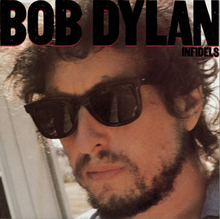 body on the album, every character. Maybe it’s all about infidels.”
 is no photographer mentioned on the cover, but Rod MacBeath suspects it is Sara Dylan who pressed the button. She also took the photo that adorns the inner cover. There Dylan is pictured, squatting on the Mount Olive, with Jerusalem in the background.
 o Jewish tradition, this transitional ritual should have taken place shortly after the boy’s thirteenth birthday on January 6, 1979, but then Dad was too busy with an intensive three-month Bible study course at the School of Discipleship.