This is one of the five songs not placed on the standard version of the New Basement Tapes album, but is avaialable on the deluxe edition, and has music by Taylor Goldsmith.
It’s just under three minutes of sweetness, singled out by the pounding beat and a twist in the tail in the lyrics.
Now, concerning these lyrics, my first stumble came with Mack girls – it appears that “Mack” is a moderately popular girls’ name in the USA – I’ve not come across it in England, although of course I only know ladies of my generation – and sometimes their children, so maybe it has been introduced this side of the Atlantic more recently.
The urban dictionary doesn’t help me too much either – I am told a “mack” can be a person who is smooth, slick etc – although the dictionary seems to imply a “mack” is male. I think I need help on that one, but I am going to guess the Mack Girls, are women who draw a man into their lives for their own benefit, rather than out of love and affection.
The theme is not unknown in Dylan – that he (that is to say the person represented as the signer of the song) becomes influenced by others, and instead of following his own instincts goes astray.
But of course this is not the Dylan we know most of the time where his strength is his independence. Yes he does get pulled away from his true way by the hungry women who really make a mess out of you, but most of the time he is more than able to fight his own way and tell others to go and crawl out their window.
As for why the singer wants then, having made all the effort to get there, he immediately wants to leave St Louis and go to Wichita I have no idea – again my Englishness counts against me. But I did look it up, and the journey is around 450 miles and takes about seven hours by car.
So why Wichita? Of course I have no idea – I only know about the lineman (always loved that song – one of my all time favourites for the melody and chordal accompaniment alone) – but I did a bit more digging and am told that Wichita “is the birthplace of Pizza Hut and White Castle fast-food chains.” Also the “first electric guitar was played at the Shadowland Ballroom in Wichita by Wichitan Gage Brewer in 1932.” If that is right, maybe that’s the key.
But actually I guess this was a little ditty that Bob knocked out when feeling a bit low – and there’s the little twist (or perhaps a joke) at the end – he spends all the song wanting to go to St Louis, and immediately he has got there he’s going to get married and then leave.
I think you really do have to know the cities, or maybe the mythology and feel of the cities, really to understand what is going on – unless really there is nothing here at all.
If I ever get back to St. Louis again There’s gonna be some changes made I’m gonna find old Alice and right away where I left off It’s gonna be just as if I’d stayed
That old organ grinder’s gonna wind his box And the knife sharpener’s gonna sing When I get back to St. Louis again I’m gonna buy that diamond ring
Diamond ring Diamond ring Shine like gold Behold that diamond ring
If I ever get back to St. Louis again Everybody’s gonna smile One of the Mack girls dragged me up to Washington I got stuck there for a while
She gave me more misery than a man can hold And I took her bad advice Now I don’t aim to bother anyone I have paid that awful price
Diamond ring Diamond ring Shine like gold Behold that diamond ring
If ever I get back to St. Louis again That diamond ring is gonna shine That old burlesque dancer is gonna bum around And everything’s gonna be fine
I’m gonna settle up my accounts with lead And leave the rest up to the law Then I’m gonna marry the one I love And head out for Wichita
Diamond ring Diamond ring Shine like gold Behold that diamond ring
Here’s the recording.
What else is on the site
You’ll find an index to our latest posts arranged by themes and subjects on the home page. You can also see details of our main sections on this site at the top of this page under the picture.
The index to the 500+ Dylan compositions reviewed is now on a new page of its own. You will find it here. It contains reviews of every Dylan composition that we can find a recording of – if you know of anything we have missed please do write in.
We also have a discussion group “Untold Dylan” on Facebook. Just type the phrase “Untold Dylan” in, on your Facebook page or follow this link
And please do note The Bob Dylan Project, which lists every Dylan song in alphabetical order, and has links to licensed recordings and performances by Dylan and by other artists, is starting to link back to our reviews.
The successful and influential comics series Preacher (66 parts, 1995-2000) is the frenzied, fiercely fanning, bewildering and highly original story of the priest Jesse Custer. Custer has gained control over a half divine, half demonic force, “Genesis” and takes off in search of God, who is missing.
This storyline, and the richness of colourful antagonists and imaginative sidelines, attract many film companies. Miramax, HBO, Columbia Pictures … rights are bought, scripts written and actors selected, but in the end nobody dares to do a filming. Religiously still too controversial, and sometimes perhaps a little too dark. Finally, in May 2016, a screen version is released: a ten-part television series on AMC. It is a success, the second, thirteen-episodes season follows in June 2017 and in June 2018 season 3.
The eighth episode of the second season ends, true to the spirit, bizarre. Custers traveling companion and comrade Cassidy, a movingly faithful, cheerful and immortal vampire of Irish descent, approaches the bed where his elderly son lies dying. Cassidy stares at the old man, at his son, with an unusually serious, intense look and sings with a heavy Irish accent:
Way down in Tipperary where cow plop is thick Where women are young and the lads all come quickThere lived pretty Charlotte, the girl we adoreThe pride of Dear Erin, the Scarlet Haired whoreIt's Charlotte the harlot, the girl we adoreThe pride of Dear ErinThe Scarlet Haired whore
“Charlotte The Harlot” is an ancient scabrous song that is sung in dozens of variants, increasingly foul-mouthed, everywhere in the English-speaking world. Dylan undoubtedly knows the version of the godfather of the Greenwich folk scene, Oscar Brand, on his Bawdy Hootenanny (1955).
Folk musician Brand is not only the organizer of the Newport Folk Festival but also the presenter of the world’s longest running radio show, Oscar Brand’s Folksong Festival. To him we owe Dylan’s radio debut, October 29, 1961, the broadcast in which the young Bob fantasies all sorts of humbug about his carnival days (“I learned it from a farmer in South Dakota and he played the autoharp. His name is Wilbur. Met him outside of Sioux Falls when I was there visiting people and him, and I heard him do it.”) and in which he plays “Sally Gal”.
https://www.youtube.com/watch?v=OBRklqq7A80
Fifty years later, Charlotte the Harlot reaches Dylan’s oeuvre, in the intriguing and often misunderstood song “Soon After Midnight” on the acclaimed album Tempest (2012).
When it is released, the album receives – obviously – considerable attention and without exception positive reviews. In those same critiques, however, “Soon After Midnight” usually gets the short hand of the stick. The Guardian and Rolling Stone do not even mention the song at all, The New Yorker, Billboard and the New York Times think it is a love song and sense heartbreaks in it, and only Uncut and The Sun suspect malicious revenge and a sinister turnaround.
The opening line puts the listeners on the wrong track, that much is true. ‘I’m searching for phrases to sing your praises’ is sweet, wistful and cute. Dylan borrows it from the doo-wop and crooner idiom of the 50s. Sinatra’s “Too Marvelous For Words”, Sarah Vaughan’s “Words Can’t Decribe” and “I Don’t Know How To Say I Love You” by The Superlatives, for example. Just as Dylan takes something from somewhere in every verse. “Money Honey” is made famous by The Drifters. Dylan runs the song in his radio program Theme Time Radio Hour, and he also plays it on stage a few times himself.
“Moon Got In My Eyes” is recorded by both Bing Crosby and Sinatra, “On The Killing Floors” is an evergreen that Dylan probably knows since Howlin’ Wolf (1964), and otherwise he heard Clapton’s performance, or Jimi Hendrix’, or the brilliant version from his musical partner Mike Bloomfield (with Electric Flag, 1968). In any case, the master has enjoyed the film O Brother Where Art Thou by the Coen Brothers. Certainly the soundtrack, which features “Hard Time Killing Floor Blues” by Chris Thomas King: “I was delighted with this album and even watched the movie,” Dylan says at a press conference in Rome, July 2001.
By the time the killing floors occur, in the third verse, the attentive listener begins to realize that this is not just a love song, that this is not some desolate whiny bigot, outside pining lonely between dusk and dawn, but that something else is going on. In his later work, Dylan the poet occasionally steps into the shoes of a dark, or at least an unpleasant, unreliable narrator. “Mississippi”, in which song he also searches for words to ‘do you justice in reason or rhyme’, “Floater”, “Huck’s Tune”, “This Dream Of You”, just to name a few – all of them songs with dubious storytellers.
This time it gets really ominous. Prior to the date with the current fairy queen, this narrator has left at least three ladies dying in their own blood, ladies who in his eyes are all whores: the money honey, Charlotte the Harlot and the Maria dressed in green (the alleged ex-prostitute Maria Magdalena is usually depicted in green clothing). He does not fear her fury; he has faced stronger walls and he is not in a hurry – it is shortly after midnight, his day is only beginning, and ‘I don’t want nobody but you’.
It is, in short, a real murder ballad. Not a love song, not a song that, as the reviewer of Pitchfork thinks, belongs to “Blood On The Tracks”, because of some bitter, vicious heartbreak, but a song like “Mac The Knife”, or “Where The Wild Roses Grow”, or “Little Sadie”, songs in which the protagonist is a murderous psychopath.
Literary, Dylan’s murder ballad surpasses most of the songs in that category. After all, those are often quite straightforward, unambiguous ballads about bloodthirsty maniacs who tell us without any remorse how and why they slaughter their victims.
Delia was cold and mean, so I tied her down and fed her two bullets (“Delia’s Gone”). My Flora was talking to some other guy, so I messed him up (“Lily Of The West”). “Soon After Midnight” relates to songs like these as a brooding Hitchcock thriller to a bloody western of Peckinpah. Dylan contrasts idyllic, innocent or even heart-warming phrases (the opening lines, ‘my heart is cheerful’, the ladies ‘chirp and chatter’) with ominous, macabre asides (‘the moon in my eyes’, ‘I’ve been down on the killing floors’, ‘they are dying in their own blood’). The upcoming murder remains, however, as in the more subtle thrillers, beyond the reach of the cameras. The contrast is reinforced by the misleading musical decoration; it is sweet, seductive and slightly melancholy, just like Dylan’s delivery.
The lyrics may be lovingly composed out of bits and pieces that the poet Dylan has raked left and right for this haunting, horrifying snapshot of a waiting sex murderer in the dark, for the music he has done less effort. The musician Dylan has copied almost unfiltered “A New Shade Of Blue” from The Bobby Fuller Four. Rhythm, tempo, chord progression, bridge and even arrangement are almost identical, only the main melody differs slightly. Dylan does have a weakness for the Texan who died young (at the age of 23, in 1966), who earned his place in the Pantheon with “I Fought The Law”. In Theme Time Radio Hour he drops by three times, the radio host comments appreciative: “One heavy cat.”
That unconcerned copying may also inhibit the urge to produce a cover. The site nobodysingsdylanlikedylan.com does register some twenty covers, but these are without exception completely uninteresting hobby projects on YouTube by dabbling amateurs or untalented tribute artists.
For now, the only exception is the talented, beguiling Aoife O’Donovan, performing an intimate, lonely “Soon After Midnight” in Massachussettes, March 2017. Even more beautiful is, incidentally, her cooperation with Sarah Janosz and Sara Watkins on “Ring Them Bells”, March 2015. Overshadowed, however, are both alluring covers by a memorable “Farewell Angelina” at the Hollywood Bowl, August 2015 – with Yo Yo Ma (!) on cello.
You’ll find an index to our latest posts arranged by themes and subjects on the home page. You can also see details of our main sections on this site at the top of this page under the picture.
The index to the 500+ Dylan compositions reviewed is now on a new page of its own. You will find it here. It contains reviews of every Dylan composition that we can find a recording of – if you know of anything we have missed please do write in.
We also have a discussion group “Untold Dylan” on Facebook. Just type the phrase “Untold Dylan” in, on your Facebook page or follow this link
And please do note The Bob Dylan Project, which lists every Dylan song in alphabetical order, and has links to licensed recordings and performances by Dylan and by other artists, is starting to link back to our reviews.
Without darkness, there’s no light; without life in the hustle and bustle of crowded, dirty cities, there’s no romantic dreams of a tranquil life with Nature in the countryside. PreRomantic poet William Blake depicts the innocence of youth corrupted by the ‘dark Satanic mills’ of the Industrial Revolution, and burlesques Emanuel Swedenborg’s separation of the spiritual and physical aspects of the human existence; William Wordsworth searches, outside the city, for reconnection with the vital spirit that pervades Nature.
Singer-songwriter Bob Dylan draws upon the translated poems of the French Symbolists:
Situations have ended sad Relationships have all been bad Mine’ve been like Verlaine’s and Rimbaud But there’s no way I can compare All them scenes to this affair (Bob Dylan: You Gonna Make Me Lonesome When You Go)
PreSurrealist poet Arthur Rimbaud is a little boy lost who scatologically buries Wordsworth’s idealism. Rosemary is a flowery symbol of of hope, and a lily, one of death that, like excrement, stinks:
In short, is a Flower, Rosemary
Or Lily, dead or alive, worth
The excrement of one sea-bird?
(Arthur Rimbaud: On The Subject Of Flowers)
The French Symbolist poet comes under the influence of the Gothic personified-filled sentiments of American poet Edgar Allan Poe:
The rosemary nods upon the grave
The lily lolls upon the wave
Wrapping the fog about its breast
(Edgar Allan Poe: The Sleeper)
The above ghostly imagery re-appears as pollution in the poetry of a Modernist:
The yellow fog rubs its back upon the window-panes
The yellow smoke that rubs it’s muzzle on the window-panes
Licks it’s tongue into the corners of the evening
Lingered upon the pools that stand in the drains
(TS Eliot: The Love Song Of J. Alfred Prufrock)
Bob Dylan out-Rimbauds Rimbaud, out-Eliots Eliot – double entendres the following song lyrics:
Now, I’m startin’ to drain My stool’s gonna squeak If I walk too much farther My crane’s gonna squeak (Bob Dylan: Please, Mrs. Henry)
Dylan takes Rimbaud’s flower symbols, and transforms them into characters in a narrative song wherein ‘dye’ links up with ‘die’:
Lily had already taken all the dye out of her hair
She was thinkin’ ’bout her father, who she very rarely saw
Thinkin’ ‘ bout Rosemary, and thinkin’ ’bout the law
But most of all, she was thinking ’bout the Jack of Hearts (Bob Dylan: Lily, Rosemary, And The Jack Of Hearts)
Lily, a symbol of death, is oft employed by Arthur Rimbaud:
It was a breath of wind, that, twisting your hair
Brought strange rumours to your dreaming mind
It was your heart listening to the song of Nature
In the groans of the trees, and the sighs of the nights….
And the poet says that by starlight
You come seeking in the night, the flowers that you picked
And that he has seen on the water, lying in her long veils
White Ophelia floating, like a great lily
(Arthur Rimbaud: Ophelia)
Rimbaud’s angst of a wasted life is not lost on Bob Dylan:
Ophelia, she’s ‘neath my window, for her I feel so afraid On her twenty-second birthday, she’s already an old maid
According to Dylan, akin to Rimbaud, it’s better to settle for reality than dream of a Garden of Eden that exists only in your mind:
All these people that you mention, yes, I know them, they’re quite lame I had to re-arrange their faces, and give them all another name Right now, I can’t read too good, don’t send me no more letters, no Not unless you send them from Desolation Row (Bob Dylan: Desolation Row)
One thing an artist of a certain age and standing might attempt to do is to release an album of re-recorded or reworked versions of their own songs. Looking through my own CD collection I found these ones that I particularly enjoy:
Joni Mitchell – Travelogue
Electric Light Orchestra – Mr Blue Sky
Kate Bush – Director’s Cut
Peter Gabriel – New Blood
Steve Hackett – Genesis Revisited I & II
Paul Simon – In The Blue Light
Van Morrison – Reworking The Catalogue
Brian Wilson – I Wasn’t Made For These Times
Now is this something that Dylan is likely to do himself? Perhaps… however like most things he has been doing it for years already!
Here are a few examples of Dylan covering himself that I have come across over the years. My criteria for inclusion being a) they have been officially released and b) they are not from a live album.
The earliest example that I have come across appears on, that’s right, you guessed it, Bette Midler’s 1976 album Songs For The New Depression. It is a duet with Bob on Buckets Of Rain.
What we have here is a very showbiz-y version with Bob’s vocals prominently featured, and yes for some reason they do decide to sing “Nugget’s Of Rain”. Judging by Bob’s little half laugh towards the end and Bette vamping away “Bobby…Bobby” it sounds like a splendid time was had by all in the studio.
Next up we have an interesting take on The Ballad Of Hollis Brown released on Mike (brother of Pete) Seeger’s 1994 album Third Annual Farewell Reunion.
With Bob in fine voice and Mike’s banjo bringing a certain menace to the track I’d rank this one as pretty good and certainly worth the time of all involved and worthy of a listen.
Moving on, we have Bob’s contribution to the soundtrack of the 1999 TV movie “The 60s”. Here we have a duet with Joan Osborne on Chimes Of Freedom.
Whilst I don’t feel that the pair’s voices work all that well together, Bob’s electric guitar and the addition of the Hammond Organ makes this early 60s classic sound like it comes from the later Highway 61 era.
Released on the Grateful Dead’s splendid Dylan covers roundup album Postcards Of The Hanging In 2002, we have a version of Man Of Peace recorded in 1987. I don’t have my copy of the CD to hand right now but if memory serves me this was recorded during rehearsals for The Dylan And The Dead tour.
A fine performance by all, with some quality soloing mid way through, its right up there with the original album track and is in my opinion better than most of the live album released from the tour.
Now here is something extra special, A Hard Rain’s A- Gonna Fall recorded in Tokyo with a full orchestra backing. I know, I said I wouldn’t include any live tracks, but this one if so different from the original that it makes it impossible to exclude, and it was officially released but only on the Dignity CD single so might be new to a few people.
I can’t really say to much about this version as it blows me away every time I hear it. Truly amazing.
Dylan also went on to re-record several of his classic tracks for the Masked & Anonymous film, but as only 2 of these songs made the soundtrack album I can only include these two: Cold Irons Bound…
and Down In The Flood.
Both excellent versions with the touring band backing Bob wonderfully. Hopefully one day we will see a release of all the tracks he recorded for the movie.
Last up we have Gonna Change My Way Of Thinking recorded with Mavis Staples for the Gotta Serve Somebody album in 2003. An amazing version which betters the original in so many ways for me. Unfortunately it doesn’t exist on YouTube but can be found on Spotify. You really should check this one out if you haven’t heard it already…even if you have, give it another listen now!
I’ll leave you with this version of Most Of The Time recorded around the time of Under The Red Sky album. I believe this was only ever released as a promo single. Listen and enjoy this amazing alternative version of a great track!
What else is on the site
You’ll find an index to our latest posts arranged by themes and subjects on the home page. You can also see details of our main sections on this site at the top of this page under the picture.
The index to the 500+ Dylan compositions reviewed is now on a new page of its own. You will find it here. It contains reviews of every Dylan composition that we can find a recording of – if you know of anything we have missed please do write in.
We also have a discussion group “Untold Dylan” on Facebook. Just type the phrase “Untold Dylan” in, on your Facebook page or follow this link
And please do note The Bob Dylan Project, which lists every Dylan song in alphabetical order, and has links to licensed recordings and performances by Dylan and by other artists, is starting to link back to our reviews.
Quick like a flash is a song written by Bob Dylan in his notebook to which Jim James added music. It is part of the New Basement Tapes collection.
It has been suggested that “Quick Like a Flash” (only found on the deluxe edition) sounds like it is ready to roll as a soundtrack a Tarantino opening credit sequence in the near future. That is possible, but I am not totally convinced.
Quick like a flash, we got to border that bus Go down on the hump and screw it We don’t need your opinions take a look at us When we find something good, we’re true to it
Revenge is sweet when we take a trip or two Put ol’ Peter in the pocket Then pull in or out and paint ’em blue Put a bow tie on ’em, and sock it
Quick like a flash Quick like a flash Quick like a flash
Crossharp’s coming just once that’s all Oh baby, wontcha please come use him Gang up on the punk and a big checker haul Poor little punk, don’t bruise him
Quick like a flash, we got to border that bus Go down on the hump and screw it We don’t need your opinions take a look at us When we find something good, we’re true to itQuick like a flash Quick like a flash Quick like a flashIf I heard this in in other situation I think I wouldn’t even notice the song – just passing on to something else. But there is one thing that pulls me up when I do come to look in detail. It is the lines
We don’t need your opinions take a look at us When we find something good, we’re true to it
I suspect that many a writer, having got to this point would have made the “we” of the song move into
We don’t need your opinions take a look at us When we find something we wanna do, we just do it
And that is how the soundtrack is played out. But such lines would be very un-Dylan and in the line he has written
We don’t need your opinions take a look at us When we find something good, we’re true to it
we get a song that is about having ideals and principles. Except, of course quite a bit of the song is not like this (or at least doesn’t seem to be like this).
For example
Quick like a flash, we got to border that bus Go down on the hump and screw it
On the other hand for a very short set of lyrics there is a lot here that is obscure, such as
Then pull in or out and paint ’em blue Put a bow tie on ’em, and sock it
I suspect the most likely explanation of this song is that Dylan was simply jotting down lines, and would have then edited some out, having decided what the song was going to be about – if anything. What influences us of course is the music that has now been added – music which takes the song in a very particular direction. But to see what Dylan meant we really do need to go back just to the lyrics.
I’ll settle for it being just a sketch, which in other circumstances might have donated lines to other songs. And it sure would have been good to have seen a whole song based around
We don’t need your opinions take a look at us When we find something good, we’re true to it
A criticism of the ever changing world of politicians perhaps.
———-
We’re getting close to the end of the New Basement Tapes reviews; you can find a complete index of the songs and links to the reviews on the “Dylan in the 60s” page – just scroll on down to 1967 and they appear at the top of the huge list of that year.
What else is on the site
You’ll find an index to our latest posts arranged by themes and subjects on the home page. You can also see details of our main sections on this site at the top of this page under the picture.
The index to the 500+ Dylan compositions reviewed is now on a new page of its own. You will find it here. It contains reviews of every Dylan composition that we can find a recording of – if you know of anything we have missed please do write in.
We also have a discussion group “Untold Dylan” on Facebook. Just type the phrase “Untold Dylan” in, on your Facebook page or follow this link
And please do note The Bob Dylan Project, which lists every Dylan song in alphabetical order, and has links to licensed recordings and performances by Dylan and by other artists, is starting to link back to our reviews.
Dylan himself is not too flattered when he is compared to a clown or a joker. In 2015 the manuscript of “American Pie” is auctioned (for $1.2 million), and author Don McLean finally, after 44 years of stubborn silence, elaborates on the meaning of the lyrics. Not in detail, but still…
McLean is interviewed in the catalog, he talks about inspiration, genesis, message and morality of the legendary song, but tacitly leaves the deciphering of cryptic metaphors to the catalog’s author. The King means Elvis, obviously, Helter Skelter refers to the murderous maniac Charles Manson and yes, the jester on the sidelines in a cast is Bob Dylan.
Two years later, interviewer Bill Flanagan confronts the elderly bard:
In Don McLean’s “American Pie“, you’re supposed to be the jester.
Yeah, Don McLean, “American Pie”, what a song that is. A jester? Sure, the jester writes songs like “Masters of War”, “A Hard Rain’s a-Gonna Fall”, “It’s Alright, Ma” – some jester. I have to think he’s talking about somebody else. Ask him.
Flanagan lets the subject rest, but he could also have mentioned Lennon, who in 1980 called his old Beatles song “I’m A Loser” a song from his ‘Dylan period’ because the word ‘clown’ appears in it. If Dylan rejects a comparison with a jester, he has in any case made the use of the words joker, jester and clown salonfähig; according to Lennon, it was rather artsy-farty before Dylan used it in lyrics.
Lennon has a point. In Hard Rain there is already one sobbing in an alley, who later, in “Stuck Inside Of Mobile” turns out to be Shakespeare (with his pointed shoes and bells), in “Mr. Tambourine Man”, “Like A Rolling Stone”, “All Along The Watchtower”, “Queen Jane Approximately”, “Wedding Song”, “Abandoned Love”… clowns, jokers and harlequins indeed are popular supporting actors in Dylan’s songs.
And of course the climax is that enigmatic, wonderful, directionless song from the early 80s, “Jokerman”.
It is an intriguing role, the elusive, romping around court jester. Especially for an elusive, self-proclaimed apolitical song and dance man. The court jester does not belong anywhere, seems to be somewhere at the bottom of the social ladder, but on the other hand he is the only one who, with impunity, can mock, criticize and contradict the highest authorities, up to and including the king. The poet Dylan who, certainly in the early 80s, is quite obsessed with right or wrong, faith or disbelief, all or nothing (as Pope Francis says), a poet who seems to posit with inner conviction: there is no neutral ground… that poet will be fascinated by such a social aberration. But it seems to go wrong if he promotes the outsider, that attention junk on the sidelines, to leading actor.
The poet recognizes this, in the SongTalk interview with Paul Zollo in 1991:
Dylan: That’s a song that got away from me. Lots of songs on that album [Infidels] got away from me. They just did. ST: You mean in the writing? Dylan: Yeah. They hung around too long. They were better before they were tampered with. Of course, it was me tampering with them. [Laughs] Yeah. That could have been a good song. It could’ve been. ST: I think it’s tremendous. Dylan: Oh, you do? It probably didn’t hold up for me because in my mind it had been written and rewritten and written again. One of those kinds of things.
So Dylan himself writes the song off, and that is a bit too radical. The opening, for example, is truly beautiful, and still holds:
Standing on the waters casting your bread While the eyes of the idol with the iron head are glowing Distant ships sailing into the mist
Words that evoke a poetic scene and the promise of an autumnal story. Perhaps about an abandoned lover who is feeding the seagulls on the beach, it is foggy, the lighthouse is burning, at sea the ships disappear out of sight. Word choice provides the misty, ambiguous Dylanesque connotation; Jesus stood on the water and brake the bread, the poet paraphrases Ecclesiastes 11:1 (‘cast thy bread upon the waters’), the lighthouse is an ‘idol with an iron head and glowing eyes‘, the disappearing ships suggest that the protagonist has had to bid a definitive farewell.
Likewise, the lines after that are from a Dylan in his usual, unusual form, a sample of the cherry-picking thief of thoughts whom a Nobel Prize will be awarded. Born with a snake in both fists refers to Heracles (not entirely correct, the snakes attack Heracles in his cradle, not at birth) and thus elaborates on that image of Jesus in the opening line, who after all also has a God as father and an earthly woman as a mother.
Born while a hurricane was blowing, oddly enough evokes “Jumping Jack Flash” (‘I was born in a cross-fire hurricane’) – here it is starting to get surprising. And freedom is just around the corner has the same aphoristic power as the other, antique one-liners scattered over Infidels (Samuel Johnson’s They say that patriotism is the last refuge / To which a scoundrel clings from “Sweetheart Like You”, for example) and which we will encounter more in this particular song.
A second eyebrow raising, after Jumping Jack, then is caused by that seemingly completely random inserted antique one-liner in the second verse, fools rush in where angels fear to tread. Originally from Alexander Pope (from the poem An Essay on Criticism, 1711), a writer whose influence is identifiable more than once in Dylan’s oeuvre.
More popular is the quote as a song title – in 1940 Johnny Mercer writes “Fools Rush In (Where Angels Fear To Tread)” and Dylan is undoubtedly familiar with the versions by Ricky Nelson (who scored a big hit in 1963), by Elvis and of course Sinatra’s hit single from 1940. In between, artists like Tony Martin, Glenn Miller, Etta James and Brook Benton also hit the charts with their versions, so it is most likely that the daring fools and the fearful angels crept under his skin through all that airplay.
It is an elegant, somewhat old-fashioned but beautifully packaged aphorism, no doubt about it, but any correlation with the rest of this verse, or with the lyrics at all, is hard to find. And with that, Dylan’s own observation, that’s a song that got away from me, is illustrated.
The lyrics are full of granite verse lines (‘the rifleman’s stalking the sick and the lame‘), poetic pearls (‘So swiftly the sun sets in the sky, / You rise up and say goodbye to no one‘) and dark, apocalyptic, Hard Rain-like imagery (‘False-hearted judges dying in the webs that they spin, / Only a matter of time ’til night comes steppin’ in‘), but unlike in Dylan’s Great Masterpieces it does not come together, there is no coherence.
Songs like “Hard Rain,” or a “Shelter From The Storm”, or a “Things Have Changed”, to name just three random examples, also consist of an accumulation of seemingly unrelated images, one-liners and aphorisms, but from that a comprehensive picture rises, which has a coherence that keeps the listener captive.
Inadvertently, this lack of direction is illustrated by the many, many attempts of interpretation, discussions and polemics among both the fans and the professionals: no common thread is detectable.
The mere mention of ‘Sodom and Gomorrah‘, for example, leads to derailing discussions about whether the poet can be accused of homophobia. The multitude of biblical references is a godsend to the stubborn faction Christian Dylanologists who pertinently want to prove in every verse that Dylan is a God-sent evangelist, that Dylan the Poet is actually Apostle Robertus, an edifying manipulator of crowds.
And of course the title ‘Jokerman’ also opens floodgates. The desperate exegetes argue that “Jokerman” is a work closed within itself; the title then reveals that the entire lyric is a prank from that joker, who fools us by suggesting that a completely meaningless text has a deeper meaning. Others who also see the key in the nature of the fool produce diluted interpretations of that view. The joker represents Man, who can be both a saint and a sinner, just like the joker in the card game can take on any colour. Or Dylan paints a self-portrait: after all, he too is a manipulator of crowds, takes on many forms (‘shedding off one more layer of skin’) and believes in the laws of Leviticus and Deuteronomy.
Oh well. It is indeed a song that slips through the fingers. The music is beautiful enough – the live debut of the song, on television in David Letterman’s show with remarkable accompaniment by members of the unknown Latino punk band The Plugz, the outtakes of Infidels or the final album version; all equally compelling.
Still, there are hardly any covers. Apparently the colleagues do not get a grip on it either. The contribution of the obscure Built To Spill from Idaho to the sympathetic tribute project Bob Dylan In The 80s: Volume One (2014) is based on that Letterman version and is very nice.
Curious is the ‘cover’ by an Indian club of musicians, Divana from Rajasthan, on the equally curious project From Another World: A Tribute To Bob Dylan (2013). On that album, world musicians from different corners of the planet (Cuba, Egypt, Romania, Iraq) play Dylan’s oeuvre on traditional instruments, with at least intriguing results. The Dylan songs are usually unrecognizable, sometimes hilarious (“I Want You” by the Burma Orchestra Saing Waing from Myanmar, for example), but still, yes … intriguing is the best description.
The only really pleasant, recognizable and above all successful cover is from an old friend: Eliza Gilkyson on her partly in the Netherlands, partly in the US recorded live album Your Town Tonight (2017). Gilkyson turns it into a pleasant swinging country ballad, and surprisingly, that fits the song perfectly.
The visions of singer/singwriter Bob Dylan are best described as Gnostic. Tangled as he is in an enclosed physical space of darkness, Dylan seeks to escape by means of his works of art to the light of a spiritual eternity, to soar on the wings of his one true love, and render some meaning, through his conscious and subconscious mind, to a Universe that has none; to go where no popular artist has gone before:
My love, she speaks like silence Without ideals or violence She doesn’t have to say she’s faithful Yet she’s true like ice, like fire People carry roses And make promises by the hour My love, she laughs like the flowers Valentines can’t buy her (Bob Dylan: Love Minus Zero)
Apparently, God’s an Existentialist, and Bob Dylan and Leonard Cohen are on His side:
Now, Suzanne takes your hand
And she leads you to the river
She’s wearing rags and feathers
From Salvation Army counters
And the sun pours down like honey
On our lady of the harbour
She shows you where to look
Among the garbage and the flowers
There are heroes in the seaweed
There are children in the morning
They are leaning out for love
And they will lean that way forever
While Suzanne holds her mirror
(Leonardo Cohen: Suzanne)
Many of Dylan’s double-edged song lyrics show existence on earth to be absurd; it’s a dark place, worthy of light-hearted, and dark-hearted humour – filled with flowers, garbage, and puns:
I took out my little penknife And showed it to this rake He looked at me as if to say You’re making a mistake (Bob Dylan et al: Hidee Hidee Ho)
Bob Dylan, big hearted though he may be, doesn’t overlook the fact that the world is one of violence and unfaithfulness, of knives and roses; he cuts you up with his pen, and then he stabs you with a big Jim Bowie knife:
The next day was hangin’ day The sky was overcast and black Big Jim lay covered up Killed by a penknife in the back And Rosemary on the gallows She didn’t even blink The hangin’ judge was sober He hadn’t had a drink The only person missin’ on the scene Was the Jack Of Hearts (Bob Dylan: Lily, Rosemary, And The Jack Of Hearts)
Other times, it’s Merry Laughter who gets you in the guts:
I said, “Tell me what I want” She say, “You probably want hard-boiled eggs” I said, “That’s right, bring me some” She says, “We ain’t got any, you picked the wrong time to come” (Bob Dylan: Highlands)
And if you like variety:
Well, I asked for something to eat I’m hungry as a hog So I get brown rice, seaweed And a dirty hot dog (Bob Dylan: On The Road Again)
But in all seriousness – don’t call me Shirley, and don’t shoot the piano player:
You’ll find an index to our latest posts arranged by themes and subjects on the home page. You can also see details of our main sections on this site at the top of this page under the picture.
The index to the 500+ Dylan compositions reviewed is now on a new page of its own. You will find it here. It contains reviews of every Dylan composition that we can find a recording of – if you know of anything we have missed please do write in.
We also have a discussion group “Untold Dylan” on Facebook. Just type the phrase “Untold Dylan” in, on your Facebook page or follow this link
And please do note The Bob Dylan Project, which lists every Dylan song in alphabetical order, and has links to licensed recordings and performances by Dylan and by other artists, is starting to link back to our reviews.
This is, according to the record kept by my computer, article number 1000 on Untold Dylan. The very first article a review of Mississippi – one of the all time great Dylan compositions in my opinion.
Article number 1000 however doesn’t have the same pazzazz in its lyrical creation. There is no “Every step of the way, you walk the line”. No quartet of lines that just stick forever in the mind like
Got nothing for you, I had nothing before
Don’t even have anything for myself anymore
Sky full of fire, pain pourin’ down
Nothing you can sell me, I’ll see you around
No, what we have here are, well, lines that simply don’t tell me anything much. And let me emphasis at once that this is just my view – I’ll be delighted to get a deeper vision of this song if you can show me the way in.
Take the opening lines for example
There are many kinds of fish that swim in the sea There’s others that swim in the dark And of those troupers and trouts and dolphins and whales The one you must watch is the shark
The reality is that Taylor Goldsmith doesn’t really have too much to work with here. (He also worked on “Kansas City,” “Liberty Street,” “When I Get My Hands on You,” “Florida Key,” and “Diamond Ring,” and performed on bass, guitar, mellotron, organ, and piano). But here there is nothing much – so full marks for having a go.
Here are the full lyrics – and if you don’t know the result of the music you might like to have a read through first to think what you might have done with this…
There are many kinds of fish that swim in the sea
There’s others that swim in the dark
And of those troupers and trouts and dolphins and whales
The one you must watch is the shark
Card shark (yes, m’am)
Get ‘m in the nose
That ol’ card shark
Now I sat me down to have some fun
I jumped in the tank for a spell
I boogalooed in the bunkhouse and saw some bandits on the run
I went down to get water from the well
Card shark (yes, m’am)
Get ‘m in the nose
That ol’ card shark
Now set ‘m up, Samba
Sit on it awhile
Toss in the towel and have a kick
Stick it in the rear and roar for a bit
And waddle down the road like a brick
Card shark (yes, m’am)
Get ‘m in the nose
That ol’ card shark
I have to say that faced with such lyrics it is hard to imagine what anyone could do with them to create a piece worthy of being on an album. Indeed one wonders if Bob actually looked at the notebook before giving permission for the band to set to work.
I mean would you want to be known for those lyrics?
So there you have it.
I am not too sure if anyone else has attempted to do a review of the song – but if so, maybe they could make more of it than I can. Anyway, there it is, article number 1000. Card Shark.
If you have been, thank you for reading. The full list of the New Basement Tape songs with links to the reviews appears in the 1967 section of Dylan in the 60s.
What else is on the site
You’ll find an index to our latest posts arranged by themes and subjects on the home page. You can also see details of our main sections on this site at the top of this page under the picture.
The index to the 500+ Dylan compositions reviewed is now on a new page of its own. You will find it here. It contains reviews of every Dylan composition that we can find a recording of – if you know of anything we have missed please do write in.
We also have a discussion group “Untold Dylan” on Facebook. Just type the phrase “Untold Dylan” in, on your Facebook page or follow this link
And please do note The Bob Dylan Project, which lists every Dylan song in alphabetical order, and has links to licensed recordings and performances by Dylan and by other artists, is starting to link back to our reviews.
We owe the thin, wild, mercury sound to a flash of inspiration from producer Bob Johnston. After exhausting, unsatisfactory and mostly unsuccesful recording sessions at the Columbia studios in New York, Johnston proposes to move to the CBS studios in Nashville and to return to the recordings over there, but this time with seasoned session musicians from the country world. An unorthodox idea, to put it mildly.
The super cool New York hipcat Dylan making music with friendly, stetson wearing porch crackers in lumberjack shirts? Manager Albert Grossman foresees an image catastrophe and sends for the producer: “If you ever mention Nashville to Dylan again, you’re gone.”
But Dylan is up for it, and on Valentine’s Day 1966 the sessions begin. With on day one, after “Fourth Time Around”, “Visions Of Johanna”, the song that has been keeping him busy for months – but for which he can not find the je-ne-sais-quoi.
On The Cutting Edge the process of creating becomes almost tangible. Disc 9 and 10 contain the recordings from New York, from which we already have heard take 8 (the one from No Direction Home), and the difference is, indeed, enormous. In New York the band remains sharp, edgy, hard-rocking, but also a bit nagging, whining.
The exceptional class of the song is apparent from the start, from the very first rehearsal, and from take 4 the performance is already much more than acceptable – in terms of drive and dynamics clearly still within the scope of Highway 61 Revisited, with the addition of a Stones-like energy. Most of all in the rhythm section, with a distinctive, exciting, rolling bass part by Rick Danko and poisonous, gritty slashing by drummer Bobby Gregg. The vicious stabs from Robbie Robertson’s guitar also seem suspiciously similar to what Brian Jones sometimes displays with The Stones. Wonderful enough, and on this path a rock classic like a “Gimme Some Lovin'” is emerging – only a bit more poetic, obviously.
But it is not what Dylan hears in his head. Irritated, he breaks off take 6. “No! That’s not the sound, that’s not it.” He strikes another chord, looking for words to make clear what he wants to achieve. “It’s not hard rock. The only thing in it that’s hard is Robbie.”
The band starts to play again, but now Dylan suddenly notices at least one weak spot: the bass. He wants to get rid of that driving, hectic avalanche: “In stead of bammbammbamm just baaahm.”
Danko bammbamms again.
“No, no: baaahm!”
Danko goes baaahm one time, Dylan is satisfied, so here we go again. And Danko just plays the same old thing over again, only a bit softer. The irritation in Dylan’s voice is audible.
From the eighth take, the harshness slowly dwindles. The harpsichord is a bit more pronounced, Robertson refrains, but strangely enough, Dylan sings now more rushed. At take 13 the song is almost completely relying on the keys; the harpsichord is now the turbine, Al Kooper on the organ sets the lyrical accents. The drummer is domesticated by now, but Rick Danko will not be curtailed. Up until the last attempt in New York, the fourteenth take, the bass continues to hit more than two notes per beat.
Dylan gives up.
Three months later, journalist Shelton accompanies Dylan in a two-engine Lockheed Lodestar, a private plane. The recordings for Blonde On Blonde have been successfully completed in Nashville. Looking back at the virtually fruitless sessions in New York, Dylan analyzes: “Oh, I was really down. I mean, in ten recording sessions, man, we didn’t get one song … It was the band. But you see, I didn’t know that. I didn’t want to think that.“
But it is true, and Bob Johnston understood that perfectly – after the meager result of those ten sessions, the despondent Dylan is open to any suggestion, even to go to that studio in the outback where those hillbillies record their songs about adulterous tramps.
Right from the start in Nashville, the dreamy, mercury-like beauty descends. Robertson’s electric guitar has retracted its nails, Koopers organ now has a thin, vibrating sound and above all: Joe South’s bass, the beating heart of this Johanna, shakes loose the subcutaneous dramatic power of the song.
A false start, an abortive attempt, another false start and then the first complete take is immediately the final take (the first one where Dylan plays his harmonica intro). Dylan’s relief in the last bars is unmistakable.
The poetic power of the lyrics is undisputed. But on what Dylan expresses, we still do not agree, after more than half a century. Of course, the richness of the full-bodied text cordially invites to industrious work by ambitious Dylan interpreters. Look, Greil Marcus says, the heating pipes of the Chelsea Hotel still cough today. And there a revision of the Mona Lisa has really been made; ‘The one with the moustache‘ is from Dadaist Marcel Duchamp. Johanna is the Anglo-Saxon translation for the Hebrew word for hell, Gehenna. And the jewels and binoculars on the donkey have almost reached a proverbial status by now – but we will never have a clue on what exactly that proverb expresses.
Biographical interpretation remains the most popular. The discussion focuses on the questions about who Louise is, and who Johanna could be. Joan Baez and Sara Lownds? Edie Sedgwick and Suze Rotolo? In any case, the poet sketches a contrast between a sensuous, present Louise and an unattainable, idealized Johanna, and lards the sketch with dream images, beautiful rhyme play and impressionistic atmospheres.
In the genesis weeks, November ’65, the working title of the song is “Seems Like A Freeze-Out”. This confirms the idea that Dylan wants to paint an impression here – a sketchy representation that freezes a fleeting moment from a hectic life. Completely in line with what he promises a year before this in the liner notes of Bringing It All Back Home:
“I am about t sketch you a picture of what goes on around here sometimes. tho I don’t understand too well myself what’s really happening”
“It’s so visual,” the maestro adds (in the booklet with Biograph, 1985).
Above all, however, it is true lyricism; the poet expresses emotions. Influence of the admired poète maudit Rimbaud is demonstrable; the disorientation of the narrator, the chaos and his loneliness, his melancholy insight that he loses something he never had. Similar, for instance, to Le bateau ivre, that melancholy, lonely, chaotic masterpiece of the French symbolist:
Si je désire une eau d'Europe, c'est la flacheNoire et froide où vers le crépuscule embauméUn enfant accroupi plein de tristesses, lâcheUn bateau frêle comme un papillon de mai.
(If I want one pool in Europe, it’s the coldBlack pond where into the scented nightA child squatting filled with sadness launchesA boat as frail as a May butterfly.)
And, like Rimbaud, Visions can not be interpreted, but it does bear the scent of a narrative – the lyrics suggest that something interesting, something intimate is being told here. Dylan the Poet is here at his best. He sometimes misfires with lyrics that seem to have been written with his Dylan-O-Matic on the écriture automatique-pilot (“I Wanna Be Your Lover”, to name just one example) – admittedly atmospheric, visual, but contentless sequences of unfathomable associations, with extremes into tiring nebula. But Visions balances between narrative lyricism and surrealistic word play, balancing on the edge of clear, lucid balladry and hermetic, closed poetry… which contributes to the nocturnal alienation the work manages to grasp, those wee small hours of Sinatra.
In short, “Visions Of Johanna” is a fascinating masterpiece, the Renoir in Dylan’s catalog, the favourite song of fans and connoisseurs like biographer Clinton Heylin and the English court poet, Poet Laureate Andrew Motion.
Remarkably many colleagues dare to risk an interpretation of Dylan’s tour de force. Robyn Hitchcock claims that Johanna made him want to become a songwriter, and he is certainly not the only one who puts the song on a pedestal – though his airy, soft version really is not his most successful tribute. Grateful Dead’s Jerry Garcia approaches the song each performance as a relic and sometimes loses himself in trance-like sessions that can last more than fifteen minutes, Marianne Faithfull emerges out of the gutter in 1971 and leaves heroin and Mick Jagger behind to record a creaking, but moving “Visions Of Johanna”.
The most successful cover, arguably, is from Chris Smither, on his album Leave The Light On (2006). Smither sings a little sloppy, which works rather poetic, plays a languid, smooth guitar part underneath it, and while gently rippling onwards, producer David Goodrich adds more guitars, mandolin, accordion to the hypnotic waltz, until the melancholy drips out of the loudspeaker boxes. Far from thin and wild and mercury, granted, but sure as Gehenna quite Rimbaudesque.
Singer/songwriter Bob Dylan confirmed yesterday that next year’s
Never-Ending Tour will include concerts on a number of the planets that make up our solar sysem.
Bob comments in an interview about his planned interplanetary mission:
Don’t know what I’d do without it Without this love that we call ours Beyond here lies nothin’ Nothin’ but the moon and stars
Our intrepid detectives at the ‘Untold Dylan’ offices in New York City have got their hands on the setlists, each designed especially for the planet visited. Every list has a song that pays tribute to the planet they land on. Dylan and His Band will perform the song right after their announcer says, “And now for all you Martians (or Venusians, etc.) out there in the audience, here’s Earth’s recording artist Bob Dylan!”
On Mercury, the planet which in Classical Mythology symbolizes the often- shot-at Messenger, the song will be:
With your mercury mouth in the missionary times And your eyes like smoke and your prayers like rhymes And your silver cross, and your voice like chimes Oh, who do they think could bury you? (Sad-Eyed Lady Of The Lowlands)
The inhabitants of the planet Mercury have ringing voics, and, especially the females, are known for their smoke-filled eyes.
The planet Venus is a symbol for Sex where Dylan will sing:
Got to hurry back to my hotel room Where I got me a date with Botticelli’s niece She promised to be right there with me When I paint my masterpiece (When I Paint My Masterpiece)
Venus is famous for its warm hotels, many of which house brothels. Sandro Botticelli created the famous painting ‘Birth Of Venus’.
The red planet Mars be a symbol of War; the opening song will be:
The cavalries charged The Indians fell The cavalries charged The Indians died Oh, the country was young With God on its side (With God On Our Side)
The ‘Red Indians’ on the planet Mars were completely wiped out, but the Martians showed their deep remorse by naming a chocolate bar after them.
The planet Jupiter symbolizes the greatest of all the gods -Zeus; Bob Dylan plans to open the concerts there with:
They shaved he head She was torn between Jupiter and Apollo A messenger arrived with a black nightingale I seen her on the stairs and I couldn’t help but follow Follow her down past the fountain where they lifted her veil (Changing Of The Guards)
Apollo’s the god of music. We’ve learned that Bob’s had a vision that a messenger from Mercury might show up, and tip off Jupiter’s King to have security guards keep an eye on the Queen after Dylan finishes his performace.
The mission to the planet Saturn is cancelled due to slow ticket sales: inhabitants there have no ears. A Dylan critic wonders why that would make any difference.
The concerts on the mission to Neptune, the planet that in Classical Mythology symbolizes the Sea, will start with:
Praise be to Nero’s Neptune The Titanic sails at dawn Everybody’s shouting ‘Which side are you on?’ (Desolation Row)
We have no information whether or not there’ll be performances on Uranus and Pluto, and for that we apologize to our readers.
What else is on the site
You’ll find an index to our latest posts arranged by themes and subjects on the home page. You can also see details of our main sections on this site at the top of this page under the picture.
The index to the 500+ Dylan compositions reviewed is now on a new page of its own. You will find it here. It contains reviews of every Dylan composition that we can find a recording of – if you know of anything we have missed please do write in.
We also have a discussion group “Untold Dylan” on Facebook. Just type the phrase “Untold Dylan” in, on your Facebook page or follow this link
And please do note The Bob Dylan Project, which lists every Dylan song in alphabetical order, and has links to licensed recordings and performances by Dylan and by other artists, is starting to link back to our reviews.
This song from the New Basement Tapes has the music written by Marcus Mumford, who of course also performs it.
In an interview in Mojo he said, “There’s a conversation within the song, so I enjoyed singing as the object and the subject. That’s a style you find through reading people like T.S. Eliot who jump around in conversations all the time, and Dylan does that all the time in songs. It also has a kind of outlaw feel to it, and that was fun to play with.”
Now Mr Mumford knows lots of stuff that I don’t, and before I saw his comment my guess was that one day Dylan suddenly thought of the line “Never fall in love with a stranger” and then started sketching out ideas around that. Had he wanted to finish the song and add the music he would, I suspect, have changed some of the opening lines…. Either to make it make more sense, or to make it more convoluted all the way through.
As it is through the first and second verse we seem to be in a classic lost love song but then after the “if I can’t resist” interlude we get
She knows that our love more than any river flows And I’m done now, all of my intentions are exposed Not hidden in my clothes Or in between my toes
I wanna tombstone pearl handle revolver Don’t wanna meet a pale man with a halo in his hair
And we are in a very different province, quite possibly a different country and a different time. Are we really jumping fromthe 20th century back to the Wild West?
So I get the feeling (and of course this is just me rambling around within the lyrics) that Bob would have either cut this section to keep the song very simple and just about the stranger, or taken this section as the core of the song, maybe kept the opening line but made these surreal themes of the revolver and the halo and substance of the song, and explored them in all the other lines. But that is just my feeling.
As it is we get a mix of lines. And maybe a reader more versed in American meanings can indeed tell me that there is a particular symbolic signifcance in the gun that the singer seeks (I did a bit of looking up but couldn’t exactly place that model revolver with any famous man in the Wild West.)
So for me the lack of connection between the everyday-ness of the opening has to be resolved in the Wild West – the world of “howdee stranger” and the inward looking nature of the small towns portrayed in Westerns.
But that’s the limit of my knowledge of the era, so I really do need help here if sense can be made of the whole song.
Here are the lyrics in full
Never fall in love with a stranger And that, son, they all said to me And never fall in love with a stranger But I can’t help it if she falls in love with me
And never fall in love with a stranger Now, they’ve gone against my command And never fall in love with a stranger The pain is written in my hands
But if I can’t resist Find my way outta thisShe knows that our love more than any river flows And I’m done now, all of my intentions are exposed Not hidden in my clothes Or in between my toes
I wanna tombstone pearl handle revolver Don’t wanna meet a pale man with a halo in his hair Never fall in love with a stranger But sometimes I simply do not care
And if I can’t resist Get my way outta this
She knows that our love more than any river flows And I’m done now, all of my intentions are exposed Not hidden in my clothes Or in between my toes
I done things right, pretty much all of my life I’m not looking for any sympathy I can run all I like away from that stranger But somehow she’ll always follow me
On the other hand if this is, as I suspect, very much an unfinished piece, pushing meaning into it is going to a false lead.
https://www.youtube.com/watch?v=8LDIZlN87fc
Musically though the highlight for me is the A E B chord change with “not hidden in my clothes” etc – that suddenly pulls us up straight and forces one’s attention on the lyrics. If only I could make sense of the lyrics, or if only Bob had finished them off, if my supposition is correct, then it would move from being an enjoyable outing to a moment of considerable significance in Bob’s writing.
Or maybe it is not meant to make any sense at all.
What else is on the site
You’ll find an index to our latest posts arranged by themes and subjects on the home page. You can also see details of our main sections on this site at the top of this page under the picture.
The index to the 500+ Dylan compositions reviewed is now on a new page of its own. You will find it here. It contains reviews of every Dylan composition that we can find a recording of – if you know of anything we have missed please do write in.
We also have a discussion group “Untold Dylan” on Facebook. Just type the phrase “Untold Dylan” in, on your Facebook page or follow this link
And please do note The Bob Dylan Project, which lists every Dylan song in alphabetical order, and has links to licensed recordings and performances by Dylan and by other artists, is starting to link back to our reviews.
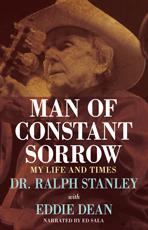
Man Of Constant Sorrow, the autobiography of Ralph Stanley (co-written with Eddie Dean, 2007), is a somewhat two-faced affair. The legendary bluegrass pioneer is a humble, down-to-earth and simple man, but emphasizes that so often that it is getting immodest, self-congratulatory and exuberant. It’s the fans, a grateful elderly Stanley says, who keep him sharp and lively. Fans like Bob Dylan he can not resist adding, a bit boastfully. And he likes to tell that he has recorded “The Lonesome River” together with Dylan. He tells it two times, and both times Stanley mentions: “He said singing with me was the highlight of his career.”
Also twice he recounts the anecdote that Dylan sent him a telegram on the occasion of the celebration in Nashville of his fiftieth anniversary in the music business, in 1996. (The first radio show of The Stanley Brother And The Clinch Mountain Boys was December 26, 1946, WCYB in Bristol, Tennessee). The second time he quotes the contents of that telegram:
“dear dr. ralph.the fields have turned brown.not for you, though.you’ll live forever.best wishes, bob dylan.”
And with the same childish pride he tells us about that time ‘not too long ago‘ that an anonymous stranger with sunglasses and a hoodie visits the memorial at his birthplace, takes photos and at the local grocery store asks for directions to Ralph Stanley’s home. “Don’t you know who that was,” the shelf stacker asks the cashier, “that was Bob Dylan.”
Boastful or not, Ralph Stanley has, of course, every right to be proud of his career and Bob Dylan’s admiration. That admiration is deep and sincere. In Theme Time Radio Hour radio producer Dylan plays five times a song by The Stanley Brothers, the last time (episode 72, More Birds) introduced by a rousing recommendation:
“We played The Stanley Brothers many many times. You can’t go around when you see a Stanley Brothers record. If you’re at a flea market or a yard sale, and you see a record with their name on it, it’s gotta be good.”
In 1997, Dylan plays three songs from the brothers on stage (“I’ll Not Be A Stranger”, “Stone Walls And Steel Bars” and “White Dove”), the cover of “Man Of Constant Sorrow” on his very first album is due to his love for the Stanleys and in the Newsweek interview (1997) he calls songs like “Let Me Rest On A Peaceful Mountain” his ‘religion’. “The songs are my lexicon. I believe the songs.”
A ‘lexicon‘, a dictionary rather is “Highway Of Regret”, the Stanley Brothers song from which he uses the opening and the third line for “Ain’t Talkin'” (Ain’t talkin’, just walkin’ and Heart’s burning, still yearning), and borrows the second line (Down that highway or regret) for one of his biggest hits, for “Make You Feel My Love”.
The metaphor immediately stands out, among the little original, tear-jerker poetry and worn-out images. Ironically, the lovingly stolen highway or regret is still the most dylanesque, is a metaphor like Desolation Row, Heartbreak Hill, river of tears and Rue Morgue Avenue, which in turn are all probably located in the vicinity of Presley’s Lonely Street.
The sweet character of the rest of the lyrics is also noticed by the most successful ambassador of the song, Adele. Her reservations initially concern her unwillingness to include a cover on her debut album (19, 2008). But her manager is a huge Dylan fan and keeps on bugging her, until she finally listens to that song.
“And then I heard it in New York when he played it for me, and it just really touched me. It’s cheesy, but I think it’s just a stunning song, and it really just summed up everything that I’d been trying to write in my songs.”
Because of that kitschiness the song is usually not very popular with the seasoned fans. The most disappointed do not shun the big words, on fan forums like expectingrain: ‘horrible’, ‘indefensibly mediocre’, ‘disgusting sentimentality’. The slightly more loyal fans sputter that the song is or can be ‘quite nice’ (and refer to live recordings on which things are not that bad), a part hides behind the dubious compliment that the song is a guilty pleasure and a faction pleads that “Make You Feel My Love” truly is a very good song.
The professionals are equally unimpressed. Clinton Heylin dismisses the song briefly and concisely; with dedain he states that it indeed belongs “on a Billy Joel album” (Billy Joel is in fact the first who releases the song, earlier than Dylan, on Greatest Hits Volume III, 1997) and that Dylan’s live performances do not reveal any hidden depths either. Greil Marcus is full of praise for Time Out Of Mind, but ignores this song completely, Greg Kot in Rolling Stone thinks that the album’s spell is broken by this ‘spare ballad, undermined by greetingcard lyrics’ and an acid Ian Bell snaps that the song ‘should have been shipped off instantly, gratis, to Billy Joel, Garth Brooks, and the rest of the balladeers who would take the vapid things to their sentimental hearts.’
That seems a bit all too bold and short-sighted. The song is really not that trivial. The music, for example, manages to push enough buttons to let “Make You Feel My Love” slowly but surely enter the canon. Among the up to hundreds of artists who now have the song on the repertoire are certainly not the least; In addition to the aforementioned megastars such as Adele, Billy Joel and Garth Brooks, it has also been picked up by colleagues like Neil Diamond, Bryan Ferry, Joan Osborne, Timothy B. Schmit and Ed Sheeran. Artists about whom one may have an opinion, but in any case musicians who have an understanding of pop music, catchy melodies and appealing compositions.
The indestructible melody Dylan seems to have borrowed largely from a song that apparently buzzes through his head: “You Belong To Me”.
“You Belong To Me” is a beautiful song from 1952, which Dylan probably admires in the performance of Dean Martin – or else the hit version of Jo Stafford, or Gene Vincent’s rock ‘n roll rendition, or the one of The Duprees, or Bing Crosby, or Patsy Cline … it is a song that is often recorded and is often a hit in the years that Dylan’s music taste is formed, so under his skin it is anyhow. He himself records it in 1992 for Good As I Been To You, but ultimately does not select it. Dylan’s recording eventually surfaces in ’94, on the soundtrack of Oliver Stone’s film hit Natural Born Killers.
Likewise, arguments can be cited against the supposed sweetness of the text. Admittedly, on hearing the song for the first time it does come across as the work of a lazy lyricist who dashes off a bunch of clichés. But at a second listening, and especially when dry re-reading the lyrics, something starts to gnaw. The narrator quite pushy, is he not? And is it not strange that he makes no mention whatsoever of his beloved, not a single word, apart from the intriguing fact that she apparently has some serious doubts (‘you haven’t made your mind up yet‘). Furthermore, the narrator merely sums up what he would do to make her ‘feel his love’. And for that matter: that ‘I will make you feel my love‘ does not sound not very tender either – certainly not after such a dubious vow like ‘I could hold you for a million years‘.
By then, one also starts to notice that it is nothing but abysmal misery. The rain hits her face, the whole world is nagging at her, tears, hunger, black and blue, storm and a ‘highway of regret’… and yet this girl still has her reservations about his ‘warm embrace’, his consolation and any of his offers at all. Smothering, to say the least, if not: stalker alert. No, perhaps it’s a good thing that this lady refuses to commit.
The majority of the covers are pretty much identical. Almost everyone chooses the same pace and similar arrangements, and sugar prevails.
Of all those uniform operations, Adele is indeed one of the finest; the English talent really is a great singer and she seems to have an innate, superior music feeling.
Behind that big leading group of superstars marches a huge platoon of artists of the second category. Ane Brun from Norway (who by the way performs one of the most beautiful versions of “She Belongs To Me”) does it beautifully, fragile and lonely at the Nobel banquet in 2016, much more poignant than the posed kitsch parade of another Girl From The North Country, Sissel Kyrkjebø in 2014.
https://www.youtube.com/watch?v=_WGVi72gAdY
A second absolute hit also comes from Scandinavia: the Swedish Pernilla Andersson manufactures a heartbreaking, sparsely arranged “Make You Feel My Love”, driven by a muted guitar, in 2004 on her album Cradlehouse.
The crown is for a man, this time. Josh Kelley from Georgia is a reasonably successful singer-songwriter who wins with his contribution to the soundtrack of the film A Cinderella Story (2004). With some good will one might hear how Jakob Dylan would address this song from his father; Josh’s voice sounds like him and Josh opts for a Wallflowers approach: prominent drums (great drumming arrangement, by the way), sound effects, organ and electric guitars – and no swooning with violins and sensitive piano tinkling or stuff.
Boy, what a most beautiful song of constant sorrow it turns out to be.
You’ll find an index to our latest posts arranged by themes and subjects on the home page. You can also see details of our main sections on this site at the top of this page under the picture.
The index to the 500+ Dylan compositions reviewed is now on a new page of its own. You will find it here. It contains reviews of every Dylan composition that we can find a recording of – if you know of anything we have missed please do write in.
We also have a discussion group “Untold Dylan” on Facebook. Just type the phrase “Untold Dylan” in, on your Facebook page or follow this link
And please do note The Bob Dylan Project, which lists every Dylan song in alphabetical order, and has links to licensed recordings and performances by Dylan and by other artists, is starting to link back to our reviews.
Under the influence of Mark Twain, singer/songwriter Bob Dylan pokes a bit of fun at those who take biblical and mythological tales as actual happenings rather than as figurative explanations of how mankind’s worldly existence came about.
According to the Bible, a settled farmer by the name of Cain, kills his brother Abel, a nomadic wanderer:
All except for Cain and Abel And the Hunchback of Notre Dame Everybody is making love Or else expecting rain (Bob Dylan: Desolation Row)
Eve gives birth to a third son to take the place of her dead one:
And Adam knew his wife again
And she bare a son, and called his name Seth
‘For God’, said she, ‘hath appointed me another seed
Instead of Abel, whom Cain slew’
(Genesis 4:25)
Apparently, Seth is not that much like Cain – he’s practical for sure, but also adventurous, a seeker of knowledge, and, like Abel, a star gazer – he has a Gnostic bent, and considers time to be more than just a seasonal thing as farmer Cain views it.
For Seth, tIme operates in cycles on a larger scale, analogous to little wheels turning inside of a big wheel. Jealous Christians, those dogmatic anyway, come to view time as linear with a beginning and an end. Albert Einstein turns back the clock, and steals Seth’s non-Christian cosmology:
Einstein disguised as Robin Hood With his memories in a trunk Passed this way an hour ago With his friend, a jealous monk (Bob Dylan: Desolation Row)
Seth of the Bible is not to be confused with the Seth (Set) of Egyptian mythology. The Hebrews escape from Egypt, and it’s ‘religion’ wherein jealous Seth kills his brother Osiris who’s married to their sister Isis; in one version of the story, Seth dumps Osiris in a coffin. In the song below, lyrics can be interpreted as the narrator taking on the persona of Seth from Egyptian mythology:
I picked up his body, dragged him inside Threw him down in the hole, and I put back the cover I said a quick prayer, and I felt satisfied Then I rode back to find Isis just to tell her I love her (Bob Dylan et al: Isis)
Fortunately for mankind, Noah (a descendant of biblical Seth, and an ancestor of Abraham), inherits Seth’s practical skills and his adventurous spirit.
God decides to drown, along with everyone else, all of Cain’s descendants in a flood because they go too far in disobeying his directives; Noah is permitted to save himself, his wife, and all the animals on the Earth – including, supposedly, the American bison. Noah needs a really big boat:
Make thee an ark of gopher wood
Rooms shalt thou make in the ark
And shalt pitch it within and without with pitch ….
And of every living thing of all flesh
Two of every sort shalt thou bring into the ark
To keep them alive with thee
They shall be male and female
(Genesis 6: 14,19)
Mark Twain’s ‘Letters From Earth’, as well as a traditional folk song, burlesques the tale of Noah’s ark:
The animals went in one by one
There’s one more river to cross
The elephant chewing a caraway bun
There’s one more river to cross
The animals went in two by two
The crocodile and the kangaroo …
The animals went in three by three
The tall giraffe and the tiny flea …
The animals went in four by four
The hippopotamus stuck in the door
(One More River – traditional)
In the song lyrics below, Bob Dylan alludes to ‘One More River’:
One by one, they followed the sun One by on, until there were none Two by two, to their lovers they flew Two by two, into the foggy dew Three by three, they danced on the sea Four by four, they danced on the shore (Bob Dylan: Two By Two)
The Dionysian eternal recurrence of mankind’s existence through earthy sexuality as expressed above in ‘Two By Two’, and not mankind’s ending up in some gentle afterlife in a sexless Heaven, is a theme Bob Dylan picks up from, among others, Dylan Thomas:
Wild men who caught and sang the sun in flight
And learn, too late, they grieved it on its way
Do not go gentle into that good night
(Dylan Thomas: Do Not Go Gentle Into That Good Night)
What else is on the site
You’ll find an index to our latest posts arranged by themes and subjects on the home page. You can also see details of our main sections on this site at the top of this page under the picture.
The index to the 500+ Dylan compositions reviewed is now on a new page of its own. You will find it here. It contains reviews of every Dylan composition that we can find a recording of – if you know of anything we have missed please do write in.
We also have a discussion group “Untold Dylan” on Facebook. Just type the phrase “Untold Dylan” in, on your Facebook page or follow this link
And please do note The Bob Dylan Project, which lists every Dylan song in alphabetical order, and has links to licensed recordings and performances by Dylan and by other artists, is starting to link back to our reviews.
Aaron Galbraith tipped me off about this song, and has with enormous dedication given us the opportunity to read the lyrics
This is one of the New Basement Tapes songs with of course lyrics by Bob Dylan and music by Elvis Costello. But it is not on the NBT album. Elvis Costello has performed it three times, according to his website, listing Munich and Gateshead (England) as two of the venues.
The reason for the fact that it didn’t make the album is, I think, quite easy to hear – this is an incredibly idiosyncratic musical arrangement song by Costello – which is very much in keeping with the lyrics left by Dylan. And this is why the work of Aaron is so helpful because it is very hard to pick up the lyrics from the recordings – and no one else seems to have tried as yet.
In each recording that there is of the song, Costello changes the lyrics slightly but more to the point between different versions of the song he changes the melody a lot. I’ve chosen one version below which makes the most sense to my ear, but you might prefer to go hunting for the others.
And the lyrics…
SANTA CRUZ I was spending my pay in Monterey And I left my beast back east The weather really wasn’t on my mind But it was hot to say the least Upon every rattled street I stamped feeling so sharp and snide who but a young man driving by said “Hello” to me and asked if I wanted a ride. “Oh, where would you be going to my dear loveless one?” And with whom will you be gone “I was just driving up to Santa Cruz,” she said And then commenced to yawn “Shut your mouth,” a gentleman across the street did squeal just as she turned back to look at him I swerved right in behind the wheel Oh, Santa Cruz please don’t make me choose I’ve painted in reds and whites and blues I’ve got smokeless powder and a splintered board all the way, all the way, all the way down that crooked road to Santa Cruz Now I’m not one to brag upon but when I did hit the gas I tore right out of there so quick her [????] blast everything was in front of me that day but there was nothing that I didn’t pass oh but when we pulled into Santa Cruz she said “Oh boy, you sure got class.”
Oh, Santa Cruz please don’t make me choose I’ve painted in reds and whites and blues I’ve got smokeless powder and a splintered board all the way, all the way, all the way down that crooked road to Santa Cruz
Oh, Santa Cruz please don’t make me choose I’ve painted in reds and whites and blues I’ve got smokeless powder and a splintered board all the way, all the way, all the way down that crooked road to Santa Cruz
In one sense this is akin to the tales of the lost and dissolute that Dylan’s songs around this time sometimes had. It reads to me like an abandoned sketch trying to create another “Tom Thumb’s blues” with, in the early sections, different characters just popping up without any context or relationship with each other.
Aaron has also pointed out to me that Sid Griffin’s “Million Dollar Bash” book mentions a song with the name “Santa Cruz” as a rumoured Basement Tape recording – although nothing turned up on the complete version – and all those songs including even the unnamed song have been reviewed here. (See Dylan songs of the 60s and scroll down to 1967 to see the full list).
Now I must admit I haven’t got a clue how to interpret these lyrics apart from the obvious bits. There seems to me to be no linkage of people, but maybe that really is the point.
And for non-American’s like me who haven’t been there, Santa Cruz is on the edige of Monterey Bay, south of San Fransisco. It is home to people living what I think is now called “altnerative lifestyles”, and to the University of California.
I’m hopeful that readers familiar with the area might be able to help further with understanding the meaning of the lyrics – if there is a meaning to be understood.
What else is on the site
You’ll find an index to our latest posts arranged by themes and subjects on the home page. You can also see details of our main sections on this site at the top of this page under the picture.
The index to the 500+ Dylan compositions reviewed is now on a new page of its own. You will find it here. It contains reviews of every Dylan composition that we can find a recording of – if you know of anything we have missed please do write in.
We also have a discussion group “Untold Dylan” on Facebook. Just type the phrase “Untold Dylan” in, on your Facebook page or follow this link
And please do note The Bob Dylan Project, which lists every Dylan song in alphabetical order, and has links to licensed recordings and performances by Dylan and by other artists, is starting to link back to our reviews.
It is an anecdote that Leonard Cohen likes to tell, apparently, for it can be read in many interviews. It refers to his late magnum opus, the wonderful song “Hallelujah”, the song that surprisingly but gradually climbed up from little-noticed album track (on Various Positions, 1984) to a classic, to one of his most loved and most covered (more than three hundred versions) songs.
That triumphal march begins in 1991, when John Cale wants to do the song for the tribute album I’m Your Fan. Cale notices at a concert that Cohen sings different words than on the record and he asks the Canadian for the correct lyrics. Cohen, who by his own account never could finish the song and would write over eighty couplets, faxes fifteen couplets.
Cale picks out five of them. “It was a long roll of fax paper. And then I chose whichever ones were really me. Some of them were religious, and coming out of my mouth would have been a little difficult to believe. I chose the cheeky ones.” This variant is picked up by Jeff Buckley, who records an unforgettable version for his first and only album, Grace from 1994. Ten years after his death in 1997, it is released as a single, after being included in Rolling Stone’s list of The Greatest Songs Of All Time (in 2004, at 259).
But Dylan deserves the credit for recognizing the greatness of the song much earlier. He sings “Hallelujah” as early as July 8, 1988, in Cohen’s hometown of Montreal and again a few weeks later, in Los Angeles. The men have known and appreciated each other for a long time, but this really flatters Cohen, which is why he brings it up regularly, in various interviews.
“That was a song that took me a long time to write. Dylan and I were having coffee the day after his concert in Paris a few years ago and he was doing that song in concert. And he asked me how long it took to write it. And I told him a couple of years. I lied actually. It was more than a couple of years.
Then I praised a song of his, “I and I”, and asked him how long it had taken and he said, ‘Fifteen minutes.’ [Laughter]”
It is true, there are many testimonies from bystanders who tell that Dylan so phenomenally fast dashes off song lyrics. George Harrison says that Dylan produces the world hit “Handle With Care” in a few minutes, close comrades-in-arms like Al Kooper, Kevin Odegard and Duke Robillard have throughout the decades all completely similar memories of a Dylan who, in between studio turbulence, card-playing musicians and tea ladies, aside at a coffee table quickly adds a verse or writes a complete song lyric, but still: Leonard Cohen inquires after the wrong song.
He should have asked about “Tangled Up In Blue”. That is the song that according to Dylan took him two years to write and ten years to live, and thereby he refers to his years of marriage with Sara Lownds.
“Tangled Up In Blue” opens Blood On The Tracks (1975), the record that, rightly or wrongly, is considered the most beautiful divorce record in pop history, and one of Dylan’s Great Masterpieces. Most of the lyrics on this album are poignant, moving, poetic and sometimes painfully clear, but this highly acclaimed Tangled is far from unambiguous.
This lack of clarity is first of all caused by the confusing use of personal pronouns (the nameless I, She and He) and secondly by the inconsistency in time, which leads to an ardent puzzling, cutting and pasting of interpreters in order to find a linear narrative. Verse sequence 3-4-5-6-1-2-7 then provides, with some inching, squeezing and pinching, a more or less coherent rise and fall of a love story. Other exegetes quote Dylan’s own words:
“I wanted to defy time, so that the story took place in the present and past at the same time. When you look at a painting, you can see any part of it or see all of it together. I wanted that song to be like a painting.”
That does shed some light. “Tangled Up In Blue” poetically tells us that the storms of life leave their marks and that we are becoming a different person along the way. Dylan rightly chooses the collage technique and gives sufficient hints to justify a biographical interpretation. Sara was not only a model but also Playboy bunny (She was workin ‘in a topless place), and indeed still married when they first met. In his early years Dylan sometimes plays in a joint on Montague Street and he lives with a couple in the neighbourhood, he is originally from Minnesota (the Great North Woods) and recalls his Girl From The North Country. For the title explanation, Dylan has also lifted a more prosaic tip of the veil: to the journalist Ron Rosenbaum he reveals that he wrote the song after having immersed himself in the music of Joni Mitchell’s Blue for a weekend.
One could go on like this for a while, but it is not all too relevant for the lyrical power of this song. Dylan the Poet expresses here how this protagonist’s life too is defined by the oldest cliché, how a life can be summarised in the three words Searching For Love – love is all there is, as he sang a few years earlier. You find love, you lose it, and you go on. Keep on keepin’ on, headin’ for another joint.
To make it even more difficult for the Dylan interpreters: there is no song in his catalogue with which Dylan has scraped and tinkered so much. In September 1974 he records the first two versions, which still are largely told in the third person. There are some small textual differences between the two versions, the first version is ultimately chosen for the LP. Dylan then stays with his family in the North over Christmas. He shares the recordings from New York, a few hours before the records will be pressed, and brother David expresses concerns. Dylan agrees and re-records five songs with local musicians. Tangled receives the most radical make-over on all fronts (different keys, different instrumentation, tempo), and, by extension, also lyrically. That version is released on Blood On The Tracks.
In the following years, Dylan continues to rewrite and ultimately declares the 80s version (to be heard on Real Live from 1984) the final. Hardly any line is maintained in this re-issue. That is not the only clue to reveal Dylan’s own fascination; to this day the song belongs to his most performed. On the list of indefatigable Dylan watcher Olof Björner from Sweden it occupies the fourth place for years now, with more than a thousand performances, after “All Along The Watchtower”, “Like A Rolling Stone” and “Highway 61 Revisited”. Björner’s painstaking monk’s work registers all official concert performances since 1958. Statistically, Tangled should actually even rank a bit higher; the first fifteen songs on that list are, except for Tangled, all written between 1963 and 1968, and thus have a lead of up to twelve years. A “Blowin’ In The Wind”, for example, is twelve years older, but since long has been taken over – Dylan has sung “Tangled Up In Blue” over a hundred times more often than that monument.
And it does not stop there, Dylan’s own fascination. In his wonderful book Why Dylan Matters, Harvard professor Richard F. Thomas points out the return of the image of the waitress in 1997, in the overwhelming song “Highlands” on Time Out Of Mind. In the alienating intermezzo halfway through the song, in those seven couplets that create a kind of one-act play for two in an empty restaurant in Boston, we recognize the male protagonist from “Tangled Up In Blue”. He is in the ‘wrong time’, he picked the wrong time to come, says the waitress, who has thrown him back in time through her looks and behavior, back to 1974.
Just like her predecessor, she carefully studies the restaurant guest (She studied the lines on my face vs. She studied me closely), we are back in an empty catering facility and when he draws her portrait at her insistence, he must strangely enough draw it from memory, although she is still standing in front of him. There is absolutely no resemblance, she says a moment later, throwing the drawing back at him. On the contrary, the satisfied artist speaks to her, there most certainly is – after all, he has made a lifelike portrait of that waitress in that topless place. The final verse, when the waitress asks which female authors he has read, illustrates once again that the narrator is in a different time zone. “Erica Jong,” he answers triumphantly. Jong’s controversial Fear Of Flying is from 1973.
Fellow musicians share Dylan’s enthusiasm for the song. There are more than a hundred cover versions in circulation, but here too, more than ever, is the harsh truth: it is not easy to step out of the master’s shadow. Most artists fail to hold the tension, the urgency – if the artist, like Dylan, colours the seven couplets in the same way seven times, then it does require some mastery to avoid tediousness. Only the master craftsman is able to restrict himself, as Goethe taught, and here too only a few remain standing. Jerry Garcia, Dickey Betts and especially a remarkable Ben Sidran (Dylan Different, 2009) are doing very well.
The best cover though, by far, is from the Indigo Girls, on their live album 1200 Curfew (1995). Particularly respectful and lovingly executed, with a beautiful progression in the arrangement, tastefully dosed singing together and a very successful turnaround in rhythm and orchestration in the sixth verse (I lived with them on Montague Street) – they most certainly do not restrict themselves. And right they are.
Leonard Cohen never dared to. In 1985 “Tangled Up In Blue” is number two in his personal top five, as can be learned from the book In His Own Words by the devout Cohen fan Jim Devlin (number one is Ray Charles’ “Take These Chains From My Heart”) and the song is untouchable. Cohen often and heartily professes his awe for Dylan’s masterpiece, but not on stage. In interviews, yes. And majestic, poetic actually, is his commentary on Dylan’s Nobel Prize: It’s like pinning a medal on Mount Everest for being the highest mountain.
Who among us can resist munching on a pun? A sure food it is to shore up lyrics, according to singer/songwriter Bob Dylan. There’s more double-entendre word play in Dylan’s song lyrics than there are grains of sand fluttering on the branches of a beech tree.
Seriously, Dylan’s song lyrics are all messed up, and confused; the songster simply oughta say what he’s talkin’ about. For example, I have no idea what ‘country pie’ in the above song actually means.
Maybe some of our ‘Untold’ readers can help us out.
What else is on the site
You’ll find an index to our latest posts arranged by themes and subjects on the home page. You can also see details of our main sections on this site at the top of this page under the picture.
The index to the 500+ Dylan compositions reviewed is now on a new page of its own. You will find it here. It contains reviews of every Dylan composition that we can find a recording of – if you know of anything we have missed please do write in.
We also have a discussion group “Untold Dylan” on Facebook. Just type the phrase “Untold Dylan” in, on your Facebook page or follow this link
And please do note The Bob Dylan Project, which lists every Dylan song in alphabetical order, and has links to licensed recordings and performances by Dylan and by other artists, is starting to link back to our reviews.
“Lost on the River” is both the subtitle of The New Basement Tapes series, it is also one of the songs that exists in two forms – each utterly different from the other. Number 12 is Elvis Costello’s version, Number 20 is by Rhiannon Giddens and Marcus Mumford, and although both work to the same set of lyrics they are two utterly different songs.
Here are the lyrics
The tears of a woman are hidden within As she moves from one to the next, her spirit grows thin And when she falls in love with one, it’s hard but it’s true But it’s oh so much harder when that man is you
I got lost on the river, but I got found I got lost on the river, but I didn’t drown
One stormy day I was out at sea The waves they rolled and tumbled over me I spied dry land and a tall pale tree I knew that soon that’s where I’d like to be
My sweetheart left me for another one And now I wait for the next rising sunI got lost on the river, but I got found I got lost on the river, but I didn’t drown I got lost on the river, but I didn’t go down I got lost on the river, but I got found
What I found after listening to that track a couple of times was that although I was initially taken by surprise over the way the melody worked (I expected the second musical line to be a repeat of the first – how right they were not to give that) by the time the song finished it felt utterly natural.
Also I find the phrase “I got lost on the river” really poignant and meaningful – the symbolism rings true, and that is one of the things Dylan has always done so well; finding the phrase that has the whole variety of meanings that can take you anywhere.
This is a live version, with a long introductory section – it lasts one minute 40 seconds if you want to bypass it. The instrumentation is particularly interesting because of the use of an electric cello – something I’ve not come across before. I am not too sure about the effect – it seems to me to distract from the beauty of the song, but it certainly has an impact.
When I first came to Elvis Costello’s version (called #12) I surprised having heard the Giddens and Mumford version, but I then found myself playing the Costello version far more than Giddens version.
But they have both evened out – and I’ve ended up very happy indeed that we have both versions to contemplate. One day one, another day the other. Somehow Costello seems to give a message of hope which isn’t in the Giddens version at all – at least as I hear it. Same lyrics of course, different message.
The acoustics on the Costello live version are not so good but it’s still worth hearing.
What else is on the site
You’ll find an index to our latest posts arranged by themes and subjects on the home page. You can also see details of our main sections on this site at the top of this page under the picture.
The index to the 500+ Dylan compositions reviewed is now on a new page of its own. You will find it here. It contains reviews of every Dylan composition that we can find a recording of – if you know of anything we have missed please do write in.
We also have a discussion group “Untold Dylan” on Facebook. Just type the phrase “Untold Dylan” in, on your Facebook page or follow this link
And please do note The Bob Dylan Project, which lists every Dylan song in alphabetical order, and has links to licensed recordings and performances by Dylan and by other artists, is starting to link back to our reviews.
A lot of great things can be said about “Blowin’ In The Wind” and in the Top 10 of the achievements of Dylan’s first classic is the fact that the song finally drove Graham Nash out of The Hollies. In his autobiography Wild Tales (2013), a rather embarrassing and humourless, but fascinating ego document in terms of rock music history, Nash recalls in Chapter 7 the run-up to the break. He gets to know David Crosby and makes a musical click, he falls in love with Joni Mitchell who overwhelms him with her songs, and at home in England he and his Hollies rise with “Jennifer Eccles” to the top of the hit parade. “It embarrassed me to hear that fucking song on the radio. Now we had to promote it as well. I felt like such a whore.”
In those days the boys propose to record a whole album with Dylan covers. Nash hesitates. Dylan is great, that is not the point, and David Crosby did great things with Dylan songs with his Byrds. “But an entire album of Dylan covers? Something about it sounded cheesy.” Eventually he is persuaded by producer Ron Richards, who does believe in it.
“But once we got into the studio, everything went wrong. The guys decided to make Dylan swing. The arrangements whitewashed the songs, giving them a slick, saccharine, Las Vegasy feel. They emasculated them, obliterated their power. We did a version of “Blowin’ in the Wind“ that sounded like a Nelson Riddle affair. It was a hatchet job, just awful.
“That was it, as far as I was concerned. No more Dylan. I put my foot down. I was convinced the Hollies had lost their focus. I thought we weren’t getting anywhere and perhaps we needed some time apart.”
The rest is history; Graham Nash fulfills his last obligations, The Hollies record the horrible Hollies Sing Dylan without him and by then he has left for America, to join David Crosby and Stephen Stills.
At the time of that Hollies cover the song is already the monument that it still is today and always will remain. “Blowin’ In The Wind” is what the Mona Lisa is to Da Vinci, Sonnet 18 (‘Shall I compare thee to a summer’s day?’) to Shakespeare, the Symphony No. 9 in D minor to Beethoven and The Thinker to Rodin – not necessarily the best work of a genius artist, but the best known, the work that immortalises the artist.
The exceptional class of the work is recognized immediately after the conception. The most alert response is from The Chad Mitchell Trio, who records the song first, four months before Dylan. The record company does not dare to release it on single, being rather hesitant about the use of the word death in the song. Dylan’s manager Albert Grossman takes advantage of that blunder.
His artist menagerie also includes the successful trio Peter, Paul And Mary and that neat trio knows what to do with the song. Their serious, stately version is a huge hit and that brings in some money. To Dylan’s astonishment, as Peter Yarrow remembers: “I told Bob he might make $5,000 from the publishing rights. He was almost speechless; it seemed like a fortune.”
The song, the open and repeated tributes and recommendations by Peter, Paul And Mary and, later on, the promotion to protégé of Joan Baez, launch the career of the young bard. A few months later, at the Newport Folk Festival in July ’63, Dylan is already the undisputed crown prince of the folk community.
“Blowin’ In The Wind” is raging around the world by then and has already left a crater in the United States. The black community also picks up the song, probably in part due to the gospel undertones of the melody. It contributes to the unifying, universal power of the song – apart from the non-specific, poetic vagueness of the lyrics, the chosen music also has a race- and culture-transcending quality.
Coincidence, of course. Dylan has not planned this success and can not foresee that the song will grow into the hymn of the civil rights movement, of the Sixties as such, even. But: a calculating cold-blooded strategist could not have figured it out craftier. The melody comes from an old slave song from the nineteenth century, “No More Auction Block”, which Dylan admits easliy, like in the interview with Marc Rowland, in 1978.
In a radio broadcast of National Public Radio, October 2000, comrades from day one, Happy Traum and Bob Cohen (from The New World Singers) recall more details:
One night at Gerde’s Folk City, Dylan heard The New World Singers perform a Civil War era freedom song, one that Bob Cohen still remembers.
“It was very dramatic and a very beautiful song, very expressive. And Dylan heard that and heard other songs we were singing. And some days later, he asked us, he said, `Hey, come downstairs.’ We used to go down to Gerde’s basement, which was—is it all right to say?—full of rats, I don’t know, and other things. And he had his guitar, and it was kind of a thing where when he added a new song, he’d call us downstairs and we’d listen to it. And he had started—and he wrote, (singing) `How many roads must a man walk down before you can call him a man?’ And the germ of that melody of “No More Auction Blocks” certainly was in that.”
Success has many fathers, but Bob Cohen’s story is credible. Not only because Dylan himself, unasked, calls that song as a source, but also because he tells in his autobiography Chronicles that he was ‘pretty close’ with The New World Singers at that time.
The unifying quality is evident from the eagerness with which black artists, and not the leasts, put the song on the repertoire. It motivates one of the greatest names, Sam Cooke, to write that other hymn of the civil rights movement, “A Chance Is Gonna Come”, the song that shortly after Cooke’s premature death in December ’64 will reach mythical significance. In his thorough biography Dream Boogie: The Triumph or Sam Cooke (2005), Peter Guralnick reconstructs the influence of “Blowin’ In The Wind” on Sam Cooke:
“When he first heard that song he was so carried away with the message, and the fact that a white boy had written it, that . . . he was almost ashamed not to have written something like that himself.”
An earlier, equally serious biographer, Daniel Wolff (You Send Me: The Life and Times or Sam Cooke, 1995) agrees:
“The soul singer and former gospel star was further inspired when he heard Peter, Paul and Mary singing Dylan’s song on the radio. The folk trio piqued Cooke’s commercial ambitions. Their recording proved that a tune could address civil rights and go to No. 2 on the pop charts. For Cooke, the result of these racial and artistic challenges was “A Change Is Gonna Come“.”
In Chronicles Dylan admires the power of expression of that song, he regularly honours Sam Cooke in his Theme Time Radio Hour, even produces a respectful reverence (“I Feel A Chance Comin’ On”) on Together Through Life (2009) and sings a beautiful rendition (Apollo Theatre, 2004), but he never discusses his own contribution to Cooke’s masterpiece. Modesty, probably.
The amazement that a white boy can write something like this, Sam Cooke shares with Stevie Wonder. Little Stevie’s version reaches the top 10 of Billboard in ’66, and even the first place on the R&B list. That an anti-war song can score that high is already meritorious, but according to Stevie the real achievement is that a white folk protest song can penetrate deep into the black neighbourhoods of the big city.
However, some objections could be made to both qualifications. For one, the source of the melody from that ‘white folk protest song’ is a black slave song, and second, the lyrics are far too general to stick the label anti-war song on it. The archaic cannonballs that the singer wants to banish forever already have stopped flying long ago (and are more likely metaphorical, anyhow) and the many unnecessary dead from the last lines may just as well refer to victims of unspecified violence, do not explicitly refer to war in any case.
The other fourteen lines protest, in various areas such as cowardice, stubbornness and self-centeredness, at most against human, moral failure in general.
The chosen images are so universal, poetically vague and age-old (from the bible book Ezekiel, for example), that the song allows a multitude of interpretations. In extremis one might defend, ironically enough, that Dylan actually wanted to write a diss, wants to dismiss the left-wing muddleheads with their impractical ‘solutions’ for world peace.
Those so-called solutions of you, the poet argues, are as elusive and airy as the wind. This possible interpretation is not that crazy. Dylan definitely has an intrinsic aversion to warmongering, racial segregation and discrimination, but just as strong a distaste for the humourless, self-glorifying, rigid do-gooders and starry-eyed idealists who claim the front seats of the civil rights movement. A year later he will opt out of all those peace marches, the protest meetings, the charity performances.
The naive, quasi-profound but terribly superficial croaking of all those self-important posers – Dylan really does not want to belong. They have to content themselves with Joan Baez. The famous photograph of Daniel Kramer, Bob Dylan and Joan Baez with Protest Sign, Newark Airport 1964 (it is actually a poster promoting Booth’s House of Lords Gin), makes that visible: where Joan Baez flawlessly controls the pose and air of the Principled Warrior for the Righteous Cause, in Dylan’s eyes boredom, ridicule and cynicism jostle for predominance. It ain’t me, babe, one can almost see him think.
But the writer’s intention ultimately is unimportant. “Blowin’ In The Wind” is an art transcending masterpiece that elevates and connects people, which is quoted by judges, popes and presidents and will still be sung by our great-grandchildren.
Except for those of The Hollies, obviously. They are not allowed.
What else is on the site
You’ll find an index to our latest posts arranged by themes and subjects on the home page. You can also see details of our main sections on this site at the top of this page under the picture.
The index to the 500+ Dylan compositions reviewed is now on a new page of its own. You will find it here. It contains reviews of every Dylan composition that we can find a recording of – if you know of anything we have missed please do write in.
We also have a discussion group “Untold Dylan” on Facebook. Just type the phrase “Untold Dylan” in, on your Facebook page or follow this link
And please do note The Bob Dylan Project, which lists every Dylan song in alphabetical order, and has links to licensed recordings and performances by Dylan and by other artists, is starting to link back to our reviews.
The Bible tells of herders, nomadic they wander in large pastures with flocks of sheep, and also it speaks of settled down, fenced-in garden farmers:
And Abel was a keeper of sheep
But Cain was a tiller of the ground
(Genesis 4: 2)
Cain kills Abel, apparently because he thinks God likes the meat eater best.
Karl Polanyi, in his book ‘The Great Transformation’, asserts the enclosures of the ‘commons’ in England marks the beginning of government imposed capitalism – land, labour, and money become commodites; human social relationships become secondary; the Industrial Revolution follows; the ‘little guy’ gets the short end of the stick.
Frederick Turner, in ‘The Significance Of The Frontier In American History’, points out that immigrants thereto get a second chance at success in the vast open expanses of the ‘Old West’; however, the same fate befalls them. Paradise is lost, then it’s regained, only to fall again – time goes round and round.
Employing irony and black humour while accessing the Bible, mythology, traditional songs and folk tales, history books, and movies, singer/songwriter Bob Dyan deals with the times that are a-changing as they be rocked by circumstance, luck, and fate.
In the Western movie ‘Bend Of The River’, Glyn McLyntock (James Stewart) is a Missouri gunslinging raider who wants to reform. He says, “I ran into these folks in Missouri. Thought I might try my hand at farming or ranching if I can find me some cattle.” More of a wanderer, Cole Emerson (Arthur Kenndy) likes gold. He says to Glyn: “I figure we’re even. Maybe I’m one up on you.”
Sings Dylan:
I didn’t know that you’d be leavin’ Or who you thought you were talkin’ to I figure maybe we’re even Or maybe I’m one up on you (Bob Dylan: Drifting Too Far From Shore)
The song ‘Pirate Jenny’ contains the line, “But you’ll never guess to who you’re talkin’.”
In the Western move ‘Shane’, a gunslinger (Alan Ladd) wants to reform and become a farm hand; he gets some advice from farmer Joe Starrett (Van Heflin): “A homesteader can’t run but a few beef, but he can grow grain, and then has a garden and hogs and milk, he’ll be all right.”
Shane remarks, “I don’t mind leaving, I just like it to be my idea.”
Dylan sings:
You give me somehing to think about, baby Every time I see ya Don’t worry, baby, I don’t mind leaving I just like it to be my idea (Bob Dylan: Never Gonna Be The Same Again)
https://www.youtube.com/watch?v=ZddqQvxeKCw
The song lyrics of Bob Dylan often suggest figuratively that you throw the dice, take your chances, and see how things turn out:
Gonna make a lot of money, gonna go up north I’ll plant and I’ll harvest what the earth brings forth The hammer’s on the table, the pitch fork’s on the shelf For the love of God, you ought to take pity on yourself (Bob Dylan: Thunder On The Mountain)
Matters often turn out badly for Dylan’s persona, caught as he is between visions of Pocahontas and the bright lights of modern Babylon:
I got a house on a hill, I got hogs all out in the mud I got a house on a hill, I got hogs lying out in the mud Got a long-haired woman, she got royal Indian blood …. Well, I’m leaving in the morning just as the dark clouds lift Gonna break in the roof, set fire to the place as a parting gift (Bob Dylan: Summer Days)
With tongue planted firmly in his cheek, Dylan ponders that perhaps Cain makes the right choice when he gets rid of Abel; Cain settles down; as well, small town life is tranquil:
I was in Wauwatosa, the truth I will tell
It’s a milk and cheese and cream
Yes, known it all my days
And I’m goin’ back to my home town
I’m leavin’ right away
(Bob Dylan/Trapper Schoepp: On Wisconsin)
Just maybe – the little house on the prairie, far away from Whore Of Babylon, is the place to be:
Build me a cabin in Utah Marry me a wife, catch rainbow trout Have a bunch of kids who call me ‘Pa’ That must be what it’s all about That must be what it’s all about (Bob Dylan: Sign On The Window)
Footnote: the Bob Dylan/Trapper Schoepp song “On Wisconsin” is not yet reviewed on this site, but will be shortly.
What else is on the site
You’ll find an index to our latest posts arranged by themes and subjects on the home page. You can also see details of our main sections on this site at the top of this page under the picture.
The index to the 500+ Dylan compositions reviewed is now on a new page of its own. You will find it here. It contains reviews of every Dylan composition that we can find a recording of – if you know of anything we have missed please do write in.
We also have a discussion group “Untold Dylan” on Facebook. Just type the phrase “Untold Dylan” in, on your Facebook page or follow this link
And please do note The Bob Dylan Project, which lists every Dylan song in alphabetical order, and has links to licensed recordings and performances by Dylan and by other artists, is starting to link back to our reviews
“You’re willing to pay him a thousand dollars a night just for singing? Why, you can get a phonograph record of ‘Minnie the Moocher’ for 75 cents. And for a buck and a quarter, you can get Minnie.”
That comment from Groucho Marx in Night at the Opera (1935) takes us back to the origins of the two versions of Bob Dylan’s “Hidee Hidee Ho” that appear on the New Basement Tapes.
It’s a song that I feel a certain historic relationship with because my mum used to sing the lyrics starting “Hidee hidee ho” to me as a child (my father played in a dance band and my mum knew all the songs of the 1930s, as they remained popular in the war years and 1950s.
So I knew about Minnie the Moorcher, which is where the phrase comes from. The man best associated with the song is Cab Calloway (who wrote it with Irving Mills) and years and years later in 1980 he could still perform it as this extract from the Blues Brothers film shows…
But even this doesn’t take us back to the origin – because Minnie was based on Willie the Weeper from 1927 performed by Frankie “Half Pint” Jaxon.
That version didn’t get exposure because of its drug references, so it is Minnie not Willie we remember. And it seems Minnie was a real person – or at least that is what was claimed in a 1951 obituary of Minnie Gayton who had the nickname “The Moocher” because of her habit of begging for food from grocers. But more than likely the desperately unfortunate Minnie of real life gained her nickname from the record.
So, anyway, Cab Calloway gave the world the hit “Minnie the Moocher” in 1931 and the line “Hi De Hi De Hi De Ho”. The song was inducted into the Grammy Hall of Fame in 1999. Many versions of the song existed as in performances the singer and the band extended the song and audience interaction.
Here is a very early film version of Calloway singing the song – I do hope you have a moment to watch and listen to this clip.
So popular was Minnie there were lots of other Minnie songs written – I particularly remember that we had a 78rpm record of “Minnie the Moocher’s Wedding Day”
Anyway, that’s where it all starts, and Bob Dylan took the phrase from the song and used it in one of his poems which was then retrieved from the sketchbook that was in turn used to create the New Basement Tapes albums.
In fact it was used twice – each time with almost the same lyrics to give us Hidee Hidee Ho #16 and #11.
Now I have written those in the reverse order from the norm, simply because I think 16 is a much much better version, and if you are only here for a moment, I hope you’ll play that one (if you don’t have the album that is). This version comes from Rhiannon Giddens and Elvis Costello working to Bob Dylan’s words. The other is by Jim James, and I’ll come to that in a moment.
So for #16 we have Rhiannon Giddens – lead vocal, Elvis Costello – acoustic guitar, vocal, Taylor Goldsmith – acoustic guitar, vocal, Jim James – bass, vocal, Marcus Mumford – mandolin, vocal, Jay Bellerose – percussion.
Hidee Hidee Ho making love wherere we go Hidee Hidee Hee making love just you and me
Hidee Hidee Ho making love wherere we go Hidee Hidee Hee making love just you and me
How could she reject me Send me on my way How could she suspect me Of leading her astray
I met her accidentally And I asked to see her home She told me she wouldn’t mind And then commenced to roam
Hidee Hidee Ho (making love wherere we go) Hidee Hidee Hee (making love just you and me)
I took out my little pen knife And showed it at this rake He looked at me as if to say You’re making a mistake
I do not frighten easily Yet no weapon I possess No matter what you thinkin’, son You better second guess
Hidee Hidee Ho (making love wherere we go) Hidee Hidee Hee (making love just you and me)
Hidee Hidee Ho (making love wherere we go) Hidee Hidee Hee (making love just you and me)
Hidee Hidee Ho (making love wherere we go) Hidee Hidee Hee (making love just you and me)
There is an extraordinary plaintive wistfulness in this realisation of the lyrics that seems to capture the essence of the words perfectly. It’s a recording I can play over and over without ever getting tired of the song.
As for #11 this is the version written by Jim James and recorded with himself on lead vocal and mellotron, with Elvis Costello on slide guitar, Rhiannon Giddens on violin and vocal, Taylor Goldsmith on acoustic guitar, Marcus Mumford mandolin, Jay Bellerose drums, Zach Dawes bass, Griffin Goldsmith drums, Bo Koster piano, plus SI Istwa and Jessica Kiley on background vocal.
The lyrics are slightly different – but it is the music that goes in an utterly different direction.
How could she reject me Send me on my way How could she suspect me Of leading her astray
I met her accidentally And I asked to see her home She told me she wouldn’t mind And we commenced to roam
Hidee Hidee Ho (making love wherever we go) Hidee Hidee Hee (making love just you and me) Hidee Hidee Hoo (making love just me and you)
I took out my pen knife And showed it at this rake He looked at me as if to say You’re making a mistake
I do not frighten easily Yet no weapon I possess No matter what you thinkin’, son You better second guess
Hidee Hidee Ho (making love wherever we go) Hidee Hidee Hee (making love just you and me) Hidee Hidee Hoo (making love just me and you)
Hidee Hidee Ho (making love on the highway bump) Hidee Hidee Hee (making love in a pile of rope) Hidee Hidee Hoo (making love on the driveway ramp)
This version relies on the contrast between the gentility of the music (particularly the additional voices in the chorus) and the violence suggested within the lyrics. Somehow it makes me uncomfortable.
Of course that is just my reaction – I am not for a second suggesting that just because I don’t feel at ease with this version it is in anyway a lesser musical representation, it is just my reaction. Perhaps it is so far away from the pure fun of Minnie the Moocher I remember from my earliest years that I can’t quite come to terms with it, whereas there is something in the melody of the #16 version that draws me in.
We also have a live version of #11 – if you have read through my ramblings above you will not be surprised to know this doesn’t draw me in to #11 any further. But it is just my view.
But let me end with something quite different. The music of the 1920s is not my only contact with that era because I also see PG Wodehouse as the greatest of all the British writers of humour – equalled only by Douglas Adams. And PG Wodehouse was of course writing his Bertie Wooster novels.
The first Bertie Wooster story appeared in 1915 and thus the series was well underway by the time Minnie the Moocher appeared. I am not convinced that in any of the original stories (as opposed to TV and film adaptations) Bertie actually does play Minnie the Moocher on the piano but in the brilliant TV series featuring Hugh Laurie and Stephen Fry this scene occurs. If you like British humour, you might enjoy this…
(Or put another way it still has me rolling around and I’ve seen the whole programme half a dozen times.)
I hope you found something of interest in this review. Writing it gave me a lot of pleasure and fun.
What else is on the site
You’ll find an index to our latest posts arranged by themes and subjects on the home page. You can also see details of our main sections on this site at the top of this page under the picture.
The index to the 500+ Dylan compositions reviewed is now on a new page of its own. You will find it here. It contains reviews of every Dylan composition that we can find a recording of – if you know of anything we have missed please do write in.
We also have a discussion group “Untold Dylan” on Facebook. Just type the phrase “Untold Dylan” in, on your Facebook page or follow this link
And please do note The Bob Dylan Project, which lists every Dylan song in alphabetical order, and has links to licensed recordings and performances by Dylan and by other artists, is starting to link back to our reviews