I stumbled across this potential unreleased Dylan track called “Maureen”…and here it’s performed by the Beatles! At the start George says, “here’s one Dylan wrote for Ringo”.
The story goes that is was written in 1968 when George visited Bob and they wrote “I’d have you anytime” and “Nowhere To Go” together. This one is potentially a third offering from those writing sessions. Either Bob wrote it himself, or Bob and George co-wrote it together.
Or a third possibility is that George wrote it himself and was embarrassed to present the song, named after Ringo’s wife, as his own. Of course George did have an affair with Maureen in 1973 (professing his love in front of his own wife and Ringo!), an incident which effectively ended his marriage to Patti and Ringo’s marriage to Maureen.
Ringo did forgive both George and Maureen and remained close friends with them both for the rest of their lives, performing on many of George’s solo albums even after the event. He was also at Maureen’s bedside when she passed away and was with George shortly before he passed also.
The track was performed during the Let It Be album sessions in 1969 with George singing and playing guitar, Paul attempts to sing along at one point and John tries out some guitar. It’s difficult to make out a lot of the lyrics but I can hear
Maureen, oh Maureen
Eyes of green
Everybody’s finger picking
Beer sniffing (??)...
Maybe someone else can decipher some more.
Around the 0.54 seconds mark George says he was showing Bob “Thingymybob” and it turned into this song. Thingymybob was an instrumental that Paul McCartney wrote for a single by The Black Dyke Mill’s Band, released on Apple Records in 1968.
George did introduce a lot of Dylan songs to the others during the “Let It Be” sessions including such rarities like “Please Mrs Henry”, “Get Your Rocks Off” and others as they were warming up to play their own songs. Here’s a video rounding up all the pieces the Beatles attempted.
These are mostly just snippets but some go on a bit longer. It’s really interesting to hear the biggest band in the world warming up for their own sessions playing some Dylan pieces. Pretty cool I thought!
Here’s the timings of the tracks for the video:
January 2 0:00 – I Shall Be Released #1 2:02 – I’ve Got A Feeling / The Mighty Quinn
January 3 3:08 – Please Mrs. Henry 4:43 – Three Cool Cats (ending) / Blowin’ In The Wind 5:32 – All Along The Watchtower
January 6 6:19 – I Want You 10:16 – Maureen 12:40 – Frere Jacques (traditional song) / It Ain’t Me Babe
January 7 13:45 – My Back Pages (part of dialogue) 13:58 – Stuck Inside of Mobile with the Memphis Blues Again 14:51 – I Shall Be Released #2
January 9 17:01 – I Threw It All Away / Mama, You’ve Been on My Mind
January 22 21:20 – Dialogue / I Shall Be Released #3 24:22 – I Shall Be Released #4
January 26 28:19 – Like A Rolling Stone / Twist and Shout (eventually turns into Dig It after the fade out) Note: It isn’t Yoko on this song, it’s Linda McCartney’s daughter, Heather
January 28 31:58 – I’ve Got A Feeling / Rainy Day Women #12 & 35 34:10 – Positively 4th Street
12 years of Untold Dylan
Although no one gets paid for writing, publishing or editing Untold Dylan, it does cost us money to keep the site afloat, safe from hackers, n’er-do-wells etc. We never ask for donations, and we try to survive on the income from our advertisers, so if you enjoy Untold Dylan, and you’ve got an ad blocker, could I beg you to turn it off while here. I’m not asking you to click on ads for the sake of it, but at least allow us to add one more to the number of people who see the full page. Thanks.
As for the writing, Untold Dylan is written by people who want to write for Untold Dylan. We welcome articles, contributions and ideas from all our readers. Although no one gets paid, if you are published here, your work will be read by a fairly large number of people across the world, ranging from fans to academics. If you have an idea, or a finished piece send it as a Word file to Tony@schools.co.uk with a note saying that it is for publication on Untold Dylan.
We also have a very lively discussion group “Untold Dylan” on Facebook with around 8500 active members. Just type the phrase “Untold Dylan” in, on your Facebook page or follow this link And because we don’t do political debates on our Facebook group there is a separate group for debating Bob Dylan’s politics – Icicles Hanging Down
Though I no longer have any cents, here’s my two pennies’ worth for the river that whispers and complains, “I’ve hardly a penny to my name” (Tell Old Bill).
Singer/songwriter/musician Bob Dylan has always had a sense of humour – often black and bleak – that pokes fun at the optimism of the Romantic Transcendentalist poets of yore, like the semi-realist Walt Whitman.
Seems you can take the country boy out of the country, but not the country out of the country boy.
Or maybe you can – as expressed in the rockabilly song lyrics below:
You can take the boy out of the country
But you'll never take the country from me
I keep my feet in the sand
And give me wide open land
That's where I need to be
(Carl Perkins: You Can Take The Boy Out Of The Country)
Getting the little doggie along to the fast-moving city just might not be such a bad idea:
Oh baby, I'm sitting here wondering
Will a matchbox hold my clothes
I ain't got no matches
I got a long way to go
(Carl Perkins: Matchbox)
Below a Dylan version thereof (he also does a rendition with Johnny Cash):
Well I'm sitting here wondering
Will a matchbox hold my clothes
I ain't got so many matches
But I got so far to go
(Bob Dylan: Matchbox)
With similar hyperbolic imagery popping up in the following lyrics about a lady supposedly from the rural lowlands:
With your silhouette when the sunlight dims
Into your eyes where the moonlight swims
And your match-book songs, and your gypsy hymns
Who among them would try to impress you
(Bob Dylan: Sad-Eyed Lady Of The Lowlands)
Along with the following Baroque poetic imagery:
You want spectacles: your eyes are dim
Turn inside out, and turn your eyes within
Your sins like motes in the sun do swim ....
(Edward Taylor: The Accusation Of The Inward Man)
In the lyrics below, Dylan does not throw Romantic Transcendental sentiment from the mix altogether:
If not for you
Baby, I'd lay awake all night
Wait for the morning light
To shine in through
But it would not be new
If not for you
(Bob Dylan: If Not For You)
Just maybe – or not – the country boy should have stayed down on the farm:
Well, I've been to  London, and I been to gay Paree
I followed the river, and got to the sea
I've been to the bottom of a world full of lies
I ain't looking for nothing in anyone's eyes
(Bob Dylan: Not Dark Yet)
The humour of it all is that both Perkins and Dylan borrow bits and pieces from the song lyrics quoted below:
How far to the river, walk down by the sea
I got those tadpoles and minnows all in over me ....
I sitting here wondering will a matchbox hold my clothes
I ain't got so many matches, but I got so far to go
(Blind Lemon Jefferson: Matchbox Blue)
https://youtu.be/i3GEDqkJeVs
12 years of Untold Dylan
Although no one gets paid for writing, publishing or editing Untold Dylan, it does cost us money to keep the site afloat, safe from hackers, n’er-do-wells etc. We never ask for donations, and we try to survive on the income from our advertisers, so if you enjoy Untold Dylan, and you’ve got an ad blocker, could I beg you to turn it off while here. I’m not asking you to click on ads for the sake of it, but at least allow us to add one more to the number of people who see the full page. Thanks.
As for the writing, Untold Dylan is written by people who want to write for Untold Dylan. We welcome articles, contributions and ideas from all our readers. Although no one gets paid, if you are published here, your work will be read by a fairly large number of people across the world, ranging from fans to academics. If you have an idea, or a finished piece send it as a Word file to Tony@schools.co.uk with a note saying that it is for publication on Untold Dylan.
We also have a very lively discussion group “Untold Dylan” on Facebook with around 8500 active members. Just type the phrase “Untold Dylan” in, on your Facebook page or follow this link And because we don’t do political debates on our Facebook group there is a separate group for debating Bob Dylan’s politics – Icicles Hanging Down
Just by way of reminder, this is how episode 12 ended…
“And then on July 29, 1966, Dylan crashed his motorcycle. The reason for the crash, the details of the accident and the level of injuries are matters of dispute, but it is clear that Dylan did not go to hospital and no ambulance was called to the scene. What is also clear is that he did not return to full-on touring for eight years. Instead, life changed…”
Of course we all know what happened: The Basement Tapes. But work did not begin on these compositions and recordings, or indeed on the notebook now known as the source of the lyrics for the “New Basement Tapes”, until the following year. Bob crashed the bike (or at least he says he did) and then stopped completely.
And then when he did get going again via the work in the Basement, the new work came out in a rush.
In all there are around 70 musical works long enough for us to call them “songs” on the Basement Tapes complete set, excluding the notebook lyrics which I will turn to later. Some are incomplete, and some are incoherent in terms of the subject matter of the lyrics, some are trivial in the extreme, and one is not even listed on the list of songs on the album itself. But we can still get a sense of the what the majority of songs are about, and thus gain some insight into Dylan’s feelings at this time, as he emerged from this most difficult period of his life.
As far as we can make out, at their first sessions together the band and Dylan started out by playing old songs that they all knew. There’s no surprise here; it’s a common activity for musicians getting back together – you play the old favourites just to get the feel of each other’s input, to “warm up” in the same way that athletes or footballers will jog around the park, getting the muscles going, kicking the occasional ball, pausing to talk to each other…
The creation of new compositions on the spot, and indeed the writing of songs that were offered to other artists, emerged from that short introductory exercise and among the highlights from these days of music-making we find such absolute gems as “I Shall Be Released”, “This Wheel’s on Fire”, “Quinn the Eskimo (The Mighty Quinn)”, “Tears of Rage” and “You Ain’t Goin’ Nowhere”. We also find, rather interestingly, examples of songs where Bob wrote the lyrics but for which members of the Band wrote the music: “This Wheel’s on Fire” is perhaps the most famous example.
Maybe those earlier struggles with “She’s your lover now” where the tapes reveal that both the music and the lyrics are an insoluble problem, were now a thing of the past. Or maybe Bob was once more just letting his mind range free. Either way the difficulties he had experienced were being shunted aside, and like so many artists before and since, he really seems to have needed a break.
And anyway maybe the lyrics of Julie Driscoll’s hit didn’t have anything to do with the bike crash…
Wheel's on fire
Rolling down the road
Just notify my next of kin
This wheel shall explode
As for the subject matter of the Basement Tapes – I am not sure if anyone else has tried to classify those recordings, so here’s my attempt of some of the main themes…
Love: 13
Being trapped: 10
Life is a mess: 9
Change: 6
Moving on: 6
Lost love: 4
Slang: 4
Party freaks: 3
Nothing means anything: 2
Humour: 2
Surrealism: 2
I do think that given that the Basement songs could have been about anything, having subjects such as being trapped, life is a mess, change and moving on, making up between them 31 of the tracks, we can get quite an idea of how Bob was feeling. It seems clear to me that even if at many other times in his life Dylan would encompass topics that were not directly related to him, while often writing songs around phrases that of themselves had no specific meaning, Dylan here was writing about the issues that he felt at this at this moment.
Indeed one doesn’t need to rummage through the dustbins – the reality is there staring us in the face. When in a short period of time a man writes (to take just one combination) 19 songs about “being trapped” and “life being a mess” we have a pretty good idea how he is feeling. Especially when he also wrote one saying
Just notify my next of kin
This wheel shall explode
This notion that the songs did indeed relate to Bob’s inner feelings at the time, does not mean that I am supporting the theory that every Dylan song is a personal message (either overtly or in code). Some songs reflect how he feels and thinks, but (to reiterate the old message) one does not have to be a gunslinger to write a story about the wild west.
And yet, I would also argue that the way that Dylan worked on the same theme across several songs, one after another, does give us some insight into how he was feeling. Not all the time, not every song, not every topic, but sometimes.
For example we first get four songs all about change; Edge of the Ocean suggests change is coming, innocence will be lost, One for the road tells us change is coming, let’s have a drink for lost times, Roll on Train tells us to keep moving on, for there there is no choice and nothing else to do, while Under control stresses that she may stay, she may go, it is not decided yet. Yes, a composer who specialised in writing about change throughout his/her career might focus on the topic without actually feeling an empathy for it (although one might consider this a little strange), but when the songwriter dips into this theme for the creation of consecutive songs, and then dips out again, it is a fair bit it was something on his mind, at least for a moment, and he used the songwriting as a way of getting rid of those thoughts.
Then Bob takes off on a new track. Of the next ten songs, one has a meaning that cannot be deciphered as it is too short, one is about lust, one about relationships, one about party freaks, and six are about love.
Taking the next group, having had just one about party freaks and now we get two more, followed by a disaster song and three saying that everything is a mess.
One song that I spent quite a bit of time trying to disentangle is “Too much of nothing” which exists in two utterly different versions, one highly melodic, one a very strange mix indeed. Here’s the former version
It was a song that allegedly caused a break between PP&M and Dylan, because of a change of the lyrics when they recorded the piece. I won’t repeat the whole saga which takes us back into TS Eliot land but you can follow it here if you wish.
My point is that the song can be heard as a piece that evolves out of a simple phrase, “Too much of nothing” or it can have a much, much deeper meaning concerning the poet Dylan was clearly already interested in. Which of the two approaches you choose to believe will affect your vision of these songs. Was “Wheels” a reflection on the motorcycle crash? What “Too much” an attack on Eliot for the hypercritical way he dealt with his first wife? Was Dylan writing quite interesting songs about nothing in particular or really drawing on his life and his interests? We can each decide.
I won’t take us through the songs one at a time, but I do find it informative that suddenly we find a sequence of songs about being trapped:
Odds and Ends (we’re trapped by time and don’t get the time back)
A little later starting with Apple Suckling Tree we have four consecutive songs that use slang in a song. The meaning in each song might not be as clear as it could, but sometimes the meaning is clear, sometimes less so, sometimes maybe there is no meaning.
But what is clear is that Bob was working in patterns. For example eight of the songs following the group above include one that says life is a mess, and then starting with Wild Wolf we have four in a row in which the notion of life being a mess is at at the heart of the lyrics. He gets an idea and explores it, and having explored, he moves on.
Then, as we approach the final run of 13 (excluding the hidden song which appears on the album but isn’t listed, and “The Spanish Song” which I find incomprehensible) there is a mixture of themes and we end with four songs of “moving on”. Four songs about moving on, just as Bob was getting ready to quit the basement… a coincidence perhaps but maybe not…
Which leaves us with the notebook of songs written most likely in 1967, as a prelude to the John Wesley Harding songs.
If I have to select just one song from the notebook it has to be Kansas City, a song which says, “I am doing my own thing.”
And I love you dear, but just how long
Can I keep singing the same old song
And I love you dear, but just how long
Can I keep singing the same old song
I’m going back to Kansas City
Again if we are looking for deeper insights into Dylan we might well consider
My sweetheart left me for another one
And now I wait for the next rising sun
I got lost on the river, but I got found
I got lost on the river, but I didn’t drown
I got lost on the river, but I didn’t go down
I got lost on the river, but I got found
The topics of the lyrics in the notebook break down as
Lost love: 4
Moving on: 3
Randomness: 3
Leadership: 2
Doing my own thing: 2
Love: 2
Blues: 1
Betrayal: 1
Friendship: 1
Gambling: 1
20 songs and ten topics – a very varied approach. And interesting that the three most popular topics, which constitute half of all the songs, cover the related topics of lost love, moving on, and randomness, which is to say, they are all primarily about change. And that would most certainly fit in with Bob’s reality at this point. He had created “Blonde on Blonde”, he had stopped touring and dropped out to create songs with his friends, and presumably he was now considering the future, sketching out ideas.
Almost certainly these sketches were written while others were having hits with his songs, so when he writes “Lost on the River” he is not talking about the failure of his career. Of course the fact that Albert Grossman managed not just Bob Dylan but other artists (such as Peter Paul and Mary, the Band, Odetta, and Ian & Sylvia), helped Dylan have a series of hits via other people’s recordings. But even allowing for Grossman’s double interest, the success of the Basement songs for other artists is extraordinary. Just consider…
“I Shall Be Released”: The Band
“The Mighty Quinn”: Manfred Mann, Ian & Sylvia
“Million Dollar Bash”: Fairport Convention
“Nothing Was Delivered”: The Byrds
“Tears of Rage”: Ian & Sylvia; The Band
“This Wheel’s on Fire”: Ian & Sylvia; Julie Driscoll, Brian Auger and the Trinity; The Band
“Too Much of Nothing”: Peter, Paul and Mary
“You Ain’t Goin’ Nowhere”: The Byrds
We are so used to Bob Dylan writing great songs one after another that sometimes this run of hits may be forgotten. But when we do consider it, the only conclusion we can reach is that the desperation Dylan felt in trying to finish “Blonde on Blonde” was one where life events were simply piling on top of each other and stopping the creativity. Removing the hassle of dealing with the outside world, and suddenly all the creative juices return.
So he poses the question “what to do next?”
The answer: something quite different. He tries out a whole range of different ideas in the notebook. And then decides to something he has never done before. To write a series of songs all with exactly the same simple structure.
And that’s what we’ll look at next time.
12 years of Untold Dylan
Although no one gets paid for writing, publishing or editing Untold Dylan, it does cost us money to keep the site afloat, safe from hackers, n’er-do-wells etc. We never ask for donations, and we try to survive on the income from our advertisers, so if you enjoy Untold Dylan, and you’ve got an ad blocker, could I beg you to turn it off while here. I’m not asking you to click on ads for the sake of it, but at least allow us to add one more to the number of people who see the full page. Thanks.
As for the writing, Untold Dylan is written by people who want to write for Untold Dylan. We welcome articles, contributions and ideas from all our readers. Although no one gets paid, if you are published here, your work will be read by a fairly large number of people across the world, ranging from fans to academics. If you have an idea, or a finished piece send it as a Word file to Tony@schools.co.uk with a note saying that it is for publication on Untold Dylan.
We also have a very lively discussion group “Untold Dylan” on Facebook with around 8500 active members. Just type the phrase “Untold Dylan” in, on your Facebook page or follow this link And because we don’t do political debates on our Facebook group there is a separate group for debating Bob Dylan’s politics – Icicles Hanging Down
In broad lines, the poet Dylan follows the structure in the last quartet as well: two verses around an archetype (here the sick man and the Englishman), the bridge with a biblical allusion (here to the Valley of Dry Bones from Ezekiel) and a literary, concluding “chorus”.
In terms of content, however, the first stanza, stanza 13, suggests a break with the previous lyrics;
Sick man lookin’ for the doctor’s cure
Lookin’ at his hands for the lines that were
And into every masterpiece of literature
For dignity
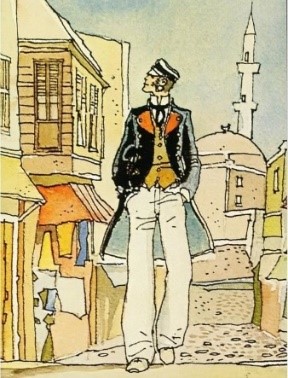
Stylistically still neatly in line. The repeated lookin’ mirrors the duplicated lookin’ from stanzas 1 and 2, the introduction of an archetype (sick man) is consistent with earlier archetypes as blind man, fat man and drinkin’ man and a powerful, mysterious second verse. Lookin’ at his hands for the lines that were is enigmatic, but, remarkably enough, reminds one of the comic, or rather: graphic novel series Corto Maltese by the Italian artist Hugo Pratt (1927-1995). Ugo Eugenio Prat was a great graphic artist who brought literature into the world of comics; his beautiful works are imbued with references to and borrowings from greats such as Rimbaud, Jack London, Melville, Joseph Conrad and more.
That was, in fact, the only correspondence with Dylan’s oeuvre. Up until this one line; Pratt’s protagonist Corto Maltese, a complex character who tries to stay down-to-earth in the midst of magical events and supernatural occurrences, is not entirely insensitive to the mystical: in his early years he recut the “life lines” in the palm of his hand with a knife because they predicted an early death. In one of the albums, a voodoo lady sees right through him, lookin’ at his hands, at the lines that were.
So far not significantly different from previous verses. The raising of the eyebrows is triggered by the third line, the verse line stating that dignity cannot be found in every masterpiece or literature either. This is weird. Either the narrator has a very peculiar definition of “literary masterpiece” or he has been browsing back and forth through those masterpieces very superficially. Homer, Ovid, Kipling, Poe, Goethe, Melville, Kerouac, Blake, Dante, Kafka… it’s actually very difficult to find a writer who does not demonstrate what dignity is, who does not thematise finding or maintaining dignity in one of his stories. In Proust’s À La Recherche Du Temps Perdu the virtue is in the Top 5 of most mentioned qualities, at Chekhov in the Top 3. In Primo Levi’s If This Is A Man it is a red thread. In Auschwitz Levi is hungry for dignity and he knows how to express in which details he, to his relief, still manages to find dignity. “There are few men who know how to go to their deaths with dignity, and often they are not those whom one would expect,” he states in the beginning, and in the continuation he describes vividly, clearly and unambiguously, for the searching storyteller in Dylan’s song, wherein he still manages to see dignity – even in this gruesome, inhumane environment.
So now, towards the end of the song, the listener suddenly has to ask himself: “not to be found in the masterpieces of literature?” It is not to be missed in the masterpieces of literature. Is this really about dignity?
The suspicion that the narrator uses the word “dignity” as a kind of code word, is in fact looking for something other than dignity, tilts – obviously – the whole text. Apparently, the narrator does not mean something like “grandeur, grace, morality”, but some other desirable greatness. A first, and obvious “real” desire of all those archetypes and the I-person would, of course, be Love. Not only because that is the Great, Eternal, Universal Desire (in the end, we are all looking for Love), but also because of that allusion, halfway through Dylan’s lyrics, the allusion to 1 Corinthians 13.
Paul’s First Epistle to the Corinthians consists of sixteen chapters, and the thirteenth chapter, the shortest chapter (only thirteen verses), is the most popular. Obama quotes from it at his inauguration in 2009, Franklin D. Roosevelt takes the oath with his hand on this chapter in 1933, the Stones use for the title of a Greatest Hits album a Corinthians 13 paraphrase (Through The Past, Darkly, 1969), Joni Mitchell writes a whole song around it (“Love”, 1982), Prime Minister Tony Blair reads from it at Lady Di’s funeral, James Baldwin quotes from it in Giovanni’s Room (1956)… the list of paraphrases and quotes in films, books, songs and speeches could be endless.
Joni’s song, and the Bible chapter open with the words Dylan appropriates:
If I speak with the tongues of men and of angels, but have not love, I am become sounding brass, or a clanging cymbal.
…which immediately sets the tone. The chapter, titled “The Excellence Of Love” in most Bible translations, is a hymn to love, is singing love as Supreme Gift. As in the explicit, unequivocal closing verse 13:
But now abideth faith, hope, love, these three; and the greatest of these is love.
By the way, the most quoted verse does not sing love (verse 11; When I was a child, I spake as a child, I felt as a child, I thought as a child), but the over-all tenor of the short chapter is indeed:
Love is all there is, it makes the world go ’round
Love and only love, it can’t be denied
No matter what you think about it
You just won’t be able to do without it
… as the poet Dylan put it in 1969 (“I Threw It All Away”).
Reading “dignity” instead of “love” in Dylan’s lyrics works, of course, fine. It remains a coherent text, more understandable even, only a little more boring – everybody’s looking for love is not exactly so earth-shattering that it justifies an eloquent 64-line lyric. And true, renaming love to dignity does turn such a hackneyed theme into something much more original and above all: into something much more elegant.
But then again – in that case the stumbling point, verse 51, “every masterpiece of literature”, remains a stumbling point. One cannot claim with a straight face that love is untraceable in these masterpieces, either. If there is one thing that all the greatest poets have been able to express throughout all centuries and cultures…
The same goes for usual suspects such as Happiness, Wisdom, Knowledge or Truth – all quite fitting, until that wretched line 51.
No, then a near-by, semantic association might be more conclusive. Dignity – divinity – deity…. could it be that the protagonist, as well as all those archetypes he encounters along the way, is looking for God?
Possibly. Strangely enough, however, style, theme and choice of words then do lead to the Great Denier of God, to Friedrich Nietzsche – and specifically to one of his greatest works, Die fröhliche Wissenschaft (The Gay Science, or The Joyful Wisdom, 1882):
Haven’t you heard of that madman who in the bright morning lit a lantern and ran around the marketplace crying incessantly, “I’m looking for God! I’m looking for God!” Since many of those who did not believe in God were standing around together just then, he caused great laughter. Has he been lost, then? asked one. Did he lose his way like a child? asked another. Or is he hiding? Is he afraid of us? Has he gone to sea? Emigrated? – Thus they shouted and laughed, one interrupting the other.
From paragraph 125, “The Madman”, which is followed by the famous death announcement.
Die fröhliche Wissenschaft is a treasure chest full of parable-like pieces of prose, hundreds of aphorisms, beautiful poems and some witty paradoxes, such as section 255:
Imitators. – A: “What? You want no imitators?’ B: “I don’t want people to imitate me; I want everyone to set his own example, which is what I do.” A: “So -?”
The work, which he would later call “my most personal work”, is divided into five books, in which Nietzsche deals with such diverse themes as the limitations of science, nihilism, the essence of art and the value of religion.
In the poems and in the parables, we encounter quite a lot of “Dignity”-like archetypes: The wise man (section 49), the poor (185), a sick man (168) and so on. The poet Dylan could have found inspiration for his obfuscation in section 6: “Loss of dignity”. And for the plot in the quatrain “The Sceptic Speaks” (section 61);
Long roaming forth it went
and searched but nothing found - and wavers here?
Comfort and fatherly advice the stranded storyteller from Dylan’s “Dignity” can also find at Nietzsche, already on page 1, in section 2, “My Happiness”:
Since I grew weary of the search
I taught myself to find instead.
And Dylan himself may identify with what Nietzsche writes about The Gay Science in his autobiography Ecce Homo. After elaborating on the Provençal origins of the concept of gaya scienza, the philosopher recalls the grandeur of the first, medieval troubadours, which we also owe to Provence, “jene Einheit von Sänger, Ritter und Freigeist, that unity of singer, knight and free spirit…” that list could be endless too.
About the author
Jochen is a regular reviewer of Dylan’s work on Untold. His books are available via Amazon both in paperback and on Kindle:
Although no one gets paid for writing, publishing or editing Untold Dylan, it does cost us money to keep the site afloat, safe from hackers, n’er-do-wells etc. We never ask for donations, and we try to survive on the income from our advertisers, so if you enjoy Untold Dylan, and you’ve got an ad blocker, could I beg you to turn it off while here. I’m not asking you to click on ads for the sake of it, but at least allow us to add one more to the number of people who see the full page. Thanks.
As for the writing, Untold Dylan is written by people who want to write for Untold Dylan. We welcome articles, contributions and ideas from all our readers. Although no one gets paid, if you are published here, your work will be read by a fairly large number of people across the world, ranging from fans to academics. If you have an idea, or a finished piece send it as a Word file to Tony@schools.co.uk with a note saying that it is for publication on Untold Dylan.
We also have a very lively discussion group “Untold Dylan” on Facebook with around 8500 active members. Just type the phrase “Untold Dylan” in, on your Facebook page or follow this link And because we don’t do political debates on our Facebook group there is a separate group for debating Bob Dylan’s politics – Icicles Hanging Down
In November 1992 Dylan released an album of traditional songs and covers. These were recorded in his own garage with only his producer and sound engineer present. Apparently he undertook the album because of a contract, not because he wanted to do it. Once he got started, however, the project developed a life of its own as Dylan returned to his folk roots.
The resulting album, Good as I Been to You, was well received and it was natural that Dylan would air these songs in the following year – 1993. On the album Dylan plays solo acoustic, and on stage he keeps the acoustic feel while bringing in some subtle backing.
One of my favourite songs from the album is ‘Blackjack Davy’, a song of love and betrayal, right up Dylan’s alley. I loved the energy and rocking tempo of the song, and there’s no lack of that here (12/09/93).
Blackjack Davy
That sounds very close to the album version. Not so with Stephen Foster’s ‘Hard Times’, a song from the depression era, reminding us that ‘protest songs’ were not invented in the 1960s. By slowing the tempo down, Dylan is able to wring every word for its effect, creating a powerful epic. Dylan has done gentler performances of the song, but none as moving as this one, at least for my ear.
Hard Times
He does something similar with ‘Jim Jones’, a song about the transporting of criminals from Britain to Australia in the late 19th Century, and the horror that awaited them when they got to Botany Bay. Again, by taking a bit more time, Dylan can build the song up in a way that didn’t happen on the album.
Jim Jones (Botany Bay)
Let’s slip back to the Supper Club for a moment (see previous post) and catch Dylan opening his second evening’s concert with ‘Ragged and Dirty’. With the band, he gives it a bounce, a kind of ragged ‘Subterranean Homesick Blues’ bounce.
Ragged and Dirty
Anyone in for a bit of weepy nostalgia? That background beat sounds just like the Inkspots, a 1950s black group. A lovely maudlin plodder with suitably agonised vocal delivery:
Tomorrow night
Before finishing this rich and varied year, there are some performances that didn’t quite fit anywhere else but were too good to leave behind.
One is this rare performance of the percussion driven ‘Series of Dreams.’ According to rumour, Lanois, the producer of Oh Mercy, wanted to include the song while Dylan did not. In the end Dylan prevailed, but when the song finally surfaced in 1991 (the Bootleg Series 1-3) it was much admired. Driven by hammering drums, Dylan takes us through an underworld of dreams and visions.
The lyrics for the song’s bridge are as good as anything he’s written.
‘Dreams where
the umbrella is folded
Into the path you are hurled
And the cards are
no good that you're holding
Unless they're
from another world’
(This line arrangement is my own, attempting to mimic where Dylan breaks the lines)
Live, the song struggles a bit, deprived of Lanois’ spooky arrangement and all the echoey stuff studios can do, but the performance builds up nicely, and Dylan is fully committed to his vocal. (08/09/93)
Series of Dreams
Followers of lyrical variations in Dylan will be fascinated by the changes here. I can’t pick up all the new lyrics but I do hear ‘In one, doors were opening and closing…’. Someone with a better ear than mine would need to piece this together.
Another rarity in terms of live performances is ‘Emotionally Yours’ from the 1985 Empire Burlesque album. This has never been my favourite Dylan song. The lyrics don’t go anywhere much. Dylan is a man of many masks, a protean artist capable of expressing a wide range of emotions, even sentimentalises such as this. But in performance terms, you won’t find anything better:
Emotionally Yours.
Another comparative rarity in performance is ‘License to Kill’, off Infidels (1984). The song was much praised, and taken as an indication that Dylan hadn’t lost his anti-war heart. However, having it next to the much reviled ‘Neighborhood Bully’ on the album creates a paradoxical effect, as that song could be described as Dylan’s one and only pro-war song. What remains is a powerful picture of a bereaved mother, and a killer who thinks he has a license to kill.
The portrait of the killer seems very contemporary. It makes me think of the young Kyle Rittenhouse who shot two Black Lives Matter protesters in Kenosha recently. Dylan can do that sometimes – seem way ahead of his time.
‘Now, he's hell-bent for destruction
he's afraid and confused
And his brain has been mismanaged with great skill
All he believes are his eyes
And his eyes, they just tell him lies’
Dylan was asked about this song in an interview he gave to USAToday in 1995. He was talking about the nature of creativity.
Dylan: ‘As you get older, you get smarter and that can hinder because you try to gain control over the creative impulse. Creativity is not like a freight train going down the tracks. It’s something that has to be caressed and treated with great respect. If your mind is intellectually in the way, it can stop you. You’ve got to program your brain not to think too much.’
Interviewer:’ In ‘License to Kill’ you said, ‘Man has invented his doom/first step was touching the moon.’ Do you believe that?’
Dylan: ‘Yeah, I do. I have no idea why I wrote that line, but at some level it’s just like a door into the unknown.’
License to Kill
‘The Lonesome Death of Hattie Carroll’ is the favourite Dylan song of poetry professor Christopher Ricks, famous for his study of Tennyson and Keats. One of the few Dylan books I do have on my shelf is Ricks’ Dylan’s Visions of Sin (Harper Collins, 2004). For Ricks, Dylan never did Hattie Carroll better than the album version (The Times they are A-changing, 1964). ‘If he sings it more gently, he sentimentalises it. If he sings it more urgently, he allies himself with Zanzinger’ (p16).
Ricks has the same issue that I have with Visions of Johanna, and Tony Attwood has with Wicked Messenger – the originals are the best, so we think. This may be a very personal thing – the version we first bonded with. The New Yorker replied to Ricks, affirming the musician’s ‘license to expand his songs in performance’(Ricks, p 17).
Often in this account of the NET, I have questioned what purpose this ‘license to expand’ might serve in terms of what any particular song says or does. Some of Mr Guitar Man’s long breaks are problematic in this regard, potentially turning a neat, crisp song into a quagmire. Dylan is a risk taker, he never plays safe, and risk takers are bound to fall at some point.
One of Dylan’s best known protest songs, ‘Hattie Carroll’ covers the wanton murder of a black kitchen hand by a rich, self-entitled bar patron, Zanzinger. It is a song that carefully harbours and balances its rage. Ricks probably doesn’t like this performance (the start is a bit ragged), but I find the semi-talking style, emphasising the reporting aspect of the song, effective. Arguably, Baxter’s haunting steel guitar sounds sweeten the music a little too much for the message. Your call!
Hattie Carroll
Ricks makes a very interesting comment on the artfulness of the song’s lyrics.
‘Hattie Carroll was a maid in the kitchen
She was fifty-one years old and gave birth to ten children
Who carried the dishes and took out the garbage
And never sat once at the head of the table
And didn't even talk to the people at the table
Who just cleaned up all the food from the table
And emptied the ashtrays on a whole other level
Got killed by a blow, lay slain by a cane
That sailed through the air and came down through the room
Doomed and determined to destroy all the gentle’
Of the discomforting repetition of the word ‘table’, Ricks observes, ‘Hattie Carroll has her enslaved rhyming – or rather non-rhyming, since a rhyme would offer some change, some relief from monotony of ‘the table…the table…the table as the grim ending of three consecutive lines.’ (Ricks, p 225)
‘It Takes a Lot to Laugh, It Takes a Train to Cry’, a blues song from Highway 61 Revisited (1965), became a regular visitor to Dylan’s setlists, and remained so right through to 2018. It works well as a late night, yearning for love, blues. When I first heard the album I was struck by the concision and beauty of the last verse.
‘Now, the wintertime is comin', the windows are filled with frost
I went to tell everybody but I could not get across
Well, I want to be your lover, baby, I don't want to be your boss
Don't say I never warned you when your train gets lost’
Years later I learned about a Japanese four-line verse form, loosely called a tanka. The first line states the major idea or image; the second line extends that idea or image; the third line introduces a new idea or image, and the last line is the wild card line that somehow encapsulates all of it. The verse just quoted is a perfect tanka.
I speculate that Dylan hit on the form naturally, its neat progression being aesthetically pleasing. This is far from his best performance of the song (wait until next year, 1994) but it’s of interest as Baxter uses the chords off ‘Rainy Day Woman’ to background the vocals.
It takes a lot to laugh
I’m up against my word limit here, but want to slip in three more performances. We are familiar with ‘Cat’s in the Well’ from Under the Red Sky (1991). It often became a rather raucous concluding song. I like the stripped down minimalism of this performance.
Cat’s in the Well
We can’t leave the year without ‘Ballad of a Thin Man’, a song we have followed through the years of the NET. Dylan does a great vocal. The verses are sung by 5.30 mins and over the next four minutes Mr Guitar Man takes his Stratocaster for a walk, and we are treated to his punky, angular ‘off key’ style.
Ballad of a thin man
Last but not least, ‘All Along the Watchtower’, a suitably apocalyptic way to end a concert – and our brief survey of 1993.
Watchtower
We can see 1993 as a year of emergence. Dylan, still pretty ragged but starting to reclaim his vocal range, the band coming together and starting to work their sounds in interesting ways. There are some outstanding performances (see Part 1), but above all, the emergence of Dylan as a lead guitar player with a distinctive, unsettling style. Mr Guitar Man has arrived.
I’m very excited about 1994, as everything that is good about the 1993 performances just gets better.
Although no one gets paid for writing, publishing or editing Untold Dylan, it does cost us money to keep the site afloat, safe from hackers, n’er-do-wells etc. We never ask for donations, and we try to survive on the income from our advertisers, so if you enjoy Untold Dylan, and you’ve got an ad blocker, could I beg you to turn it off while here. I’m not asking you to click on ads for the sake of it, but at least allow us to add one more to the number of people who see the full page. Thanks.
As for the writing, Untold Dylan is written by people who want to write for Untold Dylan. We welcome articles, contributions and ideas from all our readers. Although no one gets paid, if you are published here, your work will be read by a fairly large number of people across the world, ranging from fans to academics. If you have an idea, or a finished piece send it as a Word file to Tony@schools.co.uk with a note saying that it is for publication on Untold Dylan.
We also have a very lively discussion group “Untold Dylan” on Facebook with around 8500 active members. Just type the phrase “Untold Dylan” in, on your Facebook page or follow this link And because we don’t do political debates on our Facebook group there is a separate group for debating Bob Dylan’s politics – Icicles Hanging Down
‘I’m not the songs. It’s like somebody expecting Shakespeare to be Hamlet, or Goethe to be Faust…’[Bob Dylan]
Philip Saville sees Bob Dylan perform in New York where the young singer/songwriter performs a number of folk songs:
Oh the cuckoo is a pretty bird, and she wobbles as she flies
But she never sings 'cuckoo' 'til the fourth day of July
I've gambled in England, I've gambled in Spain
And I'll be you ten dollars that I'll beat you next game
I'll build me a cabin on a mountain so high
So I can see Nellie as she goes ridng by
(Bob Dylan: The Cuckoo Bird ~ traditional/Dylan)
In London, Bob Dylan “plays” in the Pinteresque ‘Madhouse On Castle Street’ in which Saville cleverly has the young singer/songwriter function as a “Greek choir” of sorts. After appearing in the TV play, Bob joins up with slightly older American singer/songwriter Richard ‘Dick’ Farina (and others) at “77 Records” on Charing Cross Road in London – folksingers from whom Dylan’s has already picked up quite a number of traditional American songs.
Farina’s second marriage is to the younger sister of Joan Baez; he dies a few years later in a motorcycle accident. On his first album, Dylan uses Dave Van Ronk’s arrangement of the traditional ‘House Of The Rising Sun”.
Dylan participates as ‘Blind Boy Grunt” in the recordings of some of the songs at “77 Records” – though not in the “Wobble Bird”. The songs appear on the album “Dick Farina And Eric Von Schmidt”. Dylan sings a shorter version of “The Cuckoo Bird” earlier in New York, but in the following lyrics bits and pieces are added from other folk songs:
And the cuckoo, she's a pretty bird, wobbles as she flies
Never  hollers "cuckoo" 'till the fourth day of July
Well, I played cards in England, played cards in Spain
Bet you ten dollars, beat you next game
Jack of Diamonds, Jack Of Diamonds, I know you from old
You robbed my poor pockets, silver and gold
I'm gonna build me a log cabin on a mountain so high
I can see Saro, she rides on by
(Richard Farina: Wobble Bird ~ traditional/Farina)
In ‘The Madhouse House On Castle Street’, Dylan makes some changes to the traditional American version of “The Cuckoo Bird”. It’s originally an old English folk song. Also sings therein the traditional “Hang Me, Oh Hang Me”, and his own “Blowing In The Wind”.
Next year, Dylan visits a log cabin built on a studio set in Toronto. There he sings an obviously Post-Pinter type song:
Oh every thought that has sprung a knot in my mind
I might go insane if it could not be sprung
But it's not to stand naked under unknowing eyes
It's for myself, and my friends that my stories are sung
(Bob Dylan: Restless Farewell)
Lots of entangled negatives and homophones ~ ‘knot’, ‘not’ , and ‘not’ .
12 years of Untold Dylan
Although no one gets paid for writing, publishing or editing Untold Dylan, it does cost us money to keep the site afloat, safe from hackers, n’er-do-wells etc. We never ask for donations, and we try to survive on the income from our advertisers, so if you enjoy Untold Dylan, and you’ve got an ad blocker, could I beg you to turn it off while here. I’m not asking you to click on ads for the sake of it, but at least allow us to add one more to the number of people who see the full page. Thanks.
As for the writing, Untold Dylan is written by people who want to write for Untold Dylan. We welcome articles, contributions and ideas from all our readers. Although no one gets paid, if you are published here, your work will be read by a fairly large number of people across the world, ranging from fans to academics. If you have an idea, or a finished piece send it as a Word file to Tony@schools.co.uk with a note saying that it is for publication on Untold Dylan.
We also have a very lively discussion group “Untold Dylan” on Facebook with around 8500 active members. Just type the phrase “Untold Dylan” in, on your Facebook page or follow this link And because we don’t do political debates on our Facebook group there is a separate group for debating Bob Dylan’s politics – Icicles Hanging Down
I started out to do another in the series of Bob’s rarities – performances only heard once or twice on the Never Ending Tour. But I got rather sidetracked, and rather than just delete all the blind alleys I followed this time, I thought I’d share them with you, if nothing else than to show that writing the “Once only files” and “Rarities” is not quite as easy as it looks.
But this is not just all academic meander – because at the very end is one of those fantastic one-off Dylan performances I stumbled on by chance. And when you get there please do play the recording of Samson and Delilah all the way through; the guitar solo is just so beautifully poised within the context of the music. I’ve just played it a dozen times while putting this little article together, and it is still a great performance.
So, here’s the whole thing that I meandered through on my way there…
Abandoned Love
The official Bob Dylan site has a list of all the songs Bob Dylan has written, and those played live. Except it seems on occasion not to be quite right.
Take the wonderful Abandoned Love. That, according to the official site has never ever been played live. And yet on our first review of the song we did indeed find it and dutifully put it on the site. Amazingly it is still there for all to hear.
Now I thought that was the only live version – the other one being the Biograph version. But then along comes another. This isn’t the Biograph for sure – but is it the original one and only live version?
My musical ear at once says no, this is in a different key – performed a tone higher to be technical. (Imagine you played the first note on a guitar, but then moved your finger up two frets and played that as the starting note. That’s the difference – one tone.)
https://youtu.be/givn_u7SIX4
But no, the performance is the same as the one and only other live version – someone has been digitally playing around somewhere. There are only two versions, one is live. The official site remains wrong, but only by one, not two.
Speaking of songs that the official site doesn’t recognise Bob has performed, one of these is “Baby Please Don’t Go”. But I think he has…
According to the SetList site this was performed at the PNC Bank Arts Center, Holmdel, NJ on August 10, 2003, but I don’t think this was recorded then. (You see the tangle I am getting in today). But really, it doesn’t matter too much – it’s a great recording. (I know I will be told off for being so inept as to not know the source of this, but I’m happy to accept this in return for being able to introduce it to one or two readers who might not know this recording).
Here’s another one that is not on the official site list of songs performed.
https://youtu.be/YDHwr6Rrsfg
“Glad I got to see you once again.” This does have a page to itself on the official site, but does not turn up in the list of songs performed. The recording comes from 4 August 1988 at the Greek Theatre, in LA.
On this song Bob has travelled quite a long way. Here’s Hank Snow with the same version
I’m not sure about that performance of Bob’s – we all know that some people in the audience are going to shout and scream and make strange noises, and his rendition is not suited for that. But of course it’s Bob, and Bob knows best.
There is a compilation on Spotify of “I Still Miss Someone (Original Country Songs Bob Dylan Covered 1949 – 1954)” which has this listed, but it is the one song on the selection that (at least on my system) won’t play. Very curious.
One more, and this is the one it was all worth waiting for: Samson and Delilah. I do hope you are sitting down and paying full attention, because this is fantastic.
Samson and Delilah
https://youtu.be/0om3CRJdNAI
This was performed on 11 June 2004 at Manchester TN, in the Bonnaroo Music Festival. This is listed by the Bob Dylan project as Traditional, Blind Willie Johnson, Rev. Gary Davies. I am not sure that Willie Johnson had anything to do with this song, but there is a general recognition that Gary Davies wrote it.
Here are the lyrics
If I had my way
If I had my way
If I had my way
I would tear this old building down
Well Delilah, she was a woman fine and fair
She had good looks, God knows and coal black hair
Delilah, she came to Samson's mind
The first he saw this woman that looked so fine
Delilah, she set down on Samson's knee
Said tell me where your strength lies if you please
She spoke so kind, God knows, she talked so fair
'til Samson said 'Delilah, you can cut off my hair
You can shave my head, clean as my hand
And my strength 'come as natural as any a man'
If I had my way
If I had my way
In this wicked world
If I had my way
I would tear this old building down
Talk, Yeah
Yeah, Talk to me
Yeah, Yeah, talk to me
Yeah, what happened then?
If I had my way
If I had my way
If I had my way
I would tear this old building down
Yeah you read about old Samson, told from his birth
He was the strongest man that ever had lived on Earth
So one day while Samson was-a-walkin' along
He looked on the ground and saw an old jawbone
He stretched out his arm, God knows, it broke like flint
When he got to movin' ten-thousand was dead, Mmm
If I had my way
If I had my way in this wicked world
If I had my way
I would tear this old building down
Well old Samson and the lion got attacked
Samson he jumped up on the lion's back
So you read about this lion had killed a man with his paws
But Samson got his hand in the lion's jaws
He rid that beast until he killed him dead
And the bees made honey in the lion's head
Good God!
If I had my way
If I had my way
If I had my way
I would tear this old building down
If I had my way
If I had my way in this wicked world
If I had my way
I would tear this old building down
Good God1
If you have been, thanks for reading. And listening.
Songs that Bob Dylan has only ever performed once or twice live.
Although no one gets paid for writing, publishing or editing Untold Dylan, it does cost us money to keep the site afloat, safe from hackers, n’er-do-wells etc. We never ask for donations, and we try to survive on the income from our advertisers, so if you enjoy Untold Dylan, and you’ve got an ad blocker, could I beg you to turn it off while here. I’m not asking you to click on ads for the sake of it, but at least allow us to add one more to the number of people who see the full page. Thanks.
As for the writing, Untold Dylan is written by people who want to write for Untold Dylan. We welcome articles, contributions and ideas from all our readers. Although no one gets paid, if you are published here, your work will be read by a fairly large number of people across the world, ranging from fans to academics. If you have an idea, or a finished piece send it as a Word file to Tony@schools.co.uk with a note saying that it is for publication on Untold Dylan.
We also have a very lively discussion group “Untold Dylan” on Facebook with around 8500 active members. Just type the phrase “Untold Dylan” in, on your Facebook page or follow this link And because we don’t do political debates on our Facebook group there is a separate group for debating Bob Dylan’s politics – Icicles Hanging Down
“He saw right from his side and I saw right from mine, and we wore each other down for it.”
Suze Rotolo opens the chapter “Breaking Fame”, the chapter from her autobiography A Freewheelin’ Time (2008) that tells the end of her relationship with Dylan, not coincidentally with a paraphrase of a verse from “One Too Many Mornings”.
Rotolo does add a disclaimer;
“I don’t like to claim any Dylan songs as having been written about me, to do so would violate the art he puts out in the world. The songs are for the listener to relate to, identify with, and interpret through his or her own experience,”
… but indirectly, with this paraphrase, she does claim to be a muse, or at least a source of inspiration. To which she has every right, of course. Dylan is a young, receptive guy, and no man is an island – the experiences with Suze are, of course, part of what he tries to capture poetically, part of what goes on around here sometimes, tho I don’t understand too well myself what’s really happening, as he will say in the liner notes of Bringing It All Back Home (1965).
From the quartet farewell songs that for convenience we will call the Suze cycle (next to “Don’t Think Twice, It’s All Right”, “Girl Of The North Country” and “Boots Of Spanish Leather”, all with the same chord progression and all fingerpicking, by the way), “One Too Many Mornings” is the most intimate, perhaps the most mature and in any case the most poetic. In “Don’t Think Twice”, Dylan sometimes still does sound quite adolescently wronged, and “Girl Of The North Country” and “Spanish Leather” have an admittedly classic, but also a somewhat archaic and therefore impersonal beauty. In “One Too Many Mornings”, however, we are close to the narrator, who does not wave at his beloved in the far North or in the mountains of Madrid, but looks back at her here and now, from this threshold.
The opening is the opening of a film noir;
Down the street the dogs are barkin’
And the day is a-gettin’ dark
As the night comes in a-fallin’
The dogs’ll lose their bark
An’ the silent night will shatter
From the sounds inside my mind
For I’m one too many mornings
And a thousand miles behind
… but it is a film noir for which Baudelaire has written the screenplay. We know that in these years Dylan gets to know and admires the work of the French symbolist – here echoes seem to resound from the small, posthumously published collection of “prose-poems” Le Spleen de Paris (1869), and in particular from the poem “À une heure du matin” (At One O’Clock In The Morning). The setting, from the opening lines of Baudelaire’s poem, is already very similar;
“Not a sound to be heard but the rumbling of some belated and decrepit cabs. For a few hours we shall have silence, if not repose.”
… and Dylan seems to be taking the final words to heart:
“I would gladly redeem myself and elate myself a little in the silence and solitude of night. Souls of those I have loved, souls of those I have sung, strengthen me, support me, rid me of lies and the corrupting vapours of the world; and you, O Lord God, grant me the grace to produce a few good verses, which shall prove to myself that I am not the lowest of men, that I am not inferior to those whom I despise.”
“Grant me the grace to produce a few good verses, which shall prove to myself that I am not the lowest of men…” Words the biographically interpreting Dylanologist can effortlessly lay over Dylan’s biography; Dylan has been messing around with Joan Baez for a while, Suze has to find out in an embarrassing way and he (presumably) writes this song when he spends another few weeks at Baez’s in California. Some gnawing at his conscience is not unthinkable – none of this is too graceful. Baudelaire’s need to produce those soul-cleansing verses is palpable, and the young bard undeniably succeeds. Baudelairian brilliant is already the silent night will shatter from the sounds inside my mind, but that is certainly not the only highlight:
From the crossroads of my doorstep
My eyes they start to fade
As I turn my head back to the room
Where my love and I have laid
An’ I gaze back to the street
The sidewalk and the sign
And I’m one too many mornings
An’ a thousand miles behind
The warmth of the bed that has just been used can still be sensed, sultry is the silence of the falling night… I have to get out of here. Yet another morning here, with just the two of us, no… we’ve reached the end of the line.
It is perhaps one of the most beautiful stanzas in Dylan’s rich oeuvre. The doorstep is a crossroads, a literal and figurative threshold to a new path in life, the protagonist’s torment is visible. He looks back again, with fading eyes, at the bed, and then back to the street and the sign, still calling her “my love” in his mind… elegant. But not very honest, the decoding biographical interpreter will add. Which is completely unimportant, as the deceived one, Suze Rotolo, points out too. After all, “the songs are for the listener to relate to, identify with.” And her other point is even more worthy. Narrowing poetry to something as banal as a coded account of a real love affair “would violate the art he puts out in the world”.
The template for elegance seems to have been handed to Dylan not only by Baudelaire, but also by the sympathetic Rotolo.
Biographical, Baudelairian or realistic fiction – “One Too Many Mornings” is in any which way a masterpiece – and as a work of art it is, obviously, independent of the artist’s possible dubious impulses or presumed petty motives. The evocative power of the cinematic images and the lyrical finds are brilliant, and the irresistible recurring verse line, one too many mornings and a thousand miles behind, has the beauty of classical poetry and the familiarity of an old saying.
Nevertheless, Dylan holds back on this song for a long time. Perhaps because of the emotional charge, or maybe because the chord scheme and parts of the melody are very similar to the title track of the LP. Only in the last instance he decides to put it on The Times They Are A-Changin’ (the song is not on a first test pressing), then ignoring the song for his Carnegie performance and still in 1965 he only plays it once (in England, for a BBC television recording). It is only in 1966, then still in a drastically roughened version, that the song finds a permanent place on the set list. After that, Dylan gradually seems to recognise the indestructible beauty.
Initially, however, in ’66, he rather ostentatiously dissociates music and text. In the electric arrangement “One Too Many Mornings” is a sister of “Like A Rolling Stone”: exciting, compelling and sharp – and therefore absolutely not in keeping with the content of the lyrics. Rick Danko’s vocal contribution is illustrative; after every …and a thousand miles Dylan keeps shut for four beats, giving the delayed …behind! by Danko an almost jubilant, ecstatic emphasis. Musically absolutely a goosebumps-inducing moment, but lyrically not really a direct hit; to sing the word behind a few seconds behind the last line has a slightly too strong pun intended character. On the other hand: the beautiful version from the Basement Tapes (1967) proves that in those years The Band and Dylan really do know what the words say, but apparently, they reserve melancholy for the seclusion of the Big Pink.
The sessions in ’69 with Johnny Cash suffer from the same flaw; the words seem stripped of all meaning and at best function as a sound contribution – nothing more. A studio recording in New York, May 1, 1970, proves that Dylan can no longer let go of the song, though. And that he is still searching for a form to do justice to the power. It doesn’t quite work out yet: this time, the country rock arrangement drives the song towards a somewhat dutiful conviviality – and the harmonious ensemble singing is beautiful, but once again negates the poetry. In 1976 we are almost there. Electric, still, but the melancholy finally returns. Perhaps we owe this to similar private troubles; now the marriage to Sara is crumbling. It does inspire the poet to add some new lines, expressing the same resignation to the irreparable:
You’ve no right to be here
And I’ve no right to stay
Until we’re both one too many mornings
And a thousand miles away.
After 1978 Dylan let the song mature for another ten years, to play it almost always (semi-) acoustically from ’88 onwards. Madison Square Garden, January ’98, is a fine example of that (definitive?) form. Sad, resigned and above all: inspired.
For the many, many colleagues who pick up “One Too Many Mornings”, the search for that final form is not that difficult at all. In the 60’s the up-tempo electric adepts (Beau Brummels, The Association) still dominate, but after that almost every cover gratefully adopts the melancholy and lets the words do the work; most of the time the accompaniment is sober, austere, almost unimportant. An apparent gender-specific appeal is striking, by the way; this is one of the rare Dylan songs in which the ladies remain on the side-lines. The few female singers who have a go anyway, miss out (well alright, Sophie Hunger’s cover is okay, 2012).
So: the men, this exceptional time. The Texan Dylan specialist Jimmy LaFave is distinctive, as is often the case, with his unique phrasing (and also limits himself to guitar and harmonica), the Englishman David Gray calls his live album A Thousand Miles Behind (2007) and delivers respectful versions of “To Ramona” and “Buckets Of Rain”, and a sensitive, lonely Mornings, and Dylan’s contemporary Jerry Jeff Walker provides an almost sentimental country version of the song (1977).
Another contemporary is Ronnie Hawkins, whose accompaniment band The Hawks will later move to Dylan (and be renamed The Band). His nameless LP from 1970 opens with a rather flat “One More Night”, but he retaliates a little later with an extremely nice “One Too Many Mornings”. Slithering dangerously close to the edge of the abyss of the Valley Of Tears, mainly due to violins and kitschy harmonica. Having a voice like Ronnie has, it is permitted, though – full and heavy, and breaking at the right moments. Granted, almost unbearably sentimental. But he’s right from his side.
Jochen is a regular reviewer of Dylan’s work on Untold. His books are available via Amazon both in paperback and on Kindle:
Although no one gets paid for writing, publishing or editing Untold Dylan, it does cost us money to keep the site afloat, safe from hackers, n’er-do-wells etc. We never ask for donations, and we try to survive on the income from our advertisers, so if you enjoy Untold Dylan, and you’ve got an ad blocker, could I beg you to turn it off while here. I’m not asking you to click on ads for the sake of it, but at least allow us to add one more to the number of people who see the full page. Thanks.
As for the writing, Untold Dylan is written by people who want to write for Untold Dylan. We welcome articles, contributions and ideas from all our readers. Although no one gets paid, if you are published here, your work will be read by a fairly large number of people across the world, ranging from fans to academics. If you have an idea, or a finished piece send it as a Word file to Tony@schools.co.uk with a note saying that it is for publication on Untold Dylan.
We also have a very lively discussion group “Untold Dylan” on Facebook with around 8500 active members. Just type the phrase “Untold Dylan” in, on your Facebook page or follow this link And because we don’t do political debates on our Facebook group there is a separate group for debating Bob Dylan’s politics – Icicles Hanging Down
‘The Madhouse On Castle Street’ is a Post-Pinter TV play in that it updates the British playwright’s dark vision of modern day society for younger viewers. The taped play includes a lodger in a cheap boarding house, Walter Tompkins, who isolates himself from the rest of society, and is slowly starving to death.
Like Stanley Webber in Pinter’s play, ‘The Birthday Party’, he’s alienated, incapable of revealing his true feelings because language is based on the power structure culturally encoded from the past.
There’s Martha, Walter’s sister; Lennie, the Apollonian student, who tries to figure out what is going on; Bobby the Dionysian hobo from America who plays the guitar and intersperses songs that comment on the primeval aspects of humankind; plus a reverend and a couple of strange visitors. A year later, the role of the singer is greatly expanded in a taped Canadian TV programme with the setting being in an isolated log cabin; Michael Zenon writes at a table; he and the other men in the cabin act as though they are in a silent movie, but without exhibiting any exaggerated gestures.
The myth of the the Promised Land regained in the freedom of the Old West of the American frontier is put on rest in these TV productions – a myth perpetuated for one by the “singing cowboy” of modern times, with no Leda-seducing swan resulting in the birth of Helen of Troy; no ‘Song Of Solomon’; there’s a range, however:
Home, home on the range ....
How often at night when the heavens are bright
WIth the light from the glittering stars
Have I stood there amazed, and asked as I gazed
If their glory exceeds that of ours
(Gene Autry: Home, Home On The Range)
It’s a revision of the original intertextual song below (published first as a poem by Dr. Higley) :
Oh give me the land where the bright diamond sand
Throws its light from the glittering stream
Where glideth along the graceful white swan
Like a maid in her heavenly dream ....
How often at night, when the heavens were bright
With the light from the twinkling stars
Have I stood here amazed, and asked as I gazed
If their glory exceeds that of ours
(Tom Roush: My Western Home ~ B. Higley/D. Kelley)
The author of ‘The Madhouse House On Castle Street’ is no happily singing cowboy out on the range – that’s for sure:
Tenderly William kissed his wife
Then he opened her head with a butcher knife
And the swan on the river went gliding by
The swan on the river went gliding by
Lady Margaret's pillow is wet with tears
No body's been on it in twenty years
(Bob Dylan: The Ballad Of The Gliding Swan ~ Jones/Dylan)
Not unlike the imagery in the song sung by the chorus of Titan female water nymphs in the ancient Greek play ‘Prometheus Bound’. Titan Prometheus shows compassion for mortal humans stealing fire and providing tools for them; thereby undermining Zeus’ authority:
I moun for thee, Prometheus, ministered and brought low
Watering my virgin cheeks with these sad drops that flow
From sorrow's rainy fount, to fill soft-lidded eyes
Bob Dylan goes home to America, the land of the eagle, taking the idea of intextuality with him. Perhaps Prince Philip mentioned in one if his later song refers ironically to director Philip Saville as a Judas figure – in real life, he’s an unfaithful husband:
I went down where the vultures feed
I would go deeper, but there wasn't any need
Heard the tongues of angels and the tongues of men
Wasn't any differenceto me ....
Met Prince Philip at the home of the blues
Said he'd give me information if his name wasn't used
Said he wanted money upfront, said he was abused
By dignity
(Bob Dylan: Dignity)
Despite his generosity, the BBC burns Philip’s tapes some years after ‘The Mad House On Castle Street’ is broadcast; it’s a murder most foul.
In Greek mythology, Prometheus refuses to tell Zeus who’s going to replace him as the chief god. The guide to the Underworld, Mercury, symbolized by the vulture (as Venus is by the swan) warns the Titan that he’ll be bound forever, and his liver eaten by an eagle unless some human sacrifices himself instead:
Though I speak with the tongues of men and of angels
And have not charity
I am become as sounding brass, or a tinkling cymbal
(I Corinthians 13:1)
12 years of Untold Dylan
Although no one gets paid for writing, publishing or editing Untold Dylan, it does cost us money to keep the site afloat, safe from hackers, n’er-do-wells etc. We never ask for donations, and we try to survive on the income from our advertisers, so if you enjoy Untold Dylan, and you’ve got an ad blocker, could I beg you to turn it off while here. I’m not asking you to click on ads for the sake of it, but at least allow us to add one more to the number of people who see the full page. Thanks.
As for the writing, Untold Dylan is written by people who want to write for Untold Dylan. We welcome articles, contributions and ideas from all our readers. Although no one gets paid, if you are published here, your work will be read by a fairly large number of people across the world, ranging from fans to academics. If you have an idea, or a finished piece send it as a Word file to Tony@schools.co.uk with a note saying that it is for publication on Untold Dylan.
We also have a very lively discussion group “Untold Dylan” on Facebook with around 8500 active members. Just type the phrase “Untold Dylan” in, on your Facebook page or follow this link And because we don’t do political debates on our Facebook group there is a separate group for debating Bob Dylan’s politics – Icicles Hanging Down
Bob Dylan finished 1965 by getting married, writing “Visions of Johanna” and then going on tour. That tour has since been described as leaving him utterly exhausted, and various accounts have him behaving irrationally at times during this period. Dylan himself has admitted to taking a lot of drugs at this time, although not everyone takes his words at face value.
Dylan spent most of December performing in California, had some time off in January around the birth of his son, and then started working in the studio on the next album.
Dylan and some of the ensemble moved to Nashville in February, as he continued to write and record the songs for what was to become Blonde on Blonde. This creative endeavour continued through to April at which time Dylan went touring again. The infamous motorcycle crash happened at the end of July by which time the album had been written, recorded and completed.
Up to the time of the crash 15 songs were composed during this year – as ever in this series, each title is followed by the briefest of descriptions of the subject matter of the song, to help us see at a glance just what he was writing about.
In addition to these songs it is possible that some of the jottings from the notebook that became the New Basement Tapes were made, although the dates of these are not clear, and certainly a further series of seven songs does seem to have been written after the completion of the album.
But restricting ourselves to the songs that made the album, what is immediately striking is that we have lost the Dadaistic approach to the lyrics, which had so fascinated Dylan of late, and which had been at the heart of so many of his most successful compositions. Instead, and taking my shorthand indicators of what each song is about we have in total these subjects covered…
Surrealism: 3 songs
Love: 4 songs
Moving on: 1 song
Randomness: 1 song
Lost love: 4 songs
Disdain: 1 song
Depression: 1 song
Which is not perhaps what our standard notion of romance would tell us that someone who had just got married and seen the birth of his first child would be writing about. But then it can be argued that Dylan only wrote about his life on a few occasions. He has generally been more of a writer of fiction when it comes to song lyrics, rather than an autobiographer.
But I am not sure we can tell from the songs what exactly was on Bob’s mind, for I get the impression that he was concerned with the creation of his next grand masterpiece – whatever that happened to be – rather than what it was going to be about.
Such a masterpiece would need to be a song that in terms of general recognition stood out not just from the rest of Dylan’s work but from the rest of pop, rock and folk music. And that not just for its length but because of the originality of either its music or its lyrics (or both) and its overall impact on listeners. A work as powerful and unique as such recent works as “Masters of War,” “It’s alright ma”, “Desolation Row”, “Visions of Johanna” and “Like a Rolling Stone”.
To give an idea of what Bob was probably looking for, we might consider the songs below as one possible list of the absolute Dylan classics thus far: you may not agree with each selection, but I would venture to say many people would see most of these songs as being at the summit of Bob’s creative endeavours thus far; major creations not just within his career but within the history of popular music.
1962: 3 songs
Blowing in the wind
Hard Rain’s a gonna fall
Don’t think twice
1963: 6 songs
Masters of War
Girl from the North Country / Boots of Spanish Leather
With God on our Side
When the ship comes in
The Times they are a-Changing
Restless Farewell
(The music of “North Country” and “Spanish Leather” is so similar I count it as one).
1964: 7 songs
Chimes of Freedom
Mr Tambourine Man
It ain’t me babe
All I really want to do
My back pages
Gates of Eden
It’s all right ma
1965: 7 songs
Farewell Angelina
Love Minus Zero
She Belongs to Me
It’s all over now baby blue
Like a Rolling Stone
Desolation Row
Visions of Johanna
1966: 2 songs
Sad Eyed Lady of the Lowlands
Just like a woman
Thus this is not to suggest that my selection of the works of genius is absolute and definitive, nor that I am suggesting Bob should be able to continue to create six or seven absolute masterpieces a year. But rather I am suggesting that the creation of the next song that would last in the memory not just until the next album was released, but for the rest of his life (and possibly years after that), was what he was wanting to do. And indeed what he knew he had to do to keep up his reputation.
But at this moment of need however, the production line of works of genius apparently had, if not stopped, then at least slowed down. Bob was about to discover that simply writing lots of words and (as in one case) re-working the music of “Rolling Stone” was not a guaranteed mechanism for the creation of a new earth-shattering piece of music that would be played and sung around the western world.
At the same time, the choice of topics in 1966 is also interesting. This is not to suggest that what Dylan writes about is totally reflective of what he is thinking about (as I have said before we don’t expect the writer of murder mysteries to be thinking black thoughts all day and night), but even so, given the wide range of topics Dylan had embraced in the past, it is interesting that he wrote four love songs and four lost love songs, along with another four covering moving on, randomness, disdain and depression. It seems a curious mixture – almost as if he was writing the sort of songs he had written before, in the expectation that the subject matter alone would deliver the goods.
In short I suspect that in the aftermath of the ravages of the touring Bob was finding for the first time that the songs simply did not appear in his head, as they had for the past five years. By 1966 he was, artistically speaking, having a tougher time of it than he had ever had before, when the music and lyrics simply formed in his head whenever he felt the need to call them up…
It is also interesting that whereas in the past Dylan produced a fair number of songs that he then discarded, meaning that what we got on the albums was by and large the best of his writing from that period, the number of songs that were rejected from this period was tiny. Either they were rejected before they got near the studio (which seems unlikely looking at the difficulties he had, as revealed on the tapes that survived), or Dylan was getting better at writing exactly what was needed and what would work, or the number of ideas he was getting for workable songs was reducing and so he had to work with anything he came up with.
Of course it is easy to read far too much into each event, or indeed conjunctions of events but at this time the conjunctions do seem to pile up somewhat and should be taken seriously, in my view. Dylan quite rightly took time off following the birth of his son in January 1966 but then came back on wrote what I find one of his most disturbing songs, the unfinished, “She’s your lover now”.
Now I have mentioned before that while some songs relate to what the songwriter is feeling at that moment (Paul Simon’s oft quoted “Homeward Bound” is a perfect example) this does not have to be the case with artists. Mary Shelly was not contemplating creating a monster when she wrote Frankenstein, for example. Or indeed to give a trivial example that I can personally vouch for, when as a 16 year old I wrote the song “On the streets again”, I was living in the comfort of my parents home in rural Dorset, attending the local grammar school. The song came about because I’d just seen the Alec Guinness Movie “The Horses Mouth,” based on the Joyce Cary novel, nothing else. I hadn’t actually been thrown out of the house by my parents.
My point is that anything can stimulate the imagination. Indeed for many a writer, the ebb and flow of life itself can lead to the creation of the next work. Even when the creator of the work of art is tending towards the abstract rather than the concrete.
Thus when Dylan wrote…
it’s true, I just can’t recall
San Francisco at all
I can’t even remember El Paso, uh, honey
You never had to be faithful
I didn’t want you to grieve
Oh, why was it so hard for you
If you didn’t want to be with me, just to leave?
it may well have been just another storyline. Or it might be that some of the angst and pain and annoyance expressed in those lines came from a recent heartfelt experience. Only if Dylan tells us, and then doesn’t contradict himself, or say it in a way that makes us think he is spinning a yarn, can we get a clue as to what was really going on.
Of course, and as I have just noted, a professional writer of any form of literature can and indeed must distance him/herself from his work to some degree. Failure to do so could send many more novelists, playwrights and songsmiths into long spells of mental recuperation than we actually find needing such a break. But here the suspicion must remain that even if the song is not a literal exposition of how Dylan was feeling, it could have been a shorthand version of some very difficult events. And not the events one would hope for or expect around the time of the birth of one’s first child.
The fact is that this song of extreme disdain caused Dylan enormous difficulty, as is revealed on the recordings – and it was a difficulty that he did not experience with “Rolling Stone”. And “Rolling Stone” is a good comparison because what we find is that the very unusual chord sequence of “Rolling Stone” is now used again. True, Dylan had reused ideas before but the extent of the adaptation of the underlying essence of “Rolling Stone” with its step by step bass and utter disdain in the lyrics for the subject of the piece, are both very unusual in popular, folk, and rock music. Was he really wanting to write “Rolling Stone II” so soon after marriage and becoming a father, or had he simply felt the need to writer another master-work, but was unable to find either a new subject or a new musical form?
What we do know is that Bob tried to record “Lover” an amazing 19 times and then gave up. And he must have been aware of how very different that was from the days of writing it, recording it, and then feeling it was done, all within a few hours and one or two takes.
We also have, from this period, other tales of Dylan changing the musicians around him, re-recording songs many times over, abandoning songs … It does not sound like the Dylan of just a few years before. Nor does it sound like an artist who is happy in himself or with his own work.
Thus as January progressed we see something new emerging in terms of Dylan and recording: Bob’s dissatisfaction with the recordings that were being made, and a lack of new songs that he felt could be brought in and used to fill the gaps in the album. Of course as we know, he did produce the album – indeed it was a double album (although curiously it seems no one realised this until they came to put together all the songs that survived). But it appears that Dylan simply wasn’t able to produce what to his mind then (and what may sound to us now, some 50+ years later) pieces of the same brilliance and diversity as “Blowing in the Wind”, “Chimes of Freedom”, and “Visions” at the drop of a hat.
Indeed this shortage of new material and the slow progress of the sessions contributed to Dylan’s decision to cancel some booked recording dates, and subsequently tell Robert Shelton, who had helped to launch his career, that at that moment he was “really down. I mean, in ten recording sessions, man, we didn’t get one song … It was the band…” This is simply something we cannot imagine Bob saying a year before. Really, was it the band? Didn’t Bob the singer / songwriter have something to do with it?
But say it he did, and it was this dissatisfaction that led to Bob Johnston suggesting that the recordings be moved to Nashville, which led to the recording of Visions of Johanna and Sad Eyed Lady of the Lowlands. From here on it seems several songs were written using a new process -Dylan writing in the studio and then the band recording the song. In between they played various gigs that had been previously been arranged.
There is disagreement among those who were there, and those who write about such minutiae, about exactly how everything happened, but all versions of the story seem to point to the notion that Bob had got stuck with a version of writers’ block. However by moving to a new studio and hiring new musicians, and undoubtedly because the record company wanted their pound of flesh, as per the contract, he came through it. And then, perversely, it was realised (quite late in the day) that despite all the problems, the ensemble now had too much material for one album! A double it became.
Dylan mixed the album in Los Angeles in early April (reportedly in just a few hours, which is far less time than is normally given to such a task), before he departed on the Australian leg of his world tour – another sign that far too much work had been booked into the time available.
And then on July 29, 1966, Dylan crashed his motorcycle. The reason for the crash, the details of the accident and the level of injuries are matters of dispute, but it is clear that Dylan did not go to hospital and no ambulance was called to the scene. What is also clear is that he did not return to full-on touring for eight years. Instead, life changed…
Although no one gets paid for writing, publishing or editing Untold Dylan, it does cost us money to keep the site afloat, safe from hackers, n’er-do-wells etc. We never ask for donations, and we try to survive on the income from our advertisers, so if you enjoy Untold Dylan, and you’ve got an ad blocker, could I beg you to turn it off while here. I’m not asking you to click on ads for the sake of it, but at least allow us to add one more to the number of people who see the full page. Thanks.
As for the writing, Untold Dylan is written by people who want to write for Untold Dylan. We welcome articles, contributions and ideas from all our readers. Although no one gets paid, if you are published here, your work will be read by a fairly large number of people across the world, ranging from fans to academics. If you have an idea, or a finished piece send it as a Word file to Tony@schools.co.uk with a note saying that it is for publication on Untold Dylan.
We also have a very lively discussion group “Untold Dylan” on Facebook with around 8500 active members. Just type the phrase “Untold Dylan” in, on your Facebook page or follow this link And because we don’t do political debates on our Facebook group there is a separate group for debating Bob Dylan’s politics – Icicles Hanging Down
Details of all the articles in this series on the art work on Dylan’s albums can be found here
By Patrick Roefflaer
Released: July 8, 1970
Painter: Bob Dylan
Photographers: Al Clayton, John Cohen and David Redfern
Art-director: Ron Coro
Bob Dylan’s tenth album, Self Portrait, was his second double album (after Blonde on Blonde). While he made the painting for the front cover himself, no fewer than three photographers were needed to make the artwork for its gate fold sleeve.
Photographer 1: Al Clayton
In 1969, Al Clayton almost got to deliver the photo for the front cover of Nashville Skyline. At that time, the photographer’s first contact with the singer had been rather difficult (see https://bob-dylan.org.uk/archives/12600) . That changed shortly afterwards.
On May 1, 1969, Dylan is back in Nashville. He is invited by Johnny Cash, who wants him to take part in The Johnny Cash Show. Filming of new TV series takes place in the Ryman Auditorium, the legendary theatre from which the Grand Ole Opry has been broadcast weekly since 1943. For each episode, Cash is free to invite some guests. For the very first broadcast these are: Cajun fiddler Doug Kershaw, the young folk singer Joni Mitchell and his friend Bob Dylan.
An article on the footage published in Rolling Stone on June 1, 1969, states:
“After the concert, a photographer said to him, “You looked nervous today, Bob. ”
“I was terrified,” he replied, smiling.
The author, Patrick Thomas, probably had no idea that Dylan meant it literally.
Al Clayton explains what happened: “We were all in the locker room when suddenly someone fell through the roof. The man tried to get in like that. Poor Dylan shouted, ‘Al, get him out of here!’ The police came and took him. After that, Dylan was nice to me. I think he trusted me.”
Two days after the filming, Clayton is also present in the Nashville studio during the (for now) last session for Dylan’s next album.
Doug Kershaw has also been invited to spice up the recordings of some covers of country songs with his fiddle: ‘Take A Message To Mary’, the classic ‘Blue Moon’ plus two songs by Johnny Cash.
The left side of the inner sleeve of Self Portrait contains seven photos from this session. In the five black and white photos, Dylan is at work.
In two of them, where he the musicians are listening to a playback, Dylan’s son Jesse can be seen playing on the floor.
In addition of these black and white pictures, there are two color photographs: one of the empty Columbia Studio A and one of the mixing console.
Photographer 2: David Redfern
On the right side of the inner sleeve, there’s a list of the songs and all the people involved in the sessions. There are also three more color photos. The one in the middle is one of Bob Dylan performing at the Isle of Wight Festival on August 31. 1969. It was his first live gig since the end of his World Tour, on May 27, 1966.
This portrait is the work of the David Redfern.
The Brit was specialized in immortalizing performances by jazz musicians. He stood out among his colleagues, because unlike most of them, he used color film. He was so good at his job that when the American Postal Service issued ten stamps dedicated to jazz musicians in the 1990s, three of them were based on his photos.
His reputation as the ‘Cartier Bresson of jazz’ earned him invitations to the major jazz festivals in Newport, New Orleans and Montreux, before expanding to the major rock festivals, including that on the Isle of Wight, where he captured Dylan alone with his acoustic guitar, in front of a lot of microphones.
Photographer 3: John Cohen
The two other color photo’s on the left side, and the center picture on the right side are all by a third photographer, John Cohen.
Cohen was a musicologist and musician, as well as a photographer and filmmaker. He founded the New Lost City Ramblers in 1958 with Mike Seeger and Tom Paley, a string band that aimed to bring the sound of old-time Appalachian music back to life. For this they wanted to return to the source, by looking for living musicians who made recordings in the 1920s and 1930s. The kind of people that were later collected by Harry Smith on Anthology of American Folk Music. Cohen made images of this quest, which he later bundled in the film High Lonesome Sound (1962).
“I first met Bob when he first came to New York in 1961”, Cohen recalled later, “in one of the coffee houses near where he lived in Greenwich Village”.
In the spring of 1962, Cohen was asked to have a photoshoot with the Bob Dylan, for an article on the young singer. He invited the young singer to his loft in the East Village of New York City. They decided that they wouldn’t be disturbed on the roof of the 3-story apartment building, where Bob posed with his guitar and harmonica.
“I made a lot of photographs of him in black and white. There’s a famous one of him puffing a cigarette with a very anguished expression. I was seeing Woody Guthrie, of course, and Charlie Chaplin, because Bob was a very funny guy, but I was also seeing James Dean: there was an anguished, teenage look about him.”
In the spring of 1962, Cohen was asked to have a photoshoot with the Bob Dylan, for an article on the young singer. He invited the young singer to his loft in the East Village of New York City. They decided that they wouldn’t be disturbed on the roof of the 3-story apartment building, where Bob posed with his guitar and harmonica.
In the spring of 1962, Cohen was asked to have a photoshoot with the Bob Dylan, for an article on the young singer. He invited the young singer to his loft in the East Village of New York City. They decided that they wouldn’t be disturbed on the roof of the 3-story apartment building, where Bob posed with his guitar and harmonica.
“I made a lot of photographs of him in black and white. There’s a famous one of him puffing a cigarette with a very anguished expression. I was seeing Woody Guthrie, of course, and Charlie Chaplin, because Bob was a very funny guy, but I was also seeing James Dean: there was an anguished, teenage look about him.”
Eight years after that first photo shoot, Cohen suddenly got that call from Bob Dylan.
In January 1970, Dylan had moved back to New York to escape overly pushy fans who traveled to Woodstock, to search for the singer and his family. Since moving to a remote place apparently didn’t help, the singer decided try hiding in plain sight and got back to the big city.
To find out if that worked, he enlisted the help of an old friend. “Hey John, I need some more pictures. Come to the city, but bring one of those lens like a telescope, so you can take pictures from a couple of blocks away.”
Armed with a rented tele-photo lens, Cohen headed to Dylan’s house on MacDougal Street in Greenwich Village. According to Howard Sounes (Down the Highway: The Life of Bob Dylan), Dylan owned the whole double townhouse. The Dylan family lived on the top floors, and they had tenants in the lower floors.
Perhaps for old time’s sake, the photo session started… on the roof.
“As we climbed up the ladder to access his roof, he took some forsythia flowers from a vase on his table. You can date the photos precisely by when forsythias bloom in NYC.”
These pictures were taken with a normal lens.
Then the “telescope” was needed, as Dylan wanted to know if he could blend in with the crowd. To find this out, they hit the street. The plan was for Dylan to just walk down to Houston Street, and Cohen would follow him from a great distance. Dylan. “I was mostly intuitive,” Cohen says, “because I couldn’t communicate with Bob from such a distance. He was walking around because I tried to see him. They were spontaneous compositions – there was no question of careful focusing. … He was alone and no one looked at him. He went unnoticed, was not recognized.”
In the first group of photo’s, he is carrying a drum. There are rumors that Dylan had a small recording studio on Houston Street during these years, where he then dropped the drum off. On the last photos, taken on the southeast corner of Houston Street where it meets Sixth Avenue (the ever reliable John Egan of PopSpots has identified the exact location), he no longer has the drum.
A week later they meet again, this time at Cohen’s house, on his farm in Putnam County – an hour’s drive from downtown NY. “He drove up and we had a couple of hours together. He was more self-contained than when I’d first met him, but he was always open to the shots that I suggested. […] He put on an old hat of mine (“Is that a hat? I don’t really wear hats.“), played around with my dog, got on his knees for some chickens and my kids, visited a nearby stable and some abandoned cars in the forest and admired some trees – very ordinary things that I do every day. It seemed as if I took pictures of myself in my own world with Bob as a stand-in for myself. ”
“I didn’t ask what he meant with these images and was very surprised to see them on the cover of Self Portrait.”
Dylan took the negatives and never returned them. It is not until some 40 years later that Cohen got to see the Ektachrome slides again during preparations for The Bootleg Series Vol. 10: Another Self Portrait (1969–1971) In the Deluxe Edition of that set, released in August 2013, over 60 of Cohen’s photographs from Spring 1970 were published in the accompanying book
This lead to two exhibition of Cohen’s work, one in New York and another in Los Angeles, both called: Been Here and Gone: Photographs by John Cohen of Bob Dylan and Woody Guthrie. To promote these, he told the story of his three photo shoots with Bob Dylan in various newspaper articles.
Painter: Bob Dylan
Both sessions with Cohen can be seen as an exercises in being present, without being visible. Immerse yourself in the crowd and use the world of another as if it were his own life in Woodstock. “Je est un autre”, as Arthur Rimbaud already knew.
Just as he used songs written by others to define an image of himself.
The painting he did of an unknown man can be seen entirely in the same vein.
“Someone I knew had some paint and a square canvas,” he explained casually. “With that I made that portrait for the cover in about five minutes. I thought, “I call this album Self Portrait.”
Just like on Nashville Skyline, the cover of Self Portrait lacks a title and name of the artist.
It’s difficult to present an album more anonymous.
Hiding in plain sight.
It almost goes without saying that the Bootleg Series edition dedicated to the Self Portrait period features a new portrait of another unknown man.
12 years of Untold Dylan
Although no one gets paid for writing, publishing or editing Untold Dylan, it does cost us money to keep the site afloat, safe from hackers, n’er-do-wells etc. We never ask for donations, and we try to survive on the income from our advertisers, so if you enjoy Untold Dylan, and you’ve got an ad blocker, could I beg you to turn it off while here. I’m not asking you to click on ads for the sake of it, but at least allow us to add one more to the number of people who see the full page. Thanks.
As for the writing, Untold Dylan is written by people who want to write for Untold Dylan. We welcome articles, contributions and ideas from all our readers. Although no one gets paid, if you are published here, your work will be read by a fairly large number of people across the world, ranging from fans to academics. If you have an idea, or a finished piece send it as a Word file to Tony@schools.co.uk with a note saying that it is for publication on Untold Dylan.
We also have a very lively discussion group “Untold Dylan” on Facebook with around 8500 active members. Just type the phrase “Untold Dylan” in, on your Facebook page or follow this link And because we don’t do political debates on our Facebook group there is a separate group for debating Bob Dylan’s politics – Icicles Hanging Down
This is the last in the series examining Dylan’s work as a session man for hire. There are rumours of course of other Dylan sessions playing with his friends … is that Bob on harmonica on George Harrison’s delightful b-side “Miss O’Dell”? (possibly..it lists Harrison as the harmonica player but I’ve never seen or heard him play it before or since).
I’ve also seen a rumour that Bob might be playing guitar on Emerson, Lake & Palmer’s cover of “Man In The Long Black Coat” (almost certainly not…because, why?).
So here we have the final four tracks to take a listen to.
First up, it’s another track backing up Barry Goldberg. This one remains unreleased but you can give it a listen here. It’s a cover of “Hi Heel Sneakers” with Bob pounding away on piano, recorded in 1971.
Then in 1977 during a session for Leonard Cohen’s “Death Of A Ladies Man”, who should turn up but Dylan with Allen Ginsberg in tow. Phil Spector, who produced the album, persuaded Dylan and Ginsberg to get behind the mike and provide backing vocals on the raucously silly track “Don’t Go Home With Your Hard-on”.
It’s ironic that the only time the two greatest lyricists of all time should appear on a track with lyrics like this
Ah but don't go home with your hard-on
It will only drive you insane
You can't shake it (or break it) with your Motown
You can't melt it down in the rain
Next up are two tracks Bob recorded with Steve Goodman in 1973. First up is the title track to the Somebody Else’s Trouble album. Bob provides piano and backing vocals.
https://www.youtube.com/watch?v=0H5JYgCgk3Y
The last track is the (currently) very appropriate “Election Year Rag”. This was an outtake from the album sessions and was released as a single in 1976. In fact, there are several versions of the track, so to find the one with Bob you need to get the original single, which rather helpfully informs us on the cover “with Bob Dylan on piano”. He also provides harmony vocals.
Well, don't you cry, don't shed no tears,
You know it only comes around every four years,
And I am your dark horse and you're my nag,
Do that Election Year Rag.

If you feel like you need a score card,
Well, you really don't have to fuss.
You know the winner's always somebody else
And the loser is always us.
Off to the Land of Blake, and Wordsworth’s Lakes, the young Bob Dylan flies.
There, an association with BBC-TV director Philip Saville acquaints Bob Dylan with the dramatic methods employed by playwright Harold Pinter – absurdist comedy, black humour, puns, poetic lower-class speech, and silent pauses mix with tragic events and memories of better times that arise out of realistic situations.
Saville directs Pinter’s TV play ‘Night Out’ with the playwright in the cast. A number of Pinter’s plays portray the betrayal of innocents by powerful religious and societal authorities who rave against the sex instinct though not against the horrors of war. The result is the creation of confusion, insecurity, alienation, and violence in people trying to cope with their mundane ‘kitchen sink’ lives.
Saville directs Evan Jones’ Pinteresque TV play “The Madhouse On Castle Street”. Philip adds a feature to it. Bob Dylan performs ‘Cuckoo Bird’, a symbolic song that the young singer/songwriter already knows – it’s about betrayal in that the cuckoo takes over the nests of other birds. Dylan never forgets such dramatic techniques; nor the anti-authoritarian content of Harold’s plays. Pinter later writes a screenplay for Joseph Conrad’s ‘Victory: An Island Tale’.
Dylan goes down to the figurative basement and sends up Pinter-like fragmented song narratives peppered with allusions to old folk songs:
Well, the cuckoo is a pretty bird, she warbles as she flies
I'm preaching the word of God, I'm putting out your eyes
(Bob Dylan: High Water)
A closed and desolate tomb-like room is the he setting of many of Harold Pinter’s plays; so too in the song lyrics below:
Light flicker from the opposite loft
In this room the heat pipes just cough
The country music station plays soft
But there's really nothing, really nothing, to turn off
Just Louise, and her lover so entwined
And these visions of Johanna that conquer my mind
(Bob Dylan: Visions Of Johanna)
As in Pinter’s plays (ie,The Homecoming) so it be in songs presented from the presumptuous point of view of male writers – the biological nature of the female sex better prepares it’s members to cope with the existential angst engendered by modern society; indeed, Nietzschean ‘resentment’ can be turned into lots of cash through ‘high class’ prostitution.
And chastity too can bring in money like it does for Jack Astor’s widow, and the fictional sad-eyed lady – if the following lyrics be so interpreted:
With your pockets well protected at last
And your streetcar visions, which you place on the grass
And your flesh like silk, and your face like glass
Who could they get to carry you
(Bob Dylan; Sad-Eyed Lady Of The Lowlands)
In the play ‘The Madhouse On Castle Street’, the following song is performed:
Hang me, oh hang me, I'll be dead and gone
Wouldn't mind the hanging, but the laying in the grave so long
Lord, Lord, I've been all around this world
(Bob Dylan: Hang Me, Oh Hang Me ~ traditional)
Akin to the motif that pops up in the song lyrics below:
At midnight all the agents, and superhuman crew
Come out and round up everyone that knows more than they do
Then they bring them down to the factory where the heart attack machine
Is strapped across their shoulders, and then the kerosene
Is brought down from the castle by insurance men who go
Check to see that nobody is escaping to Desolation Row
(Bob Dylan: Desolation Row)
Mustn’t forget the carol scene.
Back home, in the stage directions, Dylan lists those musicians and songsters that the singer/playwright wants in the grand choir loft to accompany his song-play entitled ‘Murder Most Foul’.
12 years of Untold Dylan
Although no one gets paid for writing, publishing or editing Untold Dylan, it does cost us money to keep the site afloat, safe from hackers, n’er-do-wells etc. We never ask for donations, and we try to survive on the income from our advertisers, so if you enjoy Untold Dylan, and you’ve got an ad blocker, could I beg you to turn it off while here. I’m not asking you to click on ads for the sake of it, but at least allow us to add one more to the number of people who see the full page. Thanks.
As for the writing, Untold Dylan is written by people who want to write for Untold Dylan. We welcome articles, contributions and ideas from all our readers. Although no one gets paid, if you are published here, your work will be read by a fairly large number of people across the world, ranging from fans to academics. If you have an idea, or a finished piece send it as a Word file to Tony@schools.co.uk with a note saying that it is for publication on Untold Dylan.
We also have a very lively discussion group “Untold Dylan” on Facebook with around 8500 active members. Just type the phrase “Untold Dylan” in, on your Facebook page or follow this link And because we don’t do political debates on our Facebook group there is a separate group for debating Bob Dylan’s politics – Icicles Hanging Down
A contemporary, female Chekhov, a Russian Harold Pinter… one of the greatest treasures of modern Russian literature is Lyudmila Petrushevskaya (1938), whose brilliant works have been published only since the perestroika of the 80s. Since then she has won almost all the most important literary prizes in Russia (including the highest, the Russian Booker Prize, the Pushkin Prize and in 2006 the Triumph Prize) and we are awaiting the – justifiably – Nobel Prize. Petrushevskaya is a versatile super talent (besides being a playwright, poet and prose writer she is also a gifted visual artist and an irresistible singer), but she deserves world fame for her short stories. The collection There Once Lived A Woman Who Tried To Kill Her Neighbor’s Baby was acclaimed in the New York Times Book Review in 2009 and is a bestseller, as is her second English book, There Once Lived A Girl Who Seduced Her Sister’s Husband, And He Hanged Himself (2013).
The titles already do spoil the surprise somewhat: bleak. But there is more to it, of course. Many stories take place in a dreamlike setting, the main characters are in a kind of trance, in strange environments or in an unidentifiable land – often without knowing how they got there. A man notices that he walks alone at night in a snowy forest, looking for a child he has never seen before. A girl stands on the side of a dark road and notices that she does not recognise at all the clothes she is wearing. A man under anaesthesia meets his daughter in a strange house and eats a raw heart.
Their experiences can only be interpreted allegorically… “Dignity”-like archetypes in “Dignity”-like decors and a “Dignity”-like allegorical tone. Mysterious and ambiguous – indeed, like a Very Great Dylan Song.
A comparison with Dylan extends beyond literary output. The Russian writer’s modesty struggles with overt expressions of appreciation too, she insists on putting her own talent into perspective, and even chooses similar evasive explanations as Dylan. When the British writer Sally Laird interviews her for her book Voices of Russian Literature: Interviews With Ten Contemporary Writers (1999), Petrushevskaya says, responding to Laird’s question how she came to write the masterful novel The Time: Night:
Russia is a land of women Homers – women who tell their stories orally, just like that, without inventing anything. They’re extraordinarily talented storytellers. I’m just a listener among them. But I dare to hope that The Time: Night is a kind of encyclopaedia of all their lives.
… Homer, the modest reservation “I’m just a listener”, the Sing In Me, O Muse characterization: words, tone and images like Dylan uses in interviews and in his Nobel Prize speech to downplay the uniqueness of his lyrics.
Artistic congeniality, however, is also evident in the details: in remarkable choice of words. For example, the unobtrusive, shining catachresis in the third “chorus” of “Dignity”.
The attention is distracted by the ostentatious nod to Rimbaud’s Le Bateau Ivre (“The Drunken Boat”);
Got no place to fade, got no coat
I’m on the rollin’ river in a jerkin’ boat
Tryin’ to read a note somebody wrote
About dignity
… in which the protagonist in a “drunken boat” perhaps is trying to read Rimbaud’s Lettre du Voyant. Beautifully phrased, too, with the compelling internal rhyme coat – boat – note – wrote. But it distracts from, and overshadows, the beauty of the great opening words, of the contamination no place to fade – a splendid, poetic contraction of no place to hide and fade away. And another trigger to look at Lyudmila Petrushevskaya, at her moving and witty poem “An Old Woman Crosses The Road”.
The old woman who wants to cross is stopped by the traffic police and is fined; she is not allowed to cross here. Of course, she does not have the money (“I only get my pension on the sixth”), but the policemen are adamant:
ГБДД стоит,
Приняв упорный вид,
Старушку не желая отпускать:
Давно пора понять,
Что некуда линять,
Придется бабка денежки отдать.
The traffic police just stood thereTaking on a stubborn look,Not wanting to let the old woman go:It's about time you understandYou got nowhere to fadeYou’ll have, grandmother, to give the money.
“некуда линять”, nekuda linyat’, nowhere to fade… It is a unique expression and demonstrates a poetic kinship across the continents and oceans.
By the way, in 2010 a heart-warming, 72-year-old Ljudmila Petrushevskaya sings the poem, to the music of the indestructible Yiddish love song “Bei Mir Bistu Shein”, known in the Anglo-Saxon world thanks to The Andrew Sisters. (“Bei Mir Bist Du Schön”, 1937)
This third part of “Dignity”, stanzas 9-12, reveals how the poet Dylan searches for balance in his lyrics. We are familiar with the notebooks, typescripts and scribblings full of erasures, arrows and corrections, we know the stories of eyewitnesses who tell how Dylan is still shifting couplets back and forth in the studio, changing verses and verse lines, and we know quite a few primeval versions of songs – primeval versions with almost always different lyrics.
Both in content and colour, the final version’s third set of stanzas, the version that remains intact after rewriting, deleting and shifting back and forth complete verses, neatly mirrors the four previous stanzas;
The Petrushevskaya-like archetype blind man breakin’ out of trance from stanza 5 is a drinkin’ man listening to voices in stanza 9,
The setting of the sixth quatrain is a cinematographic cliché (the wedding) and describes a classic film noir dialogue (“Said she could get killed if she told me what she knew”); the “mirrored” quatrain 10 has a similar movie setting (Prince Phillip in the home of the blues) and a similar mafia film dialogue (“Said he’d give me information if his name wasn’t used. He wanted money up front”),
The bridge in both parts (stanzas 7 and 11) introduces mythical, biblical characters (tongues of angels versus sons of darkness and sons of light, i.e. demons and angels),
And the concluding quatrain, the chorus-like stanza, features in both cases the nameless I-person and expresses in archaic, nineteenth-century wording the difficult circumstances in which the narrator finds himself. Here with a Rimbaud paraphrase, in the previous “chorus”, stanza 12, with Edgar Allan Poe-like choice of words (“Chilly wind sharp as a razor blade”).
And the main character has only one part left, only one quartet of stanzas to find dignity…
To be continued. Next up: Dignity part VI
———
Jochen is a regular reviewer of Dylan’s work on Untold. His books are available via Amazon both in paperback and on Kindle:
Although no one gets paid for writing, publishing or editing Untold Dylan, it does cost us money to keep the site afloat, safe from hackers, n’er-do-wells etc. We never ask for donations, and we try to survive on the income from our advertisers, so if you enjoy Untold Dylan, and you’ve got an ad blocker, could I beg you to turn it off while here. I’m not asking you to click on ads for the sake of it, but at least allow us to add one more to the number of people who see the full page. Thanks.
As for the writing, Untold Dylan is written by people who want to write for Untold Dylan. We welcome articles, contributions and ideas from all our readers. Although no one gets paid, if you are published here, your work will be read by a fairly large number of people across the world, ranging from fans to academics. If you have an idea, or a finished piece send it as a Word file to Tony@schools.co.uk with a note saying that it is for publication on Untold Dylan.
We also have a very lively discussion group “Untold Dylan” on Facebook with around 8500 active members. Just type the phrase “Untold Dylan” in, on your Facebook page or follow this link And because we don’t do political debates on our Facebook group there is a separate group for debating Bob Dylan’s politics – Icicles Hanging Down
After composing “Desolation Row” Bob Dylan might have been forgiven for taking a little break; he had after all created a monument, something that most people would consider to be their supreme artistic achievement of a lifetime. But he didn’t stop at all, for after a quick side-line with From a Buick 6 Bob then really started to explore the possibilities that Rolling Stone had opened. The possibilities of the anti-love song, or as I’ve called them on this site, “the songs of disdain”.
And he didn’t hang about, for he was straight into that notion with the next songs: first a quick trial run with “Can you please crawl out your window,” then full-blown disdain with “4th Street”.
But let’s get the perspective right. By the time Dylan had come to write “Rolling Stone” he had already written 114 of the 600+ songs of which we now have recordings, and none of those 114 songs can readily be counted as a “song of disdain.” The only contender for such a subject title would be “Ballad in Plain D” but here the disdain is for the sister, while the essence of the song is not his dislike of her, but the love she caused him to lose. So I stay with the notion of “Rolling Stone” as the first song in this newly invented genre. And most certainly in “Rolling Stone” we could be left in no doubt as to who in the piece was the centre of his attention, and what he thought of that person.
Indeed, so accomplished is “Rolling Stone” lyrically and musically, that we can easily forget that this was not just a first for Dylan in this particular genre, but pretty much a first for pop and rock music, wherein the songs were fundamentally about love, lost love and dance, as I have mentioned before. Yes folk songs went elsewhere, most commonly into social justice and being against war, but otherwise, love, lost love and dance held sway.
So it is therefore probably not surprising to recognise that having discovered (or indeed we might say “invented”) the concept of “songs of disdain” Dylan now used it four or five times more (the number depending on what you make of “Queen Jane”) before the year was out. The songs I put in this genre are
Lunatic Princess is an incomplete song, but there can be little doubt as to the nature of the piece. There is a link to a recording to it within the article listed above; we may best note it as a sketch preparing the ground for this what was to come in the aftermath of “Rolling Stone”.
And thereafter Bob settled down to continuing the work he had started in Rolling Stone by composing “Can you please crawl out your window.” And what makes this song so fascinating is that at this point Dylan not only decided to explore this new genre of disdain that he had created, he also decided to explore just how instrumentation and accompaniment could affect the enter meaning of the song – something that he came to develop over and again from 1987 onwards in what we came to know as the Never Ending Tour
What really changes everything in this song is the introduction of the glockenspiel – an instrument akin to a xylophone but with metallic rather than wooden blocks and hammers. It makes for a much more relaxed sound, as Dylan adjusts the melody to fit to this, with both the glock and the singer producing descending scales in the chorus.
The result is a much more reflective piece than we got in the single that was released… Dylan is almost pleading with the subject of the song to come out beyond the window and explore the world – and the subsequent re-write clearly demonstrated to him (if he didn’t know it already) that melody and instrumentation can be used to change the meaning of a song just as much as words can.
This second version is much more edgy, and that extra edge is achieved entirely through instrumentation and those very slight changes to the melody. The accompaniment is only just this side of cacophony; now he really is digging into the subject of the song and he really wants us (and the subject of the song) to know exactly how he feels.
So why should I make such a fuss about songs of disdain and changes of instrumentation and melody? Basically, because through our having access to so much of Dylan’s unreleased material, and through Dylan’s propensity for exploring options and possibilities, and the fact that he wrote so much music, we have what is an extremely rare insight into a composer at work. For while many short songs can be, and indeed are, written in a matter of minutes (just how long could it have taken to write “Hound Dog” for example?) Dylan was now like a painter wondering just what happens if I change the shade of the picture here, or the put that line just a little further to the left…
To show what I mean by this, we might consider that Wikipedia (at least at the moment I am writing this, on 23 Oct 2020) has an article on the subject of the song, which opens with the statement that, “Can You Please Crawl Out Your Window? is a folk rock song written by American musician Bob Dylan.” I find this very odd, for to describe the song as “folk rock” is to ignore everything within the song. The anger of the lyrics, the musical aggression in the version released as a single… This is not folk rock but something far more aggressive. A expansion of the new form… a song of disdain in fact.
Jochen in his review of this song on Untold Dylan presented us with a version of the song by The Hold Steady, taken from the soundtrack of the Dylan film I’m Not There (2007). It is a most interesting performance as the band gives us both interpretations of the song – the gentle first verse, and then the full blow disdain.
Now as we all know the song ends with the opening line of “Positively Fourth Street” which, at least according to such records as exist, Dylan wrote after “Please Crawl.” And we note that both songs are unusual musically in that they neither of them resolve the song back to the chord that is the foundation (the key chord) of the song. Pop, folk, rock and songs from similar genres in western music are each in a key – usually written as being “in C” or in “D minor” etc. There are 24 keys, half of them major and half minor ranging from A to G, and incorporating keys that start and end note just on the seven white notes of the piano keyboard (A to G) but the five black notes (B flat, C sharp etc, normally written Bb and C#). Most people hear songs in a minor key as being inherently sad, although skillfull writing can change that.
When we say a song is “In C” it not only tells us which notes are primarily used, but also what chord the song generally starts and finishes on (leaving aside songs that fade out on the record of course). But both these songs abandon this rule, and that adds very significantly to the edginess that we feel. I am not sure that Dylan wrote any other songs that used this technique, but I think these were the first two where he tried it out. (Do correct me if I’m wrong).
So these are two songs of real disdain (something I think that was new in popular music) are linked by an even rarer musical experiment of ending each verse on an unexpected chord. But then, having tried that Bob set these ideas aside to think instead about “Highway 61 Revisited”. Not just as the title of his next album but also a song that he has played and played on his tours, over and over again.
Indeed at the moment of writing, “61” is the third most often played song by Dylan in concert, beaten only by the Watchtower, (mostly as an encore) which was finally dropped from the schedules in 2018, and “Like a rolling stone.” Up to November 2019, “Highway 61” had notched up a very pleasingly round total of exactly 2000 outings. It clearly still means a lot to Bob.
As I think we all know Dylan has expressed an affinity with the road saying in Chronicles “I always felt like I’d started on it, always had been on it and could go anywhere, even down in to the deep Delta country. It was the same road, full of the same contradictions, the same one-horse towns, the same spiritual ancestors … It was my place in the universe, always felt like it was in my blood.”
For a man who has almost certainly done more full-scale professional gigs to significant audiences than anyone else, that is quite a statement.
As for the highway itself, this is the road that ran through Duluth, the road that connects with everyone from Muddy Waters to Charly Patton via Elvis Presley. Bessie Smith died in a car crash on Highway 61. Robert Johnson sold his soul to the devil on Highway 61. And Dylan uses the song to say “only the blues makes any sense”. It’s another Dadaistic vision of the world. Art for a world that makes no sense. It’s about his home, his father, the blues, the road, weird people and … nonsense.
In the late summer of 1965, Dylan did an interview with the New York Post in which he is quoted as saying, “folk music is the only music where it isn’t simple. It’s never been simple. It’s weird, man, full of legend, myth, Bible and ghosts. I’ve never written anything hard to understand, not in my head anyway, and nothing as far out as some of the old songs. They were out of sight.” Which suggests that this was Dylan drawing on the traditions of folk, by inventing his own weirdness.
Which goes someway to justify my one line entry for Highway 61 as I tried to represent every song’s subject matter in just one line: “The world makes no sense, except maybe the blues; Dada.”
Now part of the definition of Dada is that it negates traditional values in art, and this is where Dylan most certainly was; the creating of a new set of values (which is something we are most certainly going to have to face when this series reaches the Basement Tapes). Traditionally art is about beauty – but the songs of disdain such as “4th Street” and “Window” have nothing to do with beauty. They are of portraits of nasty people, self-centred people, people gone very wrong. But not necessarily real people, for with “Highway 61” Bob starts to create his own myths, legends and ghosts exactly as folk music (at least in Bob’s view) does. Indeed this song can be seen as the foundation stone of the 1967 songs from John Wesley Harding.
But was he right about folk music? Yes in the sense that folk music, like folk tales, was not about the world as we know it. Consider Nottomun Town…
Sat down on a hard, hot cold frozen stone
Ten thousand stood round me yet I was alone
Took my hat in my hand, for to keep my head warm
Ten thousand got drowned that never was born
But before that Bob had another idea in his mind. He had written some outspoken songs of disdain and he was about to write more. So the pattern continued with the absolute nightmare and despair of Just like Tom Thumb’s Blues. Indeed one could argue this is not so much disdain but self-loathing. And just in case we hadn’t got the message Queen Jane Approximately opens with, “When your mother sends back all your invitations…”
And even then after that round of negativity Bob is still not ready to stop, for the next song is another song of absolute disdain, Ballad of a thin man. Indeed Dylan seems to want to present us with negativity from every angle; despair at ourselves, dislike of everyone else, from the intellectual through to the common man; in fact pretty much everyone.
It therefore seems inevitable that he would want to compose an overarching piece which put all this into some kind of unity. But before he could do that he needed to get a few more thoughts out of the way.
And I should add that it is completely wrong to say at this stage that Bob Dylan had abandoned folk music and gone across to pop and rock music. In fact the reverse is true, for he had mined the folk traditions ever deeper and brought them into a rock music accompaniment through which he could reach a wider audience.
Although I must admit there is just a chance that at this moment Bob was actually thinking that he’d pushed things too far. He was still with Dada, but in Jet Pilot we do get a moment of humour… Nottamun Town having a laugh….
Well, she’s got Jet Pilot eyes from her hips on down.
All the bombardiers are trying to force her out of town.
She’s five feet nine and she carries a monkey wrench.
She weighs more by the foot than she does by the inch.
She got all the downtown boys, all at her command
But you’ve got to watch her closely ’cause she ain’t no woman
She’s a man.
Indeed what we have is yet another preview of the Basement Tapes.
And we must also note that these songs came pouring out from Dylan one straight after another for as far as we can tell it was just one studio session produced a new arrangement of “Can you Please Crawl out Your Window” and “I Wanna be your lover,” plus “Jet Pilot”. along with “Medicine Sunday”, which later became “Temporary Like Achilles”.
Indeed this song is worth considering for a moment for it is very much of a style that Bob Dylan favoured at this time – the surreal characters, some of whom are engaged here in references to myths, some to actual people, the racing rhythm, the restriction of the whole piece to just three chords and hardly any melody, the band at full pelt… And a fair amount of Verlaine and Rimbaud.
Thus the message is clear: nothing makes any real sense in this world, and leaving aside Medicine Sunday of which we only have an extract, the next two songs retain that vision of nothing being as it should be allied with a certain sense of panic in Long distance operator. And all that before Dylan ends the year with yet another masterpiece
There are thousands in the phone booth
Thousands at the gate
There are thousands in the phone booth
Thousands at the gate
Everybody wants to make a long-distance call
But you know they're just gonna have to wait
Well yes, when you are preparing to write another absolute masterpiece, I suppose you have to do something with that typewriter. Until you are ready, that is.
So let us just pause and recall that in this year of 1965 Bob didn’t just write 29 songs, these songs included a whole string of masterpieces. You will undoubtedly be able to create your own list, but I struggled to get my list of works of total brilliance even down to ten. Ten songs that would more than do most songwriters for a lifetime, and for Dylan it was just one year. Here’s my choice with these simple summations of what each is about.
Visions of Johanna (Mystical people in the half light, surrealism, Dada)
What I see here is the sadness of saying farewell to Angelina and Baby Blue, being replaced by the love songs (ahead of Bob’s marriage) and then a tiredness of the world and the notion that the world is wrong and the world makes no sense… and finally, that urge at the end to set out for all time what life is like in this twilight world beyond the mainstream, beyond the lights.
A song that says the wreckage of the world is everywhere for us to see, but people still have to live here – they still are living here in these shadows where the night plays its tricks.
To my mind “Johanna” could not have been written without Dylan working his way through a mindset which included the vitriol about “going electric,” the utter disdain of “4th Street”, the mystical love of “Love Minus Zero”, the most heartfelt farewell of Baby Blue, the anger of “Thin Man”…
For Johanna is the ultimate picture of life in the shadows, and before one can see the shadows, one has to see the life in the daylight, and then adjust one’s eyes to settles down and not just see the inhabitants of the underside, but find the words to describe their strange world, their strange half-life.
Of course it is night. Of course everyone in this crazed world is trying to be quiet. And yes Louise quite possibly believes she actually is holding a handful of rain. And yes, all in all there really is nothing to turn off because there is nothing left. This is not so much a mad world any more but an utterly lost world. The people in it are lost, as is the world itself, disconnected from the rest of reality. Everything is tangled, everything is muddled nothing is real, the visions (and they are not even the singer’s visions, but her visions) have taken over.
For me, brilliant as so much of the work this year was, undoubtedly as several of the songs are works of absolute genius, “Visions of Johanna” is the summit of the Dadaistic expression, and the summit of Dylan’s creative life thus far.
Plus there is a moment in the midst of the images where Bob says, “How can I explain, it’s so hard to get on…” and that in itself, to me sums up the whole year. The year of absolute love and total disdain. Of marriage and “4th Street”. Of regretful farewells and turning away. Of not just writing “Love minus zero” but of also writing “Fourth Street” – and writing them within a few months of each other.
But what this list of my top ten from the year (still retained in the order that they were written) tells me is that the journey of exploration for Dylan was still continuing. The love songs like “She Belongs to Me” are replaced by the songs of utter disdain (Rolling stone) before we move away from pointing fingers at the people and simply are given the canvas revealing the world in which these people exist.
From 24 September 24 Bob Dylan toured the U.S. and Canada for six months, backed by what became known as “The Band”.
On 22 November Dylan quietly married Sara Lownds while they were (or so we are told) living in the Chelsea Hotel.
On 30 November Dylan made the first ever recording of “Visions of Johanna”. He had created a bleak landscape, a desolate land, a wilderness in which people live, unsure and unaware that there actually is anything beyond their world. In all, 14 takes were recorded.
On 4 December Bob Dylan gave the world premier of “Visions” at the Berkeley Community Theatre. He had looked at the world, and shone a light in the darkened corners which until that moment, the world had chosen not to look at.
The peddler now speaks to the countess who’s pretending to care for him Sayin’, “Name me someone that’s not a parasite and I’ll go out and say a prayer for him” But like Louise always says “Ya can’t look at much, can ya man?” As she, herself, prepares for him And Madonna, she still has not showed We see this empty cage now corrode Where her cape of the stage once had flowed The fiddler, he now steps to the road He writes “ev’rything’s been returned which was owed” On the back of the fish truck that loads While my conscience explodes The harmonicas play the skeleton keys and the rain And these visions of Johanna are now all that remain
12 years of Untold Dylan
Although no one gets paid for writing, publishing or editing Untold Dylan, it does cost us money to keep the site afloat, safe from hackers, n’er-do-wells etc. We never ask for donations, and we try to survive on the income from our advertisers, so if you enjoy Untold Dylan, and you’ve got an ad blocker, could I beg you to turn it off while here. I’m not asking you to click on ads for the sake of it, but at least allow us to add one more to the number of people who see the full page. Thanks.
As for the writing, Untold Dylan is written by people who want to write for Untold Dylan. We welcome articles, contributions and ideas from all our readers. Although no one gets paid, if you are published here, your work will be read by a fairly large number of people across the world, ranging from fans to academics. If you have an idea, or a finished piece send it as a Word file to Tony@schools.co.uk with a note saying that it is for publication on Untold Dylan.
We also have a very lively discussion group “Untold Dylan” on Facebook with around 8500 active members. Just type the phrase “Untold Dylan” in, on your Facebook page or follow this link And because we don’t do political debates on our Facebook group there is a separate group for debating Bob Dylan’s politics – Icicles Hanging Down
On the 16th and 17th of November, 1993, Bob Dylan did a two day season at New York’s Supper Club, doing two concerts a day, morning and evening, ten songs per concert. The recordings made at these four concerts have become famous in collector circles as much for the well-balanced soundboard recordings as for the enhanced acoustic sound and a setlist that went beyond his usual suspects.
Some enthusiastic commentators suggest that these performances are better than those delivered the next year, 1994, in the commercially released Dylan Unplugged concert. They may well be right, but I have some reservations. The Supper Club performances are more adventurous, but Dylan’s voice is still pretty patchy in 1993, and his Supper Club vocals are more ragged than the smoother, 1994 concert. His voice has been better in this year too – see NET, 1993, part 1.
One of the finest performances of the season would have to be this passionate rendition of ‘Ring Them Bells’. Something of a sleeper, this one, from the 1989 Oh Mercy album, bursts into life here. It is an odd song, sounding a little like a leftover from the Christian era, but it’s not quite that, remaining, as the best Dylan songs do, somewhat mysterious.
‘Time is running backward
and so is the bride.’
The last lines are the most telling.
‘Oh the lines are long
and the fighting is strong
And they're breaking down the distance between
right and wrong.’
It’s the collapse of moral certainty that concerns the poet here. I can see a message in these lines that is very contemporary. Chaos results when a culture loses its moral compass. Dylan has approached this issue before, in ‘Idiot Wind’ (1974)
‘What’s good is bad, what’s bad is good
you’ll find out when you reach the top’
and again in ‘One Too Many Mornings’.
‘You’re right from your side
and I’m right from mine’
and in ‘Baby Stop Crying’(1978).
‘Go get me my pistol, babe,
Honey, I can't tell right from wrong.’
Despite this topsy-turvy world that has inverted good and evil or confused them, even from our fortresses we must ring them bells for the regenerative powers of spirit and nature.
Ring them bells from the fortress
for the lilies that bloom
Ring them bells
That one is from the late show on the 17th, surely Dylan’s best live performance of the song, although I love the haunting piano demo version on Tell Tale Signs.
Another from that same late show is the more familiar ‘One Too Many Mornings’(1964) just mentioned. I’ve commented on the effects of extending shorter songs to greater length in previous posts, in this year when Dylan favoured long, epic versions of even his shortest songs. ‘One Too Many Mornings’ only takes 2.43 minutes on the album (Times they are a Changing).
What made such songs feel miraculous was that they could communicate so much in such a short time, especially a moment of acoustic bleakness that this song captures. Pushing it out to just over five minutes sacrifices that wonderful brevity. But there are gains as well. The more lavish and staged presentation allows for a more seductive unfolding of the sense of loss and hopelessness.
I prefer this version to the loud, high-pitched rock performances of 1966, epic and wonderful as they are. There’s a delicacy of feeling here, and I’m certainly not averse to the minute or so of quiet harmonica solo at the end, reminiscent of Dylan’s earliest harp playing.
One Too Many Mornings
Slipping back to the late show of the night before, we catch an epic version of ‘Forever Young’. I’ve commented before on the paradox of the song and its yearning for the impossible, but what struck me about this performance was the pain, the anguish inherent in our doomed mortality. Dylan powers into the vocal, but what strikes us is how rich and full the sound is created here. It is all underpinned by Tony Garnier’s solid double bass playing, but it is Bucky Baxter creating those ‘orchestral’ sounds with his slide guitar. I’ve called this enhanced acoustic because of the sound Baxter is creating. Dylan sings alone on the choruses, enhancing the pathos of the song, and keeps a tight rein on Mr Guitar Man.
Forever Young
‘Tight Connection to My Heart (Has Anybody Seen My Love?)’ from Empire Burlesque was something of a hit for Dylan in 1985, at least it was here in New Zealand.
According to Wiki, Dylan performed ‘Tight Connection to My Heart’ 14 times in the early 1990s. He first performed it on January 12, 1990 in New Haven, Connecticut and then 11 more times in 1990. On November 16 and 17, 1993 he played the song twice in New York City.
I preferred the earlier formulation of the song, ‘Someone’s got a Hold of my Heart’ from the Infidels recording sessions in 1983. The original is far less disdainful and more vulnerable. But this powerful live performance has almost persuaded me. It’s far better than the album version, I have to say, and returns us to the full raw power of the song without the silly overdubs.
Elsewhere on this site, Tony Atwood has registered his dislike for the song as it appeared on the album. I wonder if this live performance will change his mind. (This is another from the late show on the 17th)
Tight connection to my heart.
‘I Want You’ is one of those songs that works well whether fast or slow. A bouncy little number off Blonde on Blonde, it hides its sophistication.
‘The guilty undertaker sighs
The lonesome organ grinder cries
The silver saxophones say I should refuse you
The cracked bells and washed-out horns
Blow into my face with scorn, but it's
Not that way, I wasn't born to lose you.’
This Supper Club performance is in the style of the original, just a somewhat more edgy expression of desire without that confident verbal leer of the Blonde on Blonde recordings. Note, however, that in the last verse which goes
‘But I did it, because he lied and
Because he took you for a ride’
Dylan sings ‘I did it because I lied…’ A slip of the tongue? A deliberate change? We’ll never know. This is from the early show on the 16th.
I want you
From the early show on the 17th, we find ‘The Disease of Conceit’, a song from ‘OhMercy’. This song was to drop from Dylan’s set list in 1996. This Supper Club performance may well be the best ever.
The disease of conceit
Every now and again Dylan throws himself into an epic interpretation of ‘Queen Jane Approximately’ off Highway 61 (1965). This nine-minute performance is no exception. The song is as much about a yearning for companionship as it is an attack on living falsely.
‘Now, when all of the flower ladies want back
what they have lent you
And the smell of their roses does not remain
And all of your children start to resent you
Won't you come see me, Queen Jane?’
Queen Jane Approximately
Earlier in this survey of 1993 we encountered an electric version of that wonderful love song with the hypnotic melody line, ‘One More Cup of Coffee’ (see NET, 1993, part two), and now the song turns up again at the Supper Club. As with the electric version, I don’t think this acoustic performance lives up to the glory days of the Rolling Thunder Tour, but it’s getting there.
One more cup of coffee
That completes our visit to Dylan’s Supper Club season, yet as we saw in the previous post (part 3), excellent acoustic performances were not confined to that venue. Both the London and the Portland performances are at least as good if not better, even though there are no soundboard recordings of them. The same goes for the Toulouse concert (30th June)
Take for example the performance of ‘Gates of Eden’ from that Toulouse concert. We have kept track of this song from the first, angry rock driven 1988 performance, always different yet somehow always the same, the same Celtic lilt. The same magic.
We’ve heard many wonderful performances of the song, but this one surely must stand out as one of the best, if not the very best. A ten minute epic in the year of epics, this is an extraordinary mood piece. The last verse is finished at about six and a half minutes, with most of the last four minutes sustained by a gentle, exploratory harp break before Mr Guitar Man steps in to land the song. How on earth did I miss this one in my Master Harpist series?
There’s power too in Dylan’s vocal performance, swinging between soft and sharp. My only issue is that there seems a little mix up in the lyrics. It was great however to hear the ‘Motorcycle black madonna two-wheeled gypsy queen’ verse which tends to get dropped.
We don’t get anything quite like this at the Supper Club
Gates of Eden
I could say much the same about this eleven minute ‘A Simple Twist of Fate’ from the London concert (2/12). It’s the same structure, right down to the harp break. This time, however, Dylan’s main interest seems to be in giving Mr Guitar Man plenty of room to move, to explore that always oddly dissonant and unsettling guitar style.
Simple twist of fate
I think at this point we have to ask ourselves what function these guitar breaks really serve, to what extent they add to the song, and to what extent the emotion of the song is being explored in these extended versions.
Perhaps the Supper Club performances are outstanding because they are more constrained, because the structure is tighter and Mr Guitar Man’s playing is more closely integrated with the band.
Next post will be the fifth and last for this outstanding year. We’ll hear live performances of some of the songs from Good As I Been To You and other bits and pieces that beg to be heard.
Kia Ora
12 years of Untold Dylan
Although no one gets paid for writing, publishing or editing Untold Dylan, it does cost us money to keep the site afloat, safe from hackers, n’er-do-wells etc. We never ask for donations, and we try to survive on the income from our advertisers, so if you enjoy Untold Dylan, and you’ve got an ad blocker, could I beg you to turn it off while here. I’m not asking you to click on ads for the sake of it, but at least allow us to add one more to the number of people who see the full page. Thanks.
As for the writing, Untold Dylan is written by people who want to write for Untold Dylan. We welcome articles, contributions and ideas from all our readers. Although no one gets paid, if you are published here, your work will be read by a fairly large number of people across the world, ranging from fans to academics. If you have an idea, or a finished piece send it as a Word file to Tony@schools.co.uk with a note saying that it is for publication on Untold Dylan.
We also have a very lively discussion group “Untold Dylan” on Facebook with around 8500 active members. Just type the phrase “Untold Dylan” in, on your Facebook page or follow this link And because we don’t do political debates on our Facebook group there is a separate group for debating Bob Dylan’s politics – Icicles Hanging Down
This article originally appeared on “Pop Matters”.
By Christopher John Stephens
Director Joyce Chopra’s 1985 film Smooth Talk could have been a perfect adaptation of the difficult 1966 Joyce Carol Oates short story “Where Are You Going, Where Have You Been?” Certainly casting Laura Dern as Connie was ideal. As written, Connie is a nervous, gawking 15-year-old girl who “…had a quick, nervous giggling habit of craning her neck to glance into mirrors or checking other people’s faces to make sure her own was all right.” Her sister Connie, (Elizabeth Berridge), 24 and still living at home, is the submissive good girl. She’s suppressed and repressed her own desires in order to sit in judgment of Connie. Their parents (Mary Kay Place and Levon Helm) are calm and willing to give Connie space to explore boundaries, but frustration eventually boils over.
The film is mainly faithful to the story, such as it was on paper. Connie is a restless teen shy with her parents, curious about life with boys, and ready to become an adult woman, whatever that means. She doesn’t want to stay home and help with her family’s summer house renovation. She just wants to wander through the mall, see movies, and eventually just flirt coquettishly with the much too old Arnold Friend (Treat Williams), a mysterious greaser who seems to have wandered anachronistically into this small town. Arnold’s web is set for Connie, and in their final extended confrontation he’s parked in the family driveway, calling for her to come out and take a ride.
It’s in this final ride Connie takes, and whether or not she returns, that “Smooth Talk” takes a sharp turn from its source material. For Joyce Carol Oates, Connie is doomed from the moment she enters Arnold’s web. The difficulty in adapting this as a film rests in having to eliminate much of Oates’ narrative voice, and it’s a heavy burden for Dern to carry all this longing through facial expressions and general awkwardness. Certainly the now cliché ’80s montage scenes in the mall are more padding than essential elements to this film. This story of female identity blossoming over the course of a summer unfolds like a fever dream. It’s deceptively calm, yet beneath the surface for Connie and all the teen girls of her time, the boys are lurking in the background, ready to pounce:
“…all the boys fell back and dissolved into a single face that was not even a face but an idea, a feeling, mixed with the urgent insistent pounding of the music and the humid night air of July.”
Oates was three years into her prolific writing career when “Where Are You Going, Where Have You Been?” was published in 1966 and she was carefully building a reputation as a fatalist, a naturalist, a writer whose characters existed primarily to fit her dark themes. Had there been no Edgar Allan Poe, Frank Norris, or even Theodore Dreiser, Oates might have remained a respectable Literature Professor who regularly published yet never exploded into the mainstream.
Aside from this short story, the novel Blonde (about Marilyn Monroe), and the Oprah Winfrey-endorsed We Were the Mulvaneys Joyce Carol Oates has primarily been a writer of high literature (however we choose to interpret that label.) As Oates ends her story, Connie is about to enter the vast unknown with the dark Arnold Friend. Was she about to be devoured? Would she return in one piece? She definitely returns by the end of the 1985 film, but the doom Oates creates at the end of the original source material is conclusive: Connie dared to play with fire, so now she was going to be punished.
“Where Are You Going, Where Have You Been?” is difficult not in content so much as context. Is Connie being punished for taking a bite from the forbidden fruit? Moreover, why did Oates dedicate it to Dylan? The urgency and danger of pop music permeates her pages much more so than in the movie. The most “dangerous” song on the “Smooth Talk” soundtrack is James Taylor’s 1977 cover of “Handy Man”. If the producers had been able to access Dylan’s catalog, the results might have been too incendiary. In an appreciation of Dylan, Oates published on the occasion of the latter’s 60th birthday, she seems cagey and defensive about dedicating this story to that man:
A one-sided admiration, clearly! The story was in fact suggested by a real-life incident involving a young teenaged girl and a “charismatic” serial killer in Tucson, Arizona, and not by Dylan’s song [“It’s All Over Now, Baby Blue.”] Yet [its] haunting melody… beautifully approximate[d] the atmosphere of my story…
Oates would live to regret dedicating the story to Dylan. “… [T]oo many people have asked me ‘why?’ Who knows why?” It remains a trite dismissal on Oates’s part to not pin down the meaning of this dedication. At the time of its publication in Epoch Magazine in the fall of 1966, Dylan had almost slipped this mortal coil after an August motorcycle crash. The Dylan song in question had been in the ether for 18 months and seemed to serve as a final kiss-off to his old folk purist life. “You must go now take what you you need think will last,” he sings. Part defiant farewell to an old life and absolute focus on a new one, there seems nothing here about luring a young innocent out of her safe cocoon into a world from which she’ll never return unscathed. Nevertheless, by the time he reaches the fourth verse this ode to freedom and moving forward does take on a lethal tone:
Forget the dead you’ve left/ they will not follow you. The vagabond who’s rapping at your door/ is standing in the clothes that you once wore.
The moves Arnold Friend makes on Connie stay strictly within the confines of a seductive monologue: “The hell with this house!” he says. “…Be nice to me, be sweet like you can because what else is there for a girl like you but to be sweet and pretty and give in?” Would Arnold Friend really be able to capture the heart of a gawky teenaged girl with evocative images and a haunting melody? It’s not likely. More convincing is the possibility that the voice Dylan assumes would sweep in under the cover of night and take any random desperate poor girl out of town. What both voices definitely shared was a determination to leave town at all costs.
If Oates was moved in 1966 to dedicate a story to Dylan, she might have done the same nine years later after hearing Bruce Springsteen’s “Thunder Road”. The studio version was all bombast and triumph, a sweet harmonica solo starting this urgent tale of a girl (Mary) dancing on her home’s front porch, swaying to a random Roy Orbison song. It starts softly, acoustically, harmonica and guitar with piano. When the singer tells us that he’s learned to make his guitar talk, he proves it. By the end of the song, after the declaration “It’s a town full of losers/ I’m pullin’ out of here to win”, the extended saxophone solo puts a triumphant stamp on the song’s story.
The acoustic version is more mournful, more heartbreaking. Like Arnold Friend, the unnamed singer here wants to lure the girl off her porch, out of her house, and towards salvation a ride down the road might provide: “All the redemption I can offer, girl, is beneath this dirty hood”. The song sounds like it could come from a resigned, somber Arnold remembering what once was and would never be again. It’s the highway that might have been for gamblers in the Dylan song, and a town full of losers in the Springsteen song, but the singers of both are convinced they can save a little girl from an aimless life.
“Where Are You Going, Where Have You Been?” might not speak as clearly to today’s youth as it did in 1966. Oates has never been a comfortable writer, and her work is too often unremittingly bleak. Dedicating it to Dylan seems in retrospect an attempt to unjustifiably link it with somebody topical, somebody demonstrably threatening and dangerous. Oates has spent her career traveling down the same highways, drawing on the same themes of death, murder, obsession, and sexual politics. But no story of hers has had the staying power of this one.
Some have argued that Dylan’s “It’s All Over Now, Baby Blue”, recorded in March 1965, was the apotheosis of his career, in that amazing 18 months of 1965-1966 when he went in search for and found what he called his “wild, thin mercury sound.” By 1975, two years into his recording career, Springsteen found a voice that captured the desperate feeling of being stuck in a small town, just waiting for the moment to slam down on the gas pedal and never look back as he barrels down the lonesome endless highway. They’ve all left in their wake characters who’ve taken ecstatic joy rides, long aimless and casual scenic drives, or, like Connie and Arnold, rides where the deadly ending is never in doubt.
Untold Dylan: who we are what we do
Untold Dylan is written by people who want to write for Untold Dylan. It is simply a forum for those interested in the work of the most famous, influential and recognised popular musician and poet of our era, to read about, listen to and express their thoughts on, his lyrics and music.
We welcome articles, contributions and ideas from all our readers. Sadly no one gets paid, but if you are published here, your work will be read by a fairly large number of people across the world, ranging from fans to academics. If you have an idea, or a finished piece send it as a Word file to Tony@schools.co.uk with a note saying that it is for publication on Untold Dylan.
We also have a very lively discussion group “Untold Dylan” on Facebook with around 8000 active members. Just type the phrase “Untold Dylan” in, on your Facebook page or follow this link And because we don’t do political debates on our Facebook group there is a separate group for debating Bob Dylan’s politics – Icicles Hanging Down
For this week let’s take a quick look at the videos put out by The Traveling Wilburys. I say “quick” as once you’ve seen one Wilbury’s video you’ve seen ‘em all. Still they are a lot of fun, and it’s great to see the guys all together, especially George, Roy and Tom.
The first single was “Handle With Care” and it sets the scene for future videos with the guys all gathered around a microphone leaning in to sing their various sections of the song.
The next single came out after Roy Orbison’s death. The video for End Of The Line sees the guys appropriately enough singing on a train. For Roy’s section they touchingly used his guitar rocking on a rocking chair. Not too much for Bob to do in these first two selections.
Between the two albums there was a stand-alone single “Nobody’s Child”. There is a video on YouTube if you feel like giving it a look but it is very sad so be warned.
Moving on, the second album presented us with 3 videos for its various singles (well 4 actually).
First up it’s “She’s My Baby”.
There’s a lot more for Bob to do in this one. Plus his hat and suit combo is amazing! I’d love to be that stylish!
Now with “Inside Out” Bob is front and centre and gets some more wear out of his cool straw boater.
Well, I guess by now you got the gist, but they change things up a bit with the Wilbury Twist.
They actually put out two very similar videos for this single but I’ve chosen this one to present, due to all the celebrity endorsements here. Let’s see who you can all spot joining in with the boys here.
Here’s who I got, John Candy, Eric Idle, Jimmy Nail, Cheech Marin, Fred Savage, Whoopi Goldberg, Woody Harrelson and (hilariously) Milli Vanilli!
There was a second video which featured the same footage of the Wilburys, Candy and Idle but the rest of the celebrities were edited out.
Here it is for those who want to spin there body, like a screw one more time!
Footnote from Tony:
If you are a regular reader you will know that Aaron picks the videos and sometimes I drop in the (usually irrelevant) odd thought. And certainly when it comes to the Wilbury’s any thoughts I had would be very irrelevant because for much of the time on the two albums it seems a sublime array of talent is wasted. Yes some of the songs are quite nice and do no harm, but considering the consummate array of talent, really one might have hoped for more.
Maybe the guys were all being so deferential to each other that no one wanted to push their own talents forward too much. Or maybe when they had a good song each artist kept it hidden for their own next solo album.
For me, and of course it is as always just my opinion, the two stand out songs across the two albums are “Tweeter and the Money Man” and “Where were you last night”, the first of which sounds to me like a Dylan song in every regard and the second although unusual for Dylan has his style.
Yet the videos for both are a picture of the album cover in one version, and the lyrics appearing on the screen in the alternate version.
Since I am sure you will be familiar with Tweeter, as it is so widely regarded as a Dylan piece, here is the video of “Where were you”. Not because there is anything there but simply because even after all these years I still adore the song. And it is a Dylan song one can dance too.
Even after all these decades I can still enjoy this. It’s a lost love pop song, but sometimes there’s nothing wrong with that.
Untold Dylan: who we are what we do
Untold Dylan is written by people who want to write for Untold Dylan. It is simply a forum for those interested in the work of the most famous, influential and recognised popular musician and poet of our era, to read about, listen to and express their thoughts on, his lyrics and music.
We welcome articles, contributions and ideas from all our readers. Sadly no one gets paid, but if you are published here, your work will be read by a fairly large number of people across the world, ranging from fans to academics. If you have an idea, or a finished piece send it as a Word file to Tony@schools.co.uk with a note saying that it is for publication on Untold Dylan.
We also have a very lively discussion group “Untold Dylan” on Facebook with around 8000 active members. Just type the phrase “Untold Dylan” in, on your Facebook page or follow this link And because we don’t do political debates on our Facebook group there is a separate group for debating Bob Dylan’s politics – Icicles Hanging Down
Bob Dylan becomes aware of English playwright Harold Pinter’s motifs concerning lower and middle class families even before he performs on TV in the “log cabin” for the Canadian Broadcasting Corporation. Philip Saville, a director for BBC-TV, and a great admirer of Pinter’s plays, hires the young singer/songwriter to take part in Evan Jones’ television play “The Madhouse On Castle Street”; it’s about a young boarder who who shuts himself off in his room from the world outside where he considers there be no love, justice , or dignity.
The following song is performed in the Pinter-like play, the dark-humoured lyrics of which contain the alchemic symbol of the White Swan, a bird that stays in contact with the surface of the physical water more than it flies off upward into the spiritual sky:
Tenderly William kissed his wife
Then he opened her head with a butcher's knife
And the swan on the river went gliding by
The swan on the river went gliding by
(Bob Dylan: The Ballad Of The Gliding Swan ~ Dylan/et al)
Akin thereto is Pinter’s play “The Birthday Party” wherein Stanley inhabits a Nietzschean world underscored by the supposed basic human urge to find a way to achieve one’s ‘will to power’.
In vain, Stanley attempts to separate himself from that world in a boarding house..
Frederick Nietzsche critiques the Judaeo-Christian religion because it categorizes that basic human instinct as ‘evil’ which Frederick says is simply a ‘resentment’ expressed against those who are achievers by those who possess a ‘slave morality’. Printer declines to take such a detached view of the human condition – deplores the prevailing lack of human dignity in modern times. Indeed, the Nazis latch on to Nietzsche’s views, and completely corrupt them to justify Hitler’s establishment of an unspeakable reign of horror in Germany (There is after all some romantic idealism remaining beneath Nietzsche’s so-called ‘nihilism’).
Dylan often puts on a Pinteresque mask, and conceals his own idealistic “Walden Pond” hope for a better world. Some of the time, but not all that time – as in the song lyrics below:
So many roads, so much at stake
Too many dead ends, I'm at the edge of the lake
Sometimes I wonder what's it gonna take
To find dignity
(Bob Dylan: Dignity)
Alone at the edge of a lake there be no human language spouted by others to contend with; no presence of “The Word” – as noted in another Pinter play:
One way to look at speech is to say
that it is a constant stratagem to cover nakedness
(Harold Pinter: Silence)
Even before the above-mentioned play is penned by Pinter, the singer/songwriter, and musician, creates the less explicit-in-meaning lyrics quoted below:
My love she speaks like silence
With no ideals or violence
She doesn't have to say she's faithful
Yet she's true, like ice, like fire
(Bob Dylan: Love Minus Zero/No Limit)
And these ones, likely in reference to the war-mongering President L.B. Johnson:
Goodness waits behind its gates
But even the president of the United States
Must sometimes have to stand naked
(Bob Dylan: It's Alright Ma)
Dylan’s kindred spirit states that one can find relief in mantra concentrated near silence if one leans how to meditate properly – expressed in the humorous song lyrics below:
Do the meditation, do the meditation, do the meditation, do the meditation
Learn a little patience
With generosity, generosity, generosity, and generosity
(Allen Ginsberg: Do The Meditation Rock - Ginsberg/et al)
If all else fails, one is sure to find dignity at last in the silence of dusty death:
Every nerve in my body is naked and numb
I can't even remember what it was I came here to get away from
Don't even hear the murmur of a prayer
It's not dark yet, but it's getting there
(Bob Dylan: Not Dark Yet)
Untold Dylan: who we are what we do
Untold Dylan is written by people who want to write for Untold Dylan. It is simply a forum for those interested in the work of the most famous, influential and recognised popular musician and poet of our era, to read about, listen to and express their thoughts on, his lyrics and music.
We welcome articles, contributions and ideas from all our readers. Sadly no one gets paid, but if you are published here, your work will be read by a fairly large number of people across the world, ranging from fans to academics. If you have an idea, or a finished piece send it as a Word file to Tony@schools.co.uk with a note saying that it is for publication on Untold Dylan.
We also have a very lively discussion group “Untold Dylan” on Facebook with around 8000 active members. Just type the phrase “Untold Dylan” in, on your Facebook page or follow this link And because we don’t do political debates on our Facebook group there is a separate group for debating Bob Dylan’s politics – Icicles Hanging Down
Herodotus finds it worth mentioning in his Histories. The father of classical history reports on the rise of the Persian Empire in Book 1.
With, as always, an eye for the peculiarities that make his work so worth reading. But often they also bear witness to some arrogance – such as paragraph 139:
“There is another peculiarity, which the Persians themselves have never noticed, but which has not escaped my observation. Their names, which are expressive of some bodily or mental excellence, all end with the same letter- the letter which is called San by the Dorians, and Sigma by the Ionians. Any one who examines will find that the Persian names, one and all without exception, end with this letter.”
…Herodotus really thinks he is the first to notice that all Persian names end in an s. “The Persians themselves have never noticed.”
Funny, but more interesting is his observation on the Persians’ funeral rites: “the body of a male Persian is never buried, until it has been torn either by a dog or a bird of prey.” Herodotus is the first to inform us of the existence of the Towers of Silence, the remote structures where the corpses are laid down for the vultures. For centuries the place where the vultures feed. The practice still exists today; in Mumbai and in Karachi, for example. But the population of vultures has been severely depleted, due to urbanisation and antibiotics (especially diclofenac in the corpses is toxic to vultures), so after thousands of years there seems to come an end to this rite.
However, in the 1980s, when Dylan writes “Dignity”, with that chilling verse I went down to where the vultures feed, there are still some 80 million vultures in India (a few thousand today) – so the protagonist may have gone via Mumbai, on his quest. But the sequel of this quatrain shows that the stream of consciousness of the poet has not yet reached the subcontinent, not even the Orient, but is still in Asia Minor, in Ephesus, to be precise:
I went down where the vultures feed
I would’ve gone deeper, but there wasn’t any need
Heard the tongues of angels and the tongues of men
Wasn’t any difference to me
The tongues of angels and men… that is quite unmistakable. The “Excellence of Love”, 1 Corinthians 13, from the First Letter of Paul to the congregation of Corinth: “Though I speak with the tongues of men and of angels”. Then those vultures probably are biblical too; Jesus’ answer to the question of the disciples where the wicked shall be taken. “Where there is a dead body, the vultures will gather” (Luke 14). Now, that is again a part of the New Testament where Jesus does his utmost to answer even the simplest questions with cumbersome and ambiguous parables, but this much is clear: it’s not a place the local tourist bureau will advertise, this place where the vultures feed.
In any case, they are beautiful, mysterious and sparklingly poetic lines. At first, however, the poet himself does not seem to attribute much expressiveness to them. On Tell Tale Signs we hear them in version #1, but they have been bluntly removed from version #2. They do return, fortunately – also in the live performances; up to and including the most recent version (Fuengirola, 2019) the searching protagonist goes to the vultures.
https://youtu.be/pjUV8lJbkU4
This also applies to the two preceding verses – they differ from version to version, and only seem definitive after Greatest Hits 3. In the end, the poet decides in favour for:
Blind man breakin’ out of a trance
Puts both his hands in the pockets of chance
Hopin’ to find one circumstance
Of dignity

I went to the wedding of Mary Lou
She said, “I don’t want nobody see me talkin’ to you”
Said she could get killed if she told me what she knew
About dignity
… a mysterious tableau with a blind protagonist and the elegant, ambiguous catechises pockets of chance, followed by a classic dialogue from a film noir, including ungrammatical double negation, a sinister content and a wedding, the cliché decor of any mafia film.
Nothing wrong with it, intriguing and poetic, but with the choice of these verses we unfortunately lose the fascinating quatrain VI from version #2:
Don Juan was talking to Don Miguel
Standin' outside the gates of Hell
There ain't nothing to say, there ain't nothing to tell
'bout dignity
That can only be Don Miguel de Manara, the Don Miguel who lived in Seville in the seventeenth century and became known under his nickname Don Juan … indeed, the shameless womanizer and fighter. Not the Don Juan, obviously (who was a fictional figure, after all), but after seeing Tirso de Molina’s play, The Trickster Of Seville or The Stone Guest (presumably 1616), the primeval version of all Don Juan stories, including the very greatest, Mozart’s Don Giovanni, it is said that it became Don Miguel’s vocation to be “Don Juan”. And he succeeded in getting there. Later, after many scandals and even a murder, he enters a monastery and, bizarrely enough, one year after his death in 1679, he is nominated for canonisation in Rome. The Vatican meticulously examines his life and, after ten years of research, finds that the life of Brother Don Miguel de Manara is edifying enough to make him a Venerable, the preliminary stage of beatification or canonisation – the case is still ongoing today.
It’s a beautiful Dylanesque image, the trickster Don Miguel talking at the gates of Hell with his alter ego Don Juan – a twin with an enemy within, a Jokerman who contains multitudes, a Satan who has become a Man of Peace, a monk and a Casanova… this one line of seven words from a rejected verse of “Dignity” brings together archetypes from more than fifty years of Dylan songs.
But it clashes, as the lyricist Dylan perhaps thinks, with the following bridge, with the place of action where the vultures feed, the place where according to Jesus the wicked go – also Hell, that is. So, Don Juan and Don Miguel can go to hell – Dylan ruthlessly deletes the stanza. The lieder poet being on steam anyhow, effortlessly dashing off the verses, as well as the archetypes; “the list could be endless.”
Still, pity.
To be continued. Next up: Dignity part V
————–
Jochen is a regular reviewer of Dylan’s work on Untold. His books are available via Amazon both in paperback and on Kindle:
Untold Dylan is written by people who want to write for Untold Dylan. It is simply a forum for those interested in the work of the most famous, influential and recognised popular musician and poet of our era, to read about, listen to and express their thoughts on, his lyrics and music.
We welcome articles, contributions and ideas from all our readers. Sadly no one gets paid, but if you are published here, your work will be read by a fairly large number of people across the world, ranging from fans to academics. If you have an idea, or a finished piece send it as a Word file to Tony@schools.co.uk with a note saying that it is for publication on Untold Dylan.
We also have a very lively discussion group “Untold Dylan” on Facebook with around 8000 active members. Just type the phrase “Untold Dylan” in, on your Facebook page or follow this link And because we don’t do political debates on our Facebook group there is a separate group for debating Bob Dylan’s politics – Icicles Hanging Down