Key West part 12:   Everything is fuzzy and opalescent


by Jochen Markhorst

XII        Everything is fuzzy and opalescent

I’ve never lived in the land of Oz
Or wasted my time with an unworthy cause
It’s hot down here and you can’t be overdressed
The tiny blossoms of a toxic plant
They can make you dizzy - I’d like to help ya but I can’t
Down in the flatlands - way down in Key West

Randy Newman does have a point when he wittily and sardonically dismisses America’s evergreen “A Horse With No Name”: “This song about a kid who thinks he’s taken acid.” Randy’s amusing condescension may well have been triggered by – admittedly awkward – lyrics such as “the heat was hot” and the clumsy “there were plants, and birds, and rocks, and things”, but he still could have given some credit. After all, the song is a catchy, beautiful Neil Young imitation, the open-tuned guitars have a melodious jingle-jangle sound, the driving bass and bass lick are irresistible, and the lyrics also contain nice poetic gems such as The ocean is a desert with its life underground and the perfect disguise above, just as the mirroring of desert/ocean skilfully balances the lyrics. And, unlike Dylan, singer Dewey Bunnell hides funny hints to help the determining botanist.

America – Horse With No Name:

The first thing I met was a fly with a buzz,” reveals the rider on the nameless horse after the empty observation plants, and birds, and rocks, and things – so that fly must have taken off from an epipactis helleborine, the broad-leaved helleborine, a widespread herb from the orchid family. The nectar of a broad-leaved helleborine orchid contains the strongest anaesthetic substances found in nature, comparable to oxycodone, and when insects drink it, they get a – presumably very pleasant – high, a buzz. A hint that we don’t get from Dylan; “tiny blossoms of a toxic plant / They can make you dizzy”… which doesn’t really make it clear; that could be thousands of plants.

Now, Dylan doesn’t exactly have a reputation for being a sophisticated botanist. In the sixty years before Rough And Rowdy Ways, he mentions plenty of plants and flowers, but rarely rises above the expertise of the average kindergardener (the roses in “Love Minus Zero”, violets in “Where Teardrops Fall” and the daisy in “Winterlude”, for example), and are otherwise copied from the canon: all the flowers in “Highlands” (bluebells, honeysuckle) are copied from songs like “Wildwood Flower” and “Honeysuckle Rose”, the orchids and black-eyed Susan in “Moonlight” are quoted from Sinatra’s “American Beauty Rose”, and only the mentioning of Queen Anne’s Lace in “You’re Gonna Make Me Lonesome When You Go” seems to be thanks to that one botany lesson Dylan once received:

“I remember … when we were walking out in the fields somewhere and I found a Queen Anne’s lace, and he didn’t know that that’s what it was called … this was in Minnesota. I would come up there for long weekends and then I would leave. I did say I was planning a trip to Hawaii. And I lived in San Francisco. Honolulu, San Francisco, Ashtabula—to put it in a song is so ridiculous. But it was very touching.”
(Ellen Bernstein in Clinton Heylin’s Behind The Shades, 2001)

Queen Anne’s Lace, the American, somewhat too majestic name for wild carrot, is therefore a good guess for the identification of tiny blossoms of a toxic plant that can make you dizzy in this seventh verse of “Key West”. The daucus carota does indeed have very small, delicate flowers, is (mildly) poisonous, and has a very poisonous twin sister: spotted hemlock, the poison Socrates took after he was sentenced to death for impiety.

A better guess, however, is that the songwriter is simply making an ambiguous, tongue-in-cheek reference to cannabis. A traveller in Caribbean regions who gets dizzy from the flower buds of a poisonous plant… yes, we are most likely talking about la planta, mi amigo, del sol, as Grace Slick said (“Mexico”, 1970). Fitting with the detached, transitional state of mind our narrator seems to be in here – “another kind of mind,” in the words of Sir Paul (“Got To Get You Into My Life”, 1966). He opens the stanza with I’ve never lived in the land of Oz / Or wasted my time with an unworthy cause, suggesting that until now, he has led a cautious and respectable life, sober, with both feet firmly on the ground. That is now over, apparently: It’s hot down here and you can’t be overdressed is a strange, confused observation. After all, “You can’t be underdressed” would be a more logical complaint from someone suffering from the heat. But then again, he is a little dizzy. From the little flowers of that plant, presumably.

Only the closing line, “I’d like to help ya but I can’t”, shifts the associations away from drug references and back to an otherwise confused mind. The cinema, then, to the somewhat predictable but still moving film The Leisure Seeker (Paolo Virzì, 2017). A perhaps not too spectacular story about the last days of elderly couple John and Ella Spencer, but then again: the leading roles are played by an elderly Donald Sutherland (then 82) and an elderly Helen Mirren, then 72. Elderly or not, the exceptional Sutherland and Mirren could still have played Romeo & Juliet in a compelling and credible way, could even have made Batman & Robin, the worst film of the past thirty years, a must-see.

Anyway, in The Leisure Seeker they play an elderly couple approaching death. Sutherland is a retired professor with dementia, Mirren his terminally ill wife. They decide to escape the patronising care of their well-meaning children, the pointless chemotherapy and the doctors, get into their camper van (“the Leisure Seeker”) and drive south. From Massachusetts to Key West. Sutherland becomes increasingly confused, fiddles with his clothes all the time, is roasting in the sun and dizzy, and Mirren is too sick and weak to help at the end: “You’ll have to excuse me for not helping.” But by then they have already reached their destination, in their camper van at a campsite in Key West. She puts a large dose of Valium in the glass of her childishly merry, clueless husband, waits until he is asleep, and then painfully drags her cancer-ravaged body out of bed:

“She goes to the driver’s seat and starts the motor. She bends down to the floor with a deep sigh to remove the mat that covers the trap door. She rips off the tape. Exhaust fumes begin to spread through the cabin. She joins John in bed and hugs him. The fumes thicken, making everything fuzzy and opalescent.”

They’ve been through the desert in a van with a name, ended way down in Key West and are now crossing the horizon line.


To be continued. Next up Key West part 13: She tears again my bleeding heart


Jochen is a regular reviewer of Dylan’s work on Untold. His books, in English, Dutch and German, are available via Amazon both in paperback and on Kindle:

 

Posted in Uncategorized | 2 Comments

The Philosophy of Modern Song: “Doesn’t Hurt Anymore”: Oh, oh, oh…..

A list of the other songs nominated by Bob within his post-doctorate  book, which we have already covered, is given at the end.   Each article has at least one recording of the song within it.

—————–

By Tony Attwood

“Doesn’t Hurt Anymore” is one of the songs from Bob’s book that I didn’t know before the book was published,  and as soon as I heard the recording, I had a problem.   And let me say that the problem is mine, not anyone else’s.   It is just that I really don’t care too much for “songs” which are in fact recitals, while at the same time recognising that this song is really something very special, and reciting is what John Trudell did.

So how can I possibly criticise any decision by John Trudell, who lived through an experience that I can’t even begin to comprehend, with the death of his family (you can look it up if you are not familiar with the event – I don’t want to write about it).   And if you are starting from the beginning, there is a fairly comprehensive article on John Trudell on Wikipedia.

So the best thing I can do concerning this song is to offer the lyrics.   And knowing something of John Trudell’s life I can understand why he chose to recite rather than sing, so the problem is entirely mine.   But even with my prejudice against recited songs I still do love this piece, although it makes me feel desperate.

I wonder, does how one creates the art really matter when the message in the song is so vital, so important, so overwhelming?   I doubt it – so it really is just me.   But this sung verse is now a part of me.   And in saying, this I mean no disrespect to the memory of John Trudell, nor any diminution of all that he went through.

My heart doesn’t hurt anymore
But my soul does, maybe
That′s what souls are for, to
Take the hurt the heart can’t take


“My ride showed up. Celebrate Love. Celebrate Life,”

Previously in this series

Posted in Uncategorized | 1 Comment

No Nobel Prize: “Isis” – set the lyrics aside, this is the utter triumph of music and a single word


By Tony Attwood

The essence of this series of articles is that the emphasis in analysing the work of Bob Dylan over the years has been that of considering Dylan as a lyricist, not as a musician, although it is of course perfectly evident that he is a composer and performer of songs.

And I think nothing expresses the brilliance of Dylan the musician as much as “Isis”.  Because at first hearing the complex lyrics across 13 verses are hard to follow and the meaning difficult to grasp.   But if we take a metaphysical step back, we can appreciate that everything, musically and lyrically, builds up to that one gigantic moment of

“She said, ‘you gonna stay?’ I said, ‘if you want me to, yes’.”

Now, when I have put forward this point, I have occasionally got the reply that Bob turns his literary work into songs simply to get them to a wider audience.  The crowds of admirers, it is said, would not turn up to hear Dylan read his lyrics.  They come to hear his songs because popular music is the cultural side of modern contemporary life.

That, of course, is probably true, but it ignores the point that Dylan started out not as a poet but as a performer of other people’s songs, and then, in terms of being a recording artist, was a performer of folk songs.   And although some of his compositions have been in the format of the 12-bar blues, much of the time, he has worked as a composer who takes such songs in a new musical direction as much as a new direction in terms of lyrics.

In doing this, Bob Dylan has evolved a new approach to the music that accompanies his songs, an approach which had, as one of its high points, “Idiot Wind” where the opening (which is based on a chord that has no relationship with the music of the rest of the song) is unique.

Now it is quite true that Bob holds a deep affection for the classic format of the 12 bar blues, and it is also true that he has continued to create songs which can sound to the average listener as simply variations on the forms of rock music.   Indeed, the last song I focused on – “Abandoned Love” – is in many regards, a pop or rock song, but it has within it variations in the form of the music that other composers would never include.  Indeed, if one listens afresh to that song, one appreciates the way that the last of each four-line phrase in each verse is quite different rhythmically from the earlier three lines.

Of course, it is possible that another composer had done this previously, but for the moment, I simply can’t place who, what and when that was.   And there are so many songs of this nature in which it appears that Bob has done something quite different from other composers, that I retain the view that even if I have mistakenly heard a few “borrowed” approaches in Dylan’s music as unique to Dylan, they can’t all have been borrowed.

In short, I retain the view that musically, once he has stepped outside the restrictions of the 12-bar blues format, Bob has been creating not just original lyrics but also original musical forms.  However, it is the lyrics that most people focus on, for fairly obvious reasons.

In this review of Dylan’s music (as opposed to lyrics), we now come to a song which is based around a repeating pattern of three chords.  And perhaps because of this simplicity, or because of the attractiveness of the notion that the song was somehow about Bob’s wife, (conveniently ignoring the fact that the opening line is “I married Isis on the fifth day of May” whereas Bob married  Sara Lownds on 22 November), discussions of the music tend to be short and simple.

And so as a result the debate about the song is taken away from thoughts about the music, which is a shame, for what Bob does in this song is use a repeated three-chord sequence about which there is not much to say.

But therein lies the brilliance of this song with its 13 musically identical verses – and most particularly that utter musical explosion after three verses – which is of course, the music repeated but with complete extemporisation by everyone involved.   Indeed, now we know the song so well, we are eternally waiting for the moment of sheer brilliance in the penultimate verse.

She said, where ya been? I said, no place specialShe said, you look different, I said, well, I guessShe said, you been gone, I said, that's only naturalShe said, you gonna stay? I said, if you want me to, yes

I imagine that the vast majority of people who listen to Isis don’t consider what the song is telling us – for the overall package of music and lyrics is effectively all-consuming – what it tells us is that songs don’t have to evolve musically, and lyrics don’t have to make that much sense, so what we can do is appreciate the complete sound.

Now it can also be argued that this was where rock music started.  Thus, the Jerry Leiber and Mike Stoller classic “Hound Dog” originally recorded by Big Mama Thornton in 1952, only contained two verses because the 78rpm record format couldn’t take recordings that lasted beyond three minutes without seriously reducing the volume of the recorded track.

Of course, I have no idea if Bob was celebrating the liberation of rock n roll from the restrictions of the 78rpm record in Isis (and that does seem unlikely), but the fact is that “Isis” generates a huge level of excited emotion, even though the level of repetitiveness in the music is very high.

So, although we might have fun trying to work out what the weird lyrics are about, we can later continue to have fun because of the brilliant violin part, and the hypnotic nature of the song means we simply have to go on.  We quickly ignore the tedium of the repeated musical form because of the lyrics and the relief provided by the violin.  We are on a journey of repetitiveness sustained by hope and expectation, and as such, the song is an absolute triumph.

Indeed, what we find in this triumph is that any thought of the meaning of the song can be cast aside.  We don’t care any more – we are taken along by the music, and we can listen to the song over and over again because we know we are being taken to that absolutely uplifting “Yes” at the end.

Bob has given us an utterly exciting and uplifting piece of music, even if we never bother with any of the lyrics except that exclamation of “yes”.


The lyrics and the music: the series…

  1. We might have noted the musical innovations more
  2. From Hattie Carroll to the incoming ship
  3. From Times to Percy’s song
  4. Combining musical traditions in unique ways
  5. Using music to take us to a world of hope
  6. Chimes of Freedom and Tambourine Man
  7. Bending the form to its very limits
  8. From Denise to Mama
  9. Balled in Plain D
  10. Black Crow to “All I really want to do”
  11.  I’ll keep it with mine
  12. Dylan does gothic and the world ends
  13. The Gates of Eden
  14. After the Revolution – another revolution
  15. Returning to the roots (but with new chords)
  16. From “It’s all right” to “Angelina”. What appened?
  17. How strophic became something new: Love is just a four letter word
  18. Bob reaches the subterranean
  19. The conundrum of the song that gets worse
  20. Add one chord, keep it simple, sing of love
  21. It’s over. Start anew. It’s the end
  22. Desolation Row: perhaps the most amazing piece of popular music ever written
  23. Can you please crawl out your window
  24. Positively Fourth Street
  25. Where the lyrics find new lands, keep the music simple
  26. Tom Thumb’s journey. It wasn’t that bad, was it?
  27. From Queen Jane to the Thin Man
  28. The song that revolutionised what popular music could do
  29. Taking the music to a completely new territory
  30. Sooner or Later the committee will realise its error
  31. The best ever version of “Where are you tonight sweet Marie?”
  32. Just like a woman
  33. Most likely you go your way
  34. Everybody must get stoned
  35. Obviously 5 Believers
  36. I Want You. Creativity dries up
  37. Creativity dries up – the descent towards the basement.
  38. One musical line sung 12 times to 130 words
  39. Bob invents a totally new musical form
  40. There is a change we can see and a change we can’t see
  41. A sign on the window tells us that change is here
  42. One more weekend and New Morning: pastures new
  43. Three Angels, an experiment that leads nowhere
  44. An honorary degree, nevertheless. But why was Bob not pleased?
  45. When Bob said I will show you I am more than three chords
  46. Moving out of the darkness
  47. The music returns, but with uncertainty
  48. Heaven’s Door, Never Say Goodbye, and a thought that didn’t work…
  49. Going going gone
  50. Bob goes for love songs
  51. On a night like this and Tough Mama
  52. I hate myself for loving you
  53. Lily Rosemary and the Jack of Hearts
  54. Imagine you had just written a masterpiece. What then?
  55. After “Lily” and “Tangled” what on earth could Bob compose next?
  56. If you see her, to Call letter blues
  57. From the SimpleTwist to Idiot Wind
  58. After Idiot Wind: “You’re gonna make me lonesome”
  59. I guess its just “Up to me”
  60. Abandoned Love
Posted in Uncategorized | Leave a comment

Dylan’s song of the year 1967: part 1 – Drifter’s Escape


This article was updateded on 15 March 2026 in order to try and clarify some of my more obscure statements.  Tony.

Previously in this series….

By Tony Attwood

This series of pieces is somewhat inward-looking, but having been immersed in Dylan’s music from the start of his recording career, I  felt it might be interesting to explore the notion of Dylan’s best song of each year.

Of course, it is a totally personal choice, and my hope is simply that each selection might trigger an interesting memory or two for you, or indeed, if you discovered Dylan later on in his career, take you back to a song that you did not have a chance to appreciate fully in earlier days.

I should also add that a full list of the songs Dylan wrote in the 1950s and 1960s is provided on this site, organised in the order in which they were written.  It appears in the article “Dylan songs of the 1950s and 60s” with a link to the main or original review on this site in each case.

So we move onto 1967 – which is where we have a particular problem, because Dylan appears to have started by writing a series of songs in his regular way (22 in all that we know about), before then making the Basement Tapes series (63 songs in all) and then ending the year with John Wesley Harding (12 tracks on the LP).   97 songs in all, many of which of course were not Bob Dylan compositions.  (My knowledge of the songs performed in the Basement Tapes is not comprehensive enough to say definitively how many were Dylan originals, how many were re-arrangements, and how many are fair copies of someone else’s earlier arrangements or performances.)

From this maze of writing, I find I have always held in my mind the song “I’m not there” which turned up on the Bootleg Tapes volume 11, as being an absolute highlight, and I will come back to that later.

As for the album that emerged from all this activity (JWH) I find “Drifter’s Escape” stays with me always, although of course I have to give full recognition to “All along the watchtower” and I guess it was because of Jimi Hendrix’ re-interpretation of the song, Dylan then made it his own closing number, thus knocking up 2338 performances on stage (according to the official website).

I have indeed always found it fascinating that Dylan took the Hendrix re-working of the song as his way of bowing out of so many concerts, but then who am I to argue with what the composer wants to do with his work?

As for where this leaves me, with 63 basement tape songs and a dozen songs on the album, I am not sure.   How am I going to select a composition of the year, which is what now appears to be the rather silly task I have set myself?   Clearly, I didn’t think of 1967 when coming up with the idea.

But I have tried, and in fact I ended up with two songs.  So one is “Drifter’s Escape” and the other is “I’m not there.”  I can’t separate them into one being better than the other, so I offer both as my songs of this most overwhelming Dylan year, of 1967.

“Drifter’s Escape” I have noted before as being, in my view, the ultimate Kafkaesque nightmare, the song in which cause and effect breaks down so that, as in a nightmare, nothing makes sense and there is no way out although he still doesn’t know what he did wrong.

This is the absolute opposite of almost all contemporary thinking – and quite possibly most thinking throughout all human history.  When the world was not understood in scientific and historic terms, it was understood as the world created by God, or before that, by gods.  Explanations, it seems, are always needed.  Even by the drifter.

And I think it is worth looking back to the start of the song, because of the level of fame it has reached, if nothing else.   Below is the original…. based on just two chords.  But there are also cross references.  The drifter for all his drifiting is stuck…   He says “Help me in my weakness” as he seeks to escape just as Dylan elsewhere announces, “There must be some way out of here…”   Except that the joker, the thief and in this case the Drifter are all stuck.

(We have done an index of some of the best opening lines, in case you are interested)

Do these lines still have an impact?  Indeed, if I may ask, did they ever have an impact on you?   They certainly did on me, and has stayed with me forevermore.    That feeling that this can’t be all there is… There must be more…

When I first heard the lines of songs such as these, in these songs that said none of this makes sense, and then again, there is no way out of here, they made an impact because that is what I felt… that I did not have to be living the life I had slipped into, and there should be more and it should be better.   (My career as a musician had stalled, my songwriting was not particularly appreciated and although I was getting articles published in magazines, that certainly didn’t look like a way to earn enough money to survive on.  I was still two years away from my first book being published and five years from receiving a royalty cheque that managed to pay off my debts in one go… life wasn’t good).

So yes,  I knew exactly what Bob meant about there being too much confusion, or in terms of the Drifter, “I still do not know what it was that I’ve done wrong” (which is exactly how I felt when a book I had written just didn’t sell).

But I always felt there might be an escape, and so thanks to Drifters Escape I kept believing and waiting until….

Just then a bolt of lightningStruck the courthouse out of shapeAnd while everybody knelt to prayThe drifter did escape

And I have often wondered ever since, just what others made of Drifter’s Escape.  So I just typed “meaning of Drifter’s Escape” into Google, and as usual, my computer came up with an AI overview before giving me links to various websites.   And here it is, word for word.

“Drifter’s Escape” by Bob Dylan (1967) is a folk-rock song depicting an innocent or ignorant outsider trapped in a Kafkaesque legal system, who is miraculously freed when a lightning strike causes panic in the courtroom [Wikipedia].   It explores themes of helplessness, societal malice, and divine intervention, suggesting a desperate escape from an incomprehensible predicament [Untold Dylan].

I’m not quite sure where on this site that quote is to be found, but Google thinks it’s on this site, so that’s good enough.  (And of course that might not be the message you see if you do the same search – Google is different for different people, but it gave me a little buzz today, and I enjoyed that).

What is often forgotten, however, is that the first reworking of the song actually was not Hendrix but Joan Baez

Now, as I write these pieces (which is something I quite enjoy doing, otherwise I wouldn’t bother – although it is nice to see that you are here reading this as well), I don’t particularly get bothered by what others say about my ramblings.  But when this sort of thing happens, it is rather enjoyable.

But anyway, the essence of the song seems to be that there is no logic, no sense, no future…. and it can be taken that maybe many of us are just drifters in our own lives…

You will of course, know the Hendrix version of Watchtower, but I am not sure we have included his “Drifter” very often, but it seems appropriate to include it now….

So there we are – a song for the year.  But there is more, and I shall continue later…  Meanwhile, there is a guide to our current series on the home page.


Posted in Uncategorized | Leave a comment

Theme Time Radio Hour: “Rich Man Poor Man” – the songs of hope and contrast.

An index to the current series of articles being evolved on this website can be found on the home page.

By Tony Attwood

In this series on the Theme Time Radio Hour programmes, I am looking back at some episodes recorded by Bob for series one, and choose a few songs that interest or perhaps intrigue me, and for which I can find copies on the internet that I can share.  A list of the episodes already considered in this way is given at the end.

As I say, I do add my comments, but the key point is to offer a reminder online of some of the songs that Bob commented upon – particularly those which, because of their age, might not otherwise be noticed.

While several episodes of the series have had an emphasis on songs from the last 40 years, the “Rich Man Poor Man” episode travelled the other way, which is indeed perhaps a reflection on the changing concerns of songwriters across the decades.   In this show, which first aired on July 26, 2006, the earliest songs we hear include one from 1924 and three from 1932.   To complete the 1930s part of the show, there was a Woody Gurie piece from 1937.   The only more modern song was Hobo’s Lullaby from 1988.

So going back to the earliest pieces since they are the ones that I know least about, we start with the earliest piece  “Taxes On The Farmer Feeds Us All” by  Fiddlin’ John Carson and Moonshine Kate from 1924 – and a remastered edition has popped up, which is helpful.

As the lyrics read, partway through, this is a very political song…

The farmer is the man, the farmer is the man
He buys on his credit until Fall
Then they take him by the hand
And they lead him from his land
And the merchant is the man who gets it all

“The Rich Man And The Poor Man” – Bob Miller from 1932 is available here    And one of the extraordinary things about this songwriter is that by the time he passed away in 1955 he claimed to have written over 7000 songs.  Now allowing for the fact that in his very youngest years he couldn’t possibly have been writing original songs we might guess that he has around 45 years of productive songwriting, which means he was writing 155 songs a year.

So, allowing for the fact that he probably didn’t write anything on Sundays, that makes it one song every two days throughout his adult life, which is quite something, and leads one to suspect that a fair number of them were fairly similar (which it turns out they were).  The Wiki article highlights his most famous songs as “Sweet Pal,” “War Horse Mama,” “Twenty-One Years,” “Eleven Cent Cotton, Forty Cent Meat,” “The Poor, Forgotten Man,” “A Star-Spangled Banner is Waving Somewhere,” “Seven Beers With the Wrong Woman,” and many others.

But also from 1932 is a song I actually know, probably from the fact that my father maybe played it.    Brother can you spare a dime can be found through that link.  If you have time to listento it, do focus on the lyrics – they symbolise the age perfectly.

But of course Bob didn’t just give us songs from the depression era.   Little Richard made a recording in 1953 of Get Rich Quick.

The most recent song selected by Bob is certainly, to my ears the most beautiful song in the collect.    It is Hobo’s Lullaby by Emmylou Harris from 1988, and indeed, if you choose to play nothing else from this little selection, please do try and find a moment for this song.   And please listen to the string accompaniment.    That is how plaintive should be done.   If this link doesn’t work for you, just type in the song and singer’s name in a search.

A list of all the songs from the episode can be found here.

Previously in this series

Posted in Uncategorized | Leave a comment

Key West part 11. Here’s my man, the great David Allan Coe


by Jochen Markhorst

Here’s my man, the great David Allan Coe

Key West is the place to go
Down by the Gulf of Mexico
Beyond the sea - beyond the shifting sand
Key West is the gateway key
To innocence and purity
Key West - Key West is the enchanted land

“Scarborough Fair” was “my thing,” says Martin Carthy (Tradfolk interview, February 28, 2018), thinking back to the early 1960s, when every folk singer in London had their own signature song. Davey Graham had “Angi” (or “Anji”), Bert Jansch had “Strolling Down The Highway,” and Carthy had “Scarborough Fair”. But he certainly had no problem with Paul Simon confiscating it (“It’s a traditional song, for god’s sake! Why shouldn’t he do it?”), just as he could only appreciate Dylan’s reworking of the song into “Girl From The North Country” a few months earlier, in December ’62. As Martin Carthy has an opinion on that endless Plagiarism-Or-Inspiration debate as well:

“He did actually annoy some people by being such an effective piece of blotting paper. I don’t understand that, personally. I think it’s fantastic. Somebody suggested that “Blowin’ In The Wind” was actually a reworking of a tune called “No More Auction Block”. I’ve no idea if that’s true. There’s only a limited number of notes in the scale, aren’t there? You gonna trip over each other at some point.”
(interview for Prism Films, 2013)

Martin Carthy is a likeable and respected folk artist, but unfortunately not particularly authoritative – even after his downplaying There’s only a limited number of notes in the scale in 2013, plagiarism remains a hot topic. It even seems to be getting worse. In 2014, Robin Thicke has to pay millions to the heirs of Marvin Gaye after his global hit “Blurred Lines”, and Bruno Mars had to defend himself against no fewer than five colleagues and heirs after “Uptown Funk” (also in 2014), all of whom believed he had stolen from their respective songs (mainly from 1970s disco songs such as “Oops Up Side Your Head” and “Funk You Up”). Kate Perry, Ed Sheeran, the Beach Boys, Radiohead, the Beatles, Madonna, Shakira… no one is spared, and as long as the plaintiffs’ chances of success are about 50/50, little will change for the time being.

In general, plagiarism cases are often somewhat awkward. Especially when the complainants are heirs, but opportunism and feigned indignation colour virtually every case anyway. Occasionally, however, it can also be amusing—such as when the sunny carefreeness of paradisiacal Key West is disrupted by a minor plagiarism scandal.

Dylan does have a soft spot for outlaw country artist David Allan Coe. In the May 2009 Rolling Stone interview, he calls Coe “one of my favorite guys”, and before that, in his Theme Time Radio Hour episode “Tennessee”, he is even more enthusiastic:

“Here’s my man, the great David Allan Coe. A dangerous man, in and out of reform schools, correction centers and prisons since the age of 9. He supposedly spent time on death row for killing a fellow inmate who made advances to him. A Rolling Stone magazine reporter questioned Coe about this. His musical response was the song, “I’d Like To Kick The Shit Out Of You”.”

The love is mutual, as evidenced by the passionate ode Coe recorded in 1983 for his album Castles In The Sand. The title track is a tribute, a respectful declaration of loyalty to Bob Dylan and an assertive tirade against all journalists who peddle nonsense and lies about his hero, which Dylan will undoubtedly have appreciated. He is probably just as charmed by the next track, an exciting country-funk version of “Gotta Serve Somebody”. In the bonus episode for Theme Time Radio Hour Dylan recorded in 2020 on the theme of Whiskey, he takes the opportunity to honour Coe once again, putting Coe’s “Tennessee Whiskey” on the playlist, just as he did twelve years earlier, but this time in the version by George Jones:

“You’re listening to Theme Time Radio Hour, and we played a version of this next song on our Tennessee episode by one of my favorite outlaws, Edgar Allan Poe, no, I mean David Allan Coe. But I can’t imagine doing a show about whiskey and not playing this song. I also can’t imagine not playing George Jones, so I can kill two birds with one stone.”

In 1979, one of my favorite outlaws got into a dispute with one of my favorite songwriters, Jimmy Buffett. Perhaps igniting some inner conflict of loyalty in Dylan, but more likely it raised hardly more than an eyebrow. Coe moved to Jimmy Buffett’s Key West in the 1970s and organically adopted the congas, Caribbean Soul, and Gulf & Western sound. And more than that; the song “Divers Do It Deeper” on Coe’s 1978 Family Album sounds very, very similar to Buffett’s hit “Changes in Latitudes, Changes in Attitudes” – which Jimmy does not take too elegantly. “I would have sued him,” Buffett is quoted as saying, “but I didn’t want to give Coe the pleasure of having his name in the paper.” Which in turn awakens the troll in David Allan Coe. For his next LP, Nothing Sacred (also in 1978), David writes the scathing diss track “Jimmy Buffett” with some rather explicit insults. “Son of a son of a son of bitch, what’s all that bullshit for,” for example, winking maliciously at Buffett’s then-recent “Son Of A Son Of A Sailor”. With a conciliatory finale, though:

Now Divers Do It Deeper must have really made them mad
Some of them reviewers said it really sounded bad
Well they liked Margaritaville, me I liked it too
Someday Jimmy, why don't we just both get drunk and screw
Oh those creepy motherfuckers that think music is a whore
Tell that you just don't live in Key West anymore

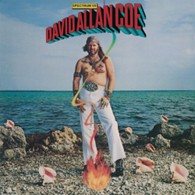
The LP can only be bought by mail order from David himself due to all the explicit lyrics and profanity. So he repeats his message on his next “regular” LP, Spectrum VII, the LP with perhaps the ugliest cover in Coe’s oeuvre (and that’s saying something after the gruesome Family Album cover). Under the credits on the back cover he writes “To Record Reviewers: Jimmy Buffett doesn’t live in Key West anymore” (the chorus line of the song).

Despite the hideous cover, it is a wonderful LP, Spectrum VII. Side A is called “Land Side” and opens with the catchy “Rollin’ With The Punches”, featuring a special, charming tribute: “Dedicated to Bob Dylan: I never thought it’d be easy Bob!” Apparently, Dylan also listened to the B-side, “Ocean Side,” and especially to the beautiful, epic song “Seven Mile Bridge”, from which Dylan seems to paraphrase the opening verse:

You know, as a child, he heard tell of the Seven Mile Bridge
That connected on Marathon's shore
Yes and it was the gateway to Key West 
His grandpa had told him ten times or more

… which Dylan then promotes to Key West is the gateway key. Coe would not dream of calling it plagiarism, of course. Not only because Dylan somehow has been above the law in that regard for sixty years now, but mainly because David Allan Coe is a devoted fan—placing Dylan’s borrowing on his mantelpiece like a Nobel Prize, no doubt.


To be continued. Next up Key West part 12: Everything is fuzzy and opalescent


Jochen is a regular reviewer of Dylan’s work on Untold. His books, in English, Dutch and German, are available via Amazon both in paperback and on Kindle:

Posted in Uncategorized | 3 Comments

The Philosophy of Modern Song: My Prayer


A list of the other songs nominated by Bob within his post-doctorate  book, which we have already covered, is given at the end.   Each article has at least one recording of the song within it.

—————–

By Tony Attwood

“My Prayer” was composed in 1939 with music by violinist Georges Boulanger and lyrics by Carlos Gomez Barrera and Jimmy Kennedy, which has featured in a number of films over the years.  The original song written in 1926, had the title  Avant de mourir (Before dying) in 1926. Jimmy Kennedy wrote the English lyrics for this version in 1939.

In that year Glen Miller then recorded the song followed by the Ink Spots and both were top ten hits in America.  This is a re-mastered copy

In the same year the Ink Spots made a recording and that also made the US top ten.

With such prescedents it is not surprising that the song has continued to be recorded by many artists, although I think most of us who have listened to the music of the 1950s will remember the hit by the Platters (above).   For most of those who remember the song that is probably the version they will receall.

The song has also turned up in several films, including the English film “One Exciting Night” sung by Vera Lynn, perhaps the most popular female vocalist of the age in the UK.

So what made Bob choose this song?  Certainly, for those who study or recall the music of the late 1930s and onwards, it is one of the songs that one comes across over and over again.   It is an incredibly simple song, as the lyrics below show, but it is packed with emotion, which cannot be misinterpreted or misunderstood, and perhaps that is what made it such a hit.

What has puzzled me, however, is why Bob chose it.   Perhaps because it is an example of how utter simplicity in lyrics can still be turned into a beautiful melody… but I think I would have to find something written not too long after the song’s release fully to understand what everyone seemed to find within the song.  I am clearly of the wrong generation to understand.

But what the song does show us is where the very simple songs of the 1950s got their inspiration from.  By the 50s the music was much more lively of course, but the notion that the song’s lyrics could be this simple had been secured in the public’s mind.

When the twilight is gone
And no songbirds are singing
When the twilight is gone
You come into my heart
And here in my heart you will stay
While I pray

My prayer is to linger with you
At the end of the day
In a dream that's divine

My prayer is a rapture in blue
With the world far away
And your lips close to mine

Tonight while our hearts are aglow
Oh, tell me the words
That I'm longing to know

Previously in this series

Posted in Uncategorized | 2 Comments

No Nobel Prize for Music: the staggeringly wonderful “Abandoned Love”


By Tony Attwood

There is an index to our current series of articles on the home page of this site.

We generally (although not invariably) follow specific themes through a series of articles, which are recorded on the home page (above) as we go.   And if you have an idea for a series, or would like to write one or more articles for us, we’d love to hear from you.  Please email Tony@schools..co.uk

The “No Nobel Prize for Music” series has one simple aim – to illustrate that continuously through his songwriting career, Bob Dylan produced musical compositions of such quality that simply to look at and analyse the lyrics is not enough to give a full appreciation of what he has been doing.   But the lyrics Bob produces are what most people focus on for one obvious reason – they are easier to reproduce and quote.

And yet it is not hard to see the inventiveness of Bob’s music.  Not through developments of the form – although Bob has done that – but simply by listening to the melody line while appreciating the novel way in which the chord progressions work.

A perfect example of this comes with the stunning composition “Abandoned Love”.   Never performed in public by Bob it is a song we’ve covered over and over again on this site from various starting positions.  It turns up in the series on the songs Bob wrote and then ignored, in our second series on covers of Dylan’s songs (The covers we missed), in the series on the meaning of the lyrics AND the music, and on and on…. it keeps coming up.

It was, in fact, the mid-popint of an extraordinary trilogy of compositions written in 1975: Oh Sister, Abandoned Love and then Isis.    And maybe it was those two exquisite songs written before and after “Abandoned Love” that caused it to be set aside first by Bob himself, and then by those who choose to spend their time listening to and studying Bob’s work.

Quite honestly, I can’t find another reason why this song would be so persistently ignored, unless it is following an invented rule that says, “if Bob doesn’t play it, we don’t want to know.”

But I include it in the “No Nobel Prize for Music” because this is a perfect example of Bob putting as much into his music as he does into the lyrics – and then leaving the song just there, without another performance, or as far as I can see, another mention.

Expecting Rain has a wonderful article covering the one single performance of this song, which I certainly recommend you read, relating to how the author went to see Ramblin’ Jack Elliott at The Bitter End in New York City – an event at which Bob was in the audience, but was persuaded to perform a song, which turned out to be this one.

As the excellent report on this event (which I do recommend you read) concludes, “It was an incredible feeling to be in that small club listening to Bob Dylan perform a new song. We all felt we were watching history in the making.”

But what is not mentioned is what happened to the song, although we get the implication.  Because what happened was nothing, except that every time I go back and try to pick out Bob’s works of musical genius, this one pops up on the list.

What makes it so wonderful is the combination of the lyrics and the music, and as I have complained so often before, so many commentators on Bob’s work tend to ignore the music.   Yet without the delicate balance of lyrics, melody and chords this song would not be a fraction of what it became via this one recording.

First, the song has a chorus line – which is not that common for Bob, although it does happen sometimes, and when it does, it tends to vary verse by verse (as for example with “Desolation Row” and “Visions of Johanna”.

The song is utterly strophic, which is to say, it is made up of musically identical, with  these verses played one after the other.  And yet, although this is just verse-verse-verse in the form of the classic folk song, there is something about the melody and chord sequence that marks it out as being utterly different from anything else.

And even more extraordinary, this is not achieved by the injection of a chord or two that are not normally found in the key of G in which it is played.   The unique quality of the music comes from line three of each verse, where the chords run B minor – C major.

Now, I stress there is nothing odd about this, for these are two chords that appear in the accompaniment of a piece in G major.  But what Bob has done is set us up to expect something else.

In classical-romantic music from which pop, contemporary folk and rock borrow so much of their structure, there are certain chord combinations (known as cadences) which are regularly used and which gives us, the listener, a sense of knowing where we are in the song.   Staying in the key of G major, the most common such combinations would be

  • D major to G major
  • C major to G major
  • A minor to D major
  • C major to D major
  • D major to E minor

The last of these (D to E minor) is known as the interrupted cadence and is far less commonly used than the others, but these endings of musical phrases (which is all cadances are) are the backbone of music.   And even if you are not familiar with any of this, or the music of the great classical musicians such as Bach, Mozart or Beenthoven you will most likely recognise that this is how the lines on songs end.

So in this song line two ends with C major to D major.  But line three moves from B minor to C major.   Those two chords are both perfectly normal in the key of G major, but to have a line that moves from B minor to C major and nothing else is extremely unusual.  It sort of leaves us hanging from a cliff, waiting for a resolution.  And most people hear this even though they know nothing about chord sequences and what is commonplace and what is not.  It just feels different.

But then Dylan resolves everything by the G D G chord sequence.

Now what makes this so interesting is that each verse is the same, so that although on hearing the first few verses we might feel slightly uncomfortable by line three, by the end of the song we are completely ok with this very unexpected third line.

If I had to take a guess as to why Bob dropped the song after this one outing, it would be that he was perhaps unsure about the third line because hearing that B minor to C major chord change tends to give most people a sense that this was unexpected, even if they know nothing about how music is constructed.   My guess is that Bob was unsure about that line musically, although also maybe after the Everlys took the song up, he felt he couldn’t go further.

But I think it is a wonderful challenge which keeps the song alive.  As ever, all one can do is give thanks to Bob for recording the song, even if he didn’t want to make anything more of it.  And thank those few other artists who have taken the song on, for doing so.

Previously in this series….

  1. We might have noted the musical innovations more
  2. From Hattie Carroll to the incoming ship
  3. From Times to Percy’s song
  4. Combining musical traditions in unique ways
  5. Using music to take us to a world of hope
  6. Chimes of Freedom and Tambourine Man
  7. Bending the form to its very limits
  8. From Denise to Mama
  9. Balled in Plain D
  10. Black Crow to “All I really want to do”
  11.  I’ll keep it with mine
  12. Dylan does gothic and the world ends
  13. The Gates of Eden
  14. After the Revolution – another revolution
  15. Returning to the roots (but with new chords)
  16. From “It’s all right” to “Angelina”. What appened?
  17. How strophic became something new: Love is just a four letter word
  18. Bob reaches the subterranean
  19. The conundrum of the song that gets worse
  20. Add one chord, keep it simple, sing of love
  21. It’s over. Start anew. It’s the end
  22. Desolation Row: perhaps the most amazing piece of popular music ever written
  23. Can you please crawl out your window
  24. Positively Fourth Street
  25. Where the lyrics find new lands, keep the music simple
  26. Tom Thumb’s journey. It wasn’t that bad, was it?
  27. From Queen Jane to the Thin Man
  28. The song that revolutionised what popular music could do
  29. Taking the music to a completely new territory
  30. Sooner or Later the committee will realise its error
  31. The best ever version of “Where are you tonight sweet Marie?”
  32. Just like a woman
  33. Most likely you go your way
  34. Everybody must get stoned
  35. Obviously 5 Believers
  36. I Want You. Creativity dries up
  37. Creativity dries up – the descent towards the basement.
  38. One musical line sung 12 times to 130 words
  39. Bob invents a totally new musical form
  40. There is a change we can see and a change we can’t see
  41. A sign on the window tells us that change is here
  42. One more weekend and New Morning: pastures new
  43. Three Angels, an experiment that leads nowhere
  44. An honorary degree, nevertheless. But why was Bob not pleased?
  45. When Bob said I will show you I am more than three chords
  46. Moving out of the darkness
  47. The music returns, but with uncertainty
  48. Heaven’s Door, Never Say Goodbye, and a thought that didn’t work…
  49. Going going gone
  50. Bob goes for love songs
  51. On a night like this and Tough Mama
  52. I hate myself for loving you
  53. Lily Rosemary and the Jack of Hearts
  54. Imagine you had just written a masterpiece. What then?
  55. After “Lily” and “Tangled” what on earth could Bob compose next?
  56. If you see her, to Call letter blues
  57. From the SimpleTwist to Idiot Wind
  58. After Idiot Wind: “You’re gonna make me lonesome”
  59. I guess its just “Up to me”
Posted in Uncategorized | 3 Comments

Dylan Song of the Year 1966: One of Us Must Know (Sooner or Later)

Recent Posts

By Tony Attwood

In 1966, Bob Dylan wrote, completed and in one way or another made available 22 songs.  Fewer than in 1962, 1963 or 1965, but roughly the same number as in 1964. Perhaps the one that immediately stands out and we all still remember is “Sad Eyed Lady” because it occupies one side of an LP, and it is both sad and enigmatic at the same time.

But for me, it’s not a song I choose to play.   I find it ponderous, and the imagery strained, and I doubt I have ever put it on the record player (although I still have the LP) since a few days after I bought the album.

However, of course, that is just me.    And the trouble beyond that is that although I bought and endlessly played the Blonde on Blonde double album, it never made me think I was hearing something wonderfully revolutionary or even new.   It was a good double album, but it did not include the revolutionarily brilliance which is how I had found within the previous albums.

There was, however, one song that stood out, and got played over and over in my house, until my mum asked, “Is that the only song on the record?”   It was One of Us Must Know.

Bob composed the song, as far as we can tell, after “Leopard skin pill-box hat” and before “She’s your lover now”.    And although it was composed in 1966, Bob didn’t perform it on stage until ten years after he released the album.    He stayed with the song for just four months, singing it sixty times, and then put it to rest once and for all.   So not a great song for Bob, but a life-changer for me.

Of course, we are used to Bob being enigmatic, and in this year of composition, perhaps above all others, “lost love” was one of his themes.   For this was the year he gave us “Fourth Time Around,” “Just like a Woman,” “Most Likely You’ll Go Your Way and I’ll Go Mine,” “Temporary Like Achilles”, “I can’t leave her behind,”  etc.

But “One of us must know” stands out (for me at least) above all those other lost love songs, and indeed above everything else on the album, and everything else (22 songs in all) that Bob wrote in that year.  And I include this recording below not only because of the picture (which I adore) but the recording too….

For musicians, it is an interesting reworking of the album version as it has an extra instrumental pause at the end of each of the first two lines in each verse.  As for example

I didn’t mean to treat you so bad
You shouldn’t take it so personal (extra rest)

I didn’t mean to make you so sad
You just happened to be there, that’s all (extra rest)

It’s just one of those little things that Bob does sometimes.  There is no musical reason why it should be in there in each case – except it just takes us by surprise after listening to the album version and (in my case at least) helps me refocus on this version, rather than what is in my head).

But to come back to the song.   1966 was not one of Bob’s greatest years for songwriting, as he spent much of his time trying to overcome the upsets in his personal life, without making each song similar to the last song.   And I am not sure that always worked, except here.

The quality of this second recording is not so good but it does show how Bob was exploring the theme and playing with it in quite subtle ways

Emma Swift who has a massive experience of working with Dylan songs, found another essence in the song, and the fact that it can be changed so much and with such success shows just how complete this song is.   Here, the meanings within the lyrics become ever clearer, while somehow the whole fragmentary nature of the relationship is retained.

And if you are a regular reader of my ramblings (for which thank you) you will know how much I have admired the way Old Crowe has reworked Dylan’s masterpieces.   And this is no exception.  Indeed, listening to the recording below takes my valuation of this song onto even higher planes.   The way they change the accompaniment for the chorus shows an implicit understanding of the song that I didn’t get until I heard this.

Now if you are a regular reader of these ramblings then not only “thank you” but also you will already realise that these are recordings I have highlighted before.   And this is not just me sticking to my favourites, but a reflection of the fact that not that many people have succeeded in making interesting original recordings of the song.

But I have found one, and I am going to finish with a version of the song that I am not sure about.  The musical accompaniment gives the song a completely new meaning.   The pain and angst have gone and have been replaced by regret.  The changes to the melody and the remarkable accompaniment really do take us somewhere new.   I am not suggesting that I prefer this to the versions above, but I am grateful to the band for showing me another aspect of the song that I had never considered before.

If you have never experienced the emotions and feelings expressed in this song, well, then at least the song offers some insight into what you have missed in life.

Thank you, once more, Bob, for this wonderful song.   I first heard it in 1966, when of course, it could have been said of me, “how young” I was, still learning about relationships, still pretending that I knew everything when, of course, I knew nothing.   I haven’t seen or heard from or about the lady I was with at the time for over 50 years.   If she is still with us, I imagine she is perhaps a grandmother now.  If I met her, I doubt I would recognise her or she me.  I have no idea what she made of her life, and of course, I am sure we will never meet or hear of each other’s exploits, but yes, I do remember her and those days, and this song from that time has stayed with me always as part of those memories.  If she does remember me, I hope it’s not in too bad a way.

All these people from across the decades that I have known…. I wonder if any remember me as I remember them….

I couldn't see what you could show me
Your scarf had kept your mouth well hid
I couldn't see how you could know me
But you said you knew me and I believed you did
Posted in Uncategorized | Leave a comment

Key West part 10:  What a long strange trip it’s been


by Jochen Markhorst

X          What a long strange trip it’s been

Key West is the place to go
Down by the Gulf of Mexico
Beyond the sea - beyond the shifting sand
Key West is the gateway key
To innocence and purity
Key West - Key West is the enchanted land

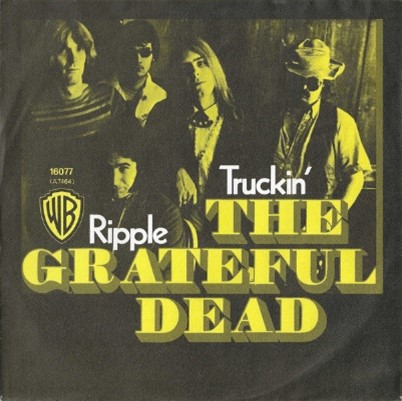
 The 66 songs Dylan discusses in The Philosophy Of Modern Song (2022) were by no means all selected because Dylan admires them so much. Sometimes he mainly wants to shine a spotlight on the songwriter (on Elvis Costello in “Pump It Up”, Warren Zevon in “Dirty Life And Times”), other songs seem to be chosen for their anecdotal quality (“Whiffenpoof Song”, “CIA Man”) and sometimes he mainly wants to talk about the vocal performances of a colleague (such as Sinatra and Bobby Darin in “Beyond The Sea” and “Mack The Knife”). And then there are a few songs that Dylan does indeed choose for their intrinsic, distinctive beauty, songs he discusses with collegial envy. Grateful Dead’s “Truckin’” falls into that category.

The admiration is unambiguous. The essayist first devotes three paragraphs to the band, to his admiration for bassist Phil Lesh and drummer Bill Kreutzmann, who, together with the rest of the Grateful Dead, turn the band into a “postmodern jazz musical rock and roll dynamo”, to Bob Weir and lyricist Robert Hunter, and then moves on to “Truckin’”, and pays tribute to the song in more than 300 words;

“This song is medium tempo, but it seems to just keep picking up speed. It’s got a fantastic first verse, which doesn’t let up or fizzle out, and every verse that follows could actually be a first verse. Arrows of neon, flashing marquees, Dallas and a soft machine, Sweet Jane, vitamin C, Bourbon Street, bowling pins, hotel windows, and the classic line, What a long strange trip it’s been. A thought that anybody can relate to.”

… highlighting the quote that Dylan had already internalised decades ago: “It’s not necessary to take a trip to write a song. What a long, strange trip it’s been, however,” Dylan replies to Paul Zollo’s question about whether one place is better than another for writing a song (SongTalk interview, 1991). Or thirty years later, when Douglas Brinkley asks Dylan, in response to a line from “I Contain Multitudes”, whether he often thinks about mortality: “I think about the death of the human race. The long strange trip of the naked ape” (New York Times, 2020).

But Dylan pays his ultimate tribute – naturally – on stage: on 12 April 2023, he surprises his Japanese audience and all bootleg fans worldwide with a performance of “Truckin’”. The band is impressive and Dylan doesn’t seem to have all the lyrics down yet, but eight days later, during the second performance of the song in Nagoya, he has refreshed his memory (or has a cheat sheet on the piano) and delivers a perfect cover. The master is pleased, apparently; Dylan ends up playing the song seven times in 2023. Thus singing seven times:

Truckin' up to Buffalo
Been thinkin', you got to mellow slow
Takes time to pick a place to go
And just keep truckin' on

… with a seemingly rather shaky bridge to the opening of the sixth verse (or the second “sort-of-chorus”, if you will) of “Key West”, the place to go. Less shaky at second glance: we know hundreds of songs with no place to go, dozens of which belong to the canon, but we hardly know any song revealing that there is, in fact, a place to go. “Lady, Be Good” is all revved up, but has no place to go, just like Meat Loaf, Chuck Berry has no particular place to go, in “Backwater Blues” thousands of people have no place to go, just like in “Let It Snow” (so we just stay at home), “Nobody Knows You When You’re Down And Out”, “Lonely Street”, “On The Road Again”, “Early Morning Rain”… for a hundred years, the canon has been trying to convince us that we have nowhere to go – only Jerry Garcia and Bob Dylan offer a more optimistic counterpoint (and, okay, the Beach Boys remember that the beach was the place to go, “Do It Again”).

And the bridge is already becoming a little bit sturdy when we hear the rest of this “verse-chorus”; just like other verses in every song on this album, this verse also consists mainly of cut-and-paste work, and seems to be a manifestation of the dominant motif on Rough And Rowdy Ways, of songs:

Down by the Gulf of Mexico is just as popular and widespread as no place to go, and Dylan’s jukebox alone undoubtedly contains some twenty songs with this specific geolocation. “Big Bayou”, Howlin’ Wolfs ” Louise”, Hank Williams’ “Seaman’s Blues”, “Rock Island Blues”, “Up On Cripple Creek”, Elvis’ “Guitar Man” of course, “61 Highway”… but on an album in which the prophet Dylan proclaims the gospel of song, he surely pays homage to the chorus of an all-time greatest:

We fired our guns and the British kept a-comin'
There wasn't nigh as many as there was a while ago
We fired once more and they begin to runnin'
On down the Mississippi to the Gulf of Mexico

… the chorus of Johnny Horton’s indestructible “The Battle of New Orleans”. The song that kept Bobby Darin’s “Dream Lover” from reaching number one on the Billboard Hot 100 in 1959, by the way. Any frustration on Darin’s part will have evaporated shortly afterwards though; his next single was “Mack The Knife”, his biggest hit (nine weeks at No. 1). Plus: in the UK, the tables were turned. There, “Dream Lover” held on to No. 1, and Lonnie Donegan’s version of “The Battle of New Orleans” had to settle for second place.


– And even more comforting, obviously, is the name-check that Bobby Darin’s “Beyond The Sea” gets in a monumental Dylan song in 2020.

– “Certain phrases are used over and over in the folk process,” says DJ Dylan in episode 75 of his radio show (2 April 2008, Cold). Demonstrating it exhaustively on this album, and after the place to go, down by the Gulf of Mexico and beyond the sea, he does so again with the shifting sand in this verse.

A first association would be “Shifting Whispering Sands”, one of the “Top 100 Western Songs of All Time” (according to the Western Writers of America), and of which Dylan presumably at the very least has the versions by Johnny Cash, Jim Reeves and Billy Vaughn in his record collection. However, a rather unbearable, corny song, really. But beyond that, it is just as established and over and over used a combination of words as the previous fixed phrases.

Dylan’s regular radio guest Tom Waits sings “And the fog lifting / The sand shifting” in the beautiful song “Shiver Me Timbers” on The Heart of Saturday Night, 1974, the song in which he also name-checks Dylan favourite Captain Ahab from Moby Dick. Grateful Dead bassist Phil Lesh, so admired by Dylan, chooses the image for a moving declaration of love in “No More Do I” (2002);

I will stand by you forever
If you’ll always stand by me
On the shifting sand or water
Take my hand, take my hand

Gordon Lightfoot, John Cale, Jimmy Dean (in “Mile Long Train”, 1963, the song with a devilish man in black), “Yesterday, When I Was Young”, Dylan’s idol George Jones (in “The Rock”), Don Henley in “Shangri-La”… “shifting sands” are as numerous in Dylan’s record collection as grains of sand on the Gulf of Mexico.

“Are you able to listen to music passively,” asks Jeff Slate in the Wall Street Journal interview, December 2022, “or do you think maybe you are always assessing what’s special – or not – about a song and looking for potential inspiration?” Dylan’s answer is crystal clear:

“That’s exactly what I do. I listen for fragments, riffs, chords, even lyrics. Anything that sounds promising.”


To be continued. Next up Key West part 11: Here’s my man, the great David Allan Coe


Jochen is a regular reviewer of Dylan’s work on Untold. His books, in English, Dutch and German, are available via Amazon both in paperback and on Kindle:

Bob Dylan’s Rough And Rowdy Ways – Side B


Posted in Uncategorized | 1 Comment

Theme Time Radio Hour: why are all the car songs 12 bar blues?


By Tony Attwood

In this series on the Theme Time Radio Hour programmes, I am looking back at some episodes recorded by Bob for series one, and choosing a few songs that interest or perhaps intrigue me, and for which I can find copies on the internet that I can share.  A list of the episodes already considered in this way is given at the end.

As I say, I do add my comments, but the key point is to offer a reminder online of some of the songs that Bob commented upon – particularly those which, because of their age, might not otherwise be noticed.

Previously in this series

In this next piece we look at Bob’s selection of tracks relating to Cars and the I’m starting with the oldest track, not least because it contains a brief instrumental part that Chuck Berry copied for “Good Morning Little Schoolgirl”.

It’s a straight 12-bar blues but with a really unexpected instrumental break – do play it all the way through, even if this isn’t your type of music.   It’s worth it just for the break.  This recording was made in 1941.

Apart from that song, Bob didn’t venture back into the 1940s, but he certainly gave us a rare collection of songs from the 50s.   From 1951 we got another 12-bar blues, “Rocket 88” by Jackie Brenston and His Delta Cats which is interesting musically because not all the sung verses are 12 bars long.  And this track does reveal the development that happened around this time of having a final instrumental verse that was not improvised but was rehearsed and prepared as the conclusion to the song – I really liked that approach, rather than just another verse and the lead guitarist or singer nodding to the band that it was then all over.

Now, the next track I picked out was “Every woman I know” which is slightly odd in a series about cars.  But the full title is actually “Every Woman I Know (Crazy ‘Bout Automobiles)” which excuses its inclusion….

In fact, the majority of songs in this episode come from the 1950s, which tells us quite a lot about the 1950s, I guess.  But although Bob did not include any songs from after 1983, he did fit in three from the early part of that decade.

And the emphasis on trying to make music that somehow reflected the power and macho approach to cars, which was so strong in early rock, but subsequently faded away.   “Mercury Blues” was a perfect example.  This is by David Lindley, and he does manage to slip in one extra chord (so I guess it is a 12-bar variant), and some very good harmonies.

But I guess I have to finish with Chuck Berry, which has a very extended introduction, but is still a 12-bar blues

So I guess all the classic car-related songs were all 12-bar blues, although sometimes the 12 bars were greatly extended as happened in the Chuck Berry song above.   We do eventually get to the chord change, but it really does take a while.

So I am left asking, why have songwriters felt the urge to a) write songs about cars and b) write songs about cars that are straightforward 12-bar blues (albeit occasionally with an extended opening section on the tonic chord).     I drive a car, but I am not actually sure I could immediately tell you what the make is… cars really don’t mean too much to me.   Maybe if they did I’d devote myself to the 12 bar blues more often… but somehow it just doesn’t seem worthwhile.

But the fact that cars are so often associated with the 12-bar blues seems to say something, although at this moment I am not exactly sure what.

Posted in Uncategorized | Leave a comment

“Philosophy of Modern Song”: Blue Suede Shoes. This is MY style!


A list of the other songs nominated by Bob within his post-doctorate  book, which we have already covered, is given at the end.   Each article has at least one recording of the song within it.

—————–

By Tony Attwood

There are many, many songs in the “Philosophy of Modern Song” that I did not know before getting the book and digging around for recordings of the songs on the internet.  So working through the volume it was always a relief to come across a track I know perfectly well, and indeed had even bought a copy of as a 78rpm disk.  But then, of course, who doesn’t know at least one version of Blue Suede Shoes?  Bob nominates the Carl Perkins version, and why not, for he was the composer.

And yet such familiarity brings with it a problem, for “Blue Suede Shoes” is a song that doesn’t seem to lend itself to a particularly wide range of re-interpretation.   It is what it is.   Of course, one can sing it as a slow blues with a new melody, and that is fun (at least I think it is fun, but then I was the only person in the room), but thus far I have not found anyone who has recorded it as anything but a re-working of what Carl Perkins did originally.

And the point about this song and its place in the history of music is that it was the first hit record that can be said to contain a combination of pop, rock, country and blues, all within the same song.  So maybe that is why the music refuses to allow any of its elements to be pushed aside.  It demands to stay as Carl Perkins wanted it.

What is also fascinating (at least to a musician) about the original versions of this song is that the opening verse has an extra two beats inserted after each line.   Thus, we have, “It’s one for the money,” which takes up four beats, and is then followed by two beats without any singing, and then “two for the show,” which repeats the same extra two-beat pause at its end, before “three to get ready”.  This extra two-beat irregularity doesn’t occur in any further verses, and over time, subsequent recording artists have lost it.  But the original version has a 10-beat verse at the beginning, which musically really is a bit odd.

The song, however, has always retained its classic original 12-bar blues concept of verse, chorus, verse, chorus and then an instrumental break.    The instrumental break, in fact follow the class 12 bar blues approach, and after the second such break, there is a repeat of the first verse followed by a coda of the lyrics “blue blue, blue suede shoes.”  It is in every way a classic and it set the scene for millions of songs thereafter.

Elvis Presley recorded “Blue Suede Shoes” in 1956, and it appears as the opening track of his first album.   Indeed, it was the song that Elvis performed constantly on TV (although mimed), and it went on to be recorded by everyone from Buddy Holly to Post Malone.

And of course it appears constantly in thevarious lists of the greatest pop and rock songs of all time.

One of the other interesting points about the song is that although it has been recorded by hundreds of artists, virtually no one can find a new arrangement that is truly different from the place where the song started.   I am sure there is a version somewhere that really does do something very different with the music, but for the moment, it has evaded me.

So what makes it such an eternal hit?  Obviously, the music is dead simple both in terms of performance and message, but the message itself is slightly different from all that has gone before – it asserted the prime importance of fashion.   For pop and rock musicians and fans, the way one dressed was an issue – something that subsequently led on to the style differences between the mods and rockers.

Yet although some songs glorified the way the newly affluent teens and 20s dressed, not too many songs found a wider audience.   Yet “Blue Suede Shoes” did.  It is, of course, a classic piece of rock n roll, but it is also a song that defines and identifies a certain group within society.   Those who relished this song in its early days were the people who had been told over and over by their parents to “dress properly” and “look smart” and here at last was a song which in the most simple of terms said, “not in your style – I’ve got my own style now.”

Which is why it remains a classic and probably will do forever.

Previously in this series

Posted in Uncategorized | 1 Comment

No Nobel Prize for Music: I guess its just “Up to me”


Previously in this series:

By Tony Attwood

As I noted before, after the musical monument that is “Idiot Wind” Bob calmed down his writing both in terms of his lyrics and in terms of the music – and a perfect example of this comes with his next composition, “Up to Me”.    The chord sequence repeats itself around just three chords (with a slight timing variation in the third line), and with a melody that repeats three times and then rounds off each verse with the title line.

This is not to say that the song doesn’t work, or doesn’t deserve to be on an album – there is, after all, nothing wrong with simple songs and repeated lines.   But what we can note is the extreme difference between Idiot Wind, and the remaining four songs that Dylan wrote in the rest of  1974 of which “Up to Me” is one example.   It is as if lyrically and musically Bob has used up all his complex ideas and analyses in one piece, and so now he is giving us simplicity by way of contrast.

“Up to me” is a perfectly fine song, with a perfectly fine recording – but having written and recorded it, Bob didn’t want to do anything with it.  It was never performed in public, and this is a theme we find with the songs composed at this time.

Yet “Up to me” is entertaining and enjoyable, which shows the quality of the piece given that it is in fact over six minutes long and with a dozen verses each of four lines with the last line ending “Up to me”.  The only chords used are the three primary chords of E major (E, A, and B), but it manages to bne soothing and entertaining at the same time.  As such, it is a perfect example of how an entertaining song can be simple and how a simple song can indeed be highly entertaining.

Roger McGuinn took it on, changed the melody somewhat, and did a lot more with the accompaniment as well as putting a lot more into the song through such changes.   The variations in the music from the guitars keep us with the song without always needing to focus on the lyrics.

Others have worked with the song, but its repetitions do challenge the performer to find ways to keep the listener’s attention, and sadly, most don’t meet this basic need.

But even though Bob did not put the song forward in concert, he must have been interested in this minimalist approach to writing as a complete variation on the complexity he had explored within “Idiot Wind”.  For the next song he composed, was again musically very simple: “Bucket of Rain”.  So Bob was persevering with this new (for him) concept of musical simplicity, but again, he was not ready for live performances – in fact, the data shows the song only being performed once by Bob in November 1990.

“Buckets of Rain” is also, we must note, another very simple song – four lines of music and three chords.  Again the opposite of “Idiot Wind”.   But we do have a remarkable recording showing Bob really thought that there was more to be found in this song.    The music starts just after the one-minute mark in the recording.

It is again a song that is utterly strophic and musically very straightforward and thus once again the antithesis of “Idiot Wind”.  Yet again a song that Bob didn’t feel he could take onto stage, or indeed take forward.

The year ended (in terms of musical compositions) with “Meet me in the Morning”.  This song did actually make it onto “Blood on the Tracks” and got one performance in 2007, but no others.  So we are still with Bob the composer who felt his songs were not set for the stage.

As a classic 12 bar blues, this is the simplest of all these songs that followed the utter complexity of “Idiot Wind”.    The chord structure is of course, set, as is the lyrical pattern of the second line, repeating the first, with the third line providing an answer.

In effect, Bob has taken us from perhaps his most complex composition ever (I’ve not checked, but it feels that way) through a series of ever simpler songs until at the end of the year (in compositional terms) he has got back to the very basics of his music.

Now this is not to suggest that Bob should have tried to emulate his own extraordinary triumph that was “Idiot Wind,”  (and of course I would never dare walk down the path of suggesting Bob should have done something else), but rather it is to point out the extremes of his movement compositionally at this point.   Idiot Wind was complex in a way that nothing in the rock or folk genre had been before, and certainly was like nothing that Bob had composed before.  But then, having reached and climbed that monument, it seems Bob couldn’t wait to get back to the old ways.

And yet, and yet, “Idiot Wind” got 55 live outings.   Not many when compared with “It ain’t me Babe” or “Tangled up in Blue” but still in the top third of his own compositions that Bob played live.

Previously in this series….

  1. We might have noted the musical innovations more
  2. From Hattie Carroll to the incoming ship
  3. From Times to Percy’s song
  4. Combining musical traditions in unique ways
  5. Using music to take us to a world of hope
  6. Chimes of Freedom and Tambourine Man
  7. Bending the form to its very limits
  8. From Denise to Mama
  9. Balled in Plain D
  10. Black Crow to “All I really want to do”
  11.  I’ll keep it with mine
  12. Dylan does gothic and the world ends
  13. The Gates of Eden
  14. After the Revolution – another revolution
  15. Returning to the roots (but with new chords)
  16. From “It’s all right” to “Angelina”. What appened?
  17. How strophic became something new: Love is just a four letter word
  18. Bob reaches the subterranean
  19. The conundrum of the song that gets worse
  20. Add one chord, keep it simple, sing of love
  21. It’s over. Start anew. It’s the end
  22. Desolation Row: perhaps the most amazing piece of popular music ever written
  23. Can you please crawl out your window
  24. Positively Fourth Street
  25. Where the lyrics find new lands, keep the music simple
  26. Tom Thumb’s journey. It wasn’t that bad, was it?
  27. From Queen Jane to the Thin Man
  28. The song that revolutionised what popular music could do
  29. Taking the music to a completely new territory
  30. Sooner or Later the committee will realise its error
  31. The best ever version of “Where are you tonight sweet Marie?”
  32. Just like a woman
  33. Most likely you go your way
  34. Everybody must get stoned
  35. Obviously 5 Believers
  36. I Want You. Creativity dries up
  37. Creativity dries up – the descent towards the basement.
  38. One musical line sung 12 times to 130 words
  39. Bob invents a totally new musical form
  40. There is a change we can see and a change we can’t see
  41. A sign on the window tells us that change is here
  42. One more weekend and New Morning: pastures new
  43. Three Angels, an experiment that leads nowhere
  44. An honorary degree, nevertheless. But why was Bob not pleased?
  45. When Bob said I will show you I am more than three chords
  46. Moving out of the darkness
  47. The music returns, but with uncertainty
  48. Heaven’s Door, Never Say Goodbye, and a thought that didn’t work…
  49. Going going gone
  50. Bob goes for love songs
  51. On a night like this and Tough Mama
  52. I hate myself for loving you
  53. Lily Rosemary and the Jack of Hearts
  54. Imagine you had just written a masterpiece. What then?
  55. After “Lily” and “Tangled” what on earth could Bob compose next?
  56. If you see her, to Call letter blues
  57. From the SimpleTwist to Idiot Wind
  58. After Idiot Wind: “You’re gonna make me lonesome”
Posted in Uncategorized | 1 Comment

Bob Dylan’s song of the year 1965: one of the greatest masterpieces of all time

By Tony Attwood

So far I have selected as my Dylan song of the year ….

My idea of choosing a Dylan song of the year is one of those things that sounds fine at the time, and a bit of fun, when simply said.    But it has to start from the beginning, and that means starting with the years when Dylan wrote and wrote and wrote.   36 songs in 1962, 31 songs in 1963, 20 songs in 1964.  But just in case we got to thinking he was drying up, in 1965 he came back with another 29 songs.

And what songs they were, ranging from songs of farewell (Farewell Angelina) to questioning the issue of the artist in society (Subterranean Homesick Blues), from adoration (Love Minus Zero) to saying farewell (It’s all over now baby blue).   And even a song saying I have had enough moving on (It takes a lot to laugh) and on to a song of utter and total disdain (Like a Rolling Stone)

But as we got to the end of another of Bob’s mega years of writing, a deep, dark negativity sank into the lyrics first with “Desolation Row” and then “Visions of Johanna” which portrayed a world of half-light, of mysticism and surrealism, verging on Dada.

A choice of song of the year from such a collection is of course going to be even more personal than it has been for other years, but for me, having discovered the music of Bob just before Freewheelin was released, and so having lived through those early years, there was one song that hit me full in the face then, and is still a central part of my world an amazing 61 years later.  And just writing that sends shivers through me.

Indeed, as I write “61” I can’t believe the time that has passed, nor the fact that, as far as I can remember, I didn’t bore you stiff with article after article commemorating 60 years of Visions.  (Although maybe I did and I have now forgotten.  Old age can do that to you).   But I have chosen the two recordings of the song with this life history in mind – I do hope you might find the time to play them both.  One is above, one below.

Of course, thinking of these past times, “Desolation Row” has its amazing opening of the historically accurate scenario of the postcards, but “Visions” equally has that overwhelming image of lying awake at night listening to the wind or the rain, or maybe in an urban environment, the traffic or the late-night drunks staggering home.

Did I sit alone, stranded in those early years?  Yes indeed, although not in an urban environment.  I was stranded in a rural community – true not too far from a town, but it was a genteel conservative place with no nightlife save a small folk club where I dutifully sang two songs each week.   So I did feel stranded.   The heating worked, there was no country music station (this was England, we didn’t have that sort of thing)… but still in my semi-rural life, going to school, coming home, doing homework, playing the piano and guitar, yes I related more to Johanna than to its companion masterpiece “Desolation Row”.

And so it strikes me that perhaps many of us are attached to the older Dylan masterpieces not just because of the compositions, but because of our personal situation at the time.   I still value Johanna as a work of musical and literary genius, but part of that emotional response does come from the situation I was in when I first played it over and over and over again.

Indeed, that line, “Ain’t it just like the night” has become an integral part of my entire life, and not just at night time alone, but for all life.   Although I have a friend now staying in my spare room, living in my house to escape matters elsewhere, although I see some of my family and/or my friends most days, and always have a conversation with someone on the phone through the day, and indeed I still often go out dancing, even now I have that link to that profound, overwhelming opening line.  And I can say it is possibly even more powerful than the follow-up, “We sit here stranded, though we’re all doing our best to deny it”.

Of course, after that, the lyrics drift away from my position in life, now in my late 70s, younger than Bob but not that much younger.    My friend, as I mentioned, now lives in my spare bedroom, two of my three daughters live close by, I still go dancing, share a lift to the clubs, see friends, and make new friends (modern jive dancing is wonderful for that…)   So no, I don’t have Visions that conquer my mind.  I have memories, and if I were to write a song today (as I still do, about once a week), it would be of visions of my world and my life, but not as sad or desperate as Bob’s world in his “Visions”.   I don’t regret the loss of past loves as Bob described in his song, and I guess it is because of this that I can still love and enjoy this utter triumph of Bob’s extraordinary composition that I have shared so much of my life with.

But here is a strange thing.  This song, that has been so central to so much of life… it has no line or two that I can quote here that sums it all up.  There is no line or two or verse or anything that I can use to say that was or is me.

It is a picture of another world; not a portrait of my world at all.  Of course, I have had love and have lost love, and have my children and grandchildren who mean everything to me.   And I have my own visions and have done my own thing.  And that is what makes this song so very, very special to me.

Bob played Visions 216 times between 1966 and 2018.   Here is the one that has become part of my life, and part of my world, in older age.   Mike chose it from 1991, and I can’t disagree.  And if you time to listen, please do let it play to the end, and make sure the room is quiet.   This is the master looking back at his world.  It is not perfect, but it is not meant to be, because whatever our memories are, they most certainly are not perfect.


Posted in Uncategorized | Leave a comment

Theme Time Radio Hour part 10: Flowers (and a thorn)

There is an index to our current series and a range of previous articles on the home page and an index to earlier articles from this series at the end of this piece.   If you are interested in writing for Untold Dylan, I’d be delighted to hear from you.  Please drop me a line to tony@schools.co.uk

————

By Tony Attwood

In this series on the Theme Time Radio Hour programmes, I am looking back at some episodes recorded by Bob for series one, and choosing a few songs that interest or perhaps intrigue me, and for which I can find copies on the internet that I can share.  A list of the episodes already considered in this way is given at the end.

As I say, I do add my comments, but the key point is to offer a reminder online of some of the songs that Bob commented upon – particularly those which, because of their age, might not otherwise be noticed.

Previously in this series

In this episode, we consider is “Flowers” which causes me a problem since although I have a garden attached to my house I moved into 20 years ago or mroe, I am not a gardener in any sense of the word.  That is something that can readily be explained by having been brought up in north London in a very small two-bedroom flat (apartment) built at high speed on a bomb site, after the end of the Second World War.  Flowers were not really part of our lives.

But on 12 July 2006 Bob gave us a collection of 14 songs mostly recorded between 1940 and 2006, which has helped expand my knowledge of this theme within music.

The earliest song in the collection is “New San Antonio Rose” by Bob Wills & His Texas Playboys from 1940.   And in common with most popular songs of the era, it starts with an instrumental, before the vocalist comes in.  I am not sure when this order of the performance (starting with the instrumental) reversed, so that in most pop music from the 1950s onwards does the reverse, and starts with the vocal verses and puts in the instumental as a break about two-thirds of the way through the performance.    But whenever it was, the order of events we have here was the norm of the day.

And I really do have to highlight Tulip or Turnip from Duke Ellington simply because it is a song with one of the whackiest names I have ever come across.

But there is another point – if one is into the music of this era one surely can’t hear the opening of this recording without thinking of Duke Ellington…  And I have to add I love the notion of a song that is fundamentally about “what am I to you” should have the title “Tulip or Turnip”.    You couldn’t get away with that today!

I did note above that most of the songs were recorded between 1940 and 2006, but there was one exception which came from The Carter Family, recorded in 1928.   As you are taking the time to read this, I imagine you’ll know of the importance of the Carter Family to Bob’s understanding of his own heritage, but forgive me if I put in a few basic facts to accompany this recording

This 1928 recording comes from very close to the start of the family’s recording work, and although we may, listening to it in the second quarter of a new century, lose some of the significance of what is going on here, the fact is that they took, and then influenced everyting from bluegrass to gosep, nad from pop to the folk revival of which Bob was such a vital part.   They were, in fact, the first (or at least one of the first) country music groups whose work reached an audience beyond the traditional country music enthusiasts.

Now moving on, the most recent recording included by Bob in this episode was “The Sharpest Thorn” recorded by Elvis Costello and Allen Toussaint in 2005 – another piece very much at the centre of my emotional world.

This is one of the songs that I thought I was on my own with, as hardly anyone else mentioned it much (in England), at least not until Bob’s programme and it is one of those that I have carried with me (metaphorically) ever since I first heard it.   And I find its influence upon me quite extraordinary.

As Elvis Costello said in an interview, “It’s a simple tale about somebody who goes out, full of pride, to join a parade, and comes home at the end of the day with confetti in his hair and his pocket’s been picked and a little wiser and humbler.”  I’m not at all sure I get anywhere near being a little wiser and humbler, but at least since this song I do try more.

And of course, as we all know, Bob went through his period of conversion and came out the other side, (a little wiser and humbler I would say, but that’s just my interpretation).   Maybe no one else sees the connection between Bob’s past and this song, but it is there for me, and this is a wonderful performance reminds me how our thoughts and views on life can be transformed by passing events, if we are willing to allow that to happen.

Indeed that seems to be me to be the point of all this.   Music can of course, just be entertainment, or something to sing along with, play, dance to, etc., etc.   But also, just sometimes it can remind us of life-changing moments, and our lives are generally all the better for that.

So glad Bob included this.

I wore my finest suit of clothes
The sharpest thorn defending the rose
Hot as a pistol keen as a blade
The sharpest thorn upon parade

And it's the same most every year
Ghosts of the dear departed are near
We raise our glasses and we cheer
Should old acquaintance disappear
Just as we wipe away a tear

    Archangel Michael will lead the way
    Archangel Gabriel is ready to play
    Although we know we must repent
    We hit the scene and look for sins
    That haven't even been invented

The strongest cage that guards the prize
The longest lash that covers your eyes
A sight no eyes are meant to know
Then on the third day he arose

    Archangel Michael will lead the way
    Archangel Gabriel is ready to play
    Although we know we must repent
    We hit the scene and look for sins
    That haven't even been invented

So Good and Evil were having a fight
It lasts much longer than any one night
It may last longer than a life
And turn a mistress into a wife

And so confetti fills the air
My head is aching
My pockets are bare
I didn't recognise their warning
Then I wasn't born the sharpest thorn
I wasn't born the sharpest thorn

At least for this episode, there isn’t anything else I can add.   Here’s the full track list.

  1. “Grazing in the Grass” – The Friends of Distinction (1968)
  2. “A Good Year for the Roses” – George Jones (1970)
  3. “The Bonny Bunch of Roses” – Paul Clayton (1957)
  4. “Laying on a Bed of Roses” – The Muffs (1995)
  5. “The Grape Vine” – Lucky Millinder & His Orchestra (1951)
  6. “Tulip Or Turnip” – Duke Ellington & His Orchestra (1947)
  7. “Tiptoe Through the Tulips” – Tiny Tim (1968)
  8. “Wildwood Flower” – The Carter Family (1928)
  9. “When the Roses Bloom Again” – Laura Cantrell (2002)
  10. “Only a Rose” – Geraint Watkins (2004)
  11. “I Threw Away the Rose” – Merle Haggard (1967)
  12. “Don’t Let the Green Grass Fool You” – Wilson Pickett (1971)
  13. “The Sharpest Thorn” – Elvis Costello & Allen Toussaint (2006)
Posted in Uncategorized | 1 Comment

Key West part 9: It all floats


by Jochen Markhorst

IX         It all floats

Key West is the place to go
Down by the Gulf of Mexico
Beyond the sea - beyond the shifting sand
Key West is the gateway key
To innocence and purity
Key West - Key West is the enchanted land

The second French Connection, after that coincidental link with Jean Sablon’s hibiscus and bougainvillea, is much more deliberate. At least, it seems obvious that “beyond the sea” is a conscious tribute to Bobby Darin and his hit “Beyond The Sea”. A case of catching up, presumably. In the twentieth century, we don’t see or hear Dylan paying any particular attention to Darin – it’s one-way traffic from Darin, the first artist to sing “Blowin’ In The Wind” in the studio (July 1962, but not released until later, in 1963), and producing beautiful covers of “Don’t Think Twice, It’s All Right” and “I’ll Be Your Baby Tonight”.

In the 21st century, Dylan finally returns the love. At first rather matter-of-factly, when DJ Dylan plays Darin’s übercool version of the perfect song “Black Coffee” in episode 5 of his Theme Time Radio Hour, Coffee (31 May 2006), the song that Polish Nobel Prize winner Wisława Szymborska had played at her funeral in 2012 (in the version by Ella Fitzgerald, though). The DJ introduces the song with an apocryphal story;

“Walden Robert Cassoto. He changed his name when he saw a sign outside a Chinese restaurant that said ‘Mandarin Duck’. First three letters were burned out, so it just said ‘darin Duck’. And he said, ‘That seems like a good name – Darin Duck.’ Here’s Bobby Darin – Black Coffee.”

… and the lead-out is equally neutral;

“That was Bobby Darin, singing about talking to the shadows from one till four, downing his past regrets in coffee and cigarettes, moonin’ all the mornin’ and moanin’ all the night. From his album This Is Darin. A song written by Sonny Burke and Paul Francis Webster.”


… although both the song and the album should be close to Dylan’s heart. This Is Darin (1960) is Bobby Darin’s most “Sinatraesque” album—perhaps not quite reaching the Olympian heights of In The Wee Small Hours, but certainly on a par with Songs For Swingin’ Lovers!; brilliantly arranged by Richard Wess, with dazzling performances of “Sinatra songs” such as “The Gal That Got Away”, “Guys and Dolls”, and especially Darin’s very Sinatraesque rendition of the classic that Ol’ Blue Eyes himself never ventured to tackle, Duke Ellington’s pièce de résistance “Caravan”.

But in 2022, Dylan makes up for everything, for all the neglect. More than that, in fact: in his collection of essays, The Philosophy Of Modern Song, he devotes two entire chapters to Bobby Darin. Chapter 14 is about Bobby’s biggest hit (and only No. 1 hit) “Mack The Knife”, in which our philosopher uses many respectful words (691, to be precise) mainly to assert, somewhat disrespectfully, that Bobby Darin is not Frank Sinatra. In the second Darin chapter, Chapter 14, “Beyond The Sea” Dylan seems to realize that he perhaps should also highlight Bobby Darin’s merits and achievements. Dylan then reveals himself to be a fan:

“Bobby Darin could sound like anybody and sing any style. He was more flexible than anyone of his time. He could be Harry Belafonte. He could be Elvis. He could be Dion, he could be a calypso singer, he could be a bluegrass singer or a folk singer. He was a rhythm and blues singer. The guy was everybody if anybody. […] Each of his guises he inhabited with verve and gusto and even in repose he just about vibrated with talent.”

Towards the end of the essay, the writer returns to that talent once more and then specifies it. It now becomes clear to the reader in what way Dylan feels an artistic kinship with Darin:

“His phrasing, especially on a pop ballad like this, is the driving wheel of the production. Time and time again, he’ll slip the first few words of a line upstairs into the end of the previous line. He’s very subtle and you don’t realize he’s doing this. But if he sang songs like this straight, it probably wouldn’t reach you. He’s playful. He’s a playful melodist and he doesn’t need words. He keeps it simple even when he’s singing about nothing. The sea, the air, the mountains, the flowers. It all floats. It never touches the ground.”

… with Darin’s phrasing, never touching the ground, that is – not coincidentally also one of Dylan’s greatest singing qualities.


Only in the very last lines does Dylan remember what the essay should actually be about: the song. The essayist is aware of the French Connection. “This is a French song” are the first words of the essay section. Before that, as in most of the 66 essays, we read an impressionistic introduction, the dramatic opening monologue in which the narrator addresses a “you” and shares his associative, colourful, often exalted vision of the expressive power of the song lyrics.

The opening line of the Beyond The Sea-ouverture reveals that Dylan sees his own “Key West” in “La Mer”: “In this song your happiness lies beyond the wide sea, and to get there you have to cross the great unknown” – so your happiness is waiting, as Dylan will repeat in other words in “Key West”, in the paradise divine on the horizon line.

“Beyond The Sea”, or rather the song’s mother, Charles Trenet’s “La Mer”, is one of those extraordinary songs that transcends categories, managing to express precisely that “unreachable paradise” – feeling and, even more, to set it to music. Plus, it has a fascinating extra quality: just like the flexibility that Dylan so admires in Bobby Darin, “Beyond The Sea/La Mer” also has the chameleon-like ability to fit into a variety of contexts. When Robbie Williams sings the song over the closing credits of Pixar’s Finding Nemo (2003), we hear the exuberant joy of a happy ending; Julio Iglesias’ live version over the final minutes of Tinker Tailor Soldier Spy (2011) casts a heart-wrenching, bittersweet, melancholic shine over the smoky images; in Ewan McGregor and Cameron Diaz’s duet in the karaoke bar (A Life Less Ordinary, 1997) the song suddenly has a catchy feel-good vibe; gloomy and surreal in the BioShock video games; light-hearted and sunny in an advert for Irish Ferries; ironic grandeur in ITV’s leader for Euro 2016 football coverage; and so on – the song is often and gladly used by film makers, art directors and other creative types, and always adapts itself.

In short, “Beyond The Sea/La Mer” has a magical quality, and Dylan can only hope that the single name-check in “Key West” will rub some of that magic off onto his song. Dylan’s song certainly has, for one thing, the heart-wrenching, bittersweet, melancholic shine.


To be continued. Next up Key West part 10: What a long strange trip it’s been


Jochen is a regular reviewer of Dylan’s work on Untold. His books, in English, Dutch and German, are available via Amazon both in paperback and on Kindle:


Posted in Uncategorized | 1 Comment

The Philosophy of Modern Song: the most wonderful, eternal and simple, “Midnight Rider”


A list of the other songs nominated by Bob within his “Philosophy of Modern Song” book, which we have already covered, is given at the end.   Each article has at least one recording of the song within it.

—————–

By Tony Attwood

Sometimes the lyrics of a song mean everything to me, sometimes nothing, and occasionally it is just one line that stays with me.   As with “ain’t gonna let them catch the midnight rider.”  It’s there in my head, as it has been since the song was first released in 1970.

One line in my head for at least 55 years – given that I probably didn’t hear the song when it was first written.   55 years of wondering what the midnight rider is or was but really not caring too much.

I was of course, a midnight rider in my days of playing with (rather unsuccessful) rock bands in the 1970s, as well as when motorcycling around the country to see whoever it was I felt I wanted to see.   And then suddenly, I wrote a book that people actually wanted, and it is amazing what a bit of money and a publisher demanding a follow-up can do for changing one’s life.  But driving back from somewhere late at night, I never lost the thought of the midnight rider.   Those two words seemed to symbolise who and what I was.

And then, rather later, I took up dancing modern jive; I once more found myself doing those long drives in the darkness; it all came back to me.  Funny how one song can be so much a part of one’s life over such a long period of time.

I am sure that for Bob this is not to think of the man on the run, but the essence of moving on, and exploring, as of course Bob has done through this concerts year after year.   And this song surely takes him back to the early days.   Just the line I’ve got one more silver dollar, is enough to tell us where we are and what the song is

Yet I think there is more.   As for me, the essence of the song has always been that I am not going to compromise on issues that seem important to me.   By which I don’t mean that I will be deliberately beligerent or difficult and never compromise, but there are some things that seem to be worth standing up for.  Not to die pointlessly for, but not to give up on.  Those things that just seem important have always done and always will do.

It is, however, one of those songs in which somehow, some of the lyrics have passed me by. Which is odd since it is such a simple song. I mean I know the opening “Well, I’ve got to run to keep from hiding” and what follows about the silver dollar, which is rather irrelevant to me being in the UK, but not much more.   And that is because each of the three verses (which are finally followed by a coda) have just two original lines followed by the repeated

And I've got one more silver dollar
But I'm not gonna let 'em catch me, no
Not gonna let 'em catch the midnight rider

It is, in fact, a simple but complete expression of individualism.   And it works because it appears without any explanation of why that individualism is important.   It just is, and it rang true at a time when musicians, and their fans (in their teens and 20s) were expressing their individuality.

Thus it was and is the simplest possible expression of the vision of the individual in society at the time.   When our individuality seemed more important than anything else.

Yes, of course, the arrangement helps enormously, and I suspect you can probably hear it in your head as you kindly take a moment to read these jottings, but still, in essence, this is utter simplicity.   I am me, leave me alone.

And the proof of the power of the lyrics and the music behind them is that I suspect most of us who were alive and listening the music in 1970 felt that it said all that needed to be said.   Who cares who or what the midnight rider is or was, we just are….

And for once, I agree with the general consensus.  That version above is a sensational version, and ultimately, as I have tried to express my own individuality in my work, that is the recording that I have held on to.

Eventually, of course, the band couldn’t resist making the song much longer with a long jam session based on the simple chord sequence, and that worked because by then (maybe 30 years later) everyone knew that this song symbolised them, and their resistance to the old ways.   There is also the rather fun story that the two originators of the song “broke into Capricorn Sound Studios to complete a demo of the song.”

It is also one of those fascinating songs in which the cover versions seem to have become much more popular than the original, particularly Gregg Allman’s solo version of the song, released in 1973.

There is also a good story about the band’s road manager Kim Payne, who wrote two lines of the third verse.

"'I've gone past the point of caring
some old bed I’ll soon be sharing.

And although the history of pop and rock is notorious for musicians and songwriters not acknowledging the odd line offered by someone else, in this case, the roadie did get his five per cent for those two lines. 

Previously in this series

Posted in Uncategorized | 1 Comment

No Nobel Prize for Music: after Idiot Wind: “You’re gonna make me lonesome”

Recent posts

No Nobel Prize for Music – index to articles at the end of this piece…

By Tony Attwood

Because most of the time, most of us don’t actually consider Dylan’s compositions in the order in which they were written, it is possible to miss the ebb and flow of Bob’s creativity. Hence in this series on Dylan’s musical approach, I do actually consider Dylan’s song in the order of composition.

“Idiot Wind” by any measure was an absolute masterpiece of composition, not only utterly gripping and entertaining to listen to, but also eight verses and a “B” section sung four times (and often mistakenly referred to as a chorus – which is isn’t since the lyrics change; to be a true chorus the B section would have to have the same music each time).

It is a massive work, and one which, if there were a Nobel Prize for music, would surely be in contention to receive it, not just because of it as a song, but also because it takes the whole concept of the contemporary song into a new dimension.

In the traditions of pop and popular music, the songs are invariably about one of three subjects: love, lost love and dance.  This song is clearly about “lost love” and yet it takes on a direction in which, instead of the man wailing in sadness over the fact that his lover has gone, he is telling her, “You’re an idiot, babe, It’s a wonder that you still know how to breathe.”

Now for 99.99% of songwriters, having composed “Idiot Wind”, that would have been enough not just for the year, but quite possibly for the decade.  But not for Bob.

This was the eighth song he wrote in 1974 and he still had four more in him before the end of the year.   And indeed none of these were songs which Bob recorded once and then forgot, for these are songs that we still know today…

  1. You’re gonna make me lonesome when you go
  2. Up to Me
  3. Buckets of Rain
  4. Meet me in the Morning

I do find that listening to Dylan’s compositions in the order they were written an interesting and indeed insightful thing to do, as he helps me get a little bit more into the world of understanding what he was thinking as he composed.

And in this regard, “You’re gonna make me lonesome” is a very gentle response to “Idiot Wind” – it is in fact, lyrically and musically the reverse of the previous song.  Indeed, as the Wiki commentary of the song notes, “the lyrics being called Dylan’s most masterfully written love poem.”

Whether the lines

"Situations have ended sad 
Relationships have all been bad 
Mine’ve been like Verlaine’s and Rimbaud

are autobiographical or not, the issue surely goes far beyond that when we remember that this song was written not long after “Idiot Wind”.   And yet if we just listen to the music, we can indeed hear that profound difference not just of lyrics, but of music and thus of emotion and meaning of the two songs written in succession.

“Idiot Wind” is very unusual in Bob’s musical canon (it might be unique in this regard, but I don’t want to go through the entire list of 500+ songs to prove it or not) in that it starts on that minor chord that has nothing to do with the key he is performing in.   In “Lonesome” we have the opposite effect.   The opening chords in this song are...

Am                         Bsus4             Bvii           E
Someone's got it in for me, they're planting stories in the press

In essence, most people who can play some Dylan songs on piano or guitar will hear this as a three-chord song.   But not just a three-chord song but a three-chord song using the three regular, normal chords that one uses when playing pop, rock or folk music.  In short, E major, A major, and B7.    If you can play those three chords on the guitar, you can strum along to a billion songs.

But there is a twist, and yes I could feel there was a twist when I first hear the song, but it wasn’t until I saw Eyolf Østrem‘s analysis that I realised just how far Dylan had gone.   For having started “Idiot Wind” on a most unexpected chord, here Dylan again springs a surprise for he does not start on plain E major; he uses  E major 7 (which is the chord of E with a D# added).  And the B chord is not just B but B11 which is B plus at least some of A, C#, and E added – although usually not all of them.

Of course, we don’t immediately focus on the chords, although many thanks to Mr  Østrem for doing just that, but these nuances, if I can call them that.  For they really do add to the song.

And there is a superb twist in all this.   The lyrics tell of us a wonderful love, but normally, love affairs in popular songs are things that happen quickly – the couple see each other, and either one of them or indeed both of them fall in love instantly.   But not here for Bob gives us a love affair that has “Never been so easy or so slow.

E                 Emaj7
I've seen love go by my door
     A
It's never been this close before
E             Emaj7      B11
Never been so easy or so slow.
     E               Emaj7
Been shooting in the dark too long
     A
When somethin's not right it's wrong
E                    B11               E . . .
You're gonna make me lonesome when you go.

Wiki also tells us that “Multiple versions were attempted, including a slow ballad arrangement, but ultimately Dylan opted – as he did with most of the tracks from these sessions – for a near-solo acoustic arrangement.”   And indeed it is that arrangement which allows us to see this song as the antithesis of “Idiot Wind” – the message and the music is very different in each case but the arrangements are not from different worlds.   We are able to hear the songs as part of a sequence because of the similarities in the arrangements.

Now of course, what Bob could have done is think that “Idiot Wind” and “You’re going to make me lonesome” are profound opposites lyrically, and so they need to be opposites not just in the music (which they are – this is a gentle lilting tune with no minor chords) but also in the arrangement, but he stopped short of making the musical arrangements utterly different.   That the music itself is different is enough of a change to emphasise the difference in the lyrics.

The movement from “Idiot Wind” to “Lonesome” is thus primarily achieved through the lyrics (obviously) and the melody and chords, not through a changed accompaniment.   With “Idiot”, the music, like the lyrics is jagged and sharp.   Here they are calm, sad but acknowledging.  Keeping the music so simple in “Lonesome” thus acknowledges that no matter how good the world is now, times pass.   For such a message, you don’t need the extremes of melodic range nor suddenly jerky chord changes.   And Bob understands that.  It is a perfect answer to “Idiot Wind”.  It is indeed, a perfect song not because of the lyrics but because the music is such a contrast from “Idiot Wind”.

And yet for Bob it seems, it was just another song.   He played it just a dozen times in all, across April and May 1976, and that was it.   Although I have to admit “Idiot Wind” only got 55 outings all told.   It really was as if these were issues in which, through writing the songs, everything had been said.

That certainly seems to have been Bob’s reaction.   But musically, we have been left with two utterly contrasting works of utter genius, written one after the other, each expressing through lyrics and music, two completely different sides of relationships.   If there had been a Nobel Prize for Music I guess they would have given it to Bob for the whole album.

Previously in this series….

  1. We might have noted the musical innovations more
  2. From Hattie Carroll to the incoming ship
  3. From Times to Percy’s song
  4. Combining musical traditions in unique ways
  5. Using music to take us to a world of hope
  6. Chimes of Freedom and Tambourine Man
  7. Bending the form to its very limits
  8. From Denise to Mama
  9. Balled in Plain D
  10. Black Crow to “All I really want to do”
  11.  I’ll keep it with mine
  12. Dylan does gothic and the world ends
  13. The Gates of Eden
  14. After the Revolution – another revolution
  15. Returning to the roots (but with new chords)
  16. From “It’s all right” to “Angelina”. What appened?
  17. How strophic became something new: Love is just a four letter word
  18. Bob reaches the subterranean
  19. The conundrum of the song that gets worse
  20. Add one chord, keep it simple, sing of love
  21. It’s over. Start anew. It’s the end
  22. Desolation Row: perhaps the most amazing piece of popular music ever written
  23. Can you please crawl out your window
  24. Positively Fourth Street
  25. Where the lyrics find new lands, keep the music simple
  26. Tom Thumb’s journey. It wasn’t that bad, was it?
  27. From Queen Jane to the Thin Man
  28. The song that revolutionised what popular music could do
  29. Taking the music to a completely new territory
  30. Sooner or Later the committee will realise its error
  31. The best ever version of “Where are you tonight sweet Marie?”
  32. Just like a woman
  33. Most likely you go your way
  34. Everybody must get stoned
  35. Obviously 5 Believers
  36. I Want You. Creativity dries up
  37. Creativity dries up – the descent towards the basement.
  38. One musical line sung 12 times to 130 words
  39. Bob invents a totally new musical form
  40. There is a change we can see and a change we can’t see
  41. A sign on the window tells us that change is here
  42. One more weekend and New Morning: pastures new
  43. Three Angels, an experiment that leads nowhere
  44. An honorary degree, nevertheless. But why was Bob not pleased?
  45. When Bob said I will show you I am more than three chords
  46. Moving out of the darkness
  47. The music returns, but with uncertainty
  48. Heaven’s Door, Never Say Goodbye, and a thought that didn’t work…
  49. Going going gone
  50. Bob goes for love songs
  51. On a night like this and Tough Mama
  52. I hate myself for loving you
  53. Lily Rosemary and the Jack of Hearts
  54. Imagine you had just written a masterpiece. What then?
  55. After “Lily” and “Tangled” what on earth could Bob compose next?
  56. If you see her, to Call letter blues
  57. From the SimpleTwist to Idiot Wind


Posted in Uncategorized | 2 Comments

Dylan Song of the Year: 1964. Gates of Eden

Recent Posts

By Tony Attwood

So far I have selected as my Dylan song of the year ….

and in my intro to the song I chose from 1963 – Seven Curses – I gave an explanation of my thinking in creating this series, which chooses one song from each year as my nomination to Dylan’s best composition of that year.  And “composition of the year” is an important notion here, because for 1964 I am indeed selecting a song written that year, but not a performance from that year.

1964 was the year that showed us that “master songwriter” though he was, Bob still had limits.  He had written and kept 36 songs in 1962, 31 in 1963 and now in 1964 he dropped down to 20 songs.   Still a phenomenal number, but now it seemed he was slowly approaching the sort of number of compositions a year that other human beings might be ableto conjure up in one 12 month period.   He was still beyond everything as a songwriter, but was slowing down just a little.

And although the number of songs is lower than before, the quality is still beyond belief.   When writing my original review of the year as part of the early days of this site, with its aim of simply trying to list all the songs Bob had written and then put them in the order they were written, my notes tell me I did try to highlight the key songs, but ended up with seven compositions.  And just looking at that list of seven now, it is as unbelievable then, as it still seems now, that one man could have written all seven songs in one year.   Although of course, we know he went far, far beyond that.

But just in case you are interested my list of seven masterpieces from that one year was

  • Chimes of Freedom
  • Mr Tambourine Man
  • It ain’t me babe
  • Mama you’ve been on my mind
  • I’ll keep it with mine
  • Gates of Eden
  • It’s all right ma

Any one of those songs on its own could have made this a year to remember, but Dylan wrote them all in one year – and of course many more beside   You can see the full list for this year, and indeed each year of the 1960s and 1970s, in the order written, here.

But I have (perhaps rather stupidly, I am starting to wonder) decided to write a series which highlights one song from each year.  “It’s all right ma” of course shouts out at me, if for nothing else other than that last line, “it’s life and life only” – a line that has helped in various ways guide me through my own life, which seems to me (although maybe not to everyone else) to have been fairly tumultuous.  Yes, if I were writing “Dylan’s phrase of the year” it would be that final line: “It’s all right ma, it’s life and life only”.

However, no, after a lot of thinking and debating and staring vaguely out of the window onto my snow-covered garden contrasting with the giant trees just showing their first sign of leaves, I go back one song to Gates of Eden.  I first heard it while still a city dweller, renting out and ultimately buying a pretty awful apartment, but working in the theatre in London, that’s all I could afford.

Looking back through, now sitting in a house in a really peaceful village, and considering this website which now has over 4000 articles on it, I’ve immediately seen there are well over 30 versions of Gates of Eden on this site – and not all with commentaries by me, thus showing that others too rate it at the very top.  Indeed, Mike Johnson wrote for this site a series tracing the live performances just of this one song.

And thanks to Mike I cannot ever get away from what turned out, I think, to be the final performance of all.   When I first published this recording, I was rather dismissive, saying that it didn’t add much to everything that had gone before.   Well, if you are a devotee of the song that full article with all the recordings is still on the site of course  but something profound has changed in my thinking, because this is the version I now return to… what I believe is the final version.  The version I now cherish.

Bob gave us 217 live performances of “Gates”, and if the afterlife exists and they make a mistake and let me into heaven, offering me along the way a chance to go back and revisit a moment, it will be this performance.

So why does Gates of Eden mean so much to me?

Musically, it offers a chord sequence which I think is, if not unique, then very unusual, with the second chord of the song (D minor) having no natural relationship with the opening chord (G major).   It is a brilliant way of musically setting up the contrasts that beset the whole song in the first and third lines of each verse.  It makes us ponder and think when we first hear it.   And now, hear that slow G to D minor, and you know what you are going to get.  That contrast of early bemusement and later affirmation is within me each time I hear this, and I find it extraordinary.   It’s like meeting an old friend not seen for years, and finding he speaks with a different accent.  It is weird, and fascinating, and one wants more….

Perhaps what has always drawn me into this song from the very first moment I heard it (and had to play it over and over again) was the complexity of the lyrics, which I still doubt that I understand.   But there are moments that have always reached out to me, especially with the lines about “Relationships of ownership” and how we are all “condemned to act” according to our place in society, what we own, what we earn, and that utter killer of a final line of the verse, “And I try to harmonize with songs, the lonesome sparrow sings; there are no kings inside the Gates of Eden.”   As one who has spent his life (not particularly successfully) in the creative arts, that line still overwhelms me.

But also, as an athiest I don’t believe in life after death, yet if I am quite wrong and God exists, then yes, surely, after death, we must all be equal.   Otherwise whatever was the point of anything?  Or am I really to be punished for not believing?

Just as I have no idea how Bob comes to his lyrics, nor do I know how he reaches his later re-arrangements, does he just stumble on an idea and say, “hey guys, let’s do it like this” or is each carefully worked out and presented as a full new version to the band?   I suspect the former – at least some of the time.

However, Bob did get to that version of “Gates” and from my revised perspective, it was worth the journey.  And the fact that this was the last live edition, or at least the last one I know of (and don’t spoil it for me if he has done another one since), adds to my feeling.

Song of the year?   Yes for me, but more than that, this final goodbye by Bob to this song sums it all up.

“Gates of Eden”…. thank you Bob for every song, but especially for this one.

If you would like to write an article about your relationship with the songs of Bob Dylan, or indeed anything else Dylan-related, do write to me.  Tony@schools.co.uk

Posted in Uncategorized | Leave a comment

Theme Time Radio Hour 9: Summer

There is an index to our current series and a range of previous articles on the home page and an index to earlier articles from this series at the end of this piece.   If you are interested in writing for Untold Dylan, I’d be delighted to hear from you.  Please drop me a line to tony@schools.co.uk

————

By Tony Attwood

In this series on the Theme Time Radio Hour programmes, I am looking back at some episodes recorded by Bob for series one, and choosing a few songs that interest or perhaps intrigue me, and for which I can find copies on the internet that I can share.  A list of the episodes already considered in this way is given at the end.

As I say, I do add my comments, but the key point is to offer a reminder online of some of the songs that Bob commented upon – particularly those which, because of their age, might not otherwise be noticed.

This episode, taken from the first series of radio programmes, took the theme of Summer and was first broadcast in July 2006.

And for this episode, Bob went so far back for one track that came from so long ago that I can say it is almost one hundred years old.   So we are talking of “old days” being the time before either Bob or I was born.   Hmmmm…..

And I am sure I have heard this song recorded by other bands over the years.   It is so gentle – I feel I could listen to it during a heat wave – although perversely I am writing this during the exact opposite of a heat wave.   This is a really bad winter in the part of England where I live.

But that’s my problem.   This was recorded in 1935 – 91 yeas ago…

As ever, Bob included in the show multiple tracks I have never heard before, and indeed many artists I didn’t previously know.  So for my next selection from Bob’s selection, I am going to quote from Wiki and hope this is correct….

Gladys Alberta Bentley (August 12, 1907 – January 18, 1960) was an American blues singer, pianist, and entertainer during the Harlem Renaissance.

“Her career skyrocketed when she appeared at Harry Hansberry’s Clam House, a well-known gay speakeasy in New York City in the 1920s, as a black, lesbian, cross-dressing performer. She headlined in the early 1930s at Harlem’s Ubangi Club, where she was backed up by a chorus line of drag queens.  She dressed in men’s clothes (including a signature tail coat and top hat), played piano, and sang her own raunchy lyrics to popular tunes of the day in a deep, growling voice while flirting with women in the audience.”

This song really did cause me a bit of searching to try and find its origins, but fortunately, it did turn up on the “Best of” album that was put out following the series.

Whether that track is one of the “best of” the series (I rather suspect copyright availability was an influential facgtor in choosing the songs, but I might be wrong), Bob really did some interesting digging with this episode, moving far away from the 12 bar blues that populate some of the episodes, as shown with Mr Sad Head in the next recording.

There are some fascinating rhythmic changes in this song, which reveals exactly what this series of radio programmes was about.  It was Bob recognising some wonderful original pieces of music, showing us just how varied the music of past eras could be.   But as we can tell Bob has never attempted to borrow or use any musical ideas from these musicians.   In terms of compositions, Bob carried his own way, always, but could still take into himself these musical forms from decades before.

And one of the great things of course, is that from this position one can go exploring the music of some of the earlier performers that Bob brings to our attention.    This is certainly the case with Mr Sad Head, where, despite the illustration below telling us this record was not for sale, online one can find a number of other recordings of this and other tracks, just by typing the musician’s name into your favoured search engine.

More in keeping with the blues tradition, which Bob invariably takes us back to is “Ice Cream Man” from 1953.  This is by John Brim

Of course, Bob did include songs from more recent times, such as “In the summertime” by Mungo Jerry, and there is every chance you’ll know that inside out.  But I will give one example from slightly more recent times, which I was already familiar with.  This comes from 1958, just five years on from the recording above.  I am sure you will know it.

It was one of the records in my first year or two of buying records with my pocket money.  It now seems restrained, and I am left wondering why everyone seemed to get so worked up about this type of music.   Maybe it was thought that a 12 year old shouldn’t know what summer times blues was, or is.

As for “I’m a-gonna raise a fuss, I’m a-gonna raise a holler” that really wasn’t what a young English lad should be listening to.   Or singing.  Or playing on the piano.

Absolutely not.

Oh my poor parents.

Previously in this series

Posted in Uncategorized | Leave a comment