Key West part 8: Leaving you, Tahiti


by Jochen Markhorst

VIII       Leaving you, Tahiti

I got both my feet planted square on the ground
Got my right hand high with the thumb down
Such is life – such is happiness

Hibiscus flowers grow everywhere here
If you wear one put it behind your ear
Down on the bottom – way down in Key West
 The two months Gauguin spent living with Van Gogh in Arles in 1888 did not really contribute to his well-being or happiness, nor was it particularly successful socially. It did, however, result in a few stunning paintings (Gauguin’s portrait of Vincent, for example, “Le peintre de Tournesols”, The Painter of Sunflowers, and especially Vincent’s hallucinatory “Self-Portrait, dedicated to Paul Gauguin”), but it ultimately cost Vincent an ear and was yet another failure for Gauguin, after forty years of one misfortune after another. Still, the two turbulent months in Arles seem to have been a sort of a turning point for Paul: in 1891, he left for French Polynesia “to escape European civilisation” and remained there – apart from one single last visit to France – until his death in 1903. Not necessarily happier, by the way.

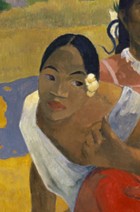
The emigration (Gauguin’s fifth and final emigration) does mark an artistic high point though. The colours, the gazes of the Polynesian women, nature… masterpieces such as “Parau Parau”, “Tahitian Women on the Beach”, “The Yellow Christ”, the monumental “D’où venons-nous? Que sommes-nous? Où allons-nous?” and dozens of others would never have been created without that impulsive flight. Masterpieces with which Paul en passant and unintentionally, establishes an archetypal object in Western art, which we see descending 130 years later in a Dylan song: the hibiscus. Gauguin is quite fond of it. In his portraits of Tahitian and later Marquesan women, they more often than not wear a hibiscus behind their ears. One of the first objects Paul paints in Tahiti is Te Burao, The Hibiscus Tree, and Gauguin receives definitive recognition as a hibiscus evangelist in the 21st century when a new variety is named after him: the Luv Paul Gauguin Hibiscus Plant.

By that time, Gauguin’s missionary work had long since established the hibiscus in Western art as a symbol of exceptional beauty, paradisiacal idyll and detachment. In paintings, wallpaper patterns and jewellery, as well as in song:

Jean Sablon – En te quittant Tahiti: 

En te quittant, Tahiti                                       Leaving you, Tahiti
Ainsi que la légende le dit                             
As the legend tells to do
De mon bateau j’ai jeté                                 
From my boat I threw
Dans le lagon tous mes colliers                   
All my garlands into the lagoon
Les colliers de frangipaniers                        
Garlands of frangipani
D’hibiscus, de bougainvillées,                     
Hibiscus, bougainvillea
S’ils reviennent vers Tahiti                            
If they return to Tahiti
C’est que j’y reviendrai aussi!                      
It means I will return too!

… as in Jean Sablon’s “En Te Quittant Tahiti” (1958), which coincidentally represents a second botanical connection between Sablon and Dylan (featuring a funny, again coincidental resemblance to Dylan’s “Duquesne Whistle”, by the way). The first botanical connection was “Autumn Leaves” and, admittedly, carries more weight.

In a certain sense, “Autumn Leaves” is an outlier in Dylan’s output from the “Sinatra years” of 2015-17, the years in which he filled five albums and 200+ concerts with his interpretations of songs from the American Songbook. The three albums (Shadows In The Night, Fallen Angels, and Triplicate) contain 52 songs. All of them are songs written by American greats such as Irving Berlin, Van Heusen/Burke, Hoagy Carmichael, and Jerome Kern/Oscar Hammerstein, with only one non-American song: the French evergreen “Les Feuilles Mortes” (in Johnny Mercer’s translation that is, as “Autumn Leaves”). Dylan does have a soft spot for the chanson. He continues to sing it even after the “Sinatra years”, up to and including July 2018 in Seoul, having performed the song 237 times. Perhaps it is not only the enchanting music, but also the story behind it.

The chanson comes from Les Portes de la Nuit from 1946 (Marcel Carné, screenplay by Jacques Prévert), a black-and-white film Dylan will appreciate. We are in Paris in February 1945, the last days of the war. Chaotic Paris has already been liberated, but elsewhere in France the war is still raging. “Le Destin”, a mystery tramp dressed in rags, predicts the death of each of the characters he encounters. He also directs the tragic love affair of the main characters, resistance fighter Diego (Yves Montand) and the unhappily married Malou (Nathalie Nattier), who ultimately cannot escape their fate either.

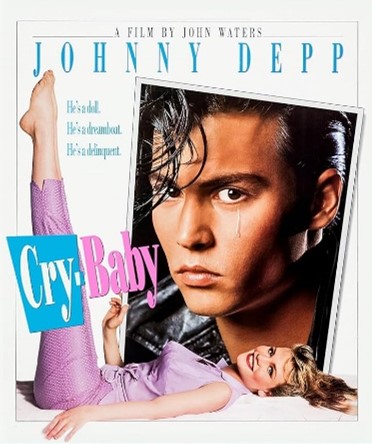
It is a dark and, alright, somewhat sentimental fateful drama. At most, setting and atmosphere still remain captivating today (and the movie might have been even more fascinating had Marlene Dietrich and Jean Gabin not declined the leading roles), but the film is nonetheless immortal: Prévert also wrote two songs for the film (music by Joseph Kosma), one of which would reach Olympian heights: “Les Feuilles Mortes”. In Les Portes de la Nuit, it is only hummed by the man who would make the song famous three years later, Yves Montand, but it is sung by Nathalie Nattier (Malou), who therefore actually has the first official recording of “Les Feuilles Mortes”, or “Autumn Leaves”, as most of us know the song, to her name. The French legend Cora Vaucaire, “La Dame blanche de Saint-Germain-des-Prés”, recorded a version simplified by Yves Montand in 1948, but the song only became a real hit, a million-seller even, when Yves himself took it on in 1949.

It was not until 2022 that it became apparent that neither Vaucaire nor Montand had been the first: a forgotten recording surfaced. The first professional studio recording of “Les Feuilles Mortes” was sung in the summer of 1947, in New York no less, by that other legend, Jean Sablon, the French Sinatra. When we hear Dylan sing Bougainvillea bloomin’ in the summer and spring four verses later in “Key West”, Sablon appears to have even a third botanical connection with Dylan – “Key West” and “En Te Quittant Tahiti” are probably the only songs in the Occident that are perfumed by both hibiscus and bougainvillea. Both also convey the same symbolic meaning, of course: the longing for the paradisiacal bliss that Dylan’s narrator hopes to find in Key West.


To be continued. Next up Key West part 9: It all floats


Jochen is a regular reviewer of Dylan’s work on Untold. His books, in English, Dutch and German, are available via Amazon both in paperback and on Kindle:
Posted in Uncategorized | 1 Comment

The Philosophy of Modern Song: Roy Orbison, Blue Bayou

By Tony Attwood

This series takes a look at the songs Bob Dylan wrote about in his work “The Philosophy of Modern Song,” the book that followed his honorary doctorate.  Thus, this isn’t a review of the book as such, since the book is a review in itself, but rather it has become a review of the songs within the book, and includes one or more recordings of each song in case there are any in Bob’s book which you have never heard.

Details of other songs from Dylan’s book “The Philosophy” which have been covered within Untold Dylan are given at the end of this article.  Here, I take a look at and listen to Blue Bayou by Roy Orbison

In my youth, I was something of an Orbison fan, and found his music consistently different from everyone else’s, and it is not with a little regret that I note that this was the only Orbison song in Bob Dylan’s collection listed in his post-doctorate book.

Yes of course, I was attracted by the voice of Orbison, but I thought (and I wasn’t the only one) that there was something dark and deep in the songs which, although replicated in Bob Dylan’s work, was only there on occasion.  While Roy Orbison seemed to be eternally capable of being hurt and indeed torn to shreds, Bob more often (it seemed to me) found fault in the world around him in general.  Different men, different voices, different perspectives, and for me, utterly wonderful the two could come together, if only for a short while.

Thus it is that we know of him as one of the Travelling Wilburys with Bob, George Harrison, Tom Petty and Jeff Lynne, so it is natural from this point alone that Bob would include at least one Orbison song.  In fact, I think I would have expected more.

Although the song was written by Roy Orbison and Joe Melson (as were many of Orbison’s hits) and although it was recorded in 1961 it wasn’t actually released until the summer of 1963.  It reached number 3 in the UK charts and got into the 20s in the various US singles charts.  It was also re-released in the 1989 posthumous album “A Black and White Night Live”.

I have to admit that if I had been selecting a set of recordings that influenced me in my young days, this isn’t one of those I would include, but I most certainly would have Roy Orbison featured in there somewhere, if for nothing other than the fact that his voice and his songs were so utterly different from everyone else’s compositions and performances.  Indeed, the sheer range of Orbinson’s voice was just beyond comprehension.   Other singers had a wide vocal range, but wherever Orbinson’s voice went, the pitch, the timbre and the control were perfect.

I guess the song that immediately comes to my mind, and I suppose the one I would have chosen, was the much more obvious “Only the Lonely” which, even though I haven’t played it myself or indeed put on a recording of it for many a long year, I still have utterly perfectly in my head.  Indeed, its impact on me was so great that a quick trip downstairs to the piano proved to me (just for my own ego) that I could still play it from memory.  Although the bands I played in could never have touched it as we didn’t have a singer who could get anywhere near Oribson’s range.

There is a Wilbury’s video that I truly treasure where Orbinson gets a solo at “I’m so tired”.

But as this a personal reflection on Bob’s choices, I do want to include the song that utterly stayed with me from the moment I first heard it.   It is not my usual sort of favourite song, as I don’t normally go for popular songs that include orchestration, but I make an exception for this.   If nothing else, just wait for “Just before the dawn”, not just Orbison’s incredible vocal, but also the orchestration.   Really, if you have a few minutes, do play it all the way through.    It is the perfection of pop music vocals.

Previously in this series

Posted in Uncategorized | Leave a comment

No Nobel Prize for Music, from the SimpleTwist to Idiot Wind

Recently on this site

By Tony Attwood

The idea of this series is to make the point that although most books and articles on Bob Dylan focus on his lyrics, he has been a really big innovator in terms of how the music in folk, pop and rock songs can also be varied to make a real contribution to the songs that we hear.  Indeed, as we have been seeing in this series of articles, Bob was regularly trying to take the music of pop and rock forward into new dimensions, without losing his audience along the way.

But for a long time, his variations in terms of music, although there, were subtle.   And indeed, we can see in the first of today’s two songs, looked at from the musical point of view, the music in “Simple Twist of Fate” is as simple as the “simple twist of fate” in the lyrics.   Only the penultimate line of each verse changes the shape and feel of the song.

Now this is a very curious arrangement in fact, but it provides the solution to the dilemma Dylan has given himself in the lyrics with the problematic end of the penultimate line, where suddenly the vocal line rises in both pitch and volume.

So I do think Bob has given himself an interesting problem here with these decisive half lines, and I am not sure the problem is fully resolved by the rise both in pitch and volume for these half lines, although it is a song Bob has tackled in concert over 800 times.  But he does (mostly) find the rhymes he needs.   The freight train is the oddity, but he’s Bob Dylan, so he can get away with that one.  Here are these penultimate rising lines….

  • wished that he’d gone straight
  • hit him like a freight train
  • a blind man at the gate
  • he just could not relate
  •  how long must he wait
  •  I was born too late

I feel that Bob realised he had created a problem for himself in this song and not fully resolved it, and this feeling led him to try and resolve the issue by changing the chords and to some extent the melodic line in live performances.   It is an interesting thought, because with Bob’s regular changing of his own compositions, we are never sure if he is just doing it for the sake of having a variation, or because he feels he has found a better way of expressing himself musically.

By 1975, some of the penultimate lines rise far less….

And by 2024, there was further rewriting

But I also feel that there was something in the music of “Simple Twist of Fate that pushed Bob towards one of his greatest moments in songwriting, by which I mean the composition of “Idiot Wind,” although here we find Bob only performed the song 55 times.   Mind you, it is a long and complex song, and maybe the strain on Bob and indeed the band was just that bit too great for what he felt were successful live performances.

However, whatever caused the writing of “Simple Twist of Fate” it is clear that everything musically within Bob’s thinking was building up to “Idiot Wind”, which in every regard is unique both in Dylan’s musical work and indeed that of other composers in the rock genre.  There is nothing else quite like it.

What is remarkable about Idiot Wind is that lyrically the song is utterly vindictive – we start with the clear statement that “Someone’s got it in for me” and move through the verse to “You’re an idiot babe it’s a wonder that you still know how to breathe.”

In fact, in every regard this is absolutely the opposite of a love song.  And that in itself is interesting since there are very few vindictive songs in any genre.  Love songs yes, lost love songs aplenty, but vindictive?  It’s hard to think of many.

Pop and rock music, growing out of the popular songs of the 1940s, was built around songs of love, lost love and dance, not songs of revenge, hatred and anger.  Indeed, the lost love songs are generally sad and plaintive, not aggressive or vindictive.  So Bob had the task of creating the first (or perhaps one of the first), truly successful aggressive, angry and blaming rock songs about the end of a relationship.

Of course, he did this in part through the lyrics – you will recall the opening line “Someone’s got it in for me, they’re planting stories in the press”.   But much more powerfully, he did it with the music.

The opening chord sequence of  C minor, D and G is, I believe, unique in folk, pop, rock and popular music.   The C minor chord has nothing to do with the key of G, which the song is performed in, and that movement from C minor onto D major tells us that this is a song about disconnection, disharmony, anger etc.   As indeed does the rising melody.

This is in fact Bob Dylan being utterly unique in his songwriting; Dylan moving as far away as possible from the known and recognised three chords of the 12 bar blues.  And most pointedly of all, he does it at the very start of the song.  We don’t get any gentle introduction – we are straight into that jarring contrast of C minor, D major and G major.

The descending chord sequence gives us a feeling of descent in fortunes and indeed a movement toward a feeling of chaos.   This is one of very few Dylan songs that starts on a minor chord.   But then it moves onto a major chord before resolving onto the key chord – in short it takes three chords for us to be sure what key we are in.   And even if one is not a musician, that feeling of uncertainty comes across.   This is not just something that Bob had never done before – I can’t think of any other song (at least any other song written before Idiot Wind) which does this.

The chordal sequence shows us clearly which key we are in (and Bob has played it in different keys at different times) but it is that mix of major and minor chords that keeps on taking us to the very edge no matter what key he is in.  Add to this the way Bob takes the melody up to the highest pitch he manages at the end of each line, and we have a revolutionary composition.

Have we ever had lyrics before (or possibly since) which have as much anger as the lines “You’re an idiot, babe, It’s a wonder that you still know how to breathe.”

Indeed if Bob is going to write lines such as

You’ll never know the hurt I suffered
Nor the pain I rise above
And I’ll never know the same about you
Your holiness or your kind of love
And it makes me feel so sorry

…then those lines are going to need some harsh chords with which to make the music fit the words, and yet Dylan solved this dilemma very simply using the simple sequence of C sharp minor, G sharp minor, A minor, and E.   These are all chords that are available if writing in E major – there is no sudden invention of a new chord progression here.    The anger and indeed hatred that pours out comes from the contrast between this sequence and the chords used against the chord lines starting “idiot Wind” and of course, the pure energy that Bob puts into the song.

Bob only performed the song some 55 times on stage; perhaps it just took too much energy and anger to perform.  Yet it is an absolute masterpiece of rock music – and here I mean to emphasise the issue of music, as much as the lyrics.   For the song would not have worked as a song of disgust and despair without the right combination of both lyrics and sounds.  Which is why I guess so few composers have ever tried writing a song with such harsh lyrics or with such a variation of major and minor chords that are not directly found within the key that the piece is played in.

This is Bob Dylan, master musician, at the height of his game.

Previously in this series….

  1. We might have noted the musical innovations more
  2. From Hattie Carroll to the incoming ship
  3. From Times to Percy’s song
  4. Combining musical traditions in unique ways
  5. Using music to take us to a world of hope
  6. Chimes of Freedom and Tambourine Man
  7. Bending the form to its very limits
  8. From Denise to Mama
  9. Balled in Plain D
  10. Black Crow to “All I really want to do”
  11.  I’ll keep it with mine
  12. Dylan does gothic and the world ends
  13. The Gates of Eden
  14. After the Revolution – another revolution
  15. Returning to the roots (but with new chords)
  16. From “It’s all right” to “Angelina”. What appened?
  17. How strophic became something new: Love is just a four letter word
  18. Bob reaches the subterranean
  19. The conundrum of the song that gets worse
  20. Add one chord, keep it simple, sing of love
  21. It’s over. Start anew. It’s the end
  22. Desolation Row: perhaps the most amazing piece of popular music ever written
  23. Can you please crawl out your window
  24. Positively Fourth Street
  25. Where the lyrics find new lands, keep the music simple
  26. Tom Thumb’s journey. It wasn’t that bad, was it?
  27. From Queen Jane to the Thin Man
  28. The song that revolutionised what popular music could do
  29. Taking the music to a completely new territory
  30. Sooner or Later the committee will realise its error
  31. The best ever version of “Where are you tonight sweet Marie?”
  32. Just like a woman
  33. Most likely you go your way
  34. Everybody must get stoned
  35. Obviously 5 Believers
  36. I Want You. Creativity dries up
  37. Creativity dries up – the descent towards the basement.
  38. One musical line sung 12 times to 130 words
  39. Bob invents a totally new musical form
  40. There is a change we can see and a change we can’t see
  41. A sign on the window tells us that change is here
  42. One more weekend and New Morning: pastures new
  43. Three Angels, an experiment that leads nowhere
  44. An honorary degree, nevertheless. But why was Bob not pleased?
  45. When Bob said I will show you I am more than three chords
  46. Moving out of the darkness
  47. The music returns, but with uncertainty
  48. Heaven’s Door, Never Say Goodbye, and a thought that didn’t work…
  49. Going going gone
  50. Bob goes for love songs
  51. On a night like this and Tough Mama
  52. I hate myself for loving you
  53. Lily Rosemary and the Jack of Hearts
  54. Imagine you had just written a masterpiece. What then?
  55. After “Lily” and “Tangled” what on earth could Bob compose next?
  56. If you see her, to Call letter blues
Posted in Uncategorized | 1 Comment

Bob Dylan’s greatest song, year by year: 1963


Recently on Untold Dylan

If you would like to offer an article to Untold Dylan please email details to Tony@schools.co.uk

——–

By Tony Attwood

First off, apologies.   While writing this piece my phone rang, I got involved in a long conversation, and then realised I was running late for a meeting, so I published the article without reading it through.   I think I have corrected it now, but my apologies if you were utterly puzzled by what I was writing about.   So, back to the original…..

Some songs get deeply inside me, and a few remain throughout my whole life.  Then, as I look back, I find that they seem to have defined myself and my reaction to the world around me for years on end.   Maybe I am odd because of that, but that’s really how it is for me.

Of course, now in old age and looking back, I remember my friends, some of whom have already passed away, and I mourn their memories as I cherish friendships now lost, even when, as in some cases, I had not seen them for many decades before I heard of their passing.

Plus, of course, I mourn my parents, both now long gone.   Although mine has also been a strange life in the sense that much of it was lived as an only child, and only now in my 70s have I discovered that all this time I had a brother, and I am thrilled beyond measure that we have become close friends.

And I think of these things as I look back to the 1960s and think of my life in those days long gone, and of the Dylan songs that were part of it, as I try to develop this series, nominating Bob’s best song of each year.   We’ve had two so far

1961.  “I was young when I left home”

1962:  Tomorrow is a long time

… and I think I found selecting one song from those two years was fairly easy.

But with 1963, I’m already stuck.   For 1963 was the second year of Bob’s explosion as a songwriter, in which he wrote at least 31 songs (well, 31 songs that I have been able to allocate to that year – the details are on the Songs in chronological order page).

Of course, with so many songs from that one year, we might all instantly pick one as our own nomination of the “song of the year” for Bob.   For example, “Restless Farewell” I love now as much as when I first heard it, but I won’t include it here as it is based on the Parting Glass.  “Times they are a-changin” remains a work of utter genius, but I’ve heard it, and we have all heard it, so many times, there seems no point in speaking further of the piece.

So I look at what else Bob wrote in 1963.   All 31 songs in fact, including such works as Masters of War continuing through to Restless Farewell with many songs tucked away in between  now considered by most of us to be part of his fundamental collection of works of genius.  Songs such as When the ship comes in and The Times they are a-Changing

But of course, some of these songs have been played endlessly in my house, and indeed some heard in concert so many times.  So a little bit of their freshness and originality has gone.

But even them, I managed to come to one song that has never left me…  It is not that well-known except to those who delve into every aspect of Bob’s music.   But I think it really should be more widely appreciated.

And indeed the lyrics haunt me today as they did when I first came across the song.  This for me represents everything that there is in early Dylan works.  If I had to choose a second song for the year (and I don’t because I made up the rules) it would be “Restless Farewell” which has also had a gigantic impact on my life, but no, Seven Curses left its mark, and I guess will always do so.

The songs of 1963.

  1. Girl from the North Country (Lost Love)
  2. Boots of Spanish Leather (Song of Leaving)
  3. Bob Dylan’s Dream (Lost love)
  4. Farewell (a song of leaving)
  5. Talkin Devil (talking blues, the Devil is real)
  6. All over you (comedy alternative to talking blues)
  7. Going back to Rome (there is something about Italy)
  8. Only a Hobo (moving on)
  9. Ramblin Down Thru the World (moving on)
  10. Who killed Davey Moore?  (Boxing, Inequality)
  11. As I rode out one morning (leaving, moving on)
  12. Dusty Old Fairgrounds (keep on moving)
  13. Walls of Red Wing (Protest: life is a matter of chance)
  14. New Orleans Rag (aka Bob Dylan’s New Orleans Rag) (Humour; life is chance)
  15. You’ve been hiding too long. (Our leaders have betrayed the ideals of our country)
  16. Seven Curses (Absolute betrayal of justice)
  17. With God on our Side (Protest)
  18. Talking World War III Blues (Protest, surrealism)
  19. Only a pawn in their game  (Social commentary, protest)
  20. Eternal Circle (Nothing changes)
  21. North Country Blues (Rural protest)
  22. Gypsy Lou  (Art, Protest)
  23. Troubled and I Don’t Know Why (everything is wrong)
  24. When the ship comes in  (Protest)
  25. The Times they are a-Changing (Protest)
  26. Percy’s Song (The failure of justice)
  27. The Lonesome Death of Hattie Carroll (Protest, racism)
  28. Lay Down your Weary Tune (the natural world is superior to anything mankind can make)
  29. One too many mornings (Song of Leaving)
  30. Restless Farewell (moving on)
Posted in Uncategorized | Leave a comment

Theme Time Radio Hour 8: Divorce. The recordings and the thoughts


By Tony Attwood

After the theme time radio hour based on the subject of weddings which I contemplated inj the last article in this series (there is a link at the end to previous articles), I guess it was inevitable that Bob would move onto divorce and that the programme, which was first broadcast on 28  June 28, would begin with Tammy Wynette’s 1968 recording DIVORCE (with full stops rather ungrammatically put after each letter of the title).

But what made this episode interesting for me was just how far back Bob went to find some of the songs he chose.   As far as I can see the oldest was “Divorce Me C.O.D.” by Merle Travis released in 1946.

Now I have to admit I have not come across this music before, but as I have started to explore the songs in this episode, it has struck me just how far back American protest music goes, with topics like the exploitation of miners being sung about in the 1930s.  This is not a subject that Bob was concerned with in this episode; it simply does show me, for the first time, that the writers of the 1950s and 1960s did not create the concept of protest within popular music.   Merle Travis himself was particularly associated with songs about the exploitation of coal miners.

While Bob’s protest songs that we all remember were tracks such as “Chimes of Freedom” and “Masters of War” I found it most interesting personally to start reading about the protest songs of earlier decades, which clearly Bob knew and indeed knows all about.

As a child, I did of course, come across songs such as “16 Tons” but don’t recall hearing much else by way of protest music until Bob came along – although perhaps that just reflects my sheltered life (my family moved from London to rural Dorset when I was 11 and the only radio we had was the BBC).

And in listening here, I’ve also learned that Merle Travis is remembered for inventing a new style of guitar playing still known as Travis picking and was highly influential in his work.  As a child in England, it all past me by.

Another track from the 1940s was “Alimony Blues” – Eddie ‘Cleanhead’ Vinson & His Orchestra, in the classic slow 12 bar blues style, which gives the pianist a chance to go everywhere his fingers take him.

I don’t know when the idea of writing blues protests against alimony arrangements faded away – although maybe it still exists in the US.  I can’t recall hearing anything like this in recent years in the UK.  In fact, five of the songs in this selection by Bob have the word “alimony” in the title.  I didn’t count how many had the word embedded in the lyrics without actually making it to the record label but I think there were a few more.

Now at this point, I was going to include “Alimony” by Huey Piano Smith, but on listening to it (and remembering I am English and thus not fully conversant with American idioms) I suspect it contains appalling racist language, but if I am wrong and if you want to investigate, you can find the song on the internet.

So, trying to stay on firmer ground, I moved on through Bob’s tracks and found “(Pay Me) Alimony” – by Maddox Brothers and Rose, which comes from 1946.

But the subject of divorce as something to be found in rock music survived until the 1980s if not beyond, and across the years composers have tried to take the subject into different musical terrains.   Here is “Divorce Decree” by Doris Duke in 1981.   And I should add here, this is Doris Duke originally Doris Willingham, not to be confused with Doris Duke, the billionaire.

But I want to end with something a little more upmarket – so here is the most recent of the songs Bob included in this episode.  It is by Jerry Reed.  “She got the goldmine (I got the shaft).”   I can relate to that.

Previously in this series

Posted in Uncategorized | Leave a comment

Key West part 7: I knew right then and there I was hooked


by Jochen Markhorst

VII        I knew right then and there I was hooked

I got both my feet planted square on the ground
Got my right hand high with the thumb down
Such is life - such is happiness
Hibiscus flowers grow everywhere here
If you wear one put it behind your ear
Down on the bottom - way down in Key West

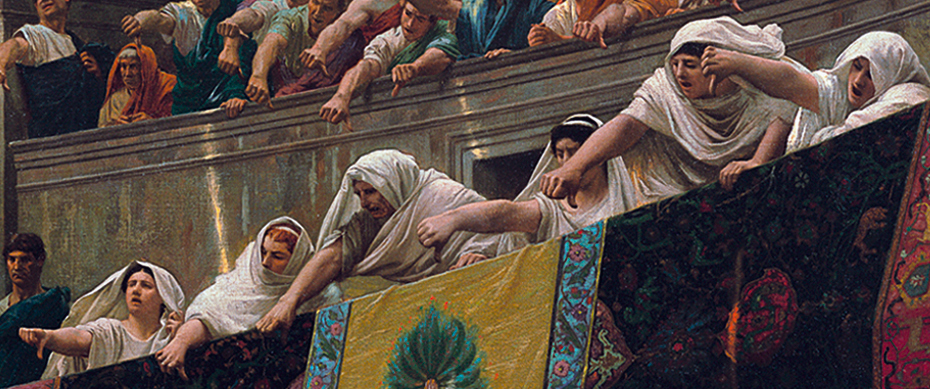
The ambiguous “thumb down” leads to surprisingly academic discussions about the meaning of the gesture on the fringes of discussion forums and fan sites. As classicists know, it is by no means certain that our everyday use of it (thumb up = “good”, thumb down = “bad”) corresponds to its origin, the gesture used by the Romans to communicate life or death in gladiatorial combats in the arenas. The authority on the subject, classicist Professor Anthony Corbeill, has researched it in depth and concluded that we have reversed the gesture: thumbs up meant that the gladiator should be killed, while “a closed fist with a wraparound thumb” meant that he should be spared (Nature Embodied. Gesture in Ancient Rome, 2004).

The confusion stems from the ambiguous name: the Romans called it pollice verso, which simply means “turned thumb”. Not specifying downwards or upwards. Our collective consensus hereon is probably due to the popularity of the 1872 painting Pollice Verso by French neoclassicist Jean-Léon Gérôme – the fanatical, bloodthirsty faces of the Vestal Virgins in the audience with their “thumbs down” communicate their message quite clearly: that defeated gladiator must die. It is this painting that motivated filmmaker Ridley Scott to make Gladiator, he explains in Gladiator: The Making of the Ridley Scott Epic (2000):

“Walter and Doug came by my office and laid a reproduction of the painting on my desk. That image spoke to me of the Roman Empire in all its glory and wickedness. I knew right then and there I was hooked.”

Scott also copies the thumbs-gestures into his film, in the dramatic scenes in which he has the cruel Emperor Commodus (Joaquin Phoenix) decide between death and mercy. It further establishes the image, and it becomes definitively anchored when Facebook introduces the like button in 2009: the raised thumb as a sign of appreciation.

Gladiator – Now We Are Free – Hans Zimmer & Lisa Gerrard:

It does matter for understanding the mental state of Dylan’s narrator, of course – does he signal life or death with “Got my right hand high with the thumb down”? The context does not provide a clear answer either; from the very first line of the song, “death” is a motif, and thematically, the whole song suggests the afterlife, transition, farewell. On the other hand, precisely this verse is lebensbejahend, as our German friends would say, life-affirming: “both feet on the ground”. “Such is life,” “happiness,” “grow”… this verse in particular does not communicate “the end of life”.

Circumstantial evidence seems to suggest that Dylan with thumb down still does want to signal “death”, though. Juvenal, again. On this album, we have already heard quotations and paraphrases from Juvenal’s Satires in two songs (get lost Madam from Satire VI in the opening song “I Contain Multitudes” and the size of your cock won’t get you nowhere from Satire IX in “Black Rider”), so it stands to reason that Dylan also picked up the ancient thumb down from Juvenal. Classics scholars discussing the meaning of a thumb down do indeed cite Juvenal’s Satire III: “verso pollice vulgus cum iubet, occidunt populariter,” which was translated in George Gilbert Ramsay’s 1920 standard work as “[they] win applause by slaying whomsoever the crowd with a turn of the thumb bids them slay”. However, we know that Dylan did not use Ramsay’s translation, but Peter Green’s 1967 translation, which reads:

“They stage gladiatorial games, and at the mob’s thumbs-down will butcher a loser for popularity’s sake.”

In any case, Dylan’s use of it remains somewhat alienating here. It seems to fit poorly between the opening line, “I got both my feet planted square on the ground,” which, atypically enough, seems to be derived from Dylan’s own “Most Of The Time” (1989; Most of the time I can keep both feet on the ground) and the following line, “Such is life – such is happiness.” The empty cliché such is life and the association it seems to impose, the cut-and-paste quote from the Irish classic “Raglan Road” (Oh, I loved too much and by such, by such is happiness thrown away), seem equally difficult to reconcile with thumb down.

“Raglan Road” is a song close to Dylan’s heart, that’s for sure. Both the song itself and its origins: in 1946, a hopelessly enamoured Patrick Kavanagh wrote a poem for Hilda Moriarty, twenty years his junior, entitled “Dark Haired Miriam Ran Away”, which appeared in The Irish Press, and was only published in 1964, with a slight change to the lyrics, as “On Raglan Road” in his Collected Poems. Kavanagh then spent an evening with Luke Kelly of The Dubliners in The Bailey, a pub in Dublin, which proved fruitful. The words the dawning of the day inspire Kelly to use the nineteenth-century Irish folk song “The Dawning of the Day” as a template, and lo and behold: the words of Kavanagh’s poem fit perfectly. After Kelly records it with The Dubliners in 1971, the song’s rapid rise begins. Van Morrison, Mark Knopfler, Ed Sheeran, Sinéad O’Connor, Billy Bragg, Roger Daltrey, Billy Joel… half the premier league has “Raglan Road” in their repertoire, and the song now has the same status as, say, “Whiskey In The Jar”, “The Wild Rover” or “Carrickfergus” – folk songs that the Irish consider part of their heritage and from which they derive their identity.

And, who knows, perhaps a song inspiring Dylan. Apart from the slight similarities in word choice, the stylistic resemblance is certainly striking.

On Grafton Street in November
We tripped lightly along the ledge
Of a deep ravine, where can be seen
The worth of passion’s pledge

… for example – the same tension created by combining the ordinary with the mythical, the poetic-realistic anchoring in specific geolocations, enchantment, elsewhere in the poem the metaphorical use of nature (“let grief be a fallen leaf” or “her own dark hair like clouds over fields of May”) and the allusions to literary and artistic heritage; Kavanagh’s “On Raglan Road” is the older sister of Dylan’s “Key West” – and at least as pretty. Thumbs up.

Sinead O’Connor – Raglan Road:

To be continued. Next up Key West part 8: Leaving you, Tahiti


Jochen is a regular reviewer of Dylan’s work on Untold. His books, in English, Dutch and German, are available via Amazon both in paperback and on Kindle:


Posted in Uncategorized | 1 Comment

The Philosophy of Modern Song: Your Cheating Heart


By Tony Attwood

This series takes a look at the songs Bob Dylan wrote about in his work “The Philosophy of Modern Song,” the book that followed his honorary doctorate.  Thus, this isn’t a review of the book as such, since the book is a review in itself, but rather it has become a review of the songs within the book, and includes one or more recordings of each song in case there are any in Bob’s book which you have never heard.

Details of other songs from Dylan’s book “The Philosophy” which have been covered within Untold Dylan are given at the end of this article.  Here, I take a look at and listen to “Your cheating heart” written and recorded by Hank Williams, as well as a Williams song that Bob himself performed.

This song was both written and performed by Hank Williams, and we can tell at once that the construction of the song is an absolutely standard approach for songs of the 1950s, with a very memorable melody, sung above a simple three-chord accompaniment.   70 years or so later it still works beautifully, even though we know that the composer could not read musical notation.  It is a song that feels right in every way, with its most simple Verse, Middle 8, and verse structure.   One can only wonder how much further Hank Williams could have taken his work as a songwriter if only he had lived.

In this composition, the second section (“When tears come”) acts as a bridge between the two verses (which begin with the song’s title) and provides a variation within the music by modulating to the dominant key and then coming back with the lyrics “You’ll toss around and call my name”.

The accompaniment is simply a guitar, and a careful listen shows that the song actually speeds up as it is performed, which is not supposed to happen, but which does reflect the situation that the singer/composer was now in.   Here are the lyrics

Your cheatin' heart will make you weep
You'll cry and cry and try to sleep
But sleep won't come the whole night through
Your cheatin' heart will tell on you

When tears come down like falling rain
You'll toss around and call my name
You'll walk the floor the way I do
Your cheatin' heart will tell on you

Your cheatin' heart will pine someday
And crave the love you threw away
The time will come when you'll be blue
Your cheatin' heart will tell on you

When tears come down like falling rain
You'll toss around and call my name
You'll walk the floor the way I do
Your cheatin' heart will tell on you

The song was also a hit for Joni James with Lew Douglas

This song represents the essence of popular ballads of the early 1950s – the antithesis of “Rock Around the Clock” which was written and released one year before “Your Cheatin’ Heart”.    Indeed, the two songs represent two of the three fundamental themes of popular music that have lasted ever since: dance (Rock around the clock), lost love (Your cheating heart) and the third, obviously and most popular of all, love.

This song does indeed symbolise one of the three dominant song forms of the era, in which, because of the technical restrictions imposed by the use of 78rpm records, songs were limited to, at most, three minutes, but generally, as with this song, two and a half minutes.   Indeed, although some 78rpm recordings were released at the three-minute mark and beyond, they suffered from a reduction in the volume of the recording being lower than the norm.

Hank Williams’ fame and legacy mean that there can be very few people who kindly dip into these notes who have not heard of him.   And yet not everyone is fully aware that Hank Williams died in 1953, aged just 29, his early death directly associated with his alcoholism.   And yet he recorded 55 tracks that were released as singles that managed to get into the Billboard top ten (five of which were released posthumously – the start of a trend that seemed to become normalised over the early years of popular music).

However, his passing did not in any way affect the popularity of his compositions as subsequently his songs have been covered by everyone from Bob Dylan to the Rolling Stones.

Many artists have covered his songs and many more have been influenced by his writing, ranging from Chuck Berry to Elvis, Johnny Cash to the Rolling Stones.   He was eventually awarded a Pulitzer Prize Special Citation for his “craftsmanship as a songwriter who expressed universal feelings with poignant simplicity and played a pivotal role in transforming country music into a major musical and cultural force in American life.”

The song “Your cheatin heart” was recorded on 23 September 1952 in Hank Williams last ever recording session.  He was already drinking far beyond reasonable limits but failed to get proper medical support and help.   He died on New Year’s Day, 1953 but as we can see the influence of his songwriting continues to this day.  Here is a recording from the last decade

Previously in this series

Posted in Uncategorized | Leave a comment

No Nobel Prize for Music: From “If you see her” to “Call Letter Blues”


Recently on this site

There is an index to our current series on the home page. and a full index to the articles in this series at the end of this article.

By Tony Attwood

In the last episode of the series, “No Nobel Prize for Music,” I looked at “You’re a Big Girl Now” and “Shelter from the Storm”.   “Shelter” is a particularly interesting song in that musically and lyrically it is extremely simple, which is the exact opposite of “Tangled up in Blue”. and “Lilly Rosemary and the Jack of Hearts.”

Of course, Bob doesn’t tell us such things, and I have no idea why Bob deliberately moved from complexity to simplicity, or if the songs just happened to form in his head, but there is no doubt that in 1974, he was exploring all the musical and lyrical options he could find.

And here musically and lyrically, Dylan has explored just how far he can take the standard approaches of popular song without breaking the boundaries so greatly that he alienates his fans.   The form is simply strophic: verse, verse, verse.   The key is clearly C major, but there is the sudden, unexpected appearance of the unrelated chord of Bb at the end of the second line.  Whether you are a musician or not, you feel that sudden change.

And there is also an instrumental coda at the end of the recording, which emphasises the final line of “Tell her she can look me up if she’s got the time”… the chords rotate, telling us that he is still there, still waiting, still hoping, offering her all the time in the world.

Ideas such as this seem incredibly simple, but they are very easy to misplace or even forget entirely – yet here, as so often, musically Dylan gets it absolutely right.   And it really is worth looking at the list of songs he wrote in this amazing year, because each one has its unique moment, if not its own unique construction.

Yet overall, it is hard to think of a more poignant song, and indeed if we return to the opening lines, the depth of the sadness of the singer is overwhelming, while the uncertainty of where the lady is is utterly emphasised by the change of Bb to G over the word “hear”.

The fact is that the singer is desperate about the lady, but manages to control himself in the lyrics, such as the almost throwaway “is living there I hear,” while the music reflects this perfectly.    For by using the unexpected chord of B flat at the word “living” and then resolving it onto the chord of G (which is part of the key of C major that he is performing in) we have that contradiction within the singer.   He is desperate to find her, but utterly anxious not to come across to her as one who is trying tell her how and where to live.

To many commentators, this is simply a sad “lost love” song (with “lost love” being one of the three main approaches to lyrics in popular music, the others being “love” and “dance”).   But Dylan, through the musical change, particularly with that gentle resolution of B flat to G, gives us that sense of desperation.  A desperation that means he dares not go to her and beg for her return, perhaps out of fear that she will say no, but in so doing, is hurting himself more and more each day.

I explored the song on this site some 13 years ago, and I am not sure I agree with that earlier commentary these days – maybe I’ve had too many difficult experiences and life goes on.   But if you are interested in reading a different perspective from the same writer, it is still on the site.

And maybe that is part of the genius of Bob’s writing – we can appreciate it in different ways at different times in our lives, depending on our emotional state each time we listen.

But what we do notice here is that the songs of this year vary in their approach to the person at the heart of the lyrics and in musical content.  There is no constant theme but rather a changing perspective.  We started with an observation of Lily, Rosemary etc, then the tale of a complex entangled relationship (justly named “Tangled”), followed by a direct talk to a single woman (“Big Girl”).  After that, here is the lady welcoming the singer into her home and heart, before moving on, (Shelter) and now the singer’s sadness that the lady is no longer there (“If you see her”).

And in each case Bob is not just changing the perspective of the song, but also the way the music is written, which explores the emotions inherent within the lyrics.

So what on earth could Bob write next?   For we are asking this question both musically and lyrically.   In fact, he returned to that old favourite, the 12 bar blues.  Call Letter Blues.

The lyrics are here but to save you working your way through the whole article or song, let me, if I may, direct you to something near the end

Call girls in the doorway
All giving me the eye
Call girls in the doorway
All giving me the eye
But my heart’s just not in it
I might as well pass right on by

And a most bizarre twist at the end…

My ears are ringing
Ringing like empty shells
My ears are ringing
Ringing like empty shells
Well, it can’t be no guitar player
It must be convent bells

What is Bob doing at this point?   If you think through the songs written immediately before this (Lily, Rosemary and the Jack of Hearts, Tangled up in blue, You’re a big girl now, Shelter from the storm,  If you see her say hello) this really is hard to make sense of.  We can take it that Bob just sketched it out for a laugh, except that he’s got the band there playing through a four and a half minute piece clearly recorded in a studio.

And I really do have to pause here, think back to the songs Bob had already written in this year, and ask why?   I can understand writing it for a bit of fun.  I can understand playing it for a bit of fun.   But these lyrics have been worked out and written down.  OK the band don’t have to learn anything because it is a 12-bar blues, and every pop and rock musician worthy of the name can play a 12-bar blues in any key blindfold.   But Bob wrote out all these verses, and as I said in my original review, “This is pure atmosphere”.  But still, what I now want to ask is, “Why at this moment in such a highly creative period of his life, did Bob need atmosphere?”

Perhaps the very last verse tells us something we’ve never noticed….

My ears are ringing
Ringing like empty shells
My ears are ringing
Ringing like empty shells
Well, it can’t be no guitar player
It must be convent bells

He is, perhaps, still asking, how could she leave him?  And if that old question still is THE question, then what better than a 12 bar blues to express his sorrow?

Previously in this series….

  1. We might have noted the musical innovations more
  2. From Hattie Carroll to the incoming ship
  3. From Times to Percy’s song
  4. Combining musical traditions in unique ways
  5. Using music to take us to a world of hope
  6. Chimes of Freedom and Tambourine Man
  7. Bending the form to its very limits
  8. From Denise to Mama
  9. Balled in Plain D
  10. Black Crow to “All I really want to do”
  11.  I’ll keep it with mine
  12. Dylan does gothic and the world ends
  13. The Gates of Eden
  14. After the Revolution – another revolution
  15. Returning to the roots (but with new chords)
  16. From “It’s all right” to “Angelina”. What appened?
  17. How strophic became something new: Love is just a four letter word
  18. Bob reaches the subterranean
  19. The conundrum of the song that gets worse
  20. Add one chord, keep it simple, sing of love
  21. It’s over. Start anew. It’s the end
  22. Desolation Row: perhaps the most amazing piece of popular music ever written
  23. Can you please crawl out your window
  24. Positively Fourth Street
  25. Where the lyrics find new lands, keep the music simple
  26. Tom Thumb’s journey. It wasn’t that bad, was it?
  27. From Queen Jane to the Thin Man
  28. The song that revolutionised what popular music could do
  29. Taking the music to a completely new territory
  30. Sooner or Later the committee will realise its error
  31. The best ever version of “Where are you tonight sweet Marie?”
  32. Just like a woman
  33. Most likely you go your way
  34. Everybody must get stoned
  35. Obviously 5 Believers
  36. I Want You. Creativity dries up
  37. Creativity dries up – the descent towards the basement.
  38. One musical line sung 12 times to 130 words
  39. Bob invents a totally new musical form
  40. There is a change we can see and a change we can’t see
  41. A sign on the window tells us that change is here
  42. One more weekend and New Morning: pastures new
  43. Three Angels, an experiment that leads nowhere
  44. An honorary degree, nevertheless. But why was Bob not pleased?
  45. When Bob said I will show you I am more than three chords
  46. Moving out of the darkness
  47. The music returns, but with uncertainty
  48. Heaven’s Door, Never Say Goodbye, and a thought that didn’t work…
  49. Going going gone
  50. Bob goes for love songs
  51. On a night like this and Tough Mama
  52. I hate myself for loving you
  53. Lily Rosemary and the Jack of Hearts
  54. Imagine you had just written a masterpiece. What then?
  55. After “Lily” and “Tangled” what on earth could Bob compose next?


Posted in Uncategorized | Leave a comment

“The Greatest Dylan Song year by year”. Episode 2: 1962


Episode 1 – 1961.  “I was young when I left home”

By Tony Attwood

This is a just-started series of articles in which I take a look back at Dylan’s compositions year by year and choose one that still appeals to me, and indeed still moves me, even after sixty or more years.  It’s a totally personal selection, but of course you are very welcome to join in with alternative suggestions either with your own article, or a comment.   A list of all the songs Bob composed in 1962 is given here.

Previously in the first episdoe of this new series I’ve offered, “Five versions of “I was young when I left home”

So, on we go…. In 1962 Bob Dylan’s compositional ability exploded (at least in terms of him writing songs and recording them for posterity) and as far as we know, he composed and kept an astounding 36 songs that year, including a range of masterpieces that we all still know and adore, even 64 years later.

In fact, being now a very elderly gent (although not quite as old as Bob) I have a few memories of 1962.  I do recall going to the English seaside town of Bournemouth to buy Freewheelin’ on the basis of having heard “Blowing in the Wind” – but of course that might well have been 1963, or even 1964.  I didn’t keep a diary.

But for this series I have been asking myself, what has stayed with me from that year, even if I didn’t hear the song until some years later.   I’ve mentioned “Ballad for a Friend” so many times over the years on this site, I feel I can’t nominate that yet again, and I don’t really want to stay with the two most famous songs from the year (“Blowing in the Wind” and “Don’t Think Twice”) as wonderful though they are, they are rather obvious.   And besides, just picking the obvious seems a bit pointless.

But there is one song  that leaps out at me from this year which has always been with me, although I have not written much about it, nor indeed particularly mentioned it in the occasional talk I have bored people with my thoughts on Dylan as a composer.   It is Tomorrow is a long time a very plaintive and utterly, utterly beautiful tale of lost love.

Now of course, 1962 was also the year of “Hard Rain”, and “Hollis Brown”, but still, there is something so wonderfully meek and mild in “Tomorrow” that even all these decades later, it still utterly moves me.  And moves me more than those more famous songs do.

Bob hung onto the song for many, many years, playing it 69 times between 1969 and 2008, and not for the first time am I brought to the feeling: “how could the composer of such a stunning work simply let it go?” if playing it 69 times is “letting it go.”  Mind you, I have the same thought about William Shakespeare, who gave up London life and play writing and returned to Stratford in 1613.  I guess he’d just had enough and wanted to be with the family.

But to return to Bob, “Tomorrow…” did turn up in 2017 in the movie “The Vanishing of Sidney Hall”  but long before that Elvis had recorded it – that is the recording Bob said that he treasured the most of all the covers of his song.  The beat has changed, and I’ve never been sure of this, but Bob valued it, so who am I to argue?  But somehow the musical extras that are slipped in by the arranger, for me, reduce my feeling about the song….

And the problem for me was that this Elvis version seemed to influence other subsequent arrangers, singers and musicians.   From here on it wasn’t a case of going back to Bob’s own version of the song, but instead taking the Elvis version and seeing what could be done with that.  We can hear it again with Odetta Holmes’ version

I have always been a fan of the musical performances of Judy Collins, and of course, she has recorded the song – it was on the “Fifth Album,” but when I got that album, I was disappointed by what she had done.   You can find her recording on the internet if you need to hear it.

ButI move on because I then heard Sandy Denny sing it and I regained a bit of faith in the song

But even so I felt that somehow there was something more that could be taken from this utter masterpiece.

Barb Junger makes me feel that she really, really does understand.  And not least because of her work with the Core Theatre in Corby, the nearest town to the village in which I am seeing out my later years.   The town was already on the map, but actually not for all the right reasons.   Somehow, this event started the return to sanity.   As Wik says “This concert started the Made in Corby Arts Council England initiative.”  And I guess if you are English, and you know about Corby, you’ll understand.

Nick Drake recorded the song, and I am so glad that his memory can be continued in this way.   His is one of the saddest stories in music, and I don’t want to repeat it here – you can look it up if you must.  But  just listen to this talent and maybe reflect for a moment on how we can allow such musicianship to be lost at such an early age.

But picking myself up, I do have one particular version that has stayed with me over the years and genuinely can still move me to tears.  The band kept playing until December 2019.  They won’t know me, but I got to know their music.

There are so many covers of this song, I am getting to the stage in this already overlong piece wherein I don’t know which to include, but I think do know where to end.  Chrissie Hynde once again is a person who won’t know who the hell I am, but through her music, I have always felt I know her.  I met her once, I think she must have thought I was very weird.    This was recorded in 2021.

There are of course hunderds more versions of this utterly amazing song.

Bob performed the song 69 times, but it touched the hearts of millions of listeners and thousands of performers.   Even if we owed him for nothing else, we’d owe him for this wonderful composition.

And here’s a PS – I think this is the most emotionally tainted series I have ever tried.  I am not sure I want any of that to come across, but I do hope you find something in these recordings.   Maybe 1963 will have less to do with my feelings when I tackle it next week.

Posted in Uncategorized | 2 Comments

Theme Time Radio Hour number 7: Wedding

By Tony Attwood

Previously in this series

Now I may be the odd one out here, revealing vast amounts of ignorance as I write, but a lot of the songs that Bob chose in the “Theme Time” are indeed songs I didn’t know before his show came along.  Maybe I have a bit of an excuse in being English, given that for many years we didn’t have a choice of radio stations that enabled us to choose the music we liked.   Or maybe I don’t know nearly as much about the history of popular music as I thought when I started this story.  Bob certainly has phenomenal knowledge.

Either way, when I come to each new episode of Bob’s radio series, I find there are songs I don’t know, and so in desperation, I flip down to find something I do know and feel I can write a few words about.

From this episode’s list, I find “Get Me to the Church on Time” as the one I know.   But fortunately, there is a second issue I can indulge in within virtually every episode and that is the finding of a song with a crazy name.   And this time we get “The Man Who Wrote ‘Home Sweet Home’ Never Was A Married Man” by Charlie Poole.   Quite remarkably, (in my view anyway) this was composed in 1908 by a woman: Fleta Jan Brown

And I just have to lead with that…

This is such an amazing find I really have to include the lyrics….

Man gets up early in the morn, leaves his wife in bed,
She lies there as the kids wake up and cry,
"Get up and cook some bread!"
Let me tell you a thing or two, that a woman like that
Won't never do:

And the man that wrote the Home Sweet Home
Never was a married man.
He never had no loving wife
To greet him with a frying pan.
She'll meet you at the door when you go to come in
And knock you down with a rolling pin,
And the man that wrote the Home Sweet Home
Never was a married man.

Man comes in at dinner-time
Hungry and he wants to eat,
Finds his wife piled up in the bed
Lying there sound asleep.
He gets so mad that he tears his hair
Swears and declares that he won't stay there:

Man comes in from work at night
And he goes to bed;
Baby lying there in the cradle
Screaming loud enough to wake the dead;
He'll sit and he'll rock for about an hour
And never a hand to help prepare:

Not amazing music, I must admit, but amazing lyrics and amazing concept; it is just so funny.

I suppose I am influenced by the fact that if I start thinking about marriage songs, the first piece that comes to mind is “Get me to the church on time” which Bob does include in the show by Rosemary Clooney.   It comes from 1956 so I guess I heard it aged about nine or ten.  I think I wondered who Pete was

If you feel so inclined, do listen to what the band does after each line that Ms Clooney sings; this is an arranger both on the top of his game, but also able to incorporate what people expect.  That combination of saxophone “commentary” after the first line (which does crop up several times) is a repeated moment of genius.

But I do like music that links back to the old music.  This is Dave Edmunds….

Dave Edmunds was always one of my favourite performers – and I did meet him a couple of times and was able to thank him for the fun he’d brought into my life.   If you remember his music, you might recall “Girls Talk”   And Goodness knows how many times I played this track – it was good to hear it again today.

But one of the great things about Bob’s selections is just how varied they are.   This is Johnny Tyler & His Riders of the Rio Grande recorded in 1948.   What a great name for a band!

And one of the things to note here is that this is just another variation on the old 12 bar blues, but they make it sound like something quite different.

And just to contrast with that Bob also gave us “Married Woman” – an absolutely straight 12 bar blues (with the second line a repeat of the first line)  by Big Joe Turner, recorded in 1974.

Bob’s final selection was “Where Were You (On Our Wedding Day)” by Lloyd Price from 1959, which was an interesting choice since the next episode of Theme Time Radio Hour turned out to be on Divorce.

Lloyd Price became known as “Mr Personality” not because he was particularly blessed in that regard, but because in 1959 he had a million-selling hit called “Personality” which is rather a clever way to get a nickname.  This is the Lloyd Price version…

I’ll have a bash at finding some of the recordings Bob played in the next episode, in a week or so.

Posted in Uncategorized | 2 Comments

Key West part 6: Glitter amongst the chicken feed


by Jochen Markhorst

VI         Glitter amongst the chicken feed

I was born on the wrong side of the railroad track
Like Ginsberg, Corso and Kerouac
Like Louie and Jimmy and Buddy and all of the rest
It might not be the thing to do
But I’m stickin’ with you through and through
Down in the flatlands - way down in Key West

As we are almost a quarter of the way through, Dylan seems to catch up, step by step, entering the 21st century. At least, one of his personalities is – Dylan the musician continues to draw on the 20th century more than ever, and even further back. But one of his other public manifestations is beginning to form an intriguing, colourful, Dylanesque online personality.

On his Instagram account bobdylan, funny, enigmatic and intriguing posts suddenly appear at irregular intervals. Initially, in the starting year 2018 and the years that followed, the posts were exclusively manufactured by the marketing guys (an announcement of a tour, an excerpt from an upcoming Bootleg Series, an image of Dylan’s graphic work, teasers for The Philosophy Of Modern Song, that kind of thing), and very occasionally a slightly more personal post, usually a eulogy.

Like the first one, dated 20 September 2022. The film poster for Wonder Boys (2000) and an in memoriam: “Today’s the day that Curtis Hanson passed away. He made some great films, and fortunately I was able to write a song for one of them, which was a great honour.” It seems fairly certain that Dylan wrote it himself: the occasion is rather random (Curtis Hanson has been dead for six years on this day), and the message contains a factual inaccuracy – Dylan wrote songs for two Hanson films (apart from “Things Have Changed” for Wonder Boys, he also wrote “Huck’s Tune” for Lucky You, 2007), something that a PR representative would certainly have mentioned. But you don’t go fact-checking the boss, obviously.

This first post seems to trigger something. Gradually, Dylan sprinkles more glitter amongst the chicken feed, and his followers are delighted with his own personal, wondrous posts. An excerpt from The Secret Life of Walter Mitty (1947) with Danny Kaye as a cool riverboat gambler, narrated life stories of Aaron Burr, Frank James, Al Capone and others, obscure clips of forgotten heroes such as The Johnson Mountain Boys and Josh White, and mysterious falsifications. Like the post from 17 January 2026, with the confusing title:

THE ACADEMY
By Larry Morrison
(character from a forthcoming science fiction novel “Fool’s Gold”)

It is a 434-word piece that suggests it is an excerpt – or excerpts – from a novel, in which a first-person narrator settles scores with “The Academy”. His criticism boils down to the fact that The Academy only values and rewards assimilation, and rejects disruption, vision and independence. Which, after the title, is a second hint that Dylan used Kafka’s A Report to an Academy (“Ein Bericht für eine Akademie”, 1917) as a blueprint, the bizarre, satirical report of a civilised monkey, also written in the first person, in which the monkey subtly makes us recognise the travesty of assimilation. Both texts, Kafka’s report and Dylan’s novel fragment, thus express what Dylan the songwriter expresses in far fewer words in this fourth verse of “Key West”: the love for the thing not to do.

Dylan chooses – as he often does – a topographical metaphor to portray the outsider: the wrong side of the railway track. It is certainly not biographical; “Like Ginsberg, Corso and Kerouac” applies at most to Gregory Corso – Kerouac and Ginsberg were both born and raised in affluent circles, on the right side of the tracks, so to speak. However, the three Beat Poets are manifestations of the ideal sought by the narrator of The Academy: their works are disruptive, display courage, willpower and creativity, and provoke the establishment, “The Academy”.

We should therefore look in that direction to identify the following three names: Louie and Jimmy and Buddy. The spelling of “Louie” inevitably brings to mind one of the greatest disruptive innovators of the 1960s: The Kingsmen’s “Louie Louie”, the abrasive, irresistible, magical standard-bearer of pure, unpolished garage rock. Well, actually from the 1950s (Richard Berry wrote the song in the golden year of 1956), but The Kingsmen’s 1963 version is in all of our DNA. “Any idiot could learn it,” as Paul Revere said, who also recorded a version with his Raiders in 1965, “and they all did.” And despite that, or perhaps because of it, a song that would be rejected by The Academy, given how utterly undisciplined, battered, fierce and from the wrong side of the railroad track “Louie Louie” is.

https://youtu.be/CfRZNNyQoF0?list=RDCfRZNNyQoF0

“Jimmy” and “Buddy” are, of course, less easy to identify. On an album full of references to old music heroes, “Buddy” seems to be an affectionate salute to Buddy Holly, the giant whom Dylan mentions in virtually every interview (“He was great. He was incredible. I mean, I’ll never forget the image of seeing Buddy Holly up on the bandstand,” Rolling Stone interview, 1984), and when it comes to “Jimmy”, the Rough And Rowdy Ways listener initially thinks of the song he heard fifteen minutes earlier, the closing track on Side 2, “Goodbye Jimmy Reed”.

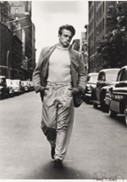
Secondly, he might be led to the patron saint of Key West, Jimmy Buffett, or perhaps to Jimmy Van Heusen, whom Dylan so admires and whose “Deep In A Dream” gets a shout-out in “Murder Most Foul” – but none of these Jimmies seem to fit the “wrong side of the railroad track” profile. At most, James “Jimmy” Dean had that aura – and we know that Dylan has held Dean in high esteem for more than sixty years:

BOB: Oh, you know where I just was?
SAM: Where?
BOB: Paso Robles. You know, on that highway where James Dean got killed?
SAM: Oh yeah?
BOB: I was there at the spot. On the spot. A windy kinda place.
SAM: They’ve got a statue or monument to him in that town, don’t they?
BOB: Yeah, but I was on the curve where he had the accident. Outsida town. And this place is incredible. I mean the place where he died is as powerful as the place he lived.
(Sam Shepard – True Dylan, 1987)

James Dean is an indestructible hero for Dylan. He regularly brings him up, even when not asked, always admiringly. It must therefore have flattered him that journalists and biographers used to compare him to James Dean – a comparison that is officially recorded by Don McLean in the immortal pop monument “American Pie” (1971), in which Bob Dylan appears as the jester:

When the jester sang for the king and queen
In a coat he borrowed from James Dean

When asked in the 2017 Bill Flanagan interview, Dylan is not too pleased with that comparison to a joker (“A jester? Sure, the jester writes songs like Masters of War, A Hard Rain’s a-Gonna Fall, It’s Alright, Ma – some jester. I have to think he’s talking about somebody else. Ask him”). Still – Don McLean is not entirely wrong.


In that conversation with Sam Shepard – though partly constructed, still one of the best Dylan interviews ever – Dylan is quite explicit about the life-changing influence of the actor who died young:

BOB: Naw. The only reason I wanted to go to New York is ’cause James Dean had been there.
SAM: So you really liked James Dean?
BOB: Oh, yeah. Always did.
SAM: How come?
BOB: Same reason you like anybody, I guess. You see somethin’ of yourself in them.

… Dylan sees “something of himself” in Jimmy Dean. The disruption, independence and vision, presumably, the urge not to do the thing to do.


To be continued. Next up Key West part 7: I knew right then and there I was hooked

——————

Jochen is a regular reviewer of Dylan’s work on Untold. His books, in English, Dutch and German, are available via Amazon both in paperback and on Kindle:


Posted in Uncategorized | Leave a comment

The Philosophy of Modern Song: London Calling with a voice you never expected


By Tony Attwood

This series takes a look at the songs Bob Dylan wrote about in his work “The Philosophy of Modern Song,” the book that he wrote following the award of the honorary doctorate.  It’s not a review of the book as such, since the book is a review in itself, but rather it has become a review of the songs within the book, and includes a recording of each song in case there are any in Bob’s book which you have never heard.

Details of other songs from Dylan’s book “The Philosophy” which have been covered within Untold Dylan are given at the end of this article.  Here, I take a look at and listen to “London Calling”, and with a diversion toward the end into “London’s Burning” for reasons that may not become fully apparent at this time.

The Clash

As a Londoner born and bred (I was brought up in Tottenham, London N17 just in case you are interested, which on reflection you probably aren’t) I still have an affinity with many things London, even though I now live in a little village out in the countryside some 80 miles out of London).  But somehow this doesn’t do much to me.

Maybe this is because I have never seen London as a unity – for me the north London has been London, while the East End, “south of the river”, the West End, these have all been other worlds, inhabited by other people who are not really “Londoners”.  (They probably think the same about me).  In short as a Londoner, I perceive no unity in the concept of London.   And although concepts such as “don’t go south of the river after dark” are of course prejudiced and utterly out of date, they still exist in my head.

So likewise “London Calling” means nothing much to me lyrically, and I can’t quite see why Bob would be drawn to that simple thump thump thump of a beat without rhythmic variation.

But – and this is a very big BUT – some of the covers have been something else….  even if this doesn’t appeal too much at the start do give this recording a chance

And to my surprise, there have even been some instrumental cover versions – a surprise because I really didn’t think there was enough in the song to do anything with, instrumentally.

But while many artists have found themselves utterly trapped by the beat of the song, just occasionally someone has been able to take the essence of the music and find somewhere else to go….

There are, of course, some valiant efforts to take the song somewhere else, such as the one below played on a ‘cello, which, after getting going, really does take us to new places.  But then, having listened to it once, at first I couldn’t imagine myself listening again.   Except… reviewing this little article I did, played it again, and began to think, I have a couple of friends who might enjoy this….

And maybe this is all my fault, for what I seem to be demanding is a real reinterpration of the original piece so that it says something new to me, rather than leaving me thinking “oh that’s London’s Burning,” which of course it isn’t.   (“London’s Burning” is a round – a musical form in which different singers start the song two bars after each other, and somehow everything fits together.  In England we all learned it in primary school).

And maybe that is always the problem – if a song somehow relates back to something in the past, that past memory can interfere with an appreciation of the current music.

But that cello solo is still in my head, and that is now going to be played again.   If you just played it for a few seconds and ventured forth, and assuming you have a couple of minutes to spare, do try it again.

As for why Bob put this in his Philosophy… well, yes music calls from all sorts of places and in all sorts of ways.

Previously in this series

Posted in Uncategorized | Leave a comment

After “Lily” and “Tangled” what on earth could Bob compose next?


Recently on this site

There is an index to our current series on the home page.

By Tony Attwood

In the last episode of the series, “No Nobel Prize for Music,” I looked at “Tangled up in Blue,” surely one of the greatest songs that Bob has ever written, and most certainly in terms of music, one of his most innovative works.  It was a song that took rock music into a dimension which no one had really considered before and which very few composers have been able to copy or develop since.

Consider this one tiny detail: in the released recording, we have eight bars with a very gentle backing from the musicians as the music alternates through two chords.

But then, suddenly, as the song develops and reaches the line “I was standing on the side of the road…” where there is the extra emphasis from the percussion, as the music encapsulates the impatience and despair of the lyrics, before we get to “Tangled up in Blue”.   It is a masterpiece of linking the music with the lyrics and their meaning.

But of course, writing a masterpiece immediately brings with it a problem, because everyone will compare what you do next with the last work, and no one can write utterly brilliant and wonderful pieces one after the next.

However, Dylan’s songwriting, although waxing and waning over the years, did not stop, and after “Tangled up in Blue”, Dylan must have known it was worth persevering with each new song just to see how far it could be taken and quite often how much it could be improved.   So he took time to re-write  You’re a big girl now and obviously liked where the song had gone as he performed it over 200 times over the next 30 years.

And here, I feel, we find Dylan determined to continue his new, unique approach to songwriting.   For a start, the piece starts with an instrumental introduction.   But that’s only part of what makes this song so different.  For indeed, even without any musical knowledge or explanation, we can tell there is something very, very different in this song musically, from what Dylan normally does.

In fact, what Bob does is start with a musical introduction, which is in effect the accompaniment without the vocals.   And although now, after hearing it hundreds, perhaps thousands of times, of course, we accept what it is; which is the chord sequence from the song.   And what makes this particularly different is that the song is written in D major, but Bob doesn’t start playing in that key.  Instead, the introduction (which is in fact the music of the verses) starts on B minor7 and is followed by A minor 7.

Now those two chords are not found in the key of D major, so even if we don’t know anything about music, we are, for a moment, misled as Bob is doing two completely unexpected things here.   First, he’s starting with an instrumental introduction, and second, that introduction includes a chord that is not related to the key the song is played in.  And even if the listener knows nothing of the technicalities of music, it does feel slightly odd, slightly unusual, slightly unbalancing.

Now of course, this stuff about starting with a chord that doesn’t exist within the key, may well sound incomprehensible if you don’t play a musical instrument, but I suspect everyone can hear that opening as unusual for Dylan.  In fact unusual for any music in the pop / rock / blues / ballad genre.

So my point here is not to labour the issue of exactly what Bob has done (and apologies if that is what I have done through my explanation above), but rather to make the point that Bob, at this moment, was continuing his deliberate attempt to write music that was different both from what he had done before, and indeed from what virtually all song writers had done before.

And this was very much Bob’s theme of the moment, for just consider the three songs we have had so far in this amazing year of 1974:

  1. Lily, Rosemary and the Jack of Hearts
  2. Tangled up in blue
  3. You’re a big girl now

Each is musically breaking completely new ground.  The first is a totally strophic song but one which lasts nearly nine minutes and contains 15 verses (far more than normal) of five lines each (very unusual – we normally have four or eight lines to a verse).

The second has a rotating pair of chords, one of which has nothing to do with the key that the song is performed in.  Additionally, there is a verse which seems to be in two parts; the second part is a six-line response to the first eight lines of the song (beginning for example, “I was standing at the side of the road”).

So, having started to tear up the traditional framework of popular songs,  and in terms of musical construction, travel in a very unusual direction, Bob was clearly striking out on both a new musical track and a new lyrical track.

And yet in the midst of this revolution, Bob’s next composition was Shelter from the storm  Here we are still in the land of songs with multiple verses, but we have travelled so far along that road.   Consider for a moment, “Blowing in the Wind”, wherein we find just three verses.  In “Shelter from the Storm” there are ten verses – a total that keeps the song in line with its predecessors in terms of Bob’s compositions (Lily and Tangled).  He was very much into big songs.

Now the musical approach is still strophic (ie, verse, verse, verse etc) but there is a difference with “Shelter” for these verses are of the conventional four-line construction – something which Bob had very clearly diverted away from in the previous compositions.

'Twas in another lifetime, one of toil and blood
When blackness was a virtue and the road was full of mud
I came in from the wilderness, a creature void of form.
"Come in," she said, "I'll give you shelter from the storm."

But more than this, we are also back to three chords – and not just any three chords but the three chords that are always associated with each particular key – in this case E.  The chords of the song are E B A E.    And not only is the chord sequence repeated over and over again, but the final line of each verse is identical.   This is still an extremely enjoyable and interesting song, but it is musically the exact opposite of the two previous compositions of the year.  It is as if Bob was saying, “Yes, I can write these long and complex pieces as I have been doing this year, but I haven’t forgotten the simple stuff…”

Of course, it could be that Bob just happened to write this.  Or it could be a deliberate reaction to the complexities and innovations of the two previous compositions (three chords in one musical line repeated over and over again).   And yes, of course, the melody line does change from line to line, but in essence, the structure of the song is the same throughout, as it is determined by the chord sequence.

Obviously, I don’t know how Bob came to write these three songs, but I do think we should note how different they are from each other, and how successful they have been as compositions.   And I would add these are not just three songs of the type we have seen him write across the years – songs written, recorded and then abandoned, neither performed on stage nor put onto an album.   No, these are utterly stunning masterpieces, each brilliant, and each completely different both musically and lyrically.   This was indeed a moment of Bob Dylan, the composer, being completely at the top of his game.

——-

If you would like to write an article or indeed a series of articles for Untold Dylan please do drop me an email either attaching your article or setting out your idea.   All emails get a reply.    Tony@schools.co.uk

Posted in Uncategorized | 1 Comment

Bob Dylan – the greatest song of 1961: five versions of “I was young when I left home”


Episode 1 of “The Greatest Dylan Song year by year”

By Tony Attwood

The idea of this new series is for me to select one song from each year in which Bob Dylan has been composing and nominate it as a candidate for “Bob Song of the Year”.    So if you already know each and every Bob Song, and most of the multiplicity of cover versions, then there won’t be anything new here for you in terms of compositions, although I rather suspect there might be the odd cover version that you haven’t heard for quite a while.

And also, if, like me, you have the ability to forget particular songs, this series might just bring back a fine memory of two.

And immediately, I am going to cheat as I am not including 1959 and 1960 in this series, both because the dates of the songs’ compositions are not always clear, and because in those two years Bob was very much finding his way.    And I must admit I feared that if I did launch with a piece that didn’t show Bob at his best, that might put you off reading episode two.

So here we go with Episode 1: 1961.   According to this site, that year included nine original compositions by Bob, and it includes (as far as I know, as the last composition of the year) I was young when I left home

Now there is what appears to be a second version of this song, in that it has a bit of Bob chatting at the beginning.  In fact I think this is the same recording as above – the previous one simply has the chat cut out.  So I am bypassing the copy which comes from “Through the open window, the bootleg series volume 18”.

Here are the lyrics….

I was young when I left home
But I been out a-rambling around
And I never wrote a letter to my home
To my home, Lord, to my home
And I never wrote a letter to my home.

It was just the other day
I was bringing home my pay
When I met an old friend I used to know.
Said your mother’s dead and gone
Baby sister’s all gone wrong
And your daddy needs you home right away.

Not a shirt on my back
Not a penny on my name
Well I can’t go home thisaway
Thisaway, Lord, Lord, Lord
And I can’t go home thisaway

If you miss the train I’m on
Count the days I’m gone
You will hear that whistle blow a hundred miles
A hundred miles, honey baby. Lord Lord Lord
And you’ll hear that whistle blow a hundred miles

I’m playing on a track
Ma would come and whoop me back
On them trestles down by old Jim McKay’s

When I pay the debt I owe
To the commissary store
I will pawn my watch and chain and go home
Go home, Lord Lord Lord
I will pawn my watch and chain and go home

Used to tell ma sometimes
When I see them riding blind
Going to make me a home out in the wind
In the wind Lord in the wind
Make me a home out in the wind

I don’t like it in the wind
Want to go back home again
But I can’t go home this-a-way
Thisaway, Lord Lord Lord
And I can’t go home this-a-way

I was young when I left home
But I been out a-rambling around
And I never wrote a letter to my home
To my home, Lord, to my home
And I never wrote a letter to my home

And now onto the recordings…. the commentary follows the video in each case…

The video has the note that it comes from “A Trolley Show (live performance) folowed by the note. While on tour with Imagine Dragons in San Diego, X Ambassadors joined a trolley show and belted out this beautiful version of Bob Dylan’s “I Was Young When I Left Home”. Special thanks to Taylor Guitars.  …”   

I just love the idea of playing the song on a train.  I know it’s obvious, but I’d just not seen it done before.

This second version is noted as being by Antony and Bryce Dessner.  If you double-click, you are likely to get the lyrics on screen with a range of pictures.

Now, if you have been with Untold Dylan for a while, you might have noticed that I tend not to take too much notice of solo artists recording themselves at home.   The multiple camera shots in this piece are a little off-putting, but if I look away from the video, I really can gather some further thoughts about the song.    (I have recorded a version of this song with a solo piano accompaniment but I don’t want to put you off reading Untold, so I’ll leave that out of this collection, you’ll be pleased to note).

So moving on…

There is a scene from the “A Complete Unknown” movie, in which Bob Dylan (played by Timothée Chalamet) is introduced by Pete Seeger (played by Edward Norton) for his first appearance at New York’s Folk City.  In that scene, “Dylan” performs “I Was Young When I Left Home.”

I really enjoyed that movie, hence I’m including this…

So there we are…. I hope you found that interesting, as there will be another “Song of the year” along in a few days.   And of course, if you would like to write a piece for this new series, or indeed a piece on anything else Dylan orientated, please do send it to me Tony@schools.co.uk – ideally complete with links to appropriate videos, although that is not essential.

Posted in Uncategorized | 1 Comment

Bob Dylan’s Theme Time Radio Hour: Father

By Tony Attwood

Previously in this series

The episode of Theme Time Radio Hour on “Father” was first broadcast on 14 June 2006, and looking down the list of titles, I was immediately drawn to “Papa’s on the house top”.  I mean, how many songs have such a wonderful title?   The track just demands to be played!

And indeed, the piano playing in this extended 12-bar blues really is just something else.   The actual song title line is “Papa’s on the housetop and won’t come down”.

The lyrics of this song are as much fun as the music, and just in case you need them, they are below.

Mama made papa be quiet as a mouse
So papa climbed up on top of the house
Made a lot of whoopee, made a lot of noise
Stood up and cheered with the rest of the boys

[Chorus]
Baby's in the cradle, brother's gone to town
Sister's in the parlour, trying on a gown
Mama's in the kitchen messing all around
Papa's on the house top, won't come down

The blues they come, the blues they come
Nobody knows where the blues come from
The blues they've gone, the blues they've gone
And everybody's happy when the old blues gone

Papa saw a chicken out in the yard
Picked up a rock and hit him hard
Hit him hard, killed him dead
Now the chicken's in the gravy and the gravy's on the bread

Hush-a-little baby, don't you cry
Blues gonna leave you by and by
Papa came in, sure was cold
Put the baby in the cradle and the blues outdoor

Not too many of the songs Bob selected come with an explanation as to how they came to be composed, but “Song for My Father” does.    Horace Silver was born in 1928 and died in 2014, and was known for the hard bop style that he worked in in the 1950s – a sort of bebop plus.

Of course, one of the things we know about Bob’s selections is that they are going to be incredibly varied.  As is shown by “Father Alone” by Lowell Fulson.

Wiki tells me (because I had to look him up) that after T-Bone Walker, Lowell Fulson was the most important figure in West Coast blues in the 1940s and 1950s.

Of course, as in many Bob Dylan selections of songs, there are songs that go way, way back.   According to Encyclopædia Britannica, Jimmie Rodgers was one of the principal figures in the emergence of country and western music, and so appropriately Bob chose a recording of his from 1928.

At the other end of the temporal spectrum, I wasn’t particularly surprised by finding an Everly Brothers track turning up, but the film below really has an introduction which reminds me how old I am getting – not for the song but for the way the duo are introduced.

But overall, it is interesting how the image of the father in these songs changed over time, for an awful lot of 20th-century songs have a very mawkish attitude towards the father figure within them.  And probably none more than this final selection in my selection from Bob’s selection.

Now I must admit I include this only because Bob included it, and it is exactly the sort of song I could happily do without.  Not for any personal reason (I have three wonderful daughters, with each of whom I have a fantastic relationship), and  I guess because of that, I just don’t need this song.  Although of course it if it had happened to me I’d be pretty desperate too.


——————–

Untold Dylan has over 4000 articles on the site, and there is an index to all of our present series of articles, and some of the ones that have now concluded, on the home page.    If you would like to write a single article, or indeed a series, or if you just have an idea for a series, we’d love to hear from you – please send an email to Tony@schools.co.uk


Posted in Uncategorized | 3 Comments

Key West part 5: Doc Pomus liked my songs


by Jochen Markhorst

The previous episode is available at The gentle lapping of the music

V          Doc Pomus liked my songs

I was born on the wrong side of the railroad track
Like Ginsberg, Corso and Kerouac
Like Louie and Jimmy and Buddy and all of the rest
It might not be the thing to do
But I’m stickin’ with you through and through
Down in the flatlands - way down in Key West

 It wasn’t really a success at the time, John Waters’ Cry-Baby from 1990, but over the years, the box office failure has grown into a cult classic, partly thanks to the successful, Tony Award-winning musical that Adam Schlesinger and David Javerbaum turned the film into in 2007 – a musical that has travelled the world and can still be enjoyed in London’s Off West End in 2025. And thanks in part to Johnny Depp of course, for whom Cry-Baby is his first title role (so before Edward Scissorhands, What’s Eating Gilbert Grape and Ed Wood), and who is then retroactively admired by the Pirates Of The Caribbean generation for yet another talent: that of a gifted rockabilly singer. For which John Waters gives him plenty of room; Wade “Cry-Baby” Walker (Depp) steals the show at a dance party with lots of hay on stage and a huge Confederate Battle Flag against the back wall as he performs “King Cry-Baby” in its entirety. Great band, good song, but above all Depp, who sings like a Gene Vincent in top form.

But alas, it’s not Depp’s voice. Depp is an actor, and he’s acting. He perfectly lip-syncs the part sung by rockabilly artist James Intveld. Although, in hindsight, Depp could probably have done it himself, as a still-doubting John Waters reflects more than thirty years later:

“There was talk of it, and Johnny can sing. It’s just that we weren’t sure of that. And maybe I made the wrong decision there. But I didn’t as far as James Intveld, who I think is one of the… Well, he is Cry-Baby in real life! He still is, in a way. I think he’s an excellent, amazing singer. He sang in “A Dirty Shame”, he sang in “King Cry-Baby”… So he was just absolutely amazing. Every time I’m with him, I can barely look at him, I’m so impressed.”
(John Waters in IndieWire, 27 May 2024)

With – coincidentally – a tenuous Dylan connection, we also hear the “excellent, amazing singer” James Intveld on the Gene Vincent song “Important Words”, the song Dylan recorded in 1987 during the sessions for Down In The Groove (1988), but strangely enough did not allow onto the album eventually.


The other Dylan connection is slightly stronger. The sleeve notes of Cry-Baby’s official soundtrack offer a few more subtle moments of revelation, fun facts that justify the suspicion that Dylan might well enjoy putting the record on his turntable:

  • Dylan’s old comrade-in-arms Al Kooper produces three songs: James Intveld’s “Teardrops are Falling”; Rachel Sweet’s beautiful version of the doo-wop classic “Teen Age Prayer”, the hit that Gale Storm scored in 1955 between her indestructible “I Hear You Knocking” and “Why Do Fools Fall in Love”; and above all the sultry, compelling R&B stomper “Please Mr. Jailer”, on which Rachel Sweet surprisingly succeeds in matching the unassailable original by Wynona Carr (1956, with Bumps Blackwell’s band).
  • On Side Two, Dylan then finds Webb Pierce‘s famous cover of Jimmie Rodgers’ “In The Jailhouse Now”, the cover with which Pierce scored such a huge hit in 1955 (21 weeks at No. 1 in the C&W Charts), the same song that DJ Dylan played in 2006 in the version by the Sir Douglas Quintet;
  • “Nosey Joe”, in the original version by Bull Moose Jackson, a typical 1940s/1950s novelty hit written by Leiber & Stoller, Rhythm and Dirty Blues in the tradition of Louis Jordan, The Coasters and Wynonie Harris;
  • Original early 1950s songs by dusty old heroes such as Shirley & Lee, Doc Starkes and Nappy Brown;


… … but the lightning already strikes right away with the opening number, Intveld’s “King Cry-Baby”:

IndieWire: “Dave Alvin told me in particular about how much he enjoyed the opportunity to write with Doc Pomus.”

John Waters: “Yeah! The two of them, are you kidding? I mean, I grew up on the music of that era. I mean, “Cry-Baby” by the Bonnie Sisters was the very first record I ever bought in my life, and my parents hated it. And it was white girls singing it, but it was more, “Shooby-dooby-da, doo-wop…” So we did the… Rachel Sweet cover, right? I don’t have every credit in front of me. I should! But all the people who did the original music for the film totally knew where I was coming from. And I greatly respected them and was thrilled that the music supervisor, Becky [Mancuso], got them to do it.”

Doc Pomus! The man who has a seat on the High Council of Dylan’s personal pantheon, alongside colleagues such as Robert Johnson, Woody Guthrie and Jimmie Rodgers. Dylan pays the most striking tribute to Jerome “Doc Pomus” Felder in 2022, when we see the dedication on page 1 of The Philosophy Of Modern Song: “For Doc Pomus”. The giant to whom we owe The Drifters’ “Save the Last Dance for Me”, “This Magic Moment” and “Sweets For My Sweet”, Elvis’s “(Marie’s the Name of) His Latest Flame”, “Little Sister”, “Can’t Get Used To Losing You”, “Suspicion” and “Surrender”, and all those dozens of other hits for Fabian, Ray Charles, Bobby Darin, Dion, The Coasters, B.B. King, Mink DeVille, Dr. John and everybody else. He is the hero Dylan praises in his MusiCares speech (2015) with particularly rousing words:

“Leiber and Stoller didn’t think much of my songs. They didn’t like ’em, but Doc Pomus did. That was all right that they didn’t like ’em, because I never liked their songs either. Doc’s songs, they were better. “This Magic Moment”. “Lonely Avenue”. “Save the Last Dance for Me”. Those songs broke my heart. I figured I’d rather have his blessings any day than theirs.”

Twenty years before that declaration of love, Dylan had already demonstrated his love musically, through his contribution to the wonderful tribute album Till The Night Is Gone: A Tribute To Doc Pomus (1995). Dylan can be heard in track 2 on Side A, after Los Lobos’ opening, a steamy “Lonely Avenue”, and before Shawn Colvin’s surprising, atmospheric, weird cover of “Viva Las Vegas”; in between is Dylan’s cool, swinging version of “Boogie Woogie Country Girl”. Though if we are honest, the show is stolen by the heart-breaking finale, by Aaron Neville’s “Save The Last Dance For Me”.

And finally, Doc Pomus is also the man who, through James Intveld in 1990, had Johnny Depp sing the words in Cry-Baby that we would hear again thirty years later in Dylan’s “Key West”:

Well, I was born on the wrong side of the tracks
In the backseat of a stolen Cadillac
I had my first cigarette before I could walk
And I was strummin' this guitar before I could talk

… although Dylan uses it metaphorically in his song, of course. Doc Pomus means wrong side of the tracks more literally, expressing that Wade “Cry-Baby” Walker comes from The Poor Side Of Town, from Shantytown, really was born and raised somewhere between Desolation Row and Lonely Avenue. Unlike Ginsberg, Corso and Kerouac, by the way. Neither were Louie and Jimmy and Buddy and all of the rest – nor Bob Dylan, for that matter.


To be continued. Next up Key West part 6: Glitter amongst the chicken feed


Jochen is a regular reviewer of Dylan’s work on Untold. His books, in English, Dutch and German, are available via Amazon both in paperback and on Kindle:


Posted in Uncategorized | Leave a comment

The Philosophy of Modern Song: “Volare”

Details of other songs from Dylan’s book “The Philosophy” which have been covered within Untold Dylan are given at the end of this article.  Here, I take a look at and listen to the Italian song “Volare”

By Tony Attwood

Volare by Domenico Modugno is most certainly one of the most famous songs in Europe – and almost certainly the most famous song not in English in the UK, where I live.  It is, in fact, the one Italian song that I suspect most people (or at least most people of a certain age) who live in England, know.      They might only know the opening of the chorus, but as soon as the song start they will say, “That’s ‘Volare’.”  And quite probably add, “Oh, oh.”

Even when the song is translated and sung in English, the title is still sung in Italian.  This translation of the lyrics of the whole song comes from Daily Italian Words website

I think a dream like this never comes back
I painted my hands and face blue
Then, suddenly, I was kidnapped by the wind
And I began to fly in the infinite sky

Chorus: 
Flying, oh, oh
Singing, oh, oh
In the blue-painted blue sky
Happy to be up there

And I flew, I flew happily higher than the sun
And even higher
While the world slowly disappeared far down below
Sweet music was playing just for me

Chorus

But all dreams in the dawn vanish because
When the moon goes down, it takes them with it
But I keep dreaming in your beautiful eyes
Which are blue like a star-studded sky

Chorus

And I keep flying happily higher than the sun
And even higher
While the world slowly disappears into your blue eyes
Your voice is sweet music that plays for me

Flying oh, oh
Singing oh, oh
In the blue of your blue eyes
Happy to be down here

However, “Volare” is not just a song which everyone over a certain age in England knows; it was also a legal adventure which looked back at today, seems completely over the top, not to say downright weird.   Or at least it does until one thinks of how many copies the song has sold.  The number of sales worldwide varies depending on where you seek the answer, but 22 million plus is a common response.

The original music, released on a record in 1958, was written by Domenico Modugno with lyrics by the composer and Franco Migliacci.  It was an entry in the Eurovision Song Contest and came third.

After coming and going in the US charts in 1958 it re-emerged in 1959, winning multiple record and “song of the year” awards, with sales said to be approaching 20 million across the world.   Naturally, it was then, of course, translated into multiple languages.   And we might note that the translation of the original copy has lyrics which are somewhat beyond the norm for popular songs.

I painted my hands and my face blue
then was suddenly swept up by the wind
and started to fly in the infinite sky.

In England, alternative lyrics by Gracie Fields were used, and she was known to change them in her own performances from time to time.

Meanwhile, the song was recorded and used by multiple artists across Europe, and in fact several different artists had hits with the song in various languages, some of which, most unusually for foreign language performances, were hits in the USA.

Indeed, in the UK there were nine separate recordings of the song available at the same time on record soon after its release.

Inevitably, for such a popular song, it won multiple awards, such as Record of the Year and Song of the Year, and a Grammy Award and was voted one of the 14 greatest songs to have been part of the Eurovision Song Contest.  And indeed, on the 50th anniversary of its release, Italy issued postage stamps commemorating the song.  The song has since been the subject of at least two court cases over claims as to who wrote the song.

Here is a completely different musical version of the song with an English translation


Previously in this series

Posted in Uncategorized | Leave a comment

No Nobel Prize for Music: Imagine you had just written a masterpiece. What then?


There is an index to our current and some recently concluded series on the home page of this site.  There is an index to all the previous articles in the “No Nobel Prize” series at the foot of this article.

By Tony Attwood

My last meander in the “No Nobel Prize for Music”  series was headlined  900 words, 15 identical verses, and still, it is brilliant music.

So we now come to the question of how to follow up on something like that.   In other words, supposing you had just written a masterpiece of the scale, breadth and quality of “Lily Rosemary and the Jack of Hearts”, what might you think of doing next?

And that is quite a question for you, not just because the song is an utter masterpiece, beloved by many fans, but because it is unlike any other song that you have written of late.

For Dylan, the answer was that he did nothing with the song, having recorded it.  Or maybe I should say, “next to nothing”.  There is a recording of the song by Dylan, which is not the copy used on the album, so maybe that is the concert version, but certainly, what we don’t have is a collection of Dylan’s performances on stage.   As Joan Baez pointed out when she performed it, there is a lot of it to remember.

In fact, what Dylan did was sit right back down and write another absolute masterpiece: in this case, “Tangled up in Blue”.

And this song became a standard part of Bob’s repetoire although often with rewritten words. And there is a reason for this, because this was one of the most complex pieces of music Bob has ever written.

So while Lily was left for a few others to dare to tackle, the latest count is that between 13 November 1975 and 29 August 2018, Bob played “Tangled up in the Blues” 1685 times!  That makes it the fourth most performed song for Bob Dylan, behind only the Watchtower, Like a Rolling Stone and Highway 61 Revisited.

I have, in fact, raved over the Live at Wembley Stadium version many times, and I am pleased to see that it is still available on Spotify for free even if you don’t have an account, which is jolly decent of them.   And it is worth it, for that version really is a complete rewrite of the song.

Now my point here is not to go back over other people’s versions of the song, which are often extraordinary, and have been mentioned on this site before, nor to consider the changing lyrics, but to think about the music, which is the essence of this series.

And the guitar accompaniment for this song certainly is unusual.  Now of course, all I can do is listen to the music and if I feel like it, play it as I hear it – but as may have become clear in the past, I am now in the latter years of my life and like most older people my hearing is declining – a decline enhanced through tinitus – so I might be hearing it wrong.

Besides, different people have written the chords out in different ways – the general thought seems to be that Bob, on the original recording for the opening chord alongside the lyrics “early one morning” plays E minor 7th with an A added (so I guess Em74 might be the shorthand).  I am not sure he ever used such a chord previously to this recording.

However, the reality is, it doesn’t matter exactly what is played because the song keeps moving so quickly, and there are several different ways of playing those rotating chords that accompany “Early one morning the sun was shining,” and most listeners won’t be too worried about the exact nature of the chords.

However, we do get a feel of this being in a rock/blues version of the chord of E minor – one that allows the chord of D major to enter into the proceedings, and the inclusion of the chords B and A with the line, “if her hair was still red,” adds to that feeling.   And so we get the feeling that the song clearly is in E major (and just sometimes E minor).   But the main point here is that although each element of the song’s music, which I have begun to explore here, is either novel or at least unusual for Bob at this time, it is very clearly part of the rock/blues tradition for a song in E.

What makes the song different is the number of chordal changes that occur – there are something like nine chords in each verse (depending on how you choose to play it).  That is not, I must stress, nine chord changes, but nine different chords.

Now, maybe Bob has revealed in conversation (although I haven’t seen it or heard it) which came first, the lyrics, the melody or the chord sequence. I’d guess that the opening of the chord sequence was what he started with, then along came the lyrics, and from there the rest of the music evolved.  But of course, I have no proof.

The song is around 600 words long – with only the title repeated at the end of each verse, and musically it is strophic, which is to say verse, verse, verse etc.

Yet from the moment of composition, the song took on a life of its own, with constant rearrangements turning up on Bob’s Never Ending Tour. There is an excellent description of the constant rearranging of the song on the dylan chords website.

And of course, the fact is that Bob can, or at least could, rearrange the song because he was performing it on his own, so there was obviously no need to let the band know what he had just come up with.

In all ways, therefore, this is a unique Dylan composition, of which the album version, or the version you heard in the concert you went to, was just one individual version among the many.   The song, in fact, opened up not just a new way of songwriting for Dylan, but a new way of song rewriting.  And the fact is that very, very few songwriters have the level of talent that allows them to write in this way.

But we also need to understand such songs as this as songs within the context of Bob Dylan’s compositions at the time.  My note on this site’s summary page of Bob’s compositions in 1973 shows that the last song of that year was “Wedding Song (Rejection of labelling, setting oneself free).”

Now I made up that little summary (which of course you might well feel is inaccurate or inadequate or indeed quite possibly both), having listened to the compositions of that year, and without in any way considering what came next.   For what came next was “Lily, Rosemary and the Jack of Hearts”  and then “Tangled up in blue” – two songs in which musically, if Dylan didn’t exactly break the mould, then he most certainly extended the mould, so it no longer looked (or more precisely sounded) anything like the mould.

Dylan wanted to see, or perhaps better said, felt the need to see, where the concept of the popular song, built on its strophic tradition of verse, verse, verse etc, (with the occasional middle 8) could go.   In doing this, Bob kept the strophic notion of the repeated music of the verse, but the music was allowed to take the verse further than it had ever been taken before.

Of course, in itself, that is not that difficult for a composer to do.   What is difficult, however, is to take the musically repetitive verse to a point where it can accommodate the multiplicity of lyrics, without leaving the listener thinking “what the hell is going on here?”

Bod does that – and he fact he did this through these two songs written one after the other: “Lily, Rosemary” and then “Tangled”.  Indeed, my view is that through writing “Lily,” which has a much more conventional lyrical approach than “Tangled”, he saw he was going to have to go much further in the music if he wanted to take the lyrics and indeed the whole of songwriting into a new dimension.    And in this regard, you might also care to listen to Tangled Up in Blue:  “Real Live” version.

The creation of these two “mega songs”, which retained the strophic verse-verse-verse notion of folk music from which Bob took so much of his inspiration, stopped after “Tangled.”   Whether he felt he had done all he wanted to do, or had gone as far as he could without losing his audience, of course, I don’t know, but the contrast with the next song Bob wrote couldn’t be greater.

After “Tangled up in Blue”, Dylan wrote You’re a big girl now, followed by Shelter from the storm    Do those two songs throw further light on Bob and where his songwriting had got to?   Certainly in form, structure and intracy, no, although I’ll have a go at exploring the issue further next time.

I am not sure how many times I have listened to “Tangled” in the past couple of days, but my friend with whom I share my house, and who is not a Dylan fan, has had enough.   And to some extent, I can understand.   Bob was not just tangled up in blue; he was tangled up in music.  And lysics.  And life.  And, I think, he needed a way out.

Previously in this series….

  1. We might have noted the musical innovations more
  2. From Hattie Carroll to the incoming ship
  3. From Times to Percy’s song
  4. Combining musical traditions in unique ways
  5. Using music to take us to a world of hope
  6. Chimes of Freedom and Tambourine Man
  7. Bending the form to its very limits
  8. From Denise to Mama
  9. Balled in Plain D
  10. Black Crow to “All I really want to do”
  11.  I’ll keep it with mine
  12. Dylan does gothic and the world ends
  13. The Gates of Eden
  14. After the Revolution – another revolution
  15. Returning to the roots (but with new chords)
  16. From “It’s all right” to “Angelina”. What appened?
  17. How strophic became something new: Love is just a four letter word
  18. Bob reaches the subterranean
  19. The conundrum of the song that gets worse
  20. Add one chord, keep it simple, sing of love
  21. It’s over. Start anew. It’s the end
  22. Desolation Row: perhaps the most amazing piece of popular music ever written
  23. Can you please crawl out your window
  24. Positively Fourth Street
  25. Where the lyrics find new lands, keep the music simple
  26. Tom Thumb’s journey. It wasn’t that bad, was it?
  27. From Queen Jane to the Thin Man
  28. The song that revolutionised what popular music could do
  29. Taking the music to a completely new territory
  30. Sooner or Later the committee will realise its error
  31. The best ever version of “Where are you tonight sweet Marie?”
  32. Just like a woman
  33. Most likely you go your way
  34. Everybody must get stoned
  35. Obviously 5 Believers
  36. I Want You. Creativity dries up
  37. Creativity dries up – the descent towards the basement.
  38. One musical line sung 12 times to 130 words
  39. Bob invents a totally new musical form
  40. There is a change we can see and a change we can’t see
  41. A sign on the window tells us that change is here
  42. One more weekend and New Morning: pastures new
  43. Three Angels, an experiment that leads nowhere
  44. An honorary degree, nevertheless. But why was Bob not pleased?
  45. When Bob said I will show you I am more than three chords
  46. Moving out of the darkness
  47. The music returns, but with uncertainty
  48. Heaven’s Door, Never Say Goodbye, and a thought that didn’t work…
  49. Going going gone
  50. Bob goes for love songs
  51. On a night like this and Tough Mama
  52. I hate myself for loving you
  53. Lily Rosemary and the Jack of Hearts


Posted in Uncategorized | 2 Comments

Bob Dylan’s Theme Time Radio Hour part 5: Jail


By Tony Attwood

Previously in this series

Bob Dylan selected 16 songs for his Theme Time Radio Hour show on the theme of “Jail”, starting with one that I suspect many people will know, whatever their background or level of interest… Folsom Prison Blues by Johnny Cash.  The 1968 album “Johnny Cash at Folsom Prison,” and subsequently “Johnny Cash at San Quentin” in 1969, recorded his live appearances in prisons and became immensely popular.

It is also often stated that Johnny Cash was himself imprisoned, but other accounts contradict this, and I am not at all sure he was actually incarcerated, although he was arrested for substance abuse and for what in England is known as being “drunk and disorderly.”  There are also reports of arrests for smuggling drugs from Mexico into the USA, so maybe the imprisonment reports are true.   Either way, maybe we can say he sailed close to the wind.

What struck me in listening to the tracks that Bob Dylan selected for this show, however, is just how many of them were songs based on the three chords of the 12 bar blues.   There is a fair amount of variation in the tracks in terms of how the sequence of chords is treated of course, as with “21 Days in Jail” by Magic Sam, recorded in 1958. Magic Sam (1958), but still the 12 bar theme often rings out through the songs.

In the case of the next track, however, perhaps I am not alone in primarily remembering that Magic Sam was one of those artists who suddenly appeared on the scene, and yet within a few years (just six years in fact) he was no longer with us.    He toured Europe in the 60s, and in 1969 reached the heights of the Ann Arbor Blues Festival.  But then, suddenly, at the end of the decade, he suffered a heart attack and then passed away.

Of course, Bob has always varied the music he has offered us on his show, which is one of the things that made the series so interesting, and it is hard to imagine much more of a contrast between the song above and the Pretenders.

This classic 12-bar blues is typical of the songs Bob found for this theme – 12 bars, fast and with a bit of an extra “something” to distinguish it, as with the bass singer adding the two phrase “bad boy” (although for my taste today probably more times than we really needed).  Mind you, the title of Jimmie Patton’s song “Okies in the Pokie” gives us a fair idea of what is coming up.

But of course, one of the great elements of Bob’s radio shows was the variety of the songs that he was able to recall and conjure up for each programme.   And this meant that Bob didn’t feel the restrictions that traditional DJs have of playing songs of a standard length;  indeed were very simple and short. I guess these were included to show us all what a variety there could be within a single theme.

As an example, consider “In the Jailhouse Now” by Sir Douglas Quintet from 1965.  It is particularly noteworthy for its length – under one minute!

https://youtu.be/_0tDNfcB6iQ

The final song I’ve chosen to illustrate the programme comes from Mere Harrard (“Sing me back home”) – the tenth anniversary of his passing will occur in a couple of months.   Unlike so many of his contemporaries, he survived well into old age, and his reputation as a songwriter and a violinist as well as a guitarist remains undiminished.

What is also moving in relation to his work are the reports of his extremely troubled younger years, which led him to sing songs relating to his own experiences rather than using the themes of the day.

He also quite rightly gained multiple awards for his music and survived until his 79th birthday.  This is “Sing me back home”


Posted in Uncategorized | Leave a comment

Key West Part 4: The gentle lapping of the music


by Jochen Markhorst (with comments on the musical arrangement by Tony Attwood)

IV         The gentle lapping of the music

Key West is the place to be
If you’re lookin’ for immortality
Stay on the road – follow the highway sign
Key West is fine and fair
If you lost your mind, you’ll find it there
Key West is on the horizon line

 This third verse seems to be the first chorus. The form and musical accompaniment of all fourteen verses are similar, but verses 3, 6, 10 and 14 serve as a kind of chorus; only these four begin with a “Key West is…” message, only these four do not have an “I”, only these four avoid the anecdotal; they focus solely on enticement, on a tourist office-like, transcendent invitation to come to Key West, with the promise that Key West is the place to be. So, after the less-than-enthusiastic specifiers in the previous two verses (down in the boondocks and down in the flatlands), it does seem to be an idyllic place after all.

For the immortal Nick Drake, the longing for the place to be is not so much a poetic need for idyll, but more a despondent “anything better than this” aspiration: Now I’m darker than the deepest sea / Just hand me down, give me a place to be. “Place To Be” is the second track on Nick’s third and final LP, the heart-wrenching, brilliant, bare, stripped-down masterpiece Pink Moon from 1972. The similarity in wording to Dylan’s Key West is the place to be is insignificant and coincidental, but on re-listening, another distinctive stylistic feature catches the ear: Drake’s remarkable, inimitable phrasing and timing.

Nick Drake – Place to Be:

Like Dylan’s song, “Place To Be” is on paper not particularly groundbreaking. A simple three-chord pattern with a somewhat unexciting melody line. However, it is only when you attempt to play along that you are confronted with the uniqueness with which Drake elevates this song, and many of his other songs, to the stratosphere:

“Place to be” sounds to me like a slow four beats in a bar song, with each beat being subdivided into three. If you listen to the chords at the very start before the singing comes in, you can count three and a half slow bars before he starts singing.

Hearing it like this, the singing always start on the half beat between two and three (we could say beat two and a half)

        When I was young, younger than before
1 2                           3           4             1

Now this is very curious because it not only starts halfway through a bar, but that next bar has the word “than” as the first beat. In doing so, Drake generates a floating ethereal feeling, a feeling that is very much in keeping with his reminiscence. The line “younger than before” implies that he is old and weary now, but in the past his mind was free to roam. And by moving away from the rigid 4 beats in a bar with the first beat at the start of the first line with its strong accent, he emphasises that he is looking back through what is often called the “mists of time”, implying the memory may not be 100 percent accurate.
(Tony Attwood, 2026)

It is the stylistic device that gives many Nick Drake songs that floating ethereal quality. “Pink Moon”. “Which Will”. Or the most beautiful of all, “River Man”. That quality which, for lack of a more precise term, we refer to as “prosody”, the combination of rhythm, stress, intonation and volume that communicates a meaning, shifting the bare content of the words themselves. And which we hear again in an exceptional Dylan song like “Key West”.   Also a three-chord song with a minimal melody, and also lifted by that “prosody”;

For example, the first beat of the first line of the verses is often not sung – we hear the band but no voice – it comes in half way between the first and second beat. That’s not a unique arrangement, but it is unusual. We might compare it with the opening of “Blowing in the Wind” where “How” as in How many roads is very much there on the first beat and very much grabs our attention and interest. Likewise “Once” at the start of “Like a Rolling Stone”. There’s no hesitation – we are in there, part of it, from the start.
And this is an important issue in the hesitant development of the theme of the song – Dylan reveals what and where he is singing about, but he is reflective, not forcing us to accept his words. This is a time of quiet contemplation – so much so that if one misses many of the lyrics it doesn’t matter, for the gentle lapping of the music is always there taking us forward.

Which is why there are so few chords used, and why they so closely link to each other – nothing is to disturb the gentle reflections.
(Tony Attwood, 2026)

In addition to the uninterrupted repetition of the same three chords, Dylan reinforces the “gentle lapping” with the ironclad, continuous rhyme scheme – tail rhyme in all fourteen verses (aab-ccb), the archaic rhyme scheme we have known since the Middle Ages, and whose musicality we have appreciated for just as long (all ten verses of the thirteenth-century Stabat Mater are six-line stanzas with the aab-ccb rhyme scheme, for example).

Popular for nursery rhymes, but somehow we also see the six-line tail rhyme stanza remarkably often in the Very Great Works of Art: foremost among them Paul Verlaine’s masterpiece “Chanson d’automne”, Autumn Song, an absolute highlight in world literature; Leonard Cohen’s “Hallelujah”; Shakespeare’s “Carpe Diem” (the song from Twelfth Night); “A Boy Named Sue”, Dylan’s own “You’re Gonna Make Me Lonesome When You Go” and “Where Are You Tonight?” of course, “Over The Rainbow”… certainly not the least of the songs, reaching Olympus with this aab-ccb. Partly due to the tail rhyme’s peculiarity, that incessant cycle of conflict (the first b), context (the cc) and harmony, or resolution, if you will (the second b), and the attractive, free bonus of its ingrained musicality.

Nick Drake resorts in his oeuvre to tail rhymes a few times. Playfully and astonishingly ingeniously in the anxious, hypnotic “Parasite” on his last LP, classically and masterfully in one of his most perfect songs, “River Man” on his debut album Five Leaves Left (1969). Not in “Place To Be” though, with its simplest rhyme scheme (aabb), but with that Dylanesque, inimitable timing and phrasing. And with that comparable romantic longing for being elsewhere, Fernweh, as our German friends call it. Darker romanticism, at first listen, than Dylan’s Sehnsucht in “Key West”, than Dylan’s longing to get away from here, but not that much darker, if we take Dylan’s admission criteria seriously: you should not only strive for immortality, but having lost your mind is apparently also a plus.

Nick Drake – River Man:

“Follow me close – I’m going to Bally-Na-Lee / I’ll lose my mind if you don’t come with me,” begs the narrator in the opening verse of the album, in the opening song “I Contain Multitudes”. On stage, Dylan changes that to the less poetic Follow me close – as close as can be / I’ll lose my mind if you don’t come with me, but the dramatic I’ll lose my mind remains. Which, sadly, seems to have been Nick Drake’s fate – after two mainly depressing, unhappy years following his last, at the time unsuccessful LP Pink Moon, Nick died in November 1974 at his parents’ house after taking an overdose of amitriptyline, an antidepressant. Let’s hope it took him to a land fine and fair.


To be continued. Next up Key West part 5: Doc Pomus liked my songs


Jochen is a regular reviewer of Dylan’s work on Untold. His books, in English, Dutch and German, are available via Amazon both in paperback and on Kindle:

Posted in Uncategorized | 1 Comment