Some nine years ago, long before I thought of compiling a series which contained a recording of one Bob Dylan concert for each year I wrote and published here the article Bob Dylan in 1977: the preparation work for “Not Dark Yet” and that pretty much sums up the year. For there were no concerts in 1977.
But at the end of the year Bob did however go into rehearsal for the planned tour for 1978 and the recording of those rehearsals have been released. So, no actual concerts from which I can pick one for your consideration, but instead a rehearsal tape from December 1977 and (cheating a bit in terms of this series) January 1978.
So yes, we are filling in the last few years in the series (see the chronology below) with bits and pieces, but we are on the other hand, almost there.
And I would say this rehearsal recording really is something.
And may I add I have met a few people who are, like me, and probably you, Dylan fans, who have told me that they haven’t bothered with this recording because it is “only” a rehearsal tape. But really, you should let it run. It gives some real insights into the two songs Bob and the band work through. I’m glad we have it.
My recent articles on the issue of Bob Dylan’s songs about gambling raised a few questions about Bob and money, not least because this was a topic Bob covered in the “Theme Time Radio Hour” shows. And since just recently we touched upon Bob’s radio shows and started to look at some of the songs he selected, I thought we might merge the two ideas.
One of the key episodes in series three, was on the theme of money, and I must say, looking it up, the collection of songs took me by surprise, not least because I thought I knew my way around the “Theme Time Radio Hour” (hence my recent article celebrating it). But I wasn’t quite ready for this many references to money as a theme. Although, of course, Bob’s knowledge of American music is infinitely superior to mine, money was a central theme in many songs from the 1920s and 1930s.
Take, for example, “Greenbacks,” either written by Reginald Richard or Ray Charles or both (although the actual spelling of the first-named does vary depending on your source of information). It is a song that appeared on the Ray Charles album “The Birth of Soul”, and as a single in 1957 or thereabouts.
What fascinates me is that Bob is not just familiar with such songs but likes them enough to put them on his radio show, even though they bear no relationship to his own songs.
But carrying on my search for Dylan and his relationship with gambling that I explored recently, I was reminded of the song”Delia,” which you may know is one of my favourites. It appears on “World Gone Wrong,” and Bob performed it occasionally between 1960 and October 2012. As I have mentioned before, I think it is a stunning piece of work, but Dylan only played this song just a dozen times in public. And I would really love to know why. It is a classic song, performed to utter perfection, with a total understanding of the lyrics and the music. This is the 1993 version, which to me, is a classic version of a classic song.
Indeed, there are only a very limited number of songs that Bob has played and recorded in this style – I just wish there were more.
The most commonly held view is that the song is about actual events, although there is no agreement as to which events. Certainly Bob loved the song enough to create an amended version 19 years later on…
The point about the song “Delia” is that it is a celebration of friends now gone, but what it is not is a morality tale about how we should live. As such, we can enjoy the sound of the music and lyrics, with or without the words. We know that Delia was a gambling girl, and she is no longer with us, but the singer holds her memory in his heart for all time, as the delicacy of the song proves to us.
Even though I find the lyrics on this recording a little hard to follow, I can still absolutely love both these recordings. And that proves to me, even if to no one else, that although Bob’s lyrics are of course of major importance, they work not least because of his care about the overall sound of his songs in relation to the lyrics.
Of course, there are many songs one could mention here, and my point is that there have been many popular songs about money, and these clearly influenced Bob and were mentioned and played by him in the Theme Time Radio Hour. And I must admit that many of them were songs I didn’t previously know. But the subject is, of course, of vital interest to all of us – and indeed, for many people there is interest in finding the best online crypto casino while considering their options.
Since that recording of Delia in 2012, Bob has moved on considerably, but that recording above still haunts me. Maybe it is the issue of getting old, and the inevitable consequence for those who live longer lives, that their earlier friends are gone. Maybe it is something quite different, but either way, I have that song eternally with me.
There is an index to all our current series and some of our recent series of articles on the home page. We also have a very active Facebook page. Links to the previous songs from Dylan’s book, which we have looked at in this series, are given at the end of this piece.
——————
By Tony Attwood
This is part of a series of articles in which I take a look at the songs Bob selected for his post-doctorate volume, “The Philosophy of Modern Song.” A recording of each song is provided, along with my own thoughts on the songs selected.
The Little White Cloud that Cried by Johnnie Ray
This song was the B side of Johnny Ray’s most famous song, “Cry”, and Bob has cited Johnny Ray as one of his prime early influences. The quote runs, “He was the first singer whose voice and style, I guess, I totally fell in love with. There was just something about the way he sang ‘When Your Sweetheart Sends A Letter’…that just knocked me out. I loved his style, wanted to dress like him too.”
That “When your sweetheart” phrase, however, is not another song, as it might appear above, but a misquote of the opening of Cry.
“Cry” is an interesting choice as it appeared as a B-side, and it is openly emotional in a very simple manner, saying as it does, the bad times will pass and always remember the lesson provided here. As such it seems the antithesis of Dylan’s own work.
But I suppose it is the fact that the message comes from a “little white cloud that cried” that makes it hard to imagine Bob finding inspiration in this message, as it is so far away from anything that we find in Bob’s own writing. Indeed, even if we go back to his early songs (for example, those from 1959 to 1961) there doesn’t seem to me to be anything there that shows any reflection of, or inspiration from, this song or this type of song. It is, in short, a childhood memory.
The song was published in 1951, and Bob was born in 1941 – thus, he might have been 10 or 11 on hearing this on a gramophone at home, so yes, it is possible that at that age the song had a profound impact, especially with the record being played at home, which gave Bob the chance to play it over and over.
And it does seem to me an important point, as I feel Bob is simply reflecting on a song that impressed him in his early years, rather than a song that has a musical value of its own. For it has been known since the days of the earliest folk music that songs with simple messages can indeed influence children as well as adults, and stay with people for life. Indeed I can remember for example, from my childhood, the song, “The Thing,” recorded by Phil Harris in 1950 – I am not sure why we had a copy of that song on a 78rpm at home, but we did, and I can still recall it.
So maybe that is the reason Bob remembers this song – he just heard it a lot at home. Maybe, just as with “The Thing” in my family house during my early years, its inclusion has nothing to do with this being a fine piece of music, but simply something recalled from childhood. And I suspect most of us have some recorded music from those early days that stays with us.
Here are the lyrics.
I went walking down by the river Feeling very sad inside When all at once I saw in the sky The little white cloud that criedHe told me he was very lonesome And no one cared if he lived or died And said sometimes the thunder and lightning Would make all the little clouds hideHe said, "Have faith in all kinds of weather For the sun will always shine Now do your best and always remember The dark clouds pass with time"He asked me if I'd tell all my world Just how hard those little clouds try That's how I know I'll always remember That little white cloud
This series of articles looks at Dylan’s compositions from the point of view of the music he wrote and the way he changed his musical style. A list of previous articles in the series is at the end.
By Tony Attwood
In the last article in this series, we looked at the early 1973 compositions in which Bob clearly was trying to explore ways of developing the musical content of his songs, and I ended up with “Going going gone” and my phrase “turning an ok song into one of the greatest moments in rock music.” It is a song that included chord changes, melodic movements and rhythmic alternations the likes of which Dylan had never incorporated before, and all that in one song.
The next song on our list as we follow Dylan’s compositional work month by month, is “Hazel”, which is a love song from Planet Waves, and which got just seven outings across an 11 year period . And to deviate for a moment from my main theme, I would love to know how this sort of history of occasional performances happens. By which I mean, did Bob suddenly wake up thinking about the girl this was written about, or did someone say to Bob, “Hey my girlfriend is Hazel – could you play your Hazel song tonight – she’d be knocked out…” or indeed anything else. How does it happen? If you have an idea, do let me know.
As far as I can tell, “Hazel” has about ten chords in the accompaniment, which is probably more than any other Dylan song, and it uses a technique he seemingly had only recently thought of using – introducing chords that are not part of the basic structure of the key he is performing in. In this case, the accompaniment runs through E,G#, A, F#7, at the very start, and although the song clearly is in the key of E, two of those chords are not formed from notes that are found in E major. Which is not to say anything here is “wrong” for it works perfectly, but rather to say, “I don’t think Dylan had done this before”.
So, of course, there is nothing new here in musical terms – popular songwriters have been doing this sort of thing for years – but those based more in the folk and blues tradition, such as Dylan, have not. Which again is not to say that a blues artist writing a song in E major would only use chords that can be made out of the notes of E major – far from it – but when such a composer wanted a variation, he would be inclined to throw in D major, rather than the G# major and F#7 that we find here.
Thus Dylan is not breaking new ground – plenty of songwriters have used such chords before – but rather it is to say this is new for Dylan. And this really is my point. I think Dylan at this time was deliberately trying to find new ways to write the music to go with his new approach to lyrics.
So, if we go back to classics such as “Visions of Johanna,” that whole song is based on three chords – all of which are regularly found in songs in the key it is written in. So, if we consider “Visions” in A major, the three chords are A major, D major, and E major.
Indeed, it can be argued that Visions doesn’t need multiple chord changes because it is powered by its outstanding lyrics – even that opening line starting, “Ain’t it just like the night to play tricks when you’re trying to be so quiet,” is enough to stop most people in their tracks.
Yet Dylan does have an interesting melody in Visions, and it is the lyrics and melody that power the song along and keep us gripped. Thus, there is no need for multiple chord changes. And if you listen to other masterpieces of the era, I think you will find the same – “Desolation Row” is another perfect example. If any extra chords are added, they are incidental to the overall issue because the lyrics and melody themselves draw us in. And to jump back a step, just consider, “They’re selling postcards of the hanging” as a line, and imagine it is the first time you have ever heard that. How can you do anything but pay attention?
But now, in 1973, Dylan doesn’t have such openings, and he is not writing songs about subjects that no one has ever touched on before in terms of rock lyrics. Now he is writing a love song, and we have all heard ten thousand love songs before. So he needs to do something else – and the something else he has chosen is unexpected chord changes that do not occur in the rock tradition, and indeed where it is found that is generally within popular music from the 1920s and 1930s.
This is not to say Dylan has copied someone else’s chord sequence or melody – but rather that Dylan has changed styles. The chords here are taken from the Dylanchords website.
EG#Hazel, dirty-blonde hairAF#7
I wouldn't be ashamed to be seen with you anywhere.EG#C#mEA
You got something I want plenty ofEBAG#mF#mE
Ooh, a little touch of your love.
This is a totally different way of writing from that which Dylan adopted previously. And if that were not enough, the “middle 8” of the song, instead of simply moving up for a moment to centre around the fourth note of the key the song is in (which in this case would be A) Dylan changes the melody, the key and the rhythm. All at once.
Am                                     G
Grandma said, "Boy, go and follow your heart
G                         C/g        G
And you'll be fine at the end of the line.
G                     C/g      G
All that's gold isn't meant to shine.
      Am                    C         D       /(c c bb bb a)
Don't you and your one true love ever part."
Suddenly, without any of the normal conventions of modulation, we have jumped from the key of E major to the completely unrelated G major, and then at the end of the middle 8 suddenly we jump back into E major.
Now I am not saying “jump back into” in a pejorative way – it is interesting, and makes for a good piece of music, although I must admit not one of my personal favourites. But my key point is that these are certainly not the sort of lyrics we have come to associate with Bob – not even when he was writing love songs. I mean if we just compare the opening lines of “Hazel, dirty-blonde hair,” with “My love she speaks like silence,” it is clear we are on a different planet. And what Bob has done, rather cleverly I think, is found his way to create a different sort of music for this very different sort of song.
He sits in your room, his tomb, with a fist full of tacks
Preoccupied with his vengeance
Cursing the dead that can’t answer him back
I’m sure that he has no intentions
Of looking your way, unless it’s to say
That he needs you to test his inventions
The “density and gravity you won’t find anywhere else” that Hornby refers to are certainly suggested by the hermetic text here. The “you” seems to be the same lady as “Miss Lonely” from “Like A Rolling Stone”, and is treated as ruthlessly here. The narrator notes that she is stuck in an unhealthy relationship, one in which she allows herself to be abused both psychologically and physically. She tolerates being bullied by a vengeful, loveless egomaniac, who, by his mere presence, manages to turn her room into a tomb, radiating aggression with his “fist full of tacks”. He wants nothing from her – she is at most useful as a test subject for his “inventions,” his ingenious insults.
Halfway through the first verse, a suspicion comes up: Dylan paints a self-portrait of his own black side. All the testimonies of intimates from the mid-sixties make a point of Dylan’s nasty side, his habit of verbally insulting less gifted table-companions to the bone, surrounded and encouraged by a few loyal disciples, especially Bob Neuwirth:
“I would see him consciously be that cruel, man, I didn’t understand the game they played, that constant insane sort of sadistic put down game.”
(Michael Bloomfield in Larry Sloman’s On The Road With Bob Dylan, 1975)
“If Dylan got drunk enough, he’d select a target from among the assembled singer/songwriters, and then pick that person apart like a cat toying with a wounded mouse. Making fun of a person’s lyrics, attire, or lack of humor was the gist of his verbal barrage. Dylan was so accomplished at this nasty little game, that if he desired, he could push his victim to the brink of fisticuffs.”
(Al Kooper in Backstage Passes And Backstabbing Bastards, 1998)
“When he was on his “telling it like it is” truth mission, he could be cruel. Though I was never on the receiving end of one of his tirades, I did witness a few. The power he was given and the changes it entailed made him lash out unreasonably, but I believe he was trying to find a balance within himself when everything was off-kilter.”
(Suze Rotole in A Freewheelin’ Time, 2008)
Although, according to Marianne Faithfull, Bobby Neuwirth was worse, and was the really diabolical of the two:
“He was affable but as forbidding, if not more so, than Dylan. Dylan had a reputation for demolishing people, but when people told these stories, it was really Neuwirth they meant. Neuwirth and Dylan did such a swift verbal pas de deux that people tended to confuse them. But the most biting commentary and crushing put-downs came from Neuwirth. And when Neuwirth got drunk, he could be deadly. I never saw Dylan’s malicious side, nor the lethal wit that has often been ascribed to him. I never thought of him as amusingly cruel the way I thought of John Lennon. Dylan was simply the mercurial, bemused center of the storm, vulnerable and almost waiflike.”
(Marianne Faithfull in An Autobiography, 1994)
… bearing all a very close resemblance to the male protagonist from “Can You Please Crawl”, with which this song fits in with the other sketches “of what goes on around here sometimes, tho I don’t understand too well myself what’s really happening” as Dylan says in the liner notes on Bringing It All Back Home.
He looks so truthful, is this how he feels
Trying to peel the moon and expose it
With his businesslike anger and his bloodhounds that kneel
If he needs a third eye he just grows it
He just needs you to talk or to hand him his chalk
Or pick it up after he throws it
This protagonist can erupt in a “businesslike anger,” is surrounded by slavish bloodhounds and can break through any armour, any mask, any posed image to humiliate, to expose his victim to public scrutiny. Biographers try to fit an occasional dinner companion like Edie Sedgwick into that profile, who, incidentally, seems to have had a somewhat unhealthy relationship with Bobby Neuwirth. But any random groupie or unsuspecting girl who happens to be present fits the fatal atmosphere of the lyrics, of course. The narrator and the male protagonist do not offer her a warm shoulder, as in “Queen Jane Approximately” – she is a target, nothing more – and she herself must bring them the ammunition, at that. Nor does he offer hope;
Why does he look so righteous while your face is so changed
Are you frightened of the box you keep him in
While his genocide fools and his friends rearrange
Their religion of the little tin women
That backs up their views but your face is so bruised
Come on out the dark is beginning
Worse still, it is getting lurid. The narrator suggests that the abuse is not only verbal and psychological, but unfortunately also physical. The original mouth full of tacks in the opening line had already been changed to a hand full of tacks in the second take and to a fist full of tacks in the third take, and in this closing verse, the ruthless narrator mentions a bruised face, qualifying the men present with a bizarre superlative from the graveyard woman in “From A Buick 6”, with genocide fools, noting that they adhere to the religion of the little tin women, that they regard women as toys. And if she does leave him, where could she possibly flee to? To more darkness, apparently: come on out, the dark is beginning.
Gloomy, vicious and unheard of; Dylan rhymes this together in a week when Herman’s Hermits’ über-cheesy “I’m Henry the VIII, I Am” is the most popular song in the U.S., while singalongs like “I Got You Babe” and “What The World Needs Now Is Love” and “What’s New Pussycat” are in the Top 10… fists full of tacks, genocide and damaged faces are spectacularly ill-suited to the Zeitgeist and the prevailing cultural climate. Which may be a key to Dylan’s schizophrenic treatment of the song. The many recording attempts between 30 July and 1 December (29 takes) illustrate that he definitely feels something for the ditty – it is even released as a single – and then Dylan forsakes the number entirely. Never plays it again, discarding it for Blonde On Blonde, and ignoring “Can You Please Crawl Out Your Window?” for any Greatest Hits and Best Of compilation until 1985.
The song simply does not have, as La Faithfull would say, that amusing cruelty.
Jochen is a regular reviewer of Dylan’s work on Untold. His books, in English, Dutch and German, are available via Amazon both in paperback and on Kindle:
This is part of a series of articles offering one Dylan concert for each year he has been touring. Concerts selected by Tony Attwood. A list of the songs performed in this selected concert and an index to the complete series of concerts included, is given below…
We have only a few years to go in this series, and I know we won’t be able to find a concert for each one. This is Warsaw, July 1994.
There is an index to all our current series and some of our recent series of articles on the home page. We also have a very active Facebook page. Links to the previous songs from Dylan’s book which we have looked at in this series is given at the end.
——————
By Tony Attwood
This is part of a series of articles in which I take a look at the songs Bob selected for his post-doctorate volume, “The Philosophy of Modern Song.”
“If you don’t know me by now” was a single by Harold Melvin & the Blue Notes – who were originally known as The Charlemagnes; a group whose fame continued well after Harold Melvin’s passing in 1997.
The song was written by Kenny Gamble and Leon Huff and topped the charts in 1972 after the trio for whom they had written it, rejected the song – an act that probably must come near the top of the list of “All-time mistakes” in popular music. But I do think there was a musical reason for this rejection, and I will come back to that at the end of this review.
However, despite the rejection, the song was taken up by Harold Melvin & the Blue Notes with Teddy Pedegrass singing, and of course was an enormous hit, which was subsequently part of many singers’ regular performances. Simply Red had a version that went to the top of the American charts….
Patti LaBelle later made the song a regular part of her repertoire and a live version appears on her 1985 album, Patti.
The composers continued with songwriting, which often featured the issues that were faced by African American communities in the United States and issues raised by the Black Power movement. Kenny Gamble himself evolved the concept that“The only way we can clean up the physical ghetto is to first clean up the mental ghetto.”
He ensured that a lot of the profits from his work were donated to projects that helped support black American causes, including the “Clean up the Ghetto” project as well as other charities and foundations such as the AMC Cancer Research Center and Hospital. I would stress, however, that first I am not in any way an expert on the work in this area, and second, what I have written here only touches the surface of the work relating to the Philadelphia sound.
But it is often asserted that overall, the songwriters are said to have composed over 3,000 songs and gained the “Ahmet Ertegün Award” by the Rock and Roll Hall of Fame, as well as gaining an Honorary Doctorate of Music from Berklee College of Music and later a similar degree from the University of Pennsylvania.
Musically the song is particularly interesting in that although it opens in A major and uses chords and notes that one would expect to find in such a key, following the standard verse and chorus model, the song also has a third element, generally noted as the “pre-chorus” in which the song suddenly jumps to C major without any warning, musically, and then edges its was the D minor, D major and E major which allows it to return to the key of A major from whence it came.
The lyrics through this passage run, “Oh, don’t get so excited when I come home a little late at night, cause we only act like children when we argue, fuss and fight,” and then return to the lines “If you don’t know me…”
This use of suddenly different chords from a different key, and of course a melody that somehow seems to fit, is not at all difficult to write, but very difficult to incorporate into a song in a way that appears natural. Here, the tension of the lyrics is reflected exactly in this unexpected musical change along with the orchestration and harmonies on the recording, which undertake the transition perfectly.
It is indeed one of the few examples in popular music of breaking away from the normal chordal structures that we find in 99% of popular songs, and although I’ve not heard this particular variation in a Dylan song, I can well understand how much he must have admired this transition in which the chord structure so accurately reflects the meaning of the lyrics. Certainly, it is a variation on a par with some of the unexpected changes Dylan has occasionally introduced within otherwise musically conventional works.
Well, I investigated all the books in the library
Ninety percent of ’em gotta be burned away
by Jochen Markhorst
Once upon a time, I dressed so fine to revisit Highway 61. In October 2019, blissfully unaware of the long and empty Corona months awaiting us around the corner, I departed from Desolation Row. In the terribly naive belief that I’d write one single article for Untold about the song.
After 2000 words in which I hadn’t even got past the title, I began to suspect that “Desolation Row” would require more than one article.
140 pages later, I realised that I had to abandon my plan to write a book about Highway 61 Revisited, seeing as how it would inevitably lead to an unwieldy 800-page doorstopper – I had to publish in stages.
So I did:
Desolation Row – Dylan’s poetic letter from 1965 (March 2020)
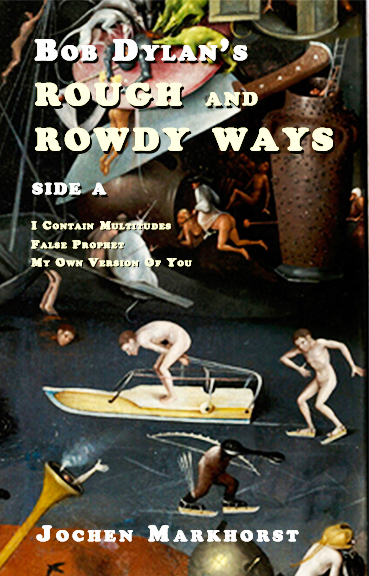
And here we are. January 2026. The fifth and final book in the H61 series. The Pentalogy. Fourteen songs, six years, more than 2000 days, five books – a marathon completed. Well, a relay race at walking pace, actually. But still.
Bob Dylan takes Highway 61 – Seven mercurial songs
Jochen is a regular reviewer of Dylan’s work on Untold. His books, in English, Dutch and German, are available via Amazon both in paperback and on Kindle:
My recent series of articles looking back at Bob’s gambling songs has brought in a few emails about one particular song, which I didn’t mention: “Roving Gambler,” and has raised the issue as to why not only did I not mention it, but also why it doesn’t turn up on the official Bob Dylan site.
Now one of the main problems with this song and indeed other gambling songs is that it turns up with all sorts of different titles which can make it difficult to keep track of, but doing a quick check up I couldn’t find it on this site under any of them – titles such as “Roving Gambler”, “Rambling Gambler”, “The Gambler”, “Gambling Man”, “Rambler Gambler”, and “I’m a Ram,bler, I’m a Gambler”
And of course I know that there are other songs which have used some of these titles and spun off in a different direction, so that can make things even more difficult to keep track of.
So if I have mentioned this before and I am repeating myself, very sorry, but I think it is worth the risk because it is such a super song, and really need to be added to our collectioin of gambling songs….
But what makes all this a bit more interesting is that running through the songs on the official Bob Dylan site they don’t seem to have the song at all. And that is odd because their heaading is “Bob Dylan songs played live” and our recording above most certainly shows that this was played live.
In fact, I was reminded of this by Zula Sweepstakes Casino and so I owe many thanks to them – although if you can explain why the song is not on the official Bob site as one of his performed pieces, that would be helpful. (It has struck me that this song might have a different title, and indeed that we might even have had this track on here before – if so my apologies – but again if you can help me sort this out, it would be really helpful).
Anyway, bumbling my way around as usual, trying to find out more about various songs I came across a version of this which is utterly different in its whole approach, so I though I would offer up that as well…
Now when I do include these various alternatives, it is entirely because I think the different approaches are interesting – not because I particularly think they are better than Bob’s version. Indeed I do love Bob’s version.
And I do like the occasional variations Bob adds in different versions of the songs. Here’s one more
So if you explain to me why I can’t find it on the official site, please do let me know. And to be clear what I can find are references to Bootleg 7 (No Direction Home) and one listing Rambling Gambling Willie from Bootlegs 1-3 but again with no reference to performances, which there clearly are.
And if it turns out that the answer is dead simple and obvious, please write in kindly – I am getting a bit old now. And this is post number 3,987 on this site. So yes, I am prone to forgetfulness.
During the Christmas and New Year period, I spent a bit of time looking back over the songs Bob wrote concerning gambling – and I am going to wrap this up now, starting with a song by the Clancy Brothers, which I not only love for itself, but because of its introduction about their meeting with the young Bob Dylan. I was chatting to a friend over Xmas who, I have always thought, outdoes me for knowledge of Bob every day of the week. But he didn’t know of this commentary or the subsequent recording, so here it is one more time.
And of course that led me on to thinking further of my favourite covers of Bob’s gambling songs – which have been mentioned a couple of times over this Christmas and New Year period.
But thinking along these lines, I then remembered “Gallo del Cielo” which many people have since recorded and which has often been noted as one of Bob Dylan’s all-time favourites.
So just in case you haven’t heard it before, here it is – and if it is the case that you don’t know this song, and it doesn’t appeal to you at once, I would beg you to let it run, it really is something. And of course, if it does make you fancy a bet and you happen to have a connection with Florida, there are details of some sports betting sites in Florida here – just to help out.
I really do love that recording – and sitting here in rural England with snow covering my garden, I do find it hard to believe I have managed to run this site for so many years without actually adding that recording. Which gives me hope for the future too.
But of course I know my place, as we enter the year of 2026, (this being written and published on 2 January of that year), I return to the normal focus on Dylan’s own music. So, staying with the notion of long songs that have relationships with the issue of gambling, I really do have to conclude this little series of Christmas and New Year pieces touching on the subject of gambling, with Tom Russell’s “Lily, Rosemary and the Jack of Hearts. Not many people have tried to record the whole song, and fewer have succeeded.
I do hope, as we have moved from Christmas through to the new year, you have found something of interest in this little collection of old Dylan songs and the thoughts they bring to mind. It’s now the new year, so we move on once again….
But of course, as ever, if you have any thoughts on a series we ought to run, or indeed if you would like to write one article or a whole series of articles for Untold Dylan, I would be very happy to hear from you. Aside from this song, in recent pieces we have looked back at “Black Diamond Bay” with a version of that I don’t think we’ve covered here before, “Taking a gamble on life” and the background to “Rambling Gambling Willie.” I hope you found some of that an interesting diversion.
And if you have any ideas for an article or a series which either you would like to write, or think that one of the regular team here should write, just email me at Tony@schools.co.uk
If you have been, thank you very much for listening and reading.
In the last episode of this series, I continued with the point that Bob was having trouble finding new ways and directions to take his music (as opposed to his lyrics) in the early 1970s. Of course, some of his songs were indeed superb, but there were also many others that musically either were left incomplete for others to finish or simply were not up to the standard that we had come to expect.
That review took us as far as “Never Say Goodbye” and the next song written by Dylan was “Nobody Cept You,” which was planned as part of Planet Waves but then omitted from the album. And indeed, if we listen to it now, we can perhaps see why
For me, there is nothing either in the melody, the accompaniment or the lyrics that make this song something that I would choose to play for entertainment, or indeed to help get me through the day. There is a tiny bit of novelty with the chords, but not enough to make anyone fascinated by Bob’s music go back and listen again, while the lyrical content is pretty much summed up in the song title.
Love songs are, of course, a prime area of interest to writers of pop, rock and folk music, and they sometimes include the notion of denying oneself in favour of the other party… and with that theme in mind, we might excuse Bob the opening of the song that reads…
Nothing 'round here to me that's sacred
'Cept you, yeah you
there's nothing round here to me that matters
'Cept you, yeah you
But then we find out that is the long and the short of the song, as we are later told “Nothing anymore seems to please me ‘cept you, yeah you”. Now of course, if the music were doing something really interesting, that could then rescue the song, but if ever there was a song that musically did not sound like Dylan, but instead sounded like a rather poorly written and not very original pop song, this is it. So as we move toward the end with….
Nothing hypnotizes me
Or holds me in a spell
Everything runs by me
Just like water from a well
Everybody wants my attention
Ev'rybody got something to sell
'Cept you, yeah you.
… I find myself thinking, “yeah, no”. “Just like water from a well”???? Oh come on!!! I don’t wonder who this lady is, and in fact, I don’t wonder anything except why Bob bothered to record the song. This is a pop song, and in my mind, not a very good one, and one can only be grateful that someone persuaded Bob it was not what he was looking for.
But then Bob at this time really did feel it was a good idea to express where he was and what was happening. And by the way, if you do play the recording below and feel it has suddenly stopped, please let it roll. I suspect you will never have heard Bob do anything like this.
In my view, this is not just a songwriter coming up with the next song ready to offer it to the record company. No, this is a songwriter crying out in desperation, “I have lost it.”
Of course, that version was far too over the edge to put on an album, and an alternative approach was used, which I am sure you will remember.
I called my article on this site, in the series that reviewed every Dylan song, “turning an ok song into one of the greatest moments in rock music” and I would stand by that.
But as this series delves further than most into the actual music, rather than the lyrics, I feel I can add something more here about the music. Unlike any song that Bob had written before this point, he did something completely unusual musically, indeed, something virtually unheard of in popular music. He starts the song as one based on a major key (F major is the opening chord, which sets the scene) but then ends the verse in a minor key, with the chord of D minor.
Now this is a cadence which is perfectly well known to classical music scholars; indeed, it has its own name, the “interrupted cadence” and is written in musical shorthand as “V – VI”. The song is in F major, so chord V is C major, and chord VI is D minor, which is how each verse ends, and which gives us that unexpected effect.
And that cadence at the end of each verse works so wonderfully because of the lyrics: “I’m going, I’m going, I’m gone” – the “gone” not appearing until the submediant chord (VI) is reached.
    F
I'm going,
    C
I'm going,
    Dm
I'm gone.
And if that were the only unexpected thing Bob did, it would be enough. But no, he goes further, for after three doleful, almost painful verses, he changes tack with by moving to a major key…
Am                                     G
Grandma said, "Boy, go and follow your heart
G                         C/g        G
And you'll be fine at the end of the line.
G                     C/g      G
All that's gold isn't meant to shine.
      Am                    C         D       /(c c bb bb a)
Don't you and your one true love ever part."
Now there is also a change of beat within that first line as we find the song completely unexpectedly jumps from the key of F major to the key of G major. And it is a real jump as there is no gentle modulation, except through the fact that the chord of A minor does exist in both the key of F major and G major. But really, if we had never heard the song before, it would be a jump and a half. And even now, knowing the song as I do, and having played and heard it over quite a few years, that jump can still take me by surprise. We are suddenly in the bouncy, happy key of G major – and believe me, Bob doesn’t normally do such things.
But then, after Grandma’s profound and soothing words, telling the singer to stay with his lover and make it work, without any real explanation, we are back to the opening minor key, and again for no reason apart from the thought that he has already gone too far, he leaves her. Grandma’s warnings are for nothing.
I been walkin' the road,
I been livin' on the edge,
Now, I've just got to go
Before I get to the ledge.
So I'm going,
I'm just going,
I'm gone.
The song made it onto The Complete Budokan and then had 79 on-stage outings. And maybe that can be excused by the totally downbeat nature of the song. But its lack of exposure is a shame.
It meant that so far in 1973 Bob had written “Nobody Cept You,” “Goodbye Holly”, “Wagon Wheel,” Knocking on Heaven’s Door” and “Never Say Goodbye” – all songs about moving on, saying goodbye, and the fear of saying goodbye. To say the composer was fixated on one vocal theme is not an exaggeration.
But musically, these songs really do seek to travel in new directions. And in case you have lost track of my argument, here are these songs from the last article and this piece, in order of composition – I am leaving out the one song in the sequence that we can’t readily date. I hope you might find half an hour to play them and listen, as as you do, to recall that this is the order of composition. I find it gives me quite an insight as to where Bob was, and where he was going. If nothing else you might note that two songs hav the word “goodbye” in the title, plus there’s “going going gone, and “Knocking on heaven’s door”. A certain theme seems to dominate.
This is part of a series of articles offering one Dylan concert for each year he has been touring. Concerts selected by Tony Attwood. A list of the songs performed and an index to the complete series of concerts included, is given below…
This concert was covered by Mike Johnson in his Never Ending Tour and Beyond series. And because of its varied content, including some acoustic performances, plus the quality of the recording, this is one of my absolute favourite events to play back. If you have not heard this before, just listen to track two, the Elizabeth Cotten song.
We have only six years to go in this series, and I know we won’t be able to find a concert for each one.
“Can You Please Crawl Out Your Window?”, as we will from now call “Look At Barry Run”, is a song that Dylan struggles with for quite some time, comparable in that respect to “I’ll Keep It With Mine”, the song he also keeps fooling around with during these months (for more than a year, in fact; the Witmark demo is from June 1964, two recording attempts during the Bringing It All Back Home sessions in January 1965 and eleven takes during the Blonde On Blonde sessions in January and February 1966).
Can You Please Crawl gets seventeen takes during that fourth Highway 61 session alone. Then two attempts in the no man’s land between the release of Highway 61 and the first real Blonde On Blonde session on 30 November 1965: on Tuesday 5 October, Dylan spends another long evening (three hours, an hour and a half break and then another four hours) in the studio for a session that will prove to be not very productive. “Medicine Sunday”, “Jet Pilot”, “Can You Please Crawl Out Your Window”, “I Wanna Be Your Lover” and two untitled “Instrumental Tracks”; a bunch of unfinished snippets and failed takes, not a single song is deemed good enough for Blonde On Blonde, and the best takes are not officially released until 1985, on the fascinating box set Biograph.
Those two “Can You Please Crawl Out Your Window” snippets we only get to hear in 2015, on Disc 8 of the acclaimed The Bootleg Series 12 – The Cutting Edge 1965-66. Unfortunately, both were cut short (after 0’57” and after 0’49”), both at a slower tempo than the H61 takes and both even more mercurial than those earlier takes.
Seven weeks after this “in-between session”, at the first real Blonde session on 30 November, the final attempt is made. First, fourteen attempts to record “Visions Of Johanna” to the master’s satisfaction (unsuccessful), and the rest of the evening is spent on Can You Please Crawl. Right from the first take, a false start, it is clear that Dylan has ironed out the main sticking point. The Rolling Stone-esque intro is replaced by an al niente, a “to nothing”, in which the band falls silent for a bar and only drummer Bobby Gregg taps the beat on a cymbal. The idea is so successful that it is also used after each chorus and becomes one of the song’s strongest features.
This version is accepted fairly quickly. During this final recording session, it hardly changes; in fact, only organist Garth Hudson is searching for a definitive part. The faltering rehearsals and breakdown are probably due to the slightly unusual chord progression of the bridge to the verses. The esteemed gentlemen musicians do have to stay focused here, but pace, arrangement and sound for the final version of the song itself have been found. The disturbing similarities from July have largely evaporated – partly because influential musicians such as Al Kooper and Mike Bloomfield are not playing on this version, of course (although Al Kooper does seem to remember playing on this session with The Hawks – but the organ part really sounds like Hudson, the piano plays far too well for Kooper’s keyboard skills and is probably Paul Griffin, and that guitar definitely is Robbie Robertson).
It is released as a single, and Dylan has expectations. In No Direction Home, Shelton tells the story of how Dylan throws the doormat on duty, Phil Ochs, out of the car because Ochs is not overly enthusiastic about the single’s hit potential.
Still, Ochs is right. In the US, Can You Please Crawl barely makes it into the charts (number 58 in the Billboard Hot 100 is the highest position), in Canada it doesn’t make it past 42nd place, and in Europe the song only makes it into the charts in England, where it is still a hit, though a minor one: it stays in the charts for five weeks, with 17 as its highest position.
The covers of the song don’t score anywhere either. In the Netherlands, even national sweetheart Patricia Paay (1975) fails with a polished but still okay version, thanks to none other than Steve Harley – who, in his glory year (“Come Up And See Me (Make Me Smile)”), finds time to produce his sister-in-law’s entire debut album and calls in his Cockney Rebels Jim Cregan (guitar) and Duncan Mackay (keyboards). EMI apparently believes in it; not only do La Paay and Steve Harley get Abbey Road Studios at their disposal, EMI also pulls out the wallet for Herbie “Walk On The Wild Side” Flowers on bass and Tony “Rebel, Rebel” Newman on drums – the crème de la crème in the session musicians rolodex. Great musicians, very nice arrangement and a short, atmospheric Make Me Smile-style Spanish guitar solo… but still not enough. The single also has a curious B-side, by the way, on which Steve Harley, now with a complete Cockney Rebel, indulges his production ambitions on “Stairway To Heaven” (but is unfortunately rather curtailed by the vocal limitations of his lovely sister-in-law).
Even with this love and budget Can You Please fails to chart. Phil Ochs’ prediction is proven right again: the song really has no hit potential.
It still is a great, mercurial Dylan song though. In his witty, autobiographical book 31 Songs, Nick Hornby devotes chapter 8 to Dylan’s “Can You Please Crawl Out Your Window?”. Already in the third line, he boldly confesses, straight-faced: “I am not a Dylan fan.” Of course, “like everyone who loves music”, he cherishes the three mid-60s albums plus Blood On The Tracks. But then standing in front of his record collection, he is surprised to find that he has more than twenty CDs by the master (more than any other artist), and he has to admit that he knows far more pointless Dylan trivia than he does about, say, Shakespeare or Jane Austen. And comes up with the highly quotable gem: “there’s a density and a gravity to a Dylan song that you can’t find anywhere else.”
But a fan, no.
Placing “Can You Please Crawl Out Your Window?” among the 31 Songs is not entirely pure though, the successful British author nuances. The appeal of this particular song lies mainly in the fact that you haven’t heard it a zillion times before, so with this song, you can approximately imagine the impression “Like A Rolling Stone” or “Visions Of Johanna” must have made on those who heard them for the first time. Dylan is at his artistic peak here, with that crisp, clear organ sound, unmistakably Dylan, but it’s not such a well-known song – roughly comparable to The Beatles’ “Rain”.
That’s true. The song is a kind of Nugget, an Original Artyfact from the First Psychedelic Era. Dylan never plays the song, especially not after that flop. It doesn’t appear on any album and, as mentioned, the single hardly sells at all. It is not until 1985, twenty years after it was recorded, with the release of the successful box set Biograph, that Can You Please Crawl reaches a wider audience…
Jochen is a regular reviewer of Dylan’s work on Untold. His books, in English, Dutch and German, are available via Amazon both in paperback and on Kindle:
There is an index to all our current series and some of our recent series of articles on the home page. We also have a very active Facebook page. An index to the songs previously covered in this series is given at the end of the article.
By Tony Attwood
This is part of a series of articles in which I take a look at the songs Bob selected for his post-doctorate volume, “The Philosophy of Modern Song.” I did start the series by trying to comment on Bob’s comments withinh the book, but I found I couldn’t really add anything meaningful or useful, so I changed the series to one that offers a recording of each song, so if you wish to hear the song Bob was talking about, eventually they will all be available in one place – on this site once I have listed them all in the final episode. And because I can never resist it, I have added my own comments too.
So today we have “Beyond the Sea” recorded by Bobby Darin and with the English version written by Jack Lawrence and Charles Trenet. And I say “English version” because “Beyond the Sea” is the English translation of the French song “La Mer”. written in 1945. The English version by Bobby Darin was released in 1959. In its various forms it has sold over 70 million copies worldwide.
But it was at the moment of the translation into English that the lyrics changed. The original French version was in fact an ode to the sea – hence the name – but the English version, “Beyond the Sea,” is a love song.
And we should also note that before even that version, the song existed as an instrumental piece and indeed as a hit as an instrumental before the lyrics were added. I can’t find a recording of that instrumental version at the moment – if you have a link to the original instrumental on the internet (rather than the 2021 re-make), please do add the URL as a comment.
First here is the French version
Here’s the English version that became a hit in the US and UK.
Jack Lawrence also wrote the official song of the Maritime Service and Merchant Marine, “Heave Ho! My Lads, Heave Ho!” while he was conductor of the band at Sheepshead Bay Maritime Service Training Station. And to go further, Lawrence also wrote “Yes My Darling Daughter” – which is a song I remember from my early childhood – I guess either we had a 78rpm record of it in the house, or more likely, my father played it on the piano. It was one of Lawrence’s first hits. I’ve put a link to it (for my sake if no one else’s) at the end.
But back to Jack Lawrence, he even managed to write a song for Linda Eastman, who was then one year old and whom he knew because she was the daughter of his solicitor. You may have heard of her as she went on to marry Paul McCartney.
Thus, Jack Lawrence’s connection with the musical establishment was enormous, and it was no surprise when the Bobby Darin version of the song was a number-one hit. And it has gone on to be a hit time and again… This version is from 1984…
But what is particularly interesting musically about this song, especially given that Bob selected it for his book, is the extraordinary complexity of the chord sequence within the song. If you have been kind enough to read some of my commentaries about Bob’s music, you will have noted how many of the songs are based on just three or four chords. “Visions of Johanna” for example, for all its lyrical complexity, only has three chords behind it.
However, La Mer has no less than six chords in the introduction (G,Em,C,E7,Am,D) and the complete verse contains 15 chords (G, Em, C, E7. Am. D, D7, B7, A7, Am7, F#7, B, G#m, C#m and Bm). And although there might be another song out there that does this, while remaining eminently hummable, I can’t think of it.
Indeed, La Mer could be called the exact opposite of a Bob Dylan song. But what we also find is that the lyrics are not nearly as extensive as some Dylan song. Here is the full set of lyrics of La Mer
Somewhere beyond the sea
Somewhere waiting for me
My lover stands on golden sands
And watches the ships that go sailing

Somewhere beyond the sea
She's there watching for me
If I could fly like birds on high
Then straight to her arms
I'd go sailing

It's far beyond the stars
It's near beyond the moon
I know beyond a doubt
My heart will lead me there soon

We'll meet beyond the shore
We'll kiss just as before
Happy we'll be beyond the sea
And never again I'll go sailing

I know beyond a doubt,
My heart will lead me there soon
We'll meet (I know we'll meet) beyond the shore
We'll kiss just as before
Happy we'll be beyond the sea
And never again I'll go sailing.
130 words – many of which are repeats, but with 15 chords in the music. It may not sound odd in any way if you are not a musician, but show the music to a guitarist or pianist who hasn’t played it before and they are most likely to say, “hang on a minute… let me work this out. ” It is, in fact, the absolute antithesis of a Dylan song in terms of its construction.
A little while back, I moved away from the regular series that are published here and wrote a little piece returning to one of the themes that occupied Bob in his writing for a while – that of gambling. And from there recently got into a conversation over a meal with some friends about gambling songs in general.
And it was during the course of that conversation that the point was made that if we were talking about gambling songs and Bob Dylan, we had to include “Black Diamond Bay.” And this turned out to be a favourite debating point, with it being pointed out that what we had not done was publish a recording of that song by Bob’s co-composer of that piece, Jacques Levy.
Now, here I hit an issue. For all the reports say that Jacques wrote the lyrics and Bob wrote the music, which, to me, just as a starting point, seems unlikely. For from general observation of Bob’s music I’d expect this to be the other way around: lyrics by Bob, music by Jacques.
And indeed it is more than general observation that points this way. Just look at the way the chords run along through the song – take this for example… (my source here is the excellent and always accurate Dylan Chords website).
       C    /b   Am    G       D(/f#)      C
As the last ship sails and the moon fades away
     C     /b Am   G
From Black Diamond Bay.
If that chord sequence was written by Bob then I would say it is either unique within his songwriting career it is at least pretty unusual – and that is not the only sequence in the piece that makes me think Bob was the author of the lyrics.
Now, according to the official Dylan site, the song was performed live only once by Bob on 25 May 1976. But the theme of course applies to all casinos – if you want to take this further, you might have a look at Best Missouri online casino sites
Anyway, the official reports of the song do insist that Jacques Levy wrote the lyrics and Bob wrote the music, and I’m just a guy who listens to the music and draws a conclusion. And my conclusion is that if Bob did write this music, it really is a one-off for him; it just doesn’t seem his style.
And yet when we come to the lyrics, these seem “pure Bob” to me. For here we must remember that this is a strophic song, meaning that it is verse, verse, verse, with each verse being the same, musically. This is Bob’s most common style, and it also describes most folk music, including virtually all Bob’s gambling songs.
One other little detail is that where Bob has written music in a lively music of this nature, it is very rare for him to start a piece in a major key (G major in this case), with a minor chord (Em). It just isn’t Bob’s style of composing, whatever the record company might say.
However, if Bob did write the lyrics, why wouldn’t he want it to be known? I suspect quite simply because they don’t make much sense. We are introduced to a lady of a certain age who isn’t gambling, a man asks for a rope and a pen, storm clouds gather, people come and go, there’s a volcano, there’s a panic, people fall in love, the island sinks, the gambler wins the jackpot, a man watches the news.
Now, none of that seems very Bob Dylan to me. Yes Bob jumps around in the lyrics, but not quite in this way. What is Bob, is the way the music moves along without any refernce to these lyrics. And with each verse being musically the same; so we get the sense that no matter what happens, no matter what the chaos, life goes on.
The whole effect is achieved by the fact of having seven verses that are musically identical – the strophic approach that Bob has so often utilised. The world as described in the lyrics falls apart, by the music goes on in the same way: that is a style Bob has often used.
So I’d put forward the view that Jacques wrote the music and played it on the piano, Bob liked it, and put lyrics to it. And the point is, everyone who wants to gamble can indeed do so.
In the last episode of this series No Nobel Prize for Music 1973: the music returns: but with considerable uncertainty, I explored what now seems to be the widely accepted view that Bob Dylan wrote part of “Wagon Wheel” and then members of Old Crow Medicine Show finished the song off, and the rights to the song were shared. Certainly, the recordings that we have, seem to back up that view.
But what then do we make of Sweet Amirillo? My view is much the same – it was a part Dylan song finished off by Old Crow.
There is no evidence that is utterly definitive on this, so I will leave you with the thoughts I have offered before, and note once more the most obvious thought that Bob was struggling to put together a song that was a) musically original and b) he could finish off.
But Bob still had a commitment to write the music for Pat Garrett and Billy the Kid in 1973 as the difficulties of finishing off those two songs, ultimately part-written with Old Crow reveal.
Indeed, the next song lines Dylan came up with, which we normally associate directly with the film Pat Garrett and Billy the Kid, if taken out of that context, could refer to Dylan’s problems with composition, the badge being his reputation for writing brilliant songs in the past, but now finding it rather hard going.
Mama, take this badge off of me
I can’t use it anymore
It’s gettin’ dark, too dark for me to see
I feel like I’m knockin’ on heaven’s door
In fact, what I believe happened here is that Bob gave up the struggle and accepted the difficulty he was having with both the lyrical and musical elements of songwriting, and so wrote a very simple song.
Four quite separate things still strike me when I hear this song. One of the elegance and beauty of the simple melody, the second is that Bob repeats the same line four times (which is very un-Dylan), the third is that the verse and chorus have exactly the same music, and the final point is how short it is.
This is the man who wrote Desolation Row, Johnanna etc etc and he delivers s
GDAm
Mama take this badge off of me
GDC
I can't use it anymore
GDAm
It's getting dark, too dark to see
GDC
I feel I'm knockin on heaven's door
Verse two gives us
Mama, put my guns in the ground
I can’t shoot them anymore
That long black cloud is comin’ down
I feel like I’m knockin’ on heaven’s door
And the chorus, as of course you know, is “Knock, knock, knocking on heaven’s door.
It is virtually impossible to think of a simpler song – and yet it works, and we all remember it because of its simplicity. Bob, in fact, had found a way out of his dilemma not by writing another song packed with lyrics and interesting chord changes with a melody over the top, but a song that in its opening line delivers pure emotion, and the song then stays at that level throughout…
But I think we must also give credit to Bob’s genius here – he could have battled on and added extra lines to the chorus, but in effect, the repetition of the title line four times adds to the poignancy and depth of the emotions. It is not a trick a songwriter can pull very often, but as a one-off, it works. And we must give Bob the fullest credit for the phrase “Knocking on Heaven’s Door” itself.
In fact, there was more than enough music here for both Eric Clapton and Guns n Roses to take the song on with their own versions, and extend it to over four minutes with variations in the melody through the addition of the harmonies.
Of course, Bob wasn’t the only artist ever to suffer this sort of blockage in his creativity, and such an approach doesn’t guarantee that the next work of art is going to build further on this innovative approach. But it can get things going again.
Now my view is that having reached this point, Bob decided to up the level of novelty in his songwriting by exploring new possibilities in the music. As we know, most of the time the emphasis is on the lyrics, out of which comes the music. But I think Bob was having some problems finding interesting new lyrics at this point, and having solved the problem by using unusual chord sequences and then putting in modulations, which are incredibly rare in popular music, I think he then felt this was his the way forward.
And this gives us the background to “Never Say Goodbye” where Dylan continued his musical exploration, challenging himself to find out just how far he could take the music, while still retaining the essence of the styles he had written in thus far: folk, pop and rock.
The song “Never Say Goodbye” starts out very simply in musical terms, being clearly in the key of D, but then after one verse chaos emerges as Bob attempts to modulate the song from the key of D into the key of G, which leads him to struggle to sing “cry” at the pitch required, having moved into the key of D
D        G            A
Twilight on the frozen lake
      G             D
North wind about to break
   G                A
On footprints in the snow
G            D     G  A  G
Silence down below.


       G  C             D
You're beautiful beyond words
       C           G
You're beautiful to me
C               D
You can make me cry
C         G      C  D  C
Never say goodbye.
Modulation – the moving of one key into another – is a fundamental part of classical music (if you have learned to play the piano the chances are you will have come across JS Bach’s “48 Preludes and Fugures” which was written to celebrate the arrival of a keyboard instrument that could indeed play in every key and still sound in tune). But modulation was never part of folk music as it is very hard to achieve without the accompaniment of musical instruments designed to be played in those different keys.
So Bob’s exploration of the issue in this song, does sound rather like a muddle, and this is a great shame, because having come up with the idea, Bob seemingly never returned to it. And yet the lyrics really do have something in them which, perhaps with more rehearsal and a less ambitious modulation (which can put a great strain on the voice) he might have explored this notion further.
Certainly, the problem is that the most obvious modulation is to take the melody up a fifth – so if you are playing in the key of D, you might modulate up to A major. But if you care to sing a song in what you feel is the normal pitch for you, and then sing it again, starting five notes further up the scale, you’ll most likely run into difficulties. Most of us can sing notes up to one and a half octaves apart, but at that point it becomes difficult and we tend to give up, or end up spluttering.
So “Never Say Goodbye” was an experiment around these issues, and is not examined here as a great Dylan song that he could have developed, but rather as evidence of just how much Dylan was experimenting and how far he was willing to experiment, while never being afraid of accepting that some ideas don’t work. That this experiment didn’t work is less important than the fact that he tried it out, seeing where else his music might go as he continued to explore new musical dimensions that would lead away from the brick wall he had previously faced.
Thus as we look back at the lyrics of “Never Say Goodbye” we can see Bob exploring there, as well as in the music, where else he could take his songs…. Just consider the images: dreams of iron and steel, a bouquet of roses from heaven to earth, waiting on the beach in front of the tumultuous waves, asking her not just to marry him and take his name but change her appearance…..
My dreams are made of iron and steel
With a big bouquet
Of roses hanging down
From the heavens to the ground

The crashing waves roll over me
As I stand upon the sand
Wait for you to come
And grab hold of my hand

Oh, baby, baby, baby blue
You’ll change your last name, too
You’ve turned your hair to brown
Love to see it hangin’ down
Dylan’s exploration here was clearly not successful musically, but that’s not the point, for I don’t know any other song writer that actually tried this approach. Yes, Bob would borrow ideas from the Medicine Show, but he then wanted to have his own musical innovations as well. This one didn’t quite work, but it helped pave the way for other adventures yet to come.
This is part of a series of articles offering one Dylan concert for each year he has been touring. Concerts selected by Tony Attwood. A list of the songs performed and an index to the complete series of concerts included is given below…
Details of our most recent articles and series can be found on the home page.
by Jochen Markhorst
I Look At Barry Run
“I tried to write another Mr Tambourine Man. It’s the only song I tried to write ‘another one’.” (Dylan, Sing Out! October 1968)
“From A Buick 6” is recorded fairly quickly, on 30 July 1965: it takes less than an hour. After two false starts, the fifth take is only the second complete performance and right away good enough for Highway 61 Revisited.
Dylan spends the remaining studio time on “Can You Please Crawl Out Your Window?”, which is still documented as “Look At Barry Run”, and this one doesn’t go so smoothly. The last attempt is Take 17, which accidentally ends up on the A-side of the first pressing of “Positively Fourth Street”. That intro, the first few bars… no doubt: “Like A Rolling Stone Part II”. And the rest of the song does not escape the familiarity either. Bloomfield plays a derivative of his part on that global hit, the trick whereby each verse builds tension towards the (similar) chorus, the harmonica… boy, did we hear this before.
Only Al Kooper’s tinkling on the celesta (it’s not a xylophone, as many critics think they hear) adds a particularly successful novelty to the mercurial sound. A brilliant recording, no doubt, but Dylan hears the similarities as well, and that’s a sensitive issue. He had already dropped the masterful “Farewell Angelina”, probably because it sounded too much like “It’s All Over Now, Baby Blue”, and later he would dump the beautiful “Up To Me” as that song was too similar to “Shelter From The Storm”.
Dylan – Can You Please Crawl Out Your Window? – Take 1:
The Freudians among us might argue that Dylan had already subliminally picked up on the similarity before the recording began. We hear Dylan say, half-choking with laughter, “Look at Barry run take one” while drummer Bobby Gregg is already counting in – Look-at-Bar-ry-run has the same number of syllables, almost the same initials and exactly the same metre as Like-a-rol-ling-stone (- ‿ – ‿ -). And Uncle Sigmund would undoubtedly point out that today, 30 July, marks ten days since the release of Dylan’s greatest pride and greatest hit, which has just entered the Billboard Hot 100 (at No. 91, tomorrow it will rise sharply to No. 76). The phrase “like a rolling stone” floats just below the surface of Dylan’s stream of consciousness today.
Home-made amateur psychology that still does not explain where the particular words of the title do come from, of course. Presumably from the same wildly swirling, opaque undercurrent of consciousness that in recent months has spewed out “working titles” such as “A Long Haired Mule And A Porcupine”, “Lunatic Princess”, “Black Dally Rue” and “Alcatraz To The 9th Power” – to name but a few.
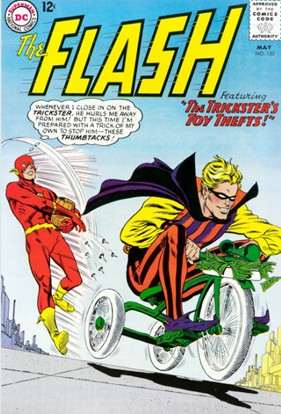
On the other hand, “Look At Barry Run” sounds far less absurd than all those other “working titles”. Even back in 1965, every teenager and young adult associated the word combination “run + Barry” with one of the most popular DC Comics heroes since 1956, Barry Allen, The Flash. Not so far-fetched when we also see the cover of the recent The Flash, the May issue (#152, “The Trickster’s Toy Thefts!”): Barry Allen, the Flash, runs after the Trickster and throws a handful of thumbtacks – with a fist full of tacks, preoccupied with his vengeance. Noteworthy: in the very first take in which we hear Dylan singing, the second take after the first false start, Dylan sings only the first line (the take is cut off after nineteen seconds):
He sits in his room, your tomb, with a mouth full of tacks
The men stop playing, we hear laughing, indistinct shouting, Dylan cheerfully says “let’s go” and “Take one again. Let’s start at the beginning. Take one, not three!” Producer Bob Johnston joins in the cheerful historical revisionism and calls out in a quasi-authoritative tone: “Hey! Take one, Look At Barry Run!” Drummer Gregg taps out the beat again, and then we hear that Dylan has reversed the possessive pronouns and changed a noun:
He sits in your room, his tomb, with his hands full of tacks
… which suggests that there may indeed be a Flash #152 lying around somewhere in the studio and Dylan is registering the running Barry with a handful of thumbtacks out of the corner of his eye. This take also quickly gets bogged down (after about 25 seconds), and then the first complete take follows, with the final opening line:
He sits in your room, his tomb, with his fist full of tacks
Well, almost final then; “his fist” will still be changed to “a fist”. In any case, it is – very unusually – the only real change in the lyrics. Atypically, Dylan will not change anything in the lyrics until the very last recording attempt, exactly four months later on 30 November – apart from insignificant details (pick up his chalk becomes hand him his chalk, when he tries becomes trying to, that sort of thing).
The arrangement does change considerably in November, which is hardly remarkable. Since Dylan’s electrification, song arrangements have changed more often than not during the recording process. Usually drastically – such as the switch from three-four to four-four time in “Like A Rolling Stone”, the halving of the tempo in “It Takes A Lot To Laugh”, the melancholicisation of “Visions Of Johanna”… and that remains Dylan’s modus operandi, as we can hear, for example, in 2023 in the colourful, fanning-out outtakes from Time Out Of Mind on The Bootleg Series Vol. 17: Fragments – Time Out of Mind Sessions (1996–1997).
Dylan – Can You Please Crawl (single version):
However, the lyrics remain surprisingly unchanged. We are used to lyrics changing along with shifting time signatures, chord progressions, tempos and arrangements. And usually no less drastic, at that: choruses come and go, verses migrate or disappear, “you’s” become “she’s”, a blacksmith with freckles transforms into John the Baptist (“Tombstone Blues”), a ghost child becomes a brakeman (“It Takes A Lot”), and so on: a subsequent take almost always contains a textual intervention – and this peculiarity continues to characterise Dylan’s production process to this day.
This lyrical consistency in this particular song is understandable in a way; although the words are not very coherent semantically and could easily tolerate changes (such as mouth – hands – fist), the structure is technically quite perfect:
He sits in your room, his tomb, with a fist full of tacks
Preoccupied with his vengeance
Cursing the dead that can’t answer him back
I’m sure that he has no intentions
Of looking your way,
unless it’s to say
That he needs you to test his inventions
Rhyme master Dylan is undoubtedly pleased with rhymes such as his vengeance – intentions, with elegant, unobtrusive, waltz-like rhythms as in Preoccupied with his vengeance (– ‿ ‿ – ‿ ‿ – ‿), and all three verses adhere to the ancient, unusual rhyme scheme ababccb, known as the Lutherstrophe (because the very musical Martin Luther was so fond of it and tried to capture many psalms in that seven-line rhyme scheme). Towards the end of his life, Shelley also resorted to it occasionally (in “To Night” from 1821, for example), but there are not many more fans. Dylan undoubtedly intuitively casts his lyrics in that scheme – let’s assume that the young Beat poet did not first study Lutheran hymns.
Both with Luther and with Shelley, it creates a kind of circular feeling, a movement suggesting both completion and perpetual return, just as the varying line lengths communicate an increase and decrease, evoking a sense of ebb and flow – all wonderfully fitting with the overarching portrait that Dylan seems to want to paint here: the portrait of a lady who cannot break free from a destructive, hopeless relationship.
It is a pity, incidentally, that Dylan did not leaf through the supposed comic book. After the title story, “The Trickster’s Toy Thefts!”, in which Barry “The Flash” Allen attacks the Trickster with a fistful of tacks, there is a bonus story: “The Case of the Explosive Vegetables”. Now, what might Trickster Dylan in his mercurial years have done with that?
Jochen is a regular reviewer of Dylan’s work on Untold. His books, in English, Dutch and German, are available via Amazon both in paperback and on Kindle:
There is an index to all our current series and some of our recent series of articles on the home page. We also have a very active Facebook page:
——————
By Tony Attwood
This is part of a series of articles (links to previous articles at the end) in which I take a look at the songs Bob selected for his post-doctorate volume, “The Philosophy of Modern Song.” I did start the series by trying to comment on Bob’s comments, but I found I couldn’t really add anything meaningful or useful, so I changed the series to one that offers a recording of each song, so if you wish to hear the song Bob was talking about, eventually they will all be available in one place – on this site once I have listed them all in the final episode. And because I can never resist it, I have added my own comments too.
Today, we have Poison Love by Johnnie and Jack
For your poison love has stained the life-blood in
                                          my heart and soul, dear
And I know my life will never be the same
For my pleadings have all been in vain for you and you alone, dear
And you know that you are guilty of the shame
Poison Love was written by Tillman Franks and Elmer Laird, although according to some sources the composition was subsequently credited to Elmer Laird’s widow as a reward for her offering him a job when he was down and out. I would imagine that was to enable her to receive the royalties from the song after the original authors passed away.
However, I’d really like to know more about that, as Tillman Franks died only 19 years ago (as I write this in 2025) and so if he gave up his rights on this song, that would be a very large amount of money he waved goodbye to. If it is true, it was a most generous gift indeed. He also wrote “How Far is Heaven” , “Honky Tonk Man” , and “When It’s Springtime in Alaska” – plus many more which were very popular in their day and has been inducted into the Rockabilly Hall of Fame as well as being bass player for Jimmie Davis, Slim Whitman and others.
The song itself was a country music hit in 1951 and offered to several artists before being taken up by Johnnie and Jack and becoming a hit.
It is one of those songs that has really appealed to a multiplicity of performers, including Jerry Lee Lewis who makes it sound like it was meant for him. I love this version – it is Jerry Lee at his very best.
Musically, the song is unusual in that it has the chord change in the fourth line of each section rather than in the third section that we would normally expect…. (the delayed change to E in the second line)
AFor your poison love has stained the life bloodEin my heart and soul dear AAnd I know my life will never be the same
If the chord change had come at the start of the third bar (“in my heart”), I would suggest the impact of the music would have been lost, and it would have been just another popular song. But that simple delay, which continues all the way through the song, makes it something extra, that something special. Here’s the full first verse.
For your poison love has stained the
Life-blood in my heart and soul, dear
And I know my life will never be the same
For my pleadings have all been in vain for you and you alone, dear
And you know that you are guilty of the shame
Into each life a love is born for one and one alone, dear
The love I chose was surely not for me
Although of course I must admit it is also unusual that a song which is so negative about a love affair – and we might also note that we get the same four lines of music over and over again – there is no separate chorus, no middle eight, no different instrumental break.
The music is also limited in that the music of the verse is identical to the chorus, which is sung at the start, at the end, and between the verses.
So really there is a minimal amount of music here, but it is a song of definitive farewell, and although quite a few of these have been written, this is one of the rarer kinds where the singer takes no blame and has no sorrow but really is throwing the whole affair straight back in the face of the partner. And it has a bouncy beat too!
And it has been picked up over the years – this recording comes from 2017…
So why did Bob pick it? For all the reasons above, I guess. Musically, it is very enjoyable, and lyrically, it has a kick. But above all, it is the delay to the chord change in the second line. One little change from what we expect, and it makes the song into something else. It’s fun, when in fact the lyrics suggest it shouldn’t be.
Details of our most recent articles and series can be found on the home page.
By Tony Attwood
In an earlier post written about eight years ago I noted that 1973 was the year in which Bob moved into a second round of genius. If you have been following this series you will know that in 1971 and 1972 Bob had cut his almost constant song-writing life, and written just three songs that many of us might consider to be of the quality that we would expect from Bob: “When I paint my masterpiece”, “Watching the River Flow” and “Foever Young”.
And of course for any other songwriter to have produced three such masterpieces in a two year spell would have been widely celebrated, but with Bob we had become used to much more. There were fears expressed occasionally that maybe the great days of Dylan’s composing were over.
However in 1973 we found that the songs were starting to flow again. Indeed one could see very clear signs of what I have previously called “unadulterated genius”.
But we also might note that seven of the first eight songs that Bob composed that year were about love – only three songs venturedd elsewhere. Going going gone – is a song of self confessions, Tough Mama is a song about being full of life (itself a strong indicator of how Bob has changed). Dirge – as its title suggests is about disdain and self hatred, but then it was followded by Wedding Song – which has within it a rejection of labelling, and the notion of setting oneself free
But here, in this series I am seeking to find ways in which Bob’s actual music, rather than his lyrics changed.
Goodbye Holly was an outtake from Pat Garrett and Billy the Kid. and both lyrically and musically it is a very simple song. Musically it just rotates through two chords throughout the whole piece with a chorus and a verse. The chorus is repeated several times with the lyrics
Goodbye Holly, Holly, goodbye.
Your wife's a-gonna miss you you baby's gonna cry
Goodbye Holly, Holly, so long.
All your good times they're past now and gone
It is I think something that we can just put down as a rough try-out not a serious piece of song writing. But in case you have never heard it, here it is.
But then just in case we were all thinking Bob had utterly lost it he gave us Wagon Wheel, which has not only been recorded by Bob but by many others. And I am going to start here with a recording by one of my favourite bands who specialise in playing Dylan songs: Old Crow Medicine Show
What we have is not only a much more interesting chord sequence, and a pleasing melody, but a change in the way Dylan usually uses chords.
If we listen to the original Dylan recording we find it starts as a straight three chord song, but the bass begins as if there should be another chord and indeed if you focus on the double bass you can hear that the bass player does indeed have difficulty in the second line each time round. But then by the time we have reached the 3 minutes 28 mark, everyone has agreed there is an extra chord in there. The sequence isn’t just those three major chords but rather
G                   D
Rock me mama to the wind and rain
Em                  C
Rock me mama like a fast bound train
G     D       Em
Hey,    mama rock me
And this is interesting for me, at least, because here we can hear the enormous difference made by the addition of just one chord. The version of Old Crow Medicine Show and comes much later.
In fact the song “Wagon Wheel” which we know today is a co-composition by Bob Dylan and Ketch Secor of Old Crow. If you want to hear how far Bob took this song, this recording reveals it…. the bass player is most certainly doing his best to follow what Bob is plyaing on the guitar, but it very much sounds as if this is not what Bob did on the previous run through!
Here Bob reduces the song to just three chords.
Now in websites that refer to the cur Old Crow recording we can find the statement that “Wagon Wheel” is a song co-written by Bob Dylan and Ketch Secor of Old Crow Medicine Show Dylan recorded the chorus in 1973 while Secor added verses 25 years later. Old Crow Medicine Show’s final version was certified Platinum by the Recording Industry Association of America in April 2013. The song has been covered numerous times, including charting versions by Nathan Carter in 2012, Darius Rucker in 2013[3] and Nathan Evans in 2022.”
So in fact what we have here is a perfect example of Bob still being able to come up with the idea and outline of the song, but really unable to finish it off. Quite why he could not finish it, of course I can’t say, but I suspect many composers and indeed artists of all descriptions will have experienced what Bob had at this point… the muse had left him – at least temporarily.
That of course would explain the lack of new compositions in previous years, and indeed Bob’s own failure to complete the song. Here’s the final version.
I do think this is a pivotal moment in the life of Bob the songwriter and one that should not be passed over, perhaps because this is not a “real” Dylan song, in that he didn’t write all of it. It actually shows us dramatically how the creativity of songwriting had slipped away from Bob in the previous years, and how he was trying to get it back.
And of course, his attempts at recovery were ultimately successful since in the same year Bob wrote songs that we still remember and enjoy. But it is worth recalling that just at this moment Bob really did seem to have lost that extraordinary creative spirit that had allowed him to write the wonderful songs we have so far covered in this series.


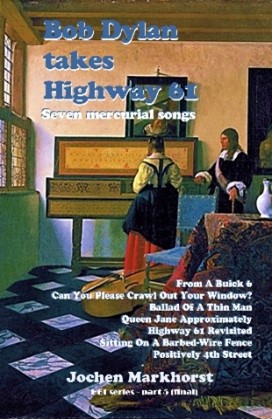

 “Can You Please Crawl Out Your Window?”, as we will from now call “Look At Barry Run”, is a song that Dylan struggles with for quite some time, comparable in that respect to “I’ll Keep It With Mine”, the song he also keeps fooling around with during these months (for more than a year, in fact; the Witmark demo is from June 1964, two recording attempts during the Bringing It All Back Home sessions in January 1965 and eleven takes during the Blonde On Blonde sessions in January and February 1966).