Mike Smith has reminded Aaron and myself that Dylan wrote a series of instrumental pieces for Olivier Dahan’s film “My own love song.”
This gives us a problem on Untold Dylan, because I have for years proudly proclaimed that we were reviewing all the Dylan compositions, and in saying this I didn’t exclude the instrumentals. And yes I did cover the Billy instrumentals quite a while ago.
So time to make amends.
Life Is Hard
https://www.youtube.com/watch?v=SjZ5agESpkg
Sweeping The Floor
This is an engaging 12 bar blues with a relaxed rocking feel.
https://www.youtube.com/watch?v=gxyiCM_ruGk
Bumble Bee
https://www.youtube.com/watch?v=OJydDId7IEw
Bob’s still keeping to the standard three major chords that most popular music uses. A little piece of atmosphere.
Jane’s Lament
https://www.youtube.com/watch?v=pwiWIpP_RE8
This could be improvised with the guitarist playing along to whatever what on the screen at the time.
Joey’s Theme(alternative version of Forgetful Heart)
https://www.youtube.com/watch?v=hIV96fwjMQ4
Again there are suggestions of improvisation here – the whole piece is on one chord and there is a sense that the accordion player is simply playing around the chord as the banjo player plays the chord over and over. I’m rather glad I wasn’t the bass player on this.
The album also has some of the covers from the movie by various cast members
https://youtu.be/343mqZxRc5A
Precious Angel by Renee Zellweger
This rendition really makes the most of a most beautiful song; I’m so glad it is not overplayed but kept completely under control especially in the build up to the “couldn’t make it by myself” life – I have heard so many artists go far too far, far too quickly at that point.
I Believe In You– Don Sparks
The elegance of the performance of “Precious Angel” is retained here. I find this rendition utterly moving.
Life Is Hard – Renee Zellweger
And in keeping with the rest of the music, this is perfectly poised, delicate but not fragile.
Here is the complete list of tracks used in the movie – including some more links to the songs. I’ve not put in links to music from the Classical-Romantic repertoire, as that is not what Untold is primarily about, but I have included the more contemporary songs that were used in the film.
Anything missing, is missing because I can’t find a copy on the internet.
Bob Dylan – Forgetful Heart (Dylan)
Bob Dylan – Life Is Hard (Dylan)
Bob Dylan – Sweeping The Floor (Dylan) *
Bob Dylan – Bumble Bee (Dylan) *
Bob Dylan – Jane’s Lament (Dylan) *
Bob Dylan – Joey’s Theme (Dylan) *
Ron Eaton – Preludes, Opus 28 #6 in b Minor (Chopin)
Bob Dylan – I Feel A Change Coming On (Dylan)
Bob Dylan – Driving South (Dylan) *
Georges Drakoulias – What Good Am I (Dylan)
Forest Whitaker – What Good Am I (Dylan)
Bob Dylan – Back Alley (Dylan) *
Bob Dylan – Snow Falling (Dylan) *
Bob Dylan – Billie #30 (Dylan) *
Chopin Nocturne 7
Renee Zellweger – Precious Angel (Dylan)
Bob Dylan – Road Weary (Dylan) *
Bob Dylan – Click Clack (Dylan) *
Bob Dylan – Life Is Hard (Dylan) (instrumental)
Bob Dylan – Robbie Robert’s Lament (Dylan) *
Robert Johnson – Me And The Devil Blues
Bob Dylan – New Orleans Drums (Dylan) *
Bob Dylan – Janet’s Step (Dylan) *
Source Music – Late Night Blues For Leroy Carr
Ron Eaton – Preludes, Opus 28 #4 in e Minor (Chopin)
Don Sparks – I Believe In You
Bob Dylan – Swingin’ (Dylan) *
Bob Dylan – Blues Club (Playback) (Dylan) *
Renee Zellweger – This Land Is Your Land
Bob Dylan – It’s All Good (Dylan)
Bob Dylan – East Texas (Dylan) *
The Bourbon Street Stompers – Down By The Riverside
Georges Darkoulias – What Good Am I (Dylan)
Ron Eaton – Preludes, Opus 28 #15 in Db Major (Chopin)
Renee Zellweger – Life Is Hard (Dylan)
Bob Dylan – Beyond Here Lies Nothing (Dylan)
Again particular thanks to Mike for alerting us to this omission on the site. And if you find a legal way to provide recordings of the missing tracks (other than the classical-romantic pieces, and the Together through Life tracks, which we have of course already reviewed, please do write in. As ever it is Tony@schools.co.uk
Untold Dylan: who we are what we do
Untold Dylan is written by people who want to write for Untold Dylan. It is simply a forum for those interested in the work of the most famous, influential and recognised popular musician and poet of our era, to read about, listen to and express their thoughts on, his lyrics and music.
We welcome articles, contributions and ideas from all our readers. Sadly no one gets paid, but if you are published here, your work will be read by a fairly large number of people across the world, ranging from fans to academics. If you have an idea, or a finished piece send it as a Word file to Tony@schools.co.uk with a note saying that it is for publication on Untold Dylan.
We also have a very lively discussion group “Untold Dylan” on Facebook with around 8000 active members. Just type the phrase “Untold Dylan” in, on your Facebook page or follow this link And because we don’t do political debates on our Facebook group there is a separate group for debating Bob Dylan’s politics – Icicles Hanging Down
In his song lyrics, generally speaking, singer/songwriter Bob Dylan avoids making direct comments about specific politicians – most of the time.
Concerning a Jewish American senator who’d run for US president (and lose) against Lyndon Johnson, Bob Dylan writes the humorous lines quoted below:
Now I'm liberal, but to a degree
I want everybody to be free
But if you think that I'll let Barry Goldwater
Move in next door, and marry my daughter
You must think I'm crazy
(Bob Dylan: I Shall Be Free No. 10)
Nixon is not mentioned by name in any of Bob Dylan’s song lyrics, but it’s not much of a stretch to consider that he’s the President who stands naked.
President Bill Clinton is not directly mentioned either in any of his song lyrics, but Dylan performs “Chimes Of Freedom” at Clinton’s inauguration concert so it’s reasonable to assume that the newly-elected President’s political position is not anathema to the singer/songwriter:
Tolling for the rebel, tolling for the rake
Tolling for the luckless, the abandoned, and forsaked
Tolling for outcast, burning constantly at stake
And we gazed upon the the chimes of freedom flashing
(Bob Dylan: Chimes Of Freedom)
A song that pays tribute to hymn below:
Tolling for the outcast, tolling for the gay
Tolling for the millionaire, and friends long passed away
But my heart is light and gay as I stroll down old Broadway
And listen to the chimes of Trinity
(Peerless Quartet: Chimes Of Trinity ~ MJ Fitzpatrick)
Keeping with the political agenda, First Lady Hillary Clinton gives an address at Ulster University in Belfast, Northern Ireland; at the time my first cousin Trevor Smith (son of my mother’s brother), is Vice-Chancellor there; he makes the introductory remarks (see:11/O2/97 video at C~Span, ‘Northern Ireland Peace Process’). The Clinton sex scandal is yet to break; Dylan’s constant concert touring stopped because of a medical problem.
In the lyrics below, it might be suggested the ‘Uncle Bill’ refers to Clinton, and that ‘Uncle Tom’ is Obama in the White House who slavishly carries on a Clinton’s political agenda beneath Capitol Hill in Washington:
Uncle Tom still working for Uncle Bill
Scarlet Town is under the hill
(Bob Dylan: Scarlet Town)
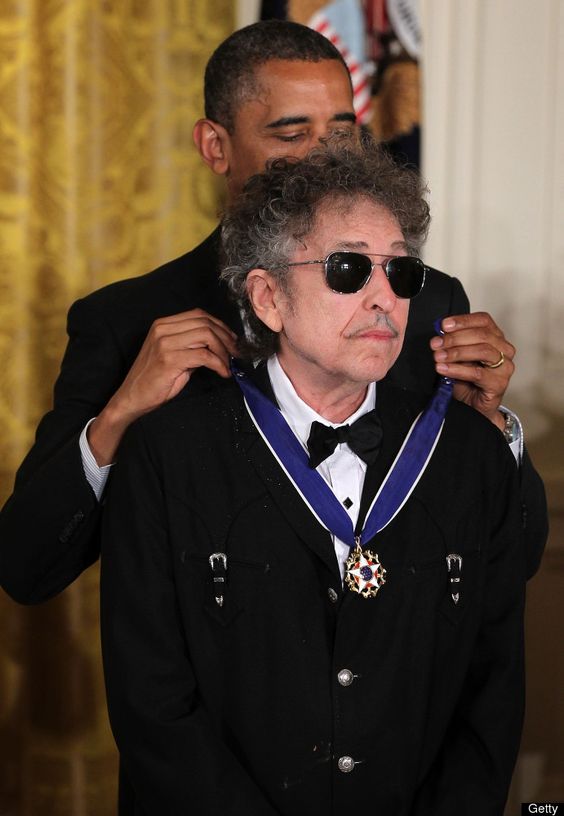
Seems a nasty stretch, however, in that Dylan and Obama have a personal connection – Dylan performs “The Times They Are A-Changing” at Obama’s celebration of the civil rights movement in the White House (later receives the Medal of Freedom there from the same President):
Come senators, congressman
Please heed the call
Don't stand in the doorway
Don't block up the hall
(Bob Dylan: The Times They Are A-Changing)
In his so-called “Christian phase”, Dylan writes some lyrics that can certainly be construed as ‘right wing’, but he returns to the idealism engendered by the presidency of John Kennedy – a mythical paradise that is lost with his assassination:
Your brothers are coming, there'll be hell to pay
Brothers? What brothers? What's this about hell?
Tell them, "We're waiting, keep coming"
We'll get them as well
(Bob Dylan: Murder Most Foul)
Untold Dylan: who we are what we do
Untold Dylan is written by people who want to write for Untold Dylan. It is simply a forum for those interested in the work of the most famous, influential and recognised popular musician and poet of our era, to read about, listen to and express their thoughts on, his lyrics and music.
We welcome articles, contributions and ideas from all our readers. Sadly no one gets paid, but if you are published here, your work will be read by a fairly large number of people across the world, ranging from fans to academics. If you have an idea, or a finished piece send it as a Word file to Tony@schools.co.uk with a note saying that it is for publication on Untold Dylan.
We also have a very lively discussion group “Untold Dylan” on Facebook with around 8000 active members. Just type the phrase “Untold Dylan” in, on your Facebook page or follow this link And because we don’t do political debates on our Facebook group there is a separate group for debating Bob Dylan’s politics – Icicles Hanging Down
“The list could be endless,” says Dylan, referring to the many archetypes appearing in “Dignity”. Thus, the songwriter implicitly reveals that he already had a “list-song” in mind at the time of conception, a song like “Political World”, “Forever Young”, “Everything Is Broken”, “Blowin’ In The Wind”… that list is endless too. Well, not endless, but he has written quite a few – depending on your definition, about fifteen to thirty.
Within that category, “Dignity” is really only comparable to “A Hard Rain’s A-Gonna Fall” – a similar explosion of metaphors testifying to Dylan’s “pictorial way of thinking”, as the Nobel Prize Committee later will call it. The opening stanza is an excellent example thereof:
Fat man lookin’ in a blade of steel
Thin man lookin’ at his last meal
Hollow man lookin’ in a cottonfield
For dignity
The colour of the lyrics is also comparable to Hard Rain: bleak. Where Hard Rain evokes apocalyptic visions, due also to Dylan’s own commentary on the song (declaring, falsely, to have written the song during the Cuban crisis and that the resulting mortal fear was the trigger), this first verse pushes the associations towards the Holocaust.
This is mainly due to the hollow man-vers line. Coincidence perhaps, but the image is practically identical to Primo Levi’s description of his fellow concentration camp residents. From the beginning of the most moving, and at the same time stylistically brilliant book about the Holocaust, from Ecce Homo (“If This Is A Man”, 1958):
“Imagine now a man who has been deprived of everyone he loves, and at the same time of his house, his habits, his clothes, of literally everything, in short, that he possesses: he will be a hollow man, reduced to suffering and needs, heedless of dignity and restraint, for he who loses everything can easily lose himself.”
“A hollow man, heedless of dignity”… It is conceivable that these crushing words of one of the greatest Jewish authors of the twentieth century resonate with Dylan.
In hindsight, then, the first line has the same sinister undertone as the stage direction from “Lily, Rosemary And The Jack Of Hearts” (“Rosemary started drinkin’ hard and seein’ her reflection in the knife”) and the second line involuntarily evokes the misery of Levi’s starving fellow-victims in Auschwitz.
Technically, it is “just” a list-couplet like there are dozens of them, just a list of an eclectic range of men. Dylan himself undoubtedly rocked along with Sinatra’s “The Look Of Love” (not Dusty Springfield’s song with the same title, that of the James Bond film Casino Royale, 1967) on Softly, As I Leave You (1964);
I've seen the look of a jockey on a winner
I've seen the look of a fat man havin' dinner
I've seen the look of those spacemen up above
But the look that closes the book is the look of love
…and Dylan must also be familiar with Mother’s Finest’s world hit “Piece Of The Rock” from 1977,
A millionaire lookin' for another million dollars
A poor man lookin' for one
A chainstore owner lookin' for another store
A hungry man lookin' for a hamburger bone.
The walking music encyclopaedia Dylan could effortlessly name another twenty songs; as a template the form is not too original. But his execution thereof, the content, is. Usually a song poet uses the enumeration to express something like “inside we are the same” or “we all have our problems”. Judy Garland’s “You Can’t Have Everything” (Rich man, poor man, beggar or king, you just can’t have everything), “God’s Children” by The Kinks, Gershwin’s “Love Is Sweeping The Country”… there are dozens of songs with such a tinker tailor soldier listing that try to express that naïve household philosophy of basically-we-are-all-equal. But, despite its superficiality, it’s an irresistible, golden formula, and it inspires catchy variations -like Elvis’ “King Of The Whole Wide World” (1962);
A poor man wants to be a rich man
A rich man wants to be a king
… which sixteen years later shall resound in Springsteen’s masterpiece “Badlands”:
Poor man wanna be rich
Rich man wanna be king
And a king ain't satisfied
'Til he rules everything
Otherwise, as in Mother’s Finest’s song, the enumeration is used to express social injustice. As in the song that gets a name-check in Dylan’s “Murder Most Foul” in 2020, in Bob Wills’ “Take Me Back To Tulsa” from 1941 (Poor man raise the cotton rich man makes the money). Originally Wills sings the rather racist darkie raise the cotton, white man gets the money, but successors like Merle Haggard prefer to change that particular line. In Theme Time Radio Hour episode 20, “Musical Maps”, broadcaster Dylan plays the original though, with that questionable text, but he doesn’t waste a single word on that darkie. Dylan does, however, quite explicitly profess his love for Bob Wills (“Here on Theme Time Radio Hour we believe you can never play too much Bob Wills”) and concludes the broadcast with a heartfelt incident regarding an injustice that has been done to his hero:
“In Gruene, Texas, there is an eight-foot statue for Bob Wills. On Saturday May 2, 2006, vandals knocked it over, and knocked its arm off. Local radio stations offered a reward for information leading to an arrest. I don’t know if anyone was arrested, but if you’re listening: stop vandalizing that statue. Bob Wills is a national treasure and must be respected.”
In itself, though, the antithesis in “Take Me Back To Tulsa” is classical, a contradiction like in “Fortunate Son”, like in the dozens of songs in which a rich man is set against a poor man, or a fat man against a thin man. In 2006 disk-jockey Dylan even devotes an entire broadcast to it (Theme Time Radio Hour episode 13, “Rich Man, Poor Man”).
The choice of cottonfield, however, suggests that Dylan is indeed singing that Bob Wills song in the back of his mind. But his implementation is idiosyncratic.
All other songs use these archetypes to illustrate either essential equality or a crying injustice. Dylan’s find frees “Dignity”’s opening stanza from such one-dimensionality. First off, the choice of words puts the listener on the wrong track. Only after the third line, after hollow man, we hear how “looking” is used as a transitive verb. The men do not look in a blade, at a last meal and in a cotton field respectively, but look for, for “dignity”, apparently.
These last two words, for dignity, is a brilliant, confusing find that torpedoes the listener’s expectations and tilts the previous lines. Predictable would be a traditional contrast; the fat man is an exploiting bad guy, the thin man an exploited poor soul, and then, after that hollow man in the cotton field, we would expect a solid man on the veranda, something in that vein.
But no; it is only then we understand that the list of archetypes is not a list of men set against each other, but rather a list connecting them – they all are searching for dignity.
The ambiguity of Dylan’s directing instructions provides the magical, poetic brilliance of this quatrain. The fat man may be sitting at a dining table, staring, like Rosemary did back in the days, at his reflection in the blade of his knife. Or, like Rosemary back in the days, about to commit murder. Or he is the victim and an aggressor holds the knife in front of the fat man’s face… possible too. But it is more appropriate, of course, to appreciate the parable-like quality of this verse fragment, and of the whole text at all; it does not say what it says. A “blade of steel” then depicts something transient, like “weaponry”, and the fat man is the archetypal master of war, a Goering type, a warlord or arms dealer who earns his living from war – and now seems to be at a moral crossroads: “What the hell am I doing?”, something like that.
Just like the thin man’s last meal opens several doors; in extremis literally his last meal, a last meal on Death Row, or he stares hungrily at fat man’s last meal, or – the most obvious, but therefore not necessarily the best interpretation – he looks at the remains of his own, most recent meal. But on a transcendental level, the thin man represents the fat man’s antithesis, meaning the one standing on the other end of that weaponry. And the hollow man then is the real victim of both, the concentration camp prisoner, the slave, the man reduced to suffering and needs, heedless of dignity and restraint, as Levi says.
The insight that he can turn the opening into such a compact triplet only gradually subsides, as the alternative versions on The Bootleg Series 8 – Tell Tale Signs (2008) reveal. An overarching Holocaust narrative can still be distilled from the first version, the naked piano version (“fat man lookin’ in the shining steel”), but has evaporated from the brilliant second version:
Fat man lookin' at a ferris wheel
Yellow man lookin' at his last meal
Hollow man lookin' in a cottonfield
For dignity
The versions on the illegal bootlegs open with the final, official lyrics, just like the MTV Unplugged recording – apparently the poet lacks the aggressive charge of steel with ferris wheel, and does, on second thought, need the antithesis fat man – thin man (and probably is not too happy with the ugly, unintentional inner rhyme yellow – hollow).
He is right. And the great artists of Solas are wrong; for unknown reasons they skip precisely this verse, in their wonderful cover on The Edge Of Silence (2002). The definitive twenty-three words of the opening quatrain form a perfect, closed in itself tableau of a condition humaine.
To be continued. Next up: Dignity part III
Jochen is a regular reviewer of Dylan’s work on Untold. His books are available via Amazon both in paperback and on Kindle:
Untold Dylan is written by people who want to write for Untold Dylan. It is simply a forum for those interested in the work of the most famous, influential and recognised popular musician and poet of our era, to read about, listen to and express their thoughts on, his lyrics and music.
We welcome articles, contributions and ideas from all our readers. Sadly no one gets paid, but if you are published here, your work will be read by a fairly large number of people across the world, ranging from fans to academics. If you have an idea, or a finished piece send it as a Word file to Tony@schools.co.uk with a note saying that it is for publication on Untold Dylan.
We also have a very lively discussion group “Untold Dylan” on Facebook with around 8000 active members. Just type the phrase “Untold Dylan” in, on your Facebook page or follow this link And because we don’t do political debates on our Facebook group there is a separate group for debating Bob Dylan’s politics – Icicles Hanging Down
In 2020 by the time “Rough and Rowdy Ways” was released, most of us had already downloaded and played endlessly the extracts from the album that Dylan and his record company had agreed to put on line for public consumption: it was “in the wild” long before it was “released.”
Although it is hard to appreciate now, the reverse was true in terms of Freewheelin’. It was released in May 1963, but unless one was living in New York, or completely up to date with the very latest trends in the American folk music scene how would one have known? Maybe some US radio stations played it – I wouldn’t know. But I do know that by the time many of us had bought it, “Times they are a changin'” had been written and Bob was lyrically and musically somewhere else.
Then it happened again. As (I suspect) most of us were trying to come to terms with the evolution between Freewheelin’ and its successor, Bob had already moved on and was writing “Another Side,” which came out the following August. Thus in the space of 15 months (May 1963 to August 1964) Dylan released three utterly ground-breaking albums: Freewheelin’, Times and Another Side. And written a huge lot more.
The compositions that appeared on these three albums are harder to date exactly but “Blowing in the Wind,” the first Freewheelin’ song was almost certainly written in April 1962, while “My Back Pages” the last of Another Side, was written in early June 1964. So all those works within those albums were written in a 26 month period. Given the diversity of these songs, that is an amazing achievement.
But that was not all. For within that period of writing the music for those three albums Dylan actually wrote 75 songs. That in itself is phenomenal – even composers of the most mundane of songs who churn them out to order, can’t compose that many songs in 26 months. But to write that many and include within that era so many phenomenal masterpieces is utterly extraordinary. Then on top of that to go through at least three major stylistic changes, is beyond belief. To my mind if one wants a simple justification of the notion that Dylan is a unique genius, then that one burst of songwriting is enough to achieve that.
And even this burst of composition was not everything. For having achieved all that and recorded the three albums that made and secured his reputation, Dylan then amused himself in the remainder of the year by writing three classics of the “individualism” genre “Gates of Eden”, “It’s all right ma” and “If you’ve gotta go, go now”.
The first two have within them strong elements of the “protest” genre, as well as a lot of Dylan’s latest fascination: the notion that the world very much does not make sense. And then the year ended (in terms of compositions) with another song of farewell. What we see therefore is that by now Dylan had a set of themes for his songs which he liked to use and re-use, and I’ll return to this as we progress through the years. New themes were certainly found from time to time, but many of the old ones returned time and time again throughout Bob’s writing career. The blues, lost love, moving on… he returned to these themes time and again, no matter where else he ventured.
That of course doesn’t mean that Bob’s music was the same. Musically and lyrically “Gates of Eden” and “It’s all right ma” take us into new fields. Anyone hearing those songs at the time of composition would know at once that Dylan’s next album was going to be different again.
Obviously Dylan’s music was getting a fulsome exposure on radio stations in North America, where stations catering for all tastes already existed. Britain, and Europe generally however had very restricted radio services which had no space available for such a rapidly evolving talent.
But in 1964 the first pirate radio station appeared in Europe. And to be clear, Radio Luxembourg was never a pirate radio station although Bob has suggested it was; that station found a niche because the amount of popular music broadcast on radio stations in the UK was extremely limited, and so R. Luxembourg (based in the principality and fully licensed by the government of the country) became the evening and night time broadcaster of top 40 music to the British Isles.
But it was thoroughly a top 40 station, financed by the record companies that released the pop music of the day, and so even there one was not going to hear Dylan. The fact that he existed and his music was revolutionary and radical was a matter dealt with in the four weekly pop and rock music papers. In the end, if you wanted to hear the music, you had to take a chance and buy the album.
And I suspect this is how it was over much of Europe, and quite possibly parts of North America. The music was being recorded and released, but unless you knew someone who was into Dylan, or read the music weeklies, it was hard to find out more. If you wanted to hear it, you had to take a chance and buy the record.
Then two things happened. Late night programmes on pirate stations like Radio Caroline and Radio London picked up on Dylan, and cover versions of Dylan’s songs began to appear and get coverage on mainstream radio. The Byrds, Sonny & Cher, the Hollies, Manfred Mann and others recorded songs, that simply seemed different, and the word spread: these songs resonated with the way many people who were unmoved by contemporary pop actually felt. These were songs that reflected their own feelings about the world in which they lived. Songs that were about more than love, lost love and dance (although Dylan as we have seen wrote a lot about the first two. But even then, when he did choose love and lost love as his themes, he did so in a way that was so completely different from everyone else).
As we got to know the music of “Times” we could hear that here, at last, was a man who was singing about the issues that many of us were concerned about. But what we didn’t know was that while we were marvelling at the “Times” album, Bob was writing Guess I’m doing fine (a simple folksong about being hurt) and then Chimes of Freedom (a song of hope, which I noted at length previously) followed by Mr Tambourine Man (an utterly different song concerning the way we see the world and touching on surrealism).
And although it was beyond the understanding of most late night disc jockeys and weekly newspaper pop music journalists, some of us did grasp the fact that, “Let us forget about today until tomorrow” is the antithesis of the fight for justice at the heart of the protest movement, although curiously it resonates strongly with “Times they are a changin” wherein the times appear to change by themselves, without any interaction from us. Likewise the Chimes of Freedom simply are there, “Trapped by no track of hours for they hanged suspended.” We don’t do anything; life moves on. That wasn’t quite what those who were protesting against capitalism and society in the city streets in the 1960s, were thinking.
These two songs are linked; they both touch on the relationship between music and the world, and to a degree the way in which we are in control of how we see the world. They concern the relationship between the artist and the world, as well as the implication that just as we will all experience the change predicted in “Times” so we can all see the world in a new way, if we choose to.
This was an utterly revolutionary approach to any concept of popular music that had existed previously. Songs which debated the passing of time, and our appreciation of the world around us as philosophical concepts were simply not known. And indeed ever since then these songs have often seemed to baffle commentators, who flailing in the face of such challenging concepts have retreated to debates about whether Dylan stole the music or lyrics from somewhere else, or indeed who he was dating. Such debating has always been irrelevant; at this moment it was even more irrelevant than usual.
For anyone who was actually paying attention to the music and the lyrics, rather than its sources, it would have be no surprise that after the success of “Times they are a changin'” both in terms of the song and the album, Bob changed again. Some might have expected Bob to stay with the writing of protest songs, at least for a while, but no, that has never been his way. Instead he wrote I don’t believe you (a lost love song), Spanish Harlem Incident (a love song) Motorpsycho Nightmare (back to Dylan’s unique brand of humour) It ain’t me babe (a song of farewell unlike anything we’d heard before) and Denise Denise (a song about taking a break and having a laugh).
Now this approach of Dylan’s involving moving on from subject to subject within his songs, is a fundamental of his work. Only once did he abandon the approach and that was 1979, when he wrote every song on the same subject. We will obviously get to that later – but not for a while.
But now another change was happening. Everyone recognised the huge success Peter PAul and Mary had had with Dylan’s work, so from 1964 onwards, other singers and groups fancied a bit of the action and so started to notice Bob’s music and began to record it. And this, I think, was the third big event of this period. First he had jumped from theme to theme in what he was writing. Second he was exploring lyrical themes that no one else touched, and now third other esteemed performers were hearing his songs and re-interpreting them.
And this third point is a key issue that I think is sometimes missed. The notion of taking a Dylan song and re-arranging it completely is what we are all used to in terms of the Never Ending Tour; it is what we expect, it is what we are there to hear. But this was new in the 1960s. In this regard Bob had already started to become not just a one man songwriting industry, but a producer of songs that could be taken apart and rebuilt. Here’s an early example
Mama you’ve been on my mind is a beautiful song of lost love – one of Dylan’s favourite themes as we have noticed. It came immediately before (in terms of Dylan’s writing), the oh so painful desperate poem of lost love and dislike Ballad in Plain D. Plain D got the attention, but it can be argued that “Mama” is the much, much more exquisite piece. The contrast, if noted at the time, was rather baffling, not least because we didn’t know the guy was writing enough to produce not just two but five albums a year, should he have wanted to. But also because he could change subject so quickly.
These two songs cannot have a greater contrast between them. Plain D recounts the disintegration of a relationship and the conflicts surrounding this. It is fair to say that no one else had written a song like this at the time (and I am not sure there have been many since).
But then “Mama” although a totally different type of song, is equally revolutionary, and to my mind far more successful. Both songs use the same unusual approach to the chord sequence, involving variations of what in classical music is called the “interrupted cadence” which simply put means ending a line with a most unusual and unexpected pair of chords
But Mama goes much further both musically and lyrically.
Just consider …
Perhaps it’s the color of the sun cut flat
An’ cov’rin’ the crossroads I’m standing at
Or maybe it’s the weather or something like that
But mama, you been on my mind
OK, if you have known those lines for years they might float by, but just look at them. We can by and large work out a meaning, but quite what has each line got to do with the next? Yes given a few moments we can work something out – but even then there is still a problem. The poet is saying over and over, it’s nothing, I’ve just been thinking about you, that’s all. Except that he says, “pretendin’ not that I don’t know” – and if we think we are bound to ask what on earth he is talking about? That “pretending” line means “I’m pretending I know” which means “I don’t know” … or does it. Trying to work that line out we go round in circles, which is exactly what the singer of the song is doing. He doesn’t know, he doesn’t understand, and Dylan expresses this both musically and lyrically in a way that I suspect has never been done before in folk or pop.
And he does this immediately before writing Ballad in Plan D!
I don’t mean trouble, please don’t put me down or get upset
I am not pleadin’ or sayin’, “I can’t forget”
I do not walk the floor bowed down an’ bent, but yet
Mama, you been on my mind
If ever there is a Dylan song in which, to understand it, you need to listen to the music and lyrics, and not just the lyrics, this is it.
If we go back to the version on Bootleg Series volumes 1 to 3 (disk 2 track 4, recorded 6 September 1964) what we find is a plaintive song with endless unexpected chord changes (sometimes catching us out by coming half a beat to early or late). But it is none of this that causes us to stop and think “what?”
It is the musical structure which gives us two four bar phrases in standard 4/4, but with a bar (in the first verse) in 3/4 time. Even if we are ready, the next verse throws us out again, because that interrupting half-way house bar is reduced to a beat. By the third verse it has become a complete 4/4 bar.
So it goes on with the timing of the piece becoming ever vaguer and more and more unexpected. And no one at the time was doing anything remotely like this in popular music.
What aids these curious rhythmic changes is the fact that the lines of the verses over run, cut short, change… there is in fact no rhythmic constancy. Conventionally the lyrics are written (depending of course on the version you are listening to) as
Perhaps it’s the colour of the sun cut flat
An’ cov’rin’ the crossroads I’m standing at
Or maybe it’s the weather or something like that
But mama, you been on my mind
But equally we could have
Perhaps it’s the colour of the sun cut flat An’ cov’rin’
the crossroads I’m standing at
Or maybe it’s the weather or something like that
But mama, you been on my mind
Or in the second verse
I don’t mean trouble, please don’t put me down or get upset
I am not pleadin’ or sayin’, “I can’t forget”
I do not walk the floor bowed down an’ bent, but yet
Mama, you been on my mind
could actually be
I don’t mean trouble, please don’t put me down or get upset
I am not pleadin’
or sayin’, “I can’t forget”
I do not walk the floor bowed down an’ bent, but yet
Mama, you been on my mind
However we play with them, the words express the mixed up feelings that we can all get at the end of a love affair, where the narrow thoughts are eating us up, but we are trying to deny it is happening. We desperately want to get out of conventional angst (that was very much the thinking of the 1960s – we don’t have to think like our forefathers) – but he knows that this is not really true – he’s just “pretending not that I don’t know”.
And the ending is so powerful that it takes us several hearings of the song to get this right…
I’d just be curious to know if you can see yourself as clear
As someone who has had you on his mind
Can you see yourself as clearly as I can see you? Now, there’s a thought and a half. Utterly simple, utterly complex.
What we have here is a piece in which the music follows the words, but the words endlessly tumble over an the music is trying to catch up, until by the end the words follow the music. Words can get extended in different versions as in the final verse in the second line suddenly the “I” in “I won’t be near” is curiously given an extra beat and a half in some versions – but not others.
Of course this works in the early recordings because it is Dylan on his own – you can’t so easily do this with a rock band, or even if singing a duet. And so as time has gone by the song has become fixed into set rhythms, although Dylan’s own performance with Joan Baez retains some of the rhythmic oddities, but in the end it loses all the subtleties. If you want this song as it was intended you have to have a solo version.
And maybe it is because the song can exist in so many different versions that we never had a version of it on the early albums. Certainly the song was intended to perhaps for Times They Are a Changing or Another Side of Bob Dylan but came out on neither, and we had to wait for the live versions, and the Bootleg series.
So this is a song whose rhythm we can’t hold down, and indeed nor can we with the chords – version after version of the song has been recorded with different chords, and of course different feelings.
And maybe this is the mark of a great, great song – because it can be reinvented so many, many times. Contrast the Buckley version above (if you dare) with Rod Stewart’s version on the “Reason to Believe” album, which works in a Rod Stewart sort of way, but utterly, utterly fails with the twiddly instrumental cover for the pauses that some idiot somewhere decided to put in. They mean nothing, have no relation to the song, and destroy what could have been an entertaining version of the piece.
But the fact that you can have so many different versions shows what a song this is.
So magnificent is this song that you don’t need to know the origins of the lyrics, but for completeness, let’s record the fact that it is the breakup with his girlfriend Suze Rotolo (or at least that is what the commentators say) that led to the song. But the notion of Oliver Trager which suggests this is a “straightforward love song of separation and yearning” is to miss the point. That is the start, but not the end.
People who suffer romantic breakups as Dylan had done react in different ways – and often different ways at different times. Some are devastated, some remain in a very depressed or even desperate state for months or years. But Bob, it seems, after writing that piece could pick himself up and just move on. It must also have been a warning note to any other woman, and indeed the family of any such woman, with whom he had a relationship!
Untold Dylan: who we are what we do
Untold Dylan is written by people who want to write for Untold Dylan. It is simply a forum for those interested in the work of the most famous, influential and recognised popular musician and poet of our era, to read about, listen to and express their thoughts on, his lyrics and music.
We welcome articles, contributions and ideas from all our readers. Sadly no one gets paid, but if you are published here, your work will be read by a fairly large number of people across the world, ranging from fans to academics. If you have an idea, or a finished piece send it as a Word file to Tony@schools.co.uk with a note saying that it is for publication on Untold Dylan.
We also have a very lively discussion group “Untold Dylan” on Facebook with around 8000 active members. Just type the phrase “Untold Dylan” in, on your Facebook page or follow this link And because we don’t do political debates on our Facebook group there is a separate group for debating Bob Dylan’s politics – Icicles Hanging Down
We have over the years looked at Bob Dylan’s work with Allen Ginsberg a number of times – the articles noted above are the main ones. Not with any intention of doing a series on Allen Ginsberg and Bob Dylan but rather as a way of recording what we have found (mostly what Aaron has found) as the information has come to light.
This article looks to pull in the other work the two did together which we haven’t touched on so far – and so (as far as we know) round the articles off. But if you we have missed something… please see the plea at the end.
—————-
Bob was involved in two sessions with Allen Ginsberg, once in November 1971 and again in January 82. These resulted in a number of tracks which appeared on the Ginsberg album “First Blues” and subsequently on two further Ginsberg box sets. Tony has already reviewed the Ginsberg/Dylan co-writes “Vomit Express”, “Jimmy Berman Rag”, “September On Jessore Road” and “ For You, Baby”. So now let’s take a listen to some more tracks from these sessions featuring Bob’s musical backing.
First up, with Bob on vocals, guitar, piano and organ… it’s “Goin’ To San Diego”
Tony: What I can’t work out is whether Ginsberg actually can’t sing in tune and has no sense of time and rhythm, or if this is just put on to make a politico-musical point. The clarinettist is however a fine musician – his work contrasts with the lyrics. Is that the point? I wish I knew.
Aaron: Next Bob contributes vocals, piano, organ and guitar to two poems by William Blake, A Dream and Nurse’s Song. I’m not sure anyone will listen to these all the way through. To be honest, they are a bit of a chore, still it’s interesting to hear Bob’s arranging skills.
Also from the same sessions was Ginsberg’ own composition “Spring (Merrily Welcome)”. Bob plays guitar, piano, organ and provides backing vocals. This one is (mercifully) a bit shorter than the others and much more upbeat.
Tony: Ginsberg is highly rated by many people, and Dylan is known to be hyper critical of his own work (just see Dignity Part 1: A bloody mess – the start of Jochen’s new series on “Dignity”). So as for what is going on here, I remain puzzled as before.
Aaron: The final two this time were taken from the 1982 sessions, these were released in 2016 on the “Last Word On “First Blues”” box set. They are a lot funkier than we are used to and here we have the unusual pleasure of hearing Bob join in on bass guitar!
And the second…
Tony: If there is someone who is kind enough to read Untold Dylan, and who has an insight into the music of Ginsberg and why Dylan recorded these pieces with him, I would love to receive either a comment below, or a whole article (send to Tony@schools.co.uk) on Ginsberg and Dylan – or if you prefer Dylan and Ginsberg – which we can publish.
Or indeed if you have a book that explains it all, please do let us know what it is and we’ll try and get a copy. Bemusement exists within the Untold Offices.
Untold Dylan: who we are what we do
Untold Dylan is written by people who want to write for Untold Dylan. It is simply a forum for those interested in the work of the most famous, influential and recognised popular musician and poet of our era, to read about, listen to and express their thoughts on, his lyrics and music.
We welcome articles, contributions and ideas from all our readers. Sadly no one gets paid, but if you are published here, your work will be read by a fairly large number of people across the world, ranging from fans to academics. If you have an idea, or a finished piece send it as a Word file to Tony@schools.co.uk with a note saying that it is for publication on Untold Dylan.
We also have a very lively discussion group “Untold Dylan” on Facebook with around 8000 active members. Just type the phrase “Untold Dylan” in, on your Facebook page or follow this link And because we don’t do political debates on our Facebook group there is a separate group for debating Bob Dylan’s politics – Icicles Hanging Down
Girl From the Red River Shore and Mother of Muses are unusual in the Dylan canon. These songs are not about any of the earthly muses who have inspired Dylan’s work and they are not about human relationships. They work on a philosophical level, exploring the relationship between the artist and the Muse, that mysterious source of inspiration and creativity that transforms people into artists. They are also, of course, a window onto the artist’s state of mind. (For ease of reference I will refer to the artist in these songs as Dylan, although I fully understand that not all Dylan songs are self-portraits).
Dylan uses the opening stanza of Girl from the Red RiverShore to provide a rough definition of the artist. Some of us are content with the beauty of the natural world; we turn off the lights and “live/In the moonlight shooting by.” Others – the artists – want more. They leave the light of the natural world behind and “scare ourselves to death in the dark,” questing further and higher to the source of things, to “be where the angels fly.”
By the time he recorded Girl from the Red River Shore, the creative confidence of Dylan’s early career was long gone. While the beauty of the natural world can still give him a song he is painfully aware that he is no longer flying with the angels. His Muse – symbolised here by the elusive girl from the Red River shore – has abandoned him. The song is an elegy for the death of the artist’s creativity (and thereby part of a noble tradition, in which the poet writes a great poem lamenting the failure of his poetic powers).
Dylan tells a tale of despair. From the moment that he first laid eyes on the Muse and discovered the joys of creativity, he has known that he “could never be free.” As a confident, young man he assumed that “She should always be with me”. He learns the hard way that she is not that kind of girl; she rejects his marriage proposal and is definitely not available on demand. She wonders whether he is strong enough to live the artist’s life: “she said/Go home and lead a quiet life.”
The good and creative times – “All those nights when I lay in the arms/Of the girl from the Red River shore” – are now “a thousand nights ago,” like something from a fairy tale. Dylan is “living in the shadows of a fading past” and there are those critics who say that he and the Muse have never been united: “Everybody that I talked to had seen us there/Said they didn’t know who I was talking about.” He is bereft: “Well, the dream dried up a long time ago/Don’t know where it is anymore.”
And then in the last stanza we have a dramatic and radical transition as he takes us suddenly into Biblical territory, with Jesus raising Lazarus from the dead. This is a powerful intervention, given the importance of Christian iconography in Dylan’s work. It is particularly powerful because Dylan uses it not as a metaphor for hope but as a gauge of his despair. He is not here this time to praise Jesus or to preach his gospel. He is here for himself and this tale of resurrection only serves to counterpoint the death of his own creativity: “Well, I don’t know what kind of language he used/ Or if they do that kind of thing anymore”. That guy “who lived a long time ago” can work his miracles for Lazarus but it’s unlikely that he can help this artist: “Sometimes I think nobody ever saw me here at all/Except the girl from the Red River shore”.
As the evidence shows, the Muse did not desert Dylan. His long creative career has had peaks and troughs and the old artist in Mother of Muses is at ease with himself and his Muse. He doesn’t expect her to be with him every hour of his life and he is confident that, wherever she is, she will hear his prayers.
Mother of Muses is many things. It is a prayer for inspiration. Dylan prays to the Muse to stay with him to the end, to clear his vision and remove the invisible barriers that are blocking his creative path. It is a prayer for consolation. As he nears the end he asks her to sing of the things that he has loved – the mountains and the seas, the lakes, the nymphs of the forest and the heroes who have shaped his world.
It is also a prayer for his artistic legacy to be remembered. It is appropriate that Dylan – who has lived the performance artist’s life – as he sings in Dark Eyes, “in another world/where life and death are memorised” – should invoke Mnemosyne, the goddess of memory and remembrance. It is also appropriate because memory, remembrance and artistic legacy are important themes in this song. He wants to be remembered for and through his art and he prays to the Muse to “Forge my identity from the inside out.”
While Dylan’s praise for the Generals who defeated slavery and Nazism should come as no surprise his real themes in this section are memory and legacy rather than the military. Names carved on tablets of stone will crumble into dust, but memories live on and grow. As Dylan says of his Generals: “Man, I could tell their stories all day.” And as he writes about memory and legacy he is also writing about himself. He concludes the stanza praising “the heroes who stood alone” with a plea for his own legacy: “Mother of Muses, sing for me.”
His explicit alignment of himself with other writers on this album is unexpected and is a slightly sad legacy plea. He “contains multitudes” like Whitman; he’s got “a tell-tale heart, like Mr. Poe,”; he “writes songs of experience like William Blake”; he “was born on the wrong side of the railroad track/Like Ginsberg, Corso and Kerouac.” And then there are ostentatious Shakespeare references – “the winter of my discontent,” “to be or not to be”. Dylan seems to be drawing attention to his own credentials as an artist by highlighting the artistic company he keeps. As he sings on False Prophet: “I’m first among equals/Second to none.”
The final stanza of this song sets out a much more convincing legacy strategy, one so bold that only Dylan could have thought of it and only the irreverent Greek mythology that he is working through could have enabled it.
Dylan has already outlived his life by far and has been “slow coming home” but he’s ready now. And he certainly doesn’t intend to just fade away. He asks Mnemosyne to take him to the river – probably the Lethe, one of the five rivers leading to the underworld. Those who drink from the Lethe experience forgetfulness and oblivion but Dylan goes a step further. He uses the Greek mythic convention where divinities have sex with mortals to envisage a final and dramatic consummation of the relationship between artist and Muse: “Take me to the river, release your charms/Let me lay down a while in your sweet, loving arms/Wake me, shake me, free me from sin.” This final consummation will lead to a dramatic metamorphosis. His physical presence will be obliterated and he will become “invisible, like the wind”. I’m not saying that vanity got the best of him but he certainly plans to leave here in style.
In conclusion I would like to say a little more about Dylan’s dazzling ability to manipulate genre. In Girl from the Red River Shore he exploited and disrupted the cowboy ballad formula. In Mother of Muses he adopts a form from “Long before the first Crusade/Way back ‘fore England or America were made.” Mnemosyne, Calliope, and the “women of the chorus” are hardly familiar figures in rock music and Douglas Brinkley, in the preface to his New York Times interview with Dylan (12 June 2020) demonstrates how alien the song is to many when he describes it as “a hymn to . . . gospel choirs.” Dylan, in his sly way, does imply a sideways allusion from the Greek chorus to the women who sang their hearts out in his own past backing bands (and who became part of his life) but this song is definitely not about gospel choirs. Similarly, his reference to “the nymphs of the forest” inevitably takes us back to the “glamorous nymph with and an arrow and bow” who misguidedly wandered into the lyrics of Sara.
Dylan is sufficiently confident about the formulas within which he is working to make a joke about genre. His relationship with Mnemosyne is strong and he mentions to her that he is “falling in love with Calliope,” one of her daughters. Calliope is the goddess of epic poetry, a long narrative form which celebrates the deeds of warrior heroes and gods. The Iliad – the story of Achilles and the Trojan Wars – is the most famous of all epics and is referenced in My Own Version of You. Dylan has co-opted some elements from this now unfashionable genre into this song and into Murder Most Foul and he wonders in passing if Calliope might have a future with him: “She don’t belong to anyone, why not give her to me?” This is just his passing thought. Dylan writes very long songs but these do not in themselves constitute epics. And, as we have seen, he is in any case more interested in the mother than the daughter.
In a song that is full of surprises, one if the best is to learn that Dylan could sit around all day telling stories about the military exploits of his five favourite Generals. That could lead to a new audience for him.
Untold Dylan: who we are what we do
Untold Dylan is written by people who want to write for Untold Dylan. It is simply a forum for those interested in the work of the most famous, influential and recognised popular musician and poet of our era, to read about, listen to and express their thoughts on, his lyrics and music.
We welcome articles, contributions and ideas from all our readers. Sadly no one gets paid, but if you are published here, your work will be read by a fairly large number of people across the world, ranging from fans to academics. If you have an idea, or a finished piece send it as a Word file to Tony@schools.co.uk with a note saying that it is for publication on Untold Dylan.
We also have a very lively discussion group “Untold Dylan” on Facebook with around 8000 active members. Just type the phrase “Untold Dylan” in, on your Facebook page or follow this link And because we don’t do political debates on our Facebook group there is a separate group for debating Bob Dylan’s politics – Icicles Hanging Down
Oh Mercy! is quite a beautiful album anyhow. Otherwise we would have been forced to impose a serious reprimand on Dylan for omitting the masterpieces “Series Of Dreams”, “Born In Time” and “Dignity”. One reproach can still be made, though: “Dignity” would have been a much more successful opening than the equally driving, but melodic and lyrically much less catchy “Political World” – great song, but hardly as monumental as “Dignity”.
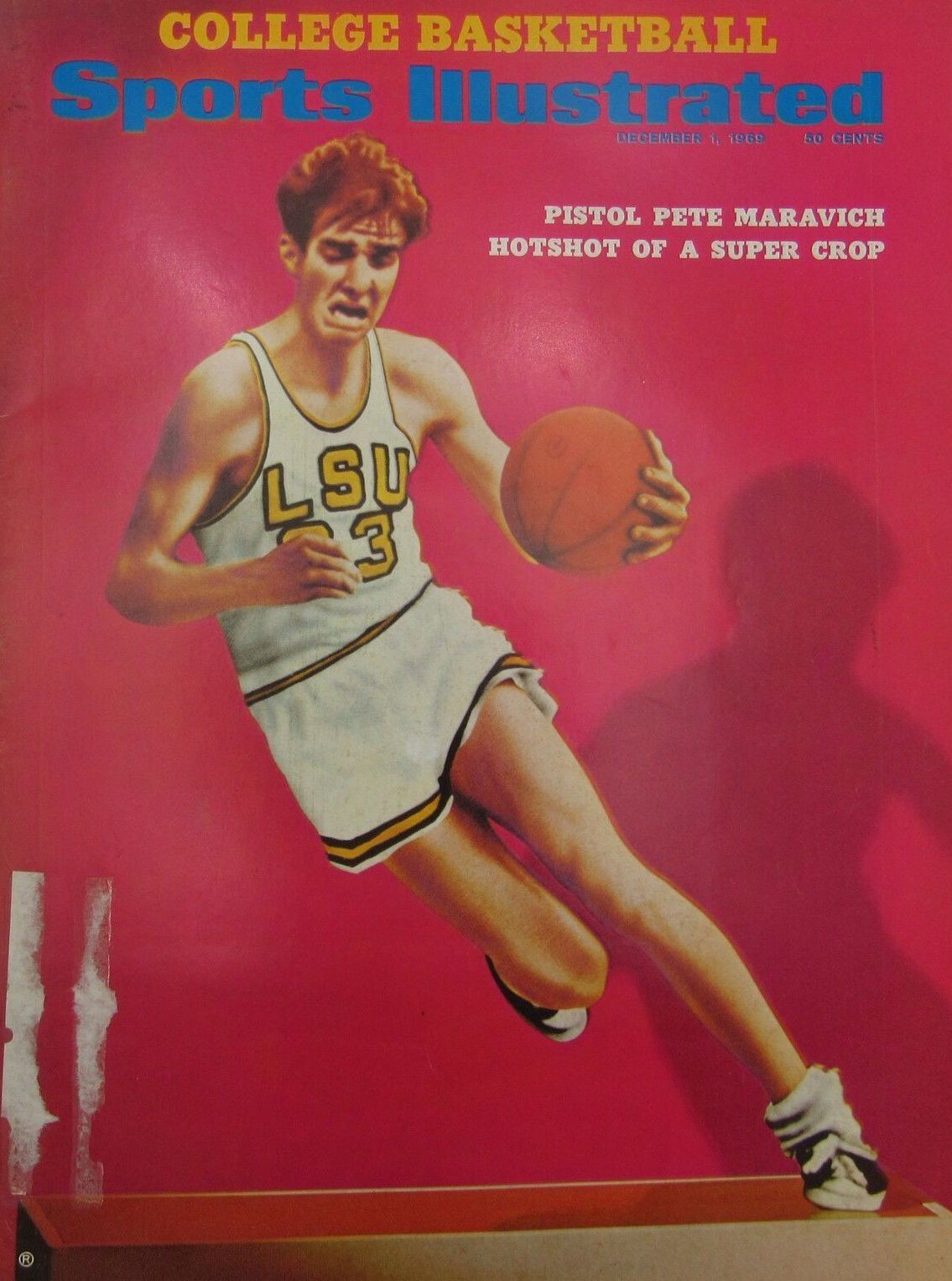
In Chronicles the bard remembers the rise and fall of the song. As usual crystal clear, yet incomprehensible. He describes how he is shocked by the news flash on the radio about the sudden death of the basketball player ‘Pistol’ Pete Maravich, whom he admires († 5 January 1988) and writes the whole song (and more) in a kind of inspired frenzy in the course of the same day and following night. “It’s like I saw the song up in front of me.” That primeval version is a bit longer, with even more archetypes, he tells. Big Ben, Virgin Mary, the Wrong Man and more: “The list could be endless.”
However, the connection between the legendary basketball player or his death with one of these characters, or with the theme of the song lyrics at all, remains unfathomable.
While writing, Dylan already hears the music in his head, too. Rhythm, tempo, melody line, everything. And He saw that it was good: “This song was a good thing to have.” He is in no hurry recording it, though. A song like this he won’t forget, he knows, and recording it is so boring. What’s more: “I didn’t like the current sounds.”
All of a sudden there appears to be a sharper discernment than we are used to from the man who, in this decade, doesn’t think recordings of brilliants like “Angelina”, “Caribbean Wind” and “Blind Willie McTell” are good enough. Fear of the disastrous effect of the 80’s sauce over a song like “Dignity” is indeed justified and it is to be applauded that the bard prefers to wait for better times with a fresh producer.
He does not have to wait very long. Just over a year later, in February 1989, better times have come, and a skilful, passionate producer has been found: Daniel Lanois.
Dylan will provide a series of beautiful recordings for Oh Mercy. And indeed, Dylan hasn’t forgotten “Dignity”; it’s one of the first songs of which a demo will be made.
Things are going well until then, at least: according to the chronicler himself. There’s nothing wrong with a first, sparingly instrumented recording with the vocals up front, he thinks, but an infectiously enthusiastic Lanois has some wild dreams about what he can achieve with this song when they record it tomorrow with Rockin’ Dopsie and his Cajun Band. Dylan lets himself be convinced.
And that is where the downfall of “Dignity” begins. After a day of muddling through text changes, tempo modifications and alternative keys, and after more than twenty recordings, the promise “was beaten into a bloody mess”. Disillusioned, Lanois and Dylan turn away from the song. The demo and one of the many outtakes can later be found on Tell Tale Signs (2008), others on bootlegs like Deeds Of Mercy and The Genuine Bootleg Series.
After Oh Mercy the song seems to be forgotten for a while, but in ’94 it reappears at the MTV Unplugged sessions. At the time ignored and even vilified, for obscure reasons, but as a matter of fact still very enjoyable today.
The same goes for the version used for Greatest Hits Vol. III (November ’94). Producer Brendan O’Brien (from, among others, Pearl Jam) waltzes off with the Lanois recordings, throws away everything except the voice and puts his own beautiful organ under it. This version also receives all the (un)necessary criticism, which from a present-day point of view seems just as empty; it really is a beautiful, “dry” recording, exciting and subdued at the same time. Dylan himself seems to think so too; a lot of (and the best, actually) live performances in the Never Ending Tour are grafted onto this version – with the troubadour singing better and better, too.
MTV Unplugged
The lyrics are from a Dylan at the top of his game. Fascinating, rich and mysterious, and by all means comparable to a highlight like “A Hard Rain’s A-Gonna Fall”: a collage of unrelated images, half-known cinematic fragments, literary references, cool humour and biblical imagery, which together sketch a gloomy, grim world view in which there is no place for Dignity.
The images are connected by a literary stylistic device we don’t encounter too often in Dylan’s oeuvre: the allegory, the personified abstraction, in this case Dignity. The narrator searches from Alaska (“The land of the midnight sun”) to the Valley of the Dry Bones (from one of Dylan’s favourite Bible books, Ezekiel), searches in literary masterpieces (in Rimbaud’s Le Bateau ivre, among others) and everyone he meets along the way is also looking for her – in vain. He is stranded on the shore of a lake and seems to give up – in this world he will no longer find Dignity. Gloomy indeed.
Fortunately, the music offers hope. It pushes forwards, expresses optimism and does not fade away – on the other side of the lake we will resume our quest.
A strong unity apparently, the lyrics and the music. The covers seldom deviate, do imitate the compelling urgency of the rhythm and tempo of the original and copy remarkably often percussion guitar and organ (Joe Cocker, the French “La Dignité” from Francis Cabrel, the splendid Italian “Dignità” by Francesco Di Gregori). Even the implausible Nana Mouskouri adheres to this format (1997), puts a pleasant piano part under it, and then confirms the prejudices by inviting a gruesome women’s choir into the studio.
Elliot Murphy does not fall for that trap. His version is beautiful but doesn’t really add anything (on the “Reporters sans frontiers” album Dignity, 2002).
Robyn Hitchcock, in contrast, does his utmost best to be original, but unfortunately – he produces a weird, monotonous cover that only gets some attraction halfway, when the bass joins in.
No, the best cover is recorded in Amsterdam, by The Low Anthem (2 Meter Sessions, 2009). The quintet from Rhode Island leaves the ambiguous character of the song for what it is and opts for a one-dimensional, text-oriented acoustic interpretation that shines thanks to a gloomy clarinet. Singer Ben Knox Miller browses the different versions in a seemingly random way, choosing the verses he likes the most, messing up the order as well.
Surely the master will allow all that – Ben Knox Miller is, after all, a young man lookin’ in the shadows that pass.
To be continued. Next up: Dignity part II: Blades
Jochen is a regular reviewer of Dylan’s work on Untold. His books are available via Amazon both in paperback and on Kindle:
Untold Dylan is written by people who want to write for Untold Dylan. It is simply a forum for those interested in the work of the most famous, influential and recognised popular musician and poet of our era, to read about, listen to and express their thoughts on, his lyrics and music.
We welcome articles, contributions and ideas from all our readers. Sadly no one gets paid, but if you are published here, your work will be read by a fairly large number of people across the world, ranging from fans to academics. If you have an idea, or a finished piece send it as a Word file to Tony@schools.co.uk with a note saying that it is for publication on Untold Dylan.
We also have a very lively discussion group “Untold Dylan” on Facebook with around 8000 active members. Just type the phrase “Untold Dylan” in, on your Facebook page or follow this link And because we don’t do political debates on our Facebook group there is a separate group for debating Bob Dylan’s politics – Icicles Hanging Down
Whether the singer/songwriter is simply catching the waves breaking on rocky shore of some unconscious Jungian sea, or instead has actually read a particulat poem, in the lyrics of Bob Dylan, the influence of the emotionally detached poetry of Elizabeth Bishop can be detected:
The art of losing isn't hard to masterSo many things seem to be filled with the intentTo be lost that their loss is no disasterLose something every day. Accept the flusterOf lost door keys, the hour badly spentThe art of losing isn't hard to master(Elizabeth Bishop: One Art)
Indirectly expressed in the precise object-oriented poem above, there’s revealed the personal hope of finding ideal happiness on earth before life is lost to death, and the door closed to any possibility of reaching it.
Though thematically very similar, in contrast to Bishop there’s a direct personal, emotionally charged “I”-aspect in the song lyrics below:
When you think you've lost everythingYou find out you can always lose a little moreI'm just going down the road feeling badTrying to get to Heaven before they close the door(Bob Dylan: Trying To Get To Heaven)
Influenced Bishop be by the objective imagery of anti-Confessionalist poets like Marianne Moore. Anti-Confessionisalist poets centre their focus on external things, on objects, not on internal emotions:
Pink rice-grains, ink-Bespattered jelly-fish, crabs like greenLilies, and submarineToadstools, slide each on the otherAll external Marks of abuse are present on thisDefiant edifice(Marianne Moore: The Fish)
More detached from emotionalism than ‘Trying To Get To Heaven’ is the imagery in the song lyric below; yet evoked is the lack of something that’s desired:
See the primitive wallflower freezeWhen the jelly-faced women all sneezeHear the one with the moustache say, "Jeez, I can't find my knees"Oh, jewels and binoculars hang from the head of the muleBut these visions of Johanna, they make it all seen so cruel(Bob Dylan: Visions Of Johanna)
A transcendentalism of one sort or another (as in the conscious and subconscious memory of the human mind), seems to linger hidden behind the poetic curtains of the objectivist lyricists regardless of any claims to the contrary, and whether or not they employ the “I”-word.
A few years of her early childhood Bishop spends in Great Village, Nova Scotia, from which she is taken away; Elizabeth never forgets that she’s left something behind, but her poetic lyrics, akin to those of Robert Frost, lean in the direction of detached objectivism:
A moose has come out of the impenetrable woodAnd stands there, looms ratherIn the middle of the roadIt approaches, and sniffs atThe bus's hot hood(Elizabeth Bishop: The Moose)
Methinks it’s very like an iceberg:
It's weight the iceberg daresUpon a shifting stage, and stands and stares(Elizabeth Bishop: The Imaginary Iceberg)
While the song lyrics of Bob Dylan often tip quite heavily toward the side of emotional expressionism:
If you're travelling in the north country fairWhere the winds hit heavy on the borderlinePlease say 'hello' to the one who lives thereFor she once was a true love of mine(Bob Dylan: Girl From The North Country)
A list of the other articles in this series is given at the foot of this piece.
by Patrick Roefflaer
Released: October 26, 1993
Photographers: Ana Maria Vélez Wood (front) & Randee St. Nicholas (back)
Liner Notes: Bob Dylan
Art-Director: Nancy Donald
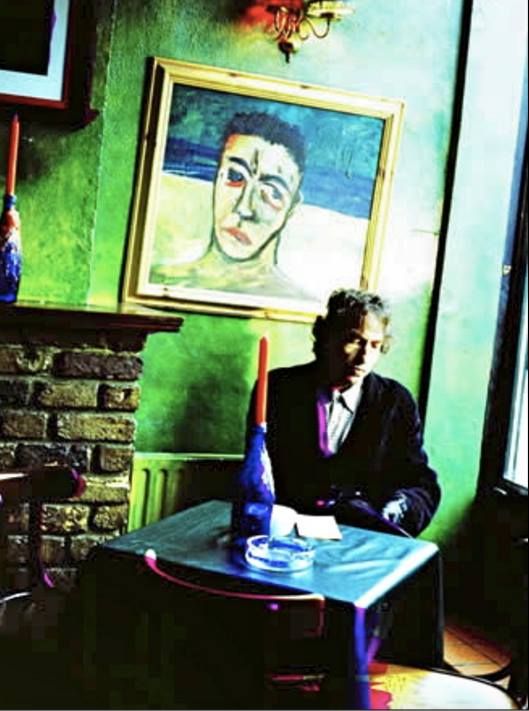
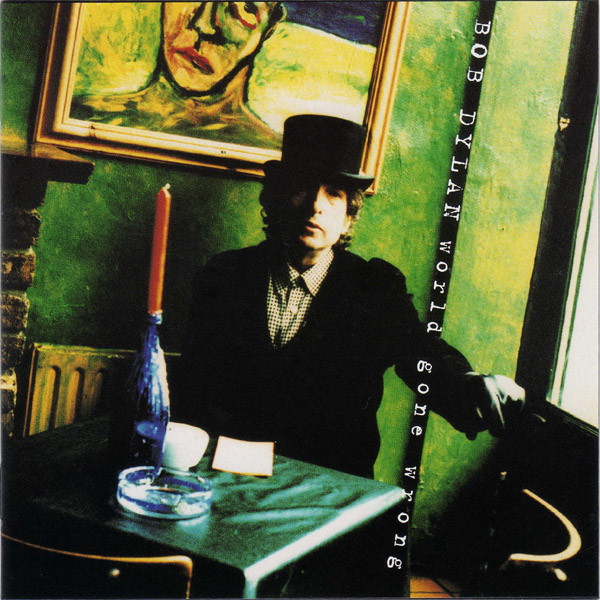
Many people have the impression that the photo on the cover of Dylan’s second acoustic album of the Nineties was carefully staged, like the one on Bringing It All Back Home.
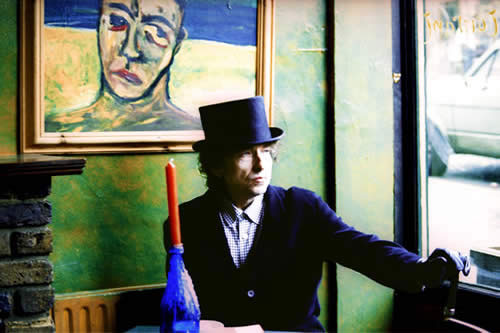
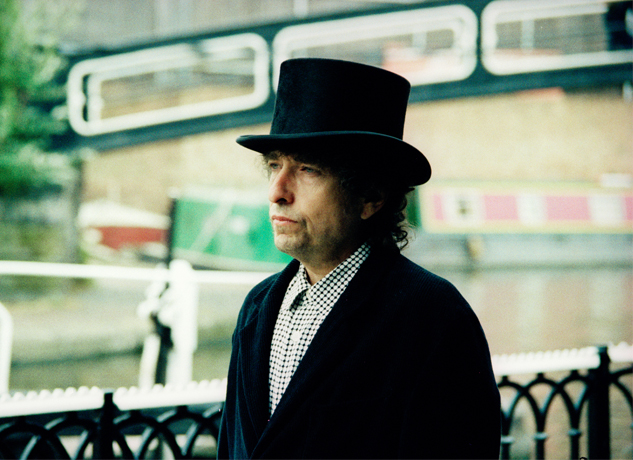
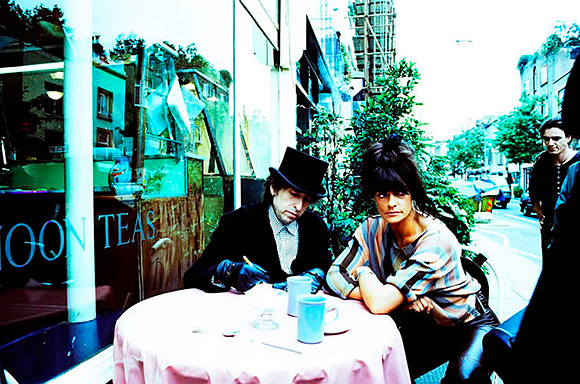
What certainly adds to the impression is that Bob is dressed in character: a black coat, black gloves, a top hat and a walking stick (it’s actually an umbrella).
Then there’s a the setting: a green wall, a green table cloth and what looks like one of Dylan’s painting behind him. On the table there’s a blue bottle with a red candle…
The light coming from the right, with the singer face half hidden in the shadow. The photo is printed in a slight tilted angle, accentuated by the black line with the artists’ name and title of the album.
Certainly, Bob Dylan is dressed the same in the video Dave Stewart made for one of the songs from the album: ‘Blood in My Eyes’. But the circumstances of this photo session remained a mystery, until twenty years later.
From 25th October to 8th November 2012, there was an exhibition in Battersea, London, called Blood in my Eyes. More than hundred photos were on display; all made by Ana Maria Vélez Wood on one day: July 21th, 1993. The day both the video and the photo were shot.
There was a catalogue available, in which the photographer and the director gave their comments on what happened that day. As much time had passed since then, they contradicted each other on some of the details. For example Dave Stewart and Ana Maria Wood differ about where and when the photographer got involved. Dave says he asked her about an hour into the shooting and she met them at Camden Lock, while Ana states that she met Dylan at The Church Studios, well before filming started…
In this story, all of the quotes from Wood and Stewart were taken from the catalogue of the exhibition. Thanks to the great Dutch Dylan collector Arie de Reus, for helping me by providing scans from the catalogue. So here it goes:
In the middle of the night, Dave Stewart and his wife Siobhan were alarmed by the phone ringing unexpectedly. When the former Eurythmic picked up the phone, he heard a man with an American accent saying something like: “Hi, this is Bob. I’m coming to London in a couple of hours to make a video. Would you help me?”
A sleepy Stewart soon realized that it was Bob Dylan who needed his help. He surely knew Dylan was in Europe at the time, as his Summer Tour had ended in Germany, four days before the call.
Although he hadn’t heard from Bob in a long time, the call didn’t come completely out of the blue, as Stewart has worked with Dylan before. In August 1985 he had been executive producer for the video clip of ‘Emotionally Yours’ and a few months later, Dylan even came to London to try out Eurythmics’ studio, The Church, in Crouch Hill, North London.
A few hours later, Bob Dylan meets Dave on his houseboat on the Regents Canal in Camden Town. There is not much of a plan and certainly no script for the video of ‘Blood In My Eyes’. So, they decide to do what Dylan usually does in this situation: go out in the street and see what happens.
This is something he picked up from photographer Don Hunstein during the shoot for his second album, The Freewheelin’ Bob Dylan.
It must have been a strange sight for the shopping people on the streets that Wednesday morning: there is Bob Dylan, wearing a strange outfit and accompanied by Dave Stewart carrying two 8 mm cine cameras. No security.
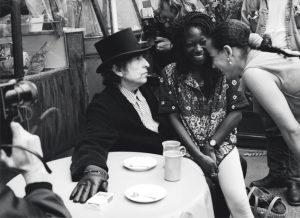
Bob is in a very good mood, willing to give autographs and chatting to people young and old, as they stroll through town.
“I decided this should be documented as it became quite surreal”, explained Dave Stewart in August 2012. “We had been filming for about an hour. Then we had a 5 minute break and a cup of tea outside a cafe,
I seized the opportunity to call the one person I knew I could rely on and would drop everything and get to our location in record time, and she did!’
Stewart refers to Ana María Vélez Wood, a Colombian dancer, guitarist and singer he had worked with some time ago.
“Ana told me later she was a photographer,” Stewart recalled, “and actually came to the UK by winning a photographic contest in her home country Colombia. Over the years I got to know and love Ana’s sense of humour along with her lack or fear and ability to tackle anything from opening a Eurythmics show to cooking for 20 people at ten minutes’ notice!”
Ana remembers Dave sounded excited on the phone, “but in his characteristically laidback manner told me Bob Dylan had called him at 4am wanting him to film and direct a video for one of the tracks of his new forthcoming album ‘World Gone Wrong’, and he asked me if I could come along and shoot some stills.”
It appeared it was cheer luck she was in town: she had just returned from Colombia, where she had made a trip to the Amazon on her own.
“I still had the musty smell of the jungle and my photo equipment was in a plastic milk canteen I had used as a photo bag. This was a preventative measure so that my photo equipment would float in the event we overturned in any of the small canoe journeys through the small islands in the swamps of the Amazon River.
I was still in bed when Dave called so I got up quickly and transformed my photo bag into a ‘first world package’, took a taxi, got some film, and went straight to Dave’s recording studio [sic].”
“Ana immediately became invisible”, Dave adds, “and started shooting at a short distance aware of the fragility of the situation and the possibility that this could bring even more attention to a crowd that was growing by the minute. I introduced Ana to Bob and he immediately felt comfortable with her gentle way, so now we were three!”
“The first shots were done on the Lock”, writes Wood, “where curious onlookers started gathering slowly and Dave ( as only he can do), recruited them to be part of the video and escort Dylan across the bridges and paths, to perform juggling acts and support; at one point even recruiting a German Sheppard carrying a stick in his mouth who proudly paraded on a lead with Dylan. All along Dylan stood out underneath his top hat, but strangely, at the same time blended in perfectly with the surroundings.”
From Camdem Lock, they turn to the Camdem High Street, with their “small army of followers, in front of souvenir shops, zebra crossings, hair dressers and barber shops, slowly covering the length of High Street.”
Some scenes are required where Bob can mime some lines from the song.
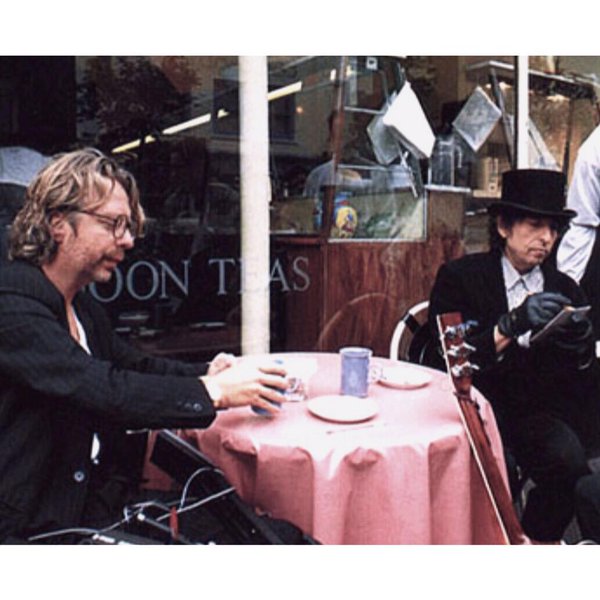
“We stopped at café and this time Dylan took up position at a table by the sidewalk. As the waitress engaged in conversation with Dylan, a passing busker joined Dylan and Dave at the table.”
As this proves to be too busy, they search for something quieter. They find a another small café, called Flukes Cradle, where Bob can sit inside, the light coming through the window. In some scenes you can see the people on the outside, looking in, while Dylan’s face is reflected in the glass. There’s a painting on the wall behind the singer, “propped up” on it’s left side by the mantelpiece.
In one of the photo’s in the exhibition, there’s a young man with an impressive quiff, sitting at the same table. In 2014, the guy is identified as Desmond van Oostrom. The Dutchman, was 21 years old at the time. He was shopping in London with a friend when he is approached by female photographer for a photo shoot. He is seated at a table in a cafe where, completely unexpectedly, as a table guest the legendary singer/songwriter Bob Dylan is next to him. Desmond is taken by surprise and Dylan – of course – is stoic. With a simple ‘thanks’ from Dylan, Desmond is thanked for the cooperation and he can go.
Although he leaves his address with the photographer, it’ll take more than 20 years before he receive the indisputable proof of his Bob Dylan moment.
So, in a way, the photo shoot wasn’t completely spontaneous after all.
After this scene, they return to Dave’s houseboat, where an impromptu film set is set up for more singing scenes, “with lights and everything in a space of not much more than a square meter”, as Wood remembers.
When all necessary filming is done, the small party heads to The Church Studios, to wind down. That was needed particularly for Dylan, explained Wood as he “Surely deserved his own space to shed the persona he adopted throughout the entire day’s shooting.”
When Dylan has changed, Dave hands the photographer an acoustic guitar to sing a few songs in Spanish and Portuguese for Dylan. The evening is wrapped up in a local Indian restaurant in Crouch End.
While Dylan heads off to his hotel, Dave and Ana Maria go “straight to Joe’s Basement, a 24-hour photo lab in Soho, to develop the film.
We asked for an express service, then walked the few blocks to Dave’s flat in Covent Garden. In less than an hour we returned to pick up the photographs.”
As Dylan has already flown to L.A. the next morning, Dave Stewart follows him the next day, to present him the photographs.
Bob picks one of Ana Maria’s photos from inside the restaurant for the cover of World Gone Wrong. Another photo, taken on the house boat is selected for the inside sleeve. On this Dylan is seen holding a glass of whiskey.
L’étranger
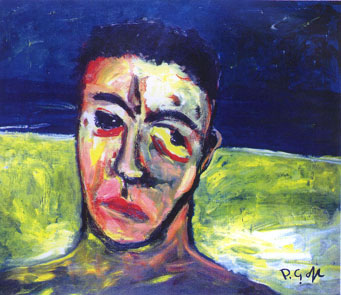
As stated earlier, the painting in the café was not by Bob Dylan. It was already there. The extraordinary story of the painting was revealed in 1995 by it’s painter, Peter Gallager, in a letter published in Isis Magazine.
“This story began in the early months of 1993, when, together with a friend of mine from the states, I trawled the art galleries of London, hoping to break into the closed-shop art exhibition circuit with a pile of heavy canvasses and portfolio of photographs and slides.
My heavily dour and moody portraits did not excite the optimistic decorative galleries, and we were shown the door many times before I could skate across the polished wooden floors to lay out my paintings for viewing. It seemed that our efforts were all to no avail, until we happened upon Flukes Cradle Cafe bar in Camden, who exhibit the works of many London artists. The manager decided to give me a chance and after two weeks of frantic preparation, my paintings were hanging shoulder to shoulder around this popular coffee bar.
After a steady start, I began to sell regularly and Flukes Cradle kept me on. Spring and summer passed and the autumn was drawing to a close when a bizarre chain of events occurred. This series of events began when I received a ‘phone call from a lady who, for the purpose of this essay will be known as Katherine. Katherine had called with a view to buying one of my paintings entitled “L’Etranger” which was hanging by the window at Flukes Cafe. Despite it’s catalogue price, I’d previously given the picture, as a present to Phil, a close friend, and I explained this to her. Curiously, she said, “I must have it!” and demanded my friends phone number. After I refused several times, she announced she was prepared to pay a lot of money for the painting. She said it no longer concerned me anymore, now that I had given it away. It interested me to know what she would offer my friend so I gave her his telephone number. It turned out that she was prepared to pay £500. Phil and I discussed this matter and decided to come to an arrangement, whereby we split the money between us.
On October 30th 1993 we met Katherine at Flukes Cradle Cafe bar, she was accompanied by a friend. I told the manager that I’d found a buyer for “L’Etranger”. He said that the painting would now be worth a lot of money. I didn’t understand what he meant, until he told me that Bob Dylan had sat beneath the painting and had been video’d by Dave Stewart, during the summer, with an album cover in mind. It was quite a surprise as you can imagine, especially since I’d been a regular patron there and nobody had mentioned it until now. Quite unbelievable really.
The painting itself shows a desperate and forlorn figure, on a beach having just committed a murder. His name Meursault, from Albert Camus’ famous (1942), novel, “L’Etranger”. The picture was “propped up” on it’s left side by the mantelpiece, in the front room of the café. The picture had fowled there when I had originally hung It, and to me it seemed that the mantelpiece “steadied” the painting from it’s dizzy and reeling subject matter. I was content to leave it tilting in such a way for this effect.
It’s always been my policy to be around personally to hand over my paintings to buyers and this was not going to be an exception. I like the feedback. The paintings mean a lot to me and I put my heart and soul into them. We spent a full hour with Katherine and her friend and I told her about Bob Dylan’s interest in the picture for his album cover.
It didn’t stir much of a response in her, she hardly twitched. I asked why she wanted the picture so badly. But equally, she hadn’t liked it when she first saw it, but had got to love it gradually, and she hoped to hang it above her bed and wake up to it every morning. She said it would bring her luck. Really? I thought. She seemed more intent on talking to my friend Phil, and Quantum Mechanics were mentioned several times between them. The only thing I know about Quantum Mechanics is that when a butterfly flaps it’s wings, there’ll be a blowin’ in the wind. Katherine was perhaps thinking of other things when she bought the picture.
A couple of weeks passed and my sister’s boyfriend rang me to say that he had just seen Bob Dylan’s CD ‘World Gone Wrong’ in Tower Records, London, and that my painting was indeed featured in the background. London Underground were now running large 5′ x 4′ posters of the album sleeve (the format of the posters was actually taller than that of the album cover, and in consequence displayed even more of my picture). There was a promotional video of the album’s single ‘Blood In My Eyes’ filmed in Camden, showing on national network T.V in the States. Full page magazine adverts. A number of people even likened my style of painting to that of Bob Dylan.
That was the good news, now for the bad. I had signed the painting in the bottom right hand corner, but unfortunately it was obscured by Dylan’s top hat. ‘Sony-Columbia’ had not approached me, and there was no mention of my name on the album credits. But for the manager of Flukes Cradle making a cursory remark two weeks previous, I might have come face to face with my painting on London Underground, late at night, alone on a platform, in a drunken stupor. What would you have done? Jump! This is the misery line.
Like all good euphoric attacks there is an equally disabling depression just around the comer. Could not the record company have said something; asked permission. My brother suggested I ring Sony Columbia in London. I had started off in Camus and ended up in a Kafka novel. Look for a decision maker. Find the responsible person forget it! I got a music solicitor to find out why nobody asked me for license to use the painting. I still had copyright, and it was my intellectual property. Why no credit? What followed was, almost a year of knee bending, twitching swordplay, legal bluff. Noise of wind, in impotent gusts wafting to and fro across the Atlantic. More blowin in the wind. Gastro Enteritis I call it.
It was in February 1994 that Sony Columbia informed me that Bob Dylan had bought the painting “with the specific objective of avoiding any further difficulties.” In March, Sony’s New York law dept. continued with a letter. It followed that; “Jeff Rosen (from Dylan’s New York office), had asked one of Dave Stewart’s employees to purchase the painting, so he would have rights to it when the album was released. Two of Dave Stewart’s employees located the (Camden) restaurant but were told that the painting had been sold to Katherine.” Within 48 hours they met Katherine and had bought the painting from her for £2,500. Well, she had said it would bring her good luck! £2,000 profit in two days. I call that incredible good luck!!
Strange to say that as a sixteen year old I used to play tennis with a Bob Dylan fan. I had little interest or awareness of his hero’s songs until one day he rammed Dylan’s lyrics down my throat and told me I must be stupid if I didn’t understand him. I just felt hurt. I have never listened to a Bob Dylan album since that day, apart from ‘World Gone Wrong’ It’s all the more poignant now. I did however, like the album.
As a painter and musician in my own right, it’s been a strange year. Bob Dylan on one side, me on the other and a minefield of legal jargon between us. I still don’t understand him. Has the World Gone Wrong? To avoid further calamities I accepted the painting back from the Dylan camp and they agreed to a credit on future printings of the album. Sony paid my legal fees and suggested I could make a good price from the painting, because of its association with Dylan.”
The photo on the back sleeve is made by celebrity photographer-designer Randee St. Nicholas. She’s the ex-wife of Steppenwolf singer Nick St. Nicholas – hence the name. The photographer, living in Los Angeles is specialized in photographing musicians and perhaps most famous for her Prince book 21 Nights (2008). Other photos from the Dylan shoot were used as late as 1997 on the single ‘Dreaming of You’.
Because Dylan had been criticized for being very vague about the authors on his previous acoustic cover record, Good As I Been To You, he wrote extensive (and excellent) liner notes, titled About The Songs (what they’re about). This filled the rest of the vinyl album’s back sleeve.
Poet William Blake critiques organized religion for suppressing sex as a unifying fiery force within the physical world; he envisions sexual union as a holy spirit that ought to be enjoyed by humankind rather than the spiritual sexual urge being chained up and confused by the doctrine of death -‘original sin’ – as taught by black-robed priests:
Unless the heart catch fire
The God will not be loved
Unless the mind catch fire
The God will not be known
(William Blake: The Pentecost)
The preRomantic poet draws on metaphoric gnostic-like imagery of the Christian God found within the Holy Bible:
His head and his hairs were white like wool, as white as snow
And his eyes were as a flame of fire
(Revelation 1:14)
Blake’s sensual imagery is not lost on the rocknrollers of modern popular music.
With piano a-pounding:
I laughed at love because I thought it funny
You came along, and you moved me honey
I've changed my mind, this love is fine
Goodness gracious, great balls of fire
(Jerry Lee Lewis: Great Balls Of Fire ~ Blackwell/Hammer)
With guitar a-blazing:
Say my arrows of are made of desire, desire
From far away as Jupiter's sulphur mines
Way down in the Methane Sea
(Jimmy Hendrix: Voodoo Child/Slight Return)
Singer/songwriter/musician Bob Dylan grows up in an era when rocknroll music dominates the air waves emanating from popular music radio stations:
They killed him on the altar of the rising sun ...
Play 'Lucille'
(Bob Dylan: Murder Most Foul)
‘Lucille’ – piano a-pounding:
I woke up this morning, Lucille was not in sight
I asked my friends about her, God, all they did was laugh
Lucille, come home where you belong
(Jerry Lee Lewis: Lucille ~ Collins, et.al.)
Likewise, an earlier rendition thereof:
I woke up this morning, Lucille was not in sight
I asked my friends about her, but all their lips were tight
Lucille, please come back where you belong
(Little Richard: Lucille)
Quieted down is the guitar tempo in the gnostic-tinted song below:
Well, I went back to see about her once
Went back to straighten it out
Everybody that I talked to had seen us there
Said they didn't know who I was talking about
(Bob Dylan: Red River Shore)
The guitar subdued again in the song below:
They walked along by the old canal
A little confused, I remember well
They stopped into a strange hotel
With the neon burning bright
He felt the heat of the night
(Bob Dylan: Simple Twist Of Fate)
Piano a-rolling in the following lament:
He had a lovely wife, and two children seldom seen
But they shot him in the backseat of a Lincoln limousine
(Jerry Lee Lewis: Lincoln Limousine)
Slowed down piano in the double-edged lament below with the alliterations still abounding; John Kennedy’s physical body is destroyed, but the memories of his lively spirit are not:
I'm riding in a long, black Lincoln limousine
Riding in the backseat next to my wife
Heading straight on in to the afterlife
(Bob Dylan: Murder Most Foul)
Commentary by Tony, research and opening comment by Aaron:
Here’s a track which Bob tried out five times in soundchecks in 78, this one is from Paris. It’s called Fix It Ma. Not the best sound quality but here it is. (It does get a little clearer as it progresses, stay with it…)
https://www.youtube.com/watch?v=tFSAfO0K09I
This was the year in which Dylan wrote a number of songs with Helena Springs. As far as we know the only songs that were not written with Ms Springs that year were (in chronological order)…
So this would make the 11th Dylan solo composition of the year. But what about the lyrics (apart from “You better fix it ma”)? Earlier we asked if anyone wanted to have a go at writing them out, and Larry Fyffe duly obliged
It was down around Tokyo, ready or not
Get out of pokey Ozzie, dead or a alive
You better fix it mama, fix it mama
You better fix it mama, you better fix it mama
You better fix it mama real quick
If you wanna get along with me
Just fix at me

Well you want to go down, and get your bad tooth, slam the door
Well you tried to tell the daddy-o that he broke the law
Well you better fix it ma
You gotta fix it ma
You better fix it for me real quick
Because I'm outside your gate
If you wanna get along with me
Musically it is a standard 12 bar blues. We have two verses here, with the first four lines containing the original lyrics. Then we have four lines of “you better fix it ma”.
I should add that the phrase “12 bar blues” has long since been a misnomer, and is now used to refer not to the number of bars of music, but to the structure of the chord sequence, which in this case would be written…
I, I, I, I
I, I, I, I
IV, IV, IV, IV
I, I, I, I,
V, V, V, V
IV, IV, I, I
which will mean quite a lot to rock musicians.
The song is listed on BobDylan.com although without any information added to the title. Olof Björner has it listed as being played five times in 1978, but Heylin makes no mention of the song at all. It was included on the bootleg album, “All this tangled rope.”
In fact around 20 websites have the song mentioned – but none go into any detail of the music nor the lyrics. The music is simple to decode, but the lyrics… here is your chance of immortality.
By all means write your version in the comments below, but if you email them to Tony@schools.co.uk (please write Fix it ma in the subject line) I’ll get to see them quicker, and integrate them into this text, with a full acknowledgement.
The brilliant closing stanza, finally, reaffirms the ironic overtones – though on a different level. As with, for example, the beautiful Basement song “Nothing Was Delivered”, or in “Subterranean Homesick Blues”, or “Highway 61 Revisited” (there are many examples), we see in this verse Dylan’s artistic kinship with that other great Jewish poet, with Heinrich Heine, the patriarch of the Ironische Pointe, the ironic punch line. With this stylistic tool, the writer destroys expectations by ending lofty, sentimental or melancholy lines with an inappropriate platitude, a dry comic footnote or a vulgarity. Don’t follow leaders, watch the parking meters is one of Dylan’s best-known, but this one ain’t bad either:
Bow down to her on Sunday
Salute her when her birthday comes
For Halloween give her a trumpet
And for Christmas, buy her a drum
The first two verses still are a logical result of all the previous character descriptions. This is a very special lady, far above us, simple footmen, a lady who may only be admired kneeling and from a distance. The poet emphasizes her majesty with appropriate, status confirming imperatives: bow down and salute her, to finally contrast all the more inappropriately with the sobering punch line. The glorified dame receives a trumpet and a drum.
A trumpet and a drum? For an unassailable highness? Is this really a majestic ladyship being sung here?
In 1958 Chuck Berry records “Memphis, Tennessee”. The song undeniably belongs to the rock canon, to the elite of indisputable rock monuments – after all, the song is a member of the very exclusive and very small club of songs recorded by the Holy Trinity; by Elvis, The Beatles and The Stones. And large parts of the premier league just below that Olympus also honour the masterpiece with studio recordings and live performances. The Who, Jerry Lee Lewis, Led Zeppelin, Roy Orbison, Bo Diddley, Rod Stewart and, well, anyone who can hold a guitar, basically.
The song is deceptively simple. Two chords. The primal version, Chuck’s recording, is rough and rowdy. Simplistic drumming on a single tom, no bass (the low strings of the electric guitar provide the service), languid, sloppy licks by Chuck on his guitar, and after two minutes and a bit it’s done. Pieced together all by himself, as Berry remembers in his memoirs (Chuck Berry: The Autobiography, 1987):
“Memphis Tennessee” was recorded in my first office building at 4221 West Easton Avenue in St. Louis on a $145 homemade studio in the heat of a muggy July afternoon with a $79 reel to reel Sears & Roebuck recorder that had provisions for sound-on-sound recording. I played the guitar and bass track, and I added the ticky-tick drums that trot along in the background which sound so good to me. I worked over a month revising the lyric before I took the tape up to Leonard Chess to listen to. He was again pressed for a release since my concerts (driving on the road then) kept me from the recording studio for long periods.
On the level of details, Berry’s book is full of minor mistakes (in those years, Sears & Roebuck didn’t have a $79 reel-to-reel tape recorder for sale that would allow sound-on-sound, for example), but the big picture is probably correct. Berry also recognises what makes the song such an exceptional masterpiece: not so much the music, however brilliantly simple it may be, but the lyrics, on which he has been polishing for more than a month after that primal recording.
The unbridled brio, obviously, is in the twist. For three verses we hear a pitiful sucker trying to call his girl in Memphis – but he has lost the number. He begs the operator to help him –
Long distance information, give me Memphis, Tennessee
Help me find the party trying to get in touch with me
She could not leave her number, but I know who placed the call
Because my uncle took the message and he wrote it on the wall
… and desperately bombards the poor telephone operator with useless information about Marie and her whereabouts (“her home is on the south side, high upon a ridge, just a half a mile from the Mississippi Bridge”). So far not very striking; song lyrics in this category, the desperate suitor who cannot reach his girl, we already have come to know in enough variations. Chuck indeed does freely reveal that he copied it from some run-of-the-mill song:
The story of Memphis got its roots from a very old and quiet bluesy selection by Muddy Waters played when I was in my teens that went “Long distance operator give me (something….something), I want to talk to my baby she’s (something else)”. Sorry I don’t remember anymore now but I did then and spirited my rendition of that feeling into my song of Memphis. My wife had relatives there who we were visiting semi-annually but other than a couple of concerts there, I had never had any basis for choosing Memphis for the location of the story.
Again, incorrect at a detailed level, probably. Muddy Waters may have a song called “Long Distance Call” (1951), but that song doesn’t contain the word operator, nor a verse that resembles Chuck’s remembered words. Little Milton’s “Long Distance Operator” looks a bit like it,
Long distance operator
Can I talk to my girl tonight?
I feel so sad and lonely
And you know, I just ain’t feeling right
…but that single was not released until February ’59. Jimmy Reed’s 1957 “Baby What’s On Your Mind” might have been a candidate (“I’d call up the operator and tell her give me your private line / I feel so bad, baby, livin’ downtown all alone”), but that still doesn’t add up to Chuck’s recollection that he heard it in my teens – that should be somewhere in the 1940s.
Not too important, of course. There are dozens of songs in this category. Here too, at least, the spirit of Chuck Berry’s story will be true; that he borrowed the plot’s setting, a man laments his sorrow to an anonymous operator. Just as Dylan and The Band will do for their “Long Distance Operator” (The Basement Tapes), by the way.
More important is the brilliant twist, the punch line that tilts the entire lyrics:
Last time I saw Marie she's waving me goodbye
With hurry home drops on her cheek that trickled from her eye
Marie is only six years old, information please
Try to put me through to her in Memphis Tennessee
This is 1958 – it is perhaps the first pop song to thematise child custody and the resulting suffering of the father after a divorce. And moreover: such an adult theme is enormously out of tune in these years, the years of bubble-gum, surfing fun and high school romance. So, at first, the Chess record company does not quite know what to do with it. It is finally put on a B-side (from “Back in the USA”) in June ’59.
After “Subterranean Homesick Blues”, for which Dylan uses as a template Berry’s “Too Much Monkey Business”, the Father Of Rock and Roll seems to inspire Dylan again, this time on a lyrical level: to the surprising punch line of “She Belongs To Me”, to the conclusion that the sung lady is a girl of about six years old. Who can look forward to a classic Christmas present: a drum.
However, unlike with “Memphis, Tennessee”, the surprising twist does not tilt the whole text. With hindsight, parts of the lyrics take on a different meaning, though. She don’t look back of course suits a six-year-old (who, after all, has no past), nobody’s child suddenly suggests a custody battle and next to a child you are a walking antique, evidently. But fragments like peeking through her keyhole suddenly get a – no doubt unintentional – creepy charge, so: no.
No, “She Belongs To Me” is and remains a beautiful collage song, a mosaic which sketches what goes around her sometimes. With a sparkling twist demonstrating a poetic congeniality with both one of the greatest European poets from the early nineteenth century and the twentieth-century, very American “Shakespeare of rock and roll” (Dylan), Chuck Berry.
The song, with its enchanting melody, is an instant success. Alone in the year of its release, 1965, seven covers are recorded, of which Barry “Eve Of Destruction” McGuire’s is the best known. Attractive drive, beautiful harmonica solo, but the affectionate vocals and Barry’s artificial recital do not stand the test of time. Then the chaotic, disrespectful cover of the weirdos from The West Coast Pop Art Experimental Band (also ’66) is more bearable – but equally dated.
Most charmed, Dylan himself undoubtedly is by Rick Nelson’s cover (Rick Nelson And The Stone Canyon Band, 1969), given his appreciative words in Chronicles:
“Ricky’s talent was very accessible to me. I felt we had a lot in common. In a few years’ time he’d record some of my songs, make them sound like they were his own, like he had written them himself. He eventually did write one himself and mentioned my name in it.”
Ricky scores a small hit with it, but this cover really is a bit too unimaginative. In that area The Nice, also in 1969, is doing better. In which regard they do have an obligation, of course, being a progrock group and all. Theatrical and with a spun-out, Teutonic middle part they stretch the song to twelve minutes, but it still has an equally fascinating, magnetic appeal as, for example, the cover of Simon & Garfunkel’s “59th Street Bridge Song (Feelin’ Groovy)” on The Live Adventures of Mike Bloomfield and Al Kooper.
Tina Turner turns it into “He Belongs To Me”, the Grateful Dead loves the song and has been playing it since the first concerts in 1966, it is popular in folk, country and rock circles, is translated all over the world – “Elle m’appartient (C’est une artiste)” by Francis Cabrel from 2008 is the most beautiful – and Dylan cherishes the song too; in 2016 it is still on his set list (46 times even), thus making Olof Björner’s list of Songs Performed More Than 500 Times.
The best cover comes from Norway. Ane Brun is blessed with an unearthly voice (and was rightly recruited by Peter Gabriel as a backing vocalist), and does everything you have to do if you dare to do a Dylan cover: an idiosyncratic approach, respect for the original and an enriching je-ne-sais quoi.
Recorded for one of the best Dylan tribute records of this century, Subterranean Homesick Blues: A Tribute To Bob Dylan’s ‘Bringing It All Back Home’ (2010), performed by artists who weren’t born yet when Dylan released Bringing It All Back Home – all of them artists who, thankfully, do look back on this walking antique.
———–
Jochen is a regular reviewer of Dylan’s work on Untold. His books are available via Amazon both in paperback and on Kindle:
Untold Dylan is written by people who want to write for Untold Dylan. It is simply a forum for those interested in the work of the most famous, influential and recognised popular musician and poet of our era, to read about, listen to and express their thoughts on, his lyrics and music.
We welcome articles, contributions and ideas from all our readers. Sadly no one gets paid, but if you are published here, your work will be read by a fairly large number of people across the world, ranging from fans to academics. If you have an idea, or a finished piece send it as a Word file to Tony@schools.co.uk with a note saying that it is for publication on Untold Dylan.
We also have a very lively discussion group “Untold Dylan” on Facebook with around 8000 active members. Just type the phrase “Untold Dylan” in, on your Facebook page or follow this link And because we don’t do political debates on our Facebook group there is a separate group for debating Bob Dylan’s politics – Icicles Hanging Down
In my last article in this series I argued that Dylan had become a man who could operate in a whole wide range of song styles, while at the same time he had become the ultimate storyteller, able to write protest songs, love songs, gambling songs, the blues etc etc etc.
Also we looked at how Bob could not only take up the themes he had previously considered (songs of leaving, lost love, protest etc) but also bring into focus new themes such as individualism, and the thought that what defines us as individuals is the way in which we choose to see the world – not the way the world is. A sophisticated concept not generally explored in popular music – or indeed in folk music.
The old year had ended on such a high with the creation of songs we now see as classics – songs such as When the ship comes in, The Times they are a-Changing, The Lonesome Death of Hattie Carroll, One too many mornings and Restless Farewell. I imagine there must have been some debate within his record company,at this point, as to whether Bob could possibly keep up this pace and this quality of writing. I wouldn’t be surprised if someone had said, “Even if the next batch are only half as good, we’ve still got more than enough for the next album.” Looking back, the quality and quantity of Dylan’s creativity at this time was astonishing.
But the issue of the future was serious: after songs like that, would Bob Dylan now go into eternal decline as so many artists have done after the first flourish artistic brilliance? And anyway, what on earth could Dylan do to top all that he had done? He had composed 20 highly memorable songs in each of the last two years – more than most songwriters can do in a lifetime. Could he really keep up the quality of his writing, the variety of styles and the sheer volume of excellent new songs for another year?
Of course as we know now, the answer turned out to be, most assuredly, “yes”. Inevitably we find some songs that don’t get an automatic mention in any list of Bob’s greatest songs, as with his opening piece in the new year Guess I’m doing fine – an ironic work in which Bob actually says he is hurting. But after that warm up, songs of the highest quality emerged once more from his typewriter, one after the next after the next. And again that by-now famous ability to keep changing his subject matter was on display.
In my original article on this site exploring this year, in which I pulled together the list of songs written in the chronological order or their composition, I ascribed the shortest possible description of each song’s lyrics. What I didn’t particularly note however was the remarkable fact (or at least it would have been remarkable in any other songwriter) that the first eight songs of the year were each on very different themes…
If we didn’t know about thing about Bob’s work and were to listen to “Guess I’m doing fine,” the first song of the year, I think any record company A&R man of the day might be tempted to say, well, ok, keep trying Bob; it’s interesting but see what else you can come up with – and then give us another call.
This is not to say that “Doing fine” is a bad piece of music, but rather when one compares it with all that has gone before, it really isn’t anything special. In fact, if you leave that recording above running it moves onto the album release of “Restless Farewell” written just a short while before. The contrast is extraordinary.
Thus a person, unfamiliar with Dylan’s work but hearing his reputation, would I suspect have been disappointed. But that disappointment would have been short lived because the very next piece Bob wrote was one of his all-time classic works: Chimes of Freedom. I particularly like this video below because if you watch the mess of the start, it is hard to imagine that this guy is going to deliver anything, yet alone this piece of artistic mastery…
The core message of the song is encapsulated in that opening verse – there is hope for everyone who is not part of the powerful or the elite. We are all going to be liberated from the shackles of this world. Just hold on in there. It’s a matter of how you see the world, not the way the world is…
And just in case we haven’t got who it was he was thinking about…
Tolling for the rebel, tolling for the rake
Tolling for the luckless, the abandoned an’ forsaked
Tolling for the outcast, burnin’ constantly at stake
An’ we gazed upon the chimes of freedom flashing
It is a most extraordinary song of hope, packed with the most brilliant images. A song that takes the inevitably better future message of “Times they are a changin” and which then tells us what it will feel like.
Take this verse which appears part way through…
Through the wild cathedral evening the rain unraveled tales
For the disrobed faceless forms of no position
Tolling for the tongues with no place to bring their thoughts
All down in taken-for-granted situations
Tolling for the deaf an’ blind, tolling for the mute
Tolling for the mistreated, mateless mother, the mistitled prostitute
For the misdemeanour outlaw, chased an’ cheated by pursuit
An’ we gazed upon the chimes of freedom flashing
Maybe I missed it, but had anyone else thought of writing a folk or pop song like this before? Had anyone else ever thought of writing a song in the popular style which ended with as much hope and positively as the lines that end this song without actually being overtly religious.
And indeed that is another point about this song: it offers the joyful future of Christian revivalist singing, without any of the religion.
Starry-eyed an’ laughing as I recall when we were caught
Trapped by no track of hours for they hanged suspended
As we listened one last time an’ we watched with one last look
Spellbound an’ swallowed ’til the tolling ended
Tolling for the aching ones whose wounds cannot be nursed
For the countless confused, accused, misused, strung-out ones an’ worse
An’ for every hung-up person in the whole wide universe
An’ we gazed upon the chimes of freedom flashing
Writers have commented on this song in many different ways; Rimbaud has been quoted as a source, others see the death of Kennedy as a theme. Paul Williams called it “Dylan’s Sermon on the Mount.” Others get tangled up over when and where the piece was written, trying to find immediate influences and antecedents. And I agree these are interesting points. I also went looking for antecedents, but I would stress, not because I thought they were desperately important, but because I like to try to keep the vast number of songs in my head in some sort of order.
So for anyone who wants to go down that route then musically I’ve little doubt that the origin is Chimes of Trinity written in 1895 (if you play the recording do let it run – you’ll hear what I mean in the second half of the verse – from about 1 minutes 5 seconds onwards).
But as ever, the origin of the language and indeed the music, is an academic debate, interesting, and one which I’ll drop into my PhD if I ever finish it, but which can also be used by academics and would-be academics to hide their lack of understanding as to exactly what is going on in the work of art.
Does it matter that Bob lifted the music in part from “Chimes of Trinity”? No, but it is interesting because it shows us he must have heard “Chimes of Trinity” somewhere – which in turn emphasises the phenomenal range of music that Bob had not only heard but also remembered, but this time.
In my view, and as I have mentioned before, breaking down a work of art into its constituent elements often tells us less than nothing about the work of art. It’s a bit like studying the brick work at St Paul’s Cathedral and expecting to learn something profound about Sir Christopher Wren. The artist, be she or he a musician, painter, poet, architect, dancer… is creating a work. A fulsome piece which is offered to anyone willing to look and/or listen and/or be inspired as a means of passing the time of day or perhaps gaining an insight into an aspect of the world today or the world beyond. That’s what art is.
If we reduce this song to a “meaning” and suggest perhaps that (as Wikipedia has it) it is an “unforgiving storm giving way at the end of the song to a partial lifting of the mist,” then every single element in the song is lost and its glorious language is reduce to doggerel.
Ian Bell, an eminent and highly acclaimed writer, says that the this song is about the fact that liberty exists in many forms, and yet the song is “too over-wrought and self-conscious to be a total success,” I have to disagree. To return to a point I made much earlier in this series, I am not at all sure that one can say what this song is about, any more than one can say what the Millennium Bridge in London is about.
But I have walked that footbridge between St Pauls and the Tate Modern art gallery countless times, and each time I am completely overwhelmed by my approach either to the cathedral or what was once upon a time a power station. I can’t describe that walk in any way that might convince another person to do the walk, but it is, for me overpowering.
In short we do not have to be able to explain art to understand its power. I can of course give you the chord sequence of the song, report on its origins or look in depth at the words, but none of that helps me express to you what this song is. Your best bet, in my view, is to listen to the recording above.
Endless debates about where the lyrics “come from” and what they mean are futile, to my mind. The composition is a work of art which either illuminates your life or it does not. To me, it most certainly does illuminate. The sheer beauty, power and hope expressed therein. Breaking it down into points in a critical debate immediately removes a key part of the essence of the the song.
For me, it was the decision of the self-appointed critics of Dylan’s work around this time to express the meaning in each and every song that led to the collapse into pointlessness of critical reviews of Dylan’s work. If Dylan wants to make the meaning clear, he is perfectly able to do so – just consider “Masters of War”. If he wants to give us a set of shimmering images of hope, he can do that. He can do it because he has this staggering ability with words, and to start analysing the antecedents or meanings in this song shows, I feel, a complete lack of understanding of what not only this art but all art, is about.
Yes such analysis can be interesting as an academic study of antecedents or meanings, but this activity should not be confused with appreciating the music for what it is.
But this is not to say one should not look at individual lines. The line, “for every hung up person the whole wide universe,” for example, resonates especially as the next three songs Dylan wrote show a certain amount of being hung up – although there again, maybe that was just a coincidence.
The series continues shortly. If you have been, thank you for reading.
Untold Dylan: who we are what we do
Untold Dylan is written by people who want to write for Untold Dylan. It is simply a forum for those interested in the work of the most famous, influential and recognised popular musician and poet of our era, to read about, listen to and express their thoughts on, his lyrics and music.
We welcome articles, contributions and ideas from all our readers. Sadly no one gets paid, but if you are published here, your work will be read by a fairly large number of people across the world, ranging from fans to academics. If you have an idea, or a finished piece send it as a Word file to Tony@schools.co.uk with a note saying that it is for publication on Untold Dylan.
We also have a very lively discussion group “Untold Dylan” on Facebook with around 8000 active members. Just type the phrase “Untold Dylan” in, on your Facebook page or follow this link And because we don’t do political debates on our Facebook group there is a separate group for debating Bob Dylan’s politics – Icicles Hanging Down
By Aaron Galbraith; additional thoughts from Tony (sorry Aaron, couldn’t resist)
“Doug had a hit record (“She’s About A Mover”) and I had a hit record (“Like A Rolling Stone”) at the same time (1965). So, we became buddies back then, and we played the same kind of music. We never really broke apart. We always hooked up at certain intervals in our lives.”
–Bob Dylan to Douglas Brinkley, Rolling Stone, May 11, 2009
One such time was in 1972 when Bob joined Sahm for the sessions for his first solo album “Doug Sahm And Band”. He contributed guitar, vocals, harmonica, organ plus a song to the sessions. Eight tracks appeared on the album with Bob’s involvement, a further three tracks from the session appeared on The Sir Douglas Band album “Texas Tornado” the following year. Then in 2005 , five more turned up on “The Genuine Texas Groover” (this is the one to get as it includes the above two albums plus 19 more tracks!).
Dylan’s contributions to “Doug Sahm and Band” are “(Is Anybody Going To) San Antone”, “It’s Gonna Be Easy”, “Poison Love”, “Wallflower”, “Dealer’s Blues”, “Faded Love”, “Blues Stay Away From Me” and “ Me And Paul”.
Here’s “Is anybody going” with Bob on backing vocals…
The three from “Texas Tornado” are “Tennessee Blues”, “Ain’t That Loving You” and “I’ll Be There”.
The five from “The Genuine Texas Groover” are “On The Banks Of The Old Ponchatrain”, “Hey, Good Lookin’”, “Please Mr Sandman”, “Colombus Stockade”, and “The Blues Walked On In”.
Here are just a few more of the best ones from across the three albums. We all know Wallflower so let’s skip that one.
But here’s a cover of Willie Nelson’s Me and Paul with Bob on guitar and harmonica…
And now…
“Tennessee Blues” with Bob on uncredited harmonica
Coming up next is the Hank Williams song “On The Banks Of The Old Ponchatrain”
There are some more great performances with Bob and all are on YouTube if you want to check out “Hey Good Looking” or “Columbus Stockade”.
But I thought I’d save my favourite for last. With Bob on guitar and vocals, it’s “Blues Stay Away From Me”.
Bob knows the song well, having already performed a run through of the track back in 1965 with Joan Baez at the Savoy Hotel.
Then again in 1987 he broke out the song again (the video says it’s with Tom Petty…but I’m fairly certain it’s Jerry Garcia and the Grateful Dead, although I could be wrong!)
Note from Tony: Aaron also included Bob Dylan’s cover of Sahm’s biggest hit – which he performed twice, and suggested he’d leave it out of this article so I could use it in my Live Rarities series. But he’s done the research so it should go into his piece.
Aaron writes: Bob covered Sahm’s biggest hit “She’s About A Mover only twice”…once in 1988 (I think with Sahm on stage)…and again in 2000, following his death in 1999
Now if it is quite a while since you have heard this (and here is Doug singing below) you might feel there is something of a similarity with “Outlaw Blues”. Or maybe that is just me getting carried away as usual.
And here is the original – this sounds far less like “Outlaw Blues” than Bob’s version, – it was clearly just the way Bob performed it. And
Ah… the days when 12 bar blues were hits, even when including “hey hey in the lyrics”.
Anyway, both “She’s about a mover” and “Outlaw Blues” were written in 1965. Which came first? I really don’t know.
Here’s what Wikipedia has to say about the song…
“The song was named the number one ‘Texas’ song by Texas Monthly, also charting at #15 on the UK Singles Chart [which explains why Tony knows it!] With a Vox Continental organ riff provided by Augie Meyers and a soulful vocal by lead singer-guitarist Doug Sahm, the track has a Tex-Mex sound. The regional smash became a breakaway hit, and the recording was used in the soundtracks of the films Echo Park (1986), American Boyfriends (1989), The Doors (1991), Riding in Cars with Boys (2001), Sorority Boys (2002), and Beautiful Darling (2010).
Untold Dylan is written by people who want to write for Untold Dylan. It is simply a forum for those interested in the work of the most famous, influential and recognised popular musician and poet of our era, to read about, listen to and express their thoughts on, his lyrics and music.
We welcome articles, contributions and ideas from all our readers. Sadly no one gets paid, but if you are published here, your work will be read by a fairly large number of people across the world, ranging from fans to academics. If you have an idea, or a finished piece send it as a Word file to Tony@schools.co.uk with a note saying that it is for publication on Untold Dylan.
We also have a very lively discussion group “Untold Dylan” on Facebook with around 8000 active members. Just type the phrase “Untold Dylan” in, on your Facebook page or follow this link And because we don’t do political debates on our Facebook group there is a separate group for debating Bob Dylan’s politics – Icicles Hanging Down
Well, my telephone rang, it would not stop
It's President Kennedy calling me up
He said "My friend Bob, what do we need to make the country grow"
I said "My friend John -  Brigitte Bardot"
(Bob Dylan: I Shall Be Free)
A song of tragedy from the sorrowful days of adulthood – in the song lyrics below, the singer/songwriter laments the murder of President Kennedy, the first Catholic elected to that position:
The day they killed him, someone said, "Son
The Age of the AntiChrist has just only begun"
(Bob Dylan: Murder Most Foul)
Construed it can easily be that some of the US presidents following Kennedy are manifestations of the metonymical AntiChrist as described by an unknown ‘someone’ in the Holy Bible:
Little children, it is the last time
And as ye have heard that AntiChrist shall come
Even now are there many AntiChrists
Whereby we know that it is the last time ....
Who is a liar but he that denies that Jesus is the Christ?
He is AntiChrist, that denies the Father and the Son
(1 John 2: 18, 22)
Words that echo, albeit ambiguously so, in the lines below:
Hush little children ....
The Beatles are coming, they're going to hold your hand
(Bob Dylan: Murder Most Foul)
Dylan obfuscates on the matter; nevertheless, it is apparent that President Obama, the first ‘black’ elected to that position, is excluded, like the idealized Kennedy, from the list of possible AntiChrists ruling the New Babylon.
President Obama presents the Medal of Freedom to Bob Dylan at the White House:
There is no doubt that President Obama is the presenter. I know a witness. In the process of being 3D’ed in the White House, behind the seated President stands my bearded nephew Graham Fyffe, son of my twin brother:
US Presidents following Kennedy are Johnson, Nixon, Ford, Carter, Reagan, Bush, Clinton, Bush Jr, Obama, Trump.
US Presidents following Kennedy are Johnson, Nixon, Ford, Carter, Reagan, Bush, Clinton, Bush Jr, Obama, Trump.
The following song quite surely takes a jab at about-to-be-ousted Pesident Nixon:
While preachers preach of evil fates
Teachers teach that knowledge waits
Can lead to hundred-dollar plates
But even the President of the United States
Must sometimes have to stand naked
(Bob Dylan: It's Alright Ma)
Carter, a fan of Dylan’s lyrics, mentions the above song in his presidential nomination speech: “We have an America that, in Bob Dylan’s phrase, is busy being born; not busy dying” though the precise phrasing is “that he not busy being born is busy dying”.
The lyrics below ponder the role played by Kennedy’s ‘how-many-kids-did-you-kill-today’ replacement:
Airforce One coming in through the gate
Johnson sworn in at two-thirty-eight
(Bob Dylan: Murder Most Foul)
As one might expect, analyst Kees de Gaaf throws down a ‘red herring’ and attempts to interpret the song above as one really about the crucifixion of Jesus Christ rather than about the assassination of President Kennedy.
Untold Dylan: who we are what we do
Untold Dylan is written by people who want to write for Untold Dylan. It is simply a forum for those interested in the work of the most famous, influential and recognised popular musician and poet of our era, to read about, listen to and express their thoughts on, his lyrics and music.
We welcome articles, contributions and ideas from all our readers. Sadly no one gets paid, but if you are published here, your work will be read by a fairly large number of people across the world, ranging from fans to academics. If you have an idea, or a finished piece send it as a Word file to Tony@schools.co.uk with a note saying that it is for publication on Untold Dylan.
We also have a very lively discussion group “Untold Dylan” on Facebook with around 8000 active members. Just type the phrase “Untold Dylan” in, on your Facebook page or follow this link And because we don’t do political debates on our Facebook group there is a separate group for debating Bob Dylan’s politics – Icicles Hanging Down
For this instalment let’s take a look at a handful of videos from the Oh Mercy and Under The Red Sky albums.
First up it’s Political World, directed by John Mellencamp.
Dylan is playing at a dinner for rich (mostly white) ageing politicians, sheikhs, dictators and kings. There are woman there but they mostly seem bored to start with, until one of the rich guys starts to talk to them. Looks like money changes hands and lots of shady deals are going on around the tables. Then people start dancing to the music (the guys are very bad dancers). I guess no one is listening to the words Dylan sings!
We live in a political world
The one we can see and feel
But there's no one to check
It's all a stacked deck
We all know for sure that it's real
Moving on to our second offering from Oh Mercy, here is Most Of The Time.
This one is a fairly straight forward performance video, but it has a few things of note. Firstly, it is a new version, recorded live as the cameras roll. I’m not sure anyone else ever attempted that before. I have a feeling that McCartney might have done it but I’m not sure. So that’s pretty cool.
Secondly, it was directed by Bob’s son Jesse Dylan. Which is also pretty cool. Jesse finds some interesting angles at time and I think the lightning is stunning. Bob looks pretty cool also, certainly better than the baggy old t-shirt look he went for in the Political World clip!
Next up, we present Unbelievable from Under The Red Sky.
This one was directed by Paris Barclay and co starred a young Molly Ringwald. Paris Barclay is a highly respected TV director, winning two Emmys and directing episodes of (amongst others), West Wing, Lost, House, CSI and Glee. He also directed music videos for New Kids On The Block, Janet Jackson and LL Cool J.
The main story involves a young man chatting up a girl in a bar, he gets beat up, they go to a motel room and then she runs off with his car and money. Fairly standard music video fare. But then you introduce the Bob stuff and that’s when it gets weird and interesting!
Bob is some kind of chauffeur driving around the desert with a pig in the back, stopping every so often to play guitar on the bonnet of the car. Bob looks really cool in this video!
Last one up is this video for Series Of Dreams
I actually wasn’t going to include this one as my memory of it was flawed. I remembered it as just being a series of still pictures. But then I watched it back recently and was amazed by how well it was put together. It works extremely well for me. It’s fantastic.
Tony: In the past I’ve been jumping in with my comments all the way through, but I’ve realised (as I suspect is apparent) with these videos that I am obviously not the audience for whom they were made. Mostly they distract from the music for me, which no matter how many times I have listened to the track, is where I focus.
Except… I really wanted to (and have) re-run the video of Series of Dreams. Several times. To me this is way, way beyond all the other videos we’ve looked at. It is entertaining and clever in a way that holds my attention throughout. The use of images grabs me by the throat and won’t let go – I am forever wondering how each can be made to fit with the music, how each was done, the clashing of images… It all reflects the lyrics of the song, but without being forced and never doing the obvious. It would have been so simple to use mists or shots from the era when it was written, but no… this takes us all over the place. The lyrics say “from another world” and that is what the video gives us.
This to me is what music videos should do – they should challenge us, push us forward and back, make us rethink, make us listen as we have never before, make us hear the music in another way, make us understand what the composer was doing.
Of course it is helped by being a fantastic piece of music – but for me it has just become even more wonderful. Utterly brilliant.
Untold Dylan: who we are what we do
Untold Dylan is written by people who want to write for Untold Dylan. It is simply a forum for those interested in the work of the most famous, influential and recognised popular musician and poet of our era, to read about, listen to and express their thoughts on, his lyrics and music.
We welcome articles, contributions and ideas from all our readers. Sadly no one gets paid, but if you are published here, your work will be read by a fairly large number of people across the world, ranging from fans to academics. If you have an idea, or a finished piece send it as a Word file to Tony@schools.co.uk with a note saying that it is for publication on Untold Dylan.
We also have a very lively discussion group “Untold Dylan” on Facebook with around 8000 active members. Just type the phrase “Untold Dylan” in, on your Facebook page or follow this link And because we don’t do political debates on our Facebook group there is a separate group for debating Bob Dylan’s politics – Icicles Hanging Down
The third verse illustrates, almost in so many words, that the title should actually be read as “I Belong To Her” or at least as “She Belongs To No One”;
She never stumbles
She’s got no place to fall
She’s nobody’s child
The Law can’t touch her at all
Choice of words suggests that Odetta’s “Stranger Here” contributed not only to number 5 of Side A, “Outlaw Blues”, but even more so to “She Belongs To Me” –
Ain't it hard to stumble
When you got no place to fall
Stranger here
Stranger everywhere
I would go home
But honey I'm a stranger
… though Harry Belafonte’s arrangement of the song might be a better candidate. As with the next song on Bringing It All Back Home, “Maggie’s Farm”, which owes the opening words to Belafonte’s performance of “Diamond Joe” (“Ain’t gonna work in the country / And neither on Forester’s farm”), the similarity is too remarkable to be coincidental. Harry’s version is called “The Way That I Feel” and has largely the same words:
It sure is hard to stumble down
    when you ain't got no place to fall
Seems like in the whole wide world I ain't got no place at all
Well I'm feeling like a stranger here
I feel like a stranger everywhere
It can be found on the beautiful album Belafonte Sings The Blues (1958), of which the track list alone suggests that Dylan cherishes this album. It contains, for example, “Cotton Fields”, the song Dylan declares being his personal Big Bang, in his Nobel Prize speech:
“And somebody – somebody I’d never seen before – handed me a Leadbelly record with the song “Cottonfields” on it. And that record changed my life right then and there. Transported me into a world I’d never known. It was like an explosion went off. Like I’d been walking in darkness and all of the sudden the darkness was illuminated. It was like somebody laid hands on me. I must have played that record a hundred times.”
Furthermore, “Mary Ann” and “Sinner’s Prayers”, of which echoes will descend later in Dylan’s “If You Ever Go To Houston” (Together Through Life, 2009); “One For My Baby”, the most quoted song in Dylan’s oeuvre (quotations and paraphrases from this song can be heard in at least six Dylan songs); and especially “Fare Thee Well”, or also “Dink’s Song”, which is on Dylan’s repertoire as well. The King Of Calypso’s version, by the way, is a crushingly beautiful version.
“Nobody’s child” and “The Law can’t touch her” reinforce the image of the untouchable lady who certainly does not belong to anyone.
The expression nobody’s child is quite unusual in the art of song. Dylan may know it from the antique “Limehouse Blues”, the old jazz standard that could be found in his record case in the bluegrass performance of Reno and Smiley (1954);
Oh, Limehouse kid
Goin' the way
That the rest of them did
Poor broken blossom
And nobody's child
Haunting and taunting
You're just kind of wild.
But more likely Dylan knows it as a song title; one of his heroes, Hank Snow, recorded it in 1949 and with the Traveling Wilbury’s Dylan will record it in 1990. It may also have been a suggestion by George Harrison, though; in 1961 The Beatles, as an accompaniment band, record “Nobody’s Child” with Tony Sheridan (released in 1964 as a B-side for “Ain’t She Sweet”) – without Harrison, so maybe George felt a need to catch up.
Being “outside the law” appears in many songs, even in amorous contexts (such as in Al Hibbler’s “You Will Be Mine”, 1955; But a woman in love, she’s above the law), but remarkable here is Dylan writing the word “Law” with a capital. No mistake; from the first edition of Writings & Drawings, in all editions of Lyrics, and on the site, law is capitalised. The connotation is Biblical, or more specifically; the five books of Moses, which the Jews call the “Torah” – “the Law”, so with a capital letter, or “the Law of Moses”, the most important books of the Jewish religion.
It is a deliberate action, writing with a capital letter, and the Jewish Dylan, who did have lessons from a rabbi in the run-up to his bar mitzvah, undoubtedly knows the meaning of the word Law with a capital letter. It does not lead, however, to a subsequent, unambiguous conclusion regarding the lady described in this verse. A shiksa, a non-Jewish woman, would be obvious, but the opposite is more attractive: Jewish, but so independent and self-willed that even Moses’ authority is not acknowledged by her.
In line with this is the other striking capital letter, the capital letter in Dylan’s instructive art confession in the liner notes: I am about t sketch You a picture. From a linguistic point of view this is only correct as reverential capitalisation, only if the writer wants to refer to God. In this case, at this point in Dylan’s career, it is more likely that the poet uses it ironically, but Christian Dylanologists, a not insignificant faction of the dogged key-seekers, will gladly see it as a profession of faith. “All my creations are at the service of Your glory,” something like that.
The fourth stanza, then, is the verse with the famous Baez trigger.
She wears an Egyptian ring
That sparkles before she speaks
She’s a hypnotist collector
You are a walking antique
… officially a Baez reference since Robert Shelton’s 1986 book, No Direction Home – The Life & Music Of Bob Dylan:
“I looked down at Joan’s Egyptian ring. “Is that a little gift from a pharaoh in Cairo?” Joan laughed: “Yes, it’s the funniest thing. The fact of the matter is that… Well, that’s supposed to be a secret. Anyway, it’s in the song.”
But Shelton, in addition to all the enviable contacts and with all his talent, also demonstrates in his Dylan interviews a susceptibility to red herrings and is quite keen on assumed hidden codes. Dylan seems to enjoy sending him into the woods, and Baez is not averse to pulling a prank either, as we know. At any rate, in her autobiography she does reveal that Dylan is far from attentive and never gives presents. Except for that one time:
“I told Sara that I’d never found Bob to be much at giving gifts, but that he had once bought me a green corduroy coat, and had told me to keep a lovely blue nightgown from the Woodstock house. “Oh!” said Sara, “that’s where it went!””
… which, incidentally, is consistent with the testimonies of other women in Dylan’s life. Ruth Tyrangiel goes public in 1994 with a lawsuit against Dylan. She alleges to have had a relationship with Dylan for seventeen years, from 1974 to 1991, claiming five million dollars in a so-called palimony lawsuit. She declares that in those seventeen years she had received a gift twice: one time a rose, another time a tangerine.
Okay, a little weird, but still: both Tyrangiel’s statement and Baez’s revelation make it all the more unlikely that Dylan would ever have gifted something as precious and symbolic as a ring to Baez. Nevertheless, it is of course quite possible that a sparkling ring on Baez’ hand is one of those images which are just in there and have got to come out. And it gives the lyrics an attractive mystical sheen, just like the continuation with the beautiful catachreses, with the unknown word combinations “hypnotist collector” and “walking antique”. Code crackers then find explanations like “Joan Baez is the frontwoman of naive political folkies, lying at her feet like hypnotised sheep”.
No, then perhaps John Cale does have a better point. In 2004, when he is a guest on the legendary BBC radio programme Desert Island Discs, the programme in which the guest has to choose the eight records he would take with him to a life on a desert island, the Velvet Underground co-founder’s first choice is “She Belongs To Me”. The record is introduced with Cale’s stories about his arrival in New York, Andy Warhol and his Factory, and the “screen tests” to which each Factory guest had to submit.
“Bob Dylan. Anybody who came by had to sit for a screentest, as it was called. And he was the only one who got up and walked off. Everybody else sat there for six minutes, but after about two he said, that’s it, I’m …”
“We better have your first record, ’cause it’s him, isn’t it. Why did you want to take this one?”
“Well, everybody was looking sideways at Bob because they were astonished at all this power that was coming out of his lyrics. And we knew that Nico had just come down to be a member of the band and she used to hang out with Bob in Woodstock. So when this song came along everybody looked at each other and said, wait a minute, this is about somebody we know.”
Photographs from that time do confirm that Nico usually wears large, flashy rings with mystical symbols and antique looking shapes. As on the cover of her debut album Chelsea Girl (1967, with Dylan’s “I’ll Keep It With Mine” on it). And from Nico, the frontwoman of the avant-garde, one indeed can say: She’s an artist, she don’t look back.
In conclusion, the guest, the castaway, must appoint the special one from the eight favourites, the one he’d pick if he had only been allowed to choose one song.
“Now, John, if you could only take one of those eight records – which one would you take?”
“I think I’d take the Bob Dylan.”
“She Belongs To Me…”
“Yeah, I think so.” “For remembering Nico too, hm?”
“No, it’s more of Bob and…. the rusty voice of his, that’s really… A lot of character in it.”
——————-
To be continued. Next up: She Belongs To Me part IV: Marie is only six years old
Jochen is a regular reviewer of Dylan’s work on Untold. His books are available via Amazon both in paperback and on Kindle:
Untold Dylan is written by people who want to write for Untold Dylan. It is simply a forum for those interested in the work of the most famous, influential and recognised popular musician and poet of our era, to read about, listen to and express their thoughts on, his lyrics and music.
We welcome articles, contributions and ideas from all our readers. Sadly no one gets paid, but if you are published here, your work will be read by a fairly large number of people across the world, ranging from fans to academics. If you have an idea, or a finished piece send it as a Word file to Tony@schools.co.uk with a note saying that it is for publication on Untold Dylan.
We also have a very lively discussion group “Untold Dylan” on Facebook with around 8000 active members. Just type the phrase “Untold Dylan” in, on your Facebook page or follow this link And because we don’t do political debates on our Facebook group there is a separate group for debating Bob Dylan’s politics – Icicles Hanging Down
Buried be they in a Nova Scotian graveyard – a number of passengers (including Luigi Gotti of the ‘Ala Carte’ restaurant) who die when the White Star ocean liner ‘Titanic’ sinks into the icy waters of the North Atlantic.
By an American poet – a pacifist who turns antifascist:
Down, down, down, into the darkness of the grave
Gently they go, the beautiful, the tender, and the kind
Quietly they go, the intelligent, the witty, the brave
I know. But I do not approve. And I am not resigned
(Edna Malley: Dirge Without Music)
More specific be the reference to the sinking of the ‘Titanic’ in the following song:
When the Reaper's task had ended
Sixteen hundred had gone to rest
The good, the bad, the rich, the poor
The lovliest, and the best
(Bob Dylan: Tempest)
The liner ‘Olympic’ suffers not such a tragic fate. By way of analogy, according to Greek/Roman mythology, the Olympians overthrow the Titans. Zeus becomes the chief of the Olympian gods and goddesses. As the God of Thunder and Lightning, he overpowers the Giants, but not the Judeo-Christian God – not even Jesus Christ comes to rescue the travellers aboard the ‘Titanic’:
When they were building the Titanic
They said what they could do
They were going to build a ship
That the water could not go through
But God with mighty hand
Showed the world that it could not stand
It was sad when that great ship went down
(Ernest Stoneman: The Titanic ~ traditional)
In the song ‘Tempest’, for instance, had imaginary time-traveller Bob Dylan, or at least his persona, instead of turning quite leisurely away from the disaster, persuaded, or perhaps tricked, Zeus into smashing the iceberg to pieces before it strikes the ‘Titanic’, how might history have turned out?
For one thing, the American singer/songwriter would have no actual historical event to inspire the following lyrics:
The ship was going under
The universe had opened wide
The role was called up yonder
The angels turned aside
(Bob Dylan: Tempest)
Nor to inspire the lines below addressed to the Olympian ruler of the water world:
Praise be to Nero's Neptune
The Titanic sails at dawn
Everyone's shouting
"Which side are you on?"
(Bob Dylan: Desolation Row)
And the hyperbolic poet from Nova Scotia would not have penned the lines below in which the mighty iceberg becomes an objective correlative for the marble-hearted God of modern times:
We'd rather have the iceberg than the ship
Although it meant the end to travel
Although it stood stock-still like cloudy rock
And all the sea were moving marble
(Elizabeth Bishop: The Imaginary Iceberg)
And Jack Dawson would not have had to sacrifice himself in to order to save lovely Rose in the previously-referenced film by Canadian James Cameron:
In the movie, Jack says:
“I don’t know about you, but I intend to write a strongly worded letter to the White Star Line about this”.
Untold Dylan: who we are what we do
Untold Dylan is written by people who want to write for Untold Dylan. It is simply a forum for those interested in the work of the most famous, influential and recognised popular musician and poet of our era, to read about, listen to and express their thoughts on, his lyrics and music.
We welcome articles, contributions and ideas from all our readers. Sadly no one gets paid, but if you are published here, your work will be read by a fairly large number of people across the world, ranging from fans to academics. If you have an idea, or a finished piece send it as a Word file to Tony@schools.co.uk with a note saying that it is for publication on Untold Dylan.
We also have a very lively discussion group “Untold Dylan” on Facebook with around 8000 active members. Just type the phrase “Untold Dylan” in, on your Facebook page or follow this link And because we don’t do political debates on our Facebook group there is a separate group for debating Bob Dylan’s politics – Icicles Hanging Down
A list of earlier episodes of this series appears at the end of the article.
By Tony Attwood
Bob Dylan ended 1962 by writing three highly exploratory songs. Hero Blues puts forward the proposition that one should be wary when your girlfriend loves you because you are famous. The Ballad of the Gliding Swan says that life can throw up every surprise at you, but life still goes on. While the final song of the year, Whatcha Gonna Do? was an unlikely venture in that it asks how we will be placed at the time of the second coming.
But unlikely though that final work may be for a young man, the music overall is stunning. Having started the year with a truly remarkable blues in terms of Ballad for a Friend, Bob ends it with something of almost the same stature.
By my rough and ready calculation Dylan had written on the following themes in the previous year
Protest / social commentary / civil rights: 9 songs
Lost love / leaving / moving on: 8 songs
Change: 5 songs
Blues: 3 songs
Comedy: 3 songs
Moving on, gambling: 2 songs
The way we see the world: 2 songs
Love / desire: 2 songs
Do the right thing: 1 song
These are of course approximate totals – merely a guide to the type of lyrics that Dylan was writing, and one can always argue about the central message of this or that particular song. But although approximate it is nonetheless interesting because his key themes were still there at the start of the new year; a new year which began with five songs that fitted completely into those top two categories of protest and lost love.
But we must step back a little for at the end of 1962 Dylan gained another valuable and insightful experience, which was going to benefit his songwriting enormously; an experience that came through Philip Saville who had heard Bob perform in Greenwich Village.
Philip Saville had become known in England as an actor before becoming a screenwriter and then a man whom the British Film Institute’s website calls “one of Britain’s most prolific and pioneering television and film directors”. At the time he saw Dylan he was working on the TV series “Armchair Theatre” – although to UK audiences he is best remembered for his later work with the series “Boys from the Blackstuff”.
It should also be remembered that at this time British television had developed in a very different way from that in America, with only two channels licensed by the government, the commercial ITV and the non-commercial BBC (the third channel, BBC2 still being a couple of years away). Therefore audiences for both channels were huge and appearances even by unknown artists would always generate a lot of interest and comment.
Philip Saville invited Bob to perform three songs in a live TV drama “Madhouse on Castle Street”. “Blowin’ in the Wind” was used at the start and the end of the programme over the credits. Dylan also performed two traditional English folk songs, “Hang Me, O Hang Me”, and “Cuckoo Bird”, and then “Ballad of the Gliding Swan” for which Saville had written the words (but which, it is said, Dylan changed during the actual performance).
Philip Saville had heard Dylan singing “Blowin’ in the Wind” one morning while Dylan was staying in his house. On that basis the arrangement to use Dylan was made.
The programme might have been just a footnote to Dylan’s extraordinary work in 1962 were it not for the fact that while in London Dylan spent time also visiting the clubs in what was now a very vibrant folk scene. Here, traditional songs, contemporary re-writes and newly created pieces in the British folk style were performed one after the other and through visiting the clubs Dylan got to know people such as Martin Carthy (pictured left, now Martin Carthy MBE in recognition of his lifetime’s work) and Bob Davenport.
Martin Carthy is reported to have taught Bob Dylan his arrangement of “Scarborough Fair” which Bob then re-worked as it became the basis of “Girl from the North Country“. Another well-known British folk song “Lady Franklin’s Lament” that Martin Carthy taught Dylan became the melody for “Bob Dylan’s Dream”.
https://youtu.be/l1NgNpeyU80
If you have never heard Lord Franklin I would (if I may) urge you to listen to the recording below. I have had several occasions over the years where I have invited friends who know Dylan’s work but who don’t know the song to listen to it, and mouths do tend to drop open.
This was an extraordinary outpouring of songs, and yet it was just the start for in this year Dylan wrote 31 songs. And while this was slightly fewer than the previous year, many more of the 1963 songs have reached a stature such that even casual Dylan fans will know them. Indeed when one remembers that this year included the creation of not just the four songs mentioned above but also “Davey Moore”, “Seven Curses”, “With God on our Side”, “Only a pawn”, “North Country Blues”, “When the ship comes in”, “Times they are a changing”, “Hattie Carroll” “One to many mornings” and “Restless Farewell,” you can see what a creative explosion was happening here. And those are just the songs I’ve picked out as the ones I can instantly recall from this year without looking them up on Untold Dylan! As we’ll see there are many more.
After returning to New York in January 1963 Bob wrote a collection of songs for Broadside, which also published “Masters of War” among others, as Bob turned his attention back to finishing what was become Freewheelin, now working with Tom Wilson as producer.
By April the album’s recordings were completed and Dylan’s fame had reached such a level that he was booked into the Ed Sullivan Show. Here he decided to perform Talkin’ John Birch Society Blues which he had written the previous year and which was initially scheduled for inclusion in Freewheelin’. There were however concerns that the John Birch Society might sue for libel, (and interesting thought from a 21st century perspective) and as a result of the arguments the song was dropped from Freewheelin, and Dylan did not appear on the Ed Sullivan show. Commentators have spent quite a bit of time bickering with each other as to which came first – the dropping of the song from the album or the refusal to appear on TV, but I must admit I personally find such matters of little importance. In reality there was a huge amount of chopping and changing of the songs for Freewheelin going on irrespective of the John Birch issue, simply because Dylan was writing more and more songs of significant artistic merit. And when the album was most certainly going to include “Don’t think twice” and “Blowing in the Wind”, along with “Hard Rain,” no one could surely think there was going to be much to worry about in terms of sales.
Indeed as the tracks were pulled together it must have been obvious to everyone what an extraordinary album was being created, for apart from those tracks it was by now clear that the album also had to include “Girl from the North Country”, and “Masters of War.” No matter what the other tracks were that collection was surely more than enough to keep audiences gaping in amazement.
But then as if to suggest that maybe those brilliant songs were not quite enough Dylan then also produced Bob Dylan’s Dream, and made it one of the most evocative pieces imaginable, especially for those who did not know the original. It sounds as if it should have been written by an old man, or at least a man of middle age looking back on his life, but this is the young Dylan showing an utter maturity in his writing (even if it was re-writing of a traditional song) that is remarkable for his age.
Indeed, the “Dream” makes me think of Ballad for a friend – not because they are musically alike, but because of the maturity both of the music and the thought behind the song. These songs sound as if Dylan had had his life and was looking back with fondness and sadness – and yet he was only just starting out.
Of course many will interrupt here and say but “he merely copied the music, the feel and the style of the original,” and yes, he has copied that folk song. But the fact is anyone could have done this at any time and brought Lord Franklin into the contemporary world, yet no one else did. There was, before Dylan, very little crossover between the phenomenally rich world of British folk songs, and contemporary audiences. Martin Carthy and others kept the traditions alive and brought them to a new audience in the 1960s and thereafter, and for that those folk singers deserve our undying thanks, but it was Dylan who introduced a world-wide audience to this heritage.
The level of emotion in Dylan’s song is quite extraordinary; it is one of those songs that above all others has stayed with me from my young days when I heard it, not appreciating what it could be like to look back on a life where so many friends have now been lost. Now I know, it hits me even harder.
But in terms of the writing, and leaving aside debates about what to put on the album, Dylan continued composing, going back to his own folk roots with Only a Hobo, before suddenly taking off in an utterly different direction with a song about boxing (a subject that was hardly on the agenda for the socially conscious young rebel) with Who killed Davey Moore? one more based on the English traditions – this coming from the 18th century (if not earlier). Indeed of that song one can also say not just “who writes songs about boxing?” but also, “who writes a contemporary song using Who killed cock robin?”
What also strikes me, and not for the first time, is that in this one year Dylan produced not only what would have been five years or more’s worth of composition, but he was so varied in his writing, for he then took in the theme of desolation with Seven Curses and then goes into desperation and hopelessness with God on our Side.
Quite how the young Dylan could jump from subject to subject I am not sure; I think in the end I just have to use the get out word, “genius”. Yes he was borrowing themes and music from classic folk music, but even so… for before we can blink he is telling us in Eternal Circle that there is nothing we can do, for nothing ever changes.
This is, no matter which way you look at it an incredible tour de force. Not just because Dylan wrote 20 glorious, memorable songs during the course of one year, but because in doing that he jumps from subject to subject to subject, from style to style, from subject to subject, to…
And, if you are still not convinced, consider what happens next, for now he suddenly diverts his talent once again and creates (or revises, opinions disagree on the dating of this song, just as the do on the implication and meaning) Gypsy Lou – a song which has caused a huge amount of debate during the years of creating this site. And then we are travelling in another direction by suddenly taking in a Biblical theme with When the ship comes in.
The positivism of When the Ship undoubtedly paved the way for The Times they are a-Changing which goes back to the notion found in “Paths of Victory,” proclaiming that the future will be fine, just let it happen. (Although many people have insisted in seeing Times as a call for the young to rise up, the lyrics actually suggest no such thing. According to this song, it’s just going to happen and there’s nothing you can do.)
Indeed in many ways these songs are a very curious mix. In the songs that led up to “Times” Dylan was upbeat with the metaphorical ship soon to be coming in, and then in Eternal Circle Dylan is telling us nothing can change and that we are all just stuck in our own circumstances – we are all pawns in their game.
The only implication I can take from this is that just as the songs are not coded messages (as many to this day, do insist that they are) they are also most certainly not a series of instructions on how to see the world. Indeed while writing this piece I have read Jochen’s excellent article on this site in which he highlights the nonsense of claiming that “Louise in “Visions Of Johanna” is “actually” his wife Sara, and Johanna is “actually” the absent Joan Baez.” Jochen describes these as “One-dimensional, superficial interpretations generally, which are, in fact, repeatedly refuted by the poet himself…” Quite so, in my view.
And I would add to that view, the fact that Dylan’s ability to write about so many different topics in so many different ways adds to the inevitable view that Dylan is not offering us a unified view of the world but rather a set of constantly varying views. What’s more, fully to understand Dylan we really do have to stop and consider the fact that Dylan is not writing all these songs because he believes in what the song says. No more, indeed, than a novelist or writer of a film script believes in the story that he writes. The storyteller tells stories because he/she likes telling stories, and finds it fun and can do it well. The storyteller does not have to preach in each story – stories can be told for the enjoyment of others. Story tellers tell stories (in my experience as an author myself) because they are good at it and from time to time readers or listeners are kind enough to say that they have enjoyed the work.
Thus I would argue (and although I haven’t checked with Jochen, I rather suspect he feels this also) that many commentators have tied themselves up in knots trying to explain each Dylan song in terms of one consistent moral code or vision of the world.
Times they are a changing tells us that the new, wonderful, vibrant, brilliant future is just around the corner and is going to happen no matter what we do, whereas Hollis Brown tells us the world is falling apart and the level of human misery our socio-economic system continues to generate is appalling. Indeed at the risk of becoming incredibly boring, allow me just once more to make the point that on the Times they are a changing album most of the songs tell us that times are very much not changing by human design or God’s grand plan. Not every Dylan song has a heart-felt message tucked away inside it, any more than does every piece of modern visual art, nor every piece of contemporary orchestral music.
Of course being Dylan, immediately he has started to explore such themes and contradictions as are in Eternal Circle and Times they are a changing, he’s back pulling at every emotional heart string and political sense of fair play with The Lonesome Death of Hattie Carroll before taking us into the world of nature with Lay Down your Weary Tune
And finally as if all this were not enough he then comes up with what I consider to be one of the greatest songs of leaving written in the 20th century: Restless Farewell, a song based on the Irish ballad “The Parting Glass”.
What is it, I therefore feel we must ask, that drives Dylan through this extraordinary creative output?
Of course he did have a strong engagement with the protest movement and with civil rights, I am not denying that. Of course he was deeply concerned about the well-being of the rural poor through his upbringing, although he had been considering the urban poor in New York in his time there. Of course he is concerned about justice. But throughout all this there are two other factors we must acknowledge. First Dylan is a natural storyteller, and second Dylan now has access to and knowledge of the vast wealth of music that is the Scottish, Irish and English folk traditions. He knows the songs, he knows the themes, and he knows how to bring them into the modern day.
“Restless Farewell” is one of the absolute masterpieces of the early years of Dylan’s writing – a song written quickly as the whole message poured out of him, a song about getting up and being on the road once again. It is a song that is a picture; a picture as powerful as anything he had produced up to this point. A song as magnificent in its achievement as “Ballad for a Friend”, “Hard Rain” and “Bob Dylan’s Dream.” Indeed if all he had ever achieved had been those four songs he should have been remembered as one of the great songwriters of the 20th century. But even in this one year there was so much more.
That recording above, for the Sinatra concert, shows the absolute power and insight of this song. This version is so very different from the original, but it adds even more power to the piece than the original.
So what we have here is a man drawing on many different sources of inspiration, and seemingly quite capable of being able to shift from one musical source to another as well as one lyrical theme to another, and all within a matter of days. A man who can write songs that he himself can rearrange weeks, months or years later and find new and even deeper meanings reflecting his own life as well as those of a musician he admires.
Consider, for example, this much earlier version of Restless Farewell
Looking at the list of songs for this year one can fully understand why Dylan became rather fed up with being pigeon holed as a “protest singer”, because such utter masterpieces as “Dream”, “Ballad for a Friend” and “Restless Farewell” are not protest songs. To call him a protest singer is to ignore these early pinnacles of Dylan’s achievement; these early expressions of his genius.
What is missing in this year is much of a Robert Johnson input – although it would soon return. Probably it went because Bob really was continuing to move in every direction at once. And it was through this multi-directional approach that we do see the flowering of the songs of sadness and regret for what has been left behind, and what must be left behind.
Whichever way you look at Dylan in 1963, it was the most incredible, awesome achievement to produce not just this many brilliant songs, but this many songs in such diverse forms and with such diverse visions of the world.
Untold Dylan is written by people who want to write for Untold Dylan. It is simply a forum for those interested in the work of the most famous, influential and recognised popular musician and poet of our era, to read about, listen to and express their thoughts on, his lyrics and music.
We welcome articles, contributions and ideas from all our readers. Sadly no one gets paid, but if you are published here, your work will be read by a fairly large number of people across the world, ranging from fans to academics. If you have an idea, or a finished piece send it as a Word file to Tony@schools.co.uk with a note saying that it is for publication on Untold Dylan.
We also have a very lively discussion group “Untold Dylan” on Facebook with around 8000 active members. Just type the phrase “Untold Dylan” in, on your Facebook page or follow this link And because we don’t do political debates on our Facebook group there is a separate group for debating Bob Dylan’s politics – Icicles Hanging Down
Those liner notes on Bringing It All Back Home should be a goldmine for the key-seeking Dylanologist, but most exegetes prefer to ignore them. After all, the most honest lines in them, I am about t sketch You a picture of what goes on around here sometimes. tho I don’t understand too well myself what’s really happening, do demythologise Dylan’s poetry quite a bit. To the dissatisfaction of the puzzling Dylanologist with crypto-analytic ambition, it is a fairly unambiguous art statement from a thoroughbred Impressionist.
Although there is no uncontroversial definition of “impressionism”, we do agree on its essence: the artistic expression of an impressionist is a notion, an impression of a moment. “Volatility” is another characteristic, and Renoir’s paintings, for example, illustrate this perfectly; paintings with the vagueness and ephemerality of a photograph taken from a passing car. Paintings that capture a blurred impression of a moment – seems like a freeze-out, as Dylan initially will call “Visions Of Johanna”, written shortly after “She Belongs To Me”.
In any case, “a nonunderstanding sketch of what is happening here”, the somewhat more cumbersome way of saying “impression”, does indeed seem to be an adequate choice of words to describe his own poetry, certainly that of these mid-sixties.
What the poet does perceive, which event does provide the impressions, the poet discloses right at the beginning of those revealing liner notes: “i’m standing here watching the parade”. Which is, added to the “sketch confession”, rather consistent with the observation that songs like “Just Like A Woman”, “Visions Of Johanna”, “Just Like Tom Thumb’s Blues” and “Farewell Angelina”, to name but a few, are collage songs, sketchy images of the parade that goes on around here sometimes.
Such a vision clashes with the vision of interpreters who are so eager to explain that the lyrics are in fact one coded narrative, telling one life fact or event from the life of the human Dylan. And then – for example – argue that Louise in “Visions Of Johanna” is “actually” his wife Sara, and Johanna is “actually” the absent Joan Baez. One-dimensional, superficial interpretations generally, which are, in fact, repeatedly refuted by the poet himself – whatever that may be worth.
Most emotionally at that eruption from the stage in England, in the Royal Albert Hall, 27 May 1966: “I’m sick of people asking what does it mean. It means nothing!” And equally convincing in calm interviews, such as in the captivating SongTalk interview with Paul Zollo (April 1991), when the interviewer wants a reaction to another high point of the mercury years, to “Absolutely Sweet Marie”, and then specifically to that one verse I stand here looking at your yellow railroad in the ruins of your balcony. That’s just true, Dylan says at first, “Every single letter in that line. It’s all true. On a literal and on an escapist level,” to come back to it a little later:
“So you must make yourself observe whatever. But most of the time it hits you. You don’t have to observe. It hits you. Like “yellow railroad” could have been a blinding day when the sun was so bright on a railroad someplace and it stayed on my mind. These aren’t contrived images. These are images which are just in there and have got to come out. You know, if it’s in there it’s got to come out.”
… words of a full-blooded Impressionist. Spoken a quarter of a century after those liner notes from Bringing It All Back Home – at the very least, these code-crackers and key seekers could consider taking the words of the artist himself just a tiny bit seriously. And if not, the words the poet spoke, again a quarter of a century hereafter, at the Nobel Prize speech 2017:
“I don’t have to know what a song means. I’ve written all kinds of things into my songs. And I’m not going to worry about it – what it all means.”
It is not that difficult, after all, to take the sobering self-analysis of the poet a bit seriously; both the characterization “sketched observations of fleeting impressions” and the self-analysis “images which are just in there and have got to come out” fit wonderfully well on most of his lyrics.
The same could apply for the tremendous number 2 of Bringing It All Back Home, for “She Belongs To Me”. The communis opinio seems to be that Dylan sings Joan Baez here. Gray, Shelton, Heylin… they all feed the thought that is being expressed even more widely on fan forums: Dylan once gave Baez an “Egyptian ring” (whatever that may be) and therefore this song must be about her.
It is, apart from rather thin evidence, a somewhat ludicrous statement. Not only does such a sentimental “interpretation” trivialise the lyrics, it is also difficult to keep the statement upright if you do take it seriously and put the other lines of text next to it. The opening, to begin with:
She’s got everything she needs
She’s an artist, she don’t look back
She can take the dark out of the nighttime
And paint the daytime black
The only words that could apply to Baez here are “she” and “artist”. As for the rest, for the narrative content of the verse lines: it is quite difficult to maintain that they have any relationship with the Queen of Folk. As a certified fighter for the Righteous Cause, Baez is constantly protesting, is at the forefront of demonstrations and protest meetings and lends herself at least once a week to the derniercri du coeur. No, she is not really a lady who got everything she needs.
Equally inappropriate is the qualification she don’t look back. Three-quarters of Baez’s repertoire consists of reinterpretations of ancient songs, by now she has already written memoirs twice and she is by no means a progressive, avant-garde artist – one of her few good self-written songs is “Diamonds And Rust”, which is reflecting and looking back all the way.
Finally, the paint it black lines can at best be interpreted as a far-fetched, ironic reversal on Baez. Whatever else one may think of her, she is undeniably an angelic appearance with an ethereal, vibrating soprano – more of a light-bringer than an eclipse. Dylan himself would agree on that, as can be deduced from his autobiography Chronicles; “She had the fire,” he says, and “a voice that drove out bad spirits.” The opposite, in short, of a creature that darkens the daylight.
On the other hand, already the title is an ironic reversal, as the second verse shows;
You will start out standing
Proud to steal her anything she sees
But you will wind up peeking through her keyhole
Down upon your knees
… this storyteller cannot claim with a straight face that she belongs to me – on the contrary, he is the slavish part of this dubious relationship, allows himself to be forced to his knees and also reduces himself figuratively by fulfilling her immoral desires, to steal anything she sees.
The contrast hereto, the dominant, unassailable opponent, is bluntly painted in the next verse.
To be continued. Next up: She Belongs To Me part III: Walking in darkness
Jochen is a regular reviewer of Dylan’s work on Untold. His books are available via Amazon both in paperback and on Kindle:
Untold Dylan is written by people who want to write for Untold Dylan. It is simply a forum for those interested in the work of the most famous, influential and recognised popular musician and poet of our era, to read about, listen to and express their thoughts on, his lyrics and music.
We welcome articles, contributions and ideas from all our readers. Sadly no one gets paid, but if you are published here, your work will be read by a fairly large number of people across the world, ranging from fans to academics. If you have an idea, or a finished piece send it as a Word file to Tony@schools.co.uk with a note saying that it is for publication on Untold Dylan.
We also have a very lively discussion group “Untold Dylan” on Facebook with around 8000 active members. Just type the phrase “Untold Dylan” in, on your Facebook page or follow this link And because we don’t do political debates on our Facebook group there is a separate group for debating Bob Dylan’s politics – Icicles Hanging Down