False Prophet: ‘Who knows what evil lurks in the hearts of men?’

by Bob Jope

‘Who knows what evil lurks in the hearts of men?’

With characteristically fastidious self-deprecation, TS Eliot’s Prufrock, in a poem alluded to – almost quoted from – by Dylan in ‘Desolation Row’, announces:

I am no prophet – and here’s no great matter

Dylan, by contrast, insists over and over, with an unPrufrockian defiance reaffirmed by a driving blues beat:

I ain’t no false prophet

The insistence draws attention to the telling epithet, ‘false’, as much as to the key word ‘prophet’, and there’s a typical ambivalence here, something that underscores the song and its possible meanings: by declaring that he’s not a ‘false prophet’ is the speaker here denying prophetic qualities or affirming that he’s not ‘false’ – ie he is prophet of sorts, and one we can trust, or should pay heed to? I’m very much inclined to the latter.

It’s a cliché to say that we live in an age of ‘fake news’, but like so many clichés (it’s how they become them) it contains a truth: we’re confronted and affronted everywhere by fakery and falsehood, by lying politicians and their sycophantic media cronies inventing ‘facts’. By insisting on not being a false prophet the voice of the poem is setting itself apart from and in opposition to fakery.

The claim to be a prophet is a large one, but it calls to mind William Blake (whose ‘Songs of Experience’ are referenced in ‘I Contain Multitudes’) and his vision of the poet as seer, possessing a wisdom, an ability to see what others are blind to, a prophet who speaks truth to the present day from the perspective of an outsider, even a voice in the wilderness, one, perhaps, who goes ‘where only the lonely can go’:

Hear the voice of the Bard!
Who Present, Past, & Future sees

Blake claims that Milton, for example, was ‘a true poet’ who regarded that kind of Energy ‘call’d Evil’ as the ‘only life’. Blake considers Energy to be opposed to Reason, the force which, he believes, restrains desire. He exalts the life of the passions over that of Reason and the true poet/seer/prophet should exalt passionate life and deny imprisoning restraint, the ‘mind-forg’d manacles’ (in ‘London’) that chain us down. Comparably, Dylan’s prophet declares:

I’m the enemy of the unlived meaningless life

(Intriguingly, too, where Blake is the enemy of reason (mocked punningly as a god, Urizen) Dylan’s prophet – or seer – declares himself ‘the enemy of treason’.)

This elevation of Energy led Blake to believe that Milton in Paradise Lost was unconsciously on Satan’s side: the reason Milton wrote in fetters when he wrote of Angels & God, and at liberty when of Devils & Hell, is because he was a true Poet and of the Devils party without knowing it.

The Marriage of Heaven and Hell (1790)

Dylan’s ‘enemy of the unlived meaningless life’ can appear to be something like an embodiment of that Blakean Energy and Passion as he declares with a kind of snarling swagger:

I’m first among equals - second to none
I’m last of the best - you can bury the rest

Don’t care what I drink - don’t care what I eat
I climbed a mountain of swords on my bare feet

The extravagant boasting culminates in a reference to Wumen Huikai  a Chinese Chán (in Japanese: Zen) master during China‘s Song period, apparently famed for the 48-koan collection The Gateless Barrier, including this:

You must carry the iron with no hole.
No trivial matter, this curse passes to descendants.
If you want to support the gate and sustain the house
You must climb a mountain of swords with bare feet.

The commands are knowingly absurd, the feats demanded hyperbolic. That’s their point. Dylan’s Prophet, though, will have us believe that he’s achieved at least one of them.

In fact, as elsewhere on this multitudinous album – ‘Key West’, for example, is a rich, mesmerising dramatic monologue – we find ourselves wondering about the voice we’re hearing, who we’re hearing, as Dylan again appears to be adopting a persona – and part of the challenge of engaging fully with the song’s meaning(s) is coming to terms with that persona, or in this song’s case, personae? After all, ‘I is another’: ‘I and I’.

The image accompanying the early-released single offers a cryptic clue. It’s a loaded pastiche of the cover image for The Shadow #96, featuring the stories ‘Death About Town’ and ‘North Woods Mystery’. (Death About Town, we also read, ‘stalks rich and poor alike’.) The skeletal figure is The Shadow himself:

Who knows what evil lurks in the hearts of men? Every fan of old-time radio, the fruit of a “golden age” on the American airwaves which lasted from the 1920s until television took hold, can tell you the answer: The Shadow knows.

http://www.openculture.com/2016/04/orson-welles-stars-in-the-shadow.html

The Shadow knows the evil lurking in men’s hearts and here he (or a version of him) carries a syringe with an intention we can only guess at (poison or a vaccine?) while behind him the silhouette of a hanged man has a Trumplike forelock. Dylan’s speaker stalks the land, and like The Shadow, ‘I just know what I know’.

Then again, ‘It may be the Devil, it may be the Lord…’ The persona, the voice, swings from boasts and vengeful threats, like an Old Testament Jehovah (Blake’s ‘Nobodaddy’) ‘here to bring vengeance’, to inveigling seducer as oily as Satan – who can also, of course, come disguised ‘as a Man of Peace’ –  tempting Eve in the Garden of Eden:

What are you lookin’ at - there’s nothing to see
Just a cool breeze encircling me
Let’s walk in the garden - so far and so wide
We can sit in the shade by the fountain side…

Shade cast by the Tree of Knowledge, Blake’s ‘Poison Tree’?

Tracking the voice as it addresses us through the verses, we begin with a world-weary, even cynical note of resignation:

Another day without end - another ship going out
Another day of anger - bitterness and doubt

Shadows are falling but it’s a day without end, dragging towards eternity, ships ‘going out’, their journeys unnamed, unremarked upon. Days wearily repeat themselves, full of tellingly unspecified ‘anger’ and coloured by ‘bitterness and doubt’. The near-hopelessness, though, shifts to something closer to a worldly knowingness, the voice of a prophet looking back, one who’s seen it all, who saw, too, what was coming  – ‘I know how it happened – I saw it begin’ – but one who also suffered, martyr-like, in his truth-telling and in his searching, we later hear, for ‘the holy grail’:

I opened my heart to the world and the world came in

If you ‘open your heart’ to someone, you tell them truths, your real thoughts and feelings, because you trust them – but in doing that you’re at the same time rendering yourself vulnerable, opening yourself to another’s exploitation if that trusted person turns out to be anything but trustworthy: you can be taken advantage of, something that’s implied here by the embittered follow-on, sung with a tired sense of seen-it-all beforeness: ‘and the world came in’. You ‘open your heart’ to or confide in usually one person, not to ‘the world’, but the speaker’s naïve mistake was perhaps to have assumed that his audience would listen and respond with generosity of spirit rather than seizing an advantage, moving in and, as it were, setting up camp *. Perhaps that’s why the speaker now seeks refuge in isolation, the safety of being ‘where only the lonely can go’, the prophet’s wilderness…

(*There’s likely to be an autobiographical note here, of course: the world-addressing, world-admonishing proselytiser – ‘so much older then’ – found himself claimed, owned even, as a voice or ‘spokesman’, a mouthpiece for others and their causes.)

On the other hand, while he may go where ‘only the lonely can go’, he’s not unaccompanied:

Hello Mary Lou - Hello Miss Pearl
My fleet footed guides from the underworld
No stars in the sky shine brighter than you
You girls mean business and I do too

‘Hello Mary Lou’ is pretty harmless pop stuff but Jimmy Wages’ ‘Miss Pearl’ sounds more like trouble:

Miss Pearl, Miss Pearl
Daylight recalls you, hang your head, go home…

Whatever she gets up to at night in her ‘underworld’ before daylight ‘recalls her’ we can only guess –  the admonishing singer sounds desperate –  but Dylan’s False Prophet welcomes his Miss Pearl and Mary Lou as ‘guides from the underworld’, subterranean muses calling to mind Maggie who once came ‘fleet foot Face full of black soot’. Ready now to do business, the three form a threateningly unholy trio – that ‘I do too’ is added with sardonic relish. The Shadow and his ‘guides’ are, as Elvis sang, ‘Lookin’ for trouble’.

That troublesome ‘business’ is intimated in the next verse with its implied declaration of intent, listing the enemies, the targets to be taken on:

I’m the enemy of treason - the enemy of strife
I’m the enemy of the unlived meaningless life

Another intriguing trio: treason, strife and life not fully lived.

Treason, an act of criminal disloyalty, typically to the state, is a crime that covers some of the more extreme acts against the nation (or its sovereign). It implies betrayal, and the voice here might well have in mind both personal experience (reminding us of the ‘world’ that ‘came in’ when he opened up his heart?) and something grander: a political leader (I can’t help but think again of that Trumpean silhouette)who betrays his own nation and all that it stands for. ‘Strife’ might well have a contemporary relevance, too, suggesting as it does, ‘angry or bitter disagreement over fundamental issues’, or ‘vigorous, bitter conflict’: a nation at war with itself – and with a leader at war with his own nation.

The lines, then, a condemn betrayal and destructive conflict, while, again, Blake comes to mind in the enmity towards ‘the unlived meaningless life’. Treason and strife are, by implication, life-denying, dark negatives, symptoms or products of the ‘Mind-forg’d manacles’ Blake hears in ‘London’, manacles that a lived, meaningful life would presumably be free of, the ‘chains’ that Rousseau and, later, Marx, saw as denying life and liberty. The speaker’s own freedom is expressed, in fact, in the triumphant separateness of the declaration that follows:

I’m first among equals - second to none
I’m last of the best *

(*Robert Currie’s Genius has a lot to say about this essentially Romantic concept, the creative artist as the One versus the Many, reaching something of an apotheosis in Nietzsche’s notion of ‘Man and Superman’: or ‘Man and The Shadow’?)

Michael Goldberg’s thoughts come to mind here:

The funny thing about ‘False Prophet’ is that when Dylan sings, “I ain’t no false prophet/ I just know what I know,” he could be indicating that he’s actually the real thing…In this new song he also sings,

“I’m the enemy of treason…
“Enemy of strife…
“Enemy of the unlived meaningless life.”

That final line is a theme of the Beats, as I was recently reminded when I read three books by the novelist/memoirist Joyce Johnson, who in her youth was Jack Kerouac’s girlfriend when On the Road, written in 1951, was finally published in 1957. “Enemy of the unlived meaningless life.” It’s as relevant today as a philosophy of life as it ever was.

https://rhythms.com.au/the-shadow-knows-what-he-knows/

The triumphant note is sustained in the next snarled insistence:

you can bury the rest
Bury ‘em naked with their silver and gold
Put ‘em six feet under and then pray for their souls

The implication seems to be that ‘the rest’ are those whose (‘unlived meaningless’) lives have been dedicated to – and wasted – on material, earthly pursuits, falling in love ‘with wealth itself’ (‘I Pity the Poor Immigrant’). Wrong-footing us again, though, a sudden, challenging question, ‘what are you lookin’ at?’, turns into an ambiguous reassurance, ‘There’s nothin’ to see’: he’s invisible now, but, as I suggested earlier, there’s a possible dark undercurrent here, the invitation to ‘walk in the garden’ on the one hand possibly innocently meant but on the other calling to mind the wily serpent (hinted at in the wind’s winding movement, ‘encircling me’)in the Garden of Eden, not actually invisible but, of course, the Devil in disguise, something picked up on a few lines later:

You don’t know me darlin’ - you never would guess
I’m nothing like my ghostly appearance would suggest

Again we’re left wondering about the voice, its tone (Inviting? Reassuring? Deceitful? Boastful?) and its intention: who, exactly are we hearing and ‘What was it [he] wanted?’ Unsettling us still more, the swaggering shifts into vengeful mode again:

I’m here to bring vengeance on somebody’s head

That ‘somebody’s head’ is particularly unnerving – somebody could be anybody – and the ‘ghostly appearance’ is now still more insubstantial, ‘nothin’ to hold’ where a hand should be. The threat of vengeance, on the other hand, is horribly actualised or particularised, stuffing with gold the mouth of the ‘poor Devil’ who can, perhaps, only look up and see, not ever reach or experience the City of God – the new Jerusalem, or Paradise: Paradise lost to Adam and Eve, corrupted by Satan – who himself was hurled out of Heaven:

Put out your hand - there’s nothin’ to hold
Open your mouth - I’ll stuff it with gold
Oh you poor Devil - look up if you will
The City of God is there on the hill

This already cryptic, allusive song (addressed by whom, and to whom?) concludes on yet another dense and enigmatic note, loaded with questions:

Hello stranger - Hello and goodbye
You rule the land but so do I
You lusty old mule - you got a poisoned brain
I’m gonna marry you to a ball and chain

You know darlin’ the kind of life that I live
When your smile meets my smile - something’s got to give
I ain’t no false prophet - I’m nobody’s bride
Can’t remember when I was born and I forgot when I died

Ambiguities, uncertainties abound: the voice of a/the Devil, or a/the Devil addressed? Hello – and goodbye –  to a stranger who rules the (strange?) land –  ‘but so do I’? Once again: ‘I and I’? And that stranger is now a poison-brained ‘lusty old mule’ who’s threatened with marriage, but not a marriage to a wife, instead – vengeance again – an ironic, punishing  ‘ball and chain’, calling to mind, for me, Shakespeare’s Lucio who’s punished by, in his words, marriage to ‘a punk!’(By delightful chance, Cockney rhyming slang for ‘wife’ is not, of course, ‘ball and chain’ but ‘trouble and strife’,  while in Janis Joplin’s song, Love is the ‘ball and chain’ that drags her down.)

The voice, meanwhile , telling us again that he’s no false prophet, adds that he’s ‘nobody’s bride’ (not ‘Nobody’s Child’), whereas, we might remember (and Dylan reminds us in ‘The Groom’s Still Waiting’) the church is the ‘bride of Christ’ in John’s Gospel. Mischievously, too , the voice, the Prophet or Seer – Blake’s eternal Bard – not only can’t remember when he was born but, weirder still, ‘forgot when I died’.

Untold Dylan: who we are what we do

Untold Dylan is written by people who want to write for Untold Dylan.  It is simply a forum for those interested in the work of the most famous, influential and recognised popular musician and poet of our era, to read about, listen to and express their thoughts on, his lyrics and music.

We welcome articles, contributions and ideas from all our readers.  Sadly no one gets paid, but if you are published here, your work will be read by a fairly large number of people across the world, ranging from fans to academics.  If you have an idea, or a finished piece send it as a Word file to Tony@schools.co.uk with a note saying that it is for publication on Untold Dylan.

We also have a very lively discussion group “Untold Dylan” on Facebook with around 8000 active members. Just type the phrase “Untold Dylan” in, on your Facebook page or follow this link    And because we don’t do political debates on our Facebook group there is a separate group for debating Bob Dylan’s politics – Icicles Hanging Down


Posted in Uncategorized | 7 Comments

Dylan pulling The Band into Nazareth II: who wrote what?

by Jochen Markhorst

This article continues from Dylan pulling The Band into Nazareth: 1 – Lessons from the master craftsman

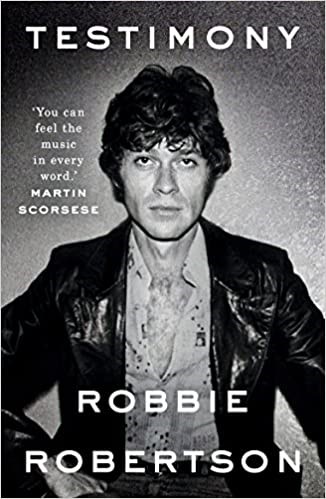
The song indeed is in Robbie’s name, and in his autobiography Testimony he devotes more than five hundred words to the genesis of the song. In doing so he insists that he wrote it all by himself. The opening words I pulled into Nazareth, for example:

“Upstairs in the workroom across from my bedroom on Larsen Lane, I sat with a little typewriter, a pen and legal pad, and a Martin D-28 guitar that said NAZARETH, PENNSYLVANIA on the label inside the sound hole. I revisited memories and characters from my southern exposure and put them into a Luis Buñuel surreal setting. One of the themes that really stuck with me from Buñuel’s films, like Viridiana, was the impossibility of sainthood—no good deed goes unpunished. I wrote “The Weight” in one sitting that night.”

A little further on he emphasises that “The Weight” is “something I had been working up to for years”, he claims that an impressed producer John Simon confides to him that he’s fascinated by the lyrics, that the guys from the band “reacted very strongly to the song,” and that a speechless Dylan wants to know who wrote that “fantastic song”. “Me,” I answered.

It’s an annoying element in Robertson’s memoirs: the blowing on his own horn. Virtually always through a transparent, quasi-modest detour; Robertson lets interlocutors burst out in hymns, jubilation cantatas and exalted tributes. If you believe him, Robbie spends large parts of his life making his way through crowds of devout Robertson fans like John Simon, Eric Clapton, Bob Dylan, Albert Grossman, Elton John and Van Morrison, who are alternately stunned, furiously patting Robbie’s back, delighted, confessing to be inspired by him and breathlessly admiring him.

It’s a bit sad and moreover unnecessary; Robertson has toured the world with Dylan, is a great guitarist, has timeless songs like “The Night They Drove Old Dixie Down”, “Davy’s On The Road Again” and “Somewhere Down The Crazy River” to his name, the world’s top directors ask him to make the film music (Raging Bull, The Color Of Money, Any Given Sunday, and many more), he wins awards and scores hits – the well-deserved recognition and appreciation is there.

And maybe he wrote “The Weight” all by himself, who knows. But especially Levon Helm has reservations:

“The main thing was the spirit. We worked so hard on that music that no matter what the song credits say—who supposedly wrote what—you’d have to call it a full-bore effort by the group to show what we were all about.”

And in interviews he sharpens that further, claiming that the lyrics might be about sixty percent Robbie’s, the rest is written by Danko and Manuel and a bit by himself, and that the music should be for a large part on Garth Hudson’s account.

Oddly enough, no one mentions Dylan’s influence. That’s also noticeable in the otherwise captivating episode “The Band” in the series Classic Albums (1997), a very successful television documentary series that highlights the ins and outs of classic rock albums for an hour. Actually, this episode focuses on the “brown album“, The Band from 1969, but in fact it has become a kind of mini documentary about the first two albums and the Big Pink-experience at all. Here too, the name Dylan barely stands out, and not at all in relation to the songs the men from The Band write there in that big pink house.

The peculiar Garth Hudson, who does speak out about Dylan’s influence in 2012, is hardly present in this documentary. The documentary makers do try it, up to two times even, but Hudson continues to play jazzy chords and funky riffs half in a trance deep over his keys. Garth talks with music.

Recognition of the influence of Dylan’s songs is at most indirectly spoken, by Levon Helm, not coincidentally in response to the success of “The Weight”:

“Of course, the Dylan connection helped. The funny thing was, when Capitol sent out a blank-label acetate of Big Pink to press and radio people, everyone assumed ‘The Weight’ was the Dylan song on the album. The Band fooled everyone except themselves.”

Levon finds it funny that everyone thinks “The Weight” was written by Dylan, but of course it’s rather obvious. The opening lines are a copy of the opening lines of “Lo And Behold!”, the song features Basement-like supporting characters like Old Luke and Crazy Chester, and in idiom and less tangible features like colour and atmosphere, songs like “Tiny Montgomery”, “Million Dollar Bash” and “Don’t Ya Tell Henry” resonate.

This is true for most of the songs of Music From The Big Pink; lines to the Dylan songs and the covers the men have heard, played and recorded over the past few months are easy to find. In the beautiful “To Kingdom Come” for example, in a quatrain like

Don't you say a word
Or reveal a thing you've learned
Time will tell you well
If you truly, truly fell

…in which pieces of “Frankie Lee And Judas Priest”, “I Don’t Hurt Anymore” and “Odds And Ends” resonate. Or the boisterous rhyme, alliteration and rhythm fun of “Caledonia Mission”:

She reads the leaves and she leads the life
That she learned so well from the old wives
It's so strange to arrange it, you know I wouldn't change it
But hear me if you're near me, can I just rearrange it?

…which Robertson would never have written if he hadn’t heard “To Ramona” dozens of times, if he hadn’t experienced twenty takes of “Fourth Time Around” or hadn’t witnessed how Dylan dashes off “Yea! Heavy And A Bottle Of Bread”.

“Yazoo Street Scandal” is a “Tombstone Blues” 2.0, and just as Dylanesque sounds “Chest Fever”:

I know she's a tracker, any scarlet would back her
They say she's a chooser, but I just can't refuse her
She was just there, but then she can't be here no more
And as my mind unweaves, I feel the freeze down in my knees
But just before she leaves, she receives

 …an eloquent rhyming, rhythmic barrage à la “Subterranean Homesick Blues”.

In 2000 Capitol Records releases the remastered versions of the first four albums (Music From The Big Pink, The Band, Stage Fright and Cahoots). Band biographer Barney Hoskyns writes extensive, rich and loving liner notes for all four albums, but these are rejected by Capitol and/or Robbie Robertson and Canadian music professor Rob Bowman is recruited to write new ones.

Hoskyns publishes his rejected liner notes on Rock’s Backpages and opens the door to the slightly paranoid suspicion that Robertson has dismissed those lyrics because Dylan is too prominent in them; alone in the liner notes to the first record, Music From The Big Pink, the name “Dylan” is mentioned eighteen times and his impact is fully acknowledged and articulated.

Rick Danko says they wouldn’t have been more than a pub band if Dylan hadn’t given them the freedom to develop and that those “one hundred and fifty songs we recorded in about seven, eight months led us to start getting our writing chops together – we started learning how to write songs.”

Robertson is quoted as saying it was on Dylan’s insistence that The Band started recording at all:

“There was nothing that we had to do, no obligations. But Bob had been wanting us to record for a long time, and our fun was beginning to run out. We needed to take care of business a little.”

Hoskyns further argues that the unfashionable, traditional, rootsy arranging and production technique is a result of Dylan’s John Wesley Harding and calls Robertson’s song “To Kingdom Come” (admiring) Dylanesque.

It all doesn’t detract from the beauty of both albums, from Music From The Big Pink and The Band, obviously. The men are widely recognized as the founders of the successful music movement Americana, still winning new fans half a century later and in 2018 the anniversary release, the 50th Anniversary Edition, the “CD Super Deluxe Box” with six outtakes and alternative versions, is once again a success.

But downplaying, covering up, ignoring Dylan’s influence, “our fearless leader” (according to Robertson), remains a bit peculiar.

https://youtu.be/ZiE0fHX-HFc

Jochen is a regular reviewer of Dylan’s work on Untold. His books are available via Amazon both in paperback and on Kindle:

Untold Dylan: who we are what we do

Untold Dylan is written by people who want to write for Untold Dylan.  It is simply a forum for those interested in the work of the most famous, influential and recognised popular musician and poet of our era, to read about, listen to and express their thoughts on, his lyrics and music.

We welcome articles, contributions and ideas from all our readers.  Sadly no one gets paid, but if you are published here, your work will be read by a fairly large number of people across the world, ranging from fans to academics.  If you have an idea, or a finished piece send it as a Word file to Tony@schools.co.uk with a note saying that it is for publication on Untold Dylan.

We also have a very lively discussion group “Untold Dylan” on Facebook with around 8000 active members. Just type the phrase “Untold Dylan” in, on your Facebook page or follow this link    And because we don’t do political debates on our Facebook group there is a separate group for debating Bob Dylan’s politics – Icicles Hanging Down


Posted in Uncategorized | 7 Comments

All directions at once: Part 4. The explosion (1962).

So far in this series

By Tony Attwood

As you can see above, the previous episode of this series was called “The prelude to the explosion”.

The point of that title was simple this: from 1959 to 1961 Bob Dylan wrote 14 songs.  Their subject matter consisted of…

  • Blues: 2
  • Love: 1
  • Humour / talking blues / satire: 7
  • Travelling on: 1
  • Social issues: 2
  • Celebration of one place: 1

There is some variation there, and as a newcomer to the art, writing 14 songs across the three years is a very decent output indeed.

But then in 1962, Bob Dylan settled down to writing seriously.  In fact having written 14 songs across three years he now wrote 36 songs of which we have copies (and probably more that have been lost) in one year.  It was a huge step forward.  But more than that he wrote them on a wide variety of topics, some of which he had never touched before.

And the songs included some utter masterpieces, two or three of which most people who listen to music today will probably know, and which anyone who confesses to like Dylan’s music will most certainly know.  Songs written some 58 years ago (if you are reading this in the year I wrote it – 2020) and yet songs of which millions can still quote the lyrics, unprompted

Three of the first four songs of 1962 were blues, Ballad for a friend, Poor Boy Blues, and Standing on the highway, and one of those three – the very first song of the year – turned out to be a sublime masterpiece and a great curiosity.  A curiosity because nothing in the earlier years of writing seems to have prepared either Dylan as the writer or those of us in the audience, for it, and yet it takes Dylan to new ground.  And also a curiosity because it remains unknown save by those who know every piece Dylan has composed.

If you are not familiar with the song and that video above has vanished by the time you get here, it is available on Spotify (no subscription is required) and I would urge you to listen – indeed even if you know it and haven’t played it for a while I would urge you to listen.

Despite the fact that the song has been highlighted on this blog since our earliest days, no one seems to have picked up on it, the covers are very basic affairs by amateur musicians and have little to recommend them, and despite years of searching I still can’t find an antecedent to the song.  That doesn’t mean there isn’t one, but it is interesting that no one else seems to have found one either.

Dylan was 21 when he recorded “Ballad”, and even after all these years of playing the song over and over I find it by itself an extraordinary achievement in both composition and performance.  Taking into account the composer’s age, it’s unimaginable. When talking at the end of the piece (to explain away a mistake) he sounds like a nervous uncertain 15 year old.  Musically he has reached absolute maturity, and thus perhaps it is no surprise that just a few months later he came up with a billion dollar hit.

What Dylan does in “Ballad” is throw away all the conventions of the blues, apart from the fact it deals with sadness.  The song itself doesn’t actually sound sad, but that works because Dylan is not raging against the world; he is just desolate, reporting what has happened, removed from the reality.  When I first wrote about this song I described him as “Numb, desolate, far too distraught to cry,” so “he just tells the story. There is no dressing up of the reality, no repeats, no chorus.  It just was.  It just is.”  That still feels right to me.

The language is old-time blues, and this is perhaps why Dylan doesn’t revisit the song, lyrically it is not the Dylan that we got to know during the rest of this year, so it remains a sketch, a one-off, an oddity…

Sad I’m sittin’ on the railroad track,
Watchin’ that old smokestack.
Train is a-leavin’ but it won’t be back.

Now over the years we have become used to Dylan, the singer songwriter who can cover all subjects, but at the start of 1962 when Dylan’s talent exploded across different topics in his songs, he opened cautiously.

The first four songs of the year primarily concern the blues and the traditional blues themes of death and moving on.

Then suddenly Bob changed course and after four blues songs we had four songs of social commentary: Talkin’ John Birch Society Blues, Death of Emmett Till, The Ballad of Donald White, and Let me die in my footsteps. Bob in four songs was taking on right wing politics, bigotry and social injustice.

“Let me die” is a remarkable song about the situation in the USA at the end of the 1950s when as a response to the Cold War people were buying or building their own fallout shelters to protect them in case of nuclear war.

Again this is an incredibly assured piece of writing.  Dylan himself said in Chronicles he took the melody from a Roy Acuff ballad – although the first Bootleg album says that it is Bob’s first original melody.  I think the point is that it sounds like it ought to be a Roy Acuff ballad, but the fact that not many (if any) people have identified which ballad suggests that one might better say the song is in the style of Roy Acuff.

In all, there we were, eight songs written in quick succession at the start of the year, following some standard themes – but containing two stunning (if now somewhat forgotten) masterpieces in “Let me Die” and “Ballad for a friend”.   But what strikes me about both these songs is their assured quality of writing and delivery.  There is nothing hesitant in the composition of either of the lyrics or the music – these are well-rounded songs that make sense and have an impact at every level.  And Dylan wrote them after just a couple of years of songwriting in which he explored a few themes across 14 interesting, but not outstanding songs.

These two songs (“Let me Die”, and “Ballad,”) written in the early part of 1962 show an assured writer, confident, in command of both his musical and literary worlds.  And the fact that these two great songs are so different in style and language suggests very strongly that there is much more to come.  And so it turned out to be.

I have the feeling that after writing “Let me Die” and “Ballad for a friend” Bob Dylan absolutely knew that he could “do it” whatever “it” might happen to be.  He didn’t have to write another blues, or another song protesting about the current state of America.  He could do something totally different.  Or not, as the case might be.

And so he wrote “Blowing in the Wind”.

Dylan himself has said that the melody came from “No more auction block” and one can certainly hear that…

… but that is simply the start of the journey of Blowing in the wind 

Dylan also said in an interview early on that, “Too many of these hip people are telling me where the answer is but oh I won’t believe that.”   And certainly there is no answer in “Blowing in the Wind”, other than the fact that there might be an answer out there somewhere.

In my earlier series which gave a very short summary as to the subject matter of each Dylan song, for “Blowing in the Wind” I chose “It’s not the world, it’s the way you see the world” – and now some years later, that still seems fair enough.   In short, you choose the answer – it’s out there, just take your choice.  I’m not going to tell you how to see the world.

Now that seems at one level an incredibly simple a vision, but it is equally incredibly complicated.  We live in a world in which people tell others what to do, what to believe and how to behave.  From parents to school teachers to politicians to religious leaders, from people on Facebook to, well, everyone, people seem to want to tell everyone else not just how to behave, but how to see the world, what’s right and what’s wrong.   Everyone seems to want to have a say.  Everyone not only has an opinion, everyone wants to have their opinion noticed.

But go further and we realise it is the decision making which decides what is to be debated, that can be more important than the outcome of the debate – and that particular approach to questioning what the question is, did not arise until much later in popular music.

And yet it is here in this song.  So we must ask, if we really want to get inside the music of Bob Dylan, how did Bob come to write this utter gem early in 1962 after just a couple of years sketching out songs with varying success in a variety of forms?

We certainly can’t say he was working his way up to it.  If we take the songs that lead up to Blowing in the Wind we find

“Let me die” we have mentioned, but if you are not aware of “Donald White” then you will most certainly be in the majority.  It’s a song that was quickly put away by Bob and not returned to after he had given it two outings, once in September and once in October 1962.  You may not want to play the whole piece, but just a few moments give us an insight.

I am not suggesting that this is not a worthy piece, but rather saying that it is a worthy attempt which does not stand any comparison with “Blowing in the Wind.”

So how could Bob write something of perhaps moderate interest to Dylanologists but not many other, as with “Donald White”, then compose the powerful protest song but still ephemeral “Let me die,” before composing a song that is still performed constantly today “Blowing in the Wind”.

Certainly the title itself is of interest.  The use of “wind” to suggest change or randomness or chance goes back a long way.  The word “windblown” dates from the 16th century, and turned up in the phrase “blown by the wind” which in the present tense became “blowing in the wind.”  And when transferred to everyday language “blowing in the wind” comes to embody the meaning of being “out there” but hard to grasp or hard to define.  But it certainly is “out there” and that is the important thing.  It is there if you look hard enough.

It is not quite the reverse of the belief of our ancestors (at least my ancestors, being English).  For in the dark ages those who lived where I now sit would have said “Wyrd bið ful āræd.”   Fate is inexorable.  But no, Dylan will have none of fate.  Yes there is chance implied in “Blowing in the Wind” but also the notion that we can all go out and create our futures.  It is there for us to choose, to do with as we please.  We are no longer ruled by the gods.  The future is out there, go make it.

I think “Blowing in the wind” is still popular not just because of the universal appeal of its core message, and because of its inherent ambiguity, but also because it does imply both this hope and this freedom to make of life what we can.  Whatever “it” is, it is still out there being blown around waiting for us to get hold of it.   “Blowing in” also suggests that randomness and chance is very much part of everyday life today, rather than something that has occurred in the past or something that is laid down at our birth.  It gives it a sense of “now” and possibility which of course was how the song came to be a favourite of the civil rights movement.  “They” might be planning for wars and telling us to build air raid shelters, but we can make another life.

Thus the song has that feeling of multiple interpretations.  There is no fixed answer any more, which moves us onto dangerous ground, because if there are no fixed answers then there is no right or wrong.  Which in turn is an interesting contradiction from Bob’s alternative mode of writing at the time, as with the four songs that Dylan wrote immediately before “Blowing in the Wind” which took a very different stance

These songs all take a stand and a position which is on the civil rights side of American politics.  But now with “Blowing” we are being told the answer is out there, which is reassuring to some degree, but not quite as reassuring as having someone telling us what that answer actually is.

So did Bob change his mind after writing those for songs?   I personally very much doubt it.  For here was a man who could write songs at the drop of a hat (as we have noted he wrote 36 songs this year that survived in a recorded form, and goodness knows how many more that were written an abandoned).

Listening to each of these songs in turn it seems to me that Bob deals in ideas, lyrical phrases and musical phrases.  Put the three together and (obviously) you get a song.  I suspect the phrase “Blowing in the Wind” came to him, a musical phrase came to him, and then suddenly he had, “The answer is blowing in the wind”.  Add four chords, a melody forms above, and there we are.

This is not to denigrate Bob’s song writing or the fact that “Blowing in the Wind” is a magnificent work – it wouldn’t have lasted this long had it not been.  But rather, put the phrase in front of the master songwriter in the making, and off you go.  It was probably the same with Irving Berlin, the only American songwriter who can be compared to Dylan.  I suspect that when the phrase “Alexander’s Ragtime Band” occurred to him, the rest probably just fell into place.  What rhymes with “band”?  “Hand”.  “Sand.”  “Land”… right let’s get writing.

Come on and hear, come on and hear, Alexander's ragtime band
Come on and hear, come on and hear, it's the best band in the land

But to return to Dylan’s song, and again to travel in a slightly odd direction, although everyone associates “Blowin’ in the Wind” with Peter Paul and Mary the first cover version of the song was recorded by the Chad Mitchell Trio (pictured at the start of this article), but it is said that their record company would not release the song as it included the word “death” which was against company policy!  How to throw away a lifetime of fame.

And so the version we remember came from Peter, Paul and Mary.  It sold over a million copies, and Bob Dylan made his first serious money as a songwriter.  It is said that he was (to put it mildly) rather surprised when he got the first cheque.

Now, it would be easy to stop at this point and move on to the next song Dylan wrote, but there is another issue I feel the need to raise here – and that is to consider the element of chance.

Self-evidently, no one planned this string of events.  Dylan was writing and having written he moved on, and in passing he happened to write one of the classics of the 20th century.

Indeed we can tell that because the next song Bob added to his repertoire was not another song of his own, but rather “Corina Corina” which the record company and his official web site later insisted on noting as WRITTEN BY: BOB DYLAN (ARR).  If you have been around this site for a while you’ll be yawning here knowing that I am about to start shouting “What does that mean?????”  He either wrote it or he arranged the work of another composer.  Not both.

It is in fact a simple 12 bar country blues first recorded by Bo Carter in 1928 and copyrighted by Mr Carter four years later.

So Bob did not follow up “Blowing in the wind” with a series of similar or related songs.  Instead he worked on

And seeing that list one might well wonder what happened to the writer of “Blowing in the wind”.  Certainly there is no follow up.  Three lost love songs, followed by a song telling the lady to stop misbehaving and do the right thing, followed by a little exploration of absolute desire.  Because of it being recorded so many times, many of us would have known “Corrina Corrina” anyway.  “Honey” might be remembered because it was on Freewheelin’ but the others…

Bob Dylan, having written an absolute masterpiece, was once again, travelling in all directions at once.  And he still had 22 more songs to write before his third year of composing, and his first serious year of songwriting, came to an end.  What on earth could he come up with next?


Untold Dylan: who we are what we do

Untold Dylan is written by people who want to write for Untold Dylan.  It is simply a forum for those interested in the work of the most famous, influential and recognised popular musician and poet of our era, to read about, listen to and express their thoughts on, his lyrics and music.

We welcome articles, contributions and ideas from all our readers.  Sadly no one gets paid, but if you are published here, your work will be read by a fairly large number of people across the world, ranging from fans to academics.  If you have an idea, or a finished piece send it as a Word file to Tony@schools.co.uk with a note saying that it is for publication on Untold Dylan.

We also have a very lively discussion group “Untold Dylan” on Facebook with around 8000 active members. Just type the phrase “Untold Dylan” in, on your Facebook page or follow this link    And because we don’t do political debates on our Facebook group there is a separate group for debating Bob Dylan’s politics – Icicles Hanging Down
Posted in Uncategorized | Leave a comment

Bob’s live rarities, from a bottle of bread to mountains of Mourne (and rock n roll)

By Aaron Galbraith and Tony Attwood

Bob performed Yea Heavy and a Bottle of Bread live twice. First in 2002 at Madison Square Garden, where it appeared as the second song in the set. Right at the end he says, “that was a request”.  I believe it was from someone he was talking to backstage just before they went on!

https://www.youtube.com/watch?v=uI1kt4xUOyk

Clearly though there has been some rehearsal as the guys in the band know when and how to come in with the vocal accompaniment.  I called it “abstract weird” when reviewing the song   But if you really want an in depth analysis of what is going on here, Jochen’s review takes us through every highway and byway that could have anything to do with the song.  His conclusion was that “Although similar in structure, melodic charm, catchiness and humbug, “Yea! Heavy And A Bottle Of Bread” never reaches a status like “Quinn The Eskimo”, “You Ain’t Going Nowhere” or “Million Dollar Bash”.”   But he still finds some fascinating covers of the song.

Bob performed it once more in London in 2003.

https://www.youtube.com/watch?v=h-bjl6QHqpc

Performing off the cuff like that (if that is what he was doing, and I am not convinced) is not too hard musically as it is a simple musical piece, but the fact is that he can remember all the lyrics – that is an extraordinary feat of memory, and gives quite an insight into the way his brain works.

Now the Mountains of Mourne – all fifty seconds of it.

https://youtu.be/Ogd_3MpKFqo

It was played at the Scottish Exhibition and Conference Centre, Glasgow, February 3, 1991 – a fact that explains why the audience was so enthusiastic about the performance.

The song opened the performance before Dylan went into Subterranean Homesick Blues!  The piece was written by 19th century songwriter William Percy French, who is also known as a watercolour artist.

And now for something completely different.   “Shake Rattle and Roll”

This came from the Leyendas de la Guitarra concert on October 17, 1991.

It is a classic 12 bar blues, and was written in 1954 by Jesse Stone (known as Charles E Calhoun for reasons that will not become clear at this point), and recorded by Big Joe Turner.   That version was a hit, but it became an even bigger hit for Bill Haley and His Comets – one of a long series of hits the band had.


Posted in Uncategorized | 2 Comments

Viewing “Lonesome Day Blues” with “20/20 Vision”

by John Radosta

When Dylan started singing the song that followed “It’s All Over Now, Baby Blue” at the City Coliseum in Austin, Texas, fans might have been forgiven for thinking that they were listening to an acoustic version of “Lonesome Day Blues.” It had the same vocal rhythms, the same rhyme scheme. The two long lines to start each verse, both with that characteristic pause, before getting resolved in the second half of the verse. It was all the same. But the lyrics would have confounded them. There was that one line, “Since she’s gone and left me” but it didn’t seem to fit in to the rest of the stanza.

Except they couldn’t have confused it for “Lonesome Day Blues,” because the date of that show was October 25, 1991, almost exactly a decade earlier than the release of “Love and Theft.”

As Tony Atwood noted on this site in July, Dylan was singing a Gene Autry tune for the first, and perhaps only, time ever, called “20/20 Vision.” Dylan’s arrangement and phrasing bear no resemblance to Autry’s recording, though “Walls of Red Wing” and some of his late ’60s country songs, like “I Threw it All Away” and “Waltzing With Sin” (on the Basement Tapes Complete collection) have recognizable echoes. Instead, he’s taken a composition stored in that vast warehouse of his mind, and transformed it entirely.

Here’s Dylan’s version:

https://www.youtube.com/watch?v=Jr28R_yicb0

And here’s Gene Autry’s:

After taking it for a spin, Dylan put it back on the shelf, but clearly never forgot it. In keeping with the blues tradition of recycling elements such as riffs, rhythms, and rhymes, when Dylan came to record tracks for “Love and Theft,” his one-off performance was still rattling around in his brain.

“Lonesome Day Blues” incorporates all of these particles. As I mentioned above, only a single phrase, “gone and left me” connects this song with Autry’s. Instead, Dylan used the structure to combine any number of other bits of literature—it’s this song that famously includes lines from Junichi Saga’s Confessions of a Yakuza, Virgil’s Aeneid, Twain’s Huckleberry Finn, and others. Gene Autry, the Singing Cowboy, provides a rack on which to hang many hats.

Here’s Dylan singing “Lonesome Day Blues” at Madison Square Garden, just a few weeks after its infamous release on 9/11:


This isn’t the only time Dylan has stored away a tune for use many years on (I’m putting aside completed songs that got repurposed, such as when “Phantom Engineer” became “It Takes a Lot To Laugh, It Takes a Train to Cry” or “Danville Girl” formed an early draft of “Brownsville Girl,” or “Dreaming of You” donated lines to “Standing in the Doorway”).

On The Cutting Edge, the collection of tracks from his epic mid-60s trilogy, Dylan sings the fragment “Lunatic Princess.” It was recorded in January of 1967, during the Blonde on Blonde sessions. The frantic lyrics are tossed off vitriol of a lesser vintage of “Positively 4th Street.” But Al Cooper’s driving organ riff is extremely familiar: it forms the backbone of “Dead Man, Dead Man,” recorded in the spring of 1981 for Shot of Love.

Here’s a side by side comparison:  first Lunatic Princess.

If you are not able to play that video try here.

and now “Dead Man, Dead Man” in London, 1981:

Again if you can’t play that one try this


It’s a cinch that there are hundreds of tunes swirling through the mind of Dylan; his encyclopedic knowledge of American music across two centuries or more, demonstrated in his one-offs, and snippets of lyrics scattered across his catalogue, prove it. It’s why we keep listening, storing away the bits for future illumination and fascinating connections.

Untold Dylan: who we are what we do

Untold Dylan is written by people who want to write for Untold Dylan.  It is simply a forum for those interested in the work of the most famous, influential and recognised popular musician and poet of our era, to read about, listen to and express their thoughts on, his lyrics and music.

We welcome articles, contributions and ideas from all our readers.  Sadly no one gets paid, but if you are published here, your work will be read by a fairly large number of people across the world, ranging from fans to academics.  If you have an idea, or a finished piece send it as a Word file to Tony@schools.co.uk with a note saying that it is for publication on Untold Dylan.

We also have a very lively discussion group “Untold Dylan” on Facebook with around 8000 active members. Just type the phrase “Untold Dylan” in, on your Facebook page or follow this link    And because we don’t do political debates on our Facebook group there is a separate group for debating Bob Dylan’s politics – Icicles Hanging Down

Posted in Uncategorized | 4 Comments

Dylan pulling The Band into Nazareth: 1 – Lessons from the master craftsman


by Jochen Markhorst


At the beginning of December ’67 it starts to itch, with The Band (which doesn’t have a name at that time – but in the village, in Woodstock, the boys are always called the band). Dylan has been away three times in the past six weeks. To Nashville, to record John Wesley Harding in three shifts. In the meantime, the men, now with Levon Helm, have merrily continued playing. Levon remembers:

“When I reported for duty in the basement the day after I arrived in Woodstock, they were working on “Yazoo Street Scandal.” Richard was playing drums. (…) I was uptight about playing, because I’d been away from it for so long, but soon they had me working so hard, there wasn’t anything else to do. Richard was writing and singing up a storm. We cut his “Orange Juice Blues” (also called “Blues for Breakfast”), with Garth playing some honky-tonk tenor sax. Richard sang and co-wrote (with Robbie) “Katie’s Been Gone,” and Garth overlayed some organ. Rick and Robbie did a great song called “Bessie Smith.”

(This Wheel’s On Fire, Levon Helm, 1993)

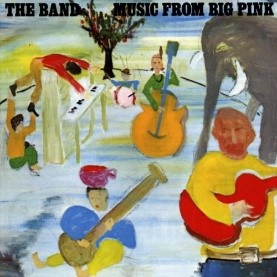
Robbie Robertson expresses the creative explosion in a similar way. They decline Dylan’s offer to play on the album, but are happy to accept his painting for the cover (which includes the elephant, five musicians and a sixth character supporting the pianist), and it’s also pretty clear that they want the Dylan song “I Shall Be Released” and both co-productions “Tears of Rage” and “This Wheel’s on Fire” on the album, despite the abundance of their own songs to choose from:

“Rick felt quite strongly about “Caledonia Mission” and wanted to give that a go. We all agreed. I definitely thought “Yazoo Street Scandal” was right up Levon’s alley. (…) I wrote “The Weight,” which was also becoming a contender. “Chest Fever” too, with its crazy “basement” words, and Garth’s new “Toccata and Fugue in D Minor” intro, borrowed from Bach. We had to choose between “Lonesome Suzie” and “Katie’s Been Gone.” Both had Richard’s sympathetic sentiments. I liked that “Katie’s Been Gone” had no intro and that Rick’s harmony in the ending had a touch of Pet Sounds influence, but “Lonesome Suzie” was so moving. I suggested we let John Simon decide.”

And Richard Manuel’s anecdote about the genesis of “Tears Of Rage” illustrates with what ease and how quickly, off the cuff, all those beautiful songs from the masterpiece Music From The Big Pink came into being:

“He came down to the basement with a piece of typewritten paper … and it was typed out … in line form … and he just said “Have you got any music for this?” I had a couple of musical movements that fit, that seemed to fit, so I just elaborated a little bit, because I wasn’t sure what the lyrics meant. I couldn’t run upstairs and say, “What’s this mean, Bob?” “Now the heart is filled with gold, as if it was a purse.”

(Conversations with the Band, The Woodstock Times, 1985)

… virtually the same lightning process as that other masterful co-production from the Basement, in “This Wheel’s On Fire”, about which Rick Danko says in the same interview series in The Woodstock Times:

“We put together about 150 songs at Big Pink. We would come together every day and work and Dylan would come over. He gave me the typewritten lyrics to “Wheels on Fire.” At that time, I was teaching myself to play the piano. Some music I had written on the piano the day before just seemed to fit with Dylan’s lyrics. I worked on the phrasing and the melody. Then Dylan and I wrote the chorus together.”

Technically, we owe the Basement Tapes to Garth Hudson, who has been conscientious from day one about recording and archiving those around 150 songs.

He’s the best musician in The Band, and also the taciturn one. At least, he rarely gives interviews, and in those few interviews he gives, he doesn’t let himself be tempted to look back too deeply into the past – Garth talks with music, period. He thinks “Yazoo Street Scandal” is one of the best songs Robbie Robertson has written, and in he admires his skilfulness “with the legal pad and pencil”.

And in the same interview with Mark T. Gould for Sound Waves Magazine, November 2001, he mentions Dylan’s influence, but on a surprising level:

“He gave me the greatest lessons I ever learned about how to work in a studio. He would go in with us, play a new song only partway through, we wouldn’t much rehearse or much less play it all the way through to learn it, and he’d turn on the tape, and we’d get it down in a first or a second take.”

But then it’s 2012. Hudson helps a Canadian friend, the archivist and producer Jan Haust, who is already preparing for The Basement Tapes Complete, listens to all those tapes, selects what has survived and can still be listened to in terms of sound quality, and Garth is willing to reminisce a little more about that special summer of 1967 – for the first time in forty-five years. Mumbling, hesitating and not always coherent he does his story for the documentary Down In The Flood by Prism Films. In it he is the only band member who clearly, in so many words, recognizes Dylan as the architect of The Band, calls him a master craftsman and an educator, a teacher, and tells:

“He would sit at the coffee table, on an old Olivetti I think it was, and type out a song and we’d go downstairs, in the basement, and record it. And we watched this happen. He worked also with Richard and Rick on lyrics. I think he saw that we were all songwriters to some extent and he would show us a talent that… he was sure of what he could do, and I don’t know how many songwriters do this, but he would make a song up on the spot. Very quickly.”

And the men are good students. All the songs of Music From The Big Pink and part of the successor The Band (“The Brown Album“) are written in Woodstock – two undisputed pop monuments.

The prize song for Music From The Big Pink is “The Weight”. That is a great song, which understandably has a position on the various lists of “Hundred Best Songs All Time”, “Most Beautiful Songs From The Twentieth Century” or whatever those senseless and always fun elections are called.

But it’s one of the nails on The Band’s coffin as well. Halfway through the 70’s, a separation arises between especially Robbie Robertson and the rest of The Band, and that has a lot to do with dissatisfaction – the dissatisfaction that Robbie puts a bit too generous royalties on his own name, copyrights on songs to which the other band members feel to have contributed as well. “The Weight” is an example thereof.

To be continued. Next up: Part II – Our fearless leader

Jochen is a regular reviewer of Dylan’s work on Untold. His books are available via Amazon both in paperback and on Kindle:

Untold Dylan: who we are what we do

Untold Dylan is written by people who want to write for Untold Dylan.  It is simply a forum for those interested in the work of the most famous, influential and recognised popular musician and poet of our era, to read about, listen to and express their thoughts on, his lyrics and music.

We welcome articles, contributions and ideas from all our readers.  Sadly no one gets paid, but if you are published here, your work will be read by a fairly large number of people across the world, ranging from fans to academics.  If you have an idea, or a finished piece send it as a Word file to Tony@schools.co.uk with a note saying that it is for publication on Untold Dylan.

We also have a very lively discussion group “Untold Dylan” on Facebook with around 8000 active members. Just type the phrase “Untold Dylan” in, on your Facebook page or follow this link    And because we don’t do political debates on our Facebook group there is a separate group for debating Bob Dylan’s politics – Icicles Hanging Down
 

Posted in Uncategorized | Leave a comment

Bob the sideman: playing with friends in the 80s

By Aaron Galbraith and Tony Attwood

Aaron: Bob was pretty busy as a sideman in the 80s and beyond but we have already covered several of these in other articles in the past.

Bob’s session work for Stevie Nicks, Lone Justice, Carlene Carter and Nanci Griffith are discussed here.

Other sessions for Tom Petty (Jammin’ Me), U2 (Love Rescue Me), Kurtis Blow (Street Rock), Gerry Goffin (Tragedy Of The Trade & Time To End This Masquerade), Ronnie Wood (King Of Kings) and Mudbone (Home) have been discussed on their respective articles for each song.

One thing you’ll notice about all these mentioned above is that Bob is the writer or co-writer on each piece.

So, this piece will concentrate on the remainder of his session work from these decades where he was not the writer of the song. The first three in this list really show where Bob’s head was at during the early 80s. They are all over the place!

First up, Bob plays harmonica on the Keith Green track “Pledge My Head To Heaven”. This appears on his 1980 album So You Wanna Go Back To Egypt.

Now to be honest, the music is ok, but I absolutely HATE the lyrics! Although in Green’s favour this was the album were he adopted the “pay what you want” policy for albums and concerts – so you could get it for free if you wanted. Bob was good friends with him at this time and maybe he shared similar views, such as this horrendous little nugget:

Well I pledge my wife to heaven, for the Gospel,
Though our love each passing day just seems to grow.
As I told her when we wed, I'd surely rather be found dead,
Than to love her more than the one who saved my soul.

Green was killed in a plane crash in 1982.

Tony: Just to explain a little further, 1979 was the one and only year in which Dylan wrote a collection of songs, every single one was on the same subject.  Where he normally meandered from blues to love to lost love to moving on etc etc, in this one and only year every single song was on the subject of his religious faith.  From Gotta Serve Somebody, via When you gonna wake up and When He Returns onto What can I do for you? and See by faith

Aaron: For the second piece I couldn’t find the version with Bob’s playing online anywhere. But here is a version of the track without Bob so you can get the idea. It’s The Cruzados with Rising Sun.

The alternative version has Bob on harmonica. Recorded in 1983 but not released until 2000, on the album “Cruzados – Unreleased Early Recordings”. It was also released as a bonus tracks on the Dylan tribute album “May Your Song Always Be Sung – Vol 3”. The Cruzados shared several members with The Plugz, who backed Dylan on the Letterman show performance in 1984.

Tony: Frustratingly although part of “Unreleased Early” is on Spotify this song is not included, so if you want to hear it the only way is to buy a copy of the single track from Amazon.

Aaron: Next up, in 1985 Bob played harmonica on Sly & Robbie’s track No Name On The Bullet.

Sly and Robbie had played on Infidels and Empire Burlesque so this is Bob repaying the favour.

The last few are more renowned artists so I’ll just rattle through these ones quickly.

Bob plays harmonica on the Warren Zevon track The Factory, from 1987.

Tony: Here is one I really like, as it sounds like Dylan and what he does fits exactly into the music and meaning of the song.  It’s not a great piece of music and the lyrics are pretty obvious, but at least it is a bit of fun rebellion.

Aaron: Bob plays organ on the U2 track “Hawkmoon 269” from the 1988 Rattle and Hum album, which also includes Love Rescue Me.


Tony: Quite a brave move to say to Bob, come and play the organ on our album, as you know he’s going to do something unusual.  But again it really works.  My kind of music – and Bob gets it just right listen to it around 3 minutes 25 seconds… you wouldn’t normally even notice the organ, but it plays its part in continuing the drive forward without it being repetitious.  Simple but very effective background.

Aaron: Last one for this article is Bob’s second contribution to Ronnie Wood’s 2001 album, “Not For Beginners”. He plays guitar on the track Interfere.

Tony: An interesting choice of track for Bob to be asked to play on.   And I wonder how they get Bob there on the right day.   Could it really be that Ronnie phones Bob and says, “Hey Bob you doing anything this afternoon?”

Aaron: Bob also contributed vocals (and appears in the videos) for the two charity singles by USA For Africa (We Are The World) and Artists United Against Apartheid ((Ain’t Gonna Play) Sun City).

Next time, we’ll move back to the 70s and take a look at some of Bob’s work with Doug Sahm.

Previously in this series…

Untold Dylan: who we are what we do

Untold Dylan is written by people who want to write for Untold Dylan.  It is simply a forum for those interested in the work of the most famous, influential and recognised popular musician and poet of our era, to read about, listen to and express their thoughts on, his lyrics and music.

We welcome articles, contributions and ideas from all our readers.  Sadly no one gets paid, but if you are published here, your work will be read by a fairly large number of people across the world, ranging from fans to academics.  If you have an idea, or a finished piece send it as a Word file to Tony@schools.co.uk with a note saying that it is for publication on Untold Dylan.

We also have a very lively discussion group “Untold Dylan” on Facebook with around 8000 active members. Just type the phrase “Untold Dylan” in, on your Facebook page or follow this link    And because we don’t do political debates on our Facebook group there is a separate group for debating Bob Dylan’s politics – Icicles Hanging Down

Posted in Uncategorized | 1 Comment

Bob Dylan And The Heart Of Darkness (Part III)

Previously in this series…

by Larry Fyffe

Mentioned previously be the following lyrics of a rather sardonic poem:

About suffering they were never wrong
The Old Masters: how well they understood
It's human position; how it takes place ....
In Brueghel's "Icarus", for instance: how everything turns away
Quite leisurely from the disaster.....
and the delicate expensive ship that must have seen
Something amazing, a boy falling out of the sky
Had somewhere to get to, and sailed calmly on
(WH Auden: Musee Des Beaux Arts)

That human nature places one’s own interest first and foremost is a theme expressed below in the lyrics of a popular satirical song:

He takes me deep-sea fishing in a submarine
We go to drive-in movies in a limousine
He's got a whirly-bird, and a twelve-foot yacht
(Dodie Stevens: Pink Shoe Laces ~ Grant)

All the gal gets out of the relationship is what she takes after her boyfriend dies – the stuff that Dooley wanted to be buried in:

He give me tan shoes with pink shoe laces
And a big Panama with a purple hat band
(Dodie Stevens: Pink Shoe Laces ~ Grant)

The consequences even worse in the following song – an East Indian island sinks beneath the waves:

I was sitting at home alone one night in L.A.
Watching old Cronkite on the seven o'clock news
It seems that there was a earthquake that
Left nothing but a Panama hat
And a pair of old Greek shoes
Didn't seem like much was happening
So I turned it off, and went to grab another beer
(Bob Dylan: Black Diamond Bay ~ Dylan/Levy)

“As the last ship sails, and the moon fades away”, nothing’s happening except, amidst other goings-on, there be gambling, a Greek hanging himself, a woman in a Panama hat preparing to leave a hotel, a volcano exploding, and an island sinking.

There’s a picture on the Dylan album cover of Joseph Conrad, author of “Victory, An Island Tale”, in which it is stated that ‘the slight indentation for a time was known officially as Black Diamond Bay’ (Part Four, chapter 5). Unlike the novel with tragedy lurking everywhere, the movie based on  Conrad’s book (that stars Jack Hart who wears a white Panama hat with a black band) has a happy ending, a victory, after the detached protagonist Heyst discovers that compassion has taken a hold of him; in both the book and the silent movie, the volcano does no more than threaten the island.

Not so in the song below:

The tiny man bit the soldier's ear
As the floor caved in, and the boiler in the basement blew
While she's out on the balcony, where a stranger tells her
"My darling, je vous aime beaucoup"
She sheds a tear, and says a prayer
As the fire burns on, and the smoke drifts away
From Black Diamond Bay
(Bob Dylan: Black Diamond Bay ~ Dylan/Levy)

WH Auden be influenced by Karl Marx and TS Eliot in content and style – two writers, caught between heaven and hell, whose differing views on alienation are not at all easy to reconcile:

Key West is the place to be
If you're looking for immortality
Key West is paradise divine
Key West is fine and fair
If you lost your mind, you'll find it there
Key West is on the horizon line
(Bob Dylan: Key West)

Seems everybody is stuck between dreams and reality:

When Ruthie says come see her
In her honky-tonk lagoon
Where I can watch her waltz for free
'Neath the Panamanian moon
And I say, "Aw, come on now
You know you know about my debutante"
And she says,"Your debutante just knows want you need
But I know what you want"
(Bob Dylan: Stuck Inside Of Mobile With The Memphis Blues Again)

Untold Dylan: who we are what we do

Untold Dylan is written by people who want to write for Untold Dylan.  It is simply a forum for those interested in the work of the most famous, influential and recognised popular musician and poet of our era, to read about, listen to and express their thoughts on, his lyrics and music.

We welcome articles, contributions and ideas from all our readers.  Sadly no one gets paid, but if you are published here, your work will be read by a fairly large number of people across the world, ranging from fans to academics.  If you have an idea, or a finished piece send it as a Word file to Tony@schools.co.uk with a note saying that it is for publication on Untold Dylan.

We also have a very lively discussion group “Untold Dylan” on Facebook with around 8000 active members. Just type the phrase “Untold Dylan” in, on your Facebook page or follow this link    And because we don’t do political debates on our Facebook group there is a separate group for debating Bob Dylan’s politics – Icicles Hanging Down

Posted in Uncategorized | 3 Comments

Three Scottish Songs, and their influence on Bob Dylan

By John Henry

“My Love is Like a Red Red Rose” is one of, if not the most iconic of Scottish songs. Written by Scotland’s national bard, Robert Burns, in 1794, it is a moving statement of the singer’s love for his beloved. It has been sung, if not recorded, by every Scottish singer worth his or her salt, and by many more besides; it has been a perennial favourite ever since it was written.

But, perhaps the most significant thing to be said about it in this context is that Bob Dylan once declared his own love for the song in no uncertain terms. In an advertising campaign launched by HMV under the title “My Inspiration”, Dylan was asked in 2008 to name the lyric that had had the most impact on his life. Dylan cited Burns’s “My Love is Like a Red Red Rose.”

Evidently, this became news and The Guardian newspaper shortly after included a piece under the headline: “Bob Dylan: Robert Burns is my biggest inspiration.” Guardian readers were told: “Dylan has revealed his greatest inspiration is Scotland’s favourite son, the Bard of Ayrshire, the 18th-century poet known to most as Rabbie Burns. Dylan selected A Red, Red Rose, written by Burns in 1794.”

The song is a declaration of undying love, and one of the most appealing, the most captivating, aspects of the lyric are those places where Burns/the singer illustrates the never-ending quality of his love by saying it will last “Till a’ the seas gang dry, my dear,/And the rocks melt wi’ the sun” (for those not familiar with Scots patois, “gang” here means “go”). He continues: “I will love thee still, my dear,/While the sands o’ life shall run.” In the final verse, the poet switches from vast expanses of time, to distance. Evidently, he must leave his true love for a while, but he assures her “And I will come again, my Love,/Tho’ it were ten thousand mile.”

This kind of imagery was picked up subsequently by the wonderful Scottish duo, The Proclaimers, in the second of our two Scottish songs, their wonderful 1988 release, “I’m Gonna Be (500 Miles).”  Much more down to earth than Burns’s romanticism, they stick to vast distances:

But I would walk 500 miles,
And I would walk 500 more,
Just to be the man who walks a thousand miles
To fall down at your door.

Their repetition of this refrain, and the fact that they incongruously squeeze 500 miles into the title,  would surely result in reminding any Scot of Burns’s “I will come again, my Love,/Tho’ it were ten thousand mile.”

But there are wonderful contrasts between the two songs. There is a melancholy about Burns’s song, an underlying sadness. It’s a song about the heartache of love, about its insecurities. The singer is trying to convince his love that he really loves her: “As fair thou art, my bonnie lass,/So deep in love am I.” But this makes us think that perhaps she doesn’t trust him, is not as sure of him as he wants her to be. There’s an air of desperation, maybe even neediness, in what the singer sings.

There is nothing sad about the Proclaimers’ song. Leonard Cohen insisted that love was not a victory march, but the Proclaimers know different. “I’m Gonna Be” is a triumphalist shout from the roof tops that the singer has won his girl and knows he’s going to be with her:

When I wake up, well I know I'm gonna be,
I'm gonna be the man who wakes up next to you.
When I go out, yeah I know I'm gonna be,
I'm gonna be the man who goes along with you.
If I get drunk, well I know I'm gonna be,
I'm gonna be the man who gets drunk next to you.

While Burns is romantic, the Proclaimers write of a relationship which is much more rooted in daily life:

When I'm working, yes I know I'm gonna be,
I'm gonna be the man who's working hard for you;
And when the money, comes in for the work I do,
I'll pass almost every penny on to you.
When I come home (when I come home), well I know I'm gonna be,
I'm gonna be the man who comes back home to you.

But even so, they sing of a love that will last, not until the rocks melt in the Sun, but as they grow old: “And if I grow-old (when I grow-old), well I know I’m gonna be,/I’m gonna be the man who’s growing old with you.”

“I’m Gonna Be (500 Miles)” is a great song in its own right, but it is also a tribute by its Scottish authors to the great Scottish song, “My Love is Like a Red Red Rose.” For all the differences in tone—from love’s insecurity and heartache on the one hand, to the overwhelming confidence that comes from finding love on the other—the songs are clearly related. In both songs, the lover demonstrates his love by his willingness to cover impossible distances to return to the beloved: ten thousand miles, or one thousand.

Dylan’s “Make You Feel My Love” of 1997, is his own tribute to the song that we know means so much to him. It’s partly for that reason, that I want to include it here as a third Scottish song. Clearly, I’m stretching the point, but let’s not forget that the album in which this song appears has Scottish features. There’s “Highlands,” for a start:

Well my heart’s in the Highlands wherever I roam;
That’s where I’ll be when I get called home.
The wind, it whispers to the buckeyed trees in rhyme,
Well my heart’s in the Highlands,
I can only get there one step at a time.

There’s an obvious Scotticism too in “Not Dark Yet.” The official lyrics on bobdylan.com give the fourth line as “I’ve still got the scars that the sun didn’t heal,” but what Dylan sings on the album is “…that the sun didnae heal.” “Didnae” is how Scots say “did not.” It seems clear that Dylan’s love of Scotland pre-dated his purchase of Aultmore House in Strathspey in 2006. Strathspey is where the renowned Speyside whiskies are distilled, including those miracles of the distillers’ art Cragganmore and The Glenlivet. And it was just a couple of years after this that he cited Burns’s wonderful love song as one of his favourite songs.

So, is “Make You Feel My Love” a tribute to “Red Red Rose”? It is, of course, different from Burns’s original and from the Proclaimers’ later echo of it, because the singer does not yet have the girl. “Make You Feel My Love” is a song of seduction. The singer is trying to persuade the girl that he loves her, and that she should trust him enough to allow herself to feel his love.

But the characteristic similarities with “My Love is Like a Red Red Rose” are there—the impossible times and distances. “I could hold you for a million years/To make you feel my love,” he sings in the second verse; and in the final two lines he says he would “Go to the ends of the earth for you/To make you feel my love.” Introducing a variation, he also sings of “crawling down the avenue.” There’s nothing so impressive about doing that for the woman he loves, you might think. But it’s clear that he’s proposing doing it when he’s in no fit state to do so—hungry, and black and blue, presumably after having been beaten up:

I’d go hungry, I’d go black and blue,
I’d go crawling down the avenue.
There’s nothing that I wouldn’t do
To make you feel my love

It’s the third line here that confirms that the two preceding lines are meant to convey extreme difficulty. For good measure, Dylan repeats the phrase “Nothing that I wouldn’t do” in the final verse.

Unlike the Proclaimers’ upbeat and uplifting tribute to Burns’s song, Dylan’s reverts to the melancholy of the original. We might also say it echoes the desperation of the original, and maybe even the neediness of its singer. Where Burns was trying to reassure his lover that he really did love her, Dylan is trying to convince his would-be lover that he really does love her. Consider the difference between the two couplets:

As fair thou art, my bonnie lass,
So deep in love am I.

And,

I know you haven’t made your mind up yet,
But I would never do you wrong.

Burns is trying to hold on to his bonnie lass, Dylan is trying to get hold of the lass who isn’t yet his. But just as Burns manages to suggest that perhaps his lass doesn’t believe him, so Dylan’s song conveys an implicit despair—a feeling that perhaps his attempts to win her won’t succeed. Consider, for example, the way he rapidly suggests this in a few deft lines:

The storms are raging on the rollin’ sea,
And on the highway of regret;
The winds of change are blowin’ wild and free;
You ain’t seen nothin’ like me yet.

Nothing is certain, or secure, and there have already been many things to regret, but in a final desperate move, he tries to make out that he’s capable of rising above all his past failures.

So, for me, Dylan’s “Make You Feel My Love” feels like a Scottish song (certainly much more so than “Highlands” could be said to be Scottish). It feels Scottish because it so obviously echoes and pays tribute to “My Love is Like a Red Red Rose.”

And, of course, these three Scottish songs have something else in common, they are all brilliantly captivating songs, and each of them has proved to be perennial favourites. Singers will continue to sing them, and audiences will continue to listen, till a’ the seas gang dry.

John Henry
Edinburgh
Scotland (where else?)

https://youtu.be/lIm2XepYq1o

Posted in Uncategorized | 4 Comments

All Directions at once: The prelude to the explosion

By Tony Attwood

Previously in this series

To the best of my knowledge, Bob Dylan wrote five songs in 1959 and 1960 that of which we have clear details, and we can be fairly sure that they were his compositions.  In 1961 he wrote another nine songs.

So these two years were Dylan’s formative moments as a song writer, and it is interesting to see what he was writing about at the very start.  Here’s the list of songs with the subject matter in brackets.

1959/60 

  1. When I got troubles (blues but with hope for the future… maybe)
  2. I got a new girl (love, but maybe she’s two-timing me)
  3. One eyed jacks (blues)
  4. Bonnie Why’d You Cut My Hair (humour)
  5. Talking Hugh Brown (humour)

1961

  1. Song to Woodie (Travelling on, remembering those who have gone before)
  2. Talkin New York  (Talking blues, humour)
  3. Talking Bear Mountain Picnic Massacre Blues.(Talking blues, humour)
  4. Talkin Folk Lore Centre Blues (Talking blues, humour)
  5. Talkin Hava Negeilah blues (Talking blues, humour)
  6. Man on the street (Tragedy of life, the lack of humanity in urban communities)
  7. Hard times in New York Town (satire on urban life)
  8. On Wisconsin (lyrics only, date within the year not certain; the drifter going home)
  9. I was young when I left home (tragedy of the lonesome traveller)

The following year was the year in which Dylan truly exploded onto the music scene with compositions ranging from now largely forgotten works of sublime genius such as “Ballad for a Friend” through to songs that marked him as far more than a blues and talking blues singer, “Blowing in the Wind”, “Don’t think twice,” “Hard Rain”, “Hollis Brown,” etc etc.

The extraordinary thing is that that year of explosion – 1962 – was not just a year of writing at least 36 songs (an extraordinary number given the quality of longevity of the works), but it is also extraordinary given the huge variety of the writing.  For we need to recall that 1962 was not just the year of writing “Hard Rain” but also Tomorrow is a long time – which if you have not heard it for a long time you might want to divert from this piece for a moment and play it.  The moments we are considering in this piece are those that were the prelude to the big time arrival of the artist whose work we have been celebrating ever since.

Thus my point here is not that there was nothing of particular note in 1960/61 but rather that there is little to prepare us for what happened in 1962.

Here is the list of the topics of the 1960/61 songs, taken from the listing above…

  • Moving on: 4
  • Talking blues (humour): 4
  • Blues: 2
  • Humour: 2
  • Love: 1
  • Tragedy of modern life: 1

These classifications are contentious of course because a “moving on” song can also be heard as a blues etc etc.  But they are provided to give us at least the start of a grid concerning what Bob was writing about.

And my point here, as exemplified by the use of the phrase “Travelling in all directions at once,” is that from the earliest moment, even before he exploded onto the music scene as a fully formed genius the following year, at a time when Dylan’s music was restricted to the forms others had invented before him, he had mastered the musical forms that he knew from his life in New York.

Bob Dylan didn’t do anything much to develop or change the talking blues (although if Talkin’ Hava Negeilah blues was an original thought, then he most certainly added an extra layer of humour to the humour normally found in the talking blues) and the songs of “moving on” are the classics of the type of music Bob really enjoyed and valued.  So at this moment in his life, before he started writing the songs which gave him his worldwide fame, Bob aged 20 was already utterly embedded in the tradition of the blues and popular music.

But… there is sitting in the midst of these derived song formats, something quite remarkable and unexpected: “Man on the Street”

Musically it is not particularly advanced, but this lyrical concept of observing tragedy and doing nothing about it is incredibly poignant, and not so often heard.  The blues singers had tragedy in their own lives, and they sang about that.  Some urged us to fight against the system, join the trade union, work for a better world for all working people.  But this song, which is in my opinion, the bedrock of a major strand of Dylan’s work across the years, gave us the tragedy of one man whom Dylan observed to have been trapped in contemporary society.  Musically it draws on the Almanac Singers which included Woodie Guthrie and Pete Seeger, and it sets out the inequalities and dehumanisation of contemporary urban life, but now the singer outside of the situation.   It just is.  This is the world we inhabit.

My point is also that Dylan’s stance on humanity is there from the very start, before he wrote any of his songs that have remained famous.  And I think this point is important because we see Dylan’s consciousness about the poor and disadvantaged (which found such a powerful expression in Hollis Brown a year later) here from the very start.

Yet at the same time he was writing humour, and although the humour in music became far less important across the years for Dylan – it never vanished completely.  But the tragedy of life, the notion of moving on, and thoughts about love… these themes all grew from this early moment.

If we listen today to “Man on the Street” we hear no moralising; it is as if Bob was painting the scene.  There is no comment, for none is needed.  The dehumanising actions of the police officer say it all.

Indeed much of  the music of these two early years would not mark Bob Dylan out from tens of thousands of other musicians trying to get a gig – “When I got troubles” falls into that category; a piece of writing in a standard genre.  OK in itself but not stand out.

But there are these moments, these fragments that insist that we sit up and take notice.    For when we listen to these, our perspective of this young man expands even further.  For example…

To me this song is completely overwhelming and outstanding.  Dylan was 20 when he wrote this, and what we have is someone who has grasped the essence of the “moving on” genre utterly perfectly, not just in the lyrics, melody and accompaniment, but the entire deeper essence of the song.   We know it can’t possibly be true, and yet everything about the song makes us feel that it is.  If it was sung by a gnarled 50+ man we would absolutely believe it.

Thus for me what happened in these two introductory years, was that Bob Dylan accumulated every ounce of knowledge and background he could, he developed his guitar and singing style, listened to every scrap of music he could find, and opened the doorway to a lifetime of songwriting.

The power of this song is shown by the fact that it has since been taken in two directions.  as it has stayed with the public consciousness by being reinterpreted.  Just listen to this …

And I would urge you to listen to this all the way through, there are some wonderful moments throughout, all of which spring from the song Dylan wrote aged 20, when he cannot possibly have experienced all that he is expressing with such feeling and emotion.  Plus if you can take more, I would urge you to try this second version by “Big Thief” that is also extremely informative and illuminating in its interpretation.

Now it can be argued here that all Dylan did was to take another composer’s song and re-work it.  In this case the song is “500 Miles” by Bobby Bare, which in turn came from a Hedy West song written in 1961.  Before that there was the folk song “900 miles” and the fiddle song “Train 45”.  In short the young, inexperienced Bob Dylan was able to join in that process of writing and re-writing and did so in a way that was not just another version of an old song, but a re-write which made a real mark on the landscape.  It turned what we had into another much more powerful song.

Thus my point here is not that Bob Dylan copied and adapted the music – in fact lots of people do that.  Every 12 bar blues is an adaptation of someone else’s work for example. But rather I argue that the result that Dylan produced was one of great subtlety and beauty which is remarkable for a 20 year old singer songwriter and which was part of the foundations of what happened later.

The issue of where the song came from is, for me (and of course I am only writing about my reaction here, and offering it in case it is of any interest to you) is secondary.  Dylan has adapted and changed a traditional tune and created something new and quite stunning out of it.  Others also did.  He did it more powerfully, and more engagingly.

And as a side note this is my answer to the people who often complain that Dylan is a plagiarist.  It never bothers me because if plagiarism instantly leads to beautiful and wonderful pieces of music, I would sooner have the beautiful and wonderful piece of music than never have it written because of arguments about legalities. If the work is “borrowed” ok, pay the originator, but let’s have the art.

So this was Dylan, 1959 to 1961.  A talent waiting to explode upon the public, but already showing us elements of what we might expect.  “Man on the Street” and “I was young when I left home” gave anyone who cared to listen at that moment, clues as to what Dylan could do, and thankfully he continued and then delivered.

His influences at this point are very clear.  The music of Guthrie, the talking blues and the notion that songs can be funny, the awareness of the degradation that urban life brings to the poor, and above all, I think, a sense of exploration.  A sense of wanting to explore what this world has, and I mean this both in terms of its music and in terms of it people and its society.  Everything I hear in this collection of 14 songs written across two years at the very start of his career shows me a man who had his eyes wide open.

There is a mention of his Jewish roots here, but there is no religious belief, no feeling of the all-powerfulness of God, any more than there is a feeling that many of the folk singers in the first part of the 20th century saw capitalism as evil.  “Man on the street” does not blame capitalism per se, it doesn’t blame anyone or anything.  It observes and leaves us to draw our own conclusions.

What we do have here are the roots of Dylan, the songwriter.  And I think they are important, for when someone suggests that all (or most) of Dylan’s songs relate to one particular subject or issue, I feel it is handy to turn back and look at the early days to see if we can find any sign of that in the early sketches.   Indeed such an activity is worth undertaking whether one looks at a painter or an actor or a novelist or any other type of creative person.

This was Bob’s base point.  After this, Bob was ready to tell us what the world is.  He didn’t often tell us what to do about it.  But he did tell us what it looked like, and as we shall see in the next episode he did that with a vengeance.

Untold Dylan: who we are what we do

Untold Dylan is written by people who want to write for Untold Dylan.  It is simply a forum for those interested in the work of the most famous, influential and recognised popular musician and poet of our era, to read about, listen to and express their thoughts on, his lyrics and music.

We welcome articles, contributions and ideas from all our readers.  Sadly no one gets paid, but if you are published here, your work will be read by a fairly large number of people across the world, ranging from fans to academics.  If you have an idea, or a finished piece send it as a Word file to Tony@schools.co.uk with a note saying that it is for publication on Untold Dylan.

We also have a very lively discussion group “Untold Dylan” on Facebook with around 8000 active members. Just type the phrase “Untold Dylan” in, on your Facebook page or follow this link    And because we don’t do political debates on our Facebook group there is a separate group for debating Bob Dylan’s politics – Icicles Hanging Down


Posted in Uncategorized | 2 Comments

The piano pounding madman… and Mississippi

by Jochen Markhorst

In June and July my “Mississippi” series was published here on Untold. That was my attempt to write an article about that song, which got out of hand, just as before with “Desolation Row” and “Where Are You Tonight?”

Likewise, “Mississippi” is now bundled into a booklet, available on Amazon:

“Mississippi – Bob Dylan’s Midlife Masterpiece”

Below you will find an unpublished chapter from that book. I do hope you enjoy reading it.


The piano pounding madman

In 1979 Jerry Lee Lewis records a dazzling, steamy cover of Dylan’s throwaway from the Desire sessions (1976), “Rita May”, the only noteworthy cover of that particular song anyone has managed.

Lewis, according to legend, demonstrates his unworldliness afterwards, when he has asked producer Bones Howe, who wrote that song. “Bob Dylan,” Howe answers with a broad grin, for he is sure Lewis will be mighty surprised. But Lewis shows no recognition at all. “That boy is good,” says Jerry Lee Lewis, “I’ll do anything by him.”

“Anything” might be a bit of an exaggeration, but indeed: thirty-five years later, in 2014, Dylan producer Daniel Lanois will collaborate on Rock & Roll Time of the then 79-year-old rock ‘n’ legend. Lanois points to the existence of another forgotten little ditty, of “Stepchild” from 1978. Jerry Lee takes the bait and repeats his ’79 feat: the cover is undeniably the most exciting version of “Stepchild”; unwieldy, swampy and irresistible. Whether he by now knows who Dylan is, the historiography does not tell.

Conversely, there is a self-evident admiration. Most explicitly expressed in Theme Time Radio Hour, where radio maker Dylan finds, no fewer than seven times, an excuse to play a record by The Killer. Usually introduced with extensive information about “the piano pounding madman”, his tumultuous youth, his dubious predilection for young girls and its consequences, and remarkable facts from his career – such as Lewis’ role as Iago in Catch My Soul, the 1968 rock musical adaptation of Othello, which allows Dylan to play “Lust of the Blood” in episode 81, Blood…

“Ya know if anyone ever asks me why I do this radio show I can just play ‘em that. Jerry Lee Lewis singing Shakespeare — that’s what this show is all about.”

Episode 31 has the theme Tennessee, so Jerry Lee is unavoidable, as the DJ says (“You can’t stop off in Tennessee without paying a visit to the Killer.”) Dylan chooses “Night Train to Memphis”, and thus passes The Killer’s other ode to Memphis, “Memphis Beat” from 1966. Not out of ignorance; we know for sure that Dylan has the LP of the same name in his record cabinet.

Memphis Beat, like many other records of the piano beast, is a compilation of Jerry Lee’s compositions, songs written especially for Lewis, and covers. Half of the songs were recorded at the Phillips Studio in Memphis in January ’66, other songs have been waiting eight months to be released and were recorded in New York, and the album contains even two songs from a recording session in 1963. In all, less than half an hour, but it is still a reasonably successful album. The opener “Memphis Beat”, is an attractive run-of-the-mill smasher, written for Jerry Lee by two members of the Nashville Songwriters Hall of Fame, Allen Reynolds and Dickey Lee. The lyrics seem to come straight from the Memphis Tourist Office brochure:

Well they got people a-walkin'
And ridin' and swimmin'
Just tryin' to get a chance at them good lookin' women
Now we just march on down to the foot of Beale Street
Ah then dance all night to that Memphis Beat

Anyway, songwriter Dickey Lee is no small fry, of course. On this same album is Jerry’s cover of Dickey Lee’s biggest hit, the immortal, “She Thinks I Still Care”. Recorded by Elvis, Johnny Cash, The Flying Burrito Brothers, Gene Pitney, John Fogerty, James Taylor and others – after acquiring its monument status through Dylan’s idol George Jones (1962), the country god of whom Dylan says:

“Looking through my record collection the other day, I’ve got about 70 George Jones albums. If you look at ’em all, it gives you a great history of men’s haircuts.”

In between are some more and less successful renditions of songs like Jimmy Reed’s “Big Boss Man” and Stick McGhee’s smoothly swinging “Drinkin’ Wine Spo-Dee-O-Dee”, with which he will score another small hit. Downright awkward is the tear-jerking doo-wop “Too Young” (“They’re trying to tell us we’re too young”). Awkward not only because of the corny lounge arrangement, but especially because of the lyrics, sung by the man who torpedoed his own career by marrying his thirteen-year-old niece Myra.

Most curious, however, is the only self-written song on the LP, “Lincoln Limousine”.

“Lincoln Limousine” is Jerry Lee’s bizarre ode to Kennedy. According to biographer Joe Bonomo in the great biography Jerry Lee Lewis: Lost And Found (2009) “one the most peculiar tracks he’s cut in his career” and…

“Jerry Lee’s odd tribute to John F. Kennedy is simply weird, so ambiguous and amateurishly written that it’s impossible to determine exactly what motivated him to write it.”

The biographer does have a point. What to think of verses like:

Well they shot him in the back seat of a Lincoln limousine
Was a great, great leader by the name of Kennedy
He fought for right and freedom, tried to keep this nation clean
But they shot him in the backseat of a Lincoln limousine
And he had ten million dollars, had the world right in his hand
But a twenty dollar rifle cut the life of this great man
He had a lovely wife and two children seldom seen
But they shot him in the backseat of a Lincoln limousine

So clumsy it almost seems deliberate, indeed. Miles away from The Byrds’ “He Was A Friend Of Mine”, Kris Kristofferson’s “They Killed Him” or Dion’s “Abraham, Martin And John”, in any case.

It could not have inspired Dylan to his “Kennedy song” “Murder Most Foul” (2020) either, but “Lincoln Limousine” does have some impact: the intro, the first ten notes, Dylan copies almost one-on-one for the final “Mississippi” version, the “Love And Theft” version – the only studio version with this intro, by the way. The same lick is used as a bridge and the bard is very content with it, apparently: in the live performances of 2001 he plays the intro twice, in later performances the lick will be integrated in even more places in the song (as with Mark Knopfler in Zurich, 2011). But just as often he skips it, unfortunately.

https://youtu.be/Mi8HG_tugzg


In any case: at least once one little melody by Jerry Lee Lewis, despite all his qualities not a great songwriter, penetrates Dylan’s oeuvre. “He sings this song, he pounds the piano. He says he wrote it and that’s good enough for me,” as the DJ says in one of his last Theme Time Radio Hours, “Clearance Sale”, April 2009.

The song “Memphis Beat” gets a second life in the twenty-first century. Television company TNT produces the comic police series Memphis Beat in 2010 and blues musician and five-time Grammy Award winner Keb’ Mo’ is asked for the soundtrack. He has Jerry Lee Lewis on a pedestal and records a very nice cover of the song for the opening theme. The show is not a big success (after two seasons the plug is pulled again), but songwriter Dickey Lee can’t complain. “She Still Thinks I Care” is of course his goose with golden eggs, but:

“There are still seven or eight songs that have paid off consistently. I can’t believe it, but it’s still mailbox money.”
(interview Nashville Music Guide, February 14, 2012)

https://youtu.be/dFBPwqLGy_Y

Untold Dylan: who we are what we do

Untold Dylan is written by people who want to write for Untold Dylan.  It is simply a forum for those interested in the work of the most famous, influential and recognised popular musician and poet of our era, to read about, listen to and express their thoughts on, his lyrics and music.

We welcome articles, contributions and ideas from all our readers.  Sadly no one gets paid, but if you are published here, your work will be read by a fairly large number of people across the world, ranging from fans to academics.  If you have an idea, or a finished piece send it as a Word file to Tony@schools.co.uk with a note saying that it is for publication on Untold Dylan.

We also have a very lively discussion group “Untold Dylan” on Facebook with around 8000 active members. Just type the phrase “Untold Dylan” in, on your Facebook page or follow this link    And because we don’t do political debates on our Facebook group there is a separate group for debating Bob Dylan’s politics – Icicles Hanging Down
Posted in Uncategorized | 1 Comment

Never Ending Tour 1993, part 3 – Mr Guitar Man goes acoustic

A list of the full set of articles in this series which traces the Never Ending Tour from its origins to the present day are given at the end of the article

————–

By Mike Johnson (Kiwipoet)

In the previous two posts we have sampled the sound and style of Bob Dylan’s lead electric guitar work in 1993. When he picked up the acoustic guitar, however, Mr Guitar Man didn’t always sound like the strumming Bob Dylan of old, but rather played his acoustic as if it were an electric guitar.

This enables him to tackle his longer songs in a new kind of spirit. Rather than just strum along, he can push the song forward with his distinctive lead guitar style. The problem he has with live performances of long songs like ‘Desolation Row’ is their repetitive structure. Such songs lack any bridge passages and their momentum is generated by their lyrics alone. So the challenge is, how to prevent a ten minute song from becoming just the same thing over and over again.

Dylan solves this problem by using all the resources of his voice and his guitar to build the song to a climax. Typically these performances begin quietly, almost understated, then slowly build up energy. Sometimes reined in by a quiet harp break, as in the case of this 13.48 mins 1993 performance of ‘Desolation Row’.

Dylan keeps this performance pretty subdued until after the last verse when the guitars have a fair go. All through the song Dylan patters away against the melodic sounds of Bucky Baxter, but the effect is much easier on the ears than the Stratocaster.

Desolation Row

It’s not surprising that, when working out his acoustic setlists, Dylan should return to his early, acoustic period, songs written to be played acoustically in the early 1960s. Arguably ‘Mr Tambourine Man’ is Dylan’s first great post protest song. As he sings, it’s a song about ‘escaping on the run,’ and following the shaman wherever he may lead as long as it is ‘far from the twisted reach of crazy sorrow’.

In this song we hear Dylan the master rhymer at work.

Though I know that evening's empire has returned into sand
Vanished from my hand
Left me blindly here to stand
but still not sleeping
My weariness amazes me, I'm branded on my feet
I have no one to meet
And the ancient empty street's too dead for dreaming

Reading lines like these, we have to conclude that Bob Dylan is the quintessential poet of alienation.

Dylan seldom messes up this song, and this powerful performance from his London show (02 – 07) is no exception. He plays it straight, no tricks, except the crowd teasing delay in getting his harp into action – and how they love it! Another gold star performance, with just the right amount of restraint and celebration.

After the harp break, around 5.15 mins, Mr Guitar Man steps in for some gentle notes before the last verse, which he builds vocally to a resounding ending. Wonderful. Then it’s back to the harp to finish the last couple of minutes. Hard to find better performance than this.

Mr Tambourine Man

Another beautiful collaboration between Master Harpist and Mr Guitar Man.

While on that subject, we can’t skip the gorgeous ‘Don’t think Twice’ from the Portland concert. Dylan was in very good voice at this concert. It’s a sensitive rendition, yet rousing too. The last line of the song, ‘You just kind of wasted my precious time,’ may seem cruel, but it reminds us that time is indeed our most precious commodity.

The same concern drives these lines written almost sixty years later:

‘I cannot redeem the time
The time so idly spent…’

(Cross the Rubicon)

Perhaps we all know people with nothing to do and who want you to do it with them. Time wasters. And, within the terms of the song, we can give our hearts but our souls belong to us, our soul’s journey, whether we’re on the ‘dark side of the road’ or not. Dylan wrote this one back in 1962, at the very start of his soul journey, if you like to see it that way. Again, at the other end of his life, he evokes the same imagery.

Take the high road, take the low
Take any one you're on

(Cross the Rubicon)

It’s curious that ‘the low road’ meant the road of death in the well-known Scottish ballad, just as the ‘dark side of the road’ puts the Dylan figure in the valley of the shadow of death (Psalm 23:4) in the earlier song.

So here it is. Enjoy (Spoiler alert: exquisite harp work)

Don’t think twice (A).

It’s worth comparing that smooth performance with this one. Much rougher, and the harp solo more jagged. Same arrangement with the long slow ending, reminding us of how Mr Guitar Man slaughtered such endings in his electric sets (See 1993 part 1 – Tangled up in guitars and 1993, Part 2 – The epic adventures of Mr Guitar Man) with his Stratocaster.

Don’t think twice (B).

And while we’re in the 1962 zone, let’s drop back into the Portland concert to pick up ‘Boots of Spanish Leather’.

A lot of Dylan songs contain conversations and snatches of dialogue, but this song is a sustained conversation over nine verses, and by the end has build up considerable pathos. Dylan never wrote anything else quite like this. The language is that of an old fashioned love ballad, almost an air of the 19th Century. Deep wells of sadness here, and right now I can’t think of a better performance.

Boots of Spanish Leather

From the same era, we have yet another gentle yet passionate song – ‘Girl from the North Country’. As written it is a neat piece of nostalgia, but somehow Dylan’s older, more cracked-voiced performance makes us really feel the distance of time. Like ‘Bob Dylan’s Dream’, this song was remarkably mature, sensitively registering how the passing of time colours our memories and perhaps idealises our loves.

When Dylan was young, he liked to sing such songs in an ‘old voice’, with a put on crackle, as if he were much older than his tender twenty-two years. By 1993, he doesn’t have to put on any old voice; he’s got a crackle right at hand, forged in years of performance.

On the other hand, it is in performances like this that I think I detect a deliberate roughening of his voice. We can hear from his Portland and London performances of that year that Dylan can sing high and clear when he wants to, and that will become more evident in the next two years, but he can also sing rough when he wants to; when he wants to put a sandpaper edge on his voice. Go forward ten years to 2003 and that sandpaper edge has turned into a throaty roar, but I believe it all starts around 1992/3.

Another gold star performance.

Girl from the north Country

We only have to skip forward a couple of years, to 1964, to find one of Dylan’s most iconic songs, ‘It’s All Over Now, Baby Blue’. In previous posts I have described this song as love’s last song, the final, painful ending of a love.

I want to draw attention to it here, as performances will build up to epic proportions by 1995, and while this performance doesn’t scale those heights, it’s fascinating to hear Dylan pushing the song with his voice, reaching for its emotional depths. Yes, it’s hard and scratchy, but again I think some of that vocal texture is deliberate, pushing his voice for that emotional quality. The effect is a little spoiled by Dylan fumbling the lyrics at one point.

Towards the end of the song, after five minutes, you hear Mr Guitar Man playing his acoustic just as if it were his Stratocaster, driving the song along with his distinctive ‘off’ sounding guitar.

It’s all over now baby blue

Another song we have been following, and an acoustic favourite, is ‘Ramona’. In previous posts I have commented on this song quite fully, cautioning against seeing it as a love song despite that lilting melody. I have a soft spot for this song as it is my daughter’s favourite Dylan song, and she loves to quote to me these lines:

‘You say many times
that you’re better than no one
and no one is better than you
If you really believe that you know
you have nothing to win
and nothing to lose’

Classic Dylan lines, showing his love of what I call ‘parallelism’ (echoing structures), part of what makes his songs distinctive.

Ramona

That’s it for this little journey into Dylan’s early, acoustic songs as he played them in 1993. We’ve heard Dylan not just strum along but play lead acoustic in his recognisable yet contentious style.

For the next post we’ll drop in on Dylan’s famous Supper Club sets and see what all the fuss is about.

Take care in the big bad world.

Kia Ora!

Previous editions of this series

Posted in Uncategorized | 1 Comment

Don’t Think Twice, It’s All Right (1963) Part II: Love Fades


This article continues from Don’t think twice, Part I: Time Passes

by Jochen Markhorst

In Holland, the annual election of the Top 2000 is quite a thing.  In the first week of December, millions of votes are cast by Dutch people who want to see and hear their all-time most beautiful song in the list, and from Boxing Day to midnight New Year’s Eve, the top two thousand elected songs are played and counted down 24/7, non-stop, on Radio 2. Ascending, of course, to the number 1, which almost always is “Bohemian Rhapsody”. In the twenty-first century, Freddy Mercury’s immortal chef-d’oeuvre reached the highest spot already seventeen times  – and in 2019 Queen is the band with the most mentions at all; with 37 songs in the Top 2000, Queen finally beats The Beatles on that front too, for the first time. Still, Pink Floyd is the only band with three songs in the Top 10.

The run-up to the list leads to family squabbles, heated discussions in the company canteen and the workplace (mostly about the merits of “Hotel California” and “Child In Time”), Facebook initiatives try to get that one song from a local hero into the “List of Lists”, interest groups are set up to push Nick Drake and lobby groups to promote songs of a certain Christian or political signature. Then, on 7 December, the registration closes, and things calm down again.

Fully united the country is then, from Boxing Day onwards. The Top 2000 is by far the best listened to radio program in the Netherlands, and the studio, in the middle of the country, receives thousands and thousands of visitors from all corners of the country, who often have to wait hours before they may enter for a one-hour-visit. Once inside, paradise is gained and the religion teacher sings along with “Highway To Hell”, the Hell’s Angel with Whitney Houston and the respectable housewife with “Smells Like Teen Spirit”.

Dylan is a mid-tier. On average there are about nine Dylan originals in the Top 2000, “Hurricane” always the highest, somewhere around spot 60, and in addition usually three or four covers (Hendrix’ “All Along The Watchtower” is the most popular, obviously, followed by usual suspects “Mr. Tambourine Man”, the Guns N’ Roses version of “Knockin’ On Heaven’s Door” and Adele).

The lowest ranked Dylan song has only been in it since 2018: “Don’t Think Twice It’s All Right” (no. 1850 in 2018 and at 1947 in 2019). From where this sudden revival of an almost sixty-year-old song comes, is unclear. Maybe because in the twenty-first century the song more often pops up in the voters’ subjective worlds. In the second decade of this century, Don’t Think Twice can be heard in the television series Mad Men and The Walking Dead, which are also successful in the Netherlands, in the period drama The Help, and in 2019 in the hit series This Is Us and in the crime film The Kitchen.

It is, of course, one of Dylan’s most beautiful love songs. The basis of the song seems autobiographical; the inspiration is quite likely a first relationship crisis, the end of the rose-tinted period with his first great love Suze Rotolo (the girl on the iconic cover of The Freewheelin’), who has just informed him that she will stay in Italy for a little while longer. The hurt, still very young Dylan tries to put into words a relation’s extinguishing, with controlled, mature melancholy, aloof and poetic.

Well, partially, he does achieve that goal. In the title and in the opening lines It ain’t no use to sit and wonder why, babe / It don’t matter, anyhow he still is poetic and aloof. But the rest of the lyrics are mainly driven by hurt pride and heartbreak. It is not yet a flaming resentment, nor a vengeful venom, like later in “Just Like A Woman” or, even worse, in “Idiot Wind”, but the bitter reproaches (You could have done better but I don’t mind / You just kinda wasted my precious time and the somewhat vacuous I gave her my heart but she wanted my soul) on the one hand, and the tender despair on the other hand (Still I wish there was somethin’ you would do or say / To try and make me change my mind and stay) reveal how much the protagonist suffers. And the fact that he almost drowns in self-pity in the process is perhaps a little awkward, but still poignant.

After her return from Italy, Dylan and Rotolo do reunite (the cover photo was taken during this period), but Dylan seems to be stuck in the role of the abandoned, wounded lover. Moreover, Joan Baez is now in the picture. When an infatuated Baez introduces Dylan at the Newport Folk Festival in July 1963, it becomes clear to the rest of the world as well. Suze leaves the concert sobbing, a few days later she packs up her things and moves out of Dylan’s apartment on West 4th Street. At a concert later, Baez announces her version of “Don’t Think Twice” rather ruthlessly with the words about a love affair that has lasted too long, but otherwise she spends remarkably few words on this constellation. In her extensive, candid autobiography And A Voice To Sing With she tells enough about her love rival Sara Lowndes, the later Mrs Dylan, she talks at length about those days when she falls in love with Dylan, around the corner in that crummy hotel over Washington Square, but she doesn’t devote a single letter to the girl he is cheating on at that moment, to Suze, nor to the song she herself will sing often enough about it, Don’t Think Twice.

There are countless covers of the song. Peter, Paul & Mary are the first to score a big hit with it (no. 2 in the Billboard Charts, 1963). Eric Clapton, Johnny Cash, Elvis Presley, Melanie, Bryan Ferry and Mme Sarkozy Carla Bruni (who sings it in 2009 together with Hugues Aufray in the French translation “N’y Pense Plus, Tout Est Bien”) are just a few of the more famous artists who have it on their repertoire. On their Staring Down The Brilliant Dream (2010) the Indigo Girls are singing a beautiful version, after they also had the opportunity to sing it with Joan Baez. And on YouTube dozens of loving living room versions are to be found. Of serious looking, spectacled forty-somethings, of shy teenage girls with ukulele and shiny washed hair and of humourless, narcissistic twenty-somethings. The song can hardly be ruined; it remains a beautiful song in every rendition. Many covers approach the original and some surpass it – “Don’t Think Twice, It’s All Right” seems to have a timeless, indestructible power.

The most beautiful cover is sung by Curtis Stigers on his CD You Inspire Me from 2003. Stigers is undoubtedly an artist after Dylan’s heart; a singing saxophonist with blues, rock and jazz in his blood. His first album already features a beautiful rendition of Nick Lowe’s “(What’s So Funny About) Peace, Love And Understanding”, the song that had almost been on both Jakob Dylan’s repertoire and that of his father. In 2007, Elvis Costello occasionally performs on stage with his idol Dylan (to which we owe the unique, acoustic duet version of “Tears Of Rage”, St. Louis, 22 October 2017);

… but in his wonderful autobiography Unfaithful Music & Disappearing Ink Costello reveals that Dylan actually wanted to play “(What’s So Funny About) Peace, Love And Understanding”. The two of them have been studying the song for a little while, “for a verse or two”, before Costello finally dares to say that he did not write this song at all.

Stigers, meanwhile, makes a few jazzy albums, explores country and pop, lets his hair grow long and scores a huge hit with the smooth earwig “I Wonder Why”, records with big guns like Clapton, Prince and Joe Cocker, and sings for the television series Sons Of Anarchy a bloodcurdling version of one of the songs from Dylan’s personal Bible, “John The Revelator”.

Stigers’ “Don’t Think Twice, It’s All Right”, however, is from his jazz phase. Jazzy arrangements do work well with Dylan songs every now and then, but rarely as well as here. This version is carried by a reverbing, rolling organ. The drums whirl off-beat around it, the bass is dry and lazy and Stigers’ phrasing is true elocution art; all the pain and all the venom within the lyrics do come out perfectly in this super cooled version.

Beautiful trumpet solo, too.  You may be able to find it here, – certainly if you are in the USA and perhaps elsewhere if you are running a VPN – but otherwise we’re having a problem finding an online copy of this version of the song openly available in the UK  – and although the “You inspire me” album is on Spotify in the UK, curiously that one track is not currently playable.  If you find an alternative source do write in with the URL.  Meanwhile you can get it on Amazon if you don’t mind paying.

———–

Jochen is a regular reviewer of Dylan’s work on Untold. His books are available via Amazon both in paperback and on Kindle:

Untold Dylan: who we are what we do

Untold Dylan is written by people who want to write for Untold Dylan.  It is simply a forum for those interested in the work of the most famous, influential and recognised popular musician and poet of our era, to read about, listen to and express their thoughts on, his lyrics and music.

We welcome articles, contributions and ideas from all our readers.  Sadly no one gets paid, but if you are published here, your work will be read by a fairly large number of people across the world, ranging from fans to academics.  If you have an idea, or a finished piece send it as a Word file to Tony@schools.co.uk with a note saying that it is for publication on Untold Dylan.

We also have a very lively discussion group “Untold Dylan” on Facebook with around 8000 active members. Just type the phrase “Untold Dylan” in, on your Facebook page or follow this link    And because we don’t do political debates on our Facebook group there is a separate group for debating Bob Dylan’s politics – Icicles Hanging Down
 

Posted in Uncategorized | 1 Comment

All directions at once: how Dylan’s lyrics empower those who wish to be empowered

By Tony Attwood

This article revised and updated 25 September 2020

In my article A song is like a painting, you can’t see it all if you’re standing too close I attempted to make the point that sometimes detailed analyses of a song, (as with any other work of art), can lead us down false trails, primarily because the artist is not always delivering a clear message.  Instead the artist (and I use the word to include writers, visual artists, musicians etc etc) may be giving us a feeling or a sense of the world, rather than a “this is how it is” statement.

And I tried to explore this notion in relation to Dylan, remembering, as Jochen reminded us recently, “Donald Fagen [of Steely Dan, pictured above] repeatedly assures that the bard is the source of inspiration for their poetic and impenetrable texts. ‘No one in the pop medium had ever used that breadth of subject matter or surrealistic and dream language,’ he says in the Wall Street Journal (“Rock’s Reluctant Front Man”, July 8, 2011).”

Dylan, as we know, generally does not overtly explain each song, but he given us the occasional insight, as when he said to Bill Flanagan in 1986,

“A lot of times you’ll just hear things and you’ll know that these are the things that you want to put in your song. Whether you say them or not. They don’t have to be your particular thoughts. They just sound good, and somebody thinks them. Half my stuff falls along those lines. Somebody thinks them. I’m sure, when I’m singing something, that I’m not just singing it to sing it. I know that I’ve read it. Somebody’s said it. I’ve heard a voice say that. A song like Don’t Fall Apart On Me Tonight sort of falls into that category: I’ll take you to a mountaintop and build you a house out of stainless steel. That kind of stuff just passes by. A guy’s getting out of bed saying don’t talk to me; it’s leaving time. I didn’t originate those kinds of thoughts. I’ve felt them, but I didn’t originate them. They’re out there, so I just use them.”

I find that explanation very attractive.  For although just writing, “I’ve heard a voice say that,” as the explanation for the lyrics within a song, lacks a certain depth, there is a lot in that, as one thinks of the three levels that most songs exist within.  First there is the meaning of individual phrases, second there is the overall meaning of the song, and third the meaning of the music.

I’m not going to deal with that third case here, but to give the simplest of examples, most of us who are used to hearing western music hear a minor chord (for example D F A) as sad, while we hear a major chord (for example C E G) as either neutral or happy when it comes to emotions.  I’ll come back to this in another article anon.

In my series of articles on the themes in Dylan’s songwriting it is the overall message or theme of each song that I have been looking at.  It was an exercise that revealed to me (for the first time, despite a lifetime of listening to Dylan) just how his subject matter has changed across time, from the early days when he looked at many different themes (from love songs to protest for example) to the one year in which he wrote only on one theme – that of faith.

To see just how Dylan changed over the years we might consider the songs written in 1962 as an example.  Here they are listed in the order Dylan composed them (as far as we have that information) with my briefest of subject matter summaries thereafter.

Now of course you can argue about the subject matter of any of those songs, but I suspect many people tackling that list of 36 songs would come up with a variety of topics, generally along the same lines as mine.  There can be, for example, little doubt what “Joe Brown” or “Oxford Town” are about.  Nor indeed for the extraordinary “Ballad for a Friend”.

Looking at those brief summaries we might agree that maybe seven of them are traditional blues songs, six seem to be are lost love songs, five or six are protest, depending on how you define that term.  But what do you say about Baby I’m in the mood for you?  Love?  Lust?  Desire?  Humour?  You take your choice.

Thus in my articles looking at the subject matter of Dylan’s work I am not making any claim to the effect that this subject matter list is somehow correct or perfect.  Indeed although for some songs the subject matter is obvious, the attribution of subject matter of many others undoubtedly could be challenged, and indeed the whole process of classification is one of personal choice.   So I am not trying to be definitive; rather I am just trying to point out the diversity of Dylan’s work year by year, and how it changed over the years.

To leap forward 16 years, I called 1978 “Dylan’s troubled year” and ascribed the meaning of his songs that year as

  • Moving on: 4
  • Love: 3
  • Blues: 3
  • Lost love: 5
  • Death: 1
  • Be yourself: 1

Again you may differ if you do your own analysis, but whatever you came out with I can’t believe you are going to find much in that collection that is happy, jolly and bouncy.

On the other hand 1979, the year that follows, is called on this site After the anxiety, the certainty in which I have no doubt that all 19 songs were songs expressing religious faith.

As I worked through the 1980s trying to ascribe a theme to each song I found myself drawn more and more to the notion that the subject matter of the songs tell us a lot about how Bob is feeling.  It is perfectly clear from the songs that Bob had had his troubled year in 1978, and then gave himself over to his seemingly new found faith (“seemingly” because he had not written about it that much before) in 1979.

But this new revelation did not continue, and by the end of 1980 he had written the stunning, “Making a liar out of me,” which although not a rejection of Christianity, sounds to me like a stunning reprimand to those who try to use Bob and his music as a way of backing up their world views.

Thereafter the lyrics of Bob’s songs reveal that he slips into the gloom in his thinking, as I hope I might have reflected in the titles chosen for each year in the second half of the 1980s.

And to jump forward and explain by what I meant by “the menace”, the songs that year include Disease of Conceit, What was it you wanted?, Broken Days / Everything is Broken , Most of the Time, and Man in a Long Black Coat, to name but a few.  That is a lot of darkness!

Now I know that there are some who will argue, and argue indeed very coherently, that in essence most of Dylan’s songs are primarily about faith and religion.   I, rather obviously given the above, disagree – and there are two strands to my thinking here.

One is that if I wanted to convert you to a religion and wanted to do it by using such artistic talent as I have, I would write songs that are clearly about that religion, the benefits of being part of it (eternal salvation for example) and what might happen if one doesn’t believe (eternal damnation etc).   And indeed this is exactly what Dylan did for a year and half.

But if I was trying to convince you to follow my religion of choice, why would I write songs which take quite a large stretch of the imagination to be seen as religious songs?  Why be obscure when trying to convert?   Of course there is nothing wrong with obscurity – Bob is often at his best when being obscure (Johanna is a perfect example) – but if the message (rather than the subtle textures and hints) is the central point, surely obscurity is pointless.

Now I have to add that I have a small amount of experience in this.  Of course I am not comparing my work with any of the major talents in the world of the arts, or even the minor talents – I have spent my life writing books and articles in part because I couldn’t make any money out of my earlier careers of playing in a band, writing songs and working in the theatre.  And besides I quite enjoy writing books and articles.

But I know, with my own very, very, very minor talent as a songwriter, and slightly larger talent as a writer of articles and books, that phrases can come to one out of the blue, and can linger in the mind, sometimes without necessarily having any associated meaning and sometimes through having multiple meanings.

I have touched often before upon the phrase that Dylan borrowed from those who have gone before him, “Beyond here lies nothing,” and I must admit I rather wish he hadn’t used it, because I would have loved to have written a song, or a song cycle, or a novel using that phrase and exploring some of the meanings.  In fact if I was going to write a book about what Dylan wrote about after the 18 months of overtly religious songs, I would almost certainly have “Beyond here lies nothing” at least as the working title, while the text was being written.  It means something, I am sure of it.  I am just not sure what.

Of course I am drawn to the notion that Dylan uses phrases he happens to like, because he likes them, not because they have a meaning that fits into the song, because of my personal views.  Which in turn implies that I am not claiming that anything I happen to mention here is definitive.  My explanations and thoughts are simply references to how I see his work, not definitively how the work actually is, as measured by some universal set of standards to which I don’t have access.

This is exactly the same as the individual who sees Dylan’s songs as primarily religious in nature is offering his chosen explanation.  We interpret art through the filters of our own preferences, our learning and our experiences.  This is not a science with a definitive answer.

But it is helpful if we can find some evidence and some logic to support whatever theory we are putting forward – and in that regard what Bob has said about his own work counts as one layer of evidence.  Then again, the theme of each song as expressed in the lyrics is more evidence.  Also the way Dylan has moved through various different themes across the years is another set of evidence (in that if we find him writing about certain themes over and over again then we can take that those themes are very much on his mind at the time).

And this is interesting and useful for it turns out that going through all of Dylan’s songs and ascribing to them a brief statement of the subject matter gives us an insight into the beauty, elegance, power and longevity of Dylan’s work.  It comes from the fact that he uses words in a way that can portray different things to different people, while regularly shifting from subject to subject.  Indeed I don’t see how he could have achieved his staggering longevity and popularity as a songwriter if he had not moved through so many different subjects across the years.

Thus overall, what I am suggesting is that Dylan is able to create works that have multiple possible meanings in part because he has changed the subject matter and the perspective of his songs so regularly.  In my view, and as I hope to show in future articles, if Bob had restricted himself to one subject only (such as the truth of the Christian message) he would not have worked in such a variety of musical and lyrical styles because they simply don’t lend themselves the lyrics portraying faith.

What’s more, because of this variety Bob does not try to give us the answer to life, the universe and everything (to use Douglas Adams’ wonderful phrase) because as he moves from style to style he finds there is no  definitive answer.  At least there isn’t “most of the time”.

Now this doesn’t mean that every Dylan song is obscure.  “Day of the Locusts” has the giveaway line about the degree in it, so we can accept that it was about his getting his honorary doctorate.  And whether, “Don’t think twice” is about an actual relationship or just about breaking up a relationship doesn’t really matter too much – it is a song of leaving, and that is the point which we can all grasp straight away.  “Look out your window and I’ll be gone” is the giveaway, and besides songs of leaving are very common both in Dylan’s output and in the music that he obviously enjoys himself.

In fact the “look out your window” example is perfect for this discussion, because looking out your window to find that your lover has gone is exactly what you don’t do.  You look in the house.  The empty road outside says nothing until you’ve searched the house.  But we don’t ponder that because we are drawn into imagining that she is looking around the house saying, “Bob where are you?  Bob?  Bob!!!” and answer comes there none.  Then too late she looks outside.  None of that is said however.  We have “Look out your window and I’ll be gone” and the rest becomes understood.

“I’ll be gone” here is perfect in that it has the meaning, “I will have left long before you wake up and notice I am not there.”  And thinking on that, what do you know, we are back with “Beyond here lies nothing” again.   The empty road outside the house is not proof that he’s gone but rather is a symbol of the emptiness she will now feel.   It is a way of saying “You’re going to miss me when I’m gone,” but a much more powerful way of saying it.  It is a perfect use of language, and typical of the man who has written so many songs of moving on.

Thus Dylan picks up words, phrases and ideas, and re-uses them, quite often seemingly without too much thought.  He then leaves us to be creative in the way we interpret them.

This is the opposite of seeing Dylan’s songs as predominantly religious, or indeed predominantly anything else.   The religious interpretation suggests he is telling us (or indeed lecturing us) to see that “this is how it is”.  The alternative – I should say the opposite – approach of moving in every direction at once gives the job of interpretation to us.

And maybe that’s what I find so wonderful about Dylan: he gives me the power to interpret his work.  He doesn’t tell me how it is.  He hints, rather like a Turner paining.

Meanwhile elsewhere

There are details of some of our more recent articles listed on our home page.  You’ll also find, at the top of the page, and index to some of our series established over the years.

If you have an article or an idea for an article which could be published on Untold Dylan, please do write to Tony@schools.co.uk with the details – or indeed the article itself.

We also have a very lively discussion group “Untold Dylan” on Facebook with getting on for 10,000 members. Just type the phrase “Untold Dylan” in, on your Facebook page or follow this link    And because we don’t do political debates on our Facebook group there is a separate group for debating Bob Dylan’s politics – Icicles Hanging Down


Posted in Uncategorized | 1 Comment

Bob Dylan: Stuck In Halifax With The Tombstone Blues Again

By Larry Fyffe

Writes Les Fyffe in reference to Bob Dylan’s song entitled “Tempest” – a song about the sinking of the Titanic:

“I’ve heard a rumour that Dylan’s lyrics originally included the verse below but the song was already too long so he decided to leave it out. Never been substantiated though –

"And 149 lost souls whose names have long been forgotten
Were taken by fishing boats to Halifax pier
And laid beneath the snowflaked stones of McGrattan
Never to be held again by those who loved them dear"

MaGrattan operates a granite works in New Brunswick in the days of yore. There’s a bit of leg-pulling on the part of my identical twin brother, but the retired geologist co-authors a published article in the “Atlantic Geology” journal entitled:

“Investigation of Sheriff Stuart’s Black Granite Quarries In Charotte County, Southwestern New Brunswick, Canada: Implications For The Source Of The Titanic Headstones In Halifax, Nova Scotia”

(by Leslie R. Fyffe and William W. Gardiner).

In short the article  concludes that the black granite with the snowflake pattern, like that from coal trimmer J(oseph) Dawson’s headstone in a Halifax graveyard, strongly supports the contention that the granite comes from a particular quarry in Charlotte County NB, and not from the High Sheriff’s nearby. A photo of the Halifax headstone is included with the article.

That grave marker becomes famous because James Cameron in the movie “Titanic”, supposedly by coincidence, has actor Leonardo DiCaprio play an artist named Jack Dawson. In 3rd Class on board the Titanic, Dawson ends up sacrificing himself to save the lovely Rose whose mother wants her to marry wealthy passenger Cal whom Rose does not like.  Reminds one of Rosemary, the Jack Of Hearts, and Big Diamond Jim in Bob Dylan’s narrative song ‘Lily, Rosemary, And The Jack Of Hearts”.

Dylan writes the song entitled ‘Tempest’ about the sinking of the world’s ‘biggest metaphor’ based on the old Carter Family song, “The Titanic”:

The watchman was a-dreaming
Yes, dreaming a sad, sad dream
He dreamed the Titanic was sinking
Out on the deep blue sea

(Carter Family: The Titanic ~ Maybelle/Sara/A.P. Carter)

In Bob Dylan’s lyrics, Leonardo Dicaprio gets a nod from the singer/songwriter – apparently, not even Dylan can make ‘Rose’ (played by Kate Winslet) rhyme with ‘Leo’:

Leo said to Cleo
"I think I'm going mad"
But he lost his mind already
Whatever mind he had

(Bob Dylan: Tempest)

Quote from the movie:

Rose: "You're crazy"
Jack: "That's what everybody says...."

Unlike jealous and nasty Big Jim in Dylan’s  “Lily, Rosemary, And The Jack Of Hearts”, and the likewise Caledon in Cameron’s movie, a man of means gets depicted as a hero in the verse below:

Jim Dandy smiled
He never learned to swim
Saw the little crippled child
And he gave his seat to him

(Bob Dylan:Tempest)

Cameron gives Bob Dylan a nod as well:

Dawson (playing cards): "When you got nothing, you got nothing to lose":

From the following song lyrics:

When you ain't got nothing, you got nothing to lose
You're invisible now, you got no secrets to conceal
(Bob Dylan: Like A Rolling Stone)

Untold Dylan: who we are what we do

Untold Dylan is written by people who want to write for Untold Dylan.  It is simply a forum for those interested in the work of the most famous, influential and recognised popular musician and poet of our era, to read about, listen to and express their thoughts on, his lyrics and music.

We welcome articles, contributions and ideas from all our readers.  Sadly no one gets paid, but if you are published here, your work will be read by a fairly large number of people across the world, ranging from fans to academics.  If you have an idea, or a finished piece send it as a Word file to Tony@schools.co.uk with a note saying that it is for publication on Untold Dylan.

We also have a very lively discussion group “Untold Dylan” on Facebook with around 8000 active members. Just type the phrase “Untold Dylan” in, on your Facebook page or follow this link    And because we don’t do political debates on our Facebook group there is a separate group for debating Bob Dylan’s politics – Icicles Hanging Down

Posted in Uncategorized | Leave a comment

Dylan’s official vids: Sweetheart, Clean Cut Kid, Jokerman, and Neil Young

By Aaron Galbraith (opening comments for each video) and Tony Attwood (replies)

Aaron: First up, it’s Sweetheart Like You, directed by Mark Robinson.

This is one of those videos we have had which appears to have regional restrictions.  Here’s a source that works in the UK

And this one works in the USA.

https://www.youtube.com/watch?v=PpRKstHl7Y0

If neither work in your area of the world trying typing into the search engine “Bob Dylan – Sweetheart Like You official video” (without the inverted commas).

Aaron: Couple of things to note this time:

  1. Bob’s facial hair is very fluffy!
  2. His miming of the words is absolutely perfect. It’s almost like he is singing live.

Ok, so point one is a bit of a joke (although true!). Point two is interesting, this is really the first music video Bob ever made (Subterranean Homesick Blues excepted). Maybe he was taking it really seriously at this stage, maybe he enjoyed the process, maybe he thought he would have a hit? Who knows!

The lady playing guitar is also on point with her miming of the solo. Her name is Carla Olson and she went onto make a tremendous album in collaboration with Gene Clark, “So Rebellious A Lover”. As a thank you for appearing in his video Bob gifted her the (then) unreleased track “Clean Cut Kid”. She recorded it with her band The Textones and released it on their 1984 album Midnight Mission, a year before it appeared on Empire Burlesque.

So let’s have a mini episode of Play Lady Play and see what Tony thinks of the Textones early version of Clean Cut Kid (by the way, that’s Barry Goldberg on piano, for those following the Dylan as Session man series!)

Tony:  Clean Cut Kid is one of those songs that caused me to have a real bash against Clinton Heylin when I reviewed it, not because I disagree with his knowledge of the social sciences (which he attacks without evidence in his review) but rather because of his sheer and utter ignorance of the social sciences and what they have done to improve the human condition.   Hearing this again reminds me of the annoyance I felt at the time, and still do feel about people pontificating on subjects of which they know nothing.  And yes of course I do the same here, but I do at least make some attempt to admit the limits of my knowledge.

This is a good and bouncy version that seems to reflect the lyrics well, and that piano really does makes a good additional counterpoint to the overall pattern of the traditional rock band.   And it is an interesting song because its emphasis on the harm done to an individual by military service and war is much more in keeping with very early Dylan than latter day Dylan.

Dylan writing about the way individuals are manipulated by social settings and socio-economic  situations, has always seemed to me to be Dylan at his strongest as a message giver.    As I said in the review, “The message is awful, the music is bouncy and jolly.  Not a care in the world.  Just like the weapon manufacturers and the politicos who utilise them.”

Aaron: So, our second video of the day is this little promo for Jokerman, in which Bob invents the lyric video! This was directed by Larry Sloman and George Lois and is one of my favourite Dylan promos.


There are some really interesting images in this video, combined with the lyrics as they come up on the screen, sometimes to startling effect. I wish I had more knowledge on some of the art pieces on show, maybe someone can help us out in the comments below.

Images of Dylan through the years are shown along with the words:

Shedding off one more layer of skin,
Keeping one step ahead of the persecutor within

And then, shockingly, Hitler shows up to this line:

Manipulator of crowds, you're a dream twister

Brilliant, but shocking. I’m not sure who chose the images, if it was Dylan or the directors, or a mixture of all three, but for me they are spot on choices.

During the sections with Bob singing, again his miming is perfect and this time, tellingly he keeps his eyes closed whilst singing for almost the entire song. Only towards the end does he risk a peak, perhaps just to check that we’re still there with him.

Towards the end we see the Kennedys and Martin Luther King aligned with the line:

Only a matter of time 'til night comes steppin' in

And then Batman’s arch nemesis the Joker morphs into Ronald Reagan. Maybe a touch “on the nose” but it works for me.

I love this video, and song. Looking back at Tony’s review of the track from 12 years ago (!!Geez has the site being going that long!!) it would appear his opinion has somewhat different back to mine. I wonder if that opinion has changed any by now and if he will like the video as much as me?

Tony: Yes my opinion has changed quite a lot Aaron, both in the way that everyone’s opinion can change over time, but particularly because this was one of the earlier songs I reviewed.  Working my way through reviewing all 600+ songs by Dylan I’ve learned a lot more about Dylan through needing to make my own inner feeling overt in order to make the review intelligible.  But also the mere experience of writing the reviews has, I think, given me a much deeper understanding of Dylan.

When I get around to re-presenting all the reviews as a book, I think a lot of them will change just because of this deeper understanding of all the songs and what Dylan has been doing.  In a little way I have touched on this in the recent piece A song is like a painting, you can’t see it all if you’re standing too close which more clearly represents where I am now.

That’s not to say I expect anyone to take any notice of what I think; it is always a bonus when someone does.  But yes, my opinion on many songs is now very different from where it was 12 years ago.

Aaron: I do agree with Tony’s opinion expressed in previous entries that Dylan, and his label seem at a bit of a loss with how to approach music videos for his singles during the 80s.

Sixties contemporaries such as the two Pauls (McCartney & Simon) obviously still had the expectation of big hit singles well into the 80s and beyond (particularly Macca) and so had the backing of their labels, large budgets and their choice of off-screen creative talent, which meant they could produce amazing, inventive videos like Pipes Of Peace and The Boy In The Bubble, two of the most inventive and expensive videos ever made in their day. Someone like Neil Young who was in the same boat as Dylan when it came to an expectation of hit singles went the other way and made a string of endearingly goofy videos during the 80s, for track such as CSNY’s American Dream and his own Wonderin’ – from the same year as these two Dylan videos.

Tony: Oh this is sort of video I like.  Aaron – can’t we just do a series on goofy videos?

Aaron: Videos like this show what can be done on a relatively small budget and with your tongue planted squarely in your cheek. I’m not saying that Wonderin’ is a better song than Sweetheart Like You (obviously it’s not!), but if I was the video DJ at MTV in 1983 I know which one I would have on heavy rotation.

I still think that the Jokerman promo is brilliant!

Untold Dylan: who we are what we do

Untold Dylan is written by people who want to write for Untold Dylan.  It is simply a forum for those interested in the work of the most famous, influential and recognised popular musician and poet of our era, to read about, listen to and express their thoughts on, his lyrics and music.

We welcome articles, contributions and ideas from all our readers.  Sadly no one gets paid, but if you are published here, your work will be read by a fairly large number of people across the world, ranging from fans to academics.  If you have an idea, or a finished piece send it as a Word file to Tony@schools.co.uk with a note saying that it is for publication on Untold Dylan.

We also have a very lively discussion group “Untold Dylan” on Facebook with around 8000 active members. Just type the phrase “Untold Dylan” in, on your Facebook page or follow this link    And because we don’t do political debates on our Facebook group there is a separate group for debating Bob Dylan’s politics – Icicles Hanging Down


Posted in Uncategorized | 1 Comment

Dylan the sideman: Bromberg, Booker T, Priscilla Jones, David Blue

By Aaron Galbraith and Tony Attwood

You might also enjoy, from this series:

Aaron: One of the great joys of this series of articles on Dylan’s session work for other artists is in reacquainting myself with some excellent works I’d completely forgotten about!

First up is one such track by David Bromberg called “Sammy’s Song”

This is from his debut album “David Bromberg” released on Columbia Records in 1972. The song is the closing track on the album.

Not only is the track itself tremendous, Bob’s harmonica piece is wonderful and complements the song beautifully. It’s a fantastic album, by the way, including a co-write with George Harrison called “The Holdup”.

Tony: It is a reminder of just how good Bob can be at stepping back.  The song does nothing for me; the subject matter is horrific, and it left me thinking, do I want to listen?  Actually no I don’t.  But of course I have to for this article and it turns out it is not just the subject matter, it is the repeating over and over of the chord sequence of a four bar phrase.  That can work, and Dylan has done it, but I don’t think this guy has it.

And at the end I wonder if Bob’s final harmonica accompaniment is more a sound of despair about how long the song is going on for, rather than for the plaintive and desperate nature of the lyrics.   But that’s not his fault – he didn’t write the song.

Aaron: Moving on to 1973, Bob contributes harmonica to two more tracks.

Booker T & Priscilla Jones “Crippled Creek” was released on the album “Chronicles” and as a single.

https://www.youtube.com/watch?v=AXMvX5gYvQ4

The song was written by Donna Weiss, the song writer who also has a claim on Sweet Amerillo.

The second session that year was for Roger McGuinn on his self titled debut solo album. Not only does Bob contribute harmonica he also gets a name check in the lyric, along with John Lennon and Mick Jagger.

Tony: Ms Jones also co-wrote one of my all time favourite songs, “Bette Davis Eyes,” a song to which I have danced so many times – it allows an evolution of dance in multiple directions at once, and very few songs do that.  That is a masterpiece.  But this…  It really doesn’t work for me.

But hell, what do I know?  Booker T and Bob Dylan are involved and they are the masters.

Aaron: Moving on to the final selection today we have David Blue with “Who Love (If Not You Love)” from his 1975 album “Com’n Back For More”.

Tony: Blue was part of the Rolling Thunder Revue tour and appears in Renaldo And Clara (playing a pinball machine, talking about the Greenwich Village scene and Blowing in the Wind.  Apparently at the Fat Black Pussycat, Dylan asked told Blue to strum a chord sequence as Dylan wrote out lyrics for what was quickly to become “Blowin’ in the Wind.” His best known song is “Outlaw Man” which the Eagles released as a single and on the “Desperado” album.

He was also on the cover of Dylan’s The Basement Tapes, wearing a bowler hat crouching down next to Rick Danko alongside the other members of the Band and the circus freaks.

But David Blue is a bit of a mystery – as Rolling Stone says, “Bob Dylan befriended him, Joni Mitchell helped support him, and the Eagles covered one of his songs. So why did success elude the late singer-songwriter?”  They also described him as the sad eyed cowboy of the lowlands.  And tragically he died of a heart attack aged just 41.

Bob Dylan played harmonica on “Who Love (If Not You Love”).

But I would like to sneak in something else in memory of David Blue

The version of this really lovely song that is on the “David Blue” album is much harsher and “produced” (if you see what I mean).  This live recording from a radio studio captures the utter beauty and delicacy of the song.  A moment to treasure of a man who should have been much more widely recognised.  It brings tears…

Untold Dylan: who we are what we do

Untold Dylan is written by people who want to write for Untold Dylan.  It is simply a forum for those interested in the work of the most famous, influential and recognised popular musician and poet of our era, to read about, listen to and express their thoughts on, his lyrics and music.

We welcome articles, contributions and ideas from all our readers.  Sadly no one gets paid, but if you are published here, your work will be read by a fairly large number of people across the world, ranging from fans to academics.  If you have an idea, or a finished piece send it as a Word file to Tony@schools.co.uk with a note saying that it is for publication on Untold Dylan.

We also have a very lively discussion group “Untold Dylan” on Facebook with around 8000 active members. Just type the phrase “Untold Dylan” in, on your Facebook page or follow this link    And because we don’t do political debates on our Facebook group there is a separate group for debating Bob Dylan’s politics – Icicles Hanging Down


Posted in Uncategorized | 4 Comments

Don’t Think Twice, It’s All Right (1963) Part I: Time Passes

by Jochen Markhorst

It is a missed opportunity for IBM. They should of course have called their talking supercomputer HAL, the name of the talking computer from Kubrick’s 2001: A Space Odessey (1968). Writer Arthur C. Clarke later stated, quite convincingly, that it was just a sheer coincidence, but to no avail: the fact that an alphabetical one-letter shift changes “HAL” into “IBM” (H becomes I, A becomes B, and M becomes L) is too good to be coincidental. Film fanatics and Dylanologists don’t differ that much – some of them really do have a tendency, or perhaps an urge, to see more than there actually is.

IBM, however, misses the opportunity for free publicity and brand awareness. Perhaps also because HAL is not that nice; after all, he kills almost the entire crew of Discovery One, including, in a cowardly manner, the three travelling scientists who spend the journey time frozen, in “cryonic sleep”, in their survival capsules.

It will eventually become “Watson”, which may be a second mistake. It is meant as an honourable naming after Thomas J. Watson the founder of IBM, but of course the whole world only thinks of Sherlock Holmes, of his sounding board John H. Watson. Not necessarily the association you want to evoke if you want to sell a supercomputer, since Watson is the permanently amazed, never understanding, in all respects average side-kick of the superior, human supercomputer Holmes.

Anyway, the commercial is funny. In 2015 the IBM marketing department manages to attract Bob Dylan for an amusing advertising film, in which Watson converses with the bard. Watson claims to have analysed all of Dylan’s songs.

“Your main themes are,” Watson concludes, “Time Passes and Love Fades.”

“That sounds about right,” Dylan answers amused.

Watson’s claim really is about right. IBM spokeswoman Laurie Freedman officially reports that the researchers have actually fed 320 of Dylan’s songs into Watson and his analysis has in fact distilled the themes mentioned. Watson’s ability to “personality analysis, tone analysis and keyword recognition” has helped to better understand the data. All right, not “all of Dylan’s  songs” (Dylan has written more than six hundred songs), but still more than half of them.

It doesn’t cost Watson any effort of course (by his own account he reads 800 million pages per second), but he could have saved himself some trouble: Watson would already have been there if he had confined himself to “Don’t Think Twice, It’s All Right”.

Dylan writes “Don’t Think Twice, It’s All Right” in 1962, records it in the autumn and 27 May 1963 it appears on the legendary LP The Freewheelin’ Bob Dylan. To put it mildly, the song is indebted to “Who’s Gonna Buy You Ribbons (When I’m Gone)” from Dylan’s friend Paul Clayton, who in turn based it on a nineteenth-century “Negro song”, on “Who’s Gonna Buy Your Chickens When I’m Gone”, as well as quoting from the traditional “Scarlet Ribbons for Her Hair”.

Not only the melody, but also considerable fragments of text from Clayton’s 1959 song Dylan copies almost unchanged: It ain’t no use to sit and wonder why, darlin’ and So I’m walkin’ down that long, lonesome road and You’re the one that made me travel on, for example.

Which is not considered plagiarism in those days – it is customary to polish up or cut up each other’s songs, or old folk and blues songs. However, it is not very honourable to claim copyright, which is what Dylan does. By the way, he effortlessly acknowledges his indebtedness:

“Paul was just an incredible songwriter and singer. He must have known a thousand songs. I learned Pay Day At Coal Creek and a bunch of other songs from him. We played on the same circuit and I traveled with him part of the time. When you’re listening to songs night after night, some of them rub off on you. Don’t Think Twice was a riff that Paul had. And so was Percy’s Song.”

(liner notes Biograph, 1985)

Twenty years earlier, in an interview with Helen McNamara for Toronto Telegram (3 February 1964, published in Gargoyle too), Dylan is similarly enthusiastic about Clayton, and confesses a mystical awe for his qualities as a folk musician:

“The only guy I know that can really do it is a guy I know named Paul Clayton, he’s the only guy I’ve ever heard or seen who can sing songs like this, because he’s a medium, he’s not trying to personalize it, he’s bringing it to you … Paul, he’s a trance.”

The admiration is mutual, and the openly homosexual Clayton may also be a bit charmed by the young Dylan, so it does not disrupt the friendship. Outside the courtroom, lawyers from the respective music publishers settle on a buy-off of any claims. Clayton receives a modest amount of money, and does not complain.

To Clayton, it hardly could be a sensitive issue, for that matter. He may be “an incredible songwriter”, but he is above all, just like Dylan, a thief of thoughts, a miner who digs up old melodies, ennobles them and records them (Clayton has released about twenty records). He does this digging at home in West Virginia, in the university library of Charlottesville. That’s where he found the template for his “Who’s Gonna Buy You Ribbons (When I’m Gone)”; in an obscure booklet from 1923, the collection Eight Negro Songs. Editor Alfred J. Swan admires in the foreword the musicality and originality of those nineteenth century songs,

“the rich imagery, the racy humour, the naive pathos, and the simple, yet original philosophy of the modern negro’s mind,”

and also gives a crash course negro dialect, for he has transcribed the songs as faithfully as possible:

Who gon bring you chickens when I’m gawn? Aw! Ba-beh!
Who gon bring you chickens when I’m gawn?
Six mont’s in jail ain so long, Aw, dahlin
Hit’s wukkin on dat county farm.

Clayton turns those chickens into ribbons, and concocts some sentences around them. By the looks of it, he has browsed a few more pages; on page 36 “Dat Lonesome Road” is printed:

True love, true love, what hev I done
To mek you treat me so
You’ve made me walk dat lonesome road,
Like uh nuvvuh done befo’
Look down, look down dat lonesome road,
Hang down my head an’ cry

According to commentators, Clayton takes a few melodic things from another old West Virginia folk song, from “Call Me Old Black Dog”. An antique recording of that song by Dick Justice, 1929, does not illustrate this claim, though:

Anyway, Clayton is actually doing the same thing as Dylan is doing with Clayton’s Ribbons song – which is why indignation would be somewhat misplaced. Entirely in line, by the way, with the somewhat cynical quote attributed to Clayton:

“If you can’t perform, write; if you can’t write, rewrite; if you can’t rewrite, copyright; if you can’t copyright, sue.”

Paul Clayton dies 30 March 1967 in his New York apartment. He sits down in the bathtub and electrocutes himself by dropping his electric heater into the water. It is less than two years after Dylan’s electric attack on acoustic folk, after “Maggie’s Farm” at the Newport Folk Festival. Far-fetched perhaps, or even a bit disrespectful, but it almost seems as if the intelligent and sensitive Clayton, the standard-bearer of acoustic traditional folk music, has staged his suicide as a metaphor.

It ain’t no use in turnin’ on your light, babe, I’m on the dark side of the road.

To be continued. Next up: Don’t Think Twice – part II: Love Fades

Jochen is a regular reviewer of Dylan’s work on Untold. His books are available via Amazon both in paperback and on Kindle:

Untold Dylan: who we are what we do

Untold Dylan is written by people who want to write for Untold Dylan.  It is simply a forum for those interested in the work of the most famous, influential and recognised popular musician and poet of our era, to read about, listen to and express their thoughts on, his lyrics and music.

We welcome articles, contributions and ideas from all our readers.  Sadly no one gets paid, but if you are published here, your work will be read by a fairly large number of people across the world, ranging from fans to academics.  If you have an idea, or a finished piece send it as a Word file to Tony@schools.co.uk with a note saying that it is for publication on Untold Dylan.

We also have a very lively discussion group “Untold Dylan” on Facebook with around 8000 active members. Just type the phrase “Untold Dylan” in, on your Facebook page or follow this link    And because we don’t do political debates on our Facebook group there is a separate group for debating Bob Dylan’s politics – Icicles Hanging Down

Posted in Uncategorized | Leave a comment

Bob Dylan: The Roving Gambler

by Larry Fyffe

Though the lyrics of songs by Bob Dylan do not saddle the the human race with such doctrines as ‘original sin’ imposed by the officials of some organized religions, his lyrics express a cynical view of the nature of humankind, a sorrowful view akin to the state  found in the Holy Bible where individuals are left abandoned and alone awaiting deliverance to a ‘Promised Land’ or else the return of a departed ‘Saviour’ to help them.

In many of Dylan’s source lyrics that pertain to the microlevel of individual existence, filled as they are with the trials and tribulations of love affairs, gambling, and death, so too is this sorrow reflected:

Down in the willow garden
Where me and my love did meet
Oh, there we sit a-courting
My love dropped off to sleep
I had a bottle of the burglar's wine
Which my true love did not know
And there I poisoned my own true love
Down under the banks below ....
My father always taught me
That money would set me free
If I'd murder that pretty little miss
Whose name is Rose Conley
(Grayson/Whitter: Rose Conley ~ traditional)

Happy endings few and far between:

Come around you roving gamblers, and a story I will tell
About the greatest gambler, and, you know, you should know him well
His name was Willie O'Conley, and he gambled all his life
He had twenty-seven children, yet he never had a wife
(Bob Dylan: Gambling Willie's Dead Man's Hand)

Also drawing a card from the deck of the following song:

He put the money in the pot
And passed the cards around
I saw him deal from the bottom of the deck
So I shot the gambler down
(Bob Dylan: The Roving Gambler ~ various/traditional)

https://youtu.be/SD82d33GOA0

Below, into the song (with the objective correlative of a “sallow” or “willow” tree) substituted be the word “flowery” by an Irish songster:

Down by the flowery garden
Where me and my true love did meet
I took her in my arms
And unto her gave kisses sweet
She bade me take love easy
Just as the leaves fall from the tree
But I, being young and foolish
With my one true love I did not agree
(Andy Irvine: You Rambling Boys Of Pleasure ~ traditional)

The song of yore is reworked by a modern Irish poet, and his words changed a wee bit by a songstress:

Down by the salley gardens my love and I did meet
She passed the salley gardens with little snow-white feet
She bade me take love easy, as the leaves grow on the tree
But I, being young and foolish, with her would not agree
(Marianne Faithful: Down By The Salley Gardens ~ William Yeats)

More lyrics by the same poet, rendered by a songstress with a very slight change in the wording:

Through hollow lands, and hilly lands
I will find our where she has gone
And kiss her lips, and take her hands
And walk among long dappled grass
(July Collins: "Golden Apples Of The Sun" ~ William Yeats)

Reflected the above poem be in the following song lyrics:

You're gonna have to leave me now, I know
But I'll see you in the sky above
In the tall grass, in the one I love
You're gonna make me lonesome when you go
(Bob Dylan: You're Gonna Make Me Lonesome When You go)

Untold Dylan: who we are what we do

Untold Dylan is written by people who want to write for Untold Dylan.  It is simply a forum for those interested in the work of the most famous, influential and recognised popular musician and poet of our era, to read about, listen to and express their thoughts on, his lyrics and music.

We welcome articles, contributions and ideas from all our readers.  Sadly no one gets paid, but if you are published here, your work will be read by a fairly large number of people across the world, ranging from fans to academics.  If you have an idea, or a finished piece send it as a Word file to Tony@schools.co.uk with a note saying that it is for publication on Untold Dylan.

We also have a very lively discussion group “Untold Dylan” on Facebook with around 8000 active members. Just type the phrase “Untold Dylan” in, on your Facebook page or follow this link    And because we don’t do political debates on our Facebook group there is a separate group for debating Bob Dylan’s politics – Icicles Hanging Down

Posted in Uncategorized | 2 Comments

A song is like a painting, you can’t see it all if you’re standing too close.

By Tony Attwood

It was Dick Dale, “king of the surf guitar,” who said “every song is like a painting.”  It is not a massively famous quote any more than Dick Dale’s music is remembered worldwide, but it gives an indication of a way of looking at Dylan’s work that I think is sometimes ignored, but which can be rather helpful.

For it seems to me that although the examination of literature line by line, phrase by phrase, can be highly informative and indeed exceedingly interesting, it is not all there is in a song.   Most self-evidently there is the music as well.  The vocal and the accompaniment.  Put it together and you can get the overt meaning of the lyrics (“I love you” is one of the most commonly used phrase) plus an additional expression via the music, of the emotions which cannot be fully expressed by the lyrics.

To take one simple example, the phrase “Beyond here lies nothing,” can express despair, it can be a powerful version of “at the end of the line,” and it can also be something more, a looking out into the mists of the future.  It can even (and more literally) suggest looking into the blackness of space.  Or, it could be used the vision of the writer who has just created her/his ultimate masterpiece and knows nothing else could ever be half as good again.  Or there again a rumination on the collapse of a civilisation or a marriage, or… nothing at all.

Part of the problem, if we continue to examine that phrase and all it implies, is that we are not very good at examining “nothing” because in our real lives there is always something.  And after death, well, others retain memories of us, plus as far as I can see, most people seem to have some belief in a life thereafter.

To consider this further, we might recall that in the days of the Roman Republic and Roman Empire (an era lasting roughly 1000 years) there was plenty of maths.  They were very precise about this,  with a Roman legion not being a big bunch of fighting men, but a team of 6000 soldiers divided up into ten cohorts, with each cohort containing ten centuria.

All very exact, but rather interestingly all created without the concept of zero.  There is no “0” in Roman numerals.  Or put it another way, “no nothing”.   Which meant the response to the question, “If I had half a dozen bananas to sell in the market and I sold them, how many bananas do I have?” has to be “Yes there are no bananas.”

Now, to come back to reality, we can enjoy the notion, “Beyond this lies nothing” but it might take a bit of thinking about really to get into the concept.  And it is also a reasonable view to think that Bob Dylan came across the phrase in the ancient texts, thought, “there’s a lot in that phrase” and used it, just like that, without an immediate notion of where it might go.   Just as Jackson Pollock perhaps could not explain why he wanted to throw a sudden burst of pink across a canvas at a particular point in a particular way.  For each artist, it just seemed the right thing to do at this point.

But the option of introducing abstraction into art through the use of phrases, colours, patterns or images that have been used before, but without accepting their previous meanings, is not the only issue when considering the art of the poet or songwriter.  There is also the issue of, “is it true?”

Now most of us can readily accept  that when a novelist writes a story it can be totally a work of fiction, even when written in the first person.  And  we can accept that a modern artist might draw or paint an abstract piece of work or paint a picture of a person who does not exist.

For the viewer it might be a bit of a laugh to see the cube or the squiggle as representing something, but it quite probably isn’t what the painter had in mind, just as it can be fun to say that the person in the painting looks like my auntie Ethel, but that doesn’t actually mean the painter knew my late aunt.

And yet a similar disassociation between the lyrics of Bob Dylan and what Bob himself feels, believes or thinks, or what has actually happened to him, is something many who listen to his music seem to find a hard step to take.  And this for two reasons.  One, because on some occasions it most certainly does sound as if what he is singing is what he believes most passionately.  And two, because we might want him to believe what we believe.

It isn’t always like this in popular music of course.  When Elvis sang “Heartbreak Hotel” I don’t think too many people assumed he’d just lost his lover.  Nor indeed did those who thought a little further assume that the writers of the song had.  Indeed as Tommy Durden reported, he began writing the lyrics for “Heartbreak Hotel” when he was inspired by a Miami Herald story about a man who committed suicide, leaving a note that read “I walk a lonely street.”

But when Bob put “It ain’t me babe” on an LP, the hunt was on to find who the “babe” is or was.  When he sang “Masters of War” everyone believed he was against the arms race.  When he wrote 19 songs about Christianity and faith in 1979, and nothing else, everyone took it that he had converted to Christianity.  And earlier when he wrote “All along the watchtower,” likewise people looked for a meaning (mostly metaphorical, not many went looking for your actual watchtower).

Meaning is what we seek.  In fact I suspect there are some who have sought, and indeed found a meaning in “Drifter’s Escape”….

But really, for most of us, this is where it breaks down.  What is to be made of the lyrics of that song?  It is in essence meaningless.  There is no sequence, no sense, no relationship to reality, anymore than one finds such things in a lot of Kafka – whose work was clearly influencing Bob Dylan at the time.

Of course artists in all walks of art are drawn to subject matter that interests them or about which they feel they have something to say.   To put it at its most obvious, Picasso could not have constructed Guernica without feeling the pain and anger.  And maybe one might be able to argue that Bob could not have written “Positively 4th Street” without having someone specific in mind.  Likewise When He Returns could not have been written by a non-believer…. Or maybe I should say WOULD not have been written by a non-believer.  Because she or he would surely choose to write about something else.

And so I come back to the simple proposition made earlier: if the person characterised in “4th Street” had been placed in a short story, we would in all probability not be particularly trying to think who it was.  We’d have seen it as fiction, and a rather engaging fiction at that; a story of the way friendships can break apart.  OK maybe we might have dug away into the author’s past to work it out an origin, but still, we might have accepted it was not a literal representation of an individual.  It starts as one person, but through the artistic process becomes something else.

Now of course everyone who writes poetry or novels has the option of writing about real people or fictional characters.  The first seventeen of Shakespeare’s sonnets are addressed to a young man, with whom the poet has an intense romantic relationship.  By and large the writer is trying to convince the young man to marry and have beautiful children who will look just like their father.

The general assumption is that Shakespeare’s writing at this point is so intense, and there are so many beautiful sonnets here that the poet must have been writing to a specific person.  And yes there indeed are several hints and suggestions dotted around that this is so, such that some will write today that it is all perfectly obvious and agreed that Shakespeare was writing to… [fill in your choice of suspect].

Well, maybe.  Certainly writing this many sonnets along the same lines to an imaginary person would seem a little curious.  But without a clear statement of intent we can never be completely sure.  Besides, to write all that Shakespeare wrote, to have the success he had at the Curtain Theatre, and then tear down the whole theatre, ship it across the river and build the Globe where they had greater success and fame, and then to leave London and settle down in his home village once more, thereafter writing nothing of significance, seems to us today a little odd.  (Or unlikely, depending on your point of view).

Odd and unlikely because although we know some parts of Shakespeare’s life, such as why they moved theatres, so much is missing.  Shakespeare, very annoyingly, did not leave a detailed diary.  A bit like Bob Dylan not telling us what all his songs mean.

And please allow me to divert from my thesis for a moment.  Dylan’s work is often denigrated on the basis that he is a plagiarist – with many examples being given.  But I rarely, if ever, see those who complain of this, also note that Shakespeare was the same.  “All the world’s a stage, And all the men and women merely players,” is indeed one of the greatest metaphors of our language.  Others have used it since (Oscar Wilde: “The world is a stage, and the play is badly cast,” Allan Moore: “All the world’s a stage, and everything else is vaudeville.”)  But few condemn Shakespeare for nicking the line from the Greek playwright Juvenal in the second century, “All of Greece is a stage, and every Greek’s an actor.”   Shakespeare was a great plagiarist.  So what?

But back to my theme, and broadening out the issue somewhat, I am hoping after travelling with me this far you can see even greater difficulties within the debate.  If the writer confesses neither the details of what lies behind his or her writing, nor leaves notes on the source, we can never be quite certain – especially as there might not be any real person or events referred to at all.  There is, after all, nothing to stop one writing a love song to an imaginary person.  And indeed many have done it.  Just as there is nothing to stop one taking an image or idea from a previous writer and using it as one’s own.  Phrases can be copyrighted, but not ideas.

So let’s see how any of my thoughts before the diversion into taking ideas from previous wrtiers, apply to a (to take one song as an example) “Masters of War”.  On the surface it seems unlikely that Bob Dylan could have written that song without actually believing that it would be good if the creators of armaments did not continue their ghastly industry.   Just as surely he must have believed in the reality of the New Testament when writing 17 songs in one year on Christian themes.

Except even here the idea of the writer believing in what she or he writes breaks down.  Consider, for example, professional writers of horror fiction and science fiction.  Do they seriously believe all they are writing will come to pass?   I am most certainly not classifying myself as an author of particular merit – a jobbing writer seems a better description – but I can at least say that for my two published science fiction novels I most certainly didn’t believe they were portraying the future.  I was evolving an entertainment, nothing more.  And the few full time writers of such fiction I met at that time, were most certainly of that point of view.

So on this basis let’s just dip back for a moment to “Masters of War”.  Bob wrote that in 1963, the same year that he wrote “Times they are a changin'”  What both of these songs have in common is a sense of fatality.   Neither says we can rise up and do this or that and the world will be a better place.  Yes there is a reference to the death of the armaments manufacturers, but not because young people are going to kill them.  He simply says he will celebrate trusts that they and will be called to account in the afterlife.

I think you will find
When your death takes its toll
All the money you made
Will never buy back your soul

There’s a similar theme in Times they are a changin’

For the wheel’s still in spin
And there’s no tellin’ who that it’s namin’
For the loser now will be later to win
For the times they are a-changin’

Dylan is telling us here that the songs are about the fact that things change, and everything moves on.  Yes there might be an element of hope for the downtrodden in each case – the masters of war will suffer eternal damnation, and the losers of  the past will get their rewards in the future.  But it is all quite vague and not too much is certain except that times do change and the future is not a repainting of the past with a few extra bright colours added for effect.

OK, so two songs like that might well be saying to us, that is what Dylan believed.  But I would argue that as with most writers, we do have to be fairly careful in our reading of the songs, because many people appear to have convinced themselves that these are revolutionary songs extolling the young to see off the old ways.  But a closer study of Bob’s work shows not only that Dylan has written many, many more love songs than he has written songs of the world changing, he has also written many more lost love songs than world changing songs, as well.

Finally, I’m going to add one final theme here, to try and make my point a little clearer.  Let’s take the theme of moving on.

In the same year as “Masters of War” and “Times they are a changin'” Bob Dylan wrote a series of twelve songs about moving on and leaving.

Does that mean that we have to believe that he was indeed “doing some hard travelling too” in the physical and geographical sense?   Maybe he was moving around a bit, but I don’t think that was the prime motivation here.  As I look back to 1963 and the 31 songs Dylan wrote in that year, I don’t hear this as an autobiography with lots of moving from place to place.  Rather a much easier explanation for what Dylan wrote about that year was that he was a storyteller exploring his art.

I doubt that many people take Dylan’s songs of moving on literally.  And so I find myself asking, if I am not going to take these songs of moving on literally, why should I take others literally?  But then if I am not taking them literally, why do I take the songs of 1979 literally and believe Bob was propagating a belief in Christianity?

Simply the answer is that just because Bob wrote only about faith in 1979, that doesn’t mean there was faith underpinning all his earlier and later works.  Just because he wrote about moving on a lot in 1963 it doesn’t mean that he had been moving on, or that he believed in moving on as a way of life, or that”moving on” underpins his whole life.  Yes of course there is a connection: we call it the “Never Ending Tour”.  But that is not exactly the same as the blues tradition found in “Hell Hound on My Trail”.

No, part of Bob’s genius, as with Shakespeare as it turns out, is surely his ability to move from subject to subject in such an engaging manner, on occasions perhaps actually believing in the truth of his subject matter, other times exploring fictional themes and ideas.  Just because he wrote about moving on, love, and lost love a lot, it doesn’t mean all the songs are on these topics.  Just because he wrote Christian songs for 18 months, that doesn’t mean Christianity is the underlying message in all his songs before or since.

So what I take from these early songs of moving on, is a set of images of the hobo jumping freight trains and moving on from town to town, and of lovers getting up because of the urge to move on because that’s what’s in their heart and soul.

But here’s the irony.  The hobo doesn’t change, but the world around the hobo does keep on changing.  The Christian faith that Bob espoused as the sole subject matter of his 1979/1980 songs clearly does not change (although it is modified along the way to fit with changes in thought about things like the equality of the sexes) but as the years come and go, Bob’s thoughts change, as do everyone’s.  The hobo can be heroic, but can also be tragic: remember for example Man on the street from 1961.  And so eventually the world gets totally out of joint.

Throughout I see Bob as observing and reporting his feelings – feelings which could later change.    As I said once before, he has spent a lot of his life leaving town in all directions at once.  (That’s my closest attempt at creating my own version of “Beyond here lies nothing”.  It’s not real, but it has a feeling about it that makes it worth using).

That is my starting point for understanding the compositions of Bob Dylan.  He has used multiple themes and ideas.  He was only telling us what to do very occasionally, and each time he did, he then moved on.  He has rarely told us about his life.  He has been writing songs in the style of, and with the approach of, composers who had gone before him, and then, being a masterful composer, has been adding new layers over the top.  His subject matter flows around him, he varies the themes as he goes.

Bob doesn’t tell us to rise up.  He doesn’t (any more) say “Worship the Almighty,” the “get up and move on”.   Rather he says, “here’s a picture I painted last week.”

To be continued…

Untold Dylan: who we are what we do

Untold Dylan is written by people who want to write for Untold Dylan.  It is simply a forum for those interested in the work of the most famous, influential and recognised popular musician and poet of our era, to read about, listen to and express their thoughts on, his lyrics and music.

We welcome articles, contributions and ideas from all our readers.  Sadly no one gets paid, but if you are published here, your work will be read by a fairly large number of people across the world, ranging from fans to academics.  If you have an idea, or a finished piece send it as a Word file to Tony@schools.co.uk with a note saying that it is for publication on Untold Dylan.

We also have a very lively discussion group “Untold Dylan” on Facebook with around 8000 active members. Just type the phrase “Untold Dylan” in, on your Facebook page or follow this link    And because we don’t do political debates on our Facebook group there is a separate group for debating Bob Dylan’s politics – Icicles Hanging Down

Posted in Uncategorized | 2 Comments