How Dylan writes songs. Part 1: The types of song

By Tony Attwood

Type the phrase “how does Dylan write his songs?” into Google and you get about 13 million results.

Some of the pieces you will be led to are pure speculation, some are interviews, and many quote extracts from interviews.

I’ve had several days of reading through the result articles, and I can honestly say that for the most part I am really not much the wiser as a result of my efforts.

Indeed using the approach that most people use in writing articles about Dylan’s songwriting methodology is tough.  Tough because he doesn’t say much about it directly, tough because when he does talk about it he sometimes contradicts himself, and tough because many of the people who have sought to describe what Dylan does in writing his songs start from their own point of view, and often use just a selection of Dylan quotes to back up their claims.

There are exceptions of course, and I’ll quote one below, and in a later article I will be relying very much on what Dylan said in one speech he made.

But mostly trying to unravel this is a bit dispiriting because although I am very happy with opinion and theories, I like to have a bit of evidence to show that the opinion and theory is valid.  Not that I want absolute proof and truth necessarily, because without Bob telling us, it is hard to know, but at least a valid set of conclusions drawn from such evidence as we have.

So although in this series of pieces I am going to come back to what others have said about how Dylan writes, and indeed what Bob Dylan himself has said, I am going to start somewhere else: by very briefly considering the various types of art.

1  Representational art

A photograph can capture a moment, a portrait can get close to expressing what an individual looks like, a landscape can do the same for the area the artist portrays.  Songs are rarely portraits, but if we accept that songs such as Plain D and 4th Street are indeed about real people, then Dylan is in this realm.

We never know how close Dylan is to expressing the truth (insofar as anyone can express the truth) about the individuals and situations he sings about, but this is probably the closest he gets to representational art.

2  Symbolic art

To be understandable the symbols used in symbolic art need to be recognisable by the audience – and this is where, in my view, a lot of the problems with understanding Dylan occur, where critics claim that a certain person, image, idea, place etc is a symbol for something else.   Some of these suggestions look plausible, but most seem to me to be open to debate.

I would go down a different route and say that “One too many mornings” is symbolic of the lost traveller, the drifter, the wanderer, the sort of person who has haunted folk song from its origin.   It is not about an actual moving on, but about all moving on, about a quality in the human spirit (and particularly I think in Dylan himself, given the Never Ending Tour) that some people bring to the fore.

Restless Farewell is another such song – not so much about him, but about everyone who moves on.  Indeed if we turn back to the source of that song (The Parting Glass) the symbolism becomes ever clearer.   Don’t think twice fits into such an analysis too.

These are symbols of broad ideas – and Dylan has produced many masterpieces in this form of art.

3  Abstract Art

Not too many artists try abstract art with words.  In contrast music is just about the most abstract of the arts.  Which means that songs are generally in that strange halfway house – half concrete, half abstract.

But occasionally Dylan has taken the words into a more abstract level – I would think of Subterranean Homesick Blues as an example.  115th Dream approaches this, and I’d say that Gypsy Lou has an element of it as well.

4 Surreal Art

I am not sure if many, or indeed if any, songwriters attempted to incorporate surrealism into rock music before Dylan, but when it got into it, he certainly kept going for a while.  Tombstone Blues is a perfect example, as is Just like Tom Thumbs Blues.   Obviously Five Believers, Tiny Montgomery, Million Dollar Bash… they all have strong surrealist tendencies.

5 Hidden meanings in Art

And this is where we run into trouble, because hidden meaning is what so many commentators on Dylan claim to have found.  Many of the songs on John Wesley Harding are set up as pieces with all sorts of hidden meaning, and indeed there is a website that reviews Dylan songs totally from a religious angle, finding Christian messages in all sorts of places.

Thus Duquesne Whistle has the line “I can hear a sweet voice gently calling, must be the mother of our Lord …” and this, it is claimed is there to show us that Dylan is a Christian, rather than reflecting on the sounds he hears.  And that the line in Pay in Blood: “I’ve sworn to uphold the laws of God … Man can’t live by bread alone, I pay in blood, but not my own, …” is a personal reflection rather than just a song about a set of images, in the way that a visual artist might explore a set of images.

6 Fictional Art

Visual artists can imagine landscapes, novelists clearly make up their stories, poets consider imagined situations and emotions.  So does each song of Dylan’s have to be about somebody, about some clear and concrete thing that he wants to put across?

I can’t see why Dylan has to be so different from every other creative writer – he might take moments from his own life, twist them, turn them, explore them, look at them from every angle, and then write a piece that might sound as if it is from the heart, but in effect is from the imagination.

The Wicked Messenger thus could be a coded religious tract, but equally it could just be an imaginary story.   I dreamed I saw St Augustine likewise.   Positively 4th Street might be about a real person but could also be a song about an imaginary  man being extremely annoyed with a woman.

Unless Dylan tells us, or unless someone very close to Dylan gives us clear information, we can only guess.

My view is that everyone working in the creative arts, creating new works of art, accumulates images, sound, information, ideas, feelings, smells etc, and spends his/her life re-working such ideas into art, by which time they might often sound or look as if they are about a person, place or thing, but often are not.

7.  Religious Art and Propaganda

Religious art and Propaganda are the most obvious forms of art as message givers – the creator of the art knows what he/she wants to say, and the audience know it too.  There can be no mistake either when one sees Christ on the cross or Lenin waving the red flag.

Dylan did, for a while, express himself as a religious artist, with albums such as Slow Train Coming and Saved and Shot of Love and there is one particular interview with Dylan which ran in Rolling Stone which I would cite here, because it helps understand the whole issue of grappling with Dylan’s approach to art.

The interviewer asked, “But weren’t three of your albums — Slow Train Coming, Saved and Shot of Love — inspired by some sort of born-again religious experience?”

And Dylan replied, “I would never call it that, I’ve never said I’m born again. That’s just a media term. I don’t think I’ve ever been an agnostic. I’ve always thought there’s a superior power, that this is not the real world and that there’s a world to come. That no soul has died, every soul is alive, either in holiness or in flames. And there’s probably a lot of middle ground.

What is your spiritual stance, then?
Well, I don’t think that this is it, you know — this life ain’t nothin’. There’s no way you’re gonna convince me this is all there is to it. I never, ever believed that. I believe in the Book of Revelation. The leaders of this world are eventually going to play God, if they’re not already playing God, and eventually a man will come that everybody will think is God. He’ll do things, and they’ll say, “Well, only God can do those things. It must be him.”

You’re a literal believer of the Bible?
Yeah. Sure, yeah. I am.

Are the Old and New Testaments equally valid?
To me.

Do you belong to any church or synagogue?
Not really. Uh, the Church of the Poison Mind [laughs].

———-

I’ll continue with this theme of how Bob Dylan writes songs, and the meanings that we might find in them, in later articles

All the songs reviewed on this site

Dylan’s songs in chronological order


Posted in Uncategorized | 5 Comments

I’m not there: one of the two great forgotten masterpieces from Dylan in the 1960s

By Tony Attwood

Updated 16 Sept 2017

If you have taken a look at the chronology page on this site, you’ll know that the very first song chosen as a significant Dylan composition is the 1962 composition Ballad for a friend, a song which I personally find to be of monumental importance in terms of Dylan’s writing, and in terms of my own understanding of Dylan as a songwriter.  It is indeed, for me, the very start of Dylan as the writer we have known across the years, although of course I do know that he wrote other songs before that.

Ballad for a friend is unknown to many, many Dylan fans, and so is “I’m not there” – but each of these songs is an utter masterpiece; they are songs that really should be considered to be fundamental to the canon of Dylan songs.

My earlier attempt at putting up a version of this song was ultimately removed, so here are two.  Let’s hope one of them survives

Here is the second

There are more videos shown at the end of the article.

This song is part of a huge outpouring of songs from Dylan in the first half of 1967, which were by and large recorded with the Band.

Indeed after the failure to get a finished version of “She’s your lover now” Dylan composed a whole collection of highly successful songs, all of which were completed and recorded…

1967 then saw him compose a set of songs that were made available for other artists to record with the understanding that Dylan himself would not be recording them.

And so we can see “I’m not there” is tucked in the middle of Million Dollar Bash, and You ain’t going nowhere, along with Sign on the cross, a song that generates different visions and views.

This is an extraordinary mixture of pieces – Tiny Montgomery is about one of Dylan’s odd character creations, Sign on the cross seems to be about a conversion to Christianity, the Million Dollar Bash is the final party of all the freaks who have appeared in earlier songs, You ain’t going nowhere is country rock-a-billy, This Wheel’s on Fire is a sensational piece of rock mysticism…

It is a most extraordinary mixture of pieces and shows Dylan at his most creative, not just for each individual song, but for the incredible variation in all the songs.

And in the midst of it all, we have a song he seemingly threw away.  The exact opposite of She’s your lover now, which he struggled to record, here is a song he just tried out once and moved away from.

“Improvising on the spot” is the phrase Heylin provides for this masterpiece from Bob Dylan – a song that apparently Dylan could never understand why others loved so much.

And there is something in what Heylin says, but it is much more than just improvising… for what we have here is a song which is not only staggeringly beautiful in itself and would be the highpoint of a career for most writers, but because of its incompleteness, it gives us a clue as to how Dylan composes.  Not how he composes every song of course, but how he composes some.

Composition by having a chord sequence and a basic melody, by playing with words, by having ideas, and, (dare I agree with Heylin?) improvising around a theme by using whatever words turn up…

Sadly, any version of the lyrics that you find written down is an approximation, because there is nothing to guide us on the official Bob Dylan site, and no second or third recording to help us compare the more confusing or downright incomprehensible moments in the song.  Even Heylin, with his endless collections of bits of paper discarded by Dylan, can’t help us all the way through, and the fragments he does provide are still open to debate.

So we have to make do with what we can work out.  But even if we can’t agree on the lyrics for this song, we surely can agree that on two things:

1: That Dylan isn’t always the best judge of his work.

2: That Dylan, at least sometimes, writes by trying out lyrics, playing with them, and seeing where they go, rather than carefully plotting hidden meanings inside convoluted texts about something so obscure, listeners can’t agree what it was that he was trying to say in the first place.

As for the recording, this is one of those songs that Dylan presented to the band, and just started playing without telling them what happens, and how many verses it takes to happen. Indeed it is not clear if the start of the song is truly captured, nor if the band are told to stay quiet until Bob gives them the nod.

What is clear however is that it takes the band a while to get into the song – and it is all the better for that because when they do become apparent behind Dylan’s searching voice and repeated chord sequence, they have really got to grips with what is going on.

Because the song isn’t finished we have to make guesses about the meanings, but in essence it seems to be the reflection of a man who was not always there when needed by the woman who has the toughest of experiences and who really needs his support.   He recriminates with himself for his failure, but doesn’t ask for forgiveness.  He just blames himself and tells it how it was.

As such it is a painful, evocative, overwhelming portrait of two lives in just over five minutes, and the uncertainty over the lyrics and melody adds to the whole notion of a fragmentary set of life-defining events presented in the song.  Indeed even the lack of anything remotely like a definitive version of the lyrics adds to this portrayal of a life falling apart.   In short, once more we experience life through the mists.  As fragmentary and uncertain as Visions, but in this case, a song not finished.

The basic chord structure is G, F, Am, G, a chord sequence that really goes hardly anywhere, and Dylan’s opening vocal lines reflects that.

When the melodic line rises (I believe that she’d stop him) we get C, Em, F, G and variations thereof.  It is not exactly in a different key, but it is halfway there, which is what gives the alternate verses such a strong sense of individual identity.

Not many people have commented on the song, but here are a few of what seemed to me to be the most interesting commentaries…

Greil Marcus called the song, “a trance, a waking dream, a whirlpool… Words are floated together in a dyslexia that is music itself — a dyslexia that seems meant to prove the claims of music over words, to see just how little words can do… In the last lines of the song, the most plainly sung, the most painful, so bereft that after the song’s five minutes, five minutes that seem like no measurable time, you no longer believe that anything so strong can be said in words.”

Michael Pisaro wrote, “It’s almost as though he has discovered a language or, better, has heard of a language: heard about some of its vocabulary, its grammar and its sounds, and before he can comprehend it, starts using this set of unformed tools to narrate the most important event of his life… [Rick] Danko plays [bass] as if he knows that all his life this song has been waiting for him to complete it, and that he will be given only one chance.”

Paul Williams, in Bob Dylan, Performing Artist 1960-1973 wrote, “What’s astonishing here is that we can feel with great intensity and specificity what the singer is talking about, even though 80% of the lyrics have not been written yet!…

“It’s as though when Dylan writes, the finished song is not constructed piece by piece as we might imagine, but tuned in; there is an entirety from the first but still out of focus, like the photograph of a fetus, a blur whose identifying characteristics are implicit but not yet visible — not because they’re obscured but because they haven’t yet taken shape. ‘I’m Not There’ is a performance complete in feeling.

The late John Bauldie, who wrote the quarterly magazine, The Telegraph, called it “Dylan’s saddest song, achieved without benefit of context or detail. It’s like listening to the inspiration before the song is wrapped around it.”

Even if this song were nothing else, it gives us one of the great insights into Dylan’s songwriting technique.  But of course, it is much more.   So much, much more.

Because the lyrics are not published on the official site, I’m putting my version of them below.  By all means correct my version with better lines, but please don’t blame me for complete misunderstandings – I’m an English guy trying to understanding an American singer.

And just a note about copyright – I mean no disrespect to the copyright of Bob Dylan in producing these lyrics, and if my production of them does cause a problem to the copyright owner, I will of course remove them at once.

Thing’s are all right and she’s all too tight
In my neighbourhood she cries both day and night
I know it because it was there
It’s a milestone but she’s down on her luck
And she’s daily salooning about to make a hard earned buck; I was there.

I believe that she’d stop him if she would start to care
I believe that she’d look upon the side that used to care
And I’d go by the Lord anywhere she’s on my way
But I don’t belong there.

No, I don’t belong to her, I don’t belong to anybody
She’s my Christ-forsaken-angel but she don’t hear me cry
She’s a lone hearted mystic and she can’t carry on
When I’m there she’s all right, but then she’s not, when I’m gone.

Heaven knows that the answer she not calling no one
She’s the way, forsaken beauty for she’s mine, for the one
And I lost her hesitation by temptation lest  it runs
But she don’t honour me but I’m not there, I’m gone.

Now I’ll cry tonight like I cried the night before
And I’m leased on the highway  but I still dream about the door
It’s so long, she’s forsaken by her faith, (where’s to tell?)
It don’t have consternation she’s my all, fare thee well.

Now when I’ll teach that lady I was born to love her
But she knows that the kingdom waits so high above her
And I run but I race but it’s not too fast or still
But I don’t perceive her, I’m not there, I’m gone.

Well it’s all about diffusion and I cry for her veil
I don’t need anybody now beside me to tell
And it’s all affirmation I receive but it’s not
She’s a lone-hearted beauty but she don’t like this spot and she’ gone.

Yeah, she’s gone like the radio below the shining yesterday
But now she’s home beside me and I’d like her here to stay
She’s a lone, forsaken beauty and she don’t trust anyone
And I wish I was beside her but I’m not there, I’m gone.

 Well, it’s too hard to stay here and I don’t want to leave
It’s so bad, for so few see, but she’s a heart too hard to need
It’s alone, it’s a crime the way she hauls me around
But she don’t fall to hate me but tears are gone, a painted clown.

Yes, I believe that it’s rightful oh, I believe it in my mind
I’ve been told like I said one night before “Carry on the crying”
And the old gypsy told her like I said, “Carry on,”
I wish I was there to help her but I’m not there, I’m gone.

This version I really like – I don’t know who this guy is, but full credit to him for taking this very difficult song on

And one more.  Ignore the date – that can’t be right.  I don’t think the opening works, but it improves…


———

What is on the site

1: Over 400 reviews of Dylan songs.  There is an index to these in alphabetical order on the home page, and an index to the songs in the order they were written in the Chronology Pages.

2: The Chronology.  We’ve taken all the songs we can find recordings of and put them in the order they were written (as far as possible) not in the order they appeared on albums.  The chronology is more or less complete and is now linked to all the reviews on the site.  We have also recently started to produce overviews of Dylan’s work year by year.     The index to the chronologies is here.

3: Bob Dylan’s themes.  We publish a wide range of articles about Bob Dylan and his compositions.  There is an index here.  A second index lists the articles under the poets and poetic themes cited – you can find that here.

4:   The Discussion Group    We now have a discussion group “Untold Dylan” on Facebook.  Just type the phrase “Untold Dylan” in, on your Facebook page or follow this link 

5:  Bob Dylan’s creativity.   We’re fascinated in taking the study of Dylan’s creative approach further.  The index is in Dylan’s Creativity.

6: You might also like: A classification of Bob Dylan’s songs and partial Index to Dylan’s Best Opening Lines

Posted in Uncategorized | 15 Comments

She’s your lover now. Bob Dylan’s lost masterpiece, or a quick work out?

By Tony Attwood

Most reviews of Bob Dylan’s unfinished song (at least in terms of a recording that Dylan was ready to release) “She’s your lover now”, see it as an absolute masterpiece, perhaps the greatest Dylan song never to be formally released (other than as an incomplete song on the outtake albums).  You can hear it on Spotify.

It came during a period of high songwriting activity, with the latter part of 1965 giving us

And then in the early part of 1966

Some reference works suggest that “One of us must know” came before “She’s your lover now” but as I’ll explain I can’t see how this can be so since a key element of the music in “She’s your lover now” turns up as the verse ending in “One of us must know”.  With “One of us” complete, I can’t imagine that Dylan would then have taken a part of that song and incorporated in another song.   Rather, with “She’s your lover now” proving troublesome, he took the one particularly interesting and novel musical element from the song (the verse ending) and used as to end the verses of “One of us must know”

Coming back to “Lover” all these years later, it is hard to escape that it is part “Like a Rolling Stone” with extra bounce, part “Can you please crawl out your window” going a trifle easier on the disdain, and a lot of Sooner or Later, but without the compassion that we find in

I didn’t mean to treat you so bad
You shouldn’t take it so personal
I didn’t mean to make you so sad
You just happened to be there, that’s all

But what the song doesn’t have at all, in the recording that is released, is the musical tightness of any of the other successful songs.   In fact it is positively loose, to the point of losing its integrity as a song in parts.   One can appreciate very much where Dylan was wanting to go, and agree at once that had he got there, it would have been one of the great songs, but it just wouldn’t work out for him.

And with the timetable set out by the demands of the record company and recording studio, rather than the artistic integrity of the musician, it was left for all time.   What should have happened is that Dylan should have had more control, fewer gigs to play, fewer demands from the record contract, and all the time he needed to walk away, do something else, and come back.  But he didn’t.  He controlled what he could – changing the musicians, even recording it as a voice and guitar only piece, but that was as far as he could take it.

Thus the song never made the cut of Blonde on Blonde and we are left with an outtake.  According to reports from those who know such things, 19 takes of the song under the title “Just a little glass of water” were tried during a 12 hour period on the afternoon and evening of 21st January 1966, and the early hours of the 22nd.

Perhaps the biggest problem is that the chord progression of the main body of the song is identical to Like a Rolling Stone.  Now of course chord progressions can be used many times over, but one needs something different above and below the progression to make the song work.   “Lover” does have the bounce but the wandering style of the singing doesn’t really give us a differentiation, and the over long lines don’t have that magnificent “Didn’t you?” hook of Rolling Stone.

Nor does the song have the incredible start that Rolling Stone has.   Of course you can’t write “Once upon a time you dressed so fine, threw the bums a dime in your prime” each time you want to write a new song, any more than you can come up with multiples of “Their selling postcards of the hanging” (probably one of the most powerful opening lines of all time), but to me (and as ever, it’s just me)…

The pawnbroker roared
Also, so, so did the landlord
The scene was so crazy, wasn’t it?

doesn’t cut it as a set of lyrics to start such a monumental piece.  Indeed “Wasn’t it?” sounds very much like a cut back to Rolling Stone and its “didn’t you?”   But “didn’t you adds to the meaning.  “Wasn’t it?” is just “wasn’t it?”

Furthermore, what Rolling Stone and Desolation Row each do at the start is set the scene without making us ponder and consider.  We are hit by the power of each, and yes indeed we want to know more, but the image of where the song is, is clear.

In Rolling Stone the image is of the girl strutting along a New York street in her finest, dropping her odd coins into the hands of the junkies and the beggars on the sidewalk.  Likewise, when I first heard Desolation Row, I didn’t know that the scene Dylan described was real, or even that it was a racist scene, but I was caught at once by the horror that such a thing might happen.

So instantly in each case I imagined the scene on first hearing, and that is what brilliant songs of this type always do.  They give us the powerful, powerful, overwhelming opening image.

This opening image can of course just be a feeling (“You’ve got a lot of nerve to say you are my friend”) but out of that clarity of feeling the image of the man berating the woman is clear.

And it is not that Dylan wasn’t familiar with this territory.  I have mentioned elsewhere that some of Dylan’s attempts at love songs have faltered a little because he wrote comparatively fewer love songs than anything else, and when he suddenly came to write one it seems sometimes that the lack of practice tells.

But here, writing about the fall out from an affair, chronicling the interactions of the man, his past lover and her new lover, with the singer talking to one then the other, we are on Dylan’s home soil.  Yes it is an incredibly complicated thing to do within the confines of popular music formats, but Dylan is the master of that.

And the song that Heylin,  the ex-poet laureate, myself and goodness knows how many other people have ranked as Dylan’s sublime and supreme achievement (Visions of Johanna), does this to perfection with Johanna, Louise and Little Boy Lost paraded in front of his microscope and long distance lens for us to get the full picture of who is who and what is what.

So why not here?  Why could Dylan not make the recording he wanted?  I think the opening lines, as well as being not up to the extraordinary standards set in Desolation Row etc, are also not up to the standard of “Ain’t it just like the night to play tricks when you’re trying to be so quiet.”   It is simply too graphic, while at the same time too unfamiliar, and in short, as a bit of poetry that even after one line leaves us begging for more, it doesn’t work.

In Visions, Desolation Row and Rolling Stone, we have different openers, but they drag us forward.  Visions (rather oddly given the song’s name) has an opening shrouded in mist.  But we take to it at once because most of us have been there – lying awake at night hearing the sounds we don’t want to hear, when all we want beyond everything else is to fall asleep and be peaceful.

The pawnbroker roared
Also, so, so did the landlord
The scene was so crazy, wasn’t it? 
Both were so glad
To watch me destroy what I had
Pain sure brings out the best in people, doesn’t it?

The links with Rolling Stone in these opening lines above are so clear – overwhelmingly so with the rhetorical questions.

Why didn’t you just leave me if you didn’t want to stay?
Why’d you have to treat me so bad?
Did it have to be that way?  

This is the part of the song where we have the music from Sooner or Later, and the lyrics too were recycled for that song or shortly after into that song, depending on which chronology you accept.    The opening line of Sooner or Later (“I didn’t mean to treat you so bad”) is just a simple reverse of the second line of “Lover” but the innocuous and unimportant, “Did it have to be that way” suddenly becomes much more important, and in songwriting terms much more successful…

When I saw you say “goodbye” to your friend and smile
I thought that it was well understood
That you’d be comin’ back in a little while
I didn’t know that you were sayin’ “goodbye” for good

Again the image is clear, whereas in “Lover” it is very confused.  Yes, Dylan can of course do “confused” very well indeed, as in “Visions,” but there the mists shade out a real world that we can recognise (I personally, am always transported back to the grotty room I rented in my first year away from home as a student in Brighton – Dylan captures that perfectly, and I have heard many other people talk of the image they see in those opening lines).

So with this song we have problems for although the notion of one person forgetting to say something and then expecting the other to remember what it was, is interesting, intriguing and probably reminds us of someone we know, but musically it really doesn’t work.

Likewise the image of the iron chain hits us suddenly, out of context, in a way that nothing is out of context in Visions, Rolling Stone, Desolation Row or One of us must know.

In short, for me, there is no connectivity with the song, the images are, just images.  The felony room suddenly appears, as does the friend in the cowboy hat – and I am left with the feeling that Dylan was trying to do an abstract piece, but somehow the wrong bits of reality keep breaking through.

As an image a line like “Yes, you, you just sit around and ask for ashtrays, can’t you reach?” is indeed evocative and interesting, but where does it fit in with everything else? Dylan can do songs where strange characters appear out of nowhere, and where in a strange way everything grows into some sort of nightmarish sense – but there is an art to that, and here the art seems to slip.

The notion, “why must everybody bow” thrown in after “And her postcards of Billy the Kid” looks and feels like it was written just to rhyme with “You’re her lover now.”  And when line start to sound as if they are only there to rhyme, then normally you know the poet was in trouble.

Even the last “lost” verse (Now your eyes cry wolf…) doesn’t appear to resolve anything much – at least not much for me.

As reviewer Ron Chester points out in a long overview of the song,  most of the lyric changes through various versions of the song are, “minor corrections to a word here and there, but often with the result of making the lyrics more concise, or more direct.”

I’d agree with that, which means that in effect Dylan did believe he had a complete workable song here, ready to roll.  He wasn’t trying to restructure it in the revisions, just make minor amends.   “Other changes may have been made to produce a better rhythm while singing the song,” and yes, maybe, but…

What I think was going on was that Dylan realised he had evolved a whole new song form in the songs of disdain, and he wanted to get another song from that genre that he had developed.  But what he found in this song was that it made its own demands on the composer, and couldn’t be created as easily or as readily as he suspected was possible.

And when we see “Why’d you wanna hurt me so bad?” mutate into “Why’d you have to treat me so bad?” it makes me think that this was more and more a set of stepping stones into “Sooner or Later.”

Indeed I am not at all sure that Dylan had a full grasp of where this was going.  In the last verse the first version we get, “My voice is really warm”, which later becomes”Her voice is really warm”.   One word changed, but a whole difference in meaning.  That doesn’t seem like a completely resolved atmosphere, let alone story.

Now to say that Dylan didn’t have a full grasp of where this was going is not to criticise Dylan’s songwriting skills, and if you have read much of the rest of this site, you’ll know how highly I rate Dylan.   But rather it is to say that he was playing, exploring, experimenting like all artists have done, trying to find a way to take an unfinished work to completion.  But it just wouldn’t happen, and I think this is because it was a lot less near completion than Dylan felt when doing the recordings.

This unresolved song is, of course, superior to most of the work that most songwriters could produce, but it is not at the level that Dylan was operating at around this time.  And so it was left.  I think he knew what he wanted to say, he knew what the song was to be, but he couldn’t quite get it there.  An experience that every artist has, and why quite often for lovers of visual art, poking around in the basement of galleries looking at the sketches of the artist exhibited above, can often be as rewarding as seeing the main exhibition.

Chester asks the question many have asked before and since, “How could such a great song have remained in obscurity for so long? Dylan spent nine hours in the studio perfecting the song, but scrapped it in the end, not releasing it for another twenty-five years. What’s going on here?”

Dylan is by no means the only artist who has set aside works that subsequent critics feel are extremely worthy while presenting to the outside world works that are thought to be of less value.   Such a situation arises from the fact that the artist, and only the artist, knows (in an emotional, not a logical sense) where the work should have been, and what it should have become.  So although it might seem to be on the road to being a masterpiece, or even (as many feel with Blind Willie McTell) already a masterpiece, the artist disagrees, knowing it could have been more.  He might then abandon it (as with She’s Your Lover Now) knowing that he is not realising the vision, and it is slipping further away than ever, or because he feels that there is just a little spot more to do.  Either way he stops.  And then events move on.

Chester adds, “Could it be that the recording session was a sufficiently cathartic experience that it had at least temporarily relieved Dylan of some of the pain of this relationship? Perhaps he had gotten it all out, at least for the time being. And perhaps he decided it was just too personal and too revealing to be put onto the album.”

Possibly, and just as possibly, it was so painful he couldn’t put any more effort into it.  Or maybe he didn’t think it was worth it.  Without his own analysis, we can’t say.  All I can offer is the notion that the song has potential, but is, I think, further from being finished than Dylan, working to a schedule to get an album produced, fully appreciated at the time.

Now that may sound ludicrously pompous, but my point is that Dylan has himself on occasion admitted his judgement isn’t always right, and the fact is that as anyone who has seen Dylan perform many times knows, sometimes his ability to judge what makes good music isn’t right.

On the other hand I recall hearing Dylan doing Desolation Row as a dance song on one tour, and it was an incredible, amazing, unexpected experience.  Who could have imagined it other than Dylan?  But I can also remember a number of occasions where Dylan performed and almost every song sounded like every other song.

In the end I hear this song as a step too far.  He had done surreal, he had done vindictive, he had done lost love, he had done disdain, and here he brought them all together and tried to make new new song using a hammer to nail all the elements together.  And it didn’t work.

I’m pretty much out on my own not valuing this as a masterpiece, but when you look at the list of the rest of the songs he wrote during 1966 it doesn’t seem too much of a loss.  At least not to me.  And after all, we did get One of us must know, instead.

All the songs on this site

Dylan in the 60s in chronological order


Posted in Uncategorized | 10 Comments

Eternal Circle: the meaning of the lyrics and the music.

By Tony Attwood

In the eternal circle, life (or if not your life, then the universe, or maybe just life in general) repeats and repeats.  Round and round without end.  Time runs,  nothing starts, nothing ends.

The philosophy can be a simple one – time has not beginning nor an end – or a tragic one, in which we are all doomed to be of the same flux of the universe – free will is ultimately an illusion.  It is the opposite of the concept within most religions that we have the choice to be good and so go to heaven, or not, in which case it’s hell.  In the eternal circle neither exist.

It can however be allied to Taoism, the Way is eternal, you can either go with it, or try and fight against it, but such a fight is always doomed.

Dylan takes the concept and removes it from its linkage to all things, and instead fixes the notion into the setting of the singer on the stage.   It is still a song of deep sadness, but now it is a song of passing, of missed opportunity, of not being able to take your chances, of being trapped in one’s own world unable to escape.  It is a theme that dominates so much of Dylan’s music – the theme of moving on, not taking opportunities, not being able to take opportunities, just being on the road.  Just like Dylan in fact.  The never ending tour.

As such there are elements of Restless Farewell…

And the corner sign
Says it’s closing time
So I’ll bid farewell and be down the road

and elements of “Girl from the north country” where the singer can do no more than be asked to be remembered to the girl, and “Boots of Spanish Leather”

I got a letter on a lonesome day
It was from her ship a-sailin’
Saying I don’t know when I’ll be comin’ back again
It depends on how I’m a-feelin’

We are not masters of our own destiny.

“Only a pawn” does this is an utterly different context – but the feeling is the same – for all that we want, and all that we try to do to create a world that we want, we don’t get what we want.  We are only a pawn in the game, whatever the game.

Here, in this song, the singer is up on the stage looking as this wonderful lady in the audience.  He wants to reach out to her, but he can’t.  If it had been a movie, he could have left the stage and just walked to her, and the audience would have parted, and gasped, and looked in amazement, and then as he took her in his arms they would have cheered, and we’d have a romantic setting.  But Dylan is presenting a different sort of life, and in this life he can’t just stop, he has to finish the song, he has to stay on tour, and so she is gone, and he’s become … Bob Dylan.

Of itself, it is an ancient theme, as ancient as the Vikings certainly, with their three spinners who control everyone’s life, and the saying “Gæð a wyrd swa hio scel”  (“Fate goes ever as she shall.”)  It is not the western way, where we are taught that with hard and solid work, we can achieve, we can change the world, we can fulfil our destinies.  Here, our destiny is already set.  As Bernard Cornwall’s translation of the Norse reads, “Fate is inexorable”.

Later in the songs of this nature Dylan’s music took on a different approach – he takes control, he tells the woman to leave, or else blames her for making decisions.  “It ain’t me babe”, for example.  Or, “She acts like we never have met.”  He is critical, not fateful.

With Eternal Circle however there is a numbness to the song, a sense of resignation that recognises that he is stuck there, up on the stage and she is the one with the freedom to stay or leave.  She has more of a life than he has, he is the one who is trapped, and she is the one who is free.  The performer can’t escape the performance.  Only the audience can walk away.  Dylan, the star performer, is trapped through being a star.  We can turn up at the theatre, watch the show, say it was brilliant or “not one of is best” and walk away.  He however is trapped; he has to complete the show tonight, and then do it all again tomorrow.

He is trapped by circumstance, exactly as he was with Lay Down Your Weary Tune.    In each song the world is fixed and the individual can do nothing about it.  But the emphasis is different.  Here the singer is trapped by his poisition as a singer and his being the on stage.  In Lay Down, it is the world that is eternal and unchanging.  In Circle it is just the microcosm of the performer on the stage.

But there is more in Lay Down, for although there the world is unchanging, that constancy of the unchanging pattern is our salvation. If I may be allowed to quote myself, with Lay Down I said, “It suggests, I think, that we should set aside our own troubled world and instead take refuge in the natural world and draw strength from all that we see therein…”

However such a feeling is not here – the implication is that the singer will pick up his guitar and do it all again next time around.

Links are made by some writers between Eternal Circle and Tambourine Man, but in Tambourine Man there is change – although it is induced by vanishing into the smoke rings of the mind.  The music (and whatever else is on offer) takes the singer away – and he is willing to go, he promises to go wandering.  Change is on offer.

But in Eternal Circle there is no escape.

She called with her eyes
To the tune I’s a-playin’
But the song it was long
And I’d only begun

The offer is there, but he won’t accept it because it is the music that defines his time, not the opportunity to get up and leave with the girl.

With a long-distance look
Her eyes was on fire
But the song it was long
And there was more to be sung

And the point of Eternal Circle is that he doesn’t quite want to escape, for the eternal tour continues, whereas with the Tambourine Man he promises to go wandering…

I glanced at my guitar
And played it pretendin’
That of all the eyes out there
I could see none
As her thoughts pounded hard
Like the pierce of an arrow
But the song it was long
And it had to get done

In short, here in Eternal Circle it is the song and the whole essence of being the star on the stage that is in control, in Tambourine Man it is the Tambourine Man, the outside force, that is in control.   Now we might argue that there is an outside force in both songs – the girl in Eternal Circle, and the Tambourine Man in the later song.  So he goes with the Tambourine Man.  But that is the point, he can’t go with the girl, no matter how beautiful or alluring.

It is as if he says, “I’m sorry love, being a performer on the stage is what I am.  It is what I do  It is what defines me.”


It is a fascinating idea, the notion of the man at the centre of the never ending tour is the one who is trapped.

But the song it was long
And I’d only begun

The artist, trapped eternally by the drive to create more art.

The never ending tour.

All the songs reviewed on this site

The Dylan songs of the 1960s in chronological order.


Posted in Uncategorized | 7 Comments

Black Crow Blues: more rural highways. The meaning of Dylan’s music and lyrics

By Tony Attwood

It is hard to see quite what Dylan was doing here, other than finding another song to fill up the album that had to be recorded fairly quickly and still ruminating on the topic that had been in his mind since he first heard Robert Johnson’s “Crossroads” (see Dylan at the Crossroads for more).

Dylan, as we have always seen, constantly wants to state his allegiance to the blues, and he has generally put a 12 bar blues on each album, but still…

Woke in the mornin’, wanderin’
Weary and worn out
I woke in the mornin’, wanderin’
Weary and worn out
Wishin’ my long-lost lover
Would walk to me, talk to me
Tell me what it’s all about

It doesn’t really say much to me apart from the fact that it is a “lost love” song – of which Dylan hasn’t done many – although “Ramona” came soon after, and was part of the same collection of songs first sketched in London, then taken onto Greece with Nico.

According to Heylin, Dylan wrote sketches for lots of songs at this time, many of which never got written, some of which changed out of all recognition during their evolution, and a lot of which were written on the backs of sheets of paper used for other songs.

Out of this jumble of creative expression we have a jumble of songs written at the start of 1964, some of which are magnificent, some of which were rejected as false starts, and some of which are in the middle.   But as one of my lecturers said to me when I was studying classical music, “Even Haydn had bad days.”

Here is the list of songs that preceded Black Crow, along with my provisional simple classification of each song.

There are some real classics in this list – although we can see that the immediate predecessor is Plain D which can be criticised both for its lyrical content (the attack on the “sister” is considered unworthy by most commentators), and because the long repetitive melody needs something more in the lyrics to take it forwards and make the song more interesting and able to hold our attention.

So was Dylan getting a bit desperate, trying to complete the songs that he knew would be required for the album?  It certainly is a possibility.  Or was he just exploring every possibility and option?  That is possible too.  So quite probably both.

Certainly we do also get a reflection back to Standing on the highway and Down the  Highway of two years before within the second verse

I was standin’ at the side road
Listenin’ to the billboard knock
Standin’ at the side road
Listenin’ to the billboard knock
Well, my wrist was empty
But my nerves were kickin’
Tickin’ like a clock

This view that it is a fill-in song is supported by the view of the accompaniment which sounds honky-tonk, on a slightly out of tune piano, with some fairly messy (but as a result interesting) playing, but with some wrong notes and unexpected (but again interesting) variations on the classic blues approach (using B instead of B flat on occasion for example).

Generally there is not much said in print about the song, but the commentator Michael Gray in Song and Dance Man 3, maintains that, “Black Crow Blues” is itself terrific for the way that it tears into the blues structure with something so fresh, so invigoratingly off the wall, that it makes you laugh just to hear it.”

Well, actually, not it doesn’t.  At least not for me.  But he continues…

“At the same time, and without sacrificing any of the hipness paraded by “wasted and worn out” of “My wrist was empty / But my nerves were kickin’ / Tickin’ like a clock”, he nevertheless brings to it, particularly in the last verse, a special rural feel.”

Here’s the verse Gray is referring to.

Black crows in the meadow
Across a broad highway
Black crows in the meadow
Across a broad highway
Though it’s funny, honey
I just don’t feel much like a
Scarecrow today

Really?  A ‘rural feel’ because he mentions a meadow and a scarecrow?  No, for me, if Dylan wants a rural feel he can do and often has done so much better than that.

Yes, there are some nice touches here and there, such as the reflection on being a star performer, and the reflection that all composers get that maybe today they just can’t write anything of any value or worth.

Sometimes I’m thinkin’
I’m too high to fall
Sometimes I’m thinkin’
I’m much too high to fall
Other times I’m thinkin’
I’m so low I don’t know
If I can come up at all

And for lost love and that eternal flip back to the cover of the Freewheelin’ album…

Woke in the mornin’, wanderin’
Weary and worn out
I woke in the mornin’, wanderin’
Weary and worn out
Wishin’ my long-lost lover
Would walk to me, talk to me
Tell me what it’s all about

So no, I don’t find this “One of the most enjoyable songs on one of Bob Dylan’s most enjoyable albums” but it is fine, and I can happily listen to it, enjoy it, and indeed occasionally bash it out myself on the piano.

But when “Song and dance man” gets to saying, “The song is performed, in keeping with the album itself, in a very relaxed, jovial atmosphere which adds an attractive off-the-cuff feel to it.”

Now hang on.  This is the album which, from a timing point of view if nothing else, is dominated by Plain D which is anything but relaxed, jovial or off the cuff.   And that song is preceded by “I don’t believe you” and followed by “It ain’t me babe” neither of which fall into that mode.   Dylan is saying, “Is it easy to forget – it’s easily done, just pick anyone, and pretend that you never have met.”   That is pretty nasty stuff.


For me, and as always, it’s just my view, it was a case of trying to find a balance to the negativity of side two, and to find a further way to explore a bit of the rural crossroads.  There’s nothing wrong with it, but I think I can see why Dylan never performed it in public.

All the songs reviewed on this site

Bob Dylan’s songs in Chronological Order.

Posted in Uncategorized | 3 Comments

Standing on the highway: Dylan at the crossroads, and which path he took

By Tony Attwood

There are several versions of how Dylan was introduced to the music of Robert Johnson, and really I don’t think it matters which tale is true – the key fact is that Dylan w as exploring music at the start of his career and then suddenly heard Robert Johnson for the first time.  And it had an impact.

And perhaps for the one time in all this writing about Dylan I can say I have a clear understanding of the feelings he must have had, because I have always defined one of the key moments in my life as being the evening when as a school student I heard Hellhound on my Trail played on a French radio station that I used to listen to from 6pm to 7pm as a 16 year old.  Music on other channels had little or nothing to do with my taste, so with a few mates I had found a station more in keeping with our needs.  And this time I utterly totally couldn’t believe it; my life really did change.

I know that for me, and I suspect for Dylan, what came along was the music of Robert Johnson, not the myths about his life – they came much later.  I didn’t know and didn’t care whether Johnson was born in 1911, 1912, or 1913 or that we only had 29 songs of his recorded or any of that selling his soul to the devil at the crossroads stuff.

What I heard was the extraordinary rhythms and timings that make no sense in terms of classic pop 4/4; this is 12 bar blues that is sometimes 15 bars long sometimes 14, occasionally 12, and all in the same song.  When I came back to it when doing my degree and started analysing other Johnson songs such as Crossroads I had a go at arguing it was in 8/8 time.  I’m not sure I convinced anyone, but I’ve seen a few others reach the same idea, so it’s a possibility.

When I managed to get a copy of King of the Delta Blues Singers I became fascinated  by the rhythms that Robert Johnson used.  I still didn’t have any real interest in the crossroads as a link between Johnson and the Devil, although of course I knew the story by then,  it was always the music for me.  While a lot of people seem to argue about where the actual crossroads were where the meeting apparently took place, that all passed me by – I was still listening to 15 bar songs phasing in and out of 8/8 time.

So when I read, as I did on a website in preparing this note, that “Without the Faustian legend of Robert Johnson”, Cross Road Blues would be remembered just as “snippet of blues history and music culture”, I could never agree.   The music itself is a staggering piece of playing, and needs to be remembered for that.

The inspiration for Dylan’ “Standing on the highway” is clear in the lyrics

Mmmmm, standin’ at the crossroad, I tried to flag a ride
Standin’ at the crossroad, I tried to flag a ride
Didn’t nobody seem to know me, everybody pass me by

although Dylan travels in a different, but still blues, direction in his song.

By the time Dylan heard it Elmore James had recorded it a couple of times, but once Dylan had taken it as a starting point (even though the song didn’t appear on the pre-bootleg albums) he continued with the theme, and his love for the blues.   Even when Rolling Stone had Clapton’s version at number three in the “Greatest Guitar Songs of All Time” but Dylan wanted to move somewhere else.

Robert Johnson’s “Cross Road Blues” was recorded at the final recording session on November 27, 1936 – and literally is about the difficulty for a hitch hiker trying to get a lift before the sun goes down.  That’s the literal interpretation – we can all make up more in relation to the later verses where being stranded at the crossroads becomes the metaphor for being stranded in life and “sinkin’ down”.  Some writers have Robert Johnson “fascinated with and probably obsessed by supernatural imagery,” so that can be added too.

So back to Dylan and February/March 1962 – when he performed his derivation of Crossroads on a radio show  we can see exactly where Dylan is coming from.

Well, I’m standing on the highway
Trying to bum a ride, Trying to bum a ride
Trying to bum a ride
Well, I’m standing on the highway
Trying to bum a ride, Trying to bum a ride
Trying to bum a ride
Nobody seem to know me
Everybody pass me by

The Dylan song is strong on the metaphor of the crossroads…

One road’s going to the bright lights
The other’s going down to my grave

and by the fourth verse…

Well, I’m standing on the highway
Watching my life roll by

Although in verse five…

Please mister, pick me up, I swear I ain’t gonna kill nobody’s kids

he really seems to have moved off to the edge.

My own personal view is that Dylan never took this song further because he got much closer to the musical essence of the Crossroads concept two or three months later with Down the Highway.  It’s not so much the fact that he is still stuck out on the highway but the way he plays the accompaniment.  And even that isn’t Robert Johnson – it is just the jagged edge of Down the Highway seems so much closer to Robert Johnson than this slightly earlier song.

Well, I’m walkin’ down the highway
With my suitcase in my hand
Yes, I’m walkin’ down the highway
With my suitcase in my hand
Lord, I really miss my baby
She’s in some far-off land

In the classification of types of song that Dylan wrote, I’ve put it as a Song of Leaving, although that isn’t quite right – but its the closest I can get without creating another category.

1962 was the year when Dylan tried out everything possible, and then some.  Just look at the songs in chronological order for that year.

Not just an amazing collection of songs but also an amazing variety of ideas.

All the songs on this site

The songs of the 60s in chronological order

Posted in Uncategorized | 1 Comment

Talking World War III Blues: the music and the meaning behind Dylan’s song

By Tony Attwood

In the spring of 1963 Bob Dylan returned to the studio to remake part of Freewheelin.  This was for two reasons.   First, there was the problem of Talking John Birch Paranoid Blues which had been rejected by the Ed Sullivan show and then had worried CBS whose executives thought that the John Birch Society might sue.    And then second, since there would have to be some re-working of the album, the chance was taken to remove certain songs and replace with more recent works.

The John Birch replacement is easy to spot – for it is another talking blues – this time the Talking World War III Blues.

Dylan played with a whole variety of talking blues songs during this period, including Talking Bear Mountain Picnic Massacre Blues, up to Motorcycho Nightmare and  I shall be free number 10, (both 1964) and Bob Dylan’s 115th Dream (1965)

In this song we still have the issue of the paranoia and hysteria surrounding communism, but we have it at about the time when it can be argued both sides were pulling back from the edge a little.  The hotline between the two main protagonists was set up and there was a partial test ban treaty.

The style of the music is exactly as was – there is after all only one talking blues style and it goes back to the 1920s.  It was also used several times by Woody Guthrie, and Dylan experimented with it in terms of the lyrics considerably around this time.

But perhaps the problem is that the musical form is fairly rigid – one can play musical games such as the “Something I learned over in England” on “I shall be free number 10” offers a slight variant, but that is fairly minor stuff, for by the time Dylan picked up the format, it had really had its day and was fixed in a rut.

These songs are amusing and ok, and for me the best one is the one he had to drop – the John Birch Society piece.  But it is not a format that extends Dylan’s talent in my view.  It just is what it is, allowing funny doggerel and quick silly humour to be set to a flexible pattern.

That doesn’t mean the songs are no good, just that if it were not Dylan writing and singing, I am not too sure they would be remembered.

The World War III blues was recorded in five takes, although Heylin insists the first four were effectively false starts.  And indeed there’s no reason to think that Dylan would not be able to perform it straight through.  It as after all a fairly straight forward song.   Heylin calls it a surreal flight of fancy, and praises it for that, but when it comes to surrealism, Dylan’s monuments to the style were, for me, still a little way off in time.

But when he got there, he would invent a form that shook popular music.

For now however the singer has dreamed he was in World War III and is worried about his own mental state so he goes to the doctor.   The doctor or psychiatrist (it’s not quite clear) asks the singer to explain, and the song goes through its surreal pathway….

He comes out of the sewers to find the streets empty, and most people are hiding in the shelters, except for a guy who runs away frightened and a woman who warns the singer off thinking about starting a new population.

In the end it turns out everyone has been having the same dream.  Dylan then misquotes the famous Abraham Lincoln line about fooling all of the people all of the time, and ends with what is one of the lines that best encapsulates Dylan’s muse over the next 50 years or so, “I’ll let you be in my dreams if I can be in yours”

All the songs reviewed on this site

Dylan’s songs in chronological order

Posted in Freewheelin | 1 Comment

Talkin’ John Birch Society Blues (Paranoid Blues): the meaning and the music

By Tony Attwood

Written in early 1962, and performed in Carnegie Hall that year, this is one of two songs I have selected that were written between the phenomenal Ballad for a Friend and Blowing in the Wind.  The other is the Robert Johnson inspired “Standing on the Highway”.  Both are, to me, monumentally important in terms of understanding Dylan’s early development.

Musically there isn’t too much to say – it is a talking blues, and these talking blues are all pretty much the same musically.  It’s taken at speed, and first time through it’s easy to miss something, which is exactly how talking blues should be.  Everything is pretty much in the words, except the fact that the music is knockabout, which makes up the feeling of the lyrics.

The song’s theme is simple – there are commie bastards out there trying to get me, you and all of us.

But really to understand this one needs to know a little about the John Birch Society.  In what follows there is my usual caveat: I’m an English guy writing about US history and politics.  If I have made an error here, my apologies – I never mean to claim I can understand the US as well as a citizen of the country can.  But sometimes the background needs to be covered.  And I know you’ll correct me where I go wrong.

So, the JBS was set up in 1958 and named after a missionary and military intelligence officer who was killed in China in 1945.  Their fundamental view seems to be to be encapsulated in the statement by their founder that,”both the U.S. and Soviet governments are controlled by the same furtive conspiratorial cabal of internationalists, greedy bankers, and corrupt politicians.”

Which is interesting because that is pretty much what the anarchist movement in Britain in the early part of the 20th century felt.

But the difference is that the JBS was anti-civil rights, and the movement for civil rights was seen as an organisation set up by the Community Party to undermine the US government.

Although far less influential today the Society is still there, and still seeks a removal of the country from the UN, and opposes all military action by the US overseas.

What adds to the interest is that in 1962 Dylan was auditioned to appear on the Ed Sullivan show, but didn’t hear anything further from the CBS network.   He carried on working and the song was set to be a part of Freewheelin, and early pressings of the album had the song on it.  Then a year or so later Dylan was invited to perform on the show 12 May 1963.

Dylan chose “Talkin’ John Birch Society Blues” and played it to Sullivan and the producer who according to reports loved the whole experience.  But by the time of the dress rehearsal 24 hours later,  he was told to cut the song and sing something else, apparently because lawyers thought the John Birch Society might sue on the grounds that the song equated the John Birch views with the actions of Hitler, and the link the song expressed with George Lincoln Rockwell, the founder of the American Nazi Party.

Dylan refused to change songs and the media picked up the story.  Ed Sullivan, it seems, backed Dylan but the network wouldn’t back down.

But since Columbia Records, with whom Dylan had a record contract, was part of CBS, they then demanded that the song be removed from Freewheelin.  Dylan had no option but to agree – he had no obligation to perform for Ed Sullivan but he did have a legal obligation to produce an album.  Besides which, without the album, he’d have a very limited future as a songwriter.

Although of course I have not seen the record contract I do know that in my musical and literary career contracts always include an assertion by the artist that there is nothing actionable in the artwork, and that if action is taken by an outside party for (for example) defamation, the artist has to carry the can.  Also the publisher / record label has the right to require changes if in the opinion of the publisher / record company anything is thought to be potentially actionable.

Dylan seemingly used the event to recast a whole chunk of Freewheelin and removed several older songs and bringing in, instead,  “Masters of War”, “Girl from the North Country”, “Bob Dylan’s Dream” and “Talkin’ World War III Blues”.  So we got our talking blues anyway, and Dylan got a huge amount of positive publicity.

Dylan then regularly performed the song with reference to CBS and it ultimately it appeared on two of the bootleg albums.

Interestingly although Dylan refused to back down, when the Rolling Stones were told to change “Let’s Spend the Night Together” to “Let’s Spend Some Time Together”, the band, at that time the epitome of the youth rebellion, quite simply obliged.   The Doors said they would change their lyrics, but then didn’t, neither leaving the band with much credence – in my opinion.

In Dylan’s song, the singer joins the Society and says,

Now we all agree with Hitler’s views
Although he killed six million Jews
It don’t matter too much that he was a Fascist
At least you can’t say he was a Communist!
That’s to say like if you got a cold you take a shot of malaria

He goes searching for Communists everywhere…

I wus lookin’ high an’ low for them Reds everywhere
I wus lookin’ in the sink an’ underneath the chair
I looked way up my chimney hole
I even looked deep down inside my toilet bowl
They got away . . .

Not finding them he gets worried and looks ever harder, becomes worried because the US flag has red in it, but carries on the search.

Well, I investigated all the books in the library
Ninety percent of ’em gotta be burned away
I investigated all the people that I knowed
Ninety-eight percent of them gotta go
The other two percent are fellow Birchers . . . just like me

Now Eisenhower, he’s a Russian spy
Lincoln, Jefferson and that Roosevelt guy
To my knowledge there’s just one man
That’s really a true American: George Lincoln Rockwell
I know for a fact he hates Commies cus he picketed the movie Exodus

and then finally he goes off and investigates himself.   Nice one Bob.

The meaning of course is clear – Bob is having a laugh at people who have beliefs for which there is no evidence as such – just a set of events put together from which conclusions are reached.  The fact is other, simpler, conclusions could equally be reached, so there is no reason to reach the more outrageous conclusions.

The maxim that when there are multiple explanations around, the simplest one usually is the best one, and the one most likely to be right, doesn’t always help us understand the world (gravity is hard to explain that way, so is quantum mechanics), but most of the time it works.

Don’t go looking for convoluted explanations, unless everything else fails to explain what we see.  That usually works.

All the songs reviewed on this site

Bob Dylan songs in chronological order

Posted in Uncategorized | 1 Comment

Bob Dylan’s Country Pie; the meaning of the music and the lyrics

.

By Tony Attwood

“Frankly embarrassing” was the Heylin comment for this 1.44 minutes of music from Nashville Skyline, and that was that.

But for me that is too strong.  It is a perfectly acceptable country song – but then I know very little about country music save for the work of Big and Rich which I guess isn’t really country music.

I also don’t really understand the words

Just like old Saxophone Joe
When he’s got the hogshead up on his toe
Oh me, oh my
Love that country pie

A hogshead I am told is a large cask of liquid primarily applied to alcoholic beverages, such as wine, ale, or cider.  And on his toe?   It probably means something in American English, or maybe in country music mystique, but in English English I am a bit lost.  (Except I wonder if Dire Straits knew the song when they created Guitar George, who knows all the chords).

https://youtu.be/74eJW-BlJKI

Certainly here Dylan rattles through all the chords, like they are going out of fashion

  • A, D
  • F#m, Bm
  • A, F#
  • Bm, E, A

There’s far more variation there than we get in a blues song, and play me a blues using the traditional words of the 1930s and I wouldn’t understand that either.  It’s just I know my blues – I have listened to it since I heard “Hellhound on my trail” when I was in my teens and it changed my life.  Maybe I just don’t get country music.

As the “Every Dylan song” site says, by this stage, Dylan could record “whatever he wants to, essentially trading on the goodwill afforded him from his previous work, regardless of whether or not it has any merit…. Songs like “Country Pie”, a little lark to say the least, probably don’t help matters.”

The problem is the way in which the music industry works.  Picasso can draw endless sketches which are noted as little sketches and doodles, and they can be cast aside to be put in the basement of museums, examined just by those who are really into such things.  We go at look at  “Les Demoiselles d’Avignon” and “Asleep” – the lesser works are not presented as a part of the mainstream collection.

The recording artist has to put out an album, and that is a BIG THING which everyone pours over.  If the recording artist has lots of time and lots of pieces to choose from fine, he picks the best.  But if not, and the record company demands….

As Dylan said, he picked up bits and pieces here and there, wrote a few songs, and pretty soon they had an album.  It seemed to surprise him as much as anyone.

This song is ok, its bouncy, it has lyrics I simply can’t understand probably because of cultural differences, and if I went to a gig by a local bunch of amateur musicians just doing their thing to their friends and others who happen to pop into the pub, and I heard this as an original, I’d say, “yes, fair enough, these guys have some talent.  Now let’s see what you can do next.”

But I’d be hearing it as the start of their journey, thinking, maybe they can go further and produce something more profound.  However the problem here was that Dylan had been further, and now seemed to be coming back again with his knapsack empty of anything but trinkets.

So we don’t listen to this song as a song, but as a song in context, and in the context of Dylan before, it is just trivial.

Perhaps the best comment I have ever seen on this song does come from the Every Dylan Song site which says, Dylan has a sense of humor about himself, and a showman’s desire to entertain. “Country Pie” showcases both of those traits, but does it in a more direct way.

Dylan clearly did enjoy the piece enough to be played occasionally on tour, so he didn’t mind it, and if one can only get away from the entire history of what Dylan is and what he has done, it actually is ok.

I mean I still have no idea about listing a load of fruit and saying, “Call me for dinner, honey, I’ll be there” nor indeed whether goose riding is a particular style of entertainment in the parts of the US where people listen to this type of music regularly, but why not?

Is the country pie a symbol for anything?  Quite possibly – I have heard it said that it is a symbol of country living, that it is just a food (made from any of those fruits listed above), or it is sex.   But then there’s always people who think Dylan writes about sex all the time.

But let’s finish on the final verse…

Shake me up that old peach tree
Little Jack Horner’s got nothin’ on me
Oh me, oh my
Love that country pie

At least here there is something to go on.   Little Jack Horner appears in English literature from the 18th century onwards.  A verse in the song Namby Pamby includes references to Jack.  (Jack incidentally is always the name of the strange character in English tales of this time from funny little boys like Jack Horner and Jack Spratt, to characters who have strange adventures – Jack and the Beanstalk – and on to the terrifying Spring Heeled Jack and Jack the Ripper, of the late 19th century.

The most famous version of the rhyme, which certainly in the 20th century all children in England knew (not sure if the tradition continues) was…

Little Jack Horner
Sat in the corner,
Eating a Christmas pie;
He put in his thumb,
And pulled out a plum,
And said ‘What a good boy am I!

So Jack Horner had his Christmas pie, but Bob Dylan has his Country Pie, and that seems to be about as far as we can go.

All the songs reviewed on this site

Dylan songs in chronological order

Posted in Uncategorized | 8 Comments

I dreamed I Saw St Augustine: the meaning of the song

by Tony Attwood

————–

Pray as though everything depended on God. Work as though everything depended on you.

—————

What does love look like? It has the hands to help others. It has the feet to hasten to the poor and needy. It has eyes to see misery and want. It has the ears to hear the sighs and sorrows of men. That is what love looks like.

—————

Since you cannot do good to all, you are to pay special attention to those who, by the accidents of time, or place, or circumstances, are brought into closer connection with you.

—————

These three quotations are just a selection from the quotes that come from St Augustine.  Not specifically chosen by me to make a point – but typical of the man.  And I put them here because I think they are relevant, in that no matter how I try to manipulate their meaning or the meaning of Dylan’s song, I can’t find the connection between St Augustine and this song.

Many have said before me that St Augustine was not put to death, but died a natural death – although at the time the Vandals were approaching his city.  So I come to the song in confusion.  But, fortunately, there is some sort of resolution to be had.  At least for me.

This song was recorded at the first John Wesley Harding session on October 17, 1967 – the session which set the scene for the whole album.  As far as we know from all reports available it is another of the songs to which Dylan wrote the lyrics, and then added the music later.

As we start to unravel the song, we are faced with two issues: one is, who is Dylan talking about here, the other is, what do we take from the origins of the song?  Both turn out to be confusing.  But not so much that we can’t take a pot shot at an answer.

St Augustine is an easily identifiable man: Augustine of Hippo, the man who helped set out the theory of original sin, and who was a pacifist who nonetheless developed the theory that there could be such a thing as a just war.

Because he is so well established as a clearly recorded historic person, we also know about his death.   We know he lived in Hippo (now in Algeria) and that Augustine spent his final days in prayer and repentance, requesting that the Psalms of David be hung on his walls so that he could read them. He directed that the library of the church in Hippo and all the books therein should be carefully preserved. And he died peacefully on 28 August 430.

And yet the dominant feeling I get from Dylan’s lyrics give over a sense of guilt, and betrayal.

I dreamed I saw St. Augustine
Alive with fiery breath
And I dreamed I was amongst the ones
That put him out to death

There is also the fact that although St Augustine is a revered saint of the Catholic Church it is an odd choice for Dylan who hasn’t had too much to say on original sin or the notion that there can be a just war up to this point.  Indeed in relation to the latter, we might well take it that Dylan was in the opposite camp.

Nor has Dylan anything to say on the issue of the filioque which, to non-Christians like me, can seem to be an argument over a point of detail but which is still fundamental to Christian belief, relating as it does to the “and the Son” bit of the creed when it speaks of the Holy Spirit, the Lord, the giver of life who proceeds from the Father and the Son, who with the Father and the Son is adored and glorified.

Thus we are in the world of the Holy Trinity, and I am not at all sure Dylan was contemplating this at this time any more than he was being particularly exercised over the issue of predestination which also flows from St Augustine’s teaching.

But then, I also have to ask, what do we make of the fact that this song is pretty similar to

I dreamed I saw Joe Hill last night
Alive as you or me
Says I, But Joe, you’re ten years dead
I never died, says he

Compare and contrast with…

I dreamed I saw St. Augustine
Alive as you or me
Tearing through these quarters
In the utmost misery
With a blanket underneath his arm
And a coat of solid gold
Searching for the very souls
Whom already have been sold.

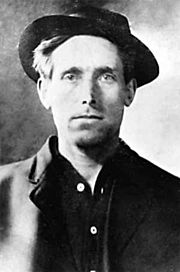
Here’s Joe Hill, the famed trade union and workers’ rights leader…

So I’m confused here.  Nothing in the volume on St Augustine I’ve been looking through in preparation for this piece speaks to me of a solid gold coat – far from it. I get the picture of a devoted man who worked hard to deliver the message of the Lord as he understood it, and to interpret it further for others.

And Joe Hill?  He was considered a martyr to his cause of trade unionism, because of his stitched up conviction, which leads to the vision that Joe Hill never dies while working men are forced to strike for their rights to decent pay.  He also is reputed to have said, when he was convicted: “Don’t waste any time in mourning. Organize…”

Meanwhile in Chronicles Volume One Dylan wrote “Protest songs are difficult to write without making them come off as preachy and one-dimensional. You have to show people a side of themselves that they didn’t know is there. The song ‘Joe Hill’ doesn’t even come close.”

Stretching points a lot, I know, but maybe St Augustine was Dylan’s very solid and vibrant attempt to give Joe Hill more than one dimension, and indeed to remove the preaching – which is amusing given the context he gave to the song.

Joe Hill ain’t dead, he says to me
Joe Hill ain’t never died
Where working men are out on strike
Joe Hill is at their side

and later

From San Diego up to Maine
In every mine and mill
Where workers strike and organize
Says he, You’ll find Joe Hill

Now the simplest line here is that remembering the rhythm and beat of Joe Hill Dylan started to write Augustine in a similar vein, and just went on adding words to it, without any particular reference to either who Augustine was or the origins of the song in relation to Joe Hill.

But there is a real connection between the Joe Hill concept of standing up for the rights of the oppressed, and that vision which occurs in Christianity – although from my limited knowledge of St Augustine I am not sure this was at all his central concern.

So the lines

No martyr is among you now
Whom you can call your own
So go on your way accordingly
But know you’re not alone –

is as much Joe Hill as it is St Augustine.  Indeed when we get to

I dreamed I saw St. Augustine
Alive with fiery breath
And I dreamed I was amongst the ones
That put him out to death

I start to feel that St Augustine has become Joe Hill – the fiery breath is Joe’s ability to rouse the crowd to anger and action, and indeed Joe Hill was put to death – for a crime he certainly did not commit.

Now there are many interpretations that run along these lines…

St Augustine “could have viewed himself as being martyred in the sense of being killed by his own sins. In the dream revealed in the song, St. Augustine wears a coat of solid gold, which may signify either the worldly excesses of mankind and the Catholic Church or St. Augustine’s own spiritual wealth.He also carries a blanket, which may be a sign of asceticism or of his compassion.”

This is from the All Music Review, and of course it might be right.  But for me there are too many “could” and “may” clauses in there.  I start to wonder, why be so convoluted with a message that is actually quite simple?

My view, and I repeat, just my view, is that Dylan had the original song in his head, and the name St Augustine came to him, or maybe he had been reading of the life of the Saint, and then he just mingled them up.

I reach this view particularly because of the line “No martyr is among ye now,” which puzzles me because there never was a martyr in the story of Augustine.

We also have the view that “One interpretation of the song is that St. Augustine is a stand-in for Dylan himself, who had been viewed as a prophet or messiah, was nearly “martyred” in a motorcycle accident a few months before the song was written, but in any case had come too late since mankind (including himself) had already sold its soul to many temptations.”

OK, if that seems possible to you, but again it seems like too many linkages that are weak – Dylan as far as I know has never expressly discussed the motorbike accident, and some consider an accident yes, but not a major neck breaking, limb busting accident.   To turn that accident into a reference point of a song about martyrs seems pushing it too far, to me.  Dylan never liked being tied down to one vision, one protest group, one type of music – so how was he martyred?   Indeed for a man who at the time was oft to be found reading the Bible, to start claiming any association with the martyrs himself seems going too far.

All Music’s review speaks of a “deep-felt, if not quite understood, guilt and sadness,” and yes I feel that, but that does not mean that Dylan is feeling that any more than I feel the emotions of the characters in my novels.  As a creative writer, one invents characters and writes about them – something that few critics of Dylan seem to want to allow him to do despite the fact that here we have a man who has for years created character after character to populate his songs.

Peter Wrench, in 2013 in a blog, is closer to my view when he says, “We are left unsure just what we are supposed to glean from the apparent vision that the singer describes.”  However he continues, “But, as we shall see, its ambiguities and ambivalence are a key part of what the song has to say,” and I am not too sure I concur.

Posted in John Wesley Harding | 26 Comments

Tell me it isn’t true: the meaning of the music and the lyrics

By Tony Attwood

For the moment, if you can, forget the music to this song and instead just read these opening lines

I have heard rumors all over town
They say that you’re planning to put me down

Just get the rhythm of the words as you say them in your head or out loud.  And then try these words

I bet you’re wonderin’ how I knew
‘Bout your plans to make me blue

Similar theme, similar beat, similar rhythm.

I bet you’re wonderin’ comes of course from the classic “I heard it through the grapevine” which was a hit one year before Dylan wrote this song.

Dylan’s own commentary on the song suggests he was trying to write a polka, although it isn’t quite clear how these lines could be a polka, so we are left with a sad lament.  It’s a bit mawkish to my taste, and doesn’t really take us anywhere new musically or lyrically.  Indeed it is the sort of song that Dylan could write with his eyes closed and the headphones on playing another song.

And yet…

In an interview with Rolling Stone Dylan suggests that having recorded the first four songs of the album it was then a case of picking up bits and pieces.   Which pretty much explains why Nashville Skyline doesn’t have the unity that John Wesley Harding has.

Whereas the songs of JWH were seemingly all written as a set of lyrics, with the music set to them in short order subsequently, Nashville Skyline was created in a very bits-and-pieces manner with nothing really unifying it except to say that these were simple love and lost love songs, country style.

All I would like you to do
Is tell me that it isn’t true

is delightfully simple, and the music does indeed play some nice tricks.  Whereas many, many of Dylan’s songs are build on three chords (exactly as the old blues songs in the 12 bar format were) this song uses every chord available.

It is in F (common at this time for Dylan, but unusual in the rest of his career and not a favourite key of most guitarists) and takes us through F, Gm, Am, B flat, C, and Dm – in fact all the chords that are available.

But all for what… it is after all a very simple lost love song.  Nothing more.  A very effective lost love song, but still, a bit of a filler.

And yet…

If we look at the lyrics Dylan does indeed pull a lot of this off.

They say that you’ve been seen with some other man
That he’s tall, dark and handsome, and you’re holding his hand

That use of the commonplace phrase “tall, dark and handsome” works perhaps because it is so unusual and so unexpected in the song.  It is like a parody of a description thrown in because the singer can’t bear to give a real description.  I can’t imagine any jilted lover would actually say to his girlfriend, “So I hear you new man is tall, dark and handsome…”

This gives us a basis for a complete simplicity in the song, making Dylan the Everyman character, the regular guy who can’t fully take in what is happening, and even as he does get it is far too much a gentleman to make too much of a fuss.  Using the commonplace phrase because he doesn’t want to make it too personal.

All of those awful things that I have heard
I don’t want to believe them, all I want is your word

No matter what, he’ll believe her.  He is not accusing her of lying or betraying him – all he wants is her word and she will take it as true.  No argument.  No row.  Just tell me and that’s enough for me.

It is the absolute simplicity of the song that really makes us accept the character in the song.  It’s not a great piece, but it avoids over emotionalism, and we do get the feeling that the guy is honourable, and just quite simply lost.

All Music’s review says that in parts Dylan “clearly tries to imitate Elvis Presley,” and yes you can imagine Elvis singing this sort of song.

It also says that these are “Dylan’s most cliché-ridden, even trite, lyrics,” and yes they are.  But Dylan is, even as this moment, such a consummate song writer that he is able to give us a melody and accompaniment that keeps us listening.

I can’t imagine many people played it over and over again but if most people had included the song as a filler on an album we would have found it completely acceptable.  Somehow, even now, I find myself expecting Dylan to be a genius all the time.  He’s not, because no one.  But he is a damn good song writer.  Even when writing a filler.

Links to all the songs on the site

Dylan’s songs in chronological order

Posted in Nashville Skyline | 3 Comments

To be alone with you: a Dylan song that could have been more, but got lost.

By Tony Attwood

To be alone with you
At the close of the day
With only you in view
While evening slips away
It only goes to show
That while life’s pleasures be few
The only one I know
Is when I’m alone with you

There is something really rather charming, slightly unexpected, a little unusual in that verse.  It’s not brilliant, it’s not a revelation.  But it is sung with a certain feeling.  Which always makes me think this could have been a delightful song, worthy of Dylan – or at least worth playing once in a way just for old times sake.

But then, talk about throwing it all away we get

They say that nighttime is the right time
To be with the one you love

And oh… I find that hard to take from a man who has given me so many phrases that have peppered my life from teenager to pensioner.

To be Alone with You is a dead simple song that sticks to the standard format of chords and structure, and it has been suggested in an interview by Dylan that it was part of an experiment musically to grasp something new, but in which that “something” remained forever out of reach.

And yes the song does degenerate into, well, not the ordinary, because Bob is never that, but less than it might have been.

If you listen to the first two verses which are taken in a slightly lighter manner than what happens later,  before the middle 8 starts to stretch the simplicity and instead gives us what everyone else would have done, then you can have the feeling that despite the simplicity this really could actually turn into a beautiful or at least memorable love song.

But where it all goes wrong is in the middle 8.  Dylan can and does use platitudes and common phrases, but he gets away with it usually by being unexpected in the music, or having given us the everyday phrase, takes us off to somewhere unexpected.

But here the middle 8 here starts

They say that nighttime is the right time

which is about as hackneyed as you can get.  Fine – that’s ok if it were to be the nighttime that was the right time to … something very unexpected.  But no it is

To be with the one you love

Oh.  I think I knew that.  And then to sing the last line of the 8 unaccompanied is just so everyday, so much what everyone would do in the middle 8 of every song of this type. Plus that false modulation in “Too many thoughts” it is too, too, much.

The fact is that Dylan had easily enough talent each day before he woke up and switched on the light to be able to do something very unusual, interesting and exciting with this song.  And that very gentle light start suggests he might be halfway there.

But it never happens.  I personally blame the pianist, whose work is out of context, crude, jarring and just erghhh… I think I was playing like that when I was about six years old – no imagination, no originality, I’d just learned it from rock n roll records and was imitating.  “Hey listen Dad I can do this.”  “OK son, yes you can.  Just don’t.”

However fade that out of your mind and y0u actually have something quite interesting… Until the middle 8, which could make or break it, broke it.

A Dylan on even 10% of his normal form would have avoided the chord sequence of A E F# B which we so utterly expect that when it comes is just…. oh….

Dylan on 10% would instead have given us the unexpected in the lyrics.  But no, we get everyday chords and everyday lyrics.

So the promise dies away, and it’s just a song that could have been but wasn’t.  Apparently 20 years later Dylan suddenly started playing it on the Never Ending Tour and because the words were fairly indecipherable it actually became quite an interesting song.  I wish I’d heard it.

We’re told that the other songs that Dylan had written for the album before he got to the studio were “Lay Lady Lay”, “I Threw It All Away” and “One More Night”.   It was and is the very weakest of the four.  Not irredeemably so, because I suspect the earlier version s without all the extra instrumentation could have worked better – if maybe he had given a little more attention to the lyrics.


AllMusic liked the song and found all these songs, “so effective in displaying the down-home, country values that Dylan was attempting to convey.”  OK, so it is probably just me, brought up and living in another country, not fully appreciating the nuances of what I hear.

I’m closer to All Music however with hearing it almost as a nursery rhyme, “I’ll always thank the Lord/When my working day is through/I get my sweet reward/To be alone with you.”

Maybe I have, in all the years I have known the song, not being ready for a return to the nursery.  (Not that we had one in the little London flat I was brought up in, but you know what I am mean).

Here’s a final thought.  As so often the chronology of the songs is interesting at this point.

Or to put it another way

  • Sad lost love
  • Happy in love
  • Sad lost love

I threw it all away tells us…

I once held her in my arms
She said she would always stay
But I was cruel
I treated her like a fool
I threw it all away

Then, to be alone with you…

It only goes to show
That while life’s pleasures be few
The only one I know
Is when I’m alone with you

And finally back to sad

One more night, the stars are in sight
But tonight I’m as lonesome as can be
Oh, the moon is shinin’ bright
Lighting ev’rything in sight
But tonight no light will shine on me

Maybe Bob always has been better at the songs of separation, leaving and loneliness than the songs of love.  And as he was better at it, he practised them more, and learned how to do them better.

Dylan songs in chronological order

All the songs reviewed on this site.

Posted in Uncategorized | 6 Comments

Tiny Montgomery: the meaning of Dylan’s song. Bringing the party to an end.

By Tony Attwood

This article is part of the Untold Dylan series which looks at the music and lyrics of Bob Dylan, not just song by song, but as part of a sequence of writing.

After finishing 1966 by writing a whole series of songs that would become part of his classic repetoire of the era, such as Absolutely Sweet MarieJust like a womanPledging my timeMost likely you go your way and I’ll go mineTemporary Like AchillesRainy Day Women  Obviously Five Believers  and I want you  Dylan shifted gear (for reasons that have oft been discussed) and wrote a whole load of quite different songs.

These are the songs we now know as being from the Basement Tapes, and were, according to Heylin, offered en masse by his publisher to anyone who wanted to record them.

There were real gems in that collection, including This Wheel’s on Fire, and I shall be released, and lots of artists rushed in to pick up a Dylan song that Dylan would not be recording on a mainstream album.

Except not Tiny Montgomery, which wasn’t sought after at all, and not recorded at the time (or indeed since, as far as I know).   It is a two chord (E and D alternating) song half sung half talked, rather like a slow lilting version of I shall be free Number 10.

Since then Tiny Montgomery  has become a New York-based record label which describes itself as “unfastened from any particular genre, scene or trend... a uniquely boundless embracement of diverse music and art.”  There is also a band with the same name, but I know nothing about them.

As for the lyrics, it is as if all the weird characters from all the previous songs, plus all the people who were about to turn up at the Million Dollar Bash in a couple of weeks time, have all been outdone by this, the ultimate gathering of the weird freaks of the endless music party world.

This is “Just like Tom Thumb’s Blues” taken to the next level of impossibility but without the need to go back home.  In this case no one has ever had enough.

This is “Hell Hound on My Trail” but without the worry.  This is the world gone mad, but actually it’s find come and join the party.

In other words it is a surreal form of surrealism which is so frightening it is not frightening any more.

Skinny Moo and
Half-track Frank
They’re gonna both be gettin’
Outa the tank
One bird book
And a buzzard and a crow
Tell ’em all
That Tiny’s gonna say hello

None of it makes sense, but all the freaks in all the world are turning up.  Every bad dream coincides, there is no sequence of events, but above all it doesn’t matter.

Scratch your dad
Do that bird
Suck that pig
And bring it on home
Pick that drip
And bake that dough
Tell ’em all
That Tiny says hello

Goodness knows who they are, and what it means.  We have a C.I.O before (at least I think was before) anyone had a job called “Chief Information Officer” (largely because we didn’t have digital technology in the home).  What’s a CIO in the 1960s? (quite possibly something in the US, so if it was, do tell me).

Now he’s king of the drunks
An’ he squeezes, too
Watch out, Lester
Take it, Lou
Join the monks
The C.I.O.
Tell ’em all
That Tiny Montgomery says hello

And like all constant insanity it gets more insane on top of it all.

Now grease that pig
And sing praise
Go on out
And gas that dog
Trick on in
Honk that stink
Take it on down
And watch it grow
Play it low
And pick it up
Take it on in
In a plucking cup
Three-legged man
And a hot-lipped hoe
Tell ’em all
Montgomery says hello

I wonder if Dylan wasn’t just taking everything out as far as he could, falling off the edge and then trying to find a way to jump back on, but was also reflecting on the fact that every culture had its own edge – except in the 1960s those edges were disappearing so people were making them up for themselves.

Throughout history mankind has lived in a world in which there were monsters or at least strangeness living around the corner.  In Shakespeare’s time the edge was nighttime and the forest where the dead walked.  We had the edge of the world too, beyond which there was nothing – until Columbus.

Then in America there was a whole continent to discover and conquer while the British Empire moved on to Africa and strange and frightening customs and practice.

By the 1960s even space was in our grasp.  But perhaps at the same time societies create their own edges, with their own strange people – people who 99.999% of us would never meet but who it seemed were out there.  People who lived lives totally different from ourselves, without responsibility or direction.

There are of course many other possible explanations – that Dylan is full of sexual innuendo on this and other tracks for example – and of course we won’t know, because he rarely tells.  But it does seem to me that there is a case to be made for the fact that Dylan had invented character after character, and made them stranger and stranger and stranger and now was getting ready to bid them all farewell, having taken the genre as far as he could.

By 1967 he was ready to round them all up, and this is what he did in this sequence of songs…

First we had Tiny Montgomery, then the great party where they all got together, the Million Dollar Bash, and finally it is all wrapped up in This Wheel’s on Fire

No man alive will come to you
With another tale to tell
But you know that we shall meet again
If your mem’ry serves you well

That is was now all over is clearly shown in Too Much of Nothing

Too much of nothing
Can make a man abuse a king
He can walk the streets and boast like most
But he wouldn’t know a thing

We’ve had the party, we’ve turned the world upside down, it is time to get up and move on.  Time for one more bit of fun though, just before we go, because the whole world is about to explode (or maybe be destroyed in the great flood).

Ev’rybody’s building the big ships and the boats
Some are building monuments
Others, jotting down notes
Ev’rybody’s in despair

All we can do is wait for the saviour, who suddenly turns out to be Quinn the Eskimo.

And that was it.  Booooom – it was all over and done, for if you look at Dylan’s compositions in chronological order you can see what happened next, once Quinn had been done and dusted.

There’s no run down, no gradual changing gear after the Mighty Quinn, everything changes – just as Dylan says it would in that song.  These John Wesley Harding songs are different in every regard from all that has gone before.  Those final songs of the wild excitement and fun were the songs of the greatest, wildest, insanest parties of all time.  So there was nowhere to go after that, except back to simpler times.

It was indeed all over.  Goodbye Tiny Montgomery and all your crazy associates.  Hello Frankie Lee.   The new world still doesn’t make any sense, as it turns out, but the whole feeling of the world and those who inhabit it, are quite, quite, different.

Dylan’s songs in Chronological Order

All the songs reviewed on this site.


Posted in Uncategorized | 10 Comments

The Wicked Messenger: Dylan, the Bible, confusion and bounce. The meaning of the lyrics and the music.

By Tony Attwood

In considering the Wicked Messenger Heylin cites a critic who once had the nerve to ask Dylan if he only wrote Dear Landlord so he could get to sing the final lines.

And if you don’t underestimate me
I won’t underestimate you

Heylin then makes the rather good point that the critic could have used the same tactic with Wicked Messenger which ends

And he was told but these few words
Which opened up his heart
“If ye cannot bring good news, then don’t bring any”

As noted in other reviews, Dylan wrote all his lyrics out first on this album and then found simple tunes to fit them.  It is also a salient point that he wrote the lyrics very quickly, saying in several interviews that he didn’t really want to make an album at this time.  And it is not too big a leap to think that these interesting end lines could well have come first.  Certainly many songwriters do find lines of lyrics that interest them and then work a song up to include them, often using the whole song to lead up to the key phrase.

And here, we may also note, we have a song that, although it goes beyond the one line of music used in Drifter’s Escape, is limited effectively to one and a half lines of music, with the first two lines of lyric having almost the same melody and chords as the final concluding line with just a variation at the end.

I think every reviewer has noted Proverbs 13:17: “A wicked messenger falleth into mischief: but a faithful ambassador is health,” as a source. Eli was, according to the Book of Samuel, a High Priest of Shiloh.  Shiloh is the ancient Biblical city where Khirbet Seilun stands today – although I am not too sure what that knowledge tells us.

But this takes us into a religious explanation for the song.  And yet, and yet…

Religion is always, in part, about good and evil and our response to it.  So do we have good and bad in this song?  And indeed in all the supposed religious songs of the album

I am not at all sure.  The Drifter’s Escape, so often my reference point on the album, gives us a little story in which the jury who turns out to be the guilty party – a lovely twist and one of the reasons I adore the song.   And from what I know of American history, John Wesley Hardin was an American criminal who was given 25 years in prison for murder at which time he claimed he had killed 42 men.  Newspapers were apparently sceptical and cut the number to 27.  Yet Dylan writes favourably of the man and names the album (almost) after him.

So to take this album as one in which there is a solid religious theme is difficult, and I find a much more convincing and consistent theme in the notion of confusion and the world turned upside down.  Indeed in “All Along the Watchtower” we have no idea who is on whose side, who is fighting whom, who are the good guys, who not.

The “Every Dylan song” website, which examines Dylan songs from a Christian perspective runs into trouble with this song, and really can’t find a way of analysing it.  The site notes Dylan’s “preoccupation with the Bible” which “helped reshape how he approached writing lyrics,” but the writer only goes so far as to say that at the time of JWH Dylan “may have become more interested in the afterlife and in spirituality, but not to the extent of becoming the devout believer he would become later. But you cannot deny that his reading of the Good Book had a profound impact on his songwriting…”

Yet even so he admits this is as a “songwriter completely in tune with the way the Gospels were written, yet not entirely in tune with taking those Gospels to heart.”

He argues that Dylan “made as much out of the Bible as he did with the old folk songs and tall tales that helped shape his Basement Tapes songs, appropriating pieces of history and moulding them into something that is now recognizably Bob Dylan music.”

To this I add the issue of confusion.  Through many of these songs we are confused and remain confused, not knowing who is who, who represents what, who is good and who is bad.  So when, Andy Gill suggests the messenger is “of course” Dylan, I can’t agree.  The whole point is we don’t know, Dylan doesn’t know, and no one in the stories knows.  “There’s too much confusion…”

Dylan may well have been reading the Old Testament of the Bible and besides Proverbs came across 2 Samuel 4:10 which in the King James Bible reads

When one told me, saying, Behold, Saul is dead, thinking to have brought good tidings, I took hold of him, and slew him in Ziklag, who thought that I would have given him a reward for his tidings.

Now it is true that the Old Testament questions and deliberates on values, seeking to find eternal values.   What I think Dylan is doing is doubting the possibility that there are such values that last all time, and indeed doubts the possibility of always understanding what on earth is going on.

The “wicked messenger” seems to me (and as always this is just my view) to be wicked in the sense of mischievous as well as being a sycophant.   But it is the mischievousness that dominates because of the music – and this, if I may be so bold, is what many commentators seem to miss as they look only at the words.

This is a very bouncy jolly piece of music.  While The Drifter really does have you on the edge with that eternally repeated line of music starting, straining indeed, on high and then falling down over and over and over, as if there is no escape, here the melody is more restrained and the accompaniment makes one want to dance as much as listen.  While the repetition of The Drifter itself adds to the concern about what is going on, here the repetition, particularly of the bass line adds to a feeling of well being and familiarity.

And I find real humour in this song.  The note in his hand which read, “The soles of my feet, I swear they’re burning,” is so disconnected with what has gone before, and so irrelevant to anything that it shouts out that this is not a song to be taken seriously.

And then the great moment of Exodus with the crossing of the Red Sea, the absolute salvation of the Jewish people, all is reduced to

…he was told but these few words
Which opened up his heart
“If ye cannot bring good news, then don’t bring any”

That is mischievous indeed, to speak of the salvation of an entire race through a miracle as “just tell us the good news.”  Especially in a scenario, as it develops here, where we can’t be quite clear what is good news and what isn’t.

The question then is, how far do we probe this?  At one extreme we have Dylan sitting on a train rapidly writing these short poems as the basis for his new album.  At the other there is the interpretation of the words as being finely crafted and well thought through with hidden deep meanings, as Gill suggests when he says, “To have been sent by Eli implies a reliance on intellect,” and that “perhaps Dylan felt he had valued rationality too highly over spirituality.”

Or maybe as Mike Marqusee suggested Dylan’s anguished, self-obsessed, prickly artistic evolution, was a deeply creative response to a deeply disturbing situation.

Or maybe we should just accept that this is simply about the world that one can’t quite understand where everything is turned on its head and nothing quite makes sense.

If we look at the chronology of the time we can see this.  Below is the list of compositions of the latter part of 1967.

Quinn is indeed funny, oddball, quirky, but then suddenly Dylan is into the sequence of songs that make up John Wesley Harding.  Then after the Messenger we have one more (Dear Landlord) from that sequence, and woooooosh, he’s off again into two songs at the end of the year that are utterly different once more.

As I have spent time considering all these songs it has slowly occurred to me that the humour of the Mighty Quinn, and the relaxation of “I’ll be Your Baby Tonight” and “Down along the cove” are not utterly separate.  They are all, to a greater or lesser degree, about being different, being outside society but having to be part of it.

And slowly I am starting to think that if we want a clue as to what is going on here, we have to go back even further in the year to the line

We’ll climb that bridge after it’s gone, after we’re way past it.

from You Ain’t Going Nowhere.  These are songs of the search, the journey, the way through, the whole issue of coping with being the odd one out in a social setting in a confusing world.  Of course not every line of every song fits that vision, but enough do to bring me to the notion that this is what occupied Dylan through the year.

And I am not sure this view is too different from others who have gone before.  The “Allmusic” review for example says,

Instead of this song simply becoming a boast, Dylan uses images from the Old Testament to create a wonderful, dense, and occasionally funny song, and one of the minor gems of his canon.

This is different from the Marqusee vision which says, “He can no longer tell the story straight, because any story told straight is a false one.”

So whereas I see Dylan exploring in many different ways the issue of being the outsider, the oddball, the joker, the kid left alone, Marqusee is somewhere utterly different in suggesting Dylan did not give up on the politics of his earlier work; he merely rearranged the definition of what politics is.  Thus it is argued, politics is everyday life.  You and me, and how we react.

And maybe, as I think of it now, we are both saying the same sort of thing, except I don’t think we should call it politics.  I call it sociology and psychology.   The individual stuck inside a crazy social world trying to make sense of it all.

And in such circumstances we are all often tempted to say something along the lines of “If ye cannot bring good news, then don’t bring any.”

It’s a good line, but ultimately not much of a solution to anything.

All the songs reviewed on Untold Dylan

Dylan songs in Chronological order


Posted in Uncategorized | 12 Comments

The Ballad of Frankie Lee and Judas Priest. Making it up as you go along.

By Tony Attwood

The Ballad of Frankie Lee and Judas Priest” from John Wesley Harding, is a song that has fascinated more commentators than most Dylan songs from this period.

Musically it is built over three ever repeating chords: G, B minor, A minor, G, although listening to some versions the A minor can be replaced with C.

I think the All Music review gives us a clue as to what many commentators believe was going on here when they say, “Clearly Dylan was attempting to write a parable of some description, with a narrative followed by a “moral” at the end of the story.”  I don’t think so, but I do recognise I am in a minority in this case – and not for the first time in the 230 or so songs reviewed on this site.

The “story” itself is perverse and strange, as events happen but without any explanation, precedent or (quite often) logical consequence.  As All Music continues, and as many other commentators believe, “The story, most argue, is a simple parable alluding to Jesus’ temptation by the Devil.”

Except a parable is a simple story used to illustrate a moral or spiritual lesson, as told by Jesus in the Gospels.

This story is not simple.  Yes it is utterly simple musically, but in terms of what is said, there is no simplicity.

In an interview with Sing Out! magazine Dylan comments that he really wasn’t ready to produce an album at this time, having nothing of his own that he really wanted to record.  However when called upon to create the album he spoke of wanting to create songs of despair, faith in the supernatural.  The model was the narrative folk song.

So we get triumphs like the Drifter’s Escape, an absolute song of the supernatural, with one musical line repeated over and over, and absolutely no worse for that.  And that song, and this, meet another target Dylan set himself: songs the lyrics of which did not repeat themselves.

So, this is the supernatural, and in the supernatural people are strange, and boy is Frankie Lee a weird guy.  As Heylin points out, he just about over reacts to every situation no matter how it hits him.   It is all like a dream where reality gets mixed up with weird.  The supernatural is everywhere screwing everything up, messing everything about.

Now to get a deeper understanding of Dylan’s thinking at this point I think it is helpful to look at the songs from around this time in the order in which they were written (as far as can be ascertained).

Starting from the first we have

If your memory serves you well we were going to meet again and wait
So I’m going to unpack all my things and sit before it gets too late
No man alive will come to you with another tale to tell
But you know that we shall meet again if your mem’ry serves you well

This is spooky stuff, especially the “No man alive” bit and the chorus which is very end-of-the-world like.

As I mentioned in my review of “I shall be released” in that song there is the belief or a desperate plea that someone else will come along and release the singer rom something – although we are not clear what.  Once more the stuff of nightmares.

Moving on, “Too Much of Nothing,” the tale of TS Eliot and his wives, has the lines

In the day of confession
We cannot mock a soul
Oh, when there’s too much of nothing
No one has control

It’s the world gone wrong, the world is crazy, nothing makes sense any more as there is no structure, nor organisation.  The same theme again, to my mind.

In Tears of Rage Dylan conjures up a character from the Mediaeval Mystery Plays – this time the thief – the passing stranger – the Wandering Jew of early English literature

Tears of rage, tears of grief
Must I always be the thief?
Come to me now, you know
We’re so low
And life is brief

The suddenly up pops Quinn the Eskimo – another strange unreal character.  More bouncy, more fun, less threatening, but still a being from another life or another time coming into our world.  No explanation as to what, who, why, where.  He just is.

So what links all these together in my mind is just this other worldliness – these out of nowhere beings that enter our vision, shift around a bit, leave us in doubt and wonderment, feel like a dream, and then vanish.

We are in fact facing once more the sort of characters Dylan painted in his surreal period, half seen, spooky, freaky, shadowy beings, who behave in odd ways and do odd things.  The only difference is that the John Westley Harding characters are black, white and grey.  Those characters were so many colours and lights it could hurt your eyes.

And it was thinking of this that made me change the quotes on the home page of the site to include the words Dylan spoke on a Theme Time Radio Hour…

“You can never tell why someone’s gonna stick something in a song. You just gotta remember that the whole is bigger than the sum of its parts. You can’t expect to understand everything in every song.”

So to my mind in all the songs I’ve noted above and which were written before Dylan wrote the lyrics of Frankie Lee, we always have this strange colourless world where things sort of make a bit of sense, but not enough.

Thus my approach to Frankie Lee is the same as with Drifters Escape, written a little later, and all these songs that lead up to it.  We are not in a real world where everything makes sense.  We are not looking at a parable, because for a parable, to be a parable, must have everything making sense with a fair degree of clarity, otherwise it doesn’t work.

And on that point, as I have confessed many times on this site but feel the need to remind you, in case you haven’t read the rest of the site, I am an atheist, so start from as biased a position as anyone who follows a religion.  But for what it is worth, my thought is that a Deity or The Deity, wanted to encourage us behave in a particular way that was laid down by the Almighty, then surely He or She would be fairly clear about it. Why wrap it all up in confusion?

So if Dylan wanted Frankie Lee or any other song to be clearly a religious tract or sermon, or parable, why hide the message in something as confusing as this song?

The concluding verse of Frankie Lee – sums it all up.   “The moral of this story, the moral of this song/Is simply that one should never be where one does not belong.”   And the closest I can get to understanding why that has some broad implication is, “Yes, if you get caught in the wrong dream, you’re screwed, until you wake up.”

For me, in Frankie Lee and in all the other songs written around this time, Dylan was exploring an interesting scenery where nothing quite makes sense.  Indeed you could say, it all builds up to All Along the Watchtower where (to summarise) everyone is trapped inside looking out on a world they can’t quite grasp.

“There must be some way out of here,” said the joker to the thief
“There’s too much confusion, I can’t get no relief.”

That for me is the message of much of the album.  In effect Dylan created here a subset of his own work – the songs of confusion.  Songs of the shadows, songs of uncertainty.  Songs of the supernatural, songs of the dreamland where nothing is quite real enough to hold onto.  (Actually I quite like Songs of the Shadows as a phrase, although Songs of The Dreamland is probably more accurate).

So for me, the song does not encapsulate “the eternal struggle for souls by Satan, and his method’s to do so,” as one Christian commentator put it.  I don’t think Judas Priest is Satan.  Instead I would slightly change the words of Galactic President Zaphod Beeblebrox’ psychoanalyst in The Hitchhiker’s Guide to the Galaxy (one of my all time favourite works of art): “Judas Priest’s just this guy, you know”.

In the religious interpretation

Judas Priest quickly pounces at his prey’s vulnerability, presenting the money and then presenting him with a lie:  That Frankie’s acceptance will be a gain for him, while a loss for Satan.

Well, ok if that is the interpretation that works for you.  But, the virtue of this being not the eternal battle of good and evil, but visions of and from the supernatural and the dreamscape that has been explored by lyricists, dramatists and novelists through the centuries, is that this explanation fits with a) what Dylan himself said and b) what he was saying in all the songs around this time.

Yes Frankie’s loss could be his soul, but this explanation makes the song monosemantic where the other songs Dylan was writing at the time were all anything but monosemantic.

So I acknowledge that every line and every phrase can be interpreted to a religious meaning, and if you find that reasonable, who am I to counter that?  Rather I am just saying, I think there is a much simpler explanation which also happens to be in tune with what Dylan himself said.

And since as part of the work for my degrees I studied scientific method, I tend to follow Occam’s razor – the  ‘law of parsimony’ – the problem-solving principle which says, “Among competing hypotheses, the one with the fewest assumptions should be selected.”

Thus the “big house” as “bright as any sun” could be a house of ill repute, and it could be bright because “Satan can appear as an Angel of Light” and it could relate to “ancient Sun worship”.  Or it could just be an image from a dream.

In the sort of approach expounded by Anthony Scaduto, John Wesley Harding is no longer a gunslinger but a symbol of Christ.  From song to song the symbolism grows until “All Along the Watchtower” takes us to the Book of Revelations and the Second Coming.

But it is still simpler to say these are just excursions into storyland.  Just journeys.

And by way of  supporting evidence consider the fact that that Dylan wrote the words very quickly, added the music in a matter of moments after, and spoke often about not being ready to record this album.  And then ask…

Could Dylan have constructed such a complex world as Scaduto outlines in a matter of days, with so many carefully interwoven images?   Or did he have a generalised theme of the supernatural in mind?

Or could it be as Barney Hoskyns said in “Across the Great Divide”,  “At least two songs on John Wesley Harding, ‘Dear Landlord’ & ‘The Ballad of Frankie Lee & Judas Priest’, were veiled attacks on Grossman…”

And I throw this in here, to make the point that with enough lyrics at your disposal, you can make up any explanation you like.

Albert Grossman: the manager with the reputation for aggressiveness in his business affairs based, as others have put it, in his “faith in his own aesthetic judgements,” (which I once heard misquoted in a recording studio in the 70s as “faith in his own aesthetic juggernauts”.

So, overall there are two issues here.

The first is the question of the interpretation that you think is right.  I argue that Dylan’s work at this time is like a partially abstract painting – there are seemingly real people and events portrayed, but the overall context is curious, misty, uncertain, disconnected, incomplete.  It needs to be seen as a whole.

Others argue that the message is religious and that it can be understood by an examination of it line by line.

We put forward our arguments – I cite the MusiCares speech, and Dylan’s general decision not to comment too deeply on meanings in support of my view, feeling that if he had a strong message he’d come out and tell us, as indeed he did with, for example, “Gotta Serve Somebody”.  After all, why hide the message when its important?

I also argue that when things are uncertain, taking the simplest explanation is generally the best.  Others argue from their point of view.

The second is, does it matter?  Does it matter who Frankie Lee and Judas Priest are, were or represent?

Of course if Dylan is preaching, if he wanted us to follow a line of belief, then yes it matters to him, and if we want to understand the overall theme, it matters.

But I would say that as with much modern art in all its forms, often it doesn’t matter.  It is the overall feeling that matters.  If we watch a biographical film or read a biography, it matters.  If we watch a film which takes a historical character and is very free with its telling of the character’s story, it matters far less; it is entertainment.

To me, if someone tells me that Johanna in Visions is based on a certain real life person, it generally doesn’t matter too much, because what really gets me about that song are the shadows and suggestions.  I don’t really mind what Johanna really felt; it is the shadows and light that engage me so strongly.

But because I don’t find deep life-affirming religious meanings in the message, I look to explain what I do find.

I find the accompaniments (called “sparse and austere” in some quarters) part of the picture that is painted for me.  It is open and empty, black and white, pen and ink.  That helps give me my picture of what is going on in these Songs of the Shadows.  No psychedelia here.  Just black and white and shades of grey.

So can statements like, “Could Everyman (Frankie Lee) be the listener & the tempter/deceiver (Judas Priest) be Dylan?” really be true, when Dylan has repeatedly said, he was just a “song & dance man.”  He sings about jugglers and clowns in earlier days but times have changed because the jugglers and clowns had lots of colour.  Now the characters are of a different type.  Black and white suits them better, not just because they are history, but because in the end “nothing is revealed.”

Who is the good guy?  Who are we supposed to have sympathy for?  What do we make of the man who watches another die without doing anything?  This is where the greyness is, in the uncertainty of it all.  With Jugglers and Clowns it is all colour.   With God and Satan, the world is black and white.   Here it is grey.

Maybe I’m too stupid to understand, or maybe it doesn’t translate readily from American into English but the whole ending about, “So when you see your neighbour carryin’ something/Help him with his load/And don’t go mistaking Paradise/For that home across the road,” contains no powerful message for me.   Yes, it is good to help others if you can.  Yes, the world that someone else has might look wonderful, but usually it’s got its own issues, just like yours.

OK, I think I knew that.

And so the difference between me and the people who really want to put a meaning into each and every Dylan song is that they think it is important to find a deeper meaning, while I don’t.  I don’t find meaning in Jackson Pollock – I love the paintings for what they are.  I don’t find meaning in Bach’s 48 Preludes and Fugues.  I know why he wrote them, but I don’t find meaning there – or at least not a meaning I can put in words.  I find the jagged edges of The Rite of Spring stimulating, difficult, and well, edgy, but I don’t find a meaning there.  I love these works for what they are, for their direct expression into my brain, and the same is true for me with Dylan.  Whereas Pollock tells me stories that can’t be expressed in words, Dylan tells me stories that can only be expressed in music and words – but not the words that spell out a story.

So when one commentator says, “By calling his destination “Eternity”, JP is suggesting that he plans on staying there forever,” my answer is “no he isn’t.  He’s calling his destination “Eternity”.”

Anyway, here’s another theory: “The story is a parable for Dylan’s own experiences in making the switch from folk to rock.  Bob Dylan himself is Judas Priest, the righteous betrayer of the folk movement.  The folk movement whom JP betrays is Frankie Lee.  The destination that JP pursues is the glory of rock-and-roll, which terrifies FL.  The passing neighbor boy that tells FL about JP’s endeavors and paints them in a negative light could be the media.  FL’s father who’s deceased could represent Woodie Guthrie, the father of the folk movement who at passed away just several years before this song was written.  The similarities to Dylan’s own situation are endless.”

At least the author of the theory, which appears on the Blogging in the Wind site does say, unlike many others who have pontificated on the song, “Of course, the theory that is imposed on the structure of the tale is just that – a theory.  It is just a guess for what this strange story of friends, betrayal, and glory could represent.  The reason why this theory is so good, in my humble opinion, is simply that it exists.  It exists for a song that I was ready to give up on.”

The blog with the title, “Every Bob Dylan song” (a bit of a misnomer, but it is good value, and does review a log of songs) comments that the author gets “the creeping sense that Dylan may just have been making this up as he was going along.”

And yes that could well be so – a bit like a fair degree of modern visual art.  I also like the bit of this review where the writer says, “there aren’t too many songs in which you could make the debate that Dylan is actively having a laugh at the people listening to this song.”

Certainly as I said at the start (and it seems appropriate to say again at the end) musically the music goes round and round and round over the same chords of G, B minor and A minor, over and over and over again.  There’s no melody and no chord sequence.  Just the words, and we can argue forever over the words.

But let me finish with a very personal memory.

Before settling on a career as a writer I worked as a musician in the theatre in London for four years, and as musicians we often had a less than wholesome regard for those who wrote our music and the lines our comrades on stage had to say.

One of our eternal jokes was that when the author found his plot was stagnating, he’d introduce a mysterious stranger onto the set to beef things up a bit.  When I first heard this song with its line, “just then a passing stranger, Burst upon the scene,” I really did burst out laughing, thinking “oh Bob, you’ve watched those same second rate plays too.”

For me that is the key line – it’s a story of random events without a meaning.  But if you find a meaning in this song, that’s fine too.  We can both be right, most of the time.

The only difference between me and the writers with a theology to push is that I can say we can both be right.

All the songs reviewed on this site

Bob Dylan Songs in Chronological Order 1962-1969.

Posted in Uncategorized | 17 Comments

Sarah Jane: the origin of Dylan’s song and why he recorded it.

By Tony Attwood

Bob Dylan’s song “Sarah Jane” is one that is nominated sometimes as being among the worst ever Dylan recordings.

That didn’t bother me too much when I was asked to write a piece about the song, but what did fascinate me was a comment made by Rolling Stone magazine:

“Sarah Jane” and “Big Yellow Taxi” (an utter disgrace and one performance that Columbia should have had the good taste to withhold) are so bad that they inevitably re-pose Self-Portrait’s central question: What was Bob Dylan thinking about when he sang this stuff?

I think Rolling Stone could have answered the question if only they’d bothered to take a moment to think about three pointers:

First, Dylan knows about rock music, and the antecedents to rock music – he is an aficionado, he knows the songs, and their antecedents, from all across North America, plus England, Scotland, and I imagine some other areas too.

Second Dylan is an experimenter, he plays with ideas, turns them inside out and upside down, not to mention back to front.  You only have to read his MusicCares speech to see this – indeed since I don’t think the speech is copyright, I think I will try and find a bit of time to put an edited section of the speech on this site.   But for now, if you haven’t read or heard the speech, take my word for it – his ideas come from being totally immersed in the music of the people across the ages.

Third, Dylan records his experiments.  And like all artists, many of his experiments turn out to be going nowhere.   Look at any creative artist and you will find sketches of ideas that in many cases don’t work, and in retrospect look to us from without as ideas that would obviously never work.

But for the creative artist that is not the point.  The idea itself might indeed be a dead end, or it might go on to somewhere else, and somewhere else, and then become… who knows.  Picasso didn’t know, Dali didn’t know, Shakespeare didn’t know (just go and watch Winters Tale and see if you can make sense of the construction of the five acts).

Most artists are careful to hide or destroy their notebooks, or at least leave them in the hands of someone who will do that hiding away. We don’t have any explanations from Shakespeare.   We don’t have any strange and bizarre unpublished poems from TS Eliot not because he didn’t write any, but because he married his secretary who was the keeper of the archive and whose lifetime’s work was to keep the image of Eliot and his writing pure as the driven snow.

This song is an experiment, never meant to be issued and that it was issued was simply down to the fact that Dylan changed record companies, and the losing company took its retribution.

In essence Dylan’s version takes a steamboat song “Rock about my Saro Jane” which was sung by travelling entertainers sometime around the turn of the 19th/20th century and which subsequently exists in many forms.  Aside from the one sung on the link above, there is also a Flatt and Scruggs version you might enjoy.

However these versions have a different version of the lyrics from the Dylan version, although the music is similar.  These versions are somewhat sanitised…

Now, Ive got a gal whos sweet to me
She lives down in Tennessee, oh Saro Jane
Nothin’ to do but sit around and sing
Rock by, my Saro Jane

However there is an Odetta version using these lyrics on her 1959 album, “My Eyes Have Seen” which has what seems to be something close to the original lyrics and which Dylan uses…

I’ve got a wife and five little children
I’m gonna take a trip on the big McMillan
With Sarah Jane, Sarah Jane
Ain’t nothin’ to do but to set down and sing
And rock about my Sarah Jane

The boiler busted and the whistle squall
Captain gone through the hole in the wall
Oh, Sarah Jane, Sarah Jane
Ain’t nothin’ to do but to set down and sing
And rock about my Sarah Jane

The engine gave a crack and whistle gave a squall
The engineer gone to the hole in the wall
Saroh Jane, Saroh Jane
Ain’t nothin’ to do but to set down and sing
And rock about my Saroh Jane

Yankee built boats to shoot them Rebels
My gun’s steady gonna hold it level
Saroh Jane, Saroh Jane
Ain’t nothin’ to do but to set down and sing
And rock about my Saroh Jane

Inside Bluegrass did a commentary on the song some years ago, and concluded that “Rock” in this context probably has sexual connotations, the “Hole-in-the-wall” probably refers to the cotton plantation near Natchez which Mark Twain refers to in Life on the Mississippi, Saroh Jane might be a girl, or a boat, the boat might have gone aground, and the end of the song relates to the Civil War, in which the warring factions each converted steam boats into gunships while fighting to control the Mississippi.  McMillan could be James Winning McMillan a Mexican War veteran.

So what Dylan has done is taken a song with a long, long, history and an ever evolving style and lyrics, tried to take it on further in an experiment which goes back to a very early version of the lyrics but a modern accompaniment and sound.

Now I’m not an expert on bluegrass and certainly as an Englishman not an expert on the American Civil War or its music (although I can hold up my end in most debates on the French Revolution of 1789) but it seems to me Dylan didn’t really add anything new to Saro Jane.  But that’s often the way.  It was certainly worth a try and probably led him somewhere else.

So Rolling Stone asking “What was Bob Dylan thinking about when he sang this stuff?” is a nonsense.  He was taking a very old song that had mutated through the years, and was experimenting to see where it could go.  And he was unfortunate enough to have a nasty record company release it.

Like I say, experimentation is normal in the arts.  Hell, I’ve got two completed novels that were never published, and I very much hope that I destroyed all copies.  I’ve had three novels published, and I still quite like them (one I like a lot, although not the one that sold a lot) but I probably needed to write those two earlier books that failed to be able to write the three that worked.  Dylan probably needed to write 10,000 songs to have 2,000 that worked.  That’s how it goes.

Allmusic gets it wrong as well, as far as I can see.  It says, “Dylan attempts to sabotage each number… its primary appeal is to die-hard fans with a perverse sense of humor.”

I really disagree.  This is Dylan’s sketchpad, his explorations, the sort of stuff that most artists who control their work would be able to throw away.  But Dylan works by making recordings – and that allows others to get hold of the results.

For the person seriously interested in looking at where Dylan gets ideas from and understanding that for every Visions of Johanna there is a Saro Jane, this is a good thing to have.  If you want music to sit in an armchair and listen to, probably not.

The Dylan version is here

All the songs reviewed on the site are listed here.

Dylan’s songs of 1962 to 1969 in chronological order are here

Posted in Uncategorized | 16 Comments

“I’ll keep it with mine” – the meaning of the lyrics and the music.

By Tony Attwood

I suspect there are many people in England (as I am) who know “I’ll keep it with mine” as a Fairport Convention song, and fortunately for anyone who has never heard this version it is on the internet – at least at the moment I’m writing this.  To me this is the realisation of the song that we hear on Biograph.

Nico’s version is also available although for me the arrangement, by retaining the jagged edges of the song that existed in Dylan’s versions, loses the overall point of the lyrics.  There is also a Judy Collins version (the first version of the song to be released) which (again to me) seems to miss the mark – and that was unusual for Judy Collins.  She could take a song and invariably get straight to the heart of the matter.  Although to be fair the problem is with an awful arrangement behind her voice – particularly the organ, where I guess the producer said, “make it sound like on those Dylan tracks”.

The awkwardness of Nico’s version is perhaps particularly surprising since Nico was with Dylan in Greece when he wrote the piece, and the song was particularly “reserved” for her by Dylan – at least according to Heylin.  Maybe she was trying too hard – maybe she was ready for the Velvet Underground, and was trying to make it sound like the Underground.   Although to be fair the Velvet recordings don’t have this problem at all.

So what’s the song all about?   The Franciscan Sisters of Charity, on their web site, say that

The lyrics console the searcher—“how long can you search for what’s not lost?”

Which bemuses me from the off, since I don’t see the line as meaning that the singer is consoling the listener.  To me the singer is saying, “stop doing this – stop beating yourself else – nothing is lost – it is all a state of mind”.

Our purpose, our way is never lost in God’s sight. If following is a burden, if finding the right route is beyond us, He can handle it—“Come on, give it to me, I’ll keep it with mine.” He’s keeping us all despite all the “helpful advice” that sometimes only marks a detour on the journey. Faith tells us He’ll be back tomorrow, same time again. Thanks be to God!

“Discover what you set out to find” for me is the focus of this song. We all search, at least at one point in life, until we know what it is we are searching for. What is the need of our heart? Ultimately we all seek to love and to be loved. This is an amazing song if you see it as God speaking. He waits for us to find Him so that that need can be filled! He was never lost!

So is it God speaking, or simply a guy giving the lady some advice – something that Dylan seemed to do a fair bit of during that time in Greece preparing for the album.   He did after all write Plain D there which really is a song based on the notion that he knows everything and it is about time he laid the information clear and simple on the line.

I suspect he is offering advice, but I understand you could hear the song otherwise.

Of Dylan’s versions, the Biograph recording which was contemplated for Bringing it all back home, or at least being the basis for a song for that album, and is the one really worth studying in my opinion.

Indeed If we just focus on the opening lines

You will search, babe
At any cost
But how long, babe
Can you search for what’s not lost?

it certainly could be gentle advice to a lady who is certain where she is going somewhere, but just needs to get the fine details sorted.  Her career had taken several turns in different directions so searching was probably on her mind.

However then instead of the standard message of the era, as in “don’t follow leaders”, just work it all out for yourself, there is instead a different two-pronged message.

Everybody will help you
Some people are very kind
But if I can save you any time
Come on, give it to me
I’ll keep it with mine

So everyone is going to offer you advice, but if you come over to me, I’ll do more than that.  I’ll take your problem from you, and put it with my problems and work on them all together.  The wonderful British author Douglas Adams had fun with this notion in his book “Dirk Gently’s Holistic Detective Agency” many years later – where the character of the monk takes over all your issues, so they are not your issues any more.  Of course I don’t know if Adams had the song in mind, but he certainly did use Dylan occasionally in his work, as when the mice in the Hitchhiker’s Guide, lacking any deep question about the nature of the universe to ask, settle for “How many roads must a man walk down.”

But back to Dylan.  As we move on there is an honest romanticism in the awkwardness of the second verse – it is not crafted and arranged – just a guy saying what he feels.

I can’t help it
If you might think I’m odd
If I say I’m not loving you for what you are
But for what you’re not

There is incidentally a difference of opinion over what that third line actually says.  The alternate version is

If I say I’m loving you not for what you are, but what you’re not

And the singer suggests he is constant, always there but also flexible, while others around might be stuck in one fixed way of seeing the world.

But moving on, I’ve never been sure how to view the final verse – I suspect the lady in the song is so troubled she is thinking of leaving, while he is saying, don’t worry I will be here for you.  But I also suspect it is a disconnect – an observation – a piece of background that isn’t integrated into the story as a whole.

The train leaves
At half past ten
But it’ll be back tomorrow
Same time again
The conductor he’s weary
He’s still stuck on the line
But if I can save you any time
Come on, give it to me
I’ll keep it with mine

Any interpretation at this point is pushing the meaning far too far.  Indeed the more I have written of these reviews the more I reach the conclusion that Dylan’s songs shouldn’t be interpreted line by line – or at least not always.

Indeed in his 2015 MusiCare speech Dylan suggested very strongly that the source of many of his songs is listening to the phraseology of other people’s songs.  As when he said in the speech that he listened to “How high’s the water, Mama?” and then wrote “It’s Alright Ma (I’m Only Bleeding)”.

In fact it was in that long speech that Dylan offered everyone like me who wants to write about Dylan’s songs the greatest challenge.   He says

“Big Bill Broonzy had a song called Key to the Highway.   I’ve got a key to the highway, I’m booked and I’m bound to go, Gonna leave here runnin’ because walking is most too slow. I sang that a lot. If you sing that a lot, you just might write,

“Well Georgia Sam he had a bloody nose
Welfare Department they wouldn’t give him no clothes
He asked poor Howard where can I go
Howard said there’s only one place I know
Sam said tell me quick man I got to run
Ol’ Howard just pointed with his gun
And said that way down on Highway 61″

In such a world of writing, it is the phrases, and the overall conception of the thing, not the detailed explanation of line by line – that gives us the clues, and I guess that really applies here.  It is also a big challenge to the way I have approached this whole web site, and was a prime reason as to why, after a couple of years work on the site, I introduced the chronology and started to approach songs in relation to the other songs written around the same time.

To give but one example, the sequence of writing around this song was, more or less…

The friendship espoused in “All I really want to do” and the notion that one learns not to be so judgemental as one gets older “My back pages” are both to be seen within “I’ll keep it with mine”, I feel.

Musically, on the piano version of the song Dylan seeks to add additional elements to the chords, and it is these that are stripped out by most other artists (although not Nico who adds more of her own).

Indeed if you look at Eyolf Østrem’s “Dylanchords” site you’ll find an overwhelming mass of chords that look like ”

C/e     F    C/g  F/a  C/g


Posted in Uncategorized | 7 Comments

“Pledging My Time”: the meaning of the music and the lyrics

By Tony Attwood

Pledging My Time” is in many regards a fairly standard 8 bar Chicago blues which was recorded in a couple of sessions along with Absolutely Sweet Marie and Just like a woman.

Indeed if we look at the chronology of Dylan’s writing we can see these three songs written within a short while of each other.

Pledging my time was the B side of the Rainy Day Women single, and the second track after Rainy Day of the Blonde on Blonde album.

It is hard to see much connection between Pledging my time, and Just like a woman, but the links with Absolutely Sweet Marie are clearer – the wondering where she is, overtly asked in the chorus of Sweet Marie, while expressed in the hope that she will come through in Pledging My Time.

So while Just like a woman is a critique of a woman, with the man taking the high moral ground, in the songs either side of that it is the woman who has the strength, and the man who is lost – a typical stance for a blues.  His only hope is to move on before she does, to avoid being left in the room, isolated, alone, afraid, full of the blues.

And still it gets even darker at the end

Well they sent for the ambulance
And one was sent
Somebody got lucky
But it was an accident
Now I’m pledging my time to you
Hopin’ you’ll come through too.

Consider this alongside

Now, I been in jail when all my mail showed
That a man can’t give his address out to bad company
And now I stand here lookin’ at your yellow railroad
In the ruins of your balcony
Wond’ring where you are tonight, sweet Marie

There is a similarity between the two.  The feeling of being lost, of having travelled too far.  Having ended up in exactly the wrong place.

It is in fact all a tribute to the blues.  Life is bad, but it ain’t my fault.   As many commentators have noted the “Somebody got lucky” line is very similar to a section in Robert Johnson’s “Come on in my kitchen”

Ah the woman I love
Took from my best friend
Some joker got lucky
Stole her back again
You better come on in my kitchen
Babe it going to be rainin outdoors

Women come, women go, other men get hurt, I get hurt, while some get lucky.  It is the old blues message, exactly as elsewhere, for there is hope in a desperate situation, but not too much that can be done.

Well, early in the mornin’
’Til late at night
I got a poison headache
But I feel all right
I’m pledging my time to you
Hopin’ you’ll come through, too

There is never anyone to trust…

Well, the hobo jumped up
He came down natur’lly
After he stole my baby
Then he wanted to steal me

…and never any guarantees.

Won’t you come with me, baby?
I’ll take you where you wanna go
And if it don’t work out
You’ll be the first to know

And that desperation of being alone or being hurt.

There are elements in Dylan’s writing here of all the famous blues songs here from “Dust My Broom” onwards.  It’s Dylan does the blues in one song, but with a question mark.  Why is it “hoping you’ll come through too”?

The obvious meaning is that I, the guy, the singer, have pulled through or got through, or beaten my way through, and I just hope you can make it after me.  So because I can’t be the last to leave, I’m going out the door now, leaving you alone in the room, then you’ll have to come through on your own.  Hope you make it.

It is a fairly spooky approach – the approach that says that he can’t help her, she’s got to fight it on her own, he’s going out first.

What we expect him to say is that he hopes she’ll “come through to me.”  But no he stops on “too”.  It is really curious, and certainly perplexed me when I first heard it.

I think I began to solve the problem for myself by considering the links between the songs on the album.  Because Visions was always my favourite song, I focussed on that, but Visions gives us an ethereal world in which people are trapped in the “empty lodge”.  And in Pledging My Time the singer and the woman are trapped but trying to break through, one after the other.  In Visions the perspective is different, no one is trying to escape, no one can escape.

And then, fairly obviously, everyone is trapped in Rainy Day Women, no matter what you do.  They’ll stone you, no matter what.

So on this basis Pledging my Time is part of a sequence of songs of people being trapped.  I am not saying this is how Dylan consciously thought it through, but maybe his subconscious was dictating this sequence of songs.

Musically, as I said at the start, this is a standard blues.  But there is one unexpected effect.  This is a blues in A, and Dylan sings “I got a poison headache” on the chord of D major – which isn’t what you’d normally do for a phrase like “poison headache”.  That would normally be a minor chord (minor chords being used for sadness, the negative etc, by and large).

But the even bigger surprise.  “I feel all right” which should be on a positive major chord is sung to a very solid D minor chord.  In short Dylan is singing those two lines with accompaniments which are completely the wrong way way around.

Looking at this lines in each verse shows us how Dylan played with the idea.  The first line in this couplet has the positive feel in the music, the second line the negative feel.

After he stole my baby
Then he wanted to steal me

—–

And if it don’t work out
You’ll be the first to know

—–

Ev’rybody’s gone but me and you
And I can’t be the last to leave

—–

Somebody got lucky
But it was an accident

Gradually we have moved from negative to positive lyrics in these two lines through the ambiguity of

And if it don’t work out
You’ll be the first to know

to a reversal – the positive first line in the lyrics (as with the music) to the negative second line (again as with the music).

Somebody got lucky
But it was an accident

It is as if life can throw you any outcome – you never know – you just have to give it time and take your chance.  Can come out well, can come out badly.

All the songs reviewed

Dylan songs in Chronological order

Posted in Uncategorized | 2 Comments

Sad Eyed Lady of the Lowlands: at long last I know why I never got it

By Tony Attwood

Updated 7 August 2018.

If you battle through this review (which I have not touched since I first wrote it in December 2015) you’ll see there is a lot in this song I just don’t like – or you might prefer to say I just don’t get.

I never knew why until I read Bob Dylan’s “Sad Eyed Lady”. The sound of 3am captured as never before.  And indeed until I heard that song.  If you are a great fan of Sad Eyed I would refer you first to that article, for within that is the explanation of why this is so lost upon me.

I may well write more on the topic anon, but for now you have the choice of two reviews.


There is a story that seems widely accepted that Dylan, far from staying up all night in the Chelsea motel writing Sad Eyed for Sara, as he later said in song, he sat up all night (six hours is the oft mentioned time) in the recording studio with his band playing cards and sleeping and waiting for Dylan to emerge with a completed song – which he described as the greatest song he’d ever written.

To put this in perspective, the twelve songs Dylan composed prior to Sad Eyed were, in order,

Dylan, as we know from other instances, had a tendency to get very excited about some of his compositions, and try and push through an immediate public performance of a newly completed song (sometimes being held back in the early days by those around him – notable Joan Baez on at least one occasion).

But although he rushed to record the song straight after writing it, and gave it the unique position of being the only song on one side of Blonde, Dylan never performed it.  He did indeed speak some three years later in less than glowing terms about the song, and I have admit that both then and now, for me, it doesn’t live up to this notion of greatness.  Compare and contrast for a moment with Visions of Johanna and Desolation Row two of the songs written in the previous 12 months.  In one every line brings out a feeling of a half seen image glimpsed through the mist, in the other we have the most powerful commentary on the failure of the American system ever expressed in popular song.

But with Sad Eyed, I have always had a feeling of an set of images that conjure up … nothing.  

The idea of adjectives, similies and metaphors is to make the statement more vivid, more enduring, more intriguing, and to develop the concept in a way that goes beyond simple description and logic.

Here we may note not just that that Sad Eyed has been said by Dylan in song to be about or for his wife, but also note that “Lowlands” is (as many have said) sounds like his wife’s surname Lownds.

But consider

With your mercury mouth in the missionary times
And your eyes like smoke and your prayers like rhymes
And your silver cross, and your voice like chimes
Oh, who among them do they think could bury you?

This for me (and of course I speak personally) does not generate a set of vivid concepts, neither surreal or real, neither literal nor metaphorical.  A mercury mouth?   Eyes like smoke?   No, it is not that there is nothing there, but rather it is ok occasionally good but not brilliant.

There is a hint of interest glimmering behind “prayers like rhymes and your silver cross and your voice like chimes” – the notion that the recitation of well-known prayers in church turns them into words ultimately as meaningless but as comforting as nursery rhymes.  But where does that take us?

The same, for me, applies to the “streetcar visions which you place on the grass”.

I am not looking for a literal explanation of things like “warehouse eyes” but I want a sense of something, and ideally I want to be transported to another realm and given new insights, and I don’t get it.   And I am not helped at all by the slow plodding melody and repeating descending bass, used so often before.  There is of course nothing wrong with a descending bass but it needs something with it to develop our interest.

Musically the structure is fine – it is just that in such a long song in the end it all becomes a bit plodding.  Dylan may have been excited by it on Day 1, but after a dozen or two plays on the album (and the knowledge that once you have heard it on the LP, that’s it, all you can do is play it again or change the record), I certainly didn’t need it again.

The chord sequence too is ok, but on its own is unstimulating

D   A   G/Em7   A7

E   A   G/Em7   A7

G   F#m   Em7/A7   D

D   Em7   A/Em   A7

That little shimmy between two chords in the third bar (with the song unusually for Dylan being in 6/8 – the same time signature that he used for Sara – although Sara is a waltz, this is certainly not) is again interesting, but…

As the percussionist Kenny Buttrey is quoted as saying, Dylan told the band, ‘We’ll do a verse and a chorus, then I’ll play my harmonica thing. Then we’ll do another verse and chorus and I’ll play some more harmonica, and we’ll see how it goes from there.’

Kenny continued… “If you notice that record, that thing after like the second chorus starts building and building like crazy, and everybody’s just peaking it up ’cause we thought, Man, this is it…This is gonna be the last chorus and we’ve gotta put everything into it we can. And he played another harmonica solo and went back down to another verse and the dynamics had to drop back down to a verse kind of feel…After about ten minutes of this thing we’re cracking up at each other, at what we were doing. I mean, we peaked five minutes ago. Where do we go from here?”

Comments from musicians working in the studio (especially after they have been kept hanging around for hours waiting for the maestro to come up with the goods) are not always utterly representative of the music that is finally recorded, (I know, I’ve been there) but here I think once you have read those views you can go back and hear exactly what he means.

All of these images could indeed go somewhere – but we need a clue to hold them all together.  And by this I most certainly don’t mean that I want Dylan to spell it out.  

“Tell ol’ Bill” which ever since the day I first heard it, has been my all time favourite Dylan song, doesn’t tell us what’s what, but it sets out the geography and gives us images that half hang together so we are endlessly puzzling to put them together. But here, we don’t get that.

With your sheets like metal and your belt like lace
And your deck of cards missing the jack and the ace
And your basement clothes and your hollow face
Who among them can think he could outguess you?

Of course many have linked the metal references to the fact that his wife’s father was a scrap metal dealer.  “Sheet metal memories of Cannery Row” does it again.  But even knowing that, I ask “so what?”  What does this reference give us?  What new image opens up at this point?  Where does it take us.  What new emotions do we embrace?

The same occurs with the line about “your magazine husband who one day just had to go” and the fact that Sara’s first husband was a magazine photographer.  I am sure that is what the reference is all about, but just writing references to real life does not make the line poetic.

In a sense it seems to me, (I say this with humility because I know Dylan could create more in three seconds of song than I can in a lifetime), that Bob Dylan was trying to do a Dylan Thomas, but not getting quite how to do it.  Compare…

And I am dumb to tell the lover’s tomb
How at my sheet goes the same crooked worm.

with Dylan’s lines.   In fact there is no comparison.  And again, compare,

With your silhouette when the sunlight dims
Into your eyes where the moonlight swims
And your matchbook songs and your gypsy hymns

with

It is a winter’s tale 
That the snow blind twilight ferries over the lakes
And floating fields from the farm in the cup of the vales
gliding windless through the hand folded flakes
The pale breath of cattle at the stealthy sail

With a nifty bit of maneuvering it is perfectly possible to sing that to Sad Eyed, and whether you choose such an odd thing to do or not, for me the latter (from Dylan Thomas’ A Winter’s Tale) works at every line – a “snow blind twilight” hovers at the edge of meaning to give me an image which Dylan appears to be reaching for but which fades away with matchbook songs and gypsy hymns.

If we reduce this to individual lines we might compare Thomas’

And the duck pond glass

And Dylan’s

your Spanish manners and your mother’s drugs

For me Bob Dylan is just not very evocative of anything whereas Dylan Thomas in five words transports me to a new world.

I won’t go on and on with this, because if you have been listening to Sad Eyed since it was released on Blonde on Blonde you’ll know every nuance and each image will have a meaning.  And I guess lines like

Oh, the farmers and the businessmen, they all did decide

To show you the dead angels that they used to hide

need the slow plod of Sad Eyed, but for me the slow plod is just a slow plod and nothing more, and that is not enough.

Perhaps the problem is that basically, as others have said, the song is a list of the attributes of the Sad Eyed Lady, and lists don’t normally work as poetry or lyrics.   Yes I know “Hard Rain” contains lists, but the images around the lists instantly mean something or are so evocative that we are peeking around the corners wanting to know more.  Here we just have the list and the unanswered question (“who do they think could bury you?”) is unanswerable because we can’t understand why it is there.  It is what Michael Gray described as “unconnected chippings.”

Indeed comparing Hard Rain with Sad Eyed is interesting because the whole essence of Hard Rain is excitement, buoyancy and fight in the face of the horrors, while here it is just plod, plod, plod.

My negative view is perhaps fractionally redeemed by Dylan’s own comment three years later when talking to Rolling Stone  editor, Jann Wenner, “I just sat down at a table and started writing…And I just got carried away with the whole thing…I just started writing and I couldn’t stop. After a period of time, I forgot what it was all about, and I started trying to get back to the beginning [laughs].”

And it isn’t just me who feels the plod-plod-plod approach.  Andy Gill said it has “as much funeral procession as wedding march”. Gill is particularly helpful in noting how different this song is from what he called the “jokey nihilism” of much of the album.  Here, Dylan (he notes) was serious.  And that was the problem, because in terms of love songs, straight devotion and seriousness this was not something that Dylan was practiced at.

If you look at the list of what he had written in the dozen songs noted above, there is a series of masterpieces here, covering that jokey nihilism, social commentary, reflection at a distance through the mists and fog, and of course the masterpieces of disdain.  Great works of art all round, but not a devoted love song among them.

In fact the disdain and lost love songs outnumber the love songs by about 20 to one in this period, and really all we have in terms of deep devotion are

and even a genius of Dylan’s standing needs more sketches than two short songs to pull off an 11 minute tribute to his new wife.

What links Live Minus Zero and She Belongs to me is that they are short pieces with bounce and energy.  What separates them is that the former is enigmatic and the second direct.  What is needed is a lot more playing around with the love idea to get used to this approach.

So my point is that even the greatest artist needs sketches before he/she creates the masterpiece, and in this case there were no sketches – the two previous love songs (and I am discounting songs like I wanna be your lover which is a knock about piece, not a love song) are short and each very different from the other.

This is why I think Dylan was misled by his instant belief in the song – he felt he was successful, I am guessing, because he had not written a large love song before, and now he had done it.  But achievement in writing does not guarantee artistic success.  Indeed if we look back we see so many “lost love” songs in Dylan’s catalogue already, and can understand where his natural lyrical drive took him – to the falling apart, to ideas like “Sooner or Later”, and “All I really want to do”, not the coming together.

Remember the year leading up to this composition, included

Mystery, sorrow, goodbye and repulsion.   That was the essence of the previous year’s writing.  This year of course he could turn to something else, but not with a 14 minute venture straight off and no preparation.

I don’t go as far as Clinton Heylin and call this “possibly the most pretentious set of lyrics ever penned”, for the notion that Dylan (an immensely skilled writer if ever there was one) was trying to reach a new level of writing and performance seems fair enough.  It was just he was reaching too high, too soon (to coin a phrase).

Heylin’s quote from the 3 December 1965 press conference where Dylan talked about writing a symphony also feels a bit pretentious and the result does not give me the feeling Dylan really knew what the journey would involve or where it might end up.  And ultimately it was not Dylan’s journey.  Dylan’s greatness comes from the development of the songs about the partially known, of which Visions and Tell ol’ Bill are perfect examples from different parts of his life.  It doesn’t come from epic love songs.

Michael Gray, who I quoted earlier, changed his mind much later and said, “Whatever the shortcomings of the lyric, the recording itself, capturing at its absolute peak Dylan’s incomparable capacity for intensity of communication, is a masterpiece if ever there was one.”

Professor Wilfrid Mellers, who I’ve mentioned in other reviews, and whom I was honoured to meet and discuss Dylan with many many years ago, totally disagreed with me in seeing a fundamental difference in artistic merit between Sad Eyed and Tambourine Man, saying that “It’s impossible to tell… whether the Lady is a creature of dream or nightmare; but she’s beyond good and evil as the cant phrase has it, only in the sense that the simple, hypnotic, even corny waltz tune contains… both fulfilment and regret.”

And yes, I can see where this is going, and yes he was the professor, and I’m the humble writer.  When I stand back and hear fragments in my head, I can see what Professor Mellers meant.  But when I play the record it doesn’t work either in considering detailed lines or the whole piece.  It just doesn’t.

Dylan hasn’t ever played the song in a concert, as far as I know, although apparently it was rehearsed during the Rolling Thunder Review tour, and I think, maybe that says something else about where Dylan went to (certainly within 3 years) in thinking about this song.

And I find myself fascinated that whereas I can share with most other people who have dedicated some of their lives to writing about Dylan’s songs an absolute love of Visions of Johanna, here I find myself on the other side of not just the fence but of the whole field.  I’m fascinated that Tom Waits (who is described on Wiki as being known for “portraits of grotesque, often seedy characters and places”) and whom I have always thought has a natural affinity with much of Dylan’s other work of the period said, “This song can make you leave home, work on the railroad or marry a Gypsy.”   I’m still stuck with the fact if I ever play it I am left thinking, “Bugger, I meant to put the other side of the album on.”

The All Music review of the song includes an interesting insight saying that the song is from the form of writing that suggests, “if it sounds good, and/or evokes some response, there is no need to explain any further,” and the moment I read that I felt myself drawn totally towards that as an explanation for what the song is.  Indeed it is a phrase that explains much of Dylan’s writing.

And if that is the point then my position is simple.  It evokes a response.  I want to turn it off.  That’s my response.

Bob Johnston is quoted as saying,”Blonde On Blonde was 20 years ahead of its time and it was the culmination of all we did,” and yes I agree to that.  But for me Sad Eyed remains an experiment within that package, that didn’t quite work.  Everyone has experiments that don’t work.  But for many writers – in fact I suspect most writers – these experiments are carefully tucked away in a bottom drawer, either to be thrown away by the writer’s children, after his or her death, or else mulled over and ultimately described as, “Dylan on an off day.”

You can understand, I hope, why having reviewed most of Blonde long, long ago, I only tackle this song now.  If you disagree, of course that’s fine.  In the end it’s just my view.

All the songs reviewed on this site

Dylan’s songs in chronological order


Posted in Uncategorized | 61 Comments

One more night: the Dylan song no one reviews

By Tony Attwood

It is difficult to find anyone who has anything much to say about One More Night from Nashville Skyline, and in a sense one can see why.  It is a twinkly country song with a message that has been given a billion times before.

But this is Dylan, so there is still time for a little extra along the way, if we want to take a look.

Now it obviously is a song that is firmly fixed in one of the triumvirate of pop song themes – lost love (the other two being love and dance).

But what makes it interesting is just how completely Dylan does that country music thing of utterly detaching the meaning of the lyrics from the music – something he never did in any of his earlier years of writing.  Compare and contrast for example with “Like a Rolling Stone” where you just feel the meaning of the lyrics via the music from the very start.

But for this approach Dylan needs country music.  Although it is possible, of course, that Dylan is making fun of country music which so often seems to deliver lyrics that revolve around appalling and awful situations (being in prison, death, suicide, losing a lover…) with that same inevitable happy spring in the musical accompaniment, I don’t think this was in his mind at all.  I think he wanted to write a standard country song.

Musically the song is like most country music, it goes mostly nowhere with standard guitar work staying the same from start to finish, but the middle 8 does cause us a spot of surprise.  (Personally I just don’t think Dylan could release any song that didn’t have some sort of surprise in it somewhere.  Not even a pure country song).

And we should note that not all of Dylan’s songs from this post-crash (or if you don’t believe in the crash, post-retreat) era are as straightforward as this.  Lay Lady Lay and I threw it all away are much more emotional and real-world.  And at the end of 1969 Dylan could write Tonight I’ll be Staying Here With You with exactly the same sort of music, but make sense of it.  This was achieved through the fact that there is that bit more to the music, and the lyrics are positive.  Thus on “Tonight” music and lyrics are as one which is not the case here.

For here he sings “But tonight no light will shine on me” as if he is quite happy about it – jolly even.

So perhaps the best I can say is that the song takes Country Music and does what Country Music does – keeps the country beat bopping along no matter what the song is about.  It goes nowhere the twinkle twinkle guitar work is the same at the start as the end.

Indeed this is what the conventions of country music demands, and it is strange that Dylan feels happy to fit into these demands given that he was the man who showed us that pop songs don’t have to be two and a half minutes long, can be full of disdain, can be surreal in their content, can have a format of their along to equal anything the beat poets did…  But here he takes the format and does all that the format demands.

And still each time I hear the song I keep thinking, “he’s having a laugh”.  Maybe that’s unfair, but I can’t get it out of my mind.

Musically the verse is dead simple – a three chord tune in C.   But the middle 8 takes us by surprise, for the simplicity of the whole piece does not prepare us for the introduction of other chords and a quite different melody line but that’s what

I was so mistaken when I thought that she’d be true
I had no idea what a woman in love would do!

gives us as it descends over G F C D minor.  It is surprising because the verses are so predictable, so much what we might expect line by line, that what we anticipate here is most certainly not the sudden introduction of the minor chord, but rather maybe G F C G – in other words the chords Dylan gave us in the verse but in another order.  That is what the convention demands.  That is Dylan having a laugh, in my estimation.

The second line of the two line middle 8 (the bridge as it is sometimes called) does get back towards convention with its sequence of rising chords – C Em F G) but we are still left wondering what Dylan was doing there and where he is going.

Either he was larking about, just having fun, saying to us “you thought you knew where this was going but you were wrong” or else he just experimented, wrote the piece in ten minutes and left it at that.

And in some ways why not?  It’s a fun jolly tune, very singable, very easy to get the hang of, and with dead simple words that have nothing to do with the music.  Why not throw a brick through the window half way through, just to make sure we are still awake?  Just to remind us this is Bob Dylan.

From the off we realise there is nothing happening

One more night, the stars are in sight
But tonight I’m as lonesome as can be
Oh, the moon is shinin’ bright
Lighting ev’rything in sight
But tonight no light will shine on me

It’s Presley’s “My baby left me” but without the fun and bounce and raw energy.

However Dylan is too much of an established and practiced writer just to leave it at that.  Because not only has “my baby left me” but lo and behold, it was HER FAULT.  Now that’s the Dylan that we know.

I just could not be what she wanted me to be

And where have we heard that before – that rejection of the demand from everyone to be the man, the musician, the writer, the lover that the recipient of the message wants.   He is, in fact, defiant.

I will turn my head up high
To that dark and rolling sky

And yes he was let down.  Let us be under no illusion – it was ALL HER FAULT as he reminds us later…

I was so mistaken when I thought that she’d be true
I had no idea what a woman in love would do!

He wanted her to stay (I didn’t mean to see her go) here we are again with another perfidious woman.  It is in fact the complete and absolute antidote to I threw it all away where it is his fault.

Interestingly the result is the same whoever’s fault it is.  He ends up feeling miserable.

It’s a tough life Bob.

All the songs reviewed on this site

Dylan’s songs in chronological order

Posted in Uncategorized | 2 Comments