I threw it all away: Bob Dylan, after the crash

By Tony Attwood

If you have ventured into the Dylan songs in Chronological Order section of this site, you may have noticed two things.

First, that it only goes from 1962 to 1969, and second that whereas in 1967 Dylan kept up his previous output by writing 20+ songs of note in that year, as far as I can tell he wrote only one song in 1968 and seven in 1969.

Thus after over 20 songs of importance in 1967 ranging from the staggering brilliance of This Wheel’s on FireI shall be released, and Too Much of Nothing in close proximity, to the overwhelming All along the watch tower and the eternally puzzling As I Went out one Morning  and the curiously difficult to fathom, I pity the poor Immigrant, the writing stopped.

The reason that most people (but not everyone) accept for this drop in output is the motorbike crash, and I’m not really wanting to debate the ins and outs of that, but rather I’m interested in noting how Dylan came back to writing after the pause.

1967 ended with a fairly ordinary fast blues (Down along the cove) and a love song I’ll be your baby tonight which we’ve actually looked at twice (second thoughts are at I’ll be your baby tonight – the two reviews will be combined as one in the forthcoming book “The Songs of Bob Dylan 1962 to 1969” based on the reviews on this site).

Anyway, what we got in the following two years is Lay Lady Lay which as far as I can tell was written in 1968 and then in 1969…

So, what do we make of “I threw it all away”?

I once held her in my arms
She said she would always stay
But I was cruel
I treated her like a fool
I threw it all away

Dylan is singing about the end of a love affair being all his fault; an interesting issue for me to focus on so soon after writing a review of Ballad in Plain D

But Plain D was written in 1964, and it is a confusing song – for there it was everyone else’s fault for the most part, and only his (partially) at the end.  Here, in I threw is all away it is his fault from start to finish.  And that motif of cruelty by him towards the woman is interesting and new too. He never admits to that in Plain D.

And whereas the metaphors and images of Plain D are ground out unconvincingly with the “friends from the prison” business, here it is quite different for here the imagery truly does ring true.

Once I had mountains in the palm of my hand
And rivers that ran through every day

Indeed it is not just a sparkling image, it has an immediate flashback to the “the mountains of Madrid” in “Boots of Spanish Leather”.  I am not sure if that was how it was meant to be, and I certainly don’t want to suggest that every time Dylan uses a piece of imagery we need to be looking for earlier occurrences to trace the images back and forth.  Perhaps I should say instead that I had that flashback to Spanish Leather when I first heard I threw it all away the song, and because of that I still do.  If you don’t, fair enough.

But I also found myself thinking about Plain D and wondering if this was the song Dylan wished he had written when in Greece, creating enough material to be recorded in one night for the Another Side album.  That is not to say he could have written the piece at that time, but maybe when he did write I threw it all away he was still thinking of the same situation, but in a calmer, mellower way.  Maybe the motorcycle accident, or whatever it was that caused the hiatus in his writing, caused this new, more reflective approach.

Musically there is a real link between Lay Lady Lay and I threw it all away.  There’s a gentleness in both although lyrically they are different, and there is a great desire to explore both the melodic line and the chord structure.

Indeed for a period it seems, lyrics, melody and chords were all of equal significance.  Dylan the poet was not exactly taking a back seat, but rather riding alongside Dylan the musician.

These two songs (Lay Lady Lady and I Threw it all away) were the only two songs that were written ready for Nashville Skyline, and inevitably many if not most commentators have speculated as to who it is about, just as I did, contemplating it as a far gentler self-blaming take on Plain D.  But maybe it is not about anyone.  Maybe Dylan just found the phrase “I threw it all away” in a book, or in a film, or maybe it simply popped into his head, and recalling the gentle rolling style of Lay Lady Lay he developed the song.

On the album it works with a very simple accompaniment, guitar, percussion, bass and organ.  And indeed for this level of self-blame and longing about lost love, you certainly don’t need any more.

It got its first outing on the Johnny Cash Show in June 1969, and there is a video of that on You Tube, as there is of the version played on the Isle of Wight in August.  It is interesting to listen to the two versions which are performed at quite different speeds.   Both work well, as in a different way did the Rolling Thunder version which turned up on Hard Rain.

What makes the song be so adaptable to different re-workings is that the opening forces us to give full attention on the melody, as the chords are running through the everyday C, Am, F, C routine (a chord sequence almost as common as the 12 bar blues).

But when faced with the line “But I was cruel” Dylan reflects the sudden change in the story line by jerking us totally and unexpectedly into the chord of A major, and from there to D minor.  Whether you know anything about music or not, there is every chance you will find what is happening in the music a bit like being pushed over… you are toppling backwards not knowing where you are going.

And even after that you still don’t know because although the guitar comes back to C, the key chord, it then adds in E minor straight after, which we haven’t heard before, before solidifying in the world we came from.

In other words, we think we know where we are, but suddenly the words, the chords and the melody conspire to jerk us out of our complacency.  It is a very hard trick to pull without it sounding horribly false, but Dylan does it superbly, which is why the song works.

Indeed we may note in passing Dylan changes direction within a song very rarely.  If you care to take a look at all the songs that came before this one in the Chronology pages it is hard to find any songs that have such a change.   Like a Rolling Stone has a different verse from the chorus, but the message, style, and approach are the same throughout.  Same with Times they are a changing.  Same with Million Dollar Bash.

Only Plain D has a go at changing with the admission of guilt, and it is the failure to make that play out alongside the harsh blame that is heaped upon the sister and mother that as much as anything makes the song fail.

So in many regards I threw it all away takes Dylan into new songwriting country – and it is a sublime success.

Now I doubt very much if any such thoughts were in Dylan’s mind as he wrote it, and he undoubtedly played around with many different chords, lyrics and melody lines as the song progressed  But the rise in pitch, and the totally unexpected chord change for “But I was cruel” is utterly perfect for the message; a superb piece of songwriting, and all the more remarkable because Dylan had never used the technique before.

But having found the approach he uses it again in the middle 8, where “it can’t be denied” once again jerks us unexpectedly onto A major.  But Dylan wants a sweet, smooth finish to the middle 8 to get us back to the verse structure, and so he does the smoothest of blues type endings by using the chords of B flat, F and G over “take a tip from one who’s tried”.

It is clever stuff, and it doesn’t sound artificial at all; it works very well indeed.  Which is presumably why Uncut, in 2002, recorded this as the 34th best song by Dylan.  As I say, even if you don’t appreciate the musical technique you can appreciate the song.

But I think it is fair to say that “I Threw It All Away” would not have emerged in this style, or maybe not emerged at all, if Dylan hadn’t first written the songs of John Wesley Harding, which allowed him to explore this new more gentle, more simple approach.

It is a perfectly crafted piece in its own format – and indeed is more than that because it goes beyond what country music normally does.   While the nearest most country songs get to a change of key is that sudden jerk up a semitone is a desperate attempt to give the fourth tragic verse a slight edge on the third tragic verse, this throws us around the harmonic department and brings us in one piece out the other side.  As I say, it is clever and it sure does work.

So in the end Bob tells us love makes the world go round, which we seem to have heard many times before, but here it is acceptable because of the musical presentation.  If you take the “love is all there is” section on its own, it really doesn’t say much…

Love is all there is, it makes the world go ’round
Love and only love, it can’t be denied
No matter what you think about it
You just won’t be able to do without it
Take a tip from one who’s tried

… but the music makes it meaningful.   The message is simple to the edge of being trite, and it has been said a billion times before, but that doesn’t make this song any less worth hearing, or, if you have a mind to do it, singing.   “Denied” takes us to the edge of the cliff but instead of jumping off, “Take a trip” takes us back down the gentle slopes and onto firmer ground.

So if you find someone that gives you all of her love
Take it to your heart, don’t let it stray
For one thing that’s certain
You will surely be a-hurtin’
If you throw it all away

All the songs reviewed on this site

Dylan’s songs in chronological order


Posted in Uncategorized | 2 Comments

Ballad in not very plain D; a case of record company demands outplaying art.

By Tony Attwood

It is difficult to find very many people with that much good to say about Ballad in Plain D.  At around 8 minutes 30 seconds of pain, viscous blame and remorse all tangled up with each other in unresolved futile recollection, it takes up over 20% of the album.   And although the melody and chord sequence is interesting, its not so interesting that some musical variation and a more consistent composer perspective might not have been a good addition.

Musically it’s based fair and square on an old ballad Once I had a sweetheart also known as The Forsaken Lover, while lyrically it is based on a flaming row that Dylan and Suze had which in essence is reported as coming down to the basic fact that Dylan was possessive while being free with his affections elsewhere; not a very helpful personality profile.

Less well noted generally, but recorded in Heylin, is the fact that Dylan was writing I shall be free no 10 not only at the same time but also on some of the same bits of paper.  

I am not quite sure what that tells us, save that he wasn’t primarily focussed on Plain D, and that if he had been he might have been able to do an awful lot more with those eight and a half minutes.  

And yet the song was essential, as part of the journey towards the early masterpieces of the Songs of Disdain,  a musical form which triumphed not long after with Positively 4th Street, Please Crawl out your window and Like a Rolling Stone.  When Dylan wrote Plain D they were on the horizon and the horizon was getting closer by the day.

Looking at the chronology of Dylan’s writing we can see the sequence of this development.

The first two in the list were very light in their vitriol.  Gypsy Lou is about a member of the beat generation whom Dylan clearly didn’t like, and I don’t believe you has the famous ending

And if anybody asks me
“Is it easy to forget?”
I’ll say, “It’s easily done
You just pick anyone
And pretend that you never have met.”

Now that bit of sarcasm works brilliantly, because it is understated, and the song works well because it is consistent in its point of view.   But with Plain D Dylan turned the screw an awful lot more.

Of course there were many other themes happening and developing in Dylan’s compositions during this time but these seem to me to be the evolution of this particular style of dismemberment in verse.

What we realise now in listening to these songs, and indeed what Dylan realised fairly quickly, is that you can only pull something like this off if it is so powerful that we never stop to think, “hey isn’t this a rather one sided rant?”   Dylan in Plain D tries to regain our sympathy with the ending, but the viciousness of the attack on Suze’s sister Carla is so one-sided, and so specific that no amount of last minute apology or attempted balance makes us sympathetic.   

Besides, the classic songs of disdain are so absolutely personal, so one-against-one with no one else seriously involved that Dylan can deliver it and we can go along with it.  We are carried along with the sheer anger and, well, disdain, of lines like “Once upon a time you dressed so fine.”  “Idiot Wind” gets there as well, because it keeps the other party at a greater distance and has the benefit of that incredibly powerful start, “Someone’s got it in for me, they’re printing stories in the press…”

It seems that Dylan quickly realised this too. He has never performed Plain D, although he did apparently rehearse it in 1978, but the performances never materialised.

But maybe part of the problem also is that here Dylan was working too closely with what had gone before.  He had the original music and lyrics (the source is the song “I once loved a lass” also known as “The False Bride” which was sung to a melody that dates back to the 17th century in both Scotland and England) and he really felt the need to do his own things with all this raw material.   That he certainly did, but what we got was not an improvement.

To try and show what I mean, here’s the complete text of the most commonly performed version of the original.

The week before Easter, the day being fair
The sun shining brightly, cold frost in the air
I went into the forest some flowers to find there
And there I did pick my love a posy.

O I loved a lass and I loved her so well
I hated all others who spoke of her ill
But now she’s rewarded me well for my love
For she’s gone and she’s married another.

When I saw my love to the church go
With bridesmen and bridesmaids she made a fine show
And I followed on with my heart full of woe
To see my love wed to another.

The parson who married them aloud he did cry
All that forbid it I’d have you draw nigh
Thought I to myself I’d have a good reason why
Though I had not the heart to forbid it.

And when I saw my love sit down to meat
I sat down beside her but nothing could eat
I thought her sweet company better than meat
Although she was tied to another.

And when the bridesmaidens had dressed her for bed
I stepped in amongst them and kissed the bride
And wished that I could have been laid by her side
And by that means I’d got me the favour.

The men in yon forest they are asking me
How many wild strawberries grow in the salt-sea
And I answer them back with a tear in my eye
How many ships sail in the forest.

Go dig me a grave that is long, wide and deep
And cover it over with flowers so sweet
That I may lay down there and take a long sleep
And that’s the best way to forget her.

So they’ve dug him a grave and they’ve dug it so deep
And they’ve covered it over with flowers so sweet
And he has lain down there to take a long sleep
And maybe by now he’s forgotten.

Now that totally works, even 350 years later, because the singer has a vision that is consistent throughout.  And that is what songs need.  Songs are short and intense, there simply is no room for multi-sided visions.

But more to the point, Dylan starts out with feelings that are positive, and I think that is the problem.  Trying to contrast three sets of emotions in one song is hard going, and even with over eight minutes I don’t think Dylan can do it.  By the time he had perfected the Songs of Disdain he made them totally one-side but here he starts with a recollection of Suze’s physical beauty, and her remarkable personality.

I once loved a girl, her skin it was bronze
With the innocence of a lamb, she was gentle like a fawn
I courted her proudly but now she is gone
Gone as the season she’s taken

But as soon as we get into the accusations it begins to slip away.

Through young summer’s breeze, I stole her away
From her mother and sister, though close did they stay
Each one of them suffering from the failures of their day
With strings of guilt they tried hard to guide us

And so he’s really putting the boot into one while remembering with pure love the other.

Of the two sisters, I loved the young
With sensitive instincts, she was the creative one
The constant scapegoat, she was easily undone
By the jealousy of others around her

And so it goes on, with For her parasite sister, I had no respect,” etc etc. 

And maybe many of us have in our long lives had moments like this, feeling that yes there are beautiful people around – beautiful in every sense, but in this case we have one (or two) evil buggers who will do everything to cause pain and suffering.

It is something that passes through many people’s thoughts, even the most forgiving can slip into this at times, but it takes an extra, extra talent to turn this into a song, and Dylan, with his need to write and then in one night record, this album, couldn’t get this right.  I can’t really think who ever has.

So we’ve got the good lover, the evil sister and her mother (this is starting to sound like a pantomime [a traditional dating back to the 18th century British theatrical show put on around Christmas and the New Year in which characters are very much either pure goodness or pure evil].   But then suddenly there is remorse, and the accusations are so overwhelming that when we get

Myself, for what I did, I cannot be excused

contrasts so utterly with

For her parasite sister, I had no respect

If he is saying how he has no excuse, why is he still spitting venom at Carla and her mother?   I guess he is trying to say, “they are the epitome of the dregs of society, but even so I should have turned the other cheek.”  But it doesn’t really work.

Besides which Dylan was working alone (ok Nico was there but in terms of a critical reviewer that wasn’t really going to work.)  Could Nico say, “Hey Bob I don’t think you should let other people hear that, it doesn’t really work”?  No.   Not least because the record company needed a full album.

In fact it could have been a beautiful song, if musically each verse had been eight lines long, rather than four, and if it had not tried to give recognition to all sides of Dylan’s feelings.  A song is a simple thing – it isn’t a novel.  And it can’t do all that Dylan wanted to do.  He might have been able to do it, had he had a year or two to work it out, but the chances are that if he had, he would have ditched the whole affair long before he got there.

Andy Gill called it a “self-pitying, one-sided account of the final traumatic night of Dylan’s long-standing romance”  and suggests that Dylan is weak on handling personal material.  But if the characters in Rolling Stone, 4th Street etc are as real as they sound, then that is certainly not the case.  What Dylan needed to do was to find the right way to handle the personal, and quite reasonably it took him several attempts.   What’s more “Day of the Locusts” and “Sara” are most certainly personal – so the statement doesn’t really stack up.

Musically, even the title is a little misleading.  When we hear it on the recording it is in D, but Dylan is almost certainly playing in C, with a capo on the second fret.  The chord sequence is certainly neither plain nor common.

  • C Am F  C
  • Am Bflat F
  • C Am C
  • C G7 G G6 C

What’s more the accompaniment changes verse by verse.  Not plain at all in fact.

Overall the problem is that whereas the later Songs of Disdain sound far more substantial (something most certainly the case with Rolling Stone) Plain D sounds just petty, and as that happens some of the images fail to have any impact (silhouetted anger for example).

But my overall point is not that I would somehow point the finger at this song and call it a failure, but rather say that every poet, painter, playwright, songwriter… every creative artist has bad ideas, ideas that don’t work, off days, poor judgements and the like.   Indeed when I was studying music at college, we occasionally sought out some of the unknown works of the great composers, composed when they were having an off day.

For the composer they are normally set aside and only considered by musicologists.  The painter has them stacked away in a back room of some august gallery, seen only by those who catalogue everything.  The playwrights poor plays are simply not performed, and this piece could have been forgotten too, if only the record company hadn’t needed a complete album that night.  “Go away and write something else Bob,” was not said.

But we have it, and it is on the album, so it gets studied and commented upon.  And so let me conclude with one point that doesn’t get mentioned too much.  The last verse.


Ah, my friends from the prison, they ask unto me
“How good, how good does it feel to be free?”
And I answer them most mysteriously
“Are birds free from the chains of the skyway?”

The original, as you will have noted above, was not the last verse of the song but it could have been, and for me at least, it works far better than Dylan’s re-working.

The men in yon forest they are asking me
How many wild strawberries grow in the salt-sea
And I answer them back with a tear in my eye
How many ships sail in the forest.

I prefer that.

Index to all the songs reviewed in the site

Bob Dylan’s songs in chronological order


Posted in Uncategorized | 5 Comments

Motopsycho nightmare: the meaning of the song and the lyrics

By Tony Attwood

Here’s a coincidence.  I’ve been focussing on Dylan’s writings in 1964, trying to fill up some of the gaps in the reviews on this site, and so came to Motorpsycho Nightmare (also written sometimes as Motorpsycho Nitemare) – a song which I still know by heart because of my early days of playing the guitar.  I had made a few notes as starters, when I went into my regular pub in Islington, north London, and found as I walked in they were playing this very song on the audio system.

Strange, as I’ve never known them play any Dylan song before. And here they were playing the very song I was contemplating – a song which I believe Dylan has never been performed in public.

Onto the review, and I think the key thing here to mention at the start is the same one that I have mentioned in the review of I shall be free number 10, what we have here with Another Side is an album made up of the songs Dylan wrote during his travels, and recorded on one night.  There was a limited range of material available, so this one got included.

The song, as I’ve noted elsewhere, is part of the sequence that leads from I shall be free number 10 on to Motorpsycho Nightmare and then on to 115th Dream which although electric has the same feel about it throughout, before finally bursting into its fullest exposition as Subterranean Homesick Blues

Motorpsycho, as the name suggests, takes as its starting point the Hitchcock movie, Psycho, along with a quick reference to La Dolce Vita by Fellini en route.  I am not at all sure about how popular or powerful an influence Fellini was in the USA, but in the cinema art-world of England this was a name to be taken with great esteem and La Dolce Vita released in 1961 was seen as a major work of modern cinema.  And Dylan certainly seems to have had a love of Italy, and the themes of the reporter drifting around Rome while his girlfriend takes an overdose and her pursues a rich heiress and a film star.

Dylan would leave his venture in the complexities of such worlds for a little while longer, venturing into them with Rolling Stone, Visions, and so on.  For the moment he looks back to the mix of the lighthearted jokes from the 1920s on to the 1960s about travelling salesmen, and what they find when they knock on the door, along to the horror story of Psycho.

There are little jokes throughout – like the fact that the daughter looks like the actor who played the killer in Hitchcok’s pyscho, and there is a mention of a shower as per the famous shower scene – the one that had the original audiences screaming of the movie screaming.

The cow motif is also here – in 115th dream Dylan walks by one, here he is ordered to milk one in return for a bed for the night.   There are references to Cuba again, (I wouldn’t let him do it for all the farms in Cuba) as in I shall be free

By the end of the mayhem there’s the line “without freedom of speech, I might be in the swamp,”  another reference to Psycho in which the now dead victim is towed in her car into the swampland.

I think it is helpful to recall just how important Psycho was and remains in movie history.  Certainly in England it transformed the way people watched movies – until then the audience would come in at any time, watch the film from there on, and then watch beginning, and piece bits together as they could.  It sounds insane, but this is how cinemas worked.

But Hitchcock refused to licence the film to any cinema chain that did not sell tickets just for one showing, with the audience unable to sit through into the new run of the movie.  It caused quite a bit of discussion at the time, but the film was so enormous in its impact, that gradually all cinemas moved over to this.

Because of the publicity, the quality of the film, the fact that the female lead actor is killed off about a quarter of the way through the film, and Hitchcock’s determination only to have people watch the whole movie, the film became the most profitable black and white movie of all time, and the most famous of all Hitchcock’s movies.

In considering the way Dylan’s music progressed towards “Subterranean Homesick Blues,” I have written before that I think for some time Dylan was trying to find the musical direction equivalent to the road the beat poets had taken and he finally got it with Subterranean.  What I Shall Be Free No 10 and Motorpsycho Nightmare offer is a build up to that song – a build up without which Subterranean could not have happened.

hitchcock_shadow

I pounded on a farmhouse
Lookin’ for a place to stay
I was mighty, mighty tired
I had come a long, long way
I said, “Hey, hey, in there
Is there anybody home?”
I was standin’ on the steps
Feelin’ most alone
Well, out comes a farmer
He must have thought that I was nuts
He immediately looked at me
And stuck a gun into my guts

It is an immediate joke about rural conservatism, made all the more interesting by the empathy Dylan has previous shown with the plight of the farmer – Hollis Brown is just one example of just how serious Dylan can be in this context.

I fell down
To my bended knees
Saying, “I dig farmers
Don’t shoot me, please!”
He cocked his rifle
And began to shout
“You’re that travelin’ salesman
That I have heard about”
I said, “No! No! No!
I’m a doctor and it’s true
I’m a clean-cut kid
And I been to college, too”

But just like Subterranean the characters are parodies, nothing is meant to be real – they are cardboard cutout characters as are some of the lines, each worth only a line a two, and they are often there for no purpose other than to make the rhyme, as at the end of this verse…

Then in comes his daughter
Whose name was Rita
She looked like she stepped out of
La Dolce Vita
I immediately tried to cool it
With her dad
And told him what a
Nice, pretty farm he had
He said, “What do doctors
Know about farms, pray tell?”
I said, “I was born
At the bottom of a wishing well”

Who had written surreal pop before, I wonder.  Dylan’s attempt to merge music with the art forms he was witnessing across Europe and undoubtedly in the US is not that successful, but the introduction once again of the cow adds a certain surrealism to the affair.

Well, by the dirt ’neath my nails
I guess he knew I wouldn’t lie
“I guess you’re tired”
He said, kinda sly
I said, “Yes, ten thousand miles
Today I drove”
He said, “I got a bed for you
Underneath the stove
Just one condition
And you go to sleep right now
That you don’t touch my daughter
And in the morning, milk the cow”

So the story goes on, Dylan is sleeping in the kitchen, and we are into a new version of Psycho

I was sleepin’ like a rat
When I heard something jerkin’
There stood Rita
Lookin’ just like Tony Perkins
She said, “Would you like to take a shower?
I’ll show you up to the door”
I said, “Oh, no! no!
I’ve been through this movie before”
I knew I had to split
But I didn’t know how
When she said
“Would you like to take that shower, now?”

And it gets all mixed up with Dylan’s notion of moral duty – he has to milk the cow because he has said he would so he can’t run away.  It is surreal because the Hitchcock movie gets mixed up with this story, and then the only way out is for the character to reveal himself not to be a fanatical right winger, so he speaks in favour of Cuba.

Well, I couldn’t leave
Unless the old man chased me out
’Cause I’d already promised
That I’d milk his cows
I had to say something
To strike him very weird
So I yelled out
“I like Fidel Castro and his beard”
Rita looked offended
But she got out of the way
As he came charging down the stairs
Sayin’, “What’s that I heard you say?”

Rita still has connections with Psycho, but the fight is now one about politics

I said, “I like Fidel Castro
I think you heard me right”
And ducked as he swung
At me with all his might
Rita mumbled something
’Bout her mother on the hill
As his fist hit the icebox
He said he’s going to kill me
If I don’t get out the door
In two seconds flat
“You unpatriotic
Rotten doctor Commie rat”

The man’s reading material – the less than intellectual Readers’ Digest which did abbreviations of stories for people who couldn’t take the whole thing in one go – gives a passing insight into his way of life, Rita sees the man she wants to kill or seduce or both, running away.

Well, he threw a Reader’s Digest
At my head and I did run
I did a somersault
As I seen him get his gun
And crashed through the window
At a hundred miles an hour
And landed fully blast
In his garden flowers
Rita said, “Come back!”
As he started to load
The sun was comin’ up
And I was runnin’ down the road

And so Rita gets the job she needed to continue her escapades – in a motel, and we end the song with the final reference to the end of the movie

Well, I don’t figure I’ll be back
There for a spell
Even though Rita moved away
And got a job in a motel
He still waits for me
Constant, on the sly
He wants to turn me in
To the F.B.I.
Me, I romp and stomp
Thankful as I romp
Without freedom of speech
I might be in the swamp

Not great songwriting, not great poetry, not great music, but I am not sure who had tried this before, and what the song led to most certainly was worth waiting for.

Hello Subterranean Homesick Blues.

All Dylan’s songs reviewed on this site

Dylan’s songs in chronological order
 

Posted in Uncategorized | 2 Comments

To Ramona: an important song in understanding how Dylan composes, and the question of Joan Baez

By Tony Attwood

To Romana has a very important place in our attempt to understand the way in which Bob Dylan writes some of his songs.  Where there are many commentators who like to see each metaphor, each image and indeed each line carry deeper meanings, reflecting on some particular approach to life that the commentator is seeking to promote, a study of the way in which this song was written, with its borrowed tune and multiple amendments over time, gives a different viewpoint.

What we see here is the use of what some have found to be an old folk tune, which had already been used for a highly successful country (but utterly depressing and fearsome) folk song in the 1930s, which Dylan developed and amended constantly.  Indeed what the scraps and notes collected by Heylin shows is a couple of lines jotted down here and there, gradually evolving into a coherent song.

The point here is that the notes reveal not a clear idea of what the song was about and what direction it should take, but rather a number of different interesting lines and possibilities which gradually coalesce around the lyrical theme and the developing melody.

To return to the issue of the origins of the music, several writers have noted that the melody itself is a traditional piece of Mexican folk music – and while I know something of British folk music, and a smaller amount about the music of the Appalachian mountains this now takes me way beyond all my areas of expertise.  I just have to take other people’s word for it, but if you can find that original piece, or indeed if you know about Mexican folk music and can tell if this melody relates to that music, please do share the information you have.

But it is possible to find versions of Rex Griffin’s song The Last Letter which certainly does have a strong musical resemblance to Ramona.  Apart from the melody is the fact that what we have here is a waltz – it is in three beats in a bar, rather than the normal two.  Dylan used this rarely – Sara is the most obvious other example.  It could also be described as a piece in 6/8, but the original Rex Griffin song is clearly a waltz, so that’s probably what was in Dylan’s mind.)  In terms of the chord sequence and melody Dylan does vary both a little from the original, but not much; what we are getting is G, G6, G7, G, G6, G7, D…

This use of the melody either from a country tragedy song or from Mexico, the use of a chord sequence which Dylan works and reworks through the whole album, hugely re-worked lines as Dylan seeks again and again to find the right phraseology… none of this contradicts nor confirms that the song is sung for Joan Baez, or Nico, who was with Dylan in Greece when he started sketching it.  (The connection with Mexico, and with Dylan’s line about returning “back to the south” is tentative in the extreme.  Joan Baez was born in New York, although her father was Mexican; she is bi-lingual Spanish and English, and Ramona is a Spanish name.   So it is all possible, but in terms of the song I still think this is stretching it).

The notion that Baez is the focus particularly comes from Baez’ autobiography, “And a voice to sing with” where (I have read) Baez mentions that Dylan called her Ramona.  Now I haven’t read the book – I know I should to complete this review, but for the moment there isn’t time.  If you have and can write back and quote a line or two of a relevant section I’d be grateful.  (And I’m holding back here because I have seen it before that a person writes, “In xxx he says that…” when “he” most certainly doesn’t.  The story gets passed on from person to person, so I am cautious).

And even if Dylan did call Baez “Ramona” that is not proof that he is singing about her – after all he might well have started strumming that guitar sequence and enjoyed the half rhyme of “Ramona” and “closer.”

But quite why Dylan would then use a melody of a song about a suicide for a publicly made statement to Joan Baez is really hard to work out.  It is much easier to cope with this if the song is just a song about an imaginary situation – not least because if the song is about Baez, and it was written or at least sketched when Dylan was in Greece with Nico, why is he writing

Ramona, come closer
Shut softly your watery eyes

That is not to say that many songs are not clearly about one person or one idea, but rather to say that in many cases Dylan’s songs are made up of interesting phrases and ideas mixed together as an abstract designed to be tantalisingly close to something we recognise and something coherent throughout, but not quite.

If we just look at the first verse there is no context established, we don’t know what’s going on, there is no background, it is just… there, being played to us

Ramona, come closer
Shut softly your watery eyes
The pangs of your sadness
Will pass as your senses will rise
The flowers of the city
Though breathlike, get deathlike at times
And there’s no use in tryin’
To deal with the dyin’
Though I cannot explain that in lines.
.
He is saying that the city can be too much and he needs to get away, because staying there is just hopeless.  We suspect he’s gone to the countryside – or in Dylan’s case, Greece.
.
Your cracked country lips
I still wish to kiss
As to be by the strength of you skin
Your magnetic movements
Still capture the minutes I’m in
But it grieves my heart, love
To see you tryin’ to be a part of
A world that just don’t exist
 It’s all just a dream, babe
A vacuum, a scheme, babe
That sucks you into feelin’ like this.
.
What makes this such a memorable piece of music is the manipulation of the words, the way each line projects a meaning that we can grasp partially but not fully.  She’s got its wrong, he’s saying, and he knows, he is right.   That is hardly original, and has been most certainly said by a billion men sitting in the gloom hopelessly.  But here he says it in such a way that the lines get inside us, and work on our imagination.
.
In many ways this is a “it’s not my fault, it’s not your fault, it’s everyone else that has turned your head’s fault” song, dressed up with an elegance of poetry.  It could be just an attack – this is in fact the opposite side of “When you ain’t got nothing you’ve got nothing to lose”, but ultimately it is still the same notion.  “I want to be with you and your magnetic movements but oh, those people you associate with…  Sorry, I can’t deal with that, so it is farewell.”
.
And sadly we know he is having Ramona on, because a man truly wanting to be with a woman doesn’t say, “you’re with them, so I can’t be with you, farewell”.  A true friend never gives up trying.
.
Yes Ramona is trying to be a part of a totally fake reality, but the singer could offer to help her, but he doesn’t.  The only difference is that where as in Rolling Stone Dylan is shouting at the woman, HOW DOES IT FEEL? here he says, “it grieves my heart” to see you like this.
.
Here Dylan does want to give Ramona compliments…
.
I can see that your head
Has been twisted and fed
With worthless foam from the mouth
I can tell you are torn
Between stayin’ and returnin’
Back to the South
You’ve been fooled into thinking
That the finishin’ end is at hand
Yet there’s no one to beat you
No one to defeat you
‘Cept the thoughts of yourself feeling bad
.
She just needs to get herself sorted and get back into the real world.   This isn’t the end.  It might not be the beginning, but it certainly ain’t the end.
 .
The problem Ramona has is the world and the people around her – the fixtures, and forces and friends.   And isn’t that a part of so much of the overall message of Dylan in these early years?  It was a part of the hippie message of the 60s, that one should not let everyone around us tell us what to do, but to be ourselves.   We don’t have to be like everyone else.  We can do our own thing, be our own person.
.
I’ve heard you say many times
That you’re better ‘n no one
And no one is better ‘n you
If you really believe that
You know you have
Nothing to win and nothing to lose
From fixtures and forces and friends
Your sorrow does stem
That hype you and type you
Making you feel
That you gotta be just like them.
.
So the message is “be true to yourself”.  And if Dylan left it at that, it would be a nice, enjoyable piece, but perhaps one that we would not pause over too long.  But he doesn’t…   for although he takes an early run at “you go your way and I’ll go mine” – which in essence is fairly heartless, and often an excuse for not being involved, he adds those final two lines about coming crying to you, that either show deep humanity and feeling for Ramona, or else twist the knife even further by offering her false hope.
.
I’d forever talk to you
But soon my words
They would turn into a meaningless ring
For deep in my heart
I know there is no help I can bring
Everything passes
Everything changes
Just do what you think you should do
And someday, maybe
Who knows, baby
I’ll come and be cryin’ to you.

The fact is that everything does pass and change, and ultimately to anyone who seems confused and seems to be too strongly influenced by events and people we might deem to be unsuitable, what we don’t have here is the vigour of “you go your way and I’ll go mine”.

The advice “do what you think you should do” is perfectly sound, because no amount of argument will actually win; in matters of the heart logic never beats emotion.  And it is at the same time flawed, of course, because the singer is just trying to remove himself from the entanglement with Ramona – which is an interesting position to get to as it is the exact opposite of the Last Letter which ends horrifically as we discover the letter is indeed the last letter, as it is a suicide note…

When you are weary and tired of another man’s gold
When you are lonely remember this letter my own
Don’t try to answer me though I’ve suffered anguish untold
If you don’t love me I just wish you would leave me alone.

While I am writing this letter I think of the past
And of the promises that you are breaking so free
But to this world I will soon say my farewell at last
I will be gone when you read this last letter from me.

The man who is saying farewell to Ramona knows he’s hurting Ramona who is crying her eyes out, but he’s trying to excuse himself by saying she’s been listening to those around and about.  “Be yourself”, in such circumstances, is about as futile a piece of advice as there can be, because all Ramona has is the singer, who is rejecting her, and the fixtures and forces and friends that are tangling her up.

In fact, as all mainstream psychology shows, most of us do what is expected of us most of the time.  Yes we can change by removing ourselves from one circle and planting ourselves in another – but it is never as easy as that, and it can take years.  How do you go out and find a new bunch of friends?  You can’t because those people already have their own lives and associations and friendships.

Ramona, in reality is vulnerable, and the advice from the singer to her is not going to make her any less vulnerable, nor any less unhappy.

“All I really wanna do, is baby be friends with you,” doesn’t work if “baby” wants more, or indeed less.  In fact one possible outcome is that she moves over to the character in the Last Letter, and her reply is dreadful and appalling especially as we note that the opening line of that song is Why do you treat me as if I were only a friend…

The Last Letter has been described as delivering “a mood of utter loneliness unequaled in country music,” and it is extraordinary to think that Dylan has in effect written the prelude to The Last Letter, with Ramona.   Quite why people want to sing The Last Letter is beyond me – but that’s neither here nor there because a lot of what people like is beyond me.   But it was performed and recorded by Gene Autry and that made it a standard in the genre.  Rambin’ Jack Elliott, Willie Nelson, and the Blue Sky Boys, all recorded it.

But… I don’t think this was Dylan’s idea at all, because in effect not only did Dylan borrow and manipulate the melody, he also consciously or sub-consciously took the starting point of the lyrics from  “My Melancholy Baby”, which although dating from 1911, has been recorded so many times that it is hard to imagine Dylan, a student of 20th century music if ever there was one, did not know the song.

So, to be clear, we have “To Ramona” which is a “I can’t deal with you when you are like this” song, which is built upon “The Last Letter” which is a song about a suicide note, and “My Melancholy Baby” which is about a woman who is so sad that she is making the man she loves sad.

Come to me my melancholy baby,
Cuddle up and don’t be blue
All your fears are foolish fancies, may be
You know dear, that I’m in love with you.
Ev’ry cloud must have a silver lining;
Wait until the sun shines through.
Smile my honey, dear, while I kiss away each tear,
Or else I shall be melancholy too.

Lines such as

It’s all just a dream, babe
A vacuum, a scheme, babe
That sucks you into feelin’ like this.

reflect this, as does the end, if we take it literally, where “I shall be melancholy too” reflects

“I’ll come and be crying to you”

But none of this critique means that lines such as “from fixtures and forces and friends your sorrow does stem,” are not absolutely exquisite and fit the music perfectly.  Of course they are, of course they do.  The sources in fact don’t matter unless we are trying to argue that the song was for or about Joan Baez.


Posted in Uncategorized | 16 Comments

“I Shall be free number 10”: why is it on the album?

By Tony Attwood

Another side of Bob Dylan is a curious album.  Apparently 14 songs were recorded in one single session, and that was the album.  The songs finally left out were “Denise” (sometimes known as “Denise Denise” – a 12 bar blues with Dylan playing piano and harmonica) “Mr Tambourine Man” and “Mama you’ve been on my mind.”

There are also references in some quarters to “New Orleans Rag” and “East Laredo Blues” also being outtakes, but neither are listed at all in Heylin, so I am not sure these really were from that same session on June 9 1964, and if they were they were not written by Dylan, but probably just used as warm up pieces or breaks between re-takes.

Dylan had undertaken a 20 day long road trip across the US with some friends earlier in the year followed by a trip to England and then on to Paris before travelling on across Europe with Christa Paffgen (Nico) ending in Greece where he wrote or finished off  songs such as “All I Really Want to Do”, “Spanish Harlem Incident”, “To Ramona”, “I Shall Be Free No. 10”, “Ballad in Plain D”, “It Ain’t Me, Babe”, “Mama, You Been on My Mind”, “Denise Denise”, “Black Crow Blues” and “I’ll Keep It With Mine”, the last of which Nico later recorded.

If we look at the abbreviated list of songs from 1964 we can see what a fertile period this was (the order of writing is approximate, as always, with Dylan revising songs over time and the exact date of composition often a matter of dispute or difficult to pin down).

The songs marked with the asterisk are the songs that made their way onto the album -which shows that it was an intense period of writing in the first half of the year and the album was indeed made up of the songs just written.

For many who have commented on this particular song, it is just a throw away, and although the album itself is a masterpiece and would be the height of achievement for almost every other artist, the fact that it was just recorded in one session, suggests that Dylan and the producer and the record company felt that whatever he did would be ok.

But it is not just some nonsense Dylan made up, for it is a throw back to Lead Belly whose We Shall Be Free has lines just like Dylan’s.   If that link doesn’t work by the time you get there, do go and find it.  Great song, and a real insight into the blues, and the origin of this particular track. Here’s some of the lines…

I was down in the hen house other night
Awful dark, I didn’t have no light
I reached for a chicken, I got me a goose
A man come out, I had to turn him loose

Preacher an’ a rooster had a terr’ble fight
Preacher knocked the rooster clean out o’ sight
Preacher told the rooster that’ll be all right
Meet ya at the hen house tomorrow night

and so on.  There’s almost elements of Chuck Berry’s Maybellene lurking in there – you can hear them if you listen to the Lead Belly recording.

And indeed the lyrics of I shall be free number 10 suggest the same every day nature of the song.

I’m just average, common too
I’m just like him, the same as you
I’m everybody’s brother and son
I ain’t different from anyone
It ain’t no use a-talking to me
It’s just the same as talking to you

As one commentator has said, “The song is basically a lark, through and through, with a few interesting lines to pick through and puzzle over,” and it is not hard to imagine that if the album had been produced over a number of weeks this outing might have been dropped.  After all Tambourine Man was on offer and later in the same year Dylan would write “It’s all right ma”!

One of the big problems with this song on the album when it was first released was that it was a bit of a bore to listen to over and over when one played the LP.  Of course you could pick up the stylus and go back or forwards, but that meant getting up and fiddling around, rather than having the pleasure of 15 or so uninterrupted minutes of listening to a side of Dylan’s music.  It really was a bit annoying.

After all having fun at Cassius Clay’s expense over his own “poetry” is a bit too easy a target isn’t it?

I was shadow-boxing earlier in the day
I figured I was ready for Cassius Clay
I said “Fee, fie, fo, fum, Cassius Clay, here I come
26, 27, 28, 29, I’m gonna make your face look just like mine
Five, four, three, two, one, Cassius Clay you’d better run
99, 100, 101, 102, your ma won’t even recognize you
14, 15, 16, 17, 18, 19, gonna knock him clean right out of his spleen”

On the other hand, Dylan is just this guy travelling the States, and then around Europe, writing songs as he goes, and this is one of his songs, it relates back  to one of his blues heroes, and so he’s going to record it.

Seen this way, the album is the notebook of those two trips.  On the other hand most of us only keep the photos that actually say something or are a record of a good, memorable event.

Still it didn’t stop me pondering the greater meaning behind the lyrics when I was a teenager.  Coming from a left wing family with ancestors who actively supported the Communist side in the Spanish Civil War, there was never any doubt which side of the road I was on, but even at that young age I could appreciate the light finger poking humour of

Well, I don’t know, but I’ve been told
The streets in heaven are lined with gold
I ask you how things could get much worse
If the Russians happen to get up there first
Wowee! pretty scary!

So Dylan was having at the right wing press, which certainly in England at the time was getting worried about the Russians using the moon as a place to locate its missiles (although I think even I got the hang of the notion that this would be a fairly stupid idea).

But I puzzled over

Now, I’m liberal, but to a degree
I want ev’rybody to be free
But if you think that I’ll let Barry Goldwater
Move in next door and marry my daughter
You must think I’m crazy!
I wouldn’t let him do it for all the farms in Cuba

I got the left wing references of course, but surely, I reasoned, that “but” in the first line, should have been an “and”.   And that really, looking back at it, shows what a muddle one can get into, trying to sort out Dylan’s lyrics as if every line means something.  It can be done, but I am not sure it is necessary.  I fancy writing a whole article on this issue of the overall meaning behind Dylan’s writings, and will come back to it shortly.

So this is a weird upside world where Dylan has a monkey for a pet and tried to teach it to dance, where he goes to play tennis is wild fancy dress, and a woman who treats him bad in order to get her hands on his bank account.

He’s got a friend who wants to kill him, and who also taught me an Americanism that we have never had in England (“barf” = to vomit) – how I could have done with an American English dictionary in those pre-google days.

I think that overall Dylan is laughing at himself mostly, but also laughing at those of us who like to analyse his songs, remembering the Lead Belly who sang of some of the most important things in life, did a song like this.  Indeed it is the throwaway lines at the end of this song that have always influenced my view that many of the songs are made up of abstract images created from words.  They are not pointing us to the word of God, nor at every turn commenting on political events (although both do happen at times), but are often just interesting images.

Now you’re probably wondering by now
Just what this song is all about
What’s probably got you baffled more
Is what this thing here is for
It’s nothing
It’s something I learned over in England

One commentator wrote, “As Freud said, sometimes a cigar is just a cigar,” and I do agree – that’s where we are at.  Certainly here, but quite often in other places too.

So maybe Dylan was commenting on harmonica playing by the Beatles, whose early music it appears that he very much admired.  Or maybe not.  Does it matter?

Alphabetical index to all the songs on this site

Dylan’s songs in chronological order

Posted in Uncategorized | 10 Comments

Farewell Angelina: the most perfect rendition ever and the hidden meaning of Dylan’s song

By Tony Attwood

Using my rough and ready chronological approach to Dylan’s writing, 1964 ended with

These songs focus overall on the notion of nothing being quite what it seems.  I don’t want to love you, I want to be your friend.  What you are searching for isn’t missing.  I’ve been travelling in the wrong direction eternally.  They promise paradise, but offer the opposite.  I’m fine – the world is just falling apart.  Just go, just stay, you decide.

I am not trying to say that Dylan was always consciously writing about such things, but rather that he was driven by this background vision that the world we see in front of us, or portrayed by the media, or through “common sense” is not the world as it is.

The world is not fixed; it all depends how you see it.

To me, Farewell Angelina is the summation of this journey into the two worlds – the world of the everyday, and the explanation of what is going on underneath.  And it is, for me, an absolute masterpiece of this journey of exploration.  Once written Bob was free to move on, and move on he most certainly did.

But generally speaking many, many people have been misled when they come to the song, either because of the lines that have become famous, or because they only know the Joan Baez version.

Consider the opening lines

Farewell Angelina the bells of the crown
Are being stolen by bandits I must follow the sound

and then

There’s no need for anger, there’s no need for blame
There’s nothing to prove, everything’s still the same

These are among the best known lines of any Dylan song that he has not released on a mainstream album.

But on the other hand I suspect the lines

The machine guns are roaring the puppets heave rocks
The fiends nail time bombs to the hands of the clocks

are among the least well known, and that if spoken in a manner that hides the rocking gentle sameness that pervades the Baez recording, many people who know the song would not recall these are from Angelina.

Indeed, Farewell Angelina is a contradiction.  A gentle love song that seems turn into a critique on terrorism – considered as part of Bringing it all Back Home when the recording sessions began.  As such it would have been the perfect half-way house between Love Minus Zero and Gates of Eden, for its theme is once more, nothing is what it seems.  From “My love she speaks like silence” to Eden being anything but heaven.

I have wondered over the years, since I first realised that Farewell was a song intended for Bringing it All Back Home but then quickly dropped, why this was so.  After all, although Outlaw Blues has a contribution to the theme that life is not what it seems (Don’t ask me nothin’ about nothin’, I just might tell you the truth, seems to get close to the overall message,) Angelina takes us much further.

So it can’t be that Dylan thought Angelina didn’t fit the album, nor can it be that he found it impossible to sing.

But the one recording we have of Dylan singing it from the Bootleg 1-3 album isn’t really very inspirational.  And this is curious; Dylan has written this amazing piece of music which is jam-packed full of possibility and intrigue, and he sings it as a dirge.

For years I listened to other people singing the song, always thinking, “no, this really can be so much more – don’t you see what is going on here”, and never being able to find someone who could do justice to the piece.  Indeed most certainly my own attempts and those with a band got nowhere near to what I could hear in my head.  But then, we were hardly experts.

And that is where I would have had to leave it until I found a version by an unknown artist on You Tube.   Now I must step with caution here because the comments on that site about this version are very very negative, not to say abusive, (partly because the person who put up the piece suggests it was being sung by Dylan).   And of course you may share their views that this recording is a second rate re-working.   All I can do is disagree and explain why.

To me this version is as revelatory as Jimi Hendrix taking Watchtower somewhere new.  The guitarist isn’t of the Hendrix standard, I am not saying that.  It is just that somehow this singer/guitarist has got inside the song and realised just what is happening to the lyrics as they progress.

This version has the most remarkable combination of voice and guitar accompaniment.   The prominence of the descending bass is something that neither Dylan nor Baez picked up, and very few people who try to sing the song today deliver any of that accompaniment.  Mind you the guitarist is very good and with this extraordinary guitar patterns combined with the delicacy in the voice at times, he makes total sense of the contrasting lines.

If you listen to this recording and just focus on how the artist entangles the horrors and delicacy of the song I hope you might hear what I hear in terms of the possibilities.

The key contrast here is that where the singer is jagged and edgy, bringing us the horror of what he is describing, the Baez version is mostly tiddly-pom,  (hardly a technical musical term, but if you listen and focus on the guitar, I hope you will see what I mean), and cut down in length, which doesn’t help us grasp the changing visions that are painted.

But there is one more point that I would like to raise.  I have seen a number of commentaries that seek to explore the meaning of the lyrics of this song line by line.  As with so many Dylan songs I don’t think that works.  I feel that as with the other songs of this writing spell, Dylan is developing a theme – a contrast between the love of two people and the lunacy of the world around us.

It is a difficult if not near impossible concept to put across in a song, but analysing line by line doesn’t actually get anywhere near the overall meaning, which as with other songs by Dylan from the era relates in part to the fact that it is not the world that we see that influences us, it is the way that we see the world.

So for me (and of course this is just my view, as always) when one commentator says

“The jacks and the queens forsake the court-yard” (those who are important in the business of making music and lyrics are heading off after the bells); “fifty-two gypsies now file past the guard in the space where the deuce and the ace once ran wild” (nothing to stop the listeners from leaving, as well; the “deuce and the ace” running wild in the same space is symbolic of the lowest and the highest having joined together in the music that they both had made together — folk music really was a common denominator in America, the singer singing of the common man/woman)…”

I really don’t think this is the right way to appreciate the song.  The metaphors and images have multiple meaning, but it is the overall effect that is the most important thing – and that is why different musical interpretations matter – each is struggling to find a way to handle such an overwhelming mix of images and ideas.

What we also have here is an early exploration of the multiplicity of characters that populate Dylan’s songs from later in 1965.  After all it was only a matter of months before Dylan was writing Tombstone Blues, Desolation Row, Rolling Stone and the like, packed with people and situations.  This is, if you like, the crossing point between those later character-filled songs and “All I really want to do”.   The Farewell is now attached to a realisation of what is going on in the crazy world beyond, the friendship offer of “All I really want to do” is now let go.

So where a commentator asks,

Who on earth would shoot tin cans with a double-barrel? Only those who need to get up close, take a broad, sweeping aim and fire away — loudly and to the point. The electrification of music has certainly accomplished this.

I think that tries to delve too deeply into the image.  It is a bit like looking at a Jackson Pollock painting and asking “why that black line is there not here”.   Or asking the person in the picture at the top of this web site is walking on the right side of the road.   Of course you can find a meaning, but in truth, that’s just how it is.

Musically the song is not one you would expect to deal with the complex issue of leaving while the world is falling apart.  It just rocks on chords between C and F major 7 (a very rare chord for Dylan to use) all the way through until the last couple of lines where the music changes but remains highly conventional.

It is this challenge of the same rotating chords all the way through as the lyrics take off in all directions, that the You Tube version I have mentioned above, tackles by breaking the chords apart.  It is a very clever and interesting solution.

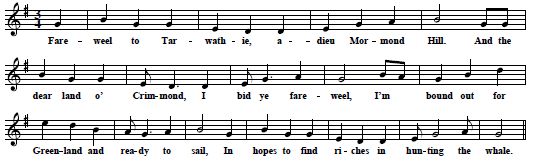
But what still makes the song so difficult to consider in a version that is truthful to all the lyrics Dylan wrote for it, is that while the lyrics are most certainly utterly modern, the song is anything but.  I’ve seen several claims to have traced the original, but I think “Farewell To Tarwathie” is one of the closest.  Indeed Heylin mentions this source, and for once I must agree with him.

It is the song of a man on a whaling boat sailing out of north east Scotland for Greenland.

The excellent “Just another tune” website provides this music

1. "Farewell To Tarwathie", as sung and recorded by Ewan MacColl and A. L. Lloyd, text and tune also available in: Peggy Seeger & Ewan MacColl (ed.), The Singing Island. A Collection Of English And Scots Folksongs, London 1960, No.56, p. 63

The lyrics (in case the text above is hard to read) are provided as

Fareweel to Tarwathie, adieu Mormond Hill,
And the dear land of Crimmond, I’ll bid you fareweel;
I’m bound out for Greenland and ready to sail,
In hopes to find riches in hunting the whale.

Indeed if you can hold Dylan’s song in your head you can almost certainly sing these lines to the song.  And it is not just that the lines fit the music, but there is an essence of the unknown and the uncertain that comes from Angelina, which is to be found here…

Our ship is well rigged and she’s ready to sail,
Our crew, they are anxious to follow the whale,
Where the icebergs do float and the stormy winds blaw,
Where the land and the ocean is covered wi’ snow.

The cold coast of Greenland is barren and bare,
No seed-time nor harvest is ever known there,
And the birds here sing sweetly on mountain and dale,
But there isn’t a birdie to sing to the whale.

Ewan McColl and Peggy Seeger published the song in 1960 in  The Singing Island. A Collection of English and Scots Folksongs, number 56.

And so to Dylan, with a song that is mysterious and wild from the off.  There are no explanations, and no reason to find them.  We are in a mysterious world where strange creatures stalk the night, and strange events happen.

Farewell Angelina
The bells of the crown
Are being stolen by bandits
I must follow the sound
The triangle tingles
And the trumpets play slow
Farewell Angelina
The sky is on fire
And I must go

It is a modern day song of leaving, with occasional elements of the original whaling song, telling us that leaving is just what happens as part of this odd world of disconnected images slips away from the past into a dark future.  A table by the edge of the sea?  Yes, there it is.  The meaning?  Who knows.  Maybe none.

There’s no need for anger
There’s no need for blame
There’s nothing to prove
Ev’rything’s still the same
Just a table standing empty
By the edge of the sea
Farewell Angelina
The sky is trembling
And I must leave

And the characters come tumbling in – or rather tumbling out.  We don’t know who they are.  Like the circus act on the cover of the Doors classic album “Strange Days” they just are there.

The jacks and the queens
Have forsaked the courtyard
Fifty-two gypsies
Now file past the guards
In the space where the deuce
And the ace once ran wild
Farewell Angelina
The sky is folding
I’ll see you in a while

And the character role continues and continues and the world slowly reaches its dealthly conclusion.   We have no explanation, except that the world is changing.  It just goes on this way…

See the cross-eyed pirates sitting
Perched in the sun
Shooting tin cans
With a sawed-off shotgun
And the neighbours they clap
And they cheer with each blast
Farewell Angelina
The sky’s changing colour
And I must leave fast

Even nature can’t make out what is going on amidst this chaos.  No one can decipher, except to say the world is falling apart, and I really can’t take much more of this…

King Kong, little elves
On the rooftops they dance
Valentino-type tangos
While the makeup man’s hands
Shut the eyes of the dead
Not to embarrass anyone
Farewell Angelina
The sky is embarrassed
And I must be gone

Perhaps one can say that the world is falling apart in war time, or that the unknown strangeness of Greenland and the whales is replaced by the weirdness of a world in which the Vietnam war can happen.

The machine guns are roaring
The puppets heave rocks
The fiends nail time bombs
To the hands of the clocks
Call me any name you like
I will never deny it
Farewell Angelina
The sky is erupting
I must go where it’s quiet

It is, for me, as masterpiece always just a step away from realisation in performance.   Even if you don’t find the version that I located on YouTube to be interesting, I still hope you see what I mean.  There is far more in this song than the Dylan and Baez versions allow to escape.


What else is on the site

1: Over 400 reviews of Dylan songs.  There is an index to these in alphabetical order on the home page, and an index to the songs in the order they were written in the Chronology Pages.

2: The Chronology.  We’ve taken all the songs we can find recordings of and put them in the order they were written (as far as possible) not in the order they appeared on albums.  The chronology is more or less complete and is now linked to all the reviews on the site.  We have also recently started to produce overviews of Dylan’s work year by year.     The index to the chronologies is here.

3: Bob Dylan’s themes.  We publish a wide range of articles about Bob Dylan and his compositions.  There is an index here.

4:   The Discussion Group    We now have a discussion group “Untold Dylan” on Facebook.  Just type the phrase “Untold Dylan” in, on your Facebook page or follow this link 

5:  Bob Dylan’s creativity.   We’re fascinated in taking the study of Dylan’s creative approach further.  The index is in Dylan’s Creativity.

6: You might also like: A classification of Bob Dylan’s songs and partial Index to Dylan’s Best Opening Lines

And please do note   The Bob Dylan Project, which lists every Dylan song in alphabetical order, and has links to licensed recordings and performances by Dylan and by other artists, is starting to link back to our reviews

Posted in Uncategorized | 29 Comments

Forever Young: the meaning of the lyrics – an alternative view

We’ve already taken one look at Forever Young, but as we’ve seen before, there’s much to be said and much to be gained in considering an alternative view.  There’s a link to the original review at the end of this article.

———

Forever Young by Dearbhla Egan

I have a friend about the same age as myself.  Let’s just say we are both around the half century mark.  We have talked together a lot about music over the years but both have very different tastes regarding what we like to listen to.  It is funny really, because if you are especially fond of a particular artist, it can sometimes be very difficult to understand why another person does not share your enthusiasm.  Recently I asked my friend why she did not like Dylan and she said she didn’t hate him but she just had a preference for other artists and bands such as Led Zeppelin!! However, she did concede that she liked the Dylan song ‘Forever Young’. Well, I thought that was a bit of an obvious and corny choice when one considers the enormous list she had to choose from but each to their own I suppose.

I was thinking about this later and I began to think that perhaps I had been a bit hasty with my criticism of both my friend and of Dylan by dismissing this song so easily.  As a person who is lucky enough to have a child of my own I can certainly vouch for the fact that the presence of a child in your life changes you utterly in almost every way if you are a loving parent.  

There is absolutely nothing you would not do for this little person to ensure that they feel loved and protected and special.  Your entire perspective on life changes and where once your focus was  entirely devoted to meeting your own needs and desires, your focus shifts, almost overnight, to meeting all the needs and desires of your child.  I would imagine that any person who has had a child that they love will understand what I am saying here and more besides. This need to protect and nurture is something that is usually shared by both parents.

Before I proceed any further with this article I would like to state that even though I will make references to the joy and fulfilment involved in having children and how these emotions change us intrinsically, I am in no way ignoring or being dismissive of the fact that this is not always the case.  There are millions of babies born in the world every day who, for a variety of reasons, are not wanted or loved or welcomed and I am not forgetting this at all.  As an adoptive mother, I know, very clearly that in order for us to have been given the gift of parenthood, it came at a massive cost to a person or persons who we will never know or be able to express our profound gratitude to. Yet, to this day, there are thousands of babies and young children in orphanages around Vietnam or out on the streets alone or working as child labourers in the most deadly conditions.  Many of them will not make it into their teens. And this is just Vietnam.  The bigger picture is truly horrifying and I feel the need to acknowledge this just because there is nobody to write a song for them.

In my case our daughter was adopted from Hanoi in Vietnam when she was just three months old.  When you go through an adoption process that takes over three years I can tell you that when you finally hold your baby in your arms you want to shout it from the rooftops with just as much vigour as any parents who have given birth to their child. Surely, Dylan must have felt some of this overwhelming joy and elation following the birth of his children.  I am sure that he must also have experienced that huge emotional shift that I have described when he felt the real love of a parent for their child.  

There is a lot of written material about the different ‘stages’ of Dylan’s music encompassing the early traditional folk through to the protest songs, going electric, religious influences etc. etc. There is a great deal of debate about how he was changing as a person as his music evolved and as he began to experience new and challenging aspects of life.  

But, I am going to throw the cat among the pigeons here by saying that nothing changes the persona of someone more than having or losing a child.  There are so many successful artists who have written songs dedicated to their children because of this huge need to ‘tell the world’ that a miracle has happened.  What is refreshing about most of these songs is their simplicity and genuine good intentions towards children.  It is as if this kind of love is so great that it cannot be contained and in this case, for a musician, the obvious thing to do is write a song about it. (If I were to provide a list of such songs it would take forever but I will compile a short list which you can read after the conclusion of this article and by all means add to if you wish.)

There is a song called ‘The Joy of Living’, written by the late Ewan MacColl, father of the late Kirsty MacColl, and a wonderful songwriter.  I would like to share a verse with you.  There are two reasons for this.  The first is because it is an amazing piece of writing and the second reason is that there is something about this verse that is reminiscent of parts of Dylan’s, ‘Forever Young’.  There are four verses in this song.  In the first he is bidding farewell to the land and the landscape in which he has lived his life. In the second verse he is bidding farewell to his beloved wife.  In the third verse, which I will show you, he is bidding farewell to his children and finally in the last verse he is coming home.  The song was written when the man was terminally ill.

The Joy of Living by Ewan MacColl; 3rd Verse

Farewell to you my chicks, soon you must fly alone
Flesh of my flesh, my future life, bone of my bone
May your wings be strong, may your days be long, safe be your journey
Each of you bears inside of you the gift of love
May it bring you light and warmth and the pleasure of giving
Eagerly savour each new day and the taste of its mouth
Never lose sight of the thrill
And the joy of living

The intention here is so clear and also sad in the context in which it was written although, ironically, it was not meant to be heard as a sad song, quite the opposite in fact.

Dylan has six children. Jesse, Anna Lea, Samuel, Jakob, Maria (adopted) and Desiree.  He had four children with his first wife Sara Lownds as well as adopting her daughter, Maria, from a prior marriage. He had another child (Desiree) after he divorced Lownds with Carolyn Dennis, a backing singer who he married in 1986 and subsequently divorced in 1992.  

Evidently Dylan said that he wrote the song, Forever Young, while on tour as he was missing his sons.  It was released on the album ‘Planet Waves’, 1974 and the song was recorded twice, the first in the slower rhythm with which most people are familiar and a second, more upbeat version on the reverse side of the album.


The joy and attraction to this song is, in a way, because of its sheer honesty and clarity. The emotion and wish that he is expressing is nothing that most parents would not want for their children and we are drawn to this song because Dylan expresses this emotion with such sincerity and accessibility.  Dylan has found a way to express this wish or prayer if you like in the most extraordinary manner while keeping things as ordinary as they can be.

Although it reads as a prayer from the start…

‘May God bless and keep you always’

this is not a religious song.    

Across many cultures the ‘blessing’ of a baby takes on many different forms and practices but it is generally common to acknowledge and celebrate the birth of a baby in most cultures.  In this case it does not really matter that Dylan asks that God be the one to protect his child, the important thing is that he wants his child protected and calls in God to help.


May God bless and keep you always
May your wishes all come true
May you always do for others
And let others do for you

The last two lines are sage advice to give to anyone, adult or child.  It shows how Dylan himself has learned that one must be able to both give and receive love in equal measure to be a rounded human being.  It seems like a simple lesson and yet so many people go through life without ever fully getting this.

May you build a ladder to the stars
And climb on every rung
May you stay forever young
Forever young, forever young
May you stay forever young

Of all the lines in this song, right or wrong, these are the ones that most people will remember if you mention it. And there is no great surprise in this.  What greater wish to have for your child than to hope they will reach the highest heights but not just by leaping up there. Yet again, Dylan is telling the child that he wants him to reach his fullest potential, to reach the stars but not without climbing on every rung along the way.  So, Dylan is not carried away so much that he is wishing his child’s life will be a piece of cake.  Yes, reach the top, but learn every lesson you can along the way – climb on every rung.


May you grow up to be righteous
May you grow up to be true
May you always know the truth
And see the lights surrounding you
May you always be courageous
Stand upright and be strong
May you stay forever young

I think we can learn a lot about Dylan from these lyrics.  This verse is not all up in the air dealing with wishes and dreams.  It is about important values that he would like the child to have as he grows older.  Of course, the values that we crave for our children are quite often the values that we either pride in ourselves or wish for in ourselves.  Here, values like righteousness, truth, courage and strength of character are immediately identifiable as characteristics that have always been important to Dylan and have been at the backbone of much of his work as a writer and activist. He has first-hand knowledge of how difficult it can be to hold your ground when you are on the wrong side of the tracks.  He knows how important it is to seek out justice and truth and to have the courage of your convictions even when you are scared.  This verse is a challenge more than a prayer I think for if, in fact, all these wishes come true, the subject has his work cut out for him and the daunting task of living up to a father who made good on all of these challenges.


May your hands always be busy
May your feet always be swift
May you have a strong foundation
When the winds of changes shift
May your heart always be joyful
May your song always be sung
May you stay forever young

There are two distinctly different themes in this last verse of the song.  In the first four lines Dylan still occupies the role of father as role model, giving advice based on what he believes is the right thing to do.  Have a good work ethic.  Be prepared for the twists and turns that life will inevitably throw at you and never sell yourself short or lose the courage of your convictions. The times are always a-changin’. Stay grounded and hold on to your beliefs.

But in the second half of this verse he lightens up again and, while knowing it is not realistically possible, he wishes for his son that his heart will always be joyful and that his song will always be sung.  These lines, like the opening lines of the song, are indicative of the immense surge of emotion Dylan is feeling towards his son and after all has been said and done, he just wants him to be happy. He has done his duty as a good father by giving guidance and now it is time just to cherish the wonder of his baby and all he wants for him.   

This is a beautifully composed love song or lullaby where we see how Dylan takes full responsibility for his role as a father.  As a song, it has always been well received and appreciated by an audience that is wider than just Dylan fans.  It is easy to see why as it delivers such a universal message.  

Unfortunately, with any of Dylan’s songs that become popular in the mainstream, they can end up being a little dismissed or side-lined by hard-core Dylan fans but I think it would be a mistake to dismiss this song too easily.  After all, there is a lot to be learned about Dylan by looking closely at the lyrics and it is certainly a good way of gauging where Dylan was emotionally placed at that time.

With regard to the music, I personally love the melody in this song but have always found the choruses very jarring.


Forever young, forever young
May you stay forever young

The verses are so gentle and then the choruses come in like a bombshell, no longer asking that his child stays forever young but demanding it.  Maybe it is just me.  I am also intrigued as to why Dylan chose to include an ‘upbeat’ recording of the song on the same album.  We know that Dylan has never looked forward to ageing himself.  He has said, and I quote, ‘People don’t retire, they fade away, they run out of steam’.  It is easy to see that a man who is now in his seventies but who insists on doing live concerts which are sometimes criticised terribly, is desperately trying to hold on to something.  Steam perhaps? Could this upbeat version of the song have something to do with that? Staying forever young?

Here’s that list of songs I mentioned near the start…

Paul Simon ‘Father and Daughter’, Harry Chapin ‘Cat’s in the Cradle’, Neil Young ‘Here for You’, Stevie Wonder ‘Isn’t she lovely’, John Lennon ‘Beautiful Boy’, David Bowie ‘Kooks’, Lenny Kravitz ‘Flowers for Zoe’, U2 ‘Original of the Species’, Thin Lizzy ‘Sarah’, Eric Clapton ‘Tears in Heaven’, Joan Baez ‘A Young Gypsy’…

Posted in Uncategorized | 9 Comments

Queen Jane Approximately: the painful meaning of the music and the lyrics

By Tony Attwood

Who is or was Queen Jane?  Joan Baez?  Lady Jane Grey?  Jane Seymour?   Someone else?  Anyone?  Or is it that Queen Jane is a variation on “Mary Jane”, one of the infinite number of slang words for marijuana?

Or was Queen Jane “a man,” as Dylan once said.

We don’t know and won’t know, and certainly some of the attempts to turn Queen Jane into an actual person are highly fanciful.

But for me all the evidence suggests she is another of the people from the Billion Dollar Bash.  One of the freaks, the far-out people, the talentless crew who hang out together thinking that just by being they is something special.  As if dressing in odd clothes is an equivalent to expressing interesting ideas in a coherent manner.

I reach this view in particular taking into account what Dylan had written immediately before Queen Jane.  Here’s the list in as close to the correct chronological order as we can get it…

I’m not trying to suggest this sequence of songs are all related to each other, for clearly they are not.  Desolation Row stands out from the rest; they really were selling postcards of the hanging.   And “Window” and “4th street” clearly form a pairing of absolute disgust at the people around.

But consider the rest in this little group: Tombstone Blues, Highway 61 Revisited, Just like Tom Thumb’s Blues and Queen Jane Approximately; they are all about the strange, weird and odd people, the people of dreams or drug-inspired hallucinations, or just the images that populate those very strange dreams after you ate cheese just before going to bed.

The one thing that makes Queen Jane different from the other songs is that it seems to be about the odd balls circling around the queen bee; the woman who owns the house, or has the dope, or is the rich kid rich enough never to worry about the house being trashed, or maybe the woman who remains totally cool and unattached while all hell is breaking loose.

It is a totally different song from “One of us must know” which appeared as the A side of the single.  On that song lines such as “Your voice was all that I heard” stand out, plaintive, painful, full of loss.  This earlier collection of songs including Queen Jane have nothing personal about them at all.  It is a song of “when you’ve sorted out your mess, come back and say hi.”

In this regard there is a connection to the songs of disdain, but only a slight connection, for with songs such as Rolling Stone and 4th Street, there is no “come and see me again”.  Far from it in fact.

Thus for me what Dylan is saying here is that he’s had enough of all these fakes and phonies; this is his exit line.  The difference between Queen Jane and Million Dollar Bash is that here is he still offering a connection between himself and the freak show.  In the later song he is just laughing at them.

This is then the half way world.  Dylan has moved out of the freak show, and is putting his head back in for one second to say, “when you come out, come and find me”. No further explanations are needed, you don’t have to speak about it beyond that, just come and see me sometime – when you are sorted.

Musically the song is very simple.  Three lines over a descending bass followed by the repeated chorus line, “Won’t you come and see me Queen Jane” with, in musical terms, a plagal cadence.  Interestingly it is one of only a handful of Dylan compositions with its structure analysed on Wikipedia – interesting because it really is such a simple song that there isn’t much analysis to do.  (Wiki refuses to allow any mention of Untold Dylan on the grounds that this site is not prestigious enough to warrant inclusion, so our commentaries remain beyond the bounds of Wiki’s world.  That’s fair enough – it’s their show, but sometimes when they do such simple analyses, I do wonder).

But where Wiki is at one with other commentators is in stating that the recording has the guitars out of tune with each other and the two keyboard instruments.  That’s true, but the difference is only slight, and nothing remotely as upsetting as the mistake by the bass player on the original version of Visions of Johanna.  Indeed this lack of perfection in the tuning, seems to reflect the subject matter.  Queen Jane is stuck inside a jingle jangle morning, afternoon, evening and night.  That’s the problem, and the music does seem to reflect that.

Lyrically, the song has a strong sense of the singer knowing that this mad and crazy world of the sweet pretty things will come to an end

When your mother sends back all your invitations
And your father to your sister he explains
That you’re tired of yourself and all of your creations

and in this sense the song is so much more gentle than that aggressive opening of Rolling Stone where there only finger pointing, sneering, and no suggesting that matters can ever be resolved in the future.  While the object of the sneers in Rolling Stone is stuck and the singer is simply pointing and saying “How does it feel”, here he is opening the door.  “Won’t you come see me, Queen Jane?” is not now, but at some suitable time in the future.

But we should be in no mistake – by this time, Queen Jane will be in a desperate state.  Everything that was owed has to be returned (as the peddler demands in Visions), and even her own children won’t like her at this time.

Now when all of the flower ladies want back what they have lent you
And the smell of their roses does not remain
And all of your children start to resent you

We have the impression that Queen Jane has money, and uses the money to buy friendship – but of course that friendship is full of sycophancy.  So Jane becomes sick of all this repetition and in the end she just craves the time when there will be no one trying to tell her what to do, and making demands or playing their part.

Then we have the final moment: all you want is to sit with someone you can trust, in silence.  That is a moment that cannot be bought.  It has to be earned.

So this is quite a rarity for Dylan – a song that offers a way back in for one of the sweet pretty things who is no longer sweet or pretty.  A friend or lover who has totally lost her way.  There’s no blame – just the notion that she’s got to sort the mess out for herself, and when she truly has done that, when she’s hit the bottom, that endlessly repeating descending bass line will end and we will rock gently on that cadence.    At that moment she’s welcome to come round and sit with the singer in contemplative silence.

At least that is what the lyrics say.  As for the performance on the albums, opinions vary.  Some find it careless (particularly the out of synch playing between guitars and piano, and of course the lack of tuning) while one commentary I found described this song as “stately”, “along with the arrangement that allows Dylan’s piano to lend its added gravitas.”

This review found, “a band playing to its strengths and creating a lovely backing track, a slower tempo to match the album’s more mature viewpoints.”

Maybe, but for me the lack of synchronisation within the band, both in rhythm and tuning suggests the fact that although the offer of a further meeting is there, rocking gently over a stable bass line, the present is still a mess and a muddle and is still descending.

As such the whole notion of the song is a challenge – how do you portray a mess and a muddle musically?  How do you say to someone who is addicted to dope or alcohol, come and see me when you are clean?  How do you say to someone who cannot get over a love affair, “come round when you have stopped feeling sorry for yourself”?

What do you do to help a friend whose only salvation is to help herself, but who right now seem incapable of helping herself?  Do you just say “when you are back together come and see me”? or do you say, “you have to do it yourself, but here’s the first step.”

I’d go for the latter, but I suspect I am now taking the issue of the song too personally.  But let me offer one final thought.

Call up a full set of the lyrics on the official Dylan site and just read them.  And then try and get that accompaniment playing in your head as you read the words.  And on top of that consider the point about a friend whose only salvation is to save herself, but who can’t see how to do it.

Unnerving isn’t it?

All the songs reviewed on this site in alphabetical order

Dylan songs in chronological order


Posted in Uncategorized | 18 Comments

“I pity the poor immigrant”: the meaning of the music and the lyrics

By Tony Attwood

This is a song that has attracted few commentaries, but those who have ventured into it have wandered deep, dark and different roads as they have endeavoured to make sense of the whole piece.

Speaking generally, there are two separate approaches that have been explored.  One focuses on the use of the word “immigrant” and what that means, and how the words flow on from that point, and the other focuses on the music.  I’ll try and take a quick look at each approach.

First the immigrant.

A literal immigrant who comes to another country and then is disappointed?  A person who simply changes ideology or converts to another religion?  A person who changes path and then wishes he hadn’t?  Something literal from Leviticus?

Or is Dylan doing another song of disdain?  Does the reference to “turn his back on me” really take us back to 4th Street?

Or indeed did he perhaps just think of the phrase “I pity the poor immigrant” and then try to do something with it – another atmospheric semi-abstract piece built around a phrase he liked and within which words that just followed?

Or could it even be a song of moving on – the dark side of Restless Farewell and The Parting Glass.

I’ll leave those questions hanging for a moment and move onto the music, before trying to pull it all together.

“Immigrant” itself seems to come from a Scottish Ballad “Tramps and Hawkers”- a typical ballad of idolising the life on the road, a concept that Dylan himself has often used as we’ve regularly noted here, often with melodies taken from Irish and Scottish ballads.  (So back again to The Parting Glass).

But – and this is the bit that seems to worry commentators – having written what seems to be a serious, religious commentary, and sung it in a serious manner, Dylan then turned it over in the Rolling Thunder Review and played a completely different, buoyant, lively, and yet fierce version.  Some dismiss this change as incomprehensible, a musical disaster and even disrespectful,  but others report it as a musical triumph.

I think there is a way to resolve all this – but it is just a theory.  It seems to fit the little that we know, but without a commentary from the songwriter himself, we really can’t say for sure.

The song, as a say, is lifted from a Scottish ballad with a totally different meaning from that which seems to make its way through “Immigrant”.

Nae thinking whar I’m comin frae nor thinking whar I’m gang

is the joyful conclusion.

So Dylan has taken a happy song and turned it into either something horribly mournful (But in the end is always left so alone) or something deadly serious, as any piece that quotes Leviticus is bound to be.

Leviticus, in case it’s not your cup of tea, means “The book of laws” and these are really serious Old Testament Laws incorporating some thoroughly nasty things to be done to women who are unfaithful and anyone who is gay.  “If a man also lie with mankind as he lieth with a woman, both of them have committed an abomination. They shall surely be put to death: their blood shall be upon them,” gives you the flavour of this book of the Bible.  (My quote is from the King James version).

It seems a curious mix, to take this jaunty song as Tramps and Hawkers, and then bring in such subject matter.  But here’s another point.  Dylan is not the only composer to re-use old tradtionional songs in this way nor in fact to use this particular jaunty piece to talk about the darker sides of life.

Consider, if you will, the song Goodnight Irene by Lead Belly (Huddie Ledbetter).  This uses the same tune (with inevitably a few variations of course).

Irene good night, Irene good night,
Good night Irene, good night Irene,
I’ll see you in my dreams.

Now that is the verse that everyone knows, and given the elegance of the melody it sounds like a beautiful love song.   But it is only if you listen to the rest of the song that you realise there is something else mighty nasty and frightening lurking underneath.

Last Saturday night I got married,
Me and my wife settled down,
Now me and my wife we are parted,
I think I’ll go out on the town.

OK, he’s going to drown his sorrows.  Perhaps not the brightest thing to do, but a commonplace response.  But then…

Sometimes I live in the country,
Sometimes I live in town,
Sometimes I take a great notion
To jump in the river and drown.

What?  Last we heard he was just going to have a few drinks too many in town.  Now he’s contemplating suicide?

I love Irene, God knows I do,
I’ll love her ’til the seas run dry,
But if Irene should turn me down,
I’d take morphine and die.

Just how dark do you want your blues (and later pop – try the Weavers version for size – although they left out some of the latter parts) to be?

I am not saying Dylan consciously went through all these thoughts, but we know he has a great knowledge of blues, pop and rock, not to mention the Old Testament of the Bible, and I think he took all these and mixed them up without consciously having an exact meaning for it all nor a knowledge of the exact direction he was taking.  It is a nice tune, and he would know the Lead Belly version, so, let’s see…

Which then explains how he could do what he did on the Rolling Thunder tour, because this song started as a jaunty outing and has a relationship to another horror story that because quite a delightful and well known song.

So on one level Dylan pities people who do bad things because then inevitably their world falls apart.   But the opening lines also pity those who forever believe the grass is always greener, and on finding that it isn’t feels betrayed and so retaliates against his new homeland that has let him down.

And indeed in the European Union at the moment, we are awash with an awareness of this.  As surely must be in the news across the world, millions are fleeing the civil war in Syria, and the advance of Islamic State, but some (I don’t know how many of course) are complaining about the way the Europeans are behaving.   I heard only yesterday of a group who ended up in Cyprus, but found themselves locked up in the British military base on the island.  This is not the life they imagined and they (or perhaps a few of them) are being vociferous in their denunciation of Britain over their treatment.

It’s a pretty sad state of affairs all round.  But back in the song Dylan is also contemplating a psychologically disturbed condition.

Who uses all his power to do evil
But in the end is always left so alone
That man whom with his fingers cheats
And who lies with ev’ry breath
Who passionately hates his life
And likewise, fears his death

Nothing of course is his (the immigrant’s) fault – like the characters described on Crawl out your window and Rolling Stone it is always someone else who is to blame, and at no time is support offered.  But then, leaving aside the suffering and hurt and pain that immigrants can feel on finding the streets of Europe are not paved with whatever it was they were expecting, the immigrant can blame everyone and everything.

And that leads into a classic case of denial.  I didn’t do it, it’s not my fault.

The “immigrant” has strength and ability but misuses it.  He is looking for paradise, his promised land, to drop from the sky and land at his feet.   And in this regard is like Oliver Cromwell (whose nickname was Ironside) in the English civil war who truly believed that if the whole country could be made to follow a specific strict code of puritan behaviour, God would be happy and everything would be fine.

In short, Dylan is focussed on people who think that the answer to all the problems is simple.  “If only I moved to another country,” “If only she loved me,” “If only we had a child”, “If only I had a bit more money”…

And that’s the point.  One simple change is never the solution.  It is always more complex than that.

So in one regard the immigrant symbolises the “if only” people who fool themselves, because life is never that simple that it can be made perfect by doing one simple thing, by living the puritan life, by not wearing a coat made of two different cloths (as Leviticus tells us)…

Simple explanations of how to make the world perfect never work.  As Dylan says…

Whose visions in the final end
Must shatter like the glass
I pity the poor immigrant
When his gladness comes to pass

So the issue isn’t really about why Dylan chose to focus on an “immigrant” – it just fits the song he chose, and it works because there are examples of immigrants who feel let down by their new homeland, rather than thinking, “it is up to me to make the most of life”.

The notion that I do this, and I want everything to be perfect, is naive and simplistic and bound to fail.  And one can say this in an upbeat way as in Rolling Thunder or a sad plaintive way as in the original version.

As such the song is a rejection of the Leviticus approach to life which sets it down as a list of rules that absolutely must be followed, including killing people for breaking one of the rules.

It is in fact much more about the concept that all situations can be seen either as fine and a good basic ground on which to develop, or as bad and someone else’s fault.

I have read commentaries that turn this into a wholly religious song, and of course they might be right.  Thus it is argued that “from a religious perspective, we are all unwilling immigrants in the land of the living, exiled from paradise and placed into the broken and happily temporal world where we must struggle against the temptations to do evil and instead choose to do good. To the religious person, there are signs of truth everywhere. To the secular, reality is only reality without intimations of Godly designs or Heavenly destinations.”

To which I say, yes I get this, and I have met enough deeply religious people to know that to them there can be signs of God’s truth everywhere.   But that last bit – “to the secular, reality is only reality…” is a complete misrepresentation.  To a secular person like me who has studied science nothing could be further from the truth.  My task in life is to enjoy of much of it as I can, seek to understand as much of it as I can, and try to do good and not harm.  That’s rather different.

Leviticus 26:20 says, “Your strength shall be spent in vain: for your land shall not yield her increase”, mine is, “keep an open mind, keep a loving heart, keep exploring, do no harm.”

So when one of the commentators on the song from a religious point of view says, “The godless hate their lives, but, trapped in a choice between two forms of torture, fear death as well.”

And that takes us back to the old problem of people who believe that they have the ultimate answer to life, the universe and everything, also tend to believe they know what I am thinking.  But when they tell me they are always so very, very wrong.

I don’t hate my life, I love my life.  I know I have been incredibly lucky in my life to have been born with a decent brain and enough talent to make my way in the world.  I enjoy that good fortune and try and share it a bit with others.  I know that I will die, and that I am over half way through my life – perhaps much more.  But it doesn’t scare me, because I will one day just go to sleep.  For ever.  There’s nothing wrong with that.  Yes I hope my daughters remember me, and think well of me, but that’s it.

Really the song isn’t that complex.   If you are as bitter as the immigrant and adopt as simplistic a vision of life as the immigrant, then inevitably when you get one of the simple things that you believe will make your life perfect and it doesn’t, you get fairly fed up.

So I don’t see the immigrant making a free choice between good and evil and choosing evil.    I see him as a guide stuck in that simplistic vision of the world that says, if only I could do this or have that or get the other, everything would be perfect.

In the end I don’t think it is a particularly important song, and I keep coming back to the notion that Dylan perhaps found the phrase, and just played with it.

Just that.

All the songs on this site listed in alphabetical order

Dylan’s songs in chronological order


Posted in Uncategorized | 26 Comments

Baby please don’t go: Bob Dylan’s take on an all time blues classic

Baby, Please Don’t Go

Baby please don’t go is often reported as the song that everyone who has sung the blues or played in a blues band has worked on, mostly while trying to get an authentic blues sound out of the music.  We’ve all done it, and most of us (certainly including me) have failed, because the song appears so simple and yet is just so hard to deliver in a way that keeps the listener’s interest.

I’ve included it on this site as Dylan has recorded it, as you can hear via the link above, and as I was specifically asked to do a review.  There are, as you might have gathered several other songs on the site not written by Bob, and indeed one that hasn’t been recorded by him, but was included in his radio programme.  No reason why not to include them.

The song seems to have its roots in a collection of slavery songs based around the “Long John” theme in the 19th century, that transmuted in the first decade of the 20th century to become songs like Alabama Bound and Charlie Patton’s “Elder Green”.  And indeed there are songs that have mention of Alabama Bound, Elder Green’s in Town, and Don’t Leave Me Here, all within one version, and which give a very strong link the Baby Please Don’t Go.   The earliest versions appear to emerge around 1907/8, mutating all the way from there on.

During its evolution the song moved from the rural ethos of southern slavery to the more modern urban feel.   It soon became part of the Delta Blues repertoire and by the 1940s the title “Please don’t go” was in use and by this time the main propagator of the song was Big Joe Williams.  Verses came and went in the song, although I must admit that there are some Dylan verses in the song that I’ve never heard used elsewhere.  But I’m not that much of an expert on the blues.

After that it seemed to have become an obvious song for all the big names of the blues. Muddy Waters, Howling Wolf, Little Walter, and many more all gave it their own take.  Gradually the title evolved with “Don’t you leave me here” being a popular title for a while.   Eventually it became the “Baby please don’t go” that everyone who has tried to perform the blues has murdered one way or another.

If you are interested in the origins the Big Joe Williams versions from the mid 1930s are one that gives a lot of feel of the earlier versions.  If you want to hear what the real blues sounded like at that time (and remember this is the music that really influenced Dylan) just click on that link and play it through.

If you go searching you can also find recordings by  Lightnin’ Hopkins, John Lee Hooker and Big Bill Broonzy.  Like I say, everyone’s done it.

As I have mentioned, Dylan adds many other verses, but here are the key lines that turn up in everyone’s version from the 1940s onwards…

Baby please don’t go
Back to New Orleans
You know it hurt me so
Baby please don’t go.

Turn your lamp down low
Don’t drive me from your door
Baby please don’t go
Baby please don’t leave.

In Britain there was a big interest in the blues in the 1960s and many white bands took to covering blues classics.  Blues artists from the USA, when they toured England, were revered in a way that I suspect was not always the case in their home country.

So everyone picked up on the song, and I think many of us old timers will particularly recall the version by Them, which some have suggested had Jimmy Page playing on it (although he wasn’t in the band), in the mid 1960s.  It became a huge hit, and a classic in its own right.   Them at the time consisted of  Van Morrison, Alan Henderson, Ronnie Millings, Billy Harrison and Eric Wrixon.

Although the song evolved from the original blues, through the 1930s blues and into the electric blues and pop blues, it has never lost the fact that it is all based around one single chord.  Dylan has himself used this technique a few times – as with the recently reviewed, “It’s all good.”   It’s a tough thing to pull off because the chord changes give the composer a chance of variation and movement.  Without it you have to put everything into the rhythm and the lyrics.

If the Big Joe Williams version of the song affected a generation of would-be blues singerss then the Muddy Waters 1953 version did it all again, with an even stronger rhythmic drive than the earlier version.

Big Joe Williams’ “Baby, Please Don’t Go” is included in the Rock and Roll Hall of Fame list of “500 Songs That Shaped Rock and Roll”.

Here are the lyrics from the Dylan version which I think was recorded in 1961.  I’d be glad to know if anyone has a source for these lines.  Are they Dylan’s own or from an earlier artist’s version?

Baby please don’t go
Back to New Orleans
You know it hurt me so.

I’m way down here
Babe i’m way down here
‘d give a girl for a beer
Baby please don’t go.

I’m on Parchman farm
Didn’t do no wrong
Baby please don’t go.

Baby i’m way down low
I ain’t do no harm
Baby please don’t go
Baby please don’t go.

Baby please don’t go
Baby please don’t go.

New Orleans is bad
New Orleans is bad
New Orleans is bad
Worst times i’ve ever had
Baby please don’t go
Baby please don’t go.

Jack o’ diamonds is hard
But it’s the only card
Jack o’ diamonds is hard.

Well you know what i mean
Where is the money i made
Well theres’s two cards lookin’
One is the eight of diamonds
The other’s the ace of spades
The other’s the ace of spades.

Honey i need you now
Baby please don’t go
Back to Jackson town
Babe i need you so
An’ i love you so.

It is undoubtedly a fine rendition of the song, but I am not sure it adds too much to what we know and understand about this classic of the genre.  Sorry about that.

Index to all the songs reviewed

The main Dylan compositions in chronological order.


Posted in Uncategorized | 4 Comments

As I went out one morning: Dylan paints an abstract revolution

By Tony Attwood

In my house, at the foot of the stairs, is a picture that I bought some 16 years ago.  The buying of the painting was quite an important personal moment in my life (I won’t bore you with it now, but I can remember the exact details of how, where and why I bought it) and I must have looked at it every day I’ve been in the house ever since.

It’s a picture of images – doors, walls, columns, squares… it looks like it could be a real place… but it isn’t.  Its an impression of a reality, rather than reality itself.

I mention this because it has often occurred to me that some Dylan songs are like that picture – they are made up of realistic elements, but they don’t coalesce into a clear finite image of the real world.   They are, like my favourite picture, reflections of overlapping elements taken from reality – not photographs of reality.

As I went out one morning is like this.  That title itself is like the representation of a standard door.  The folk version of “I woke up this morning” in the blues, as Heylin has pointed out.

But although this is a commonplace, what happens next is anything but commonplace for suddenly we are into the world of Tom Paine.

I’ve pondered long and hard about Tom Paine in this song, and have come up with all sorts of explanations as to what Dylan was referring to.  I am not sure which, if any, are true.   Tom Paine the French revolutionary, Marianne (the girl) was and is the symbol of the French Revolution, Tom Paine was one of the cornerstones of the American revolution, Tom Paine was also a famous British engineer, there’s an apparent link I’ve found with WH Auden, the English American poet of great renown, and we have the National Emergency Civil Liberties Committee… it goes on and on.

Quite possibly many of these people and concepts were all lurking about in Dylan’s mind as he wrote – and it is indeed interesting that he wrote the music not in a normal major or minor key of the type that we hear in 99.99% of our music today, but in a mediaeval mode.  I think it is the phrigian mode – if you want to experiment sit at the piano and play the white notes only from E up to the next E.  That scale of eight notes doesn’t sound major or minor, but actually sounds rather old and mediaeval.   That is the phrigian mode – it was quite a thing in the 15th and 16th centuries – but of course not much used now.  At once it sounds, well, mediaeval.

So, to try somehow and unravel this semi-abstract picture…

Tom Paine (9 February 9 1737 to 8 June 1809) was an English political activist whose life I first came across when studying the French Revolution of 1789, is indeed still a most famous man not least because he is considered one of the cornerstones of the American revolution and the inspiration of the revolt of 1776.

I know of him not just because I studied the French Revolution because two of the towns he lived in – Thetford in Norfolk and Lewes in Sussex – are towns I know.  The former because it is not too far from where I now live and indeed I was there just a few weeks ago, and the latter because it was close to where I studied in my teens and early 20s.

Tom Paine emigrated to the American colonies in 1774, was a close associate of Benjamin Franklin, and the author of Common Sense – the best selling article of the era.  John Adams (second president of the Republic ) said, “Without the pen of the author of Common Sense, the sword of Washington would have been raised in vain.”

More well remembered in the UK and indeed in France is The Rights of Man which defended the French Revolution even as it was turning into the Terror.  Paine was tried for sedition in England, and elected to the National Assembly in Paris only for Robespierre to have him subsequently arrested.  He escaped the guillotine however and eventually it was Robespierre himself who was executed and Paine who was released.

In 1802, he returned to America for the last time but when he died only six people attended his funeral – due to his rejection of Christianity which the citizenary of the new world hated – although it was much in favour in revolutionary France.

Here’s the Thetford plaque (there is also a statue to him in the town, but I don’t have a picture of that).

Paine was also an engineer and in 1796 designed the Sunderland Bridge.  (There is still a bridge at this point, but it has twice been rebuilt).  It became the prototype of iron and steel bridges.

.

And so having discussed Tom Paine what on earth do we make of this?

As I went out one morning
To breathe the air around Tom Paine’s
I spied the fairest damsel
That ever did walk in chains
I offer’d her my hand
She took me by the arm
I knew that very instant
She meant to do me harm

Are we to take it that the damsel is the Revolution?   The French symbol of the 1789 revolution (the great revolution in France, which led to the break with the rest of Europe as it established government without monarchs, although ultimately led to the rise of Napoleon), and indeed the French symbol of Liberty to this day, is the woman Marianne whose image is still displayed in the law courts, and indeed on euro coins in France and its postage stamps.  She is the symbol of the republic, democracy, freedom and ultimately Liberté, Égalité, Fraternité.

But enough of France.  What about the National Emergency Civil Liberties Committee? Dylan received the Tom Paine Award in 1963 from the National Emergency Civil Liberties Committee.   His subsequent off-the-cuff speech contained a series of references to the world being confused and old timers being out of date was met with at first laughter and then disdain from some of the audience.  Having just listened to it again I am not sure it is one of Bob’s more impressive monologues.

Moving on, let’s try another link: “As I walked out one evening” by WH Auden.  A different time of day but a similar meter, and surely a man of Dylan’s reading will know Auden as much as he knows the oft-quoted TS Eliot and Ezra Pound.

As I walked out one evening,
Walking down Bristol Street,
The crowds upon the pavement
Were fields of harvest wheat.

And down by the brimming river
I heard a lover sing
Under an arch of the railway:
‘Love has no ending.

‘I’ll love you, dear, I’ll love you
Till China and Africa meet,
And the river jumps over the mountain
And the salmon sing in the street,

‘I’ll love you till the ocean
Is folded and hung up to dry
And the seven stars go squawking
Like geese about the sky.

The poem continues and if you don’t know it I recommend it – but then I recommend all Auden so maybe that doesn’t mean too much.

Which leads me to think, maybe Dylan also must have known not just that song but also Funeral Blues from 1938.   If it is new to you try this version read by four different actors.   I think of this not just because it is a famous Auden poem (famous in England at least) but because here there is a feeling of separation and uncertainty that Dylan achieves – although seemingly travelling in a different direction.

Stop all the clocks, cut off the telephone,
Prevent the dog from barking with a juicy bone.
Silence the pianos and with muffled drum
Bring out the coffin, let the mourners come.

So what I am saying is that this song is not, as one commentator put it, “dripping with meaning” but is instead “dripping with unresolved images,” allowing us to make a million meanings out of it, just as I do with my picture of the door, the wall, the columns etc that I consider each morning as I come down from another night’s sleep.

Yes some of those images might be metaphors, and so might some of Dylan’s words, but mostly they are, to my mind, suggestions of images you can build yourself.

If you want to go further the clue is surely that the signer went to breathe the air around Tom Paine’s, meaning to grasp the meaning of Tom Paine’s incredibly important and decisive writing, the writing that influenced perhaps the two biggest revolutions in the history of the formation of the West.

But despite Tom Paine’s offer of liberation we (the girl) are still enchained, because our governments have sought eternally to remove the freedoms that Tom Paine contemplated.  The Marianne effect – and Marianne is now in chains.

In one sense we could be seeing that the relations of two people at the individual level are as complex as the problems of building a complete society.  And personally I love the notion that by offering Marianne as a symbol of the Republic, I will be harmed.  For every supporter of the Revolution it was ever thus.  The revolution is our greatest chance and turns into our greatest defeat.

The turmoil of the song then is the turmoil of creating a new society

“Depart from me this moment”
I told her with my voice
Said she, “But I don’t wish to”
Said I, “But you have no choice”
“I beg you, sir,” she pleaded
From the corners of her mouth
“I will secretly accept you
And together we’ll fly south”

So the revolution, at least in France, failed to live up to its original ideals.  As I am far less a student of the liberation of America from British rule than I am a student of the French Revolution of 1789 and the aftermath, I can’t say if the same is true of America, but to me, as an outsider, an occasional visitor, I find the USA in its current form far from the land Paine wanted it to be and the land he proposed in his writings.

Just then Tom Paine, himself
Came running from across the field
Shouting at this lovely girl
And commanding her to yield
And as she was letting go her grip
Up Tom Paine did run,
“I’m sorry, sir,” he said to me
“I’m sorry for what she’s done”

In which case this means, “I’m sorry for what the way in which the meanings of the Revolution have been betrayed.”

So there we are.  Either a painting of ideas in the form of real people, just like the work that hangs at the bottom of the stairs in my house in Northamptonshire, or an allegorical poem about the outcome of Paine’s writing, and the corruption of the revolution.

Who knows?

Details of all the songs reviewed on this site.

The songs of Dylan in chronological order.

Posted in Uncategorized | 20 Comments

If You Gotta Go, Go Now. Dylan being light-hearted and spooky

By Tony Attwood

If You Gotta Go, Go Now” is not by any means a great Dylan song, but it is of interest if the analyses of what was happening at the time are to be believed.

The Beatles were on the up having had their first hit in 1962 (Love me do) and by the time “If you gotta go” was written were up to A Hard Day’s Night.

The suggestion that Dylan thought he ought to have a top ten hit might seem laughable today – as if he would think about such things! – but in the early days of his career, he probably did consider such matters.  And of course he got one – “Like a Rolling Stone” – a top 10 hit unlike anything that had gone before.

But what is so interesting is that Dylan got his top 10 hit in one sense by doing what the Beatles had done (taking popular song to its ultimate limits) but not doing it in the way the Beatles had done.

Prior to the Beatles most charting popular songs were based around three or four chords of the type that every would-be guitarist learned to play.  E, A and B7 for example.  You learn those in the first few weeks of learning to play.

By the time of Hard Day’s Night, the Beatles had gone to another planet, for that song opens with a crashing Fadded9 (which 99% of rock guitarists would have to look up in a book of chords before getting right) and for good measure through in an opening line of Cadd9 and Dm7.  It sounds like nothing that had gone before.

In “Like a Rolling Stone” Dylan stuck to the chords that everyone who played rock, pop and blues would know, but took the lyrics (not the chords and melody) onto another planet.

But if “If you gotta go” was a trial run for all this, is does nothing to match either the Beatles nor his own subsequent bravado with the form.  It’s bouncy, conventional and three chords.   Indeed the only challenge is the line “or else you gotta stay all night” which I suppose might well have occupied the BBC committee on acceptable lyric content for a while, had it got into the charts.

Eventually however, “If you gotta go” did indeed become a hit – although not for Dylan.  Manfred Mann recorded it and got it to number 2 in the UK in 1965, the Manfreds having had a number of hits already, most notably “Do Wah Diddy Diddy”.

And in the light of all that we know now, it is interesting to note now that this song which to me at least seems very pop-ish and slight and nothing like the other Dylan songs of the time was recorded as an acoustic song for Bringing it all back home.

To get a feel of what was going on before it became a full pop song try this version which is followed immediately by Love Minus Zero.

After that there were apparently several attempts to rescue the acoustic recordings with overdubbing from other musicians.  The 7th take of the series was issued on the The Bootleg Series Volumes 1–3 (Rare & Unreleased) 1961–1991

Then in one of the more odd twists in British folk rock Fairport Convention recorded the song in French, “Si Tu Dois Partir” – for reasons that have never been clear, in 1969.   Fairport (in case you don’t know the name) has been and to a large degree still is an extraordinarily important band in English folk rock, but this was their only single success.  Indeed one particular link to note here is that David Pegg was part of Fairport at the time, and went on later to form The Dylan Project, which tours regularly in the UK and draws a very dedicated and positive audience.

As for the meaning of the lyrics, they are simply saying, “come on make up your mind.”  The singer is not being macho or demanding, just saying how he feels and asking the lady to stay – if she wants to.

But if you got to go
It’s all right
But if you got to go, go now
Or else you gotta stay all night

And he’s being a trifle funny

It ain’t that I’m questionin’ you
To take part in any quiz
It’s just that I ain’t got no watch
An’ you keep askin’ me what time it is

While reassuring her that he really is a decent sort of chap who will pay heed to her wishes.

I am just a poor boy, baby
Lookin’ to connect
But I certainly don’t want you thinkin’
That I ain’t got any respect

And he says it all with a spot of humour

It ain’t that I’m wantin’
Anything you never gave before
It’s just that I’ll be sleepin’ soon
It’ll be too dark for you to find the door

It’s very light and sweet, a fun song of not much consequence.  And in a very real way rather odd that this should be followed up with Farewell Angelina.  That one man could write both songs within a few months of each other is, well, rather spooky.

Alphabetical Index to all the songs on the site (complete)

Index to the songs in chronological order (still being developed)


Posted in Uncategorized | 5 Comments

I don’t believe you (She acts like we never have met). Dylan prepares the ground for the songs of disdain

By Tony Attwood

It is curious that the phrase “I don’t believe you” was the proper name for a Dylan song of 1964, when then became known popularly by another name (“She acts like we never have met”) while “I don’t believe you” became known as Dylan’s response to the cry of “Judas!” (the full response of course being “I don’t believe you. You’re a liar!”)

Dylan also later turned the phrase around with the phrase ” They’d like to drive me from this town; they don’t want me around, ’cause I believe in you.”  Indeed he said that “I believe in you even on the morning after,” in 1979.

I’m not sure if that means anything, but it is just a phrase that seems to pop up in his life.

“I don’t believe you” appeared on Another Side in 1964.  If you want some contrast in the way that the song can be performed there are two Alternate Takes from album – (the second runs straight on from the first so stay on the site) and then compare and contrast with a Thump it out live version with The Band – which I must admit I don’t like.  It seems to take everything that was worthwhile in the original, out of the song.  The delicacy and poignancy is all gone – it’s just blame, blame, blame.

Yet Dylan clearly liked the song as he continued to play it off and on through the years, saying at an early performance “This is about all the people that say they’ve never seen you…”

The song has also over the years not only undergone a musical transformation from a delicate reflection in its early acoustic versions to a belt it out rock song, the chord sequence has changed – originally gently rocking back and forth between C and G7, to a more negative challenging change in the full band version between Em and Dm.   He’s clearly a lot more angry and wanting to spell out his feelings later on and the change in the chord sequence absolutely reflects that.

But both ways of performing the song has Dylan using the standard chords of folk music – it just gets more edgy in the transformed version because of the minor chords.   Yet it is a song that has lived on through the years, because the story of a person who seemed to show affection but then turns away and ignores you, is something that many people have suffered.

And suffered is the right word, because the person who has taken affection and then turns away is both cruel, and admired.  Cruel because the person who is left can’t understand why it happened, and admired because the person who has suffered can want to be like that, can want to be able to turn away and ignore another, rather than be at the mercy of the other’s emotions.

It is all a question of power.

Acceptance can lead to happiness rejection leads to great pain.  Acceptance gives power to the other, rejection – that cruelest of moves – gives the individual who does the rejecting, the power.  They control the game for both of them – although from my experience the regular rejectors of others never get the ultimate happiness they think they will find next time around.

But Dylan always, in the songs of this era, can pick himself up and move on, go wandering, leave town, stroll down the highway, go on to another town.  It’s all just “One to many mornings”, he’s the ultimate drifter, he can move on to another town.

Rejecting relationships and anything that lasts more than a night is fine if you have the confidence to keep moving and know you will find another bed to share, more warmth which you can take, giving little back, and then move on.

And it is utterly selfish.

In the end, in the modern world everything ends, everything changes.  The stability that was everything in mediaeval society is now replaced by total turmoil.

So Dylan starts with incomprehension.

I can’t understand
She let go of my hand
An’ left me here facing the wall
I’d sure like t’ know
Why she did go
But I can’t get close t’ her at all

And the assertion that it was all so perfect in the past.

Though we kissed through the wild blazing nighttime
She said she would never forget
But now morning’s clear
It’s like I ain’t here
She just acts like we never have met

And I think this is the heart of the success of the song – its universality. We’ve all been there.

But what really adds to the song is the language – from the everyday description of what has happened and his disbelief at the situation, we move to

From darkness, dreams are deserted
Am I still dreaming yet?

A really powerful jump, to my mind.

There’s the desperation that it isn’t him, that there is some explanation other than the fact that she’s just gone off him…

If she ain’t feelin’ well
Then why don’t she tell
’Stead of turnin’ her back t’ my face?

But at the same time he knows she’s gone for good

Without any doubt
She seems too far out
For me to return to or chase

And then in exactly the same position in the verse as last time around, the lines that reflect rather than tell…

Though the night ran swirling and whirling
I remember her whispering yet

Then we have that desperate plea of all abandoned lovers: what did I do?

If I was with her too long
Or have done something wrong
I wish she’d tell me what it is, I’ll run an’ hide

And to round it all off, a brilliant, brilliant, summation leading to an ability to move on and start again.

And if anybody asks me
“Is it easy to forget?”
I’ll say, “It’s easily done
You just pick anyone
And pretend that you never have met.”

It is superb, and in a very real way prepares the ground for the songs of disdain and the songs of hopeless drift.   Like a Rolling Stone turns the bemusement into sheer disgust, while Johanna is as lost as Dylan suggests his past lover has become in “I don’t believe you“.

Pretending that you have never met someone is the cruelest way out, and the way chosen by only the most selfish.  But ultimately they get their comeuppance, for they become lost and alone: that is the message across the songs.

“Once upon a time you dressed so fine” really does follow on from “And pretend that you never have met”.  Just as “Ain’t it just like the night to play tricks when you’re trying to be so quiet” does.

It is the preparation for the darkness.

——————–

Alphabetical Index to all the songs on the site (complete)

Index to the songs in chronological order (still being developed)

Posted in Uncategorized | 5 Comments

Dylan as Celebrity


Dylan as Celebrity

By Dearbhla Egan

We live in an age where the label of ‘celebrity’ is up for grabs by anyone with even the most tenuous and limited claim to fame.  The title of ‘Celebrity’ is pinned on people because of how they look, what their surname is, how wealthy they are, if they are married to a footballer, if they are a friend of the person married to the footballer or if they can dish the dirt on the person who is married to the footballer.

It is absolutely staggering to consider the number of people who take an obsessive interest in the lives of these people and even more staggering to bear in mind the multi-billion dollar industry that has built up around this obsession.  The ‘celebrities’ at the centre of this will occasionally complain about invasion of privacy or inaccurate reporting but the truth is that they do not know how to do anything else other than to play at being famous.  Being a celebrity is their job.

Of course, successful, modern musicians can potentially fall into this category to some extent but it is as if they have the option of a decision or choice to make about their level of involvement.  There are many successful recording artists on the scene at any one time.  The level of their success can be measured by the number of albums they sell and the amount of air play they receive but not all of them choose to be in the public spotlight.  Those who choose the publicity go out of their way to be seen as celebrity either through personal choice or by being managed in that way.  There is a lot of money to be made by making public appearances, photo shoots for publication, giving interviews etc.

So, how is all this different to how things were when Bob Dylan’s name started to form on the lips of people as part of everyday conversation?  Of course everything is different really insofar as the impact of technology and communications on how we hear and see things now was just not around back then. When you think about this and then consider the unsurpassed, widespread popularity of Dylan, it was quite an achievement under the circumstances.

There is a line in the song ‘Diamonds and Rust’ which Joan Baez wrote about Dylan where she says ‘You burst onto the scene already a legend, the unwashed phenomenon, the original vagabond’ and this line is very telling.  It is widely regarded that Dylan’s first real exposure to the live public was when Baez invited him to work with her as a guest at the Newport Folk Festival in 1963.  But, of course at that point he already had two bestselling albums under his belt and was no ‘little boy lost’, no, he was ‘already a legend’ as she said.

In early-January of 1964, at which point his third studio album was to be released, 22-year-old Dylan wrote a long letter to Sis Cunningham and Gordon Friesen, both founding editors of ‘Broadside’, a highly influential underground magazine of the period — and spoke of, amongst other things, his recent rise to fame. The letter was published in the magazine’s next issue. This was what he had to say about fame: (This text is an exact transcript of how it was written in the typed letter that Dylan wrote)

let me begin by not beginnin
let me start not by startin but by continuin
it sometimes gets so hard for me —
I am now famous
I am now famous by the rules of public famiousity
it snuck up on me
an pulverized me…
I never knew what was happenin
it is hard for me t walk down the same streets
I did before the same way because now
I truly dont know
who is waitin for my autograph…
I dont know if I like givin my autograph
oh yes sometimes I do…
but other times the back of my mind tells me
it is not honest… for I am just fulfillin
a myth t somebody who’d actually treasure my
handwritin more’n his own handwritin…
this gets very complicated for me
an proves t me that I am livin in a contradiction…
t quote mr froyd
I get quite paranoyd
an I know this isn’t right
it is not a useful healthy attitude for one t have……

Because this is a passage from a personal letter it may be safe to assume that we are hearing a version of Dylan that is more open and sincere than perhaps what we would read on a transcript from an interview for example, where he was always more guarded. On the issue of fame, he is talking about it in a kind of innocent or slightly naïve manner and perhaps this is as a result of the times that were in it and the fact that it took longer for successful artists to be recognised in public and ultimately reach a stage where they found it almost impossible to walk down a street without the public or the paparazzi hounding them.  If Dylan’s biggest problem at this point was not knowing whether or not he might be stopped for an autograph he was doing well.

However, it is very clear from this passage that Dylan had begun to question the concept of being famous and what was expected of him as a result of this.  I think it is interesting to see that he was exploring this dilemma when he was just 22 years old when, arguably, it would remain one of the greatest dilemmas he would face throughout his life as an artist. It would not be long before the times would be a changin’ and not necessarily in a way he liked.

Fans of musicians come in varying degrees of obsessiveness.  The most obsessed fans are those who will risk life and limb to get to the front of the crowd at an open-air concert just so they can get as physically close to the band or musician as possible.  Just being in close proximity comes with the outside chance of a touch or a look or maybe even an autograph.  Many, many years ago I had a friend who went to a Status Quo concert and a drop of sweat from Francis Rossi’s hair flew down on to his face which he then refused to wash or shave for a fortnight, outlining the spot where the sweat had landed with permanent black marker.  He felt as if he had a little bit of Rossi, a little part of him, and for my friend this was the ultimate reward.  Feeling as though you possess a little part of your idol is the ultimate reward for most great fans and this was something that Dylan could never resign himself to. For his fans, the little bit of him that they wanted most of all was information, information that he did not regard as public property.

He was caught in a predicament all right, but, it must be said, that Dylan was not entirely a victim of circumstance when it came to the price of fame.  He was no fool and understood very well that if it were not for these fans he would never have reached the level of popularity that he enjoyed and encouraged.  What he did not seem to understand or approve of was what appeared to be the somewhat fickle nature of the loyalty of his fans. He was ever quite prepared for the outcry of disapproval that came about as a result of his ‘going electric’ at the Newport Folk Festival in 1965.   Thousands of people had made their way there in throngs to listen to and support him but sections of the audience suddenly turned into an angry mob who ‘booed’ him off the stage.  The critics too really turned on him because of this new musical approach.  And Dylan, who had never been particularly generous where his fans were concerned, was now in a quandary over what to do next.  There was never a question that he was so influenced by his fans that he would follow their lead but at the same time he knew he could not survive without them.

Interviewed by KQED Television, San Francisco, December 1965, When asked whether he was “surprised the first time the boos came?” He responded:

“That was at Newport. Well, I did this very crazy thing, I didn’t know what was going to               happen, but they certainly booed, I’ll tell you that. You could hear it all over the place…. I        mean, they must be pretty rich, to be able to go some place and boo. I couldn’t afford it if I     was in their shoes.”

It was a response that would become very familiar in tone both in his interviews and his music.  When something or someone hurt him, the stock response was to put them down by making little of them.  For all of his virtues and heaven knows there are many, a sarcastic or derisive Dylan was not to be trifled with. For example:

Positively 4TH Street (1965)

(last two verses)

I wish that for just one time
You could stand inside my shoes
And just for that one moment
I could be you

Yes, I wish that for just one time
You could stand inside my shoes
You’d know what a drag it is
To see you

I suppose, in his favour you can say that he was true to himself and despite the fact that he knew, and no doubt his management knew, that it was potentially disastrous to alienate his fans, Dylan still did not pander to their protests and demands.

Without becoming too embroiled in a very complex subject, I think it is important to make some kind of reference to personality here.  It is widely accepted in psychology that all people have a dominant personality type which is displayed through their behaviour.  This accounts for all those people you know who you describe as bubbly and outgoing or a great giver and helpful friend or a bookworm who keeps to themselves or that very creative and slightly eccentric person.

There are many different personality types and traits that make us who we are. So, what happens when you have a very creative person such as Dylan, who is very much an observer rather than an active participant in life, particularly social life, who is a thinker more than a talker, who is happiest either on his own writing or playing music or in a studio with others who are part of the creative process involved in producing an album? What happens when a person like this, almost as a result of a ‘simple twist of fate’ is cast into the limelight up to a point where his fans are relentless in their desire to know more and more of the intricacies  of every detail of the life and times of this deeply private and insular human being?

He responds, very true to type, by blocking people out as much as it is humanly possible for him to do.  Is he deliberately being awkward and precious and stand offish?  I don’t believe he is.  I think he is doing no more than being himself and unfortunately, Dylan’s ‘self’ is not one that occupies the role of celebrity with any degree of comfort.

The following is a small excerpt from a transcript of an interview in an issue of Rolling Stone magazine, November 29th, 1969 between Jann S. Wenner and Bob Dylan

JSW: You’ve been very reluctant to talk to reporters, the press and so on . ..  why is that?
BD: Why would you think?

JSW: Well, I know why you won’t go on those things.
BD: Well, if you know why, you tell ’em . . . ’cause I find it hard to talk about. People don’t understand how the press works. People don’t understand that the press, they just use you to sell papers. And, in a certain way, that’s not bad . . . but when they misquote you all the time, and when they just use you to fill in some story. And when you read it after, it isn’t anything the way you pictured it happening. Well, anyhow, it hurts. It hurts because you think you were just played for a fool. And the more hurts you get, the less you want to do it. Ain’t that correct?

It was clear from this that he had no desire to be fodder for the press to use in their own way and at their own will.  He was frustrated at the lack of control he had over what they were writing which would have stung him as Dylan liked to maintain control over all things in his life.

However, returning to personality type for a moment.  While our dominant traits are at the essence of who we are and how we behave, we are not necessarily defined by them and intelligent adults as they mature can learn to understand and embrace characteristics that may have felt uncomfortable or out of synch with how we have generally seen ourselves in the past.

Dylan is a really good example of this because as time has gone by he has become much more open and vocal in interviews most particularly when it comes to talking about music.  He remains unforthcoming when questioned about his private life but he is entitled to this as all of us are.  This is why it is referred to as our ‘private life’ and all people have personal stories and issues that they would not wish to share openly with thousands of people. It begs the question, why do fans of Dylan feel they have the right to ask and interrogate the man about his personal life when they would not wish it done to themselves? There is a double standard in there somewhere!

In conclusion I believe that ‘fame’ was the price Dylan had to pay in order to achieve what he wanted rather than ‘fame’ being a welcome side-effect.  He has spent almost as much time battling with it as he has writing, recording and performing his music.  It has been a monkey on his back but having lived with the monkey for so long I think they are finally starting to bond in mutual respect.

In the February/March, 2015 edition of AARP Magazine, Robert Love Interviewed Bob Dylan in relation to his forthcoming album, Shadows in the Night.

Q: A lot of your newer songs deal with ageing. You once said that people don’t retire, they fade away, they run out of steam. And now you’re 73, you’re a great-grandfather.

A: Look, you get older. Passion is a young man’s game, OK? Young people can be passionate. Older people gotta be more wise. I mean, you’re around awhile, you leave certain things to the young and you don’t try to act like you’re young. You could really hurt yourself.

And in concluding the interview…

Q: You’ve been generous to take up all of these questions.

A: I found the questions really interesting. The last time I did an interview, the guy wanted to know about everything except the music. Man, I’m just a musician, you know? People have been doing that to me since the ’60s — they ask questions like they would ask a medical doctor or a psychiatrist or a professor or a politician. Why? Why are you asking me these things?

Q: What do you ask a musician about? 

A: Music! Exactly.

Index to the songs reviewed and other articles on Untold Dylan

Posted in Uncategorized | 1 Comment

Lay down your weary tune: the meaning of the music and the lyrics

Lay Down Your Weary Tune” was written in 1963 – my evolving chronology has it within this sequence of writing

Reports suggest that Dylan was initially very excited by his new composition and tried to persuade Joan Baez to perform it at a forthcoming concert at the Hollywood Bowl, but she felt she wanted more time to get used to the song.

This excitement that Dylan felt led next to his desire, so we are told, to put it on The Time They a-Changin’ album but then of course it didn’t appear until Biograph.

One reason for the loss of the song at this time was perhaps because criticism and controversy was emerging concerning Dylan’s use of other people’s materials and his habit of claiming copyright himself.  This song would certainly fall into this category, and he admitted that it originated in Scottish folk ballads (O Waly, Waly and The Water is Wide are the most obvious).

After that opinions differ.  Some have it replaced by Restless Farewell and others suggest it was Only a Pawn in their Game which took the place on the album.

Restless Farewell was the last song added to the album, and this itself is based on an Irish ballad, and contains the famous rebuttal to Newsweek about various issues, particularly the issue of taking other people’s work and Dylan’s relationship with his family.

So maybe Dylan didn’t want another old folk song re-worked, or maybe he didn’t want more ammunition for the doubters of his talent, or maybe he wanted some more variation, and so chose Only a pawn, which like Hattie Carroll was contemporary in the extreme.

Dylan was certainly on top of the song, for his recording was made in a single take on 24 October 1963 and he performed it at Carnegie Hall a couple of days later.

Many of the commentaries focus on the song as mystic or religious.  Stephen H. Webb called it “one of the greatest theological songs since King David composed his psalms.”  I wouldn’t like to comment on that.

The source – The Water is Wide – is a song that has been collected from Scotland to Somerset (which in terms of the United Kingdom is pretty much north to south), and turns up in the collections of Cecil Sharpe, whose collecting of folk songs laid the basis for the Morris Men revival in Britain in the 20th and 21st century.

The song is particularly well known for its development of the phases of love within it – the all encompassing phase at the start, the fading or love as it grows old before it fades away like the morning dew.

A rough translation from the original Scots would be

O woe is me upon the bank,
And woe woe down the hill,
And woe woe by the riverside,
Where I and my love want to be.
I lean’d my back into an oak,
I thought it was a trusty tree;
But first it bowed, and soon it broke,
Just as my true love did lie to me.

You can appreciate the same feeling from the Water is Wide

A ship there is and she sails the seas
She’s loaded deep, as deep can be
But not as deep as the love I’m
I know not if I sink or swim.

What really marks out Dylan’s composition and his reference back to the original ballads is the use of common measure – a way of composing that is incredibly common (as its name suggests!) in traditional British folk ballads.

In essence this means you have four lines of music and in lines one and three there are four beats, and in lines two and four there are three beats.

Additionally the stress is on the second of each pair of beats so we get

Lay down your wear-y tune, lay down
Lay down the song you strum
And rest your-self ‘neath the strength of strings
No voice can hope to hum

where the words or syllables in bold are stressed.

Now what makes this so common in the music of the 16th and 17th centuries is that songs written like this are easier to remember – with most of their performers being illiterate and having to learn the songs by heart.  If you have a long ballad you at least have a chance of knowing where you are going with this repeated pattern.

Musically the song is simple – three major chords in the accompaniment and the same basic melody for both verse and chorus – common for the folk music of the time but unusual for Dylan.

And there is no storyline, no telling us how to behave or reflection on how we have behaved.  It is just a person talking about the natural world – and how the natural world is superior to anything mankind could make.

Which when we look at the album this might have been on (Times) we can see is a real contradiction to the title track.  Maybe that was another reason not to put it on the album.  As the album actually emerged, the final track was the moving on song, keeping going, finding something new, doing my thing.  If Lay Down had been there instead we would have had a something else – a sort of times they are a changing but nothing is changing, album.  Of course I have no idea if this would have worried Dylan, but it is possible that it might have done.

If there is a link between this song and other Dylan work it is not with the songs of Times but with concepts like every grain of sand.  Even “When the Ship Comes In” uses the ship as the allegory; but we’re not thinking that laughing fish are real!  But in Lay Down, this is a description of the real world.

If we want to take it further we can say that Dylan is in some way harking back to William Blake, a poet many of us entering college and university as teenagers were reading at the same time as appreciating Dylan.

To see a World in a Grain of Sand
And a Heaven in a Wild Flower,
Hold Infinity in the palm of your hand 
And Eternity in an hour.

Dylan’s vision is not the same but there are similarities

Lay down your weary tune, lay down
Lay down the song you strum
And rest yourself ’neath the strength of strings
No voice can hope to hum

It suggests, I think, that we should set aside our own troubled world and instead take refuge in the natural world and draw strength from all that we see therein – exactly as Blake suggested.

Struck by the sounds before the sun
I knew the night had gone
The morning breeze like a bugle blew
Against the drums of dawn

At whatever time of day or night the natural world can offer you insights, beauty, understanding…

The ocean wild like an organ played
The seaweed’s wove its strands
The crashin’ waves like cymbals clashed
Against the rocks and sands

Even in the changing nature of the weather we can find insight

I stood unwound beneath the skies
And clouds unbound by laws
The cryin’ rain like a trumpet sang
And asked for no applause

It is a beautiful song, but not, I feel, the message Dylan wanted to give out at that moment of conflict on an album called Times they are a Changin’

Index to all the songs on the site

Posted in Biograph | 11 Comments

Only a pawn in their game (1963): the meaning of the music and the lyrics

By Tony Attwood

“Only a Pawn in Their Game” refers to the murder of Medgar Evers, as the opening lines of the song reveal.  He was the civil rights activist who was the Mississippi leader of the National Association for the Advancement of Coloured People.   The song was said to be one of the first that suggested that the poor white man or woman was as victimized by discrimination as the poor black.   Dylan sang the song at the March on Washington for Jobs and Freedom, which I have mentioned in relation to The Lonesome Death of Hattie Carroll.

As many commentators and critics have said, “Only a Pawn in Their Game” puts forward the notion that Medgar Evers’ killer was not the only person guilty of murder: he was just the pawn in a much bigger game.

In this regard there is a strong link with Lonesome Death where Dylan suggests we should cry for the miscarriage of justice and the action of the judges as much as for the death of Hattie Carroll.  The killer is guilty, but blame is everywhere.

But the song moves onto more complex territory still, suggesting a conspiracy in which the poor whites are encouraged to blame the poor blacks while the people they most certainly should blame are the wealthy and powerful whites who have failed everyone in their economic and political leadership.

It is, as we used to say, “the system”, although these days I guess I’d say, the economy, the politics, the social structure and our psychology, and that’s only the start of the list.  But it is hard to make that lot rhyme let alone fit into a slogan.

So this song moved away from being a civil rights song, and became far more revolutionary: it is about overthrowing the state.  And there is no uplifting thought here, no “We shall overcome,” in fact Dylan is saying “this is how it is”.  Which is curious because on Times – the title track on the album – he is saying the change is happening, you can’t stop it, things are getting better, the new order is taking over.

Medgar Evers had dropped out of high school at the age of 17, joined the army and fought with honour in Europe during the second world war.  But then he found like so many others he didn’t return a hero, but as an outsider.  Indeed the issue of returning heroes is one that was of huge significance in England after the first world war, as much as in the US.

Our countries would willing accept such men as soliders ready to lay down their lives, but as civilians back in their own country, that was a different matter.  In Britain my forefathers voted in the most left wing government we have ever had and threw out Churchill and the rest who had led the government’s war.  In America… well I can only read this from a distance, but songs such as this tell us little changed.

When Evers returned home, he was prevented from voting in elections, and vowed then to work for change.  He, like James Meredith, applied for a place in a segregated University of Mississippi to study law.  The NAACP campaigned to desegregate the school and you can read my understanding of these events in the review of Oxford Town.   As always, my apologies if I have misunderstood any of this history – while beyond any doubt these were massive landmarks in the history of the US, they had no impact on the UK, where I live, and so I am very much reporting from without not within.

Medgar Evers worked with NAACP organizing voter-registration and the boycott of companies that practised discrimination and achieved something of a reputation.

On June 12, 1963, Medgar Evers was shot in back, outside his house.  He was buried a week later at the Arlington National Cemetery, receiving full military honours and Byron De La Beckwith, of the Ku Klux Klan, was arrested for Evers’ murder.

Of course times have changed – but watching from 4500 miles away, I wonder how much, and if the game Dylan was complaining about – the game of stopping the poor from understanding exactly why they are poor – isn’t still being played out on both sides of the Atlantic.

One website I read while researching the background to this song, suggests that “Dylan’s ever-constant hammering of the rhymes and odd tempo (there are moments where his lines are overwhelming the chord changes) make the song sound less serious than it should be, and this is just about the most serious song on the whole album. Dylan, who apparently had forgotten the subtleties that marked his best work on Freewheelin’, fires away with a number of broad generalities – so every Southern politician rose to power on the back of the black man? And every poor white man is trained like a dog to hate blacks? Doesn’t speak too well about the intelligence or independent thought of poor white men in the South, now does it? Surely not every man or woman in Alabama or Louisiana was born with strings attached, waiting to be just another puppet?”

Personally I think this is incorrect, and in the arguments that follow in the commentary on that site the author does backtrack a little – but I think he is profoundly on the wrong track.

And I find it unfair because of an oddity in my own life.  I played the album so that I knew it by heart – which is not so difficult for a young musician wanting to understand the full musical and poetic construction of the songs.  Coming back to the songs now I can still conjure up the complete lyrics and music in my head and make a fair fist of playing and singing them, and just for the hell of it, I just did it without listening to the album again.

But of course I do listen to the recordings each song I review, and play them a number of times.  And I find that on this album one I actually really do want to hear, despite knowing it inside out, is this song.   Those sudden changes of pace, the repeating of the rhymes, in this case they seem even more powerful than before.  I knew them, but had somehow forgotten the impact.

Dylan is right in what he does here, in my opinion, because the poet’s job, by and large, is not to represent reality, but to bring out emotional responses to that reality.  Of course Dylan is overplaying the part because that was what he had to do.  Should he have written a piece which said

A South politician preaches to the poor white man

But of course I say “A”, because they don’t all follow the segregationist plan

OK I am teasing, but political poetry doesn’t work like that.  You emphasise, over-play, make the point.  This is poetry not a doctoral dissertation.

This has been the case since the Norse myths and Icelandic sagas circulated.  The characters in the sagas were gods, invincible, heroic.  The white man in the Dylan song was a hypocrite, racist, fascist.  But I didn’t land in the States on my first visit expecting every white man I met to be like this because of Dylan’s song, no more than I expected the Icelanders I met a few years back to wield great axes and call upon Thor and Odin every couple of minutes.

So for me, a complete outsider to the events within the song, I don’t hear “clumsiness and the cliches” I hear something utterly fascinating.  Another Dylan song experimenting with the 6/8 rhythm format that is at the heart of this album, but this time endlessly changing and meandering around that format in a way that refers back to Down the Highway – the only other song I can recall where he does this – although that is just a preliminary to what Dylan does here.

These songs of Dylan didn’t set out to be a photograph of reality, but they did set out to shock and to pave the way for change, which in terms of dealing with the insanity and inhumanity of official segregation did work, but in terms of totally changing the world didn’t.  Nixon and Thatcher still won elections in the US and UK and then won them again, and the right wing fought back.

Which is perhaps why I find today, in 2015, Only a Pawn is a song I do want to come back to.  I don’t believe in conspiracy theories that tell me that man never went to the moon, but I do believe groups conspire together to grab and hold power (such The Gunpowder Plot in English history, which we celebrate the defeat of, every November 5), and the power of societies to resist wholesale change.  (In fact I think I learned that in the first term of the first year of studying sociology – that is what those with power do – they hold on to power).

So I do believe in “their game” although it doesn’t get much of an airing.  Of the songs on Times the official web site has him playing Hollis Brown 211 times in concert, Spanish Leather 299, North Country Blues 2, One too many mornings 40, Only a pawn 9, Restless Farewell 2, Hattie Carroll 296, When the Ship comes in 3, With God on our side 30 times.  I doubt those numbers are right and up to date, but it gives an indication of the way Dylan remembers different songs.

But I am intrigued that Dylan did perform the song at a CBS Sales convention in Puerto Rico and lots of the sales reps from southern states walked out.  Now that is a good statement to make to your record company – no one is going to tell Dylan what to sing.

To me there is a real power in the song from the very opening line

A bullet from the back of a bush took Medgar Evers’ blood

How dramatic do you want the song to be?  And I think it is the power of that opening line that makes Dylan change the rhythm and time throughout the song, to reflect the jagged edge of reality that he is singing about.

But having made such a dramatic statement he then emphasises the the individual elements of the shooting which then remove the reality of the horror, by focussing on such detailed issues.

A finger fired the trigger to his name
A handle hid out in the dark
A hand set the spark
Two eyes took the aim
Behind a man’s brain

And then the absolute shock of “But he can’t be blamed”.  While we are trying to think how the eyes are behind a man’s brain, or should it be “behind, a man’s brain” – ie the man’s brain was behind the eyes behind the hand directing it all.  I do wish the official web site would think about such things when putting up the lyrics!

But then the reinforcement of the shock, “He’s only a pawn in their game.”

After that there is no holding back

A South politician preaches to the poor white man
“You got more than the blacks, don’t complain.
You’re better than them, you been born with white skin,” they explain.

To me what you have there are some of the most powerful lines in contemporary music.  Indeed even now, all these years later I am shocked to see them turning up in a song on an album that sold so many copies.

And he’s not going to lay off either

The deputy sheriffs, the soldiers, the governors get paid
And the marshals and cops get the same
But the poor white man’s used in the hands of them all like a tool
He’s taught in his school
From the start by the rule
That the laws are with him
To protect his white skin
To keep up his hate
So he never thinks straight
’Bout the shape that he’s in
But it ain’t him to blame
He’s only a pawn in their game

The issue of the power of state schooling to continue the existence of inequality in society is an issue that has occupied me for much of my life since that first term in the first year of studying sociology.  Indeed my pal Drew (a doctor of philosophy, and expert in urban street crime in 19th century London) and I regularly spend hours arguing about the power of society vis a vis the decisions of the individual.  (Mind you the fact that we spend five hours every other week travelling to and from football matches together gives us a lot of time for this sort of debate!)

We imagine in our societies that the individual should be our focus – we put individuals on trial, but do not accept the argument of the influence of society as a force in determining behaviour.  Dylan here is suggesting we should – it is a hugely controversial and radical thought.

From the poverty shacks, he looks from the cracks to the tracks
And the hoofbeats pound in his brain
And he’s taught how to walk in a pack
Shoot in the back
With his fist in a clinch
To hang and to lynch
To hide ’neath the hood
To kill with no pain
Like a dog on a chain
He ain’t got no name
But it ain’t him to blame
He’s only a pawn in their game.

This truly is revolutionary stuff.  Free will goes out the window, and the power of social pressure and manipulation by an elite teaches these people how to behave.

But when the shadowy sun sets on the one
That fired the gun
He’ll see by his grave
On the stone that remains
Carved next to his name
His epitaph plain:
Only a pawn in their game

Byron De La Beckwith Jr. was convicted in 1994 of the killing of Medgar Evers 31 years earlier.   In two trials in 1964 on the same charge the jury had failed to reach a verdict, possibly because the juries were all white.  In Mississippi only voters could serve on the jury, and since blacks did not have the vote, the juries were white.

Over time inconsistencies and irregularities in the second trial were revealed, including the manipulation of who sat on the jury.  Meanwhile De La Beckwith having been a member of the White Knights of the Ku Klux Klan and having sought the Democratic Party nomination for Lieutenant Governor of Mississippi, moved on to being a member of the Phineas Priesthood which expressed hostility towards foreigners, Jews, Catholics and African Americans.

By 1973 Beckwith was under FBI surveillance and was stopped near New Orleans and loaded firearms and a time bomb complete with dynamite was found in his car. He had recently been ordained as a minister in the Temple Memorial Baptist Church – a Christian Identity church.   He served under three years in prison as a result.

He was brought to trial again in 1994 and convicted of first degree murder of Medgar Evers.  Evidence included sworn statements that Beckwith had boasted that he had committed the murder at racist rallies.  Beckwith appealed but he lost the appeal in 1997 and a sentence of life imprisonment without parole was confirmed.

De La Beckwith died, having been transferred from prison to a medical facility, on 21 January 2001.

One year later the prosecutor at De La Beckwith’s final trial was promoted to state judge.  However in 2009, the prosecutor-turned-judge pleaded guilty to obstruction of justice within an FBI anti-corruption probe.  When the judge was sentenced to 18 months imprisonment, Byron De La Beckwith’s son was in the courtroom.  He, like his father  at his trial, wore a Confederate flag pin.

So, it continues….

All the songs reviewed on this site.

Posted in Times they are a changing | 11 Comments

The Lonesome Death of Hattie Carroll (1963). A true telling of historical facts or…

by Tony Attwood

Does it matter that sometimes Dylan uses other people’s melodies, phrases, partial lyrics?  Does it matter that on occasion he re-uses his own music with new words?   Does it matter if he takes an actual event which relates to a recently deceased person and doesn’t reflect the true facts of the case?

Actually I don’t quite know where I stand on this although I know I would be both proud and bothered if Dylan took one of my songs, changed the words, published it and didn’t ask permission and pay for the privilege.  But I suspect most of my annoyance would be because most people wouldn’t believe I had written it!

But I am also bothered about changing the reporting of facts about events and drawing conclusions that seemingly are not at all valid.  So Hattie Carroll did indeed worry me as I came to write this article.  If it were about events 100 years earlier, no, I’d let it go. But somehow, the fact that Dylan was writing about contemporary events, and from all the evidence got some of the facts utterly wrong, and from these errors makes the strongest accusations of corruption and miscarriages of justice, and accuses a man of murder – an accusation which many have said was not at all justified, then yes, I am worried.

Or at least I was, when I started.  But not now, because my view changed in the researching of this review, for in doing my background work I came across an article from Mother Jones magazine, (an American radical publication) which gave me a new insight.

It is often pointed out that the sentence of William Zantzinger was delivered by the court on the same day that Martin Luther King, gave his “I Have a Dream” speech in Washington. Bob Dylan, as we know, was one of the celebrities at the march and it is often reported that on the journey home to New York he read about the conviction of Zantzinger and that gave him the idea for the song.

That much I knew, but what I didn’t know and what a 2005 article from Mother Jones tells me is how the mainstream press reported the march and speech.  Here’s what the article says on that point…

What comes through in the stories about the march is a vast sense of relief – shared, presumably, by the reporters, the papers’ management and their readership – that the 200,000 or more assembled “Negroes” hadn’t burned Washington to the ground. All three papers used the adjective “orderly” in their headlines; all reported prominently on President Kennedy’s praise for the marchers’ politeness and decorum. The Post and the Sun gave small notice to Dr King, and less to what he said. Neither made much of the phrase “I have a dream”. Only James Reston of the Times understood that he had witnessed a great work of oratory, but even his story veered into brow-wiping at the good manners of the marchers.

And that, I think is the key.  Dylan uses every weapon at his disposal to hit not so much at the hopeless William Zantzinger but the hopelessness of the national press in seeing an event and utterly, totally and completely misunderstanding what was going on.  He wanted (I believe) to point the finger at the fact that the white nation and those who wrote for the white nation, were just totally out of touch with the way the times were a-changing.

The point about “The Lonesome Death of Hattie Carroll” is that it was “lonesome”, because no one knew what was going on and no one was going to report it, let alone be outraged.  In this sense the song is attuned to the message of Times they are a changing  – “there’s a battle outside and it’s raging” but you haven’t looked outside to see it.

The point on the march wasn’t that the marchers were very polite and didn’t cause a riot.  The point was “I have a dream”.   The point wasn’t whether William Zantzinger killed Hattie Carroll or not, but that the mindless, ceaseless horrific abuse of black workers by arrogant prats like Zantzinger was part of day to day reality for millions upon million of Americans and no one was reporting it as even significant.

The “I have a dream” speech could have been lost as a major historic moment if so many had not taken up the theme.  But at first the media was indeed blind.  The abuse of Hattie Carroll would have most certainly gone unnoticed if Dylan had not taken up the theme because no one took that sort of thing up.

Dylan’s approach to the death of Hattie Carroll followed from the bleak headline in Broadside

Rich brute slays Negro mother of ten.  

and what Dylan did was to write a stunning piece of music based around that allegation (which itself hides most of the truth), and the fact that William Zantzinger, the accused, got six months for for being the perpetrator.

What is sometimes not noticed however is the timetable.  Hattie Carroll died on February 9; Zantzinger went to jail on September 15; Dylan recorded the song on October 23 – a very fast turnaround of six weeks from the event to the recording.

None of this hides the fact that the accused was not found guilty of murder, but of involuntary manslaughter, because the case that was put showed that no, William Zantzinger did not beat Hattie Carroll to death although he did behave in an illegal, not to say utterly offensive and disgusting manner.

Now I am not going to try and unpick what happened; so many people far closer to the details and much more knowledgeable about what the laws that applied said at the time have done that.  But the essence of it appears to me to be that Zantzinger was extremely drunk, extremely abusive, was a racist (commonplace and not a crime at the time) and clearly felt it was his right to shout at a waitress who he perceived to be slow.

But the court found that the cane left no mark on her; and that she died of a brain haemorrhage brought on by stress caused by Zantzinger’s verbal abuse, coupled with the assault.

Heylin argues strongly that Dylan took the prosecution case in the subsequent trial but took no notice of the defence case which seemingly was stronger than the prosecution case.  But I think that is wrong.  I think he was thinking not just about Hattie Carroll and the abuse she suffered, but also the media’s perception of the march and the King speech.  I think he was incredibly frustrated by the way the march was reported, and so used the most dramatic drama he could to portray his feelings and to get attention.  And in that he certainly succeeded.  Lesser writers might have written a piece about the papers ignoring the true meaning of the march.  Dylan went in the opposite direction and had much more effect.

Dylan set his diatribe to a variation of the traditional Scottish song “Mary Hamilton” which implicates the Queen’s husband in the murder of a child of a maid.  The Queen later made the singing of the song, the writing of it down, and the teaching of it to another, an act of treason.  So it’s a good piece to choose for this type of writing.

And surely no one can deny the power of the song he produced.  The use of the “time for your tears” line is surely one of the most powerful single lines in Dylan’s work, and indeed the whole chorus with its plea for humanity and understanding, is phenomenally powerful.

Interestingly in a musical sense he also used two techniques that he had already experimented with.  The song like Times they are a changing is again a song in triple time – this time in 6/8 rather than 12/8, meaning each bar consists of two groups of three beats.

Second he used verses of varying length, as in Hard Rain.

What also adds to the absolute power of the delivery is the fact that the chord sequence in unremitting in its repetition.  Six lines of the same three chords…

C  Am  Em; C Am Em; C Am Em…..

with the added impact of the last two being minor chords which builds significantly on the feel of melancholy and doom.

Of course the song raises many other issues.  For example, if one is being critical and accepting the view that Dylan’s lyrics have nothing to do with the finding of the court, then the question arises why didn’t Zantzinger sue Dylan for millions of dollars.

There’s also the fact that Dylan deliberately or mistakenly calls the protagonist “William Zanzinger”.  We never know why.

Dylan is also completely off track with the “cane” which Dylan says was the weapon that killed Hattie Carroll.  It was in fact a toy costing 25 cents, which could not be used as a weapon.

Hattie Carroll complained of feeling unwell five minutes later, collapsed and died eight hours later.  The autopsy showed she had an enlarged heart, hardened arteries and high blood pressure.

After the trial Time magazine said, “After Zantzinger’s phalanx of five topflight attorneys won a change of venue to a court in Hagerstown, a three-judge panel reduced the murder charge to manslaughter. Following a three-day trial, Zantzinger was found guilty. For the assault on the hotel employees: a fine of $125. For the death of Hattie Carroll: six months in jail and a fine of $500. The judges deferred the start of the jail sentence until September 15, to give Zantzinger time to harvest his tobacco crop.”  This sort of deferral is not known in the UK, but is common in parts of Europe – indeed it is the norm in Sweden.  I am told it is in parts of the US too.

Although Zantzinger was said to be a rich tobacco farmer in many reports, it seems he had a lot of financial problems and eventually had his properties removed from him in response to his tax arrears.

In 1986, because of the back taxes, the county took possession of some rental houses he owned but seemingly being the sort of man who always thinks he is clever when he isn’t, he went on collecting rents as before. When the black tenants fell behind on their rent, he took them to court which was fairly dumb, and the state noticed.  In 1991,  Zantzinger was arrested on charges of fraud and deceptive business practices.  The judge sentenced him to 18 months on work-release in the county jail, 2,400 hours of community service and about $62,000 in penalties and fines.

Zantzinger passed into whatever afterlife such people go to, but his name lives on with one of the most powerful first lines in any song – and this in a song packed with power.

William Zanzinger killed poor Hattie Carroll
With a cane that he twirled around his diamond ring finger
At a Baltimore hotel society gath’rin’.
And the cops were called in and his weapon took from him
As they rode him in custody down to the station
And booked William Zanzinger for first-degree murder.
But you who philosophise disgrace and criticise all fears,
Take the rag away from your face.
Now ain’t the time for your tears.

Six lines of unremitting repeated chords as I mentioned above before a three line chorus – all very unusual in musical terms.  And then it gets more odd, with seven lines plus three.

William Zanzinger, who at 24 years
Owns a tobacco farm of 600 acres
With rich wealthy parents who provide and protect him
And high office relations in the politics of Maryland,
Reacted to his deed with a shrug of his shoulders
And swear words and sneering, and his tongue it was snarling,
In a matter of minutes on bail was out walking.
But you who philosophise disgrace and criticise all fears,
Take the rag away from your face.
Now ain’t the time for your tears.

And then the third and fourth verses of unremitting horror across 11 lines plus the final three – with the last verse’s powerful variation.

Hattie Carroll was a maid of the kitchen.
She was 51 years old and gave birth to 10 children
Who carried the dishes and took out the garbage
And never sat once at the head of the table
And didn’t even talk to the people at the table
Who just cleaned up all the food from the table
And emptied the ashtrays on a whole other level,
Got killed by a blow, lay slain by a cane
That sailed through the air and came down through the room,
Doomed and determined to destroy all the gentle.
And she never done nothing to William Zanzinger.
But you who philosophise disgrace and criticise all fears,
Take the rag away from your face.
Now ain’t the time for your tears.

That third verse above adds even more pressure on the listener with three lines all ending “table” – you just don’t do that unless you are making one hell of a point.  It is like banging on that table in fact.

And so to the conclusion.

In the courtroom of honor, the judge pounded his gavel
To show that all’s equal and that the courts are on the level
And that the strings in the books ain’t pulled and persuaded
And that even the nobles get properly handled
Once that the cops have chased after and caught ’em
And that the ladder of law has no top and no bottom,
Stared at the person who killed for no reason
Who just happened to be feelin’ that way without warnin’.
And he spoke through his cloak, most deep and distinguished,
And handed out strongly, for penalty and repentance,
William Zanzinger with a six-month sentence.
Oh, but you who philosophise disgrace and criticise all fears,
Bury the rag deep in your face
For now’s the time for your tears.

How powerful do you want a song to be?

All the songs reviewed on this site.

Posted in Times they are a changing | 6 Comments

The times they are a changin’. The meanings behind Bob Dylan’s song

By Tony Attwood

This article updated 14 June 2017.

By pure chance as I settled down to gather my thoughts on The Times in preparation to write this review, I also listened to Girl of the North Country.  And I think this truly brought home to me how different from his general self Dylan was, in writing The Times.  How strident, how determined to make a point.

How different also because the song is in what is, for Dylan, a most unusual time signature – 12/8.

You can hear this time signature by listening to the guitar as he plays 1,2,3; 1,2,3; over and over again, with the “1” being the bass note of the chord, and 2,3 being the chord itself.

This process allows a multiplicity of words to get an accent because there are four accented words on syllables in each bar, rather than one, as we get in 4/4 (four beats in a bar).

12/8 is a c0mplex time in which the music is arranged (as noted above) in threes, with four groups of three making up a complete bar.  If we look at the opening…

Come gath-er ’round peo-ple
Wher-ev-er you roam
And ad-mit that the wat-ers
A-round you have grown

the bold words and part words are the emphasised words, the first of the 1,2,3 across two bars.  It gives the whole song its effect and fits with the strident, “this is how it is” concept, which is so unusual in Dylan.

Interestingly it seems to have been written just two weeks after “When the ship comes in” which tells not of how it is now, but how it will be in the future When the ship comes in.  Perhaps as a result, “When the ship” is a much more joyous song telling of wonderful times to come.  “Times,” written in the aftermath of the Washington march, is solid telling us it is happening now, and there ain’t nothing we can do about it.

Musically we can also note as Bream does in Dylan disc by disc that the melody is directly copied from One too many mornings – but we don’t hear it as such because the time signature is so different.  One too many is a straight four beats in a bar piece – none of the complex rhythmic interplay of the twelve beats in four groups of three that Times gives us.

The opening is, of course, firmly based in the folk tradition of telling the villagers to gather around and I will tell you of wonderful things that are happening.  Dylan did the same opening with North Country Blues where he commands, “Come gather round friends.”

Likewise the emphasis on an old traditional approach to songwriting is emphasised by Dylan writing “A-changing” and not “changing” in the title – a phrase dating back to 18th century English folk ballads.

But Times has neither the joyous buoyancy of “When the ship” nor the delicate feeling and concern of Girl of the North Country, nor the desperate bleakness and sorrow of North Country Blues.  All the wistfulness has gone, this is definitive, strident, telling.  There’s nothing personal here.

Dylan has a few times talked about the song and its meaning, and we all know how confusing and contradictory he can be, but in one interview in Melody Maker he did make a point that seems to me to be valid, as one comes to look back on a song that clearly has anthem proportions.   Dylan said, it is “about the person who doesn’t take you seriously but expects you to take him seriously.”

Which from the point of view of the young incorporates everyone from parents to teachers, from those who programme TV channels to politicians.

And yet what has been called one of the most famous protest songs of all, isn’t really a protest song at all.  It isn’t protesting about anything, rather saying, “time to wake up, the world has moved on”.  It is a song about perception.  You don’t have to rise up and overthrow the evil empire, but rather just admit that the world has changed irrevocably.  So be careful – it might just pass you by, and you might just be left wondering where the old world went.

Certainly the world moved on at a pace none of us could have anticipated,  although Dylan continued to open his concerts with the song.  Talking to Anthony Scaduto, Dylan said, “Something had just gone haywire in the country and they were applauding the song. And I couldn’t understand why they were clapping, or why I wrote the song. I couldn’t understand anything. For me, it was just insane,” which in a perverse way shows how a perception of a song can be influenced by those who proclaim they know its meaning, rather than by the guy who wrote it.

So we have to

And accept it that soon
You’ll be drenched to the bone

had already happened, the world had moved on.

And yet there is a secondary meaning within all this, for as Dylan says, there is no catching up to be done.  The pathways are diverging here – you get on the route you choose and then you are stuck there.

Come writers and critics
Who prophesize with your pen
And keep your eyes wide
The chance won’t come again
And don’t speak too soon
For the wheel’s still in spin
And there’s no tellin’ who that it’s namin’
For the loser now will be later to win
For the times they are a-changin’

Dylan wasn’t right of course, because the changes of that year were just the sort of thing we had to get used to; from here on it was all change all the time, and by no means always for the better.  Modernism was over, and the constant change, evolution and re-evaluation of post-modernism was now what we had to get use to.  Dramatic, endless change, not the one off divergence that Dylan imagined.

Although he was absolutely right in saying,

For he that gets hurt
Will be he who has stalled

Being non-changing in a world of endless change and re-invention was not an option if you wanted to stay part of the mainstream.  The only way to opt out was the rural idyll of the later “New Morning” songs.

Of course what most teenagers of the time loved most of all was the lines telling their parents that it was all over.  The cry “You don’t understand” suddenly had extra validity because it was on a record…

Come mothers and fathers
Throughout the land
And don’t criticize
What you can’t understand
Your sons and your daughters
Are beyond your command
Your old road is rapidly agin’
Please get out of the new one if you can’t lend your hand
For the times they are a-changin’

Except of course that those who were teenagers at the time are now parents and grandparents.  Maybe however we (or some of us) try to keep up with new ways of seeing.

While many songs about the revolution to come (from The Red Flag onwards) are seriously upbeat, Dylan is seriously downbeat.  There is no joyous future, just a saying, “you are past it, get out of my way”.  The song has no humour, just as indeed as  the AllMusic Review by Stephen Thomas Erlewine points out, the album has no humour.

In fact this song opens an album that really I don’t want to listen to as an album any more.  So as I said at the start, while I welcome the chance opportunity to hear Girl of the North Country again when I was actually meaning to play Times, there is not so much here I really want.  Some tracks, yes, but somehow for much of the album, and particularly this song, the moment has gone.  “One Too Many Mornings” and “Boots of Spanish Leather,” are for me the great exceptions.

And it was this realisation that led me to realise that the whole album except “Times” is about days gone by.  This is an album that says, “the past has gone, the new times are here, but I want to tell you what it was like the past”.    “Only a pawn”, “Hattie Carrol” and “Hollis Brown” all tell of desperate times, not a bright new future.   “Restless Farewell” and “One too many mornings” tell us the only thing to do is to keep on moving on.

Since the 1980s the song has had more to do with advertising than political and social change.   Steve Jobs used it in 1984 to unveil the Macintosh computer.  Ten years later Coopers & Lybrand, the accountants (who were my company’s accountants at the time, curiously) used it.  Two years after that the Bank of Montreal got their hands on it.  By 2005 it was being used to advertise insurance.  Finally, as if to show that there was a meaning in the song, but just never the one we imagined, Dylan’s hand written notes for the song were to at auction for just under half a million dollars to a hedge fund manager.

Yes, he was right, the times were changing.  I just wish that change had had less to do with rampant capitalism and religious fundamentalism and more to do with humanity, honesty and perhaps most of all, trying to be a decent sort of bloke in a world gone wrong.  But that’s just me.

Just under two years after he had written the song, Dylan did an interview with the English pop/rock/jazz/blues weekly, “Melody Maker” as said, “It was nothing to do with age or parents… This is what it was, maybe – a bitterness towards authority – the type of person who sticks his nose down and doesn’t take you seriously, but expects you to take him seriously.”

What is on the site

1: Over 400 reviews of Dylan songs.  There is an index to these in alphabetical order on the home page, and an index to the songs in the order they were written in the Chronology Pages.

2: The Chronology.  We’ve taken all the songs we can find recordings of and put them in the order they were written (as far as possible) not in the order they appeared on albums.  The chronology is more or less complete and is now linked to all the reviews on the site.  We have also recently started to produce overviews of Dylan’s work year by year.     The index to the chronologies is here.

3: Bob Dylan’s themes.  We publish a wide range of articles about Bob Dylan and his compositions.  There is an index here.

4:   The Discussion Group    We now have a discussion group “Untold Dylan” on Facebook.  Just type the phrase “Untold Dylan” in, on your Facebook page or follow this link 

5:  Bob Dylan’s creativity.   We’re fascinated in taking the study of Dylan’s creative approach further.  The index is in Dylan’s Creativity.

6: You might also like: A classification of Bob Dylan’s songs and partial Index to Dylan’s Best Opening Lines

And please do note   The Bob Dylan Project, which lists every Dylan song in alphabetical order, and has links to licensed recordings and performances by Dylan and by other artists, is starting to link back to our reviews.


Posted in Times they are a changing, Uncategorized | 10 Comments

Who killed Davey Moore: an exploration of Dylan’s meanings

By Tony Attwood

Updated 8 September 2017

Dylan was clearly taken by the death of Davey Moore in that he wrote and then performed this song three weeks after the death.  But was he moved by the events?  But then somehow it never turned up on a mainstream album.  It is suggested that this was more by chance it seems than anything else, but I wonder.  My writing of this little review has been with that issue in mind.

Dylan uses the simple (but very rare for him) device of chord changes word by word at the start to emphasise the drama, but as all other commentators have said long before I started writing these reviews, the song itself is a pastiche of Who Killed Cock Robin? – an English nursery rhyme popularly dating from the 18th century although there are versions dating back to the early 16th century).  And it survived beyond the books; certainly it was still recited when I was a child – another piece I recall my mother telling me as a child.

The original work begins…

Who killed Cock Robin?

I, said the Sparrowwith my bow and arrow,

I killed Cock Robin.

Quite why the sparrow killed the robin we don’t know, but robins will fight with each other to the death, and sparrows are vicious birds that will kill, and will steal nesting materials from robins. It’s all violence in the English country garden.

However the British have always had a particular fondness for the robin, which features heavily on traditional Christmas cards.  In July 2015 a vote to give Britain a national bird (which we have not had before) came out heavily in favour of the robin.  Its nastier streaks are set aside in favour of Dickensian imagery.

And so, it seems, it has always been our favourite.  The poor little robin was killed by the nasty sparrow and from the death onwards the other animals of the forest all work together to give the poor robin a proper funeral.  At the end as the bull tolls the bell the animals cry and weep for the death of their poor comrade.

“Who Killed Davey Moore?” uses the format, but not the style – and I will come back to this in a moment.

Davey Moore was an American boxer who had boxed for around ten years despite being only 5 feet 2 inches tall, winning the World Featherweight title in 1959.

In a fight with Sugar Ramos for the title on 21 March 1963 Moore was defeated by technical knockout at the end of the 10th.  Davy Moore seemed fine at the end of the fight, did some interviews and then fell unconscious.  He had brain damage, did not regain consciousness and died four days later.

Following Moore’s death, Phil Ochs recorded Davey Moore and this version, as we would expect given Phil Ochs’ reformist agenda, is much more direct.  Presumably each song was written at around the same time with neither composer knowing of the work of the other until after both compositions were completed.

Dylan does indeed blame everyone for wanting their share of boxing, while only the boxer takes all the risks, and makes the (slightly misleading) political point that Davey Moore could not have fought in Cuba – a line that regularly drew a cheer from the audience when he performed the song in concerts.  But the fact is that amateur boxing was allowed on the island – the ban was on making money from the sport, not a ban on the sport itself.

Dylan did also prelude one performance by saying that the song had nothing to do with boxing, and then added,

“It’s taken directly from the newspapers, nothing’s been changed…  Except for the words.”  A Dylanism if ever there was one.  But what does that mean?

Phil Ochs song is personal and direct.  Dylan is the opposite; he blames everyone, no one, society, the situation, nothing… He paints a picture and says, “that’s just the confusing way life goes.”   There is no answer, and quite probably not even a question.  This is where we are, we watch each other die.

So while none of the animals blame the sparrow in the forest for the death of Cock Robin, Dylan has everyone claim it was not their fault.   Dylan is saying, if he is consciously saying anything at all, that everyone is guilty and everyone pleads innocence.  He ends with the words of Davey Moore’s wife, “it was God’s will”.

The song primarily works so well because of the power it builds up in each verse with its short lines and rhymes and half rhymes and then the sudden and almost shocking non-rhyme of “sure” and “worth”.  Indeed it is the shortness of the lines that links to the punch of the boxer.  We are hit by line after line and never get a chance to recover.

“Not I,” says the referee
“Don’t point your finger at me
I could’ve stopped it in the eighth
And maybe kept him from his fate
But the crowd would have booed, I’m sure
At not getting their money’s worth
It’s too bad he had to go
But there was a pressure on me too, you know
It wasn’t me that made him fall
No, you can’t blame me at all”

But where was Dylan in all this?  Seemingly standing outside of the debate.  Indeed he may have been a little cynical here for not only did Dylan later particularly pick up the cause of Rubin “Hurricane” Carter, according to one report I found in Los Angeles magazine Dylan said he liked to train in a boxing gym he owned in Santa Monica.

Which raises the question, if Dylan is quite taken with boxing maybe it is just a reflection on the fact that we know it is a dangerous occupation, so why is everyone trying to distance themselves from the event?  Or again, maybe it is just about the way people behave, and really has nothing to do with boxing at all.

Undeniably there’s a dreadful double-take irony in some of the lines – like the gamblers’ whose defence was that back Davey to win.

“Not me,” says the gambling man
With his ticket stub still in his hand
“It wasn’t me that knocked him down
My hands never touched him none
I didn’t commit no ugly sin
Anyway, I put money on him to win”

I am also confused by the fact that although the song came out in a burst after the tragic events, it only stayed in the repertoire for a short while, and as we have noted was not recorded.  Maybe Dylan didn’t know his own reaction to all this.  Maybe he was just painting an LS Lowry-like picture, little people going about their lives, some live some die, time to move on.

Or to go to another extreme, as the Monty Python lines have it, “It’s a fair cop but society is to blame,” to which the policeman replies, “Agreed”.

And then we are stuck, for if it is everyone’s fault, we are no further on than saying it is no one’s fault.  And maybe we simply can’t go further for “it’s alright, Ma, it’s life, and life only.”

And if that is so, then maybe that is why I was very attracted to a very unexpected version of Davey Moore by  Boombox   (This link updated September 2017 – if it snaps again, just search for Davey Moore by Boombox – it is unexpected and may not be to your taste, but I was taken by it – and yes it really is Davey Moore.  There is a version by the band that is a little closer to the song in which the lyrics are slightly clearer on this video).

But there is another point here.  This was a terrible tragedy, and a lot of people used the moment to call for the end of boxing.  Now maybe they meant it, but if so, were they campaigning before, and did they campaign after?  From Governor Brown to Pope John XXIII, I don’t recall the entreaties before or after.  But maybe I just missed them

On the other hand Hemingway often wrote positively about boxing, and Stanley Kubrick at the time of the fight was working as a photographer of boxers.  When in another notorious fight Griffith hammered Paret to pieces Norman Mailer wrote the graphic details of the fight in a poetic style in Esquire.  “He went down like a large ship which turns on end and slides second by second into its grave.”

“Not me,” says the boxing writer
Pounding print on his old typewriter
Sayin’, “Boxing ain’t to blame
There’s just as much danger in a football game”
Sayin’, “Fistfighting is here to stay
It’s just the old American way
It wasn’t me that made him fall
No, you can’t blame me at all”

We had boxing on TV in Britain a lot, and it was popular still in the East End clubs in London when I grew up.  My dad always loved watching it – it was part of his culture.  One of the billion things I wished I had talked to my dad about when I had the chance.

But we shouldn’t forget that unlike the Hurricane who could have been the champion of the world, Davey Moore was a world champion.  Both boxers lied about their age to quit school and get into the ring earlier than they should.

Davey Moore’s team mate, when they both fought on the Olympic team, was Big Ed Sanders, who also died as a result of injuries sustained after being knocked out in 1954.  The context is important – death by boxing was not unknown, boxing continued.

Sugar Ramos resumed boxing four months after Davey Moore’s death. He won six in a row before losing the featherweight title to Vicente Saldivar in 1964. He never regained the championship.   Of the fight he said, “I have thought about Davey Moore till I cannot think about it anymore.”

“Not me,” says the man whose fists
Laid him low in a cloud of mist
Who came here from Cuba’s door
Where boxing ain’t allowed no more
“I hit him, yes, it’s true
But that’s what I am paid to do
Don’t say ‘murder,’ don’t say ‘kill’
It was destiny, it was God’s will”

There is a retrospective article at the time of the death of Sugar Ramos in 2017 here

What is on the site

1: Over 400 reviews of Dylan songs.  There is an index to these in alphabetical order on the home page, and an index to the songs in the order they were written in the Chronology Pages.

2: The Chronology.  We’ve taken all the songs we can find recordings of and put them in the order they were written (as far as possible) not in the order they appeared on albums.  The chronology is more or less complete and is now linked to all the reviews on the site.  We have also recently started to produce overviews of Dylan’s work year by year.     The index to the chronologies is here.

3: Bob Dylan’s themes.  We publish a wide range of articles about Bob Dylan and his compositions.  There is an index here.  A second index lists the articles under the poets and poetic themes cited – you can find that here.

4:   The Discussion Group    We now have a discussion group “Untold Dylan” on Facebook.  Just type the phrase “Untold Dylan” in, on your Facebook page or follow this link 

5:  Bob Dylan’s creativity.   We’re fascinated in taking the study of Dylan’s creative approach further.  The index is in Dylan’s Creativity.

6: You might also like: A classification of Bob Dylan’s songs and partial Index to Dylan’s Best Opening Lines

Posted in Bootleg Series volume 3, Uncategorized | 5 Comments

Oxford Town: Dylan’s protest song, slightly detached

By Tony Attwood

The first performance of Oxford Town came just two months after the first performance of Hard Rain’s a Gonna Fall, and yet Oxford Town sounds as if Hard Rain hadn’t happened.  It is a beautiful powerful song, eloquent and emotional, but quite a different sort of composition.

So this is not to say that Dylan should have been developing Hard Rain (no one of course can tell him what he should be doing) but straight after Hard Rain he was back to writing a more traditional style of music.  The fact that he could move between such different genres shows the power of his creative drive at this time.

Oxford Town itself resulted from a competition in Broadside magazine (issue 14) where the invitation was sent out for composers to write a song about James Meredith’s University of Mississippi enrolment.  It was one of two very notable submissions – the other being “Ballad of Oxford, Mississippi” by Phil Ochs.

The magazine was one of those from the era which had a small circulation and was produced using fairly basic technology, but which had an influence far beyond its appearance and circulation.  It was the heartland of the debate as to what was happening with pop, rock, folk, traditional music and so on.

The publishers were friends with Pete Seeger and Woody Guthrie, and strongly socialist in their outlook at and political activity.  Music was seen as part of the drive for change and social justice.  The magazine lasted for over a quarter of a century.

Analysis and review of the actions and work James Meredith within the American Civil Rights Movement are readily available and I do not mean to reduce his importance or the importance of the movement by not dealing with his work in detail.  But because it is so widely covered on line I will just cover a couple of basics, perhaps primarily for friends in England where there were and still are racial issues, but where segregation followed a different route and the name James Meredith is not widely known.

In 1954 the Supreme Court in the USA ruled that segregation of public schools and universities was unconstitutional, as they were funded by all taxpayers.  However although the federal government had asserted the right of all Americans to attend state funded universities regardless of colour, in reality many universities operated a policy of being white only.  In 1962 Meredith applied for a place at the University of Mississippi and was ultimately the first African-American student to be admitted to the University.  His aim therefore was encourage the national government to enforce what it had said was the right of all the population.

On 31 May 1961, Meredith, with the backing of the National Association for the Advancement of Colored People took the university to court, pointing to his academic record and his service to the state in the military as justification for his having a place.  Ultimately he won the case in the appeals court and again in the Supreme Court and in September 1962, the District Court directed the University to register Meredith.

The Democratic Governor of Mississippi opposed this, and the state passed a new law seeking to ban Meredith on the grounds of a previous criminal offence.  The government overruled this, the Governor refused to admit Meredith, and the Governor was found to be in contempt and threatened with a fine $10,000 a day unless he gave way.

The Governor did give way, President Kennedy issued a “cease and desist” proclamation.  When a mob gathered to stop the registration the National Guard was ordered in.  Two men were killed in the rioting, as Dylan notes in his song.  With the National Guard now in control Meredith was registered and this is seen as a key moment in the civil rights movement.

Meredith’s time as a student was extremely arduous as the protests did not cease but he gained a degree in political science in 1963, and others followed suit.

In using the phrase “Oxford Town” Dylan is (as I understand it from my distance of many thousand miles) using poetic licence; from what I read the University is described as being in Oxford, Mississippi, not Oxford Town.

And just as the song does not mention the university, the song also does not cite Meredith, but Dylan is quoted as saying “It deals with the Meredith case, but then again it doesn’t…” which is a fairly typical Dylan comment.  He continues “‘Why doesn’t somebody investigate soon’ that’s a verse in the song.”

 In 2002 a statue of James Meredith was installed at the University on the 40th anniversary of his admission.

But although Dylan may have slightly changed the name of the location, the song had enormous power because of its absolute simplicity.

In the introduction the guitar rotates between two chords, and then continues to do this through the song, but it is in essence a song on one chord, with all the power coming from the melody.   (Dylan once described it as a banjo song played on a guitar, and that chord rotation is most certainly reminiscent of banjo music).

Oxford Town, Oxford Town
Ev’rybody’s got their heads bowed down
The sun don’t shine above the ground
Ain’t a-goin’ down to Oxford Town

Even the opening verse tells us there is something deeply, seriously wrong here.  Dylan doesn’t have to say why, because we know.

The rhyming structure is interesting though (although one hardly notices it until going back to seek it out).   In verse 1 above we have lines 1, 2, and 4 rhyming.   In verse 2 all lines rhyme.

He went down to Oxford Town
Guns and clubs followed him down
All because his face was brown
Better get away from Oxford Town

But then Verse three – one suddenly wonders “what does ‘around the bend’ mean?”   In English English the phrase is slang for having a bizarre or odd idea.  A person says “I’ve working on a time machine” and the friend replies, mockingly, “You’re round the bend”.    Not such that it makes you insane, but that is just an odd, odd, thing to say or do.  In that context it doesn’t seem at all strong enough for what happened at the university, so maybe there is another meaning in American English.

Oxford Town around the bend
He come in to the door, he couldn’t get in
All because of the color of his skin
What do you think about that, my friend?

One fears that perhaps it was just a throw away line to get a rhyme with the last line – and yet it seems quite unnecessary.   The rhyming structure is already established as variable, and since “friend” is hardly essential to the meaning, one wonders why another phrase wasn’t used – unless there is an American meaning to the phrase “round the bend” that I don’t know.   (Round the Bend is also a novel by Neville Shute, published 1951, which deals with religion’s relationship to good works, but that doesn’t seem to take us anywhere).

Verse four again seems to drift away from the point.  The visit of the man and his lover and her child is hardly central, and seems only to be there to find a rhyme with “come” – although it is only a half rhyme.  All the drive comes from the proper rhymes of lines 2 and 4.  It is almost as if Dylan and his family stumbled across the issue while passing, which is again odd.  This was national news.

Me and my gal, my gal’s son
We got met with a tear gas bomb
I don’t even know why we come
Goin’ back where we come from

But then after this we are back on track.  The rhymes work and the urgent need for this to be resolved (in the last line) is made more powerful because the rhymes are working, and each line is vital to the song.

Oxford Town in the afternoon
Ev’rybody singin’ a sorrowful tune
Two men died ’neath the Mississippi moon
Somebody better investigate soon

And yet despite the fact that some of the lines appear to have been thrown in without deep thought, the song has the power because it is so simple and understated.   A “this is the world we live in – we really ought to get this sorted” type of song, except that it is not “we” who need to take action, but rather “someone”.

Indeed that “someone” is the oddity, and it is odd that Dylan specifically mentioned that line in his commentary.  He’s not doing anything, I’m not doing anything, there’s no call on the President.  Just someone.  Maybe that is the point.  “We sit here stranded” waiting for others to act.  (Mind you, I seem to be able to relate every Dylan song back to Johanna, so maybe not).

I personally find this very strange.  I have known the song since its first release in the UK; I can even remember the record shop where I bought it with my pocket money as a kid.  As I came to think about writing about it today, I could sing the whole song, get every word right and play the guitar part without listening to it again.  It is there deep within me and I haven’t played it or heard it in years.  And yet, I still find it curious, almost as if Dylan just wrote it and sang it, without going back to think,  “couldn’t I say a little more there?”

Maybe he was being pressured to finish off his piece for Broadside, maybe he was already moving on to something else.  Who knows.

But it is still a poignant, meaningful, powerful remarkable piece of music.  I’m glad I’ve still got that original copy of the album all these years on.

Index to all the songs on Untold Dylan

Posted in Freewheelin | 13 Comments