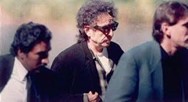
In this series, I am trying to find one recording of a concert in each year, which represents in some way what Bob was doing and sounding like in that particular year. But I am also looking for recordings of the best quality I can find, so that we can actually enjoy the music rather than listening to poor reproductions amidst audience chit chat and shouting.
And I must admit I have not been making notes as I go along but there are some really wonderful reworkings of songs. Just listen to the opening song – “Things have changed” – in the recording below – the changes are not enormous, but they are really interesting. And then he moves on to “It ain’t me babe…”
A list of all the concerts in this series is given at the foot of the article.
Of course, the whole concept of “the best” in this regard is ludicrous, but I do hope you might enjoy one or two of these recordings and perhaps come back to them when you just want a different perspective.
A list of our other current and recent series can be found on the home page. We’ve got 48 so far in this series with a few more to add before I call it a day – not because I am bored with the concept, but for some years there simply aren’t recordings (or concerts) that I feel I would want to revisit.
And one last thing – whatever you do, don’t miss “Cry a While”
27 October 2018: quality performance, quality recording, wonderful arrangements
I’m going to make a confession. I can’t remember all of the articles we’ve published on this site. Worse, I can’t even remember all of the articles I personally have written for this site.
Now that is due in part because of my now advanced age, in part because we have published almost 4000 articles on Untold Dylan, in part because we started in 2008, which, according to my calculator, is around 17 years ago. And it is in part because I also write on other subjects. And indeed I have one or two other hobbies, like dancing and watching football (soccer) matches. So no excuses – it’s all pretty much my fault.
And besides, 17 years ago, when all this started, I was still getting up when the alarm went off and driving to my place of work, putting in the statutory eight-hour day, before coming home and quite often doing the work I hadn’t managed to get done during the day.
But it is only just this year that it has struck me that among those almost 4000 articles, there are some real gems (not I hasten to add written by me) and some exquisite, or at least interesting, recordings of Dylan compositions – ranging from those performed on the Never Ending Tour (which we have been discussing somewhat of late) and cover versions, like the one below….
There are, of course, many that I have come back to before, including the original recording of “Hard Rain” followed by Dylan performing an exquisite rock n roll version in 1975. Playing those two recordings one after the other really still does knock me out.
But yes, it is true that sometimes I come to selections and wonder why I got quite so excited about cover versions as with “Acquaraggia play Dylan” which I think I would now downgrade to “interesting” rather than anything more. But at the time…
And this makes me think there is a broader issue here. It is not just that Bob has written so many songs, each of which we have reviewed, but also that there have been so many variant versions of the songs that have been recorded by Bob and, of course, so many other performers, that it is difficult to take all the songs and all the variant performances into one’s head.
Indeed, to try and reflect upon this a while back, we ran a series called “Beautiful Obscurity”, which, by chance, I turned back to this week, while trying to trace all we had written about a particular song. And this activity caused me to start to work my way through a few of the past articles on this site. Not, I must add, because I wanted to read what I had written (I mostly skipped the text), but because the series contained some lesser-known versions by various artists of (occasionally) lesser-known songs.
Now my point here is not that each one of these recordings is brilliant musically, but rather that mostly they offer a new insight into what actually resides within each song. By which I mean, a thousand people can record “Times they are a-changin'” without giving us any new insight into the song, but occasionally an artist will take a Dylan composition and offer us a new version which does somehow add something to the meanings that we can draw from the song.
Add to this the fact that around half of the songs listed on the BobDylan.com website as Dylan compositions have never been played by Dylan in public (not even once) shows how strange this situation is. Yes, we might expect a composer to reject some of his work, but to write a song, put it on an album, and then never across a whole lifetime on stage, perform it in public – that is (to me at least) a bit odd.
If you want to see the vast list of songs that Dylan has written and recorded, but not performed you can work that out from the data on the official Dylan site, but here a few of my favourites.
Now I know that I have mentioned most of these before, but when I have, it has been a case of one song per article. But when one starts to gather together the list of beautiful songs Dylan has created but never performed, one cannot help but wonder, why not?
I’m back with this theme because I truly do find these songs really interesting and worth listening to in their different forms. And each one leaves me wondering exactly what it is that has made Bob record the songs but never perform them in concert. Indeed setlist.fm kindly gives us details of over 3,700 gigs. And yet even with that number, we have some songs Dylan felt were good enough to go on an album, yet not right to perform ever in public.
Songs such as “Alberta”, “Time Passes Slowly”, “Dirge”, “No Time to Think” (see above), “Farewell Angelina”
And after that list, which goes on and on through hundreds of songs, we have compositions such as “Angelina”, which Bob recorded, but didn’t put on an album and again never sang in concert. This, for me, is one of the great, great, great Dylan compositions….
Then, in addition, there are the songs that Bob did record, but then abandoned, only to have another performer show the world just what was in a song
I have to admit that some of these decisions are utterly incomprehensible to me. “Foot of Pride” seems to me to be beautiful, elegant, expressive, interesting, demanding… and Bob actually records it but then leaves it off the playlist. Why would you do that?
But let me leave you with one more. Abandoned Love is a beautiful, original piece and yet never once has it had an outing. We only know about it because of “Biograph”. And I am left wondering, “why?” It can’t be because the performance needs a violin – Bob has endlessly rearranged his music. Maybe he just forgot the song…
In this series, rather than review what Bob said about each song in his “Philosophy” book I am offering recordings of the song/s in question, and my own thoughts on the song and its origins. And I must continue to admit this is not least because I did try to review Bob’s comments, but felt my efforts were really of no use to anyone – you are better off reading the book. Thus these articles in “The Philosophy” series are provided in case you want a bit more background on the songs that Bob chose.
And I must admit that the majority of the songs Bob chose are ones I didn’t know before looking at Bob’s selection. And maybe that, in part, is because of being brought up in England and not the US, or maybe some of these songs really are just a bit too obscure for me to have found them before coming to Bob’s book. Either way, I am hoping my thoughts might give a bit more background to the songs that Bob chose for “The Philosophy,” and possibly even an insight or two. Although there’s no guarantee.
But today is different for today’s song is one that I actually owned a copy of in my early days of record buying… Money Honey. Here’s the original
It is of course, quite possible that you know another version of this song that sounds somewhat different, because this song has been recorded over and over again – the Wiki article contains a fairly comprehensible list of recordings.
The original was released in the autumn of 1953, the song, being written by Jesse Stone who also wrote under the name Charles Calhoun, and who was active as a songwriter from the 1920s through to the 1960s. He wrote numerous songs, including “Shake, Rattle and Roll” with which Bill Haley had a hit. He passed away in 1999 aged 97.
The original recording of Money Honey was by Clyde McPhatter and the Drifters and was an instant hit. Rolling Stone had it listed as number 25 in the 500 Greatest Songs of All Time. That “Greatest Songs” title can be found a number of times in Rolling Stone, and indeed has on occasion had “Like a Rolling Stone” at number one. Reports suggest that Money Honey sold more than two million copies before the end of the 1960s. Not bad for around 170 words.
The theme of the course is dead simple: the singer has run out of money, the rent is due, and he tells his lover that for their affair to continue, she needs to help him out financially.
As such, in many ways this is the antithesis of the notion that pop songs are all about love, lost love and dance. For the woman has to pay the rent, “if you want to get along with me” which is about as far away from love as one can get. (It also implies the couple are living together without being married – a wholly unacceptable concept for song lyrics at the time, but neatly set aside by focusing on the rent). But the implication is that the situation is reversed: the woman doesn’t want to give money to the down-and-out, the implication being she wants a rich man to give her money. It is all very scurrilous.
As such, the lyrics feed into the desperation of the man and the cynical view of some men that women only fall in love because of the man’s ability to provide a good life.
In many senses, this notion of how life is in terms of the average man and woman was (and remains) utterly shocking to those who wanted to criticise rock n roll and its reflection of the world as it actually is, rather than how the romantic songs of the 1940s portrayed it to be. People are supposed to fall in love for reasons of love, not financial reasons, but the song reminded everyone that such idealism is not quite how things work in the real world. (Indeed, throughout much of civilisation, marriages have been arranged as a matter of financial convenience – marriage for love is a relatively modern concept. One only has to read the novels of the 18th and 19th centuries to get the idea).
The recording above was made on 9 August 1953. However, the song got a further boost when Elvis Presley recorded it in 1956.
The key to the success of the song is both musical and lyrical. Musically, the song is in the simple verse-chorus pattern, but there is a real contrast between the two, with the verse being over a drone bass note, while the chorus brings relief to that drone and is sung over the other standard chords of the 12-bar blues. Indeed, it is the eight bars of each verse over the constant drone bass note that distinguishes the song from all that went before.
But the song lyrically has a strong attraction in that it spells out the problems that the working-class man of the era could have. Both the landlord and the singer’s lover demand money, so the singer resolves that future lovers will have to provide for him, not the reverse. A very radical thought!
You know, the landlord rang my front door bell
I let it ring for a long, long spell
I went to the window,
I peeped through the blind,
And asked him to tell me what's on his mind
He said,

Money, honey, uh uh
Money, honey
Money, honey, if you want to get along with me

Well, I screamed and I hollered,
I was so hard-pressed
I called the woman that I loved the best
I finally got my baby about half past three,
She said I'd like to know what you want with me

Chorus

Well, I said tell me baby, what's wrong with you?
From this day on our romance is through
I said tell me baby face to face
'Bout how could another man take my place, she said

Chorus

Well, I've learned my lesson and now I know
The sun may shine and the winds may blow
The women may come and the women may go,
But before I say I love you so, I want

Chorus
It is, of course, all utterly cynical, and a complete rejection of any standard religious and moral values of compassion, hard work, just rewards or anything else of that nature. What the song says in effect is that we are “Living in the material world” as George Harrison proclaimed 20 years after “Money Honey” was written.
This series explores the argument that the structure and approach to the music in Dylan’s compositions is of equal interest and equally worthy of study, as his lyrics (to which most commentators devote their entire attention). Recognising however, that most of my readers are quite probably not musicians, I’m attempting to set out my argument in as non-technical a way as possible.
A list of the previous articles in this series is given at the end.
——————-
In the last piece I looked at (Obviously five believers) I noted how Bob Dylan added in a few variations to the normal musical form that he had used. That song contained repeated musical phrases (nothing unusual there) except that we are given seven and five note phrases (which are unusual and which I think Dylan had not used before). Also of note in that song is the fact that it is in a 12-bar blues format, but itself isn’t 12 bars long, plus it includes an instrumental line after the fifth vocal line, which again is unusual.
What is remarkable is that with such variations, it sounds fine, and indeed, I can’t recall any reviewers writing about the construction of the song, although it really is most unusual. But that is how it goes. Reviewers review his lyrics, not his music.
So then, for anyone who had been able to follow Bob’s song constructions at the time, the question would have been: what would he do next? How far could he take these variations in the classic 12-bar blues format without the listeners getting utterly lost, feeling perhaps Bob had now gone a step too far for his non-musically educated audience?
My view is that such questions may well have been in Bob’s mind as he wrote these songs we have been looking at of late in this series, and nowhere more so than with “I want you” which he performed live 214 times between 1976 and 2005.
We get a full instrumental introduction (not unique but unusual in Dylan) and a very bouncy rhythm (again unusual for Bob – and unexpected given the lyrics). In fact, the music and the lyrics, if considered apart, don’t seem to have a relationship with each other. The singer is desperately sad, but the song is jolly and bounces along.
Musically at first listen the construction is utterly standard – the verse is 16 bars long – the most common length for the verse of a song in all forms of popualr music, The chorus is eight bars long although it does contain a little surprise when having finished its eight bars, Bob puts in a sort of PS, in the form of another “I want you” leading into the short musical interlude before the next verse starts. That is of course, quite understandable as it gives the listener a chance to come to terms with the overall construction of the song without engaging in any sort of counting of the bars. It simply feels right.
What also helps the song feel “right” is the descending bass line – although this is done in a very clever non-standard way. The bass plays C, B, A, G – a classic descending line. But the chords played with it are C, E minor, A minor, G. That’s not unique, but it is unusual.
Then, in the next lines the chords take us down one more step before bringing us back up and finally coming to rest on G (what is known to musicians as the dominant chord)
F, G, Am G
And from there it is a natural step back to the tonic chord (C major) for the first “I want you.”
The point about this is that these chords are all chords that feel obvious, right and normal for this song. No one, musician or non-musician alike, feels anything out of place – and that fits exactly with the theme of the song “I want you”.
But we can note that at the same time, the lyrics are not of the “why did you leave me?” and “I feel so bad” type. What Bob is actually saying in the words is that there is a world out there in which everyone has their own thoughts and worries, and that these are reflected in the broken world in which we live. We don’t know why the undertaker is guilty, why the organ grinder is lonesome (although we can guess) or why the saxophone music says what it does. But as the lyrics go on, we get the sense of a broken world (cracked bells and washed-out horns for example) but why it is all like this, we don’t know. It just is.
Yet still the music bounces along, giving all the more force to “But it’s not that way, I wasn’t born to lose you.”
So musically and vocally, we get the point; he has lost her, but he is not going to let that lead him into dark misery. It is the world gone wrong.
And apart from everything else, what this bouncy music does is carry us along so we don’t immediately fixate on the changing rhyming scheme
A A B C C D B
Now this view of the rhyme scheme is contentious because it counts the sixth line as “And asks me to open up” thus rhyming with “cup”. The official site, however, sticks to the seven-line verse, which is in itself very unusual, but is certainly another way of seeing the piece.
But what holds us together is the chorus, which in effect is the title line four times with “so bad” added partway through, which is itself very un-Dylan.
The middle 8 then, is a classic middle 8 with no oddities at all
How all my fathers, they’ve gone down
True love they’ve been without it
But all their daughters put me down
’Cause I don’t think about it
Then we are back to the expected (although still very unusual) rhyming scheme, although the pattern that we might feel from the ending of verses 1 and 2 with “you” is broken as the third verse ends with “matter” and the last verse with “because I”.
In short, what Bob is doing is giving us a standard bouncy pop-style song with a rhythm that I can’t recall him using elsewhere (perhaps because it is so bouncy), all the while singing words of utter desperation. And he pulls it off, to such an extent that most listeners are quite happy to accept this song as a jolly bit of fun, and not see any contradiction therein.
What’s more, this extraordinary effect is achieved through using the absolutely standard ternary form, which runs
A (Chorus)
A (Chorus)
B
A (Chorus)
A (Chorus)
The prime difference we might feel from a pop song is that the lyrics keep changing – in pop music, we more commonly get a verse and the middle 8 (signified as B above) repeated. But no, Bob only gives us a middle 8 once.
So what Bob is doing is making us feel that this is a lost-love song, but with two surprises. Firstly, the music doesn’t reflect the sadness of the singer’s position – the music is bouncy, lively, and fun while the lyrics are desperate. And second, he wants her, can’t have her and of all things, is finding solace with his “chambermaid” as the music continues to bounce along in its jolly way.
When I first started to think about this song (as opposed to just listening to it and enjoying the contradiction between the bounce of the music and the sadness of the lyrics), I found myself taken to the famous line from The Handmaid’s Tale:
“A rat in a maze is free to go anywhere, as long as it stays inside the maze.”
and then of course realised that Margaret Atwood wrote her novel some 18 years AFTER Dylan composed “I want you”. Could she be a Dylan fan? No, of course not – you might recall (if you follow such things) that when Bob got the Nobel Prize and she was asked about that, she replied “For what?” So no, just a coincidence. Or maybe she did hear the line and it stuck in her subconscious.
But to return to my theme. What Bob has done here is musically extremely interesting, for he has taken the lyrics of desire and desperation (remember it is not just “I want you” but “I want you so bad”), and combined that with a jolly, bouncy song. If we fail to take equal note of both music and lyrics, we fail to grab the key message, that the singer is continuing to put a good face on what’s going on but feels desperate about it all, at the same time.
Bob pulls this off perfectly, although the refusal of most commentators to comment upon Bob’s musical style means that this double meaning (the brave face over the inner desperation) is not seen in the context of the music (the brave face) and the lyrics (the desperation). As a result, quite often, as here, the full meaning of the song overall is missed, and thus this next stage of Dylan’s progress in exploring where pop and rock music might be taken is simply not observed.
More than five years ago, on March 8, 2020, Tony posted here on Untold “Desolation Row – The Origins of the Title”, being Chapter 1 of my attempt to write an article about “Desolation Row”, which got a bit out of control.
It led to a 17-chapter book (available on Amazon). We then promised to post some chapters here, though. A promise that somehow floated away over the Waters of Oblivion after one publication (about the Ophelia stanza, 18 March 2020).
And today, more than five years later, it washed ashore again.
Desolation Row: The artist knew their faces well
I Rembrandt
On November 23, 1973, King Crimson play one of their best concerts in the Amsterdam Concertgebouw. The bootleg recording circulated in fan circles for years, until it is finally officially released in 1997. It is a double CD and receives the title of the sixth song from the set list (fifth song on the CD), the then unknown, and this evening partly improvised, “The Night Watch”. Which is appropriate: Rembrandt’s Night Watch hangs in the Rijksmuseum, across the street from the Concertgebouw – just cross Museumplein, a five-minute walk. That is where lyricist Richard Palmer-James got his inspiration:
The artist knew their faces well
The husbands of his lady friends
His creditors and councillors
In armour bright, the merchant men
Official moments of the guild
In poses keen from bygone days
The recording is used for the first official release of the song, on Starless And Bible Black (1974).
King Crimson – The Night Watch:
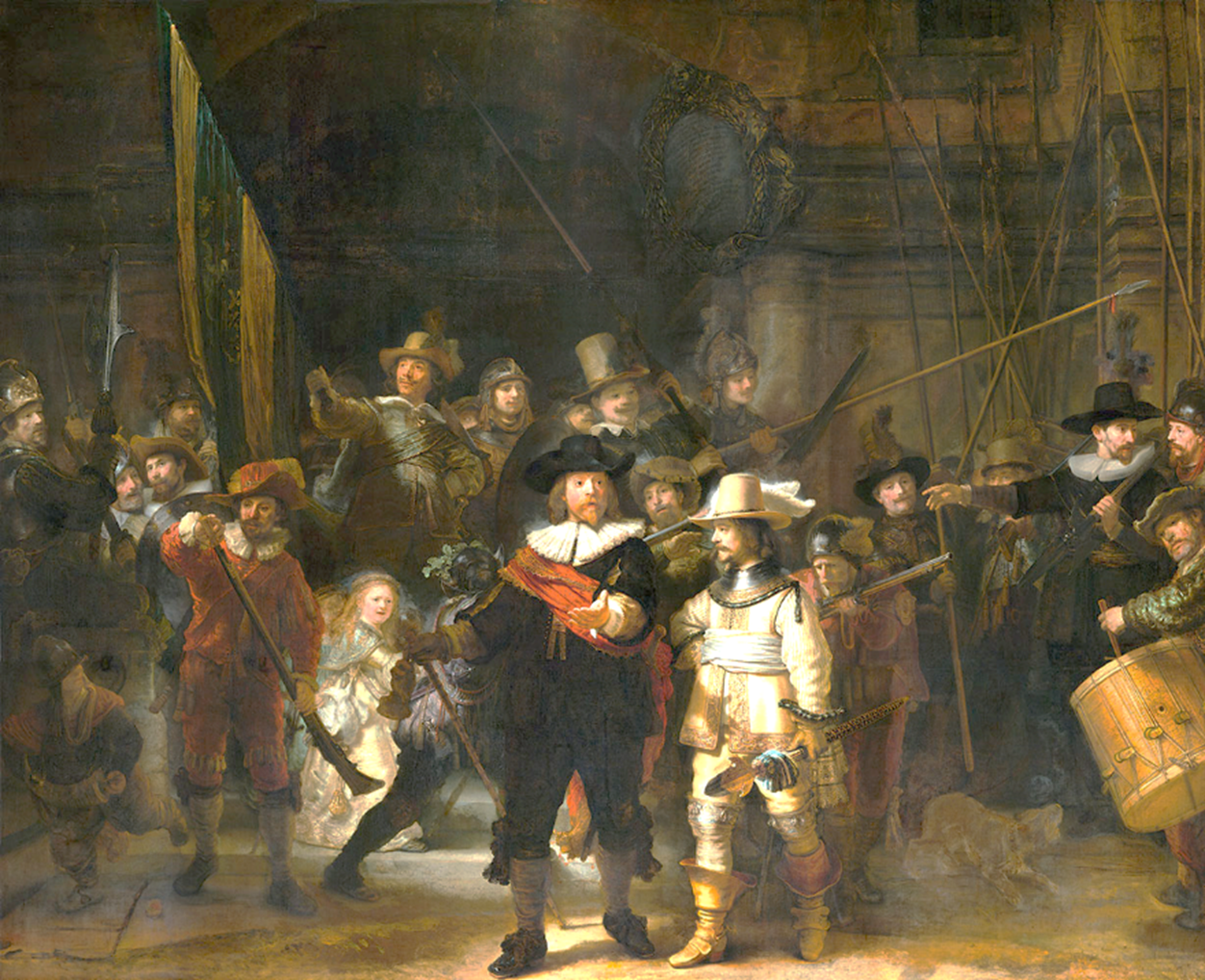
“The company of Captain Frans Banninck Cocq and Lieutenant Willem van Ruytenburgh is getting ready to march”, the original title of Rembrandt’s Night Watch (1642), is a restless riot squad. It is a militia piece, but the militia is not portrayed, as usual, posing in a static arrangement, but rather while they are still grouping. Light falls on a girl who has no business here, a dog runs around through the legs, in the background we see Rembrandt himself peeking over a shoulder, the firing musketeer wears an outdated uniform from a century ago – he comes from another time.
It is an explosion of light, colour and movement, a dramatic symphony, and yet in balance; just like the refrain line of “Desolation Row” holds all images, unrelated persons and contextless actions together, Rembrandt paints a coherent disorder along perpendicular composition lines (arms, lances, guns).
It is an exceptional masterpiece. It is Rembrandt’s “Desolation Row”.
II Cinderella the slut
“A cultural pessimistic view of a crumbling America,” is the tenor of most analyses that attempt to produce a comprehensive, general interpretation of the lyrics.
“One of the most immaculately frightful visions ever set to music,” writes Mark Polizzotti, who apparently has the great fortune that he never had a catchy little Death Metal tune on his turntable (in his very worthy monograph Highway 61 Revisited, 2006). Mike Marqusee calls it “the experience of history recast as phantasmagoria.” Enviable fancy five-dollar words, and the colleagues don’t lag behind.
“This far out vision depicts a totalitarian world,” says Clinton Heylin in his standard work Revolution In The Air, 2009. Greil Marcus: “A circus of grotesques”, Robert Shelton: “one of the strongest expressions of apocalypse”, “a Vision of Sin,” Christopher Ricks “a Nietzschean nightmare,” thinks John Hughes and Sean Wilentz sees, “shards of a civilization that has gone to pieces” … the entire premier division of Dylan watchers kinda agrees.
Desolation Row is then usually a metaphor for a state of mind, or a state of enlightenment, that depicts insight; “Being on Desolation Row” is like getting out, not participating in a perverted society, seeing a truth.
Reactive reasoning then tries to press the tableaus, the archetypes and the actions described into that mould, with varying success.
The fishermen’s flowers are the works of art that artists like Dylan give to the world, the Titanic symbolizes the demise of the powerful elite, Ophelia refers to (artists like) Joan Baez, who do not understand the way of the world, Professor Ricks once again tinkers something unparalleled from Einstein disguised as Robin Hood (something with the archer Robin Hood and Einstein’s Arrow of Time), Dr. Filth tries to inject “conformity”, expecting rain means you are waiting for the drug dealer and Dylan shows that the world is upside down, because Cinderella, the “icon of True Love” (?) now is a slut.
Yes, there is a lot of suffering and despair out there, Your Majesty.
Bob Dylan – Desolation Row (Live 1994):
III But it sounds good
The less hysterical view, Dylan capturing here in poetry an impression of his reality, free from prophetic ambitions and without cultural pessimistic criticism, is less popular. It is more cohesive, though.
Dylan’s self-reflection on his songs is often enough polluted by bullying, silly, and unserious “explanations”, that is true. As a Swedish radio presenter must experience in 1966:
Rainy Day Women happens to deal with a minority of, you know, cripples and orientals and, uh, you know, and the world in which they live, you realise, you know, you understand, you know. It’s another sort of a North Mexican kind of a thing, uh, very protesty. Very, very protesty. And, uh, one of the protestiest of all things I ever protested against in my protest years.
… and that is just one of many examples. But in between all the nonsense, there are plenty of more serious moments, getting longer as he gets older. And there, in the more serious moments, one Great Constant can be seen: I am just a song and dance man, I only sketch a picture of what is happening around me, je est un autre, I don’t know what politic means, I am not a voice of a generation, they are just songs, people.
This image, this conception of art, of an artist who, off the beaten track, expresses his experience of reality, Dylan has been confessing since his very first reflections on his own work: “I don’t consider anything that I write political,” he says in the early 1960s , in the (deleted) liner notes for “Let Me Die In My Footsteps” on The Freewheelin’ (1963). On stage in the Royal Albert Hall, May 27, 1966, he even gets a little pissed, after a performance of “Leopard-Skin Pill-Box Hat”:
What you’re just hearing here now is the sound of the songs…you’re not hearing anything else except the songs, the sound…of the words…and sounds…so, you know, you can take it or leave it. (…) I’m sick of people asking, “what does it mean?” It means nothing.
Fifty years later, in his Nobel Prize Speech (2017), the gist of his self-analysis is still the same:
“If a song moves you, that’s all that’s important. I don’t have to know what a song means. I’ve written all kinds of things into my songs. And I’m not going to worry about it – what it all means. (…) But it sounds good. And you want your songs to sound good.”
And in that, to sound good, Bob Dylan succeeds often enough. For example, with “Desolation Row”, his exceptional masterpiece.
It is Dylan’s “Night Watch”.
———————
Jochen is a regular reviewer of Dylan’s work on Untold. His books, in English, Dutch and German, are available via Amazon both in paperback and on Kindle. The above is, obviously, a chapter from Desolation Row: Bob Dylan’s poetic letter from 1965.
(P)haedra pounding her knucklesinto apiece of water - scratching her snake bites(Bob Dylan: Tarantula)
A tale from Greek mythology is given a humorous twist:
Well Phaedra with her looking glassStretching out upon the grassShe gets all messed up, and she faintsThat's because she's so obviousAnd you ain't(Bob Dylan: I Wanna Be Your Lover)
The way the ancient myth goes, Princess Phaedra becomes the wife of King Theseus; jealous love-goddess Aphrodite puts a spell on his wife, causing her to lust after the King’s son. Phaedra’s stepson rejects her sexual advances. Hippolytus admires Artemis who abstains from sex.
To cover up her shameful conduct, Phaedra accuses the King’s son of raping her. King Theseus believes his wife and banishes Hippolytus.
Poseidon, a father of Theseus, orders a monster to rise out of the sea. The ugly creature spooks Hippolytus’ horses – the resulting accident takes the life of Phaedra’s step child.
Remorseful, Phaedra hangs herself.
Playwright “Buripides Dylamis” changes the tragedy into a comedy.
Therein, Phaedra is punished by having to scratch herself because of the snake bites she receives when stretching out upon the grass.
Brings to mind the following poem:
But never met this fellow
Attended or alone
Without a tighter breathing
And zero at the bone

(Emily Dickinson: A Narrow Fellow In The Grass)
Phaedra does not decribe how big or little or narrow the snakes are; but there’s lots of them. Some she calls Tom, some she calls Dick; others, she calls Harry.
For her, making love is magic:
"(L)ove is gentleness - softness - creaminess"
say Phaedra - who is now having a pillow fight
- her weapon a mattress
(Bob Dylan: Tarantula)
She’s a bit kinky, likes to dress up as Annie Oakley:
Phaedra takes off her stetson – five bunnies
& a nickel shot full of holes jump out
(Bob Dylan: Tarantula)
Rumours abound about Phaedra’s promiscuous behaviour – confirmed as true by Odysseus in the song below:
When I first met you baby
You didn't show no visible scars
You could ride like Annie Oakley
And shoot like Belle Starr
(Bob Dylan: Seeing The Real You At Last)
Below, the chorus of the post-modernist play, sung from Phaedra’s point of view.
She still craves to have sex with Hippolytus, cursed as she by Athrodite (Venus):
You mistreat me baby
I can't see no reason why
You know that I'd kill you
And I'm not afraid to die
Oh Lordy, like a stepchild
I wanna run away from you
But you know I can't leave you baby

(Bob Dylan: Step Child ~ Bob Dylan/Helena Springs)
In the following song, the narrator thereof also suffers from Athrodite’s curse:
It was raining from the first
And I was dying there of thirst
So I came in here
And your long-time curse hurts
But what's worse is this pain in here
I can't stay in here
(Bob Dylan: Just Like A Woman)
It was raining from the first
And I was dying there of thirst
So I came in here
And your long-time curse hurts
But what's worse is this pain in here
I can't stay in here
(Bob Dylan: Just Like A Woman)
In this series, I am trying to find one recording of a concert in each year, which represents in some way what Bob was doing and sounding like in that particular year.
A list of all the concerts in this series is given at the foot of the article.
Of course, the idea of having a concert that signifies the whole year is ludicrous, I know that, but it’s never stopped me before.
The Absolute Highlight series came out of Mike’s massive “Never Ending Tour” series of 144 articles, complete with recordings – undoubtedly the most comprehensive analysis ever of Bob’s touring from 1987 until the Covid crisis, when everything stopped.
So massive was this series, and so impossible is it to take it all in, I decided to create a personal series of highlights from the tour. In each case, I chose one song and looked for two or three recordings that, for me, stood out from the rest, and then republished the recordings in a single article.
There were 31 articles in all, and the nature of the articles changed and meandered over time, but the central theme of trying to find recordings that I personally thought were really great remained constant.
This is not to say that I think you should agree with my thoughts, but rather that if on the list of 31 songs below there are one or two of your particular favourites, you might care to click on the link and listen to the selection.
There are of course many more recordings on the series – it ran for 144 episodes and there must be around 1000 recordings within the series, but since that seems a rather overwhelming number, I thought this little series might help guide your listening.
That’s not to say I expect you to agree with me – the complete series is still on line, and of curse in the coming weeks Mike’s three volume series on the Tour will be published, and I’ll be back with a book review at that point just to remind you.
But for now, here’s my series of the highlights from Mike’s recording selections publsihed between February 2020 and January 2024…
Meanwhile, below, there is an index to the Absolute Highlights series itself.
This series looks at the songs Bob Dylan chose to cover in volume “The Philsophy of Modern Song” Links to the previous articles in this series are given at the end. You can find details of our current series and latest posts on the home page of this site.
By Tony Attwood
We’ve got three versions of this song – and since there is no shortage of space here, I am including them all…
As far as I can ascertain, this song dates back to the mid-19th century and was known as a barber-shop song. These songs were performed without instrumentation, but with close four-part harmonies for male voices. The melodies tended to be fairly straightforward and memorable, so the audience could remember them after the performance and sing or hum the lead line, with their fairly straightforward lyrics. The complexity came from the chordal accompaniment provided by the two intermediate voices between the melody and the bass line.
The songs were of course, passed from one quartet to another – the very first (and indeed very primitive) recording of these songs came from around 1860, and of course, it was many years before recordings became generally available. So this song’s creation pre-dates even the most basic of recordings of the first few songs.
The songs of this type were often highly emotional – and this was no exception – these were not songs performed as background music, or songs that everyone would know (this long preceded the days of records and radio stations, of course), and so listeners had less chance to become very familiar with each individual song. They would hear it once, have an understandable emotional reaction and then not hear it again until the next concert.
What this also means is that the melody and lyrics could well change from one performance to another, and most certainly from one city to another, and indeed from one year to another. So we don’t have a clear idea of which is the original version.
These are the lyrics to Stephen C. Foster’s version
Down on de Mississippi floating,
Long time I trabble on de way,
All night de cottonwood a-toting,
Sing for my true lub all de day.

Chorus (after each verse):
Nelly was a lady,
Last night she died,
Toll de bell for lubly Nell,
My dark Virginny bride.

Now I’m unhappy, and I’m weeping,
Can’t tote de cottonwood no more;
Last night, while Nelly was a-sleeping,
Death came a-knockin’ at de door.

When I saw my Nelly in de morning,
Smile till she open’d up her eyes,
Seem’d like de light ob day a-dawning,
Jist ’fore de sun begin to rise.

Close by de margin ob de water,
Whar de lone weeping willow grows,
Dar lib’d Virginny’s lubly daughter;
Dar she in death may find repose.

Down in de meadow, ’mong de clober,
Walk wid my Nelly by my side;
Now all dem happy days am ober,
Farewell, my dark Virginny bride.
Stephen Foster, the composer, was born in 1826 in what is now Pittsburgh, and wrote songs as a sideline from his work as a bookkeeper (basically an administrator of a company’s accounts) in Cincinnati, working for his brother’s shipping company.
As a sideline, in 1849 he created Foster’s Ethiopian Melodies, in which this song was included and which was made famous by the Christy Minstrels. What made the song and its performances unusual is that it was written for and appealed to those who were dissatisfied with the racial bias in society up to this point, which suggested that only white people could appreciate love and family life. As such Dylan saw the song as a major player in the movement to use song as a way of changing people’s views of social structure.
The word “Ethiopian” at the time was a way of suggesting these were the songs of “lesser races” but slowly Foster stopped seeing the “old days” in a sentimental way in which everyone “knew their place” and the songs began to portray people living in the present day, with genuine personalities and emotions interacting with each other. It was a significant step away from the racism that had been a fundamental feature of musical appreciation and understanding up to that point – a view that suggested that Western music was of value, while other music was primitive and of lesser or possibly zero importance.
Thus, although “Nelly was a Lady” was composed in 1849 for a white audience with the prejudices of the day, it did speak to the audience in terms of showing that all people, regardless of race, shared in the basic human emotions. The word “lady” was used for upper-class women at the time, while “Ethiopian” in effect meant non-white, non-American and at the time the use of these words in different context would have been quite surprising, and possibly shocking.
The point I have been trying to make of late in this series is that after the breakup of his relationship, Bob got tangled up in writing about the breakup of relationships in general. And that gave him a problem of how to make each song sound different. This is in essence what I have been trying to explore in recent articles.
One way of doing this, of course, is by recognising that the songs are basically all going to be taking on a similar subject, and so one needs to change the format of the music. Otherwise, the audience members who are not going through breakups start to get bored.
But Bob’s approach to songwriting has evolved from his interest in folk songs, which normally had a strophic format of verse, verse, verse etc. The first, most obvious way of overcoming this is to insert a chorus which is heard after each verse, and is always the same each time it appears, but which doesn’t take the storyline or the emotional account found in the verses any further forward. It is a bit like having a background screen on stage which always stays the same, while the actors in front of the screen act out the continuing story.
The other way around the problem of the strophic song simply going on and on without any musical change, is to have a “middle 8” – a section of music that is different from the verses, and which might appear between verse 2 and verse 3.
And of course, writers who wanted to be a little more adventurous could actually incorporate a chorus and a middle 8 – but there are two issues that then arise. The chorus makes the song sound like a traditional folk song, and the middle 8 makes it sound like a pop song, and obviously, Dylan didn’t want either.
In some cases, he got around the problem by writing extraordinarily memorable and unusual lyrics (we might note them as the opposite of moon and June lyrics) and at other times he wrote extraordinarily memorable melodies. I would nominate “Sad Eyed Lady” and “Desolation Row” among the early examples.
So we return to “Obviously 5 Believers”. Here Bob gives us a couple of repeated musical phrases. The first at the very start of the song is seven notes long, and comes twice. Then we get a five-note answering phrase, played four times.
Now a five-note phrase is itself, although certainly not unique, somewhat unusual – and particularly memorable because it doesn’t turn up in the main melody line.
The second, five-note musical phrase appears four times and as the final note of this second phrase occurs for the final time Bob starts singing
There is of course, a connection between the title of the song “5 Believers” and that repeated phrase. Whether the number in the song title was deliberately chosen, though, thinking about the musical phrases, of course we don’t know, but if not it is certainly a fortuitous discovery.
Then Bob starts singing a 12 bar blues. Except it isn’t 12 bars long – it is 16 bars long. But the chord structure is classic blues, which musicians will recognise at once.
But as we listen to the music, we find there are other oddities – such as the instrumental line after the fifth vocal line
Early in the mornin'
Early in the mornin'
I'm callin' you to
I'm callin' you to
Please come home
(Instrumental line)
Yes, I could make it without you
If I just didn't feel so all alone
Of course, musically it all works, so no one notices the oddities of the instrumental line included to give us a classic eight-line song. And in part this happens because of the repeated harmoncia lines after each verse.
The bounce of the song and the unusual construction with the instrumental line partway through both help distract from the oddity of the lyrics. In the first verse, the woman is not at home. In the second verse, the black dog is barking for reasons not revealed. The third verse says the singer has been faithful to the lady and asks her for the same in return. In the fourth verse, suddenly the lady’s “mama” is introduced as being unhappy before we have 15 jugglers and five believers, for reasons we can’t understand. And then we get a repeat of the first verse, making the point that he’s still there late at night waiting for her to return.
Here Bob’s couplets are only ten bars long; the eight bars of vocals plus two bars of instrumental is quite unusual although not unique: “Good Morning Little Schoolgirl” by Muddy Waters has a similar abnormality.
So this is indeed a straight strophic song (verse, verse, verse etc), but it is made interesting both by bizarre (or at least unusual, depending on your point of view) lyrics, and five and seven-beat phrases. It is as if Bob wanted to show us that 12-bar blues didn’t all have to sound like Robert Johnson. You could use the format, but there was so much more that could be done with the form.
Put another way, we could argue that the conventional way in which songwriters have given variety to their songs has been through modulation from one key to another. Dylan has created here a highly memorable song seemingly in the classic 12 bar mode, but into this he has also brought an unexpected instrumental line partway through each verse (after “Please come home” in the example above).
It is as if he is saying, “You thought you knew everything there was to know about the 12-bar blues, but you don’t.” At the same time as saying, “You’ve never heard a 12-bar blues like this.”
And he was right in both cases. It sounds as if it is a 12 bar blues, but also sounds as if it isn’t, which is the brilliance of the composition.
After recording the song, Bob played it just 40 times over a two-year period, but if anything that illustrates his unique ability to get more out of a 12-bar blues than anyone had ever imagined, it is this song. Below is the raw material Bob started with. I do hope you have a moment to play it, and then consider once more just where this song took both those of us who listened to it on the album, and the whole of pop and rock music. And in doing so, perhaps we may see again why so many people feel that focusing on the music not just the lyrics, of Bob Dylan, is important. Not because of anything I am saying, but because generally writers focus on the lyrics, when really they should focus on both lyrics and the music.
The founder of Egyptian Records, Bob Dylan, personally wrote the liner notes for the label’s first record, The Songs of Jimmy Rodgers: A Tribute (1997). It is a loving and respectful 562-word canonisation, in which we already see unmistakable flashes of the stylist who a few years later would publish his fictionalised memoirs Chronicles, and some two decades later the essay collection The Philosophy Of Modern Song. Wild, poetic metaphors (“He gets somehow into the mystery of life and death without saying too much, has some kind of uncanny ability to translate it – he’s like the smell of flowers”); unambiguous superlatives (“He makes everything unmistakably his own and does it with piercing charm”); wondrous aphorisms (“His is the voice in the wilderness of your head,” and “Times change and don’t change”); and the integration of obscure and less obscure quotations from cultural history, such as “he is as in the Warren Smith ballad, the man who …held your hand and sang you a song” – an insider reference to
Somebody saw you at the break of day
Dining and a-dancing in the cabaret
He was long and tall, he had plenty of cash
He had a red Cadillac and a black mustache
He held your hand and he sang you a song
Who you been loving since I been gone
… to Warren Smith’s “Red Cadillac And A Black Moustache”, the song for which Dylan demonstrates the same missionary zeal as for Jimmie Rodgers’ legacy: he adds the song to his set list a few times (three times in 1986); he seems to have played “Red Cadillac And A Black Moustache” during the Knocked Out Loaded sessions (but unfortunately rejected it, apparently); he contributes his (awesome) cover of the song to the tribute project Good Rockin’ Tonight: The Legacy Of Sun Records in 2001; he plays it as DJ of Theme Time Radio Hour in 2007 (episode 43, “Colours”); and he pays perhaps the most regal reverence of all in 2020:
Red Cadillac and a black moustache
Rings on my fingers that sparkle and flash
Tell me what’s next, what shall we do?
Half my soul, baby, belongs to you
I rollick and I frolic with all the young dudes
I contain multitudes
… the third verse of the opening song of Rough And Rowdy Ways, from “I Contain Multitudes”. In that opening song we see more offshoots of the tribute Dylan wrote almost a quarter of a century earlier on the back cover of his tribute album. “He sings not only among his bawdy, upbeat blues and railroading songs, but also Tin Pan Alley trash and crooner lullabies as well,” he roared at the time, praising Jimmie Rodgers’ “refined style, an amalgamation of sources unknown, too cryptic to pin down. His is a thousand and one voices.” The Singing Brakeman, Dylan states in many words, contains multitudes.
After this remarkable aha-moment, the door to Rough And Rowdy Ways swings open even wider. In track 2, “False Prophet”, we hear the prophet proclaiming “I’m first among equals, second to none”. About Jimmie Rodgers, tribute writer Dylan says:
“A blazing star whose sound was and remains the raw essence of individuality in a sea of conformity, par excellence with no equal.”
A little later, Dylan calls him “a performer of force without precedent”, even attributing sheer messianic qualities to Rodgers when writing: “He gives hope to the vanquished and humility to the mighty.”
In March 2007, when DJ Dylan plays a Jimmie Rodgers record for the fourth time (episode 45, Trains), “Waitin’ For A Train” from 1929, he goes even further than his usual praise:
“Well, you can’t do a show about trains without playing something by The Singing Brakeman. We played him a bunch of times and we’ve talked about him. And the most you’re gonna get here is a sample. There’s no substitute for going out and listen to all of his records or reading about his life. […] Jimmie was the first performer inducted into the Country Music Hall of Fame, and I couldn’t have made a better choice myself. Not that anybody asked, but if they did, I would have chosen him.”
And once we’re in that Jimmie Rodgers tunnel, we naturally arrive at Side A’s closing track, “My Own Version Of You”, the song about the how and what of songwriting. And at what Dylan had to say about songwriting in 1985, in the Biograph interview with Cameron Crowe:
“He was combining elements of blues and hillbilly sounds before anyone else had thought of it. He recorded at the same time as Blind Willie McTell but he wasn’t just another white boy singing black. That was his great genius and he was there first. All he had to do was appear with his guitar and a straw hat and he played on the same stage with big bands, girly choruses and follies burlesque and he sang in a plaintive voice and style and he’s outlasted them all.”
Twelve years later, while promoting the tribute album, Dylan unequivocally expresses what drove him: “I had to find another way just to get Jimmie’s music out there properly” (telephone interview with Nick Krewen, published in the Long Island Voice, September 1997). It is obviously the mission of a prophet – this is not a musician seeking inspiration or a record executive hungry for profit. After all, the ultimate Jimmie Rodgers tribute album already exists, was made long ago, says prophet Dylan – way back in 1969: Same Train, A Different Time – Merle Haggard Sings the Great Songs of Jimmie Rodgers.
“Probably the definitive Rodgers record,” declares the man who knows a thing or two about it. But thirty years after that Merle Haggard record, the name of Jimmie Rodgers has once again disappeared under thick layers of dust. Determined, the prophet blows the dust off again, releasing yet another tribute album. And the DJ plays the records of the Singing Brakeman. And the performer plays the songs on stage. And in 2020, the artist produces his own Rough And Rowdy Ways – so that the spirit of Jimmie Rodgers lives on.
Merle Haggard & The Strangers – Waitin’ For A Train:
Jochen is a regular reviewer of Dylan’s work on Untold. His books, in English, Dutch and German, are available via Amazon both in paperback and on Kindle:
In this series I am trying to find a recording of a concert in each year, which represents in some way what Bob was doing and sounding like in that particular year.
A list of all the concerts in this series is given at the foot of the article.
Of course, the idea of having a concert that signifies the whole year is ludicrous, I know that, but it’s never stopped me before. And if you want something quite extraordinary and maybe unexpected try “God Knows” just after the one hour mark.
Perhaps extremely unwisely, I recently began a set of articles about some of the series that have been published on Untold Dylan since we first emerged some 17 years ago – series that I thought were interesting in their own way, which can stand the test of time, in the sense of still being informative today and which in most cases had nothing to do with me.
So I’ve written short articles reminding our readers, if a reminder was helpful, of these series, which are of course still on the site.
And wouldn’t you know it, as I came to publish the next piece in this series, the site went down. It seems the settings put in place 17 years ago were no longer adequate for the size of site we now are, nor the number of readers we get. But here we are back again, so I battle on in the hope of future stability.
In my series of series that you might want to go back and re-read (or take in for the first time if you joined us more recently) I started with The Album Covers, which has long been one of the works I’ve been most proud to have published, as I learned so much from it. The second was Once or Twice, which I am not trying to say was interesting for its writing, but rather because it highlighted the oddities of Bob’s selections when performing. As the title implies, these are the songs that he performed in public just once or twice, and then left. And much of the time, I am left saying, “How could he???”
Then of course, I turned to Jochen and asked him which of his masterworks of analysis he might nominate for inclusion in the series. Unfortunately, he chose “Like a Rolling Stone” – which was published as a book, but as far as I recall, with only a few episodes published on Untold. And I am told the book is out of print 0r about to be so, thus there is no point publishing extracts and saying “go and read the book” if the book can’t be bought! But the series is still on Untold so you can still read it here.
But undeterred I am choosing another work of Jochen’s myself: “I contain multitudes.”
Now I am very biased here since I love this song and have played it constantly and I really enjoyed the series of articles we published on the song.
But there is something else that is very personal to me at this point. I live in rural England, in a small English village that (as I have mentioned at least twice before) dates back its history by at least 1000 years. It is in fact, mentioned in the Domesday Book of 1086, and in my younger days, long before coming here, I always said to myself that one day I would live in a Domesday village.
So as I sit in my study and each morning, gazing across the garden at the trees at the far end, (themselves pretty ancient) I think of the people who have lived in this village for the past thousand years, and if I want a piece of music to play as I contemplate the weirdness of this situation, and the incomprehensibility of what led a north London boy to end up here, I play “I contain multitudes”. Not for the lyrics but for the music, for the sounds, and for that concept of “I contain multitudes”. I have no idea how many people have lived in this village where I live since the Conquest of 1066, but it is a small village (although the nearest town has expanded over the last century, and crept up to the village boundaries – but I don’t begrudge them a share of this beauty and antiquity).
For because of the way that my country does make some effort to protect and remember its history, the ancient manor house and church are still there – its lands backing onto my back garden and the river shown in the Domesday map as running through the village is still there, flowing exactly the same path – which I am genuinely thrilled to be able to walk.
There is something about “I contain multitudes” that links me to the honour I feel in living in such an ancient village, where I have been for maybe 25 years now, and I think more than any other Dylan song, I have a deep-rooted connection to this track related to all these feelings about where I now live. And here I must admit I don’t listen to the lyrics, I listen to the sound. And I sit here in peace and harmony with my home, myself, and Dylan’s performance of this song.
It is the sound that wraps itself around me, and the notion that yes, here I am in this village which people have lived in for over 1000 years, and somehow in some small way, their spirits are wrapped around my house, and indeed wrapped around me.
That can of course, just be the wild thoughts of an old man wrapping himself up in the past, but I like to think there is something more. I will of course, in my time pass on, but my children and my grandchildren will continue and (at least for now) I am hopeful they might play this song at my funeral – although hopefully not for a while yet. (And yes in my younger days as a pianist, I did learn to play Beethoven sonatas and Chopin preludes. There are connections everywhere for me in this song).
So, having had my say, I refer you for further reading to Jochen’s series on this song, while here is Emma Swift again, this time live, and below the full list of articles that make up the series. Thank you Bob, thank you Emma, thank you Jochen
This series looks at the songs Bob Dylan chose to cover in volume “The Philsophy of Modern Song” Links to the previous articles in this series are given at the end.
By Tony Attwood
Tutti Frutti by Little Richard (who died aged 87 in 2020) was released in 1955 and is an absolute classic rock n roll song of the era. It was written by Richard Penniman himself and Dorothy LaBostrie. You’ll know the former of course, but the latter is one of those songwriters who wrote vast numbers of songs but with only one or two now remembered. And indeed in this case her role was not to write the original, but to re-write the lyrics – the original lyrics being considered too suggestive for audiences of the day.
Perhaps of all her other songs, the most famous is “You Can Have My Husband But Please Don’t Mess With My Man”, which Irma Thomas recorded. As with so many songwriters of the era, her life was dogged by disputes over royalties, but it is reported that by the 1980s she was receiving regular payments for “Tutti Frutti”. She is also no longer with us, having passed away aged 79.
The famous line within the song “A-wop-bop-a-loo-mop-a-lop-bam-boom!” is said to come from the drum beat that Richard Pennyman created as the heart of the song.
As Little Richard’s first hit, this style and approach was copied as the style and approach for most of his subsequent records. Indeed, it can quite reasonably be argued that this one song had an enormous impact on the direction of rock ‘n’ roll thereafter. In fact, one can readily argue that the song had as much impact as “Rock Around the Clock”, by taking the beat and simplicity of that song and adding what has become known as a much more “driven” sound.
In 2007, the song itself was voted as number 1 in a poll of “The Top 100 Records That Changed The World,” and many commentators repeated the line subsequently that it was this song (rather than anything by Bill Haley and others) that created the sound of rock and roll. In recognition of this the Library of Congress National Recording Registry included the song as one that initiated a new era in music.
Indeed, what is particularly interesting is that prior to this recording, Little Richard had been making demos and sending them off to record companies without success, not least because the original lyrics appeared to relate to anal sex. Dorothy LaBostrie was then engaged to create the rewrite, but the music was kept the same. Copies of the original lyrics are available on the internet, but I’ll leave them to your imagination. Or not.
A dispute remains over whether there was a third writer (“Lubin”) involved with the song, but this has not been resolved, nor has the allegation that Little Richard did not write any of the song. But I would add that such allegations about rock songs from this era are commonplace and rarely proven.
Apparently, the song was revised and recorded by Little Richard in around 15 minutes on 14 September 1955. and it was of course, a hit in the USA, although not in the UK where it received no airplay on the BBC, in part because the record company chose to issue the song as the B side of “Long Tall Sally.”
But the song was not only a hit in its own right, it laid down the basis for what rock n roll could be, taking the music to a much more frenetic level than Bill Haley and the Comets created. Indeed, one only has to listen to a few bars of Rock Around the Clock to appreciate the difference.
As we can see from the video above, there were attempts immediately to constrain rock n roll in the Bill Haley form into a rehearsed and practiced style, to make it ever more acceptable to the TV stations.
What Little Richard did was to combine elements of the blues and gospel music into the beat of rock n roll, as well as upping the volume. With his music and the dancing that it encouraged, the whole situation moved away from the highly choreographed approach seen before, and moved into the improvised form of jive that was quickly adopted by those who felt able to dance to the music at this speed. (And believe me, as one who has enjoyed dancing jive for much of his life, dancing to the speed of the early rock n roll records needs practice, energy and strength, if you want to keep going at that speed.
For many commentators, Tutti Fruti is the origin of true rock n roll music, and ultimately it joined the Rolling Stone list of “The 500 Greatest Songs of All Time“.
As for Bob Dylan, he wrote in The Philosophy, “Little Richard was speaking in tongues across the airwaves long before anyone knew what was happening. He took speaking in tongues right out of the sweaty canvas tent and put it on the mainstream radio, even screamed like a holy preacher-which is what he was.”
But for anyone who actually gets hold of an original copy of the Little Richard release and dares play it (it is now worth a lot of money), you might find the B side a real disappointment – it’s a slow track with none of the excitement of the A side.
Wop-bop-a-loo-mop, alop-bom-bom

Tutti frutti, oh Rudy
Tutti frutti, oh Rudy
Tutti frutti, oh Rudy
Tutti frutti, oh Rudy
Tutti frutti, oh Rudy
Awop-bop-a-loo-mop, alop bom bom

I got a girl, named Sue
She knows just what to do
I got a girl, named Sue
She knows just what to do

She rock to the east
She rock to the west
But she's the girl
That I love best

[Chorus]

I got a girl, named Daisy
She almost drives me crazy
I got a girl, named Daisy
She almost drives me crazy

She knows how to love me
Yes, indeed
Boy, you don't know
What she's doing to me

[Chorus and repeats]
The title of this series is “No Nobel Prize for Music” reflecting on the fact that Bob Dylan was awarded the Nobel Prize for Literature, not for songwriting, because there is no Nobel Prize for music or any aspect of music. And yet Bob primarily has written songs, not “literature.” As such arises the thought that maybe we should start spending more time looking at his music, alongside his lyrics, rather than just the lyrics on their own.
So in this series, I am dealing with the music in Dylan’s songs, as much of the lyrics, and taking the songs in the order they were written, and we have reached a period in which Dylan was dealing very strongly with the theme of “lost love”. The last song reviewed in the series, “Temporary like Achilles,” and most of the nine compositions leading up to its creation were focused on this theme of lost love, while those that did not appeared to move into a consideration of the notion of disdain, which I guess is a side effect of lost love. In case you are keeping score, here’s the classification list I’ve used on this site in the listing which attempts to put Dylan’s songs in the order of composition….. I think the date sequence is right, but you may, of course, disagree with the theme in each case
In this song “Temporary” Dylan has reverted in his musical approach to ternary form, this time giving us two verses (the “A” section), a middle 8 The B section) which runs…
Like a poor fool in his prime
I know you can hear me walk
But is your heart made out of stone?
Or is it lime or is it just solid rock?
and then two more verses.
There are no repeats, and there is no chorus, but the structure of Verse, Verse, Middle 8, Verse, Verse, holds the song together and gives it a real sense of unity. While folk music was often written as verse-verse-verse-verse – etc (known as strophic form) a lot of pop and rock music is written as verse-verse-middle 8-verse-verse-verse (ternary form)
There is a clear distinction between the verses and the middle 8 section above, through the chords used. The verses just use the primary chords of the key of G major (G, C and D), but in the classic approach of using a “middle 8”, the chords here, as well as the melody, are quite different – although very much the chords we can find in the key of G major. This is how Dylanchords writes it out
       Em
Like a poor fool in his prime,
                    Bm
Yes, I know you can hear me walk,
            Em
But is your heart made out of stone, or is it lime,
Bm              D7    D7sus4
  Or is it just solid rock?
Thus, in very many ways, this is a classic popular song, although with more lyrics. (The absolutely classic pop songs using this form would have just one verse after the middle 8, followed often by an instrumental break created around the music of the verse, then the middle 8 again, and the last verse repeated once more. And to take the point a bit further, that “D7sus4” is probably a bit too adventurous for most pop and rock songwriters, although it is very Dylan.
But in essence, Bob has used a classic pop format, which he most certainly didn’t use very much in his earlier writings, where he would either just use the strophic form of verse-verse-verse or would have the middle 8 turn up in a quite unexpected position.
It is very, very interesting (for me at least), therefore, to note that having written what is in essence a song which if not a pop or rock song, is in the style of a pop or rock song, Bob then moved on to “Rainy Day Women”
The Cutting Edge recording gives us a real insight into how this came to be performed, as we find it on the record.
What is so interesting is that what we have here is a classic 12-bar blues working its way through the basic three chords in the standard way.
The song is obviously in strophic (verse-verse-verse) form, because anything else would suggest a higher level of organisation, which the lyrics, the instrumental arrangement and the musical performance all deny.
Listening to this today, I am struggling to think (at least off the top of my head) of another song in which Bob used the instrumentation to express what is in the lyrics, in this way. Quite possibly, you’ll think of one at once, and my excuse is that I have been playing this song for a while this morning as I write this piece, but at the very least, I would say playing this song in this way is unusual for Bob.
In the live performance with George Harrison, below, the music starts at 2’10”, with the song is performed as more of a straightforward 12-bar blues. We can also see from the interaction of the two stars that what they were going to do was most certainly not rehearsed. For them, this could be the gang playing an introductory workout in a studio, as much as something in front of ten thousand fans.
This is of course, simply fun and in many ways, we can argue that to have the music in any form other than this bouncy 12-bar blues could lose the effect. But listening to these two versions one after another does show me the power of the arrangement of the first recording, with its slower beat and the central part the percussion plays in the song – something that was completely lost in the live version.
Now, if you are kind enough to be a regular reader of my meanderings on these subjects, you’ll know how much I value the work of Old Crow Medicine Show, and I think here they do show us just how important that percussion part is in holding our interest in the song
Now of course, it may be revealed in someone’s reminisces as to how that beat came about – maybe the percussionist just played it and Bob liked it. Maybe he told the drummer what to do.
But what is also interesting is this cover version, which I originally featured a few years ago in the Cover a Day series. And I’m including this again because it does make the point that a key essence in Bob’s songwriting is the flexibility of the songs he composes. Not every song, by any means, can be translated into other forms and still have a meaning, but so many of Bob’s songs can. Indeed, we only have to think of what Hendrix did to the Watchtower to understand and feel that.
My point, therefore, is that not many composers can create songs which can be reworked successfully in so many different ways. That is a particular measure of Bob’s songwriting, and one which, in my opinion, should not be ignored. Thus, my regular interest in this site in the cover versions; they are not just other performers doing the song in a slightly different way, they are revelations of the depth of possibilities within the songs – depths which most folk, pop and song songs do not have.
Yes, of course you can take any song and perform it differently from the way it has been recorded by the composer or the performer for whom it was written, but Bob has this extraordinary ability to compose songs which are ideal for such transformations.
That doesn’t mean each transformation is a work of art – obviously not, but some are – and for a songwriter to write so many songs which can be transmuted in this way, is one of the key elements of Bob’s musical talent. Time and again Dylan creates songs that can be performed in utterly different ways – ways which are intriguing and well worth listening to. By no means has every songwriter ever been able to do that. Just listen to this recording….
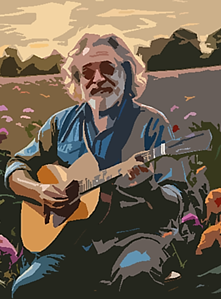
Even Dylan’s False Prophet, who 25 years later would proclaim himself “I’m first among equals, second to none,” apparently still ranks a notch below Jerry Garcia, frontman of the legendary band Grateful Dead. “He really had no equal,” Dylan writes on 10 August 1995 in his requiem for his friend, for Captain Trips, for the Supreme Deadhead, for the undisputed king of Haight-Ashbury who died the day before, shortly after his 53rd birthday, Jerome John Garcia.
The bond goes deeper than collegial admiration. It is an apocryphal but persistent story that Dylan applied for a job as a band member in the late 1980s, but was rejected due to a veto by bassist Phil Lesh. However, in his autobiography Searching for the Sound (2005), Lesh makes no mention of any application – insinuating quite the contrary, in fact. His boundless admiration for Dylan flares up more than ten times, and the 1987 Dylan & The Dead tour is a personal highlight: “We had always wanted to play behind him like The Band did in the sixties. We were very pleased to find out that Bob was agreeable.” Phil’s memories and anecdotes echo the experiences we have heard dozens of times from others:
“Bob gave us a set list each show before we went on stage. Lotsa luck. At least twice Bob, that prankster, threw in a song we hadn’t rehearsed. Playing with Bob really kept us on our toes, too; he was fully capable of deviating radically from the set list, and more than once left us slack-jawed in confusion as he switched songs in midstream. That seemed like poetic justice for a band that took pride in its flexibility and in not using a set list.”
Phil thinks it’s great: “Hey, this guy’s at least as weird as any of us.” Co-frontman Bob Weir, on the other hand, is much less positive in his conversations with Howard Sounes (for his book Down The Highway, 2001):
“It’s as if we had never practised,” says Weir. “[Bob] came up with a set list [that] didn’t have much to do with what we had rehearsed.” Bob played in the wrong key and seemed to forget his own lyrics.
Alcohol in sad quantities and alarming regularity, Weir suggests. He then reveals that Dylan did indeed apply for the job in 1989, two years after that joint tour. “I was in for that, but one of our members didn’t particularly care for him,” he claims there – and 45 pages later, Sounes reveals the name: Phil Lesh was the dissenting voice, “according to Bob Weir”. Not very credible; Phil’s love for Dylan seems deep and sincere, judging by the many declarations of love in his memoirs and, even more so, by the joint concerts in the autumn of 1999 and the summer of 2000, the double bill Bob Dylan and his band / Phil Lesh and Friends, the tour during which they played together dozens of times and offered exceptional performances of both Dead songs (“Friend of the Devil”) and Dylan classics (“Blowin’ In The Wind”, “Rainy Day Women”).
The men demonstrate mutual admiration and a joy in playing that makes Weir’s claim that Lesh “didn’t particularly care for him” sound unconvincing. A mutual admiration that Dylan immortalises in The Philosophy Of Modern Song, in chapter 29, “Truckin’”: “Lesh is one of the most skilled bassists you’ll ever hear in subtlety and invention.”
Anyway, Jerry Garcia. His death affected Dylan deeply, as evidenced not only by that requiem. Dylan usually avoids funerals of beloved and admired colleagues, even comrades-in-arms such as Robbie Robertson, Pete Seeger or George Harrison – either because he is far away on tour or because he knows that his presence will only distract attention from the ceremony – but he does attend Jerry’s funeral to pay his last respects. Almost thirty years later, in December 2023, concert promoter John Scher recalls the event in the Bob Lefsetz Podcast. The day after the funeral, Scher is on the front page of the San Francisco Chronicle: “Bob Dylan with an unknown person leaving Jerry Garcia’s funeral,” Scher quotes with a laugh. What were you talking about, host Bob Lefsetz wants to know.
“What I really remember about it is while we were walking out, Dylan leaned over to me and said, ‘You know what, John?’ I said, ‘What, Bob?’ He said, ‘The guy lying there (referring to Garcia), he’s the only one in the world who knows what it’s like to be me.’ Which was pretty profound.”
Suggesting, apart from profoundness, also a deep soul connection. And a second trigger for Dylan’s exceptional decision to attend may have a somewhat macabre background: Jerry Garcia’s very last recording was for Dylan.
In 1997, Dylan surprises with a tribute album: The Songs Of Jimmie Rodgers – A Tribute, the first album released on his own label, Egyptian Records. He invites colleagues to contribute to the album. Bono sings a remarkably sweet, yet very successful “Dreaming With Tears In My Eyes”, Willie Nelson reconstructs “Peach Pickin’ Time Down In Georgia” and chooses the song a few days later to promote Farm Aid on Jay Leno’s Tonight Show (remarkably enough, duetting with Beck). Van Morrison records a steamy “Mule Skinner Blues”, Aaron Neville, Dwight Yoakam, John Mellencamp… apparently, you don’t say no when Dylan calls.
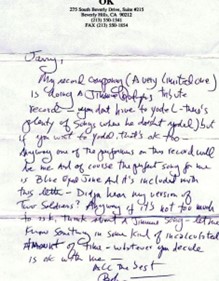
Dylan himself contributes the surprising choice “My Blue Eyed Jane”, modestly placed at number 6 on Side A. And at number 2 on Side B we find Jerry Garcia’s last recording: “Blue Yodel #9 (Standing On The Corner)”, recorded on 16 July 1995, three weeks before Jerry’s death. Dylan does not interfere with the song selection, as evidenced by the charming, handwritten letter in which label boss Dylan humbly requests a contribution:
“Jerry,
My record company (a very limited one) is doing a Jimmie Rodgers tribute record – you don’t have to yodel – there’s plenty of songs where he doesn’t yodel but if you want to yodel, that’s ok too –
Anyway one of the performers on this record will be me and of course the perfect song for me is Blue Eyed Jane. And it’s included with this letter – Did ya hear my version of “Two Soldiers”? Anyway if it’s not too much to ask, think about a Jimmie song – let me know something in some kind of incalculated amount of time – whatever you decide is ok with me –
All the best
Bob —”
Jerry doesn’t have to think twice. He has been a Jimmie Rodgers fan all his life, and “Blue Yodel #9 (Standing On The Corner)” has been on his set list for about ten years, at the acoustic concerts he gives with his companion David Grisham. Mandolin player Grisham happens to have a home studio in Mill Valley, just across the Golden Gate Bridge, which now has historical value for being the venue of Jerry’s swan song on 16 June.
It’s a song choice that will touch the heart of the fresh CEO of the “very limited” Egyptian Records. This is the song whose opening line, Standing on the corner, I didn’t mean no harm, seems to have trickled down into Dylan’s “Temporary Like Achilles” at the time (Blonde On Blonde, 1966; “Standing on your window, honey / Yes, I’ve been here before / Feeling so harmless / I’m looking at your second door”); Garcia and Grisham’s performance is brilliant, even featuring a kind of yodel; and the original by Jimmie Rodgers was number 4 on Side A on the album, between the title track at number 3 and Dylan’s “perfect song” “My Blue Eyed Jane” at number 5, on the Jimmie Rodgers record that will receive such a very special name-check in 2020: My Rough And Rowdy Ways (released 1960).
Jerry Garcia – Blue Yodel #9 (Standing On The Corner):
And as we then read the liner notes record company executive Dylan wrote in 1997 for The Songs Of Jimmie Rodgers – A Tribute, we’re starting to suspect that the seeds for Rough And Rowdy Ways were sown long, long before its release in 2020…
Jochen is a regular reviewer of Dylan’s work on Untold. His books, in English, Dutch and German, are available via Amazon both in paperback and on Kindle:
If you have been with Untold Dylan for a few years you’ll know about our Never Ending Tour Series. It is the first item highlighted on this site, just under the picture of the rising sun on every page. Click on the link and you will find yourself taken to an index of a staggering 142 articles published between February 2020 and January 2024. Click on the January 2024 article and at the end, you’ll find a link to those aarticles that made up the series.
So, given that the series is still online, and given that it costs you nothing to come and visit this site (and you are always welcome to leave comments too), why would you even think of buying not just “the book” but actually “the books” – three volumes containing the reviews of gigs that have made up this extraorindary series?
And indeed I wondered that, when Mike first told me of the project, and I kept wondering until I got my copies of Mike’s books, and then I realised: of course, he is right. We need the series in book form, not least because with the books, the Never Ending Tour is with me, always. I can pick the books up, look up a particular song and find Mike’s articles about it and relive that moment from this incredible, extraordinary world-musical-adventure.
But more, I can read the book as a book, in the way that I never read things (not even things I’ve written) on the internet. There is something much more satisfying about holding the book.
And, I have to add, I have already had the experience of sitting on a tube train (The Underground, The Metro, The Subway – whatever you call it – the electric railway that runs under London) and had a fellow traveller say, on seeing the book, “Hey where did you get that????”
Mike’s coverage of the tour via the 144 articles on the series, which appeared on this site over a four year period is utterly complete, and so yes, one can say about the tour, “but I can read this on the internet”. But having the books, and reading the words printed on paper, is different – and I say that as the guy who runs this website!
So why, even before I have read the whole of volume one, let alone, all three volumes, am I writing a review which in essence says “Buy these books!”
One very good reason for buying the books that comes to mind at once is that the series contains a brilliant index of all the songs performed and where and when they were performed. That’s not on the internet copy and is worth a lot in itself.
But beyond that, proud though I am to have seen the value of the series and thus published it on Untold, there is a lot to be said for having the books and going back through articles while not sitting at a computer. So far I have found myself not just reading volume 1 on the train, but also while waiting patiently for a dance to begin (for even at my advanced age, dancing is still one of my more mentionable hobbies), and because even now, with all my engagement with Dylan on this website and my own writing, I am still discovering ever more about Dylan, his music, and how I feel about his music. The book gives me that bit “more.”
For example, no I didn’t know that Bob was 47 years old when he first hit the road on what became the Never-Ending Tour. And there’s also the point that each concert is separate, and one can enter the world of the Tour at any point, to suit one’s enquiring mind as it meanders through history. (Or at least that’s what mine does).
But more than anything, although Mike and I have never met (we do after all, live literally a world apart) we do share certain feelings about Bob and other people’s reaction to Bob. Mike, for example, says, “I got about halfway through Clinton Heylin’s compendious ‘Behind the Shades” but gave up on it. I’d rather spend the time I had listening to the songs.”
And I felt, yes, I could have written that line myself. Perhaps for different reasons, but when I saw Mike’s citation of a comment from a 13th-century Persian poet of whom I had not heard, which read, “Study me as much as you like, you will never know me,” I thought yes, that is how I feel about Bob Dylan. And from my perception, that is exactly the opposite of how Heylin sees writing about Dylan.
For me, and I think for Mike (although we’ve never even spoken on the phone, at least not as far as I can remember, so I might be wrong on that point – but his day is my night, so it is unliely), the line, “I have chosen to dwell in a place you can’t see” is exactly how Dylan sees himself, and is exactly the opposite of how Heylin views Dylan.
The fact is my copy of volume 1 of the “Never Ending Tour” trilogy, now published by Mike, is already covered in underlinings, sometimes to help me remember facts but sometimes because of Mike’s insights, which I often feel everyone else is fully conversant with, but I have somehow missed. As he points out, we have been encouraged to believe that Bob was at the start of the tour, “lost and in search of directions,” But that is absolutely not reflected in the performances of 1982. And not for the first time do I find myself thinking, “I’ve been misled by all these other commentators, but never by Mike”. And indeed not just by other writers when commenting on Dylan, not just by the Dylan’s regular changes of direction, but by myself and my false memories. And then I think, thank goodness for Mike, always there putting out the other way of seeing things reminding me where I have gone wrong.
I have felt since the 2020 to 2024 period in which Mike was writing the reviews of the Never Ending Tour, how, if there were to be a god, which I don’t believe there is, and if He then, despite my disbelief, took a moment to smile down on me, and get Mike to write to me with the idea of his first unique series, how I could repay this god. The series incidentally can be read in full via the links found here – ) and then, as I ponederd how to fill the gap left by the end of that series, I got Mike’s proposal for the Never Ending Tour series.
Why he chose me to receive the series and have the honour of publishing it, I can’t say, but I remain eternally honoured. To be chosen as the publisher of the definitive, total, complete NET series is most certainly one of the ultimate high points of my work as a publisher.
Time and again Mike’s commentaries that we have published on Untold Dylan have led me back to the essence of Dylan’s performances, reminding me that it is one thing to know the song as a song (which I would argue I can do fairly well as a musician myself), but it is another thing altogether to express in words the meaning and the essence of the song and what is going on around it and to make that commntary of interest to non-musicians.
Maybe it reflects my own inadequacies as a publisher (a role for which I was never trained – it just happened) but I knew, yet had forgotten, that at the time of the start of the Tour, the media were full of highly misleading tales about Dylan being lost and in search of a new direction. Somehow that thought had got into my head too, and remained there even though I doubted its validity, until I read, early on in volume one of Mike’s masterpiece, that any sense of being lost was most certainly “not reflected in the performances of that year, which are full of power and vigour.”
I got that reminder on page 15 of volume 1 of Mike’s now published 3 volume series andand immediately flicked to the NET index on this site and was playing Forever Young from the very start of the tour.
Of course we didn’t know then that this was the start of something so gigantic it really can’t be done justice to in print. But we took the leap – Mike as the writer into the deep end, and me (very much into the shallow end) as the publisher.
It was indeed, as Mike said at the time, “Wonderful, to hear the way the voices of the girl chorus come floating in as we reach the end of the verses.”
That was just the start, and if you will stay with me I am going to write some more about this staggering three-volume collection of articles on the “Never Ending Tour”. If you can’t buy it for yourself, at the very least, put this book at the top of your Christmas list. But if you do, I’d be tempted to ask, “how can you bear to wait??”
———————-
The three volumes of “Bob Dylan’s Never Ending Tour” together cost £34.50 plus postage at £7.50 within the UK, totalling £42.00; although of course the three books are available separately.
In this series in which we try and find a recording of a concert in each year we are getting into the troublesome zone where either there were no gigs, or no recordings, or copyright issues. But I’ll keep going on until we have covered as many years as we can find, and then hope the archive is there for anyone looking for a gig from a particular year.
A list of all the concerts in this series is givn at the foot of the article, and if you have any suggestions for videos we ought to include (even if we already have a concert for that year) please do drop a note to tony@schools.co.uk
Untold Dylan has been running for 17 years, and from time to time, people write to me suggesting we take a look at this or that issue in Bob’s work. And indeed quite often I’m moved to say “What a great idea” although sometimes I find myself replying, “Actually, we’ve done that.” I don’t mean that last point as a criticism but rather in recognition that it’s pretty hard to remember all that has gone on in a site, when it has been running that long and been publishing an article most days. Indeed, I must admit, I’ve been the publisher all the way through, and sometimes I forget what we’ve done.
So I went back and just picked out a few series that seemed to me to be a little out of the ordinary, and worth another look, for anyone who has forgotten what we did before, or maybe just wasn’t following the site at the time.
And then it struck me how far we have already gone in our selection of songs in our 11 episodes from the songs Bob selected for the Philosophy of Modern Songs book.
Which then made me think, perhaps as a supplement or maybe as a contrast to the Dylan’s favourite songs series, I’d contrast that series (details below) with the songs we have covered in the “Philosophy of Modern Song series” the most recent of which complete with an index to all the songs we’ve covered so far is here.
But of course, the subjects of the two collections are quite different – Bob selected the modern songs for the philosophy book to reveal to us what the songs were about. My earlier selection, listed below, was not published by Bob but was based on my own understanding of the songs he liked. And quite possibly I got it all completely wrong. Well, most of it anyway.
But there is a point here: what has influenced Bob Dylan in his songwriting? I’d say obviously the music he has listened to and enjoyed, along with some that he simply enjoys and wants to perform. But not necessarily every day events.
However, my thoughts then took a turn in a different direction, discovering an article about the songs that Bob put on the list of songs that he drew up before the concert, but then didn’t play. Not only in that concert but in other concerts.
Now I think it is widely accepted that Bob, prior to the current tours which tend to be more fixed in their list of songs, would on occasion put down a song and then not play it. And I’ve shown my interest in these with the series I did on the songs Dylan wrote but never performed. It is around half of his entire catalogue. It wasn’t a long series of songs but it’s out there, including “On the road again”, “Plain D”, “Motorcycle Nightmare”…
But out of this came the notion that Bob could actually list one or more songs from his list of compositions that he had never played previously, as possible songs for a particular gig, – and then still not play them! That is, to say, the least a little bit bizarre.
The songs this wonderful piece of research lists (ie their research not mine) include a number of songs where the title is not written out completely, so it includes “Freight Train” presumably meaning “Freight Train Blues,” although it might also be “Freight Train running so fast”!!!
Of course, many of the entries are totally clear. “Desolation” for example, is hardly likely to be anything other than the song we all know.
The whole approach of having a play list and then alternatives within it is fascinating and of course exactly the opposite of what most bands do, where not only do they have the play listed absolutely sorted before the evening starts, but it tends to be the same play list most nights, unless there is some specific link between the town where the band is playing and a particular song.
But it also emphasises Bob’s extraordinary ability with remembering lyrics, which of course, many have commented on in the past. I know that in my days performing (at a very modest level, I must point out once again I often had problems even with the songs I had rehearsed for the evening; – Bob’s memory seems utterly extraordinary and quite simply on a different planet.
And I do find a lot of this utterly fascinating – like why he record two versions of Alberta but never play either of them but put them on the album? I mean, imagine if Bob had done his show and sung what we all thought was going to be the last song, and then just stood there and played Alberta.
Or if he really wanted to get everyone worked up in debates after the show, how about ending with Dirge, before walking off. What on earth would we make of that?
Of course, the point is that we don’t have to associate any meaning with the songs that Bob chooses to play. But equally, of course, numerous commentators will want to find a meaning within the selections just as they want to find meanings in the lyrics which perhaps are not always there..
And I sometimes wonder if Bob doesn’t have quite a laugh at some of our wilder suppositions as we try and work out exctly what is going on. Still at least we do have a bit of an idea about the songs he likes.
This series is not a set of reviews of what Bob said about each song, but rather it contains my own reaction to each song – and sometimes found Bob’s articles a little hard to follow.
The titles of songs reviewed in my series are noted at the end of this article in alphabetical order, not in the order found in the book.
“Without a Song” was a song (originally containing racist phraseology, later obviously removed) composed originally as an instrumental in 1929 by Vincent Youmans, with the lyrics being added to the music later in the same year by Billy Rose and Edward Eliscu, and published in 1929 (when the original phraseology was acceptable). The song was included in the play Great Day, which closed after a couple of months, although “Without a Song” and “Great Day” – two songs from the show – continued to be popular. Bing Crosby recorded it in the same year with Paul Whiteman’s orchestra.
In the Philosophy of Modern song Bob Dylan has called the Perry Como version”… just downright incredible. There is nothing small you can say about it. The orchestration alone can knock you off your feet.”
Sadly for me (obviously not for anyone else) I really can’t agree with any of that. For me it is totally over the top emotionally and orchestrally, so that the notion that a song can bring solace, hope, understanding etc etc, is lost. But then, that’s just me.
The lyrics below follow the link to the Perry Como recording which Bob particularly cited.
Without a song, the day would never end
Without a song, the road would never bend
When things go wrong, a man ain't got a friend
Without a song!

That field of corn, would never see a plough
That field of corn, would be deserted now
A young one's born, but he's no good no how
Without a song!

I got my trouble an' woe, but sure as I know
The Jordan will roll (Roll you river Jordan!)
I'll get along as long as a song is strung
In my soul!

I'll never know what makes the rain to fall,
I'll never know what makes the grass so tall,
I only know there ain't no love at all
Without a song!

(I got my trouble an' woe, but sure as I know the Jordan will roll,
I'll get along as long as a song is strung in my soul!)
In my soul!

I'll never know what makes the rain to fall,
I'll never know what makes the grass so tall,
I only know there ain't no love at all
Without a song.