There is an index to all the articles in this series, which traces the themes within Dylan’s songs from his earliest writing, up to 2016 (thus far). Details at the foot of this piece.
Considering the songs composed between 2011 and 2016 by Bob Dylan we have no idea what order they were written in. And we have no access to outtakes – only the songs that have formally been released.
But we can of course continue the series in which each song is reduced to just a handful of words to try and give ourselves an indication of the themes that were occupying Dylan’s mind as he came to compose each album.
As I have noted a couple of times in recent articles in this series (and the index to all the articles is here) I wasn’t sure where this series would go, if anywhere, when I started, but for me (even if no one else) it has been an absolute revelation. For by noting the content of the lyrics of each song in as simple a way as I can, I have been able to understand for the first time, the movement of Bob Dylan’s thinking across the years.
Put simply, songwriters, like novelists, can write about anything that takes their fancy. But if we find a songwriter with a prolific output such as Bob Dylan (with over 600 song lyrics composed) and we see profound changes in the themes about which he writes, then it is a fair bet that to some degree at least, these changes reflect his own thinking, his interests, his moods, his feelings…
And what I have noted in continuing this series is that through these 21st century songs there is a clear darkening of the subject matter, as the old mixture of topics that I noted in the 20th century songs, is set aside.
For here we are hearing a continuing of the world gone wrong theme.
This is a list of the songs composed or co-composed in the period 2011/16
Which is a fairly solid indication that this was not a sudden turn into the darkness for Dylan, but the continuation of a theme.
I will be pulling together all of the 21st century songs when I’ve completed this series with what I suspect will be the toughest task of all – reducing the Rough and Rowdy Ways songs to simple meanings. But for now, just a look at the titles of the first two articles covering the song writing periods of the 21st century shows what we Bob has been giving us:
Unfortunately the title I came up with for the 2008/10 era doesn’t help us much, and I’ll have to change that, but the totals I found in that period show what’s going on:
Lost love: 2
Everything is wrong / life is bad: 6
The need of a woman: 1
And so as noted above what we have in the 2011-16 period, as noted in the individual songs covered above, we have disaster, nothing is what it seems, world gone wrong, the past reviewed, and lost love.
It is the same theme of negativity over and over again. The one question left is, if this is what Bob was offering throughout this century, is it fair to say that this is what he delivered in the double album? I’ll tell you, when I’ve worked it out.
Certainly I do hope that in moving on the Rough and Rowdy with this perspective in mind, it will help me understand that album better than I do at the moment. And in writing this I don’t mean that I’ve not got any grip on the individual songs, I think perhaps I have. But it is the overall world-view of Bob Dylan that fascinates me here, for I do feel that if we can understand that, we can see which, of the many interpretations on offer, best gives us an insight into what Bob was thinking about, as he wrote each song.
We shall see.
You may also find of interest, these series related to this article
Untold Dylan is written by people who want to write for Untold Dylan. It is simply a forum for those interested in the work of the most famous, influential and recognised popular musician and poet of our era, to read about, listen to and express their thoughts on, his lyrics and music.
We welcome articles, contributions and ideas from all our readers. Sadly no one gets paid, but if you are published here, your work will be read by a fairly large number of people across the world, ranging from fans to academics. If you have an idea, or a finished piece send it as a Word file to Tony@schools.co.uk with a note saying that it is for publication on Untold Dylan.
We also have a very lively discussion group “Untold Dylan” on Facebook with around 7000 active members. Just type the phrase “Untold Dylan” in, on your Facebook page or follow this link
You’ll find some notes about our latest posts arranged by themes and subjects on the home page of this site. You can also see details of our main sections on this site at the top of this page under the picture. Not every index is complete but I do my best. Tony Attwood
In spite of what he jokingly claims, singer/singerwriter Bob Dylan is quite influenced by the humanist messages uncovered in the figurative diction of WH Auden’s writings.
Auden, a poet who is influenced by socio-economic theories of Karl Marx though extremely disgruntled at how these have been put into practice:
About suffering they were never wrong
The Old Masters: how well they understood
It's human position ....
In Brueghel's 'Icarus', for instance: how everything turns away
Quite leisurely from the disaster ....
and the expensive ship delicate ship that must have seen
Something amazing, a boy falling out of the sky
Had somewhere to get to and sailed calmly on
Musée des Beaux Arts (1940) W.H. Auden
In the poem above, by way of hyperbolic analogy, the worship of the Golden Calf, the God of Money, is far more important than concern about the dire plight of any fellow human beings in the modern industrial state let alone in an outright authoritarian one.
Similar to the sentiments expressed in the song lyrics below whereby individuals are conditioned in capitalist ‘democracies’ to think only of themselves:
Advertising signs that con you
Into thinking you're the one
That can do what's never be better done
That can win what's never been won
Meantime life outside goes on
All around you
(Bob Dylan: It's Alright Ma)
Yes, to think the modernized Puritanical thought that no-one is to be trusted; below, Victor believes he’s Christ Almighty; knows all:
It wasn't the Jack Of Diamonds
Not the Joker she drew first
It wasn't the the King or Queen of Hearts
But the Ace of Spades reversed
Victor was standing in the doorway
He didn't utter a word
She said, "What's the matter darling?"
He behaved as if he hadn't heard
(WH Auden: Victor)
Postmodern Johnny’s in the basement, mixing up the medicine. Seems Death awaits those who do not properly follow the path of the Golden Calf – akin to the sentiment expressed in the narrative song lyrics below; only it’s the wealthy but wayward Big Diamond Jim who’s got a real reason to be nervous; JOH might well stand for ‘Jehovah’:
He was standing in the doorway, looking like the Jack Of Hearts ....
She fluttered her false eyelashes, and whispered in his ear
"Sorry, darling, that I'm late", but he didn't seem to hear
He was staring into space over at the Jack Of Hearts
(Bob Dylan: Lily, Rosemary, And The Jack Of Hearts)
The Dylanesque ‘rhyme twist’ ~ ‘ear’/hear’ instead of ~ ‘word’/ ‘heard’ – with a Lily as a symbol of Death rather than an Ace of Spades:
So be the mechanical clock of the city oft juxtaposed in poetry with the organic and regenerative cycles of the countryside:
As I walked out one evening
Walking down Bristol Street
The crowds upon the pavement
Were fields of harvest wheat ....
But all the clocks in the city
Began to whirr and chime
O let not Time deceive you
You cannot conquer time
(WH Auden: As I Walked Out One Evening)
An Imagist poet presents a darker metaphor depicting death-like city life:
The apparition of these faces in the crowd
Petals on a wet, black bough
(Ezra Pound: In A Station Of The Metro)
Below, Death is described as a fair maiden but she’s really the Queen of Spades in disguise:
As I went out one morning
To breathe the air around Tom Paine's
I spied the fairest damsel
That ever did walk in chains ....
"I beg you, sir", she pleaded
From the corners of her mouth
"I will secretly accept you
And together we'll fly south"
(Bob Dylan: As I Went Out One Morning)
Untold Dylan: who we are what we do
Untold Dylan is written by people who want to write for Untold Dylan. It is simply a forum for those interested in the work of the most famous, influential and recognised popular musician and poet of our era, to read about, listen to and express their thoughts on, his lyrics and music.
We welcome articles, contributions and ideas from all our readers. Sadly no one gets paid, but if you are published here, your work will be read by a fairly large number of people across the world, ranging from fans to academics. If you have an idea, or a finished piece send it as a Word file to Tony@schools.co.uk with a note saying that it is for publication on Untold Dylan.
We also have a very lively discussion group “Untold Dylan” on Facebook with around 7000 active members. Just type the phrase “Untold Dylan” in, on your Facebook page or follow this link
You’ll find some notes about our latest posts arranged by themes and subjects on the home page of this site. You can also see details of our main sections on this site at the top of this page under the picture. Not every index is complete but I do my best. Tony Attwood
Not only on Greatest Hits, but also on Freewheelin’ “Bob Dylan’s Blues” is an odd duck. The other twelve songs are all coherent, either tell a story (“Oxford Town”, “Girl From The North Country”), or communicate in unrelated verse lines a single, text-transcending image, or a single comprehensive message (“Blowin’ In The Wind”, “Masters Of War”, “Hard Rain”). The more insignificant songs, such as “Bob Dylan’s Dream” or “Down The Highway” and even “I Shall Be Free” are still more or less coherent.
“Bob Dylan’s Blues” is the only song avoiding that. Five unrelated verses, each a short tableau of its own, which together do not form one atmosphere, not one state of mind and not one narrative – they remain five loose, uncorrelated snapshots.
The opening promises a grotesque fantasy à la “Motorpsycho Nitemare”, “I Shall Be Free No. 10” or “Highway 61 Revisited”:
Well, the Lone Ranger and Tonto
They are ridin’ down the line
Fixin’ ev’rybody’s troubles
Ev’rybody’s ’cept mine
Somebody musta tol’ ’em
That I was doin’ fine
An opening stanza in a style that will become characteristic of Dylan’s lyrics in about three years’ time. The alienating effect caused by the use of cultural icons or archetypes from other art disciplines, in this case the television heroes from the Western series The Lone Ranger, is comparable to the guest appearance of Cassius Clay in “I Shall Be Free No. 10”, of Captain Arab in “Bob Dylan’s 115th Dream” or of Cinderella in “Desolation Row” – to name but three of the many, many examples.
This becomes even more alienating by embedding those intruders in, as Dylan later calls it in his Nobel Prize speech, the vernacular; the blues clichés and the folk lingo, “the only vocabulary that I knew, and I used it.”
“Ridin’ down the line” is vernacular that young Dylan knows from half his baggage. From “Cocaine Blues”, for example, or from “On The Atchison, Topeka And The Santa Fe” – and above all from Woody Guthrie of course, from “Talking Sailor Blues”; the Guthrie song which in more than one respect (musically, for example) is a template for this early Dylan song;
Doorbell rung and in come a man,
I signed my name, I got a telegram.
Said, "If you wanna take a vacation trip,
Got a dish-washin' job on a Liberty ship."
Woman a-cryin', me a-flyin', out the door and down the line!
The next lines are just as recognizable. Fixin’ ev’rybody’s troubles, ev’rybody’s ‘cept mine is a variant of the well-known wailing from lamento’s like “Oh, Lonesome Me” and “But Not For Me”, and variants of I guess I’m doing fine sound familiar thanks to dozens of country and folk songs – Dylan’s trigger may be the recent country hit “Funny How Time Slips Away” (written by Willie Nelson).
The narrator of the second verse, unlike the protagonist of the opening couplet, is not troubled at all:
Oh you five and ten cent women
With nothin’ in your heads
I got a real gal I’m lovin’
And Lord I’ll love her till I’m dead
Go away from my door and my window too
Right now
This is a confident, seriously infatuated young man, and the verse is even autobiographical, as we may conclude in this exceptional case. In her memoirs A Freewheelin’ Time (2008), Suze Rotolo, Dylan’s girlfriend in those years, reveals quite a lot about the background of the songs on this LP, and she even quotes from letters Dylan wrote to her while she was in Italy:
“Some of the words he wrote in the letters became song lyrics, others he put in quotes so I would know they were from a newly written song:
I had another recording session you know—I sang six more songs—you’re in two of them — Bob Dylan’s Blues and Down The Highway (“All you five & ten cent women with nothing in your heads I got a real gal I’m loving and I’ll lover her ’til I’m dead so get away from my door and my window too—right now”). Anyway you’re in those two songs specifically—and another one too—“I’m in the Mood for You”—which is for you but I don’t mention your name…. “
And although Rotolo modestly adds a disclaimer a little later:
“I don’t like to claim any Dylan songs as having been written about me, to do so would violate the art he puts out in the world. The songs are for the listener to relate to, identify with, and interpret through his or her own experience.”
… she most certainly may, and we may, go so far as to say that this chorus, these thirty-eight words, express Dylan’s infatuation with Suze.
Stylistically still somewhat in line with the first verse. The opening is again disruptive. “Five and ten cent women” is not a household term. The five and ten cent, or five and dime is the department where the bargains are, five-and-dime products stand for “cheap”, “low quality”, and the same goes for the food you could get at the lunch counter there (like at Woolworth and at Kresge): cheap and not really refined.
In a few songs, the expression does appear, but never with the negative, insulting connotation that Dylan now attributes to it. The most famous is Bing Crosby’s “I Found a Million Dollar Baby (in a Five and Ten Cent Store)”, Glenn Miller is overjoyed with the love so sublime he finds in Woolworth’s five and dime (“A String Of Pearls”, 1944) and a derogatory connotation really only sounds in the ancient “Braggin’” (1941, Harry James and his Orchestra), which Dylan will sing on Triplicate in 2017:
Braggin' 'bout your fishin'
'Bout your horseshoe pitchin'
Bet you always keep the score
Braggin' 'bout your medal
That's the kind they peddle
Down at the five and ten cent store
But to dismiss flirtatious ladies as five and ten cents women with nothing in your heads is an original and alienating find of the young poet.
Just like in the previous verse, Dylan contrasts the unusual with the ordinary; this original insult is followed by run-of-the-mill lingo. Especially the last line, Go away from my door and my window too, is an evergreen, obviously. Dylan copies it quite verbatim from John Jacob Niles’ classic “Go Away From My Window” and will further vary on it in “Don’t Think Twice, It’s All Right”, in “It Ain’t Me, Babe”, in “Can You Please Crawl Out Your Window”… up to Rough And Rowdy Ways, 2020, the window is one of Dylan’s favourite whereabouts for protagonists and antagonists.
The expressions five-and-ten-cents and the synonym five-and-dime are of course – literally – subject to inflation. At the end of the 70’s the first upgrades dollar shop and pound shop pop up and the previous specification becomes a metaphor like Dylan already used it in 1962: five-and-dime or nickel-and-dime is something like “worthless”, “banal”.
Until 1982, that is, when Robert Altman’s film adaptation of the successful play Come Back To The Five And Dime, Jimmy Dean, Jimmy Dean becomes a huge hit. The play, and the film, is set in a Woolworth’s Five-And-Dime in Texas, not far from Marfa, where James Dean’s last film Giant (1955) was shot. It’s 1975 and the five ladies of the James Dean fan club The Disciples Of James Dean commemorate the death of their idol, twenty years ago today.
It’s a great, suffocating actors’ movie with a particularly beautiful, poignant, melancholy ending: the sudden flash forward to the place of action years later. The Five And Dime is abandoned, dilapidated, in the dusty mirror we see the apparitions of Mona, Joanne and Sissy (Sandy Dennis, Karen Black and Cher), hollowly singing their McGuire Sisters imitation (“Sincerely”).
As an expression, five and dime has a bitter-sweet, melancholic charge since then, depicting something like the innocence of the 1950s, when we were still young and beautiful and carefree, when James Dean and Marilyn Monroe were still alive.
Incidentally, Come back to the five and dime, Jimmy Dean has a similar emotional charge, and also a similar musicality and a similar timbre as the word combination Goodbye Jimmy Reed – the song of cinephile Dylan from 2020. Just like “Bob Dylan’s Blues” a song of unrelated verses, with alienating clashes of clichés with anomalies… yet in the 2020 song, a coherent image still does emerge from all of this.
To be continued. Next up: Bob Dylan’s Blues – part III
Jochen is a regular reviewer of Dylan’s work on Untold. His books are available via Amazon both in paperback and on Kindle:
Untold Dylan is written by people who want to write for Untold Dylan. It is simply a forum for those interested in the work of the most famous, influential and recognised popular musician and poet of our era, to read about, listen to and express their thoughts on, his lyrics and music.
We welcome articles, contributions and ideas from all our readers. Sadly no one gets paid, but if you are published here, your work will be read by a fairly large number of people across the world, ranging from fans to academics. If you have an idea, or a finished piece send it as a Word file to Tony@schools.co.uk with a note saying that it is for publication on Untold Dylan.
We also have a very lively discussion group “Untold Dylan” on Facebook with around 7000 active members. Just type the phrase “Untold Dylan” in, on your Facebook page or follow this link
You’ll find some notes about our latest posts arranged by themes and subjects on the home page of this site. You can also see details of our main sections on this site at the top of this page under the picture. Not every index is complete but I do my best. Tony Attwood
This series focuses on the many songs that Bob Dylan has brought to a public performance, but then played just the once and walked away from thereafter. There are around 50 of such songs in the repertoire. Here are another three, and an index to all the articles in the series can be found at the foot of this piece.
For our first piece, Aaron pointed me towards Bob’s once only performance of “Twelve Gates to the City”, and I’ve not a chance to ask him for some background. But the only recording we have for the gig really is a bit of a mess all round. Indeed the video – which we will come to in a moment looks a mess too.
Which is sad, because a lot can be made of this song. And for once, instead of starting with Bob’s performance I would like to offer up a recording that shows just what can be made of the song.
There is in fact a lot of debate on the websites that concern themselves with such matters about what the actual lyrics were, and what they should be now. I can’t comment on those since I most certainly don’t have a background in this music, but what Carly Simon sings seems to be pretty much the standard lyrics that are accepted by most performers.
Here is Bob’s one and only rendition with Jeff Tweedy and Jim James
Oh, what a beautiful cityOh, what a beautiful cityOh, what a beautiful cityWell, twelve gates into the city, HalleluThree gates into the eastThree gates into the westThree gates into the northThree gates into the southMaking that twelve gates into the city, HalleluSee those children yonderThey're all dressed in redThey must be the childrenChildren that Moses ledYou know there're twelve gates into the city, HalleluWell, oh, what a beautifulWhen I get to heavenI'm goin' to sing and shoutThere ain't nobody up thereWho's goin' to put me outYou know there're twelve gates into the city, HalleluWell, oh, what a beautiful city
I am really not sure Bob and the band had much thought beforehand when they had a bash at this song. But, that is of course entirely up to him.
As I Went Out One Morning – Jan 1974
So far we have focused primarily on songs written by other composers which Bob has performed just the once on stage, but there are of course some of Dylan’s own compositions which have only been performed once. Here’s one.
So why did he work out the arrangement and then just it give one go? Presumably he just didn’t feel it worked ok. Actually I rather like this; in fact more than the album version. Of course that could be the novelty, but even so, I do think there is something there worth holding on to.
But perhaps Bob just didn’t feel he could take the song any further. And he’s the composer – and oh yes, he is Bob Dylan.
OK so after two of Aaron’s choices, one more of mine
Viola Lee Blues – a straight 12 bar blues performed at Hokkaidou Kousei Nenkin Kaikan, Sapporo on 24 February 1997.
Gus Cannon’s Jug Band recorded it on September 20, 1928.
https://youtu.be/ClC_KizCpQk
Here are the lyrics
The judge he pleaded, the clerk he wrote it
The clerk he wrote it down indeed-e
The judge decreed it, the clerk he wrote it down
If you miss jail sentence, you must be Nashville bound

Some got six months, some got one solid
Some got one solid year, indeed Lord
Some got six months, some got one solid year
But me and my buddy, we got lifetime here
Fix my supper, mama, let me go to
Let me go to bed, indeed Lord
Fix my supper, let me go to bed
I've been drinking white lightning, and it just gone to my head
And the Grateful Dead made this one of their own improvised pieces on tour
The song was written by Noah Lewis (September 3, 1891 – February 7, 1961) who was known for his harmonica playing – including an ability to play two harmonicas at once.
Lewis’ ability to generate volume led to him playing in brass marching bands around Henning and on the streets of Memphis.
He played with street bands before evolving his own band which became the Jug Stompers. He sang the lead and played harmonica on the original “Viola Lee Blues”. The Dead not only played that song but also “New, New Minglewood Blues”, and “Big Railroad Blues” from his repetoire.
Bob Dylan’s version harks back to the original sound of the Gus Cannon band – although without the harmonica.
Dylan’s once only file: earlier editions – and the concert
Untold Dylan is written by people who want to write for Untold Dylan. It is simply a forum for those interested in the work of the most famous, influential and recognised popular musician and poet of our era, to read about, listen to and express their thoughts on, his lyrics and music.
We welcome articles, contributions and ideas from all our readers. Sadly no one gets paid, but if you are published here, your work will be read by a fairly large number of people across the world, ranging from fans to academics. If you have an idea, or a finished piece send it as a Word file to Tony@schools.co.uk with a note saying that it is for publication on Untold Dylan.
We also have a very lively discussion group “Untold Dylan” on Facebook with around 7000 active members. Just type the phrase “Untold Dylan” in, on your Facebook page or follow this link
You’ll find some notes about our latest posts arranged by themes and subjects on the home page of this site. You can also see details of our main sections on this site at the top of this page under the picture. Not every index is complete but I do my best. Tony Attwood
Research by Aaron Galbraith, vague meanderings by Tony Attwood
In this new series we are planning to have a look at the work of Bob Dylan, the man in the background. And not always the man using his own name.
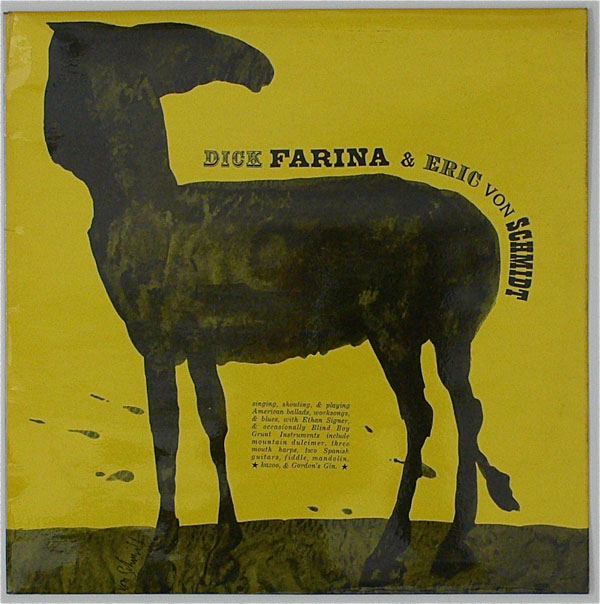
We are starting the series with Bob Dylan’s work as Blind Boy Grunt, working on the album “Dick Fariña & Eric von Schmidt.”
On the left is the cover on which we have the inscription “singing, shouting & playing American ballads, work songs & blues with Ethan Signer & occasionally Blind Boy Grunt. Instruments include mountain dulcimer, three mouth harps, two Spanish guitars, fiddle, mandolin, kazoo & Gordon’s Gin.”
The album was released in 1964 and was recorded during an impromptu session in January 1963 at Dobells Folk Record Shop in London, being issued later on their label. Bob (appearing as we have noted as Blind Boy Grunt) sings backing vocals and harmonica on 6 tracks.
And the reason for the pseudonym is that Bob’s Columbia contract prevented him from appearing under his own name so this pseudonym was used instead.
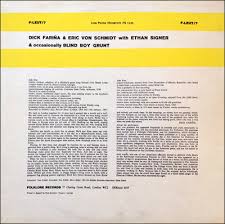
It is not possible to get the back cover of the album (shown left) reproduced in a manner that makes it readable on the screen, but the back cover notes make for some interesting reading including the note, “Blind Boy Grunt showed up from Rome and nobody got much sleep.”
A nice copy of the original album will set you back anywhere between $50-$100 depending on the condition and the pressing (there was a “Limited Edition” pressing which was the exact same as the regular pressing except the vinyl label states “limited edition”).
Solano Records issued a two CD version in 2007 with an additional disc of some 21 outtakes from the session, including several of Blind Boy Grunt’s contributions. It’s worth seeking out but it’s quite hard to find now and may set you back $40-$50.
This would have passed most fans by at the time of release due to the use of the pseudonym and as such it’s now pretty obscure and hard to come by, but it’s an essential album for fans of 60s folk music by one of the great duos and the addition of Dylan just makes this catnip for this collector!
If they had been allowed to say “& occasionally Bob Dylan” on the sleeve would this record be more well known these days? It’s very likely indeed.
Eric von Schmidt, who died in 2007 aged 75, was a leading light in the Cambridge, Massachusetts folk scene in the late 1950s and early 1960s, he was described as “a man of huge generosity to his fellow musicians.”
Bob Dylan stayed with von Schmidt, and repaid the debt to him by mentioning Rick in the intro to “Baby Let Me Follow You Down”. Also on the cover of “Bringing It All Back Home” there is a copy of “The Folk Blues of Eric von Schmidt.”
Von Schmidt was also a friend of Richard Fariña who was himself considered to be one of the leading folk music / protest songwriters of the time, and who was a friend of Thomas Pynchon, not just Thomas Pynchon the author, but THE Thomas Pynchon (at least in Tony’s house). He also became a good friend of Bob Dylan as explored in “Positively 4th Street: The Lives and Times of Joan Baez, Bob Dylan, Mimi Baez Fariña, and Richard Fariña,” by David Hajdu.
Thomas Pynchon dedicated his masterpiece Gravity’s Rainbow to the memory of Richard Fariña, who died in a motorcycle accident in 1966 and described Fariña’s own novel as “coming on like the Hallelujah Chorus done by 200 kazoo players with perfect pitch… hilarious, chilling, sexy, profound, maniacal, beautiful, and outrageous all at the same time.”
The story is that after Richard met Joan Baez’ younger sister, Richard divorced his wife and married the teenager and then released the Mimi & Richard Fariña album.
Which more or less takes us around in a complete circle.
I (Tony) appreciate I have meandered a way from Aaron’s intention with this series, and if you have not come across Pynchon or the Fariña album this probably means nothing, but if you have a moment, just listen to what follows.
If you have not ever tried a Pynchon novel before, it might be best to start with the “Crying of Lot 49”. After that it got a bit weird.
Sorry Aaron – I got a bit carried away on this one. Tony.
Untold Dylan: who we are what we do
Untold Dylan is written by people who want to write for Untold Dylan. It is simply a forum for those interested in the work of the most famous, influential and recognised popular musician and poet of our era, to read about, listen to and express their thoughts on, his lyrics and music.
We welcome articles, contributions and ideas from all our readers. Sadly no one gets paid, but if you are published here, your work will be read by a fairly large number of people across the world, ranging from fans to academics. If you have an idea, or a finished piece send it as a Word file to Tony@schools.co.uk with a note saying that it is for publication on Untold Dylan.
We also have a very lively discussion group “Untold Dylan” on Facebook with around 7000 active members. Just type the phrase “Untold Dylan” in, on your Facebook page or follow this link
You’ll find some notes about our latest posts arranged by themes and subjects on the home page of this site. You can also see details of our main sections on this site at the top of this page under the picture. Not every index is complete but I do my best. Tony Attwood
In the lyrics below, singer/songwriter Bob Dylan leaves a word blank for the listener or reader thereof to fill in. Many so-called ‘Dylanologists’ have wasted page upon page in an attempt to provide the correct answer to this serious riddle, but most simply get it wrong:
He saw an animal as smooth as glass Slithering his way through the grass Saw him disappear by a tree near a lake Ah, think I’ll call it a ________
(Bob Dylan: Man Gave Names To All The Animals)
In one essay of some twenty pages or so, one analyst dares to suggest that Dylan lifted a line from another songwriter, and therefore the answer to the riddle is definitely ‘snake.’
Little John was stung by a snake Over by the lake And looks like he’s really, really hurt He was lying in the dirt
(The Band: The Moon Struck One ~ Robbie Robertson)
We’ll assume that Johnny isn’t “lying”, and that he was actually bitten by a snake. Nonetheless, the analyst’s answer to the riddle is not correct – “Ah, think I’ll call it a snake” – because everybody knows that Bob Dylan would never steal a line from another writer. Kiwi poet Mike Johnson, miserable old soul that he is, says the line ought to be: “Ah, think I’ll call it a fake”
Another ‘Dylanologist’ writes a whole book about Dylan explaining how much the songwriter is influenced by a pre-Romantic poet; the poem below is quoted:
Little Lamb who made thee
Dost thou know who made thee?
Little lamb, I’ll tell thee
(William Blake: The Lamb)
Then a reference is made to the following song lyrics:
Next animal he did meet
Had wool on his back, and hooves on his feet
Eating grass on the mountainside so steep
Ah, think I’ll call it a sheep
(Bob Dylan: Man Gave Names To All The Animals)
https://youtu.be/OjYdjjIN6HI
Hence, the analyst, going a bit too far methinks, claims that the song is surely meant to conclude:
Saw him disappear by a tree near a lake
Ah, think I’ll call it William Blake
Though it must be admitted that Blake cares a lot about birds and animals:
Each cry of the hunted hare
A fibre from the brain does tear
A skylark wounded in the wing
A cherubim does cease to sing
(William Blake: To See The World In a Grain Of Sand)
Claimed it be by others that the Dylan line definitely ends in ‘hake’. This assertion is easily dismissed out of hand – even if the haddock-related fish somehow gets thrown up onto the shore, it’s a salt-water, not a fresh-water fish; so “Ah, think I’ll call it a hake” will not do.
Apparently Dylan is so amused at these silly solutions to his riddle that he gives out a clue by singing a rather Blakean variation of the song in which the lake is obviously frozen over:
I saw an animal upon lake
He was afraid that his heart would break
He was trying to drive a truck
Ah, think I'll call it a duck
(Bob Dylan: Man Gave Names To All The Animals)
The astute staff at the Untold Offices quickly pick up on this clue, and come up with the definitive answer to the riddle:
Slithering his way through the grass
Saw him disappear by a tree near the lake
Ah, think I'll call it a drake
(Bob Dylan: Man Gave Names To All The Animals)
With the benefit of hindsight, there is a clue already given in the lyrics; the animal is male, not female – a male duck, a drake. An analyst, who shall remain nameless for his own protection, suggests the verse refers to the rap singer named Drake.
In any event, listeners to the Dylan song above can now rest easy, and stop worrying about what the solution to the riddle is; just enjoy the song.
And to show their appreciation, a donation can be made, if they wish, to the nearest animal shelter.
Untold Dylan: who we are what we do
Untold Dylan is written by people who want to write for Untold Dylan. It is simply a forum for those interested in the work of the most famous, influential and recognised popular musician and poet of our era, to read about, listen to and express their thoughts on, his lyrics and music.
We welcome articles, contributions and ideas from all our readers. Sadly no one gets paid, but if you are published here, your work will be read by a fairly large number of people across the world, ranging from fans to academics. If you have an idea, or a finished piece send it as a Word file to Tony@schools.co.uk with a note saying that it is for publication on Untold Dylan.
We also have a very lively discussion group “Untold Dylan” on Facebook with around 7000 active members. Just type the phrase “Untold Dylan” in, on your Facebook page or follow this link
You’ll find some notes about our latest posts arranged by themes and subjects on the home page of this site. You can also see details of our main sections on this site at the top of this page under the picture. Not every index is complete but I do my best. Tony Attwood
“Spent a week in the hospital, then they moved me to this doctor’s house in town. In his attic. Had a bed up there in the attic with a window lookin’ out. Sarah stayed there with me. I just remember how bad I wanted to see my kids. I started thinkin’ about the short life of trouble. How short life is. I’d just lay there listenin’ to birds chirping. Kids playing in the neighbor’s yard or rain falling by the window. I realized how much I’d missed. Then I’d hear the fire engine roar, and I could feel the steady thrust of death that had been constantly looking over its shoulder at me. [pause] Then I’d just go back to sleep.”
(“True Dylan”, by Sam Shepard, Esquire, July 1987)
On July 29, 1966, Hurricane Dylan comes abruptly to a halt. The mythical motorbike accident at Woodstock forces Dylan to cancel all upcoming commitments, concerts, recordings and whatnot, and the following recovery period is used as an opportunity to get out of the rat-race altogether.
Record company CBS and manager Albert Grossman do not mind the first, forced break that much; Blonde On Blonde has just come out and is doing well. Six days before the accident, on the 23rd of July, the first double album in pop history enters the Billboard 200 (on 101), a month later, August 20, the LP is already at number 15, in the week of October 1 Blonde On Blonde reaches its peak (number 9). It isn’t until months later, mid-February 1967, that Dylan’s masterpiece disappears from the Top 200 again, in the week that The Monkees are at number one and two (with More Of The Monkees and The Monkees, respectively – Dylan’s influence with regard to original album titles has still not found its way into every sub-region of the pop world).
So, from that side the money tap is still open, and the singles are still doing fine, too; when Dylan is in the hospital, “I Want You” is number 20 in the Hot 100 and on the sixteenth place in England, the successor “Just Like A Woman” reaches the Top 40 as well. But a few months later, in the spring of 1967, the well is starting to dry up. “Leopard-Skin Pill-Box Hat” has a go in March, but this single doesn’t really score (top ranking: 81). In West Saugerties Dylan is already making music again, with the boys of The Band in the Basement, but for the time being no income is to be expected from that endeavour. CBS fears – rightly – to miss the momentum, and decides to release Dylan’s first compilation album: Greatest Hits.
The compilation is released 27 March 1967 and is a huge success. It reaches “only” the tenth place in the charts, but has very long legs. In January ’68 gold, and it goes on into the twenty-first century; April 2001 the five millionth copy is sold, so Greatest Hits is now on 5 x platinum.
The tracklist is quite safe. All Top 40 singles, plus the songs with which others have scored a hit (Peter, Paul & Mary with “Blowin’ In The Wind”, The Byrds with “Mr. Tambourine Man” and The Turtles with “It Ain’t Me, Babe”) plus “The Times They Are A-Changin’”, which wasn’t a single in the USA, but was a Top 10 hit in England:
Side one
1. Rainy Day Women ♯12 & 35
2. Blowin’ in the Wind
3. The Times They Are a-Changin’
4. It Ain’t Me Babe
5. Like a Rolling Stone Side two
1. Mr. Tambourine Man
2. Subterranean Homesick Blues
3. I Want You
4. Positively 4th Street
5. Just Like a Woman
In those years, when the record industry begins to grow into a multi-billion dollar business, the marketing departments are still dominated by big talkers and windbags, who get a hefty budget and have free rein to make their own work important and make their empty opinions the norm.
In England, it is decided that Greatest Hits needs a different tracklist. “Positively 4th Street” is deleted, “She Belongs To Me”, “It’s All Over Now, Baby Blue” and “One Of Us Must Know” take its place. Six of one and half a dozen of the other, but still: nothing wrong with that, of course – and it has got two more songs. Why “All I Really Want To Do”‘isn’t on either compilator’s list is puzzling, by the way; that was a big hit for Cher in both countries. Or “Don’t Think Twice”, which was a big hit for Peter, Paul & Mary as well as for The Wonder Who?
Much earlier, but also much weirder, was the European mainland. In the early summer of 1966, well before the American and English editions, the first Bob Dylan’s Greatest Hits is compiled in Hamburg: the so-called “stern music” edition. Since the 60’s, the German magazine stern regularly releases its own compiled records, in cooperation with the respective record company, which magazine subscribers can then order at a discount. Middle of the road, mostly (James Last, Herb Albert, and the likes) but occasionally special, attractive rarities – the beatles in hamburg, for example. And Bob Dylan’s Greatest Hits. Although it is also possible that the album was compiled by CBS Holland, and then taken over by stern – in the summer of ’66 the stern musik-edition is already for sale in Amsterdam. By the way, the Dutch edition has a now well-known motto on the cover: Nobody Sings Dylan Like Dylan.
The A&R-person of stern musik, or perhaps of CBS Holland, has an own opinion too. When the tracklist is to be chosen, presumably somewhere in the early spring of ’66, Dylan has only had one real hit on the European mainland: “Like A Rolling Stone”. Plus the three songs known in cover versions, but that’s about it – the record shall have twelve songs, so there are eight vacancies. Blonde On Blonde hasn’t been released yet, debut album Bob Dylan has no candidates. That limits the choice to five LP’s (Freewheelin’ up to Highway 61 Revisited), to 54 album tracks. With plenty of choice of classic, indestructible songs, but the final tracklist is surprising still:
Side one
1. Blowin’ in the Wind
2. Don’t Think Twice, It’s All Right
3. Queen Jane Approximately
4. Maggie’s Farm
5. Mr. Tambourine Man
6. Bob Dylan’s Blues Side two
1. The Times They Are a-Changin’
2. It Ain’t Me Babe
3. Subterranean Homesick Blues
4. It’s All Over Now, Baby Blue
5. Like a Rolling Stone
6. Highway 61 Revisited
“Maggie’s Farm”? “Highway 61 Revisited”? The compiler not only ignores the covers that were hits in Europe as well (Cher’s “All I Really Want To Do” was a Top 20 hit in the Netherlands, for instance), but also the singles Dylan did release on the mainland: “Positively 4th Street” and “Can You Please Crawl Out Your Window”. Alright, Maggie and Highway are recent, earth-shattering signature songs, songs that define the new, electric Dylan – and in June ’65, “Maggie’s Farm” was released in Germany as a single (and flopped).
However, the choice of “Bob Dylan’s Blues” is incomprehensible. “Bob Dylan’s Blues”? That unsightly, hardly to be taken seriously album filler from 1962 a Greatest Hit?
To be continued. Next up: Bob Dylan’s Blues – part II
============
Jochen is a regular reviewer of Dylan’s work on Untold. His books are available via Amazon both in paperback and on Kindle:
Untold Dylan is written by people who want to write for Untold Dylan. It is simply a forum for those interested in the work of the most famous, influential and recognised popular musician and poet of our era, to read about, listen to and express their thoughts on, his lyrics and music.
We welcome articles, contributions and ideas from all our readers. Sadly no one gets paid, but if you are published here, your work will be read by a fairly large number of people across the world, ranging from fans to academics. If you have an idea, or a finished piece send it as a Word file to Tony@schools.co.uk with a note saying that it is for publication on Untold Dylan.
We also have a very lively discussion group “Untold Dylan” on Facebook with around 7000 active members. Just type the phrase “Untold Dylan” in, on your Facebook page or follow this link
You’ll find some notes about our latest posts arranged by themes and subjects on the home page of this site. You can also see details of our main sections on this site at the top of this page under the picture. Not every index is complete but I do my best. Tony Attwood
This series looks at the subject matter of Bob Dylan’s songs year by year, trying to see a pattern in his writing across a year, rather than analysing his work song by song, as has been the traditional approach of commentators on Dylan’s work.
I have been writing this series as a voyage of discovery for myself, without a clear idea of what I would discover, and indeed I was genuinely surprise to find that for many years the main themes of Dylan’s writing were love and lost love. Two of the three main themes of popular music since the 1950s (the third being dance which Bob has shown no interest in at all).
And as this review has moved on I have noticed a move in Bob’s writing into writing about darker issues, giving a feeling of a strong lack of positivity about the world around us by the end of the 1980s. That decade ended with The menace emerges – the title to my piece about the meaning of the songs in 1989.
It’s all negative stuff. Now moving on I come to the Together Through Life songs, which were of course co-compositions, and we don’t know who wrote what exactly. But reading through the reviews of those songs and listening again, it is clear to me that these are not songs of love and hope.
Indeed I am reminded as I look through Bob’s songwriting across his career, of the last work by the great English novelist HG Wells. Wells had written novels which have lived on since he created them, novels written before the age of film which were turned into popular movies such as “The Time Machine” and “War of the Worlds”. But as time passed he lost that belief in the human race’s ability to survive no matter what.
Wells’ last book was “Mind at the End of Its Tether”. It is only 34 pages long and was written at the age of 78, and in it he considers the notion that humanity has had its day and is soon to be replaced. It is as if the violence of “The Invisible Man” (another early Wells, smash hit story) has become the essence of humanity.
To return to Bob Dylan’s themes, In preparing this piece about 2008/10 I have revisited the reviews of the “Together through Life” songs and added videos where it seems appropriate – they were not available at the time I did the original reviews. I hope they might be helpful, and I wanted to go back to the songs and think about them again.
After all, I wrote, not long after the album was released, that the “Highlight across the two years 2008/9” was the song “It’s all good”, in which ” Bob sums up everything that is wrong with the world in one song based on one chord. This really does tell it as it is, and by and large it is pretty much all over.”
My point here is that I had no idea what I was going to discover when I hit on the notion of trying to summarise the meaning of each and every song of Dylan’s in a word or two. What I find is that the rich mixture of themes of the earlier years, replaced as it was for one year by nothing but songs about faith, is now replaced by songs about decline and negativity.
Using the same format as in all the previous articles – trying to summarise each song in just a few words… but also taking the first song of this period of writing as a scene setter this is what I find…
The evening winds are still
I've lost the way and will
Can't tell you where they went
I just know what they meant
I'm always on my guard
Admitting life is hard
Without you near me
And now moving on to the rest of the songs, again using a similar format to that used before
It’s all good (Nothingness: we’re making lame responses to a world of chaos)
There is one more song in this period of writing, probably written in 2010, although the date is somewhat uncertain. The Love that Faded with lyrics by Hank Williams and music by Bob Dylan. As Dylan only wrote the music and not the lyrics, I’m not including this in my reviews of how Bob’s lyrics reflect his vies of the world and his thinking.
So yes, I have expanded my previous one or two word summaries, to try and get closer to the flavour of these complex songs, although that makes giving a summary of the year’s work harder, but I’ll give it a go, since that is the theme of the series.
Lost love: 2
Everything is wrong / life is bad: 6
The need of a woman: 1
This is so different from where we began. Dylan himself obviously took a few years to settle down into the themes that he really wanted about, but in looking at 1962 and 1963 together I came up with these subject areas across those two years…
The Blues (5)
Love / desire (3)
Gambling (1)
It’s just how we see the world (1)
Personal commentary – do the right thing (2)
The future will be fine (1)
Lost love / moving on (12)
The point is that I have been evolving my theory that we can learn a lot about Bob’s state of mind by the subject matter of his songs in groups and I am going to have to go back and review this earlier work, to try and pull everything together, but two things stand out from this 1962/3 review.
There is a tendency even in the early days towards the negative, but it is not all consuming. There is also an understanding that we all see the world in different ways. However although in the early times positive songs did take their place alongside the negativity, now as we look at Dylan’s subject matter in 2008 to 2010 the negative has won out, utterly.
Of course it can be argued that many of these 2008/10 songs were co-compositions, but I do not believe that Bob Dylan by this stage of his life would have agreed to put out songs that were not on themes that he felt. I can’t prove it, but it would seem utterly odd if not downright weird that the most famous songwriter of his age, the only songwriter who could stand alongside Irving Berlin in terms of the number of songs written, the popularity of those songs, and the generally agreed quality of those songs, if in the latter stages of his songwriting he was co-composing songs that were not on a subject of his choice.
There is an index to all the articles in this series, and I recognise I am going to have to go back and re-write the whole series at some stage, in the light of what I have found (which is not what I expected at all).
But first I’ll carry on through the remaining years of Bob’s writing to finish the series off.
I am not that big of a fan of Dylan covers, to tell you the truth. But I also can’t be immune when I see a gift.
I am also not that familiar with the work of Emma Swift, at least that I know of. I’ve heard so many different musical styles, I wouldn’t be surprised if I ran into this woman somewhere, where she might’ve been a backing vocalist or just one of the people in the credits, you know? Her spirit must’ve been around me somewhere before. Because, listening to her and saying her name, she looked very familiar.
First time I ran into this lady was when she uploaded her version of “I Contain Multitudes” on her YouTube channel. It really touched me I must say. I didn’t think it was better than Bob’s version (I rarely actually think that about any song Dylan wrote and recorded) but she was really good with it. I remember the video was really nice too.
Then I heard two other singles, which apparently were the promotion of the new album “Blonde On The Tracks”, an all Dylan-covers album.
The other two singles “Queen Jane Approximately” and “You’re A Big Girl Now” didn’t catch my attention that much.
This week I decided to give it a listen. Like I said, I’m not a fan of these, but, I said to myself, if I could’ve listened to Joan Osborne’s album from 2017 which was all Dylan covers as well and enjoy it, then I can enjoy this one too.
Before listening to the album, what really caught my attention was this lady’s interviews about this album. I really liked her point of view and takes on Bob’s music. That was a great first impression that I needed.
The album opens with “Queen Jane Approximately”. Despite a distracting start, for me at least, because I felt the song lacks a certain kind of firepower, whether in the music or the voice, it catches up nicely and is a very fair opener. It’s definitely a grower.
The second track “I Contain Multitudes” is, as I said, brilliant. Not better than the original, just as the first track wasn’t, but again, a fair tribute to the great artist of this age who’s still alive by the way and creating masterpieces. This is the only newer song in Dylan’s catalogue on this album. Emma’s delivery is very rich. Her vocals are very relaxing.
What I will give credit to Emma in the first two tracks is that she absolutely pulled it off in her own way. There was no evidence of her trying to imitate Dylan in any kind of way. Kudos for that!
The third track, “One Of Us Must Know (Sooner Or Later)” is an amazing, staggering cover. An album highlight if you ask me.
Definitely the best cover of this song I’ve heard, and I’ve heard a singer like Mick Hucknall (from Simply Red) cover it and it’s nothing like this.
Emma’s tone here is mesmerising. It’s like Blonde on Blonde meets Sgt. Pepper. It’s really great!
The 4th track, “Simple Twist Of Fate” was a nice landing back to the earthly ground after “One Of Must Know” blew me to the sky.
I didn’t even know that Simple Twist Of Fate was playing until the last verse, which Emma sang beautifully. I also forgot these original lyrics of the song after listening to so many live performances with different ones. Thank you Emma for reminding me. Not sure if Bob ever used “a parrot that talks” in his live performances. It’s a very interesting line. Especially for a Philosopher Pirate that’s listening to the wireless radio in Key West. Not surprising that he has a parrot. What’s surprising is that he never mentions it.
The fifth track, “Sad Eyed Lady Of The Lowlands”, another Blonde On Blonde gem, is again delivered masterfully here. Not an easy song to sing at all, lasting 11 minutes, Emma does it like a goddess I must say.
It just proved to me, with this and “One Of Us Must Know” that Blonde on Blonde, if it was made today, would still be as relevant.
I just thought to myself “people don’t write songs like these anymore” or “we don’t have songwriting or songwriters like this anymore”. Once again I realized how blessed we were to live in the age of Dylan.
The two Blonde on Blonde covers of Emma Swift on this album have cemented themselves as one of the best Dylan covers out there (and I’m sure there’s many good ones, having listened to them and knowing many people covered them) and Emma Swift certainly made it clear that she understands Dylan and Dylan’s art.
The sixth track, “The Man In Me” is also very beautifully done and arranged. The musical arrangement of this entire album is very good and it’s nicely produced. I have always had a soft spot for “The Man In Me”, so I was really happy it was included. I have only one flaw with this one : it’s too short.
The seventh track, “Going Going Gone” sounds like it’s arranged for Blood On The Tracks. Seriously. I felt it was a genius idea to do, because, Going Going Gone did feel as a prequel to Blood On The Tracks. No other Planet Waves song can say that.
The eighth track, “You’re A Big Girl Now”, still didn’t impress me. And I’m so sorry to say that as it is a song I really love. It’s a hard song to do though and I know that. So I won’t be critiquing it too much.
The main problem I have of it is that the album was very nicely put together until this moment. Tracks were nicely placed until this.
Going Going Gone felt like a Blood On The Tracks song. And then, a very similar arrangement, and even vocal delivery, was used for this one too.
You’re A Big Girl Now, of course, is not even near a “difficult listen”, it’s actually very uniquely arranged and again, kudos for such originality, but…
Emma’s potential is definitely through the roof and I think she could’ve performed this much better. This is not a critique, this is just encouragement.
Dylan usually ends the album on a very high note, and with Emma putting together an album like this, it needed a little bit of more… I don’t know… Firepower.
Queen Jane Approximately, when listening to it as a single, also did the same thing for me. But when listening to the album, it grew on me. You’re A Big Girl Now failed to do that unfortunately.
But I’ll certainly be listening to this album more.
I’m very glad that there are artists still covering Dylan. I’m also glad that, along with Joan Osborne a few years ago, Emma has decided to cover the deeper cuts more rather than the greatest hits.
I wish some people would even cover the really deep cuts like “Changing Of The Guards” , “Caribbean Wind” , “To Fall In Love With You” , “Tell Ol’ Bill”… The list goes on, but people get the point. Maybe we should promote that part of Dylan’s career more?
Nonetheless, Emma’s “Blonde On The Tracks” will go down as one of the better Dylan cover albums we’ve heard. All the universal acclaim she received for it is well deserved.
It’s a nice, short, walkthrough Dylan’s career.
Emma’s respect for the lyrics and keeping them the way they are without changing them to the female perspective and even sometimes finding ways to express herself in a more masculine way, shows Emma’s great adaptability that goes along with her incredibly gifted singing voice. Along with her singing, Emma really highlighted her unbelievable phrasing. Somewhere it reaches Dylan level even, which is the highest level of phrasing, and is a very necessary ingredient to Bob’s music, which again shows her knowledge of Bob’s music and the way she respects it and treasures it.
This is a great promotion for Bob Dylan’s music and Emma’s delivery really makes you focus on the beauty of the lyrics more than anything which only adds to Dylan’s genius even more. Also, it will especially make people check out Bob’s two albums that are combined in the album title, Blonde on Blonde and Blood On The Tracks. Especially Blonde on Blonde, having delivered the two songs mastefully.
I also like the art that was used for the videos uploaded to YouTube of the three singles – I Contain Multitudes, Queen Jane Approximately and You’re A Big Girl Now. Really beautiful videos! Wish more videos were made like that nowadays.
There’s so many good things about this album . I would give it 4.5/5 or 9/10. It’s really that good, if you understand Bob’s music that much. Really good job by Emma Swift! I wish she would make at least two more albums like this.
The albums that Emma will make you check out, having covered some of their tracks, are:
Highway 61 Revisited
Rough And Rowdy Ways
Blonde on Blonde
Blood On The Tracks
New Morning
Planet Waves
Six amazing albums.
So… Check those six albums and check out Emma’s album. You don’t need anything else to listen to but that. That’ll be enough.
=========
Editor’s note: There are a couple of songs from the album for which there are not musical or video links above. This is simply because I couldn’t locate online copies which I could legally use here to accompany the article – there’s no other significance.
High Water – you know the song – but just to remind you here it is…
According to the official site Bob has played the song 712 times in concert between 2001 and 2018, making it the 23rd most performed song in his repertoire.
But what is not often noticed (except by Aaron) is that at least once it turned up sounding like this
https://youtu.be/9w_jxNHgSiI
So where did that rearrangement come from?
In fact it appears to be a reworking of Boom Boom Mancini by Warren Zevon, which by chance we have already commented upon….
And we commented upon that because it has featured on our “Once only” series, when Bob performed the above mentioned “Boom Boom Mancini” at Key Arena, Seattle WA, on 4 October 2002, 14 years before he used the music for the re-write of High Water.
https://youtu.be/eNKWLfwJEKk
Actually it does seem to be a song that gets quite a few reworkings, although most of them stay much closer to the original construction of the song and vary the accompaniment.
There is however no real connection between Bob’s “High Water” and the original Charlie Patton song “High Water Everywhere” except in the title. Here’s Charlie Patton’s original
And here is part two
And here are the lyrics to the original
Backwater at Blytheville, backed up all aroundBackwater at Blytheville, done took Joiner townIt was fifty families and children come to sink and drownThe water was risin' up at my friend's doorThe water was risin' up at my friend's doorThe man said to his women folk, "Lord, we'd better go"The water was risin', got up in my bedLord, the water was rollin', got up to my bedI thought I would take a trip, Lord, out on the big ice sledOh, I can hear, Lord Lord, water upon my doorYou know what I mean, look-a hereI hear the ice, Lord Lord, was sinkin' downI couldn't get no boats there, Marion City gone down
So high the water was risin' our men sinkin' downMan, the water was risin' at places all aroundBoy, they's all aroundIt was fifty men and children come to sink and drownOh, Lordy, women and grown men drownOh, women and children sinkin' downLord, have mercyI couldn't see nobody's home and wasn't no one to be found
Now what is also interesting is that in the concert in Seattle on 4 October 2002 where Bob sang “Boom Boom Mancini” he also sang “High Water”. But I can’t find a recording of that song in that concert. The “Set List” web site does have a link to the song, but it takes us to the studio recording, not the performance in Seattle.
Ok so that is quite a meander around and about, but the real standout moment in all this is where we started: the Boom Boom Mancini re-arrangement by Bob Dylan. Just in case you’ve got confused with so many videos in one little article here’s the piece we are making the point about once more.
And if you know of any other case where Bob has taken one of his lyrics and then re-written the music so that it incorporates someone else’s melody and chord sequence, please do let us know. It’s the sort of thing we really like chasing down.
https://youtu.be/9w_jxNHgSiI
Oh and if you feel any of the leaps and conclusions within this little piece are wrong, we’d like to know because it really was quite a meander, so please do write in. But also please could you give evidence rather than just stating something as a fact, while leaving us to verify what you’ve said.
Untold Dylan: who we are what we do
Untold Dylan is written by people who want to write for Untold Dylan. It is simply a forum for those interested in the work of the most famous, influential and recognised popular musician and poet of our era, to read about, listen to and express their thoughts on, his lyrics and music.
We welcome articles, contributions and ideas from all our readers. Sadly no one gets paid, but if you are published here, your work will be read by a fairly large number of people across the world, ranging from fans to academics. If you have an idea, or a finished piece send it as a Word file to Tony@schools.co.uk with a note saying that it is for publication on Untold Dylan.
We also have a very lively discussion group “Untold Dylan” on Facebook with around 7000 active members. Just type the phrase “Untold Dylan” in, on your Facebook page or follow this link
You’ll find some notes about our latest posts arranged by themes and subjects on the home page of this site. You can also see details of our main sections on this site at the top of this page under the picture. Not every index is complete but I do my best. Tony Attwood
A consistent theme expressed by singer/songwriter Bob Dylan through his lyrics is the loss of a Paradise that might have been – lost because of greed.
Humorously expressed in the following song:
"I think I'll call it America", I said as we hit land
I took a deep breath, I fell down, I could not stand
Captain Arab he started writing up some deeds
He said, "Let's set up a fort, and start buying the place with beads"
(Bob Dylan: Bob Dylan's 115th Dream)
More darkly in the ‘Romantic’ lyrics below – native American Chief Shenandoah converts to Christianity, supports the American colonialists first against French-Canadian ‘voyageurs’, and then against the British in the War of Independence- only to have ‘Indian Territory’ more and more occupied:
Well, the white man loved an Indian maiden
Look away, you rolling river
With notions his canoe was laden
Look away, we're bound away
Across the wide MissourI
Shenandoah, I love your daughter
(Bob Dylan: Shenandoah ~ Vandall/traditional)
Later the song becomes a lament for the southern belle left behind, personified by the Shenandoah River of Virginia:
Oh Shenandoah, I love your daughter
Away, I'm bound away
'Cross the wide Missouri
Oh, who will tie your shoe
Oh, ,who will glove your hand
And who will kiss your ruby lips
When I am gone?
(Harve Persnell: Shenandoah ~ Persnell/traditional)
The ‘Paradise’ of the Southern Confederacy is lost due to the American Civil War, but, in this case, four million black slaves are freed:
"Virgil, quick come see, there goes the Robert E. Lee"
Now I don't mind chopping wood
And I don't mind if the money's no good
You take what you need, and you leave the rest
But they should never have taken the very best
(The Band: The Night They Drove Old Dixie Down ~ Robbie Robinson)
A theme picked up in the song lyrics quoted below:
I'm going to spare the defeated, I'm going to speak to the crowd
I am going to teach peace to the conquered
Well, I'm gonna tame the proud
(Bob Dylan: Lonesome Day Blues)
https://youtu.be/_NgTjNhyQtE
Referencing:
Roman, remember by your strength
to rule the Earth's peoples
For your arts are to be these:
To pacify, to impose the rule of law
To spare the conquered
Battle down the proud
(Virgil: Aeneid,  Book VI)
A theme akin to that expressed in the following lyrics:
I went out in Virginia, honey, where the green grass grow
I went out in Virginia, honey, where the green grass grow
I tried to tell myself I didn't want you no more
My baby told me, honey, stop doing me wrong
My baby told me, honey, stop doing me wrong
Well, I'm telling you, baby, 'cause I'm tired of living alone
(Jimmy Reed: Down In Virginia)
Now, with a little dirty humour thrown in:
Transparent woman in a transparent dress
Suits you well, I must confess
I'll break open your grapes, I'll suck out that juice
I need you like my head needs a noose
Goodbye, Jimmy Reed, goodbye and so long
I thought I could resist her, but I was so wrong ....
Can't you hear me calling from down in Virginia?
(Bob Dylan: Goodbye Jimmy Reed)
Untold Dylan: who we are what we do
Untold Dylan is written by people who want to write for Untold Dylan. It is simply a forum for those interested in the work of the most famous, influential and recognised popular musician and poet of our era, to read about, listen to and express their thoughts on, his lyrics and music.
We welcome articles, contributions and ideas from all our readers. Sadly no one gets paid, but if you are published here, your work will be read by a fairly large number of people across the world, ranging from fans to academics. If you have an idea, or a finished piece send it as a Word file to Tony@schools.co.uk with a note saying that it is for publication on Untold Dylan.
We also have a very lively discussion group “Untold Dylan” on Facebook with around 7000 active members. Just type the phrase “Untold Dylan” in, on your Facebook page or follow this link
You’ll find some notes about our latest posts arranged by themes and subjects on the home page of this site. You can also see details of our main sections on this site at the top of this page under the picture. Not every index is complete but I do my best. Tony Attwood
PLAYBOY: Do you think you have a purpose and a mission?
BOB DYLAN: Henry Miller said it: The role of an artist is to inoculate the world with disillusionment. Playboy interview, March 1978
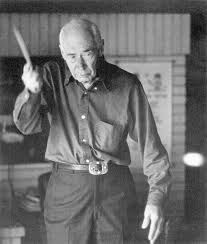
They met once, Dylan and Henry Miller, but that wasn’t really a success. Dylan is with Joan Baez in Big Sur, California, in the late summer of ’63, and Baez casually mentions that Miller lives nearby. She happens to know him. The fan Dylan wants to meet him, and after the Baez concert in Los Angeles (October 12th), where Dylan makes his Hollywood Bowl debut as an opener and accompanist for Baez, she takes him and sister Mimi to the famous writer. In the liner notes of Another Side Of he incorporates an impression of that encounter:
henry miller stands on other side of ping pong table an’ keeps talkin’ about me. “did you ask the poet fellow if he wants something t’ drink” he says t’someone gettin’ all the drinks. i drop my ping pong paddle an’ look at the pool. my worst enemies don’t even put me down in such a mysterious way.
At that time, August ’64, it still seems to be a somewhat surreal memory of a fictitious encounter. But Henry Miller is indeed a fanatical ping-pong player, and in the same Playboy interview in 1978 in which he quotes the above words of Miller, it seems to be a real, true memory: “Yeah, I met him. Years ago. Played ping-pong with him,” which he repeats a year later, in the interview for L’Expresse with French journalist Philippe Adler (“we played table tennis”).
Years later, February 1975, when asked about Dylan in the Rolling Stone interview with Dylan fan Jonathan Cott, Henry Miller remembers:
“I have no way of knowing whether Bob Dylan was influenced by me. You know, Bob Dylan came to my house ten years ago. Joan Baez and her sister brought him and some friends to see me. But Dylan was snooty and arrogant. He was a kid then, of course. And he didn’t like me. He thought I was talking down to him, which I wasn’t. I was trying to be sociable. But we just couldn’t get together. But I know that he is a character, probably a genius, and I really should listen to his work. I’m full of prejudices like everybody else. My kids love him and the Beatles and all the rest.”
Dylan remains an admirer. He often mentions Miller when asked about his favourite writers, Miller drops by in Tarantula, and in 2000 that enigmatic line from the Oscar-winning “Things Have Changed” (I feel like putting her in a wheel barrow and wheeling her down the street) seems to be a paraphrase of an excerpt from Miller’s Tropic Of Capricorn: “Sometimes he’d stand her on her hands and push her around the room that way, like a wheelbarrow.”
Overlapping is the love for songs by both greats. Quantitatively less often than in Dylan’s Chronicles, of course, but in any Miller book about every four or five pages a song, a musical scene or a memory of a song comes along.
At the crossroads of both declarations of love lies John Jacob Niles. Miller writes full of admiration in Plexus (1952):
“Over the coffee and liqueurs we would sometimes listen to John Jacob Niles’ recordings. Our favorite was “I Wonder As I Wander”, sung in a clear, high-pitched voice with a quaver and a modality all his own. The metallic clang of his dulcimer never failed to produce ecstasy. He had a voice which summoned memories of Arthur, Merlin, Guinevere. There was something of the Druid in him. Like a psalmodist, he intoned his verses in an ethereal chant which the angels carried aloft to the Glory seat. When he sang of Jesus, Mary and Joseph they became living presences. A sweep of the hand and the dulcimer gave forth magical sounds which caused the stars to gleam more brightly, which peopled the hills and meadows with silvery figures and made the brooks to babble like infants.”
In every respect (content, stylistic and even word choice) comparable to Dylan in Chronicles (2004):
“I listened a lot to a John Jacob Niles record, too. Niles was nontraditional, but he sang traditional songs. A Mephistophelean character out of Carolina, he hammered away at some harplike instrument and sang in a bone chilling soprano voice. Niles was eerie and illogical, terrifically intense and gave you goosebumps. Definitely a switched-on character, almost like a sorcerer. Niles was otherworldly and his voice raged with strange incantations. I listened to Maid Freed from the Gallows and Go Away from My Window plenty of times.”
Well-chosen words, from both writers. And Dylan implicitly reveals the sources for two of his songs. “Maid Freed From The Gallows” has given him the plot for “Seven Curses” (1963), and “Go Away From My Window” leaves traces, too:
Go away from my window
Go away from my door
Go away way from my bedside
And bother me no more
…so, the opening line, the rhyme scheme and the theme for “It Ain’t Me, Babe”.
John Jacob Niles, however, has the words spoken by the girl, the girl with whom the narrator is in love and by whom he is rejected. According to his own words, this is a true story. At least, that’s how Niles introduces the song, in 1957:
“I wrote Go Away From My Window for a girl, with blue eyes and blond hair, and the year was 1908. I was exactly sixteen years of age. The girl didn’t think much of the song, she didn’t think much of me. Since then, a great many people have sung Go Away From My Window.”
Touching. Though not very believable – it is not very likely that a sixteen-year-old boy in love would try to charm his chosen one with a song in which the woman says that the guy should get lost. And “I wrote” also could do with some nuance; the Roud Folk Song Index dates the first of a long, long line of “Go From My Window” songs 1611, and the title is even mentioned as early as 1578. With a different tenor, though; usually these are songs in which the woman tries to warn her lover, who is standing outside under the window, that her husband has come home unexpectedly – it is the first example of the intrigue ballad of the night visit.
Niles changes the plot, and Dylan eventually tilts the motive. This brings him back to the narrative of the seventeenth century “Go From My Window”, with a different, much more vicious mentality, of course, and even with the same constellation of persons:
Go melt back into the night, babe
Everything inside is made of stone
There’s nothing in here moving
An’ anyway I’m not alone
In Dylan’s song the third party returns, present behind the back of the speaker, just like five centuries ago the party with whom the protagonist will spend the night.
“It Ain’t Me, Babe” makes a huge impression. Joan Baez loves the song and records it as early as 1964 for her album Joan Baez 5 (which also includes her cover of Niles’ “Go Away From My Window”); it becomes a year later the breakthrough hit for The Turtles, still in 1965 Johnny Cash scores a hit with it as well, with future wife June Carter; Jan & Dean; Nancy Sinatra; Peter, Paul & Mary; Bryan Ferry through Bettye LaVette in 2018… the song has been continuously covered in all echelons of the pop world for over fifty years and the end is not yet in sight.
As a catchphrase, the song title has long since penetrated into the collective cultural baggage. In lawsuits, for example. Like in New York 2003, in the case Kinkopf v. Triborough Bridge & Tunnel Authority. An insignificant dispute about whether or not tolls have been wrongly collected, on which the judge rules in writing:
“Rather than provide any documentation to support his contention such as showing that his vehicles were elsewhere at those times and places, claimant offers the Bob Dylan “It Ain’t Me, Babe” plea.”
A feminist magazine from Berkeley calls itself It Ain’t Me Babe in 1970; a writer of an erotic novel uses the title in 2014; magazine articles; episodes of TV series; titles of graphic works of art; and in 2005 a racehorse is born and is given the name It Ain’t Me Babe, the poor soul.
The biographical crime film Blow (2001, Ted Demme), starring Johnny Depp, goes one step further. George Jung (Johnny Depp) is arrested with 660 pounds of marijuana and the judge asks: how do you plead?
George: [stands] “Alright. Well, in all honesty, I don’t feel that what I’ve done is a crime. And I think it’s illogical and irresponsible for you to sentence me to prison. Because, when you think about it, what did I really do? I crossed an imaginary line with a bunch of plants. I mean, you say I’m an outlaw, you say I’m a thief, but where’s the Christmas dinner for the people on relief? Huh? You say you’re looking for someone who’s never weak but always strong, to gather flowers constantly whether you are right or wrong, someone to open each and every door, but it ain’t me, babe, huh? No, no, no, it ain’t me, babe. It ain’t me you’re looking for, babe. You follow?”
It is a brilliant, absurd monologue, which does justice to music historical cross connections; George connects Dylan’s “It Ain’t Me, Babe” with a verse from Woody Guthrie’s “Pretty Boy Floyd”, which Dylan in turn has quoted in “Song To Woody” and paraphrased in “Absolutely Sweet Marie”.
Part of the Olympic magic the song owes to contrast; the lyrics are blunt and mean, almost cynical, but set-up, composition and structure of the musical accompaniment do not match that; the introductory lines to the chorus promise a We Are The Champions-like hymn, the chorus itself is, well, jubilantly comes pretty close. “It’s not me!” the narrator cheers triumphantly.
Quite indestructible, the combination of these lyrics with this magnetic melody. Thus, almost all covers are fun, at the very least – you have to dress it up very, very corny to compromise the power of the song. The downside is: it is apparently difficult to add something. All those nice covers are actually quite interchangeable. Only radically different arrangements stand out. Not necessarily better than the original, but some of them do surprise, at any rate.
At the top of that category: the old-fashioned, glowing soul approach by Bedford Incident, a completely unknown band with a completely unknown single from May 1969 – with a magnificent harmony-intermezzo and an overflowing, irresistible arrangement. Horns, violins, four male vocalists and a complete band – fortunately, Bedford Incident completely fails in Henry Miller’s function-requirement to inoculate the world with disillusionment. Although… Bedford Incident’s single never got any further than “Best Leftfield Pick” on Radio KIBH in the remote village of Sewald, Alaska, August 1969.
Which, with all due respect for Sewald and Radio KIBH, is a bit of a disillusionment, obviously.
And in case of difficulty, here’s an alternative source…
https://www.youtube.com/watch?v=frVt1jGDS6Y
Jochen is a regular reviewer of Dylan’s work on Untold. His books are available via Amazon both in paperback and on Kindle:
Untold Dylan is written by people who want to write for Untold Dylan. It is simply a forum for those interested in the work of the most famous, influential and recognised popular musician and poet of our era, to read about, listen to and express their thoughts on, his lyrics and music.
We welcome articles, contributions and ideas from all our readers. Sadly no one gets paid, but if you are published here, your work will be read by a fairly large number of people across the world, ranging from fans to academics. If you have an idea, or a finished piece send it as a Word file to Tony@schools.co.uk with a note saying that it is for publication on Untold Dylan.
We also have a very lively discussion group “Untold Dylan” on Facebook with around 7000 active members. Just type the phrase “Untold Dylan” in, on your Facebook page or follow this link
You’ll find some notes about our latest posts arranged by themes and subjects on the home page of this site. You can also see details of our main sections on this site at the top of this page under the picture. Not every index is complete but I do my best. Tony Attwood
I live on a street named after a Saint
Women in the churches wear powder and paint
Where the Jews, and Catholics, and the Muslims all pray
I can tell they're Proddie from a mile away
Goodbye Jimmy Reed, Jimmy Reed indeed
Give me that old time religion, it's just what I need
The opening stanza makes most sense in conjunction with the second, but, briefly, note the stock metaphor of “women in powder and paint,” an image which is usually deployed to connote insincerity or artifice. As this stanza and the next are about religion, it is worth noting that one thrust of the Protestation Reformation and Henry VIII’s schism was the removal of painted statues and much of the adornment and ceremony of the Roman Catholic Church. This association is reinforced by the second couplet, in which Protestants appear in a separate reference from the other three named religions; in the third, the singer calls for that “old-time religion,” a phrase generally associated with Baptist and related fundamentalist Protestant sects in rural America.
Thus, the first stanza sets up a commonplace contrast between artifice and something more intense. The items in the contrast are religions and it may make some uncomfortable to read this as an explicit preference for the fundamentalist style of religious experience instead of endorsing politically correct diversity. It’s possible to read the contrast in a way that the religions are merely metaphors for, say, contemporary media versus the old time music that Bob venerates.
Some have noted that the Proddie reference invokes an association with Van Morrison, who covered some Jimmy Reed songs. It is also worth noting that Van has been known to drop in and sing during services at a fundamentalist church in Southern California, not at all far from Dylan’s Malibu residence. It’s thus possible that this stanza and the next are written with Van in mind, and might even stem from a conversation between them on Jimmy Reed.
Stanza 2:
For thine is the kingdom, the power, the glory
Go tell it on the mountain, go tell the real story
Tell it in that straightforward, puritanical tone
In the mystic hours when a person's alone
Goodbye Jimmy Reed, godspeed
Thump on the Bible, proclaim a creed
In calling on a deceased person to speak, and tell a story, the second stanza reminds me of the similar conjuring of the spirit of Wolfman Jack in “Murder Most Foul,” although here the invited guest will talk about himself and not the historic events narrated in the other song.
This stanza is a fairly straightforward continuation of the prior one. The first line is a phrase appended initially, by Protestant sects, to the “Lord’s Prayer” and “Go Tell it on the Mountain” is an African-American spiritual; it’s also the title of a 1953 James Baldwin novel about the importance of the a Pentecostal church in African-American life. It makes perfect sense in a song about a bluesman to invoke these associations.
The next couplet relates back to the contrast in the first stanza, calling for “the real story” to be told “straightforward” and in “puritanical” tone, i.e., no powder and paint.
And last, the singer asks the spirit he’s summoned up to be a “Bible thumper,” another stock fundamentalist image.
As before, if the religious preference makes one uncomfortable, you can always metaphorize it as a contrast between a purer form of art, say the blues or folk music, and more powdered and painted forms.
The singer calls on the spirit of Jimmy Reed to “proclaim a creed” but actually the spirit delivers an autobiographical sketch in three Dylanized stanzas.
Third stanza:
You won't amount to much, the people all said
‘Cause I didn’t play guitar behind my head
Never pandered, never acted proud
Never took off my shoes, throw 'em in the crowd
Goodbye Jimmy Reed, goodbye, goodnight
Put a jewel in your crown and I put out the lights.
Per genius dot com, the line about playing guitar behind his head refers to other black musicians, such as Charley Patton, perhaps even Hendrix, who did that on occasion. Also, the line about “jewel in your crown” refers to the inlays of Jimmy Reed’s guitar. So basically, this stanza is portraying Jimmy Reed as a live performer.
Stanza 4:
They threw everything at me, everything in the book
I had nothing to fight with but a butcher's hook
They had no pity, they never lend a hand
I can't sing a song that I don't understand
Goodbye Jimmy Reed, goodbye, good luck
I can't play the record 'cause my needle got stuck
This stanza, I believe, conveys two facts about Jimmy Reed’s life offstage, First, like so many bluesmen, he did not get paid all his royalties or other earnings for the songs he wrote and the records he made. The people who robbed and cheated him are the “they” referred to several times in the stanza. Second, the reference to “a butcher’s hook” makes sense when one learns (see Wikipedia entry on Jimmy Reed) that, after WWII, Reed worked in a meat-packing plant in Akron Ohio. It’s a very economical way to squeeze that fact into the larger context of a bluesman not making enough money off his calling.
Stanza 5:
Transparent woman in a transparent dress
Suits you well, I must confess
I’ll break open your grapes, I’ll suck out the juice
I need you like my head needs a noose
Goodbye Jimmy Reed, goodbye and so long
I thought I could resist her but I was so wrong
This is where the muses separate the Nobel laureates from the rest of us.
In reading Jimmy Reed’s obituaries online, it seems he died while on tour in San Francisco, trying to make a comeback after losing years to alcoholism.
Picture a bottle of really cheap vodka in your mind, then read the stanza again.
Clear liquid? Clear bottle? I thought I could resist her but …
This stanza is a poetic, to say the least, reference to Reed’s alcohol addiction.
Stanza 6:
God be with you, brother dear
If you don't mind me asking what brings you here?
Oh, nothing much, I'm just looking for the man
Need to see where he's lying in this lost land
Goodbye Jimmy Reed, and everything within ya
Can't you hear me calling from down in Virginia?
This closes the song and doesn’t’ require much exploration. Bob continues his late period cinematic technique of composing lyrics that are basically movie dialogue.
The specific exchange here reminds me of news articles about Bob visiting the boyhood homes of Neil Young, Bruce Springsteen. Perhaps he made a visit to Reed’s birthplace, although that is in Mississippi and not Virginia. But word swap is a common Dylan trick, and in this case “down in Virginia” is the title of one of Reed’s songs.
I picture Bob making pilgrimages during the Never-Ending Tour to sites that are associated with his musical inspiration. I don’t know if he really does, but it’s a nice image. Maybe he sees them as shrines to the patron saints of the old time musical tradition he seems to venerate (go back to stanzas 1 and 2).
Now that we’re at the end of the song, and we see how “Jimmy” responded to the call at the end of Stanza 2 to “proclaim a creed,” we can perhaps infer that, to Bob, a song and dance man on a Never-Ending Tour, one’s “creed” is not one’s formal sect, but how one lives one’s life.
Borges wrote, “Every poem, given enough time, becomes an elegy.” Here is a fine elegy for a deceased fellow craftsman of Bob.
It blows me away that Bob is nearly 80, probably a billionaire, and he has both the mental capacity and the commitment to craft such a heartfelt tribute to a man like Reed.
Untold Dylan: who we are what we do
Untold Dylan is written by people who want to write for Untold Dylan. It is simply a forum for those interested in the work of the most famous, influential and recognised popular musician and poet of our era, to read about, listen to and express their thoughts on, his lyrics and music.
We welcome articles, contributions and ideas from all our readers. Sadly no one gets paid, but if you are published here, your work will be read by a fairly large number of people across the world, ranging from fans to academics. If you have an idea, or a finished piece send it as a Word file to Tony@schools.co.uk with a note saying that it is for publication on Untold Dylan.
We also have a very lively discussion group “Untold Dylan” on Facebook with around 7000 active members. Just type the phrase “Untold Dylan” in, on your Facebook page or follow this link
You’ll find some notes about our latest posts arranged by themes and subjects on the home page of this site. You can also see details of our main sections on this site at the top of this page under the picture. Not every index is complete but I do my best. Tony Attwood
Boom Boom Mancini was written by Warren Zevon and is a song about a boxer – as we all know Bob Dylan has a particular interest in boxing and has recorded Hurricane and Davey Moore. He also sang “The Boxer” on Self Portrait.
Ray Mancini was born in 1961, competing as a professional boxer from 1979 to 1992, and then after retirement worked as an actor and commentator. He held the WBA lightweight title and took his nickname from his father, also a boxer, Lenny Mancini.
The issue most people in the world of boxing recall about Mancini was his fight with Korean challenged Duk Koo Kim which Mancini won in 14 rounds. However immediately after the fight Kim collapsed and four days later he died.
Mancini was deeply affected by the tragedy, for which he is said to have blamed himself. Kim’s mother committed suicide three months after the fight and the referee of the contest committed suicide the following year.
The song was written and recorded originally by Warren Zevon. Here are the lyrics
Hurry home early hurry on homeBoom Boom Mancini's fighting Bobby ChaconHurry home early hurry on homeBoom Boom Mancini's fighting Bobby ChaconFrom Youngstown, Ohio, Ray "Boom Boom" ManciniA lightweight contender, like father like sonHe fought for the title with Frias in VegasAnd he put him away in round number oneHurry home early hurry on homeBoom Boom Mancini's fighting Bobby ChaconHurry home early hurry on homeBoom Boom Mancini's fighting Bobby ChaconWhen Alexis Arguello gave Boom Boom a beatingSeven weeks later he was back in the ringSome have the speed and the right combinationsIf you can't take the punches, it don't mean a thingHurry home early hurry on homeBoom Boom Mancini's fighting Bobby ChaconHurry home early hurry on homeBoom Boom Mancini's fighting Bobby ChaconWhen they asked him who was responsibleFor the death of do Koo KimHe said, "Some one should have stopped the fightAnd told me it was him."They made hypocrite judgements after the factBut the name of the game is be hit and hit backHurry home early hurry on homeBoom Boom Mancini's fighting Bobby ChaconHurry home early hurry on homeBoom Boom Mancini's fighting Bobby Chacon
Here is Warren Zevon’s version…
Warren William Zevon who wrote the song was born January 24, 1947 and died in 2003. He started out as a session musician, jingle composer, songwriter, and bandleader, and his career took off when Linda Ronstadt started to record his music.
Thereafter he particularly became known for “Werewolves of London” and “Lawyers Guns and Money” recorded by himself, and a series of hits recorded by other performers such as “Poor Poor Pitiful Me”, “Accidentally Like a Martyr”, “Mohammed’s Radio”, “Carmelita”, and “Hasten Down the Wind.” He also recorded “Knockin on Heaven’s Door.”
I don’t know if this was a hit worldwide – us Londoners certain knew it – and quoted it.
Here is Bob’s one off performance of Boom Boom.
https://youtu.be/eNKWLfwJEKk
This was performed in Key Arena, Seattle WA, on 4 October 2002.
Farewell to the Gold
https://youtu.be/to6z40EzWhg
This was from November 1992 in Youngstown Ohio and it gives me a chance to promote one of my favourite songs…
It was written by Paul Metsers a New Zealand folk singer who has spent a lot of time in the UK, but who seemed to stop writing and performing sometime around his 50th birthday. A ludicrously early date but it did at least give him time to write and record “Farewell to the gold.”
I had no idea before coming to this that Paul Metsers was born in the Netherlands – so I learn something from this series (as I hope you might). Farewell to the Gold was written after he had moved to England, I think, and was also popularised by Nic Jones.
Colin Irwin of the Melody Maker, described Metsers as “a songwriter of genuine depth and versatility”. I would agree, and then agree some more.
The Nic Jones version of this song is particularly well known which is why I include it below. If this doesn’t move you at all, then of course that is a personal matter, but it means that our emotional lives are on different levels. Not that mine is in any way superior to yours but simply we are different.
Quite why Bob has performed this song only once I can’t imagine – but it is the same with several songs we have reviewed on the “once only songs” reviews. There is solid work going on in learning the lyrics and getting the arrangement to work, and then rehearsing it all.
But here’s the big thing: when this track finishes, stay with it, because then you get Paul Metsers performing in 2012.
https://youtu.be/i6tFuxKKXkU
Shotover river, your gold it is waningIt's weeks since the colour I've seenBut it's no use just sitting and Lady Luck blamingSo I'll pack up and make the break cleanFarewell to the gold that never I foundGoodbye to the nuggets that somewhere aboundFor it's only when dreaming that I see you gleamingDown in the dark, deep undergroundIt's nearly two years since I left my old motherFor adventure and gold by the poundWith Jimmy the prospector - he was anotherFor the hills of Otago was bound
We worked the Cardrona's dry valley all over
Old Jimmy Williams and meBut they were panning good dirt on the winding ShotoverSo we headed down there just to seeWe sluiced and we cradled for day after dayMaking hardly enough to get byTil a terrible flood swept poor Jimmy awayDuring six stormy days in July
Dylan’s once only file: earlier editions – and the concert
Untold Dylan is written by people who want to write for Untold Dylan. It is simply a forum for those interested in the work of the most famous, influential and recognised popular musician and poet of our era, to read about, listen to and express their thoughts on, his lyrics and music.
We welcome articles, contributions and ideas from all our readers. Sadly no one gets paid, but if you are published here, your work will be read by a fairly large number of people across the world, ranging from fans to academics. If you have an idea, or a finished piece send it as a Word file to Tony@schools.co.uk with a note saying that it is for publication on Untold Dylan.
We also have a very lively discussion group “Untold Dylan” on Facebook with around 7000 active members. Just type the phrase “Untold Dylan” in, on your Facebook page or follow this link
You’ll find some notes about our latest posts arranged by themes and subjects on the home page of this site. You can also see details of our main sections on this site at the top of this page under the picture. Not every index is complete but I do my best. Tony Attwood
During the American Civil War, general Stonewall Jackson is accidentally shot by his own men. Surgeon Zimmerman puts the monstrous Civil War back together by gathering alliterative parts and pieces from different poets in his song ” ‘Cross The Green Mountain”:
From Julia Howe:
I have seen Him in the watch-fires of a a hundred circling camps
They have builded Him an altar in the evening dews and damps
I can read His righteous sentence by the dim and flaring lamps
(The Battle-Hymn Of The Republic)
To this:
Altars are burning, the flames falling wide
(Bob Dylan: 'Cross The Green Mountain)
From William Yeats:
Black out; Heaven blazing into the head
Tragedy wrought to the utmost
(Lapis Lazuli)
To this:
I cross the Green Mountain, I slept by the stream
Heaven blazing in my head, I dreamt a monstrous dream
(Bob Dylan: 'Cross The Green Mountain)
From Nathaniel Shepherd:
For the foe had crossed from the other side
That day, in the face of murderous fire
That swept them down in its terrible ire
And their life-blood went to colour the tide
(The Roll Call)
To this:
The foe has crossed over from the other side
They tip their caps from top of a hill
(Bob Dylan: 'Cross The Green Mountain)
From Henry Timrod:
But still along yon dim Atlantic line
The only hostile smoke
Creeps like a harmless mist above the brine
From some frail floating oak
(Charleston)
And from Henry Melville:
The ravaged land was miles behind
And Loudon spread her landscapes rare
(The Scout Toward Aldie)
To this:
All along the dim Atlantic line
The ravaged land lies miles behind
(Bob Dylan: 'Cross The Green Mountain)
From Henry Flash:
Not 'mid the lightning of the stormy fight
Nor in the rush of the vandal foes
Did kingly Death, with his resistless might
Lay the great leader low
(The Death Of Stonewall Jackson)
To this:
Close the eyes of our captain, peace may he know
His long night is done, the great leader is laid low
(Bob Dylan: 'Cross The Green Mountain)
From Robert C. Waterston:
The memory of the just
Shall still be dear, whatever their earthly lot
Dust may return to dust
But Virtue lives, and cannot be forgot
(The Departed)
To this:
Pride will vanish, and glory will rot
But virtue lives on, and cannot be forgot
(Bob Dylan: 'Cross The Green Mountain)
From William Gannett:
Only ten miles from the city
And how I am lifted away
To the peace that passeth knowing
And the night that is not day
(Sunday On The Hill-Top)
To this:
I'm ten miles outside the city, and I'm lifted away
In an ancient light that is not day
(Bob Dylan: 'Cross The Green Mountain)
From Walt Whitman:
See, dearest mother, the letter says Pete will soon be better
Alas, poor boy, he will never be better ....
While they stand at home neat the door, he is dead already
The only son is dead
(Come Up From The Fields Father)
To this:
But he will better soon, he's in a hospital bed
But he'll never be better, he's already dead
(Bob Dylan: 'Cross The Green Mountain)
From Henry Longfellow:
And I saw a vision how far and fleet
That fatal bullet went speeding forth ....
And a bell was tolled, in that far-off town
For one who had passed from cross to crown
(Killed At The Ford)
To this:
The bells of evening have rung
There's blasphemy on the end of the tongue
Let them say that I walked in fair nature's light
And that I was loyal to truth and to right
(Bob Dylan: 'Cross The Green Mountain)
There be biblical allusions in ‘Cross The Green Mountain’:
And I stood upon the sand of the sea
And saw a beast rise up out of the sea
Having seven heads and ten horns
And upon his heads the name of blasphemy
(Book Of Revelations 13:1)
Untold Dylan: who we are what we do
Untold Dylan is written by people who want to write for Untold Dylan. It is simply a forum for those interested in the work of the most famous, influential and recognised popular musician and poet of our era, to read about, listen to and express their thoughts on, his lyrics and music.
We welcome articles, contributions and ideas from all our readers. Sadly no one gets paid, but if you are published here, your work will be read by a fairly large number of people across the world, ranging from fans to academics. If you have an idea, or a finished piece send it as a Word file to Tony@schools.co.uk with a note saying that it is for publication on Untold Dylan.
We also have a very lively discussion group “Untold Dylan” on Facebook with around 7000 active members. Just type the phrase “Untold Dylan” in, on your Facebook page or follow this link
You’ll find some notes about our latest posts arranged by themes and subjects on the home page of this site. You can also see details of our main sections on this site at the top of this page under the picture. Not every index is complete but I do my best. Tony Attwood
Time Out Of Mind is the most unique album in Dylan’s career for many reasons.
First of all, the timing of its release is very specific in itself. Seven years without any new original material (since Under The Red Sky), Bob having heart problems that almost killed him (giving the critics a warmer approach to the album) and a lot of experimentation and uncertainty, that almost lead to the album not even being released.
Bob’s sessions usually pass quickly. Sometimes there’s a lot of uncertainty and experimentation too, but the album always gets rushed and released as soon as it can be. However Time Out Of Mind wasn’t such a case. Bob took his time more than ever.
The entire process started in what seems to be middle to late 1996, and the album was finally released in September 1997. A full year of Dylan overthinking an album. Unheard of!
Despite so much going on, we have very little access to this album’s background and we’re not sure how many songs were there and when they were recorded.
However one of the few pieces of information that I have collected in my years as a Bob researcher, is the so called “Oxnard Demos” which could have been recorded in 1996.
Apparently, these songs were demos only, but still, some of them are probably worthy. But the good news is, the Bootleg Series team, has found a lot from Time Out Of Mind and they’re definitely working on it, but it’s not sure when they’re gonna release it. It might as well be the next bootleg series: Volume 16.
Along with the Oxnard Demos, we could see the second appearance for some songs on the Bootleg Series.
On Tell Tale Signs, Bootleg Series volume 8, we have witnessed some mighty fine performances.
Dreamin’ Of You– what appears to be an early version of Standing In The Doorway, but an entirely different song. It even has an official video on Bob Dylan’s official YouTube channel. It would be nice to see how this song came about and did it actually turn into Standing In The Doorway, or was it just another song that just had very similar lyrics. There’s an Untold review of the song with the video here.
Marchin’ To The City– this one sort of seems like an early version of ‘Til I Fell In Love With You, also containing some of its lyrics. Again, it would be nice to find out if it’s actually the same song or was it just another song.
This song has had two versions on Tell Tale Signs. Both versions are far from a finished song in my opinion, but it does show some promise.
Red River Shore – this song is actually seen by many as a lost masterpiece. I’m one of those people that agrees with that. It’s a heartwrenching ballad filled with touching lyrics, but also the one that’s very comforting on dark lonely nights. It doesn’t seem finished though.
We also have two versions of this one, but both lack a few details to be finished and released songs. Maybe there are more and better versions during the sessions?
I have heard that there might be a version that has the lyrics of Not Dark Yet “she wrote me a letter and she wrote it so kind”, unless it’s an error. The two versions on Tell Tale Signs do not contain that lyric. Maybe there’s another version.
Mississippi – originally recorded for Time Out Of Mind, it came as a highlight on Love And Theft in 2001 and one of Dylan’s late career triumphs. Written in 1996 apparently, we have witnessed three different versions on Tell Tale Signs, more than any other song from that Bootleg Series volume, maybe meaning that it was a song which Dylan experimented with the most?
The three versions we’ve heard sound very charming and in some parts better than the L&T version, but as a whole it can not eclipse the released version. Still, it would be nice to see if there might be some really masterful versions out there.
Can’t Wait (alternative)– we have had a chance to hear two versions of this song. One with much clearer vocals and different lyrics (some lyrics that later ended up on Sugar Baby from Love And Theft!) and the other with similar, but still different lyrics and the arrangement similar to Love Sick, maybe even more dark!
Those two versions definitely are one of my highlights of Tell Tale Signs, which to this day is my favorite Dylan bootleg series volume probably.
That should be all that we have so far.
There’s this one song I found listed that’s called “All I Ever Loved Is You”. Could it be a Dylan original or perhaps a cover or maybe even just a sheet title or an alternative name of a song we already know?
People have said that there’s an alternative version of Not Dark Yet, that’s much more beautiful than the album version and also, Highlands is said to be more than 27 minutes long in its alternate form! That confirms the rumors about one of Bob’s interview answers. When asked “were there shorter versions of Highlands” he replied “this is the short version” when talking about the released album version, which is “only” 16 minutes long.
You thought Murder Most Foul was long?
I heard a few more stories.
One is that Daniel Lanois ruined the final production, which probably swallowed the songs more than it should. Although I like Time Out Of Mind in many ways, I do feel that it’s missing something. So maybe it is true? Maybe the session performances were much better than the final cuts?
Also, one interesting story.
As we know, Time Out Of Mind has had 11 songs.
One person sort of familiar with the album said that there were 13 songs total recorded for Time Out Of Mind. That makes me ask “just 13?”. I would be surprised if Dylan didn’t do any covers during the sessions, because he always seems to do so.
Along with the 11 we already know, he said that there’s Mississippi as the 12th and he said something very interesting then.
“I always wondered if the 13th song was actually Things Have Changed”.
What?
This raises a lot of questions then?
If that’s so, then the list looks like this
Love Sick
Dirt Road Blues
Standing In The Doorway
Million Miles
Tryin’ To Get To Heaven
‘Til I Fell In Love With You
Not Dark Yet
Cold Irons Bound
Make You Feel My Love
Can’t Wait
Highlands
Mississippi
Things Have Changed (?)
What about Red River Shore? Could that mean that Red River Shore might’ve been an early version of Not Dark Yet, based on the lyric “she wrote me a letter and she wrote it so kind”? I mean, everybody knew about Red River Shore before it even got released on Tell Tale Signs and everyone was waiting to hear that one more than anything. How come this guy didn’t mention it as the 13th song? Maybe he knows something we don’t know?
Maybe Red River Shore is actually Not Dark Yet. And I never thought of this until writing this very article. I can definitely see similarities between the two songs.
“I followed the river (Red River) and I got to the sea”. Puzzles everywhere. We gotta find the code somewhere.
This would also mean that Dreamin’ Of You did become Standing In The Doorway and Marchin’ To The City did become ‘Til I Fell In Love With You?
What about the lyrics “my back is to the sun because the light is too intense, I can see what everybody in the world is up against”, early lyrics of Can’t Wait, later used for Sugar Baby? Was Sugar Baby in the mix here too?
Was there maybe a song out there that could be like a hybrid of Things Have Changed and Sugar Baby?
Then again, what’s with this song “All I Ever Loved Is You”?
Could that be the alternate name for one of the songs or an early version of some of the songs that ended up on the album? Like maybe “Make You Feel My Love”? Or was it another song, that hybrid of Things Have Changed and Sugar Baby?
Let’s try again.
Love Sick, other than the released version, nothing else. Was there maybe an acoustic demo out there somewhere? Or piano demo? Anything?
Dirt Road Blues – again, nothing
Standing In The Doorway / Dreamin’ Of You
Million Miles – nothing … I do see it resemble Marchin’ To The City a little, but is it actually it? Probably not.
Tryin’ To Get To Heaven – again, nothing, maybe some previous demos…
‘Til I Fell In Love With You / Marching To The City
Not Dark Yet / Red River Shore + a version more beautiful than the released one
Cold Irons Bound – nothing…
Make You Feel My Love / perhaps an early version is “All I Ever Loved Is You”?
Can’t Wait – multiple alternate versions – very similar to Love Sick in one of those versions and contains future lyrics for Sugar Baby and lyrics that ended up on Tryin’ To Get To Heaven (“you think you’ve lost it all, there’s always more to lose” turned into “when you think that you’ve lost everything, you find out you can always lose a little more”).
Highlands – lasted as long as 27 minutes in its alternate form
Mississippi – multiple versions exist, one of the three has lyrics that open the song going like this:
I'm standing in the shadows
With an achin' heart
I'm looking at the world
Tear itself apart
Minutes turn to hours
Hours turn to days
I'm still lovin' you
In a million ways
Things Have Changed (?)
Time Out Of Mind definitely has more speculations than the actual trustworthy sources, but it’s certainly an album of experimentation. Tell Tale Signs gave us a hint.
Time Out Of Mind seems, of what we have so far, like a goldmine of great songs (same fate as Infidels it seems) that have uncanny resemblance and connection. It seems like Bob was all over the place with the lyrics. If he didn’t like the lyrics for one song, he was gonna try them on the other.
I’m still surprised that it’s only 13 songs in the mix, but then again, one Dylan song goes through many transformations, it feels like there’s actually 10 different songs that ultimately turn into one.
Forget the Cutting Edge or More Blood More Tracks… This should be the most interesting album step by step walkthrough ever. This needs the Cutting Edge/More Blood More Tracks approach to it. It needs that step by step, chronological order of the entire sessions. I heard that most of it, if not all of it, can be found somewhere.
That would be great because it would give Dylan fans a chance to see the entire sessions for one of the Mod-Bob albums (a popular term among Dylan fans used for a streak of albums from Time Out Of Mind to Rough And Rowdy Ways). We don’t have almost anything from those albums. Love And Theft for example has nothing else but the album itself in circulation. No information about the sessions even.
We know a few things about Modern Times and Together Through Life, but not much. Tempest, not so much either.
Only Time Out Of Mind and Modern Times were covered in Tell Tale Signs, but not as much for us to have any details about how the sessions went.
Hopefully, soon…
Untold Dylan: who we are what we do
Untold Dylan is written by people who want to write for Untold Dylan. It is simply a forum for those interested in the work of the most famous, influential and recognised popular musician and poet of our era, to read about, listen to and express their thoughts on, his lyrics and music.
We welcome articles, contributions and ideas from all our readers. Sadly no one gets paid, but if you are published here, your work will be read by a fairly large number of people across the world, ranging from fans to academics. If you have an idea, or a finished piece send it as a Word file to Tony@schools.co.uk with a note saying that it is for publication on Untold Dylan.
We also have a very lively discussion group “Untold Dylan” on Facebook with around 7000 active members. Just type the phrase “Untold Dylan” in, on your Facebook page or follow this link
You’ll find some notes about our latest posts arranged by themes and subjects on the home page of this site. You can also see details of our main sections on this site at the top of this page under the picture. Not every index is complete but I do my best. Tony Attwood
Will Freeman, the protagonist of Nick Hornby’s filmed novel About A Boy (1998), lives a luxurious, empty life in London and can afford it thanks to his father’s inheritance; Dad wrote the Christmas evergreen “Santa’s Super Sleigh”, and his son Will sees the annual royalties from it pouring in by buckets and barrels.
For the plot of book and film adaptation (2002, by the Weitz brothers, starring Hugh Grant) this fact is not too relevant; the Christmas hit is more like a MacGuffin to explain the financing of Freeman’s life. Yet it intrigues. Can an heir to a decades-old Christmas hit live off the royalties? In 2005, a reader of The Guardian wonders about that in a reader’s letter, and the answer comes a week later, November 9, from an experience expert in Kingston upon Thames, Surrey, Greg Lake:
I can tell you from experience that it’s lovely to get the old royalty cheque around September every year, but on its own, the Christmas song money isn’t quite enough to buy my own island in the Caribbean.
Greg Lake scored a huge hit in 1975 with “I Believe In Father Christmas”, a song that at the time of his readers’ letter, thirty years later, is still one of the most popular Christmas hits in England, so he has a right to speak.
In February 2014, Greg is told he has pancreatic cancer with metastases. He can still process the bad news in his autobiography, which should have been published in 2012, but will eventually be published posthumously, six months after his death in December 2016. The book, Lucky Man (2017), is a pleasant, sympathetic autobiography, written by a pleasant, sympathetic musician without too much pretension, literary or otherwise. The title refers to Emerson, Lake & Palmer’s first big hit, the 1970 “Lucky Man”, a song Lake wrote as a teenager, and it refers to the moving closing line of the autobiography, written in the face of impending death: “I have been a lucky man.”
Entertaining and interesting enough, all of it, Lake’s memories of ELP, King Crimson, his solo work and his contributions to various occasional projects (such as The Who and Ringo Starr’s All Star Band), though especially interesting for the Dylan fan is his background story to “(I Must) Love You Too Much”.
“(I Must) Love You Too Much”, or “Love You Too Much”, or without brackets (there are several titles in circulation) is one of the “Helena Springs songs”, one of the songs Dylan writes in 1978 together with the young singer from his background choir. He doesn’t record it, but apparently Dylan attaches more importance to it than to “Walk Out In The Rain” and “If I Don’t Be There By Morning”: the song is played live twice, and used a few times at a sound check.
Those live performances are pretty fun. Power rock, propelled by Jerry Scheff’s thundering bass, sharp, Stones-like rhythm guitar and even a concrete riff in the middle-eight… it’s quite a boost. Dylan places the song well, at number 12, between “I Shall Be Released” and “Going, Going, Gone”, just before the break, and both times the end falters a bit (Dylan: “Thank you. We almost played that one right”), but still: both times it is a nice, solid rocker.
For Street Legal, the song is too late anyway. That album was released June 15, the first performance of “Love You Too Much” is September 24th; considering the mistakes while performing, the song hasn’t been rehearsed much yet and probably only recently written. The next album is the first evangelical record, Slow Train Coming, and of course the song doesn’t qualify for that, although on closer inspection a not too dramatic lyrical intervention could have made the song reli-proof. If the you is Christ, the lyrics would have the same, somewhat disparagingly complaining, tone as “I Believe In You”.
Anyway, Dylan rejects the song. But he doesn’t completely forget the song. Two years later, in 1980, Greg Lake calls in. Through an intermediary:
For my debut solo record, I wanted to pay tribute to Bob Dylan by recording one of his songs. I had always been a huge fan of Bob and his songwriting, and I felt that this was as good a time as any for me to pay my respects. The only thing was that I did not really want to do one of his big hits, but rather something less well known. Just purely by coincidence, Tommy Mohler, one of my tour managers at the time, used to work for Bob. He asked him if he had any unreleased material that I could record. Bob explained that he didn’t have any completed songs, but that he did have one song that was halfway written and that he would be more than happy for me to complete it. The title of the song was ‘Love You Too Much’. As a result, I share a co-writing credit with the legendary Bob Dylan (plus Helena Springs). Having finished the writing, I began to record the track at Abbey Road.
That recording is, as can be expected from Greg Lake, a smooth, flawless interpretation, performed by world-class hard rocking musicians, with the only drawback being the sterile 80s sound of the Miami Vice synthesizers. Its strong point is Gary Moore’s Formula 1 guitar solo, which also makes Greg Lake’s jaw drop:
“I asked him if he would like to come into the control room and take a listen to the track but he said that he would rather just play along in real time. […]. Gary’s track was done in one single pass having never heard the song before. To be honest, we were all absolutely floored by his performance.”
Greg asks him on the spot for his band, and Moore accepts. So he is standing next to Lake at the King Biscuit Flower Hour on November 5, 1981, when he plays another superlative of that studio part.
Lake has added and changed some lyrics, but hardly distinctive changes. The original text isn’t really a poetic masterpiece anyway – there’s not much to spoil about it. “(I Must) Love You Too Much” expresses in interchangeable verses the suffering of a loser in love with the wrong woman. His mother warns him, but in vain; he sure wishes he could leave her – but he loves her too much;
Well, my mama said the girl’s puttin’ you downShe’s gonna ruin my lifeI must have loved you too much
…and variants thereof. Not surprising, and not too original either – in the blues canon dozens of variants of the same approach can be found, in any case. Arthur Crudup’s classic “Mean Frisco Blues”, for example, from which Dylan drew earlier, for the Basement gem “Santa Fe”;
Well, my mama, she done told me
And my papa told me too
A woman that gets in your face
Lord, she ain't no friend for you
Or Lead Belly’s equally influential “Fannin Street”;
My mama told me
“Women in Shreveport, son
Gonna be the death of you”
… more variants of the song in Dylan’s personal Top 10, the song which echoes in seven, eight Dylan songs, of Harold Arlen’s “Blues In The Night”, one of the many highlights on Sinatra’s Sings For Only The Lonely (1958):
My mama done tol' me, when I was in knee-pants
My mama done tol' me, “Son a woman'll sweet talk
And give ya the big eye, but when the sweet talkin's done
A woman's a two-face, a worrisome thing
        who'll leave ya to sing the blues in the night”
A third life gets “(I Must) Love You Too Much” in 1996, when The Band releases the peculiar album High On The Hog, after Jericho the second reunion album without Robbie Robertson, this time without really strong songs. The interpretation is not substantially different from Dylan’s original approach – funkier and tighter, but otherwise almost identical; also driven by a thunderous bass of presumably Rick Danko, a similar ladies’ choir (with Garth Hudson’s wife Maud), an identical tempo. However, “I Must Love You Too Much” is the most ferocious rocker of the otherwise mediocre, rather colourless album.
Richard Manuel’s replacement, ex-Beach Boy and “secret weapon of The Rolling Stones” (according to Ron Wood) Blondie Chaplin modestly participates in the background and donates one of the most beautiful songs on the album, “Where I Should Always Be”. Toe-curling lyrics, though. About a boy. In love with the wrong woman. No sustainable Christmas hit potential, unfortunately.
Untold Dylan is written by people who want to write for Untold Dylan. It is simply a forum for those interested in the work of the most famous, influential and recognised popular musician and poet of our era, to read about, listen to and express their thoughts on, his lyrics and music.
We welcome articles, contributions and ideas from all our readers. Sadly no one gets paid, but if you are published here, your work will be read by a fairly large number of people across the world, ranging from fans to academics. If you have an idea, or a finished piece send it as a Word file to Tony@schools.co.uk with a note saying that it is for publication on Untold Dylan.
We also have a very lively discussion group “Untold Dylan” on Facebook with around 7000 active members. Just type the phrase “Untold Dylan” in, on your Facebook page or follow this link
You’ll find some notes about our latest posts arranged by themes and subjects on the home page of this site. You can also see details of our main sections on this site at the top of this page under the picture. Not every index is complete but I do my best. Tony Attwood
In this series of articles I have been trying to look at each and every Dylan composition and summarise in one or two words the theme within the song. This has proved reasonably straightforward much of the time (love, lost love, moving on, the blues, surrealism, faith…) but as time passed by it got harder. And in the 21st century, things really get a lot more complex.
I’ve tried to show in these articles (and there is a full year by year index here) that we can tell a lot about where Bob’s thoughts and interests lay by looking at these lyrics, song by song. Not because the lyrics in detail relate to his real life, but rather that through the generality of the songs’ subject matter we can get an insight into the idea of Bob Dylan the man, and what was concerning him.
Bob has often said that he doesn’t know where his lyrics come from – they come from within, presumably influenced by his emotions, what he has been reading, the music he has been listening to, what films he has seen and so forth. So my theory is simply that we can get a much better insight into what is on his mind by starting from the premise that what pops into Bob’s mind reflects his current state of thinking and his current interests and feelings.
I also do feel that there has been a strong tendency among commentators to follow Heylin’s lead and primarily to see each song in isolation from those written around the same time. That approach fails to spot the flow of thoughts and ideas whereas by looking year by year we get a deeper insight into the general flow of thoughts behind the lyrics, in my opinion.
And indeed it’s not been too hard a slog to put this together, at least up to this point. And so consider the current point in this series, we can note that by 2005 Bob was recognised as the definitive master songwriter of the age, and in response to this he clearly felt even more free that before to meander as and where he liked. Of course this had always been the case, as witness the subject matter of songs assigned through the Basement Tapes period, where Dylan seemed to be writing and improvising without constraint.
And now, unshackled by any over-arching concern or interest or drive Bob was letting his inner thoughts be expressed in the lyrics more than ever before.
In what follows I am omitting Waiting for the morning light here as I am still not sure of its provenance. Which leaves us with 13 songs… as ever the simple summary of the subject matter appears in brackets after each song title.
So, in my usual attempt to draw these categories together I bring the list down to….
It’s just life / change: 3
Lost love / moving on: 5
Love: 3
Death: 1
Economic woes / living with the barbarians: 2
Thus the old favourites of love, lost love, and moving on, are still there at the top of the list as they have been throughout so much of Bob’s writing career. But we may also note that Bob is concerned particularly with change and moving on.
In the last article in this series I looked at the songs written around 2001 and reached the conclusion that Dylan at that time was writing primarily about chaos. Adding together the subject headings I get for that year we had
Chaos: 3
Disaffection, disorientation: 2
Leaving: 1
Living lie a contrarian / crazy world: 4
Coming to the end: 1
Happiness is a state of mind: 1
So the emphasis has changed somewhat, but it is similar; the world is turned upside down, but we just keep on living in it, trying to do our best.
Tell Ol’ Bill, the song that I ceaselessly rave about to anyone who is crazy enough to listen, contains the lines
You trampled on me as you passed, Left the coldest kiss upon my brow, All my doubts and fears have gone at last, I’ve nothing more to tell you now.
Those are the lines of the ending time; the world marches on and tramples on ordinary people trying to make the best of the world they find themselves in. In these strange times Bob knows where he is; he has no more need to shout out the message. He’s done his bit.
As the reviews of Dylan decade by decade (listed below) show, Bob Dylan has never stood still in his choice of themes for his work, but in the 21st century Bob has been either treading new ground, or tackling where he has been before in a new way.
We we have three more major songwriting periods to cover before our series is done (assuming Bob doesn’t fool us and bring out another new album or the record company don’t give us the outtakes of Rough and Rowdy). So three more episodes before I can start drawing my final conclusions.
Meanwhile if you are interested in seeing the details of Bob’s songwriting year by year, that is brought together in five files, with each having links to the reviews of each and every song.
Regular British troops and Canadian militia under Colonel Garner Wolselley put down the ‘Red River Rebellion’ in Manitoba; inhabitants of the the area, including its Metis population, led by Louis Riel, rebel against the authority of the Canadian federal government because their rights are ignored; however, Riel is forced to leave the country, and he settles in Minnesota for a time (the US state from whence singer/songwriter Bob Dylan hails). Louis becomes a bit of a religious fanatic; returns to Canada; ends up hanged.
The eastern militiamen remain in the Red River Colony to maintain law and order, some forming relationships with Metis – women biologically part European, part native ‘Indian’. Out of this historical setting arises a song that expresses the sorrow these women feel when their lover heads back home:
There could never be such a longing
In the heart of white maiden's breast
As dwells in the heart you are breaking
With love for a boy who came west
(Red River Valley ~ traditional)
The song changes over time, but its origins can oft be detected. In the very-much-revised song lyrics below, the narrator thereof figuratively tranforms into Louis Riel; the girl, into his love – Manitoba.
Not all that crazy of an idea really:
Well, I knew when I first laid eyes on her
I would never be free
One look at her, and I knew right away
She would always be with me
Well, the dream dried up a long time ago
True to life, true to me
Was the girl from the Red River shore
(Bob Dylan: Red River Shore)
The Red River flows into Lake Winnipeg, and eventually into often ice-bound Hudson Bay by way of the Nelson River, near where Gods River enters by way of the Hayes.
The song below at first appears to have somewhat the same Canadian theme as “Red River Shore”:
I got a house on a hill, I got hogs out lying in the mud
I got a long-haired woman, she's got royal Indian blood ....
Well, I'm driving in the flats in a Cadillac car....
Standing on God's River, my soul is beginning to shake
I'm counting on you, love, to give me a break
(Bob Dylan: Summer Days)
https://youtu.be/TjFnzUgDzbc
But it’s a crazy idea – the Canadian name has no apothrophe in it. God’s River likely refers to the Mississippi River in that no Cadillac car is going to be found driving on the shores of Hudson Bay.
The song lyrics below are jokingly and falsely attributed to Bob Dylan:
We were all just hanging around
Down at Ed's Cafe
Everybody had too much beer
And nothing to say
Overlooking Hudson's Bay
(More Or Less Hudson’s Bay ~ Masked Marauders)
While the following lyrics do refer to the Minnesota/Manitoba border:
If you're travelling to the north country fair
Where the winds hit heavy on the borderline
Remember me to one who lives there
For she was once a true love of mine
(Bob Dylan: Girl From The North Country)
The lyrics below have a Canadian reference. Charottetown, the capital of the province of Prince Edward Island, gets its name from the queen consort of George III:
In Charlottetown, not far from here
There was a fair maid dwelling
And her name was known both far and near
And her name was Barbara Allen
(Bob Dylan: Barbara Allen ~ traditional)
https://youtu.be/pkOH7Rdfnkg
The Canadian province of Alberta takes its name from a daughter of Queen Victoria:
Alberta, let your hair hang low
I'll give you more gold
Than your apron can hold
If you only let your hair hang low
But alas in the song ‘Red River Shore’, no matter what, the sun is simply not going to shine for its narrator – not even with thoughts of the miracles performed by Jesus Christ:
Well, I heard of a guy who lived a long time ago
A man full of sorrow and strife
That if someone around him had died, and was dead
He knew how to bring them on back to life
Well, I don't know what kind of language he used
Or if they do that kind of thing anymore
Sometimes I think nobody ever saw me here at all
'Cept the girl from the Red River Shore
(Bob Dylan: Red River Shore)
The girl from the Red River is gone.
Untold Dylan: who we are what we do
Untold Dylan is written by people who want to write for Untold Dylan. It is simply a forum for those interested in the work of the most famous, influential and recognised popular musician and poet of our era, to read about, listen to and express their thoughts on, his lyrics and music.
We welcome articles, contributions and ideas from all our readers. Sadly no one gets paid, but if you are published here, your work will be read by a fairly large number of people across the world, ranging from fans to academics. If you have an idea, or a finished piece send it as a Word file to Tony@schools.co.uk with a note saying that it is for publication on Untold Dylan.
We also have a very lively discussion group “Untold Dylan” on Facebook with around 7000 active members. Just type the phrase “Untold Dylan” in, on your Facebook page or follow this link
You’ll find some notes about our latest posts arranged by themes and subjects on the home page of this site. You can also see details of our main sections on this site at the top of this page under the picture. Not every index is complete but I do my best. Tony Attwood
What Chrissie Hynde has done is, to me, an example of artistic inspiration of the highest order. We’ve already covered “In the Summertime” when Jochen picked this video for his review of the song. But Aaron had actually got there first with Play Lady Play, shot of love, infidels, empire. (You did realise that this site is nothing but a competition between the writers, didn’t you?)
So, we’ve all given that track a very big thumbs up, and now it is time to encompass the entire collection of songs that Ms Hynde is releasing.
And thus moving on to number 2 – “You’re a big girl now”
I found myself about to write “there is an earthiness to this rendition” but realised that I had been watching the video, and that would be pretty crass. So I won’t.
What is so wonderful is the relationship to the lyrics, while not in anyway falling into the trap of doing what Bob has done. That cascading steel guitar chord on 2 minutes 25 seconds as she sings
I can make it through
You can make it too
adds such a wonderful edge – it is so simple but so perfect.
Thereafter we have the chords building a wall of sound but with variations coming in over the top. The change in the weather takes us back down, but with the piano picking out raindrops (which sounds naff but is the only way I can describe it).
What they’ve done here is build without going over the top; the drone is still there but it is perfectly acceptable because of the total orchestration. Fantastic.
And now, the song that gave me the idea of doing a complete review of this collection, even if no one else wanted to read it. But as you are still here, just listen to “Standing in the doorway” with its piano accompaniment. And just listen to that final line “You left me standing…” if it doesn’t give you shivers then I guess nothing in music can.
The point about this rendition, and the others, is that they force me to listen and listen although I know the songs so well, and have heard so many people try their hand at them.
As I have written about this song before, the core of its phenomenal power is the key change and it is a challenge for anyone entering the realms of the piece to be able to handle it in a way that makes lyrical and musical sense.
If you are still with me, allow me to try and explore this with verse three which starts after the instrumental verse at around 3 minutes 28.
Maybe they’ll get me and maybe they won’t
But not tonight and it won’t be here
There are things I could say but I don’t
I know the mercy of God must be near
I’ve been riding the midnight train
Got ice water in my veins
I would be crazy if I took you back
It would go up against every rule
You left me standing in the doorway crying
Suffering like a fool
The first four lines are as we expect; the song is plodding along through its message of misery – and I don’t mean that disparagingly, misery is a plod; just ask anyone who has been abandoned.
So the first four lines of the verse just express utter desperation; the misery is destined to go on and on until the Almighty sends some blessed relief.
OK you can’t get any lower than that in a song of this nature, but then what Dylan does is changes key, taking us up to the subdominant – the fourth note of the scale, and suddenly we are not sitting alone in desperation, but freezing to death through the night.
It was a clever move by Bob, but the singer and arranger still has to handle this in a way that makes sense without make the song sound as if it has just suddenly taken off and travelled into another land. And just listen to Chrissie (if I may be so familiar as to call her Chrissie) handles this to perfection. She has been lyrical, gentle, but then a grit turns up in her voice for two lines before the voice almost breaks as she sings “I would be crazy…”
These are all details, but the details add to perfection.
And then the final twist – there are five long verses in this song, and most people trying the piece just plough through it, relying on the lyrics to carry them on. But listen to how Chrissie takes on the final verse. If you have heard this before and not noticed this change, then that is a mark of the genius of this arrangement… and we are still unprepared for what she does to the ultimate line, “Blues wrapped around my head”.
I am going to stop now, and come back to the series anon; there is only just so much emotion a man can take at times like this.
Untold Dylan: who we are what we do
Untold Dylan is written by people who want to write for Untold Dylan. It is simply a forum for those interested in the work of the most famous, influential and recognised popular musician and poet of our era, to read about, listen to and express their thoughts on, his lyrics and music.
We welcome articles, contributions and ideas from all our readers. Sadly no one gets paid, but if you are published here, your work will be read by a fairly large number of people across the world, ranging from fans to academics. If you have an idea, or a finished piece send it as a Word file to Tony@schools.co.uk with a note saying that it is for publication on Untold Dylan.
We also have a very lively discussion group “Untold Dylan” on Facebook with around 7000 active members. Just type the phrase “Untold Dylan” in, on your Facebook page or follow this link
You’ll find some notes about our latest posts arranged by themes and subjects on the home page of this site. You can also see details of our main sections on this site at the top of this page under the picture. Not every index is complete but I do my best. Tony Attwood