Over time, lyrics of folk or country songs often become entangled up with one another, deliberately or otherwise:
On the wings of a snow-white dove
He sends his pure sweet love
A sign from above
On the wings of a dove
(Ferlin Husky: On The Wings Of A Dove ~ R. Ferguson)
Referencing a biblical verse:
And the dove came to him in the evening
And, lo, in her mouth was an olive leaf pluckt off
So Noah knew that the waters were abated from off the earth
(Genesis 8:11)
The biblical verse referenced again in the song below:
If I had wings like Noah's dove
I'd fly the river to the one I love
Fare thee well, my honey
Fare thee well
(Bob Dylan: Dink’s Song ~ traditional)
A Nova Scotian performs a related song:
Please do meet me tonight in the moonlight
Please do meet me tonight all alone ....
Oh, if I had the wings of a swallow
Over these prison walls I would fly
(Wilf Carter: Prisoner's Song ~ traditional)
Another Nova Scotian performs the same song:
Please meet me tonight in the moonlight
Please meet me tonight all alone ....
Now if I had the wings of an angel
Over these prison walls I would fly
(Hank Snow: Prisoner's Song ~ traditional)
The song is alluded to in the lyrics below:
The branches cast their shodows over stone
Won't you meet me out in the moonlight alone?
(Bob Dylan: Moonlight)
And ‘angels’ there be in the song quoted beneath:
He spoke of his angel, a dear baby girl
He loved every footstep, he loved every curl
But she went to heaven, just one year ago
The angels came for her, at the first fall of snow
(Molly O'Day: At The First Fall Of Snow ~ Lorene Rose)
The bluegrass song gets alluded to in the following lyrics:
I saw the first fall of snow
I saw the flowers come and go
(Bob Dylan: I've Made Up My Mind To Give Myself To You)
Reminds one as well of a famous poem:
In the room the women come and go
Talking of Michelangelo
(TS Eliot: The Love Song Of J. Alfred Prufrock)
The singing of such songs are divided by some analysts thereof into two eras:
ie, ‘PM’ ~ Pre-Maritimers taking over the world; ‘AM’ ~ After-Maritimers take over the world.
A traditional ballad from the lumber woods of New Brunswick:
I landed in New Brunswick close by the lumbering country .....
Oh, there is danger on the ocean where the waves roll mountains high
There is danger on the battlefield where the angry bullets fly
There is danger in the old north wood for death lurks silent there
(Bonnie Dobson: Peter Amberley ~ traditional)
The above song from the Maritimes paid tribute to in lyrics below that involve a murder:
And there's danger on the ocean where the salt sea waves split high
And there's danger on the battlefield where the shells of bullets fly
And there's danger in this open world where men fight to be free ....
Farewell to the old north woods of which I used to roam
(Bob Dylan: The Ballad Of Donald White)
The following performance features yet another singer from Nova Scotia:
Well, I'm walking down that long, lonesome road, babe
Where I'm bound, I can't tell
"Goodbye" is too good a word, babe
So l'll just say, "Fare thee well"
(Ann Murray – with Glen Campbell – : Don’t Think Twice It’s Alright ~ Bob Dylan)
https://youtu.be/x8IclOl9emI
Untold Dylan: who we are what we do
Untold Dylan is written by people who want to write for Untold Dylan. It is simply a forum for those interested in the work of the most famous, influential and recognised popular musician and poet of our era, to read about, listen to and express their thoughts on, his lyrics and music.
We welcome articles, contributions and ideas from all our readers. Sadly no one gets paid, but if you are published here, your work will be read by a fairly large number of people across the world, ranging from fans to academics. If you have an idea, or a finished piece send it as a Word file to Tony@schools.co.uk with a note saying that it is for publication on Untold Dylan.
We also have a very lively discussion group “Untold Dylan” on Facebook with around 8000 active members. Just type the phrase “Untold Dylan” in, on your Facebook page or follow this link
You’ll find some notes about our latest posts arranged by themes and subjects on the home page of this site. You can also see details of our main sections on this site at the top of this page under the picture. Not every index is complete but I do my best. Tony Attwood
Maggie’s Farm (1965) part II – Even the president of the United States
by Jochen Markhorst
The former President is a fan. Since 2015 Barack Obama annually publishes his Spotify playlist. On the first, his August 2015 summer holiday list, Dylan’s “Tombstone Blues” is ranked fourth on the “Summer Day List”. In August 2020, “Goodbye Jimmy Reed”, which has just been released, is among the 53 songs of the “2020 Summer Playlist”.
The president’s lists are quite eclectic, similar in colour to an average episode of Dylan’s Theme Time Radio Hour. If he really, really had to choose, Stevie Wonder would be his all-time favourite, but Dylan surely is a contender and does reach his personal Top 3. “There is not a bigger giant in the history of American music,” as Obama says at the 2012 Medal of Freedom ceremony. This is, of course, partly the usual trumpet of praise that goes with an award ceremony, but sincere as well. As Obama’s awe also resounds when he talks about the one time he had the chance to get to know Dylan personally.
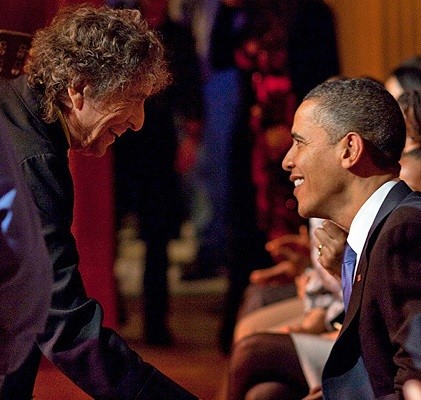
That was in February 2010, when a Celebration of Music from the Civil Rights Movement is organised in the White House. Surprisingly, Dylan accepts an invitation. About what he will play he remains vague until the last moment, but eventually it is a breath-taking performance of “The Times They Are A-Changin'”, accompanied only by piano and double bass. Later, Obama tells Rolling Stone the details of his “meeting” with the legend.
“He was exactly as you’d expect he would be. He wouldn’t come to the rehearsal. Usually, all these guys are practicing before the set in the evening. He didn’t want to take a picture with me; usually all the talent is dying to take a picture with me and Michelle before the show, but he didn’t show up to that. He came in and played The Times They Are A-Changin’. A beautiful rendition. The guy is so steeped in this stuff that he can just come up with some new arrangement, and the song sounds completely different. Finishes the song, steps off the stage – I’m sitting right in the front row – comes up, shakes my hand, sort of tips his head, gives me just a little grin, and then leaves. And that was it – then he left. That was our only interaction with him. And I thought: That’s how you want Bob Dylan, right? You don’t want him to be all cheesin’ and grinnin’ with you. You want him to be a little skeptical about the whole enterprise. So that was a real treat.”
Two years before that, during the 2008 election campaign that will end with his first victory, Obama has already revealed part of his playlist, again to Rolling Stone, demonstrating his Dylan love:
“I have probably 30 Dylan songs on my iPod. “Maggie’s Farm” is one of my favorites during the political season. It speaks to me as I listen to some of the political rhetoric.”
… Obama thus assigning a kind of therapeutic, or at least inspirational, value to “Maggie’s Farm”. And then explicitly to its words – which he apparently interprets in a way that appeals to him.
Despite its apparent clarity and simplicity, the song, like the Very Great Dylan songs, indeed offers a multitude of interpretation possibilities. In that respect “Maggie’s Farm” has the Kafkaesque quality of the John Wesley Harding songs Dylan will write two years later.
At universities it is an intellectual finger exercise for Kafka students: “write a historical, a biographical, a Marxist and a religious interpretation of (for example) Kafka’s Der Aufbruch” – an extremely short story (145 words), written in extremely clear sentences and simple words that nevertheless allows a multitude of interpretations. A similar task has never been given to the Dylanologists, but that – obviously – does not stop the multitude of interpretations coming in.
The anti-political, socially critical interpretation is a fairly popular one. And one for which the average student of literature would not turn his hand. “Maggie’s Farm” symbolises “society”, the successive archetypes (Maggie’s brother, pa and ma) can easily be seen as social institutions, (respectively the exploitative market economy, the repressive legislator and enforcer, and the manipulating press, for example). Surrounding songs on Bringing It All Back Home, like “Gates Of Eden” and “It’s Alright Ma (I’m Only Bleeding)” could support this viewpoint; both songs can effortlessly be interpreted as expressions of systemic, anti-establishment beliefs, too.
The faction of Dylanologists who see the song as an encryption of personal, biographical worries of the artist Dylan is larger. “Maggie’s Farm” then expresses the reckoning with the folk movement, marking Dylan’s conversion to rock music and farewell to one-dimensional, finger-pointing songs. These interpreters of course point to verse fragments such as I got a head full of ideas and especially to the last verse:
Well, I try my best
To be just like I am
But everybody wants you
To be just like them
They sing while you slave and I just get bored
I ain’t gonna work on Maggie’s farm no more
… and find confirmation in the special circumstances of the live debut, that earth-shattering premiere at the Newport Folk Festival, in the biographical fact that Dylan played the archetypal fingerpointing song “Only A Pawn In Their Game” at Silas McGee’s Farm, and in the cynical put-down they sing while you slave.
All right and all wrong, of course – as it should be, with the Very Great Dylan songs. Dylan himself, however, sees no exceptional metaphorical power or value.
It seems that Dylan dashes this song off, casually during a spare quarter of an hour. It’s the only album track of which only one take exists, judging by The Cutting Edge (2015), the collection of all studio recordings for the magical trio Bringing It All Back Home, Highway 61 Revisited and Blonde On Blonde. For comparison: even album-filler and later B-side “On The Road Again” gets thirteen takes. The missing poetry is a further indication of an ad hoc theory; unlike most other album tracks, the lyrics of “Maggie’s Farm” contain no surrealism, no literary curiosities, no “brilliant way of rhyming and putting together refrains, and his pictorial thinking”, as the Nobel Prize Committee will characterize his mid-60s work later.
“Maggie’s Farm” is recorded at the beginning of the third and final Bringing It All Back Home session, 15 January 1965. Neither after this one and only take, nor after its release on the LP (22 March), does Dylan himself seem to recognise its quality – nor does he seem to attach any particular importance to it. In February and March, he performs on the East Coast, in Canada and in California, in April and May he tours England, but “Maggie’s Farm” does not once appear on the set list. CBS nevertheless sees something in it; in June the song is released on single in the States as well as in Europe (only to flop on both sides of the ocean).
The decision to perform it at Newport is probably opportunistic. Dylan doesn’t have a band of his own yet, and for a band scrambled together on the spot (with members of the Paul Butterfield Blues Band who happen to be present) “Maggie’s Farm” is simple enough to perform without significant rehearsal time.
It’s Dylan’s first electric performance and it’s likely that he hasn’t foreseen the impact at all. Which is understandable; after all, at the same festival Paul Butterfield and Howlin’ Wolf also play electrically, and that goes without any fuzz. A year later, after being jeered at, being booed and being angrily heckled dozens of times, Dylan still has trouble understanding all this hullabaloo. He addresses the English public in London on 27 May 1966:
“What you’re just hearing here now is the sound of the songs…you’re not hearing anything else except the songs, the sound…of the words…and sounds…so, you know, you can take it or leave it. (…) I’m sick of people asking what does it mean. It means NOTHING.”
Anyway, the choice of “Maggie’s Farm” at Newport is a fortunate one. Its performance elevates the song to the canon, to one of the milestones of the 60s. The song is quoted in songs, films, newspaper articles and novels, catering establishments and beer producers borrow the name and in the 80’s, when Maggie Thatcher divides and rules, the song gets an unforeseen, further deepening and topical value. It is, obviously, covered in all corners of the music world, from bluegrass to blues to heavy metal to folk. Blues suits the song best, probably.
Eventually, Dylan did roll over; after having more or less ignored the song for ten years, it has been on the set list with great regularity since 1976 – in 2020 “Maggie’s Farm” is, according to Olof Björner, in the ninth place of Dylan’s Most Performed Songs, with 1064 performances.
And still in the twenty-first century, forty-three years after that one and only volatile take on a freezing cold Friday in New York in January ’65, even the President of the United States puts “Maggie’s Farm” on a pedestal.
Jochen is a regular reviewer of Dylan’s work on Untold. His books are available via Amazon both in paperback and on Kindle:
Untold Dylan is written by people who want to write for Untold Dylan. It is simply a forum for those interested in the work of the most famous, influential and recognised popular musician and poet of our era, to read about, listen to and express their thoughts on, his lyrics and music.
We welcome articles, contributions and ideas from all our readers. Sadly no one gets paid, but if you are published here, your work will be read by a fairly large number of people across the world, ranging from fans to academics. If you have an idea, or a finished piece send it as a Word file to Tony@schools.co.uk with a note saying that it is for publication on Untold Dylan.
We also have a very lively discussion group “Untold Dylan” on Facebook with around 8000 active members. Just type the phrase “Untold Dylan” in, on your Facebook page or follow this link
You’ll find some notes about our latest posts arranged by themes and subjects on the home page of this site. You can also see details of our main sections on this site at the top of this page under the picture. Not every index is complete but I do my best. Tony Attwood
Dylan’s first recorded and released work was as harmonica player for Harry Belafonte on his version of “Midnight Special” – mentioned recently in part 1 of Jochen’s commentary on “Maggie’s Farm”
This was released on the album “The Midnight Special” in 1962, and has appeared on various Belafonte “best of” collections many times over the years.
An alternative, previously unreleased take 1 was included on the “May Your Song Always Be Sung Again” Dylan tribute album. So here we have Bob Dylan’s first ever performance in a studio environment, June 1961.
Belafonte talks about the incident in his book, My Songs. The original player, Sonny Terry, called in sick to the session, so Dylan was drafted in at the last minute. He turned up with a bag of cheap harmonicas, found the right one, blew it for a few takes, took his $50 and left the studio, tossing the harmonica in the trash on the way out (they were so cheap after you blew them a few times they were useless).
Moving on to Dylan’s second ever appearance on record, again, backing an established singer on harmonica, this time it’s Carolyn Hester. Three tracks appeared on her self titled 1962 album.
Saving the best to last is this version of “Come Back Baby”. Just listen to what Dylan does in the solo, kicking off around the 1:50 mark. He stays on the same note for almost 20 seconds – making it six bars long. You’d have to be brave, foolish or extremely confident in your abilities to attempt something like that in one of your first sessions as a performer. Dylan absolutely nails this one.
(Tony adds: In case you are interested, the band is playing in the key of A, and Dylan’s held note is an E. That is fine for the opening chord, but as the song moves onto the chord of D, the E note that Dylan is holding clashes with the straight D major chord, and makes it sound like the more exciting D9. D9 is a perfectly acceptable chord, although not often used, and it gives the instrumental section more spice, which is helpful since the band is in essence continuing to play the same music as it plays when the vocalist is singing. Dylan’s not the only harmonica player to have done this, and certainly not the first, but he finds a moment to make it work, adding more (the D9) by doing nothing (holding the same note). It certainly works).
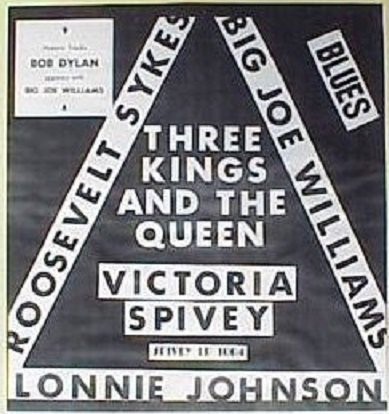
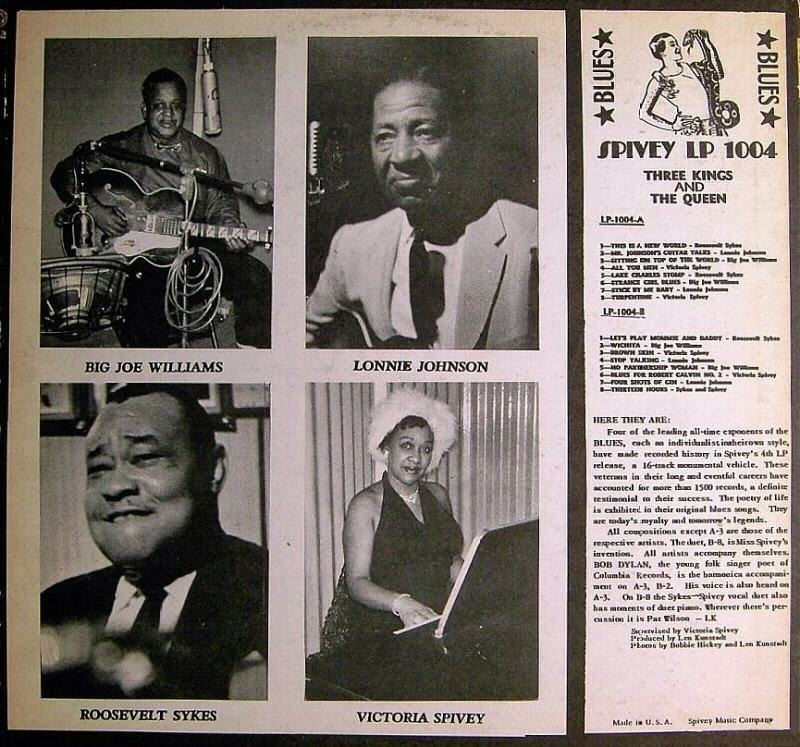
Dylan’s final session as a side man from 1962 was as a harmonica player, and occasionally backing vocals for Big Joe Williams and Victoria Spivey on a series of recordings released in 1962 and a follow up volume in 1972. A picture from these sessions was used on the back cover of New Morning, yes, that’s Bob with Victoria Spivey.
The original album released in 1962 was called “Three Kings And A Queen”, the three Kings being Big Joe Williams, Roosevelt Sykes and Lonnie Johnson with the Queen being Victoria Spivey herself.
The original album released in 1962 was called “Three Kings And A Queen”, the three Kings being Big Joe Williams, Roosevelt Sykes and Lonnie Johnson with the Queen being Victoria Spivey herself.
The original album released in 1962 was called “Three Kings And A Queen”, the three Kings being Big Joe Williams, Roosevelt Sykes and Lonnie Johnson with the Queen being Victoria Spivey herself.
Dylan appears on two tracks with Big Joe Williams, “Sitting On Top Of The World” and “Wichita”. Only the first track is available on line to listen to, and it’s a revelation. Dylan’s performance is amazing and he is even allowed a line or two of vocals on his own.
A second volume from the sessions was released in 1972, called “Kings And The Queen, Volume 2”. Unfortunately nothing is available on line to listen to but the songs with Dylan are “It’s Dangerous” (with Spivey) and the intriguingly titled “Big Joe, Dylan & Victoria”.
If you want to hear those extra Dylan tracks you’ll have to search out original copies of the 2 volumes, they will likely set you back $25-$50 for the first volume and anything up to $100 for volume 2.
Dylan was obviously impressed by Big Joe Williams at that time. He was playing a version of Big Joe’s “Baby Please Don’t Go” in 61/62. It was dropped pretty quickly and strangely he never returned to it again in a live setting.
Untold Dylan: who we are what we do
Untold Dylan is written by people who want to write for Untold Dylan. It is simply a forum for those interested in the work of the most famous, influential and recognised popular musician and poet of our era, to read about, listen to and express their thoughts on, his lyrics and music.
We welcome articles, contributions and ideas from all our readers. Sadly no one gets paid, but if you are published here, your work will be read by a fairly large number of people across the world, ranging from fans to academics. If you have an idea, or a finished piece send it as a Word file to Tony@schools.co.uk with a note saying that it is for publication on Untold Dylan.
We also have a very lively discussion group “Untold Dylan” on Facebook with around 7000 active members. Just type the phrase “Untold Dylan” in, on your Facebook page or follow this link
You’ll find some notes about our latest posts arranged by themes and subjects on the home page of this site. You can also see details of our main sections on this site at the top of this page under the picture. Not every index is complete but I do my best. Tony Attwood
Please note, since we put this post on line we have had a report that the videos themselves are not visible in all parts of the world. If you find you can’t access any of them please do write in, saying which country you are in. If you can find the official video of the song elsewhere please do send in (using the form below) the complete link to the file page and a note of which country you are in. Thanks.
Always on the look out for something different to contemplate in the Universe of Dylan, we (well, Aaron actually) had the idea of looking back at the official Dylan videos for individual songs.
And so for the first in this series Aaron has selected the three official videos produced for the Empire Burlesque’ singles: Tight Connection, Emotionally Yours and When The Night Comes Falling From The Sky.
Aaron: First up, Tight Connection. Now I did a bit of a deep dive on this, because to be honest, I don’t get what’s even happening here!
It was directed by Paul Schrader who, amongst other things, wrote the screenplay for four Scorsese movies, Taxi Driver, Raging Bull, Last Temptation Of Christ and Bringing Out The Dead. He’s even got an Oscar nomination, so that’s not a bad C.V.
But somehow we ended up with this strange video, Dylan’s “acting” is awkward at best and the less said about the 80s fashion sense the better.
Perhaps Tony, with his creative writing skills can come up with a narrative that brings all this together in a way that is understandable.
I read a piece online which describes the video, “True to form for both artists, the video is an elliptical and visually ambiguous affair, something either half-remembered or imagined all together.
Schrader envisions a glittering, metropolitan Tokyo, wrapping our hero up in a surreal web of mistaken identity, dreamlike romance, Cold War geopolitics, and Yakuza/punk rock conflict. Wide pans and sudden zooms only add to the disorienting effect, as Dylan wanders the city, searching for something we wouldn’t even know how to begin to describe”.
Schrader, while working on the video for “Tight Connection,” said: “Bob, if you ever hear I’m doing another music video, take me out in the backyard and hose me down.” True to his word, this was the only music video he ever made.
Tony: One of the things that anyone who works in the arts normally realises early on is that just because you can work in one art form that does not mean you necessarily know how to work in another. What can turn out as a sublime moment of creativity and originality in one’s normal medium and mode of working can equally look forced and fake if one changes media. And that’s what seems (to me) to happen here. Bob looks utterly misplaced, the surrealism looks amateur… it is all pretty horrible. Mind you, I don’t care for the track much either, so that doesn’t help.
I really can’t find one redeeming feature, and I do hope someone will write in and point out to me what is good about this video.
Thus I turn to the next piece with concern if not trepidation…
Aaron: The next two videos for Emotionally Yours and When The Night Comes Falling From The Sky are more straightforward, shot in artful black and white and focusing more on a performance of the song.
Here is Emotionally Yours
Aaron: This one was directed by Dave Stewart and features Mike Campbell. For some reason Dylan sits next to a piano but chooses to strum on his guitar despite the fact that the piano is the main instrument in the song and there is only the barest trace of acoustic guitar in the music! I suspect the director expected Dylan to mime the piano but Bob being Bob chose the guitar. There is also some business going on with Dylan and a girl swinging in a tree, Bob seems to say something that upsets her and she runs off. He doesn’t seem too bothered.
Tony: OK Aaron, you don’t really need me on this do you? You’ve nailed it. The only thing I wondered was whether Bob or someone else said, “There’s got to be something weird in this; it is too straightforward.” Hence the guitar.
Sadly, I find, as with the previous piece, nothing at all to draw me into this video – if it were not for having agreed with Aaron to write the review, I’d just listen to the music.
The only thing I found interesting was when the lead guitarist turns up, they share the table to sit on, only it seems to have moved a bit to accommodate them. And when one starts noticing things like that it suggests the video is not really working.
As for the last ten seconds, I found that utterly horrible. Really, really awful.
Aaron: Now, “When The Night Comes Falling From The Sky”.
The directors are Eddie Arno and Markus Innocenti and this time Dave Stewart is in the band. The band all pile in the bus and head off to the gig and have to learn the song on the way. It is a fairly straightforward performance video but there is a side story going through of a girl in the crowd and some kids outside trying to look in and falling off some trash cans. All very standard 80s MTV stuff but at least the video gives us an otherwise unavailable edit of the song and Bob and the band attempt to invent a new dance craze about half way through. This suffered the same fate as the attempted one near the end of the Tight Connection video and roundly failed to catch on.
Tony: OK one reason why I turned into being a guy who writes about music, rather than a reviewer of videos is because I find the music much more interesting.
Please tell me, what actually is there that is worth watching in this video? I can list one hundred things that are worth contemplating in the song itself, and then again in this version of the song, but not in relation to the video.
In fact I really would love someone who knows about the videos to tell me what actually appeals here. Is there a reason why we get one shot rather than another? That is what is puzzling me.
But please don’t take this to mean that I am against all Dylan videos. I haven’t gone back and watched it in a long time but I seem to recall a video for the Wonder Boys promotional video using “Things have changed” which was really intriguing. But I am really struggling here.
What audience is this made for? Obviously not me, but for whom? Is it for us real Dylan fans? Or is it to attract non-Dylan fans in for the first time?
And I mean this: do we have any kind reader who can explain to me something in any of these featured videos that makes it actually worth watching?
Please either write in, in the normal way, or if you would like to have an article of your own in response to my negative comments here, just write it out as a word document, and email it to Tony@schools.co.uk and you can show me why I am so utterly wrong about these videos doing nothing to enhance the songs, or our image of Dylan.
Untold Dylan: who we are what we do
Untold Dylan is written by people who want to write for Untold Dylan. It is simply a forum for those interested in the work of the most famous, influential and recognised popular musician and poet of our era, to read about, listen to and express their thoughts on, his lyrics and music.
We welcome articles, contributions and ideas from all our readers. Sadly no one gets paid, but if you are published here, your work will be read by a fairly large number of people across the world, ranging from fans to academics. If you have an idea, or a finished piece send it as a Word file to Tony@schools.co.uk with a note saying that it is for publication on Untold Dylan.
We also have a very lively discussion group “Untold Dylan” on Facebook with around 7000 active members. Just type the phrase “Untold Dylan” in, on your Facebook page or follow this link
You’ll find some notes about our latest posts arranged by themes and subjects on the home page of this site. You can also see details of our main sections on this site at the top of this page under the picture. Not every index is complete but I do my best. Tony Attwood
Seems, according to Bob Dylan, that Miles Standish is Captain Arab of the good ship “Mayflower”:
Hanging in shining array along the walls of the chamber
Cutlass and coselet of steel, and his trusty sword of Damascus
Curved at the point, and inscribed with its mystical Arabic sentence
(Henry Wadsworth Longfellow: The Courtship Of Miles Standish)
In his 115th Dream, singer/songwriter Bob Dylan burlesques the arrival of the Pilgrims in America at Plymouth Rock aboard the “Mayflower” that had intended to sail to the Virginia settlement of Jamestown; ruthless Miles Standish is their military leader. In the parody, the ship’s captain of the modern day Pilgrims is named Arab; on shore, strange things happen to the crew – the narrator thereof bumps into an undertaker:
I shook his hand, and said 'goodbye', and went back out on the street
When a bowling ball came down the road, and knocked me off my feet
Edward Taylor, a true-to-life latter-day Puritan preacher at the Colony of Massachusetts Bay, pens the following lyrics:
Who in this bowling alley bowled the sun?
Who made it always when it rises set?
To go at once both down, and up to get?
(Edward Taylor: The Preface)
The Puritan separatists from the Church of England head off to America, inspired by a biblical verse about, no – not Arab, but about the Jewish religious leader Abram:
By faith, he sojourned in the land of promise
As in a strange country
Dwelling in tabernacles with Isaac and Jacob
The heirs with him of the same promise
(Hebrews 11: 9)
The American singer, from a Jewish family, takes the dark history of the United States quite seriously at times:
.....can you feel the weight of oblivion
And the songs of redemption on you your backside
We surface along side Miles Standish
And take the rock
(Liners notes: ‘Desire’ album)
Paradise for the native American ‘Indian’ is lost, gone forever; the Pilgrim colonizers considered heroes in verse and song:
I came to a place where the lone pilgrim lay
And patiently stood by his tomb
When in a low whisper, I heard someone say
"How sweetly I sleep here alone"
(Bob Dylan:The Lone Pilgrim ~ White/Pace*)
Below an African-American electric bluesman in his tomb is depicted as though a lone pilgrim who’d been searching for the Promised Land – in vain:
God be with you, brother dear
If you don't mind me asking, what brings you here?
Oh, nothing much, I'm just looking for the man
Need to see where he is laying in this lost land
(Bob Dylan: Goodbye Jimmy Reed)
Pocahontas, a native ‘Indian’ princess is kidnapped, and Christianized at the King James I settlement in Virginia – a more diverse group of adventurers than at Plymouth; the princess is celebrated by the settlers there as though a trophy.
Worthy of a black-humoured comment indeed:
I got a house on the hill, I got hogs out in the mud
Got a long-haired woman, she got royal Indian blood
Everybody get ready to lift up his glass, and sing
Everybody get ready to lift up his glass, and sing
Well, I'm standing on the table, I'm proposing a toast to the King
(Bob Dylan: Summer Days)
So there you have it. All’s well that end’s well, and there is no need to keep on a-worrying.
Paradise waits for everyone -it will be regained in the grave
*There is no recording of Bob Dylan performing The Lone Pilgrim on the internet, so I’ve added a particularly beautiful non-Dylan version for readers who are not familiar with the piece. Tony.
Untold Dylan: who we are what we do
Untold Dylan is written by people who want to write for Untold Dylan. It is simply a forum for those interested in the work of the most famous, influential and recognised popular musician and poet of our era, to read about, listen to and express their thoughts on, his lyrics and music.
We welcome articles, contributions and ideas from all our readers. Sadly no one gets paid, but if you are published here, your work will be read by a fairly large number of people across the world, ranging from fans to academics. If you have an idea, or a finished piece send it as a Word file to Tony@schools.co.uk with a note saying that it is for publication on Untold Dylan.
We also have a very lively discussion group “Untold Dylan” on Facebook with around 7000 active members. Just type the phrase “Untold Dylan” in, on your Facebook page or follow this link
You’ll find some notes about our latest posts arranged by themes and subjects on the home page of this site. You can also see details of our main sections on this site at the top of this page under the picture. Not every index is complete but I do my best. Tony Attwood
The list of Grammy Award winners reveals that 1961 was not a bad year, in Musicland. Ray Charles wins four, including for his best vocal performance single record on “Georgia On My Mind” and one for the best rhythm & blues performance, being “Let The Good Times Roll”; Ella Fitzgerald gets two for “Mack The Knife”; Cole Porter; Henry Mancini; and Marty Robbins (best country & western, “El Paso”)… names, songs and albums that have stood the test of time.
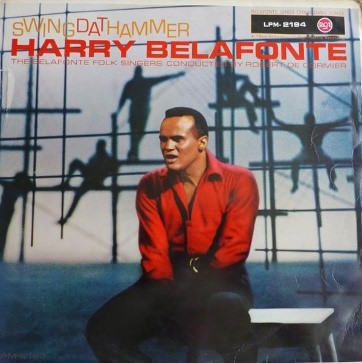
The young Dylan probably hears with appreciation who wins in the category best performance folk: Harry Belafonte, for his album Swing Dat Hammer. The King of Calypso is a common thread in Dylan’s career. In interviews he invariably mentions Belafonte – Odetta – The Kingston Trio – Woody Guthrie, in the listing of artists that put him on the track to his breakthrough as a folk artist. In the Playboy interview with Nat Hentoff (autumn ’65) even as the primal source: “First it started with, you know, Odetta. Oh no, it starts with Harry Belafonte. It starts with Harry Belafonte.”
Dylan will always be grateful to Belafonte for his first studio experience, for the invitation to play harmonica on “The Midnight Special”, for the album of the same name, in ’62. It makes an indelible impression on Dylan, although his memory of his “professional recording debut” (Chronicles, chapter 2) is not entirely correct historically – the studio recording on which Dylan “made a professional debut” is five months earlier, on Carolyn Hester’s third record (also harmonica, and quite prominent – as in “I’ll Fly Away”).
Whatever the case, Belafonte seems to make more of an impression in February ’62. In Chronicles, the autobiographer Dylan devotes many words to Belafonte. Only superlatives, roaring compliments and expressions of respect – both for Harry’s music, his acting and his personality at all. It comes close to a canonization:
“Astoundingly and as unbelievable as it might have seemed, I’d be making my professional recording debut with Harry, playing harmonica on one of his albums called Midnight Special. Strangely enough, this was the only one memorable recording date that would stand out in my mind for years to come. Even my own sessions would become lost in abstractions. With Belafonte I felt like I’d become anointed in some kind of way.”
… the words with which Dylan concludes his long declaration of love (over 400 words) to Harry Belafonte.
By the way, it leads to a moving reaction of the honestly surprised, elderly protagonist. He actually thought at the time that the monosyllabic, closed Dylan, who flatly refused to play in a second take, who threw his harmonica in the wastebasket on his way out, looked down on him and his music:
“I remember thinking, does he have that much disdain for what I’m doing? But I found out later that he bought his harps at the Woolworth drugstore. They were cheap ones, and once he’d gotten them wet and really played through them as hard as he did, they were finished. It wasn’t until decades later, when he wrote his book (Chronicles), that I read what he really felt about me, and I tell you, I got very, very choked up. I had admired him all along, and no matter what he did or said, I was just a stone, stone fan.”
(interview in Mojo, July 2010, with the then 83-year-old Belafonte)
Traces of Belafonte can be found throughout Dylan’s oeuvre. In song fragments (in “If You Ever Go To Houston”, 2009, for example), in choice of repertoire (“Dink’s Song”, “Rocks And Gravel”, “Delia’s Gone”, “Go Away From My Window”… Belafonte has recorded dozens of songs that inspired Dylan, or at least stimulated), in references (in “Desolation Row”), and it is not inconceivable that Dylan derives the title for his literary debut, Tarantula, from Belafonte’s signature song “The Banana Boat Song (Day-O)”:
A beautiful bunch o' ripe banana
Daylight come and me wan' go home
Hide the deadly black tarantula
Daylight come and me wan' go home
In No Direction Home Belafonte can also be heard, with his interpretation of “Bald-Headed Woman”, one of the chain-gang songs, songs sung by the working, chained prisoners, from this award-winning album Swing Dat Hammer. On that record Dylan also notices “Rocks And Gravel”, which he will record in April ’62 during the second Freewheelin’ session, and especially Belafonte’s version of the chain-gang song “Diamond Joe”:
Ain't gonna work in the country
And neither on Forester's farm
I'm gonna stay 'till my Marybell come
She gone call me Tom
There are two songs called “Diamond Joe”. One is the nineteenth century cowboy song Dylan will be covering on Good As I Been To You in 1992. That one has nothing in common with the other, which is the song Dylan will perform, in a variation, as Jack Fate in the film Masked & Anonymous (2003). The oldest recording of this “Diamond Joe” is from 1927, by the Georgia Crackers. But Belafonte uses as source the recording made by the legendary music archivist Alan Lomax in 1937 at the infamous Parchman Farm, the Mississippi State Penitentiary. The arrangement and interpretation by the Calypso king are breath-taking, by the way.
As a radio maker Dylan plays both songs in Theme Time Radio Hour episode 73 (March 2008, “Joe”) – Cisco Houston’s version of the cowboy song, and the steaming 1927 Georgia Crackers recording of the other (“No matter how you slice it, that’s rock and roll”, Dylan mumbles approvingly).
For the inspiration of “Maggie’s Farm” Dylan circles often refer to “Down On Penny’s Farm” (The Bently Boys, 1929, alternative title “Hard Times In The Country”). That song unmistakably provides the template for Dylan’s “Hard Times in New York City”, both lyrically and musically, but the resemblance to “Maggie’s Farm” is really not much more than “some girl’s name + farm”. No, the “Diamond Joe” by Belafonte (or rather: by Charlie Butler, the singing prisoner on the original Lomax recording) is a more obvious candidate.
Not too important, of course. More importance has the landslide impact of the song. In 1965, “Maggie’s Farm” is the cat thrown amongst the hard-core folk pigeons – Dylan opens his much-discussed electric set at the Newport Folk Festival with the song, and things would never be the same. Retrospective historiography says that the public’s dismay had more to do with the lousy, overdriven sound quality than with the so-called taboo-breaking electrical amplification, but the myth is inextinguishable. As are the stories around it. About Pete Seeger is still told, mainly thanks to fantasist Greil Marcus, how he attacked the cables with an axe. But Seeger himself later states, and credibly: “I only went to the sound engineer to tell him that Dylan’s microphone needed adjusting.” In his memoirs he is unequivocal:
“Bob was singing Maggie’s Farm, one of his best songs, but you couldn’t understand a word, because of the distortion.”
The folk legend continues to admire Dylan publicly and continues to play Dylan songs after Newport, until his death in January 2014. Not “Maggie’s Farm” though. He allows that one to pass him by, as Ketch Secor, the foreman of Old Crown Medicine Show, tells in a heartwarming necrological article for The New Yorker (“Pete Seeger Gazing up into the Trees”, 27 February 2014):
“In 2005, the Clearwater Festival went on in spite of a cold, driving rain. My band, Old Crow Medicine Show, played our set, then cheered from the side stage while Pete Seeger sang with a chorus of schoolchildren. Later that day, I joined in with Pete’s grandson, Tao Rodriguez-Seeger, and his rock band. Backstage, Pete crunched on an apple and looked up at the dripping trees, seemingly unaware of the clash of drums and guitars. While Tao and I sang “Maggie’s Farm,” I kept looking back to see how Pete liked it, but he just went on munching that apple and gazing up into the trees.”
Half-brother Mike Seeger does the honours and records in 1999 with David Grisham and John Hartford the album Retrograss, containing a beautiful rocking chair version of “Maggie’s Farm” in an archaic, Dock Boggs-like arrangement.
Pete’s last professional recording – and only time in his entire life that he makes a music video – is Dylan’s “Forever Young” (Seeger’s contribution to the Amnesty project Chimes Of Freedom, 2012). Irresistible – just like the Caribbean cover of “Forever Young” by that other eternally young giant, Harry Belafonte (1981), by the way.
To be continued. Next up: Maggie’s Farm – part II
Jochen is a regular reviewer of Dylan’s work on Untold. His books are available via Amazon both in paperback and on Kindle:
Untold Dylan is written by people who want to write for Untold Dylan. It is simply a forum for those interested in the work of the most famous, influential and recognised popular musician and poet of our era, to read about, listen to and express their thoughts on, his lyrics and music.
We welcome articles, contributions and ideas from all our readers. Sadly no one gets paid, but if you are published here, your work will be read by a fairly large number of people across the world, ranging from fans to academics. If you have an idea, or a finished piece send it as a Word file to Tony@schools.co.uk with a note saying that it is for publication on Untold Dylan.
We also have a very lively discussion group “Untold Dylan” on Facebook with around 7000 active members. Just type the phrase “Untold Dylan” in, on your Facebook page or follow this link
You’ll find some notes about our latest posts arranged by themes and subjects on the home page of this site. You can also see details of our main sections on this site at the top of this page under the picture. Not every index is complete but I do my best. Tony Attwood
This song lyric comes from the summer 1961 “McKenzie manuscript and the picture is of Bob Dylan in 1961 taken by John Cohen from the Bob Dylan Roots page.
The story that is reported that Bob met Ramblin Jack Elliott at a gig performing in a Fifth Avenue Hotel.
Bob had written a song for his new girlfriend called California Brown-Eyed Baby, and he sang it to her down the phone. Allegedly it made everyone who heard it cry.
At least that is the story told in “Eve McKenzie Remembers” in The Telegraph 56, Winter 1997 pp 36/7.
The McKenzie manuscripts appeared in Isis No 44, August/September 1992, and yes, Untold Dylan, trying to build the ultimate definitive list of every Bob Dylan song and set of lyrics, has missed it. So this will be song number 620 on our files.
And of course, we shall do what we have done before- ask all the musicians who read Untold to consider writing the music, which we will then put on the site under the Showcase heading, and the person or persons who create the song will be listed as having a song written by Bob Dylan and themselves.
Here are the lyrics
The rain is falling at my window
My thoughts are sad forever.
Thinking about my fair haired baby,
The one I really do adore

She's my California brown eyed baby,
She's the one I think about today,
She's my California brown eyed baby,
Livin' down San Francisco way

Sadly I look out my window,
Where I can hear the raindrops fall.
My heart is sayin' ***** ****
Where I can hear my true love call.

Now boys don't start to ramble,
You better stay in your hometown
Get you a gal that really loves you,
Stay right there and settle down.
If you want to send in a performance of the music, please send it as an MP3 or MP4 to Tony@schools.co.uk along with details of who you are, including any biographical details you want to reveal.
Here are some of the earlier songs we’ve had completed in this way
Untold Dylan is written by people who want to write for Untold Dylan. It is simply a forum for those interested in the work of the most famous, influential and recognised popular musician and poet of our era, to read about, listen to and express their thoughts on, his lyrics and music.
We welcome articles, contributions and ideas from all our readers. Sadly no one gets paid, but if you are published here, your work will be read by a fairly large number of people across the world, ranging from fans to academics. If you have an idea, or a finished piece send it as a Word file to Tony@schools.co.uk with a note saying that it is for publication on Untold Dylan.
We also have a very lively discussion group “Untold Dylan” on Facebook with around 7000 active members. Just type the phrase “Untold Dylan” in, on your Facebook page or follow this link
You’ll find some notes about our latest posts arranged by themes and subjects on the home page of this site. You can also see details of our main sections on this site at the top of this page under the picture. Not every index is complete but I do my best. Tony Attwood
1993 is a stand out year for the Never Ending Tour. I’m tempted to rank it as one of the very best.
All the hard work the band has been putting in for the last two years suddenly pays off. This is not just Dylan with band, this is a band, a unity and a formidable force. A five piece powerhouse with Dylan and John Jackson on main guitars, Tony Garnier on bass, Wilson Watson on drums, and, important for the sounds the band was developing, the brilliant Bucky Baxter on slide guitar and dobro.
The year is famous for the acoustic season Dylan did at the Supper Club, and we will drop in on that, but most outstanding is the emergence of Dylan as Mr Guitar Man. We’ve noticed him here and there in 1991 and 1992, with his odd, dissonant sounds, but mostly he’s been content to play second guitar. However, in 1993 Mr Guitar Man steps out of the shadows and makes his presence felt in no uncertain terms.
Bob Dylan is not listed in the world’s top 100 guitar players. This is somewhat surprising as the young acoustic Dylan inspired generations of young buskers and folk singers. Dylan plays adroitly on Blood on the Tracks, and his two solo traditional albums in 1992 and 1993, Good as I been to You and World Gone Wrong show that Dylan has not lost his touch when it comes to acoustic guitar. The 1992 acoustic performances show Dylan in fine form (see NET 1992 part 3 – All the friends I ever had are gone)
It is not Dylan’s acoustic skills that cause disquiet, but his electric guitar playing, and we have to ask why it sounds so strange and ‘off’. My jazz playing friends are only too happy to tell me that Dylan is playing ‘off key’ and that his breaks are full of ‘bum notes’.
This is puzzling as Dylan rarely if ever sings off key. The accusation that Dylan ‘can’t sing’ is baseless, as he has the most expressive voice in the business. Similarly his harmonica playing, while it often deliberately flirts with dissonance, is unique, Dylan is master of the little instrument (See Bob Dylan Master Harpist series).
The same can’t be said with any confidence about Dylan’s electric guitar playing. Obsessive and manic, and always unsettling, Dylan appears to be playing ‘under the note’ or just below the note. He plays percussively, often hammering away at one or two notes, and he seems more concerned with subverting the melody with his guttural tones than supporting it.
Dark and trenchant, it lacks the airiness of his harmonica playing. And yet, when he pulls it off, there is nothing quite like it, and I’m dedicating this and the next two posts to exploring Dylan’s electric guitar sound as it emerged in 1993.
It seems to me that the triumphant emergence of Mr Guitar Man in 1993 sees the best of his guitar performances, with a touch of Dylan-style genius. Maybe it is the joy of discovering his inner Eric Clapton, but to my mind Dylan’s lead guitar work was never better than in this year.
Let’s start with a raging performance of ‘I and I’ from September 12. Dylan must have decided that the album version was just too sweet (Infidels, 1984). He worked it into a rocker with Tom Petty in the mid 1980s, and began re-exploring it in 1991 and 1992. Nothing, however can prepare us for this blast of sound, this tangle of guitars. And his voice! How he tears it out of his throat! A soundboard recording brings it right up close.
After the opening crash of the drums, the first guitar sounds you hear are from Dylan on his punky Stratocaster. From there on Dylan and guitarist Carlos Santana, who played with him from August 20 to October 9, get into a duet, a marvellous weaving of notes. The ending is all pathos. As the music draws to a dark close, with Baxter’s long gloomy sounds heralding doom, Dylan continues, as if to keep the song alive, before the final shattering surrender. Crank up the volume and hold onto your seats!
The ‘I and I’ story doesn’t end there for this year, however. In August, Dylan did a memorable concert in Portland (20/8/93), also with Carlos Santana. While this Portland performance sees some gutsy guitar work by Dylan and Santana, with the ending more fully developed, it is Dylan’s voice that is astonishing, emerging from those oddly forced, timbreless tones of the past two years, where the sounds seemed to be stuck in his throat, to soar clear and high. Dylan, at fifty, is rediscovering his voice, that high, wild mercury voice.
Those who have followed along this far can only rejoice, and I invite your to revel in Dylan’s vocal on this ‘I and I’. Back in the 1960s we tried to imagine what Dylan’s voice might be like when he got older. I think we imagined something like this:
We can’t quite leave the song there. Since 1993 was the year this song reached a kind of perfection, I find it interesting to backtrack to a six show run Dylan did in London at the start of the year, 2/12/93. Here we find Dylan pushing his voice in all kinds of direction, testing the melodic limits of the song and his voice at the same time. The effect is a little more strained than the Portland performance, his voice hasn’t quite loosened up, but no less epic.
Then, quite unexpectedly and beautifully, the tangle of growling guitars recedes and a harp solo intervenes, with a few bars of sadness and reflection as a build up to a soaring conclusion, all of which brings a spontaneous roar of approval from the audience. It’s not quite as ferocious as our first version, but it reaches further.
What we have been listening to with these remarkable performances is Jackson (or Santana) and Dylan playing good cop bad cop. Jackson/Santana playing good cop, working the melody like a jazz man, keeping it clear and sharp, while Dylan plays bad cop, attacking the melody line, bitching at it, subverting it, throwing in jagged notes in the key of Dylan.
We now turn to our old favourite, Tangled up In Blue. We heard Dylan in 1992 turning this wonderfully adaptable song into an extended, pounding rocker. In 1993 Dylan stretches the song as far as he can, with twelve and thirteen minute performances, many of those minutes given over to Mr Guitar Man. In this (June 25) performance, we get an extraordinary introduction to Mr Guitar Man. While Dylan is playing hard and fast in the first guitar break, it’s not until the second break, before the last verse, at 5.47 minutes, that we hear Mr Guitar Man in full flight.
It’s a wacky, off the wall, positively demented guitar break. I used this performance in my Master Harpist series, and one of the correspondents suggested that Dylan was influenced by the jazz pianist, Thelonious Monk, who was always stabbing at the piano trying to find the notes between the notes. At 6.35 minutes Jackson takes over the lead, you can hear his clear melodic tones, while Dylan continues to stalk the melody with dark, punky sounds.
The harp solo kicks in after the last verse at 7.36 minutes, after which, at 8.30 minutes, the two guitars take over again for a frantic two minutes of furious guitars, driven by Dylan’s off the wall sounds.
This was no one-off performance. All through 1993 Dylan turned out these powerhouse performances of ‘Tangled..’, throwing restraint to the wind and ripping into lengthy guitar duets with John Jackson or Carlos Santana. This kicked off a decade of ecstatic performances of this song, but none so wild or extensive as in 1993.
What’s remarkable about the next performance, as well as the tangle of guitars, is the piercing harp break, taking us back to Dylan’s 1989 form. At just over thirteen and a half minutes this must go on record as being among Dylan’s most sustained guitar performances. The harp break finishes at 10.55 mins and the guitars take over for the next three minutes of wild duetting with Santana. Dylan tearing it apart. And we hear the best of many slow, ominous pounding endings, with Dylan slamming three or four notes over and over. Madness!
Madness is what we get too, in this hard driven performance of ‘God Knows’. Originally recorded for ‘Oh Mercy’ in 1989, it was re-recorded for ‘Under the Red Sky’ (1990). It’s been a bit of a sleeper up to this point, when it steps forward in all its glory. It’s all about the tenuousness and fragility of things. How stretched everything is:
God knows it could snap apart right now
Just like putting scissors to a string
That feels very contemporary, I have to say.
Ah, but Dylan and Santana turn this song into an apocalyptic hurricane, with Dylan’s hard, dark tones leading. I’ve heard some heavy metal that sounds pretty candified compared to this. Again that long ending as Dylan fights against the closing down of the song, the drawing in of night … however you think of it.
At Portland in August, Dylan changes the whole build up of the song by starting with a low-key harmonica solo, keeping it quiet to begin with, only cranking it up after two and half minutes. Another wonderful vocal performance – note some lyrical variations. And of course the guitars…
So that’s enough to get us started on this remarkable year. Next post I’ll be back with more rocking, electric sounds from 1993.
Stay safe, keep dancing.
Kia Ora
Untold Dylan: who we are what we do
Untold Dylan is written by people who want to write for Untold Dylan. It is simply a forum for those interested in the work of the most famous, influential and recognised popular musician and poet of our era, to read about, listen to and express their thoughts on, his lyrics and music.
We welcome articles, contributions and ideas from all our readers. Sadly no one gets paid, but if you are published here, your work will be read by a fairly large number of people across the world, ranging from fans to academics. If you have an idea, or a finished piece send it as a Word file to Tony@schools.co.uk with a note saying that it is for publication on Untold Dylan.
We also have a very lively discussion group “Untold Dylan” on Facebook with around 7000 active members. Just type the phrase “Untold Dylan” in, on your Facebook page or follow this link
You’ll find some notes about our latest posts arranged by themes and subjects on the home page of this site. You can also see details of our main sections on this site at the top of this page under the picture. Not every index is complete but I do my best. Tony Attwood
In July 1987 Bob Dylan, accompanied by Tom Petty and the Heartbreakers, performs a few concerts on a double bill with Grateful Dead. Since the Dead covers quite a few songs by Dylan, he is even willing to play some songs along as a guest at their performances.
“We’ve always loved his music,” explains Jerry Garcia later, “and we still do. That was something we always wanted to do: Bob Dylan and The Grateful Dead. So when we ran into him [in ’86] and we started about [a joint tour], he said okay. ”
That tour will take place next summer. They rehearse beforehand in Club Front, San Rafael, California. As Dylan didn’t even bring a guitar, he chooses one from Bob Weir’s collection. Bob goes for a pink one.
“He came by for a week or two or three,” Garcia continues. “We rehearsed and tried something out. We played some things and had fun and hung out together. ”
Dylan takes the opportunity to collaborate on two songs with the band’s lyricist, Robert Hunter.
When he records those songs on June 16, three members of the group (Jerry Garcia, Bob Weir and Brent Mydland) join in to sing along.
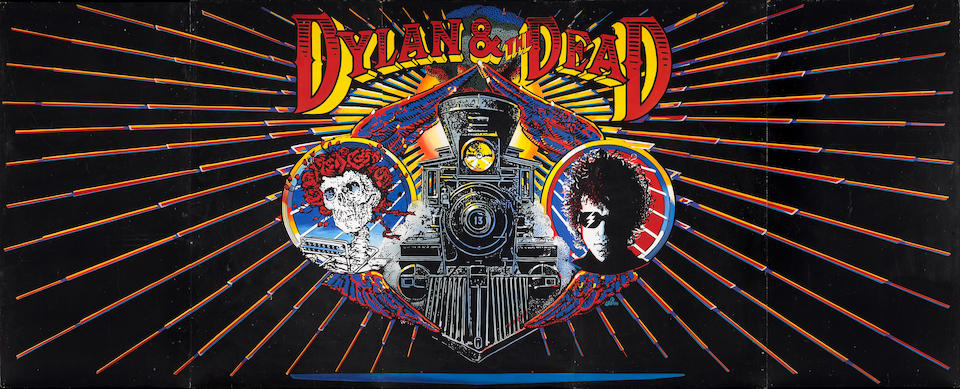
Between July 4 and July 26, 1987, Dylan plays six shows with Grateful Dead: first the Dead plays a set of about two hours, then the band acts as backing band for Bob. At the back of the stage is a large oil painting by the legendary poster artist Rick Griffin. With his cover designs for Grateful Dead (e.g. Aoxomoxoa), Griffin has largely determined the image of the band.
The whole painting is assembled from five multiplex panels, each 4 x 8ft (1,20 m by 2,40m).
In the center is a steam locomotive, referring to Dylan’s “Slow Train Coming”. On the left: a skull, with harmonica and roses, images that together refer to the name of the backing band. On the other side is Dylan’s head, at the time of Bringing It All Back Home, with a lightning rod reflected in the lenses of his sunglasses. At the top a large logo “Dylan & the Dead”. The whole is surrounded by rays emanating from the central scene.
Griffin had previously created a design for Dylan’s previous LP, Knocked Out Loaded, but it was ultimately not used. This time again, he is commissioned by Dylan’s management to make a design for the cover. The somewhat vague description is a “psychedelic design”. That should suit the man made famous for his legendary posters in the San Francisco scene of the 1960s.
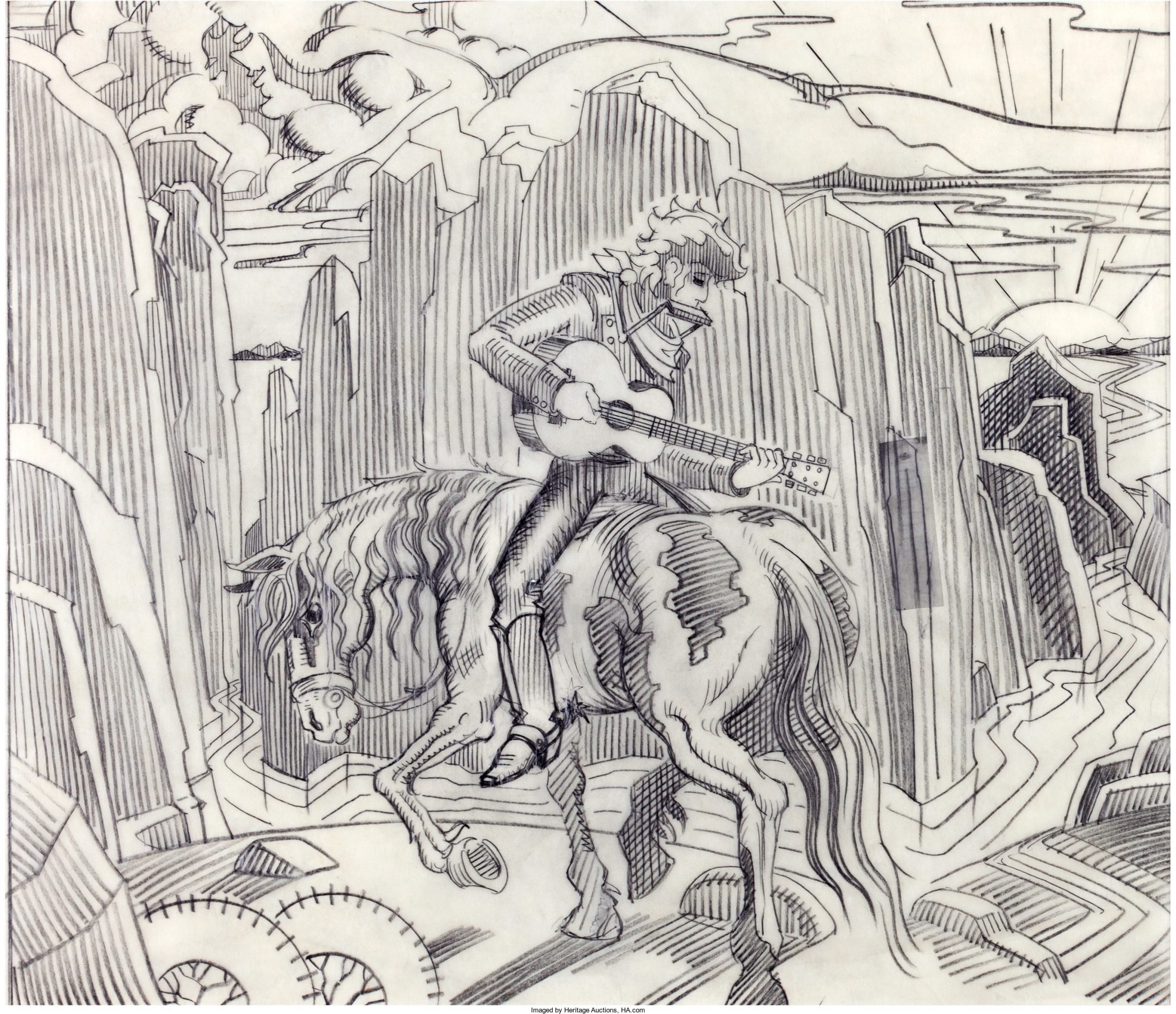
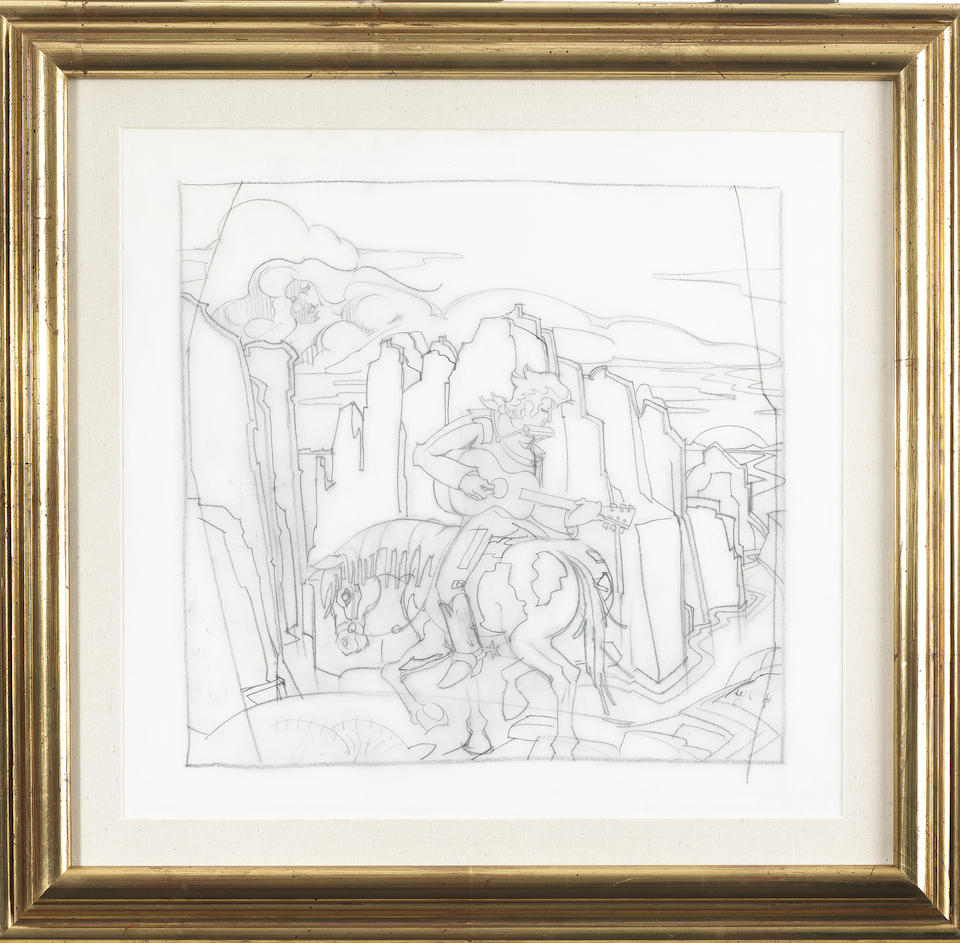
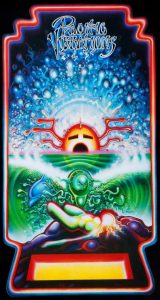
However, the artist has since evolved and comes with a completely different design: an acrylic painting of a rider in a canyon, above him a female figure visible in the clouds (reminiscent of famous poster “Pacific Vibrations”).
It is striking that the man sits backwards on his horse.
Griffin refers to the heyokha, a figure from the culture of the Lakota Indians. The heyoka is an unruly jester and satirist, to avert the dark forces, he speaks backwards and moves in a way that is opposite to the people around him.
The record company, however, fears that the image without interpretation will be incomprehensible. They discontinued the collaboration with Griffrin.
The original painting was lost in a fire, but a number of sketches and preliminary studies have been preserved.
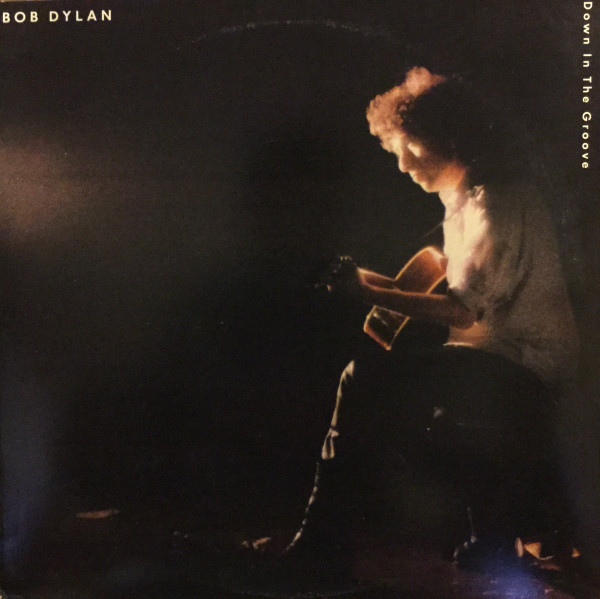
Instead, a more conventional photo is chosen. Peter Carni, a commercial photographer from Playa del Rey, portrays Dylan in the semi-darkness of the auditorium of a Hollywood church. It is almost a cliché image of the singer, seated in front of a piano, playing an acoustic guitar.
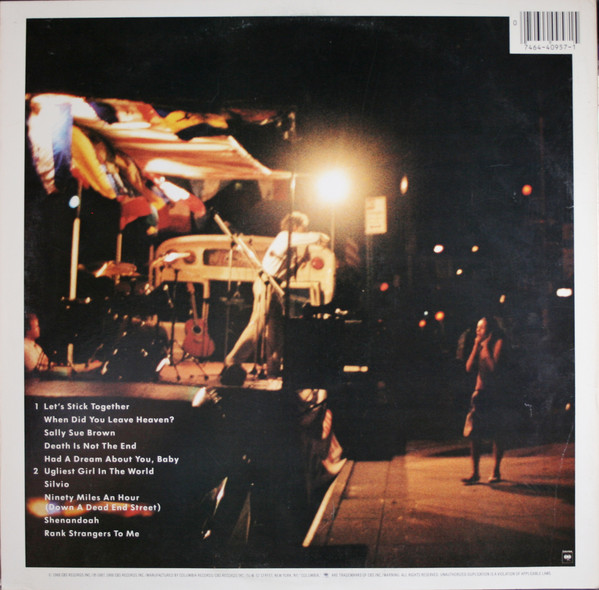
On the back sleeve is another picture of Dylan on stage. During a sound check he is talking to a woman, probably one of the singers – possibly his wife Carolyn Dennis.
Dylan & the Dead
Drawing: Rick Griffin
Released: February 6, 1989
Drawing: Rick Griffin
Photographer inner cover: Herb Greene
Art director: Allen Weinberg
When a live LP of the tour of Dylan and the Grateful Dead is released eighteen months after the facts, it is decided to display the oil painting of Griffin that served as a background on the cover.
Finally the artist has made it!
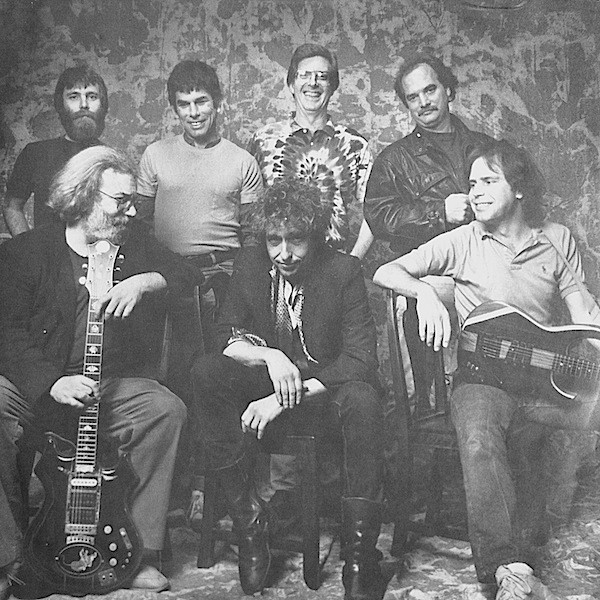
The photo on the back, showing Dylan surrounded by his occasional supervisors, is also recycled. Herb Greene’s photo was originally used for performance posters.
When ‘With God on our Side’ appeared in 1962, no one was in any doubt that this was an anti-war song aimed at the meaninglessness of war. Its refrain mocks the way nations call upon God when it comes to slaughtering others. No nation goes to war without having God on its side. The irony of it all, calling on God to kill, was implicit in every line.
Here are the lyrics in full, with the exception of a verse on the Vietnam War Dylan later added.
Oh my name it ain't nothin'
My age it means less
The country I come from
Is called the Midwest
I was taught and brought up there
The laws to abide
And that land that I live in
Has God on its side

Oh, the history books tell it
They tell it so well
The cavalries charged
The Indians fell
The cavalries charged
The Indians died
Oh, the country was young
With God on its side

The Spanish-American
War had its day
And the Civil War, too
Was soon laid away
And the names of the heroes
I was made to memorize
With guns in their hands
And God on their side

The First World War, boys
It came and it went
The reason for fighting
I never did get
But I learned to accept it
Accept it with pride
For you don't count the dead
When God's on your side

The Second World War
Came to an end
We forgave the Germans
And then we were friends
Though they murdered six million
In the ovens they fried
The Germans now, too
Have God on their side

I've learned to hate the Russians
All through my whole life
If another war comes
It's them we must fight
To hate them and fear them
To run and to hide
And accept it all bravely
With God on my side

But now we got weapons
Of chemical dust
If fire them, we're forced to
Then fire them we must
One push of the button
And a shot the world wide
And you never ask questions
When God's on your side

Through many a dark hour
I've been thinkin' about this
That Jesus Christ was
Betrayed by a kiss
But I can't think for you
You'll have to decide
Whether Judas Iscariot
Had God on his side.

So now as I'm leavin'
I'm weary as Hell
The confusion I'm feelin'
Ain't no tongue can tell
The words fill my head
And fall to the floor
That if God's on our side
He'll stop the next war
So far so good. Here is Dylan performing the song in 1988, at the beginning of the Never Ending Tour, when he seemed keen to reclaim his radical credentials. He performs the song with gusto in a vocal performance dripping with irony and anti-war sentiment. Here is the additional verse as far as I can make it out.
In the nineteen sixties came the Vietnam war
Can somebody tell me, what we were fighting for?
Too many young men died
Too many mothers cried
So I ask the question
Was God on our side?
This verse condemns war more directly than the other verses. So again we get the message. War is senseless slaughter. War is grief.
Now we have to fast forward nearly sixty years to Rough and Rowdy Ways and the song, ‘Mother of Muses’, where we find these lines, sung in reverential tones:
Mother of Muses, sing for my heart
Sing of a love too soon to depart
Sing of the heroes who stood alone
Whose names are engraved on tablets of stone
Who struggled with pain, so the world could go free

Mother of Muses, sing for me

Sing of Sherman, Montgomery and Scott
And of Zhukov, and Patton, and the battles they fought
Who cleared the path for Presley to sing
Who carved the path for Martin Luther King
Who did what they did and they went on their way
Man, I could tell their stories all day
This is a totally different outlook on history to ‘With God on Our Side’. Four of these men named, Sherman, Montgomery, Zhukov and Patton were generals; if not masters of war, exactly, they were certainly their agents. Here’s what Wikipedia has to say about these heroes.
William Tecumseh Sherman (February 8, 1820 – February 14, 1891) was an American soldier, businessman, educator, and author. He served as a general in the Union Army during the American Civil War (1861–65), receiving recognition for his command of military strategy as well as criticism for the harshness of the scorched earth policies he implemented in conducting total war against the Confederate States.[2] British military theorist and historian B. H. Liddell Hart declared that Sherman was “the first modern general.”[3]
If we exclude Sherman, who defeated the Confederacy, what do the other three generals have in common? They were the three major allies, Britain, Russia and the U.S who defeated Hitler and the Nazis in World War 2. Here was a war that was not meaningless. The path was cleared for the post war flowering of western culture. This sent me scurrying back to ‘With God on our Side’ to check the WW2 verse.
The Second World War
Came to an end
We forgave the Germans
And then we were friends
Though they murdered six million
In the ovens they fried
The Germans now, too
Have God on their side
As the history of America’s wars unfolds in the song, WW2 is the odd man out, for what is being condemned is not the senseless slaughter of war but our forgiveness of the Germans. (Dylan conflates the German people with the Nazis, as was commonly done at the time.) WW2, it seems, was a war worth fighting, because of the Holocaust – the six million ‘fried’. We are reminded of Dylan’s Jewish heritage, and why he might have had a particular perspective on that war.
Returning to ‘Mother of Muses’, those generals are to be revered for ‘the battles they fought’.
‘Man,’ sings the Bard, ‘I could tell their stories all day’.
This kind of language is Homeric in its intent. These generals that he celebrates have become, in Dylan’s Classics soaked mind, the modern day equivalents of Odysseus, Ajax and Hector. Men who ‘struggled with pain so the world could go free’. Because they cleared the world of the evils of fascism, the great world of American culture, symbolized by Elvis Presley in this song (but celebrated at length in Murder Most Foul) could flourish, out of which the civil rights movement would grow, symbolized here by Martin Luther King. And out of that movement, of course, the young Bob Dylan would grow.
All this Homeric valorizing leads Dylan, usually ever aware of our mortality, to boast that the names of these heroes ‘are engraved on tablets of stone’. I can’t help but wonder if the Bard has forgotten the lesson of Shelley’s Ozymandias: words engraved on stone come back to mock us.
Are these the same kind of ‘heroes’ the Bard was ‘made to memorise’ in the earlier song? This question made me return to ‘With God on Our Side’ with new eyes. Is the song really what we always thought it was?
Some of Dylan’s protest songs have been unmasked as something quite different. Tony Atwood has characterized ‘The Times they are a-changing’ as a protest song that doesn’t protest anything. That’s because the song is a meditation on time and eternal recurrence. If sung in a young, strident voice, it may sound like a protest song. If sung in an old, experienced voice, it sounds more like grandfatherly advice on how to deal with the young. ‘Blowing in the Wind’ is a series of unanswerable metaphysical questions. What marks them both is a certain fatalism. Times will go on changing. Our questions will go on ‘blowing in the wind’.
Coming back to ‘With God on our Side’ I find a similar fatalism. Could it be that the radicalism of the song is partly at least contextual, the social/political context in which it was written and received? I looked at some of the verses again.
The cavalries charged
The Indians fell
The cavalries charged
The Indians died
Oh, the country was young
With God on its side
Strip the verse of its irony, and we find that genocide is not being condemned exactly – we just get the fact, baldly presented. Evident is a kind of bleak fatalism: this happened and that happened. On WW 1, we hear:
But I learned to accept it
Accept it with pride
Do we have any reason not to take this as the literal truth?
With regard to the Russians, we find this:
I've learned to hate the Russians
All through my whole life
If another war comes
It's them we must fight
Must fight? Is there no alternative? Can’t we decide not to fight another war? Apparently not, as we are caught up in the imperatives of history. That imperative is carried through into the next verse about the next war:
But now we got weapons
Of chemical dust
If fire them, we're forced to
Then fire them we must
There seems no way out. The logic of war has us in thrall and there is no escaping it. Might as well try to escape fate.
The verse on Judas is linked to the other verses by this same theme – we cannot escape our destinies. The argument here flows from one of the paradoxes of Christianity. If it weren’t for Judas and that kiss of betrayal, Jesus would never have been arrested and martyred. Jesus would not have been able to fulfill his destiny. So, Judas must have been a part of God’s perfect finished plan. All kinds of heresies flow from this problem.
Now the last verse comes into perspective.
So now as I'm leavin'
I'm weary as Hell
The confusion I'm feelin'
Ain't no tongue can tell
The confusion he’s feeling is about the nature of God’s will. It seems that all this war and death are pre-ordained – could God enter history and put an end to the wretched cycle of slaughter? Doesn’t seem likely. So the very last two lines are the most pessimistic of all. Our fates are sealed.
So is this still mainly an anti-war song? I’m not so sure anymore. The song records and laments God’s will and our fates – hardly a rallying cry.
Dylan’s performance of the song in 1994 at the Unplugged concert may bear out my new sense of the song to some extent. Unlike the vital 1988 performance, the 1994 version is much more of a dirge. The music drones. Dylan leaves out the more explicit anti-war Vietnam verse. Yet the performance, oddly dispassionate, is as powerful as any he’s given. We have moved from the anger and outrage of the earlier version to weary acceptance.
Of course we should feel no obligation to reconcile the early Dylan with the older Dylan. After all, the man ‘contains multitudes’, but that doesn’t stop us from looking at his earlier work through the lens of the later songs.
Kia Ora
Untold Dylan: who we are what we do
Untold Dylan is written by people who want to write for Untold Dylan. It is simply a forum for those interested in the work of the most famous, influential and recognised popular musician and poet of our era, to read about, listen to and express their thoughts on, his lyrics and music.
We welcome articles, contributions and ideas from all our readers. Sadly no one gets paid, but if you are published here, your work will be read by a fairly large number of people across the world, ranging from fans to academics. If you have an idea, or a finished piece send it as a Word file to Tony@schools.co.uk with a note saying that it is for publication on Untold Dylan.
We also have a very lively discussion group “Untold Dylan” on Facebook with around 7000 active members. Just type the phrase “Untold Dylan” in, on your Facebook page or follow this link
You’ll find some notes about our latest posts arranged by themes and subjects on the home page of this site. You can also see details of our main sections on this site at the top of this page under the picture. Not every index is complete but I do my best. Tony Attwood
In his song ‘False Prophet’, Bob Dylan grabs hold of Frederick Nietzsche’s arm, and searches for meaning in life:
Well, I'm an enemy of treason
An enemy of  strife
I'm the enemy of the unlived meaningless life
I ain't no false prophet
I know what I know
I go where only the lonely can go
(Bob Dylan: False Prophet)
Pays tribute to a melancholy singer:
Only the lonely know the way I feel tonight
Only the lonely know this feeling ain't right
There goes my baby, there goes my my heart
They're gone forever, so far apart
(Roy Orbison: Only The Lonely ~ Melson/Orbinson)
The song pays tribute to those happier, to rocknroller Ricky Nelson who sings about Mary Lou; the blues singer Pearl Bailey stars in the Broadway musical ‘Hello Dolly’:
Hello, Mary Lou
Hello, Miss Pearl
My fleet-footed guides from the underworld
No stars in the sky shine brighter than you
You girls mean business, and I do too
(Bob Dylan:False Prophet)
Hermes and Persephone are the guides to Hades, the mythodical underworld:
Hello Mary Lou, goodbye heart
Sweet Mary Lou, I'm so in love with you
I knew Mary Lou, we'd never part
So hello Mary Lou, goodbye heart
(Ricky Nelson: Hello Mary Lou ~ Pitney/Mangiaracina)
To the movie anti-hero Robert Mitchum attention is paid; ie, “Rachel And The Stranger”:
Hello stranger
A long goodbye
You ruled the land
But so do I
You lusty mule
You got a poison brain
l'll marry you to a ball and chain
(Bob Dylan: False Prophet)
The movie features the following song about a lusty mule who’s after a Mary Lou: the womanizing stranger leaves after the husband starts to appreciate wife Rachel:
Once there was a man, a hateful man
Had a wife, but didn't see the danger
'Till one day, one fateful day
Along long came a tall dark stranger
(Robert Mitchum: Tall Dark Stranger ~ (Webb/Salt)
“The Long Goodbye” is a pastiche on the ‘noir’ detective movies starring Humphrey Bogart; features the following song:
There's a long goodbye
And it happens every day
When some passer-by
Invites your eye
To come his way
Even as you smile a quick 'hello'
(Clydie King: Long Goodbye ~ Williams/Mercer)
In the Humprey Bogart movie “The Treasure Of Sierra Madre”, greed takes its toll; the bandits kill Bogart at the water hole; thinking that the gold dust is sand they throw it away:
Put out your hand
There's nothing to hold
Open your mouth
I'll stuff it with gold
Ah, you poor devil, look up if you will
The City Of God is there on the hill
(Bob Dylan: False Prophet)
The song pays tribute to adventure stories of hardship and romance; ie, Jack Livings’ “Mountain Of Swords Seas Of Fire”:
I search the world the over
For the Holy Grail
I sing songs of love
I sing songs of betrayal
Don't care what I drink
Don't care what I eat
I climbed the mountain of swords on my bare feet
(BP Bob Dylan: False Prophet)
Referencing:
I'll eat when I'm hungry
I'll drink when I'm dry
If hard times don't get me
I' ll lay down and die
(Tex Ritter: Rye Whiskey ~ traditional)
https://youtu.be/kyk1BPEABsE
Lines also in:
I eat when when I'm hungry
I drink when I'm dry
And Iive my life on the square
Bob Dylan: Standing In The Doorway)
As Dylan so often does, the singer/songwriter from the North Country has a little fun at the expense of interpreters of his lyrics – Freudians, for example:
What are you looking at?
There's nothing to see
Just a cool breeze that's encircling me
Let's go for a walk in the garden
So far and so wide
We can sit in the shade by the fountain-side
Or is it that King Solomon actually likes his country pie:
A fountain of gardens, a well of living waters
And  streams from Lebanon
Awake, O north wind, and come thou south
Blow upon my garden, that the spices thereof may flow out
Let my beloved come into his garden
And eat his pleasant fruits
(Song Of Solomon 4: 15,16)
Untold Dylan: who we are what we do
Untold Dylan is written by people who want to write for Untold Dylan. It is simply a forum for those interested in the work of the most famous, influential and recognised popular musician and poet of our era, to read about, listen to and express their thoughts on, his lyrics and music.
We welcome articles, contributions and ideas from all our readers. Sadly no one gets paid, but if you are published here, your work will be read by a fairly large number of people across the world, ranging from fans to academics. If you have an idea, or a finished piece send it as a Word file to Tony@schools.co.uk with a note saying that it is for publication on Untold Dylan.
We also have a very lively discussion group “Untold Dylan” on Facebook with around 7000 active members. Just type the phrase “Untold Dylan” in, on your Facebook page or follow this link
You’ll find some notes about our latest posts arranged by themes and subjects on the home page of this site. You can also see details of our main sections on this site at the top of this page under the picture. Not every index is complete but I do my best. Tony Attwood
On August 6, 1986, Dylan plays a rather acclaimed concert in Paso Robles, California, accompanied by Tom Petty. Nice setlist, with a beautiful tribute to Ricky Nelson (“Lonesome Town”), who was killed in a plane crash on New Year’s Eve; with the live debut of “Brownsville Girl” (partly at least – Dylan only plays the chorus); with some nice covers (“Uranium Rock”, for example, and “Across The Borderline”) and with an attractive mix of old and new own work. Dylan is in a good mood, praises the quality of The Heartbreakers, his band (“It’s a real rock ‘n’ roll band here”) and is pleased that old comrade Al Kooper joins in for “Like A Rolling Stone”.
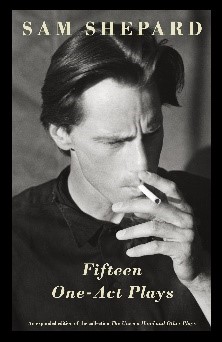
But he doesn’t talk about any of that, a little later in the interview with the co-writer of “Brownsville Girl”, with Sam Shepard:
BOB: Oh, you know where I just was?
SAM: Where?
BOB: Paso Robles. You know, on that highway where James Dean got killed?
SAM: Oh yeah?
BOB: I was there at the spot. On the spot. A windy kinda place.
SAM: They’ve got a statue or monument to him in that town, don’t they?
BOB: Yeah, but I was on the curve where he had the accident. Outsida town. And this place is incredible. I mean the place where he died is as powerful as the place he lived.
James Dean is an indestructible hero to Dylan. He brings him up regularly, unsolicited too, always admiring him. It must have flattered him that journalists and biographers often compare him to James Dean – a comparison that is officially recorded by Don McLean in the immortal pop monument “American Pie” (1971), in which Bob Dylan plays a small part, as “the jester”:
When the jester sang for the king and queen
In a coat he borrowed from James Dean
When asked, in the Bill Flanagan interview 2017, Dylan is not too happy with that comparison with a joker (“A jester? Sure, the jester writes songs like ‘Masters of War’, ‘A Hard Rain’s a-Gonna Fall’, ‘It’s Alright, Ma’ – some jester. I have to think he’s talking about somebody else. Ask him”), but Don McLean is not entirely wrong.
In that conversation with Sam Shepard – one of the best Dylan interviews ever – Dylan is quite explicit about the life-decisive influence of the young deceased actor:
BOB: Naw. The only reason I wanted to go to New York is ’cause James Dean had been there.
SAM: So you really liked James Dean?
BOB: Oh, yeah. Always did.
SAM: How come?
BOB: Same reason you like anybody, I guess. You see somethin’ of yourself in them.
Dean was a racing fanatic, took part in racing races, and, as we know, he died in his Porsche 550 on his way to yet another race in Salinas. And echoes of that crash the jester in a coat borrowed from James Dean seems to process in the third verse of “Bob Dylan’s Blues”:
Lord, I ain’t goin’ down to no race track
See no sports car run
I don’t have no sports car
And I don’t even care to have one
I can walk anytime around the block
The gimmick of the first two verses, contrasting anomaly and cliché, is gone. The third verse has no “inner conflict”. Although a “sports car” is a unusual attribute in a song in 1962 (in January ’63, shortly after the creation of this song, Elvis sings “(There’s) No Room To Rhumba In A Sports Car” – there are hardly any other examples), a sports car is, unlike the Lone Ranger and unlike the five and ten cent women, not alienating or unrealistic; the couplet has – again – no relation to the other verses, but is in itself a weekday, realistic tableau.
With some tolerance there seems to be, for the first time, a kind of storyline to the following verse. The narrator has just told us that he could walk around the block, and now the narrator indeed is walking in the street:
Well, the wind keeps a-blowin’ me
Up and down the street
With my hat in my hand
And my boots on my feet
Watch out so you don’t step on me
…but it’s not really gonna be a story. It’s another stand-alone tableau, this time with a high Woody Guthrie content. Spoken, it seems, by Dylan’s protagonist from “I Was Young When I Left Home”, or rather from “Man On The Street”, that old hobo who dies so lost and lonely on the street. A Guthrie archetype anyway, but Dylan also borrows his vernacular – from “Goin’ Down The Road”, for example:
I'm blowin' down this old dusty road
I'm a-blowin' down this old dusty road
I'm a-blowin' down this old dusty road, Lord, Lord
An' I ain't a-gonna be treated this a-way
But then again, the choice of words and images are clichéd enough to have been raked out of dozens of other songs. In these same days, Jimmy Dean (what’s in a name) writes a sequel of his hit “Big Bad John”, called “Little Bitty Big John”, containing the words his hat in his hand, to name just one other possible lyric influencer.
Anyway, this tableau, this fourth verse, has nothing more to offer than a snapshot, is nothing more than a stand-alone intermezzo.
A similar loose link as from the third to the fourth verse seems discernible, again with some leniency, from the fourth to the last verse. The Great Common Divider is then Woody Guthrie, and again the vernacular, the specific jargon, is a first trigger. In this case the somewhat dated lookit. Though Dylan uses it differently, here. Guthrie uses it as a phonetic short-cut for look at. As in his autobiography Bound For Glory (“I got ’em! I got ’em! Hi! Lookit me!”) and as in a song like “Dry Bed” (“Hey, lookit my dry bed! Come feel my dry bed!”) – where, by the way, both in his book and in the songs, “lookit” most of the time is said by children.
In the 1940s, the somewhat shabby, hillbilly-ish word shifts to Hollywood, to the city, and even to the elite. In a recorded phone conversation between President Kennedy and the Mayor of Chicago, Richard Daley, we hear how Daley teaches party discipline to a colleague: “He’ll do it. The last time I told him, ‘Now lookit… you vote for anything the President wants‘… and that’s the way it’s gonna be.”
In migrating to a higher social class the meaning has shifted too, apparently. Now it means something like “listen”, “look” – and that’s how Dylan applies it here:
Well, lookit here buddy
You want to be like me
Pull out your six-shooter
And rob every bank you can see
Tell the judge I said it was all right
Yes!
No, that’s not how Woody uses it. It’s a lookit, actually, like it’s exclusively sung by Howlin’ Wolf. Like in “Mr. Highway Man” from 1952 (“Lookit here, man, please check this oil”), but especially like in the Mother of all Blueses, in the template for all slow blues songs, in “Goin’ Down Slow”:
Now lookit here
I did not say I was a millionaire
But I said I have spent more money than a millionaire
Not too far-fetched, of course. Dylan’s love for Howlin’ Wolf is well documented, this version of “Goin’ Down Slow” has just been released on single, the song gets a name-check in Dylan’s “Caribbean Wind” (1980) and again, more explicitly, in 2020 on Rough And Rowdy Ways. Twice even, both in “Key West” and in “Murder Most Foul”.
After that intentional or accidental detour Dylan ends up with Woody Guthrie again, with one of his signature songs, “Pretty Boy Floyd”. According to the narrator, the addressed buddy has to live his life just like the I-person does, just like the romanticized version of that bank robber: with his six-shooter he is allowed to rob banks. Because banks, as the myth around Pretty Boy Floyd says, are the heartless, greedy institutions that evict poor, honest and hardworking people from their homes. “And tell the judge I was okay with it.”
Words of a rebel with a cause.
“Bob Dylan’s Blues” is still not a Greatest Hit. On stage Dylan will never perform it, the song is ignored by colleagues and it is never selected for compilation albums. Except that one time, for the very first Bob Dylan Greatest Hits album. Actually, it’s a bit puzzling that it was even selected at all for The Freewheelin’, instead of small masterpieces like “Tomorrow Is A Long Time” and “He Was A Friend Of Mine”, or more successful songs like “Let Me Die In My Footsteps” and “Quit Your Low Down Ways”. Or one of the many other songs Dylan records in these same days, which are not officially released until decades later.
Still, we have to hand it to the anonymous compiler of that stern musik compilation: “Bob Dylan’s Blues” is a rudimentary sample of the things to come. The surreal touch of the opening stanza with The Lone Ranger predicts the disruptive, poetic explosions like “Farewell Angelina” and “Tombstone Blues”. The love poetry of the second strophe announces “Love Minus Zero”, the urban blues of the third verse promises a return to Highway 61 and the last two strophes illustrate the folky Woody Guthrie phase in which the young Dylan currently still is wallowing.
Thus, the 2’28” of “Bob Dylan’s Blues” is like the overture of a Mozart opera: in two and a half minutes, the ditty divulges the highlights of the next four years, the years up to 29 July 1966, the day Dylan barely escapes a James Dean final.
=======
Jochen is a regular reviewer of Dylan’s work on Untold. His books are available via Amazon both in paperback and on Kindle:
Untold Dylan is written by people who want to write for Untold Dylan. It is simply a forum for those interested in the work of the most famous, influential and recognised popular musician and poet of our era, to read about, listen to and express their thoughts on, his lyrics and music.
We welcome articles, contributions and ideas from all our readers. Sadly no one gets paid, but if you are published here, your work will be read by a fairly large number of people across the world, ranging from fans to academics. If you have an idea, or a finished piece send it as a Word file to Tony@schools.co.uk with a note saying that it is for publication on Untold Dylan.
We also have a very lively discussion group “Untold Dylan” on Facebook with around 7000 active members. Just type the phrase “Untold Dylan” in, on your Facebook page or follow this link
You’ll find some notes about our latest posts arranged by themes and subjects on the home page of this site. You can also see details of our main sections on this site at the top of this page under the picture. Not every index is complete but I do my best. Tony Attwood
There is an index to all the articles in this series, which traces the themes within Dylan’s songs from his earliest writing, up to 2016 (thus far). Details at the foot of this piece.
Considering the songs composed between 2011 and 2016 by Bob Dylan we have no idea what order they were written in. And we have no access to outtakes – only the songs that have formally been released.
But we can of course continue the series in which each song is reduced to just a handful of words to try and give ourselves an indication of the themes that were occupying Dylan’s mind as he came to compose each album.
As I have noted a couple of times in recent articles in this series (and the index to all the articles is here) I wasn’t sure where this series would go, if anywhere, when I started, but for me (even if no one else) it has been an absolute revelation. For by noting the content of the lyrics of each song in as simple a way as I can, I have been able to understand for the first time, the movement of Bob Dylan’s thinking across the years.
Put simply, songwriters, like novelists, can write about anything that takes their fancy. But if we find a songwriter with a prolific output such as Bob Dylan (with over 600 song lyrics composed) and we see profound changes in the themes about which he writes, then it is a fair bet that to some degree at least, these changes reflect his own thinking, his interests, his moods, his feelings…
And what I have noted in continuing this series is that through these 21st century songs there is a clear darkening of the subject matter, as the old mixture of topics that I noted in the 20th century songs, is set aside.
For here we are hearing a continuing of the world gone wrong theme.
This is a list of the songs composed or co-composed in the period 2011/16
Which is a fairly solid indication that this was not a sudden turn into the darkness for Dylan, but the continuation of a theme.
I will be pulling together all of the 21st century songs when I’ve completed this series with what I suspect will be the toughest task of all – reducing the Rough and Rowdy Ways songs to simple meanings. But for now, just a look at the titles of the first two articles covering the song writing periods of the 21st century shows what we Bob has been giving us:
Unfortunately the title I came up with for the 2008/10 era doesn’t help us much, and I’ll have to change that, but the totals I found in that period show what’s going on:
Lost love: 2
Everything is wrong / life is bad: 6
The need of a woman: 1
And so as noted above what we have in the 2011-16 period, as noted in the individual songs covered above, we have disaster, nothing is what it seems, world gone wrong, the past reviewed, and lost love.
It is the same theme of negativity over and over again. The one question left is, if this is what Bob was offering throughout this century, is it fair to say that this is what he delivered in the double album? I’ll tell you, when I’ve worked it out.
Certainly I do hope that in moving on the Rough and Rowdy with this perspective in mind, it will help me understand that album better than I do at the moment. And in writing this I don’t mean that I’ve not got any grip on the individual songs, I think perhaps I have. But it is the overall world-view of Bob Dylan that fascinates me here, for I do feel that if we can understand that, we can see which, of the many interpretations on offer, best gives us an insight into what Bob was thinking about, as he wrote each song.
We shall see.
You may also find of interest, these series related to this article
Untold Dylan is written by people who want to write for Untold Dylan. It is simply a forum for those interested in the work of the most famous, influential and recognised popular musician and poet of our era, to read about, listen to and express their thoughts on, his lyrics and music.
We welcome articles, contributions and ideas from all our readers. Sadly no one gets paid, but if you are published here, your work will be read by a fairly large number of people across the world, ranging from fans to academics. If you have an idea, or a finished piece send it as a Word file to Tony@schools.co.uk with a note saying that it is for publication on Untold Dylan.
We also have a very lively discussion group “Untold Dylan” on Facebook with around 7000 active members. Just type the phrase “Untold Dylan” in, on your Facebook page or follow this link
You’ll find some notes about our latest posts arranged by themes and subjects on the home page of this site. You can also see details of our main sections on this site at the top of this page under the picture. Not every index is complete but I do my best. Tony Attwood
In spite of what he jokingly claims, singer/singerwriter Bob Dylan is quite influenced by the humanist messages uncovered in the figurative diction of WH Auden’s writings.
Auden, a poet who is influenced by socio-economic theories of Karl Marx though extremely disgruntled at how these have been put into practice:
About suffering they were never wrong
The Old Masters: how well they understood
It's human position ....
In Brueghel's 'Icarus', for instance: how everything turns away
Quite leisurely from the disaster ....
and the expensive ship delicate ship that must have seen
Something amazing, a boy falling out of the sky
Had somewhere to get to and sailed calmly on
Musée des Beaux Arts (1940) W.H. Auden
In the poem above, by way of hyperbolic analogy, the worship of the Golden Calf, the God of Money, is far more important than concern about the dire plight of any fellow human beings in the modern industrial state let alone in an outright authoritarian one.
Similar to the sentiments expressed in the song lyrics below whereby individuals are conditioned in capitalist ‘democracies’ to think only of themselves:
Advertising signs that con you
Into thinking you're the one
That can do what's never be better done
That can win what's never been won
Meantime life outside goes on
All around you
(Bob Dylan: It's Alright Ma)
Yes, to think the modernized Puritanical thought that no-one is to be trusted; below, Victor believes he’s Christ Almighty; knows all:
It wasn't the Jack Of Diamonds
Not the Joker she drew first
It wasn't the the King or Queen of Hearts
But the Ace of Spades reversed
Victor was standing in the doorway
He didn't utter a word
She said, "What's the matter darling?"
He behaved as if he hadn't heard
(WH Auden: Victor)
Postmodern Johnny’s in the basement, mixing up the medicine. Seems Death awaits those who do not properly follow the path of the Golden Calf – akin to the sentiment expressed in the narrative song lyrics below; only it’s the wealthy but wayward Big Diamond Jim who’s got a real reason to be nervous; JOH might well stand for ‘Jehovah’:
He was standing in the doorway, looking like the Jack Of Hearts ....
She fluttered her false eyelashes, and whispered in his ear
"Sorry, darling, that I'm late", but he didn't seem to hear
He was staring into space over at the Jack Of Hearts
(Bob Dylan: Lily, Rosemary, And The Jack Of Hearts)
The Dylanesque ‘rhyme twist’ ~ ‘ear’/hear’ instead of ~ ‘word’/ ‘heard’ – with a Lily as a symbol of Death rather than an Ace of Spades:
So be the mechanical clock of the city oft juxtaposed in poetry with the organic and regenerative cycles of the countryside:
As I walked out one evening
Walking down Bristol Street
The crowds upon the pavement
Were fields of harvest wheat ....
But all the clocks in the city
Began to whirr and chime
O let not Time deceive you
You cannot conquer time
(WH Auden: As I Walked Out One Evening)
An Imagist poet presents a darker metaphor depicting death-like city life:
The apparition of these faces in the crowd
Petals on a wet, black bough
(Ezra Pound: In A Station Of The Metro)
Below, Death is described as a fair maiden but she’s really the Queen of Spades in disguise:
As I went out one morning
To breathe the air around Tom Paine's
I spied the fairest damsel
That ever did walk in chains ....
"I beg you, sir", she pleaded
From the corners of her mouth
"I will secretly accept you
And together we'll fly south"
(Bob Dylan: As I Went Out One Morning)
Untold Dylan: who we are what we do
Untold Dylan is written by people who want to write for Untold Dylan. It is simply a forum for those interested in the work of the most famous, influential and recognised popular musician and poet of our era, to read about, listen to and express their thoughts on, his lyrics and music.
We welcome articles, contributions and ideas from all our readers. Sadly no one gets paid, but if you are published here, your work will be read by a fairly large number of people across the world, ranging from fans to academics. If you have an idea, or a finished piece send it as a Word file to Tony@schools.co.uk with a note saying that it is for publication on Untold Dylan.
We also have a very lively discussion group “Untold Dylan” on Facebook with around 7000 active members. Just type the phrase “Untold Dylan” in, on your Facebook page or follow this link
You’ll find some notes about our latest posts arranged by themes and subjects on the home page of this site. You can also see details of our main sections on this site at the top of this page under the picture. Not every index is complete but I do my best. Tony Attwood
Not only on Greatest Hits, but also on Freewheelin’ “Bob Dylan’s Blues” is an odd duck. The other twelve songs are all coherent, either tell a story (“Oxford Town”, “Girl From The North Country”), or communicate in unrelated verse lines a single, text-transcending image, or a single comprehensive message (“Blowin’ In The Wind”, “Masters Of War”, “Hard Rain”). The more insignificant songs, such as “Bob Dylan’s Dream” or “Down The Highway” and even “I Shall Be Free” are still more or less coherent.
“Bob Dylan’s Blues” is the only song avoiding that. Five unrelated verses, each a short tableau of its own, which together do not form one atmosphere, not one state of mind and not one narrative – they remain five loose, uncorrelated snapshots.
The opening promises a grotesque fantasy à la “Motorpsycho Nitemare”, “I Shall Be Free No. 10” or “Highway 61 Revisited”:
Well, the Lone Ranger and Tonto
They are ridin’ down the line
Fixin’ ev’rybody’s troubles
Ev’rybody’s ’cept mine
Somebody musta tol’ ’em
That I was doin’ fine
An opening stanza in a style that will become characteristic of Dylan’s lyrics in about three years’ time. The alienating effect caused by the use of cultural icons or archetypes from other art disciplines, in this case the television heroes from the Western series The Lone Ranger, is comparable to the guest appearance of Cassius Clay in “I Shall Be Free No. 10”, of Captain Arab in “Bob Dylan’s 115th Dream” or of Cinderella in “Desolation Row” – to name but three of the many, many examples.
This becomes even more alienating by embedding those intruders in, as Dylan later calls it in his Nobel Prize speech, the vernacular; the blues clichés and the folk lingo, “the only vocabulary that I knew, and I used it.”
“Ridin’ down the line” is vernacular that young Dylan knows from half his baggage. From “Cocaine Blues”, for example, or from “On The Atchison, Topeka And The Santa Fe” – and above all from Woody Guthrie of course, from “Talking Sailor Blues”; the Guthrie song which in more than one respect (musically, for example) is a template for this early Dylan song;
Doorbell rung and in come a man,
I signed my name, I got a telegram.
Said, "If you wanna take a vacation trip,
Got a dish-washin' job on a Liberty ship."
Woman a-cryin', me a-flyin', out the door and down the line!
The next lines are just as recognizable. Fixin’ ev’rybody’s troubles, ev’rybody’s ‘cept mine is a variant of the well-known wailing from lamento’s like “Oh, Lonesome Me” and “But Not For Me”, and variants of I guess I’m doing fine sound familiar thanks to dozens of country and folk songs – Dylan’s trigger may be the recent country hit “Funny How Time Slips Away” (written by Willie Nelson).
The narrator of the second verse, unlike the protagonist of the opening couplet, is not troubled at all:
Oh you five and ten cent women
With nothin’ in your heads
I got a real gal I’m lovin’
And Lord I’ll love her till I’m dead
Go away from my door and my window too
Right now
This is a confident, seriously infatuated young man, and the verse is even autobiographical, as we may conclude in this exceptional case. In her memoirs A Freewheelin’ Time (2008), Suze Rotolo, Dylan’s girlfriend in those years, reveals quite a lot about the background of the songs on this LP, and she even quotes from letters Dylan wrote to her while she was in Italy:
“Some of the words he wrote in the letters became song lyrics, others he put in quotes so I would know they were from a newly written song:
I had another recording session you know—I sang six more songs—you’re in two of them — Bob Dylan’s Blues and Down The Highway (“All you five & ten cent women with nothing in your heads I got a real gal I’m loving and I’ll lover her ’til I’m dead so get away from my door and my window too—right now”). Anyway you’re in those two songs specifically—and another one too—“I’m in the Mood for You”—which is for you but I don’t mention your name…. “
And although Rotolo modestly adds a disclaimer a little later:
“I don’t like to claim any Dylan songs as having been written about me, to do so would violate the art he puts out in the world. The songs are for the listener to relate to, identify with, and interpret through his or her own experience.”
… she most certainly may, and we may, go so far as to say that this chorus, these thirty-eight words, express Dylan’s infatuation with Suze.
Stylistically still somewhat in line with the first verse. The opening is again disruptive. “Five and ten cent women” is not a household term. The five and ten cent, or five and dime is the department where the bargains are, five-and-dime products stand for “cheap”, “low quality”, and the same goes for the food you could get at the lunch counter there (like at Woolworth and at Kresge): cheap and not really refined.
In a few songs, the expression does appear, but never with the negative, insulting connotation that Dylan now attributes to it. The most famous is Bing Crosby’s “I Found a Million Dollar Baby (in a Five and Ten Cent Store)”, Glenn Miller is overjoyed with the love so sublime he finds in Woolworth’s five and dime (“A String Of Pearls”, 1944) and a derogatory connotation really only sounds in the ancient “Braggin’” (1941, Harry James and his Orchestra), which Dylan will sing on Triplicate in 2017:
Braggin' 'bout your fishin'
'Bout your horseshoe pitchin'
Bet you always keep the score
Braggin' 'bout your medal
That's the kind they peddle
Down at the five and ten cent store
But to dismiss flirtatious ladies as five and ten cents women with nothing in your heads is an original and alienating find of the young poet.
Just like in the previous verse, Dylan contrasts the unusual with the ordinary; this original insult is followed by run-of-the-mill lingo. Especially the last line, Go away from my door and my window too, is an evergreen, obviously. Dylan copies it quite verbatim from John Jacob Niles’ classic “Go Away From My Window” and will further vary on it in “Don’t Think Twice, It’s All Right”, in “It Ain’t Me, Babe”, in “Can You Please Crawl Out Your Window”… up to Rough And Rowdy Ways, 2020, the window is one of Dylan’s favourite whereabouts for protagonists and antagonists.
The expressions five-and-ten-cents and the synonym five-and-dime are of course – literally – subject to inflation. At the end of the 70’s the first upgrades dollar shop and pound shop pop up and the previous specification becomes a metaphor like Dylan already used it in 1962: five-and-dime or nickel-and-dime is something like “worthless”, “banal”.
Until 1982, that is, when Robert Altman’s film adaptation of the successful play Come Back To The Five And Dime, Jimmy Dean, Jimmy Dean becomes a huge hit. The play, and the film, is set in a Woolworth’s Five-And-Dime in Texas, not far from Marfa, where James Dean’s last film Giant (1955) was shot. It’s 1975 and the five ladies of the James Dean fan club The Disciples Of James Dean commemorate the death of their idol, twenty years ago today.
It’s a great, suffocating actors’ movie with a particularly beautiful, poignant, melancholy ending: the sudden flash forward to the place of action years later. The Five And Dime is abandoned, dilapidated, in the dusty mirror we see the apparitions of Mona, Joanne and Sissy (Sandy Dennis, Karen Black and Cher), hollowly singing their McGuire Sisters imitation (“Sincerely”).
As an expression, five and dime has a bitter-sweet, melancholic charge since then, depicting something like the innocence of the 1950s, when we were still young and beautiful and carefree, when James Dean and Marilyn Monroe were still alive.
Incidentally, Come back to the five and dime, Jimmy Dean has a similar emotional charge, and also a similar musicality and a similar timbre as the word combination Goodbye Jimmy Reed – the song of cinephile Dylan from 2020. Just like “Bob Dylan’s Blues” a song of unrelated verses, with alienating clashes of clichés with anomalies… yet in the 2020 song, a coherent image still does emerge from all of this.
To be continued. Next up: Bob Dylan’s Blues – part III
Jochen is a regular reviewer of Dylan’s work on Untold. His books are available via Amazon both in paperback and on Kindle:
Untold Dylan is written by people who want to write for Untold Dylan. It is simply a forum for those interested in the work of the most famous, influential and recognised popular musician and poet of our era, to read about, listen to and express their thoughts on, his lyrics and music.
We welcome articles, contributions and ideas from all our readers. Sadly no one gets paid, but if you are published here, your work will be read by a fairly large number of people across the world, ranging from fans to academics. If you have an idea, or a finished piece send it as a Word file to Tony@schools.co.uk with a note saying that it is for publication on Untold Dylan.
We also have a very lively discussion group “Untold Dylan” on Facebook with around 7000 active members. Just type the phrase “Untold Dylan” in, on your Facebook page or follow this link
You’ll find some notes about our latest posts arranged by themes and subjects on the home page of this site. You can also see details of our main sections on this site at the top of this page under the picture. Not every index is complete but I do my best. Tony Attwood
This series focuses on the many songs that Bob Dylan has brought to a public performance, but then played just the once and walked away from thereafter. There are around 50 of such songs in the repertoire. Here are another three, and an index to all the articles in the series can be found at the foot of this piece.
For our first piece, Aaron pointed me towards Bob’s once only performance of “Twelve Gates to the City”, and I’ve not a chance to ask him for some background. But the only recording we have for the gig really is a bit of a mess all round. Indeed the video – which we will come to in a moment looks a mess too.
Which is sad, because a lot can be made of this song. And for once, instead of starting with Bob’s performance I would like to offer up a recording that shows just what can be made of the song.
There is in fact a lot of debate on the websites that concern themselves with such matters about what the actual lyrics were, and what they should be now. I can’t comment on those since I most certainly don’t have a background in this music, but what Carly Simon sings seems to be pretty much the standard lyrics that are accepted by most performers.
Here is Bob’s one and only rendition with Jeff Tweedy and Jim James
Oh, what a beautiful cityOh, what a beautiful cityOh, what a beautiful cityWell, twelve gates into the city, HalleluThree gates into the eastThree gates into the westThree gates into the northThree gates into the southMaking that twelve gates into the city, HalleluSee those children yonderThey're all dressed in redThey must be the childrenChildren that Moses ledYou know there're twelve gates into the city, HalleluWell, oh, what a beautifulWhen I get to heavenI'm goin' to sing and shoutThere ain't nobody up thereWho's goin' to put me outYou know there're twelve gates into the city, HalleluWell, oh, what a beautiful city
I am really not sure Bob and the band had much thought beforehand when they had a bash at this song. But, that is of course entirely up to him.
As I Went Out One Morning – Jan 1974
So far we have focused primarily on songs written by other composers which Bob has performed just the once on stage, but there are of course some of Dylan’s own compositions which have only been performed once. Here’s one.
So why did he work out the arrangement and then just it give one go? Presumably he just didn’t feel it worked ok. Actually I rather like this; in fact more than the album version. Of course that could be the novelty, but even so, I do think there is something there worth holding on to.
But perhaps Bob just didn’t feel he could take the song any further. And he’s the composer – and oh yes, he is Bob Dylan.
OK so after two of Aaron’s choices, one more of mine
Viola Lee Blues – a straight 12 bar blues performed at Hokkaidou Kousei Nenkin Kaikan, Sapporo on 24 February 1997.
Gus Cannon’s Jug Band recorded it on September 20, 1928.
https://youtu.be/ClC_KizCpQk
Here are the lyrics
The judge he pleaded, the clerk he wrote it
The clerk he wrote it down indeed-e
The judge decreed it, the clerk he wrote it down
If you miss jail sentence, you must be Nashville bound

Some got six months, some got one solid
Some got one solid year, indeed Lord
Some got six months, some got one solid year
But me and my buddy, we got lifetime here
Fix my supper, mama, let me go to
Let me go to bed, indeed Lord
Fix my supper, let me go to bed
I've been drinking white lightning, and it just gone to my head
And the Grateful Dead made this one of their own improvised pieces on tour
The song was written by Noah Lewis (September 3, 1891 – February 7, 1961) who was known for his harmonica playing – including an ability to play two harmonicas at once.
Lewis’ ability to generate volume led to him playing in brass marching bands around Henning and on the streets of Memphis.
He played with street bands before evolving his own band which became the Jug Stompers. He sang the lead and played harmonica on the original “Viola Lee Blues”. The Dead not only played that song but also “New, New Minglewood Blues”, and “Big Railroad Blues” from his repetoire.
Bob Dylan’s version harks back to the original sound of the Gus Cannon band – although without the harmonica.
Dylan’s once only file: earlier editions – and the concert
Untold Dylan is written by people who want to write for Untold Dylan. It is simply a forum for those interested in the work of the most famous, influential and recognised popular musician and poet of our era, to read about, listen to and express their thoughts on, his lyrics and music.
We welcome articles, contributions and ideas from all our readers. Sadly no one gets paid, but if you are published here, your work will be read by a fairly large number of people across the world, ranging from fans to academics. If you have an idea, or a finished piece send it as a Word file to Tony@schools.co.uk with a note saying that it is for publication on Untold Dylan.
We also have a very lively discussion group “Untold Dylan” on Facebook with around 7000 active members. Just type the phrase “Untold Dylan” in, on your Facebook page or follow this link
You’ll find some notes about our latest posts arranged by themes and subjects on the home page of this site. You can also see details of our main sections on this site at the top of this page under the picture. Not every index is complete but I do my best. Tony Attwood
Research by Aaron Galbraith, vague meanderings by Tony Attwood
In this new series we are planning to have a look at the work of Bob Dylan, the man in the background. And not always the man using his own name.
We are starting the series with Bob Dylan’s work as Blind Boy Grunt, working on the album “Dick Fariña & Eric von Schmidt.”
On the left is the cover on which we have the inscription “singing, shouting & playing American ballads, work songs & blues with Ethan Signer & occasionally Blind Boy Grunt. Instruments include mountain dulcimer, three mouth harps, two Spanish guitars, fiddle, mandolin, kazoo & Gordon’s Gin.”
The album was released in 1964 and was recorded during an impromptu session in January 1963 at Dobells Folk Record Shop in London, being issued later on their label. Bob (appearing as we have noted as Blind Boy Grunt) sings backing vocals and harmonica on 6 tracks.
And the reason for the pseudonym is that Bob’s Columbia contract prevented him from appearing under his own name so this pseudonym was used instead.
It is not possible to get the back cover of the album (shown left) reproduced in a manner that makes it readable on the screen, but the back cover notes make for some interesting reading including the note, “Blind Boy Grunt showed up from Rome and nobody got much sleep.”
A nice copy of the original album will set you back anywhere between $50-$100 depending on the condition and the pressing (there was a “Limited Edition” pressing which was the exact same as the regular pressing except the vinyl label states “limited edition”).
Solano Records issued a two CD version in 2007 with an additional disc of some 21 outtakes from the session, including several of Blind Boy Grunt’s contributions. It’s worth seeking out but it’s quite hard to find now and may set you back $40-$50.
This would have passed most fans by at the time of release due to the use of the pseudonym and as such it’s now pretty obscure and hard to come by, but it’s an essential album for fans of 60s folk music by one of the great duos and the addition of Dylan just makes this catnip for this collector!
If they had been allowed to say “& occasionally Bob Dylan” on the sleeve would this record be more well known these days? It’s very likely indeed.
Eric von Schmidt, who died in 2007 aged 75, was a leading light in the Cambridge, Massachusetts folk scene in the late 1950s and early 1960s, he was described as “a man of huge generosity to his fellow musicians.”
Bob Dylan stayed with von Schmidt, and repaid the debt to him by mentioning Rick in the intro to “Baby Let Me Follow You Down”. Also on the cover of “Bringing It All Back Home” there is a copy of “The Folk Blues of Eric von Schmidt.”
Von Schmidt was also a friend of Richard Fariña who was himself considered to be one of the leading folk music / protest songwriters of the time, and who was a friend of Thomas Pynchon, not just Thomas Pynchon the author, but THE Thomas Pynchon (at least in Tony’s house). He also became a good friend of Bob Dylan as explored in “Positively 4th Street: The Lives and Times of Joan Baez, Bob Dylan, Mimi Baez Fariña, and Richard Fariña,” by David Hajdu.
Thomas Pynchon dedicated his masterpiece Gravity’s Rainbow to the memory of Richard Fariña, who died in a motorcycle accident in 1966 and described Fariña’s own novel as “coming on like the Hallelujah Chorus done by 200 kazoo players with perfect pitch… hilarious, chilling, sexy, profound, maniacal, beautiful, and outrageous all at the same time.”
The story is that after Richard met Joan Baez’ younger sister, Richard divorced his wife and married the teenager and then released the Mimi & Richard Fariña album.
Which more or less takes us around in a complete circle.
I (Tony) appreciate I have meandered a way from Aaron’s intention with this series, and if you have not come across Pynchon or the Fariña album this probably means nothing, but if you have a moment, just listen to what follows.
If you have not ever tried a Pynchon novel before, it might be best to start with the “Crying of Lot 49”. After that it got a bit weird.
Sorry Aaron – I got a bit carried away on this one. Tony.
Untold Dylan: who we are what we do
Untold Dylan is written by people who want to write for Untold Dylan. It is simply a forum for those interested in the work of the most famous, influential and recognised popular musician and poet of our era, to read about, listen to and express their thoughts on, his lyrics and music.
We welcome articles, contributions and ideas from all our readers. Sadly no one gets paid, but if you are published here, your work will be read by a fairly large number of people across the world, ranging from fans to academics. If you have an idea, or a finished piece send it as a Word file to Tony@schools.co.uk with a note saying that it is for publication on Untold Dylan.
We also have a very lively discussion group “Untold Dylan” on Facebook with around 7000 active members. Just type the phrase “Untold Dylan” in, on your Facebook page or follow this link
You’ll find some notes about our latest posts arranged by themes and subjects on the home page of this site. You can also see details of our main sections on this site at the top of this page under the picture. Not every index is complete but I do my best. Tony Attwood
In the lyrics below, singer/songwriter Bob Dylan leaves a word blank for the listener or reader thereof to fill in. Many so-called ‘Dylanologists’ have wasted page upon page in an attempt to provide the correct answer to this serious riddle, but most simply get it wrong:
He saw an animal as smooth as glass Slithering his way through the grass Saw him disappear by a tree near a lake Ah, think I’ll call it a ________
(Bob Dylan: Man Gave Names To All The Animals)
In one essay of some twenty pages or so, one analyst dares to suggest that Dylan lifted a line from another songwriter, and therefore the answer to the riddle is definitely ‘snake.’
Little John was stung by a snake Over by the lake And looks like he’s really, really hurt He was lying in the dirt
(The Band: The Moon Struck One ~ Robbie Robertson)
We’ll assume that Johnny isn’t “lying”, and that he was actually bitten by a snake. Nonetheless, the analyst’s answer to the riddle is not correct – “Ah, think I’ll call it a snake” – because everybody knows that Bob Dylan would never steal a line from another writer. Kiwi poet Mike Johnson, miserable old soul that he is, says the line ought to be: “Ah, think I’ll call it a fake”
Another ‘Dylanologist’ writes a whole book about Dylan explaining how much the songwriter is influenced by a pre-Romantic poet; the poem below is quoted:
Little Lamb who made thee
Dost thou know who made thee?
Little lamb, I’ll tell thee
(William Blake: The Lamb)
Then a reference is made to the following song lyrics:
Next animal he did meet
Had wool on his back, and hooves on his feet
Eating grass on the mountainside so steep
Ah, think I’ll call it a sheep
(Bob Dylan: Man Gave Names To All The Animals)
https://youtu.be/OjYdjjIN6HI
Hence, the analyst, going a bit too far methinks, claims that the song is surely meant to conclude:
Saw him disappear by a tree near a lake
Ah, think I’ll call it William Blake
Though it must be admitted that Blake cares a lot about birds and animals:
Each cry of the hunted hare
A fibre from the brain does tear
A skylark wounded in the wing
A cherubim does cease to sing
(William Blake: To See The World In a Grain Of Sand)
Claimed it be by others that the Dylan line definitely ends in ‘hake’. This assertion is easily dismissed out of hand – even if the haddock-related fish somehow gets thrown up onto the shore, it’s a salt-water, not a fresh-water fish; so “Ah, think I’ll call it a hake” will not do.
Apparently Dylan is so amused at these silly solutions to his riddle that he gives out a clue by singing a rather Blakean variation of the song in which the lake is obviously frozen over:
I saw an animal upon lake
He was afraid that his heart would break
He was trying to drive a truck
Ah, think I'll call it a duck
(Bob Dylan: Man Gave Names To All The Animals)
The astute staff at the Untold Offices quickly pick up on this clue, and come up with the definitive answer to the riddle:
Slithering his way through the grass
Saw him disappear by a tree near the lake
Ah, think I'll call it a drake
(Bob Dylan: Man Gave Names To All The Animals)
With the benefit of hindsight, there is a clue already given in the lyrics; the animal is male, not female – a male duck, a drake. An analyst, who shall remain nameless for his own protection, suggests the verse refers to the rap singer named Drake.
In any event, listeners to the Dylan song above can now rest easy, and stop worrying about what the solution to the riddle is; just enjoy the song.
And to show their appreciation, a donation can be made, if they wish, to the nearest animal shelter.
Untold Dylan: who we are what we do
Untold Dylan is written by people who want to write for Untold Dylan. It is simply a forum for those interested in the work of the most famous, influential and recognised popular musician and poet of our era, to read about, listen to and express their thoughts on, his lyrics and music.
We welcome articles, contributions and ideas from all our readers. Sadly no one gets paid, but if you are published here, your work will be read by a fairly large number of people across the world, ranging from fans to academics. If you have an idea, or a finished piece send it as a Word file to Tony@schools.co.uk with a note saying that it is for publication on Untold Dylan.
We also have a very lively discussion group “Untold Dylan” on Facebook with around 7000 active members. Just type the phrase “Untold Dylan” in, on your Facebook page or follow this link
You’ll find some notes about our latest posts arranged by themes and subjects on the home page of this site. You can also see details of our main sections on this site at the top of this page under the picture. Not every index is complete but I do my best. Tony Attwood
“Spent a week in the hospital, then they moved me to this doctor’s house in town. In his attic. Had a bed up there in the attic with a window lookin’ out. Sarah stayed there with me. I just remember how bad I wanted to see my kids. I started thinkin’ about the short life of trouble. How short life is. I’d just lay there listenin’ to birds chirping. Kids playing in the neighbor’s yard or rain falling by the window. I realized how much I’d missed. Then I’d hear the fire engine roar, and I could feel the steady thrust of death that had been constantly looking over its shoulder at me. [pause] Then I’d just go back to sleep.”
(“True Dylan”, by Sam Shepard, Esquire, July 1987)
On July 29, 1966, Hurricane Dylan comes abruptly to a halt. The mythical motorbike accident at Woodstock forces Dylan to cancel all upcoming commitments, concerts, recordings and whatnot, and the following recovery period is used as an opportunity to get out of the rat-race altogether.
Record company CBS and manager Albert Grossman do not mind the first, forced break that much; Blonde On Blonde has just come out and is doing well. Six days before the accident, on the 23rd of July, the first double album in pop history enters the Billboard 200 (on 101), a month later, August 20, the LP is already at number 15, in the week of October 1 Blonde On Blonde reaches its peak (number 9). It isn’t until months later, mid-February 1967, that Dylan’s masterpiece disappears from the Top 200 again, in the week that The Monkees are at number one and two (with More Of The Monkees and The Monkees, respectively – Dylan’s influence with regard to original album titles has still not found its way into every sub-region of the pop world).
So, from that side the money tap is still open, and the singles are still doing fine, too; when Dylan is in the hospital, “I Want You” is number 20 in the Hot 100 and on the sixteenth place in England, the successor “Just Like A Woman” reaches the Top 40 as well. But a few months later, in the spring of 1967, the well is starting to dry up. “Leopard-Skin Pill-Box Hat” has a go in March, but this single doesn’t really score (top ranking: 81). In West Saugerties Dylan is already making music again, with the boys of The Band in the Basement, but for the time being no income is to be expected from that endeavour. CBS fears – rightly – to miss the momentum, and decides to release Dylan’s first compilation album: Greatest Hits.
The compilation is released 27 March 1967 and is a huge success. It reaches “only” the tenth place in the charts, but has very long legs. In January ’68 gold, and it goes on into the twenty-first century; April 2001 the five millionth copy is sold, so Greatest Hits is now on 5 x platinum.
The tracklist is quite safe. All Top 40 singles, plus the songs with which others have scored a hit (Peter, Paul & Mary with “Blowin’ In The Wind”, The Byrds with “Mr. Tambourine Man” and The Turtles with “It Ain’t Me, Babe”) plus “The Times They Are A-Changin’”, which wasn’t a single in the USA, but was a Top 10 hit in England:
Side one
1. Rainy Day Women ♯12 & 35
2. Blowin’ in the Wind
3. The Times They Are a-Changin’
4. It Ain’t Me Babe
5. Like a Rolling Stone Side two
1. Mr. Tambourine Man
2. Subterranean Homesick Blues
3. I Want You
4. Positively 4th Street
5. Just Like a Woman
In those years, when the record industry begins to grow into a multi-billion dollar business, the marketing departments are still dominated by big talkers and windbags, who get a hefty budget and have free rein to make their own work important and make their empty opinions the norm.
In England, it is decided that Greatest Hits needs a different tracklist. “Positively 4th Street” is deleted, “She Belongs To Me”, “It’s All Over Now, Baby Blue” and “One Of Us Must Know” take its place. Six of one and half a dozen of the other, but still: nothing wrong with that, of course – and it has got two more songs. Why “All I Really Want To Do”‘isn’t on either compilator’s list is puzzling, by the way; that was a big hit for Cher in both countries. Or “Don’t Think Twice”, which was a big hit for Peter, Paul & Mary as well as for The Wonder Who?
Much earlier, but also much weirder, was the European mainland. In the early summer of 1966, well before the American and English editions, the first Bob Dylan’s Greatest Hits is compiled in Hamburg: the so-called “stern music” edition. Since the 60’s, the German magazine stern regularly releases its own compiled records, in cooperation with the respective record company, which magazine subscribers can then order at a discount. Middle of the road, mostly (James Last, Herb Albert, and the likes) but occasionally special, attractive rarities – the beatles in hamburg, for example. And Bob Dylan’s Greatest Hits. Although it is also possible that the album was compiled by CBS Holland, and then taken over by stern – in the summer of ’66 the stern musik-edition is already for sale in Amsterdam. By the way, the Dutch edition has a now well-known motto on the cover: Nobody Sings Dylan Like Dylan.
The A&R-person of stern musik, or perhaps of CBS Holland, has an own opinion too. When the tracklist is to be chosen, presumably somewhere in the early spring of ’66, Dylan has only had one real hit on the European mainland: “Like A Rolling Stone”. Plus the three songs known in cover versions, but that’s about it – the record shall have twelve songs, so there are eight vacancies. Blonde On Blonde hasn’t been released yet, debut album Bob Dylan has no candidates. That limits the choice to five LP’s (Freewheelin’ up to Highway 61 Revisited), to 54 album tracks. With plenty of choice of classic, indestructible songs, but the final tracklist is surprising still:
Side one
1. Blowin’ in the Wind
2. Don’t Think Twice, It’s All Right
3. Queen Jane Approximately
4. Maggie’s Farm
5. Mr. Tambourine Man
6. Bob Dylan’s Blues Side two
1. The Times They Are a-Changin’
2. It Ain’t Me Babe
3. Subterranean Homesick Blues
4. It’s All Over Now, Baby Blue
5. Like a Rolling Stone
6. Highway 61 Revisited
“Maggie’s Farm”? “Highway 61 Revisited”? The compiler not only ignores the covers that were hits in Europe as well (Cher’s “All I Really Want To Do” was a Top 20 hit in the Netherlands, for instance), but also the singles Dylan did release on the mainland: “Positively 4th Street” and “Can You Please Crawl Out Your Window”. Alright, Maggie and Highway are recent, earth-shattering signature songs, songs that define the new, electric Dylan – and in June ’65, “Maggie’s Farm” was released in Germany as a single (and flopped).
However, the choice of “Bob Dylan’s Blues” is incomprehensible. “Bob Dylan’s Blues”? That unsightly, hardly to be taken seriously album filler from 1962 a Greatest Hit?
To be continued. Next up: Bob Dylan’s Blues – part II
============
Jochen is a regular reviewer of Dylan’s work on Untold. His books are available via Amazon both in paperback and on Kindle:
Untold Dylan is written by people who want to write for Untold Dylan. It is simply a forum for those interested in the work of the most famous, influential and recognised popular musician and poet of our era, to read about, listen to and express their thoughts on, his lyrics and music.
We welcome articles, contributions and ideas from all our readers. Sadly no one gets paid, but if you are published here, your work will be read by a fairly large number of people across the world, ranging from fans to academics. If you have an idea, or a finished piece send it as a Word file to Tony@schools.co.uk with a note saying that it is for publication on Untold Dylan.
We also have a very lively discussion group “Untold Dylan” on Facebook with around 7000 active members. Just type the phrase “Untold Dylan” in, on your Facebook page or follow this link
You’ll find some notes about our latest posts arranged by themes and subjects on the home page of this site. You can also see details of our main sections on this site at the top of this page under the picture. Not every index is complete but I do my best. Tony Attwood
This series looks at the subject matter of Bob Dylan’s songs year by year, trying to see a pattern in his writing across a year, rather than analysing his work song by song, as has been the traditional approach of commentators on Dylan’s work.
I have been writing this series as a voyage of discovery for myself, without a clear idea of what I would discover, and indeed I was genuinely surprise to find that for many years the main themes of Dylan’s writing were love and lost love. Two of the three main themes of popular music since the 1950s (the third being dance which Bob has shown no interest in at all).
And as this review has moved on I have noticed a move in Bob’s writing into writing about darker issues, giving a feeling of a strong lack of positivity about the world around us by the end of the 1980s. That decade ended with The menace emerges – the title to my piece about the meaning of the songs in 1989.
It’s all negative stuff. Now moving on I come to the Together Through Life songs, which were of course co-compositions, and we don’t know who wrote what exactly. But reading through the reviews of those songs and listening again, it is clear to me that these are not songs of love and hope.
Indeed I am reminded as I look through Bob’s songwriting across his career, of the last work by the great English novelist HG Wells. Wells had written novels which have lived on since he created them, novels written before the age of film which were turned into popular movies such as “The Time Machine” and “War of the Worlds”. But as time passed he lost that belief in the human race’s ability to survive no matter what.
Wells’ last book was “Mind at the End of Its Tether”. It is only 34 pages long and was written at the age of 78, and in it he considers the notion that humanity has had its day and is soon to be replaced. It is as if the violence of “The Invisible Man” (another early Wells, smash hit story) has become the essence of humanity.
To return to Bob Dylan’s themes, In preparing this piece about 2008/10 I have revisited the reviews of the “Together through Life” songs and added videos where it seems appropriate – they were not available at the time I did the original reviews. I hope they might be helpful, and I wanted to go back to the songs and think about them again.
After all, I wrote, not long after the album was released, that the “Highlight across the two years 2008/9” was the song “It’s all good”, in which ” Bob sums up everything that is wrong with the world in one song based on one chord. This really does tell it as it is, and by and large it is pretty much all over.”
My point here is that I had no idea what I was going to discover when I hit on the notion of trying to summarise the meaning of each and every song of Dylan’s in a word or two. What I find is that the rich mixture of themes of the earlier years, replaced as it was for one year by nothing but songs about faith, is now replaced by songs about decline and negativity.
Using the same format as in all the previous articles – trying to summarise each song in just a few words… but also taking the first song of this period of writing as a scene setter this is what I find…
The evening winds are still
I've lost the way and will
Can't tell you where they went
I just know what they meant
I'm always on my guard
Admitting life is hard
Without you near me
And now moving on to the rest of the songs, again using a similar format to that used before
It’s all good (Nothingness: we’re making lame responses to a world of chaos)
There is one more song in this period of writing, probably written in 2010, although the date is somewhat uncertain. The Love that Faded with lyrics by Hank Williams and music by Bob Dylan. As Dylan only wrote the music and not the lyrics, I’m not including this in my reviews of how Bob’s lyrics reflect his vies of the world and his thinking.
So yes, I have expanded my previous one or two word summaries, to try and get closer to the flavour of these complex songs, although that makes giving a summary of the year’s work harder, but I’ll give it a go, since that is the theme of the series.
Lost love: 2
Everything is wrong / life is bad: 6
The need of a woman: 1
This is so different from where we began. Dylan himself obviously took a few years to settle down into the themes that he really wanted about, but in looking at 1962 and 1963 together I came up with these subject areas across those two years…
The Blues (5)
Love / desire (3)
Gambling (1)
It’s just how we see the world (1)
Personal commentary – do the right thing (2)
The future will be fine (1)
Lost love / moving on (12)
The point is that I have been evolving my theory that we can learn a lot about Bob’s state of mind by the subject matter of his songs in groups and I am going to have to go back and review this earlier work, to try and pull everything together, but two things stand out from this 1962/3 review.
There is a tendency even in the early days towards the negative, but it is not all consuming. There is also an understanding that we all see the world in different ways. However although in the early times positive songs did take their place alongside the negativity, now as we look at Dylan’s subject matter in 2008 to 2010 the negative has won out, utterly.
Of course it can be argued that many of these 2008/10 songs were co-compositions, but I do not believe that Bob Dylan by this stage of his life would have agreed to put out songs that were not on themes that he felt. I can’t prove it, but it would seem utterly odd if not downright weird that the most famous songwriter of his age, the only songwriter who could stand alongside Irving Berlin in terms of the number of songs written, the popularity of those songs, and the generally agreed quality of those songs, if in the latter stages of his songwriting he was co-composing songs that were not on a subject of his choice.
There is an index to all the articles in this series, and I recognise I am going to have to go back and re-write the whole series at some stage, in the light of what I have found (which is not what I expected at all).
But first I’ll carry on through the remaining years of Bob’s writing to finish the series off.