Crossing The Rubicon (2020) part 12: We must find the next little girl


by Jochen Markhorst


XII        We must find the next little girl

You won’t find any happiness here - no happiness or joy
Go back to the gutter and try your luck - 
        find you some nice young pretty boy
Tell me how many men I need and who I can count upon
I strapped my belt and buttoned my coat and I crossed the Rubicon
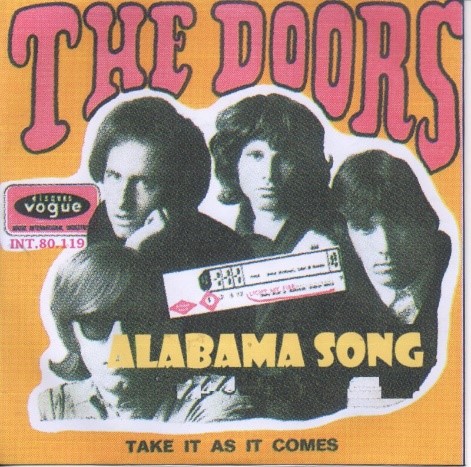
Jim Morrison, who we can hardly accuse of prudery or conventionality, who, for instance in “The End”, effortlessly identifies with Oedipus, and in a dramatic reconstruction kills his father and does the unthinkable with his mother, the Lizard King, who doesn’t practise self-censorship when he loudly proclaims the pleasures of anal sex (“Back Door Man”) – this taboo-breaking Morrison does have a boundary after all, as it turns out when he sings the second verse of “Alabama Song”, the fifth track on the “greatest debut album of all time”, 1967’s The Doors.

“Alabama Song” (or “Whiskey Bar”, or “Moon Of Alabama”, the song has been recorded and performed under different titles) is, along with “Mack The Knife” and “Pirate Jenny”, one of the crown jewels of the song treasure left to the world by Bertolt Brecht and Kurt Weill, and has probably been under Dylan’s skin since 1963, when he breathlessly absorbed a performance of Tabori’s play Brecht On Brecht. At least, that is what we can conclude from both the memoirs of Dylan’s girlfriend at the time, Suze Rotolo (A Freewheelin’ Time, 2008: “Brecht would be part of him now”) and from Dylan’s own autobiography Chronicles (2004):

“Every song seemed to come from some obscure tradition, seemed to have a pistol in its hip pocket, a club or a brickbat and they came at you in crutches, braces and wheelchairs. They were like folk songs in nature, but unlike folk songs, too, because they were sophisticated.
Within a few minutes I felt like I hadn’t slept or tasted food for about thirty hours, I was so into it.”

And Dylan, of course, is not the only one touched by Brecht songs. Sinatra, Ella Fitzgerald, Bobby Darin, Marianne Faithfull, Bing Crosby, David Bowie… the entire premier league plus the divisions below it have Brecht & Weill songs in their repertoire. Including “Alabama Song”, with that second verse:

For we must find the next pretty boy,
For if we don't find the next pretty boy
I tell you we must die
I tell you
I tell you
I tell you we must die!

… the verse that Jim Morrison, apparently fearful of homoerotic connotations, cannot get out of his throat. Instead, Mr. Mojo Rising sings:

Show me the way to the next little girl
Oh, don't ask why
Oh, don't ask why
For if we don't find
The next little girl
I tell you we must die

Even more remarkable is the fact that even Bowie is beating about the bush. Remarkable, given that in his wild 70s, Bowie had no qualms about venting his bisexual predilection, with a fairy stage presence and an androgynous image. But when Bowie has shaken off his mascara and funky hair, in 1980, and records “Alabama Song”, he too sings very straight:

Oh show us the way to the next little girl
Oh don't ask why, no don't ask why
For we must find the next little girl
Or if we don't find the next little girl
I tell you we must die

(Although, in the twenty-first century, both Morrison and Bowie would probably have found this “little girl” a little too sensitive as well.)

“Nice young pretty boys” are, in short, rarely sung by our male entertainers. But Dylan, in 2020, seems to be beyond shame. Partly, at least. He doesn’t yet go so far as to put himself in the shoes of an I-person looking for a handsome lad, but is emancipated enough to allow his interlocutor a homoerotic escapade: Go back to the gutter and try your luck – find you some nice young pretty boy.

It is the first and only time in the studio version of “Crossing The Rubicon” that Dylan makes such an atypical, semi-aggressive allusion to his opponent’s sexual preference, whether supposed or not. There is a charm in the fact that the poet borrows words from a song that is almost a century old, but it is atypical and alienating nonetheless. Dylan himself seems to think so too: these words, and the entire verse, are radically removed even before the first performance – in none of the 53 performances of the American tour in which “Crossing The Rubicon” debuts (Phoenix, 3 March 2022 – Denver 6 July 2022) is this verse sung. Weirdly enough, Dylan initially seems to want to keep a homoerotic allusion anyway, as evidenced by that odd text change in the previous verse, in verse 6, in which he changes the original lines

You defiled the most lovely flower in all of womanhood
Others can be tolerant - others can be good

and replaces with:

Well, you foxy man, you’re the talk of the town
You’ve been suckin’ off all of the younger men

… but as we have seen, this variant lasts only three performances (Phoenix 3, Tucson 4 and Albuquerque 6 March). At the fourth concert (Lubbock 8 March), Dylan already waters down the line by deleting the vulgar “sucking off”: “You foxy man, you’re the talk of the town, you been going down for other men”. And from performance five (Irving, 10 March) onwards, this last LGBT+ connotation has also completely disappeared:

Well, there’s nothin’ you got, my good man, 
    and that ought to be understood
You can keep your gifts, take ’em all back, 
    I got things that are just as good

After which, with the earlier deletion of the seventh verse, the entire song is finally completely free of same-sex innuendo.

Apart from discomfort at the nice young pretty boy fragment, the song poet might also feel a certain redundancy at the opening of this deleted verse. “You won’t find any happiness here – no happiness or joy” has the same tone and communicates the same message as the Dante quote in stanza 1, as “abandon all hope”. It could be a nod to his old comrade in arms Roy Orbison, to his charming little ditty “Paper Boy” (1959), with the same opening words;

I walk down to the blue side of town
Where there's no happiness, no joy
Down at the end of a long dark street
I saw a little paper boy

… but a reverence to The Big O would probably have been less subtly hidden and, moreover, not so rashly deleted. No, “dispensable,” he probably thinks, like the unspectacular metaphors he chose for the next two equivalents in the accumulatio, “I strapped my belt and buttoned my coat”: dispensable.

The ghost couplet, as befits a good ghost, does not disappear completely. The band keeps playing it, but the words don’t come. In all his performances, Dylan remains stoically silent, at the piano, sitting through the verse. The now-empty verse still does get its own intro, though; a sudden, frightening eruption like the entrance of Monty Python’s Spanish Inquisition, or rather à la Scottie Moore’s solo in “Heartbreak Hotel”, insinuating a dramatic climax – but soon Tony Garnier’s bass, à la Bill Black in “Heartbreak Hotel”, calms the waves. And peacefully, the Rubicon ripples on to the next verse.

Crossing The Rubicon live: the silenced 7th verse at 4’17” (Spokane, 28 May 2022):

To be continued. Next up Crossing The Rubicon part 13: I’m hot as a bull


Jochen is a regular reviewer of Dylan’s work on Untold. His books, in English, Dutch and German, are available via Amazon both in paperback and on Kindle:


Posted in Uncategorized | Leave a comment

Bob Dylan And Roland Barthes

By Larry Fyffe

Friedrich Nietzsche expounds that we have killed God, He being found wanting as the author of all creation.

Rowland Barthes posits that modernists like Ezra Pound and TS Eliot, and subsequent poets, have killed off the writer (killed off William Blake, for example) as the creator of a piece of art.

Words have many meanings of their own over which creative authors have little control: “the birth of the reader must be at the cost of the death of the Author” (Barthes).

French Symbolists, akin the Edgar Allan Poe, focus on the sounds of intertwined words; any meaning or message within the lyrics of a poem is left for its readers or listeners to dig up.

Seems they’re all struggling on dry land in the unconscious waves of a Jungian sea:

Here I was wandering, with my eyes 
Riveted to ancient cobble stones
When with sunshine in your hair, in the street
And in the night, you appeared to me, laughing
And I thought I saw the fairy with a hat of clarity
(Stephane Mallarme: Apparition ~ translated)

Could be said, an imaginative concept that’s not lost, but surfaces rather negatively in the sound of the song lyrics quoted beneath:

Sweat falling down, I'm staring at the floor
I'm thinking about that gal who won't be back no more
(Bob Dylan: 'Til I Fell In Love With You)

However, all in all, the tables are turned, upset on Roland.

Announced below is that the death of the author and his sentiment (“the light is never dying”) is greatly exaggerated; the over-optimism of Romantic God-pervading Transcendentalists, even of the mythological Elysian Field, not dead.

A Hamlet archetype he be; the author is a-gonna, at least figuratively, avenge his traditionalist father’s death; regrets leaving his true love hehind.

The author is revived:

I'm learning, still yearning
Thinking about that gal I left behind ....
As I walked out in the mystic garden
On a hot summer day, on a hot summer lawn
Excuse me ma'am, I beg your pardon
The gardener is gone
Ain't talking, just a-walking
Up the road around the bend
Heart burning, still yearning
In the last outback of the world
At the water's edge
(Bob Dylan: Ain't Talking)

Posted in Uncategorized | 2 Comments

NET 2008 Part 2 Something’s out of whack: Salzburg and Odense


By Mike Johnson (Kiwipoet)

We finished Part 1 of 2008 with four songs from Modern Times (2006) from the Dallas concert. Indeed, Dylan weighed his setlists heavily with his most recent songs, not just from Modern Times but Love and Theft also. For example, at Salzburg, 11th June, ten out of the 19 songs on the setlist were from those two albums and just one (‘Till I Fell in Love with You’) from Time Out Of Mind. The rest were a scattering of 1960s songs with no songs from the 1970s or 1980s. Exactly the same at Odense (28th May), ten new songs, none from the 70s or 80s.

I surmise from that, and the enthusiasm of these performances, that Dylan related to those songs more strongly than the others. This weighting may be one reason why many Dylan fans fell out of love with the NET – they just weren’t getting enough of the old Bob, the one they knew and expected to see.

‘Nettie Moore’ couldn’t generate the recognition and affection that ‘Mr Tambourine Man’ could. Yet here it is, from Salzburg, a solid, powerful performance. Despite the funereal beat and apparent seriousness of the song, there’s a good deal of absurdity in it, the kind of humour we associate with the two most recent albums.

Don't know why my baby never looked so good before
I don't have to wonder no more
She been cooking all day, and it’s gonna take me all night
I can't eat all that stuff in a single bite

 Nettie Moore

And yet that kind of madcap humour is evident in Dylan’s earliest work.

I gotta woman, she's so mean
She sticks my boots in the washing machine
Sticks me with buckshot when I'm nude
Puts bubblegum in my food

That’s from ‘I Shall Be Free No: 10’ (The Freewheelin Bob Dylan, 1963).

We find the same style of humour in ‘Honest with Me’ (Love and Theft, 2001)

My woman got a face like a teddy bear
She's tossin' a baseball bat in the air
The meat is so tough, you can't cut it with a sword
I'm crashin' my car trunk first into the board

I’m not sure what that last line means, but the implication is clear enough. The blues tradition of men complaining about their women fits Dylan just like a glove. However, this later humour has a darker edge.

I'm here to create the New Imperial Empire
I'm gonna do whatever circumstances require
I care so much for you, didn't think I could
I can't tell my heart that you're no good

Is that even funny, given the current state of global affairs?

Dylan holds nothing back in this raw Salzburg performance.

Honest With Me

Because ‘Beyond the Horizon’ from Modern Times was not performed as often as some of the songs from that album, good live recordings of that song are all the more precious. This recording from Odense (28th May) comes as close as I can find so far to a definitive performance, if there is such a thing, despite the background audience noise.

The dumpty-dum becomes the plinkity-plunk of the Ink Spots of the 1930s, gentle and lilting. I can imagine the Ink Spots singing this song, if it had been around then. I wonder if anyone would have noticed the hidden depths in the apparently straightforward if rather melancholy lyrics.

Beyond the horizon the night winds blow
The theme of a melody from many moons ago
The bells of St. Mary, how sweetly they chime
Beyond the horizon I found you just in time

This is my favourite song from the album after ‘Ain’t Talkin’ and is, I believe, one of Dylan’s most successful ‘retro’ songs.

Beyond the Horizon


In the same gentle vein, we find ‘Moonlight’ also on Love and Theft. This is another song which wouldn’t have sounded too out of place on an Ink Spots album. There’s a wistfulness in this song which makes us wonder if she ever will meet him ‘in the moonlight alone.’ As Christopher Ricks points out in his Dylan’s Visions of Sin, the number of times he has to put the question puts the outcome in doubt. One of the things I like is the song’s evocation of nature. The song’s focus is as much on nature’s ‘turning seasons’ as on the desire for love.

The dusky light, the day is losing
Orchids, poppies, black-eyed Susan
The earth and sky that melts with flesh and bone
Won't you meet me out in the moonlight alone?

This one’s from Salzburg. There’s a welcome and unexpected harp break before the last verse. I wonder what the Ink Spots would have made of it.

Moonlight (A)

Fans of the song might appreciate this performance from Vigo, Spain. Rather than a harp break, there’s some nicely appropriate guitar work. As with Odense, a bit of background audience noise here.

Moonlight (B)

There’s a very contemporary ring to ‘The Levee’s Gonna Break’ for even as I write, flooding has been threatening the Mississippi due to heavy rains. That Dylan was most probably writing about the 1927 floods doesn’t change that. In this age of global heating and its effects this song is just as relevant now, if not more so, than when it was written twenty-one years ago. ‘Some of these people don’t know which road to take.’ This one from Odense.

The Levee’s Gonna Break

As in 2007, ‘Summer Days’ is one of Dylan’s firm favourites. This is an exuberant, celebratory song from the jump jazz tradition of the 1930s. My preference is for this jaunty performance from Odense.

 Summer Days (A)

But it’s also hard to resist this high-spirited performance from Salzburg.

Summer Days (B)

‘High Water (For Charlie Patton)’ is another regular, and another prescient extreme weather event song, regularly but wrongly interpreted as being about Hurricane Katrina. It was written before then. At best the song has a heavy, apocalyptic fury to it. I think the 2006 performance is the best so far (see NET 2006 part 3) but this one from Odense is close to it.

However, the way Dylan emphasizes the second half of the line means that the first half of the line gets gabbled. If you don’t know the words you won’t be able to make them out. This is an experiment in terms of the phrasing, and I’ll leave the reader to decide how successful that is.

High Water (A)

The same issue is evident in the Salzburg performance, maybe a little more pronounced.

High Water (B)

‘Tweedle Dee, Tweedle Dum’ was the opening song at Odense as ‘Maggie’s Farm’ began to fade as Dylan’s favourite opener. It’s also the opening song on Love and Theft. As I’ve said before, I find it hard to work my way into this song. It’s not so much that I don’t know what the song is really about, many of the later Dylan songs are not necessarily about any one identifiable thing, but what the affective centre of the song is. That is, the emotion that’s driving it. That it’s about betrayal and backstabbing is clear enough, and, it has its own intrigue.

Well, a childish dream is a deathless need
And a noble truth is a sacred creed
My pretty baby, she's lookin' around
She's wearin' a multi-thousand dollar gown

Tweedle Dee, Tweedle Dum

‘Rollin and Tumblin’ sounds just the way the title reads. It rolls and tumbles like a sleepless man, and is a darker song than the frenetic tempo might suggest. It’s the agonies of a love gone sour that drive this song. Another urban blues, solidly in the complaints-about-love genre. The touch of hope at the end, before the final chorus, may well be tinged with sarcasm. Going ‘down to the greenwood glen’ to make amends sounds too bucolic to be real:

Let's forgive each other darlin', let's go down to the greenwood glen
Let's put our heads together, let's put old matters to an end

Why do I think that’s just not going to happen?

This first one is from Odense.

Rollin and Tumblin (A)

That kicks it along, but so does this one from Salzburg.

Rollin and Tumblin (B)

‘Sugar Baby’ was not performed as often as the faster-paced songs from the last two albums I’ve focused on here. Because of the chorus, and the line ‘you ain’t got no brains no how,’ it might seem like an attack song like ‘Like a Rolling Stone’ but it’s much softer than it at first appears, or maybe more contemplative.

‘Love’s not an evil thing,’ he sings, but the prospects of success in love are not bright. Fate can play some dirty tricks on us, and happiness can vanish in the blink of an eye. In addition, our good intentions may be counterproductive.

Every moment of existence seems like some dirty trick
Happiness can come suddenly and leave just as quick
Any minute of the day the bubble could burst
Try to make things better
For someone, sometimes you 
    just end up making it a thousand times worse

The mood is one of sad resignation rather than anger or bitterness. This is well captured by this Salzburg performance.

Sugar Baby

I had to go back to Dallas to find this performance of ‘Mississippi,’ perhaps Dylan’s greatest early 21st Century song. I have it sitting right beside ‘Ain’t Talkin.’ Once more I can only recommend Jochen Markhorst’s massive study found on Untold Dylan here https://bob-dylan.org.uk/mississippi. Markhorst has said it all.

‘The emptiness is endless,’ Dylan sings, and the song certainly makes us feel it. This is a good recording, and Dylan is in excellent voice, but I find the performance less than compelling because of the dumpty-dum which, to my ear, trivializes the song, turning it into a stilted waltz. The effect is quite peculiar and unsettling. It just doesn’t do the song justice. The album version and the 2001/2002 performances have a touch of grandeur, an epic feel befitting the scope of the song. That’s all gone here. We have this weird, childlike tempo. Something’s out of whack. Make of it what you will.

Mississippi

I’m going to stay in Dallas to quickly catch ‘Blind Willie McTell.’ It’s got a bit of a lilt but otherwise is played straight. Enthusiastically played and received.

Blind Willie McTell

That’s it for now. I’ll be back shortly to see what else we can uncover in 2008.

Kia Ora


Posted in Uncategorized | 1 Comment

Dylan cover a day: Most of the time and a rhythmic thing

By Tony Attwood

I have a problem with “Most of the Time” in that there is a recurring rhythmic theme within it which is (in my head of no one else’s) very close to that used in “Take a walk on the wildside” by Lou Reed.   I doubt it was deliberate – these things can just happen, but it gets at me somewhat.   In case by any strange chance you have an interest in what I am writing about here, I’ll stick a copy of the old “do do do do do do, do do do do do do do do” at the end.   But meanwhile, back to the show…

Some of the tracks I include in this series are put in because I have known them for quite a while and always enjoyed them.  Others turn up as I do what passes for research in the run up to each article.    And this first version of Most of the Time falls into this category.

Quite possibly everyone else already knows it, but for me it is a wonderful discovery this saturday morning.

Sandra McCracken is described on her website as “Sandra McCracken is a singer-songwriter and hymn writer from Nashville, Tennessee. A prolific recording artist, McCracken has produced 14 solo albums….”   So very much my loss in not knowing about her before.

Openings are important.  Opening lines of poems, opening paragraphs of books.  The first sentence of a speech to a live audience…  quite often it seems to me that performers and writers forget this remember this.   But this track gets it right, and from this moment on everything is perfection.   Having the two singers is an excellent idea, and their voices work together so well over the accompaniment.   Brilliant.

Contrast the above with the next version below (Dean and Britta) where everything is submerged behind the notion of using the echo.   OK, so echoing is often used as a way of representing what is going on in a person’s head, but line after line after line of it seems overkill, and it doesn’t fit with what the guitars are doing.  It’s an all-right idea but it’s just used too much.

Luna on the other hand, give us a straighter version, which works ok, except for the fact that there seems to be a desire to add effects where ever possible, a sudden bit of bass here, a something else there… and the vocalist just seems to be somewhere in the studio, not centrally engaged with the song, but just being.

And so finally we come to Sophie Zelmani.  This is what her website says:

“Sophie travels in the same musical timeless space as Leonard Cohen and Bob Dylan. She has refined her distinctive expression for more than 25 years as an artist -the level and consistency of her creation has been steadily high throughout her career.”

Ms Zelmani did a version of the song for Masked And Anonymous and not for the first time I agree with Jochen when he said of this recording, “here everything falls into place.”

This is a case of the voice fitting exactly into the demands of the song.  I don’t know if that just happens or it is pure talent on the part of the vocalist

That is a wonderful recording, and having played it again I am not sure I want to spoil the effect by giving the promised Lou Reed do do do thing, but I did promise, so here it is.  You can see if there is a link between the rhythms, or whether the old man writing these notes has finally lost it totally.  Although if you want to keep the beauty of Sophie Zelmani in your head, just forget I ever mentioned it.

The Dylan Cover a Day series

Posted in Uncategorized | Leave a comment

Crossing The Rubicon (2020) part 11: A bridge crossing the Avon, Warwickshire

by Jochen Markhorst


XI         A bridge crossing the Avon, Warwickshire

I’ll cut you up with a crooked knife 
     and I’ll miss you when you’re gone
I stood between heaven and earth and I crossed the Rubicon

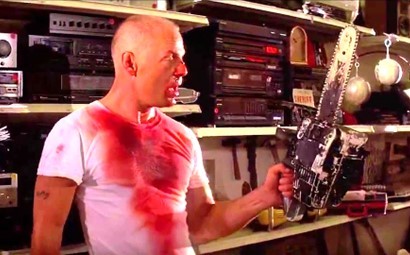
 Butch (Bruce Willis) needs about forty seconds, in Quentin Tarantino’s Pulp Fiction (1994). He has managed to free himself, knocks out the gimp with one blow, opens the curtain and walks upstairs, through the pawn shop, and opens the shop door to freedom. But down in the basement, gangster boss Marcellus is being raped by hillbilly psychopaths Maynard and Zed. Butch hesitates. Marcellus is an enemy and has a price on his head, but you wouldn’t wish this on even your enemy. Butch pushes the door shut again. He shall help Marcellus. He needs a weapon. Butch looks around behind the counter. Finds a claw hammer. No, not destructive enough. There is a chainsaw. He hesitates for a moment, puts it back. A baseball bat, a large Louisville slugger. And then he sees the perfect weapon: a samurai sword. Butch descends the stairs to the basement again, and cuts Maynard up with his crooked sword.

It was a good choice of weapon, and it took Butch 40 seconds. With Dylan, it takes a little longer, but not much longer. In the fourth verse, at 2’19”, his protagonist comes to his bloodthirsty decision (“I’ll make your wife a widow”), at 3’50” he has chosen his weapon: “I’ll cut you up with a crooked knife”.

It is, like with Tarantino, an original choice. Not the choice for a knife as such, of course. Passion seems to be a driving motive here, and thanks to Columbo, Perry Mason and Derrick, by now all of Western civilisation knows the criminalistic rule-of-thumb knife = passion. Which, by the way, is really scientifically confirmed. In their study Homicides and Weapons: Examining the Covariates of Weapon Choice (2018), researchers Pelletier and Pizarro neatly prove, using an enormous mountain of data, that “relative to incidents involving strangers, family/intimate partner (β = 1.290, p < .05) and friend/acquaintance (β = 1.268, p < .001) homicides were more likely to be committed with a knife or blunt object as opposed to a firearm” – there is indeed quite a significant difference.

And we know it from the canon too, of course; Dylan’s record collection is full of knife-wielding murderers. Tom Dooley, Mack the Knife, Pretty Polly, Henry Lee… plenty of stabbers and stabbing victims. The murderers wield switchblade knives, bloody knives and jack knives, occasionally a carving knife or a butcher’s knife (in Manfred Mann’s 1975 murder ballad “Fat Nelly” for instance, the still breathtaking hybrid of lurid nursery rhyme and furious jazz rock exercise). Never a crooked knife, though.


Dylan cannot have come across too many crooked knives, and it is an attractive, if once again confusing option, that he read it with the other Great Bard, and that it then got stuck in his working memory: the last words of Shakespeare’s “Sonnet 100”;

And make Time's spoils despised every where.
Give my love fame faster than Time wastes life;
So thou prevent'st his scythe and crooked knife.

Attractive and confusing, as it opens the gate to a next interpretation option. Shakespeare’s sonnet personifies the Muse and bitterly reproaches her for abandoning him. To add insult to injury, she visits others (“Spend’st thou thy fury on some worthless song”). But after the reproaches and lamentations in the first part of the sonnet, follow the humble entreaties to return, to give the poet songs:

Return, forgetful Muse, and straight redeem
In gentle numbers time so idly spent

… remarkably, Willy the Shake uses the same idiom here as Dylan will choose in verse 3 (How can I redeem the time – the time so idly spent).

Which, combined with the placement of “Crossing The Rubicon” on the album, opens up new vistas. After all, the song follows “Mother Of Muses”, with the opening that both Dylan and Shakespeare borrow from Homer: Mother of muses sing for me, and with the closing couplet that almost organically flows into the opening line of “Crossing The Rubicon”:

Take me to the river, release your charms
Let me lay down once in your sweet lovin’ arms
Wake me, shake me, free me from sin
Make me invisible like the wind
Got a mind to ramble, got a mind to roam
I’m travelling light, and I’m a-slow coming home

“Take me to the river”, “free me from sin”, “I’m travelling”, “I’m coming home”. And then, after the gap groove, we hear that the I-person “crossed the Rubicon on the 14th day of the most dangerous month of the year” to find the Muse via the sin-cleansing purgatory… Dylan seems to be writing the introduction to a song in which the Muse is found on the other side of the Rubicon. An interpretation to which the other words of this sixth verse adjust without too much acrobatics. I’ll miss you when you’re gone speaks for itself, and the next metaphor in the accumulatio, in the series of “crossing the Rubicon equivalents”, I stood between heaven and earth, is a beautiful, poetic image for The Zone in which the poet finds himself when he has received divine inspiration.

Attractive, all in all, such a bridge being built between the sixteenth-century Father Of Muses from Stratford-upon-Avon and the Nobel Prize winner in Malibu from the twenty-first century, with that single “crooked knife”. But alas… when Dylan brings the song to the stage, March 2022, the bridge soon collapses. Dylan disposes of the murder weapon. As of March 11 (sixth concert, Sugar Land, Texas), the knife is gone, and it does not return.

However, it is not entirely clear whether literary motives are the deciding factor. Bizarrely, Dylan seems to have singing problems with the line. At the live debut, 3 March 2022 in Phoenix, Dylan stumbles over exactly this third line of the sixth verse:

I’ll rip your heart, cut your heart out with a crooked knife

… in which he probably accidentally sings “rip your heart” (studio version: I’ll cut you up) – and then quickly improvises and corrects to get “cut” in after all. So the next evening, in Tucson, he tries to avoid “crooked”:

Well, I’ll cut your heart out with a broken knife

The third concert, Albuquerque 6 March, “crooked” may return, but then seems to mess up the line after:

I cut your heart out with a crooked knife 
   and I’ll weep on your, over you when you’re gone

… after which, at his fourth attempt, Lubbock 8 March, he is almost entirely successful:

I’ll cut you up with a crooked knife, 
   I’ll weep over you after you’re gone

But it is a last hurrah. Irving 10 March, the fifth time “Crossing The Rubicon” is on the setlist, is the last time we hear “crooked knife” – which again seems to lead to a crumpled follow-up line:

Well, I’ll cut your heart out with a crooked knife 
   and I’ll burn it till it’s gone

The transition to the substitute of the knife is messy. At the sixth concert, Sugar Land, Texas, 11 March, almost the entire verse has been changed. Changed beyond recognition even, replaced by a bloodless, violence-free version that will only be sung on this night in this suburb of Houston, within walking distance of the Sugar Land Prison where Lead Belly wrote his “Midnight Special”:

I bet you got nothing that I want, my good man, 
   should be, should be clear
Keep your gifts, you can take ’em all back, 
   I got things that are just as good
The evening sun is low, until it’s gone
I stood between heaven and earth, and I crossed the Rubicon

… clearly improvised on the spot. No rhyming in the first lines, and forgotten is the murder. Dylan thinks so too afterwards in the bus to San Antonio. For the seventh concert, 13 March in San Antonio, the master has finally got his act together. The verse is rewritten and will remain in this form for the rest of the tour, the remaining 46 concerts:

Right or wrong what can I say, what more needs to be said
I’ll spill your brains out on the ground, 
     you’d be better off over there with the dead
Seems like ten – maybe 20 – years now that I’ve been gone
I stood between heaven and earth and I crossed the Rubicon

“Spill your brains out on the ground”… Dylan apparently put the crooked knife back after all, and went back to the second-to-final choice, the baseball bat, the large Louisville slugger.


To be continued. Next up Crossing The Rubicon part 12: We must find the next little girl


Jochen is a regular reviewer of Dylan’s work on Untold. His books, in English, Dutch and German, are available via Amazon both in paperback and on Kindle:


Posted in Uncategorized | 9 Comments

Bob Dylan: Puritanism And It’s Obverse

by Larry Fyffe

Any Euro-centric analyst of Bob Dylan’s artistic output has to be counterbalanced by the singer/songwriter’s deep awareness of Americana – the influence of Puritanism on the American psyche, for example.

Zealous Puritans latch onto the “Gnostic-like” cosmological view that the material world is hopelessly corrupt and depraved; the only individuals who are going to escape from it are those chosen to be part of the ‘elect’ ….off they will be to a paradisal Afterlife.

An anxiety-ridden religion in that no one knows for sure if they are one of the few or not that God has listed to join Him in Heaven.

That angst is expressed in the following song lyrics:

Well, my house is on fire, burning to the sky
Well, I thought it would rain, but the clouds passed by
Now I feel like I'm coming to the end of my way
But I know God is my shield, and He won't lead me astray
(Bob Dylan: 'Til I Fell In Love With You)

The Puritans, not knowing if they are members of the Elect sail for America, the Promised Land, in search of the ‘American Dream’; inner-directed self-reliance, not outside instruction, be the key to salvation;  signified it’s hoped by economic success.

Distractions from the commands of a strict God to be avoided.

God forbids even lusting after another in one’s own mind:

Well junk is piling up, taking up space
My eyes feel like they're falling off my face
Sweat falling down, I'm staring at the floor
I'm thinking about that girl who won't be back no more
(Bob Dylan: 'Til I Fell In Love With You)

Woe unto those who allow their eyes or spectacles to fog up:

You want clear spectacles: your eyes are dim
Turn inside out, and turn your eyes within
Your sins like motes in the sun do swim: nay see
Your mites are moleheads, moleheads mountains be
(Edward Taylor: The Accusation Of The Inward Man)

Hypocrisy, based on the sin of hubris, is what Bob Dylan often sees in his critique of the social norms of America, the New Babylon.

That the sanctification of economic success be a religious superstructure (proposed by Karl Marx) is dismissed.

The obverse of ‘Til I Fell In Love With You’ turns the meaning of the song on its head ~ too much devotion to a demanding God, or the love of money for itself (the Golden Cafe), will diminish the light of natural love that individuals can have for each other.

Dark (warehouse) sunglasses, a symbol thereof:

With your silhouette when the sunlight dims
Into your eyes where the moonlight swims ...
My warehouse eyes, my Arabian drums
Should I put them by your gate
Or, sad-eyed lady, should I wait
(Bob Dylan: Sad-Eyed Lady Of The Lowlands)


We also have an active Facebook group 

Posted in Uncategorized | Leave a comment

Other people’s songs: Blue Moon, and North London Forever

By Aaron Galbraith and Tony Attwood

Aaron: “Blue Moon” was written by Richard Rodgers and Lorenz Hart in 1934. That is considered by musicologists to be the first instance of the familiar “50s progression” in a popular song.

Here is an early recording by Al Bowlly in 1935.

Tony: I’m not sure the “50s progression” is that commonly used in the UK as the term to describe what happens here, although anyone who listens to chord progressions will, I am sure, immediately recognise it.   So, to give a simple explanation, if you are at the piano or playing the guitar, it is the chord sequence which, in C major, runs

C major, A minor, F major, G major.

Although of course as we can see here it was being used in the 1930s, but certainly by the 1950s is was as common in pop as that other most famous progression, the “12 bar blues” (which confusingly is rarely played as 12 bars).   That, in C, would run.

C major, F major, C major, G major, F major, C major.

For an example of that think of Elvis Presley singing “Hound Dog” – which actually does play the sequence as 12 bars.

And Elvis is relevant here because…

Aaron: Elvis Presley included his version of Blue Moon on his debut 1956 album…

Bob’s version appeared on Self Portrait

Tony:  Bob uses a rhythm which certainly took me by surprise (not having listened to this track for years and years).  And I think if I had no idea of who the singer was, and didn’t know Bob had recorded the track, I wouldn’t have guessed it was him.  Perhaps I would have said, it was recorded by “someone who has been listening to a bit of Dylan,” but that’s as close as I would have got.

I must say I still find the ending very odd.  Certainly unexpected (unless of course you know the track already and were expecting it!)  It sounds like one of those things that Bob heard in the studio and said to the viola play “hey do that at the end” so she/he does.

Coming back to the beat, I’m really a bit surprised here.  The middle 8 turns the song from its sadness into happiness, but the usual ending (as far as I know) is of the type that is heard in the Elvis recording, ending “without a love of my own” and fade…

But the middle 8 says

And then they suddenly appeared before meThe only one my arms will ever holdI heard somebody whisper"Please adore me"And when I lookedThe moon had turned to gold

and I guess that is what the musical coda signifies, and yes at that level it certainly works.

Aaron: Subsequent versions include those by New Edition in 1986…

Tony: Oh I remember this and thought it was quite amusing at the time.  It does show you can do almost anything with this song – including taking the middle 8 at half the speed of the verses, which is quite fun.

Aaron: Rod Stewart & Eric Clapton in 2004.

Tony: Another one of those in which the version Aaron has found in the USA won’t play in the UK (where I am) so I’ve also put a version by the guys that I have found below.  I’m hoping it is the same one that you found in the USA, Aaron.

Tony: It’s all very pleasant and sweet, but not something I would opt to put on.  It is, for me (and of course my comments are always totally personal) just too sugary for my taste.  As my acupuncturist – who I see each month to treat my tinnitus – said to me a few weeks ago, having listened to the latest (very limited edition) CD of songs I’ve written, “They are all so whistful and sad.”  And that’s where I always seem to be, at least in terms of songwriting.   But I rather suspect Bob likes it because of the beautiful construction of the music – the way the melody can float over that repeated chord sequence is indeed just something else.  In fact, songwriting to die for.

Aaron: Liam Gallagher… I’m only including this as a little wind-up, honestly feel free to ignore!

Tony: Aaron, I would never dare ignore anything you suggest, as I am sure you know perfectly well.  And to explain to everyone else, the shirt seen at the start of this video is that of Manchester City, an English football club funded by Sheikh Mansour bin Zayed Al Nahyan through the Abu Dhabi United Group.  The club use “Blue Moon” as a theme song.

However, as I was born and brought up in north London I support, (as my family has done through previous generations) and have a season ticket for, Arsenal.  And indeed I was in London last night watching them maintain their place at the top of the Premier League.   My club uses “North London Forever” as its theme – and the chorus is sung by the crowd at the start of each match.   And like many people brought up in north London I’m incredibly proud of my heritage.

North London foreverWhatever the weatherThese streets are our ownAnd my heart will leave you neverMy blood will foreverRun through the stone

There’s a second video at the end of the song, just in case you are interested, recorded at Arsenal, during which you do get a quick look at the ground.

And perhaps I should add, as there is every chance you are not familiar with the lingo, the song is written and performed in a north London working-class accent.

(I never thought I’d find a way of slipping this song in.  Brilliant, Aaron, thank you).

———————–

We also have a very active Facebook group, which you can find through your search engine by typing in Untold Dylan Facebook.

Previously in this series…


Posted in Uncategorized | Leave a comment

Dylan Cover a Day: Most likely you go your way

By Tony Attwood

At first I wasn’t at all sure about this 100 miles an hour version of the song, but it really has grown on me.  It contains the accent on the last word of each line as Bob has done in some performances.

But there is a problem with a performance at this speed; it is very hard to put in any nuances.  Yes there is a nice bit of harmony at the end of the verse and the harmonica gets a nice solo in the instrumental but otherwise the slight relaxation of the vocals in the post-instrumental verse is pretty much all we have by way of innovation once the tempo has been set.

Terrance Simien & The Zydeco Experience however do manage to rework the song a little and gain a much more relaxed feel.   I am not sure this version tell us anything new – until we get to the two chorus lines, but I would just like to have something more to appreciate.  The “Time will tell” line however does bring an element of freshness

In all there are two problem with this song: the instrumental concept at the start of the piece is so clearly identified with the song, we know where we are before we start.  And then there is the opening chord (the supertonic to be precice) which is very, very unusal for a rock song as an opening.   It doesn’t matter if you don’t have a clue what I am talking about there, you’ll know the feeling – hear that opening and you know what the song is going to be.

So even the Yardbirds, who most certainly knew a thing or two about how to play this type of music really struggled to make any sort of difference

Patti LaBelle and her arrangers really did try with a long introduction, and keeps on innovating all the way through.  It is certainly refreshing, but after the first verse I felt, well, ok, yep, I get it, and how much more of this is there.  Which is the old problem – I know the song too well.  I think I’m just getting old.

But not for the first time Jochen’s superior knowledge comes to the rescue with a really delightful recording of the song.  And I was tempted to wipe out my references to all the other versions of the song that are included above, but then I thought I would leave them in, because they show us all how hard it can be to escape Bob’s original thoughts.  But in the end it is always possible, given enough talent.

Now it is the old song, and it is a new song.  And believe me, being both, well, that ain’t easy.

Interestingly that wasn’t Jochen’s prime choice for a cover of this song – and curiously he made a reference to the getting copyright clearance.  Perhaps that is why the video he found is no longer available.  But click on this link and you might well be able to get to it.

https://youtu.be/bny98srX6CY

For me it doesn’t match Gerry van der Laan but it is worth a listen – if for nothing other than the instrumental break.

And these final two recordings do show us once again: with talent and a real insight of what there is within the song beyond that which we immediately hear, something interesting can be achieved.

The Dylan Cover a Day series


Posted in Uncategorized | 2 Comments

Damn The Comma

by Larry Fyffe

A modern playwrite has a a character bring up the Four Gospels, specifically Luke 23: 43, on the subject of salvation through repentance:

“But all were there. And only one speaks of a thief being saved”

(Samuel Beckett: Waiting For Godot)

The words Jesus speaks, when wrìtten down, seems to indicate that the souls (supposedly) of a sincerely repentant thief and that of Jesus will get to “paradise” very quickly when their material bodies succumb to hanging on wooden crosses:

Verily I say unto thee, today
Shalt thou be with me in paradise

Had these words been written down without the insertion of the comma, there’d not be much of a contradiction in the continuing narrative that states Jesus (the thief now nowhere to be seen) gets to hang out with His buddies, the disciples, for a time after escaping from His tomb ~ apparently, He does the magic trick in bodily form.

Jesus not exactly sure when He’ll next see the repentant thief in paradise:

Verily I say unto you today
Shalt thou be with me in paradise

Sometime before Christ is crucified, He eats the Last Supper with His disciples.

Apostle John says  to them that Jesus says in order to make it to paradise, mortals must not only die first, but they must have sincerely repented of their sins before doing so.

The disciples eat bread and drink wine with Jesus to symbolize the consumption of a sacrificed lamb as the Hebrews do at Passover:

Who eateth my flesh
And drinketh my blood
Hath eternal life
And I will rise him up at the last day
(John: 6:54)

The Christian apostle attempts to figuratively shove the “Son of God” down the throats of Jews who do not consider Jesus to be the Messiah.

Jews abhor even the thought of drinking blood.

Seems the Last Supper is not to be considered the Passover meal as that calendar date is yet to come.

John calls Jesus the “Lamb God”, crucified, sacrificed on the day of the special Jewish celebration.

Quite confusing enough it all is to open up the mouth of sarcasm – in the following song lyrics:

Never could learn to drink that blood
And call it wine
Never could learn to hold you love
And call you mine
(Bob Dylan: Tight Connection To My Heart)

You may like to note that we also have a very active Facebook group: just type into your search engine Facebook Untold Dylan.

Posted in Uncategorized | 1 Comment

Crossing The Rubicon (2020) part 10: They’re written on plastic


by Jochen Markhorst


X          They’re written on plastic

You defiled the most lovely flower in all of womanhood
Others can be tolerant - others can be good
I’ll cut you up with a crooked knife 
     and I’ll miss you when you’re gone
I stood between heaven and earth and I crossed the Rubicon

“They’re songs. They’re not written in stone. They’re on plastic,” declares Dylan in 1991 in the SongTalk interview with Paul Zollo. He says so elaborating on his own statement that a song like “Precious Angel” is never finished. Interviewer Zollo sputters:

Zollo: “To us though they are written in stone, because Bob Dylan wrote them. I’ve been amazed by the way you’ve changed some of your great songs.”
Dylan: “Right. Somebody told me that Tennyson often wanted to rewrite his poems once he saw them in print.”

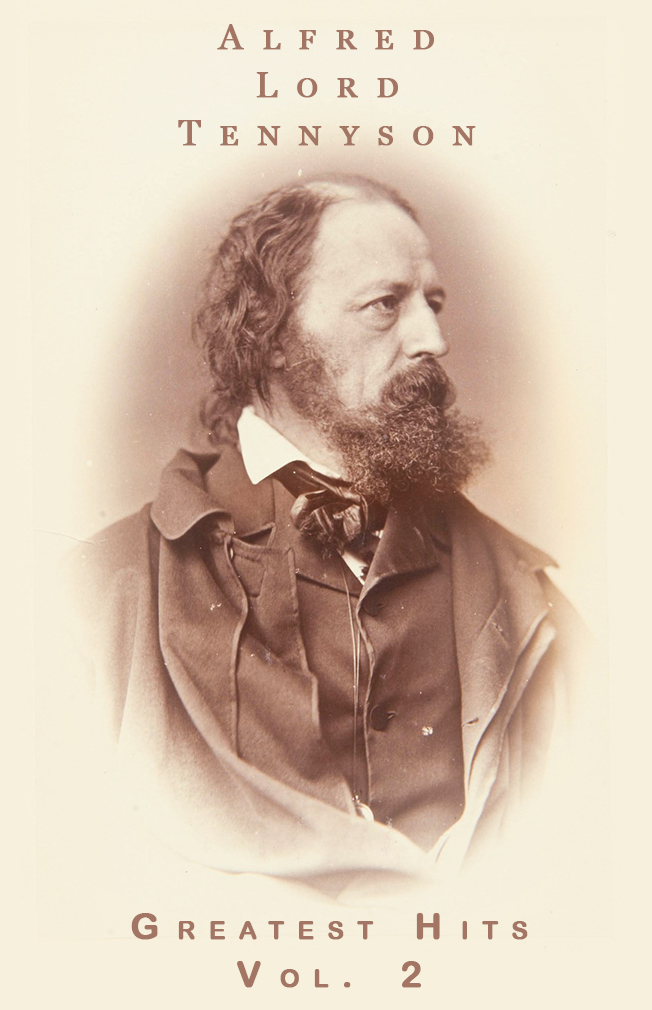
Which is true, by the way. Tennyson did indeed rewrite poems after their first publication. Greatest hits such as “The Lotos-Eaters” and “Mariana in the South”, for example, were revised, rewritten, given extra verses and whatnot ten years later, in the second edition of the collection Poems in 1842.

Dylan not only recognises the reflex; he also acts upon it. Although rarely to the extreme of revising the lyrics in the official publications (in Lyrics and on the site) – that is rather exceptional. And if he does, he sometimes even chooses to print both the original and the new lyrics (both “Gonna Change My Way Of Thinking” and “Down Along The Cove” are published together with an “Alternate Version”).

It is a fate that also seems to await “Crossing The Rubicon”. This sixth verse and the seventh verse are not going to last. Which perhaps explains why it takes such a suspiciously long time before the song is performed at all. On the first post-Corona tour, the 2021 US Fall Tour (2 November – 2 December, 21 concerts), “Crossing The Rubicon” is the only Rough And Rowdy Ways song not to be included in the setlist (not counting “Murder Most Foul”, for obvious reasons) – all eight other songs are played every night. When the song’s live debut finally takes place, Phoenix 3 March 2022, the first two lines of this sixth stanza are gone, replaced by the peculiar lines

Well, you foxy man, you’re the talk of the town 
    you’ve been suckin’ off all of the younger men
I trusted you once and that was more than enough, 
    I’ll never trust another person again

The intervention changes the tenor of the song rather radically. The original opening line, You defiled the most lovely flower in all of womanhood, confirms a scenario that was created earlier, in the second verse, with the line the blood that flows from the rose; a rape or deflowering scene. But apparently, the master dislikes it; somewhere between the recording of the song, in the beginning of 2020, and the first performance in March ’22, the defiled flower is deleted – Dylan has never sung the line on stage. After two years’ time for reflection, eight years less than Tennyson needed for his revisions.

Still too little time to think it over, evidently, as it soon transpires. The revision to the alienating, aggressive, homoerotic Well, you foxy man, you’re the talk of the town you’ve been suckin’ off all of the younger men lasts only four concerts (3, 4, 6 and 8 March), and then it is dropped as well. The last time, in Buddy Holly’s hometown Lubbock, Texas, it is toned down to You foxy man, you’re the talk of the town, you been (going) down for other men, but it is still the last time the homosexual foxy man is brought to the stage. Somewhat understandable. It smells of homophobic mockery of effeminate fag behaviour, after all. The qualifier “foxy” has, after all, been reserved for ladies for some decades now, probably since Screamin’ Jay Hawkins (“Person To Person”, 1958, Bring your own fine foxy self home), and institutionalised at the latest since Jimi Hendrix’ “Foxy Lady”. Only the unforgettable Marc Bolan dared to deviate from the gender-specific format, in “Mad Donna” (1973);

I`m a foxy man, don`t you understand, 
Would take a rocket ship, to let me get my thighs on you. 
I`m gonna change Mad Donna, l`m gonna change Mad Donna, 
I`m gonna change Mad Donna, for you.

But then again, Marc Bolan’s trademark was a cross-sexual image, with his androgynous stage presence and the ambiguous lyrics. And it’s 1973. Anyway, Dylan does not feel comfortable with his own intervention and changes the opening line again after Lubbock. First into the more neutral Well, there’s nothin’ you got, my good man and that ought to be understood (Irving, 10 March), and then into the equally meaningless Right or wrong what can I say, what more needs to be said, which with slight deviations becomes the standard for the time being. So, in the course of the first tour with this song on the setlist, Dylan revises this one line four times:

studio, January/February 2020:
You defiled the most lovely flower in all of womanhood

live debut 3 march 2022:
Well, you foxy man, you’re the talk of the town you’ve been suckin’ off all of the younger men

fourth performance, 8 March:
You foxy man, you’re the talk of the town, you been (going) down for other men

fifth performance, 10 March:
Well, there’s nothin’ you got, my good man and that ought to be understood

from San Antonio, the 7th concert up until the last, 53rd of the US tour, Denver 6 July 2022:
Right or wrong what can I say, what really needs to be said?

… with which the song has tilted back “safely”, to more ambiguous distances. In the “defiled flower” version, the focus tends towards a rape scenario. The turn to the foxy man who so diligently sucks off younger men opens up very bizarre vistas. And the – for the time being – definitive restructuring to the rather vacuous, but at least an ethical dilemma expressing right or wrong-wording still mirrors Take the high road – take the low, take the one you’re on from the previous verse.

At the same time, the equally unequivocal Others can be tolerant – others can be good, the next line, has been deleted. “Too unambiguous” could also be the reason why its first alternative (I trusted you once and that was more than enough, I’ll never trust another person again) has been deleted. Again a line that almost inevitably pushes the associations towards a rape scenario and, on closer inspection, has an unwelcome “defenceless victim” tone. The words do suggest, anyway, a traumatic event that profoundly changes the victim’s character, and the tone is plaintive. Not the tone Dylan is looking for, presumably.

“And he’d say, Ah, nah, nah, nah. That’s not the guy. And I’d say, The guy? And he’d say, Yeah. It’s not the same guy.”

… engineer Malcolm Burn probably would know how to explain Dylan’s interventions. It all goes to show: they’re songs. They’re not written in stone. They’re on plastic.


To be continued. Next up Crossing The Rubicon part 11: A bridge crossing the Avon, Warwickshire


Jochen is a regular reviewer of Dylan’s work on Untold. His books, in English, Dutch and German, are available via Amazon both in paperback and on Kindle:


Posted in Uncategorized | 1 Comment

Other people’s songs: Little Sadie

By Aaron Galbraith and Tony Attwood

Aaron: Little Sadie tells the story of a man, who is apprehended after shooting his wife/girlfriend. He is then sentenced by a judge.

Tony: It is strange that such a horrific set of events is set to such a jolly, bouncy tune, but somehow it seems to work; maybe it is because we don’t actually take any note of the reality – the music just takes over and we enjoy the piece because of that, not because of the content of the lyrics.  And of course at the time of its composition, attitudes were different.

Aaron: It is thought that Bob took his version from the March 1930 recording by Clarence Ashley

Tony: The extra speed and the exciting banjo playing means that I now hardly even hear the lyrics as a set of words with any sort of meaning.  I’m just listening to that banjo.

Aaron: Hedy West performs Little Sadie on Pete Seeger’s Rainbow Quest

Tony: Now that is invaluable – brilliant Aaron.  To see how the right-hand works to get that sound is terrific.  OK that is me getting carried away because I always want to know how the music works mechanically as well as how it works as work, but hopefully I am not the only one fascinated by mechanics.

Aaron: Bob’s version appeared on Self Portrait

Tony: I am thinking this is a different recording from the one I slipped in at the start of this piece, rather than a re-mix – the accompaniment is different.   I’ve not played each one over and over to work out the level of differences, but there are some – either in the mixing or in the actual performance.  But they are not that great.

Aaron: The song has been covered over 90 times. Here are just a couple modern versions I liked.

Tony: Ah well, if it is Old Crowe, then it must be worth listening to.  And of course they find something new to include – violin and harmonies and some extra guitar work.   The wonderful thing about these guys is that the arrangements like this never feel over-crowded.  It seems they can throw everything into the mix and it still works.  Wonderful.

Aaron: Crooked Still

Tony: It’s actually a shock to come to this version with its modern accompaniment.  And what a brilliant version it is – 100% for the arranger.  This approach makes the song of interest and worth hearing all over again.  I love it.

————————-

If you, dear reader, have slipped through to the end just to see what the selections are, and haven’t played this final version all the way through while giving it your most fulsome attention please do play it through.  It is two and a half minutes of absolute genius.

Footnote: Aside from this blog, Untold Dylan also has a very active (and excellently moderated) Facebook page.  If you don’t know it just go to your search engine and type in Facebook Untold Dylan.

Previously in this series…

Posted in Uncategorized | 3 Comments

Bob Dylan And Ezra

by Larry Fyffe

Apparently, notwithstanding the fog of history, and what is fact and what is fiction,

Jonah is reluctant to preach to nonHebrews even if a number of them do change their wicked ways; that is, they stop worshipping Baal and all; initially, Jonah doesn’t care whether or not  Nineveh, the capital of ancient Assyria, is destroyed by God Yahweh.

Then, when the Persians conquered Babylon, prophet Ezra is allowed to lead some more Hebrews back home to Judah from their Babylonian Captivity; Ezra insists they follow Ezekiel’s determination to be loyal to the God of the Hebrews.

Ezra acknowledges the scepticism of Jonah; demands that the Hebrews already back in Judah become more Jewish; focus on their own beliefs; stop intermingling with ‘strangers’ from other lands:

[S]o that the holy seed have mingled themselves
With the people of those lands
Yea, the hand of the princes and rulers
Hath been chief in this trespass
(Ezra 9: 2)

In the song lyrics below, the narrator, in America, the New Babylon, struggles with Ezra’s edict.

After all, who among us can seriously fault biblical Bathsheba for sleeping with sling-shot-flinging hero David, now a very powerfu king, who happens to play the lyre, writes and sings psalms.

When the King arranges the demise of Bathsheba’s sun-goddess-worshipping husband, Yahweh’s pretty well forced to put His foot down; pleased He’s not; righteous the lust-filled King no longer.

To wit:

Been so long since a strange woman has slept in my bed
Look how sweet she sleeps, how free she must be in her dreams
In another lifetime she must have owned the world, or been faithfully wed
To some righteous king who wrote psalms beside moonlight streams
(Bob Dylan: I And I)

David gets his comeuppance. Bathsheba becomes a power behind the throne;

Absalom, a much-beloved son of the King by another of his wives, rebels against his father; ends up getting killed when his long hair becomes entangled in the branches of an oak tree.

In the song lyrics below, Bathsheba be compared to Deliah; King David to Samson:

Your faith was strong, but you needed proof
You saw her bathing on the roof
Her beauty and the moonlight overthrew you
She tied you to a kitchen chair
She broke your throne, and she cut your hair
And from your lips she drew the Hallelujah
(Leonard Cohen: Hallelujah)

Posted in Uncategorized | Leave a comment

NET 2008, part 1, Industry Standards and Dallas Delights

  1. NET 2007 Part 1: The light is never dying.
  2. Never Ending Tour, 2007, part 2: Your servant both night and day.
  3. Part 3: One foot on the platform


‘Over and out, under and in’ (Bob Dylan: Gotta Serve Somebody’, 2008 version)


In his thirteen song collection covering the years 2006-2009, known as Pool of Tears, Dylan compiler CS, at A Thousand Highways, includes only one song from 2008, ‘Love Minus Zero No Limit,’ and in his fifteen song collection covering 2008-2012, known as Center Stage, again only one song from 2008 is included, ‘Gotta Serve Somebody.’

We’ll get to those songs in due course, but what this shows is that it’s easy to pass over 2008 as if not much was going on in that year. 2008, it seems, has been largely cancelled.

The reasons are not hard to find. 2008 can be seen as an extension of 2007, only not quite as good, with Dylan’s voice thickening further, some tired, wooden and stilted performances, and no great innovation. If there is any year in which we might feel that Dylan is standing still, it would be this one.

To demonstrate this, I’ll kick off with a performance of ‘Till I Fell in Love with You.’ I suggest that readers flick back to the first performance in NET, 2007, Part 1 to catch a scintillating version of that song, then listen to this one from Vancouver, (24th Oct)

Till I Fell in Love with You (A)

Same song, same arrangement, same tempo, similar harp break, and yet the 2008 performance sounds like a pale, messy imitation of 2007. (The poorer Vancouver recording doesn’t help, admittedly.) The Vancouver performance meets industry standards, but that’s about it.

This version from Dallas (28th Feb), without harp break, is much better than Vancouver, both better recorded and more enthusiastically performed, but still doesn’t touch 2007. That’s the problem with ‘best ever’ performances; they cast a shadow over all the others.

NET 2008 part 1 ins 2 Till I Fell in Love with You (B)

2008 was not without some interesting developments, however. When considering 2007, I pointed out that when Dylan took to his little keyboard, he abdicated center stage. Since the band were arranged in a semi-circle, there was nobody to front the band and center stage remained symbolically empty. Perhaps Dylan became aware of the unsettling effect of this on his audiences for, in 2008, he began to move into center stage with his guitar, or just his harmonica, for the first two or three songs. You want to see your Bob Dylan, with guitar and harp, just like the old days, well here he is. Once he had established himself in this way, he would retreat to his keyboard and hide under his hat for the rest of the concert. Now you see him, now you don’t.

He kicked off the Dallas concert this way with ‘Rainy Day Woman,’ a playful performance with new lines being made up on the spot, it sounds like, and a taste of Mr Guitar Man.

Rainy Day Woman

He may sing with a face like a graven image, his Easter Island statue face, but we are never far from a glint of humour. Dylan is having fun.

He sounds like he’s having fun too with this upbeat Dallas performance of ‘Spirit on the Water,’ a disarmingly charming song with hidden depths. This is one you can confidently sit back and enjoy.

Spirit on the Water

I’m not sure why CS choose this ‘Love Minus Zero’ to represent the whole of 2008. On the face of it, there are much better performances.

What is of interest here is that Dylan has abandoned the previous baroque, madrigal style arrangement for a free-swinging, jazzy style. Dumpty-dum has turned quite catchy, like a dance hall number, and it’s fun to listen to, but is the music at variance with the gentle and mysterious lyrics? Has the atmosphere of the song been lost? It takes a bit of getting used to, that’s for sure. Fine if you want to get up and dance, but maybe not so fine if you want to plumb the mysteries and paradoxes of love. Easy to understand how such reconfigurations divided followers of the NET. (6th July, Madrid)

Love Minus Zero

It’s easy to see why CS chose ‘Gotta Serve Somebody’ to represent Dylan’s move to center stage for some numbers in 2008. At first I thought it was a bit thumpy, a touch ponderous, but as soon as Dylan hit the harp I got right with it. That bluesy harp lifts the song into something quite special. Behind the thump there’s a swing and a solid groove. Dylan’s voice is full-throated circus barker, perhaps the perfect song for it. You don’t croon this one. You croak it from the rooftops. In this case Dylan without guitar, just the harp.

And the lyrics? If you can follow them, most are completely new. I don’t know if they’re made up on the spot or not. I can only catch fragments of them. It’s not the first time Dylan has come up with new lyrics for this song. It’s that kind of song. You could be lots and lots of things and still have to serve somebody. (21st Nov, New York City)

 Gotta Serve Somebody

If I were to put up a contender for best center stage performance for 2008, I would be tempted to choose ‘Just Like Tom Thumb’s Blues’ from Dallas. Like ‘Love Minus Zero’ it’s been given an upbeat tempo with a bit of a swing. Again, the happy beat might be at variance with the angst of the lyrics, but it does give them a devil-may-care feeling. Lovers of the desperate original might be put off by the flippancy of this performance, but anguish can take a frivolous form. Things are just so bad we have to make fun of them. That works around the song’s potential to be weary and dreary.

Tom Thumb’s blues

Or, I might go for the lush textures of ‘Lay Lady Lay,’ also from Dallas, number 2 on the setlist, with Dylan on the guitar. We can hardly find fault here with Dylan’s enticing vocal, or the clarity of the recording. The unwearying lover never gives up; he’s always hopeful. There is an underlying humour here; he’s being flirtatious and he knows it. Take him or leave him.

Lay Lady Lay

Staying with Dallas, I was pleased to find this excellent recording of ‘Senor.’ It was only performed four times in 2008, is gradually disappearing from the setlists and will finally vanish in 2011. Now here’s a song to match ‘Tom Thumb’s Blues’ in desperation, the desperation of suppressed ennui, the desire to ‘overturn these tables,’ make a clean break, get the hell out of Dodge – ‘Can you tell me what we’re waiting for, Senor?’

Some are quick to identify the senor as Jesus but that doesn’t work for me. To see the senor as any authority figure, a true one or false, leaves the image more open-ended and potent. And what if Senor doesn’t have the answers?

Dylan doesn’t try to give this one a frivolous makeover. Those lyrics are just too heavy I guess for anything other than this funereal beat. Dylan’s vocal is wonderfully emphatic, but there’s a curiously stilted riff behind it, courtesy of the organ (that lurking dumpty-dum), and the final harp break is quite sedate compared to the wild excesses of 2003. (See NET 2003 part 2)

(By the way, the official Dylan website does not list this Dallas concert for this song.)

Senor

In my first article for 2007 (See NET, 2007 Part 1) I included three recordings of ‘Ain’t Talkin,’ the masterpiece from Modern Times, with the comment that it was in that year the song fully came into its own. Dylan continued to deliver the song in 2008, playing it some forty times, but to my mind these performances don’t match 2007. The song is a journey from the ‘mystic garden’ to Ovid’s ‘last outback at the world’s end.’ It’s one of my top five Dylan songs, up there with ‘Desolation Row,’ ‘Visions of Johanna,’ ‘Tell ol Bill’ and ‘Where Are You Tonight (Journey Through Dark Heat).’

‘Ain’t Talkin’’ is one of those Dylan songs that seems to cast a spell over the listener, the walking beat carrying us along through dark emotional landscapes. This is a fine performance from Vigo, Spain, although the background audience noise is louder than we would like. I’m still searching for a better version and may come back to the song in later posts, if I can find one.

Ain’t Talkin’

Staying with Modern Times, and slipping back to Dallas, we find an energetic performance of ‘Thunder on the Mountain.’ The spirit of freedom that pervades this song is hard to describe. It feels like he could take it anywhere he wants, recalling old blues songs and classical literature, all kinds of things thrown into the pot.

Sometimes I think of Dylan songs as tapestries. Strands of different colours and textures are woven in to create the overall texture. The boundaries are loose; the song is held together by a buoyant rhythm and sense of celebration. This is creativity at its most open-ended. ‘I feel like my soul is beginning to expand,’ he sings, and as his soul expands, it takes in more and more of the world. I am reminded of these lines from ‘False Prophet’ in a somewhat darker context: ‘I opened my heart to the world and the world came in.’

(I recommend Wanda Jackson’s ebullient ‘Thunder on the Mountain’ found on YouTube here.)

Thunder on the Mountain

As with 2007, the most exciting performances are of more recent songs, songs from Modern Times and Love and Theft. It’s the older songs that can sound a bit tired. At Dallas, Dylan also performed a moving version of ‘Working Man’s Blues # 2,’ a sombre, ambitious, atmospheric song. A melancholy call for revolution, to ‘join the front line.’ It’s a very American song, but the malaise he’s describing echoes through our western culture.

Working Man’s Blues

I’ll finish with another Modern Times song, ‘When the Deal Goes Down,’ another melancholic song steeped in the music of the 1930s/40s. I think the idea here is that beyond the passion of the senses and the flesh, there is a love which will not fade or fail. When the deal goes down, when the big changes happen, that’s the kind of love you want, steady and unconditional. This is not a Christian song as such, but the feeling behind it reminds me of ‘What Can I Do For You?’ from Saved (1980). There is a dogged devotion in it, a vow to stay the course whatever may come.

This Dallas performance sounds like a cross between a song and a poetry recitation, half-spoken, half-sung.

When the Deal Goes Down

That’s it for this time around. Catch you later with more from 2008.

Kia Ora

———

Untold Dylan also has a very active Facebook page: you can find us by typing Untold Dylan Facebook into your search engine.

Posted in Uncategorized | Leave a comment

Crossing The Rubicon (2020) part 9: For a moment they fell back

by Jochen Markhorst

IX         For a moment they fell back

Put my heart upon the hill where some happiness I’ll find
If I survive then let me love - let the hour be mine
Take the high road - take the low, take the one you’re on
I poured the cup and I passed it along and I crossed the Rubicon

 In the novel there is only one brief phase when Jean-Baptiste Grenouille finds some happiness: halfway through, in Part Two, in a cave high upon the hill. Well, a mountain actually, “on the peak of a six-thousand-foot-high volcano named Plomb du Cantal”. And it’s a bit more than “some happiness”, to be precise;

“He erupted with thundering jubilation. Like a ship-wrecked sailor ecstatically greeting the sight of an inhabited island after weeks of aimless drifting, Grenouille celebrated his arrival at the mountain of solitude. He shouted for joy.”

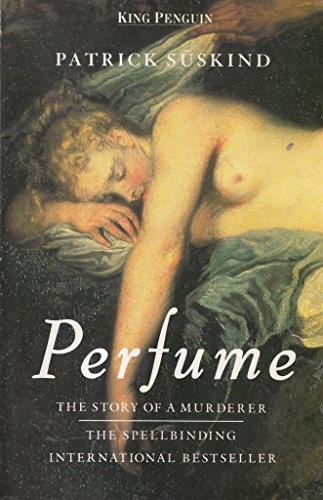
Grenouille, the protagonist of Patrick Süskind’s brilliant masterpiece PerfumeThe Story of a Murderer (1985), will spend seven years in his mountain lair. In the Auvergne mountains, in eighteenth century France, at the farthest point from other people, alone with all the scents he has stored in his mind, living off a minimal diet of dripping meltwater, grass and the occasional dead bat. Seven years upon the hill, seven years of soulful bliss… Put my heart upon the hill where some happiness I’ll find;

“Never in his life had he felt so secure, certainly not in his mother’s belly. The world could go up in flames out there, but he would not even notice it here. He began to cry softly. He did not know whom to thank for such good fortune.”

Coincidence, of course, but curiously enough, the rest of this fifth verse of “Crossing The Rubicon” also skims along the plot of Perfume. Grenouille barely survives his years on the mountain, decides to go in search of love, literally takes the high road (over the mountains) and then the low road (to the sea), reaches the hour is mine, experiencing his hour of ultimate victory in Grasse, and finally dies, literally, by pouring a cup. Well alright, by pouring a little glass flacon of his perfume. Which, by the way, can be counted as one of the most spectacular suicides in all of world literature.

Grenouille even survives his execution years after the hardships on the mountain, but will never experience love. Frustratingly, he does inspire love, excessive love even – and that will eventually kill him too. “Love” is, as a matter of fact, the last word of the book:

“They were uncommonly proud. For the first time they had done something out of love.”

Exactly halfway through the song, in this fifth verse of the nine, the song poet introduces a fermata, a grand pause in the rollercoaster of emotions. It’s not really a stylistic feature in Dylan’s oeuvre, but every now and then his poetic instinct seems to move him to such a break. We know it from songs like “The Ballad Of Frankie Lee And Judas Priest”, “Bob Dylan’s 115th Dream” and “Hurricane”, long songs with a more or less chronologically told story, usually filled with a hectic accumulation of events. In which, just like in the better action films and literary thrillers, the story gains strength from a breather, a stillness, a phase of reflection just before the final sprint. Like that second just before the murderers, selected by Grenouille to kill him, complete their bloody task:

“For a moment they fell back in awe and pure amazement. But in the same instant they sensed their falling back was more like preparing for a running start.”

The parallels with Perfume in terms of content or plot development are, of course, only coincidental, but the stylistic ones are not; both Süskind and Dylan are craftsmen. And both have a poetic instinct that tells them when the fermata should come.

Descriptions of idyll, like the opening line of this fifth verse, are effective on that front. Put my heart upon the hill where some happiness I’ll find and the continuation with love and let the hour be mine are not much more than psalm-like wishes of salvation, and take the sting out of the previous, ferociously aggressive stanza. Just as the word-playing third verse, Take the high road – take the low, take the one you’re on, has a cooling, don’t worry be happy-vibe. Inspired, probably, by Gordon Jenkins’ American Songbook evergreen “Good-Bye” (1935), which Dylan has been singing along to for the past 60 years in Sinatra’s rendition on Sings For Only The Lonely (1958) – the album that is situated somewhere at the front of Dylan’s inner jukebox;

But we'll go on living
Our own way of living
So you take the high road
And I'll take the low
It's time that we parted
It's much better so
But kiss me as you go
Good-bye

… although it might be more appealing to hope that in this case Dylan’s inner stream flows past Dennis Wilson, past his heartbreaking “Farewell My Friend”, one of the many highlights on his 1977 masterpiece Pacific Ocean Blue. And all the more heartbreaking as it is also the song that will eventually be played at the Beach Boy’s funeral, 4 January 1984.

Farewell my friend
My beautiful friend
Farewell

You take the high road
And I'll take the low road
And we'll meet again
Farewell my friend

But without these text-external, sought-after associations, a dramatic tension in Dylan’s middle stanza actually only flares up again in the final line, in the chorus line with the next link in the chain of metaphors that all express something similar to “crossing the Rubicon”: I poured the cup and I passed it along.

A loaded and slightly provocative metaphor. After all, the Jesus reference is inescapable – both at the Last Supper (And he took the cup, and gave thanks, and gave it to them, saying, Drink ye all of it) and in the Garden of Gethsemane (O my Father, if it be possible, let this cup pass from me), Jesus uses the image of the passed cup in a farewell setting. And to make matters worse, it’s not the first time Dylan suggests identification with the Messiah. In “Shelter From The Storm”, the narrator makes remarkable, blasphemy-bordering statements like “she took my crown of thorns” and “they gambled for my clothes”, also loaded images borrowed from the biblical account of Jesus’ last days.

Thus, the accumulation of equivalents of crossing the Rubicon is already becoming a quite colourful list:

– couplet 1: I painted my wagon – I abandoned all hope
– couplet 2: I prayed to the cross and I kissed the girls
– couplet 3: I embraced my love put down my head
– couplet 4: I pawned my watch and I paid my debts
– couplet 5: I poured the cup and I passed it along

Wild West, Dante, gospel, country, blues, Socrates and Matthew, and we are only halfway… Dylan takes the high road and takes the low road, and crosses three-quarters of Western cultural history.


To be continued. Next up Crossing The Rubicon part 10: They’re written on plastic


Jochen is a regular reviewer of Dylan’s work on Untold. His books, in English, Dutch and German, are available via Amazon both in paperback and on Kindle:


Posted in Uncategorized | 4 Comments

Bob Dylan And Leon Redbone


by Larry Fyffe

Leon Redbone, a Helgalian Romantic, trifles with the lyrics and music of yesterday to mesh them in with modern times – country, blues, ragtime, woggie-boggie, tin-pan-alley-pop, whatever, but for Redbone the history of good music stops with the coming of the nonvocalized big band ‘dance sound’.

Once upon a time, there were archetypical ‘hobo’ railroad songs like those of Jimmie Rodgers and Woody Guthrie:

You bet your life she was a pearl
She wore the Danville curl
She wore her hat on the back of her head
Like high-tone people all do
The very next train come down the track
I bid that gal 'adieu'
(Woody Guthrie: Danville Girl ~ traditional)

His family having fled to Canada from the trauma of war, Leon Redbone sought personal solace in his art, not in the politics and conflicts of the day.

Though he did it on his own terms, Leon is often considered a ‘sellout’ to the music industry by those who feel the need for political protest in the hypocritical “Candy Land” of capitalist greed and militarism.

Singer/singer writer Bob Dylan, whose family fled to the United States from oppression, moved on from political protest songs. America might be a New Babylon, but, relatively speaking, it’s not all bad.

In some ways America, the New Promised Land, was like the great white moon-mother of yore envisioned by Romantic Robert Graves.

History is somewhat cyclical as envisioned by other Hegalians, and by the imagination of a number of artists; there are good eras, bad ones; the wagon wheels of time turn and turn again.

Seems like a long time ago
Long before the stars were torn down
Brownsville girl with you Brownsville curl
Teeth like pearls
Shining like the moon above
(Bob Dylan: New Danville Girl ~ Dylan/Shepard)

But for Redbone, as for some Hegalians, history has pretty well come to a stop – at least as far as music is concerned.

In “Candy Mountain’, a dark-humoured, end-of-era movie, Elmore Silk’s daughter (married to wheelchair-bound Henry, played by musician Dr John) is given money by Julius Book if she launches him across the Rubicon (as it were) in search of her Godot-like father.

Book is a lackadaisical guitar-player in quest of the crafter of what are considered the ‘holy grail’ of guitars; Elmore Silk, that guitar-maker, secludes himself up in Cape Breton, Nova Scotia, Canada.

Leon Redbone calls Julius “Mr. Brook” in this, what else, Silk Road movie.

Julius thinks he’s in the right place at the right time. But he does the right thing for the wrong reasons.  With “greed is good” as the spiritual creed of the new era, the ‘bounty hunter’ hopes to make money by arranging deals between the elusive producer, and musicians who desire to own one of the special guitars.

“Local constable” Leon Redbone, a shotgun-carrying lion, so to speak, stands in Julius’ way. With his father, ‘the justice of the peace’, Leon makes it difficult for Book to carry on with his mission.

After he gets into an accident, Julius is locked up; gets out by handing a bribe to Leon’s father.

Thereby Redbone plays the guitar, and with his movie father, performs a little ditty that indicates this mini-Odyssey is gonna have a funny, if fiery, ending:

I'm the justice of the peace
My law you can't resist
Put'm in jail, you hear'em wail
He's on the road to nowhere
(Leon Redbone: Justice Of The Peace)


Posted in Uncategorized | 6 Comments

Dylan Cover a Day: Mississippi. Listen, and marvel

By Tony Attwood

Until today I had never heard of Luke Vassella, but in doing my usual unco-ordinated, not to say disconnected meandering around the internet and my record collection looking for any versions of the chosen song of the day that I might have missed previously, I found him, and his recording.

And a search on the internet has not revealed too much about him other than that he is from the north coast of New South Wales, which is currently where my youngest daughter, her  husband and my youngest grandchild are on a boating holiday at this very moment.   Which in turn isn’t really relevant to the music, but I thought I’d throw it in, because, well, it’s important to me.

Anyway, I thought I knew most of the covers of this wonderful song, but this is new.  It is a perfectly simple rendition, and it is simply near perfect.  Or if you prefer, perfect.  There is no attempt to deliver anything other than the song, beautifully played and beautifully sung.  And because of that simplicity I absolutely enjoyed it, totally.  I do hope you’ll have time to listen – and if I may add, listen fully, not in the background.  It deserves nothing less.  It simply is.

Big Brass Bed, for their version, have the band playing, but what makes their version different is not so much that, but the bounce.   The arrangement is far from perfect from my point of view (a repeated triangle hit at one point doesn’t really add anything, remembering as always, that we are all listening to a song we’ve heard many times before so the details in the background tend to stand out.)

But the bass guitarist has fun, and that’s welcome; he sounds like he is really enjoying his performance, and that’s how it should be.

Now I know I have submitted for your attention the Dixie Chicks version so often, if you are a regular reader you’ll know every moment of the piece by now.   And it is not just a wonderful version of a wonderful song, but they really do add something else – or rather lots of somethings else.

The beat is different, the harmony on the chorus line is a real stand-out moment, the instrumental break with the violin between each verse…, and then having got it all going they keep changing the arrangement with subtle extras.

Here’s one simple point that strikes me.   We all know the line “Last night I knew you, tonight I don’t” – of course we do  – but just listen it here.  It just rings so true, the emotion within the line comes pouring out so we really feel it even though we’ve heard it a hundred dozen times before.

10 out of 10 for performance, but also several million out of ten for the arranger.  It is a work of sublime, overwhelming art which has, since I first heard it, added something else to my life, even in times when all else seems to be taking things away.

And don’t you dare stop playing it, before the end.   Those ladies on the violins really know a thing or three about music, about Dylan, and about this song.

The Dylan Cover a Day series


Posted in Uncategorized | 4 Comments

Crossing The Rubicon (2020) part 8

by Jochen Markhorst

VIII       And let his children be fatherless

I feel the bones beneath my skin and they’re tremblin’ with rage
I’ll make your wife a widow - you’ll never see old age
Show me one good man in sight that the sun shines down upon
I pawned my watch and I paid my debts and I crossed the Rubicon

The sudden change from gentleness to fury is not the only remarkable thing about the fourth verse. Each verse of this exceptional song has an inner tension, a clash of colours, a collision of culture carriers or conflicting associations. Like the clash in the first stanza of the very American, nineteenth-century painted my wagon with the fourteenth-century, old European abandoned all hope. Or the clash in the second stanza of the carnal (I kissed the girls) with the spiritual (I prayed to the cross). Which, for an important part, colours the fascinating, eclectic power of “Crossing The Rubicon”.

This fourth verse takes the crown, as far as that is concerned. The opening line, I feel the bones beneath my skin and they’re tremblin’ with rage, leads to R.L. Stevenson’s immortal masterpiece The Strange Case of Dr. Jekyll and Mr. Hyde (1886). Not only through its transcendent, substantive clash with the preceding stanza, the clash of two personas, but also through its specific image. After all, the first words that the disconcerted Dr. Jekyll chooses to describe his transformation into the enraged Mr. Hyde are:

“The most racking pangs succeeded: a grinding in the bones, deadly nausea, and a horror of the spirit that cannot be exceeded at the hour of birth or death. Then these agonies began swiftly to subside, and I came to myself as if out of a great sickness.”

… the first thing worth mentioning is apparently, just as with the transformation of the “I” in “Crossing The Rubicon”, a disturbing osteological shivering; a grinding respectively trembling in the bones. Dylan’s specific choice of words, however, brings to mind, remarkably enough, for the second time in Dylan’s oeuvre a fairly recent song (1993) by the Counting Crows;

I got bones beneath my skin, and mister...
There's a skeleton in every man's house
Beneath the dust and love and sweat that hangs on everybody
There's a dead man trying to get out
Please help me stay awake, I'm falling...

From “Perfect Blue Buildings”, from the successful debut album August And Everything After. “Bones beneath my skin” is perhaps a bit unusual in itself, but still too generic to be considered appropriation. However, elsewhere in the song we come across the beautiful line “Try to keep myself away from me”, a line that Dylan word-for-word copies to “Dirt Road Blues” (Time Out Of Mind, 1997) – which at the very least suggests that the Counting Crows song has been buzzing around the back of Dylan’s mind for almost a quarter of a century.

After this introductory, worldly opening line, the verse takes a turn towards evangelical horizons – specifically Psalm 109, the famous/infamous “Judas Psalm”, so often misused for political bullying thanks to verse 8; Let his days be few; and let another take his office. It is a psalm that celebrates its heyday among Republican politicians when Obama is president, but immediately afterwards, with the advent of Trump, becomes just as popular among Democratic colleagues. The poet Dylan does not turn off the radio, after verse 8, and also hears verse 9: “Let his children be fatherless, and his wife a widow”.

At least, it is beginning to look that way. Psalm 109 is a peculiar, rather double-hearted psalm, written by David. Moving back and forth between grovelling praise of God and quite cruel, unreasonable curses of an unnamed enemy (10: “Let his children be continually vagabonds, and beg: let them seek their bread also out of their desolate places”, for example), between tame and aggressive – it is understandable that the Catholic Church finds the psalm so offensive that in 1970 it was removed from the Liturgy of the Hours.

So, it has the same schizophrenic character as Dylan’s “Crossing The Rubicon”, with on the one hand the humble requests for personal happiness (Dylan’s “Put my heart upon the hill where some happiness I’ll find” versus David’s “because thy mercy is good, deliver thou me”, for example), and on the other hand the harsh, vengeful passages directed at an anonymous enemy (David’s “so let it come into his bowels like water, and like oil into his bones” versus Dylan’s “I’ll cut you up with a crooked knife”, to quote just one random example). But Dylanesque, poetic beauty is just as well to be found in Psalm 109. Verse 23, for example: I am gone like the shadow when it declineth: I am tossed up and down as the locust – a verse that would fit without a hitch on Time Out Of Mind or on Rough And Rowdy Ways.

Fitting also with the biblical connotation of Dylan’s third verse, Show me one good man in sight that the sun shines down upon. On its own this classical, grim demand would lead first of all to Diogenes, of course, the peculiar Greek philosopher († 323 B.C.) who, in broad daylight in the market square, was looking with a lantern for a “man” – a good man in sight that the sun shines down upon, as it were.

But the line does not stand alone; the tone of the preceding line pushes the associations to biblical distances, and so this search for “one good man” rather recalls that weird haggling of Abraham, when he tries to stop God from destroying Sodom. Genesis 18; when Abraham argues that God should not destroy the city if there are fifty righteous, but then neither should there be forty-five, forty, thirty, and so on until finally there is only one good man in sight, Lot, who will then be spared. A biblical connotation reinforced by the biblical choice of words; the tautological show me someone in sight and the scriptural sun shining down upon.

Nevertheless, despite that attractive biblical colouring, Dylan seems to feel some unease. The site of “dylyricus”, a seasoned fan who has taken on the praiseworthy task of keeping track of lyric variations in performances (and also letting us hear them), mentions the first recurring text change of “Crossing The Rubicon” at exactly this verse. In Phoenix, 3 March ’22, at the live debut of the song, Dylan sings instead of the one good man-line: “The summer turned to gold, and the winter chill is gone”, and similar are the words the next day, 4 March in Tucson: “The summer meadows turned to gold, well, and the winter chill was gone”, and in Albuquerque (6 March) the golden meadows seem to be internalised – there Dylan sings them again, and that’s how he keeps on singing this verse line the rest of the tour.

A remarkable change; not only are the words different, the emotional content has changed as well. The one good man line, especially in this context, breathes pessimism, the new line is pure optimism. Cheerful even, weirdly enough. Although the evangelical connotation is maintained, albeit less strong. It has a gospel colour to it. It could have been a line on Hank Snow’s religion album Gospel Train (1966), anyway. Something like “How Big Is God?”;

As winter chill may cause the tiny seed to fall
To lie asleep till wake by summer’s rain
The heart grown cold will warm
And trod with life anew
The Master’s touch will bring the glow again

But as of yet, Dylan’s lyrics have not been officially sanctioned: the official publication, on the site bobdylan.com, still reads Show me one good man in sight that the sun shines down upon.

And to complete the mosaic-like character of this fourth verse, Dylan fills the closing line, the refrain line, the next link in the chain of accumulatio, with an anachronistic image: I pawned my watch. Motivated, presumably, by a poetic need to achieve some kind of unity via mirroring with the previous verse, with

How can I redeem the time - the time so idly spent
How much longer can it last - how long can this go on

… and borrowed, no doubt, from Elizabeth Cotten’s immortal classic, “Shake Sugaree” (Pawn my watch, pawn my chain, pawn everything that was in my name). Or, perhaps a better candidate, Skip James’s wonderful “Drunken Spree” from 1931;

I pawned my watch, pawned my chain
Pawned my diamond ring
And if that don't settle all my drunken spree
Lord, I'll never get drunk again

But the main by-catch of that quirky I pawned my watch is that it contributes to the eclectic nature of this wonderful stanza. Which, to top it off, gets a final extra facet with the closing I paid my debts, words we have been associating with Last Words since the death of Socrates (“Crito, we owe a cock to Asklepios; pay him, don’t forget,” 399 B.C.).

David, The Counting Crows, Dr. Jekyll and Mr. Hyde, Socrates and Hank Snow… in one verse, four lines, Dylan spans thirty centuries, Bible and nineteenth-century literature, gospel and rock, Socrates and Skip James. The song sure crosses many a river.

————

To be continued. Next up Crossing The Rubicon part 9: For a moment they fell back


Jochen is a regular reviewer of Dylan’s work on Untold. His books, in English, Dutch and German, are available via Amazon both in paperback and on Kindle:

We also have a very active Facebook page – just type Untold Dylan Facebook in your search engine.

Posted in Uncategorized | 1 Comment

I contain multitudes part 11


by Larry Fyffe

The Roman Emperor Constantine allows the Christian religion, at least some historians claim, to unify the diverse Roman Empire.

Seeking a simplified explanation as to why the Empire eventually breaks up, other historians claim it’s because the Christian Church undermines the absolute authority of the emperors who claim a lineage sanctified by Jupiter, the chief Roman god.

For one thing, the Germanic Vandals go on to conquer more Roman territory after politically-weakened Constantine, having had a vision of Apollo (the son of Zeus/Jupiter), allows Vandals to settle down within the borders of the Roman Empire.

Made just all too concise and too clear by the following song lyrics:

Lookout kid, they keep it all hid
Better jump down a manhole, light yourself a candle
Don't wear sandals, try to avoid scandals
Don't wanna be a bum, you better chew gum
The pump don't work 'cause the vandals took the handle
(Bob Dylan: Subterranean Homesick Blues)

https://youtu.be/DaXD9Pldfbw

Apparently, the same thing – or so it could be said – happens to the New Babylon of America once “organized” Christianity takes a firm hold of the handle.

A Puritan minister in the poem below, which he hides away with other poems of his, warns himself not to look outwards to organized religion for the way to achieve salvation, but rather inwards in order to magnify and examine where he as an individual goes astray:

You want clear spectacles: your eyes are dim
Turn inside out, and turn your eyes within
Your sins like motes in the sun do swim: nay see
Your mites are molehills, molehills mountains be
(Edward Taylor: Accusations Of the Inward Man)

Taylor’s baroque sentiment and style apparently depicted in song lyrics below:

With your silhouette when the sunlight dims
Into you eyes where the moonlight swims
And your match-book songs, and your gypsy hymns
Who among them could try to impress you
(Bob Dylan: Sad-Eyed Lady Of The Lowlands)

How wide the Jungian Sea is, we do not know, but Bayard Taylor, an American poet of yore (well-versed in the German language, he translates Goethe’s ‘Faust’ that features the pact with the Devil) appears to mimic Edward, the Puritan poet, in a couple of poems – as previously mentioned.

Anyhow, as noted before too, all we know for sure is that Bob Dylan’s name isn’t Bob Dylan.


Posted in Uncategorized | Leave a comment

Dylan Cover a Day: Million Miles. Listen, and marvel.

By Tony Attwood

Bonnie Raitt does a live version of this song which takes us through the emotions, and does what all the really good cover versions do – hide the fact that is a 12 bar blues in terms of musical construction, which actually is 12 bars long.

What Dylan’s composition doesn’t do however is repeat the first line, and instead has a fixed final line in terms of lyrics.    And this is what keeps us listening – or at least that, along with the fact that the construction gives good musicians every opportunity to show how good they are without actually seeming to be showing off.

And what is interesting in putting together a short collection of versions of this song is just how different is each treatment, even though it is a classic blues in contstruction…

One might be tempted to think that after all these years the 12 bar blues might have had its day, but no, we can go on and on being entertained, and indeed surprised by each new approach.    In this version by Vintage 18 the guitar plods its way through without boring us, not least because its part is suddenly taken over by the bass while the lead guitar multiplies the speed by something like 12-fold.   An extraordinary virtuoso performance, and great arranging.

Bonnier Raith has the voice to carry off the atmospheric version of this song, and she is fulsomely aided by the accompaniment, both in the vocalised verses and in the instrumental break, which I really love.   Everything and everyone working together with the same object in mind.  Superb.

Well may she have that twinkle in her eye when she can deliver a performance like this.  It’s stunning.

So by the time we reach Viktoria T0lstoy, the feeling surely must be, there can’t be much more you can do with what is in essence such a simply constructed song.  Yes the melody is particularly fine, but is there anything else to say?

Well, actually yes…

Once again we can see the importance of the accompaniment – and here the arranger doesn’t just rethink how the instruments are going to perform, he/she also changes the chord sequence.  Not a lot but enough for us to feel.   And I really do feel that works, because, as I say so often we all know the songs so well, sometimes we need to be jerked out of our historic knowledge.

This version is not only my favourite of this song, but also one of my all-time favourite Dylan covers both for the way the vocalised verses progress but also the instrumental break.   It’s a virtuoso performance – but not just that, it is sensitive to the rest of the performance.

The idea of multiple key changes is interesting too.   Generally I think doing more than one is pushing one’s luck a bit, but a really clever idea which this time works.   And a beautiful coda as the music changes from 4/4 to 6/4 and back over the “Yea yea yea yea” sections.  Another great idea – give the arranger an award.   Blues songs very, very rarely have codas, so there is no history of adding that extra section at the end to consider when creating one.   Thus this ending comes out of almost nowhere and works a dream.

Utterly brilliant.  Listen, and listen again.  And marvel.

The Dylan Cover a Day series

Posted in Uncategorized | 1 Comment

I contain multitudes part 9 and 10

I Contain Multitudes (Part 9)

by Larry Fyffe

There are interpretations of Daniel’s four creatures that differ from the aforementioned possibilities.

Some Christain interpretations proclaim that the symbols mean ~  firstly, the empire of  Babylonia; secondly, of Persia; thirdly, of Greece: and finally, of the Roman Empire.

The last empire is hallmarked by bad human beings like Nero, but also by the good  “Son of Man” which brings us back to Isaiah’s “Immanuel” who’s later interpreted as Jesus – not as, for example, the suggested Hezekiah.

Four wings appear on the creatures in Ezekiel’s Old Testament vision:

And this was their appearance
They had the likeness of a man
And every one had four faces
And everyone had four wings
Ezekiel's 1: 5, 6)

Six wings in Isaiah’s vision; the number of creatures not mentioned:

Each had six wings
With twain he covered his face
With twain he coverd his feet
And with twain he did fly
(Isaiah 6: 2)
And six wings in John's New Testament vision:
And the four beasts had each of them six wings about him
And they were full of eyes within
And they rest not day and night
Saying, "Holy, holy, holy, Lord God Almighty
Which was, and is, and is to come"
(Revelation 4:8 )

The latter two prophets announce the coming of somebody, anybody ~

Could it be Immanuel, or could it be Jesus?

In his  masterpiece below, the singer/songwriter gives us his best advice ~

If you don't know the answer, don't ask the question:
Beat a path of retreat up them spiral staircases
Past the tree of smoke, past the angel with four faces
Beggining God for mercy, and weeping in unholy places
(Bob Dyan: Angelina)

Just remember what the dormouse said:

And I stood upon the sand of the sea
And saw a beast rise up out of the sea
Having seven heads and ten horns
And upon his horns ten crowns
And upon his heads the name of blasphemy

I Contain Multitudes (Part 10)

Jupiter becomes the chief god of the Romans, and their rulers seek deification as the “son of god”.

Greek gods, like Zeus, be immortal; but for the most part, humans are mere mortals.

Julius Caesar crosses the Rubicon; declares himself the “dictator” of the Roman Republc; he’s supported by General Mark Antony.

It’s cold in the winter month of January in northern Italy; Aurora, sister of Helios (the Sun god) and Selene (the Moon god), be the Roman goddess of the Dawn:

I crossed the Rubicon on the fourteenth day
Of the most dangerous month of the year
At the worst time, and at the worst place
That's all I seem to hear
I got up early
So I could greet the goddess of the dawn
I painted my wagon, abandoned all hope
And I crossed the Rubicon
(Bob Dylan: Crossing The Rubicon)

After Caesar’s death by Brutus, Antony rises in power, forms a coalition; marries the sister of Octavian, the first Roman Emperor-to-be.

Herald the Great is appointed to rule over land from which the Hellenists have been ousted; his son Herald inherits a part thereof; refuses to condemn Jesus, steps aside because Jerusalem is not within his jurisdiction.

Drifter Jesus escapes death, at least for a while:

Outside,  the crowd was stirring
You could here it from the door
Inside the judge was stepping down
While the jury cried for more
(Bob Dylan: Drifter's Escape)

Saith the Holy Bible:

And Herald with his men of war
Set Him at nought, and mocked Him
Arrayed Him in a gorgeous gown
And sent Him again to Pilate
(Lukes 23:11)

Cleopatra, the Hellenistic Queen of Egypt cements her position too: she combines belief in the Egyptian goddess Isis with that of the moon goddess of Greek mythology.

After the death of Julius,  with whom she has a male child, Cleo sets her eyes on Antony:

Isis, oh Isis, you're a mystical child
What drives me to you is what drives me insane
I still can remember the way that you smiled
On the fifth day of May in the drizzling rain
(Bob Dylan: Isis)

They name their children Helios, Selene, and Ptolemy.

To make a long story short, things go awry everywhere, and the two love birds  commit suicide.

Egypt, like Judea, becomes part of the Roman Empire.

—————

We also have a Facebook page that is quite lively, with over 11,000 subscribers.  You can find us at Untold Dylan Facebook.


Posted in Uncategorized | 1 Comment