Below, a wisecrack reference to “Now I’ll Tell”, a movie that involves a necklace placed around a teddy bear’s neck, the necklace supposedly stolen by Shirley Temple:
& a bunch of old Shirley temple pictureswith her head in a noose was all I could find(Bob Dylan: Tarantula)
Shirley’s known as “America’s sweetheart”; she sings, dances, and stars in movies.
One of Bob Dylan’s favourite poets pens:
She walks in beautyAnd all that's best of dark and bright Meets in her aspect and her eyes(Lord Byron: She Walks In Beauty)
Precocious Shirley loses the innocence of her childhood in real life. Subjected to physical abuse and sexual exposure by “animals” higher up on the totem pole
She’s directed to dance in an adult sexual manner in the movie “Bright Eyes”, sings a sweet song along with her suggestive movements, thereby steering clear of any censorship problems:
On the Good Ship LollipopIt's a sweet trip to a candy shopWhere the bons-bons playOn the sunny beach of Peppermint Bay(Shirley Temple: On The Good Ship Lollipop ~Whiting/Clare)
The fun never stops:
W)hile on the other side of the streetthis mailman who looks like shirley temple& who's carrying a lollipop stops(Bob Dylan: Tarantula)
Much later than when first written, Bob Dylan’s “Shirley Temple Don’t Live Here Anymore” is rehashed by Dylan and two co-writers; the title changed to “Mr. Alice Doesn’t Live Here Anymore”.
It’s a witty song that carries a serious message; one that is idealistic, for sure.
The message has a “Rip Van Winkle” theme to it ~ abusive behaviour is bid farewell, and it’s certainly not a fond one; it’s good riddance, goodbye to mean old “Mr. Alice”.
At the same time, a fellow who’s written a script titled “Alice Doesn’t Live Here Anymore” has difficulty finding a filmmaker who doesn’t consider it too “corny”:
Now the chimney is rottenAnd the wallpaper's tornThe garden in the backWon't grow no more cornThe windows are boardedWith papper macheEven the dog just ran away(Bob Dylan/Don Fagenson/David Weiss: Mr. Alice Doesn't Live Here Anymore)
In Washington Irving’s story, Van Winkle runs away from his nagging wife; falls under a spell, and wakes up twenty years later, only to discover that New England has rid itself of the British monarchy; civil rights put in a Constitution.
The song beneath, a pastiche of one that Shirley sings (‘soup’ rhyming with ‘hoop” instead of ‘loop’):
Wiggle, wiggle, wiggle like a bowl of soupWiggle, wiggle, wiggle like a rolling hoopWiggle, wiggle, wiggle like a ton of leadWiggle - you can raise the dead(Bob Dylan: Wiggle Wiggle)
Below, from the movie “Curly Top”, a soupy song along with which Shirley Temple dances and wiggles; the toddler gives a rather paedophile-luring performance:
Animal crackers in my soupMonkeys and rabbits loop the loopGosh oh gee but I have funSwallowing animals one by one(Shirley Temple: Animal Crackers In My Soup ~ Henderson/Koehler/Caesar)
“Quite advanced playing, which requires precision and dexterity — not for the faint of heart!” says Eyolf Østrem on his acclaimed website Dylanchords – The Complete Chords and Lyrics of Bob Dylan (dylanchords.com). He is referring to the guitar part for “My Own Version Of You” by Blake Mills, the prodigy whose contributions have left such an unobtrusive but indispensable mark on Rough And Rowdy Ways. Contributions that we can attribute to Mills himself. In interviews, Blake confirms what we already know from dozens of other testimonials: “You don’t sit around with Bob and he explains the song to you – either you get it right away or you don’t,” he reveals in Uncut, June 2021. And three months earlier, in the Belgian magazine Knack (9 March 2021), he was equally unequivocal:
“The most important thing is that you put yourself at the service of the song, the story or the mood. But of course you can also follow your instincts. Dylan doesn’t tell you exactly what to play. He does expect you to play what needs to be played. That may seem the same, but it’s a world of difference.”
Even more illuminating are the seven short films Blake Mills posted on his Instagram account in June 2020, shortly after the release of Rough And Rowdy Ways. Short videos, no longer than a minute (except for “Black Rider”, which lasts 1’35”), visually unspectacular, but breathtaking in content: in each video, he demonstrates his contributions to seven songs from Rough And Rowdy Ways on his guitar (“I Contain Multitudes”, “False Prophet”, “Mother Of Muses”, “My Own Version Of You”, “Crossing The Rubicon”, “Black Rider” and “I’ve Made Up My Mind To Give Myself To You”).
The ingenuity of Multitudes, the accents with the slide on Prophet, the part for I’ve Made Up My Mind that almost all reviewers thought was played on a marimba (or steel drums, or a xylophone), but now turns out to be a guitar after all; Blake’s old Telecaster, a muting thumb on the bass strings and lightning-fast triplets with the fingers of his right hand on the lower strings… and that atmospheric, goosebump-inducing part on “My Own Version of You”. We hear what Blake’s “instinct” told him, what he thought needed to be played, what Dylan’s song expected of him: that descending bass line as if he hears Cole Porter’s “Night And Day” in it and the jazzy Duke Ellington-esque embellishments whose “dexterity” and “precision” Eyolf Østrem so admires. Chords and accents that you wouldn’t immediately associate with Dylan, by the way. One of the followers writes under the Blake Mills video: “I was wondering where Dylan got those chords from.” To which Mills replies: “From the chord fairy.” Chords that Eyolf manages to decipher, thanks in part to the video:
Am                         /g                        /g♭     /f
All through the summers, into January

Am                         /g                            /g♭     /f
I've been visiting morgues and monasteries

Dm7                       F/c                   G7/b           Bb7
Looking for the necessary body parts

Am                         /a♭                      /g           /g♭
Limbs and livers and brains and hearts

F7
    I'll bring someone to life, is what I wanna do

                                                          Am
    I'm gonna create my own version of you
… all in all, it is quite clear why Dylan is so fond of Mills, who incidentally, is practically Dylan’s neighbour kid in Malibu.
That descending bass line helps Tony Attwood crack the most idiosyncratic aspect of the musical backdrop to “My Own Version Of You”: the missing beat. Attwood, the musicologist who, in his series “No Nobel Prize For Music” and elsewhere, often delights us with surprising discoveries in Dylan’s music, especially in the area of peculiar time signatures and unobtrusive, “hidden” beats, missing bars or extra half bars – such as the half bar of two beats at the end of each line of “Not Dark Yet”. Here in “My Own Version Of You”, Tony points to an almost subliminal peculiarity that has escaped every analyst:
There is the basic 123 123 123 going on from the start. And on each 1 of the 123 the descending bass runs, so we get:
Bass A 1 = 1 2 3 All through the
Bass G 2 = 1 2 3 summers into
Bass G♭ 3 = 1 2 3 January
Bass F 4 = 1 2 3 I’ve been….
I think if I were writing out the music I might call that 12/8 and it takes us through the sections of the triple time ( 1 2 3 – 1 2 3). You can hear the bass line going through four beats. But …. at the end of each verse after “my own version of you” Bob cuts a beat – so instead of getting a perfect 12 beats we only get three of those 1 2 3 lines. not four.
If you can hear that solid beat at the start of each 3 beats you hear:
1 create my
2 own
3 version of
1 you (2 3 4)
So instead of a group of four sets of three for a perfect 12/8 time signature, we get a bar of 9/8 for “Create my own version of”, as the word “you” takes us back to the 12/8 bars signified by the four notes of the descending bass.
Because the music sounds fairly spooky, we don’t particularly hear the missing beat – but perhaps subconsciously we feel something is missing, and it is associated with the word “you” which again makes the whole thing feel a bit strange. And this must be deliberate by Bob because this is a very spooky song.
Here’s another way of looking at and hearing it by focusing on the first of each group of three beats. 1 represents the solid beat – the first of the three:
1 2 3 4 1 2 3 4
All through the summers into January I’ve been
1 1 1 1
visiting morgues and monasteries
1 1 1 1
Looking for the necessary body parts
1 1 1 1
Limbs and livers and brains and hearts
1 1 1 1
I’ll bring someone to life is what I wanna do
1 1 1 1
I wanna create my own version of
1 1 1
You
1 2 3 4
I would certainly write this in 12/8 time with that final line with the missing beat as 9/8. It is so cleverly done that we don’t hear it as something wrong, but rather as an emphasis on the “You” – the feeling that we must continue on.
The first two verses are five lines of the straight 12/8 with then the missing beat line, but then Bob changes the number of lines.
Then in the penultimate verse we are following a route that is similar to the opening verse. That makes us think we are at the end. Except that we still get that enormous final verse. This is like the first verse and with that variation in the final line – it is straight 12/8 and we have the change to 9/8 for the last line, “Do it with laughter and do it with….” are on just beats (i.e. 3 strong beats) with “tears” clearly the first of another group of three. We are back to the start.
Of course many people don’t take in the subtle changes that Bob brings in and takes out, but it means that the song does catch us out over and over again
Do it with laughter and do it with tears
… and that tells us perhaps subconsciously (for non-musicians ) that we are at the end.
Blake Mills’ instinct is not only inspired by the chord fairy, but also by Chronos the Timekeeper.
———————–
Jochen is a regular reviewer of Dylan’s work on Untold. His books, in English, Dutch and German, are available via Amazon both in paperback and on Kindle:
Revision note: although my link to the concert noted below worked ok when I first put it up, it has now been blocked – at least in the UK. But if you find it blocked what you can try is going to the website https://www.youtube.com/watch?v=RmsvImKHGD4 (just copy and paste it into your browser) or failing that try typing in “Bob Dylan Live at Royal Festival Hall (May 17, 1964)” Hopefully one of these might work for you. If I remember, when the series is over, I’ll go back and have another look.
With this extraordinary recording of this remarkable event, you can even see the programme that was produced for the concert, which includes one of the first public performances of Tambourine Man.
Indeed, when I first thought of this series, I started out with the idea of just a few videos for the most important historic events in Bob Dylan’s life as a touring artist, with this being one of them. But the whole thing grew very quickly to the idea of one concert a year, so I have held back on this one, but always with the thought that at some stage this recording would be featured.
A list of all the 43 concerts in this series is givn at the foot of the article, and if you have any suggestions for videos we ought to include (even if we already have a concert for that year) please do drop a note to tony@schools.co.uk
The idea behind “The series we should never forget” is simple. Untold Dylan was started in 2008, and since then we have published nearly 4,000 articles, some of which (and not, I hasten to add, the ones written by me) have started to be used as part of the broader study and analysis of Bob Dylan’s lifetime of songwriting.
All the articles that we have published across these 17 years are still on the site, but I felt that it would be good to have a sort of “Best of” set of articles, commemorating, and indeed making it easy to find, some of the series that to me, if no one else, has helped deepen the understanding of Bob’s work.
Being as self-centred as I am I nominated one of my own series Once or Twice but at least had the sense not to start with me, but rather to initiate the review with the brilliant series which looked in greater depth than I have not seen elsewhere, at the covers of Dylan’s albums.
Of course, having got going with the series, I asked Jochen to nominate one of his own many series on this site and he mentioned “Desolation Row” – but the problem with that was twofold. One is that only parts of the whole series of articles he wrote were published here, and the rest, quite reasonably given their importance and innovative analysis, were retained for the book. Which of course was fine, except that Jochen now tells me the book is almost out of print. Just a few copies left.
So, without that input, I moved on to one of Jochen’s reviews that we did publish in full – a review of one of Dylan’s more recent compositions; a composition which has had a particular effect on me: “I contain multitudes.” That series was published here, and quite seriously, I feel honoured to have been able to publish it.
Whether you love the song or not, whether you read the whole series of articles on the song when we first published them, I’m sure you would agree, this series of articles takes you into the song in a way that nothing else does.
Of course I don’t have pretensions that what we do here ever reaches the eyes and ears of Bob or his band, but I’d like to think that maybe one day, one of Bob’s close associates will come across this series of articles and say to Bob, “you ought to read this Bob”.
Well, you never know.
“I contain multitudes” – the series on Untold Dylan, with my eternal thanks to Jochen for writing it and offering it to Untold to publish.
This series is not a set of reviews of what Bob said about each song (you can, of course, buy a copy of Bob’s “Philosophy” book and see what he said), but rather it contains my own reaction to each song – written particularly since in many cases I was not familiar with the song until I saw Bob’s book. Although in this case I was (if you are with me so far).
So I’m not trying to review Bob’s book; lots of people have done that, and you can go out and buy it and read it for yourself. Rather, I am trying to offer my thoughts on the songs and recordings Bob suggested and when I can, ponder why he chose each song.
I should add that the titles of songs reviewed in my series are noted at the end of this article in alphabetical order, not in the order found in the book. That makes it easier for me, even if no one else.
Today: Saturday Night at the Movies. This was written by the husband and wife songwriting team Barry Mann and Cynthia Weil and was a hit for the Drifters in 1964. Rather perversely in the UK the song was a bigger hit second time around when re-released in 1972.
And here I want to pause and mention Cynthia Weill in particular. She died just two years ago and her name really should be more revered than I think it is (at least in the UK), as the writer not just of “Saturday Night at the Movies”, a song that personally I don’t have too much time for, but the staggeringly wonderful and beautiful, “Lay Down Your Weary Tune”.
I’ll come back to that, but Bob’s choice is “Saturday Night” so here it is.
Although it was not a number 1 hit on either side of the Atlantic, it was one of those songs that everyone seemed to know, and half of them would make an attempt at singing it, not least because the song is easy to sing, although the falsetto in the penultimate line of the verse can be a bit of a problem. But everyone can manage the chorus:
Saturday night at the movies
Who cares what picture you see
When you're huggin' with your baby
In the last row of the balcony?
The song was released as a 1964 single, peaking at number 18 in the United States. In the United Kingdom only made it to number 35, but it got into the charts a second time around eight years later when reissued.
“Saturday night” is in fact a classic of a regular beat that is impossible to get out of one’s head, giving us a simple picture of a couple sitting in the cinema as a way of escaping the eagle-eyed parents, two simple four-line verses and a two line chorus that appears five times in a two and a half minute track. (Actually, I didn’t time it, but it feels like two and a half minutes).
In fact, the song is the exact opposite of a Dylan song – few words, repeated chorus over and over, harmonies, and a bumpty-bump accompaniment. And it is interesting in that most people who were listening to music in those dim and distant days will still remember it because of its simplicity and easily remembered chorus line.
But what the song does, and I think this is an important point, is solidify the image of teenagers living in a world with, yet apart from, their parents. This was, after all, the time when teenagers would constantly complain that they were not understood in any way – in terms of their relationships, their music, their dress sense, their lack of devotion to tedious, meaningless jobs, their desire to serve their country or anything else. The song portrays this in a way that would not be offensive to the adults who owned the radio stations and record companies, and thus would be allowed on the strictly controlled media, which was still wary of the whole notion of “teenagers” of this general concept of individuality and being “different”.
Now it was at this point that I started a new train of thought – did every version of this song sound just the same? Working through the recordings, it certainly appeared so. I listened to around a dozen covers of the song, and each one had that same beat, same style, same approach… There was no originality.
Until I found this one. And this is not to say I like this version, but at least they do something different….
And I think in this regard, it was worth contemplating what Bob Dylan was writing at the time. At the end of 1963 he wrote The Times they are a-Changing,The Lonesome Death of Hattie Carroll, and then a song that I think surpasses both of those as an expression of what it could be like to be a teenager at this moment, Lay Down Your Weary Tune This song had as its first and last verse
Lay down your weary tune, lay down
Lay down the song you strum
And rest yourself 'neath the strength of strings
No voice can hope to hum
If you are as fascinated by this wonderful song as I am, you might possibly be interested in the article devoted just to this song, which I have just realised I wrote 14 years ago. Goodness! Incidentally, I have found that this version has a habit of disappearing from the internet and then returning. If you find this happens, do persevere, if you can. It is a song worth searching for.
Anyway, Bob chose “Saturday Night at the Movies” undoubtedly as a representation of the way in which teenagers in the 1960s were somehow or other finding their own escape from what many found to be the claustrophobic world of their “elders and betters”. But it is interesting to know what Bob was writing at the same time as this song was released.
Here are the other songs we’ve covered from this book….
In previous articles in the “No Nobel Prize for Music” series I have dealt somewhat on the failure of the song She’s Your Lover Now, because it was a rare event in Bob’s writing career – writing about something real that happened (the break up of a relationship) and the failure to produce a recording that was felt (perhaps by Dylan, perhaps by the producer) to be suitable for the next album. Certainly listening to those recordings of the song, I rach the conclusion that the song itself just doesn’t work, but then, that’s just me.
So Bob then continued on his way, writing first Absolutely Sweet Marie which spent its time wondering where the woman of his imagination had gone, and then coming up with his final response to the break-up that he failed to deal with in “She’s your lover now”, with the magnificent Just like a woman.
One of the problems of course with thinking about Bob’s older work is that many of us (myself included) have lived with these songs through most of our adult lives, and so trying to see them in a way that allows proper analysis is difficult. But surely if ever one wanted a song that might show Dylan’s sublime musical and literary ability in the face of personal distress, this surely is it. For here in “Just like a woman” he finds the ultimate put down for the woman he has lost, suggesting that the way she behaves is typical of the female of the race, failing to grow up, behaving like a child.
It may not be the slightest bit politically correct, and of course if the music of the song were not as near to perfect as makes no odds, the song would be unacceptable in the modern world where it is not acceptable to disparage all of woman kind as acting as acting physically and emotonally in a unified manner which can be described as being “just like a woman”. One might say to a teenager, “you are behaving like a child” and get away with it, but to saying “that’s just like a woman” really isn’t acceptable. It isn’t acceptable now, and it wasn’t acceptable when Bob wrote it.
But here every very ends with saying that the woman is behaving like a little girl, which is just as sexist as the main comment itself.
Of course I am far from the first to point out the sexism of the lyrics. ” Bob Dylan: The Illustrated Record”, described the piece as “a devastating character assassination…the most sardonic, nastiest of all Dylan’s putdowns of former lovers.” In the New York Times we found Marion Meade proclaiming that “there’s no more complete catalogue of sexist slurs.”
But what these commentaries do not examine is how Bob can get away with such an overtly sexist set of lyrics? The answer, for me, even if for no one else, is not the fact that it is Dylan and so he can say anything, but rather in the music.
If you can forget the lyrics and just listen to the music, this is a stunningly beautiful song. What would be helpful here is if someone had made an instrumental version of the song – but mostly what we have are copies of the instrumental accompaniment simply without the lyrics. The nearest I have is this
which goes partway to showing us what a superb piece of music it is without the lyrics.
But of course, the devastating message that she’s just a child in her behaviour and emotional response is there always because we have heard the piece so many times. And a pretty devastating message it is.
Yet if we can ever separate ourselves from the lyrics and hear the music, it is an extraordinary piece. And all the more so because it doesn’t pull any tricks in terms of using chords from outside the key that it is in. All the chords in fact are chords that
C      F     G   C
Nobody feels any pain
             F       G        C
tonight as I stand inside the rain
F         G          F               G
Everbody knows that Baby's got new clothes
    F  Em Dm C       F                G
But lately I  see her ribbons and her bows,
     Am     C    F    G
have fallen from her curls.
Each of these chords is a chord that can be formed when playing only notes from the scale of C major – it is an absolute manual in writing a song just within the chords available in a certain key. There are no blues chords or any other variations that Dylan has used in the past. This is songwriting in the classical mould.
Nobody feels any pain
Tonight as I stand inside the rain
Everybody knows that baby’s got new clothes
But lately I see her ribbons and her bows
Have fallen from her curls
She takes just like a woman
Yes, she does, she makes love just like a woman
Yes, she does, and she aches just like a woman
But she breaks just like a little girl
Bob’s build-up to writing Just Like A Woman, isn’t always mentioned in reviews of the song, but it does seem to me to be fundamental to grasping the full implication of the piece. This was his response to his own failed “She’s your lover now” which contains lines such as “Pain sure brings out the best in people, doesn’t it?”
That song never made it onto a record, despite Bob recording it over and over again, as we have seen in previous episodes of this series, but “Just like a woman” removed the intolerence and replaced it with acceptance as the title istself suggests and Bob gave the song 871 performances, making it his 16th most performed song of all time. Indeed it has more live versions than “It’s alright ma”, “Thunder on the mountain”, “Desolation Row,” “Times they are a changin”, and “It;s all over now baby blue”.
And of course other bands have picked up on the song too…
The song has all sorts of original elements to it in Dylan’s version such as starting with a Harmonica solo which actually plays the tune rather than an improvisation around it.
Also we really must note the gentility of the accompaniment. Of course we all know the song so well, we can pass over this but if you have a moment do go back to Bob’s album recording and listen to the accompaniment as he sings,
Harmonica solo, verse and chorus and coda
Feel the pain – start at 1 minute.
Now in my original draft of this little piece I was going to finish with this, but then I suddenly remembered an article by Jochen about seven years ago and I went back to find it, and for once my memory was not decieiving me.
The article is still on the site, and if you have time do have a look, and then indeed whether you have time or not, play the recording at the end of the piece. It will round off your reverie perfectly.
Below, a spoof of a newspaper ad that’s supposedly inserted by someone who’s looking for a relationship based on true love:
(D)o people tell you to your face youve changed? do you feel offended?
are you seeking companionship? are you plump? 4 ft. 5? if you fit
& are a full blooded alcololic catholic, please call UH2-6969 ask for OOmpa
(Bob Dylan: Tarantula)
The stories of “Charlie And The Chocolate Factory” feature Oompas who are little people; one gets mentioned in the humorous piece above. An Oompa attempts to turn the tables and do some exploiting of his own.
That people less well off in America are taken advantage of by those with more money, and even get killed by them, is a theme seriously expressed by the persona of the singer/songwriter/musician:
Hattie Carroll was a maid of the kitchen
She was fifty-one years old, and gave birth to ten children
She cleaned up the dishes, hauled out the garbage
(Bob Dylan: The Lonesome Death Of Hattie Carroll)
Dylan is more aware of literature books written in English than he lets on.
Beneath, a quote that’s found in a fictionalised work authored by a dark-hearted Neo-Romantic writer who searches for peace and justice:
(T)he slight indentation which for a time was known officially as Black Diamond Bay
(Joseph Conrad ~ Victory: An Island Tale)
Therein, mankind faces an all-powerful and hostile environment. The Dylan/Levy story changes the location; the characters are changed too. But the influence of the fragmented style of Conrad’s writing is obvious.
A small picture of the Modernist Conrad is included with the “Desire” album akin to comedian Lord Buckley’s picture, which is placed on the mantelpiece on the front cover of the “Bringing It All Back Home” album.
Irony abounds:
Seems like every time you turn around
There's another hard-luck story you're gonna hear
And there's really nothing anyone can say
And I never did plan to go anyway
To Black Diamond Bay

(Bob Dylan: Black Diamond Bay ~ Bob Dylan and Jacques Levy)
Below, is a narrative in which there’s a mixture of the once-supposed prime elements ~ water, fire, earth, and air.
And America gets transformed into New Egypt; ie, Isis being the goddess of the Moon; she’s a daughter of the Earth god; she’s given birth to by the Sky goddess:
The wind it was howling, and the snow was outrageous
We chopped through the night, and we chopped through the dawn
When he died I was hoping it wasn't contageous
But I made up my mind that I had to go on
(Bob Dylan: Isis ~ Bob Dylan and Jacques Levy)
In Egyptain mythology, incest abounds. Jealous Set/Seth, desires his sister Isis.
She, fathered by the Earth god, is the Goddess-Queen of Egypt. Osiris, her nonidentical twin, is the mighty Sun-King. Wanting that position for himself, Set hacks up Osiris, the husband of Isis; then puts him in a coffin.
Magical and motherly Isis finds him and reassembles enough of what is left of Osiris that she’s able to give birth to a son, falcon-headed Horus. Their son is born with one of his eyes larger than the other. After trials, tribulations and chaos, Horus is appointed the rightful God-King of Egypt.
Argued it can be that the song “Oh, Sister” contains a united meaning, even though the Egyptian mythology gets mixed in with Swedenborgian gnosticism (ie, the twins die but both of them come from the same cradle down on Earth, then are “reborn”, and “mysteriously saved”; one supposes in Swedenborg’s Realm of Spirits).
Interpreted it can be, however, that the song is mostly about Set. His father’s the Egyptian Earth god, and so of course that makes Set a brother to the twins.
Anyway, to this reader/listener, the song from “Desire” bespeaks of Set’s devilish ambitions:
Oh, sister when I come to lie in your arms
You should not treat me like a stranger
Our father would not like the way that you act
And you must realize the danger
(Bob Dylan: Oh Sister ~ Bob Dylan and Jacques Levy)
There’s no question that the lyrics of the song directly above are deliberately ambiguous.
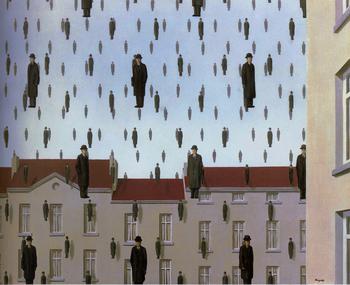
“My Own Version Of You” is, apart from the oddball “Murder Most Foul”, the only song on Rough And Rowdy Ways that is not named after the chorus line. Dylan’s song naming has not been particularly exciting since 1967, since John Wesley Harding. Before that, roughly from Another Side Of (1964) to Blonde On Blonde (1966), Dylan is in his “Margritte phase”, the phase in which he, like the Belgian surrealist for his paintings (“Golconde”, “La condition humaine”, “Le blanc-seing”), comes up with alienating, poetic, often incomprehensible and sometimes unrelated titles. Titles that might insinuate an explanatory, underlying idea (“Spanish Harlem Incident”, “It Takes A Lot To Laugh, It Takes A Train To Cry”), suggest a deeper meaning to the lyrics, but more often than not they are simply alienating and seem to have no relation to the lyrics (“Rainy Day Women #12 & 35”, “Fourth Time Around”) or are vaguely cryptic encodings (“Subterranean Homesick Blues”).
From 1967 onwards, the song titles are “normal” again. Often the opening line, just like old folk songs and poems are named (“As I Went Out One Morning”, “The Wicked Messenger”, “Went To See The Gypsy”), often the recurring refrain line (“I Threw It All Away”, “If Not For You”, “Watching The River Flow”) or the chorus (“Forever Young”, “Knockin’ On Heaven’s Door”, “Shelter From The Storm”). And that’s how it is, with a few rare exceptions, to this day. Exceptions are song titles such as “Wedding Song” and “Romance In Durango”, titles that are at least fairly unambiguous and cover the subject matter.
“Margritte titles” have been virtually extinct since 1967. At most, “Floater” (2001) and “Tin Angel” (2012) are comparable – words that do not appear in the lyrics and whose relationship, if any, is not immediately clear. But apart from that, almost all songs since 1967 have had unspectacular, self-explanatory titles, and Dylan’s tendency towards extra-textual mystification has virtually evaporated. Virtually evaporated; we can still see the residue of it in the album titles. Planet Waves. Street-Legal. Infidels. Rough And Rowdy Ways. Code breakers with crypto-analytical ambitions are served, at least, with the album titles (as well as with the lyrics themselves, obviously).
Anyway, “My Own Version Of You”. Dylan demonstratively chooses not to use the recurring line “I’ll bring someone to life” as the title. All eight other regular songs on the album are named after (part of) the recurring refrain line, but for this song, he chooses a combination of words that only appear once in the song. A reflex we hardly ever see, by the way. Songs such as “Long And Wasted Years”, “Boots Of Spanish Leather” and “Abandoned Love” are also named after a single word combination from the song, but these are always closing lines, punchlines, the apotheosis, which in themselves have an extra, striking value. Elevating a fragment from somewhere in the middle hardly ever occurs in Dylan’s oeuvre of some 700 songs. “Changing Of The Guards” and “Under The Red Sky” are about the only other examples. Apparently, Dylan attaches special value to the words my own version of you, words that we only encounter at the end of the first verse:
I want to bring someone to life - is what I want to do
I want to create my own version of you
… as the closing words of the first chorus, at that – the seasoned Dylan fan who has been singing along since “Blowin’ In The Wind” through to “I Contain Multitudes”, knows what to expect: my own version of you is the title and the closing hurrah of the first chorus – this is what we’re going to hear at the end of each verse. Just like in dozens, perhaps hundreds of Dylan songs between “Blowin’ In The Wind” and “I Contain Multitudes”, just as in, say, “Shelter From The Storm” and “Make You Feel My Love”, “The Times They Are A-Changin’” and “When The Deal Goes Down”. But behold, this time things turn out differently:
2
I want to bring someone to life - someone I’ve never seen
You know what I mean - you know exactly what I mean
3
I’ll bring someone to life - someone for real
Someone who feels the way that I feel
4
I’ll bring someone to life - in more ways than one
Don’t matter how long it takes - it’ll be done when it’s done
… the recurring refrain line really is I’ll bring someone to life, and the second remarkable thing is the insignificance of the surrounding words at the end of verses 2 to 4. Lazy rhymes (seen-mean, real-feel and one-done), substantively empty (“You know what I mean – you know exactly what I mean”) to even somewhat awkward filler (“someone I’ve never seen”? – as opposed to “I want to bring someone I’ve seen before to life”?). Only chorus line 3, “Someone who feels the way that I feel”, still has some weight as it echoes both a God who creates in His own image and the Prometheus myth – but given the emptiness of the other chorus lines, that weight now seems to be due more to happy coincidence than to poetic insight, more to the wishful thinking of the analyst than to the inspiration of the poet.
5
I’ll bring someone to life - balance the scales
I’m not gonna get involved in any insignificant details

6
I’ll bring someone to life - spare no expense
Do it with decency and common sense

7
I want to bring someone to life - use all my powers
Do it in the dark in the wee small hours
The Nobel Prize winner seems to realise this from verse 5 onwards. The chorus lines become more ambitious. The rhymes are no longer banal (the scales-details, no expense-common sense, powers-hours), a line such as I’m not gonna get involved in any insignificant details is technically challenging for a master of phrasing, not to mention its tongue-twisting quality (Dylan fails on the recording: “I’m not gonna get involved any insignificant a-details”), and we hear thoughts with substance and funny references (“in the wee small hours”).
John Mayer – In The Wee Small Hours Of The Morning:
I want to bring someone to life - turn back the years
Do it with laughter - do it with tears
And finally, the Nobel Prize-worthy apotheosis, the confession of the songwriter who wants to keep honouring and reviving tradition and heritage in his own version of you, declaring that his songs shall cover the entire spectrum of human emotions, comedy and tragedy, from laughter to tears;
Here sit I, forming mortals
After my image;
A race resembling me,
To suffer, to weep,
To enjoy, to be glad,
And thee to scorn,
As I!
… laughter and tears, as already prescribed by that former Modern Prometheus, Goethe’s Prometheus.
Jochen is a regular reviewer of Dylan’s work on Untold. His books, in English, Dutch and German, are available via Amazon both in paperback and on Kindle:
Learn more about Bob Dylan’s perception of stage lights and how it has affected his shows. Discover the list of casino venues where he successfully performed.
When you think of great names such as Bob Dylan, amazing concerts, shows, and appearances come to mind. While many would expect to see flashing lights attracting the attention of the audience, Bob Dylan’s shows were quite different.
Despite being completely different, he still visited flashy places to perform before his fans. That even included brick-and-mortar casinos. They were just as popular as today’s live texas holdem bonus poker online casinos that you can find digitally. Even today, retail casinos offer an authentic experience, appealing to many people who don’t want to just gamble, but enjoy a quality show, food, and nearby sightseeing.
Let’s explore how Dylan liked his lighting and how it affected his appearances on the stage.
Dylan’s Lighting Style and What it Means
Dylan is among the most popular music artists for a good reason. His authentic style always made him different compared to others. That’s why he was able to perform in a wide range of venues, some of which included retail casinos. It’s the perfect place because Las Vegas offers make or break trips couples enjoy as they get to rebuild their relationship through fun and interesting events. One of the places where it’s possible to do is definitely a Bob Dylan concert or a show. The entertainment capital of the world is the place where all artists get the chance to perform, and the best ones come back. This was the case with Dylan, who repeatedly appeared in Las Vegas.
One thing is certain: his success was not about the lights. It was about his captivating music that made fans flock to his shows. When it comes to lighting, Bob Dylan was as minimalistic as he could get. He never wanted his fans to be distracted by anything on stage; he wanted the music and him to be the only things his fans focused on. Plus, all the lighting could actually distract him as he was playing.
All this is testified by Joel Reiff, who was his lighting director from ‘99 to ‘02. During this time, Joel received simple instructions from Dylan. He always told him to keep the lights black and white. He also instructed him to keep the lights stationary as much as possible. He was allowed to change the lighting for specific songs, but they would remain still and in black and white.
Casino Venues Where Bob Dylan Performed
As years went by, fans knew what to expect from a Bob Dylan concert. This stillness in his appearances didn’t stop him from visiting some of the most popular casino theaters in the United States. Dylan performed 20 times in Las Vegas so far, and here are a couple of casino-related venues where he had his appearances:
The Joint – The Hard Rock Hotel & Casino – The Joint is a legendary place in Las Vegas that was visited by numerous artists over the years. He performed there seven times, the last of which was in 2009.
Pearl Concert Theater – Palms Casino Resort– Bob performed at this theater only once in 2011. It’s an iconic Las Vegas theater where not only musicians but also many comedians have performed. It’s part of the Palms Casino Resort that offers a complete experience for all its visitors.
The Chelsea Theatre – The Cosmopolitan –Dylan appeared here twice in 2016 and 2017. Like always, he kept his shows simple in terms of lighting and performance, keeping himself in focus for the whole show.
Colosseum at Caesars Palace– With over 4,000 seats available, this theater is among the most popular ones in Las Vegas. He performed there in 2010, marking his only appearance at that venue.
How was Simplicity a Risk
What was so risky about simple lighting and theatrics in Bob Dylan’s appearances? The answer is his simplistic appearance. In a world where artists go above and beyond to entertain their audience in various ways, Dylan keeps things simple.
He wants his fans to enjoy the music and not the lighting effects. He wants them to enjoy every sound that he makes and not be distracted by some colorful lights or other parts of his scene. The best part is that this risk has paid off. People attending his shows know exactly what to expect, which makes him uniquely authentic in today’s world.
Videos selected by Tony Attwood with the idea of finding a representative concert for each year since Bob started performing live. If you have any suggestions for videos we ought to include, please do drop a note to tony@schools.co.uk This one is from 2007. There is a list of the 42 concerts we have so far covered below.
As part of my work in publishing a new article about Bob Dylan about 350 times a year I also do a fair amount of checking back through the almost 4000 articles already on the site, and in doing that I thought it might be an idea to maybe pick out a few of those series which have stood the test of time.
Unfortunately, “stood the test of time” is merely my own view, and since I wrote the articles, that is liable to be very untrustworthy. But maybe it will stimulate you to think of some of Bob’s songs that were performed once but could and perhaps should have gone further.
So, having offered the series on The album Covers as being an Untold series that can stand being reviewed, this time I would like to highlight a series that I found absolutely fascinating to research (even if my subsequent articles were not always very informative) – a series which gave me, as I wrote it, a huge number of surprises.
This was the series that focused on the songs that Bob has only performed once or twice, and it arose out of the realisation that the majority of Bob’s compositions have never been performed by him at all.
Now I guess most of us know immediately that the song Bob has performed most on stage is “All along the Watchtower” – the official Dylan site clocks that as having been performed 2320 times by Bob, just a bit ahead of the 2075 performances of “Like a Rolling Stone.”
Andd fortunately, it is possible to put the song list in the order of the number of times played, and I must admit I was a little surprised when I found that the collection of songs that had never been performed at all, was greater than the list of songs that had been performed once or more (all the way up to 2320 times).
Quite why Bob has chosen to ignore totally such songs as (just by way of example) “No Time to Think” or “Farewell Angelina”, (or indeed “Angelina”), or “Abandoned Love” or indeed why he didn’t take “Ballad for a Friend” further and record that, is totally beyond me. But he’s the genius composer, and I’m just the guy who writes about him, so of course he knows best.
So arose the series “Once or Twice” – the songs that Bob wrote, and played in public once or twice before leaving them behind. And actually, I did have to change the title to Three Times and Out when I realised that “When the Ship” had been performed three and not twice – but we all make mistakes, and as long as I say “sorry” I guess that is ok.
The series went on for quite a while – I think it got to around 25 entries and as with so many series I indulge in, I really didn’t know where it would go when I started. But I was stunned to find some songs in the list that, in my opinion, at least. really did (and indeed do) deserve a much wider audience. It makes me think that maybe there should be a series on some of the songs that Dylan has composed but never performed. Especially if we could find some recordings by other artists. In fact now I think of it, I did write maybe half a dozen articles on that series and then got distracted. Maybe it is time to try again. Unless you’d like to volunteer….
Meanwhile, here is the list of articles on the songs that Bob performed once or twice but then left. If you have suggestions of any kind (as long as they are moderately polite) you can write to me at Tony@schools.co.uk
This series is not a set of reviews of what Bob said about each song (you can, of course, buy a copy of Bob’s “Philosophy” book and see what he said) but rather my own reaction to each song – written particularly since in most cases I was not familiar with the song until I saw Bob’s book.
So I’m not trying to review Bob’s book, but rather just offer my thoughts on the songs and recordings he suggested.
I should add that the titles of songs reviewed in my series are noted at the end of this article in alphabetical order, not in the order found in the book. That makes it easier for me, even if no one else.
CIA Man by The Fugs was written by Tuli Kupferberg (1923-2010). One of Dylan’s comments on the song is that “If these lyrics don’t get your attention, then you must be comatose. It’s amazing how powerful The Fugs could be with just a few edgy instruments.”
Which is interesting indeed, given that for most people Dylan is known particularly for his use of lyrics. And yet here the lyrics are pared down to the bone – as shown further down the page.
The Fugs are one of those bands I have a problem with because their music doesn’t really appeal to me, and yet they are said by many commentators to have influenced so many of the musicians whose work I utterly adore. Apart from Bob, I’d cite Syd Barrett, Lou Reed, Frank Zappa, Donald Eagen…
But they represent to me the Alan Ginsberg side of the equation of protest against the way the world is run by the rich and powerful, while Bob Dylan has been on the other side observing, commenting, …. And in this way the highly repetitious nature of the song can work – they are pulling the same trick over and over again and getting away with it without anyone doing much about it. Although after hearing the song once, I am not sure I want to listen again.
Listening to this track and looking into the history of the Fugs I saw that their name came from the fact that in the original copy of “The Naked and the Dead” by Norman Mailer was published with the word “fuck” replaced throughout by the invented word “fug”. It’s one of those odd games that people start to play when faced with the notion of the power of words.
In one sense, the Fugs were somewhat like Dylan in that they would change their approach from time to time to the extent that people would say you would have no notion of what each new record would sound like. Maybe we could think of them as Dylan taken to extremes, in this regard.
But for me, if for no one else, there is a problem because just coming up with a novel way of doing things does not mean that what you have invented is particularly good, or important or memorable, or influential or artistic or anything else. It can just be different.
So should something that is simply “different” be valued just because it is different? I valued, and have always valued, Freewheelin’ not just because it was unlike any other album I had heard, but because it was a set of excellent performances of excellent songs. After all one side starts with “Blowin in the Wind” and the other with “Don’t think twice” which is not a bad starter on each side. And that’s before we consider what else is on the album.
Of course we can’t in any way compare the lyrics that Dylan produced either there or anywhere else with what we have on this track nominated by Bob…
Who can kill a general in his bed?
Overthrow dictators if they're Red?
Fucking-a man!
(Fucking-A! C-I-A!)
CIA Man!

Who can find a counter-agent quick?
Especially the ones, themselves, of it?
Fucking-a man!
(Fucking-A! C-I-A!)
CIA Man!

Who can be so overtly covert?
Sometimes even covertly overt.
Fucking-a man!
(Fucking-A! C-I-A!)
CIA Man!
The song continues in the same manner for quite a while until we get to the last verse which reads
Who's the agency well-known to God?
The one that copped his staff and copped his rod?
Fucking-a man! CIA Man!
Fucking-a man! CIA Man!
Fucking-a man! CIA Man!
CIA Man! CIA Man!
CIA Man! CIA Man!
CIA Man!
C I A
Maybe it’s just me. Maybe I am not so much getting old but am actually old. Maybe I was never as radical and left wing as I think I was in my youth, and in many ways still think I am, but my only reaction is well, yes, I know. So what? But if you want some more proof, here it is
Here are the other songs we’ve covered from this book….
(Prelude: my reference in the title to the best ever, does not refer to the above version of the song under discussion, fun though that is. The “best ever” is a version from the Never Ending Tour, and that appears later).
My argument in this series is that Bob Dylan faced two major issues as he evolved his own form of writing songs. One was how to express in lyrics the feelings and emotions he wished to put across, and the other was how to evolve the music of his compositions in a way that reflected these ever more complex lyrical forms.
Now this might not sound too difficult, but it must be remembered it not only had to be achieved without the music falling apart through becoming too complicated, it also had to be achieved without alienating his many fans who did not have the benefit of the musical insights that he himself found through his own lifelong study of music.
And this brings us to an absolutely key point in understanding Dylan’s work. Many people listening to his compositions will accept and enjoy them without fully understanding or even without correctly hearing all the lyrics. But if they don’t understand what the music is doing, then they tend to be far less forgiving. For some reason, most of us are willing to spend time deciphering the meaning of the lyrics, but we want the music to be instantly memorable.
After writing She’s Your Lover Now, and the failure to produce a recording that was felt (perhaps by Dylan, perhaps by the producer) to be suitable for the next album, Dylan entered a long phase of songs that lyrically further reflected on all the problems and issues that he exposed in that song – but while taking the music back to a form that was more immediately recognisable.
Now we should remember that by this time Dylan had written a lot of strophic (verse-verse-verse) songs and ternary form songs (in the style verse, verse, middle 8, verse). He had also introduced songs, which had much more complex rhyme patterns for the music to reflect than the normal A, B, C, B approach. And even had songs in which suddenly one verse would have more lines than previous verses (something I am not aware of other composers doing). “Visions of Johanna” was an early example that I have mentioned before.
So the question now was, would Bob be able to find any other variation to his music, as he worked to bring the lyrics, which appeared to have run away from him in “She’s your lover now”) back under control, while still containing their essential Dylan-ness.
In many ways Absolutely Sweet Marie, sounds like a classic Dylan rock song. And it has a rhyming pattern of its own (A, B, A, B, B) which immediately makes sense to the listener.
Well, your railroad gate you know I just can't jump it (A)
Sometimes it gets so hard, you see (B)
I'm just sitting here beating on my trumpet (A)
With all these promises you left for me (B)
But where are you tonight, sweet Marie? (B)
The only slight oddity is that it has five lines – but by making the last line a repeated “chorus” type line which is the same for each verse, everything seems to fit as we move on to the second verse the music being the same as in verse one.
Well, I waited for you when I was a-half sickYes, I waited for you when you hated meWell, I waited for you inside of the frozen trafficWhen you knew I had some other place to beNow, where are you tonight, Sweet Marie?
Thus Bob seems to have set aside his musical experimentation with “She’s your lover now” and returned to the essence of rock music albeit with five lines instead of four in a verse. So it would seem that Bob must have recognised or been told that [although who would tell him?] even after a multiplicity of run throughs in the studio with the band, that song didn’t work as a piece of music. Which is why it is interesting to consider what he did next.
And what we find is that aside from giving us a much more upbeat, bouncy tune, he simplified both the rhyme scheme and the musical form itself. There are three different melody lines, with two of them repeated….
Melody A: Well, your railroad gate, you know I just can't jump it
Melody B: Sometimes it gets so hard, you see
Melody A: I'm just sitting here beating on my trumpet
Melody B: With all these promises you left for me
Chorus Melody: But where are you tonight, Sweet Marie?
What is clever about this is that the song is primarily performed over the standard three chords. In the key of D. these are D, G and A. But a couple of other chords – which are perfectly normal and natural for the key in which the song is performed – also find their way in. And the effect of these is to emphasise musically that this is a straightforward rock song.
So the first three lines are accompanied by the three major chords that sound natural and obvious in the key, because they are made up of notes that appear in that key. Thus in the key of D, we have the chords of D major, G major and A major, and that is what we get all the way through to “trumpet” – but then Bob throws in a B minor chord.
           D             G           A          D
Well, your railroad gate, you know I just can't jump it
G            D                 A
Sometimes it gets so hard, you see
         D           G        A     D       Bm
I'm just sitting here beating on my trumpet
But the point is here that this chord of B minor makes us feel that yes, we still know, musically, where we are, even if we don’t know anything at all about music. This all feels right and natural. All that B minor does is emphasise that the singer is still part of the show, but is a bit outside of everything being ok – as the ultimately meaningless concept “beating on my trumpet” feels out of place.
Now this move to B minor is subtle and we hardly notice it, because we quickly move on to another chord. Again, not one of the three mainstream chords of a piece in D major, but nevertheless a perfectly regular and normal chord for that key: F sharp minor. And then again, as quickly as we have arrived, we move on, back solidly into the key of D, which then is even more firmly established by the last line of the verse.
     F#m                    D        A
With all these promises you left for me
    G               A              D
But where are you tonight, sweet Marie?
So musically, we have a spot of adventurousness, but nothing that ever once leaves the mainstream of the key of D major or the well-recognised structure of a ternary song.
And I stress “ternary” because Dylan still does have something up his sleeve, which is what makes him a great songwriter as well as a prize-winning poet. That is the middle 8 – which is a short section of music usually inserted after a couple of verses, and which does something different, although never leading us too far away from the mainstream.
Here Bob does stick to the tradition – the middle 8 comes indeed after two verses. Lyrically, it doesn’t continue the narrative, but to emphasise the different nature of what is being said, it introduces a chord that we have not previously heard in the accompaniment.
This is the chord of B flat and it occurs with “Well, anybody can be like”.
Now, B flat major has nothing to do with the key of D major, in which the whole piece is played. There is no B flat anywhere in the chords used or in the melody. But here we get it – we bounce into the chord and quickly out again. The chord of D that follows the Bb section each time, reminds us where the song is based.
      Bb                        D
Well, anybody can be just like me, obviously
    Bb                                         D        A
But then, now again,nott too many can be like you fortunately.
and that quick resolution at the end from D to A, makes it quite clear we are still in the key of A and ready to take on board another verse.
So what Bob has done is introduced a middle 8 section which musically and lyrically is different from the verses, but not so different that we lose track of where we are.
Unfortunately, many websites that have printed out these lyrics have done so without any thought to the musical structure of the song, so this “middle 8” which appears between verses two and three, and also appears between verses four and five, but is often written out as if it is just another verse. But it should be written as a separate section…
Well, I don't know how it happened But the river-boat captain,
                                                 he knows my fate
But everybody else, even yourself They're just gonna have to wait
It is unfortunate that the structure of the music can be ignored, although the reason the sites do this is not through any superior musical knowledge – the mistake occurs on the official Bob Dylan site. Quite possibly, no one bothered to listen.
But to summarise the main point, Bob retreated completely from the utter complexity of “She’s Your Lover Now” and, seemingly for very good reasons, because musically that song becomes so complex that it does not work. But it appears Bob did not want to return totally to the strophic song – and so gave us songs such as “She’s Your Lover Now” which in giving us two “middle 8” sections moves away from the strophic (verse – verse – verse) song into the strophic song which introduces a different section between a couple of the verses.
And it was a very good compromise. It really works, and Bob realised the possibility because he featured this as a Never-Ending Tour song. And indeed listening to where the song got to on the tour makes me think that Bob really has gone back and listened to his own work once more, and thought about both what he wrote and why he wrote it. It’s no longer a throw-away piece, allowing latecomers to take their seats. It becomes a song that demands attention.
As a result, for me, the NET version below is by far the best of the versions that we have here. The changes are not dramatic and it would be easy to dismiss them, but the instrumental verse halfway through this performance really does give us an extra insight into the relationship between the singer and Marie – and that is something that I don’t think was there previously.
Also, it is an extended instrumental break going through three verses in different ways and this leads us into the “middle 8” perfectly, allowing for the reflective “forgot to leave me with the key” verse, and then another instrumental verse.
Suddenly, I do feel that the re-scripting of the song was completely worthwhile – that last, protracted instrumental break does give extra thoughts and insights into what the singer and Marie have been up to all these years. And equally, the sudden end makes sense – Bob re-wrote the song, and re-wrote the end. “Yeah! Yeah!” as the gentleman in the audience says. And we can see why, after this Bob dropped the song. Not because he was fed up with it, but because there really was nowhere else to go.
This recording below is from 2006. And as with other extracts in this series, it is one of my absolute favourite Dylan moments – this is the time when he realised exactly what was in this song created so many years before. The song was performed 181 times. This surely must be the best version of them all.
henry miller stands on the other side of ping pong tableand keeps talking about me(Bob Dylan: liner notes ~ Another Side Of Bob Dylan)
Miller’s known for writing novels that are intended to cause sexual excitement when read.
Bob Dylan goes out of his way to avoid truck-driving censors; he does not want to have his art – his writings, his songs, his music – mixed up in any obscenity trial.
Below, a portrayal of a gal eating a Mexican orange that parodies the “pornographic” writings of Henry Miller:
O'lady takes an orange out of her pocket
"got this from Aztec country - watch me boys"
she takes the orange & oozes and dribbles
all down her mouth all over her skirt
- more -  more - more -
she's all covered in orange
(Bob Dylan: Tarantula)
An example of Henry’s smutty literature:
O Tania, where now is that warm cunt of yours, those fat, heavy garters,
the soft, bulging thighs? There is a bone in my prick six inches long.
I will ream out every wrinkle in your cunt, Tania, big with seed.

(Henry Miller: Tropic Of Cancer)
Below, Dylan messes around with Miller’s tale in order to create humor:
Feel like falling in love with the first women I meet
Putting her in a wheelbarrow and wheeling her down the street

(Bob Dylan: Things Have Changed)
Miller is writing below about some kind of “kinky” sex game:
Sometimes he’d stand her on her hands, and push her around the room that way, like a wheelbarrow.
(Henry Miller: Tropic Of Cancer)
The lyrics beneath express a hope that there’s going to be sexual activity but certainly there’s no arousing depiction thereof:
Stay, lady, stayStay with your man a whileUntil the break of dayLet me see you make him smile(Bob Dylan: Lay Lady Lady)
The following song’s easily taken as a parody that features Henry’s bony part:
And you go watch the geekWho immediately walks up to youWhen he hears you speakAnd says, "How does it feelTo be such a freak?"And you say, "Impossible"As he hands you a bone(Bob Dylan: Ballad Of A Thin Man)
The final song’s surely about reaching a sexual climax, but that meaning, at first sight anyway, is not obvious.
It’s very euphemistic:
Well, I ride a mail train, babyCan't buy a thrillWell, I've been up all night, babyLeaning on the windowsillWell, if I die on top of the hillAnd if I don't make itYou know my baby will(Bob Dylan: It Takes A Lot To Laugh, It Takes A Train To Cry)
One strike of lightning is all that I need
And a blast of ‘lectricity that runs at top speed
Show me your ribs - I’ll stick in the knife
I’m gonna jump start my creation to life
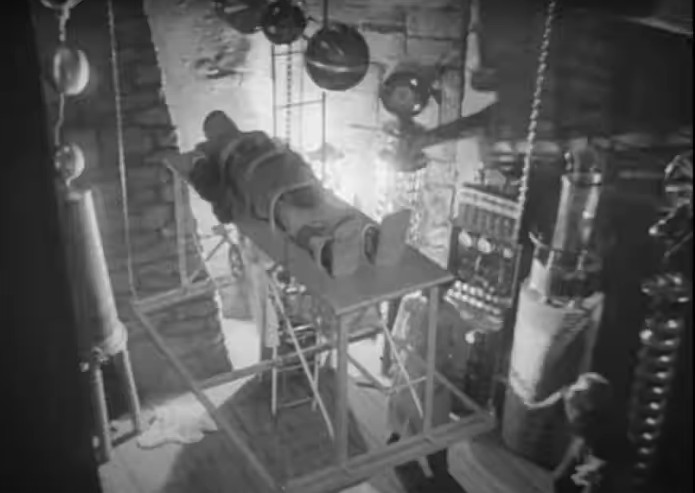
It is the cinematic dramatisation of the creation story. Of the creation of Frankenstein’s monster, that is. The first film adaptation, James Whale’s Frankenstein from 1931, not only coined the now iconic image of Dr. Frankenstein as a mad scientist and a hunchbacked Igor as his assistant, but also all the fuss with thunderstorms and lightning.
In 1931, the still lifeless body lies on an operating table, in a setting that we would now call steampunk; a lot of gears, Van de Graaff generators, Tesla coils and whatnot. Metal chains with heavy links hang limply from the corners of the table until the doctor activates a mechanism hoisting the entire contraption up through pulleys, towards a recess in the roof.
Outside, a violent storm is raging, and the body and the operating table with all its conductors are now exposed to the elements. We watch along with the doctor, Igor and two visitors, friends of the doctor. From below, we see the table being struck by one lightning bolt after another. The average voltage of a lightning discharge is about 100 million volts, so it’s quite a situation. The horror dripping from the visitors’ faces is completely understandable, but Dr Henry Frankenstein (Colin Clive) is in full mad scientist mode, staring with a burning gaze at the inferno above. Culminating when, a moment later, he bends over the body and sees the monster’s hand move:
Henry: Look. It’s moving. lt’s alive. It’s alive. lt’s alive. It’s moving! lt is alive! It’s alive! lt’s alive! It’s alive! IT’S ALIVE!!
Victor: Henry, in the name of God!
Henry: In the name of God? Now I know what it feels like to BE God!
The scene becomes a template for later film adaptations, parodies and Looney Tunes derivatives; the laboratory usually is a Gothic castle room, preferably on a hill, the assistant a hunchbacked monster, and the moment suprême is heralded by flashes of lightning and claps of thunder.
Thunderbolt and lightning very, very frightening, as Galileo reportedly once said, and he was usually right. It is an upgrade from a visual thinker, the kind of creative mind imagining that Marty McFly in 1955 needs a lightning strike to charge his DeLorean for the return journey Back To The Future or the hundreds of movies using thunder and lightning to heighten the sense of drama. However, in the source, Mary Shelley’s novel Frankenstein; or, The Modern Prometheus, the surrection scene is a lot less spectacular. The word “electricity” appears only twice in the book, as does “galvanism”, both at a respectful distance from the fateful birth. That apotheosis is treated much more modestly than in the film adaptations and than the spectacle in Dylan’s song:
“With an anxiety that almost amounted to agony, I collected the instruments of life around me, that I might infuse a spark of being into the lifeless thing that lay at my feet. It was already one in the morning ; the rain pattered dismally against the panes, and my candle was nearly burnt out, when , by the glimmer of the half-extinguished light, I saw the dull yellow eye of the creature open ; it breathed hard, and a convulsive motion agitated its limbs.”
So instead of a hellish thunderstorm and cascades of lightning bolts: “infuse a spark”. No demonic “It’s alive” screaming either, for that matter; Shelley’s Frankenstein flees the laboratory and lies down on the bed, tossing and turning. And even falls asleep.
The strike of lightning here in “My Own Version Of You” illustrates – once again – that Dylan is a visual thinker and a film fan, who tends to copy images from film adaptations rather than literary sources for his songs. We saw this more than half a century ago in “Bob Dylan’s 115th Dream” (1965), where he sings that “Captain Arab” was stuck on a whale; again an image from the film adaptation, the movie with Gregory Peck – it does not take place in the source, the novel Moby Dick. And we still see it in Dylan’s 2012 Titanic song, “Tempest” (with the Leo took his sketchbook verses, the integration of the film images).
It is, of course, a good choice. “One strike of lightning is all that I need,” the scene with the life-giving electroshock has infinitely more dramatic power with the image of a striking lightning bolt than with the clinical “I infuse a spark of being.” The extrapolation, the next line of verse, “And a blast of ‘lectricity that runs at top speed,” sounds great, but we shouldn’t take the content too seriously. Lightning and a blast of electricity is semantically a bit strange already, and “at top speed” is just silly; electricity can at most be accelerated – a little – to the speed of light in a vacuum. Which would be rather fatal for survival chances. Anyway, while this second line of verse may not hold up in the lecture hall, it certainly does on stage – the line sounds like a bell and runs like clockwork. Partly thanks to the Shakespearean elision, the shortening of words for rhythmic reasons, in this case the striking electricity that Dylan shortens to ’lectricity. Which, in all its insignificance, could by now be catalogued as “Dylanesque”, by the way; this is the third ’lectricity in Dylan’s oeuvre, after Stay far from the fence with the ‘lectricity sting in “Walls Of Red Wing” and the well-known The ghost of ‘lectricity howls in the bones of her face from “Visions Of Johanna”.
It is the melodious introduction to the gruesome final lines of this closing verse, to Show me your ribs – I’ll stick in the knife / I’m gonna jump start my creation to life. At first glance fitting in with the bloodlust that we have seen intensify in Dylan’s songs since the twenty-first century and in line with the physical aggression here on Rough And Rowdy Ways at all. “I take a sword, and hack off your arm” in “Black Rider”, for example, or “I’ll cut you up with a crooked knife” in “Crossing The Rubicon” and “fight with a butcher’s hook” in “Goodbye Jimmy Reed”. The difference is – of course – that the knife stab here is not life-threatening, but rather life-giving, presented as a sinister variant of jumper cables. With stage directions, plot and word choice that, strangely enough, remind us once again of a film classic:
Vincent grabs the magic marker out of Jody’s hand and makes a big red dot on Mia’s body where her heart is.
VINCENT
Okay, what do I do?
LANCE
Well, you’re giving her an injection of adrenaline straight to her heart. But she’s got a breast plate in front of her heart, so you gotta pierce through that. So what you gotta do is bring the needle down in a stabbing motion.
Lance demonstrates a stabbing motion, which looks like “The Shape” killing its victims in “Halloween”.
VINCENT
I gotta stab her?
LANCE
If you want the needle to pierce through to her heart, you gotta stab her hard. Then once you do, push down on the plunger.
VINCENT
What happens after that?
LANCE
I’m curious about that myself.
… the scene from Pulp Fiction (Quentin Tarantino, 1994) in which John Travolta as Vincent has to save Mia’s life. Mia (Uma Thurman) has accidentally overdosed on heroin – she thought the bag of white powder in Vincent’s coat pocket was cocaine. She is as good as dead, and Vincent is understandably slightly hysterical, as she is the wife of Vincent’s boss, the gangster kingpin Marsellus. But, as we all know, it ends well:
Vincent brings the needle down hard, stabbing Mia in the chest. Mia’s head is jolted from the impact. The syringe plunger is pushed down, pumping the adrenaline out through the needle. Mia’s eyes pop wide open and she lets out a hellish cry of the banshee. She bolts up in a sitting position, needle stuck in her chest [screaming]. Vincent, Lance and Jody, who were in sitting positions in front of Mia, jump back, scared to death.
LANCE
If you’re okay, say something.
Mia, still breathing, not looking up at them, says in a relatively normal voice:
MIA
Something.
Vincent and Lance collapse on their backs, exhausted and shaking from how close to death Mia came.
JODY
Anybody want a beer?
No flashes of lightning or power surges, nor “it’s alive, it’s alive” shrieking, but no less a blood-curdling jump start to life.
Jochen is a regular reviewer of Dylan’s work on Untold. His books, in English, Dutch and German, are available via Amazon both in paperback and on Kindle:
Videos selected by Tony Attwood with the idea of finding as good a recording as possible for on interesting concert each year – where possible! This one is from Kansas City
It is very rare for me, secured in my East Midlands village in middle England, to meet those people who so kindly and willingly give up their time to write for Bob Dylan.
And indeed once they have finished writing, they vanish from my life, which I regret. Obviously, the articles by these dedicated souls are still on the site, and flipping back through the site, as I often do, but I’ve recently thought it might be nice from time to time to look back at one or two of the really wonderful series that we have had on this site.
Now I should say that in almost every case, it is the author of the series who has come up with the idea – not me. I’ve just sat here and published the work, generally as interested and often thrilled by the series, as many readers have been.
So I’ve decided from time to time to publish an occasional article celebrating past series – so that if you’ve read them and forgotten them, or maybe joined us on Untold Dylan after their publication, you might consider going back and taking a look at what has gone before.
I’m starting with the album artwork series, which with illustrations, considering the origins of and decision making that went into the making of each of the covers of Bob Dylan’s albums.
All the articles and selection of illustrations in that series are by Patrick Roefflaer.
As with all the other series on this site, they remain on line in the original format – except in the odd occasion where a mistake has been spotted [normally a mistake by myself made as I set the article for publication] and it has been corrected.
In this series on the artwork of the albums, Patrick covered 32 albums, and I believe this remains a unique contribution to the study of Dylan’s work. I enjoyed the series enormously, and I know many of our readers who got in touch with me did as well.
If you missed the series, or if you want to go back to some of its revelations, hopefully this set of links will take you exactly where you want to go…
Below, a humorous spoof on Roy Rogers (birth name Leonard Slye), a.k.a “King Of The Cowboys”; he marries Dale Evans (birth name Frances Smith), a.k.a “Queen Of The West”. Roy – Dale’s third husband; Dale – Roy’s third wife.
In real life, the married couple act in films together and sing songs together. Together, they have their own TV show. Roy and Dale are very religious.
According to singer, songwriter, musician, and fibber Bob Dylan, a newspaper of the day tells a different story.
Actress and singer Debbie Reynolds appears in the movie “How the West Was Won,” which features James Stewart as Linus Rawlings. Debbie plays Lilith Prescott, who eventually marries gambler Cleve Van Valen (Gregory Peck).
Debbie sings a Romantic Transcendentalist song to lift the spirits of those travelling west by wagon train:
Away, away, come away with me
Where the grass grows wild
Where the winds blow free
Away, away, come away with me
And I'll build you a home in the meadow

(Debbie Reynolds: Home In The Meadow ~ traditional; Cahn et al)
Manifest Destiny is blowing in the wind!
As the story goes, Leonard Slye keeps his mouth shut most of the time. (A gossip columnist accuses Debbie and Dale of having a hot sexual affair with one another.)
Note, the actual name of Dale’s horse is “Buttermilk”. And Roy’s is named “Trigger”:
Lem the Clam tho, he really gives a damn if Dale really does get nailed slamming down the scotch …. and good old Dale, she comes along and both her and Debbie, they start shacking up in the newspaper
& jesus who can blame'em
(Bob Dylan: Tarantula)
Gossipers and tellers of lies get their comeuppance in the song below:
Someone's got it in for me
They're planting stories in the press
Whoever it is I wish they'd cut it out quick
But when they will I can only guess
They say I shot a man named Gray
And took his wife to Italy
She inherited a million bucks
And when she died it came to me
I can't help it if I'm lucky
(Bob Dylan: Idiot Wind)
The narrator of the above song is angry, but his rage is muted somewhat by the self-knowledge that he has often been the “howling beast” himself; the wind in the song certainly isn’t presented as a fundamental element of a caring Universe as portrayed by Romantic Transcendentalist writers.
To them, the sun’s up there in the sky to serve the inhabitants of the Earth – keeps them alive. As expressed in the following song:
Can’t you hear that rooster crowin’?
Rabbit runnin’ down across the road
Underneath the bridge where the water flowed through
So happy just to see you smile
Underneath the sky of blue
On this new morning, new morning
On this new morning with you
Williamn Boyd stars as Hopalong Cassidy in movies as a milk-drinking, hard-riding, lawman.
Spoofed he is below:
(O)ut of his past appears Insanely Hoppy
screaming and dancing

(Bob Dylan: Tarantula)
in another spoof, it might be asserted that Bob Dylan presents Miles Standish as the captain of the “Mayflower”, rather than Christopher Jones, when it lands at Plymouth Rock. Bob names the captain “Arab” – as in “Arabic”.
“Arabic”, a word from the epic poem quoted below.
Miles is on the ship, but he’s actually the Pilgrims’ military commander. So says the romanticized poem “The Courtship Of Miles Standish” – there’s litte doubt that it’s been read at some time by Bob Dylan:
Ever and anon to behold his glittering weapons of war
Hanging in shining array along the walls of the chamber
Cutlass and corselet of steel, and his trusty sword of Damascus
Curved at the point, and inscribed with its mystical Arabic sentence

(Henry Wadsworth Longfellow: The Courtship Of Miles Standish).
That is, the sentence on the blade is a mysterious one, according to Longfellow’s unsubstantiated rendering thereof.
In the following song, Dylan’s persona is a sailor on board the “Mayflower”:
I was riding on the Mayflower
When I thought I spied some land ....
"I think I'll call it America", I said as we hit land ....
Captain Arab started writing out some deeds
(Bob Dylan: Bob Dylan's 115th Dream)
Not “Ahab” as reported by some sources.
Then there’s:
(T)hese people consider themselves gourmets for not
attending charlie starkweather's funeral
(Bob  Dylan: Tarantula)
The film “Natural Born Killers” is somewhat based on Starkweather’s killing spree across Nebraska and Wyoming; he’s accompanied by his girlfriend.
The movie mocks the sensationalism that’s often published in newspapers.
From one of the many songs in the movie:
See the pyramids along the Nile
Watch the sun rise from a tropic isle
You can, of course, buy a copy of Bob’s “Philosophy” book and see what he said about each song that I am covering in this series – and then turn to the recordings of the music for that song as we work through the pieces of music one by by.
Or if you want a bit of extra background on the song you can read my notes as well – notes which for the most part are written on hearing the songs for the first time.
So I’m not trying to surplant Bob’s work in any way, it is just that for some of Bob’s reviews, I really am not fully certain I can grasp his point, particularly when I have no background in the music on which he is commenting. So my reviews are really written for people like me, who do not have a familiarity with the songs and musical traditions that Bob mentions. It’s a sort of commentary on the music, not on Bob’s commentary.
I should add that the titles of songs reviewed in this series at the end of this article are now in alphabetical order, not in the order of publication. That makes it easier for me, even if no one else.)
The song “Willy the Wandering Gypsy and Me” was composed and recorded by Billy Joe Shaver who is pictured above, and then recorded again Tom T. Hall. First here’s the original.
And before going on may I point to one line in the song “moving is the closest thing to being free”. Given Bob’s desire constantly to tour and travel, it is a fair guess that this line was one that first attracted him to the song – as well of course as the title.
This is not the tradition of music that I was brought up with, nor that which I have subsequently explored, so I can’t really comment on that, but one of the things I do know about it is that these songs do attract a lot of famous names to record them…
Three fingers whiskey pleasures the drinkersAnd moving does more than the same thing for meWilly he tells me that doers and thinkers
Say moving is the closest thing to being freeWell he's rosined his riggings and laid back his wages
He's dead set on ridin' the big rodeoMy woman's tight with an overdue baby
And Willy keeps yelling, "Hey, Gypsy, let's go"Willy, you're wild as a Texas Blue NortherReady rolled from the same makings as meWell, I reckon we're gonna ramble 'til Hell freezes overWilly the wandering Gypsy and meNow, ladies, we surely will take of your favors
And we'll surely warn you there never will be
A single soul living that could put brand or handle
On Willy the wandering Gypsy and meWe'll dance on the mountains, shout in the canyonsAnd swarm in a loose herd like wild buffaloJammin' our heads full of figures and anglesAnd tellin' us things that we already know
The composer had a reputation for shying away from publicity, and tales exist of him avoiding performers and recording artists who wanted to record his songs. I would guess it is this image of the wandering songwriter who is not interested in fame that interests and maybe even attracts Bob, particularly here. Waylon Jennings was impressed, and he decided to record an entire album of Shaver’s songs.
In fact Billy Joe Shaver, who died in 2020 aged 81, is described as a “prominent member of the outlaw country genre” and apart from being recognised by Bob Dylan was also praised by Willie Nelson and Kris Kristofferson, while artists as diverse as Elvis Presley, Tom Jones and Johnny Cash have recorded his songs. Since I have not heard of the ” outlaw country genre” before that puts me in my place, although to be fair I am not sure it ever reached England. Maybe it did, and I just missed it.
But I’ve tried to do my research, and one of the multiplicity of unexpected facts about the composer is that he married and divorced the same woman “several times” according to the Wiki article – wherein you can find a lot more about the composer than I can offer.
Here are the other songs we’ve covered from this book….
An index of previous articles in this series is given at the foot of the page.
By Tony Attwood
My argument in this series is that Bob Dylan faced two major issues as he evolved his form of writing. One was how to express in lyrics the feelings and emotions he wished to put across, and the other was how to evolve the music of his compositions in a way that reflected these ever more complex lyrical forms without the music falling apart.
In relation to the lyrics, there seemed to be not too much of a problem, because it quickly appeared that his fans welcomed the diversion away from the traditional love, lost love and dance format that popular music had embraced for decades. Thus, the different levels of complexities expressed within songs such as “Tambourine Man,” “Gates of Eden”, “It’s Alright Ma,” etc etc, were welcomed, even when the meaning of the lyrics was far from clear.
But Bob’s early musical experiences had been with Woodie Guthrie, Hank Williams, and Robert Johnson, and while there is no denying the expressiveness and innovation of these composers, equally it must be admitted that they generally did not evolve or develop the musical form they used. They established the form, rather than took it forward.
Thus Dylan’s early musical evolutions were modest – we may note, for example, the addition of the extra lines in the last verse of “Visions of Johanna” and the evolution of more interesting melodies as with “Desolation Row,” even with the song itself is based on just three chords. The lyrics were changing in terms of the topics covered (love, lost love, moving on, randomness and even surrealism (with Stuck inside of Memphis), but musically it seems Bob was finding it harder to take things forward.
But I suspect that Bob felt that while for many fans it is perfectly acceptable to have lyrics that they can’t make absolute sense of, (not least because it is such a relief to get away from the lyrics of “She loves you yeah yeah yeah” and the simplicity of life that such lyrics express), the music presents a different problem.
For many of us, the world is not the simple world of love and lost love that we find in pop songs, and Dylan indeed took us far further away from that than most other composers. And of course, for that I think we were all grateful. But I feel that although Bob realised that the fans of pop, rock and folk music all wanted to be able to hang on to what they knew, he could take them further still.
Certainly, as we saw later with John Wesley Hardin Bob was perfectly able to go back to shorter, simpler songs, and still come up with some magical moment, but for now, he wanted to push on, not least with the form. And so we got”She’s your love now”.
This is a song that, on first hearing, sounds utterly impossible to put into any format at all – although this version does contain a lot more musical sense than the earlier versions, which have now been released.
What we have here is Dylan trying to take the variation in musical form that was so successful in “Sooner or Later One of Us Must Know”, and extend it even further, lyrically, with far more vitriolic lines. The trouble with it is that while we are carried through “Desolation Row” by the contrast between the lightness of the music and the horror of the lyrics, and while “One of us Must Know” has a more distinct set of melodies thorugh its different sections, “She’s your lover now” seems to go so far without a reference to a succint form that it is very easy to lose track of where we are.
And given the utterly depressing nature of the lyrics, that means we have virtually nothing to hold on to. I’m printing them all out below, with the musical breaks as I perceive them, in case you have eight and a half minutes to spare and are not subject to bouts of depressive illness.
O how the pawnbroker roared
Also, so, so did the landlord
The scene was so crazy, wasn’t it?

They both were so glad
To watch me destroy what I had
Pain sure brings out the best in people, doesn’t it?

Why didn’t you just leave me if you didn’t want to stay?
Why’d you have to treat me so bad?
Did it have to be that way?
Now you stand here expectin’ me to remember somethin’ you forgot to say

And you, I see you’re still with her, well
That’s fine ’cause she’s comin’ on so strange, can’t you tell?

Take off your iron chains
Somebody had better explain
I’d do it, but I, I just can’t remember how
You talk to her she’s your lover now

I already assumed
That we’re in the felony room
But I ain’t a judge, you don’t have to be nice to me

But please tell that
To your friend in the cowboy hat
You know he keeps on sayin’ ev’rythin’ twice to me

You know I was straight with you
You know I’ve never tried to change you in any way
You know if you didn’t want to be with me
That you could . . . didn’t have to stay

Now you stand here sayin’ you forgive what do you expect me to say?
Yes, you, you just sit around and ask for ashtrays, can’t you reach?
I see you kiss her on the cheek ev’rytime she gives a speech

With her postcard and her pyramid
And her snapshots of Billy the Kid
they're all so nice why must everybody bow?)
Explain to her your You’re her lover now

Oh, ev’rybody that cares
Is goin’ up the castle stairs
But I’m not up in your castle, honey
It’s true, I just can’t recall
San Francisco at all
I can’t even remember El Paso, honey

You never had to be faithful
I didn’t want you to grieve
Oh, why was it so hard for you
If you didn’t want to be with me, just to leave?
Why must you stand here now with your finger’s goin’ up my sleeve?

An’ you, just what do you do anyway?
Isn't there anything you can say?
She’ll be standin’ on the bar stool
With a fish head an’ a harpoon
An’ a fake beard plastered on her brow
You’d better do somethin’she’s your lover now

Oh, why must I fall into this sadness?
Do I look like Charles Atlas?
Do you think I still got what you still got, baby?
Her voice is really warm
It's just that it ain't got no form
But it's just like a dead man's last pistol shot, baby

Oh, your mouth used to be naked,
your eyes used to be so blue
Your hurts used to be so nameless
and your tears used to be so few

Now your eyes cry wolf while your mouth cries:
"I'm not scared of animals like you."
And you there's really nothing about you I can recall
I just saw you that one time and you were just there that's all
But I've already been kissed,
I'm not gonna get into this
I couldn't make it anyhow
You do it for me You're her lover now
I personally find the song extraordinarily hard going. Indeed before I set out all the lyrics with the breaks into the sections shown above, I found myself losing track of where we were.
In short, I think with Desolation Row, and indeed Sooner or Later, Tambourine Man and the other long songs of the era, Dylan this time went beyond the limits of what the listener could cope with. In pop, rock and blues, we are guided through a song by conventions as to how the sections of the song appear and what the melody and pulse could do, in relation to a long song. “Sad Eyed Lady” just about works because the descending “Warehouse has my Arabian drums” is so distinctive musically that it gives us a sense of the overall structure of the song. “Visions of Johnanna” has a repeated structure which is musically very clear from the start. This song has neither of those musical “signposts” to help us feel where we have got to, and what comes next.
Worse, the “You’re her lover now” has to be sung low, because of the lyrics, but it makes the whole thing seem so depressing that we really don’t want there to be any more verses. Johnanna starts with the challenging “Ain’t it just like the night,” and Desolation Row opens with selling postcards of the hanging. But the music in each case carries us through. Here it doesn’t.
Of course, the song reflects what was on Bob’s mind. Three of Bob’s next five compositions were lost love songs, one ventured into surreal concerns as to where the lover had gone, and one said he would wait. I’ll come onto what these songs did musically next time, but it does seem to me that with “She’s your lover now,” Bob found that there was a limit to just how far down one could go in a song musically and lyrically. There are limits, he found, just as there are limitations to what could be done with a song in the pop/rock range. He was trying to change the music and extend the song, but in this case, it ended up sounding too much like “One of Us Must Know”, but with so much gloom, with a far less attractive and memorable melody, and so many repeats of how awful everything was, it became impossible to take.
But although I believe most of us can hear this on one or two listens, Bob undertook something like 16 recordings of the song. He wanted it to work – and by this stage, no one was going to tell him, it really wasn’t going to work, no matter what. It might be possible to be that negative lyrically and that gloomy musically for that length of time, for the song to work, but it is not going to be easy, and even then, you can’t expect your audience to appreciate what you are up to.
Maybe ultimately Bob could have made this song work as something we all wanted to listen to, just like “One of us must know” and “Desolation Row”, for it was not the fact that this was a song of disdain that caused all the problems. Indeed, this song is in the same subject area as “Like a Rolling Stone”, and was written around the same time as “Why do you have to be so frantic,” “Can you please crawl out your window?” “Positively Fourth Street,” and “Ballad of a Thin Man”. He could write songs of disdain – but like any other subject matter and style, that doesn’t mean that every song is going to work.