Analysing Dylan’s current set list – and forecasting what comes next

by mr tambourine

https://youtu.be/XfLEHhELYXY

Current setlist (current streak: 19 shows in a row)

  1. Watching The River Flow
  2. Most Likely You Go Your Way
  3. I Contain Multitudes
  4. False Prophet
  5. When I Paint My Masterpiece
  6. Black Rider
  7. I’ll Be Your Baby Tonight
  8. My Own Version Of You
  9. Early Roman Kings
  10. To Be Alone With You
  11. Key West
  12. Gotta Serve Somebody
  13. I’ve Made Up My Mind To Give Myself To You
  14. Melancholy Mood
  15. Mother Of Muses
  16. Goodbye Jimmy Reed
  17. Every Grain Of Sand

https://youtu.be/zqwupvRhEjk

If Bob plays the same setlist as he did at the end of the previous tour throughout all 28 shows, it’ll be the longest running same setlist streak on consecutive shows ever in his entire career.

That record would have been broken, in fact, if he played the same setlist for the first 18 shows of this tour.

My expectation would be that he will change it a few times over the course of 28 shows, minimally though.

I’ve been studying Bob’s setlist changes in the very static 2013-2021 period and I came up with a pattern that he seems to use. (Not joking, I wasted so much of my precious time trying to figure it out)

Based on that pattern, there are “expected” songs he might revisit. By expected, I mean “more likely” compared to all other songs from his catalogue and of all the songs he’s ever played live. So, based on that pattern, I’ll give you likely songs that, if he changed the setlist, he’d return to the set.

I’ll put them in a few categories. Category 0 is the most likely percentage. Everything below has a lesser percentage. Remember, this is not only for this tour, I’m speaking about the entire 2022 year. I’m sure more tours will be announced later during the year.

Category 0:

17 songs from the latest setlist on the 2021 Tour (see above)

Category A:

Love Sick, It Takes A Lot To Laugh It Takes A Train To Cry, Soon After Midnight, Simple Twist Of Fate

Category B:

Queen Jane Approximately, Just Like Tom Thumb’s Blues, It’s All Over Now Baby Blue, Forever Young, Pledging My Time, The Wicked Messenger, Tombstone Blues, What Was It You Wanted

Category C:

Highway 61 Revisited, Honest With Me, Make You Feel My Love, Pay In Blood, Thunder On The Mountain, Tryin’ To Get To Heaven, It Ain’t Me Babe, Things Have Changed, Can’t Wait, Girl From The North Country, Ballad Of A Thin Man, Lenny Bruce, Not Dark Yet, Blowin’ In The Wind, Like A Rolling Stone, Scarlet Town, Don’t Think Twice It’s All Right, Cry A While, Beyond Here Lies Nothin’, Dignity, Boots Of Spanish Leather, Long And Wasted Years

Category D:

All or Nothing At All, She Belongs To Me, I’m A Fool To Want You, What’ll I Do, The Night We Called It A Day, How Deep Is The Ocean (How High Is The Sky), That Old Feeling, Rainy Day Women, Masters Of War, Waiting For You, Forgetful Heart, Where Are You, Shelter From The Storm, Tweedle Dee and Tweedle Dum, The Levee’s Gonna Break, ‘Til I Fell In Love With You, Jolene, Sad Songs And Waltzes, What Good Am I, Huck’s Tune, Blueberry Hill, Heartbeat, You’re Too Late, Key To The Highway, Million Miles

Category E:

Drifter’s Escape, Bye And Bye, Tell Me That It Isn’t True, Sing Me Back Home, I’ll Remember You, If Dogs Run Free, A-11, Hazel, Rumble, Ring Them Bells, London Calling, Blue Monday, Down In The Flood (Crash On The Levee), Folsom Prison Blues, I Want You, Million Dollar Bash, One Too Many Mornings, You Win Again

Bonus Category, Category F:

Tangled Up In Blue, Desolation Row, Duquesne Whistle, Autumn Leaves, All Along The Watchtower, Come Rain Or Come Shine, Once Upon A Time, Summer Days, High Water, Spirit On The Water, Full Moon And Empty Arms, It’s A Man’s World, Why Try To Change Me Now, Workingman’s Blues #2, Moon River, September Of My Years, Visions Of Johanna, Lonesome Day Blues, Blind Willie McTell, To Ramona, That Old Black Magic, Stormy Weather, I Could Have Told You, This Nearly Was Mine, Where Is The One, A Hard Rain’s A-Gonna Fall, Learning To Fly, That Lucky Old Sun, Standing In The Doorway

If any of these songs gets played in 2022, we shouldn’t be surprised.

We should only be surprised if Bob plays a song that’s not on this list.   Trust me. I dedicated so much time into this!

I would also add another bonus category that contains: Crossing The Rubicon, Murder Most Foul. Just because they were released not long ago on the latest so far studio album.

With the additions of those two and all the songs I’ve mentioned: the appearance of any of them would not surprise me or shock me.

Sure, the live debuts of Rubicon and Murder Most Foul would be cool, and maybe one of the songs from the list if they contained a cool arrangement or performance…

Apart from the two Rowdy songs still not played, all of the rest are in the category of what I call “old news”.   They wouldn’t surprise me that much.   I would be surprised if Bob pulled out Jokerman or something… That would be shocking to me.

I’m not saying it won’t happen, but based on my detailed research, it doesn’t fit into the scheme and pattern of Bob’s static setlists phase that started in 2013, that many call “The Set”.

If a song like Jokerman or something similar gets played, you’ll know that Bob has finally got out of his comfort zone of 2013 onward.

The 2013-2021 period doesn’t attract many fans because it’s a “no risk, no reward” type of pattern established.   That being said, here is Bob’s pattern since 2013:

When Bob is bringing back songs to the setlist, it’s under these conditions:

  • songs he played a year earlier – which is not a big surprise
  • songs he played 2-3 years prior. There’s been many examples.

Not many people know Jolene was played last in 2015. It was the lone performance after a 3 year gap, since 2012.

https://youtu.be/fgLUIee8sLU

  • I’ll Be Your Baby Tonight, before 2021, was played in 2015 a few times after a 3-year gap and it was brought back in an interesting place – Albi in France, which sounds like Bob was jokingly singing Albi Your Baby Tonight.
  • Make You Feel My Love became a setlist regular in 2016 after a 3-year gap since 2013.
  • Cry A While was played in 2018 and became a setlist regular for a while, it was played for the first time since 2015.
  • Workingman’s Blues #2 had two rare performances in 2018 which are the last ones to date, they were played for the first time since 2015.
  • Thunder On The Mountain returned to the set and became a setlist regular in 2017 after not being played since 2014.
  • Summer Days wasn’t played from 2014 to 2017 at all.
  • Visions Of Johanna, the last performance to date in 2018 and the only one of that year, was played for the first time since 2015.
  • Tryin’ To Get To Heaven became a setlist regular in 2017, it was played for the first time since 2014.
  • All Along The Watchtower was played in 2018 for the first time since 2015.
  • What Good Am I played in 2013 for the first time since 2010.
  • Lonesome Day Blues and Rainy Day Women played in 2016 for the first time since 2014.
  • To Ramona, A Hard Rain’s A-Gonna Fall, Blind Willie McTell played in 2017 for the first time since 2015.
  • Shelter From The Storm played in 2014 for the first time since 2012.
  • Like A Rolling Stone played in 2016 for the first time since 2013 and also played in 2018 for the first time since 2016.
  • Highway 61 Revisited played in 2016 for the first time since 2013.
  • Beyond Here Lies Nothin’ brought back in 2019 for the first time since 2017.

Songs he played four years prior.  This has only a few examples.

  • It Ain’t Me Babe and Honest With Me became setlist regulars in 2017 on the same exact show, after both songs weren’t played since 2013.
  • It’s All Over Now Baby Blue played in 2016 for the first time since 2012.

Songs he played 6-7-8 years prior

  • I’ll Be Your Baby Tonight was played for the first time in 2021 since 2015.
  • Watching The River Flow and Most Likely You Go Your Way were played in 2021 for the first time since 2014.
  • Not Dark Yet, Dignity and Can’t Wait played in 2019 for the first time since 2012.
  • Every Grain Of Sand played in 2021 for the first time since 2013.
  • Masters Of War played in 2016 for the first time since 2010.

Rare/unique examples:

5 year gaps

Only twice that I’m aware of – Girl From The North Country played in 2019 for the first time since 2014, same goes for Just Like Tom Thumb’s Blues, but it was played as an instrumental in 2019

11 year gap

Only one of that kind – Lenny Bruce played in 2019 for the first time since 2008, one of the more surprising returns since 2013.

Now a special segment:  Returns of songs last played in 2005

  • Waiting For You returned in 2013, first performance since 2005
  • Standing In The Doorway returned in 2017, first performance since 2005
  • It Takes A Lot To Laugh It Takes A Train To Cry returned in 2018, first performance since 2005
  • To Be Alone With You returned in 2021, first performance since 2005

So, I see a pattern in 2-3 years apart, 6-7-8 years apart and songs last played in 2005. Most examples are there. You have rare examples of 4 years apart, 5 years apart and 11 years apart.  If you don’t count Shadow Kingdom as a concert, which I don’t.   But if you do, then you have rare examples of What Was It You Wanted being played for the first time since 1995 and Pledging My Time since 1999.

Most of the Shadow Kingdom songs though, fit into the pattern as well…

  • When I Paint My Masterpiece previously last played in 2019
  • It’s All Over Now Baby Blue previously last played in 2019
  • Just Like Tom Thumb’s Blues previously last played in 2019 as an instrumental and in 2014 as a singing performance
  • I’ll Be Your Baby Tonight previously last played in 2015
  • Queen Jane Approximately previously last played in 2013
  • Watching The River Flow previously last played in 2014
  • Most Likely You Go Your Way previously last played in 2014.

Rare examples, along with What Was It You Wanted and Pledging My Time, include To Be Alone With You (since 2005), Tombstone Blues (since 2006), Wicked Messenger (since 2009) and Forever Young (since 2011).

The biggest surprise from the 2013-2021 is possibly Huck’s Tune debuted in 2014 and played 6 times that year and never again. A song by the way recorded in 2006 and released officially in 2008 on Tell Tale Signs, which fits into the 6-7-8 year gap, which is one of the patterns Bob has used quite a few times in this period.

Dylan has not gone deeper than 2005 when it comes to picking songs last played from certain years if you don’t count Shadow Kingdom as a concert, since “The Set” started in 2013.   And it’s sad because you have some great songs last played before that.

  • 2004 – If Not For You, Silvio
  • 2003 – Jokerman, Knockin’ On Heaven’s Door, Dear Landlord, Everything Is Broken, Born In Time
  • 2002 – In The Summertime, In The Garden
  • 2001 – Gates Of Eden
  • 2000 – Man Of Peace
  • 1999 – I And I
  • 1998 – License To Kill
  • 1993 – Emotionally Yours, Tight Connection To My Heart
  • 1992 – Idiot Wind

Let’s now look at the 2006-2012 period, songs Bob rarely dusts off the shelf:

  • 2006 – Down Along The Cove, Tonight I’ll Be Staying Here With You, New Morning, Never Gonna Be The Same Again, Tombstone Blues
  • 2007 – Country Pie, You’re A Big Girl Now
  • 2008 – Tomorrow Is A Long Time, Tears Of Rage
  • 2009 – Maggie’s Farm (NET performance), Times They Are A-Changin’ (NET performance), Wicked Messenger
  • 2010 – Just Like A Woman, Mr Tambourine Man, Lay Lady Lay
  • 2011 – I Dreamed I Saw St Augustine, Forever Young, Cold Irons Bound
  • 2012 – Mississippi, Joey, Sugar Baby, Chimes Of Freedom, You Ain’t Goin’ Nowhere, Ballad Of Hollis Brown, Love Minus Zero No Limit, My Back Pages, Absolutely Sweet Marie, The Lonesome Death Of Hattie Carroll, John Brown

So many songs out there.

The quoted text includes songs that would be shocking returns in 2022 and beyond probably. But mainly this is for 2022.

I expect at least three tours in 2022.  So will Bob stick to the pattern only? Or will he start a new period yet again?   Maybe an updated “Set”?

We’ll see…

I laid out the main information for you; I expect you to keep this information as a future guide!

If Bob returns to a song not played in a while, just check these lists of mine to see if you should be shocked or not. I hope you will be shocked…!

————

Untold Dylan was created in 2008 and is currently published once or twice a day –  sometimes more, sometimes less.  Details of some of our series are given at the top of the page and in the Recent Posts list, which appears both on the right side of the page and at the very foot of the page (helpful if you are reading on a phone).  Some of our past articles which form part of a series are also included on the home page.

Articles are written by a variety of volunteers and you can read more about them here    If you would like to write for Untold Dylan, do email with your idea or article to Tony@schools.co.uk.  Details of some of our past articles are also included on the home page.

We also have a Facebook site with over 14,000 members.
Posted in Uncategorized | 6 Comments

Dylan cover a day “I was young when I left home” and an emotional connection

By Tony Attwood

Some people don’t show emotions, some at the other extreme can be swamped by them.  For most of us, it is not a choice, it is just how it happens to be. I’m at the far end of the second option.  I do emotions big time.

And quite possibly never more so than this moment, for having lived my life as an only child, a week ago I was contacted by a gentleman three years older than myself telling me that he thought he was my brother.   And indeed so it turns out to be.  I can’t begin to describe the emotions.  I have spent my life wishing I had a sibling; now I find he was there all the time.  And he’s such a nice guy.

Now I am not going to go into all the details surrounding how I could have lived a long and active life and never known I had a brother, but I would say that the emotions I perceive in “I was young when I left home” ring a bell with me at this point.   Except “ring a bell” is a woefully inadequate and misleading image.   My story is not that described by Dylan in this song, but it involves a family breaking up, and me spending my entire life without ever knowing what happened.  Thankfully in the end my brother took it upon himself to face the emotions and tracked me down.

And now, despite the fact that I have spent my life writing, and indeed still do spend my time writing, I find it completely impossible to describe the emotions on the discovery that through my entire life there has been a brother of mine living in the same country as me – and indeed for three years living, not 20 miles from where I lived – without me knowing.

Such thoughts have dominated my head for the past week or so,  and welled up once more as a full emotional onslaught on listening to “I was young when I left home” for the first time in a few years.  And I would stress this song today wasn’t planned and it wasn’t a choice.  It is simply the next song in the alphabetical list of Dylan songs for which there are cover versions.

It’s a simple and beautiful song of regret; nothing to do with my life and this last week of a  glorious turmoil of tears and smiles, but still a song of a family being torn apart.

And to my surprise, there are a few covers….

Big Thief is the name given on the video above, but the Wiki article on the band makes no mention of this track which appeared on the compilation album “Decoration Day”.   There is a beautiful wistfulness about this version but I am not sure what the extraneous background sounds are about.

Marcus Mumford stays closer to Dylan, and as you would expect gives a performance of perfection, with every note carefully crafted and exquisitely executed.  And miraculously he holds the emotion all the way through without it ever feeling too much.

And I think when I decided to be brave and tackle this song today I expected the Marcus Mumford version would be enough for me, but no, I can still find more emotion in the version from Antony + Bryce Dessner

The final version is refreshing in that it is not tearing my emotions apart, because it doesn’t sound to me that the singer feels the music as in the earlier versions above, and for once in my life I am grateful for this, as I need something to bring me back to myself.

And I am glad that by pure chance a song of a family being torn apart (although I must stress that although I have now learned that my family broke up, the events are not related to those Dylan describes) turns up now as the next “cover a day” that is there for me to write about.  Had I got here one week earlier, I’d have written the review without any knowledge that my life was about to be turned inside out.  Such a thing makes everything seem so much more real.

—————–

Untold Dylan was created in 2008 and is currently published once or twice a day –  sometimes more, sometimes less.  Details of some of our series are given at the top of the page and in the Recent Posts list, which appears both on the right side of the page and at the very foot of the page (helpful if you are reading on a phone).  Some of our past articles which form part of a series are also included on the home page.

Articles are written by a variety of volunteers and you can read more about them here    If you would like to write for Untold Dylan, do email with your idea or article to Tony@schools.co.uk.  Details of some of our past articles are also included on the home page.

We also have a Facebook site with over 14,000 members.
Posted in Uncategorized | Leave a comment

NET 2004 part 2: The Jazz Connection

This is part of a series covering the whole of the Never Ending Tour.  You can find an index to all the articles here.

By Mike Johnson (Kiwipoet)

‘Popular culture usually comes to an end very quickly. It gets thrown into the grave. I wanted to do something that stood alongside Rembrandt’s paintings.’ (Bob Dylan, 2004, Los Angeles Times.

Dylan’s music stands at the crossroads of various influences. Blues and country music are obvious influences, as is folk. (Hard not to pick up the country reference with Dylan wearing a Stetson, as he did in 2004). But let’s not forget jazz.

The sound Bob Dylan produced onstage over the years 2003 – 2005 is quite distinctive from all other periods of the NET, and often leaned towards jazz, or has jazzy undertones. This is partly a natural consequence of Dylan moving from the guitar to the piano, and the style of Dylan piano playing, and partly the result of the jazzy turn Dylan took with “Love and Theft.” On that album blues and jazz sit quite comfortably together.

The big difference between Dylan’s guitar and piano playing during these years is that he picks the guitar, playing individual notes, while he tends to play chords on the piano. Only later, in 2012, when he returns to the piano after playing the organ from 2006, will he start playing individual notes and develop an entirely new way of playing the piano.

As I have written before, Dylan had no interest in playing lead piano during these three years. He was interested in a kind of retro musical texture, playing the piano like some barroom basher from the 1930s, using syncopation to drive his songs forward.

I would say the jazziest song Dylan wrote would be ‘Po Boy’ from “Love and Theft.” It swings. It has an unusual chord structure for a Dylan song, and is more sophisticated structurally than most Dylan songs. “I am not a melodist,’ Dylan says in that same Los Angeles Time article, but I might take issue with him there as he has written some exquisite melodies and ‘Po Boy’ is one of them. In that interview, he says that his songs are based on ‘old Protestant hymns and Carter Family songs or variations of the blues form.’ but that doesn’t describe ‘Po Boy.’  Both the lyrics and the melody of that song, with its humour and pathos, evoke the hobo years of the depression era with its Jim Crow laws. It’s a song of great subtly both lyrically and melodically. There’s nothing quite like it in Dylan’s entire canon.

We are lucky to have two very high-quality performances of the song in 2004, one from Rochester (13th Nov) and another from Binghampton (14th Nov)

This first one is from Rochester and has some fine harp work by the master. The harmonica is not thought of as jazz instrument, but Dylan turns it into one here. An irresistible performance.

NET, 2004, part 2 ins 1 Po Boy (A)

Workin' like on the mainline, workin' like the devil
The game is the same it's just up on a different level
Poor boy, dressed in black
Police at your back

That odd reference to ‘on a different level’ reminds me of these lyrics from ‘The Lonesome Death of Hattie Carroll.

Who just cleaned up all the food from the table,
And emptied the ashtrays on a whole other level

Curious. I’m not sure what Dylan means in both examples, but the po boy of that song and Hattie Carroll are both from the same class and most probably race – ‘Po Boy’ could be about a poor white person, but I get the feeling it’s a black person he’s singing about, without being quite sure why I feel that way. Perhaps it’s the reference to ‘Georgia laws’ which most likely refers to Jim Crow laws.

As with ‘Floater’ from the same album, Dylan delights in creating an imaginary back story for the persona that sings the song.

My mother was a daughter of a wealthy farmer
My father was a traveling salesman, I never met him
When my mother died, my uncle took me in, he ran a funeral parlor
He did a lot of nice things for me and I won't forget him

This is complex. Either Dylan is creating a character who is telling us about the po boy, or he is switching to the first person, and this is the po boy himself speaking. Or it’s both at the same time. Very postmodern despite the 1930’s ambience.

This second recording is from Binghampton. Dylan is clearly relishing the song. The pace is a little slower but it swings just the same. Pity there’s no harp in this one.

Po Boy (B)

If ‘Po Boy’ was Dylan’s jazziest composition, ‘Floater’ is not far behind. The opening violin takes us back into the 1920’s in terms of the sound, the beginnings of jazz, while at the same time it’s a sophisticated song that draws together on all sorts of different levels. It’s the picture of a life lived at the same time as our po boy, but a different character; it’s a wry and wise song. Rembrandt? Hmm. Norman Rockwell? Both?

We have a beauty here from that famous Glasgow concert (See NET, 2004, Part 1). It swings too. It doesn’t get much better than this. The words ‘best ever’ are hovering around me looking for a sentence to land in (I guess they found one). This performance is a joy. Note how, on proper jazz style, the guitar takes a turn after the violin. Jazz evolved the tradition of each major instrumentalist taking a solo.

Floater

Swing, one of the varieties of jazz, evokes the big band era that reigned from 1935 to 1946 and according to Wikepedia “The name derived from its emphasis of the off–beat, or nominally weaker beat” and was popular in the dance halls. Think of Benny Goodman.

‘Bye and Bye’ is another 1920s style song that also has a swing to it. A wistful song with wide-ranging lyrics best sung with ‘a lover’s sigh.’ There is direct reference to swing in the song:

I'm paintin' the town
Swinging my partner around

That refers to the dance style of the era. It could get pretty fancy, with the woman being swung over the man’s shoulder. This is slower than most swing, with a lazier beat. A touch of despair in the lyrics:

Well the future for me
is already a thing of the past

Yes, I think I know how he feels.

We had some marvellous performances of this song dating back to 2001. This one’s from Toronto (20th March) and I think it can stand beside any of the previous performances.

Bye and Bye (A)

But we have another one here from Newcastle (22nd June), something of a rarity as Dylan seldom plays the harp on this song. In my Master Harpist series I likened the effect of this style of harmonica playing to a muted trumpet, and suggested, in regard to ‘Million Miles,’ that if you transcribed what Dylan is playing and then had it played on a muted trumpet, no one would think of Bob Dylan. The same applies here. Dylan toots away on his harp just as if it were a trumpet.

Bye and Bye (B)

If you slow swing right down you get the kind of slinky after midnight jazz that Dylan captures in ‘Million Miles.’ We heard a great version of this in 2003 (See NET 2003 part 1) but this one’s even better, mainly I think because it’s better recorded. This is a great mood piece in the melancholy vein with Dylan’s muted trumpet harp adding to the effect. This is jazz club music, to be played when people are danced out and ready to do a little crying in their cups over the impossibility of getting close to the one you really want to get close to.

This one’s from Toronto again.

Million Miles

The song needed to complete this set is Moonlight, which we could describe as a jazz ballad with a very antique feel to it. It wouldn’t have sounded out of place in the early 1920s or even earlier. Unfortunately, I couldn’t find a good recording of this song for 2004, although I did find this one which, although not well recorded and a bit harsh on the ears, has several interesting features. First, he plays the harmonica on the song, which I haven’t heard before, and, perhaps more interestingly, he speeds it up, making it more jazzy than it has been up till now. (I can’t date this one exactly. I have it on a Bootleg album called Going to the Finest Schools, and information on that album has vanished from google, along with the album.)

Moonlight

You might be surprised that I have included ‘To Make You Feel My Love’ in this post on Dylan’s jazzy inclinations. ‘To Make You Feel My Love’ is a ballad in the great tradition of ballads that grew out of the jazz era and became known standards. I can imagine Ella Fitzgerald singing this song back in the 1050s, or Frank Sinatra. Here’s what All Music has to say about the genre:

‘During the golden age of the American popular song (around 1915-60), several dozen very talented composers wrote a countless number of flexible songs that were adopted (and often transformed) by creative jazz musicians and singers. Often originally written for Broadway shows and Hollywood films, many of these works (generally 32 bars in length) have been performed and recorded a seemingly infinite number of times, including “Body and Soul,” “Stardust,” and “All the Things You Are.”’

This one is from Cooperstown, NY. 13th August.

To make you feel my love

All of these songs in this post are from “Love and Theft”, except ‘Million Miles’ which is from Time Out of Mind, but the story of Dylan’s jazz connection doesn’t start there. It goes back to ‘When Dogs Run Free’ from the New Morning album (1970) and was a piss-take of the beat poets with their poetry and jazz thing, a piss-take of Dylan’s friend Allen Ginsberg and of cosmic, mystically soaked poetry. Yet, somehow, these later performances do not sound like such a piss-take, but underneath it all, he’s playing it for real. When he sings about being ‘in harmony with the cosmic sea’ you think maybe he might be. And ‘what will be will be.’ Didn’t Doris Day sing that first?

One way or another, it’s a lot of fun. This one’s from Washington, April 10.

When Dogs Run Free

I’m going to finish the post with a couple of rousing performances of Summer Days; a wonderful torrent of words. The genre here is jump jazz, described by Google as, ‘A sub-style of swing played by small bands in the late 1930s and 1940s that combined strong rhythms, riff tunes, blues, and pop songs. A precursor to rhythm and blues.’

Jump jazz differs from Rock and Roll in one vital respect: ‘Syncopation is almost synonymous with swing music. … White audiences at the time preferred jazz, swing, and standards. Jump blues differed from rock and roll mainly in the syncopated rhythm and instrumentation (rhythm guitar rather than horns).

This first one’s from Manchester (11th June).

Summer Days (A)

The second is from that marvellous Rochester concert. Better get jiving.

Summer days (B)

Wow! What a way to finish. See you soon with more exciting sounds from 2004.

Kia Ora

———-

Untold Dylan was created in 2008 and is published daily – currently twice a day –  sometimes more, sometimes less.  Details of some of our series are given at the top of the page and in the Recent Posts list, which appears both on the right side of the page and at the very foot of the page (helpful if you are reading on a phone).  Some of our past articles which form part of a series are also included on the home page.

Articles are written by a variety of volunteers and you can read more about them here    If you would like to write for Untold Dylan, do email with your idea or article to Tony@schools.co.uk.  Our readership is rather large (many thanks to Rolling Stone for help in that regard). Details of some of our past articles are also included on the home page.

We also have a Facebook site with over 13,000 members.


Posted in Uncategorized | 1 Comment

Escorting Bob across the city’s nights

By David Andrews

Bob Dylan has never been afraid to venture into every aspect of life, and for this of course he can as easily be praised for his willingness to confront the total reality of the everyday experience, as much as he can be criticised for giving voice to aspects of life that some people really don’t like – or at least really don’t want to know very much about.

Thus arises the analyses of Bob’s music in ways that can suit all tastes – just pick out the bits you like and ignore the bits that don’t fit.

‘Just Like Tom Thumb’s Blues’ takes us into a world in which a lady invites you up into her room.  Many songwriters would skate over such situations, not because anything illegal is going on, but rather because the notion of an agency such as London Escorts isn’t mentioned very often in popular song.

Yet Bob from the very start turned the whole world of what we can and can’t say inside out.  So we can now speak of “Sweet Melinda” and why not?  Although it could be argued that by the time we get to “Key West” we really are going to places that no one else has ever been before in song.


Indeed trying to work out what Bob thinks is a good idea and what he doesn’t really can be incredibly difficult to work out.

For example, if you take the lines

Well, the Book of Leviticus and Deuteronomy
The law of the jungle and the sea are your only teachers

what are we to make of that?  Is Leviticus – the Book of Laws – really a book of laws, or is the law of the jungle something that can be followed?  Or indeed are there really no rules at all except for your own rules?   Be consistent to your own rules, and everything is fine… that sort of thing.

Indeed it is surely worth remembering that the Elvis song “One night with you” was originally called “One Night of Sin”.

What Bob has done has taken the fact that there really are no limits and offered the thought that everything is possible.  Go where you like, do as you please.

Posted in Uncategorized | Leave a comment

Bob Dylan And Patti Page (Part IV)


By Larry Fyffe

Patti Page’s rendition of the following song is the romantic antithesis of “Romeo” George Sanders saying to Eve (Anne Baxter) in the movie starring Bette Davis – “you agree now completely you belong to me” (All About Eve):

Just remember til you're home again
You belong to me

(Patti Page: You Belong To Me ~ Price/King/Stewart)

In the song lyrics below, the sentiment expressed is anything but romantic:

And puts her hands in her back pockets
Bette Davis style
And in comes Romeo
He's moaning, "You belong to me"

(Bob Dylan: Desolation Row)

In biblical lore, Adam’s first wife flees from Eden to escape her husband’s domination; he feels that she belongs to him like a piece of property.

Wife number one does not receive good press; she’s depicted as a screech owl, a night demon:

The wild beasts of the desert shall also meet
With the wild beasts of the island
And the satyr shall cry to his fellow
The screech owl shall also rest there
And find for herself a place of rest
(Isaiah 34:14)

Her new abode sounds a lot like Hollywood in Los Angeles to where modern Lilith flies from Broadway in New York City:

This place ain't doing me any good
I'm in the wrong town, I should be in Hollywood
Just for a second there, I thought I saw something move
Gonna take dancing lessons, do the jitterbug rag
Ain't no shortcuts, gonna dress in drag
(Bob Dylan: Things Have Changed)

Loyalty is the focus in the song lyrics beneath:

Hollywood's got movie stars, and movie czars
Cocktail bars, shiny cars, and a wonderful climate they say
But it hasn't got the handy subway trains
You seldom find a taxi when it rains
New York's my home sweet home
(Patti Page: New York's My Home Town ~ Jenkins)

https://youtu.be/Qwcgs7RE0G0

And best it be that loyalty is returned in kind:

I was dancing with my darling to the Tennessee Waltz
When an old friend I happened to see
Introduced her to my loved one, and while they were dancing
My friend stole my sweetheart from me
(Patti Page: The Tennessee Waltz ~ King/Stewart)

As the song above indicates, loyalty often isn’t returned

– satyrs await:

He looked into her eyes when she stopped him to ask
If he wanted to dance, he had a face like a mask
Somebody said from the bible he'd quote
There was dust on the man in the long black coat
(Bob Dylan: Man In The Long Black Coat)

Nevertheless, hope springs eternal:

Like the mountain laurel in the grove, dear 
My love, dear, is ever green
Like the mountain laurel finds the grove, dear
I'll find you again
(Vaughn Monroe : The Mountain Laurel ~ C. Price)

That’s just how it goes:

Forty-eight hours later, the sun is breaking
Near broken chains, mountain laurel, and rolling rocks
She's begging to know what measures he will be taking
He's pulling her down, and she's clutching onto his long golden locks
(Bob Dylan: Changing Of The Guards)

Money doesn’t talk; it swears:

Laurel's playing for money
On your ribbon wide
(Bob Dylan: Patty's Gone To Laredo)


—————–

Untold Dylan was created in 2008 and is currently published once or twice a day –  sometimes more, sometimes less.  Details of some of our series are given at the top of the page and in the Recent Posts list, which appears both on the right side of the page and at the very foot of the page (helpful if you are reading on a phone).  Some of our past articles which form part of a series are also included on the home page.

Articles are written by a variety of volunteers and you can read more about them here    If you would like to write for Untold Dylan, do email with your idea or article to Tony@schools.co.uk.  Details of some of our past articles are also included on the home page.

We also have a Facebook site with over 14,000 members.
Posted in Uncategorized | 1 Comment

Dylan Released and Unreleased: Rock of Ages

By Aaron Galbraith and Tony Attwood

Aaron: The Band’s Rock of Ages live album was released in 1972. It was compiled from a series of shows from December 28 through December 31 1971.

In 2001 it was remastered and expanded with 10 new tracks including four recorded with Dylan as a special guest. You see Bob join the guys on stage after midnight on the last night – so what you get here is almost like a Dylan & The Band live EP from New Year’s Day 1972. A splendid time was had by all!

Down In The Flood

Here’s what Wiki says of the event:

“Four nights from December 28 through 31 were recorded, and the balance of the recordings on the released album were derived from the final two nights. Their previous employer Bob Dylan made a surprise visit on the New Year’s Eve show, playing four songs with the group in the early morning hours of January 1, 1972.”

Tony: I do like this song, but somehow feel this is one of those moments when Bob said to the gang, “let’s play this” and off they go.  As a result, and of course as always this is just my personal view, this live version loses some of the utter magic of the song.  And just in case you might have forgotten how it went on the studio outtake, here it is…

I do love that recording.   Bob at his best!

When I Paint My Masterpiece

Tony: On the other hand “When I paint” works really well in this recording, maybe because there’s no thought of doing a re-arrangement, and Bob’s voice is in full, vibrant form.

Also, this is a song that really can take the fulsome bashing-out treatment, which gives a really fun expansion to the notion of actually painting a masterpiece.   There is also that great fun irony of not wanting to be there, but actually taking it all in…

The streets of Rome are filled with rubble
Ancient footprints are everywhere
You could almost think that you're seeing double
On a cold, dark night on the Spanish Stairs

but then instead wanting to be back in the land of Coca Cola.

And I think that is often the point for me.  Some songs work with a re-arranged live format for belting it out, and some don’t.   Here the vigour and energy is part of the irony, and I think it works beautifully.

Don’t Ya Tell Henry

On the other hand….

The ragged entry of the vocals at the start again suggests there really wasn’t too much rehearsal going on here.   And this is a bit of a bash, very much unrehearsed.  And the biggest problem is that Bob doesn’t bring any extra nuance or new idea into the arrangement.

Overall I’m not sure what there is here to rescue the piece; a bit of a mess to my ears.

But that’s probably just me getting old.

Like A Rolling Stone 

There have been so many thousands of versions of this song one always wonders what Bob can do with it next.   There is a slight playing with the rhythm which is fun and the pianist endeavours to attempt to give us a few slight variations.

But I am sorry to say it feels slightly leaden.  Does it give any new insight into the song?  Does it take us somewhere new?  Not really – it is a chance for the audience to shout “How does it feel” and be part of the party – which is great in itself – but not all parties benefit from being filmed or recorded.

I think that the reason that Dylan on tour has always been of such interest, and indeed why I’m delighted to be running the Never Ending Tour series on this site, is that among the touring events there are many, many glorious moments that it is fantastic to have recorded for posterity.  But (and this is a very personal view) it doesn’t mean that everything done on the tours, or the sudden one night stands, is great.  It would have been wonderful to be there, and that would be a memory to hold, but the performance is another performance.

So for me, “When I paint my masterpiece” is the stand out moment – and that recording I really do want to play again.   So if you’ll excuse me, that is exactly what I will do now…

Dylan released and unreleased: the series


—————–

Untold Dylan was created in 2008 and is currently published once or twice a day –  sometimes more, sometimes less.  Details of some of our series are given at the top of the page and in the Recent Posts list, which appears both on the right side of the page and at the very foot of the page (helpful if you are reading on a phone).  Some of our past articles which form part of a series are also included on the home page.

Articles are written by a variety of volunteers and you can read more about them here    If you would like to write for Untold Dylan, do email with your idea or article to Tony@schools.co.uk.  Details of some of our past articles are also included on the home page.

We also have a Facebook site with over 14,000 members.
Posted in Uncategorized | 1 Comment

Red River Shore (1997) part 2: The importance of capturing spontaneity

by Jochen Markhorst

II          The importance of capturing spontaneity

“The great thing about the really great songwriters, is that the great songs, the really magic ones, they play themselves. There’s very little question about what you’re supposed to do. I love that when it happens. And Bob has done that over the years to a great extent, with a great variety of musicians.”

That’s what Jim Keltner says when, in Uncut’s Tell Tale Signs Special (2008), he reminisces for the umpteenth time about one of his earliest recording sessions with Dylan, about “Knockin’ On Heaven’s Door” in 1973 (“I actually cried while we were recording it”). He tells it as an introduction to his story about recording “Red River Shore”: “And that particular song, it was one of those really beautiful Bob moments: a great song, and he sang it really beautifully.”

He is not the only session musician who is a fan, and who is disappointed that the song is not selected for Time Out Of Mind. Veteran keyboardist Jim Dickinson thinks it’s “the best thing we recorded”, and guitarist Duke Robillard is equally unequivocal: “I was mesmerised by it, completely blown away.”

Dickinson is the only one who seeks some kind of explanation as for why Dylan passes over the song for the album. He is familiar with the bard’s reputation (“Dylan is notorious for leaving off what appears to be the best one”) and through a casual remark from Dylan he understands that “Red River Shore” has been tried many times before (engineer Chris Shaw reveals that there are four versions):

“One of the things you really don’t want to hear on a record is boredom. And, while, certainly, no one was bored by playing with Bob Dylan, once they did fall into playing repetitious parts, I think that had that same effect on him.”

He does recognise it. Dickinson has worked with Alex Chilton, as a producer both for his solo album Like Flies on Sherbert (1979) and for the last record of the legendary Big Star, Third (1974): “After you did a song with Alex three or four times, he was past it.”  And Keith Richards (Dickinson plays piano on “Wild Horses”) has the same short span, has the real fire only in the moment of creation; “Keith Richards said, that’s where the song comes alive, the first performance.” More detailed, and infectiously, he recounts his three-day recording experience with Sticky Fingers in an interview for ArtistHouseMusic, shortly before his death in 2009;

“But the thing that I learned… what we did was the same thing every day. Insert the artist. Hamburger production. Assembly line. Lines, patterns, forms… insert the artist. Play it till it’s right. I been on cut 132 with Aretha Franklin, I mean: play it till it’s right. That was the way I thought you made a record. And here’s The Rolling Stones. As they take literally the first cut they get through without a major mistake. Nobody says the words “should we do that again, can we do that better, why don’t you do this, why you don’t that…” those words were not spoken in three days. When they got to do a cut without a major mistake, Charlie Watts got up from the drums and, by God, it was over. And I’m sitting there and I’m thinking, well, this is certainly not the way we make records – who do you suppose is right here? I think maybe it’s them. So I learned spontaneity, the importance of capturing spontaneity.”

Dickinson asks Richards about it and Keef confirms that they really do it like this all the time. “We take the first performance, as we write the song. You know, you capture the moment of spontaneity and creation. The only problem is, when we go on the road I gotta learn all this stuff over.”

It might be an explanation. And Jim Dickinson is no nitwit, of course. He is the man Dylan describes in his Theme Time Radio Hour as that magical musical maestro from Memphis, “the kind of guy you could call to play piano, fix a tractor, or make red coleslaw from scratch.” And this magical musical maestro thinks “Red River Shore” is the best thing we recorded, calling the recording amazing and the song remarkable. Still, Jim’s guess as to why Dylan rejects “Red River Shore”, bored by playing repetitious parts, doesn’t seem entirely conclusive. Apart from those four versions of “Red River Shore”, Dylan also records a very long version of “Highlands”, three versions of “Can’t Wait” and three versions of “Mississippi”… Dylan’s patience and stamina don’t seem to be too bad these days.

Surely the music cannot be a problem either. The musical accompaniment of both versions we know (of Tell Tale Signs) is, as Dickinson also implies, beyond criticism. Well, obviously; Augie Meyers, Duke Robillard, Jim Keltner, Bob Dylan, Jim Dickinson, Bucky Baxter… in the studio there’s an A-team of musicians with a grand total of about 200 years of experience at Premier League level – these guys could have made a good song out of “Driftin’ Too Far From Shore” even on a bad day. The sound then, perhaps? Yes, the #2 on Disc 3 of Tell Tale Signs, the version with the even stronger Tex-Mex colour and Dylan’s voice “drier” and mixed a bit further back, does have a different sound, but the first version, on Disc 1, is not at all that far away from the sound of Time Out Of Mind.

The lyrics then. Maybe the master is still dissatisfied with the lyrics – kind of how he explained the rejection of “Blind Willie McTell” at the time; because the song was “not finished”. Possible. True, the lyrics do seem somewhat aimless. But on the other hand, it has more than enough gems to overcome something as debatable as “lack of direction”. The opening, for starters, has a classic, cast-iron poetic power;

Some of us turn off the lights and we live
In the moonlight shooting by
Some of us scare ourselves to death in the dark
To be where the angels fly
Pretty maids all in a row lined up
Outside my cabin door
I’ve never wanted any of ’em wanting me
’Cept the girl from the Red River shore

Already looks like one of the great songs, the really magic ones, the ones that play themselves.


To be continued. Next up Red River Shore part 3: Pretty angels all flying in a row

Jochen is a regular reviewer of Dylan’s work on Untold. His books, in English, Dutch and German, are available via Amazon both in paperback and on Kindle:


Posted in Uncategorized | 4 Comments

“I Feel A Change Comin’ On” revisited

I Feel A Change Comin’ On

by Allan Achesko

While Shake Shake Mama was a fun rockabilly song that needed very little introduction, I Feel a Change Comin’ On, just by its title name alone, deserves some prying attention.  For example, Is Dylan (and Hunter), with I Feel a Change Comin’ On, paying tribute to the legendary Rhythm and Blues artist, Sam Cooke?

Dylan performed Sam Cooke’s A Change is Gonna Come at the Apollo Theatre in Harlem on March 28, 2004, where Cooke performed it in February 1963.   Recall from an early Dylan session, Sam Cooke’s A Change is Gonna Come was in turn inspired by Dylan’s Blowin’ in the Wind

Another clue to the origins of the song, come in the second last verse:

“I'm listening to Billy Joe Shaver
And I'm reading James Joyce
Some people they tell me
I've got the blood of the land in my voice”

What has “listening to Billy Joe Shaver” and “reading James Joyce” got to do with this song?   Let’s ask Bob Dylan, in the unlikelihood that he can give us a definitive answer.

In fact, Douglas Brinkley does precisely that in an interview in the May 2009 edition of the Rolling Stone Magazine. Per Dylan:

“Waylon played me (Shaver’s) Ain’t No God in Mexico, and I don’t know, it was quite good. Shaver and David Allen Coe became my favorite guys in that (outlaw) genre. The verse came out of nowhere. No …You know something? Subliminally, I can’t say that is actually true. But I think it was more of a Celtic thing. Tying Billy Joe with James Joyce. I think subliminally or astrologically those two names just wanted to be combined.”

I don’t know about you, but I got to believe that Dylan is pulling Brinkley’s leg.

What I get from Dylan’s “explanation” is that the connection of the two names is more likely than not, about “Joyce” rhyming with “voice”. (Dylan sometimes prioritizes rhymes and music accommodations over meaningful lyrics)

Billy Joe Shaver is a hand-maimed Texas guitar picker who wrote many of Waylon Jennings best songs.   Waylon Jennings was one of the Highwaymen who made “Outlaw” country music very popular.  (The other three Highwaymen were Johnny Cash, Willie Nelson and Kris Kristofferson).

And the song that Dylan is referring to is one of Jennings most popular songs: Waylon Jennings, Ain’t No God In Mexico

The last two lines of the above-referred to verse, “Some people they tell me/ I’ve got the blood of the land in my voice” may be Dylan’s saying people are reading too much into his lyrics.

People are saying, “The blood of the land in my voice”, is like saying Dylan is a prophet, or the ‘voice of the generation’ and he is reading everyone the riot act.  I suspect Dylan is mocking this notion.

So, given that, perhaps we should be careful about reading too much into this song.  But what the heck, this is Dylan, and let’s have some fun.

Let’s start at the beginning with the following interesting verse:

“Well I’m looking the world over
Looking far off into the East
And I see my baby coming
She’s walking with the village priest
I feel a change coming on
And the last part of the day is already gone”

The first lines remind me of the lines in the refrain from I Shall Be Released:

“I see my light come shining/ From the West onto the East.”

DYLAN, (the song narrator as opposed to Dylan, the songwriter), in his wishful thinking and dream of finding eternal love, is a wanderer, searching the world over for his perfect soul mate, and lands in the mystical east.

After repeating the loneliness and abandoned love themes in so many songs, I wonder if DYLAN’s I can “see my baby coming” isn’t just wishful thinking, and perhaps a dream (Afterall, the second previous song on the album was This Dream of You).

Is Dylan raising up some controversy about his religious affiliations again with:

“She’s walking with the village priest”

Or once again, is Dylan just trying to fit a rhyming word with “east”?  “Priest” could have just as easily been “beast”, which is what appears in the first google search of Dylan’s lyrics for this song.

I have another explanation for “priest”, which is likely a stretch, that comes in the last verse of the song. Bear with me.

The line, “I feel a change coming on” is repeated five times in the song.   In the first verse, DYLAN could be talking about a positive change he is hopeful will come into his life, with a new love interest.

The next verse, in my mind confirms that DYLAN has not yet found his eternal love:

“We got so much in common
We strive for the same old ends
And I just can't wait
Wait for us to become friends
I feel a change comin' on
And the fourth part of the day's already gone”

The first two lines suggest the two bound lovers will have much in common.  However, DYLAN is still waiting for this perhaps imaginary woman, to become friends with him.

Once again, DYLAN feels a change is coming but this time it is connected to a more developed last line, as “the fourth Part” which replaces “last part” (“of the day’s already gone).”

Maybe this is a deliberate clue as to the evolving meaning of “a change comin’ on”.

The next verse, to me, raises the clue that DYLAN knows his dream of finding his soul mate is whimsical:

“Well, life is for love
And they say that love is blind
If you wanna live easy
Baby, pack your clothes with mine
I feel a change comin' on
And the fourth part of the day's already gone”

Admitting “love is blind”, is acknowledging that loving someone makes you unable to see their faults.  Which might mean this love will ultimately fail once his vision is regained and he can recognize her faults.

Is “a change comin’ on” evolving into something temporary or fleeting, as opposed to a permanent change?

In the next verse, maybe DYLAN is admitting to himself that his dream of finding his eternal love, is just a dream, that even if “realized”, will prove false:

“Well now what's the use in dreaming?
You got better things to do
Dreams never did work for me anyway
Even when they did come true”

In the next verse, DYLAN may be losing his mind, in his mind, as he imagines the lust and the desire for his loved one:

“You are as porous as ever
Baby, you can start a fire
I must be losing my mind
You're the object of my desire
I feel a change comin' on
And the fourth part of the day's already gone”

Maybe the “change comin’ on” is like his dream and is unlikely to ever happen.

Which brings us back to the second last verse, which we already reviewed about Billy Joe Shaver, Joyce, and people misinterpreting his songs.

My interpretation of the last verse, pulls everything together, “in my mind”:

“Everybody got all the money
Everybody got all the beautiful clothes
Everybody got all the flowers
I don't have one single rose
I feel a change comin' on
And the fourth part of the day's already gone”

With help from Seth Rogovoy and Margotin and Guesdon, “the fourth part of the day’s already gone”, may be a reference to the Hebrew Book of Ezra-Nehemiah.

From the Book of Ezra-Nehemiah (9:1-3):  “The book of the law of the Lord their God was read for one-fourth of the day, and for another fourth they confessed and did obeisance to the Lord their God.”

Wikipiedia tells us that “The book tells how Nehemiah, around 400 BC, at the court of the king in Susa, is informed that Jerusalem is without walls, and resolves to restore them.

“The king appoints him as governor of Judah, and he travels to Jerusalem.   There he rebuilds the walls, despite the opposition of Israel’s enemies, and reforms the community in conformity with the Law of Moses.

“Nehemiah sees that the Jewish nobles are oppressing the poor, and forces the cancellation of all debt and mortgages; while previous governors have been corrupt and oppressive, he has been righteous and just

“Nehemiah assembles the people and has Ezra read to them the law-book of Moses; Nehemiah, Ezra and the Levites institute the Feast of Booths (ie Sukkah), in accordance with the Law.

“The Jews assemble in penance and prayer, recalling their past sins, God’s help to them, and his promise of the land.   The priests, Levites and the Israelite people enter into a covenant, agreeing to separate themselves from the surrounding peoples and to keep the Law.

“Jerusalem is repopulated by the Jews living in the towns and villages of Judah and Benjamin.   A list of priests and Levites who returned in the days of Cyrus (the first returnees from Babylon) is presented; Nehemiah, aided by Ezra, oversees the dedication of the walls and the rebuilt city.

“After 12 years, he finds that the Israelites have been backsliding and taking non-Jewish wives, and he stays in Jerusalem to enforce the Law.”

In other words, this cycle of repentance and sin continues, or as DYLAN says, “the fourth part of the day’s already gone” and this quarter day of repenting by the people of Israel, was ultimately meaningless.

In the last verse, the people or nobles with all the “money”, “beautiful clothes” and “all the flowers”, overlord the poor, who “don’t have one single rose.”

Back to the reference to his “baby” “walking with the village priest,” in the first verse, DYLAN or Dylan, a Jew, is flirting or dreaming of living outside his faith with a non-Jewess.

In the last lines of the song, do you believe that change is “blowin’ in the wind” or a change is coming on?  Like the fickle People of Israel and humankind in general, does DYLAN really believe this dream of a better world, will come true?

Tony Attwood has some interesting observations about the music (co-written with Hunter):

“Musically it is all Dylan, I suspect, and it is one of those pieces he has enjoyed in more recent times where he makes the musical accompaniment complex whereas the melody itself actually sounds very simple.  After all, he’d found all these funny chords, and he liked to use them”.

While Margotin and Guesdon describe the song as “an excellent slow rock song with an irresistible groove, provided by the talented George G. Receli and Tony Garnier. The accordion again brings a Cajun tone so important to Dylan. Mike Campbell performs two magnificent solos. Dylan plays organ and provides an excellent vocal performance with “the blood of the land in his voice” as he himself says in his lyrics.”

Bob Dylan – I Feel a Change Comin’ On (Official Audio)


Posted in Uncategorized | 2 Comments

Bob Dylan and Patti Page Part 3

Bob Dylan and Patti Page Part 1.

Bob Dylan and Patti Page Part 2

By Larry Fyffe

Take what you gather from coincidence.

Influenced by Edgar Allen Poe, many of the lyrics of singer/songwriter Bob Dylan demonstrate a dark-humoured interest in the macabre; certainly in painful loneliness.

She wears an Egyptian ring, it sparkles before she speaks
She's a hypnotist collector, you are a walking antique
(Bob Dylan: She Belongs To Me)

In the movie “All About Eve”, an aspiring young actress, Eve, conspires to take the place of an aging star played by Bette Davis.

Therein says a theatre critic to Eve:

"And you realize - you agree now completely
you belong to me"

“You Belong To Me” is sung by Bob Dylan for “Natural Born Killers”, a movie that satirizes the role the media takes on for monetary gain through the sensationalizing of mass murderers. In context of the macabre movie mentioned directly above, it’s no romantic song as it is elsewhere rendered by sweet baby Patti Page:

See the pyramids along the Nile
Watch the sunrise on a tropic Isle
Just remember, darling, all the while
You belong to me
(You Belong To Me ~ Price/King/Stewart)

In the psycho-horror movie “What Ever Happened To Baby Jane”, based on a story by Henry Farrell, Bette Davis plays an ageing vaudeville actress who’s upstaged by her younger sister with the arrival of talking movies.

The Davis film features a porcelain Baby Jane doll with a wide ribbon on her head.

Brings an association by at least some listeners to the following song lyrics:

And Laurel's playing for money
On your ribbon wide
(Bob Dylan: Patty's Gone To Laredo)

Songwriter/singer/musician Bob Dylan covers the song below (rendered by Page and others as well):

We three, we're all alone
Living in a memory
My echo, my shadow, and me
We three, we're not a crowd
We're not even company

(Patti Page: We Three ~ Robertson/Cogane/Mysels)

https://www.youtube.com/watch?v=suYoM7rre1k

A sorrowful sentiment reworked in the song lyrics beneath:

Sign on the window says,"lonely"
Sign on the door says,"no company allowed"
Sign on the street says,"you don't own me"
Sign on the porch says ,"three's a crowd"
(Bob Dylan: Sign On The Window)

Take what you can from coincidence.

———-

Untold Dylan was created in 2008 and is currently published once or twice a day –  sometimes more, sometimes less.  Details of some of our series are given at the top of the page and in the Recent Posts list, which appears both on the right side of the page and at the very foot of the page (helpful if you are reading on a phone).  Some of our past articles which form part of a series are also included on the home page.

Articles are written by a variety of volunteers and you can read more about them here    If you would like to write for Untold Dylan, do email with your idea or article to Tony@schools.co.uk.  Details of some of our past articles are also included on the home page.

We also have a Facebook site with over 14,000 members.

Posted in Uncategorized | Leave a comment

Dylan Cover a Day: I want you (and a nod to Visions)

By Tony Attwood

A list of past episodes of this series is given at the end.

Sometimes with these covers I immediately know the cover version I want to offer as a highlight, sometimes I have to go through quite a few covers to find one that seems to me to offer further insights or additional entertainment or new emotions, or something else along those lines.

Today, with “I want you” I started looking / listening and immediately found a version that really intrigues me, interests me, and at times has me asking “Oh why on earth did they do that?”

This is Colton Ryan, Caitlin Houlahan from the stage show…

If you’ve seen the play you’ll know all about this version of course, and I do love what they have done but the extemporisation by the male voice really isn’t necessary in my view.  They are creating a beautiful re-interpretation of the song and no extra emotion is needed.   (I had this idea some years ago of a stage play which takes place in bar which has a notice up saying “No emotions” instead of “No smoking”, except I didn’t have any idea how to write it, once I had done the stage design).

Anway Bob hardly puts any emotion into the song when he sings it.  It is in fact just a statement.  The lyrics are enough.

There is incidentally a version from the original London cast of the show which I don’t think works nearly as well but you can find it on line.

And here’s another one I enjoy: Alice Jayne

Now we have song as a bouncy fun version with no hyper emotion.  It is not that I am against emotion – it is just that the song and the fun they have with the accompaniment is enough.  And indeed this version makes me listen to the lyrics, even though I guess I have known them for much of my life.  The harmonica incidentally is great fun too.

It is in fact quite interesting that such different versions are available of such a simple song.   Although with this one (Phosphorescent) I was waiting for something else to happen, but it didn’t.  But then I am listening to the songs one after the other, which of course one would not normally do.

https://youtu.be/Ibi8kw8Tk24

The 50 years of Amnesty album has some wonderful recordings, and rarely lets us down, and this time they don’t either.  I’m not quite sure about the percussion effect, but the way the middle 8 is changed really works for me – and so is the bare and open follow-up verse.

But the one I especially went looking for was the Old Crowe Medicine Show version, and although it is fun, it delivers less than I expected.

And because this is my blog, and when I write I am both writer and publisher, no one can tell me off for bending the rules or ceaselessly repeating myself, so I am going to sneak in for the 90000th time (or something like that) a mention of Old Crow’s version of Visions of Johanna.

This of course is going to turn up again when we get to V, if we ever get there, and I’ve highlighted it before, but I still love it so much.  And to make it even worse there is no copy of the song on the internet from their album – just several live recordings which are nowhere near the same.   But if you have Spotify you can find it and play it.

And you really should.

But let me return to my theme with a nice bit of fun – a gorgeous instrumental version…

Oh that is fun.  What a nice way to finish before braving the traffic from the East Midlands to London in the snow.

———-

Untold Dylan was created in 2008 and is currently published once or twice a day –  sometimes more, sometimes less.  Details of some of our series are given at the top of the page and in the Recent Posts list, which appears both on the right side of the page and at the very foot of the page (helpful if you are reading on a phone).  Some of our past articles which form part of a series are also included on the home page.

Articles are written by a variety of volunteers and you can read more about them here    If you would like to write for Untold Dylan, do email with your idea or article to Tony@schools.co.uk.  Details of some of our past articles are also included on the home page.

We also have a Facebook site with over 14,000 members.
 

Posted in Uncategorized | 2 Comments

Red River Shore (1997) part 1: She wrote me a letter

by Jochen Markhorst

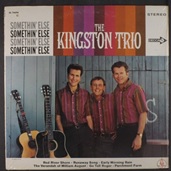
The Kingston Trio’s track record is staggering. Five number-one albums, four of them consecutive (in 1959 and 1960, the successive records At Large, Here We Go Again, Sold Out and String Along all reached the top position); fourteen Top 10 albums; three Grammy’s; in 22 of the 52 weeks of 1960, a Kingston Trio album was number one, and so on. As a result, the trio is considered mainstream and not appreciated in hardcore folk circles, among snobby college kids and other self-proclaimed purists, but Dylan has always remained a fan. In almost every interview in which he is asked about his musical idols, he mentions the men from San Francisco, among Odetta, Harry Belafonte and Woody Guthrie, and in his autobiography Chronicles he is unequivocal, with one small reservation, as well:

“I liked The Kingston Trio. Even though their style was polished and collegiate, I liked most of their stuff anyway. Songs like “Getaway John,” “Remember the Alamo,” “Long Black Rifle.”

… and further on Dylan is even rather exuberant in his admiration:

“Folk music, if nothing else, makes a believer out of you. I believed Dave Guard in The Kingston Trio, too. I believed that he would kill or already did kill poor Laura Foster. I believed that he’d kill someone else, too. I didn’t think he was playing around.”

Dylan names three song titles that can be found on Side 2 of the millionseller At Large (1959, fifteen weeks at #1), and poor Laura Foster is of course referring to the landslide 1958 “Tom Dooley”, the hit that pundits like Joan Baez, John Fogerty and Joni Mitchell say ignited the folk boom, the single that sold more than six million copies, and inspired envious peers The Four Preps to write the witty parody “More Money For You And Me”;

Hang down the Kingston Trio,
Hang 'em from a tall oak tree;
Eliminate the Kingston Trio;
More money for you and me.

Dylan remains loyal to the Kingston Trio even after they are finally eliminated. From 1965 onwards, the commercial success is over. Stay Awhile does not get any further than a 125th place in the summer, Somethin’ Else from November ’65 doesn’t even make it to the Billboard Top 150 LPs. But it reaches Dylan’s turntable anyhow, apparently. The Dylan cover “She Belongs To Me” is dismissed for the final tracklist, remaining an outtake, which is a shame – although it is, like more of the tracks, a rather frenetic attempt by the men to fit in with the times, and a particularly atypical recording for the Kingston Trio, it still has most definitely an antiquarian charm. And the song is still way better than the slightly bizarre Dylan parody that does pass selection, the wacky “Verandah Of Millium August”, a sort of psychedelic mutilation of “Tombstone Blues”, with presumably satirically intended, bad Dylan imitations in the lyrics such as

The yellow window's hanging on the bed across the wall
Well, always in the morning the yellowest of all
And the faces of the people in the window look so small
And the faces in the morning were the peoplest of all
Standing on the verandah of Millium August.

https://youtu.be/iVvx0CguTu4

… and Dylanesque rhymes like Victrola/crayola and someone else’s odour/secret decoder, Dyanesque meant images like a prisoner on a cemetery lane and Dylanesque meant idioms like kaleidoscope and renaissance wallpaper.

Dylan most likely has noted it with some bewilderment, but has in any case already been touched by the song that precedes that weird “Verandah Of Millium August”, by the opening track of Side 2, by “Red River Shore”.

The Kingston Trio’s “Red River Shore” is, apart from the martial drum rolls in the background, a real, old-fashioned Kingston Trio song; the charm of a nineteenth-century folk song, banjo, nice harmony vocals and no new-fangled antics like elsewhere on the LP. No tomfoolery like the funky organ, electric guitar and intrusive percussion in Mose Allison’s “Parchman Farm” (the opening and unlikely single choice), which by the way is spelled rather disrespectfully both on the single and the LP as Parchment; no hooliganism like the all-electric pop rocker “Runaway Song” or the shameless Byrds rip-off “Long Time Blues” – songs the overenthusiastic writer of the liner notes probably is thinking of when he writes: “In places it has a beat born in that jailhouse and baptized in the waters of the Mersey.”

But fortunately, “Red River Shore” is still old-school.

…a narrative ballad with an ancient melody, in a classical arrangement, with a Civil War colour and archaic language;

At the foot of yon mountain, where the big river flows, 
there's a fond creation and a soft wind that blows.
There lives a fair maiden, she's the one I adore. 
She's the one I will marry on the Red River shore.

… is the opening couplet, which right away explains the nineteenth-century colour; the Kingstons adapt the “Red River Shore” version as collected by the music historian John Lomax and recorded by The New Christy Minstrels (Cowboys And Indians, 1964), an adaptation of the time-honoured “New River Shore”, of which the oldest known version was indeed written down in 1864, during the Civil War.

In all versions we find the text fragment Dylan eagerly saves for reuse:

She wrote me a letter, she wrote it so kind 
and in that letter these words you will find:
Come back to me, darling, you're the one I adore, 
You're the one I will marry on the Red River shore.

… the words Dylan will transfer during these very same recording sessions in Miami, January 1997, to that other Great Masterpiece, to “Not Dark Yet”, also to the second verse:

She wrote me a letter and she wrote it so kind
She put down in writing what was in her mind

“All these songs are connected. Don’t be fooled. I just opened up a different door in a different kind of way. It’s just different, saying the same thing,” as Dylan says in his brilliant MusiCares speech, February 2015.

For his own “Red River Shore”, Dylan radically changes the plot. The Kingston Trio tells of the woman who so badly wants to marry the protagonist, but her father forbids it. The narrator wants to elope with his fair maiden, but Dad sees through it and awaits him with a private army of 24. With his six-shooter, the hero tries to fight his way through (“six men were wounded and seven were down”), but then he has to give up: “I can’t fight an army of twenty and four / when I’m bound for my true love on the Red River shore.”

Which may seem a bit excessive, twenty-four enemies, but compared to his predecessor in the original 1864 version of “New River Shore”, he is still a pathetic sissy:

He raised for him an army
Of sixty and four
To fight her old father
On the New River shore.

He drew out his sword
And he waved it around
Till twenty and four
Lay dead on the ground

And the rest of the number
Lay bleeding in gore,
And he gained his own true love
On the New River shore.

Somethin’ else, indeed.


To be continued. Next up: Red River Shore part 2 – The importance of capturing spontaneity


Jochen is a regular reviewer of Dylan’s work on Untold. His books, in English, Dutch and German, are available via Amazon both in paperback and on Kindle:


Posted in Uncategorized | 5 Comments

The art work to “Time Out of Mind”

by Patrick Roefflaer

A list of previous articles in this series is given at the foot of this piece.

Time out of mind…

  • Released                        September 30, 1997
  • Photographers                Daniel Lanois, Mark Seliger, Susie Q., K. Dalka
  • Art-director                     Geoff Gans

Geoff Gans

Since the late Nineties, nearly all of Dylan’s album and book packaging, archival reissues and tour graphics up until today have been the work of art director Geoff Gans.

And if you were a music fan in the Eighties, there’s a big chance you have at least one piece of music in your collection on which you can hear Geoff Gans.

R.E.M. was in L.A. in May 1987 to mix their Document album at Master Control in Burbank, when a benefit for Texas Record was organized in McCabe’s Guitar Shop in Santa Monica, on May 24.

There were two shows planned that evening: one at 8pm followed by a 10:30pm Show. As Peter Buck hadn’t arrived yet, Geoff Gans picked up an acoustic guitar to accompany Michael Stipe on a new song: ‘This One Goes Out’. Geoff was present as the art department boss at I.R.S. Records. Prior to establishing himself in graphics, he had played guitar with local bands in L.A.

Peter Buck arrived while Michael and Geoff were performing, and he took over for the rest of the show. So, it was the only song on which Gans participated. While Buck did play on the second version recorded later that evening, the version with Geoff was chosen to be released as the b-side of ‘The One I Love’, as the song was retitled later.

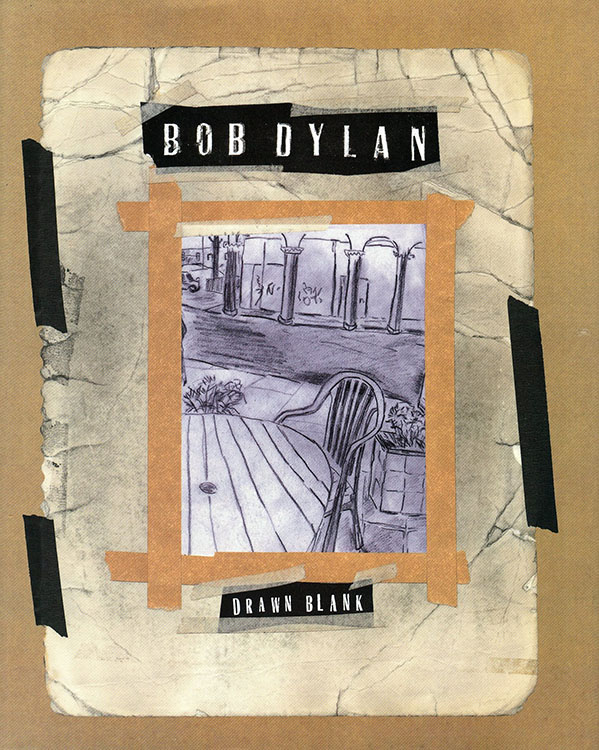
Later, Gans did the artwork for the R.EM. compilation Eponymous (1988), before he made the switch to Rhino Records, where he specialized in packaging high-end boxed sets and other luxury publications. That made him the perfect choice for Dylan first collection of drawings and sketches: the Drawn Blank book (November 1994).

Around that time Kim Gaucher was doing the art work for Dylan’s albums: Bob Dylan’s Greatest Hits Volume 3 (November 1994) and MTV Unplugged (May 1995). But as Time Out of Mind was Dylan’s first album with original material since Under the Red Sky in 1990, Geoff Gans was chosen to take care of the cover design.

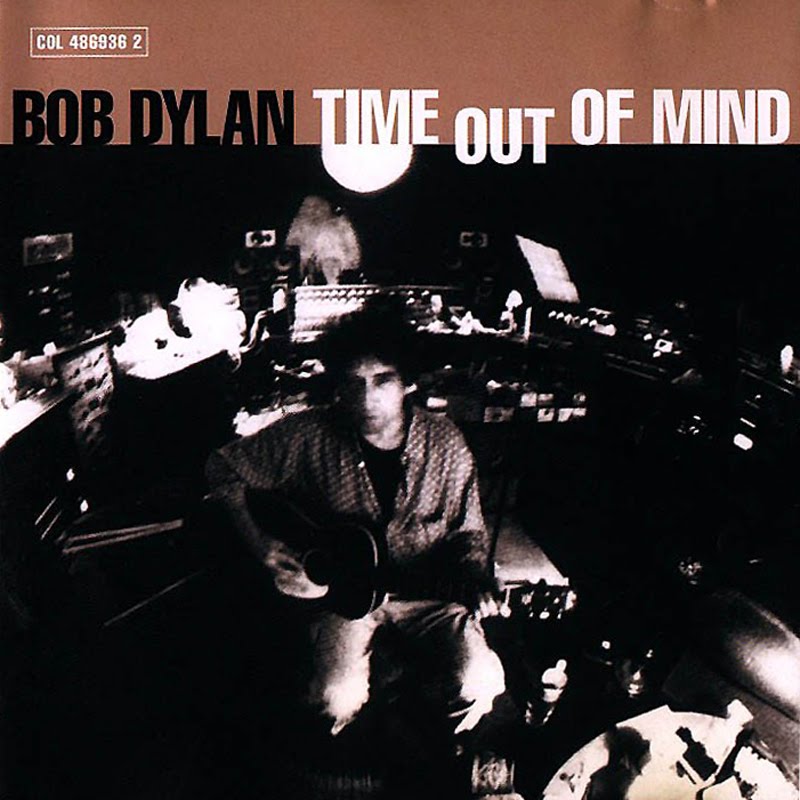
For his first album assignment, Dylan gives him a blurry photo to work with. On the picture taken by Daniel Lanois, the producer of the album, the singer sits in the control room of a studio with an acoustic guitar in his hands. There’s someone that looks like a ghostly figure behind the console. The location is most probably the Criteria Recording Studios in Miami. What attracted Dylan in this image is probably that he looks like an old folk-blues guy sitting uncomfortably inside a fortress of technology.

Gans adds a brown band at the top, in which the title is saved in white letters, while the name of the singer is added in black letters. Nice detail is the drop “OUT” in the title.

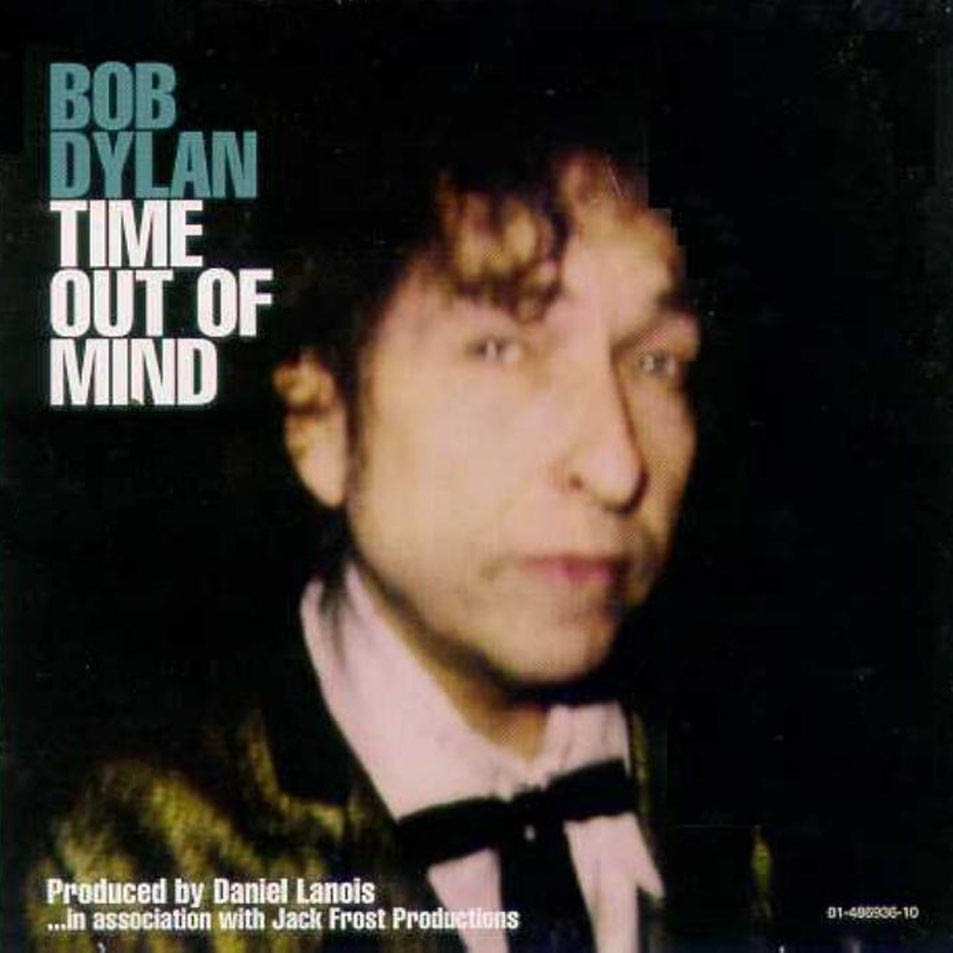
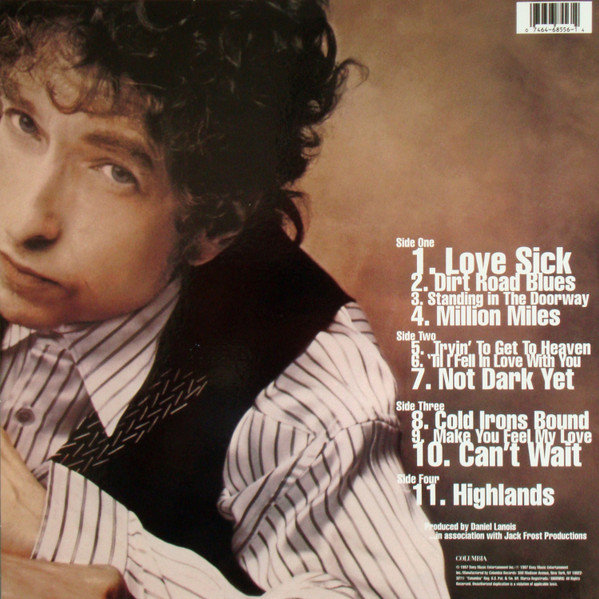
On the back side of the sleeve, a portrait in color is used. It was made by Rolling Stone’s Chief Photographer Mark Seliger. In this function, he shot over 175 covers for the magazine, between 1992 and 2002.

As Bob is wearing exactly the same shirt as on the photograph ‘Bob Dylan with a Bicycle’ dated “ca. 1995”, it might be that the singer wasn’t available for a new shoot, as he had been in hospital at the time, with a life-threatening illness.


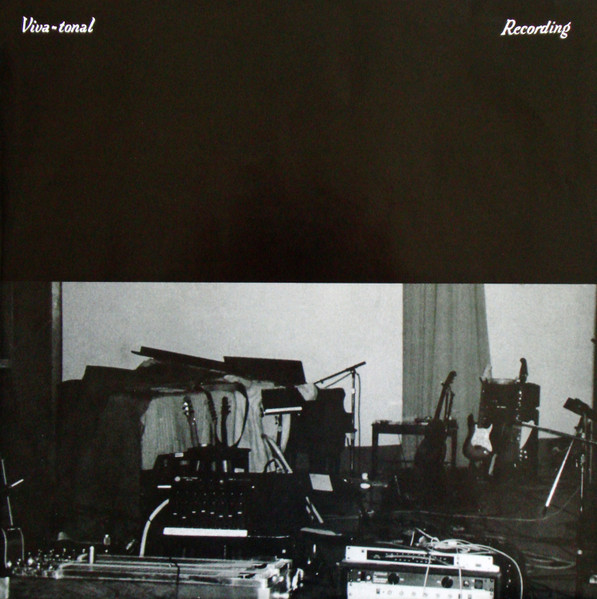
Three more photos are shown on the inner sleeves of the vinyl records. (The fourth side doesn’t have an illustration, just white song titles on a black background.) All these are black & white photographs.  The first picture is full page, the other two are printed half page. One picture doesn’t have any persons involved, just instruments inside the studio.

But the other two show a seated Dylan. The full page one shows Bob sitting in front of a table, one hand resting on a walking stick. He is wearing a black suit and white shirt, in sharp contrast with the two men sitting at the other side of the table, who wear ordinary clothes. One is laughing and gives a thumbs up, while the other man looks rather angry. On the first pressings there were only three photographers credited, while later a fourth was added: K. Dalka. As there is no info to be found about this photographer, your guess is as good as mine.

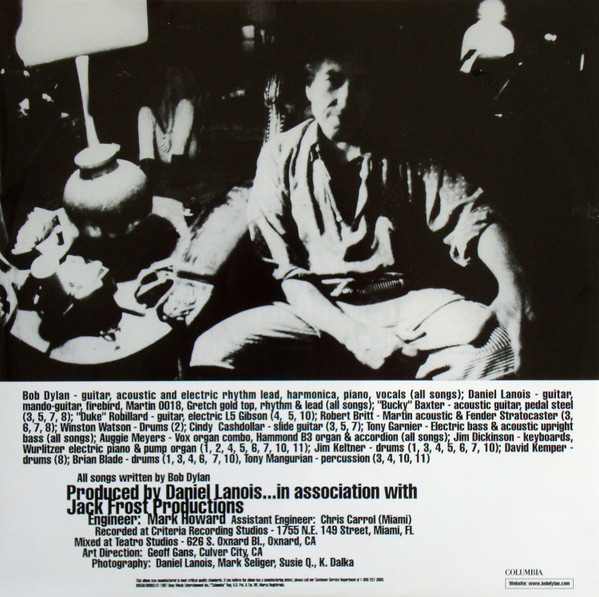
On the last picture of Dylan (above) Bob is in a living room, sitting wide-legged next to a lamp. There’s a story that Gans faxed Dylan one of the photos for the album and Dylan preferred the fax to the actual photo. That’s probably this picture.  It might be the one taken by Suzie Pullen, Bob’s longtime aide/assistant and dresser/stylist.

Mavis Staples once referred to her as “the girl that’s with him all the time”.
Beneath the photograph are the credits (musicians, studios, photographers…).

There’s one thing that every portrait used on Time Out of Mind have in common, and that is that Bob Dylan looks directly in the camera, as if to say: “Hey, I’m still here, you know.”

Footnote: On the booklet with the CD version, there’s an extra photo added. This color photo is also blurry and Bob looking straight in the lens again. The photographer is uncredited.


The articles from this series, in alphabetical order

Posted in Uncategorized | 8 Comments

Bob Dylan And Patti Page (Part II)

This article continues from Bob Dylan and Patti Page Part 1.

by Larry Fyffe

Below, a line similar to one in the song “Hush Hush Sweet Charlotte”:

Then make him tell it never
But she don't cry
(Bob Dylan: Patty's Gone To Laredo)

(A recording of Patty’s gone to Laredo can be found at 4 min 45 sec on this video)

Patti Page borrows the following song from the movie by the same name; makes a big hit out of it:

Hush, hush, sweet Charlotte
Charlotte, don't you cry
Hush, hush, sweet Charlotte
He'll love you till he dies
(Patti Page: Hush Hush Sweet Charlotte ~  De Vol/David)

In the movie “Hush Hush Sweet Charlotte”, starring Bette Davis, Mariam connives with Dr. Drew to steal the southern belle’s estate by driving her insane; actually beheaded by his wife, Charlotte’s thought to have murdered John, the married man she fell in love with a long time ago.

The two culprits make it appear that Charoltte shoots Dr. Drew; his ‘body’ then thrown into a muddy swamp. He returns to the mansion, and  haunts Charlotte. Now more mad than ever, Charlotte catches on to the evil plot, and shoves a large flowerpot down on their heads.

Take what you have gathered from coincidence – the Gothic movie above reminds one somewhat distantly of the fragmented narrative in the song lyrics quoted beneath:

Charotte's a harlot dresses in scarlet
Mary dresses in green ....
I'll drag his corpse through the mud
It's now or never
More than ever
When I first met you, I didn't think you would do
It's soon after midnight, and I don't want nobody but you
(Bob Dylan: Soon After Midnight)

The singer/songwriter/musician explains how he comes up with his musical works art:

I'll pick a number between a one and two
And I'll ask myself, "What would Caesar do?"
I'll bring someone back to life in more ways than one
Don't matter how long it takes
It'll be done when it's done

(Dylan: My Own Version Of You)

And what would King Solomon do?:

Take the foxes, the little foxes
That spoil the vines
For our vines have tender grapes
(Song Of Solomon 2:15)

In a movie, Regina (Bette Davis) says to her wealthy, but ill, husband (as she tries to fox money out of him):

"I hope you die! I hope you die soon!
I've been waiting for you to die!"
(Movie: The Little Foxes)

Her husband ends up dying of a heart attack while Regina looks on.

In the song below, the singer/songwriter turns his words against the master foxes of war:

And I hope that you die
And your death will come soon
(Bob Dylan: Masters Of War)

The singer/musician covers the following song:

See the pyramids along the Nile
Watch the sunrise from a tropic isle
Just remember, darling, all the while
You belong to me
(Patti Page: You Belong To Me ~ Price/King/Stewart)

Footnote about Untold Dylan

Untold Dylan was founded in 2008 and is run entirely by volunteers with the aim of publishing insights into Dylan’s work that have not been published elsewhere.  We’re always open to ideas and suggestions on how the site can be developed, and welcome contributions from writers.  Unfortunately, we don’t have the funds to pay for articles we use, but we do hope you’ll understand why that is.   If you are interested in contributing please do write to Tony@schools.co.uk.    If you are quoting something you’ve found on the site, please cite Untold Dylan (www.bob-dylan.org.uk).

We also have a vibrant and active Facebook page – just search Facebook for Untold Dylan.

Posted in Uncategorized | 3 Comments

Never Endting Tour, 2004, Part 1 – The best singing audience

This is part of a series covering the whole of the Never Ending Tour.  You can find an index to all the articles here.

The review of 2003 is now complete: the articles for that year can be found at

NET, 2004, Part 1 – The best singing audience

By Mike Johnson (Kiwipoet)

“Listen to me; you are the best singing audience we’ve ever had. We play that song a thousand times and nobody could sing with it.”  (Bob Dylan onstage, Glasgow, 24th June)

The problem with 2004 is that it lies in the shadow of 2003. In many respects it is an extension of 2003, or a repeat of it, often with the same arrangements and style as the earlier year built around Dylan’s keyboard playing. We have seen what an innovative year 2003 was, the arrangements and style forged in that year carrying Dylan through to 2005. In 2006, another major shakeup takes place as Dylan moves from the piano to the organ.

And yet when we look more closely at 2004, we find it is not a pale imitation of 2003. The arrangement may be the same, but the sound is often heavier and thumpier, with Dylan’s voice richer and throatier. He may have been riding on the energy of 2003, but some of the 2004 performances outshine those of the previous year.

Dylan’s relationship with his audiences has been as contentious as everything else that he does. He is accused of ignoring his audiences (because he refuses to butter them up with lots of ra-ra talk about how wonderful it is to be in that town etc), never speaking to them and so on. Dylan is famous for coming onstage, playing his songs and walking off without a (spoken) word or a smile. His grumpiness is also legendary. At one concert in 2003 he cleared the two front rows because of their disruptive behaviour. But this caricature of a boorish Dylan is far too simplistic. Dylan’s relationship with his audience is complex and nuanced. He can perform through the racket of a rowdy audience as if they weren’t there, but can also woo an audience and respond to a quieter, focused concentration with exquisite performances.

The Glasgow concert of 2004 (24th August) is famous in the history of the NET for the warm relationship between Dylan and his Scottish audience. Dylan is in good form, and soon has the audience eating out of his hand. Their enthusiasm is palpable This audience, eager to participate, starts to sing along. By the time they get to the fourth song, ‘Just Like A Woman,’ the audience takes over the chorus, and Dylan gives them the reins.  They even sing in tune. After describing the venue, Barrowland Ballroom as a ‘sweaty, intimate vibrant setting,’ Bobcat Andre Muir tells the story:

“ ‘Just like a Woman’ saw the beginning of the main event of the night: the crowd trying to sing along with Bob. Dylan for once revelling in this but still trying to maintain control. Yet when the crowd roared out the title line, Dylan had no choice but to let them go, such was the volume they engendered. It seemed like a moveable wall of sound was bouncing all around you, from the stage and the singing crowd, careering off the ceiling and reverberating in one direction before being blasted back from another. To regain control of the song, Dylan followed a few beats behind, originally to try to throw the audience, but by the end of the song, just to maintain some kind of parity in the performing stakes. You could see him quite clearly chuckling on one of the choruses before grinning broadly as he allowed the audience to participate to the point they demanded.” (Muir, One More Night, p 328)

Here it is:

Just like a woman (A)

By way of comparison, let’s drop into the Washington concert earlier in the year (2nd April) and hear how the song sounds without the audience singalong. It’s another beautiful performance, the slow, lilting, contemplative tempo more evident, and while it’s rare for Dylan to play the harmonica in this song, he does so here, with a thin, muted solo, full of pathos. Done this way, the song is dominated by regret; it starts to sound like a love song – ‘Maybe I’ll go see her again…’.

Just like a woman (B)

Towards the end of the Glasgow concert, we get another attempt at audience participation with ‘Just Like A Rolling Stone.’ Muir describes the event this way:

‘Dylan’s voice was a blurred burr and yet powerful and compelling as it competed with a deafening crowd…Clearly loving the audience reaction and interaction Dylan was smiling and pointing as he belted out ‘No direction home’; the band was busting a gut to keep up with, and make as much noise as Dylan and the audience… Dylan was singing lines before and after he knew the crowd would be, it was like being present at an audio wrestling match. This is the kind of tussle that Dylan had a lifetime of experience of not only dealing with but triumphing in; but on this night he had to admit defeat. This he did graciously, laughingly and with obvious pleasure as the delirious crowd eventually drowned everything but themselves as they belted out the famous chorus.” (Muir p 329)

Here it is:

Just Like A rolling stone (A)

Glasgow, however, is not the only outstanding concert in 2004. While Glasgow is unmatched for audience participation, the Rochester concert (13th Nov) is arguably better both in terms of the recording and Dylan’s performance. I’m not sure what the magic is here, maybe the venue’s superior sound system, but whatever it is, this full-bodied recording is one of the best you’ll hear in Bootleg land, at least audience recordings – soundboard recordings can be superior as they cut back audience noise. But this Rochester sound is better than most soundboards even, for my ear.

Compare the Glasgow performance with this one from Rochester. There is no struggle for control here, and it turns into one of the most enthusiastic performances of the song on the NET.

Just like a rolling stone (B)

2004 was a big year for ‘The Ballad of Hollis Brown,’ not heard of since 2001, but erupting into 2004, being played twenty-five times. It’s a gripping tale of how poverty can destroy a person, drive them to murder-suicide. It’s a masterpiece of narrative construction as each verse takes us deeper into this poor man’s stress and eventual madness, leading to the grisly denouement. The laconic last verse shifts us to a larger, even more chilling context:

There’s seven people dead
On a South Dakota farm
There’s seven people dead
On a South Dakota farm
Somewhere in the distance
There’s seven new people born

This one is from Rochester once more, again demonstrating the superiority of that concert’s recordings.

Hollis Brown

Anyone bothered by the upsinging? Not me. In this case it is in balance with the overall vocal performance. I feel that he’s in control of it, and using it as an integral part of the overall vocal effect.

‘I Believe In You’ was performed twelve times during 2004, having been played comparatively rarely over the previous five years. A fervent avowal of faith from Dylan’s gospel era, we last encountered this song in 2003 (See NET, 2003, part 3). Both that and the 2004 version are ardent performances. The 2004 version, a little slower, has a finer sense of vocal drama, with Dylan singing low then lifting his voice for dramatic effect, but the 2003 version is the sharper performance. The one thing we can say is that while he can’t match the vocal pyrotechnics of his 1980 performances, the older Dylan can pull the song off magnificently in terms of conveying the passion of the song. I love this song’s chord changes, so melancholy. This one’s from that Glasgow concert, which helps explain the warmth of tone; easy to imagine the song is addressed not to Jesus, or a lover, but the audience itself.

I believe In You

Glasgow and Rochester were not the only good concerts of 2004. We have already heard one song from the Washington concert, but we need to go to Manchester (11th June) to find the most compelling performance of ‘Cold Irons Bound.’ It’s a desperate song, and Dylan usually hits it with everything he’s got. This performance is no exception. From the opening, threatening chords to the sharp, urgent beat that carries the song, this is a wild ride. Dylan is learning, however, to keep on top of the song, and not let his voice get drowned in the fury, moving towards a more minimal backing during the verses. And catch Tony Garnier’s wonderful descending bass, dragging us into the maelstrom of the song.

This is the first time I know of where Dylan uses a repeating echo on his voice. It sounds like Dylan’s ghost repeating the lines after him. It works on this song, I’m just glad he didn’t make it a habit.

Cold Irons Bound

Let’s stay in Manchester to enjoy ‘Blind Willie McTell’ a song Dylan brought into prominence at the same time as the Time out of Mind material. Dylan hasn’t yet changed his approach to the song; it still has the same arrangement as when it débuted in 1997. Dylan’s vocal is outstanding. He pushes his voice into the nasal on the name ‘Mcteeeeel’ to produce his famous snarl, yet can sing with soft sensitivity on the elegiac verses.

Blind Willie McTell

We have to hop back to Washington to catch ‘Love Sick.’ Perhaps because of its distinctive beat and atmosphere, ‘Love Sick’ is another song that hasn’t changed much in performance. It’s a song about walking at night, among the shadows, both shadows of night and the shadows of the past. (…I’m walking…I’m walking…)

It is one of Dylan’s most atmospheric crepuscular songs. Dylan is the great poet of the night. We have songs ranging from ‘After Midnight’ to ‘Visions of Johanna’ that celebrate night, particularly on Time out of Mind (they would make a wonderful playlist), but ‘Love Sick’ is surely the most concentrated of them. Little light shows, just enough to make ‘silhouettes in the windows’ and to light the imagination with ‘lovers in the meadows.’

A great performance.

Love Sick

‘Not Dark Yet’ is straight out of the same bag. In this case approaching night (shadows are falling…) is a metaphor for death, and the inevitability of death. It also expresses the utter aloneness we might feel before that final moment (don’t even hear/the murmur of a prayer). You can’t rid yourself of this song. The older you get the more true it becomes. It’s the same with Dylan. The older he gets the more true the song sounds. We’ll follow it right through to 2019, when it becomes most chillingly true.

Another Washington performance.

 Not Dark Yet

I’ve run out of space, but I’m going to squeeze in this ‘Standing in the Doorway’ and finish the post with a triptych from Time out of Mind. Now we are ‘walking through the summer nights’ and we have to face our grief ‘under the midnight moon.’ A  sombre note on which to finish the post, but an irresistible Rochester performance. In a rare move, Dylan starts the first verse a second time after the first couple of lines, having apparently lost it first time around.

Kia Ora, see you next time with some jazzy sounds from 2004.

Standing in the doorway


Footnote about Untold Dylan

Untold Dylan was founded in 2008 and is run entirely by volunteers with the aim of publishing insights into Dylan’s work that have not been published elsewhere.  We’re always open to ideas and suggestions on how the site can be developed, and welcome contributions from writers.  Unfortunately, we don’t have the funds to pay for articles we use, but we do hope you’ll understand why that is.   If you are interested in contributing please do write to Tony@schools.co.uk.    If you are quoting something you’ve found on the site, please cite Untold Dylan (www.bob-dylan.org.uk).

We also have a vibrant and active Facebook page – just search Facebook for Untold Dylan.


Posted in Uncategorized | Leave a comment

Dylan cover a day number 53: I threw it all away

By Tony Attwood

A list of the previous articles in this series is given at the end of the article.

The point about “I threw it all away”  is that musically it has two outstanding features.  One is the melody (not always Bob’s strongest suit) and the other is the chord sequence.  In fact in this song the chord sequence drives the unexpected developments in the melody.

The song is generally played in the key of C and the opening lines are accompanied by exactly the normal chords from that key: C, A minor, F and G.

But then suddenly with the line “But I was cruel” Bob throws in the utterly unexpected chord of A major, and then instantly returns to the normal and expected chords of a piece written in this key.

The middle 8 (the section that is different from the rest of the piece, starting “Love is all there is”, he again introduces the A major chord, utterly unexpectedly (this time with the lyrics “it can’t be denied”).

There is also one other chord that doesn’t belong in the key of C in a classical sense (the chord of B flat which is used at the start of “Take a tip from” in the middle 8, but that has been used so many times in the blues and rock, that it doesn’t leap out and slap one around the face as the A major chord does.

I’ve never been sure it really works – it sounds too artificial for me – but then who am I to criticise the way Bob writes?

But it is the chord sequence and the melody that marks out the song, and by listening to it in Swedish (one of the infinite number of languages I don’t speak) there is a chance to let the words slip away and appreciate the music.

This is “Jag sumpade alltihop” by Georga

https://youtu.be/66tOUBePP0g

We know what it is going to be straight away because of the melody – but what really puzzles me is the use of the organ after the vocals in the opening lines.  What is that doing there?  What does it add?  (To really appreciate this point, and if you don’t fancy listening to four versions of this song, skip through to the last example and you’ll hear the contrast I am trying to make in my normal laboured way.)

If it is to wake us up, fine we are now awake, so why have it in the second verse as well?  Take out that answering organ chord, and it is a perfectly fine rendition – but with it… well, no.  It sounds like someone trying too hard to do something different.

Moving on, the Peter Viskinde Band want to do something different – and the held chords of the organ do that – but this time it fits perfectly.   It is a straight rendition but the vocalist makes me feel he means it – he is not just going through the motions.  It’s restrained, gentle, and when the second vocalist joins in later on, in a way that one can only just make out, that is a lovely additional touch.

Everyone knows his place, no one gets carried away, and even the late guitar solo fits perfectly (and I say “even” because so often in songs like this the guitarist just uses the occasion to show off – but not here.)  Beautiful.

Jimmy LaFave, in the next example, takes us into a very gentle version, although with maybe a temptation to fill in every moment without the vocals.  But it doesn’t do as much for me as the Viskinde version, because I feel the vocalist is trying to put too much emotion into the song.  The emotion is there anyway, and he has a fine voice, so nothing needs to be pushed.  It just feels a touch overdone to me, and doesn’t quite add the gentle nuances that the previous version offers.

And finally to what is for me the best version of all.

Jacqui Dankworth MBE has all the heritage to have a beautiful voice and an ability to recognise an exquisite arrangement for a beautiful song when she finds one, and she shows that here.  This tears my heartstrings about as far as I am willing to let them be torn on a Saturday morning before I venture into the task of driving the 85 miles to London.

And I think that because Ms Dankworth was born in the county town (Northampton) of the English county I live in (Northamptonshire).  I do love to find trivial connections!   And if you are English and an aficionado of jazz you will know she is the daughter of Cleo Laine and John Dankworth.

This is just gorgeous.  I love it.

I doubt anything could improve on this version, so this is the moment I stop.

—–

Untold Dylan was created in 2008 and is currently published once or twice a day –  sometimes more, sometimes less.  Details of some of our series are given at the top of the page and in the Recent Posts list, which appears both on the right side of the page and at the very foot of the page (helpful if you are reading on a phone).  Some of our past articles which form part of a series are also included on the home page.

Articles are written by a variety of volunteers and you can read more about them here    If you would like to write for Untold Dylan, do email with your idea or article to Tony@schools.co.uk.  Details of some of our past articles are also included on the home page.

We also have a Facebook site with over 14,000 members.
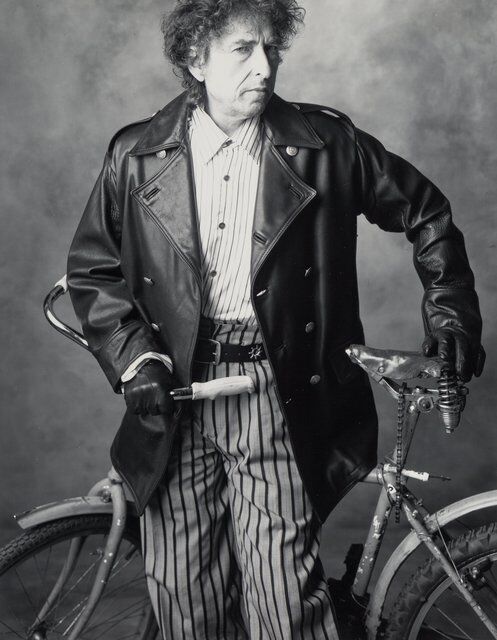
Posted in Uncategorized | 2 Comments

Peggy Day (1969) part 5: What more can I say

Peggy Day (1969) part 5 (final)

by Jochen Markhorst

V          What more can I say

A talent for self-mockery he had as well, Elvis. On the bootleg I Sing All Kinds – The Nashville Sessions 1971, there is an incomplete take of “Johnny B. Goode”. When the final chord is fading away, Elvis suddenly starts again, now at half speed: “I said… Johnny…”. Obediently, the obliging band picks it up right away, The King bursts into laughter and waves it away cheerfully, with a just kidding-undertone: “No, no, no, no”. It is clear that the band has been conditioned to an “Elvis ending”. Like the rest of the rock-loving world since 1956, for that matter.

It is the third track on Side 1 of the 1956 comet impact, the Elvis Presley album, the first rock and roll record to reach the top spot on Billboard, and the first rock and roll record to sell more than a million copies. The historical monument opens with “Blue Suede Shoes”, followed by “I’m Counting On You”, and then: “I Got A Woman”.

Thanks to the moving “Bucklen tape”, the earliest-known tape of Bob Dylan, recorded when he was around sixteen, we know that as a schoolboy Dylan was already starting to build his inner music encyclopaedia. In between rumbling through songs like “Jenny Take A Ride” and “Blue Moon”, we hear young Robert Zimmerman chatting with his buddy John Bucklen;

Zimmerman: You know they get all their songs, they get all their songs from little groups. They copy all the little groups. Same thing with Elvis Presley. Elvis Presley, who did he copy? He copied Clyde McPhatter, he copied Little Richard, …
Bucklen: Wait a minute, wait a minute!
Zimmerman: …he copied the Drifters
Bucklen: Wait a minute, name, name, name four songs that Elvis Presley’s copied from those, from those little groups.
Zimmerman: He copied all the Richard songs.
Bucklen: Like what?
Zimmerman: “Rip It Up”, “Long Tall Sally”, “Ready Teddy”, err … what’s the other one…
Bucklen: “Money Honey”?
Zimmerman: No, “Money Honey” he copied from Clyde McPhatter. He copied “I Was The One” – he copied that from the Coasters. He copied, ahhh, “I Got A Woman” from Ray Charles.
Bucklen: Er, listen that song was written for him.

Young Zimmerman is largely right. “I Was The One” is not a Coasters song, but everything else is right. The choice of words is debatable, though. “Copied”, in particular, is a bit harsh. “I Got A Woman” is indeed a Ray Charles song, but Elvis does more than just copy; he makes the song his own, like in fact only Sinatra can make a song his own, and he does add something: at 2’08” we hear a closing bang, the song seems finished, but at 2’09” Elvis kicks in again, at half speed, for another twelve-second coda: the first “Elvis ending” is a fact.


The fans call it an “I Got A Woman-ending” as well, and that may be more accurate. Elvis recorded 767 songs, and only about ten to fourteen of them (depending on your definition) have such a dramatic coda at half speed. They are, however, spread throughout his career; “Got A Lot O’ Livin’ To Do” in ’57 is the next one, in the ’60s in about seven songs (including in the 68 Comeback Special version of “Jailhouse Rock”), then in the ultimate kitsch “Winter Wonderland” (1971), and the last studio recording in which he applies this finale is “I Can Help” from ’75.

All in all, less than 2% of Elvis’ recordings have an “Elvis ending”, so to call it an “I Got A Woman-ending” is defensible. Moreover, “I Got A Woman” is indisputably one of the main pillars of his oeuvre. The man from Tupelo played it already in his Sun years (the recording is lost), it’s the first song he recorded for RCA, and it was on the set list right up to his very last concert (Indianapolis 26 June 1977).

It is a bit of a mystery why Dylan chooses an Elvis ending in “Peggy Day” of all places. An open application? According to Dylan, Elvis is the greatest compliment his songs can receive:

JW: Are there any particular artists that you like to see do your songs?
BD: Yeah, Elvis Presley. I liked Elvis Presley… Elvis Presley recorded a song of mine. That’s the one recording I treasure the most… It was called “Tomorrow Is A Long Time”. I wrote it but never recorded it.


… that’s what Dylan says in the Rolling Stone interview with Jann Wenner on 26 June 1969, four months after recording “Peggy Day”. But Dylan must have acknowledged that “Peggy Day” is not Elvis-worthy. Without being able to define exactly what an “Elvis-worthy” song is, of course – but “Peggy Day” really isn’t.

Maybe Dylan does it just to stretch the song a bit more, though. When he’s finished, when the verses, twice the bridge and a repeat of the first verse have been completed, the clock only stands at 1’40” … which would make it the shortest song in Dylan’s oeuvre. Shorter still than “Oxford Town” on The Freewheelin’, which is a mere 1’50”. With the Elvis ending from 1’41”, Dylan stretches the tune another eighteen seconds, to 1’59”, and then another 6 seconds of lead-out groove… final score 2’05”. Longer now than “Oxford Town” and ex aequo with Dylan’s second-shortest song, “The Wicked Messenger”.

Elvis, despite the enticing finale, unsurprisingly ignores the song. But Dylan’s Elvis dream still comes true again soon after: The King records “Don’t Think Twice” in March ’71, which will be released on the 1973 Elvis album. Making the song his own again, of course.

Dylan’s bow to The King is elegant. When he himself adopts a country-rock approach to his live performances of “Don’t Think Twice” in the 1990s, he is obviously reminded of his hero: he concludes the often long, drawn-out versions with an Elvis ending. Bloomington November ’96, Atlantic City November ’99, Cardiff September 2000… the Worcester ’99 version is one of the longest, by the way – Dylan stretches the song to over seven minutes with a harmonica solo, and then throws in an Elvis ending of over half a minute.

“Don’t Think Twice” has been performed more than 1100 times by Dylan. With and without an “I Got A Woman ending”. “Peggy Day” has never been performed. That girl is out of sight.

—————

Jochen is a regular reviewer of Dylan’s work on Untold. His books, in English, Dutch and German, are available via Amazon both in paperback and on Kindle:


Posted in Uncategorized | Leave a comment

More On Bob Dylan’s Famous Cook Book

This follows on from Bob Dylan’s Original Recipes and Cookbook

By Larry Fyffe

From the “Untold Archives”, and exclusively reproduced below  for the interest of our readers, here are the original lyrics of

“All I Really Want To Do”, first published in “Bob Dylan’s Cook Book”:

I ain't cooking to compete with you
Eat you, heat you, or whole-wheat you
Jelly roll, or casserole you
Freeze-dry, deep fry, porkie pie you
All I really want to do
Is Bacon be Eggs with you
No, I ain't cooking to fry you up
To glutton you, or gluten you
Or spread you around, or drain you down
Or knead you up, or strain you down
All I really want to do
Is Bacon be Eggs with you
No, I ain't cooking to paste you up
Shake or bake you, or yeast you up
Or super-size you, franchise you
Or yoke you up, or smoke you up
All I really want to do
Is Bacon be Eggs with you
Now, I don't want to butter baste you 
Grease you, mince you, strip, or taste you
Or mayonnaise or glaze you
Or dine or drink red wine with you
All I really want to do
Is Bacon be Eggs with you
I don't want to make you lean and thin
Anorex, or be next to you
Fatten you nice, or dough you in
Or hop you up, or chop you up
All I really want to do
Is Bacon be Eggs with you

Note:

There are other variants of  ‘All I Really Want To Do” locked in the Untold vaults, but this is the one from the Cook Book – that’s also locked away in the vaults.


Posted in Uncategorized | 2 Comments

Bromberg and Dylan – the missing album, part 5

by Jochen Markhorst

We are continuing looking at songs that might have made it onto the Dylan / Bromberg album had it ever been completed and released.

  1. Young Westley 

First release by Mary McCaslin (1974), but moreover another song from Bromberg’s repertoire – like “New Lee Highway Blues”, “The Main Street Moan”, “Kaatskill Serenade”, “Sloppy Drunk” and “Summer wages” to be found on Bromberg’s How Late’ll Ya Play ‘Til? from 1976. The Dylan/Bromberg session presumably uses Bromberg’s version as a template, which is nice enough – but the McCaslin original is truly enchanting.

  1. The Lady Came From Baltimore 

https://youtu.be/g1g0ukp58nU

Scott Walker, Joan Baez, Ricky Nelson, Cliff Richard… half the Premier League has this evergreen from the unforgettable Tim Hardin in their repertoire. As does Dylan himself – he performs the song a couple of times in ’94. The best known version is probably the one by Johnny Cash, who had a hit with the song in 1974. Still, it’s hard to beat the original.

  1. New Lee Highway Blues 

Bromberg’s third LP, 1974’s Wanted Dead or Alive, is one of the purveyors of the Bromberg/Dylan session. Understandably so; it is one of Bromberg’s most infectious, colourful records.

It’s the album that opens with the George Harrison/Bromberg collaboration “The Holdup”, the album that features the Dylan song “Wallflower” (at the time an obscurity known only through Doug Sahm’s premiere), and the album that features a brilliant live version of one of Dylan’s favourite songs, “Kansas City” – and the album that provides three songs for this 1992 session. In addition to “Send Me to the ‘Lectric Chair” and “The Main Street Moan”, this “New Lee Highway Blues”. A derivative of the old bluegrass standard “Goin’ Down the Lee Highway”, and embellished and provided with lyrics by Bromberg, with an exciting acceleration halfway through – a worthy album finale.

  1. Rise Again https://youtu.be/r6s6VJIKss8

One of the few songs on the list that doesn’t seem to have any Bromberg link. Dylan is a fan of the Dallas Holm song – he plays it a few times in his gospel years, in 1980 and 1981. And then abandons the song, but takes one of its strongholds, the remarkable, unusual G+ chord, to “God Knows” in 1990.

“Rise Again” is a beautiful song from 1977 that CCM Magazine considers to be one of the 100 Greatest Songs In Christian Music. When Dylan performs the song, Clydie King sings along, and those performances are all utterly beautiful (Portland, December 3, 1980 is a very successful one).

For The Bootleg Series 13 – Trouble No More 1979-1981 (2017) unfortunately only a rehearsal is selected. That is a wonderful, sober version, with excellent vocals of King and Dylan, merely accompanied by Dylan’s acoustic guitar – illuminating that heavenly, “lost” chord all the better (it is the second chord, on “drive the nails”, for instance, and on “say it isn’t me”).

  1. Duncan & Brady 

The old murder ballad (first recorded in 1929) that we know from Leadbelly, Dave Van Ronk, Jerry Garcia and dozens of others, but now also from Dylan himself – the 1992 Dylan/Bromberg recording is on the bonus disc from Tell Tale Signs (2008).

  1. The Main Street Moan 

Jerry Garcia plays on the original 1974 Bromberg version. On the “Dead side” (the four songs on the A-side were recorded in the studio with members of the Grateful Dead, the four songs on the B-side are live recordings – hence the title Wanted Dead Or Alive). “The Main Street Moan” is a nice little tune, as Dylan would say, and has a sympathetic Self Portrait vibe. But still seems a less exciting choice than, say, the brilliantly arranged “Someone Else’s Blues”, another Bromberg original on the Dead side.

  1. Nobody’s Fault But Mine 

Blind Willie Johnson’s pièce de résistance, the A-side of the song that as of 2021 is past the outer boundary of the heliosphere in interstellar space: “Dark Was The Night”, one of the 27 samples of music included on the Voyager Golden Record.
In our solar system, the A-side “Nobody’s Fault But Mine” is equally celestial. In any version; Led Zeppelin’s overblown, Ry Cooder’s terrifying, Grateful Dead’s intimate or Nina Simone’s heartbreakingly lonely… let’s hope one day we can add Dylan/Bromberg’s version to that list.

  1. Miss The Mississippi And You 

The old Jimmie Rodgers song (1932), just like “Duncan & Brady” eventually released, on the bonus disc of Tell Tale Signs.


Posted in Uncategorized | Leave a comment

NET, 2003, part 6: The Ragged Clown

This is part of a series covering the whole of the Never Ending Tour.  You can find an index to all the articles here.

So far in 2003 we have had

By Mike Johnson (Kiwipoet)

In my last post, I quoted Dylan commentator Professor Christopher Ricks that the album version of ‘The Lonesome Death of Hattie Carroll’ is ‘a perfect song perfectly rendered once and for all.’ I have some sympathy with Ricks as I felt the same way about the album version of ‘Visions of Johanna‘– until I heard some of the 1966 solo acoustic performances. Then I felt that the collective performances from 1966 qualified as ‘the perfect song perfectly rendered (several times)’ and still do.

On reflection, I realized that in the early years when Dylan played solo, with just his guitar and harmonica, he could change the tempo of a song while he was singing it, in other words he could slow the song down or speed it up to fit the vocal line as he wished. He certainly does this on the album version of ‘Hattie Carroll’, which lends weight to Ricks’ contention that only once did Dylan achieve the magic formula in which the vocal line is most perfectly expressed in musical form.

As soon as Dylan began singing with a band, he had to adapt the song to a single tempo and so lose that sensitivity of vocal line to the musical line. He could vary the timing of the vocal but not the tempo.

‘It’s All Over Now Baby Blue’ is another example that gives me a Ricks moment. The album version does have some subtle variations of tempo, but for me it is not until we get to 1995, and the Prague concert, that we find ‘the perfect song perfectly rendered.’

By 2003, the song is in trouble. Dylan’s attempt to put a baroque, and therefore quite rigid, structure to the song, which works so well with ‘Love Minus Zero’, does not lead to a satisfying performance despite the richness of the opening chords. It sounds too constrained, too choppy, and he struggles to fit the vocal lines, themselves of varying length, into that rigid structure. This performance is from Birmingham (21st Nov)

Baby Blue

We could say the same for ‘Mr Tambourine Man’, those lovely free flowing lines of the original album version, and 1966 live performances, were an integral part of the meaning and impact of the song. The more rigid structure of the following performance does not suit the song so well, although we find a powerful and blistering performance, using the same tempo and chord progression, in 2001 (See NET, 2001, Part 1). This 2003 performance is from Niagara Falls (23rd August).

Mr T Man

We could argue that this song announces Dylan’s move away from protest songs rather than ‘It’s All Over Now Baby Blue’ (‘it’s not aimed at anyone, it’s just escaping on the run…’), for the song has wider terms of reference, famously giving voice to our desire to escape from our dull and humdrum lives.

It’s disappointing that Dylan has chosen to drop the ‘ragged clown’ verse from later performances of the song. It could be read as a self-portrait, a portrait of a troubled young rhymester chasing shadows in the dark, in ‘evening’s empire’:

Though you might hear laughing, spinning, swinging madly across the sun
It's not aimed at anyone
It's just escaping on the run
And but for the sky there are no fences facing
And if you hear vague traces of skipping reels of rhyme
To your tambourine in time
It's just a ragged clown behind
I wouldn't pay it any mind
It's just a shadow you're seeing that he's chasing

‘Skipping reels of rhyme’ is a perfect description of the song itself, the ‘ragged clown’ the perfect circus Dylan.

‘My Back Pages’ is another song from the same solo Dylan era. It fares better than ‘Baby Blue’ and ‘Mr T Man’ although he does tie it to a lumbering tempo, more rigid than the original album version. We might still feel that he’s struggling to fit the vocal line into the musical line, having to break up the vocal line to do it. The violin backing helps to pull up this Red Bluff performance and give the performance a bit of a country twist (7th Oct).

My Back Pages (A)

Dylan may not have been entirely happy with this lumbering tempo, as a few weeks later, in London (23rd Nov) he speeds it up, uses some nice fat chords on the piano to push the song along. This turns it into a foot-tapper, but does the vocal line better suit the musical line? He’s still breaking the vocal line up. I’ll leave it to my dear reader to decide.

My Back Pages (B)

We don’t get the same issue with ‘Masters of War,’ another from Dylan’s solo era, as it has always had a firm, almost military tempo, and has adapted well to having a backing band. Bass and drums make it sound threatening and funereal at the same time. This song has been evolving successfully as a slow-paced dirge, which seems to fit the song better than the fast-paced, hard rock versions of 1978 and 1986. This one’s from Sydney, 17th Feb. The most enduring protest song of all time, given perfect expression here (almost – check out the 1995 Brixton performance).

Masters of War

Now along comes a rarity. ‘Heavy and a Bottle of Bread’ from the Basement Tapes was only performed twice during the NET, once in 2002 (see NET, 2002, part 2) and once in 2003, in London (25th Nov). There’s plenty of tempo changing going on in the Basement Tapes, as fits its casual, throwaway feel. I discern behind the nonsense rhymes of ‘Heavy and a Bottle of Bread’, a song about addiction. Addiction and a certain madness.

Well, the comic book and me, just us, we caught the bus
The poor little chauffeur, though, she was back in bed
On the very next day, with a nose full of pus

Cocaine anyone? And again:

Now, pull that drummer out from behind that bottle
Bring me my pipe, we’re gonna shake it
Slap that drummer with a pie that smells
Take me down to California, baby

Booze and dope, anyone? It’s a very zonked song.

Heavy and a Bottle of Bread

Dylan has tried out a number of different approaches to ‘If Not For You,’ from the New Morning album. I love the forlorn, solo version from Another Self Portrait, (official Bootleg Series Vol 10); the more swinging version he did with George Harrison is fun to listen to, as is the upbeat New Morning version. This version from London (23rd Nov) also swings, and Dylan does a great vocal. For my ear, the guitar break is a little harsh for the sweetness of the song.

If not for you

(I’m sorry if I have created some confusion over the London dates. Dylan did three concerts in London, Shepherd’s Bush 23 Nov, Hammersmith, 24th Nov, and The Brixton Academy 25th Nov.)

This performance of ‘Under The Red Sky’ is from Shepherd’s Bush, and while I always enjoy this song, its fairy-tale inspired lyrics, and its hint of despair and broken innocence, I feel that the long instrumental break adds little to the song, and merely pads it out.

Under the Red Sky

Dylan kicked off the St Paul (30th Oct) concert with ‘Seeing the Real You At Last’ from Empire Burlesque r(1985). (According to the official website, which is often wrong, Dylan only played this song once in 2003, at Melbourne 8th Feb)

It’s a great rocker, with plenty of bounce. Anybody who’s mistaken about somebody, maybe has an idealized picture of them, must eventually have a moment when the scales fall from their eyes and they see the real person. The sirens’ call can create powerful illusions around the loved one’s goodness, virtues and prowess while the past remains hidden:

When I met you, baby
You didn't show no visible scars
You could ride like Annie Oakley
You could shoot like Belle Star.

Dylan belts it out fine style.

Seeing the real you

In my first post for 2003, I grumbled that Dylan tends to use his New Zealand concerts as rehearsals, but it isn’t all bad. This ‘Simple Twist of Fate’ is from Auckland 23rd of Feb. It’s a gentle, muted performance, well suited to this hymn to love and chance. It’s all about the poignancy of those chance meetings, those one-night stands that are so bitter sweet. We’re all blind men at the gate when it comes to the whim of the gods.

Simple twist of fate

‘Cat’s in the Well’ from Under the Red Sky is a ferocious song and a real hard hitting rocker. There is a typical Dylan wildness to the lyrics, but it’s an easy song to overlook as, like ‘Silvio,’ it can sound like a filler. If you don’t know them, I recommend that you pull up the lyrics and read as you listen.

The cat's in the well and the servant is at the door
the drinks are ready and the dogs are going to war

Classic Dylan lyrics, as true now as the day they were written back in1990.  I speculate that the first Gulf War (1990 – 1991) helped forge the passion behind this song. ‘May the lord have mercy on us all.’ Indeed. (This one’s from Berlin, 3O Oct)

Cat’s in the Well (A)

That’s a great performance, but unfortunately, the recording is a little muted if not fuzzy. You may prefer this one from Hammersmith. I don’t know that it’s that much better in terms of performance, but the sound is much clearer and sharper.

Cat’s in the Well (B)

Since Dylan often closes his concert with ‘All Along the Watchtower’ I have fallen into the pattern of finishing up a particular year with the song. To go out in a blizzard of screaming apocalyptic guitars is fitting, as it returns us to one of Dylan’s most enduring themes – the imminence of war. (Isn’t that what’s driving ‘Cat’s in the Well’?) Whenever I hear this song done well, I think of Samuel Taylor Coleridge and his ‘ancestral voices prophesying war.’ (From ‘Kubla Khan’) There may well be no way ‘out of here.’

Again I’ve got two offerings. The first is from that wonderful Red Bluff concert. It reeks of Jimi Hendrix.

Watchtower (A)

And this from the equally wonderful Hammersmith concert. Note the theme song from Exodus at the start. Cool descending riff backs up the verses.

Watchtower (B)

A perfect song perfectly rendered – twice?

That brings my survey of 2003 to a close. A year of innovation and rambunctious energy. There’s a loose, tearaway element to the year’s performances. Dylan’s occasional slurring, his vocal roughness, his urgent piano. This is not a peak year for polished performances such as we saw in 2000 and 2001, but there is a rugged, jaggy energy here unmatched by any other year we’ve so far encountered.

I’ll be back soon to see what happened in the following year – 2004.

Kia Ora

Posted in Uncategorized | Leave a comment

A Dylan Cover a Day: I shall be released

by Tony Attwood

There is a list of previous covers in this series at the very foot of the page.

OK, it is getting more like being a Dylan Cover a Week, or maybe a Dylan Cover a Fortnight, but here’s another one…  And in writing this little series what I have discovered is that I particularly like exploring Dylan songs that I’m not especially fond of.  Not that I mean I don’t like the songs but rather that I don’t particularly choose to play them; they are not among my favourites.

“I shall be released” is one of those songs – it just doesn’t do anything much for me.  Of course, that is my failing, no one else’s, but that’s just how it is.

So I was keen to find someone who could give me a new insight into the song, but really it was hard going.

One technique often used is by having an unexpected opening, but then in comes that melody and chord sequence and we are totally within the song.  With an album cover like that above I had hoped for more inventiveness.

Bob Margolin certainly does have a go at changing the instrumentation, and his voice is very unusual (at least it seems so for me) so it does have me listening.  Love the howling wolves on the cover.

But Bert Dockx really does deserve a mention from the off, not least for that totally unexpected note in the opening bars which if I heard it in rehearsal I’d say the guitarist had slipped, but clearly he hadn’t.

So is this “I shall be released”?  Well yes it is as we find when he starts singing, and I’m giving this performance 10 out of 10, because he has done what no one else seems capable of doing – finding other heights and depths within the song which Dylan didn’t really expect when he wrote it.  (Of course I don’t know that, but it’s just the feeling I get, and I am feeling quite positive this morning as finally it has stopped raining and we have blue skies in the English Midlands.)

A beautiful beautiful voice as well as a remarkable and original way of playing the accompaniment.  This, for me is what it is all about – finding that person out there who has an exquisite talent, and who can take a song and transform it.  Keeping some elements of the original he goes in a completely different direction and delivers a different feel.

And as for the instrumental break after 4 minutes 30 seconds… oh that had me rushing back to the computer to take the recording back and play it again.  Truly remarkable.  I learn more about his song through this one performance than I have ever learned about it over the years.

Bert Dockx is not a performer I’ve come across before (my failing I’m sure) but it appears he is a Belgian composer, singer and jazz guitarist who attended the Royal Conservatory of Brussels.

Wiki tells me that in 2008 he founded Flying Horseman, a band that was nominated for two Music Industry Awards (“album of the year” and “alternative”) in 2013. Dockx himself was nominated in the ‘best musician’ category in 2013 and 2014. He also won the biennial KU Leuven Culture Prize 2015-2016.

Elsewhere, very very few people have played with the chord sequence or tried to speed up the song, but here is a version that does both…  I really quite like this, although that may be because I have just listened to so many people faithfully sticking to the lyrics, chords and timing.  And yes I know that is the point – but only up to a point.  It is not vital.

———————–

Untold Dylan was created in 2008 and is currently published twice a day –  sometimes more, sometimes less.  Details of some of our series are given at the top of the page and in the Recent Posts list, which appears both on the right side of the page and at the very foot of the page (helpful if you are reading on a phone).  Some of our past articles which form part of a series are also included on the home page.

Articles are written by a variety of volunteers and you can read more about them here    If you would like to write for Untold Dylan, do email with your idea or article to Tony@schools.co.uk.  Our readership is rather large (many thanks to Rolling Stone for help in that regard). Details of some of our past articles are also included on the home page.

We also have a Facebook site with over 14,000 members.

Posted in Uncategorized | Leave a comment