Never Ending Tour 2011: Part 3. I lit the torch, I looked to the east

This is episode 111 of the Never Ending Tour series – you can find a complete index of previous episodes here.

By Mike Johnson (kiwipoet)

Among the innovations of 2011, Dylan’s new performance act and his banner, the Eye of Dylan, covered in the previous two posts, we also find him taking his songs to a new audience in the east: Hong Kong, Taipei, Ho Chi Minh City, and China – Shanghai and Beijing. This was the summer tour at the beginning of the year, and while the recordings from these concerts seem to be no match for the Crystal Cat recordings in Britain at the end of the year, there were some brilliant performances from that leg of the tour, particularly the first concert of the year in Taipei on March 4th.

Let’s start with a moving performance of ‘Forever Young’ from the second concert of the year in Beijing on March 6th. In 2011 Dylan largely abandoned the thunderous ‘All Along the Watchtower’ as the final song of the night in favour of the more elegiac ‘Forever Young,’ finishing the concerts on a nostalgic rather than apocalyptic note. I might hanker for a better recording, but hardly for a better performance.

Forever Young

The Chinese leg of the tour had its controversy, with The Washington Post accusing Dylan of caving into pressure from China to avoid certain songs, in short, allowing himself to be censored by the Chinese Government.

Dylan took the unusual step of issuing the lengthy rebuttal, entitled ‘To My Fans and Followers,’ concluding, ‘As far as censorship goes, the Chinese government had asked for the names of the songs that I would be playing. There’s no logical answer to that, so we sent them the set lists from the previous 3 months. If there were any songs, verses or lines censored, nobody ever told me about it and we played all the songs that we intended to play.’

Much was made of the fact that he didn’t play his famous protest songs ‘Blowing in the Wind’ and ‘The Times They are A-Changing,’ but anyone familiar with Dylan’s changing setlists would have known that he didn’t play these songs at every concert anyway. A media beat-up, it seems to me.

There are at least three songs from the Shanghai concert (March 8th)  worth picking up on, and we can start with ‘Don’t Think Twice,’ a centre-stage performance with Dylan on acoustic guitar, one of the oldest of the songs on his setlists and a bittersweet number that never loses its appeal. Note the slow, bluesy ending.

Don’t Think Twice

One of the impressions we begin to get from listening to these Asian performances is that they are softer and more reflective than the rousing performances at the end of the year in London. I get that feeling from this Shanghai performance of ‘Tangled Up In Blue,’ and you might like to compare it to the more manic version from London I used to kick off the first post for 2011. Some of that more muted feeling may arise from very different recordings.

Tangled Up in Blue

Also from Shanghai we find this version of ‘Honest With Me’ in which the balance of the recording is weighed toward the vocal. It’s a fine, energetic performance with Dylan on organ.

Honest With Me (A)

It’s entirely understandable, however, if readers prefer this sharper London performance (3rd concert, the last of the year). This may be because of the Crystal Cat’s superior recording, every instrument sounds sharp and clear, or because Dylan here is playing the guitar, and effectively too. Joe Neanor, who wrote the liner notes for the bootlegged album of the concert, comments:

‘As the volume was cranked up it was harder to hear all the vocals but the sentiment expressed in the refrain was reflected in the intense delivery of the song. Having seen Bob do a kind of rain dance when performing this number last month I preferred tonight’s less manic version. I had a good look at his finger movement up and down the fret board and the contribution he was making to the band’s sound. He was playing strong guitar, not just going through the motions with a few chords.’

Honest With Me (B)

We have no such problem hearing the lyrics in the Shanghai performance.

Lastly from Shanghai, we get this reflective performance of ‘Desolation Row.’ The song builds up, as Dylan has been doing for some years now, but this is more restrained than many we have heard. This is one song for which Dylan’s curious circus organ sound is entirely appropriate, despite the echo of the old dumpty-dum; the song is full of circus characters and their antics. Pity there’s no harp break.

Desolation Row (A)

Good as that is, I think this one from Taipei is better. Again, it might be the recording, the Taipei recordings are particularly good, better than those from mainland China, and you can feel Dylan’s undiminished appetite for the song:

Desolation Row (B)

The Ho Chi Minh City concert (March 10) is notable for this rather cool and insouciant performance of ‘My Wife’s Home Town,’ a song that was never intended to be taken too seriously, a bluesy, big-band era sounding number only ever played eleven times. This is the third to last performance, and the last time we’ll be hearing it. Enjoy while you can. It’s fun. I regret seeing it go.

My Wife’s Home Town

‘Gonna Change My Way of Thinking,’ the updated version that, when first performed in 2009 heralded changes that were coming up in the next three years, was a popular concert opener all through the Asian tour and the subsequent ‘down under’ Australia and New Zealand leg of the tour, only to be dropped abruptly after the Costa Mesa (CA) performance (July 15th), never to be performed again. So this one from Hong Kong (March 13th) is another one we’re saying goodbye to.

I rather regret that. It’s not Dylan’s greatest song, and I never particularly liked the tub-thumping original from Slow Train Coming (1979) but this alternative version, with its affirmative bounce, conveys that feeling we can get when we are on top of ourselves, our old bad habits, bad influences and addictions, those moments perhaps too rare in which we feel we can make positive changes, take control of our destinies, in short ‘jump on the monkey’s back.’ Mix in a little crazy humour and you have an interesting concoction.

Gonna Change My Way of Thinking

‘Simple Twist of Fate’ is a song Dylan is still performing and performed steadily throughout 2011. We have some beautiful versions from Milan and Manchester we may revisit later, but here it is from Hong Kong. It’s a fine, emotional vocal, my only reservation being the simple guitar riff that carries it seems to be pretty intrusive and repetitive and maybe not necessary.

Simple Twist of Fate.

Listening to that reminds me of the line from ‘It’s Not Dark Yet,’ ‘Behind every beautiful thing there’s been some kind of pain.’ Even a perfect encounter with love can leave us with a kind of longing, a loneliness that cannot be assuaged.

Our final song from Hong Kong is ‘Spirit on the Water,’ and in this case I have no problem preferring it to the London version. Again it’s easier on the ears, but more than that, the harp solo at the end is more sensitive and jazzy than the harsh toots we get in London. This song needs to be disarmingly jaunty and casual sounding to give those wonderful, elusive, lovesick lyrics:

I’m pale as a ghost
Holding a blossom on a stem
Have you ever seen a ghost? No
But you have heard of them.

Those lines remind me of this line from ‘False Prophet’:

‘I’m nothing like my ghostly appearance would suggest.’

Spirit on the Water (A)

And, for comparison, here is the London version (third night):

Spirit on the Water (B)

The last four songs I have for you all come from that superlative Taipei concert, the first of the year. We find a magic mix of fine performances with nice clear recordings to rival the Crystal Cat recordings at the end of year. Those who enjoy ‘Jolene’ might like to compare this Taipei version to the London (first night) performance I covered in the last post. This Taipei performance rocks, and it’s a little easier on the ears than the sharp-edged Crystal Cat recording.

‘Jolene’ would last another year of occasional performances before fading out. I find it a compulsive foot-tapper and great dance song. It’s the swing that does it.

Jolene

Since 2009 we have been enjoying outstanding performances of the stripped back, driving version of ‘Cold Irons Bound,’ complete with slashing harp break. I highlighted both the 2009 and 2010 performances as being particularly compelling, and I can add this one from Taipei to make it three in a row. Shorn of the ghostly, swampy accompaniment we find on the Lanois arranged album versions, the song emerges as a stark, ferocious rocker, full of suppressed energy. It expresses a profound alienation from love and the world, but, like all the great tracks from Time Out of Mind, an intense spiritual state, a claustrophobic feeling that it is your soul that is in chains, ‘twenty miles out of town, cold irons bound.’

There’s an ambiguity in that refrain. We could be ‘cold irons bound’ in the sense that we are hurtling towards incarceration, not bound for glory but bound for prison, or it could mean that the ‘cold irons’ have already bound us – we are already incarcerated. The power of this refrain lies in that ambiguity.

Cold Irons Bound

I find it regrettable that 2011 was the last year in which that song would be performed, and the Taipei performance is probably the best of that crop. Another song we have to say goodbye to.

‘Sugar Baby’ from Love and Theft is another song on its way out. It will get a few performances in 2012 before disappearing after a mere 130 performances, and again this Taipei performance is probably the best of the 2011 crop, complete with rare, contemplative harp interludes. This may be best ever. It’s a slow song, and threatens to drag, but it’s more gentle and vulnerable than the refrain ‘sugar baby better get on down the line/ you ain’t got no brains no how’ would suggest. It’s not really an attack song at all, but one saturated in regret and despair.

Every moment of existence seems like some dirty trick
Happiness can come suddenly and leave just as quick
Any minute of the day the bubble could burst
Try to make things better for someone,
sometimes you just end up making it a thousand times worse

Sugar Baby

I’m going to finish with this triumphant performance of Dylan’s famous anthem, ‘Like A Rolling Stone.’ Rapturously received. Now there’s an attack song par excellence, but somehow by this time, some 45 years on, it doesn’t sound quite so full of spite and jeer. More like sadness and regret at the delusions of grandeur into which we can fall, delusions that soon shatter when your sense of superiority and entitlement are gone, you have nothing else – and you’re hanging out for a fix:

You said you’d never compromise
With the mystery tramp, but now you realize
He’s not selling any alibis
As you stare into the vacuum of his eyes
And ask him do you want to make a deal?

Dylan likes to pull this winner out of the hat late in a concert, as the second or third to last. At Taipei it comes as number 15 in the setlist, right before a final ‘Blowing in the Wind.’

Like a Rolling Stone

I haven’t quite finished with Taipei, or indeed 2011, and will be back soon with more.

In the meantime

Kia Ora
Posted in Uncategorized | Leave a comment

The ‘Untold’ Movie Musical Extravaganza “Tarantula” (with liner notes)

Soundtrack composed by Larry Fyffe & Tony Attwood

[pearl bailey stomps him against a buick

(Bob Dylan: Tarantula)]

[& get out there to meet James Cagney

(Bob Dylan: Tarantula)]

[i will give you my fats domino records

(Bob Dylan: Tarantula)]

[& asks the man if he sees any relationship between doris day & tarzan

(Bob Dylan: Tarantula)]

[aretha with no goals, eternally single & one step soft of heaven

(Bob Dylan: Tarantula)]

[threw away all of my lefty frizzell records

(Bob Dylan: Tarantula)]

https://youtu.be/udvpVJqy7iw

[& into the march now where tab hunter leads with his thunderbird

(Bob Dylan: Tarantula)]

https://youtu.be/EVJAIHzVg10

[could you tell me what happened to julius la rosa

(Bob Dylan: Tarantula)]

[i mean you just might as well snatch jayne mansfield

(Bob Dylan: Tarantula)]

[who started a streetfight over Carl Perkins’ eyes

(Bob Dylan: Tarantula)]

[but whatever happened to jane russell

(Bob Dylan: Tarantula)]

https://youtu.be/4h6Z7VGeqUA

[who looks like Shirley temple & who’s carrying a lollypop

(Bob Dylan: Tarantula)]

[the lawrence welk people Inside the window

(Bob Dylan: Tarantula)]


+++++++++++++++++++++++++++++++++

{Pre-order now~ supplies won’t last long!!!}

Posted in Uncategorized | Leave a comment

Other People’s Songs: “Baby let me follow you down”

By Aaron Galbraith and Tony Attwood

Aaron: The song was first recorded as “Don’t Tear My Clothes” in January 1935 by the State Street Boys, a group that included Big Bill Broonzy and Jazz Gillum.

Tony: My father played piano and later sax in dance bands in the pre-war era, and we had 78 rpm records of this type of music in the house – complete with the scratches that can be heard in parts of this recording.  I absolutely love this type of music.

So although it doesn’t have anything to do the song in question I want to add another Big Bill Broonzy recording from the same era – just in case anyone likes this music as much as I do.  You’ll know the song, of course…

Aaron: Bob’s version appears on his debut album. He starts off the song with the introduction ” “I first heard this from Ric von Schmidt. He lives in Cambridge. Ric is a blues guitar player. I met him one day on the green pastures of the Harvard University.”

The song has been mistakenly credited to Eric Von Schmidt. However it was adapted from Mama Let Me Lay It on You written by Reverend Gary Davis. Here is Dave Van Ronk from 1964

Tony:  The British Band, the Animals, played this at their gigs, along with “House of the Rising Sun” and admitted (at least to me, I don’t know if they made it public) that they got both songs from Dylan’s album.    But I’d not heard this van Ronk version before, which is presumably where the arrangement came from.

Aaron: Bryan Ferry recorded the song on his 2007 album Dylanesque 2007.

Tony: Dylanesque is a superb album, and I do love Ferry’s comment in an interview after the album was released, when asked what he would say if he met Bob Dylan.  He paused for a second and then said he would say, “I hope you don’t mind”.

And because there is no one here to stop me, I’m going to go off-piste and slip in another track from the Dylanesque album simply because I love this version of “Gates of Eden”.  So if you are here just to read the background to “Baby Let Me Follow You Down”, do stop reading now.   But if you would like to hear an exquisite version of “Gates” do play this – and do play it all the way through.  Sorry Aaron, I’ve subverted the story, once again.

Previously in this series…

  1. Other people’s songs. How Dylan covers the work of other composers
  2. Other People’s songs: Bob and others perform “Froggie went a courtin”
  3. Other people’s songs: They killed him
  4. Other people’s songs: Frankie & Albert
  5. Other people’s songs: Tomorrow Night where the music is always everything
  6. Other people’s songs: from Stack a Lee to Stagger Lee and Hugh Laurie
  7. Other people’s songs: Love Henry
  8. Other people’s songs: Rank Stranger To Me
  9. Other people’s songs: Man of Constant Sorrow
  10. Other people’s songs: Satisfied Mind
  11. Other people’s songs: See that my grave is kept clean
  12. Other people’s songs: Precious moments and some extras
  13. Other people’s songs: You go to my head
  14. Other people’s songs: What’ll I do?
  15. Other people’s songs: Copper Kettle
  16. Other people’s songs: Belle Isle
  17. Other people’s songs: Fixing to Die
  18. Other people’s songs: When did you leave heaven?
  19. Other people’s songs: Sally Sue Brown
  20. Other people’s songs: Ninety miles an hour down a dead end street
  21. Other people’s songs: Step it up and Go
  22. Other people’s songs: Canadee-I-O
  23. Other people’s songs: Arthur McBride
  24. Other people’s songs: Little Sadie
  25. Other people’s songs: Blue Moon, and North London Forever
  26. Other people’s songs: Hard times come again no more
  27. Other people’s songs: You’re no good
  28. Other people’s songs: Lone Pilgrim (and more Crooked Still)
  29. Other people’s songs: Blood in my eyes
  30. Other people’s songs: I forgot more than you’ll ever know
  31.  Other people’s songs: Let’s stick (or maybe work) together.
  32. Other people’s songs: Highway 51
  33. Other people’s songs: Jim Jones
  34. Other people’s songs: Let’s stick (or maybe work) together.
  35. Other people’s songs: Jim Jones
  36. Other people’s songs: Highway 51 Blues
  37. Other people’s songs: Freight Train Blues
  38. Other People’s Songs: The Little Drummer Boy
  39. Other People’s Songs: Must be Santa
  40. Other People’s songs: The Christmas Song
  41. Other People’s songs: Corina Corina
  42. Other People’s Songs: Mr Bojangles
  43. Other People’s Songs: It hurts me too
  44. Other people’s songs: Take a message to Mary
  45. Other people’s songs: House of the Rising Sun
  46. Other people’s songs: “Days of 49”
  47. Other people’s songs: In my time of dying
  48. Other people’s songs: Pretty Peggy O
Posted in Uncategorized | Leave a comment

NET: the Absolute Highlights. The Man in the long black cloak

By Tony Attwood, based on the series The Never Ending Tour by Mike Johnson (Kiwipoet).

We have presented 15 different versions of “Man with a long black coat” in the Never Ending Tour series of articles ranging from 1988 to 2009, and they are incredibly varied, and with this song I get the feeling that for many years Bob Dylan was never quite been able to decide how best to do it.

Indeed, I have to admit that some of the versions are, to my ear, failures.  Arrangements that could be tried, but which should have been abandoned straight off.  Consider this 1988 version – listening to it today, I really can’t understand how it got past the censors – except of course Bob has no censors, or indeed musical advisers because, well, because he is Bob Dylan.  I mean, who would dare tell him that an arrangement wasn’t working?

1988

But now let us jump forward to 1992, and what we have is something completely different.  It is much more recognisable as the song that we know – and what Bob has done here is played just a little with the rhythm, running two lines together each time.

It is effective and the only drawback is that once we have got the hang of the re-arrangement it is simply the song and the atmosphere around it.   Each verse is pretty much the same.  The harmonica playing is used to add to the atmosphere rather than construct anything new and as such the song doesn’t go anywhere, rather like the image of  the man in the cloak it fades into the distance.

1992

So now let us jump on again this time by ten more years to 2002.

At once we hear that the speed is the same but there is an extra chunkiness in the delivery, and now the first four lines of the verse are run together and this seems to work much better.  We know the song, we know the lyrics so let’s get into it and drive it forward seems to be the message.  In fact this is the start of a journey toward the salvation of this song – although of course at the time we didn’t know it.

Having made this change Bob needs some more variations and he puts this into parts of his delivery, and a very different instrumental verse.  But Bob’s singing has now got a sense of desperation within it, and I don’t feel this works at all.

2002

Next time we come to the song we are in 2004.  And although it is only two years on we suddenly do have something quite different.  It is calmer, quieter, and the melody has gone.  The accompaniment tells us which song we are in, and we have a brief interlude between each verse.

With this many musical changes made, the meaning changes; there seems to be more desperation here, but somehow the middle 8.

But what is lost somehow is a bit of the spookiness of the lyrics.  Remember this is the song that has the lines

Feel the pulse and vibration and the rumbling forceSomebody is out there beating on a dead horse


And yet despite the look and feel of the spooky that has always been there, that is where this version really works – this is the moment that I really begin to feel that final verse in the music.  In case you don’t have the words in your head here they are…

There's smoke on the water it's been there since JuneTree trunks uprooted beneath the high crescent moonFeel the pulse and vibration and the rumbling forceSomebody is out there beating on a dead horseShe never said nothing there was nothing she wroteShe gone with the man in the long black coat

That is an incredible set of lines in my view, and there has been a drive by Dylan to get to those lines such that the music reflects the lyrics.

2004

And having heard that I wasn’t too sure that anything more could be done with this song.  But of course that was stupid of me; this is after all, Bob Dylan.  And in 2009 he turned everything upside down once more to give us something completely different in terms of a bouncy accompaniment.

And if you have never heard this you may be saying “What??????”   A bouncy accompaniment for this song about Death?

The temptation of course is to say that there is no artistic integrity here.  Bob was simply thinking “what else can we do with this song?” and someone said, “how about a bouncy rhythm?” and Bob says, “Well I guess…”

And yes, through these various re-writes now we have something that seemingly makes no sense when simply described, and which when I first heard it, I just couldn’t take it in.  Indeed it is only through going back to these earlier editions of the on-stage “Black Horse” can I understand it at all.

Now the story has changed.   She’s gone with the man in the long black coat – but this is not a tragedy, not the end, not a disaster; no she’s gone, and I’m here, but you know, life goes on, I go on, it’s ok.

It is now an utterly different story, and for me, even if no one else, it now works totally.

And here’s the reason why with this song I’ve changed the format of the article, presenting not just the very best version, as I perceive it, but rather something that I feel is a little more interesting – the journey of a unique song from its oriigns to an enormously successful re-write.

For, when I first heard this version I couldn’t quite see why or what Bob had in mind.  But now, working through the history of the song on stage it suddenly makes sense.  I think Bob knew that he had written a song of ghostliness and loss, but that somehow that plodding rhythm didn’t quite express everything that the song could offer.

I think (and of course it is just me) Bob realised over time this is not the song he thought it was.  Now we have something different, and to my mind, a song much better suited to a live show.

So maybe the conclusion is we do need two versions of this song.  The original recorded version – the song of loss, and this live version in which he says,  She’s gone – but life goes on.

She never said nothing there was nothing she wroteShe gone with the man in the long black coat

I created the title “The Absolute Highlights” without knowing where this series of articles would take me.  Maybe the series ought to be called “The Journies”.   But either way – somehow I got here.

Posted in Uncategorized | 6 Comments

I’ve Made Up My Mind To Give Myself To You (2020) part 6: I knew Margo could sing it

by Jochen Markhorst

VI         I knew Margo could sing it

Take me out traveling, you’re a traveling man
Show me something that I’ll understand
I’m not what I was, things aren’t what they were
I’m going far away from home with her

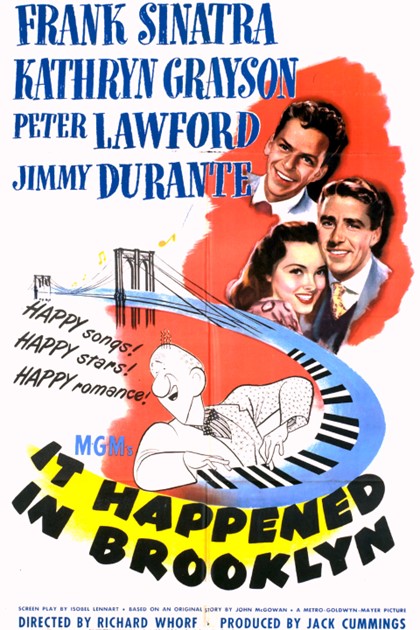
 It is a brilliant mistake, to have Sinatra sing an opera duet. His co-star in the mawkish It Happened In Brooklyn (1947) is the classically trained, enchanting Kathryn Grayson, and when they sing “Là Ci Darem La Mano” from Mozart’s Don Giovanni together, the contrast between the two convincingly demonstrates that a crooner is not an opera singer. In the same film, Sinatra shines with the perfect world premiere of the beautiful song “Time After Time” – unintentionally accentuating the difference between a romantic jazz ballad and a romantic opera duet.

Sinatra’s acting is less awkward. And he knows what he is singing, apparently. “Là Ci Darem La Mano” is officially a duettino – it only becomes really a duet in the last part, when Zerlina gives in. Before that, Mozart brilliantly captures what the song truly is: not a duet, but a duel. Don Giovanni, shortly before her wedding, tries to lure the lovely peasant girl Zerlina into his bedroom – and as long as Zerlina resists, her lyrics have a different melody to the Don’s. Only when she gives in do the melodies also flow together.

But in whatever performance, it remains a “real” duet; a musical composition for two performers. Solo versions of duets also exist plenty, of course. “Boots Of Spanish Letter”, for instance, the song in which Dylan himself does all the dialogue: both the guilt-ridden, departing lady and the resentful whiner who stays home. Or, slightly more sophisticated: double tracking, which we’ve known since Buddy Holly, where a previously recorded part lets the singer sing along with himself – but solo duets are of all times, of course.

Either way, the division of roles is always clear. Either because you simply hear two voices, or because it is clear from the text, from the dialogue, names, personal pronouns or otherwise, who is speaking and when. But in the twenty-first century, Dylan no longer makes it that easy for the listener. True, by now we are used to a sudden, confusing change of perspective (as in “Tangled Up In Blue”), or a surprising introduction of an unsuspected interlocutor (like the “you” in the last stanza of “Desolation Row”), but in this second bridge of “I’ve Made Up My Mind To Give Myself To You” Dylan goes one step further.

Until this sixth stanza, we had the impression to be listening to a dramatic monologue, one like Dylan has done dozens of times before; a protagonist telling his story to an otherwise invisible antagonist. The opening line tilts that perspective, or at least confuses it: “Take me out travelling, you’re a travelling man.” The suggestion so far was: a man who, after careful consideration, decides to share his life with a lady. Well, the “you” seemed to be a lady, anyway. This one addition “man” changes the perception;

– either the perspective now tilts, and the female antagonist comes into play,

– or Dylan, in a rather unique burst of gay emancipatory belligerence, describes the inner turmoil of a gay man,

– or we have been listening to a dialogue already from stanza 1, and should re-evaluate our understanding of the lyrics so far.

All possible… until the closing line of this bridge: “I’m going far away from home with her”. Changed both in the live versions and in the official publication, on the site, to “I’m going to go far away from home with her”, but that doesn’t clarify anything more; it remains a confusing juggling of personal pronouns. In fact, the last word, “her”, insinuates the introduction of a third person (after “I” and “you”), and thus a fatal love triangle.

Indeed, the music video accompanying the cover of Cowboy Junkies (2021) elegantly suggests this solution to capture the whole thing in an all-encompassing, narrative plot. The first-person in the clip is indeed a lady, hopelessly in love with a married man (presumably; in any case, a man who cannot just give himself away). We may then understand the pain point “away from home with her” as “away from where she, your lawful wife, is”. Laborious perhaps, but in doing so this verse, the only verse with a third person singular, and thus the only verse that obscures the initially uncluttered plot, does fit into a narrative. At least: in the alternative narrative, the narrative told by Cowboy Junkies’ music video.

https://youtu.be/CmWpwp9s9Eo


It is, incidentally, an exceptionally successful cover, which when released, on the bonus CD Dylan Revisited with Uncut magazine on the occasion of Dylan’s 80th birthday, immediately breaks through to the Top 10 Most Beautiful Dylan Covers of All Time. Supreme Cowboy Junkie Michael Timmins is responsible for the surprising choice:

“When Uncut came to us, Dylan had just put that record out and I loved it. I’ve Made Up My Mind was definitely in our wheelhouse, and I knew Margo could sing it. Everyone did their parts, and it was very easy to pull together. I figured everyone else [on the tribute CD] would be covering songs from the late-’60s era and that it would be cool to do something Dylan had just put out a few weeks ago.”
(interview The Arts Fuse, 10 April 2022)

“I knew Margo could sing it,” Michael says with great sense of understatement about his little sister’s sky-rocketing vocal qualities. After all, Margo Timmins’ shrouded, goose-bumps inducing voice has long been the Canadian band’s secret weapon. As we could already hear on their Dylan covers “Girl From The North Country”, the slow, compelling “License To Kill”, and the brilliant, ferocious, debauched “If You Gotta Go, Go Now” – equally elevated to the peerage thanks to Margo’s drawling vocals.

Yep, Margo can sing “I’ve Made Up My Mind”. It is absolutely no longer a duet, though. But what the heck.


To be continued. Next up I’ve Made Up My Mind To Give Myself To You part 7: The Philosophy Of Modern Song


Jochen is a regular reviewer of Dylan’s work on Untold. His books, in English, Dutch and German, are available via Amazon both in paperback and on Kindle:


Posted in Uncategorized | Leave a comment

Never Ending Tour: the Absolute Highlights – Dark Eyes


by Tony Attwood

https://youtu.be/F0KIQ6HGn0U

This choice come from 1995 and is made not for its musical excellence, but for its originality.  I love the fact that Bob will try anything, and seemingly often without bothering too much with all those annoying rehearsals.  The harmonies are not perfect, and some more work could have been done on the arrangement, but simply for doing it, I think this recording needs a place in this series.

And I also wanted to include this because in the original article on this performance, all three of the videos have now vanished.  One or two going, yes, but all three!!!???

However since there seems to be a tendency to lose these videos here is another one – a different evening and a slightly different version.   They never did seem to get those pesk harmonies right.

Posted in Uncategorized | Leave a comment

“Too hot to handle” and “Lucien’s Tarantula”

by Larry Fyffe

Too Hot To Handle

Further unfolding of the Untold movie script for the film production (tentatively titled “Tarantula Road”) of the book “Tarantula”.

Narrator: Sandy Bob

 ********************************

{To wit}

Speaking of the (Fran)cisco Kid:

"Do you know San Francisco?"
"I've been there to a party once"
(Kirk Douglas & Robert Mitchum speaking from: Out Of The Past)

A quip that pops up in the following song lyrics:

You said you were going to Frisco, stay a couple of months
I always liked San Francisco, I was there for a party once
(Bob Dylan: Maybe Someday)

Maybe Someday the Untold Edit

A movie entitled ‘Too Hot To Handle’ stars well-endowed Jayne Mansfield (whom singer/songwriter Dylan actually meets in New York City).

An American, she plays Frankie Midnight in the amusing British gangster film.

Alluded to in the song lyrics beneath:

I guess I was too hot to handle, not sentimental enough
Maybe someday, you'll believe me when I say
That I wanted you, baby, in every kind of way
(Bob Dylan: Maybe Someday)

Sex-symbol Jayne mentioned outright by name in the lines below  ~ by the advice-giving Justine:

"(I) mean like if you wanna be some kind of charles atlas
go right ahead .... but you better head off for muscle beach
- i mean you just might as well snatch jayne mansfield
- become king of your kind and start some kind of secret gymnasium"
(Bob Dylan: Tarantula)

In the following song lyrics, the narrator seemingly pretends that he’s a tough guy; says he can’t even recall the times he and his former girlfriend had when in San Francisco:

Oh, must I fall into this sadness
Do I look like Charles Atlas
Do you think I still got
What you still got, baby
(Bob Dylan: She's Your Lover Now)

Out of the black-magic, hot-fluid plasma spewed forth from the pages of the postmodern book cools the Jungian Universe composed by singer/writer Bob Dylan.

Out gallops the crystal cowboy angel:
(I) am gazing into the big dipper with
with a silver buttoned blouse in my nostrils
(Bob Dylan: Tarantula)

And there too, lo and behold:

(A)lice toklas lays on the grassy knoll
& blesses a flower
(Bob Dylan: Tarantula)

Lucien’s Tarantula

(A) girl with her back
full of ink
raises her hand
(Bob Dylan: Tarantula)

Creatively said it is that jealous is the tarantula, a seeker of vengeance against those with power and authority ~ in a nutshell, the big poisonous spider is Christian-like, a black-cloaked preacher of equality.

So claimed by Zarathustra below:

There cometh the tarantula willingly. Welcome tarantula. Black on
 thy back is thy triangle and symbol. And I know what is in thy soul
(Friedrich Nietzsche: Thus Spake Zarathustra ~ translated)

Existentialist Nietzsche and Gothic writer Edgar Allan Poe are romantic wimps in comparison to the French-Urugaryan writer Lucien Ducasse.

Lucien presents a prose/poem wherein he posits that God must exist because the Almighty One demonstrates that He hates humankind so much that the Creator goes out of His way to put the evil actions of Lucifer (Maldoror) to shame.

In the ambiguity-strewn, and highly fragmented ‘The Songs of Maldoror’, two individuals (whom Maldoror believes he’s killed) are transformed by a heavenly angel into a giant blood-sucking tarantula that torments the satanic sadist every night when he tries get some sleep:

An archangel descends from heaven
And the Lord's messenger orders the two men
To turn themselves into one giant black spider
That comes every night to suck Maldoror's throat 
(Lucien Ducasse: The Songs Of Maldoror ~ translated)

Singer/songwriter/musician Bob Dylan waters down what can be considered on one level Ducasse’s critique of complacent authors who dare not step very far outside the norms of what’s considered acceptable and decent writing of the day.

But critique them Dylan does:

& behold the prophesying blind allegiance
to fox law, monthly cupid
& the intoxication ghosts of dogma ... nay
& may the boatmen in bathrobes be banished forever
& anointed into the shelves of a live hell, the 
unimaginative sleep, repetition without change
& fat sheriffs who watch for doom in the matttess
(Bob Dylan: Tarantula)

In the lines below, unimaginative writers condemned – they’ll find no immortality, figuratively or otherwise, anywhere ~ neither on earth nor in heaven:

Are you tired of living
You who have barely been born
You may count on encountering up there
The very same evils as down here
(Lucien Ducasse: The Songs Of Maldoror ~ translated)

The sorrowful sentiment of precious time wasted echoed in the following song lyrics:

From the fool's gold mouthpiece the hollow horn
Plays wasted words, proves to warn
That he not busy being born 
Is busy dying
(Bob Dylan: It's Alright Ma)

Both the creepy ghosts of Arthur Rimbaud and Lucien Ducasse lurk in the shadows of Dylan’s dark-humoured mind:

Lilith teaches her new husband, Bubba
how to use deodorant
also teaches him that
"stinky doo doo" means nasty filth
(Bob Dylan: Tarantula)
Posted in Uncategorized | Leave a comment

Other people’s songs: Pretty Peggy-o

By Aaron Galbraith and Tony Attwood

Aaron: The Bonnie Lass o’ Fyvie is a traditional Scottish folk song about a thwarted romance between a soldier and a girl. There is no strict version of the lyrics and the song has multiple variants including Handoms Polly-O, Peggy-O, Fennario, and The Maid of Fife. The Americanized variant is usually called “Peggy-O”.

Here is the earliest known recorded version by Scotsman John Strachan from 1955

Bob’s version appears on his debut album. He starts off the song with the introduction “I’ve been around this whole country but I never yet found Fennario”.

Tony:  Indeed as I understand it Fennerio is a fictional location.  Robert Hunter and Jerry Garcia mention it in Dire Wolf:

In the timbers of Fennario
The wolves are running ’round
The winter was so hard and cold, froze 10 feet ’neath the ground…

And here indeed is a recording of Robert Hunter singing the song…  Interestingly this song refers to “going down to Fennerio”.  It seems one always “goes down to” Fennerio, which presumably means it is “down south”.

Aaron: Simon and Garfunkel recorded an arrangement of the song titled “Peggy-O” as part of their 1964 debut album Wednesday Morning, 3 A.M.

Tony: Which gives it a totally different perspective, through the delicate guitar and harmonies.  Really, it becomes  a totally different song.

Aaron: The National recorded their version in 2016 for a Grateful Dead tribute album Day of the Dead

Tony: I have never heard this before, not being particularly concerned with the music of the Dead, and I found this a really beautiful, and exquisite arrangement.  In fact, I do love these spacious instrumentations in which the music itself contains (for me at least) a meaning of its own; it is the music that then determines what the lyrics mean.

So, I can see and feel the mythical land, and the use of the slow and utterly controlled build-up through the song, which has been done 100 million times before, still has a sense of originality and meaning.

I guess this is because the whole development of the song in the recording is so carefully handled.  It would have been so easy to fly away, letting it build up more and more.  And yet it is arranged so that “stepping down the stairs” still contains that feel of delicacy and uncertainty.

You’ll notice the change of lyrics from Dylan’s version, but that doesn’t matter at all – there must be hundreds of versions of the song out there, and I can’t imagine anyone ever doing this better.

And the lyrics are different.    With the Dead, the song ends …

If ever I return Pretty Peggy-O
If ever I return, all your cities I will burn
Destroy all the people in the area-O

Come steppin' down the stairs Pretty Peggy-O
Come steppin' down the stairs, holding back your yellow hair
Bid a last farewell to your William-O

Sweet William he is dead Pretty Peggy-O
Sweet William he is dead and he died for a maid
And he spent the loot he had in the country-O

As we rowed up to Fennario
Our captain fell in love
With a lady like a dove
And he called her by name, Pretty Peggy-O

Which emphasises the point that there are many different versions available.  Bob had either lost part of the lyrics, or didn’t want to do the whole piece, or the Dead decided to add some extra lines.

But most of all what this recording shows is that even with the most basic of lyrics and a simple melody one can create an absolute masterpiece of atmosphere and tension.  Go on, play it again – and well, even if you don’t want to, I do.


Previously in this series…

  1. Other people’s songs. How Dylan covers the work of other composers
  2. Other People’s songs: Bob and others perform “Froggie went a courtin”
  3. Other people’s songs: They killed him
  4. Other people’s songs: Frankie & Albert
  5. Other people’s songs: Tomorrow Night where the music is always everything
  6. Other people’s songs: from Stack a Lee to Stagger Lee and Hugh Laurie
  7. Other people’s songs: Love Henry
  8. Other people’s songs: Rank Stranger To Me
  9. Other people’s songs: Man of Constant Sorrow
  10. Other people’s songs: Satisfied Mind
  11. Other people’s songs: See that my grave is kept clean
  12. Other people’s songs: Precious moments and some extras
  13. Other people’s songs: You go to my head
  14. Other people’s songs: What’ll I do?
  15. Other people’s songs: Copper Kettle
  16. Other people’s songs: Belle Isle
  17. Other people’s songs: Fixing to Die
  18. Other people’s songs: When did you leave heaven?
  19. Other people’s songs: Sally Sue Brown
  20. Other people’s songs: Ninety miles an hour down a dead end street
  21. Other people’s songs: Step it up and Go
  22. Other people’s songs: Canadee-I-O
  23. Other people’s songs: Arthur McBride
  24. Other people’s songs: Little Sadie
  25. Other people’s songs: Blue Moon, and North London Forever
  26. Other people’s songs: Hard times come again no more
  27. Other people’s songs: You’re no good
  28. Other people’s songs: Lone Pilgrim (and more Crooked Still)
  29. Other people’s songs: Blood in my eyes
  30. Other people’s songs: I forgot more than you’ll ever know
  31.  Other people’s songs: Let’s stick (or maybe work) together.
  32. Other people’s songs: Highway 51
  33. Other people’s songs: Jim Jones
  34. Other people’s songs: Let’s stick (or maybe work) together.
  35. Other people’s songs: Jim Jones
  36. Other people’s songs: Highway 51 Blues
  37. Other people’s songs: Freight Train Blues
  38. Other People’s Songs: The Little Drummer Boy
  39. Other People’s Songs: Must be Santa
  40. Other People’s songs: The Christmas Song
  41. Other People’s songs: Corina Corina
  42. Other People’s Songs: Mr Bojangles
  43. Other People’s Songs: It hurts me too
  44. Other people’s songs: Take a message to Mary
  45. Other people’s songs: House of the Rising Sun
  46. Other people’s songs: “Days of 49”
  47. Other people’s songs: In my time of dying
Posted in Uncategorized | Leave a comment

I’ve Made Up My Mind To Give Myself To You (2020) part 5: A bottle of gin loosed her muse


by Jochen Markhorst

V          A bottle of gin loosed her muse

If I had the wings of a snow-white dove
I’d preach the gospel, the gospel of love
A love so real, a love so true
I’ve made up my mind to give myself to you

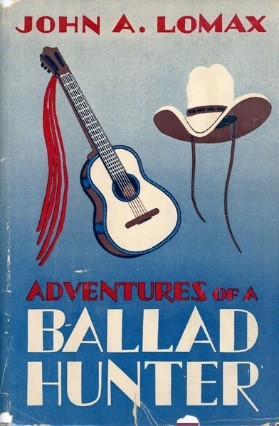
 It is one of the many fascinating stories told in his riveting and sometimes moving Adventures Of A Ballad Hunter (1947), the memoirs of John A. Lomax. The musical treasure hunter tells how in 1908 he is hunting in Texas, near the Brazos River, where dams are being built by “levee Negroes from Vicksburg”. He looks for the woman Dink, said to be best singer in the encampment. He does find her, eventually, but she refuses – out of shyness, Lomax suspects – to sing anything for him;

“Finally, a bottle of gin, bought at a nearby plantation commissary, loosed her muse. The bottle of liquor soon disappeared. She sang, as she scrubbed her man’s dirty clothes, the pathetic story of a woman deserted by her lover when she needs him most … Dink ended the refrain with a subdued cry of despair and longing … the sobbing of a woman deserted by her man.”

Lomax’s contribution to music history cannot be overstated. To him we owe “Buffalo Skinners”, Lead Belly, “The Midnight Special”, the folk revival, “Swing Low Sweet Chariot” and dozens, maybe hundreds more songs that without him would have dissolved into the mists of time. Songs, which are the foundation of Dylan’s oeuvre – like the song Dink finally sang there, after a bottle of gin, for John Lomax:

If I had wings like Noah's dove,
I'd fly up da river to the man I love.
Fare thee well, O Honey, fare thee well

… “Fare Thee Well”, or also called “Dink’s Song”, Dink’s own gospel of love, and for all its simplicity one of the finest songs of the twentieth century. “Part blues, part British lyric, and all perfection,” as son Alan Lomax writes in his compilation for Penguin Books, American Folk Songs (1964). “Dink’s Song” can be found in the last chapter, Chapter VI, Modern Times, after songs like “Whose Side Are You On”, “Frankie And Johnny”, “Delia”, “St. James Infirm’ry”, “The Titanic”, “House Of The Rising Sun” and some 20 more songs that we all see appear on Dylan’s set lists, and hear again in Dylan’s songs.

As we also hark back Dink’s If I had wings like Noah’s dove, here in this fifth verse of “I’ve Made Up My Mind To Give Myself To You”, the song’s gentle centre. Indirectly, admittedly; Dylan literally quotes Ferlin Husky’s paraphrase of it, the 1960 No.1 hit, “Wings Of A Dove”;

On the wings of a snow-white dove
He sends His pure sweet love
A sign from above
On the wings of a dove

… a good song that in Husky’s version is unfortunately rather polluted by an evangelical jubilant chorus. Which seems inescapable; country king George Jones, queen Kitty Wells, Charley Pride, Porter Wagoner (backed by Elvis’ beloved Blackwood Brothers) and even the untouchable Dolly Parton also glaze the song with it. It takes until 1984, until a modern Grand Master interferes before a version is recorded without ecstatic backing vocals: Leon Russell turns it back into a pure, Grand Ole Opry-worthy country classic – but alas, still with the now-dated 80s sound of clinical bathroom reverb on the vocals. We have to wait until 1993 before a more or less timeless version is recorded; again Dolly Parton, but this time with the Honky Tonk Angels, featuring Tammy Wynette and Loretta Lynn.

Anyway, Ferlin Husky’s version is etched in Dylan’s music memory, of course. The song spent ten weeks at No 1 in 1960, and it is also the version played by DJ Dylan himself, as the closing track of the Noah’s Ark episode of his Theme Time Radio Hour in 2009. Still, despite Husky’s shadow, Dylan’s stream-of-consciousness most likely will have been carried away to the song’s source, to “Dink’s Song” – which is, after all, even deeper under his skin.

On the legendary The Minnesota Hotel Tape (Songs for Bonnie), the living room concert at Bonnie Beecher’s home-recorded by Dylan’s friend Tony Glover in December 1961, “Dink’s Song” is number 8, between “It’s Hard To Be Blind” and “Man Of Constant Sorrow”.

After the song ends, we hear:

Tony Glover: “Is that the way the original goes?”
Dylan: “Huh?”
Tony Glover: “Is that the way the original goes?”
Dylan: “That’s the way I heard it. I heard it from a lady named Dink. I don’t know who wrote it.”

… Lomax heard Dink sing the song in 1908. So Dylan has either heard a very, very elderly Dink sing a song that has now been in her repertoire for a very, very long time, or Dylan is once again making up stories and already knitting the next chapter of his fable biography. The latter is more likely.

We can even correct him in fairly precise, high-probability detail; on Friday afternoon 29 September 1961, just before he gets a record deal himself, Dylan is in the studio. Carolyn Hester is recording an LP, and Dylan has been invited to play harmonica on a couple of songs. These end up being five, though he does not play on “Dink’s Song”, which is also recorded that afternoon. However, it is very likely that Dylan is still hanging out in the studio by then: that same night, he plays at Gerde’s Folk City – and “Dink’s Song” is on his setlist for the very first time.

We have no recordings of that performance, of that first time Dylan plays “Dink’s Song”. But an educated guess would be that after the last chord, the young troubadour says through the applause, “That’s the way I heard it. I heard it from a lady named Dink.”

Incidentally, on that December recording from Minneapolis, Dylan sings the same lyric variation as Carolyn Hester – a different order of stanzas, but the same words. Heard from a lady named Carolyn.

To be continued. Next up I’ve Made Up My Mind To Give Myself To You part 6: I knew Margo could sing it


Jochen is a regular reviewer of Dylan’s work on Untold. His books, in English, Dutch and German, are available via Amazon both in paperback and on Kindle:


Posted in Uncategorized | Leave a comment

Bob Dylan’s favourite songs: Sam Stone

“Sweet songs never last too long on broken radios” is one of those phrases that seem to last forever in my mind and take on a whole range of meaning.   Of his work Bob Dylan said, “Prine’s stuff is pure Proustian existentialism. Midwestern mindtrips to the nth degree. And he writes beautiful songs. . . . All that stuff about ‘Sam Stone’, the soldier junkie daddy, and ‘Donald and Lydia’, where people make love from ten miles away. Nobody but Prine could write like that.”

It is said that he wrote some of his early songs while working as postman (I think that is mailman in American English), and the story is told that after a single open mic event he started to get paid for his gigs.    Kris Kristofferson is quoted on Wiki as saying, after hearing John Prine for the first time, “By the end of the first line we knew we were hearing something else. It must’ve been like stumbling onto Dylan when he first busted onto the Village scene.”

“Far From Me”, above, is not one that is on Dylan’s list of his favourite songs, but John Prine said it was his personal favourite of all the songs he composed.  He continued recording until his death in 2020 from complications having contracted Covid.  He is regarded as one of the most important songwriters of his time and his work is celebrated not just by Bob Dylan but also by artists as different as Johnny Cash and Roger Waters.

Posted in Uncategorized | Leave a comment

A Dylan Cover a Day: Property of Jesus

By Tony Attwood

I reviewed Property of Jesus on this site  back in 2016 and immediately confessed my position in terms of religion, so that anyone kind enough to spend a moment or two reading my meanderings would appreciate that I was not trying to hide my own viewpoint under the guise of giving a balanced review of a piece of music.  My reviews aren’t balanced  – they come from my upbringing, my experience, my beliefs – same for all of us.

But as I think I noted at the time, and certainly have always felt, there are two ways to read this song: either the person sung about is liberated by being the property of Jesus or else she or he is enslaved by being the property of Jesus.  Being someone else’s property is of course in contemporary language, enslavement, a reduction of the full person, mental abuse…

I don’t think Bob has ever performed the song live – I know it wasn’t part of the “gospel tour” and it is not shown as being played live on the official Bob Dylan site so I think not.

And of course I don’t know exactly what Bob meant when he wrote the piece, but I had a bash at explaining my thoughts in my review here (see link above) and I’ve been a bit bemused to see that on some computers, if you do a search for the song title, my review comes up actually at, or at least near, the top of page one on Google (not that many people do search for the song on Google!)

Anyway, that’s the background, except for the fact that there are very few cover versions of the song.  However one of them is by Sinéad O’Connor of whom I have written several times in relation to “I believe in you” not least because I do consider one of the greatest Dylan covers of all time.  So of course I start with her…

Right from the start with the rhythm we know this is going to be different, and then we find the vocals are going to run the same melody line after line, relentlessly and the anti-established church view for which Ms O’Connor is well known is established.

The percussion emphasises her point of view, and her solid, strong vocals add to that.   And then, very curiously at the word “stone” the music softens, as if the heart of stone is not a criticism at all, but salvation.  Your “heart of stone” enables you to stand up against the propaganda of the church, and the evils of the Catholic Church in Ireland that Ms O’Connor has spoken about so clearly, and from personal experience.

I have never been sure what the lines

But you're picked up quite a story and you've changed since the wombWhat happened to the real you, you've been captured but by whom?

actually refer to.  Are these lines criticising the individual who says she/he doesn’t need God, or is it a reference to the person who has been caught up in a religion and has lost the “real you” and been transformed into a person who puts everything second to the belief that has now overtaken every waking moment of the individual’s life?   Or is “you” the Church itself?

And yet and yet…

There was a very good piece about the artist in America Magazine some six months ago which is well worth reading if you are interested in Sinéad O’Connor and her work.  It has a fair perspective, and perhaps helps put her performance of “Property of Jesus” into a deeper perspective than I can ever do.  And what it does portray to me, and what this recording gives me, is a deeper sense of just how far the media mob and its allies seek to punish an individual for his/her views.   For as the article says, “in the years that followed the extent of the abuse and its coverup became much more widely known….

“Three decades ago, Catholics were demanding Sinéad O’Connor apologize for defaming the church. Perhaps we had it all wrong. Maybe we should be apologizing for the way we treated her.”

Of course, many will disagree, and after all, what does my opinion matter?  But listening to Dylan’s composition, and her rendition of it, I do still find that song puzzling, and I’m grateful to Sinéad O’Connor for recording her version.

This next recording is from Neal Casal, and although it is beautifully produced I am not sure that it adds anything to my understanding of the song.  But that is not to put down Neal Casal, who as you may know, was a staggeringly brilliant musician who tragically took his own life because of his mental health problems.  And I use this opportunity to mention this because mental health is still something that is hard to discuss in our society – except it seems by those who constantly wanted to dismiss Sinéad O’Connor as being crazy and mentally deranged.   Thus it is that western civilisation finds it very easy to knock and hurt people with whom they disagree, but not so easy to support those who suffer from mental health problems.

But, time to move on.   Chrissie Hynde has said “Yes, I’m very religious. I’ve never doubted the existence of God for a moment, and I deliberately try to associate with other people for whom religiosity is important, whether Muslim or Roman Catholic or whatever. I pray, and I keep God at the forefront of my consciousness as much as I can. I know there is a super being out there who looks over and controls everything that I do. How could anyone think otherwise?”

So now we have a version that clearly expresses the view that this is a pro-Christian anti-atheist song.  Which really does make the different versions even more interesting.  Same song, seemingly opposite viewpoints.

If you have battled your way to the end of my ramble today, thank you, and if nothing else I do hope I have in a small way been able to suggest that just because some people hold utterly different views from others, that in itself is not harmful.  It is what they do in the pursuance of those views that is the problem.

But of course, that is just my view.

The Dylan Cover a Day series

  1. The song with numbers in the title.
  2. Ain’t Talkin
  3. All I really want to do
  4.  Angelina
  5.  Apple Suckling and Are you Ready.
  6. As I went out one morning
  7.  Ballad for a Friend
  8. Ballad in Plain D
  9. Ballad of a thin man
  10.  Frankie Lee and Judas Priest
  11. The ballad of Hollis Brown
  12. Beyond here lies nothing
  13. Blind Willie McTell
  14.  Black Crow Blues (more fun than you might recall)
  15. An unexpected cover of “Black Diamond Bay”
  16. Blowin in the wind as never before
  17. Bob Dylan’s Dream
  18. You will not believe this… 115th Dream revisited
  19. Boots of Spanish leather
  20. Born in Time
  21. Buckets of Rain
  22. Can you please crawl out your window
  23. Can’t wait
  24. Changing of the Guard
  25. Chimes of Freedom
  26. Country Pie
  27.  Crash on the Levee
  28. Dark Eyes
  29. Dear Landlord
  30. Desolation Row as never ever before (twice)
  31. Dignity.
  32. Dirge
  33. Don’t fall apart on me tonight.
  34. Don’t think twice
  35.  Down along the cove
  36. Drifter’s Escape
  37. Duquesne Whistle
  38. Farewell Angelina
  39. Foot of Pride and Forever Young
  40. Fourth Time Around
  41. From a Buick 6
  42. Gates of Eden
  43. Gotta Serve Somebody
  44. Hard Rain’s a-gonna Fall.
  45. Heart of Mine
  46. High Water
  47. Highway 61
  48. Hurricane
  49. I am a lonesome hobo
  50. I believe in you
  51. I contain multitudes
  52. I don’t believe you.
  53. I love you too much
  54. I pity the poor immigrant. 
  55. I shall be released
  56. I threw it all away
  57. I want you
  58. I was young when I left home
  59. I’ll remember you
  60. Idiot Wind and  More idiot wind
  61. If not for you, and a rant against prosody
  62. If you Gotta Go, please go and do something different
  63. If you see her say hello
  64. Dylan cover a day: I’ll be your baby tonight
  65. I’m not there.
  66. In the Summertime, Is your love and an amazing Isis
  67. It ain’t me babe
  68. It takes a lot to laugh
  69. It’s all over now Baby Blue
  70. It’s all right ma
  71. Just Like a Woman
  72. Knocking on Heaven’s Door
  73. Lay down your weary tune
  74. Lay Lady Lay
  75. Lenny Bruce
  76. That brand new leopard skin pill box hat
  77. Lily, Rosemary and the Jack of Hearts
  78. License to kill
  79. Like a Rolling Stone
  80. Love is just a four letter word
  81. Love Sick
  82. Maggies Farm!
  83. Make you feel my love; a performance that made me cry.
  84. Mama you’ve been on my mind
  85. Man in a long black coat.
  86. Masters of War
  87. Meet me in the morning
  88. Million Miles. Listen, and marvel.
  89. Mississippi. Listen, and marvel (again)
  90. Most likely you go your way
  91. Most of the time and a rhythmic thing
  92. Motorpsycho Nitemare
  93. Mozambique
  94. Mr Tambourine Man
  95. My back pages, with a real treat at the end
  96. New Morning
  97. New Pony. Listen where and when appropriate
  98. Nobody Cept You
  99. North Country Blues
  100. No time to think
  101. Obviously Five Believers
  102. Oh Sister
  103. On the road again
  104. One more cup of coffee
  105. (Sooner or later) one of us must know
  106. One too many mornings
  107. Only a hobo
  108. Only a pawn in their game
  109. Outlaw Blues – prepare to be amazed
  110. Oxford Town
  111. Peggy Day and Pledging my time
  112. Please Mrs Henry
  113. Political world
  114. Positively 4th Street
  115. Precious Angel
Posted in Uncategorized | Leave a comment

Tarantula 30: Oh Pancho Oh Cisco


by Larry Fyffe

Take a little stretch, and conjectured it can be that the following lines make reference to the sentimental western adventures of the Cisco Kid and his sidekick Pancho:

Pancho was very startled
& screamed "i'll give you a friend or doe, you freak"
& banged him with a judo chop
(Bob Dylan: Tarantula)

In a short story by William Porter (aka O. Henry), the (Fran)Cisco Kid is described as “a vain person, as all eminent assassins are …”

Therein, the Tex-Mex bandito sings to himself:

Don't you monkey with my Lulu girl
Or I'll tell you what I'll do
(William Porter: The Caballero's Way)

Cisco’s gal double-crosses her outlaw-boyfriend, but her new guardian-lover, a Texas Ranger, guns her down by mistake; in the twist ending, the Kid fools the lawman into thinking that he’s disguised himself by dressing up to look like her.

Cisco (played by Duncan Renaldo) gets a jovial partner named Pancho (after Villa?) who chops up the English language when the two are portrayed on radio and TV, and in movies, as humour-prone nice guys mistakenly believed to be outlaws.

Brings to mind the following song lyrics:

The only thing we knew for sure about Henry Porter

Is that his name wasn’t Henry Porter.

In O. Henry’s story, though she definitely does not do so intentionally, Cisco’s gal gives up her own life in order that the Kid can get away from the Texas Ranger who’s out to kill him.

As he rides off into the sunset on his horse Diablo, Cisco (or so it could be said anyway) sings the following lyrics to himself:

I always liked San Francisco
I was there for a party once
Maybe someday you'll see that it's true
There was no greater love than what I had for you

(Bob Dylan: Maybe Someday – the Untold edit)

Besides Charles Dickens, TS Eliot has a say too:

And the cities hostile and towns unfriendly
And the villages dirty and charging high prices
(TS Eliot: The Journey Of The Magi)

Oh Pancho. Oh Cisco!:

Through hostile cities and unfriendly towns
Thirty pieces of silver, no money down
(Bob Dylan: Maybe Someday)

Below lie the roots of another Bob Dylan song:

Had King Solomon been the janitor, with all his treasures 
piled up in the basement,
Jim would have pulled out his watch every time he passed, 
just to see him pluck at his  beard with envy

(William Porter: The Gift Of The Magi)

As in:

Big Jim was no one's fool, he owned the town's only diamond mine ....
But his bodyguards and silver cane 
   were no match for the Jack Of Hearts
(Bob Dylan: Lily, Rosemary,  And The Jack Of Hearts)

Posted in Uncategorized | Leave a comment

The art work on Dylan’s albums: Planet Waves

This article is part of a long-running series which reviews the artwork of Dylan’s albums from the earliest days of his career.  An alphabetical index to the albums covered in the series can be found here.

Dylan’s album artwork: Planet Waves

by Patrick Roefflaer

  • Release                         January 17, 1974
  • Illustrations                 Bob Dylan
  • Liner Notes                  Bob Dylan
  • Art-director                  Bob Dylan

In September 1973, Bob Dylan signed an album record deal with Elektra/Asylum Records. Because he can no longer use the trusted art directors of Columbia, he decides to design the artwork for the album entirely on his own. There’s not even a photographer involved.

Front

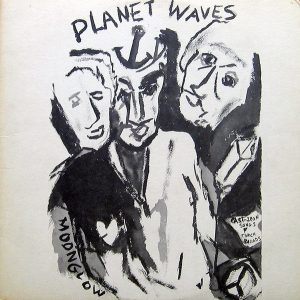
As for Self Portrait and The Band’s debut album (Music from Big Pink), Bob Dylan makes a painting for the front of the cover. On a white background he places figures and letters, in rough strokes, with black ink (or paint).
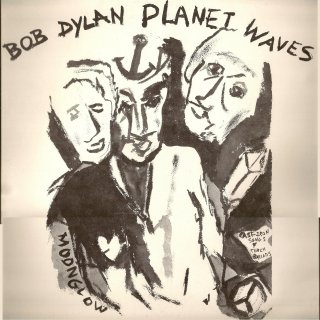
The image shows an unknown man, decorated with various attributes: an anchor on his forehead, a pierced heart on his jacket and the word ‘Moonglow’ on his sleeve. Behind the figure are two more men, of which only the faces are depicted. The head of the man on the right is clear, but otherwise he is surrounded by a grey spot.

Three objects are depicted in grey: some kind of crystal, a peace sign and a badge with the words ‘cast iron songs & torch ballads’. Those words may be a characterization of the album, an addition to the title “Planet Waves,” which tops the list. With some goodwill, you can see references to the song “Never Say Goodbye.” In that song, the singer claims that his dreams are made of “iron and steel.” There is also talk of ‘crashing waves’.

A key song perhaps? But one with a fairly vague text.

The name of the performer is missing from the front of the cover. As with the last few albums, nowhere on the front cover is it mentioned that this is a Bob Dylan album.

Since there isn’t even a picture of the singer shown, the record company are worried potential buyers could overlook the release.  The solution is to put a sticker on it with ‘Bob Dylan’.

This is done on the plastic in which the album is packed, or even directly on the cover. For the French pressing, someone tries to imitate Dylan’s handwriting to add his name to the title.

Back

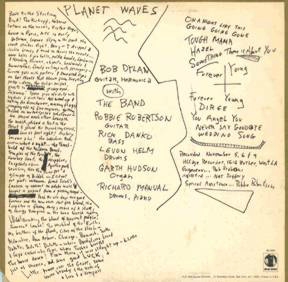
The back of the cover is also executed with black letters on a white background. Surrounded by a narrow golden border, the white square is roughly divided into three columns using two angular lines.

In the left column is a handwritten text – possibly excerpts from a diary – complete with deletions and typographical errors (‘Buddha’ and ‘echoes’).

In the middle: the title at the top is underlined by three waves, and below that a list of the musicians, with their main instruments. Richard Manuel has been renamed ‘Manual’. A mistake or a joke?

The column on the right shows another list: the song titles, with those of side 1 and side 2 separated by a cross. Below that, some more data is added: location, (some of the) dates of the recordings, plus the names of the technical staff involved.

If the lack of the singer’s name on the front caused some problems for the record company, the back proved to be even more problematic. In the piece of text on the left, there’s talk about ‘big dicks’ and ‘bar stools that stank from sweating pussy’. Of course Asylum’s lawyers objected to the passages that could be considered obscene.

Deleting the offensive words was apparently not an option and so a compromise is found.

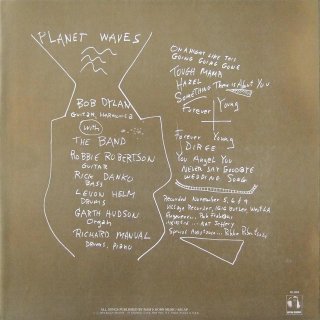
The disc will be sold in a transparent protective cover, with the back of the cover completely hidden behind a golden loose sheet. On that sheet, in white letters, an enlargement of the middle and right columns is shown.

In England, the albums are distributed by another independent record company: Island Records. Someone at the company feels that the extra sheet is easier to read when the colours are reversed: golden letters on a white background.

Rejected designs

Because of all that hassle, the album does not reach the stores in time and the tour has been going on for two weeks when the album finally appears on January 17, 1974. In some articles, it is mentioned that the postponement is due to a late name change of the record. However, this is not evident from the promo copies that have been distributed.

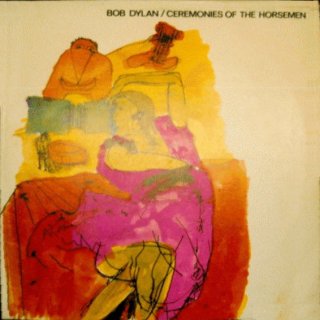
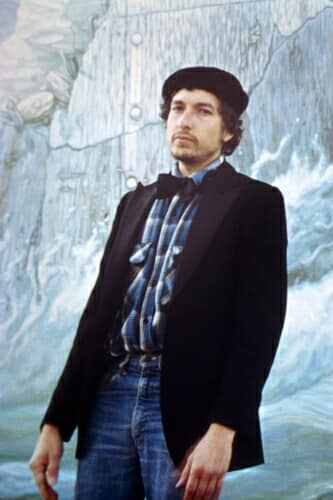
It appears that originally Dylan had indeed designed a different cover, with a painting of a dancer on the front and a photo of himself with a beret on the head on the back.

The record was then titled Ceremonies Of The Horsemen – a quote from ‘Love Minus Zero/No Limit’ of 1965.

In addition, another possible title is mentioned: Love Songs. However, no cover design has surfaced for this.

In 1982, Sony Music (which by then had bought CBS) took over the rights to the album. For the reissue, a new cover design was considered.

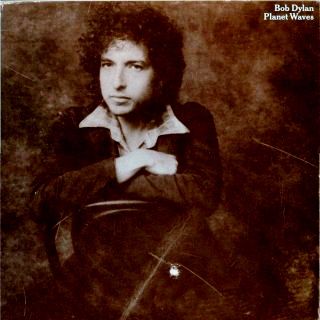
The sepia-tinted photo of Dylan with a beret was probably taken by Lynn Goldsmith, in October 1975.

Variants

In addition, there are several variants of the cover, two of which stand out in particular.

In the former Rhodesia (now Zimbabwe) the cover is printed negatively so that both the front and back display white letters and lines against a black background.

The so-called quadraphonic LP pressing, published in 1974 by Asylum, distinguishes itself from the ordinary stereo pressing because the front of the cover is black, with a reduced version of the original cover in the middle.


Posted in Uncategorized | 1 Comment

NET 2011 part 1: Things should start to get interestin’ right about now…

By Mike Johnson (Kiwipoet)

In 2011 things do indeed start to get interesting. Dylan, now turned 70, stands on the threshold of a transformation that will set the tone for the next eight years, and usher in one of the most remarkable decades in Dylan’s performing career. Dylan will astonish both his supporters and detractors alike with this transformation, and those who said that by 2010 the NET was played out and that Dylan was at the end of the line would eat their words.

2011 is the last year of the era I have dubbed ‘the circus barker and the organ grinder’ which began in 2006. In 2012 Dylan will switch to playing the grand piano and his new album, Tempest, which released a new set of songs into the mix, will set a new benchmark for live performances. The dumpty-dum of the circus baker years will evolve into swing, and his voice too will evolve from a bark into rough-edged singing and crooning.

You don’t have to subscribe to the ‘black hole’ interpretation of those circus barker years to sense the new energy in Dylan’s 2011 performances, as we shall see soon enough, but something else was happening that can’t be picked up by just listening to sound files. Dylan was starting to do strange things on stage, especially during his centre-stage performances, which in 2011, became more prominent. In previous posts I have discussed how, starting in 2006, Dylan retreated behind his keyboard, often leaving centre stage vacant. This I called his anti-performance performance and anti-spectacle spectacle. In 2008 – 2010 he would front up with his guitar and harmonica for two or three songs to show his audiences something of the Dylan they remembered and perhaps craved.

In 2011 Dylan began to use those centre-stage appearances for extraordinary performances, spectacles of a riveting but disturbing nature.

Andrew Muir, who wrote One More Night, referred to a number of times in previous posts, quotes blogger Rainer Vesely “Since Dylan crawled out from his hiding place behind the keyboard, where he ducked away from 2005 -09, he is staging a 90 to 100 minute drama, in which he puts much, much more emphasis on his physical presence than ever before. He really acts (!) and recites, gestures, mimics, uses, very consciously, his weird way of walking, knee bending, staring, half closing or wide-opening his eyes.”

Muir supports this with his own experience of the Manchester concert. “Dylan  (was) centre stage for much of the time, giving an extraordinary display of visual gestures, body contortions and facial engagement.”

The liner notes on the bootleg album for the first Hammersmith concert read: “Skilfully balancing and retaining the necessary duality of professional arrogance and humility, Dylan half passes, extends, collects, pirouettes, and counter-can-ters effortlessly through his show. At times, he lopes with the modest style of a crooner or old music-hall entertainer … skipping, reeling rhymes ..”

It’s time we had a look at a couple of these performances to see what the fuss is all about. I get the feeling you had to be there, but videos give something of the flavour of these shows.

The first I’ve picked is ‘Tangled Up In Blue’ from Manchester, 10th October.


It’s an unsettling experience, watching that performance, the facial grimaces, the strange shrugging of his body inside his long black coat, the way he touched his face and the back of his head. His combination of crooning and barking, and slipping somewhat hysterically into falsetto on the words ‘you’ and ‘blue’ can only add to the weirdness of it. It’s strangely compelling, but also very good. Note the power of those harp blasts.

Here is the sound file of that performance in case the video suddenly becomes unavailable.

Tangled up in Blue.

(There are other 2011 videos of this song on You Tube but I can’t recommend them as the sound quality is too poor. There is mass of material on You Tube now, but much of it is inferior in terms of sound and/or video quality.)

This well-known video of ‘Can’t Wait’ from Milan (22nd June) may not be able to match the 2010 performance (See NET 2010 part 1) in terms of its musical power, but sure is showy, with Dylan pacing about, throwing his arms out and generally acting histrionically. But doesn’t he get a little grin on his face when he points to the audience and repeats ‘I don’t know I don’t know I don’t know how much longer I can wait’?

I’m not quite buying it, but it’s fun to watch

And here’s the sound file:

Can’t Wait

This might not be Mick Jagger’s cavorting, David Bowie’s costume dramas or even Leonard Cohen’s deadpan stage act but is certainly a spectacle in its own right. Show bizz.

Not only the performances but Dylan’s outfits were souped up, what I call his riverboat gambler costume. Here’s how he’s described in the liner notes to the second Hammersmith concert:

“At this point it should be said that Bob was pretty much wearing a long black coat tonight. Garbed in a three-quarter length black jacket/coat with four brass buttons, over a blue shirt and blue neckerchief drawn together by a silver ring. On his jacket were more brass buttons and the occasional glimpse of his shirt sleeve revealed sparkling cufflinks. He wore black trousers with white piping vertical stripe on the outside of each leg and, of course, a hat, tonight’s being light grey, with a small feather to one side. A stage dandy from head to toe. With that kit on you know you’re in show business.” (My emphasis)

Then there is that puzzling Eye of Horus used as a backdrop on stage.

Lots of ink has been spilled on trying to decode the symbolism of this, and I would encourage the reader to look at the articles on the subject by Larry Fyffe here at Untold Dylan.

The problem is not just the eye itself, but the figure above the eye which seems to have flames coming from it. That figure has been interpreted as Baphomet, or the Goat of Mendes – in short, the devil. This has fed into the narrative you can find on You Tube that Dylan sold his soul to the devil in return for fame and fortune.

It has also been interpreted in the completely opposite sense: “The Dylan Eye Logo, the eye being the eye of God, the crown being King of kings and lord of lords, Jesus and the diving Dove being the Holy Spirit. Performing in front of a huge symbol for the trinity has to have profound significance for what the man believes.”

Or it could be the eye of a falcon. “The Eye of Horus has been used for many metaphors over the years, i.e., Eye of the Mind, Third Eye, Eye of the Truth or Insight, the Eye of God Inside the Human Mind. The ancient Egyptians, believing in its mystic powers, gave all of these names to the Eye of Horus.” (National Library of Medicine.)

It wasn’t only used as a backdrop but Dylan Eye Logos were available at concerts in badge form.

So Dylan’s bizarre performances, his dandified costumes and his Eye all go to create a renewed interest in his concerts, which was surely his aim. Despite his apparent indifference, he can’t have been happy with reports of his audience deserting his concerts early, and the NET’s sinking reputation in the few years prior to 2011. But, for me anyway, it is the vigour and passion of the performances that really tell the story. Take this performance of ‘Love Sick’ from the third Hammersmith concert (21st Nov), for example:

Love Sick

I can’t bring to mind any other performance of the song that matches this one for power and clarity. As soon as I heard it, it joined my list of ‘best evers.’ All the vocal resources he brought to ‘Tangled Up in Blue’ he brings to bear here to deliver a remarkable performance.

I have introduced this song many times, but feel I’ve missed something. That it expresses a profound alienation from the world (the walking ghost) may be true enough, but it also expresses an intense spiritual state.

“The opening line of the first track on Time Out of Mind set the theme and tone for the entire proceedings: ‘I’m walking through streets that are dead.’ The stark imagery and the gritty, gravelly vocals channelled those of a biblical prophet. And indeed, the lyrics of that first song, ‘Love Sick,’ were rooted in the love poetry of King Solomon, whose aptly titled Song of Songs — commonly understood to be an allegory for the love between God and the people of Israel — has the exiled collective seeking His comfort from afar, explaining, ‘For bereft of Your Presence, I am sick with love.’ Or, put another way, Israel is ‘lovesick” for God.’’’ (Seth Rogovoy at forward.com – shared by Jane Carol Seff on Untold Dylan’s Facebook page).

This confirms the impression I’ve always had that this song was not about a woman, or at least not only about a woman.

Dylan brings this new vigour to these performances of ‘Things Have Changed.’ This Manchester performance is a hard one to beat. The song bustles along with Dylan nailing every line.

Things Have Changed (A)

That has all the hallmarks of a Crystal Cat recording (sharpness, clarity etc), but even that compelling performance may not be the best. This one from Memphis (30th July) is a contender, and interesting in itself in terms of audience reaction. You can feel the enthusiasm of the crowd, and the sound is not as abrasive as Crystal Cat recordings can be.

Things Have Changed (B)

Seth Rogovoy also had some interesting things to say about ‘Not Dark Yet’ and other songs from Time Out of Mind. “A triptych of songs — ‘Tryin’ to Get to Heaven,’ ‘Standing in the Doorway’ and ‘Not Dark Yet’ — took their themes from the Yom Kippur ritual. In ‘Standing in the Doorway, the singer insists, ‘There are things I could say but I don’t / I know the mercy of God must be near.’ The song ‘Not Dark Yet’ captures the liminal state of consciousness that overtakes one over the course of Yom Kippur worship:

‘Shadows are falling, and I’ve been here all day’

Plus:

‘I know it looks like I’m moving, but I’m standing still’

Plus:

‘Don’t even hear a murmur of a prayer
It’s not dark yet, but it’s getting there.’”

(Yom Kippur is the “Day of Atonement” and the holiest day of the Jewish year. Healthy adults are commanded to refrain from eating and drinking from sunset to sunset to remind us of the frailty of the human body and our own mortality.)

As with ‘Lovesick,’ a spiritual state is being expressed here. This is another Hammersmith (second concert) Crystal Cat recording of ‘Not Dark Yet.’ Wonderful the way Dylan uses the harmonica to create a fading echo.

It’s Not Dark Yet (A)

Lovers of the song might appreciate this performance from Lille, France (16th Oct), equally exciting.

It’s Not Dark Yet (B)

Looking at what Seth Rogovoy calls ‘a triptych of songs’ we can’t include ‘Standing in the Doorway’ as it disappeared from the setlists in 2005 (It will reappear for a single performance in 2017), but we do have ‘Trying to Get to Heaven.’

“And ‘Tryin’ to Get to Heaven’ offers a detailed description of the Neilah service, the final service of the day, offering worshippers their last opportunity to make teshuvah [repentance/return] before sundown, before their names are inscribed in the Book of Life for the next year (or not). In Dylan’s words: ‘You can seal up the book and not write anymore / I’ve been … tryin’ to get to heaven before they close the door.’ Words spoken by someone on intimate terms with the arc of the holiest day of the Jewish calendar.”

Here’s the Hammersmith performance (second concert):

Trying to Get to Heaven (A)

And here’s the Lille performance:

Trying to Get to Heaven (B)

That’s it to kick off the year. I’ll be back soon to dig deeper into 2011

Until then

Kia Ora

Posted in Uncategorized | Leave a comment

Other people’s songs: In my time of dying

By Aaron Galbraith (in the USA) and Tony Attwood (in the UK).

Aaron selects the recordings and emails these with his notes to Tony who tries to write something about the song during the time it is playing.  Links to the previous episodes in this series is given at the end.

Aaron: “In My Time of Dying” was written by Blind Willie Johnson. The lyrics were inspired by a passage in the Bible from Psalms 41:3 “The Lord will strengthen him upon the bed of languishing, thou wilt make all his bed in his sickness”.

Tony: OK, after about an hour of flapping around back and forth I am more confused now than when I started.   So let me try and explain the source of my confusion.

There are several versions of the lyrics of this song on the internet but none seem to accord with the recording above.

There are also two titles of the song – the second of these “Jesus make up my dying bed” is shown on the Google entry as being the song Dylan recorded as “In my time of dying”, starting

Now in the time of dyingI don't want nobody to moan

So I think the song above is “Jesus make up my dying bed” – as the full heading on the YouTube link above says, but I am really not convinced that this is the same song as “In my time of dying”.   Of course, that is probably just my lack of knowledge, because a lot of people seem to be saying the two songs are linked.  And thematically they are of course, but musically … at the moment I just don’t hear it and hence have ended up going around in circles.

Thus, better that I admit I have no idea what I am writing about, and let you, dear reader, write in and put me straight.   How are the songs, “Jesus make up my dying bed” and “In my time of dying” as performed by Dylan, related?  Apart from being about death.

Aaron: Bob’s version appears on side 1 of his debut album.

Tony: So this is the song I first heard on Dylan’s first album.  Wiki cites the album liner notes as saying “Dylan had never sung “In My Time of Dyin'” prior to this recording session. He does not recall where he first heard it. The guitar is fretted with the lipstick holder makeshift slide he borrowed from girlfriend, Suze Rotolo, who sat devotedly and wide-eyed through the recording session.”

Aaron: Led Zeppelin’s version was released on their sixth album Physical Graffiti in 1975. The album credits list the four group members as the song’s authors, despite the earlier released versions. At a little over 11 minutes, it is the longest studio track by the group. So plenty of time for Tony to make his comments!!

Tony: Yes well, thank you, Aaron.  As it happens I am not a Led Zepplin fan and the thought of listening to 11 minutes of them and finding something to write at the same time is a little challenging.

Does it do anything for me emotionally?  Nope.  Does it entertain me?  Sorry, again nope.  Does it make me want to go back and play it again?   Sorry a third time, but no.

I think (and of course this is just a guess) that the band knew that they were short of material for the album, and so decided to do a long atmospheric version of a blues song.  But the atmosphere doesn’t work for me – it is just a prolonged improvisation around a couple of sets of chord changes and a rhythmic feature.

Now of course maybe I don’t appreciate any of this because I have spent a little too long trying to see if I can find a link between the two songs we have here: “Jesus make up my dying bed” and “In my time of dying” beyond the fact that they are both about dying.  I would love someone to be able to show me the finer points of the link between these two pieces, because I am blowed if I can find them myself.

Aaron: Martin Gore, the main songwriter from Depeche Mode released his version on his debut solo album from 2003, apparently based on the Dylan version.

Tony: And wouldn’t you know it, the version that Aaron has found in the USA is not available in the UK.  But as most of our readers are not in the UK, I’m putting it in…

Tony: And fortunately there is a UK version

Tony: An antidote to Led Zep.   Now here we have an atmosphere which is appropriate to the lyrics of the song.  And just in case you don’t keep up with such things, I should add Mr Gore is/was the songwriter for Depeche Mode as well as being a multi-instrumentalist.

He’s gone for the full atmospheric approach – which is ok, but I think rather than play it again I’d sooner go and make myself a coffee.

I’m really sorry Aaron, maybe I’m having an off day, but I’ve done my best.  Would you like to say what you think of these versions and how they are related to each other?   Normally I feel I can cover up for my ignorance by writing more words (along the lines of “never use 50 words when 5000 are available) but today, I have hit the buffers.   It’s going to take me a little while to recover from that 11 minutes (was it really only 11 minutes – it felt like 11 hours) of Led Z.

I’ll try harder next time!


Posted in Uncategorized | 5 Comments

I’ve Made Up My Mind To Give Myself To You (2020) part 4: I see thy glory


by Jochen Markhorst

IV         I see thy glory

My eye is like a shooting star
It looks at nothing here or there, looks at nothing near or far
No one ever told me, it’s just something I knew
I’ve made up my mind to give myself to you

“Drops Of Jupiter (Tell Me)” (2001) is a fine rock song and the definitive breakthrough for Californian band Train. Two Grammy Awards, and the album, Train’s second LP Drops Of Jupiter is a resounding success: double platinum. The band is no shooting star. Excellent musicianship, charismatic singer, particularly strong hooks in catchy, melodic rock songs – Train has now been scoring one nice hit after another attractive flop after another millionseller for more than 20 years. And one of its strongholds is singer Pat Monahan’s poetic talent. Not so much in terms of depth and sophistication, but at least technically similar to Dylan; Monahan has a similar feel for euphony, a talent for unobtrusively integrating tried-and-tested stylistic devices, and a similar feel for fun rhyme inventions. Which we already see in the first hit, 1998’s “Meet Virginia”;

She doesn't own a dress, her hair is always a mess
If you catch her stealin', she won't confess
She's beautiful, she smokes a pack a day, wait that's me, but anyway
She doesn't care a thing about that, hey
She thinks I'm beautiful. Meet Virginia

… with seemingly casual but well-considered rhyme triplets (the next verse opens with She never compromises, loves babies and surprises / Wears hi-heels when she exercises), as we know from Dylan’s songs like “We Better Talk This Over” (The vows that we kept are now broken and swept / ‘Neath the bed where we slept), “Simple Twist Of Fate” or “Cold Irons Bound” (The walls of pride are high and wide / Can’t see over to the other side) – there are many examples and they can be heard in every decade of Dylan’s career. And Monahan, like Dylan, manages to maintain quality through the years. The 2009 world hit “Hey, Soul Sister” demonstrates just as much craftsmanship and linguistic delight, and a next world hit, “Drive By” in 2012, opens no less strongly:

On the other side of a street I knew
Stood a girl that looked like you
I guess that's déjà vu
But I thought this can't be true 'cause
You moved to west L.A., or New York or Santa Fe
Or wherever, to get away from me

The love for smart quality lyrics does not come out of the blue, we understand from a Q&A in the Rolling Stone of 24 July 2003. Dad Monahan paved the way, Pat reveals:

“I was the last of seven kids, and my father was so obsessed with music that I’d walk in from school and he’d make me listen to records — make me listen to why a song was great. Stan Getz and Cal Tjader and Milt Jackson … He was very into words. Songs like ”Jeepers Creepers” — it’s fucking good — and ”Moon River,” where I think the words make the melody so amazing.”

“Moon River”, the song of which Dylan says in Chronicles: “My favorite of all the new ones was “Moon River”. I could sing that in my sleep,” and “Jeepers Creepers”, which Dylan considers one of the “big songs” in that same autobiography, among standards like “When Irish Eyes Are Smiling” and “The Very Thought Of You”… in any case, Dylan and Monahan share cultural baggage and taste as well.

A distinguishing quality of that breakthrough hit “Drops Of Jupiter” then is its consistency, in this case its perhaps old-fashioned but no less enjoyable fidelity to the motif “cosmos”. In terms of content, the lyrics are a put-down, a poetic account of an ordinary adultery jeremiad. The title comes along only once, in the opening (Now that she’s back in the atmosphere / With drops of Jupiter in her hair), but it does right from the start introduce that motif, which shoots by in every verse. And also in the chorus:

But tell me, did you sail across the sun?
Did you make it to the Milky Way to see the lights all faded
And that Heaven is overrated?
And tell me, did you fall for a shooting star?
One without a permanent scar, and did you miss me
While you were looking for yourself out there?

… with a relatively traceable use of the milked metaphor shooting star. At least, in both literature and song art, the image is commonly used for something like fleeting, transient fame. Often as a set piece symbolising impermanence, as in Dylan’s own 1989 “Shooting Star”. Or metaphorically, as in Bad Company’s “Shooting Star”, or Arlo Guthrie’s “Victor Jara”, Nancy Sinatra & Lee Hazlewood’s “Sand” (one of the most beautiful songs on the forgotten, charming album Nancy & Lee, 1968).

Incidentally, Disney seems to associate the cosmic phenomenon, oddly enough, rather with something like “long journey”; both in Aladdin (I’m like a shooting star / I’ve come so far / I can’t go back to where I used to be, “A Whole New World”) and in Hercules (Like a shooting star, I will go the distance / I will search the world, I will face its harms, “Go The Distance”), it has nothing to do with “transience, fleeting fame”. As the Bard did teach us at the time:

Earl of Salisbury.
Ah, Richard, with the eyes of heavy mind
I see thy glory like a shooting star
Fall to the base earth from the firmament.
(Richard II, Act II, Scene 4)

All of them light years away, anyway, from the wondrous My eye is like a shooting star / It looks at nothing here or there, looks at nothing near or far in the fourth verse of Dylan’s “I’ve Made Up My Mind To Give Myself To You”.

Odd on several fronts. To begin with, the singular is oddly chosen. Whether they are seductive, or spitting fire, or twinkling like stars: eyes are always plural. The communication with the singular “My eye is …” suggests either a one-eyed protagonist, or pushes the associations towards “evil eye”, “third eye”, something like that. A far-fetched possibility could be that the singer wants to incorporate the ambiguity “My I” as in “my self” – which in itself would give some poetic beauty to both shooting star and the follow-up line – but it is ultimately far too laborious. In that case the poet could have simply chosen “I am like a shooting star”.

And the second peculiarity is the metaphorical charge. In the official publication of the lyrics, on the site, the explanatory line has been shortened from It looks at nothing here or there, looks at nothing near or far to It looks at nothing, neither near or far, which makes no further difference in terms of content, of course. Apparently, the image of “shooting star” was chosen to express something like “randomness, purposelessness” or, indeed, “disinterest”. Which all fits spectacularly poorly with the tenor of the song – after all, this is a very interested narrator who has made the very deliberate, purposeful decision to give himself to “you”.

However, it does suit an entertainer who, from Salt Lake City to Birmingham and from East L.A. to San Antone, gives himself to the audience, never seeking eye contact with those present. An entertainer who looks at nothing here or there, looks at nothing near or far.

Hmm… sounds familiar. Could it be that biographical interpreters perhaps score a second point here?


To be continued. Next up I’ve Made Up My Mind To Give Myself To You part 5:


Jochen is a regular reviewer of Dylan’s work on Untold. His books, in English, Dutch and German, are available via Amazon both in paperback and on Kindle:


Posted in Uncategorized | 4 Comments

The Tarantula Files Continued

by Larry Fyffe

In regards to ‘Tarantula’ by Bob Dylan ~

Details about the three pin-up gals are rather sketchy and confusing, but it seems Betty’s gangster-friend gets a bit too fresh with Zelda and Jenny at a steamy bar; apparently, he ends up stabbed to death; the cool-headed narrator of the story, with his donkey, take off with Jenny.

Next morning, says to a reporter from the National  Enquirer:

"(I) still aint gonna tell you nothing
about Jenny"
(Bob Dylan: Tarantula)

Certainly leaves the impression that Jenny did the bad boy in.

In any event, detectives Auguste Dupin and Sherlock Holmes, both disguised, are snooping around for clues:

Mona’s cousin – this 320 pound Frenchman

– he resembles Arthur Canon Doyle

(Bob Dylan: Tarantula)

A guy named ‘Monk’ raises Sherlock Holmes’ suspicious eyebrow:

Monk, typical flunky
& writer of eccentric gag lines to tell yourself
if you're ever hung up in the Andes
(Bob Dylan: Tarantula)

Detective Auguste Dupin notes that the author who pens the the song beneath is surely ultimately responsible for the death of Big Diamond Jim:

Big Jim lay covered up
Killed by a penknife in the back
And Rosemary on the gallows
She didn't even blink
(Bob Dylan: Lily, Rosemary, And The Jack Of Hearts)

It’s quite likely that the monk, who’s disguised as such in the song below, is the killer of Betty’s gangster friend in ‘Tarantula’ ~ anyway, so surmise the two detectives with the help of Lord Buckley:

As the leading actor hurried by
In a costume of a monk
There was no actor anywhere
Better than than the Jack of Hearts
(Bob Dylan: Lily, Rosemary, And The Jack Of Hearts)

The two private-eyes set out to prove the robber called Jack in the song above is the one and the same figure who’s known as Monk in the spider-book.

They claim that Monk is the offspring of the AntiChrist – based on the line ~ “(T)here is a gigantic mirror & Monk immediately disintegrates.”

The son of the Beast alluded to in the Holy Bible:

I considered the horns, and, behold
There came up among them another little horn ....
And behold, in this horn were eyes like the eyes of man
And a mouth speaking great things
(Daniel 7:8)

Now ain’t that just like the Jack of Hearts who moves across the mirrored room; says, ‘set it up for everyone’ … and then later disappears.

Posted in Uncategorized | 1 Comment

Dylan’s favourite songs 4: Randy Newman: ‘Sail Away’,

By Tony Attwood

So far we have looked at three of the songs that Bob Dylan himself declared to be his favourite songs of all time…

In America you get food to eat
Won't have to run through the jungle
And scuff up your feet
You just sing about Jesus and drink wine all day
It's great to be an American

Ain't no lion or tiger, ain't no mamba snake
Just the sweet watermelon and the buckwheat cake
Ev'rybody is as happy as a man can be
Climb aboard, little wog, sail away with me

Sail away, sail away
We will cross the mighty ocean into Charleston Bay
Sail away, sail away
We will cross the mighty ocean into Charleston Bay

In America every man is free
To take care of his home and his family
You'll be as happy as a monkey in a monkey tree
You're all gonna be an American

Sail away, sail away
We will cross the mighty ocean into Charleston Bay
Sail away, sail away
We will cross the mighty ocean into Charleston Bay

Randy Newman talked about the song in an interview in 2013, saying “I wrote about slave trade from the view of the recruiter from the slave trade. He is talking, you know, come to America and then talks about using that and I [found] another way to do it. I mean, you could say the slave trade is bad, horrendous or a great crime of the nation, but I chose to do differently.”

It most certainly is a most unusual song, and one that takes the emotional level up to 250 on a scale of 1 to 10, both through the lyrics and the arrangement.   Just the notion of Africans being tricked into boarding the boat to America for a better life when in fact they are being sold into slavery is utterly emotionally overwhelming.

(Slavery was abolished in the United States 1865, 32 years after it was abolished in England…. I know a little of the history of slavery in England as the village in which I live is recorded in the Domesday Book of 1086 as being populated with 19 villagers and two slaves.  I find it extraordinary and emotional to feel that the footpath and river that I have walked a thousand times – and which as the Domesday book map shows, has not moved in the course of the last thousand years in the village – was trodden by those slaves gathering water for their owners.)

It is an incredibly emotional song, in the way that Bob’s own songs normally aren’t, tearing at the heartstrings, if you are emotionally inclined, and there are some very interesting cover versions around.   Consider this from Sonny Terry and Brownie McGhee and then in total contrast Tonic Sol Fa.

Footnote: I thought I had finished writing my little commentary on this song, when suddenly the contrast between “Times they are a changin'” and “Saily Away” struck me with more force.   “Times” of course looks to a future which is brighter and in which liberty is finally obtained, not through the struggles of mankind to overthrow the oppressor and the entitled, but because it just happens.   “Sail Away” offers same thought – get on the boat and come to America and liberty and good living will be yours.

Both were completely untrue. Obviously, times haven’t changed in my lifetime (at least not in the sense of wars and poverty ending, attitudes changing, liberty being attained) and the American promised in “Sail Away” was obviously a total lie.   I wonder if Bob thought of this when he added the song to his list, or was he just thinking of the extraordinary performance of the song by its creator, and its beautiful melody?


Posted in Uncategorized | 5 Comments

Tarantula 27: Lem the Clam; 28: An Untold Production: Tyrantula, The Motion Picture

by Larry Fyffe

27: Lem The Clam

“Tarantula” by Bob Dylan has the “Beat” style and content of writer William Burroughs splashed all over it.

For example, Dylan’s written words “Lem the Clam tho, he really gives a damn if dale evans does get nailed slamming down the scotch” (Tarantula) clearly echo, with a smile, Burroughs’ “Hear Clem and Cash, down in the Everglades of Florida get their jollies killing wild pigs with knives” (The Cat Inside).

Many of Dylan’s allusions likely make direct reference to actual associates (ie, Harold, Maurice) of the addict-turned-killer.

However, actual biographical details are not required to draw allegorical meaning from the personalized, and modernized, mythology of Dylan’s “Thus Spake Tarantula”.

Therein, anarchist/antichrist Moan sends Lacky up from the pits of the Abyss to rid the capitalist organization above of Medusa, a beautiful female creature who distracts male workers from focusing on their jobs – she turns them, or at least parts of them, into stone.

As instructed, Lacky holds up a mirrored shield to protect himself from the direct gaze of Medusa; then he cuts off her snake-covered head:

Medusa going into a room with two swords above the door
- some removable mirrors inside
- Medusa disappears ...
Lacky,  a strange counterpart of the organization 
- he comes out of the room carrying a mirror
(Bob Dylan: Tarantula)

Alas, works alone do not please the Amighty One ~ the two knives fall down, and one slices not-so-lucky Lacky in half.

The warning in the lines beneath ignored:

But the two-handed engine at the door
Stands ready to smite once
And smite no more
(John Milton: Lycidas)

There’s no place safe to turn:

“(B)y noon, we’re in Abyss Hallway” (Tarantula), and before evening we’re headed for “the judgement hall of Christ” (Precious Angel).

There’s just no escape ~ righteous Bible-thumping authorities follow mortals right down into the earth-filled grave:

Temptation's not an easy thing
Adam given the devil reign
Because he sinned, I got no choice
It run in my vein
(Bob Dylan:  Pressing On)

Indeed, death is not the end:

Leaving men wholly, totally free
To do anything they wish to do, but die
(Bob Dylan: Gates Of Eden)


28: An Untold Production: Tyrantula, The Motion Picture

Directed by L.J. Fyffe

Narrated by Sandy Bob

Introduction

There was New York Jake, the butcher's boy
He was always getting tight
(Bob Dylan: Days Of Forty-nine ~ traditional)

Aka ~ “The Flesh”

Peewee the Ear … him & Jake the Flesh

– along with Sandy Bob from Pecos

******************************************

And here they come … there’s an American group of ‘champagne musicians’, led by a German-speaking player of the accordion, marching toward New York City in search of Fatty Aphrodite’s shadow on Groundhog Day:

(T)he lawrence welk people
Inside the window, they're running the city planning division
& they hibernate & feeding their summers by conversing
with poor people's shadows & other ambulance drivers

They strike up the band with a traditional tune:

Here she comes around the mountain … the piano-playing soul singer who strays not that far from the Lord’s furry group of groundhogs:

(A)retha with no goals, eternally single

& one step soft of heaven

She sings:

I'm only one step ahead of heartbreak
One step ahead of misery
One step is all I have to take backwards
To be the same old fool for you I used to be
(Aretha Franklin: One Step ~ Singleton/Snyder)

And lookie here … three guys and a gal from Australia, consoling Obie, Fatty’s funny buckteethed boyfriend:

(B)y the the way, I've heard you
live in a world of your own
yes, it's true, says Obie
& also don't go to birthday parties

Whose lament goes like this:

Close the door, light the light
We're staying home tonight ...
And we'll live in a world of our own
(The Seekers: We Live In A World Of Our Own ~ T. Springfield)

Paid tribute in the following song lyrics:

Close your eyes, close the door
You don't have to worry anymore
I'll be your baby tonight
(Bob Dylan: I'll Be Your Baby Tonight)

More missy minstrels mentioned:

(C)rooked betty &  volcano the leg
here they come - theyre popped out
and theyve been crying in the chapel

All the singers searching in the vain for Fatty Aphrodite the lost groundhog; everyone’s sobbing, including an apparently cross-dressed Pelvis:

I searched and I searched
But I couldn't find
No way on earth to find peace of mind
Now I'm happy in the chapel
Where people are of one accord
(Elvis Presley: Crying In The Chapel ~ A. Glenn)

Another tearful songster, known as Peewee, gets a nod:

(W)ho should come by but the little
ole winemaker trying to be helpful

His song, a sorrowful one:

When they asked me who's in the corner
Crying
I say, "The little ole wine drinker me"
(Charlie Walker: Little Ole Wine Drinker Me ~ Mills/Jennings)

To sum up ~ Fatty’s dismembered body is discovered in a Nashville alleyway.

Butcher Jake’s done in by old Brown Dan:

(W)ho by this time is beating Jake the Flesh
to death with a hacksaw

There’s a happy ending though; Daisy Mae and Li’l Abner finally get married in the chapel:

You daisy mae
who are not even one of the masses


Posted in Uncategorized | Leave a comment

Never Ending Tour: the Absolute Highlights – Visions of Johanna

By Tony Attwood

OK, this one is going to be contentious, not least I fear with Mike Johnson who titled his review of the concert that this version of Visions in 1991 comes from “King of the Unsteady”.

Mike’s view is that 1991 was a “difficult and contentious year… Not quite the train wreck that the commentators claim, the year comes across to me more like a year of on-stage rehearsals, with Dylan trying out new arrangements and new musicians in front of audiences. This attempt to make old songs new again would not fully pay off until later years. Here we see them in their raw state, and the results are more gritty than pretty.”

And of course I take a lot of note of Mike’s views because he’s the one who has brought all these recordings together so that all of us can enjoy them and understand the context through his commentaries.   I just sit here and listen (and fiddle with the website a bit).

Beyond that sitting and playing with the website, my life in music has been a life not of great performances in front of big audiences (if only) but of “trying out new arrangements” mostly with no audiences.

And contemplating this recording makes me understand a little bit more what I am doing here.  I’m not looking for a set of wonderful recordings that could be put together onto an ultimate album of “Dylan’s greatest NET recordings” but rather renditions of the songs we know with something in them that makes me just stop, contemplate and be amazed.

Yes, I would agree that this recording is not of the highest quality (the hand clapping is particularly frustrating) and yes maybe Dylan had just worked out this approach to Visions and was trying it on stage for the first time, but whatever brought about this moment, this version of Visions is to me utterly stunning.   Forget the quality, and any mistakes you perceive in the lyrics (and I would never agree there are mistakes because Bob has treated all lyrics as fluid and open to adjustment at a moment’s notice – and why not?)

But what he does is take Vision to that “somewhere else” which I think many of us in the creative arts talented (like Bob) or otherwise (like most of us) are chasing.  That hard-to-define moment when the shade of blue in the painting, is tinged with the tiniest taste of green, when the actor pauses for just that extra second, of when the piece of music is rearranged in marginal ways and manages to say something quite different.

In this version of Visions, there is an extraordinary energy now within the song, rather than the laid-back approach which is symbolised by that famous opening, “Ain’t it just like the night to play tricks when you’re tryin’ to be so quiet?”    No, we are not in the grip of the night.  Rather Bob and the song together are fighting back.   It is not going to be a quiet night, we are not sitting here stranded, and we are not trying to deny reality.    That was merely the starting point.    For now we have not so much denied reality as said, “it doesn’t actually have to be like this”.

The point is that the song is a monologue from an observer of The Lost (if I may call them that) which doesn’t mean that the singer has to be part of The Lost, part of the quiet background, part of the dope heads who do nothing.  Indeed of course he is not because by the end of the song his conscience explodes.  He knows most certainly that it doesn’t have to be like this.  More, it shouldn’t be like this.

To me, this is Dylan’s best interpretation of the lyrics as the album version we are so used to.    This time the singer is angry with the cynicism of “Ya can’t look at much, can ya man?” bursting out all over.  On the album version, I always feel that the singer accepts that line and says “you are probably right, even though you are doomed”, now he’s not agreeing he is very much fighting back.  And he wants us to know it.

Thus the descriptions within the song, such as

Inside the museums, infinity goes up on trialVoices echo this is what salvation must be like after a whileBut Mona Lisa musta had the highway bluesYou can tell by the way she smiles

can be accepted in a sort of “this is how life is” way, or they can be rejected.  In this latter case, Dylan is not part of the scene, but the outside observer looking in at the wretched, the lost, the junkies, the damned, the people who say “far out man” and think they have said something important (or even meaningful), the people who are so lost that their entire contribution to life is now nothing more than “muttering small talk at the wall.”

And the great part of the vision, turned this way around, is that it is not only financially well-to-do but actually unproductive middle classes who are muttering small talk, it is their opposite numbers – the dope heads in the attics who are doing the same.

I love this version.  It is the political activist who raged against discrimination and the inequalities of capitalist society shouting out, “Stop being so utterly self-centred – go out and do something”.

And further, musically I love it because I think it is a sublime arrangement of the song.  And then politically I love it too.

Smoking dope and saying “far out man” does nothing to improve the world and this time that is what Visions says.

The Absolute Highlights series

Posted in Uncategorized | 1 Comment