I’ve Made Up My Mind To Give Myself To You (2020) part 3


by Jochen Markhorst

III         Give the Salt Lakers what they want

I’m giving myself to you, I am
From Salt Lake City to Birmingham
From East LA to San Antone
I don’t think I could bear to live my life alone
 The playlist at Obama’s US presidential election campaign rallies is attractive and enjoyable, with a few surprising outsiders (U2’s “City of Blinding Lights”, for instance), but still mostly usual suspects and predictable choices. Bruce Springsteen’s “The Rising”, Curtis Mayfield’s “Move On Up”, Sam and Dave with “Hold On, I’m Comin'”, songs like that. And in that category also falls the old O’Jays hit “Give The People What They Want”. The O’Jays reveal to Obama what the people want: truth and no more lies, and freedom, justice and equality, and altogether ambitious is the preachy interlude, summarising the election manifesto of every politician of every denomination:

People want better education now, now
People want better food to eat
People want, hey, better housing
People need money, money
People need equality
People need understanding
People need freedom

In the concert hall, wishes are somewhat more modest. Usually, audiences are already content with a few familiar hits and tolerable sound quality. And any concert audience gets particularly excited from: recognition.

The Dutch are used to it, to (mostly American) artists greeting fans in Amsterdam with an enthusiastic “Hello Denmark!”  Just as Belgian fans will have to live with “Bonjour France!” in Brussels, Norwegians with “Hallå Sweden” and Slovaks with a heartfelt “Dobré ráno Slovenia!”. Slovenia and Slovakia are the most mixed-up names in the world anyway, even more so than Austria and Australia; the story that around the world the embassies of Slovenia and Slovakia maintain a shuttle service to exchange misdelivered mail once a month is not officially confirmed by either, but seems to be really true.

The fans in small countries usually do not make an issue of it and politely cheer back. Still, they cheer much louder when Paul Simon says “Hello Warsaw” in Warsaw, when Mick Jagger shouts “Hej Stockholm” in Sweden and when Paul McCartney topographically correct greets the crowd in Munich.

A superlative of it is the joy that erupts when one’s own city is mentioned in a song lyric. It’s a bit childish perhaps, well, even cheap probably, but it’s just the way it is: irrational pride undulates even through more distinguished audiences when Billy Joel plays “New York State Of Mind” in his hometown, something special happens when Bowie plays “Heroes” in Berlin, and Glen Campbell knows what to do when he finally performs in Phoenix in 1988: “And 21 years ago, this song came out. I figured I’ve got to do it.” And, of course, when he then deploys “By The Time I Get To Phoenix”, this neat, bedraggled audience also starts cheering and whistling. Arguably the most compelling, the most goose-bumps inducing of all is Springsteen’s version of Tom Waits’ “Jersey Girl”, the live-in-Jersey version on Live 1975-85 (1986), with that ever-flaring ecstasy whenever The Boss sings the word “Jersey”.

Almost all entertainers are aware of the mechanism; you score bonus points if you appeal to local pride. Steve Miller adapts the row of place names from “Rock’n Me” (I went from Phoenix, Arizona / All the way to Tacoma / Philadelphia, Atlanta, L.A.) to tonight’s location. “The Motor City where the girls are so pretty” when he is in Detroit, for example. The wacky alternative trio The Presidents Of The United States Of America choose the musical variety, covering AC/DC’s “Highway To Hell” when they play in Australia, “French Girl” when they are in Paris, and in Belgium Plastic Bertrand’s alternative Belgian anthem of the Walloons “Ça Plane Pour Moi” – a brilliant move that Metallica will copy when they are in Brussels in 2019.

But Dylan is Dylan. For a very long time, he seems rather indifferent to this simple crowdpleaser. In Mobile and in Memphis, he hardly ever plays “Stuck Inside Of Mobile With The Memphis Blues Again”, and if so, he seems to do it with some reluctance: “Per special request tonight. About two hundred people wanted to hear this,” he mutters somewhat gruffly (Mobile, 26 October 1997). Just as he teasingly does play two songs from Together Through Life in Houston in 2015, but not “If You Ever Go To Houston”.

Between 1985 and 2013, he performs five times in Champaign, Illinois, but never plays “Champaign, Illinois”, seventeen concerts in Amsterdam over the years, but never “Slow Train” on the setlist (Deciding America’s future from Amsterdam and to Paris). The one time in his career that he performs in Aberdeen (16 September 2000) does not entice him to perform “Highlands”, and even in Israel Dylan does not play “Neighboorhood Bully” – which surely would have earned him quite a few extra sympathy points.

In all those decades, Dylan succumbs to the charm of pleasing audiences with name-dropping only a handful of times. “Kansas City” has been on the setlist only once in sixty years… indeed, in Kansas City. When he is in Rome for the sixth time, in 1991, he finally delights the Romans with “When I Paint My Masterpiece” (Oh, the streets of Rome are filled with rubble). However, they remain rare exceptions.

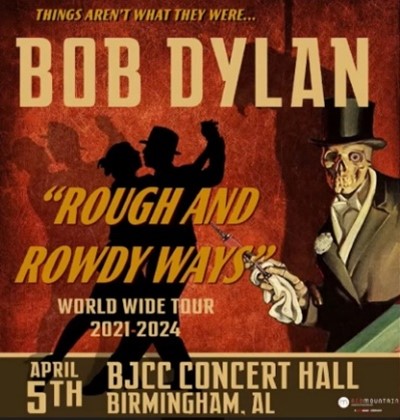
But: you get older, you get softer. Towards the end of his career, then, the now very elderly troubadour is apparently more audience-friendly than ever. In fact, it almost seems as if he inserted this one verse, the first bridge of “I’ve Made Up My Mind To Give Myself To You” especially for his audience. Four place names that are on his 2022 tour calendar, and, even more atypically, he does make a point of it: “From Salt Lake City to Birmingham!” shouts the entertainer announcing the song on 30 June in Salt Lake City. The warm-up works well. Jubilantly, the audience jumps up when they hear the name of their city, at 1’39”. It was no different in Birmingham, 5 April, and in Los Angeles, mid-June, and the fans are even a degree more enthusiastic in Texas, in San Antonio on 14 March.

Give the people what they want.

To be continued. Next up I’ve Made Up My Mind To Give Myself To You part 4: I see thy glory


Jochen is a regular reviewer of Dylan’s work on Untold. His books, in English, Dutch and German, are available via Amazon both in paperback and on Kindle:


Posted in Uncategorized | 5 Comments

Tarantula 27: The Lumberjacks Are Coming

By Larry Fyffe

by Larry Fyffe

The Taranterbury Tales continue:

(I) moved from the forest
- frozen in the moment
 (Bob Dylan: Tarantula)

In the song lyrics below, said it could be that ‘forest’ is not a noun, but a comparative adjective; ie, ‘fore’, ‘forer’, ‘forest’:

Upon four-legged forest clouds
The cowboy angel glides
(Bob Dylan: Gates Of Eden)

The noun rendition from “Tarantula”, likely a reference to the following song lyrics:

I'll walk to the depths of the deepest black forest
Where the people are many, and their hands are all empty
(Bob Dylan: A Hard Rain's A-Gonna Fall)

A woody motif that’s a hallmark of singer/songwriter/musician Bob Dylan:

Born in 'Liz Texas timber
Up where the eagles fly
(Tony Attwood: Patty's Gone To Laredo ~ Dylan)


Drawn from songs back a ways in time.

Lyrics of one modernized beneath:

I've been to the wild wood, mother
Make my bed soon
For I'm weary with hunting
And would like to lie down
(Martin Carthy: Lord Randal ~ traditional)

Which brings up an obvious observation:

(E)verybody talks about the middle ages
as if it was actually the middle ages
(Bob Dylan: Tarantula)

Likewise, one might ask, How come historians had the foresight to call it World War One?

(T)here are only three things that continue
Life - Death & the lumberjacks are coming
(Bob Dylan: Tarantula)

For sure, no false prophet there!:

I cut down trees, I wear high heels
Suspendies and a bra
I wish I'd been born a girlie
Just like my dear papa
(Monty Python: The Lumberjack Song ~ Tomlinson, et.al.)

Posted in Uncategorized | Leave a comment

Other people’s songs: “Days of 49”

by Arron Galbraith and Tony Attwood

In this series, we look back at songs recorded by, but not written by, Bob Dylan, with a glance at their origins, Bob’s version, and the recordings of one or two others.   Aaron selects the songs, Tony adds his thoughts as they play.

——–

Aaron:Days Of 49″ is an old-time ballad from the California Gold Rush days. Some scholars have suggested that it was written by minstrel singer Charles Bensell or vaudevillian Charley Rhoades. The first recording and indeed the first release was by Jules Allen “The Singing Cowboy” in 1928.

Tony: It is interesting that this rhythm is never used these days – it almost seems funny and maybe rather childish.  I often wonder about how things fade in and out of favour – there is after all nothing inherently odd about this rhythm – but I suppose it reminds people of children jigging up and down.   And it is hard to do much with the rhythm – it doesn’t lend itself to much variation without destroying the whole rhythm itself.  Having selected the rhythm, the perform is stuck with it.

Aaron: Dylan’s version came from 1970s Self Portrait

Tony: Bob has put it in a minor key (I don’t know enough about the song’s history to know if this was a Dylan-innovation or whether lots of other performers had done it before.  Certainly from the one copy I’ve got stored on computer the song mutated very early indeed.  This Logan English version comes from 1957 and has the song utterly transformed – so by the time Bob got to the piece it really had moved on from its origins.

Bob may have taken his version from elsewhere (and if you know where, please write it – usually when I write about things I don’t know it turns out that everyone else in the Bobbyverse knows the answer, and I am the only one who doesn’t).

Aaron:  Fairport Convention recorded a live version in  1973, “A Tree With Roots – Fairport Convention And The Songs Of Bob Dylan”

Tony: This is indeed very much Bob’s version – or perhaps I should say the version Bob used, which he may have got from somewhere else.  The difference is that the accompaniment is more sparse; I do like the use of the piano in the Dylan edition.  But the sparce use of the lead guitar really seems to work to me.  And I do like the harmonies in the chorus.

I think the point here is that there is an assumption that most listeners will know the song at least to some degree, so the performers are deliberately going out of their way to add more to the song, without destroying its essence.  And believe me it takes talent to do that – it is much harder than one might think.  It also helps if one has an arranger in the band, who works out how the arrangement is going to go, rather than let everyone do their own thing.  Just listen to the instrumental verse – they really got this sorted.

Aaron: Lastly we have Phil Trigwell – originally from the U.K. where he was a member of a skiffle group in the 1950s. In 1971 he moved to Sweden and was active in the rockabilly revival there.

Tony: Coming to each song in turn and writing my commentary as I go, at the first hearing of each song (or at least the first hearing in a while) I bring in my own prejudices.  Everyone does – it is impossible to hear a piece of music with an open mind if music has always been part of your life.

And for some reason or other, genenerally I don’t enjoy songs in which the vocal part is spoken by a man with a bass voice.  Basso profundo I think it is called – but here it really works because of the speed and the way it fits with the accompaniment and the vocal harmonies.  It is also funny to hear that voice say “jolly saucy crew”.   But the point is that after each declaimed verse one is waiting to hear the harmonies again.  And increasing the drama in the declamation when the fight scene occurs really works too.

Of course what happens is the monotone is abandoned later on – he’s still declaiming but with variation, and that keeps our attention.  We really want to know what he is going to do in each subsequent verse – and that roaring verse with its slight venture into humour is again unexpected (given that I know the song, but not all the lyrics).

And it works also because in the end he is left in his misery, being pointed out by passers by – which the music somewhat suggests, but not totally.

Certainly by the end I am hooked and want to play it again.  A great find Aaron – for by no means the first time I’m thoroughly obliged to you for what you’ve presented.   Terrific fun for me.  I hope you (my reader) enjoyed it too.

Posted in Uncategorized | 5 Comments

A Dylan Cover a Day 115: Precious Angel

By Tony Attwood

Overtly religious songs are not my favourites, irrespective of what particular religion they seek to promote, for one reason because I’m an atheist and for another because the message that this or that religion is the one true way tends to be rather too simple a song concept for my taste.  (Although of course since the message, if true, is the biggest message of all, I guess for the believers there is an excuse).

But I do make an exception for “Precious Angel” which is a beautiful song, musically and lyrically, in my view.  Which in turn makes it rather strange that so few covers are available – and those that are really don’t add too much to what we got in the original.

Esteban Paez

Esteban Paez also had a go at my favourite Dylan religious song, “When He Returns” – which again for me doesn’t quite reach the force of Dylan’s live version which I have raved over before, but it is still worth a listen.

Anyway moving on… the desire to make the covers as close to Dylan’s original work seems to be what actually shines through with the versions of this song I’ve found.  Danielle Brillo is another example.  Yes there are differences from the original, but hardly enough to make it worth all the effort, it seems to me.

Simply Dylan of course know what they are doing because Dylan songs are what they do, live on stage.   And here again the point is the same – this is as close a copy of the original as they can get.   So 10/10 for copying (and I don’t mean that sarcastically – it is very hard to get this sort of thing this close).  And the chorus of ladies adds something extra, but I am not sure I am really moved.

But finally, I got some help (and most certainly not for the first time) from Jochen whose article on this site, Precious Angel. Unpopular, otherwise brilliant  contains a version I missed.

Since Jochen did all the work in finding this, I let him have the final say…

“…only the Renee Zellweger version from the film approaches the beauty of the original.

“For cinematographic reasons, that version is limited to one verse and one chorus and that really is a shame; beautifully, intimately arranged and surprisingly well sung by the actress, who seems to sing the second voice too. The fragment adorns a silent film scene, in which Zellweger in her wheelchair is illuminated by the light of fireworks, you torch up the night.

“Her eyes slowly fill with tears.”

https://youtu.be/343mqZxRc5A


The Dylan Cover a Day series

  1. The song with numbers in the title.
  2. Ain’t Talkin
  3. All I really want to do
  4.  Angelina
  5.  Apple Suckling and Are you Ready.
  6. As I went out one morning
  7.  Ballad for a Friend
  8. Ballad in Plain D
  9. Ballad of a thin man
  10.  Frankie Lee and Judas Priest
  11. The ballad of Hollis Brown
  12. Beyond here lies nothing
  13. Blind Willie McTell
  14.  Black Crow Blues (more fun than you might recall)
  15. An unexpected cover of “Black Diamond Bay”
  16. Blowin in the wind as never before
  17. Bob Dylan’s Dream
  18. You will not believe this… 115th Dream revisited
  19. Boots of Spanish leather
  20. Born in Time
  21. Buckets of Rain
  22. Can you please crawl out your window
  23. Can’t wait
  24. Changing of the Guard
  25. Chimes of Freedom
  26. Country Pie
  27.  Crash on the Levee
  28. Dark Eyes
  29. Dear Landlord
  30. Desolation Row as never ever before (twice)
  31. Dignity.
  32. Dirge
  33. Don’t fall apart on me tonight.
  34. Don’t think twice
  35.  Down along the cove
  36. Drifter’s Escape
  37. Duquesne Whistle
  38. Farewell Angelina
  39. Foot of Pride and Forever Young
  40. Fourth Time Around
  41. From a Buick 6
  42. Gates of Eden
  43. Gotta Serve Somebody
  44. Hard Rain’s a-gonna Fall.
  45. Heart of Mine
  46. High Water
  47. Highway 61
  48. Hurricane
  49. I am a lonesome hobo
  50. I believe in you
  51. I contain multitudes
  52. I don’t believe you.
  53. I love you too much
  54. I pity the poor immigrant. 
  55. I shall be released
  56. I threw it all away
  57. I want you
  58. I was young when I left home
  59. I’ll remember you
  60. Idiot Wind and  More idiot wind
  61. If not for you, and a rant against prosody
  62. If you Gotta Go, please go and do something different
  63. If you see her say hello
  64. Dylan cover a day: I’ll be your baby tonight
  65. I’m not there.
  66. In the Summertime, Is your love and an amazing Isis
  67. It ain’t me babe
  68. It takes a lot to laugh
  69. It’s all over now Baby Blue
  70. It’s all right ma
  71. Just Like a Woman
  72. Knocking on Heaven’s Door
  73. Lay down your weary tune
  74. Lay Lady Lay
  75. Lenny Bruce
  76. That brand new leopard skin pill box hat
  77. Lily, Rosemary and the Jack of Hearts
  78. License to kill
  79. Like a Rolling Stone
  80. Love is just a four letter word
  81. Love Sick
  82. Maggies Farm!
  83. Make you feel my love; a performance that made me cry.
  84. Mama you’ve been on my mind
  85. Man in a long black coat.
  86. Masters of War
  87. Meet me in the morning
  88. Million Miles. Listen, and marvel.
  89. Mississippi. Listen, and marvel (again)
  90. Most likely you go your way
  91. Most of the time and a rhythmic thing
  92. Motorpsycho Nitemare
  93. Mozambique
  94. Mr Tambourine Man
  95. My back pages, with a real treat at the end
  96. New Morning
  97. New Pony. Listen where and when appropriate
  98. Nobody Cept You
  99. North Country Blues
  100. No time to think
  101. Obviously Five Believers
  102. Oh Sister
  103. On the road again
  104. One more cup of coffee
  105. (Sooner or later) one of us must know
  106. One too many mornings
  107. Only a hobo
  108. Only a pawn in their game
  109. Outlaw Blues – prepare to be amazed
  110. Oxford Town
  111. Peggy Day and Pledging my time
  112. Please Mrs Henry
  113. Political world
  114. Positively 4th Street
Posted in Uncategorized | 1 Comment

I’ve Made Up My Mind To Give Myself To You (2020) part 2

by Jochen Markhorst

II          Wanted Man in Birmingham

I’m sitting on my terrace, lost in the stars
Listening to the sounds of the sad guitars
Been thinking it all over, and I thought it all through
I’ve made up my mind to give myself to you

After the cinematic exposition of the opening two lines, reminiscent of Heine, the song immediately takes a curious, strangely ambivalent turn. The pensive stargazer on his terrace apparently is not, as the opening promises, an emotional dreamer at all, but a rather clinical, down-to-earth analyst who now shares with us the outcome of a rational consideration. For it is an announcement of some surprise, “I have decided to give myself to you” – not very romantic, really.

The specific choice of words seems borrowed from an indestructible monument, from Don Gibson’s “I Can’t Stop Loving You”. Originally a B-side, incredibly, from the most perfect single in the history of country music, “Oh, Lonesome Me b/w I Can’t Stop Loving You” (1958, and both originated in one divinely inspired writing session as well, on Friday afternoon, 7 June 1957). But immortalised by Ray Charles, of course. And torch-bearers like Elvis, Sinatra, Paul Anka, Jerry Lee, Van The Man, and well, everyone in the premier league really, keep the flame burning. Which makes the word combination “I’ve made up my mind to…”, the opening words, belonging to the song forever.


The message, however, we have also heard once before with Dylan, also in a romance-suggesting context:

All right, I’ll take a chance, I will fall in love with you
If I’m a fool you can have the night, you can have the morning too

… in the controversial “Is Your Love In Vain?” (Street-Legal, 1978). Controversial because quite a few critics analyse that

  1. a) a male chauvinist pig with an incorrigible Archie Bunker mentality is speaking here, and
  2. b) the “I” is Bob Dylan himself – the ineradicable, childish misconception that I = the writer himself, that is.

Dylan deftly dodges that odd accusation here. In “Is Your Love In Vain?” it is abundantly clear that the “You” is a lady, a female suitor even. Fall in love with you, Can you cook and sew, make flowers grow… quite explicit, all in all . That clarity is lacking in “I’ve Made Up My Mind To Give Myself To You”; the “You” could be anything. A woman, but also God, the fans, Art, Jesus, a drug of choice – the “You” is ambiguous enough, so analysts can choose from a whole palette of interpretation possibilities. “The audience” is a popular one. Also because then again the step to I = Dylan himself is so tantalisingly small, of course. And because it’s a charming, appealing interpretation at all. Dylan, sitting on the terrace of his Malibu home on a balmy coronalockdown summer evening, pondering under the stars, in the living room Marty Robbins’ “El Paso” is playing, and then he contemplates that he will record another album and resume his Never Ending Tour, something like that. “I have decided to give myself to you, my audience, for another four years.” Fits quite well, and wholeheartedly on the third verse, the lyrics of the first bridge;

I’m giving myself to you, I am
From Salt Lake City to Birmingham
From East LA to San Antone
I don’t think I could bear to live my life alone

… where, to further excite the biographical analysts, all four places mentioned are indeed on Dylan’s 2022 tour calendar; 30 June he plays Salt Lake City, Birmingham 5 April, Los Angeles 14-16 June, and 13 and 14 March San Antonio. An inside joke we’ve also seen before; “Wanted Man”, the song Dylan writes for his comrade Johnny Cash’s San Quentin concert in 1969, lists 14 place names of cities on Cash’s 1968/69 tour schedule.

Ambivalent it remains, of course. After all, the listener has been conditioned for decades now to hear a romantic confession in an outpouring like “I give myself to you”. “For Sentimental Reasons”, Johnny Winters’ “Ain’t That Kindness” (1970, the funky rocker with the amusing Dylan reference Two riders were approachin’ / But they were no friends of mine), Ray Charles’ early croon-song “If I Give You My Love”, “Drive My Car”, Lee Dorsey’s “A Lover Was Born”… from all corners and all decades of pop music we know songs in which a protagonist makes an overtly intellectually motivated decision to fall in love. Outnumbered, of course, by the millions of songs in which the heart overpowers the brains, in which the first-person cannot control the infatuation, songs like “I’ve Just Seen A Face”, Tom Waits’ “I Hope That I Don’t Fall In Love With You” and half the American Songbook up to extremes like Dylan’s “Dirge” (I hate myself for lovin’ you), but still: we have long since accepted the rational announcement “I give myself to you” as a declaration of love as well.

The song poet, the walking music encyclopaedia and living jukebox Bob Dylan, knows that too, of course. But he muddies the romantic connotations as early as the ensuing second verse:

I saw the first fall of snow
I saw the flowers come and go
I don’t think that anyone ever else ever knew
I’ve made up my mind to give myself to you

… pushing the listener’s associations more towards melancholy, end-of-life, elderly contemplation. Although “The first fall of snow” may still be somewhat ambiguous – it is the same metaphor Robert Burns uses for “the first kiss” in “To A Kiss”, the ode that DJ Dylan quotes in its entirety in the bonus episode “Kiss” of his Theme Time Radio Hour, February 2015 (Love’s first snow-drop, virgin kiss).

Nor is a romantic connotation predominant in the sequel. I saw the flowers come and go is another contribution to one of the dominant motifs of Rough And Rowdy Ways, the album that already opens with

Today and tomorrow and yesterday too
The flowers are dying like all things do

… the opening words of track 1, “I Contain Multitudes”. In track 3, “My Own Version Of You”, the protagonist speaks All through the summers into January as he dwells in a “winter of discontent”, in “Crossing The Rubicon” all seasons pass, “Key West” lies outside time (Bougainvillea blooming in the summer, in the spring / Winter here is an unknown thing)… the passage of time, of the flowers coming and going, is a thing on Rough And Rowdy Ways. Still, as it should be in an exceptional Dylan song, the gateway to other interpretations remains open; after all, “flowers” symbolises expressions of love. “I’ve seen the flowers come and go” is as much a poetic account of the blossoming and again extinction of an amorous love.

The third line, the last line before the chorus line, is not too exciting. “I don’t think anyone else ever knew” suggests a furtive love story, adultery perhaps, but Dylan’s rehashing of it on the studio recording, and the indifferent variants on the live performances already signal that the poet himself does not attach too much weight to this verse either. For Dylanologists, though, the studio rehash I don’t think that anyone ever else ever knew is a fine example of what we’ve heard studio personnel like engineers Chris Shaw and Malcolm Burn explain many times before – Dylan cares relatively little about mistakes like that. As long as the sound is right. Dylan mainly wants to hear the right guy, his persona for these lyrics, when judging the recording; the emotion, the colour, the guy. “It was never about whether it was in tune or out of tune or anything like that,” as Burn explains in Uncut, 2008.

And this is a guy who starts stuttering when he thinks back to days gone by, apparently.


To be continued. Next up I’ve Made Up My Mind To Give Myself To You part 3: Give the Salt Lakers what they want


Jochen is a regular reviewer of Dylan’s work on Untold. His books, in English, Dutch and German, are available via Amazon both in paperback and on Kindle:


Posted in Uncategorized | 1 Comment

Not Dark Yet Version 1: at last we know how Bob got that edgy feel into the song

By Tony Attwood

I imagine I am with several million other people for whom “Not Dark Yet” is one of the greatest of all of Dylan’s musical achievements.  Not necessarily the greatest, but one of them.  An utter masterpiece portraying a sense that everything is “just slipping away.”

So coming to this early version which is so different from the one that we know from the album is a shock.  But ultimately a shock that reveals how Bob came to create such an amazing piece of music.

In this earliest of versions, we have the same song – although the lyrics travel a somewhat different pathway – as when Bob sings about love after “some kind of pain”.

"I got nothing left over from the love that we knew
A love that I know that I never can share
It's not dark yet but it's getting there"

And this simple textual change transforms how we appreciate the song.  Some of the other textual changes are interesting, and “I’m in the land of the lost” does give us a real clue as to the thinking processes going on.  But the return to his thinking about “her” and her tender lips, makes it quite clear that this is a “lost love” song – which I don’t think the album version that we have got to know, is, at all.

Of course, “It’s not dark yet but it’s getting there” is indeed a concept that fits with the absolute pain of lost love – a pain can last, develop, engross, overtake, or anything else negative you care to name for years and years, leading to a total decline in the person.

But what Bob has also done here is added a repeated (with variations) short lead guitar phrase and used a totally different rhythmic approach, which after years of knowing the album version, comes as an absolute shock.   Now “just being in the same country as her is making me blue” does indeed fit with this repetitive rhythm.   Lost love can be like this, tied up in an ever-repeating set of thoughts that envelops the person who is lost.  So yes it works.

However, although it is a perfectly acceptable (or indeed an utterly amazing song), and one that we would have enjoyed had it turned up on the album instead of the version we got, it would have totally destroyed the overall concept of the version we did get.

And more than anything that thought comes with the line “I’m praying the master will guide me past”.  That thought is a total contradiction of the song that was released on “Time out of mind”.

In fact from the very start what we have with the “Time out of Mind” version is nothing to do with the Almighty, but rather an instrumental part that is a constant statement of that famous early line “Time is running away”.  In short, it’s not God, it just is.

Indeed what we have in the album version is an utter belief that the darkness continues to grow and there is not only no way out now, there is never any way out.  Ever.  The universe expands and eventually dies.  Time passes, we grow old, and die.

The percussion is utterly different and gives a sense of timelessness.  And this is where we start to get the clue as to what is going on, because this timelessness is achieved by the very unusual rhythm of the album version.  Indeed I would argue that although there are multiple changes between this early edition and the final version on the album,  it is the rhythmic change that transforms what would have been just another album track, albeit one with interesting lyrics, into one of the ultimate absolute masterpieces of contemporary music.

What the album version gives us is five bars of 4/4 time of music which makes it sound as if the band and the singer are somehow out of sync – which of course they are not.  Now this constant use of five-bar phrases is virtually unknown in contemporary pop, rock, blues etc and even if one has no musical knowledge concerning the construction of songs, there is something deeply unsettling about that fifth bar.  We are used to groups of four bars in a phrase – that is what every song has.  Until this one.

And the reason for having it is simple: it gives us a musical sense of the passing time seen in that famous opening line, “Shadows are falling and I’ve been here all day”.  It is that simple, but previously unexplored extra bar at the end of the line which gives us that sense of time breaking down.  Which in fact makes “and I’ve been here all day” believable.  (There’s a lot more on this, if you are interested, in “Not Dark Yet, the music and the covers” – see the footnote).

So what did Bob do in this first version?

Clearly from the off he was thinking about the phrasing of the song, because what he does is use a four-bar phrase for the lyrics followed by three bars of music.  Which sounds very odd when it is written out, but in fact that the last word of each line can be heard as either the fourth bar of the vocal lines, or the first bar of the instrumental lines.

If you listen again you’ll hear that that last word is extended over the instrumental part – a descending single word with the lead guitar taking up its repeated phrase.   So we get a sense that something slightly unusual and even unsettling is happening here, but it still somehow seems to balance out.  If we focus on Dylan’s singing, then that is a four-bar phrase.  If we focus on the instrumental at the end of each line, then that is a four bar phrase.  So the brain gives us a sense of “normal” or “balanced” musical phrasing.   It is only if we try to count out the beats that we realise that this is very odd as the both the vocal lines and the instrumental line are using the same bar as one of “their own.”

So Dylan had the idea of expressing the uneasiness of Not Dark Yet as a concept from the start.   But as I note, the brain has an ability here to play both games at once.  We get a slight sense of unease, but we let it pass because we can hear and feel both sides at once.  Musically it is brilliant, but our brains let it pass.

But in the album version, we very clearly get four bars of music with vocals, and then one and only one bar of instrumental.  So it is a five bar phrase, and that five bar phrasing is very odd.  Even for a person who knows nothing of four beats in a bar or four bar phrases, (which is what 99% of all popular music gives us)  it feels much edgier than this original version that we have now been able to hear through the release of the new album).

And this must have been a deliberate re-thinking of the music by Dylan as he changed the lyrics to be so much edgier, with that feeling in line two that “time is running away”.

Yes now we can hear much more clearly that time is running away, and although most listeners will not spend their time counting the number of beats and bars between each phrase.  But the edginess of the lyrics is utterly translated into the edginess of the music so now we feel it.  We now actually feel that time is running away.

I am so knocked out by having this version available, for I’ve so often wondered how Bob came not just to think of having an extra bar between each line of music but how he made it fit.  Now on hearing this first version, we know.

Thank you Bob.  Thank you record company executives.   I’ve puzzled over this for 16 years.   Phew; I shall die happy (although hopefully not for a while).

You might also be interested in

Posted in Uncategorized | 1 Comment

Other people’s songs: House of the Rising Sun (and the littlest birds)

By Aaron Galbraith (in the USA) and Tony Attwood (in the UK).  As ever, Aaron selects the songs and adds his comments, and Tony on the other side of the ocean replies.  In this series we are listening to songs that Dylan has recorded but not written, and seeing where it all leads.  Today it is “House of the Rising Sun”.  A list of the 44 previous episodes is at the end, and there is more about Untold Dylan on our home page, and our Facebook site.

———–

Aaron: The earliest recorded version of this traditional folk song, of uncertain authorship,  was by Tom Clarence Ashley & Gwen Foster in 1933

Tony: Oh this is why I love this series – I’ve never heard this before and had no idea that the original had this bouncy approach, plus a melody and chord sequence that was in many parts so different from the one we know today.  And although my knowledge of music of the 1930s is patchy I do think the chords used here are quite unusual for this time – a mix of popular song chords and blues I think.  That is a really fascinating recording.

Aaron:  Dylan learned the song from the singing of Dave Van Ronk: “I’d always known ‘Risin’ Sun’ but never really knew I knew it until I heard Dave sing it.”

Tony: Aaron, I know that you do the selection of the music for this series, so my apologies here, but I really do want to slip in the Dave Van Ronk version here, because in my experience a lot of people I’ve talked to about this era of music have never heard it.   Thanks to the Smithsonian we have a recording.  Prepared to be amazed.

Tony: It really is a very unusual approach to this sort of music.   And of course it is a long way from the original version above.  But, there’s a problem… for what this track uses is the chord sequence that Bob used – a chord sequence that is quite a long way from that used in 1933.

But, this version by van Ronk appeared in August 1964 and the first Dylan album came out in March 1962, so I think we have to take it that Bob listened to van Ronk perform the song in a folk club, and took the approach with the chords, but straightened out the melody.  Unless it was Bob who created the chord sequence, and van Ronk copied it, and then added his hesitant vocal approach for his album two years later.   I think the former is more likely, but if anyone has the definitive answer perhaps they can resolve it for me.  I’m just trying to put it together, not suggesting that I know.

Aaron: The most famous and successful version appeared in 1964 by The Animals. Alan Price famously got arrangement credits for this, simply because there was insufficient room to name all five band members on the record label, and Alan Price’s first name was first alphabetically. As a result, a lot of later versions that are covers of the Animals version credit him as well. In America it became the first British Invasion number one unconnected with the Beatles.

Tony: Now I can add something personal.  As a very young musician (a pretentious schoolboy in fact) I played organ in a band that certainly never got within a billion miles of the big time, but we did once play as second warm up band to the Animals (I suspect we were probably booked by mistake).

I know my father was completely unsure whether to be annoyed at me not staying in to do my homework, or proud that I was getting some work as a musician – as he had done in his youth playing sax in a touring dance band (I have two photographs of that band in pride of place in my sitting room).   Anyway, back with me and the Animals, no one noticed the warm-up band of course, but it’s a nice memory for me.

And of course that broken chord sequence has itself become famous.

Aaron: This song has been covered by everyone from Dolly Parton, Jerry Garcia and Russell Watson to many many others. Here is one final version I discovered, that I particularly like.  It is by The Be Good Tanyas

Tony: Wow what an episode this is for me (sorry if I am boring everyone else).  The Be Good Tanyas were and are, in my view utterly superb, so I am going to slip another one of theirs in.  With “Rising Sun” they have taken a piece that we all know so well, and has clearly been performed in so many ways, but given it a totally different treatment.   The lightness of their musical approach takes nothing away from the lyrics because of the brilliant vocals.  Do listen to it all the way through.

And so I can’t resist ending this ramble of mine with another of their recordings.   Just listen to what they do with the rhythms in “Littlest Birds”.

Aaron, I had a rotten night out last night at a club that didn’t seem to realise that dance music is supposed to have some swing in it.  I really don’t understand young people these days!!!  But this morning you have given me a real lift, remembering old times and having a chance to put the Be Good Tanays on this site.  I’m out at another dance club tonight, this time with my favourite dance partner.  You’ve set me up for the day, and evening.


Posted in Uncategorized | 2 Comments

Tarantula 25: Velly Solly and 26: Rain

By Larry Fyffe

Tarantula 25: Velly Solly

by Larry Fyffe

& into the march now where tab hunter
leads with his thunderbird
(Bob Tarantula)

‘Chubbie’ Clementine is mentioned by Bobby Darin in song lyrics; and ‘Fatty’ Aphrodite is mentioned in the novelette “Tarantula” by Bob Dylan:

The old bridge trembled
and disassembled
(Bobby Darin: Clementine ~ traditional/P. Montrose,  et.al.)

There’s no overweight woman in the song below.

A pregnant one perhaps:

The bridge at midnight trembles
The country doctor rambles
(Bob Dylan: Love Minus Zero)

Nor be there “fatties” in the western movie “My Darling Clementine” about lawman Wyatt Earp (Henry Fonda), along with Doc Holiday, and Clementine Carter.

Obverse bubbles come to the surface of the plasmatic sea as it grows darker in the lines below.

No possibility of a happy ending in the offing in ‘Tarantula’; things just go from bad to worse:

& anointed into the shelves of a live hell
the unimaginative sleep, repetition without change
& fat sheriffs who watch for doom in the mattress
(Bob Dylan: Tarantula)

Happier  the following song lyrics:

They say for every boy and girl
There's just one love in this whole world
And I know I've found mine
(Tab Hunter: Young Love ~ Cartey/Joyner)

Likewise, the movie “Pleasure Of His Company”  starring Tab Hunter, Debbie Reynolds, and Fred Astaire.  Rancher Roger with wife Jessica drive off in a sports car while her father Pogo, still thinking of himself as a playboy, flies off to Europe with Toy, the happy-go-lucky Chinese ‘house boy’.

Toy talks thusly as below, and Debbie’s cultured father in the movie apes him:

"(V)ery sorry - velly solly"
(Bob Dylan: Tarantula)

Similarly, black actors and actresses were often told to speak in dialects of slavery days (the grandfather in the above-mentioned movie looks like Colonel Saunders).

Seems the likes of pretty white-faced actors like Hunter receive no marks for advancing the cause of civil rights:

(P)earl bailey stomps him up against a buick
(Bob Dylan: Tarantula)

In the Tennessee Williams’ play “The Milk Train Doesn’t Stop Here Anymore”, Hunter takes on a serious role; nicknamed the “Angel Of Death”, Tab attempts to spiritually guide an elderly actress to a peaceful death though she thinks he’s just after her money.

“We all live in a house that is on fire”, he says to the little old lady, “no fire department to call”.

Not at all Zen-like be the narrator in the following song lyrics:

Yes, I'm leaving this morning
Just as soon as the dark clouds lift
I'll break in the roof
Set fire to the place as a parting gift
(Bob Dylan: Summer Days)


26: Rain

by Larry Fyffe

The parade of talking pilgrims continues on down Tarantula Road:

(B)ut I asked him anyway
"whatever happened to gregory corso?"
(Bob Dylan: Tarantula)

Dramatic irony ~ we readers know for sure that Corso writes the poem below:

O Bomb, I love you
I want to kiss your clank, eat your boom
You are a paean, an acme of scream
(Gregory Corso: The Bomb)

The burlesquer above, burlesqued below:

& Nuclear Beethoven screaming
"oh aretha - i shall be your voodoo doll
- oh prick me - let's make somebody hurt"
(Bob Dylan: Tarantula)

The narrator’s satire continues:

(H)e replied " wanna play some cards?"
to which I answered "no but what ever happened to jane russell?"
(Bob Dylan: Tarantula)

The lyrics of the following song contains a hint about what happens to Jane:

And over in the corner
Much to my surprise
Mr. Hughes hid in Dylan shoes
Wearing his disguise
(Ricky Nelson: Garden Party)

Howard Hughes casts Jane Russell in the funny-filled movie “The Outlaw”, a burlesque film the location of which is supposedly New Mexico. Two gunslingers fight over a horse named ‘Red’. In the end, the gal Rio rides off with Billy the Kid (she’s packing a couple of busty weapons of her own) after Doc Holiday (played by Canadian-born Walter Huston) gets shot by jealous marshal Pat Garrett because the two ‘softie’ outlaws become pals.

In this western movie, the Apaches are coming:

"Now whatta we do, make a stand, or run for it?"
(Pat Garrett: 'The Outlaw')

From a later song:

I didn't know whether to duck or to run, so I ran
(Bob Dylan: Brownsville Girl ~ Dylan/Shephard)

Then an American playwright arrives on the scene disguised as an Armenian:

& curiously belonging to the armen ian hunchback
resembling arthur miller who's very turned off
(Bob Dylan: Tarantula)

Mixing up the medicine:

"He reminds me rather of Hoagy Carmichael, but there is something 
cold and ruthless ..."

(Ian Fleming: "Casino Royale")

Arthur Miller’s “Death of A Salesman” depicts Willie Loman as a victim of the ‘American Dream’.

Walter Huston of “The Outlaw” is the father of movie director John Marcellas

Huston:

(W)e get stoned on joan crawford
& form teeming colonies
& die of masculine conversation
...Marcellus, wearing khaki
when madness struck him immediately
(Bob Dylan: Tarantula)

In the movie “Rain”, directed by Lewis Milestone, Joan Crawford stars as Sadie; she a prostitute that a brimstone missionary (Walter Huston) is determined to ‘save’ while native drums beat in the background:

I was nothing, I was nobody
Now I'm something
I'm somebody
(Joan Crawford: "Rain")

Converted, Sadie’s eyes glaze over. Shaken by the power of the devil, and unable to resist her, the narrow-minded preacher enters Sadie’s bedroom, and rapes ‘one of the daughters of the king’.

The next morning, Sadie puts on a frapper dress ~ plays  the “Wabash Blues” to blow the hypocrisy away.

The missionary, be dead by suicide.


Posted in Uncategorized | 3 Comments

NET 2010: Stay Dylan Stay. Part 4.2


This article is part of the Never Ending Tour series, the full index to which is here.  Because of the number of musical examples in this episode it has been divided into two.  The first part (NET 2010 Part 4.1: Stay Dylan Stay) can be found through that link.

———–

By Mike Johnson (Kiwipoet)

‘Watching the River Flow’ is no protest song, in fact it appears to leave all that angst behind, but it doesn’t quite work out that way, and the song is a complaint of a different kind – ‘I don’t have much to say.’ The singer is still in the ‘all-night café’ of his earlier songs, and while he professes to ‘sit here so contentedly and watch the river flow’ it’s still the same old bad world out there:

People disagreeing on all just about everything, yeah
Makes you stop and all wonder why
Why only yesterday I saw somebody on the street
Who just couldn’t help but cry

This is another brisk song with which Dylan would open a concert and use as a warm-up. This kicks off the Kansas City concert. I miss the scintillating harp breaks we heard in 2005, but I have no complaints with this:

Watching the River Flow

If you sit around doing nothing long enough you might start wondering what you’re waiting for: salvation? death? some good drugs? for the rest of your life to arrive? That’s what the world of ‘Senor’ feels like. The gypsy ‘with a broken flag and a flashing ring’ has shaken you out of your dream and now it’s time to ‘disconnect these cables/overturn these tables’ and get out of Dodge before it’s too late.

Despite its slow tempo, the song is packed with tension and quiet desperation. Dylan loses nothing of the nexus of feeling that drives the song in this Kansas City performance. I’m not sure about ‘best ever,’ there have been so many great performances, but it must come close. A magnificent vocal performance, and anguished harp breaks. The song is on the way out, however, and won’t be heard after 2011.

 Senor

Lovers of ‘Senor’ might like to compare that to the 2003 performance (2003 part 2: Pounding pianos and hectic harps) which is another candidate for ‘best ever.’

One of the most successful adaptions of a Blonde on Blonde song would have to be this hard-hitting take of ‘Most Likely You Go Your Way (And I’ll Go Mine)’ from Kansas City, not because it captures the ambience of the album version (it doesn’t), but because it puts a new, tough energy into the emotion of the song. Most of us will know what it feels like to have to pass up a possible relationship with more hurt than a shrug of the shoulders. Sometimes we just have to let someone go – but not without a twinge of regret or a bit of grudge. Not without a parting shot.

The song suits this gutsy, thumpy treatment, with minimal backing and dramatic pauses. And of course the triumphant harp.

The song was also fading from Dylan’s setlists, but would undertake a remarkable revival in 2021/22.

You go your way

Almost as successful is this Parma (June 18th) performance of that great Blonde on Blonde surrealist, world weary epic ‘Stuck Inside Of Mobile With The Memphis Blues Again.’ To my mind Dylan has struggled to bring this song to life on stage, but, despite some ragged vocals that get a bit lost, this one pulls it off.

Stuck inside of mobile (A)

You might, however, prefer this one from Tokyo, with harmonica to finish. The vocal is stronger and the recording a bit better.

Stuck inside of mobile (B)

We can do a similar comparison with ‘Honest With Me from Love and Theft. This performance from Lintz (12th June) gives this uncompromising rocker a good go. There is a desperate edge to this song. Look at how it kicks off:

Well, I’m stranded in the city that never sleeps
Some of these women they just give me the creeps
I’m avoidin’ the Southside the best I can
These memories I got, they can strangle a man
Well, I came ashore in the dead of the night
Lot of things can get in the way when you’re tryin’ to do what’s right

The impossibility of living with our memories is a major thread in Dylan’s later work. Our memories tend to come back to haunt us; some we can live with, some we can’t.

Honest with me (A)

However good that is, I prefer this one from Tokyo. It’s faster and harder. The increased tempo suits the song. I do like these minimal arrangements that foreground the vocal. When he falls into emphasizing the rhythm and splitting up the words, around 2.45 mins, the effect is strange and powerful rather than awkward; it’s fine line he’s walking here in terms of the vocal.

Honest with me (B)

Dylan was to perform ‘Just Like a Woman’ a whopping seventy times in 2010, but never again, at least not so far. Mostly songs fade slowly from the setlists before disappearing, but not his one. Although it’s a contentious song, I regret seeing it go, and have fond memories of the audience singing performance from 2004. So, let’s sit back and enjoy one last performance a song that falls somewhat uncomfortably between an accusation and a plea. This performance from Mashumtucket  is the song’s final airing.

Just like a woman

Another song that vanishes for good in 2010 is that wonderful song of lust ‘Lay Lady Lay,’ a regular NET stalwart. Again, a final performance ever from Mashumtucket. I can’t help but wonder as I listen to this if Dylan knew he’d never sing it again. Am I just imagining that he’s singing it with a particular, valedictory relish? Some farewell blasts from the harp?

Lay Lady Lay

Although not a part of the NET, Dylan’s bleak, stripped back performance of ‘The Times They Are A-Changing’ at the White House for Barak Obama’s inauguration is notable. I can’t help thinking he chose that song to remind Obama to ‘Please heed the call’ (for equity and social justice).   If you haven’t seen it, check it out here:

https://www.youtube.com/watch?v=Fo8IvGXccug

That’s it for this post and 2010. Next up, 2011, a year in which new things begin to happen. Catch you there.

Until then

Kia Ora


Posted in Uncategorized | Leave a comment

I’ve Made Up My Mind To Give Myself To You (2020) part 1

by Jochen Markhorst

I           God will pardon me, that’s his job

Heinrich Heine (1797-1856) is the other Jewish artist to convert to Christianity. Unlike Dylan, purely opportunistically motivated, of which Heine makes no secret.

He received his doctorate in law in 1825, and as a Jew he could never become a lawyer or a university professor. He writes unconcernedly but cynically that he regards his baptismal certificate as his “Eintrittsbillet zur europäischen Kultur, entrance ticket to European culture”. And religion, church and faith he mocks throughout his life, in his poems, conversations and personal writings. “Den Himmel überlassen wir den Engeln und den Spatzen, we leave heaven to the angels and the sparrows,” is one of the milder examples.

On his deathbed, ill and miserable, he still writes: “Am very miserable. Coughed terribly for twenty-four hours; I shall press charges against the good Lord, who acts so cruelly on me, at the Society for the Cruelty to Animals.” Heine leaves on record that he wants no religious fuss at his funeral, no rabbi, pastor or priest is allowed to speak, and he continues to mock until his death: “Dieu me pardonnera, c’est son metier – God will pardon me, that’s his job,” are, according to his friend Alfred Meißner, the last words of the German mockingbird in Paris. Not coincidentally also Nietzsche’s favourite poet.

With Dylan, religion does go a little deeper, though;

“I’m a religious person. I read the scriptures a lot, meditate and pray, light candles in church. I believe in damnation and salvation, as well as predestination. The Five Books of Moses, Pauline Epistles, Invocation of the Saints, all of it.”
(Jeff Slate interview, Wall Street Journal, 19 December 2022)

Conversion is not the only similarity between the two greatest Jewish poets of recent centuries. On a level above, their status is very similar; Heine was the standard-bearer of nineteenth-century counterculture, both feared and respected and hated by the bourgeoisie, and his emigration to Paris, 1831, was reviled as a betrayal, similar to Dylan’s switch to electric rock music in 1965. But the main similarity, of course, is artistic fraternity, the similarities within the oeuvres of both giants.

Already unmistakable on a transcendent level; the irony, the ability to hide the weighty under lightness, the interweaving of “high art” with “low culture”, the sardonic outliers, the melancholy and casual humour – the congeniality is remarkable. And on a content level, coincidentally or not, we also see plenty of common ground. Like with the first verse of one of the highlights on Rough & Rowdy Ways (2022), in Dylan’s late masterpiece “I’ve Made Up My Mind To Give Myself To You”,

I’m sitting on my terrace, lost in the stars
Listening to the sounds of the sad guitars
Been thinking it all over, and I thought it all through
I’ve made up my mind to give myself to you

… which takes every Heine fan to Neben mir wohnt Don Henriquez (“Don Henriquez lives next to me”):

Doch in stiller Abendstunde          But in the quiet hours of the evening
Sitzt er ganz allein daheime,        He is all alone at home
In den Händen die Gitarre,          In his hands the guitar
In der Seele süße Träume             In his soul sweet dreams

Hereafter, Heine does take a different turn in this poem than Dylan does, destroying the romantic overtones with one of his famous “ironic pointes” (Quivering he touches the strings / Starting his improvising / Argh, his squeeking and scrapings / Torture me like caterwauling!), but this setting and this mood are strikingly similar.

To what extent Dylan leaves the romantic mood intact is open to debate. In Dylan’s song, at least, the suggestion of romance is many times more penetrating than in Heine’s, mainly thanks to the unfair advantage: the music. There are exceptionally many of Heine’s poems set to music, more than a hundred anyway, also and especially by the Big Guns (Schubert, Wolf, Schumann, Mendelssohn-Bartholdy, Brahms, Strauss, Wagner, Tchaikovsky, Liszt – well, all of them, actually), but as it so happens, this Don Henriquez isn’t. And if Don Henriquez had been set to music at all, it is highly doubtful whether a Grieg or a Schubert would have chosen a similar deceptive loveliness as Dylan did for “I’ve Made Up My Mind To Give Myself To You”.

The release of Rough And Rowdy Ways, 19 June 2020, has been greeted with exclusively positive to jubilant reactions, and much of the joy concerns the album’s immense richness, its many references and allusions, enriching aesthetic pleasure with something like intellectual satisfaction. After all, it sort of boosts the ego when you understand a pun, crack a code, recognise a quote, can place a paraphrase – and on that front, the artist Dylan meets his admirers more than ever. Whitman, Little Walter, Juvenalis, Billy ‘The Kid’ Emerson, Caesar, Frankenstein and Charlie Poole… every song on the album strings allusions together. And one of the subtler ones is the chosen musical accompaniment to “I’ve Made Up My Mind To Give Myself To You”: the waltz-like shuffle from Offenbach’s gondola song “Belle nuit, ô nuit d’amour” (1881).

The find is presented by Jon Pareles in his New York Times review immediately on release date 19 June, upon which social media quickly spread the find across the planet, and after being parroted around thousands of times, I’ve Made Up My Mind = Offenbach’s barcarolle is by now considered musicological fact. It largely explains the song’s irresistible appeal, its delightfulness. “But my songs are standing on a strong foundation, and subliminally that’s what people are hearing,” Dylan says as early as 1997 in the interview with the same Jon Pareles, following the release of Time Out Of Mind.

“Belle nuit, ô nuit d’amour” is indeed firmly embedded in our cultural baggage. It is used in advertisements (Audi, Baileys, Fiat, and more), in films like Woody Allen’s Midnight In Paris (2011) and, crushingly and heartbreakingly, in Roberto Benigni’s La vita è bella (1997), even and especially in one of the Auschwitz scenes. Because, as the ad boys and filmmakers know, the simple lick, the sultry summer evening romanticism and the pleasant 6/8 meter have been steadily ingrained in us for over a hundred years now – Offenbach’s barcarolle is a strong foundation.

Baileys commercial – Belle nuit, ô nuit d’amour:

To be continued. Next up I’ve Made Up My Mind To Give Myself To You part 2: Wanted Man in Birmingham


Jochen is a regular reviewer of Dylan’s work on Untold. His books, in English, Dutch and German, are available via Amazon both in paperback and on Kindle:


Posted in Uncategorized | 4 Comments

Well well, here’s another Well, well, well. Welcome back Francesco Garolfi.

By Tony Attwood

In my original article about Dylan’s lesser known song “Well, well, well” I raved over a version by Dylan’s co-composer for this piece.  That was some six or seven years ago and I still do play the recording, and still do think that is a masterpiece of live performance and arrangement.

But despite my ravings, (or more likely probably, because of them), the song has remained as unknown now as it was when I wrote that original piece.

However, Francesco Garolfi, whose work was mentioned in the “Dylan Cover a Day” series, and who then subsequently got in touch with Untold Dylan to say thanks, which was I thought incredibly kind of him.

And just to show he has not forgotten us, Francesco has been back into touch offering us a recording of him performing Dylan’s “Well, Well, Well”.   And when a talented artist is kind enough to take note of this site, the very least I can do is pass on the recording.  Although in truth I’d want to include it on Untold Dylan, because I not only love the song that Dylan co-composed, I also do love this totally new arrangement

The recording was made just after Francesco received the Italian Blues award – which explains the unexpected array of abandoned amps and instruments around him.

What I love about this performance is the scene setting at the start of the music, which somehow seems both relevant to the stage setting, and which in a curious way gives me the feeling of tumbling water.  But more than that I think it is really interesting to compare this with not only the Danny O’Keefe version but also the Ben Harper recording, which is also featured in the original review (see the link above).

But there is more, for what it also shows, I feel, is that talented musicians with the ability to re-think a song from the very start, really can take a song to a totally new place, without utterly losing the connection with the original piece.

Now just to make life more confusing than it already is, there are a couple of other songs with the same title, one written (I think) by John Lennon, but to be clear there is no connection with this lesser known Dylan co-composition.

And to the best of my knowledge, the recordings presented here and on the previous article linked above are the only recordings of the song (given that Dylan did not record it himself), which seems an awful waste.  When we listen to the way in which Francesco Garolfi, Ben Harper and Danny O’Keefe interpret the song it really gives an insight into the inventiveness of these musicians and the potential of the lyrics Dylan created.

Although for completeness I should add there is also a version by Steve Howe on the “Portraits of Bob Dylan” album.  It is not freely available on the internet, but it can be found on Spotify.  However I wouldn’t really push you in that direction; that version is one that seems to me to lose track of the original piece completely.  So I am not just raving over any and every version of this song; there are limits.  Much better to listen to Francesco Garolfi’s version above.

And just in case you think I am out on my own with my feelings about Francesco’s work, you might care to have a look at this page, which opens with a comment from Peter Walsh, who produced the works of Peter Gabriel, Scott Walker, Simple Minds and others.   He said,  Francesco Garolfi is one of the best musicians I’ve ever worked with.”

So, you see, it is not just me!

There are over 100 tracks by Francesco on Spotify, but if you don’t have a subscription or the time for anything else, do listen to his version of “Buckets of Rain”


Posted in Uncategorized | 2 Comments

Tarantula: 24 – Cream Cheese and 25 – Davy Crocker


by Larry Fyffe

24: Cream Cheese

Through a prophet, God speaks to King Ahaz of Judah:

Therefore the Lord Himself will give you a sign
Behold a virgin shall conceive
And have a son
And shall call his name 'Immanuel'
(Isaiah 7:14)

Emanuel Swedenborg figures he’s that sign, that person.

According to Swedenborg, there be emanations of light and dark forces that spread out from the Godhead, and form the material world. But, unlike in other variations of Gnosticism, the Almighty One is Jesus Christ.

He’s everywhere at once, and the only One capable of existing beyond space and time. But He’s no clockmaker outside the Universe that sets everything in motion, and then steps aside.

Swirling around in different levels of the Cosmos, spiritual angels and demons fly; the task for physical mortals is to find a way through the maze, and get in contact with the love and wisdom within the universal spirit of Jesus:

For in Him dwelleth all the fullness
Of the Godhead bodily
(Colossians 2:9)

It’s a more plasmatic picture of the Cosmos (a figuratively fluid one that consists of earth, wind, fire, and water) that’s depicted in Bob Dyan’s Tarantsula-shaped Universe.

Though the little book “Tarantula” has its serious parts, overall it’s quite funny.

On the road therein, Sandy Bob relates to Justine a dream he has – she seemingly a Swedenborgian:

(I) was unable to do anything about 
this fire - you see - not because I was lazy
or because I loved to watch fires
- but because myself and the fire
were in the same Time all right
but we were not in the same Space
(Bob Dylan: Tarantula)

In his time, a preRomantic poet also satirizes Swedenborg’s contention of the uniqueness of the Holy Bible in regard to literal/figurative – material/spiritual “correspondences”:

Apparently, the following lines not eligible because they are too earth-oriented:

Mock On Voltaire, Rousseau
Mock on, mock on: 'tis all in vain
You throw the sand against the wind
And the wind blows it back again
(William Blake: Mock On Voltaire, Rousseau)

Nor these:

To see the world in a grain of sand
And a heaven in a wild flower
Hold infinity in the palm of your hand
And eternity in an hour
(William Blake: Auguries Of Innocence)

The quote beneath from a poet who’s brought up as a Swedenborgian, but he secularizes its Christian aspects; takes a middle path, becomes a mystic in outlook:

From what I tasted of desire
I hold with those who favour fire ....
I think I know enough of hate
To say for destruction ice
Is also great
(Robert Frost: Fire And Ice)

The creator of the Tarantulean Universe, on the other hand, appears to permit his Cosmos to expand quite rapidly:

(T)ho i might be nothing but a butter sculptor ....
i must go now - i have this new hunk of margarine
waiting in the bathtub -yes I said MARGARINE
& next week i just might decide to use cream cheese
(Bob Dylan: Tarantula)

25: Davy Crocker

No relation to Charlie, Fess Parker sings:

Fought single-handed through the Indian War
'Til the Creeks was whipped
And peace was in store

(Wellingtons: The Ballad Of Davy Crockett ~ Blackburn/Bruns)

Fess joins the pilgrim’s parade, and sells out his stock of coonskin hats before heading off to Texas to fight at the Alamo ~ those damned Mexicans – having banned slavery – need a whipping:

Things don’t go well for Davy.

In fact, bad things are happening all over the place:

(P)icture of dirt farmer
 - long johns - coonskin cap
strangling himself on his shoe
(Bob Dylan: Tarantula)

Good news though in Venice; according to Bill Shakespeare, Lorenzo has managed to convert Jewess Jessica to Christianity; loves not only her, but her money besides.

Garage mechanic Antonio’s a good-hearted fellow ~ “hires out women for baseball players”.

Lorenzo tells Jessica not to feel so alone; she must change her name to LONZO:

& must walk the streets of life
forever with lazy people
having nothing to do but fight
over women
(Bob Dylan: Tarantula)

Actually, she’s not alone; there are strange men out there with their pin-up posters.

Including cook Betty Crocker hawking dinner plates while she’s holding hands with Elvis the Pelvis, he dressed in drag:

(C)rooked betty & volcano the leg
here they come - theyre popped out
and theyve been crying in the chapel
(Bob Dylan: Tarantula)

Hymn singing:

I searched and I searched
But I couldn't find
No way on earth to gain peace of mind
Now I'm happy in the chapel
Where people are of one accord 
(Elvis Presley: Crying In The Chapel ~ Artie Glenn)

Along the way, Charlie Darwin’s observing that some cuckoos have short wings, and fly crooked; some lay eggs in another birds’ nest.

Sandy Bob depicts the behaviour of some preachers as even worst:

Well, the cuckoo is a pretty bird
She warbles as she flies
I'm preaching the word of God
I'm putting out your eyes
(Bob Dylan: High Water)

It’s all more than enough to drive a person through the swinging doors of the “Babylon Saloon”:

Then the music takes me back to Tennessee
When they ask who's the fool in the corner ... crying
I say, "The little ole wine drinker me"
(Charlie Walker: Little Ole Wine Drinker Me ~  Mills/Jennings)

The song above being inspired by a wine company’s commercial ~

“Little ole winemaker me!”

Indeed:

(W)ho should come by but the
little ole winemaker
trying to be helpful
(Bob Dylan: Tarantula)
Posted in Uncategorized | Leave a comment

NET 2010 Part 4.1: Stay Dylan Stay

Publisher’s note: because of the number of musical examples herein, this post is published in two parts – Part 4.2 will follow shortly.  Details of all the previous episodes in this series are to be found on the Never Ending Tour index page.

———–

By Mike Johnson (Kiwipoet)

We’ll begin this final post for 2010 by rounding up a few of the songs from Dylan’s early ‘protest’ period, song which, as I’ve commented before, Dylan did not abandon even though he’d long since stopped writing such topical songs. These songs are the foundation of Dylan’s career, and the main reason for his artistic identity and early fame.

‘The Ballad of Hollis Brown’ is a simple driving blues that tells a powerful story driven to despair by poverty, driven in the end to murdering his ‘wife and five children’ and committing suicide. It is a tense, elegant piece of storytelling, and by using the second person (you) after the first verse, rather than the third person (he), achieves an uncomfortable intimacy with his character.

This Kansas City performance with its minimal backing, a thudding drum, mandolin and darkly driven bass, is as good as any and better than most.

Hollis Brown

‘John Brown,’ although not a blues, is another piece of tense story-telling, this time of a dramatic confrontation between a mother and soldier son over the issue of war, ending with the son’s final rejection of his mother’s jingoistic patriotism. ‘You weren’t there standing in my shoes,’ he tells her.

The song has a similar minimal arrangement as ‘Hollis Brown,’ with mandolin, which is maybe why Dylan doesn’t perform both songs at the same concert. Putting them together as I have here emphasizes the similarity of their arrangements.

This performance from Tokyo (March 23rd) is a rarity in that Dylan punctuates some of the verses with a single, insistent, bluesy harp note. As far as I know, this the first time Dylan has played the harp for this song. A little gem this one.

John Brown

Also highly topical, ‘The Lonesome Death of Hattie Carroll’ was taken from a newspaper story and dramatically portrays the contempt of the rich for the poor. Over the previous few years Dylan had been perfecting a half-recited, half-sung version, half way between poetry and song, in keeping with the story-telling that drives the song. As with Hollis Brown and John Brown, one of the prime virtues of the song is its compact, condensed storytelling. This acoustic performance from Dornbirn (June 19th) continues that presentation of the song, the half-spoken delivery gives rise to an intimate rather than strident performance.

Hattie Carroll

The greatest of these early protest songs has to be ‘A Hard Rain’s A-Gonna Fall.’ It isn’t a topical song, dealing with story of a particular character, like the three songs we’ve looked at so far, but ranges far and wide in the regions of human suffering and war. A truly visionary and prophetic song. Whenever I see a reference to child soldiers, a heart-rending feature of modern war, I think of the line, ‘I saw guns and sharp swords in the hands of young children.’

You will have you own response to the strange, circus-like organ riff in this New York performance (23rd Dec), and maybe wonder if it doesn’t fall a little too heavily into the dumpty-dum. I think I’ve grown used to it now, and it doesn’t put me off the way it once did.

Hard Rain

‘Masters of War’ of course belongs to this little set. I included the Padova performance in Part 2 (See NET, 2010, part 2), but it won’t hurt to include the equally powerful Tokyo performance here.

Masters of War

It may seem that ‘Cat’s in the Well’ is the odd man out here, as it was written for the 1991 album Under the Red Sky, but by placing it here I’m emphasizing my view that it is a protest song of its own right, with anti-war strains running through it, along with intimations of disaster and doom. The song is fading from Dylan’s set list, where it was often used as a kicker to start a concert as it does here. This Tokyo (23rd march) performance is the second to last, the song vanishing from view after 2010. To my mind, one of the sharpest and clearest performances we’ve had. A boogie-like beat.

Cat’s in the well

I’ve always seen Desolation Row as a protest song, albeit of a different stamp from the earlier songs. I tend to see a greater continuity between the early, acoustic, protest song and the mid-sixties surrealist songs than is generally acknowledged. In ‘Desolation Row,’ a social concern that might have taken a whole song now gets one or two evocative lines:

And the riot squad they’re restless
they need somewhere to go
as lady and I look out tonight from Desolation Row.

This one from Dornbirn (19th June) swings along in fine style to begin with, but I’m not too sure how to take the breaking up of the vocal into single words that fall heavily into the beat of the song at 4.47 mins. Dylan falls into this vocal pattern from time to time during this stage of career, and for me it’s too intrusive to ignore, and distracts from the unfolding of these amazing lyrics.

Desolation Row

I could say similar things about this performance of ‘Visions of Johanna,’ another mid-sixties masterpiece, and maybe Dylan’s best ever song although that might be difficult to tell from this rather jerky version from Mashantucket (Nov 27th). I find these performances lack the spooky mysterious atmosphere of the album version, or the bleak world-weariness of the sixty’s live performances. That odd, stilted organ however might have its raison d’etre.

Vision of Johanna


—————

You can read more about Untold Dylan on our home page and we also have a very active Facebook group – just search for Untold Dylan Facebook on your search engine.

Posted in Uncategorized | Leave a comment

Dylan’s favourite songs: ‘Desperado Under the Eaves’

By Tony Attwood, based on research by Aaron Galbraith.

The third in our series of reviews of the songs that Bob Dylan has declared as being his favourite pieces from specific composers is Warren Zevon’s song ‘Desperado Under the Eaves’,

You will probably know songs like “Werewolves of London” and “Accidentally Like a Martyr” – and if so you might know, or at least be ready for this recording.  But if not, it could come as a bit of shock, especially if you are sitting still and listening to the music with no interruptions and you are not engaged in any other form of activity.  This is not a song for the background.

Indeed this is a song that breaks all the rules of what you can and can’t do in a song – or at least in a song in the contemporary popular style.  For just as Bob Dylan broke all the rules of writing contemporary songs for a wide audience which were not just about the three classic themes of popular music (love, lost love and dance), so did Warren Zevon, although he has broken different rules and broken them in different ways.

The song starts with a gentle string quartet outlining the theme of the music – and the melody and both chord sequence are interesting and arresting.  There is nothing that I am reminded of; this is music of a different kind.   But then so are the lyrics “of a different kind.”  Just read the opening verse as it plays…

I was sitting in the Hollywood Hawaiian Hotel
I was staring in my empty coffee cup
I was thinking that the gypsy wasn't lyin'
All the salty margaritas in Los Angeles
I'm gonna drink 'em up

It is not just that “salty margaritas” are rarely mentioned in popular music, it is more that we are given so much information in five lines.  The first two set the scene, but then there is background in the third line, and then the suggestion of desperation in lines four and five.  So much in just five lines, but of course we don’t know why he is drinking…

Songs like “Isis” give us a lot of information, but songs like that can be clearer – he’s married her, she’s gone, which at least gives us context… but this is just hints combined with atmosphere which makes it much more troubling.   “Visions of Johanna” at the other extreme is virtually all atmosphere, since we never know if Johanna really is real…    But this is different.  It is real, he is desperate, but what has caused it?

And if California slides into the ocean
Like the mystics and statistics say it will
I predict this motel will be standing until I pay my bill

That is a wonderful side step, it is funny, but the image is frightening, and more it all comes after that gentle string quartet opening.  Do you hear anything predicting this in the opening?  If not, then what?

And what helps all this uncertainty get inside me is the way the music changes, not once but over and over and over.  It is as if every possible musical mechanism for jolting the listener out of her/his apathy is used at once, and beyond all the realms of possibility it works.

Until then after all that, we have had the music resembling something…. but still… what?

Don't the sun look angry through the trees
Don't the trees look like crucified thieves
Don't you feel like Desperados under the eaves
Heaven help the one who leaves

What? indeed!  Musically and lyrically this is beyond everything we know in terms of pop and rock music.

Still waking up in the mornings with shaking hands
And I'm trying to find a girl who understands me
But except in dreams you're never really free
Don't the sun look angry at me

Then unexpectedly we are back to the start – oh he’s going to sing the opening again… but no, he does the mmmmmm – and I suddenly thought could anyone else ever have got away with this?   Certainly not unless they had both that gorgeous melody and an excellent arranger who knows exactly how to pull a string quartet and rock drummer together so that everyone can co-exist.

I was sitting in the Hollywood Hawaiian Hotel
I was listening to the air conditioner hum
It went mmm...
Look away
(Look away down Gower Avenue, look away)

Nothing I know about popular music, or its history, prepared me for this track, which I’ve never heard before now (and I am probably revealing my absolute ignorance – sorry, somehow the piece just past me by).

So I went looking for the explanation….

All the above was written without looking up anything on the internet or elsewhere to give me background about this song.  I found it very disturbing as I listened (I played it five or six times while preparing and then writing this little piece) and it is only now after I have heard it enough to have it in my head as I write, have I looked for the context.

And I discover that apparently at the heart of the song is an alcoholic trying to come off the drink.  Zevon has also reported this to be one of his most personal songs.  It also seems that he directed the string section himself – and if that’s true (and I have no reason to think it’s not – it is just that not everything said in the world of rock music is actually true) that is no mean feat for a rock musician.  (The reverse is also true of course.  Try putting a classically trained violinist in charge of a rock band in a recording session).

All I can say is, “thanks Bob, thanks Aaron.”  I didn’t know the piece before.  It is troubling and worrying, but what a sensational piece of music it is.

The series continues (when I have had a chance to recover).

Posted in Uncategorized | 4 Comments

Tarantula 22: the Egotist and 23: The Lord of the Spiders

A list of all the articles in this series is given at the end.

By Larry Fyffe

22: The Egotist

The problem for those who smirk at the contention that Bob Dylan hides clues in his works, especially those with a Eurocentric point of view, is that they do not realize, as Poe’s detective surely would, that Dylan hides his clues in plain sight.

Especially in “Tarantula”.

Tells this tale about a supposed ‘male’ man:

(W)hile on the other side of the street
this mailman who looks like Shirley temple
& who's carrying a lollypop stops
& looks at a cloud & then the sky
he gets kinda pissed
& decides to throw his weight around a little
& bloop a tulip falls dead
(Bob Dylan: Tarantula)

Shirley Temple’s outraged at the besmirching of her sexual transformation.

Sings a song from her movie “Bright Eyes”:

On the good ship
Lollipop
It's a sweet trip
To a candy shop
Where the bonbons play
On the sunny beach of Peppermint Bay
(Shirley Temple: On The Good Ship Lollypop ~ Whiting/Clare)

It’s a mean old world outside – Shirley gets her lollipop taken; her song’s stolen; and she ends up getting hanged.

Her lyrics darkened down a bit:

Take me disappearing ....
Out to the windy beach
Far from the twisted reach
Of crazy sorry
(Bob Dylan: Mr. Tambourine Man)

Hopalong Bob Cassidy blames it on Pancho; Pancho blames it on some guy called Harold ….  his last name might be Lloyd.

The Mexican bandit brags that he quickly dispatches the smart-ass guy in a slap-stick manner:

Pancho was very startled
& screamed "I'll give you a friend or doe, you freak!"
& banged him with a judo chop
& stuck his head through the ladder
(Bob Dylan: Tarantula)

Given the evidence cited below, the above story’s seems to be a tall tale:

Via a TV broadcast, Richard Boone tells the story differently: on his way to escort the daughter of a landowner across the border from Mexico to the United States, Paladin, an expert in the martial arts, and a have-gun-will-travel kind of guy, digs out a young Pancho Villa who’s been buried up to his neck in sand ~ saves him from a slow death arranged by the above-mentioned landowner.

Pancho and his gang capture Paladin and the girl; ‘the knight without armour’ tries to convince the revolutionary to let him and the landowner’s daughter continue on their way.

Quicker than lightning, Paladin resorts to physical means in order to ensure that he achieves his objective.

English author George Meredith enters the fray.

In the tragicomedy “The Egotist”, self-absorbed Sir Willoughby only pays attention to others when he runs out of ideas of his own.

Truth and beauty unfolds ~ in the Keatian bower of bliss, a good wife “points to her husband like a sunflower”:

Egotist shows you his diary
& he says "i've learned to be silent"
& you say "youve learned nothing
- youve just said something"
(Bob Dylan: Tarantula)

In the song lyrics below, the lover knows her rightful place:

My love she speaks like silence
Without ideals or violence
She doesn't have to says she's faithful
Yet she's true, like ice, like fire
(Bob Dylan: Love Minus Zero)


23: The Lord Of The Spiders

by Larry Fyffe

According to the advocates of the “New Historicism” literary approach, an educated interpreter’s associations gathered from a piece of writing are said to be as valid as those considered thought up by the original author.

So the “Harold”, mentioned in the lines below, might be interpreted by some as a reference to the slap-stick actor (Harold Lloyd), or perhaps he’s a spoof on William Golding, the author of “Lord Of The Flies”:

(W)e sat in a room where Harold
who called himself "Lord Of The Dead Animals"
was climbing down a ladder
(Bob Dylan: Tanantula)

In William Golding’s story, the Christian, non-Jewish, creed of ‘original sin’, the disposition to do ‘evil’, manifests itself among a group of teenage boys who are stranded on a tropical island.

Friedrich Nietzsche’s “will to power” wins out with the ‘strong’ boys coming out on top.

Based on the biblical verse quoted beneath with reference to the god of a Philistine city:

Thus saith the Lord, "Is it not because there is not a God in Israel
That thou sendest to enquire of Baalzebub, the god of Ekron?
Therefore though shalt not come down from that bed
Which thou art gone up, but shalt surely die"
(II Kings: 1:6)

Demonstrated in “Rain”, starring John Crawford, is that words can be manipulated by a persona in a performance to suit his or her own egocentric purposes ~ as conducted to do so by a director on the movie set.

Pointed out below:

(I)'m not saying  books are good or bad, but I don't think
youve ever had the chance to find out for yourself
what they are all about
(Bob Dylan: Tarantula)

But now to get serious ~ a card-player and gun-toting former Confederate soldier from the cartoons, and a rabbit,  join the parade of characters on the road to Tarantula Ville:

I'm no doc, you flea-bitten varmint
I'm Riff-Raff Sam, the riffiest riff that
ever riffed a raff
(Yosemite Sam: "Bugs Bunny")

Nor a lover of peace is the flame-slinger below:

Jim Ghandi, the welder, is overlooking
from the window & yells something like
"aw reet ye sons a vermints
- draw ye now or shut ye mouths frever"
(Bob Dylan:Tarantula)
Posted in Uncategorized | 3 Comments

Other people’s songs: Take a message to Mary

By Aaron Galbraith and Tony Attwood

In this series Aaron selects the music, and Tony responds with his thoughts, which as you will see below, sometimes can meander somewhat.

Aaron: Take a Message to Mary was written by Boudleaux and Felice Bryant and first released by The Everly Brothers in 1959.

Tony:  I’ve always found this a most curious song.  The lyrics are desperately sad and tragic, and yet the music (at least in the Everly Brothers version) is really bouncy and quite jolly.  Maybe most people just don’t feel that contradiction, or maybe it is there to express the contradiction between what happened to the singer, and the message he wants to send to his loved one.  But whatever the reason it feels like a contradiction to me.

I suppose it is also part of the tradition of songs about going to jail not because one is thoroughly evil or nasty, but because one, sort of, falls into the criminal way of life – as if these things happen by accident.  It’s not his fault, he’s a frontier lad.  I’m poor, they are rich, that’s not fair.

The fact that he is in prison for a stagecoach robbery takes us back to the days of Westerns, the genre of movie where fifty people can be killed in a shoot out on screen, and then everything is ok again… until the next episode.  Bring on the Lone Ranger.

Aaron: Dylan’s version came from the 1970s album, Self Portrait

Tony:  Bob puts a lot more into the vocals than the Everlys to my mind.  While they rely on the harmonies, as they always did, this is Bob using his full vocal range.  Indeed if one ever wants to counter the old argument that Bob can’t sing, here’s a perfect example to show what nonsense that is.

In fact I’m so taken by his singing that I don’t really care about the lyrics any more.  Indeed, pedantic musician that I am in my old age, I am more offended by the musical modulation (jerking the key up by a semitone or tone) at the end which rounds the piece off.  I’d be surprised if Bob wrote that – it’s just weird and unnecessary.    But apart from that, Bob turns it into a really nice song, showing his vocal range to a decent arrangement.

Incidentally, the couple who wrote the song also wrote (sometimes together sometimes just Boudleaux)  “All I Have to Do Is Dream” (credited solely to Boudleaux but I had my doubts), “Bye Bye Love”,  “Wake Up Little Susie” and “Love Hurts”,  Clearly they and the Everlys got on rather well.

Indeed their story is one of the classic tales of struggling artists who finally made the big time.  They lived in a mobile home, churning out songs day and night until they had a hit with a Little Jimmy Dickens song “Country Boy”.   After that it all turned out all right.

(In fact the song “Country Boy” which turned the Bryants into mega-star composers really is unbelievable from a 2023 point of view.  I don’t want to interrupt the flow of Aaron’s choices of music, but I will add it at the end of the piece in case you are interested).

Aaron: “Take a message” eventually became a favorite of reggae artists, with several covering it in the mid-70s. Here is Jackie Brown from 1974

Tony:  Adding the reggae beat takes us even further away from the tragedy of the song.  And maybe that is the point – that life is random and we are not the masters of our destiny.  It’s not a message I care for at all – but then on the other hand maybe I am just reading stuff into the lyrics that are really there.

Aaron: Teddy Thompson son of Richard and Linda Thompson made a habit of including an Everly Brothers cover on each album. Linda is on duet vocal on this one from 2005

Tony: By taking the speed down we finally have a sad song, which I suspect is what Mr and Mrs Bryant had in mind when they wrote it.  Indeed, this is indeed the only version of the song we have heard in which the music and lyrics are properly united.   The singer’s fantasy world that he wants to project to Mary is now faithfully seen as a fantasy, and the emphasis finally is on his tragedy, as epitomised by the singing of the last line.

And so with Aaron’s selection discussed, I want to go back to Little Jimmy Dickens and the first song written by the man who wrote “All I Have to Do Is Dream” and then co-wrote with his wife, “Bye Bye Love”,  “Wake Up Little Susie” and “Love Hurts”.

The question I want to pose is, “How does one write ‘Country Boy’ (below) and then go on to write those Everly hits?”  One suspects that the lady wife had more influence on Mr Bryant’s writing career than she is ever given credit for.  Without her, I am not sure we would ever have had the Everly Brothers as we got to know them.

Previously in this series…

  1. Other people’s songs. How Dylan covers the work of other composers
  2. Other People’s songs: Bob and others perform “Froggie went a courtin”
  3. Other people’s songs: They killed him
  4. Other people’s songs: Frankie & Albert
  5. Other people’s songs: Tomorrow Night where the music is always everything
  6. Other people’s songs: from Stack a Lee to Stagger Lee and Hugh Laurie
  7. Other people’s songs: Love Henry
  8. Other people’s songs: Rank Stranger To Me
  9. Other people’s songs: Man of Constant Sorrow
  10. Other people’s songs: Satisfied Mind
  11. Other people’s songs: See that my grave is kept clean
  12. Other people’s songs: Precious moments and some extras
  13. Other people’s songs: You go to my head
  14. Other people’s songs: What’ll I do?
  15. Other people’s songs: Copper Kettle
  16. Other people’s songs: Belle Isle
  17. Other people’s songs: Fixing to Die
  18. Other people’s songs: When did you leave heaven?
  19. Other people’s songs: Sally Sue Brown
  20. Other people’s songs: Ninety miles an hour down a dead end street
  21. Other people’s songs: Step it up and Go
  22. Other people’s songs: Canadee-I-O
  23. Other people’s songs: Arthur McBride
  24. Other people’s songs: Little Sadie
  25. Other people’s songs: Blue Moon, and North London Forever
  26. Other people’s songs: Hard times come again no more
  27. Other people’s songs: You’re no good
  28. Other people’s songs: Lone Pilgrim (and more Crooked Still)
  29. Other people’s songs: Blood in my eyes
  30. Other people’s songs: I forgot more than you’ll ever know
  31.  Other people’s songs: Let’s stick (or maybe work) together.
  32. Other people’s songs: Highway 51
  33. Other people’s songs: Jim Jones
  34. Other people’s songs: Let’s stick (or maybe work) together.
  35. Other people’s songs: Jim Jones
  36. Other people’s songs: Highway 51 Blues
  37. Other people’s songs: Freight Train Blues
  38. Other People’s Songs: The Little Drummer Boy
  39. Other People’s Songs: Must be Santa
  40. Other People’s songs: The Christmas Song
  41. Other People’s songs: Corina Corina
  42. Other People’s Songs: Mr Bojangles
  43. Other People’s Songs: It hurts me too
Posted in Uncategorized | Leave a comment

The Never Ending Tour: the absolute highlights. Satisfied Mind

By Tony Attwood

The Absolute Highlights series

I find it hard to pick many absolute highlights from the Never Ending Tour series that are not Dylan songs, as much of the time they sound to me like songs that have been played through just once or twice in rehearsal without too much thought about the arrangement.  My guess (and it is of course no more than that) is that Bob thinks of a song he likes and starts playing it, and the guys join in.  Then if it goes ok, they play it in the show.

It can be fun, and enjoyable on the occasion, but listened to in retrospect the rough edges become very prominent and one ends up wishing that there had been a little more rehearsal… an agreement as to what happens in the instrumental break, how the performance ends, where the harmonies come in and where they don’t etc.

Satisfied Mind from 1996 isn’t perfect by any means, but it does sound as if everyone knew what they were doing, and really wanted to perform this song

There’s an interesting bit of history of the song on Wiki,  which tells us it was “written by Joe “Red” Hayes and Jack Rhodes. Hayes explained the origin of the song in an interview: “The song came from my mother. Everything in the song are things I heard her say over the years. I put a lot of thought into the song before I came up with the title. One day my father-in-law asked me who I thought the richest man in the world was, and I mentioned some names. He said, ‘You’re wrong; it is the man with a satisfied mind.’

I’m now of an age where both my parents have passed away, but I still have the fondest memories of them, although I know they were often horrified by what I got up to in the early days.  So there’s an personal emotional appeal with the song, but beyond that there is a sublime elegance about the composition which Bob finds and maintains throughout.  And I am so glad that at least in this song there had been enough rehearsal for the harmonies to work in a meaningful way.

And I must admit I am moved by the meaning of the lyrics.  Very, very simple of course, but very true.  If you can’t be satisfied with your life, what else is there?

I suspect Bob remembered the song particularly because of the Johnny Cash version, which is below, but I think the performance above by Bob far outshines what Johnny Cash did.


Posted in Uncategorized | 1 Comment

Man Gave Names To All The Animals: I think I’ll call it Masiakasaurus knopfleri

Man Gave Names To All The Animals (1979)

by Jochen Markhorst

 The Strigiphilus garylarsoni is a species of louse belonging to the Ischnocera family that, as we all know of course, mainly affects the Ptilopsis leucotis, the northern white-faced owls (not to be confused with ptilopsis granti, the southern white-faced owl). The garylarsoni, an ugly little parasite, was discovered fairly recently and – obviously – named after Gary Larson, the creator of The Far Side, the insane, sometimes lurid, frenzied, hilarious cartoons particularly popular in scientific circles, which were eventually published in more than 1900 newspapers between 1979 and 1994.

Biologist Dale H. Clayton, who discovered and named the louse, wanted to honour Larson “in appreciation of the unique light he has shed on the workings of nature,” as he writes in the official publication, in the Journal Of Medical Entomology, May 1990. A few months earlier, he had already put his feelers out to the cartoonist, writing him a personal letter, also thanking Larson for “the enormous contribution that my colleagues and I feel you have made to biology through your cartoons.” Larson feels honoured, and proudly and quickly incorporates the naming of “his” louse into the retrospective The PreHistory of the Far Side (1989):

“I considered this an extreme honor. Besides, I knew no one was going to write and ask to name a new species of swan after me. You have to grab these opportunities when they come along.”

Friendly and witty, though presumably Larson knows as well: it really is not that “an extreme honor”, not that special. New insect varieties, ferns, mosses, flowers, fungi or deep-sea monsters are discovered every day, extinct or not, and most of them are named after celebrities. There are four related trilobites named after the four Ramones (Mackenziurus ceejayi, deedeei, joeyi and johnnyi), the Ptomaphagus thebeatles is a beetle that has been discovered in Amsterdam’s Vondelpark, the Alviniconcha strummeri is a sea slug, Henry Rollins is honoured with a jellyfish (Amphinema rollinsi), and The Beatles have been immortalised individually in four related trilobites also… and these are just a few examples of only rock stars.

There are, in fact, thousands of writers, kings, musicians, politicians, actors and other celebrities to be found in the records of university libraries. Dylan has to make do with an Italian stonefly: the Leuctra dylani. For which naming in 2007, by the way, the Austrian entomologist Wolfram Graf has a somewhat peculiar motivation: “dedicated to Bob Dylan, poet, composer, singer and dancer.” Well, perhaps the researcher associates the stonefly’s stiff motorics with Dylan’s dancing skills.

A lot cooler and more special already is when a dinosaur is named after you. Clint Eastwood is proud of the Europatitan eastwoodi, a giant sauropod from the early Cretaceous, and Gary Larson has the next best thing: the thagomizer. After Larson created the cartoon about a group of cavemen being taught about the Stegosaurus, in which the professor teaches that the four spikes on its tail are called a thagomizer, “after the late Thag Simmons”, scientists actually start calling this spiny part of the tail a “thagomizer” – as it turned out, the thing did not yet have a name, and Larson’s joke has since been gratefully adopted. Even by the respectable Smithsonian Institution, as well as in academic papers, books and the successful BBC programme Planet Dinosaur (2011).

In the rock world, meanwhile, there is only one prominent who gets this special honour, a dinosaur naming. Not Dylan. Eastwood’s Europatitan may be classified as a Somphospondylan, but that really just means “spongy vertebra”, and has nothing to do with Bob Dylan. No, Dylan is passed over by a dear colleague: in 2001, scientists Scott D. Sampson, Matthew Carrano, and Catherine A. Forster name and describe in Nature the Masiakasaurus knopfleri, a carnivorous theropod dinosaur that lived in the Late Cretaceous in the area of present-day Madagascar. Unfortunately, the motivation is not too remarkable and extremely brief. “After singer/songwriter Mark Knopfler, whose music inspired expedition crews.” Still: very, very honourable.

Dylan will be at peace with it. To Mark Knopfler we owe the exceptional, ethereal beauty of “I Believe In You”, the goosebumps on “Precious Angel”, and the breath-taking restraint of the twelve-string contribution to the acoustic outtake of “Blind Willie McTell”. And the percussive perfection of the acoustic guitar on “Man Gave Names To All The Animals”, the very last recording for Slow Train Coming, on the fifth and final session day, 4 May 1979. Would have deserved a reverential, explicit reference from Dylan, actually.

He saw a vicious lizard devouring meat
Six feet long, procumbent front teeth
A carnivorous mutt on the late Cretaceous prairie
Ah, I think I’ll call it a Masiakasaurus knopfleri

Something like that anyway.


Jochen is a regular reviewer of Dylan’s work on Untold. His books, in English, Dutch and German, are available via Amazon both in paperback and on Kindle:

Posted in Uncategorized | Leave a comment

The Never Ending Tour: a celebration

by Robert Ford

Bob Dylan has always said that “if you want to know anything about me then listen to my songs.” He prefers not to speak in public, he intensely dislikes TV and he tends to see himself as a craftsman who should get on with his work. It is easy to see though that he does acknowledge that he is primarily a performer, and a constant opinion throughout his career has been that his songs do not mean the same when sung by someone else. Another perhaps more recent opinion is that many of his recordings were first drafts of songs which he has since developed on stage (he has also said that some recordings have nailed the song ).

The Never Ending Tour’s origins are very interesting. Dylan observed in Chronicles that he was struggling as a performer in 1986-87 when he toured the world with Tom Petty and the Heartbreakers. He claimed that he could not recognise his own songs when performing them and seemed to suggest that this feeling was even worse when trying to perform his songs with the Grateful Dead during this same period.

I believe that this disconnect is easy to hear when listening to his performances with Jerry Garcia’s band but not easy to detect when listening to both the 1986 and 1987 tours with Tom Petty.

Indeed, I would argue that both these tours are very different.  The first year contains long shows with many marvellous cover songs adding a distinctive identity.  The second year’s shows are shorter shows with no cover songs other than ‘Go Down Moses’ and the setlist virtually changing from one show to the next; these are among his greatest-ever tours. Some people however may consider that performing with a ready-made, established band, is a sign of fatigue. Who really knows?

The other major factor during this period is that Bob did not write many songs and the songs that he did write were mostly co-written such as ‘Got My Mind Made Up’ with Tom Petty or R&B performance pieces like ‘Shake’. The other factors which seem to support Dylan’s own view that he was almost finished were the “Hearts of Fire” film role (playing a washed-up has-been) and deliberately making the “Down in the Groove” album as inconsequential as he possibly could.

Bob Dylan suggests in Chronicles that he had an enlightening experience when performing in Europe in late 1987 which was a major turning point for him together with the discovery of a different musical theory which enabled him to rediscover his songs, and it is interesting to see that he did not waste any time in resuming touring.

However, with the NET he made a number of very significant changes. Probably the most relevant was the decision to omit a keyboard player from the band. The piano/organ sound had been a vital component of his live band for many years and although the 1984 European tour had a stripped-down band it still had the long-standing keyboard sound. The other major omission was the Queens of Rhythm. The brilliant female backing singers had been a terrific addition to his music since 1978 and although he rested them from time to time such as the 1984 tour, they had been an integral part of his music for nearly 10 years.

When the 4-piece NET band performed their first concert on the 7th June 1988 other changes were clear to hear. The band drenched in darkness came out all guns blazing and did not divert from a high-octane, take no prisoners performance during both the electric and acoustic segments. These early concerts also began to introduce more traditional songs into the mid-concert acoustic set.

Another innovation was G E Smith accompanying Dylan on the acoustic songs and their duelling guitar’s adding another dimension to the songs. This developed into the later sublime performances in which an acoustic performance would change midway, to a full band performance such as’ Knockin’ On Heaven’s Door ‘. This first US tour also had the unusual, unannounced added band member Neil Young trading guitar licks with Dylan and Smith.

The electric ‘Gates of Eden’ is an early highlight of the first few shows. I remember seeing video footage of these first NET concerts at a UK Dylan Convention in 1989. I must admit that the performances were initially disconcerting and the powerhouse, no-frills sound took some getting used to. However, looking back this was the release he needed from his earlier performing self and was the beginning of his attempt to develop a new audience.

Prior to the NET’s first tour in June 1988, Dylan had in the May recorded the superb Traveling Wilbury’s album, and co-wrote the songs including’ Dirty World’, ‘Congratulations’ and ‘ Tweeter and the Monkey Man.’   And despite the presence of Roy Orbison, Dylan also contributed the majority of the lead vocals.

During this period he may also have begun to write the songs for his first album of all new and original songs in four years: “Oh Mercy”. The album was recorded the following Winter but the seeds were planted during this first year of the NET.

The album was one of his most important especially given his writer’s block and the fact that there were great songs such as’ Dignity’, ‘Born in Time’ and ‘Series of Dreams’ left off the album demonstrates what a truly brilliant album it was (interesting to note that Daniel Lanois has recently said how highly he values the album and how feels it is a greater album than the much-heralded “Time Out Of Mind” which has the honour of its own Bootleg Series now being released).

This is the background to the beginning of the NET and I would like to explore some of the tour’s history. The numbers are amazing. The NET has lasted for 35 years. There have been 3165 concerts. The tour has been performed in six of the 7 continents of the world. The range of songs performed is dazzling; both his own songs and an enormous variety of cover songs. There have been 26 NET bands during this period and over 30 backing musicians have been in the band during the years.

Dylan has also preferred to have a muli-instrumentalist in his band since 1992 which has enabled him to cover more musical ground.  Tony Garnier, the bass player, has remarkably been with the band for 34 years. Since 2001 he has preferred to have his current NET band as his studio band when recording the great albums he has recorded since this time (usually with a couple of other musicians such as David Hidalgo augmenting the NET musicians ).

It is clear to see that since 1986, the actual year that he began the constant touring, Dylan’s primary consideration in relation to his art is live performance. He has continued to record great albums, but whereas in the 1960s and 1970s he recorded more albums and toured less (no touring between 1966 and 1974 … 8 long years ) since 1988 he has recorded far fewer albums, especially albums of his own songs, but has been on the almost non-stop (in lockdown tours were cancelled in the Far East and the USA ) Never Ending Tour.

Yet the NET has been criticised by older critics and older fans because of the constant reworkings of his songs both musically and lyrically. However, these people completely misunderstand the ethos of Bob Dylan. Dylan has never been a nostalgia act and he has always rebelled against people’s expectations of him. He expects his audience to have an open mind and allow him to challenge himself, and his band. Bob Dylan knows that not every new arrangement or lyric change is going to be successful but this does not deter him from trying. The key point is that as a performing artist, he needs to try.

The NET has also led to an expanding of the musical canvas. The Love & Theft and Modern Times albums extended the folk, rock and blues music with country swing, rockabilly, jazz, big band etc. This unrestricted musical framework also involved a widening of the cover songs performed live and so a run of songs could be 1930’s cover song, mid-sixties classic and that of a Tin Pan Alley crooner. The great traditional cover song albums in 1992 and 1993 and the terrific Sinatra-inspired cover albums released between 2015 and 2017 also contributed to further extending the musical palette.

There have been further musical explorations along the way including the superb Great Musical Experience in Nara with the Tokyo New Philharmonic Orchestra, the Wynton Marsalis Septet jazz performance, the Christmas in the Heart album, The Bromberg Sessions and The Supper Club concerts. I would include the Rough and Rowdy Ways album (and tour) together with the recent Shadow Kingdom concert within these musical explorations.

Mike Johnson’s current great series on the NET includes many great performances from this groundbreaking tour. Mike’s emphasis has been on Dylan’s own compositions and the myriad performances of classic songs from all stages of the tour. It is a mighty achievement which currently has 105 episodes up to 2010. There is another series covering the rich oeuvre of cover songs performed throughout the tour waiting to be written.

There has been a deterioration in his voice over the course of the NET, probably a natural progression allied to not allowing sufficient rest between the various legs of the tour. However, it is remarkable how well his voice has held up despite the fluctuations in the vocal cords and it is amazing how the recording of the classic Shadows in the Night album in 2014 resulted in another transformation leading to his finest singing in over 20 years. Many people including his right-hand man Tony Garnier feel that his 2019 US tour was his greatest tour – if not ever, certainly of the NET.

Dylan has said that the only place you can be yourself is on stage. Obviously, his motivation for performing on stage and his relentless touring is connecting with an audience (or as he referred to the audience during last year’s London concerts “music lovers”).

It is also most obvious that Bob Dylan’s idea of connecting with an audience is not getting the audience to sing his songs, or playing his most popular songs or telling them how wonderful they are or flashing light shows,etc. He has never played the game. It was reported that he left George Harrison standing in the wings with his guitar in hand at Wembley Arena in 1987 preferring to end the concert with ‘Go Down Moses’.

The other part of this motivation is connecting with his songs both his own and also cover songs which he admires and makes his own (as in the case of the Sinatra-inspired albums).  I also believe that he has further motivation because, as his songs demonstrate, he is a student of history. We have all heard the stories of him on tour seeking out the childhood homes of some of the musicians he holds in high regard. I also feel he has a strong attachment to the historic venues he performs in. It has been speculated that he owns a historic theatre or two in the USA. In Blackpool in 2013, I watched as he left the Imperial hotel during the afternoon of the 8pm concert. I believe he was on his way to the Opera House for a private tour of the venue and to take in the history of the largest theatre in Europe.

The excellent Scorsese Rolling Thunder Revue film released in 2019 has a most wonderful ending with a dynamic performance of ‘Knockin’ On Heaven’s Door’ leading into an audio of ‘The Water is Wide’ and then a magnificent rolling list of all the Dylan tours from 1975 to 2019. Bob Dylan may be emulating the great blues giants who have always been at his side…constantly playing another joint. The great B B King was driven to play over 200 shows a year. However, the NET is of a different order. The ever-changing 35-year tour has constantly toured the world and the emotional connection Dylan has made with people of all ages in countries with different languages, different cultures is unique.


Posted in Uncategorized | Leave a comment

Dylan’s album artwork: Shadows in the Night


Shadows in the Night

This article is part of a long-running series which reviews the artwork of Dylan’s albums from the earliest days of his career.  An alphabetical index to the albums covered in the series can be found here.

Dylan’s album artwork: Shadows in the Night

by Patrick Roefflaer

  • Released:                           February 3, 2015
  • Photographers:                William Claxton, John Shearer
  • Art-director:                     Geoff Gans

Front

When Bob Dylan is confronted with writer’s block, he likes to go back to music that appealed to him as a young man. In the early nineties it was the blues and folk music on Good as I Been to You and World Gone Wrong. Twenty years later, he – like so many before him – flips through the Great American Songbook.

With Frank Sinatra as his guide, he pays tribute to the kind of professional songwriters who saw their glory days come to an end through artists like himself and The Beatles: singers who shifted the norms by seeing it as their right to write their own songs.

To present his first album with this kind of covers, (“Shadows in the Night”), he chooses the formal language of the period just before he himself started as a recording artist: the early sixties. But much cooler than the art work of Sinatra’s albums of that time, is the graphic art of the jazz label Blue Note Records, for which Reid Miles created a series of iconic album covers, often with photographs made by label co-founder Francis Wolff.

Dylan had worked with Miles Reid before: he was the photographer for The Basement Tapes (1975). But by 2014 both Reid and Wolff were no longer with us.

So Geoff Gans, Dylan’s regular art-director since the mid-Nineties, had to come up with making something similar. Gans based his design on a concept of which Reid made three variations for Blue Note.

In July 1960 appeared Speakin’ My Piece an album by The Horace Parlan Quintet. Pictured are seven black bars of equal size on a white background. The bars weave a bit like on a sound wave. The third bar from the right shows a black and white photo of the leader of the five – a photo by Francis Wolff. The lettering is in red.

Reid improved this design two years later for Hub-Tones, an album by jazz trumpeter Freddie Hubbard, released in October 1962. Again the backdrop is white, and the bars are black. This time there are nine of them, all vertical and all the same size. This time it’s the fourth bar from the right that show the red tinted photograph.

This bar is dropped down slightly, like a depressed piano key, to make it stand out. Simple, yet perfect.


Less than ten months later, Reid used a third variation on the same concept for Shoutin’ by Don Wilinson (July 1963).  Again the colour scheme remains white, black and red. This time the vertical black bars are much smaller, as there are 24 of them.

Now they seem to be following the shapes of the lettering of the name of the album: shoutin’. Again there’s a red tinted black and white photograph of the saxophonist, but this time it is spread across all the bars.

Bob Dylan.

Geoff Gans took the overall look of the Freddie Hubbard album: nine vertical bars, of which the fourth from the right is dropped down slightly.

From the Don Wilinson album he used the idea to place a black and white photograph of Dylan in a thoughtful pose, coming through the bars.  Instead of a white background, Gans used a blue filter over both the background and the photograph.

Although, in the minimal credits featured on the package, only John Shearer is mentioned as photographer, the formal attire and general look of the used portrait strongly reminds of other photos William Claxton had made of Bob Dylan almost a decade earlier.

William Claxton was best known as a photographer of jazz musicians and movie stars in the fifties (Frank Sinatra, Chet Baker…). One of his last assignments was for Dylan: portraits used for Modern Times (2006) and Tell Tale Signs (Rare And Unreleased 1989-2006) (2008).

The photographer died in 2008 at the age of 81.

For the title and name, Gans lets go of miles Reid’s visual language. Instead of the small font, often in lower-case letters as used by Reid, Gans opts for large capital letters. The font he uses is Eagle Bold, designed by Morris Fuller Benton and introduced by American Type Founders in 1934. These letters are also printed in blue, with the name Bob Dylan in a lighter shade.

Back

The back sleeve is mostly filled with a large black and white photograph of Bob Dylan and a masked woman.

They are sitting at a small nightclub table, dressed in their finest clothes, and looking at a 7” single. Not, as you might expect something by Frank Sinatra, but a Sun record!

To be precise (based on the larger version of the photo and the newly designed sleeve), it is identified as Johnny Cash’s ‘Get Rhythm’/’I Walk The Line’, re-released by Jack White’s Third Man Records on 21 May 2013.

Because of this, some believe that the masked lady could well be Meg White, the former wife of label owner Jack White. But the scene might refer to photos of Sinatra and his then wife, Mia Farrow, wearing masks at Truman Capote’s 1966 Black and White ball.

The photo was taken by John Shearer, who was more or less Dylan’s official photographer between 2012 and 2017.   Under the photograph there are the titles of the songs and the people who contributed to the recordings and sleeve design.

The label design for both the CD and album versions is a Blue Note facsimile.


Posted in Uncategorized | 4 Comments