Some of the pilgrims on their way discuss art and philosophy:
One says to the other that James Whistler creates “art for art’s sake”, and it doesn’t matter one iota that a portrait he paints is of his mother; the arrangement is what counts, not the expression of any sentimentality or morality.
The other, a follower of Carl Jung, tells the tale below that illustrates that you have to gather what you can from coincidence:
(T)he little old man is planning revenge
just as the same old time train
shakes his whistler's mother painting off the wall
& it gooses him too
(Bob Dylan: Tarantula)
Lilith-reversed Debbie Reynolds of “How the West was Lost” divorces her two-timing husband Eddie Fisher; her second husband Harry Karl is a wealthy shoe salesman, and a gambler to boot.
Harry, he gets himself into the portrait:
Harie Carl & the Cruel Mother teasing at your
harmless fate
(Bob Dylan: Tarantula)
Meanwhile back at a ranch in Angola, the Portuguese military attacks rebels – Africans therein who want to rid themselves of their European masters.
Not to worry, says a traveller to his gal: existentialist Jean-Paul Sartre in his book “Nausea” agrees with Friedrich Nietzsche that God is dead; but that just gives individuals more freedom to think for themselves.
To make his point, the Sartrized guy decides to exercise his new-found freedom.
And it’s not to protest the colonial war:
Angola being bombed this morning
i right now am happy with nausea ....
i am leaving my kid on your doorstep
(Bob Dylan: Tarantula)
There are three motley, and saucy, groups in the parade:
1) The Existentialists, led by Albert Camus’ author of “The Myth Of Sisyphus”.
Monk says he has made an important decision for him:
(H)e's with the angels now
& he says "all's useless - useless"
(Bob Dylan: Tranantula)
2) The Instinctualists, led by H.D. Lawrence, author of “The Rocking-Horse Winner”:
& instinct, poet of the antique zenith
putting on his hoofs
& whinnying "all's not useless
all is very signifying"
(Bob Dylan: Tarantula)
3) The Pied Pipers, led by Bob Dylan; he takes the middle path:
& the insane pied piper
stealing the Queen's Pawn
& the conquering war cry
"neither - neither"
(Bob Dylan: Tarantula)
Sings:
Without your love
I'd be nowhere at all
Oh, what would I do
If not for you
(Bob Dylan: If Not For You)
21: Thelonius
Besides ‘Miss Lucy’ from the ” Sweet Bird Of Youth”, there’s ‘Lucy Brown’, and ‘Pirate Jenny’ from the “Threepenny Opera”. Its theme ~ capitalist “morality” promotes self-interest even among the poor; the wealthy exploit everyone; the poor, a few.
Suky Tawdry, Jenny Diver
Lotte Lenya,  sweet Lucy Brown
Yes, the line forms on the right, dear
Now that Macheath's back in town
(Louis Armstrong: Mack The Knife ~ Weill/Brecht/Blitzstein)
A theme repeated in the song lyrics below:
Steal a little, and they throw you in jail
Steal a lot, and they make you king
(Bob Dylan: Sweetheart Like You)
In the “Threepenny Opera”, Jenny Diver, akin to the story of Judas and the donkey-riding Jesus, betrays her lover and pimp Macheath for a promised reward.
Goes a tale told to the pilgrims on their way to New York City:
"(I) still aint gonna tell you nothing about jenny"
he calls me an idiot & I say "here take my donkey
if it'll make you feel any better"
(Bob Dylan: Tarantula)
Jenny apparently gets around:
Jenny's a-wet, poor body
Jenny's seldom dry
She dirtied her petticoat
Coming through the rye
(Robert Burns: Coming Through The Rye)
In the make-believe world of the ‘Threepenny Opera’, Macheath escapes death from hanging.
Likewise, the Christi-like figure in the song lyrics below:
Just then a bolt of lightning
Struck the courthouse out of shape
And while everybody knelt to pray
The drifter did escape
(Bob Dylan: The  Drifter's Escape)
In the opera, the Bible’s interpreted so as to coincide with one’s own self-interest.
Reminds of the following lines:
Only you, who believe what suits you
Could speak so badly of thelonius baker
(Bob Dylan: Tarantula)
Thelonius Monk’s a piano-playing jazz musician that Dylan likes listening to, and meets in New York City.
Though few songs by Dylan can properly be described as jazz:
To each his own
It's all unknown
If dogs run free
(Bob Dylan: If Dog's Run Free)
Every now and then Dylan likes to throw in a rarity – a song he has never before, or only rarely, performed. When he performed ‘What Good Am I?’ at Lintz on the 12th of June 2010, he hadn’t performed the song since 1999, and would perform it only four times in 2010. It’s a song about how we shut ourselves off from the injustices and tragedies of the world, and how our denial adds to those injustices:
What good am I if I’m like all the rest
If I just turn away, when I see how you’re dressed
If I shut myself off so I can’t hear you cry
What good am I?
We can feel that we’re not good for much in this world when we shut out the pain of those who love us. It’s not just a political thing; it’s very personal:
What good am I then to others and me
If I’ve had every chance and yet still fail to see
If my hands are tied must I not wonder within
Who tied them and why and where must I have been?
This is a fine performance by Dylan, driven by a slow, heavy thudding drum.
What Good Am I?
‘I Feel A Change Coming On,’ co-written with Robert Hunter from Together Through Life, was only performed twenty-two times, and not after 2010. This is the second to last performance, Kansas City, 7th August. In his article on the song, Tony Attwood recommends that we don’t read too much into these lyrics and I agree with that. In hindsight, the title is provocative, however, as 2010 was the beginning of some big changes for the NET, changes we’ll see playing out in 2011 and 2012.
I Feel a Change Coming On
In 2009 Dylan introduced a new version of this gospel tub-thumper ‘Gonna Change My Way of Thinking’ which steers away from a lot of the Pentecostal posturing of the original,
I’m sittin’ at the welcome table, I’m so hungry I could eat a horse
I’m sittin’ at the welcome table, I’m so hungry I could eat a horse
I’m gonna revitalize my thinking, I’m gonna let the law take its course
without totally losing the religious implications, although arguably with a touch of cynicism:
Jesus is calling, He’s coming back to gather up his jewels
Jesus is calling, He’s coming back to gather up his jewels
We living by the golden rule, whoever got the gold rules
There were a handful of performances in 2010, and the song would disappear after 2011. It’s a good bouncy number to kick off a concert. Here it’s the first song from Mashantucket, 27th Nov.
Gonna Change My Way of Thinking
Putting the two songs together like that, both heralding change, I can’t help but wonder if Dylan had some inkling or intimation that in fact there would be big changes coming up in the next couple of years. There is some evidence that Dylan was incubating his next album, Tempest, in 2010. ‘Classics Professor Richard F Thomas discovered that Dylan began writing the first draft of the title song on hotel stationery during the European leg of the NET in summer 2010 and that the song progressed from “alphabetical wordlists” written in Istanbul in late May to “the almost-finished song” in Spain one month later.’ (Wikipedia)
Tempest would turn out to be a very different album from Together Through Life, both in spirit and execution, and would usher in a new phase of Dylan’s career. The shift that made Tempest possible was taking place between 2009 and 2011. A change was coming on and he was indeed changing his way of thinking.
Another song that was only passing through is ‘If You Ever Go To Houston,’ also from Together Through Life. This may be a minor song but it swings along in fine style and contains some classic Dylan sentiments:
I got a restless fever
Burnin' in my brain
Got to keep ridin' forward
Can't spoil the game
The same way I leave here
Will be the way that I came
This one’s from Dornbirn 19th June, and features Dylan centre stage on the guitar.
If You Ever Go To Houston
‘Simple Twist of Fate,’ inescapably one of Dylan’s greatest songs, and one of his clearest expressions of how we are but playthings of the gods (the fates), was only played once in 2009, looked as if it was on the way out, only to begin a resurgence in 2010 that would continue through to 2021. I know of no other song that so clearly expresses the pathos of one night stands.
This might not match the magnificent 2005 performance at Brixton (See NET, 2005, Part 1) but this rather bouncy performance from New York, 23rd December, keeps up the tradition of fine performances of this song. This is Dylan once more on the guitar, centre stage.
Simple Twist of Fate
Staying with Blood On the Tracks for the moment, we move to Billings (11th August) for this also bouncy ‘Shelter From the Storm’ – that’s almost a Rasta beat jumping it along, quite a different arrangement from previous versions. Probably because the hard-edged 1976 live version is etched into my brain this one doesn’t get to me the way it might. I love Dylan’s description of himself as ‘a creature void of form.’ I know just how that feels.
Shelter from the Storm
I’m glad Dylan didn’t lose sight of ‘Spirit on the Water’ one of those deceptively gentle songs from Modern Times. The song would last through to 2018. By 2006, when the song was written, Dylan could wear his profundity lightly. I don’t know about ‘best ever’ but this is the performance I keep returning to; there’s a defiant joyousness in it that’s hard to match. (Parma. 18th June)
Spirit On the Water
That same joyousness seems to infect ‘High Water (for Charlie Patton),’ although it’s a much darker song, a vision of the chaos and anarchy let loose by a natural disaster. It’s more about moral chaos than extreme weather. Over the years we’ve heard some wonderful versions of the song, often featuring Donnie Herron on mandolin who provides the country, ‘square dance’ sounding accompaniment and Dylan at his growly best. (My favourite performance is from 2006, see NET 2006, part 3, while editor Tony Attwood has yet another favourite: https://bob-dylan.org.uk/archives/24795)
This one’s from Mashantucket, a performance to rival both Tony’s and my favourites, especially with those sharp little harp interjections.
High Water
Perhaps with ‘Summer Days’ the apparent joyousness is matched by an underlying scepticism: ‘What looks good in the day, at night is another thing.’ Always, it’s the reality behind the appearance that counts. We have heard harder, louder, faster versions than this one (also from Mashantucket), but the sharpness of Dylan’s vocal brings that disjunction between appearance and reality into focus.
Summer Days
The brisk pace of ‘Rollin’ and Tumblin’’ shouldn’t fool us into thinking that there’s any kind of joyousness in this song, as the lyrics are pure hard-edged blues – ‘sooner or later you too shall burn.’ Arguably there’s an underlying joyousness in all blues, as it was originally sung to relieve the singer of his troubles, rather than be depressing.
The hard bounce here is cathartic. There is a bitter defiance in this song which goes to the very foundations of the blues. (Kansas, 7th August) Nice slide guitar from Herron.
Rollin’ and Tumblin’
That same spirit of bitter defiance permeates ‘Cry a While,’ only played once in 2010, at Kansas City, but revived in 2012 and played through to 2019. With its tempo switch from blues to jazz, which Dylan sometimes abandons, this is a tricky song to perform. It evokes a world of deceit and betrayal and ends with the threat of litigation and death. The bluesy segments take us down into the underworld of dark feelings while the jazzy segments lift us up onto rebellion and provocation.
Another top notch performance, broodingly introduced by Herron’s violin. Note how the slide guitar backing echoes the sound of the big band era, which the song evokes in both the lyrics and the music.
Cry a While
There’s a similar mixture of despair and defiance in Dylan’s melancholy masterpiece, ‘Trying to Get to Heaven.’ I may have quoted them before, but in the last verse I find some of Dylan’s finest writing, and can’t resist sharing again.
Gonna sleep down in the parlor
And relive my dreams
I'll close my eyes and I wonder
If everything is as hollow as it seems
Some trains don't pull no gamblers
No midnight ramblers, like they did before
I been to Sugar Town, I shook the sugar down
Now I'm trying to get to heaven before they close the door
I think this recording is from New York, but I’ve lost the exact date. A vigorous performance from Bob.
Trying to Get to Heaven
Perhaps it’s not so much despair as fatalism that drives ‘Not Dark Yet.’ I don’t know any other song of Dylan’s that so clearly articulates his sense of mortality, the inevitability of approaching death. As I’ve suggested before, the older Dylan gets, the more real this song sounds. A bleak and bluesy harp break punctuates this performance from Clemson (17th October). I only wish the recording was a little better, and that Dylan had not fallen into the rhythm of the song quite so emphatically. He usually sounds better when he sings across the beat.
Not Dark Yet
We return to Mashantucket to catch ‘Lovesick,’ a song in which melancholy merges grandly into despair. Some nice guitar work here from Sexton and a convincing vocal by Bob. Lovers of this song, however, will find a much energised performance in 2011.
Lovesick
In 2010 Dylan began, for some concerts, replacing ‘All Along the Watchtower’ with ‘Forever Young’ as the last song of the night. If for a moment, and whimsically, we imagine that the ‘monkey’ referred to in the later version of ‘Gonna Change My Way of Thinking’ as this overriding sense of mortality and approaching death, then we can imagine that Dylan, on the verge of seventy, might find some humour in finishing with this anthem to youth. By performing it last he ends up jumping on the monkey’s back to win another year on the road.
This recording is from Lintz, and continues Dylan’s recent practice of singing the song unaided, with no chorus of voices for the chorus, leaving the song feeling kind of naked, but more real for all of that. The old, and fading dumpty-dum creeps into this one however, and I think I prefer the smoother, less jerky versions.
Forever Young
That’s it for this time around. We shall meet again – next time for the last round of performances from 2010.
Kia Ora.
There is an index to all the episodes in this series here.
There are details of some other current and recent series on the home page
Postmodern writing often plays around with subconscious associations, with mind- twisting allusions that lure the reader or listener into the entangled web of the text in search of meaning within the sound effects created by the arrangement of words.
“Tarantula” by Bob Dylan, a masterpiece thereof.
A group of pilgrims, it might be said, are on their way to New York City.
Gnostcs, led by decadent poet Charles Swinburne, arrive to join the pilgrimage; they explain to any pilgrim willing to listen that the physical world is condemned to perpetual darkness because the Almighty’s female aspect messes up by abandoning her binary male partner ~ leaves him behind in the far off spiritual wilderness.
Consequently finds her incomplete self mating with a smooth-talking, malevolent Demiurge:
She slays, and her hands are not bloody
She moves as a moon in the wane
White-robed, and thy raiment is ruddy
Our Lady of Pain
(Charles Swinburne: Dolores)
Burlesqued it appears in these lines from Bob Dylan’s book:
& kill babies among lady shame
good looks & her constant foe
torn sawyer of the breakfast cereal
causing all females paying
no attention to this toilet massacre to be
hereafter called LONZO
(Bob Dylan; Tarantula)
Suggests to this reader that the earthly male companion to the lady of shame and pain be no other than Mario LANZA!
Johnny and Prudence are lovers in a squeaky-clean movie entitled “The Midnight Kiss”. It stars Mario Lanza and Kathryn Grayson; she’s an aspiring young opera singer who falls in love with an Italian truck driver; and he with her; they perform in an opera together.
In the movie, handsome Mario Lanza dresses up as a nineteenth-century military officer.
Could be that the lines below, from “Tarantula”, undermine the storyline of the motion picture ~ blasts it with burlesque ~ (B)road saves the clean!
The word “censor” plays off against “sensor”, and gets mixed into the soupy literary broth with a good sprinkling of ‘s’ alliteration:
The censor in a twelve wheel drive semi
stopping in for donuts
& pinching the waitress
he likes his women raw & with syrup
he has his mind set on becoming a famous soldier
(Bob Dylan: Tarantula)
Be that as it may, the story of our adventurous pilgrims continues ~
the wife of Roy Rogers meets up with Lilith, Adam’s first wife – that “femme fatale” Debbie Reynolds.
Deb featured in the movie “How The West Was Won” as Lilith Prescott, a riverboat – singer; Gregory Peck as a gambler:
& debbie reynolds, she comes along
& both her & dale, they start shacking up
in the newspapers
(Bob Dylan: Tarantula)
Debbie especially is real bad:
Lilith teaches her new husband, Bubba
how to use deodorant
also teaches him that
"stinky doo doo' means nasty filth
(Bob Dylan: Tarantula)
In the movie, she sings of the new Promised Land:
Away, away
Come away with me
Where the grass grows wild, the winds blow free ...
And I'll give you a home in the meadow
(Debbie Reynolds: A Home In The Meadow ~ Cahn, et. al.)
19: The Golden Gate
by Larry Fyffe
Under the moon, a bunch of Solipsists, Realists and Absurdists join in on the philosophical discussions by pilgrims as they wend their way to New York City.
Monty Hall, down from Winnipeg, shouts out, “How does it feel? Let’s make a deal!”
The show’s a hit, and still making the rounds:
I pick a number between one and two
And ask myself what would Caesar do
(Bob Dylan: My Own Version of You)
Contestants in the original TV show, dressed in absurd costumes, have the numbers 1, 2, and 3 to chose from; they have to cope with the game-show host’s interference, and could end up ‘winning’ a worthless booby prize; that is, they get “Zonked!”
In the tale told below, the narrator thereof decides to change from a Solipsist into a Realist after he realizes that Zonk, a boxer who’s real name is Danny, be the booby prize in this round, and would knock him into little pieces should the narrator/contestant pick the wrong door to open:
(M)e - I started wondering about whether anybody existed
but I never pushed it
especially when Zonk was around
Zonk hated himelf & when he got high
he thought everybody was a mirror
(Bob Dylan: Tarantula)
The remaining Solipsists continue to argue among themselves as to whether they are all alone, or not:
Justine was always trying to prove she existed
as if she really needed proof
(Bob Dylan: Tarantula)
Note that the word “diddley” means “absolutely nothing”:
- Ruthy - she was always trying to prove Bo Diddley existed
(Bob Dylan: Tarantula)
To confuse matters, Monty puts on a phonograph record:
Tell you Mona, what I wanna do
Build my house next door to you
Can I see you sometime
We can go kissing through the blind ...
Can I see you in the front
Listen to my heart go bumpity bump
(Bo Diddley:  Mona)
& Zonk he was trying to prove that he existed just for Ruthy
but later on said that he was trying to prove he existed to himself
(Bob Dylan: Tarantula)
Meantime, Mona tells Bo what she wants to do ~ find a bridge between all-out sensual pleasure, and complete asceticism ~ the ‘golden mean’ – apparently in
San Francisco:
Mona - she resembles a sexy Buddha
& always looks like she's standing over the Golden Gate
(Bob Dylan: Tarantula)
I started off this new series, suggested by Aaron, with “Death of an Unpopular Poet” and since reaction back to myself was fairly positive, here is the second piece. However I would add that for the most part I am not familiar with the songs Bob put on his favourites’ list, so I am coming to most of them afresh at the moment of writing.
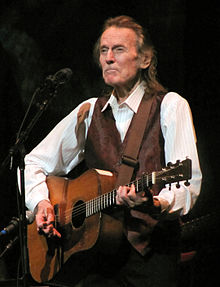
For the second song we have Gordon Lightfoot with ‘Shadows’.
As with the first song in the series we have a composition with a melody of the type that Bob would never have written, and with a regularly repeated chorus, which is far from being Bob’s favourite device. So all in all a very non-Dylan piece of music.
And I have to admit I personally have a problem with the organ’s four-note phrase repeated over and over again. For me (and as ever it is just my own thoughts on the matter, coming to a recording for the first time) it gets in the way of everything else.
But I suspect the melody attracted Bob, which obviously you can hear in the recording above. And the lyrics…. well, I thought it might be helpful to print some of them out.
Won't you reach out, love and touch meLet me hold you for awhile?I been all around the worldOh, how I long to see you smileThere's a shadow on the moonAnd the waters here belowDo not shine the way they shouldAnd I love you just in case you didn't knowLet it goLet it happen like it happened once before
There’s no denying there is a good set of images with the challenge of what the “it” is in “let it go”. Indeed as the song moves on, it is clear it is a lost love song, the type of song Bob doesn’t write much. He writes about old relationships, but often with a sense of pleasure that it is over – sometimes even utter disdain – after all you can’t get more of a put down than “You’ve got a lot of nerve to say you are my friend”.
So this is lost love song with a really pleasing melody and the simple question, “Is it me or is it you?” There are some fine images of course, such s the “shadow of a dream” and the self-doubt (which composers often have problems within the lost love songs. Indeed “Is it me or is it you, Or the shadow of a dream?” is perfectly ok as a line in my view, but I am not really convinced “Is it wrong to be in love?”
Gordon Lightfoot was part of the folk-pop round of performers in the 1960s and 70s, and considered as one ofthe greats of Canadian songwriting. His brother once said, “His name is synonymous with timeless songs about trains and shipwrecks, rivers and highways, lovers and loneliness,” which to a degree sounds like some of Dylan’s favourite themes.
As for his best known composition, surely it is Early Morning Rain…
… which would undoubtedly be in my personal list of songs I wish I had written – although that of course is utterly irrelevant.
But more to the point the songs of Canada’s greatest have been recorded by everyone from Elvis to Jerry Lee, from Bob to Judy Collins.
In fact Bob once said, “I can’t think of any Gordon Lightfoot song I don’t like. Everytime I hear a song of his, it’s like I wish it would last forever…. Lightfoot became a mentor for a long time. I think he probably still is to this day”.
If you want more Gordon Lightfoot, just leave the link above running.
Anyway, my not being totally drawn to Shadows is undoubtedly my failing, as I am sure you have already realised. The man is synonymous with brilliant songwriting, and Bob’s not that bad a judge.
Writer D.H. Lawrence joins the pilgrimage to New Babylon; cries out that the struggle to survive, and the sexual drive (pointed out by Charles Darwin), gets usurped by modern industrial capitalists.
In the lines below, Social Darwinism mocked ~ i.e., curly hair determines one’s destiny:
(T)he sight of george raft - richard nixon - liberace
d.h. lawrence & pablo casals - all the same person
struggle -struggle
& your weapons of curls blowing
(Bob Dylan: Tarantula)
Senator Joe McCarthy comes along; tells the Monk that he doesn’t like monkey-lovers:
(H)e don't like people that say
he comes from the monkeys
(Bob Dylan: Tarantula)
Henry Miller jumps into the stream of consciousness and tells a tale of ‘hot’ sex.
Porno-Lit parodied below:
Grady O'lady comes in - gives everybody the nod
& wants to know where she can get a maid ....
O'lady takes an orange out of her pocket
"got this from Aztec country - watch me now boys"
she takes the orange & oozes & dribbles
all down her mouth all over her skirt -
more - more - she's all covered in orange
(Bob Dylan: Tarantula)
Later on, a possible source of the above lyrics revealed:
I buyed me a little box about four acres square
filled it with guineas, and silver so fair
Oh now I'm bound for Turkey, I travel like an ox
And in my breeches pocket I carry my little box
(Bob Dylan: Taddle O'Day ~ traditional)
Street slang for ‘dirty sex’ hidden in a future song ~ in the lyrics quoted beneath:
Brownsville girl with your Brownsville curls
Teeth like pearls, shining like the moon above
Brownsville girl
Show me all around the world
Brownsville girl, you're my honey love
(Bob Dylan: Brownsville Girl ~ Dylan/Shepard)
“I’d walk a million miles for one of your smiles” sings back-faced Al Jolson ~ “My Mammy” (Young/Lewis/Donaldson). Tarantsulated below: Al, the Jewish performer drops into a theatre to watch “Two Women”, an Italian-language movie that stars Sophia Loren in which a mother and daughter are raped by Moroccan ‘irregulars’ from the Fench African colony who are fighting against the German Nazis in Italy.
Humphrey Bogart’s not there.
Hubris notwithstanding, apparently Jolson expects a postage stamp to be issued in his honour:
(I)n the winter a blackface musician announces
he is from Two Woman
he spends his free time trying to peel the moon
& he's here to collect his eight cent stamp
(Bob Dylan: Tarantula)
Below, metonymically speaking with humour and wordplay abounding, Walter Scott, and George Eliot (a woman) get Shakespeared:
(O)k, so you used to get B's in the Ivanhoe tests
& A minuses in the silas marners
then you wonder why you failed hamlet exams
yeah well, that's because one hoe and one lass
do not make a spear
(Bob Dylan: Tarantula)
17: Hopalong Bob
William Boyd and Andy Clyde star in the western movie “Hoppy Serves A Writ”.
Milk-drinking black-clad, white-horsed, hard-riding lawman Bill “Hopalong” Cassidy, and his slapstick-sidekick “California” Carlson ride into Bob Dylan’s kaleidoscopic montage of movie stars acting as though they’re in the unfenced Old West – here supposedly located in Texas and Oklahoma.
The times they are a-changing.
“Talkies” take over. Silent movies are dead.
Nor do printed words talk:
(T)he audio repairman stumbles
thru the door with "sound is sacred
so come in and talk to us"
written on the back of his shirt
(Bob Dylan: Tarantula)
Louis L’Amour grabs the opportunity to make money by writing noveletts about Hopalong’s adventures:
Into the Valley of Burlesque the cowboy angels ride.
Mocked be that any sexual activity is pretty well outlawed in those Hoppy Days whether in stories, at the movies, or on tv:
(O)ut of his past appears Insanely Hoppy
screaming and dancing
(Bob Dylan; Tarantula)
He holds up a stagecoach, and takes the strongbox that contains a nursery rhyme:
Little Jack Horner
Sat in the corner
Eating his Christmas pie
He put in his thumb
And pulled other a plum
And said, " What a good boy am I"
Exchanges the nursery rhyme for a night of sex:
Listen to the fiddler play
When he's playing 'til the break of day
Oh me, oh my
Love that country pie
(Bob Dylan: Country Pie)
Sometimes things don’t go that well:
(E)xcept that I can't do anything with with my finger
& it's already beginning to smell
(Bob Dylan: Tarantula)
Onward, onward rides Hoppy, with his sidekick, into New Babylon.
In pursuit of the Golden Calf:
(T)he american flag turned green
& andy clyde kept pestering about a back paycheck
(Bob Dylan: Tarantula)
They’re not alone, don’t forget:
& all the rest of these people
that would make leadbelly a pet
(Bob Dylan: Tarantula)
IX When Charlie was around, something good would usually come out
“Country Pie” is a song that I played a guitar part on – my favourite guitar part ever played on a Dylan song, back on Nashville Skyline. I wanted to do it different, so I played fiddle on this. But it is just a good-time tune, you know. I think it’s kinda Bob’s concept of country life: “Give to me my country pie”.
(Charlie Daniels on his “Country Pie” cover on Off The Grid, 2014)
At the talk-show-style book launch of Ron Cornelius’ book The Guitar Behind Dylan & Cohen at Nashville’s Music Hall of Fame, 2017, Charlie Daniels and Bob Wilson sit next to each other on stage. So the conversation, despite Cornelius having absolutely no involvement in the album, a few times drifts off to Nashville Skyline – which is, after all, the album where Wilson and Daniels met, the breakthrough for Charlie Daniels, and the album that is at the intersection of Cornelius, Bob Johnston, Dylan and both musicians. And to that joyous, frequent drifting off we owe insights and backstories about the origins of individual songs like “Country Pie” and the album at all. Recalling “Country Pie” in particular enthuses Daniels:
“Something that always sticked in my mind with Nashville Skyline is when Bob started doing “Country Pie”. And I had my Telecaster and Bob [Wilson] had the piano, and he started playing those chords and Bob started playing tadeladeda-tatataa… I never forget that, that’s my favourite piano part you ever did, and then I came in on the Telecaster, remember that? [singing:] “And just like old Saxophone Joe when he got the hogshead…” and I just…, I mean…, it just blew… we were just… but that was the spirit of things I mean: we were having fun.”
He stumbles over his own words, bursts out in infectious laughter almost 50 years after that evening at Columbia Studio A, seems to completely forget about the other guests, the presenter and the audience, here on this stage in Nashville, and has a reminiscing, intimate entre-nous with Bob Wilson – who does confirm his stories in full. And then just wants to have said publicly:
“But for Charlie Daniels and that Telly of his, Nashville Skyline would not have been Nashville Skyline. I mean, this guy was perfect. You got all these talented god-gifted guitarists in Nashville, but he was perfect for that album.”
They wave praise at each other rather effusively, but it doesn’t get awkward; the recording of “Country Pie” illustrates and supports both the memories and analysis of both men. It is true, after all; the song is carried by Wilson’s funky piano intro and the bouncy, pleasantly intrusive encouragement of Daniels’ Telecaster. Dylan’s objection at the time, “I don’t want another guitar player, I want him”, is quite understandable. And in his autobiography Chronicles (2014), Dylan reaffirms his appreciation, even confesses to feeling a kind of soul affinity, and moreover, suggests a kind of dependence on Charlie Daniels’ input:
“I was wondering who he [Johnston] was going to bring to the sessions this time and was hoping he’d bring Charlie Daniels. He’d brought Charlie before, but he’d failed to bring him a few times, too. […] When Charlie was around, something good would usually come out of the sessions.”
… in which, as an aside, that oddly passive “I was hoping he’d bring Charlie Daniels” also stands out. This is 1970. Dylan has long since been in the position of being able to dictate who he wants to play with – but still seems unaware that he could order Jimi Hendrix, Glenn Gould, Paul McCartney and Gene Krupa to the studio, so to speak.
Our cliché expectations of country & western it definitely does not meet, the intro by the duo Wilson & Daniels. Which is hardly surprising: Bob Wilson hails from Detroit and indeed has soul in his blood and in his fingers, having made a modest name for himself in the years before with piano contributions to the San Remo Quartet’s instrumental soul-muzak and sweaty, funky, flopped soul stompers like “All Turned On” and “After Hours” – which we also hear back in that blues trifle “Western Road”, the improvisation he, as an encore, set in after “Lay, Lady, Lay” last night, 13 February 1969.
How song-defining Wilson’s intro is, the prog rock dinosaurs of The Nice demonstrate, with one of the first covers of “Country Pie”, still in its 1969 birth year. Side A of their over-ambitious LP Five Bridges is devoted entirely to the rather pretentious “The Five Bridges Suite”, but no less brave is Side B: rock symphonic arrangements with jazz-rock-like excursions on Sibelius’ “Karelia Suite” and Tchaikovksky’s “Pathetique”. And then, No.3 of Side B, a bizarre interpretation of Dylan’s “Country Pie”, larded with Bach’s “Brandenburg Concerto No. 6”. How successful that is, is debatable, but Keith Emerson is obviously an extremely talented craftsman, and accurately hits the bearing of “Country Pie”: he builds his entire excerpt on Wilson’s piano pattern from the intro.
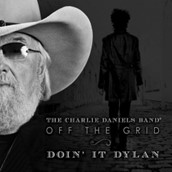
In the studio, Charlie Daniels also immediately picks up on its funkiness – his pinched guitar licks and rousing lines are closer to Curtis Mayfield than to Chet Atkins. Looking back on it fifty years later with justifiable pride, he still finds: “My favourite guitar part ever played on a Dylan song.” Can’t be topped, he apparently thinks in 2014, when he records the song again for his Dylan album Off The Grid: Doin’ It Dylan; he swaps the Telecaster for his violin. He could have skipped the song, of course, but the “good-time tune” is irresistible – Charlie has contributed to some 30 studio recordings of Dylan originals (apart from Nashville Skyline, also for Self Portrait and New Morning), but this is the only song on his tribute album to which he returns (the other nine covers are mostly from the 1963-1967 period).
Fun, and good-time, indeed – but the fiddle does not compensate for the loss of that energising, funky guitar part. Fairport Convention demonstrates as early as 1981 that Daniels should have stayed true to himself; Richard Thompson, an exceptionally adept and original guitarist himself after all, takes his hat off to Charlie’s input and in broad strokes copies the part. In an otherwise rather perfect cover from which the funk and ragtime has virtually evaporated – promoting the song to a dynamic country rocker. Including a ferociously-disrespectful, anarchistic rockabilly coda.
Still, it is only one of the rare covers. The song does not become a classic. Dylan himself ignores the song as well, more than thirty years, until he suddenly resuscitates it in 2000, playing it over a hundred times. In rather faithful, funky and hoppy versions, with a starring role for Larry Campbell’s solo guitar, usually playing attractive derivatives of Daniels’ template. After 2001, “Country Pie” does pop up on the setlist a few more times, but after a final performance in 2007, it is over.
The latest revival for now comes from the good old Nitty Gritty Dirt Band, the guys who have been distinguishing themselves at times with fine Dylan covers since the 60s and crowned it in May 2022 with the very attractive tribute album Dirt Does Dylan. Beautiful cover design and filled with nice to very nice versions of everyman’s friends like “She Belongs To Me”, “Quinn The Eskimo”, “Forever Young” and “Don’t Think Twice”. Plus one outsider: our half-forgotten country-funk gem “Country Pie”. This time in a folky, unpretentious pub version.
Listen to the fiddler play.
Jochen is a regular reviewer of Dylan’s work on Untold. His books, in English, Dutch and German, are available via Amazon both in paperback and on Kindle:
Continuing my personal selection of the greatest moment from the Never Ending Tour, I come to “It’s Alright Ma” from 2001.
Once again we are with a song that those with a musical ear will know from the opening of the introduction and everyone else will know from the opening line and that distinctive chord change.
More than that most of us will know every word of every line, and by 2001 will have heard it at least a few times before live, as well as hundreds of time on recordings. Or to be brief: we already know the piece inside out, despite its lyrical complexity.
But of course this is also not a song that naturally lends itself easily to a full band accompaniment, and if we are to have Bob on his own performing the piece there is not too much he can do to differentiate this performance from others without the changes sounding forced.
So what he brilliantly does here is give us a gentle accompaniment. The speed of the song is just a fraction slower than the album, but above all we have that gentle percussion along with a second acoustic guitar. And the result is a completely new vision created from a song we know oh so well and lyrics that have become part of our very existence.
Indeed amazingly, even though we do know all those lyrics, they now shine through afresh, and bring with them a new realisation of what this is all about. Individual lines that were just part of the mix before now take on a special significance, even though Bob is not emphasising anything beyond the last word of each line.
Indeed much of the effect is achieved by the way Bob treats the last word of each line. The lack of melody vanishes – with the pitch changing in some lines but not every line. And when get to “It’s all right ma” yes for the first time I really do feel that he is explaining himself and his life to his ma. “Don’t worry about what I’m doing ma, that’s how it goes these days.”
What I also find is that for the first time I am appreciating the sound of the lines, rather than the meaning of each word – it is as if at times the vocals are in fact another instrument – it is the sound not the meaning of the words that draws me in.
Of course maybe that is because I know every line so well, or maybe it is through something else in the way Bob ends each line but this really is a most curious effect achieved with such a small change.
Then the whole performance is further enhanced by the way Bob changes the rhythm of the lyrics – not just with the final word of each section, but throughout, often in fairly subtle ways.
For me this is the re-birth of an old favourite that maybe I felt I had heard so often that I could not appreciate anymore. If the writing of the song was a work of genius (as surely it was) this re-arrangement is equally the work of a master at the very top of his game.
By Aaron Galbraith and (a rather over-excited) Tony Attwood
Foreword for new readers: Aaron in the USA selects the song and the tracks, and Tony in the UK adds his comments while listening to the recordings Aaron has selected.
Aaron:“It Hurts Me Too” is based on “Things ‘Bout Comin’ My Way”, recorded by Tampa Red in 1931, recording this in 1940.
Tony: This is an absolute classic blues format based around the chord sequence:
Bb, Bb7, Eb, Ebm, Bb, F, Bb
It’s a sequence that offers easily as much as the 12 bar blues sequence, but is used far less often for some reason. Maybe because there are no repeated vocal lines, which makes the 12 bar blues even easier to write. Or perhaps if it had become known as the 8 bar blues (which is in fact what it is) it would have caught on more. Personally, as a sequence, I love it.
But this song does show how much there is, in this simple arrangement of chords and a great musical arrangement built on top of it. It is just verse after verse with the same last line for each verse, but so much can be done with it.
Aaron: Dylan’s version came from 1970s Self Portrait
Tony: Bob plays around with the rhythm and with the classic chord sequence adding an extra chord as the penultimate after “go wrong with you”.
But what we really notice is the addition of the swing beat which allows for all the laid-back fun in the instrumental verse. That swing beat gives us 16 bars of bouncy 4/4 rhythm and a totally different feel. And what really, really makes it work is that accompaniment, so gentle, but with so much swing – these guys must have had a wow of a time playing this.
I really wonder how on earth Bob thought of putting this rhythm to the song. Was it entirely his idea or did he hear this rhythmic version on an old 78rpm? (And I must odd, it would be a hell of a track to dance to in a classic but fast 1930s swing style. Way beyond my abilities now, and actually it probably was when I was a lot younger, but I can see it in my mind’s eye, and it sure looks good.)
Anyway, enough of that…
Aaron: Three members of The Rolling Stones released an album in 1972 called Jamming with Edward! Based on jam sessions while waiting for Keith to arrive in the studio, their version of the track incorporates lyrics from Dylan’s Pledging My Time
Tony: What a fabulous introduction; I just feel it is a trifle sad that with all this talent on display, they couldn’t come up with something more after that intro. But then I guess they were just waiting for the final member of the band to show, and so they are going to play it, not work on the arrangement. Good fun. Nice change over to Dylan’s “Pledging my time” partway through as well, which of course is based on the same sequence. I’m sure you’ll know it inside out, but just in case here it is…
Aaron:Several great versions followed over the years by the likes of Foghat, Eric Clapton, Robert Palmer , Steve Miller ETC. But here is a version by Keb’ Mo’ from 2000 who took this song in an entirely different direction
Tony: Wow this is a surprise – not a track I knew at all; either this is a brilliant find Aaron or I am, as ever, several hundred years behind the times. This is incredible; it is exactly the sort of musical invention that I adore and worship. He’s kept the lyrical style, and the chord sequence, although there is one change (the one written as Ebm in my original is played at Gb I think – sorry I am doing this in my head and not at the piano and that change just took me completely by surprise), and it is a stunner. It works perfectly, while giving us that little feel that yes, ok, the beat is pronounced and speeded up, the instrumentation is different, but (he says) I’m still going to give you another surprise too.
And if I may wander over to another art form, it would be an absolute scream to dance this piece as a couple, to a triple-step just dancing around the whole ballroom floor. Just the band playing this, and one couple travelling the whole floor – goodness I ought to have had a life writing film scripts rather than advertising copy.
Oh Aaron, that was so much fun. Another article soon please!
PS: I’ve just started to play that final track again – I would strongly recommend anyone who has read this ramble of mine and listened to the Keb Mo version to the end now does this. Go back to the start and play it again, and just take in that opening in the knowledge of where the song goes to. I say again “wow, wow and thrice wow” (sorry to non-UK readers, that’s a very English joke… Frankie Howerd, if you remember).
In “Tarantula”, per usual, it’s difficult to pin shape-shifter Dylan down; it’s pages are left wide open for interpretation.
For instance, therein is Al Capp’s “Li’l Abner”, but then again, perhaps the biblical character Abner.
Biblical Abner switches sides; supports David as king rather than Saul’s son because Abner’s been accused of disloyalty for sleeping with one of Saul’s concubines.
The commander of David’s army, his brother having been killed by Abner, stabs the turncoat to death which makes David very angry.
Nevertheless, synchronicity there be ~ the American cartoon-satirist Capp, initially somewhat liberal-minded turns about; he becomes more and more right-wing in his political sentiments.
A reversed mirror image of Bob Dylan that can be put in a corncob pipe and smoked:
(H)e Abner cursed out East Texas, tomatoes
& tin pan alley, he didn't talk to me
he talked in a mirror
(Bob Dylan: Tarantula)
Likewise, Jake the Flesh, the biblical Jacob; or Mick Jagger, the devil of the Rolling Stones, the group founded by Brian Jones. “Jumping Jack Flash” is not written yet so take want you can gather from coincidence; but there’s the nursery rhyme “Jack Be Nimble”.
Afloat on the timeless Jungian Sea, beneath mona moon, sneaky Jacob, born holding on to Esau’s heel, “steals” his fraternal twin’s birthright.
Yahweh further informs Jacob about the ladder of history ~ that Persia will defeat Babylon, and captive Hebrews will be allowed to return to Jerusalem to assist in the restoration of Israel to its former glory – if they all behave themselves of course.
So said it could be, as indicated by the bible verses below, that Jacob, as an ardent follower of Yahweh, will make good things happen – he’s the Rain Man.
Yahweh says to him:
For I will pour water upon him that is thirsty
And floods upon the dry ground
I will pour my spirit upon thy seed
And my blessing upon thine offspring
And they shall spring up as among the grass
As willows by the water courses
(Isaiah 44: 3,4)
In the Third Testament, known as the Tarantula, Jacob warns the Flower Lady that the Herculean elephant boy is not afraid to take on the boy from the New Babylon who’s trying to drown Albion.
Rain Man yelled
"watch out Flower Lady, there's an elephant coming"
but by this time she was singing auld lang syne
with Babbooo Boy
who'd snuck up, stuck a lead
weight life jacket around fablan
& threw him in the swimming pool
(Bob Dylan: Tarantula)
The Flower Lady records the following song:
Show me the country, where the bombs had to fall
Show me the ruins of the buildings, once so tall
And I'll show you a young man
With so many reasons why
There but for fortune go you and I
(Joan Baez: There But For Fortune ~ Phil Ochs)
The lyrics following, perhaps an answer song from Dylan’s nemesis ~ recorded in Blake’s Albion, the Land of the Fab Four:
The painter paints his brushes black
Through the canvas runs a crack
Portrait of the pain never answers back
But nobody's buying flowers from the flower lady
(Peter And Gordon: The Flower Lady ~ Phil Ochs)
In reference to the personification of America below:
She's an artist, she don't look back
She can take the dark out of night-time
And paint the daytime black
(Bob Dylan: She Belongs To Me)
Meanwhile, San Francisco’s freezing, and New York’s suffering from spells of Poe:
All wreathed with fairy fruits and flowers
And all the flowers were mine
Ah, dream too bright to last
(Edgar Allan Poe: To One In Paradise)
15: Tarzantula
Joining the Tarantula pilgrim parade is the cousin of Ronnie Hawkins:
& Suzy-Q, the angel
putting new dime into this adoption machine
as out squirts a symbol
sqawking & freezing & crashing
into the bowels of some hideous soap box
(Bob Dylan: Tarantula)
The cousin, from Louisiana, performs the landmark rocknroll song quoted beneath:
Oh Suzy-Q, Oh Suzy-Q
I love you, my Suzy-Q
I like the way you walk
I like the way you talk
I like the way you walk, I like the way you talk
My Suzy-Q
(Dale Hawkins: Suzy-Q ~ D.Hawkins/Chaisson/Burton)
With its roots in the Jazz Age of F. Scott Fitzgerald, and his wife Zelda:
Now, you swing over here
Now, you swing over there
For you swing on out, and you do the Suzie-Q
Oh, you dance in
Yes, you're prancing
When you hear the music play, that's your cue
(Lil Armstrong: Doing The Suzie-Q)
Below, a Tarzan-yelling song intended to be funny – with appalling racist slurs (even Walt Whitman refers to Afro-Americans as “baboons”):
Oh yes, I saw her Saturday at the show down town
She said, "Hi there, Baboon, can I sit down?"
I said, "Wait a minute, baby, where's your raccoon?"
(Dale Hawkins: See You Soon Baboon)
If the lyrics above by the gentleman from Dixieland had any influence on the following song by the Beatles, the Fab Four do not admit it, and rightly so:
Well, she and her man who called himself Dan
Were in the next room at the hoedown
Rocky burst in, and grinning a grin
He said, "Danny Boy, this is a showdown"
But Daniel was hot, he drew first and shot
And Rocky collapsed in the corner
(Beatles: Rocky Raccoon ~ McCartney/Lennon)
The influence of the poem below readily acknowledged;
And the two men lay stiff and stark
Pitched on his head, and pumped full of lead
Was Dangerous Dan McGrew
While the man from the creeks lay clutched to the breast
Of the lady that's known as Lou
(Robert Service: The Shooting Of Dan McGrew)
In ‘Tarantula’, Dylan, who turns away from protest songs of the day, uses a “two-b” name in ‘the Flower Lady & Babboon Boy’, maybe the latter in reference to Phil Ochs (Dylan, being driven in a limousine, tells Phil to get out of the car).
Ochs writes the anti-Vietnam War song below, the lyrics of which give the protest song a sharper edge.
Bob Hope and Anita Bryant entertain the troops in South Vietnam:
The comic and the beauty queen are dancing on the stage
Raw recruits are lining up like coffins in a cage
We're fighting a war we lost before the war began
We're the white boots marching in a yellow land
(Phil Ochs: White Boots Marching In A Yellow Land)
The narrator in the lines beneath resorts to sarcasm:
(I) don't care what bob hope says
he aint going with you nowhere
(Bob Dylan: Tarantula)
Ready or not here I come
Gee that used to be such fun
Apples peaches pumpkin pie
Who's afraid to holler I?
One of the many pleasant surprises of The Basement Tapes is the corny, churting parody of Bobbie Gentry’s exceptional world hit “Ode To Billie Joe”, which inspired Dylan’s deliberately saltless throwaway “Clothes Line Saga”. Although, throwaway… when 34 years later The Roches adorn the tribute album A Nod To Bob (2001) with their version, the raw lump of ore from the basement turns out to contain a shining jewel. By then, the three Irish-American sisters from New Jersey have had the song in their repertoire for more than 20 years, and that prolonged polishing, refining and sanding has by then taken the featherweight trifle into, as Dylan would say, the stratosphere, into the regions where only Very Great Dylan covers are allowed to float around. Where Hendrix’s “All Along The Watchtower” is, and Derek Trucks’ “Down In The Flood”, “Tangled Up In Blue” by the Indigo Girls, those regions.
Dylan’s inspiration is not that hard to trace; in that same summer of 1967 when the men have their playtime in the basement, Gentry’s “Study of Unconscious Cruelty” (her words) dominates the charts; the song is a mainstay on the radio. And the radio DJ digging into the Billboard Top 20 for his playlist in the late summer of ’67 will, in many cases, snap up a neighbouring hit that accompanies “Ode To Billie Joe” in those same months: “Apples, Peaches, Pumpkin Pie” by Jay & the Techniques, a dated but still enjoyable soul stomp. A relaxed Dylan, relieved of his toothache and finally pie-eating again, listening to the radio in the background at the breakfast table in the morning, scribbling down a witty response to Billie Joe in his notebook, quickly writes “pie assortment” down in the margin – should yield some funny lyrics at a later point, the self-confident best songwriter in the world knows.
At least, that is an attractive scenario on the premise that the lyrics of “Country Pie” are a leftover from the Big Pink. Which does seem very likely, after all. Just as nice a guess would then be the scenario that an inspiration-seeking Dylan, a year and a half later in a motel room in Nashville, leafing back through his notebook, gets struck by Saxophone Joe, the pie assortment and especially the word “country”.
We know that Dylan arrived in Nashville with only “a handful of songs”, or, to be more precise: “The first time I went into the studio I had, I think, four songs” (Rolling Stone Interview with Jann Wenner, 1969), and that even the idea of making an album only surfaced after a day or so. And that “Tonight I’ll Be Staying Here With You”, the “Girl From The North Country” duet with Cash and “Nashville Skyline Rag” only emerged sometime after the first day of recording.
It seems obvious then that Dylan arrived with the songs that were also recorded first: “To Be Alone With You”, “I Threw It All Away”, “One More Night” and “Lay, Lady, Lay”. The only tune that follows “Lay, Lady, Lay” on that 13th February is the rather directionless, clearly improvised on the spot “Western Road” – it seems plausible that the basket was empty at that point, and that the rest of Nashville Skyline, including “Country Pie”, was not written until after this 13th February.
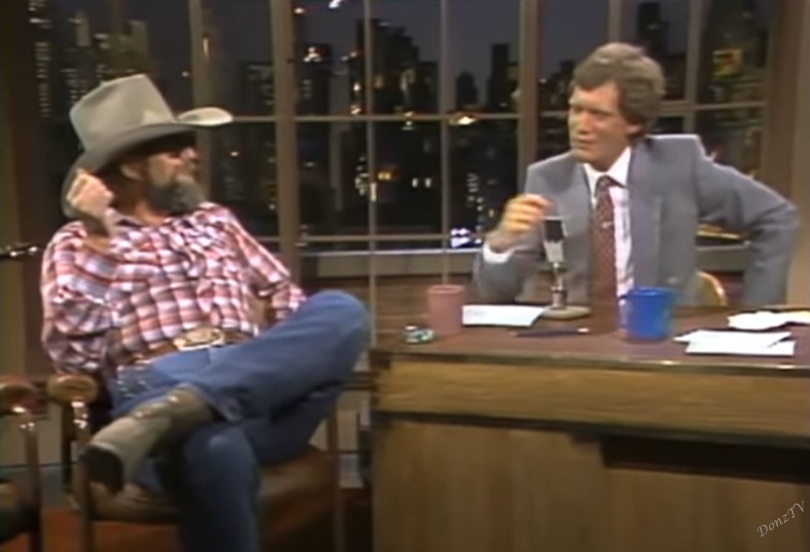
It is even quite likely that a lot of the music and melody are only conceived on the spot, in the studio on February 14. Session musicians pianist Bob Wilson and guitarist Charlie Daniels, the two driving forces of “Country Pie” both emphasise the free, unstructured nature of the Nashville Skyline sessions. As Charlie puts it on the Letterman Show, 27 July 1982:
“That was some of the freest… about as free as you can get in the studio, because he wanted you to do, you know, what you wanted to do. As opposed to somebody telling you exactly what to do. He would want you to put your own self into it, your own style of playing and all.”
It is something they are not used to at all, and it is especially clear from the stories of the eternally grateful Charlie Daniels, that the musical accompaniment to songs like “Nashville Skyline Rag” and “Country Pie” came more or less out of the blue.
Charlie Daniels being eternally grateful, as he is convinced he owes his entire career to nine words spoken by Dylan during the Nashville Skyline sessions. He tells the story often, like here for the Grammy Foundation Living History interview in 2017:
“They had a really good guitar player booked that had worked with him before, that was booked for all 15 sessions, but he couldn’t make the very first one for some reason. He was booked on another session. And they asked me to come in and fill in for him, which I did, and I literally… I was playing guitar and I literally hung on everything that Dylan did, every chord he played, every note that came out of his mouth. I was sitting there looking at him and playing, and when the session was over, I was packing my gear up, I was fixing to leave, and Dylan asked Bob Johnston: where’s he going, and he said he’s leaving, I got another guitar player coming, and then Bob Dylan said nine words that changed my life. He said, I don’t want another guitar player, I want him.”
It is a story Daniels gladly retells, almost always in roughly the same words (including that dramatic “he said nine words that changed my life”). And then explains it further; Dylan “had a big enough heart that he put the name of the session players on the back of his album, pretty prominently actually,” and that changes everything. Not only for his own self-confidence and status, but “it gave me a validity that I could have worked years and years to try to find.”
Sympathetic and modest, but perhaps a little too modest; Charlie Daniels’ exceptional talent would have taken him to the Premier League without Dylan’s nine words just as well. Dylan sped it up a bit, probably. Moreover, Daniels – out of that same sympathetic modesty – underplays the reciprocity; that Nashville Skyline owes its charm and magic in no small part to Charlie Daniels. That is, anyway, what quite some insiders with a right to speak argue…
To be continued. Next up Country Pie part 9 (final): When Charlie was around, something good would usually come out
Jochen is a regular reviewer of Dylan’s work on Untold. His books, in English, Dutch and German, are available via Amazon both in paperback and on Kindle:
Love songs, lost love songs and hate songs… when it comes to pop and rock, love and lost love songs win hands down. I suspect there are a million songs in each genre to every song of hate or utter disdain, and most of those hate / disdain songs will hardly have made it above the waterline.
Except of course for “Positively 4th Street” – and indeed in 1965 Dylan wrote, or at least made known, four such songs
He then laid off the subject, coming back to it only occasionally with pieces such as “I don’t believe you (She acts like we never have met).” It is after all a hard subject to turn into a song, and requires an audience that is ready to spend cash on engaging with repeated negative emotions – which is a pretty dispiriting thing to do, at least after a while.
Dislike, hatred, disdain… they can all be used as the themes of popular songs but they don’t seem to sit easily within the genre – if one wants to write negatively, protest against the current situation, and politicians in general are far more popular than pointing out the horrible attributes of an individual. Thus “Masters of War” is of course about the whole weapons industry, and even on that score, although I used to agree this was a good target, I think maybe I’ve changed my mind since the Russian invasion of Ukraine. I want Ukraine to be able to defend itself against the invader, which means having weapons. (Oh to be able to regain the naivety of youth!)
And as for songs against a group of individuals, I guess one could have a bash at politicians as a class (maybe “You’re all self-seeking bastards” would be a decent working title), economists (“You never once got it right” has possibilities for an as yet unwritten example of the genre), and of course ex-lovers. But then most ex-lovers’ songs focus primarily on sadness and regret, not an expression of downright disdain or even hatred.
So “Positively Fourth Street” remains an outsider in terms of content – and yet it has had a large number of covers – although sadly (in my estimation, and as ever of course this is just me pontificating on my own thought patterns as I write), not many are that good.
And all this led me to wonder what artists and arrangers actually think when they tackle a Dylan song. Is it, “hey we might sell a few extra copies when people realise it’s a Dylan” or “it must be good, Dylan wrote it,” or… well, I don’t know.
The covers of this song I really don’t like are the ones in which the arranger simply copies the Dylan recording, complete with the distinctive organ part, and there are dozens of these. Which is why I start with Lucinda Williams. Personally I am not 100% ok with the voice, because I don’t like that much vibrato, but the simplicity of the approach gives me the deep sense of sadness rather than absolute anger, that is, if not refreshing, then at least something I can come out of after the piece finishes.
There is something here about the continuity of the two guitar parts which adds to the sadness and sense of desolation, and the sudden arrival of vocal harmonies in the “come out once and scream it” line, really is a great touch. And a great idea to bring it back for “And just for that one moment”. It makes the “what a drag” line really work.
Paul Westerburg choose a rocking beat and this works with the meaning of the song, in the sense that the singer is bouncing along, happily throwing out insults as he saunters past. It’s a clever idea, and it maintains interest through what is, after all, nothing but two lines of music repeated over and over and over again. But sadly, the instrumental verse is really not very inspiring when it could be and indeed needs to be. After all that lead guitar is doing interesting things thereafter.
Mary and Jay of Bitter Sweet show us from the start that they are at least going give us a guitar part that does something else. There are slight changes of nuance in the vocals as well. But entertaining though the instrumental verses are, in the end, we are still just left two lines repeated over and over and over.
All of which makes Sharon Mcnally refreshing (sorry that just came out like that, it wasn’t meant to be a pun on Coldwater). Suddenly I want to listen again. Yes suddenly again I can feel the pain as well as the disdain – and for a song of disdain really to work it needs to bring in some of the pain too, in my view. That voice is utterly suited for the song, so congratulations to the band, and to the arranger for keeping the band behind the singer. No one else has ever got the “such a fool” line so perfect. I feel it utterly, each time I replay this version. Same with “and scream it”. Brilliantly played and sung.
So moving on from the sublime to the … well yes the Persuasions version is ridiculous. All the meaning is retained by the exquisite lead vocalist and destroyed by the bom bom boms and other accompanying lines. These are quality, quality vocalists. Did they think this is funny, or did they not think? Or were they just told “you need to do a Dylan”?
Brian Ferry knows his Dylan of course and knows what he is doing. He once said that if he met Bob he’d say, “I hope you don’t mind”, and how could Bob ever mind this gorgeous rendition which understands and interprets every single word, as does the accompaniment?
Brian makes us feel he really does know the reason why she talks behind his back. He feels that she is taking him as a fool. He really wishes she could stand inside his shoes. He really does want her to know what a drag it is to have to see her. And the band invent a new approach to an instrumental verse – whatever else you do, I beg you, listen to this all the way through.
Absolutely not for the first time I am so utterly indebtedly to Mr Ferry and the musicians and arrangers with whom he works. This is staggering.
And then I find there is nothing more to be said. There is nothing more that can be said. Of course Brian Ferry won’t ever read my rambling words of tribute, but I do wish that just one time he could hear his own work as I do and realise what an amazing contribution he has made to this song, and indeed to my life. Dylan of course created the piece. Brian Ferry gave it the realisation that the composition deserved.
If anyone who has contact with Brian Ferry ever reads this, tell him thank you from me.
Untold Dylan started in 2008 – so we have been at it for approaching 15 years. Indeed in a short while we’ll publish our 3000th article. I’ve no idea how many of these articles I have written, but it is quite a few, since it took a year or two of publication for Untold Dylan to get known widely enough for others kindly to offer articles for publication on the site. (Details of some of those who have written for the site are published here, and I’m still always keen to receive pieces from anyone who has something to say on Dylan that has not been said before. Just email Tony@schools.co.uk).
Anyway, across the decade and a half of the site I’ve noted a few Dylan performances that stay in my mind as absolute gems, and I thought I would dig one out for today’s piece in the “Absolute Highlights” series.
It is a 1980 performance of When He Returns, and I have remembered it particularly, not just for its re-invention of the song and the power of its delivery, but because it is quite unusual for myself as an atheist, to enjoy music which celebrates a religion. It happens, but when it does it tends to be in relation to the less overt religious pieces than this.
I guess there is nothing unusual in this. Few of my friends who hold a religious belief are particularly attracted to songs which deny the existence of the Almighty, any more than I am drawn toward pieces of music that express in their lyrics an approval of any aspect of, for example, right-wing politics.
It was these thoughts that led me, just for this article, to jump away from the recordings that Mike Johnson has given us in his series reviewing the tour and turn back to the 1980 recording of When He Returns
In my original review which I wrote six years ago, I said, “If there were a Dylan Christian song that could convert me I guess it could only be “When He Returns”. But it is not the album version that moves me, for there I find the piano part horribly overdone – so much so that all the twiddles, the quick arpeggios, the sudden introduction of bass notes, then scampering away to the high trebles – it is all the work of Beckett showing off, and of the producers saying, ‘hey look Bob can write a piece like THIS!!!’
“But fortunately there exists a totally different live version – and this is the piece which if I were convertible to Christianity could be used to convert me.”
And yet playing it again today, for perhaps the first time in maybe four years I didn’t hear it like this. Indeed I found myself sitting here and wondering what all the fuss was about – which is pretty alarming since I was the one making all the fuss.
Maybe it was the sheer surprise of the musical arrangement of piano and organ duet – which is fairly unusual, maybe it was the power of Bob’s singing and his absolute commitment to the piece which influenced me. But hearing it again, I had doubts.
And yet, and yet, now playing it for the fourth time (which of course is what those of us who listen to Dylan rarely do – we mostly play one song after another, but which I find necessary when writing an article like this) I begin to see again what made me so excited about this recording.
Now, this is odd, or at least unusual, for me. My feelings about a recording tend not to meander around very much. And yet now as I start playing it for the fifth consecutive time, I am again hearing what I heard when I first found this recording and thus wrote the “song that could convert me” piece.
As to what it is that draws me to this piece, I think I can get a little closer. The balance of the piano and organ both in terms of volume and musical interaction is perfect, as is Bob’s verse over the top. Vocally his conviction of the truth of the lyrics shines through in every line. I don’t care that I don’t believe a word of it – it is the musical integrity which overwhelms me.
But there is one more thing – coming back to this version of this song yet again I also find myself once more noting what appear to be contradictions in the words – or perhaps simply lyrics that are constructed to fit the rhyme and the beat.
In the official lyrics we find
Can I cast it aside, all this loyalty and this pride?
Will I ever learn that there’ll be no peace, that the war won’t cease
Until He returns?
But in fact what we really ought to have and what is delivered in musical terms is
Can I cast it aside,
all this loyalty and this pride?
Will I ever learn...
That there’ll be no peace,
that the war won’t cease
Until He returns?
It makes much more sense when the lyrics are re-written according to the rhyme and rhythm of the song.
And so now having played this version through multiple times as I have contemplated and then written this little piece, I am back to loving the performance.
A William Blake-influenced, postmodernist poet joins artist-pilgrims on their way along the Yellow Brick Road.
This time, meets up with a land-dwelling Tarantula:
(A)nd molly was chased by a horrible thing
which raced sideways while blowing bubbles: and
may came home with a smooth round stone
a small as the world and large as a stone
For whatever we lose (like you or me)
it's always ourselves we find in the sea
(EE Cummings: Maggie And Milly And Molly And May)
No Artemis she, the Moon Goddess below is not that crazy about Cummings’ poetry; prefers muscle-bound movie stars instead:
Mona - she resembles a sexy Buddah
& always looks like she's standing over the Golden Gate
she don't dig e.e. cummings - she digs Fernando Lamas
(Bob Dylan: Tarantula)
Fernando stars in “Dangerous When Wet” with swimmer/actress Esther Williams, along with cartoon cat and mouse Tom and Jerry:
Lady Esther is the cleaning lady
& she was mopping up the floor
when I woke up
(Bob Dylan: Tarantula)
Allegory and satire, open to more than one interpretation, be good literary devices to use when a writer is out to question the sacred beliefs of a strongly-bound mother land ~ be warned, the gates of Hades are guarded by a three-headed dog called Cerberus – stops souls condemned thereto from escaping.
Thus spake Taranthustra:
& Cupid can now kick over the kerosene lamp
Bob Dylan, killed by a discarded Oedipus
who turned around to investigate a ghost
& discovered that the ghost too
was more than one person
(Bob Dylan: Tarantula)
Cupid forbids mortal Psyche from looking at him, she lights a candle, and off flies the God of Desire into the night.
Oedipus unknowingly screws his own mother.
The (holy) ghost, part of a Trinity, with father God and son Jesus.
Blasphemy! above ~ Christianity equated with Ancient Roman/Greek mythology.
Might say God is compared to a Dog, goodness me.
Better to kick out the lamp, blow out the candle, and remain blind, than be sent down to the hot pits of Hell.
Marksist Twain is at the gate!
The Tarantula orders some Fried Rich; Old Testament Yahweh gets it too:
Oh, God said to Abraham, "Kill me a son"
Abe said, "Man, you must be putting me on"
God said, "No"; Abe say, "What?"
God say, "You can do what you want, Abe, but
The next time you see me coming, you better run"
(Bob Dylan: Highway Sixty-One)
Lord Buckley drops by holding a slave-driver’s whip while Christ, and some black Muslims, protest for civil rights, and against the Vietnam War:
(B)lack betty, black betty, blam de lam
betty had a loser, blam de lam
i spied him on the ocean
with a long string of muslims
blam de lam, going quack quack
(Bob Dylan: Tarantula)
God, He say " Don't bame me, blame Adam":
Nothing can hold you down, nothing that you lack
Temptations not an easy thing, Adam given the devil reign
Because he sinned, I got no choice, it run in my vein
(Bob Dylan: Pressing On)
Blame it on the stones.
13: Oval Faubus
It’s not all over between Al Capp, and Li’l Abner’s Dog Patch:
(Y)esterday I talked to Abner for forty minutes
he Abner cursed out East Texas, tomatoes
&  tin pan alley, he didn't talk to me
he talked in a mirror
(Bob Dylan: Tarantula)
You don’t need a weatherman to know that East Texas is humid and rainy; and besides Patty’s from there:
Born in 'Liz Texas timber
Up where the eagles fly
Then makes him tell'im never
But she don't cry
(Tony Attwood: Patty’s Gone To Laredo ~ Bob Dylan)
Films like ‘Ace In The Hole’ and ‘Little Foxes’ are just too dark, you see.
So Sandy Bob’s keeps on looking for a balance between Fatty Aphrodite and Sandy Slim.
But he just can’t find it:
I never could guess your weight baby
Never needed to call you my whore
I always thought you were straight baby
But you're drifting too from shore
(Bob Dylan: Drifting Too Far From Shore)
https://youtu.be/lJPDvKIELY4
Already questioned in “Tarantula”, is the cozy relationship of the cowboy angels Hopalong Cassidy with Topper, and Roy Rogers with Trigger:
(M)ore or less like a roy rogers
& trigger relationship of which
under present standards is an impossibility
(Bob Dylan: Tarantula)
Before this a flood has wiped out the Witchita falls; Tennessee Williams writes about dead-end “Camino Real”.
Sings Sands on the Sullivan Show:
More than you'll know, more than you know
Girl of my heart, I love you so
Lately I find, you're on my mind
More than you'll know
Whether you're right, whether you're wrong
Girl of my heart, I'll string along
(Tommy Sands: More Than You'll Ever Know ~ Elisu, et. al.)
The Rolling Stones appear on the Sullivan Show, and Jack-Be-Nimble so not to be censored.
Back from the Mad House on Castle Street returns Sandy Bob ~ on a mission to save the day for the peewee music stations of Babylon America.
Peewee the Ear, whose mouth looks like a credit card
him and Jake the Flesh
along with Sandy Bob from Pecos
they're leading the white elephant to water
somewhere between witchita falls & el camino real
it's late in the day & no word from Saigon is in yet
(Bob Dylan: Tarantula)
It’s all more than enough to want the scales of justice to tip all the way over to the other side ~ to make a red-blooded man want to rule in hell, rather than serve in heaven.
To find an Eve before she’s kicked out of Eden, to find one with a Nietzschean “slave morality”:
I am so Sick of Biblical people
they are like castor oil
like rabies
& now I wish for
Your eyes - you who doesn't talk business
& supplies my eyes with blankness
(Bob Dylan: Tarantula)
Ah, there must be some way outta here ~ a middle path between the two extremes of earthy materialism and heavenly spiritualism.
But nay, the strict sexual teachings of the oh-so popular Christian televangelist Oral Roberts get in the way:
(O)ne of the men, he asks, "anything bothering you?"
jenny replies,  "yes - whatever happened to Oval Faubus?"
& the man quickly drops the subject
(Bob Dylan: Tarantula)
Shake me up that old peach tree
Little Jack Horner’s got nothin’ on me
Oh me, oh my
Love that country pie
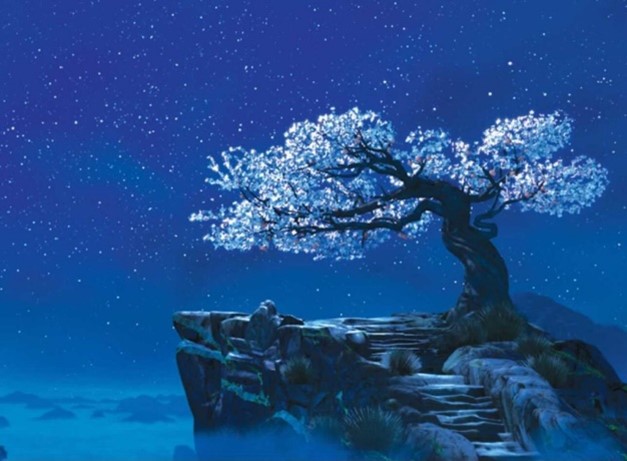
“I see you’ve found the Sacred Peach Tree of Heavenly Wisdom,” says Master Oogway shortly before his demise, as he catches Po eating emotionally.
“Is that what this is? I’m so sorry,” says an honestly startled Po with a mouth full of comfort food, full of peach that is, “I thought it was just a regular peach tree.” Screenwriters Ethan Reiff and Cyrus Voris have done their research, it seems; the peach tree, under which Master Oogway will leave this world moments later, dissolving in a cloud of peach blossom, symbolises immortality in China.
A peach tree, in short, is never just a peach tree – even in Kung Fu Panda (2008), it is a “Sacred Peach Tree of Heavenly Wisdom”. It is a family film, so the peach here – obviously – has a family-friendly connotation. Safe and at the same time old-fashioned; in the Middle Ages, peaches symbolised the Trinity (because a peach is flesh, stone and germ), but from the Renaissance onwards at the latest, the metaphorical quality shifts to lust, love, female body parts or “woman” at all (because of the soft skin).
Dylan knows that too, of course, when he sings “Shake me up that old peach tree”. Peaches, and fruit anyway, have lost all innocence in twentieth-century songwriting. Thanks mainly to Bo Carter, the foremost ambassador of dirty blues, who alternates educational gems like “Pussy Cat Blues”, “Please Warm My Wiener” and “My Pencil Won’t Write No More” with fruity ambiguities like “Banana In Your Fruit Basket” or “Let Me Roll Your Lemon”. And to a pioneer like Blind Lemon Jefferson, who starts filling the fruit basket with songs like “Peach Orchard Mama” (1929, Peach orchard mama, you swore wasn’t nobody gonna use your peaches but me).
But at the time of the Basement, Dylan presumably was mainly singing along with Sonny Boy Williamson II, who also has “Peach Orchard Tree” in his repertoire, who sings “Until My Love Come Down”, in which the harmonica master serves up a complete fruit cocktail;
I like yo' apple in your tree
I'm crazy 'bout yo' peaches, too
I'm crazy about your fruit, baby
'Cause you know just how to do
And otherwise with Yank Rachel’s “Peach Tree Blues” from 1942, on which Sonny Boy plays along:
Don’t them peaches look mellow, hanging way up in your tree
Don’t them peaches look mellow, hanging way up in your tree
I like your peaches so well, they have taken effect on me
… of which, incidentally, Big Joe Williams then makes “Don’t Your Plums Look Mellow Hanging On Your Tree”. But both variants owe their euphoniousness, of course, to the inspiration of others; to Kokomo Arnold’s “Milk Cow Blues” (Don’t that sun look good, going down, 1934) or to Leroy Carr’s “Alabama Woman Blues” (Don’t the clouds look lonesome across the deep blue sea / Don’t my gal look good when she’s coming after me, 1930), which Dylan lovingly copied on to “It Takes A Lot To Laugh, It Takes A Train To Cry”.
The comrades in the Basement, The Band, experienced “the most magical day of our lives” (Levon Helm’s autobiography This Wheel’s On Fire, 1993) in the spring of ’65 when they spent an afternoon spontaneously jamming with Sonny Boy in Helena, Arkansas, shortly before his death, so the line from Sonny Boy Williamson II to the Basement to Dylan’s “Country Pie” is pretty short. Yielding, in all likelihood, Dylan’s familiarisation with the association peach tree = female body.
But: Dylan is Dylan. So, unambiguous it seldom is, and a Dylan in Basement-mood most certainly isn’t. Each dirty blues squares an ambiguity like Shake me up that old peach tree with a subsequent, equally piquant metaphor. “Squeeze it the whole night long”, for instance, “I’m gon’ climb up on your top limb” or “You gotta give me some of it ‘fore you give it all away” or endless variations with grabbing, picking, shaking, snatching, or rattling and more obvious allusions to lovemaking. But hardly any dirty bluesman would have the nerve to follow up his ding-a-ling‘s desire for pie, peach, lemon, poodle or sugar bowl with a children’s verse like “Little Jack Horner’s got nothin’ on me”, so with an unequivocal reference to:
Little Jack Horner
Sat in the corner,
Eating his Christmas pie;
He put in his thumb,
And pulled out a plum,
And said, "What a good boy am I!"
… the eighteenth-century nursery rhyme in which an apparently not too savvy smug gobbler demonstrates utterly misplaced pride after performing a totally pointless act. Unknown in pop music, though, Little Jack is not. Shortly before Nashville Skyline, Stevie Wonder’s “Do I Love Her” does occasionally pop up on the radio (Bees love honey, banks love money / Birdies love to fly / Little Jack Horner in the corner loves his Christmas pie), and in the Basement days, Dylan undoubtely is familiar with Skip & Flip’s 1959 Top Twenty hit, the unpretentious sing-along “Cherry Pie”;
Like Little Jack Horner sat, sat, sat in the corner
Eating his cherry, cherry pie
I didn't put in a thumb
I didn't pull out a plum
I guess I'm not as great as he, whoa-oh, whoa-oh
… in which – coincidence, presumably – the associative leap from cherrie pie to country pie is even smaller than the one from Christmas pie to country pie. But anyway, still closer under Dylan’s skin is that one bluesman who has little hesitation about larding obscene allusions with quotes from nursery rhymes, one of the giants we’ve been hearing resonating in Dylan’s oeuvre for sixty years now:
My sister's name is Puttentang,
If you ask me again I'm gonna tell you the same,
My brother's name is Little Jack Horner
Mama told to watch the baby he didn’t wanna.

Putt told papa when he got home,
Papa, papa, he sassed and moaned,
Papa looked at brother with fire in his eyes,
Brother started doin’ the hand jive.
… “Nursery Rhyme” from Bo Diddley’s first LP with a funny cover, 1959’s Have Guitar Will Travel. On the 1966 collector The Originator, the song is renamed “Puttentang” – the peculiar name seems an obvious mutilation of the French noun putain, but most online fans suspect a corruption of an alleged slang word for vagina, “pootang”. Either way: slightly obscene. And the nod to Johnny Otis’ “Willie And The Hand Jive” (1958) is less debatable, of course. On the other hand: this Jack Horner has the decency of refraining from poking his fingers in any pie. Or squeezing any peaches.
To be continued. Next up Country Pie part 8: Nine words that changed my life
Jochen is a regular reviewer of Dylan’s work on Untold. His books, in English, Dutch and German, are available via Amazon both in paperback and on Kindle:
Bob Dylan’s “Tarantula” by itself justifies his winning the Nobel Prize in Literature.
The humorous, semi-coded book records Bob’s pilgrimage to New York State with his pen pals that include, among others, William Wordsworth, Walt Whitman, and Alice B.Toklas:
(T)o South Duchess County comes Them
& Woolworth's Fool
& triumphant alice toklas
(Bob Dylan: Tarantula)
Influenced by William James’ “stream of consciousness” concept; Emanuel Swedenborg’s concept of “correspondences”; images from Picasso’s Cubist paintings; and th eating of Mary Jane cookies, Toklas hops along casually down the Yellow Brick Road.
She plays with words to produce images that depict the material world sidesattled on emanations flowing forth from the mysterious and timeless spiritual realm:
Godiva was tired, and old Gertrude Stein
in spring bought a new car
(Alice B. Toklas: The Alice B.Toklas Cookbook)
Meanwhile, satirist Lord Byron comes and goes on Rue Morgue Avenue, speaking with Edgar Allan Poe:
(C)ompared to the big day
when you discover lord
byron shooting craps
in the morgue
with his pants off
(Bob Dylan: Tarantula)
With them too, F. Scott Fitzgerald, and his wife Zelda Sayre, the archetypical southern belle.
After they stop at an inn for a cup of coffee, Zelda scampers off into the woods, and has a knotty affair with a French pilot:
(Z)elda rat asks for a black
mongrel - please make it hot
& one of the men dangles a watch
in front of her face
"it's late - zeld babe - it's late"
The troupe’s led by Friedrich Nietzsche, the Wiseman of the State:
Nietzsche tells a story about the resentful, metonymic Tarantula who preachers that all humans are equal; he’s the nemesis of metonymic Superman, those who contol the State. Tarantula, in desperation, plays the death card – says it makes everybody happy.
Bob relates a tale that turns Friedrich around; in it, Tara-Man carries a case that contains a Kryptonite guitar; he tempts Superman to defy it ~ the electric power of song, music, and poetry exposes Superman’s mortal weakness, his Achilles’ heel ~ his love for the Golden Calf; that is, his desire for money, and material things.
One song that Bob sings quotes from ‘The Monk’s Tale’ by Geoffrey Chaucer:
One of these days, I'll end up on the run
I'm pretty sure she will make me kill someone
(Bob Dylan:  My Wife's Home Town)
11: The Long Dark Stranger
Ìn “Thus Spake Zarathustra, the tarantula’s a fuzzy friend of Christian preachers who declare that all members of the human race will be treated equally at the pearly gates; there, St. Peter gives them either a thumbs-up, or a thumbs-down.
Looking up, the metonymic Overman on Earth is not that concerned because it’s the good life, not death, that he’s after.
Now, there’s a dualistic conundrum begging to be satirized.
No one’s willing to accept the blame when things go wrong.
In the song below, metonymic Eve gets the blame – maybe even murdered:
Black Betty had a baby ...
Bam a lam, little thing went crazy ...
Bam a lam, little Tiny went blind ...
Bam a lam, l said he was none of mine ...
What about it, Black Betty
(Lead Belly: Black Betty ~ Ledbetter/traditional)
In the burlesque below, sea-walker Christ, the “Lamb” ~ according to St. John ~ takes the blame; i.e.,”blam’ de lam’ “:
(B)lack betty, black betty, blam de lam
betty had a loser, blam de lam
i spied him on the ocean
with a long string of muslims
blam de lam, all going quack quack
(Bob Dylan: Black Betty)
Nietzsche’s figurative “tarantula” classifies human behaviour in terms of “good” and “evil”; be nice to your fellow man, including your rulers, and St. Peter will open up the gates for you; the Overmen, those in power, think in terms of “good” and “bad”; those they rule are considered weak – flawed in character – in need of guidance, if not outright punishment that includes death.
Accordingly, on the micro-level, those with a ‘slave morality’, woman for example, resentful though they may be, all they can do to exercise their ‘will for power” is to provide men with comfort in one form or another; though careful they must be.
Such sentiments, not so cut and dried (indeed ambiguously so), expressed in the following song lyrics:
You give something to think about, baby
Every time I see you
Don't worry, I don't mind leaving
I'd just like it to be my idea
(Bob Dylan: Never Gonna Be The Same Again)
A line drawn from a western movie that takes place in wide-open Wyoming country filled it is with sunshine. The times they are a-changing ~ Shane (Alan Ladd), handy with a gun, is hired as a ploughman by a farmer who has a wife and son; they’re concerned about the gunman’s effect on their kid. Says Shane, guns are just a tool, neither ‘good’ nor ‘bad’.
Which side is Shane on?
First encounter with the farmer involves a misunderstanding:
Farmer: What’s the difference? You’re leaving anyway”
Shane: “I’d like it to be my idea”
Later Shane goes into town to a bar, and orders a soda-pop:
“What’s it be? Lemon, strawberry, or lilac, sodbuster?”
Apparently, the bar has no raspberry or lime.
At the end of the movie, Shane, wounded, rides off into the sunset after helping the struggling homesteaders in the valley hold their own against a greedy cattle baron, and his hired guns ~ most of them depicted on the screen as clearly ‘evil’.
In Bob Dylan’s “Tarantula”, the Lead Belly spoof is placed under the title: “Having a Wierd Drink With The Long Tall Stranger”.
The movie “The Tall Stranger” stars Joel McCrea as an ex-Civil War officer reluctant to use a gun; he’d rather negotiate in an effort to resolve a conflict.
The film messes with a western story written by Louis L’Amour.
The movie about an attempted arranged range war in Colorado, not only jams in too many subplots, but it turns the original story that’s similar to that of ‘Shane’, into a confusing shoot’em-upper in the middle of the night.
Better for the movie had “Ned” more lead for his tongue.
Bob Dylan’s music is known for many things, one of which is the interesting chord changes that he incorporates into some of his songs. But Political World turned that upside down by giving us a song that stayed on one chord all the way through.
And when that happens one needs something else to keep the momentum – such as rhythm and an exquisite lead guitar part, which this recording by Dylan demonstrates perfectly.
I’ve cited that version above because it does show what a challenge anyone wanting to cover the song has – how do you keep up the momentum and excitement without any chord changes at all?
Betty Lavette and co decide to give us an introduction and then add a reggae rhythm without any reference to the chord at all – the melodic instruments are playing their own melodies as a counterbalance to the vocal. Thus rather than have one chord there are no chords until…. the instrumental section, which just suddenly changes key.
Now a sudden key change is often an utterly naff thing to do since it basically says “sorry can’t think of anything else to do” but here, making it the instrumental section in contrast to no overt chord playing before, it works. A clever idea and one that really does add to the whole piece, rather than just being a clever idea.
Tuomo and Markus are not names I know – or at least didn’t know until this moment. And that is simply because I am not totally au fait with Finnish soul and jazz. But judging by this I ought to be. It once again is highly inventive and as a way of illustrating the lyrics really worth hearing – unless of course you only like music that keeps to the beat.
Which brings us to the Chimes of Freedom version by Carolina Chocolate Drops which I have raved over before in relation to an article written in liaison with Aaron. The vocal harmonies are magnificent, the violin playing is a perfect foil for the vocal verses – oh what a joy this version is.
I would imagine that performing a song about a flood, indoors, on stage, requires quite a bit of re-thinking. But doing it with a song that has already been rethought so much that as I’ve noted elsewhere, it really has little if anything to do with the original that Dylan cites as his source, is doubly hard going.
And yet here, in this live performance, Bob does manage to portray the desolation, and somehow link us back to the cited Charley Patton, while taking us on a journey into the horrors of flooding, without actually making it a horror show.
Which when put like that makes the performance sound pretty amazing, which it is.
In fact, this recording operates at so many contradictory levels that it is neigh on impossible to write about (not that this is going to stop me).
For way beyond any attempt to link these lyrics to reality, this version of High Water really attracts me not because of Bob’s singing but particularly because of the re-arrangement of the music. Just listen to the start before Bob’s voice comes in – and then hear the way he sings against this minimal accompaniment. And then the full accompaniment hits us at “Nothing Standing There”. This really is inventiveness within a minimalist musical construction based on just one chord until we get to the short chorus lines which give us two chords more.
And if the technicalities of the music are not of interest to you, just think of the sound and the images of flooding. At that level too, this performance is a masterpiece.
For the notion of flooding from which one cannot escape is enough to bring a total sense of panic to most people, but Bob manages through this arrangement to deliver not so much panic, as a sense of desolation and desperation. There is also a type of sparceness in the musical arrangement that has me thinking of being in the roadway above the water but watching the flood rise and rise on both sides, and there being no way out.
Besides this, the way Bob sings gives the sense of trying to escape, but at the same time the accompaniment gives the sense of water everywhere exactly as the lyrics suggest.
With this sort of arrangement, it is very easy for every instrumentalist to get carried away with their own input into the chaos, and as a result the music would become a mess, but this is controlled and indeed at times reduced. Each instrument is butting into the music of the other but the musical accompaniment itself survives, representing the water everywhere no matter what else happens.
Somehow we just don’t know what is going to happen as each instrument juts in at odd times often playing the repeated two note theme, one instrument echoing another. (Just listen to the instrumental break halfway through.)
Plus one has to remember the lyrics. Maybe some of the students of literature who study Dylan’s words have made sense out of verses like…
Well, the cuckoo is a pretty bird, she warbles as she flies
I'm preachin' the word of God
I'm puttin' out your eyes
I asked Fat Nancy for something to eat, she said, "Take it off the shelf
As great as you are a man,
You'll never be greater than yourself"
I told her I didn't really care
High water everywhere
… but I haven’t – not in the slightest. Yet hearing this version of the song it didn’t matter – they became just lines of chaos, jutting out on occasion from the destruction and havoc caused by the flood.
The song ends
I just can't be happy, love
Unless you're happy too
It's bad out there
High water everywhere
and with this performance, I don’t care that this doesn’t make any sense, for flooding doesn’t make any sense. In fact in its nonsense it does makes sense, except that this very statement makes no sense. And yet that seems right as we head to the end.
Generally speaking I’m not one for chaos, but I love this arrangement.
This series looks at recordings Bob Dylan has made of songs he did not write. A list of previous episodes in the series can be found at the end. As ever in the series, Aaron selects the songs and makes his own comments, and then Tony replies.
by Aaron Galbraith and Tony Attwood
Aaron:“Mr. Bojangles” is a song written by country music artist Jerry Jeff Walker for his 1968 album of the same title.
Wikipedia tells us: “Walker was inspired to write the song after an encounter with a street performer in a New Orleans jail. While in jail for public intoxication in 1965, he met a homeless man who called himself “Mr. Bojangles” to conceal his true identity from the police. Mr. Bojangles had been arrested as part of a police sweep of indigent people that was carried out following a high-profile murder. The two men and others in the cell chatted about all manner of things, but when Mr. Bojangles told a story about his dog, the mood in the room turned heavy. Someone else in the cell asked for something to lighten the mood, and Mr. Bojangles obliged with a tap dance.”
Tony:I’m very grateful to you Aaron; I’d didn’t know the origin of all this, even if it might be apocryphal. I find in listening to this I’m much more taken by the music than the lyric although actually, I don’t care much for the way that the arranger tries to add something extra to the chorus.
Musically it is very adventurous for a pop song – the line before the chorus modulates twice, which is probably not unique for a piece of pop but is certainly unusual. In fact I had to listen to it twice (which I know is cheating) I was so surprised at what the music does. The piece is in C but it flirts with being in A minor and G, which is what gives the unusual effect in the “jumped so high” line.
Aaron: In the first few years after release it was covered by the likes of Harry Nilsson, Neil Diamond, Lulu, John Denver, Harry Belafonte, Nina Simone, Sammy Davis Jr., and most successfully by The Nitty Gritty Dirt Band, who’s version hit #9 in the US charts.
Tony: I don’t like the emphasis on the drum to give us the 1-2-3 effect of a fast waltz; musically it is in 6/8 not 3/4 – and yes there is huge difference (which I won’t bore everyone with now). They’ve done this I’m sure to emphasise the notion of the dancer, which for me isn’t what the “jumped so high” and “clicked his heels” is all about. It’s beautifully sung, but the arranger should be severely punished for what he/she has done to such a lovely melody and chord sequence.
Aaron:Bob’s version appeared on his 1973 studio album, Dylan. Wikipedia describes it as “a much loved version of the song”.
Tony: Bob took it at a much more stately pace and we back in six beats to a bar. And although there is the female chorus with its “oooo” behind Bob, the essence of the song is retained and I get a real sense Bob is not only paying tribute to a famous song, but he utterly understands its essence – as of course we would fully expect. Not too sure about the half shouting out of the title at the end of each verse, and for once I wonder if Bob wasn’t influenced by the arranger or producer rather than his own feeling for the song. I guess he is emphasising the anguish of the old man, but for me it is far, far, far too false and very un-Bob.
Aaron: After Robbie Williams included it on his “Swing When You’re Winning” hit album it became something of a swing standard – I debated about including this on a Bob Dylan website, but here we are!
Tony:It is always your choice Aaron as to what to put in these articles, but I found this something of a relief, hearing a sparse accompaniment at the start here after Bob’s version. Indeed I do think Robbie Williams has a real understanding of what the song is about. Now I know this is a bit of an odd thing to say, after all there are not many lyrics and how could one not understand, but arrangers do tend to get carried away by the music and forget the meaning expressed in the lyrics, on occason.
And yet even here we get into the bizarre – the full orchestration followed by a bit of imitation scat… it is almost as if there was a feeling that everyone else has recorded the song and so one can’t just simply perform it. What hasn’t been done? Oh I know…
And why do arrangers so often want whistling on their productions?
Aaron: Eventually Steve Earle got his hands on it in 2022 and give us this fine version.
Tony:Of course I have no idea how many readers actually do work their way through all the examples selected, and my ramblings thereafter, although where I have been able to have conversations it appears that a lot of people who are kind enough to follow the series do read in full, even if they disagree.
But to you, dear reader, I’m glad you’ve made it to here and that you will be playing this in full. It is the best version of the song you are likely to find, not least because it uses some of the tricks that producers and arrangers feel the need to include, but for once keeps them under control. I thought the strings were particularly effective as a way of accompanying the two-part harmonies of the voice toward the end. And although the percussion does give us the regular 1-2-3 we still get the feel that this is 6/8 and not a ludicrously fast waltz.
And above all this version keeps everything under control and let’s the song be itself. And that more than anything is what needs to happen. Full marks to Steve Earle and co for resisting everyone else’s extras, and just doing it. Lovely end too.
In a secret “Untold Dylan” vault is locked a copy of the first edition of ‘Tarantula’ ~ a short book by Bob Dylan, entitled ‘Tarantula Island’.
Exclusive to our readers is a quick summary of the original pulp novelette.
* * * * *
The book opens at a play where Prince Hamlet is addressing the skull of a court jester:
"Where be your gibes now?
Your gambols?
Your songs?"
(William Shakespeare: Hamlet, Act V, sc.i)
The Prince is compared to gospel singer Lady Aretha Franklin:
(P)rince hamlet - he's somewhere on the totem pole
he hums a shallow tune
"oh, killing me by the grave"
Aretha - lady godiva of the migrants
she sings too

(Bob Dylan: Tarantula)
The “Tarantula Island” version simply says that Hamlet’s song lyrics get stolen.
Note: sometime later additional lyrics, claimed to be intended for the first edition, are bootlegged under the label of “The Pig”:
Strumming my pain with his fingers
Singing my life with his words
Killing me softly with his song
(Roberta Flack: Killing Me Softly ~ Fox, Gimble, Lieberman)
A reference to a poet who’s admired by another poet (apparently not a very good one) appears in both the new and older editions of the novelette:
(F)ox eyes from abilene
garbage poet from the
greyhound circuit
& who has a feeling for the most lost
pieces of frost

(Bob Dylan: Tarantula)
That poet wrote the following poem:
The woods are lovely, dark and deep
But I have promises to keep

(Robert Frost: Stopping By The Woods On A Snowy Evening)
That poet later alluded to again in the song lyrics quoted beneath:
The evening sun is singing low
The woods are dark, the town is too

(Bob Dylan: Tell Old Bill)
Then there’s the big chapter in the first edition ~ a story about a hard-drinking pirate named Shirley Temple – goes by the nom de plume
“JC Penny”; gets arrested after stealing a big diamond necklace from a Danish ship; it’s hidden around the neck of her long-haired teddy bear.
Mentioned but a bit in the second edition:
(A) water logged pen & a bunch of old Shirley
temple pictures
with her neck in a noose was all I could find

(Bob Dylan: Tarantula)
Things get interesting right about now in the first edition ~
the curly-haired pirate is hanged, and her shack in the woods falls down.
Hanged she is, but not before Shirley tells her three-fingered boyfriend that she stashed the teddy bear with the necklace in a casket, and there’s a map hidden in the shack that’s in the back of the woods that shows the way to the treasure.
The name of Pirate Penny’s mysterious boyfriend is Jerry Day, but, honour bright, he says his name is Jerry Night.
Three-fingered Jerry hooks up with one the many former lovers of pirate Penny, with one who calls himself “Billy Bones”; says he’s from Key West, but he’s really from Key East.
Off they go hunting together for the treasure:
I was thinking about turquoise
I was thinking about gold
I was thinking about diamonds
And the world's biggest necklace
(Bob Dylan: Isis ~ Dylan/Levy)
Not to be spoiler, I’ll just conclude my review by saying that the casket’s found, but the teddy bear’s gone!!
Net 2010 Part 2.1 concluded with a version of Cold Irons Bound. Good as that is, it might not, however, be the best performance of the year for that song. I’m leaning towards this one from Clemson, also number 9 on the setlist, as a suitable rival for the ‘best ever’ stamp I gave a 2009 performance (See NET, 2009 Part 2). It’s partly the harp break; the soaring opening few notes, starting at 3.19 mins. Also, the recording is sharper though the sound is not as rich as Padova.
Cold Irons Bound (B)
For the fourth song in a row, Dylan keeps the harp, which he plays with one hand while playing the organ with the other, for ‘Under the Red Sky.’ These duets between harp and keyboard characterize this era, running from 2003 to 2012, when Dylan switches to the grand piano. Somewhat more upbeat than most performances of this song, it skips along with a bit of a swing. A ‘best ever’? Must be pretty close.
Under the Red Sky
‘Highway 61 Revisited’ often comes about three quarters of the way through a concert and is always good for kicking the energy level up. In 2009 we saw how Dylan used these fast songs to take us back to the good ol’ days of rock n’ roll, at least in spirit, but here with that ripping organ, the song is pushed towards the jazzier end of rock.
As with ‘Levee’s Gonna Break’ we hear Dylan using a few organ notes and his exquisite timing to create a mighty eight and half minute epic. We’ve never heard the song done quite like this – hypnotic and ecstatic.
Highway 61 Revisited
Number 12 on the setlist is ‘Can’t Wait’ which I covered in the last post. For readers who didn’t catch that remarkable performance, I can only urge you to go back to part 1, 2010 and listen to it. It’s a kicker.
Number 13 on the Padova setlist is ‘Thunder on the Mountain’ the opening track from Modern Times. This upbeat song is a great outpouring of words and a celebration of Dylan’s eclectic lyric writing. It leaps about all over the place, wherever the music’s coming from – ‘there’s hot stuff here and everywhere I go.’
Thunder on the mountain, rolling like a drum
Gonna sleep over there, that's where the music coming from
I don't need any guide, I already know the way
Remember this, I'm your servant both night and day
I can’t help thinking that that last line refers to us, his audience. Now fully in command of his material (‘I don’t need any guide’), he can serve us, as he’s always done, with this great storm of music. There’s a neat backing riff from Sexton and Kimball. Another enthusiastic vocal from Bob, but it pays to have the lyrics on hand. Note how the song quietens down in the middle for a minimal but rocking organ break. Dylan sounds more like Freddie Roach than ever here. Mr Jazz struttin’ his stuff. Try to keep your feet still!
Thunder on the Mountain
We swoop back to the sixties now to catch ‘Ballad of a Thin Man,’ a NET favourite. While few live performances have captured the eerie spookiness of the album version, this one comes close with a gutsy vocal and a gentle jazzy tooting harp. In 2011 Dylan will add an echo to his voice, but I think I prefer this heartfelt performance.
Ballad of a Thin Man
Perhaps in recognition of its iconic status, Dylan likes to present his famous ‘Like A Rolling Stone’ towards the end of a concert, usually the third to last, as in this case where it’s number 15 on the setlist. A rousing song sure to energize the faithful for a penultimate burst of enthusiasm. This is a solid performance, but a little too much of the old dumpty-dum for me; instead of swinging, it bounces, but that doesn’t seem to bother the enthusiastic audience.
Like a Rolling Stone
‘Jolene,’ one of the ‘slighter’ songs from Together Through Life, often turns up near the end, number 17 on the setlist, as it is a swinging, crowd-pleasing number with a good old fashioned rock ‘n roll feel to it. Some fancy guitar work from Sexton and some scintillating organ from Bob. The kind of performance that leaves the audience wanting more.
Jolene
Before launching into his final number, ‘All Along the Watchtower,’ Dylan does an energetic introduction of the band. As it’s one of the few times he talks to the audience, it’s cool to listen to.
Band introductions
Finally, ‘Watchtower’ which hardly needs an intro from me at this stage. What is interesting here is that Dylan again moves to centre stage with the guitar. He ain’t no Jimi Hendrix, but the whole band have a lot of fun going out on this one. Wish I’d been there.
Watchtower
So we leave Padova behind, but not 2010. There’s plenty more to come. See you soon.