A Dylan Cover a Day: Ring them bells in many different ways


By Tony Attwood

The great problems with doing a cover version of “Ring Them Bells” are a) the song itself is highly distinctive, and b) the use of the word “bells” invites the uninventive performer / arranger / producer to do the obvious.   So in listening to a range of cover versions I have veered away from both of those approaches and looked for versions that take us to completely new interpretations.   And thankfully quite a few artists have gone to new places and found new things to do.

As Cindy Cashdollar has worked on occasion alongside Bob Dylan she ought to know a thing or two about re-arranging, and that certainly shines through here.  The harmonies are beautiful, and the accompaniment laid back without any temptation to include a few bells, gongs or chimes.   The instrumental with which the song ends is perfection.

Muscle and Bone play with us by playing a chord sequence at the start and starting the song in exactly the place we don’t expect.  The guitar part is so simple, but fits so perfectly with the melody and the lyrics.  It just shows you really don’t need to go further and further to get a good cover of Dylan.   And perhaps because of that, when the harmonies start it feels so natural.

Perfection in simplicity.  (Incidentally, I found myself listening to lyrics in a completely new way through this version – which is always a good thing).

Jumping from one version to another of the same song is always fascinating, and doing it over and again in writing this series I have so often reached the view that amusician or producer or arranger has made changes just for the sake of it.   But that doesn’t apply here.  Just compare Natasha Bedingfield’s version with Muscle and Bone.  Two utterly different interpretations but both really worth contemplating.

After the previous version – indeed after all the previous versions, this is another jolt.

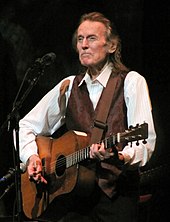
And Gordon Lightfoot has of course the right to do anything he likes with any song.  After all, if the composer of “Early Morning Rain” hasn’t earned that right, who has?  (Incidentally, Gordon Lightfoot also wrote “Rainy Day People” years after “Rainy Day Women” and I’ve often wondered why – but that’s another story).

Anyway, the starting point is so different and a different interpretation throughout.

So to the final version, and I’ve kept this to last because the opening is so odd, but also because the accompaniment is so unexpected in parts.  It just shows how much can be done with a good song.   And because I think it works – despite its complete divergence in parts from the original feeling of the song.   If you have a moment please do listen throughout.  It is worth staying with it.

Posted in Uncategorized | 3 Comments

Other people’s Songs: Gotta Travel On

By Aaron Galbraith and Tony Attwood

Aaron: This article in which we look at Bob Dylan singing songs he didn’t compose, marks the one-year anniversary since the first piece in this series!!

Tony: That first episode can still be found here, and a full list of all the episodes is given at the end.  This is number 53 in the series.

Aaron: “Gotta Travel On” was based on a fragment of an unnamed song found in the archives of the Virginia Folklore Society.  It was also titled “Done Laid Around”, though versions with that title typically use a different set of lyrics.

Tony: According to Wiki, “The earliest known version was printed in Carl Sandburg‘s The American Songbag in 1927 under the title “Yonder Comes the High Sheriff” and several variations were recorded in the 1920s.”   Not that Wiki always gets it right!

Aaron: Billy Grammar had the hit with it in 1958

Tony: This is  one of the occasions on which the version Aaron (in the USA) has forwarded to me (in the UK) doesn’t play for me, so here’s a copy I’ve found that hopefully works in parts of the world where the version above doesn’t.

Tony: It’s a jolly piece, but what really attracted my attention (beyond the drummer standing up) was the bass part.  If you missed it just listen again to what the bassist is doing – he’s having a rare old time and it really gives a buzz to what might otherwise be a not particularly memorable recording.

Aaron: The Au Go Go Singers were a nine-member folk group formed in New York City in 1964, and best remembered for featuring Stephen Stills and Richie Furay two years before they formed Buffalo Springfield.

Tony: Well, I’d never guess that Stephen Stills was on that recording, and I always loved his work – although I must admit this doesn’t do too much for me.  But Suite Judy Blue Eyes was a major influence in my very early days as a wannabe musician / songwriter.  This, I was convinced, is the way to write songs that say something, and which don’t sound like Bob Dylan.  So many layers within one song – oh I haven’t listened to it for several years, but there was a time when it was always there with me.  “Fear is the lock and laughter the key…”   Oh yes.  I tried to make that my motto in teenage years.

Aaron: Dylan’s version came from 1970s Self Portrait

Tony: My usual comment comes straight into my mind – if we are listening to a song we know well, then the new version must give us something more than we already know.  Does Bob do that?  Well, I suppose so, but I am not sure I quite get the message or that I really want to get the message.  It doesn’t deliver anything new to me – rather as if a bunch of good musicians just decided to play the piece they all knew, without bothering with too many rehearsals.  (See also the final piece in this article!)

It reminds me of the sort of thing we used to play just because we all knew it, and no one quite knew how to end it.   Indeed that ending is rather rough.   But I would really like to hear from someone who does like this and feels it adds something such that she/he would feel inclined to play it again.  It doesn’t do that to me – but then I’ve heard the song off and on all through my life, so maybe that’s the problem.   (Hell, I’m getting really crotchety in my old age).

Aaron: Neil Young & Crazy Horse recorded the track for their 2012 album Americana

Tony: This is weird – or at least that opening is weird.   Why do we have that?   It is a crude version in the sense of the percussion as a driving force – there is no sophistication there at all.   But the harmonies are really good and work very well.   Yet we have that bash bash bash percussion part all the way through.  Why is that?   And can you imagine being part of the chorus that sings the last line of each verse in perfect harmony?  It must have been hard not to leave the session thinking “what the **** was that all about?”

Especially as the piece runs to over six minutes (although it really does sound as if no one has any idea how to end it).

Hmmm.  I might have laughed too if I had been on the piano in the recording session, but then crawled under the table the moment I found that recording was being released.

But hey ho – these are fine musicians having some fun, so why not?

Previously in this series…

  1. Other people’s songs. How Dylan covers the work of other composers
  2. Other People’s songs: Bob and others perform “Froggie went a courtin”
  3. Other people’s songs: They killed him
  4. Other people’s songs: Frankie & Albert
  5. Other people’s songs: Tomorrow Night where the music is always everything
  6. Other people’s songs: from Stack a Lee to Stagger Lee and Hugh Laurie
  7. Other people’s songs: Love Henry
  8. Other people’s songs: Rank Stranger To Me
  9. Other people’s songs: Man of Constant Sorrow
  10. Other people’s songs: Satisfied Mind
  11. Other people’s songs: See that my grave is kept clean
  12. Other people’s songs: Precious moments and some extras
  13. Other people’s songs: You go to my head
  14. Other people’s songs: What’ll I do?
  15. Other people’s songs: Copper Kettle
  16. Other people’s songs: Belle Isle
  17. Other people’s songs: Fixing to Die
  18. Other people’s songs: When did you leave heaven?
  19. Other people’s songs: Sally Sue Brown
  20. Other people’s songs: Ninety miles an hour down a dead end street
  21. Other people’s songs: Step it up and Go
  22. Other people’s songs: Canadee-I-O
  23. Other people’s songs: Arthur McBride
  24. Other people’s songs: Little Sadie
  25. Other people’s songs: Blue Moon, and North London Forever
  26. Other people’s songs: Hard times come again no more
  27. Other people’s songs: You’re no good
  28. Other people’s songs: Lone Pilgrim (and more Crooked Still)
  29. Other people’s songs: Blood in my eyes
  30. Other people’s songs: I forgot more than you’ll ever know
  31.  Other people’s songs: Let’s stick (or maybe work) together.
  32. Other people’s songs: Highway 51
  33. Other people’s songs: Jim Jones
  34. Other people’s songs: Let’s stick (or maybe work) together.
  35. Other people’s songs: Jim Jones
  36. Other people’s songs: Highway 51 Blues
  37. Other people’s songs: Freight Train Blues
  38. Other People’s Songs: The Little Drummer Boy
  39. Other People’s Songs: Must be Santa
  40. Other People’s songs: The Christmas Song
  41. Other People’s songs: Corina Corina
  42. Other People’s Songs: Mr Bojangles
  43. Other People’s Songs: It hurts me too
  44. Other people’s songs: Take a message to Mary
  45. Other people’s songs: House of the Rising Sun
  46. Other people’s songs: “Days of 49”
  47. Other people’s songs: In my time of dying
  48. Other people’s songs: Pretty Peggy O
  49. Other people’s songs: Baby Let me Follow You Down
  50. Other people’s songs: Gospel Plow
  51. Other People’s Songs: Melancholy Mood
  52. Other people’s songs: The Boxer and Big Yellow Taxi
  53. Other people’s songs: Early morning rain
Posted in Uncategorized | Leave a comment

Black Rider (2020) part 2: O where are you going?


by Jochen Markhorst

II          O where are you going?

Black rider, black rider, you been living too hard
Been up all night, have to stay on your guard
The path that you’re walking on, too narrow to walk
Every step of the way, another stumbling block
The road that you’re on, (the) same road that you know
Just not the same as it was a minute ago

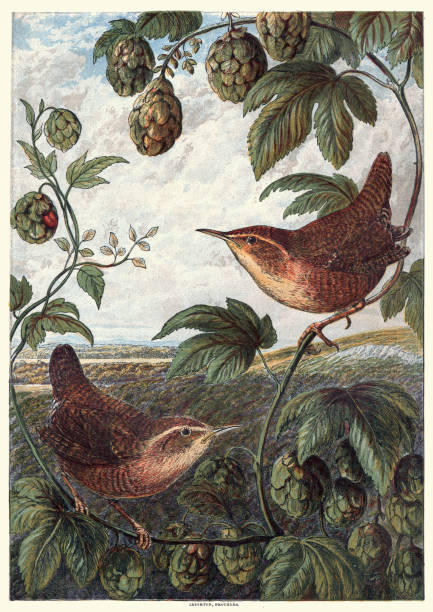
Vintage engraving of a pair of wrens, 1870


Unconventional the song certainly is. On all fronts, in fact. That goes for the opening words already, the opening line with its unusual metre. Black RIder, black RIder, you been LIving too HARD – twice an amphibrachys, twice an anapest.

In which, as so often with Dylan, the formatting of the official publication (on the site) differs from the recitation; the stanzas are published on the site as six lines. Presumably dictated by the rhyme, which thus appears aabbcc. However, the recitation is different – Dylan rather clearly sings 12 lines:

Black rider, black rider, 
You been living too hard
Been up all night, 
Have to stay on your guard
The path that you’re on walking, 
Too narrow to walk
Ev'ry step of the way, 
Another stumbling block
The road that you’re on, 
(the) Same road that you know
Just not the same as it was
A minute ago

Small textual differences between the official release and the studio recording illustrate that Dylan the Singer is guided by metre. The site says, for example, The path that you’re on. In the studio, Dylan sings The path that you’re walking. As he also sings it at the first live performance, Milwaukee 2 November 2021, and as he still sings it 104 concert performances later, April 2023 in Japan. Prompted by an apparent need to preserve the short-long-short, these dual amphibrachys; The PATH that / you’re WALking.

It is, oddly enough, a completely unusual metre. Strange, because it has an elegant, attractive rhythm that naturally imparts a waltzy cadence to the words. But in the canon, we really only know it from Leonard Cohen’s “Famous Blue Raincoat”;

It’s four in the morning, the end of December, 
I’m writing you now just to see if you’re better


… which, given the song’s classic status, might have been a template. If Dylan applied his famous “Bob Nolan method”, as he explained to journalist Robert Hilburn, in a 1984 interview for the L.A. Times:

“What happens is, I’ll take a song I know and simply start playing it in my head. […] I’ll be playing Bob Nolan’s Tumbling Tumbleweeds, for instance, in my head constantly — while I’m driving a car or talking to a person or sitting around or whatever. […] I’m listening to the song in my head. At a certain point, some of the words will change and I’ll start writing a song.”

And this time, instead of “Tumbling Tumbleweed”, it might have been the monumental “Famous Blue Raincoat”. Possible, though not too likely. Content-wise, there is one thin overlap passage (Dylan’s Go home to your wife, stop visiting mine from the third stanza), and thematically, “Black Rider” has hardly any common ground with Cohen’s chilling, moving adultery ballad either. More attractive candidates can be found on Dylan’s poetry shelf. William Blake is a regular guest in Dylan’s oeuvre anyway, since the 1960s in fact, and resorts to the amphibrachys often enough. In Songs Of Experience (1789), for instance, the collection Dylan explicitly names as an inspiration in the opening track of Rough And Rowdy Ways, in “I Contain Multitudes”:

I sing the songs of experience like William Blake
I have no apologies to make
Everything’s flowin’ all at the same time
I live on the boulevard of crime
I drive fast cars and I eat fast foods . . . I contain multitudes

Somewhere halfway through Songs Of Experience we find the beautiful “The Garden Of Love”, which will also appeal to Dylan in terms of content; it is one of Blake’s both religious and sensual attacks on the rigidity of organised religion, on the church that is. Very musically contained in amphibrachs;

I went to the Garden of Love,
And saw what I never had seen:
A Chapel was built in the midst,
Where I used to play on the green.

Graceful and dashing, but again an unlikely candidate for the template, for the song in Dylan’s head where “some of the words will change and I’ll start writing a song.” Another regular guest in Dylan’s discography is then a more likely “Bob Nolan on duty”: W.H. Auden. And then one of his all-time greatest, “O Where Are You Going?” (1932);

“O where are you going?” said reader to rider,
“That valley is fatal where furnaces burn,
Yonder's the midden whose odours will madden,
That gap is the grave where the tall return.”

…Auden’s breathtaking, near-perfect ballad with the same theme, choice of words and subcutaneous suspense as Dylan’s “Black Rider”. And quite conceivable it is, the step an in-his-head-reciting Dylan can take from “O where are you going?” said reader to rider to the man who seems to be on a quest as well, to Black rider, black rider, you been living too hard. For which Auden in turn, very Dylanesque, also had a template. A folk song even, to complete the circle; the eighteenth-century “The Cutty Wren”, with its opening lines

“O where are you going?” said Milder to Maulder
“O we may not tell you,” said Festle to Foes
“We're off to the woods,” said John the Red Nose

Popular in English folk circles, so many artists have the song in their repertoire, but its sinister undercurrent is nowhere more hauntingly captured than by Steeleye Span on 1996’s relaunch album Time.


Maulder, Festle and John the Red Nose, Auden’s rider, Blake’s love seeker and the man bereft of his blue mackintosh… all men on a quest. Just like the Black Rider. But o, where is he going?


To be continued. Next up Black Rider part 3: A Chance Is Gonna Come


Jochen is a regular reviewer of Dylan’s work on Untold. His books, in English, Dutch and German, are available via Amazon both in paperback and on Kindle:


Posted in Uncategorized | Leave a comment

Dylan: the lyrics and the music. It ain’t me babe

By Tony Attwood

“It ain’t me babe” is a complicated song to write about from the musical point of view because Dylan himself has changed the chordal accompaniment to the song in various performances, and so have those who have issued cover versions.

But if we go back to the start, and the original album version, the song has a feel of tentativeness, uncertainty, and apology, all brought about through the music because at the start we are not clear what key we are in.  In terms of the chords, if you want more on this there is of course Dylanchords).

The opening chords are D and C, (although the D chord sounds to me incomplete) and this alternation of the chords along with the way the D chord is played, gives a sense of uncertainty which contradicts the forthrightness of the opening line…

Go away from my windowLeave at your own chosen speedI'm not the one you want, babeI'm not the one you need

It is a push out the door – but not a violent push, more a gentle edging outwards.  And as the lyrics say, it is presented as being in the lady’s best interests: “I’m not the one you need”.

For me this opening is a perfect example of how Bob Dylan can get the music and the lyrics to operate as one.  The gentleness of the persuasion and the feeling of issues unresolved in the music, since we have not heard the key-chord until the word “speed”.

Thus the music edges the lady along, across those first four lines, with just a touch of the tonic – the chord that is at the base of the music.

And just to make the point of the uncertainty Dylan moves 0nwards immediately taking us to the chord of B minor 7 – a chord of uncertainty – followed by A minor 7 (ditto)… and then the song rocks back and forth between the following lines until we get to the dominant chord of D at “each and every door”.   That is the resolution of what she wants, and the music finally “agreeing” (as it were) that this is where everything is building to…

And then bang, we are with the tonic chord of G around which everything else circles – the minor chords have gone and as the words become more strident (as in “No, no, no…”) we are hearing the three major chords of songs in G (G, C, D). You can’t get more forceful than that.

Now my point here is not that Dylan thought this through – I am not suggesting he said to himself, “Hmmm I am going to be more strident in the chorus in saying ‘No no no’ so I need chords that reflect that.”   Of course not.

What I am saying is that this happened just naturally as part of the composition, as it would for any talented and experienced song writer.   It is quite possible that as he first sketched out the idea of the song Dylan started with the “It ain’t me babe” line, and then built the verse around it later, but there is no doubt that this title line needs strength in the music.

The major chords of G C and D give us that strength, but just playing the chorus straight out wouldn’t make us feel the strength.   It is by having the rotating D and C chords at the start that we get the feeling of gentleness with which the “It ain’t me” line can contrast.

This is, I am sure, a highly talented instinctive songwriter simply coming out with the lyrics and the music, knowing as he plays the guitar in readiness for this song for the first time, that this contrast is what is needed.   And it happens in a way that just feels natural to us, because the minor chords (associated with unhappiness and uncertainty) contrast so clearly with the major chords of the chorus.

Then add in the fact that “No no no” naturally descends, indicating the end of the affair, and you have the whole picture.

Instinctive writing, I suspect it was.  But also instinctively right.  Music and lyrics at one.


Posted in Uncategorized | 1 Comment

The Juke Box

By Larry Fyffe

Reverend Dylan simply would not be an ordained vicar were most of his music unaccompanied by words.

He wouldn’t have been able to marry literature and popular music.

There are still a number of analysts who promote the very dubious claim that singer/songwriter/musician Bob Dylan constructs lyrics to reinforce the feeling that accompanies the ‘meaning’ of a song that’s already been encoded therein by his choice of music.

When, of course, word-sounds are written down as to what their literal and figurative meaning(s) are –  defined in dictionaries; musical notes not so encumbered.

Lyrics and then the music may be created, or vice versa, maybe both together,  but the end product, how the lyrics and music mesh together, is what counts.

Words and sentences can be chosen by an author because of their bare sound, but they are still clothed in meaning ~ meaning that can even be turned upside down when spoken or sung in an ironic tone of voice.

Pre-surrealist poet Rimbaud, for instance, can play with sounds and tropes including assonance, and consonance all he wants while insisting on creating without emotional attachment “art for art’s sake”.

But to some degree or another, the inherent structure of a language, and the meaning(s) attached to its words, demand attention be paid.

Likewise, the innovative Baroque musician Jean-Phillippe Rameau had to contend with the accepted structure of classical instrumental music at that particular time in history ~ though it be not possible to deal with the music in the same manner as with a broadly spoken and/or written language.

For sure, Bob Dylan demonstrates more than once that he is aware of poets like Edgar Poe, Paul Verlaine, and Arthur Rimbaud; symbolist writers who are not musicians, but who focus nevertheless on the pleasing and unpleasant effects of sounds that can be produced through the uttering of words and phrases:

Relationships have all been bad
Mine's been like Verlaine's and Rimbaud
(Bob Dylan: You're Gonna Make Me Lonesome When You Go)

Novelists too:

There was music from my neighbour's house
through the summer nights
(F. Scott Fitzgerald: The Great Gatsby, chap.3)

Echoed, albeit more specifically, beneath:

I'm walking through that summer night
The juke box playing low
(Bob Dylan: Standing In The Doorway)

Posted in Uncategorized | Leave a comment

Bob Dylan’s favourite songs No 10: “If you could read my mind”. Don’t dig too far.

By Aaron Galbraith and Tony Attwood

Prelude from Tony: I took on this series following a suggestion by Aaron (with whom I’ve written a number of earlier series, Aaron himself providing the research and background, myself filling in some detail and personal opinion).   And I love doing this because with Aaron choosing the songs, it takes me into all sorts of areas that I have never really contemplated and music I didn’t know.

For example, I had never heard “Lawyers, Guns and Money” before it turned up in this series, and it is still getting a regular playing in my house, both in terms of listening to the original and the various cover versions.   (Which makes me think there might be a series to be had out of “Cover versions of Dylan’s favourite songs” although that I rather suspect is going one step too far.)

But back to the here and now, and we are now at song number 10 in the list Bob provided for “Far Out” magazine of his favourite songs.  In fact Bob only nominated four performer / songwriters within his list of favourite songs: Gordon Lighfoot, Warren Zevon, Randy Newman and John Prine.  And today for episode 11 we are back Gordon Lightfoot for his third and final contribution.

There’s a full list of the episodes in this series as usual at the foot of the article, but in case you want a bit of background first, the three Gordon Lightfoot nominated songs were Shadows, ‘Sundown’, and now here we have, ‘If You Could Read My Mind’.

Now the song in question.

And if you have been following this little series, or if you are conversant with Gordon Lightfoot’s extraordinary ability as a songwriter, you’ll know where we are going with this song, even if you have never heard it before (which seems unlikely).

It is another utterly extraordinary piece – something many people feel from the moment the original recording starts alternating just two chords with an utterly magical melody above it, and lyrics that must dig into the heart of anyone with any sort of feelings and uncertainties within her or his life.

The song is a look back to Lightfoot’s thoughts on his divorce with a combination of extraordinary honesty and extraordinary poetic delicacy about what has happened – and all the time there is that amazing melody circling around and around.

So thus we have it – extraordinarily beautiful melody, unusual chord changes which use perfectly usual chords but in a different way, and such poignant lyrics.  Just consider

In a castle dark or a fortress strong
With chains upon my feet
You know that ghost is me
And I will never be set free
As long as I am a ghost, you can't see

As a person who has been divorced twice, and lost multiple other relationships, these words pierce my heart – and I suppose this is the point of such amazing songwriting.  If one has been there, a song like this says everything.  And if you are lucky, and have loved and stayed in love through your life then there is still the melody – and the knowledge of how lucky you are.  If not, the lyrics are there if you fancy having a few extra nails hammered into your emotional backdrop.

When you reach the part where the heartaches come
The hero would be me
But heroes often fail
And you won't read that book again
Because the ending's just too hard to take

But in fact we don’t have to go that far or that deep.  Just the opening lines, which with a less moving melody might sound trite, now sound utterly extraordinary…

If you could read my mind, love
What a tale my thoughts could tell

I’m putting another video below – a video that is not only of interest because it is about Gordon Lightfoot, but it is particularly interesting as it includes a number of comments about Bob Dylan talking about Gordon Lightfoot.  It then gets into the technicalities of how the song is written which are I guess primarily added for musicians and particularly for up-and-coming songwriters who want to have an answer to “what did he do there to get that sound?” but still, the opening I think will be of interest to most people.

And I sympathise with the problems those involved in the “What makes this song great” video have, for trying to make this interesting to everyone else is tough going.  And indeed I know this myself for just recently Jochen Markhorst (whose writing you will of course know if you are a regular reader on this site) asked me to help a little in considering how 5/4 time was used by Nick Drake in the recording of that most amazing piece of music “River Man”.   I did write out my thoughts on how Drake used that most unusual time structure, and gave the notes to Jochen.

By coincidence just yesterday I started to read Jochen’s book “Nick Drake’s River Man: A very British masterpiece”, and (literally) fell off my chair when I found myself reading my two page explanation of what Drake did with the 5/4 time signature that was not just so unusual but as far as I know unique.

So I know from recent experience just how hard it is to explain how a piece of music is written, and re-reading my commentary just yesterday how difficult it is to explain the clever twists and turns genius composers come up with, in a way that might be interesting to the non-musical reader.  Jochen’s book incidentally is available here – if you know River Man you really must read it – not in any way for my small part in the affair, but because it really does help us all consider that work of utter genius.

But enough of that, back to the plot.  To me, the “What makes this song great” explanation of “If you could read my mind” on the video below is so detailed that I think it loses the sense of creativity that comes with the writing.  And not because the speaker doesn’t know his stuff – he most certainly does.  It is just incredibly hard to do, as I found out with my explanation of how 5/4 time is used in “River Man.”

I don’t know how Lightfoot added all those twists and turns to the accompaniment that the commentator goes into in such detail in the video below, but from the songwriters I have chatted to, I know that often it is by chance – it just comes along suddenly and one thinks “yes that’s it”, and “that’s what I need there.”   (I don’t think that applies to River Man, because that is a song on another planet, but it applies here and this is a song of genius).

This video is by Rick Beato, music producer.

So back with the main theme – “If you could read my mind” – we have a wonderful, wonderful song, with every element being perfect, and in the video above every element being reduced down to its individual sub-atomic particles.   I am not sure I want to go that far – but if you do, there it is.

In the case of Lightfoot, for me, just hearing it and knowing it is about his divorce is enough.

Overall, “What makes this song great” is an interesting approach, but to me it loses the creativity and suggests that we could all be great songwriters if we pinched some of these techniques.  No, “If you could read my mind” is great because it has a beautiful melody, powerful and painful lyrics, and gently different chords.

“River Man” was different – it goes beyond greatness onto another planet, and hence breaking it down somewhat helps if one wants to know how the previously unheard and unconsidered effects within the song were achieved.   With “If you could read my mind” a simpler explanation will suffice.  Gorgeous melody, somewhat unusual chords in passing, a painful theme but with the thought of survival, and the unique notion of a songwriter writing to his ex about their actual real-life divorce.  It is a wonderful, wonderful song.  Painful but wonderful.

Digging into what makes a song work can be helpful – but is certainly not always necessary.  Sometimes yes, but not always.

Posted in Uncategorized | 2 Comments

The Never Ending Tour – the absolute highlights: It’s all over now baby blue

By Tony Attwood, based on the research by  Mike Johnson (Kiwipoet) for the Never Ending Tour series on this site.  Links to previous articles in the “Absolute Highlights” series are given at the end.

Dylan was trying out this new arrangement of Baby Blue all through 1994, resulting in a series of different performances with differences of emphais.   And before anyone asks, we don’t have the date or location of this particularly slow version, with its own different balance.  Just the year.

This song is one that has always seemed to me much sadder than the music of the original recording portrayed, and here in this recording we can get a much deeper insight into what other emotions and feeling – and indeed background – lie within the song which are not revealed in the LP recording.

Because Dylan was changing the arrangements as he moved through the tour, we don’t (in my opinion) get a version in which Bob is fully certain where he is taking each and every line, but the overall effect most certainly tells us the direction he is going in and the type of feeling he wishes to portray.

And what we now have in bucketfuls is the desperate sense of loss –  it is all over and there is a sense of total desperation here, which the two harmonica solos each just one verse apart deliver very clearly.

I very much get a sense that this version had only had one or two rehearsal run-throughs before they ventured into it on stage, so we are getting a raw re-working here with Bob interested in seeing just how far the sadness of the song could be pushed.

The quiet opening of Dylan playing the guitar is followed with the lines we all know but with a slightly different rhythm both in the guitar and the vocals.   It is the sort of thing that we only notice now because we know the song so well.  Different words are emphasised occasional lyrics are changed.   “Now” the sky is folding over you.  Previously in the published lyrics it was folding under you.   One word, but it means everything.

As a result of these changes to the music, the lyrics take on a completely different meaning.  Before

The lover who just walked out your door
Has taken all his blankets from the floor

was just a hippy friend who had been dossing down in the room who has moved on.  Now there is something far more desperate going on.  Before everyone assumes you can just move on and everything will be ok.  Now all that certainty has gone.

And as for the final verse – I am not sure I have heard Bob more desperate in his singing than we get here.  Nor much more plaintive on the harmonica.  “Strike another match, go start anew” is not a case of venturing out to find others to play with, others to be with, others to talk to, it is a case of leaving everything behind without any certainty that the next stop will actually be ok.   And that final repeated and repeated and repeated single phrase on the harmonica is painful beyond belief.

This really is not a case of moving on, because that is what people do, this is a case of the entire world breaking up.   So “it’s all over now”, now means everything is falling apart.   Absolutely everything.  The masters of war have, it turns out, won.

After listening to this recording three or four times as I write this, I found it almost impossible to listen to the original album version.  It just seems so out of place.  Far too jaunty, far too accepting.   I’m almost thinking, “how can this be?”  How can he sing this with all this pain going on around him?

But of course in the original there was no pain.   It really was a case of just moving on, because that’s what we do.

Previously on “The Never Ending Tour, the absolute highlights…”

Posted in Uncategorized | 3 Comments

Black Rider (2020) part 1: He must keep himself clean in speech

Black Rider (2020) part 1

by Jochen Markhorst

I           He must keep himself clean in speech

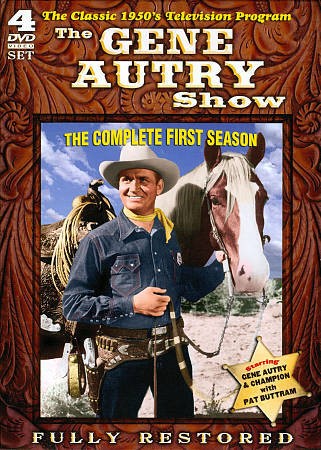
On 23 July 1950, when CBS airs the first of 91 episodes of The Gene Autry Show, Robert “Bobby” Zimmerman is nine years old – at an age, that is, that makes him extremely susceptible to the one-dimensionality, simplism and morality of “America’s Favorite Cowboy”. The episodes last half an hour, and in that half hour, Gene has an adventure, usually one in which he catches a mean crook, sings a song, and lives his insufferably righteous Cowboy Code. “The cowboy must always tell the truth”, “must help people in distress”, and “must never go back on his word, or a trust confided in him”… all ten commandments of the Cowboy Code are recited with apparent approval by DJ Dylan in 2006 in “Guns”, episode 25 of his Theme Time Radio Hour (“And I’m not ashamed to say that I live my life according to that code”).

The 91 episodes have, even by 1950s standards, an awkwardly naive Boy Scout tone, the acting is tear-jerkingly bad, the scripts and dialogues don’t rise above the level of a primary school musical, and the humour component provided by side-kick Pat Buttram is kindergarten-level (Pat stumbles, drum rolls; it doesn’t get much more sophisticated), but: the series runs for five seasons, is a success and anchors the reputation of the already immensely popular Singing Cowboy Gene Autry – especially with impressionable nine-year-old Bobby Zimmerman.

The series is now being shown again on Amazon Prime, the DVD box sets are still selling – apart from a certain cult status, Gene Autry also has a reassuring, nostalgic quality for surviving members of the Silent Generation and for Baby Boomers like Dylan. And one of the most popular episodes seems to be: “The Black Rider” season 1, episode 14.

In terms of content, there is no overlap with Dylan’s song. The serial-killing black rider is the avenging sister (Sheila Ryan) of executed murderer Rocky Dexter, who checks off the list of men she believes are responsible for her brother’s death. This black rider is a cold-hearted sadist, who smilingly shoots law enforcement officers through the heart from close range and shows no remorse when she is eventually caught by Autry. Little common ground, in short, with Dylan’s Black Rider.

But an educated guess is that Autry has thereby inserted the timeless, irresistibly fascinating and (apart from Zorro) always sinister image of “the black rider” into Dylan’s cultural baggage. And lasting respect for Autry himself, presumably. At least, we can hear Autry traces throughout Dylan’s oeuvre from the 1960s (Autry’s “The Rheumatism Blues” seems to be the court supplier for “Rainy Day Women #12 & 35”) into the twenty-first century (Dylan’s Autry cover “Here Comes Santa Claus” opens Christmas In The Heart, for instance).


After that first, crushing encounter with a Black Rider (who turns out to be a badass fatal woman in the process), the then nine-year-old Dylan, like all of us, will be confronted with dozens of Black Riders, which only carves the image deeper into our cultural baggage. We meet them in the Bible, countless Westerns, songs, tales of knights and romances of chivalry, fantasy films… though each new generation gets its own archetypal Bad Man or Evil Force, every generation gets a Black Rider. The millennials are to be envied. Their image of a Black Rider is the scariest of them all: the Nazgûl, the Ring Spirits, the Black Riders from Lord Of The Rings (in Peter Jackson’s 2001 film adaptation), responsible for an entire generation’s first experience with a blood-curdling movie scene – when Frodo and his fellow hobbits get off the path just in time and hide under a tree stump;

“The hoofs drew nearer. They had no time to find any hiding-place better than the general darkness under the trees; Sam and Pippin crouched behind a large tree-bole, while Frodo crept back a few yards towards the lane. […] The black shadow stood close to the point where they had left the path, and it swayed from side to side. Frodo thought he heard the sound of snuffling. The shadow bent to the ground, and then began to crawl towards him.”
(J.R.R. Tolkien, The Fellowship of the Ring, 1954)

And as well as generationally, the archetype is transcending cross-culturally too; every nation, in all times, has at least one dark horseman in its canon. The German Kriegskindergeneration (the generation of war children) presumably thinks of John Wayne, because he made such an impression in Der schwarze Reiter (English title “Angel and the Badman”, 1947) as a notorious-gunman-who-repents, while the French contemporaries, on the other hand, will think of Le Cavalier Noir with a wistful smile, Russians see the Devil, Generation X sees Monty Python’s Black Knight looming, Spaniards might think of the Jinetes Negros, Charles V’s dreaded 16th-century elite corps, and as a nickname for smugglers, we have known Black Riders all over the world.

Dylan’s Black Rider, however, has none of these unambiguous identities – or perhaps just a little of everything indeed. The protagonist has a somewhat duplicitous relationship with this Black Rider; his dramatic monologue expresses both hatred and compassion, both admiration and disgust, and both submission and superiority. In any case, this Black Rider does not seem overly sympathetic. Nor does the protagonist, for that matter, who does not seem to live by the Cowboy Code either.

In more ways. But at the very least, in the last verse, the verse with the bizarre line The size of your cock won’t get you nowhere, he unceremoniously does violate the eighth commandment: “He must keep himself clean in thought, speech, action, and personal habits.”

https://youtu.be/6S3I4EAwtpU

To be continued. Next up Black Rider part 2: O where are you going?


Jochen is a regular reviewer of Dylan’s work on Untold. His books, in English, Dutch and German, are available via Amazon both in paperback and on Kindle:


Posted in Uncategorized | 5 Comments

A Dylan Cover a Day: Restless Farewell. Exquisite arrangements, unbelievable power
by Tony Attwood

An unusual – perhaps unique – episode of this long running series which originated from a time when lock down ruled my part of England and I was spending day after day on my own, and really was writing an article every day in the series.

And I’ve always known that we would eventually get to this song, and that I would have to break my own rules by including a version of the song in which Dylan covers his own work, and at the same time refer back to the music that existed before Dylan’s composition.

But let us leave that for a moment.   First Mark Knopfler, who opens with instrumentation that makes it sound like a Scottish folk song.  And which is quite reasonable since the melody, as we all know, is based around the traditional folk song “The Parting Glass”.

Mark Knopfler shows a real understanding and grasp of what he is singing.  Indeed I find this an utterly exquisite rendition, wherein the beauty is reflected both in the singing and the orchestration.  Nothing is forced – his voice flows naturally through the whole song, every verse offers a new insight.    One can focus on any little phrase one chooses, such as “no special friend” and there is emotion and feeling pouring out from those individual words.

Indeed even oft-used devices such as taking the orchestration completely back to basics for the final verse, works perfectly.  As does the decision not to round off the song by ending on the tonic chord (the foundation of the key that the piece is in, which is what normally happens).

So changing direction…. and you may not know the Singing Loins – a band from the Medway, part of south east England, just south of London, which developed its own style of music.  Sadly the extraordinary vocalist of the band, Chris Broderick, passed away from cancer in January 2022, and I’m really pleased to be able to include a recording on this site of him in full flow.

His vocals bring a completely different dimension to this song, and listening to this version today I can imagine that this was how it was meant to be – although of course I know that is not the case.  But this version does show just how flexible Bob’s songs can be (although of course there is a case here for saying “just how flexible traditional English folk songs can be”).  Even if you are taken aback by the way the song is redeveloped I do hope you’ll hear it through.

Moving back to the origins of the song – and I will spend a moment with the actual origins at the end of the Dylan-related recordings – this next recording which was released as part of the tribute to Bob on his 60th birthday, merges the original and his re-writing of the piece.   The accompaniment is exquisitely simple with just the single violin and the guitar.  Exactly the opposite of the version above, but for me each one adds something to my understanding, and my enjoyment.

It is of course also a song that would appeal to Joan Baez and she handles it most delicately, and I do like the way the arranger reworks the piece for her – although after a while it does start to sound a little forced.

What happens is this: the opening part of each verse is in the standard 4/4 rhythm of four beats in a bar, and then it suddenly moves (as other instruments join in) to 6/8 in which we get 1 2 3 4 5 6 with the accents on the first and fourth beat of each bar.

This alternation of the two rhythms is something that I can’t recall from any other performance of any other song.  In a sense it is a little artificial, but it really does make one think again about the lyrics.

There is also the unexpected cadence at the end of each verse – technically it is an interrupted cadence – wherein the chords don’t go where we might expect.

In short this is, musically a complete re-working of Dylan’s original piece.

Moving on to Bob himself (and I know that’s not really allowed because this is a series about cover versions), I can’t leave out the performance by Dylan for Frank Sinatra, who apparently specifically requested this song.

I also featured this recording in the Dylan Obscuranti series in which we created an album of obscure Dylan performances that a record company could pick up and release.  Curiously they never did – or maybe Bob vetoed it.  (The full set of tracks with links is given here).

I’ve noted this version so often here I can’t say any more, and it is after all not really a cover in the normal sense, but still if you have never heard it or not heard it for a long time, do have a listen.  Dylan covering Dylan.

So there we are – four actual covers, and a reworking of the song by Bob himself.  And yet I am still not finished.   For here is an utterly overwhelming and stunning arrangement of the original.   And I really would beg you, if you have never heard this before, to listen now.  Block out the modern world totally, and accept this for what it is.  A beautiful piece of music.

Posted in Uncategorized | Leave a comment

The Tarantula Files: Maldoror and The Good World

by Larry Fyffe

Maldoror

The exciting adventures of the Tarantula Tales continue:

(Y)ou look like james arness? - i am writing
to you to say that you are my son's idol
(Bob Dylan: Tarantula)

Auto/biographical in that singer/songwriter/musician Bob Dylan is said by a number of “Dylanologists” to take his “stage name” from Marshal Matt Dillon of Dodge City, Kansas.

Played on TV’s “Gunsmoke” by James Arness.

Poet Dylan Thomas, a more likely candidate as indicated in the following song lyrics:

The cloak and dagger dangles
Madams light the candles
(Bob Dylan: Love Minus Zero)


Words  that remind of those below:

(T)he goat and daisy dingles
Nap happy and lazy
(Dylan Thomas: Under The Milk Wood)

Another literary source is indicated beneath, a clear one this time:

& Lord Randall  playing with a quart of beer
(Bob Dylan: Tarantula)

Reflected in the following song lyrics:

Oh where have you been, my blue-eyed son
Oh where have you been, my darling young one
(Bob Dylan: A Hard Rain's A-Gonna Fall)

As in:

Oh where have ye been, Lord Randall, my son
Oh where have ye been, my handsome young man
(Lord Randall ~ traditional)

There be outlaws, gun-slinging cowboys, bank and train robbers, all from the Old American West,  positioned here, there, and everywhere.

A member of the James /Younger Gang, a former Confederate guerrilla, then a bank robber, later a Christian:

"(I)'m cole younger, gave my horse to the pony express
- other'n than that, i'm just like you"
(Bob Dylan: Tarantula)

The symbolic Tarantula, for the prose/poet below anyway, is not at all sympathetic to any claim that there’s a brighter world to come, where everyone’s equal; rather eternally surrounded we all are by a vampiric nightmare:

Night was beginning to spread over nature
The blackness of her veil
(Lucien Ducasse: The Songs Of Maldoror ~ translated)

John Keats no longer accused of being a nightingale too happy in its happiness:

Well, my sense of humanity has gone down the drain
Behind every beautiful thing, there's some kind of pain
... I just don't see why I should even care
It's not dark yet, but it's getting there
(Bob Dylan: Not Dark Yet)


The Good World

& he's eating a picture of jean paul belmondo
(Bob Dylan: Tarantula)

In a neoNoir movie, Jean-Paul Belmondo, a handsome French actor plays a small-time hood who’s searching for the good life.

The Existentialist-oriented film is titled “Breathless”, a ‘New Wave’ film that features “jump cuts”, and ambiguous dialogue.

In the movie, the fleeing anti-hero shoots a policeman; he ends up betrayed by his American girlfriend, and is shot to death.

In the song lyrics below, albeit at a slower pace of breathing than before, the Poe-like narrator manages to retain a living breath ~ at least for the time being:

Forgetful heart
We loved with all the love that life can give
What can I say
Without you it's so hard to live
Can't take much more
Why can't we love like we did before
(Bob Dylan: Forgetful Heart ~ Dylan/Hunter)

As previously noted, Euro-centric ‘Dylanologists’ tend to forget, or else ignore, the strong influence that the Gothic writings of Edgar Allen Poe have on many of the song lyrics written (some assisted) by Bob Dylan.

Words count:

But we loved with a love that was more than love
I and my Annabel Lee ...
And so all the night-tide, I Iie down by her side
Of my darling - my darling - my life and my bride
In her sepulchre there by the sea
(Edgar Poe: Annabel Lee)

Annabel’s “highborn kinsmen” take her body away.

Now-a-days, asserted it is by a number of doomsday writers, official bureaucracies control most everyone’s life, their dreams, and even their deaths:

(W)here the bureaucrats
- the dreamy Huxley hanger oners
(Bob Dylan: Tarantula)

These bureaucrats, warns Britisher Aldous Huxley (in “Brave New World”), are always getting new and more efficient means to maintain social control:

Oh wonder
How many goodly creatures are there here
How beauteous mankind is
O brave new world
(William Shakespeare: The Tempest, Act V, sc. i)

Those means of control can include musicians, and songsters to entertain; and   drugs to placate:

The watchman he lay dreaming
As the ballroom dancers twirled
He dreamed the Titanic was sinking
Into the underworld
(Bob Dylan: Tempest)

Posted in Uncategorized | Leave a comment

Dylan: the music and the lyrics: Sign on the window

by Tony Attwood

This series tries to look at Dylan’s songs from the point of view of the music and the lyrics in equal measure, rather than (as seems to me to be the normal approach in literature about Dylan) focussing primarily on the lyrics, and if considering the music at all, considering it as an afterthought.

And in returning to “Sign on the window” something like eight years after I first wrote a review of the song for this site, and now looking to consider the music and the lyrics as equal partners in the song, I find “Sign on the window” a most curious case in many ways.

One point is that I think Dylan got the accompaniment wrong in his recording of the song, and another is that I think everyone else has got their arrangements wrong too.  So if you want a piece of arrogant writing – here it is, for I am arguing “I am right and they are all wrong.”  So if you feel that no one has the right to criticise Dylan’s work in this way, this article may not be for you.

But maybe Bob also has his concerns about this piece.   After all it is a delicate and beautiful piece that deserves a wide audience – and it got it in “Girl from the north country” and indeed even in that show, there was a feeling that much of Dylan’s original musical creation needed to be kept.  And those guys know a thing or two about music.   So maybe this is just me…

But I’ll keep going, and if you are still with me, let me try and illustrate, using the original album version.

The opening line is delicately performed.  The singing is restrained, the piano is merely the chordal accompaniment – and a simple chordal accompaniment at that – with a wonderfully extended pause after the first line.   This continues into the second line, but then incomprehensibly the piano plays multiple repeats of one note after the word “allowed”.

OK that is not right for the mood of the piece, but it is not too bad.  But the we get it again after the next line.  OK after that thankfully it is gone – and we get the band coming in and playing in sympathy with the sadness of the lyrics, but there are still those moments of repeated notes.

And I keep wanting to know why?   Was Bob trying to express what was wrong with his feelings – that agony was pounding away in his head?   Or did he just not like the drift into silence at that point?

But still worse is to come.   For after that there is the middle 8 – in which extraordinarily he changes key – which hardly ever, ever happens in a Dylan song, and from a musical point of view is absolutely not needed here.  The song is written in F# (F sharp) which as the Dylan Chords site says is “possibly the worst conceivable guitar key”.  And I suspect every amateur guitarist would agree.   However, it is not that awful for a pianist – one ends up mostly playing the black notes and I take it this is Dylan at the piano.

But then suddenly the music in the “middle 8” (the section starting “Looks like nothing but rain”, jumps to B flat which is musically as far removed from F sharp as it is possible to imagine – and then keeps meandering around.

I wonder if Bob was thinking he could express the distress shown in the lyrics, within the music as well, by using these chords which really make no musical sense?  Maybe that’s it, because I can’t think of any other reason for doing what he did to this most beautiful piece of music (up to the point of the middle 8 at least).

What actually happens through those repeated notes and the sudden jerk into a new unrelated key for the middle 8 is that we get a deep sense of unease about the whole thing he is singing about.   And (and I know, here I am criticising the greatest songwriter of our time) I think he is trying too hard.  It really doesn’t work.   The lyrics are simple, poignant and heart-wrenching,

Sign on the window says “Lonely”
Sign on the door said “No Company Allowed”
Sign on the street says “Y’ Don’t Own Me”
Sign on the porch says “Three’s A Crowd”

and the melody fits perfectly, but expressing the anguish through repeated piano notes and sudden jerks of the key into something else really isn’t right.  Yes the heart may be hurting and pounding, but that is not best represented by this in the music.

I think it is possible to understand what Bob was wanting to do – expressing the pain and anguish in his heart through the music, but in doing that he makes the song much harder to appreciate.

Of course, at this point, I am on my own.  “Girl from the north country” used it as Dylan wrote it and the handful of cover versions have done so as well, but if you can imagine the song without the repeated notes and without the sudden jerk into another dimension for “Looks like nothing but rain” you get a wonderful expression of the sadness and pain of lost love without all these artificial musical constructs which in my view are absolutely not needed.

And surely it would make more sense not to have them in the song, for the song ends with a portrayal of idyllic country living.

The Wiki review of the piece says, “”Sign on the Window” expands on the joyous sentiments found in “New Morning”, applying it to domestic bliss.”   But Wiki reviews of Dylan by and large don’t comment much on the music – which is I guess why they leave it at that.   However for me, what the music in that “Looks like nothing but rain” section has to do with anything else in the song, I’ve no idea.

Reports from the time suggest that every song was recorded multiple times with Dylan changing his mind incessantly.  My guess would be that key change section from this song was one of those sudden mind changes.  And my guess as to why he has never performed the song live is exactly because of this.  It seemed like a good idea at the time.  But really it wasn’t.

And that’s also why so few people cover the song.   Without the “nothing but rain” part and those repeated piano notes, it would be so beautiful.  But with them….

Posted in Uncategorized | 9 Comments

Standing In The Doorway (1997) part 2 All these songs are connected


Standing In The Doorway (1997) part 2 (final)

by Jochen Markhorst

II          All these songs are connected

“I had to scramble around to find the right types of lyrics and basically moved lyrics around and put together the puzzle.” Dylan gives three interviews in the week of 21 September 1997, all in an ocean-view hotel suite in Santa Monica, to John Pareles, Edna Gundersen and David Gates respectively. The above quote is from the interview with Gundersen and relates to “Highlands” – but, as we have seen especially thanks to the outtakes on Tell-Tale Signs, is equally applicable to more songs from Time Out Of Mind.

Certainly to “Standing In The Doorway” too; of the 357 words, 83 were first in the outtake “Dreamin’ Of You”; about a quarter of them, therefore, fall into the category,“I basically moved lyrics around and put together the puzzle”. And most of them are the “right type of lyrics” anyway, lyrics that Dylan found elsewhere, “by scrambling around”. Without being too secretive about it by the way; like the insertion of a well-known line like I’ll eat when I’m hungry, drink when I’m dry from the well-known “Moonshiner Blues”, for example. After all, most people who buy Time Out Of Mind have been singing those words for decades, at the latest since the success of The Bootleg Series 1, which features Dylan’s recording of it from the early 60s.

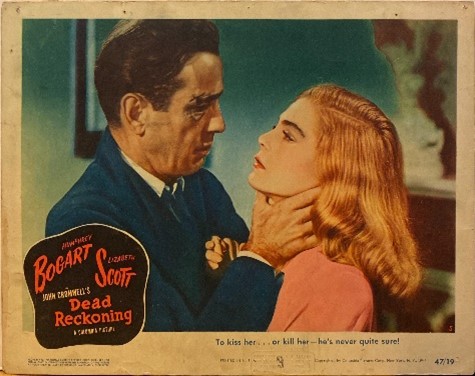
Not all borrowings are so well known, of course. A Rollins quote like The light in this place is so bad is only exposed by Scott Warmuth many years later. The heartbreaking outcry “Don’t know if I saw you, if I would kiss you or kill you / It probably wouldn’t matter to you anyhow” is suspiciously similar to the text of a lobby card from the 1940s film with Humphrey Bogart, Dead Reckoning; “To kiss her or kill her… he’s never quite sure!”. A film noir, by the way, which is of course mainly carried by Bogart, but even more so by his co-star, the irresistible Lizabeth Scott – who, for her performance of “Either It’s Love Or It Isn’t” alone, should at least have received an Oscar nomination.

A line like “The last rays of daylight” is of course not unique, but maybe Dylan just had R. L. Stevenson on his bedside table (“As the last rays of daylight dwindled and disappeared, absolute blackness settled down on Treasure Island”), and underlined this line. And a somewhat alienating interjection like “Buddy, you’ll roll no more” may have been picked up by Dylan from the deeper shelves of his inner jukebox, from Bill Monroe’s “Roll On Buddy, Roll On”;

Roll on, buddy, roll on
Wouldn't roll so slow

… although it is more likely that he lovingly steals it from The Rambling Boys, the 1957 album by Ramblin’ Jack Elliott and Derroll Adams, the album Dylan mentions in his autobiography Chronicles. “Roll On, Buddy” is the last song on that album, and in their version the men sing the verse

Well I never liked no railroad man
I never liked no railroad man
Cause the railroad man will kill you if he can
Drink up your blood like wine

… the words Dylan will sing in “Stuck Inside Of Mobile With The Memphis Blues Again” (on a side note: in the verse before that, Elliott and Adams sing “I slept in the pen with the rough and rowdy men”). The rest of the track list does suggest that Dylan has played the album more than once: “Buffalo Skinners”, “Danville Girl”, “East Virginia Blues”… all songs whose echoes descend in Dylan’s work over the years.

Both Bill Monroe and Ramblin’ Jack Elliott sing I got a home in Tennessee, and Gillian Welch seems to notice that too.

In 2011, Gillian Welch releases her masterpiece The Harrow And The Harvest, an album that, very dylanesque, is bursting with borrowings, paraphrases and quotes. It becomes even more Dylan-like when Gillian steals most of her borrowings, paraphrases and quotes from Dylan. As in the moving “The Way The Whole Thing Ends”, in which verse fragments such as standing in the doorway crying and once you had a motorcycle but you couldn’t ride it right are explicit enough already, and the verse:

Momma's in the beauty parlor
And Daddy's in the baseball pool
Sister's in the drive-in movie
Brother's in the old high school

… which is winking pleasantly, unobtrusively at both “Tombstone Blues” and “Desolation Row”. And just as charming Gillian incorporates a playful nod to “Sweetheart Like You” and to “Highway 61 Revisited”:

Now what's a little sweetheart like you
Doing with a bloody nose?

But she hides the subtlest of “Standing In The Doorway” decompositions in the song that, in the spirit of “Standing In The Doorway” contributor “Roll On, Buddy”, she titles “Tennessee”:

Back to Tennessee
It's beef steak when I'm working
Whiskey when I'm dry
Sweet heaven when I die
Now some will come confessing of transgressions
Some will come confessing of their love
You were there strumming on your gay guitar
You were trying to tell me something with your thumb

… the unobtrusive nod “gay guitar” (a somewhat unfortunate brand name, but it just so happens that its maker is called Frank Gay), and the witty reworking of “I’ll eat when I’m hungry, drink when I’m dry”, the quote Dylan in turn had stolen from “Moonshiner Blues”, to “It’s beef steak when I’m working, whiskey when I’m dry”.

“All these songs are connected,” Dylan says in one of his most beautiful and honest speeches, in the MusiCares speech, February 2015. He will have appreciated that Gillian Welch is incorporating his songs into the next link in the chain. Which is suggested by the tracklist of Tempest, which appears a year after Welch’s The Harrow And The Harvest. Dylan seems to return the compliment. Track 6 is called “Scarlet Town”… exactly the same title as the opening song of Gillian’s album. All these songs are connected.

———–

Jochen is a regular reviewer of Dylan’s work on Untold. His books, in English, Dutch and German, are available via Amazon both in paperback and on Kindle:


Posted in Uncategorized | 3 Comments

Bob Dylan’s favourite songs 9: Donald and Lydia

By Tony Attwood

In our list of Dylan’s favourite songs we come to the second John Prine song.  The first was Sam Stone – and as I quoted Dylan saying in that article, “Nobody but Prine could write like that.”   “That” in fact was “Donald and Lydia”, another song of desperate, sad, lonely people and all that surrounds them.

I think the key issue with such songs is whether one wants to hear about the lonely and their failures to break out of their lonliness.   Which perhaps is determined by whether one is afraid of being alone, whether one is fascinated by why some people are alone, or whether one actually craves being alone for a while.

The point of course is that the lonely have no choice – they would love not to be lonely but somehow don’t seem to be able to break out of it although they just desperately wish they could.

John Prine is able to write about such people in a way that brings home their desperation and in a way that, for example, “Only the Lonely” by Roy Orbison does not.  That is not to say that “Only the Lonely” is not a wonderful song – it most certainly is – but although the lyrics proclaim the singer is singing about himself, (“Only the lonely know the way I feel tonight”), there is nothing within that song that makes the listener share the desperation and total pain and often fear within loneliness.

Dylan’s choice is completely different – this is taking the experience of loneliness directly into the heart, mind and soul of the listener.  It is presumably something that Bob Dylan has never and could never feel.  If he feels any emotions in this area, it must be the desire to get away from all the people that surround him.

Choosing this song, Bob is, I think, providing us with a vision of a song that he could never write, and perhaps giving us a thought that he would like to experience being totally lonely, just to see.

Small town, bright lights, Saturday night
Pinballs and pool halls flashing their lights
Making change behind the counter in a penny arcade
Sat the fat girl daughter of Virginia and Ray
Lydia

Lydia hid her thoughts like a cat
Behind her small eyes sunk deep in her fat
She read romance magazines up in her room
And felt just like Sunday on Saturday afternoon

But dreaming just comes natural
Like the first breath from a baby
Like sunshine feeding daisies
Like the love hidden deep in your heart

Bunk beds, shaved heads, Saturday night
A warehouse of strangers with sixty watt lights
Staring through the ceiling, just wanting to be
Lay one of too many, a young PFC
Donald

There were spaces between Donald and whatever he said
Strangers had forced him to live in his head
He envisioned the details of romantic scenes
After midnight in the stillness of the barracks latrine

But dreaming just comes natural
Like the first breath from a baby
Like sunshine feeding daisies
Like the love hidden deep in your heart

Hot love, cold love, no love at all
A portrait of guilt is hung on the wall
Nothing is wrong, nothing is right
Donald and Lydia made love that night
Love

They made love in the mountains, they made love in the streams
They made love in the valleys, they made love in their dreams
But when they was finished, there was nothing to say
'Cause mostly they made love from ten miles away
Posted in Uncategorized | 4 Comments

NET: the absolute highlights – One Too Many Mornings 2001.

By Tony Attwood

Seattle, (6th October 2001)

In his review of this concert Mike Johnson, who continues to undertake the monumental task of tracking the Never Ending Tour through is decades-long existence says, “The crossroads of my doorstep is an intriguing image as it suggests choices and decisions, to turn back or to go on, but in the end we’re all just ‘one too many mornings and a thousand miles behind’.

“The song is heavy with the sense of fate. This performance from Seattle, (6th Oct) does the song full justice. Larry’s steel guitar works like a string section, providing a more lush backdrop to Dylan’s superb vocal.”


And yes of course Mike is absolutely right.  This version is unusual for Dylan by having an instrumental verse as an introduction before Bob comes in with the vocal.   And here he avoids his occasional habit of singing the same melody over and over.   Instead he repeats melodies sometimes – but not all the time, leaving us (whether we notice the exact details of the melody or not) with a sense of uncertainty admist the feeling of everything just moving on at its own pace, and nothing new happening.

Bob then moves straight into verse two with no instrumental break so that he retains that feeling, of endlessly moving on while reminding us of the deep, deep sadness in the song.

Meanwhile the music continues on without significant change into the instrumental break, beyond the way the acoustic guitar is played.  It is like a life that continues without any change except a few minor details of day by day – an incredibly difficult effect to achieve.   Music that represents repetition is hard to replicate without itself becoming tedious.

But throughout we remember that in that opening line he sings “And the day IS a-gettin’ dark.”  Yet it is getting dark there is no escape…. as is emphasised by the fact that we move immediately on to verse two at once.

And this really is a clever arrangement – everything is moving at a very slow pace to emphasise the words, and yet we move on to emphasise the similarity of everything, day after day, before we get the instrumental break.

I fear that many people who listen to this arrangement will just hear it as another Dylan minor re-write but it is far more than that.  For it is easy to forget just how the song sounded in its early days….

In the original the song is above all gentle, but this is a young man singing – he still has thousands of more adventures to undertake.  Yes there is sadness in leaving and moving on, but a whole life is still to come in the years beyond.  It is whistful, inevitable and unknown at the same time.   As emphasised indeed by the fact that the instrumental at the end contains not one but two verses.

And just compare the speed at which the original moves with this live version.   Now we have the feeling that Bob really has moved on.  Indeed when he recorded the live version at the top of the page he was sixty years old.   And I think quite a few people will agree, when one becomes sixty, it has an effect.  It changes perspective.   And between that original recording and this live performance there is a real change of perspective.   The lyrics and much of the melody remain the same.  But everything else has changed.  It’s a different Bob singing.

Maybe I am influenced by being, like Bob, of an older vintage, but I really appreciate this change of perception of what age does.  I feel it myself.

Previously on “The Never Ending Tour, the absolute highlights…”

Posted in Uncategorized | Leave a comment

Tom Tom & Phaedra (The Tarantula Files 44 & 45)

by Larry Fyffe

Mauricie and Paul Zimmerman be two of Bob Dylan’s uncles, brothers of his father Abe.

So an analyser of Dylan’s technically-musicless book “Tarantula” might suggest that there’s some auto/biographical material therein:

& men going outside with Maurice
who ain't the Peoria Kid
(Bob Dylan: Tarantula)

Uncles Maurice and Paul set up an electric appliance business in Hibbing, Minnesota.

And that’s all there is folks, ye sons of vermits!

Instead,  Bob Buckley Darwin sails the Jungian seas; he turns out to be a monkey’s uncle who often docks his boat where there are strange, cartoonish parties going on all the time:

Well, I set my monkey on the log
And  ordered him to do the dog
He wagged his tail, and shook his head
And he went and did the cat instead
(Bob Dylan: I Shall Be Free No. 10)

Parties where men in black masks get saddled up by Asian women who think they’re in the Ireland, the land of of lore:

& she say "yeah man I be a yellow monkey ooweel"
& he say "you just folly me baby snooks! jus you
folly me & you feel fine!"
& she say "giddy up & hi ho silver
& i feel irish"
(Bob Dylan: Tarantula)

In ”Tarantula”, everything from biblical verses to nursery rhymes merge:

Tom, Tom, the piper's son
Stole a pig, and away he run
The pig was eat, and Tom was beat
And Tom went running down the street
(Tom The Piper's Son ~ nursery rhyme)

Perhaps below the royal muse Melodius from the biblical days of King David be happy that Tom Tom’s beaten up for eating pork.

But she’s not amused that Tom Tom escapes further punishment:

Josie said everybody at the trial came with a blow gun
... Tom Tom made Melodius hate him, then jumped
from a window
(Bob Dylan: Tarantula)

Now that’s certainly not the way things turn out in regards to the worshippers of Baal in ancient Northern Israel.

According to the Holy Bible, the Hebrew non-eaters of “overly-reproductive” pigs regain power there:

And she (Jezebel) painted her face, and tired her head
And looked out the window ....
And he (Jehu) said, "Throw her down"
So they threw her down
And some of her blood was sprinkled on the wall
And on the horses
And he trod her under foot
(II Kings 9:30,33)

Nonetheless, Jezebel, presented as the archetypical lip-sticked sow, shows up later in the New Testament:

Notwithstanding I have a few things against thee
Because though sufferest that woman Jezebel
Which calleth herself a prophetess
To teach and seduce my servants to commit fornication
And to eat things sacrificed unto idols
(Revelation 2: 20)

Indeed! From out of Carl Jung’s shadowy world break loose all kinds of bloodied vampiric themes ~ criss-crossed; confused.

And dark humoured:

... Jezebel the nun, she violently knits
A bald wig for Jack the Ripper ...
(Bob Dylan: Tombstone Blues)

Phaedra

Muddled up, often humorous, allusions be the hallmark of Bob Dylan’s “Tarantula”.

  1. Scott Fitzgerald’s “The Great Gatsby” gets reviewed by the narrator in the following lines.
(F)inally read the great glaspy - helluva book
just a helluva one - that cat sure tells it
like it is, not much happening around here
(Bob Dylan: Tarantula)

The novel above referred to later on in these song lyrics below:

She say, "You can't repeat the past"
I say, "You can't? What do you mean, 'you can't '
Of course,  you can"
(Bob Dylan: Summer Days)

Jay Gatsby’s line goes, “Can’t repeat the past? Why of course you can”.

The  quote from “Tarantula” beneath alludes to ancient mythology (texts from different editions of the Dylan book vary):

Phaedra pounding her knuckles into a piece of water
- scratching her snake bites
(Bob Dylan: Tarantula)

The Greek/Roman goddess Venus puts a curse on mortal Phaedra that makes her lust after her own stepson.

That mythological story obliquely referenced in the following song – it might be suggested:

Well, Phaedra with her looking glass ....
She gets all messed up, then she faints
That's 'cause she's so obvious, and you ain't
(Bob Dylan: I Wanna Be Your Lover)

Referenced again below:

"(L)ove is magic" says Phaedra
- Funky Phaedra - Rabbit dont say nothing
- Weep the Greed says "go to it gal!"
(Bob Dylan: Tarantula)

Mighty mythology modernized:

(T)here is no more room in the car
- phaedra scrowls & she bellows
"love is going plumb insane"
(Bob Dylan: Tarantula)

Could it be that Phaedra above refers to an actual person ~ alive, outside the book?

No one knows, for sure.

Unlike, of course, the two people mentioned below:

(A)nnette & frankie avalon found in pacific ocean
- hands tied behind their backs
(Bob Dylan: Tarantula)
Posted in Uncategorized | 2 Comments

Dylan cover a day: Rainy Day Women as never before

By Tony Attwood

The problem with Rainy Day is that the instrumental introduction is so distinctive, that as soon as someone starts to play it, we all know what is going on, and where it is going.  So a cover version that is really going to get attention has not only to be different from original, it has to be different from the very start – while at the same time allowing us to appreciate that yes we are going to hear “Rainy Day Women”

And this is Joan Osborne does.

But more than that, she and her fellow musicians and the arranger really work at keeping  the essence of the song (the lyrics) the same and recognisable, while changing the rest.  We hear that from the wordless chorus at the start, and despite the unexpected lack of instrumentation as Ms Osborne starts singing.

However that is not enough to counter the oh-so-famous Dylan version, so there is a new break between the verses as well.

Then there is the simple repeat of “Everybody must get” – dead simple, but still very effective.   Plus there is the fact that in the Dylan version everyone is competing to be part of the recording.  Here we are laid back, every instrument has its place and every performer knows where he/she should be.

Plus there is more, for at 2.41 the accompaniment changes to a descending bass line, which works utterly perfectly – and that oh oh oh background chorus between the verses fits so perfectly that it has a code all to itself.

In short I never really cared for Bob’s original – it seems too much like a throwaway, and the release of the rehearsal recording and the first take does nothing to dissuade me from thinking that Bob was trying to show just how far he could push things without having his contract torn up by the record company, which in essence turned out to mean “as far as you want to go Bob – you’re the genius.”

Yet even with such a throwaway song, it is possible to pick out some genius and play with it, as this recording shows.

But as with all Dylan songs, just doing something utterly different isn’t enough to make a cover version interesting.   Baroque Inevitable are funny in a way, but would I play it twice?  No.  would I play it all the way through?   Well, it’s not really what I want to do.  These woodwind players are very good, and the arranger has had fun, but as we progress, I think, well, yes ok.   Great string work lads, but… is there not something more engaging to spend your time with?

So my day has taken a downturn before it really starts.  Can the day be saved?   Well, yes because Old Crow Medicine Show has recorded this, and they never let me down.

What they do is so simple: they subtly change the rhythm and add harmonies.   And there’s an accordion in the mix too which works perfectly.    And it is not just the music I love with this band it is the fun they seem to be having.

And it all comes out of that subtle change of rhythm.  That’s really clever – because it influences the emphases that are put on the lyrics.  The chaotic overtones of Bob’s original are kept with the shouts of “that’s right” etc from band members, but the music is more controlled and organised, which really makes the contrast work.

Indeed while some songs have no cover versions at all, here with this throwaway song, there are lots of versions out there running from the fairly straight copies to the oh-so-freaky that one ends up wondering what on earth made anyone think of it, let alone spend time recording it.

But for me, personally, I want to have a sense of the original song amidst all the variants – and yes I do like the retention of the fun that is there at the start.  This version, which has a lovely variation of the chorus line as well as within the verse itself, gives me what I’m after.

But of course that’s just me.

This is Willie Nile…

Posted in Uncategorized | Leave a comment

Standing In The Doorway – part 1: He’ll have to go

Standing In The Doorway (1997) part 1

by Jochen Markhorst

I           He’ll Have To Go

I’m walking through the summer nights
Jukebox playing low

It is a select club, the guitarists who played in both the band of Living Legend John Fogerty and in the band of Living Legend Bob Dylan: actually only Billy Burnette and Bob Britt. Billy Burnette only for a short while, replacing Charlie Sexton for eleven concerts Down Under.

But Bob Britt, the guitarist who joined the Dylan ranks on Time Out Of Mind, has turned out to be a keeper; on Rough And Rowdy Ways (2020) he’s back, and on stage he’s been a remarkably unobtrusive, highly regarded force for a few years now. And with that knowledge, knowing Britt’s concert performances, we can, with some certainty, pinpoint which notes he’s playing in “Standing In The Doorway”; it must be those gliding, short licks in the intro and those short fills throughout the rest of the song. In any case, we hear a guitarist who has both Nashville and blues in his blood and in his fingers – and even the traces of his teacher, pianist Leon Russell. Russell who, in turn, learned the art from the ultimate Elvis pianist.

On YouTube, the charmingly enthusiastic grandson Jason Coleman explains his famous grandfather’s trademark and demonstrates it with an obviously inherited talent: the “slip-notes” of the legendary Floyd Cramer. The keystrokes on the piano, where the finger slips off the adjacent key and in fact hits the wrong note at first, became a stylistic feature of the Nashville sound thanks to Floyd Cramer’s thousands of recording sessions in the 50s and 60s, partly because Cramer declined Elvis’ offer to go with him to the West Coast; he preferred to stay in Nashville.

By then, Floyd had already long secured his place in eternity; one of the most iconic piano parts in rock history, the piano part of “Heartbreak Hotel” is also Floyd Cramer. Thereafter, he plays with all the greats, with Brenda Lee, The Everly Brothers and Roy Orbison, on “Crying In The Chapel” and on “Are You Lonesome Tonight?”, with Chet Atkins and with Paul McCartney, and in the twenty-first century we even hear Dylan play Cramer’s unmistakable slip-notes (in “Soon After Midnight” for example, Mankato, October 2019). Remarkably, Cramer even influences, via a small diversion, Jimi Hendrix. Via Bobby Womack, that is. As a kid, Womack has taught himself guitar by imitating Floyd Cramer. Later, in 1964, he sits for hours and hours with Jimi on the tour bus;

“I could tell what he was doing on the guitar, but he had no clue what I was doing. I was making up chords and all of them were unorthodox. I always played that way. It was a big joke with Jimi, who used to tell me, ‘Man, you play some beautiful chords.’

I told him about the piano player, Floyd Cramer, who I got my style from. Jimi didn’t believe me. He said, ‘But he’s a piano player.’ I said, ‘Yeah, but imagine me hittin’ the same notes on the guitar, playin’ what you’d hear on a piano. It’s different.’ Sometimes me and Jimi used to sit backstage between shows and swap licks. That’s how we became friends.”
(Bobby Womack – My Autobiography – Midnight Mover, 2006)

… and indeed; if you listen with that knowledge to (especially) “Little Wing”, and even Jimi’s “Like A Rolling Stone” (Monterey, 1967), you can hear Cramer’s slip-notes.

And Floyd Cramer plays the indispensable part on one of the many stepfathers of “Standing In The Doorway”, on “He’ll Have To Go”.

“Standing In The Doorway” is perhaps the ultimate example of an eclectic mash-up, of the recipe for the greatness of Time Out Of Mind. Dylan constructs both the music and lyrics from chunks of bluegrass, F. Scott Fitzgerald, blues, American Songbook, the Bible, folk, film noir and country. We hear snippets of Dock Boggs, reuse of “Moonshiner Blues”, Big Joe Turner, “Bullfrog Blues” from 1928 (I left you standin’ here in your back door crying), Jimmie Rodgers and I see nothing to be gained by explanation from Willie Nelson’s “Long Story Short (She’s Gone)”… and that’s just a small selection; almost every line of text can be found in one of the songs in Dylan’s enormous working memory, in one of the novels in his bookcase, in one of the films in his home cinema.

Dylan’s opening is an illustration thereof, of that eclectic nature. “There was music from my neighbor’s house through the summer nights” is the opening line of chapter 2 of F. Scott Fitzgerald’s The Great Gatsby (1925), which could quite easily have been paraphrased into, say

I’m walking through the summer nights
Music playing low

… but Dylan chooses “jukebox playing low” and thereby, by this simple intervention, tilts the atmosphere towards a tear-in-your-beer ballad, towards a country tearjerker, towards one of the greatest of all country tearjerkers;

Put your sweet lips a little closer to the phone
Let's pretend that we're together, all alone
I'll tell the man to turn the jukebox way down low
And you can tell your friend there with you he'll have to go

… Jim Reeves’ pièce de résistance from 1959. And Bob Britt seems to hear that too; his fingers slip naturally from the adjacent note to the right one, just like Floyd Cramer’s slip-notes in the intro of “He’ll Have To Go” elevate the song to the stratosphere. Not on his own, by the way; the track was recorded by a Nashville A-Team. Elvis guitarist Hank Garland, Elvis and Dylan bassist Bob Moore, Elvis drummer Buddy Harman… Jim Reeves apparently already had some status, back in 1959.

Less poetic and seemingly more one-dimensional than Dylan, of course, but it is the same lament. One poor sap is discarded by telephone, and the other sod gets the door slammed in his face on the doorstep. Both wretches also seem to have lost their women to a competing man. And both seek solace in the arms of another woman. By Dylan’s narrator poignantly expressed with the words “Last night I danced with a stranger, but she just reminded me you were the one”, with Jim Reeves we only get that revelation in the sequel “He’ll Have To Stay”:

I can hear the jukebox playing soft and low
And you're out again with someone else, I know

… a good-old fashioned answer song, in which Jeanne Black, over the same soundtrack and on the other end of the telephone, turns the whole plot around; Jim Reeves’ narrator was apparently a notorious cheater who for years has been leading on his fiancée – and now she’s had enough. “You broke my heart too many times”. And she has opened her heart and arms to a sweet, reliable rival. “Now someone else is in your place, he’ll have to stay”.

“Buddy, you’ll roll no more,” she could have said as well.

To be continued. Next up Standing In The Doorway part 2: All these songs are connected


Jochen is a regular reviewer of Dylan’s work on Untold. His books, in English, Dutch and German, are available via Amazon both in paperback and on Kindle:


Posted in Uncategorized | 2 Comments

Dylan: the music and the lyrics – Not Dark Yet

By Tony Attwood

If there is one single song written by Bob Dylan that deserves an analysis of the lyrics and music together it is “Not Dark Yet,” because here Dylan uses a musical device to add to the mystery and desperation in the song.  For instead of writing in the normal four beats in a bar approach, the music occasionally adds two extra beats.

I won’t go through all the details again as Jochen did a piece on this to which I added a couple of details, but I do want to add this song to this series on the music of Dylan.  For in this song perhaps more than any other the music gives us the sense of desperation and tiredness to perfection.

Now by “the music” I mean both the arrangement of the instruments and the music itself.  As an example of this, listen to the music during the instrumental break (the part of the song where there are no lyrics)  starting at 3.20.   No instrument takes over, but rather we just get the accompaniment continuing.

This is something Dylan often does, and it is incredibly rare elsewhere in popular music – in fact, I can’t think of anyone else who does this as regularly as Dylan.  And it works brilliantly in this song because this is absolutely not a moment for an instrumentalist to show off his/her skills.  That would break the entire atmosphere and the message.

My point is that the song is about the continuance of decline, and any intrusion by a soloist at this point would utterly damage the images being built.

And what is equally remarkable is that there is a second instrumental section starting at around 5.25.   Again there is no intrusive solo part – we just hear the accompaniment – which is absolutely right because this is a piece of music about the decline into darkness, and the wish of the singer for that darkness to happen.

For many a lesser artist (or any artist beholden to the demands of the producer) that second instrumental part would never have happened – and I suspect if Dylan had not had the total control over his music that he clearly had after the first few albums, it would mots certainly not have happened.  A lesser musician or producer would have thought in conventional terms of keeping the listener alert by allowing a soloist to show off his/her skills.

But that would have been utterly against the concept of the song: the exposition of decline, and the desperation that comes from an awareness of decline and there being nothing one can do about it.

Musically speaking. the high point of each verse, where the solo line reaches its highest note is the penultimate line – the line before the repeat of the title.  For here music and lyrics combine to make these final two lines the very crux of the matter.

But Dylan then goes a step further for he doesn’t just sing

There's not even room enough to be anywhere
It's not dark yet, but it's gettin' there

What he actually sings on the recording on the album is

There's not even room enough ...   to be anywhere
It's not dark yet, but it's gettin' there

And that tiny pause before “to be anywhere” which is hardly noticeable is a brilliant musical signification of the desolation that the vocal line is expressing.   In saying there is no room the line says “I can’t move, I’m stuck here”.   The slight pause stresses that.

In the second verse we get the same pause

I just don't see why ...    I should even care
It's not dark yet, but it's gettin' there

Again there is hardly time for us to think “what is it that he doesn’t see?” but that musical pause increases the emotional understanding that he is utterly lost.

And because of this, the use of the song title in the last line comes to the listener not as a mere repeat but as a further element of descent into desperation.

Expressing desperation in music is incredibly difficult.  Of course pop music is full of “lost love” songs – lost love is one of the three giant topics of pop music (the others being “love” and “dance”.  But not utter desperation.  There are some songs expressing this emotion, but they are rare, because they are so hard to pull off musically.

What we have in fact is a sense of total continuity and of utter collapse.  The only interruption to this is the sudden guitar chord at the end of each line.   Indeed if one listens to the recording without interruption or background sound one can pick out this sudden chord.  Occasionally it is not there but almost every time it is – a sudden jerk which reminds us subconsciously that this is not a gentle slide into nothingness – there are sudden bursts of pain along the way.

But decline it is – and that is the hardest thing in the world to write in a musical form without engaging in a trite run of minor chords and discords.   However, Dylan solves the problem through continuity with that very occasional shot of one guitar chord.   So when we hear the line “I can’t even remember what it was I came here to get away from” we are in sympathy with the singer and the music – that nagging sudden single chord, louder than anything else in the performance is always there.  There is something out there but we don’t know what it is.    Hence what that chord is supposed to be telling us we don’t know.

Finally, there is the last verse – an instrumental verse.  I haven’t gone back to check how often Dylan has done this on recordings, and I am sure there must be some occasions, but I am also sure it is very rare in contemporary songs.   Here it is brilliantly used – the singer has made his final declaration that it is not dark yet, and to make the point, even when there is nothing more to say, the music continues.  Even when he can do and think no more, life goes on.  The situation, the world, will continue in this same vein, even when he is long since gone and the darkness has finally descended.

Musically in terms of both the composition and the arrangement, this is a staggeringly brilliant masterpiece.   One of the greatest moments of contemporary songwriting.

Earlier in this series

Posted in Uncategorized | Leave a comment

Bob Dylan’s favourite songs 8: “Burn down the cornfield”

By Tony Attwood

This is the second Randy Newman song in the series of Bob’s favourite songs – the first was Sail Away (there’s a link to all the previous articles at the foot of this piece).

All Music contains this review of the song: “A sinewy ballad built around a fine bottleneck guitar riff, “Let’s Burn Down the Cornfield” is a love song, basically, but the slightly demented lyric content is what gives it the edge. Newman was writing a lot of material during this period that was generally intended for “conventional” instrumentation (drums, bass, piano, guitar), and this is one of the finest examples of this. It’s one of producer Lenny Waronker’s favorites from the period.”

So “slightly demented lyric content”….   That obviously needs considering.  Here are the lyrics…

Let's burn down the cornfield
And we can listen to it burn

You hide behind the oak tree
Stay out of danger 'till I return

Oh, it's so good
On a cold night
To have a fire
Burnin' warm and bright

You hide behind the oak tree
Stay out of danger 'till I return

Let's burn down the cornfield
And I'll make love to you while it's burnin

I find this interesting because I am currently and very slowly trying to develop a series of articles which argue that one has to consider both Dylan’s music and his lyrics as one, rather than eternally focus on the lyrics.   And here from another source is a perfect example of why we have to do this.

The lyrics are weird – I suspect the reaction of almost everyone to the notion of burning a cornfield is “What????” and maybe “Why?”

And as you can see above the only answer is “to have a fire burning warm and bright”.

But the whole point of the song is to have spooky words and spooky music together to give an atmosphere of, well, spookiness.     And more to the point, Bob selected this as one of his favourite songs.

As for why, well, this choice can only have been made because this song is so very different from most.  It is a song of atmosphere both in the music and in the lyrics, and that’s what I am trying to argue is the case with Dylan’s song: the music and the lyrics give the atmosphere.

The version that Bob nominated was not the first of this song.  Here, as far as I know, is the original

And without the arrangement in the Randy Newman version, and I think all subsequent versions, much of the meaning is lost, in my view.  But once the notion of the spookier approach to the music came about, so the song got locked into that approach…

… and thus the accompaniment has been seen as central to the song


Previously in this series…

Posted in Uncategorized | 2 Comments

The Tarantula Files: How Old and The Wooden Chest

by Larry Fyffe

How Old

The Tarantula Pilgrims on the way to NY meet up with a traveller who claims to be a Palaeontologist:

(W)e sat in a room where Harold, who called himself
'Lord of dead animals', was climbing down a ladder
(Bob Dylan: Tarantula)

His seemingly lost records might contain revelations such as:

He found an animal that left a trail
Had a great big head and a great big tail
Couldn't fly because it was as large as a bus
Ah, think I'll call it a Tyrannosaurus
(Harold: List Of Names For All The Dead Animals)

Romantically speaking, everywhere, in these modern times, all that’s left are complacent Hobbitts, Babbitts, and Babboons.

Even in the White House:

(T)he Plump himself tried to give a warning
but he was so drunk that he fell into a barrel
& a tractor being driven by some dogs ran him over 
& dumped him into a garage ...
the world didnt stop for a second
(Bob Dylan: Tarantula)

Below, a source poem that looks back to the tales of ancient mythology:

(T)he ploughman may
Have heard the forsaken cry ...
and the expensive delicate ship that must have seen
Something amazing, a boy falling out of the sky
Had somewhere to get to, and sailed calmly on
(WH Auden: Musee Des Beaux Arts)

Especially now, asserts the song beneath, in these days of the H-bomb, attention must be paid:

For the love of a lousy buck
I've watched them die
Stick around, baby, we're not through
Don't look for me, I'll see you
When the night comes falling from the sky
(Bob Dylan: When The Night Comes Falling From The Sky)

The Wooden Chest

“Tarantula” is presented by its author as a rather mean ole god who gains the upper hand over the God depicted in the Holy Bible ~  apparently, modern-day Hebrews, Christians too, are abandoned by JHVH because they turn yet again to worship the Golden Calf.

It’s speculated by a number of biblical scholars that the precious Ark of the Covenant (wherein stored are the Ten Commandments) either gets hidden away by faithful Hebrews or taken away by Babylonian invaders.

Lost anyhow:

& curious tabernacles move slowly thru your mind
- hitchhicking - hitchhiking unashamed thru the goofs of your brain
- your ideals are gone
(Bob Dylan: Tarantula)

According to Tarantula, the other God (He Who tells Abraham to kill his own son) appears to be missing from the scene:

(T)rip into the light here abraham
What about this boss of yours
& don't tell me that you do what youre told
(Bob Dylan; Tarantula)

A long time ago, according to the Bible, Abraham’s God gets the Ark back by sending plagues upon the Philistines who’ve killed the wayward sons of High Priest Eli; the Philistines snatch the Arc away, but they’re more than glad to give it back:

And the Ark of God was taken
And the two sons of Eli ... we're slain
(I Samuel 4:11)

Then much later on, the Babylonians, worshippers of the Golden Calf, invade southern Israel. The Ark, say some sources, has been hidden away; others claim that it’s taken away:

The Christian portion of the Holy Bible goes on to assert that the Ark’s in Heaven, enclosed the wooden chest be by a grand temple:

And the temple of God was opened in heaven
And there was seen in the temple
The Ark of His testament ...
(Revelation 11:19)

Mixed-up confusion everywhere.

For example, there be claims that the Ark is in the hands of Ethiopian Christians who disagree, for one, with the Catholic Church by the Ethiopians insisting that Christ has a single ‘nature’ only.

Ethiopia able to hold off getting taken over by the spread of the Islamic religion

Seems thus speaks Friedrich Nietzsche in the lines below while carrying a torch in his hand; on his shoulder, an ink-stained tarantula marked and mocked with the motto “everyone’s equal”:

I'm just like Anne Frank, like Indiana Jones
And them British bad boys, the Rolling Stones
I go right to the edge, I go right to the end
I go right where all things lost are made new again
(Bob Dylan: I Contain Multitudes)

Nietzschean-like lines beneath too, but even more ambiguously laden:

You're the lamp of my soul, girl
And you torch up the night
But there's violence in the eyes, girl
So let us not be enticed
On the way out of Egypt
Through Ethiopia ....
(Bob Dylan: Precious Angel)


Posted in Uncategorized | 2 Comments