Dylan said that he knocked this song off during a time spent in the Caribbean in about 15 minutes. That may or may not be the absolute truth, but if it were composed quickly, then it must be one of the most rewarding ways ever to have spent a quarter of an hour or so, not least because between 1984 and its final putting to bed in 1999 Dylan performed it 204 times. That’s about 17 hours of live performance, all out of 15 minutes original work (although to be fair they would have spent some time in rehearsal getting the arrangement sorted).
And it is clearly not an easy song to get a perfect performance out of, because of the instrumental sections in which the various parts of the band seem to be competing with each other to be at the fore, in musical representation of the I and I message.
I’ve read the various reviews of what the song is all about, and indeed I wrote one myself, but I think I have just reached the stage where it has become a set of lyrics and musical phrases that eternally intertwine representing this “two sides of everything” concept. The exact meaning of the lyrics, if there is one, has for me become secondary to the overall sound.
And indeed why not? Why should not lyrics be more about sound rather than meaning? Of course I have now meandered into the world of sound poetry, of which I am absolutely not in any way an expert, but which is there and has some highly praised practitioners. Just because poetry with meaning dominates, it doesn’t mean that sound poetry isn’t of equal merit – or at the very least worthy of contemplation.
These are the thoughts that swirl around as I listen to this recording in which there is such a movement from the opening section to the frenetic build-up of the music later. And as a result, while writing this I jumped from the frantic musical entanglement that we get to at the five-minute mark back to the start. It is a phenomenal contrast, and the fact that after the five-minute section they do take it all back down as they enter the final coda, shows that there is an overall conception in the piece rather than just an improvisation around a theme.
In fact, it is the extraordinary set of contrasts within this performance that made me think of adding it to this series. The opening, both in terms of the musical accompaniment and Bob’s singing is an extraordinary entwining of voice and instruments, so that it seems to me we are no longer in the world of vocals and accompaniment but of an entwining of a range of sounds in which at different moments different elements come to the fore. The meaning of the lyrics thus disappears in terms of importance.
And in this entanglement, take the piano as an example: a lot of the time we don’t know it is there at all, and yet occasionally up it turns. But always it is those repeated guitar phrases that entwine themselves and dominate our vision.
But despite this level of entwining, still there are moments where everything is taken back down. Indeed in this regard just consider the final verse of the song which starts around the four minute mark:
Noontime, and I'm still along the road, on the darkest part
Into the narrow lanes, I can't stumble or stay put
Someone else is speakin' with my mouth,
        but I'm listening only to my heart
I've made shoes for everyone,  I'm still going barefoot

I and I
In creation where one's nature neither honors nor forgives
I and I
One said to the other, "No man sees my face and lives"
This is, for me, a perfect example of a Dylan sound picture. The lyrics give us images which are not precise – we can change them as we wish. For me the “darkest part” makes sure that we do appreciate this is the bleakness of the world that is being portrayed in which we each have two parts to our personality, each facing the other.
The entanglement of the music through the guitars thus expresses this vision perfectly. Everything is a contradiction, but everything fits together into one life, one piece of music, two parts of the same. I and I.
Please note a full index to this series, of which this is episode 114, is available here.
Mike Johnson (Kiwi Poet)
I ain't dead yet
My bell still rings
(Early Roman Kings)
2012 is one of those pivot years for the NET in which big changes are heralded. I am reminded of 1992, when Dylan added a fifth musician, steel guitarist, to his basic line of four. A decade later, in the most dramatic change of all, Dylan largely abandoned the guitar to take to the keyboards. A decade after that, 2012, Dylan abandoned his little electronic keyboard to get in behind a real piano, a grand piano no less, and so laid the foundation for the sound we hear now, if we tune into the Rough and Rowdy Ways Tour.
We need to appreciate that when Dylan started playing ‘piano’ in 2002, and ‘organ’ in 2006, he was playing a little electronic keyboard. You could flip a switch and make it sound like a piano and flip another switch and make it sound like an organ. An actual piano, however, especially a grand, is a different beastie altogether; its resonant tones and more mellow sound were to shape Dylan’s sound as it emerged over 2012 and 2013. Dylan used his electronic piano from 2002 to 2005 strictly as a rhythm instrument, mostly vamping chords, adding urgency to the band’s sound. With the grand however, he was prepared to go further, using the instrument as a lead, often picking at single and double notes as he had done when playing lead guitar during those years from 1992 to 2002.
A distinctive, ‘primitive’ style emerged with echoes of Dr John and Thelonious Monk.
At the moment I don’t have access to the Hop Farm Festival concert, (Kent, June 30th) when Dylan first presented the grand, and the ivory revolution began, so we’ll skip to Barolo, Italy (16th July), to hear what those first audiences heard. As was his wont with these early concerts, Dylan kicked off with an organ number, in this case ‘Leopard Skin Pillbox Hat,’ before moving to the grand for the second number and the rest of the concert. In Barlo that second song was the softer ‘It’s All Over Now Baby Blue,’ a song that had gone through many changes. It’s an upbeat take on the song. Note the piano break starting around 3.30 mins.
Baby Blue
We find him doing the same thing at Chester(Sept 4th), kicking off the concert on the organ with ‘Watching the River Flow,’ to switch to the grand for a moving rendition of ‘Love Minus Zero No Limit.’ Again you can hear him shaping the arrangement around the softer sound of the grand.
Love Minus Zero
Another notable aspect of that performance is that it is the second to last time we’ll hear that mysterious little love song (last play Oct 30th). In an earlier post, can’t remember which, I made a reference to the great purge of his setlists in 2011. That was not quite accurate. Dylan began dropping significant songs in 2010 – ‘Mr Tambourine Man,’ for example, never to be heard again, and ‘Masters of War,’ gone but for a lone performance in 2016; these slipped into NET history without me noticing – but his purge of the setlists cranked up in earnest in 2012 and 2013, losing fifteen songs in each year, a total of thirty songs over the two years.
Songs last played in 2012 are:
‘My Back Pages’ (Montreux, July 8), ‘Absolutely Sweet Marie’ (Lyon, July 18), ‘This Wheel’s On Fire’ (Carhaix, July 23), ‘Saving Grace’ (Johnstown, August 29), ‘This Dream Of You’ (Winnipeg, October 5), ‘Nettie Moore’ (Edmonton, October 9), ‘Hattie Carroll’ (Sacramento, October 20), ‘Hollis Brown’ (Sacramento, October 20), ‘Love Minus Zero’ (Broomfield, October 30), ‘John Brown’ (Broomfield, October 30), ‘Joey’ (Toronto, November 14), ‘Sugar Baby’ (Toronto, November 14), ‘Mississippi’ (Philadelphia, November 19), ‘You Ain’t Goin’ Nowhere’ (Brooklyn, November 21), ‘Chimes Of Freedom’ (Brooklyn, November 21).
This is more than just pushing a few songs aside to make way for new material, but a significant narrowing and refocusing of the setlists. And a step in the direction of solidifying the setlist into songs he’d play pretty much every night with little variation. The setlists in his current Rough and Rowdy Ways tour are almost identical, just a few wild cards thrown in here and there. The days of turning up to a Dylan concert not knowing what to expect are well and truly over, and that movement began in 2012.
I lament the passing of a number of these songs, ‘Love Minus Zero,’ both ‘Hollis Brown’ and ‘John Brown’, staples from his earliest writing of topical protest songs. Sad to see the trenchant ‘Wheel’s on Fire’ and the magnificent ‘Mississippi’ disappear. In 2002 Dylan shifted from guitar to piano, which changed the sound of the band, but everything else stayed in place and there was no great purge of songs or upheaval in the setlists as in 2012/2013
I’m not going to cover all of these vanishing songs, but let’s at least pay homage to a few of them. Here’s the last performance of the happy-go-lucky sounding ‘You Ain’t Goin’ Nowhere,’ the opening number at Toronto (Dylan on organ here).
You Ain’t Goin’ Nowhere
Staying in Toronto, let’s hear the last ‘Sugar Baby.’ This slow, contemplative song was never an easy one to perform. I’ve argued that it is not an attack song, despite the line ‘you ain’t got no brains no how,’ and that the song is more melancholic than accusatory. I love this performance and find I’m regretting its passing; with its quiet tone, it seems to suit the piano perfectly.
Sugar Baby
‘Joey’ has never been a favourite Dylan song of mine. I find it portentous and bombastic, and the glorification of a hoodlum (but that’s just me). I have however given Dylan due credit for giving the song his all in a mere handful of performances, and it is a sustained piece of storytelling from an album, Desire, full of stories.
We return to Toronto to hear its final performance.
Joey
I’m not sure if Dylan ever really got on top of his masterpiece, ‘Mississippi’ in performance. I don’t think he ever improved on his passionate 2001 performances (See NET, 2001 part 6), and I seem to prefer the acoustic version on Tell Tale Signs. Here it is, the final performance, (Grand Prairie, 1st Nov), a swinging rendition, and a good opportunity for Dylan to tickle those ivories.
Mississippi
Let’s go to Broomfield (29th October) and catch the final performance of ‘Saving Grace,’ a song from Dylan’s gospel period from the album Saved. I just wish the recording was not so tinny.
I’ve got a soft spot for this song, and its gentle surrendered sentiment. I’m certainly not religious in the sense that Dylan was during those gospel years, but as someone who has recently escaped death by a whisker, I can certainly relate to these lines:
I've escaped death so many times, I know I'm only living
By the saving grace that's over me

By this time, I'd a-thought that I would be sleeping
In a pine box for all eternity
My faith keeps me alive, but I’ll still be weeping
For the saving grace that's over me
Saving Grace
Finally, in terms of these last performances, I can’t overlook the Edmonton performance of ‘John Brown’ (9th Oct). Not only is it the last performance, but I would suggest a ‘best ever’ performance as well. Dylan has rarely played the harp on this song, but does so here to great effect. When I want to enjoy this song, this is my go-to performance. Donnie Herron’s banjo gives it both a country, and somewhat eerie sound, as if the song is coming across to us over the centuries with its timeless message of senseless war and death. This wonderful performance makes the loss of this song more acute.
John Brown
(Before moving on, it’s worth noting that this winnowing of Dylan’s setlists will have a knock-on effect on these posts. Up till now I have written between four and six articles per NET year, but that will drop to three or even two as the setlists become more honed to fewer songs.)
2012 was not just remarkable for Dylan’s shift to the grand piano, and the loss of fifteen songs, but in September Dylan released a new album, Tempest. Tempest could not be more different from the previous Together Through Life. That album had a rough-and-ready, improvised, throw-away feel; Tempest is a precision machine, much more like the album which would come eight years later, Rough and Rowdy Ways.
Critics lavished praise on the album, some seeing it as even better than Love and Theft and Modern Times. “Tempest is Dylan’s best musical album of this century, a vibrant maximising of strict rules and the savaged-leather state of that voice” (Mojo Magazine) and “Tempest’s epic scale and grandeur makes his few previous albums look like short stories leading up to a great novel.” (Tiny Mix Tapes)
Dylan did not immediately overwhelm his setlists with this new material. Indeed, some of the concerts in September and October didn’t include any of the new material, or maybe one song. Duquesne Whistle,’ co-written with Robert Hunter, which would become a regular, was not performed until 2013. ‘Early Roman Kings,’ which would also become a favourite, was only played a handful of times.
For my ear, these first performances of the new songs would be surpassed in quality by performances in later years, but to kick things off, here is ‘Early Roman Kings’ from Toronto, the only song from Tempest played at that concert, and the second time the song was performed.
Early Roman Kings
I’m not going to attempt a full exploration of the song. Our editor Tony Attwood has a pretty good crack at it here. It seems to deal with a state of lawlessness in which powerful groups can lord it over others for better or worse. ‘Sluggers and muggers,’ ‘peddlers and meddlers.’ What they give can just as arbitrarily be taken away.
This song contains a number of directions and misdirections and may perhaps be more playful than the heavy blues riff that carries it suggests.
I’m going to finish this post with the sole performance of ‘Scarlet Town’ in 2012 (Winnipeg 5th Oct) and my favourite song from the album. It has a deep history in folk music. Again, Tony Atwood gives a good account of it here and Hobo Magazine goes into it pretty thoroughly here:
I can’t add a lot to these accounts except that it makes me think of Lenard Cohen, I can imagine him singing it, and that it evokes both the comfort and terror of our childhood. Scarlet Town is a mythical contradictory place, a place you need to escape yet ‘wished to God’ you’d never left.
The last verse, the first two lines of which are beautifully aphoristic, and which reminds of maybe Catullus, seems to end with a vision of racial harmony, all the colours of humanity, ‘beautiful in their time,’ are ‘right there for ya’ in this mythical place of love and war, death and sacrifice:
If love is a sin then beauty is a crime
All things are beautiful in their time
The black and the white, the yellow and the brown
It’s all right there for ya in Scarlet Town
It’s a beautiful performance and a lovely way to meet this profound song.
Scarlet Town
That’s all for now. See you soon with more songs from that formative year – 2012.
Black rider, black rider, all dressed in black
I’m walking away, you try to make me look back
My heart is at rest, I’d like to keep it that way
I don’t want to fight, at least not today
Go home to your wife, stop visiting mine
One of these days, I’ll forget to be kind
“Creative ability is about pulling old elements together and making something new,” Dylan says in the Wall Street Journal interview with Jeff Slate. That’s in December 2022, so Dylan’s conception of art is no longer really surprising; by then, we’ve known for more than 20 years that Dylan doesn’t so much borrow the occasional line here or metaphor there, but that he cobbles together whole songs out of odds and ends and bits and pieces.
What is new, though, is Dylan’s clarity – he has never expressed this so bluntly before. Interviewer Jeff Slate wants to hear it again, and comes back to it a few minutes later, when they pretty much conclude the topic of creativity. “Are you able to listen to music passively,” Slate asks, “or do you think maybe you are always assessing what’s special – or not – about a song and looking for potential inspiration?” Dylan’s answer is crystal clear:
“That’s exactly what I do. I listen for fragments, riffs, chords, even lyrics. Anything that sounds promising.”
Riffs or chords he does not seem to have borrowed for “Black Rider”. The music under the lyrics is remarkably complex, as a delighted Eyolf Østrem argues and demonstrates in his brilliant, comprehensive analysis “Black Rider – Dylan’s most complex song ever” on his site things twice (Black Rider – Dylan’s most complex song ever). Østrem is a highly versed musicologist, and cannot recognise the harmonic structure – so suspects that the music is a Dylan original. Although he still does build in a disclaimer; “If he has written it himself, which obviously can’t be taken for granted these days, given his track record of musical thievery. But for the sake of argument: his most complex song.”
The lyrics now in this third verse, on the other hand, prove more and more to be an example of Dylan’s working method of pulling old elements together and making something new. The opening, Black rider, black rider, all dressed in black, would have been disappointingly tautological if the clichédness of the word combination all dressed in black had not already detached itself from its content.
After all, we know it from hundreds of songs, and among them are quite a few monuments. “I’m Waiting For My Man”, of course (Here he comes, he’s all dressed in black), “Fool If You Think It’s Over”, “Heartbreak Hotel”, “Blues in D” by the McGarrigle sisters (All dressed in black, he won’t be coming back), “Cocaine Blues”… in Dylan’s jukebox alone, there are probably more than a dozen records to listen to with the words (all) dressed in black.
Which is equally true of the other lines in this verse. “I don’t want to fight” is already just as over-used (“Let The Good Times In”, Costello’s “Tears Before Bedtime”, Tom Petty, Arthur Alexander’s “Soldier Of Love”) as “I’m walking away” + all variants of “looking back”, which has been trotted out by poets since Orpheus and Eurydice, for thousands of years in other words.
Characteristically, 21st-century Dylan additionally draws from the literary canon. At least, a somewhat archaic sigh like My heart is at rest could theoretically also come to him via a lyric (Tennessee Ernie Ford’s “Cry of the Wild Goose”, for instance), but seems, also given the other Shakespeare paraphrases here on Rough And Rowdy Ways in general and here in “Black Rider” in particular, to have come from the Supreme Bard, from A Midsummer Night’s Dream (Titiana: “Set your heart at rest: The fairy land buys not the child of me”).
Less uncertain is the source of Go home to your wife; that’s most likely an echo of…
Stop ramblin' and stop gamblin'
Quit staying out late at night
Go home to your wife and family
Stay there by the fireside bright
… of “Goodnight Irene”, one of the indestructible pillars under the song canon since John Lomax recorded Huddie ‘Lead Belly’ Ledbetter’s granite version in prison, at the Louisiana State Penitentiary Angola, in 1933. And has since been recorded by everything and everyone. From Pete Seeger and The Weavers to Keith Richards, Ry Cooder and Frank Sinatra, and one of the best might be Little Richard, with Jimi Hendrix on guitar, just before his dishonourable dismissal from the band.
But the Nobel laureate is not just a thief of thoughts, of course. His lyrics, in turn, inspire entire generations of artists. Often enough with overt tributes in the form of quotations, as in Hootie & the Blowfish’s world hit “Only Wanna Be With You”, or the dozens of quotes and references Gillian Welch incorporates into the songs of her wonderful album The Harrow And The Harvest (2011). Or like, less noticeable, the last line of this verse, One of these days, I’ll forget to be kind, a few months after its release seems to echo in the opening lines of one of the most beautiful songs by the phenomenon Taylor Swift, the moving “Marjorie”;
Never be so kind, you forget to be clever
Never be so clever, you forget to be kind
It is a superb ode to the memory of Taylor Swift’s grandmother, the opera singer Marjorie Finlay, and Taylor explains that she incorporates life wisdom and advice from her grandmother, who died in 2003. Which is touching enough, but perhaps a slightly embellished version of the genesis. Swift wrote the song just after the release of her album Folklore, 24 July 2020, and well before December 2020, when “Marjorie” is released – exactly in the weeks when Taylor, like the rest of the music-loving world, has Rough And Rowdy Ways on her turntable. And presumably has heard Dylan sing, “I’ll forget to be kind” more than once.
Yeah well. “All these songs are connected,” as Dylan says in that wonderful speech, in the MusiCares speech, February 2015.
To be continued. Next up Black Rider part 6: ‘Tis but a scratch
Jochen is a regular reviewer of Dylan’s work on Untold. His books, in English, Dutch and German, are available via Amazon both in paperback and on Kindle:
Aaron:This is a traditional Irish folk song, best known today as an American folk song. It’s alternative title: “Flora, the Lily of the West”. The lyrics to the American version were first published in 1861.
Joan Baez recorded the song in 1961, including it on her second album; her live concerts have frequently included performances of the song well into the 2010s.
Tony:It’s one of those pieces of music which really allows a singer such as Joan Baez, who has a terrific range in her singing voice, to show off that range, as well as giving the opportunity for an active, enjoyable guitar accompaniment – exactly as we hear on this recording (although just wait until you hear some of the other guitar and banjo work that appears in the recordings below!)
And believe me, singing the piece while playing this accompaniment is no easy achievement. Which is why most people who attempt the song in live performances return to playing chords.
Aaron: Peter, Paul and Mary recorded it as Flora for their 1963 album “Moving”.
Tony: And unbelievably they took it even faster – and of course the speed does convey the extreme turn of events the song portrays. In this way we can get through the whole story from
When first I came to Louisville
Some pleasure there to find
A damsel there from Lexington
Was pleasing to my mind
through to
Although she swore my life away
Deprived me of my rest
Still I love my faithless Flora
The Lily of the West
… in just three minutes. It is a breathless performance, and then some.
Aaron: Bob’s version appeared on his 1973 studio album, Dylan. Just listen to the harpsichord. I think the player is being paid by the note!
Tony:If I didn’t know better, I’d say that wasn’t Bob singing, although of course once one knows, then yes it is Bob, and a reminder of how his voice used to be. What I like far less is the very obvious bass part. Surely that wonderful performance by Bob and the ladies deserves better than that plod plod.
Aaron:Subsequent versions include:
The Chieftains with Mark Knopfler on lead vocals
Tony: Ah the traditional Irish feel. And indeed you can’t get more authentic in terms of recreations than the Chieftans. Goodness, how many awards the guys have picked up! And their interpretation is undoubtedly as authentic as it comes in terms of the melody and lyrics.
No one knows who wrote this, but it appeared in 1839 for the first time. What it must be like to have a time machine and travel back to then, find the person who created the song, and tell that person that we are still listening to it in the 21st century, and still appreciating all the emotions within.
Aaron: Crooked Still included it on their 2004 album Hop High, as Flora
Tony: These guys are always utterly amazing in terms both of their technical skill and the arrangements they come up. Really all I can say is play this and just listen. And then play it again. And then go and find some other recordings by the band.
And isn’t their ending just a perfect way to conclude my ramblings?
Well, to answer my question, yes, but I can’t resist adding one more by this band. In case you are still reading, and want some more music. If yes, try this…
I must admit I approached this classic with trepidation. Of course it is a masterpiece of the genre, but it is just that I don’t think I’ve chosen to play it and listen with any sort of contemplative focus that I think the song needs to appreciate it, since I first bought it. That failing is of course mine – the song is widely regarded as one of the greats, and yet I find I don’t want to give it 11 minutes of my time. I bought the album in 1966 and dutifully played it a few times – and of course have listened a few times since, but it just doesn’t move me. Work of genius it might be, so I guess the failings are all mine.
However in 2017 along came 50 Years of Blonde on Blonde – the album of the Old Crowe Medicine Show recorded the year before. And then I discovered the composition properly. But I’ll have to leave that recording to last in my little selection of Lowland covers, because for me it is such an overwhelmingly brilliant re-working of the song everything else falls into the shade. Yet some of the covers deserve far more than that relegation.
And as I often try to say, that is just “for me.” My response to music is always initially emotional, and I am sure that for everyone else it has always been a masterpiece, and perhaps Dylan’s original recording is still often listened to and noted as being a great work. And indeed others have looked, listened and successfully taken the song elsewhere, and I’ll try and show in this little selection.
But if like me, the song is not for you, you are excused a complete run through all these tracks (although they are excellent), although if I may I would you not to skip everything but to go to the end of the article, for the final version in this collection really is beyond everything else. (Although really I think you might get some enjoyment from the other versions that come before the grand finale.)
Jessica Rhaye and the Ramshackle Parade give us rhythms variations and harmonies that take us from the constancy of the original, without losing the message – but now the music brings us the thought that life does indeed go on, no matter what, and the memories of the past can be a useful bridge to the future. Sometimes.
Moving on, I was very hesitant about including a solo version of the song, but Juliana Daily does carry it off through the restrained passion of her performance. A memorable version indeed.
Weyes Blood keeps the feel of the original… at first but keeps my interest with the build up of the accompaniment and gives us an extra chorus and verse without lyrics at the end – which is a brave notion. I didn’t think it would, but it does indeed work as a conclusion.
A solo guitar instrumental version of Sad Eyed Lady? Surely that is impossible given that it is five identical musical verses (each of three sections) and what keeps us going are the lyrics… and yet it has been done – and again to my surprise, with success. Although largely that is because it is by Ken Navarro. And indeed this version really did invoke another re-think of the whole song.
But I must admit everything above is building up to this moment. Old Crow, as you perhaps well know, did the whole double album some years back, in their own style. And in fact they start “Sad Eyed Lady” by playing… yes their version of “Visions of Johanna”…. which amazingly does become “Sad Eyed Lady”. It is a stunningly brilliant idea, and gives a completely new insight and meaning to the whole song. In fact it virtually is a new song, except that when we get to the title line we know where we are.
Until I heard this version I really didn’t connect “Sad Eyed” with “Visions” and yet having heard both in the Old Crow versions, I suddenly realised they are both about the same woman. OK she might not be real (how would I know?) but the image is the same.
So, back to “Sad Eyed”, the harmonies Old Crow find are extraordinary, in that they sound obvious, and yet I am not sure anyone thought of them before.
But most of all, this arrangement changes the entire meaning of the song. The sadness is replaced by vigour. Now the singer is fighting back. He’s not defeated, he’s moving on, because he’s the one with life and vitality and a future. The answer to “should I wait?” suddenly becomes “NO! Absolutely not, there’s a world out there and it is waiting for me.”
So, the song now says, you are your own problem, not my problem. I am moving on. What a brilliant revision.
I have been so grateful over the years for a number of Old Crow reworkings of Dylan and I’ve noted these quite a few times on this site, but I think this one is the best of them all.
And if you have been lurking around Untold for a while you may recall my writing before the Old Crow’s version of “Visions” was how song was always meant to sound. The same is true of “Sad Eyed Lady”.
And just in case you haven’t had enough here’s Visions by Old Crow
(D)ictator wires for more candy
- US sending in marines
& arnold stang
(Bob Dylan: Tarantula)
Arnold Stang plays “Peewee”, a US soldier, in the movie “Dondi” (based on a newspaper cartoon). Features David Janssen and Patti Page.
An orphaned Italian boy stows away on a ship returning American troops to New York City.
The following lyrics sung in that film:
There's a meadow in the sky
Where breezes spin the silver willow tree
Where you and I can leave our worldly cares
And wander anywhere we please
(Patti Page: Meadow In The Sky ~ Garson/Shuman)
Similar to the Edenic theme in a previously mentioned song:
I was just rambling through
Through the streets of Laredo
Just another stranger that day
On my way to anywhere
(Patti Page: Streets Of Laredo ~ Evans/Livingston)
Brings to mind by association the following improvised song lyrics:
Patty gone to Laredo
But she be back soon
Left Jamaica this morning
On a boat Bonnie Lou
(Bob Dylan: Patty Gone To Laredo)
The “Tarantula” informs us that all’s not well here, there, and everywhere:
& Lord Randall playing with a quart of beer
- Fanny Blair dragging a judge
- Willie Moore, a shoemaker, who counts his thumbs with a switchblade ...
(Bob Dylan: Tarantula)
The following ballad from the Old Country – about a poisoning:
Oh, where have you been, Lord Randall, my son
Oh, where have you been, my bonnie young man
I've been to the wild wood; mother, make my bed soon
For I'm weary of hunting, and I fain would lie down
(Ewan MacColl: Lord Randall ~ traditional)
This one from there too – about a false accusation:
It was last Monday morning, I lay in my bed
A young friend came to me, and unto me said
Rise up, Henry Higgins, and flee you elsewhere
For they're bound out against you by young Fanny Blair
(A.L. Lloyd: Fanny Blair ~ traditional)
Bob Dylan meets ‘Bert’ Lloyd and MacColl way back at the Singers Club in London, England.
Another death song – the one below, an American Appalachia song, about Anna who drowns herself because her parents would not consent to her marrying the man she loves:
Willie Moore was a king, age twenty-one
Courted a lady fair
Her eyes were like two diamonds bright
Raven black was her hair
 (Joan Baez: Willie Moore ~ Baez/traditional)
The Talking Mule
More suggestions for song and dance numbers in Untold’s production of “Tarantula: The Musical” by Bob Dylan.
Charles Starkweather (later executed for his deadly deeds), and his younger girlfriend Caril Fugate go on a killing rampage in Nebraska and Wyoming.
All makes for good entertainment as far as those in the media industry are concerned:
(T)hese people consider themselves gourmets
for not attending charlie starkweather's funeral
ye gads the champagne being appropriate pagan
(Bob Dylan: Tarantula )
The lyrics below, from the soundtrack of ‘Natural Born Killers”, a movie inspired by Starkweather and Fugate’s bloody spree:
See the pyramids along the Nile
Watch the sun rise from a tropic isle
Just remember, darling, all the while
You belong to me
(Bob Dylan: You Belong To Me)
Let’s not forget that senators and businessmen have their troubles too:
He is on a prune diet
& secretly wishes he was bing crosby
(Bob Dylan: Tarantula)
Crooning:
She sailed at the dawning
All day I've been blue
Red sails in the sunset
I'm trusting on you
(Bing Crosby: Red Sails In The Sunset ~ Kennedy/Grosz)
Bringing it all back home – lyrics beneath with same tune as above:
I'm touched with desire
What don't I do
Through the flame and fire
I'll build my world around you
(Bob Dylan: Beyond The Horizon ~  Dylan/Kennedy/Grosz)
There be other musicians and singers in the Tarantula pilgrimage from which to choose:
& it sounds like john lee (!!!!!!) coming
& oh Lord louder like a train
(Bob Dylan: Tarantula)
That is, guitar-player and blues-singer John Lee Hooker.
Not to be confused with the rockabilly piano-player:
... (I) shall have to recommend that you place
jerry lee lewis first and foremost
(Bob Dylan: Tarantula)
There’s Jose the piano player from “The Tonight Show”, hosted by Jack Paar; and then there’s Don the dancer with Francis, the talking mule.
Someone shouts out that freedom’s great:
(I)s it possible that jose melis could have said it?
perhaps donald o'connor?
i happen to be a library janitor, so could you please clarify things
a little for me, thank you
(Bob Dylan: Tarantula)
You might recall a series of articles Jochen Markhorst wrote about “More than Flesh and Blood” in 2021 – and if not there is an index to them at the end of this little piece.
And I mention that today because Aaron Galbraith has just sent over a note about the song saying, “I thought you might be interested to hear this. I believe this is the first officially released studio version of this song. I found the information on the searching for a gem site.”
Here’s what they say…
“MORE THAN FLESH AND BLOOD CAN BEAR, a 1978 song by Bob Dylan and Helena Springs, newly recorded by Bob’s ex-band member Billy Cross with Danish band Dissing Las & Cross, included in their November 2022 Bessie Productions Denmark album “Copenhagen Skyline”. The album also includes a new version of LEGIONNAIRE’S DISEASE, previously recorded by Billy Cross with the Delta Cross Band in 1981.”
Coming back to this song for the first time in a couple of years, I actually rather like it. Now I do agree with Jochen’s assessment that “The song lyrics Dylan writes together with Helena Springs, or the songs that are in both their names anyway, mostly have a cut-and-paste character…
“Dylan doesn’t seem to take the collaboration very seriously anyway. None of the Dylan/Springs songs are selected for recording, only a fraction of the bulk of probably about twenty songs get an occasional live performance. Which seems to be due to the most likely explanation: Dylan himself is not too impressed by the songs either. Only “Stop Now” is said to have been a candidate for Street-Legal for a while – but it has since floated away over the waters of oblivion, too.
“The lyrics of “More Than Flesh And Blood” are perhaps the most unbalanced in that hybrid club, or at least the most frown-inducing. Just take the opening couplet:
You’re fighting for existence, you hate me cos I'm pure
You put a hurting on me baby and you make me insecure
But to be strong, I must be weak or else I won't endure
I love you, but I love you unaware
And that's more than flesh and blood can bear
More than flesh and blood can bear
I reach for you at midnight just to find you're never there
And it’s more than flesh and blood can bear
———–
And yes I take the point, but with the sort of beat and production that is put into this version, it makes me want to play it again – not for the lyrics but for the sound. Indeed I immediately found I’m not taking too much notice of the lyrics because there is a fun bounce to the song, which is exactly what I want this Sunday morning, what with my car having broken down on the way home in the early hours. It now sits useless on my drive, and with today being Sunday and tomorrow beaing a public holiday in England, it will so remain for a couple of days. Which means I can’t go anywhere unless I hire a car or persuade my friends to drive me. “More than flesh and blood can bear,” indeed.
Here’s the recording of “Legionnaire’s Disease” that Aaron mentions, and I am going to admit here I stopped it at 1 minute 9 seconds… really I do think this song has very little going for it. But that’s just me. Jochen found a lot more in the song that I have ever done, and his review is here.
And so it is interesting to compare the band’s version of these two songs – one really knocks me out, one leaves me cold.
If ever there was a song of Dylan’s in which (in my opinion even if no one else’s) one absolutely must consider the music and the lyrics as one, for me that song is Angelina.
And to explain this I would start with Dylan’s own comment,
“That one I couldn’t quite grasp what it was about after I finished it. Sometimes, you’ll write something to be very inspired, and you won’t quite finish it for one reason or another. Then you’ll go back and try and pick it up, and the inspiration is just gone. Either you get it all, and you can leave a few little pieces to fill in, or you’re trying always to finish it off. Then it’s a struggle. The inspiration’s gone and you can’t remember why you started it in the first place.”
(Biograph, 1985)
Of course such a comment as “I couldn’t quite grasp what it was about after I finished it,” gives us the notion that all Dylan’s songs have to be about something concrete such as a love affair, mankind’s propensity to fight, poverty, injustice…. And that is the perfectly reasonable line that many people take. After all, we live in a world of science where everything is explained except the paranormal and those who believe in the paranormal are often considered a little off-centre themselves. So “what it was about” is taken to mean the song needs to be about love, or lost love, or power and corruption, or religion, or … well something.
But the phrase “what it’s all about?” (or its variant “what’s that all about?”) is often used in a quizzical form, suggesting that in this piece there is no underlying meaning, and therefore something is wrong. Stuff happens, innocent youngsters die, the church authorises and encourages wars to scour the sinners and disbelievers from the face of the earth, an earthquake kills thousands….
Thus this “what’s it all about?” phrase can indeed be about a specific event or about life in general. And although “What’s it all about?” is not a phrase I tend to use, I think quite possibly if I was engaged in a debate about the Crusades I think I might be reduced to dragging it out.
So because it is such a common phrase, often used as a bit of a throw-away line, I don’t think Dylan’s single comment about this song should be taken as the be-all and end-all of any discussion about the song. Rather it could well mean that the recording just didn’t feel right to Bob as they listened to the playback. And of course, Dylan is an infinitely superior musician and lyricist to me, so I normally bow to his view. Except…. this time I think he called this one wrong. And although that sounds ludicrous, I take heart from the fact that commentators on the works of great artists have often suggested over the centuries that the artist, in whatever branch of the arts he/she works, doesn’t always fully appreciate what he has just created.
Then there is the second issue – the combination of the lyrics and the music. Just listen to the opening verse and I suspect you will see that what we have is a set of images in both the lyrics and the music. The music is hesitant, except in the way the word “Angelina” is portrayed; the lyrics portray a more secure world in which the singer knows what he is about … until it gets to Angelina. Thus when the lyrics are certain the music is unsure, when the music is certain the lyrics are unsure; it is a brilliant artistic contradiction.
The opening in Dylan’s version with the piano has a restricted melody line except for the word Angelina, which musically doubles up around itself in a most un-Dylan-like way. That name is sung like a snake coiling around – an utterly different musical moment from the rest of the song, which is much more Dylan-like. Also, it is worth noting that singing the word “Angelina” in that way is really difficult – you have to be an expert vocalist to get away with it, which may well explain why hardly anyone tries. Performing it and getting it wrong sounds utterly ghastly (believe me I’ve tried).
The musical image is of being haunted, being somehow removed from this world, when we think of Angelina. Meanwhile, the singer sings of himself in a way that tells us nothing except that this is a world of disconnected images.
Just take those two lines near the start
I know what it is that has drawn me to your door
But whatever it could be, makes me think you've seen me before
This is a world of uncertainty. Just contrast “I know what it is” with “Whatever it could be” … is he sure or know. Yet this is often what the world of love is. One loves another person, but trying to describe exactly why or understanding the other party’s feelings, is often difficult.
And so Bob gives us all sorts of images such as the multiple Biblical references as Jochen points out in his review, but at the same time what we are getting are snatches from other moments in life
Do I need your permission to turn the other cheek?
If you can read my mind, why must I speak?
No, I have heard nothing about the man that you seek
Angelina
We know nothing of the man who she is seeking – which suggests we are just suddenly jumping into a conversation that has been had in the past, and we are picking up the end, without any context. A bit like reading someone’s reply to a letter or email without having a clue what was in the previous correspondence.
Now one way to deal with such lyrics would be to have music that is just as confused as the singer of the song is portrayed as being. But Dylan does the reverse – he makes the music gentle and emphasises not the confusion but the quality of the singer’s reverence for the lady about whom he is singing.
And then he emphasises this beautifully with the chorus “Oh Angelina” – which says both in those two words and the four bars of music that accompany them a deep sigh of heartfelt love plus total uncertainty. Those four bars [I am taking it that the song is in 2/4 not 4/4 time] are both the lyrical and musical contrast with each and every verse of confusion.
This is how we can get to answer Bob’s pondering of what the song is about. It is about confusion, and the genius of the piece is that the singer can portray perfectly the confusion he finds around him (and indeed there is confusion in almost every line) while at the same time the music keeps us grounded. Yet there are no discordant harmonies, no clashes of percussion – which would be the obvious musical way to make the point. There is just an outpouring of love.
I don’t have any problem that Bob is supposedly quoting from the four Evangelists, because when I hear this song I don’t relate, “No, I have heard nothing about the man that you seek” to “Peter’s denial from John” as Jochen noted, but rather I perceive it as the heartfelt agony of the singer so desperately in love with Angelina, but knowing that the only reason she is talking to him is to find someone else.
And maybe I feel that so much because something slightly akin to this has happened to me – meeting up with a lady with whom I had had a relationship decades before; a relationship which I still recall with affection, and thinking I might enjoy this reunion conversation, only to find her asking me if I had any idea what happened to the guy she left me for. A guy who I had in the intervening years successfully forgotten all about. But seemingly she had not.
Getting personal meanings out of other people’s songs is of course always something that can enhance or reduce one’s affection for the song. But in this case, it doesn’t knock back my love of this piece, because the music is so beautiful while being so achingly painful. The constant repetition of the “Oh Angelina line”, as (at least it seems to me) the singer thinks back to those glorious days now long since gone, is achieved brilliantly in the music, in my view.
Jochen’s point is as ever well-founded when he says of the song, that it is “All very expressive and most mysterious, but a coherent image still does not rise.” And maybe that is the point. There is no coherent image in the lyrics, because the coherent image is in the music – particularly the chorus.
As I noted the last time I wrote about this song, “Dylan himself never plays the song. Not even when he performs in Berlin on April 4, 2019, at the Mercedes Benz Arena. Where a glittering black Mercedes is proudly showing off in front of the entrance.” It would have been fun to throw the song in, but maybe Bob had forgotten the lyrics. Or the whole song.
But as for now, it would be hard to compete in any arrangement or re-arrangement of the piece with the version that Ashley Hutchings created. And for so many, many years I have been so grateful to Mr Hutchings for making this recording of this wonderful song, and preserving such a beautiful recording of the performance. Somehow the non-existent Angelina of the song has, for me, in the strange world I inhabit, become utterly real. It is as if I have known her and lost her myself. Somehow she is out there, and one day, just possibly, we might meet.
By Tony Attwood, based on research by Aaron Galbraith
We are now at number 12 in the list of Dylan’s favourite songs and so far we have had two from Randy Newman: Sail Away and “Burn down the cornfield”. The third and final Newman song is ‘Louisiana 1927’.
And I would urge you, if at all possible to leave the video running because there is a second version of the song, this by Martin Simpson which follows it. That second recording starts with a couple of minutes of Martin chatting, so if you want to avoid that move on to the 2 minute mark. I do think it is worth it.
And here are the lyrics
What has happened down here is the wind have changedClouds roll in from the north and it start to rainIt rained real hard and it rained for a real long timeSix feet of water in the streets of EvangelineThe river rose all day--The river rose all nightSome people got lost in the floodSome people got away alrightThe river has busted through clear down to PlaquemineSix feet of water in the streets of EvangelineLouisiana, LouisianaThey're tryin' to wash us awayThey're tryin' to wash us awayLouisiana, LouisianaThey're tryin' to wash us awayThey're tryin' to wash us awayPresident Coolidge come down in a railroad trainWith a little fat man with a notepad in his handPresident say, "Little Fat Man, ain't it a shame
What the river has done to this poor cracker's land"Louisiana, LouisianaThey're tryin' to wash us away
If ever there was a song where the music and the lyrics fit together perfectly, surely this is it – although as noted below the music is not original. But the music rolls reflecting not just the storm and flood itself but the aftermath.
And, for myself, being English, I had to look up “cracker”, although I could guess it was an insult. In case you are not familiar with the term, Cracker, “sometimes white cracker or cracka, is a racial slur directed towards white people, used especially with regard to poor rural whites in the Southern United States,” according to the definition I found.
This recording by the composer gives some illustrations and information about the event.
Randy Newman was brought up in Louisiana, and wrote the song in 1974. But 31 years later another, and after Hurricane Katrina hit the Deep South, the song was used as a fundraiser and is now permanently associated with the two tragedies.
In an interview in 2008 Newman was asked if he would be playing it at every show until he retired. He replied: “I wouldn’t have, because it’s the same tune as ‘Sail Away’ and it’s not quite as good a song maybe… But yeah I do.”
Which is as good a cue as any for Sail Away – and I am sure you can hear that what the composer admits, is quite true.
He added later, “I wanted to write a song about North and South again. I’ve written a number of them, about the guy in the song, sort of, complains about the whole treatment, not quite trusting the president coming down. And it kind of did that. I have the clouds coming in from the north, which they really never do. I mean, as if the North had sent these clouds down.”
The article continues… “In the chorus, when Newman sings, “Louisiana… They’re tryin’ to wash us away,” he’s referring to the North, and the feeling that those states were indifferent to Louisiana and bordering states. It’s a similar sentiment heard in the aftermath of Hurricane Katrina.”
This recording from 1994 was one of two utterly different versions of Positively 4th Street from that year – you can hear the other version and indeed other performances from this era in the episode “1994 part 2”.
This one I adore because it takes out the stridency and anger of the song (which is of course a natural part of it, given the lyrics), and replaces it with a deep, deep sadness. And given the nature of the lyrics that is quite an achievement.
And for me this is not only a beautiful rendition of a remarkable piece of music, but a shining example of Dylan’s ability to take a song written from one angle and turn it completely around so it almost becomes a different piece of music.
The reason it works, I think, is because that one can imagine that famous opening line “You got a lot of nerve to say you are my friend” being said in anger or in desperate sadness.
What is also interesting is that the chord sequence is so distinctive in Dylan’s song writing (I don’t think any other Dylan song starts G – A minor – C – G, although having written that I am rather afraid there might be many of them, so if there are, tell me gently) so that anyone who plays Dylan on a guitar or keyboard will know what is coming up. And yet the beat and gentleness of the opening makes us think, it can’t possibly be “4th Street”.
And the song brings with it its own problems in performance, for musically the song simply runs through the verse’s unchanging chord sequence 12 times – there are no variations to play with. But that turns out to give this version its brilliance. By performing the piece in a manner of one who is simply resigned to the problem and has reached the view that there is nothing more to be done, the whole piece holds me in its grip, as it builds up to that most extraordinary final verse.
Indeed in this version, the instrumental break, which again I think works so well, prepares us afresh for those lines
I wish that for just one time
You could stand inside my shoes
And just for that one moment
I could be you

Yes, I wish that for just one time
You could stand inside my shoes
You'd know what a drag it is
To see you
And then we have that musical epilogue in which Bob doodles on his guitar, suggesting once more that this just goes on and on and on. But at the very end there is that slight uplift in the music before the final run-through of the verse and finally one can let out a breath as it concludes.
I do hope you have time to listen to all nine minutes of this performance and either close your eyes or look at a single painting, or perhaps a rural setting where nothing is changing. Heard in this way it is an extraordinary performance and an amazing piece of rewriting.
And then perhaps, if you really want an extraordinary experience, play the original four minute version below. It will utterly break the spell of the live version above, but of course, you can always go back and listen again to the live version, which I must admit I have just done.
Black rider, black rider, you’ve seen it all
You’ve seen the great world, and you’ve seen the small
You fell into the fire, and you’re eating the flame
Better seal up your lips if you want to stay in the game
Be reasonable mister, be honest, be fair
Let all of your earthly thoughts be of prayer
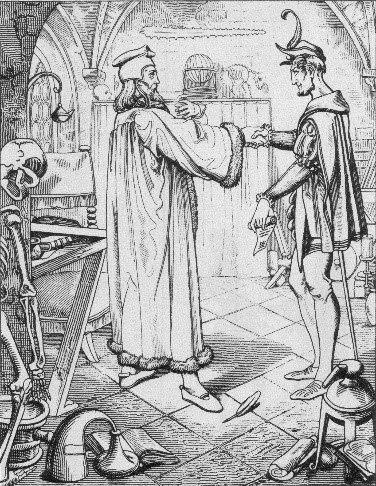
A change does come in this second verse, but for the time being for the worse; the suggestion suddenly becomes that the Black Rider is the blackest of all: Satan himself. At least, that’s what the second and third verse lines really seem to insinuate. You’ve seen the great world, and you’ve seen the small is an echo of the words with which Mephisto announces Faust‘s entire arc of action. After Mephisto’s first attempt to infiltrate Faust’s household fails miserably, he makes himself known as the Devil, with the usual detours (“I am the spirit that denies”, “Destruction is my original element”, “Part of the part am I, which once was all”, and a few more such cryptic hints), but then gets to the point fairly quickly: he wants Faust’s soul. They agree on the terms, and then Faust asks:
Faust
Which way now shall we go? Mephistopheles.
Which way it pleases thee.
The little world and then the great we see.
O with what gain, as well as pleasure,
. Wilt thou the rollicking cursus measure!
… so, the little world and then the great world, it shall be – the same route that the Black Rider has travelled, according to the narrator. In Faust I, the setting is then the small world, the here and now, with a relatively manageable radius of action – Faust and Mephisto move roughly between Leipzig and the Brocken in the Harz, so some two hundred kilometres all in all. We get to know the great world in Faust II. Boundaries of time and space no longer exist; Faust and Mephisto are in Ancient Greece, in a dream world, at the court of a medieval emperor, crisscrossing Europe.
And the next line, You fell into the fire, and you’re eating the flame, doesn’t really contradict the suggestion that the Black Rider is the Devil himself. Well, “fallen into the fire” fits, at the very least, Lucifer’s fall from grace, out of Heaven, straight into Hell, “so I brought fire out from your midst; it consumed you, and I turned you to ashes on the earth in the sight of all who saw you,” as God says it, flowery as ever, in Ezekiel (28:18). You’re eating the flame, however, is a less recognisable image. Remarkably, Dylan himself used it once before, more than 50 years ago:
Too much of nothing
Can turn a man into a liar
It can cause one man to sleep on nails
And another man to eat fire
… in one of the Basement highlights that is, in “Too Much Of Nothing”. Apart from the wondrous content, it is notable that Dylan is now repeating himself for the second time: after the “Mississippi” quote in the opening verse, now a Basement paraphrase in the second verse.
It is a somewhat bizarre image. In “Too Much Of Nothing” we can deduce from the context that it should be understood as an expression of despair, and in the canon, we really only know it that way as well: Portia’s gruesome suicide from the fourth act of Shakespeare’s Julius Caesar (“she fell distract and, her attendants absent, swallowed fire”) – there are not many more examples of eating fire.
Quite a lot of examples of the opposite, of course. Tragic heroes consumed, eaten, devoured and extinguished by fire – we know hundreds of examples thereof. An “ordinary” playful inversion of the cliché, however, it doesn’t seem to be – there is, in any case, no illuminating continuation, not one that builds on this alienating image, or a mirroring of catachreses, as we know from 1960s songs like “Stuck Inside Of Mobile” (the post office has been stolen / and the mailbox is locked) or ” Sad-Eyed Lady Of The Lowlands” (your sheets like metal and your belt like lace).
The other obvious association is equally incomprehensible, although Dylan sings about that significantly more often than about bizarre suicides;
Th’ iron horse draweth nigh,
With his smoke nostril high;
Eating fire as if grazing,
Drinking water while he’s blazing;
Then his steam forces out,
Whistling loud, “Clear the route”
… the fire-eating black rider that is the steam locomotive. Which is closer to Dylan’s heart, and old-fashioned train songs like this nineteenth-century “The Utah Iron Horse” are bound to be found in Dylan’s jukebox too.
Anyway: the last lines of this verse torpedo the last attempts to distil a narrative or a coherent portrayal from the lyrics. Better seal up your lips if you want to stay in the game are not words anyone can say to Satan, nor to a steam locomotive. “Seal up your lips, and give no words but mum” are Hume’s words in Shakespeare’s Henry VI, Part II and have a certain notoriety because it is often incorrectly identified as the origin of the expression mum’s the word (mum has nothing to do with “mother”, but is “an inarticulate sound made with closed lips” according to the Oxford English Dictionary).
Be reasonable mister is a cliché that appears in dozens of film noirs, westerns and hard-boiled detectives, and the concluding Let all of your earthly thoughts be of prayer is utterly alienating again. Tone and content are derived from archaic, Puritan edifying literature popular in the eighteenth and nineteenth centuries. The tone of religious hymns or evangelical poetry, usually written by pastors’ wives or old maids. Writers in whose biographies you always come across concepts like “Christian piety,” “purity” and “honest simplicity”. Like Eliza Lee Cabot (1787-1860) and one of her greatest hits, her hymn to the Lord’s Day, which opens with:
Sabbath Day

How sweet, upon this sacred day,
The best of all the seven,
To cast our earthly thoughts away,
And think of God and heaven!
How sweet to be allowed to pray
Our sins may be forgiven!
On the whole, it is beginning to look very much like Dylan has opened his ornate, beautiful box once again. The box we know about thanks to the loose tongue of screenwriter Larry Charles, who has worked with Dylan a few times. In Pete Holmes’ podcast You Made It Weird, Charles revealed in 2015 that Dylan has a box, filled with pieces of written paper, which he occasionally turns over on the table:
“It was hotel stationary, little scraps like from Norway, and from Belgium and from Brazil, you know places like that. And each little piece of paper had a line […]. I realized, that’s how he writes songs. He takes these scraps and he puts them together and makes his poetry out of that. He has all of these ideas and then just in a subconscious or unconscious way, he lets them synthesize into a coherent thing.”
… to which Larry Charles, however, still notes: “He lets them synthesize into a coherent thing.” But what holds “Black Rider” together, what exactly makes it a coherent, unified whole is, for now, still puzzling…
To be continued. Next up Black Rider part 5: Marjorie
Jochen is a regular reviewer of Dylan’s work on Untold. His books, in English, Dutch and German, are available via Amazon both in paperback and on Kindle:
If you have been lurking around Untold Dylan for a few years you’ll perhaps remember that the notion of a Dylan Cover a Day came about when lockdown hit England, and I was shut up on my own day after day with just the computer and phone for company.
With lockdown very much a thing of the past I am now allowed out again (although I think quite a few people reckon that is not quite such a good idea) so it’s no longer “a day” but maybe “once a week” or so.
Anyway this is episode 123, and I mention that because I think this might be the first time I have brought in covers not just of the song in question (Romance in Durango) but re-writes of that song under different names. Hopefully, I’ll be able to explain myself in a moment.
But first a straight cover: Els miralls de Dylan is described on Secondhand songs as “A duo project dedicated to Bob Dylan songs in Catalan, mainly translated by themselves. Temporarily also integrating other artists.” Except much of this is in English, so I remain as confused as normal.
I love the song, and find this a rather jolly version, and one worthy of a listen but not one that suddenly gives me that insight into the music which deepens my appreciation, or which really draws me back to it. But as I say, in my view, worth a listen.
The next example, from Nicole Stella, does however give me something extra. There’s more emotion here, which I always feel is what this song needs. Not over the top emotion, but just more than Els miralls de Dylan gave us. Somehow, because of the fractional delay of certain words and the fractional speeding of others, I believe in the song more. The harmonies work for me as well.
In fact it is one of those frustrating pieces that I can say, yes I really do appreciate this music, but I find it hard to explain exactly why. Maybe it is the way the accompaniment is always held back with no temptation to get above itself. Maybe it is because I don’t understand the language – and in fact that is interesting, because there is nothing in my head that is translating the lyrics into English – I am in fact enjoying the sound of the lyrics without trying to remember the English.
The video ends with a note to the effect that if you enjoy the video please share it, so I have.
https://youtu.be/i4GD4XvAzWE
This next one is Fabrizio De André, but now not just with a language I don’t speak and a totally different accompaniment, and indeed what seems to me inappropriately fast moving pictures (which I find distracting) I am less inclined toward this version. But I don’t think it is the music that is putting me off, it really is the video. These pictures just fly past too quickly, and the timing of that movement is so out of keeping with the music.
Indeed it is a thought I do get sometimes – that the video makers really don’t have any appreciation of what the music is doing. How could anyone think that the music requires a new picture (one without association to the next) every two or three seconds? It just seems utterly bizarre and self-defeating to me. If by any chance you feel the same, try closing your eyes. I most certainly found it helped. (Mind you as I get older I often find that helps).
And now for something different. Because this is one of the songs that Dylan didn’t just write once, but wrote again and again. And that’s not just me trying to be clever with a bit of musical memory – as many others have noted he really did use the same music in different songs.
Try this for example… and don’t be put off by the rhythm and accompaniment. Listen to the melody.
And if that were not clear, try this version.
We’ve moved from covering to copying – but you know, it’s Bob. He’s written over 620 songs so he’s entitled to have one or two sounding like the others, surely.
The Tarantula chapter entitled ‘Cowboy Angel Blues’ alludes not only to Gene Autry, the owner of the California Angels baseball team, and singer of ‘Home On The Range’, but also to the Tennessee Williams play ‘Streetcar Named Desire’ in which Stanley Kowalski rapes Blanche, the sister of his wife Stella.
In “Tarantula”, Sigmund Freud, with a big-mouth-Martha-Raye-like grin, gives some sage advice to Mr. Clap:
& if anything drastic comes up
- here - take these pills
- by the way, you should call your mother 'Stella'
just to show her that you mean business
(Bob Dylan: Tarantula)
That play by Williams also alluded to in the following song:
And your streetcar visions which you place on the grass
And your flesh like silk, and your face like glass
(Bob Dylan: Sad-Eyed Lady Of The Lowlands)
In the one below too:
Well, they're going to the country, they're gonna retire
They're taking a streetcar named desire
(Bob Dylan: Tweedle Dee, Tweedle Dum)
However, let us not digress ~ back to the source poem of ‘Home On The Range’.
Beaver Creek is in Kansas; the the Solomon River in that State refers way back to the biblical times – to King Solomon of Israel:
Oh, give me the gale of the Solomon vale
Where the streams with buoyancy flow
On the banks of the Beaver where seldom if ever
Any poisonous herbage doth grow
(Brewster Higley: My Western Home)
https://youtu.be/CTYI5MVR4vU
The sad-eyed lady described by Dylan as having a kiss like a “geranium”, the flower brought to America by the Dutch; thought by some to be poisonous to humans.
The giant Tarantula, hairy-legged and horrible, on the other hand, tramples over the cities and countryside of America, wreaking havoc everywhere it goes:
& voids held up to Scawny Horizon by lee marvin ....
& malcolm X forgotten like a caught fish
& wonder - ah wonder just what
- just what that means
(Bob Dylan: Tarantula)
Lee Marvin portrays gun-slinging killer Tim Strawn (as well as Tim’s drunken brother – who reforms) in the humorous movie ‘Cat Ballou’, starring Jane Fonda. Another character therein be Jackson Two Bears.
Malcolm X, an actual person, advocates the separation of blacks from the ‘evil’ white race; gets assassinated after he moderates his views.
Who Wrote Tarantula?
Who writes ‘Tarantula’?
Not:
Matty Groves, who secretly at midnight
tries to chop down the church steeple
with Edward, who cuts hedges
for his wages
(Bob Dylan: Tarantula)
The above lines written by Bob Dylan allude to the folk ballad below:
Rise up, rise up, my gay young bride
Draw on your pretty clothes
Now tell me do you like me best
Or your Matty Groves
Or the dying Matty Groves
She picked up Matty's dying head
She kissed him from cheek to chin
It is Matty Groves I'd rather have
Than Arlen and all his kin
(Joan Baez: Matty Groves ~ traditional)
Mentioned in ‘Tarantula’ too is the following ballad:
'Twas in the merry month of May
The green buds they were swelling
Poor William on his deathbed lay
For the love of Barbara Allen
(Bob Dylan: Ode To Barbara Allen ~ traditional)
In the print of his little book, Dylan deliberately tongue-fumbles over ‘woody guthrie’, ‘woody guppie’, ‘coody puppie’, and ‘boody guppie’, though we’re still not sure that the writer fools around with words like “curlew”and “curfew”; “forest” and “fore-est”; “Strawn” and “Scrawny”.
However, Dylan songs sure mix actual happenings, and possible ones, with the world of entertainment, past and present.
With factory-made teenage heart-throbs of recent times, a number of them from families with Italian backgrounds – i.e., Franklin Avalon, Fabian Foote.
Noted on the CBC ‘Quest’ show, for instance:
Turned on my record player
It was Fabian singing
"Tell your ma, tell your pa
Our love's a-gonna grow
Ooh-wah, ooh-wah"
(Bob Dylan: Talking World War III Blues)
In “Tarantula” too:
T)he little old winemaker immediately took off his head
& his belt
& who do you think it turned out to be
but fabian
(Bob Dylan: Tarantula)
On the tv show, sitting at the CBC Quest table, Michael Zenon’s observed writing down a bunch of stuff in his notebook while Dylan sings –
giving rise to a suspicion:
Could it be that the Canadian actor from “The Forest Rangers” tv show actually provides most of the words for the upcoming book that young Dylan titles “Tarantula”?
Aaron: “Can’t Help Falling in Love” is a song recorded by Elvis Presley for the album Blue Hawaii.
From Wikipedia: The melody is based on “Plaisir d’amour”, a popular French love song composed in 1784 by Jean-Paul-Égide Martini. The song was initially written from the perspective of a woman as “Can’t Help Falling in Love with Him”, which explains the first and third line ending on “in” and “sin” rather than words rhyming with “you.”
Bob’s version appeared on his 1973 studio album, Dylan
Tony:An unusually melodic harmonica part from Bob at the start. And a bit of a feeling that as he sings he always makes a grab at the word “help” for some reason, which I find a bit odd – but as ever that’s just me. It’s a nice, relaxing recording, but it is not something of Bob’s that I’d ever feel like listening to when I could choose what to play next.
Although I must admit the subtle changes made on the middle 8 “Like a river flows” are interesting. Plus the slight changes to the melody on occasion are enjoyable.
But there are oddities too, that I am not at all sure about. Such as why suddenly the setting of the organ is changed at 2’26” – it just seems a sudden jolt.
I suppose the answer to why this was recorded would be as a tribute, and if there are indeed many people who thoroughly enjoy this and play it often, then clearly it is a success on that score. So I guess it is just that I am not one of them, and in my old age I’m getting grumpy!
Aaron: In 1993, British reggae band UB40 covered it as the first single from their 1993 album, “Promises and Lies”. The song climbed to No. 1 on the US Billboard Hot 100, staying there for seven weeks and the United Kingdom where it topped the chart for two months.
Tony: I like this – which is not to say that I am going to play it again, but rather is a reflection of the way the accompaniment travels its own route while the melody keeps the traditionally restrained approach – and indeed the crowded conditions of the mock performance in the tunnel add to the fun. It’s jolly, and it made me feel good in a way that neither Bob’s nor Elvis’ version ever does.
Aaron: Emmylou Harris recorded a version of the original French lyric in 2003 for her wonderful Stumble into Grace album.
Tony: Now that accordion part does work for me, and seems to be in keeping with the whole arrangement. Suddenly I enjoy the song – and the chord change (at the “joy of love”) from all the other versions also works for me, as does the instrumental.
I think it is the simplicity of the whole piece and the gentleness of the entire performance that attracts me. Plus the fact that there is no attempt to spin it out. It is a short song, and this performance lets it be just that: a sort song.
And so as I play through the selected recordings it finally hits me. Bob’s version is four minutes 20 seconds long, and that really is stretching the song beyond its natural boundaries for me.
Aaron:As an added treat here is Christine McVie covering it for an obscure movie soundtrack
Tony: I can’t resist Christine McVie’s voice, so I am expecting to like this right from the start, and she doesn’t let me down. There’s no attempt to take the song beyond its own simplicity and self-imposed limitations – which as I noted above is what I feel the Dylan version does. Emmylou Harris still gets my vote as the best of these examples, and I am playing it now for the third time as I conclude my rambling notes, and even though it is only just gone 10am and there is a load of work waiting for me in my in-box I really don’t want to do anything else except listen to it again.
Bob Dylan set himself quite a challenge in turning “Abandoned Love” into more than just an interesting song – for it consists of one of the standard pop motifs (lost love), is quite long (eight verses), and (as is inevitable with verses within popular music) has a melody that repeats and repeats across four and a half minutes.
Of course, the lyrics are really engaging, although they don’t actually follow a logical sequence or make obvious sense. Rather they are an ongoing reflection on a relationship which the singer is about to end. People and situations seem to appear and then vanish from the song as if in and out of the fog, so what we are left with is an overall vision of unhappiness but no certainty as to what is going on. The song lyrics are the musical equivalent of an impressionist painting…
But against this the music is rather jolly and is the same verse after verse. And therein lies the challenge – how to keep up the musical interest, so that the listener does not end up thinking only of the words – which actually don’t tell us the story we might expect.
One option would be to give the listener interesting and unexpected chords, but Dylan doesn’t let that happen. The chords used are absolutely standard and can be found in hundreds of thousands of songs, although the actual sequence of the chords is slightly unusual (but hardly unique) when the second and third lines are taken as a whole
GEmI can see the turning of the key
CDI've been deceived by the clown inside of me
BmCI thought that he was righteous but he's vain
GDGSomething's telling me, I wear the ball and chain
So how can our interest in the piece be kept? Partly this conundrum is solved by having the violin played exquisitely by Scarlet Rivera, as an ever-evolving counter melody – indeed it is a part that keeps going even when the harmonica comes in. Had anyone performed a violin / harmonica duet before? Possibly, but certainly not very often.
But what actually happens thereafter is that the music is so beguiling, with the slight variations that the violin adds throughout, that we keep losing track of what the lyrics are telling us, and so we want to come back again to have another listen to what the storyline is – if it is anything at all.
And beyond that there is the overall feel of guitar, drums and violin that gives us a floating romantic feeling (emphasised by the opening line “My heart is telling me I love you still”) that offers a sense of continuity. Which is interesting because if we do pick up on any of the lines in the song this is not what we hear. We hear the lover leaving, the lover who is left behind being tied down by the ball and chain, abandoned by those who might help (the patron saint for example)…
Indeed put together, none of the lyrics really make sense – after all what are we to make of
Everybody's wearing a disguise
To hide what they've got left behind their eyes
But me, I can't cover what I am
Wherever the children go I'll follow them
In fact, we don’t make anything out of it because the music carries us along. And this is my point here – this is a drifting stream-of-consciousness set of lyrics that could become dull or laughable through their lack of obvious meaning and the lack of context. But the engaging melodic line Bob sings and the beautiful counter-melody of the violin keeps the song going, along with a regular but relaxing beat, which gives us a feeling of a strange, but actually not frightening world.
There is no pain in this breakup, only bemusement at all the things happening around – and that is a very unusual context for a popular song. And thus it needs an unusual accompaniment which is what the violin brings. Indeed I would go so far as to say that without the violin’s improvised part, the recording would be far, far less interesting and might never have been kept, let alone released.
In fact so powerful is the musical accompaniment in terms of its emotional content, that when we get to the denouement we don’t feel a sense of end at all. Rather we want to go back and hear it all again.
So one more time at midnight, near the wall
Take off your heavy make-up and your shawl
Won't you descend from the throne, from where you sit?
Let me feel your love one more time before I abandon it
It is an amazing recording, which with a less interesting melody and/or without the violin part, would probably hardly be remembered at all. And yet for many of us it is an essential part of the Dylan collection. A perfect example of Dylan using music AND lyrics as equals to create a set of images and a storyline, neither of which make sense, but make us feel that if we listen just one more time, will reveal more of their secrets.
There are cover versions of this song, but none of them seem to be able to take the music anywhere else – it only works in the form that Dylan laid it down. The music and the lyrics have to co-exist as he set them out. No other way is possible.
This is the third Warren Zevon song in Bob Dylan’s list of his favourite songs. We’ve already covered ‘Desperado Under the Eaves’, and ‘Lawyers, Guns, and Money’, and as ever there is a list of all the articles in this series, with links, at the end of the piece.
We’ve always known about Bob’s interest in boxing – if you would like more on this it is worth reading Jochen’s article I shall be free no 10; Bob Dylan’s love of boxing. And of course, through this series, of late I have been coming to grasp his love of the music of Warren Zevon too.
So I guess this choice is fairly natural – although it makes life difficult for me because I know nothing of boxing. I am therefore going to take what I can from Wiki by way of background to the events referred to in this song. Please do correct any mistakes you find.
Ray Mancini was born 1961, and held the WBA lightweight title from 1982 to 1984. Since then he has worked as a boxing commentator and was inducted into the International Boxing Hall of Fame in 2015.
The most well-known event in his career I think was the fight against Duk Koo Kim in 1982 four days after which Kim died. “Kim’s mother died by suicide three months after the fight, and the bout’s referee, Richard Green, killed himself in July 1983,” according to Wiki.
In January 1984, Mancini defeated Bobby Chacon when referee Richard Steele stopped the fight in the third round – another incident referred to in the song.
The song has the power and “push” if I can use that word, of the earlier two Warren Zevon songs that we have considered, although of course each has delivered that “push” in a different way, in a reflection of the lyrics. But it really does reveal the power that he was able to get into his songs.
Hurry home early hurry on home
Boom Boom Mancini's fighting Bobby Chacon
Hurry home early hurry on home
Boom Boom Mancini's fighting Bobby Chacon

From Youngstown, Ohio, Ray "Boom Boom" Mancini
A lightweight contender, like father like son
He fought for the title with Frias in Vegas
And he put him away in round number one

Hurry home early hurry on home
Boom Boom Mancini's fighting Bobby Chacon
Hurry home early hurry on home
Boom Boom Mancini's fighting Bobby Chacon

When Alexis Arguello gave Boom Boom a beating
Seven weeks later he was back in the ring
Some have the speed and the right combinations
If you can't take the punches, it don't mean a thing

Hurry home early hurry on home
Boom Boom Mancini's fighting Bobby Chacon
Hurry home early hurry on home
Boom Boom Mancini's fighting Bobby Chacon

When they asked him who was responsible
For the death of Duk Koo Kim
He said, "Someone should have stopped the fight
And told me it was him."

They made hypocrite judgements after the fact
But the name of the game is be hit and hit back

Hurry home early hurry on home
Boom Boom Mancini's fighting Bobby Chacon
Hurry home early hurry on home
Boom Boom Mancini's fighting Bobby Chacon
I suspect Bob’s liking of this song comes both from his admiration of Warren Zevon’s work and his love of boxing – plus of course the fact that the song doesn’t shy away from the key issue of what boxing is, and the part played in the Duk Koo Kim fight not just by Mancini but also the referee and the media.
Perhaps we might also note that Zevon is the only artist on Dylan’s list of favourite songs to have four of his compositions listed. This was the third of those four, and I rather think it might be worth, at the end of the series also looking at another Zevon song: “Mutineer,” which Bob played during his tour of the USA in the autumn of 2002. But I will leave that, as I say, for the end of the series.
Black rider, black rider, you been living too hard
Been up all night, have to stay on your guard
The path that you’re on, too narrow to walk
Every step of the way, another stumbling block
The road that you’re on, the same road that you know
Just not the same as it was a minute ago
“If Bob Dylan could go back in time, would he travel the same road, would he leave behind everything he had, to devote his whole life to music?” Sandra Jones asks Bob Dylan, in the third person for reasons that are unclear, for Belgium’s Ciné-Revue in 1978. Dylan’s answer echoes more than 40 years later in the opening lines of “Black Rider”:
“I don’t think I can answer your question with all the honesty it deserves. First, you can never rebuild the past, and that’s how it should be. So, it’s not humanly possible to answer that question. Over twenty years a man accumulates experiences, mistakes and successes. At the end of the day, he finds out that he has changed totally and that he couldn’t travel the same road again.”
Dylan does seem to be fond of it it, of the life-is-a-road metaphor. “I’m standin’ on the highway watchin’ my life roll by”, “I’m walkin’ down that long, lonesome road, babe”, “Your old road is rapidly agin’”, “The way is long but the end is near”, “I can follow the path”, “Gon’ walk down that dirt road” … every record since 1962 has featured a song that uses life = a road. Dozens of times as in these examples, and in addition often enough symbolically. “Desolation Row”, “the Highway of Regret”, “Suicide Road”, Rough And Rowdy Ways, the album on which we again encounter a “boulevard of crime”, “Armageddon Street”, a “road of despair” and a “long, lonesome road”. And in this opening couplet of “Black Rider”, the song poet seems to want to thematise the metaphor itself.
At least, we do see a similar accumulatio, an accumulation of equivalents, as in “Crossing The Rubicon”, and , more so, as in “Mississippi”:
The narrow path in verse line 3;
Stumbing blocks on the way in verse line 4;
The changed road in verse line 5/6
… where the Dylan fan will notice that Dylan, with every step of the way, chooses exactly the same words as the opening words of “Mississippi”. Remarkable, as Dylan has a documented aversion to repetition – but apparently his need to use the equivalents path, way and road in this verse trumps that aversion to repetition.
The state of mind of both protagonists, of the narrator in “Mississippi” and the Black Rider, is approximately similar. In “Mississippi”, the song poet chooses an accumulation of equivalents that all express distress; boxed in, painted in a corner, trapped, nowhere to escape, drownin’, and so on. The Black Rider is similarly trapped; the path is too narrow, there are obstacles in the way, the only route he knows has changed beyond recognition. But the distress seems even a degree worse than the one tormenting the narrator in “Mississippi” – this protagonist seems terrified. Well, he should be scared to death, at the very least. A suspicion which is triggered mostly by the opening line, of course; you’ve been living too hard.
Word choice Dylan chooses in other contexts to describe a fatal course of life, like when he talks as a DJ in Theme Time Radio Hour about Little Walters’ death: “He died at an early age, 38 years old. But if you see pictures, he looks closer to sixty. A hard-living man, but a great artist.” And like the famous words from the monumental song that stands on a pedestal with Dylan, and with all of us, from “A Change Is Gonna Come”: It’s been too hard living, but I’m afraid to die.
The follow-up line, the second line of verse, hints at much the same thing. Have to stay on your guard suggests, quite clearly, that the Black Rider is threatened, and it is obvious that his life is threatened. In any case, the words echo Sir Toby’s words in Shakespeare’s Twelfth Night:
“So if you value your life at all, be on your guard, for your opponent has all the youth, strength, skill, and anger that god can give to a man.”
… which at first seems a bit far-fetched, but on the other hand: Twelfth Night has been a purveyor of Dylan’s oeuvre for sixty years now. Starting as early as 1963’s “Percy’s Song”, which bases the final song from the play, on “The Wind and the Rain”. A few years later we hear an otherwise empty name-check in “Highway 61 Revisited”, and conversely, directors in the twenty-first century integrate Dylan’s songs into performances of Twelfth Night. And, to complete the circle, my ship’s been split to splinters from “Mississippi” is the plot-driving catastrophe from Twelfth Night or What You Will.
Anyway: both the words living too hard and be on your guard Dylan knows and uses mainly in a fatal context, and that’s how he seems to use them here – so this black rider does indeed seem to be at the end of his life’s journey. A rather hackneyed theme presents itself. Which might explain why even a Nobel Prize-winning poet does not shy away from clichés like narrow path and the road you’re on. And who, apart from “Mississippi”, indeed seems to be haunted by “A Change Is Gonna Come”:
For what I knew was wrong
Yes it's been an uphill journey
It's sure's been a long way comin
Yes it has

It's been real hard
Every step of the way
But I believe, I believe
This evenin' my change is come
But whether the coming change here in “Black Rider” is indeed the ultimate, final change, we will only hear and learn in the following verses…
https://youtu.be/xNyt7lifhjE
To be continued. Next up Black Rider part 4: He lets them synthesize into a coherent thing
Jochen is a regular reviewer of Dylan’s work on Untold. His books, in English, Dutch and German, are available via Amazon both in paperback and on Kindle:
Bob Dylan tried a dramatic re-write of Wicked Messager in 2001 (this recording from Seattle on 6 October that year) and made a few variations along the way. It was a very similar approach to that used for “The Drifter’s Escape” – but far more successful in my view.
Here’s the original – just in case you haven’t heard it for a while…
It is quite an interesting melody running over the repeated instrumental accompaniment and with a harmonica part in between each verse which really doesn’t seem to have much to do with anything else in the song – either in terms of the chords, the melody or indeed the feeling.
Now here’s the reworked live version…
As you can hear there is an element of the original instrumentation retained but the entire feel of the song is utterly different. Where there was previously a calm journey across the plains or deserts (or wherever the messenger had come from) it is all fairly calm.
And this indeed makes some sort of sense with regards to the last verse – although the lyrics are changed slightly
The leaves began to falling
And the seas began to part
And the people that confronted him were many
And he was told these last few words
Which opened up his heart
"If ye cannot bring good news, then don't bring any"
But what we have now (I feel) is a sense of panic – which is then continued in the solo part at the end of the song.
In fact, without us knowing what on earth was in the message from God (Eli), or what is going on (apart from the seeming fact that those in power ignore its contents), we have a totally different song.
And in this regard, the rock version makes sense in its own way, just as the original folk version does. God can just let silly humans get on with their own vanity (the original album’s simple folk version) or He can swipe mankind away with a flick of the finger (this reinvented rock version).
Or maybe Bob said to the band members, “let’s just do some JWH tracks with a beat.”
What we have to remember is that this electric version was performed ten years before Thea Gilmore brought out her version which totally reconfigured the song, but around 28 years after Hendrix did his typically Hendrixian version. Also there was the fascinating reworking of the piece by the David Nelson Band and I have always had the thought that maybe Bob was trying to find something that neither David Nelson nor Hendrix had actually achieved with the song.
Of course that is pure speculation on my part – but I think it is relevant, because of why I chose this piece as a highlight. Not because it is a musically brilliant re-interpretation or a sublime live performance but because it expresses to me Dylan’s thought processes as he seeks to find a reinvention not just of his original work but of other people’s re-interpretations in the cover versions.
In short, I find it a highlight because it shines a light on the working process, not because of the end result – although I do enjoy this reworking enormously as an illumination of Bob’s regularly changing views on religion. The “When He Returns” era is long since gone and with this version of the song I am left wondering who the messenger now is, what his message was, and whether he feels the whole message delivery thing is worth the trouble.
And there is that line, “If you can’t bring good news then don’t bring any,” that is so anti-Christian in its approach (for Christianity brings us not just the news of the Second Coming but also the work of the Devil) that it does seem to me (as a non-Christian) that Bob really had shaken a lot of the Christian era out of his thinking. A feeling that is emphasised by the ending as it descends down and down to the final note.
Of course a very personal interpretation, but then, by and large, they all are.
& tolstoy - all right then
- what my work is
- is merely picking up where they left off
- nothing more
(Bob Dylan: Tarantula)
Apparently, it’s really nothing to carry on, at least according to the rather foggy poetic diction below into which rides our “cowboy angel”.
Leo Tolstoy pens “War and Peace,” a fictionalized rendering of Napoleon’s actual invasion of Russia:
Of war and peace the truth just twists
Its curfew gull just glides
Upon four-legged forest clouds
The cowboy angel rides
(Bob Dylan: Gates Of Eden)
The translated quote below, be at the end of “The Gambler” ~ a book by another Russian writer:
" ... later i left the Casino with one hundred & seventy gulden
in my pocket
 - it's the absolute truth!"

 - fyodor dostoevsky

(Bob Dylan: Tarantula)
Inferred above is that what you need to win in life is to first have the courage to make the bet:
Well, I knew I was young enough
And I knew there was nothing to it
'Cause I'd already seen it done enough
And I knew there was nothing to it
(Jim James et al: Nothing To It ~ Bob Dylan)
Another Russian author comes along; this time a modernist playwright whose dark-humored dramas introduce characters who have desires ~ albeit suppressed~ about which they speak inferentially.
For Anton Chekov, the trick in life is to reconcile lofty romantic sentiments with stone-cold reality – as best that one is able.
His writings and literary symbolism go together:
I shall always remember you as I saw you that bright day … you wore your light dress, and we talked together, and the white gull lay on the bench beside us
(Anton Chekov: The Lake Gull ~ translated)
Though time moves on – ie, the wilderness passes, youth passes –
hope remains:
Our conservation was short and sweet
It nearly knocked me of of my feet ....
Bird on the horizon, sitting on the fence
He's singing his song for me at his own expense
And I'm just like that bird, oohh
Singing just for you
(Bob Dylan: You're A Big Girl Now)
White Swan
From out of the Blakean poem beneath springs “Home On The Range”, a song that depicts the Old West of America as an Edenic paradise on earth:
I love these wild flowers in this bright land of ours
I love , too, the curlew's wild scream
The bluffs of white rocks, and antelope flocks
That graze on the hillsides so green
(Brewster Higley: The Western Home)
Gather what you can from author Leo Tolstoy, from post-modernist word-twists, and from pure coincidence ~ in the song lyrics below.
Also, there’s the possible playful ‘fore’, ‘forer’, and ‘forest’:
Of war and peace the truth just twists
It's curfew gull just glides
Upon four-legged forest clouds
The cowboy angel rides
(Bob Dylan: Gates Of Eden)
Poet William Blake engraves visions that tightly combine the spiritual and physical aspects of the mysterious Universe.
In the Dylan quote above, the two cosmic planes are congealed into somewhat-updated word-images which are carried solumnly along by the accompanying music.
Similarly so in the book “Tarantula” by Bob Dylan; but of course without any accompanying “music” ~ except for the ways the sounds of the words are put together to create rhythm, onomatopoeia, assonance, dissonance, consonance, alliteration, and all.
As in the following quote:
(T)here's no liquor in the land
that can stop your brain from bleedin
(Bob Dylan: Tarantula)
Dylan’s “Gates Of Eden” crosses the path of the paradisal “Home On The Range”, a version of that song made well-known by Gene Autry, the singing cowboy “angel”; then owner of the “California Angels” baseball team.
Below, akin to the early version of the range (Autry, on the other hand, leaves out the white swan):
Where the graceful white swan goes gliding along
Like a maid in a heavenly dream
(Frank Sinatra: Home On The Range~ Higley, Kelley, et. al.)
The  range also crosses the path of the following ballad:
And the swan on the river goes gliding by
The swan on the river goes giding by
(Bob Dylan: The Ballad Of The Gliding Swan ~ Dylan/Jones)
Anyway, the cowboy angel’s rendition goes:
Oh, give me a home, where the buffalo roam
Where the deer and the antelope play ....
How often at night when the heavens are bright
With the light from the glittering stars
Have I stood there amazed, and asked as I gazed
If their glory exceeds that of ours
(Gene Autry: Home On The Range ~ Higley, Kelley, et.al.)
Actor Alan Hale plays “Tiny”, Gene Autry’s cowboy sidekick ~ a couple of times on screen.
But apparently, things have changed:
Tiny - I met her at an outrageous party ....
& she's got a new boyfriend now
& he looks like machine gun kelly
(Bob Dylan: Tarantula)
The great problems with doing a cover version of “Ring Them Bells” are a) the song itself is highly distinctive, and b) the use of the word “bells” invites the uninventive performer / arranger / producer to do the obvious. So in listening to a range of cover versions I have veered away from both of those approaches and looked for versions that take us to completely new interpretations. And thankfully quite a few artists have gone to new places and found new things to do.
As Cindy Cashdollar has worked on occasion alongside Bob Dylan she ought to know a thing or two about re-arranging, and that certainly shines through here. The harmonies are beautiful, and the accompaniment laid back without any temptation to include a few bells, gongs or chimes. The instrumental with which the song ends is perfection.
Muscle and Bone play with us by playing a chord sequence at the start and starting the song in exactly the place we don’t expect. The guitar part is so simple, but fits so perfectly with the melody and the lyrics. It just shows you really don’t need to go further and further to get a good cover of Dylan. And perhaps because of that, when the harmonies start it feels so natural.
Perfection in simplicity. (Incidentally, I found myself listening to lyrics in a completely new way through this version – which is always a good thing).
Jumping from one version to another of the same song is always fascinating, and doing it over and again in writing this series I have so often reached the view that amusician or producer or arranger has made changes just for the sake of it. But that doesn’t apply here. Just compare Natasha Bedingfield’s version with Muscle and Bone. Two utterly different interpretations but both really worth contemplating.
After the previous version – indeed after all the previous versions, this is another jolt.
And Gordon Lightfoot has of course the right to do anything he likes with any song. After all, if the composer of “Early Morning Rain” hasn’t earned that right, who has? (Incidentally, Gordon Lightfoot also wrote “Rainy Day People” years after “Rainy Day Women” and I’ve often wondered why – but that’s another story).
Anyway, the starting point is so different and a different interpretation throughout.
So to the final version, and I’ve kept this to last because the opening is so odd, but also because the accompaniment is so unexpected in parts. It just shows how much can be done with a good song. And because I think it works – despite its complete divergence in parts from the original feeling of the song. If you have a moment please do listen throughout. It is worth staying with it.