Black Rider (2020) part 1: He must keep himself clean in speech

Black Rider (2020) part 1

by Jochen Markhorst

I           He must keep himself clean in speech
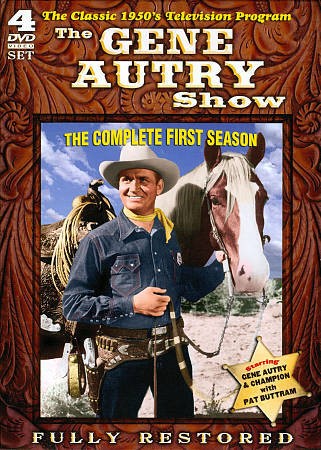
On 23 July 1950, when CBS airs the first of 91 episodes of The Gene Autry Show, Robert “Bobby” Zimmerman is nine years old – at an age, that is, that makes him extremely susceptible to the one-dimensionality, simplism and morality of “America’s Favorite Cowboy”. The episodes last half an hour, and in that half hour, Gene has an adventure, usually one in which he catches a mean crook, sings a song, and lives his insufferably righteous Cowboy Code. “The cowboy must always tell the truth”, “must help people in distress”, and “must never go back on his word, or a trust confided in him”… all ten commandments of the Cowboy Code are recited with apparent approval by DJ Dylan in 2006 in “Guns”, episode 25 of his Theme Time Radio Hour (“And I’m not ashamed to say that I live my life according to that code”).

The 91 episodes have, even by 1950s standards, an awkwardly naive Boy Scout tone, the acting is tear-jerkingly bad, the scripts and dialogues don’t rise above the level of a primary school musical, and the humour component provided by side-kick Pat Buttram is kindergarten-level (Pat stumbles, drum rolls; it doesn’t get much more sophisticated), but: the series runs for five seasons, is a success and anchors the reputation of the already immensely popular Singing Cowboy Gene Autry – especially with impressionable nine-year-old Bobby Zimmerman.

The series is now being shown again on Amazon Prime, the DVD box sets are still selling – apart from a certain cult status, Gene Autry also has a reassuring, nostalgic quality for surviving members of the Silent Generation and for Baby Boomers like Dylan. And one of the most popular episodes seems to be: “The Black Rider” season 1, episode 14.

In terms of content, there is no overlap with Dylan’s song. The serial-killing black rider is the avenging sister (Sheila Ryan) of executed murderer Rocky Dexter, who checks off the list of men she believes are responsible for her brother’s death. This black rider is a cold-hearted sadist, who smilingly shoots law enforcement officers through the heart from close range and shows no remorse when she is eventually caught by Autry. Little common ground, in short, with Dylan’s Black Rider.

But an educated guess is that Autry has thereby inserted the timeless, irresistibly fascinating and (apart from Zorro) always sinister image of “the black rider” into Dylan’s cultural baggage. And lasting respect for Autry himself, presumably. At least, we can hear Autry traces throughout Dylan’s oeuvre from the 1960s (Autry’s “The Rheumatism Blues” seems to be the court supplier for “Rainy Day Women #12 & 35”) into the twenty-first century (Dylan’s Autry cover “Here Comes Santa Claus” opens Christmas In The Heart, for instance).


After that first, crushing encounter with a Black Rider (who turns out to be a badass fatal woman in the process), the then nine-year-old Dylan, like all of us, will be confronted with dozens of Black Riders, which only carves the image deeper into our cultural baggage. We meet them in the Bible, countless Westerns, songs, tales of knights and romances of chivalry, fantasy films… though each new generation gets its own archetypal Bad Man or Evil Force, every generation gets a Black Rider. The millennials are to be envied. Their image of a Black Rider is the scariest of them all: the Nazgûl, the Ring Spirits, the Black Riders from Lord Of The Rings (in Peter Jackson’s 2001 film adaptation), responsible for an entire generation’s first experience with a blood-curdling movie scene – when Frodo and his fellow hobbits get off the path just in time and hide under a tree stump;

“The hoofs drew nearer. They had no time to find any hiding-place better than the general darkness under the trees; Sam and Pippin crouched behind a large tree-bole, while Frodo crept back a few yards towards the lane. […] The black shadow stood close to the point where they had left the path, and it swayed from side to side. Frodo thought he heard the sound of snuffling. The shadow bent to the ground, and then began to crawl towards him.”
(J.R.R. Tolkien, The Fellowship of the Ring, 1954)

And as well as generationally, the archetype is transcending cross-culturally too; every nation, in all times, has at least one dark horseman in its canon. The German Kriegskindergeneration (the generation of war children) presumably thinks of John Wayne, because he made such an impression in Der schwarze Reiter (English title “Angel and the Badman”, 1947) as a notorious-gunman-who-repents, while the French contemporaries, on the other hand, will think of Le Cavalier Noir with a wistful smile, Russians see the Devil, Generation X sees Monty Python’s Black Knight looming, Spaniards might think of the Jinetes Negros, Charles V’s dreaded 16th-century elite corps, and as a nickname for smugglers, we have known Black Riders all over the world.

Dylan’s Black Rider, however, has none of these unambiguous identities – or perhaps just a little of everything indeed. The protagonist has a somewhat duplicitous relationship with this Black Rider; his dramatic monologue expresses both hatred and compassion, both admiration and disgust, and both submission and superiority. In any case, this Black Rider does not seem overly sympathetic. Nor does the protagonist, for that matter, who does not seem to live by the Cowboy Code either.

In more ways. But at the very least, in the last verse, the verse with the bizarre line The size of your cock won’t get you nowhere, he unceremoniously does violate the eighth commandment: “He must keep himself clean in thought, speech, action, and personal habits.”

https://youtu.be/6S3I4EAwtpU

To be continued. Next up Black Rider part 2: O where are you going?


Jochen is a regular reviewer of Dylan’s work on Untold. His books, in English, Dutch and German, are available via Amazon both in paperback and on Kindle:


Posted in Uncategorized | 5 Comments

A Dylan Cover a Day: Restless Farewell. Exquisite arrangements, unbelievable power

by Tony Attwood

An unusual – perhaps unique – episode of this long running series which originated from a time when lock down ruled my part of England and I was spending day after day on my own, and really was writing an article every day in the series.

And I’ve always known that we would eventually get to this song, and that I would have to break my own rules by including a version of the song in which Dylan covers his own work, and at the same time refer back to the music that existed before Dylan’s composition.

But let us leave that for a moment.   First Mark Knopfler, who opens with instrumentation that makes it sound like a Scottish folk song.  And which is quite reasonable since the melody, as we all know, is based around the traditional folk song “The Parting Glass”.

Mark Knopfler shows a real understanding and grasp of what he is singing.  Indeed I find this an utterly exquisite rendition, wherein the beauty is reflected both in the singing and the orchestration.  Nothing is forced – his voice flows naturally through the whole song, every verse offers a new insight.    One can focus on any little phrase one chooses, such as “no special friend” and there is emotion and feeling pouring out from those individual words.

Indeed even oft-used devices such as taking the orchestration completely back to basics for the final verse, works perfectly.  As does the decision not to round off the song by ending on the tonic chord (the foundation of the key that the piece is in, which is what normally happens).

So changing direction…. and you may not know the Singing Loins – a band from the Medway, part of south east England, just south of London, which developed its own style of music.  Sadly the extraordinary vocalist of the band, Chris Broderick, passed away from cancer in January 2022, and I’m really pleased to be able to include a recording on this site of him in full flow.

His vocals bring a completely different dimension to this song, and listening to this version today I can imagine that this was how it was meant to be – although of course I know that is not the case.  But this version does show just how flexible Bob’s songs can be (although of course there is a case here for saying “just how flexible traditional English folk songs can be”).  Even if you are taken aback by the way the song is redeveloped I do hope you’ll hear it through.

Moving back to the origins of the song – and I will spend a moment with the actual origins at the end of the Dylan-related recordings – this next recording which was released as part of the tribute to Bob on his 60th birthday, merges the original and his re-writing of the piece.   The accompaniment is exquisitely simple with just the single violin and the guitar.  Exactly the opposite of the version above, but for me each one adds something to my understanding, and my enjoyment.

It is of course also a song that would appeal to Joan Baez and she handles it most delicately, and I do like the way the arranger reworks the piece for her – although after a while it does start to sound a little forced.

What happens is this: the opening part of each verse is in the standard 4/4 rhythm of four beats in a bar, and then it suddenly moves (as other instruments join in) to 6/8 in which we get 1 2 3 4 5 6 with the accents on the first and fourth beat of each bar.

This alternation of the two rhythms is something that I can’t recall from any other performance of any other song.  In a sense it is a little artificial, but it really does make one think again about the lyrics.

There is also the unexpected cadence at the end of each verse – technically it is an interrupted cadence – wherein the chords don’t go where we might expect.

In short this is, musically a complete re-working of Dylan’s original piece.

Moving on to Bob himself (and I know that’s not really allowed because this is a series about cover versions), I can’t leave out the performance by Dylan for Frank Sinatra, who apparently specifically requested this song.

I also featured this recording in the Dylan Obscuranti series in which we created an album of obscure Dylan performances that a record company could pick up and release.  Curiously they never did – or maybe Bob vetoed it.  (The full set of tracks with links is given here).

I’ve noted this version so often here I can’t say any more, and it is after all not really a cover in the normal sense, but still if you have never heard it or not heard it for a long time, do have a listen.  Dylan covering Dylan.

So there we are – four actual covers, and a reworking of the song by Bob himself.  And yet I am still not finished.   For here is an utterly overwhelming and stunning arrangement of the original.   And I really would beg you, if you have never heard this before, to listen now.  Block out the modern world totally, and accept this for what it is.  A beautiful piece of music.

Posted in Uncategorized | Leave a comment

The Tarantula Files: Maldoror and The Good World

by Larry Fyffe

Maldoror

The exciting adventures of the Tarantula Tales continue:

(Y)ou look like james arness? - i am writing
to you to say that you are my son's idol
(Bob Dylan: Tarantula)

Auto/biographical in that singer/songwriter/musician Bob Dylan is said by a number of “Dylanologists” to take his “stage name” from Marshal Matt Dillon of Dodge City, Kansas.

Played on TV’s “Gunsmoke” by James Arness.

Poet Dylan Thomas, a more likely candidate as indicated in the following song lyrics:

The cloak and dagger dangles
Madams light the candles
(Bob Dylan: Love Minus Zero)


Words  that remind of those below:

(T)he goat and daisy dingles
Nap happy and lazy
(Dylan Thomas: Under The Milk Wood)

Another literary source is indicated beneath, a clear one this time:

& Lord Randall  playing with a quart of beer
(Bob Dylan: Tarantula)

Reflected in the following song lyrics:

Oh where have you been, my blue-eyed son
Oh where have you been, my darling young one
(Bob Dylan: A Hard Rain's A-Gonna Fall)

As in:

Oh where have ye been, Lord Randall, my son
Oh where have ye been, my handsome young man
(Lord Randall ~ traditional)

There be outlaws, gun-slinging cowboys, bank and train robbers, all from the Old American West,  positioned here, there, and everywhere.

A member of the James /Younger Gang, a former Confederate guerrilla, then a bank robber, later a Christian:

"(I)'m cole younger, gave my horse to the pony express
- other'n than that, i'm just like you"
(Bob Dylan: Tarantula)

The symbolic Tarantula, for the prose/poet below anyway, is not at all sympathetic to any claim that there’s a brighter world to come, where everyone’s equal; rather eternally surrounded we all are by a vampiric nightmare:

Night was beginning to spread over nature
The blackness of her veil
(Lucien Ducasse: The Songs Of Maldoror ~ translated)

John Keats no longer accused of being a nightingale too happy in its happiness:

Well, my sense of humanity has gone down the drain
Behind every beautiful thing, there's some kind of pain
... I just don't see why I should even care
It's not dark yet, but it's getting there
(Bob Dylan: Not Dark Yet)


The Good World

& he's eating a picture of jean paul belmondo
(Bob Dylan: Tarantula)

In a neoNoir movie, Jean-Paul Belmondo, a handsome French actor plays a small-time hood who’s searching for the good life.

The Existentialist-oriented film is titled “Breathless”, a ‘New Wave’ film that features “jump cuts”, and ambiguous dialogue.

In the movie, the fleeing anti-hero shoots a policeman; he ends up betrayed by his American girlfriend, and is shot to death.

In the song lyrics below, albeit at a slower pace of breathing than before, the Poe-like narrator manages to retain a living breath ~ at least for the time being:

Forgetful heart
We loved with all the love that life can give
What can I say
Without you it's so hard to live
Can't take much more
Why can't we love like we did before
(Bob Dylan: Forgetful Heart ~ Dylan/Hunter)

As previously noted, Euro-centric ‘Dylanologists’ tend to forget, or else ignore, the strong influence that the Gothic writings of Edgar Allen Poe have on many of the song lyrics written (some assisted) by Bob Dylan.

Words count:

But we loved with a love that was more than love
I and my Annabel Lee ...
And so all the night-tide, I Iie down by her side
Of my darling - my darling - my life and my bride
In her sepulchre there by the sea
(Edgar Poe: Annabel Lee)

Annabel’s “highborn kinsmen” take her body away.

Now-a-days, asserted it is by a number of doomsday writers, official bureaucracies control most everyone’s life, their dreams, and even their deaths:

(W)here the bureaucrats
- the dreamy Huxley hanger oners
(Bob Dylan: Tarantula)

These bureaucrats, warns Britisher Aldous Huxley (in “Brave New World”), are always getting new and more efficient means to maintain social control:

Oh wonder
How many goodly creatures are there here
How beauteous mankind is
O brave new world
(William Shakespeare: The Tempest, Act V, sc. i)

Those means of control can include musicians, and songsters to entertain; and   drugs to placate:

The watchman he lay dreaming
As the ballroom dancers twirled
He dreamed the Titanic was sinking
Into the underworld
(Bob Dylan: Tempest)

Posted in Uncategorized | Leave a comment

Dylan: the music and the lyrics: Sign on the window

by Tony Attwood

This series tries to look at Dylan’s songs from the point of view of the music and the lyrics in equal measure, rather than (as seems to me to be the normal approach in literature about Dylan) focussing primarily on the lyrics, and if considering the music at all, considering it as an afterthought.

And in returning to “Sign on the window” something like eight years after I first wrote a review of the song for this site, and now looking to consider the music and the lyrics as equal partners in the song, I find “Sign on the window” a most curious case in many ways.

One point is that I think Dylan got the accompaniment wrong in his recording of the song, and another is that I think everyone else has got their arrangements wrong too.  So if you want a piece of arrogant writing – here it is, for I am arguing “I am right and they are all wrong.”  So if you feel that no one has the right to criticise Dylan’s work in this way, this article may not be for you.

But maybe Bob also has his concerns about this piece.   After all it is a delicate and beautiful piece that deserves a wide audience – and it got it in “Girl from the north country” and indeed even in that show, there was a feeling that much of Dylan’s original musical creation needed to be kept.  And those guys know a thing or two about music.   So maybe this is just me…

But I’ll keep going, and if you are still with me, let me try and illustrate, using the original album version.

The opening line is delicately performed.  The singing is restrained, the piano is merely the chordal accompaniment – and a simple chordal accompaniment at that – with a wonderfully extended pause after the first line.   This continues into the second line, but then incomprehensibly the piano plays multiple repeats of one note after the word “allowed”.

OK that is not right for the mood of the piece, but it is not too bad.  But the we get it again after the next line.  OK after that thankfully it is gone – and we get the band coming in and playing in sympathy with the sadness of the lyrics, but there are still those moments of repeated notes.

And I keep wanting to know why?   Was Bob trying to express what was wrong with his feelings – that agony was pounding away in his head?   Or did he just not like the drift into silence at that point?

But still worse is to come.   For after that there is the middle 8 – in which extraordinarily he changes key – which hardly ever, ever happens in a Dylan song, and from a musical point of view is absolutely not needed here.  The song is written in F# (F sharp) which as the Dylan Chords site says is “possibly the worst conceivable guitar key”.  And I suspect every amateur guitarist would agree.   However, it is not that awful for a pianist – one ends up mostly playing the black notes and I take it this is Dylan at the piano.

But then suddenly the music in the “middle 8” (the section starting “Looks like nothing but rain”, jumps to B flat which is musically as far removed from F sharp as it is possible to imagine – and then keeps meandering around.

I wonder if Bob was thinking he could express the distress shown in the lyrics, within the music as well, by using these chords which really make no musical sense?  Maybe that’s it, because I can’t think of any other reason for doing what he did to this most beautiful piece of music (up to the point of the middle 8 at least).

What actually happens through those repeated notes and the sudden jerk into a new unrelated key for the middle 8 is that we get a deep sense of unease about the whole thing he is singing about.   And (and I know, here I am criticising the greatest songwriter of our time) I think he is trying too hard.  It really doesn’t work.   The lyrics are simple, poignant and heart-wrenching,

Sign on the window says “Lonely”
Sign on the door said “No Company Allowed”
Sign on the street says “Y’ Don’t Own Me”
Sign on the porch says “Three’s A Crowd”

and the melody fits perfectly, but expressing the anguish through repeated piano notes and sudden jerks of the key into something else really isn’t right.  Yes the heart may be hurting and pounding, but that is not best represented by this in the music.

I think it is possible to understand what Bob was wanting to do – expressing the pain and anguish in his heart through the music, but in doing that he makes the song much harder to appreciate.

Of course, at this point, I am on my own.  “Girl from the north country” used it as Dylan wrote it and the handful of cover versions have done so as well, but if you can imagine the song without the repeated notes and without the sudden jerk into another dimension for “Looks like nothing but rain” you get a wonderful expression of the sadness and pain of lost love without all these artificial musical constructs which in my view are absolutely not needed.

And surely it would make more sense not to have them in the song, for the song ends with a portrayal of idyllic country living.

The Wiki review of the piece says, “”Sign on the Window” expands on the joyous sentiments found in “New Morning”, applying it to domestic bliss.”   But Wiki reviews of Dylan by and large don’t comment much on the music – which is I guess why they leave it at that.   However for me, what the music in that “Looks like nothing but rain” section has to do with anything else in the song, I’ve no idea.

Reports from the time suggest that every song was recorded multiple times with Dylan changing his mind incessantly.  My guess would be that key change section from this song was one of those sudden mind changes.  And my guess as to why he has never performed the song live is exactly because of this.  It seemed like a good idea at the time.  But really it wasn’t.

And that’s also why so few people cover the song.   Without the “nothing but rain” part and those repeated piano notes, it would be so beautiful.  But with them….

Posted in Uncategorized | 9 Comments

Standing In The Doorway (1997) part 2 All these songs are connected


Standing In The Doorway (1997) part 2 (final)

by Jochen Markhorst

II          All these songs are connected

“I had to scramble around to find the right types of lyrics and basically moved lyrics around and put together the puzzle.” Dylan gives three interviews in the week of 21 September 1997, all in an ocean-view hotel suite in Santa Monica, to John Pareles, Edna Gundersen and David Gates respectively. The above quote is from the interview with Gundersen and relates to “Highlands” – but, as we have seen especially thanks to the outtakes on Tell-Tale Signs, is equally applicable to more songs from Time Out Of Mind.

Certainly to “Standing In The Doorway” too; of the 357 words, 83 were first in the outtake “Dreamin’ Of You”; about a quarter of them, therefore, fall into the category,“I basically moved lyrics around and put together the puzzle”. And most of them are the “right type of lyrics” anyway, lyrics that Dylan found elsewhere, “by scrambling around”. Without being too secretive about it by the way; like the insertion of a well-known line like I’ll eat when I’m hungry, drink when I’m dry from the well-known “Moonshiner Blues”, for example. After all, most people who buy Time Out Of Mind have been singing those words for decades, at the latest since the success of The Bootleg Series 1, which features Dylan’s recording of it from the early 60s.

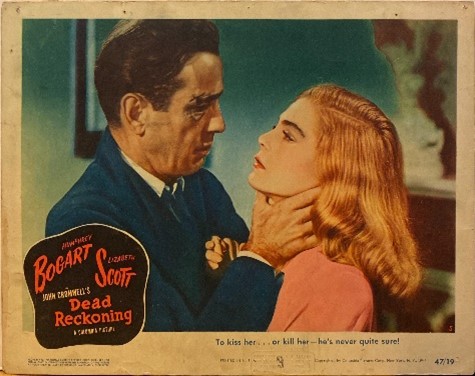
Not all borrowings are so well known, of course. A Rollins quote like The light in this place is so bad is only exposed by Scott Warmuth many years later. The heartbreaking outcry “Don’t know if I saw you, if I would kiss you or kill you / It probably wouldn’t matter to you anyhow” is suspiciously similar to the text of a lobby card from the 1940s film with Humphrey Bogart, Dead Reckoning; “To kiss her or kill her… he’s never quite sure!”. A film noir, by the way, which is of course mainly carried by Bogart, but even more so by his co-star, the irresistible Lizabeth Scott – who, for her performance of “Either It’s Love Or It Isn’t” alone, should at least have received an Oscar nomination.

A line like “The last rays of daylight” is of course not unique, but maybe Dylan just had R. L. Stevenson on his bedside table (“As the last rays of daylight dwindled and disappeared, absolute blackness settled down on Treasure Island”), and underlined this line. And a somewhat alienating interjection like “Buddy, you’ll roll no more” may have been picked up by Dylan from the deeper shelves of his inner jukebox, from Bill Monroe’s “Roll On Buddy, Roll On”;

Roll on, buddy, roll on
Wouldn't roll so slow

… although it is more likely that he lovingly steals it from The Rambling Boys, the 1957 album by Ramblin’ Jack Elliott and Derroll Adams, the album Dylan mentions in his autobiography Chronicles. “Roll On, Buddy” is the last song on that album, and in their version the men sing the verse

Well I never liked no railroad man
I never liked no railroad man
Cause the railroad man will kill you if he can
Drink up your blood like wine

… the words Dylan will sing in “Stuck Inside Of Mobile With The Memphis Blues Again” (on a side note: in the verse before that, Elliott and Adams sing “I slept in the pen with the rough and rowdy men”). The rest of the track list does suggest that Dylan has played the album more than once: “Buffalo Skinners”, “Danville Girl”, “East Virginia Blues”… all songs whose echoes descend in Dylan’s work over the years.

Both Bill Monroe and Ramblin’ Jack Elliott sing I got a home in Tennessee, and Gillian Welch seems to notice that too.

In 2011, Gillian Welch releases her masterpiece The Harrow And The Harvest, an album that, very dylanesque, is bursting with borrowings, paraphrases and quotes. It becomes even more Dylan-like when Gillian steals most of her borrowings, paraphrases and quotes from Dylan. As in the moving “The Way The Whole Thing Ends”, in which verse fragments such as standing in the doorway crying and once you had a motorcycle but you couldn’t ride it right are explicit enough already, and the verse:

Momma's in the beauty parlor
And Daddy's in the baseball pool
Sister's in the drive-in movie
Brother's in the old high school

… which is winking pleasantly, unobtrusively at both “Tombstone Blues” and “Desolation Row”. And just as charming Gillian incorporates a playful nod to “Sweetheart Like You” and to “Highway 61 Revisited”:

Now what's a little sweetheart like you
Doing with a bloody nose?

But she hides the subtlest of “Standing In The Doorway” decompositions in the song that, in the spirit of “Standing In The Doorway” contributor “Roll On, Buddy”, she titles “Tennessee”:

Back to Tennessee
It's beef steak when I'm working
Whiskey when I'm dry
Sweet heaven when I die
Now some will come confessing of transgressions
Some will come confessing of their love
You were there strumming on your gay guitar
You were trying to tell me something with your thumb

… the unobtrusive nod “gay guitar” (a somewhat unfortunate brand name, but it just so happens that its maker is called Frank Gay), and the witty reworking of “I’ll eat when I’m hungry, drink when I’m dry”, the quote Dylan in turn had stolen from “Moonshiner Blues”, to “It’s beef steak when I’m working, whiskey when I’m dry”.

“All these songs are connected,” Dylan says in one of his most beautiful and honest speeches, in the MusiCares speech, February 2015. He will have appreciated that Gillian Welch is incorporating his songs into the next link in the chain. Which is suggested by the tracklist of Tempest, which appears a year after Welch’s The Harrow And The Harvest. Dylan seems to return the compliment. Track 6 is called “Scarlet Town”… exactly the same title as the opening song of Gillian’s album. All these songs are connected.

———–

Jochen is a regular reviewer of Dylan’s work on Untold. His books, in English, Dutch and German, are available via Amazon both in paperback and on Kindle:


Posted in Uncategorized | 3 Comments

Bob Dylan’s favourite songs 9: Donald and Lydia

By Tony Attwood

In our list of Dylan’s favourite songs we come to the second John Prine song.  The first was Sam Stone – and as I quoted Dylan saying in that article, “Nobody but Prine could write like that.”   “That” in fact was “Donald and Lydia”, another song of desperate, sad, lonely people and all that surrounds them.

I think the key issue with such songs is whether one wants to hear about the lonely and their failures to break out of their lonliness.   Which perhaps is determined by whether one is afraid of being alone, whether one is fascinated by why some people are alone, or whether one actually craves being alone for a while.

The point of course is that the lonely have no choice – they would love not to be lonely but somehow don’t seem to be able to break out of it although they just desperately wish they could.

John Prine is able to write about such people in a way that brings home their desperation and in a way that, for example, “Only the Lonely” by Roy Orbison does not.  That is not to say that “Only the Lonely” is not a wonderful song – it most certainly is – but although the lyrics proclaim the singer is singing about himself, (“Only the lonely know the way I feel tonight”), there is nothing within that song that makes the listener share the desperation and total pain and often fear within loneliness.

Dylan’s choice is completely different – this is taking the experience of loneliness directly into the heart, mind and soul of the listener.  It is presumably something that Bob Dylan has never and could never feel.  If he feels any emotions in this area, it must be the desire to get away from all the people that surround him.

Choosing this song, Bob is, I think, providing us with a vision of a song that he could never write, and perhaps giving us a thought that he would like to experience being totally lonely, just to see.

Small town, bright lights, Saturday night
Pinballs and pool halls flashing their lights
Making change behind the counter in a penny arcade
Sat the fat girl daughter of Virginia and Ray
Lydia

Lydia hid her thoughts like a cat
Behind her small eyes sunk deep in her fat
She read romance magazines up in her room
And felt just like Sunday on Saturday afternoon

But dreaming just comes natural
Like the first breath from a baby
Like sunshine feeding daisies
Like the love hidden deep in your heart

Bunk beds, shaved heads, Saturday night
A warehouse of strangers with sixty watt lights
Staring through the ceiling, just wanting to be
Lay one of too many, a young PFC
Donald

There were spaces between Donald and whatever he said
Strangers had forced him to live in his head
He envisioned the details of romantic scenes
After midnight in the stillness of the barracks latrine

But dreaming just comes natural
Like the first breath from a baby
Like sunshine feeding daisies
Like the love hidden deep in your heart

Hot love, cold love, no love at all
A portrait of guilt is hung on the wall
Nothing is wrong, nothing is right
Donald and Lydia made love that night
Love

They made love in the mountains, they made love in the streams
They made love in the valleys, they made love in their dreams
But when they was finished, there was nothing to say
'Cause mostly they made love from ten miles away
Posted in Uncategorized | 4 Comments

NET: the absolute highlights – One Too Many Mornings 2001.

By Tony Attwood

Seattle, (6th October 2001)

In his review of this concert Mike Johnson, who continues to undertake the monumental task of tracking the Never Ending Tour through is decades-long existence says, “The crossroads of my doorstep is an intriguing image as it suggests choices and decisions, to turn back or to go on, but in the end we’re all just ‘one too many mornings and a thousand miles behind’.

“The song is heavy with the sense of fate. This performance from Seattle, (6th Oct) does the song full justice. Larry’s steel guitar works like a string section, providing a more lush backdrop to Dylan’s superb vocal.”


And yes of course Mike is absolutely right.  This version is unusual for Dylan by having an instrumental verse as an introduction before Bob comes in with the vocal.   And here he avoids his occasional habit of singing the same melody over and over.   Instead he repeats melodies sometimes – but not all the time, leaving us (whether we notice the exact details of the melody or not) with a sense of uncertainty admist the feeling of everything just moving on at its own pace, and nothing new happening.

Bob then moves straight into verse two with no instrumental break so that he retains that feeling, of endlessly moving on while reminding us of the deep, deep sadness in the song.

Meanwhile the music continues on without significant change into the instrumental break, beyond the way the acoustic guitar is played.  It is like a life that continues without any change except a few minor details of day by day – an incredibly difficult effect to achieve.   Music that represents repetition is hard to replicate without itself becoming tedious.

But throughout we remember that in that opening line he sings “And the day IS a-gettin’ dark.”  Yet it is getting dark there is no escape…. as is emphasised by the fact that we move immediately on to verse two at once.

And this really is a clever arrangement – everything is moving at a very slow pace to emphasise the words, and yet we move on to emphasise the similarity of everything, day after day, before we get the instrumental break.

I fear that many people who listen to this arrangement will just hear it as another Dylan minor re-write but it is far more than that.  For it is easy to forget just how the song sounded in its early days….

In the original the song is above all gentle, but this is a young man singing – he still has thousands of more adventures to undertake.  Yes there is sadness in leaving and moving on, but a whole life is still to come in the years beyond.  It is whistful, inevitable and unknown at the same time.   As emphasised indeed by the fact that the instrumental at the end contains not one but two verses.

And just compare the speed at which the original moves with this live version.   Now we have the feeling that Bob really has moved on.  Indeed when he recorded the live version at the top of the page he was sixty years old.   And I think quite a few people will agree, when one becomes sixty, it has an effect.  It changes perspective.   And between that original recording and this live performance there is a real change of perspective.   The lyrics and much of the melody remain the same.  But everything else has changed.  It’s a different Bob singing.

Maybe I am influenced by being, like Bob, of an older vintage, but I really appreciate this change of perception of what age does.  I feel it myself.

Previously on “The Never Ending Tour, the absolute highlights…”

Posted in Uncategorized | Leave a comment

Tom Tom & Phaedra (The Tarantula Files 44 & 45)

by Larry Fyffe

Mauricie and Paul Zimmerman be two of Bob Dylan’s uncles, brothers of his father Abe.

So an analyser of Dylan’s technically-musicless book “Tarantula” might suggest that there’s some auto/biographical material therein:

& men going outside with Maurice
who ain't the Peoria Kid
(Bob Dylan: Tarantula)

Uncles Maurice and Paul set up an electric appliance business in Hibbing, Minnesota.

And that’s all there is folks, ye sons of vermits!

Instead,  Bob Buckley Darwin sails the Jungian seas; he turns out to be a monkey’s uncle who often docks his boat where there are strange, cartoonish parties going on all the time:

Well, I set my monkey on the log
And  ordered him to do the dog
He wagged his tail, and shook his head
And he went and did the cat instead
(Bob Dylan: I Shall Be Free No. 10)

Parties where men in black masks get saddled up by Asian women who think they’re in the Ireland, the land of of lore:

& she say "yeah man I be a yellow monkey ooweel"
& he say "you just folly me baby snooks! jus you
folly me & you feel fine!"
& she say "giddy up & hi ho silver
& i feel irish"
(Bob Dylan: Tarantula)

In ”Tarantula”, everything from biblical verses to nursery rhymes merge:

Tom, Tom, the piper's son
Stole a pig, and away he run
The pig was eat, and Tom was beat
And Tom went running down the street
(Tom The Piper's Son ~ nursery rhyme)

Perhaps below the royal muse Melodius from the biblical days of King David be happy that Tom Tom’s beaten up for eating pork.

But she’s not amused that Tom Tom escapes further punishment:

Josie said everybody at the trial came with a blow gun
... Tom Tom made Melodius hate him, then jumped
from a window
(Bob Dylan: Tarantula)

Now that’s certainly not the way things turn out in regards to the worshippers of Baal in ancient Northern Israel.

According to the Holy Bible, the Hebrew non-eaters of “overly-reproductive” pigs regain power there:

And she (Jezebel) painted her face, and tired her head
And looked out the window ....
And he (Jehu) said, "Throw her down"
So they threw her down
And some of her blood was sprinkled on the wall
And on the horses
And he trod her under foot
(II Kings 9:30,33)

Nonetheless, Jezebel, presented as the archetypical lip-sticked sow, shows up later in the New Testament:

Notwithstanding I have a few things against thee
Because though sufferest that woman Jezebel
Which calleth herself a prophetess
To teach and seduce my servants to commit fornication
And to eat things sacrificed unto idols
(Revelation 2: 20)

Indeed! From out of Carl Jung’s shadowy world break loose all kinds of bloodied vampiric themes ~ criss-crossed; confused.

And dark humoured:

... Jezebel the nun, she violently knits
A bald wig for Jack the Ripper ...
(Bob Dylan: Tombstone Blues)

Phaedra

Muddled up, often humorous, allusions be the hallmark of Bob Dylan’s “Tarantula”.

  1. Scott Fitzgerald’s “The Great Gatsby” gets reviewed by the narrator in the following lines.
(F)inally read the great glaspy - helluva book
just a helluva one - that cat sure tells it
like it is, not much happening around here
(Bob Dylan: Tarantula)

The novel above referred to later on in these song lyrics below:

She say, "You can't repeat the past"
I say, "You can't? What do you mean, 'you can't '
Of course,  you can"
(Bob Dylan: Summer Days)

Jay Gatsby’s line goes, “Can’t repeat the past? Why of course you can”.

The  quote from “Tarantula” beneath alludes to ancient mythology (texts from different editions of the Dylan book vary):

Phaedra pounding her knuckles into a piece of water
- scratching her snake bites
(Bob Dylan: Tarantula)

The Greek/Roman goddess Venus puts a curse on mortal Phaedra that makes her lust after her own stepson.

That mythological story obliquely referenced in the following song – it might be suggested:

Well, Phaedra with her looking glass ....
She gets all messed up, then she faints
That's 'cause she's so obvious, and you ain't
(Bob Dylan: I Wanna Be Your Lover)

Referenced again below:

"(L)ove is magic" says Phaedra
- Funky Phaedra - Rabbit dont say nothing
- Weep the Greed says "go to it gal!"
(Bob Dylan: Tarantula)

Mighty mythology modernized:

(T)here is no more room in the car
- phaedra scrowls & she bellows
"love is going plumb insane"
(Bob Dylan: Tarantula)

Could it be that Phaedra above refers to an actual person ~ alive, outside the book?

No one knows, for sure.

Unlike, of course, the two people mentioned below:

(A)nnette & frankie avalon found in pacific ocean
- hands tied behind their backs
(Bob Dylan: Tarantula)
Posted in Uncategorized | 2 Comments

Dylan cover a day: Rainy Day Women as never before

By Tony Attwood

The problem with Rainy Day is that the instrumental introduction is so distinctive, that as soon as someone starts to play it, we all know what is going on, and where it is going.  So a cover version that is really going to get attention has not only to be different from original, it has to be different from the very start – while at the same time allowing us to appreciate that yes we are going to hear “Rainy Day Women”

And this is Joan Osborne does.

But more than that, she and her fellow musicians and the arranger really work at keeping  the essence of the song (the lyrics) the same and recognisable, while changing the rest.  We hear that from the wordless chorus at the start, and despite the unexpected lack of instrumentation as Ms Osborne starts singing.

However that is not enough to counter the oh-so-famous Dylan version, so there is a new break between the verses as well.

Then there is the simple repeat of “Everybody must get” – dead simple, but still very effective.   Plus there is the fact that in the Dylan version everyone is competing to be part of the recording.  Here we are laid back, every instrument has its place and every performer knows where he/she should be.

Plus there is more, for at 2.41 the accompaniment changes to a descending bass line, which works utterly perfectly – and that oh oh oh background chorus between the verses fits so perfectly that it has a code all to itself.

In short I never really cared for Bob’s original – it seems too much like a throwaway, and the release of the rehearsal recording and the first take does nothing to dissuade me from thinking that Bob was trying to show just how far he could push things without having his contract torn up by the record company, which in essence turned out to mean “as far as you want to go Bob – you’re the genius.”

Yet even with such a throwaway song, it is possible to pick out some genius and play with it, as this recording shows.

But as with all Dylan songs, just doing something utterly different isn’t enough to make a cover version interesting.   Baroque Inevitable are funny in a way, but would I play it twice?  No.  would I play it all the way through?   Well, it’s not really what I want to do.  These woodwind players are very good, and the arranger has had fun, but as we progress, I think, well, yes ok.   Great string work lads, but… is there not something more engaging to spend your time with?

So my day has taken a downturn before it really starts.  Can the day be saved?   Well, yes because Old Crow Medicine Show has recorded this, and they never let me down.

What they do is so simple: they subtly change the rhythm and add harmonies.   And there’s an accordion in the mix too which works perfectly.    And it is not just the music I love with this band it is the fun they seem to be having.

And it all comes out of that subtle change of rhythm.  That’s really clever – because it influences the emphases that are put on the lyrics.  The chaotic overtones of Bob’s original are kept with the shouts of “that’s right” etc from band members, but the music is more controlled and organised, which really makes the contrast work.

Indeed while some songs have no cover versions at all, here with this throwaway song, there are lots of versions out there running from the fairly straight copies to the oh-so-freaky that one ends up wondering what on earth made anyone think of it, let alone spend time recording it.

But for me, personally, I want to have a sense of the original song amidst all the variants – and yes I do like the retention of the fun that is there at the start.  This version, which has a lovely variation of the chorus line as well as within the verse itself, gives me what I’m after.

But of course that’s just me.

This is Willie Nile…

Posted in Uncategorized | Leave a comment

Standing In The Doorway – part 1: He’ll have to go

Standing In The Doorway (1997) part 1

by Jochen Markhorst

I           He’ll Have To Go

I’m walking through the summer nights
Jukebox playing low

It is a select club, the guitarists who played in both the band of Living Legend John Fogerty and in the band of Living Legend Bob Dylan: actually only Billy Burnette and Bob Britt. Billy Burnette only for a short while, replacing Charlie Sexton for eleven concerts Down Under.

But Bob Britt, the guitarist who joined the Dylan ranks on Time Out Of Mind, has turned out to be a keeper; on Rough And Rowdy Ways (2020) he’s back, and on stage he’s been a remarkably unobtrusive, highly regarded force for a few years now. And with that knowledge, knowing Britt’s concert performances, we can, with some certainty, pinpoint which notes he’s playing in “Standing In The Doorway”; it must be those gliding, short licks in the intro and those short fills throughout the rest of the song. In any case, we hear a guitarist who has both Nashville and blues in his blood and in his fingers – and even the traces of his teacher, pianist Leon Russell. Russell who, in turn, learned the art from the ultimate Elvis pianist.

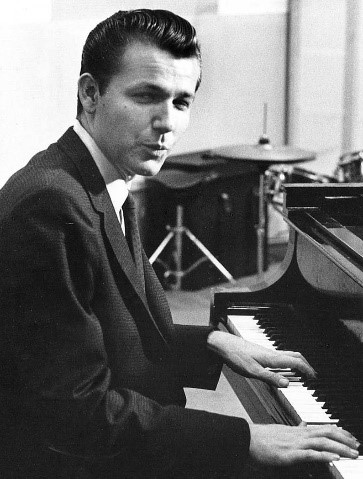
On YouTube, the charmingly enthusiastic grandson Jason Coleman explains his famous grandfather’s trademark and demonstrates it with an obviously inherited talent: the “slip-notes” of the legendary Floyd Cramer. The keystrokes on the piano, where the finger slips off the adjacent key and in fact hits the wrong note at first, became a stylistic feature of the Nashville sound thanks to Floyd Cramer’s thousands of recording sessions in the 50s and 60s, partly because Cramer declined Elvis’ offer to go with him to the West Coast; he preferred to stay in Nashville.

By then, Floyd had already long secured his place in eternity; one of the most iconic piano parts in rock history, the piano part of “Heartbreak Hotel” is also Floyd Cramer. Thereafter, he plays with all the greats, with Brenda Lee, The Everly Brothers and Roy Orbison, on “Crying In The Chapel” and on “Are You Lonesome Tonight?”, with Chet Atkins and with Paul McCartney, and in the twenty-first century we even hear Dylan play Cramer’s unmistakable slip-notes (in “Soon After Midnight” for example, Mankato, October 2019). Remarkably, Cramer even influences, via a small diversion, Jimi Hendrix. Via Bobby Womack, that is. As a kid, Womack has taught himself guitar by imitating Floyd Cramer. Later, in 1964, he sits for hours and hours with Jimi on the tour bus;

“I could tell what he was doing on the guitar, but he had no clue what I was doing. I was making up chords and all of them were unorthodox. I always played that way. It was a big joke with Jimi, who used to tell me, ‘Man, you play some beautiful chords.’

I told him about the piano player, Floyd Cramer, who I got my style from. Jimi didn’t believe me. He said, ‘But he’s a piano player.’ I said, ‘Yeah, but imagine me hittin’ the same notes on the guitar, playin’ what you’d hear on a piano. It’s different.’ Sometimes me and Jimi used to sit backstage between shows and swap licks. That’s how we became friends.”
(Bobby Womack – My Autobiography – Midnight Mover, 2006)

… and indeed; if you listen with that knowledge to (especially) “Little Wing”, and even Jimi’s “Like A Rolling Stone” (Monterey, 1967), you can hear Cramer’s slip-notes.

And Floyd Cramer plays the indispensable part on one of the many stepfathers of “Standing In The Doorway”, on “He’ll Have To Go”.

“Standing In The Doorway” is perhaps the ultimate example of an eclectic mash-up, of the recipe for the greatness of Time Out Of Mind. Dylan constructs both the music and lyrics from chunks of bluegrass, F. Scott Fitzgerald, blues, American Songbook, the Bible, folk, film noir and country. We hear snippets of Dock Boggs, reuse of “Moonshiner Blues”, Big Joe Turner, “Bullfrog Blues” from 1928 (I left you standin’ here in your back door crying), Jimmie Rodgers and I see nothing to be gained by explanation from Willie Nelson’s “Long Story Short (She’s Gone)”… and that’s just a small selection; almost every line of text can be found in one of the songs in Dylan’s enormous working memory, in one of the novels in his bookcase, in one of the films in his home cinema.

Dylan’s opening is an illustration thereof, of that eclectic nature. “There was music from my neighbor’s house through the summer nights” is the opening line of chapter 2 of F. Scott Fitzgerald’s The Great Gatsby (1925), which could quite easily have been paraphrased into, say

I’m walking through the summer nights
Music playing low

… but Dylan chooses “jukebox playing low” and thereby, by this simple intervention, tilts the atmosphere towards a tear-in-your-beer ballad, towards a country tearjerker, towards one of the greatest of all country tearjerkers;

Put your sweet lips a little closer to the phone
Let's pretend that we're together, all alone
I'll tell the man to turn the jukebox way down low
And you can tell your friend there with you he'll have to go

… Jim Reeves’ pièce de résistance from 1959. And Bob Britt seems to hear that too; his fingers slip naturally from the adjacent note to the right one, just like Floyd Cramer’s slip-notes in the intro of “He’ll Have To Go” elevate the song to the stratosphere. Not on his own, by the way; the track was recorded by a Nashville A-Team. Elvis guitarist Hank Garland, Elvis and Dylan bassist Bob Moore, Elvis drummer Buddy Harman… Jim Reeves apparently already had some status, back in 1959.

Less poetic and seemingly more one-dimensional than Dylan, of course, but it is the same lament. One poor sap is discarded by telephone, and the other sod gets the door slammed in his face on the doorstep. Both wretches also seem to have lost their women to a competing man. And both seek solace in the arms of another woman. By Dylan’s narrator poignantly expressed with the words “Last night I danced with a stranger, but she just reminded me you were the one”, with Jim Reeves we only get that revelation in the sequel “He’ll Have To Stay”:

I can hear the jukebox playing soft and low
And you're out again with someone else, I know

… a good-old fashioned answer song, in which Jeanne Black, over the same soundtrack and on the other end of the telephone, turns the whole plot around; Jim Reeves’ narrator was apparently a notorious cheater who for years has been leading on his fiancée – and now she’s had enough. “You broke my heart too many times”. And she has opened her heart and arms to a sweet, reliable rival. “Now someone else is in your place, he’ll have to stay”.

“Buddy, you’ll roll no more,” she could have said as well.

To be continued. Next up Standing In The Doorway part 2: All these songs are connected


Jochen is a regular reviewer of Dylan’s work on Untold. His books, in English, Dutch and German, are available via Amazon both in paperback and on Kindle:


Posted in Uncategorized | 2 Comments

Dylan: the music and the lyrics – Not Dark Yet

By Tony Attwood

If there is one single song written by Bob Dylan that deserves an analysis of the lyrics and music together it is “Not Dark Yet,” because here Dylan uses a musical device to add to the mystery and desperation in the song.  For instead of writing in the normal four beats in a bar approach, the music occasionally adds two extra beats.

I won’t go through all the details again as Jochen did a piece on this to which I added a couple of details, but I do want to add this song to this series on the music of Dylan.  For in this song perhaps more than any other the music gives us the sense of desperation and tiredness to perfection.

Now by “the music” I mean both the arrangement of the instruments and the music itself.  As an example of this, listen to the music during the instrumental break (the part of the song where there are no lyrics)  starting at 3.20.   No instrument takes over, but rather we just get the accompaniment continuing.

This is something Dylan often does, and it is incredibly rare elsewhere in popular music – in fact, I can’t think of anyone else who does this as regularly as Dylan.  And it works brilliantly in this song because this is absolutely not a moment for an instrumentalist to show off his/her skills.  That would break the entire atmosphere and the message.

My point is that the song is about the continuance of decline, and any intrusion by a soloist at this point would utterly damage the images being built.

And what is equally remarkable is that there is a second instrumental section starting at around 5.25.   Again there is no intrusive solo part – we just hear the accompaniment – which is absolutely right because this is a piece of music about the decline into darkness, and the wish of the singer for that darkness to happen.

For many a lesser artist (or any artist beholden to the demands of the producer) that second instrumental part would never have happened – and I suspect if Dylan had not had the total control over his music that he clearly had after the first few albums, it would mots certainly not have happened.  A lesser musician or producer would have thought in conventional terms of keeping the listener alert by allowing a soloist to show off his/her skills.

But that would have been utterly against the concept of the song: the exposition of decline, and the desperation that comes from an awareness of decline and there being nothing one can do about it.

Musically speaking. the high point of each verse, where the solo line reaches its highest note is the penultimate line – the line before the repeat of the title.  For here music and lyrics combine to make these final two lines the very crux of the matter.

But Dylan then goes a step further for he doesn’t just sing

There's not even room enough to be anywhere
It's not dark yet, but it's gettin' there

What he actually sings on the recording on the album is

There's not even room enough ...   to be anywhere
It's not dark yet, but it's gettin' there

And that tiny pause before “to be anywhere” which is hardly noticeable is a brilliant musical signification of the desolation that the vocal line is expressing.   In saying there is no room the line says “I can’t move, I’m stuck here”.   The slight pause stresses that.

In the second verse we get the same pause

I just don't see why ...    I should even care
It's not dark yet, but it's gettin' there

Again there is hardly time for us to think “what is it that he doesn’t see?” but that musical pause increases the emotional understanding that he is utterly lost.

And because of this, the use of the song title in the last line comes to the listener not as a mere repeat but as a further element of descent into desperation.

Expressing desperation in music is incredibly difficult.  Of course pop music is full of “lost love” songs – lost love is one of the three giant topics of pop music (the others being “love” and “dance”.  But not utter desperation.  There are some songs expressing this emotion, but they are rare, because they are so hard to pull off musically.

What we have in fact is a sense of total continuity and of utter collapse.  The only interruption to this is the sudden guitar chord at the end of each line.   Indeed if one listens to the recording without interruption or background sound one can pick out this sudden chord.  Occasionally it is not there but almost every time it is – a sudden jerk which reminds us subconsciously that this is not a gentle slide into nothingness – there are sudden bursts of pain along the way.

But decline it is – and that is the hardest thing in the world to write in a musical form without engaging in a trite run of minor chords and discords.   However, Dylan solves the problem through continuity with that very occasional shot of one guitar chord.   So when we hear the line “I can’t even remember what it was I came here to get away from” we are in sympathy with the singer and the music – that nagging sudden single chord, louder than anything else in the performance is always there.  There is something out there but we don’t know what it is.    Hence what that chord is supposed to be telling us we don’t know.

Finally, there is the last verse – an instrumental verse.  I haven’t gone back to check how often Dylan has done this on recordings, and I am sure there must be some occasions, but I am also sure it is very rare in contemporary songs.   Here it is brilliantly used – the singer has made his final declaration that it is not dark yet, and to make the point, even when there is nothing more to say, the music continues.  Even when he can do and think no more, life goes on.  The situation, the world, will continue in this same vein, even when he is long since gone and the darkness has finally descended.

Musically in terms of both the composition and the arrangement, this is a staggeringly brilliant masterpiece.   One of the greatest moments of contemporary songwriting.

Earlier in this series

Posted in Uncategorized | Leave a comment

Bob Dylan’s favourite songs 8: “Burn down the cornfield”

By Tony Attwood

This is the second Randy Newman song in the series of Bob’s favourite songs – the first was Sail Away (there’s a link to all the previous articles at the foot of this piece).

All Music contains this review of the song: “A sinewy ballad built around a fine bottleneck guitar riff, “Let’s Burn Down the Cornfield” is a love song, basically, but the slightly demented lyric content is what gives it the edge. Newman was writing a lot of material during this period that was generally intended for “conventional” instrumentation (drums, bass, piano, guitar), and this is one of the finest examples of this. It’s one of producer Lenny Waronker’s favorites from the period.”

So “slightly demented lyric content”….   That obviously needs considering.  Here are the lyrics…

Let's burn down the cornfield
And we can listen to it burn

You hide behind the oak tree
Stay out of danger 'till I return

Oh, it's so good
On a cold night
To have a fire
Burnin' warm and bright

You hide behind the oak tree
Stay out of danger 'till I return

Let's burn down the cornfield
And I'll make love to you while it's burnin

I find this interesting because I am currently and very slowly trying to develop a series of articles which argue that one has to consider both Dylan’s music and his lyrics as one, rather than eternally focus on the lyrics.   And here from another source is a perfect example of why we have to do this.

The lyrics are weird – I suspect the reaction of almost everyone to the notion of burning a cornfield is “What????” and maybe “Why?”

And as you can see above the only answer is “to have a fire burning warm and bright”.

But the whole point of the song is to have spooky words and spooky music together to give an atmosphere of, well, spookiness.     And more to the point, Bob selected this as one of his favourite songs.

As for why, well, this choice can only have been made because this song is so very different from most.  It is a song of atmosphere both in the music and in the lyrics, and that’s what I am trying to argue is the case with Dylan’s song: the music and the lyrics give the atmosphere.

The version that Bob nominated was not the first of this song.  Here, as far as I know, is the original

And without the arrangement in the Randy Newman version, and I think all subsequent versions, much of the meaning is lost, in my view.  But once the notion of the spookier approach to the music came about, so the song got locked into that approach…

… and thus the accompaniment has been seen as central to the song


Previously in this series…

Posted in Uncategorized | 2 Comments

The Tarantula Files: How Old and The Wooden Chest

by Larry Fyffe

How Old

The Tarantula Pilgrims on the way to NY meet up with a traveller who claims to be a Palaeontologist:

(W)e sat in a room where Harold, who called himself
'Lord of dead animals', was climbing down a ladder
(Bob Dylan: Tarantula)

His seemingly lost records might contain revelations such as:

He found an animal that left a trail
Had a great big head and a great big tail
Couldn't fly because it was as large as a bus
Ah, think I'll call it a Tyrannosaurus
(Harold: List Of Names For All The Dead Animals)

Romantically speaking, everywhere, in these modern times, all that’s left are complacent Hobbitts, Babbitts, and Babboons.

Even in the White House:

(T)he Plump himself tried to give a warning
but he was so drunk that he fell into a barrel
& a tractor being driven by some dogs ran him over 
& dumped him into a garage ...
the world didnt stop for a second
(Bob Dylan: Tarantula)

Below, a source poem that looks back to the tales of ancient mythology:

(T)he ploughman may
Have heard the forsaken cry ...
and the expensive delicate ship that must have seen
Something amazing, a boy falling out of the sky
Had somewhere to get to, and sailed calmly on
(WH Auden: Musee Des Beaux Arts)

Especially now, asserts the song beneath, in these days of the H-bomb, attention must be paid:

For the love of a lousy buck
I've watched them die
Stick around, baby, we're not through
Don't look for me, I'll see you
When the night comes falling from the sky
(Bob Dylan: When The Night Comes Falling From The Sky)

The Wooden Chest

“Tarantula” is presented by its author as a rather mean ole god who gains the upper hand over the God depicted in the Holy Bible ~  apparently, modern-day Hebrews, Christians too, are abandoned by JHVH because they turn yet again to worship the Golden Calf.

It’s speculated by a number of biblical scholars that the precious Ark of the Covenant (wherein stored are the Ten Commandments) either gets hidden away by faithful Hebrews or taken away by Babylonian invaders.

Lost anyhow:

& curious tabernacles move slowly thru your mind
- hitchhicking - hitchhiking unashamed thru the goofs of your brain
- your ideals are gone
(Bob Dylan: Tarantula)

According to Tarantula, the other God (He Who tells Abraham to kill his own son) appears to be missing from the scene:

(T)rip into the light here abraham
What about this boss of yours
& don't tell me that you do what youre told
(Bob Dylan; Tarantula)

A long time ago, according to the Bible, Abraham’s God gets the Ark back by sending plagues upon the Philistines who’ve killed the wayward sons of High Priest Eli; the Philistines snatch the Arc away, but they’re more than glad to give it back:

And the Ark of God was taken
And the two sons of Eli ... we're slain
(I Samuel 4:11)

Then much later on, the Babylonians, worshippers of the Golden Calf, invade southern Israel. The Ark, say some sources, has been hidden away; others claim that it’s taken away:

The Christian portion of the Holy Bible goes on to assert that the Ark’s in Heaven, enclosed the wooden chest be by a grand temple:

And the temple of God was opened in heaven
And there was seen in the temple
The Ark of His testament ...
(Revelation 11:19)

Mixed-up confusion everywhere.

For example, there be claims that the Ark is in the hands of Ethiopian Christians who disagree, for one, with the Catholic Church by the Ethiopians insisting that Christ has a single ‘nature’ only.

Ethiopia able to hold off getting taken over by the spread of the Islamic religion

Seems thus speaks Friedrich Nietzsche in the lines below while carrying a torch in his hand; on his shoulder, an ink-stained tarantula marked and mocked with the motto “everyone’s equal”:

I'm just like Anne Frank, like Indiana Jones
And them British bad boys, the Rolling Stones
I go right to the edge, I go right to the end
I go right where all things lost are made new again
(Bob Dylan: I Contain Multitudes)

Nietzschean-like lines beneath too, but even more ambiguously laden:

You're the lamp of my soul, girl
And you torch up the night
But there's violence in the eyes, girl
So let us not be enticed
On the way out of Egypt
Through Ethiopia ....
(Bob Dylan: Precious Angel)


Posted in Uncategorized | 2 Comments

Nashville Skyline Rag (1969) part 3 (final): The long-haired hippies and their drugs


Nashville Skyline Rag

by Jochen Markhorst


III         The long-haired hippies and their drugs

 The Soggy Bottom Boys they call themselves, the unlikely folk sensation that breaks through like a bolt from the blue with “Man Of Constant Sorrow”, in the Coen Brothers’ enchanting love project, O Brother, Where Art Thou (2000). A band name, which, like many names and scenes in the film, kindly nods to a cultural phenomenon from twentieth-century America, in this case to the Foggy Mountain Boys, the backing band of legendary bluegrass duo Flatt & Scruggs.

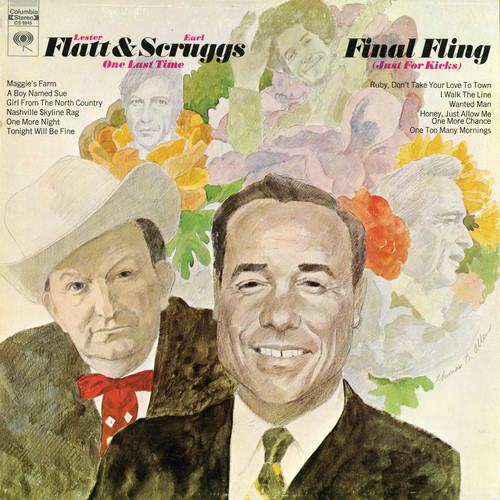
Dylan is a passive but still destructive force in the duo’s career. After 20 highly successful years, during which traditionalist Lester Flatt’s resistance to his mate Earl Scruggs’ drive for experimentation and innovation continues to erode, something inside of Flatts dies, presumably during the recording of their last record together, 1968’s Nashville Airplane.

Scruggs and producer Johnston push through four Dylan covers: bluegrass versions of “Like A Rolling Stone”, “I’ll Be Your Baby Tonight”, “The Times They Are A-Changin'” and even “Rainy Day Women #12 & 35”. Meanwhile, the places of the former-familiar Foggy Mountain Boys have been taken by men who have just recorded Blonde On Blonde and John Wesley Hardin with Dylan, or will be heard shortly afterwards on Nashville Skyline and Self Portrait: Charlie Daniels, Bobby Moore, Henry Strzelecki and Kenny Buttrey. And in the producer’s chair these days is Dylan producer Bob Johnston. None of which Lester likes. In Bluegrass: A History (1985), the standard work by the eminently knowledgeable professor Neil V. Rosenberg, Flatt’s uneasiness is catchily, though not academically, articulated:

“Behind the scenes, Lester Flatt was very dissatisfied with their material; he didn’t like singing Bob Dylan and was disgusted by the long-haired hippies and their drugs. He refused to perform the new songs, and this became a source of contention between him and the Scruggses.”

… and the professor knows very well what he is talking about. In the liner notes of the compilation album Flatt & Scruggs (1982), he already incorporated excerpts from interviews with Flatt:

Lester Flatt felt uneasy with Bob Johnston: “He also cuts Bob Dylan and we would record what he would come up with, regardless of whether I liked it or not. I can’t sing Bob Dylan stuff, I mean. Columbia has got Bob Dylan, why did they want me?”

Scrolling back through the discography, however, we have to hand it to Lester: he has demonstrated a respectable amount of tolerance, he did put up with it for quite some time. From May 1966 to the last recordings with Earl in August 1969 (i.e. well after the release of Nashville Airplane, the recording sessions forming the second-to-last drop), he bowed his head no less than nineteen times, playing yet another one of those damn Dylan hippie songs. “Honey, Just Allow Me One More Chance” is, ironically, the very last one. Released on the album that hit shops after the irreparable break-up, as a kind of Let It Be: the aptly titled 1970’s Final Fling – One Last Time (Just For Kicks). With even more indirect Dylan input; SEVEN Dylan covers. And Dylan’s unofficial bandleader in Nashville, Supreme Nashville Cat Charlie McCoy, joined too (harmonica). It’s almost beginning to look like poor Lester Flatts was, in fact, bullied out.

You can kind of hear it too, with hindsight. From Lester’s vocals on “Girl From The North Country”, “Wanted Man”, “One Too Many Mornings” and “One More Night” drips dejection, some fatigue and reluctance, and only “Maggie’s Farm” seems to be able to light a flame. And, well alright, in the announcement of “Nashville Skyline Rag”, understandably the only Dylan song Lester really likes, we can actually hear a trace of enthusiasm:

Lester: “Earl, what’s the name of this tune”?
Earl: “The Nashville Skyline Rag.”

Earl, however, this much is clear, has long been a full-blooded Dylan fan. Which is also well illustrated in the 1972 documentary The Bluegrass Legend – Family & Friends. The recordings in that living room with Dylan and with Earl’s sons Gary and Randy are weirdly moving – not so much because of the music, which is fine, but because of the moments around it, because of the interaction of Dylan and Scruggs;

“Have you heard this latest version of your song Nashville Skyline Rag?” the meek Earl Scruggs asks, smiling shyly
“Yeah,” Dylan replies, appearing equally bashful.
“Could… could we just try that one?”
“Okay.”

Touching. As is Earl’s half-proud, half acknowledgement-seeking look and smile after the final chord.

https://youtu.be/crG4ZDRLVYE

Dylan & Scruggs – Nashville Skyline Rag (at 2’31”): 

The actually, by Dylan standards anyway, somewhat silly “Nashville Skyline Rag” remains quite popular with the peers – especially in country and bluegrass circles, of course. And surely this will be mostly due to the missionary work of giant Earl Scruggs. With Scruggs, the song remains on the repertoire, in his Earl Scruggs Revue, the band with his sons in which Dylan songs all remain a regular part of the setlist – the live album Live! From Austin City Limits from 1977 opens again with the Rag, for instance.

Banks & Shane (1975), J.D. Crowe & The New South (1976), Knoxville Grass (1977), Knoxville Grass (1978)… meanwhile, the next generation of bluegrass, alt-country , cowpunk and all its variants, long-haired potheads or not, keep “Nashville Skyline Rag” alive with recordings and live performances as if passing on a relay baton. Even into the generation after that; in the twenty-first century, it’s the children’s children, bands like Monroe Crossing, The Abrams Brothers and the David Grier Band, so that the song seems to be gradually becoming a kind of rite of passage; apparently, it belongs on your setlist if you want to count in bluegrass circles.

None of them add anything to the original. At most if the band happens not to have a banjo or mandolin, it sounds a nuance different (like Dan Whitaker & The Shinebenders, 2006), but otherwise, the dozens of covers in the twenty-first century are all equally enjoyable and utterly interchangeable. Which doesn’t bother anyone, of course.

———-

Jochen is a regular reviewer of Dylan’s work on Untold. His books, in English, Dutch and German, are available via Amazon both in paperback and on Kindle:


Posted in Uncategorized | Leave a comment

NET 2011 Part 5 – Quick man, I gotta run

An index to all the previous articles in this series can be found here.

By Mike Johnson

2011 is a stand-out year in the history of Dylan’s live performances. It is a fitting climax to a five-year movement that began in 2006 when Dylan moved from the piano to the organ, and is marked by some adventurous singing, not just his famous circus bark and growls but sustained notes with vibrato – Dylan the emerging baritone crooner. A singer preparing himself to take on Frank Sinatra.

The year also brings to fruition Dylan’s ongoing relationship with his other instrument, the harmonica. From 2012 on, that little instrument will begin to take a back seat as Dylan focuses his arrangements around his new love, the grand piano, and within a couple of years his harp playing will be mostly confined to a few bluesy blasts on a couple of songs per performance, mostly ‘She Belongs to Me’ and ‘Tangled Up in Blue.’

Perhaps the 2011 performance that best captures Dylan’s loving use of the harp is this remarkable, harp-driven performance of ‘Blind Willie McTell’ from Hong Kong (April 12th). I covered this song in NET 2011 Part 2, the Oberhausen performance, focusing on how he swung the song. That was a great rendition and I thoroughly recommend you to  check it out.

To my mind however, this Hong Kong performance must take the prize. It doesn’t swing with quite the same sassiness as Oberhausen but must be included as one of Dylan’s best ever harp performances.

Blind Willie McTell

‘Shooting Star’ is another song featuring the harp. This song had its heyday in 2005, was only performed twice in 2011 and would be last performed in 2013 after a single 2012 performance. It’s a song that powerfully yearns for love and salvation, an intensely emotional experience. This one is from Cardiff, October 13th.

Shooting Star

‘Till I Fell in Love with You’ has featured the harp since a remarkable performance in 2007 (See NET 2007 Part 1). It’s another song fading from the setlists. This one from Milan (June 22nd) is the sole 2011 performance, and we’ll see only two more performances in 2015. Pity, as it’s a great rocker. There’s a bit of harp work here, but it feels to me as if Dylan is losing interest in the song, at least in terms of providing scintillating harp breaks.

Till I Fell in Love with You

Sticking with the harp for the moment, we now have a final performance. ‘I Dreamed I Saw St Augustine’ had not been performed since 2005, and was only ever performed thirty-nine times. I can’t say what drew Dylan back to this song for this lone and last performance in Cork (June 16th), maybe the way it laments the darkness of a world without spiritual light.

I Dreamed I Saw St Augustine

In 2009 and 2010 we saw how Dylan stripped back some of his faster rock songs to their 1950’s style rock ‘n roll bones. While in 2011 Dylan was starting to build his arrangements back up again, we can still find some wonderful straight rock performances, like this version of the irreverent and mocking ‘Leopard Skin Pillbox Hat.’ (London,1st night) You can kick back to this one, do some foot-tapping, maybe even get up and dance. I’ll sound like an old fella and say they don’t make music like this anymore.

This is another song on its way out. It gets a fair hammering in 2012, but disappears after a single 2013 performance.

Leopard Skin Pillbox Hat

Let’s stay with that first London concert for what is perhaps one of Dylan’s most successful topical songs, ‘The Ballad of Hollis Brown,’ to be put alongside ‘The Ballad of Emmet Till’ and ‘Oxford Town’ as songs culled from newspaper items.

Maybe it’s the simple blues format that does the trick or that the ‘dust bowl’ feel of it means it could have come out of Woody Guthrie’s song book. It’s a pitiless portrait of poverty and a masterful narrative.

Dylan was to largely abandon topical songs, perhaps because they lose their relevance over time, but this bare-boned narrative achieves the kind of universality that transcends its immediate context. How many Hollis Browns are out there right now being pushed by poverty and desperation into violence? The song turns sixty this year, but it could have been written yesterday. It’s a pity that it’s on its way out, and won’t be performed after 2012. Donnie Herron’s banjo gives this performance a fittingly rural feel.

Hollis Brown

Thinking for a moment about the development of Dylan’s voice, his greatest instrument, this Milan performance of ‘When I Paint My Masterpiece’ is remarkable in the way it shows Dylan overcoming his circus barker voice with sustained notes and rich vocal tones.

There’s plenty of barking in here too, but the way forward is evident. To me the song reveals the struggle for artistic perfection in a messy, chaotic world. Fragments of memory and history vie with a surreal present. Dylan is on guitar here.

When I Paint my Masterpiece

Let’s pop over to Tel Aviv to hear this superlative performance of ‘Highway 61 Revisited.’ It’s a hard rock song, and is meant to be rough and rowdy and passionately disillusioned, however the more muted recording at Tel Aviv suits the song well. It pumps along in fine style, pulsing and throbbing, with just the right balance between recklessness and control. I don’t know about ‘best ever’ but I can’t think of a more compelling performance. It’s right on target when it comes to the immorality, madness and confusion of the world.

Highway 61 Revisited

Fast forward forty years from the writing of that song and we find another song, ‘The Levee’s Gonna Break’ that deals with the same immorality, madness and confusion of the world, and some climate disaster thrown in for good measure. When that levee breaks, chaos is let loose upon the world, the ‘levee’ being more than just river banks but a moral breakwater standing between us and mayhem. (Hamburg, 31st October).

Levee’s Gonna Break

We can draw a straight line from ‘Highway 61 Revisited’ through ‘Levee’s Gonna Break’ to ‘Thunder on the Mountain,’ although ‘Thunder’ is broader in scope. All three songs are lit with flashes of humour, a characteristic irreverence and mock posturing, flicking from the personal to the political to the cultural at dizzying speed. That dizzying speed is the point – the bedlam and tumult all goes by so fast you can’t grasp onto anything before it’s gone. (London, 2nd concert)

Thunder on the Mountain

Why stop there? We can continue that line through to ‘High Water’ (Odense 27th June) picking up on the uproar and turmoil as we go. Sounds like the levee’s already broken

high water risin', the shacks are slidin' down
folks lose their possessions and folks are leaving town

and there’s nothing or nobody to cling onto

Water pourin' into Vicksburg, don't know what I'm going to do
"Don't reach out for me, " she said "Can't you see I'm drownin' too?"

High Water

What a great performance, with that sharp, goading harmonica. Hard to beat.

We can keep drawing that same line right on through to ‘Summer Days.’ These lyrics could have come out of ‘Highway 61 Rev’:

Politician got on his jogging shoes
He must be running for office, got no time to lose
You been suckin’ the blood out of the genius of generosity
You been rolling your eyes—you been teasing me

As always with Dylan, the sunny side of love is hard to find.

Wedding bells ringin’, the choir is beginning to sing
Yes, the wedding bells are ringing 
                   and the choir is beginning to sing
What looks good in the day, at night is another thing

To my mind nothing betters the 2005 performances of ‘Summer Days’ and by 2011 the song sounds a bit muted, not quite as frenetic, but the band hits a fine jazzy groove in this Tel Aviv performance. The strength on the bass of Tony Garnier, the anchor of the band, stands out.

Summer Days (A)

Fans of the famous Crystal Cat recordings might prefer this one from the second London Concert.

Summer Days (B)

There’s a jauntiness to all five of these songs that belies their desperation. Jaunty desperation? There’s no rest along the way – quick man you gotta run. There’s crazy shit going down all over but you keep on keeping on, and you can always pick yourself up off the floor one more time.

It’s not pushing that line too far to extend it to ‘Rollin’ and Tumblin’’, another fast-paced kaleidoscopic rocker, although here the focus is more on the travails and tribulations of love than the larger pandemonium.

This one is from the 3rd London concert and is notable for its jazzy organ.

Rollin’ and Tumblin’

So what lies beyond the personal and political uproar we’ve encountered in the last six songs? Well…nothing. ‘Beyond Here Lies Nothin’’ might be the final realization. ‘Nothin’ done nothin’ said.’ I still hark back to the 2009 performance when Dylan went into a harp duo with a trumpet, and it sounded pretty wild. Here, in Odense, he’s on the guitar, but the message doesn’t change.

Beyond Here Lies Nothing

I’m going to finish in Odense with a change of pace and a last ever performance. ‘The Man in Me’ is hardly likely to feature in your best twenty Dylan songs list, but it is direct and heartfelt even though it doesn’t have the lyrical fireworks of the previous songs we’ve considered, and this is as good a performance as you’ll find. Like a lot of these NET songs, you don’t miss them till they’re gone.

The Man in Me

This ends my study of this powerhouse of a year, and Dylan’s adventures on the organ.

What to say about Dylan’s organ playing? Many fans hated it, there’s no doubt of that. Silly little dinky riffs ruined many songs, and the organ helped push the arrangements into the dumpty-dum. And yet… there are moments when the organ shimmers with that wild mercury sound or leaps about the keyboard with jazzy precision. Or pushes the rhythm along with solid vamping.

Right now, I gotta run, but I’ll be back soon with the beginning of new adventure in 2012, one that continues to this day – the grand piano man is about to be born.

Until then…


Kia Ora

Posted in Uncategorized | Leave a comment

NET: The absolute highlights – The Gates of Eden, (2000) how it should always have sounded

By Tony Attwood

When I first heard the recording of Gates of Eden I felt it was a great, great song, and I fully appreciated the performance on the album.  But I thereafter always had this feeling that it was, in reality, a much darker song than the one Dylan performed, lurking therein, held back, one day perhaps to be released.   I felt it would contain more gloom, with trails of smoke and fog drifting across the wreckage of the civilised world.

Just in case you can’t immediately call that original version to mind, here it is…  I am including it, not because I am suggesting that you should listen to it all (of course I can’t tell you what to do, any more than I know if you can conjure up a memory of what the original sounded like) but because I do feel it is helpful to hear it, at least in part, once again, before considering the presentation of a completely new “Gates of Eden”.

So here’s the one you’ll have heard a million times

And now I want to contrast this with “Gates of Eden” live, as performed in 2000.  In his first of several articles covering the Never Ending Tour for that year Mike wrote,

“We find some extraordinary and unparalleled performances in 2000, and I’m prepared to stick my neck out and say that some of these performances are Dylan’s best ever, and I’ll do my best to prove it.

“Take that mysterious song, ‘Gates of Eden’ which we have been following since the angry, electric version of 1988. (As a comparison, readers might like to check it out at NET, 1988, part 1 ). But no subsequent performance is as exquisitely spooky as this one. Whenever I want to hear this song, I play this.  It has a sense of spaciousness, and something very ancient…”

And yes I 100% agree with Mike.  In fact when I first put forward to Mike the idea of trying to write this series on my personal highlights from the tour, I almost began with this.  But then I thought, what on earth could I follow it with?

Gates of Eden

If there is one moment that symbolises the utter glory of this rendition it is the first instrumental break, followed by the return of Dylan’s voice in the “lonesome sparrow” verse.  Please make sure you are not doing anything else.  Turn off the lights, turn off the phone.  Just listen.

For this is not just a brilliant performance; it is the total reconstruction of the song in a way that says, “things were pretty bad when I first recorded ‘Gates’, by just look outside now – they are 10,000 times worse.

And more, for although I don’t ever believe that Dylan was a revolutionary trying to change the world, I think he is now saying – “We thought it was bad in 1965.   Well really, I  had no idea how awful it could get.  23 years later, and really is now all over.  There is nothing left.  There is nowhere to go.”

Utterly brilliantly, Dylan resists any temptation to take the song anywhere else.  When all is desolation beneath a seemingly uncaring God, or maybe other beings locked inside the Gates, there is nothing left to say.

On a more prosaic technical point, two verses are missing: the motorcycle black Madonna and the kingdoms of experience, replaced in effect by the extra harmonica solo.  I don’t think it matters, although I would have liked to have heard the whole set of verses, simply because I want this performance to go on and on.

I am left knowing that all of us on this earth are outside a paradise in which the gods take their ease, caring nothing for us or our disintegrating world.   And why should they – all we have is a life, and then a death.  That is all; for the likes of me, there is no paradise hereafter.  I live, I will die.

It is not a comforting vision, and not one that I particularly want to carry round with me – and fortunately for me I have activities I can get on with, that mean my mind goes elsewhere.   Yesterday I walked for six miles with friends across the windblown Northamptonshire countryside.   Tonight I shall be in Derbyshire dancing.   I pass my days writing, walking, dancing, and being with my friends, and I need all of that, because if I thought too much about this song, and this particular performance of this song, there would be nothing more to live for.

It is probably the most terrifying artistic performance I have ever come across.   Fortunately having now written this, I can move on, do some work, and welcome my pal who normally pops round on a Friday afternoon as we compare thoughts on what sort of a week it has been…. Hopefully by then I’ll have pulled myself back together.

Previously on “The Never Ending Tour, the absolute highlights…”

Posted in Uncategorized | 5 Comments

Other people’s songs: Early Morning Rain.

by Aaron Galbraith and Tony Attwood

Aaron: Early Morning Rain is a song by Canadian singer-songwriter Gordon Lightfoot. The song appears on his 1966 debut album Lightfoot!

Tony: It is amazing to hear the original version after all these years.  This must be one of the most recorded songs ever.   I’ve just looked it up on Wiki and it says

“Lightfoot wrote and composed the song in 1964, but its genesis took root during his 1960 sojourn in Westlake, Los Angeles. Throughout this time, Lightfoot sometimes became homesick and would go out to the Los Angeles International Airport on rainy days to watch the approaching aircraft.  The imagery of the flights taking off into the overcast sky was still with him when, in 1964, he was caring for his 5-month-old baby son and he thought, “I’ll put him over here in his crib, and I’ll write myself a tune.”  Early Morning Rain was the result.”

I love the restrained accompaniment – thank goodness the arranger didn’t try and milk the emotion by bringing the strings forward – it is restrained and utterly perfect as it is.  And yet although it is really well-known, it has never been a gigantic hit… just one of those songs that is always there.

Aaron: Dylan’s version came from 1970s Self Portrait

Tony: A totally different rhythm from Bob, and his voice is totally suited to this style, and the feelings of this song, although I think there is a little too much detail in the accompaniment; I could do with something simpler.  But as always that’s just me.

Indeed I am also not sure about the harmonica against the various other instruments playing… and I just get a feeling it could be a little slower.  Mind you as I get older I think almost everything could be played a little slower.

I’ve just gone back to the Gordon Lightfoot recording and replayed that and there is some extra freshness and directness in his recording which Bob doesn’t capture, I feel.

Aaron: Paul Weller included the track on his 2005 album Studio 150, the single reached No. 40 in the UK Singles Chart

Tony: Not sure of those quickfire notes at the very start, nor the change of second chord – and overall although it is a pleasant listen, it doesn’t deliver to me the intensity of the emotions that Gordon Lightfoot’s recording does.   But maybe this is unfair…. I hadn’t heard the song for a few years before I played the first version above, and now I’ve heard three versions in the space of 20 minutes.

But whoever added that sound effect after “might engines roar” should be taken out and shot.  Don’t even wait for dawn, do it now.  Sacrilege at this degree should be punishable…

Indeed I think the musical director must have thought the song was going on a bit and needed something to keep up the listener’s interest.   To which I can only reply, “Arghhhhh”.

However, these are just my immediate thoughts….

Aaron: Billy Bragg closed out his 2016 album Shine A Light: Field Recordings From The Great American Railroad with his version

Tony: Now this I like.   Oh yes I really, really do.   I like it because the singers and arranger have worked to take the song to another place – and it is a place that I think really works in keeping with this song.   The harmonies are very unusual, and very much in keeping with being stuck here on the ground where the cold winds blow.  Indeed I’ve never heard a version that gets inside the emotional meaning of the song in the way this does.

In fact I would say this is a truly remarkable arrangement and performance all the way through.  They carry the deep sadness of the lyrics throughout, in the way many others don’t bother to consider.

This old airport's got me down, it's no earthly good to meAnd I'm stuck here on the ground as cold and drunk as I can beYou can't jump a jet plane like you can a freight trainSo, I'd best be on my way in the early morning rain

I think I do tend to focus on songs more intently than most people, and I know I am a highly emotional person compared to many, and this last version of this song has totally taken me apart.   And maybe that is just me, but this final version of this wonderful song really is something to be treasured and played again and again.


Posted in Uncategorized | 5 Comments

Dylan: how the music and the lyrics make the song. 2: Desolation Row

Previously…

by Tony Attwood

Analyses of “Desolation Row” by and large focus on the lyrics.  And there are a lot of lyrics to analyse: 670 words or thereabouts.   And the key we have to understanding these lyrics is not just “Desolation Row” as a title, but also the music.

For this is a song about emptiness, loss, bleakness, grimness, loneliness, remoteness, isolation, hopelessness… accompanied by a rather jolly fairly simple tune with which, as the examples at the end hopefully show, one can do anything.

But the opening lines are a contrast to this music, they speak of selling postcards, the beauty parlour, and the circus, before we come to a the blind commissioner and the riot squad.  And meanwhile into these lyrics there creeps a madness in concepts such as “sniffing drainpipes and reciting the alphabet.”

Yet throughout all this the music is, well, fairly positive.  Negative emotions such as fear and sadness are normally expressed in minor keys or at least with minor chords, along with dramatic sounds from the band or orchestra, discordant noises rather than the jaunty tune we have here.

But jauntiness is what we get in Dylan’s original recording: it is a very pleasant melody based around the three major chords of the key, no minor chords, no discords, no feedback, no aggressive percussion, indeed nothing sudden at all.  It is gentle.  Unchanging.  And here’s a thing: just to emphasise this point, there is no percussion.

And for me, it is with listening to other people’s versions of the song, where for example sometimes one gets more energy with percussion, and extra accent on certain words, that I can more readily perceive what Dylan has done.    So that when we go back to the early acoustic versions we really can hear the essence of what Dylan was aiming for once he dropped the original notion of an electric version.  (I think the guitar is re-tuned to “open tuning” get the effect of depth that he delivers here, while in the album version this is not the case).


Wiki reports that “the song was initially recorded in an electric version. The first take was recorded during an evening session on July 29, 1965,[3] with Harvey Brooks on electric bass and Al Kooper on electric guitar. This version was eventually released in 2005 on The Bootleg Series Vol. 7: No Direction Home: The Soundtrack.”    And this adds quite a lot to my understanding of the song – for without this knowledge it could be argued that Dylan always saw it as a gentle non-electric song.   Instead, it appears that it was only on trying the song out he perhaps realised the vast contradiction between the lyrics and the music is greatly enhanced when the song is performed as an acoustic piece.

The impression I get is of society (in terms of co-operation, caring for each other etc) having ended, civilisation has broken down, and there is nothing left.  No electricity, no support, nothing.   It is reminiscent of post-doomsday science fiction stories of the 1950s where human kind is living in the wreckage of the past.

Wiki also reports that “When asked where “Desolation Row” was located, at a TV press conference in San Francisco on December 3, 1965, Dylan replied: “Oh, that’s some place in Mexico, it’s across the border.”   Apparently, Al Kookper suggested it was part of Eighth Avenue, others see it related to Kerouac, “Desolation Angels”.  I see it as nowhere and everywhere.

But just as there have been attempts to see Desolation Row as an actual place, so there have been multiple attempts to link the lyrics of the song to real events. Most powerfully, Polizzotti, and other critics, have connected this song with the lynching of three black men in Duluth.  The men were employed by a travelling circus and had been accused of raping a white woman. On the night of June 15, 1920, they were removed from custody and hanged on the corner of First Street and Second Avenue East. Photos of the lynching were sold as postcards.    Dylan’s father, Abram Zimmerman, was eight years old at the time of the lynchings and lived only two blocks from the scene. Abram Zimmerman passed the story on to his son.

And that may well be true – but my point here is that the meaning Dylan gives to the piece does not come just from those lyrics, it comes from the gentle, constant nature of the music which tells us that life goes on, and on, and it can be pretty horrifying, but somehow because it is always there, we get used to it.  Thus the line that “No one has to think too much about Desolation Row” takes on a powerful central meaning, when the music is taken into account with the lyrics.

And so as the characters slip in and out, but there is a constancy within the song as the music stays pretty much the same, while the horror show slips by in the lyrics.  We are made immune to what is happening out there because it is out there every day – but it is still there.  

In this view of the song there is thus no point shouting about the life that Dylan describes any more than it is worth my while shouting out about the three giant trees at the end of the my garden that I watch day after day as I sit and write.  The sun, the snow, the rain,  it all comes and goes and everything is pretty much the same.  In such a world one begins to accept everything that is here, and everything that happens.  Emotions and energy drift away.  The sun rises, the sun sets.  It rains, it snows.  We don’t particularly notice, because this is how it is.

Change the music however and the song becomes something quite different.   Which is to say that the meanings and emotions carried within the lyrics and not just based on the lyrics themselves but are also determined by the music that accompanies them.  And indeed it can be argued that the song is thus 11 minutes long in order to express the constancy of a world of horrors sited all around us.

For me the 1966 recording above is superb because the music does give us this contrast between the acceptance of life around, and the life itself.  The original album version does the same.    Being gentle and pretty much unchanging these two versions say, “there’s the horror show out there, it never changes.”

Which is rather a profound thought given that Dylan was seen as a protest singer, which as I have often argued before, he wasn’t.   Indeed as I’ve noted so often, “Times they are a changin'” is not a protest song, but a song that actually says, the world changes, it happens, it’s nothing to do with what people do – it just happens.   “Desolation Row” says life is awful, but somehow we just carry on.

Put the two messages together and we have a vision of humans just meandering through a world, letting everything just happen around them.  It gets better it gets worse, it’s not much to do with us.

All such meanings however are lost when the song is transformed and the original music is lost.  Just try these for size…


In the end Desolation Row is not a place, it is a state of mind, experienced within a disintegrating world.   And that is what the original music and the lyrics tells us.

Posted in Uncategorized | 6 Comments

Nashville Skyline Rag (1969) part 2: Some of the names just didn’t seem to fit


by Jochen Markhorst

II          Some of the names just didn’t seem to fit

On 9 April 2019, the trustees of the Al Clayton Photography estate post on social media the photo that graces the back cover of Nashville Skyline. With explanatory text:

“50 years ago today the Nashville Skyline album was released. Al shot the back cover. Story: Al had heard Dylan wanted a certain “look” for the back cover. We have recently discovered all of the slides he shot while searching for “the” image. […]. When Al saw this one, he went to Johnny Cash’s home. There was a party going on. Dylan was there. Al walked up and placed this picture on the table and asked “Is this what you’re looking for?” The rest is history.”

Interesting enough, but it still leaves plenty of question marks. Clayton selects one of his photographs, in the apparent belief that this is “the certain look” Dylan is looking for – the famous photo with the Nashville skyline. Which suggests that Clayton already knew the album’s title. Which in turn suggests that the album was named after the song “Nashville Skyline Rag” (and not the other way around).

Dylan’s own statements about the title choice don’t clarify much either, but they do clarify something. In the lengthy 1969 Rolling Stone interview, Jann Wenner explicitly asks about it, shortly after Dylan reveals that an initial title was John Wesley Harding, Volume II, and that the record company wanted to call the LP Love Is All There Is. Which is killed by Dylan with the enigmatic, self-contradictory argument, “I didn’t see anything wrong with it, but it sounded a little spooky to me.” Yes, but where then did the final title Nashville Skyline come from, Wenner wants to know;

“Well, I always like to tie the name of the album in with some song. Or if not some song, some kind of general feeling. I think that just about fit because it was less in the way, and less specific than any of the other ones there. Certainly couldn’t call the album Lay Lady Lay. I wouldn’t have wanted to call it that, although that name was brought up. It didn’t get my vote, but it was brought up. Peggy Day – Lay Peggy Day, that was brought up. A lot of things were brought up. Tonight I’ll Be Staying Here With Peggy Day. That’s another one. Some of the names just didn’t seem to fit. Girl From The North Country. That was another title which didn’t really seem to fit. Picture me on the front holding a guitar and Girl From The North Country printed on top. [laughs] Tell Me That It Isn’t Peggy Day. I don’t know who thought of that one.”

It really looks like Dylan is sucking the second part out of his thumb on the spot here. At least, it seems very unlikely that all those Peggy Day variations were actually serious proposals. The first part of his answer, though, “I always like to tie the name of the album in with some song. Or if not some song, some kind of general feeling”, sounds very plausible. After the corniness of the trite, embarrassing album title Another Side Of Bob Dylan, so from Bringing It All Back Home onwards, Dylan reserves the right to name his own LPs. And indeed, the four albums since then do express a “general feeling”, or are “tied in with some song”, and in half the cases both at the same time (Highway 61 Revisited and John Wesley Harding). Just as Nashville Skyline both is “tied in with a song” and expressing a “general feeling”.

Fine choice of title, then. Which Dylan unfortunately undercuts a bit himself with the continuation of his motivation: “It was less in the way” – more or less dismissing the motivation for choosing Nashville Skyline as: the least bad of even worse options. Incidentally, he is of course right to disqualify candidate album titles like Lay Peggy Day or Girl From The North Country as “awkward, in the way”. But surely Nashville Skyline is an excellent, apt, original title. Better at least than other extremes like Planet Waves and Empire Burlesque, to name just two – after all, Dylan misses as often as he hits the mark, with his album titles.

The most likely scenario, all things considered, is that on Monday afternoon, 17 February 1969, producer Johnston asks: “What do you want to call it?” after recording the instrumental they had just improvised. He needs some title for the recording sheet. The inimitable Norman Blake just turned those few chords and “that little melody” into a splashy rag.

“Nashville Rag?” Dylan tries, not too imaginatively. “Already exists,” ragtime expert Norman Blake will presumably object (and he’s right; “Nashville Rag” was written by legendary female ragtime pioneer Mamie Gunn back in 1899). “Just make it Nashville Skyline Rag then,” says Dylan, after taking a quick glance outside, meanwhile trying to think of how the chords of the next song, “Tonight I’ll Be Staying Here With You”, went.


To be continued. Next up Nashville Skyline Rag part 3: The long-haired hippies and their drugs


Jochen is a regular reviewer of Dylan’s work on Untold. His books, in English, Dutch and German, are available via Amazon both in paperback and on Kindle:


Posted in Uncategorized | 2 Comments

Tarantula Files: Zevon and Rip Van Winkle


by Larry Fyffe

Warren Zevon, a singer/singwriter greatly influenced by Bob Dylan.

William Blakes’s “Marriage of Heaven and Hell” can be taken as a parody of Emanuel Swedenborg’s “Heaven And Hell”; in Blakean poetry, few are capable of escaping from their dark worldly beginnings into the pure light of spiritual heaven.

Bob Dylan’s “Tarantula” can be be taken as a parody of Existentialist writers ~ such as William Burroughs who authors ‘Naked Lunch”;  books wherein humankind’s stuck, like a buzzing fly, on the clueless pages of life and death ~ from which there is no escape.

Existence is depicted as a philosophical spider web –  a snare in which singer/songwriter/musician Bob Dylan refuses to get caught:

My existence led by confusion boats
Mutiny from stern to bow
Ah, but I was so much older then
I'm younger than that now
(Bob Dylan: My Back Pages)

That is, life’s more than mere existence upon a meaningless brink which all mortals sooner or later are doomed to flow over; down into a deep and dark abyss.

Though it might be construed as presented so in the lyrics beneath, life is not designed for those who are zealous hedonists:

Yo-ho-ho, and a bottle of rum
Hoist the mainsail here I come
Ain't no room on board for the insincere
You're my witness, I'm your mutineer
(Warren Zevon: Mutineer ~ Zevon/Aldrich)

Nor is life a comical absurdity, albeit it can be imagined filled with Gothic black humour, often involving horrible creatures such as headless ghosts:

And he would have passed a pleasant life of it ...
if his path had not been crossed by ... a woman

(Washington Irving: The Legend Of Sleepy Hollow)

The gothic story above akin to the one featured in following song lyrics.

About a paid-for “freedom fighter”:

They can still see his headless body
Stalking through the night
In the muzzle flash of
Roland's Thompson gun
(Warren Zevon: Roland The Headless Thompson Gunner ~ Zevon/Lindell)

Humorous irony abounds in such Postmodern laments ~ below, both George Orwell and the Committee of Un-American Activities chase after the Little Tramp who’s come down off the silent movie screen:

& you say "no i am a mute"
& he says "no no i've told the others 
you were Charlie Chaplin
& now you must live up to it 
- you must!"
(Bob Dylan: Tarantula)

Mysterious for sure the figurative winds of existence be, but, mamita mia, rather dangerous they are for those unwary of the driving force Friedrich Nietzsche calls “the will to power”.

That is, the iron wheels of freedom can just as easily spin in cycles rather than move progressively upward:

And them Caribbean winds still blow 
from Nassau to Mexico
Fanning the flames in the furnace of desire
And them distant ships of liberty
On them iron waves so bold and free
Bringing everything that's near to me 
Nearer to the fire
(Bob Dylan: Caribbean Wind)


Rip Van Winkle

Now the chimney is rotten
And the wallpaper is torn
The garden in back
Won't grow no more corn
The windows are boarded
With paper mache
And even the dog just ran away
(Was Brothers: Shirley Temple Doesn't Live Here Anymore ~ 
     Bob Dylan, et. al.)

Gloomy Washington Irving joins the parade of pilgrims marching to New York City:

(I)t couldnt've been more'n a few hours later
when I happened  to be passing by again
- in the spot where the tree was, a lightbulb factory now stood
- "did there used to be a guy up in the tree?"
I yelled up to one of the windows
(Bob Dylan: Tarantula)

Below, Irving’s sorrowful sentiment expressed headlong in the dust:

Where are the men that I used to sport with
What has become of my beautiful town
Wolf, my old friend, even you don't know me
This must be the end, my house is tumbled down
(Bob Dylan: Kaatskill Serenade ~ Bromberg)

Below be mentioned West Coast Hollywood; and the founder of the Beach Boys:

Play it for Carl Wilson, too
Looking far, far away down Gower Avenue
(Bob Dylan: Murder Most Foul)

The above quote alludes to the following –  lyrics darkly concerned with the passage of time:

Don't the sun look angry through the trees
Don't the trees look like crucified thieves ....
Look away
Look away down Gower Avenue
Look away
(Warren Zevon: Desperados Under The Eaves)

Which in turn draw upon the somewhat more uplifting lyrics beneath:

Don't the moon look good, mama
Shining through the trees ...
Don't the sun look good
Going down over the sea
(Bob Dylan: It Takes A Lot To Laugh, It Takes A Train To Cry)

Nevertheless, a horrible ghost, a symbol of death, haunts the land:

Roland aimed his Thompson gun
He didn't say a word
But he blew Van Owen's body
From here to Johannesburg
(Warren Zevon: Roland The Headless Thompson Gunner - Zevon/Lindell)

The ghost oft headless:

Just then he saw the goblin hurling his head at him ...
It encountered his cranium with a tremendous crash
- he was tumbled headlong into the dust ...
(Washington Irving: The Legend Of Sleepy Hollow)
Posted in Uncategorized | Leave a comment