Commentary by Tony Attwood, audio kindly provided by Mr Tambourine.
Key West begins at 54’15”.
The basis of this performance is pretty much “Key West” as we know it from the album. But there are some extras from the band. And that makes all the difference, for on the album there is a profundity created by the simplicity of the music against primarily the background of a very gentle lilting input from the band. Together this creates an image of peace and tranquility, which I guess is what Dylan found at Key West.
But this profundity is lost in a live performance caused both by audience noise, and Dylan’s variance from the delicacy of the original recording – which of course is what he normally does.
Indeed aybe Bob felt he had to do this because he knows his audience finds it hard to be quiet in the way that they did listening to his early performances from the days of Freewheelin’ and Times… And that of course is a good reason to change things: one has to take note of what the audience will do.
But… I don’t find the live version attractive, because what I value so much in the original is the simplicity of the overall sound, which fits so perfectly with the lyrics.
Thus in the original recording the lyrics
Beyond the sea - beyond the shifting sand
Key West is the gateway key
To innocence and purity
make absolute sense in the context of the music. But with the extra variations from the instruments and the noise of the audience I find this is lost. In fact most of the meaning is, for me, lost.
But of course Bob can’t do much about the audience making noise, so instead perhaps I should focus on the accompaniment. And this is where I think there is a problem. If you care to listen to the original album recording again (I’ve put it below) you will hear once again how completely simple it is. But now on tour the instrumentalists still feel the need to do something, and this constant background seems to me to take away everything from the tranquility and gentleness of the original recording.
Obviously, sometimes such views can be misleading, arising simply because one likes what one hears first, but I’ve tried to put such thoughts out of my head. Yet still that meandering lead guitar background, and the extra percussion, just seem to be wrong to me.
The album recording works, and is a beautiful piece because it stays with the essence of the singer meandering through his memories without any interruption. And thus without the need for counter-melodies. Nothing interrupts the daydreams and reminiscences – which is why the recorded performance works.
But of course, the audience demands variation, because that is what Bob has always delivered. He tries to find this, but this time, for me (and as ever it is just for me) it really doesn’t work.
For me, what is so wonderful however is that I can now play the original, and just sit here, looking across to the tall trees wavering very gently in the wind, and know that although what I see is so different from what one sees in Key West, they are both the environments worth contemplating in calmness.
I sit here 4500 miles from Key West. It is March. Snow is forecast. Beyond the house there is silence. The trees in my garden are sixty feet high – maybe more. They sway in even the slightest breeze. The music below is perfect.
“Maybe you noticed that most of my songs are traditionally rooted. I don’t do that on purpose. Charley Patton’s 30’s blues has made a deep impression on me and High Water (for Charley Patton) is, in my opinion, the best song of this record,” says Dylan at the Rome press conference, July 2001.
I do agree. Well, ex aequo with “Mississippi”, anyway. Both songs open the floodgates (no pun intended), and “High Water” belongs in the same outer category as “Desolation Row”, “Mississippi” and “I Contain Multitudes”; extremely rich, poetic, Nobel Prize-worthy musical gems. Lovely, lovely song.
On Wednesday, 4 October 2006, XM Satellite Radio airs episode 23 of Theme Time Radio Hour, with your host Bob Dylan. Today’s theme is “Water”, offering the DJ’s first and only opportunity to play a song by one of his great idols Charley Patton (“the fantastic Charley Patton, testing the waters”): “High Water Everywhere”, obviously. Part 1 only;
“It’s called Part One because back in the days of the 78s if you had a song longer than three minutes, you had to split it up on Side 1 and Side 2, because the records were only three minutes long. So you only did a long song when you had something important to say. Like this song, about the most destructive river flood in United States history. The flood also inspired songs by Bessie Smith, Kansas Joe McCoy, Memphis Minnie and Randy Newman.”
By the latter, the DJ is of course referring to Randy Newman’s “Louisiana 1927”, coming up later in this same broadcast. Newman’s 1974 song is probably still hanging in the air on this October day in 2006 after it became a kind of unofficial signature song of the recent Hurricane Katrina disaster and subsequent floods in and around New Orleans, August 2005. The references to Bessie Smith’s “Back-Water Blues” and to “When the Levee Breaks” (Memphis Minnie and Kansas Joe McCoy) are pretty random in themselves. DJ could just as well have mentioned some 20 other songs, all associated with the Great Mississippi Flood too – although Bessie Smith’s song is actually about the Cumberland River flood in Nashville on Christmas Day 1926 – but these two songs, like Patton’s song, float somewhere on the surface of the musician Dylan’s working memory. “Back-Water Blues” was in his repertoire in 1961 (we know the recording from November, Carnegie Hall), and Memphis Minnie’s evergreen he will even honour with a reworking in 2008 (“The Levee’s Gonna Break”, Modern Times).
Kansas Joe McCoy and Memphis Minnie – When the Levee Breaks:
Closing then, after the DJ Dylan and the musician Dylan, the poet Dylan makes his appearance. When the last notes of “High Water Everywhere” have died away, first the DJ spends a few last words on the record:
“Charley Patton, “High Water Everywhere Part 1”. How the backwater rose at Sumner and drove poor Charley down the line. You hear a lot of scratching and hiss on these records. They were so popular they were played to death, and the master recordings were sold for scrap. Some of them even used to lie in chicken coops. And unfortunately, we might never know what Charley Patton really sounded like.”
… but the last words on Patton, and the move to the next record (“Water Water” by Effie Smith and The Squires), are then for the poet Dylan:
“This is from The Rime Of The Ancient Mariner:

Day after day, day after day,
We stuck, nor breath nor motion;
As idle as a painted ship
Upon a painted ocean.

Water, water, every where,
And all the boards did shrink;
Water, water, every where,
Nor any drop to drink.”
… indirectly adding another sparkling stone to the eclectic mosaic “High Water (for Charley Patton)”.
For eclectic we may well call the song by now. If we stand close to the artwork and distinguish the individual mosaic stones, both those laid aside and those used, we see:
“High Water Everywhere” – Charley Patton, 1929
“Didn’t It Rain” – spiritual, late nineteenth century
“London Bridge Is Falling Down” – nursery rhyme, early eighteenth century
“Joe Turner Blues” – traditional, late nineteenth century
“Kansas City” – Wilbert Harrison, 1959
“Kansas City Blues” – Big Joe Turner, 1951
“I’m Going To Memphis” – Johnny Cash, 1960
“Train 45” – traditional, late nineteenth century
“Nine Hundred Miles” – Woody Guthrie, 1944
“Shake It And Break It” – Charley Patton, 1929
“Hopped-Up Mustang” – Arlen Sanders, 1964
“Hot Rod Harry” – Johnny Bond, 1974
“Wait for the Wagon” – unknown, early 1850s D’un chateau l’autre – Louis-Ferdinand Céline, 1957
“Chump Man Blues” – Blind Blake, 1929
“As I Went To Bonner” – nursery rhyme, around 1760 Adventures of Huckleberry Finn – Mark Twain, 1884
“Sinner’s Prayer” (the song) – Lowell Fulson, 1950
“Hellhound On My Trail” – Robert Johnson, 1937
“Mad Mama’s Blues” – Josie Mills / Julia Moody, 1920s
“When The Levee Breaks” – Memphis Minnie and Kansas Joe McCoy, 1929
“Vicksburg Blues” – Little Brother Montgomery, 1920s
“Traveling Riverside Blues” – Robert Johnson, 1937 Pissing In The Gene Pool – Henry Rollins, 1987 Now Watch Him Die – Henry Rollins, 1992 Ulysses – James Joyce, 1922
“Po’ Lazarus” – Lead Belly, 1933
“The Coo Coo Bird” – Clarence Ashley, 1929
“Omie Wise” – traditional, early nineteenth century
“Deep Water” – Tom Paley, 1953 Wise Blood – John Huston, 1979
“I Believe I’ll Dust My Broom”- Robert Johnson, 1936
“The Bald-Headed End Of The Broom” – Harry Bennett, 1877
“I Got Love” – Glenn Frey, 1992 Frankenstein – Mary Shelley, 1818
“Crash On The Levee (Down In The Flood)” – Bob Dylan and The Band, 1967
“This World Can’t Stand Long” – Roy Acuff, 1947 Bartleby, the Scrivener – Herman Melville, 1853
“Jim Along Josie” – Edward Harper, 1838
“Terraplane Blues” – Robert Johnson, 1936
Forty mosaic pebbles. Ignoring less traceable fragments like “shacks are slidin’ down” or “coffins droppin’ in the street”, fragments with an undylanesque, idiosyncratic couleur that have presumably also been picked up somewhere by the self-proclaimed thief of thoughts; we don’t talk about fragments that we can hardly decipher in the draft versions (“nothing to buy up there”?, “can’t keep nothing dry”?); and at best look with half an eye at fragments that may appear to be borrowed, but what they would be borrowed from is not entirely unambiguous. Of the unfriendly lines of verse in stanza 2 for example, “You’re dancin’ with whom they tell you to / Or you don’t dance at all”, Warmuth suspects that the ebony ballad “The Boatman’s Dance” from 1843 by “Dixie” composer Daniel Decatur Emmett is a source;
When you go to de boatmans Ball,
Dance wid my wife or not at all,
Sky blue jacket and tarpaulin hat
Look out my boys for de nine tail cat.
… which seems fairly likely, yes. Especially since Dylan will incorporate the reference I lost my gal at the boatman’s ball in “Waitin’ For You” (2002), and will perform Emmett’s greatest hit “Dixie” in Masked And Anonymous. Apparently, he knows the song and its author Emmett, founder of the first blackface minstrel group, the Virginia Minstrels – and in doing so, by the way, Dylan would have smuggled in a blackface reference into “High Water” after all, after deleting the “Jim Along Josie” quote White cat just put out the black cat’s eye.
Bob Dylan – Dixie:
Or a verse excerpt like Water pourin’ into Vicksburg, which has the brutal factuality like we know from Shelby Foote’s standard work The Civil War: A Narrative, the mammoth work from which Dylan does frequently borrow excerpts (on this album in “Floater”, notably), and in which we also find the same setting often enough. In Foote’s reconstruction of Grant’s 1863 Yazoo Pass Expedition along the Mississippi, for example;
On the evening of February 3 — while Ellet prepared to take the Queen past the Vicksburg bluff at daybreak and Grant himself was about to head upriver for a first-hand look at Lake Providence — Wilson mined and blew the levee sealing the mouth of Yazoo Pass. The result was altogether spectacular, he reported, “water pouring through like nothing else I ever saw except Niagara.”
… pouring water causing wet feet for people from Clarksdale to Tutwiler, from Sumner to Rosedale and Greenville, and from Rolling Fork to Vicksburg.
Verse fragments, in short, whose rough outlines can be found in obvious sources of inspiration, which, in fairness, cannot quite claim the honourable stamp of “Dylan song supplier”. At least, not for “High Water” – after all, elsewhere in Dylan’s oeuvre, borrowings from The Civil War, from Daniel Decatur Emmett’s songs, and from all those others are undeniably demonstrable. About which, incidentally, the songwriter was perfectly clear both in the album’s title and forty years before “Love And Theft”, in the liner notes of The Times They Are A-Changin’:
Yes, I am a thief of thoughts
not, I pray, a stealer of souls
I have built an’ rebuilt
upon what is waitin’
To be continued. Next up High Water (For Charley Patton) part 24: Via Sistina 69, Rome
Jochen is a regular reviewer of Dylan’s work on Untold. His books, in English, Dutch and German, are available via Amazon both in paperback and on Kindle:
Dylan’s song “When I paint my masterpiece” got 372 outings between 2011 and 2024, but even without going through the recordings from the shows I can guarantee it never sounded liked this first cover version below – nor indeed like any of these covers (which represent around a quarter of those that I found on a quick search through the archives).
And I start here because the fact that “When I Paint My Masterpiece” actually survives the approach taken by Warboys US, tells us a lot about the song. Delicacy and nuance is not actually part of music here. But I also include this recording because the band have answered my plea for artists covering Dylan not to just make a straight recording of the song that we already know.
However it seems that this notion of changing the entire approach style and just about everything was not a one off. Others have followed this course as well. Here is the Dirty Nil…
It is interesting – why would musicians be drawn to treating this song in this way? And come to that I wonder what Bob thinks of it all…. although I rather suspect he stopped listening to other people’s versions of his songs long, long ago.
It was almost in desperation that I went searching for something a little less, ummm… energetic (me being the age I am and all). And actually I quite like Joshua Davis’ cover. I must admit I didn’t know anything about this artist. If you want to know more there is information here.
The main thing here is that it is a bit of a relief from the previous two versions. But nice and bouncy, which seems to me to be much closer to the intention of the lyrics.
So let’s go to some guys who have a real insight into what Dylan is all about: Grateful Dead, and oh what a relief (for me if no one else). Here is a version I can relate to. It is relaxed – and that seems to me to be the point of the whole song. It is a projection into the future, a feeling that if one can just relax a bit and see the world in a different way that artistic work of genius will somehow simply appear. (That of course is a load of nonsense, and I am quite sure Bob had his tongue very very much in his cheek with these lyrics).
But environments can of course stimulate a real genius. I’m not one of them of course, but even so, occasionally works I’ve created and actually looked at, have resulted in me thinking, “blimey that’s quite good.” At which point it is a sense of relaxation like that below which seems in tune with my feelings, even though fewer ever agree with me.
I get similar good feelings about the Charlie Robinson version, at least at the very start, but the emphasis on the drum beat throughout removes that feeling. I don’t think the contemplation of a masterpiece fits in with a simple repetitive beat that we have all heard a million times before.
There are many, many more cover versions of this song which you can find all over the internet if you have a mind to, but I felt the need to finish with something different. So here it is, and even if you don’t normally listen to this type of music do give this a go. It’s just… well, fun.
“The Lyrics and the Music” is a series by Tony Attwood which tries to find out what happens when one reviews a Dylan song not primarily as a set of lyrics, but as a piece of music which includes lyrics. An updated list of previous articles in the series is given at the end.
Going back to the original Isis after hearing some of the wild live versions (see for example the end of this piece) reminds me how plodding the original version is – but also how none of us really noticed too much because the lyrics are so extraordinary, and indeed how the music fits with the story told in the lyrics.
But musically we have on the originally released version, a bass which is a four note phrase repeated over and over with the first and last note the same – not to mention the odd mistake by the bass player who forgets when he has to stop.
The pianist also has an endless piece of repetition. Thankfully, no one has ever asked me to play the piano in a version of Isis – I think I’d go mad if I had to. It is just the three chords to the straight rhythm of 12 3 1 2 3.
Indeed the only real variation to be had is by the vocalist with all those varied lyrics, which really are great fun, and the violinist who occasionally has a bit of improvisation. And when I say “great fun” maybe I ought to say just plain weird. The singer meets this guy who says I’ll show you something, so the singer goes off only to find a body inside a pyramid, but there is nothing else there so (it appears) the singer kills his partner and leaves him in the pyramid and returns to his girlfriend with whom he says he will stay.
In this regard, the notion of the constant beat is perfectly reasonable. After all what we have here is a tedious, boring and ultimately pointless journey (except that the singer has learned his lesson) so the remorseless 123 123 beat symbolises that. As does the fact that there are just three chords over and over again.
And yet somehow we don’t notice all this because of the lyrics and because of Scarlet Rivera who does a brilliant job of distracting us on the violin.
But there is more to it than this. There is something utterly hypnotic here which draws us into the tedious journey that the singer undertakes. We too have to go on, in a way that we might not feel so inclined to do otherwise.
Indeed this is the point of Isis, at least in its original recorded form. It is the tedium of the repeated piano and bass against the crazy lyrics and those intermediate moments of relief from the violin. In the end there is a balance which allows Dylan to express what the journey was like, alongside the hope and expectation of what might be found.
Further, had the song ended with the lack of anything worth finding in the tomb then we’d feel flat at the end, but by taking the singer back to his lover, it allows the violin to express joy and relief that it is all over.
It is thus the perfect example of how the most difficult of subject matter – such as a tedious journey undertaken in an expectation that is unfulfilled – can still be used to create an exciting and highly memorable song.
And there is one final musical point to note: the shout, of “Yes” in the final line.
For the live versions Dylan has changed the approach, because of course the audience now knows the song so well, and expects something else. But that original recording is a masterpiece of expressing the tediousness of the journey through repeated music, without making us all bored out of our minds.
The Never Ending Tour Extended: This series uses recordings selected by Mike Johnson in his inestimable masterpiece The Never Ending Tour, and looks at how those performances of individual songs change as time goes by. The selection of songs from the series, and the commentary below, are by Tony Attwood.
Cold Irons Bound
Cold Irons Bound from Time out of Mind was played 423 times on the tour from October 1997 to October 2011. And we do indeed come across it in “The Never Ending Tour” series, near its very first appearance in 1997.
This is quite a challenging song for the performers: there are seven verses, much based on just the one chord – the first four lines having almost identical melody and no chord change.
What keeps the song moving along is the very distinctive rhythm, and the change for the three “chorus” lines after each verse
So we can appreciate from the start that evolving this song into something different, as so many other songs have been evolved, would be a challenge. It has far too fixed a format for that to be possible… or so one might think. But by 2000 that all-important beat had changed – as had the last three lines of each verse.
Indeed even when we get to the second verse where we might expect the rhythm to be really emphasised, as it was such a key element in the original, no, we are taken aback. It’s not there.
And I really do want to say this is one of the most unexpected and extraordinary developments of a Dylan song on the Tour that I have found. Bob has in effect taken out the very heart of the song, but as a result he has not lost the song, instead he has made it even more interesting.
Of course part of this interest comes from the mere change itself, but it is more than that. The new music of the sung verses contrasts brilliantly with the lack of background in the verses – just one chord and the percussion. Personally I much prefer this version to the original. And there is superb ending too. And if you stay with the recording there’s Bob introducing the band with a fair degree of real affection implied.
The prelude to the piece is still here, but now we are back with the dominant beat. However we also have the chord from the guitar coming in once more at an unexpected place. And then as we move along other sounds – I might call the “interruptions” come in.
Suddenly the piece is completely full – until Bob starts the verse again and we have his voice and that one strident chord on an unexpected beat … but then there are other sounds, other oddities, other… otherness. Just listen to the instrumental break around 3 minutes 30 seconds, there seems to be no central theme – every instrument is falling over each other. And maybe that is the point.
I find this version incredibly uncomfortable and disturbing. The 20 miles out of town feels real – there is nothing there; I’m lost and I can’t get back. With the instrumental break on five minutes, this feeling of disturbance and being utterly lost is complete. I really need to be absolutely full of myself and totally on form to be able to take this. And a question arises, do I go to a concert to be made to feel uncomfortable?
Actually, the answer for me is no. But then also I don’t go to watch horror movies either.
So now we have come full circle from a performance of the music as recorded through that retrospective softer re-interpretation, to a full-on blast. The percussionist finds a few interesting variations and the descending bass part gets a greater emphasis.
Thus this is a blast: there’s no escape – that chord hitting out over and over again through the verse allows us no way out. The lyrics have merged into the sound. The world is wrecked. Carnage is all that is left.
And if you don’t feel that way, try the instrumental break and the way Bob comes out of it. This is it, this is how it is and it will never change. Except, expect, at 4 minutes 52 seconds something new happens, an eight note theme we have not heard before as a coda. Wow, where did that come from? But then, that’s Bob for you.
Commentary by Tony Attwood, audio kindly provided by Mr Tambourine.
To be alone with you starts at around 49′ 30″ on the video
Bob uses the technique of singing one line and reciting the next – or sometimes reciting more than individual lines, for after a short while reciting seems to take over from the original melody.
It’s a fairly simple three chord song, although not in the format of the 12 bar blues, with a middle 8 that modulates for a moment to a new key before taking us straight back. Theer’s not too much evolution of the song, which overall in this performance lasts four and a half minutes.
The song comes of course from Nashville Skyline when Dylan was generally writing simpler songs, and was regularly performed from the late 1980s through to 2005 when it was given a rest. And I think here again it is worth hearing how the song sounded in 2005. You can hear much of this concert in 2005 Hello, Goodbye: First Ever, Last Ever– here is To Be Alone with You, extracted from that review.
As we can hear this is a totally different approach to the song: in 2005 the essence of the song was a real desire to be alone with the lady – indeed an urgent need to be with the lady.
What we now have in the “Rough and Rowdy Ways” version is a much more relaxed approach as Bob seems to be looking at the issue of being with the lady from the point of view of a older man who more likely to spend the hour just chatting about the past rather than the other activities that seem to be implied in the 2005 performance.
In fact listening for a second time, the Rough and Rowdy version is indeed very much the older Bob looking back. That is not to say that is how he was thinking when he devised the arrangement, but that’s how it comes across to me. But here’s a curious thing: having listened to the 2005 version, which I really do enjoy, and then returning for another listen to the Rought and Rowdy Ways version, I found this new version much more enjoyable. I guess I just had to bring myself into the right mood to appreciate it.
“Maybe you noticed that most of my songs are traditionally rooted. I don’t do that on purpose. Charley Patton’s 30’s blues has made a deep impression on me and High Water (for Charley Patton) is, in my opinion, the best song of this record,” says Dylan at the Rome press conference, July 2001.
I do agree. Well, ex aequo with “Mississippi”, anyway. Both songs open the floodgates (no pun intended), and “High Water” belongs in the same outer category as “Desolation Row”, “Mississippi” and “I Contain Multitudes”; extremely rich, poetic, Nobel Prize-worthy musical gems. Lovely, lovely song.
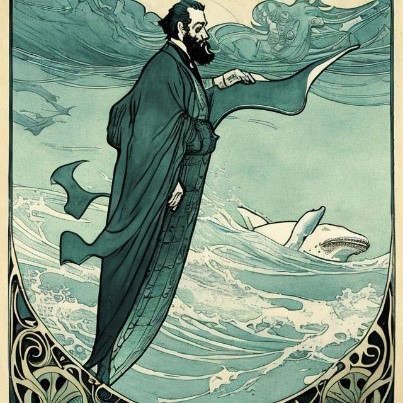
“Because the whale is not wicked. He doesn’t bite. And their gods had to bite. He’s not a dragon. He is Leviathan. He never coils like the Chinese dragon of the sun. He’s not a serpent of the waters. He is warm-blooded, a mammal. And hunted, hunted down.
It is a great book.”
D.H. Lawrence is a fan. And doesn’t hide it. “One of the strangest and most wonderful books in the world,” he writes in Studies in Classic American Literature (1923), in his essay on Moby-Dick or The Whale, the same essay from which the above quote comes. In which, incidentally, the Dylan follower will also be struck by the remarkable similarity to Dylan’s narrative style in prose. As in The Philosophy Of Modern Song (2022), the writing style of virtually every introduction to the 66 essays;
“Perry is also the anti–American Idol. He is anti–flavor of the week, anti–hot list and anti-bling. He was a Cadillac before the tail fins; a Colt .45, not a Glock; steak and potatoes, not California cuisine. Perry Como stands and delivers. No artifice, no forcing one syllable to spread itself thin across many notes.”
… to Perry Como’s “Without A Song”. Or in “Tutti Frutti”: Little Richard was anything but little. He’s saying that something is happening. The world’s gonna fall apart. He’s a preacher. “Tutti Frutti“ is sounding the alarm. The same ebb-and-flow rhythm as D.H Lawrence, that same attractive tension between the short, forceful and bare-bones sentences with a minimum of adjectives or even adverbs on the one hand, and the baroque abundance of the evoked images, the surprising metaphors and their alienating connotations on the other.
And we see, coincidentally of course, an amusing substantive parallel with a striking verse from the penultimate stanza of “High Water”. While Fat Nancy puts the narrator in his place with the bitchy “As great as you are, man, you’ll never be greater than yourself,” D.H. Lawrence says of Herman Melville: “The artist was so much greater than the man” – apparently, the writer of Moby-Dick can be greater than himself.
We owe the discovery of Melville’s surfacing in “High Water” to Albuquerque-based Supreme Source Finder Scott Warmuth. Following the disclosure of manuscripts and draft versions by the Bob Dylan Center in Tulsa, fans and Dylanologists are confronted with yet another challenge: deciphering crossed-out passages, half-words and Dylan’s often illegible cramped, scrawly handwriting. Firstly, of course, the excerpts featured in Mixing Up The Medicine – after all, these are accessible to all.
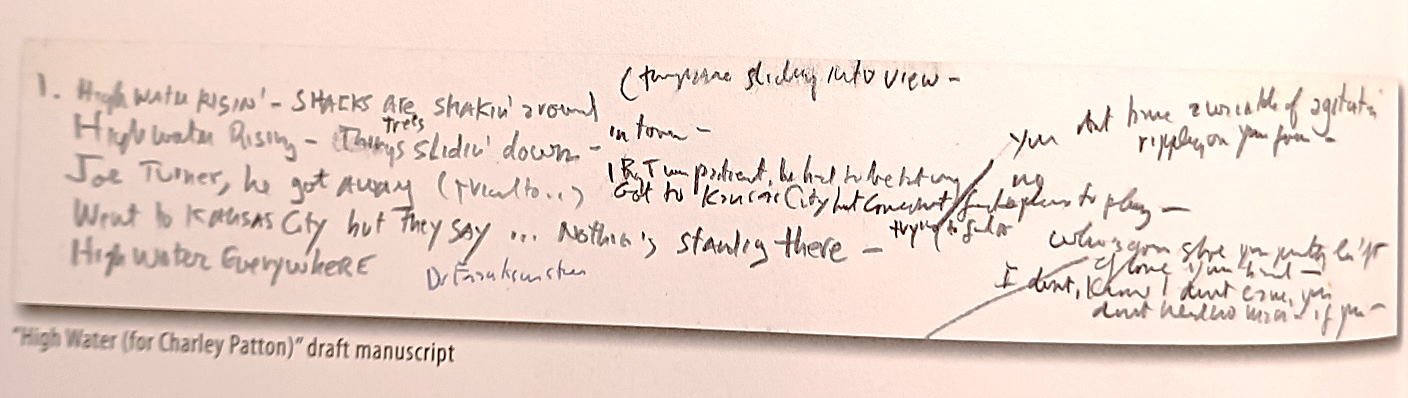
The verse from a draft version of “High Water” pictured (presumably a second version) is quite a nut to crack for the esteemed ladies and gentlemen analysts. Especially the hieroglyphs at the top right:
“You dont have a wreathe of agitation rippling on your face,” sees one, “You xxx have a life of agitation rippling on your farm,” a next one suspects, and “You don’t have a world of agitation rippling on your face” reads the third. Warmuth is not only the only one who can decipher it, but also immediately finds its source: it is “You don’t have a wrinkle of agitation rippling on your face” and it is a barely rebuilt paraphrase:
“I looked at him steadfastly. His face was leanly composed; his gray eye dimly calm. Not a wrinkle of agitation rippled him. Had there been the least uneasiness, anger, impatience or impertinence in his manner; in other words, had there been any thing ordinarily human about him, doubtless I should have violently dismissed him from the premises.”
… from one of Melville’s Piazza Tales, from the brilliant “Bartleby, the Scrivener: A Story of Wall Street”, written in 1853. A baffling birth year, by the way, and it may explain why the short story was so lukewarmly received at the time: Melville was more than half a century ahead of his time. In his time at most reminding of Gogol, but similarities to twentieth-century grandmasters like Kafka and Camus stand out much more clearly. Not only because of the composition – an otherwise rather colourless narrator sharing with us his observations of the eccentric, irrational office clerk Bartleby – but mainly because of the plot: Bartleby slowly but consistently shirks the responsibilities expected of him, justifies this exclusively with the enigmatic “I would prefer not to”, is somehow unremovable and is eventually taken away by the police. In prison, he refuses to eat and dies after a few days. Very Kafkaesque, Melville then offers a short coda – which, however, does not offer the expected key, but only raises more questions.
Not only is the plot similar to a Kafka story like Die Verwandlung (The Metamorphosis) or Dylan songs like “Drifter’s Escape” and “The Ballad of Frankie Lee and Judas Priest”, we also recognise the style: the clear, straightforward prose that superficially suggests a deceptive transparency, and beneath that clear surface an enigmatic, alienating undercurrent. Extra camouflaged by humour; as with Kafka and Gogol and Dylan, Bartleby’s answers and actions are initially laughable, tickle our funny bone. The underlying, unknown but unmistakably present tragedy only seeps through at second glance. It’s a connection to John Wesley Harding songs which Dylan himself seems to recognise: at the Night of The Hurricane concert in New York (8 December 1975), he announces “I Dreamed I Saw St. Augustine”, the only John Wesley Harding song of the evening, with “Here’s a song, I want to dedicate this to Mr. Herman Melville.”
Thus, Scott Warmuth exposes the first clearly verifiable, irrefutable example of Melville influence on “Love And Theft”. Melville’s presence was always palpable, but not that categorically identifiable, was more or less traceable in remarkable word choice. In No 8 of the album, “Moonlight”, for example. The clouds are turnin’ crimson we find in Melville’s Mardi (twice), as do such undylanesque idioms as trailing moss, cypress, mystic glow, groan and petals; words and word combinations that we otherwise rarely, if ever, find with Dylan, but all are found in Melville’s novel.
As we find typical “Melville words” like dazzling and squall in No 6, “Floater”, as we notice phrases like “golden haze”, “silent sun” and “beams of light” in the Time Out Of Mind-outtake “Dreamin’ Of You”; unusual with Dylan, but all found in Melville’s Collected Works. And as a bonus, we then find another likely, and slightly absurd source for the depth measurement in the opening line of the fourth stanza, “High water risin’, six inches ‘bove my head”, in that same perfect short story “Bartleby, the Scrivener”, a few pages after the wrinkle of agitation fragment:
“He did not look at me while I spoke, but kept his glance fixed upon my bust of Cicero, which, as I then sat, was directly behind me, some six inches above my head.”
We could rule out the coincidence factor anyway since “’Cross The Green Mountain”, Dylan’s masterful contribution to the soundtrack of Gods And Generals (2003) – in it, Dylan copies a couple of verse excerpts from Melville’s poem “The Scout Towards Aldie” (brave blood to spill and the ravaged land was miles behind) – but Melville, thanks to Warmuth, is now retroactively demonstrable even before that, in the creation phase of “Love And Theft”. And, leafing through the Collected Works, discernible. Identification Dylan should have felt with the narrator of “Bartleby, the Scrivener”. I was not unemployed in my profession by the late John Jacob Astor; a name which, I admit, I love to repeat; for it hath a rounded and orbicular sound to it, and rings like unto bullion he says already on page 1 – demonstrating an identical, almost synaesthetic sense of sound as Dylan has. And confirmation Dylan should have found with a conception of art that Melville articulates in Redburn:
“And for me, I should be charged with swelling out my volume by plagiarizing from a guide-book – the most vulgar and ignominious of thefts!”
… in his mind, Dylan will have registered a kinship with his fellow thief of thoughts and put a tick in the margin with a collegial nod. Perhaps even a wrinkle of agitation rippled him.
To be continued. Next up High Water (For Charley Patton) part 23: Love and Theft
Jochen is a regular reviewer of Dylan’s work on Untold. His books, in English, Dutch and German, are available via Amazon both in paperback and on Kindle:
Bob only gave “What was it you wanted?” 22 outings on the Tour, and yet as the cover versions below show there is a lot in the song that an inventive musician can play with. Is it to be soulful, secretive, accusatory, even a trifle amusing in parts… however you see the song you can make it into something new.
Willie Nelson takes the song with a lot of reverence to Bob’s original as you might expect, not least because from the last news I heard the two old timers are playing together on the Outlaw Music Festival Tour this year.
Thus this version pays total respect to Bob’s original, including even the details of the harmonica part. The vocal is fractionally more delicate and there are a few more twists in the background music, but in essence this is a copy of what Bob laid down. There are some guitar variations at the end, but they almost seem like doing something different just for the sake of it. You’d buy this if you are a Willie Nelson devotee, but if you are a Dylan fan, you’ve pretty much already got it.
Chris Smither however gives us some interesting guitar work at the start and a really offbeat but very light percussion from the beginning, which gives me a greater sense of time passing in its regular manner. As a result this is all about the atmosphere which is in fact the essence of the song. Although I know the song inside out, hearing this did bring back the magic of the lyrics… that puzzlement and uncertainty of the situation.
Indeed it is very easy to lose the thoughts behind these lyrics as the singer loses track not only of what was wanted but who the person is that he is confronting. This version re-finds that spookiness and delivers it as the main part of the message. There is also a gorgeous background to the last few seconds that leaves me with a shiver.
Roli Frei and the Soulful Desert
Here we get a very laid back opening to the point of almost being hidden which looks to take the atmosphere even further. And indeed it really works, while keeping the guitar effects quiet and in the background until the “somebody looking” verse where the singer expresses the anger in the lyrics very successfully, I felt. Indeed this sort of contrast is harder to do than you might imagine.
Same again with the middle 8 – he takes it right up but then successfully brings it back down. It’s a version I will need to play several times to get the full measure of, but on the first run through I have to say I’ve really enjoyed this.
The Lucky Losers
It is a shock to move away from Roli Frei to this version. Yet the harmonies of the vocals really do work for me – I suppose in part because in listening to Roli Frei I felt it wasn’t really possible to take the mystery approach any further. And here are a couple who haven’t tried, but have gone in the opposite direction.
And this is a major part of the joy of Dylan covers… the songs have so much in them they can be re-worked in all sorts of ways. I must admit I would never have thought of an approach like this in a million years, but it is fun.
Now I must admit part of the fun comes from having listened to the cover versions above first, and I really needed to be taken up and out of the gloom. That this version comes next is pure chance – I’ve put them here in the order of finding the recordings, nothing more sophisticated than that. But sometimes serendipity works.
I love the “who are you anyway” in this version. It gives a totally new thought about the whole piece.
Bettye LaVette featuring Trombone Shorty
Bettye Lavette has sung so much Dylan we can always be sure that she knows the song and its context and has given a lot of thought to how approach the piece. Here she uses her voice to give a new extra layer of uncertainty and the anger that uncertainty can bring.
There are some lovely unexpected elements in the accompaniment. Indeed if you can, take your mind away from her voice and listen to exactly what is happening behind her. And even if not, just focus on the fact that we now have a trombone playing a solo. Whoever would have thought of that for this song? Certainly not me. If someone had said that I’d have said “Noooo” in no uncertain terms, but within the context of this total re-write it works.
It’s a version that is full of surprises and no less enjoyable for that. I’m not sure I’m going to come back to it, but I’m glad I found it.
Stef Kamil Carlens and the Gates of Eden
Now we are back to where we started with the mystery, and as can happen with these articles I feel almost overloaded by the song by the time I get to the end. This is a fairly standard interpretation, taking the music and lyrics as they are, and letting the instrumentalists add their bits and pieces behind.
But I think I’m a bit overwhelmed by all that has gone before, and maybe if I came back to this version in a few days without hearing the other editions first, I’d get more out of it. Which is of course the problem with the series and this style of writing while I listen to the music. It helps me to get down my first impressions but maybe loses some perspective.
However, the addition of the chorus in the latter parts of the song really did make me think. It might have been interesting to give the organ a break sometimes, but still, it’s enjoyable and another insight. And do stay with this to take in the instrumental section at the end. It’s worth it.
“The Lyrics and the Music” is a series by Tony Attwood which tries to find out what happens when one reviews a Dylan song not primarily as a set of lyrics, but as a piece of music which includes lyrics. An updated list of previous articles in the series is given at the end.
There is a level of tired resignation in Mississippi both in the lyrics and the music that really comes across in this first version. Indeed the chorus line reflects this perfectly:
Only one thing I did wrong
Stayed in Mississippi a day too long
Musically it is put across by that slow swing to the music and the simplicity of the accompaniment. The percussion part can hardly be heard, in this version it is a simple beat suggesting that no matter what, time moves on.
But what is so wonderful here is that the music can reflect the opening line of tired resignation without putting us off listening. We are pulled forward, wanting to know more despite that opening.
Every step of the way we walk the line
Your days are numbered, so are mine
Indeed multiple lines in this song reflect tiredness and resignation, and those are two feelings that really are hard to put across in music without making the audience feel bored. We can take songs about another person’s sadness. But this is six minutes of personal resignation. How can that be kept going?
There are moments of course where the music raises itself up a little – not to anger but more to angst – just saying “well, that’s life for you.” And this is emphasised as instead of coming straight back into the next verse we get a pause where the music is just sitting on one chord
Got nothing for you, I had nothing before
Don’t even have anything for myself anymore
If we were listening to this for the first time we might think that this is the moment when the music is about to take off. Indeed a lesser composer might have introduced a sudden burst of sound here especially as the lyrics continue
Sky full of fire, pain pourin’ down
But no, the music stays in its place, plodding along, but never dull or boring even though we hear there is “Nothing you can sell me, I’ll see you around”.
So how does Dylan stop the plod of the music in this initial version from becoming tedious, as anything “plodding” normally is? If you listen to the “got nothing for you” lines you’ll find the guitar part does something quite unexpected. It alternates going up and down before rising up to emphasise the hopelessness of “see you around”.
In the breaks between the verses the guitar starts out by playing the melody but then reverts to accompaniment. It leaves the listener slightly uncertain, and this uncertainty is emphasised by the totally unexpected pause between the verses. If you listen from 1’54” onwards there is an instrumental break which seems to stop, on one chord waiting for the verse to begin again, but it doesn’t. We get two and a half bars of music where absolutely nothing is happening except this chord is strummed before Bob comes back in with…
Well, the devil’s in the alley, mule’s in the stall
Say anything you wanna, I have heard it all
It is an utterly remarkable piece of composing, and I doubt any other composer of contemporary song has ever tried it, or indeed ever would try it, because every producer would instantly say, “You’re losing your audience”.
But this is untrue because that pause where nothing happens totally reflects where the singer’s life is. And if that pause were not sublime enough we then get
Well, the devil’s in the alley, mule’s in the stall
Say anything you wanna, I have heard it all
In fact the lyrics upon their return reflect exactly what we felt with that pause. Nothing matters. This is how it is. There’s nothing I can do.
This is in fact a preparation musically for another of the killer lines in the song
Feeling like a stranger nobody sees
And if ever there was a way of singing, a melody line or a musical accompaniment that reflected that line, this is it. This is absolute resignation to the fact that
So many things that we never will undo
I know you’re sorry, I’m sorry too
Now of course there is change going on around us all the time, and this time as the music starts to rise Dylan agrees that
Some people will offer you their hand and some won’t
Last night I knew you, tonight I don’t
I need somethin’ strong to distract my mind
I’m gonna look at you ‘til my eyes go blind
But that is as far as he can raise himself for then we slip back down. He has made an effort in the past…
Well I got here following the southern star
I crossed that river just to be where you are
but as we know he got distracted on the journey.
The point is that the singer is not angry, he is not accusing anyone, which is why this gentle limiting music works so perfectly. He might be drowning in the poison, as we all effectively are,
But my heart is not weary, it’s light and it’s free
I’ve got nothin’ but affection for all those who’ve sailed with me
And it is because of all this musical preparation in which we are carried along with the lyrics, just observing the world, not part of it any more that we can accept within these easy-flowing moments that
Things should start to get interesting right about now
With a line like that many lesser composers would be tempted to start changing the gentle lilting music but not Bob because he has the final twist for us. Yes the world has gone very wrong, so how can the music be so gentle, how can he still have affection for all those who he has known?
And this is where we get the jolt. The music stays the same and when we hear
I know that fortune is waitin’ to be kind
So give me your hand and say you’ll be mine
We are tempted to think, so this is what it was all about… this gentle floating music carrying us toward that moment. But no, the meaning of the music is what we heard at the start… it goes on and on, but that doesn’t mean that everything is ok. Just drifting on and on has its downside too because…
Well, the emptiness is endless, cold as the clay
You can always come back, but you can’t come back all the way
… because emptiness is gentle, because there is no change. The melody can be lilting, and the fact that it runs on and on gives us a sort of feeling that all is well, but maybe that is not all there is….
Of course none of this means that just because Bob composed it that way he doesn’t try and make the song into something else. In the second recording below he was exploring where else this could go, and in the live performances he took this much, much further.
The resignation that was there in the original version still shines through in the version below, although (sadly from my perspective) by the time the song hit the stage it was becoming something else. And maybe that was right. Maybe such a long gentle piece in front of an audience known for making a lot of noise, the song just wouldn’t work. So it changed. But we do still have the original to marvel over, and of course the version that was originally released.
The Never Ending Tour Extended: This series uses recordings selected by Mike Johnson in his inestimable masterpiece The Never Ending Tour, and looks at how those performances change as time goes by. The selection of songs from the series, and the commentary, are by Tony Attwood.
Thjs is one of those performances where it sounds to me as if Bob knew he wanted to changed the performance from that which he had recorded but doesn’t yet really know quite what to do, so he takes it a bit of a gallop, with odd words emphasised for no particular reason. I included this version as it is just about the first recording we have of the song from the Never Ending Tour articles, rather than because I think it gives us new insights either into the song or Dylan’s feelings for it. And as for the end, well, it just sort of… stops.
If you are kind enough to go on and read through (and more importantly listen to) the other recordings within this piece, if you have time do then come back and listen to this one. It is something of a shock to see just how far the song travelled.
So we jump forward a mere five years (which in the context of the Tour is a blink of an eye) and the contrast is overwhelming. Now the lady is gentle, refined, and above all enigmatic, in both the music AND those oh-so-famous lyrics. Better still although there is the occasional use of that sudden leap of an octave at the end of vocal line, it actually seems to fit here – not least because it is used so occasionally.
This is one of those performances which makes me so pleased that Mike was able to put in the hours, days, weeks, months, years ploughing through the NET recordings to find and help preserve moments like this. Just imagine if no one had ever thought of recording these concerts. Just imagine if Mike had never thought of writing the definitive guide…. How much poorer we should all be.
But I must stop – this is a wonderful eight minutes, not just of the arrangement itself, but the improvisions – just listen to the guitar comment after each line in the verse starting around 4 minutes 15 seconds (“Bow down to her on Sunday”).
And then the instrumental verses that follow. This song, originally lasting 2 minutes 40 seconds, is now eight minutes long, and every second is a joy to behold. And the way it builds up makes me just wish I could have been there for that birthday. What a day it must have been. Please don’t leave before the end – that coda is something else to behold.
Bob certainly knew he was onto a winner here as the simple arrangement stayed the same, but the speed is taking up slightly, and although Bob’s voice is restrained he does put some extra force into the singing at times. But my feeling is that the band knew they had a wonderful simple instrumental here which if kept under control could lead to wonderful improvisations.
I get the feeling here however that the enthusiasms for the improvisions is now starting to take over a little, and Bob finds it nigh on impossible to hold the song down, as the “big drum” verse leading up to the four minute marker shows.
It just goes to show how hard it is to keep some of these improvisations completely under control when they are being performed night after night. Bob uses a harmonica solo to try and restrain the enthusiasm for the song but I am not sure it works. It’s still great fun, but somehow I feel the boundaries have been broken.
So we jump forward one more time. The leap of the voice at the end of the line has gone; the “don’t look back” sounds almost sardonic. Dylan is now more distanced, far less involved, no longer entranced by her by looking back with a shake of the head at how anyone could be so taken in by this woman. The Egyptian ring has just become a detail. Now the “walking antique” line applies to everyone.
Instrumentally the band is closer to counterpoint than ever before, with instruments entwining with each other as the lady in the song extends her tentacles and draws in those foolish enough to get too close.
Yet amidst all this the band is kept under control and the end is sudden. She’s now so much a thing of the past. She’s not even a real memory. She’s gone.
This track starts at around 43 minutes 25 seconds.
The change between this version and that on the album is in one sense small: the organ isn’t there. It is still a 12 bar blues with an extended section on the opening chord, and with the oddity (in terms of the classic blues construction) that there are no vocals on the final (dominant) chord (which the album version doesn’t include at all).
The fact that we might have this difference is obvious – there is no organ being used on the tour version of the song – but the difference for the sound is enormous. Somehow the album version has fewer jagged edges, as if the singer is reporting something that we know. A sort of “that’s how it is” sound without too much of a commentary about whether this is a good thing or not.
Here it is as if we are being given the news for the first time, and no organ is used. As a result, the difference in the sound is enormous. The live version is therefore much more “in your face,” much more threatening, much more of a warning rather than a report. And Bob’s singing style adds to this. Indeed there are moments before the instrumental break where it almost sounds as if the band members are fighting each other for prominence, just as can happen in gang warfare.
There are also musical clashes at times with the piano part not fitting exactly with the rest of the band. Bob on the piano seems occasionally to be wandering into his own little alternative approach.
Now of course Bob is known for re-writing his songs for the tours – and indeed in another series at the moment “The Never Ending Tour Extended” I am trying to explore what Dylan does to various songs that we already know well from the albums, when he performs on stage.
The point from all this is that this one particular version should not necessarily be seen as the version that was heard or is going to be heard on this tour. Bob adds, Bob takes away, Bob changes.
I’ll put the original album version below in case you feel like contrasting the two versions.
Maybe you noticed that most of my songs are traditionally rooted. I don’t do that on purpose. Charley Patton’s 30’s blues has made a deep impression on me and High Water (for Charley Patton) is, in my opinion, the best song of this record,” says Dylan at the Rome press conference, July 2001.
I do agree. Well, ex aequo with “Mississippi”, anyway. Both songs open the floodgates (no pun intended), and “High Water” belongs in the same outer category as “Desolation Row”, “Mississippi” and “I Contain Multitudes”; extremely rich, poetic, Nobel Prize-worthy musical gems. Lovely, lovely song.
The album’s namesake, Eric Lott’s Love and Theft: Blackface Minstrelsy and the American Working Class from 1993, leaves no other recognisable traces on Dylan’s album. Lott himself doesn’t see any either. In 2017, in his book Black Mirror: The Cultural Contradictions of American Racism, he devotes a chapter to Dylan, but then limits himself to generalities. “I would guess that Dylan regards minstrelsy, say, whatever its ugliness, as responsible for some of the United States’ best music as well as much of its worst,” for example, and he speculates Dylan “wants to step up and face the racial facts of one of the traditions he inherited.” Which seems debatable, to say the least. Indeed, from the draft versions of “High Water” one might even conclude the opposite, one might infer that Dylan is instead stepping back and facing away.
We do, at any rate, decipher at the bottom of the second verse of the – presumably – first draft:
White cat just put out the black cat’s eye
… about which the freewheeling songwriter is not entirely dissatisfied at the conception stage; on the right-hand side of the sheet, among three “Joe Turner” variants with and without “Bertha Mason” and with and without “Train 45”, there is a fairly readable verse:
The white cat bit the black cat – he said I’m not lonely but I feel alone
It is a remarkable mosaic piece for “High Water”, which, after these two attempts, is nevertheless put back in the box, in the famous very ornate box of Dylan’s loose ideas and lovingly stolen fragments; the apparently non-fitting puzzle piece combines two worlds. The second part, he said I’m not lonely but I feel alone, is one of many phrases and word combinations Dylan draws from the work of Henry Rollins. Originating again, after the many borrowings on the previous album Time Out Of Mind and after “dark room of my mind” in this “High Water”, from the poignant Now Watch Him Die, the diary-like work from 1993 in which Rollins processes his post-traumatic stress after his best friend is shot dead right in front him in a brutal street robbery. In the excerpt 26 April, New York, we read:
“I cannot translate the language of exhaustion. I feel alone but I’m not lonely. The walls understand me better.”
… which does seem a rather irrefutable source for Dylan’s rejected verse. Interesting, but of course no longer too surprising – by now, we know the special status of royal purveyor Rollins. More surprising then is the source of the first part of the verse, from The white cat bit the black cat and the first lead-up to it, White cat just put out the black cat’s eye. Which can no doubt be traced back to
My sister Rose de oder night did dream,
Dat she was floating up and down de stream,
And when she woke she began to cry,
And de white cat picked out de black cat’s eye.
… to the fourth verse of the antique “Jim Along Josie”.
“Jim Along Josie” is a hit from the heyday of blackface minstrelsy (roughly 1840-70), written in 1838 by Edward Harper. “A wildly popular song, ‘that first-rate ballad,’ known by everyone,” as banjo player Carson Hudson Jr. writes in the liner notes of his LP I Come From Old Virginny! Early Virginia Banjo Music 1790-1860 (2003).
Traces of minstrelsy do appear in Dylan’s oeuvre these years. The name-check “Mr. Jinx and Miss Lucy” in the 2000 Oscar-winning “Things Have Changed”, for example (“Miss Lucy Long”, written around 1840, is one of the most popular blackface minstrel songs; Mr. Jinx a black stereotype from the Harlem Renaissance of the 1920’s). The appearance of a blackface artist in Dylan’s film Masked And Anonymous (2003, a black-faced Ed Harris as the ghost of “Oscar Vogel”); the Al Johnson songs he gives the musicians on Time Out Of Mind as homework; the quotes from Box and Cox, a blackface minstrel skit from 1856, in the opening song of “Love And Theft”, “Tweedle Dee & Tweedle Dum”… there are some lines to be drawn to blackface minstrelsy, and thus to Eric Lott’s standard work. More so, however, as again Scott Warmuth demonstrates, to musicologist Dale Cockrell’s 1997 study Demons of Disorder: Early Blackface Minstrels and their World, in which, in addition to the term masked and anonymous, we find an extensive analysis of both lyrics and music of “Jim Along Josie”.
But with that, Dylan apparently thinks it is enough. After two attempts to allow another sample of “inherited tradition”, as Lott calls it, into a song on “Love And Theft”, Dylan leaves the quote from a blackface song from over a century and a half ago on the cutting floor – stepping back and facing away. Too unsubtle, perhaps, this particular quote with imagery imposed a little too thickly.
True, the songs usually demonstrate mockingly and racially motivated stupidity or laziness of the black fellow man, larded with simple puns and half-obscene asides, but there are songs like “Jim Along Josie” as well, in which veiled some suffering is sung, with or without references to cruelty from white bosses. In “Jim Along Josie”, The white cat picked out the black cat’s eye is the only verse line with such a charge, so it seems to say something that Dylan initially picks out this very line. The preceding lines, describing Rose’s dream, the dream in which she drowns in a river, would obviously have fitted much better in terms of content to “High Water”, to a song in which “flooding” is a motif.
Anyway – after Dylan thickens the white violence a little more in a second variation (The white cat bit the black cat), the line disappears for good, and with it the mosaic pebble “blackface 19th century”. At least: as yet, we haven’t heard it in a Dylan song.
In “Scarlet Town” (Tempest, 2012), we still encounter a half-hearted reference to “racial facts”, as Eric Lott calls it (The black and the white, the yellow and the brown / It’s all right there for ya in Scarlet Town), and in 2020, another name-check of sorts follows in “Murder Most Foul” (Blackface singer, whiteface clown / Better not show your faces after the sun goes down), but that’s about it.
Yeah well. With or without the catfight, “High Water” is a first-rate ballad anyway, of course.
—-
To be continued. Next up High Water (For Charley Patton) part 22: The Ghost of Herman Melville
—-
Jochen is a regular reviewer of Dylan’s work on Untold. His books, in English, Dutch and German, are available via Amazon both in paperback and on Kindle:
Slow songs are often difficult to cover, as they tend to encourage singers to add lots of extra bits to the spaces that have deliberately been left as spaces by the composer seeking to make a point. Arrangers and producers don’t like spaces.
But this is a highly reflective song, the lyrics of which don’t lend themself to massive self-expression or indulgence by instrumentalists or vocalists. However, take out all the emotion and that can mean what is a beautiful, deeply caring, song can become just another bit of self-reflection. There needs to be a balance – and Bob got that in his recording of the song.
Although Jimmy LaFave’s version is sensitive, I find it to contain a trifle too much extra sugar in the accompaniment, without any new insights. I guess I think the female chorus is just one step too far away from the original conception of the piece.
Jimmy LaFave
The Pines
There are several bands around, or which have been around called “The Pines” and I honestly don’t know which one this is. If you can fill in the details, please do respond.
Musically their view in this recording is that the song can exist with a beat – which indeed it can, but all of that angst that Dylan put into the original, and which is within the essence of the lyrics, is then destroyed.
It is as if someone said, “hey let’s do it with a beat” and no one thought, “but what about the meaning?” For meaning to be expressed, the music, the lyrics and their meaning must be co-ordinated, as they were so perfectly in Bob’s original.
Jill Johnson
Ms Johson takes us right back to Bob’s original conception of the song, and I am so grateful for that. There is maybe a little bit too much emotion in the third line (If I shut myself off so I can’t hear you cry) but much of the time the piece remains restrained, as I think it should.
The lyrics are not full of self- indulgence, or indeed self-pity, but a realisation of what one has to do to be a real person. And sadly this is lost in the middle section – and this more expressive notion returns in the last verse.
I know many performers, and most of all arrangers, love contrast in songs, but that’s just because of the view that the modern audience won’t pay attention otherwise. Bob knows that if you hold them with the words they will be there and so that is what he does in his version.
Yet curiously the instrumental coda in this version is much more restrained, but I guess the arranger and singer still felt there ought to be a bit of showing off the high notes, whatever the music was about. In the end my view is the performance is about the song: lots of performers think the performance is all about them. That’s the difference between us.
Solomon Burke
The rhythm at the start tells us it all, and destroys much of my feeling that this should be a delicate song. And Mr Burke takes it on from there. It’s ok as a performance if one doesn’t think about the deep meaning within the lyrics. How can they possibly justify the “foolish things” middle eight, within the context of the whole song?
Barb Jungr
But thank goodness for Barb Jungr who doesn’t just sing Dylan, but actually understands the songs Dylan has created and thus performs Dylan. For she shows that yes she can use the range of her wonderful voice in such a song, without destroying the original conception.
Play this, but maybe if you are at all prone to appreciating the emotion that can reside within beautiful music, have a handkerchief ready to dab your eyes. And say thank you to the arranger AND the vocalist for showing everyone else, it is possible to retain the full meaning of the original without just repeating it.
“The Lyrics and the Music” is a series by Tony Attwood which tries to find out what happens when one reviews a Dylan song not primarily as a set of lyrics, but as a piece of music which includes lyrics. An updated list of previous articles in the series is given at the end.
——–
This series of articles includes songs that I find ok, songs I like, songs I really really like, and then there are songs that absolutely move me. And this is one of the latter.
And it has this effect because of the combination of the lyrics and the music, a combination which allows Dylan to express extraordinarily strong emotions of love for the woman, and frustration and annoyance with those around him, at the same time in the same song. It is an extraordinarily difficult feat to achieve.
If we start with the lyrics, the opening verse is incredibly powerful – expressing the way in which a belief in a person can surpass all the comments of others, and all the events that surround that person. It’s powerful stuff.
They ask me how I feel
And if my love is real
And how I know I'll make it through
And they, they look at me and frown,
They'd like to drive me from this town,
They don't want me around
'Cause I believe in you
But now add the music. There’s a rare delicacy in the composition, starting so gently as it does but with that unexpected rise to “make it through” with its sudden touch of falsetto which sounds almost as if Bob’s voice is breaking with emotion.
Against this gentleness in the music, there is a gentle person singing – a person who cannot be bullied by public opinion and by the mob, but who will stay with his belief in this one person who is the subject of the song.
Plus there are moments in which the vocal line is taken down to express both the singer’s love and his willingness to take his love’s side no matter what
And that which you've given me today
Is worth more than I could pay
And no matter what they say
I believe in you
But contrast this with the build-up we get
I believe in you

I believe in you when winter turn to summer,
I believe in you when white turn to black,
I believe in you even though I be outnumbered
Oh, though the earth may shake me
Oh, though my friends forsake me
Oh, even that couldn't make me go back
But then it comes down again to the final verse. The plea for her help so that the singer never loses these feelings no matter what goes on around him.
Don't let me change my heart,
Keep me set apart
From all the plans they do pursue
And I, I don't mind the pain
Don't mind the driving rain
I know I will sustain
'Cause I believe in you
The musical contrasts within this song, expressed almost totally by Dylan’s singing, rather than by the band, are remarkable. Normally in pop and rock, if some extra emotion is to be expressed it is done so through taking up the sound, expressing more in the percussion and so on.
So how is all this achieved? First, through the way Dylan sings, with Bob expressing all the emotion in his voice while the music from the band is always there expressing the gentleness of the lady about whom he is singing. His vocals in contrast express his struggles with those who “don’t want me around”.
Thus the rise of the melody in the third line expresses the angst and pain. The extra energy expressed in “I believe in you even through the tears and the laughter,” and in the following lines is the clear affirmation of belief, but the gentleness is never lost; it always returns. The gentility of the singer’s feelings, the love, the affection, always overcomes anything else.
So the question for someone like me who is interested in the music as well as the lyrics is, how on earth did Bob achieve all this within one song? The answer is through pure inventiveness – which is an absolute mark of Bob Dylan’s musical genius.
The first point is that the verses are seven lines long – extremely unusual in the field of popular music where four and eight line verses are the order of the day. We don’t know there are seven lines of course (unless setting out to count) but we feel there is something here, something different, something not exactly edgy, but with an extra unexpected tension.
Here’s the first verse and you can see also the unexpected rhyming pattern. Lines 1 and 2 rhyme, but then line three stands on its own, it seems. Lines four, five and six rhyme (“around” sounding as a rhyme for “town”) and then in the seventh line we get the rhyme for “through” in line three. Very unusual, very effective, but hidden until we start looking.
They ask me how I feel
And if my love is real
And how I know I'll make it through
And they, they look at me and frown,
They'd like to drive me from this town,
They don't want me around
'Cause I believe in you
Thus we don’t notice any of this until it is written out and studied, but we feel the effect of the contrast between the doubt of those asking how he feels, those who want to drive him out, and his unwavering belief.
The pattern continues until we get to the middle 8 – the short intermediate section that so many songs have in which the song briefly changes. But what a change this is musically as we reach,
Oh, though the earth may shake me
Oh, though my friends forsake me
Oh, even that couldn't make me go back
Musically this is an extraordinary composition – not only for the structure and rhyming scheme that it uses, but the way the music itself changes. This is Dylan as a composer of music at his most sublime, and although one can read or listen to the words and admire them, it is only when one adds the music and feels the way the music copes with the seven line verses that one can fully appreciate the genius at work in this piece.
If we want to describe any song (rather than set of lyrics) by Dylan as a work of genius, then this surely is one of the songs we must choose.
The Never Ending Tour Extended:This series uses recordings selected by Mike Johnson in his inestimable masterpiece The Never Ending Tour, and looks at how those performances change as time goes by. The selection of songs from the series, and the commentary, are by Tony Attwood.
—————–
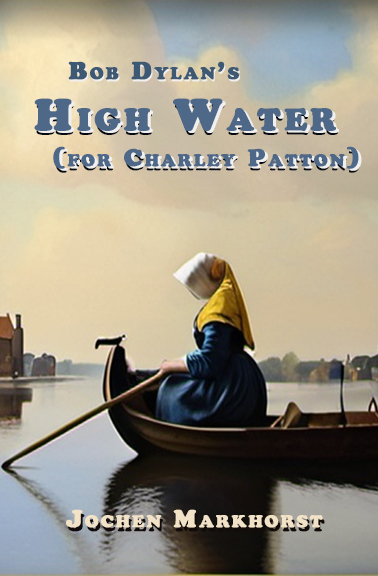
As you will know if you have been paying attention, “High Water (For Charley Patton)” is the subject of Jochen’s latest book and I believe, is the most comprehensive analysis series ever on Untold Dylan. We’ve just published episode 20, Odds and Ends, and my copy of the book of the series arrived yesterday (brilliant cover by the way Jochen). So it’s a good time to see what Dylan has done with the song on stage.
Between October 2001 and October 2018 Bob played the song an amazing 712 times, and then decided to let it go.
I absolutely love this. It has captured that fantastic combination of energy and reflection both in Bob’s vocals and in the backing by the band – and all achieved without any chord changes (which are normally an absolute fundamental of rock, R&B, the blues…)
A lot of this success comes from the terrific percussion which drives the whole piece along without ever intruding, while the multilayer accompaniment weaves inside, outside and around itself. Just listen to the instrumental break, and then the contrast between that and the next couple of sung verses.
The temptation for the instrumental lines to fight each other or overtake the lyrics is never given into (Bob of course knows exactly how to keep a band under control), and the second instrumental break not only keeps the band where it should be, but actually offers a fade out and slow down. Remarkable, brilliant, wonderful, and so worth preserving.
In fact what we have here is Bob Dylan doing counterpoint, and perhaps I should explain. Counterpoint in music means that the harmonies are kept (which is easy because the song is based on only one chord) but the individual instruments have a clear level of independence and individuality as the musicians express themselves. Who else has done this in rock music?
In 2002 (Accidentally Friends and Other Strangers) the sound has changed a little and Bob has modified his delivery too, plus we get a slight change of instrumental prominence, and together this gives a greater power of delivery, without the essence of the song ever being lost.
What I get here is a feeling that by now the guys have played the song multiple times but are still finding little nuances to slip in. If you can pick it out as the song moves along, do listen to the “Well, George Lewis told the Englishman, the Italian and the Jew” verse – it is slightly changed – but only slightly – and that adds that extra nuance which turns this from being very good into stunning.
More than anything I get the feeling that this is a favourite song being caressed and nurtured. As ever with Bob there aren’t any vibrant showing-off solos but an entwining of the musical threads.
Just listen to the solo around the five minute mark and onwards; these are expert musicians carefully nurturing a friend.
2002
So let us jump forward and what we find by 2005 (Choice cuts from London and Dublin) is a change to the accompaniment at the start. It gives a different bounce to the song. Not a huge contrast as the piece moves on, but enough to change the emphasis. And what we find is that slowly, very slowly, the song is losing a little bit of its “difference” but so different was the song at the beginning of its life, that much of the unique quality is not lost. Indeed the instrumental breaks show this. Try the instrumental approach from 2’15” onward. It’s Dylan but not as we know him. Then as we get to around 3 minutes there’s a piano in there too – is that Bob playing?
And then again at 3’50” I guess that is a banjo part, but once again when the vocals return it is all stripped back and we find ourselves ready to start over.
What I do hope you can do is have the time to play the whole recording below, and focus as much on the instrumentation in the breaks as on Dylan’s own performance. To me, the band really found something within this song that gave it an extra life and vitality. If you have six and a half minutes to spare please do take it all the way through. I can’t say this was a life-changing moment for me (that would be going far too far) but my goodness, it changed my vision of music for many a month after I first heard it.
The recording starts at around 35 minutes 40 seconds.
My own version of youis one of those Dylan songs which most of will know immediately from the first bar – those four descending notes appear throughout the song, over and over again, three times in every four lines. Although to be fair we do get an extra accent at the start of each descending bass line later on as the performance does pick up a lot of extra energy.
It does have what I take to be one of the great latter-day in-jokes of popular music with the line “You can bring it to Jerome” line.
If you are of a certain vintage and musical background as yours truly, you’ll surely get the line: Jerome Green, occasional songwriter but mostly known as Bo Diddley’s maracas player on the tours when he was really becoming known as one of the fathers of R&B, – the guy who really didn’t want to be hassled by carrying the drum kit around so persuaded Bo that all he needed was two maracas in each hand.
As such he had an easy life, although I think he was actually an accomplished percussionist. But opting out was very much Jerome’s lifestyle. He was a pal of Bob Diddley from the early days, being the man who went around with the hat when they played on the streets. Then in 1955 the little band of street musicians suddenly had a number one hit, with Jerome acting as co-writer on some songs, and of course writing “Bring it to Jerome”.
Jerome played and recorded with Bo Diddley until late 1964, by which time he had something of a reputation as a very solid drinker. He got married but died some time around 1973, lost to the world of music, and to his family. He deserves to be remembered far more than he is, and Bob’s mention of him here is more than welcome in my house.
I actually interviewed Jerome when I saw Bo Diddley play on stage as a teenager when the band toured England and came to play in Bournemouth near where I live. It was my first-ever interview of a famous musician. I was shaking like a leaf.
But back to Bob. Although the song sounds utterly repetitive it does have built-in variations, starting out with four lines the same line before the final two lines which vary the theme. Then the verses get longer and the ending varies.
Yet despite the changes it is the atmosphere of the song that carries it through to the crescendo at the end of each verse. But as for the “bring it to Jerome verse” does it give us a clue as to what is going on?
You can bring it to St. Peter
You can bring it to Jerome
You can bring it all the way over
Bring it all the way home
Bring it to the corner where the children play
You can bring it to me on a silver tray
I'll bring someone to life, spare no expense
Do it with decency and common sense
For thereafter we have the sudden accent at the start of each line for the extended final verse with his gory details and additional weight on the beat and then a strangely slowing down, down-beat ending.
Is it the descent of mankind? Is it the ever slower plod of footsteps as one gets older? I don’t know, but I do find the “Bring it to Jerome” line fascinating. It is a direct quote, and this reference to how Jerome Green, a lively, fun, talented musician just suddenly withdrew from music and passe away so young. Is that part of telling us “the history of the whole human race” as something that plods along step by step?
Indeed I move toward such thoughts as in moments of being downcast and worried about life, or myself I think I have often felt like shouting out
Is there light at the end of the tunnel?
Can you tell me, please?
And I am tempted to stay with the vision that this is the clue to it all, this life moving from a rhythm and blues man who died far too young to the “Trojan women and children were sold into slavery”
Reddit has a long detailed discussion following on from lines such as
Mr. Freud with his dreams, Mr. Marx with his ax
See the raw hide lash rip the skin from their backs
but upon reflection I think that as so often this misses the point: this is as much about the sound of the words as the individual disconnected images. Yes it can be explained with convoluted thoughts such as ” the axe comes to refer to an obsolete technology that Marx rejected,” or as saying something about the sadness of Jerome Green’s early death, as I have suggested, but it can also just be a set of images over a rather spooky sounding repeated accompaniment suggesting the world plods along, and we are just ants scampering around on the surface.
And indeed that is what this performance shows me. It is a set of random lines that spring to Bob’s mind as he surveys the world he has known. There’s no significance in each line; it is the overall feeling of those constant downward steps in the accompaniment that is central to all this.
Forget the meaning and this is as moving and worrying as a walk along an empty dark corridor where just one light bulb is occasionally flashing off and on. It is a reflection of a troubling world which we can’t fully understand because of itself it is not comprehensible. Just keep taking the steps one after another, and try not to fall over.
I utterly adore this performance as it really does seem to me to be reflecting the world Dylan sees and portrays. A world that just keeps on moving on, without us being any more signficant than a bunch of ants upon whom someone might stand at any moment.
Yes Jerome left music and passed away so young… and he could have done so much more. Did he have a great life after leaving the band? I fear probably not, and that’s the horror of it all. This is, I fear, nothing other than the story of our discontent.
“Maybe you noticed that most of my songs are traditionally rooted. I don’t do that on purpose. Charley Patton’s 30’s blues has made a deep impression on me and High Water (for Charley Patton) is, in my opinion, the best song of this record,” says Dylan at the Rome press conference, July 2001.
I do agree. Well, ex aequo with “Mississippi”, anyway. Both songs open the floodgates (no pun intended), and “High Water” belongs in the same outer category as “Desolation Row”, “Mississippi” and “I Contain Multitudes”; extremely rich, poetic, Nobel Prize-worthy musical gems. Lovely, lovely song.
A fascinating dilemma for Duluth’s peace officers and law keepers if today or tomorrow a complaint comes in about the city’s most famous son. It’s plain as day though; Dylan does indeed sing the n-word. “The Negro’s name is used” in “Only A Pawn In Their Game” (The Times They Are A-Changin’, 1964) and eleven years later even a degree stronger in “Hurricane”: To the black folks he was just a crazy nigger. Unthinkable it is not, such a complaint. In 2019, Duluth school district administrators decide to remove Harper Lee’s novel To Kill A Mockingbird and Mark Twain’s Adventures Of Huckleberry Finn from the curriculum “to protect the dignity of our students” and not require them to read books that marginalise them. Duluth is not alone herein; in the twenty-first century alone, the tally stands at over 20 school districts where Harper Lee’s pièce de résistance is being removed from reading lists plus dozens of attempts to do so. And usually complainants then invoke the perceived offensive use of the n-word. Like in Biloxi, Mississippi, where a concerned mother complains that her son feels “uncomfortable” with its use in Mockingbird – which, ironically, seems to be precisely the intention of Lee’s 1960 novel, the 1962 film version starring Gregory Peck and Aaron Sorkin’s 2018 stage adaptation.
Morrissey – Only a Pawn in Their Game:
The ongoing controversy gets a new boost in 2015, when publishers HarperCollins (US) and Heinemann (UK) release Harper Lee’s Go Set a Watchman, initially touted as “the sequel to To Kill A Mockingbird”. Excitement about this soon gives way to sobering; Go Set a Watchman turns out to be not so much a sequel as rather a kind of preliminary study – Harper Lee wrote the work before To Kill A Mockingbird. After constructive criticism from an apparently knowledgeable editor, Therese von Hohoff Torrey, Lee lifted out the flashback passages centered around young Scout, and rewrote them into what is now the classic. “Draft manuscript” is thus a more correct classification for Go Set a Watchman than “novel” or “sequel”.
It is perfectly common for fragments and passages from rejected manuscripts to be saved for reuse in a subsequent attempt or, indeed, for reuse in a subsequent, different work of art. Bach disregarded the eternal value of his vibrant Brandenburg Concertos and unconcernedly cut and copied from it for later cantatas and even an entire harpsichord concerto (BWV 1057). Haydn’s Schöpfungsmesse (Creation Mass, 1801) contains scraps originally intended for Die Schöpfung, Beethoven’s Eroica is recycled ballet music, and there are hundreds more examples.
From literati, novelists and poets, even from giants like T.S. Eliot and Kafka, we can observe how deleted fragments from first drafts are later recycled in subsequent works. Which gives admirers fascinating insights into the creation of works of art, and critics ammunition: after all, interchangeability and reuse do undermine the idea that those admired symphonies, poems, novels and song lyrics are self-enclosed, autonomous works of art.
We know plenty of examples in Dylan’s oeuvre as well. Thanks to the Bootleg Series, we discover how outtakes like “Marchin’ To The City” and “Dreamin’ Of You” are plundered to contribute half couplets and complete verse lines to “‘Til I Fell In Love With You” and “Not Dark Yet”, among others. And in 2022, we see that artifice when we get to peruse draft versions and loose notes via the archive in Tulsa. For instance, we decipher Got to believe that you’re alive, at least that’s what to tell yourself in the “James Joyce stanza”, a verse line that moves paraphrased to No 5 of Side A, to “Lonesome Day Blues”: I’m telling myself I’m still alive. And we see the mechanism on a micro level as well: the migration of word combinations and even single words to later songs.
Saturday Nite Fish Fry – Lonesome Day Blues:
The draft versions of “High Water”, both the published copies and the rejected verses published by authors like Clinton Heylin after visiting the archive, provide quite a few aha moments in this area. In The Double Life of Bob Dylan Volume 2: 1966-2021 (2023), Heylin quotes three more distichs that struck him. The first one looks familiar:
James Joyce left in the roaring rain
Rode to Rosedale but they wouldn’t let him off the train
The second line we initially know as Got pulled in Vicksburg but they wouldn’t let him off the train (something like that, anyway) from the other draft version, but in the definitive version only “Vicksburg” survives. Rosedale, though mentioned in Charley Patton’s “High Water Everywhere”, we won’t see again in Dylan’s oeuvre, nor the claustrophobic train experience.
“James Joyce”, to whom Dylan previously tried to give a place, between the lines of what was once a third verse, disappears too. In that third verse from the draft, of which not a trace remains as it is, James already had a hard time: “James Joyce just walked in the door like he’d been in a whirlwind”. Deleted, but not entirely evaporated. James Joyce then makes his “grande” entrance into Dylan’s oeuvre eight years later, on Together Through Life in “I Feel A Change Comin’ On”. Well, actually not really “grande” and much less spectacular at that (“I’m hearing Billy Joe Shaver / And I’m reading James Joyce”), but still. The spectacular setting, the whirlwind, lingers a little longer in Dylan’s working memory, but eventually finds a place too: in “Tempest” (2012).
For that marathon song from the album of the same name, Dylan has apparently been browsing his “High Water” draft versions quite a bit. At least, we hear a remarkable amount of noticeable idiom that we really only encounter once in sixty years of Dylan songs:
– High Water draft: River banks are swelling – Tempest: the swelling tide
– High Water draft: James Joyce just walked in the door like he’d been in a whirlwind – Tempest: He walked into the whirlwind
– High Water draft: Livin’ there in the underworld – Tempest: Into the underworld
– High Water draft: I’m looking as far to the East as the eye can see
– Tempest: He saw the starlight shining streaming from the East and much more similarly in – again – “I Feel a Change Comin’ On”:
– Looking far off into the East
– High Water draft: in the dreadful hours of dawn – Tempest: In the long and dreadful hours
Taken by itself, each fragment is too unremarkable to be classified as re-use, but after the fifth notice, the coincidence factor can pretty much be ruled out. As also, with the benefit of hindsight, that Got pulled in Vicksburg but they wouldn’t let him off the train line does sound very much like an echo of a rejected line from the alternative “Dignity” version on Tell Tale Signs: “Pull into the platform, step off the train”. According to Dylans’s own origination report written in January 1988, recorded – and rejected – during the Oh Mercy sessions in 1989. So a 13-year-old echo of the song that kept him writing for a day and a night, as he writes in Chronicles:
“There were more verses with other individuals in different interplays. The Green Beret, The Sorceress, Virgin Mary, The Wrong Man, Big Ben, and The Cripple and The Honkey. The list could be endless. All kinds of identifiable characters that found their way into the song but somehow didn’t survive.”
Other individuals and identifiable characters such as James Joyce, Joe Turner, Dr Frankenstein and Huckleberry Finn, one would be inclined to think. Some of whom then turn out, years later, to have survived after all. You got to believe that you’re alive, at least that’s what to tell yourself.
————
To be continued. Next up High Water (For Charley Patton) part 21: Dat first rate ballad
Jochen is a regular reviewer of Dylan’s work on Untold. His books, in English, Dutch and German, are available via Amazon both in paperback and on Kindle:
I started writing this series (A Dylan Cover A Day) two and a half years ago, and for quite a while it was something I put up each day, but then the pandemic ended, other events happened, and it became a once every few days affair. But I have really grown rather fond of it, not because I like my own writing or opinions (often the reverse) but because I have discovered so many new cover versions as I’ve done the basic research.
As with the two versions below. Going back to the earlier days of this site I wrote quite a long review of the song which is still there if you want to take a look, but didn’t include any cover versions, probably because I couldn’t find any.
And they are indeed thin on the ground. I won’t include the Girl from the North Country versions, as they always seem to me “show versions” rather than “cover versions” – show versions not really being intended to stand alone, but to be part of the complete theatrical performance from which they come.
Which leaves me with just two covers. And how amazingly different they are.
Martha Scanlan’s version has a few seconds of guitar before the percussion comes in, which until that moment is a perfect musical accompaniment to the picture on the cover of the album (below). But fortunately (as far as I am concerned) the prominence of the percussion is reduced (although I would have liked to have it reduced even further – and that is because the vocals here are exquisite. In fact I would have taken the bass guitar down as well.
Actually, I am not sure I know another recorded version of any Dylan song where I would pay to lay my hands on the studio recording and produce a version in which those two instruments are taken further and further back.
The harmonies, the strings, the piano, and of course Martha’s voice, are just so wonderful for this song, I could cry at the way the rest of the instrumentation is added. But still, it remains worth hearing and appreciating. It turns what was for me another Dylan song from a not overwhelmingly inspired moment into something beautiful – but then has it removed by the arrangement. Ah well, so it goes.
And now by way of absolute contradiction, Al Kooper, who basically takes the view that if you going to play rock n roll, then damn well play rock n roll and don’t mess about in any halfway house.
I’m not sure it works as a piece of music, but it really makes me smile – especially the female vocals. It is not a version I come back to for the fun of it, but I have been known to torment a few Dylan purist friends with it too.
The middle 8 particularly is a scream. I don’t really like this, but I’m pleased to have a copy. Not least because then I can go back to Martha.
Bob has never played the song in public. I wonder what he would have made of it?
Indeed, in the ludicrous concept that somehow I was transported into being Bob Dylan, I think I would go through all the songs that I had never ever played on stage and introduce one of them into each concert. Just for the fun of it.
“The Lyrics and the Music” is a series by Tony Attwood which tries to find out what happens when one reviews a Dylan song not primarily as a set of lyrics, but as a piece of music which includes lyrics. An updated list of previous articles in the series is given at the end.
——–
Highway 61 Revisitedis one of just three songs that Dylan has performed live, 2000 times or more. The other two are “Like a Rolling Stone” and “All along the watchtower”.
So journalists seeking a shortcut in terms of writing about the piece are likely to call it “iconic” – a symbol of Dylan’s compositions worthy of veneration; a symbol of the 628 songs Dylan has composed or co-composed.
And yes of course it holds a special place in our minds, the title song of the LP and (if you really have a good memory for irrelevant pieces of information) the B side to the single “Can you please crawl out your window”.
The opening line itself is iconic, “God said to Abraham, ‘Kill me a son’,” – no one surely has ever written an opening line like that. You can’t be a Dylan fan without knowing it.
But what of the music? And it is interesting, for although I am sure there must be some articles on the music of this song, I can’t immediately bring any to mind. And indeed such is the historic and contemporary power of the song, I had to play it through in my head to check that my memory how the song is constructed was right.
And yes, the answer is dead simple: it is an extended 12 bar blues, based on the three standard chords of the blues and rock n roll. What of course distinguishes it from every other 12 bar blues (the fundamental music of the blues and early rock n roll) is the lyrics.
For the lyrics, from the off, are so outrageous, that it is hard to take in what the music is actually doing. It is there, supporting the lyrics. I mean, how would you write music to the opening lines,
Abe said, "Man, you must be puttin' me on"
God said, "No", Abe said, "What?"
Build in complexity to the music and the sheer oddity of those lines in any context (let alone in a rock song, or a piece of popular music) would be lost.
And this is part of Bob’s unerring grasp of his art. It may sound dead simple to say, but many a songwriter has failed to get it: if you want a piece of popular music that is going to be grasped at once, you can make the lyrics complex, or you can make the music complex, but not both.
Of course many songs do make both the lyrics and music complex at once – Bob did it with the wonderful “Angelina” for example, but then he is not aiming at writing a blockbuster that everyone will get the moment they hear it. (You try singing the opening lines of “Angelina” from memory, or even after listening to it once through, and you’ll find it rather hard). On the other hand with “Like a Rolling Stone” it is the melody that is simple but the lyrics which are complex.
So Bob wanted a blockbuster both in terms of the lyrics and in terms of the music. That meant a solid beat with a bounce in it, a simple 12 bar blues construction using the classic three chords, and one hell of an opening line, which of course we got.
But then there is a problem, because we all know the 12 bar blues construction from classic blues songs with the repeated first line, but Bob wanted to make an enormous impact than that would allow, as of course he did with
God said, "You can do what you want Abe, but
The next time you see me comin' you better run"
God said, "Where do you want this killin' done?"
Out on Highway 61
Out of interest, while writing this little piece I asked a few friends who are Dylan fans if they could quote me the first verse of the song, and each one could. Because no one has ever written a line like “God said to Abraham kill me a son” in a rock song before, let alone as the opening line.
But then I asked them for the second verse. And yes a couple of pals got it – but it took a bit of time. Because when you think about it, the second verse doesn’t have the impact that the first song has.
Georgia Sam, he had a bloody nose
Welfare Department wouldn't give him no clothes
He asked poor Howard, "Where can I go?"
Howard said, "There's only one place I know"
The point is we don’t know who these people are, or why they are in the song, any more than we know what the importance of “40 red white and blue shoe strings” actually is. Something patriotic I guess, and maybe if I was American I would know, but being British, I don’t.
But this doesn’t matter because the format of the song is now set. We have the feeling of the beat and the chord changes (even if we have no understanding of what the chord changes are, or what a 12 bar blues is), Dylan has within one verse given us the feel of the song.
Of course when we go back to the original recording we also get the whistle, and a superb keyboard part which keeps running the background and gives us a lot of the energy. You maybe can’t remember what the keyboard actually does, but really it contrasts with the almost laconic way in which Bob half recites half sings the song. It serves a real musical purpose of pointing out musically, the contradictions within the lyrics.
No matter how well you know the piece just play that original again (that’s the link above) and focus for once not on Dylan’s lyrics but on the music playing behind – particularly the piano. This is pure energy, and indeed brilliant playing. We might not immediately notice it, but if Bob, the backing musicians and the production had not got that right in terms of musical energy, I suspect “iconic” would never be a word that we used about this song.
Here it is from 2019. The whistle has long gone, but the energy is still there. And that is the essence of this piece even all these years later. Even the instrumental break is a gem and a half. It’s four minutes of pure inspiration.
The Never Ending Tour Extended:This series uses recordings selected by Mike Johnson in his inestimable masterpiece The Never Ending Tour, and looks at how those performances change as time goes by. The selection of songs from the series, and the commentary, are by Tony Attwood.
—————–
Bob Dylan first performed “Forever Young” in 1974, four years before it was released on record, and went on to perform it 493 times, concluding in November 2011.
In the Never Ending Tour series we first picked up on the song in 1987, indeed in the very first of the 144 articles that Mike provided us within in his comprehensive review of the Tour.
This first performance that we have on record is indeed most curious. There is one of the longest instrumental introductions I can remember to a song on tour, followed by Bob destroying the melody by calling out the lyrics in two word bursts with only a cursory relationship with the melody. The chorus still retains the melody but otherwise… what on earth was he thinking about? I have no idea, except that maybe people had been begging him to perform it, and he didn’t like the song, so decided to make it sound awful.
But of course maybe I just don’t like this rendition – and I’ll add a little personal context at the end to explain why that might be. Or maybe I don’t realise that songs don’t need melodies – although I don’t think that’s right. I do think that is a horrible treatment.
But whatever it was that was bugging him, Bob got it out of his system, and two years later was showing us that he realised that this was a complicated song: a love piece, and a song of devotion, plus a song of impossible wishes.
So here Bob goes out of his way to point out that it is not just the melody but also the chord structure which adds to the piece. But he’s still being perverse: for half the song it is a guitar and vocal piece just like the early days, and then he brings in…. the percussion, with the guitar just constantly repeating the chords!!! And all I can say is “what????”
We get a spot of relief from the constant strumming when the percussion joins – but really; an arrangement of acoustic guitar, harmonica and thumping drum, for a song with the chorus line, “May you stay forever young”?????
And what of those last few seconds? Mind you there is a guy shouting “Bravo bravo” over and over at the end, so he obviously gets it. If I could find who that was, I’d love to have him review this performance rather than me.
After hearing those early performances I really did begin to wonder if Bob hated the song.
But of course I am wrong, as I always am if I try to predict anything to do with Bob. In 1993 he delivered of the song a version that finally did it absolute justice in my view. It is a beautiful love song whether it is aimed at a child by a father or at an 18 year old by a lover of the same age.
Now we have a version that I can listen to. There is a touch of that incessant repetition just for a few seconds in the instrumental break but that only sets me on edge because of listening to the earlier versions. This time Bob doesn’t descend. He stays in the ethereal.
And I wonder, was this his decision, or did someone point out to him that those earlier performances were destroying something of beauty? We won’t know of course, but there is a lovely ending too.
So the question then became, which of these approaches would Bob retain? Would he go back to destroying a work of beauty (and of course this is just my opinion – and as ever it is perfectly reasonable to reply “what do you know?”).
Well, what Bob actually added was more beat, and gave the percussion a more prominent part generally, but much of the beauty of the song remained – although, although…. that highly repetitive nature of the instrumental break at 3 minutes worries me. And indeed it comes again later.
Is Bob really thinking “Let’s emphasise the ‘forever’ nature of the piece by playing the same notes over and over and over again?” He might be, although I’d love to think that’s not it. There must be something else.
So where did it all end up? Below is the last recording we have from the Never Ending Tour of this song, and now he almost sounds like a grandfather giving his love to a grandchild. He loses some of the melody again and the temptation to have those double beats in the rhyme is still there, but the feeling of genuine concern comes across.
However, here’s the thing: all reviews like this are based on our own lives and world experiences. And there’s a very strong element of that here, as one of my grand daughters now in her teenage years is revealing an extraordinary talent as an actor. I watch her in amazement and see her taking on more and more complex parts, but most of all I want to say, “Of course I won’t be alive to watch all your career blossom, but whatever happens, ‘stay forever young’.” Remember these early years wherever your talent takes you.