Commentary by Tony Attwood, audio kindly provided by Mr Tambourine.
Mother of Muses starts at around 1 hour 15 minutes
Bob starts with a growl but he then takes up the tune to the simplest accompaniments. All the instruments are there, but apart from the counter melody of the lead guitar the performance is primarily Bob’s voice, and that to me does not always feel that certain. In fact I find myself losing track of quite where the song is at times.
Of course if anyone has the right to sing a verse such as…
Sing of Sherman, Montgomery, and Scott
And of Zhukov, and Patton, and the battles they fought
Who cleared the path for Presley to sing
Who carved the path for Martin Luther King
Who did what they did and they went on their way
Man, I could tell their stories all day
…then Bob Dylan absolutely has that right. It is just that musically I don’t find this is a performance I want to listen to.
A reflection on one’s own life is an incredibly hard concept to put into a song, and clearly the audience here utterly approves of what Bob is doing. But for me, having not been there, and listening to the music from afar, I find this is not something I get anything from. If I want to hear the song again I go to the album.
So once again I feel the need to compare the live performance with the album recording. Just listen to Bob’s voice here, and the way that the instrumental accompaniment fits together. Everything in this album recording seems to me to be so far beyond that which is delivered live, I find the two impossible to compare.
This article is the start of what might be a new series on songs Dylan only performed live once or twice.
By Tony Attwood
We have naturally focussed – and indeed we continue to focus – on songs that Dylan has performed a lot on stage, noting particularly how he has changed the performances of the songs over time. (See for example the most comprehensive review – The Never Ending Tour series and the occasional The Never Ending Tour Extended series where songs are tracked over time.
But in conversation the notion arose that we could do some more work on the songs that Bob has only performed once or twice. What makes him learn, rehearse and perform a song, only to drop it immediately – or maybe almost immediately?
Several ideas came up as to why this could happen: that it was worth a try but didn’t work, that a member of the band or entourage suggested it and Bob obliged, that he did it as a tribute… but in reality we don’t know much of the time (although if you know please do write in). Or that the song brought back painful memories.
Anyway, it was decided that we might look at a few songs Bob has just performed once or twice, the only restriction we put on this being that we can lay hands on a recording of Bob’s performance. It was left to me to start the series and for no particular reason I chose “The Girl from the Greenbriar Shore” which turned up on Tell Tale Signs.
There is nothing surprising with that recording, and you probably know it and have it already. But please don’t give up on this just yet.
The song was recorded by the Carter Family in 1941 and it is quite possible that this was where Bob first heard this.
It’s a simple tale of leaving home…
Was in the year of '92
In the merry month of June
I left my mother and a home so dear
For the girl I loved on the green-briar shore
So he leaves his mother, off he goes, gets married… but it doesn’t work out….
The years rolled on and the months rolled by
She left me all alone
Now I remember what mother said
"Never trust a girl on the green briar shore"
And of course it is a song that has been performed multiple times as the revival of America’s own traditional folk music evolved….
But what we have below however is a video of Bob singing this song at a gig and what is so interesting apart from the fact that we have the video, is what Bob says at the end. This comes from from Göteborg, Sweden, 6/28/1992.
And what Bob says at the end is, “Thanks everybody! That was the story of my life. Things always get better though.”
Dylan only performed this song twice and this recording is different than the one which appears on The Genuine Never Ending Tour Covers Collection 1988-2000. The other performance took place two days later in Dunkerque, France and was officially released on The Bootleg Series Vol. 8: Tell Tale Signs.
At least I think that is how the story pans out. If you any different information please do say, and if possible where the info comes from. But I would say even if the issue can’t be resolved fully, it is still a great recording,
“The Lyrics and the Music” is a series by Tony Attwood which sets out to find out what happens when one reviews a Dylan song not primarily as a set of lyrics, but as a piece of music which includes lyrics.
“I Want You” is a song that I find fascinating, and which only began to make sense to me when I started to consider the music and the lyrics separately, rather than simply hearing the song as recorded by Dylan.
For the album version always appeared to me to be an incredibly trivial piece of music, and yet after appearing on Blonde on Blonde it was performed over 200 times live by Dylan between 1976 and 2005, So my question was, why was it this important to him? Listening to how he performed it on stage, I think the answer becomes obvious.
My initial feeling about the piece came primarily from not from the lyrics but from the organ sounds and the descending instrumental line (which many people hear as a descending dum, de dum, de dum). These factors give us nothing short of musical trivia, (especially that descending line). It almost sounds like something out of a fairground.
But the lyrics offer something else – or rather two something else’s, if there can be such things. The chorus is trivial, both musically and lyrically, repeating “I want you” and then adding “so bad”. That is hardly what any of us would quote if telling a colleague or friend that Dylan was a master of words.
However the verses are something quite different, for the trivia of the music found on the LP version is never found in the lyrics:
 The drunken politician leaps
Upon the street where mothers weep
And the saviors who are fast asleep, they wait for you
And I wait for them to interrupt
Me drinkin’ from my broken cup
And ask me to
Open up the gate for you
So this is a song of strange contradictions: bouncy organ music and interesting, often dark or at least somewhat obscure lyrics, but with a lighthearted feel to the melody.
It was only later that Dylan resolved the puzzle for me (although of course not for me specifically)…
This is now an utterly different song with different meanings throughout.
I have no idea why Dylan adopted the original version (although Dylan might have confessed somewhere and in my old age I’ve now forgotten) – or maybe the song in reality was just a filler to help fill up the album – or maybe because the record company would only agree to Dylan’s release being a double album if it had a lighter track in it that maybe could get some exposure on radio. (In which case Dylan would be playing a trick on the record company, writing a mournful set of lyrics and then putting them to a bouncy melody).
Certainly when the musical accompaniment to the lyrics is changed the song itself retains absolutely nothing of the feel of the version that we were given on the album as this version below shows.
Thus my feeling (and of course it is offered with no proof), is that the musical version Bob offered for the album was something he was edged into by the record company, and the feeling he had for the song from the start was more in keeping with these two live performances.
Here the lyrics and the music are as one, and I remain with the feeling that the album version makes no sense at all. This is a song of pain, and the pain on the album version has been utterly removed. The live versions make it really one of the Dylan classics.
Oh, the streets of Rome are filled with rubble
Ancient footprints are everywhere
You can almost think that you’re seein’ double
On a cold, dark night on the Spanish Stairs
Got to hurry on back to my hotel room
Where I’ve got me a date with Botticelli’s niece
She promised that she’d be right there with me
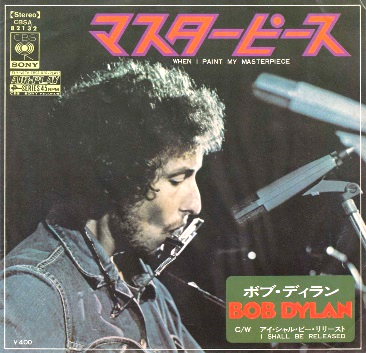
When I paint my masterpiece
All in all, it is a fascinating account, Leon Russell’s account in Doggett’s article “Whose Masterpiece Is It Anyway?”. And mainly because it gives us such an unusual glimpse into such an unusual genesis of two unusual Dylan songs. Russell testifies that Dylan plucked the lyrics out of thin air on the spot, and that’s believable. After all, we know plenty of similar stories. About the creation of songs in the Basement, for example, both from Garth Hudson (in the moving 2014 Rolling Stone documentary “Garth Hudson Returns to Big Pink”):
“Bob didn’t like to sing the same song over and over again. Sounds to me like he did make up songs on the spot. (…). I think “Sign On The Cross” was done in real time. Both the composition and the execution thereof.”
https://youtu.be/FKz8HQKyc4w
And we know similar testimonies from the autobiographies of Robbie Robertson (“His ability to improvise on a basic idea was truly exceptional and a lot of fun to witness”) and Levon Helm (on Planet Waves: “Bob had a few songs and wrote the rest in the studio”), from drummer David Kemper on “Cold Irons Bound” (1997) or from George Harrison on “Handle With Care”, to name but a few – Dylan has the gift of dashing off lyrics almost on command.
For Jim Keltner, the drummer, the session on 16 March 1971 was the first experience with Bob Dylan. As he recalls the memory of that special moment, his story is largely in line with Russell’s account, but he does build in a little disclaimer:
“He had a pencil and a notepad, and he was writing a lot. He was writing these songs on the spot in the studio, or finishing them up at least. And the rest of us, we just started playing, jamming around on some different chords and things, and finally the song came together, Bob came over, and we recorded them: “Watching The River Flow” and “When I Paint My Masterpiece”. Those two songs were done really quickly.”
(Uncut, 17 October 2008)
“… or finishing them up at least,” Keltner still hesitates, but Leon Russell is pretty sure that the entire lyrics are made up on the spot; both his memory He let me watch him as he wrote and Bob got his pad out and started walking around, writing stuff down. I followed him around the room, watching him as he was writing suggest that Dylan starts on a blank page, filling it while Russell rewinds the tape and plays the track again and again. The first song recorded is “When I Paint My Masterpiece”, so it is plausible that it is also the first lyric Dylan constructs here in the Blue Rock Studio under Leon’s watchful eye.
The theme of both songs seems taken from life; Dylan himself is in an unproductive, inspirationless phase. These are the dry years after the prolific war of attrition that was the 1960s, a dry spell which he himself explains in his autobiography Chronicles as:
“Art is unimportant next to life, and you have no choice. I had no hunger for it anymore, anyway. Creativity has much to do with experience, observation and imagination, and if any one of those key elements is missing, it doesn’t work.”
But apparently – paradoxically – it inspires two songs today that have an inspiration-seeking creator as their protagonist. The opening line, Oh, the streets of Rome are filled with rubble, remains unchanged in all alternative and later versions – presumably that line is the catalyst, as Dylan calls it. And indeed, it does seem Dylan draws that line today from experience, observation and imagination.
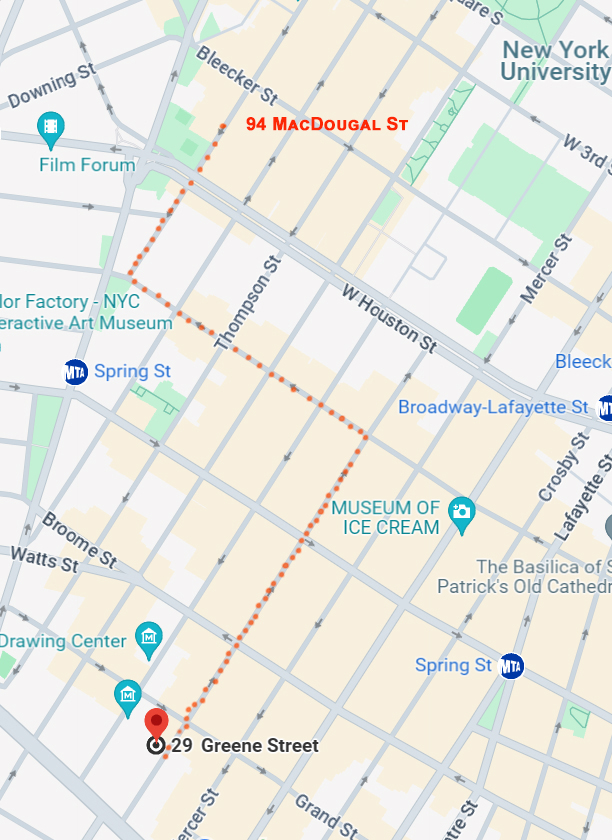
Blue Rock Studio is located in SoHo, at 29 Greene Street. That’s less than a 15-minute walk from Dylan’s pied-a-terre in the city, 94 MacDougal Street. When he steps out the door there, the first things greeting him are a huge Italian flag and the smell of rosemary and oregano, courtesy of the neighbours across from “America’s oldest Italian heritage organization” Tiro a Segno, the Italian culture house that has been housed at number 77 since 1927.
The most likely walking route then takes Dylan down Prince Street, past the smell of warm bread from the Italian bakery Vesuvio, which has been baking its breads and selling Italian pastries at house number 160 since 1920. We are now 600 metres, 0.4 miles from the studio and we are walking the cobblestones of Prince Street. The third street on the right is Greene Street, where Leon Russell, Carl Radle, Jesse Ed Davis and Jim Keltner have probably just finished recording the basic tracks that will become “Watching The River Flow” and “When I Paint My Masterpiece” a little later.
Pure speculation, of course, but it really doesn’t sound too insane. Dylan putting on his coat, saying “see ya later” to wife and children and opening the door. It is a warm, windy day in late winter, about 18 degrees (65 °F) and dry. On the way to his appointment with Russell in the studio, things are probably already starting to bubble up. Open to inspiration, he walks along the cobblestones of the back then rather shabby part of SoHo, past the Italian flag of Tiro a Segno and bakery Vesuvio, which opens a door to a back room in his phenomenal music memory.
And there he finds the trifle “Going Back To Rome”. A forgotten song for which he most likely wrote a few lines in Rome in January 1963, which he performed only once, seemingly improvising the rest of the lyrics, judging from the only recording we know, the 8 February 1963 recording from the basement of Gerde’s Folk City in New York. It’s a somewhat giggly performance, the song sounds vaguely like a kind of precursor to “She Belongs To Me”, has the playful refrain line Well I’m going back to Rome, that’s where I was born, and a closing couplet of which we will hear a faint echo today:
You can keep Madison Square Garden
Give me the Coliseum
You can keep Madison Square Garden
Give me the Coliseum
So I want to see the gladiators
Man I can always see ‘em [laughs again]
In such a scenario, the step to the streets of Rome filled with rubble, to the Spanish Stairs and to dodging lions inside the Coliseum is not that big. In any case, the transfer of the rather frenzied rhyme finding Coliseum / always see ’em (in “Masterpiece”: I could hardly stand to see ’em) does make a strong case for the likelihood of that scenario.
And with that, with that rhyme and with the streets of Rome, the song poet with a cold has his catalyst, the key to open the creative part of his brain.
———-
To be continued. Next up When I Paint My Masterpiece part 3: Blake did come up with some bold lines
Jochen is a regular reviewer of Dylan’s work on Untold. His books, in English, Dutch and German, are available via Amazon both in paperback and on Kindle:
The Never Ending Tour Extended: This series uses recordings selected by Mike Johnson in his inestimable masterpiece The Never Ending Tour, and looks at how those performances of individual songs change as time goes by. The selection of songs from the series, and the commentary below, are by Tony Attwood.
Positively 4th Street was issued as a single (at least in Britain if not everywhere) and then turned up on the Greatest Hits album. Bob played it 359 times between October 1 1965 and November 7 2013, which puts the song in the top 50 of his most-performed songs.
The earliest recording we have from the Never Ending Tour series is this 1994 version which manipulates the melody to such a degree that the song loses its link with the past in the first and third lines of each verse. The negativity of the lyrics – and these are some of the most negative lyrics that Bob has ever written – are thus emphasised totally.
And indeed the fact that the song is so utterly strophic (ie, verse, verse, verse etc) adds to the pain that has always been in the lyrics, but is itself curiously not utterly central to the music. Only the instrumental break gives any relief for this outpouring of grief and anger – made all the more painful by the slowdown just after the five-minute mark as the pain is mulled over more and more, until we are past seven minutes. It is amazingly effective and desperately depressing.
But then as the year continued Bob clearly felt that he had not taken this down as far as it could go and later the same year he transported the song down to a lower key and made it even slower, adding getting on for an extra two minutes to an already massively extended track. What this version now gives us is not so much anger as desperate sadness.
This latter version was obviously one that Bob felt did something for his song of desperation for it was this refined version that then stayed on the tour. And, we thought, surely this as far as this piece can go.
But no, Bob is not so easily satisfied, for it turns out that the anger can be rinsed right out of the piece, and despite the words can be replaced by utter sadness.
And indeed one might think that the 1996 performance once again was just about as far as it could go. I won’t take you through all the variations that came thereafter, but will now jump through to the last performance of which we have a recording, from the Never Ending Tour series.
Bob did continue to perform it as we have noted, until 2013, but this 2006 tour version shows his feeling for the fact that all he has is eight bars of music repeated over and over throughout the song he can not only get a performance of six or minutes out of the song, he can also find changes that allow us to find more and more nuances within, which somehow were never there before.
And although of course it is a coincidence, this last recording we have for this song from the Never Ending Tour, really does seem to sum it all up.
Commentary by Tony Attwood, audio kindly provided by Mr Tambourine.
Melancholy Mood starts at 1′ 14′ 08″ and is an upbeat rendition of the original song with just a few small lyrical updates and modifications to suit Bob’s voice. The main difference from the original score and recordings is the omission of the slow prelude to the main part of the song and overall a more upbeat approach.
But as it turns out there is something much more profound going on here…
Bob clearly likes this song, as at the time of writing he has performed it 249 times, according to the official Dylan site. And I hope below I can explain a little of why this is the case.
The music was written in 1939 by Walter Schumann with lyrics written by Vick Knight and Bob’s version appeared on the Fallen Angels album. It was first recorded by Kenny Baker in the year of its composition, and I believe it is certainly worth returning for a moment to that original recording, just to see the magnitude of what Bob has done with this song.
In Bob’s case, the song first appeared on the Fallen Angels album – the album that consists of cover versions of twelve classic American songs chosen by Dylan from a range of songwriters. You may recall that as with “Shadows in the Night” every song on the album, except for one, had previously been recorded by Frank Sinatra.
Indeed the album was well received and Fallen Angels was also nominated for the Best Traditional Pop Vocal Album at the Grammies in February 2017.
But what has Bob actually done here? Well, by removing the opening part of the song and taking it in a more upbeat fashion the song becomes not only not melancholy in its approach, but also very short. While we are used to Dylan songs in concert being five minutes long, and sometimes much longer, this one is just a couple of minutes long. Very un-Bob-like.
Of course contrary to that, taking a song and then re-writing the whole approach of the piece by changing the rhythm, the speed and the style, is very much what Dylan does, and his arrangement does indeed make for easy listening and suggests it could well be a dance track. But at first hearing, especially if one was familiar with the original, it just seems rather out of touch with the lyrics.
The opening bars – the prelude – does indeed ready to reflect the lyrics, and yet at the same time when one listens to the lyrics of the opening verse, it is hard to see what the connection subsequently is between the music and the lyrics. Certainly, the gentleman in the audience who shouts out during the musical prologue, along with the others who feel moved to give voice to their feelings, don’t seem in touch with ….
Melancholy mood forever haunts me
Steals upon me in the night, forever taunts me
Oh, what a lonely soul am I, stranded high and dry
By a melancholy mood
And in fact this is not just the contradiction as the song seems to bounce along behind the lyrics that say…
Gone is every joy and inspiration
Tears are all I have to show, no consolation
All I see is grief and gloom, until the crack of doom
Oh, melancholy mood
Now it is true that the second “melancholy mood” in the vocals is more in touch with the music overall, and it is a tribute to what Dylan’s arrangement does, that as the song continues with this oddity of the upbeat nature of the music with the downbeat lyrics.
Deep in the night I search for a trace
Of a lingering kiss, a warm embrace
But love is a whimsy, as flimsy as lace
And my arms embrace an empty space
Bob then continues with all the verses of the song and amazingly, as it continues somehow the bounce of the music now doesn’t seem to be a contradiction of the lyrics at all. One seems to be able to accept that a melancholy mood can indeed be completely upbeat.
Melancholy mood, why must you blind me
Pity me and break the chains, the chains that bind me
Won't you release me, set me free, bring her back to me
Oh, melancholy mood
It is an extraordinary achievement to balance such a relaxed upbeat version of the song with those very, very downbeat lyrics which I don’t think any performer has tried before.
It is also interesting (to me if no one else) that Bob then adds a very short musical coda and that’s that. No musical extemporisations, no verse repeats (not that Bob ever does do that) – just a very short song in which tye lyrics and music at first seem out of kilter with each other, but then fall into place as one.
Working through the recordings that Mr Tambourine has so kindly provided, this performance is certainly something that really stands out for me thus far. I find it an utterly amazing piece of re-writing, and one that I want to play over and over again.
As you will be aware if you have followed any of this series, I am working through Dylan’s compositions in alphabetical order and writing about the songs where there are at least a couple of interesting commercial cover versions available on the internet. The logic of course is that if I write about versions that you can’t immediately hear, it is much harder for me to put across my own thoughts, and I guess it makes the article less interesting too.
So here we go with four covers, and two versions from Bob.
Larry Norman
I find this version simply too slow and ponderous for me. The impact of the lyrics is the power of the message, and I don’t mean that this should make the music fast – but there needs to be a power in the music and I simply don’t feel this.
Take for example the “don’t you burn” line – it is followed by four descending chords – something that turns up elsewhere. This is an absolutely conventional piece of accompaniment and really doesn’t fit, as I hear it.
And of course we are all aware Bob’s versions of the song. So having four conventional descending chords playing over again isn’t really inspirational. Nor is the over-excited voice, as the piece continues.
So not for me.
Bishop Rance Allen
Rance Allen is an established Gospel singer and this was produced for the album Gotta Serve Somebody: The Gospel Songs of Bob Dylan. Here the problem is that I am not a fan of gospel music – and indeed as I have mentioned in passing before I am a confirmed atheist, so what attracts me to the song is the overall music, rather than the message.
My view is that in this performance the music is secondary to the meaning. For me the music and the meaning can co-exist, and indeed in the best songs are equal partners, but once the meaning overtakes the music then the essence of the music is in danger, and that is what I find here.
There is also an extraordinary moment just after 3 minutes where the organist seems to have got a bit bored and puts in a few extra twiddly bits which to me seem totally out of context with the way the Bishop has, just a few seconds before getting utterly carried away. I wonder what was going on in the studio! Or was that something they added later?
Phil Madeira
This is getting closer to what I think it takes to make this song work, as the singer keeps the performance under control much more than others, but then in doing so doesn’t really add much more to the song than we already have. And this is something I think I often come back to: that the point of doing a cover is to see where else the song can be taken without destroying the essence of the piece. Here the performer does this, but it turns out that the song can’t be taken much further!
Kevin Max
Now the opening of this next version sounds very similar to Bob’s version and yet there is enough variation in this version to keep me listening. The voice is beautiful, the piano accompaniment is perfectly controlled. This is more as I imagine the song, but then it is fairly close to what Bob did in the first place, but sometimes that is just how it has to be.
Bob Dylan
As I suspect you know, we have two Bob versions of the song. I’m putting both of them in, because after feeling rather dissatisfied with all the cover versions above I wanted to recover my faith in the song (although not my faith in the message which I don’t have ).
It is really interesting to listen both to Bob’s singing and the piano part in comparison with those above. Does this feel right to me because I heard it first or is it that this really is the perfect combination of lyrics, vocal line and piano? I think the latter, but of course one can never be sure.
The Trouble No More version was made public later, so in hearing it one was already used to the Slow Train version. The piano accompaniment is much smoother for much of this version and for me the final album version (above) does it better. Maybe Bob had got used to playing the part much more by then.
But that’s not to say that the “Trouble no more” version is not worthy of our time as members of the audience. It is just that somehow by the time of the “Slow Train” version Bob seems to have someone managed to take control of the balance between the piano, the lyrics, the melody and the meaning, and that is no easy achievement, as indeed I think the cover versions above show.
If you are really interested in comparing the two versions try this – play the version above from about four minutes on and the version below from about 3 minutes 30 seconds. There is a difference: for me the version below is more about Bob, the version above is truly about the religion he believes in – or at least believed in at that moment.
Overall, for me, this is a real case of “No one sings Dylan like Dylan,” even when I feel no personal relationship with the lyrics.
“The Lyrics and the Music” is a series by Tony Attwood which sets out to find out what happens when one reviews a Dylan song not primarily as a set of lyrics, but as a piece of music which includes lyrics.
If there were to be a competition to find a Dylan song which really has what one might describe “not much of a melody” and “an awful lot of depression” then surely “It’s all right ma” would surely be one of the songs up for discussion.
Which would suggest that there are not many good reasons for discussing the song in a series about the music and the lyrics. For although the melody is not the only element on the musical side of a song it is not generally considered an important point. And if we go back to the original album version of this song in 1965, we can appreciate yet again that Bob emphasises the tedium of life not just in the repeated “It’s alright ma” line, but also in that lack of melody which pervades all the song, except those three lines that make up the chorus
So don’t fear if you hear
A foreign sound to your ear
It’s alright, Ma, I’m only sighing
And to be truthful there’s not much melody even there. It just seems like there is because of the way the previous 18 lines are sung with only the tiniest occasional nod at the end of every sixth line that there is anything other than a single note available.
That’s the song that we know. Intriguing words of desperation and despair and a monotone melody which holds us gripped because the lyrics are so intriguing and having heard it before we now know that relief, of sorts, comes at the end of each chorus, and particularly in that final line.
And it works. Although as it turns out there is much, much more and this song is not just about the lyrics, although that is what virtually every review focuses on.
And by way of example of what else is in the song, I would cite this performance from 2013 which Mike highlighted in the Never Ending Tour series from the first article for that year, Shedding old Favourites: A Roman Farewell.
This is not the only amazing version of this song, but it is a fine example of just what can be done even when there is no melody:
My view is that such a version could not have existed without the original To fully appreciate what is happening here we need to be familiar with the album version – and we do have to be able to recall what the song was originally. For what are actually getting here is the bit that is so easy to miss if one just knows the original version on the album and in terms of early performances.
The fact is that life is in many regards tedious and depressing, especially when one considers what is going on in terms of political and religious acts around the world, or indeed even when one considers everything from family feuds, lost loves and mental health issues. And that is what the original version does.
But it is also possible to hear the song as an exposition of getting through life despite all that. That descending guitar line that runs through line after line in the verses, beyond Bob’s vocals, tells us that yes life is repetitive. But combined with the beat it also tells us that yes, it can all be ok. We can get through because in between the tedium, we can work to make things better. With this upbeat version “I can make it” becomes a key line.
The brief musical break between each verse aids this as well. OK that background musical line is endless descending, but after each run of 24 or so notes in that descending scale we can still be bouncing along. Just listen to the percussion and those guitars in the background.
So now the message is, life’s shit, but really we can still make something of it, especially as we now have nothing to live up to. It don’t really matter. It’s life and life only.
And sing the word “only” with an upturn of the melody, as in the last verse of the live performance, and yes, it really is all right.
It is almost as if Bob is saying of himself, his music, his band, and all of us in the audience, really, the fact that we are all still here proves it. It’s all fine. It’s just life.
And my point at bringing this commentary into the “lyrics and the music” series, is that that notion that despite everything, life is ok, is there in the original version. It is just that it gets a bit lost because of the lack of a beat. As a result the negative overwhelms us, and that probably was exactly what Bob intended. But tucked away in the lyrics is the thought that despite all this, we can make it. We can survive. And by changing the music in this live performance Bob brought that second, but equally important thought to the fore.
It is there in the original album version, so it was always there. It is just that with this live performance it was made that bit clearer so we can all get it. It’s the music that tells us…
The wonderful documentary Tim’s Vermeer (2013) does stir things up among the esteemed ladies and gentlemen of art critics and connoisseurs, led by The Guardian‘s Jonathan Jones. “A man who totally fails to paint a Vermeer,” he harshly writes. Art historian Benon Grosvenor (Art History News) agrees wholeheartedly, donating half his page to an artistic reader who finds Tim’s Vermeer “laughable” and then fires hail at the American millionaire who dares to claim that Vermeer is not a “God-given genius”.
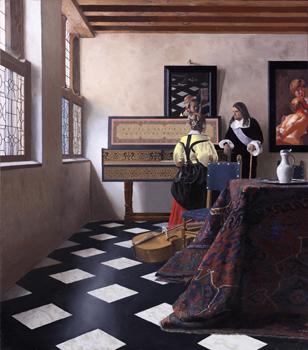
However, the admirers and compliments are in the majority. Conceivable; it ís a spectacular documentary. It tells the story of Tim Jennison, the successful inventor and pioneer of digital video and computer graphics who is fascinated by the question How does he do it? and then becomes obsessed with the idea that Vermeer was able to create his extraordinary masterpieces thanks to optical aids. Although he is not a painter – he has never even painted anything – he resolves to crack Vermeer’s “trick” and then paint a Vermeer himself. And not just any one: the late, brilliant masterpiece The Music Lesson (1662/65). Jennison spends years on the project. He visits the Netherlands, talks to scientists and connoisseurs like David Hockney, experiments with a man-sized camera obscura, other projection techniques and mirrors, and then gets to work. First to recreate the room and furniture, the heavy tablecloth, the virginal, the viola da gamba and all the other objects, and then another 130 days for the painting itself. In the end, the whole undertaking takes 1825 days, exactly five years.
The result is quite mind-boggling. Tim Jennison manages to develop a technique that captures light as Vermeer does, to copy a Music Lesson that comes frighteningly close to the original – all the more frightening because we are looking at the first painting by a non-painter here. Hockney is stupéfait: “It’s amazing, actually.” Professor Philip Steadman, the architect who wrote Vermeer’s Camera: Uncovering the Truth behind the Masterpieces (2001), is even a tad more complimentary. “I think this is better than Vermeer,” he says only half-jokingly. Jennison remains modest. “I’m not a painter. I’m trying to show the power of the concept.” Nevertheless, he cannot hide a lump in his throat and a tear as he stands next to his finished masterpiece. Hockney is becoming increasingly cheerful. “I say you might disturb quite a lot of people,” he concludes, smirking sardonically.
The documentary ends in Tim’s bedroom, where the painting hangs above the fireplace. Tim remains silent, looks proudly at the work once more, folds his hands in front of his stomach and as the picture fades to black, familiar piano chords sound: over the closing credits, Dylan’s “When I Paint My Masterpiece” plays.
There is an amusing parallel to be drawn between the conception of Tim’s Vermeer and the genesis of Dylan’s song: both begin with the question How does he do it. In Dylan’s case, long-haired piano beast Leon Russell is obsessed with Dylan’s songwriting, as we know from the wonderful article “Whose Masterpiece Is It Anyway?” (Judas! #9, April 2004) by Peter Doggett, for which Doggett interviewed Leon Russell at home in June 2002.
Russell tells that at the time, in the early 1970s, he was fascinated by the stories about a Dylan who writes his songs amid the studio noise of waiting session musicians at the ping-pong table and coffee ladies, the Dylan who, while the producer and musicians listen back to the recording, is already working on the next song. He occasionally runs into him, backstage at Fillmore East, Leon recalls, and on one such occasion he dares to ask Dylan, who is always friendly and communicative to him (“he endeavoured to show me all the stuff that I asked him”), if he can witness such a writing session:
“I begged him and begged him, and after a little while he agreed to show me. So I called my guys – Carl Radle on bass, Jimmy Keltner on drums, and [Jesse] Ed Davis on guitar – and we went up to Blue Rock Studios in the Village, and I cut these two tracks for Bob. It took about 30 minutes. Then Bob came down, and I said, let me see you write songs to these.”
And then Leon’s wish is granted:
“Bob got his pad out and started walking around, writing stuff down. I followed him round the room, watching him as he was writing. When it got to the end, they’d rewind the tape and play it again, and he kept writing. And then when he’d got the words the way he liked, he cut the vocals.”
The charming anecdote offers right away the title explanation of Doggett’s article – whose masterpiece is it really? Or are they actually, to be precise. Remarkably, Leon has already recorded the music for both songs, in “about 30 minutes”, without any interference from Dylan.
Both songs are simply credited to Dylan alone, neither Russell nor anyone else has credits for either song. Apparently, the accompanying music is considered insignificant confections; the lyrics are the song, and/or the melody to which Dylan sings those lyrics. Russell makes no point of it – he neutrally calls it “a chord sequence” that he just got from somewhere, and for “Watching The River Flow” he copies a riff he has used before (for “Dixie Lullaby”, from his 1969 debut album). He also more or less dashes off the track for what will soon become “Masterpiece”. And yes indeed, if we listen to Russell’s records from that era, we can hear “Masterpiece”-like snippets, chord changes and the stomp passing by here, there and everywhere. Not only on Leon Russell and the Shelter People and on the album he makes with Marc Benno, Asylum Choir II, but especially on a recording that only emerged decades later: The Castle Session 1971.
On 5 February 1971, a month before Leon has his dream session with Dylan in Manhattan, he is in Holland, recording a concert with his Shelter People for television broadcaster VPRO. In an unusual setting, by the way: in a room of Castle Groeneveld in Baarn. Already in the first bars of the first song, “Come On Into My Kitchen”, we can hum some “Masterpiece”-snippets, and further on, Dylan’s spirit appears to be in that castle room anyway: number 2 is a brilliant “Girl From The North Country”, after which the band is allowed to join in, a little later “Dixie Lullabye” is on the setlist, the lick of which he will use for “Watching The River Flow”, and then back to Dylan with an irresistible “It Takes A Lot To Laugh, It Takes A Train To Cry” – – all of it with Carl Radle on bass, who will also join the Dylan session in New York a month later. Guitarist Don Preston was present here in Baarn , but not in New York. Joe Schick, engineer and owner of Blue Rock Studio corrects the historiography on that point: the session guitarist really was Jesse Ed Davis.
Leon Russell at the piano in the music room of a 17th-century castle in Holland – seems like a Vermeer. And he does get some kind of credit after all, half a century later, in the most honourable way: with a name-check in 2020’s “My Own Version Of You” (I’m gonna make you play the piano like Leon Russell).
To be continued. Next up When I Paint My Masterpiece part 2: Oh, the streets of SoHo
Jochen is a regular reviewer of Dylan’s work on Untold. His books, in English, Dutch and German, are available via Amazon both in paperback and on Kindle:
The Never Ending Tour Extended:This series uses recordings selected by Mike Johnson in his inestimable masterpiece The Never Ending Tour, and looks at how those performances of individual songs change as time goes by. The selection of songs from the series, and the commentary below, are by Tony Attwood.
When I start each of these articles for this series I simply choose a song that I know Bob has played multiple times, and go looking for the recordings Mike has provided us with, never really knowing what I am going to find. Of course I have listened to all the recordings as we have published each of Mike’s articles, but there must be getting on for 2000 recordings all told in series and there’s no way my brain can hold more than a fraction of them in the active part of what passes for my memory.
So this 1998 version really took me by surprise. There’s a real earnestness and urgency about Bob’s delivery, and the decision to perform the whole piece with just two acoustic guitars really lays the song bare.
But at the same time I am aware that the song is now taken at a slightly faster speed than the original album version.
So having given us an extra urgency to the song, what does Bob do? He next gives us even more urgency, upping the speed but also putting something extra into his voice suggesting he needs to drive this on. But I am caught wondering, why? What is there to hurry about? Has he not already hurried enough?
There’s something, because the whole performance is a minute shorter than it was a year before. And yes, it is interesting, but also almost unnerving. “My love she speaks like silence” is one of the great, great opening lines in the history of popular music, and it needs to be considered, and taken in, and contemplated, and then thought about some more, but here it is now just part of an energetic drive onwards.
Now having changed the speed Bob changes the melody – a melody that I have cherished from the moment I first heard the song and compared the lady described in the song with my own girlfriend (a bloody stupid thing to do, but well, I was so much older then…)
There is an utter desperate urgency in the performance now which I never imagined in the earlier editions which to me were reflective love songs; songs of the most fulsome appreciation of a beautiful woman. But now… I am not sure.
But then in a later concert in the same year Bob expanded the song giving us an extra minute and a half , as if maybe he realised he’d cut the piece back so much that it was no longer all there.
The extra time is taken up with haronica solos, and the fact that the tempo has been taken down a fraction. But I am left now, as I was when we first published the article with this in it, profoundly unmoved. For me this is an experiment that was going down the wrong tracks, and could have been closed up. But the crowd love it.
So was there anywhere else to go? Oh yes. Forward four years and we have found the original song and the original declaration of love to the original lady.
To me this next version sounds as if Bob finally found a tape of the original song and remembered what he had originally meant the piece to be. The addition of the double bass and second guitar helps enormously to add a stability to the performance that was perhaps drifting away previously. Now once more there is love, desire, dedication, and indeed worship of the lady.
It is as if before Bob was singing to a picture of the lady. Now he has been reunited with her and wants to tell her about his feelings while also telling us all about her, and about his love of her.
And of course it is quite likely that she never existed, and is just the fictional character in a song, but I really, really don’t mind, because I have on my computer this wonderful recording or this most wonderful song, and playing it once more makes me feel that despite the horrors of the world, despite my own failed love affairs and marriages, despite the arguments and fights, despite everything, there is still beauty in this world. And that, I owe to Bob.
Commentary by Tony Attwood, audio kindly provided by Mr Tambourine.
“I made up my mind to give myself to you” starts at 1.08′.09″
This is a song where Bob occasionally seems to struggle with the melody line, but the audience approves of his attempts, as the song is taken at the same speed (by the band) and in the same key, as on the original recording. Bob changes his part, but everyone else keeps to the script.
But in listening to this live version it is easy to forget the sublime gentleness that Bob makes the central point of the original recording – aided of course by the vocal hummed backing.
So as I have done before I am going to publish the original recording below this live recording because the same question arises in my mind as it has done for other Dylan songs on this tour: does this version actually give us new insights, or new understandings into the song? Is it more entertaining, or more emotional?
I am sure that for many people it is more entertaining. But for myself no. Whereas so often in listening to Dylan’s live versions of the songs through the Never Ending Tour series I really have found something completely new through Dylan’s rearrangement, here I don’t.
Indeed I am almost taken to the point of view that when Bob is emphasising certain words, or saying or singing them in a certain way it is not for any purpose other than the feeling that this is what Bob Dylan does, this is what the hard core fans expect.
But here I simply don’t get the arrangement of
Take me out traveling, you're a traveling man
Show me something I don't understand
I'm not what I was, things aren't what they were
I'll go far away from home with her
in this live version, and that of course is my failing. I simply don’t understand why Bob has chosen to perform this variation on the original with these lyrics And of course this is not the only song this criticism has been applied to, and so I have often wondered before, is Bob changing the arrangement and the vocals because that is what is expected of him, or because he is offering us a different insight into the song through this live version.
Or maybe he just does it to alleviate the boredom of singing the same set night after night which is what he has done on this tour Or to test the view that the fans will cheer with delight no matter what? No, I won’t accept that.
Those last two views seem very cynical and I don’t believe them. After all why go on touring into old age just to be cynical? I’m not as old as Bob, but I am not too far behind, and if he has even half of the aches that I get as old age comes on, he can only be touring because he loves it and because he feels he has something to say. Which suggests that it is just me: with a performance like this I just don’t get what it is he wants to tell me.
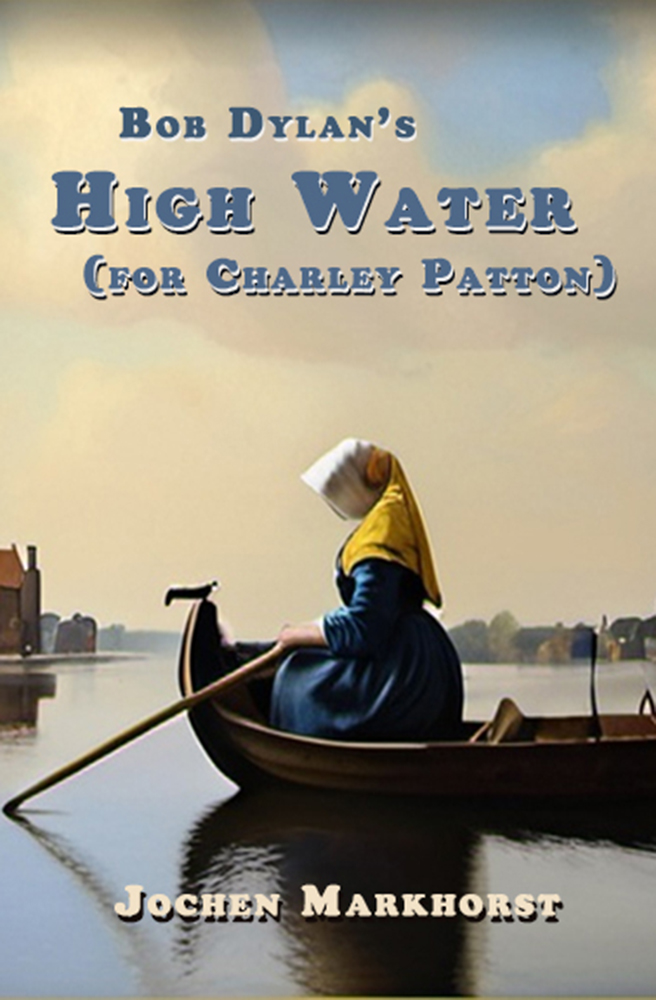
“Maybe you noticed that most of my songs are traditionally rooted. I don’t do that on purpose. Charley Patton’s 30’s blues has made a deep impression on me and High Water (for Charley Patton) is, in my opinion, the best song of this record,” says Dylan at the Rome press conference, July 2001.
I do agree. Well, ex aequo with “Mississippi”, anyway. Both songs open the floodgates (no pun intended), and “High Water” belongs in the same outer category as “Desolation Row”, “Mississippi” and “I Contain Multitudes”; extremely rich, poetic, Nobel Prize-worthy musical gems. Lovely, lovely song.
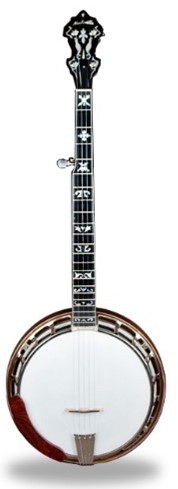
Although the song is dedicated to Charley Patton, it is not a blues. Dylan chooses a peculiar, surprising setting for his ode. “High Water (For Charley Patton)” floats on only one chord, a G major (plus a short F – F# lick in each chorus line, signalling despondency), the arrangement is carried by Campbell’s banjo, drummer Kemper limits himself to dramatic thunderous accents (swelling roll with reverb on the upright tom, ominous rustle on the cymbals), the rhythm section consists of Augie Meyer’s neurotic, asthmatic accordion and Kemper’s shaker, and most undylanesque of all is the backing vocals; unearthly and low humming, only in the chorus line, and mixed quite far back – but it’s still there.
The whole communicates implacability, hopelessness. Or, as English musicologist Tony Attwood articulates on his site Untold Dylan:
It is the music, that resolute use of just one chord, that unchanging banjo, that playing around with the melody, and that absolute sense that tells me that no matter what, it is NOT going to stop raining, and that everyone is doomed.
(High Water, a rise, a fall, a bounce, a flood, 23 November 2023)
Bob Dylan — High Water live in Philadelphia, 2001:
The first live performances in 2001 – the premiere is Los Angeles, 19 October – are still fairly faithful to the studio version. Campbell’s banjo is leading (Olof Björner’s unsurpassed website bjorner.com calls it a mandolin, but it’s really a banjo), the only notable difference is the much more prominent drum accompaniment; David Kemper thumps along on his bass drum every beat during the first verse, then joins in energetically like a “regular” rock drummer, and remains very much present, the rest of the song. And the live renditions last a lot longer than the four minutes of the studio version: usually more than six minutes. The tempo is only very slightly slower, but Dylan leaves more space between verses – usually Charlie Sexton plays a short solo after the third verse, often partly in duet with Dylan’s guitar.
In the following years, the banjo briefly disappears from the arrangement and the stage. By 2003, “High Water” has become a taut, funky rocker, including a Little Feat-like interlude spotlighting duelling guitarists Freddie Koella and Larry Campbell. Dylan has moved to an almost inaudible keyboard. In 2004, the song begins to sound like Keith Richards and Ron Wood have joined the band; the guitars get nastier and more obtrusive, the song trashier. But a year later, in 2005, Donnie Herron joins the band, and with him the banjo returns. Initially, this leads to an attractive but somewhat peculiar mix of dirty funk rock with bluegrass, but gradually the arrangement shifts back to 2001. The drums continue to thrust, but the guitars become more civilised, Dylan’s organ forces its way to the fore, and by 2013, when “High Water” is on the setlist more than eighty times, it’s already almost completely turned back to hillbilly; Herron’s banjo is up front, Dylan happily honks along on his harmonica, and when, during the so-called AmericanaramA Festival Of Music Tour in the summer months, Colin Linden is on stage playing slide on his dobro guitar, the return to bluegrass is complete. Well, to rural country rock anyway.
Apart from the occasional outing, such as in 2016, when he suddenly casts the song in the banjo-less corset of Warren Zevon’s “Boom Boom Mancini”, Dylan remains a fan of the more rustic banjo-driven performances in the 300-plus performances since 2013.
The colleagues are not too eager to cover the song. After all, it is quite a challenge, this monotone setting under those wildly fanning lyrics – similar in that respect to the equally untouchable “It’s Alright, Ma (I’m Only Bleeding)”, which its peers also shy away from. Not considering the usual tribute artists, who generally produce lacklustre covers of the song (Big Brass Bed is the exception), there are only two Premier League artists who put “High Water” in their repertoire. Ladies, both of them.
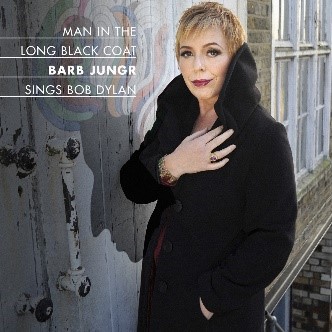
Barb Jungr is the most remarkable. The Englishwoman with jazz blood already has a solid reputation as a Dylan interpreter (according to the Village Voice , “one of the best interpreters of Bob Dylan”) when she releases her first Dylan album Every Grain of Sand: Barb Jungr Sings Bob Dylan in 2002, which includes one of the very best “Is Your Love In Vain?” covers. Its success, and the constant inspiration she continues to find in one Dylan song after another (“Once I had started singing Dylan’s songs I couldn’t stop”), yields another highlight in 2011: her second Dylan tribute album Man In The Long Black Coat. Thirteen songs, mostly usual suspects like “Just Like a Woman”, “It Ain’t Me Babe” and “Blind Willie McTell”, but also a few outsiders. “Sara”, for instance, and “Trouble In Mind”. And “High Water (For Charlie Patton)”, an interpretation as idiosyncratic as her spelling of the Patton’s first name. It is a dramatic, very European jazz interpretation, carried by a compelling lick from the double bass, expressionistic touches from the piano and soundtrack-like guitar commentary. Whether it can withstand comparison with Dylan’s original is debatable – but at least it is idiosyncratic.
American Joan Osborne stays closer to the source and to Mississippi on her tribute album(Songs Of Bob Dylan, 2017). More dynamic, faster and, well, more exciting than Dylan, though its hypnotic nature is still maintained, including through subtle use of a sitar, remarkably. Osborne does sneak in some extra chords, and adds artificial suspense with a stillness halfway through, as well as having a drummer who knows how to work towards a climax – so she does cheat a bit. She is forgiven; the cover is cool and catchy. As are more of the 13 covers on the album, by the way – even “Rainy Day Women #12 & 35” gets cool, swampy and sultry with Joan. And otherwise she opts for the “simply gorgeous” approach , as with “Buckets Of Rain”. Joan Osborne is a pretty bird, she warbles as she flies.
This is probably the most frustrating of all the episodes of Dylan Cover a Day, that I can remember, because I think this is a superb song, and thus it ought to be possible to generate a few brilliant cover versions of it.
But in the end after listening to 20+ covers I found myself playing a few bars of each version and then giving up, because once again the performers had not found something quite different to do with the song. (Although please keep going because it did come right in the end).
And maybe it is not the artists’ fault. After all they are performing the song as they hear it, and as they feel it can be developed – not for the sole purpose of doing something quite different with the song.
To try and understand a little more as to why this is the case with this particular song I’ve just spent an hour at the piano trying to write my own variant version and yes I came up with something, but not something I particularly want to foist upon you at this time! So yes indeed it is harder that it might at first appear.
For this is a song in which the nature of the song itself determines how it should be sung. And Dylan himself must have realised the problems there are with doing something with this song in public, for in fact he has only performed it himself three times between 1963 and 1985!
So what we have is a small collection of performances from other people, and just three from Dylan – none of which I have a copy of. That surely tells us something – most likely that it is a song that has to be sung as Dylan sang it. There is not much else one can do.
Except, not, please don’t stop, because there is something else one can do. It just took me a while to find it.
But to start at the start as it were.
Gene Cotton takes a brave approach and varies the rhythm, and to a fair extent this does work. But the urgency of the song is now lost – the great celebration of the Second Coming, or whatever the occasion is that causes the ship to arrive now seems awfully relaxed, which isn’t the idea at all.
Heron gives us seagulls, and I almost stopped at that point. I mean, if that is the best the producer or musical arranger can do he/she surely now give up and stand before the firing squad (not literally!). Along with quite a few other versions this one just loses me after a few moments. It is all too ploddy.
Now The Chieftains know a thing or three about working with this type of song, and yes I do get a feeling that they appreciate what this is all about. And they do make this grow without destroying the essence of the songs. The addition of the violin and the percussion are there supporting the singer, and the build-up seems to work well. But…. oh that instrumental break has nothing much to do with the essence of the song. It’s just the Chieftains throwing in their own format into a Dylan song. Worse they change key for no reason other than it is because what the Chieftains do.
Annie Patterson gets into my little selection because the harmonies work without destroying the song. But between verses there is a twinkly twinkly bit which also creeps into the verses.
And this is a problem I think a lot of performers and their musical directors have. Recognising the strophic nature of the song they feel that changing lyrics are not enough to carry the performance so they throw in some extras. The twinkly bits here end my interest.
So, pretty hopeless from my point of view having reviewed covers of around 170 or so Dylan songs (see the list below) but then Grace Notes grabbed my attention with a completely different approach. And surely the point of cover versions of songs we all know is to give us something new. And yes this is it. The harmonies are unexpected but exquisite. The piano is delicately played, and from the very start I have the clear understanding that the arranger and performers actually listened to and thought about the lyrics they are singing.
This comes from the album Northern Tide and it is the only moment in this review where I wanted to hear more. Indeed I hope you too not only enjoy this but also want to learn more. Take a look at their website.
At this stage I can’t write more about them since I’ve only just discovered them, but having listened to “Just the way you look tonight” I’m taken. It was worth the journey.
“The Lyrics and the Music” is a series by Tony Attwood which sets out to find out what happens when one reviews a Dylan song not primarily as a set of lyrics, but as a piece of music which includes lyrics.
“It’s All Over Now Baby Blue” is a song of goodbye and a certain level of regret – but one in which, for the singer, the future is open and full of possibilities, while he is also recognising that the lady in the relationship will be sad at the break up – but at the same time saying that at least it is inevitable, if not her fault.
And yet the lyrics are far more complex than that. The opening is clear of course
You must leave, now take what you need
You think will last
But whatever you wish to keep
You better grab it fast
Those opening lines are gentle – the music is calm and Bob’s voice seems to be straining with sadness. And he lowers his voice to speak of “your orphan” which we may perhaps take as her son who is not being fully looked after. (But only perhaps, the meaning is not clear).
But musically we have a combination of two strands The high pitch of the lyrics of lines one and two contrasts with the lower pitch of lines three and four. High again for line five and then much lower and plaintive for line six.
So we have this really clever set of musical and lyrical contrasts within each verse that is not normally attempted by any songwriter. The instrumental verse however remains plaintive throughout.
Just consider the central lines of each verse that are sung at a lower pitch and far more plaintively…
Yonder stands your orphan with his gun
Crying like a fire in the sun
and then
The empty-handed painter from your streets
Is drawing crazy patterns on your sheets
In verse 3…
The lover who just walked out your door
Has taken all his blankets from the floor
while in verse 4
The vagabond who’s rapping at your door
Is standing in the clothes that you once wore
These are all lines of desperate sadness, or a world that has gone wrong and is not working at all for the people that Dylan is singing about.
Now contrast this with the strong, forceful start of each verse
You must leave now, take what you need, you think will last
The highway is for gamblers, better use your sense
All your seasick sailors, they are rowing home
Leave your stepping stones behind, something calls for you
But also note the contrast within each of those lines, and how the final phrase tails away in the music. There is in fact a real lyrical and musical contrast within each line.
These are lines of travelling, moving on, getting away from the past. There is no sympathy here in the opening of each line, but a clear touch of sadness in the second part of each line, which is reflected by the music to a degree in the original performances and much more in some of the live versions later.
And this is the magic of this song, it is this contradiction between the concern expressed in lines three and four in each verse, compared with the opening and closing couplets that surround them.
In fact it is quite hard to think of another song that takes these two different points of view and successfully shares them in one song. Dylan’s musical method is simple: the central couplet is musically totally different from the opening and closing two lines of each verse.
So if we just take the last verse we can see this incredibly clearly
First the harsh instruction, sung with vigour at a high pitch
Leave your stepping stones behind, something calls for you
Forget the dead you’ve left, they will not follow you
Then the sadness of the world we live in
The vagabond who’s rapping at your door
Is standing in the clothes that you once wore
Then back to the vigour and the moving on with no concern for the past…
Strike another match, go start anew
And it’s all over now, Baby Blue
It is a superb piece of writing, all the more so for the same pattern working through each verse without becoming artificial.
Dylan has of course played with the approach – this version below from 1989 changes it to a degree by making the last line one of sadness rather than instruction, but the overall approach is the same – that contest between force and compassion. As the live version continues Dylan chooses different lines to emphasise, but of course by this stage we all know the song and its meaning, so the need for the contrast is not so essential – but retaining it in the song reminds us of its original message.
The Never Ending Tour Extended: This series uses recordings selected by Mike Johnson in his inestimable masterpiece The Never Ending Tour, and looks at how those performances of individual songs change as time goes by. The selection of songs from the series, and the commentary below, are by Tony Attwood.
——————–
Shelter from the Stormwas played on stage 376 times by Dylan between 1976 and 2015. At least that is what the official site says, although as we found with the last article in this series, the details from the official site are maybe not always as correct as one might hope.
1989
We had our first sighting of the song in 1989 : and how different it is from the original. For now it is bouncy and jolly – until suddenly it isn’t.
The impression given here is that the song is moving at a much faster speed than the original, but in fact that is not the case. It is the bounce of the percussion that give jus that feeling.
And very curiously for Dylan the song has pauses in it in which the backing stops and Dylan sings at a much slower speed acapello . There are harmonica breaks in there too, but I am not sure where they take us. Anyway, it proceeds to a final very slow harmonica solo and stops (actually the recording stops prematurely, but I am sure there was nothing more after that. That is the end).
I do find it all very curious – there seems no link between the lyrics and the performance, and no links between the slowed down parts and the rest. It is almost as if Bob said,
“Let’s do it like this” out of perversity, and no one had the nerve to say, “Are you sure Bob?”
Two years later the bounce was still there, so Bob obviously liked it but nowwe do get a very long introduction with Bob improvising on the harmonica.
However much of the melody has gone – Bob reciting as much as singing. And I guess these approaches come from the fact that the song is in essence the same three chord sequence over and over again with only the lyrics (which of course we all know by heart) changing as we go through.
And given Bob’s lack of interest in guitar solos when the vocals stop there is just the harmonica to break it all up. And “break it up” is important since the song is just those three chords over and over.
Here, although the recording is not perfect, we do get what passes in the world of Dylan as a guitar solo.
After listening to those recordings I was despairing a bit, and trying to cast my mind back as to whether Bob had just continued that way throughout the tour. But in 1994 we were back to a somewhat more relaxed mode which didn’t emphasise the fact that this is the same chord sequence over and over.
And lo and behold yes we do have an electric guitar solo – and it really does bring a relief. (And this is not me trying to be clever – when I wrote the previous comment on 1991 I had completely forgotten what happened a couple of years later.)
I particularly like the way Bob comes in after the solo. And the tentative way the harmonica is used in the instrumental section around the five-minute marker and thereafter.
Indeed thinking about the time it is extraordinary how it is possible to make this oh-so-simple piece last over seven minutes while being enjoyable throughout. A massive improvement, in my view.
For my last choice, I’ve again moved on two years, and we can hear that now Bob has gone from full-speed down to treating this as a gentle ballad.
Here with verse after verse which has the impact of making the lyrics utterly believable. We are now reliving the affair between the couple, and when first instrumental break comes in, it is a time for us to take breath and prepare for what will come next. And I would add that the organ is put to excellent use within this arrangement.
I particularly like the return of the vocals around the 3’30” mark.
Overall the ceaseless repetition of the chords doesn’t feel like something going round in circles any more – I think largely because of a subtle change the chord sequence which now runs I, IV, V, I at the start of each verse but then runs I, IV, V. It is a very subtle change but it helps make this performance so much more than what went before.
Commentary by Tony Attwood, audio kindly provided by Mr Tambourine.
Got to Serve Somebody starts at !:02:55
“Gotta Serve Somebody” from Slow Train Coming remains one of Bob’s favourite songs and the official site now records it having been performed 695 times since November 1979, and still going strong as of a couple of days ago. It is (if I have counted correctly) the 22nd most performed of his own songs by Bob during his eternal tour.
This is a perfectly rehearsed, rousing rocker which takes the concert up to a completely new level. And when we hear it like this it is hard to remember that on occasion Bob has decided to take it a lot slower. Compare it with…
The fact is of course that like so many Dylan songs it can be played in a multitude of ways with each one having a range of meanings depending on the interpretation you want to put onto it.
But here, more than anything, what it does remind me of, is the fact that no matter what his age Bob can still rock. And indeed that even now, after all these decades the old 12 bar blues format can still deliver a huge amount of fun.
And even more than that, how each different approach sounds as if it is the one that is meant to be.
I particularly love the guitar solo in between the verses – and the clarity of Bob’s voice above the band. There’s even a “What you say?” thrown in there.
But now that you have had a chance to hear most of this rock classic here is the original. Just to remind us all exactly how far this song has travelled. And what really knocks me out (as I keep on saying) is how each version can sound just like it was the one that was meant to be. In fact each one works perfectly.
“Maybe you noticed that most of my songs are traditionally rooted. I don’t do that on purpose. Charley Patton’s 30’s blues has made a deep impression on me and High Water (for Charley Patton) is, in my opinion, the best song of this record,” says Dylan at the Rome press conference, July 2001.
I do agree. Well, ex aequo with “Mississippi”, anyway. Both songs open the floodgates (no pun intended), and “High Water” belongs in the same outer category as “Desolation Row”, “Mississippi” and “I Contain Multitudes”; extremely rich, poetic, Nobel Prize-worthy musical gems. Lovely, lovely song.
High Water (for Charley Patton) (2001) part 24. XXIV Via Sistina 69, Rome
by Jochen Markhorst
Hotel de la Ville is an 18th-century palazzo on Via Sistina in the heart of the Eternal City, not three hundred metres from the Spanish Steps.
If he quickly descends the stairs again and hurries back to his hotel, where some gal from the entourage of the country’s most famous Renaissance painter is already waiting, as Dylan sings in “When I Paint My Masterpiece” in 1971;
On a cold, dark night on the Spanish Stairs
Got to hurry on back to my hotel room
Where I’ve got me a date with Botticelli’s niece
… then an athletic, hurrying suitor can be back in less than two minutes. Going to the Colosseo the next morning (“Oh, the hours I’ve spent inside the Coliseum”-both Lyrics and the official website bobdylan.com rather stubbornly stick to a U.S. spelling of Colosseum) is also doable: a lovely half-hour morning walk. Cup of coffee on the way in the Giardini del Quirinale, perhaps admire Michelangelo’s masterpiece Moses in the Basilica di San Pietro in Vincoli, and when we’re back outside we can already see the Colosseum shining.
Anyway, in that five-star hotel on the Via Sistina, Dylan, after a somewhat awkward, cold start, gives a relaxed, increasingly cheerful press conference on 23 July 2001. The small group of thirteen chosen reporters gradually manifest themselves more as fanboys than critical journalists, but nevertheless – or perhaps precisely therefore – manage to extract one fascinating quote after another revealing fact from the protagonist.
The press conference is the next stage in an orchestrated, actually undylanesque promotional campaign for the forthcoming album “Love And Theft”. In the morning prior to this press conference on 23 July, the thirteen journalists were given the opportunity to listen to the record in its entirety a few times, just as USA Today ‘s Edna Gundersen and Robert Hilburn for the Los Angeles Times were allowed to do earlier this month back home in Malibu, and on August 15 Columbia Records published a press release announcing the release date of 11 September, giving away the song titles and quoting some jubilant passages from Gundersen’s and Hilburn’s articles. “Filled with his trademark level of dizzying lyric sophistication”, for example, and “exudes the breezy confidence of a veteran and the adventurous energy of a budding prodigy”.
Tape recordings of the meeting in Rome are circulating, and from these, even better than from the written representations, one can distil the shift in atmosphere, Dylan’s participation and the relevance of the content. Initially, the flow is far from smooth. Dylan starts in the mode we know from the illustrious press conferences of the 1960s: repeating the question with an intonation insinuating he thinks the question a bit weird, answering questions with counter-questions or answering questions with a regretful and sincere-sounding I don’t know. For example:
Q: Could you explain the title?
BD: The what?
Q: The title of the album, “Love and Theft” BD: Explain it?
Q: Does it refer to one of the songs, or the general atmosphere?
BD: Probably, yeah.
Q: Can I rephrase it?
BD: Sure
Q: “Love and theft” are synonymous, or opposite concepts?
BD: [laughing] Are they what?
Q: Synonymous or opposite concepts. Are they the same or…
BD: No. Ehmm… I don’t think of them as contrary, no.
But then the mood actually soon turns to a kind of camaraderie, both cheerful and serious. “Would you say that this is the first record of yours that people can dance to?” is the somewhat silly question, and when Dylan doesn’t answer immediately, the same reporter continues, “I mean, we’ve listened to it all morning, and…” Dylan: “And you’ve been dancing all morning?” Hilarity, in between which the reporter, and others too, confess that they were, indeed, swinging and finger snapping. Dylan: “Oh, I’m sorry ’bout that.” And after half an hour, Dylan is loosened up and relaxed to such an extent that he begins to entertain. With witty, ironic self-mockery, as the journalists try to distil autobiographical outpourings from the lyrics, and another Dylan quote is thrown on the table:
Q: “The future for me is already a thing of the past.”
BD: “I say that for everyone! I’m a spokesman of a generation!”
And shortly afterwards, the camaraderie between the journalists and Dylan is definitely forged. Dylan is asked about his interest in history, one of the reporters thinks he is being clever and tries to hit him over the head with a song quote. “You said: inside the museums history’s goes up on trial.” Dylan: “Inside the museums… is it ‘history’?” Surely that’s not right, Dylan thinks. It doesn’t sound right. But he can’t remember what it should be either. He can no longer concentrate on the question. As the interviewers try to continue, we hear Dylan repeating the line to himself, in an increasingly questioning tone. A pub quiz atmosphere ensues as other journalists have a shot. “Salvation goes up in trial, isn’t it?” tries one of them, not too convinced. Dylan goes along for a moment, tries the “improved” version, and judges: “No, no.” “Let’s take a ten-minute break,” suggests an apparently authoritative colleague, “then we can look it up.” Which is accepted with gleeful laughter by both Dylan and the newspaper men (plus one woman).
(It is, of course “Inside the museums, Infinity goes up on trial”, from “Visions Of Johanna”. The word salvation is in the next line, “Voices echo this is what salvation must be like after a while”, the word history does not appear in the song at all.)
It doesn’t kill the mood, the ten-minute break. After resuming, the conversation meanders past birthday parties, Nobel Prize rumours and Dylan’s career, gradually becoming both more technical and more philosophical as the focus rightly turns to today’s actual agenda item, to “Love And Theft”. Dylan tries to explain how the songs came about, for instance: “I take notes, I retrieve them, I pull ideas together. There are lots of ways,” but then doesn’t quite show all of his cards, omitting how he “pulls ideas” from the work of men like Henry Rollins, Junichi Saga and Mark Twain – which, en passant, could have answered the very first question of the press conference (“Could you explain the title”) a lot more satisfactorily and truthfully. However, the omission does not make his explanations about his methods any less fascinating or true, of course. Like the explanation where Dylan seems to have specifically mosaic songs like “Mississippi”, “Summer Days” and “High Water” in mind:
“Many of these songs were written in some kind of ‘stream of consciousness’ kind of mood, and I don’t sit and linger, meditate on every line afterwards. My approach is just to let it happen and then reject the things that don’t work.”
And the outpouring with which many of us would find it hard to disagree:
“Maybe you noticed that most of my songs are traditionally rooted. I don’t do that on purpose. Charley Patton’s 30’s blues has made a deep impression on me and “High Water (for Charley Patton)” is, in my opinion, the best song of this record.”
The press conference ripples towards a natural end, Dylan thanks the attendees, and then something happens that the experienced Dutch reporter Jan Vollaard has never experienced before: the thirteen journalistic fanboys and one girl stand up and applaud. Dylan looks up in surprise, has to laugh, poses for another photo with Austrian interviewer Thomas Zeidler, and says: “And now I’m gonna see the Coliseum.”
———
To be continued. Next up High Water (For Charley Patton) part 25: 653 10th Avenue, Hell’s Kitchen, Midtown Manhattan
Jochen is a regular reviewer of Dylan’s work on Untold. His books, in English, Dutch and German, are available via Amazon both in paperback and on Kindle:
This is one of those songs where lots of amateur performers have created solo versions which they feel are worthy of worldwide attention and so have put them on the internet, but which professional performers have by and large tended to ignore.
And in such circumstances, I do listen to the amateur productions in the hope of finding a pearl, but the problem is that such performers do tend to perform it as Dylan does – or as near as they can get. Which is the problem – because we’ve already got the Dylan versions
Unless of course this is one of those occasions where I have simply not found the ultimate cover – which is in fact the conclusion I reach at the end (just in case you don’t want to plough through all my ramblings).
This song was never a Dylan favourite – he played it on tour some 61 times during the 1986/7 tour, but that was it – at least according to the official site (which, if you are a regular reader of my ramblings on other topics here, you will know we have now discovered is not as accurate as one might wish.)
Anyway, we have a few versions, so here we go…
Jeff Healey Band
This version starts on around one minute, after the introductory chitchat from the double guitarist – double in the sense that he is playing two guitars – one as a rhythm guitar and the other as a lead which he switches to for the brief breaks. I have to admit I have not seen this done before, and it is done in the instrumental break with extraordinary effect.
I imagine it must take a huge amount of practice to move from the standard way of playing to be able to do this, although as far as I know he always played like this from the very start.
I find this an utterly stunning piece of reworking of the Dylan song, which really takes the original much, much further.
Jeff Healey died of cancer in 2007 – a tragic loss.
The Black Crows
The Black Crows go in for a full-bloodied full-on version, which I guess reflects the implication of tragedy contained within the title. And yet I am not sure this is the right treatment. After all the lyrics begin
You can look out across the fields, see me returning
Smoke is in your eye, you draw a smile
From the fireplace where all my letters to you are burning
You've had time to think about it for a while
But maybe we shouldn’t pay too much attention to the lyrics.
Lucious
But of course, the song doesn’t have to be belted out at full blast and in this next version it seems to me the lyrics are considered much more comprehensively
I walked 200 miles, now look me over
It's the end of the chase and the moon is high
It don't matter who loves who
Either you love me or I love you
When the night comes falling from the sky
I particularly like the way the percussion holds back, although when it does enter fulsomely in the third verse, I have a feeling that maybe it is just too much. But there again there are those lovely harmonies over the repeated title line.
But still, for me, by this time we are getting rather overloaded – and it strikes me a set of singers could do an unaccompanied version of this. For here I think that they have taken the song up so far before the instrumental break that it then urgently needs taking back down thereafter.
And they do this with the solo section, but then in comes that percussion again. Overall it is tantalisingly close to a version I can hear in my head, but destroyed by an unneeded accompaniment.
And yes I do appreciate that the concept of the night falling from the sky is dramatic – but I just imagine a contrast between that repeated line, and … well,, silence.
Dylan and Petty
I’m sorry to say I can’t make out what Bob is saying at the start of this piece – and that’s a shame for it could be just the insight into what he then does that I am looking for.
As you will expect the two rockers treat this as a rock song – and of course it works perfectly well as that. So my thoughts about it being a much gentler song are really just about its potential. For me, the female chorus is not needed – and yes of course the concept of the night falling is as dramatic as you can get. So it’s just me. I’ve had enough drama; I’d like the sky to fall gently and quietly – such an event could be just as dramatic.
But then, if your audience is standing and bouncing up and down and indeed going wild, this is what they want.
“The Lyrics and the Music” is a series by Tony Attwood which set out to find out what happens when one reviews a Dylan song not primarily as a set of lyrics, but as a piece of music which includes lyrics.
And having found that out in the first few articles, the series is now continued, because I think we are finding some rather interesting insights into the songs, which maybe some commentators have missed as they focus (perhaps sometimes too much) on set lists and live performances.
An updated list of previous articles in the series is given at the end.
—————
Although it appeared way back on Highway 61, Bob didn’t start playing this song on stage until 1996, but has since stayed with it. at least until 2021. At least according to the official site. But now I have taken to checking one or two facts as published on the official site, I find that again Mike Johnson gave us a performance earlier than this in 1988 (The 60s revisited).
So that is the second such issue we’ve come up with on the official site in a couple of days. I rather suspect that because I wasn’t checking there are quite a few other issues that I’ve just taken from the official site as gospel. Ooops.
Anyway since I have just looked up the live recording from 1988 let’s have it again…
And this gives us a chance to compare directly with how Bob perceived the song when it appeared on Highway 61 in 1965
But also we have a chance to hear another way in which Bob heard the song at first with the recording from the Bootleg 1-3 album
Now I have to admit that playing these various recordings today, I am drawn far more to the version released on the album in 1965. However that might well be because that was the first version I heard, and a track I played over and over again on getting the LP.
But I still think it is possible to understand why Bob chose this version for the album, and why it still stands out. And I really do think this is a perfect example of why when considering Bob and his songs we really must consider more than the lyrics.
The very opening in which we get the guitar first, then percussion and then keyboard one after the other suggests moving on so that by the time Bob sings “Well, I ride on a mailtrain, baby,” the music has us there riding with him.
But we also have to remember there are very few words in this song – only 129 if you want the exact number. And throughout they are accompanied by this lilting music, which has a counterpoint Bob on the harmonica – and it is the harmonica which really does express the dichotomy of the song.
The opening lyrics of the song, although suggesting the singer is now on the mailtrain, don’t actually take us anywhere – they just express the life of the hobo jumping on a train to get from one place to another.
But there is an enigma within the song for the train appears to be both real and not real at the same time as commentators have argued about the meaning of the Double E. I prefer the thought that this refers to the actual locomotives, which are apparently the largest trains on the railway (railroads) in the USA.
But in effect the actual meaning that Dylan intended really doesn’t matter too much because that lilting melody and accompaniment takes us through the song. We’re not in too much of a hurry, it just goes along, and besides having been up all night, the singer is hardly going to notice much.
The fact is that everything is carried forth by the lilting rhythm with that descending change in the third line.
And when the instrumental verse comes in before the final sung verse, the harmonica is incredibly plaintive and wanting – especially in the penultimate line of the music. And indeed the sound of the harmonica there prepares us somehow for the winter time – which of course for the illegal traveller was very much the worst time of year.
Of course there are complexities here and double meanings (not least in the final line) but because of the way the music is performed here we are left with the image of the illegal traveller on the train in the cold just wanting to get across the country to his girlfriend but not having the money to travel conventionally.
It is in fact a perfect matching of the music and the lyrics, the rhythm, and the plaintive melody rising to its height in the third of the four couplets (for example “Well, I wanna be your lover, baby, I don’t wanna be your boss”) that gives us the complete feeling of the train rumbling across the vast American countryside (which is how I, as an Englishman who has not travelled on such trains imagine it).
And this music does indeed fit perfectly after the instrumental break with the final verse. Any musical arrangement that had been more vigorous would not have accommodated this last section… It needs to rise in that penultimate couplet before slipping away, as it does with that final notion “when your train gets lost”.
Now the wintertime is coming
The windows are filled with frost
I went to tell everybody
But I could not get across
Well, I wanna be your lover, baby
I don’t wanna be your boss
Don’t say I never warned you
When your train gets lost
I can well understand most writers ignoring the music because the tradition is to fixate on Dylan’s lyrics, but here as in other cases we have seen, without the music the lyrics, although still excellent and interesting, don’t reach the final heights that they achieve within the song.
So now, if you are still with me, may I suggest that if you have time you listen again to the 1988 recording at the top of the page and consider the music. There the singer is hurrying to his girlfriend’s side, and much of the meaning of travelling across the wide spaces of north America is lost. In a sense it doesn’t matter for the show because the audience knows the song and basically is there just to see and hear Dylan. But the LP version is there for us to play in our sitting rooms or our cars, and for that, with these lyrics, we do indeed need the slower version as originally written.
The Never Ending Tour Extended: This series uses recordings selected by Mike Johnson in his inestimable masterpiece The Never Ending Tour, and looks at how those performances of individual songs change as time goes by. The selection of songs from the series, and the commentary below, are by Tony Attwood.
And first, a note about the dates. The performance data for To Ramona initially surprised and puzzled me. For according to the official website this song has had 381 outings on the Tour but all them were packed in between 2014 and 2017, which is interesting given that the song was written so many years before, and if these dates were right it would mean around 100 performances a year across four years, then a dead stop.
In fact I think this is just a misprint on the official site – but it is a misprint that has never been picked up. It might be the only one in the song list, but there could be many others. In short, if using the data on BobDylan.com, take care.
So the Official Bob Dylan Website list of songs is wrong at least in this instance, which is rather troubling because until now I had assumed that if there were errors on it, they would over time be corrected. But then, some of the Dylan co-compositions we have found were not only the official site when I looked. So maybe it should not be me looking up data on the official site, but them looking up data on Untold Dylan. That makes me feel rather smug! Now back to the music.
1989
This first recording is from 1989 part 2 of the Never Ending Tour series: A fire in the sun.
So here we have the first recording we find from the tour. Most of the melody is there as we will recall it, but with the usual Bob exaggerations and unexpected changes of the vocal line as with “From fixtures and forces and friends Your sorrow does stem…”
It is slightly faster than the original now, but not that much faster. What there is however, is an absolute urgency about the song. In the original Bob seems just to be reflecting on the lady with a bit of a sad shake of the head. Now he is shouting out to her, “What’s going on, what happened???”
And please do spare a moment to focus on the two instrumental breaks they really do add something extra to the song. And that slowing down at the end, really is a wonderfully deep insight as the past is put away.
So we move on a couple of years and the song has now done two things – for it feels faster and more gentle at the same time – which is quite a trick to pull off. And the instrumental verses are indeed just Bob. It is as if all the affection for the lady has come rushing back to him. The fact that the final verse is at least in part virtually a harmonica solo without any guitar work – is quite a shock too. As if “I’ll come and be cryin’ to you” is being spelled out.
Yet I am indeed puzzled by the overall emotion conveyed in this version – perhaps the line “I cannot explain that in rhyme” is the dominant force here. The memory is still there but he really cannot explain his feelings, and now finally admits it.
The final instrumental verse however leaves me feeling uneasy – but for the purpose of writing this I went back and played the opening again, and I now feel much more positive about the whole performance. Especially the guitar solo that starts around 1’50”. It is worth going back to that and playing it again after you have heard the whole piece. (And a thank you from me for the audience staying quiet.)
So we jump on another four years and the speed, which means the incredible urgency, of the performances four years before has now gone. Now we are back to a slow gentle reflection on just what it is that Bob cannot explain in rhyme.
And although it is not easy to pick up all the time there is a string bass (double bass) playing there which adds to the solemnity. Lines like “nothing to lose” now reflect the whole essence of the song.
Indeed recordings like this make me so utterly grateful yet again to all the people who made the effort to record these concerts. I know it was against the wishes of Bob, and/or the record company, but for those of us who love this music, I think these recordings are of inestimable importance.
And so for our final visit to this song, a total contrast because now we have percussion, and not just any percussion but an absolute thumping percussion and what I take to be a banjo as well. I can get the point of the banjo part, but not the percussion – or at least not at the volume we perceive on the recording. Although of course that might just be the recording, or a problem with the balance in the theatre.
Either way, the whole essence of the piece has now changed. The way Bob sings, the thump of the drum, the banjo – it takes us to a totally different place.
Indeed this is one of those recordings that makes me think that Bob sat down with the guys and said “what else can we do o this song?” So they came up with this. In musical terms we originally had a lilting song in 12/8 – an unusual time signature for popular music but still a perfectly legitimate well-known style in which there are four groups of three beats in each bar, the first of each three having the slightly heavier accent.
Now we have a ponderous 6/8 piece, which when accompanied by the almost sneering voice of Bob. Before he wanted her to resist. He was feeling sorry.
From fixtures and forces and friends
Your sorrow does stem
That hype you and type you
Making you feel
That you gotta be exactly like them
Now I have the feeling he is blaming her for giving in. But then as he says at the end
Everything passes
Everything changes
Just do what you think you should do
And someday maybe
Who knows, baby
I'll come and be cryin' to you
It is now that ending which has become the focus. Although curiously the instrumental verse at the end of the piece is for me, by far the most successful, pleasing moment of the whole performance. Ah well, that’s just me.