Another Dylan long-term favourite on stage with over 600 performances, differentiated this time by the thumping accompaniment: it has become a straightforward rocker. But generally straightforward rock songs have some sort of distinguishing feature for Bob, either in the unusual accompaniment or in the instrumental break, or the way in which Bob himself performs, but there is nothing really here to distinguish this version.
However there is an oddity, for suddenly, without any warning, the song goes down to half speed for the last run-through.
Now I really don’t get this at all; I can’t understand any of the decisions made in the arrangement. So I thought it might be interesting to look at the last recording we have of this song from the Never Ending Tour series – this being in 2015
Now there is not too much that is different in terms of Bob’s approach which is partly declaimed and partly sung, but what made it work back in 2015 was the gentle and almost lilting nature of the accompaniment.
And indeed on hearing this once more, it really leaped out at me that the lyrics are “I’ll be your baby tonight” which is gentle loving phrase, linked to the romantic nature of the lyrics throughout. Take the “middle 8” for example
Well, the mockingbird's gonna sail away
We're gonna forget it
Big old moon's gonna shine like a spoon
We're gonna let it - you won't regret it
Now I don’t mean to say that all music should slavishly follow the style and tone of the lyrics, nor indeed vice versa, but as a general rule that is not a bad starting point. Then if there is a good reason, and ideally a novel approach, one can do something different, and sometimes that can work.
But here it just seems to me that Bob is simply declaiming the song above a rock arrangement while singing
Close your eyes - close the door
You don't have to worry any more
I'll be your baby tonight

Shut the light - shut the shade
You don't have to be afraid
I'll be your baby tonight
Of course contrasts between the music and the lyrics can work, but for me there has to be a reason, and I simply can’t find either an artistic or intellectual reason here. Now I am sure that is my fault; there is something here I am just not getting, but that’s how it comes across to me.
Obviously this is not the first time I’ve not been impressed with something Bob has done and sometimes in situations like this I try and imagine that I’d never heard a Dylan song or Dylan performance before and this was the first time; then would I be impressed? Would I come back for more? Would I think (as in fact I have so often thought, and noted on these pages) “Wow, that’s amazing, how on earth did he come up with that?”
And the answer is no. I didn’t the first time on hearing this, nor the second, nor the third. My fault, I am sure, but I just don’t get it, either emotionally, musically or intellectually.
A couple of days ago I wrote a little piece for this site, in “The lyrics and the music” series, Hard Rain’s A-gonna Fall. A musical and lyrical revolution. and tried to point out there what an utter revolution Bob had created in that song. And that revolution worked perfectly in every regard – in the music, the lyrics and the overall approach.
Here I think we are at the opposite end of the scale. I just don’t think it works. It’s an experiment, but it’s a dead end for me.
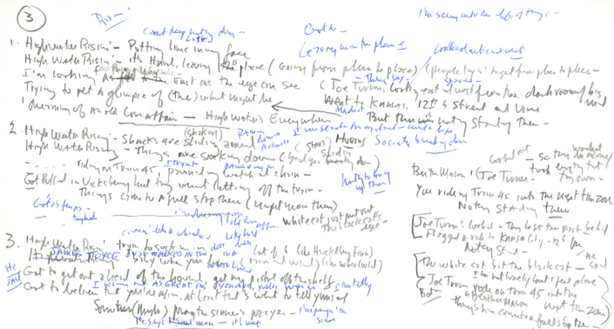
It does show a circled “3” at the top, but the draft version photographed by the Rolling Stone journalist when he visited the Bob Dylan Centre archives in 2017 does seem to be the very first version anyway – perhaps Dylan put the 3 above it because this was page 3 of a notebook. Or perhaps because he came up with three variants (two in black, the third in blue) on this draft alone. The opening couplet of this – supposed – primordial version can still be deciphered reasonably well:
High water risin’ – putting lime in my face
High water risin’ – it’s hard, leaving this place
I’m looking as far to the East as the eye can see
Trying to get a glimpse of what might be
Dreaming of an old love affair – high water’s everywhere
Presumably primal version, as Joe Turner is not yet mentioned. A name Dylan seems to want to have in there pretty soon after scribbling down this first draft; we see in brackets next to line 3: Joe Turner looking east and west from the dark room of his mind, the line that will eventually be chosen with the addition “Big”, and below three more variants with “Joe Turner”.
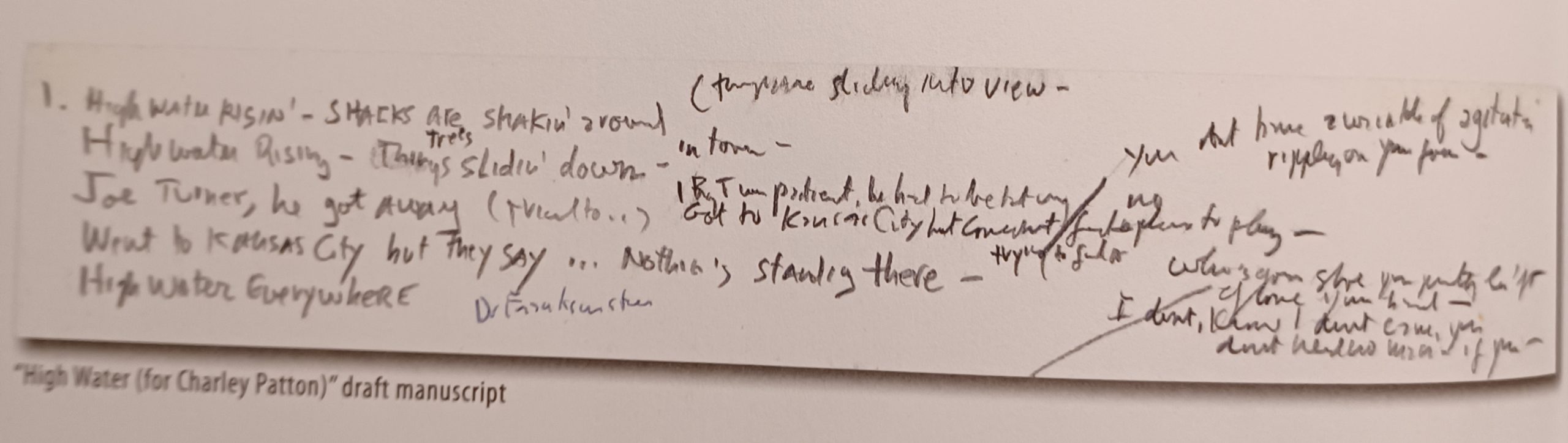
In the other so-called “draft manuscript”, the version printed on page 496 in Mixing Up The Medicine, the third line is “Joe Turner he got away (tried to)” and something with “Got to Kansas City / Got no place to play” – which seems to confirm that this draft version was written later than the version without “Joe Turner”. Also illustrating once again, incidentally, that “Big Joe Turner” is a last-minute addition, and that at the creation stage Dylan had the protagonist from the antique folk song “Joe Turner” in mind.
Wynton Marsalis & Eric Clapton Joe Turner’s Blues:
More revealing than that relatively weightless Joe/Big Joe switch is the tenor of this primal couplet, suggesting an entirely different slant from what the cultural-historical mosaic “High Water” eventually became.
It seems that the opening words high water risin’ were the trigger, the catalyst, as Dylan will call it 2020 (New York Times interview, on the Walt Whitman quote I contain multitudes), and that the stream of consciousness initially leads him to lyricism like in 1967’s Basement gem “Down In The Flood (Crash On The Levee)”: metaphorical use of “high water”, “flood” and “levee crash”, to express the state of mind of a man who has had enough of his wife. Here we have a narrator who is “leaving this place”, looking for a new future (looking East, trying to get a glimpse of what might be), stone-faced (lime in my face), and who muses on a previous, presumably long-forgotten love interest; he is a man who is again “dreaming of an old love affair”.
The gentler version, all in all, of the narrator in “Down In The Flood”, who snarls at his wife “don’t you make a sound”, growls “pack up your suitcase”, a man who “refuses” her and tells her to take the train, and advises her to “find another best friend”. Meanwhile, the metaphors the narrator uses to express his displeasure are identical to “High Water”: high tide’s risin’, crash on the levee, water’s gonna overflow, go down in the flood.
The Derek Trucks Band – Down In The Flood:
It is quite likely that Dylan, with his documented aversion to repetition, would also see, no later than after about four of five lines into the conception stage, the similarity to his sneering song from over 30 years before. “Down In The Flood” is, after all, one of those few songs for which he still feels affection after the Basement months. Indeed, it is not unlikely that “Down In The Flood” (or “Crash On The Levee”; the titles are used interchangeably) was an initial trigger for “High Water” in the first place. After “Down In The Flood” is polished, it gets an honourable place on Bob Dylan’s Greatest Hits Vol. II in 1971: the re-recorded version with Happy Traum is the bestseller’s finale. A few weeks after the release of the double album, Dylan steps on stage at The Band’s New Year’s Eve concert in New York (1 January 1972) to play four songs with his old compadres, and “Crash On The Levee (Down In The Flood)” is the opening track. After that, the song slowly gathers dust – Dylan doesn’t look back at it for over 20 years.
But then it’s 1995, and Dylan starts his spring tour in Prague on 11 March, opening the concert with the pleasant surprise “Crash On The Levee” in a considerably roughened version with stadium rock-like Rolling Stones quality. It does please; the song stays on the setlist and is used 88 times as a concert opener in 1995. Ditto in ’96 and ’97; dozens of times on the setlist, always as an opener. In the run-up to the recording days for “Love And Theft” (8-21 May 2001), Dylan plays the song less often, and “Crash On The Levee” is no longer the opener, but the song is still alive – two days before Dylan goes into the studio, 6 May 2001, he plays the song in Memphis, as number six on the setlist.
It is further notable that the last three performances of the song (4, 5 and 6 May) are each preceded by the cover of the time-honoured Roy Acuff song “This World Can’t Stand Long” (1947), the song Dylan has been performing with some regularity since 2000 – always respectful and quite authentical acoustic performances, usually with Larry Campbell on mandolin, Charlie Sexton and Dylan acoustic guitar,Tony Garnier on upright bass and modest drum accompaniment by David Kemper, ending with the chorus as a fine three-part a cappella. In an arrangement, in short, that is already suspiciously close to the studio recording of “High Water”. The substantive link with “Crash On The Levee” – and by extension with “High Water” – is of course obvious:
This world was destroyed before
Because it was so full of sin
And for that very reason now
It's gotta be destroyed again
… after all, Roy Acuff’s song recalls the greatest flood of all.
So on 4, 5 and 6 May, Dylan plays “This World Can’t Stand Long” plus “Crash On The Levee” sisterly side by side, and on Tuesday 8 May he enters the studio in New York for the recording of “Love And Theft”. The first two days are spent taping “Tweedle Dee & Tweedle Dum”, “Summer Days” and “Honest With Me”, Thursday and Friday the band is off, Saturday 12 May is spent recording “Bye And Bye” and “Floater”, then three days off, and from Wednesday 16 May to Saturday 19 May the rest of the album is recorded (and on Monday 21 May another recording day is dedicated to the Time Out Of Mind-outtake “Mississippi”). Thursday 17 May is reserved for “High Water”. Two takes, the first being chosen for the album.
An educated guess is that Dylan wrote “High Water (for Charley Patton)” in the days leading up to its recording. We owe the clearest indication of this to engineer Chris Shaw’s testimony in Uncut, the revelation that “a lot of editing” took place, and that the editing included the verse order of “High Water” – apparently the song was not yet finished when recording began.
The most likely scenario for the creation process is then, all things considered:
– in the week before Dylan goes into the studio, he plays the combination “This World Can’t Stand Long” with “Crash On The Levee” three times; the word combination high water risin’ is now floating somewhere in the upper stream of his prefrontal cortex;
– high water risin’ floats almost naturally into an already deepened navigation channel, the channel dug à l’improviste in the Basement by “Crash On The Levee” 34 years ago;
– after a few lines Dylan notices this too, but thankfully the rhyme finding old love affair / everywhere opens new vistas – high water’s everywhere leads the flow of thought to Charley Patton.
At least, that apostrophe -s in high water’s everywhere seems to tell us that Charley Patton’s “High Water Everywhere” was not the catalyst, but suddenly comes out of the blue now. “None of those songs with designated names are intentionally written,” Dylan says in that same 2020 New York Times interview, “they just fall down from space. I’m just as bewildered as anybody else as to why I write them.”
To be continued. Next up High Water (For Charley Patton) part 20: Odds and Ends
Jochen is a regular reviewer of Dylan’s work on Untold. His books, in English, Dutch and German, are available via Amazon both in paperback and on Kindle:
I have written before about how highly I rate “Well, well, well” and since then have discovered a few more covers which again I rate highly. But I should add the caveat that there is at least one other song with the same title, so if you go a-searching you might come up with something that was not co-written by Bob at all.
This first one however does actually make it clear that this is the Dylan co-composition. These guys get a fantastic sound out of the song – it is one of those cover versions which make me think, this must be the original, even though I know it isn’t. It is the care with which the instrumental arrangements fit with the vocals that really knocks me out.
And remember it was co-written by Bob Dylan; how can this be not better known?
Arnaud Fradin & His Roots Combo – Well, Well, Well
With Bonnie Raitt there is a 40 second introduction which isn’t really necessary to listen to in order to appreciate the music. Another artist that appreciates just what a gem this song is. It really deserves to be much better known.
There must be something in this song that makes people want to talk about it rather than sing it. Danny O’Keefe gives us 90 seconds of talk first about how he came to write the song with Bob Dylan, which I can excuse – I mean if Bob ever asked me to help him out with a song, I’d still be talking about it six weeks later. But if you want to know about the songs origins do listen, or otherwise skip forward. As I said last time I featured this song, this is so worth hearing…
I’ll finish with Don Henley, not because I think it is the best of all but because one of the key issues with this song is that allows itself to be re-arranged into many different shapes and approaches and still come out shining. If only artists and their producers were not so drawn to covering the same Dylan songs that everyone else had done, maybe we could have even more superb covers of this wonderful piece.
“The Lyrics and the Music” is a series by Tony Attwood which tries to find out what happens when one reviews a Dylan song not primarily as a set of lyrics, but as a piece of music which includes lyrics. An updated list of previous articles in the series is given at the end.
In a 1963 radio interview Bob said, “No, it’s not atomic rain, it’s just a hard rain. It isn’t the fallout rain. I mean some sort of end that’s just gotta happen … In the last verse, when I say, “the pellets of poison are flooding the waters”, that means all the lies that people get told on their radios and in their newspapers.”
That comment I think gives us an insight into the lyrics, which is bolstered by listening to the rather obvious effect of the music. Musically, it is, in its original form, a gentle, highly repetitive song.
But that doesn’t really tell us the whole story, because in western culture one of the most common forms of gentle, repetitive songs, is nursery rhymes like “Ba ba blacksheep.” (You’ll have to forgive me here, I don’t know if that is a song known outside of the UK, but if not, take it from it, it is very gentle and simple and sung to children to help them go to sleep).
Musically “Hard Rain” is indeed highly repetitive. The first two lines are very similar, the difference being that the second line ends on the dominant chord, which gives us a feeling that we’ve reached a turning point, and something different will happen.
We then get five lines beginning with “I” and then the two chorus lines containing the title.
Oh, where have you been, my blue-eyed son?
Oh, where have you been, my darling young one?

I’ve stumbled on the side of twelve misty mountains
I’ve walked and I’ve crawled on six crooked highways
I’ve stepped in the middle of seven sad forests
I’ve been out in front of a dozen dead oceans
I’ve been ten thousand miles in the mouth of a graveyard

And it’s a hard, and it’s a hard, it’s a hard, and it’s a hard
And it’s a hard rain’s a-gonna fall
It is a very gentle song; if one heard the music and did not know the lyrics (which of course is now impossible) it could almost be a nursery rhyme, and the places one has visited could have been places a child would know.
Oh, where have you been, my blue-eyed son?
Oh, where have you been, my darling young one?

I've been to see Grandma and I've been to see Grandad...
OK that sounds really weird because we know the song, but if we did not, it is a song that could be invented as a calming process when the child is settled down at night and for fun the song changes each night to record what actually happened. (And really I can’t believe I was the only dad who sang to his children as they settled down for night…. nor the only one who amused them by changing the lyrics and the songs sometimes…)
Anyway, it could have been a gentle lullaby, given the music, but in fact it is a warning about the end of the world, which gives us a staggering contrast between the gentle music and what the lyrics actually say; a contrast that makes the song all the more effective.
Now this is quite a hard trick to pull off. A lesser composer would have given us sharp-edged chords and a jagged or monotonous melody. And yes Dylan does repeat the music in the main body of the verse over and over: we get lines in the main body of the song anything between five and twelve times in a verse. And it makes the point – we are being pushed down and down and down by what is happening around us.
That of course could be horribly dull, but it is rescued by various factors. First through the contrast between the delicate nature of the music and the horrors portrayed in the lyrics. Second because of the total abandonment of rhyming after the first two lines of each verse. And third, as noted just now, because we get the same musical line over and over and over as if we are being driven down deeper and deeper into the ground by the terrible events that the song relates.
To my mind it really was here, in this song, that Bob Dylan realised just how far he could take popular music and folk music. The length could be anything. The subject matter could move as far away from the traditional “love, lost love and dance” themes of popular music. Repetition of the music to a level never heard before could be used if the lyrics were interesting and varied enough. And perhaps most extraordinary of all, for any musician listening, the verses could be of different lengths (nine lines in the first verse, 16 in the last verse).
This was in fact a song that tore up the rule book and threw it out the window. But that could have resulted in something that was nothing more than a jumble, if Dylan had not constructed a new format that held the song together. And for that he needed the repeating lyrics, as well as the repeating music.
It is, in fact, not just a work of lyrical and musical genius, it is a song that offered songwriters a chance to see just how far the song format could be taken. It is hardly Bob’s fault that so few of them had the ability to take the hint and try it themselves.
The Never Ending Tour Extended: Comparing recordings of Dylan performing his own compositions across the years.
This series uses recordings selected by Mike Johnson in his inestimable masterpiece The Never Ending Tour, and looks at how those performances change as time goes by. The selection of songs from the series, and the commentary, are by Tony Attwood.
———–
“Spirit on the Water” from Modern Times was played 547 times by Dylan and the band between 2006 and 2018, when it was finally put to bed. In this piece I’m going to look at five snapshots: Dylan’s live performances from 2006 (when it all started) through to 2016, just three years before the Never Ending Tour actually ended.
Bob and the band are actually performing this in a different key from on the album – one tone lower in fact. I guess this was not because his voice was not happy reaching the high notes but rather to accommodate some of the small changes he has made in the melody.
And somehow, although this is indeed still a gentle song, some of that gentle reflectiveness of the album recording has gone, as Bob does his thing of emphasising some of the words in a half-spoken. half-sung way.
For me it is a performance that is ok, but has that element in it that I do find in some of the early stage versions of songs where Bob hasn’t yet found some new variations in the music and is playing around with the vocals a bit. It is as if the stage shows are themselves rehearsals for what comes next, which is an interesting approach, although it can be a bit frustrating if it happens too often on one night. But then, that’s Bob.
And if that was what happened, then now, two years on, there is that fraction of an extra bounce in the music that makes all the difference. Bob’s singing is now responding to this and we are on our way. For as a result the feel is more gentle, more sympathetic, more caring. The band is still doing its thing, but somehow in a slightly more restrained way with some extra caresses from the guitar that are only there if you really are listening for them.
In short we still have the bounce, but it is not quite as dominant as before, meaning we can focus on Bob’s singing, although I suspect anyone who didn’t know the lyrics would have a lot of problems understanding them.
However, for me Bob loses the way in the middle 8 and can’t sustain the new approach lyrically throughout, and yet the performance is totally rescued by the gorgeous instrumental break at 3 minutes 45 seconds. It doesn’t totally work, as is always the way with improvisations, but even so, it deserves more than the smattering of applause it gets.
And the second instrumental after the six minute marker really is fun – and that’s without knowing what it was that turned the audience on at that point.
Now the bounce is friskier – or if you prefer bouncier, and somehow Bob’s part sung part declaimed approach fits with this perfectly. And what’s interesting is there is still a joy in Bob’s voice and no sign of repetition taking its effect. The melody still gets some changes, but most of the developments are in the instrumentation, but only there if you listen carefully. Overall, there is now a real feeling of this as an old friend that is to be caressed and nurtured, rather than just wheeled out, because everyone expects it.
Indeed this is a perfect example of where Bob’s declaimed style (as opposed to a conventional singing of the song) works completely.
There is also an interesting instrumental break around 3 minutes 40 seconds, which sounds to me rather different from all that has gone before with the bass reaching its highest possible notes against the staccato organ part. And do listen to what the organ does when Bob’s voice comes back in as we move into the fifth minute of the song.
All in all this is where a song benefits from so many performances. It has evolved to such a degree that the second break with the ultra-simple harmonica part, which ends the performance, really, really works.
As this version starts, once again I feel this is going to be another bit of fun, and an enjoyable listen. By now the song has become very much an old favourite within which small variations can always be found without the essence of the song being removed in any way.
And there really is a sense that Bob is enjoying it too – as if he is caressing a favoured pet. The lyrics are often unintelligible but then by now who cares? And I get the real feeling that the band love it too. There is a perfect gentleness in the instrumental sections which seems to make it all complete.
This is one of the last recordings we have from the tour of this song, and Bob’s voice is more dominant here. There’s not too much new here but rather a feeling that although by now the band has played the song so often, it is still an enjoyable experience for them.
Although maybe there is also a feeling that it has been performed enough. The variations in the instrumentation sound a little more forced, as if they are looking for changes rather than just finding them.
So, a good moment to say farewell to a piece that Bob was clearly extremely fond of. It’s maybe been performed a little too often, and that heavier than normal beat at the end doesn’t quite seem right to me… but then Bob’s the boss. And it is throughout a really great song.
The song runs from approximately 27 minutes into the concert to 31 minutes and indeed Black Rider is performed at pretty much the same speed on stage as it did on the album, although somehow it seems to me to be more strung out.
I have a problem here because although I am fascinated by the lyrics which have from the off seemed to me simply an address to Death (not a really an original concept) with the notion that Death can be cheated (again not really original – but very unusual for a song that is not in the classic blues style).
And as I wonder about making the song simply a declamation over a series of 16 chords I guess that is as valid a way of writing music about death as any. Indeed in a real sense it works because the question can be raised, how else do you address Death (if you are going to at all)? But then each time I listen I reach the end wondering exactly where I have got to, have I enjoyed the experience of the song, have I learned anything, have I appreciated anything, was this a good use of my time? I’m still struggling with that.
What’s interesting in the concert is that the song comes between “When I paint my masterpiece” and “I’ll be your baby tonight”. And I said in my thoughts about the “Masterpiece” version that it comes across as if Bob is saying, “Hey let’s not get too excited about anything.” And although I’ve not written the next piece yet (it is strictly one at a time with me) I can imagine that might be a reasonable response to “Baby tonight”.
If that is the case (and the more I listen the more I think it is) then he really is saying here (either deliberately or it just seeps out as it might do for an octogenarian) then let’s not get too excited about death or love or life or anything. Time passes. Just enjoy it as it goes.
Now I didn’t start the reviews of this concert tour with the thought that it could possibly be the “Let’s not get too excited” tour; I do write the reviews individually, listening to the music and watching the video as we go. But that thought has now arisen. The “Let’s not get too excited” tour.
And as I think back to the show that I saw on the tour, yes there were moments when I was thinking something along those lines. Not all the time, but sometimes.
It will be interesting to see where this goes for the rest of the songs in the sequence.
“So-called hardcore fans of mine, whoever they might be — those folks out there who are obsessed with finding every scrap of paper I’ve ever written on, every single outtake,” Dylan sneers at the press conference in Rome, 2001. He despises how manuscripts, sketches and outtakes get out in the open, that they are traded and that people make money from them, calls it theft, and declares that “Mississippi” only survived because the 1997 outtakes were never leaked – which is why he was still able to record the song for “Love And Theft” in 2001.
After all, leaked outtakes, being “unfinished” anyway, are “contaminated” and even a masterpiece like “Mississippi” would in that case ruthlessly have been discarded.
Unfortunately, the journalists present don’t ask the obvious next question. This is ten years after he himself released the highly successful, trendsetting triple box set The Bootleg Series 1-3, after the official release of 58 outtakes, alternative takes and live recordings, it is three years after The Bootleg Series 4: Royal Albert Hall 1966, and one year before The Bootleg Series 5 – Live 1975.
Apparently, we are long past the point where Dylan has artistic or moral objections to publicising of outtakes and the like, long past the point where Dylan and his record company have figured out that it would be better for them to make a profit themselves. Which is perfectly understandable, of course.
It doesn’t stop, hereafter. The hunger of fans is insatiable, and in the first decades of the twenty-first century, a next volume in the Bootleg Series or a next “50th Anniversary Collection” (to secure copyright extensions) is released on average every 13 months. Among them, monumental releases like The Bootleg Series Vol. 12: The Cutting Edge 1965-1966 in 2015; eighteen CDs of just about everything Dylan did in the studio (and outside, in hotel rooms, for instance) during those years while a tape recorder was running. One goldmine after another treasure trove for so-called hardcore fans, for Dylanologists and academics – the Bootleg Series bestows fascinating insights into the genesis of masterpieces.
In 2016, the same year that Dylan is awarded the Nobel Prize and with it definitive literary recognition, the last restraint evaporates too: Dylan sells his entire archive of thousands of items to the George Kaiser Family Foundation to build a real museum, the Bob Dylan Center in Tulsa, Oklahoma, which will open its doors to the public in May 2022. The archive contains some six thousand manuscripts, rejected versions, corrected drafts of hundreds of songs, poems and diary-like notes: “every scrap of paper I’ve ever written on,” as it were. Of which a select club of authors will gratefully make use of for contributions to the paper pavement tile to be published in 2023, Mixing up the Medicine, or for research for their own books.
Thus, of “High Water (For Charley Patton)” we also get to see first manuscripts, handwritten drafts with deletions and annotations and alternative stanzas. Not very much and partly illegible, but intriguing enough – and it does what you hope for from manuscripts: it gives some insight into the creation of the masterpiece. Dylan author Clinton Heylin, for instance, enthuses (“a corker”) about a complete but rejected couplet:
Doctor Frankenstein's still up there at his castle on the hill
If he ain't come down by now
I guess he never will
Livin' there in the underworld, I ain't sayin' it's wrong or right
The sun is shining down
Like it's twelve o'clock at night.
Like a nightmare up there
High water everywhere.
Presumably a candidate who dropped out late, we may assume with some certainty. The metre has already been reasonably polished up, the rhyme scheme “fits” (is similar to the other stanzas), but mostly:
… on the fragment of the draft manuscript printed on page 496 of Mixing up the Medicine, we see Dylan jotting down the inspiration “Dr Frankenstein” under an earlier version of the opening couplet. Written with a different pen. Apparently Dylan had already put this – presumably second – draft version away again, he makes a cup of tea, the stream of consciousness still ripples on, then bears a possibly fitting mosaic stone with “Dr Frankenstein”, Dylan grabs the nearby pen and scribbles down a reminder. Something like that, probably – one of the many examples, anyway, from the Bob Dylan Centre archives that give us a glimpse of the path from a scribble in the margin to a song couplet.
To call the “Frankenstein couplet”, which eventually fails to make the final selection, a “corker”, a brilliant achievement, is perhaps a bit overly enthusiastic, but it does indeed have its own distinct charm. At first glance, and without prior knowledge, most Dylanologists would probably classify it as a lost “Desolation Row” couplet, a classification justified by the opening line Doctor Frankenstein’s still up there at his castle on the hill alone. A literary celebrity as protagonist, presented as the film character (no castle appears in Shelley’s book; only in film adaptations is Dr Frankenstein portrayed as an eccentric mad scientist in some castle on a hill). Very similar to other 60s protagonists in Dylan’s songs. Like Captain Ahab in “Bob Dylan’s 115th Dream” (he was stuck on a whale – that’s Gregory Peck in the film, in Melville’s book it doesn’t happen) or Cinderella, who puts her hands in her back pockets “Bette Davis style”.
Equally deceptive is the strong doom vibe, identical to the “agents & superhuman crew” couplet from “Desolation Row”. Besides the matching décor (“castle”) and a cultural icon as the protagonist, word choices like underworld, nightmare and midnight, the poetic paradox The sun is shining down / Like it’s twelve o’clock at night, and postmodernist blending of cultural stereotypes also push the associating Dylanologist into the mercurial ’65-’66s. In this case: it ís Dr Frankenstein, yet for the character’s colouring, the song poet reaches for the clichés from Bram Stoker’s Dracula. Not to mention the form:
Doctor Frankenstein’s still up there Now at midnight all the agents
at his castle on the hill And the superhuman crew
If he ain’t come down by now Come out and round up everyone
I guess he never will That knows more than they do
Same number of syllables, identical rhyme scheme, matching metre, stylistically a copy plus content parallels… it becomes increasingly understandable why Dylan discarded this verse, this “corker” in the end. “Dylan really, really hates to repeat himself” (engineer Chris Shaw in Uncut, October 2008).
Incidentally, the Frankenstein couplet is not completely discarded. As we so often see in manuscripts and drafts, things move to subsequent songs. The Frankenstein theme keeps bouncing around in the back of Dylan’s mind for about 20 years, eventually descending in “My Own Version Of You” on Rough And Rowdy Ways, 2020, the verse fragment I ain’t sayin’ it’s wrong or right popping up a few years later as I don’t know what’s wrong or right in “Life Is Hard” (Together Through Life, 2009) and the underworld in “Tempest”, 2012.
“He has these fragments round in his head all the time,” as Larry Charles says, “and he’s constantly trying different bits together and seeing what happens.”
————————
To be continued. Next up High Water (For Charley Patton) part 19: Water’s gonna overflow
Jochen is a regular reviewer of Dylan’s work on Untold. His books, in English, Dutch and German, are available via Amazon both in paperback and on Kindle:
I can only find one cover version of Dylan’s “Whatcha gonna do?” which either emphasises a view that I have put forward before that there is a feeling among musicians generally that if you are going to do a cover version of a Dylan song, do a famous Dylan song, or else they simply don’t know the more obscure bits of the catalogue.
Anyway, just in case you didn’t read my original “Dylan as the modern Robert Johnson” piece in 2017 you can find it here but the key point is the recording which is below…
Now when I listen to that even now, years after having first heard it, it still knocks me out and I can’t imagine why others have not taken the song up as there is so much you could with it. (I’d record my own version of it and put it here, but you’d only laugh, so we’ll by-pass that).
But there is one terrific cover version which is on the internet and here it is
Whatcha Gonna Do?(Bob Dylan song featuring Tim Easton & The McCrary Sisters)
What I love about this is not just the music itself, but the thinking that has gone into this production. The female voices are not what I would have introduced, but they do give a terrific extra dimension to the song.
If there is a criticism to be made it is that there are so many extra elements added it is neigh on impossible to make the whole piece balanced; it perhaps begins to feel that as if they threw in every idea that they had.
But I am being extremely churlish here, because after a few listens to this song I get to appreciate it more and more, and understand exactly what those involved in the musical direction and arrangement had in mind.
In my head I can hear a version of the song that is half way between this full-blown version with accompanying singers, hand-clapping and the rest and Dylan’s stripped back solo. And maybe one day someone will do that. Indeed maybe someone has and I just haven’t found it yet.
However more than anything there is this point: this is a great upbeat blues song that deserves far more recognition than it has ever had, and it really makes me wonder what the “Dylanologists” are up to. This is not the only forgotten masterpiece of simplicity from the early Dylan catalogue that has gone this way. And anyway, think of the publicity there is to be gained from the headline that Block Xerox and the Copycats release “lost” Dylan masterpiece.
Well, ok maybe I’m no good at made-up band names, but really, this is far too good an upbeat blues tune to be left on the shelf.
Shadows are falling but it’s a day without end, dragging towards eternity, ships ‘going out’, their journeys unnamed, unremarked upon. Days wearily repeat themselves, full of tellingly unspecified ‘anger’ and coloured by ‘bitterness and doubt’. The near-hopelessness, though, shifts to something closer to a worldly knowingness, the voice of a prophet looking back, one who’s seen it all, who saw, too, what was coming – ‘I know how it happened – I saw it begin’ – but one who also suffered, martyr-like, in his truth-telling and in his searching, we later hear, for ‘the holy grail’:
I opened my heart to the world and the world came in
If you ‘open your heart’ to someone, you tell them truths, your real thoughts and feelings, because you trust them – but in doing that you’re at the same time rendering yourself vulnerable, opening yourself to another’s exploitation if that trusted person turns out to be anything but trustworthy: you can be taken advantage of, something that’s implied here by the embittered follow-on, sung with a tired sense of seen-it-all beforeness: ‘and the world came in’.
You ‘open your heart’ to or confide in usually one person, not to ‘the world’, but the speaker’s naïve mistake was perhaps to have assumed that his audience would listen and respond with generosity of spirit rather than seizing an advantage, moving in and, as it were, setting up camp *. Perhaps that’s why the speaker now seeks refuge in isolation, the safety of being ‘where only the lonely can go’, the prophet’s wilderness…
(*There’s likely to be an autobiographical note here, of course: the world-addressing, world-admonishing proselytiser – ‘so much older then’ – found himself claimed, owned even, as a voice or ‘spokesman’, a mouthpiece for others and their causes.)
On the other hand, while he may go where ‘only the lonely can go’, he’s not unaccompanied:
Hello Mary Lou - Hello Miss Pearl
My fleet footed guides from the underworld
No stars in the sky shine brighter than you
You girls mean business and I do too
‘Hello Mary Lou’ is pretty harmless pop stuff but Jimmy Wages’ ‘Miss Pearl’ sounds more like trouble:
Miss Pearl, Miss Pearl
Daylight recalls you, hang your head, go home…
Whatever she gets up to at night in her ‘underworld’ before daylight ‘recalls her’ we can only guess – the admonishing singer sounds desperate – but Dylan’s False Prophet welcomes his Miss Pearl and Mary Lou as ‘guides from the underworld’, subterranean muses calling to mind Maggie who once came ‘fleet foot Face full of black soot’. Ready now to do business, the three form a threateningly unholy trio – that ‘I do too’ is added with sardonic relish. The Shadow and his ‘guides’ are, as Elvis sang, ‘Lookin’ for trouble’.
That troublesome ‘business’ is intimated in the next verse with its implied declaration of intent, listing the enemies, the targets to be taken on:
I’m the enemy of treason - the enemy of strife
I’m the enemy of the unlived meaningless life
Another intriguing trio: treason, strife and life not fully lived.
Treason, an act of criminal disloyalty, typically to the state, is a crime that covers some of the more extreme acts against the nation (or its sovereign). It implies betrayal, and the voice here might well have in mind both personal experience (reminding us of the ‘world’ that ‘came in’ when he opened up his heart?) and something grander: a political leader (I can’t help but think again of that Trumpean silhouette) who betrays his own nation and all that it stands for. ‘Strife’ might well have a contemporary relevance, too, suggesting as it does, ‘angry or bitter disagreement over fundamental issues’, or ‘vigorous, bitter conflict’: a nation at war with itself – and with a leader at war with his own nation.
The lines, then, condemn betrayal and destructive conflict, while, again, Blake comes to mind in the enmity towards ‘the unlived meaningless life’. Treason and strife are, by implication, life-denying, dark negatives, symptoms or products of the ‘Mind-forg’d manacles’ Blake hears in ‘London’, manacles that a lived, meaningful life would presumably be free of, the ‘chains’ that Rousseau and, later, Marx, saw as denying life and liberty. The speaker’s own freedom is expressed, in fact, in the triumphant separateness of the declaration that follows:
I’m first among equals - second to none
I’m last of the best *
(*Robert Currie’s Genius has a lot to say about this essentially Romantic concept, the creative artist as the One versus the Many, reaching something of an apotheosis in Nietzsche’s notion of ‘Man and Superman’: or ‘Man and The Shadow’?)
Michael Goldberg’s thoughts come to mind here:
The funny thing about ‘False Prophet’ is that when Dylan sings, “I ain’t no false prophet/ I just know what I know,” he could be indicating that he’s actually the real thing…In this new song he also sings,
“I’m the enemy of treason…
“Enemy of strife…
“Enemy of the unlived meaningless life.”
That final line is a theme of the Beats, as I was recently reminded when I read three books by the novelist/memoirist Joyce Johnson, who in her youth was Jack Kerouac’s girlfriend when On the Road, written in 1951, was finally published in 1957. “Enemy of the unlived meaningless life.” It’s as relevant today as a philosophy of life as it ever was.
The triumphant note is sustained in the next snarled insistence:
you can bury the rest
Bury ‘em naked with their silver and gold
Put ‘em six feet under and then pray for their souls
The implication seems to be that ‘the rest’ are those whose (‘unlived meaningless’) lives have been dedicated to – and wasted – on material, earthly pursuits, falling in love ‘with wealth itself’ (‘I Pity the Poor Immigrant’). Wrong-footing us again, though, a sudden, challenging question, ‘what are you lookin’ at?’, turns into an ambiguous reassurance, ‘There’s nothin’ to see’: he’s invisible now, but, as I suggested earlier, there’s a possible dark undercurrent here, the invitation to ‘walk in the garden’ on the one hand possibly innocently meant but on the other calling to mind the wily serpent (hinted at in the wind’s winding movement, ‘encircling me’)in the Garden of Eden, not actually invisible but, of course, the Devil in disguise, something picked up on a few lines later:
You don’t know me darlin’ - you never would guess
I’m nothing like my ghostly appearance would suggest
Again we’re left wondering about the voice, its tone (Inviting? Reassuring? Deceitful? Boastful?) and its intention: who, exactly are we hearing and ‘What was it [he] wanted?’ Unsettling us still more, the swaggering shifts into vengeful mode again:
I’m here to bring vengeance on somebody’s head
That ‘somebody’s head’ is particularly unnerving – somebody could be anybody – and the ‘ghostly appearance’ is now still more insubstantial, ‘nothin’ to hold’ where a hand should be. The threat of vengeance, on the other hand, is horribly actualised or particularised, stuffing with gold the mouth of the ‘poor Devil’ who can, perhaps, only look up and see, not ever reach or experience the City of God – the new Jerusalem, or Paradise: Paradise lost to Adam and Eve, corrupted by Satan – who himself was hurled out of Heaven:
Put out your hand - there’s nothin’ to hold
Open your mouth - I’ll stuff it with gold
Oh you poor Devil - look up if you will
The City of God is there on the hill
This already cryptic, allusive song (addressed by whom, and to whom?) concludes on yet another dense and enigmatic note, loaded with questions:
Hello stranger - Hello and goodbye
You rule the land but so do I
You lusty old mule - you got a poisoned brain
I’m gonna marry you to a ball and chain

You know darlin’ the kind of life that I live
When your smile meets my smile - something’s got to give
I ain’t no false prophet - I’m nobody’s bride
Can’t remember when I was born and I forgot when I died
Ambiguities, uncertainties abound: the voice of a/the Devil, or a/the Devil addressed? Hello – and goodbye – to a stranger who rules the (strange?) land – ‘but so do I’? Once again: ‘I and I’? And that stranger is now a poison-brained ‘lusty old mule’ who’s threatened with marriage, but not a marriage to a wife, instead – vengeance again – an ironic, punishing ‘ball and chain’, calling to mind, for me, Shakespeare’s Lucio who’s punished by, in his words, marriage to ‘a punk!’(By delightful chance, Cockney rhyming slang for ‘wife’ is not, of course, ‘ball and chain’ but ‘trouble and strife’, while in Janis Joplin’s song, Love is the ‘ball and chain’ that drags her down.)
The voice, meanwhile , telling us again that he’s no false prophet, adds that he’s ‘nobody’s bride’ (not ‘Nobody’s Child’), whereas, we might remember (and Dylan reminds us in ‘The Groom’s Still Waiting’) the church is the ‘bride of Christ’ in John’s Gospel. Mischievously, too , the voice, the Prophet or Seer – Blake’s eternal Bard – not only can’t remember when he was born but, weirder still, ‘forgot when I died’.
———–
There is an index to all the latest articles on this site on our home page.
“The Lyrics and the Music” is a series by Tony Attwood which tries to find out what happens when one reviews a Dylan song not primarily as a set of lyrics, but as a piece of music which includes lyrics. An updated list of previous articles in the series is given at the end.
————
This is a genuine 12-bar blues with a very strange extra instrumental bar at the end of each verse which endlessly must throw anyone who is actually listening to the music, off balance. It makes the song a 13-bar blues. In fact, as far as I know, the only 13 bar blues ever recorded.
Just listen to the last line (unaccompanied) of each verse, and then hear that guitar solo – which means that the final line of each verse actually has five beats rather than four. It really throws everything else in the song in terms of the music, into question.
And the fact is that even if one doesn’t know anything about the construction of songs, the balance and equality of everything within the song is perfect until that last little one-bar guitar solo. It feels odd… as if one is walking along at a regular pace and then suddenly puts in one skip, but then keeps on walking as if nothing had happened.
The fact is that without that extra bar the song would have a lot less. It would still be a Dylan song with some intriguing lyrics. For example
They threw everything at me, everything in the book
I had nothing to fight with but a butcher's hook
They had no pity, they never lend a hand
I can't sing a song that I don't understand
Goodbye, Jimmy Reed, goodbye, good luck
I can't play the record 'cause my needle got stuck
but that extra moment, that extra edge, that extra something that throws us all off balance, would not be there.
In the live concerts Bob tended to hold the last note of the melody while the guitar plays the 13th bar, and that lessens the impact somewhat, but it is still there, still that something that makes the song feel slightly out of kilter at the end of each verse.
But does the 13th bar in a 12 bar blues actually have any meaning in the sense of adding something to the lyrics apart from throwing us off balance just for the sake of it? If it does I can’t find it, except as a way of saying thank you to Jimmy Reed for the difference he made. In fact it takes me back to the famous line at the end of “I shall be free Number 10” in which Dylan sings/recites…
You're probably wondering by now
Just what this song is all about
What's probably got you baffled more
What this thing here is for
It's nothing
It's something I learned over in England
There, you might recall, there is a strange instrumental moment at the end of each verse, which is what Dylan is commenting upon, saying that he just added it to the music because he heard someone else do something like that. The tale might well be apocryphal but it adds a moment of difference and lightness, and the same is true with the extra bar in “Goodbye Jimmy Reed.” It is just a twist, a bit of fun, a smile, a nod… all those things but captured within one musical moment.
And the reason I spend my time (and your time if you are still with me at this point) featuring this, is that it reveals not only a moment of humour in Dylan, but also a moment of humour expressed in music, which is something that is somewhat rarer.
Bob Dylan, of course, knows the classic musical forms that he plays with, such as the 12 bar blues, inside out and upside down, and so it is natural to have the occasional twist added to the mix. It is just a little extra, but is a little extra that could only have been added by someone who not only can play and write the music, but also someone who feels and thinks about the musical form. It’s Bob’s little joke, just like a great Shakespearian actor might occasionally deliberately misquote a line, just because he can.
And just to appreciate Bob’s jokes, consider the above in which he leaves his position as the lead singer and goes over to the piano. At the very end he has a lovely grin for one of the musicians, as if to say “I don’t know why I did that but I just did,” as if to explain his movement to the piano part way through.
I can’t be sure that’s what it is about, but it fits with that impish extra bar that turns the 12 bar blues that has been heard a billion times into what is probably the one and only 13 bar bar blues ever written
The Never Ending Tour Extended: Comparing recordings of Dylan performing his own compositions across the years.
This series uses recordings selected by Mike Johnson in his inestimable masterpiece The Never Ending Tour, and looks at how those performances change as time goes by. The selection of songs from the series, and the commentary, is by Tony Attwood.
———–
I am not sure what I expected going back to some of the earliest recordings we have of Desolation Row on the Never Ending Tour, but I am sure I didn’t expect this version from 1992. Of course by the time of that concert the song was over a quarter of a century old, which is a long time for a composer to be not just contemplating one of his greatest ever works but constantly re-imagining it.
And equally “of course” I listened to this when Mike first presented the article in 2020, and was knocked out then. But then 2020 was the time of the pandemic in England, where I live, and life was weird, disrupted, and a case of somehow just hanging on as my normal life which I was rather enjoying was utterly torn to pieces within one afternoon of insane government diktats. I was left alone, isolated, bereft. I turned to Dylan and came across the NET recordings of Desolation Row. Talk about music that fits life at that moment.
Now four years on, I still think of Desolation Row as sad and sedate, a desperate shaking of the head as one moves away to look elsewhere. Yet turning back to Dylan’s live presentations of the song that we published in the “Never Ending Tour” series, the song is nothing in any way like that: it is, well…, “explosive” is the only word that comes to mind.
But explosive without the explosion. Not explosive because of a full-band treatment; that would be far too obvious, but explosive because it just hits me on the face like a punch that sends me reeling backwards, and leaves me wondering where on earth that came from, but perversely wondering, could we do that again?
And if you are not convinced that there is something here that demands your attention, please don’t move away but give yourself time and go on to the instrumental sections. For example try 6 minutes 25 seconds of this first example, and just let it roll on. Remember this is planned but nonetheless improvised, and yes the various instruments tangle themselves up, undoubtedly because Bob changes what he is doing each night… but please stay with it. This instrumental section lasts and lasts, going through multiple chasms… and the first hint of the harmonica doesn’t come until past the ten minute marker.
It ends at 11 minutes 30 seconds, and my goodness does the audience know that it has been witness to something utterly amazing. If I was looking to write a “highlights of the highlights of the highlights” series (which I am not, so I’ll leave that to you – email your copy to Tony@schools.co.uk) this would be right there.
So what would Bob do next? Cut it down to size maybe? Make it more pleading? More emphasis on the key issue of how we are all just looking out on the ever increasing wreckage of… well, everything. Our personal lives, our civilisation, everyone else’s civilisation, our humanity… Well yes, but that’s all a bit obvious isn’t it? (At least it is from where I am sitting, beautiful, peaceful and calm though the countryside is around here).
But does it need 11 and half minutes to express disaster? Actually, yes it does if one is trying to express both the universal and personal catastrophes at the same time. In fact in that case 11 and a half minutes might not be enough.
Indeed that turned out to be the case, because the following year the performances were even longer, showing that one can never accuse Bob of not taking an experimentation as far as anyone could imagine and then going further.
Now I appreciate that if you have been following me this far you have just had 11 and a half minutes of Desolation Row, and as I tell you that by the following year the performance had got even longer, you might feel you want to leave this for another day. And of course it is your computer, your life, and your partner asking if you’ve cleaned up the bedroom yet, and isn’t it time for a coffee? Yes, you choose.
So you might want to wait. But let me tempt you slightly. If you thought that 1992 was of a certain interest, this is going to blow what is left of your mind even further than you could possibly imagine. I can’t say this is the ultimate highlight of the Never Ending Tour, for there is just so much of it, that I can’t hold it all in my head to make a comparison. But if nothing else take in the harmonica solo around 9 minutes 45 seconds.
And oh yes I should have warned you. This piece lasts over 13 minutes.
Of course there are many more Desolation Row performances to contemplate, and I could imagine writing a whole website on the live performances of this song alone. But I am going to offer you just one more and leap forward 14 years to 2017. If you are still reeling from the two versions above you might want to take a few deep breaths before pressing the button again. Not because Bob is about to take you down even more, but rather the opposite.
And that’s the point. This magnificent work of genius can be worked in any way Bob wants it. But as you listen to this, just imagine what it must be like to have performed it previously as we have heard above, and then come up with something so utterly different, and yet still so meaningful. This time we have wrecked the world, as ever, but now it is met by a shrug of the shoulders. I mean, that world’s gone, but there are a billion others out there, aren’t there?
So he slings his guitar over his shoulder, takes his lady by the hand, and walks off over the hill, just to see what’s on the other side…
This is a very relaxed version of the song that was first performed in 1975 and which has continued until the end of 2023. It’s half sung, half spoken piece (“declaimed” seems to be a better word than “sung”) which even includes a trick ending and which continues the laid back feel of the whole concert.
For me it is almost as if Bob has taken his own line, “Someday, everything is gonna be smooth like a rhapsody” and is trying through this declaimed approach to get to that feeling. As a result it comes across to me as a sort of, “Hey let’s not get too excited about anything” style, which I guess fits the demeanor of a revered octogenarian.
And in pondering this, it suddenly interested me to think what the same piece sounded like when we first came across it on the Never Ending Tour in 1991. Then Bob played a trick with us giving a two minute 30 seconds musical introduction – which is a bit odd given that musically the song is just two chords alternating with the real interest being in the lyrics. This comes from 1991 Part 2 – Feet walking by themselves
By the end of the Never Ending Tour the song sounded a little different, although Bob’s vision of the song remains the same albeit with a sung introduction. This time it takes over two and a half minutes before we get to it being a song in the conventional sense.
The violin and harmonica do gell together nicely however….
This version from a concert in 2019: The liberated republic – and I’ve added this to make my point that in many ways the “Rough and Rowdy Ways” tour is a continuation of the Never Ending Tour (although Bob himself has on occasion railed against the continuing use of the “Never Ending Tour” as a title.
So what I am suggesting is that Bob has a seemingly eternal fascination with this song which is musically limited, and which, for me (and of course as ever this is just me) is just a gentle reflection on being in Rome and the absolute feeling of history and art that it can bring.
I’ve not been to Italy that many times, but when I have, immediately this song springs to mind; yet for me that does not make it one of the almighty, great, wonderful, overwhelming Dylan compositions. It’s just, well, nice, reflective, feel-good, relaxing, and with nothing really to do with Rome.
And I think that is the problem with the Rough and Rowdy Ways version. Bob clearly feels a deep attraction to the piece, and he likes the notion of being in the home of such an historic extraordinary culture, and the notion that being there he too can produce a work comperable with Arellius … but this isn’t “Visions of Johanna” or “Not Dark Yet”… this is (for me, and of course my comments are always just about my perception) a rather pleasant two chord song.
I mean
Sailin’ round the world in a dirty gondola
Oh, to be back in the land of Coca-Cola!
is fun in the original, and that surely is the point. Dylan is saying he can feel that being in Rome might induce a sense of being able to create a master work because of the heritage, but the heritage has long ago been commercialised to such a degree that he wants to be back home. And besides, as has been pointed out endlessly, there are no gondolas in Rome. They are in Venice, a city which if one wants to relax, is surely much preferable to Rome.
In the end I don’t quite know what Bob meant – if he meant anything. Thus for me, his fascination with this song is difficult to understand. Of course I fully realise that is my problem: Bob knows why he wants to keep this piece in the repertoire and that of course is fine. And he knows why he likes these rearrangements. It’s just me that’s not on board.
I’m gettin’ up in the morning—I believe I’ll dust my broom
Keeping away from the women
I’m givin’ ’em lots of room
Thunder rolling over Clarksdale, everything is looking blue
I just can’t be happy, love
Unless you’re happy too
It’s bad out there
High water everywhere
“We were thinking that somebody needs to write some Bob Dylan songs to help change the world,” Jack Tempchin tells Songfacts, “we’re in a lot of trouble right now – maybe if I drink this whiskey, I can write a Bob Dylan song.”
By “this whiskey”, Tempchin obviously means Heaven’s Door, Dylan’s own brand of whiskey launched in 2018. The song is fun enough, but gains considerable traction when in 2022 Jack is joined by the guys of Mrs. Henry, the talented “official revival” quartet from San Diego that put so much love and skills into resuscitating The Band. Jack seeks contact when he sees Mrs. Henry’s recreation of The Last Waltz: “I wrote them an email, I said, look, I’m not Bob Dylan, and you’re not The Band, but maybe we should get together and make some music.” And a first fruit of that collaboration is a reanimation of the witty “Bob Dylan Whiskey”;
The times they are changing
Like never before
So I turn off the news
And pour me one more

And I’m tryin to write a song
Like I wish he would write
I’m drinking Bob Dylan
Whiskey tonight
Jack Tempchin and Mrs. Henry – Bob Dylan’s Whiskey:
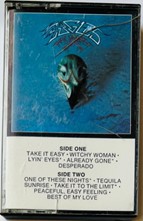
The song has an appealing double layer of irony. Jack Tempchin’s own commentary allows us to equate the I-person with the writer and singer, with Tempchin, so we may understand the song as Jack’s personal, autobiographical desire to write a Great Song. Demonstrating sympathetic self-mockery; Tempchin has written songs for George Jones and Emmylou Harris, for Johnny Rivers and for Olivia Newton-John and a host of premier league artists more, but especially for the Eagles – the best-selling U.S. album of the twentieth century, Their Greatest Hits 1971-1975, features two Tempchin songs: “Peaceful Easy Feeling” and “Already Gone”. In 2019, Jack will be inducted into the Songwriters Hall of Fame in New York City; no, Tempchin cannot complain about his ability to write Great Songs.
The second layer is even more ironic: Jack Tempchin did, in fact, write Dylan songs. Well, sort of anyway. Which he also owes to his Eagles connection. When the Eagles break up and move on to solo projects, Tempchin remains the regular songwriter for Glenn Frey, the Eagles guitarist who is namechecked by Dylan in “Murder Most Foul” (Play Don Henley, play Glenn Frey / Take it to the limit and let it go by). On Frey’s solo debut No Fun Aloud, Tempchin (co-)wrote six of the 10 songs, on the successful follow-up The Allnighter all 10 of them. “We have a very good rapport,” Frey says of Tempchin (Ultimate Classic Rock, June 2015). “It’s funny, there are only those certain people where things click – at least for me. He’s very free. I’ll just run some soul licks by him.” To which Jack then writes his lyrics. Among others for the song from which Dylan will so gratefully draw.
Dylan himself turns the spotlight on the Eagles twice in 2020. Apart from that name-check, his remark in the interview with Douglas Brinkley for the New York Times in June 2020 also causes a stir. Brinkley is curious about how and why Play Don Henley, play Glenn Frey, and wants to know which Eagles songs Dylan admires;
“”New Kid in Town,” “Life in the Fast Lane,” “Pretty Maids All in a Row.” That could be one of the best songs ever.”
Which retrospectively sheds new light on the opening couplet of a Time Out Of Mind outtake, on the crushingly beautiful “Red River Shore”, which we don’t get to hear until 2008, on The Bootleg Series 8: Tell Tale Signs;
In the moonlight shooting by
Some of us scare ourselves to death in the dark
To be where the angels fly
Pretty maids all in a row lined up
Outside my cabin door
I’ve never wanted any of ’em wanting me
’Cept the girl from the Red River shore
At the time, the eighteenth-century nursery rhyme “Mary” seemed the obvious source of pretty maids in a row, but now the Eagles song is becoming a serious option. And by extension, Glenn Frey’s solo work is being looked at with new eyes. Perhaps it is no coincidence after all that It’s too hot to sleep in the opening of “Not Dark Yet” was already sung by Glenn Frey in 1992, five years before “Not Dark Yet”, on Strange Weather in the song “Long Hot Summer”. Written by… Jack Tempchin.
It opens floodgates. And the most amazing aha! we then find on The Allnighter, the record on which every song was (co-)written by Tempchin. Number 3 is “I Got Love”, an attractive piece of craftsmanship that would have long since been forgotten if it had not contributed to one of Dylan’s Very Great Songs: I started thinkin’ ’bout the things we said / I said I’m sorry; She said I’m sorry too sings Glenn in the second verse – and Dylan copies it, paraphrasing it in “Mississippi”:
I was thinkin’ about the things that Rosie said
I was dreaming I was sleeping in Rosie’s bed
[…]
So many things that we never will undo
I know you’re sorry, I’m sorry too
… so that we now also begin to believe that Frey’s fragment (or rather Tempchins) from the heavens above descends into the outtake Dylan writes in the same days as “Mississippi”, in “Dreamin’ Of You”, and that “I Got Love” is still echoing in the creative part of Dylan’s brain four years later when he writes another Very Great Song. The entire second verse of the Frey/Tempchin song inspiring “Mississippi” is:
Jumped on the freeway with this song in my head
I started thinkin' 'bout the things we said
I said I'm sorry; She said I'm sorry too;
You know I can't be happy unless I'm happy with you.
… which in Dylan’s meandering stream of consciousness four years later is regrinded to I just can’t be happy, love / Unless you’re happy too. Making Jack Tempchin’s dream of writing a song the way Dylan does at least partly come true; after his contributions to the majestic Dylan songs “Not Dark Yet”, “Mississippi” and “High Water”, he may by now with some right call himself a co-author. “I tried to be Bob Dylan over and over again in my life,” says Jack in 2016 to interviewer Paul Zollo for Laurel Canyon Radio. “And it always never worked. ‘Cause I am not him.”
Still, the next best thing Jack Tempchin did manage to reach.
To be continued. Next up High Water (For Charley Patton) part 18: Every scrap of paper I’ve ever written on
Jochen is a regular reviewer of Dylan’s work on Untold. His books, in English, Dutch and German, are available via Amazon both in paperback and on Kindle:
If you don’t recall “Walking Down the Line” as a Dylan song you are forgiven.
But it was indeed a Dylan piece, recorded in 1963 and released much much later.
OK so it is dead simple, just two chords, and only known to those of us who really follow most aspects of Bob’s work. Bob has never once played it in a concert.
So why has it attained such popularity? I think the answer can be summarised within this live version by Michael Cerveris and Loose Cattle: it is such fun to play. I don’t mean everyone heard this version and thought they could have fun with the song, but rather that Loose Cattle seem to sum up all the fun that can be had if one just lets the imagination run riot.
Indeed you don’t have to do much by way of rehearsal because the song is just based on those two rocking chords, but it gives everyone a chance to shine. Just listen to the violinist having a fantastic time in the instrumental break… and the laughter because the band having exactly agreed when that violin part is coming in as a solo. It may look under-rehearsed, but playing like this is part of the great fun of creating music, and this is a perfect song with which to have such fun.
And of course there is the fun with the lyrics – just listen to the “My money comes and goes” verse here.
But don’t think this is simply the enclave of unknown bands having a lark. Rick Nelson also made a recording emphasizing the country feel of the lyrics. And I really do think it is interesting to hear the contrast between this version below and the high-power approach above – all from such a simple song!
Robin and Linda Williams give it a bit of an extra on-beat emphasis to mix with the country feel in the chorus – just listen to the percussion in the chorus – that drum thump is on beat three of every four beats which is profoundly odd. Normally with rock the emphasis is on the second and fourth beat of the bar.
And then to contrast with that, try this next one… and enjoy these exquisite harmonies, which are perfect for their take on the song. But also if possible just recall the distance we have already traveled with this most simple of songs. (And that’s before I start waxing lyrical about the strings’ instrumental break). I just wish she hadn’t changed the lyrics in the “rolls and flows” verse from Bob’s recording.
I suppose one of the things about this song is that because it is not particularly well known outside the circles of those of us who really do know a bit about Bob’s songs, it can be played around with – here’s an example… This is Penny Lang. New chords too.
Fortunately, we even have the odd recording made by musicians of repute trying to get to grips with what they are doing with this most simple, yet utterly endearing of songs. Try this for example: it is Ry Cooder and Taj Mahal, not quite getting where they expected to be. (Please let it run; don’t judge it by the first five seconds).
But most of all it is the harmonies and simplicity that has attracted performers across the years. Plus the fact that it can be taken at a ludicrous speed while still making it an understandable piece. This next one is not, of course walking, but charging at 2000 mph. But it is still fun: Hamilton Camp.
I must admit I am now exhausted and I have to stop there. There are lots more recordings of this most simple of songs, and I am so glad they exist. On days when I’m covered in blue, it is lovely to have pieces of music like this around. Thank you to everyone who has felt it worth while… and thank you dear reader if you have listened to each one all the way through. And if you haven’t, just take the last example above and make that the one you listen to completely.
With characteristically fastidious self-deprecation, TS Eliot’s Prufrock, in a poem alluded to – almost quoted from – by Dylan in ‘Desolation Row’, announces:
I am no prophet – and here’s no great matter
Dylan, by contrast, insists over and over, with an unPrufrockian defiance reaffirmed by a driving blues beat, “I ain’t no false prophet”.
The insistence draws attention to the telling epithet, ‘false’, as much as to the key word ‘prophet’, and there’s a typical ambivalence here, something that underscores the song and its possible meanings: by declaring that he’s not a ‘false prophet’ is the speaker here denying prophetic qualities or affirming that he’s not ‘false’ – ie he is a prophet of sorts, and one we can trust, or should pay heed to? I’m very much inclined to the latter.
It’s a cliché to say that we live in an age of ‘fake news’, but like so many clichés (it’s how they become them) it contains a truth: we’re confronted and affronted everywhere by fakery and falsehood, by lying politicians and their sycophantic media cronies inventing ‘facts’. By insisting on not being a false prophet the voice of the poem is setting itself apart from and in opposition to fakery.
The claim to be a prophet is a large one, but it calls to mind William Blake (whose ‘Songs of Experience’ are referenced in ‘I Contain Multitudes’) and his vision of the poet as seer, possessing a wisdom, an ability to see what others are blind to, a prophet who speaks truth to the present day from the perspective of an outsider, even a voice in the wilderness, one, perhaps, who goes ‘where only the lonely can go’:
Hear the voice of the Bard!
Who Present, Past, & Future sees
Blake claims that Milton, for example, was ‘a true poet’ who regarded that kind of Energy ‘call’d Evil’ as the ‘only life’. Blake considers Energy to be opposed to Reason, the force which, he believes, restrains desire. He exalts the life of the passions over that of Reason and the true poet/seer/prophet should exalt passionate life and deny imprisoning restraint, the ‘mind-forg’d manacles’ (in ‘London’) that chain us down. Comparably, Dylan’s prophet declares:
I’m the enemy of the unlived meaningless life
(Intriguingly, too, where Blake is the enemy of reason (mocked punningly as a god, Urizen) Dylan’s prophet – or seer – declares himself ‘the enemy of treason’.)
This elevation of Energy led Blake to believe that Milton in Paradise Lost was unconsciously on Satan’s side:
The reason Milton wrote in fetters when he wrote of Angels & God, and at liberty when of Devils & Hell, is because he was a true Poet and of the Devil’s party without knowing it.
The Marriage of Heaven and Hell (1790)
Dylan’s ‘enemy of the unlived meaningless life’ can appear to be something like an embodiment of that Blakean Energy and Passion as he declares with a kind of snarling swagger:
I’m first among equals - second to none
I’m last of the best - you can bury the rest
Don’t care what I drink - don’t care what I eat
I climbed a mountain of swords on my bare feet
The extravagant boasting culminates in a reference to Wumen Huikai a Chinese Chán (in Japanese: Zen) master during China‘s Song period, apparently famed for the 48-koan collection The Gateless Barrier, including this:
You must carry the iron with no hole.
No trivial matter, this curse passes to descendants.
If you want to support the gate and sustain the house
You must climb a mountain of swords with bare feet.
The commands are knowingly absurd, the feats demanded hyperbolic. That’s their point. Dylan’s Prophet, though, will have us believe that he’s achieved at least one of them.
In fact, as elsewhere on this multitudinous album – ‘Key West’, for example, is a rich, mesmerising dramatic monologue – we find ourselves wondering about the voice we’re hearing, who we’re hearing, as Dylan again appears to be adopting a persona – and part of the challenge of engaging fully with the song’s meaning(s) is coming to terms with that persona, or in this song’s case, personae? After all, ‘I is another’: ‘I and I’.
The image accompanying the early-released single offers a cryptic clue. It’s a loaded pastiche of the cover image for The Shadow #96, featuring the stories ‘Death About Town’ and ‘North Woods Mystery’. (Death About Town, we also read, ‘stalks rich and poor alike’.) The skeletal figure is The Shadow himself:
Who knows what evil lurks in the hearts of men? Every fan of old-time radio, the fruit of a “golden age” on the American airwaves which lasted from the 1920s until television took hold, can tell you the answer: The Shadow knows.
The Shadow knows the evil lurking in men’s hearts and here he (or a version of him) carries a syringe with an intention we can only guess at (poison or a vaccine?) while behind him the silhouette of a hanged man has a Trumplike forelock. Dylan’s speaker stalks the land, and like The Shadow, ‘I just know what I know’.
Then again, ‘It may be the Devil, it may be the Lord…’ The persona, the voice, swings from boasts and vengeful threats, like an Old Testament Jehovah (Blake’s ‘Nobodaddy’) ‘here to bring vengeance’, to inveigling seducer as oily as Satan – who can also, of course, come disguised ‘as a Man of Peace’ – tempting Eve in the Garden of Eden:
What are you lookin’ at - there’s nothing to see
Just a cool breeze encircling me
Let’s walk in the garden - so far and so wide
We can sit in the shade by the fountain side…
Shade cast by the Tree of Knowledge, Blake’s ‘Poison Tree’?
Tracking the voice as it addresses us through the verses, we begin with a world-weary, even cynical note of resignation:
Another day without end - another ship going out
Another day of anger - bitterness and doubt
“The lyrics and the music” is a series which tries to find out what happens when one reviews a Dylan song not primarily as a set of lyrics, but as a piece of music which includes lyrics. An updated list of previous articles in the series is given at the end.
Every day is much the same.
By Tony Attwood
“All along the watchtower” remains Dylan’s most self-performed song with 2268 performances noted between 1974 and 2018, the song having appeared as the fourth track on John Wesley Harding in 1967. Its popularity was of course boosted greatly when it appeared on Jimi Hendrix “Electric Ladyland” album in 1968 in a completely different form, a form which Bob himself later partially adopted in concert.
Going back to this original version the sparseness of the recording still hits me, with the harmonica giving an extra eerie quality to the sound, which combines with the endlessly repeated simple chord sequence of just three chords moving up and down.
The bass too follows the same path, as only the vocal line and the harmonica improvisation between the verses adds any musical variety.
As such it is not surprising that the song can only last 2 minutes 30 seconds. At that length the ceaseless repetition of the musical format is acceptable: any more and we might begin to tire. For in effect we get that simple chord sequence 40 times, and that’s it. There is no variation to the chords, or the bass part, with only the very smallest amount of change to be heard from the percussion. Only the lyrics move us on.
Here is the format for the “A minor, G, F, G, A minor” sequence, showing the number of times the sequence is repeated.
Musical intro: 4
Verse 1: 8
Interlude: 4
Verse 2: 8
Interlude: 4 (slight variation from percussion)
Verse 3: 8
Conclusion: 4
In short, we hear that same sequence 40 times in this two and a half minute song.
To use such a minimal amount of music for any song and make the song worth listening to even once is quite remarkable. To turn this into the song that Dylan has performed more times than any other is, by any measure, extraordinary.
But of course to make this work, Dylan’s has changed the music. For example, the last time we featured the song in the Never Ending Tour series was 2018: “Shuffle to the beat” by which time it had become a completely different song.
And of course it had to become something else – with a new rhythm, new melody, new musical intermission, new chord sequence, new musical coda… in fact only the lyrics remain.
But in many ways it seems impossible for such an incredibly simple song even to survive on stage, let alone be more played than any other piece.
Of course what kept the song in the limelight to a large degree was the Hendrix version which because of the repeated chord structure gave Hendrix the chance to improvise over the sequence. In particular, the second musical break which lasts as long as two sung verses, grabbed the public’s imagination.
Thus musically what Dylan produced, was a very simple musical grid of just those three chords, around which an infinite number of improvisations could be made. And in essence, this is what the traditions upon which pop and rock music is based.
The ancient folk songs of England, which seem to have originated somewhere around 400 AD, were of course in this strophic form – verse, verse, verse … allowing the singers to add and subtract verses according to their situation, their audience and recent events. And as songs were taken from village to village, so the music would vary somewhat according to the singer’s capabilities, as would the lyrics.
In effect what what Dylan has done in a contemporary context is much the same, endlessly varying the songs in performance. What Hendrix did however was utterly to transform the song – something which then gave Dylan the impetus to do himself, to his own song.
Transformations of this type however work most readily when the musical structure is simple: and this is what Dylan provided here. A melodic line repeated four times each with its own lyrics, over the same, repeating chord sequence. Only later did Dylan see the possibility of changing the musical structure as well.
And perhaps this notion of rewriting songs over and over all started from this one song, for I can’t immediately think of any other song that uses the same concept of four lines of identical chord changes with just a changing melody. Maybe it was the musical structure of this song, that made The Never Ending Tour possible – for Dylan could take songs we all knew, but make every year’s concert worth visiting, just to hear what he had done to the song since last year.
But whatever the explanation for its popularity, “All Along the Watchtower” remains an intriguing and much loved, very simple piece of music, in which the musical accompaniment in Dylan’s original version expresses perhaps the eternity of life. I still have that imagined image of a medieval castle in which for everyone, every day is much the same…
The Never Ending Tour Extended: Comparing recordings of Dylan performing his own compositions across the years.
This series uses recordings selected by Mike Johnson in his inestimable masterpiece The Never Ending Tour, and looks at how those performances change as time goes by. The selection of songs from the series, and the commentary, is by Tony Attwood.
“The Times They Are A-changin'” was played by Dylan 633 times between 1963 and 2009, and remains a song by which many people who are not particularly interested in Dylan’s music, know as one of his prime songs. It seems utterly curious today that it was released as a 45 rpm single in the UK and was a top 10 hit. I don’t think it was ever a single in America.
We first picked it up on the Never Ending Tour in 1987 in the very first episode of the “Never Ending Tour” series and of course everyone knows the song immediately from the introduction… which then turns into a complete verse as a harmonica solo followed by … a second verse with a really interesting piano solo alongside it, before Bob launches forth.
But the melody has gone to a large degree as Bob declaims his message with just a few lines sung. Just listen to the Senators, Congressmen verse.
What we also find is that the inter-verse interlude often vanishes completely. Then around the four minute mark we get an instrumental verse without a lead followed by a vocal verse which is almost a parody of Bob’s vocal style… by Bob himself. It is, to my ears, a very strange, and not very endearing, version.
One year on Bob had retained something of the notion of the breaking the lines into fragments that he can almost bark out, but the extremes have gone. Instead, some of the poignancy of the song has returned, at least for the first couple of minutes. But Bob still seems to want to blame the mothers and fathers with a vehemence that isn’t in the original.
And yet… listen to the instrumental verse that starts around 2’30” – there is a delicacy and poignancy here which is in total contrast to the barking out of two and three words segments that dominated last year’s performance.
So when we get to the line that is drawn, the song expresses once more its sympathy for the underdog without throwing mud all over those who have benefitted by the old system.
And then we have a most delicate and yes I would say “lovely” final instrumental verse. All in all it’s a strange contrast between the piece as an aggressive denouncement of those in control, and a gentle lullaby for the downtrodden whose time is to come.
And so jumping forward once again – and just what a contrast we find in 1995. Indeed this is one of those moments where I give myself a metaphorical pat on the back and call out to my pals, “hey just listen to this”. For of course I heard this recording when Jochen first presented his article (linked below) which included this recording, but I wasn’t hearing it then in contrast to how the song had sounded in the early days of the tour.
In those early days, it was almost as if Dylan had not thought whatsoever as to the power of the lyrics or the generational importance of the song. There was no thought of treating it as a treasured monument to be brushed down and maybe given a careful new coat of paint. It was just “here it is, take it”.
But now we have that delicacy that I feel the song needs, and more, and I must say I utterly love this version, because it retains the power and elegance of the original, along with a desperate reflection that far from getting better the situation is getting worse.
Here the orignal three-minute statement of a world gone wrong is now an eight-minute elegy. There is no hope now, for this is a lament for everything that went wrong, and which all of us, with all our hopes, plans, dreams and desires found that all we could do was to try and live decent lives while all around us the world fell apart.
If there were ever to be a CD of “The Never Ending Tour: The Greatest Moments” this would be on it, probably as the closing track.
False Prophet starts at 14 minutes 45 seconds. The music is based on Billy “The Kid” Emerson’s 1954 single “If Lovin’ Is Believin'”.
You have been so deceiving tell me when are you leaving
When you go will you set me free?
I Haven't been my best but you made such a mess
Of the plans that were going to be
But if love it is believing
Tell me why don't you believe in me
I gave you everything that money could buy
I haven't been my best but heaven knows I thought I tried
The things that I said baby you thought you'd never see
You said that you loved me that's the way it's going to be
But is love it is believing
Tell me why dont you believe in me
The Three Milkshakes version of the song is a direct copy of the original. This was recorded in 1992.
Bob’s lyrics however take us to a totally different place.
Another day that don't end
Another ship goin' out
Another day of anger, bitterness, and doubt
But I know how it happened, I saw it begin
I opened my heart to the world and the world came in

Hello Mary Lou
Hello Miss Pearl
My fleet-footed guides from the underworld
No stars in the sky shine brighter than you
You girls mean business, and I do too
So what is the false prophet of whom Bob Dylan sings while claiming it isn’t him? The most obvious answer is that as Dylan openly takes a song from 1954 and changes the words, he’s not only not a false prophet he is not a prophet at all – but a person recognising that enjoying music from the past and playing with it by adding one’s own lyrics, is a perfect legitimate and enjoyable experience.
The picture here is Billy Emerson toward the end of his life – he died in 2023, so maybe he and Bob met and Mr Emerson heard Bob’s piece.
We might in passing feel sorrow for the injustice done to Billy Emerson who seemingly made not a penny from writing and recording the song, but on the other hand maybe some people have now taken the song and gone back to find other Billy Emerson compositions and recordings. Not least because musically Bob’s song is an absolute copy of the original.
And maybe all this is a link back to a concert in 1980 in which Dylan said, “I used to say, ‘No I’m not a prophet’. They’d say, ‘Yes you are, you’re a prophet’. I said, ‘No it’s not me’. They used to say, ‘You sure are a prophet’. They used to convince me I was a prophet.” Billy Emerson was a musical prophet however. But few recognised him as such.
Another possible starting point for the song was the fact that Cardinal Ratzinger who became Pope Benedict XVI spoke against Dylan playing at a Catholic Youth concert. Later he wrote that he had “doubts to this day whether it was right to let this kind of so-called prophet take the stage” in front of the Pope.
There’s also been a fair amount of work done in relating the lyrics to the last days of the 500 year old Roman Republic as Julius Caesar stepped up to end its life and create the Roman Empire. Maybe – maybe not.
And of course we have a few quotes from the Egyptian Book of the Dead, such as “Another day of anger, bitterness and doubt” and “I opened my heart to the world and the world came in.” And why not? If the music is completely copied from an old blues song, and perhaps is created in honour of one of the great original but unrecognised blues artists, why not have the lyrics taken from the Book of the Dead?
In the end what we have is a copy and a pastiche, which turns into a great piece of music that really demands our attention and pulls us forward, without perhaps our ever knowing what all this means and why it is such fun to listen to.
And if that is the point, this performance works 100%. It is powerful, it certainly pulls me into its orbit, and actually in the end I don’t really care too much what the lyrics mean and where it comes from; I just enjoy the sound.
But more than that, it was this performance that really brought home to me the line “I opened my heart to the world and the world came in.” Suddenly I got that as a reference to all the love and heartache that one can enjoy and suffer in the course of life and it became one of my favourite lines.
So for me, that’s all it has to mean, and in that regard, this live performance gives me quite a bit more than the album release does.
I’m gettin’ up in the morning—I believe I’ll dust my broom
Keeping away from the women
I’m givin’ ’em lots of room
Thunder rolling over Clarksdale, everything is looking blue
I just can’t be happy, love
Unless you’re happy too
It’s bad out there
High water everywhere
Right on the homepage www.cityofclarksdale.org, we are already greeted with a proud the birthplace of the blues and rock ‘n’ roll!, the same greeting that is also written on signs and water towers as you approach Clarksdale by car. Vicksburg, Memphis, New Orleans… all hallowed places along the Blues Trail, of course – but the Jerusalem of the blues is Clarksdale. Apart from – not quite truthfully – calling itself the birthplace of the blues, Clarksdale also has no fewer than 11 markers of the Blues Trail within its city limits. Howlin’ Wolf, Sam Cooke, Ike Turner, Arthur Crudup, Muddy Waters, John Lee Hooker, Robert Johnson, Son House: these are just a few of the blues pioneers and giants who were born or lived there. Enough in any case to justify Dylan’s pun everything is looking blue in this last verse of “High Water”. And definitively confirmed is the title of honour by the greatest name of all, the Father of the Blues, W.C. Handy.
William Christopher Handy lived in Clarksdale for six years and has two markers on the Trail. Neither in Clarksdale, however. One is at his birthplace in Florence, Alabama. But the second one in particular will irk Clarksdale city historians: it stands in Tutwiler, some 15 miles from Clarksdale. And the very first words on the marker, paid for and unveiled by Led Zeppelin’s Robert Plant in 2009, are:
Tutwiler has been celebrated as “the birthplace of the blues” in honor of W. C. Handy’s encounter here with a solitary guitarist who was performing one of the earliest documented blues songs.
The encounter is, unfortunately for Clarksdale, well and reliably documented. Handy himself describes the event in detail, with academic precision and poetic beauty, in his wonderful 1947 autobiography, Father Of The Blues:
“Then one night at Tutwiler, as I nodded in the railroad station while waiting for a train that had been delayed nine hours, life suddenly took me by the shoulder and wakened me with a start.
“A lean, loose-jointed Negro had commenced plunking a guitar beside me while I slept. His clothes were rags; his feet peeped out of his shoes. His face had on it some of the sadness of the ages. As he played, he pressed a knife on the strings of the guitar in a manner popularized by Hawaiian guitarists who used steel bars. The effect was unforgettable. His song, too, struck me instantly.
Goin’ where the Southern cross’ the Dog.
The singer repeated the line three times, accompanying himself on the guitar with the weirdest music I had ever heard. The tune stayed in my mind.”
This plays out around 1903. But, as Clarksdale’s city historian will not entirely wrongly counter, this is the conception, Tutwiler is at most the Nazareth of the blues. Handy won’t actually write the “Yellow Dog Blues” until “a number of years later”, as he himself documents, in Clarksdale – so the physical birth of the blues does indeed take place in Clarksdale, apart from the Jerusalem thus also the Bethlehem of the blues. And well alright, W.C. Handy does insinuate as much, in the beginning of the fascinating Chapter 6, Mississippi Mud, which again has such a catchy, poetic opening:
“Summer returns. A blistering sun beats down upon a gang of black section hands during the late nineties. They are working down in Mississippi, laying the railroad tracks for the Yazoo Delta line between Clarksdale and Yazoo City. Their hammers rise and fall rhythmically as they drive the heavy spikes and sing Dis ole hammer killed John Henry, won’t kill me. Dis ole hammer killed John Henry, won’t kill me.”
Handy tells he has two offers to become a conductor. One for a municipal band in Michigan, a well-paid job with excellent prospects for an orchestra made up of white people. He is about to accept that offer, when he gets a second offer, a “colored Knights of Pythias band in Clarksdale, Mississippi”. Actually a less attractive job in every respect (money, career prospects, prestige), but: “Yet, for no good reason that I could express, I turned my face southward and down the road that led inevitably to the blues.”
History agrees with him wholeheartedly. Indeed, Handy’s decision to go to Clarksdale soon after leads to the birth of the blues, to the mythical shine on the town on the Mississippi River, and lays the foundation for its fertility. The Clarksdale Musicians & Artists page of the municipal site lists all the artists with a connection to Clarksdale: 49 names, including 35 from the Pantheon of blues gods. Charlie Musselwhite, who to this day sings of Clarksdale in his own work, as in “Blues Gave Me A Ride” (2022):
I was raised up in Memphis
Left down on 61
But you'll find me in Clarksdale
Where I have my fun
… Bessie Smith, who died here, Willie Brown, who was born here, Robert Johnson lived here, and so on. And the name that stands out above all is, of course: Charley Patton, “the Father of the Delta Blues”.
Patton lived mostly near Clarksdale, not in Clarksdale itself. In his youth at Dockery Farms, some 40 miles to the south, his final years in Lula, about 15 miles north of Clarksdale. Honoured there nonetheless – not only because he performed there often enough, but also because of his mentorship to local greats Son House and Willie Brown, just as the slightly older Patton also acted as a signpost and teacher to the youngsters, to men like Tommy Johnson, Howlin’ Wolf and Robert Johnson. And Patton himself, for his part, had in turn learned his early delta blues style on the plantation, at Dockery Farms, from Henry Sloan – the man who, to complete the circle, is the most likely candidate for the identity of that anonymous, lean, loose-jointed Negro, sitting there on the platform in Tutwiler in 1903, playing his guitar weirdly as W.C. Handy is waiting for the train to Memphis.
And what Patton did not learn from Sloan, he teaches himself in the noisy juke joints and dance barns: the sheer volume of sound at which he sang. As the preserved recordings suggest, and confirmed by all witness accounts, Patton’s singing could wake the dead; “exaggeratedly loud voice”, “a very loud voice capable of projecting above the din of a juke house”, “such a booming voice that it could be heard over 500 yards away”… a voice, in short, that rolled like thunder over Clarksdale.
To be continued. Next up High Water (For Charley Patton) part 17: I’m drinking Bob Dylan Whiskey tonight
—–
Jochen is a regular reviewer of Dylan’s work on Untold. His books, in English, Dutch and German, are available via Amazon both in paperback and on Kindle:
Jochen has of course written an article about Visions of Johanna in which he highlights one particular cover of the song, but unfortunately, the link to the song is no longer working (I will fix it when I have time), but I have found a new link to the cover version he nominated. So here it is, and I have to agree it is a stand-out contribution.
And indeed do listen to way more and more is added to the performance, from occasional vocal harmonies (perfectly executed never overdone) to additional instrumentation. This version surely grasps hold of the swirling mists that swirl around this song, and must be part of any even half-successful re-working of the piece.
But then if you are a regular reader of my ramblings, and you have somehow managed to remember anything I’ve written (and there is no reason why you should) you won’t be surprised to find also here is the Old Crow Medicine show version.
This, through the emphasis on the beat and the wonderful continuous violin part once more takes the song to a totally different place. And who can say which place is the right one, for the song contains so many visions of the lives of the characters surrounding this piece? Certainly not me.
Listening to a song one knows inside out and upside down and back to front, in a language of which one doesn’t speak a word, is quite an interesting experience, at least for me if no one else.
This version is in Catalan by Els mirallas de Dylan (Gerard Quintana and Jordi Batiste) – and there is one change of chord thrown in at the end of each verse – I guess just to make sure we are paying attention.
But the structure of the song makes it hard for artists to transform the music very much although Stephen Inglis does make a very good attempt. However the lightness of the result does take me away from the desperation that I have always associated with the song. And it’s not that I want to be reminded of desperation, but somehow after a few verses, I feel this isn’t quite right.
There are indeed many, many singers and bands who have tried to give us a few variations but in the end appear to forget that most of us know the song inside out and upside down, and thus these changes are really of little consequence unless they are truly innovative and brilliantly executed.
But then, I suppose they were for the most part reduced to this because way back in 1971 The Quinaimes Band really did do the experiment to see what else could be done with the song. Indeed maybe it was this recording that stopped almost everyone else from going anywhere else.
As far as I know the album from which this came was their only record. And I don’t include it here because it is something I would want to play again, but just to show that with a bit of inventiveness, all things are possible. Some work, some don’t, but for me, trying them out is always preferable to taking the easy route to the middle ground.