The lyrics and the music: “Yonder Comes Sin”

“The lyrics and the music” is a series which tries to find out what happens when one reviews a Dylan song not primarily as a set of lyrics, but as a piece of music which includes lyrics.   A list of previous articles in the series is given at the end.

By Tony Attwood

Before writing “Yonder Comes Sin” Bob wrote

Three extraordinary, and possibly sensational songs, I think you might agree, which show Bob really doing his old thing of giving us remarkable lyrics which touch on a multiplicity of ideas and worlds without actually telling us any particular story.

Then along comes along “Yonder Comes Sin” of which we have but one incomplete recording…

Now I have written about this before, and as we know it is a song that Bob obviously rejected.  So what brings me back to it in this series which focuses on the music of Dylan, rather than the words?

Quite simply it is the incredibly joyful bounce and fun within the music, contrasting so utterly with the title line of “Yonder Comes Sin”.  Is the music the sin?   Is everything we enjoy a sin; and thus to be rejected?   I have absolutely no idea, but I am so delighted Bob left us with at least gave us a recording of the first four of seven verses.

(If you want the full set of lyrics including the three “lost” verses that is here.)

But for now, all we have are the first four verses of the song in the only recording.   An incredible piece of music built out of a very simple base which absolutely takes my breath away.

At it’s heart, the song has a pattern of chords which is far from unique, but is unusual and is made particularly powerful by the rhythm with which it is always repeated.   To copy from the Dylan Chords site 

A
You wanna talk to me,
       C          G       A
you got many things to say

And that’s it.  We get the pattern four times

You wanna talk to meYou got many things to sayYou want the spirit to be speaking throughBut your lust for comfort get in the way

I can read it in your eyes, ohWhat your heart will not revealAnd that old evil burden has been draggin' you downBound to grind you 'neath the wheel

Now up to that point it is a great song, with an unusual rhythm worked around one of the less common chords sequences and a good melody over the top.  In fact the song has got pretty much everything.

But that’s not enough for Bob because then he does something that I am not sure I had ever heard before this point (although someone else may have done it).   He reverses what he and the chorus are doing.  He sings the repeated line while the chorus bounces along with the commentary.   A dead simple idea, but such a clever one.  Who else has done this?

Yonder comes sin(Walkin' like a man, talkin' like an angel)Yonder comes sin(Proud like a peacock, swift like an eagle)

And bouncing is the right word here: just listen to the delivery of the female chorus to those two lines in brackets.

And if we go back to the verse, although this is not Bob teasing out a gorgeous melody, he is certainly getting a lot out of the lyrics and melody, before the end of the verse with the declining “Yonder Comes Sin” at the end.

In fact such is the energy in the song I suspect most of us don’t really bother with the lyrics but actually get totally engrossed in the power and drive of the music.

Indeed, to take this point a step further, the fact that the song is just verse after verse, and that many of the lyrics are not immediately clear, doesn’t matter at all.    We know the ladies are putting in a counter commentary, and we know that sometimes the lyrics don’t quite fit (like the “tail spin” line) but Dylan uses his voice so well, that with the energy within the music, the overall sound carries us through.

Even when we get to the moment where Bob fluffs his line, it still doesn’t matter.

But now what really bemuses me is why no bands seem to have taken it up.  Although Dylan fans who follow every nuance of Bob’s career will know of this recording, millions more won’t and thus here is a really dynamic piece of music which could be a great part of any R&B band’s evening out.

Likewise if someone wanted to a do a Dylan cover album, putting this in would give any passing critic an extra something to talk about.

It is a fantastically fun bouncy piece of music which has one line that we can all make out (“Yonder Comes Sin”) so why not record it?   Or at least why not make it part of your evening’s performance?

In fact so entranced am I by the music of this song I still haven’t really taken in the lyrics at all.

And as Eyolf Østrem points out, “The copyrighted version also has different punchlines in each of the verses (can’t you take it on the chin, Pour me another glass of gin, Ain’t no room tonight at the inn, Sounding like a sweet violin)”.  What more fun do you want from a set of lyrics?

Bob not using such a fantastic piece of music is one thing; it is what he does.  But why no one else has picked up on it, I don’t know.    And really, I must stress again: it is not about the lyrics primarily, it is the fun and bounce of the music.  That’s where the heart and soul of this piece is.

The lyrics and the music: the series…

Posted in Uncategorized | 2 Comments

The Never Ending Tour Extended: Watching the River Flow

The Never Ending Tour Extended: Comparing recordings of Dylan performing his own compositions across the years.

This series uses by recordings selected by Mike Johnson in his inestimable masterpiece The Never Ending Tour, and looks at how those performances change as time goes by.   The selection of songs from the series, and the commentary, is by Tony Attwood.

Watching the River Flow was first performed on stage on 21 November 1978 and continued into last year (2023) making it up to 677 performances.  There may be more to come!

Our first recording on the Never Ending Tour series from Mike was for the concert in 1991 within the article “Feet Walking by themselves”.   The opening tells us exactly what we are going to get, and Bob gives us a low-key harmonica intro before telling us that he don’t have much to say…

1991 Feet walking by themselves

It’s a good ol’ rocker but with a fair bit of whining in Bob’s voice in that first verse, as if saying to the adoring fans in the audience, I don’t want your adoration, I want your pity.  I’m the one who’s got to go through all this whether I like it or not.

As such the song comes across a fair old rocker, but the words lose their significance.

We jump on next to 1996.

Busy being born. With Al Kooper in Liverpool 

 And what a change we have – indeed what a change there is from the performances of this in 1995, which I’ve not included here as they don’t really give us much more that what we heard in 1991.   Somebody – maybe Bob maybe one of the band – has said, “hey rather than do this as we always do, let’s give this some umph, but keep it really under control.”

This sounds more reflective to me – as if that opening about not having much to say is being taken more seriously, and then explored.   The quality of this recording leaves us struggling a little but we can still feel just how much Bob has pulled back into a more genuinely reflective mood which is of course what the title implies.   The instrumental break that begins around the two-minute marker really is something to behold not least because it goes on for a minute and a half and fits perfectly into the newfound vigour of the song.

Let’s jump on another five years….

2000: The Prague Revelation – down in the flood 

OK we are benefitting from a better quality of recording, but even without that we would know that now we have the sort of beat that makes us want jog from side to side.   We are back to the earlier style of the song as a slowish rocker, and Bob really is back to putting expression into the lyrcs in a way that makes sense – he is passing the time and watching the river, but he’s ok with that.

There is also some more fun around the 4 minute 30 second marker in that the band really are trying a different approach to the instrumental break that leads up to the conclusion.  A nice idea too.

2004: Rocking on

A disappointment to me after all that has gone before, in that Bob seems by now to be looking to make his voice reflect the laziness of the river.  But I think it is important to include one or two examples like this in the series, just to show how much experimentation is going on here.

The band being constantly on tour don’t have the time to settle down to multiple rehearsals of each song, rejecting versions that don’t quite work and aiming for the highest standard all the time.

For Bob that is not what touring is about – the tour is an experiment, a way of playing with his massive back catalogue and seeing what emerges.   Of course, he makes judgements along the way, but with this sort of approach, we can’t expect wonderful new versions each and every time.

And there’s nothing wrong with this version – it’s just that there is nothing particularly new emerging.  But that’s how it goes sometimes.

Other articles in this series…

Posted in Uncategorized | Leave a comment

The Rough and Rowdy Ways Tour part 3: I contain multitudes

On this recording from the 2021 tour, the song starts at 9 minutes 20 seconds and ends at 14 minutes 34 seconds.  If I have got the technology right it might actually open automatically at that point, but if not, you can skim along to find the start at that time.

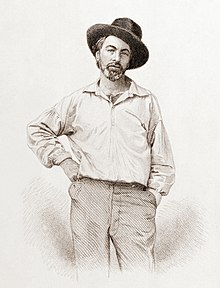
The title of the song is taken from Section 51 of the poem that eventually became known as  “Song of Myself” by Walt Whitman, although the line has been used by Bob Dylan himself (he quoted it in 2019).  And indeed others have used it about him quite often over the years to reflect the multiple versions of himself that Dylan has presented in his recordings and performances.

So the phrase is well known, and of course is used by many others as well.  Ed Young published the book “I contain multitudes” in 2016, for example, but it is nothing to do with Whitman or Dylan – that one is about microbes.

To me this performance, slowing the concert down so close to the start, is as much a strong statement by Dylan about himself and the never ending tour (the name he so fervently denies) as anything else, and its position here does suggest Bob wants to offer us a clear link between his vision of life and that of Walt Whitman.

Of course the approach to the lyrics is not that of Whitman, but we might pause for a second to remember the opening of “Leaves of Grass”, perhaps the most well-known Whitman work…

I celebrate myself,
And what I assume you shall assume,
For every atom belonging to me as good belongs to you.

I know from conversations that I’ve had that of course not everyone sees the link between those lines and the opening of “Multitudes” nor the link with the Whitman lines…

The smoke of my own breath,
Echos, ripples, and buzzed whispers
as being something Dylan could have been influenced by but it feels that way to me when I hear
I fuss with my hair, and I fight blood feudsI contain multitudes.
Plus of course I am not the first person to suggest there is a mix of playfulness and bitterness here.  Just remember the ending…
I'll keep the path open, the path in my mindI'll see to it that there's no love left behindI'll play Beethoven's sonatas, and Chopin's preludesI contain multitudes

If you have ever devoted a bit of your life to mastering just one of the 32 classic piano sonatas, or the 24 preludes I think maybe you’ll get this.  Unless you are an ultimate genius performer on the piano, working to perfect a performance of a single one of those pieces takes one into a new world.   On the other hand having achieved it one might also say, “It’s life and life only”.

Posted in Uncategorized | 1 Comment

High Water (for Charley Patton)15: “A roulette wheel rolling round in his head”

High Water (for Charley Patton) (2001) part 15

by Jochen Markhorst

XV       “A roulette wheel rolling round in his head”

I’m gettin’ up in the morning—I believe I’ll dust my broom
Keeping away from the women
I’m givin’ ’em lots of room
Thunder rolling over Clarksdale, everything is looking blue
I just can’t be happy, love
Unless you’re happy too
It’s bad out there
High water everywhere
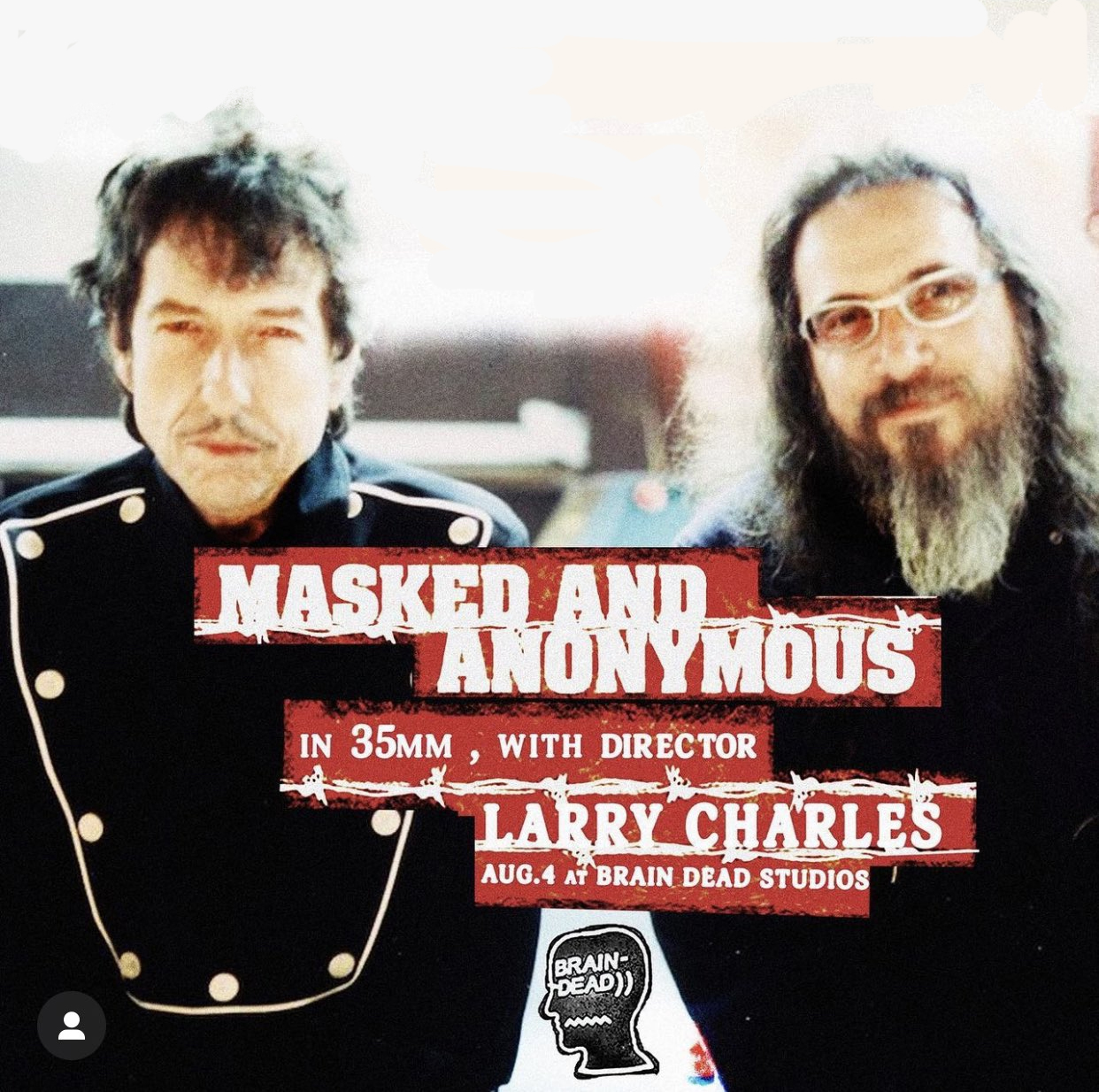
“He has these fragments, these bits rolling round in his head all the time and he’s constantly – almost like a roulette wheel – trying different bits together and seeing what happens.” Trev Gibb interviews director and screenwriter Larry Charles by phone in 2003 for the Masked And Anonymous Database (published in Isis #113, 2004). For a time, Charles is in the unique and enviable position of seeing Dylan creating right before his eyes, sitting with him at a worktable, being able to see and hear the cogs turning in Dylan’s head up close – during the period when Dylan is recording both “Love And Theft” and the film Masked And Anonymous. So Charles does have some authority and right to speak, he is sharp and eloquent, and fortunately, he is quite open about his Dylan observations in interviews.

Larry considers the trio Time Out Of Mind, “Love And Theft” and Masked And Anonymous as one Dylan period, similar to the born-again period and the electric period, and he does have a point. A point he can substantiate:

“He was working on “Love And Theft” at the same time and in fact I had the privilege of going into the recording studio and what happens is, a lot of lines that didn’t wind up in ‘Masked and Anonymous’, wound up in “Love And Theft” and vice versa. Again we’re mixing and matching and sort of making our own puzzle.”

… the similar method of work, then, the back-and-forth of usable lines, the “mixing and matching” of which we hear Larry give an example ten years later in that You Made It Weird podcast, 2014 (the I’m no pig without a wig line from the third stanza). But beyond that working method, Charles also sees a distinctive stylistic feature of this, let’s call it “puzzle period”: a kind of retro-quality, old-fashioned warmth, comparable to what in fantasy culture is called steampunk. “Quaintness”, as Larry Charles puts it;

“If you listen to “Love And Theft” it’s there too. And I think this is part of that same period in his work, which is the juxtaposition of the old and the quaint, and the old-fashioned with the post-modern. He’s trying to really juxtapose those forms and see what happens.”

An art historian with a red pencil would probably put one or two crosses, but we get what Charles means; postmodernism without the irony and without the anarchy, something like that. After all, Dylan has been mixing and matching since the 1960s, but indeed, in those years, in songs like “Highway 61 Revisited” and “Gates Of Eden”, qualities like irony, anarchy and surrealism overshadow the warmth, the “quaintness”. From the late 20th century, Dylan tends towards the style that Larry Charles tries to capture in words, a style that can be illustrated with an image like early Roman Kings in their sharkskin suits, bowties and buttons, high top boots, with a mise-en-scene like Charles Darwin trapped out there on Highway Five. Which, incidentally, is just as true of the sound, although Charles doesn’t seem to mean that. Dylan has turned away from searching for the more chilly mercurial sound, finding his Holy Grail now in the sound of these old blues recordings, Little Walter, guys like that, as engineer Mark Howard explained to Uncut in 2008.

The fragment, the bits rolling around in his head as Dylan conceives this final couplet is, of course, effortlessly identified by every music fan:

I’m gettin’ up in the morning, I believe I’ll dust my broom
Girlfriend, the black man that you been lovin’, girlfriend, can get my room

… Robert Johnson’s immortal, indestructible “I Believe I’ll Dust My Broom” from 1936. And otherwise the standard Elmore James made of it, preferably the 1951 recording, which opens with practically the same words:

I’m gettin’ up soon in the mornin’, I believe I’ll dust my broom
I quit the best gal I’m lovin’, now my friends can get my room

Robert Johnson, by the way, is not actually the real father – he in turn borrowed the phrase from Kokomo Arnold’s 1934 “Sagefield Woman Blues”, and Kokomo had probably heard it from the Sparks Brothers, in 1932’s “I Believe I’ll Make a Change” or Jack Kelly’s 1933 “Believe I’ll Go Back Home”, all of which, apart from the shared use of dust my broom, also have a similar melody to Johnson’s monument.

But Johnson singles out the phrase and elevates it to a title, and – obviously – has his own magic to turn it into the better song. And, on a side note, in the centre of the manuscript we decipher, scribbled in blue in between, something with raining down in Arkansas – which seems to echo Johnson’s “Terraplane Blues” (I got a woman that I’m lovin / way down in Arkansas), suggesting that at this stage of the creation Robert Johnson indeed is haunting Dylan’s mind.

Dylan himself performed “Dust My Broom” one single time, and seems to use the standard set by Elmore James as a template. Which is also the version DJ Dylan plays on his radio show (episode 50, Spring Cleaning, April 2007), introduced with the appreciative words “Speaking of brooms… here we have Elmore James with a song that’ll drive you ’round the bend.”

Elmore’s golden find, of course, is the opening lick, which has become the Mother Of All Blues Licks. The lick also dominates Dylan’s one-off performance 12 November 1991 in Detroit. For this one song a local axe grinder, the rather unknown guitar player Tino Gross is invited on stage, and he indeed duly discharges his duty to play the role of Elmore James. A tip from Detroit’s hero The Nuge Motor City Madman Uncle Ted Nugent apparently; “Thank you Ted Nugent,” Dylan says without further comment after the final chord.

It made a lasting impression on Tino Gross. A blues blogger asks him almost a quarter-century later if he could name a “life-changing” experience. Tino, who after all has also played with men like Bo Diddley, RL Burnside and John Lee Hooker, doesn’t have to think twice:

“For me personally, it was being invited to play guitar with Bob Dylan at a sold out show in Detroit at the Fox Theatre. I’ll never forget that night as long as I live. I am a huge Dylan fan, so to be able to play with him was amazing! It doesn’t happen everyday.”
(Michael Limnios Blues Network, Blues.Gr, 14 December 2014).

After this copied classic as an opening line the “roulette wheel” in Dylan’s head, as Larry Charles calls it, stops in a surprisingly predictable place: the word “broom” triggers the nineteenth-century country song “The Bald-Headed End Of The Broom”, from which Dylan copies as verbatim as from Robert Johnson’s song:

Boys I say from the girls keep away
Give them lots of room
When you’re wed they will hit you on the head
With the bald-headed end of the broom

Registered in the Roud Folk Song Index as “Baldheaded End of the Broom” and attributed to an American songwriter, one Harry Bennett, who released it in 1877 as “Boys Keep Away from the Gals”. But an educated guess is that Dylan heard his old mate Martin Carthy’s version shortly before “High Water”. Carthy, from whom Dylan learned “Scarborough Fair” in a grey past in London, and to whom we thus owe “Girl From The North Country”, released the album Broken Ground with The Watersons in 1999, featuring the infectious “The Royal Forester / The Bald Headed End of the Broom”. It is a highlight of the album, and so is rightly selected two years later for the collector The Carthy Chronicles, which hits shops on 10 April 2001 – five weeks before Dylan records “High Water”.

“He has these fragments rolling round in his head all the time and he’s constantly trying different bits together and seeing what happens.”

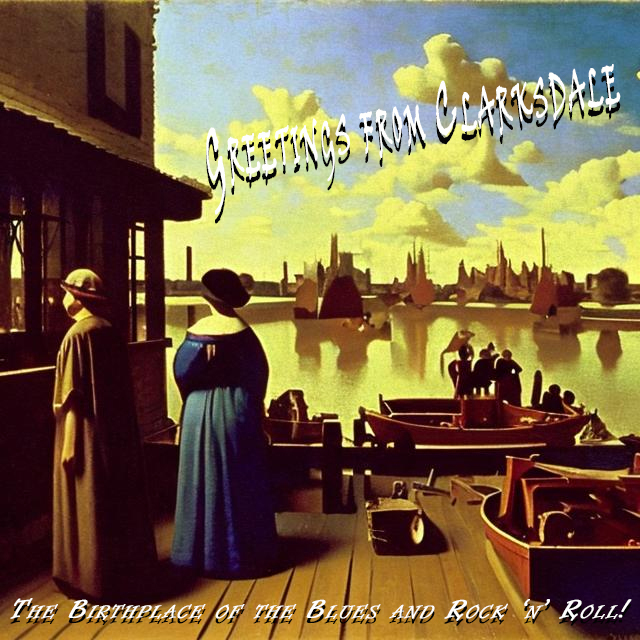
To be continued. Next up High Water (For Charley Patton) part 16: Greetings from Clarksdale

—-

Jochen is a regular reviewer of Dylan’s work on Untold. His books, in English, Dutch and German, are available via Amazon both in paperback and on Kindle:


Posted in Uncategorized | 4 Comments

A Dylan cover a day: “Up to Me” and a return to earlier days

By Tony Attwood

There are of course a number of songs by Dylan that I particularly love, but for which I can find no cover versions – for reasons that I cannot fathom.

And there are some wherein I can only find one cover which I feel is worth presenting in this series.   And such is the case here with “Up to Me”.

Quite why other artists haven’t covered the song (or perhaps it should be why other artists have covered the song but I can’t find them freely available on  the internet) I don’ know (although I’ll to take a guess at the end of this little piece) but if you can find other cover  recordings of Up to Me which take us somewhere new, please do say – I really do like this song.

What we get here is a very different impression of the song from Dylan’s original, and in a real way the illustration above reflects this.   The guitar and percussion suggest that the “up to me” is related to a fight.  Not a literal fist fight, but a real demand on the singer to get things sorted out.

I guess Bob didn’t use the song on the album, (and indeed why others haven’t covered it), is because it utterly strophic – meaning to say that it is just verse, verse, verse, and that gives the recording artist a real problem.   It is hard to keep attention unless the lyrics really grab the listener.

So it is worth seeing how Bob solved the problem…

What he does is emphasise the lyrics so we really can pick them up first time around – not something that is always the case.     The point is that since there is only the acoustic guitar and the bass guitar providing the accompaniment, and with the lyrics being clearly sung, almost occasionally declaimed, that is where our attention has to go.  There is nowhere else to listen.

There is also the point that Bob probably dropped the song because it has overlaps with the masterpiece of “Tangled up in Blue”.  But we should also note that what he does here is take the song slowly and with such clear declamation that we get all the lyrics first time around.

We do have copies of several takes of the song including one which is labeled “take 2 remake 3” but the difference between the takes is small, suggesting that Bob couldn’t find any significant alternative way of re-working the piece.   Here is the faster version…

And Bob’s clearly trying through these different versions to overcome the inherent issue of the song.  Hence, presumably, the lack of performances.  He wasn’t sure he could hold the audience’s attention through verse after verse after musically indentical verse.

The melody too is a problem, in that it is so unvaried, as the lyrics just move on and on as a set of un seemingly unrelated reflections, many of which are hard to unravel.   What are we do make of….

 We heard the Sermon on the Mount and I knew it was too complex
It didn’t amount to anything more than what the broken glass reflects
When you bite off more than you can chew you pay the penalty
Somebody’s got to tell the tale, I guess it must be up to me

followed by

Well, Dupree came in pimpin’ tonight to the Thunderbird Café
Crystal wanted to talk to him, I had to look the other way
Well, I just can’t rest without you, love, I need your company
But you ain’t a-gonna cross the line, I guess it must be up to me

So why am I bothering in a series of articles with a piece where we only have one cover?  Several reasons.  One is I do like the song with its incredibly dense set of images pouring one over the other, unrelentingly.

Another is that I am fascinated not only by the songs people choose to rework as cover versions but why some songs get left behind.    Although here I think the answer is the same as the reason why Bob dropped the piece from the album and didn’t perform it: the audience will just get bored with verse after verse.

But just because Bob drops a song and not one else takes it up, doesn’t mean the song is not good: not at all.  If you have been following my rambling series from the start [and I am overwhelmed by your kindness if you have] you will know that sometimes I have highlighted songs by Dylan which are indeed obscure and which have only one or two covers, but wherein the cover version is an utter, utter masterpiece – at least in my opinion.

The overwhelming example came early in the series with “Angelina”.   And a) because I love the song so much and b) because hardly anyone else ever mentions it, and c) because I’ll jump at any opportunity to play this cover version again, here it is.   Just because hardly anyone wants to cover a Dylan song, that doesn’t mean it’s a poor or difficult song.

Posted in Uncategorized | 1 Comment

Dylan: The lyrics AND the music. Abandoned Love

By Tony Attwood

Two versions of “Abandoned Love” exist – some rave over the Other End version, while others seem very satisfied with the Biograph version.   Personally, I am more than happy with the Biograph version, but I’ve also included below the “Other End” version in case you need a reminder…

However my main point here is to consider the song from the perspective of the “music and the lyrics” theme.

One of the first things most musicians recognise in the song is that the chords are not that usual or complex but at first hearing they appear so.   The chords run…

G              D           Em
I can hear the turning of the key
C               G                        D
I've been deceived by the clown inside of me.
Bm                                        C
I thought that he was righteous but he's vain
 G   G7          D      Em  C               G  
Oh, something's telling me I wear a ball and chain.

which is interesting but not that unusual – although the chords are spiked up a little with occasional passing notes, and in the Studio Outtake version by the violin’ counter melody.

In fact although the song is in G, it confuses us by ending the first line on E minor, and then feels as if it has modulated to D by the end of the second line.  The third line leaves us uncertain (which is a good musical reflection of the lyrics) and the six chords of the fourth line are used to gake us back to the key of G – where we started.

That is all very unusual for any rock or pop song, but what really gives this song its unique musical element is the combination of these changes with a particularly interesting melody. The melody thus evolves from the sequence of the chords (being in the key of G for example but then ending the first line on E minor is unusual – not unique but unusual).  Equally the fourth line with five chord changes is again unexpected), and accompany the unexpected image of the ball and chain.

And all that is before we consider the melody – and the counter melody played throughout by the violin, plus the occasional vocal harmonies behind Dylan (not a very Dylan-ish thing to do).

But if we just consider the melody, it is varied, but retains a gorgeous shape, but also incorporates that unexpected hold on the last word of the third line – another very unusual effect.  And thinking of those third lines we find that they are not actually key lines in the song.  Some of them are, others and just fill ins, and I suspect it is that which, among other things, made Bob decide that the song hadn’t quite realised its fullest potential.

Here are all the third lines

  • I thought that he was righteous but he’s vain
  • The Spanish moon is rising on the hill
  • I love to see you dress before the mirror
  • But me, I can’t cover what I am
  • How long must I suffer such abuse?
  • The treasure can’t be found by men who search
  • My head tells me it’s time to make a change
  • Won’t you descend from the throne, from where you sit?

It would be very hard to make the music always fit with such a diverse array of thoughts in those third lines.  For that powerful all-important third line is sometimes found with loving lines “I love to see you dress before the mirror” but other times the ultimate negative, “How long must I suffer such abuse?” or the highly enigmatic: “The treasure can’t be found by men who search.”

In short it is great fun and gorgeous music, but it just doesn’t feel right, quite possibly because it is trying to do several things that pop and rock music isn’t actually built for.  Later in his songwriting career, Bob would have found a way to resolve this, but instead he abandoned the piece.

And I think in part he also abandoned the song because that third line musically does gives a problem with held vocal note.  It is interesting for the first few verses, but here we have seven musically identical verses, and for that third line to work musically and lyrically the lyrics really do have to have a consistency in that third line.

Yet what we find in just looking at the third line is a description of her which is of pure desire (“I love to see you dress before the mirror”) but which becomes, inexplicably I feel, “How long must I suffer such abuse?” and then ends with a criticism of her arrogance with “Won’t you descend from the throne, from where you sit?”

Now of course in many relationships each partner has mixed emotions – loving the person but disliking strongly one or two things she/he does, is common.  But that doesn’t seem to be Bob’s theme here.   He is writing about the entanglement of contradictory emotions – and he is doing it with a piece of music that doesn’t change, verse by verse.

Thus I see it as a great theme to try (in my opinion, and of course I am just the outsider looking in) but it is, I think, almost impossible to do within a strictly strophic format (strophic being the verse, verse, verse… sequence that we find in many folk songs).

And this highlights what for me is the contradiction of the song.   The melody and accompaniment are very interesting and unusual, and the ending of the third line in each verse is singular – but the story in the words, although coherent, takes us on a journey which the music doesn’t reflect.

What is particularly interesting is that although the music itself (and here I don’t mean the performance, but the actual music) doesn’t change between the two versions but the lyrics do – and this is where problems can arise if the song is dealing with complex, challenging feelings.

The Bitter End version included a verse that was dropped

I can't play the game no more, I can't abide
by their stupid rules which kept me sick inside
They've been made by men who've given up the search
Whose gods are dead and whose queens are in the church.

And also included as the last two verses

Send out for Saint John the Evangelist
All my friends are drunk, they can be dismissed.
My head says that it's time to make a change
But my heart is telling me I love ya but you're strange.

So step lightly, darling, near the wall
Put on your heavy make-up, wear your shawl.
Won't you descend from the throne, from where you sit?
Let me feel your love one more time before I abandon it.

In the alternative version, these became

We sat in an empty theatre and we kissed
I asked you please to cross me off your list
My head tells me it's time to make a change
But my heart is telling me I love ya but you're strange.

So one more time, at midnight near the wall,
take off your heavy make-up, and your shawl.
Won't you descend from the throne, from where you sit?
Let me feel your love one more time before I abandon it.

The fact that Bob Dylan could change “Put on your heavy make up” to “Take off your heavy make up” might seem a trivial alternation to a line, but it actually reflects quite a profound alternation in his vision of the woman.

But overall I think (and as ever this is just me, as ever, reacting to the music and lyrics) this change, trivial though it might seem, reveals an uncertainty over the essence of the woman at the heart of the storyline.   Is she heavily made up to disguise what she is, or is the singer asking that she should disguise herself so that she does not reveal what she is.

Musically it is a great piece, but that music, being the ever-repeated four lines, comes with constrictions, and that I think is what Bob felt finally defeated the song.

For myself (and again I stress, as ever this is just me), I came to this song today with a deep and positive feeling for it as a forgotten gem.   But, as is the nature of writing these commentaries (although it may not always seem so to you as a reader!) I do listen to the song repeatedly before and during the writing of my little piece.   And that is where the song breaks down.

So I end up thinking, there is not enough variation in the music to sustain the expression of the emotion in the lyrics.   Indeed the music has no variation within it, which I think is needed for complex expressions within a song.   To give an extreme example consider, “The country music station plays soft, But there’s nothing, really nothing to turn off”.   In Visions, there is a consistency of the images throughout and they are totally in tune with the music – but that music varies even to the extent of the last verse having extra lines in it.

In Abandoned Love that sort of variation is not achieved, although the lyrics seem to demand it.   The music is bouncy and fun, while the lyrics are attempting, it seems to me, to take in the individual’s dislike of a woman’s changing views, and that is very hard if the music doesn’t change.

It might have been that with Abandoned Love, Bob did realise, as all songwriters do, that the constrictions of a strophic song (ie one that is verse, verse, verse) but with the end line being repeated or near repeated, there has to be an absolute consistency between the start and the end, and a consistency of image.

Abandoned Love is dealing with the incredibly complex issue of self-deception, but with a bouncy fun tune that repeats and repeats.   If Dylan had tried this a few years later, he more than likely would have made a huge success of the song, but as he was still learning what was, and what was not possible, I don’t think at this moment he could find the way through.

Which is not to say that other writers were like to be more successful, but rather to point out that just because Dylan had written “Visions of Johanna” ten years before Abandoned Love, it didn’t mean that every composition would be a masterpiece.   This song is fun, but it was, and remains, a spot of light relief, a curiosity, from a master of the art who had long before soared to the highest peaks of both music and lyrics.

Posted in Uncategorized | Leave a comment

The Never Ending Tour Extended: Thunder on the Mountain

The Never Ending Tour Extended: Comparing recordings of Dylan performing his own compositions across the years.  This series uses by recordings selected by Mike Johnson in his inestimable series The Never Ending Tour, and looks at how those performances change as time goes by.   The selection of songs from the series, and the commentary is by Tony Attwood.

Thunder on the Mountain was performed 739 times by Dylan between 2006 and 2019 – making it the 21st most popular song in terms of live performances.   Here we pick it up in 2006:  Enter Modern Times

This is a straight performance of the song from its singular introduction through to the verses, changing only when we get to the short guitar solos between verses. It is a real rocker where the lyrics don’t seem to matter that much – which is a shame because there really are some strange but interesting concepts in this song…

Gonna raise me an army, some tough sons of bitchesI'll recruit my army from the orphanagesI been to St. Herman's church, said my religious vowsI've sucked the milk out of a thousand cows

By 2009 – Foundations: the raw and the real

Yes the introduction is still the same but the pace has been taken up a bit, and Bob sounds  little more excited by the whole event.   There’s energy everywhere, and the instrumental breaks now have much more impact – they sound like they are there for a real reason, rather than just being fillers.

In fact, I get the feeling Bob is wanting us to realise that this is far more than a 12 bar blues – it is a fast rocker with some really freaky lyrics and indeed it is now impossible to sit still while this is playing.   If there were to be a single word for this performance it would have to be “enthusiasm”.   Or a second word: “gusto”.

And when have we ever heard Bob sing a line and drop his voice by an octave for the follow up line (if that actually is him and not a member of the band with lines like “Go up north).   Plus I am not sure how many times I have heard the Dylan band rock like it does in the last couple of minutes of that performance.

2012: The Ivory Revolution Continues

Amazingly Bob and the guys were then able to build on the 2012 version, and so now we really get to somewhere else.  Bob meets boogie-woogie… well, almost.

The whole introduction is gentler, with subtle differences from the recorded original.  And the thing we recognise is the double bass playing a really interesting boogie-woogie set of patterns.   Thus this is now totally different from what we heard in 2009.

And just listen to that instrumental break!  After that Bob changes the tune too – we are half way into contemporary jazz.   OK it’s not the Modern Jazz Quartet, but I can almost imagine Bob having listened to them while thinking up this arrangement.

What strikes me at this moment is that having the luxury of listening to the same song played across the years we can appreciate the enormous leaps Bob makes.   There is even a simple piano solo after four minutes which really is unexpected.

So by the time we get to “Make a lot of money” I’m really buying into this big time.  As we approach six minutes I think I’m in a sophisticated jazz cafe, and I mean if you suddenly came in at around 6 minutes 25 seconds, would you think this was a Bob Dylan band performance?

To finish this episode here is a recording from 2014: The survivors

We now take the 2012 version, and take the essence of that approach and yet reign it in somewhat to take us back into the rock edition, but without losing all the smooth jazz elements of that earlier version.

What I really love here is the enthusiasm.  There is no need to push us into rock n roll, we know what that’s about.  This is a smoother reflection without going totally into the night club.   Indeed if I was going to make a film of this I’d have the band outside the nightclub in daytime, on the street, as people walk by just glancing at the band as they walk on.

And that works for me because this is about the different elements that there always are in life, each colliding with each other.  People going about their own lives, the band playing its music, Dylan providing his often disconnected lyrics.

Indeed I love this version – if I could make an album of my favourite recordings from the Never Ending Tour series, this recording would be there, most certainly.   Just listen to that final verse, and what then follows after the five minute marker.

Gonna make a lot of money, gonna go up northI'll plant and I'll harvest what the earth brings forthThe hammer's on the table, the pitchfork's on the shelfFor the love of God, you ought to take pity on yourself

Never has that song made more sense to me than in this wonderful performance.  Indeed “gonna take this performance and play it all day” seems about right.

Other articles in this series…

Posted in Uncategorized | Leave a comment

The Rough and Rowdy Ways Tour: Most likely you go your way and I’ll go mine


By Tony Attwood

This new series uses the recordings from beyond the Never Ending Tour, as prepared by Mr Tambourine.   You can hear the full set of recordings on this video with an index and links to all the songs here.  “Most likely” starts at around 5 minutes – I am hoping that just clicking on the start button will take you there, but if not use the time bar at the foot of the video.   (Sorry, I know a bit about music, but nothing about IT, but clicking on the Watch on You Tube button bottom left seems to bring the right result at my end.)

So looking at “Most Likely You Go Your Way” recorded at Moon Township, November 15, 2021) what we get is a straight rendition of the song preluded by a musical introduction, and thereafter an approach to the song which is sometimes more recital of the lyrics than singing. 

Indeed from time to time Bob’s recitation meanders away even from the timing of the rest of the band.  Which perhaps tells us in the clearest of terms that yes, everyone can do their own thing if they want.  Including Bob.

The one real innovation comes with

The judge, he holds a grudge
He’s gonna call on you
But he’s badly built
And he walks on stilts
Watch out he don’t fall on you
You say you’re sorry
For tellin’ stories
That you know I believe are true

If this is a commentary on something, I am not sure what – apart maybe from the notion that those who want to tell you what to do can suffocate you, even when you act in a way that tries to suck up to them.

The song has been performed 490 times since January 1974 – here it is from 2009 Rolling the Rock.


The key has changed but the tempo is the same.  And yet the question arises, has the music taken us any further forward?   I am not sure – for this to me sounds very much like the simple evolution of the song which begins with everyone thinking, “How did we do that before?”

What is particularly interesting is the lack of any lead instrumentation in the non-vocal part: very much a part of Dylan’s approach in earlier times. And so overall this sounds to me as if the break between the end of the Never Ending Tour in 2019, and the return with the Rough and Rowdy Ways tour in 2021, never really happened.  The NET has ended; off we go again.

The one big innovation from the original recording is the declaimed section of “The judge he holds a grudge” which really added a deep sense of sorrow and regret to the 2009 performance.   And the removal of that makes this much lighter.

So again I come back to the question what is Bob telling us?  (If anything – after all one can say, “it’s just a song”.   Well, if there is a message (and I do like messages) it is pretty much that he is continuing to do his own thing.   You can do what you like, and he’ll do what he likes, and he’s not taking any notice of the critics, commentators, columnists, and most certainly not of people like me (not that he knows I’m here, but you know what I mean).

Be yourself he said then, and that’s what he’s still saying now.  Those lines

The judge, he holds a grudge
He’s gonna call on you
But he’s badly built
And he walks on stilts
Watch out he don’t fall on you

are the constant warning from Bob in his songs.

Don’t let them get you.

Oh yes and whatever you were expecting on this tour – it’s what Bob wants to offer, not what the critics are demanding, and maybe what you want.  Or maybe not.


Posted in Uncategorized | Leave a comment

A Dylan Cover a Day: Unbelievable

By Tony Attwood

The song “Unbelievable” from Under the Red Sky only got 29 performances by Dylan across a 12 year period, and is I suspect largely forgotten, not least since the last public performance was 20 years ago.

But still at least it spawned three covers – one of which was featured in the original review of the song on this site, so it meets our minimum requirements, and off we go…

Blitzen Trapper is not a musician nor a band that I know but Wiki tells me that “Blitzen Trapper is a Portland, Oregon-based experimental country/folk/rock band”, and full credit to them for not just reproducing what Bob did, but finding something completely new which keeps my interest all the way through.   In fact I think there is more in this version than in Bob’s own recording.

If nothing else do listen to the rhythms behind fast 4/4 beat.   That’s not to say it is a great Dylan song, nor as it turns out the best cover version – but still there is more in it than I first realised.

Bettye LaVette of course we know well through these explorations, and she too finds energy and excitement in the song.   And just in case you think you’ve got the hang of it after the first minute, I would urge you to keep going; she and her arranger do have some fun with the piece.

At which point I felt it was worth going back to Bob’s original – not least for the extraordinarily silly video which takes the word “unbelievable” rather too literally and then maybe thinking they had not done enough felt they should throw in some gratuitous violence, while also taking the word “run” literally.   Not a prize winner.  In fact I don’t think it is worthy of even a modest Dylan composition, but I suspect the promotion company felt they really had to do something to boost the sales.

However that boost did come, from elsewhere.  This final version is by the Bavarian Bob Dylan tribute band “Dylan On The Rocks”.  For me, it’s the best of the lot – and that does indeed mean I prefer this to Bob’s own version.  Although maybe it is that video on top of Bob’s recording  that put me off.


Previously in the series

  1. The song with numbers in the title.
  2. Ain’t Talkin
  3. All I really want to do
  4.  Angelina
  5.  Apple Suckling and Are you Ready.
  6. As I went out one morning
  7.  Ballad for a Friend
  8. Ballad in Plain D
  9. Ballad of a thin man
  10.  Frankie Lee and Judas Priest
  11. The ballad of Hollis Brown
  12. Beyond here lies nothing
  13. Blind Willie McTell
  14.  Black Crow Blues (more fun than you might recall)
  15. An unexpected cover of “Black Diamond Bay”
  16. Blowin in the wind as never before
  17. Bob Dylan’s Dream
  18. BoB Dylan’s 115th Dream revisited
  19. Boots of Spanish leather
  20. Born in Time
  21. Buckets of Rain
  22. Can you please crawl out your window
  23. Can’t wait
  24. Changing of the Guard
  25. Chimes of Freedom
  26. Country Pie
  27.  Crash on the Levee
  28. Dark Eyes
  29. Dear Landlord
  30. Desolation Row as never ever before (twice)
  31. Dignity.
  32. Dirge
  33. Don’t fall apart on me tonight.
  34. Don’t think twice
  35.  Down along the cove
  36. Drifter’s Escape
  37. Duquesne Whistle
  38. Farewell Angelina
  39. Foot of Pride and Forever Young
  40. Fourth Time Around
  41. From a Buick 6
  42. Gates of Eden
  43. Gotta Serve Somebody
  44. Hard Rain’s a-gonna Fall.
  45. Heart of Mine
  46. High Water
  47. Highway 61
  48. Hurricane
  49. I am a lonesome hobo
  50. I believe in you
  51. I contain multitudes
  52. I don’t believe you.
  53. I love you too much
  54. I pity the poor immigrant. 
  55. I shall be released
  56. I threw it all away
  57. I want you
  58. I was young when I left home
  59. I’ll remember you
  60. Idiot Wind and  More idiot wind
  61. If not for you, and a rant against prosody
  62. If you Gotta Go, please go and do something different
  63. If you see her say hello
  64. Dylan cover a day: I’ll be your baby tonight
  65. I’m not there.
  66. In the Summertime, Is your love and an amazing Isis
  67. It ain’t me babe
  68. It takes a lot to laugh
  69. It’s all over now Baby Blue
  70. It’s all right ma
  71. Just Like a Woman
  72. Knocking on Heaven’s Door
  73. Lay down your weary tune
  74. Lay Lady Lay
  75. Lenny Bruce
  76. That brand new leopard skin pill box hat
  77. Lily, Rosemary and the Jack of Hearts
  78. License to kill
  79. Like a Rolling Stone
  80. Love is just a four letter word
  81. Love Sick
  82. Maggies Farm!
  83. Make you feel my love; a performance that made me cry.
  84. Mama you’ve been on my mind
  85. Man in a long black coat.
  86. Masters of War
  87. Meet me in the morning
  88. Million Miles. Listen, and marvel.
  89. Mississippi. Listen, and marvel (again)
  90. Most likely you go your way
  91. Most of the time and a rhythmic thing
  92. Motorpsycho Nitemare
  93. Mozambique
  94. Mr Tambourine Man
  95. My back pages, with a real treat at the end
  96. New Morning
  97. New Pony. Listen where and when appropriate
  98. Nobody Cept You
  99. North Country Blues
  100. No time to think
  101. Obviously Five Believers
  102. Oh Sister
  103. On the road again
  104. One more cup of coffee
  105. (Sooner or later) one of us must know
  106. One too many mornings
  107. Only a hobo
  108. Only a pawn in their game
  109. Outlaw Blues – prepare to be amazed
  110. Oxford Town
  111. Peggy Day and Pledging my time
  112. Please Mrs Henry
  113. Political world
  114. Positively 4th Street
  115. Precious Angel
  116. Property of Jesus
  117. Queen Jane Approximately
  118. Quinn the Eskimo as it should be performed.
  119. Quit your lowdown ways
  120. Rainy Day Women as never before
  121. Restless Farewell. Exquisite arrangements, unbelievable power
  122. Ring them bells in many different ways
  123. Romance in Durango, covered and re-written
  124. Sad Eyed Lady of Lowlands, like you won’t believe
  125. Sara
  126. Senor
  127. A series of Dreams; no one gets it (except Dylan)
  128. Seven Days
  129. She Belongs to Me
  130. Shelter from the Storm
  131. Sign on the window
  132. Silvio
  133. Simple twist of fate
  134. Slow Train
  135. Someday Baby
  136. Spanish Harlem Incident
  137. Standing in the Doorway
  138. Stuck inside of Mobile with the Memphis Blues Again
  139. Subterranean Homesick Blues
  140. Sweetheart Like You
  141. Tangled up in Blue
  142. Tears of Rage
  143.  Temporary Like Achilles. Left in the cold, but there’s still something…
  144. The Groom’s Still Waiting at the Altar
  145. The Lonesome Death of Hattie Carroll
  146. The Man in Me
  147. Times they are a-changin’
  148. The Wicked Messenger
  149. Things have changed
  150. This Wheel’s on Fire
  151. Thunder on the mountain
  152. Till I fell in love with you in the north of Norway
  153. Time Passes Slowly – just sit down and close your eyes
  154. To be alone with you
  155. To Ramona: unexpectedly yes!
  156. Tombstone Blues
  157. Tonight I’ll be Staying Here With You
  158. Too much of nothing
  159. Trouble as you have never been troubled before
  160. Tryin’ to get to Heaven
Posted in Uncategorized | Leave a comment

High Water part 14: Just grab something off the shelf

High Water (for Charley Patton) (2001) part 14

by Jochen Markhorst

XIV      Just grab something off the shelf

The Cuckoo is a pretty bird, she warbles as she flies
I’m preachin’ the word of God
I’m puttin’ out your eyes
I asked Fat Nancy for something to eat, she said, “Take it off the shelf—
As great as you are, man,
You’ll never be greater than yourself.”
I told her I didn’t really care
High water everywhere

To the millennials, it is what Neil Armstrong’s moonwalk is to baby boomers: Rafiki the mandrill on the protruding rock lifting the lion cub Simba high above his head to show him to the assembled animals on the savannah – the image is an identity-defining landmark, an unwearable childhood memory. The deeper layer beneath Rafiki’s action is not seen by millennials but is unmistakable to baby boomers and Generation X: Disney copies the equally iconic scene from the beginning of the first episode of the legendary, groundbreaking 1970s TV series Roots. The scene where father Omoro Kinte takes his just-born son outside, lifting him above his head, into the African night sky, and names him:

“Kunta Kinte. Behold… the only thing that is greater than yourself [he laughs].”

Omoro Names His Son:

You Are Only As Great As You Are (and any variation thereof) is, of course, a fairly empty slogan with high bumper sticker value that has been hijacked by self-help gurus and management book authors since the 1970s, but thanks in part to the staging, the breathtaking starry sky and our foreknowledge of the fate that awaits this cute little baby Kunta, we are still receptive to the suggested profundity of the cliché in this particular case.

Fat Nancy does not reach that level. Not only does her ludicrous nickname disrupt our receptivity to the supposed profundity of her words, the staging is also soberingly banal. The first-person has to get up to grab a snack or something from the shelf, and then, as a bonus, gets snapped at with the astutely intended aphorism “As great as you are, man, you’ll never be greater than yourself” – driven, apparently, by a need on Fat Nancy’s part to put the first-person in his place.

This is the third time in Dylan’s oeuvre that an assertive bar lady is given a supporting role. The first is the lady in a topless bar who picks up the protagonist and makes such a smashing impression with the words of a thirteenth-century Italian poet, “Tangled Up In Blue”, 1975. Twenty-two years later, her colleague in some Boston restaurant gets the spotlight, with word choice (She studies me closely versus She studied the lines on my face, notably) and plot suggesting that the protagonist has the same lady as in “Tangled Up In Blue” in his mind’s eye (“Highlands”, 1997). And four years after that, in this sixth verse of “High Water”, the lady in the tavern is then given a name, “Fat Nancy”, and there is yet another suspicion of déjà vu. The tone, this time.

Each time, the protagonist has a laborious, stumbling dialogue with the lady. In Tangled, the first-person can only mumble unintelligibly at a direct, simple question like, “Don’t I know your name?” and remain uncomfortably silent at an inviting opening like, “I thought you’d never say hello”. In Boston, like in a Kafka story, the conversation stumbles from denial to misunderstanding to rebuttals and back again (“A soft-boiled egg, please.” “We’re out of eggs.” “Make a portrait of me.” “I don’t have paper,” etc.), and that’s also the pattern of this short interlude in “High Water”.

Thanks to published manuscript versions, we know that Fat Nancy’s aphorism is originally a revision in the third stanza, and put there in James Joyce’s mouth. At least, we see added above and between the partly crossed-out black lines in blue:

James Joyce just walked in the door like he’d been in a whirlwind
He said I believe that as great as you are, you’re never

For Dylanologists, it is remarkable. After the sinner’s prayer, which appears in this same third stanza of the manuscript, surviving the initial shuffling but eventually disappearing only to be resuscitated eight years later on Together Through Life, “James Joyce” is also discarded again and will also not reappear again until Together Through Life (in “I Feel a Change Comin’ On”; I’m hearing Billy Joe Shaver / And I’m reading James Joyce).

This back-and-forth shuffling of remarkable verse fragments and notable names from one verse to the next, from one song to the next, and eventually even from one album to the next, does put the sought-after coherence somewhat into perspective. In self-analyses, Dylan has claimed for a couple of decades now that the whole is bigger than the sum of its parts, and in 2020 he even chided interviewer Douglas Brinkley for taking one part out of context. Still, Dylan himself appears to have no problem at all with it in the creative phase; taking both “You’ll never be greater than yourself” and “James Joyce” as well as “sinner’s prayer”, to name just three examples, out of its original context, only to repurpose it in a completely different, utterly incomparable new context.

Which, reasoning back circularly, in this Fat Nancy interlude could ironically be precisely the song poet’s underlying by-play.

“I need something to sing.”
“Just grab something off the shelf – it’s all completely interchangeable anyway.”
“I really don’t care about that.”

Unlikely, though. Text-internal circuits in which Dylan performs something like analysis on his own creative process would be highly atypical; too laborious and even smelling of arrogance and complacency – no, Dylan is allergic to that. The decisive factors for content and word choice of this verse seem to be first and foremost: pleasure in wordplay and euphony. Demonstrated among other things in the choice of the name “Fat Nancy”: a name that could just have been chosen by a young 1967 Dylan in the Basement, merrily, carefree and nonsensically juggling names like “Silly Nelly”, “Moby Dick”, “Skinny Moo” and “Half-track Frank”, shaking colourful protagonists like Tiny Montgomery, Missus Henry and Quinn the Eskimo out of his trouser leg. Naming the big dumb blonde from “Million Dollar Bash” Fat Nancy would fit in seamlessly, at any rate.


To be continued. Next up High Water (For Charley Patton) part 15: “A roulette wheel rolling round in his head”


Jochen is a regular reviewer of Dylan’s work on Untold. His books, in English, Dutch and German, are available via Amazon both in paperback and on Kindle:


Posted in Uncategorized | 1 Comment

The Lyrics and the Music: Tangled up in blue


By Tony Attwood

Tangled up in Blue from Blood on the Tracks is the fourth most played song by Bob Dylan on tour, having been played over 1600 times on stage between 1975 and 2018.  And I suspect most of us would say, “quite right too”.  It is a staggeringly brilliant song, and a unique composition.

But as ever with Bob Dylan, most reviews of the song have focussed on the lyrics, and here again I suspect most people would say “quite right too” in terms of its acceptance and longevity.

Now the lyrics are attractive not least because they are so confusing from the off…  If I may remind you…

Early one morning, the sun was shiningI was laying in bedWondering if she'd changed it allIf her hair was still red

Her folks, they said, our lives togetherSure was gonna be roughThey never did like mama's homemade dressPapa's bankbook wasn't big enough

And I was standing on the side of the roadRain falling on my shoesHeading out for the East CoastLord knows I've paid some dues getting throughTangled up in blue

We have of course moved within the space of one verse from laying in bed early in the morning with the sun shining, to standing in the rain at the side of the road, without any attempt at explanation.

The question is how can the music reflect these seismic jumps without doing the obvious and having huge bumps in the music?  If you need reminding of the original and want to play it while reading it is here.

What Dylan does musically is set us up for this alternating vision of life by opening with the rocking two chords played very gently.   This opening really does reflect the relaxed lying in bed – and there is a very gentle percussion in the background.  We could lying in bed too…

But then as we get to the jump where he is no longer lying in bed but standing on the side of the road, the percussion ups it a gear to announce we are in a different scene.  Dylan’s voice takes on a greater level of urgency too.  And in this way although the musical background stays the same there is enough change to give the music a sense of that jump from one place to another.

Then we have the instrumental pause, which is a sort of retreat into the earlier reflections and we are back with the first part of the next verse and the reflective “She was married when we first met”.  The pattern is then repeated throughout the song.

But now his voice rises with “We drove that car as far as we could, abandoned it out west” (which is a pretty dramatic thing to do – at least for most of us who have worked hard and saved money to get a car, and never ever abandoned one – I don’t know what happens in the States but in the UK, abandoning a car is a fairly serious offence, and with all the serial numbers on the engine and bodywork as well as the number plates, it is certain you will be caught).

So what Bob has done here is, he has taken us into the dramatic, in the first part of the verse, and now in the second part as the percussion ups its level once more, we get

She turned around to look at me
As I was walking away
I heard her say over my shoulder
"We'll meet again someday
On the avenue"
Tangled up in blue
The drama therefore is not the ditching of the car (which I think it would be for most people), but her simply walking away.   And walking away where?   Somewhere “out west”.  The image (at least to a UK resident) is this is somewhere remote – and a long way away.
Then it all happens again, although the difference between the two parts musically is reduced, it is still there.  The first part of the verse is
I had a job in the great north woods
Working as a cook for a spell
But I never did like it all that much
And one day the ax just fell
So I drifted down to New Orleans
Where I lucky was to be employed
Working for a while on a fishing boat
Right outside of Delacroix
So he’s rambling on just moving from job to job.   But now the second part of the verse gives a suggestion of the slightest sense of… well if not menace, then uncertainty.
But all the while I was alone
The past was close behind
I seen a lot of women
But she never escaped my mind
And I just grew
Tangled up in blue
So it continues verse after verse – the verses in two parts, and the music subtly different between the two parts.   By the last verse, Bob is more energetic with part one.  He is determined, and he expresses that in the voice, but that relaxed music makes us think this is really just a change of vision, not a change of determination or willingness to get up and go.  He wants to go back again – but really is he going to do it?   I get the impression of a guy saying “This time I really am going to…” but we know he won’t.
So now I'm going back again
I got to get to her somehow
All the people we used to know
They're an illusion to me now
Some are mathematicians
Some are carpenter's wives
Don't know how it all got started
I don't know what they're doing with their lives
And then we find the final twist, because although the music once again energizes itself a bit more for the second part of this verse, we find out that for all his engagement in moving on, he hasn’t got anywhere.   He has moved on physically and that is reflected in the music, but in himself, he hasn’t changed at all.
But me, I'm still on the road
A-heading for another joint
We always did feel the same
We just saw it from a different point
Of view
Tangled up in blue

Thus those two sections of the verses just keep us on keeping on.   The second part is where the action can take place… but in the end it doesn’t, which is why we constantly come back to the more relaxed, less energised part one.

The difference between the opening eight lines, and the last five, signified by the slight rise in musical energy and the percussive introduction of the last five lines, is subtle.   Had it been aggressive and overt it would never have worked.

But it does here.  It works brilliantly because the music so perfectly symbolises that the singer, for all his bravado about moving on, for all the upping of the energy, is still stuck.  The music always comes back to where it started.

Of course, the lyrics are excellent, and most of us I am sure can recite them by heart, but if Dylan had not got that subtle musical difference between the first eight and the last five lines of each verse, it would not have become the work of genius that many of us feel it to be.

And there is one final point: the relaxed section is eight lines, the energised section is shorter.  He really is tangled up in blue – most of the time.  It is just the occasional burst of energy that gets him going, but in the end he always slips back.

Posted in Uncategorized | Leave a comment

The Never Ending Tour Extended: Honest with Me – 2001-2017


Comparing recordings of Dylan performing his own compositions, across the years.

In this series we look back at recordings presented by Mike Johnson in the Never Ending Tour series of articles (there is an index to that series here).  Links to previous articles in this “Extended” series are given at the end.  The selections and comments are by Tony Attwood.

“Honest with Me” was played 739 times between 2001 and 2019.   We picked it up for the first time in 2001 in More power, wealth, knowledge and salvation. it is a real bouncy rocker to the format of the old 12 bar blues – although of course very much extended.  And in the opening versions it does sound very much like the recording from “Love and Theft”.   Although it does also feel to me that Bob is looking for ways to make something more of it as he goes along.   He clearly loves the piece (739 performances after all) and he is extending it somewhat: its a minute longer than the original recording, and that is accounted for by the additional instrumental break.

So off we go, and I would urge you please to dip into these recordings even if you don’t play them all, because this really is a journey worth contemplating.

2001: More power, wealth, knowledge and salvation

OK, this is fairly straightforward reworking of the song for the live performance with a touch of extra emphasis on certain words.  But it is the song that we know.

So let us take a leap forward to 2006 – and wow what a difference the years have made.  It is still the old 12 bar blues of course, but the signature guitar part has gone, except for the link between the verses.   Now the lyrics are a growl – and that seems to me to be a really good re-consideration of the song by Bob.  Just look at the opening lines (if you don’t already know them by heart)…

Well, I’m stranded in the city that never sleeps
Some of these women they just give me the creeps
I’m avoidin’ the Southside the best I can
These memories I got, they can strangle a man

And then while you are listening, please do focus on the instrumental break which starts around 4’15” – that really emphasises that we are now into a totally different interpretation of the piece.

2006:   Walking through the Cities of the plague

All of which raises the issue of where would Bob go next?  Would he be satisfied with this major re-working of the song, while retaining its essence as an extended 12 bar blues?   (Incidentally, I would urge listening to this recording all the way through – the ending in which the familiar descending chord line is reversed is unexpected and very interesting).

2011

So let us leap forward to 2011:  I lit the torch and looked to the east

There are changes to the way Bob sings this time, with occasional extra emphasis on the last word of some lines.  For me the instrumentation has now lost its edge – there is a clear attempt to do something different with the song, but it’s not quite there.   Sometimes this does work as the break between the verses shows, but the lack of a clear lead guitar contrast with the vocal lines leaves me feeling that an old favourite has lost its edge.   There are occasional extra chord changes too, but I get the impression of it being a bit of a mess, due to uncertainty of exactly what else can be done….

Except that at 3’30” we get a total diversion from what has gone before with a different sort of instrumentatal break.   However then it is back to more of the same – although there is another instrumental variation at around 4’45”.  It’s interesting, but is it enough to sustain our interest in a song we’ve heard so many times before?  Or is there a shortage of ideas?  Or indeed are there more ideas to come?

2013: Softly softly golden oldies

Yes, softly softly indeed as Mike called the whole episode.   The piece is shorter, the band’s part is reduced, and Bob is almost talking to the audience – telling them the song.   Suddenly my faith in the piece is refreshed; there is something so interesting in the way Bob delivers the line, with the band keeping the “temperature” of the piece right down, although the speed is there.

Now I have been commenting on the instrumental breaks as I go, but just listen to what has happened now at 2’40”.  The whole piece is taken down; there is no shrieking guitar solo but a gentle reconsideration of the piece.   There’s another one at the four minute mark.

This is one of those re-workings that always reaffirms my faith in Bob Dylan, musical arranger.   He knows the song inside out; he has performed it so many times… and yet he can still transform it into something quite new.   I am so glad this transformation has been preserved; to me it is an important musical document, for without this, and the other recordings we’d just have a few comments as to how Bob changed the songs as he went.  Now we can hear just how much.

2017:  Songs on the rebound

This is the final recording we have of the song – and the sharp and fresh opening tells us Bob really has done a further reworking of it, perhaps reconsidering the whole journey the piece has been on.   Still a 12 bar blues – but with so many changes, it really is refreshing – it is almost like a new song.   Certainly, the addition of the unexpected non-blues chord in the chorus really works.  Even the elements of Little Richard style performance on the piano are an interesting surprise!

For me I am back to a Dylan recording that I really want to listen to, and this is one of those occasions where I am so, so glad we can trace the changes that Dylan has been able to put into a song that he obviously knows inside out.

It is a much shorter and sharper song as well: cut down to four minutes to make the strongest possible impact.

A great journey, and great fun.

Other articles in this series…

Posted in Uncategorized | Leave a comment

The Rough and Rowdy Way Tour: 2021.

By Tony Attwood

Recently Mr Tambourine wrote to Untold Dylan presenting his latest project: an audio of the Rough and Rowdy Ways Tour.   He kindly gave me free rein to present it in any way I wanted.

I’ve consulted fellow writers and fans, but none of us really can see what we can do other than offer you the full programme along with Mr Tambourine’s opening notes….

So here we go

Mr Tambourine: Hello everyone. I wanted to present to you what I’ve been working on for a while now. Not long ago, I set out to do something that was a dream of mine for so long. It’s nice to finally be able to share it with all of you. I wanted to cover the entire RARW tour from beginning to end, which is why I began a project I’m eventually going to complete called “Searching The World Over”, which will be a summary of the entire 2021-2024 RARW tour.

I knew this wasn’t going to be a one person job, so I figured I needed to share this journey with another compilation maker. I managed to find help in one of my dear subscribers that goes by the name of bollykecks – who not long ago started a channel of her own. If you ever have the chance, please subscribe to her channel. You won’t be disappointed. You’ll be supporting a very good person, if anything. I want to take a chance and thank bollykecks for her wonderful energy, dedication and time while we were working on this project so far. 

Tony: Here’s the index for the opening 17 songs…

  • 01. Watching The River Flow (Columbus, November 6, 2021) 00:00
  • 02. Most Likely You Go Your Way (Moon Township, November 15, 2021) 04:57
  • 03. I Contain Multitudes (Charleston, November 13, 2021) 09:15
  • 04. False Prophet (New York, November 21, 2021) 14:40
  • 05. When I Paint My Masterpiece (Chicago, November 3, 2021) 21:03
  • 06. Black Rider (Washington, December 2, 2021) 26:31
  • 07. I’ll Be Your Baby Tonight (New York, November 19, 2021) 30:57
  • 08. My Own Version of You (Hershey, November 16, 2021) 35:30
  • 09. Early Roman Kings (Chicago, November 3, 2021) 43:26
  • 10. To Be Alone with You (New York, November 20, 2021) 49:20
  • 11. Key West (New York, November 19, 2021) 54:06
  • 12. Gotta Serve Somebody (Cleveland, November 5, 2021) 01:02:47
  • 13. I’ve Made Up My Mind to Give Myself to You (Charleston, November 13, 2021) 01:08:00
  • 14. Melancholy Mood (Columbus, November 6, 2021) 01:14:03
  • 15. Mother of Muses (Port Chester, November 24, 2021) 01:16:53
  • 16. Goodbye Jimmy Reed (New York, November 19, 2021) 01:23:20
  • 17. Every Grain of Sand (Charleston, November 13, 2021) 01:29:46

And I did try and write a few thoughts with the view of maybe offering a guide to the whole concert.   They began…

So the first song on the agenda is “Watching the River Flow” – there is some introductory improvisation I guess to get the audience settled and then on we go.   You can of course run the whole five hours if you wish but I’m going to try and take it more slowly, considering the performances as we go.  It starts at the one minute mark.

This was a very logical piece to start the new journey with: Dylan seeing himself as an observer of the world.  He’s been away for the duration of covid, but the world just moves along.

Indeed the whole concept of moving on is continued with the second song “Most Likely You Go Your Way” – we’ve all been going our own way through the days when Dylan wasn’t on the road.   Here the essence of the song in the sense of the counter melody and the rhythms is the same as we know, but Dylan has retreated into a way of declaiming the piece, before bringing it to an absolute stop… and then we get going again.

It’s hard to avoid the notion that these songs were chosen specifically for the occasion of getting going again.

Then came “I contain multitudes” and I really found I didn’t know what to say, apart from a variety of things that were completely obvious.   So, for the rest of the programme I’ll let you settle down and listen and leave you with the problem I have been facing these last days listening to this compilation.   Is there anything one can do other than just listen to it?

Posted in Uncategorized | Leave a comment

A Dylan Cover a Day episode 160: Tryin’ to get to Heaven

By Tony Attwood

I was surprised to see how many covers there have been of “Tryin’ to get to Heaven” as from simple recollection of the song I was unsure that there were going to be that many ways to vary the performance and produce something new.   It’s the problem with slow songs: they tend to define themselves in the original format, and it gets hard to see others ways of working that retain the integrity of the song, but still offer something new.

But I was wrong, not least because there is one masterful version of the song available, and it is one that we’ve covered before: Jochen highlighting the David Bowie version in his article on the piece.

That of course is a definitive review of the song and its antecedents and reception, but here I’m casting around for other versions that fascinate – but I’ll still have to end with Bowie.

Starting with Robyn Hitchcock; what we have is the idea of keeping the speed as slow as possible and the accompaniment as simple as can be.  What I like here are the occasional vocal harmonies; what I don’t like are the unexpected changes of melody at the start of the second half of each verse.   Just listen to the line “You broke a heart that loved you”.  It really doesn’t work for me.

Sofia Laiti has the band give us the thought that this could be a reggae version, but it’s not.  But she too feels the temptation to do something with that fifth line in each verse but this is much more successful in my view, and gives us a piece that maintains the interest.

And that really is the issue: it is a strophic song of five musically identical verses, and by now we all know the lyrics … but what this version does is has some fun in the instrumental break in a way that isn’t expected (unless you know this version of course).   That gives us a refreshed outlook for “I’m going down the river” which really works for me.

But I really could do without the coda from 4’30” on.  What were they thinking?

Lucinda Williams goes for the simplest of accompaniments, but for me puts so much into her opening vocals that I can’t imagine what can happen thereafter, except to bring in the band.  And that is what happens.

There is a gorgeous instrumental break, but then we are back to where we were.  And this is the problem with cover versions…by the time we get there we know the song so well, but it needs some real inspiration to hold attention.   That’s there with the instrumentation here, but the focus is on the vocals for most of the time, and they offer little that is new.

I’ve touched on the work of Joan Osborne a number of times before, and I really do think she has an intuitive grasp of Dylan’s work for many of her recordings.  But with the opening of this cover I get a feeling of drowning; there is just too much happening with the electric piano, being played as if it is doing a solo.   Indeed if it were there on its own it could make a really interesting piece.  Just as we could have if Joan Osborne were performing without any accompaniment.   But put it all together and… no it loses me.

And so to the track that Jochen picked out, with a quite remarkable video accompaniment too.

Bowie seemed to have an automatic, instinctive musical vision which allowed him to perform songs in utterly unexpected ways – ways that really no one else would ever imagine.  Here he, and those who worked with him on the arrangement, take this song to utterly unexpected places while retaining the integrity of the song.  It is wonderful, and incredibly hard to do.

Even the addition of Bowie’s voice as a chorus in an over-the-top arrangement from 2’30” onward works, not least because it is successfully taken back down.

I think the point here is that the arranger and artist didn’t just say, “hey let’s do it as xxxx” and stick with that one idea.  This is a multiplicity of ideas – after four minutes we are into another aspect of the whole arrangement, and although there is a use of repeat and repeat Bowie can still carry it off.

Plus remarkably and thankfully, no one suggested doing a fade out. The song has a complete and fulsome ending, and the door is still open.

As I have mentioned before, I am a convinced atheist, and often feel the need to stand up to what I consider to be the remorseless state-funded propaganda of organised religion in my country, but even I can forgive the late Mr Bowie on this occasion.  I hope he made it, if it exists, which I don’t think it does.


Previously in the series

  1. The song with numbers in the title.
  2. Ain’t Talkin
  3. All I really want to do
  4.  Angelina
  5.  Apple Suckling and Are you Ready.
  6. As I went out one morning
  7.  Ballad for a Friend
  8. Ballad in Plain D
  9. Ballad of a thin man
  10.  Frankie Lee and Judas Priest
  11. The ballad of Hollis Brown
  12. Beyond here lies nothing
  13. Blind Willie McTell
  14.  Black Crow Blues (more fun than you might recall)
  15. An unexpected cover of “Black Diamond Bay”
  16. Blowin in the wind as never before
  17. Bob Dylan’s Dream
  18. BoB Dylan’s 115th Dream revisited
  19. Boots of Spanish leather
  20. Born in Time
  21. Buckets of Rain
  22. Can you please crawl out your window
  23. Can’t wait
  24. Changing of the Guard
  25. Chimes of Freedom
  26. Country Pie
  27.  Crash on the Levee
  28. Dark Eyes
  29. Dear Landlord
  30. Desolation Row as never ever before (twice)
  31. Dignity.
  32. Dirge
  33. Don’t fall apart on me tonight.
  34. Don’t think twice
  35.  Down along the cove
  36. Drifter’s Escape
  37. Duquesne Whistle
  38. Farewell Angelina
  39. Foot of Pride and Forever Young
  40. Fourth Time Around
  41. From a Buick 6
  42. Gates of Eden
  43. Gotta Serve Somebody
  44. Hard Rain’s a-gonna Fall.
  45. Heart of Mine
  46. High Water
  47. Highway 61
  48. Hurricane
  49. I am a lonesome hobo
  50. I believe in you
  51. I contain multitudes
  52. I don’t believe you.
  53. I love you too much
  54. I pity the poor immigrant. 
  55. I shall be released
  56. I threw it all away
  57. I want you
  58. I was young when I left home
  59. I’ll remember you
  60. Idiot Wind and  More idiot wind
  61. If not for you, and a rant against prosody
  62. If you Gotta Go, please go and do something different
  63. If you see her say hello
  64. Dylan cover a day: I’ll be your baby tonight
  65. I’m not there.
  66. In the Summertime, Is your love and an amazing Isis
  67. It ain’t me babe
  68. It takes a lot to laugh
  69. It’s all over now Baby Blue
  70. It’s all right ma
  71. Just Like a Woman
  72. Knocking on Heaven’s Door
  73. Lay down your weary tune
  74. Lay Lady Lay
  75. Lenny Bruce
  76. That brand new leopard skin pill box hat
  77. Lily, Rosemary and the Jack of Hearts
  78. License to kill
  79. Like a Rolling Stone
  80. Love is just a four letter word
  81. Love Sick
  82. Maggies Farm!
  83. Make you feel my love; a performance that made me cry.
  84. Mama you’ve been on my mind
  85. Man in a long black coat.
  86. Masters of War
  87. Meet me in the morning
  88. Million Miles. Listen, and marvel.
  89. Mississippi. Listen, and marvel (again)
  90. Most likely you go your way
  91. Most of the time and a rhythmic thing
  92. Motorpsycho Nitemare
  93. Mozambique
  94. Mr Tambourine Man
  95. My back pages, with a real treat at the end
  96. New Morning
  97. New Pony. Listen where and when appropriate
  98. Nobody Cept You
  99. North Country Blues
  100. No time to think
  101. Obviously Five Believers
  102. Oh Sister
  103. On the road again
  104. One more cup of coffee
  105. (Sooner or later) one of us must know
  106. One too many mornings
  107. Only a hobo
  108. Only a pawn in their game
  109. Outlaw Blues – prepare to be amazed
  110. Oxford Town
  111. Peggy Day and Pledging my time
  112. Please Mrs Henry
  113. Political world
  114. Positively 4th Street
  115. Precious Angel
  116. Property of Jesus
  117. Queen Jane Approximately
  118. Quinn the Eskimo as it should be performed.
  119. Quit your lowdown ways
  120. Rainy Day Women as never before
  121. Restless Farewell. Exquisite arrangements, unbelievable power
  122. Ring them bells in many different ways
  123. Romance in Durango, covered and re-written
  124. Sad Eyed Lady of Lowlands, like you won’t believe
  125. Sara
  126. Senor
  127. A series of Dreams; no one gets it (except Dylan)
  128. Seven Days
  129. She Belongs to Me
  130. Shelter from the Storm
  131. Sign on the window
  132. Silvio
  133. Simple twist of fate
  134. Slow Train
  135. Someday Baby
  136. Spanish Harlem Incident
  137. Standing in the Doorway
  138. Stuck inside of Mobile with the Memphis Blues Again
  139. Subterranean Homesick Blues
  140. Sweetheart Like You
  141. Tangled up in Blue
  142. Tears of Rage
  143.  Temporary Like Achilles. Left in the cold, but there’s still something…
  144. The Groom’s Still Waiting at the Altar
  145. The Lonesome Death of Hattie Carroll
  146. The Man in Me
  147. Times they are a-changin’
  148. The Wicked Messenger
  149. Things have changed
  150. This Wheel’s on Fire
  151. Thunder on the mountain
  152. Till I fell in love with you in the north of Norway
  153. Time Passes Slowly – just sit down and close your eyes
  154. To be alone with you
  155. To Ramona: unexpectedly yes!
  156. Tombstone Blues
  157. Tonight I’ll be Staying Here With You
  158. Too much of nothing
  159. Trouble as you have never been troubled before
Posted in Uncategorized | 1 Comment

High Water (for Charley Patton) (2001) part 13:  The sum of its parts


by Jochen Markhorst

XIII       The sum of its parts

The Cuckoo is a pretty bird, she warbles as she flies
I’m preachin’ the word of God
I’m puttin’ out your eyes
I asked Fat Nancy for something to eat, she said, “Take it off the shelf—
As great as you are, man,
You’ll never be greater than yourself.”
I told her I didn’t really care
High water everywhere

 “You just gotta remember that the whole is bigger than the sum of its parts,” says DJ Dylan in 2008, in that same fictitious phone conversation with listener Charles from Bloomington. Essentially the same as his rebuttal in the New York Times in 2020, to interviewer Douglas Brinkley’s question about the significance of Anne Frank next to Indiana Jones in the opening song of Rough And Rowdy Ways, “I Contain Multitudes”. You shouldn’t take it out of context, Dylan corrects, those names don’t stand alone;

“It’s the combination of them that adds up to something more than their singular parts. To go too much into detail is irrelevant. The song is like a painting, you can’t see it all at once if you’re standing too close. The individual pieces are just part of a whole.”

… hardly varying from the much-quoted 1985 reflection, from the Bill Flanagan interview, in which he unleashes a structural analysis on his own 1970s masterpiece “Tangled Up In Blue”: “When you look at a painting, you can see any part of it or see all of it together. I wanted that song to be like a painting. […] You’ve got yesterday, today and tomorrow all in the same room.”

Indeed, Dylan’s conception of art leads to exceptional beauty and breathtaking poetic explosions as in songs like “Tangled Up In Blue” and “I Contain Multitudes”. And to exceptionally challenging lyricism – as in the opening triplet (actually an ordinary distich which for unclear reasons is structured in the official publication as three verses) of this sixth verse of “High Water”, with seemingly incompatible singular parts:

- The Cuckoo is a pretty bird, she warbles as she flies

- I’m preachin’ the word of God

- I’m puttin’ out your eyes

A borrowed verse from an ancient folk song, a creed and a sadistic threat – it is quite a challenge to understand these individual pieces as just part of a whole.

Unified within themselves, perhaps, this combination of them. After all, supplier “The Coo Coo Bird” is a textbook example of a mosaic-like song made up of separate, totally unrelated parts in terms of content. In all variations actually, but certainly in Dylan’s source, the Clarence Ashley version.

Three stanzas, the first of which announces that the first-person intends to build a log cabin somewhere on a mountaintop, in order to observe one Willie (“So I can see Willie as he goes on by”); the second stanza is the song’s namesake, the one praising the cuckoo’s singing talent, which strangely enough is not showcased until after 4 July; and the third stanza, again, has nothing to do with the previous one:

I've played cards in England
I've played cards in Spain
I'll bet you ten dollars
I'll beat you next game

Clarence Ashley – The Coo-Coo Bird (1929 recording):

https://youtu.be/M6gATqj4qp8

… any relation to a lonely log cabin or a talented songbird is untraceable. And yet the song has been popular for more than two hundred years – apparently “The Coo Coo Bird” has a special, almost magical power that keeps us fascinated. The power Dylan refers to throughout the decades when he adores old folk songs:

“There are some really strange, weird folk songs, you know, that have come down through the ages, based on nothing. Based on a legend or Bible or, you know, plague or… or religion, and just based on mysticism.”

Dylan says this back in 1965, in the Playboy interview with Nat Hentoff, in the same weeks that he says pretty much the same thing to Nora Ephron and Susan Edmiston for the New York Post: “Folk music is the only music where it isn’t simple. It’s weird, man, full of legend, myth, bible and ghosts.” In the twenty-first century, Dylan professes his awe less poetically but all the more definitively: “Folk music is where it all starts and in many ways ends” (Rolling Stone interview with Mikal Gilmore, 2001), and in between, in 1997, he puts the religious component on thickest:

“My songs come out of folk music,” he says. “I love that whole pantheon.” […] “Those old songs are my lexicon and my prayer book,” he adds. “All my beliefs come out of those old songs, literally, anything from Let Me Rest on That Peaceful Mountain to Keep on the Sunny Side. You can find all my philosophy in those old songs. I believe in a God of time and space, but if people ask me about that, my impulse is to point them back toward those songs. I believe in Hank Williams singing I Saw the Light. I’ve seen the light, too.”
(John Pareles interview, New York Times, 1997

The Carter Family – Keep On The Sunny Side:

Which apparently triggers the songwriter Dylan to post the creed “I’m preachin’ the word of God” after a snippet from such a strange, weird folk song – insinuating that “The Cuckoo Is A Pretty Bird” is also such a song from his “lexicon”, such a song full of legend, myth, bible and ghosts, such a song that qualifies for being the word of God. And in line with that statement in the New York Times interview four years before the recording of “High Water”, the statement that he finds his God of time and space in old folk songs, that is.

However, there does not seem to be a biblical link to the subsequent macabre threat I’m puttin’ out your eyes. At least, as divine punishment, it does not actually appear. Blindness is only brought up anecdotally, to illustrate God’s forgiveness (after Samson’s eyes are put out by the Philistines) or to demonstrate Jesus’ miraculousness, to show that he truly is the Son of God. The healing of Bartimeus, for example (Mark 10:46-52), and the beggar in John 9.

Still, we do encounter a similar threat in that chapter, from Jesus himself, note: “For judgment I am come into this world, that they which see not might see; and that they which see might be made blind” (John 9:39). With that, the second and third verse lines in this verse of Dylan’s song would actually have a substantive connection – after all, Jesus is indeed preaching the word of God, and indeed expresses something like “I put out your eyes” here in John 9.

An unintended connection, presumably. A more likely, and also more attractive, scenario is that the song poet here at a micro level lays out a mosaic with side by side a folksong, a biblical reference and, finally, a pinch of world literature – after all, “putting out eyes” is a popular punishment with both nineteenth-century giants like Poe and Jules Verne, as well as in Greek mythology, and especially – to stay close to Dylan’s favourites – with Shakespeare. King Lear, of course, but especially King John, in which Shakespeare even uses the same words: “If an angel should have come to me and told me Hubert should put out mine eyes I would not have believed him” (Act 4, scene 1).

More prosaic, finally, is the cinematic link. Dylan is no doubt familiar with John Huston’s film adaptation of Flannery O’Connor’s exceptional “Southern Gothic novel” Wise Blood. The 1979 film of the same name is a black comedy in which Dylan’s pal Harry Dean Stanton plays one of the main supporting roles as Asa Hawks, the preacher who simulates being blind – and in which the protagonist Hazel Motes, the atheist preacher and founder of the Church of Truth Without Jesus Christ Crucified deliberately blinds himself with quicklime.

All the more likely, this connection, when years after the release of “High Water”, we face the first draft version, which includes as its first line High water risin’ – putting lime in my face. Poignant and memorable enough in any case to twirl down as a distorted reflection in a Dylan song thirty years later, as a preacher putting out eyes.

However, the verses remain either way, with or without Shakespeare, with or without Harry Dean Stanton, and with or without Jesus, singular parts, and to see a whole that is bigger than the sum of its parts, we need to take a few more steps back, probably.


To be continued. Next up High Water (For Charley Patton) part 14: Just grab something off the shelf

——–

Jochen is a regular reviewer of Dylan’s work on Untold. His books, in English, Dutch and German, are available via Amazon both in paperback and on Kindle:

Posted in Uncategorized | Leave a comment

The Never Ending Tour Extended: It’s all right ma – at least it was by 2001


Comparing recordings of Dylan performing his own compositions, across the years.

In this series we look back at recordings presented by Mike Johnson in the Never Ending Tour series of articles (there is an index to that series here).  Links to previous articles in this “Extended” series are given at the end.  The selections and comments are by Tony Attwood.

It’s Alright Ma (I’m only bleeding) was performed 772 times between 1 September 1964 and 12 October 2013.

We can pick it up in 1999: Inside the museum.

Of course everyone knows what song we are about to get from the opening guitar solo.  There are a few variations with the melody (or indeed the lack of it), and there is percussion between each sung line, which to me sounds interesting at first but after a while gets a bit obvious and repetitive.  And let us not forget that the audience very much did appreciate at this time that the President of the United States has to stand naked.

But I really do like what the guitars are doing, especially with the instrumental break after the six minute mark – although that’s where the entry of the drums each time seems a bit over done.  Everything else is varied and inventive but the percussionist has nowhere else to go.

Now onto 2000  Back to Bedrock I

We benefit by a better recording here, and I was surprised by the way Dylan has really changed the way he sings here – but then equally depressed by the fact that the percussion seems to be emphasised once again. In fact at times even more.

It is now clear through the improved quality of the recording that the percussion (or maybe it is because of a change in the way the drums are being played) is indeed taking a dominant part in the interpretation all the way through.  And hearing it this way it makes more sense, and if the percussionist had kept his volume down all the way through it would be ok – it would have made sense of the pounding inexorability of this being life and life only going on and on.   But taking up and down – I just don’t get it.

But dragging myself away from that annoyance the rest of the instrumentation along with the changes in the way Dylan sings are superb.   There is also a great instrumental break around 4 minutes 30 seconds, where the percussionist shows he really can do some interesting things as Bob finds more and more variations in how to sing the song.  I love it.  And don’t miss the instrumental break around six minutes 30 either.

2001 The Spirit of Protest: acoustic part 2

There is by now a real vigour in Bob’s approach to this song, which I must admit I had forgotten across the years.   And now just listen to what the percussionist is doing around the 1 minute mark and thereafter.  Now that to me really fits.

And at the same time, please do listen to Bob’s voice (which I am sure you are doing without me saying).  This is not a man going through the process of performance; he is still finding new ways of exploring his masterwork.   Indeed it has a real bounce to it now – the emphasis is on the fact that it really is all right ma and this life is actually ok.  It’s got bad stuff yes, but it also has vigour and vim and excitement – and come to that Bob Dylan concerts.

Also consider, if you will, the way the instrumental breaks have evolved – this really takes things forward.

Indeed I think this whole evolution of performance should be fully commemorated as something far beyond yet another set of repeated runs through of a famous old song (it was 36 years old by now). This is a song that has travelled a long distance and evolved its message through the way the music has changed.  And that’s my point.  The song is the song, but oh how the song has changed.

Now I am going to leave this here, rather than going on with more and more performances of this masterwork, because I really do want to emphasise what a triumph this 2001 version is.  Bob is putting ever more vigour and interest into the way he sings, and the instrumentation has now ultimately been utterly sorted out.

Of course, we all know the song inside out, but with this performance, the notion that it is life and life only takes on an additional meaning.  And if I haven’t convinced you yet, listen to the instrumental break at seven minutes.  The guitars are utterly entangled: if that isn’t a musical symbol of life and life only, I really don’t know what could be.

Yes, this is a staggering rendition, and a suitable place to pause, until the next time.

Other articles in this series…

Posted in Uncategorized | Leave a comment

A Dylan Cover a Day: Trouble as you have never been troubled before

By Tony Attwood

The normal approach in this series is for me to find a number of cover versions of a particular song composed by Dylan and put up links to them with a few notes relating to my own feelings about the song, the covers and anything else that pops into my head while I am writing.

But this is different.   For “Trouble” is a ten-minute track by Isabella Lundgrun in which the credits suggest the song is written by the performer.  The piece opens with what one might call an avant-garde improvisation, which may or may not be to your taste.

But then at around 2 minutes 50 seconds we get

Trouble in the city, trouble in the farm
You got your rabbit’s foot, you got your good-luck charm
But they can’t help you none when there’s trouble

which of course are the lyrics from Bob Dylan’s “Trouble”.   And meanwhile, I am sure you can’t have missed the link between the cover above and a certain album by Bob…


But back to the recording, in fact we get the first four verses of Bob’s song, before we return to the avant garde improvisation until at 7’45” we get the last verse followed by a coda.

Now I don’t have a copy of “Out of the bell jar” but looking it up it is clear that this is an album of reinterpretations of Dylan’s work, and of course there’s nothing wrong with that.  Indeed this whole series is about exactly that.  But I think this is the first time I have come across a complete musical re-write, and certainly the first re-write in an avant-garde form.

And as it happens in my 20s I did play in an avant-garde ensemble for a while – the Scratch Orchestra under the direction of Cornelius Cardew, before ultimately deciding this form of music was not for me (although I am sure the rest of the ensemble knew that long before I did).  Interestingly Cardew, an infinitely superior musician to myself, made the same musical decision a little later about the music, although politically he remained committed to the very far very hard left, while I softened rather a lot.

But to get back to the music … no it’s not for me, and I don’t want to play it again, and I really can’t remember why I was drawn to it all those years ago.

Here, for me, the avant-garde introduction before we get to the lyrics seems to be completely disconnected from the song itself.  Yes I know that the confusion of the instrumentation can be considered a representation of trouble, but then, that’s a bit too easy, and a bit too disconnected from what the song does.

So as I say not one for me – but I am sorry to say I can’t find any other cover versions of the song either freely available via a youtube link or on Spotify.  If you know of one (or indeed if you would like to tell me why I’m wrong) please do write in.  As ever it is Tony@schools.co.uk or you can of course leave a comment.


Posted in Uncategorized | Leave a comment

High Water part 12: You can never tell why someone’s gonna stick something in a song


High Water (for Charley Patton) (2001) part 12

by Jochen Markhorst

XII        You can never tell why someone’s gonna stick something in a song

The Cuckoo is a pretty bird, she warbles as she flies
I’m preachin’ the word of God
I’m puttin’ out your eyes
I asked Fat Nancy for something to eat, she said, “Take it off the shelf—
As great as you are, man,
You’ll never be greater than yourself.”
I told her I didn’t really care
High water everywhere

 On 5 March 2008, the theme of episode 71 of Theme Time Radio Hour is “Birds” and on the playlist at No 6 is not Clarence Ashley’s 1929 primal version of “The Coo Coo Bird”, but Ashley’s 1961 re-recording. Re-recorded, DJ Dylan tells us, as Clarence was dissatisfied with his playing on that old recording. “He said he had to practice it to perfection. Well, it sounds pretty good to me.”

And a few moments later, we then hear Clarence singing The coo coo is a pretty bird, she warbles as she flies. A listener from Bloomington, Indiana, calls the radio studio ten minutes after. Charles has a substantive question about that song. He wonders what Ashley means by that date, why the bird “never hollers coo coo ’til the fourth day of July”. What do I know, says DJ Dylan:

“If I had to guess, I’d guess it had more do with Clarence Ashley. Perhaps the Fourth of July was important to him for some reason. Maybe it was somebody’s birthday, or the day his wife walked out of him. You can never tell why someone’s gonna stick something in a song. You just gotta remember that the whole is bigger than the sum of its parts. You can’t expect to understand everything in every song.”

It’s a fascinating response from the DJ, and he does seem to be talking more about himself than about Clarence Ashley. Dylan obviously knows very well that Ashley did not write the song himself, so this blindly shooting at supposed birthdays or divorce dates makes no sense either. True, the date may not be found in the English primal versions from the 18th century, but “fourth of July” is presumably an American addition from the 19th century – older than Ashley, in any case.

It therefore has every appearance that Dylan is only staging this little act, this radio play featuring a dial-up listener from Bloomington with that nerdy question, to air something about his own philosophy of the modern song. In itself, of course, the statement You can’t expect to understand everything in every song is an art declaration that does fit into a consistent, long-running series. From the bitchy “I’m sick of people asking what does it mean. It means NOTHING!” (Royal Albert Hall, 27 May 1966) and “I mean, they’re just songs” (Eliot Mintz interview, 1991) to “All my stuff is rhythmically orientated” (Paul Zollo interview for SongTalk, 1991), “All that profound meaning stuff-that comes later. Believe me, the songwriter isn’t thinking of any of those things” (interview with John Elderfield for Bob Dylan’s The Asia Series catalogue, 2011) and the ultimate confession from the 2016 Nobel Prize lecture: “I don’t know what it means, either. But it sounds good. And you want your songs to sound good.”

Still, it is precisely this 2008 statement by the DJ in relation to this very song that makes this one variation on Dylan’s conception of art more remarkable than all those other confessions that say essentially the same thing: the DJ Dylan makes this comment seven years after he recorded “High Water (For Charley Patton)” at Clinton Recording Studios at 653 10th Avenue, in the heart of Manhattan’s Hell’s Kitchen, on Thursday 17 May 2001. “High Water”, the mosaic song with plenty of alienating verse fragments, and among them this opening of the sixth verse, the opening taken word-for-word, in its entirety, from Ashley’s version of “The Coo Coo Bird”.

The song, like “Po’ Lazarus”, is deep under Dylan’s skin. “The Cuckoo Is A Pretty Bird” (or: “The Coo Coo Bird”) is on his setlist as early as November 1961, at the Carnegie Chapter Hall concert, and still is in October 1962 (Gaslight Café, New York). Like almost all artists who record the song, Dylan fiddles around with the order of the verses, with the number of verses and even with the content; Dylan’s version is the only variant with the verse

I wish I was a poet
And could write a fine hand
I’d write my love a letter
Lord, she would understand.

Bob Dylan – Poor Lazarus: … a surprising insertion copied from “Pretty Saro”, the song he ventures into during the Self Portrait sessions in March 1970, which we don’t get to hear until the 2013 release of The Bootleg Series Vol. 10: Another Self Portrait. On it, he also sings the subsequent closing lines:

If I was a poet and could write a fine hand
I'd write my love a letter that she'd understand
And write it by the river where the waters overflow
But I dream of Pretty Saro wherever I go

… with which, via the hopscotch step Coo Coo Bird – Pretty Saro, we are back to overflowing waters, to “High Water”. And if we also make the jump after the hop step, we finally arrive at the one and only “George Lewis”, the Great Unknown from the fifth verse of “High Water”. During these same months in 1961 that Dylan has “The Cuckoo Is A Pretty Bird” and “Po’ Lazarus” in his repertoire, he also plays and sings the antique murder ballad “Omie Wise”.

“Omie Wise” is one of those murder ballads based on a real, horrific event – the cowardly murder of naive, smitten, nineteen-year-old Naomi Wise, who gets impregnated by the untrustworthy good-for-nothing Jonathan Lewis and is therefore lured away by him in April 1807, knocked down and thrown into the Deep River, near Randleman in North Carolina, with her hands and feet tied. Naomi drowns; her body is found three days later.

According to lore, shortly after her death the tragic story is cast in a ballad that soon becomes popular and today is considered North Carolina’s most important contribution to America’s treasure chest of songs. In 2019, the North Randolph Historical Society will receive the grant to place a so-called “historic marker” in Randleman, on the street now called W Naomi Street:

NAOMI WISE
DROWNED IN DEEP RIVER BY
HER LOVER IN 1807. BECAME
SUBJECT OF WELL-KNOWN
NORTH CAROLINA BALLAD
BEARING HER NAME.
north carolina folklife institute
william g. pomeroy foundation 2019

The ballad exists – of course – in dozens of variants. Naomi is called Omie, Annie, Oma, Roney, Romey, Ommie or Noma, the killer is sometimes called Jonathan and usually John, as in both Dylan recordings we know (Riverside Church 29 July ’61, just before “Po’ Lazarus”, and on The Minneapolis Hotel Tape, December ’61), but the echo we hear in “High Water” comes from the LP Dylan listened to more than once, Tom Paley’s Folk Songs from the Southern Appalachian Mountains from 1953.

Bob Dylan – Naomi Wise (1961)

In his early New York years, Dylan gets to know Tom Paley when Paley is a member of The New Lost City Ramblers, he learns “Love Henry” and “Jack-A-Roe” from him, which Dylan will record for World Gone Wrong in 1993, and from Paley’s solo-album he also copies the fourth song from Side B, “Girl On The Grianbriar Shore”, which he will play twice as “The Girl On The Greenbriar Shore” in 1992 (and which eventually will be released on the unsurpassed The Bootleg Series Vol. 8 – Tell Tale Signs: Rare and Unreleased 1989-2006). And right before that fourth song on Side B is track 3, “Deep Water” – Tom Paley’s version of “Omie Wise”;

Then Romy was missin’, no more to be found
The people to seek her were all gathered ’round
Then up spoke her mother, in her words was a sting
No one but George Lewis could have done such a thing

… with which, after Charley Patton and Big Joe Turner, “Didn’t It Rain” and “London Bridge Is Falling Down”, the Stanley Brothers and Woody Guthrie, “Shake It And Break It” and “Hopped-Up Mustang”, Jimmy Dean and Henry Rollins, “As I Went To Bonner” and “Vicksburg Blues”, “When The Levee’s Gonna Break”, “Po’ Lazarus” and “The Cuckoo Is A Pretty Bird”, after all those different shiny tesserae, we’ll get the next pebble in the multi-coloured, fascinating, encompassing mosaic Dylan constructs with “High Water”: George Lewis leads us to the next tile, to the little gem “Omie Wise”.

And still the mosaic is not finished…


To be continued. Next up High Water (For Charley Patton) part 13: The sum of its parts


Jochen is a regular reviewer of Dylan’s work on Untold. His books, in English, Dutch and German, are available via Amazon both in paperback and on Kindle:


Posted in Uncategorized | 1 Comment

The Never Ending Tour Extended: Simple Twist of Fate 1989-2003

Comparing recordings of Dylan performing his own compositions, across the years.

In this series we look back at recordings presented by Mike Johnson in the Never Ending Tour series of articles (there is an index to that series here).  Links to previous articles in this “Extended” series are given at the end.

The selections and comments are by Tony Attwood.

——–

We first come across “Simple Twist of Fate” in the Never Ending Tour series of articles in 1989 when the song was already 15 years old, and we find it with an accompaniment that makes it utterly clear what the song is, but with Bob varying the melody in order to  maximise the sense of tragedy.

Hearing this today, I am not sure what the rush of the lyrics actually convey to me.  Is it the hopelessness of lives in which we are forever chasing the next objective, or perhaps that for all of the semblance of control that we like to feel we have, is it the realisation that fate is still the dominant factor in our lives?

1989: Blown out on the trail

In fact I found myself so wrapped up in this transition of the song, I felt the need to go back and play the original; I think this is the first-ever recording, and so a reflection of how Bob first perceived the song having recently written it.

So the song has already travelled a long way from that starting point.  But was it to go any further?

Well, yes, for within two years of that 1989 recording the piece really had moved on as the introduction in the 1991 version sets a new scene.  I must admit I find this version much more enjoyable; not to say that sadness is enjoyable, but as I can enjoy a movie or novel with a sad theme if it is well constructed so I can enjoy this.  The pictures that occur in my head as I listen as much more in keeping with the lyrics.  Just listen to “the blind man at the gate” – I’ve never felt so much from that simple line before.

It is also interesting how the instrumental sections are extended, and yet still can retain the interest, and after the instrumental break Bob retains the feel of the song completely, in the way he sings the lyrics.

It is also fascinating how such a simple song can become an eight and a half minute performance, extended of course by the interestingly growing but still somehow restrained harmonica performance.   This extension in time and the slow coda adds more and more, and we are left wondering where it ends…. which it does without returning to the tonic chord – musically we are utterly left hanging the air.   For a moment I can’t think of any other time Bob does that – but maybe as I work through this series there might be another.

Wow, is all I am left saying along with a feeling that maybe I’ve already reached the end after just one example from the Tour.   But I’m committed to writing this, so onwards…

1991 part 3:  King of the unsteady

The following year the format and length is similar, but those small nuances and changes within the melody that Bob so loves are there. as the accompaniment takes further small steps into the song itself, filling out more and more of the openness that was present the year before.

I get the feeling these changes have come not from re-thinking in rehearsal but what has simply happened in each performance.   Certainly, one way or another the percussionist has taken it upon himself to have a greater input and I am not happy with that; it is as if the percussion is leading the show, which is not what I wanted from this song.   Nor indeed as an accompaniment to a gentle harmonica solo.   Harmonica and percussion?  No, not for me, but it is an interesting experiment.  Whoever else has tried this?

Mind you I could also do without that person (probably the same one as we have come across elsewhere who seems to go to Dylan concerts in order to shout “Yeah” repeatedly) near the microphone.  He’s at it around 7’25” but block it out if you can – there’s some very interesting musical entwining going on here.

1992 part 2 What good am I

Bob continued to experiment with the piece in the coming years and continued to extend the performance – by 1993 it was approaching 11 minutes; two and half times the length of the original arrangement.

This year Bob seems to have decided to extend his vocal range, as if to make the lyrics more central to the song, and while the percussion continues to have an important role, the drums have in fact been taken back just a little.  Of course these recordings are made by those attending the concerts without the opportunities to balance and modify how the tracks sound.  Which means that the quality of the recordings is variable, but we do get it as it sounds to the punter in the concert.

I do get the feeling in considering songs in this way, year by year, as if Bob himself simply lets it happen during the rehearsals and then on stage, or if there was any planning and discussion.  Either way, I have the feeling here that he felt that 1992 had gone as far as it could with the song, and it was time to reign things in somewhat but isn’t quite sure how.  As a result the instrumental coda from around ten minutes to the end is interesting, and more in keeping with the whole song I think.

1993 part 4: The Supper Club and beyond.

One year on, and Bob now has found that even deeper sense of calm regret in the song, and has resisted the notion of letting it grow anymore.  Now we have a slightly shorter version of something which was in danger of taking over half the show.    And Bob’s voice shows signs of expressing his depression at losing her.  It’s not sorrow anymore; this is pure unadulterated anguish.

There is also just before the seven minute mark a moment of music which almost sounds like the first ever run through “Someone’s got it in for me…”  but maybe I’ve been listening too much.    Certainly we are now hearing the song taken down and down and down so far that approach eight minutes it is almost vanishing, before recovering.   There is indeed a sense that this is as far as it goes; everything that could be done has been done.

1994 part 4: I’d give you the sky high above

So where else could this song go?   It could retreat into its original form, it could become shorter, it could become more mainstream… and indeed that is what Bob did.  Not exactly the original melody but four years later we have a variation on earlier versions of the melody, and a feeling of gentleness rather than any sense of despair.  A sort of sense of retrospection that wasn’t there when the song was first being performed.

And this is interesting because it is not just retrospection within the story in the song, but also I feel, a looking back by Bob on his own earlier performances.  As if he is saying, well, yes this is interesting, but maybe I took it just a little too far before.   These lyrics… they are rather good, let’s keep the focus there.

And you might also notice how restrained the harmonica part is.  Or if you prefer, just how Bob treats “I was born… I was born too late.”  To me this is a performer who has just re-discovered one of his masterpieces.

1998 part 4:  You won’t regret it

OK it’s been a long journey, and when I started writing this I didn’t mean to take us quite so far in one go, but I did want to move on one more step, to 2003.

For what I hear now is a complete retrospective – a pulling together of the different approaches taken, gentle and modest though some of those variations might be.

So what I have just done having finished listening to these seven versions of the song spread across 14 years is played the Take 1 version near the top of the article.   We’ve been on a long old journey since then, and I really feel it was worth it, because it led to this 2003 version (below).

Could Bob have got to this, without going through the journey revealed above?  Maybe, but probably not.   The changes are not always that overt, and much of the time it is the overall sound and the approach that we feel as being different.  Even if you have had enough and are skipping some of the music, do listen to 5’20” in this version.

I’ve been listening to these recordings all morning, and this is the one that brings forth the tears.   Of course I have no idea what Bob thinks about the song and his various versions, but for me, in 2003, he finally knew where he all these previous outings were heading and he got there.  And so did I as the listener.  I hope you did too, or at least I hope you enjoyed some of the journey.

2003 part 6: The Ragged Clown

Other articles in this series…

Posted in Uncategorized | Leave a comment

A Dylan Cover a Day: Too much of nothing

By Tony Attwood

Dylan clearly did not rate the song himself – and for me the version on the Basement Tapes is one of the worst things, if not the worst, I have ever heard from Bob.   The attempt to add the ascending chord sequence, the vocal harmonies… well, maybe there are many people who love it and still play it, but not in my house, please.

But the song was rescued (and yes that is exactly the right word) by Peter Paul and Mary in 1967 in a version which I raved over for many a year.  Indeed for a long time it was right up at the top of my favourite Dylan covers.

Listening now all these decades later I still enjoy it, but I’m not at all sure why I got so excited about the song.   What they did was get rid of that strange chord sequence, and give the song a bounce, and of course give us a lovely contrast between the verse and the chorus.   In short they took out Bob’s move into the avant-garde, which I really think was a terrible error, and turned it back into a straight pop song.  And yes straight pop songs can work sometimes.

In 2010 Grassmakers decided that Dylan could become something else, but in fact what they did was take the PPM version and add some fun violin.

And that seemed to remind people that there was actually an interesting song here as in 2011 Invisible Republic had a go at putting together a version based on the alternative version – the one with the rising chord sequence, which I find really, really horrible.  To me that rising sequence sounds like something a 10 year old being given her/his first lessons in musical compositions would do.

It is not so much that just going up the scale chord by chord is wrong, it just sounds horrible, and there is no reason to do it.   As the alternative versions shows, it is perfectly find song without jumping all over the place in terms of what key it is in.

So let us escape as fast as we can and venture backwards to 2001 for Felix Cabrera’s version which gives the song a reggae beat.  And although there’s not too much in this version to excite me it doesn’t have that horrible rising chord sequence.

Anyway, enough of that because we do have versions that give more than hints of what actually exists within this song.  For in 1970 Fotheringay used their undoubted ability to take us back to the song as it is – a fairly simple song of regret.   The singer is, after all, “on the waters of oblivion”.

True, the last verse reads

Everybody's doing something,
I heard it in a dream.
But when there's too much of nothing
it just makes a fellow mean.

But that is no excuse to try and make the music sound like a nightmare.

But less you feel I might stop here, no, because every time I came across a new version of the song I would always get it, in the desperate hope that they would make the song, something approaching what I always felt it could be.

And mostly I was very disappointed.   Now in this series, mostly I ignore versions of the songs that I really dislike, but I’m making an exception with Five Day Rain.  I think this is horrible… the the “la la” is utterly unnecessary, so is the dominance of the bass, and the change of the chord sequence.   In fact I am almost getting to the stage where I might have to make my own recording of the song (but don’t worry I won’t force it on the rest of the world – it’s just for my own sanity).

But please do listen to this version all the way through, including the very long coda in which the title is repeated and repeated, before a very fast instrumental fade out.  I’d love to be able to ask the arranger why he did that.   I suspect the answer would be “we wanted to make it longer”.

And so, and so, after all the torment, I have to come to Fairport Convention.  It’

Previously in the series


Posted in Uncategorized | 3 Comments