NET 2009 part 3 The blood of the land in my voice: Together Through Life

By Mike Johnson (Kiwipoet)

Publisher’s Note: This is article number 100 in the Never Ending Tour series.  I’m sure everyone who has read even just one or two articles from this series, as well as those who have taken in everything will want to join me in thanking Mike for the astounding level of commitment and dedication he has shown in putting this series together.  And it’s not over yet!  Personally, all I can say is, I’ve loved every second of it.

——————-

‘There are reasons for that, and reasons for this
I can’t think of any right now but I know they exist’
(My Wife’s Home Town)

While flicking through some of the reviews for Dylan’s thirty-third studio album Together Through Life, released in April 2009, I found in the reviewer’s responses an echo of what I have been feeling about the whole year.

“Dylan, who turns 68 in May, has never sounded as ravaged, pissed off and lusty,” Rolling Stone magazine declared. That applies to Dylan’s NET performances perfectly.

“Dylan, with his crinkly, corpselike skin and croaky grumblings, both looks and sounds like a ghost,” said Slant magazine. Right on.

“And yet if the aptly titled Together Through Life turns out to be the last album that America’s most important song poet records, its mix of inscrutability, flashed teeth, existential angst, deep sorrow, deadpan humour and dead-on takedowns would make it a perfectly satisfactory coda to a remarkable half-century of music-making.” So sayeth the Washington Post.

The album’s title doesn’t tell us much about the songs, except maybe give them an ironical slant. Come to think of it, a good title for the album would have been Rough and Rowdy Ways for it’s a lot rougher and rowdier than the album of that name. The songs have a rough-cut, almost throw-away feel. The story I like about the making of the album is that Dylan and co-writer Robert Hunter went into the studio to record one song ‘Beyond Here Lies Nothing’ for a film and kept on writing and recording until the album was done.

‘One consolation Together offers is the fact these songs are going to absolutely kill when played live,’ says Slant magazine, after characterising the songs as ‘slight.’ And maybe they were slight compared to the range and complexity of the previous three albums, but they’re blues club, midnight specials, and it’s misdirected to look for more in them than is there.

The big difference between the album versions and the live performances is the absence, on stage, of David Hildalgo’s accordion, which gave some of the songs a ‘south of the border’ feel. Without the accordion, the sound is squarely Chicago, home of urban blues singers like Muddy Waters, Howlin’ Wolf and Willie Dixon; guitar players such as Elmore James, Luther Allison and Buddy Guy; and harp players such as Little Walter, Paul Butterfield and Charlie Musselwhite.

You could drop in off the street and hear a performance like this one, ‘Beyond Here Lies Nothing’ (15th October, Los Angeles).

Beyond Here Lies Nothing (A)

That has to be a best-ever, on the strength of Dylan’s harp work if nothing else. I wrote about this song in Master Harpist 5 but will refrain from quoting myself this time (vile habit), but I have to note that I misheard Donnie Herron’s trumpet for an alto sax in that comment (my bad).

The broken urban landscape suggested by these lyrics
Well, I'm movin' after midnight
Down boulevards of broken cars
Don't know what I'd do without it
Without this love that we call ours

… which makes it a perfect fit for The Walking Dead series, where it ended up.

The Los Angeles performance was centre stage, Dylan alone with harp, but when he performed the song in Boston (15th Nov) he put the harp aside and moved behind the organ. I personally miss the harp, but it’s a strong vocal, and Dylan swings and swirls that keyboard.

Beyond Here Lies Nothing (B)

‘Beyond’ is a song that grows on me the more I hear it. Let’s give it one more fling, this one fittingly enough from Chicago 31st October. Another organ-backed version.

 Beyond Here Lies Nothing (C)

‘My Wife’s Home Town,’ a take-off of Willie Dixon’s ‘I Just Wanna Make Love to You,’ continues the pissed-off apocalyptic feel of ‘Beyond.’ It’s the same bleak picture.

State gone broke, the county's dry
Don't be looking at me, with that evil eye
Keep on walking don't be hanging around
I'm telling you again that Hell's my wife's home town

Paste magazine describes the song as ‘a bluesy jaunt that surveys the current economic wreckage as if from the passenger-side window of a car up on blocks without forsaking the idea that love—and the comfort we find in shared misery—is essentially all we have left when a lifetime of ambition and achievement are swept away by the winds of change.’

For me, this performance (14th Nov Boston) has more vitality than the album version. It rocks. The Slant reviewer was right. These songs, blues club songs, come into their own when played live.

My Wife’s Home Town.

‘Jolene’ is another in the same spirit, but this time a bluesy fast-step. This one gets your club crowd up and dancing. It’s a love song, all right, but it doesn’t take itself too seriously. If I were Jolene I wouldn’t trust a word this man says. He’s only passing through, remember?

Well it's a long old highway that don't ever end
I got a Saturday Night Special, I'm back again
I'll sleep by your door, lay my life on the line
You probably don't know but I'm gonna make you mine

Jolene (A)

Deadpan humour driven by a grim good-cheer. (Boston 15th Nov) It’s worth tuning into the performance from the night before, also in Boston, for this more stripped-down version. It might be the recording, but this one has a cleaner feel.

Jolene (B)

The album produced at least one gem: ‘Forgetful Heart.’ I would argue that we don’t get our ‘best ever’ performances until 2011, but right from the start the song, with its heart-rending melancholy, stood out. In this song the singer addresses his heart, chiding it for its forgetfulness. At first it seems as if he is addressing someone else, as in your forgetful heart, but on closer listening, it makes as much sense to see it as his own heart. You can take it either way or both ways.

Forgetful heart
Lost your power of recall
Every little detail
You don't remember at all
The times we knew
Who would remember better than you?

Whichever way you take it, it builds to a devastating end:

Forgetful heart
Like a walking shadow in my brain
All night long
I lay awake and listen to the sound of pain
The door has closed forevermore
If indeed there ever was a door

Forgetful Heart (A)

That one was from Boston, 15th Nov, beautifully subdued. Same with this one from Chicago, sweet misery. Heart-piercing harp.

Forgetful Heart (B)

But you might prefer this more rowdy, upfront Crystal Cat recording from 31st July, Orange Beach, AL.

Forgetful Heart (C)

‘This Dream Of You’ is the only song on the album not co-written with Robert Hunter, and could be considered another gem, even though it was only played twelve times, and not played after 2009.

Exquisite melancholy, a wistful gloom, lights the song which is all about the brevity of our hopes and desires.

There's a moment when all old things
Become new again
But that moment might have been here and gone

Like the shooting star in the song by that name, the good moments, all our hopes and aspirations, flash briefly and are gone before we know it.

From a cheerless room in a curtained gloom
I saw a star from heaven fall
I turned and looked again but it was gone
All I have and all I know
Is this dream of you
Which keeps me living on

The two performances I’ve chosen for this song are both centre stage. At first my favourite was this one from Los Angeles, because of the mournful, sombre harp break. It’s the master harpist at work here, sounding almost but not quite off key, just enough for that doleful edge.

This Dream of You (A)

But then I heard this one from that wonderful Chicago concert, also centre stage, but in this case Dylan plays a faintly ‘Mexican’ sounding guitar, giving the song a south-of-the-border feel, and he does some of the sweetest lead guitar work I remember hearing from him. Wonderful to hear him on the guitar and in such good form. There’s no choosing between this and the Los Angeles performance. They’re both absolutely necessary.

This Dream of you (B)

Those two songs, ‘Forgetful Heart’ and ‘This Dream of You’ make up the soft centre of the otherwise hard-bitten ‘deadpan humour and dead-on takedowns’ that mark the album. But there’s another more subdued song that we can’t overlook, ‘I Feel A Change Coming On.’ As ever, the hour is getting late, but change is always coming on. There seems to be a personal moment in the song, but it’s hard to tell with Dylan:

I'm listening to Billy Joe Shaver
And I'm reading James Joyce
Some people they tell me
I've got the blood of the land in my voice

Our moments of wistfulness and nostalgia avail us not:

Well now what's the use in dreaming?
You got better things to do
Dreams never did work for me anyway
Even when they did come true

This song was only played twenty-two times and didn’t make it beyond 2010. This one is from the first Chicago concert (29th October. All the other Chicago performances I’ve covered are from the last of a three-night gig, 31st Oct). It’s dominated by some solid rinky-dink organ but the vocal is a wry jest. That organ gives the song a cheeky levity; “isn’t all this desire and despair one hell of a joke?” Of course, as always, the joke’s on us.

I Feel a Change Coming On

You can call these songs slight if you like, but within the unobtrusive universality of vintage popular songs, Dylan has achieved a focus we don’t find in the two previous great albums. The phrase, ‘beyond here lies nothing’ sums up the themes and spirit of all the songs. It only seems like a throw-away album.

‘If You Ever Go to Houston’ comes from the point of view of a desperado of the cowboy era. It’s about gun violence, murder and booze. Living on the lam:

If you ever go to Austin
Fort Worth or San Antone
Find the bar rooms I got lost in
And send my memories home
Put my tears in a bottle
Screw the top on tight
If you ever go to Houston
You better walk right

We are in familiar Dylan territory here:

I got a restless fever
Burnin' in my brain
Got to keep ridin' forward
Can't spoil the game
The same way I leave here
Will be the way that I came

This performance, the 9th August, Albuquerque, is driven by a jazzy swing.

If You Ever Go to Houston

The biting ‘It’s All Good,’ the last song on the album, was only played three times. It’s the most cutting of all the songs on the album, and has the making of a ‘Subterranean Homesick Blues’ for the 21st Century. The opening bars suggest that song. The lyrics too, half-sung half-rapped, are in that same ballpark.

Big politician telling lies
Restaurant kitchen all full of flies
Don't make a bit of difference, don't see why it should
But it's all right, 'cause it's all good
It's all good
It's all good

It mocks that popular phrase, asserting it and denying it at the same time. Moral chaos rules the land. You struggle to survive it:

Brick by brick, they tear you down
A  teacup of water is enough to drown.

Another Chicago 31st Oct performance.

It’s All Good

It’s all good from me too, now, but we’re not finished with this multitudinous year, 2009. See you soon for some more.

Kia Ora
Posted in Uncategorized | 4 Comments

Where are you tonight?

By Larry Fyffe

According to the tenets of Existentialism, the isolated, subjective human is lonesome, and anxiety-ridden, existing in a world where the ‘other’ is objectified – even more so in a technology-oriented society.

For the writer below, fragments of times past, good and bad, are glimpsed through memory; however, best forgotten if one is to get on with life.

Symbolized by a sea that appears flat from a distance:

“I caught a glimpse of the sea through the leafy boughs of trees ….I was no longer near enough to the sea which seems to me not a living thing, but fixed; I no longer felt any power beneath its colours.”

(Marcel Proust: In Search Of Lost Time)

Akin to Friedrich Nietzsche’s assertion that the old garment worn by God is in threads; it’s dead, out of style.

An obverse perspective, closer to a Romantic Transcendentalist one, is presented by the writer in the lines below.

Symbolized by the waves of the sea:

“I caught a glimpse of the sea through the leafy boughs of the pines. I wasn’t near to it, but I could feel the power beneath its colours.”

(Bob Dylan: Chronicles I)

Not the “I think, therefore I am” motif of the likes of Marcel Proust, but the “I feel therefore I am” of Gabriel Marcel, who’s often wrongly classified as an Existentialist, a Christian one.

According to Gabriel, God, through the lamb-like sacrifice of His Son, transforms ego-centric subjectivity into love for the ‘other’; eventually, everybody will love everybody; everyone will agree.

On the macro-level, the technological society will be replaced by an organic one.

In the song lyrics beneath, the like of sweet Mary (Marie) Magdalene disappears from the picture:

I know that you always say that you agree
Alright, so where are you tonight, Sweet Marie
(Bob Dylan: Absolutely Sweet Marie)

In the following lyrics, the listener/reader knows not which strong men, which St. John, or which Marcel, the narrator is leaving with.

The hollow motif, “I doubt, therefore I am” pops up.

I left town at dawn with Marcel and St. John
Strong men belittled by doubt.

(Bob Dylan: Where Are You Tonight)

The John of the Revelations refers to the “Son of man” (Rev, 14:14), a reference to the metaphor that the Hebrews apply to themselves; Jesus never calls Himself the “Son of God”. Gospel John does, and metaphorically calls Jesus the “Lamb of God” (Jesus compares Himself to Apollo ‘with eyes like unto a flame of fire’ (Rev. 2:18) when addressing those who follow the Sun God ~ the son of the God of Thunder.).

Existentialist Proust holds that the subjective individual sometimes gets a glimpse of a caring Cosmos but seldom perceives the external world otherwise than consisting of objects.

Gabriel holds that over time cold objectivity gives way to an all-round warm feeling as individuals realize one’s fellow beings are creatures divine.

In the song lyrics below, the narrator therein takes a middle path:

There'll be a new day at dawn
And it finally arrived
If I'm there in the morning, baby
You'll know I've survived
I can't believe it, I can't believe I'm alive
But without you, it doesn't seem right
Oh, where are you tonight
(Bob Dylan: Where Are You Tonight)

Biblism, Existentialism, PostModernism, New Historicism, Transcendentalism, Satirism, and other points of view, light and dark, are crushed together into a critical mass.

Posted in Uncategorized | Leave a comment

Man In The Long Black Coat (1989) Part 6: Some stupid with a flare gun

by Jochen Markhorst


VI         Some stupid with a flare gun

There’s smoke on the water, it’s been there since June
Tree trunks uprooted, ’neath the high crescent moon
Feel the pulse and vibration and the rumbling force
Somebody is out there beating on a dead horse
She never said nothing, there was nothing she wrote
She went with the man
In the long black coat

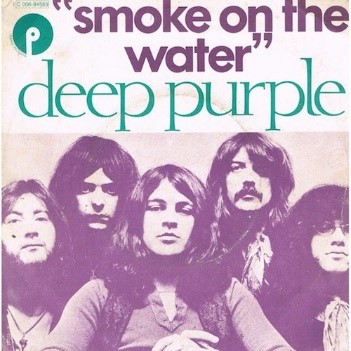
By now it has obtained the status of an urban legend, but it really is true, factually accurate historiography; the story behind Deep Purple’s “Smoke On The Water”.

On 4 December 1971, the hairy hard rockers really are in Switzerland, on Lake Geneva, to record the album Machine Head at the Montreux Casino.

And indeed have to find another venue…


We all came out to Montreux on the Lake Geneva shoreline
To make records with a mobile, yeah
We didn't have much time now
Frank Zappa and the Mothers were at the best place around
But some stupid with a flare gun burned the place to the ground
Smoke on the water, a fire in the sky

… yes, because some stupid Zappa fan fires a flare gun during the Zappa concert, after which the entire complex burns down. Clouds of smoke drift across the lake, flames shoot into the air, and bassist Roger Glover has his chorus (vocalist Ian Gillan writes most of the remaining, rather awkward, lyrics, guitarist Ritchie Blackmore is the architect of the monumental, immortal riff).

Dylan opens the last verse of his 1989 “Man In The Long Black Coat” with There’s smoke on the water, and a scenario in which it escapes him that he is quoting Deep Purple is extremely unlikely. For half the world’s population, hearing those words immediately rumbles in Blackmore’s riff, and Dylan certainly belongs to that half of the world’s population.

While there is a – theoretical – possibility that Dylan wants to give a nod to his old country hero Bob Wills, who had a No. 1 hit with Red Foley’s “Smoke On The Water” in 1945, that is not too likely. Pleasant tune, sure enough, with toe-curlingly naive, patriotic lyrics (if possible, even worse than Deep Purple’s “Smoke On The Water”), but apart from that: Dylan is most certainly aware of the fact that the associations of everyone of his listeners are pushed towards the hard rock classic, not towards a country hit from half a century ago.

Moreover, a few years later Dylan also paraphrases the second half of Deep Purple’s refrain line, fire in the sky, in “Mississippi” (sky full of fire, pain pouring down) – for some reason Roger Glover’s words do roll into Dylan’s stream-of-consciousness every now and then.

Anyway, much more than a casual nod to an untouchable monument Dylan’s choice of the words smoke on the water really can’t be; there is no further indication that he has a soft spot for the band. Deep Purple is never mentioned, not in interviews or otherwise. Yes, one single time, via a diversion, in Theme Time Radio Hour, when DJ Dylan plays The Ravens’ evergreen “Deep Purple” (episode 47, Colors, aired February 28, 2007): “And no, I’m not talking about the one-time holders of the Guinness World Record for being The Loudest Band In The World.”

Conversely, the men talk about Dylan often enough, by the way. Ritchie Blackmore is an outspoken fan, for instance. “He is the only person I admire in the business,” he says, “I have been in the business for so long, he’s the one that I still feel he remains mysterious, there is something about him that I think is truly monumental and he is so creative.”

Roger Glover tells interviewer Mark Dean (Antihero Magazine) in 2017 that Dylan is “my all-time favourite songwriter”, and adds, to the interviewer’s surprise, “but I’ve got this kind of strange feeling that I don’t want to meet him.” Because he has such a difficult reputation surely, Dean suspects. No, not at all, Glover explains:

“Well, it’s not so much that. It’s that he is what he is, in my mind, and I don’t want that to change, because he’s so precious. I don’t want to know that he’s just a guy. I know he is. Do you know what I mean? I think the kind of questions I’d want to ask him, he’d be pretty bored with, anyway.”

… a motivation remarkably similar to Dylan’s explanation of why he passed up the chance to meet Elvis back then – Dylan, too, preferred to keep the myth alive. But meanwhile, we thus miss the chance of Roger Glover, someone with the right to speak, finally asking Dylan a “pretty boring” question like why he sings those words smoke on the water in “The Man In The Long Black Coat”.

Years later, when Dylan has inserted in the preceding bridge the new line I went down to the river, but I just missed the boat, he seems to lift a small corner of the veil. If Dylan was initially inspired by “House Carpenter”, and indeed set up his song as a kind of answer song, a song in which the abandoned spouse from “House Carpenter” gets the stage, then with that smoke on the water we suddenly have a symbolic set detail that fits the narrative just fine. After all, the frivolous wife who runs off with the Devil (or Death, or a ghost) in “House Carpenter” leaves by boat. And then perishes with him;

Oh twice around went the gallant ship
I'm sure it was not three
When the ship all of a sudden, it sprung a leak
And it drifted to the bottom of the sea

… and from the shore the abandoned husband sees, or we see, then only smoke on the surface of the water, below which the pulse and vibration and the rumbling force are audible and discernible. Fitting, then, is the second notable lyric change: in the first decade of the twenty-first century, Dylan changes the second line, “’neath the high crescent moon” to “there’s blood on the moon”.

Semi-officially, by the way: in the official 2004 edition of the lyrics, Lyrics 1962-2001, the crescent moon is changed to this bloody moon, but in the next edition (Lyrics 1961-2012 from 2014) and on the site the original lyrics from the studio recording have been restored, returning to ‘neath the high crescent moon – as Dylan sings it on stage again after 2009, by the way.

The other lyrics change, I went down to the river, but I just missed the boat, is retained. As is some stupid who’s beating on a dead horse…


To be continued. Next up Man In The Long Black Coat part 7: Somebody is out there feeding a fed horse

——-

Jochen is a regular reviewer of Dylan’s work on Untold. His books, in English, Dutch and German, are available via Amazon both in paperback and on Kindle:


Posted in Uncategorized | 5 Comments

Bob Dylan On His Wagon

By Larry Fyffe

Sure it be that Julius Caesar has no pocket watch, but he likely travels a lot by “painted wagon”, not on a stallion as romanticized by poets, and painters.

Placing his faith on the power of the sword, not on the what the entrails of a bull might foretell, he’s about to cross the Rubicon:

Born from a modest spring
It is parched by the heat of summer
But then it's volume was increased by winter ...
(Lucan: Pharsalia ~ translated)

So too Julius Zimmerman romanticizes his persona:

I crossed the Rubicon on the fourteenth day
Of the most dangerous month of the year
At the worst time, and the worst place
That's all I seem to hear
(Bob Dylan: Crossing The Rubicon)

The city of Rome corrupted by greed is envisioned by Caesar as in distress; the city personified as female, wants him to be tolerant, and hold her hand.

However, Julius, as a son of Jove, finds no peaceful option available; certainly it’s not his fault, but civil war it will be.

Like a lion, he leads his legions across the Rubicon, and onward to Rome:

His shall hold the guilt who forces me 
To act as your enemy
Then he let loose the bonds of war
And led his standards swiftly over the swollen stream
(Lucan: Pharsalia ~ translated)

In the song lyrics below, it might be said that corrupted America, figuratively speaking, replaces Rome as the New Babylon.

Hyperbole abounds in the lyrics beneath – the Almighty is not left unscathed since He allows the New  Promised Land to be lost.

Eden’s gone again:

Well, you defiled the most beautiful flower in all of womanhood
Others can be tolerant, others can be good
I'll cut you up with a crooked knife, Lord
And I'll miss you when you're gone
I stood between heaven and earth
And I crossed the Rubicon
(Bob Dylan: Crossing The Rubicon)

A Scottish Romantic poet called upon in the following song lyrics.

The low road represents the path for the dead:

Oh, ye'll take the high road
And I'll take the low road
And I'll be in Scotland afore ye
(Robbie Burns: The Bonnie Banks Of Loch Lomond)

Taking the cue from the ballad above, the Caesar in the following song lyrics be not as confident of success as the one in Lucan’s epic poem:

Take the high road, take the low road
Take any one you're on
I poured the cup, I passed it on
And I crossed the Rubicon
(Bob Dylan: Crossing The Rubicon)

Apparently, only Mona, the Moon Goddness, keeps him hanging on.

Posted in Uncategorized | Leave a comment

Why does Dylan keep changing his songs part 3

by Tony Attwood

Folk music, which for many, many centuries never written down, was constantly changed either because the performer forgot exactly how the song went, or because he/she changed the song deliberately.  This deliberate change could be because the performer couldn’t manage the original version, or because she/he wanted to add an update or local reference.  Or because a new idea occurred.  So different versions of the same song appeared in different parts of the country.

To overcome this to some degree musical notation was invented – and across the centuries became more and more sophisticated.  In earlier times the speed at which a piece was to be played might be indicated on the musical score by the vague word “Allegro” or “Andante” (performance indications always being written in Italian in the era of classical-romantic compositions) but once the wind-up metronome was invented in 1815 a more accurate representation of the composer’s wishes for the speed of the piece could be given.

The implication of this increasing exactitude in terms of how the composer wanted the piece to be played was that the music should NOT be changed.   Rather like the author of a book expects the published version to include all the chapters in the order she/he lays down, not at random, or with bits taken out (although Readers’ Digest used to do this).  The author, like the composer, dictates how the work of art should be received.  It is the same of course in all the arts.

Matters became even more fixed when mechanical recording devices (the phonograph, the gramophone, the tape recorder…) became available – and thus at last a definitive version of the music could become fixed for all time.

But it is important to realise just how recent this notion of a fixed, definitive version of music is.  In the 18th century JS Bach gave no indication on the page as to how (for example) the 48 Preludes and Fugues were to be played.  All we have is the notes.  There are no speed and no volume indications (the latter because initially the pieces were played on the clavier not the piano, and thus volume changes were impossible.

So because of what the instruments could do, the evolution of recording techniques, and the response of composers who wanted (as time went by) to indicate exactly how they expected the music to be performed) we moved from compositions as a base from which possibilities could be explored, to a fixed grid which said, “My piece should be performed like this.”

The arrival of the gramophone in the late 19th century allowed all music to become fixed in terms of how it should be performed.  However, we really should remember that saying “it should be played like this” is no more of a correct response to a composer’s creation, than taking a piece and changing the instrumentation, the speed, and indeed the entire way in which is it performed.

Of course, if the music has a clear meaning, either through the sound created, or the lyrics added to a song, or indeed both, then changing the music can change the meaning.  But quite often changes to instrumentation and speed simply give us a different version, and one can then argue about which version works best.   After all, music doesn’t have to have a meaning and most instrumental music has no discernable meaning at all.

However when we are talking of songs, the issue of the meaning of the lyrics arises.  Because the music most of us in the west hear as babies is associated with happiness and sung in a major key we associate music in a major key as happy, and music in a minor key is perceived as sad – there is no inherent reason why music written in a minor key should be felt to be sad – but that is just the tradition we have evolved.  Listen to a song with the lyrics “Oh how much I love you” performed in a minor key and the immediate implication is that the love affair is over and the singer is desperate.

So if a composer wants to write a happy song the composer will normally write in a major key.  If a performer wants then to make the piece ambiguous and strange the simplest thing she or he can do is turn it into a piece in the minor key.   However, most people will find the result really odd.

Thus the number of changes one can make is limited, where the meaning of the song is overt.   However, where the meaning of the song is more difficult to ascertain, perhaps because of the abstract notion of the lyrics, more and more changes can be affected.

These changes can be to instrumentation, the introduction, an instrumental break, the ending, the melody, the rhythm…. and they can be added for musical effect, or to change the meaning of the song.

But the key point is that even with the most inventive of composers and musicians, the most obvious changes will be discovered first.  And the danger is that after a while one starts looking for change for the sake of change, and although great new arrangements can be discovered, sometimes they sound exactly what they are: change for the sake of it.

But sometimes it really can work.  Perhaps because of the music, or perhaps of the occasion, changes to the music just works so wonderfully…

Posted in Uncategorized | 1 Comment

Dylan cover a day: North Country Blues

By Tony Attwood

I am restricting myself to just two covers of this song, because these two cover versions are so utterly sublime, that I really don’t want to go on and listen to any other versions.  And indeed I’m not sure I could take it – not least because once I have written this I am off to see my youngest grandchild for the first time.

This is a song of desperation, and such songs need to be handled with enormous care by the performers as otherwise the emotion can get too overplayed and starts to sound like exploitation rather than a description – and in this case a description played out with sensitivity is really all that is needed.

Also, a significant level of talent both as a guitarist and a singer is needed to carry the song through – both because we know it so well, and because one false step could make the whole thing sound mawkish.

These two artists take the song in different ways, including of course the way the guitar part is performed.  But both are stunningly effective.   People of a sensitive disposition (a bit like me) might want to go and do something else in between playing each version.  Fortunately for me, I can now go and see the youngest member of my family.

The Dylan Cover a Day series

Posted in Uncategorized | Leave a comment

Man In The Long Black Coat (1989) Part 5: Happy little accidents

Man In The Long Black Coat (1989) Part 5

by Jochen Markhorst


V          Happy little accidents

There are no mistakes in life some people say
And it’s true sometimes you can see it that way
People don’t live or die, people just float
She went with the man
In the long black coat

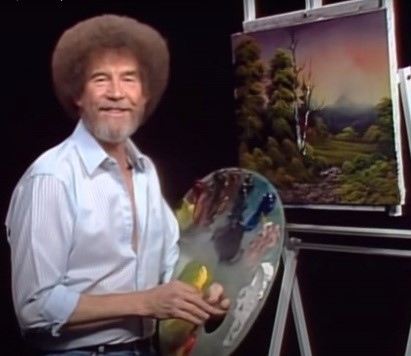
 American landscape painter Bob Ross dies in 1993, at the age of 52, far too young. His television series The Joy Of Painting, broadcast all over the world at the time, was then as popular as ever. And is popular still: reruns on communication channels like Twitch and YouTube resuscitate Ross’ popularity and posthumously bring him new generations of fans. A regular episode like “Island In The Woods”, for example, is viewed 41 million times in five years. Meanwhile, Ross’ iconic presence, his manner of speaking and his unique personality have long since been incorporated by popular culture; documentaries, merchandising, board games, video games and bumper stickers provide, decades after his death, a constant revenue stream for the Bob Ross Inc., which carefully guards his legacy.

The artistic value of his landscapes can be debated, but that’s not the secret of the success anyway; that’s the man himself, his gentle, good-natured, hypnotic instructional videos, consistently embellished with casual, off-the-cuff aphorisms with a high feel-good content. Like “Don’t be afraid to go out on a limb, because that’s where the fruit is.” And the most popular bumper sticker is probably the one with the most beloved Bob Ross quote: “We don’t make mistakes – we just have happy accidents.”

It is a charming thought that in the late 1980s, when Bob Ross is at a first peak of fame, the ambitious amateur painter Bob Dylan is enchanted by the painting positivity guru with the afro hairdo. Perhaps Dylan became aware of the phenomenon in 1987, when his hero Hank Snow invited the painter to the stage of the Grand Ole Opry (after which Snow got a private painting lesson from Ross), but Ross could not be avoided anyway: on television in those years, he was hardly to be missed. In the United States alone, his instructional videos were broadcast on 95 per cent of all public television stations. Also in the motel room in Napoleonville in late March ’89, where the inspiration for “Man In The Long Black Coat” trickles down on Dylan. “We don’t make mistakes,” hears Dylan on Louisiana Public Television, lying on his bed, as Ross spills a few paint splatters, “let’s make them birds. Yeah, they’re birds now.”

Balm on the restless soul of the inspiration-seeking Dylan. “There are no mistakes in life some people say – and it’s true sometimes you can see it that way,” he might think. Hippie-like philosophies with the depth of the Bayou Lafourche, but inspiring nonetheless. At least: the step to the next, equally rosy key phrase, the Buddhist-anchored People don’t live or die, people just float is not that big anymore. Apparently, Ross’ soothing voice and placid aphorisms lead Dylan’s stream-of-consciousness, on this evening in the interior of Louisiana, while the crickets chirp outside, to Herman Hesse’s Siddharta, the gentle master narrative from 1922 by a Nobel laureate that sooner or later touches us all;

“Yet none died, each was merely transformed, kept being reborn, kept receiving a new face, with no time between one face and the other-and all these shapes and faces rested, flowed, produced themselves and one another, floated away and poured into one another.”

… the vision that old Govinda receives when old Siddharta invites him to kiss his forehead, the vision in which Govinda recognises that no one lives or dies, but that each soul just floats from the one into the other. From the key chapter Govinda, the chapter in which old Siddharta articulates his enlightenment with one insight after another that we also encounter in Dylan’s oeuvre – especially those relating to Truth (“The opposite of every truth is just as true”), and wholeheartedly those relating to Time;

“But time is not real, Govinda; I have experienced this time and time again. And if time is not real, then the span that seems to lie between world and eternity, between sorrow and bliss, between evil and good is also an illusion.”

… the same philosophy as in Dylan’s oeuvre from the earliest years to his latest works – in which we sometimes hear echoes of Siddharta almost one-on-one. In “I Contain Multitudes”, for instance, the opening song that sets the tone right from the opening line (“Today and tomorrow and yesterday too”), and in which we hear two-and-a-half minutes later, “Everything’s flowing all at the same time.” A near-literal crystallisation of the insight bestowed on Siddharta, the river’s secret, that there is no such thing as time;

“… that the river is everywhere at once, at its source and at its mouth, at the waterfall, at the ferry, at the rapids, in the sea, in the mountains, everywhere at once, and only the present exists for it, and not the shadow of the future.”

In any case, a scenario in which Dylan’s meandering spirit flows via Bob Ross to Hermann Hesse’s Siddharta and his reflections on life, death, time and truth also goes quite nicely with Dylan’s lyric intervention. After all, he changes, officially in Lyrics even, this beautifully poetic People don’t live or die, people just float into the less floaty but equally powerful I went down to the river but I just missed the boat. Just like Siddharta. Who returns to the river twenty years later, but does not take the boat, just misses it, to stay with the ferryman Vasudeva – for the rest of his life. He becomes the river man himself, reaches his enlightenment thanks to the river, and here is where he says goodbye to his worldly lover Kamala, who is bitten by a black snake and dies in his arms – she leaves Siddharta to go with The Man In The Long Black Coat, so to speak.

Well, it is a possibility. And if not, this bridge from “The Man In The Long Black Coat” at least illustrates: great Nobel Prize winners think alike. And if then not to a great Dylan song, Siddharta can always take a pride in the merit that it led to one of the most perfect songs of the 20th century, to Nick Drake’s “River Man”;

Going to see the river man
Going to tell him all I can
About the ban
On feeling free

To be continued. Next up Man In The Long Black Coat part 6: Some stupid with a flare gun


Jochen is a regular reviewer of Dylan’s work on Untold. His books, in English, Dutch and German, are available via Amazon both in paperback and on Kindle:


Posted in Uncategorized | Leave a comment

Where Is Bob Dylan’s Online Casino Game?

The online gambling industry has grown at a rapid rate over the past decade or so, and now accounts for a staggering amount of business. Altogether, online gambling crossed the $50 billion threshold back in 2017, and it’s only continued to skyrocket since –– with the pandemic, in some cases, accelerating activity. By some estimates, the internet gambling industry was worth over $60 billion by 2021.

These enormous sums account for all gambling activity, which means that online sports betting is included. Alongside categories like betting and poker however, internet casino gaming – slots, jackpots, bingo, and the like – plays a significant role as well. And it’s in this category that, believe it or not, the introduction of a game with a Bob Dylan theme would make a great deal of sense.

This is the case first and foremost because online casino developers and host sites have already begun to embrace a great deal of licensed content in recent years.

Perhaps most noticeably, this has meant the creation of internet casino games based on other video games, or large video game franchises known for adaptation and evolution. Consider the likes of Street Fighter and Tetris, for instance. The Street Fighter series has put out well over a dozen games in the last 30 years or so, all with slight twists on the original concept and gameplay. And just last year, GameRant explored the best Tetris titles and came up with 13 of them – from Super Nintendo’s Tetris Battle Garden, to Tetris Effect on PlayStation 4, to the old-school NES version. Today, both of these legendary franchises have licensed material to slot developers; Street Fighter and Tetris slot games may not make lists of the respective franchises’ best, but they do capture the spirit of the originals, and they certainly appeal to fans.

We’ve also seen more and more licensed material when it comes to films and TV shows. There have long been internet slot arcades based on films (from The Mummy to The Matrix). And more recently, the entire category of arcade Slingo games (which cross bingo with slots) has been built, in part, on licensed television content. Foxy Bingo’s collection of Slingo titles showcases the most popular options on the internet, and includes games based on Who Wants To Be A Millionaire?The ChaseX-Factor, and even the beloved American sitcom Friends.

Finally – and most directly relevant to the notion of a Dylan casino game – development companies have also crafted games that revolve around licensed material from bands. Though it wasn’t the actual origin of band-based slot games, the Guns N’ Roses reunion tour brought attention to this category on casino sites. The tour was announced in April of 2016, and would end up spanning a sprawling, years-long revival. Right around when Axl Rose and Co. were leaping back into the spotlight though, slot machine games based on Guns N’ Roses and a handful of other classic rock and metal bands and artists were being featured front and centre on gaming sites. The games effectively tapped into the real-world revitalisation of this era of music, and for a little while, slots based on the likes of Jimi Hendrix, Ozzy Osbourne, and Megadeth were all the rage.

Given all of these games – slots, slingo, and more, based on everything from Tetris to Hendrix – it’s easy to ask, why not Dylan? Indeed, beyond simply being another fitting pop culture figure upon whom to base a casino game, there are three reasons a Dylan casino game makes particularly good sense:

First is raw popularity. Bob Dylan has millions of fans around the world, and that could only be good news for casino developers and the sites that host the games. The very point of themes in slots and slingo games is to attract fans, and where Dylan is concerned there’s certainly a large audience to tap into.

The second reason is Dylan’s unique quality. While these things are difficult to measure, it’s a fairly safe bet that there’s significant overlap between, say, Megadeth and Guns N’ Roses fans, or people who watched Who Wants To Be A Millionaire? and X-Factor. Dylan, however, is more unique – a singular presence, and almost a genre unto himself. Thus, in addition to a large audience, a Dylan game might just attract a distinct one that wouldn’t otherwise be attached to casino sites.

The third reason is that Dylan’s actual content matches casino gaming quite nicely. As fans are well aware, Bob Dylan has numerous songs that touch on gambling. The most famous is probably the Rambling Gambling Willie masterpiece, which we’ve dug into before. But other tracks like Huck’s Tune and Lilly Rosemary And The Jack Of Hearts have gambling themes as well. Granted, the gambling content in these tracks relates more closely to cards than slots or arcade games; it is also at least somewhat metaphorical. Nevertheless, one can certainly begin to imagine a Dylan-themed casino arcade game with these specific songs playing in the background.

It’s a slightly strange idea, we grant you. Bob Dylan fans certainly don’t need a casino game, let alone expect one. But given the existing material referenced above, and the potential for a Dylan game to attract its own audience, it’s certainly an intriguing concept.

Posted in Uncategorized | Leave a comment

Bob Dylan And Leon Redbone part 2: Night’s coming on


by Larry Fyffe

This article continues from Bob Dylan And Leon Redbone

And when I hear the whistle of an old steamboat
Down the Mississippi River
Again I'm going to float
(Leon Redbone: Mississippi River Blues ~ McWilliams/Rodgers)

Leon Redbone might be described as a nonphilosophical Hegelian who savours old songs from the days of steam.

Singer/songwriter/musician Bob Dylan mixes the old with the new.  As in the song lyrics below:

Guess I hop on a train to ride ...
Comes a ways down by the river side
Bob Dylan: Let Me Come Baby)

Alluding to the following song:

She's got a ticket to ride
But she don't care
(Beatles: Ticket To Ride ~ Lennon/McCartney)

Again in the lyrics beneath:

I love seeing you, hold my hand
What I need is a loving plan
(Bob Dylan: Let Me Come Baby)

Mixed with:

You'll let me be your man ...
You'll let me hold your hand
(Beatles: I Want To Hold Your Hand ~ Lennon/McCartney)

Then we have:

There she comes baby all around ...
I'm leaving that thieving town
(Bob Dylan: Let Me Come Baby)

Reminding of the song quoted beneath:

Oh I hate to see that evening sun go down
For I know I'm on my last go round
(Shirkey & Harper: Steamboat Man)

The train steams along  the track:

Over by the river side
Oh there's no God knows where
(Bob Dylan: Let Me Come Baby)

The steamboat along the river:

I'm gonna where I won't have to work no more
And I'm going to the Lord's knows where
(Shirkey & Harper: Steamboat Man)
Mistress Death always comes along for the ride:
The dying sun was going down
And the night was coming on
(Bob Dylan: Crossing The Rubicon ~ variant)

And so it ends:

I might-a pulled a plug
And she blessed my soul
(Bob Dylan: Let Me Come Baby)
Posted in Uncategorized | 1 Comment

Other people’s songs: Let’s stick (or maybe work) together

By Aaron Galbriath and Tony Attwood

Aaron: Looking back through previous entries in the series. I realized there was one more track from Down in the groove left to discuss, that being Let’s stick together

Let’s stick together was written and released as a single in 1962 by Wilbert Harrison. it was then rewritten in 1969 as Let’s Work Together.

Tony: I am not sure I ever heard this original version, so I must have got to know the song once it was re-written, but what really did ring a bell with me was the opening instrumental line – which makes me contradict myself and think I did hear the original.

There is a trumpet, or maybe two trumpets, or maybe its a saxophone (the recording quality is so awful it hard to tell) that plays one note in the instrumental verse.  As it gets to the end of the verse, instead playing one held note, it plays a more rapid rhythm of four quavers and a minim (which might also be expressed as dah dah dah dah dah……… all on the same note.

What’s interesting with this one little musical event is that the note that is played is A, which fits perfectly with the opening chord (A) and the variant chord (D) (this being a 12 bar blues), but is a total clash with the last chord used with the dah dah dah bit which is E.

And across all these decades I remember this – it is such a strange, and in many way horrible, clash.    In fact I have a vague memory of my father (who was a pianist and saxophonist in a touring dance band) complaining how horrible that is.   It goes all the way through the song.

Aaron: The song has been a major hit twice, first in 1970 by Canned Heat.

Tony: So now there is none of that blaring repeated trumpet because, well, this is Canned Heat.   It is interesting that this is such a simple 12 bar blues – I mean it is hard to imagine anything much simpler.  And indeed the lyrics follow suit…

Oh well now, make someone happy, make someone smile,Let's all work together and make life worthwhileLet's work together, come on, come onLet's work together, now now peopleBecause together we will we stand, every boy, girl, woman and a man

Who needs complex lyrics?

Aaron: Then again in 1976 by Bryan ferry

Tony: And this version I most certainly do remember.   It’s quite hypnotic isn’t it?   The band here keep the notion of the repeated note but drop the clash between the final chord and the repeated note which I think is a great idea.  Not sure I fully appreciate the appearance of the young lady in the lady stages of the video, but maybe that is a sign of the times.   The sounds she makes don’t seem to be related to the smoothness of Bryan Ferry – but I’m being picky.

However, the main point is that we have now got to the different set of lyrics.

And now the marriage vow is very sacred
The man has put us together now
You ought to make it stick together
Come on, come on, let's stick together
You know we made a vow not to leave one another never

Aaron: Bob’s version appeared as the opening track on down in the groove in 1988

Tony: Bob makes a change with the rhythm of the opening lines of each verse.  It is very subtle, and really only stand out in the first verse.  And Dylan uses the alternate lyrics….

Well, a marriage vow, you know, it's very sacred
The man put us together, now, you wanna make it
Stick together
Come on, come on, stick together

You know, you made a vow, not to leave one another, never
Well, ya never miss your water 'til your well runs dry
Now, come on, baby, give our love a try, let's stick together
Come on, come on, stick together

We made a vow, not to leave one another, never
Well, ya never miss your water 'til your well runs dry
Come one, baby, give our love a try, let's stick together
Come on, come on and stick together
You know, we made a vow, not to leave one another, never

It might be tough for a while, but consider the child
Cannot be happy without his mom and his papi

Let's stick together
Come on, come on, stick together
You know, we made a vow, not to leave one another, never

So how did this change of lyrics come about?  Well, I’m not the absolute expert on this but as far as I know (and various articles do back this version up) the original version was “Let’s Stick Together” came out in 1962.  Then the song was re-written and released again in 1969 as “Let’s Work Together”, probably for no reason other than the songwriter was thinking – “we ought to be able to get more out of that song – let’s change the lyrics a bit”.

Both are 12 bar blues and the music is virtually identical, it is just the lyrics that have completely changed.  And it is all the work of the one man: Wilbert Harrison.  He wrote it, and re-wrote it.  Here’s the quick summary of the change…

“Let’s Stick Together”
Well now the marriage vow is very sacred
The man put us together now you want to make it
Stick together, come on, come on let's stick together
You know we made a vow not to leave one another never
“Let’s Work Together”
Together we will stand divided we'll fall
Come on now people let's get on the ball
And work together, come on, come on let's work together, now people
Say now together we will stand, every boy, girl, woman, and man

So there we are. Aaron, as ever, I am indebted to you.

Previously in this series…


Posted in Uncategorized | Leave a comment

Why does Dylan keep changing his songs Part 2: Breaking the traditions

Part 1 of Why does Dylan keep changing his songs is here.

By Tony Attwood

There are two fundamental traditions in western music.

One is the classical-romantic tradition in which music was written down, and then played as the notation dictated.  There were and are of course differences between performances, for example at the behest of the orchestral conductor, not least because some of the instructions as to performance were vague.  The time (in terms of number of beats per minute) for example was not always indicated, and the volume marks (ranging from ppp for very soft up to fff for very loud) were to say the best, vague.

The other tradition was folk music which was normally only written down by collectors such as Cecil Sharpe who travelled the country writing down the songs he heard.  That writing down solidified the songs to a degree, but even so variations in terms of speed, volume, emphasis etc continued.  And indeed the whole tradition of folk music was that the songs would change according to the singer, which is why the same song would turn up in so many different variations across the country.

So two traditions.  One more precise than the other, but both subject to variations.

Then along came recording technology and gradually the notion that what was on the record was how it was meant to be – at least for popular music.   And that notion took on a stranglehold, in all sorts of ways.

For example, on TV shows (in the UK it was “Top of the Pops”, and I think from looking at old film recordings there were similar programmes in the USA) artists would mime to their recordings.  Sometimes they were forced to perform live, because of agreements between the BBC and the Musicians Union in the UK, but in so doing the performers would endeavour (with greater or lesser success) to perform the song as it was heard on the record.  The record in short became the definitive statement of what the music should sound like.  It was agreed, “Rock Around the Clock” should sound like the Bill Hayley version on the 78 rpm record.  Most artists attempted to perform it as the Comets laid it down.

But Bob Dylan’s interests and the tradition of music that he followed were not those of popular music dominated by record companies.  He was interested in the music as music, and knew perfectly well that songs changed over time.   And indeed that songs would often exist in various forms.  And although a recording was seen by most people as the “definitive” version which laid down the sound for everyone, Bob’s view has been that this is now how it has to be.  Nor in fact how it should be.

So in my view, Bob came to music with the concept of variation inside him, and the track that he laid down when making an album was simply how each song sounded that day.

Initially of course he did sing the songs he recorded in the way he recorded them, not least because there is a limit to the ways in which a song can be changed when all you have is an acoustic guitar, a harmonica and your voice.  But when a band is added, the possibilities open up.

Of course, we should be very careful of considering what Bob did in changing his own songs as a revolutionary step.  Bands would often try out their songs in different ways before settling on a version that would become the record.  But what Bob did was to carry on making the changes AFTER he had made the recording.   And in doing this he was just continuing the tradition of the blues and folk singers he so admired.

However, this vision was completely at odds with the pop music industry which at its heart had the top 20, or top 40, depending on where you lived.   The charts were lists of recordings that were fixed.  “Please Please Me” by the Beatles was heard multiple times day after day on the radio, record players and juke boxes and it always sounded the same.  If a cover artist wanted to perform the song, he would perform it as the Beatles did it.

So what made Bob want to merge part of the tradition of a thousand years of folk music and the more recent tradition of the record being the definitive fixed version of the music.   As I have suggested, the folk tradition with its endless changes, and different versions by different performers influenced him, of course.  And I suspect so did his personality – he comes across to me as a man who loves change, who doesn’t want the same routine.  He wants to record, he wants to tour, he wants to paint, he wants to create art in other forms… of course a personality like this would never just want to play the same song in the same way over and over again.

Which raises the question: what can be changed?

Dylan could of course change the lyrics, the chord progression, the melody, the tempo.  And later he could change the instrumentation as well.   And in turn this meant changing the musicians on tour with him.  And when Hendrix turned “All along the watchtower” upside down, Bob realised and indeed admitted that just because he, Bob Dylan, did a version first, that didn’t make it definitive.

But to do all this changing, three things were needed.  One was a staggering level of creative inventiveness.  The second was the stamina and desire to be out there, performing these variations.  And the third was a desire and willingness to take the most almighty risks.

And I’ll deal with those, if I can, next time.


Posted in Uncategorized | 1 Comment

Every Song By Bob Dylan Is About The Lamb Of God

by Larry Fyffe

From the Holy Bible:

The next day John seeth Jesus coming unto him
And saith, "Behold the Lamb of God
Which taketh away the sin of the world"
(John 1:29)

Somehow getting crucified saves everybody.

But more importantly, the New Testament verse explains how Dylanologist David Weir knows that every song (well many of them anyway) written by Bob Dylan refers to the Lamb of God – even if the songwriter does not come right and say so in the lyrics.

It’s Weir’s task to find the hidden Passover meal so his readers can eat it up.

All fine and good if the lyrics of the song analyzed by Weir were not twisted and turned to such an extent that they become Weir’s own words instead of those of the songwriter – the songwriter who’s seldom accused of being unequivocal.

Take Weir’s analysis of Dylan’s “Crossing The Rubicon”, a song that might be interpreted as an angry fellow on the trail of a woman abuser.

We are informed instead that the guy is really a rapist, symbolically the raper of Jesus Himself for Christ’s sake, and the sinner is hoping for forgiveness because he feels guilty about the dastardly deed he’s done!

The sinner imagines that the Lamb of God shape-shifts to Mona, ie, the Holy Ghost, who tells  him not to worry about the rape … it’s okay:

“He wants it to be the case that he’s forgiven, and he imagines his victim forgiving him. By way of the song’s river, blood, and flowery imagery, we’re able to identify his victim with Christ, and as such she represents the route to his redemption – the forgiveness he imagines her bestowing on him.”

(David Weir: Crossing The Rubicon)

The Christian template is applied yet again to the song “My Own Version Of You” by Bob Dylan, based on Mary Shelley’s book in which the Dr. Frankenstein creation turns against his creator; it’s understandable why the monster does; he looks hideous, and consequently, he’s not loved.

Dylan turns the theme around: and presents a spooky, dark-humoured story in song; the narrator imagines himself saved by the creation of a perfect performer of music and song by combining the talents of a number of deceased actors, artists, and adventurers, like Caesar.

Weir claims that the unworthy every-man/narrator holds himself responsible for somebody’s death though it appears that no rape’s involved.

However since Christ gets no mention in the Dylan song, the sacrificial Lamb of God  must be hiding somewhere.

Weir’s solution is to transubstantiate the Frankenstein monster into Christ.

Presto, out of the blue, Dylanologist Weir concludes:

“Successful redemption will only be achieved by following the ways of Christ and Caesar”

(David Weir: My Own Version Of You)

Clever, but the the meat is a way overdone.

Meanwhile,  Zimmerman is off somewhere eating a nicely-roasted Passover lamb.


Posted in Uncategorized | 1 Comment

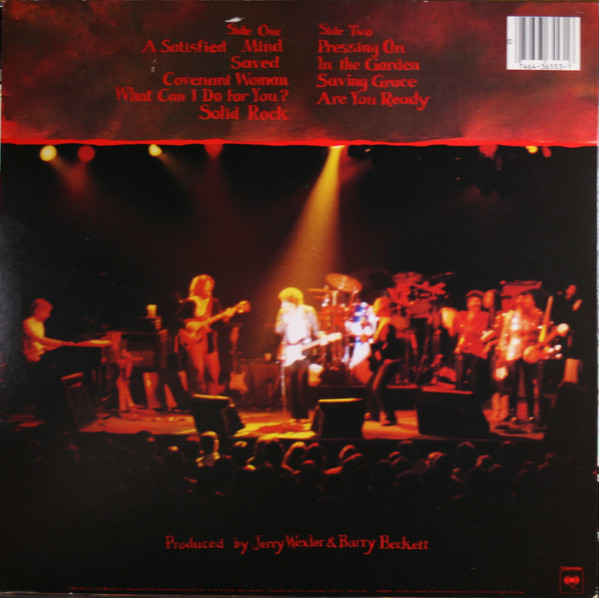
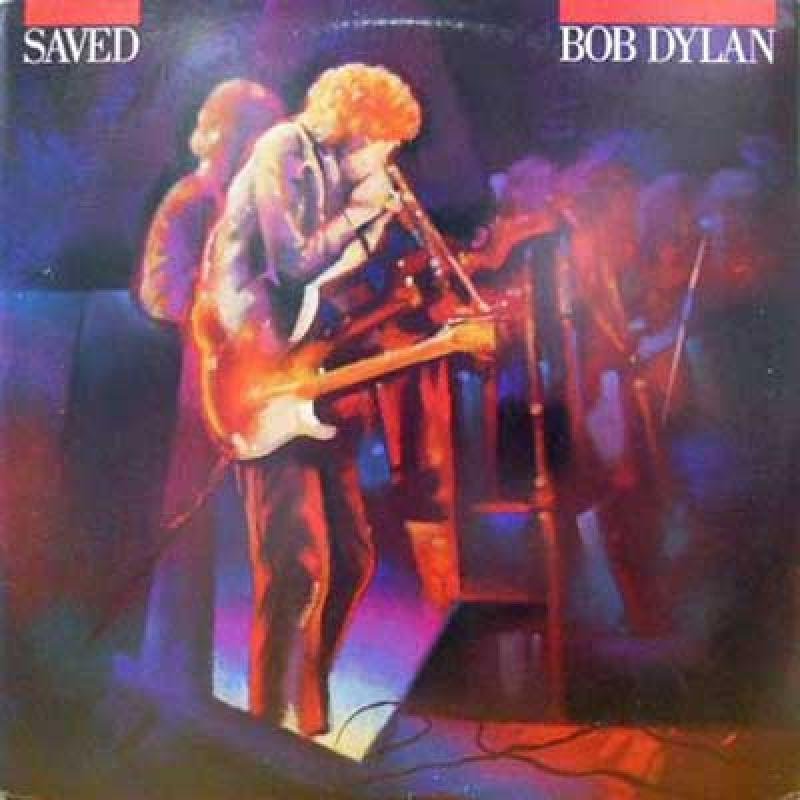
The Art Work of Bob Dylan’s “Saved”

by Patrick Roefflaer

  • Released                                June 20, 1980
  • Pastel                                      Tony Wright
  • Photographer                        Arthur Rosato
  • Art-director                           Tony Wright

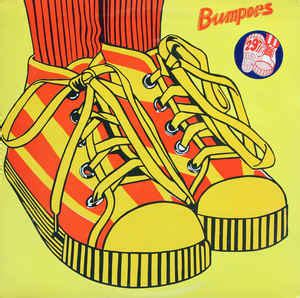
At the end of the sixties, British record labels experimented with samplers: double albums with an eclectic selection of songs by artists from their range. Because the whole thing is offered at a low price, the compilations prove to be very popular – especially with teenagers on a budget. For the record company, it’s an interesting way to introduce the listener to a large number of their artists. Of course, the cover should not cost too much.

While visiting a poster shop in London’s Kings Road, Chris Blackwell of Island Records finds a solution. He sees a poster on which the same pair of sports shoes is depicted nine times, each time in a different colour. The screen print is the work of a 19-year-old: Tony Wright. Blackwell pays Wright £200 for the rights, and buys all available copies of the poster.

The shoes on the poster are called Bumpers and that naturally becomes the name of the album.

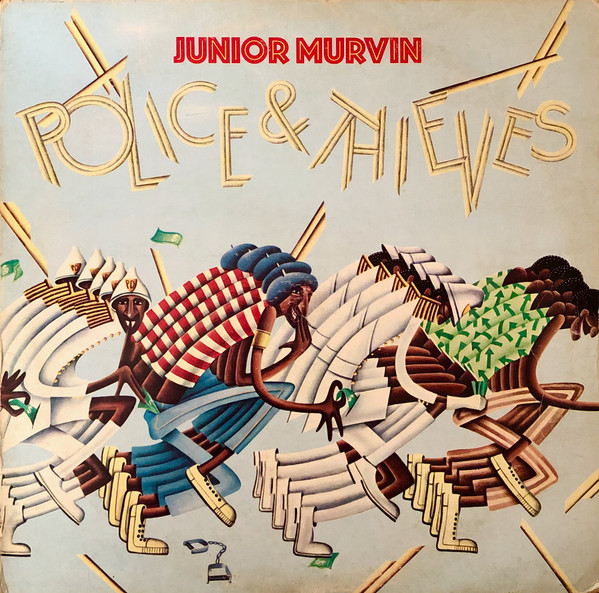
In addition, Blackwell offers the young man a job: design record covers for Island Records. His first major cover is one for Traffic (The Low Spark of High Heeled Boys), followed by Bob Marley (Natty Dread) and numerous reggae records, such as Police and Thieves (Junior Murvin), Super Ape (Lee Perry) and War Ina Babylon (Max Romeo).

At the end of 1979 Wright was allowed to move to New York to become head of the American branch of the record company. The job includes an apartment on the 47th floor of a building on 57th Street, with a “view like a God of Central Park and New York,” as he puts it. “On a stormy day, the clouds passed under my window. I was in the middle of New York, but I wasn’t exactly ‘in’ New York.”

In the last days of February 1980, Wright is barely in New York for a few months, when he unexpectedly receives a call from Jerry Wexler. Wright has met the producer a few times and the man knows his job. Wexler asks him about his religious beliefs and states that he can expect a phone call from someone. That’s all he wants to say.

What follows is based on the story as Tony Wright noted it for David Eckstrom in January 2016. Eckstrom is the owner of forever young records in Texas, and prides himself on owning the largest collection of Dylan material. In 2016, he bought the original design of the cover and asked Wright to explain how it was created. Wright gave me permission to display his story here and also to use the images.

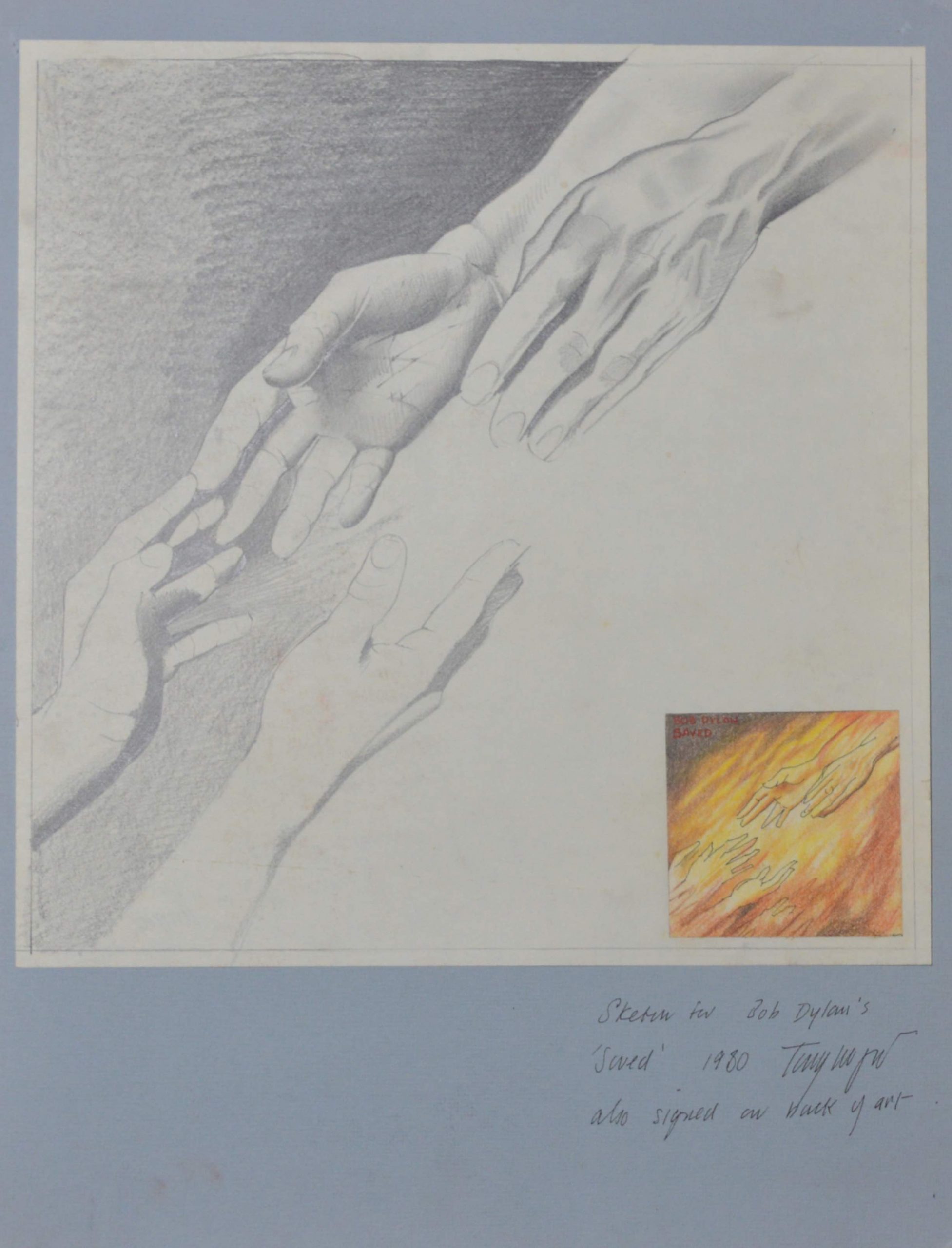
“A few minutes later, Bob Dylan was on the line. Wexler had just finished the record [Saved] and Bob was looking in vain for an artist who could visualize his dream, a vision he had experienced, for the cover.

Dylan told me that he had seen my work and knew that I had the technical expertise, but that he needed someone who understood him. I could only say: Tell me what you want.

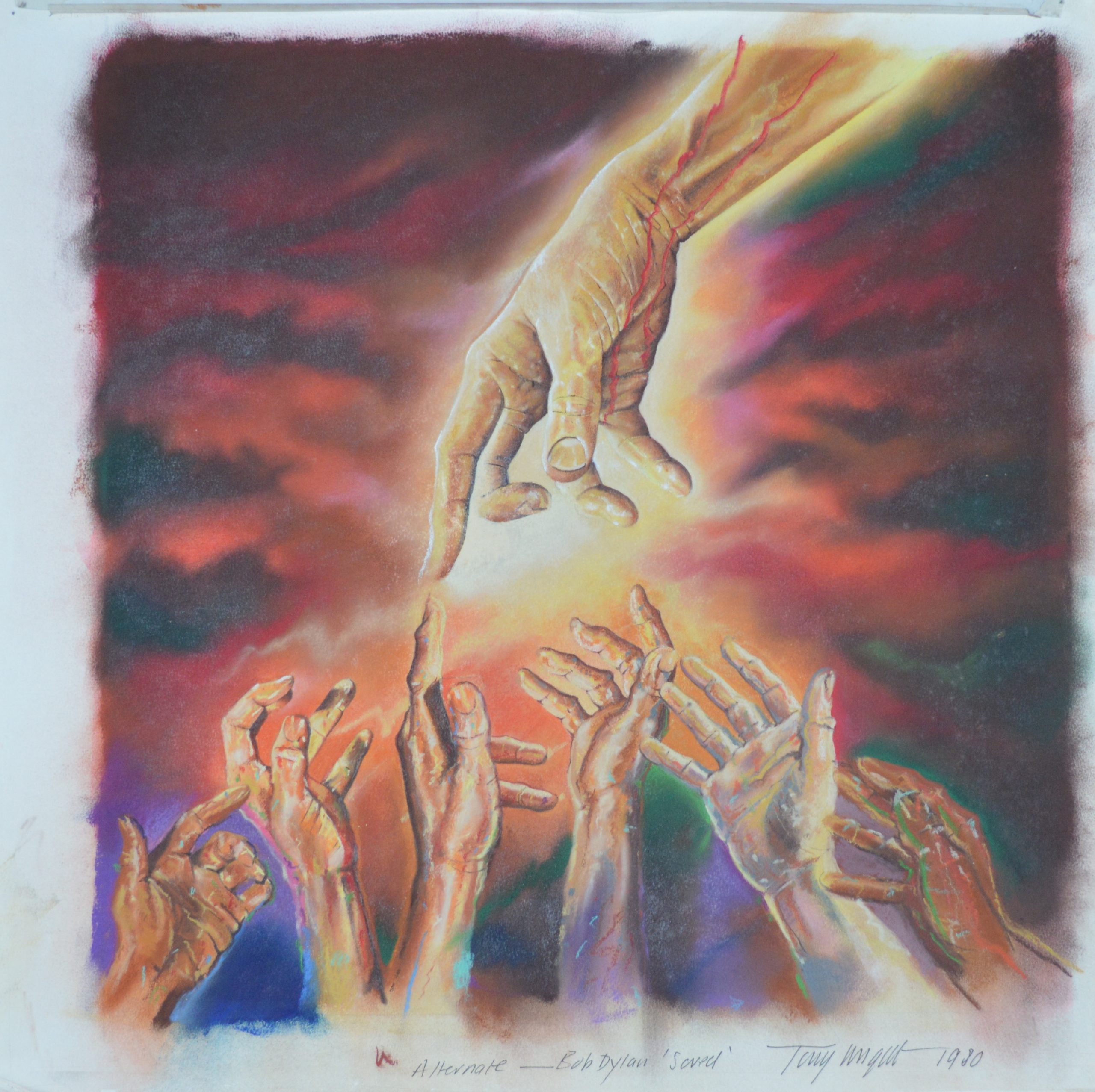
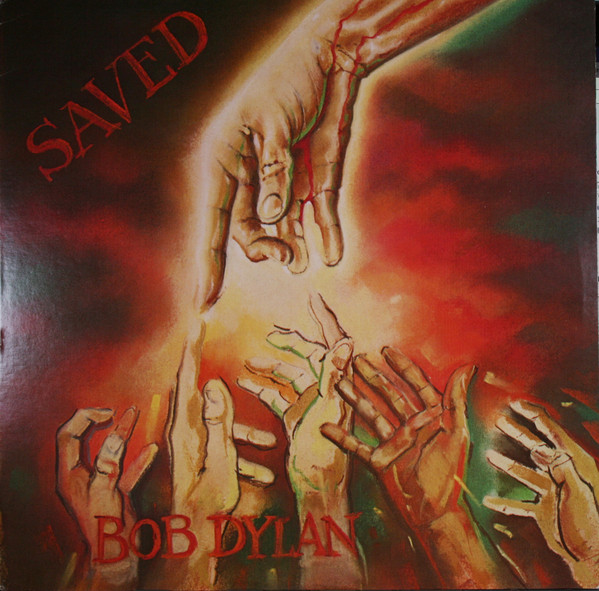
That was a vision, a kind of whole apparently, including all the songs from the record. The image was the hand of God/Christ reaching down to the hands of men. I asked: Rich from heaven? “No, not from heaven. Through it, like through oil.’

No problem: I understand. That same day, I sent him a sketch.

He called me again, completely over the moon. “How did you do that? It’s exactly what I wanted. That’s him. That’s the cover. It will certainly win an award.’

I replied: No, that’s a sketch. You can’t use that. I’ll take the plane and come and discuss the final version with you. “Oh, okay.”

The next day I arrived in LA, with a box full of pastels and paper. I took a taxi to Santa Monica, where he had a rehearsal room with office. As I walked up the stairs from the front desk, I saw him. He stood on the lookout in a small back room, to see what kind of person was coming. In the classroom there was a refrigerator, a small, much too fat dog – a Basset dog, I think – and a blackboard. It quickly became clear to me why the dog was overweight, when I noticed how Bob regularly went into the fridge to get some treats for him.

He gave me a tour and explained that the band was rehearsing here and that he was the singer. It seems like an absurd addition, but it proves that Bob Dylan doesn’t take it for granted that everyone knows who he is.

We sat down, talked a bit and it clicked. He wanted to add some blood to the hand on the sketch, so I took my pastel and drew some blood smoothly over the hand. “Wow, Tony. I’ve never seen an artist at work before.’

When we were done, we agreed that I would go on tour to take some pictures and finish the corner drawing. It was an absurd dream for a Bob Dylan fan. I had first seen him at the Royal Albert Hall in 1965 – I was truant from school before – and the last time was at Earls Court in London (June 1978). Then you only saw a speck of light in the distance, in which you could suspect Bob Dylan. Now, however, I had a backstage pass and could go wherever I wanted: in the audience, backstage or even, at Bob’s own request, on stage to take pictures.

I travelled back and forth to NY over and over again, for each gig, and then arrived sometime in the late afternoon, just in time for the soundcheck. Imagine standing on an empty stage, while Bob Dylan sings ‘Pressing On’ on his own at the piano. The morning [after the performance] we discussed the progress in his hotel room. Bob is very talkative, as long as you don’t talk about the subject of ‘Bob Dylan’. I instinctively sensed that and we even talked about Bob Dylan in the third person. He is interested in art. We talked about it a lot. Ordinary conversations with an ordinary guy, who happens to be a genius when he practices his profession.”

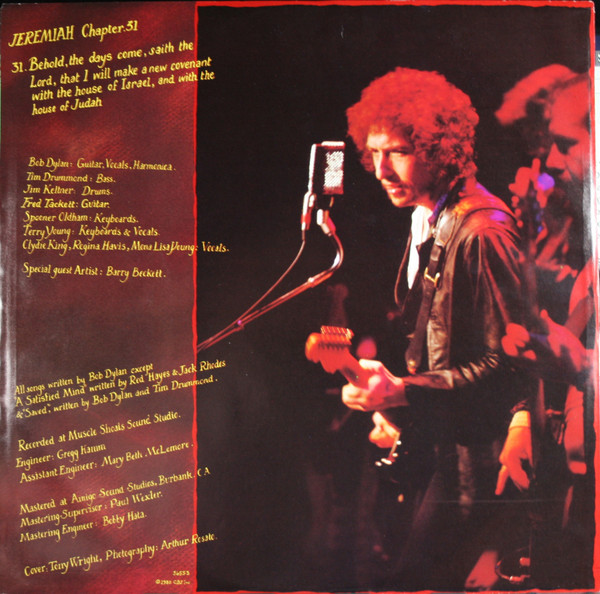
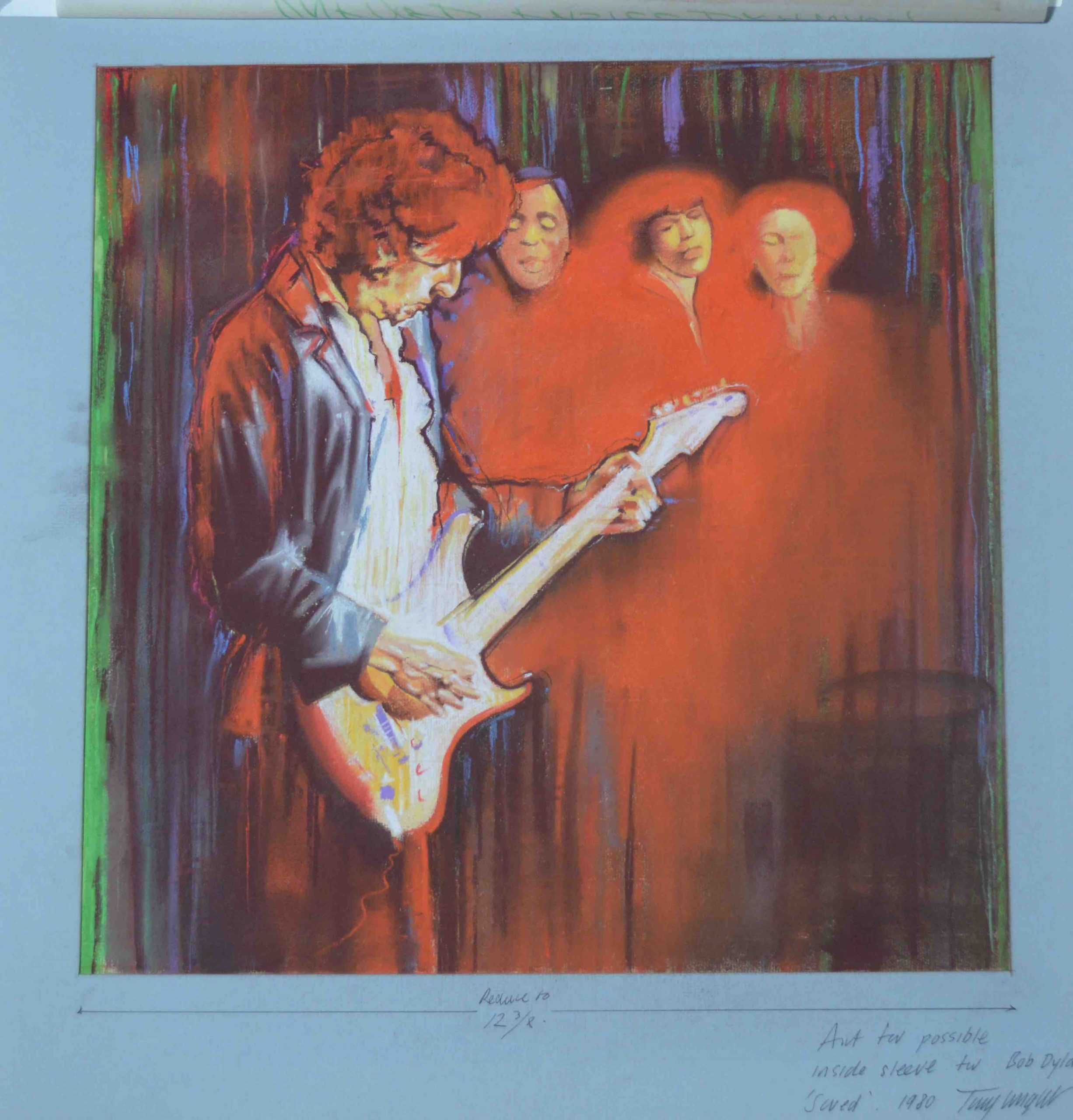
In addition to the pastel with the hands, Wright submits two pastel drawings for the inner cover: both are based on photos he took during live performances of the gospel tour.

Also, there are also two photos of Arthur Rosato, taken during the same tour.However, the record company is not happy with the new direction that Dylan has taken. The attitude is downright hostile. “When the record was finished, they were so rude, so mean about Bob Dylan…

They said they wouldn’t do any promotion for this record – another religious record. […]

I heard how those people, the seniors at CBS, talked about him as if… ‘He can go up the tree’. Something like that.”

They also didn’t like the proposed cover. “I think it goes heavily against Jewish sensibilities.”


Alternative artwork

As soon as the record company gets the chance, they replace the cover with one of Wright’s other pastels, on which Dylan plays harmonica on stage.

That happens sometime in 1985, for the covers of the vinyl records in the United States and Spain. “They’ve always hated it,” Tony Wright said. “Really hated. They were waiting for it.”

Even when Saved is later released on CD, the distinction remains: while in the rest of the world the original cover is usually retained, in the United States the modified version is used. Only in November 2013, with the box set The Complete Album Collection Vol. One, the CD appears for the first time with the original cover.

Here are the articles so far in this series.  All are by Patrick Roefflaer.


Posted in Uncategorized | 3 Comments

Bob Dylan: Sign On The Cross (Part V)

Now when I was just a bawling runt
I saw what I wanted to be
And it's all for the sake
Of that I should be
(Bob Dylan: Sign On The Cross)

Right from the get-go, singer/songwriter/musician Bob Dylan refers to the mythology of the ancient Greeks and Romans; sometimes directly, sometimes obliquely.

Sun-God Apollo encourages the Trojan hero Hector to attack the Greek ships; said it is that the Greek princess Helen possesses the face that sinks a thousand ships:

So spake he, and bade Terror and Rout
To harness his horses
And himself did don his shining armour
(Homer: Illiad, chapter xv ~ translated)

In the song lyrics below, Caesar, a follower of the chief God Jupiter from whose head Athena bursts, is on his way to conquer Rome:

I can feel the Holy Spirit inside
And see the light that freedom gives
I believe it's within the reach of every man who lives
And the dying sun was going down
And the night was coming along
(Bob Dylan: Crossing The Rubicon ~ variant)

The theme that history, whether on the micro-, or on the macro-level, depends upon individuals seizing the right moment to act before Hegel’s Athena asserts that it’s too late:

Because later on you might find the door
You might want to enter
But of course the door might be closed
(Bob Dylan: Sign On The Cross)

So it is with modern Disco dancers ~ they have the Goddess of Love to thank; the Dionysian dancers become like Mars, the God of War, the mythological lover of Venus.

As in the following song lyrics:

Your gaze got a hold on me
My god this feeling just won't quit
I'm in the right, just get out of my face
And I'll tear the roof straight down to the floor
(Mikael Johansson: Hot Nights)

Indeed there are those among us who insist that Disco will return yet again because the sign on the cross says so.

To wit:

“Jesus of Nazareth, the King of the Disco”


Posted in Uncategorized | Leave a comment

Man In The Long Black Coat (1989) Part 4: Those are the hills of hell-fire my love


by Jochen Markhorst


IV         Those are the hills of hell-fire my love

The preacher was a-talkin’, there’s a sermon he gave
He said, “Every man’s conscience is vile and depraved
You cannot depend on it to be your guide
When it’s you who must keep it satisfied.”
It ain’t easy to swallow, it sticks in the throat
She gave her heart to the man
In the long black coat

“Their consciences, God help them, were vile and depraved.”
(Sun Pie in Bob Dylan’s Chronicles, 2004)

 The conscience sermon seems to be, not only literally, the centre of Dylan’s lyrics. Of course, we do not know when Dylan wrote that entertaining Sun Pie Interlude in the “Oh Mercy” chapter of his autobiography Chronicles (2004), but it is very plausible that Dylan put it down on paper well after the song’s creation (March 1989, 15 years before the book’s publication). And that “Man In The Long Black Coat” gave him the inspiration for the Sun Pie Interlude (rather than the other way around).

In itself quite unique, by the way – Dylan building a myth around the creation of a song. We’ve seen it before with “A Hard Rain’s A-Gonna Fall”, of which Dylan declares that the nuclear threat of the Cuba crisis inspired him to write the song, which is demonstrably untrue (the song’s first performance was September ’62, over a month before the Cuba crisis). But otherwise, Dylan hardly ever expresses himself too clearly about leads, inspirations or triggers; he usually sticks to generalities like “Those kinds of songs for me just come out of the blue” (about “Roll On, John”) or “magic” (about “It’s Alright, Ma”) or “It’s like I saw the song up in front of me and overtook it” (about “Dignity”).

The myth-making around Hard Rain seems mainly motivated by youthful self-aggrandizing. That motivation will obviously not have played a role in the fairy tale Dylan composes around the creation of “Man In The Long Black Coat”; the man is sixty plus, doesn’t have to prove anything anymore and he hasn’t been asked about it either (as about Hard Rain, in the liner notes of The Freewheelin’). No, Sun Pie’s genesis seems to originate in a lust for storytelling, and then especially the lust to tell suggestive, insinuating stories, stories like Kafka writes them, like John Wesley Harding‘s songs are, like a song like “Tangled Up In Blue” is; stories that suggest more than tell, that give the illusion of factuality, that

„… das Leben in seiner realistischen, unverzerrten Wirklichkeit schildern, aber gleichzeitig als einen schwebenden, deutlich gesehenen Traum, also als eine realistisch gesehene Irrealität.

… portray life in its realistic, undistorted actuality, but at the same time as a floating, clearly seen dream, i.e. as a realistically perceived irreality.”

(Kafka‘s so-called “Petřín Hill Experience”, in his Reflections From The Year 1920)

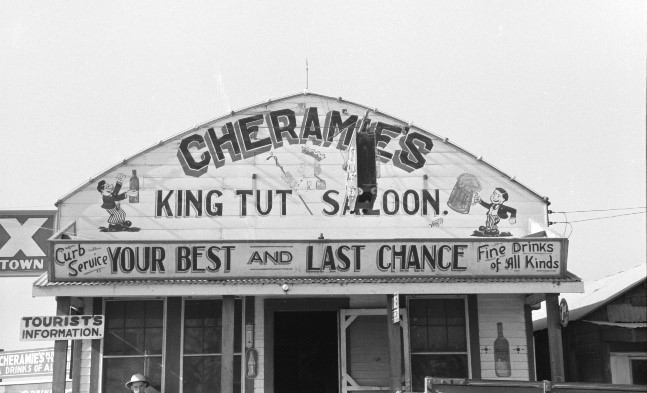
The Sun Pie Interlude complies ceaselessly with Kafka’s ideal image of literature. It is realistic and undistorted, and at the same time dreamlike and unreal. The realistically perceived irreality is already set up by the exposition; Dylan sees from a petrol station an “obscure roadside place” across the road, “across a vacant field”, accessible only by a cow path. The name is slightly hysterical (“King Tut’s Museum”) and “the dust hung like a red cloud in the air”. Located, Dylan divulges suspiciously accurately, “off Route 90 near Raceland.”

This exhibition alone has exactly that misleading touch of reality to meet Kafka’s requirements. Just outside Raceland, which is some fifty miles from Dylan’s studio on Soniat Street in New Orleans, really is a gas station (Chevron) off Route 90, and indeed, across the road is a vacant field. In the 1930s, somewhere around there was located “Cheramie’s King Tut Saloon”… an old dance hall. In the outskirts of the town Raceland. Apparently, Dylan did some research to give the setting of his Sun Pie Interlude that semblance of reality.

A similar realistic unreality has his protagonist’s description, of the man with the unreal name Sun Pie. At the beginning of the twenty-first century, New Orleans musician Bruce Sunpie Barnes has more than local fame in Louisiana with his Louisiana Sunspots (which will grow; in 2015, Sunpie is a member of the Paul Simon band) – it is an option that the autobiographer Dylan knows and chooses that name for his protagonist. And that the associatively meandering stream-of-consciousness comes via the name of the Chinese warlord Sun Tzu (The Art Of War, roughly 5th century BC) to that alienating monologue about Chinese territorial drift, and the theory that the American Natives, the Indians, are actually Chinese. Belligerent Chinese, ancestors of Sun Tzu;

“Trouble was that they split up into parties and tribes and started wearing feathers and forgot they were Chinese. They started wars with each other for no reason, one tribe against another.”

Another one of those untruthful-looking stories that nevertheless has a touch of reality; recent DNA research on a 14,000-year-old human skull indeed confirms an older theory that wandering Asians reached America via a land connection that is now the Bering Strait and are the ancestors of native Americans.

A nice touch, but the most interesting detail is Sun Pie’s occupation: carpenter. By which Dylan, deliberately, we may assume, seems to be revealing an inspiration for “Man In The Long Black Coat”: the old folk song “House Carpenter”, the song Dylan recorded in 1962 and released on The Bootleg Series 1-3 in 1991.

The folk song from probably the 17th century, also known as “The Daemon Lover”, “James Harris”, “The Carpenter’s Wife” and more names, tells the story of the woman who leaves her husband the carpenter and children to go with a strange man. In some variants the ghost of her first love, in others simply a mortal man, in still others the devil himself. In Dylan’s version, the latter:

Oh what are those hills yonder, my love
They look as dark as night
Those are the hills of hell-fire my love
Where you and I will unite


We also know that the song is no one-hit wonder in Dylan’s inner jukebox; in March 1970, during the fifth Self Portrait recording session, he records another “House Carpenter” (with partly different lyrics; released on The Bootleg Series Vol. 10: Another Self Portrait in 2013). But in almost all variants, including the ones Dylan chooses, the carpenter’s wife takes the boat – the boat that the first-person from “Man In The Long Black Coat”, in the bridge, is still trying to catch (“I went down to the river but I just missed the boat”).

They are, all in all, enough hints to understand the song as an answer song, a song like the answer to “He’ll Have To Go”, Jeanne Black’s “He’ll Have To Stay” (which in turn was answered by Johnny Scoggins with “I’m Gonna Stay” – it has a happier ending than Dylan’s song) or the witty “Slip-In Mules (No High Heel Sneakers)” by Sugar Pie DeSanto, the irresistible answer to Tommy Tucker’s “Hi-Heel Sneakers” (also 1964). Songs in which usually a lady replies, either melodramatically or humorously, to a usually somewhat macho-talking man.


Dylan’s “Man In The Long Black Coat” is then – in that scenario – a reversal of the cliché: the cheated and abandoned husband from “House Carpenter” now gets the spotlight and the microphone, and gets to lament the injustice done to him.

The autobiographer closes the Sun Pie Interlude in style. In farewell, Dylan is presented with a bumper sticker, and not, as one might hope from King Tut’s Museum, an Egyptian ring that sparkles, and travels back via what should be perceived as an unreal realistic route:

“We stopped only once more, and that was at Jesuit Bend, but before nightfall we were back on St. Charles Avenue. I’d gotten back to New Orleans with a clear head.”

It is impossible to drive from Raceland to New Orleans via Jesuit Bend; the separating bayou, with Lake Salvador, Bayou Perot and Bayou Rigolettes, has no roads and is impassable for a motorbike. Well, maybe it is, but at most in a floating, clearly seen dream.


To be continued. Next up Man In The Long Black Coat part 5: Happy Little Accidents

——————-

Jochen is a regular reviewer of Dylan’s work on Untold. His books, in English, Dutch and German, are available via Amazon both in paperback and on Kindle:


Posted in Uncategorized | 1 Comment

NET 2009 part 2: contending forces: through the tears and the laughter

By Mike Johnson (Kiwipoet)

It was the best of years, it was the worst of years. It was the year of both superlative and abysmal performances. It was the year of contradictions, the year of astonishment and disillusionment, at least for followers of the NET.

What was happening to Bob Dylan? His voice sounded like it was on the verge of giving out, his arrangements were strange and staccato, his organ playing rinky-dink and oddly obsessive, his harp playing sharp, rich and high flying. His instrumental backing was often minimal, highlighting that hoarse voice.

In my last post, I featured some pretty abysmal performances, so I thought I’d start here with a superlative one – Po Boy from the Rothbury concert. This is a best ever, folks. Usually I use the term ‘best ever’ with a tongue in my cheek as one best-ever performance will be superseded by another. Not in this case, at least for me; this has remained my favourite.

Dylan hones the lyrics by leaving out the ‘Othello to Desdemona’ verse, which doesn’t fit into the rest of the song, but otherwise, it’s all there.

I have suggested that, despite the wry humour, this is a protest song dealing with the life of a poor black man living under the Jim Crow laws that crept in after the civil war to keep black people subjugated. But it is nothing like the protest songs of the 1960s, being oblique and impressionistic.

Po’ boy, dressed in black
police at your back

The tempo is slow but jazzy, pure 1930s, the harmonica sharp and jagged. Despite the vamping organ, it escapes the dumpty-dum by its syncopation. Dylan’s vocal is superb, as is the recording. Readers may not be surprised to learn that this is another Crystal Cat bootleg; bootlegs that are famous for their sharpness and clarity. Enjoy, and then enjoy again.

Po Boy

We have another best ever with this beaty, ominous performance of ‘Cold Irons Bound.’ (Fairfax, 11th November). The shrieking guitar intro has long gone, the instrumentals minimal, the pace relentless, the atmosphere threatening, and is completed by a slashing harp. Again, this is a genuine best ever… although when we come to 2010 we might find its rival. It’s a fraught, intense performance by Dylan.

It might also be seen as a protest song if the anguished expression of alienation can be a considered protest.

Cold Irons Bound (A)

We can’t leave it there, however, as Dylan performed the song in Chicago. It’s worth listening to if just to hear the audience responding to the lines ‘the winds of Chicago have torn me to shreds.’ Those Chicago folks know what he’s talking about. I don’t think it’s quite as good as the Fairfax performance, although that may be because the recording is a bit more echoey. I don’t find the harp break not quite as slashing or the instrumental sound that wraps up the song quite as frenetic. But I’m sure not complaining.

Cold Irons Bound (B)

Just to show how problematic the 2009 performances can be, we have to now jump from the sublime to the ridiculous, from the superlative to the abysmal, from the best ever to the worst ever.

Compare the sinuous and insinuating ‘Mobile’ on Blonde on Blonde with this jerky travesty. If you can hack it, listen to how Dylan mangles the magnificent last verse by emphasizing the jerkiness rather than singing across it. It’s another Rothbury performance, and so, unfortunately, is brilliantly recorded. I could have tiptoed around it and left it out, but, well hell, it was the best of years and the worst of years…

Mobile

‘To Ramona’ might be seen as another kind of protest song, a protest against the devastating effect of propaganda and self-delusion:

I can see that your head
Has been twisted and fed
With worthless foam from the mouth
I can tell you are torn
Between stayin' and returnin'
Back to the South
You've been fooled into thinking
That the finishin' end is at hand
Yet there's no one to beat you
No one t' defeat you
'Cept the thoughts of yourself feeling bad

This performance turns the dumpty-dum into a waltz, the song being carried by Dylan’s rich voice and equally rich organ chords, if you can cope with the rinky-dink and the vocal sometimes falling too emphatically into the 123/123 time signature. (31st Oct, Chicago)

To Ramona

While looking at 2008, I outlined how Dylan would sometimes get out from behind his keyboard and move centre stage, alone with harp or guitar. This added a bit of movement and interest to what was otherwise a static stage scene, and often provided something of a refreshing change. It also brought Dylan out of the comparative anonymity into the limelight. The Fairfax version of ‘Cold Irons Bound’ was a center-stage performance.

The performances too, being free of that omnipresent organ, were of special interest. This performance of ‘Shooting Star’ from Los Angels, 14th Oct, certainly is. Dylan has always been able to generate a lot of intensity with this song; its slow, quiet beat should not be taken for a laid-back sound. It’s the lyrics that generate that intensity, as it’s not just human love that may be lost, but our chances for spiritual salvation. It’s the bridge verse that’s the key to this lift from a love song to a song of spiritual yearning.

Google usefully describes a bridge in a song this way: ‘A bridge in songwriting is a section that differs melodically, rhythmically, and lyrically from the rest of the song. As a structural transition between choruses, a bridge breaks up the repetition of verse/chorus/verse and offers new information or a different perspective. It can also serve as an emotional shift.’

Dylan uses it in ‘Shooting Star’ to up the emotional and thematic ante, to push the song to a new level:

Listen for the engine
Listen for the bell
As the last fire-truck from hell
Goes rollin' by
All good people are prayin'
It's the last temptation
The last account
Last time you might hear

The sermon on the mount
Last Radio is playin'

I wouldn’t list this as a best-ever performance, the song has always been performed well, and at different tempos, and this one is no exception. Dylan as circus barker is in good form and the enthusiasm of the audience when he produces his harp is amply rewarded.

Shooting Star

That obsessive organ vamping of Dylan’s does not always turn the song rinky-dink. In this performance of ‘Lovesick’ from Florence (18th April), the organ, made a little ghostly by being in the background rather than the foreground, is used to great effect. That walking beat that drives the song has its own obsessive aspect. The organ here seems to add a touch of the fantastic to the singer’s midnight walk. It’s a raw and powerful performance.

Lovesick

Similarly, the churchy chords Dylan uses in ‘Every Grain of Sand’ are apposite, and help bring out the grandeur of the song, although they may get too rigid and staccato towards the end. It’s a song in which the contending forces are doubt and faith; we hang in that balance. From the album version on, the song has been used as a showcase for Dylan’s harp, and here it adds a lonely, bluesy edge. Another raw and powerful vocal, even when his voice falls too emphatically into the dumpty-dum. (14th Nov, Boston)

Every grain of sand

‘Tough Mama’ (Amsterdam, 12th April) is notable, not just for the new lyrics but the slow, dramatic ending. The slow, deliberate, loud organ chords give this song a less bouncy ending. It’s more clearly a hymn to the eternal female. With regard to those new lyrics, maybe a reader could decipher them and post them into the comments section; my ear can’t pick them all up, and they sound fascinating, well worth deciphering.

Tough Mama

‘I believe in you’ is another song that can sit comfortably with a churchy organ. After reintroducing the song to his setlists in 2004, having not played it since 1981, Dylan has done some powerful performances of this devotional/love song. It’s all the more powerful for the minimal arrangement in this performance from Stockholm (22nd March). As far as I know, Dylan did not perform this song after 2009.

I believe in you

Perhaps it was Dylan’s sense of humour to play this song immediately after singing ‘I Don’t Believe You,’ one of Dylan’s old acoustic songs from the early sixties that Dylan transformed into a rock song in the mid-sixties. Here it is a mid-tempo foot-tapper. He polishes it off with nice touch of harp.

I don’t believe you

The official Dylan website doesn’t list this performance of ‘To Make You Feel My Love’ from Florence (18th April) but attributes it to Stockholm. As with 2008, Dylan’s broken-voiced performance perfectly suits the song, surely one of Dylan’s saddest love songs. To my knowledge, Dylan has not performed the song since 2009.

To make you feel my love

Staying in Florence, we catch this performance of ‘Mr Tambourine Man.’ Dylan’s powerful, circus barker vocal makes up for the rigidity of the beat. The audience loves this one despite the missed verse and lines. This one has to be the best he did in this style. All it’s lacking is the touch of the harp.

Mr Tambourine Man

We do get a touch of the harp however in ‘The Times They Are A-Changing,’ another song that’s been through a lot of changes over the years. This one’s from London (25th April). This anthem never seems to age, as its message around the inevitability of changing time never changes. The triumphant harp break before and after the last verse is a fitting end to the song and to this post.

Times they are a-changing

In the next post I’ll be turning to the album Dylan released in 2009, Together Through Life, and considering a tranche of new and exciting songs that Dylan wrote with Robert Hunter.

So stick around and I’ll see you then.

Kia Ora


Posted in Uncategorized | Leave a comment

A Dylan cover a day: Nobody Cept You: an almost lost work of utter brilliance.

By Tony Attwood

I should explain as a prelude that these articles are written as I search for and listen to the cover versions – at the start I am quite often not sure where the trail leads or whether I’ll find something interesting.  That is certainly the case here, and I almost didn’t develop this piece, because I didn’t think much of the original.  But… have I been surprised by what has turned up.

So I am presenting the recordings in the order that I found them, starting of course with Bob’s own version.

Nobody Cept You was planned as the final song for Planet Waves and then dropped from the album.  It was played eight times in concert in January 1974 and then also dropped from the rosta, so we can take it that after a bit of initial enthusiasm, Dylan didn’t really like the song anymore.

I did a rather uninspired review of the song back in 2016 when the site consisted entirely of me plodding through all the Dylan compositions I could find and writing a review of each one.

But over the years since then eight readers have kindly taken the time to comment on my review, and several showed themselves to be very fond of a song that many of us have long since forgotten.

So I was wondering if I could find some cover versions of this obscure piece, or see if there was anything interesting to say about the song that hasn’t been said.   And by pure luck I did find such a recording.  (I’d love to say that it was the result of hours of dedicated research, but in truth searching out Dylan covers in the way I do it is as much chance as it is the dedicated research).  Therefore I would beg you to stay with this particular ramble because there is something rather super at the end.

But because it is a rather obscure song and because it was a bit of a fun journey this morning, here’s the original, in case you’ve not heard it or forgotten it.

The wah-wah background guitar is, for me, utterly horrible, and detracts enormously from the song.  Indeed the whole accompaniment seems wrong for the song – and maybe that is why Bob dropped the piece.

The Waterboys seemed to feel this too as they made the accompaniment fit the lyrics in a much more acceptable way.   It’s now a nice, jolly love song.  Not Dylan at his best as a composer, but still very listenable.

The next version is a bit of a cover in that it says that the cover is by “16 Horsepower” and I think this is David Eugene Edward who wrote the lyrics for the band.  But if I have got that wrong, or you can fill in more please do write in.

What I really love about this performance is not only that the singer feels every word but he makes the performance sound as if it really is the way this song was meant to sound in the first place.

And I thought that was that, until just as I was about to wrap this up and publish this little ramble, I stumbled on this performance by chance.  It is a recording David Eugene Edward’s band 16 Horsepower playing the song.  I don’t know if this version came first or the solo version, but my goodness they are different.

Here, amazingly, all the promise and possibilities that flitted through my head while listening to the performance above came to total fruition in this song.

Suddenly the phrase “lost work of utter brilliance” springs to mind – although of course it could well be just me that has lived these years in ignorance.

But for me, this is now a song rewritten and reborn, and for me at this moment, I have just discovered a wonderful new Dylan song.  New, because although I heard it when the Rare and Unreleased bootleg came out, I thought nothing much of the song, couldn’t really see the possibilities and have hardly played it since.

Of course, that is not to say that everyone felt this way, but certainly Bob appears not to have seen any way forward for the piece.  But thank goodness 16 Horsepower did.

The Dylan Cover a Day series

Posted in Uncategorized | Leave a comment

Bob Dylan and the Sign of the Cross Parts III and IV

Bob Dylan And The Sign Of The Cross Parts I and II

by Larry Fyffe

Jesus says to the apostle Peter:

And I will give unto thee the keys to the kingdom
(Matthew 16:19)

The monopolization by structured and dogmatic religion of what is the true purpose and meaning of mankind’s existence be the focus of “Sign On The Cross”.

Rendered it be through the ‘stream of consciousness’ technique; the narrator in the song lyrics beneath, is worried:

Well, it's that old key to the kingdom
Well, it's that old sign on the cross 
Like it used to be
(Bob Dylan: Sign On The Cross)

The belief in an Afterlife so earnestly emoted in gospel tunes, the singer/songwriter/musician Bob Dylan trifles with – turns to travesty.

He’s very like a whale, a wail of sarcasm that lowers it’s head, and charges:

You might think you're weak
But I mean to say you're strong
Yes you are
If that sign on the cross begins to worry you 
That's all right, you just give me a song
And all your troubles will pass right on through
(Bob Dylan: Sign On The Cross)

Though not humorously expressed as above, similar to the motif are the lyrics below:

Play another one, and 'Another One Bites The Dust'
Play 'The Old Rugged Cross', and 'In God We Trust"
Ride the pink horse down the long lonesome rode
Stand there and wait for his head to explod
(Bob Dylan: Murder Most Foul)

Odd indeed  that neither Jochen Markhorst nor Tony Attwood, both adherents of the Sound School of Dylanology, can’t make any sense of “Sign On The Cross” by Rorbert Zimmerman.

You see, it’s no longer Pilate’s message that used to be ‘laying’ there – rather it’s Paul’s message that’s ‘lying’ there now:

Well, it's just a sign on the cross
Every day, every night
The sign on the cross
Is laying up on top of the hill
Yes, one thought it might-a disappeared long ago
But I'm here to tell you, friends
That I'm afraid it's lying their still
(Bob Dylan: Sign On The Cross)

Burlesque at its best.

Bob Dylan And The Sign On The Cross (Part IV)

Reverend Bobby stirs up associative medicine lyrics in his Travelling Salvation Show.

Mixes in verses of dark and light:

Every morn, and every night
Some are born to sweet delight
William Blake: Auguries Of Innocence)

With:

Every day, every night ...
Yes, we thought it might
(Bob Dylan; Sign On The Cross)

And this too:

Realms of bliss, realms of light
Some are born to sweet delight
Some are born to the endless night
End of night, end of night
(Jim Morrison: End Of Night ~ The Doors)

There're more doors thrown into the pot:
Trying to make it to heaven in due time
Before those heaven doors close
(Blues Project: Wake Me Shake Me ~ traditional gospel)

Swirled around with:

Because later on you might find the door
You might want to enter 
But of course the door might be closed
(Bob Dylan: Sign On The Cross)

Not a mostly pink murdered foal in the big pink house, but there are white horses.

The Southern Baptist preacher raves on about the unworthy, and the need for repentance, and salvation:

Well, six white horses that you did promise
Were finally delivered down to the penitenitary
(Bob Dylan: Absolutely Sweet Marie)

Stirred up with:

Well, there are some in, men in prison
And there are some in a penitentiary too
(Bob Dylan: Sign On The Cross)

If you buy a Bob Dylan Secret Decoder Ring, you’ll be able to uncover more clues.

(Available at your local Untold Store)

Posted in Uncategorized | 1 Comment

Man In The Long Black Coat (1989) Part 3

by Jochen Markhorst


III         The Man Comes Around

Somebody seen him hanging around
At the old dance hall on the outskirts of town
He looked into her eyes when she stopped him to ask
If he wanted to dance, he had a face like a mask
Somebody said from the Bible he’d quote
There was dust on the man
In the long black coat

 “A lot of people say his songs are full of images that don’t mean anything. It’s like abstract painting. Some people don’t have the imagination to appreciate something a bit vague,” says Ramblin’ Jack Elliott about his mate Dylan back in the 1960s (Melody Maker, 29 May 1965).

A decade later, another expert says pretty much the same: “You who are so good with words and at keeping things vague,” sings Baez in her heartbreakingly melancholic reflection song about her relationship with Dylan, “Diamonds And Rust” (1975).

It is an aptly formulated stylistic feature of Dylan’s poetry, and in 1989, twenty-four years after Elliott’s analysis and fourteen years after Baez’s reflection, it has lost none of its sharpness. The poet has just opened “Man In The Long Black Coat” cinematically, with the cricket soundtrack and a classic wide-shot, promising a “normal” narrative. In a traditional narrative, the exposition, the development of the catastrophe and finally the catastrophe now follow. But Dylan skips the exposition, as well as the development of the catastrophe, and immediately gives away an ending: “Not a word of goodbye, not even a note / She gone with the man in the long black coat.”

Not necessarily unusual, as we know plenty of stories that start with the end. Every Columbo episode, like most detectives for that matter, starts with the murder – and we only then learn about the circumstances, the story beforehand and the main characters. Something like that now promises Dylan’s abrupt spoiler, the disappearance of “she”: we will surely now be presented with a flashback, the advance story that will reveal who “she” is, and who or what the man in the long black coat is.

That, of course, is not going to happen. Dylan does suggest, right from the opening line of the second verse, an illuminating flashback – but he is and remains good at keeping things vague: “Somebody seen him hanging around at the old dance hall on the outskirts of town.” Very good, even. “Somebody” is another “ordinary” vagueness, which Dylan has preferred to use throughout his career (there are 89 somebodies and 86 someones in the official Lyrics alone), but the old dance hall on the outskirts of town is a particularly subtle, layered vagueness. The use of “the” rather than “an” insinuates that we are, in fact, introduced, that we know which dance hall in which town, but of course we don’t, and the lyrics do not reveal any of that at all. “Dance hall” is a term we haven’t used since the early 1960s, so we situate the story in, say, the 1950s, but no, it’s the old dance hall – suggesting that the dance hall is now out of use, supplanted by nightclubs, dancings and discotheques. So that one word “old” alone blurs the picture again; this story could be set in the 1920s, or in the 1960s, or yesterday.

Something similar applies to “the outskirts of town”. Again, not necessarily unusual in songwriting, but surely the first association is the old blues classic “I’m Gonna Move To The Outskirts Of Town”, recorded by everyone and everything, and Dylan can undoubtedly play in his inner jukebox the versions by Josh White, Ray Charles, Louis Jordan, The Allman Brothers and B.B. King. And at the very front, of course, is Jimmy Reed,


… which gently pushes the décor back towards the 1950s. And Dylan’s second association only confirms this likely time frame;

Well on the outskirts of town, there's a little night spot
Dan dropped in about five o'clock
Pulled off his coat, said "The night is short."
He reached in his pocket and he flashed a quart

… not just the outskirts of town, but in a dance venue as well: “Dixie Fried” by Carl Perkins, one of those Sun Records giants, the men Dylan thinks of when he tells about the run-up to “Man In The Long Black Coat” in Chronicles, the men who

“… were singing for their lives and sounded like they were coming from the most mysterious place on the planet. No justice for them. They were so strong, can send you up a wall. If you were walking away and looked back at them, you could be turned into stone.”

And the third indication that we are indeed in the 1950s Dylan’s fourth line gives: “she” asks the stranger in the long black coat to dance, so the old dance hall, though old, is still in use.

Via the same diversions, we get a vague geographical notion; “outskirts of town” Dylan seems to associate with “Southern” anyway – at least that seems to be the setting in the two other songs in which he uses this very geolocation (“Something’s Burning” and “Floater”), and ís the backdrop in such landmarks as Bobbie Gentry’s “Fancy” (We lived in a one room, rundown shack on the outskirts of New Orleans), truckers’ smartlaps like Ferlin Huskey’s “Teddy Bear” (I was on the outskirts of a little southern town) and Warren Zevon’s “Carmelita”. And the mystery man has dust on his coat – so it’s probably hot and dry. Thin, but near-by enough to simultaneously keep things vague and still hint: we are somewhere in the South, presumably in the 1950s.

A same anonymous “somebody” then, agonisingly, hints that the stranger is quoting from the Bible. But, of course, does not reveal what he is quoting. Frustrating, but on the other hand… it opens the gate to see Blind Willie Johnson (and hear “In My Time Of Dyin’” or “John The Revelator”), or even more intriguingly: Leonard Cohen (“Story Of Isaac”, to name just one of the all-time great songs in which he quotes the Bible), or one of the dozens of songs with biblical references by the Man In Black himself, of course, Johnny Cash. “He Turned The Water Into Wine”, for instance, or “Belshazzar”. And all the vagueness even invites to argue that Dylan, like a Rembrandt, smuggles in a self-portrait. After all, like from Blind Willie, Cohen and Cash, we also know of some Dylan photographs showing him wearing a long black coat.

But in the end, the most attractive scenario is an inverse scenario; that “Man In The Long Black Coat” inspires Johnny Cash, just before his death, to “The Man Comes Around” – the Man In Black, in his long black coat, quoting from the Bible, with his face like a mask, hanging out at the dance hall. And he decides who to free…

Probably comin’ ’round in the outskirts too, this man.


To be continued. Next up Man In The Long Black Coat part 4: Those are the hills of hell-fire my love

———-

Jochen is a regular reviewer of Dylan’s work on Untold. His books, in English, Dutch and German, are available via Amazon both in paperback and on Kindle:


Posted in Uncategorized | Leave a comment

Bob Dylan And The Sign Of The Cross Parts I and II

by Larry Fyffe

Part I

From the Gnostic point-of-view of  the Cosmos, both big and small, the material part thereof is a world of darkness ~ either through ignorance, or, worse still, through the presence of evil.

Earth is no paradise for sure; Doctor Death carries his sword.

Furthermore, only a few people are able to ignite some of the spiritual light that lies within the material darkness.

But for the most part, darkness remains.

As indicated in the following song lyrics.:

The evening sun is sinking low
The woods are dark, the town is too
(Bob Dylan: Tell Old Bill)

Though the poet mother’s be a believer in Christian Gnosticism, the poem quoted beneath declines to follow the dark path:

Rather, the modernist writer is influenced by the Romantic Transcendentalists, albeit only to a degree:

The woods are lovely, dark and deep
But I have promises to keep
(Robert Frost: Stopping By Woods On A Snowy Evening)

One big problem, according to some forms of Gnosticism anyway, is that the authorities of structured politics and religion are determined to impose particular views across the board as to what the means of escape is from the dark material world.

On the other hand, the Gnostic view is that the door is locked to most, but individual self-enlightenment is considered to be the key to freedom.

Demonstrated in the song lyrics below by the narrator thereof in reference to Jesus on the cross.

If thought a ‘King’ Jesus be a threat to the Roman Empire:

And Pilate wrote a title
And put it on the cross
And the writing was
"Jesus of Nazareth, the King of the Jews"
(John 19:19)

Nevertheless, it’s the Judeans who bear the brunt thereafter; they are the ones labelled by most Christians as the murderers of Jesus Christ.

The lyrics below, performed as a burlesque of a long-drawn-out Christian gospel tune that tells everybody that Jesus loves them:

Yes, but I know in my head
That we're all so misled
And it's that old sign on the cross
That worries me
(Bob Dylan: Sign On The Cross)

Being from a Jewish background, Robert Zimmerman’s well aware of the false accusation spread by adherents of Christianity throughout history.

Paradise lost, the gates of Eden closed: 
But I was lost on the land
As I heard that front door slam
And that old sign on the cross
Worries me
(Bob Dylan: Sign On The Cross)

A masterful satire; a masterpiece beyond compare.

Bob Dylan And The Sign On The Cross (Part ll)

In the biblical verse below, Jesus is called the “Lamb of God”, a Jewish Passeover meal, so to speak:

The next day John seeth Jesus coming unto him
And saith, "Behold the Lamb of God
Which taketh away the sin of the world"
(John 1: 28)

So referred to in the following gospel song

Oh, that old rugged cross, so despised by the world
Has a wondrous attraction for me
For the dear Lamb of God left His glory above
To bear it to dark Calvary
(Elvis Presley: The Old Rugged Cross ~ Bernard)

For the narrator in the song below, the cross is not a wonder but a worry:

Oh when I hold my head so high
As I see my old friends go by
And it's still that sign on the cross 
That worries me
(Bob Dylan: Sign On The Cross)

No wonder ~ Christian apostle Paul blames the death of Jesus on the Jews:

Who both killed the Lord Jesus
And their own prophets
And have presecuted us
And they please not God
And are contrary to all men
(I Thessalonians 2:15)

However, Governor Pilate condemns Christ to death because He’s considered a threat to the political authority of the Roman Empire.

No mention is made of how the Governor knows that Jesus has supposedly been anointed the “King of the Judeans”.

Franz Kafka told’im, maybe:

And Pilate wrote a title

And put it on the cross

And the writing was

"Jesus of Nazareth, the King of the Jews"
(John  19:19)

The narrator in the Dylan song howls to his Paulinist friends that it was not he, or his people, who put Jesus Christ out to death.

In short, before they die, what his friends need the mostest is a little Blake-light “gnosis”:

And I just would like to tell you one time
If I don't see you again
That the thing is
That the sign on the cross
Is the thing that you need the most
(Bob Dylan: Sign On The Cross)

The meaning of the song easily thus construed.

Posted in Uncategorized | Leave a comment