In this series I select my favourite performance by Dylan of a particular song from across the years of the Never Ending Tour – using of course the recordings selected from the mega-series which Mike Johnson is compiling for us and which has now reached episode 128.
In those 128 episodes we have 17 recordings of Every Grain of Sand, and I have just worked my way through them with increasing despair, not finding one that I could really say stands out. Of course, this is my personal view, and really, who am I to judge what Bob does? But even so, I still feel moved to consider the recordings, and wonder. Because if you were to go through each one I think you might reach the same conclusion as me: that Bob has been trying between 2009 and 2013 to find a way to deliver an alternative version, but without success.
Except for once. This one recording from 2007 stands out to me, head and shoulders above all the others.
Every grain of sand
While some of the alternative versions sound to me as if Bob had an idea and then let it happens, this version appears to have been worked out in detail. It is as if the composer has gone back to the original and asked himself: what does this song mean? Why is it here? Why do I want to perform it?
And here he finds an answer. While other versions virtually dispense with the melody completely, and indulge in endless repeats of one melodic line, here it is as if he has returned to the meaning rather than simply having a need to get through the lyrics.
I am not saying that this version is perfect; I am not convinced by the notion of the six repeats of specific chords, but even so this is a great step forward from other versions. Even the harmonica solo seems to fit.
Indeed what we have is a song that has all the components of a song which keeps my interest, no matter how often I have heard it. But now compare the above with this version from 2009 in which the lines are called out and the harmonica used between the lyrical lines. It just feels to me as if this version arose from a desire to do something different with the song whereas the 2007 version above actually solves the problem.
This is not to say that I think the 2007 performance does the song its full justice, but I think it does get closer and does give some further insights into the lyrics.
Indeed I guess my feeling about this song comes particularly from the lyrics which I do find really moving
I hear the ancient footsteps like the motion of the sea
Sometimes I turn, there's someone there, other time it's only me
I am hanging in the balance of a perfect finished plan
Like every sparrow falling, like every grain of sand
That contradiction of moods where on occasion one feels completely isolated but other times part of world, sharing all its joys and sorrows with everyone else… I think these lines reflect that thought perfectly, but somehow on stage (and this as ever is just my thought) Bob doesn’t quite maximise the potential of the song. But with the 2007 version, in my view he does get that much closer.
My guess is that the problems that I perceive with the performance of this song began with the album recording, which is very fixed and rigid in its rhythm and for me doesn’t have the sway and relaxation that the lyrics seem to demand. So, extending guess upon guess, I think in the live performances Bob has been trying to move on from the rigidity of that recorded version and give us something more in keeping with the swaying motion of the lyrics.
Of course, I’m just an outsider listening in, but my view, for what it is worth, is that the perfect live performance of the song is yet to be found.
Considered by some is that Queen of Sheba with King Solomon’s baby in her belly transfers the Heaven-On-Earth of the future, at least in part, from Jerusalem to Ethiopia, a paradise in Africa modelled after the idealistic depiction of the biblical Garden Of Eden:
She was the rose of Sharon from paradise lost
From the seven hills near the place of the cross
(Bob Dylan: Caribbean Wind)
She’s the personification of an ideal place ~ as presented in the poem below:
A damsel with a dulcimer
In a vision once I saw
It was an Abyssinian maid
And on a dulcimer she played
Singing of Mount Abora
(Samuel Coleridge: Kubla Khan)
Though Ethiopia’s not biblical Eden, it’s close enough thereto ~ as noted in the poem “Paradise Lost”:
Nor where Abassin kings their issue guard
Mount Amara, though this by some supposed
true paradise under the Ethiop line
(John Milton: Paradise Lost, Book IV)
Noted too is that Queen Sheba’s skin is not white:
I am black, but comely, O ye daughters of Jerusalem
As the tents of Kedar, as the curtains of Solomon ....
I am the rose of Sharon, and the lily of the valley
(Song Of Solomon 1:5, 2:1)
Thus claimed that via her womb there be descendants of Hebrew slaves delivered out of Egypt who settle in Abyssina (Abassin).
King David and Bathsheba are Solomon’s parents:
Princes shall come out of Egypt
Ethiopia shall stretch out her hand unto God
(Psalm 68:31)
Jamaican “Rastafarians” refer to God, who is black, as “Jah” (Jehovah).
Ethiopia/Abyssinia ~ from where many of the Queen’s offspring end up getting kidnapped by men armed with iron guns, and shipped off as slaves to America, including the islands of the Caribbean Sea:
She told me about the jungle
Where her brothers were slain
By the man who invented iron
And disappeared mysteriously
(Bob Dylan: Caribbean Wind)
America becomes New Babylon, and a post-apocalyptic return by blacks to heavenly Ethiopia is envisioned by Rastafarians:
Every new messenger brings evil report
'Bout armies on the march, and the time that is short
And famines and earthquakes and train wrecks
(Bob Dylan: Caribbean Wind)
In the following song lyrics, the ancient elements of earth, wind, water, and fire (figuratively presented by poet William Blake) act as objective correlatives:
I see a house in the country being torn apart from within
I hear my ancestors calling from the land far beyond
And the Caribbean winds still blow from Nassau to Mexico
From the flames of the furnace of desire
(Bob Dylan: Caribbean Wind)
Reminding of the Rodgers and Hammerstein-like lyrics below, and the train that is supposed to come up around the bend:
Walk out in the rain
Walk out with some dreams
Walk out of my life if it don't feel right
And catch the next train
(Eric Clapton: Walk Out In The Rain ~ Bob Dylan/ Helena Springs)
In this series (of which there is a full index at the end) Aaron selects a song that Dylan has recorded but which he did not write, and looks at the Dylan version and other artists’ versions of the song. Tony (on the other side of the Atlantic) then adds his comments.
Aaron:“Sarah Jane” is inspired by “Rock about my Saro Jane”, written sometime around the turn of the 20th century and most notably performed by Uncle Dave Macon in 1927.
Tony: Not a song that I know and I’m immediately struck by the very curious rhythm around “Oh there’s nothing to do but sit down and sing.” The previous line Oh Saro Jane! only has three beat in it, and every other bar is the standard four beats to the bar. It gives a very interesting effect, and not one that happens very often in folk music. It makes me suspect (and I fully confess I am not in any way, shape or form anything remotely like an expert on American traditional folk music) that this was an unaccompanied song originally where the solo singer could slip in that unexpected change and not have to worry about the band knowing what was going on, while at the same time giving the audience the feeling that there’s something a little different about this song.
But I would add it is a great, fun song with a lovely swing, and very memorable chorus melody too.
This all makes me curious – have those who have come later kept this unusual change to the beat, or have they cast it aside for the sake of making something more acceptable to contemporary hearing, where far too often, things are simplified for the sake of keeping the audience’s attention.
Aaron: “Rockabout My Saro Jane” appeared on The Kingston Trio’s first album, the million-selling, “The Kingston Trio,” which was released June 1, 1958
Tony:Yep that beat change has gone, and we have a solid four beats to the bar, with the only quirk being that in the line “Oh Saro Jane” the first beat of the bar – the one that normally has the strongest accent, has no melody at all. “Oh” comes on beat two, beat three is “Sar” and beat four is “o” leaving Jane to have a bar on its own. It works fine, but something is lost, I feel.
Aaron: Odetta recorded a version in 1968
Tony: And she does retain the oddity of the beat in the verse with the “Oh Saro Jane” line. I suspect that the Kingston Trio were doing what they often did and simplifying the music for white audiences – which then helped give the impression that traditional folk songs from the black communities were simple – which they often were not. But let me stress, this is not a subject on which I can speak with any authority (I know a certain amount about traditional English folk music, but not American) – so it is just a conclusion I’m reaching from hearing these recordings for the first time. There could be some other explanation.
Aaron:Bob’s version appeared on his 1973 studio album, Dylan.
Tony:Bob does something curious. He omits the change involving the move to a bar with only three beats, but instead he extends the lyrics so we have verses that are 14 bars long – which itself is very unusual (normally verses are eight or 16 bars long to give a feeling of symmetry).
It would be wonderful to find out how this happened. Did Bob just feel that the song always had a rhythmic oddity so deliberately added one of his own, or did it simply happen during rehearsals. Certainly for anyone who has played in a rock or folk rock band, it feels slightly odd. That doesn’t mean it’s hard to play or there is anything wrong, it’s just a little twist that one has to be conscious of in performance.
Aaron: Subsequently the song became a staple for bluegrass banjo bands . I quite like this version by Dan Zanes & Friends from the Kids album Putumayo Kids Presents American Playground
Tony: Rhythmically we have now lost the oddity completely, and what really comes to the fore is the slightly unusual chord sequence, with the song opening with a minor chord but alternating with the major chord that is the foundation of the song. Obviously, I know nothing of the decisions made by each artist, but each person or ensemble recording the song appears to have taken one of the unusual elements since the piece and brought it to the fore.
This version is in E, and the opening instrumental verse clearly starts in E, and brings in the chords of A, C# minor, B and then back to E. But as soon as the vocal verse starts we start on C# minor, which is what gives the piece its slightly unexpected feel. It really does seem that everyone wants to have an unusual twist somewhere in the music, but over time it has moved on from being that rhythmic change to an unexpected chord sequence.
Aaron: The album also includes this rather pleasant version of Forever Young by Randy Kaplan
Tony: Here’s an irony – this version adds three extra chord changes that Dylan didn’t write in the original. I guess the arrangers felt that they needed something else to keep up interest with the sort of accompaniment they have devised. I’m not sure it helps, but it has been fun listening to how this song has been treated. I really do wonder how much of it was conscious and how much was simply “feel”.
There’s an index to our current series and the latest article in each case, on the home page.
Some found it incongruous that Bob Dylan should be singing Frank Sinatra songs. It was the young Bob Dylan whose songs put an end to an era of popular music that flourished in the 1950s, the era of the American Standards and the music that had grown out of the Big Band jazz/swing music of the 1940s. Dylan’s lyrics in particular seemed to out-class the often mushy but certainly sentimental ‘moon in June’ type love songs, Sinatra’s natural habitat. When Dylan released Shadows in the Night in February 2015, I recall seeing a cartoon showing Sinatra in heaven singing ‘Mr Tambourine Man’ to a group of puzzled saints.
However, we can see, I think, that Dylan’s discovery of the American Standards was natural and even inevitable. Since Love and Theft in 2001, Dylan had been exploring and drawing from music rooted in the 1930s and 40s. In the 90s Dylan put out two albums of traditional material, all from the folk tradition. American Standards was the final territory to be opened up to Dylan’s voice, and Dylan’s voice opened up to meet it. A remarkable fusion.
It’s exciting to see how, growing from that fusion, Sinatra influenced the way in which Dylan interpreted his own songs, at least some of them. Perhaps the clearest and finest example of that influence can be found in this performance of ‘Shelter From the Storm’ (Locarno, July 15th). If someone tells you Dylan can’t sing, play them this one. A fine baritone, he sings it the way Sinatra might have. Readers who know of the super slow version of ‘Tangled Up in Blue’ from 1978, or are aware of the slow ‘Tombstone Blues’ on Shadow Kingdom may not be surprised to hear this.
The slow treatment seems to add layers of years to the song. I mean, that memory is no longer fresh; it is now immersed in the same sepia nostalgia as ‘Autumn Leaves.’ A Dylan song in disguise as an American Standard. Almost as if he were singing somebody else’s song, which becomes grand and majestic. A remarkable performance with two aching harp breaks. A treat!
Shelter from the Storm
And here is ‘Autumn Leaves,’ composed by Joseph Kosma in 1945, which has seen over a thousand commercial recordings including Bing Crosby, Nat King Cole, Doris Day, John Coltrane, and of course, in 1957, Frank Sinatra. I wonder how many of them Dylan listened to. (Oslo, Oct 1st).
Autumn Leaves
The rustle of those autumn leaves characterizes the performances from 2015. The hopes of youth have faded but we can drown our sorrows in sublime song. Even in some of those mushy lyrics Dylan can uncover a vein of universality.
‘Visions of Johanna’ is the crepuscular song par-excellence. It really is grand and majestic. Dylan floats through it all quite fine, maybe a little too fine, a little too airy for the freaky subject matter. We can breeze through incomparable lyrics like ‘the ghost of ‘lectricity / howls in the bones of her face’ as if it were a jaunt in the park. I guess it just doesn’t sound bleak enough for my ear, a bit too jaunty, but I wouldn’t let that spoil your response. (Lörrach, July 16th)
Visions of Johanna
‘Desolation Row,’ that other standout song from the mid 1960s, doesn’t suffer from jauntiness so much as the overuse of a little piano riff between lines and repeated in the instrumental breaks. Dylan handles the vocal with the same airy confidence that marks the other performances from this year.
Desolation Row
These last two performances sound a little detached to me. They seem to lack emotional impact. We get the feeling that Dylan is more engaged with his current material, the American Standards and songs from Tempest than his ancient stuff from the 1960s.
I’d like now to return to ‘Duquesne Whistle’ which I covered in Part 2. That recording was from Manchester, but since writing that I have discovered this one from Ljubljana, June 25th which to my mind has the edge on the Manchester performance. I also think that my comments in Part 2 were quite inadequate. There’s a lot going on in this song.
‘Duquesne Whistle’ is a bright, chirpy number, a bustling train song, the train which might be bringing the singer home, or Christ back for his second coming at the end of the world. At the same time, it evokes a tornado, capable of uprooting oak trees, and also at the same time is about the whirlwind of a love affair. Christ is the wind is love – Is it a warning or a celebration? Or both. Or a mad, devil-may-care dance at the end of the world? Or a frenetic jazz piece from the madcap 1930’s courtesy of Jelly Roll Morton? All of the above. Dylan keeps all those balls in the air in a joyful lyrical juggle.
For my ear, this performance towers over those from previous years. The band is jumping. They are right into the roots of jazz. Dylan sounds suitably manic, throwing his voice around like the master he is. Staccato jabs at the piano. Again, what is impressive here is the sense we get of Dylan being in complete command of his material. He gets right on top of the song and stays that way.
Duquesne Whistle
No one contributed more songs to the Great American Songbook than Irving Berlin. ‘What’ll I do?’ is seen as an autobiographical song, with the composer pining for his love who has been sent to Europe by her rich, disapproving father. There’s an odd parallel with Dylan. The family of Dylan’s first known love, Suzie Rotolo, sent her to Europe to get her away from, and take her mind off, the rascally young Bob Dylan. From that we get ‘Boots of Spanish Leather.’ Sinatra’s version was released in 1962.
Here you find the honeyed voiced crooner at his best; there’s hardly a bark or a growl to be heard. (Copenhagen Oct 8th)
What’ll I do?
‘Stay With Me’ was the first American Standard Dylan presented near the end of 2014. It remained one of his favourites. It was written by Carolyn Leigh and Jerome Moross, and was originally recorded by Sinatra in December 1963. (Detroit)
Stay With Me
Now we arrive at the encores. ‘All Along the Watchtower’ has been largely replaced by ‘Blowing in the Wind,’ but occasionally he played both, with sometimes an American Standard thrown in.
The musical blizzard that was once ‘All Along the Watchtower’ has long since given way to quieter, more throbbing performances. It’s a reminder that war is never far away.
This performance from Mainz leaves Jimi Hendrix behind as the guitar work of old is replaced by the piano. It rocks, as it has always done, but it also swings a little. Dylan’s vocal is heavy with implication. A great performance. The hour, is indeed getting late.
All Along the Watchtower
That leaves us with ‘Blowing In the Wind,’ a blast of nostalgia ending a setlist made up of mostly modern material, a reminder of where Dylan came from, the young Dylan, a lone voice crying in the wilderness. Of course, it rapidly became an anthem, but there has always been a touch of the forlorn to the song; those questions it asks can never be answered. There’s a yearning in it for a world far from this world of war and racism. The Detroit audience rapturously welcomes the old Dylan back into its collective heart. There’s a bit of lilt to it, a touch of a waltz, and again Dylan’s right on top of the lyric. All I miss are a few blasts from the harp at the end…
Blowing in the wind.
So that’s 2015. Is it really the best ever year for the NET? I’ll have to leave you to decide that; I’ve had a lot of fun testing that idea out. For my money it must come close. There’s a sense of easy mastery and a fluidity in the vocal contrasting to the staccato iterance of the piano. The band are sweet perfection, totally at home in their medium.
Dylan described Sinatra (the Voice) as a mountain he had to climb each time he approached an American Standard. He had trepidations: ‘I’ve wanted to do something like this for a long time, but was never brave enough to approach 30-piece complicated arrangements and refine them down for a five-piece band.”
Well…he succeeded in climbing that mountain, taking advantage of his aged voice to wring perhaps more melancholy out of these Standards than Frank himself, who was young and vital when he sang most of these songs. A bit too pleased with his virtuosity, perhaps.
Mastering these songs had a profound effect on the way Dylan approached his own work, evolving a complex verbal collage of singing baritone, soaring into the notes, crooning, half whispering, talking, confiding in us, with a bit of barking and growling thrown in for good measure. Bringing these threads together is a stylistic triumph.
That completes 2015. Next up 2016 in which something remarkable took place: Bob Dylan won the Nobel Prize for Literature.
This series is supposed to be simple: a look at a few of the cover versions of Bob Dylan’s songs, picking out a few highlights along the way. But what is one to do when Dylan’s “original” song is itself a cover – as is the case here?
I guess the easiest thing to do is to start with the original recording
But then where do we go? The problem is that it is a 12 bar blues, and Bob did make some remarkable changes to the way the song can be performed. And although I don’t normally come back to Bob’s version (as this is obviously a series about covers) I think it is worth doing so to remind ourselves just how far he took it in his re-written version.
There is a gentle feel to this rocking blues, with all the instrumentation completely under control. So what have others done, either by starting from the original or going on from Bob’s version?
I feel Peter Poirier tried to get a midway point between Bob and the original, and it makes a nice rocking jazzy blues feel – which of course is a complete contradiction, but I can’t find a better way of describing what he has done.
Homesick James however will have none of this, and takes us back to the traditional blues version. A straight 12-bar blues – except it isn’t, for liberties are taken with the rhythm and what we actually have is an 11 bar blues (or is that a 10 and a half bar blues – it is so unexpected, what the singer does, coming in with his vocal line half a bar too early on various occasions that I got totally taken by surprise. It must have been a nightmare to play.)
Scott Biram gives us the “one man and an amp” treatment, which is interesting …. for about 30 seconds in my case, but maybe you feel it is worthy of the whole song. I’m never sure about this type of treatment. Does it give me anything new? Not really. Although an amusing end.
Duke Robillard stays with the blues, complete with strummed acoustic guitar, harmonica, and a banjo playing from time to time behind both of them. It’s got a bounce too.
So by now you are completely excused for thinking, “what more can be taken from this song?” And I guess that is my point – for the answer is far more than one might imagine. RL Burnside goes somewhere utterly and completely different with the same simple origins. Even if by now you’ve now got into the habit of just playing the first few bars of each track and moving on, I would urge you to give this a full listen. I am not saying this is great music, but it is highly inventive, and inventiveness is what all the arts need all the time otherwise they turn into nothing beyond being endless repeats of the past.
“Is there much more of this?” you may ask. It is after all a 12 bar blues. How often do we have to hear it? And actually, I was planning to stop with the Burnside version above, but as you are still here, here’s another variant that is fun.
The key point I take from all this is that Bob did come up with a completely original version of the song in a crowded field. His version, for me, really does stand out. And believe me there are hundreds of other versions of this classic.
Pink pedal pushers and red blue jeans
All the pretty maids and all the old queens
All the old queens from all my past lives
I carry four pistols and two large knives
I’m a man of contradictions and a man of many moods
    . . . I contain multitudes
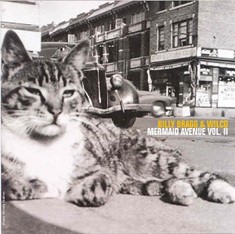
A first association might lead the Dylan fan back to that loving, charming Woody Guthrie project Mermaid Avenue, which, after a Vol. 1 in 1998, was followed up in 2000 with Vol. 2 and finally completed in 2012 with the release of a box set that also includes a Vol. 3. In total, it ends up being 47 songs, all set to lyrics from Woody Guthrie’s estate, lyrics that on average some 50 years after their creation are finally set to music by the men of Wilco and by Billy Bragg.
It is a successful, respectful project that is rightly well received, and the timing of that last release, Mermaid Avenue: The Complete Sessions is perfectly chosen: on the centenary of Woody Guthrie’s birth. Dylan most likely followed it all with above-average interest – after all, Guthrie is one of his artistic fathers, his personal catalyst, a role model. “The songs themselves, his repertoire, were really beyond category,” as he swoons in Chronicles, and
“It was like I had been in the dark and someone had turned on the main switch of a lightning conductor.”
In those 47 songs, we hear plenty of turns of phrase, jargon and imagery that seem to echo in Dylan’s songs. For instance, in the witty “Meanest Man”; I’d preach the gospel of hate and I’d drink your blood, which we would effortlessly classify as a Rough And Rowdy Ways -verse fragment, or
If my wife didn't kiss me the way she does
I'd carry four or five daggers and three or four guns
I'd shoot craps and ramble and hang out late
I'd steal baby buggies and Cadillac Eights
Billy Bragg/Wilco – Meanest Man:
… which seems to be a source for the slightly hysterical verse I carry four pistols and two large knives from this fifth verse of “I Contain Multitudes”. Attractive option, but incorrect, as James Adams of Bob Dylan Notes discovers and tweets on the very day of its release, 17 April 2020. Not Woody. We need to go back even further.
“It reminded me of some old still images I’d seen of the Civil War. How much did I know about that cataclysmic event? Probably close to nothing,” writes Dylan in his autobiography, reflecting back on his early days, on those first floundering months in New York. But he catches up on his knowledge gap. In the decades that follow, he remains a fascinated student of American history. Well, of U.S. history anyway, and especially of those disastrous years 1861-65, the years of the Civil War. Images and motifs can be heard surfacing in songs like “John Brown” and “Blind Willie McTell”, Dylan regularly plays Civil War ballads (“Two Soldiers”, “The Lakes of Pontchartrain”), and a highlight, of course, is Dylan’s contribution to the Civil War film Gods And Generals (2003), “‘Cross The Green Mountain”.
During self-tuition, in particular Shelby Foote’s The Civil War – A Narrative, the 3,000-page monumental work published in three volumes between 1958 and 1974, makes an impression, apparently. True, in 2012 he proclaims that neither reading Grant’s memoirs nor Foote’s reconstruction can be compared to studying newspaper accounts of the time;
“Shelby Foote is looking down from a high mountain, and Grant is actually down there in it. Shelby Foote wasn’t there. Neither were any of those guys who fight Civil War re-enactments. Grant was there, but he was off leading his army. He only wrote about it all once it was over. If you want to know what it was about, read the daily newspapers from that time from both the North and South. You’ll see things that you won’t believe.”
(Rolling Stone interview with Mikal Gilmore)
… but at the latest since his 2001 album “Love And Theft”, we see phrases, images and idioms from Foote’s pièce de résistance popping up in Dylan’s songs.
In “Floater”, for example. Word combinations like “grove of trees”, and remarkable, undylanesque idioms like “squall”, “timber” and “dazzling” are utterly common with Foote, but never occur in Dylan’s oeuvre elsewhere. The verses with which Dylan opens the last verse of “Floater”, If you ever try to interfere with me or cross my path again / You do so at the peril of your own life come verbatim from Volume 2, Fredericksburg to Meridian (1963);
“I have stood your meanness as long as I intend to. You have played the part of a damned scoundrel, and are a coward, and if you were any part of a man I would slap your jaws and force you to resent it. You may as well not issue any more orders to me, for I will not obey them … and I say to you that if you ever again try to interfere with me or cross my path it will be at the peril of your life.”
From Chapter 8, The centre gives, the words Foote puts into the mouth of General Nathan Bedford Forrest, the words with which he lashes out at his immediate commander, General Baxton Bragg, who, incidentally, is indeed regarded by historians as one of the worst generals of the South. And the décor of Dylan’s song, finally, also looks very familiar to readers of Foote’s standard work: the Ohio, the Cumberland, the Tennessee / All the rest of them rebel rivers.
It’s not a one-off wink, this colouring songs with idioms or phrases or even fun facts (Ever since the British burned the white house down from 2012’s “Narrow Way”, for example) from American history. And here on Rough And Rowdy Ways, that motif culminates – where a sub-motif seems to be “dead presidents”; Kennedy and Johnson in “Murder Most Foul”, McKinley and Truman in “Key West”, and here then, indirectly, the reference to Lincoln:
While they waited, Lincoln heard a drunk bawling “Dixie” on the quay. Lamon, with his bulging eyes and sad frontier mustache, sat clutching four pistols and two large knives. At last the car was picked up by a train from the west, and Lincoln stepped onto the Washington platform at 6 o’clock in the morning. “You can’t play that on me,” a man said, coming forward. Lamon drew back his fist. “Don’t strike him!” Lincoln cried, and caught his arm, recognizing Elihu Washburn, an Illinois congressman.
(The Civil War – A Narrative, Volume 1, “Prologue – The Opponents”)
… the reference to Lincoln’s bodyguard Ward Hill Lamon, who with four pistols and two large knives may have been a bit over-armed, but as an image in a song lyric it works well. And, on reflection, also sheds new light on that much-discussed, enigmatic distich of another highlight on Rough And Rowdy Ways, on the opening lines of “Crossing The Rubicon”: “I crossed the Rubicon on the 14th day / Of the most dangerous month of the year”. After all, Lincoln was cowardly shot from behind by the lowly John Wilkes Booth on Good Friday 14 April 1865 – Good Friday, the day the Lamb of God was crucified,
Good day to be livin’ and a good day to die
Being led to the slaughter like a sacrificial lamb
… as the narrator in “Murder Most Foul” says about the day that other president, Kennedy, is assassinated. In which he also cannot resist to recall that Kennedy was in the backseat of a Lincoln when he was shot – also through the back of the head.
All too thin to really speak of a theme, but that loose association that Dylan accepts of “Lincoln” as a sub-motif on the album seems plausible. Or else the Willie Dixon song DJ Dylan plays on his Theme Time Radio Hour in 2008 (Little Walter’s version), “Dead Presidents”;
Them dead presidents
Them dead presidents
Well I ain't broke but I'm badly bent
Everybody loves them dead presidents
… “a little bit of Lincoln can’t park the car – a five hundred McKinley is the one for me.”
To be continued. Next up I Contain Multitudes part 14: I’ll huff, and I’ll puff, and I’ll blow your house in
————-
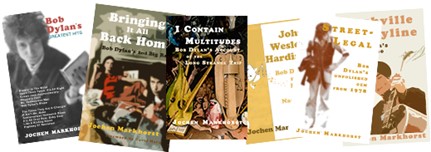
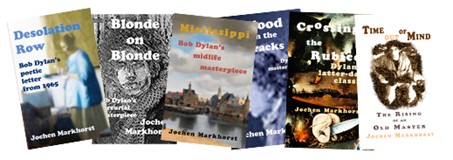
Jochen is a regular reviewer of Dylan’s work on Untold. His books, in English, Dutch and German, are available via Amazon both in paperback and on Kindle:
Aaron:Let’s look at another one of the albums that spun out of the Rolling Thunder Revue. This time it is Hejira by Joni Mitchell. According to Mitchell, the album was written during or after three journeys she took in late 1975 and the first half of 1976. The first was a stint as a member of Bob Dylan’s Rolling Thunder Revue in late 1975 and it is easily my favorite Joni Mitchell album.
“Coyote” was inspired by Sam Shepard, with whom Mitchell was briefly linked during Bob Dylan’s 1975–76 Rolling Thunder Revue tour. Martin Scorsese’s 2019 documentary film about the tour includes footage of Mitchell performing the song at Gordon Lightfoot’s house, with Dylan and Roger McGuinn accompanying her on acoustic guitar. Prior to the performance, McGuinn states “Joni wrote this song about this tour and on this tour and for this tour.”
Tony:Joni Mitchell evolves melodies as readily as Dylan evolves lyrics. It is an extraordinary talent, which exists alongside her exquisite voice. And her lyrics are often so very different from other writers – it is a real case of the snapshots of life that make up the story that makes no sense in the broader context, but is what happened. I really do love this music – although I do have a caveat that I’ll come to in a moment.
We saw a farmhouse burning down
In the middle of nowhere
In the middle of the night
And we rolled right past that tragedy
'Til we turned down to some road house lights
Where a local band was playing
Locals were up kicking and shaking on the floor
And the next thing I know
That coyote's at my door
He pins me in a corner and he won't take no
He drags me out on the dance floor
And we're dancing close and slow
Now he's got a woman at home
He's got another woman down the hall
He seems to want me anyway
Why'd you have to get so drunk
And lead me on that way
You just picked up a hitcher
A prisoner of the white lines on the freeway
Aaron:Here is the complete version from the album.
For the complete story on that song you should read this piece on the evolution of Coyote.
Several of the songs were debuted live on stage during the Rolling Thunder Revue, these can be found on youtube. Here are just a handful of my favorites from the album.
Amelia
Tony:For me, as I suspect for most people if not everyone, one only has to hear the opening chords or the first line of melody to know who wrote the song. Plus (and of course this is, throughout, just my view) these songs are the description of a complete approach to life and living – something I don’t share but I can completely appreciate.
Somedays I would love to be there, somedays I am glad I am somewhere more solid and known. But on this track, and indeed throughout all of these songs, there is one part of the arrangement that I could do without – the fretless bass of Jaco Pastorius. But then I wasn’t that taken with Weather Report either.
Of course I know that Pastorius was widely acclaimed and indeed still is, and I know of the horribly difficult life he had, but if I set aside that knowledge and just listen to the music, I keep having the same feeling that although this is one approach to these songs, it is not the right one. I am very reluctant to speak ill of those no longer with us, and indeed of those who had such difficult lives, and I am not meaning to criticise his extraordinary ability, but here I think his insights into music took him to a different place from that which Joni Mitchell was reaching on her travels. For me the melodies and the lyrics have everything, and don’t need such a dominant force as Pastorius’ bass became. Thus I guess I wanted Joni Mitchell to have more faith in the totality of what she wrote, rather than thinking it needed more.
Equally of course, it was Joni’s album, and from what I have learned of her over the years, she wouldn’t have accepted the final mix had she not been happy.
Aaron: Furry Sings the Blues with Neil Young on harmonica
Tony: The truth is I have never been able to play this album straight through and this track is one example why. I just feel there is so much in the lyrics, the melody and the chords we don’t need the rambling accompaniment extra sounds when Joni is not singing, and yet here we get it again. This time it sounds like an electrified harmonica. Yes it is played by someone who knows exactly how to get everything out of the instrument, but, as I say, I just don’t need it. I have too much in the meaning of the music as it is.
The extra part of the reality of this album is that I have to be in exactly the right mood to listen to it: I think it normally comes very late at night, in the house on my own, lying on the sofa, eyes closed. But even then, I still think there is too much in the accompaniment.
Refuge of the Roads
Tony:So I guess that last point is the main one: I am writing this at the wrong time of day – it is 0730 and at 0800 I set out on the 85 mile journey down the motorway to my friend’s house in north London, from whence we will walk, take the train and walk again, to go and watch the football team we both support. I’m not feeling rushed – if I don’t complete this review I can do it tomorrow, so that is not the problem. It is that I think this is music for certain moments, not for all times.
And I mention that because how one is, and what one is planning to do, can affect how one hears the music. But the truth is, even when I have listened to this album at home alone, without plans of what happens next, I have felt unhappy about the electronically modified accompaniment. Here I just crave for versions of these magnificent compositions without all those improvised musical extras.
Just look at these lyrics….
In a highway service station
Over the month of June
Was a photograph of the earth
Taken coming back from the moon
And you couldn't see a city
On that marbled bowling ball
Or a forest or a highway
Or me here, least of all

You couldn't see these cold water restrooms
Or this baggage overload
Westbound and rolling, taking refuge in the roads
If someone could get the master tapes and let me have them without the bass, I’d really be so happy – if for no reason than to find out if I was right or not. These songs with no bass… something else.
“‘Don’t Make Her Cry’ were the words Regina McCrary’s father, Reverend Sam McCrary, said to Bob Dylan when they met at a Nashville show in 1978 shortly after she joined his band,” Buddy Miller tells SPIN.
The story continues: “Three decades later, they finally wrote lyrics to the song together in Huntsville, Alabama. When it came to writing the music, Bob said to Regina, ‘give it to Buddy Miller.’ Regina says that she “then passed it to Julie, who added more lyrics, moved others around, and set it to music.”
He stood like a soldier, concern in his eye
He nodded his head, it was full of surprise
He stood there a while, and said are you sure
Is your love for him really that pure

Ever since she was born, she was my little girl
And I'll always watch over her even from another world
She's a seventh charm, the seventh child, boy do you know that
God's thumbprints on her wherever she's at

Don't make her cry
Don't make her cry

When your mind's bouncing around like a pinball arcade
Just keep standing there, and don't be afraid
What's done in the dark comes to the light
So stay out of the shadows, and do what's right

Sometime your critics think they're so justified
But they don't know a thing about who you are inside
Stand strong, and always remember who you are
Stand strong, and always follow that star

Don' maKe her cry
Don't make her cry

Yes, when I heard your father talk
It sounded like someone else on the block
When he shook my hand, it truly felt
Like the power of love that makes your heart melt

I'll never forget that night, that time, that place
He looked me straight in the eye with amazing grace
Said with  compassion all over his face
Said to me:

Don't make her cry
Don't make her cry
Don't make her cry
Don't make her cry
Don't make her cry ...
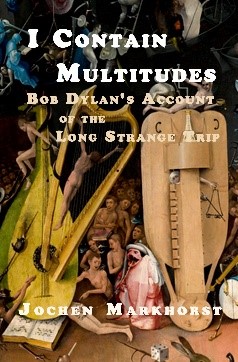
Following the publication of my most recent book, I Contain Multitudes, our publisher Tony Attwood suggested that I take a little break from my Never Ending Song Reviews and write an exposé on the how, what and why with regard to all those articles and books about our common passion – the songs of Bob Dylan. Which indeed did beg a somewhat confrontational question: why have I been writing all these essays on Dylan songs for years now? There are some six hundred of them by now, most of them published in my fifteen Dylan books and/or on Untold Dylan, and there is no end in sight as yet.
At least on a technical level, the beginning is clear: in February 2015, Tom Willems, one of the most knowledgeable and passionate Dylanologists in the Netherlands, and perhaps in Western Europe, published on his blog my first article, a short essay on “Just Like Tom Thumb’s Blues”. As a Dylan fan, I had been following and enjoying Tom’s blog, filled with fun facts, Dylan news, reviews and witty columns for years. I did, however, have one small point of criticism. Well, comment, if you will: Tom’s site was mainly filled with The Stuff Around Dylan. And so rarely, and at best sideways, reflected on the songs themselves. Tom replied what every webmaster then replies: “Go right ahead. Be my guest.”
I immediately discovered the pleasure of it, of studying Dylan songs, and forcing oneself to put one’s findings in writing: it opens gateways and vistas, it awakens neglected loves and forgotten knowledge, and it deepens the love for Dylan songs.
Still, “February 2015” is a historically accurate but somewhat overly dry fact. “It took me two hours to write, but fifty years to live,” to paraphrase Dylan. The run-up, Dylan means, is much longer and more important than the actual writing. Imperative, even.
Dylan’s music has always been a main contributor to the soundtrack of my life: it quite literally rocked my cradle. I was born in 1964, and around then my parents must have had The Freewheelin’ and The Times – I suspect because The Beatles had said they listened to and admired The Freewheelin’. In the following years, Blonde On Blonde and especially Greatest Hits joined the record collection. That latter record (the first Greatest Hits, the European version, the one with “Bob Dylan’s Blues” and “Highway 61 Revisited”) just about everyone in the family had, so we heard it at every birthday party from Hannover to Arnhem to Frankfurt to Amsterdam. The first record I bought myself was Street-Legal, the one I still cherish as a First Love.
When I had written some 40 short essays on Dylan’s songs for Tom’s blog, Tom suggested that I compile them into a booklet. And I have continued to do so, ever since. Initially because it gives a maybe petty, but still pleasant, paternal kind of pride to have a Real Actual Book with your own name on the front, later because it also gives a nice focus; you’re working towards something.
In August 2018, I sent a first English translation of a Dutch article to Untold Dylan. Tony was kind and complimentary and cordially invited me to send more. Translating previously published articles was easy enough, and the sympathetic response from Dylan fans around the world was a pleasant motivator; I ventured into longer, deeper digging analyses of untouchable, terrifying landmarks like “Desolation Row”. A song that proved far more fruitful than expected; after 1,500 words, I hadn’t even got past the title (an ordinary essay is about 1,200 words). And only after 17 chapters, 30,000 words, did I feel I had done some justice to the monument – and had material for an English book for the first time as well (Desolation Row: Bob Dylan’s poetic letter from 1965). The initial approach was, of course, to compile a book about Highway 61 Revisited. But with such word counts, that would become far too thick, unwieldy a book. The album analysis, like Rough And Rowdy Ways, probably will eventually be completed in parts, though.
The joy of this hobby, for a hobby it is, is multicoloured. For a start: digging into such a Dylan song opens up vistas. Without “Crossing The Rubicon” I would never have delved into Juvenal’s Satires, thanks to Dylan, Little Walter has become a regular on my stereo system, because of “Desolation Row” there is now half a shelf of Jack Kerouac on my bookshelf, and since “I Contain Multitudes” I know Walt Whitman’s “Song Of Myself”. Currently, I am concentrating on “Goodbye Jimmy Reed”, which has taken me, so far, to Boz Scaggs’ discography, a Van Morrison biography, Jimmy Reed (obviously), the movie Inherit The Wind from 1950 and “Shake, Rattle And Roll” – and I only just started digging.
Second, it renews the acquaintance with forgotten beauty. All those old records from my grandfather and from my father – Little Richard, Hank Williams, The Everly Brothers, Kitty Wells, Jim Reeves… if it weren’t for my Dylan digging, those records would have long since ended up in the grab-bins of local thrift shops. Revaluation might be a better word, by the way. For which, credits should go partly to DJ Dylan’s Theme Time Radio Hour too, I suppose. Something similar applies to Rimbaud, Shakespeare, Under The Volcano, Ovid, T.S. Eliot, Freud, Grimm’s fairy tales, Caesar and all those others: without “Too Much Of Nothing”, “Just Like Tom Thumb’s Blues”, “Ain’t Talkin'”, “Visions Of Johanna”, “Series Of Dreams”, all those titles and names would have long since been covered in dust, degenerated into empty notions somewhere in the back corner of the brain, where high school knowledge slowly dries up and crumbles.
And perhaps the most pleasant by-catch: I get to meet nice people from all over the world. Somehow, most Dylan fans tend to be friendly, likeable people with open minds. Over the years, I have corresponded with intelligent, inquisitive Dylan friends from New Zealand and New York, Finland and Norway, Belgium and Argentina, Berlin, Canada and the British Isles, and everywhere in between. I get invited to radio programmes, book launches and Dylan events in my part of Europe (and occasionally beyond), and everywhere you meet kind, interesting, driven compadres.
Meanwhile, 15 books have been published in English, German and Dutch. The source has not yet dried up. I guess I’ll just keep on keepin’ on.
Jochen is a regular reviewer of Dylan’s work on Untold. His books, in English, Dutch and German, are available via Amazon both in paperback and on Kindle:
This series of articles (along with an earlier series “The meaning behind the lyrics and the music”) endeavours to explore the importance of the music in Dylan’s songs, rather than simply looking at the lyrics. An index to this series and the earlier “meaning behind” series is given at the foot of the article.
Early Roman Kings is an interesting song to include in this series simply because the melody is so restrictive. We know from the start that this is going to be a straightforward blues by the accompaniment. But Dylan, in terms of melody takes this to an extreme because the vocal is more a declamation than a melody being based primarily on one note. A second note is sometimes used (the minor third) and very occasionally the fourth note of the scale pops up. There are in fact more added notes in the live performances as above, but that’s as far as it goes.
And it doesn’t matter which chord the band is playing, the melody doesn’t change – the use of the second note increases as we go forward, but that’s it. There really is hardly any melody to speak of. (And spare a thought for the bass guitarist…)
But then, come to that, calling what the band does “an accompaniment” is stretching it a bit as what we have here is a four note accompaniment with the last note being the same as the first and a single change of chord. There is a certain amount of variation from the organ, but not much.
So what we have is an unvarying musical accompaniment to an almost single note vocal line – it is the ultimate song of repetition.
And yet no one that I have read or heard speak about this song has called it boring or dull – it seems to carry us along with it. In a real sense the unchanging continuity of the piece is a background for the lyrics presented in a way that it sets a scene but doesn’t distract. Rather like an actor performing in front of a plain curtain, and simply speaking. No props, no waving of the arms, no pacing up and down. It is a declamation. (And the coda played in the live version above does change this approach slightly – but only as a way of roudning it up on stage and telling the audience it is time to cheer).
When I first heard the song, the antecedent that came to mind was “Hoochie Coochie Man” but that is still a 12 bar blues – what Dylan has done has taken the first eight bars, and then for the melody just extended it forever
Through the music Dylan gives us a sense of absolute continuity to eternity. This is how it is and this is never going to change. We don’t know if Bob is talking about gang warfare in New York or the days of what we now know as Italy before the Roman Empire – before even the Roman Republic.
Certainly gangs like to think of themselves as being unmoveable, and most certainly so do republics. In fact so do most people with power be they in gangs or individuals.
And this is the brilliance of the music in this piece for there are clear references to continuity and a lack of change:
All the early Roman kings
In the early, early morn'
Coming down the mountain
Distributing the corn
Speeding through the forest
Racing down the track
You try to get away
They drag you back
As we all know, despite their leaders’ belief in their permanence, societies, gangs and groups always fall in the end as they seek to stop change while being assaulted by change on all sides. Everything falls in the end – but while one is caught in the middle of it, it seems like this is how it will be forever.
As such this is a perfect combination of music and lyric, for both carry exactly the same message.
This must be just about the most curious “Cover a Day” episode thus far – and given that this is episode 134 of the series (there’s an index at the end to prove it) that is saying something.
I’ve been working through Dylan’s songs in alphabetical order searching for interesting cover versions since November 2021 and have mostly been able to find some recordings of the better-known songs, and from these pick out a few that I personally think are worthy of playing and discussion. Occasionally there are songs that no one wants to tackle, but normally these are the more obscure pieces.
But Slow Train is different. Virtually no well-known artists have felt like recording this song, and where unknown performers have taken it on, they really have produced results which I wouldn’t want to put here. Maybe it is just me having difficulty with a religious song but the covers make no sense to me, or are sung off-key or are just tedious attempts to sound like Bob.
And this raises the question of, “what is a good cover version?” To me, it is a recording which brings a new perspective to the piece – a new insight perhaps – and which is interesting to listen to. So on that basis just being different isn’t enough: it has to give me some new thoughts about the song, and where it takes me, as a listener.
Plus of course, it has to sound ok as a recording.
So I was about to give up on Slow Train and move on to the next song in the alphabetical list, after listening to half a dozen or so recordings which quite honestly I found painful, when this turned up.
The information provided is that it is performed by Joseph Israel with Marlon Davis and Chris Meredith and I rather enjoyed it – which is not always something I can say about the insistent reggae rhythm. I think mostly what makes it work for me is the integrity of the arrangement – it sets out to be something different from the original, and sees it through holding my interest and making it a pleasurable experience throughout.
So that was it: one cover version which I felt I could offer – which seemed a bit short for an article. But while I would searching around for any other versions of the song that I felt were presentable, I found a live performance by Bob himself, which I don’t think we’ve featured before. Not one of his greatest moments, in my view, but it does show that the song can be given a new treatment which makes for an interesting listen.
And that really is about it. Even the live versions with Tom Petty, which are normally guaranteed to be really interesting and enjoyable seem to be rather forced and ordinary. Maybe that is because I have got non-Christian ears.
[Prelude from Tony – I write these reviews as I am listening to the music so the comments really are just how I feel at the time. In this piece I start of sounding like a grumpy old git (that’s probably just an English phrase, but I’m hoping you’ll understand) but I do hope you can get to the end, not just because there are some good recordings on the way, but also because last piece selected by Aaron is a real wonder to behold.]
Aaron: Let’s look at another one of the albums that spun out of the Rolling Thunder Revue. This time it is Cardiff Rose by Roger McGuinn. The band included Rolling Thunder alumni Rob Stoner, Mick Ronson, David Mansfield and Howard Wyeth. Both Dylan and Joni Mitchell gifted him original songs. McGuinn wrote several songs with Jacques Levy.
The album, produced by Mick Ronson, was recorded on the heels of Bob Dylan’s Rolling Thunder Revue 1975 tour, in which both McGuinn and Ronson had participated.
Album opener Take Me Away describes the scene of the Rolling Thunder Revue…
You should have been there
When the time was right for the music to begin
You should have been there
When that band of gypsies started rollin' in
You should have seen it
You'd have swore for sure the circus came to town
There were ladies ridin' bareback
And the mystery man all painted like a clown

Take me away, take me away, take me away
Tony: I’m wondering if I am getting too old for this reviewing lark, because I find myself being increasingly negative about songs I listen to from the “old days”. And this is another – it just doesn’t seem to have any of the real excitement of what Rolling Thunder was about. Indeed even the repeated line “You should have been there” is not in itself very exciting.
Just a few months ago we did a little series about Dylan’s greatest opening lines – we ended up with over 100 of them, and they are absolute knock-outs. Ranging from ‘God said to Abraham “Kill me a son”’ through to “In the lonely night, in the blinking stardust of a pale blue light” with every possible variation en route.
OK even Dylan couldn’t give every song a brilliant opening line, but really, for a song about the greatest rock tour ever surely there is something better to say than “You should have been there.”
I mean one could even take a Dylan line and turn it into something new if all else failed (how about “Maybe it is like the night to explode when you think you’ve already seen it all” – that just popped into my head out of nowhere, and if that can emerge in a couple of seconds, there must be many many more better opening lines to describe the great Tour than “You should have been there”.) Sorry, not for me.
Aaron: One of my favorites from the album is the acoustic Friend
Tony:Now that I have got the Rolling Thunder Review out of my head, I can listen to this more clearly.
Oh friend
Why did you try so hard to pretend
That you could beat your own
Gut feelings in the end
Oh we're gonna miss you 'round here,
Good old friend
Friend is a song that strikes a chord – and indeed a painful one – and this time I really do think Roger McGuinn got this right. The passing of a dear friend is something, I find, that never leaves me, and actually I find I feel that for friends who I have lost touch with as well as for those who have passed away. But there are surely few things worse than seeing a dear friend take a road that is so obviously wrong for him/herself and not being able to do anything to help. There’s that moment when one is trying to persuade the friend and she says, “It’s just something I have to do,” and you know there is nothing more you can say. Debate, reason, logic have all broken down, and you know that when the friend has gone off and done it, she won’t be able to come back and admit, “I got it wrong.” Or in the case described in the song, simply won’t be able to come back.
Aaron:Next we have the Dylan track Up to Me
Tony: I love this track, and I love this arrangement. And I’m beginning to see the pattern in the whole album, and if I am right it was a very brave album to tackle. Very interesting way the accompaniment is arranged – and as far as I know this is one of the very few covers of this song – perhaps the only one. I’ve not got to it yet on the Cover a Day series – and it will be interesting to see who else (if anyone) has tackled it.
The point about the song is that it is 12 verses of identical structure, with each verse having four lines (although some people split the last line in half to make five). But more to the point, all the lines have the same melody and chord sequence. So one musical line repeated 48 times. Which is probably why hardly anyone else has ever tried a cover.
I’m not sure if this really works here. And I don’t think Bob ever played this in public for the simple reason that after one has got used to the words, it does get, well repetitive. It’s a great try here, and if there is a fault it is with the song not the singer.
Aaron:Joni Mitchell’s “Dreamland”, which later appeared on her 1977 album Don Juan’s Reckless Daughter.
Tar baby and the Great White Wonder
Talking over a glass of rum
Burning on the inside
With the knowledge of things to come
There's gambling out on the terrace
And midnight ramblin' on the lawn
As they lead toward temptation
With dreamland coming on
Dream, dream, dreamland, dream, dreamland
Tony:This is, to my mind, an utterly amazing song, and if you are taken by hearing it I would urge you to look up the complete lyrics as the song does indeed fulfill the title – it is a picture of wild and impossible dreams with a brilliant, energetic backing.
What makes this so exciting, (apart from the lyrics and the performance!) is that instead of the regular four bars to a phrase we get five – which gives the whole piece a really edgy feel.
I don’t know the sequence of recordings – maybe you can help me, but there is also this recording which through its utterly different accompaniment gives the song a totally different feel and indeed a totally different meaning. I do hope you have time to listen to this all the way through; the harmonies that she slips in are great fun (and I just wish there were a few more).
Talk about two utterly different versions of the same song by the same artist!
Wow, Aaron, this series you dreamed up is taking us to the most amazing places. It’s a brilliant idea. Hope you can keep it going – I’m really loving it, and even the tracks I don’t like are interesting to listen to as I try to puzzle out why I don’t like them. Ignore my initial comments about getting to old. Not at all. More please.
… a totally personal view of some of the best moments from across the decades.
Looking through the masterpiece which is Mike Johnson’s on-going review of the Never Ending Tour (which as I write this has reached episode 126 I was surprised to find how few mentions there were of “Idiot Wind”). And indeed to find that Bob abandoned the song on stage in 1992. Mike gave the opinion – and a very valid one I think – that, “It must be a hell of a song to sustain, all that outrage and anger, over so many verses.” Adding, “It flashes like fire or not at all. It can’t be tamed. There is no sweetening the bitter pill. It is an aggrieved beast. “I think the 1976 Rolling Thunder versions are probably the best in performance terms….”
And as I don’t think we’ve published the video of that 1976 performance before (although Jochen fully examines it in his article on the song) so I thought I would add it here… except this video and recording isn’t quite all that it seems. But then I got suspicious with what I was hearing, and so for once didn’t leap in with my own commentary but instead read of the text beneath the video. If you take a read, you’ll see how this was achieved. It is not quite all that it seems.
And anyway, besides the very clever technical trickery used to achieve this there is the fact that the Rolling Thunder isn’t part of our “Never Ending Tour” series so I ventured on, seeing if I could find anything from our series.
The truth is Bob hasn’t performed this song that much, but this is from 1992, and it is a version that really does stand out for me… and it is interesting to compare with the full-on version above.
You can tell from the very start that this is a different approach – there is all the sadness and desperation, and yet it is more reflective than aggressive, with the music suddenly taken right down at the end of the opening sequence of lines.
And I find that works with the additional desperation of the following musical phrases – a desperation that also follows within the chorus. In short the vocal, for me, reflects the hopelessness of the lyrics which the approach of taking the whole song full on.
Consider, for example, the way Dylan now approaches the “I woke up on the roadside” series of lines – there is a total desperation in this musical arrangement, and the following lines – which then contrasts with the “Idiot Wind” lines of the chorus.
What’s more the instrumental break stays completely in line with the pain and anguish that Dylan brings forth in his vocals. Indeed the guitar part achieves this not just with the virtuosos performance by the fact that it includes pauses.
What’s more the upsinging that Bob engages in seems very much in keeping with the pain of the song – which is not always the case when used elsewhere, in my opinion.
This is not a comfortable version to listen to but then
One day you'll be in the ditch
Flies buzzin' around your eyes
Blood on your saddle
are not exactly comfortable lines. Indeed the harmonica solo makes this point even more strongly. So strongly in fact that although I am nominating this as a highlight, it is not, I must admit, one that I want to return to over and over. It is indeed a case of taking pain to the highest level that one can in music without simply playing discords one after the other.
Having played this version several times while preparing and writing this little piece, I feel I don’t want to hear it again. Not because there is anything wrong with it, but because there is too much right with it. The music really does reflect all that is in the words – and there is only so much of that which I can take.
Dylan fans, you are in for a treat this time around. In the first post for 2015 I playfully suggested that 2015 was the best ever year for the NET. By the time I’d assembled the recordings for this post and the next, I had fallen for my own hyperbole. These are superlative performances which, at least in the case of ‘Early Roman Kings,’ transformed the way I responded to the song.
I am threading my way through the Setlist, and we have now reached the second half of the concert. I missed the moment Dylan began to break his concerts into two halves, taking a ten-minute break, but it has allowed the two sections to develop a character of their own, a momentum, an arc. I have seen the two halves described as Act 1 and Act 2 of a ninety-minute Dylan drama. You can see it that way.
Act 2 begins with ‘High Water (For Charlie Patton)’ complete with guitar riffs by Stu Kimball to introduce the set as was done with Act 1. It’s a fairly subdued performance compared to what we have seen (try the rousing 2012 version), with a deliberately restrained and understated vocal. He’s not shouting it out, as he has done, but holding it in, meditating and brooding over it. There’s a sense of menace. The first is from Detroit, and the second from Bamberg. The Detroit recording probably has the edge, but I like the echoey acoustics at the Bamberg venue.
High Water (A)
High Water (B)
After ‘High Water’ there’s quite a lot of variation, with ‘Simple Twist of Fate’ (See 2015 part 2), or ‘Why Try to Change Me Now?,’ written by Cy Coleman and Joseph McCarthy Jnr and released by Sinatra in 1952, a slow ballad and once more lovingly uncovered by Dylan. (Copenhagen, Oct 9th)
Why Try to Change Me Now?
Sometimes you can listen to a Dylan song and not quite get it until a particular performance knocks your sox off. That happened to me with ‘Early Roman Kings.’ I quite liked the song, although I didn’t think it matched ‘Scarlet Town,’ ‘Pay in Blood’ or ‘Long and Wasted Years,’ also off Tempest, but when I heard this performance from Detroit, 2015, it clicked. The scales fell from my eyes. We have to leave ‘best ever’ behind us here and just say this is an impeccable, unmatched performance. This is not stadium rock. It is club music. Picture a blues joint in Chicago maybe mid 1950s. The air’s full of smoke. It’s maybe 2 a.m., things are winding down, and in they come at a canter, those Early Roman Kings, arbiters of your fate:
I can strip you of life
Strip you of breath
Ship you down
To the house of death
Hear the Detroit crowd’s reaction to the mention of that city. It really doesn’t get any better than this.
Early Roman Kings (A)
It’s the third song into the second set across most concerts. Let’s try it one more time from Ljubljana (Slovenia), June 25th.
Early Roman Kings (B)
There are various contenders, however, for the fourth slot. In Locarno we find ‘Blind Willie McTell,’ the swinging version Dylan’s been doing since 2011, still swinging.
Blind Willie McTell
Unexpectedly, In Mainz, Dylan performed ‘Sad Songs and Waltzes’ in that fourth slot, a Willie Nelson song released in 1973, not a Sinatra song and a downright tear-jerker. That melancholy is a slippery slope!
Sad Songs and Waltzes
I want to pause for a moment to consider Dylan’s use of slurring as a vocal style or mannerism. Dylan is not the first slurrer, which has its roots deep in the blues – you can hear it in John Lee Hooker and Lightning Hopkins – and flourished during the Sinatra period. Sinatra’s rat pack buddy Dean Martin made a feature of it, appearing on TV apparently holding a glass of whisky (it was cold tea), slipping off the piano he’s trying to sit on and other inebriated antics. Of course, it was all 100% show biz. Sinatra liked to cultivate a relaxed, informal atmosphere on stage, his hat pushed back on his head, tie askew, his hand in his pocket, as if you’d just run into him in a seedy bar.
You might have already noticed Dylan slurring a little in his 2015 performances, now hear him use it to stunning effect on ‘Long and Wasted Years.’ In an earlier post I suggested that the song comes from the point of view of a barroom drunk accosting a woman whose relationship to him is not clear. It is here, in 2015, that he finally finds the right voice for the guy he’s been trying to channel since 2012; a rather sad, nasty soul full of bitterness and guile, a wheedling backstabber.
This performance is a vocal triumph for Dylan; he captures those drunken cadences perfectly as the music lurches him forward. Listen to the way he says, ‘You don’t have to go, I just came to you because you’re a friend of mine,’ and catch him at his best. But don’t be fooled by the edgy drunken demeanour, Dylan is in complete control of what he’s doing, and he’s working the vocal like the master he is.
This must be one of Dylan’s greatest ever live performances, and a powerful character study. The last two lines come across as a devastating confession.
So much for tears
So much for those long and wasted years
Long and Wasted Years
Audience participation makes that a precious recording. The audience is with him every step of the way, egging him on. (Sorry, lost the date of that one.)
(A personal note. Have you noticed how Bob Dylan lines can take on a life of their own? How they can detach themselves from the context of a song and attach themselves to the context of your life? As I listen to these words ‘I think that when my back was turned / the whole world behind me burned,’ fires are causing panic and destruction in Greece, Algeria and across swathes of Canada. It feels a bit spooky.)
‘Long and Wasted Years’ usually comes later in the second set. There’s too much variation for me to try to follow the order of songs, the Setlist tends to break down, so I’ll highlight a few necessary performances from those last four or five slots without trying to follow any setlist order.
It seems natural to follow with ‘Scarlet Town,’ another masterpiece from Tempest and beautifully atmospheric in performance (Bamberg). Part of its brilliance is that it feels like a much older song, right from the roots of folk songs. The place, Scarlet Town itself, remains an enigma; it contains multitudes:
The evil and the good livin’ side by side
All human forms seem glorified
Scarlet Town
Staying with Tempest, we find ‘Soon After Midnight’ late in the set. I’ve considered this deadly, unnerving little song in some length in previous posts. It’s easy to be seduced by its sweetness. I can’t imagine Ol’ Blue Eyes singing this one; the American Standards seem innocent compared to the ‘killing floors’ of this song. There’s a chilling casualness in the way death is treated here:
They chirp and they chatter
What does it matter?
They’re lying there
dying in their blood
Two-timing Slim
Who's ever heard of him?
I'll drag his corpse through the mud
Nice fella!
We stay in Bamberg for this one. Dylan’s vocal has just the right amount of airiness, light casualness, pulling us in until we become unwitting witnesses to the killer’s confession.
Soon After Midnight
As the year progressed, we got more American Standards. As well as the songs I have already covered, we might find ‘Where Are You?’ and ‘What’ll I do?’ Songs that ask questions of an unfair world where love did not fulfil its promise.
I sometimes regret that Dylan didn’t choose some of Sinatra’s faster, swinging numbers, but his search in the most melancholy corners of the Great American Songbook, inevitably leads him to these mournful ballads. ‘Where Are You?’ proceeds at a sedate pace, while the lyrics remind me that Dylan wrote ‘Where Are You Tonight?’ a very different song but stemming from the same forlorn complaint. It was written by Jimmy McHugh & Harold Adamson for the 1937 film Top Of The Town. (Copenhagen, Oct 8th)
Where Are You?
When you put Dylan’s own ‘Spirit on the Water’ beside these American Standards you see the kinship. That light jazzy beat, the flavour of old-time dance music. I can imagine Sinatra singing this one, but I doubt he would half-talk it the way Dylan does. Those hushed confidential tones. A lovely clean recording and great performance (Bamberg).
Spirit On the Water
At Mainz, Dylan did his blues rocker ‘Till I Fell In Love With You,’ from Time Out of Mind. We’ve heard some swinging versions of this one over the years. The 2007 performance stands out in my mind as one of the finest (NET 2007 Part 1), but this Mainz performance is hard to match.
Till I Fell In Love With You
What makes these 2015 performances so good is not just the incomparable band but the sense we get that Dylan is in complete control, confident and assured, adventurous too – note the extended ending to that last one. He’s revelling in his power, and the result is these joyous vocal deliveries.
Dylan strayed from the Setlist in Mainz to keep some songs alive, it seems. ‘Hard Rain’ and ‘Ballad Of A Thin Man.’
I get the feeling that Dylan has not always found it easy to adapt ‘Hard Rain’ to his changing sound, his move from guitar to keyboards. With its structure going back at least to 1710, a popular Medieval ballad called ‘Lord Randall,’ ‘Hard Rain’ remains determinedly a folk song. You can dumpty-dum it or swing it, but it’s a long song and an awkward kind of beast to sustain. Dylan takes some risks here, vocally, by sometimes hitting the beat hard, almost mechanically, and often that doesn’t work so well, at least for my ear. In this performance however, he pulls it off.
Hard Rain
This Mainz ‘Ballad of a Thin Man’ is a triumphant performance. When Dylan follows the Setlist, the harmonica usually appears only twice per concert: in ‘She Belongs to Me’ and ‘Tangled Up in Blue.’ So it’s all the more welcome here, as sharp and clear as ever. The innovative backing lends the song, musically, the strangeness we find in the lyrics. Dylan’s piano has that circus like flavour he’s so good at. It’s not deliberately spooky but it’s unnerving.
Ballad of a Thin Man
I’ve run out of space with a few songs and the encores to follow. We’ll catch up with that soon.
Pink pedal pushers and red blue jeans
All the pretty maids and all the old queens
All the old queens from all my past lives
I carry four pistols and two large knives
I’m a man of contradictions and a man of many moods . . .
                               I contain multitudes
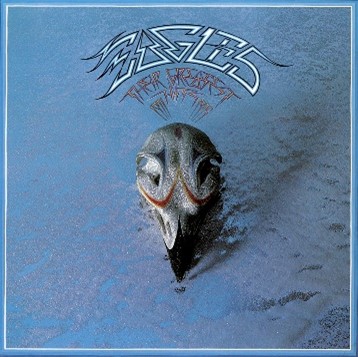
Two months after Dylan has his sympathetic but rather incomprehensible eulogy penned by Douglas Brinkley for the New York Times interview in June 2020 (“Pretty Maids All In A Row. That could be one of the best songs ever”), co-composer Joe Vitale is still perplexed. “Coming from Bob Dylan, it doesn’t get any better than that,” the drummer tells Rolling Stone. “I called Joe [Walsh, the other writer of this Eagles song] immediately. And he goes, ‘I know what you’re calling about.’ I said, ‘This is so cool, Joe.’ He was excited, too. He thought that was really cool. I printed out that article and framed it.”
Apparently, the song has been on a pedestal with Dylan for quite some time. Almost a quarter of a century before, in the first verse of the brilliant Time Out Of Mind-outtake “Red River Shore” already stood out: “Pretty maids all in a row lined up / Outside my cabin door”. At the time, nobody catalogued that as a tip of the hat from Dylan to the Walsh/Vitale song, which most pop fans would not exactly consider an unrelenting masterpiece. Far more likely, and far more dylanesque too, was the option that Dylan here appropriates an old, eighteenth-century English nursery rhyme…
Mary, Mary, quite contrary,
How does your garden grow?
With silver bells and cockle shells,
And pretty maids all in a row.
… “Mary”, as it was written down in the 1950s by Iona and Peter Opie in the invaluable The Oxford Dictionary of Nursery Rhymes. But this finding can be binned, after Dylan’s declaration of love in the New York Times; he really does wink at Eagles. Not just once (in “Red River Shore”), not twice (this second time here in “I Contain Multitudes”), but even three times; after all, the trigger for Douglas Brinkley’s question about Dylan’s appreciation of the Eagles is the name-check in the last song of Rough And Rowdy Ways, “Play Don Henley, play Glenn Frey” in the monumental time-travelling “Murder Most Foul”.
And perhaps it’s even more than three times; retrospectively, after this name-check in 2020, remarkably matching fragments of Glenn Frey’s solo work in particular can be found in more songs from the Time Out Of Mind period (1997) – in “Not Dark Yet”, for instance (too hot to sleep from Freys “Long Hot Summer” 1992), in “Mississippi” (there’s a fire in the sky and I started thinkin’ ’bout the things we said / I said I’m sorry; she said I’m sorry too, from “I Got Love” on his solo album The Allnighter, 1984), and in “Dreamin’ Of You”.
Whether Dylan also places a wink in the continuation of this verse, with and all the old queens, is less demonstrable. More obvious is that the rhyme king was looking for a rhyme word for red blue jeans, and queens would quite easily pop up even among less gifted pop poets. The word combination the old queens is hardly obvious. Or at least hardly common. Sure, men like Elton John, William Burroughs and Allen Ginsberg use it, usually with self-mockery, to refer to homosexuals older than, say, forty. As it is also used in one of the very few songs, perhaps even the only song in the canon with this word combination:
Along the boulevards he'd cruise
and all the old queens blew a fuse
Everybody loved Georgie boy
… Rod Stewart’s moving ballad “The Killing Of Georgie” (1976), from one of his finest albums, A Night On The Town. According to writer Nick Hornby, the last record before it became embarrassing to be a Rod Stewart fan; before all those “interchangeable blonde women” Rod makes headlines with; before
“… Do Ya Think l’m Sexy. And Ole Ola, the 1978 Scotland World Cup song (the chorus of which went Ole ole, ole ola / We’re going to bring the World Cup back from over thar’). And his obsession with LA, and the champagne and straw boaters on album sleeves, and the drawing on the cover of Atlantic Crossing.”
(Nick Hornby, 31 Songs, 2003)
The album that also features the wonderful version of Cat Stevens’ classic, “The First Cut Is The Deepest”. So wonderful, in fact, that the song has since been more or less hijacked and is considered one of Stewart’s signature songs. Which does bother the otherwise meek, unassuming Yusuf Cat Stevens a tiny bit; “Maybe some people don’t know I wrote this one. It wasn’t Rod Stewart,” he says, announcing the song in 2014 at one of those charming NPR Tiny Desk Concerts (and when he plays it at Glastonbury June 2023, at his ravishing, triumphant set, the whole world is reminded).
Either way; neither a compliment to Rod Stewart’s “The Killing Of Georgie” nor a scenario integrating gay men of age into “I Contain Multitudes” is very likely. A well-thought-out scenario is unlikely anyhow; by now, we may be open to the option that Dylan is telling the truth, when he self-analyses: “It’s one of those where you write it on instinct. Kind of in a trance state.” Interviewer Douglas Brinkley does try to provoke his host with the bold statement “I Contain Multitudes is surprisingly autobiographical in parts”, qualifying this part of the song as “confessional”, but in vain; Dylan doesn’t bite.
With some flexibility, then, a line can still be drawn to Dylan’s oeuvre. After all, over the past sixty years he has referred to pretty maids as “queen” plenty of times. Queen Jane; Queen Mary; the motorbike black madonna from “Gates Of Eden” is a two-wheeled gypsy queen; the adored one from “I Want You” is the Queen of Spades; Rosemary from “Lily, Rosemary and the Jack of Hearts” looks like a queen without a crown, and there are plenty more examples – in the past lives of the male narrators immortalised in Dylan’s oeuvre, dozens of old queens can be found. Which is what the narrator here, in the snatches of context we can discern with some tolerance, seems to mean with old queens; something like “girlfriends of the past”.
Although Dylan does of course, in this same interview clip about this same song, claim seriously: “The lyrics are the real thing, tangible, they’re not metaphors.” Hmm. “All the old queens from all my past lives”. But: no metaphors. So the poet thus suggests that his multitudes-containing protagonist is not just some guy, but on the contrary, has spent quite some time in royal circles.
Not very likely either. No, it wouldn’t be the first time we’ve caught Dylan using an entirely unique interpretation of a term like “metaphor”. And he claims the opposite just as easily and seriously. “I use a lot of metaphors and symbolism in songs,” he tells Edna Gundersen for USA Today in 2004, “and they’re based on rhythmic value.”
Yeah, well. Above all Dylan is, as we all know, a man of contradictions and a man of many moods.
To be continued. Next up I Contain Multitudes part 13: A little bit of Lincoln can’t park the car
Jochen is a regular reviewer of Dylan’s work on Untold. His books, in English, Dutch and German, are available via Amazon both in paperback and on Kindle:
Aaron: I can’t find much online about the song. According to Wikipedia “Mary Ann” is a folk song originating from at least as far back as the ethnomusicology of Marius Barbeau, a Canadian folklorist, and perhaps as far back as the mid-19th century. It describes the parting of a man from his love, “Mary Ann”, to faraway at sea.
Tony:I suspect most countries have one person who above all others has worked to collect and record early folk songs from his/her society. In England that person was Cecil Sharp (1859 – 1924) and indeed the HQ of the English folk song and dance society is in superb building in north London named Cecil Sharp House which has acted as a centre for the preservation of English folk songs which date back to the 13th century. (I actually had the honour of performing there, something of which I am rather proud although it was a very long time ago!) Sorry, I digress…..
Aaron: Peggy Seeger sings the song on the 1958 Kapp album ‘Alan Lomax Presents Folk-Song Saturday Night’.
Aaron: Bob’s version appeared on his 1973 studio album, Dylan.
Tony: This is one of a number of Dylan songs that I find I have completely forgotten about. Listening to it now without any memory of it from the past, it sounds rather strange; Bob seems to want to turn the folk song into a something contemporary in terms of the way he sings it. It is an interesting idea although I find it grates for me. But perhaps if I didn’t know about its origins I might just accept it as a Dylan composition as this is what it sounds like.
Aaron:I can only find one more subsequent version which appeared in 1980: Stuart M. Frank on his Songs of Sea and Shore album
Aaron: I also just found this online about the song which gives more details
‘This unusual sailor’s song comes from the collection of Dr. Marius Barbeau, the dean of Canadian folklorists. He heard it in 1920 in the town of Tadoussao in the province of Quebec. The singer, Edouard Hovington, who was then ninety, had been for many years an employee of the Hudson’s Bay Company, the famous fur-trading company which played such an important part in Canada’s early history. He said he had learned it from an Irish sailor some seventy years earlier, which would carry it back at least to 1850.
‘”Mary Ann” is obviously descended from the old English song, “The True Lover’s Farewell”, which is also the ancestor of “The Turtle Dove” and Burns’ “My Luve’s Like a Red, Red Rose”, but this is one of the most unusual of the many variants.
The nautical references give it a salty flavour quite appropriate to the Tadoussao region which abounds in tiny fishing villages. However it did not originate in Canada, for almost the same words are given in a book of Victorian Street Ballads edited by W. Henderson and published in London in 1937. Even the lobster and the blue fish, which seem typically Canadian, are found in the English version.’
Fare thee well, my own true love
Fare thee well, my dear
For the ship is a-waiting and the wind blows out
And I am bound away to the sea, Mary Anne
And I am bound away to the sea, Mary Anne

Ten-thousand miles away from home
Ten-thousand miles or more
The sea may freeze and the earth may burn
If I never no more return to you, Mary Anne
If I never no more return to you, Mary Anne

A lobster boiling in the pot
A bluefish on the hook
There suffering long it's nothing like
The ache I bear for you, my dear Mary Anne
The ache I bear for you, my dear Mary Anne

Had I brought a flask of gin,
Sugar here for two
And a great big bowl for to mix 'em in
I'd pour a drink for you my dear Mary Anne
I'd pour a drink for you my dear Mary Anne

Fare thee well, my own true love
Fare thee well, my dear,
For the ship is a-waiting and the wind blows out
And I am bound away to the sea, Mary Anne
And I am bound away to the sea, Mary Anne
Tony:Since The True Lovers’ Farewell, has been mentioned I wonder if I can sneak in a recording of it, which I really do like. There are a number of quite different interpretations of the song around, but this one really is my favourite. I really know virtually nothing of Canadian folk music, but much English folk music of the time was in 6/8 time, meaning that the song’s beat was 1 2 3 4 5 6 – with the emphasis on the first and then to a lesser degree the fourth note of each bar. This version keeps to that style – something that has been lost in the other versions above.
I’ve learned quite a bit following this trail – thanks as ever Aaron.
“An attempt to show that analyses of Dylan’s music that focus just on the lyrics can miss the point.”
By Tony Attwood
“Cover Down, Pray Through”, is something of an oddity in Bob Dylan’s list of compositions. For a start, it doesn’t actually appear on the official list of songs on the official Bob Dylan site. In fact, if you go searching for details of this song there’s every chance that one of the first sites you’ll come across is the site that you are on at this moment; no one else seems to have taken much notice. We’ve reviewed it because our original raison d’être was to do a review of every song Dylan has written.
So I guess I should start with the recording, the one and only recording that I know about, in case you have missed it.
Now the point here is that the accompaniment is simply based on three chords repeated over and over again, without change. And there is the chorus which consists of the phrase “Cover down pray through”. So basically there is not much for Dylan to work with – although obviously, that is through Bob’s own choice.
And it does work with that repeated sequence, through having a melody which changes a little according to what the lyrics are offering, and the varied use of the female chorus. Plus the lyrics which are very clearly articulated; Bob really wants us to hear the lyrics.
Also he introduces an electric piano for the instrumental break playing an improvisation over the chord sequence which again fits perfectly
But more than anything it is those contrasts – the contrasts between Bob’s singing of the melody and that of the female chorus with its occasional scat singing – that make this piece work. It is a pure case of the music and the lyrics having equal parts to play.
As for the lyrics, there is nothing amiss with them, but because it is a religious treaty, we pretty much know what we are going to get. There’s no debating what is being said here, in the way that we might debate the exact implications of so many other songs. It says God will protect you if you believe. Everything you need to know is in the Bible.
So there are many reasons why the song might fail; it is repetitious and it has a message we have heard so many times before. And maybe Bob did think it has failed since it wasn’t put on an album, and hasn’t even made it onto his official site. But it is the music that drives it along. It really doesn’t matter if you don’t take in the words: that rhythm is hypnotic, there is a constant pulse, the melody changes and there is a really great interchange between Bob and the female chorus.
But at the heart of it all, is that rhythm and the melody – in short the music. True Bob does enunciate the words clearly, but really they are a set of declamations of a fundamental belief that we will all have heard many times before. If you are a believer then you know them, if you are a convinced non-believer (as for example I am) then you let them pass and enjoy the music.
So this really is a piece where it is the music that carries us along. I suspect many listeners haven’t fully focussed on the lyrics, having understood the basic message, but can enjoy the song because of the rhythm, the engaging and constantly varying melody, and the interaction of Bob’s voice with the chorus.
In short, it is the music that takes us through. Of course, we might choose to listen to the lyrics, but because of the music, that is just an option. What cannot be ignored is the music, and in this case, as so often, Bob has got the music just right.
This is not to say the lyrics don’t matter – they are fine if you want that message, and indeed the ending
You will be separated from everything you seem to be
You think you'll be liberated but the grave won't set you free
which really is quite powerful stuff. But in effect it is the music that carries the piece through, and here Bob put as much energy into creating the music as he has done with those lyrics. And that’s what makes it happen.
I’ve no idea why the official site denies the existence of the piece, but then, there is an awful lot in the world of Bob Dylan that I have no idea about.
With a song such as this which has well over 50 established cover versions, and goodness knows how many other obscure ones, my tendency is to start by listening to some recent recordings, for musicians who take on a song that is almost 50 years old not only have the task of creating a performance that is different from the original but also of offering something new to say after so many others have had a go.
And this is the trouble with Simple Twist, for it is, in essence, a very simple song with a very recognizable penultimate line that rises. And those first three lines are also very similar with just the descending bass differentiating them in musical terms.
Now as usual, I’ve included a range of covers, but if you only have a few moments, or you are really looking for something different, just skip through this whole piece (although it pains me to say that) and take in the Maria Pia De Vito version which is the final video in the selection.
But I’m hoping you’ll stay with me here, as I am starting by listening to more recent editions – this first by Ryan Adams is pleasant enough, and has a different sound from Bob’s original… There’s nothing wrong with it, but I don’t really learn anything new, nor do I really feel drawn to going back to listen again. The long coda leading to the fade out which plays the same two bars over and over is a nice idea, giving a feeling of the eternity felt within the song, but, it’s not enough for me.
It is a great relief to leave the voice in the track above and come to Emma Swift whose voice is exquisite and she and her arranger and producer have done the most difficult thing of keeping the song as it was, but making me want to hear it again. It is that combination of an elegant voice and delicate accompaniment that draws me in. This, I feel is how this song should sound.
I am going to jump sideways now because I’ve suddenly remembered (and “suddenly remembering” is something that happens increasingly as I get older, like suddenly rembering I put a pan of milk on the cooker to boil an hour ago and the house now seems to be on fire) that I wanted to include Concrete Blond, as Jochen included it in his review of the song but the recording noted there has vanished from the internet.
Listening to that version for the first time since Jochen provided his article five years ago, I’m struck with the same feelings that I had then: that this is another interesting re-interpretation, but which also gives us through the variations in the way the singer presents the vocals, a completely new insight into the song. I’m glad I went back – although having done so I am almost tempted to re-present more of Jochen’s choice – there are seven extant versions there – but no I will leave you to go back if you wish.
But with so many covers available it is impossible to listen to them all and draw meaningful conclusions. However I would highlight Mary Lee’s Corvette because of the way they’ve pulled back the vocals, and let the accompaniment explore what it has got.
And of course I am eternally drawn to Judy Collins, an artist whose singing always explored different approaches. She’s still with us, in her mid-80s, and I do hope she knows many of us are still listening.
And also I can’t avoid including Bryan Ferry. It’s a jolly and bouncy song he gives us, but still manages to convey all the nuances of the original. It’s 9.15am as I am writing this on a miserable August morning, and I want to get a bit of a fun into the day. The computer has just told me my printer is low on ink (which means half an hour trying to work out how to remove the old ink and a further hour where I put the new cartridge), and I need to find some bounce. Although first I do have to include Bryan Ferry…
If you are looking for a really, really different interpretation of the song, and perhaps feel I haven’t given you that yet, try this…. but no cheating… no stopping the recording after 15 seconds. You’ve got to take it all in. This is the version that gives me the lift, and makes me ready to tackle the printer ink. Although I think a coffee is due first.
Indeed having listened to that I feel ready to take on the day, refreshed in the knowledge that there is always something new one can do, no matter what raw materials you have.
At first glance it might seem that Dylan’s 2015 setlists were a repeat of the 2014 master Setlist, and indeed the first two or three songs in 2015 are a carry-over from the year before, but after those first few songs there is more variation, although some setlists look almost identical to 2014. Here’s what he played in Detroit, 15th May.
Set 1:
Things Have Changed
She Belongs To Me
Beyond Here Lies Nothin’
Workingman’s Blues #2
Duquesne Whistle
Waiting For You
Pay In Blood
Tangled Up In Blue
Love Sick
Set 2:
High Water (For Charley Patton)
Simple Twist Of Fate
Early Roman Kings
Forgetful Heart
Spirit On The Water
Scarlet Town
Soon After Midnight
Long And Wasted Years
Autumn Leaves
(encore)
Blowin’ In The Wind
Stay With Me
That’s the Setlist as we’ve come to know it. The songs from the newly released Shadows In The Night came only at the end, in this case the last song and encore. As with Tempest, Dylan does not overwhelm his setlist with new material, one or two songs only, except towards the end of the year. By the time we get to the five final concerts in London it looks like this, with seven entries from Shadows In The Night. (More details of all Dylan’s current and historic set lists can be found here).
Set 1:
Things Have Changed
She Belongs to Me
Beyond Here Lies Nothin’
What’ll I Do (Irving Berlin cover)
Duquesne Whistle
Melancholy Mood (Frank Sinatra cover)
Pay in Blood
I’m a Fool to Want You (Frank Sinatra cover)
Tangled Up in Blue
High Water (For Charley Patton)
Why Try to Change Me Now (Cy Coleman Jazz Trio cover)
Early Roman Kings
The Night We Called It a Day (Frank Sinatra cover)
Spirit on the Water
Scarlet Town
All or Nothing at All (Jimmy Dorsey and His Orchestra cover)
Long and Wasted Year
Autumn Leaves (Yves Montand cover)
Encore: Blowin’ in the Wind
I began the first posts for 2013 and 2014 with ‘She Belongs to Me.’ Despite my somewhat reckless claim that 2015 just might be the best ever NET year (I should have known better), I think the 2014 performance has the edge on 2015, but this one (Manchester Oct 28th) must run a very close second if it’s not a dead heat. There’s an excitement in Dylan’s voice in 2015, a newfound sense of power. He’s reveling in the maturity of his ‘new’ voice, the voice he’s been working on since 2012, the voice that takes us beyond the circus barker of his organ-grinding days. This one really does power along:
She Belongs to Me
Since the concerts invariably began with ‘Things Have Changed’ it’s there we’d better go now. As an opening song it conveys an immediate message. The Bob Dylan you are about to see is not the old Bob Dylan you have had in your mind. Listening to this, however, one thing that hasn’t changed is Dylan’s defiance. The old fire is still there; he’s all too fervent in his claims not to care.
The opening acoustic chords are by Stu Kimball. You can hear the crowd react when Dylan comes on stage. (Detroit)
Things Have Changed.
Arguably, the influence of Sinatra can still be felt, if subtly. You can hear it in the way Dylan holds the notes and cleverly glides the vocal across the bustling energy of the song. You can feel Sinatra in the phrasing.
You can hear it in the way he swoops through the new verses of ‘Tangled Up in Blue.’ He’s learned, or re-learned, how to bend his notes, how to smooth his voice and roughen it, how to croon one moment and bark the next, all done with the consummate ease that marks the 2015 performances. (Bamberg June 23rd)
Tangled Up in Blue (A)
Equally, I like this recording from Mainz, June 20th. The vocal is right close up. It’s a joyous exercise in celebrating slices of nostalgia, these scenes that are long gone. We have to ‘wipe away the dust’ to see them.
Tangled Up in Blue (B)
And you can hear the Voice as they called Sinatra’s voice, in this sensitively done ‘Simple Twist of Fate.’ You can hear Dylan integrating the Voice with the conversational style he’s evolving for this song. In this performance ruefulness gives way to nostalgia; it’s lit with the same glow as the songs from Shadows in the Night.
Simple Twist of Fate (A)
That one is from Detroit, but I like this one from Bamberg just as much. I couldn’t decide between them.
Simple Twist of Fate (B)
Back to the Setlist and we find ‘Beyond Here Lies Nothin’,’ constant at number 3. I thought the song was nihilistic, but a friend has suggested that maybe a more positive Buddhist conception of the void is what it’s about. Whatever the case, its message that without love there is nothing, ‘nothin’ done, nothin’ said.’ The song keeps its rough edge without any Sinatra smoothness. The influence of the Voice shows in the overall sense of power and command of the song.
Beyond Here Lies Nothin’
At number 4 on the Setlist we begin to get some variation. ‘Workingman’s Blues #2’ is the default setting for this slot, brought over from 2014, but, for example, we get ‘Don’t Think Twice’ at Locarno. A lovely blast from the past.
Don’t Think Twice
That’s a brilliant example of Dylan’s ‘conversational’ vocal style, a somewhat hushed delivery, intimate as if we are hearing a confession of sorts. The arrangement is bouncy. Back in the late 1990s, Dylan would turn it into a celebration; not so here but there is a resilience and bubbliness in it which sweeps along the darker tints of the song.
That same conversational style is also a good fit for ‘Workingman’s Blues #2.’ It’s taken me a while to warm to this song. I’ve found the lyrics a bit contrived, but that’s a difficult judgement to make when, in the world of song and poetry, it is all contrivance. I guess the trick is to make it sound natural, and the conversational style goes a long way to achieving that. It could be a preachy song, but not when we’re being sung to and not at.
Workingman’s Blues #2
‘Duquesne Whistle’ is a regular at number 5, good to follow a slow thoughtful number. It sounds upbeat but it’s about the uprooting power of the wind, and whenever we get the wind in a Dylan song we are never far from a symbol, the meaning of which may be blowing in the wind, even an idiot wind. In ‘Duquesne Whistle’ it’s an apocalyptic wind, ‘blowing like it never did before.’ (Manchester) Another triumphant vocal. What’s dissonant is that there is a jubilation in Dylan’s voice, as if he’s celebrating that destructive force. It gives the song a strange edge.
Duquesne Whistle
Further variations follow, with the first American Standard slotting in at number 6 later in the year. Earlier in the year we would get the unremarkable ‘Waiting for You.’ So let’s take the opportunity to listen to another Sinatra rendition, another uncovering of an old song. ‘All Or Nothing at All,’ written by Arthur Altman and Jack Lawrence in 1939 (Saarbrücken, Oct 17th).
All or Nothing at All
How lightly and easily Dylan navigates this gentle-sounding song, the airy way he handles the high notes, a touch of wistfulness in his voice.
‘Pay in Blood’ invariably comes in at number 7 on the Setlist. I think it’s fair to say that Sinatra never got this dark. Melancholy, wistful, rueful and regretful yes, but never with such sinister implications. Again, there is no obvious influence here other than the practiced, Sinatra-like ease with which Dylan draws us through the song. It’s not as abrasive as some performances in previous years, but all the more chilling for that.
Dylan hasn’t made it easy for me to choose, as all the performances are top notch. I’m putting in two. The first, from Locarno, is a little softer than the second, from Detroit, but they are both compelling performances.
Pay In Blood (A)
Pay In Blood (B)
Often ‘Tangled Up in Blue’ would follow ‘Pay in Blood’ to finish off the first half of the concert but there is some variation. In Locarno we get ‘Levee’s Gonna Break,’ another song far from Sinatra territory. In this understated performance Dylan strips the song back to its boogie bones. It gets pushed along by the bass.
Levee’s Gonna Break
While in Detroit we find ‘Love Sick’ as the final song before the break. This is a song which is never going to change much, except for the occasional lyrical variation, (Here he sings, ‘‘You emptied my pockets while I was sleeping.’) and it’s never going to be a Sinatra sounding song, but there’s something in this performance that drives the audience wild and I think it may be that it has a lilt or swing which ameliorates the inherent rigidity of it. It never lumbers. It becomes hypnotic.
This is a good opportunity to say something about the band. They now have two precision albums behind them, Tempest and Shadows; the performances are faultless and sensitively attuned to Dylan’s vocals. They do an inventive job with ‘Love Sick’ adding some chords, neatly and discreetly picking their way through the melody. They find ways to keep it interesting. A pleasure to listen to.
Lovesick
Or, Dylan did ‘I’m a Fool to Want You’ near the end of the first set, as he did in Manchester. Sinatra did not write his own songs, but in this case he had a hand in the lyrics, which are said to be written for Ava Gardner. The music was written by Joel Herron and Jack Wolf, and the song was released in 1951. In Dylan’s hands, this is melancholy grown ripe and sumptuous. I don’t think it’s at all fruitful to compare Dylan and Sinatra to see which one is ‘best’ but to hear how Sinatra handled the song back in 1951 you can find it here:
This is the ‘mountain’ Dylan said he had to climb each time he faced one of these American Standards. Sinatra’s voice is younger, and vibrant with passion, whereas Dylan takes advantage of his age to lead us into a weary but haunting sadness. There’s no fool like an old fool.
I’m a Fool to Want You
My time’s up for now. I’ll be back soon to see how the second set fared during this exciting year, 2015.
Until then
Kia Ora
A full index of all 125 previous episodes of “The Never Ending Tour” can be found here.
In this series Aaron selects albums and tracks that are in the style of, or otherwise related to, Bob Dylan. Tony then adds his thoughts as he plays the music selected.
——–
Aaron: Let’s look at another one of the albums that spun out of the Rolling Thunder Revue. This time it is “Lasso from El Paso” by Kinky Friedman.
The band included Rolling Thunder alumni T-Bone Burnett, Rob Stoner, Mick Ronson, Steven Soles and Howard Wyeth as well as guest performers such as Eric Clapton, Ronnie Wood, Roger McGuinn, Ringo Starr and members of The Band. Dylan and Jacques Levy even gifted him the original song Catfish.
AllMusic wrote that “of the many albums that grew out of Bob Dylan’s Rolling Thunder Revue, this must be the strangest.”
The album opener “Sold American” was recorded live with Bob Dylan and The Rolling Thunder Revue, Ft. Collins, Colorado.
Tony:As ever I am writing my contribution while listening to the music – and throughout this piece, listening for the first time. I’ve never heard this album before.
And as such it gives me another chance to go onto a ramble. My father, as I think I have mentioned, played piano and saxophone in dance bands in the pre-war era and as such there were in the flat (apartment) in which I grew up lots of 78rpm records, including some by Glenn Miller. So I got to know his music – and did at sometime come across the song “Sold American” by Glenn Miller. It wasn’t until much. much later, when I started doing research into songs that I got to understand the title came from a Lucky Strike cigarette advert, which itself came from a tobacco auctioneer who used the phrase to suggest that the American Tobacco Company only used the best tobacco in their cigarettes. Apparently, the company used the phrase in its radio adverts.
So now I get to understand (and sorry for being so slow, but it can take me a while to get to the bottom of phrases that I’ve never heard before) that the song title is itself a reference back to the old days with, I guess, a cross-reference between the original song and the old days of the busker hoping for a dime, thinking of the lost old days when he was a star.
Now I do know that quite often my attempts to make sense of a song that I’ve not heard before can go laughingly wrong, so if there is a totally different explanation please do let me know, (although ideally without laughing at me too much).
Aaron:The rest of the album range from off color comedy songs and touching ballads such as Dear Abbie:
Tony: Here we go again – I am culturally lost. What I have found is a statement that says Dear Abby “is the most widely syndicated columnist in the world.” So are we into an album which are made up of songs based on phrases from America’s past? Listening to the lyrics I think this might be true. Although if not, I suspect that Aaron is maybe having a good laugh at me and everyone else in America is groaning at my stupidity and ignorance.
But there is of course a link between the two tracks so far… in that both are about reflecting on the past, and being desperately lonely…
But the life I lead's so lonesome
That I wonder, Abbie, if you've ever known
What it's like to live in others' dreams
And never have a dream to call your own
That is desperately, desperately sad – or at least it feels that way to me. It is so simple, and yet obviously very true. There are many people – particularly older people who are simply alone and just crave the company of others.
But dragging myself away from such thoughts, and back to Dylan, I’m immediately reminded of
There are those who worship loneliness, I'm not one of them
In this age of fiberglass I'm searching for a gem
The crystal ball up on the wall hasn't shown me nothing yet
I've paid the price of solitude, but at last I'm out of debt
Aaron:Catfish
Tony: As you will be seeing, Aaron has simply given me the tracks, with no hints as to where I should be taking this or what I should be hearing or understanding. But at least I can touch the ground with a little certainty here, as this is a Dylan/Levy song with a completely new treatment.
Although actually, it took me a few moments to recognise what I was listening to. In my original review of the song written five years ago, I wrote “It is a slow atmospheric blues with a reverberating harmonica played throughout – while the blues band does its blues band thing.” Which is, of course, not how it sounds here.
Here’s Bob’s version in case you don’t recall.
So, I don’t know… it’s an interesting reworking of the song that Friedman has offered, but to what end? I am really not too sure.
Aaron: Ol’ Ben Lucas…All right, pick it, Eric!
Tony: I looked this song up on my computer and the first result says, “Some results may have been removed under data protection law in Europe”.
What data protection law protects us from that song? I wish I knew because I’d like to thank whoever it was that introduced it – and have it extended.
Aaron: The last track is the deliberately misspelled “Waitret, Please, Waitret”
Tony:I have stopped trying to do this all on my own, feeling as I do, totally with an understanding of what is going on in this album. So turning for help… AllMusic’s review of the album says “of the many albums that grew out of Bob Dylan’s Rolling Thunder Revue, this must be the strangest.”
I’d agree with that, and I also know that quite often in terms of music, as indeed with theatre, writing and dance, the other art forms that occupy my time, strange can be interesting, illuminating, engaging, stimulating, and indeed fun.
But maybe because I am from a different cultural background, or maybe it is just me, but I really don’t find anything in this that engages me in any of this strangeness. For if there is something of interest in any of these pieces then it has passed me by. That doesn’t mean that the music is no good – rather that I simply don’t understand what’s going on.
Sorry, Aaron, this time you have really beaten me. But to you, dear reader, if you have just battled through my ramblings here and wondered why you were bothering, please don’t be put off the earlier episodes of the series. It’s not that my writing was any better, but rather the songs are of a totally different nature.