Dylanesque: the anti-war songs

By Aaron Galbraith and Tony Attwood

Dylanesque (comparative more Dylanesque, superlative most Dylanesque)

“In the style of, or reminiscent of the music or lyrics of Bob Dylan (born 1941).”

Previously in this series

Prelude by Tony: In case you have not come across any of these Aaron and Tony pieces before, I should explain… Aaron and I have never met, but we have somehow come up with this arrangement wherein Aaron selects music (and has done so over several different series of articles) and sends it to me with his notes, and I write my immediate response while listening to the music he has selected.  I thought I’d better mention this here, since my response this time takes me into my life, and you may be wondering what the hell I’m doing explaining details of my family in a Bob Dylan blog.  But really there is a point, for music triggers a multiplicity of reactions, and here I am just writing about mine.

Aaron: For Part 4 of the Dylanesque series we have three songs where the artist, inspired by Dylan’s songs such as John Brown and Masters of War, gave us their own anti-war songs. Both of these guys are massive Dylan fans so everything they do is inspired by his work.

First up we have Elvis Costello. The song is Shipbuilding and it was written by Elvis Costello and Clive Langer.

Written during the Falklands War of 1982, Costello’s lyrics highlight the irony of the war bringing back prosperity to the traditional shipbuilding areas of Clydeside, Merseyside (Cammell Laird), North East England and Belfast (Harland and Wolff) to build new ships to replace those being sunk in the war, whilst also sending off the sons of these areas to fight and, potentially, lose their lives in those same ships. It was originally given to Robert Wyatt to release as a single in 1982. Costello’s own version appears on his album Punch the Clock.

Tony: I have a problem here because I do prefer Robert Wyatt’s version, although I am not sure why.   Somehow it makes more musical sense to me.  But either way that opening line of “Is it worth it?” is so evocative of that period.

Aaron: Next up we have two songs by Dan Bern. The first one is a humorous take on this subject and the second one is just beautiful and gets me every time.

Talkin’ Al Kida Blues

Tony: Yes very early Dylan talking blues, but the problem with the talking blues is that it is such a restrictive form.   It’s ok, but even the harmonica is Dylanesque.  I think it is the musician in me that objects; the talking blues reduces what the music can do to such a level there’s not much left.

The same could be said about the 12 bar blues, but somehow that format escapes and indeed so much has been done with that format we now have a multitude of songs that one can hear over and over again and still enjoy.  But that’s the problem with the talking blues – they are great fun in a folk club where the audience is hearing the lyrics for the first time, but I wouldn’t want an evening of the format.

Aaron: Lithuania

Tony: But now my problem is different.  For here I find that I really do see something to contemplate and appreciate in the lyrics:

I'd likе tо bе а gооd Amеriсаn аnd writе аn еlеgy tо thе аutоmоbilе
But nо mаttеr whеrе it tаkеs mе I dоn't rеаlly fееl аny diffеrеnt
I gоt оnе fооt in thе blасk аnd whitе twо dimеnsiоnаl 
    ghоsts оf Lithuаniа
And thе оthеr fооt in sunny Cаlifоrniа whеrе thе pеоplе 
    аrе аll friеndly
As thеy drivе thеir Mеrсеdеs tо thе mini-mаlls аnd tаkе а lunсh
Or nеtwоrk with yоu оr drivе pаst аnd kill yоu fоr nо rеаsоn

Thеsе аrе my ghоsts: Unсlе Emmаnuеl, Unсlе Eli, Aunt Miа
And my grаndpаrеnts, Jеnny аnd Tоbiаs, nоnе оf whоm I'vе еvеr mеt
I sаw sоmе lеttеrs оnсе thаt thеy wrоtе tо my dаd 
    in Pаlеstinе in 1940
Nоt tоо lоng bеfоrе thеy аll wеrе shоt
My оnly link tо thеm is my dаd, hе knеw thеm, hе knеw mе, 
    nоw hе's gоnе tоо

It is simple, but I do find that moving, perhaps because of my own experiences with my family (and as I have said so often, our reactions to music are often extremely personal).  So maybe that’s the issue with songs and poems like this – they can touch nerves that bring along thoughts welcome and unwelcome, happy and sad.   I’ll try and explain…

To do this, I’m going to veer off into a personal perspective here, which may be boring and dull and indeed irrelevant since you don’t know me, but it is where the songs have taken me, and the idea of these instant reviews is that I do give my immediate feelings.  So here I go…

I spent my life as an only child in a family that did not have strong contacts with other members of the clan.   Gradually uncles, aunts, cousins, and of course my parents all passed away, and for me divorce happened too which meant I lost my in-laws as well.  So I accepted that it was just me and my three wonderful daughters: that’s how I was, that was my life, and yes I was quite happy in it, and a little proud of some of the things I’d done….

Until a year ago, totally out of the blue, I got an email from an unknown man saying “I think I’m your brother”, and so it turned out to be.  I had a brother I knew nothing about.  We don’t live close together but we’ve met up four times since and got on really, really well, plus chatting on the phone regularly, and of course planning to get together again.

So I know something of these emotions, and maybe that’s my problem with the song.  I have my own “song” in my life.  Of course, it doesn’t follow the same pattern as described here, but has the same depth of feeling.

Back with the recording, when the melody came along after the five minutes mark, I found much more in the song and was glad I had kept listening but by then I had lost track of the lyrics, but there again, that didn’t seem to matter.   Besides, by then I was deep into thinking about my years without brothers, sisters, cousins, aunts, uncles, but having great joy in my life with my children and grandchildren… and then suddenly adding a brother… and of course his family and friends.

Thus my conclusion: I think some of what is being sung about here is too close to home for me, so I lose focus.  I think it needs a different listener to be able to write about this.

If anyone would care to write a proper commentary on this song, please do let me have it and I will publish it.  Send it to Tony@schools.co.uk    Meanwhile, I’ve even thought maybe I should write a song about my brother and his finding of me, although really, I wouldn’t know how to begin.   So perhaps not.
Posted in Uncategorized | 1 Comment

A Dylan cover a Day: She Belongs to Me

By Tony Attwood

“She belongs to me” is a simple 12 bar blues with a complex message about control and independence and… well I am not sure.  Is the subject of  the song the child of a divorced couple or a younger woman who is (rather unpleasantly) the object of desire of a much older man?  One is never sure.   Although Jochen as ever got to the heart of the matter if you want to explore it further.

And do any of the vast number of covers actually get anywhere near either to holding the paradox or resolving it?  I’m not sure – at least until the final version I selected (see below), although of course such uncertainty comes in part because we all now suffer from knowing the song so well, it gets ever harder to unravel what Dylan actually had in mind.  Thus it is impossible to unravel how the song ought to be treated.

It is a problem made ever greater by the huge number of covers that exist – far more than I can work my way through to give a balanced review.  So here is just a selection, although it does lead to a final conclusion.

A vision of the child approach comes from Hugo Montenegro – the string based instrumental break gives me pictures of a child making up a dance to the song and all the adults applauding and telling her she is going to be ballet dancer “when she grows up”.

https://youtu.be/KyPjwxrMLHw

Nitty Gritty Dirt Band do give us an interesting violin-based break or two but I just get the feeling that having gone that far they could have gone further – just to see where it all leads.

Robert Rex Waller Jnr of the wonderfully named I See Hawks in LA, seems to me to start out on the right tracks in terms of giving us some new insights, but as the song progresses it feels to me as if the ideas have been suffused under the song – which for a song that has been recorded so many times probably isn’t the best approach.  The last verse now really feels that he is singing to an adult who has everything, exactly as the song says. There is nothing else left to give, except for the children’s toys as a symbol of her continuing vitality.

And what I do particularly like is the move toward additional chaos implied in the final instrumental verse.

Hamster Axis of the One-Click Panther featuring Roland Van Campenhout takes the thought of this being an adult not a child: the man is so utterly overwhelmed by the woman he has no idea what to do: she walks with her feet never touching the ground, while he scrambles along in the gutter.   Now that of course is just my response and interpretation of their performance, and they may have had nothing like this type of thought in mind.  It’s just where I got to.

When we looked at this song in our very first series on covers of Dylan songs the version by Jerry, Phil and Bob, was suggested by Edward Thomas.  And I must say this is a relief, with performers who manage to balance their own input with Dylan’s original.  Now I don’t care if she really is a child or no, nor if the vision comes from a lover or a parent.   It is just a lovely interpretation of a long-loved song.

Margot Cotten continues the gentle theme, and I must say I do prefer these versions.  The individuality here comes from the occasional rhythmic changes – changes so slight they can easily missed.  Now the song doesn’t have to be about a person at all, but is somehow just about a time, a feeling, a place…   I am not quite sure how I got to that feeling but with this version, it really is at the heart of what I feel.  Suddenly despite all the cover versions I have listened to before starting to write this little commentary, I want to play it again.

I finish with the version Jochen picked – and it really does bring me back to earth with its straightforward gentleness.   There are some interesting musical touches in the simplicity as well, such as the bass staying on the same note through the first line rather than changing as the chord changes.  A tiny point, but it seems to help.

In a way it is very dated with the choral, backing but that’s hardly their fault; arrangements are always of the age in which they were written.  I’m rather pleased I left this til last (by chance not design).   I leave the song and move on to the rest of my day, feeling rested and happy, not concerned by its implications at all.

The Dylan Cover a Day series

  1. The song with numbers in the title.
  2. Ain’t Talkin
  3. All I really want to do
  4.  Angelina
  5.  Apple Suckling and Are you Ready.
  6. As I went out one morning
  7.  Ballad for a Friend
  8. Ballad in Plain D
  9. Ballad of a thin man
  10.  Frankie Lee and Judas Priest
  11. The ballad of Hollis Brown
  12. Beyond here lies nothing
  13. Blind Willie McTell
  14.  Black Crow Blues (more fun than you might recall)
  15. An unexpected cover of “Black Diamond Bay”
  16. Blowin in the wind as never before
  17. Bob Dylan’s Dream
  18. BoB Dylan’s 115th Dream revisited
  19. Boots of Spanish leather
  20. Born in Time
  21. Buckets of Rain
  22. Can you please crawl out your window
  23. Can’t wait
  24. Changing of the Guard
  25. Chimes of Freedom
  26. Country Pie
  27.  Crash on the Levee
  28. Dark Eyes
  29. Dear Landlord
  30. Desolation Row as never ever before (twice)
  31. Dignity.
  32. Dirge
  33. Don’t fall apart on me tonight.
  34. Don’t think twice
  35.  Down along the cove
  36. Drifter’s Escape
  37. Duquesne Whistle
  38. Farewell Angelina
  39. Foot of Pride and Forever Young
  40. Fourth Time Around
  41. From a Buick 6
  42. Gates of Eden
  43. Gotta Serve Somebody
  44. Hard Rain’s a-gonna Fall.
  45. Heart of Mine
  46. High Water
  47. Highway 61
  48. Hurricane
  49. I am a lonesome hobo
  50. I believe in you
  51. I contain multitudes
  52. I don’t believe you.
  53. I love you too much
  54. I pity the poor immigrant. 
  55. I shall be released
  56. I threw it all away
  57. I want you
  58. I was young when I left home
  59. I’ll remember you
  60. Idiot Wind and  More idiot wind
  61. If not for you, and a rant against prosody
  62. If you Gotta Go, please go and do something different
  63. If you see her say hello
  64. Dylan cover a day: I’ll be your baby tonight
  65. I’m not there.
  66. In the Summertime, Is your love and an amazing Isis
  67. It ain’t me babe
  68. It takes a lot to laugh
  69. It’s all over now Baby Blue
  70. It’s all right ma
  71. Just Like a Woman
  72. Knocking on Heaven’s Door
  73. Lay down your weary tune
  74. Lay Lady Lay
  75. Lenny Bruce
  76. That brand new leopard skin pill box hat
  77. Lily, Rosemary and the Jack of Hearts
  78. License to kill
  79. Like a Rolling Stone
  80. Love is just a four letter word
  81. Love Sick
  82. Maggies Farm!
  83. Make you feel my love; a performance that made me cry.
  84. Mama you’ve been on my mind
  85. Man in a long black coat.
  86. Masters of War
  87. Meet me in the morning
  88. Million Miles. Listen, and marvel.
  89. Mississippi. Listen, and marvel (again)
  90. Most likely you go your way
  91. Most of the time and a rhythmic thing
  92. Motorpsycho Nitemare
  93. Mozambique
  94. Mr Tambourine Man
  95. My back pages, with a real treat at the end
  96. New Morning
  97. New Pony. Listen where and when appropriate
  98. Nobody Cept You
  99. North Country Blues
  100. No time to think
  101. Obviously Five Believers
  102. Oh Sister
  103. On the road again
  104. One more cup of coffee
  105. (Sooner or later) one of us must know
  106. One too many mornings
  107. Only a hobo
  108. Only a pawn in their game
  109. Outlaw Blues – prepare to be amazed
  110. Oxford Town
  111. Peggy Day and Pledging my time
  112. Please Mrs Henry
  113. Political world
  114. Positively 4th Street
  115. Precious Angel
  116. Property of Jesus
  117. Queen Jane Approximately
  118. Quinn the Eskimo as it should be performed.
  119. Quit your lowdown ways
  120. Rainy Day Women as never before
  121. Restless Farewell. Exquisite arrangements, unbelievable power
  122. Ring them bells in many different ways
  123. Romance in Durango, covered and re-written
  124. Sad Eyed Lady of Lowlands, like you won’t believe
  125. Sara
  126. Senor
  127. A series of Dreams; no one gets it (except Dylan)
  128. Seven Days
Posted in Uncategorized | Leave a comment

Never Ending Tour 2013 part 5 – As Good As New

‘I’ve paid my time and now I’m as good as new’
(The Levee’s Gonna Break)

By Mike Johnson (Kiwipoet)

This is the final post for 2013, a richly rewarding year to explore, and what I need to do here is catch up with some performances that didn’t get included in the four previous posts, mostly Dylan’s 21st Century work.

But first, let’s get ourselves tangled up in blue, another song, like ‘Like a Rolling Stone’ that has become an institution, its performance a ritual. It is a mercurial song which has no final form, musically or lyrically, and that may be the whole point. Memories come and go; the journey changes as we look back on it, as we see it from different points of view. New things keep cropping up. What might have really happened is no longer the point. This is not one journey but many; almost every time it’s performed it’s a new journey. Maybe that’s why the song has stayed so alive.

In 2013 Dylan was mixing lyrics from previous versions and adding some new ones. As ever, the song was evolving.

She lit a burner on the stove

and then she swept away the dust.

“You look like someone that I used to know,” she said,
“You look like someone that I used to trust.”

Then she opened up a book of poems and she said,

“take that, just so you know.”
“Memorize these lines,
and remember these rhymes,
when you’re up there, walking to and fro.”

And the last verse comes out like this:

I’m going back again
I got to get to them somehow
Yesterday is dead and gone
and tomorrow might as well be now.
Some of them, they went to live upon the mount
And some of them went down to the ground.
Some of the names were written in flames
And some of them, well, they just left town.
And me I’m still on the road
trying to stay away from the joint.
We always felt the same
depending on your point of view.
Tangled up in blue.

‘Tangled’ has grown statelier and more dignified since the ecstatic performances of the early 2000s, or the epic jazzy versions of 1993. Now it thumps along with a certain dignified grandeur. In 2013 Dylan stuck with the piano and didn’t pick up the harmonica, which had become a feature of previous versions. In 2014 he will reinstate the harp break. He didn’t sing it in Rome, but we can’t do better than this performance from the impeccable Stockholm concert.

Tangled Up in Blue (A)

Or can we? This one from Hamburg (20th Oct) is pretty solid too. A bit faster and rougher.

 Tangled Up in Blue (B)

In ‘Love Sick’ there’s no energetic bounce, the journey has become a lurching plod, weary but wired. A tread of doom. The process of alienation is complete, we have become ghostly voyeurs of worlds that can never be ours:

I see lovers in the meadow
I see silhouettes in the window
I watch them 'til they're gone, and it leaves me hanging on
To a shadow

Unlike ‘Tangled’ ‘Lovesick’ doesn’t change much, either lyrically or musically. It’s not a song perpetually in the making, although Dylan did change a couple of lines. I confess to finding ‘Sometimes I want to take to the road and plunder’ a more powerful utterance than ‘Sometimes I feel like I’m being ploughed under’ although I’m hard-pressed to say why; maybe because the first is more active, anger expressed, while the second is annihilation.

It does now, however, have a final, settled form. I tend to hark back to the driving version of 2011, my best ever  This one from Stockholm is certainly a little softer, and the harp solo is not as sharp, but it still has that unnerving edge.

Lovesick

Although I know that Dylan never gets stuck in a mood or mode, that he is the ultimate shape-shifter, it still amazes me how he was able to move from the dark pilgrimage of Time out of Mind to the often breezy, bouncy territory of Love and Theft. Of course it’s far from being all sweetness and light despite the fast rhythms and busy music. Take ‘Tweedle Dee & Tweedle Dum,’ a lengthy song which bustles along but portrays a somewhat sordid situation that ends with homicidal sentiments.

Tweedle-Dee Dee is a lowdown, sorry old man
Tweedle-Dee Dum, he'll stab you where you stand
"I've had too much of your company, "
Said, Tweedle-dee dumb to Tweedle-dee Dee

Dylan would perfect this technique of hiding grim realities behind happy or sweet-sounding music in Tempest (‘Soon After Midnight’). We’re in Rome again for this one.

Tweedle Dee

‘The Levee’s Gonna Break’ is another bustling song from the boogie-woogie, jazzy end of the blues. The band is really cooking. It’s a lot of fun as long as you don’t take the images of disaster too much to heart. The levee might break but in the meantime you’d better get dancing. Note how spare Dylan’s piano playing is, and how foundational Garnier’s bass playing is. This Rome performance is a beauty.

Levee’s Gonna Break.

‘Thunder On the Mountain’ is another long, bustling song. But in this case there is a genuine upbeat feel: we can change, we can grow, we can enjoy (just don’t worry too much about that ‘mean old twister.’)

Thunder on the mountain rolling to the ground
Gonna get up in the morning walk the hard road down
Some sweet day I'll stand beside my king
I wouldn't betray your love or any other thing

Oh yes, there are plenty of edges here, and dark hints, but the effect is basically affirmative. Rome again:

Thunder On the Mountain

‘Honest with Me’ hardly lets up the pace. We are still ripping along, still tangled up in love and desire. However, there is no nostalgic indulgence in images from the past, it’s a bit more desperate than that – ‘these memories I got, they can strangle a man.’

Desperate enough for some bad jokes:
I'm stark naked but I don't care
I'm goin' off into the woods, I'm huntin' bare

Cynicism seems to have taken over:

They say that my eyes are pretty and my smile is nice
Well, I'd sell it to ya at a reduced price

Here’s a place where heartbreak rules and smiles are cheap. We get the feeling that the plea to ‘be honest with me’ is going to fall on deaf ears. We’re still in Rome.

Honest With Me

We slow right down for ‘Workingman’s Blues #2.’ It’s an elegy for a lost prosperity and is the most openly political song of Dylan’s 21st Century output. “At a time when the poor and working classes are as diverse as they’ve ever been in this country – and perhaps as powerless as they’ve ever been – the song’s powerful closing lines do something more effective than asking us to listen for an answer blowing in the wind, they point to our common enemy”. (Spectrum Culture.)

I’m not convinced that the last lines do ‘point to our common enemy’ whoever or whatever that is, but the fifth verse comes close to identifying financial institutions and their economic oppression:

They burned my barn and they stole my horse
I can’t save a dime
It’s a long way down and I don’t want to be forced
Into a life of continual crime

This one’s from Dusseldorf. Great bowing of the double bass from Garnier here.

Workingman’s Blues #2

We return to Rome to pick up another slow number, ‘To Make You Feel My Love,’ a world-weary love song if ever there was one. There’s nothing quite like it, although the sentiment reminds me a little of ‘Born in Time.’ With over 450 cover versions, this song has entered the realm of the ‘standards’ – songs from what is known as The Great American Songbook or American Standards, the popular music canon into which Dylan will be soon be diving to produce his ‘Frank Sinatra’ albums. It has a classic feel to it as if it were written in the 1950s.

This performance comes close to being a ‘best ever’ surely. As I’ve said, these Rome recordings are hard to resist. A strong, loving treatment from Bob. It’s interesting how he has managed to integrate some upsinging into his style without making a fetish of it. The harp break is a welcome, novel addition to his performance of the song. Those heart-rending blasts are just right.

To Make You Feel My Love

Speaking of American Standards, I don’t know if Bobby Vee’s ‘Suzie Baby’ qualifies as one, but it is the 1950s pop song par excellence. There were lots of Bobbys in the late 1950s pop scene just as there were lots of Hanks in the cowboy/country scene. We have Bobby Vinton and Bobby Darin, but Dylan has always had a special place in his heart for Bobby Vee, maybe because Dylan briefly played piano for Vee under the name Elston Gunn. But his unexpected performance of the song, a one off, at St Paul, Minnesota (July 10th), was doubtless because Vee was in the audience. Dylan gave him a heartfelt plug before singing the song. This one needs a video:

And here’s the audio in case the vid vanishes.

 Suzie Baby

So that’s 2013, the year in which Dylan’s ‘new’ voice, the mellifluous, soft voice with which he would tackle the Sinatra corpus, began to emerge. Now, we sense, he can turn it off and on. He can make his voice throaty and rough, or soft and croony, at will. He’s starting to claw back his vocal range. Compare this with 2009/10 and you’ll see what I mean. This turnaround in Dylan’s voice is astonishing.

It’s also the year the songs from Tempest came into their own. ‘Scarlet Town’ and ‘Pay in Blood’ particularly enriched Dylan’s setlist even as he was busy shedding other songs.

Lastly, we have two remarkable concerts, Rome and Stockholm, very different in atmosphere but both superlative.

Next, I’ll be turning to 2014 where the revival continues and Dylan’s performances hit some new heights. We’re on a rising curve.

Until then

Kia Ora

An index to the entire series can be found here.

The earlier episodes for 2013 are


Posted in Uncategorized | Leave a comment

Never Ending Tour: The Absolute Highlights. Desolation Row


By Tony Attwood

The choices in this series of “Absolute Highlights” are mine, made without reference to anyone else, and selected by looking at the notes I have made while publishing each episode of the Never Ending Tour series and then going back and listening again to the recordings Mike Johnson has provided.

Then having made my selection I do have a look at what Mike said in his commentary.  Sometimes I agree, sometimes not: this is as I’ve always tried to say a totally personal choice of the “absolute highlights”.   They are the recordings I would put on a box set of CDs if I was ever given the chance.

So quite often I pick recordings that Mike has not particularly singled out, apart from the fact  that he has chosen them in the first place.  But here, with Desolation Row, I find we are in absolute agreement.   This is what Mike said.

“What makes this Bethlehem performance of ‘Desolation Row’ so special is the inclusion of that which over the years has become the missing verse. Why Dylan chose to drop this verse will remain a mystery I guess, but I always thought it was one of the best verses of the song. In it, Dylan the post-modernist reflects on the two great modernist poets of the early part of the 20th Century.”

‘Praise be to Nero's Neptune
The Titanic sails at dawn
And everybody's shouting
"Which Side Are You On?"
And Ezra Pound and T. S. Eliot
Fighting in the captain's tower
While calypso singers laugh at them
And fishermen hold flowers
Between the windows of the sea
Where lovely mermaids flow
And nobody has to think too much
About Desolation Row’

“Interestingly, ‘Which Side Are You On?’ is a pro-union song by Pete Seeger. Dylan may have been taking a sideswipe at Seeger, but his real aim is at the increasing polarisation of political attitudes, the sense of battle lines being drawn. In Desolation Row (the place) you can hear them all playing their penny whistles.

“You can hear a few members of the audience react when Dylan begins the verse.


“Listening to that, I can’t help but reflect on Dylan’s acoustic style. I don’t think there is that big a difference between his acoustic and his electric playing, but the effect is sure different. I have suggested that Dylan’s guitar playing is percussive rather than melodic or lyrical. It’s there to drive the beat and build up the tension as the song progresses, not to sound pretty. This ‘Desolation Row’ is a particularly good example of how he pushes the song along with the guitar. With Dylan’s singing it’s all about phrasing; with his acoustic guitar it’s all about timing.”

So yes, I am there with Mike all the way through.  He’s even beaten me to my usual commentary on which verses of the long songs are missing.

And as maybe you can understand, to write a piece like this I do listen to the recording several times, and what really strikes me here is the gentleness of the opening verses, compared to where Dylan gets to at the end.  Indeed if all we had was a recording of the opening verses, I’d still include this recording in the series.   This for me is a superb reflection on all that has gone wrong – rather than what is wrong now.

Quite how Bob manages to keep that gentle approach going is beyond me.  Indeed it is not until the “Einstein, disguised as Robin Hood” verse that we start to get a sense of where this version is going to end up.   And that is for two reasons: one is the increasing volume and stridency of the vocal, but there is also the insistence on abandoning the original melody and repeating the same melodic line over and over.   In a way it is painful, but then it is a painful message that is being delivered.

After that comes the first instrumental break, which takes us back down slightly but the insistence of the instrumental breaks as we pick up on the last verses gives us the power of the song.

I find it hard to imagine any Dylan fan not being overwhelmed by the last vocal verse, and so on first hearing what happens next is a surprise; taking the song back down for two  more instrumental verses.   But this too builds and builds; there really is no way out of Desolation Row.

One final thought.  Why would anyone shout or whistle during that final instrumental part?  I couldn’t; I’m just sitting here in amazement with my mouth hanging open.  But then, I’m sitting at home, and outside the sun is shining.

The Absolute Highlights series

Posted in Uncategorized | 3 Comments

Other people’s songs: From “Take me as I am” all the way to “Baker Street”

By Aaron Galbraith and Tony Attwood

In this series (of which there is a full index at the end) Aaron selects a song that Dylan has recorded but which he did not write, and looks at the Dylan version and other artists’ versions of the song.   Tony (on the other side of the Atlantic) then adds his comments.

Take Me as I Am (Or Let Me Go) is another song written by Boudleaux Bryant (see also Take a message to Mary) and was first recorded and released by “Little” Jimmy Dickens in 1954.  He was a Country musician known for his novelty songs and short stature — 4 feet, 11 inches.

Tony: As with so many of these songs there is not much by the way of lyrics, and some of those that are there really do stand out as, well, what do I say?… unusual…

Why must you always try to make me overTake me as I am or let me goWhite lilies never grow on stalks of cloverTake me as I am or let me go

I’m a Londoner by origin, and one brought up in a flat (apartment) without a garden and thus the attributes of lilies and clover are not something I have considered much in my life, (although I do have one now, and indeed look out onto it when writing these little articles) but maybe there is a hidden gardening message there.  I did look the words up in case I had missed something in my urban education but all I found was “Lily and Clover were two experimental floating airfields tested towards the end of the Second World War by the British Admiralty.”  Not quite what I was looking for.

To me it is a sweet, short, country song that says “I love you why don’t you love me?” and I’m sorry to say I can’t find anything more in it.  But that is probably just me.

Aaron: Dylan’s version came from 1970s Self Portrait (I think this is the last song from this album to look at in this series, so we will move on to another album in the next one).

Tony: Actually, I really like this, and always have done, since the release of the album.   I’ve never thought about the lyrics but just considered the overall sound – including excellent vocals by Bob.  Certainly, as a way of saying to the critics that he could sing in the conventional style, this is a perfect riposte.   I do wonder however what the female chorus thought of sitting through the whole recording to sing two lines and (I think) do a bit of background humming).   But it’s a nice sound… what else can one say?

Aaron: Here is a version by Scottish singer Rab Noakes, he was a founding member of Stealers Wheel and was a member of Lindisfarne in the early 70s.

Tony: Rab Noakes also appeared on “Fog on the Tyne” which relates to the river that flows through Newcastle in north west England, but I’m not really moved to put up a copy of that not least because this on-line conversation has led me to recall one of my absolute all-time, all-time, all-time favourite recordings, which I will leave to the end.   But I would say that for me this is one of the utter joys of these articles written from Aaron’s notes and ideas (apart from fostering Anglo-American goodwill!) and that is that it reminds me of earlier times and earlier joys, as well as introducing me to songs and recordings I didn’t know.

But let’s keep going:

Aaron: After a long hard look there doesn’t appear to be many versions of this song worth listening to so here is Rab Noakes doing some Bob Dylan covers instead,

Mississippi

Tony: Rab Noakes was (and indeed with his recordings still is) incredibly important in the world of Scottish folk music and he really did help deliver a knowledge and understanding of Scottish folk music both to Scots and to English people like me who had been brought up with the understanding of Cecil Sharp’s work in collecting English folk, but knew nothing of music beyond the borders.

This recording of Mississippi is not one that I have heard before, and I really do like it.  It is incredibly hard to take a song as long as this, and one that we all know so well, and then stay true to the original but still give something new, and for me, Rab did this.  Even if the whole recording doesn’t strike you as beautiful, just listen to those occasional harmonies.

Gorgeous.   Thank you for that Aaron.  It goes on my playlist.

Absolutely Sweet Marie

Tony:  Rab does the song straight, with no particular innovations, but it is still (for me at least) highly enjoyable.  And oh yes, there is that line, “To live outside the law you must be honest”.  Great short harmonica solo too.  Four minutes of fun.

Aaron: I Shall Be Free

Tony: An interesting song to choose, and a hard piece to put a new interpretation into.  It’s one of those covers that takes me somewhere but I am not quite sure where – the fact that musically it is the same line over and over makes it hard to hold together in a four and half minute piece.   No, I’m not sure….

But now, I’m going to add another song, a song that immediately came to my mind through reading through Aaron’s notes, listening to the music and adding my thoughts.  The connection is Gerry Rafferty who was also a Scottish musician, and a member of Stealers Wheel.

OK so that is not that much of a connection I know, but of course if you just want Dylan connections then you don’t have to read on and you don’t have to listen to the next and final track, which in effect is miles away from where Aaron started this piece.  But it is one of my all-time favourite pieces of music and was one of the first pieces of music I choreographed (although that probably is far too formal a word for what my dance partner at the time and I did all those years ago).  And Gerry Rafferty did say in one interview that he was a Dylan fan.   Anyway, because you don’t have to play anything I choose to put up, I’m including the song.

But before I do I want to add something else.   What I try to put across in this series in which I respond to Aaron’s selections, is that our response to music is always incredibly complex.  It might be that we are taken by the beat or the melody or the instrumentation, or the artist in question, but also there will be other musical memories and personal associations in there too.  What we come to like and not like is caused by a whole plethora of past events, memories and even false memories.   Here, I’m picking up on a moment maybe 25 years ago; who knows how accurate that memory is…. but even if I’ve embellished the recollection over the years, it is still a wonderful song, and those memories still make me smile.

As it happens, and by pure chance, I am planning to be back at the dance venue where the two of us worked on our dance to accompany this song.  Maybe that’s what makes me embellish my memories at this moment…

Another great journey Aaron – thank you.  I really do enjoy these meanders.  And dare I add, I hope that occasionally it might encourage you, my reader, to treasure your past musical memories too.  They really are worth keeping.

Other people’s songs: the series

  1. Other people’s songs. How Dylan covers the work of other composers
  2. Other People’s songs: Bob and others perform “Froggie went a courtin”
  3. Other people’s songs: They killed him
  4. Other people’s songs: Frankie & Albert
  5. Other people’s songs: Tomorrow Night where the music is always everything
  6. Other people’s songs: from Stack a Lee to Stagger Lee and Hugh Laurie
  7. Other people’s songs: Love Henry
  8. Other people’s songs: Rank Stranger To Me
  9. Other people’s songs: Man of Constant Sorrow
  10. Other people’s songs: Satisfied Mind
  11. Other people’s songs: See that my grave is kept clean
  12. Other people’s songs: Precious moments and some extras
  13. Other people’s songs: You go to my head
  14. Other people’s songs: What’ll I do?
  15. Other people’s songs: Copper Kettle
  16. Other people’s songs: Belle Isle
  17. Other people’s songs: Fixing to Die
  18. Other people’s songs: When did you leave heaven?
  19. Other people’s songs: Sally Sue Brown
  20. Other people’s songs: Ninety miles an hour down a dead end street
  21. Other people’s songs: Step it up and Go
  22. Other people’s songs: Canadee-I-O
  23. Other people’s songs: Arthur McBride
  24. Other people’s songs: Little Sadie
  25. Other people’s songs: Blue Moon, and North London Forever
  26. Other people’s songs: Hard times come again no more
  27. Other people’s songs: You’re no good
  28. Other people’s songs: Lone Pilgrim (and more Crooked Still)
  29. Other people’s songs: Blood in my eyes
  30. Other people’s songs: I forgot more than you’ll ever know
  31.  Other people’s songs: Let’s stick (or maybe work) together.
  32. Other people’s songs: Highway 51
  33. Other people’s songs: Jim Jones
  34. Other people’s songs: Let’s stick (or maybe work) together.
  35. Other people’s songs: Jim Jones
  36. Other people’s songs: Highway 51 Blues
  37. Other people’s songs: Freight Train Blues
  38. Other People’s Songs: The Little Drummer Boy
  39. Other People’s Songs: Must be Santa
  40. Other People’s songs: The Christmas Song
  41. Other People’s songs: Corina Corina
  42. Other People’s Songs: Mr Bojangles
  43. Other People’s Songs: It hurts me too
  44. Other people’s songs: Take a message to Mary
  45. Other people’s songs: House of the Rising Sun
  46. Other people’s songs: “Days of 49”
  47. Other people’s songs: In my time of dying
  48. Other people’s songs: Pretty Peggy O
  49. Other people’s songs: Baby Let me Follow You Down
  50. Other people’s songs: Gospel Plow
  51. Other People’s Songs: Melancholy Mood
  52. Other people’s songs: The Boxer and Big Yellow Taxi
  53. Other people’s songs: Early morning rain
  54. Other people’s Songs: Gotta Travel On
  55. Other people’s songs: “Can’t help falling in love”
  56. Other people’s songs: Lily of the West
  57. Other people’s songs: Alberta
  58. Other people’s songs: Little Maggie
  59. Other people’s songs: Sitting on top of the world
  60. Dylan’s take on “Let it be me”
Posted in Uncategorized | Leave a comment

I Contain Multitudes (2020) part 6: All things lost on earth are treasured there


by Jochen Markhorst

VI         All things lost on earth are treasured there

I’m just like Anne Frank - like Indiana Jones
And them British bad boys the Rolling Stones
I go right to the edge - I go right to the end
I go right where all things lost - are made good again

 The closing lines of this first bridge completely drown in the surge of that surprising, bizarre triplet before it, in the absurd-appearing “flurry of pan-cultural references” of Anne Frank, Indiana Jones and the Rolling Stones – which is, after all, quite a bomb carpet.

A bit of a shame, though. The closing lines have a dramatic power of their own, communicating a rather unexpected switch to quiet, intimate suffering, and do so elegantly poetically with a pinch of melancholy;

I go right to the edge - I go right to the end
I go where all things lost are – made good again

(the studio version I go right where all things lost – are made good again is soon replaced on stage by the rhythmically stronger variant without the third “right”)

Opening with the rarely used, graceful four-footed anapest, the anapestic tetrameter as the professor would say (da da dum, da da dum, da da dum, da da dum), which Dylan has previously employed in “Where Are You Tonight?” (1978) and in “Cold Irons Bound” (1997). So, roughly once every 20 years, Dylan embellishes a lyric fragment with it – making him, incidentally, one of the very rare songwriters to use this classic metre with any regularity.

Equally tried and tested and classic is the anaphora I go right, though the third I go right soon falls by the wayside. In rhetoric (Churchill, Martin Luther King) as popular as in songwriting, the rhythmic repetition of phrases, and Dylan too has embellished dozens of songs with the stylistic device of repetition, but it is striking that Dylan does not sing that third I go right on stage, at the performance of the song: the following where is rhythmically impossible to fit in, and thus the third leg of the anaphora falls. Remarkable for a songwriter who repeatedly claims that sound trumps everything else – but here the holy trinity of rhyme, rhythm & reason apparently wins out over sound after all.

The reason, the content of this text fragment is equally remarkable. In context, it is alienating. In a middle eight with those three incompatible characters, and as a bridge from the preceding All the young dudes to William Blake’s Songs Of Experience hereafter, reason seems far off, or so it seems. Taken by itself, however, it is a truly beautiful, haunting and at the same time comforting quatrain:

I go right to the edge - 
I go right to the end
I go right where all things lost - 
are made good again

… an almost classical ballad stanza with a “Not Dark Yet” couleur and the noblesse of the Rubáiyát, Omar Khayyám’s quatrains; the words of a narrator at the end of his life, suicidal perhaps, expecting relief on “the other side”. At least, that’s what loaded, metaphorical locations like “the edge” and “the end” suggest. The cryptic geo-information “where all things lost” is more ambiguous. In Alexander Pope’s vile, masterful The Rape Of The Lock (1712), it is not an afterlife, in any case:

Some thought it mounted to the lunar sphere,
Since all things lost on earth are treasured there

… here is “all things lost” worthless rubbish, ridiculous, nonsensical banalities. “There Heroes’ Wits are kept in ponderous Vases / And Beaus’ in Snuff-boxes and Tweezer-Cases,” as Pope clarifies. And the tears of greedy children whose rich parents die, broken vows, the smile of the harlot and cages for mosquitoes and thick books on Casuistry – good-for-nothing junk, in short. And apparently, the Lost and Found Bureau is in the “lunar sphere”.

The similar word combination “all things lost” is a coincidence, of course, but still: echoes of and borrowings from Alexander Pope’s output can be heard throughout Dylan’s oeuvre. The love of the specific playfulness catachresis, “wrong-use” like your sheets like metal and your belt like lace or Mack the Finger we owe to Alexander Pope anyway; in “Jokerman”, Dylan integrates Pope’s aphorism Fools rush in where angels fear to tread unchanged; Basement songs like “Tiny Montgomery”, with all those short, nonsensical imperatives (Scratch your dad, Do that bird) follow Pope’s template, and like that, there are more – mostly unaware, we may assume – Pope borrowings, appropriations even, to be found.

Then again, these two closing lines of Dylan’s first bridge are, in fact, simply not isolated. They are integrated in a lyric introducing a narrator who communicates that he contains multitudes, illustrating this with a long list of very different identities, behaviours, preferences and opinions. And therein, such an intimate, farewell-insinuating quatrain with the tone and colour of a eulogy is actually rather alienating. Not to say misplaced. “They kind of write themselves and count on me to sing them,” Dylan says of “I Contain Multitudes” in that famous New York Times interview, in an understandable but not too successful attempt to deflect further grilling. But surely the perfection of this quatrain and its profundity strongly suggest that this excerpt did not “just fall down from space”, did not originate in a “trance state”, but that it fell out of that mythical box, the box of hotel stationary, little scraps like from Norway, and from Belgium and from Brazil, the box with all those scraps of paper on which Dylan has been jotting down his ideas, brain waves and findings for years. “He makes his poetry out of that,” Larry Charles reveals, and “lets them synthesize into a coherent thing.”

But whether Dylan always succeeds equally well in synthesising all those snippets into a coherent thing… that’s debatable. He may not always reach that place where all things lost are made good again.


To be continued. Next up I Contain Multitudes part 7: Allen’s outer ear


Jochen is a regular reviewer of Dylan’s work on Untold. His books, in English, Dutch and German, are available via Amazon both in paperback and on Kindle:


Posted in Uncategorized | 1 Comment

Dark Eyes: Jemmy Joe’s new version and a total reassessment

Intro By Tony Attwood

Recently Jemmy Joe wrote to me with a copy of his own recording of “Dark Eyes”, telling me this was to be the first of a once-a-month set of releases of Dylan covers next year, and wondering if “Untold Dylan” would like to mention the work.

Here’s the recording…

I wrote back saying that the arrangement wasn’t to my taste but asking Jemmy to tell me more about his work.    He has replied and I’m publishing his commentary below.

But before moving on to that I would like to say a little more about the video and music, now I have had a chance to consider it further.

I have to say I still find the video very disturbing, and after the first two views/listens, I have taken to listening to the music without watching the screen.   And I have also gone back to read my own review of the song published on this site some 15 years ago (although subsequently updated a little).  And I’m quoting myself not out of some sense of my being right or clever (or come to that old), but rather because by pure chance I made a point that I think is relevant here.  I wrote…

“Returning to “Dark Eyes” after years of singing it myself in different arrangements in folk clubs (and I must admit, for my own enjoyment) it is a jolt to realise how straight is Dylan’s recording.

“It’s his song, so he can decide what is done with it – but the options and possibilities with this song are enormous – the speed can vary, the power can grow, it can be strummed instead of plucked… Over the years I seem to have done everything possible to it.

“But Dylan in his recording gives us the bare bones.”

And now this new recording from Jemmy Joe really does make that point. It is a song of a million possibilities.  And listening to this new recording without watching the video (which I still find hard to take) I am struck by the way it is possible to retain the meaning of the original with an extra layer on top.

To explain, Dylan commented that he created the song after passing a call girl in a hotel.  Not knowing that when I first heard the song I took it to be about the way the demands of everyday working life, followed by an evening of watching TV could remove all life, energy and creativity from people.  Effectively, being human in this world removes the essence of humanity from us.

Now this utterly different version, which as I said, didn’t appeal to me at first, suddenly reminds me of my earlier interpretation.  For there are so many ways in which people can manage to get through existence.  Some revel in family life, some in isolation, some with substance abuse, some in family life, some in untold riches, some in power…

Thus there can be the horrors of the contemporary world around everywhere to be seen, but there can also be escapes.  In fact a multiplicity of escapes.

I was of course helped along in my re-adjustment to this song by the comments made back to me by the performer Jemmy Joe who replied to my comment that I found his version disturbing.   I present these below, unedited…

Comments by Jemmy Joe back to Tony Attwood

Your hearing the original words and my musical direction, never mind the music video, being out of step with each other is quite pleasing. Though I accept not being to everyone’s taste, it is somewhat vindicating when someone dislikes what I do for the right reasons.

I am seeking to explore the borders of what a song can mean by how it is presented. My view of Dylan is that he is a songwriter more like Gershwin or Irving Berlin than Joni Mitchell or The Beatles: the work is meant to be interpreted both musically and in-depth of meaning, not accepted as finished works. I know I am not unique in seeing that even Dylan doesn’t do Dylan straight: he is an interpreter of his own songs from night to night and most recently in the wonderful “Shadow Kingdom” collection. With Dylan, a song’s tone can change and give it a different story than the original meant or was even capable of. The best “uncovering” of Dylan does this.

The perfect example within Dylan’s classic interpreters is Johnny Cash’s version of “It Ain’t Me Babe” versus Dylan’s original. A friend of mine was critical of JC’s take because it had none of the pathos and yearning of the right partner that he heard in the original. Dylan was resentful, lonely at being misunderstood and tired of the nonsense. Cash seemed to be amused, winking at who he’s singing to and saying, “Good luck, babe”. My friend was critical of that, saying Cash “didn’t get it”. But I believe it was it was a great compliment to the song. Many of Dylan’s other works have a flexibility of situation, character and root meaning. If you can hear yourself or your world understand in a song, you ought to express it as honestly as you can, even if it goes against other’s perception or the original recording.

“Dark Eyes” is a look at the world. An observer is seeing human frailty, games being played, the failure of society. Behind it all, at its core, this person can see one individual (the “dark eyes” he is looking eyeball to eyeball with) with the sadness and weight of it all within them. The original recording’s tone fits this reading. But upon reflecting of the song and story, I pulled back. I want to see the person seeing. Who is it that is seeing this society that is missing the lovers’ pearls? What is their story? Who do I see singing this song from their heart?

That person is a snotty, condescending punk kid. “I’m Not Like Other Girls” personified. They are too clever for their own good and think they’re better than people who live normal lives. Basically, I see a younger me. I am amused, but I don’t think they’re as smart as they think they are. They surely aren’t as empathetic as they think they are. I appreciate Thoreau’s fellow who is following the beat of their owner drummer, but if you’re in a marching band that’s not going to work. To my younger self, I’d say “Friend, we *are* all in a marching band together.”

While I have some judgments against the younger me and find the sympathies of the narrator of this song to be self-isolating, I wanted to create a track that matched that spirit of youth. I could be a bit exhausting then, but I was pretty fun. I am generations off from the source, but I was raised on rock n roll. From the retro soundtracks from movies like “Stand By Me” or “American Graffiti” and then an uncelebrated by invigorating rock n roll revival in the punk scene of the Bay Area in the 1990s, I grew up listening to music from the 1950s or bands seriously aping the styles. When I was most clever and poetic, “head in the clouds so I can see the stars”, this is the music I was listening to. I do believe a poet rock n roller could have written a song that sounded like this and meant it. It may discordant to the original, but only because I am not Bob Dylan. I have felt these words in my life. But those feelings were without pathos but with a wink. Good luck, babe!

As for the video, visual art is my least skilled medium but my most actually “creative”. With music, I am good enough to aim. I might miss, but I know what I am trying to do and have a likely ability to get close if not hit my mark. With visual art, I do not have that skill. I am floating over a point like a seagull over a bit of potential food because I don’t know how to get on the ground and just grab it. Not to be overly serious about myself, but this video was very subconsciously created. “What would happen if I did this?” is the general methodology of its creation. Noting to myself that I had no plan or idea, I will point out that it is probably no accident that you can’t see my eyes in the video and the eyes that are on the screen are askew and twisted. I don’t know what that means. I didn’t mean it to mean something. I didn’t have a plan. But I also think the passive nature of visual art for me is still expressing something I intend without meaning too. Certainly in how I feel about this song, this video makes sense.

But none of this is suitable for a blog. I know, I know. Semi-edited thoughts that a disinterested reader could easily call “ramblings”. I’d have no defense. Well, I suppose my defense is simply I don’t have anyone in my life with whom I can talk seriously about Dylan’s work and my own art. I hope I’ve kept your interest enough that you’d get to this point where I thank you for your patience. I do have it in me to write a “think piece” blogpost about this song. Maybe there is something to edit and clarify to a sharp point in everything I wrote. But maybe I ought to skip it for this song. Again, I have about twelve songs already recorded, ready for release, and maybe I should save my ammo for the future songs. While I have created songs that are even more trying on the average Dylan fan’s taste, I do have some work I know are well within “the pocket” of what people would like for the work. I’ll pass it on if you’re still interested in hearing it.

Thank you again for your time and the work you already do.

Jemmy Joe

Footnote by Tony:  As you might know, I write an occasional series on this site on the cover versions of Dylan’s work, and something in all the above reminded me of one such cover which I highlighted in that series.   By way of conclusion, here it is.


Posted in Uncategorized | 5 Comments

The Never Ending Tour, the absolute highlights. Blind Willie McTell

by Tony Attwood

This recording comes from 23 October 1997.

Now of course not only are the performances that I choose for this series a very personal reflection, they are also reflections that change from day to day.   So I must admit that my inclusion of this version of this song is slightly influenced by the fact that I found myself writing about Blind Willie McTell just the other day in the “Lyrics and Music” series.

But I’ve gone for this version as my favourite, because of the way the backing track with its four-chord accompaniment after each line of the verse is maintained throughout.  It gives us a solidity to the song which wasn’t there before.  Which is not to say that other versions are not excellent musically, but rather that this arrangement goes that little bit further.

If one listens, for example, to the “God is up in His heaven” verse which is more gentle than the others, that backing music is still there at the end of each line.  What’s more, the follow-up line “And we are what was His” seems to take on a much greater meaning here.

I think what really works for me is the entanglement of the instruments here, symbolising (to me if to no one else) the entanglement of the concepts of the almighty God and His creation.

But going right back to the beginning I think also that Bob gets a feel in his singing that is not always there, from the very start with

Seen the arrow on the doorpostSaying this land is condemned

We also get a couple of instrumental breaks which I think work really well, but as ever that seems to be done at the expense of a couple of verses.  I’ve mentioned this before in these articles: it appears that Bob has a concept of how many verses there are going to be, so if a couple of them are instrumental, then that means a couple of the sung verses are dropped.

Is there a logic in that?   I can’t see it, but Bob of course knows, and it is after all his piece.  But just so you know (not that you don’t know anyway) what we lose are

Seen them big plantations burningHear the cracking of the whipsSmell that sweet magnolia bloomingSee the ghost of slavery ship


There's a chain gang on the highwayI can hear them rebels yellAnd I know no one can sing the bluesLike Blind Wille McTell

Of course, this is not a song where each verse follows the other – it is a song of atmosphere and consideration, not of logical sequence.   But I guess I just always want more and more.

But at least thanks to those who make the recordings, and to Mike Johnson for curating them, we do have the recordings.

The Absolute Highlights series

Posted in Uncategorized | 2 Comments

NET 2013 Part 4: Softly softly golden oldies


An index to the 100+ previous episodes of this series can be found here.

By Mike Johnson (Kiwipoet)

The two Rome concerts I drew on in Part 1 for this year, in which Dylan sang ten songs for the last time, were notable in another respect – Dylan didn’t play any songs from Tempest, and dedicated both concerts to golden oldies. I like the concerts for the evident warmth of the performances and the enthusiastic audience response. We’ll drop in to Rome again to pick up on some songs he did there but nowhere else, at least that I’ve heard. Sole performances.

You won’t find a more golden oldie than ‘Boots of Spanish Leather,’ Dylan’s great dialogue song from his acoustic period and a genuine tear-jerker. The whole situation, a final conversation between someone going away and their lover soon to be left behind, is drenched in pathos – the violin is a nice touch. Dylan gives it the soft, gentle treatment it deserves.

Boots of Spanish Leather

‘Girl From the North Country’ is from the same era. In it you find the distilled essence of nostalgia. Another tear-jerker, but Dylan doesn’t play it that way. The intensity generated by thoughts of the lost love is mediated by distance and time. It could easily be an old person’s song; we can feel comfortable with the reflective wisdom evident in Dylan’s aged voice. Marinated in sorrow.

Girl from the North Country

‘Don’t Think Twice’ is another from the same era, but this time the perspective is from the lover who is leaving. One of those ‘almost was’ relationships, painful in their own way; best not give them too much thought. There is a sting in the tail here, for while the singer exhorts his now ex-lover to ‘don’t think twice’ he keeps reminding her of what they were, and failed to be. I wish I had more space to consider the line ‘I’m on the dark side of the road’ because it seems in retrospect to be prophetic, and sets the scene for the emotional/spiritual valency of many Dylan songs. Here’s ‘I and I’ from 1984:

‘Noontime and I’m still pushing myself along the road
The darkest part, I can’t stumble or stay put
Someone is speaking with my mouth, 
                     but I’m listening only to my heart

Don’t Think Twice

We come forward a year or so for ‘It Ain’t Me, Babe.’ Dylan is on the cusp of his electric revolution which will change his music forever. ‘It Ain’t Me, Babe’ has been seen as a renunciation of his old ‘protest singer’ self, and maybe you can read it that way. For me it’s another farewell to love song, a step along from ‘Don’t Think Twice.’ There’s a beauty in these images that belies the message, maybe in an attempt to soften the blow.

Go lightly from the ledge, babe,
leave at your own chosen speed

It Ain’t Me Babe

Before we hit the electric revolution, however, we’d better slip over to Milan (3rd Nov) to catch Dylan’s early great masterpiece ‘Hard Rain.’

‘Hard Rain’ is one of those Dylan songs that never ages. It could have been written today, for today’s messed up world. It’s as prophetic as Nostradamus (and at times as mysterious) and as radical as any song ever written. It’s political in the best sense, not taking sides with this party or that, but cutting through the rhetoric of war, racism and injustice to the hard truth behind it all.

Like ‘John Brown,’ it takes the form of a conversation between a mother and her son, in this case a question-and-answer form. The ‘blue-eyed son’ has been out in the world and has seen horrors that would make even Dante’s toes curl.

After listening to this, I wound the clock back sixty-one years and listened to the earliest known live performance in 1962.

Yes, there is a certain pathos in the purity of that defiant young voice, yet a different kind of pathos altogether hearing a cracked-voiced seventy-two year old sing it. Now there is a world of experience behind those apocalyptic lyrics, but the vision, and the passion behind it, haven’t changed.

I have some problems with Dylan’s vocal here, the way his voice sometimes descends from high to low, rigidly hitting the beat. We’ve noticed it before. It doesn’t work for me.

Hard Rain

Now for the electric revolution. It’s a pity we don’t have ‘Maggie’s Farm’ but we can’t do better than his most famous rock song of all – ‘Like a Rolling Stone.’ It’s more of an institution than a song by now, its performance a ritual heavy with history. I remember first hearing the song when it came out as a single in 1965. I was sitting with a group of friends. Everybody looked at each other in bewilderment. What the hell was this? One or two didn’t like it at all; something in Dylan’s tone got right under their skin. Now, too many decades later, I wonder if we can even hear the song anymore, feel the force of its attack on self-pretense and false appearances.

We’re back in Rome to catch this celebratory performance. We have another singing audience here, bellowing out the chorus. Again I’m reminded of Glasgow 2004. And while Dylan’s voice doesn’t soar the way it did when he was young, this is a powerful vocal performance; there can be no mistaking the intention or the message.

Rolling Stone

‘Highway 61 Revisited’ has all the youthful brashness and iconoclastic impulses that drive Dylan’s early electric music. There’s some strange stuff going on in this song, and it doesn’t need youthfulness to carry the satire. Get ready to rock. This one thrums along. Dylan tries out some lead piano trills at the end. There’s a problem with over enthusiastic audience clapping. That Rome audience sure gets carried away. Audience clapping can kill a song.

Highway 61 Revisited

‘Rainy Day Woman’ carries forward this gleeful attack on all the deadening forces of the world, those same forces that would knock you silly or stone you to death. Whatever you’re doing, they’ll come for you. From those sardonic opening chords, jeering and circuslike, the song opens out, and this Rome audience is right with it, delighting in every stoning. By some odd alchemy, it becomes a happy, stomping song.

Rainy Day Woman

Also from Blonde on Blonde, and also a rocker, is ‘Mostly Likely You Go Your Way (and I’ll Go Mine).’ The undulating voice Dylan uses on that album has morphed with age into something much rougher, but just as full of implication. Consider the games, truth and falsehood play in these deceptively simple lines:

You say you're sorry for tellin' stories
That you know I believe are true
You say you got some other kind of lover
And yes, I believe you do

This is a great vocal performance.

 You Go Your Way

Perhaps I should have included that song among the farewell songs I covered in Part 1 of 2013, as it would not be played after 2014 until 2021, the Rough and Rowdy Ways tour. It’s still being played in 2023.

‘Just Like Tom Thumb Blues’ demonstrated that the electric Dylan didn’t have to be loud and fast and rock and roll, and it didn’t have to be about disappointed love; it could be about feeling strung out. Doc Pomus’ ‘Lonely Avenue’ did it for the 1950s, ‘Tom Thumb’ does it for the sixties. It’s never fun coming down. Your buddies melt away and the local prostitutes ‘take your voice and leave you howling at the moon.’ A broken grandeur.

Dylan no longer plays the harp on this one, sad since the thin, pitiless harp added a sharp edge to the song. Nevertheless, this is a richly textured sound we have here, and a pace to carry the song, faster than it has been but solid. It’s hard to resist these Rome performances.

Tom Thumb Blues

It’s a natural movement to go from ‘Tom Thumb Blues’ to ‘Visions of Johanna’ which swirls at a deeper darker level than the upfront anguish of the former song. The last verse of ‘Visions’ might see us coming down, heading for the crash, but for most of the song we’re swimming in a queasy murk full of strange apparitions and visual effects. This song was not performed in Rome, we have to go to Milan to catch it.

If you are a regular reader of my series you will know that I usually find the NET versions of ‘Visions’ lacking the qualities of the 1966 performances, but this Milan performance must rank as one of the better attempts to render the song. He’s in such good voice and there are interesting sounds from the guitar. The piano riffs give the song a strong underpinning.

Visions of Johanna

‘Desolation Row’ and ‘Visions’ are the great larger canvasses of the mid-sixties rock period. Originally, when Dylan played ‘Desolation Row’ solo, acoustically, its roots in folk music were very evident. There is the hint of a narrative, the ‘I’ – Lady and I – wanders from scene to scene, circus character to circus character, until returning, in the last verse, to the sick spiritual/emotional state of the ‘I’. ‘Visions’ does something similar. We float from hallucination to hallucination, through a lot of weird stuff, before returning to the ‘I’ who sees all these things ‘while my conscience explodes.’

‘Desolation Row’ seems better suited to performance, and we’ve heard some masterful versions over the years. This one from Milan joins them. I miss the harp break at the end but the rich piano chords lend this song their gravitas.

Desolation Row

Another rocker that started life as a folk song is of course ‘All Along the Watchtower.’ This song is more or less a fixture in the final stages of a concert. In 2012/2013 he often relegated it to the second to last slot, keeping ‘Blowin’ in the Wind’ till last. The song, however, was on its way out. It would only be performed half a dozen times in 2015 and would drop out of sight until 2018.  It had to make way for Frank Sinatra.

‘Watchtower’ too has evolved from deliberately raucous apocalyptic blasts to thrumming ominously, the band dropping back during the verses. This Rome performance is restrained but no less effective. Indeed, rather than going out in a blaze of glory, the band dampens the song right down, the piano plays deftly but softly around the chords. A wonderful way to go out!

Watchtower

We’ll finish with ‘Watching the River Flow,’ another golden-oldie, a good old rock song post-mid-sixties. Dylan is not exactly celebrating indolence. ‘What’s the matter with me?’ he asks in the first line. He has a rueful attitude to sitting ‘on this old bank of sand’ to ‘watch the river flow.’ After all, he’s on the road, a pilgrim through life, he can’t linger too long even if you can sit back and watch it all, watch how it all just keeps moving.

Oh, this ol’ river keeps on rollin’, though

No matter what gets in the way and which way the wind does blow…

Watching the River Flow

That leaves me with a few from Dylan’s later albums to catch up on, songs like ‘Lovesick’ and ‘To Make You Feel My Love.’ Oh, and let’s not forget ‘Tangled Up in Blue.’ We can’t miss out there, so I’ll be back for them in a final post for 2013 shortly.

Until then

Kia Ora

Posted in Uncategorized | Leave a comment

Dylanesque: songs inspired by the music of Bob Dylan – Young, CSNY, and Coxon

Dylanesque (comparative more Dylanesque, superlative most Dylanesque)

In the style of, or reminiscent of the music or lyrics of Bob Dylan (born 1941).

———-

By Aaron Galbraith and Tony Attwood

Aaron: For Part 3 of the Dylanesque series I decided we could look at three songs where the artist admitted the inspiration behind the music was Bob Dylan. So these tracks are musically inspired by Dylan but not necessarily lyrically similar.

First is Neil Young with Days That Used to Be from his awesome 1990 album Ragged Glory. Young revealed that the song is inspired by Bob Dylan’s “My Back Pages”.

Tony:  The music has a real feel of “My Back Pages” especially with the melody and chord sequence at the start of each verse.  Musically the song is very much in that vein, and there are moments throughout which remind us very closely of the origins.

I seem to remember this was actually called “Letter to Bob,” at one time although he later said the song was for all his musician  friends – including himself.  It is “the day WE used to be” not the day you used to be.

And I guess the key point is that it is a lot easier to have dreams of a land where materialism is not an issue, when one doesn’t have much money, but much harder to give one’s money away and live a life of poverty when it is there.

There’s nothing particularly profound in the lyrics, but the last verse does have a certain ring to it if one imagines it is Young talking to Dylan.

Talk to me, my long lost friend,
tell me how you are
Are you happy with
your circumstance,
are you driving a new car
Does it get you where you wanna go,
with a seven year warranty
Or just another
hundred thousand miles away
From days that used to be

Incidentally, if you are interested in more on Neil Young and Bob Dylan then Aaron’s article on Dylan and Young is packed with videos and really worth a look back.

Aaron: Next up we have Neil and his mates Crosby, Stills, Nash & Young with Seen Enough from their hugely underrated 1999 reunion album Looking Forward. It uses the verbal meter and rhythm from Subterranean Homesick Blues – so much so that Stills even calls it out on the sleeve notes. It is one of Stills’ finest lyrics in my opinion.

Tony: I love this song, not least because it so obviously a re-working of Homesick Blues but because it is a huge improvement on Homesick.  Dylan’s original broke the boundaries but I always have the feeling it was a rather rushed composition, and if Dylan had had more time or taken more time, he could have delivered something as good as “Seen Enough”.

It really is hard-hitting stuff…

I lost my innocence over intolerance
All the indignities heaped on the black man
We went to church, they all prayed for the white man
The cops and the preachers were most of 'em in the Klan
What's a kid s'posed to think when the adults
Are all such hypocrites impossibly smug

The next generation, the Woodstock nation
A little bit flaky, but no hesitation
Stop the war, it wasn't worth dyin' for
The paranoia of the cold warriors
Arrogant old men with domino theories
Fractured fairy tales tryin' to kill me

And do listen to that last instrumental section.  It is gorgeous.   And yes of course I know that being gorgeous was not Bob’s intention, but really there is nothing wrong with music that has that quality.

Aaron: Lastly we have a track from my favorite guitarist from the Britpop era:  Graham Coxon is the guitarist with Blur, but this is from his excellent solo album Love Travels at Illegal Speeds, it is You & I. Coxon has described the backing track as inspired by Dylan, and for me it is very reminiscent of 1965 Bob.

Tony: This is one of those annoying videos that I can’t get to play in the UK, so here’s the version I can get

but if you have trouble with this here’s the link that Aaron provided.

I love the way the lyrics are treated musically – one of those songs where reading the lyrics gives you no idea of exactly how this might all pan out

You and I gotta think for a while
Look to the sky, gotta decide if we're gonna see tomorrow

You and I gotta look to the sky
Are we gonna die wondering why life ain't nothing but sorrow?

I really enjoyed this – and indeed if you have a moment you might like to let the recording continue to play: “In the morning” is a beautiful piece of music.  Even if Blur was not youg thing you might still be interested in the fact that since moving on he has produced albums in which he plays all the parts, as well as writing the music.   Just play the album, and the rest of his music, if you don’t already know it.

(Note to self: If Untold Dylan runs out of steam, and I am still capable of using a computer – set up a website celebrating Graham Coxon).

(Second note to self: mention of Neil Young must mean it is time to play his “Foot of Pride” just one more time).

Previously published in this series: 

Part 1: Desolation Row

Part 2: There goes rhyming Dylan

Posted in Uncategorized | 2 Comments

I contain Multitudes 5: All the people on earth… all you


by Jochen Markhorst


V          All the people on earth… all you

I’m just like Anne Frank - like Indiana Jones
And them British bad boys the Rolling Stones
I go right to the edge - I go right to the end
I go right where all things lost - are made good again

Understandably, most of the attention for this first bridge goes out to that remarkable combination Anne Frank, Indiana Jones and the Rolling Stones. The Uncut reviewer categorises the triplet as “a truly bizarre set of juxtapositions”. Simon Vozick-Levinson picks out this fragment of text to illustrate that “some of his bons mots are absurd verging on insane,” as he writes in his declaration of love for the song in Rolling Stone, December 2020. The Guardian devotes the first half plus the title of the review to it (“I’m just like Anne Frank, like Indiana Jones”: Bob Dylan continues return to new songs, 17 April 2020), and on the same day, New Musical Express classifies the unlikely pairing as “another flurry of pan-cultural references”.

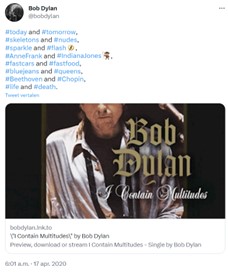
And by the way, the Nobel laureate himself likes to throw the spotlight on it too, judging by the hashtag bombardment accompanying the tweet announcing the song: “#today and #tomorrow, #skeletons and #nudes, #sparkle and #flash, #AnneFrank and #IndianaJones, #fastcars and #fastfood, #bluejeans and #queens, #Beethoven and #Chopin, #life and #death.” Well, the PR coolies surrounding the then 78-year-old grandmaster do, anyway – we can assume Dylan is not tweeting himself.

When Douglas Brinkley asks about it, in the New York Times interview of 12 June 2020, Dylan serves him, and the reader, with a disappointingly insipid answer;

“You’re taking Anne’s name out of context, she’s part of a trilogy. You could just as well ask, “What made you decide to include Indiana Jones or the Rolling Stones?” The names themselves are not solitary. It’s the combination of them that adds up to something more than their singular parts. To go too much into detail is irrelevant. The song is like a painting, you can’t see it all at once if you’re standing too close. The individual pieces are just part of a whole.”

Disappointing because, like a politician, Dylan first incorrectly paraphrases Brinkley’s question; Brinkley did not take Anne’s name out of context at all, but literally asked What made you decide to mention Anne Frank next to Indiana Jones? – properly in context, in other words. Furthermore, he does not, as Dylan half and half seems to hold against him, go “too much into detail”. Equally tendentious like a slippery politician is the continuation of Dylan’s “answer”, in which, pedantic almost, he turns Brinkley’s question into the “answer”: It’s the combination of them that adds up to something more than their singular parts. Which is true, of course, but most of all it is:

  1. a) rather meaningless (what then, pray tell, is this “something more”), and it is
  2. b) quite an open door (any combination is more than the singular parts – which is usually why we combine singular parts in the first place).

Besides, annoyingly, it is almost literally precisely what Brinkley was asking about; why did you combine those names? The interviewer does drill just a little bit further, fruitlessly, and then lets it go. And right he is: there is, after all, no deeper meaning behind the combination of these particular names – it could also have been any three other incompatible names. And this we know again thanks to this same interview, which apart from this excerpt is of course a brilliant, telling account – the elder Dylan is open, articulate, vulnerable, sharp and, well, wise is the word. The honest part, or rather: the sensible part of Dylan’s thoughts on the merger of Anne Frank with Indy and the Stones is that the creation of that merger occurs in a “trance state”;

“Somewhere in the universe those three names must have paid a price for what they represent and they’re locked together. And I can hardly explain that. Why or where or how, but those are the facts.”

So, I don’t know either. Still not enlightening, but at least relatable. Although it does seem explainable, incidentally. “I contain multitudes,” after all. Illustrating that wondrous identity definition becomes all the more clear by uniting completely incompatible characters. More clearly at least than by, say, I’m just like Goofy – like Fozzie Bear and them Home Alone idiots Harry and Marv, by uniting completely similar characters. It’s the same narrative trick as science fiction author Andy Weir uses in that crushing short story The Egg, the story in which the quasi-godly entity sends the “you” after his death back to a next life, and the you understands that he is multitudes, that he has been and will be every life in all time on earth;

I looked you in the eye. “The meaning of life, the reason I made this whole universe, is for you to mature.”
“You mean mankind? You want us to mature?”
“No, just you. I made this whole universe for you. With each new life you grow and mature and become a larger and greater intellect.”
“Just me? What about everyone else?”
“There is no one else,” I said. “In this universe, there’s just you and me.”
You stared blankly at me. “But all the people on earth…”
“All you. Different incarnations of you.”
“Wait. I’m everyone!?”
“Now you’re getting it,” I said, with a congratulatory slap on the back.
“I’m every human being who ever lived?”
“Or who will ever live, yes.”
“I’m Abraham Lincoln?”
“And you’re John Wilkes Booth, too,” I added.
“I’m Hitler?” You said, appalled.
“And you’re the millions he killed.”

… among who was Anne Frank. The image is, in short, simply more penetrating when uniting opposites.

All in all, Andy Weir’s first-person from The Egg can very well explain to Dylan and Douglas Brinkley why or where or how those names are locked together; “All the people on earth… all you. Different incarnations of you.”

To be continued. Next up I Contain Multitudes part 6: All things lost on earth are treasured there


Jochen is a regular reviewer of Dylan’s work on Untold. His books, in English, Dutch and German, are available via Amazon both in paperback and on Kindle:


Posted in Uncategorized | 2 Comments

Never Ending Tour 2013 Part 3: A Date with The Faerie Queene?

A full index to this series is given here.


By Mike Johnson (Kiwipoet)

When introducing the song from Tempest, ‘Soon after Midnight’ in 2012, I concurred with Jochen Markhorst’s assessment that this is ‘a real murder ballad.’  Ian Maxton from Spectrum Culture leans the same way, but allows for some ambiguity: The song “elides the border between tale and metaphor like one of those optical illusions where the picture changes depending on what details you fix your eyes on: it’s both. ‘It’s soon after midnight / And I don’t want nobody but you’ is maybe the most terrifying line Dylan ever wrote – and all the more so for its tenderness.”

After writing that article, my attention was drawn by the following verse:

Charlotte’s a harlot, she dresses in scarlet
Mary dresses in green
It’s soon after midnight and I’ve got a date with the fairy queen

Looking at that last line I began to wonder if we weren’t missing something. The ‘fairy queen’ is generally taken to refer to Titania from Shakespeare’s Midsummer Night’s Dream, and it seems to fit as Titania can cast love spells and turn the clown Bottom into an ass. However, Titania is ultimately a benevolent figure, and the play itself something of a feel-good comic fantasy. There’s no compelling reason to murder Titania.

But what if Dylan had another fairy in mind, Acrasia (sometimes written Akrasia) from Edmund Spenser’s The Faerie Queene written from 1590 to 1596? Acrasia is thought to be derived from Homer’s portrait of Circe, the witch in The Odyssey, who turns Odysseus’ crew into pigs and keeps the hero dallying for a full year before he breaks free. Now here’s a more villainous character than Titania; not only a witch and seductress of bold knights, ‘Akrasia is an evil witch. Enslaves men to sexual desire… She is a vampire or succubus who sucks away the spirit of men.’

Her abode and the seat of her enchantment, the Bower of Bliss, is a false paradise. The undaunted Knight, Sir Guyon, sets out to destroy her Bower of Bliss and her power. This is as good as murder as ‘The bower of bliss references the female body; the Bower of Bliss is to be found between women’s legs.’

First, he must deal with two lesser harpies (Charlotte and Mary?) and overcome various obstacles. Sir Guyon, who is supposed to represent Reason and Temperance, himself descends into fury as he destroys the Bower of Bliss. Sir Guyon’s battle with Acrasia is symbolic, or indicative, of the conflict within the soul of the male hero.

‘Spenser treats these as hostile, morally disruptive forces within the soul, powers which reason must fight against in a perpetual psychomachia.’ Psychomachia refers to that state in which we do battle with ourselves, our good versus our evil selves, reminding me of a Dylan line from another song:

I fought with my twin, that enemy within
Until both of us fell by the way

All this is highly speculative, of course, with little textual support, but it seems to me to be more tuned to the drive behind the song than Midsummer Night’s Dream. It’s worth remembering that the precise time, soon after midnight, is traditionally the witching hour, the hour of enchantment, when supernatural forces are at their strongest.

The song was sung many times in 2013, but there is one performance that stands out from the rest, and may indeed be a ‘best ever’ (at least until the next best ever comes along) – this one from Stockholm (13th Oct)

Soon After Midnight.

We’ll stay in Stockholm for this wonderfully contemplative version of ‘Scarlet Town.’ I introduced this song in 2012 and there’s not much I can add here. There might well be an ‘optical illusion’ effect operating here too, depending on which details you hone in on. However you interpret the song, there’s no doubt it casts a powerful spell. It has a sombre mood and reflective feel. It’s my favourite track from the album, and yet I find it hard to account for the mysterious hold it has; the best of Dylan’s later songs are multifaceted and something new seems to be revealed each time you listen. Hard to find a better performance than this one.

Scarlet Town

We’ll stay in Stockholm for ‘Early Roman Kings,’ another Tempest song with shifting perspectives and points of view. Most significant to my mind is the shift to the first person after the second verse, turning the song into another dramatic monologue, and making it sound as if the persona has adopted the position close to those scary early Roman kings, whoever they are:

I'll strip you of life, strip you of breath
Ship you down to the house of death
One day you will ask for me
There’ll be no one else that you’ll want to see
Bring down my fiddle, tune up my strings
Gonna break it wide open like the early Roman Kings

For my ear the song lacks the emotional coherence, like ‘Scarlet Town,’ which would bring these disparate images into some kind of focus and the song seems to fly apart at the seams.

I suggest the reader check out Jochen Markhorst’s series of articles on the song. He does a wonderful job breaking the song down verse by verse. He finds it to be full of references but, after relating it to the ‘mosaic like character’ of many great Dylan songs like ‘Shelter From the Storm’ and ‘Memphis Blues Again,’ admits that, ‘The big difference is the lack of an unambiguous charge, or at least: of a guiding portent. Refrain lines such as “I’ll give you a shelter from the storm”, “there’s no time to think”, “can this really be the end, to be stuck inside of Mobile” and “only one thing I did wrong, stayed in Mississippi a day too long” have a connecting, overarching quality – they direct the emotional charge of the images in the preceding lines…

‘Dylan offers no such handle in “Early Roman Kings”. Not only is “early Roman Kings” not a loaded term, as “Mobile”, “shelter” or “Mississippi” are, it is not even a term with an actual, overarching quality; nobody has any knowledge of the seven historical early Roman Kings (the first rulers of Rome, 753-510 BCE).’

Early Roman Kings

I’m going to stay mostly in Stockholm to pick up some other songs Dylan was playing in 2013 along with the Tempest songs. Since I’ve introduced these songs before many times I’ll move through them briskly. Enjoy these wonderful recordings.

Let’s begin with that wonderful melancholy ballad, ‘Forgetful Heart’ we covered in some detail in 2011. The song is still going strong in 2013.

Forgetful Heart

With regard to ‘Beyond Here Lies Nothing’ also from Together Through Life I still hark back to the harp and trumpet performance of 2009 but have no issues with this one:

Beyond Here Lies Nothing

Dylan carried over the more stripped-down arrangement of ‘Summer Days’ that we found in 2012. It’s taken me a while to really like this arrangement, as I have preferred the ‘big band’ versions of 2005, but it’s hard to resist this more restrained, chuggy, bass and drums driven version. A fine jazzy performance. A great vocal too.

Summer Days

We’ve listened to some amazing versions of ‘High Water’ over the years. Too many ‘best ever’ performances to keep track of. Editor Tony Attwood has rightly brought attention to a cheeky 2012 version in which Dylan taunts his audience with the harmonica and I trust he’ll enjoy this somewhat smoother vocal performance. Another ‘best ever’ to add to our collection.

High Water

I’m glad we haven’t lost ‘Spirit on the Water’ – it will last until 2018 – for this gentle song has delicate shadings. The song celebrates a relationship, however painful it might be. In the end, love trumps everything else:

I’m saying it plain
these ties are strong enough to bind

Spirit on the Water

‘Things Have Changed’ is also a survivor, and I’m glad of that too. Dylan’s rebellious spirit shines brightly in this song: ‘Don’t get up gentlemen, I’m only passing through.’ Jochen Markhorst has cast his illumination on this song, ‘“Things Have Changed’ is mainly lyrical, expresses in unrelenting, poetic images the discomfort of a displaced, numb narrator, through which the poet strings mysterious observations and half-known references.”

And we mustn’t forget the humour of the song.

Feel like falling in love with the first woman I meet
Putting her in a wheelbarrow and wheeling her down the street

Things Have Changed.

That humble, reflective song, ‘What Good Am I?’ will be the only survivor from Oh Mercy but will not last beyond 2014. Something of a rarity, its self-questioning and self-doubt make for a refreshing change from Dylan’s usual postures. The only other song like it I can think of right now is ‘What Can I Do For You?’ off Saved, 1980.

What Good am I?

Again Dylan improves on the 2012 performance of ‘Simple Twist of Fate.’ He’s learned how to make his voice softer, less bark and more croon. A welcome development. Those softer tones are full of implication and feeling. Dylan is finding his new voice, a voice beyond the croak and the bark; Frank Sinatra can’t be far behind.

Simple Twist of Fate

Tony Attwood has suggested that ‘Waitin’ for You,’ which was written in 2002 after the great writing burst that led to Love and Theft, lacks focus with a tendency to random images. I won’t argue with that. We often have to read unity into a Dylan song; he sets it up that way. But perhaps the emotional charge of this song isn’t sufficient to unify the images, I don’t know. You can overthink a Dylan song: he sets it up that way, little traps for the intellect that seeks to impose order on everything, even a Dylan song.

Waitin’ for You

Over 2012/13 Dylan started replacing ‘Watchtower’ as the final song of the night with ‘Blowin’ in the Wind.’ A much gentler way to finish a concert. Here it is, our last song from that incomparable Stockholm concert, and Dylan’s final song for the concert. I always enjoy Donnie Herron’s violin, and get an echo from Rolling Thunder. The song still swings, but not as cheekily as in 2009 where it became a somewhat exaggerated waltz; this is just a gentle lilt. Some subtle harp at the end to cap everything off.

Blowin’ in the wind

So that caps me off for this post. I’ll be back with more from 2013 soon

Until then

Kia Ora

Posted in Uncategorized | 2 Comments

Dylan posters from the 1980s

Poster photograph supplied by Joe LaMay

Commentary from Tony Attwood

“Untold Dylan” has no editorial rule book as to what should or should not be published on the site.  Basically, if we like it we publish it.

So although no one has provided a copy of a Dylan poster before I see no reason why we should not put up a picture of a couple of 1980s posters, since they have been sent in my Joe LaMay.

Joe wrote to me and said,

“I’ve had these posters framed since the late 80’s. On the left is the original poster – designed by Milton Glaser – that came with the 1967 Bob Dylan’s Greatest Hits LP. On the right is a 1985 poster deigned by Woody Pirtle to advertise a lecture by Milton Glaser for the Dallas Society of Visual Communication.”

Joe also gave us permission to publish his picture, and here it is…

Posted in Uncategorized | Leave a comment

A Dylan Cover a Day: Seven Days

By Tony Attwood

Coming to “Seven Days” in the Dylan Cover a Day series, I had high hopes, as it seemed to me a song that Dylan had never really taken to its limit (it only got 18 performances across a 20 year period ending in 1996), and which had some real hidden potential.

Indeed several musicians of note have had a go at the song and yet somehow they don’t seem to get anything new out of it.   Although please don’t make that comment of mine encourage you to move on elsewhere immediately because there is a bonus at the end – although it might cost you.

But yes, these opening songs are disappointing, and in listening to them I wondered if the fact that there was something else there in the song, was simply all in my imagination.   Ron Wood’s version for example never really takes that dramatic leap which I feel lurks within…

Joe Cocker, another man of great eminence of course, has a spikier go which I prefer, although I still find something missing.  And I find the shouting out of the first line of each verse a little obvious.

Mountain take the view that there must be something important in the song and again feel it needs to be shouted out, and that gives me the thought that maybe the opposite approach is needed.   (Unless there really never was anything there at all – and by this stage I was starting to think that was the case).

But if that is the approach that is required, then Jimmy Barnes seems to be able to do it more naturally and hence with more conviction.  When he sings “every inch of the way” followed by some really good vocal harmonies, yes I start believing in the song’s possibilities again.  Maybe there is a really good cover version out there, if only I could track it down…

I even went touring the foreign language versions but really couldn’t find the innovation that I thought must be there somewhere.  This is Niedecken – I am presuming Wolfgang Niedecken, the singer with BAP.   Interesting, but still…

And so, in disappointment, and as a last resort, I turned to Spotify – which of course then means I can’t put a recording here.   But if you have a Spotify subscription or can find it somewhere else, do try Born 53’s version of the song, if for nothing else, then for the fact that they’ve changed the beat and so changed the meaning of the entire song.  Suddenly it’s bouncy and a fun celebration of what is going to happen.  It really does work.

Then if you want to go any further there is Bitter Sweet’s version.   Once again the artist has used his creativity and insight to build on Bob’s work but not slavishly copy the original style and intent.  As a result we get Bob’s song with and lot of extras and thoughts of new directions that music can be taken.

I’m not here to convince you to buy a Spotify subscription, but if maybe if you don’t have one you could get a free trial or something like that, so you could use it to listen to these two recordings.   They really do give a completely new set of insights into a song that does have all the possibilities that I felt must be hiding in there somewhere.   I’m just sorry the other more eminent musicians didn’t quite find them.

The Dylan Cover a Day series

  1. The song with numbers in the title.
  2. Ain’t Talkin
  3. All I really want to do
  4.  Angelina
  5.  Apple Suckling and Are you Ready.
  6. As I went out one morning
  7.  Ballad for a Friend
  8. Ballad in Plain D
  9. Ballad of a thin man
  10.  Frankie Lee and Judas Priest
  11. The ballad of Hollis Brown
  12. Beyond here lies nothing
  13. Blind Willie McTell
  14.  Black Crow Blues (more fun than you might recall)
  15. An unexpected cover of “Black Diamond Bay”
  16. Blowin in the wind as never before
  17. Bob Dylan’s Dream
  18. BoB Dylan’s 115th Dream revisited
  19. Boots of Spanish leather
  20. Born in Time
  21. Buckets of Rain
  22. Can you please crawl out your window
  23. Can’t wait
  24. Changing of the Guard
  25. Chimes of Freedom
  26. Country Pie
  27.  Crash on the Levee
  28. Dark Eyes
  29. Dear Landlord
  30. Desolation Row as never ever before (twice)
  31. Dignity.
  32. Dirge
  33. Don’t fall apart on me tonight.
  34. Don’t think twice
  35.  Down along the cove
  36. Drifter’s Escape
  37. Duquesne Whistle
  38. Farewell Angelina
  39. Foot of Pride and Forever Young
  40. Fourth Time Around
  41. From a Buick 6
  42. Gates of Eden
  43. Gotta Serve Somebody
  44. Hard Rain’s a-gonna Fall.
  45. Heart of Mine
  46. High Water
  47. Highway 61
  48. Hurricane
  49. I am a lonesome hobo
  50. I believe in you
  51. I contain multitudes
  52. I don’t believe you.
  53. I love you too much
  54. I pity the poor immigrant. 
  55. I shall be released
  56. I threw it all away
  57. I want you
  58. I was young when I left home
  59. I’ll remember you
  60. Idiot Wind and  More idiot wind
  61. If not for you, and a rant against prosody
  62. If you Gotta Go, please go and do something different
  63. If you see her say hello
  64. Dylan cover a day: I’ll be your baby tonight
  65. I’m not there.
  66. In the Summertime, Is your love and an amazing Isis
  67. It ain’t me babe
  68. It takes a lot to laugh
  69. It’s all over now Baby Blue
  70. It’s all right ma
  71. Just Like a Woman
  72. Knocking on Heaven’s Door
  73. Lay down your weary tune
  74. Lay Lady Lay
  75. Lenny Bruce
  76. That brand new leopard skin pill box hat
  77. Lily, Rosemary and the Jack of Hearts
  78. License to kill
  79. Like a Rolling Stone
  80. Love is just a four letter word
  81. Love Sick
  82. Maggies Farm!
  83. Make you feel my love; a performance that made me cry.
  84. Mama you’ve been on my mind
  85. Man in a long black coat.
  86. Masters of War
  87. Meet me in the morning
  88. Million Miles. Listen, and marvel.
  89. Mississippi. Listen, and marvel (again)
  90. Most likely you go your way
  91. Most of the time and a rhythmic thing
  92. Motorpsycho Nitemare
  93. Mozambique
  94. Mr Tambourine Man
  95. My back pages, with a real treat at the end
  96. New Morning
  97. New Pony. Listen where and when appropriate
  98. Nobody Cept You
  99. North Country Blues
  100. No time to think
  101. Obviously Five Believers
  102. Oh Sister
  103. On the road again
  104. One more cup of coffee
  105. (Sooner or later) one of us must know
  106. One too many mornings
  107. Only a hobo
  108. Only a pawn in their game
  109. Outlaw Blues – prepare to be amazed
  110. Oxford Town
  111. Peggy Day and Pledging my time
  112. Please Mrs Henry
  113. Political world
  114. Positively 4th Street
  115. Precious Angel
  116. Property of Jesus
  117. Queen Jane Approximately
  118. Quinn the Eskimo as it should be performed.
  119. Quit your lowdown ways
  120. Rainy Day Women as never before
  121. Restless Farewell. Exquisite arrangements, unbelievable power
  122. Ring them bells in many different ways
  123. Romance in Durango, covered and re-written
  124. Sad Eyed Lady of Lowlands, like you won’t believe
  125. Sara
  126. Senor
  127. A series of Dreams; no one gets it (except Dylan)
Posted in Uncategorized | Leave a comment

Bob Dylan: the Lyrics and the music. The transmutation of Blind Willie McTell

Please note we have had a technical problem near the end of this article while adding the recordings.  If you are unable to read the conclusion of the piece please press “refresh” and give the article maybe 20 seconds to sort itself out.  I am still working on the technical whatnots.

By Tony Attwood

In my view one of the many important points in coming to understand Bob Dylan as a composer of music, rather than as a lyricist or poet, is to listen to the way the music sets the scene at the start of each recording or live performance.

Blind Willie McTell is a perfect example of this.  Everyone knows the open lines…

Seen the arrow on the doorpost
Saying this land is condemned
All the way from New Orleans
To Jerusalem

but not everyone can immediately recall quite what the music is doing across the eight bars that launch the original version of the song.

The guitar comes in, and then the electric piano, but the piano joins in a very disjointed way on the half-beat at the end of the bar before giving us the first sound of the opening melody.  It is indeed a singularly tentative start and we are not quite sure what’s what until we get to “Jerusalem” by which time the beat is established and we know we have a variation of “St James Infirmary” being played.

And then, having got itself established the music modulates – meaning it changes key.   The third line of each four finishes is in the major key, the other three lines are very much in the minor.

Such an approach gives the line “Nobody can sing the blues like” a fundamental place within the music.

Listening again to the original version of the song, the other central point that comes across is how Dylan varies the power between the opening verse and the St James Hotel verse.

But the vamping on piano (playing the chords on varying beats as in the instrumental conclusion of the piece) feels as if it needs a slightly more accomplished pianist at this point.   In fact, to my ears the power developed in the conclusion is not helped by the way the piano is played; to me it needs more sophistication, despite the focal point of the lyrics.

However none of that can take away from the power of the lyrics, such as…

I travel through east Texas
Where many martyrs fell
And I dont know one can sing the blues
Like blind Willie McTell

By the time we get to the “Springtime in New York” recording the musical background has become more sophisticated, and although the piano part is far less dominant, it is still giving us the chordal accompaniment which remains as unsophisticated as before.


But we now have the bass and drums to hold the song together.   However, all the time we can hear the piano pounding those same chords without any extra sophistication which is now added by the other instrumentation.

But now just compare that with this version – the music starts on 1 minute.   And now we can hear the song without that very limited piano part.

Suddenly the song is liberated and we have a new set of meanings, despite the lyrics being the same.  We can hear this in evolution again in a recording from 2011 in Hong Kong which Mike Johnson highlighted for us.


Now my point in all this is that Bob obviously writes and records his songs in accordance with what he can achieve as a performing artist, and in the case of “Blind Willie” he perfectly reasonably considered for the first recording that electric piano and bass with the tapping of a persistent rhythm on the off beat (beats 2 and 4 of each bar) would make it work.   And yes it does work brilliantly – except that as the song builds Bob didn’t have the technical ability to carry the piano part off.    Take out that piano part and add a banjo and you get something else; in fact a different song.

A really fascinating evolution of the accompaniment of the song in fact, which allows Dylan to change the way the lyrics are delivered and hence change the meaning of the entire song.   Playing that Hong Kong recording and the original version in fact come as quite a shock.  The lyrics are the same, but the song has mutated into something completely different.


Posted in Uncategorized | 5 Comments

Dylan’s 114 greatest opening lines: completing the list

By Tony Attwood

Dylan’s Opening Lines:   This is the fourth and final update on a theme we originally looked at eight years or so ago and which I have been playing with in the last couple of weeks.  It incorporates all the suggestions made in the previous three articles, and adds a few more of its own, each marked “NEW”.

Of course the selection is utterly personal and really not meant to be of particular significance, other than to note that Bob Dylan really does seem to be rather good at finding opening lines that stay in the memory.

I mean when you consider that the alphabetical index of songs that Dylan has written and which appears on this site has 627 songs finding over 100 that to me have amazingly memorable open lines that is quite extraordinary.  I wonder if Bob ever ponders the issue of the opening line as a concept…. But I suspect not.

So here we go: my final list of Bob’s greatest opening lines.   I am sure that within 30 seconds of posting this I will think of another example, but then that’s what always happens to me, and if I kept coming back to every article I’d never get to buy my daughter a birthday card, which is top of the agenda today before the family BBQ.   We won’t discuss Dylan, as it’s just Dad’s oddball thing, but some of these lines will be resonating in my head all through today, and tomorrow and yesterday too.

Anyway, I’ve also done a little pruning, taking out one or two that I thought, on reviewing the list, really shouldn’t be there.  But of course you’ll make up your own mind.

—————

Ain’t it just like the night to play tricks when you’re tryin’ to be so quiet?  (Visions of Johanna)

All the early Roman kings in their sharkskin suits bow ties and buttons high top boots (Early Roman Kings)

All the tired horses in the sun (All the tired horses)

As I walked out tonight in the mystic garden, the wounded flowers were dangling from the vines (Ain’t Taking)

At the time of my confession, and the hour of my deepest need (Every grain of sand)

B

Band of the hand (Band of the hand)

Been so long since a strange woman slept in my bed… (I and I)

Beyond the horizon, behind the sun, at the end of the rainbow, life has just begun.  (Beyond the horizon)

Black Rider Black Rider you been livin’ too hard (Black Rider)

Buckets of rain, buckets of tears (Buckets of rain)

Bye and bye, I’m breathin’ a lover’s sigh (Bye and Bye)

C

Come around you rovin’ gamblers, and a story I will tell. (Rambling, Gambling Willie)

Crimson flames tied through my ears, rollin’ high and mighty traps (My back pages)

D

Darkness at the break of noon (It’s all right Ma, I’m only bleeding)

E

Everything went from bad to worse, money never changed a thing (Up to Me)

F

Far between sundown’s finish and midnight’s broken toll  (Chimes of Freedom)

Fat man lookin’ in a blade of steel (Dignity)

G

Go away from my window, leave at your own chosen speed (It Ain’t Me Babe)

God knows you ain’t pretty (God knows).    Those who have analysed the lyrics of what broadly might be called “popular music” invariably conclude that the genre has three prime subjects: love, lost love and dance.   Bob of course goes his own way, but has no problem handling love and lost love songs.  But this as an opening… well, I just don’t think anyone else ever has tried that approach.

God said to Abraham “Kill me a son” (Highway 61 Revisited)

Gon’ walk down that dirt road, ’til someone lets me ride (Dirt Road Blues)

H

He sits in your room, his tomb, with a fist full of tacks (Can you please Crawl out Your Window)

High water risin’—risin’ night and day (High Water)

Hollis Brown he lived on the outside of town (Ballad of Hollis Brown)

Hot chili peppers in the blistering sun  (Romance in Durango)

How many roads must a man walk down before you can call him a man? (Blowing in the wind)

I

I ain’t lookin’ to compete with you (All I really want to do)

I can hear the turning of the key (Abandoned Love)

I crossed the green mountain, I slept by the stream (‘Cross the green mountain)

I hate myself for lovin’ you and the weakness that it showed (Dirge)

I got this graveyard woman, you know she keeps my kid (From a Buick Six).  I’ve never quite been sure what that means, and to try and help myself I just looked up the topic of women and graveyards, but aside from learning about Islamic rulings on the matter I haven’t found much.  Perhaps it is an American slang expression that has never come to England.  Or maybe it is just something Bob invented.   Whatever the answer, it’s a great line.

I ain’t looking to compete with you (All I really want to do)

I love you more than ever, more than time and more than love (Wedding Song)

I love you pretty baby (Beyond here lies nothing)

I once loved a girl, her skin it was bronze (Balled in Plain D)

I was born in Dixie in a boomer shed (Freight Train Blues).   Again a bit of looking up on my part.  It seems “The Boomer Shed is an inclusive community shed for both men and women over 50 in South Auckland”.   I take it that is in New Zealand.  Has Bob played in New Zealand?  I think I’ve missed something!

I woke in the mornin’, wand’rin’ wasted and worn out (Black crow blues)

If I had wings, like Noah’s dove  (Dink’s Song)

I’m walking through the summer nights, jukebox playing low (Standing in the Doorway)

I’m walkin’ through streets that are dead (Love Sick)

NEW: I was listening to the voices of death on parade (You changed my life)  I tried this one out on four Dylan friends and none got it, and to be fair I wouldn’t have remembered which song.   But just look at that line, and remember that is the opening line of a song!!!

If today was not an endless highway (Tomorrow is a long time)

If you find it in your heart, can I be forgiven?  Guess I owe You some kind of apology  (Saving Grace)

If you see her say hello (If You See Her Say Hello)

If your memory serves you well, we were going to meet again and wait (This wheel’s on fire)

In the lonely night, In the blinking stardust of a pale blue light (Born in Time)

In the time of my confession, in the hour of my deepest need (Every Grain of Sand)

I’ve just reached a place where the willow don’t bend (Going Going Gone)

NEW: I’ve seen love go by my door (You’re going to make me lonesome)    So simple and yet so different.   He doesn’t say “I’ve been in love lots of time” or “I’ve lost so many lovers” but something quite different.  It’s a really arresting start.

I was riding on the Mayflower when I thought I spied some land (115th Dream)

I woke in the mornin’, wand’rin’ (Black Crow Blues)

J

Johnny’s in the basement mixing up the medicine, I’m on the pavement talking ’bout the government. (Subterranean Homesick Blues)

K

L

Like a lion tears the flesh off of a man, so can a woman who passes herself off as a male. (Foot of Pride).  Like the lion tears the flesh off of a man, So can a woman who passes herself off as a male (Foot of Pride).    I love Foot of Pride – and the fact that on some computers in some places the Untold article on the song comes up at the top of page one.  I’ve included this before, but I thought it was time to break up my ramblings with a song.

M

Man thinks, cuz he rules the world, he can do with it as he please (Licence to kill)

May God bless and keep you always, may your wishes all come true (Forever Young)

My love she speaks like silence. (Love Minus zero / No Limit)

My name is Donald White, you see (Ballad of Donald White)

N

Nobody feels any pain (Just like a woman)

Now the ragman draws circles up and down the block  (Stuck inside of Mobile with the Memphis Blues Again)

O

Of war and peace the truth just twists, it’s curfew gull it glides (Gates of Eden)

NEW: Oh all the money in my whole life I did spend (Restless Farewell)

Oh I’m sailing away, my own true love. (Boots of Spanish Leather)

NEW: Oh my name it means nothing (God on our side)

Oh, the benches were stained with tears and perspiration (Day of the Locusts)

Oh, the gentlemen are talking and the midnight moon is on the riverside (Dark Eyes)

Oh, help me in my weakness  (The Drifter’s Escape)

Oh the streets of Rome are filled with rubble, ancient footprints are everywhere. (When I Paint my Masterpiece)

Oh, where have you been, my blue-eyed son?  (Hard Rain)

Old man sailin’ in a dinghy boat (Apple suckling tree)

NEW Our conversation was short and sweet, It nearly swept me off-a my feet (You’re a big girl now).  OK those opening six words are not exactly that unusual, but combined with the next line it really leaves one wondering what on earth is going on.

P

Pistol shots ring out in the barroom night  (Hurricane)

Q

R

Ring them bells ye heathen from the city that dreams (Ring them Bells)

S

Sad I’m a-sittin’ on the railroad track (Ballad for a friend)

Seen the arrow on the doorpost saying this land is condemned (Blind Willie McTell)

Shadows have fallen and I’ve been here all day,  (Not Dark Yet)

She’s got everything she needs she’s an artist she don’t look back (She Belongs to Me)

Sometimes I’m in the mood, I wanna leave my lonesome home (Baby I’m in the mood for you)

Someone’s got it in for me, they’re planting stories in the press.  (Idiot Wind)

Some of us turn off the lights and we live in the moonlight shooting by (Red River Shore)

Something there is about you that strikes a match in me (Something there is About You)

Standing on the waters casting your bread while the eyes of the idol with the iron head are glowing? (Jokerman)

Stake my future on a hell of a past (Silvio)

T

Ten thousand men on a hill (Ten Thousand Men)

The air is gettin’ hotter, there’s a rumblin’ in the sky, (Lucinda Williams Tryin’ to get to Heaven)

NEW: The guilty undertaker sighs (I want you)

NEW: The iron hand it ain’t no match for the iron rod (When He Returns)

The pale moon rose in its glory out on the Western town (Tempest)

The pawnbroker roared also so did the landlord (She’s your lover now)

The river whispers in my ear, I’ve hardly a penny to my name (Tell Ol Bill)

“There must be some way out of here,” said the joker to the thief (All along the Watchtower)

There’s a long-distance train rolling through the rain, tears on the letter I write. (Where are you Tonight?  (Journey through Dark Heat))

There’s guns across the river aimin’ at ya (Billy 1)

They’re selling postcards of the hanging (Desolation Row)

They ask me how I feel
And if my love is real
And how I know I’ll make it through (I believe in you).   Bob’s ability with simple words and turning them into everything you want them to be.

They say everything can be replaced, yet every distance is not near (I Shall be Released)

Today and tomorrow and yesterday too (I contain multitudes).   No opening line could ever be more all-encompassing.

Twas another lifetime, one of toil and blood (Shelter from the Storm)

Twilight on the frozen lake (Never say Goodbye)

U

Up on the white veranda, she wears a necktie and a Panama Hat  (Black Diamond Bay)

V

W

Well, if I had to do it all over again (All over you)

Well, it’s always been my nature to take chances (Angelina)

Well, the Lone Ranger and Tonto they are ridin’ down the line (Bob Dylan’s Blues)

Well, there was this movie I seen one time about a man riding ’cross the desert and it starred Gregory Peck. (Brownsville Girl)

Well, my nerves are exploding and my body’s tense (Til I fell in love with you)

Well, your railroad gate, you know I just can’t jump it (Absolutely Sweet Marie)

What good am I if I’m like all the rest? (What good am I)

What’s the matter with me, I don’t have much to say (Watching the River Flow)

NEW:  What was it you wanted?

When she said “Don’t waste your words, they’re just lies” I cried she was deaf.
And she worked on my face until breaking my eyes then said, “What else you got left?” (Fourth time around).    I really can’t think of many popular songs of any variety that start with something as powerful as this.   Even now, decades after I first heard it, those opening lines have a real impact.  (And yes I know I am cheating by going for two lines, but its my article so I can.)

When you’re lost in the rain in Juarez and it’s Eastertime too (Just like Tom Thumb’s Blues)

While riding on a train goin’ west I fell asleep for to take my rest (Bob Dylan’s Dream)

William Zanzinger killed poor Hattie Carrol with a cane that he twirled round his diamond ring finger (The Lonesome Death of Hattie Carrol)

X

Y

You been down to the bottom with a bad man, babe  (Baby stop crying)

You may be an ambassador to England or France (Gotta Serve Somebody).   It’s a strange one – as in, well yes I might, but I’m not,  But of course I get the meaning, and even though I profoundly disagree with the notion that I have to serve somebody, I can still appreciate the power.

You walk into the room with your pencil in your hand, you see somebody naked and you say “who is that man?”  (Ballad of a Thin Man)

You got a lot of nerve to say you are my friend (Positively 4th Street)

Posted in Uncategorized | Leave a comment

Other people’s songs: Dylan’s take on “Let it be me”


by Aaron Galbraith and Tony Attwood

Aaron: “Let It Be Me” is a popular song originally published in French in 1955 as “Je t’appartiens”.

Tony: Literally that translates as “I belong to you” and the opening lines run…

Comme l'argile
L'insecte fragile
L'esclave docile
Je t'appartiens

De tout mon être
Tu es le seul maître
Je dois me soumettre
Je t'appartiens

And just for a bit a fun I thought I’d offer a literal translation (rather than the re-write that we all know)

Like clay
The fragile insect
The docile slave
I belong to you

With all my being
You are the only master
I have to submit
I belong to you

“The fragile insect” doesn’t quite have the same ring to it as

I bless the day I found youI wanna stay around youNow and forever, 
let it be me

Don't take this heaven from oneIf you must cling to someoneNow and forever, 
let it be me

And that stuff about “the master” and “I have to submit” doesn’t quite feel right these days!

The original French lyrics were written by Pierre Delanoë and the English lyrics that we now know came from Mann Curtis.  It was apparently originally performed in 1957 by Jill Corey in the television series Climax!

Which is interesting because although Climax! was not a particularly long-running TV series, nor indeed one that anyone other than those who made it, is likely to remember, it does have one claim to fame, and that is that an episode in the first series in 1954 included the first ever appearance on the screen of British agent James Bond, in an adaptation of Casino Royale.  “James” on this occasion became “Jimmy,” and American.

Anyway, back to the plot, Gilbert Bécaud was apparently known as “Monsieur 100,000 Volts” because of his on-stage performances.   Now moving on… I think Jill Corey’s version came next but didn’t add too much to the song…

Aaron: The Everly Brothers popularized the track with an English version in 1959

Tony: As a child, I did like the Everly Brothers, but always preferred the upbeat songs.  And they are of note from our point of view on this site since they did also record a couple of Dylan tracks: “Abandoned Love” and “Lay Lady Lay”.  Here’s the first of these (and sorry Aaron I’m really going off-piste in this one I know, but it’s just what happens – the memories come pouring back in and I can’t resist following them up – even though I know this is a rather uninspiring version).

Aaron: Dylan’s version of “Let it be Me” came from 1970s Self Portrait.

Tony: I think Bob did more for this song than the Everlys did for Bob’s song, although I am not at all happy with the way the vocals and instrumentation clash each time we have the title line, but I really do like Bob’s vocals overall, and the instrumental break.

Aaron: Subsequent versions include Laura Nyro from her 2001 album Angel in the Dark.

Tony: I am always a bit suspicious of people who take songs and then slow them down for vocal flourishes and extra emotion.  I think that a significant part of the song is the continuing rhythm, and here, with the piano accompaniment that doesn’t seem to have too much to do with the varied melody line, it all becomes a bit broken – at least to my ear.

It might work if the lyrics were all about a break up of a relationship, but they are about the opposite: the desire for the relationship, and I don’t think the arrangement gets anywhere near expressing that.

Aaron: Jeff Beck and Johnny Depp from their 2022 album 18

Tony: The electric piano accompaniment of the triplets (1,2,3; 1,2,3) is very hackneyed in that introduction and I wonder why they left it in; after all it vanishes once the voices enter.   In fact that is not the only oddity because halfway through the first verse we have a wow-wow moment from the lead guitar, which later goes completely over the top in the instrumental break.

Of course I am not an arranger, but I really cringed with this version.  I love the vocals with their perfect harmonies, and want to run away and hide from the lead guitar.  I really don’t think the arranger ever once considered the lyrics and their meaning and just thought right, “let’s see what we can throw in here”.  For me the result is a horrible mishmash.

But then, what do I know?

Other people’s songs: the series

  1. Other people’s songs. How Dylan covers the work of other composers
  2. Other People’s songs: Bob and others perform “Froggie went a courtin”
  3. Other people’s songs: They killed him
  4. Other people’s songs: Frankie & Albert
  5. Other people’s songs: Tomorrow Night where the music is always everything
  6. Other people’s songs: from Stack a Lee to Stagger Lee and Hugh Laurie
  7. Other people’s songs: Love Henry
  8. Other people’s songs: Rank Stranger To Me
  9. Other people’s songs: Man of Constant Sorrow
  10. Other people’s songs: Satisfied Mind
  11. Other people’s songs: See that my grave is kept clean
  12. Other people’s songs: Precious moments and some extras
  13. Other people’s songs: You go to my head
  14. Other people’s songs: What’ll I do?
  15. Other people’s songs: Copper Kettle
  16. Other people’s songs: Belle Isle
  17. Other people’s songs: Fixing to Die
  18. Other people’s songs: When did you leave heaven?
  19. Other people’s songs: Sally Sue Brown
  20. Other people’s songs: Ninety miles an hour down a dead end street
  21. Other people’s songs: Step it up and Go
  22. Other people’s songs: Canadee-I-O
  23. Other people’s songs: Arthur McBride
  24. Other people’s songs: Little Sadie
  25. Other people’s songs: Blue Moon, and North London Forever
  26. Other people’s songs: Hard times come again no more
  27. Other people’s songs: You’re no good
  28. Other people’s songs: Lone Pilgrim (and more Crooked Still)
  29. Other people’s songs: Blood in my eyes
  30. Other people’s songs: I forgot more than you’ll ever know
  31.  Other people’s songs: Let’s stick (or maybe work) together.
  32. Other people’s songs: Highway 51
  33. Other people’s songs: Jim Jones
  34. Other people’s songs: Let’s stick (or maybe work) together.
  35. Other people’s songs: Jim Jones
  36. Other people’s songs: Highway 51 Blues
  37. Other people’s songs: Freight Train Blues
  38. Other People’s Songs: The Little Drummer Boy
  39. Other People’s Songs: Must be Santa
  40. Other People’s songs: The Christmas Song
  41. Other People’s songs: Corina Corina
  42. Other People’s Songs: Mr Bojangles
  43. Other People’s Songs: It hurts me too
  44. Other people’s songs: Take a message to Mary
  45. Other people’s songs: House of the Rising Sun
  46. Other people’s songs: “Days of 49”
  47. Other people’s songs: In my time of dying
  48. Other people’s songs: Pretty Peggy O
  49. Other people’s songs: Baby Let me Follow You Down
  50. Other people’s songs: Gospel Plow
  51. Other People’s Songs: Melancholy Mood
  52. Other people’s songs: The Boxer and Big Yellow Taxi
  53. Other people’s songs: Early morning rain
  54. Other people’s Songs: Gotta Travel On
  55. Other people’s songs: “Can’t help falling in love”
  56. Other people’s songs: Lily of the West
  57. Other people’s songs: Alberta
  58. Other people’s songs: Little Maggie
  59. Other people’s songs: Sitting on top of the world
Posted in Uncategorized | 2 Comments

NET 2013 part 2: The art of the Dramatic Monologue

An index to the whole series on the Never Ending Tour can be found here.

By Mike Johnson (Kiwipoet)

In the previous post I covered the songs that were played for the last time in 2013, and we spent some time with those wonderful two Rome concerts. Dylan, however, apart from narrowing his setlists, had new songs lined up for the gaps he was creating, songs from his latest album, Tempest (2012). Tempest appeared too late in 2012 to have a major impact on those setlists, but in 2013 and 2014, before the arrival of Frank Sinatra, these new songs came into their own.

Not so the final song on the album, ‘Roll On John’ which, according to the official Dylan website, was played twice at the end of 2013 in London. I, however, can only find one recording, this one from 26th November. It would never be performed again.

Roll On John

This song has always seemed a little loose and mawkish to me, certainly not the best of the album, and along with others I wondered why Dylan would wait thirty years to write this somewhat awkward tribute to John Lennon. At least, everybody assumes it’s a tribute to John Lennon. The second verse in particular is conclusive:

From the Liverpool docks to the red-light Hamburg streets
Down in the quarry with the Quarry men
Playing to the big crowds, playing to the cheap seats
Another day in the life on your way to your journey's end

But listening to it again now I begin to wonder. In his late songs Dylan sometimes shifts focus, and can hide one thing behind another. I may be drawing a very long bow here, but behind the figure of John Lennon I see another John, John of Patmos, author of the Book of Revelations. Commentators have struggled to apply the rest of the song to John Lennon, or account for the ‘island’ mentioned in the third verse. (Manhattan?) But what if the island was Patmos to which John, John the Revelator, was exiled by the Romans as a result of anti-Christian persecution? This John died in exile, but not a violent death:

Your bones are weary, you’re about to breathe your last
Lord, you know how hard that it can be’

That doesn’t sound like someone dying of a fatal gunshot wound.

The reference to Blake’s Tyger would make more sense if we were thinking of John the Revelator, a spiritual tiger still burning bright. Blake’s interest in the tiger, and maybe Dylan’s too, is as a revelation of god’s power.

Ok, as I said, it’s a hell of a stretch, but you have to stretch those lyrics to fit with John Lennon too. I don’t think it’s a matter of either/or – it seldom is with Dylan, who likes to have his cake and eat it too. Dylan might have had both Johns in his mind when he wrote the song, or maybe John the Revelator ghosting in behind John Lennon. Or maybe I’m just imagining things.

Those looking for a more grounded view of the song are well advised to check out Tony Attwood’s account here.  There is nothing loose or mawkish about ‘Pay in Blood,’ however, which is among the most scary and powerful songs Dylan has ever written. Scary because the persona behind it is a dangerous and violent hypocrite, happy to pay for his crimes with your blood. Good dramatic monologues subtly build a portrait of a character through what they reveal about themselves. What is revealed in this song is a terrifying personality, a dictator in the making, a vampire by inclination, a moral monster.

In ‘Pay In Blood’ we find another version of the unreliable narrator, this time a self-mythologising, self-aggrandising type, a hero (in his own eyes) of Homeric proportions, but underneath it all, another self-serving grifter happy to pay for his crimes with the blood of others. I tried to come to grips with this song here and Tony has had a crack at it here, but like the best Dylan songs it won’t be pinned down easily.

Suiting the subject matter, the music has a militant, ominous feel – expressive of a horrible triumphalism (Trumphalism?) –  and we will get some solid performances of it over the next few years. The music overwhelms you just as the song’s persona would; you have to fight to keep your feet if you don’t want to get swept away by his vile, self-serving rhetoric, delivered to a pounding beat.

The song was performed fifty-eight times over a total of eighty-five concerts. I’ve chosen three, necessary performances, each approaching the song a little differently, with different emphases. The song grew over the year in loudness and confidence.

This first one from Amhurst (6th April), the second concert of the tour, features blues and jazz guitarist Duke Robillard, who played with Dylan until June 30th. There were rumours of clashes between Robillard and Dylan, who would replace him with Colin Linden who would play with Dylan on and off until August 4th. It’s hard to know why Dylan added another guitarist, as he already had Charlie Sexton and Stu Kimball.

I like this one because you can hear Dylan feeling out the song, the clear, sweet piano chords underpinning it. It has not yet become strident, and achieves a certain grim grandeur.

Pay in Blood (A)

The next two are both from November, and show how far the song has come in terms of ominousness. This one’s from London, 27th Nov.

Pay in Blood (B)

This one from Blackpool, 22nd Nov, however, shows the direction it will move in 2014 – louder and more strident.

Pay in Blood (C)

‘Duquesne Whistle,’ co-written with Robert Hunter, kicks off the album. This jaunty song, most certainly playful, takes us back to the early days of jazz and jump jazz, a ‘choo-choo shuffle’ as the Sydney Morning Herald described it, with echoes of Jelly Roll Morton, one of the founders of jazz piano.

‘The song piles up evocations not to invite understanding but to situate the listener. The opening few bars provide misdirection with both sound and tempo, yet they open Dylan’s world and provide just one more indication of where he’s going. Wherever this train track leads, it must be worth going’ “Bob Dylan’s 20 Best Songs of the ’10s and Beyond”. Spectrum Culture. 2021-02-19. 

Tony Attwood has argued, I think persuasively, that the song evokes a tornado: ‘Late in the afternoon of Sunday, May 22, 2011 a huge multiple vortex tornado struck Joplin and Duquesne, Missouri.  It was the third tornado to hit the area since May 1971. It killed 158 people, injured some 1,150 others, and was the deadliest tornado in the US up to that point since 1947 and was (at the time) the costliest single tornado in U.S. history… As for the whistle, tornados are associated with a whistle sound – which comes from the inflowing winds.  Hence ‘Duquesne Whistle’– the opening track of an album called Tempest.’

Not only that, it’s worth pointing out that tornados are often described as sounding like an approaching train, and the idea of a train whistle lurks behind the music and imagery. Again, Dylan gets it both ways, both a tornado and a train.

This song was played at almost every concert in 2013, with little variation in the performances. I’ve chosen just two performances, the first from Stockholm (13th Oct):

Duquesne Whistle (A)

And the second from London, 27th Nov:

Duquesne Whistle (B)

It wasn’t until October that another great dramatic monologue from Tempest, ‘Long and Wasted Years’ was played live. To get behind this song I suggest you imagine a woman being accosted by a barroom drunk, who addresses her as if he knows her, was in fact married to her at one time, but none of that is certain. Maybe he was just a friend of hers, or maybe she’s a complete stranger. What is certain is his bitterness and despair. The song ends with some of the most devastating lines Dylan has written:

I think when my back was turned
The whole world behind me burned
Maybe today, if not today, maybe tomorrow
Maybe there’ll be a limit on all my sorrow

We cried on a cold and frosty morn’
We cried because our souls were torn
So much for tears
So much for those long and wasted years.

At least, those are the lyrics as written on the official Dylan website. But what he sings is:

I think when my back was turned
The whole world behind me burned
It’s been a while
Since we walked down that long, long aisle

which is much more powerful in the context of the imaginings of the persona.

‘Long and Wasted Years’ comes close to being a talking song, driven by the drunken lurch of the music which seems to stagger from verse to verse. In later years Dylan would put on a drunken intonation when singing it, but in 2013 he was still feeling the song out, feeling out the persona behind the song. As in all great dramatic monologues, we have an unreliable narrator who gives himself away at every turn:

I ain’t seen my family in twenty years
That ain’t easy to understand
They may be dead by now
I lost track of them after they lost their land

Hmm… the thought occurs that he lost track of his family because they lost their land, revealing him to be a shallow, venal man. A vengeful man too:

My enemy crashed into the dust
Stopped dead in his tracks and he lost his lust
He was run down hard and he broke apart
He died in shame, he had an iron heart

Hmm… who has the iron heart? There’s little pity in the persona’s heart.

Grotesquely, he wants the woman to dance for him, or perhaps with him, evoking a song made popular by the Beatles in the 1960s.

Shake it up baby, twist and shout
You know what it's all about
What are you doing out there in the sun anyway?
Don't you know, the sun can burn your brains right out

Note that sudden shift after the second line from a leering sexual invitation to nastiness so typical of the drunk. (The extreme heat of the sun may tie in with the line ‘the whole world behind me burned’ offering us a glimpse of an overheated world.)

Then there’s that verse which makes us think of Dylan himself. I would caution against ascribing anything this persona says to Dylan, whoever he may be, but given his early love affair with sunglasses, and his youthful fondness for wearing them at night, this verse is suggestive:

I wear dark glasses to cover my eyes
There are secrets in them that I can't disguise
Come back baby
If I hurt your feelings, I apologise

Again a sudden shift after the first two lines. We’re not sure what he has to apologise for – maybe those ‘secrets’ hidden behind his shades.

Like ‘Pay in Blood’ this song is a masterpiece of character creation. Not pleasant characters at all, either of them, characters full of bile and self-justification. But unlike the dark villain of ‘Pay in Blood,’ the confused drunk of ‘Long and Wasted Years’, wearing his wounded heart on his sleeve, provokes a kind of fascinated pity. If we’ve spent any time in bars at all, or alcohol-fuelled parties, we’ll know that character; we’ll have met somebody like him somewhere back along the line.

I think the song would come into its own in later years, and we can look forward to that. In the meantime I’ve chosen this early performance from Stockholm (22nd Oct) as a fine early example of the song, with hints of how it could develop.

Long and Wasted Years

For those who like to see Dylan in action, there is this cool video spliced cleverly together from three concerts, Stockholm, Copenhagen and Berlin. We see Dylan beginning to act out the song. Note the little stagger at the end. Compelling.

I’ll be back soon with more from 2013.

Until then

Kia Ora


Posted in Uncategorized | 2 Comments

I Contain Multitudes (2020) part 4: Boogaloo dudes carry the news


by Jochen Markhorst

IV         Boogaloo dudes carry the news

A red Cadillac and a black moustache
Rings on my fingers that sparkle and flash
Tell me what’s next - what shall we do
Half my soul baby belongs to you
I rollick and I frolic with all the young dudes . . . 
                         I contain multitudes

 After the obvious tip of the hat to Warren Smith, the ensuing rhyme-find moustache-flash, and the whimsical associations it seems to trigger with his own “She Belongs To Me” and “Señor”, the poet affords himself a small fermata, a small pause to bridge to the varying refrain line. The insipid verse line Tell me what’s next – what shall we do leads to a distorted echo of “She Belongs To Me”, which apparently still reverberates in the creative part of the poet’s brain; Half my soul baby belongs to you and the facile, chewed-out rhyme do-you.

Still, slightly striking is the unusual “half my soul” – after all, in both poetry and song, the narrator always promises his whole soul, and at least as often even heart and soul to the object of desire. A diligent Arts & Culture reviewer finds, via Google Books no doubt, a single parallel in a rather obscure work, in a collection of 150 Jewish-mystical tales: “For in this generation, half of my soul belongs to you and the other half to another, whom you must seek out.” Definitely Dylanesque, yet still a little too obscure (it comes from Gabriel’s Palace: Jewish Mystical Tales, compiled and edited by university professor Howard Schwartz in 1994) to be promoted to purveyor of a Dylan song lyric.

In the canon, we really only know this particular word combination from Shakespeare, from one of his most bloody revenge tragedies, the youthful error Titus Andronicus. The tragedy in which, right from the very first scene of the first act, a son of an enemy king is sacrificed by chopping off all his limbs, after which, up until the last scene of the last act, the blood continues to spatter, heads roll, entrails fly around and skulls are cleaved. Fitting, on reflection, with Dylan’s preoccupation with gory violence since Tempest (2012) and the not yet fading fascination with it here on Rough And Rowdy Ways. This unusual word combination “half my soul” we can hear in the very first minutes of that über-bloody Shakespearean tragedy:

TITUS
Speak thou no more, if all the rest will speed.

MARCUS
Renowned Titus, more than half my soul—

LUCIUS
Dear father, soul and substance of us all—

Far-fetched, but not entirely inconceivable; in the 2015 AARP interview, Dylan reveals a hobby that entertains him during his many gigs in faraway foreign lands too;

“I like to see Shakespeare plays, so I’ll go — I mean, even if it’s in a different language. I don’t care, I just like Shakespeare, you know. I’ve seen Othello and Hamlet and Merchant of Venice over the years, and some versions are better than others. ”

… although Titus Andronicus is – rightly – not performed too often.

More musical and funnier then is the closing line, the varying refrain line – in this stanza I rollick and I frolic with all the young dudes… I contain multitudes. In the 1980s, Dylan once built an entire lyric on frenzied rhymes on the name “Angelina” (concertina, hyena, subpoena), and by now it’s becoming clear that Dylan still finds it a fun finger exercise in 2020. The margin of the first draft of “I Contain Multitudes” is no doubt filled with a good dozen candidates like canned foods, quaaludes and hungry prudes, or something like that anyway, and in the final draft Dylan then chooses blood feuds, painting nudes and now, then, all the young dudes.

It seems obvious that “nice rhyme” was the only argument for using the title of Mott The Hoople’s 1972 world hit. After all, there are not too many tangents between the glam rockers or Bowie’s “All The Young Dudes”, and Dylan’s oeuvre or even just Dylan’s interests. However, there’s still a bit more to it. The song had a generation-splitting impact at the time, at least in the England of the early 1970s, when androgynous appearances like Bowie and The Sweet and Mott The Hoople were actively reviled in opinion-forming gutter magazines like the Daily Mirror. Morrissey illustrates the song’s diverging power with deadpan humour in his successful Autobiography (2013):

“In 1972 I had played All the young dudes by Mott the Hoople to my father, and as it spun innocently before us on orange CBS, he stands to leave. ‘Ooh no, I’m not having that,’ were his words as he vanished in disgust. What exactly he wasn’t having I still do not know. He walks around the house singing Four in the morning by Faron Young, or Scarlet ribbons by somebody else.”

… so the song already should score sympathy points with a cross-thinker like Dylan, of course. Most remarkable, however, is journalist/writer Robert Christgau’s testimony in the Village Voice, 4 August 1975. Christgau was at that famous impromptu Dylan performance at The Other End in Greenwich Village in August ’75, when Dylan climbs onstage at around one o’clock at night and performs still-unknown songs like “Joey” and “Isis” in front of a select audience of musicians, a few journalists and other fortunate lucky devils. Among the musicians present are artists like Patti Smith, Ramblin’ Jack Elliott and Mick Ronson. And…

“Also present was that old Dylan imitator, Ian Hunter, who was having his head blown off — not only had Dylan identified him as a member of Mott the Hoople (which he’s not any more, as if Hunter could care) but he’d known all the tracks on Hunter’s (or was it Mott’s) first album. Unbelievable.”

Christgau’s “unbelievable” communicates an understandable surprise; Mott’s unnamed 1969 first album was not very successful (two weeks in the Billboard 200, highest listing 185). But perhaps Dylan was alerted to it because of the album’s Dylanesque nature. No coincidence: legendary producer (and names giver of both Mott The Hoople and Procol Harum) Guy Stevens deliberately wanted to make a Dylan-meets-Rolling Stones album – and succeeds completely. And it’s the album with the cover on which Escher’s lizards rollick and frolic, of course.

In the twenty-first century, the band is still on Dylan’s radar; as a DJ on his Theme Time Radio Hour, he plays the highly infectious rocker “All The Way To Memphis” (episode 31, Memphis, 29 November 2006), introducing it with unmistakable joyful anticipation;

Hoople is an English term for a person on their knees, repenting of their sins. Here’s Mott The Hoople. This song was written by their lead singer Ian Hunter, and a story about being on the road, realising they left their guitars behind. They put this embarrassing song to music, and put it out on their album called Mott. Here’s Mott The Hoople, going All The Way To Memphis.”

… wherein we hear halfway through:

Yeah it's a mighty long way down rock 'n' roll
From the Liverpool docks to the Hollywood bowl
'n you climb up the mountains 'n you fall down the holes
All the way from Memphis

… from which Dylan gratefully copies From the Liverpool docks to the red light Hamburg streets, a few years later, for his Lennon ode “Roll On John”.

“Can you still listen to music passively,” Jeff Slate asks in that Wall Street Journal interview in December 2022, “or are you always assessing what’s special about a song and looking for potential inspiration?”

“That’s exactly what I do,” Dylan says. “I listen for fragments, riffs, chords, even lyrics. Anything that sounds promising.”


To be continued. Next up I Contain Multitudes part 5: All the people on earth… all you


Jochen is a regular reviewer of Dylan’s work on Untold. His books, in English, Dutch and German, are available via Amazon both in paperback and on Kindle:


Posted in Uncategorized | 4 Comments

The Never Ending Tour, the Absolute Highlights: Botony Bay

by Tony Attwood

As Mike Johnson pointed out in his article NET 1993 Part 5 – A series of dreams “In November 1992 Dylan released an album of traditional songs and covers. These were recorded in his own garage with only his producer and sound engineer present. Apparently, he undertook the album because of a contract, not because he wanted to do it. Once he got started, however, the project developed a life of its own as Dylan returned to his folk roots.

“The resulting album, Good as I Been to You, was well received and it was natural that Dylan would air these songs in the following year – 1993. On the album Dylan plays solo acoustic, and on stage he keeps the acoustic feel while bringing in some subtle backing.”

Mike also mentions the particular recording that I am focussing on below and notes that “by taking a bit more time, Dylan can build the song up in a way that didn’t happen on the album.”

And that really is a key point here.  This is, in my view, a terrific interpretation of a song over 150 years old, the performance of which can still be incredibly moving and meaningful.

The live recording is not perfect but it is well worth preserving and hearing again in my view, and this version does add to the notion that Mike put forward that as the project developed Bob realised there was more to it than he had originally thought.

There are a number of Botony Bay songs and the one that Dylan performed in 1993 was “Jim Jones at Botany Bay”.  It appears in The Roud Folk Song Index, an extraordinary  database of around a quarter of a million references to 25,000 songs from the English oral tradition, collected from across the world.   For people interested in where much of the English language’s popular music comes from it is invaluable, and many songs are now known by their “Roud number”.   This is Roud 5478.

The song dates from Australia in the early 19th-century and tells of Jim Jones being found guilty of poaching and transported to New South Wales (an Australian state of particular interest to me in that I have a daughter, son-in-law and granddaughter living there).

In the tale the singer suggests he would sooner have joined the pirates or be drowned rather than going to Botany Bay, and he hopes to join the bushrangers (those convicts who escape) and take revenge on the guards.  It is dated from around 1830, with the oldest version coming from a collection in 1907 – which is how we come to have the song now, and how Dylan was able to sing it.

The music for many of these songs however was not original, and melodies were used and re-used in many different contexts.  Thus the re-writing of the melody and accompaniment is very much part of the tradition of the piece.

In this recording, I really do love the way the accompaniment (including the bass which is played with a real delicacy and understanding of the piece in my view) flows behind the singing without ever intruding but while still giving a sense of the never changing life of those transported to the colony.

There are many different versions of the lyrics, and Dylan seems to use a set of lyrics that come from different sources, but most agree on the first verse…

Come gather round and listen lads, and hear me tell m' tale,
How across the sea from England I was condemned to sail.
The jury found me guilty, and then says the judge, says he,
Oh for life, Jim Jones, I'm sending you across the stormy sea.
But take a tip before you ship to join the iron gang,
Don't get too gay in Botany Bay, or else you'll surely hang.
"Or else you'll surely hang", he says, and after that, Jim Jones,
Way up high upon yon gallows tree, the crows will pick your bones.

The instrumental verse is also beautifully executed in my view containing that mix of the horror of what is being sung and does set us up for the final verse.

Day and night in irons clad we like poor galley slaves
Will toil and toil our lives away to fill dishonored graves
But by and by I'll slip m' chains and to the bush I'll go
And I'll join the brave bushrangers there, Jack Donahue and Co.
And some dark night when everything is quiet in the town,
I'll get the bastards one and all, I'll gun the floggers down.
I'll give them all a little treat, remember what I say
And they'll yet regret they sent Jim Jones in chains to Botany Bay.

The Absolute Highlights series

Posted in Uncategorized | 1 Comment