Never Ending Tour 2019 part 1 The liberated republic

An index of all the articles in the Never Ending Tour series can be found here.

NET 2019 part 1 The liberated republic

By Mike Johnson (Kiwipoet)

“Songs, to me, were more important than just light entertainment. They were my preceptor and guide into some altered consciousness of reality. Some different republic, some liberated republic.” Bob Dylan

Nobody could have guessed, least of all Bob Dylan, that 2019 would turn out to be the last year of the NET, that on March 11th 2020 the World Health Organisation would declare Covid 19 a pandemic, that performance venues would close and the world would change forever. Dylan would be off the road for nearly two years and when he did come back, in November 2022, the tour would be clearly labeled the Rough and Rowdy Ways tour, making the NET history.

So there is no sense that the 2019 tour were farewell concerts; as far as everybody was concerned it was business as usual for the NET, and the seventy-eight year old maestro continued the roll he’d been on since 2015, innovating and experimenting, reveling in the new power and authority of his miraculously rejuvenated voice, making the final five years of the NET the most arresting and compelling of all. For us of course, looking back from hindsight, there is a special poignancy to these recordings as they are mostly final performances.

Some of the 2019 performances qualify as ‘best evers,’ definitive versions of great power. I’ll start with a few of these to see if I can convince you.

‘Early Roman Kings’ did, to my mind, come into focus in terms of performance in 2015 as a powerful Chicago Blues style creation, dark and heavy and full of portent. Just listen to the way Dylan uses his voice in this performance from Santa Barbara, Oct 12th. You don’t have to puzzle over the lyrics to figure out that these early Roman kings are not to be messed with, that they are an implacable and sinister force. (I wish I knew what was taking place on stage about a quarter of the way through. The audience cheers and claps. Something is happening here but we don’t know what it is.)

Early Roman Kings (A)

What a blast! That has to be a best-ever, surely. Well, maybe. But here’s another one, this one from New York, Dec 3rd. The vocal articulation may not be quite as clear as in Santa Barbara but otherwise it’s equal in terms of its sheer power. Two best evers, running side by side down the tracks, right into the arms of those early Roman kings. Enjoy the ride.

Early Roman Kings (B)

Let’s do the same thing with ‘Highway 61 Revisited,’ and switch from Santa Barbara to New York. It’s the backing, the rhythm section, that pushes this version from a rocker into a progressive rock/jazz thriller. Dylan hasn’t been idle behind that baby grand for the past seven years since quitting the organ; he’s been developing his keyboard style. He sure hammers those ivories Jerry Lee Lewis style in this scathing meteor of a song, a denunciation of all things false and phony.

Highway 61 Revisited (A)

Before you say ‘best ever,’ best listen to the New York performance. The piano is not quite so evident, but the way the guitars pick up the jazzy riff is a pleasure to listen to, and the recording is a little clearer than Santa Barbara. Take your pick!

Highway 61 Revisited (B)

Now for a change of pace. If I’m cherry-picking from 2019, in search of the elusive best evers, the next song up has to be ‘When I Paint My Masterpiece’ from Palo Alto, Oct 14th. It’s such an astonishing performance I should probably have kicked off with it, but the early Roman kings had me in thrall and then I got whirled off down Highway 61 before I could catch my breath.

What is interesting about the new lyrics is that they expose the tension between the privacy and isolation needed for the creative act, and the surreal craziness of the life of a touring super-star. In this version, he sings

I’ll lock the doors
turn my back on the world for a while
I’ll stay right there
Till I paint my masterpiece.

However, at the end of the song we come down with a bump into the bizarre reality of such a life. The lyrics here are subtly changed from the official version (I’ve put in three dots where I can’t pick up the words):

I left Rome and pulled into Brussels
On a plane ride so bumpy that that it made me ill
Clergymen in uniform and young girls pullin’ muscles
Everyone was there to meet me …
Newspaperman eating candy
Had to be held back by big police
Someday, everything is gonna be beautiful
When I paint my masterpiece

In the penultimate verse, the attractions and deceptions of that touring life might bury the private self, the one who needs to get away, in too much of a good thing.

Travelling around the world full of crimson and clover

… looks like my cup is running over

(‘Crimson and Clover’ is the name of a pop song written in 1968 by Tommy James and the Shondells. I think here the phrase is being used to suggest luxury. ‘My cup running over’ references Psalms 23:5-6, and means having a surfeit of God’s grace.)

In 2018 Dylan introduced a new arrangement for ‘Masterpiece’ with the first third of the song done dead slow, before it picks up into a gentle, steady beat. I raved about that performance, and might even have made best ever noises (See NET 2018 part 2), but when I wrote that I hadn’t yet heard this one, same arrangement brought to perfection.

Sinatra can throw his voice all over the place and make it sound easy. Dylan can too – he’s learned his lessons well from the Voice. There’s an enchantment in this quiet, almost understated performance that’s beyond my words to describe. There’s an intimacy here, a singing to, rather than at, a voice taking you into its confidence, the piano filling in with some subtle accompaniment and a rare, plaintive harp solo, the icing on the cake. There’s a bit of audience talk picked up by the mic at the beginning, but it all settles down as Dylan’s heartfelt confession takes over. The audience gets sucked in and becomes beautifully responsive.

If this isn’t a best ever I don’t know what is.

When I Paint My Masterpiece

We have noticed that in this final period of the NET, Dylan has picked up on songs that we thought he’d dropped, representing them in a new guise. ‘It Takes a Lot to Laugh’ is one such song. So is ‘Can’t Wait,’ which we last heard in 2012 and which suddenly reappears for twenty-two performances in 2019. My best ever remains the smokin’ profession of unsatisfied desire we heard in 2010, sung with the energy of a coiled spring, like a tiger pacing in its cage (See NET 2010 part 1), and this version from New York (Dec 3rd) recalls the 2010 performance, matching it for suppressed energy. The sudden, dramatic slowing down of the short bridge passage (‘I’m doomed to love you…’), with its histrionic display shows the lessons Dylan has learned from Sinatra

Can’t Wait (A)

But that’s not the end of the story. The New York performance is hardly better than this one from Palo Alto. I couldn’t choose between them.

Can’t Wait (B)

But that’s still not the end of the story. In this version (sorry, lost the date of this one) Dylan has kicked the pace up into the shuffling jazz beat and turned the song into a dance piece. It grooves and it swings and it’s totally unlike previous versions. There is a buzzy atmosphere here and both Dylan and the audience are having a lot of fun. The histrionic bridge is so extravagantly done in the Sinatra style it makes us want to laugh. He’s sending it up and, at the same time, capturing a kind of throw-away desperation. This version becomes the one I want to play. If your feet don’t start moving with this one you have lead in your shoes.

 Can’t Wait (C)

In 2018 we discovered what seemed to be the definitive version of ‘To Make You Feel My Love,’ that forlorn ballad that could have been written as an American Standard, the harmonica accompaniment being the icing on the cake. In 2019 Dylan returns to the song with the same arrangement only more forlorn and heart-rending, if that’s possible. It feels like the saddest love song ever written, while remaining a testament to love, and how love will survive the worst despair possible on that ‘highway of regret.’ It’s enough to tear your heart out. Here’s a rough-edged performance from Santa Barbara.

To Make You Feel My Love (A)

And here’s another from New York (Dec 3rd), minus the upsinging we heard at Santa Barbara. This one comes out as my all-time favourite. An excellent recording and a compelling performance, with just the right amount of slur in Dylan’s voice.

To Make You Feel My Love (B)

You might remember the stunning performance of ‘It Takes a Lot to Laugh, it Takes a Train to Cry’ with which I kicked off my first article for 2018. It was my stand-out track for that year, the finest slow and swinging blues you’ll ever hear. Readers might like to flip back to that performance before trying this one from Palo Alto. What hits me with this performance is the tasty guitar work by Charlie Sexton – and of course Dylan’s dreamy performance.

It Takes a Lot to Laugh (A)

That performance is matched by this one from New York (Dec 3rd). Since Dylan’s voice is foregrounded a little better with the New York performance, this one may have the edge. Oh, how his voice soars! More fancy guitar work from Charlie.

It Takes a Lot to Laugh (B)

(The song was brought back for a couple of performances in 2021.)

For a song to finish this post, I went looking for old reliable, ‘Tangled Up In Blue,’ only to belatedly discover that it was last performed in 2018, in my own hometown, Christchurch New Zealand, on August 28th. It has not so far been revived for the Rough and Rowdy Ways tour. Somehow I missed its passing, maybe because I didn’t ever think that this, arguably Dylan’s greatest performance song, would ever slip out of sight. ‘Tangled’ was more than a song; it was an institution, passing through many forms and styles.

So we won’t be hearing it when we return for the next post, and more superlative performances from 2019.

Until then, enjoy your new year, and…

Kia Ora


Posted in Uncategorized | Leave a comment

The Never Ending Tour Extended: Highway 61 Revisited 1989-2003

The Never Ending Tour Extended: Comparing recordings of Dylan performing his own compositions across the years.  Articles by Tony Attwood returning to recordings presented by Mike Johnson in the Never Ending Tour Series.

In this series we look at the way Bob has transformed certain songs over time in his live performances, in particular looking for the progression in his feelings about, and his understanding of, what the song offers, what the song says, where it can be taken next, and even on occasion how he can reinterpret the past.

According to the official figures “Highway 61 Revisited” is the third most performed song from the Never Ending Tour beaten only by the Watchtower and Rolling Stone.   As I come to write this piece the official site is showing 2000 performances dating from August 1969 to November 2019.  Can you imagine playing the same song 2000 times?

The earliest recording we have comes from 1989 and is not taken from the actual “NET” series on this site.  But it is worth hearing as the song in terms of the lyrics and melody is pretty much as we’d expect but the instrumental breaks are quite different as is the ending.  But it retains its position as a rare old rocker…

1989

In 1994 as you can hear next, the song was the introductory piece.   Bob has changed his voice to make the delivery slightly more spooky, emphasising the fact that the opening verse does have a contract between Abe and God to commit a murder.

I find Bob’s voice perfect for reflecting this horror – and the instrumentation follows that style – it is less rock than the first example above.  This is helped by the fact that the instrumental breaks move into two verses long, emphasising the feelings.   Then as Bob’s voice comes in he is reflecting this deeper, darker mood.   The Highway is indeed covered in blood.

By the time we reach the next world war we are swamped under the horrors of what is hitting all around.  As a result, a very simple piece of music is extended to around six and a half minutes, and as the instrumental breaks hit us harder and harder we also get the point that Bob is saying, “You want rock?  Yes, I can do that!”  Just listen to the last ten seconds!

1994

What Bob has now done is taken the song down somewhat in its intensity.  It is still there still vibrant, still in your face, but now there is an element that we have all heard this before.   Yes, it still means a lot, but we know that because we know the lyrics off by heart.   So when he tells us that “It is easily done” there is a sense of tiredness not of urgency anymore.    1995 part 6

1995

But who is to say Bob can’t go back to an earlier version?  Let’s go back and use the upbeat version again – after all, it hasn’t been played like this for a while.  1998: One who sings with his tongue on fire.

1998

And so it goes on and on, the speed has been varied, the emphasis slightly changed, surely with such a simple song (it does hardly have a melody after all, and there are only three chords).   Is there anything else that can be done?

Well, if you were expecting the answer to be “no” suggesting that Bob will just go through the motions, then in my view you are wrong.   For in 2003: Can there be a perfect performance? we really were going somewhere different again.

2003

This is solid rock n roll, but just listen to the freedom and flexibility the soloists have in each of the instrumental verses.   The fight is not over, in fact it seems it has hardly begun.  Highway 61 is not just some relic of a signpost, but a fight that is still going on across the generations.

And really if you are not convinced by this just listen to the final verse (that’s the”trying to create the next world war” verse) and the instrumental coda that occurs thereafter, with that ultimate epilogue as the slow blues steps up to the final conclusion.   That was nothing like it sounded way back in 1989.

Quite honestly I’ve been so overpowered by that collection I don’t think I can take any more “61” – so unless you can remember later performances we’ll have to stop with that one for now and wait for a later date.   “Mopping one’s brow” seems an appropriate phrase at this moment.

The series so far

Posted in Uncategorized | Leave a comment

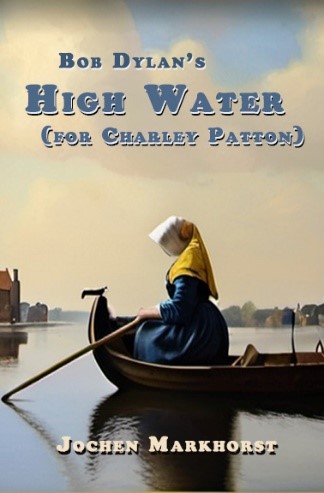
High Water (for Charley Patton) (2001) part 6: The Levee’s Gonna Break


High Water (for Charley Patton) (2001) part 6

by Jochen Markhorst

VI         The Levee’s Gonna Break

High water risin’, six inches ’bove my head
Coffins droppin’ in the street
Like balloons made out of lead
Water pourin’ into Vicksburg, don’t know what I’m going to do
“Don’t reach out for me,” she said
“Can’t you see I’m drownin’ too?”
It’s rough out there
High water everywhere

We don’t need to worry about the artistic legacy of The Who’s bassist John Entwistle. It’ll be fine; the musical contributions and especially the revolutionary, overwhelming style of Thunderfingers will be admired and studied for another century or so. In the visual collective memory, Entwistle probably won’t linger that long, though. Both on stage and in the clips, the Ox acts like your local undertaker, as Bill Wyman put it, and nothing ever changes about that – not even when he is the frontman of the John Entwistle Band in the 1990s.

The exception is John’s unforgettable one-act play in the rockumentary The Kids Are Alright (1979), the scene in which Entwistle descends the stairs in his decadent Victorian mansion Quarwood, affectionately caresses some of the hundreds of guitars hanging there along walls and on stair balustrades, plucks a dozen or so gold records from the wall and then has them placed in the pitching machine to be abused as clay pigeons. As the soundtrack plays “Success Story”, John shouts “pull!”. When he has missed for the third time, we can actually see an inkling of emotion on his face. Not for long; unmoved, Thunderfingers puts away his double-barrel, and the fourth gold record is splintered to smithereens in the barrage fired from John’s antique tommygun with 100-round drum magazine. That image is bound to linger a bit longer than his stage presence.

And a third claim to eternal fame is one for the rock archivists: the apocryphal story that The Quiet One of The Who came up with the band name for Led Zeppelin.

In the aftermath of recording “Beck’s Bolero”, Jimmy Page, Jeff Beck, John Entwistle and Keith Moon find themselves in a rehearsal room in the late 1960s. Page dreams of detaching Keith Moon from The Who and starting a supergroup. Keith Moon, who rarely takes anything seriously, says that “the project would go down like a lead balloon,” and Entwistle makes the pun Lead Zeppelin. Well, could be. Entwistle, a keen illustrator and art collector might have been touched by the ingrained chiaroscuro of the name – similar to names like Iron Butterfly or Guns ‘n’ Roses or Dark Star. And in another scenario Entwistle himself was even at the root of the find, if tour manager Richard Cole is to be believed;

“Entwistle said, according to Cole, “Yeah. We’ll call it Lead Zeppelin. Because it’ll fucking go over like a lead balloon.” Moon roared out his maniacal bray, and Richard Cole told Jimmy about the idea the minute he got back to the hotel.”
(Hammer Of The Gods – Stephen Davis, 1985)

Then again, Cole has quite a reputation, and his contributions to Stephen Davis’ infamous band biography have not exactly improved that reputation.

Whether Led Zeppelin led Dylan’s swirling stream of association to lead balloon is dubious – but the little-used phrase at this place in Dylan’s song is alienating enough to go looking for clues. “High Water” has seven stanzas, and only the second and this fourth stanza of “High Water” add any substance to that suggested “flood catastrophe” theme. In the second verse rather indirectly, by mentioning sliding shacks and fleeing people, and in this verse very explicitly; water rising six inches overhead, coffins, and water flowing into Vicksburg. But substantively then, the phrase going down like a lead balloon has no tangent at all to the insinuated apocalyptic circumstances – so it must almost have flowed into Dylan’s creative vein via a poetic tributary.

A second Led Zeppelin association offers the mention of Clarksdale in the last verse. Clarksdale is, of course, by itself the holy grail of the blues, as the site of the crossroads, the intersection of Highway 49 and Highway 61 where Robert Johnson sold his soul to the devil, as the town where Willie Dixon was born, where W.C. Handy discovered the blues when somewhere around 1914 he heard “a lean, loose-jointed Negro” on a platform singing and playing Goin’ where the Southern cross’ the Dog, the city where Muddy Waters spent his youth. Plus, Clarksdale is the setting in songs from the canon by greats like Muddy Waters, Robert Johnson, Charlie Musselwhite and Charley Patton. But Dylan’s stream of thoughts may also meander past the title track of Led Zeppelin’s “sort-of-comeback record”, the successful 1998 album Walking Into Clarksdale by frontmen Robert Plant and Jimmy Page, so released shortly before Dylan writes “High Water” – an album filled with strong songs and lyrics full of respectful historical awareness plus a pinch of mysticism that a poetic bluesman like Dylan would not be ashamed of either;

A shiny neon riverboat taking income from the poor
It's floating by the levee in an artificial pool
There's a six mile tailback back on junction 304
A stranger at the crossroads, believe I've seen his face before

And just as thin is the line from Dylan’s song to Led Zeppelin’s indestructible masterpiece “When The Levee Breaks”, the 1971 finale of Led Zeppelin IV, the song with one of the twentieth century’s most intense intros and featuring Bonham’s monumental drumming – from which a whole generation of millennials are now experiencing an onslaught of childhood sentiment: “Beastie Boys!” (the Upper West Side boys with superbly acted street credibility sampled the drum part for “Rhymin’ and Stealin'”, 1986).

A line that, on reflection, is not so very thin after all; Jimmy Page reworked Memphis Minnie and Kansas Joe McCoy’s 1929 country blues song “When The Levee Breaks”, the landmark that Dylan will also rework, into “The Levee’s Gonna Break” (2008, Modern Times, as usual without citing its source). Written by Kansas Joe McCoy, one of Wilbur McCoy’s many stage names. “Big Joe McCoy” is another, circling back to the first verse of Dylan’s “High Water”; to Big Joe Turner who managed to make it to Kansas City.

The last dyke the Dylan researcher would then actually have to lay, trying to lead all the meandering rivers into the mighty stream “High Water”, would be the one to McCoy Turner, but oh well – we can’t really justify any more crookedness without getting into trouble with the Clarksdale Water Authority’s Dyke Building and Construction Supervision Department. That levee wouldn’t hold anyway.

To be continued. Next up High Water (For Charley Patton) part 7: Greetings from Vicksburg

Jochen is a regular reviewer of Dylan’s work on Untold. His books, in English, Dutch and German, are available via Amazon both in paperback and on Kindle:


Posted in Uncategorized | 1 Comment

Other people’s songs: Repossession Blues, and Dylan on Roland Janes

Publishers’ note: Apologies for non-publication for a few days – totally due to delays in my flights from Australia back to the UK, and then a day of adjusting to the 11 hours time difference.   But I’m back, and awake, and hopefully we now can proceed as normal.

by Aaron Galbraith

Roland Janes is a Memphis guitar player who got his start at Sun Studios. Billy Lee Riley cut the original “Repossession Blues” under the nom de disque “Lightnin’ Leon”. Dylan’s a big fan of Billy Lee Riley (and Sun Records, naturally).

What makes it so appropriate, of course, is that Dylan got divorced in 1977. Wags dogged the tour with the nickname “The Alimony Tour.”

Tony: The absolute classic blues opening – I used to hear these all the time, and absolutely loved them and in my early days as a musician used to play the piano parts – although to very small audiences!   Hearing this sent shivers through my spine.   And I especially love the way the piano keeps on in the background with endlessly inventive variations.  Also love the notion of a car for $20!

Aaron: Bob only performed it twice. The best version comes from the early-’78 rehearsals in Santa Monica, before they took off for Japan.

Tony: This is an absolutely perfect blues rendition of a class blues song.   What can one say; everything is perfect, no one is trying to outdo the others, every performer feels the music, the style and the arrangement perfectly.  If you want to hear a modern version of the classic blues which totally pays tribute to the original, this is it.   Even the picture above seems perfect.  So is the ending.

Aaron: The Complete Budokan 1978

Tony: Dylan takes it faster this time, but still gets the total blues feel right, as does the band.  It’s a more complex arrangement because of the addition of the simple tenor sax part (which must have been a bit of strain to play as it takes quite  few verses before the saxophonist is allowed to vary that simple refrain, but musically it works).

The build-up also works for me because although it is inventive it is utterly kept under control.

Yes two exquisite versions of a real classic, and a fanastic original.

And now what you really really must do is click the link that follows for there you will find Bob Dylan writing about Roland Janes, and a story that Roland Janes wrote and which Bob comments upon.

Bob Dylan on Roland Janes

Meanwhile here are the previous editions…

  1. Other people’s songs. How Dylan covers the work of other composers
  2. Other People’s songs: Bob and others perform “Froggie went a courtin”
  3. Other people’s songs: They killed him
  4. Other people’s songs: Frankie & Albert
  5. Other people’s songs: Tomorrow Night where the music is always everything
  6. Other people’s songs: from Stack a Lee to Stagger Lee and Hugh Laurie
  7. Other people’s songs: Love Henry
  8. Other people’s songs: Rank Stranger To Me
  9. Other people’s songs: Man of Constant Sorrow
  10. Other people’s songs: Satisfied Mind
  11. Other people’s songs: See that my grave is kept clean
  12. Other people’s songs: Precious moments and some extras
  13. Other people’s songs: You go to my head
  14. Other people’s songs: What’ll I do?
  15. Other people’s songs: Copper Kettle
  16. Other people’s songs: Belle Isle
  17. Other people’s songs: Fixing to Die
  18. Other people’s songs: When did you leave heaven?
  19. Other people’s songs: Sally Sue Brown
  20. Other people’s songs: Ninety miles an hour down a dead end street
  21. Other people’s songs: Step it up and Go
  22. Other people’s songs: Canadee-I-O
  23. Other people’s songs: Arthur McBride
  24. Other people’s songs: Little Sadie
  25. Other people’s songs: Blue Moon, and North London Forever
  26. Other people’s songs: Hard times come again no more
  27. Other people’s songs: You’re no good
  28. Other people’s songs: Lone Pilgrim (and more Crooked Still)
  29. Other people’s songs: Blood in my eyes
  30. Other people’s songs: I forgot more than you’ll ever know
  31.  Other people’s songs: Let’s stick (or maybe work) together.
  32. Other people’s songs: Highway 51
  33. Other people’s songs: Jim Jones
  34. Other people’s songs: Let’s stick (or maybe work) together.
  35. Other people’s songs: Jim Jones
  36. Other people’s songs: Highway 51 Blues
  37. Other people’s songs: Freight Train Blues
  38. Other People’s Songs: The Little Drummer Boy
  39. Other People’s Songs: Must be Santa
  40. Other People’s songs: The Christmas Song
  41. Other People’s songs: Corina Corina
  42. Other People’s Songs: Mr Bojangles
  43. Other People’s Songs: It hurts me too
  44. Other people’s songs: Take a message to Mary
  45. Other people’s songs: House of the Rising Sun
  46. Other people’s songs: “Days of 49”
  47. Other people’s songs: In my time of dying
  48. Other people’s songs: Pretty Peggy O
  49. Other people’s songs: Baby Let me Follow You Down
  50. Other people’s songs: Gospel Plow
  51. Other People’s Songs: Melancholy Mood
  52. Other people’s songs: The Boxer and Big Yellow Taxi
  53. Other people’s songs: Early morning rain
  54. Other people’s Songs: Gotta Travel On
  55. Other people’s songs: “Can’t help falling in love”
  56. Other people’s songs: Lily of the West
  57. Other people’s songs: Alberta
  58. Other people’s songs: Little Maggie
  59. Other people’s songs: Sitting on top of the world
  60. Dylan’s take on “Let it be me”
  61. Other people’s songs: From “Take me as I am” all the way to “Baker Street”
  62. Other people’s songs: A fool such as I
  63. Other people’s songs: Sarah Jane and the rhythmic changes
  64. Other people’s songs: Spanish is the loving tongue. Author drawn to tears
  65. Other people’s songs: The ballad of Ira Hayes
  66. Other people’s songs: The usual
  67. Other people’s songs: Blackjack Davey
  68. Other people’s songs: You’re gonna quit me
  69. Other people’s songs: You belong to me
  70. Other people’s songs: Stardust
  71. Other people’s songs: Diamond Joe
  72. Other people’s songs: The Cuckoo
  73. Other people’s songs: Come Rain or Come Shine
  74. Other people’s songs: Two soldiers and an amazing discovery
  75. Other people’s songs: Pretty Boy Floyd
  76. Other people’s songs: My Blue Eyed Jane
  77. That Old Black Magic (and a lot of laughs)
  78. Angel Flying Too Close to the Ground
  79. Other people’s songs: The Christmas Blues
  80. Other people’s songs: I’ll be home for Christmas
Posted in Uncategorized | Leave a comment

A Dylan cover a day: Till I fell in love with you in the north of Norway


By Tony Attwood

The North Cape monument marks the northernmost point of Norway“‘Til I fell in love with you”, from Time out of Mind was played live by Dylan nearly 200 times in an 18-year period and yet the number of cover versions that I’ve been able to find is very small.  Or put another way, very very small.

Maybe it’s because it is a 12-bar blues, and when singers cover Dylan they don’t want to do another 12-bar blues anymore.    Maybe it’s because it is a 12-bar blues with a lively, and indeed even jaunty rhythm and the artists looking to cover Dylan’s song don’t want their blues to be lively and jaunty.   Maybe desperation is more their thing – and to be fair this is one of the oddities about this song.  It is a lively 12-bar blues but the lyrics are the lyrics of negativity.

Or maybe it is just something else that I haven’t quite got.  That strange something that also means that “Summer Days” (another lively 12 bar blues) has also only had a few covers (and at least one of those is not the song by Dylan but a different song entirely). 

But whatever the reason, there is some good music to be found here.   Take for example Max Washington, seemingly an amateur performer working in his bedroom.   Now I am not saying that this is a great version of the song and that it should result in the artist being given a recording contract, but rather he shows that there’s life in the song, there are possibilities in the song that could go even further.


Albert Catiglia then takes all the possibilities forward and makes it sound like an absolute 12 bar classic – which in the sense that it was written by Bob it is.  I guess, if bands are looking for a Dylan song that hasn’t been covered much, they don’t want another 12 bar blues.

But there is life here and things to be had and done with the song, as Arve Gunnar Heloy shows us with “Til æ fikk dæ kjær.”

Now I am particularly grateful to “Expecting Rain” at this point for they tell us that this comes from a 2002 CD recorded not in Norwegian, as I had naively assumed up to this point, but in Nordnorsk, which is a Norwegian dialect from the Arctic north of the country.

And it is this 2002 release of “Time out of mind” in Nordnorsk that is possibly something you might not have come across before – and indeed I hadn’t ever heard of this until starting work on this article.  But I can now report that this recording comes from it a private release of 2000 copies in 2002 with the vocals performed by Tore Hestbråten.   The performers don’t give themselves a group name – instead we are just left with “Tankelaus Tid” as the title of the CD and the name of the project.  Literally, that phrase translates as “Thoughtless Time”.  Arve-Gunnar Heløy is both the vocalist and lead guitarist.

OK, that was a bit of a ramble from me, but I must admit the whole notion of translating Dylan into a Norwegian dialect from the Arctic north of the country is just overwhelming.  The music of Bob Dylan surely is truly universal.   And how interesting (for me if no one else) that this can be verified through the discovery of a song that virtually no one else wants to cover.

Shame on the rest of humanity.  High fives for the north Norwegians.

Here’s the rest of this series of reviews of Dylan covers.

Posted in Uncategorized | Leave a comment

The Never Ending Tour Extended: Absolutely Sweet Marie

The Never Ending Tour Extended: Comparing recordings of Dylan performing his own compositions across the years.  By Tony Attwood returning to recordings presented by Mike Johnson in the Never Ending Tour Series.

In this series we look at the way Bob has transformed certain songs over time in his live performances, in particular looking for the progression in his feelings about, and his understanding of, what the song offers, what the song says, where it can be taken next, and even on occasion how he can reinterpret the past.

So far we’ve looked at

Absolutely Sweet Marie was performed by Bob 181 times between June 1988 and July 2012 – a period of 24 years – after which it was dropped completely, never to return (or at least not until December 2023 when this review was written).

It’s a straight song in one of the classic popular music styles in which there is a verse and an occasional “B” section (often known as the “middle 8” in rock musical circles).   The first example of this “middle 8” appears after the first two verses, with the lyrics “Well anybody can be just like me.”

Now this is interesting when we come to Bob’s live performances in that we know from previous articles in this series that when Bob sings a song in strophic form (that is a song that has a structure of verse, verse, verse without variation) he does sometimes drop verses, re-write verses, or perform an instrumental verse instead of a lyrical verse.  But that’s not the key issue here as we can see through the three examples the “Never Ending Tour” series have offered up…

1988 part 1 insert 9

Obviously, the first variation is that we get an instrumental introduction, and we have a solid beat throughout, and much of the melody has vanished.  And we’ve got an instrumental verse to help pad the whole performance out.

But I am left thinking – if this the only change Bob can make is it worth it with a song that we already know so well.   If so, why perform it on stage?   After all, everyone at the gig is going to know the song inside out, and aside from the introduction and the end, there isn’t much new here.

Indeed I am left thinking, if this is as far as it goes, why bother to take the piece on tour at all?

1998 insert 1  part 7

But then years later, immediately we know that this is a totally different version of the song.   There’s more verve, more enthusiasm, and more contact between Bob and the music.   There are changes from the album version, but not too many – so we can recognise a song from the album, and Bob can get himself in full working order in a performance that doesn’t take too many risks.

Plus those annoying latecomers can come in and get their places while those who are disturbed don’t feel we’ve missed too much – and what we have missed is not too important.

There is a slightly more languid style in the piece as if yes he is asking where she is, but this has happened so many times before he’s really quite used to it and isn’t really expecting an answer.

The instrumental verse at the end with two guitars fighting each other musically does come across as a bit of a muddle, and overall it still does feel like a song just thrown in at number 1 to get everyone in the mood before the real business starts.

But finally, from 2006 (part 1)we have the most polished of the versions we’ve noted in the Never Ending Tour series.   And indeed listening to this straight after the two previous versions makes me think that Bob really has gone back and read and listened to his own work once more, and thought about why he wrote it.   It’s no longer a throw-away piece allowing latecomers to take their seats.

As a result, for me this is by far the best of the versions that we have here.   The changes are not dramatic and it would be easy to dismiss them, but the instrumental verse half-way through this performance really does give us an extra insight into the relationship between the singer and Marie – and that is something that I don’t think was there previously.

Also, it is an extended instrumental break going through three verses in different ways and this leads us into the “middle 8” perfectly, allowing for the reflective “forgot to leave me with the key” verse, and then another instrumental verse.

Suddenly I do feel that the re-scripting of the song was completely worthwhile – that last, protracted instrumental break, does give extra thoughts and insights into what the singer and Marie have been up to all these years.   And suddenly the sudden end makes sense – they re-wrote the song, and re-wrote the end.   “Yeah! Yeah!” as the gentleman in the audience says.  And we can see why after this Bob dropped the song.  There really was nowhere else to go.

Posted in Uncategorized | Leave a comment

Dylan: the lyrics and the music. Caribbean Wind – Dylan’s musical exploration of evolving uncertainty

Details of earlier articles in the “lyrics and the music” series are given at the end.

By Tony Attwood

What most Dylan fans remember from Caribbean Wind is the chorus (because it is catchy and repeated) and the opening line… because it is the opening line…

She was the rose of Sharon from Pradise Lost

But what, if anything, does it mean?   No one is quite sure and to get an answer one has to indulge in a sport of literary jiggery-pokery (to use the technical musical term) and come up with an answer which others might well disagree with.

But… if we take a step back for a moment and listen not to the opening lyrics, but to the music, something else catches the attention.

However, the trouble here is that if you are not a musician, it is easy to miss what it is that Dylan does in order to catch our attention.  Here are the opening lines with the chords the guitar plays as provided by the Ultimate Guitar website

 
G                               Bm
She was the rose of Sharon from paradise lost
         Em                           C
From the city of seven hills near the place of the cross.
      G                 Bm            Em         D    C
I was playing a show in Miami in the theater of divine comedy.

And the clue we get in terms of what makes this such an intriguing piece of music is right there in that chord sequence.   Even if you don’t play an instrument I’m hoping you might have seen a few chord sequences, and if you have you might realise that this is really is quite a complex sequence in terms of rock n roll.   Not the most complex by any means, but not your run of the mill normal pop and rock.

Now all the chords in this sequence are not themselves the problem; they are perfectly normal and legit when playing in the key of G, which Dylan is, but what makes the sequence odd and gives us that momentary feel of strangeness is the fact that the sequence – indeed the last two bars of the eight bar sequence, ends on the chord of C major.

What normally happens is that a phrase ends up on the “tonic” the chord around which the whole song is based – the basic chord of the key that the piece is in.   This piece is in G, and it starts on the chord of G, all the chords used are taken from the key of G, so we expect the line to end of G, but then… suddenly Bob ends the opening section on C.

And this is not a one-off.   The next three-line section ending with “disappeared so mysteriously” does the same.  So does the next one (“long arm of the law could not reach”) and the next.

Bob really is making a point here – we are not going back home, we are left hanging in the air, both in terms of the lyrics AND the music.

Then we have the chorus (“And them Caribbean winds”) which also starts and ends its opening line on the chord of C.   So consciously or unconsciously we are now waiting even more than ever to get that resolution back to the chord of G, but no, the next line “Fanning the flames in the furnace of desire” ends on D.   And this pattern is repeated although the final line of the chorus (“nearer to the fire”) , finally, finally, finally gets us back to the basic chord of the whole piece: G.

Now I know this is all a bit techno so here’s the song – and I am hoping you may be able to feel that each section ends on a different chord from where it starts, giving us a feeling that we are still standing, waiting, at the edge of the cliff.

In short we are in a situation in which we are in one key, but we end each phrase on a chord that is away from the main chord of the piece – and this gives a sense of incompleteness – a sense that we are still pushing on.  In short a sense of uncertainty.

And to my mind this is fully warranted because of the lyrics, which are at the pinnacle of Dylan’s uncertainty in his writing.


Now this is how we carry on with each section of each verse, there is uncertainty piled upon uncertainty, and this, in a song where we have references to Jesus, whose position in relation to all questions is normally rather clear – at least when expressed by His followers.

But Dylan has offered us words that are hard to resolve, let alone comprehend, and has matched it with a chord sequence that ends, not on the key chord – the “home” chord, the chord where we started but on a different chord that hangs in the air

In fact only at the end of the chorus, after sixteen lines of music, do we actually come to rest on G, on the base chord of the whole composition.

But still Dylan wasn’t happy with this, maybe thinking we might still not have got the implications, because then he took this one final resolution of the song and removed it for the Genuine Bootleg Series Vol.1. version which has each verse ending on the even more uncertain A minor.

And them Caribbean winds still blow from Nassau to Mexico
Fanning the flames in the furnace of desire
And them distant ships of liberty on them iron waves so bold and free
Bringing everything that's near to me nearer to the fire

Meanwhile of course the lyrics go on changing and changing and changing and if you would like to see just how an ideal place to start is with the Dylan Chords discussion.

Now my point here is simple: Dylan, I think, wanted a very edgy uncertain piece, full of obscure references and as the piece evolved (for me at least) ever greater uncertainty.

I mean what exactly do we make of

Now there’s stars on the balcony, flies buzz my head
Ceiling fan’s broken, there’s heat in my bed
Street band playing “Nearer My God to Thee.”
She looked into my eyes, I hear the mission bells ring
She said, “I know what you’re thinking, but there ain’t a thing
you can do about it, so you might as well let it be.”

apart from the notion that “there ain’t a thing you can do about it”? as this song evolves and evolves and evolves.

Except what we can hang on to is the musical structure, which allows us to appreciate that this is a song in the form of a song, no matter what the lyrics are doing.

And it is with that thought that we get the clue.   The song is about uncertainty in a world in which the certainty of religion is preached – and the chord sequence reflects this dichotomy, constantly refusing to resolve the music by coming back to the tonic chord – the chord that we hear as being at the heart of the piece.  This chord (G) tells us that the song is “in the key of G” and the other chords flow from that knowledge.

My view, for what it is worth, is that in the end Dylan tried one uncertainty too many by ending the verse on A minor in that variation.   

When the piece gave us a more certain ending we could hold onto it as a piece of music telling us about life continuing, and there being uncertainty within life.   But ending the chorus on a chord that takes us away from the key chord which told us where we were, and adding even more uncertainty, was a step too far for me, even if no one else.
Of course such experiments are always worthwhile, and I think Bob learned a huge amount from such explorations, and there is no need to appreciate the technique to hear it in the music – but I do find it rather helpful to understand what was going on in the music, behind that constant flood of lyrics.

The lyrics and the music: the series…

Posted in Uncategorized | 4 Comments

High Water (for Charley Patton) (2001) part 5: Maybe we should put that there

High Water (for Charley Patton) (2001) part 5

by Jochen Markhorst

V          Maybe we should put that there

I got a cravin’ love for blazing speed
Got a hopped up Mustang Ford
Jump into the wagon, love, throw your panties overboard
I can write you poems, make a strong man lose his mind
I’m no pig without a wig
I hope you treat me kind
Things are breakin’ up out there
High water everywhere

Aragon is initially an anonymous hobbit who is good at making wooden shoes, in a subsequent version the rightful King of the Hobbits, in the third version he is called Strider, and only in the manuscript after that Strider is a code name for Aragon. Suddenly he is human, and Tolkien decides that Aragon is actually the heir to the throne of Arnon and Gondor. From nameless clogmaker with hairy feet to Middle-Earth’s most powerful king – it’s quite a career.

Beethoven’s manuscripts are violently ploughed battlefields, Chopin thoroughly shades entire bars, and thanks to Wilhelm Röntgen, we know what the first sketches of Rembrandt’s Night Watch and Vermeer’s Milkmaid looked like, we find unknown self-portraits by Van Gogh and an overpainted portrait under Picasso’s Blue Room.

Manuscripts, sketchy drafts, first versions and crossed-out passages… they are, obviously, not meant for the public or for perusal, but if those disapproved versions are the precursors of masterpieces, they offer an irresistible, almost voyeuristic pleasure. Rarely on an aesthetic level, of course – usually the master rejected them for a reason. But for fans they offer fascinating insight into the creation of masterpieces. 2015’s The Bootleg Series 12 – The Cutting Edge 1965-66 is the shiniest example on Planet Dylan; 18 CDs on which we can follow the creation of such highlights as “Visions Of Johanna”, “Like A Rolling Stone” and “It Takes A Lot To Laugh, It Takes A Train To Cry” almost in real time.


Less spectacular, but at least as fascinating, are the draft versions of song lyrics. After all, they offer the opportunity to peek into the creative part of an admired artist’s mind – in this case even of a Nobel Prize-winning genius. Process descriptions we have heard many times. From fellow artists, from studio personnel and from Dylan himself, who tries often enough, both in Chronicles and in interviews, to explain how his lyrics come about. Most of the time, by the way, the mystery only deepens. “They just fall from space”, “I’ll play a Bob Nolan song in my head, and at a certain point, some of the words will change and I’ll start writing a song”, “All those early songs were almost magically written” … no, then we learn more from Larry Charles’ testimony, who reveals how Dylan saves one-liners and word combinations on paper scraps, and starts “writing” by shuffling and puzzling. Or from Mike Campbell’s revelation in the Consequence Podcast, 9 March 2022:

“He told me once, which was a really good tip, he said, when you’re writing a song, you know, you got your verses, your bridge and your chorus, he said, don’t stop there. Write twenty verses while you’re in The Zone. You know, the last ones might be better than all the stuff you had.”

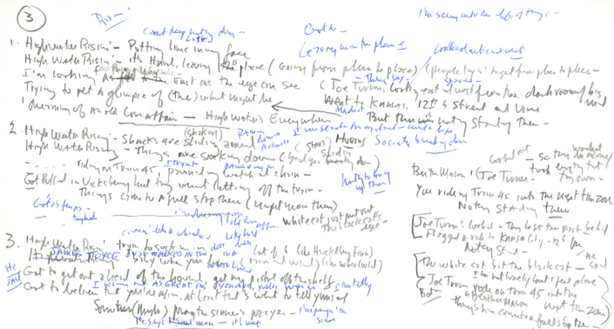
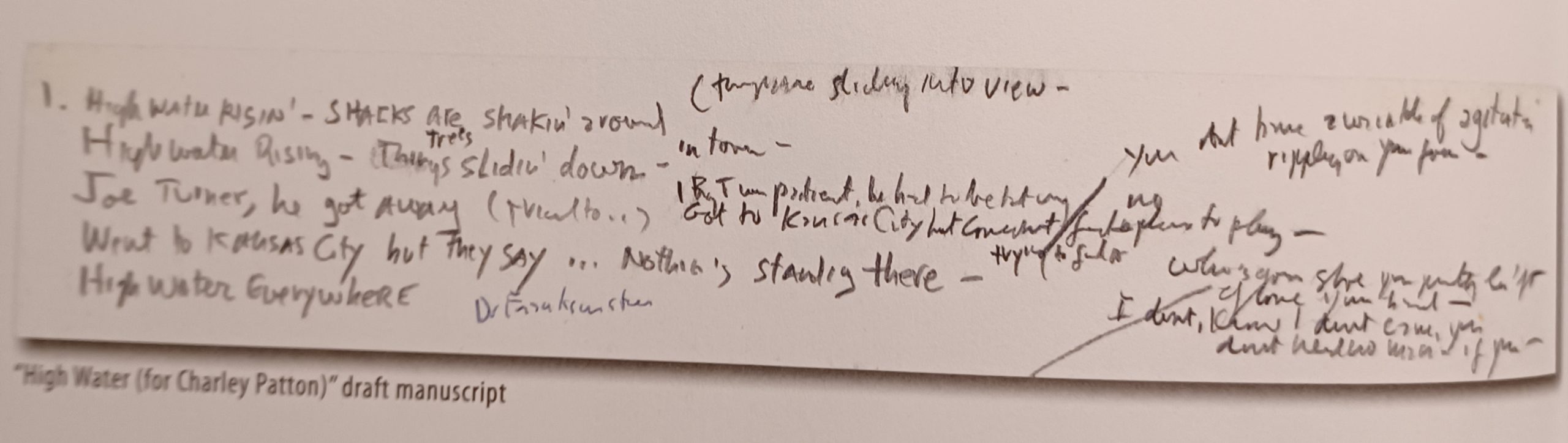
A combination of Charles’ cut-and-paste revelation and Campbell’s description then seems to be exposed here, in the manuscript of “High Water”. And especially in this third stanza;

                              comin’ like a whirlwind
3.            High Water Risin’ tryin to suck me in                       (at f        like Hucklbery Finn)
                              James Joyce just walked in the door like he’d been in a whirlwind
               It’s probably the way                     baby where you been (rain and wind) (like whirlwind)
Got to get out ahead of the hound
get my pistol off the shelf
He said                               I believe that as great as you are, you’re never                 I’m telling
Got to believe that you’re alive, at least that’s what to tell yourself
Sometime ( Maybe) pray the sinner’s prayer                       
I’m prayin’ the Sinners
                                             He says I said man – it’s wet

Not a single word survives in the final version of this third verse. One inspiration from, let’s call it, the “second draft” (the interjected verse lines and loose fragments in blue) eventually moves to the sixth verse, half of As great as you are, man, you’ll never be greater than yourself. We see James Joyce and Huckleberry Finn pop up, both of whom will fade away again. We decipher that, in both the first and second versions, Dylan is considering to incorporate something with “like a whirlwind”.

Equally desirable, apparently, is a reference to the narrator’s devout disposition – the sinner’s prayer, at least, still survives the first cut as well, but eventually moves to the song “If You Ever Go to Houston”, re-appearing eight years later on Together Through Life (“Tell her other sister Betsy / To pray the sinner’s prayer”). And the hard to decipher primal fragment Got to get out ahead of the hound seems to be a reference to Robert Johnson’s 1937 “Hellhound On My Trail”. Perhaps triggered by ominous lyric passages like Blues fallin’ down like hail and I can tell the wind is risin’ in Johnson’s song. Just as get my pistol off the shelf might be an echo from another blues staple, “Mad Mama’s Blues”, recorded in the 1920s by both Josie Miles and Julia Moody – and both bloodthirsty ladies sing I took my big Winchester down off the shelf.

Apart from those fascinating wanderings in content, apart from intriguing name-checks like James Joyce and Huckleberry Finn and the Sinner’s Prayer, the manuscript also grants us insight into stylistic considerations. Originally, then, the poet Dylan again lets this third stanza begin with the words High water risin’, opting thus for an anaphora, for a recurring verse line as the opening of each stanza, that is. We know the figure of speech mainly from rhetoric, of course (MLK’s I have a dream, Jesus’ Sermon on the Mount, Churchill in just about every speech). In songwriting it is less common, though not unique. Dylan’s own 1967 Basement ditty “Don’t Ya Tell Henry” has the structure, for example (each stanza beginning with I went down to…), Psalm 29 starts each verse with The voice of the Lord, Kylie Minogue’s “Can’t Get You Out Of My Head”, T. Rex’s “Metal Guru”… through the centuries the repeated opening line is used, but not too often.

So the manuscript now suggests that the poet Dylan is ultimately trumped by the musician Dylan. It does seem that the poet was charmed by the anaphora, by the stylistic device of beginning each stanza with High water risin’. Perceivable; it is a choice that a Poe or a Baudelaire would also have made, a choice made by poets striving for a total fusion of sound and content. The two stressed i-sounds suggest a rise; the repetition communicates the inevitable, irrepressibly swelling threat of the flood. But then the musician Dylan intervenes; we’ve had two verses, now there should be something like a bridge or a chorus – a break, anyway. The repetition, and with it the unstoppable swelling of the flood, might just as well be communicated by the music, the musician Dylan knows. Which then in fact does come about, as Tony Attwood soberly and aptly analyses:

“The song is about the ceaseless rain, so Bob makes the song ceaseless by having it all based on one chord, and we have an unrelenting accompaniment containing as it does, a very clear rhythm.”

(High Water, a rise, a fall, a bounce, a flood, Untold Dylan, 5 November 2023)

… and then a sophisticated use of stylistic devices is no longer that important, apparently – the music succeeds in providing that coveted fusion of sound and content. The accompanying words no longer need to perform that function. Which is also illustrated by engineer Chris Shaw’s recollections, in Uncut, October 2008:

“There was a lot of editing done on “Love And Theft”. Like, the song “High Water”, for example, the verse order of that was changed quite a few times, literally hacking the tape up. He was like, “Nah, maybe the third verse should come first. And maybe we should put that there.”

Things are breakin’ up out there. High water everywhere.

To be continued. Next up High Water (For Charley Patton) part 6: The Levee’s Gonna Break

—————

Jochen is a regular reviewer of Dylan’s work on Untold. His books, in English, Dutch and German, are available via Amazon both in paperback and on Kindle:


Posted in Uncategorized | Leave a comment

Never Ending Tour 2018 part 4: Hell bent for leather


By Mike Johnson (Kiwipoet)

Before rounding up a few strays we haven’t already covered, Dylan songs that didn’t regularly make it onto the Setlist, I’d like to offer two covers. While Dylan dropped singing American Standards after the first leg of the 2018 tour, some of the final performances of these songs were loving renditions indeed. No more so than ‘Come Rain or Come Shine,’ first sung, just twice, in 2015 and reappearing in 2018 for six performances between April 13th and April 18th. Dylan’s ‘uncover’ has a lovely, slow, lazy, post-coital feeling to it despite giving voice to a jilted lover. This one is from Salzburg April 13th, and is heart-breakingly gentle and tender.

 Come Rain or Come Shine

The other rarity is ‘It’s a Man’s Man’s Man’s World’ written by James Brown and Betty Jean Newsome. The song is not as chauvinistic as the title suggests, since Newsome wrote the lyrics based on some sharp observations of the relationship between the sexes (Newsome also said that James was sometimes lax in paying her royalties), and it can be cogently sung by a woman. I don’t know if you’d call it an American Standard; as far as I know Sinatra didn’t sing it, although Dean Martin did.    There were plenty of cover versions. Dylan only sang it twice, both times in 2018. This recording is from Charlotte, Nov 10th and is clearly a powerful performance. It’s a pity the sound quality of the vocal wasn’t better.

It’s a Man’s World

‘Duquesne Whistle’ had been pretty much a fixture in the Setlist, often coming in at number five, after ‘A Simple Twist of Fate.’ It was powering along in 2018, only to be abruptly dropped in August never to be heard again – at least up till now – being replaced by the mighty drama of ‘Cry A While’ (See NET 2018 part 1).

This bright and breezy number is, frighteningly, about a huge and implacable force that can tear things up and destroy them. Despite the shuffle-shuffle, and boogie-woogie and the flavour of the jump jazz of the 1930’s, you don’t really want to be hearing that Duquesne whistle blow; it’s a bad sign. Only the music is bright and breezy. Note once more that odd ‘fooling around’ before the song begins, a feature of the 2018 performances. It’s not really fooling around as it’s building towards the song. This is another from Brno.

Duquesne Whistle

‘High Water (For Charlie Patton)’ which has delighted us in its various guises over the years since Love and Theft in 2005, saw its final performance in Oct 2018. Editor Tony Attwood and I both have our favourite performances, but share an enthusiasm for the song. My latest best ever is the kick-arse rock version of 2016 (See NET 2016 part 1), but we need to return to 2012 for the most riotous version, with the audience whooping along (See NET 2012 part 3 first version of two). It had been dropping away, sharing slot five with ‘Duquesne Whistle.’ I’m sorry to see it vanish; the way the lyrics mix environmental, social and moral chaos is perfect for the times.

Nevertheless, Dylan’s given the song another makeover, even as he abandons it. I’m not sure that the new chord riffs that now propel the song are urgent enough, but once he settles into it, and starts to groove with that jazzy piano sound, the song works just fine.

High Water

Another song from Love and Theft which saw its last performance (in Christchurch, New Zealand in October) is ‘Summer Days.’  Like ‘High Water,’ this song had become a fixture in the Setlist up to 2014 when it disappeared, only to return again for fifty odd performances in 2017 and a mere half-dozen in 2018. Fast paced and full of zest, early performances of this song took us back to the big band era of the the 1940’s (See NET 2005 part 2) but it was later honed down to more of a bass and drums driven arrangement. ‘Everybody get ready to lift up your glasses and sing/ well I’m standing on the table, I’m proposing a toast to the king’ are the lyrics that seem to sum up the exuberant spirit of the song. It is not as happy a song as it may at first appear however, being full of defiance and Dylan’s rebellious spirit – but the wounds of love and heartbreak cut deep, as does the desire for vengeance and mayhem:

Well, I’m leaving in the morning as soon as the dark clouds lift
Yes, I’m leaving in the morning just as soon as the dark clouds lift
Gonna break in the roof—set fire to the place as a parting gift

He has to really babble that last line to get it to fit the melody, and it’s a far cry from the young Dylan who slips away unseen at dawn down ‘the dark side of the road’ with the advice to ‘don’t think twice.’

When the rooster crows at the break of dawn
Look out your window and I’ll be gone

Never let it be said that Dylan softened with age!

This recording (March 22nd) is from the first concert of the year in Lisbon, and once more we find Dylan reaching for innovative ways to present the song, even these last performances. Rather than an urban, big-band sound, we get an upbeat countrified square-dance version complete with fiddle. Grab yer pardners and circle to the left!

Summer Days

The magnificent dramatic monologue, ‘Long and Wasted Years’ off Tempest all but disappeared in 2018. It would be played once only in 2019. Its wheedling, self-justifying narrator is a study in belligerent grief. While I return to the incomparable performances of 2015 as my touchstone for this song (see NET 2015 part 3), this recording, from Bielefeld, Germany (April 21st), where it comes as the last song of the night before the two encores, is gentler with a somewhat faster tempo. Belligerence has been tempered by regret.

Long and Wasted Years

‘Soon After Midnight’ did not fade away, and was even played once in 2021 in the Rough and Rowdy Ways tour. It’s a little gem, this song, mixing beauty and horror in equal measure, both tender and murderous, another brilliant character creation from Tempest.

I’m going to do what I did in previous posts and compare two performances from Waterbury and Macon, where it appears as number seventeen on the Setlist. First, Waterbury:

Soon After Midnight (A)

The simple, minimal arrangement and 1950’s feel suits the song well. Now to Macon, for a fuller richer sound and equally effective vocal:

 Soon After Midnight (B)

Similarly, ‘Early Roman Kings’ survived through to 2021. I would be happy to declare these performances from Waterbury and Macon best evers if I didn’t know that an even better performance was coming up in 2019 – that will have to wait for the next post. This song has grown on me, particularly since the powerful 2015 performance that knocked me on my ear (see NET 2015 part 3). If anything, the song has grown in stature as a distempered blues, with a talking vocal line, and increasingly I’m seeing it as a protest song of sorts. You really don’t want to mess with those early Roman kings who lord it over the rest of us, exercising their arbitrary power. They’ll ‘destroy your city’ and ‘they’ll destroy you as well.’ First Waterbury

Early Roman Kings (A)

After a nice bit of ‘fooling around’ Dylan kicks into another insinuating performance at Macon.

Early Roman Kings (B)

That brings to a close this post and our study of 2018. We have seen that the innovative spirit that has been driving Dylan’s shows since 2015, when the American Standards arrived, is still running hot, and, remarkable as it is, Dylan’s voice seems to have gained in power and authority. All this he will carry unabated through to 2019 which would, unexpectedly, turn out to be the last year of the NET.

I’ll be back soon to dig into that year and finish off this exploration. In the meantime, I wish all my readers a happy festive season, however you might celebrate it, and keep your compassion strong.

Kia Ora

Posted in Uncategorized | Leave a comment

A Dylan cover a day: Thunder on the mountain


By Tony Attwood

In meandering my way through this series it is difficult sometimes to understand why some Dylan songs are so often covered while others are ignored.  I rather suspect there is a deep laziness within some parts of the music industry – a sort of “What can we do?” question answered by, “Let’s do one of those famous Dylan songs.”

And maybe “Thunder on the Mountain” doesn’t fall into this latter category – it simply isn’t covered just because people don’t think of covering it.

Mind you the one cover I have been able to find is a particularly brilliant cover by Wanda Jackson and Jack White both having a whale of a time making the recording.  Which is why I’ll deviate from the usual policy of only focussing on songs that have multiple covers because I do so want to bring this version to your attention.

Now of course there may be other covers available on youtube which I can’t find at the moment on the interent since I am currently in Australia, and a lot of You Tube videos do have country restrictions.   So if I remember or if anyone can point any out to me once I get back to England at the end of 2023 then I will have a listen and put up some more.

Going on a search of the internet here in Australia, I did find “Thunder on the Mountain” by Mountain Man Recordings on Spotify, which is actually a recording of rain falling with a photo of a mountain.   And a version by Joe Satriani but actually that turns out to be “Thunder High on the Mountain” – which is quite a jolly instrumental if you like that kind of thing.

But all in all it looks like most artists really don’t want to have a bash at this song – and I wonder why.  Is it that they think that with Bob’s rendition and the Wanda/Jack version above there is nothing more to be said?

Of course you’ll know Bob’s version well enough, but here it is, just as a contrast to the version above…

Now it might be argued that for some reason this is a song that just doesn’t allow itself to be covered with a new interpretation.   But if that is the case, how come Bob can do it with his own work?    And yes I know I am covering Bob’s covers of himself in a separate series, but to make my point (that with enough imagination it is always possible to do something of interest with a song) here is Bob from 2018 re-working his own piece.

Yes, beyond doubt there is a lot that can be done with this song.   So it is not the music that is the problem; which means it must be the imagination of other artists.

Posted in Uncategorized | Leave a comment

Never Ending Tour Extended: One too many mornings. For those who have ears, this is beyond amazing

By Tony Attwood with recordings presented by Mike Johnson in the Never Ending Tour Series.

In this series we look at the way Bob has transformed certain songs over time in his live performances, in particular looking for the progression in his feelings about, and his understanding of, what the song offers, what the song says, where it can be taken next, and even on occasion how he can reinterpret the past.

So far we’ve looked at

One Too Many Mornings was played 237 times between February 1966 and July 2005.

Our first recording comes from 1989 part 2 in the article   1989 Part 2 – A fire in the sun

The spacing of the lines shows us a new set of thoughts about these past days and certainly gives me the feeling Bob is reflecting on those times past, rather than just trying to create a melody to fit over the chord sequence – which in fact is what he has done.

There is, for me, a great deal of extra space within the piece which gives that extra reflectiveness – as if to say yes, I know I wrote this when I was much younger, but it is only now that these feelings really mean something to the present day Dylan, rather than just being another song from the early days.

For me this gives a strange feeling: a feeling that he wrote this song about the past so that it could have its true meaning explored in the future.

In 1990 there was more vibrancy to the song – as if the feelings of the past can now be reflected upon without them totally dominating the way the world is now seen.

There is indeed a power that drives the music forward – such that when he says that he is right from his side just as you are from yours the new meaning is clear – we all have our views and our ability to connect with each us through discussion is lost – we are simply all independent people who have lost the ability to communicate.

Such a view is emphasised through the instrumental verses – with the addition of an extra level of regret that appears in the harmonica verse, especially in the way that the harmonica and the guitar intermingle.

And then we come back to the first verse again – an interesting turn around for Dylan.   He really is now making the point.   And If you are not convinced listen to the final instrumental verse.  For me, he really, really, really wants to say we are all going in different directions.  A stunning performance.

So what did you expect next?  A banjo?   No surely not!    But oh yes, this recording is taken from 1993 part four in the NET series.  (1993, part 4 – The Supper Club and beyond).

Could Bob get even more out of such a simple song?  Well yes – he’s now slowed the song right down, and that banjo is there throughout, and Bob himself is so plaintive it is hard to believe the piece has not always been written this way.

I have to admit to being amazed and stunned at the same time.  Obviously, I listen to each and every recording from the Tour as we publish the NET series – that’s part of my job –  but somehow I’d not remembered anything like this happening to “One too many.”    Somehow Bob has taken the simplest of songs with really simple lyrics and not only made them work in the original recording but found new meanings and new interpretations.

For me the Never Ending Tour series on this site, which of course I have merely published, not written, gives amazing insights into Dylan’s work.   These little investigations into individual songs over time however show just how incredible his musicianship is, and how extraordinarily deep and powerful even the simplest of songs is.

The Never Ending Tour Index

Posted in Uncategorized | Leave a comment

High Water (for Charley Patton) (2001) part 4


by Jochen Markhorst

IV         What’s so bad about misunderstanding?

I got a cravin’ love for blazing speed
Got a hopped up Mustang Ford
Jump into the wagon, love, throw your panties overboard
I can write you poems, make a strong man lose his mind
I’m no pig without a wig
I hope you treat me kind
Things are breakin’ up out there
High water everywhere

 We owe some fascinating insights to Larry Charles’ now illustrious 2014 visit to the podcast You Made It Weird. Foremost, the revelation about the “very ornate box” Dylan always seems to have with him, the box filled with “little scraps of paper” on which a wide variety of ideas are jotted down. Sometimes a single word or name, Charles explains, like “Uncle Sweetheart”, but mostly phrases. “He takes these scraps and he puts them together and makes his poetry out of that.” Like – apparently – a line eventually used not for the mythical slapstick comedy Charles and Dylan were working on at the time (which would somehow evolve into the weird, dystopian drama Masked And Anonymous, 2003), but for this song in 2001:

“He would ask these questions that would come back and crack your mind open. One time he said to me… he had a line about a pig wearing a wig, and I was comfortable enough to say “Bob, that doesn’t make any sense, no one is gonna understand that.” And he said “what’s so bad about misunderstanding?” That’s like wow that’s a heavy one. Because we are striving all the time to be understood. He’s been understood. He’s more interested now in what happens when you’re misunderstood. He’s like Andy Kaufmann or something like that. Very, very kind of conceptual.”

Where, on a semantic level, you can argue about whether “nonunderstanding” would be a somewhat sharper qualification than “misunderstanding”, and it also seems that Larry has an entirely unique definition of “conceptual”, but the thrust of his analysis is clear; linear logic or simple cause-and-effect concepts are not a priority with Dylan. At least; not with Dylan in the 1990s, the time Larry Charles is talking about. Which, given Masked & Anonymous, “High Water” and the mosaic-like lyrics of Rough And Rowdy Ways (2020), we may extend to the present day.

The change in this third verse of “High Water” seems an extreme example thereof, of such a deliberate attempt to create “misunderstanding”. The first three lines, about speed and the Ford Mustang and the wagon into which a lady should jump with abandonment of her panties, still have a traceable relationship connecting them – the car, obviously. But then the poet slides a snippet from his “ornate box” to the manuscript, and suddenly “I can write you poems, make a strong man lose his mind” comes out of thin air. The narrator’s boastful mention that he is able to write such impressive poems might still fit in as a text from a smooth talker flirting with the now pantsless lady in the passenger seat, but the addition that those poems “can make a strong man lose his mind” is quite alienating. Mind deranging writings are of all times, of course, with the tragic Cyrano de Bergerac as the standard bearer, but these are actually always meant to make a female head spin – we have been conditioned for centuries now that poets use their brainchildren to woo the ladies.

Before the raised eyebrows have had a chance to lower, however, they are raised some more: “I’m no pig without a wig,” clarifies the first-person behind the wheel of his hopped-up Mustang. A verse that, as we know thanks to Larry Charles, has been in Dylan’s clipping box for about a decade. Picked up from an ancient nursery rhyme, from

As I went to Bonner,
I met a pig
Without a wig.
Upon my word and honour.

Published around 1830 by the legendary London printer and publisher James Catnach in the nursery rhyme collection Nurse Love-Child’s New Year’s Gift for Little Misses and Masters, but believed to have been sung much earlier, as early as 1760. The collection in which Dylan also will have noticed “Who Killed Cock Robin?”, which provides the template for “Who Killed Davey Moore?” (1964), and filled with nursery rhymes that appeal to Dylan’s penchant for punchless absurdity. Like the story of Jack-a-Nory;

I’ll tell you a story
About Jack-a-Nory,
And now my story 's begun,
I’ll tell you another 
About Jack and his brother, 
And now my story 's done.

… which has now entered the dictionaries as jackanory; by qualifying something as “jackanory”, you indicate that you think the other person is making up or stretching a story – or lying, even. “Not making any sense,” Dylan would probably add.

The alienating intruder with a wig does not stand alone, in this whimsical verse. The tone of the follow-up I hope you treat me kind does not fit at all with the macho talk of the Mustang driver either, with the stud who gruffly orders some nice girl to jump in the car and throw her panties overboard. “I hope you treat me kind” is vulnerable, an appeal of a sensitive, insecure guy with a slight undertone of despair. Quite exclusively reserved for soul ballads, actually, although a first use can be found all the way back in the dustclouds around the Big Bang, in “Aggravatin’ Papa”;

Aggravatin' Papa, don't try to two-time me! 
Aggravatin' Papa, treat me kind or let me be

… popular in the 1920s, recorded by matriarchs such as Florence Mills, Alberta Hunter and Bessie Smith.

Still, the fragile, in later years the somewhat tearful plea has been confiscated by soul masters like Ray Charles (“The Sun’s Gonna Shine Again”, 1953, the song with the frenzied trumpet), The Temptations (“You’ve Got To Earn It”, 1964), or the most beautiful of all, “I Don’t Know What You’ve Got (But It’s Got Me)”. Little Richards’ last single for Dylan’s beloved Vee-Jay Records from 1965, featuring the young promising James Marshall Hendrix on guitar;

You never treat me kind 
You party all the time
You don’t mean me no good 
I'd leave you if only could
Baby I don't know what you got
Honey I don't know what you got
But it's got me, I believe it's got me


A sparkling soul diamond that, in retrospect, makes it all the more regrettable that Little Richard did not feel the urge to fill the gap left by Sam Cooke and Otis.

Anyway – all hurt, vulnerable suckers, incomparable to the bragging hotshot behind the wheel of the Mustang. No, then still more comparable to a hog wearing a hairpiece, indeed.

To be continued. Next up High Water (For Charley Patton) part 5: Maybe we should put that there

———–

Jochen is a regular reviewer of Dylan’s work on Untold. His books, in English, Dutch and German, are available via Amazon both in paperback and on Kindle:

Posted in Uncategorized | Leave a comment

Other people’s songs: I’ll be home for Christmas


By Aaron Galbraith and Tony Attwood

An index to this whole series of articles looking at recordings by Bob Dylan of songs written by others, can be found at the end of the article.

Aaron: “I’ll Be Home for Christmas” was written by Kim Gannon and Walter Kent and recorded in 1943 by Bing Crosby, who scored a top ten hit with the song.

Originally written to honor soldiers overseas who longed to be home at Christmas time it has gone on to become a Christmas standard. The song ends on a melancholy note, with the soldier saying, “I’ll be home for Christmas, if only in my dreams”.

This is Bing Crosby’s version….

Tony:  This is one of the songs that people like me who are ,interested in copyright issues know about as the original lyrics were written a long way before the song’s initial popularity.  Those lyrics were composed by Buck Ram who also wrote The Great Pretender, Only You, and Twilight Time, and The Magic Touch – so not a one-hit-wonder!

Buck Ram wrote the lyrics in 1922, apparently as a poem for his mother.   The original version of the song by Bing Crosby however didn’t credit Buck Ram and instead had Walter Kent and Kim Gannon as the composers.

Inevitably a legal case followed which Buck Ram won and he was added to the credits and so (presumably) he got the royalties due to him.   It shows once more what a pesky business songwriting can be.  Imagine a poem written for your mum turning up on a number one hit, and you not getting any credit (or cash).

As for the song, it’s all a bit too schmaltzy for me, but obviously was loved by many others.

Judy Collins recorded it in 1994.

Tony: This version is utterly suited to Judy Collins’ perfect voice and the unaccompanied approach is ideal.   Could anyone listen to this and think they could take it further?

Aaron: Bob’s version comes from the 2009 album Christmas in the Heart

Tony:  Bob gives us double plus gruff on this version.   Personally, it doesn’t do anything for me, but then I don’t think anything could improve on Judy Collin’s version.

But I’m having some new thoughts about Christmas, as this is the first Christmas in many years that I am not spending the holiday at home – I’m in fact with the part of my family that lives in Australia, which is getting on for as far away from my home in England as it is possible to get (it takes about 24 hours by plane – I did it via Hong Kong).

So I’m listening to this when I most certainly won’t be home for Christmas, but then I never am, as I always go and see one of my daughters for the holiday.

And given that fact I ought to find something special in the song, given that it is almost Christmas as I write this, and I am on the other side of the world, so won’t be home for Christmas, although I will be back for the New Years’ Eve celebrations.

But sadly I can’t.   There is a fundamental point here that really ought to be mentioned for each and every one of the songs on this album, and that is that all the royalties due to Dylan as the vocalist from the album went to Feeding America in the USA, Crisis in the UK, and the World Food Programme, on all sales for all time.

Given that the album hit number one in the Billboard Holiday Album chart, number five on the folk album chart, number 10 on the rock album chart, and 23 on the album chart in general, a fair amount of money must have been raised, and I imagine is raised each year, which makes it a really excellent statement by Bob.  Whether I care for the music or not is of course totally irrelevant.

Sufjan Stevens

Tony: I have to admit I’m not a person who plays Christmas carols or other songs at Christmas, as I find them a bit, well, schmaltzy is the only word I can think of, and this version of this song is included in the list of tracks I don’t play.   But as I say I’m in Australia for Christmas it will be interesting to see what they play.   Especially as it is the middle of summer.

Meanwhile here are the previous editions…

  1. Other people’s songs. How Dylan covers the work of other composers
  2. Other People’s songs: Bob and others perform “Froggie went a courtin”
  3. Other people’s songs: They killed him
  4. Other people’s songs: Frankie & Albert
  5. Other people’s songs: Tomorrow Night where the music is always everything
  6. Other people’s songs: from Stack a Lee to Stagger Lee and Hugh Laurie
  7. Other people’s songs: Love Henry
  8. Other people’s songs: Rank Stranger To Me
  9. Other people’s songs: Man of Constant Sorrow
  10. Other people’s songs: Satisfied Mind
  11. Other people’s songs: See that my grave is kept clean
  12. Other people’s songs: Precious moments and some extras
  13. Other people’s songs: You go to my head
  14. Other people’s songs: What’ll I do?
  15. Other people’s songs: Copper Kettle
  16. Other people’s songs: Belle Isle
  17. Other people’s songs: Fixing to Die
  18. Other people’s songs: When did you leave heaven?
  19. Other people’s songs: Sally Sue Brown
  20. Other people’s songs: Ninety miles an hour down a dead end street
  21. Other people’s songs: Step it up and Go
  22. Other people’s songs: Canadee-I-O
  23. Other people’s songs: Arthur McBride
  24. Other people’s songs: Little Sadie
  25. Other people’s songs: Blue Moon, and North London Forever
  26. Other people’s songs: Hard times come again no more
  27. Other people’s songs: You’re no good
  28. Other people’s songs: Lone Pilgrim (and more Crooked Still)
  29. Other people’s songs: Blood in my eyes
  30. Other people’s songs: I forgot more than you’ll ever know
  31.  Other people’s songs: Let’s stick (or maybe work) together.
  32. Other people’s songs: Highway 51
  33. Other people’s songs: Jim Jones
  34. Other people’s songs: Let’s stick (or maybe work) together.
  35. Other people’s songs: Jim Jones
  36. Other people’s songs: Highway 51 Blues
  37. Other people’s songs: Freight Train Blues
  38. Other People’s Songs: The Little Drummer Boy
  39. Other People’s Songs: Must be Santa
  40. Other People’s songs: The Christmas Song
  41. Other People’s songs: Corina Corina
  42. Other People’s Songs: Mr Bojangles
  43. Other People’s Songs: It hurts me too
  44. Other people’s songs: Take a message to Mary
  45. Other people’s songs: House of the Rising Sun
  46. Other people’s songs: “Days of 49”
  47. Other people’s songs: In my time of dying
  48. Other people’s songs: Pretty Peggy O
  49. Other people’s songs: Baby Let me Follow You Down
  50. Other people’s songs: Gospel Plow
  51. Other People’s Songs: Melancholy Mood
  52. Other people’s songs: The Boxer and Big Yellow Taxi
  53. Other people’s songs: Early morning rain
  54. Other people’s Songs: Gotta Travel On
  55. Other people’s songs: “Can’t help falling in love”
  56. Other people’s songs: Lily of the West
  57. Other people’s songs: Alberta
  58. Other people’s songs: Little Maggie
  59. Other people’s songs: Sitting on top of the world
  60. Dylan’s take on “Let it be me”
  61. Other people’s songs: From “Take me as I am” all the way to “Baker Street”
  62. Other people’s songs: A fool such as I
  63. Other people’s songs: Sarah Jane and the rhythmic changes
  64. Other people’s songs: Spanish is the loving tongue. Author drawn to tears
  65. Other people’s songs: The ballad of Ira Hayes
  66. Other people’s songs: The usual
  67. Other people’s songs: Blackjack Davey
  68. Other people’s songs: You’re gonna quit me
  69. Other people’s songs: You belong to me
  70. Other people’s songs: Stardust
  71. Other people’s songs: Diamond Joe
  72. Other people’s songs: The Cuckoo
  73. Other people’s songs: Come Rain or Come Shine
  74. Other people’s songs: Two soldiers and an amazing discovery
  75. Other people’s songs: Pretty Boy Floyd
  76. Other people’s songs: My Blue Eyed Jane
  77. That Old Black Magic (and a lot of laughs)
  78. Angel Flying Too Close to the Ground
  79. Other people’s songs: The Christmas Blues
Posted in Uncategorized | Leave a comment

High Water (for Charley Patton) (2001) part 3


by Jochen Markhorst

III         You got a fast car

I got a cravin’ love for blazing speed
Got a hopped up Mustang Ford
Jump into the wagon, love, throw your panties overboard
I can write you poems, make a strong man lose his mind
I’m no pig without a wig
I hope you treat me kind
Things are breakin’ up out there
High water everywhere

In Dylan’s oeuvre, this is certainly not the first or only protagonist to confess an addiction to speed. The Early Roman Kings (2012) are speeding through the forest, racing down the track; “I had to move fast,” opens “Tight Connection To My Heart” in 1985; and when I was young, driving was my crave, the first-person says in “Someday Baby”, but then takes the almost traditional turn to double entendre in the continuation: You drive me so hard, almost to the grave – a now hundred-year-old metaphor for sex, courtesy of all those blues classics that feature horny drivers, riders and chauffeurs.

Here in this third stanza the narrator also wants to share something about his need for carnal pleasures, but the fast car is the setting, not a metaphor. Just as familiar in the history of popular music. Standard-bearer, of course, is Tracy Chapman’s indestructible “Fast Car” from 1988 (although that song is not about fast cars at all). And at least as legendary are songs like Deep Purple’s “Highway Star” with Blackmore’s unforgettable solo, Jim Croce’s “Rapid Boy”, George Harrison’s somewhat bloodless ode to speed “Faster” from 1979 (with the clip featuring Jackie Stewart as Harrison’s chauffeur, which does make up for much of the bloodlessness). Not to mention Queen’s unabashed declaration of love to fast cars, the unjustly often maligned “I’m In Love With My Car” (1975). Or the song Dylan singles out in the Wall Street Journal interview (December 2022), Chuck Berry’s 1960 ” Jaguar And Thunderbird”. And there are, of course, thousands more examples.

The car industry does not complain. One of the first “car songs” is K.C. Douglas’ 1948 “Mercury Blues”, an ode to the Ford Mercury in an attractive country-blues package. Recorded in 1948, it already sings with anticipation of the Mercury ’49, indeed a beast of a car;

Hey now mama
You look so fine
Drivin’ around in your Mercury ‘49
Crazy about a Mercury
Lord I'm crazy bout a Mercury
I'm going to buy me a Mercury and cruise it up and down the road

The Ford Motor Company even buys the rights to the song, and then uses it in 1996 for a television commercial (replacing the word “Mercury” with “Ford Truck”).


Dylan’s source for the hopped-up Mustang Ford does not receive that honour, and understandably so. The surf rocker “Hopped-Up Mustang” by Arlen Sanders, a flopped single from 1964 that still occasionally turns up on compilation albums, is a fairly run-of-the-mill talkin’ blues over a fairly run-of-the-mill surf tune, and admittedly does begin as if it were a commercial for Ford, with a young man proudly presenting his “new steed”, the Mustang:

It's got a 289 motor, with a special Cobra kit,
there ain't nothin' on the road that can even touch it.
It's got eight carburettors and it uses them all,
with a four-speed stick that just won't stall.

With that transistor ignition and power-pipe exhaust,
this is the machine that'll really get lost.
Everything built to make it perform,
it may not be hot but it sure is warm.

… but its promotional value is undermined by the continuation; Arlen gets in, is to his annoyance overtaken by a Cadillac and chases after it like a madman. It becomes a race at speeds where “the lines on the road just look like dots” and “the telephone poles looked like a picket fence”, and ends in jail. Arlen’s father is furious and refuses to post bail – Dang me, he told me not to hop up that Mustang!

No, not exactly advertising Ford. But with Dylan, the lyrics of the talkin’ song clearly strike a chord; on this same album “Love And Theft”, we already heard the ninth verse of “Summer Days” 15 minutes ago, on Side A:

I got eight carburetors, boys, I’m using ’em all
Well, I got eight carburetors and boys, I’m using ’em all
I’m short on gas, my motor’s starting to stall

… a barely remodelled paraphrase of Arlen Sanders’

It's got eight carburettors and it uses them all,
with a four-speed stick that just won't stall.

… that, incidentally, 20 lines later is short on gas as well.

Just as the cravin’ love for blazing speed, according to Albuquerque’s Supreme Sourcefinder Scott Warmuth, is a loving theft from an obscure single as well, in this case Johnny Bond’s “Hot Rod Harry” from 1974, when that whole craze of talkin’ up-tempo songs about Hot Rod races had already faded away;

Everybody make way for Hot Rod Harry,
Of brains and cash I ain't got narry.
Gotta cravin' love for blazin' speed,
A whizzin' Lizzie, that's all I need.

It all suggests that Dylan still has the same working method in the creation phase as we saw with the previous album, Time Out Of Mind (1997). Thanks to the outtakes on The Bootleg Series 8: Tell Tale Signs (2008), we know that Dylan rescues beautiful phrases, lines of verse with a power of their own, from discards and moves them to other songs, sometimes even distributing them over two, three songs. We have seen, for instance, that the most beautiful lines from the rejected song “Marchin’ To The City” are reused in “‘Til I Fell In Love With You” and in “Not Dark Yet”. And like that, it now also seems that “Summer Days” and “High Water” are built on the remains of an unknown, presumably rejected “car song”, some song about a car or about driving for which Dylan drew from the flopped surf rocker “Hopped-Up Mustang” from 1964 and the dated, equally flopped “Hot Rod Harry” from 1974.

“It’s nice to be able to put yourself in an environment where you can completely accept all the unconscious stuff that comes to you from your inner workings of your mind,” Dylan replied back in 1991 when Paul Zollo asked him: “Do you try to consciously guide the meaning or do you try to follow subconscious directions?” We may assume that Dylan means subconscious when he says all the unconscious stuff that comes to you from your inner workings of your mind. And it seems we see that demonstrated again here; the insertion of a line from “Hopped-Up Mustang” triggers presumably the best-known recitation song from the early 1960s, Jimmy Dean’s “Big Bad John”, and Jimmy Dean in turn awakens his version of the nineteenth-century old-time song “Wait For The Wagon”:

Come listen to my story now it will relieve my heart
So jump into the wagon and off we will start

Possible. But how the meandering stream then arrives at the trite throw your panties overboard is mysterious. Via the translation of Céline’s D’un château l’autre (Castle to Castle, 1957), suspects Dylan researcher Scott Warmuth. In the award-winning 1970 translation, Ralph Manheim translates slips par-dessus les moulins as “panties overboard”, which indeed is a word combination remarkable enough to be promoted to “Dylan inspiration”.

Dylan’s stream-of-consciousness is starting to pick up steam. It’s got eight carburettors and it uses them all.


To be continued. Next up High Water (For Charley Patton) part 4: What’s so bad about misunderstanding?


Jochen is a regular reviewer of Dylan’s work on Untold. His books, in English, Dutch and German, are available via Amazon both in paperback and on Kindle:

Posted in Uncategorized | Leave a comment

The lyrics and the music: Shelter from the Storm

The lyrics and the music.   An attempt to show that analyses of Dylan’s music that focus just on the lyrics can miss the point.   An index to previous articles in the series appears at the end.   Today: Shelter from the Storm

By Tony Attwood

It is of course a temptation in this little series considering the music and the lyrics of Dylan as two sides of the same coin, to focus as most people do on the lyrics, and see the music as simply a vehicle upon which the lyrics travel.  In short to reject the standard notion that the lyrics are everything and the music is incidental, and replace it with the idea that the music and the lyrics are equal partners in each song.

And if we were looking for a song that would act as evidence for this notion we would surely hit sooner or later on “Shelter from the Storm”.  Not least because the song consists of verse after verse without any musical variation and with each verse consisting of four lines of two bars of music that does not vary at all.

If one can imagine never having heard this song before it must seem quite ludicrous that this song with its minimal musical content and a quarter of the lines being a constantly repeated chorus line, can maintain any interest.  There is no clear story line (athough of course as with so many Dylan songs a story line can be put together if one works at it for a bit, and ignores the odd moment where lines seem to be totally out of place).

Also if then a potential story is found it never really quite gets resolved: she has welcomed him in from the wilderness and shelters him, and then…   well we are not quite sure.

And yet against this the music is as conventional and standard as it can get.   The chord sequence, which controls where the melody can go, is repeated endlessly and is as simple as it can get…

D A G D

And that is all we have.   That same sequence over and over again.   Four times in each verse and that’s it.   Ten verses, and not only are all the verses the same, so every line is identical in terms of the chord sequence, which of course controls where the melody can go.   40 identical lines in terms of chord sequence, with lines two and three being similar and the last line of each verse always being identical to the standard format laid down at the end of verse one.

Thus the music sets a very clear scene: this is a world of unchanging continuity, it goes on and on and on.   But what we learn from the start is that the song is about “another lifetime, one of toil and blood, When blackness was a virtue the road was full of mud.”

Which is certainly strange – for this seems to be in total contradiction of the gentle world portrayed by the music.   This is a simple musical land, and yet it portrays a world of “the wilderness,” and the character singing the song was “a creature void of form” who was welcomed in by a female entity and who says, “I’ll give ya shelter from the storm.”

So what is the storm?   We don’t know, and no attempt is made to tell us.  It is whatever we want it to be.

And even more confusingly we immediately seem to be at the end of the adventure for the second verse begins, “And if I pass this way again,” which surely sounds like the end, not verse two of a 14-verse song.

In effect what we have got is….   Well, what have we got?   A very confusing song lyrically, with a very, very simple musical accompaniment.   And that is the musical / lyrical secret of Dylan’s work.   The two can fit together or they can contrast.  One can illuminate the other or seem to be pushing against the other.   He tries every way of doing it.

This contradiction, or perhaps one might say “this contrast” (but I do hear it as a contradiction) is pointed to, with the third verse…

Not a word was spoke between us, there was little risk involved
Everything up to that point had been left unresolved
Try imagining a place where it's always safe and warm
Come in, she said, I'll give ya shelter from the storm


And that notion of everything being unresolved is utterly clear, for the lyrics resolve nothing, while the music doesn’t have to resolve anything, because it is already as simple as it could be.

What is interesting however is that few commentators note the torment that the singer is in – the exhaustion, the crocodiles etc – from which he is rescued before she walks in, removes the Christ-like crown and helps him out.

In short what we have is a world of total trial and tribulation in terms of the singer, and the peace and tranquility of the rescuer.   The lyrics thus become the torment while “she” is tranquility.

Now at this point it must have been very tempting to give the two characters different music, but no it is calm, and gentle all the way through, as if it is the world that is calm and gentle and is always so, it is just human kind that turns it into torment.

For it doesn’t matter what happens to the singer – he can be exhausted, buried, poisoned, hunted, ravaged, and always she says “I’ll give you shelter.”

Thus it becomes clear that whatever else, the music is the continuity (as noted it doesn’t change; it is the same chord sequence over and over) and the continuity is the gentility and well-being of the world.   And that world of gentility and grace is always there, no matter what.  Like the never changing chord sequence, it is eternal.

Indeed even when “somethin’ there’s been lost, I took too much for granted, I got my signals crossed,” she is there offering shelter from the storm.

In fact, as we progress through the song the message is ever more clear – the gentle world portrayed by music is always there.   The turbulent every ever-changing world is also there, but it can be calmed by the music.   The music always triumphs over the turmoil of the lyrics.

Thus we can see now where we are.   The lyrics portray a world of doubt and uncertainty.   The melody however remains unchanging.

But for the seeker of peace and tranquility and harmony it all feels “livin’ in a foreign country” in which “Beauty walks a razor’s edge,” but ultimately there is no need to worry or suffer.   Because the music doesn’t change, and although the lyrics take us through torment and tribulation, ultimately the Goddess will be there offering “shelter from the storm.”   And she is there because the music has never changed.  In the world of total turbulence, she is still there, still offering to “give ya shelter from the storm.”

The message is clear, the harmony and gentleness of the world is within the music – it is always there if we wish to take it.   Or we can choose tumult expressed in the words.  That too is eternal so it is up to us.    For she is there, hands out.

“Come in,” she said “I’ll give ya shelter from the storm.”   Not just today, but always.

————–

The lyrics and the music: the series…


High Water, a rise, a fall, a bounce, a flood

Posted in Uncategorized | 1 Comment

High Water (for Charley Patton) (2001) part 2: A service with a real preacher


High Water (for Charley Patton) (2001) part 2

by Jochen Markhorst

II          A service with a real preacher

High water risin’, the shacks are slidin’ down
Folks lose their possessions—folks are leaving town
Bertha Mason shook it—broke it
Then she hung it on a wall
Says, “You’re dancin’ with whom they tell you to
Or you don’t dance at all.”
It’s tough out there
High water everywhere

 John Fogerty confesses that he got to know Charley Patton’s work very late – had never even heard of him until 1990. Then, in 1990, he has a “Mississippi itch”, an irrational, nagging need to visit the birthplace of the blues, and eventually gives in to it. He makes six weekly trips across Mississippi, he says, as a kind of pilgrimage. Fogerty goes to the plantation where Muddy Waters grew up, looks for the graves of men like Robert Johnson, and he visits Dockery Plantation, the birthplace of the Delta Blues, where Howlin’ Wolf and Robert Johnson lived… and where Charley Patton came from, as he understands from a book he buys there (he doesn’t mention the title, but Robert Palmers Deep Blues is an educated guess). When Fogerty is then introduced to Patton’s music, it’s an instant hit:

“When he started to sing, the hair on the back of my neck stood up: “Oh my God, he sounds like that?” It was like hearing Moses. […] I thought, This is where it all starts.”
(John Fogerty, Fortunate Son, 2015)

He then wants to visit Charley Patton’s grave at Holly Ridge, which eventually turns out to be unmarked. Only thanks to a confident, retired cemetery caretaker to whom the exact location was pointed as a child does he find the spot. Fogerty decides to fund a headstone, contacts the family and eventually even a service is organised.

“They had an official ceremony, unveiling the headstone on July 20, 1991. They had a service, with a real preacher. It was moving. One of Patton’s relatives was there. I had a little guitar slide in my pocket, and so, hoping that a little Patton mojo might rub off, I talked her into holding it for a few seconds. It was hotter than blazes that day. I sat next to Pops Staples, who was wearing a breezy, all-white linen suit.”

The source that presumably introduces Fogerty to Patton, Robert Palmer’s beautiful book Deep Blues (1981), is the same as the one used by graphic artist Robert Crumb for his breathtaking masterpiece Draws The Blues (1995), in which the chapter on Charley Patton, the shiftless no-good rambler who lived off women, is the highlight. Twelve pages of graphic miniatures in black and white that essentially depict Palmer’s story about Patton, with, as in Palmer’s book, a focus on the dramatic climax of Patton’s life, the four final years full of hate and love with Bertha Lee, who also sings along on his last recordings (1934, “Troubled ‘Bout My Mother” and “Oh Death”, fittingly enough).

So it does seem obvious that Bertha Lee triggered the appearance of the name “Bertha” in the second verse of Dylan’s “High Water”. The other, more poetic, source could be Johnny Cash. In the manuscript of “High Water”, “Bertha Mason” only appears on second thought. The first rough version of the second verse is:

High water Risin’ – shacks are sliding around
High water Risin’ – things are sinking down
Riding on Train 45, pawned my watch and chain
Got pulled in Vicksburg but they weren’t letting me off the train
Things came to a full stop there

… no “Bertha”, but rather “Vicksburg”. The historic city name imposes itself on Dylan through Patton’s “High Water Everywhere”, of course (Well, I’m goin’ to Vicksburg for that high of mine), but in the meantime also leads the associations to

I got a gal in Vicksburg
Bertha is her name
Wish I's tied to Bertha
Instead of this ball and chain

… to “I’m Going To Memphis” from Cash’s 1960 “train album” Ride This Train.

Dylan’s stream of consciousness seems to be churning, meanwhile. In Patton’s song, Charley gets on the train to flee the Great Flood. Rosedale, Blytheville, Leland. Greenville… but the high water follows him everywhere. So Patton’s train journey apparently awakens the archetypal song “Train 45” in Dylan’s mind (the seed that spawned “Reuben’s Train”, “900 Miles” and “500 Miles”), igniting in turn his own derivative of that archetypal song, “I Was Young When I Left Home”, which may be why it is added as a bonus to the Limited Edition of “Love And Theft”;

When I pay the debt I owe
To the commissary store,
I will pawn my watch and chain and go home.
Oh home, Lord Lord Lord,
I will pawn my watch and chain and go home

“Pawn my watch and chain”, which the young Dylan didn’t have from himself either at the time, in 1961, obviously. From Dinah Washington’s superior “Nobody Knows The Way I Feel This Morning” perhaps (I pawned my ring, gold watch and chain), but more obvious is Woody Guthrie’s version of “Nine Hundred Miles” from 1944:

I will pawn you my wagon,
I will pawn you my team,
I will pawn you my watch and my chain;
And if this train runs me right
I'll see my woman Saturday night,
I’m tired of livin’ this a-way
And I hate to hear that lonesome whistle blow

Anyway, back to “High Water”. Of the first draft of this second verse, only the first line eventually remains; the follow-up lines, with that flood of references, associations and allusions, are again deleted. In the margin of the manuscript, we already see “Bertha Mason” popping up, each time in combination both with “Joe Turner” and – still – with “Train 45” (twice, and both times Train 45 drives “into the next time zone”). Neither the train nor the time zone survive the final editing, but “Bertha Mason” remains. In the final version explicitly detached from Joe Turner, and moved to Charley Patton; Bertha Mason shook it-broke it / Then she hung it on a wall is, after all, an unconcealed reference to

Just shake it, you can break it, you can hang it on the wall
Out the window, catch it 'fore it roll
You can shake it, you can break it, you can hang it on the wall
Out the window, catch it 'fore it falls
My jelly, my roll, sweet mama, don't let it fall

… to Patton’s 1929 “Shake It And Break It”. So it almost seems, in that sketching phase of “High Water”, that Dylan simply mistook Bertha Lee’s name – or, for reasons of rhythm, wanted a surname of two syllables (although that seems more unlikely, given Dylan’s unrivalled mastery of phrasing). A fruitful mistake, in that case; many Dylan-exegetes go looking and find as a prime candidate one “Bertha Mason” in Charlotte Brontë’s Jane Eyre, where she is a colourful secondary character – a crazy Creole woman, “violently insane”, who spends most of the book locked in the attic. The find leads to entertaining reflections from analysts, but it is still very unlikely that Dylan’s – admittedly highly associative – mind led him to that gothic Bildungsroman from the nineteenth century. No, it is still more plausible that during that sketching phase, a country music station was playing soft in the background. Mark Knopfler’s hit “Sailing To Philadelphia” then, combining Charley Patton and Bertha Mason;

He calls me Charlie Mason
A stargazer am I

Well, equally implausible anyway.

To be continued. Next up High Water (For Charley Patton) part 3: You got a fast car


Jochen is a regular reviewer of Dylan’s work on Untold. His books, in English, Dutch and German, are available via Amazon both in paperback and on Kindle:


Posted in Uncategorized | Leave a comment

Other people’s songs: The Christmas Blues

Other people’s songs: Performances by Dylan of traditional songs, and those written by others with explorations of their origins.

Songs and opening comments by Aaron Galbraith in the USA, subsequent commentary by Tony Attwood currently moving between England and Australia.

Aaron: The song The Christmas Blues was written by Sammy Cahn and David Holt and was first released by Dean Martin in 1953.

Beatriz Ritter writing for the Old Time Music website tells us…

“The song opens with a reflective tone and candidly addresses the feelings of loneliness and longing that can accompany the holiday season. It acknowledges that while this time of year is traditionally associated with warmth, joy, and togetherness, it can also evoke a sense of melancholy for those who find themselves reminiscing about past memories or longing for someone dear who is no longer present. Martin’s velvety smooth vocals exude a sense of vulnerability, allowing listeners to emotionally connect and empathize with the sentiment expressed in the song.

“As the lyrics unfold, Martin skillfully captures the essence of the “Christmas blues,” articulating the deep yearning for love and connection during a time that is supposed to be filled with happiness and cheer. The longing for companionship and the desire to be close to loved ones is palpable throughout the track. While the title may suggest a purely sad tune, Martin manages to imbue the song with a sense of hope and optimism, subtly encouraging listeners to hold onto the belief that love and togetherness will ultimately prevail.”

Tony: He does indeed have an exquisite voice, and the arrangement is beautifully done, in the style that Dean Martin always sings in.   In fact with arrangements like this I find myself ignoring the lyrics and just going along with the music and the overall sound.   I can imagine a slow dance where the couple hold each other tight and just shuffle around the floor – forgetting totally that this is about the Christmas blues, and instead expressing their feelings for each other.  It’s a strange contradiction in that image, but that doesn’t distract from its beauty.

Aaron: Bob’s version comes from the 2009 album Christmas in the Heart

Tony: Bob does the gruff old man voice for the verse, except then he drops it for the title line.   And I must say I really don’t know about this.   I mean if it wasn’t Bob would you listen to the track?   Would anyone listen?  Perhaps you would; I think I wouldn’t.

But I must admit I’ve always had a problem with this album, and most of the time if I want to hear any of the Christmas songs of this type, I don’t choose Bob’s version.

And that gruff, rough voice that he has here – I really do think it is put on, because by the end of the track it has vanished.   And if I am right about that, that it is “put on” then why?

Aaron: Here is one more version from 2017 by Crissi Cochrane , at three months pregnant

Tony:  And again I have a problem with the arranger – why put in the jingle bells at the start?   It is so so obvious.   We know from the name of the song what it is about – to me it is treating the listener with contempt; as if we don’t realise what the song is about if they don’t put the jingle bells in there.

But aside from that, this is a beautiful version – the notion of the simple guitar against that beautifully controlled and expressive voice, really works.  Maybe the solo guitar verse pushes it a bit far – again I suspect a musical director insisted “we have to have a musical verse” when in fact we don’t, because the essence of everything is that gorgeous voice.

Yet this is lovely, despite the sadness of the lyrics.   And the sudden unexpected cheers at the end – totally deserved.  That’s one for me to listen to again.

Meanwhile here are the previous editions…

  1. Other people’s songs. How Dylan covers the work of other composers
  2. Other People’s songs: Bob and others perform “Froggie went a courtin”
  3. Other people’s songs: They killed him
  4. Other people’s songs: Frankie & Albert
  5. Other people’s songs: Tomorrow Night where the music is always everything
  6. Other people’s songs: from Stack a Lee to Stagger Lee and Hugh Laurie
  7. Other people’s songs: Love Henry
  8. Other people’s songs: Rank Stranger To Me
  9. Other people’s songs: Man of Constant Sorrow
  10. Other people’s songs: Satisfied Mind
  11. Other people’s songs: See that my grave is kept clean
  12. Other people’s songs: Precious moments and some extras
  13. Other people’s songs: You go to my head
  14. Other people’s songs: What’ll I do?
  15. Other people’s songs: Copper Kettle
  16. Other people’s songs: Belle Isle
  17. Other people’s songs: Fixing to Die
  18. Other people’s songs: When did you leave heaven?
  19. Other people’s songs: Sally Sue Brown
  20. Other people’s songs: Ninety miles an hour down a dead end street
  21. Other people’s songs: Step it up and Go
  22. Other people’s songs: Canadee-I-O
  23. Other people’s songs: Arthur McBride
  24. Other people’s songs: Little Sadie
  25. Other people’s songs: Blue Moon, and North London Forever
  26. Other people’s songs: Hard times come again no more
  27. Other people’s songs: You’re no good
  28. Other people’s songs: Lone Pilgrim (and more Crooked Still)
  29. Other people’s songs: Blood in my eyes
  30. Other people’s songs: I forgot more than you’ll ever know
  31.  Other people’s songs: Let’s stick (or maybe work) together.
  32. Other people’s songs: Highway 51
  33. Other people’s songs: Jim Jones
  34. Other people’s songs: Let’s stick (or maybe work) together.
  35. Other people’s songs: Jim Jones
  36. Other people’s songs: Highway 51 Blues
  37. Other people’s songs: Freight Train Blues
  38. Other People’s Songs: The Little Drummer Boy
  39. Other People’s Songs: Must be Santa
  40. Other People’s songs: The Christmas Song
  41. Other People’s songs: Corina Corina
  42. Other People’s Songs: Mr Bojangles
  43. Other People’s Songs: It hurts me too
  44. Other people’s songs: Take a message to Mary
  45. Other people’s songs: House of the Rising Sun
  46. Other people’s songs: “Days of 49”
  47. Other people’s songs: In my time of dying
  48. Other people’s songs: Pretty Peggy O
  49. Other people’s songs: Baby Let me Follow You Down
  50. Other people’s songs: Gospel Plow
  51. Other People’s Songs: Melancholy Mood
  52. Other people’s songs: The Boxer and Big Yellow Taxi
  53. Other people’s songs: Early morning rain
  54. Other people’s Songs: Gotta Travel On
  55. Other people’s songs: “Can’t help falling in love”
  56. Other people’s songs: Lily of the West
  57. Other people’s songs: Alberta
  58. Other people’s songs: Little Maggie
  59. Other people’s songs: Sitting on top of the world
  60. Dylan’s take on “Let it be me”
  61. Other people’s songs: From “Take me as I am” all the way to “Baker Street”
  62. Other people’s songs: A fool such as I
  63. Other people’s songs: Sarah Jane and the rhythmic changes
  64. Other people’s songs: Spanish is the loving tongue. Author drawn to tears
  65. Other people’s songs: The ballad of Ira Hayes
  66. Other people’s songs: The usual
  67. Other people’s songs: Blackjack Davey
  68. Other people’s songs: You’re gonna quit me
  69. Other people’s songs: You belong to me
  70. Other people’s songs: Stardust
  71. Other people’s songs: Diamond Joe
  72. Other people’s songs: The Cuckoo
  73. Other people’s songs: Come Rain or Come Shine
  74. Other people’s songs: Two soldiers and an amazing discovery
  75. Other people’s songs: Pretty Boy Floyd
  76. Other people’s songs: My Blue Eyed Jane
  77. That Old Black Magic (and a lot of laughs)
  78. Angel Flying Too Close to the Ground


Posted in Uncategorized | Leave a comment

NET 2018 Part 3 Riding the Setlist Wave

By Mike Johnson (Kiwipoet)

In 2018 the Setlist ruled just as it had since 2014, and kicking off concerts with ‘Things Have Changed’ was pretty much set in concrete by this stage. It is the perfect way to introduce audiences to a Dylan who had evolved in new directions (‘I’m not what I was, things aren’t what they were’ he would later sing), and to songs that had similarly undergone change and transformation.

The song itself, however, had not changed much over the years, at least compared to some other songs, and remained that busy, bustling ice-breaker. In 2018, however, there is a new, shuffly rhythm I find hard to describe (a teaspoon of bossa nova, perhaps, with a pinch of jazz and sustained chords behind the last lines of each verse giving them a touch of rock grandeur). The song was feeling the heat from the transformational energy which had been driving Dylan’s live performances since 2012, when he took to his beloved baby grand, and which had been given a turbo charge in 2015 by his encounter with the American Standards and Frank Sinatra.

I don’t think there’s one special performance of the song (they’re all equally special), so I’ll go with this one from Tulsa

Things Have Changed (A)

and this bursting with energy performance from Waterbury

Things Have Changed (B)

With the audience now suitably charged up, Dylan would switch, for number 2 on the Setlist and a quieter sound, to ‘It Ain’t Me, Babe’ from 1964.

I don’t want to read too much into the pairing of these songs at the beginning of the concerts. Are we to read ‘It Ain’t Me, Babe’ as a continuation of the assertion that ‘things have changed’? It still isn’t him, dontcha know? There’s a paradox here in that ‘It Ain’t Me, Babe’ is quintessential Dylan, vintage Dylan – it really is him, babe, so things can’t have changed that much. Both songs challenge the image we might have of Dylan, but there’s great nostalgia value in that earlier song.

There’s a catchy little jazzy riff, some subtle chord work, and another shuffling beat behind this 2018 version, almost a continuation of the bossa nova feel of ‘Things Have Changed.’ Dylan once more excels with a half-spoken half-sung delivery. My favourite is this Waterbury recording,

It Ain’t Me, Babe (A)

although I do like this brasher, Thackerville recording:

It Ain’t Me, Babe (B)

Spot three on the Setlist is mostly reserved for the hard rocker, ‘Highway 61 Revisited.’ I’ve written a lot about this song in past posts, how it feels like a reaction to empty materialism and the ‘anything goes’ culture. Is it the next World War you want? Sure, it can be easily done. It’s a protest song in all but name. My favourite is this one from Waterbury. It glides smoothly along. Get ready to groove.

Highway 61 (A)

But I also like that harder-edged sound from Macon.

 Highway 61 (B)

We pass over the next three on the Setlist – ‘Simple Twist of Fate,’ ‘Cry A While’ and ‘Paint My Masterpiece’ as we met them in the previous two posts, which brings us to number 7 on the Setlist, ‘Honest With Me,’ another full-on rocker. What strikes me listening to these two excellent renditions is how far Dylan has pushed them towards a jazz sound, the early jazz of the 1930s, especially during the instrumental breaks. The wide-ranging lyrics are also jazzy with their improvised feel, desperate and frenetic as that might be, with a sense of menace lurking in there somewhere.

The first recording is from early in the year at Brno, the Czech Republic (April 15th) with the song sounding very much as it has done in previous years.

Honest with Me (A)

This second recording from Macon in Oct shows how the song has grown and changed over the year. It’s now a 1950’s rocker with echoes of Hank Marvin and the Shadows. It’s stripped down and ready to rock. It’s worth mentioning too the ‘fooling around’ before the song begins which is a bit more than just fooling around, and you can hear similar intros to other songs; they seem like random sounds that sort of coalesce into the melody.

Honest with Me (B)

We now jump over ‘Tryin’ to Get to Heaven’ at number 8 on the Setlist (See NET 2018 part 1) to arrive at the mysterious and evocative ‘Scarlet Town’ at number 9. With this song we have an embarrassment of riches, with many fine performances, and it’s difficult to choose between them.

In previous posts I have tried to crack the enigma of this song, not particularly successfully, but have now lost the desire to do so, preferring instead to sit back and let the images wash over me, to let the song cast its magic spell without trying to dissect it or break it down; the song floats along within its own world, carrying you with it. Do ‘Uncle Tom’ and ‘Uncle Bill’ really refer to Obama and Clinton? It makes no difference to me. These figures don’t have to represent people in the world, they are just characters in the pageant that is Scarlet Town. There are mystical hints ‘all human forms seem glorified’ as well as the familiar emotional wasteland ‘put your heart on a platter and see who will bite’ as well as a touch of the sordid. In this verse God’s grace and the sordid go hand in hand.

Set ‘em up Joe, play Walking The Floor
Play it for my flat chested junky whore
I’m staying up late and I’m making amends
While the smile of heaven descends

My advice is to enjoy first and ask questions afterwards. We might never be able to fully account for the spooky yet uplifting effect of the song; some poetry lies just beyond the reach of the intellect which is why it exerts such power.

I’m restricting myself to two performances, this first from the ever-reliable Waterbury concert. Feel that jazzy clip of the rhythm in behind the voice.

Scarlet Town (A)

And this one from NYC (Nov 30th) with its powerful, slightly echoey vocal.

Scarlet Town (B)

We skip number 10, ‘To Make You Feel My Love’ (see NET 2018 part 2) to arrive at ‘Pay In Blood,’ at number 11, another enigmatic song from Tempest. I think of it as the song of the self-made crook, a character full of self-righteousness and violence. My go-to performance has been the 2016 version (See NET 2016 part 1) which takes its audience by storm, frightening and overwhelming. The 2018 versions are musically more subtle, driven by an edgy progressive riff, but the character remains the same, a Trumpian mix of victim and perpetrator.

Let’s start once more at Waterbury.

Pay in Blood (A)

This Thackerville performance is equally convincing and a shade sharper.

 Pay in Blood (B)

We are now just over half-way through the concert. We have to skip three places (‘Rolling Stone’ ‘Early Roman Kings’ and ‘Don’t Think Twice’ covered in previous posts) to arrive at number 15 on the Setlist, ‘Love Sick,’ a haunted and haunting song, the first song, and first walking song, off Time Out of Mind. My ‘best ever’ for this song remains the 2014 performance with its heavy tread and blistering harp solo (See NET 2014 part 1), but these 2018 performances have grown on me.

Dylan increases the tempo of the song a little, and comes up with a whimsical piano riff to carry it, but it has lost none of its spookiness (just a little of its heaviness) or lostness. The change of lyrics to (I think):

You fill me to my heart, then you rip it all apart
You went through my pockets as I lay sleeping

returns me, albeit briefly, to the sordid story told in ‘Fourth Time Around’ (1966)

She screamed till her face got so red
Then she fell on the floor
And I covered her up and then
Thought I’d go look through her drawer

In ‘Love Sick’ the master thief gets robbed – sluggers and muggers!

The new lyrics make it more explicit what kind of love he’s talking about, a love a lot less mysterious than the original words. We’re back with Honey who stole his money. All of which makes the ending, a broken yet heartfelt confession – ‘I’d do anything to, just be with you’ – all the more craven and pitiable. In past posts I’ve taken a more spiritual view of the song, the feeling of being deserted by, and haunted by his God, the ending an agonising cry at being separated from God. I haven’t lost that feeling entirely, but the new lyrics bring it all back home – it’s another hard luck story you gonna hear.

I’ll keep with tradition and start with Waterbury, which has become my reference concert.

Love Sick (A)

And, further sticking to tradition, match that with this one from Macon, another brilliant vocal.

 Love Sick (B)

I’m going to leave it there for now, having eight more songs to cover, and will catch you with the next post, the final for 2018.

In the meantime, keep dancing…


Kia Ora


Mike Johnson is fiction writer and poet little known outside of his country New Zealand/Aotearoa. His eleventh novel, Driftdead, a dark fantasy, has been critically well received.

Driftdead is as canny a book about the uncanny as you would want to read. Past and future stream; our catastrophic present is registered with hallucinatory clarity; haunting characters from a small Aotearoan town speak the rhapsodies of their passing from a dreamland where beauty and horror orbit each other in the eye of an incorrigibly domestic storm. It is disturbing and salutary in equal measure; philosophically astute; a slow burn which generates terrific suspense. Mike Johnson has written a classic.’ Martin Edmond

If you want a signed copy sent to you, email Mike at: m.johnson@xtra.co.nz

Or order it from our website: https://lasaviapublishing.com/driftdead/


Posted in Uncategorized | Leave a comment

A Dylan cover a Day: This Wheel’s on Fire


By Tony Attwood

I try not to go over the top with covers of Dylan songs that are not in English, but they do serve the purpose (when they are in a language one doesn’t speak) of focussing on the music rather than the lyrics.   This first choice does that, although the recording quality detracts somewhat, due to it being a recording of a concert performance.

It really is a remarkable piece of music, and as I have said elsewhere, not at all Dylanesque.  the language here is Czech, or so I am told.

Compare and contrast, as they say, with Richard Thompson for the Dylan Revisited album.  I love this version because it makes me feel that Richard Thompson really has considered the lyrics, rather than just singing them (not that Richard Thompson would ever “just sing” a set of lyrics.)

The harmonies are perfect, the instrumental break at the end is beautiful, the accompaniment is sublime, and as ever with Richard Thompson’s recordings I feel he really has worked and worked on what the essence of the piece in order to get an arrangement that makes musical sense.

He’s still touring, although in some rather unusual places – if you have never seen him live, I’d thoroughly recommend it, no matter where it is.  And please do listen in utter silence to the instrumental at the end.

In total contrast is the version by Famous Horses – a band of whom I know very little – if you know of a source of detailed information about the band please do write in with the website URL.  I really like this, and totally admire their imagination in terms of re-invention.

Indeed this is one of those songs where one could go on with version after version each with a different idea of what the song is really saying.  The only ones I feel don’t work are those that treat the music as just another rock song.  It isn’t and it really doesn’t work if one goes down that route.

The point is there are multiple levels in this song, and it is not possible to find them all in one version – the song would vanish under the levels of invention if that happened.    But really one can do pretty much anything with this piece, as Les Fradkin shows.   Although, for me there is too much here, and their attempt to hold it all together with the solid beat of the percussion, doesn’t quite work.  Which is a shame because the harmonies are gorgeous, with variations I’ve not heard elsewhere.   And I do love the way they hold the word “Wheels” for that extra fraction of a beat before “on fire”.  A terrific touch.

And that is where I was going to leave it, until I realised I hadn’t taken in that version by Julie Driscoll, Brian Auger and The Trinity.    It’s no longer the great revelation that it was when it first came out, but the use of the melatrone (I think) behind the band and vocals is fun.

And if you would like some more musical examples with quite different insights then you’ll enjoy This Wheel’s On Fire: where’s that restraining order?” in which Jochen took in some other excellent versions of the song.

The Dylan Cover a Day series

  1. The song with numbers in the title.
  2. Ain’t Talkin
  3. All I really want to do
  4.  Angelina
  5.  Apple Suckling and Are you Ready.
  6. As I went out one morning
  7.  Ballad for a Friend
  8. Ballad in Plain D
  9. Ballad of a thin man
  10.  Frankie Lee and Judas Priest
  11. The ballad of Hollis Brown
  12. Beyond here lies nothing
  13. Blind Willie McTell
  14.  Black Crow Blues (more fun than you might recall)
  15. An unexpected cover of “Black Diamond Bay”
  16. Blowin in the wind as never before
  17. Bob Dylan’s Dream
  18. BoB Dylan’s 115th Dream revisited
  19. Boots of Spanish leather
  20. Born in Time
  21. Buckets of Rain
  22. Can you please crawl out your window
  23. Can’t wait
  24. Changing of the Guard
  25. Chimes of Freedom
  26. Country Pie
  27.  Crash on the Levee
  28. Dark Eyes
  29. Dear Landlord
  30. Desolation Row as never ever before (twice)
  31. Dignity.
  32. Dirge
  33. Don’t fall apart on me tonight.
  34. Don’t think twice
  35.  Down along the cove
  36. Drifter’s Escape
  37. Duquesne Whistle
  38. Farewell Angelina
  39. Foot of Pride and Forever Young
  40. Fourth Time Around
  41. From a Buick 6
  42. Gates of Eden
  43. Gotta Serve Somebody
  44. Hard Rain’s a-gonna Fall.
  45. Heart of Mine
  46. High Water
  47. Highway 61
  48. Hurricane
  49. I am a lonesome hobo
  50. I believe in you
  51. I contain multitudes
  52. I don’t believe you.
  53. I love you too much
  54. I pity the poor immigrant. 
  55. I shall be released
  56. I threw it all away
  57. I want you
  58. I was young when I left home
  59. I’ll remember you
  60. Idiot Wind and  More idiot wind
  61. If not for you, and a rant against prosody
  62. If you Gotta Go, please go and do something different
  63. If you see her say hello
  64. Dylan cover a day: I’ll be your baby tonight
  65. I’m not there.
  66. In the Summertime, Is your love and an amazing Isis
  67. It ain’t me babe
  68. It takes a lot to laugh
  69. It’s all over now Baby Blue
  70. It’s all right ma
  71. Just Like a Woman
  72. Knocking on Heaven’s Door
  73. Lay down your weary tune
  74. Lay Lady Lay
  75. Lenny Bruce
  76. That brand new leopard skin pill box hat
  77. Lily, Rosemary and the Jack of Hearts
  78. License to kill
  79. Like a Rolling Stone
  80. Love is just a four letter word
  81. Love Sick
  82. Maggies Farm!
  83. Make you feel my love; a performance that made me cry.
  84. Mama you’ve been on my mind
  85. Man in a long black coat.
  86. Masters of War
  87. Meet me in the morning
  88. Million Miles. Listen, and marvel.
  89. Mississippi. Listen, and marvel (again)
  90. Most likely you go your way
  91. Most of the time and a rhythmic thing
  92. Motorpsycho Nitemare
  93. Mozambique
  94. Mr Tambourine Man
  95. My back pages, with a real treat at the end
  96. New Morning
  97. New Pony. Listen where and when appropriate
  98. Nobody Cept You
  99. North Country Blues
  100. No time to think
  101. Obviously Five Believers
  102. Oh Sister
  103. On the road again
  104. One more cup of coffee
  105. (Sooner or later) one of us must know
  106. One too many mornings
  107. Only a hobo
  108. Only a pawn in their game
  109. Outlaw Blues – prepare to be amazed
  110. Oxford Town
  111. Peggy Day and Pledging my time
  112. Please Mrs Henry
  113. Political world
  114. Positively 4th Street
  115. Precious Angel
  116. Property of Jesus
  117. Queen Jane Approximately
  118. Quinn the Eskimo as it should be performed.
  119. Quit your lowdown ways
  120. Rainy Day Women as never before
  121. Restless Farewell. Exquisite arrangements, unbelievable power
  122. Ring them bells in many different ways
  123. Romance in Durango, covered and re-written
  124. Sad Eyed Lady of Lowlands, like you won’t believe
  125. Sara
  126. Senor
  127. A series of Dreams; no one gets it (except Dylan)
  128. Seven Days
  129. She Belongs to Me
  130. Shelter from the Storm
  131. Sign on the window
  132. Silvio
  133. Simple twist of fate
  134. Slow Train
  135. Someday Baby
  136. Spanish Harlem Incident
  137. Standing in the Doorway
  138. Stuck inside of Mobile with the Memphis Blues Again
  139. Subterranean Homesick Blues
  140. Sweetheart Like You
  141. Tangled up in Blue
  142. Tears of Rage
  143.  Temporary Like Achilles. Left in the cold, but there’s still something…
  144. The Groom’s Still Waiting at the Altar
  145. The Lonesome Death of Hattie Carroll
  146. The Man in Me
  147. Times they are a-changin’
  148. The Wicked Messenger
  149. Things have changed
Posted in Uncategorized | Leave a comment

High Water (for Charley Patton) (2001) part 1: London Bridge Is Falling Down

High Water (for Charley Patton) (2001) part 1

by Jochen Markhorst

I           London Bridge Is Falling Down

High water risin’—risin’ night and day
All the gold and silver are being stolen away
Big Joe Turner lookin’ east and west
From the dark room of his mind
He made it to Kansas City
Twelfth Street and Vine
Nothing standing there
High water everywhere

“Joe Turner is always surprising me with little nuances and things,” Dylan tells Jeff Slate in the Wall Street Journal interview in 2022. The declaration of love is not really surprising; we have known Dylan’s appreciation for Big Joe Turner since the 1960s. Explicitly, in interviews, as a DJ on Theme Time Radio Hour, and on stage (he plays “Shake, Rattle And Roll”, for example, in 1991 with Keith Richards in Seville). And implicitly through references, nods and borrowings in his own songs. The big brass bed from “Lay, Lady, Lay” (1969) is probably borrowed from Turner’s “Cherry Red” (although both men may also have copied it from Blind Willie McTell’s “Rough Alley Blues” – I take it to my room and lay it ‘cross my big brass bed); in Dylan’s “Standing In The Doorway” we hear a snippet from Big Joe’s “Bull Frog Blues” (I left you standin’ here in your back door crying); “Boogie Woogie Country Girl”, the song Dylan recorded for the tribute album Till The Night Has Gone: A Tribute To Doc Pomus (1995) seems to be the template for Modern Times‘ opening song “Thunder On The Mountain” in 2006; and when Patti Smith invites drummer David Kemper for her podcast series A Bob Dylan Podcast in 2007 and asks about his studio experiences, Kemper talks about the so-called reference records Dylan has his band reenact:

“All right, the first song we’re going to start with is this song,” and he’d play it on the guitar and then he’d say “I want to do it in the style of this song,” and he’d play an early song. Like he started with Summer Days and he’d play a song called Rebecca by Pete Johnson and Big Joe Turner. . . . It was like, “Oh my God, he’s been teaching us this music [all along]—not literally these songs, but these styles.”

Kemper refers to the recordings for “Love And Theft”, confirming that Big Joe Turner also indirectly penetrates Dylan songs.

As a DJ, Dylan plays a Big Joe Turner record five times in his Theme Time Radio Hour, always framed with words of love and respect, and twice with more than just words of appreciation. Like the words the DJ chooses when he has played “The Chill Is On” in Episode 75 (2 April 2008, Cold):

“There’s also a line in that song: I been your dog ever since I been your man. Certain phrases are used over and over in the folk process, and are crossing the boundaries between country and blues music. A phrase like that one, or: I’m going where the chilly winds don’t blow can be heard over and over.”

… “certain phrases used over and over”, “crossing the boundaries between country and blues music” – exactly what Dylan loves to do in general and in extremis here in “High Water”; Dylan not only slaloms across the boundaries of country and blues, but also picks up gospel and folk in the first verse alone.


The first two words, high water, are obviously due to the song’s namesake, Charley Patton and his monumental 1929 “High Water Everywhere” part 1 and/or part 2. But apparently songwriter Dylan decides to honour a gospel monument in one fell swoop immediately afterwards;

Just listen how it’s raining, all day, all night
Water rising in the east, water rising in the west

… from the old spiritual “Didn’t It Rain” (believed to be from the late nineteenth century, first published in 1919), the classic about Noah’s flood that is in the repertoire of everyone from Mahalia Jackson to Johnny Cash and from Sister Rosetta Tharpe to Tom Jones, The Band and Dave Van Ronk. And in between, between water rising and night and day and east and west, there is then room for another reference. Again antique, and again well known:

Silver and gold will be stolen away
Stolen away, stolen away
Silver and gold will be stolen away
My fair lady

… “London Bridge Is Falling Down” (or “My Fair Lady”, or “London Bridge”), the ancient nursery rhyme from the early eighteenth century, which Dylan might have picked up from his copy of Tommy Thumb’s Pretty Song Book (1744). At least, after namechecking “Just Like Tom Thumb’s Blues” (1965) and remodelling Tommy Thumb’s “Who Killed Cock Robin?” into “Who Killed Davey Moore?” (1963), it does seem plausible that Dylan tends to browse it every once in a while.

So far, the connotations of a freely associating Dylan, floating around on his stream of consciousness, can be followed. “High water” – Noah’s flood – collapsing bridges… it seems fairly straightforward. But then again, that does not go for the popping up of Big Joe Turner, halfway through. A somewhat obscure branch of the stream, one might suspect at first (thinking of deep cuts like “Rainy Day Blues” or ” Rainy Weather Blues”), or perhaps a Big Joe Turner recording is the reference record for “High Water”. Not very likely. The influence of “Rebecca” on “Summer Days” revealed by David Kemper is traceable. However, there is no song in Big Joe Turner’s oeuvre that approaches “High Water” – neither the tone colour, i.e. the sound, nor distinctive features like arrangement, stomp or even a lick are traceable. On those fronts, Dylan’s song creeps much closer to the Stanley Brothers or Bill Monroe, anyway.

No, for the sake of convenience, we should maybe leave out the prefix “Big”, for now. A link to one of the foundations of blues, “Joe Turner Blues” is more obvious. The name “Joe Turner” pops up in several old blues and folk songs, and the best known is of course W.C. Handy’s evergreen from 1915. Handy draws on a nineteenth-century folk song for his hit, as he easily reveals himself:

“Following my frequent custom of using a snatch of folk melody in one out of two or three strains of an otherwise original song, I wrote Joe Turner Blues and adapted the twelve bars of Old Joe Turner as one of its themes. Here Joe Turner himself was no longer the long-chain man; he was the masculine victim of unrequited love just as the singer in St. Louis Blues was the feminine, and he sang sadly and yet jauntily.”
(W.C. Handy – Father Of The Blues, 1947, p. 146)

The various Joe Turners are: a sinister human trafficker; a released prisoner; a the deplorable victim of unrequited love, and in most “Joe Turners” the refrain survives: They tell me Joe Turner been here and gone. As it does in the Joe Turner variant that Dylan seems to be thinking of in the concept phase of “High Water”: Big Bill Broonzy’s “Joe Turner Blues”, the song that William Lee “Big Bill” Conley calls “the earliest blues I ever heard”, the song about a Good Samaritan helping people after a flood catastrophe. “It’s older than I am,” says Big Bill in his hotel room 1952 in Paris, in the interview conducted by Alan Lomax, “because I was born 1893, and my uncle sang it back in 1892. Now, I don’t know how long it was sung before then”:

This is a song was sung back in 18 and 92. There was a terrible flood that year. People lost everything they had. Their crops, their live stock, that means their horses, their mules, cows, goats and everything they had on their farm. And they would start cryin’ and singin’ this song:

They tell me, Joe Turner been here and gone
Lord, they tell me, Joe Turner been here and gone
They tell me, Joe Turner been here and gone


With that, with that three-step flood catastrophe – “Joe Turner Blues” – Big Joe Turner, the train of thought is again as clear as the water – Noah – bridge hopscotch; Joseph Vernon “Big Joe” Turner Jr. was born and raised in Kansas City, and has a “Kansas City Blues” of his own in his repertoire (a B-side from 1951), so the leap to Wilbert Harrison’s monumental “Kansas City” is quickly made. The song from which Dylan lovingly steals for “Just Like Tom Thumb’s Blues” (they got some hungry women there is a little disguised derivation of Wilbert’s they got some crazy women there), the song from which he literally copies the now-nonexistent address Twelfth Street and Vine here, for “High Water”, and the song from which DJ Dylan said in 2006:

“Here’s a chart-topping smash by Mr. Wilbert Harrison, recorded for Bobby Robinson in 1959, and features the barbed-wire guitar of Wild Jimmy Spruill. Y’all know this song, and it always sounds good. Wilbert Harrison. Kansas City.”
(Theme Time Radio Hour episode 20, “Musical Map”).

Which may all make it reducible why Joe Turner surfaces here, in Dylan’s 2001 tribute to Charley Patton, but that still does not make Big Joe Turner a fitting guest. In any case, it is not a subconscious action of an autonomously rippling stream of consciousness. After all, the very first draft of the song, exhibited at the Bob Dylan Centre in Tulsa, does not yet feature Big Joe:

High water risin’ – putting lime in my face
High water risin’ – it’s hard, leaving this place
I’m looking as far to the East as the eye can see
Trying to get a glimpse of what might be
dreaming of an old love affair – High water’s everywhere

… but then the creating song poet is apparently soon determined to include Big Joe Turner – in that same draft we see no fewer than four variations in the right margin incorporating the name. The most wondrous is the last one:

The white cat bit the black cat – he said I’m not lonely but I feel alone
Both Joe Turner and Bertha Mason rode on Train 45 into the next time zone

“Write twenty verses while you’re in The Zone. You know, the last ones might be better than all the stuff you had,” is the advice Dylan gives to the studious Mike Campbell (as Mike tells us in Consequence Podcast, 9 March 2022). But complete derailment is apparently also possible, out there in The Zone.

Still: “better stuff” or not, those scraps in the margin do lift a second corner of the veil. Joe Turner and Bertha Mason rode on Train 45… the old folk song “Train 45” might just have been the reference record for “High Water”. Bill Monroe’s interpretation, or the one by The New Lost City Ramblers then. No wait, the Stanley Brothers, of course.


——

Jochen is a regular reviewer of Dylan’s work on Untold. His books, in English, Dutch and German, are available via Amazon both in paperback and on Kindle:


Posted in Uncategorized | Leave a comment